Candidates can download NCERT Exemplar Class 7 Science Unit 18 from this page. The exemplar has been provided by the National Council of Educational Research & Training (NCERT) and the candidates can check it from below for free of cost. It contains objective, very short answer type, short answer type, and long answer type questions. Along with it, the answer for each question has also been provided. From the NCERT Exemplar Class 7 Science Unit 18, candidates can understand the level and type of questions that are asked in the exam.
NCERT Exemplar Class 7 Science Unit 18 Wastewater Story
NCERT Class 7 Science Unit 18 is for Wastewater Story. The type of questions that will be asked from NCERT Class 7 Science Unit 18 are displayed in the below provided NCERT Exemplar Class 7 Science Unit 18. With the help of it, candidates can prepare well for the examination.
Also Check: NCERT Solutions Class 7 Science
Multiple Choice Questions
- Which of the following is waste water
(a) Water trickling from a damaged tap.
(b) Water coming out of a shower.
(c) Water flowing in a river.
(d) Water coming out of a laundry. - Sewage is mainly a
(a) liquid waste.
(b) solid waste.
(c) gaseous waste.
(d) mixture of solid and gas. - Which of the following is/are products of wastewater treatment?
(a) Biogas
(b) Sludge
(c) Both biogas and sludge
(d) Aerator - Open drain system is a breeding place for which of the following.
(a) Flies
(b) Mosquitoes
(c) Organisms which cause diseases
(d) All of these - Water polluted by various human activities causes a number of water borne diseases. Which of the following is not a water borne disease?
(a) Cholera
(b) Typhoid
(c) Asthma
(d) Dysentry - Pick from the following one chemical used to disinfect water.
(a) Chlorine
(b) Washing soda
(c) Silica
(d) Coal - The system of a network of pipes used for taking away wastewater from homes or public buildings to the treatment plant is known as
(a) sewers.
(b) sewerage.
(c) transport system.
(d) treatment plant. - Which of the following is a part of inorganic impurities of the sewage?
(a) Pesticides
(b) Urea
(c) Phosphates
(d) Vegetable waste - In a filtration plant water is filtered using layers of
(a) sand and clay.
(b) clay and fine gravel.
(c) sand and fine gravel.
(d) sand, fine gravel and medium gravel. - Which of the following is not a source of waste water?
(a) Sewers
(b) Homes
(c) Industries
(d) Hospitals
Very Short Answer Type Questions
- Why are open drains a concern?
- State whether the following statements are True or False. In case a statement is false, write the correct statement.
(a) Sewage is a solid waste which causes water pollution and soil pollution.
(b) Used water is wastewater.
(c) Wastewater could be reused.
(d) Where underground sewerage systems and refuse disposal systems are not available, the high cost on-site sanitation system can be adopted. - How are open drains harmful for human health?
Short Answer Type Questions
- Name two inorganic impurities present in sewage.
- Animal waste, oil and urea are some of the organic impurities present in sewage. Name two more organic impurities present in sewage.
- Name two alternative arrangements for sewage disposal where there is no sewerage system.
- A man travelling in a train threw an empty packet of food on the platfrom. Do you think this is a proper waste disposal method? Elaborate.
- Why should we not throw
(a) used tea leaves into sink?
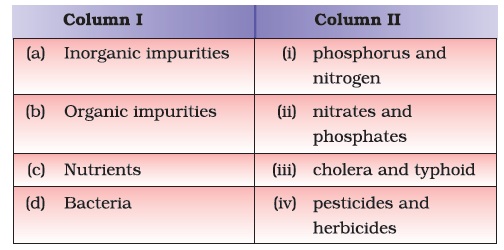
(b) cooking oil and fats down the drain? - Match the items of Column I with the items of Column II with reference to sewage.
- Given below is a jumbled sequence of the processes involved in a wastewater treatment plant. Arrange them in their correct sequence.
(a) Sludge is scraped out and skimmer removes the floating grease.
(b) Water is made to settle in a large tank with a slope in the middle.
(c) Large objects like plastic bags are removed by passing wastewater through bar screens.
(d) Sand, grit and pebbles are made to settle by decreasing the speed of incoming wastewater.
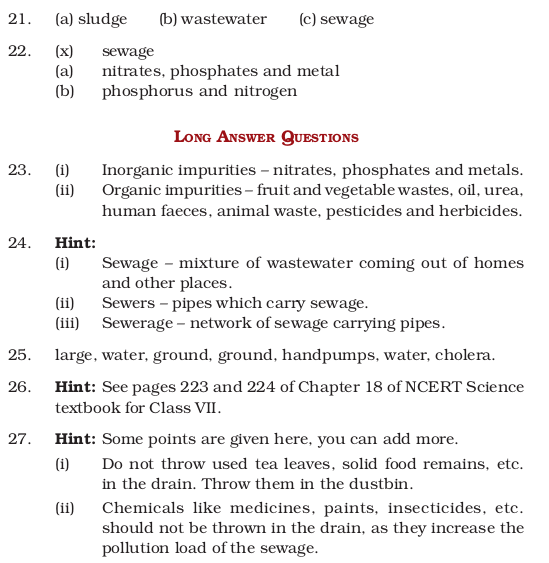
(e) Wastewater enters a grit and sand removal tank. - Three statements are provided here which define the terms – (a) sludge (b) sewage and (c) wastewater. Pick out the correct definition for each of these terms.
(a) The settled solids that are removed in wastewater treatment with a scraper.
(b) Water from kitchen used for washing dishes.
(c) Wastewater released from homes, industries, hospitals and other public buildings. - A mixture (x) in water contains suspended solids, organic impurities, inorganic impurities (a), nutrients (b), disease causing bacteria and other microbes. Give names for (x), (a) and (b)?
Long Answer Type Questions
- What are the different types of inorganic and organic impurities generally present in sewage?
- The terms sewage, sewers and sewerage are interlinked with each other. Can you explain, how?
- Fill in the blanks in the following statements using words given in the box.
air, handpumps, cholera, water, large, ground
A very _________ number of our people defecate in the open. It may cause _________ pollution and soil pollution. Both the surface water and _________ water get polluted. _________ water is the source for wells, tubewells and _________. Thus it becomes the most common route for _________ borne diseases like _________, dysentery, etc. - Describe various steps of cleaning wastewater in a wastewater treatment plant.
- Think and suggest some ways to minimise waste and pollutants at their source, taking your home as an example.
Answers

To get study material, exam alerts and news, join our Whatsapp Channel.