Candidates can download NCERT Exemplar Class 7 Science Unit 3 from this page. The exemplar has been provided by the National Council of Educational Research & Training (NCERT) and the candidates can check it from below for free of cost. It contains objective, very short answer type, short answer type, and long answer type questions. Along with it, the answer for each question has also been provided. From the NCERT Exemplar Class 7 Science Unit 3, candidates can understand the level and type of questions that are asked in the exam.
NCERT Exemplar Class 7 Science Unit 3 Nutrition in Plants
NCERT Class 7 Science Unit 3 is for Nutrition in Plants. The type of questions that will be asked from NCERT Class 7 Science Unit 3 are displayed in the below provided NCERT Exemplar Class 7 Science Unit 3. With the help of it, candidates can prepare well for the examination.
Also Check: NCERT Solutions Class 7 Science
Multiple Choice Questions
- The rearing of silkworms for obtaining silk is called
(a) cocoon
(b) silk
(c) sericulture
(d) silviculture - Which of the following is not a type of silk?
(a) Mulberry silk
(b) Tassar silk
(c) Mooga silk
(d) Moth silk - Paheli wanted to buy a gift made of animal fibre obtained without killing the animal. Which of the following would be the right gift for her to buy?
(a) Woollen shawl
(b) Silk scarf
(c) Animal fur cap
(d) Leather jacket - Silk fibre is obtained from
(a) fleece of sheep
(b) cotton ball
(c) cocoon
(d) shiny jute stalk - Wool fibre cannot be obtained from which of the following?
(a) Goat
(b) Llama
(c) Alpaca
(d) Moth - Selective breeding is a process of
(a) selecting the offsprings with desired properties.
(b) selecting the parents with desired properties.
(c) selecting an area for breeding.
(d) selecting fine hair for good quality wool. - The general process that takes place at a sheep shearing shed is
(a) removal of fleece.
(b) separating hair of different textures.
(c) washing of sheep fibre to remove grease.
(d) rolling of sheep fibre into yarn. - The term sericulture is used for
(a) culture of bacteria.
(b) rearing of silkworm.
(c) making silk fabric from silk yarn.
(d) production of sarees. - Reeling of silk is
(a) a process of making silk reels.
(b) spinning of silk fibres.
(c) weaving of silk cloth.
(d) the process of taking silk threads from cocoon. - Silkworms secrete fibre made of
(a) fat
(b) cellulose
(c) protein
(d) nylon
Very Short Answer Type Questions
- Fill in the blanks in the following statements.
(a) _________ and _________ fibres are obtained from animals.
(b) Silk fibres come from _________ of silk _________.
(c) Wool yielding animals bear _________ on their body.
(d) Hair trap a lot of _________, which is a poor _________ of heat. - State whether the following statements are True or False. If false, correct them.
(a) Silkworms are caterpillars of silk moth.
(b) In India, camels and goats are generally reared for obtaining wool.
(c) The rearing of silkworms for obtaining silk is called silviculture.
(d) In the process of obtaining wool from fleece, sorting is done after scouring.
(e) Yak hair are not used to make woollen fabric. - How do the hair of certain animals help in keeping their bodies warm?
Short Answer Type Questions
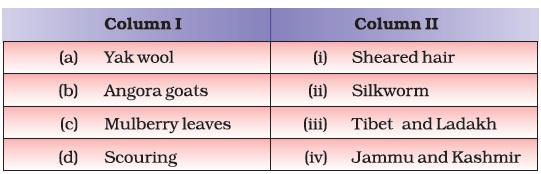
- Match the items of Column I with the items given in Column II.
- Various steps involved to obtain wool from fleece are given here.
(i) Picking out the burrs
(ii) Dyeing in various colours
(iii) Shearing
(iv) Scouring
(v) Sorting
Write the above steps in the correct sequence in which they are carried out. - Some words related with silk are jumbled up. Write them in their correct form.
(a) TURECULRISE
(b) WILSMORK
(c) BELMURRY
(d) RINGLEE - Figure 3.1 shows three rings of circles with letters in them. Some of these letters in each ring can form the name of one wool yielding animal. Find the names of these animals.

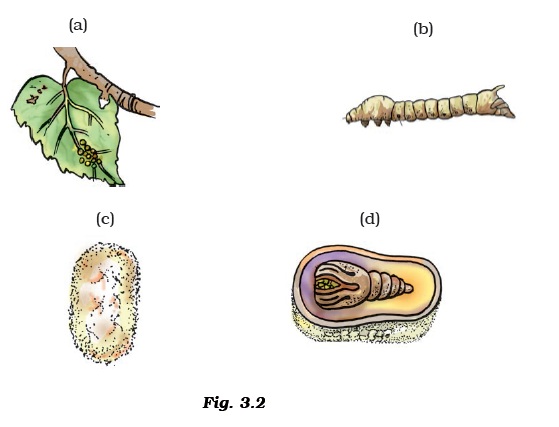
- Write a caption for each of the figures given as Figure 3.2 (a–d).
- Steps for the production of silk are given below in a jumbled order. Arrange them in their proper sequence.
(a) Eggs are warmed to a suitable temperature for the larvae to hatch from eggs.
(b) Fibers are taken out from the cocoon.
(c) After 25 to 30 days, the caterpillars stop eating and start spinning cocoons.
(d) The larvae/caterpillars or silkworms are kept in clean trays along with freshly chopped mulberry leaves.
(e) Female silk moths lay eggs.
(f) Cocoons are kept under the sun or boiled in water. - A wholesale woollen fibre dealer gets the woollen fibre of different textures sorted for various purposes. Match the items in Column I with the woollen fibre in Column II.

Long Answer Type Questions

- Paheli went to the market to buy sarees for her mother. She took out a thread from the edge of the two sarees shown by the shopkeeper and burnt them. One thread burnt with a smell of burning hair and the other burnt with the smell of burning paper. Which thread is from a pure cotton saree and which one from a pure silk saree? Give reason for your answer.
- Explain the phrase – “Unity is Strength” on the basis of the making of fabric from fibre.
- Write various steps for processing fibres into wool.
- Describe the life history of silk moth with the help of figures of various stages.
Answers


To get study material, exam alerts and news, join our Whatsapp Channel.