Trigonometry, a branch of mathematics that deals with the relationships between the angles and sides of triangles, is pivotal in various scientific and engineering applications. One of the essential tools for mastering trigonometry is the trigonometric table. Based on NCERT curriculum Trigonometry is introduced in class 10 with Chapter 8 Introduction to Trigonometry and Chapter 9 Some Applications of Trigonometry adds its applications in real life. It advances in class 11 with Chapter 3 Trigonometric Functions and class 12 with Chapter 2 Inverse Trigonometric Functions. This blog post aims to introduce the trigonometric table, explain its importance, and guide you on how to use it effectively.
What is a Trigonometric Table?
A trigonometric table lists the values of sine, cosine, tangent, and other trigonometric functions for specific angle increments. Historically, these trig values table were critical for navigation, astronomy, and surveying before the advent of digital calculators. Today, they serve as a valuable learning tool for students and a quick reference for professionals.
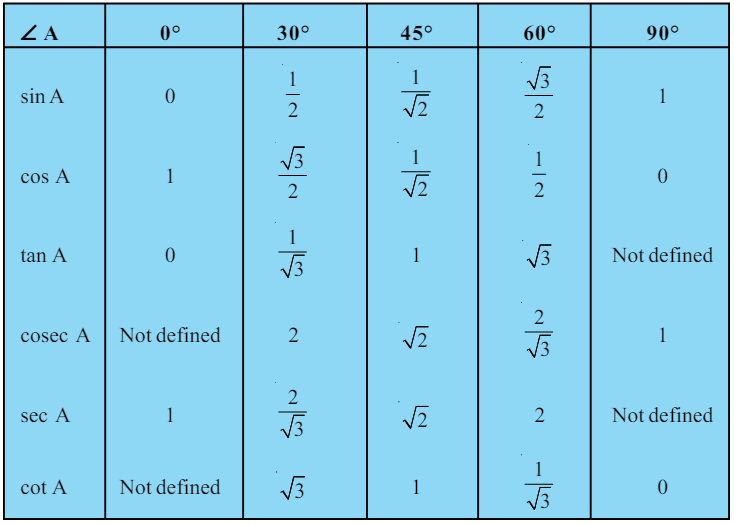
Trigonometric Table
From the table below you can observe that as angle A increases from 0° to 90°, sin A increases from 0 to 1 and cos A decreases from 1 to 0.
Relation between degree and radian
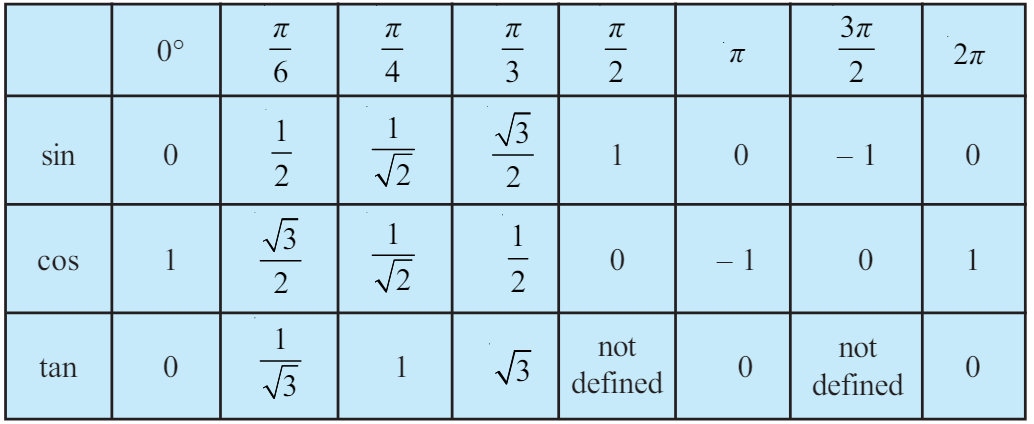
The relation between degree measures and radian measure of some common angles are given in the following table:

Earlier, we have discussed the values of trigonometric ratios for 0°, 30°, 45°, 60° and 90°. The values of trigonometric functions for these angles are same
as that of trigonometric ratios studied in earlier classes. Thus, we have the following table:
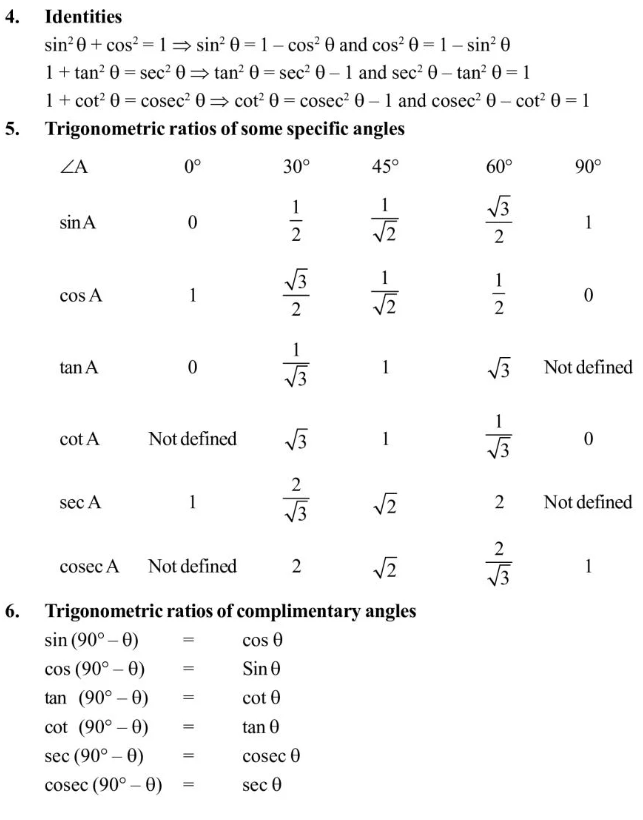
Key Points about Trigonometry Class 10
The Components of a Trigonometry Table
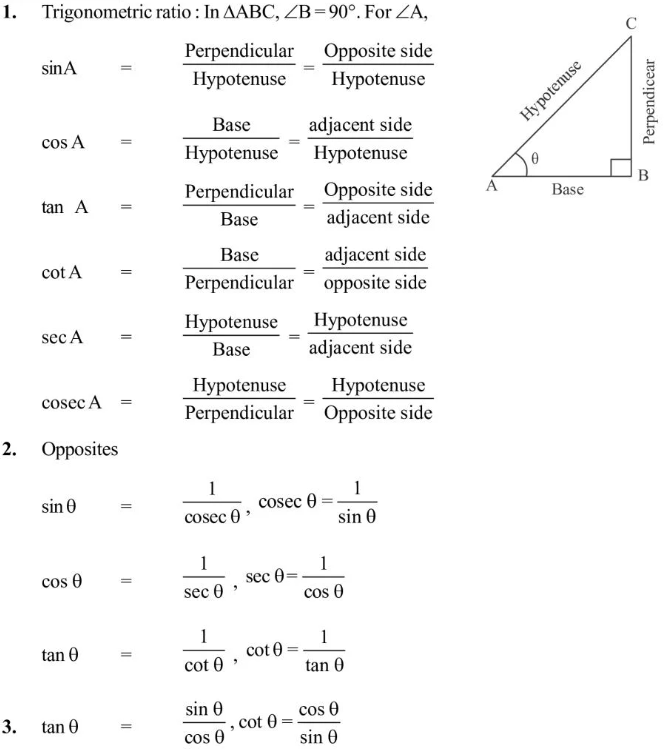
Trigonometry tables typically include the following columns:
- Angles: Listed in degrees and sometimes radians, this column shows the angle increments, commonly ranging from 0° to 360°.
- Sine (sin): Shows the sine value for each angle, which is the ratio of the length of the opposite side to the hypotenuse in a right triangle.
- Cosine (cos): Lists the cosine values, the ratio of the adjacent side to the hypotenuse.
- Tangent (tan): Displays the tangent values, which is the ratio of the opposite side to the adjacent side.
- Cotangent (cot), Secant (sec), and Cosecant (csc): Some tables also include these additional functions, which are the reciprocals of tangent, cosine, and sine, respectively.
Why is a Trigonometry Table Important?
- Educational Tool: For students, these tables are an excellent way to understand how trigonometric table formula behave as angles increase or decrease.
- Quick Reference: Professionals in fields like engineering, physics, and mathematics often use these tables for quick calculations and checks.
- Historical Significance: They offer insight into how early mathematicians and scientists solved complex problems without modern technology.
How to Use a Trigonometric Table
Using a Trigonometry table 0 -360 is straightforward:
- Identify the Desired Angle: Locate the angle you are interested in along the first column.
- Select the Function: Choose the trigonometric function (sin, cos, tan, etc.) relevant to your problem.
- Read the Value: Follow the row of your chosen angle across to the column of the desired function to find the trigonometric value.
For example, if you need to find the sine of 30°, you would look down the angle column until you find 30°, then move horizontally to the sine column to read the value, which is typically 0.5.
Tips for Effective Use
- Accuracy: Remember that tables may round values, so for precision calculations, a digital calculator or software is preferable.
- Interpolation: For angles not listed in the table, you can use interpolation techniques to estimate values.
- Practice: Regularly using the table with practice problems can improve your speed and familiarity with trigonometric values.
Conclusion
Whether you are a student tackling trigonometry for the first time or a professional needing a quick recap, a trigonometric table is a valuable tool. It bridges historical mathematical practices with modern needs, illustrating the timeless nature of mathematics. By familiarizing yourself with this tool, you can enhance your understanding and appreciation of trigonometry in everyday applications.
Hopefully, this blog post has provided you with a clear understanding and appreciation of the trigonometric table and its role in both educational and professional settings. Happy calculating!
To get study material, exam alerts and news, join our Whatsapp Channel.