aglasem
  • Home
  • Boards
    • Date Sheet
    • Admit Card
    • Result
    • Sample Paper
    • Question Paper
  • NCERT
    • NCERT Solutions
    • NCERT Books
    • NCERT Audio Books
    • NCERT Exempler
  • Study Material
    • Notes
    • Model Papers
    • Past Year Question Paper
    • Maps
    • Writing Skill Format
  • Solutions
    • NCERT Solutions
    • RD Sharma Solutions
    • HC Verma Solutions
    • CG Board Solutions
    • UP Board Solutions
  • Olympiads
    • NMMS
  • Admissions
  • Career Guide
    • Careers Opportunities
    • Courses & Career
    • Courses after 12th
No Result
View All Result
aglasem
  • Home
  • Boards
    • Date Sheet
    • Admit Card
    • Result
    • Sample Paper
    • Question Paper
  • NCERT
    • NCERT Solutions
    • NCERT Books
    • NCERT Audio Books
    • NCERT Exempler
  • Study Material
    • Notes
    • Model Papers
    • Past Year Question Paper
    • Maps
    • Writing Skill Format
  • Solutions
    • NCERT Solutions
    • RD Sharma Solutions
    • HC Verma Solutions
    • CG Board Solutions
    • UP Board Solutions
  • Olympiads
    • NMMS
  • Admissions
  • Career Guide
    • Careers Opportunities
    • Courses & Career
    • Courses after 12th
No Result
View All Result
aglasem
No Result
View All Result

Home » Resources » Study Material » Dispersion of White Light – Study Material

Dispersion of White Light – Study Material

by Anwesha Bose
November 10, 2024
in 12th Class, Study Material

You must have seen and appreciated the spectacular colours in a rainbow. How could the white light of the Sun give us various colours of the rainbow? Before we take up this question, we shall first go back to the refraction of light through a prism. The inclined refracting surfaces of a glass prism show exciting phenomenon. Let us find it out through an activity.

Activity 11.2

  • Take a thick sheet of cardboard and make a small hole or narrow slit in its middle.
  • Allow sunlight to fall on the narrow slit. This gives a narrow beam of white light.
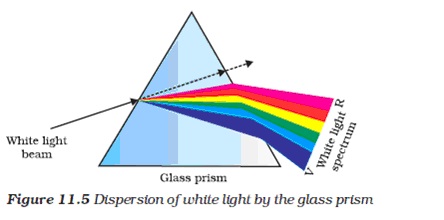
  • Now, take a glass prism and allow the light from the slit to fall on one of its faces as shown in Fig. 11.5.
  • Turn the prism slowly until the light that comes out of it appears on a nearby screen
  • What do you observe? You will find a beautiful band of colours. Why does this happen?
Dispersion of White Light

The prism has probably split the incident white light into a band of colours. Note the colours that appear at the two ends of the colour band. What is the sequence of colours that you see on the screen? The various colours seen are Violet, Indigo, Blue, Green, Yellow, Orange and Red, as shown in Fig. 11.5. The acronym VIBGYOR will help you to remember the sequence of colours. The band of the coloured components of a light beam is called its spectrum. You might not be able to see all the colours separately. Yet something makes each colour distinct from the other. The splitting of light into its component colours is called dispersion.

You have seen that white light is dispersed into its seven-colour components by a prism. Why do we get these colours? Different colours of light bend through different angles with respect to the incident ray, as they pass through a prism. The red light bends the least while the violet the most. Thus the rays of each colour emerge along different paths and thus become distinct. It is the band of distinct colours that we see in a spectrum.
Dispersion of White Light

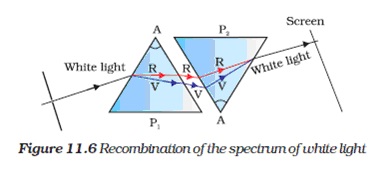
Isaac Newton was the first to use a glass prism to obtain the spectrum of sunlight. He tried to split the colours of the spectrum of white light further by using another similar prism. However, he could not get any more colours. He then placed a second identical prism in an inverted position with respect to the first prism, as shown in Fig. 11.6. This allowed all the colours of the spectrum to pass through the second prism. He found a beam of white light emerging from the other side of the second prism. This observation gave Newton the idea that the sunlight is made up of seven colours.

Any light that gives a spectrum similar to that of sunlight is often referred to as white light.
Dispersion of White Light

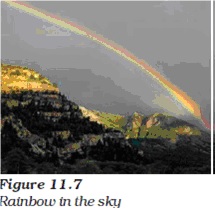
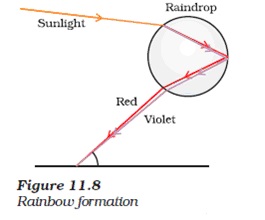
A rainbow is a natural spectrum appearing in the sky after a rain shower (Fig. 11.7). It is caused by dispersion of sunlight by tiny water droplets, present in the atmosphere. A rainbow is always formed in a direction opposite to that of the Sun. The water droplets act like small prisms. They refract and disperse the incident sunlight, then reflect it internally, and finally refract it again when it comes out of the raindrop (Fig. 11.8). Due to the dispersion of light and internal reflection, different colours reach the observer’s eye.
Dispersion of White Light

You can also see a rainbow on a sunny day when you look at the sky through a waterfall or through a water fountain, with the Sun behind you.

Open Educational Resources

To get study material, exam alerts and news, join our Whatsapp Channel.
Tags: Class 12thOpen Educational Resources
Previous Post

Food Crops in India – Study Material

Next Post

Twinkling of Stars – Study Material

Related Posts

12th Class

Manipur Board HS Sample Question Paper 2026 (PDF) – Download COHSEM Class 12 Model Papers

12th Class

TBSE 12th Model Paper 2026 (PDF) – Download Tripura Board Class 12 Sample Question Papers

12th Class

TBSE Class 12 Model Question Paper for Political Science 2026 (PDF) – Download Here

12th Class

TBSE Class 12 Model Question Paper for Psychology 2026 (PDF) – Download Here

Leave a ReplyCancel reply

Class Wise Study Material

  • Class 1
  • Class 2
  • Class 3
  • Class 4
  • Class 5
  • Class 6
  • Class 7
  • Class 8
  • Class 9
  • Class 10
  • Class 11
  • Class 12

AglaSem Study Material

  • AglaSem Notes
  • AglaSem Sample Papers
  • PT, HY, Annual PYQP
  • Important Questions
  • Competency Based Questions
  • Maps

Board Exams

  • Solved Sample Papers
  • Maps
  • Revision Notes
  • CBSE
  • State Board

Study Material

  • Class Notes
  • NCERT Solutions
  • NCERT Books
  • HC Verma Solutions
  • Courses After Class 12th

Exam Zone

  • JEE Main 2025
  • NEET 2025
  • CLAT 2025
  • Fashion & Design
  • Latest
  • Disclaimer
  • Terms of Use
  • Privacy Policy
  • Contact

© 2019 aglasem.com

  • Home
  • Boards
    • Date Sheet
    • Admit Card
    • Result
    • Sample Paper
    • Question Paper
  • NCERT
    • NCERT Solutions
    • NCERT Books
    • NCERT Audio Books
    • NCERT Exempler
  • Study Material
    • Notes
    • Model Papers
    • Past Year Question Paper
    • Maps
    • Writing Skill Format
  • Solutions
    • NCERT Solutions
    • RD Sharma Solutions
    • HC Verma Solutions
    • CG Board Solutions
    • UP Board Solutions
  • Olympiads
    • NMMS
  • Admissions
  • Career Guide
    • Careers Opportunities
    • Courses & Career
    • Courses after 12th

Discover more from AglaSem Schools

Subscribe now to keep reading and get access to the full archive.

Continue reading