aglasem
  • Home
  • Boards
    • Date Sheet
    • Admit Card
    • Result
    • Sample Paper
    • Question Paper
  • NCERT
    • NCERT Solutions
    • NCERT Books
    • NCERT Audio Books
    • NCERT Exempler
  • Study Material
    • Notes
    • Model Papers
    • Past Year Question Paper
    • Maps
    • Writing Skill Format
  • Solutions
    • NCERT Solutions
    • RD Sharma Solutions
    • HC Verma Solutions
    • CG Board Solutions
    • UP Board Solutions
  • Olympiads
    • NMMS
  • Admissions
  • Career Guide
    • Careers Opportunities
    • Courses & Career
    • Courses after 12th
No Result
View All Result
aglasem
  • Home
  • Boards
    • Date Sheet
    • Admit Card
    • Result
    • Sample Paper
    • Question Paper
  • NCERT
    • NCERT Solutions
    • NCERT Books
    • NCERT Audio Books
    • NCERT Exempler
  • Study Material
    • Notes
    • Model Papers
    • Past Year Question Paper
    • Maps
    • Writing Skill Format
  • Solutions
    • NCERT Solutions
    • RD Sharma Solutions
    • HC Verma Solutions
    • CG Board Solutions
    • UP Board Solutions
  • Olympiads
    • NMMS
  • Admissions
  • Career Guide
    • Careers Opportunities
    • Courses & Career
    • Courses after 12th
No Result
View All Result
aglasem
No Result
View All Result

Home » 7th Class » Class 7 Science Notes for Acids, Bases and Salt (PDF) – Study Material

Class 7 Science Notes for Acids, Bases and Salt (PDF) – Study Material

by Neepur Garg
September 17, 2024
in 7th Class

Class 7 Science Acids, Bases and Salt – Get here the Notes, Question & Practice Paper of Class 7 Science for topic Acids, Bases and Salt Notes. Acids, Bases and Salt Notes for Class 7 Science are here. You can download the Acids, Bases and Salt Notes PDF to study all the topics in this chapter. Moreover the Class 7 Science notes include chapter summary, definitions, examples, and key pointers for Acids, Bases and Salt. Thus if you are studying class Science (विज्ञान), then the Acids, Bases and Salt notes will help you easily understand the topic and ace it.

Class 7 Science Notes for Acids, Bases and Salt

Acids, Bases and Salt is a critical part in the study of Science. In India, it is taught in class. Therefore the Class 7 Notes for Science topic Acids, Bases and Salt have been compiled by teachers and field experts. They explain the complete chapter of Acids, Bases and Salt in one-shot.


Acids, Bases and Salt Notes Download Link – Click Here to Download PDF


Acids, Bases and Salt Notes for Class 7 Science

Acids, Bases and Salt Class 7 notes is as follows. You can view the document here and also download it use it anytime for future reference whenever you want to brush up your concepts of Science.

Chapter 4 – Acids, Bases and Salt

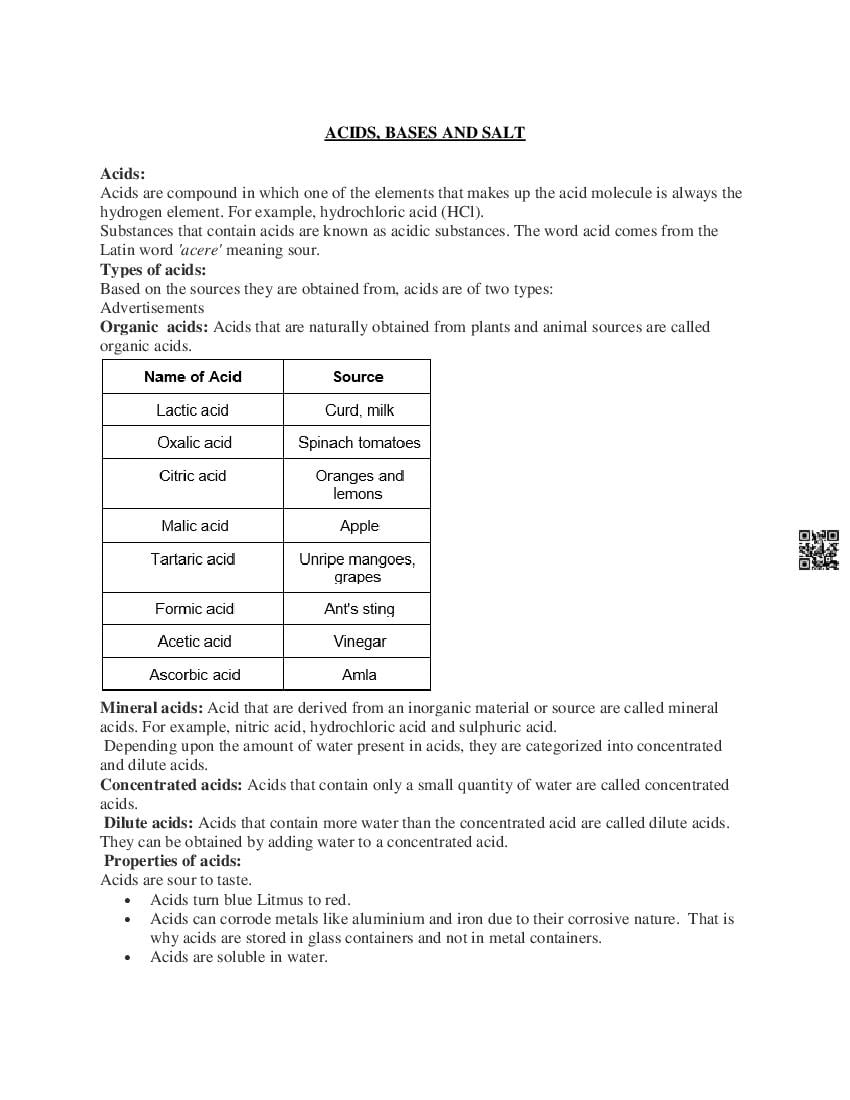
Acids:

Acids are compound in which one of the elements that makes up the acid molecule is always the hydrogen element. For example, hydrochloric acid (HCl)

Substances that contain acids are known as acidic substances. The word acid comes from the Latin word ‘acere’ meaning sour.

Types of acids:

Based on the sources they are obtained from, acids are of two types:

Advertisements

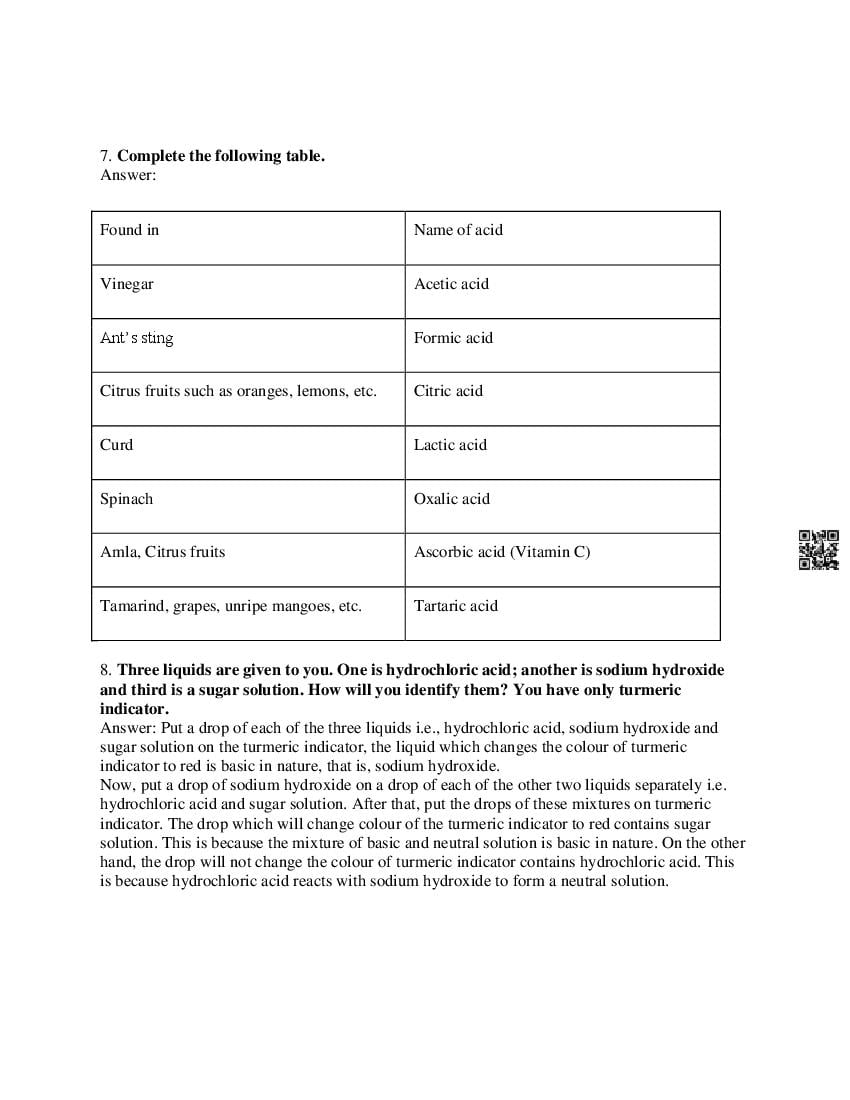
Organic acids: Acids that are naturally obtained from plants and animal sources are called organic acids.

Mineral acids: Acid that are derived from an inorganic material or source are called mineral acids. For example, nitric acid, hydrochloric acid and sulphuric acid. Depending upon the amount of water present in acids, they are categorized into concentrated and dilute acids.

Concentrated acids: Acids that contain only a small quantity of water are called concentrated acids.

Dilute acids: Acids that contain more water than the concentrated acid are called dilute acids.

They can be obtained by adding water to a concentrated acid.

Properties of acids:

Acids are sour to taste.

  • Acids turn blue Litmus to red.
  • Acids can corrode metals like aluminium and iron due to their corrosive nature. That is why acids are stored in glass containers and not in metal containers.
  • Acids are soluble in water.
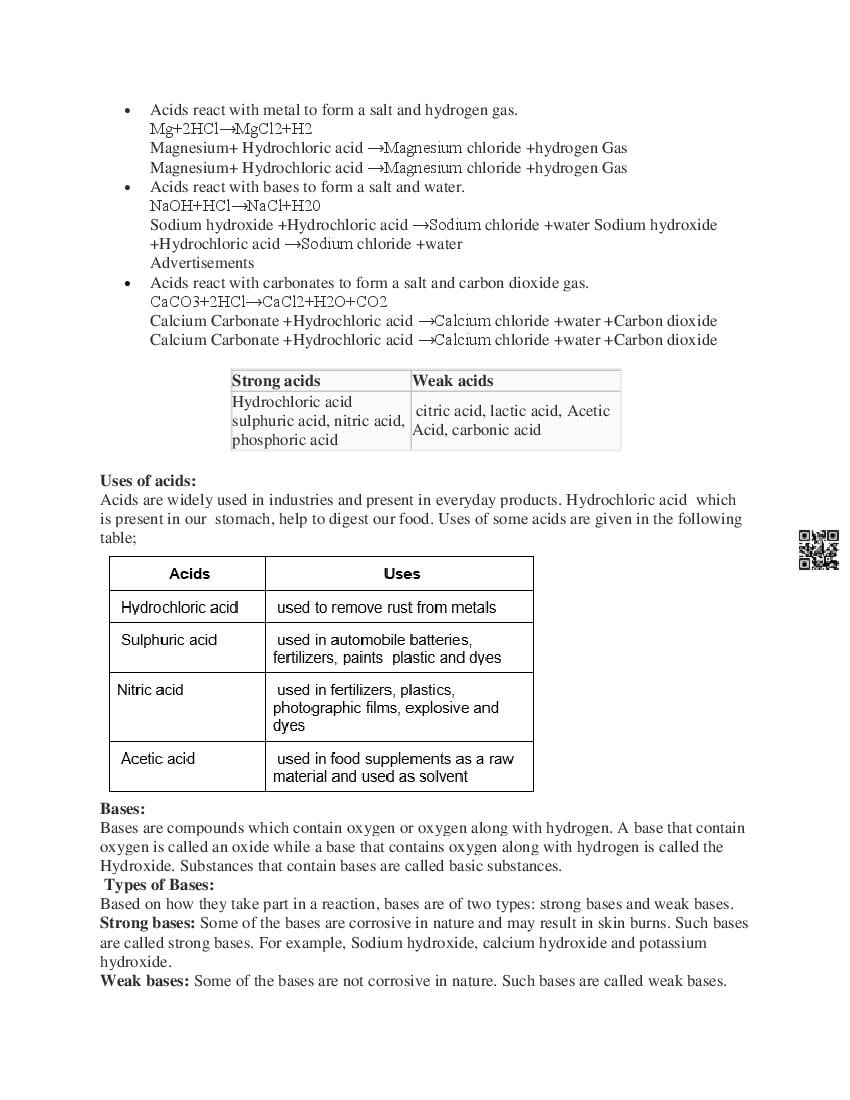
  • Acids react with metal to form a salt and hydrogen gas.
    Mg+2HCl→MgCl2+H2
    Magnesium+ Hydrochloric acid →Magnesium chloride +hydrogen Gas
    Magnesium+ Hydrochloric acid →Magnesium chloride +hydrogen Gas Acids react with bases to form a salt and water.
    NaOH+HCl→NaCl+H20
    Sodium hydroxide +Hydrochloric acid →Sodium chloride +water Sodium hydroxide+Hydrochloric acid →Sodium chloride +water
    Advertisements
  • Acids react with carbonates to form a salt and carbon dioxide gas.
    CaCO3+2HCl→CaCl2+H2O+CO2
    Calcium Carbonate +Hydrochloric acid →Calcium chloride +water +Carbon dioxide
    Calcium Carbonate +Hydrochloric acid →Calcium chloride +water +Carbon dioxide

Uses of acids:

Acids are widely used in industries and present in everyday products. Hydrochloric acid which is present in our stomach, help to digest our food. Uses of some acids are given in the following table;

Bases:

Bases are compounds which contain oxygen or oxygen along with hydrogen. A base that contain oxygen is called an oxide while a base that contains oxygen along with hydrogen is called the Hydroxide. Substances that contain bases are called basic substances.

Types of Bases:

Based on how they take part in a reaction, bases are of two types: strong bases and weak bases. Strong bases: Some of the bases are corrosive in nature and may result in skin burns. Such bases are called strong bases. For example, Sodium hydroxide, calcium hydroxide and potassium hydroxide.

Weak bases: Some of the bases are not corrosive in nature. Such bases are called weak bases.

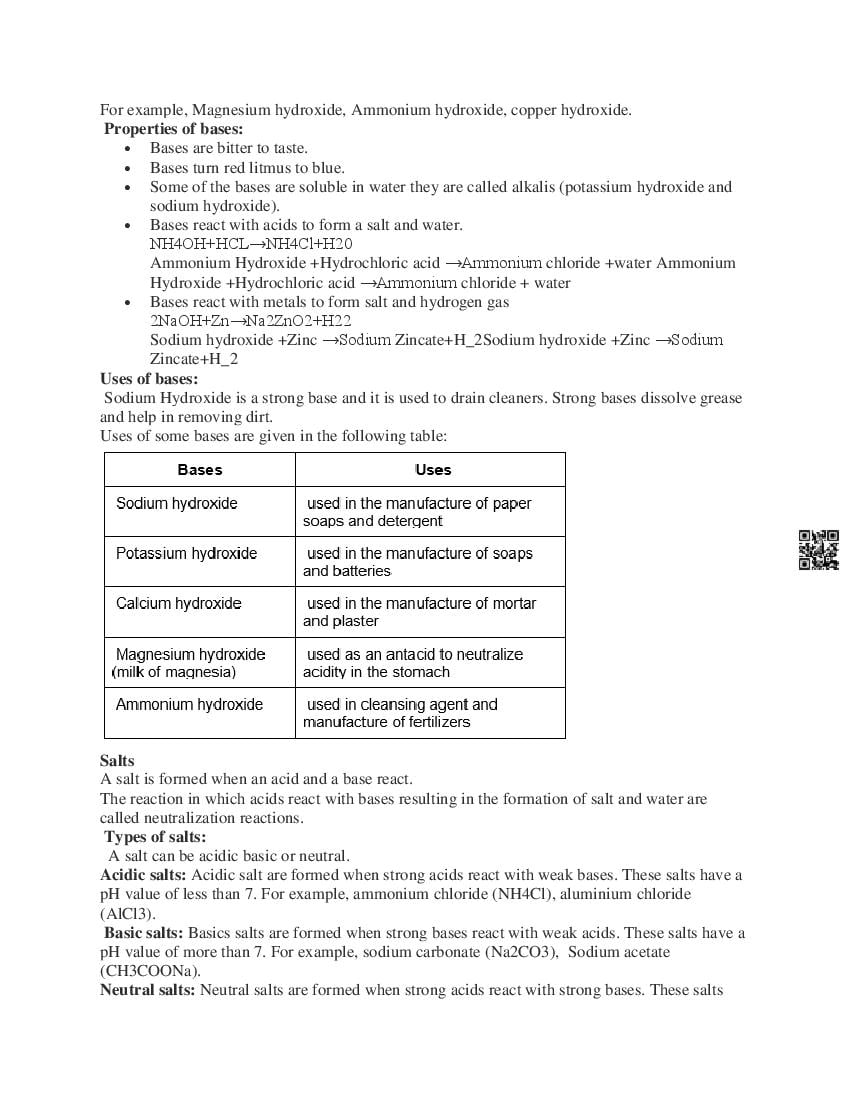
For example, Magnesium hydroxide, Ammonium hydroxide, copper hydroxide.

Properties of bases:

  • Bases are bitter to taste.
  • Bases turn red litmus to blue.
  • Some of the bases are soluble in water they are called alkalis (potassium hydroxide and sodium hydroxide).
  • Bases react with acids to form a salt and water.
    NH4OH+HCL→NH4Cl+H20
    Ammonium Hydroxide +Hydrochloric acid →Ammonium chloride +water Ammonium
    Hydroxide +Hydrochloric acid →Ammonium chloride + water
  • Bases react with metals to form salt and hydrogen gas
    2NaOH+Zn→Na2ZnO2+H22
    Sodium hydroxide +Zinc →Sodium Zincate+H_2Sodium hydroxide +Zinc →Sodium Zincate+H_2

Uses of bases:

Sodium Hydroxide is a strong base and it is used to drain cleaners. Strong bases dissolve grease and help in removing dirt.

Uses of some bases are given in the following table:

Salts
A salt is formed when an acid and a base react.

The reaction in which acids react with bases resulting in the formation of salt and water are called neutralization reactions.

Types of salts:

A salt can be acidic basic or neutral.

Acidic salts: Acidic salt are formed when strong acids react with weak bases. These salts have a pH value of less than 7. For example, ammonium chloride (NH4Cl), aluminium chloride (AlCl3).

Basic salts: Basics salts are formed when strong bases react with weak acids. These salts have a pH value of more than 7. For example, sodium carbonate (Na2CO3), Sodium acetate (CH3COONa).

Neutral salts: Neutral salts are formed when strong acids react with strong bases. These salts have a pH value of 7. For example, sodium chloride (NaCl), Potassium Nitrate (KNO3).

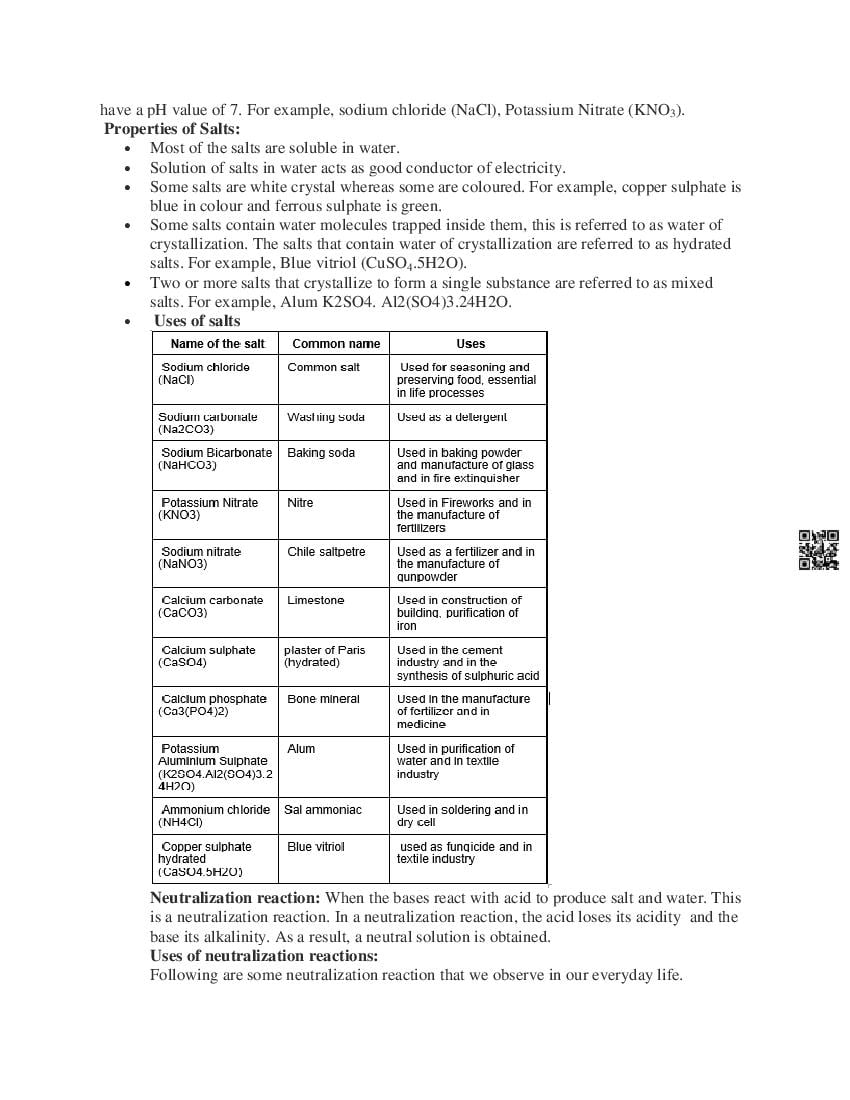
Properties of Salts:

  • Most of the salts are soluble in water.
  • Solution of salts in water acts as good conductor of electricity.
  • Some salts are white crystal whereas some are coloured. For example, copper sulphate is blue in colour and ferrous sulphate is green.
  • Some salts contain water molecules trapped inside them, this is referred to as water of crystallization. The salts that contain water of crystallization are referred to as hydrated salts. For example, Blue vitriol (CuSO4.5H2O).
  • Two or more salts that crystallize to form a single substance are referred to as mixed salts. For example, Alum K2SO4. Al2(SO4)3.24H2O.
  • Uses of salts

Neutralization reaction: When the bases react with acid to produce salt and water. This is a neutralization reaction. In a neutralization reaction, the acid loses its acidity and the base its alkalinity. As a result, a neutral solution is obtained.

Uses of neutralization reactions:

Following are some neutralization reaction that we observe in our everyday life.

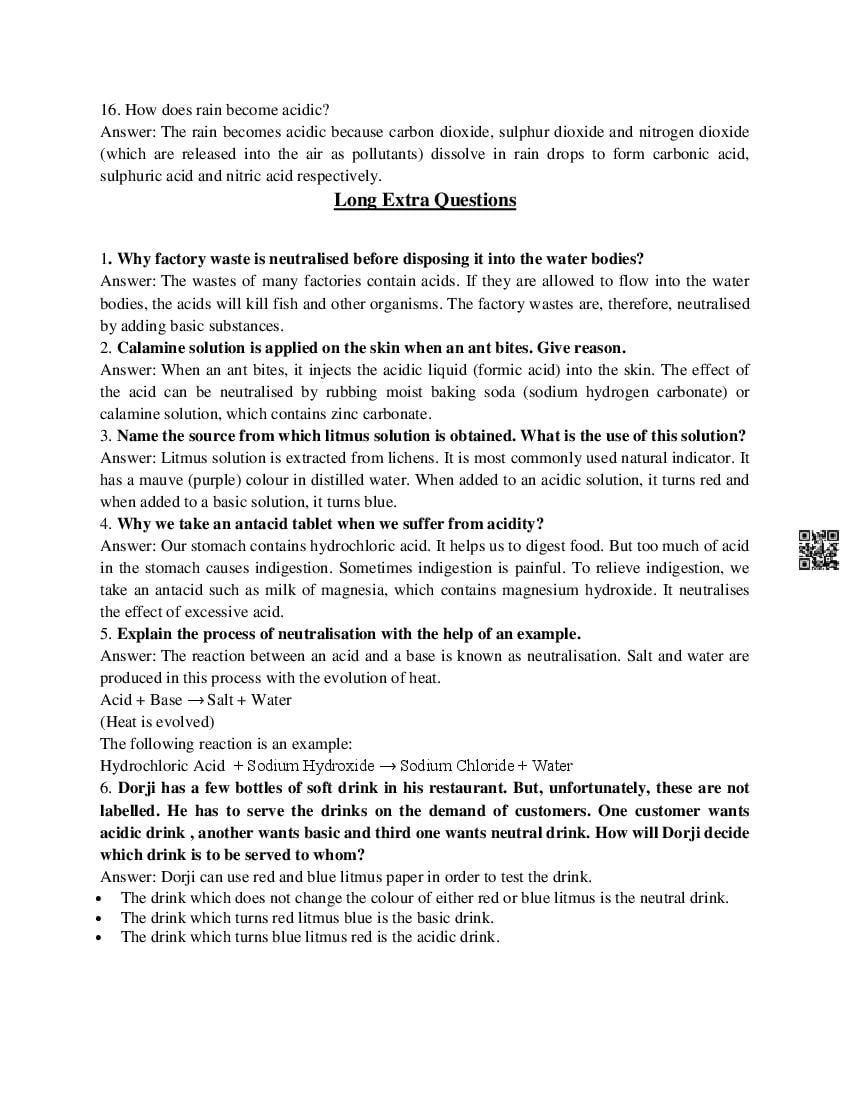
In the treatment of ant sting: Some people are highly allergic to ant string as it releases formic acid. It is neutralized by rubbing moist baking soda (sodium bicarbonate) or Calamine solution, which contains zinc carbonate on the affected area.

In the treatment of indigestion: Hydrochloric acid secreted in the stomach helps in the digestion of food. However, its excess secretion could lead to acidity and indigestion. Milk of magnesia is used to neutralize the acid.

In the treatment of soil: When the soil is too acidic, it is treated with slaked lime or quicklime, which is a base. If the soil is too basic, it is treated with organic matter such as fertilizers that are obtained from vegetables or fruits as they are acidic in nature.

In the treatment of sewage waste: several Industries produce acids as waste. If they are allowed to flow into water bodies, these wastages would affect aquatic organisms. Slaked lime (Calcium Hydroxide) is often used to neutralize this acidic waste let out from the factories.

Protecting teeth: One of the best common applications of neutralization of acids is the toothpaste. Toothpastes contain an alkali that neutralizes the weak acid produced by bacteria and prevent tooth damage.

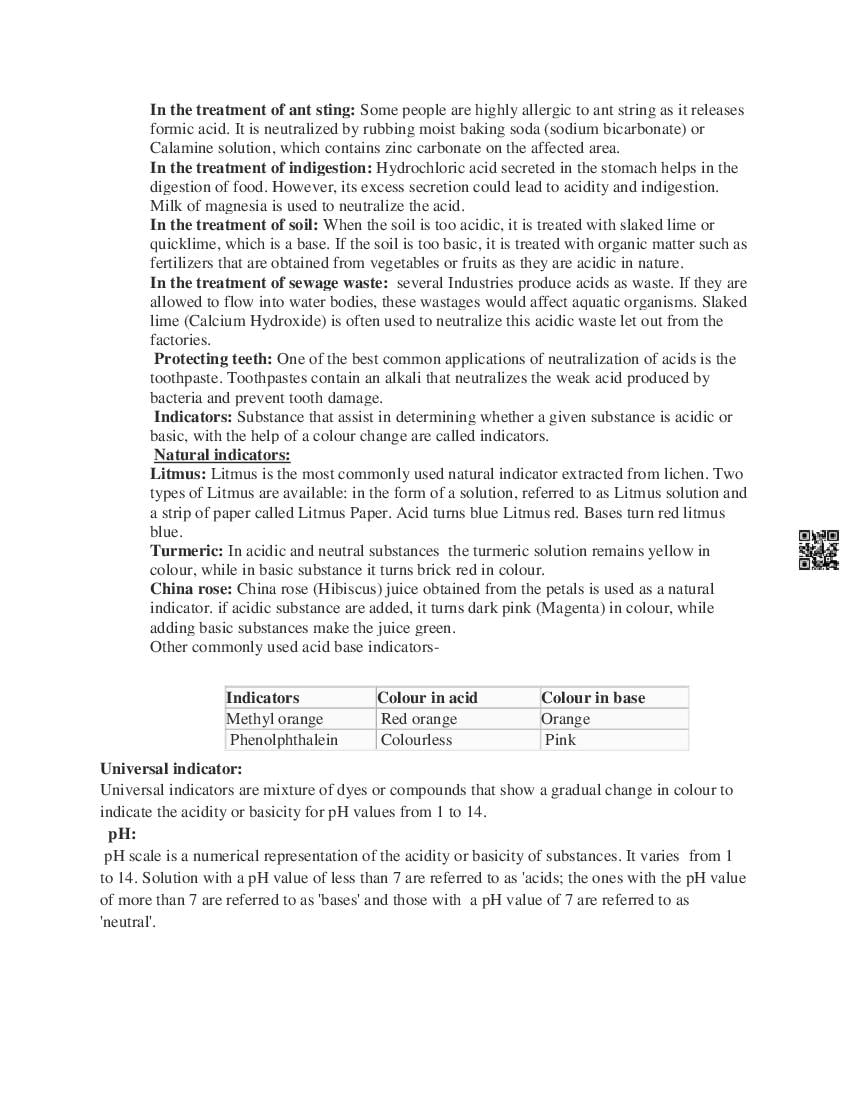
Indicators: Substance that assist in determining whether a given substance is acidic or basic, with the help of a colour change are called indicators.

Natural indicators:

Litmus: Litmus is the most commonly used natural indicator extracted from lichen. Two types of Litmus are available: in the form of a solution, referred to as Litmus solution and a strip of paper called Litmus Paper. Acid turns blue Litmus red. Bases turn red litmus blue.

Turmeric: In acidic and neutral substances the turmeric solution remains yellow in colour, while in basic substance it turns brick red in colour.

China rose: China rose (Hibiscus) juice obtained from the petals is used as a natural indicator. if acidic substance are added, it turns dark pink (Magenta) in colour, while adding basic substances make the juice green.

Other commonly used acid base indicators

Universal indicator:

Universal indicators are mixture of dyes or compounds that show a gradual change in colour to indicate the acidity or basicity for pH values from 1 to 14.

pH:

pH scale is a numerical representation of the acidity or basicity of substances. It varies from 1 to 14. Solution with a pH value of less than 7 are referred to as ‘acids; the ones with the pH value of more than 7 are referred to as ‘bases’ and those with a pH value of 7 are referred to as ‘neutral’.

Candidates who are ambitious to qualify the Class 7 with good score can check this article for Notes, Study Material, Practice Paper. Above we provided the link to access the Notes, Important Question and Practice Paper of Class 7 Science for topic Acids, Bases and Salt.

All Topics Class 7 Science Notes

Chapter wise notes for Science (विज्ञान) are given below.

  • Nutrition in Plants
  • Nutrition in Animals
  • Heat
  • Acids, Bases and Salt
  • Physical and Chemical Changes
  • Respiration in Organism
  • Transportation in Animals and Plants
  • Reproduction in Plants
  • Motion and Time
  • Electric Current and Its Effects
  • Light
  • Forest our Life Line
  • Wastewater Story

Class 7 Notes for All Subjects

  • Class 7 Maths Notes
  • Class 7 Science Notes

NCERT Solutions for Class 7 Science Acids, Bases and Salt

The Acids, Bases and Salt notes here help you solve the questions and answers. Also, you can complete the Class 7 Acids, Bases and Salt worksheet using the same. In addition you will also tackle CBSE Class 7 Science Important Questions with these Class 7 notes.

However if you still need help, then you can use the NCERT Solutions for Class 7 Science Acids, Bases and Salt to get all the answers. Acids, Bases and Salt solutions contain questions, answers, and steps to solve all questions.

Notes for All Classes

  • Class 6 Notes
  • Class 7 Notes
  • Class 8 Notes
  • Class 9 Notes
  • Class 10 Notes
  • Class 11 Notes
  • Class 12 Notes

Acids, Bases and Salt Notes for Class 7 Science – An Overview

Name of TopicAcids, Bases and Salt
Class6
SubjectScience
All Class 7 Science NotesClass 7 Science Notes
All Class 7 NotesClass 7 Notes

Class 7 Acids, Bases and Salt Notes for All Boards

You can use the Class 7 Science notes of Acids, Bases and Salt for all boards.

The education boards in India for which Acids, Bases and Salt notes are relevant are – CBSE, CISCE, AHSEC, CHSE Odisha, CGBSE, HBSE, HPBOSE, PUE Karnataka, MSBSHSE, PSEB, RBSE, TBSE, UPMSP, UBSE, BIEAP, BSEB, GBSHSE, GSEB, JAC, JKBOSE, KBPE, MBOSE, MBSE, MPBSE, NBSE, DGE TN, TSBIE, COHSEM, WBCHSE.

Therefore you can refer to these notes as CBSE, CISCE, AHSEC, CHSE Odisha, CGBSE, HBSE, HPBOSE, PUE Karnataka, MSBSHSE, PSEB, RBSE, TBSE, UPMSP, UBSE, BIEAP, BSEB, GBSHSE, GSEB, JAC, JKBOSE, KBPE, MBOSE, MBSE, MPBSE, NBSE, DGE TN, TSBIE, COHSEM, WBCHSE notes for class Class 7 / Class / Science for the topic Acids, Bases and Salt.

Class 7 Science Notes
Class 7 Notes
Notes

To get study material, exam alerts and news, join our Whatsapp Channel.

Tags: Class 7 NotesClass 7thClass 7th NotesNotesScience Notes
Previous Post

Class 7 Science Notes for Heat (PDF) – Study Material

Next Post

Class 7 Science Notes for Physical and Chemical Changes (PDF) – Study Material

Related Posts

Jharkhand Board
7th Class

JAC Class 7th Model Question Paper 2026 (PDF) – Download Jharkhand Board Class 7 Sample Papers

Jammu Kashmir Board
7th Class

JKBOSE Class 7th Model Paper 2026 (PDF) – Download JK Board Class 7 Sample Question Papers

Jammu Kashmir Board
7th Class

JKBOSE Class 7th Model Question Paper 2026 Maths (PDF) – Download JK Board Class 7 Maths Sample Paper

Jammu Kashmir Board
7th Class

JKBOSE Class 7th Model Question Paper 2026 Punjabi (PDF) – Download JK Board Class 7 Punjabi Sample Paper

Leave a ReplyCancel reply

Class Wise Study Material

  • Class 1
  • Class 2
  • Class 3
  • Class 4
  • Class 5
  • Class 6
  • Class 7
  • Class 8
  • Class 9
  • Class 10
  • Class 11
  • Class 12

AglaSem Study Material

  • AglaSem Notes
  • AglaSem Sample Papers
  • PT, HY, Annual PYQP
  • Important Questions
  • Competency Based Questions
  • Maps

Board Exams

  • Solved Sample Papers
  • Maps
  • Revision Notes
  • CBSE
  • State Board

Study Material

  • Class Notes
  • NCERT Solutions
  • NCERT Books
  • HC Verma Solutions
  • Courses After Class 12th

Exam Zone

  • JEE Main 2025
  • NEET 2025
  • CLAT 2025
  • Fashion & Design
  • Latest
  • Disclaimer
  • Terms of Use
  • Privacy Policy
  • Contact

© 2019 aglasem.com

  • Home
  • Boards
    • Date Sheet
    • Admit Card
    • Result
    • Sample Paper
    • Question Paper
  • NCERT
    • NCERT Solutions
    • NCERT Books
    • NCERT Audio Books
    • NCERT Exempler
  • Study Material
    • Notes
    • Model Papers
    • Past Year Question Paper
    • Maps
    • Writing Skill Format
  • Solutions
    • NCERT Solutions
    • RD Sharma Solutions
    • HC Verma Solutions
    • CG Board Solutions
    • UP Board Solutions
  • Olympiads
    • NMMS
  • Admissions
  • Career Guide
    • Careers Opportunities
    • Courses & Career
    • Courses after 12th

Discover more from AglaSem Schools

Subscribe now to keep reading and get access to the full archive.

Continue reading