aglasem
  • Home
  • Boards
    • Date Sheet
    • Admit Card
    • Result
    • Sample Paper
    • Question Paper
  • NCERT
    • NCERT Solutions
    • NCERT Books
    • NCERT Audio Books
    • NCERT Exempler
  • Study Material
    • Notes
    • Model Papers
    • Past Year Question Paper
    • Maps
    • Writing Skill Format
  • Solutions
    • NCERT Solutions
    • RD Sharma Solutions
    • HC Verma Solutions
    • CG Board Solutions
    • UP Board Solutions
  • Olympiads
    • NMMS
  • Admissions
  • Career Guide
    • Careers Opportunities
    • Courses & Career
    • Courses after 12th
No Result
View All Result
aglasem
  • Home
  • Boards
    • Date Sheet
    • Admit Card
    • Result
    • Sample Paper
    • Question Paper
  • NCERT
    • NCERT Solutions
    • NCERT Books
    • NCERT Audio Books
    • NCERT Exempler
  • Study Material
    • Notes
    • Model Papers
    • Past Year Question Paper
    • Maps
    • Writing Skill Format
  • Solutions
    • NCERT Solutions
    • RD Sharma Solutions
    • HC Verma Solutions
    • CG Board Solutions
    • UP Board Solutions
  • Olympiads
    • NMMS
  • Admissions
  • Career Guide
    • Careers Opportunities
    • Courses & Career
    • Courses after 12th
No Result
View All Result
aglasem
No Result
View All Result

Home » 7th Class » Class 7 Science Notes for Heat (PDF) – Study Material

Class 7 Science Notes for Heat (PDF) – Study Material

by Neepur Garg
September 17, 2024
in 7th Class

Class 7 Science Heat – Get here the Notes, Question & Practice Paper of Class 7 Science for topic Heat Notes. Heat Notes for Class 7 Science are here. You can download the Heat Notes PDF to study all the topics in this chapter. Moreover the Class 7 Science notes include chapter summary, definitions, examples, and key pointers for Heat. Thus if you are studying class Science (विज्ञान), then the Heat notes will help you easily understand the topic and ace it.

Class 7 Science Notes for Heat

Heat is a critical part in the study of Science. In India, it is taught in class. Therefore the Class 7 Notes for Science topic Heat have been compiled by teachers and field experts. They explain the complete chapter of Heat in one-shot.


Heat Notes Download Link – Click Here to Download PDF


Heat Notes for Class 7 Science

Heat Class 7 notes is as follows. You can view the document here and also download it use it anytime for future reference whenever you want to brush up your concepts of Science.

Chapter 3 – Heat

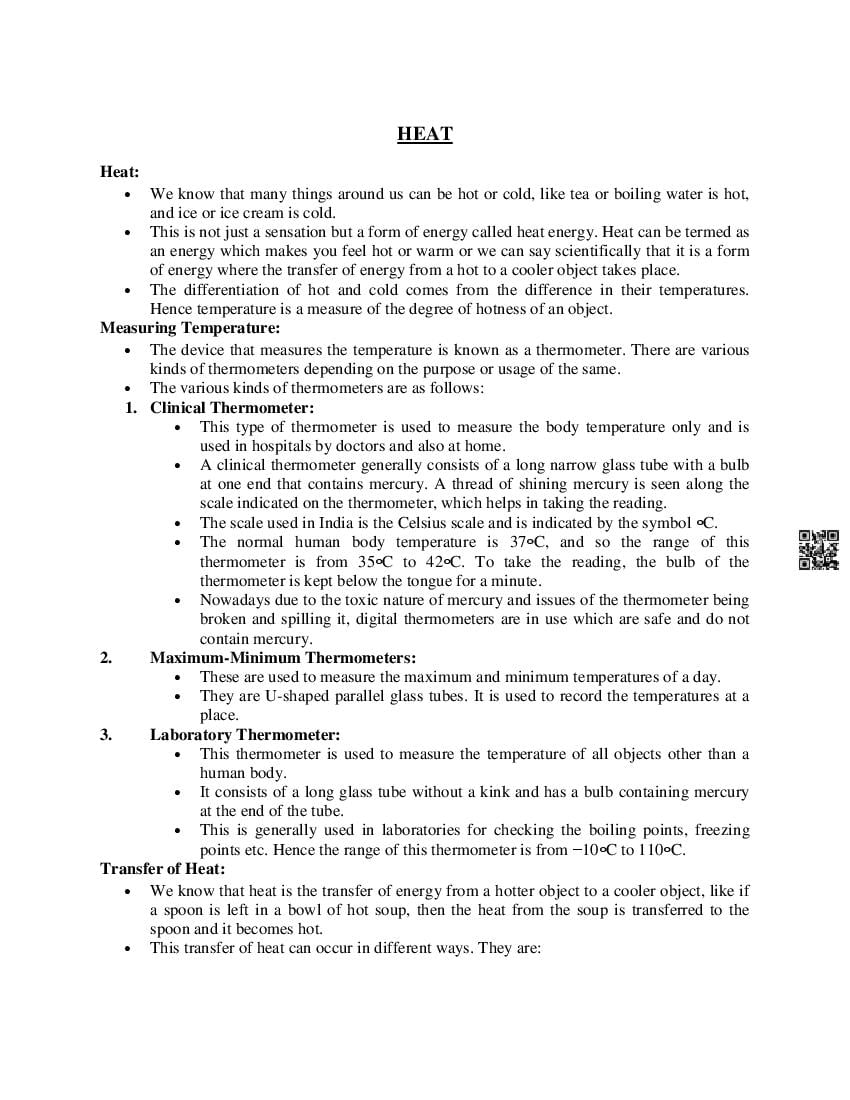
Heat:

  • We know that many things around us can be hot or cold, like tea or boiling water is hot, and ice or ice cream is cold.
  • This is not just a sensation but a form of energy called heat energy. Heat can be termed as an energy which makes you feel hot or warm or we can say scientifically that it is a form of energy where the transfer of energy from a hot to a cooler object takes place.
  • The differentiation of hot and cold comes from the difference in their temperatures. Hence temperature is a measure of the degree of hotness of an object.

Measuring Temperature:

  • The device that measures the temperature is known as a thermometer. There are various kinds of thermometers depending on the purpose or usage of the same.
  • The various kinds of thermometers are as follows:

1. Clinical Thermometer:

  • This type of thermometer is used to measure the body temperature only and is used in hospitals by doctors and also at home.
  • A clinical thermometer generally consists of a long narrow glass tube with a bulb at one end that contains mercury. A thread of shining mercury is seen along the scale indicated on the thermometer, which helps in taking the reading.
  • The scale used in India is the Celsius scale and is indicated by the symbol ∘C.
  • The normal human body temperature is 37∘C, and so the range of this thermometer is from 35∘C to 42∘C. To take the reading, the bulb of the thermometer is kept below the tongue for a minute.
  • Nowadays due to the toxic nature of mercury and issues of the thermometer being broken and spilling it, digital thermometers are in use which are safe and do not contain mercury.

2. Maximum-Minimum Thermometers:

  • These are used to measure the maximum and minimum temperatures of a day.
  • They are U-shaped parallel glass tubes. It is used to record the temperatures at a place.

3. Laboratory Thermometer:

  • This thermometer is used to measure the temperature of all objects other than a human body.
  • It consists of a long glass tube without a kink and has a bulb containing mercury at the end of the tube.
  • This is generally used in laboratories for checking the boiling points, freezing points etc. Hence the range of this thermometer is from −10∘C to 110∘C.

Transfer of Heat:

  • We know that heat is the transfer of energy from a hotter object to a cooler object, like if a spoon is left in a bowl of hot soup, then the heat from the soup is transferred to the spoon and it becomes hot.
  • This transfer of heat can occur in different ways. They are:

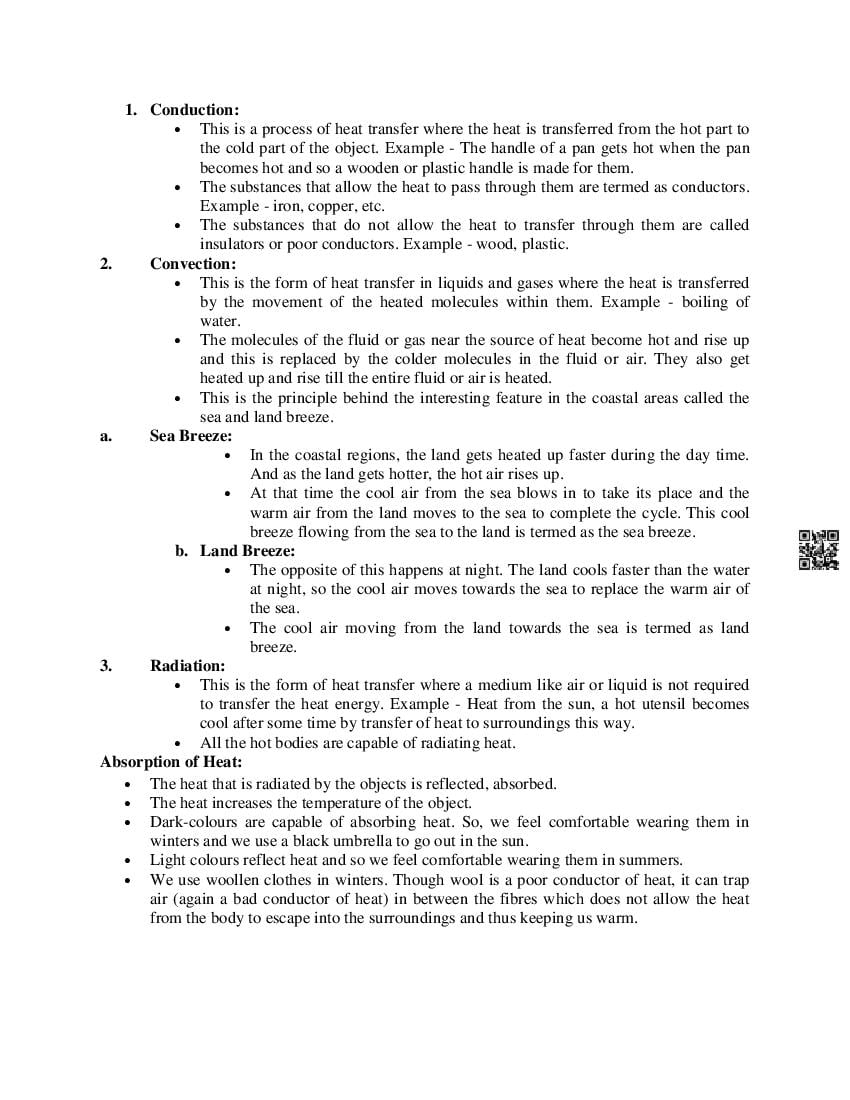
1. Conduction:

  • This is a process of heat transfer where the heat is transferred from the hot part to the cold part of the object. Example – The handle of a pan gets hot when the pan becomes hot and so a wooden or plastic handle is made for them.
  • The substances that allow the heat to pass through them are termed as conductors. Example – iron, copper, etc.
  • The substances that do not allow the heat to transfer through them are called insulators or poor conductors. Example – wood, plastic.

2. Convection:

  • This is the form of heat transfer in liquids and gases where the heat is transferred by the movement of the heated molecules within them. Example – boiling of water.
  • The molecules of the fluid or gas near the source of heat become hot and rise up and this is replaced by the colder molecules in the fluid or air. They also get heated up and rise till the entire fluid or air is heated.
  • This is the principle behind the interesting feature in the coastal areas called the sea and land breeze.

a. Sea Breeze:

  • In the coastal regions, the land gets heated up faster during the day time. And as the land gets hotter, the hot air rises up.
  • At that time the cool air from the sea blows in to take its place and the warm air from the land moves to the sea to complete the cycle. This cool breeze flowing from the sea to the land is termed as the sea breeze.

b. Land Breeze:

  • The opposite of this happens at night. The land cools faster than the water at night, so the cool air moves towards the sea to replace the warm air of the sea.
  • The cool air moving from the land towards the sea is termed as land breeze.

3. Radiation:

  • This is the form of heat transfer where a medium like air or liquid is not required to transfer the heat energy. Example – Heat from the sun, a hot utensil becomes cool after some time by transfer of heat to surroundings this way.
  • All the hot bodies are capable of radiating heat.

Absorption of Heat:

  • The heat that is radiated by the objects is reflected, absorbed.
  • The heat increases the temperature of the object.
  • Dark-colours are capable of absorbing heat. So, we feel comfortable wearing them in winters and we use a black umbrella to go out in the sun.
  • Light colours reflect heat and so we feel comfortable wearing them in summers.
  • We use woollen clothes in winters. Though wool is a poor conductor of heat, it can trap air (again a bad conductor of heat) in between the fibres which does not allow the heat from the body to escape into the surroundings and thus keeping us warm.

Candidates who are ambitious to qualify the Class 7 with good score can check this article for Notes, Study Material, Practice Paper. Above we provided the link to access the Notes, Important Question and Practice Paper of Class 7 Science for topic Heat.

All Topics Class 7 Science Notes

Chapter wise notes for Science (विज्ञान) are given below.

  • Nutrition in Plants
  • Nutrition in Animals
  • Heat
  • Acids, Bases and Salt
  • Physical and Chemical Changes
  • Respiration in Organism
  • Transportation in Animals and Plants
  • Reproduction in Plants
  • Motion and Time
  • Electric Current and Its Effects
  • Light
  • Forest our Life Line
  • Wastewater Story

Class 7 Notes for All Subjects

  • Class 7 Maths Notes
  • Class 7 Science Notes

NCERT Solutions for Class 7 Science Heat

The Heat notes here help you solve the questions and answers. Also, you can complete the Class 7 Heat worksheet using the same. In addition you will also tackle CBSE Class 7 Science Important Questions with these Class 7 notes.

However if you still need help, then you can use the NCERT Solutions for Class 7 Science Heat to get all the answers. Heat solutions contain questions, answers, and steps to solve all questions.

Notes for All Classes

  • Class 6 Notes
  • Class 7 Notes
  • Class 8 Notes
  • Class 9 Notes
  • Class 10 Notes
  • Class 11 Notes
  • Class 12 Notes

Heat Notes for Class 7 Science – An Overview

Name of TopicHeat
Class6
SubjectScience
All Class 7 Science NotesClass 7 Science Notes
All Class 7 NotesClass 7 Notes

Class 7 Heat Notes for All Boards

You can use the Class 7 Science notes of Heat for all boards.

The education boards in India for which Heat notes are relevant are – CBSE, CISCE, AHSEC, CHSE Odisha, CGBSE, HBSE, HPBOSE, PUE Karnataka, MSBSHSE, PSEB, RBSE, TBSE, UPMSP, UBSE, BIEAP, BSEB, GBSHSE, GSEB, JAC, JKBOSE, KBPE, MBOSE, MBSE, MPBSE, NBSE, DGE TN, TSBIE, COHSEM, WBCHSE.

Therefore you can refer to these notes as CBSE, CISCE, AHSEC, CHSE Odisha, CGBSE, HBSE, HPBOSE, PUE Karnataka, MSBSHSE, PSEB, RBSE, TBSE, UPMSP, UBSE, BIEAP, BSEB, GBSHSE, GSEB, JAC, JKBOSE, KBPE, MBOSE, MBSE, MPBSE, NBSE, DGE TN, TSBIE, COHSEM, WBCHSE notes for class Class 7 / Class / Science for the topic Heat.

Class 7 Science Notes
Class 7 Notes
Notes

To get study material, exam alerts and news, join our Whatsapp Channel.

Tags: Class 7 NotesClass 7thClass 7th NotesNotesScience Notes
Previous Post

Class 7 Science Notes for Nutrition in Animals (PDF) – Study Material

Next Post

Class 7 Science Notes for Acids, Bases and Salt (PDF) – Study Material

Related Posts

7th Class

Kerala Class 7 Onam Exam Model Papers 2026 – 7th Standard First Term Model Question Paper PDF

7th Class

Kerala Class 7 Basic Science Onam Exam Model Question Paper 2026 (First Term Exam / 1st Terminal Exam) PDF Download

7th Class

Kerala Class 7 English Onam Exam Model Question Paper 2026 (First Term Exam / 1st Terminal Exam) PDF Download

7th Class

Kerala Class 7 Health & Physical Education, Art Education, and Work Integrated Education Onam Exam Model Question Paper 2026 (First Term Exam / 1st Terminal Exam) PDF Download

Leave a ReplyCancel reply

Class Wise Study Material

  • Class 1
  • Class 2
  • Class 3
  • Class 4
  • Class 5
  • Class 6
  • Class 7
  • Class 8
  • Class 9
  • Class 10
  • Class 11
  • Class 12

AglaSem Study Material

  • AglaSem Notes
  • AglaSem Sample Papers
  • PT, HY, Annual PYQP
  • Important Questions
  • Competency Based Questions
  • Maps

Board Exams

  • Solved Sample Papers
  • Maps
  • Revision Notes
  • CBSE
  • State Board

Study Material

  • Class Notes
  • NCERT Solutions
  • NCERT Books
  • HC Verma Solutions
  • Courses After Class 12th

Exam Zone

  • JEE Main 2025
  • NEET 2025
  • CLAT 2025
  • Fashion & Design
  • Latest
  • Disclaimer
  • Terms of Use
  • Privacy Policy
  • Contact

© 2019 aglasem.com

  • Home
  • Boards
    • Date Sheet
    • Admit Card
    • Result
    • Sample Paper
    • Question Paper
  • NCERT
    • NCERT Solutions
    • NCERT Books
    • NCERT Audio Books
    • NCERT Exempler
  • Study Material
    • Notes
    • Model Papers
    • Past Year Question Paper
    • Maps
    • Writing Skill Format
  • Solutions
    • NCERT Solutions
    • RD Sharma Solutions
    • HC Verma Solutions
    • CG Board Solutions
    • UP Board Solutions
  • Olympiads
    • NMMS
  • Admissions
  • Career Guide
    • Careers Opportunities
    • Courses & Career
    • Courses after 12th

Discover more from AglaSem Schools

Subscribe now to keep reading and get access to the full archive.

Continue reading