Download the ICSE Class 10 Computer Applications Specimen Paper PDF for the ICSE 2027 board exam here, free. The latest specimen paper for Computer Applications is the 2025 paper. CISCE has not released a new 2027 specimen paper for Computer Applications – the CISCE circular of 9 October 2026 issued new papers only in selected subjects and says that for all other subjects the 2026 rubrics and assessment structure continue. So the pattern has not changed, and the 2025 paper is still the official sample of the paper format for 2027. The 2025 paper is a 100-mark, 2-hour paper with 8 questions. The 2024 papers are also here. Students also search for it as the ICSE 10th Computer Applications sample paper 2027 or model paper – it is the same official CISCE paper.
ICSE Class 10 Computer Applications Specimen Paper PDF Download
Open a paper to read it online or download the PDF.
| Year | Paper | Download |
|---|---|---|
| 2025 | ICSE Class 10 Computer Applications Specimen Paper 2025 | View PDF |
| 2024 | ICSE Class 10 Computer Applications Specimen Paper 2024 | View PDF |
ICSE Computer Applications Specimen Paper 2025 – Quick Facts
| Board | CISCE (Council for the Indian School Certificate Examinations) |
| Class | Class 10 (ICSE) |
| Subject | Computer Applications (code 861) |
| Exam | ICSE 2027 board exam (February–March 2027) |
| Latest specimen paper | 2025 – no new paper for 2027; the 2026 pattern continues |
| Marks and time | 100 marks, 2 hours, plus 15 minutes reading time |
| Questions | 8 questions in 3 sections |
| Answer key | Yes – in the same PDF, after the paper |
| Older papers | 2024 |
ICSE Class 10 Computer Applications Specimen Paper 2025 – Read Online

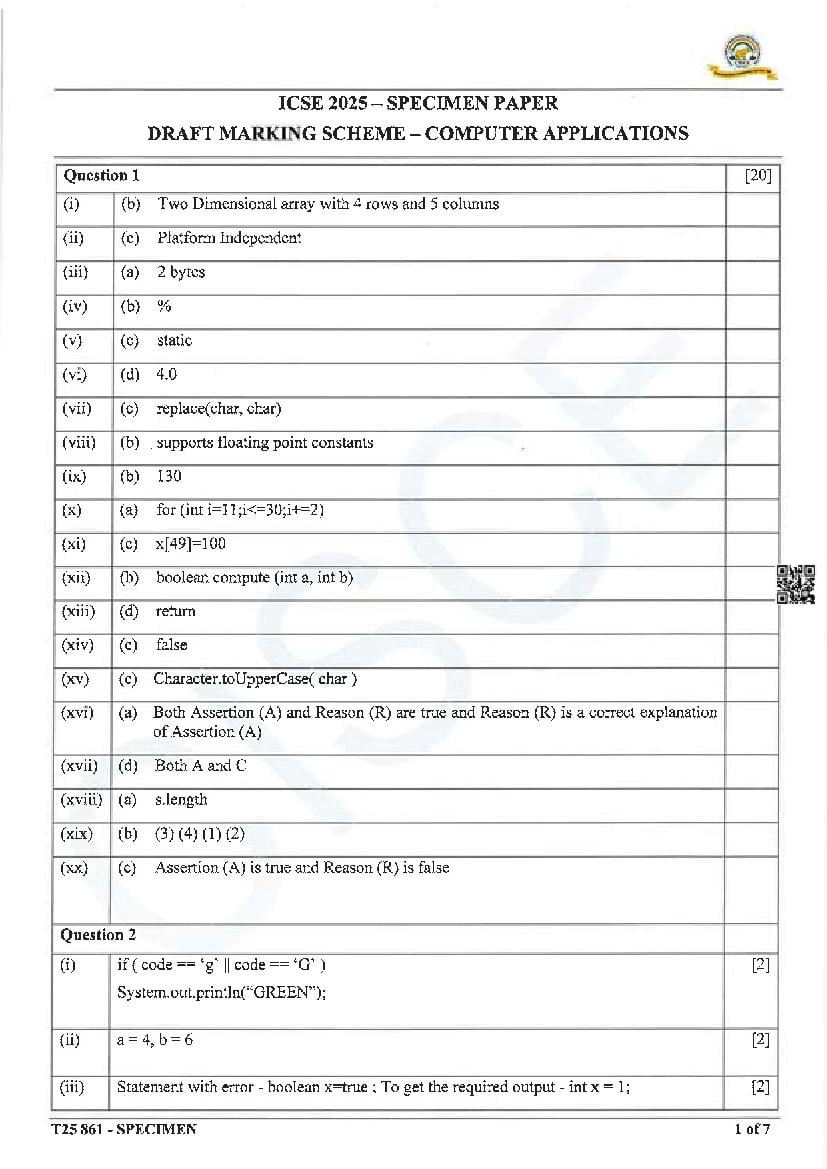
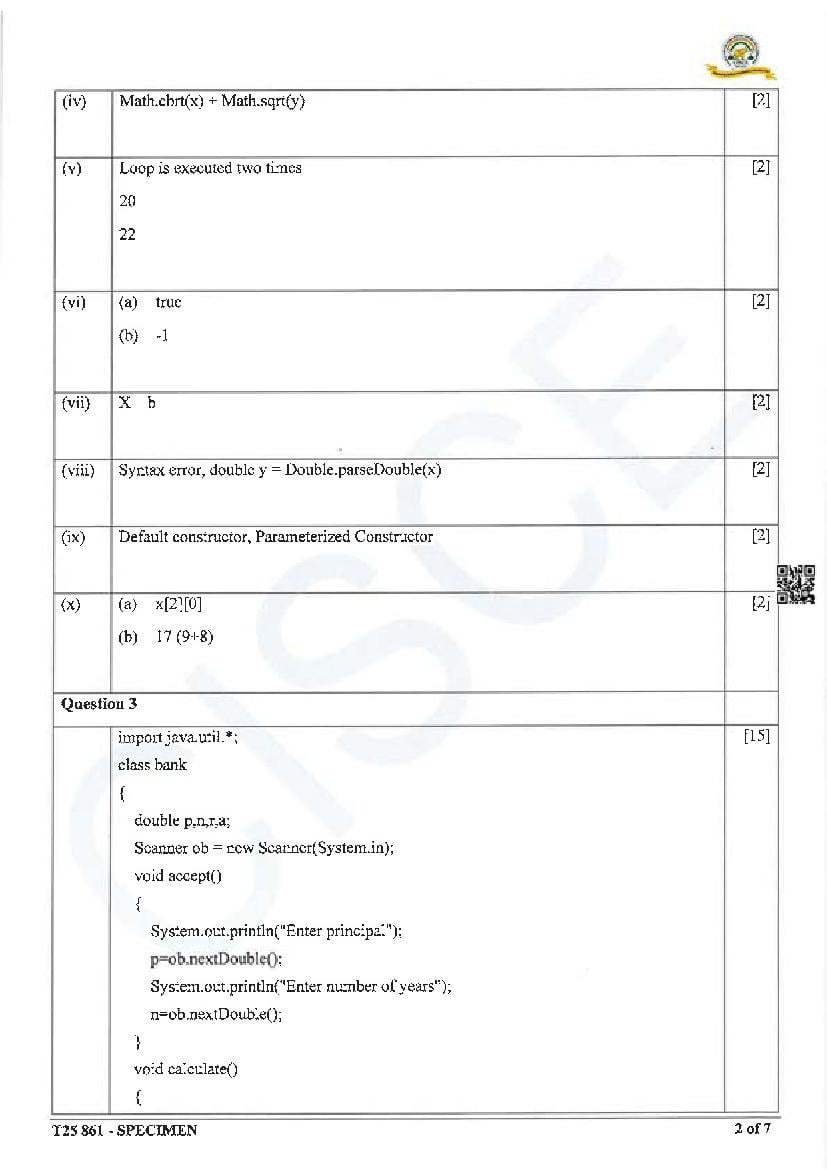
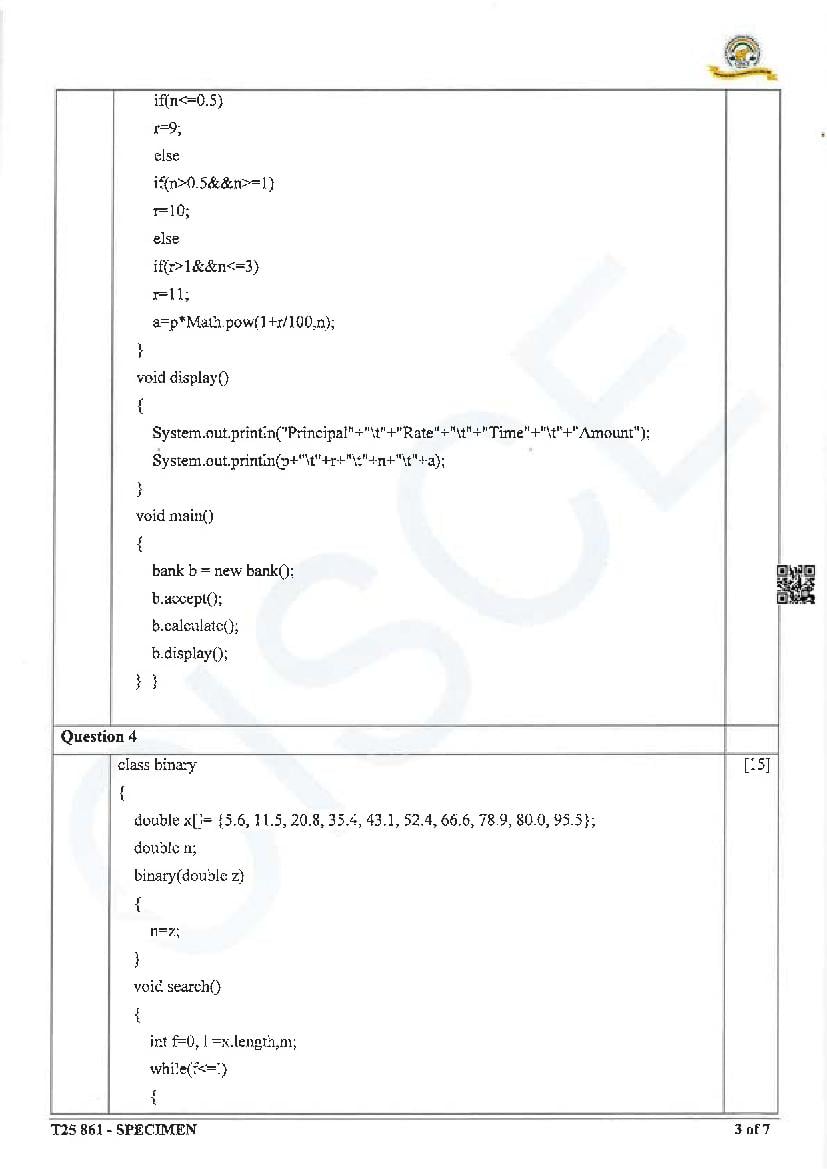
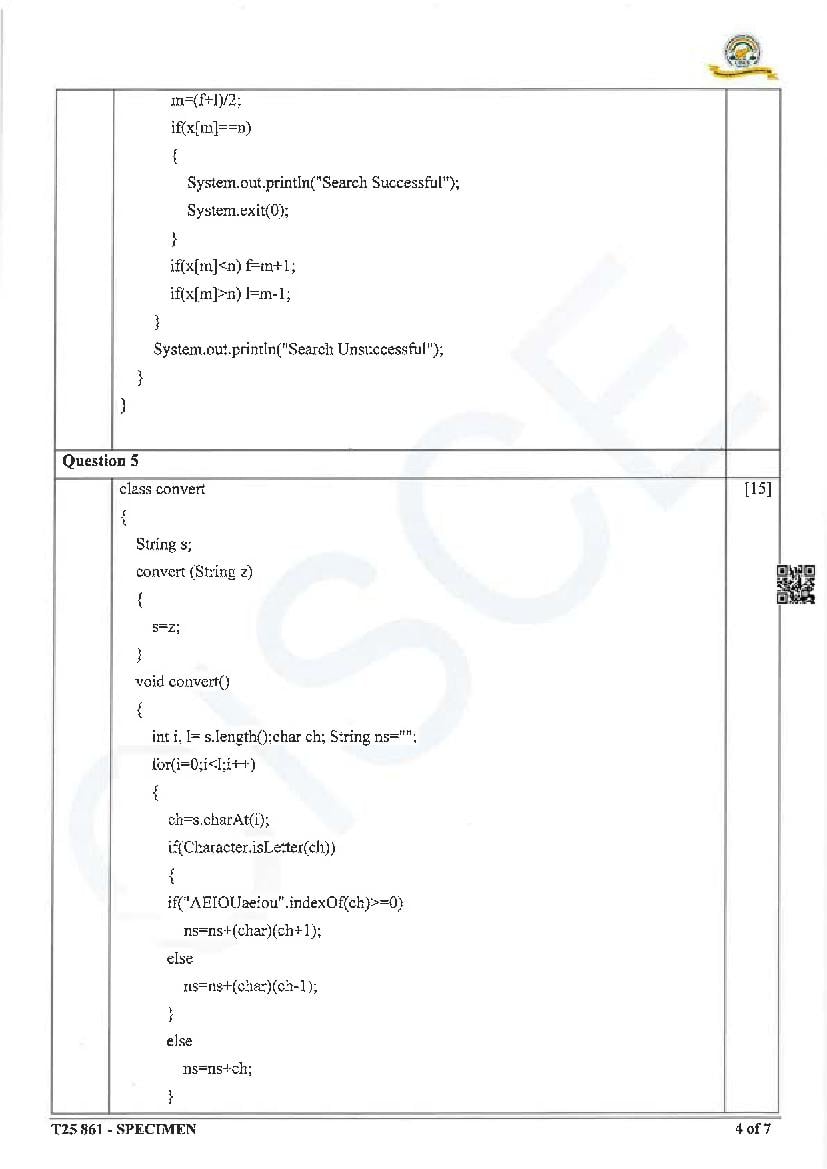
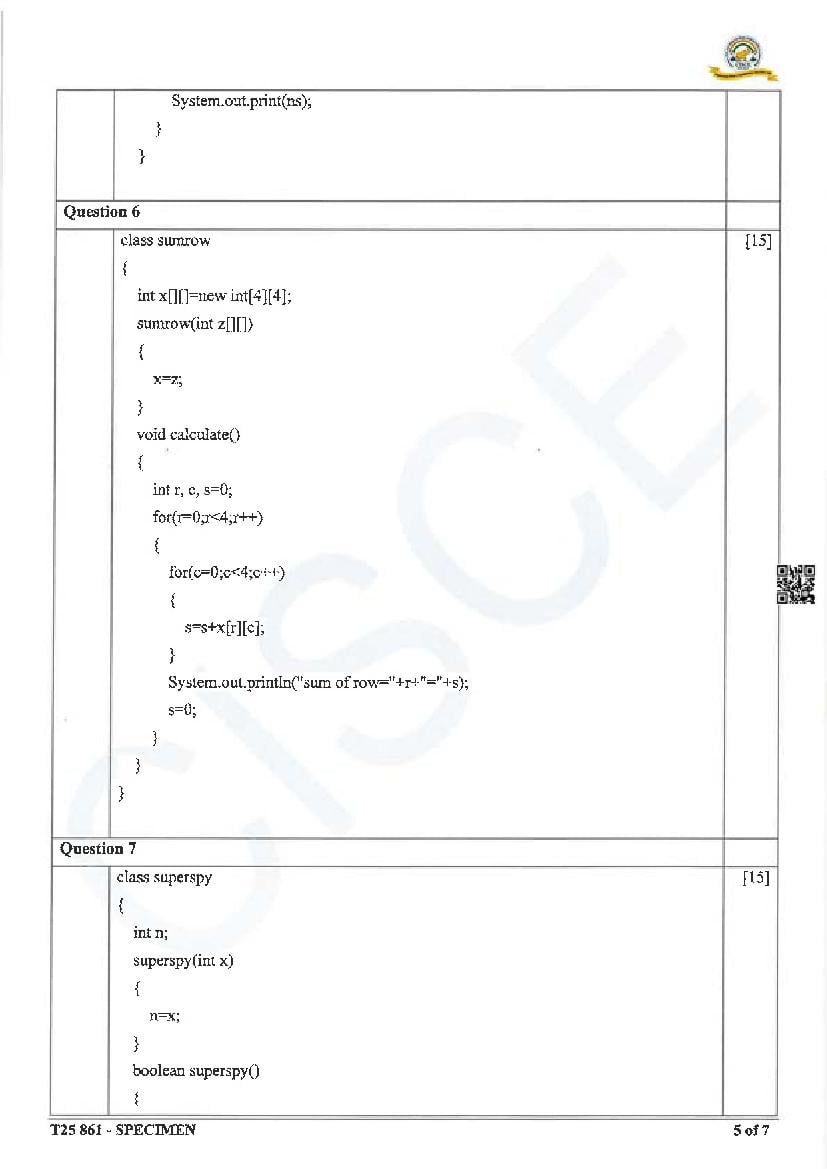
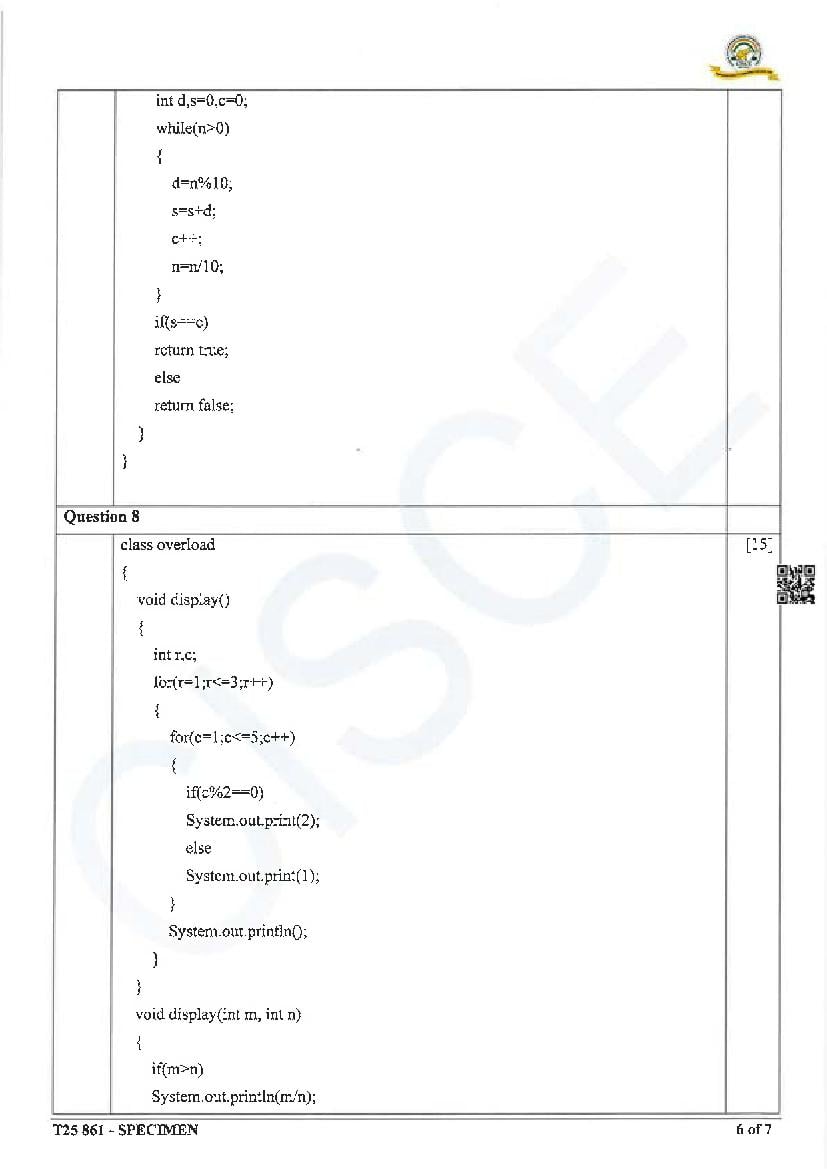

ICSE Class 10 Computer Applications Paper Pattern (2025 specimen paper)
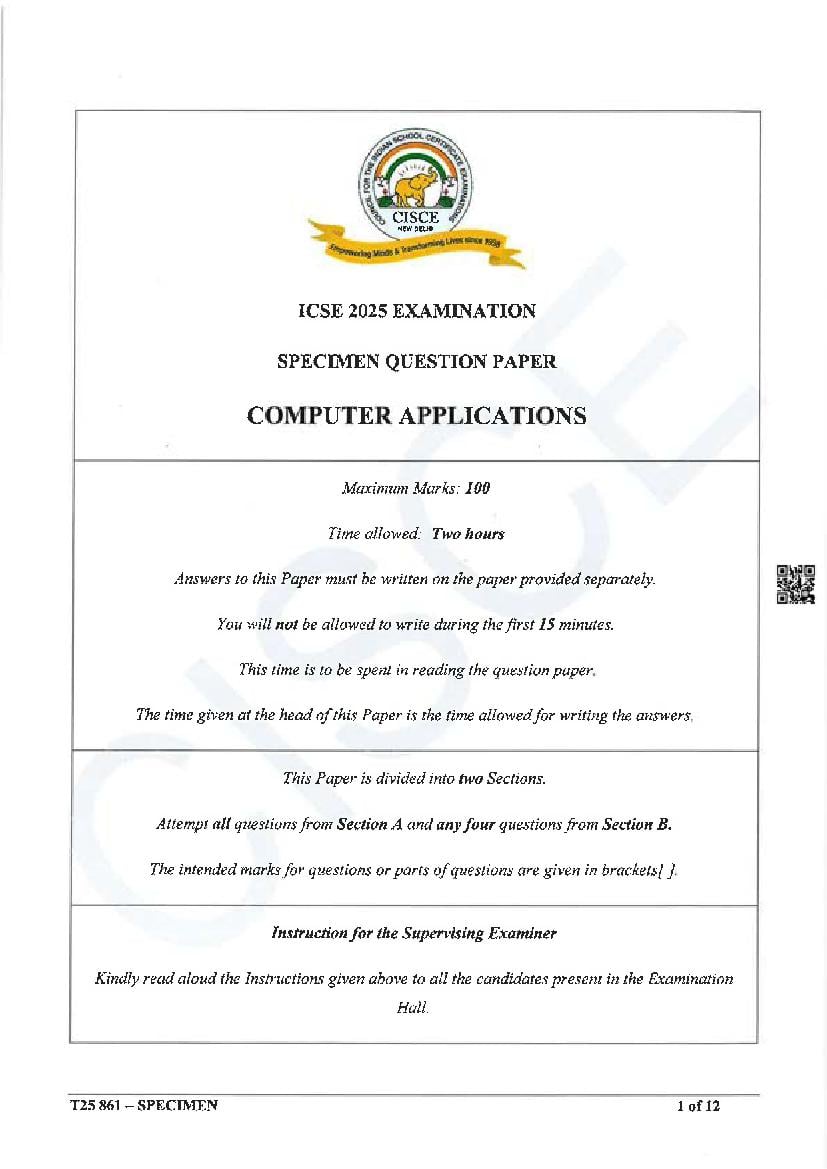
How the 2025 specimen paper is set (read from the paper itself) – a 100-mark, 2-hour paper with 8 questions:
| Section | Questions | Type | Marks each | Total |
|---|---|---|---|---|
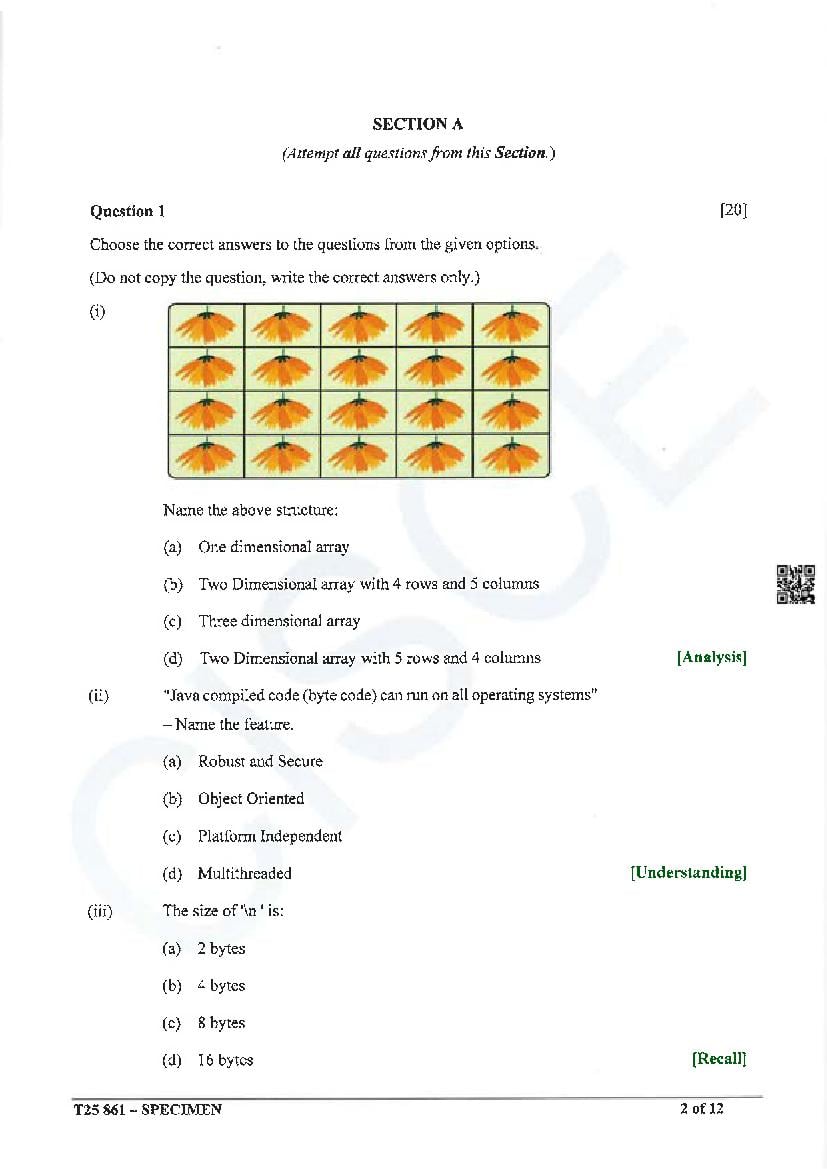
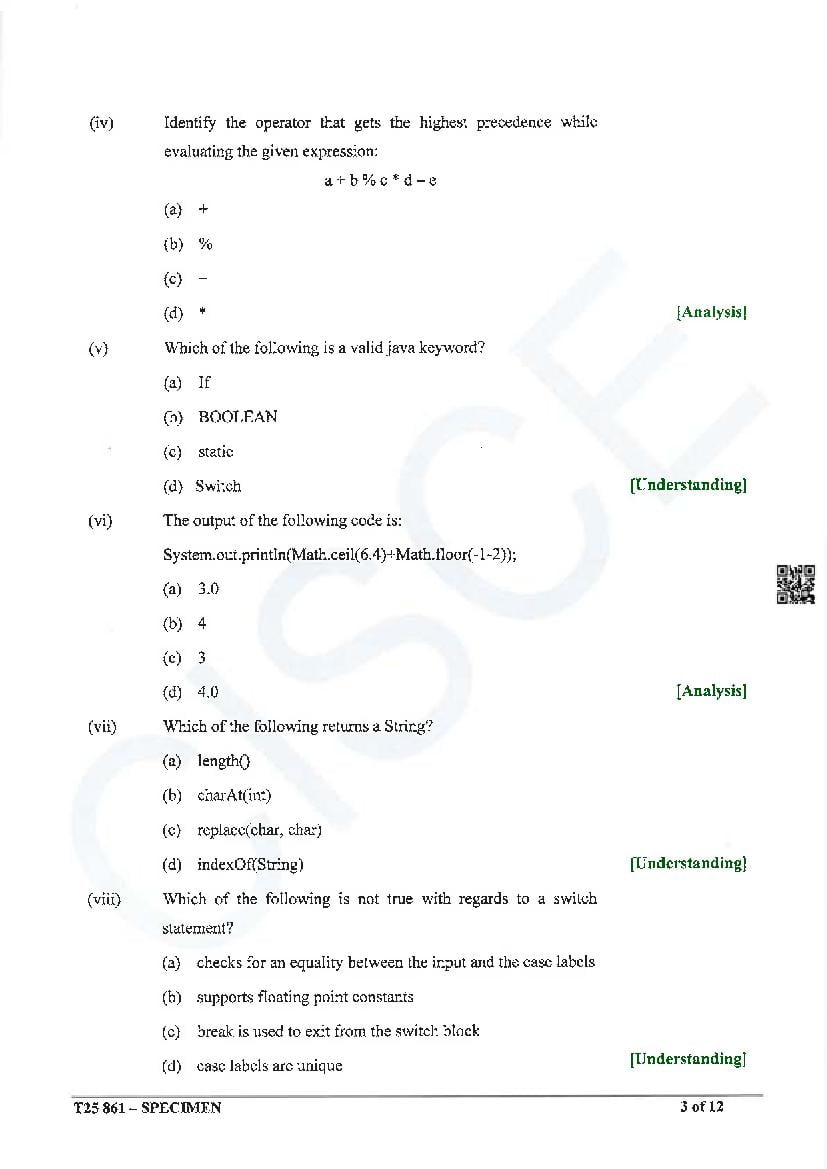
| Section A – Question 1 | 1 (i)–(xx) | MCQs (incl. picture-based, assertion–reason, output prediction, jumbled-statement ordering) | 1 | 20 |
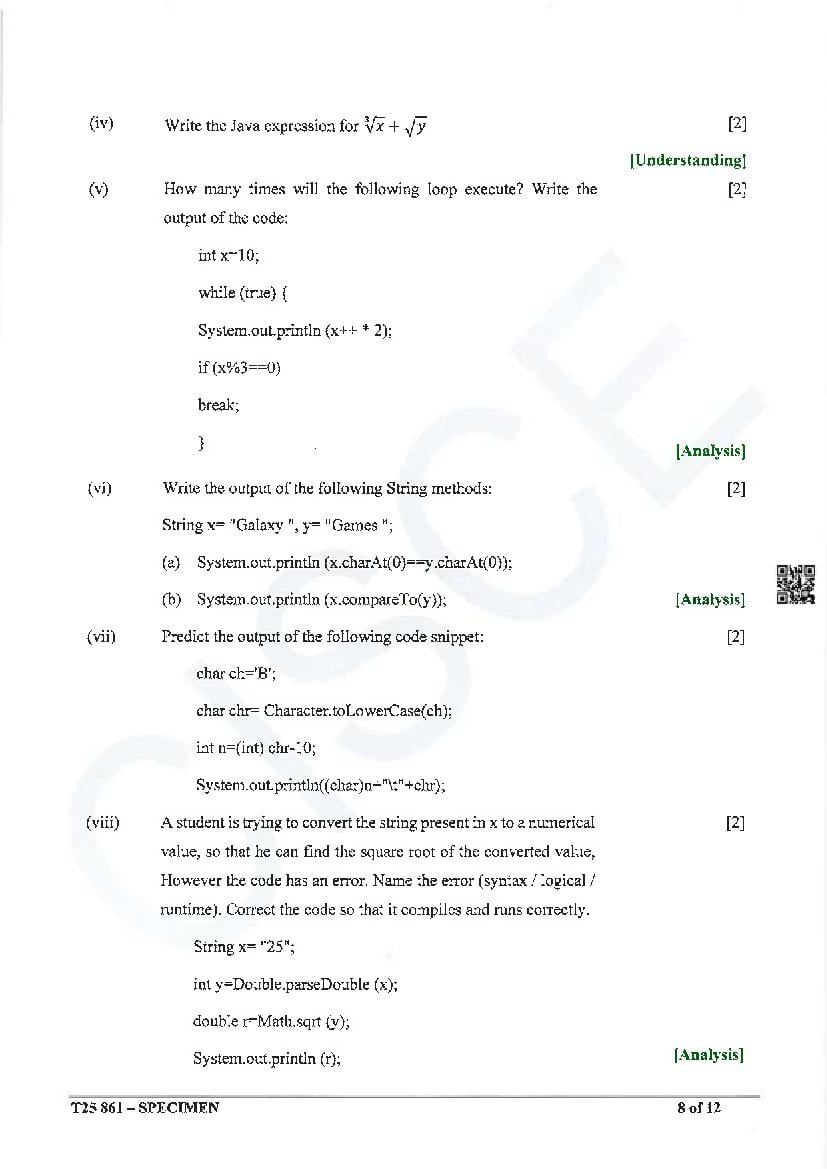
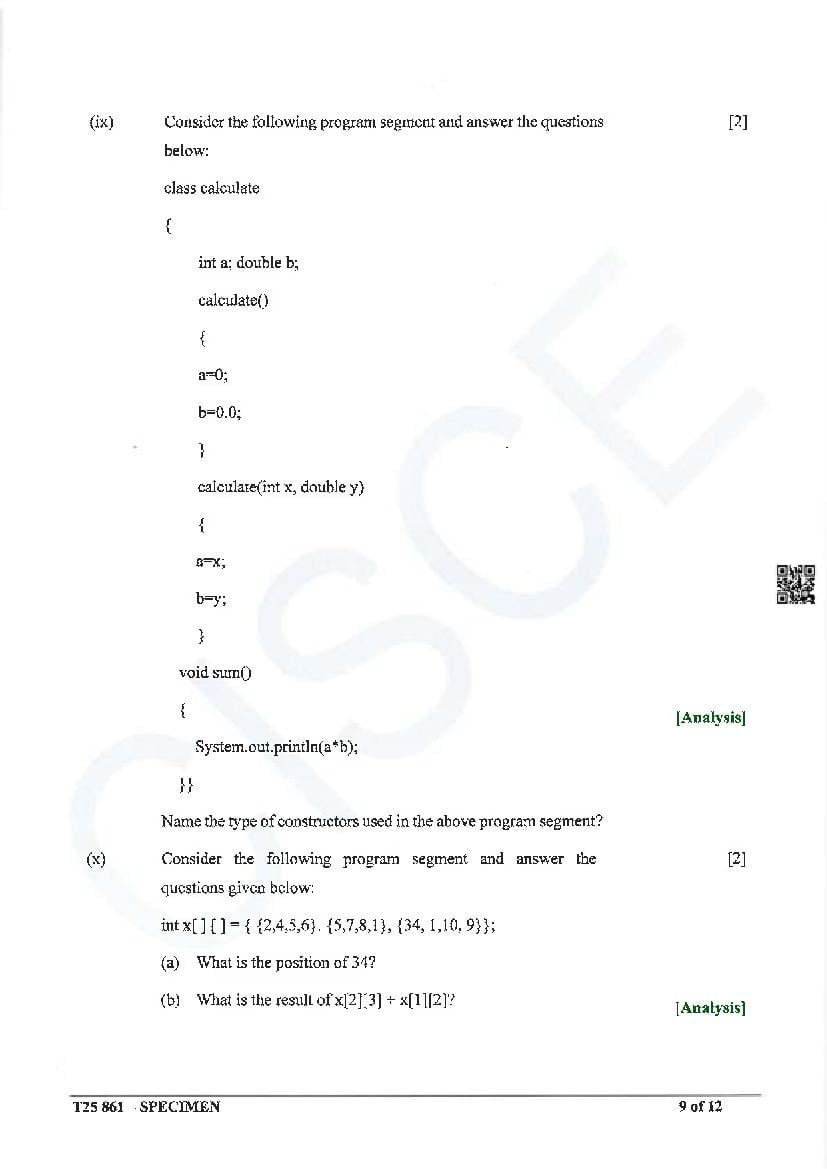
| Section A – Question 2 | 2 (i)–(x) | Short answers: rewrite code, evaluate expressions, find/correct errors, Java expressions, predict output, constructors, 2-D array positions | 2 | 20 |
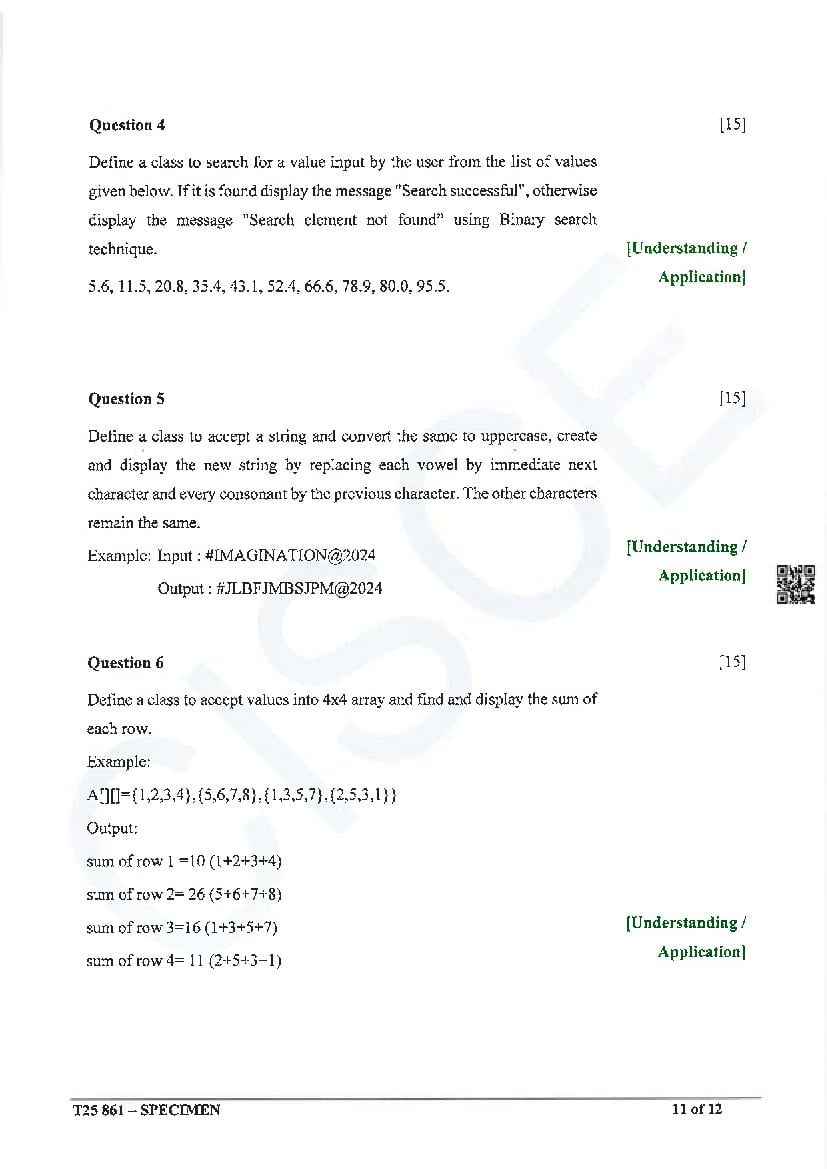
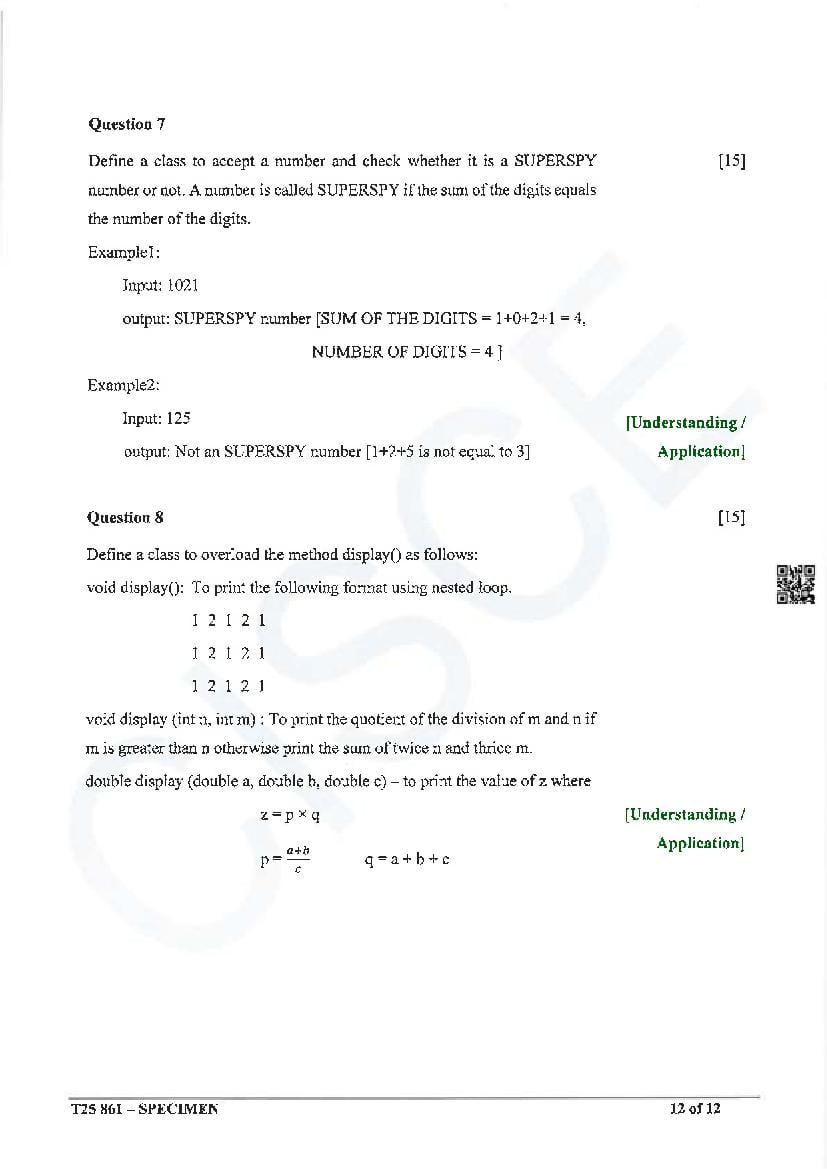
| Section B | 3–8 | Java programs (class design, binary search, string manipulation, 4×4 array row sums, SUPERSPY number, method overloading) | 15 | 60 |
| Total | 8 | 100 |
Choice: Attempt all questions in Section A (Questions 1 and 2) and any four of the six programs in Section B; no choice within questions.
- You will not be allowed to write during the first 15 minutes (reading time).
- Section A MCQs: do not copy the question, write the correct answers only.
- Section B programs must be written in BlueJ or any program environment with Java as the base, using variable description / mnemonic codes so the logic is clear.
- Flowcharts and algorithms are not required.
Competency-wise Marks in the Computer Applications Specimen Paper 2025
Each question in the paper is tagged with the skill it tests. Marks per skill level:
| Skill level | Marks |
|---|---|
| Analysis | 23 |
| Understanding | 9 |
| Recall | 4 |
| Application | 2 |
| Understanding / Application (Section B programs – each of Q3–Q8 tagged so; 4 answered) | 60 |
| Untagged (Q2 vii) | 2 |
Chapter-wise Marks in the Computer Applications Specimen Paper 2025
Marks for each chapter or unit (counted question by question from the 2025 paper):
| Chapter / unit | Questions | Marks |
|---|---|---|
| Arrays (1-D and 2-D) | Q1 (i), (ix), (xi), (xviii); Q2 (x) | 6 |
| Library classes / wrapper classes (Character, Integer, parseDouble) | Q1 (xv), (xvi); Q2 (vii), (viii) | 6 |
| Conditional constructs (if, switch) | Q1 (viii); Q2 (i), (iii) | 5 |
| Operators (precedence, shorthand, expression evaluation) | Q1 (iv), (xvii); Q2 (ii) | 4 |
| User-defined methods (prototype, return, arguments/parameters, swap) | Q1 (xii), (xiii), (xix), (xx) | 4 |
| Values and data types / keywords / default values | Q1 (iii), (v), (xiv) | 3 |
| Mathematical library methods | Q1 (vi); Q2 (iv) | 3 |
| String handling | Q1 (vii); Q2 (vi) | 3 |
| Iterative constructs (loops) | Q1 (x); Q2 (v) | 3 |
| Constructors | Q2 (ix) | 2 |
| Introduction to Java / features (platform independence) | Q1 (ii) | 1 |
| Section B programs – any 4 of: class with member methods (Q3 Bank), binary search on array (Q4), string manipulation (Q5), 2-D array row sums (Q6), number program with loops (Q7 SUPERSPY), method overloading with nested-loop pattern (Q8) | Any 4 of Q3–Q8 | 60 |
What Is New in the Computer Applications Specimen Paper 2025?
Compared with the 2024 specimen paper:
- No change in pattern – like the 2024 specimen, the 2025 paper is 100 marks, 2 hours, Section A with Q1 (20 one-mark MCQs) and Q2 (ten 2-mark questions), and Section B with six 15-mark programs of which any four are answered.
- Every question in the 2025 paper carries a competency tag (Recall / Understanding / Analysis / Application; Section B ‘Understanding / Application’) – the 2024 specimen had no tags.
- A draft marking scheme with answers and full program solutions is appended to the 2025 specimen; the 2024 specimen PDF had no answer key.
- 2025 adds a jumbled-statement ordering MCQ (swap method) and a picture-based 2-D array MCQ (2024 had a picture-based inheritance MCQ); 2025 Section B also adds the instruction that BufferedReader / DataInputStream should not be used.
- No 2027 (or 2026) specimen paper is on the page for this subject; this 2025 paper is the latest one available.
Questions from the Computer Applications Specimen Paper 2025
Two questions from the 2025 paper, to show the level:
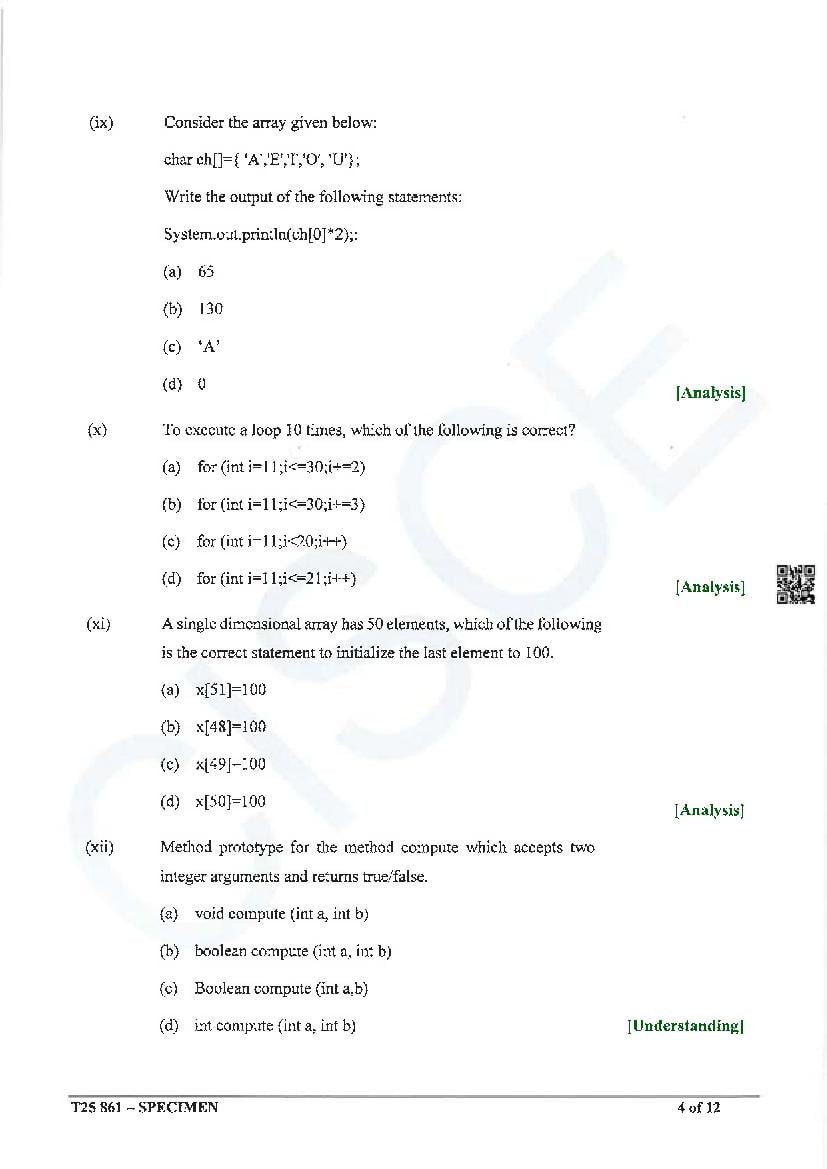
- Section A – Question 1, 1 mark: A single dimensional array has 50 elements; which is the correct statement to initialise the last element to 100? (a) x[51]=100 (b) x[48]=100 (c) x[49]=100 (d) x[50]=100
- Section B, 15 marks: Define a class to accept a number and check whether it is a SUPERSPY number or not. A number is SUPERSPY if the sum of its digits equals the number of digits (e.g. 1021: 1+0+2+1 = 4 = number of digits).
How to Score Well – Tips from the 2025 Paper
- Analysis is the largest tagged share of Section A (23 of 40 marks) – practise dry-running code: loop counts, Math.ceil/floor results, char arithmetic like ch[0]*2, compareTo output.
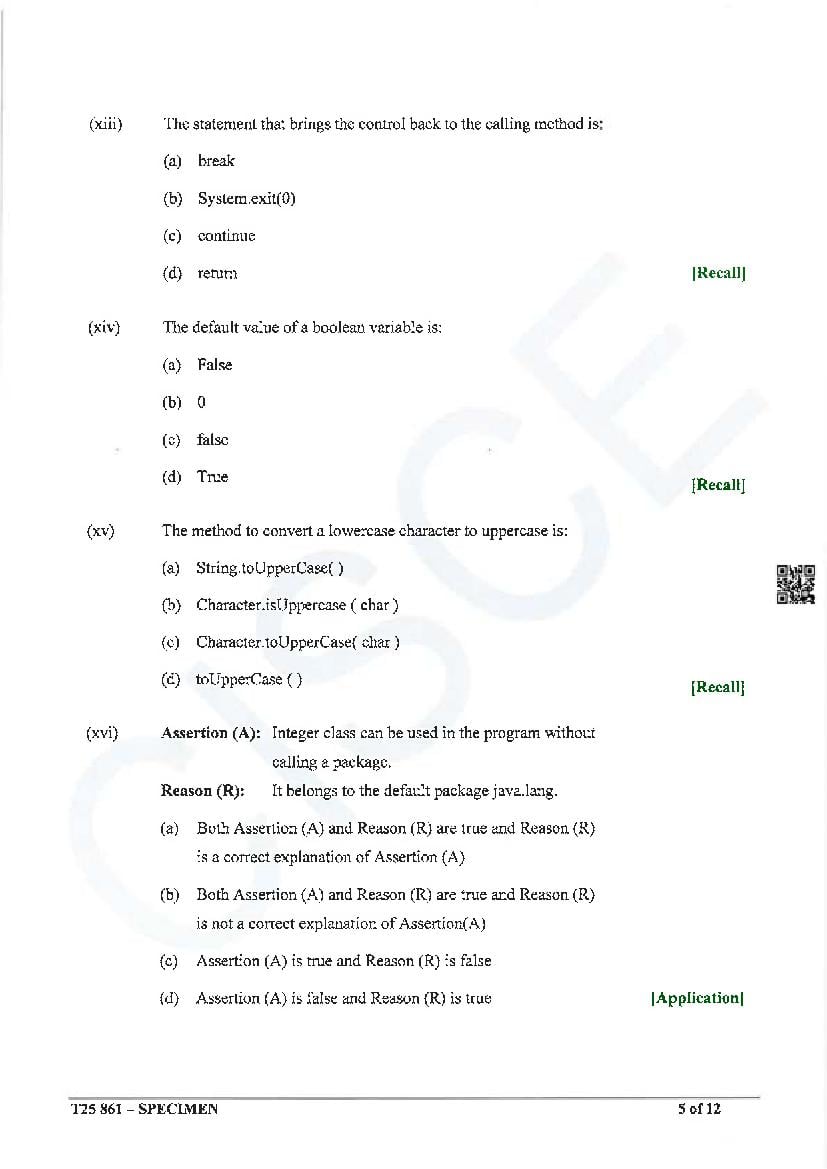
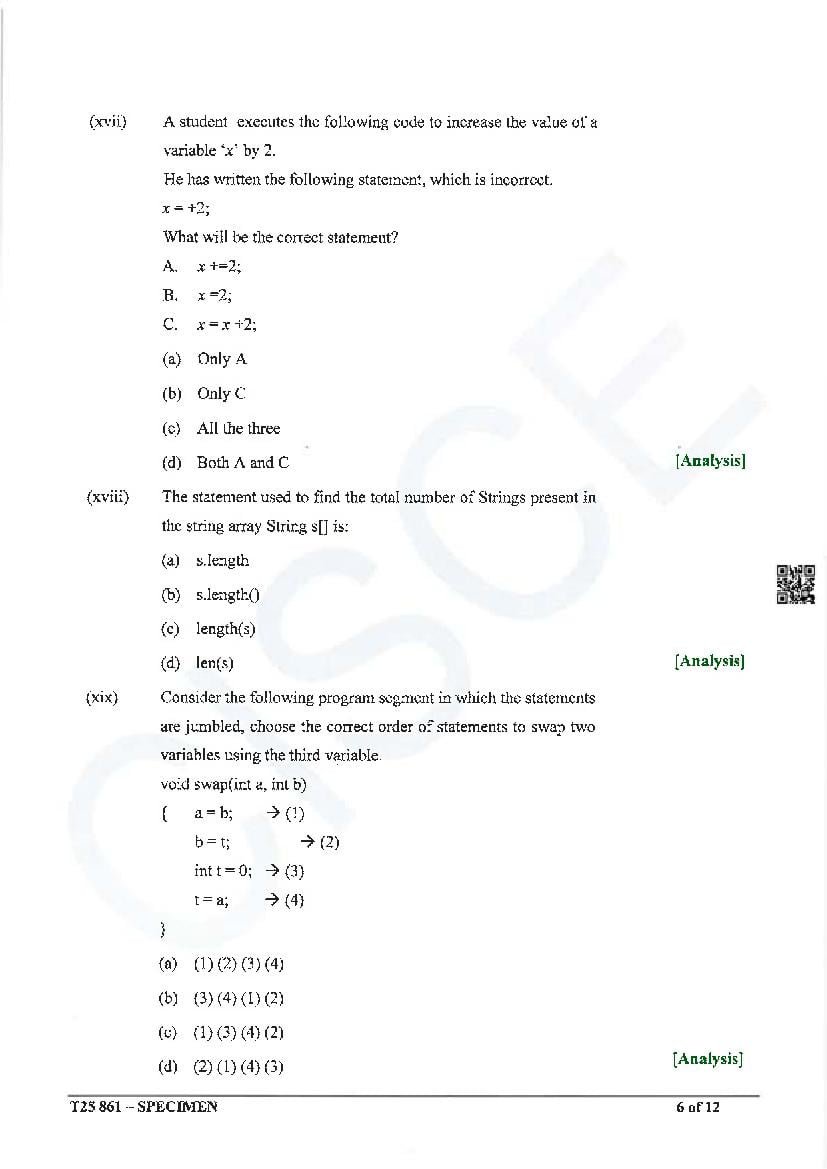
- Know exact Java method names and return types (Character.toUpperCase(char), s.length for arrays vs length() for strings, boolean method prototypes) – several MCQs hinge on them.
- In Section B choose your four programs early; the scheme gives full solutions, so write complete classes with a main method/object creation where asked.
- Use only Scanner for input and add variable descriptions/mnemonic names – the paper explicitly bars BufferedReader/DataInputStream and does not want flowcharts or algorithms.
- Revise binary search, 2-D array traversal and method overloading – each appears as a full 15-mark program.
- Solve the 2025 paper in one sitting – 2 hours plus 15 minutes reading time, like the exam, and solve the 2024 paper a few days later.
More Class 10 Computer Applications Papers and Study Material
Practise past papers, or plan your revision with the syllabus for ICSE Class 10 Computer Applications:
ICSE Class 10 Computer Applications Specimen Paper 2027 – FAQs
Is the ICSE Class 10 Computer Applications Specimen Paper 2027 out?
CISCE has not released a separate 2027 specimen paper for Computer Applications. Its circular of 9 October 2026 issued new papers only in selected subjects and says that for the other subjects the 2026 rubrics and assessment structure continue – so the 2025 specimen paper on this page still shows the format of the 2027 exam.
Is the 2025 Computer Applications specimen paper still valid for 2027?
Yes. The pattern for Computer Applications has not changed for 2027, so the 2025 paper is still the right paper to practise. Check the 2027 syllabus for any change in chapters.
How many marks is the ICSE Class 10 Computer Applications paper?
The 2025 specimen paper is a 100-mark, 2-hour paper with 8 questions, plus 15 minutes reading time.
Which chapters carry the most marks in the Computer Applications specimen paper?
In the 2025 paper: Section B programs – any 4 of: class with member methods (Q3 Bank), binary search on array (Q4), string manipulation (Q5), 2-D array row sums (Q6), number program with loops (Q7 SUPERSPY), method overloading with nested-loop pattern (Q8) (60 marks), Arrays (1-D and 2-D) (6 marks), Library classes / wrapper classes (Character, Integer, parseDouble) (6 marks).
Is the ICSE 10th Computer Applications sample paper the same as the specimen paper?
Yes. CISCE calls it the specimen question paper; students also search for it as the ICSE 10th Computer Applications sample paper or model paper – it is the same official paper on this page.
Will the exam paper be the same as the specimen paper?
No – the questions will be different, but the paper follows the same format: the same sections, marks and question types. CISCE says individual questions can vary.