NCERT Exemplar Class 11 Biology Chapter 9 Biomolecules – the extra practice questions NCERT publishes for the chapter (MCQs, very short, short and long answer questions) with their answers.
NCERT Exemplar Class 11 Biology Chapter 9 Biomolecules PDF
| Chapter | Download | |
|---|---|---|
| Exemplar PDF | Biomolecules | View PDF |
Read Online

NCERT Exemplar Class 11 Biology Chapter 9 Biomolecules – Questions and Answers
Multiple Choice Questions
- It is said that elemental composition of living organisms and that of inanimate objects (like earth’s crust) are similar in the sense that all the major elements are present in both. Then what would be the difference between these two groups? Choose a correct answer from among the following:
a. Living organisms have more gold in them than inanimate objects
b. Living organisms have more water in their body than inanimate objects
c. Living organisms have more carbon, oxygen and hydrogen per unit mass than inanimate objects.
d. Living organisms have more calcium in them than inanimate objects. - Many elements are found in living organisms either free or in the form of compounds. One of the following is not, found in living organisms.
a. Silicon
b. Magnesium
c. Iron
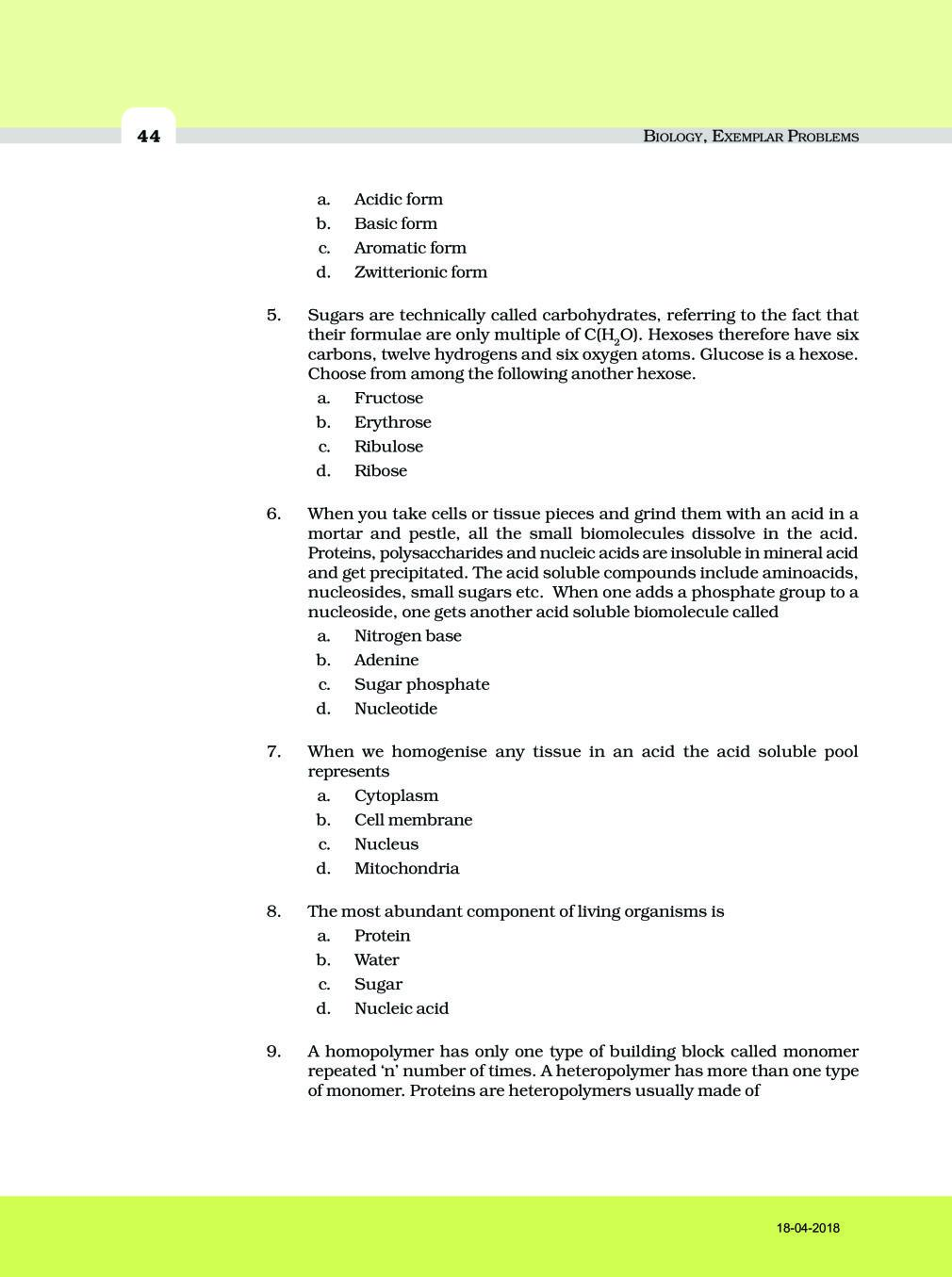
d. Sodium - Amino Acids, as the name suggests, have both an amino group and a carboxyl group in their structure. In addition, all naturally occurring amino acids (those which are found in proteins) are called L-amino acids. From this, can you guess from which compound can the simplest amino acid be made?
a. Formic acid
b. Methane
c. Phenol
d. Glycine - Many organic substances are negatively charged e.g., acetic acid, while others are positively charged e.g., ammonium ion. An aminoacid under certain conditions would have both positive and negative charges simultaneously in the same molecule. Such a form of aminoacid is called
a. Positively charged form
b. Negatively charged form
c. Neutral form
d. Zwitterionic form - Sugars are technically called carbohydrates, referring to the fact that their formulae are only multiple of C(H2O). Hexoses therefore have six carbons, twelve hydrogens and six oxygen atoms. Glucose is a hexose. Choose from among the following another hexose.
a. Fructose
b. Erythrose
c. Ribulose
d. Ribose - When you take cells or tissue pieces and grind them with an acid in a mortar and pestle, all the small biomolecules dissolve in the acid. Proteins, polysaccharides and nucleic acids are insoluble in mineral acid and get precipitated. The acid soluble compounds include aminoacids, nucleosides, small sugars etc. When one adds a phosphate group to a nucleoside one gets another acid soluble biomolecule called
a. Nitrogen bas
b. Adenine
c. Sugar phosphate
d. Nucleotide - When we homogenise any tissue in an acid the acid soluble pool represents
a. Cytoplasm
b. Cell membrane
c. Nucleus
d. Mitochondria - The most abundant chemical in living organisms could be
a. Protein
b. Water
c. Sugar
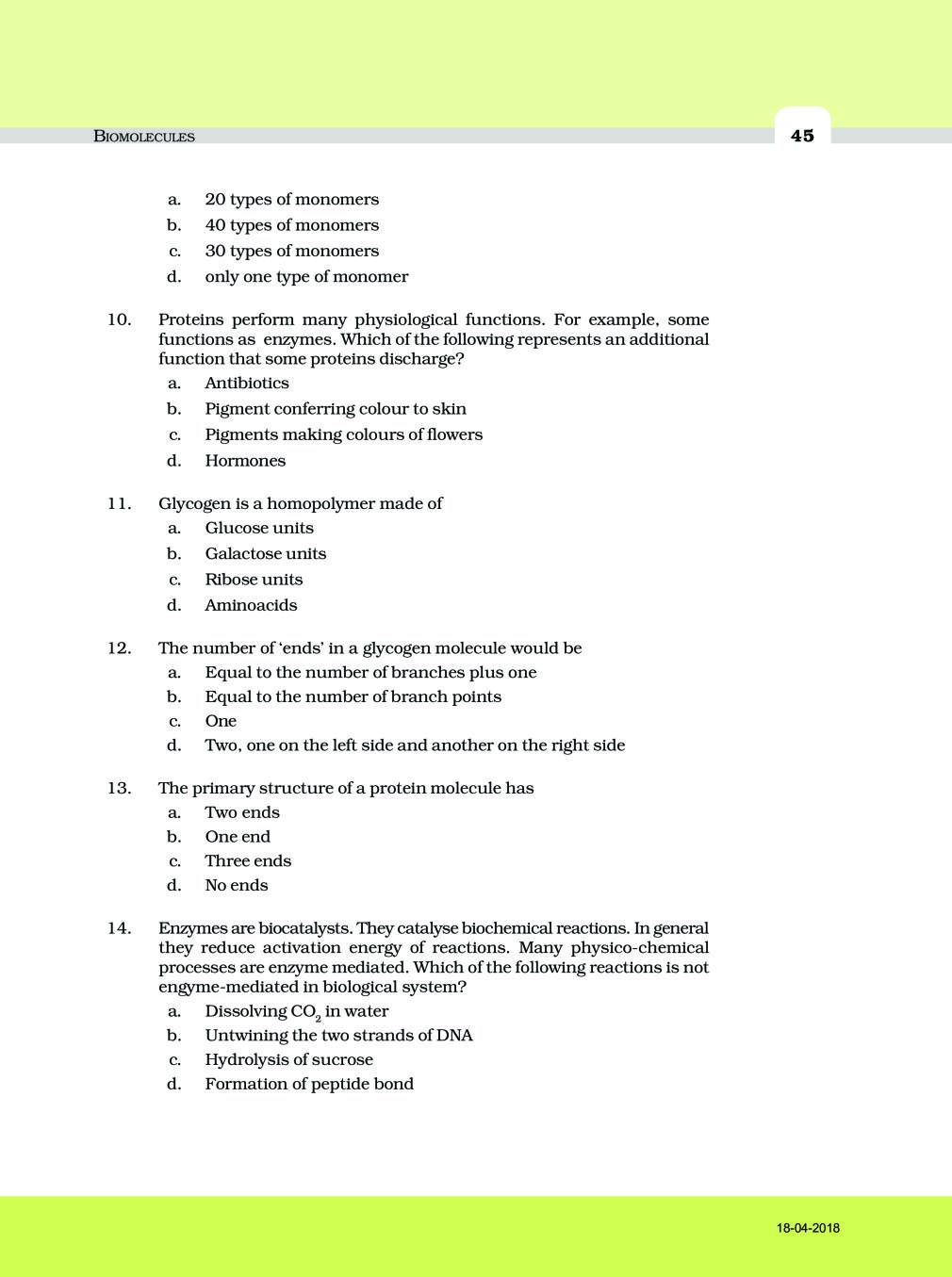
d. Nucleic acid - A homopolymer has only one type of building block called monomer repeated ‘n’ number of times. A heteropolymer has more than one type of monomer. Proteins are heteropolymers made of aminoacids. While a nucleic acid like DNA or RNA is made of only 4 types of nucleotide monomers, proteins are made of
a. 20 types of monomers
b. 40 types of monomers
c. 3 types of monomers
d. only one type of monomer - Proteins perform many physiological functions. For example, some functions as enzymes. One of the following represents an additional function that some proteins discharge
a. Antibiotics
b. Pigment conferring colour to skin
c. Pigments making colours of flowers
d. Hormones - Glycogen is a homopolymer made of
a. Glucose units
b. Galactose units
c. Ribose units
d. Aminoacids - The number of ‘ends’ in a glycogen molecule would be
a. Equal to the number of branches plus one
b. Equal to the number of branch points
c. One
d. Two, one on the left side and another on the right side - A pure protein should normally have
a. Two ends
b. One end
c. Three ends
d. No ends - Enzymes are bio catalysts. They catalyse biochemical reactions. In general they reduce activation energy of reactions. Many physico-chemical processes are enzyme mediated. Some examples of enzyme mediated reactions are given below. Tick the wrong entry
a. Dissolving CO2 in water
b. Untwining the two strands of DNA
c. Hydrolysis of sucrose
d. Formation of peptide bond
Very Short Answer Type Questions
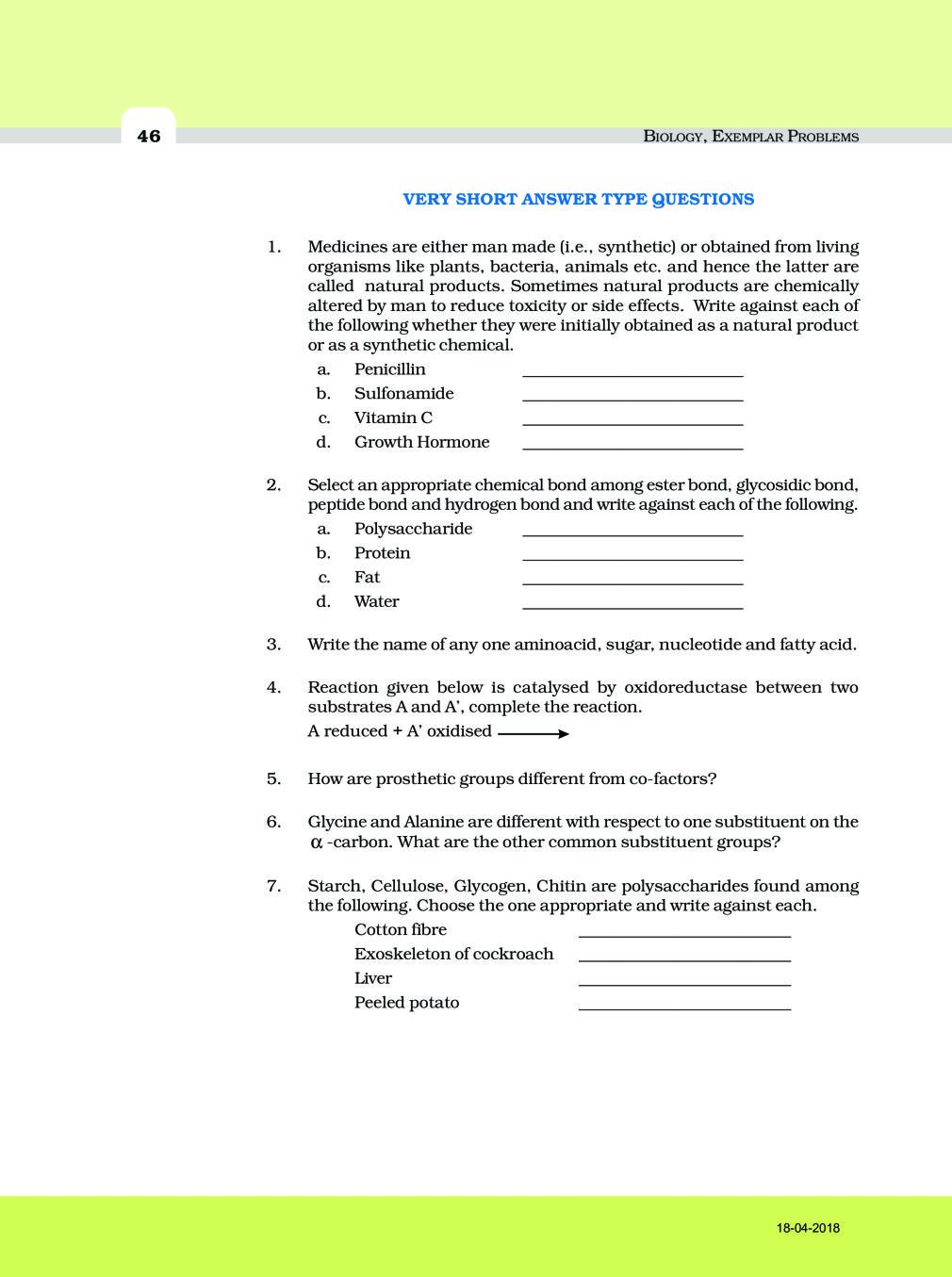
- Medicines are either man made (i.e., synthetic) or obtained from living organisms like plants, bacteria, animals etc. and hence the latter are called natural products. Sometimes natural products are chemically altered by man to reduce toxicity or side effects. Write against each of the following whether they were initially obtained as a natural product or as a synthetic chemical.
a. Penicillin ___________________________
b. Sulfonamide ___________________________
c. Vitamin C ___________________________
d. Growth Hormone ___________________________ - Select an appropriate chemical bond among ester bond, glycosidic bond, peptide bond and hydrogen bond and write against each of the following.
a. Polysaccharide ___________________________
b. Protein ___________________________
c. Fat ___________________________
d. Water ___________________________ - Write the name of any one aminoacid, sugar, nucleotide and fatty acid.
- Reaction given below is catalysed by oxidoreductase between two substrates A and A’, complete the reaction.
A reduced + A’ oxidised → - How are prosthetic groups different from co-factors?
- Glycine and Alanine are different with respect to one substituent on the α -carbon. What are the other common substituent groups?
- Starch, Cellulose, Glycogen, Chitin are polysaccharides found among the following. Choose the one appropriate and write against each.
Cotton fibre __________________________
Exoskeleton of cockroach __________________________
Liver __________________________
Peeled potato __________________________
Short Answer Type Questions
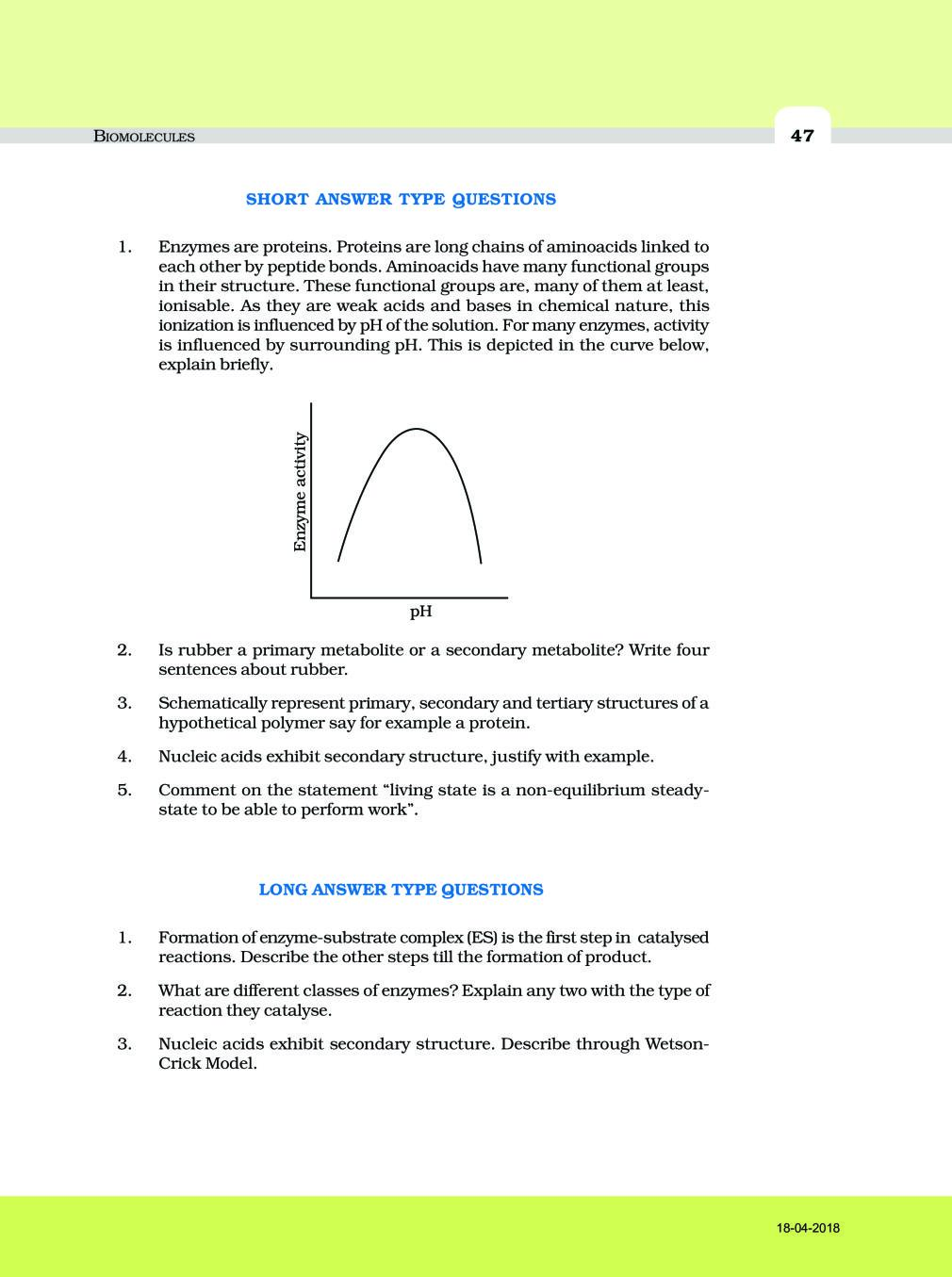
- Enzymes are proteins. Proteins are long chains of aminoacids linked to each other by peptide bonds. Aminoacids have many functional groups in their structure. These functional groups are, many of them at least, ionisable. As they are weak acids and bases in chemical nature, this ionization is influenced by pH of the solution. For many enzymes, activity is influenced by surrounding pH. This is depicted in the curve below, explain briefly.

- Is rubber a primary metabolite or a secondary metabolite? Write four sentences about rubber.
- Schematically represent primary, secondary and tertiary structures of a hypothetical polymer say for example a protein.
- Nucleic acids exhibit secondary structure, justify with example.
- Comment on the statement “living state is a non-equilibrium steady- state to be able to perform work”.
Long Answer Type Questions
- Formation of enzyme-substrate complex (ES) is the first step in catalysed reactions. Describe the other steps till the formation of product.
- What are different classes of enzymes? Explain any two with the type of reaction they catalyse.
- Nucleic acids exhibit secondary structure. Describe through Watson- Crick Model.
- What is the difference between a nucleotide and nucleoside? Give two examples of each with their structure.
- Describe various forms of lipid with a few examples.
Click Here to download NCERT Exemplar Class 11 Biology Chapter 9 Biomolecules.
Answers to Multiple Choice Questions
| 1-c; | 2-b; | 3-b; | 4-d; | 5-b; | 6-d; |
| 7-a; | 8-b; | 9-a; | 10-d; | 11-a; | 12-a; |
| 13-a; | 14-d |
Biology Physics Chemistry Maths
NCERT Exemplar Class 11 Biology Chapter 9 Biomolecules – Overview
| Class | Class 11 |
| Subject | Biology |
| Chapter | 9 – Biomolecules |
| Session | 2027 |
| Format | PDF – read online or download |
Chapter 9 of 22 – Biology
- Previous: Chapter 8 Cell: The Unit of Life
- Next: Chapter 10 Cell Cycle and Cell Division
- All chapters: NCERT Exemplar Class 11 Biology
Also for This Chapter
NCERT Exemplar Class 11 Biology Chapter 9 Biomolecules – Overview
| Class | Class 11 |
| Subject | Biology |
| Chapter | 9 – Biomolecules |
| Session | 2027 |
| Format | PDF – read online or download |
NCERT Exemplar Class 11 Biology Chapter 9 – FAQs
Where can I download NCERT Exemplar Class 11 Biology Chapter 9 Biomolecules PDF?
From the download table on this page – it is free.
Is this for the 2027 session?
Yes, it follows the latest NCERT Class 11 Biology book for 2027.
How should I use these exemplar problems?
Read the chapter in the NCERT book first, attempt the questions yourself, then check your answers here.
Chapter 9 of 22 – Biology
- Previous: Chapter 8 Cell: The Unit of Life
- Next: Chapter 10 Cell Cycle and Cell Division
- All chapters: NCERT Exemplar Class 11 Biology
Also for This Chapter
- NCERT Book Class 11 Biology Chapter 9
- NCERT Solutions Class 11 Biology Chapter 9
- Class 11 Biology Notes – Biomolecules
NCERT Exemplar Class 11 Biology Chapter 9 Biomolecules – Overview
| Class | Class 11 |
| Subject | Biology |
| Chapter | 9 – Biomolecules |
| Session | 2027 |
| Format | PDF – read online or download |
NCERT Exemplar Class 11 Biology Chapter 9 – FAQs
Where can I download NCERT Exemplar Class 11 Biology Chapter 9 Biomolecules PDF?
From the download table on this page – it is free.
Is this for the 2027 session?
Yes, it follows the latest NCERT Class 11 Biology book for 2027.
How should I use these exemplar problems?
Read the chapter in the NCERT book first, attempt the questions yourself, then check your answers here.