Candidates can download NCERT Exemplar Class 12 Biology Chapter 2 from this page. The exemplar has been provided by the National Council of Educational Research & Training (NCERT) and the candidates can check it from below for free of cost. It contains objective, very short answer type, short answer type, and long answer type questions. Along with it, the answer for each question has also been provided. From the NCERT Exemplar Class 12 Biology Chapter 2, candidates can understand the level and type of questions that are asked in the exam.
NCERT Exemplar Class 12 Biology Chapter 2 Sexual Reproduction in Flowering Plants
NCERT Class 12 Biology Chapter 2 is for Sexual Reproduction in Flowering Plants. The type of questions that will be asked from NCERT Class 12 Biology Chapter 2 are displayed in the below provided NCERT Exemplar Class 12 Biology Chapter 2. With the help of it, candidates can prepare well for the examination.
Also Check: NCERT Solutions for Class 12 Biology
Multiple Choice Questions
- Among the terms listed below, those that of are not technically correct names for a floral whorl are:
i. Androecium
ii. Carpel
iii. Corolla
iv. Sepal
(a) i and iv,
(b) iii and iv
(c) ii and iv
(d) i and ii. - Embryo sac is to ovule as is to an anther.
a. Stamen
b. Filament
c. Pollen grain
d. Androecium - In a typical complete, bisexual and hypogynous flower the arrangement of floral whorls on the thalamus from the outermost to the innermost is:
a. Calyx, corolla, androecium and gynoecium
b. Calyx, corolla, gynoecium and androecium
c. Gynoecium, androecium, corolla and calyx
d. Androecium, gynoecium, corolla and calyx - A dicotyledonous plant bears flowers but never produces fruits and seeds. The most probable cause for the above situation is:
a. Plant is dioecious and bears only pistillate flowers
b. Plant is dioecious and bears both pistillate and staminate flowers
c. Plant is monoecious
d. Plant is dioecious and bears only staminate flowers. - The outermost and innermost wall layers of microsporangium in an anther are respectively:
a. Endothecium and tapetum
b. Epidermis and endodermis
c. Epidermis and middle layer
d. Epidermis and tapetum - During microsporogenesis, meiosis occurs in:
a. Endothecium
b. Microspore mother cells
c. Microspore tetrads
d. Pollen grains. - From among the sets of terms given below, identify those that are associated with the gynoecium.
a. Stigma, ovule, embryo sac, placenta
b. Thalamus, pistil, style, ovule
c. Ovule, ovary, embryo sac, tapetum
d. Ovule, stamen, ovary, embryo sac - Starting from the innermost part, the correct sequence of parts in an ovule are,
a. egg, nucellus, embryo sac, integument
b. egg, embryo sac, nucellus, integument
c. embryo sac, nucellus, integument, egg
d. egg, integument, embryo sac, nucellus. - From the statements given below choose the option that are true for a typical female gametophyte of a flowering
i. It is 8-nucleate and 7-celled at maturity
ii. It is free-nuclear during the development
iii. It is situated inside the integument but outside the nucellus
iv. It has an egg apparatus situated at the chalazal end
(a) i and iv,
(b) ii and iii
(c) i & ii
(d) ii & iv - Autogamy can occur in a chasmogamous flower if:
a. Pollen matures before maturity of ovule
b. Ovules mature before maturity of pollen
c. Both pollen and ovules mature simultaneously
d. Both anther and stigma are of equal lengths. - Choose the correct statement from the following:
a. Cleistogamous flowers always exhibit autogamy
b. Chasmogamous flowers always exhibit geitonogamy
c. Cleistogamous flowers exhibit both autogamy and geitonogamy
d. Chasmogamous flowers never exhibit autogamy - A particular species of plant produces light, non-sticky pollen in large numbers and its stigmas are long and feathery. These modifications facilitate pollination by:
a. Insects
b. Water
c. Wind
d. Animals. - From among the situations given below, choose the one that prevents both autogamy and geitonogamy.
a. Monoecious plant bearing unisexual flowers
b. Dioecious plant bearing only male or female flowers
c. Monoecious plant with bisexual flowers
d. Dioecious plant with bisexual flowers - In a fertilised embryo sac, the haploid, diploid and triploid structures are:
a. Synergid, zygote and primary endosperm nucleus
b. Synergid, antipodal and polar nuclei
c. Antipodal, synergid and primary endosperm nucleus
d. Synergid, polar nuclei and zygote. - In an embryo sac, the cells that degenerate after fertilisation are:
a. Synergid, zygote and primary endosperm nucleus
b. Synergid, antipodal and polar nuclei
c. Antipodal, synergid and primary endosperm nucleus
d. Synergid, polar nuclei and zygote. - While planning for an artificial hybridization programme involving dioecious plants, which of the following steps would not be relevant:
a. Bagging of female flower
b. Dusting of pollen on stigma
c. Emasculation
d. Collection of pollen - In the embryos of a typical dicot and a grass, true homologous structures are:
a. Coleorhiza and coleoptile
b. Coleoptile and scutellum
c. Cotyledons and scutellum
d. Hypocotyl and radicle. - The phenomenon observed in some plants wherein parts of the sexual apparatus is used for forming embryos without fertilisation is called:
a. Parthenocarpy
b. Apomixis
c. Vegetative propagation
d. Sexual reproduction. - In a flower, if the megaspore mother cell forms megaspores without undergoing meiosis and if one of the megaspores develops into an embryo sac, its nuclei would be:
a. Haploid
b. Diploid
c. A few haploid and a few diploid
d. With varying ploidy. - The phenomenon wherein, the ovary develops into a fruit without fertilisation is called:
a. Parthenocarpy
b. Apomixis
c. Asexual reproduction
d. Sexual reproduction
Very Short Answer Type Questions
- Name the component cells of the ‘egg apparatus’ in an embryo sac.
- Name the part of gynoecium that determines the compatible nature of pollen grain.
- Name the common function that cotyledons and nucellus perform.
- Complete the following flow chart
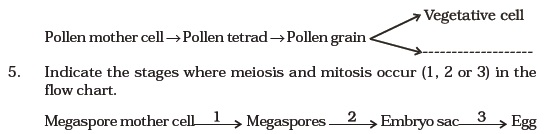
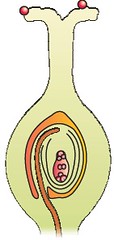
- In the diagram given below, show the path of a pollen tube from the pollen on the stigma into the embryo sac. Name the components of egg apparatus.
- Name the parts of pistil which develop into fruit and seeds.
- In case of polyembryony, if an embryo develops from the synergid and another from the nucellus which is haploid and which is diploid?
- Can an unfertilised, apomictic embryo sac give rise to a diploid embryo? If yes, then how?
- Which are the three cells found in a pollen grain when it is shed at the three celled stage?
- What is self-incompatibility?
- Name the type of pollination in self-incompatible plants.
- Draw the diagram of a mature embryo sac and show its 8-nucleate, 7-celled nature. Show the following parts: antipodals, synergids, egg, central cell, polar nuclei.
- Which is the triploid tissue in a fertilised ovule? How is the triploid condition achieved?
- Are pollination and fertilisation necessary in apomixis? Give reasons.
- Identify the type of carpel with the help of diagrams given below:
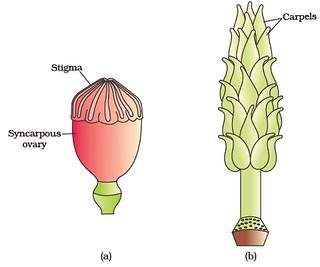
- How is pollination carried out in water plants?
- What is the function of the two male gametes produced by each pollen grain in angiosperms.
Short Answer Type Questions
- List three strategies that a bisexual chasmogamous flower can evolve to prevent self pollination (autogamy).
- Given below are the events that are observed in an artificial hybridization programme. Arrange them in the correct sequential order in which they are followed in the hybridisation programme.
(a) Re-bagging
(b) Selection of parents
(c) Bagging
(d) Dusting the pollen on stigma
(e) Emasculation
(f) Collection of pollen from male parent. - Vivipary automatically limits the number of offsprings in a litter. How?
- Does self incompatibility impose any restrictions on autogamy? reasons and suggest the method of pollnation in such plants.
- In the given diagram, write the names of parts shown with lines.
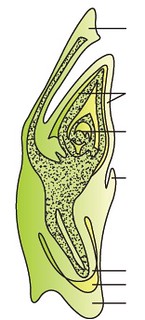
- What is polyembryony and how can it be commercially exploited?
- Are parthenocarpy and apomixis different phenomena? Discuss their benefits.
Hint: Yes, they are different. Parthenocarpy leads to development of seedless fruits. Apomixis leads to embryo development. - Why does the zygote begin to divide only after the division of Primary endosperm cell (PEC)?
- The generative cell of a two-celled pollen divides in the pollen tube but not in a three-celled pollen. Give reasons.
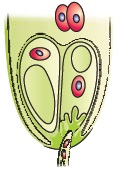
- In the figure given below label the following parts: male gametes, egg cell, polar nuclei, synergid and pollen tube
Long Answer Type Questions
- Starting with the zygote, draw the diagrams of the different stages of embryo development in a dicot.
- What are the possible types of pollinations in chasmogamous flowers. Give reasons.
- With a neat, labelled diagram, describe the parts of a mature angiosperm embryo sac. Mention the role of synergids.
- Draw the diagram of a microsporangium and label its wall layers. Write briefly on the role of the endothecium.
- Embryo sacs of some apomictic species appear normal but contain diploid cells. Suggest a suitable explanation for the condition.
| « Previous | Next » |
Answers to Multiple Choice Questions
| 1-c | 2-c | 3-a | 4-d | 5-d | 6-b |
| 7-a | 8-b | 9-c | 10-c | 11-a | 12-c |
| 13-b | 14-a | 15-b | 16-c | 17-c | 18-b |
| 19-b | 20-a |
Biology Physics Chemistry Maths
To get study material, exam alerts and news, join our Whatsapp Channel.