Download the 2nd PUC Chemistry Quarterly Question Paper 2026 PDF free, along with the 2025 and 2024 papers. The 2026 paper is for 35 marks, 1 hour 30 minutes, 24 questions, without answers. Papers are set at district or college level, so the questions differ from place to place.
2nd PUC Chemistry Quarterly Question Paper PDF Download
Open a paper to read it online or download the PDF.
| Year | Paper | Download |
|---|---|---|
| 2026 | Karnataka 2nd PUC Quarterly Exam Question Paper 2026 Chemistry | View PDF |
| 2025 | Karnataka 2nd PUC Quarterly Exam Question Paper 2025 Chemistry | View PDF |
| 2024 | Karnataka 2nd PUC Quarterly Exam Question Paper 2024 Chemistry | View PDF |
2nd PUC Chemistry Quarterly Question Paper 2026 – Quick Facts
| Board | Karnataka (Department of School Education – Pre-University) |
| Class | Class 12 |
| Exam | Quarterly exam – in the first term (August–September) |
| Subject | Chemistry |
| Papers on this page | 2026, 2025, 2024 |
| Marks and time | 35 marks, 1 hour 30 minutes |
| Answers | Not included |
| Medium | English |
2nd PUC Chemistry Quarterly Question Paper 2026 – Read Online
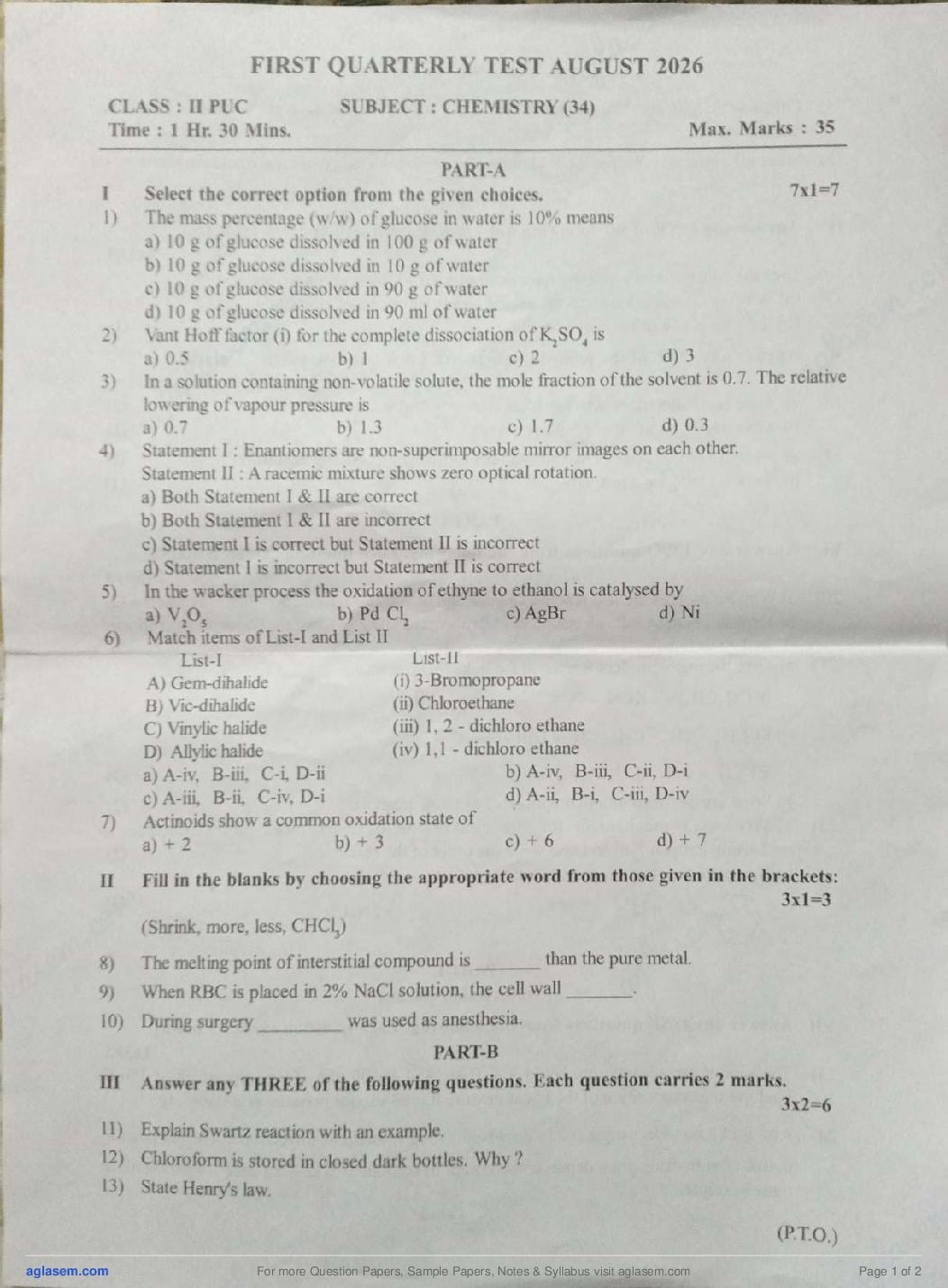
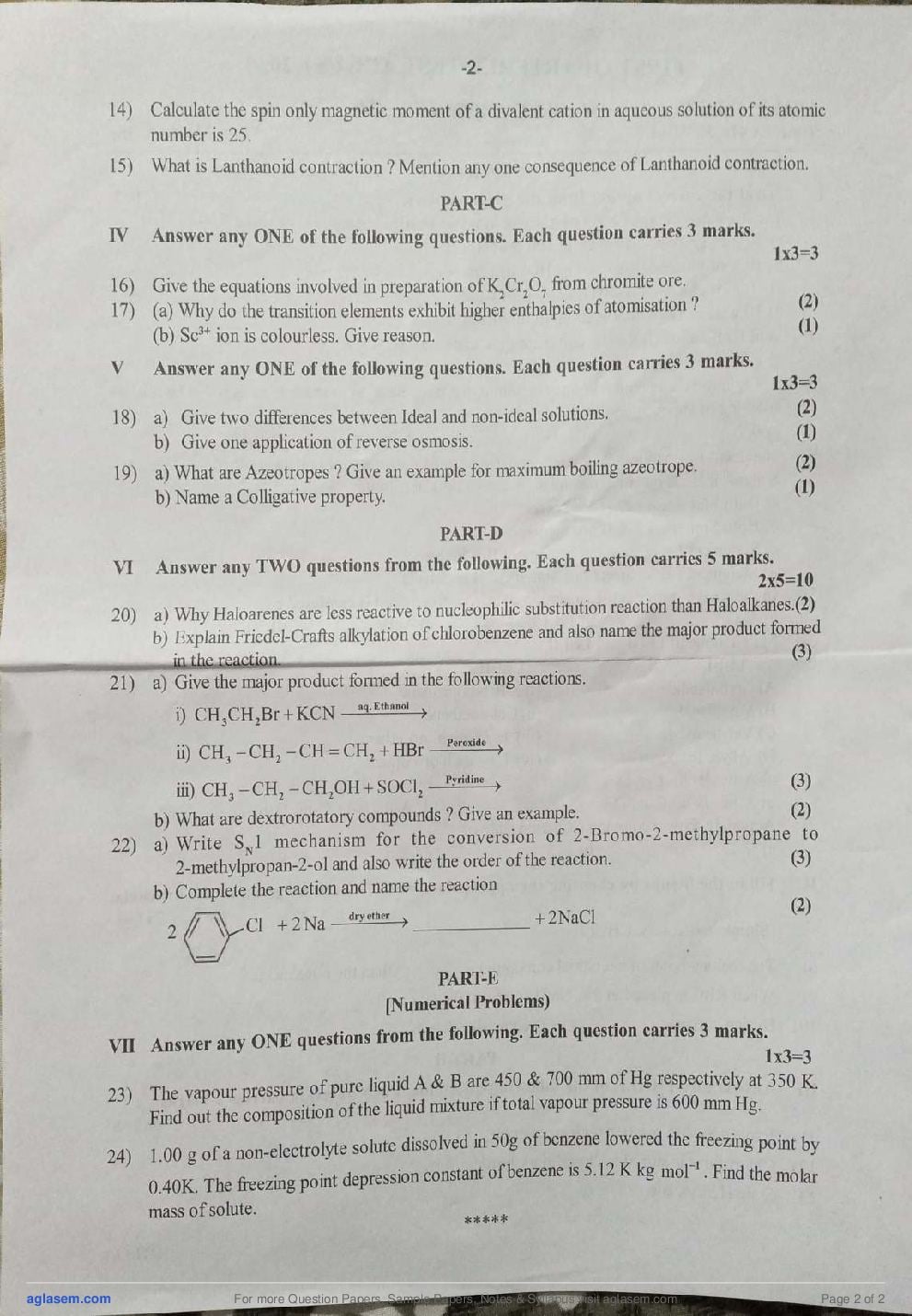
2nd PUC Chemistry Quarterly Question Paper 2026 – Paper Pattern
How the 2026 paper is set (read from the paper itself):
| Section | What is asked | Marks |
|---|---|---|
| Part A | 7 MCQs and 3 fill in the blanks | 7 × 1 + 3 × 1 = 10 |
| Part B | Short answers, any 3 | 3 × 2 = 6 |
| Part C | Two choice groups, any one from each | 1 × 3 + 1 × 3 = 6 |
| Part D | Long answers, any 2 | 2 × 5 = 10 |
| Part E | Numerical problems, any 1 | 1 × 3 = 3 |
Chapters Asked in the 2026 Paper
- Solutions (Henry's law, colligative properties, azeotropes)
- Haloalkanes and Haloarenes (Swarts reaction, SN1 mechanism, Friedel-Crafts)
- The d- and f-Block Elements (K2Cr2O7, lanthanoid contraction)
- Optical isomerism (enantiomers, racemic mixture)
How to Score Well – Tips from the 2026 Paper
- Part E has numerical problems such as vapour pressure and molar mass from freezing point depression.
- In Parts B to E you must pick only the stated number of questions.
- Reaction questions in Part D ask for named reactions and major products, so learn them with equations.
- Solve the 2026 paper in one sitting with a timer, then the older papers, and revise the chapters where you lose marks.
More Chemistry Papers and Study Material
Practise more Class 12 Chemistry papers, or plan your revision with the blueprint.
2nd PUC Chemistry Quarterly Question Paper – FAQs
Is the 2nd PUC Chemistry Quarterly Question Paper 2026 available?
Yes. The 2026 paper is the first one in the table above, with the 2025 and 2024 papers.
Does the 2nd PUC Chemistry Quarterly Question Paper have answers?
No, it has only the questions. Check your answers with your textbook and the study material linked above.
Which medium is the 2nd PUC Chemistry Quarterly Question Paper in?
The 2026 paper is in English.
How many marks is the 2nd PUC Chemistry Quarterly Question Paper?
The 2026 paper is for 35 marks, 1 hour 30 minutes, 24 questions – Part A: 7 × 1 + 3 × 1 = 10; Part B: 3 × 2 = 6; Part C: 1 × 3 + 1 × 3 = 6; Part D: 2 × 5 = 10; Part E: 1 × 3 = 3.
Which chapters come in the 2nd PUC Chemistry Quarterly exam?
In the 2026 paper: Solutions; Haloalkanes and Haloarenes; The d- and f-Block Elements; Optical isomerism.
Is the 2nd PUC Chemistry Quarterly Question Paper the same for every school?
Papers are set at district or college level, so the questions differ from place to place.
Where can I download the 2nd PUC Chemistry Quarterly Question Paper PDF?
From the table on this page – every paper is a free PDF you can read online or download.