Download Prime Time – NCERT Class 6 Maths Chapter 5 PDF from the new NCERT Class 6 Maths book Ganita Prakash (2026-27). Read the chapter online or download the free PDF. A multiple of a number is what you get on multiplying it by 1, 2, 3, … A factor (or divisor) of a number divides it exactly, leaving remainder 0. Numbers that are multiples of both numbers are their common multiples; numbers that divide both are…
Prime Time PDF – Chapter 5 of Ganita Prakash
Read the chapter online or download the PDF.
| Chapter | Download | |
|---|---|---|
| Chapter 5 PDF | Prime Time | View PDF |
| Full book | NCERT Class 6 Maths – Ganita Prakash | View Book |
Read Online
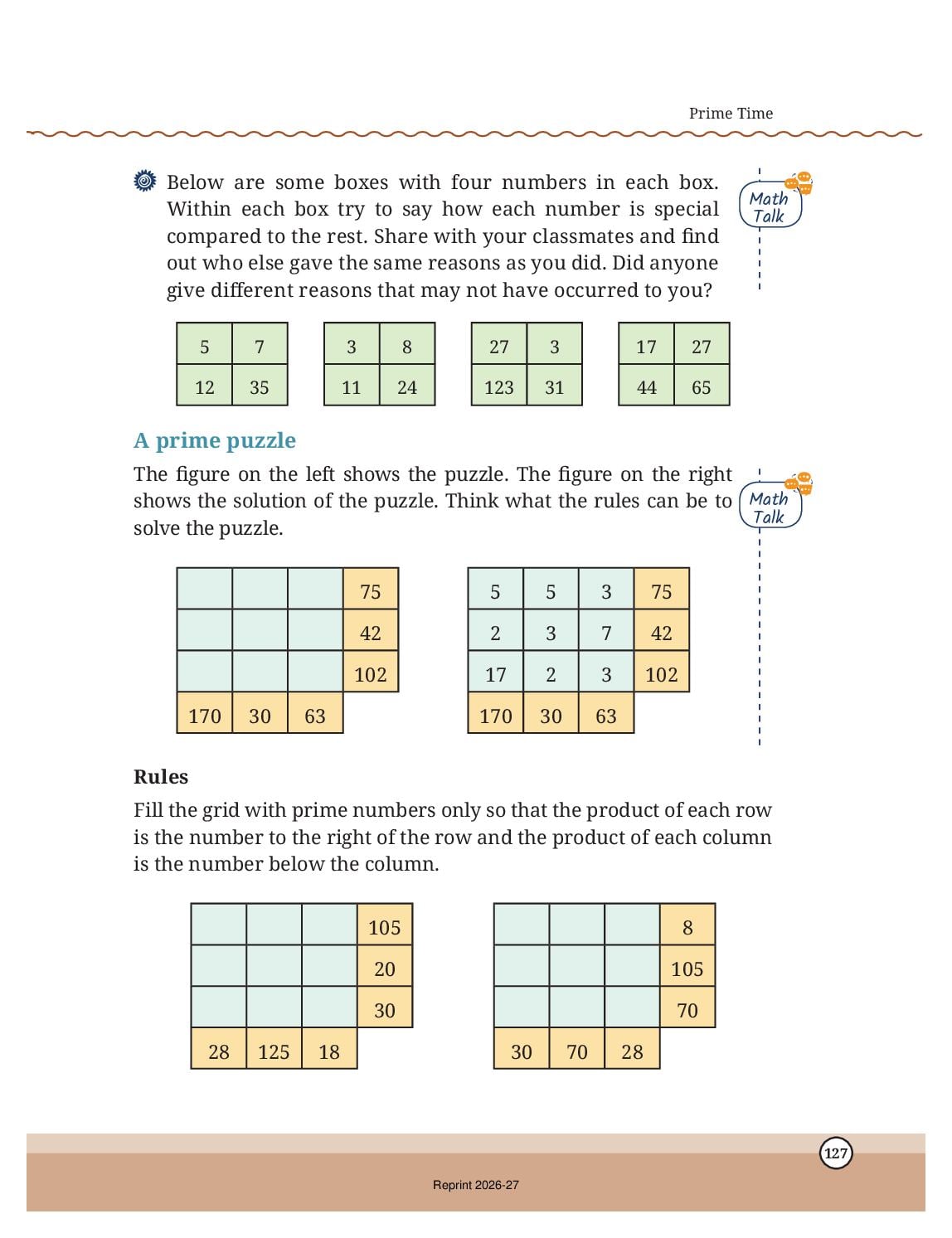
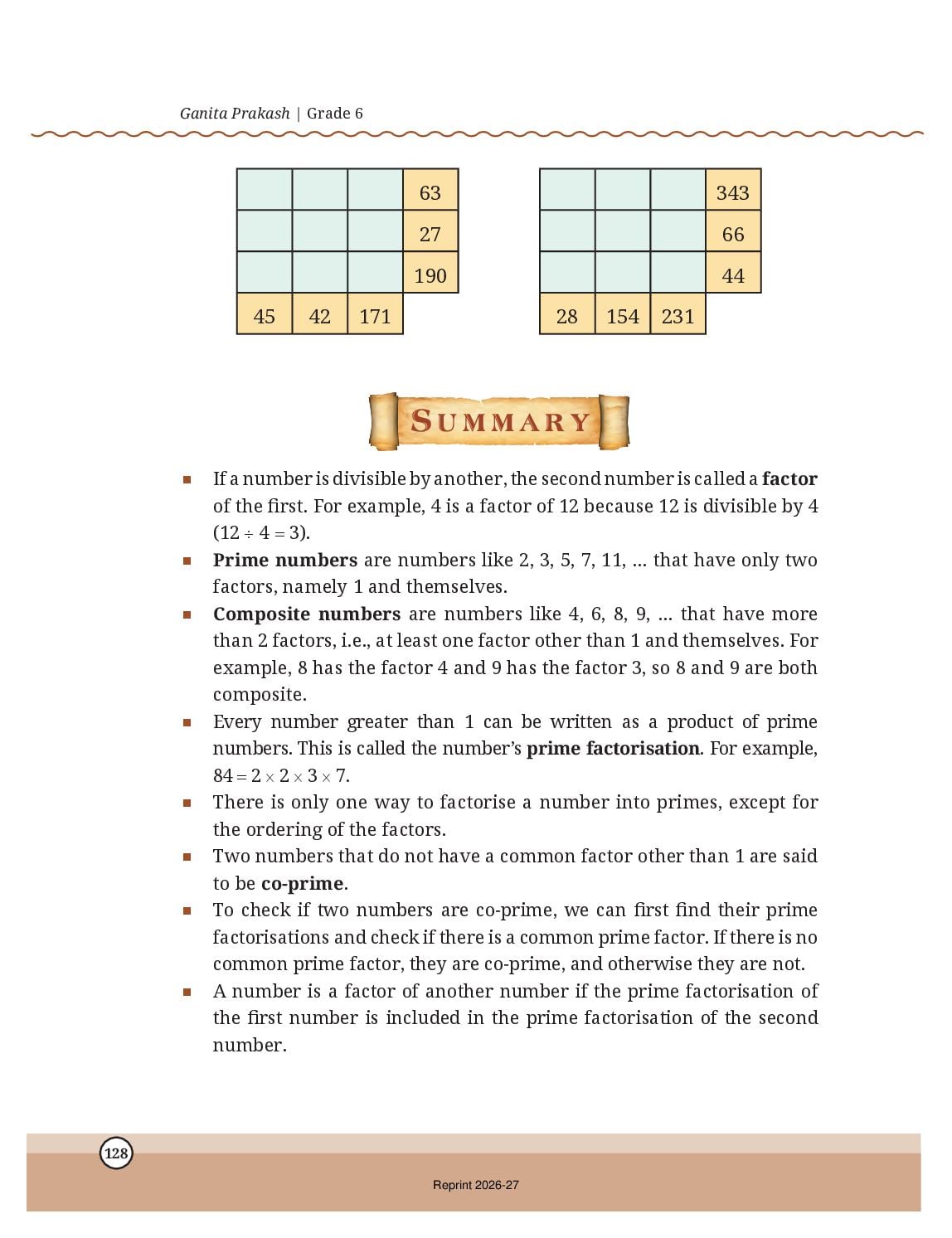
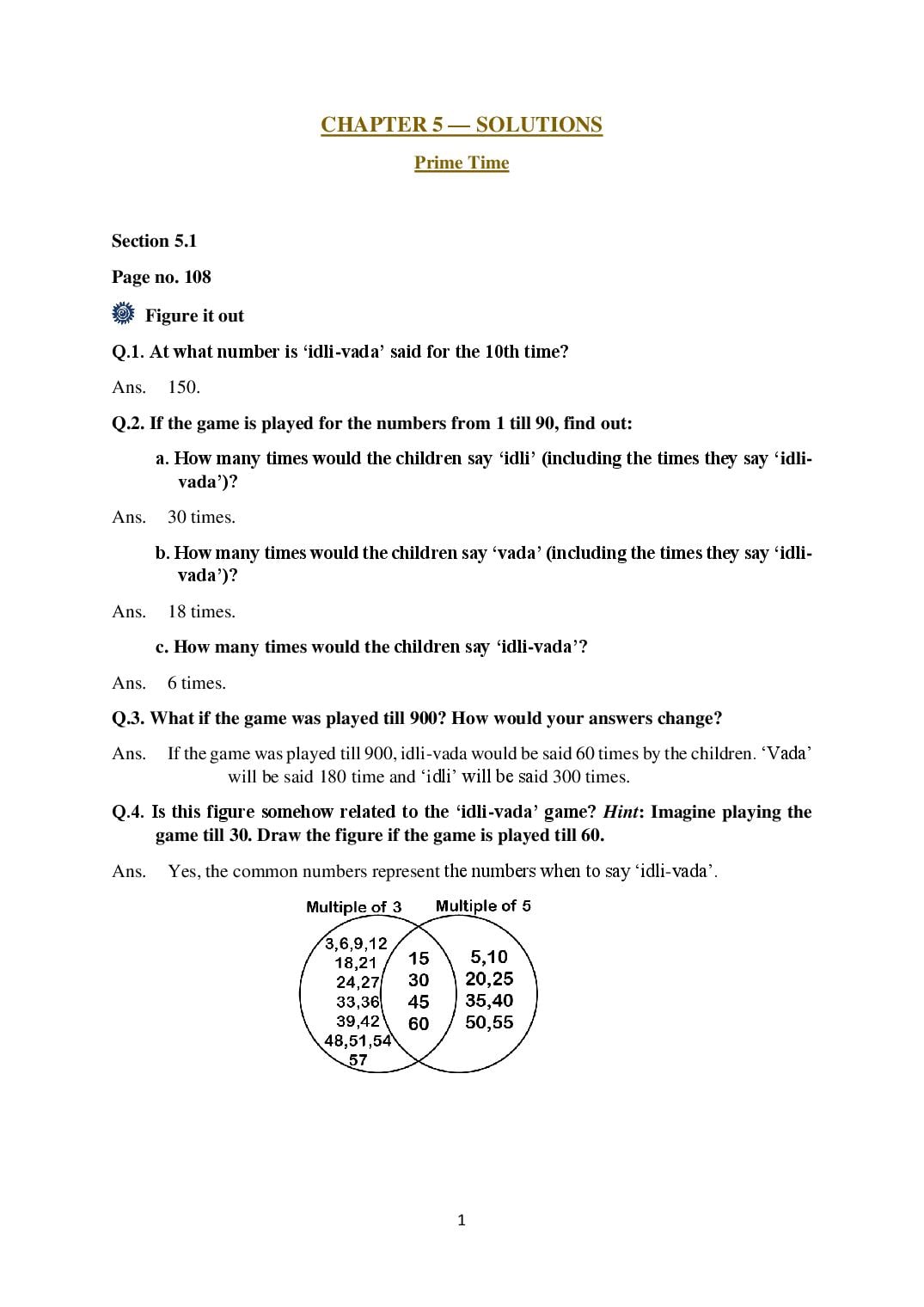
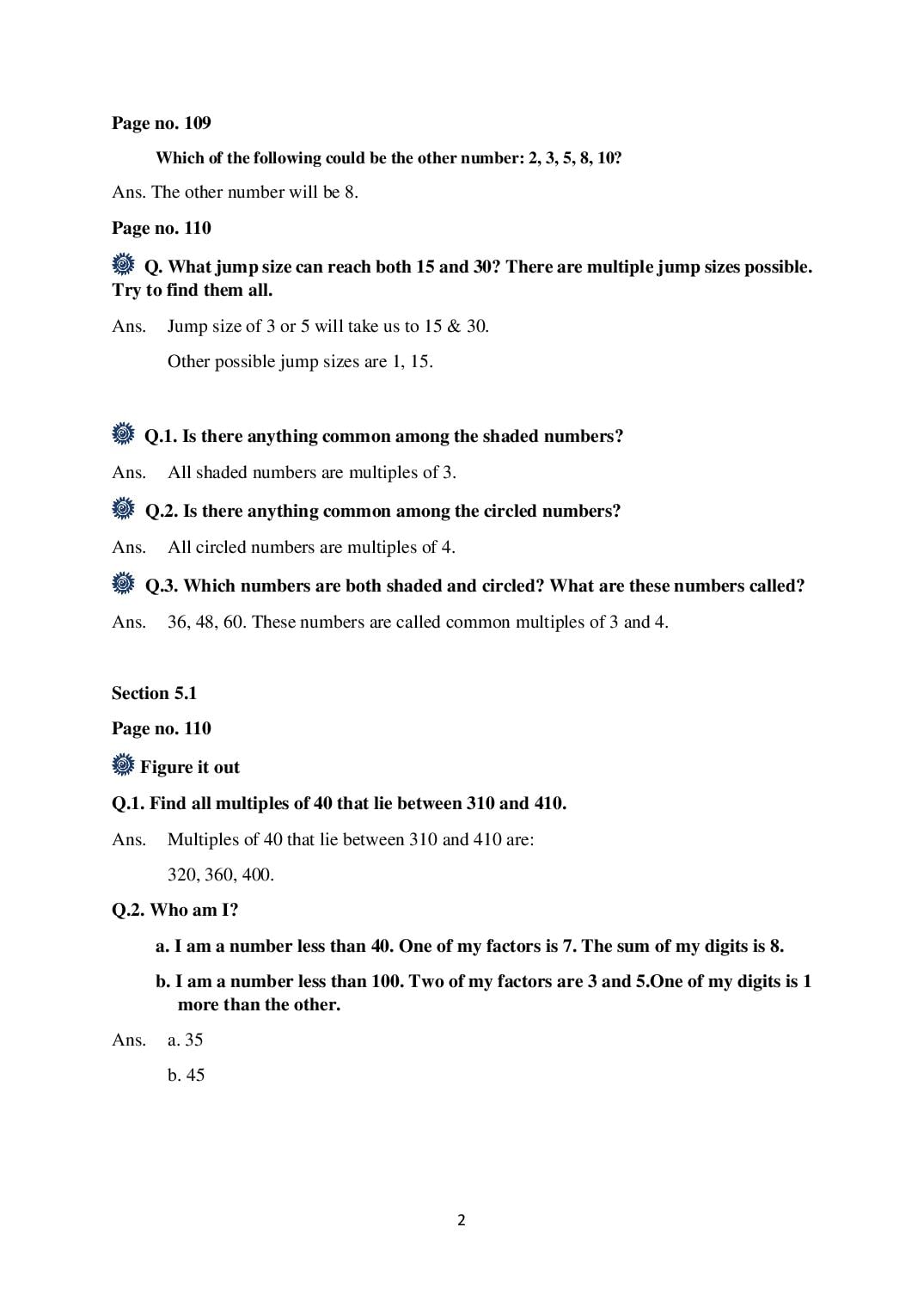
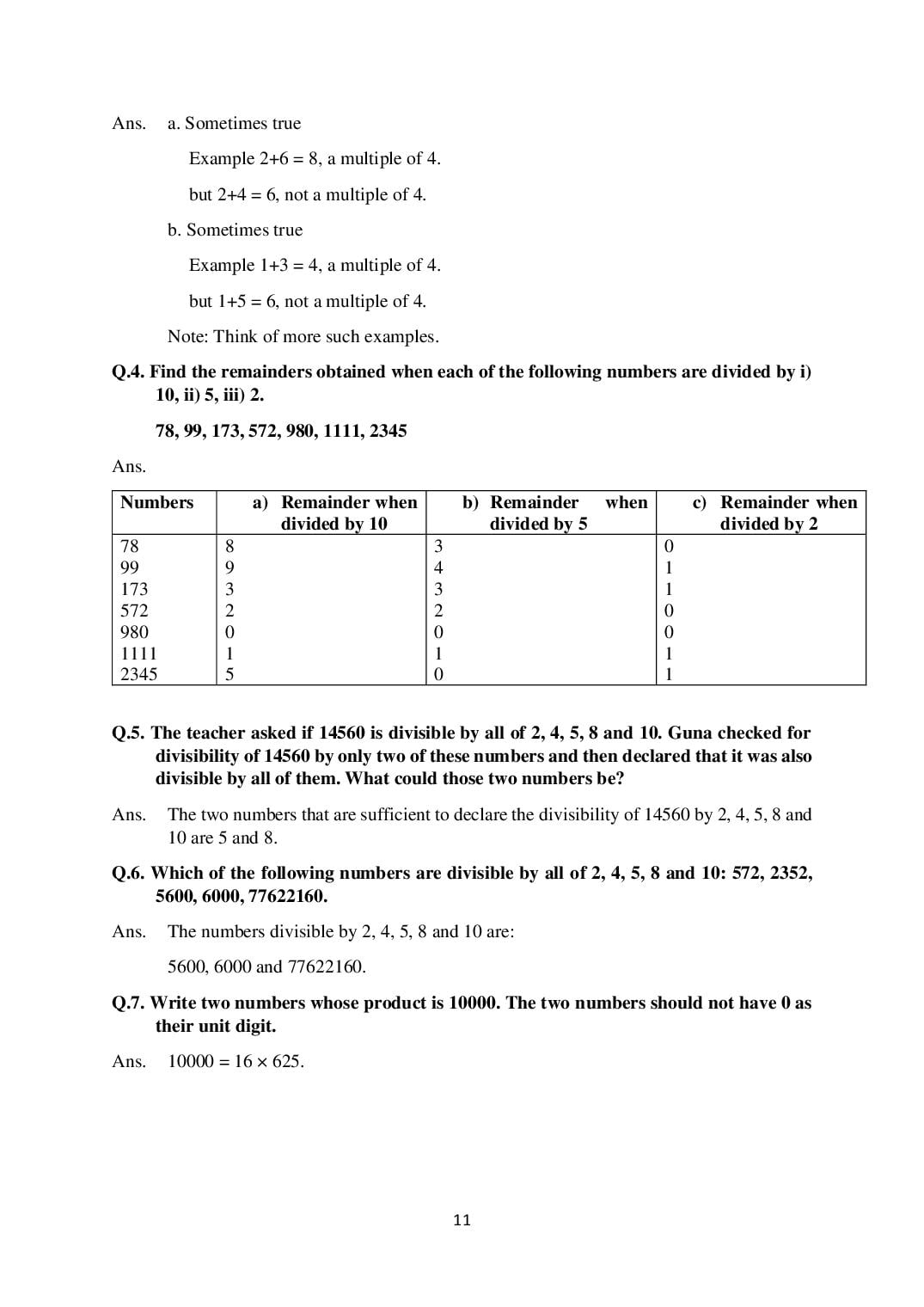
What Is in Prime Time? (Class 6 Maths Chapter 5)
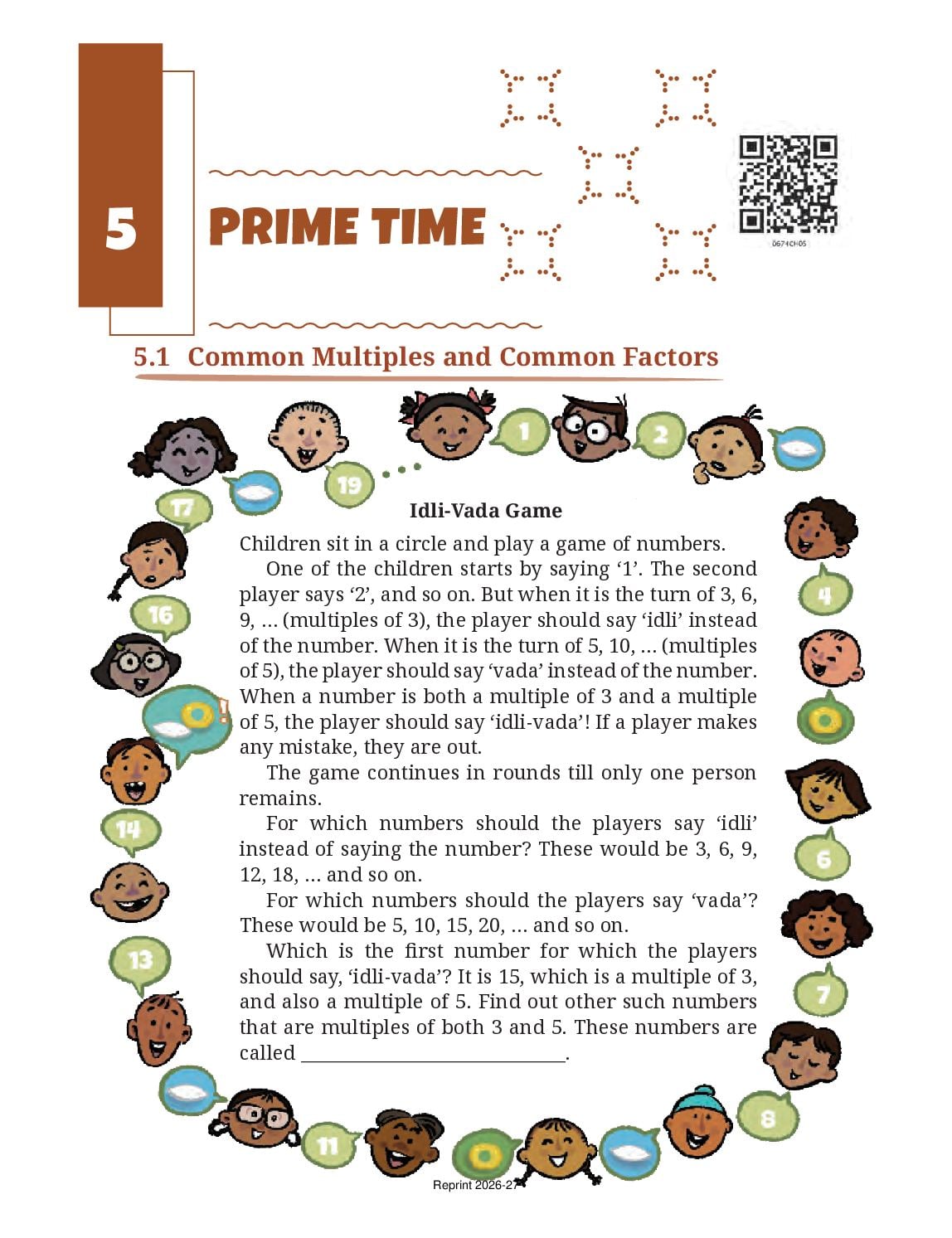
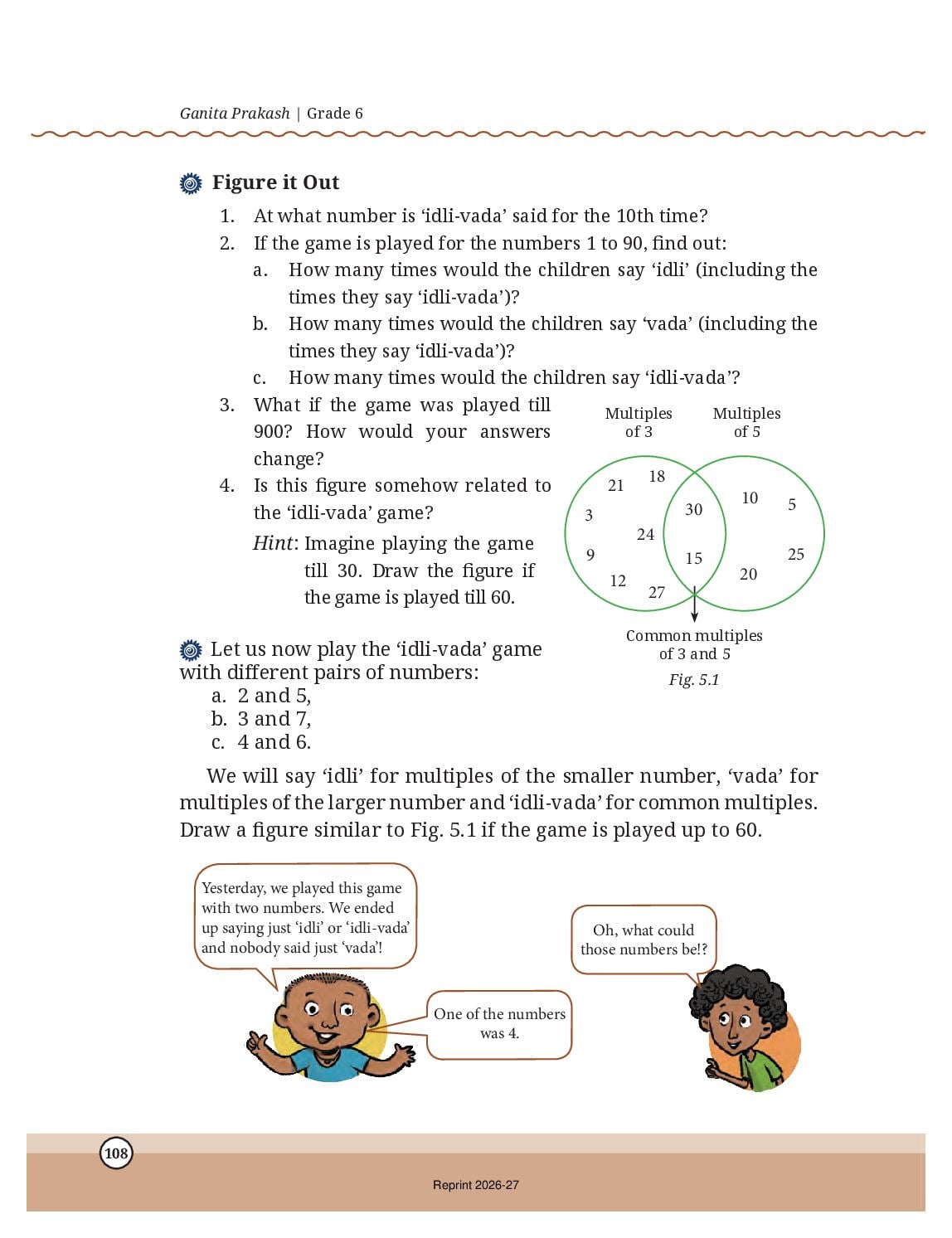
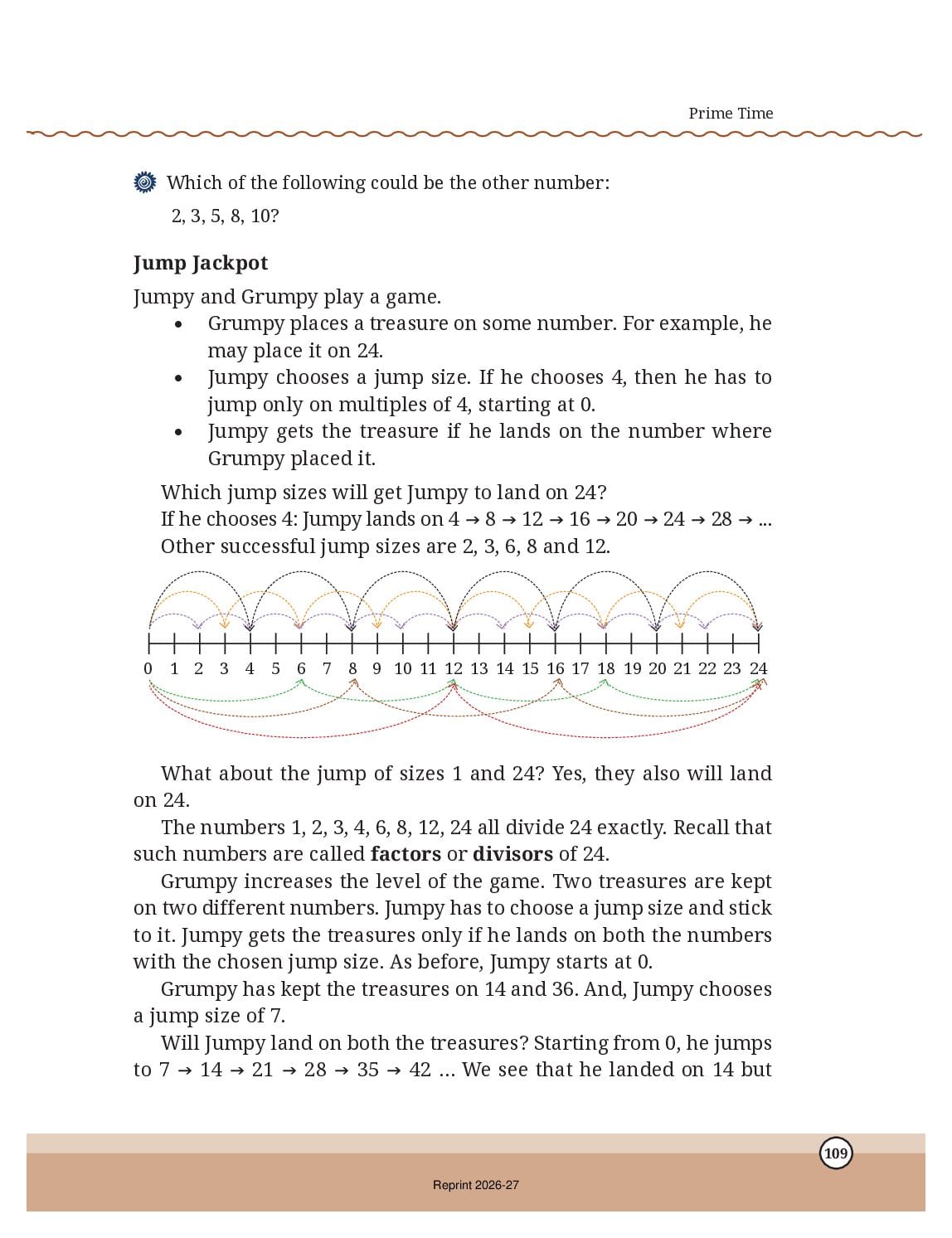
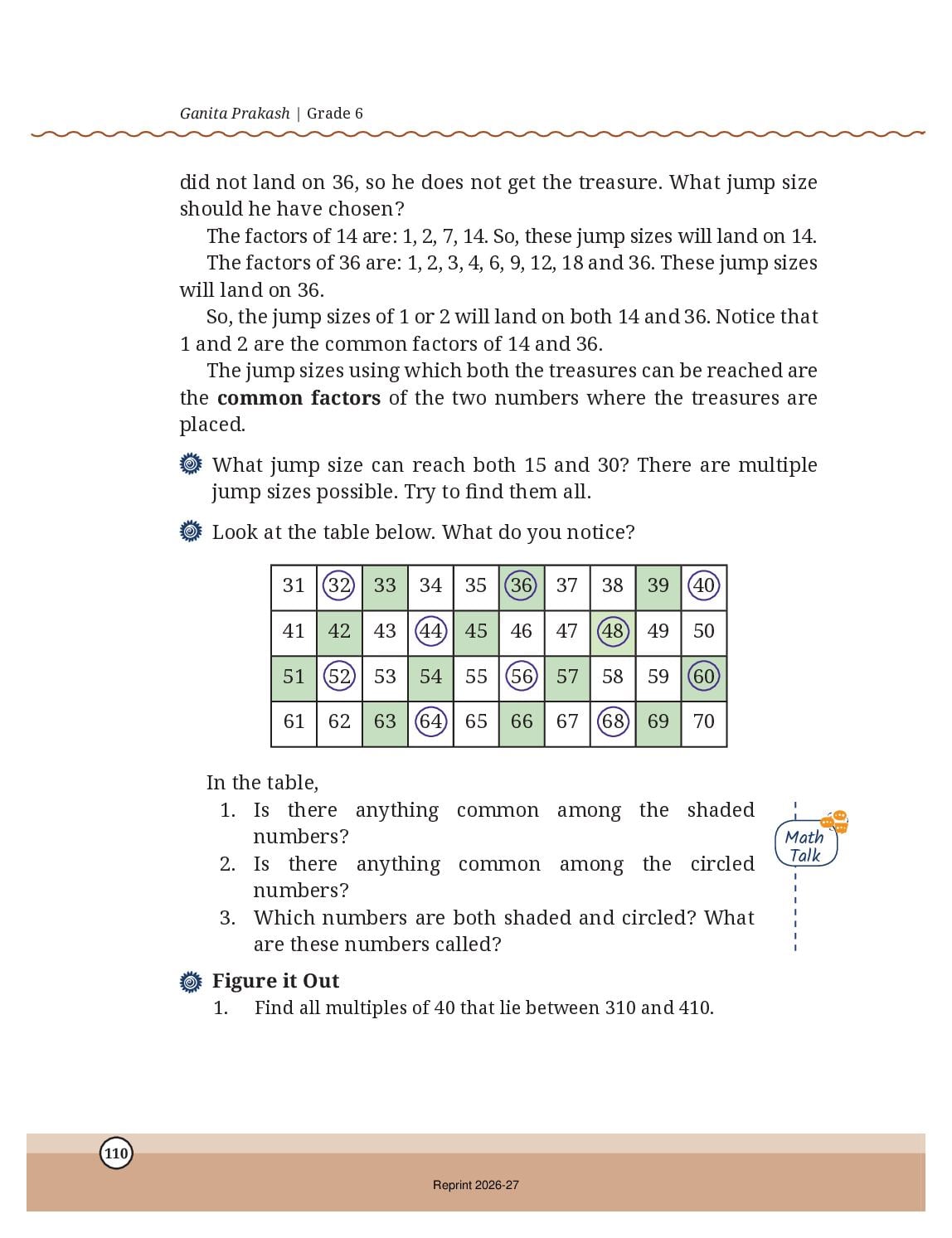
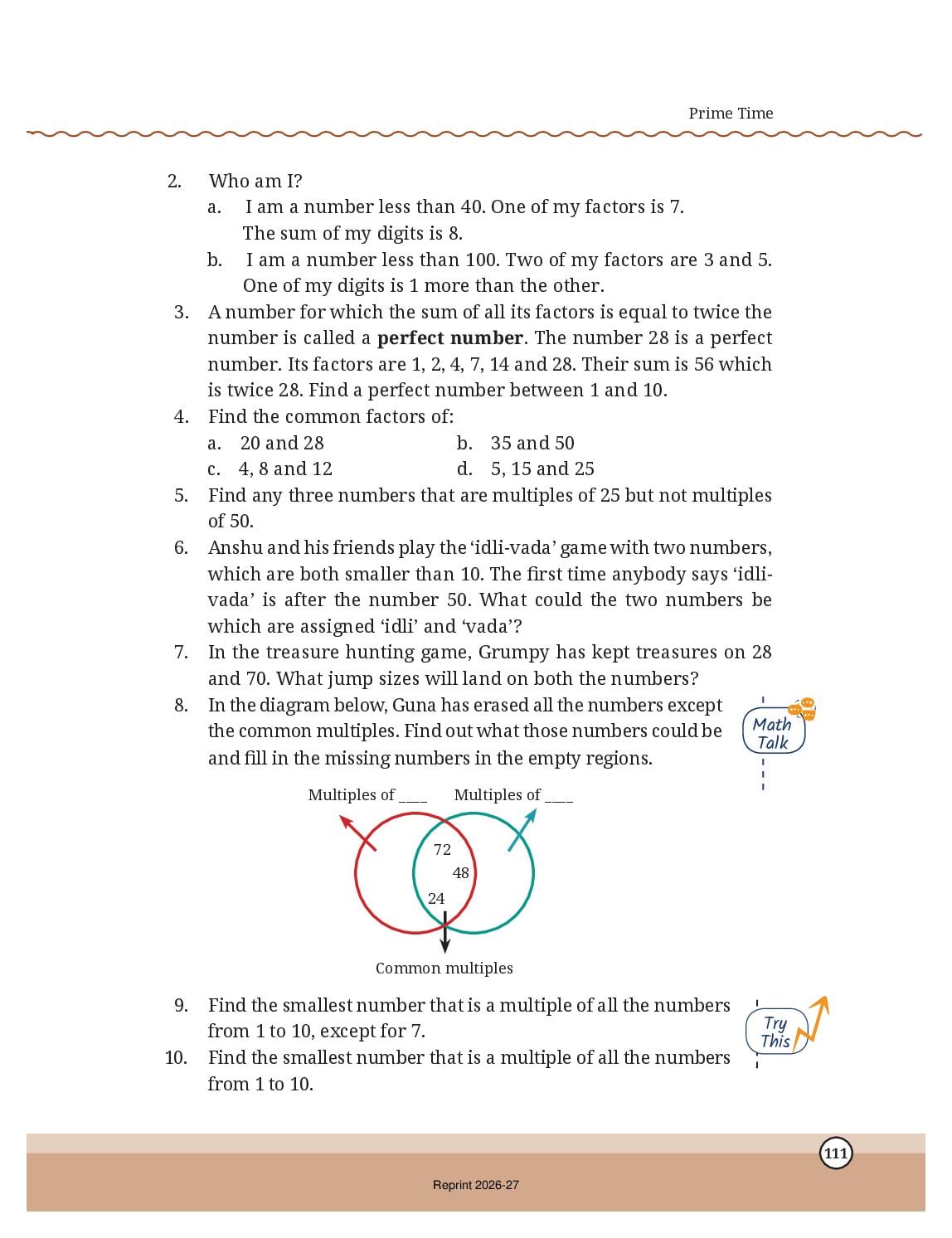
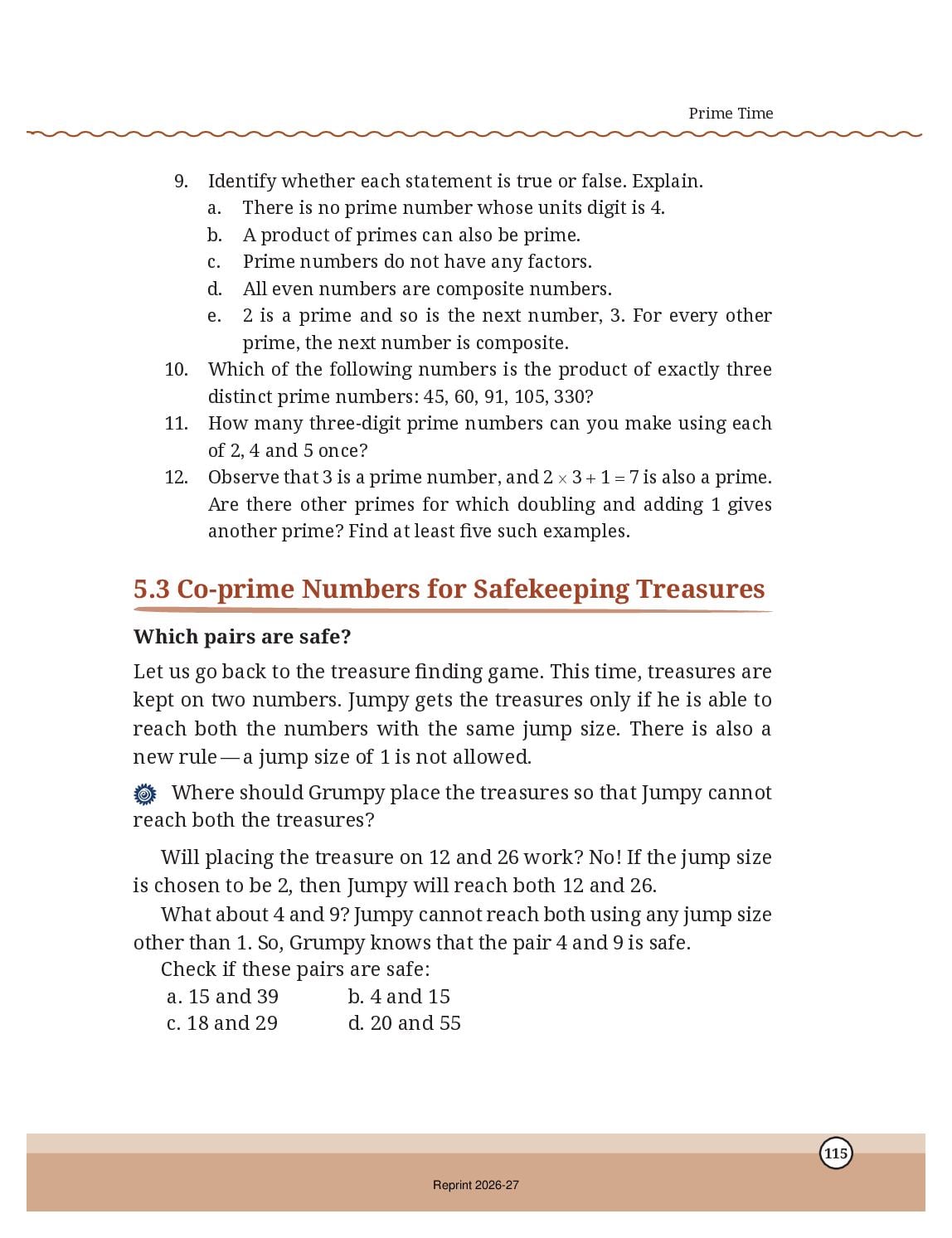
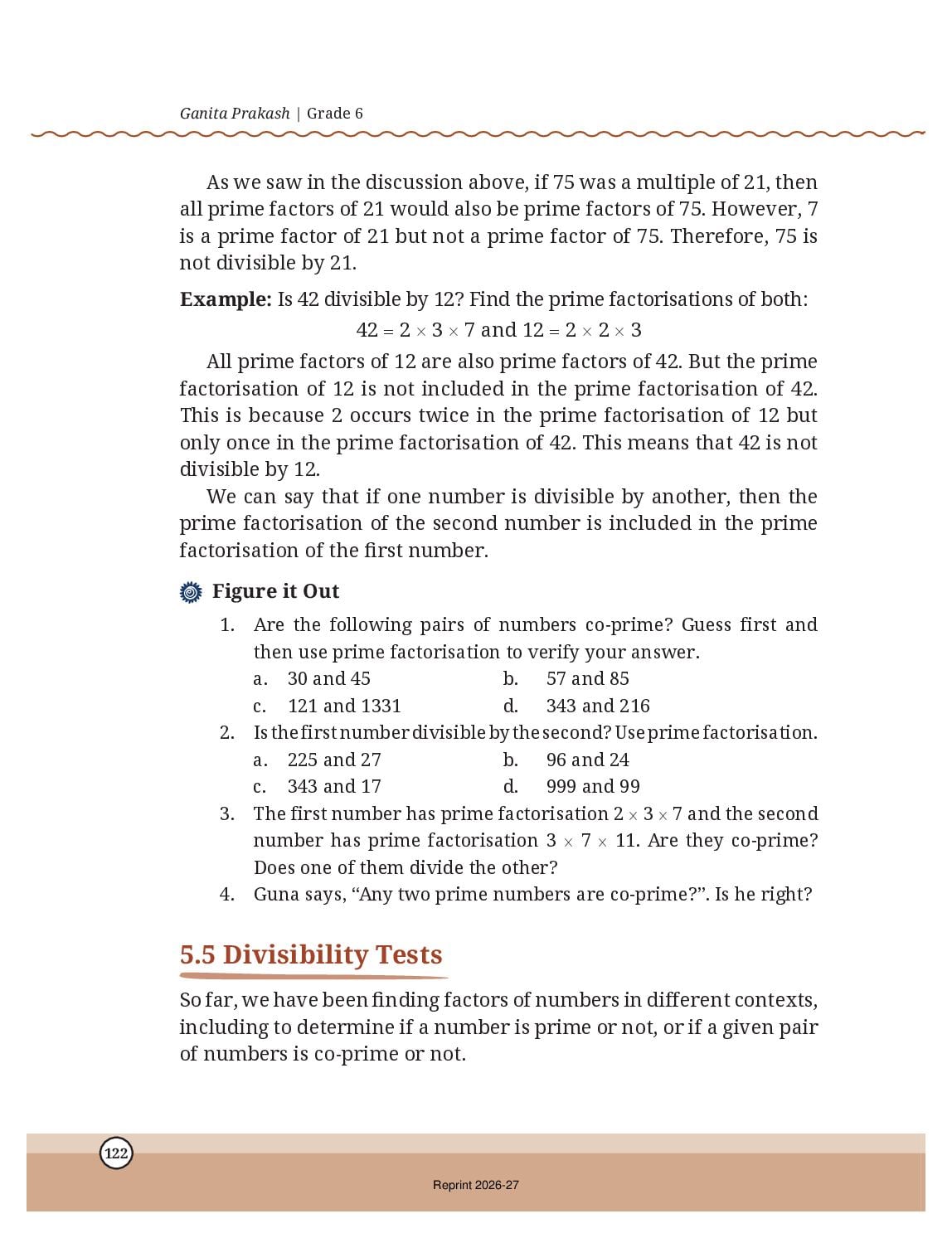
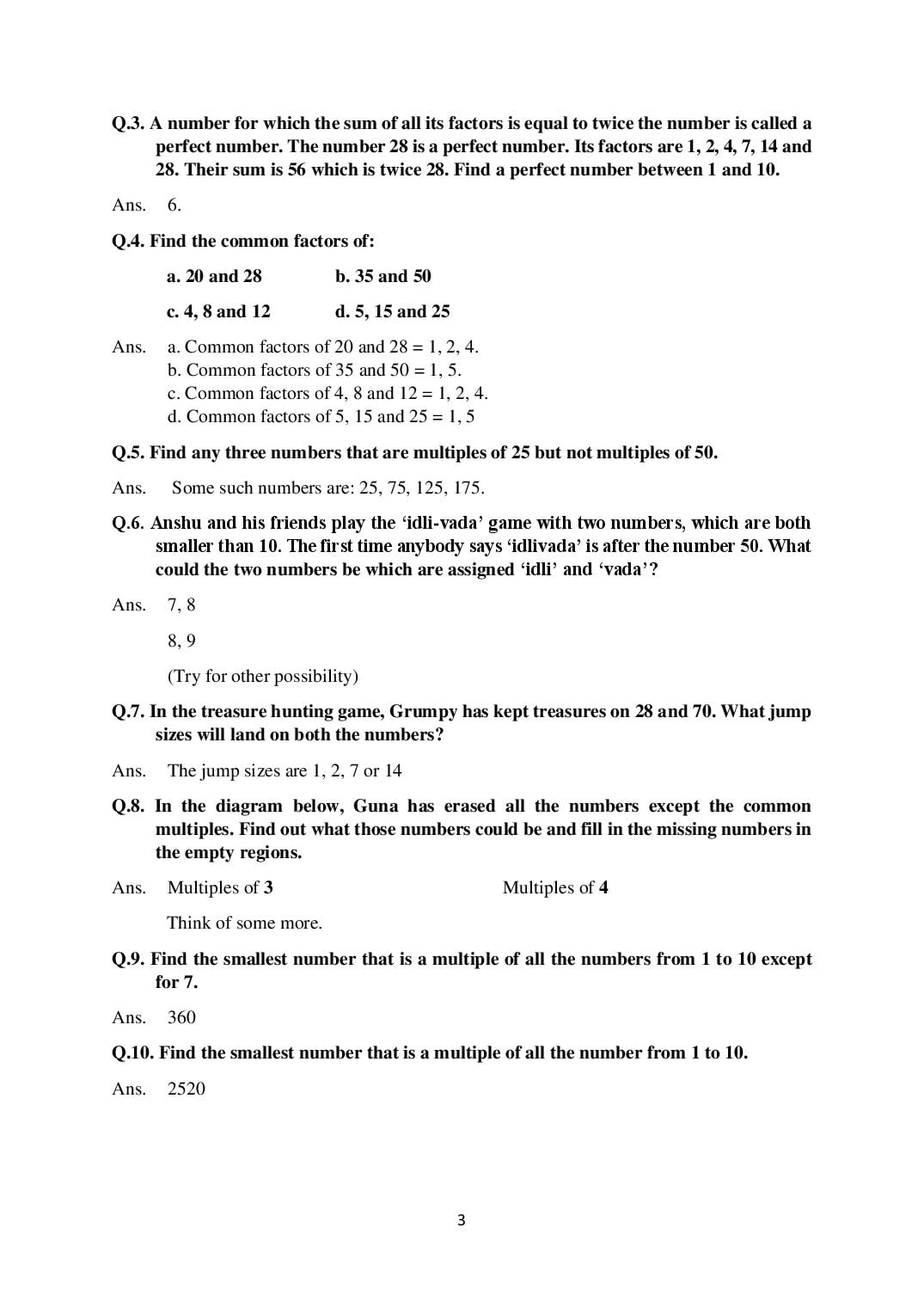
- A multiple of a number is what you get on multiplying it by 1, 2, 3, … A factor (or divisor) of a number divides it exactly, leaving remainder 0. Numbers that are multiples of both numbers are their common multiples; numbers that divide both are their common factors.
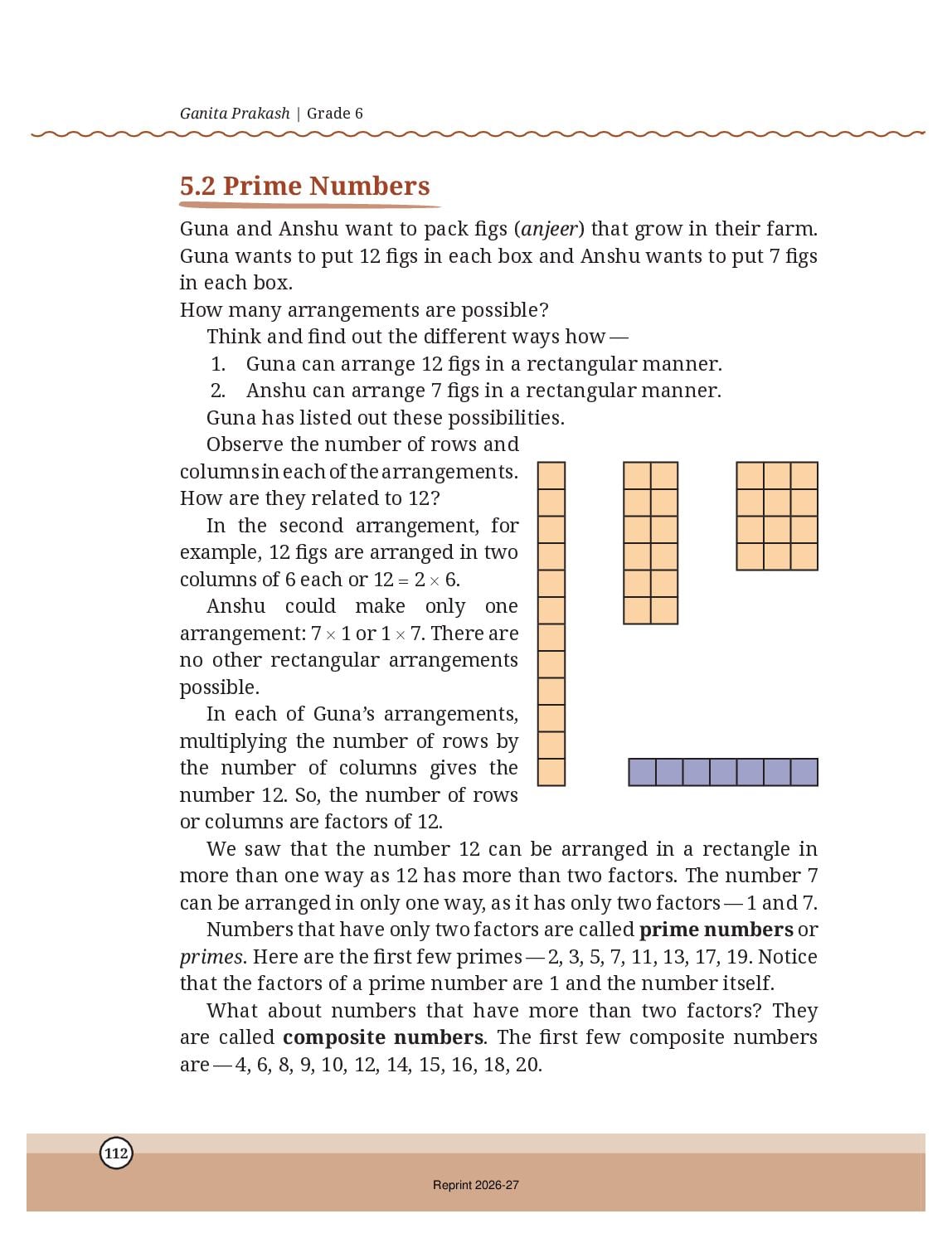
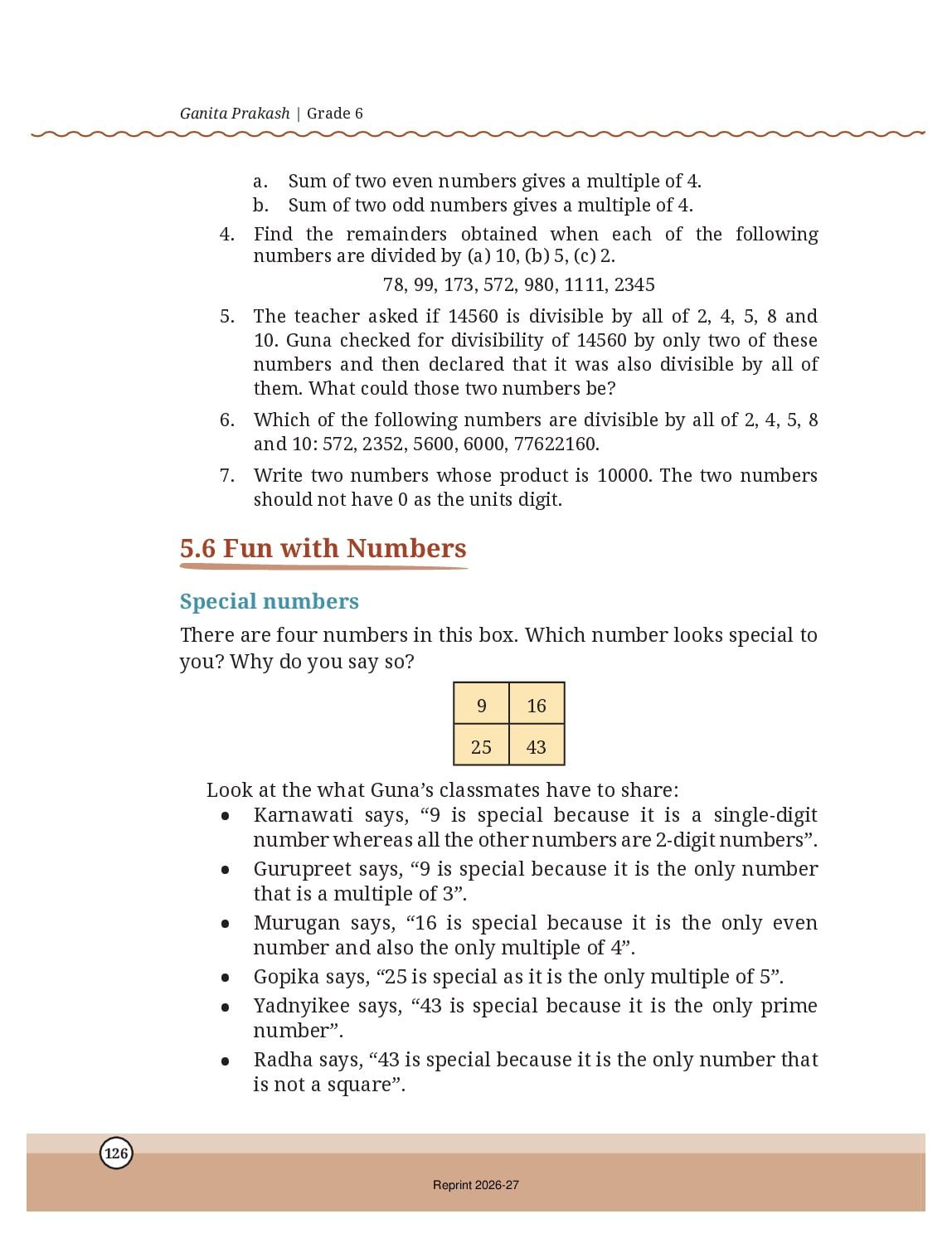
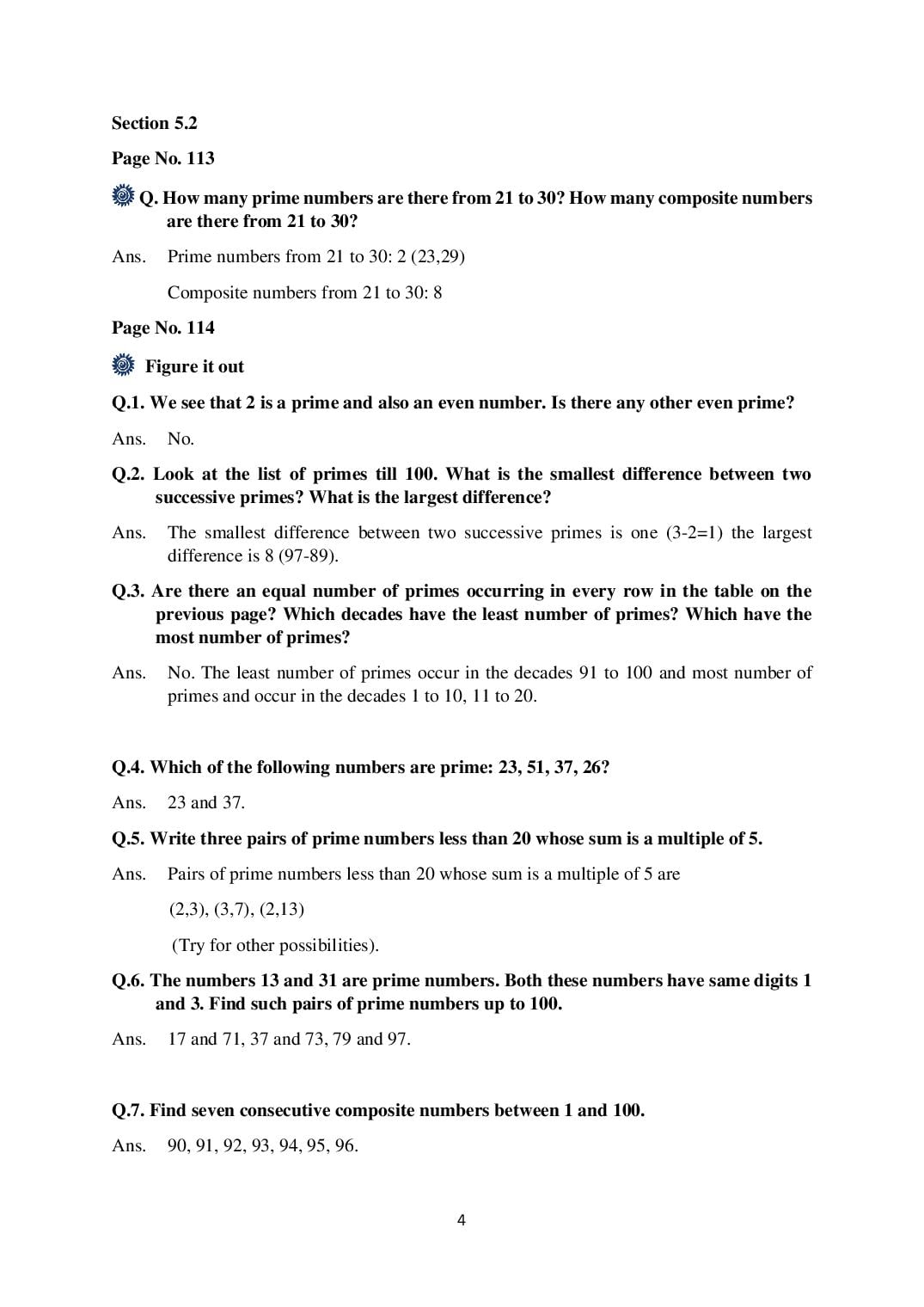
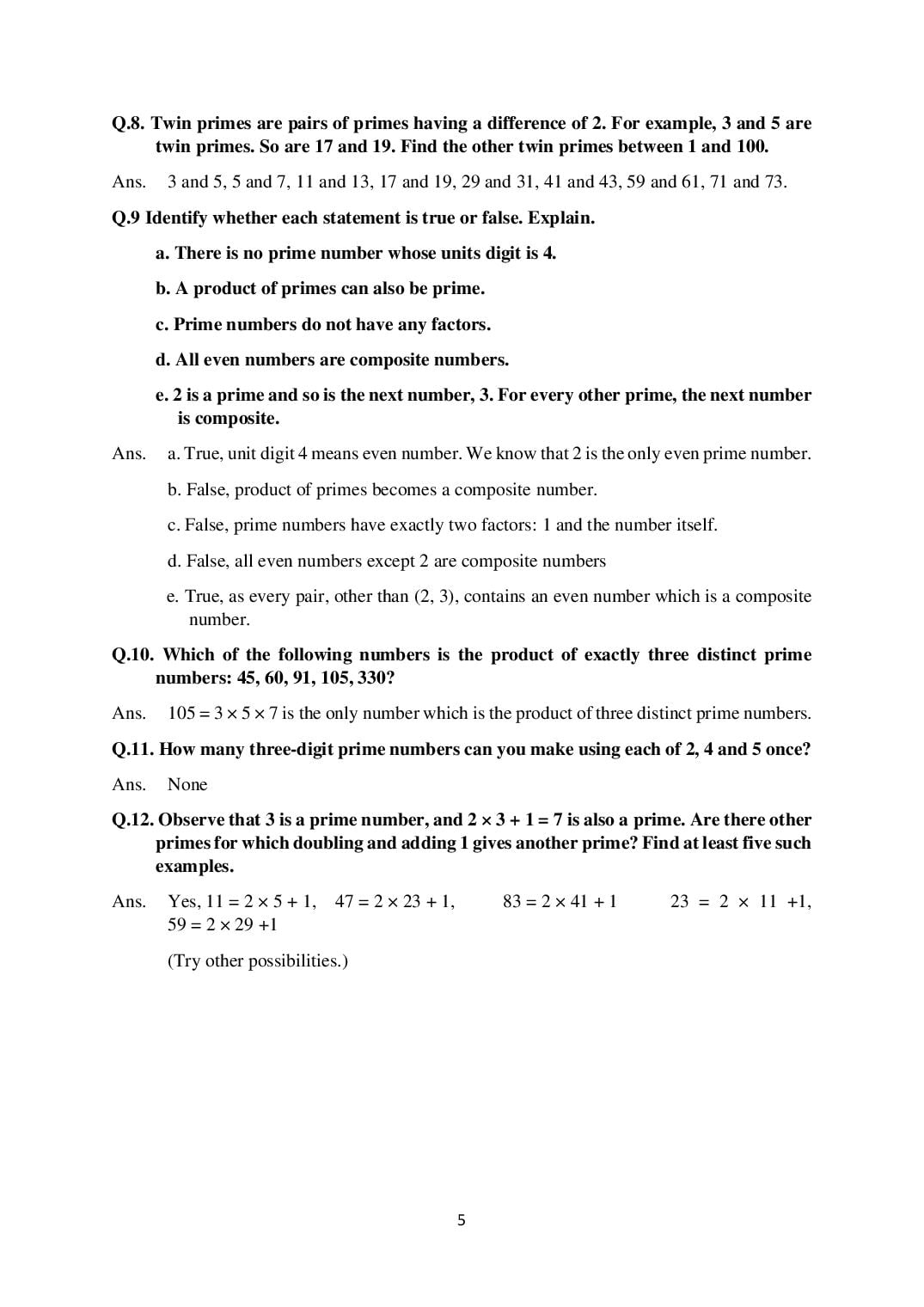
- A prime number has exactly two factors — 1 and itself (2, 3, 5, 7, 11, …). A composite number has more than two factors (4, 6, 8, 9, …). The number 1 is neither prime nor composite, as it has only one factor.
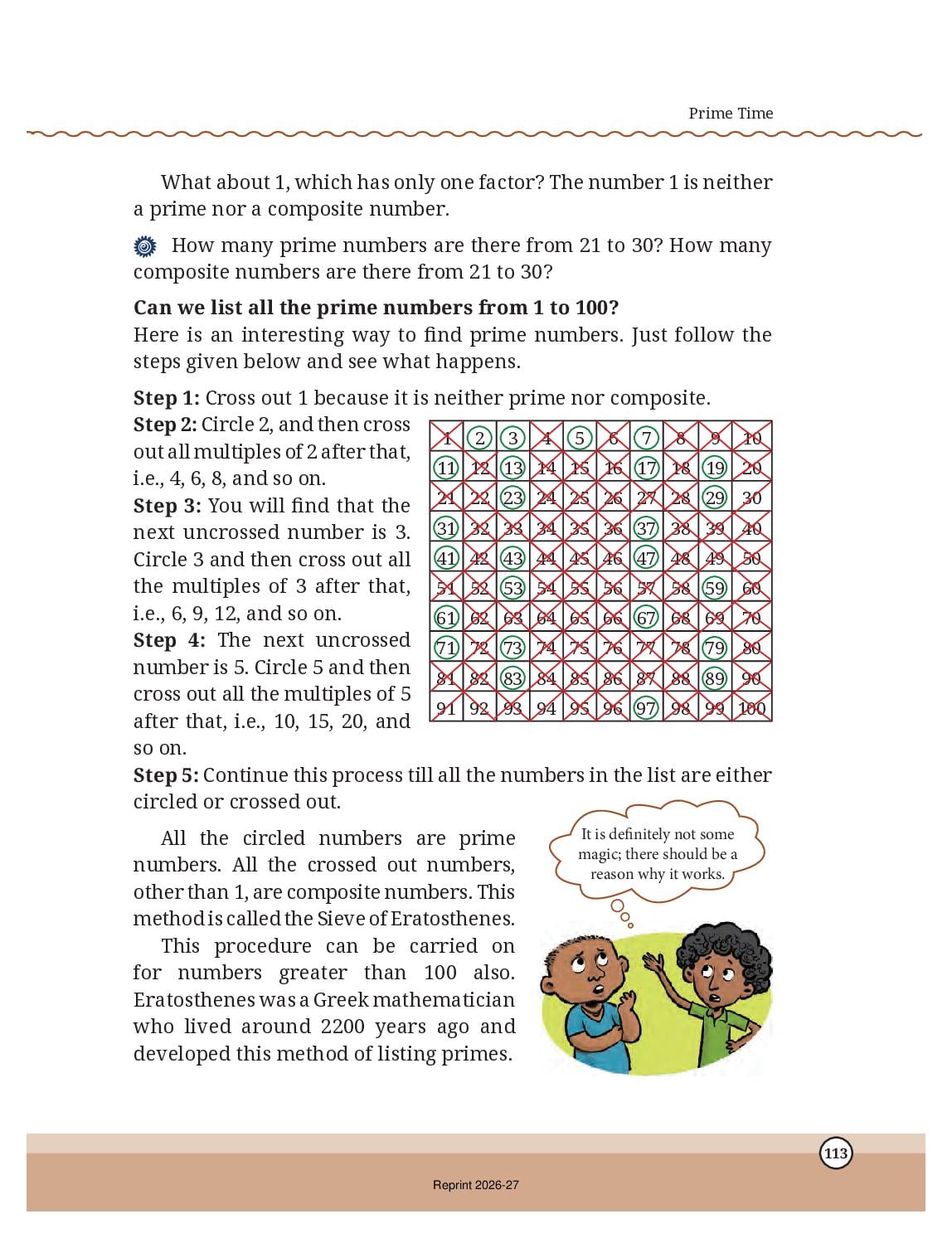
- The Sieve of Eratosthenes lists primes by circling a number and crossing out all its later multiples. It gives exactly 25 primes below 100.
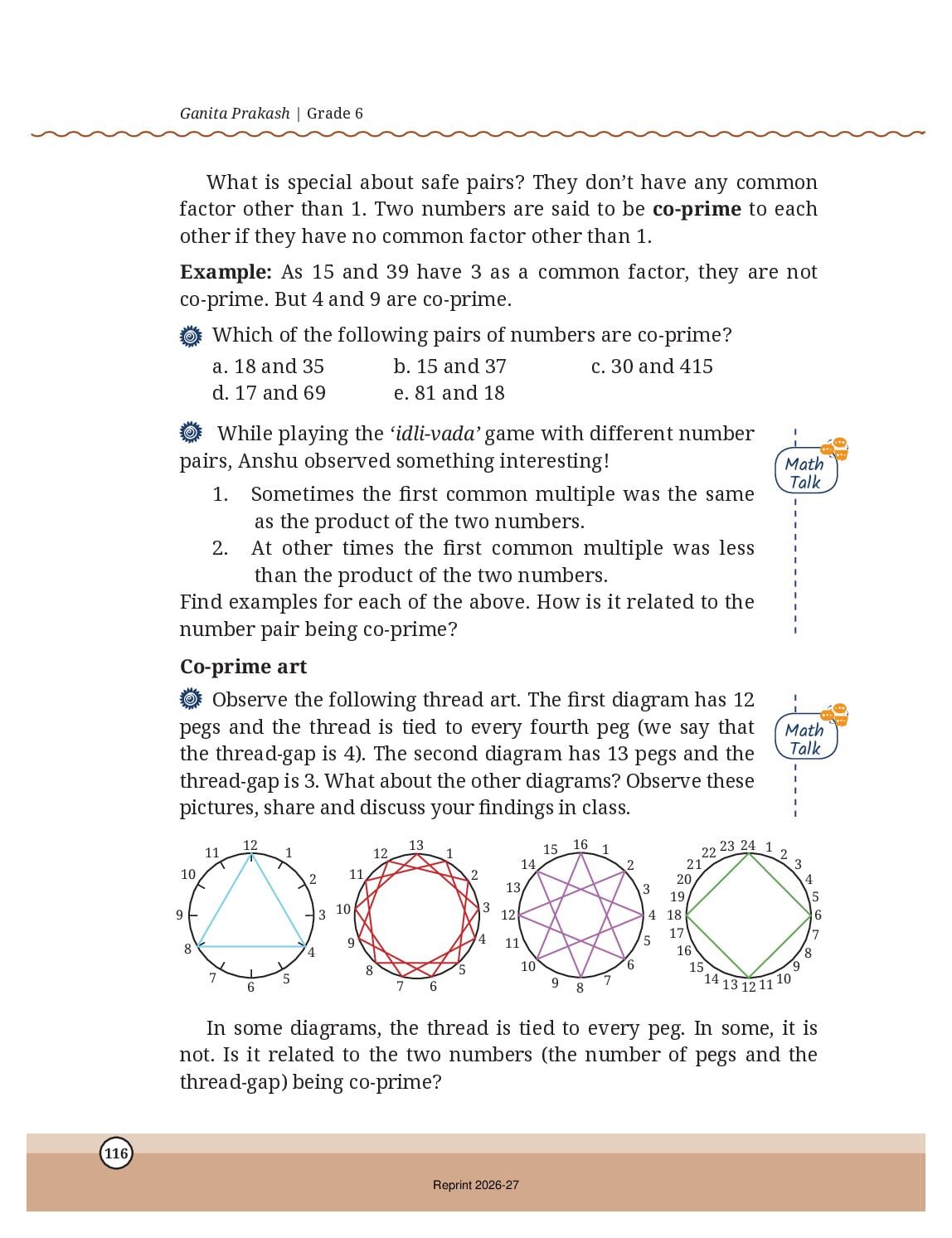
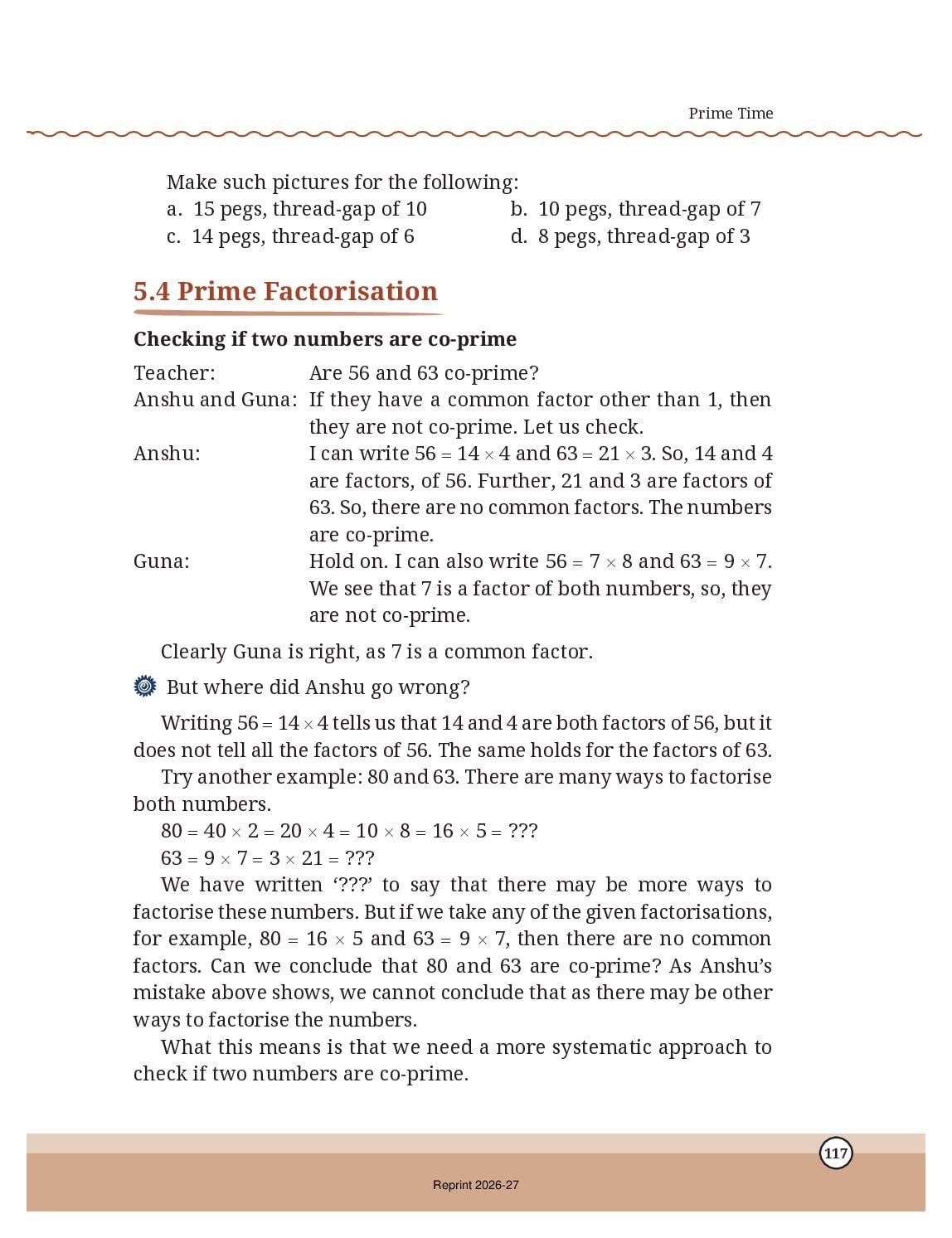
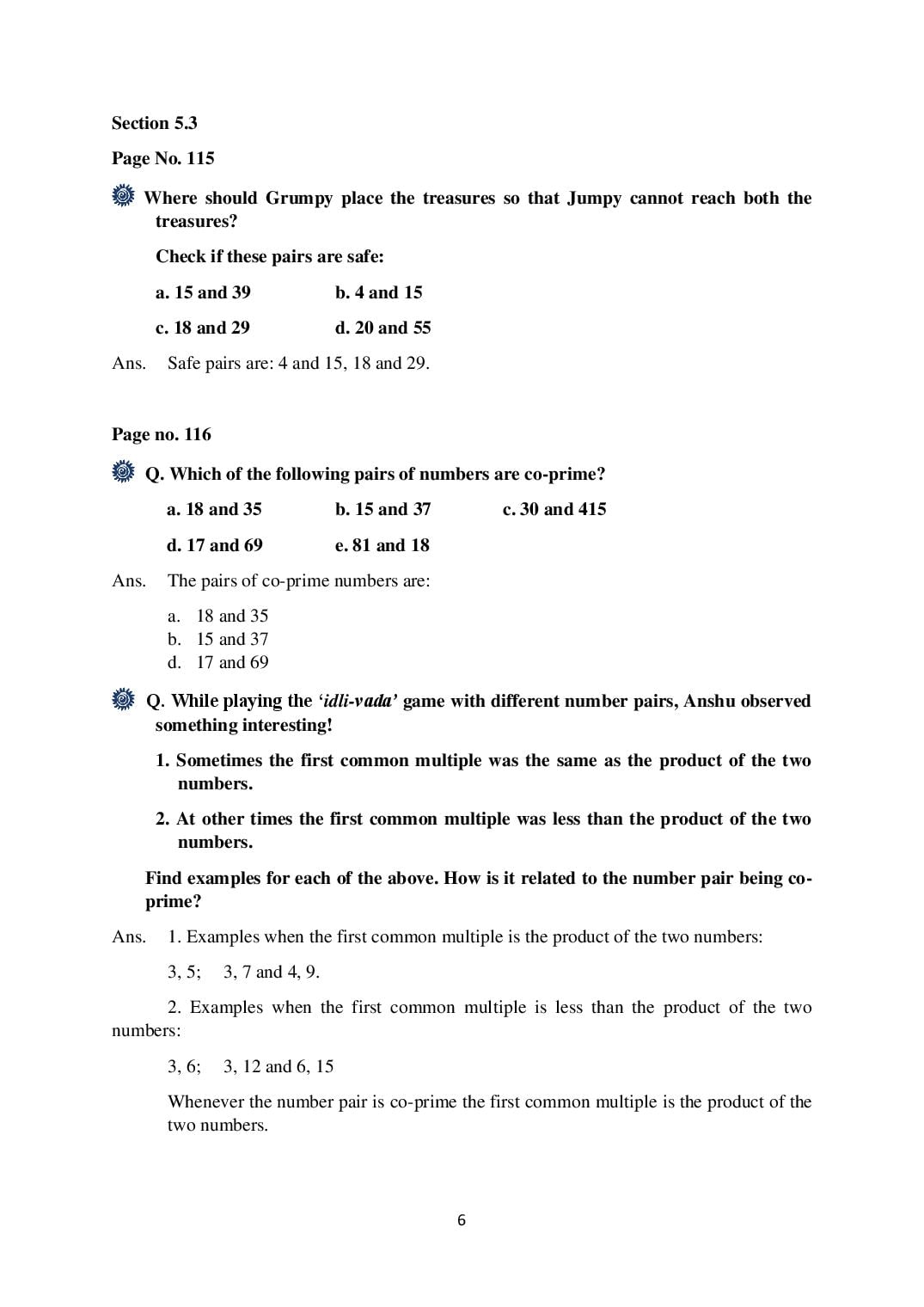
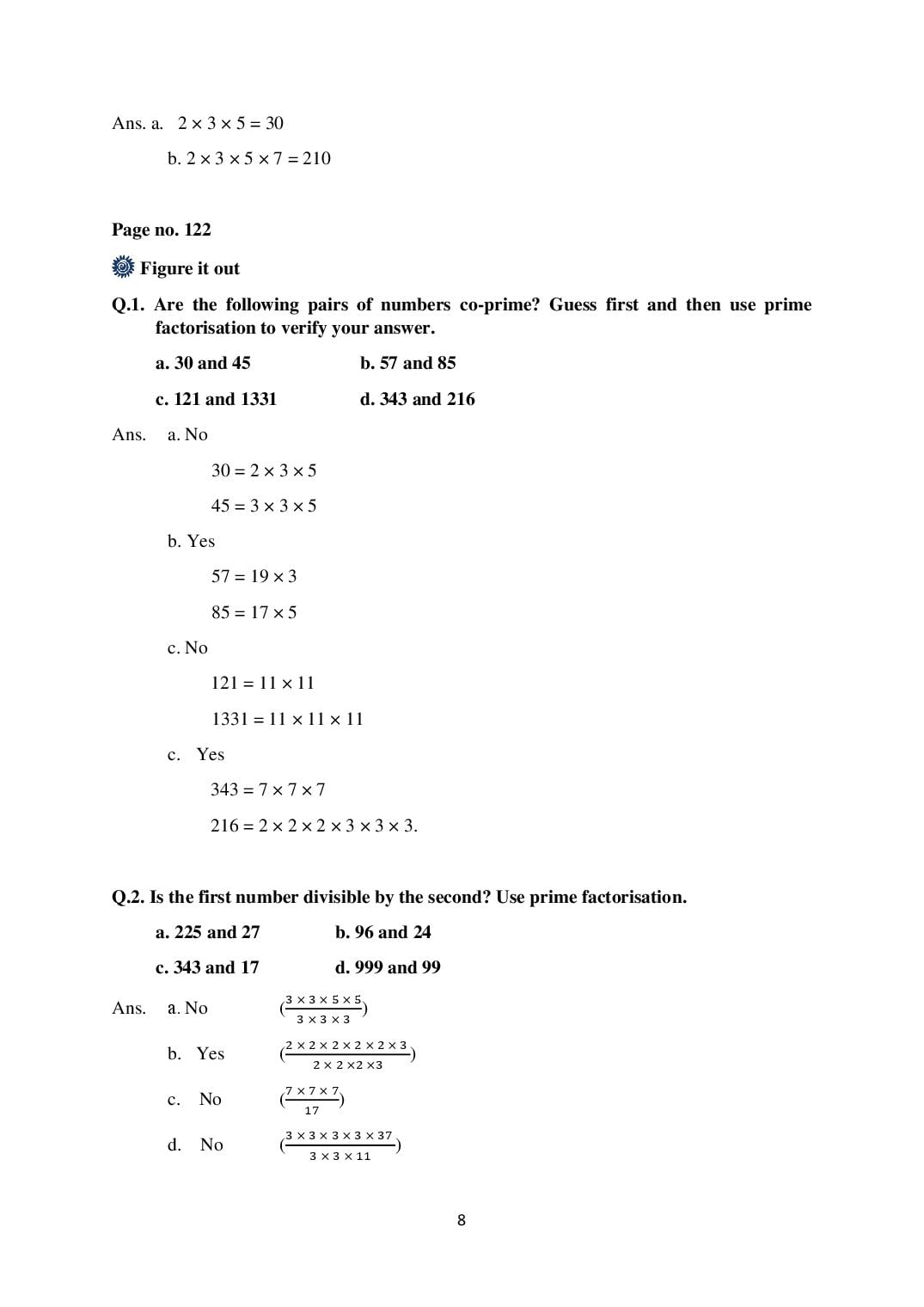
- Two numbers with no common factor other than 1 are co-prime — 4 and 9, 17 and 69, 40 and 231. Any two different primes are always co-prime.
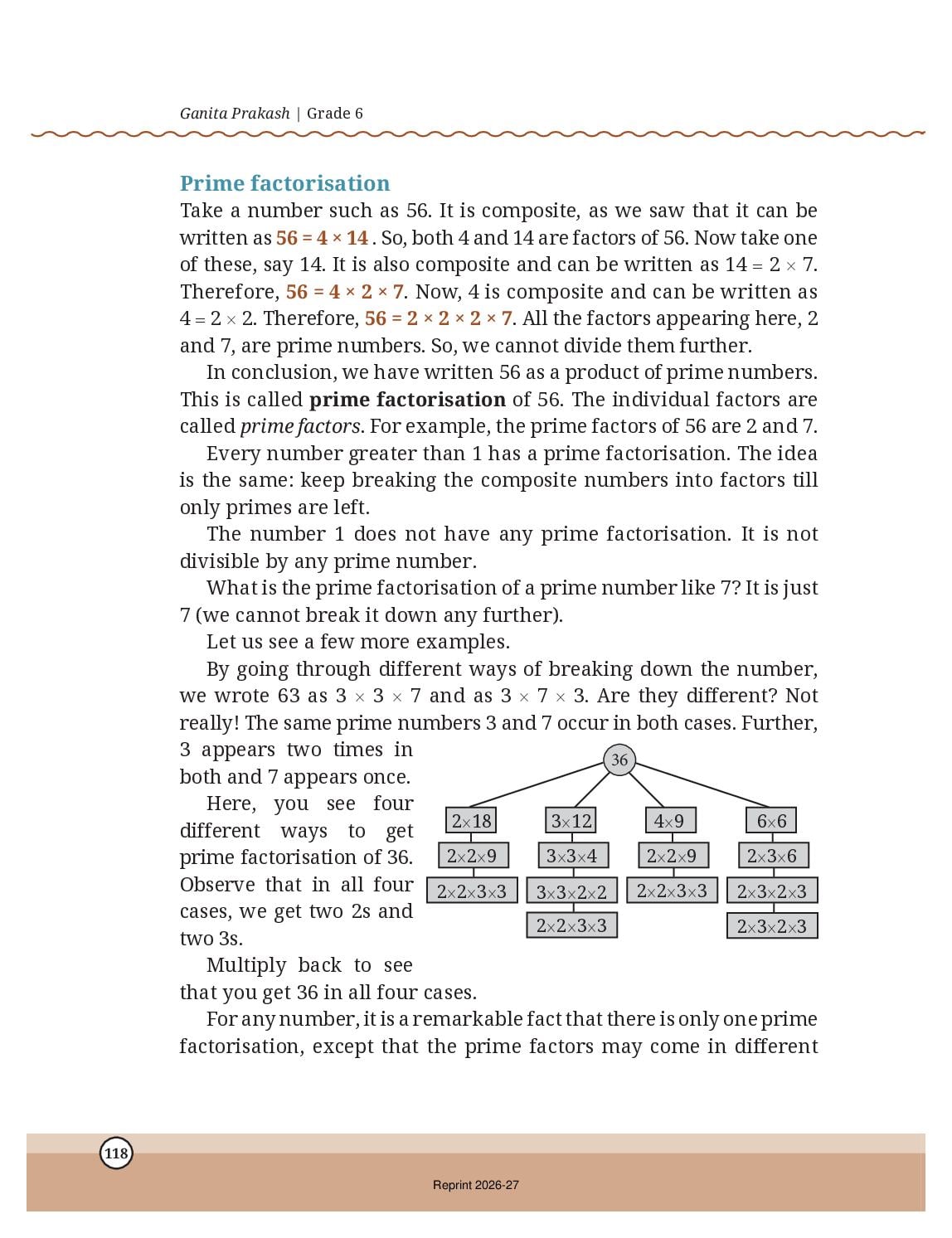
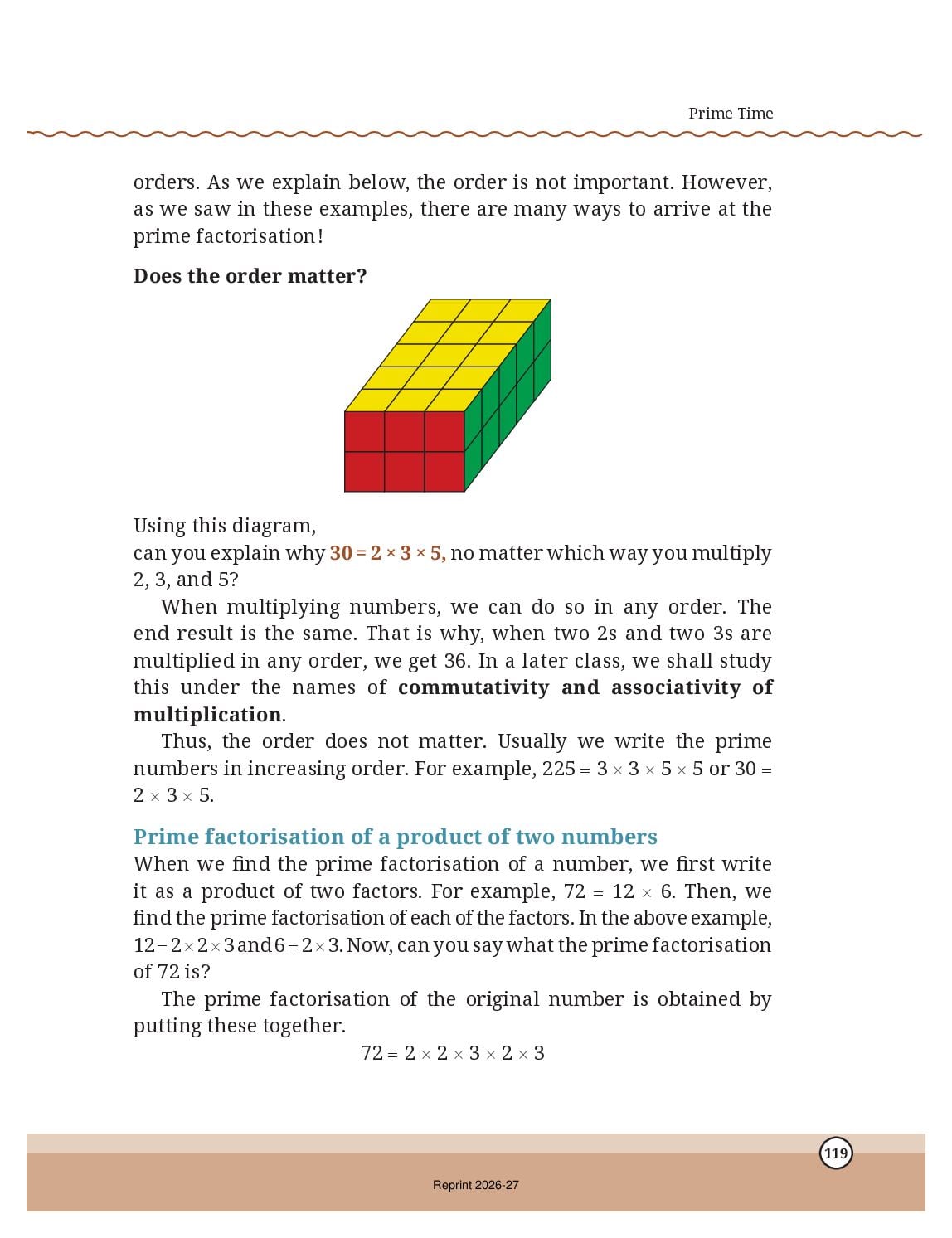
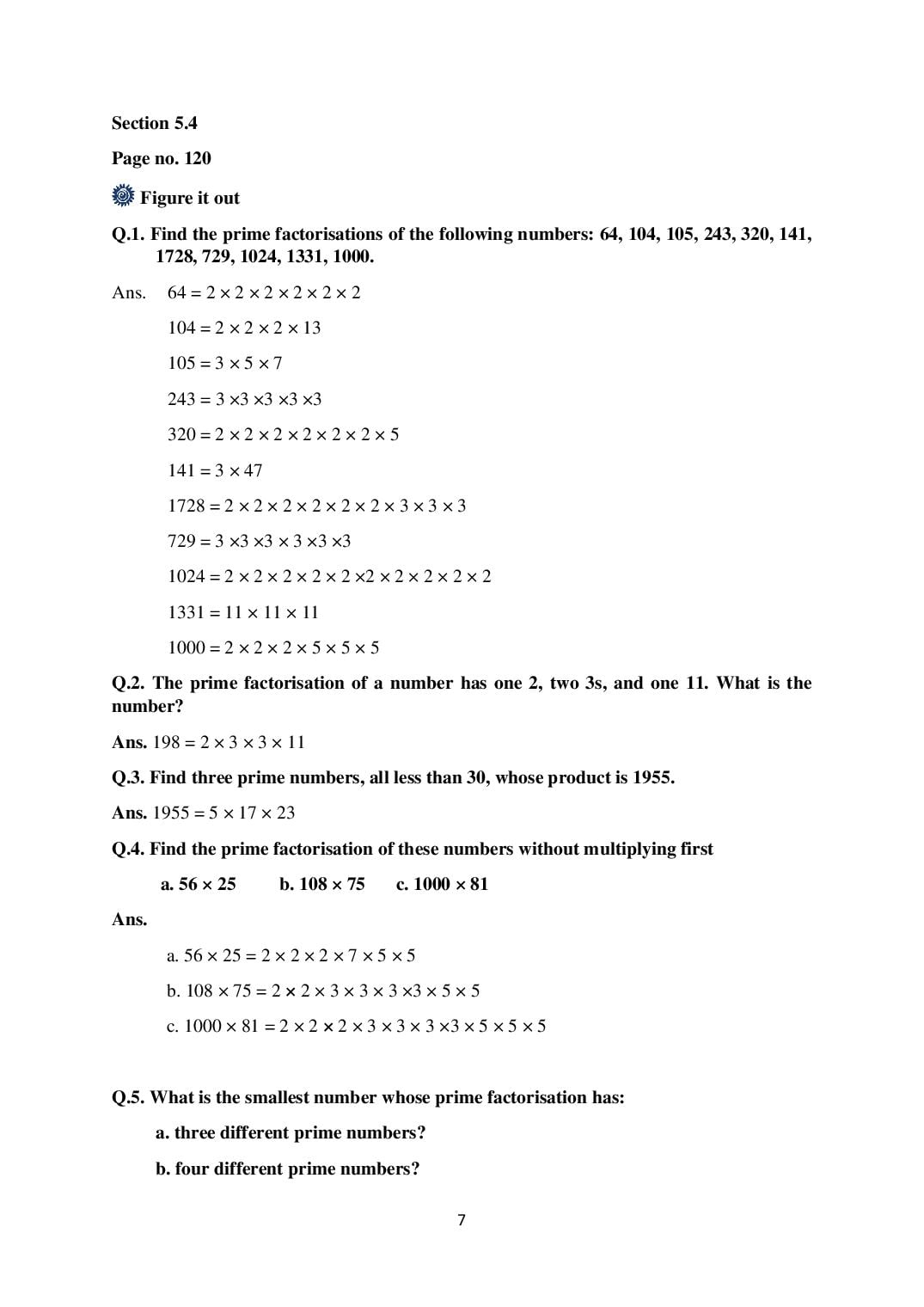
- Every number greater than 1 can be written as a product of primes — its prime factorisation — and there is only one such way, apart from the order (84 = 2 × 2 × 3 × 7).
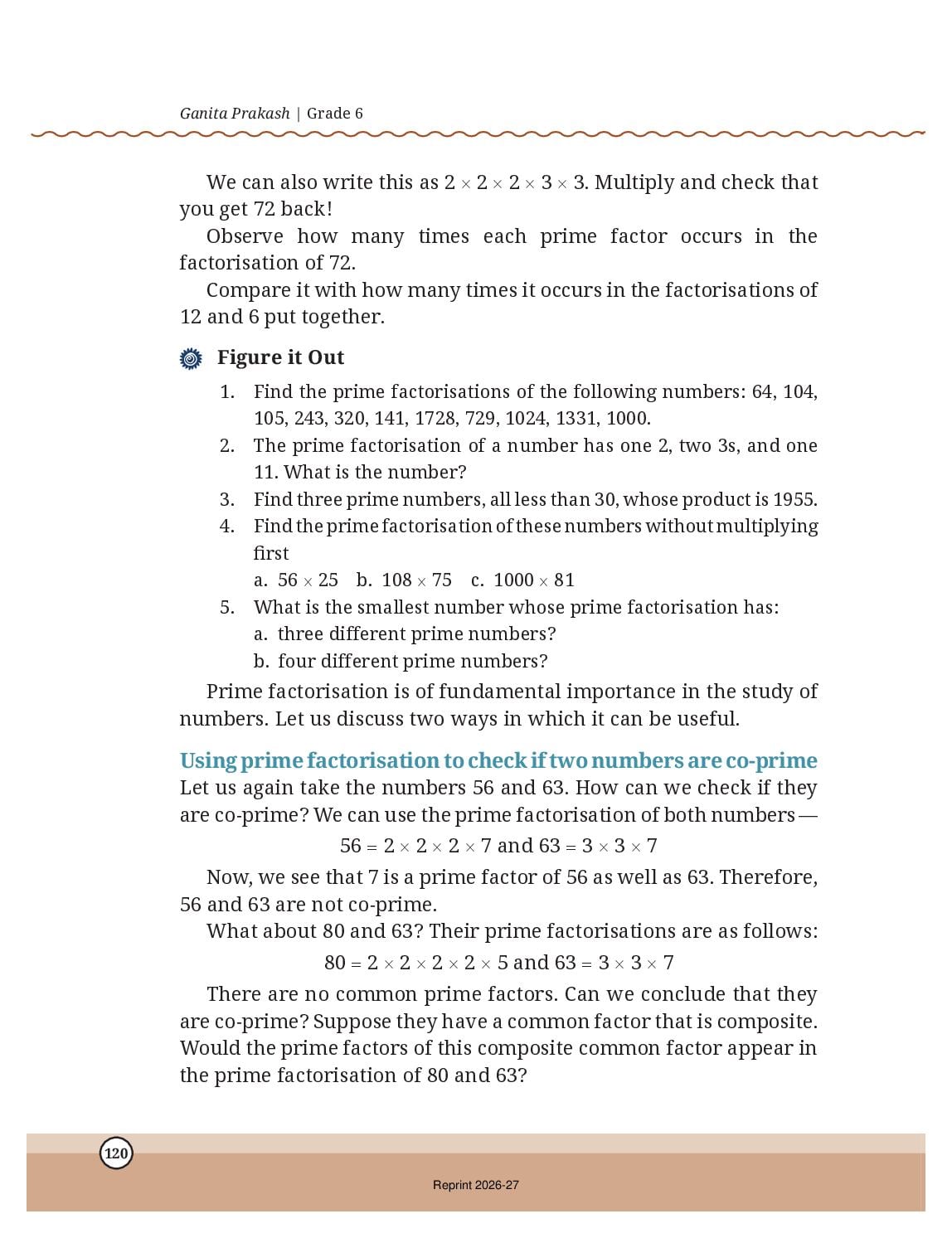
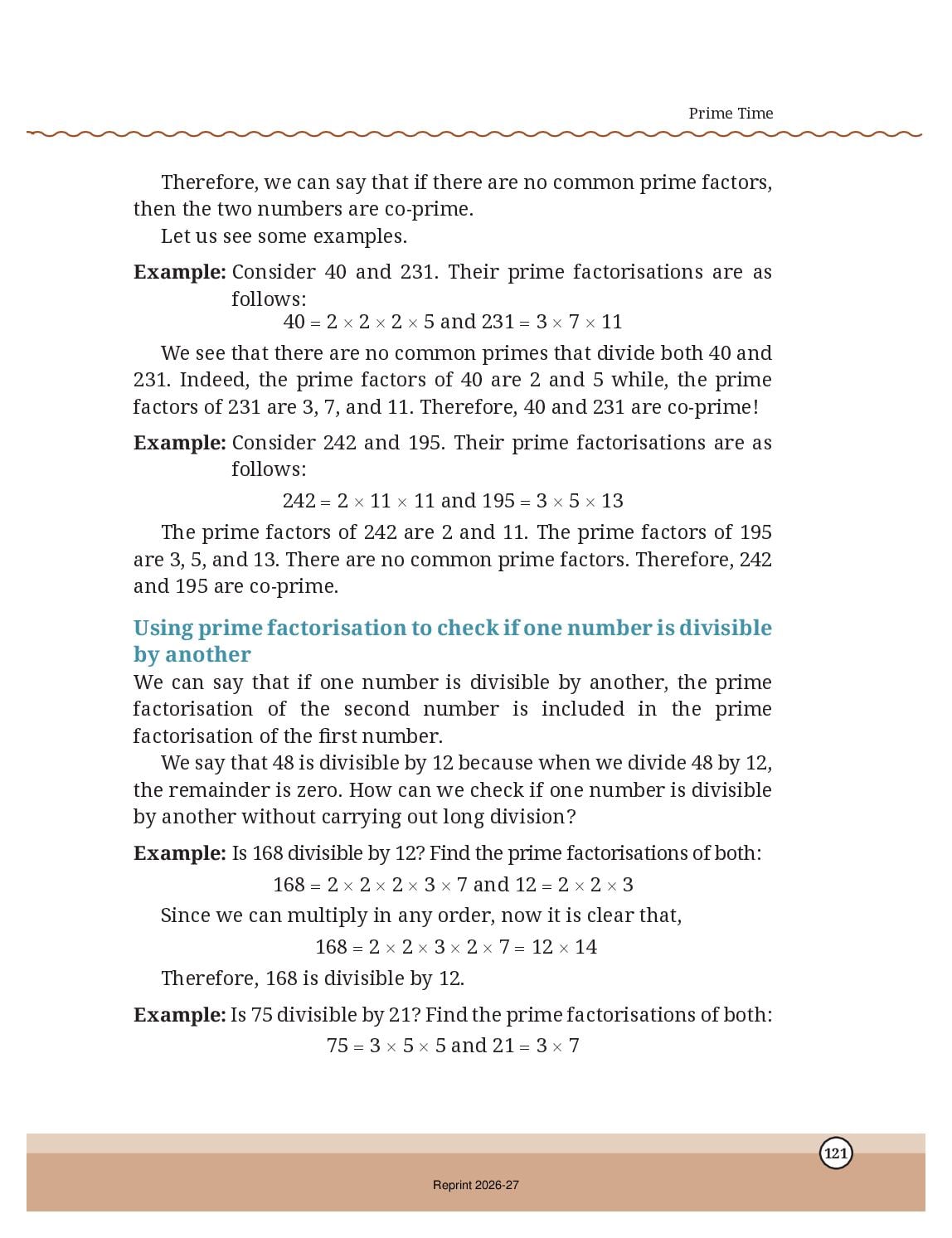
- Prime factorisation answers two questions without any long division: two numbers are co-prime when they share no common prime factor, and one number divides another when its whole prime factorisation is included in the other’s.
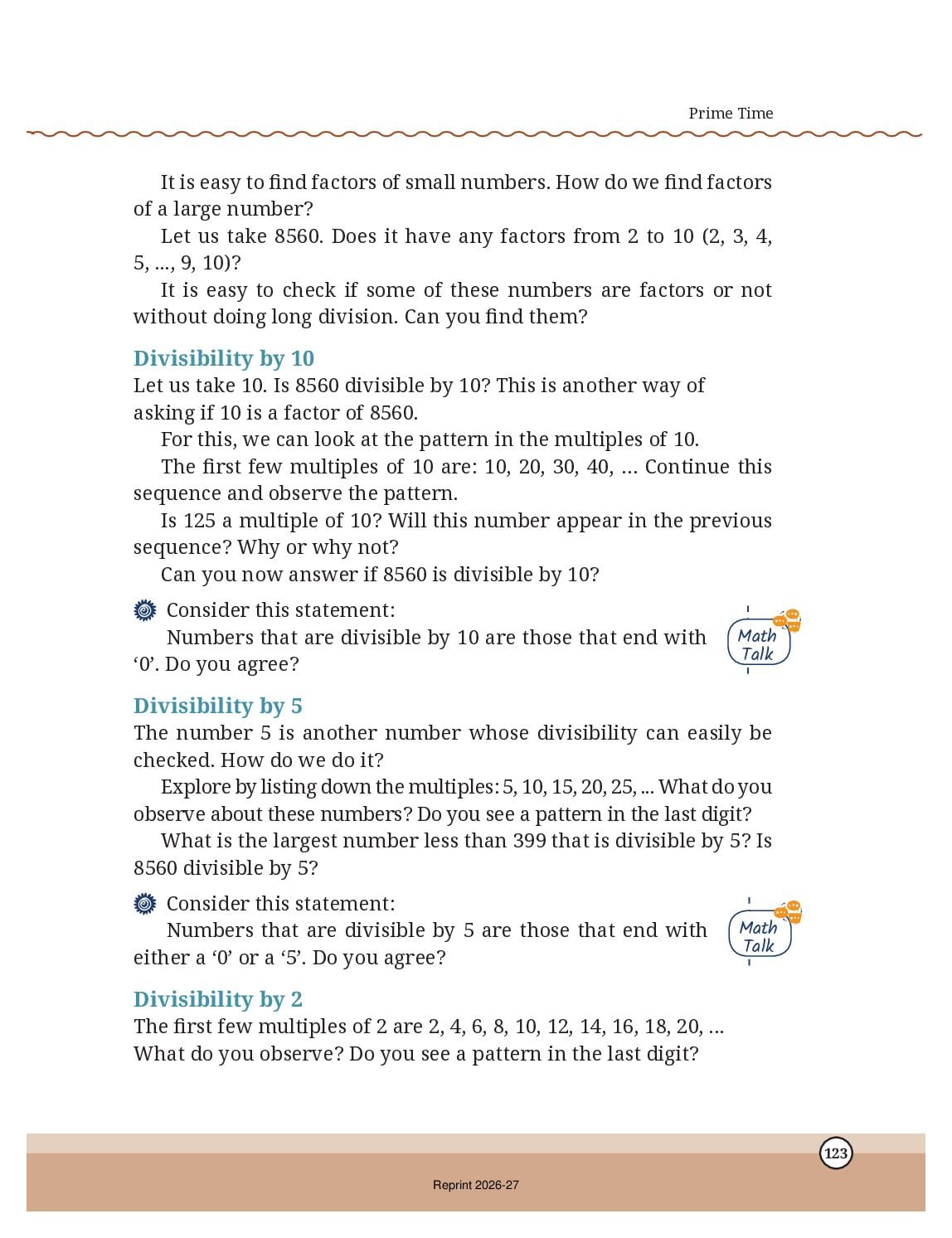
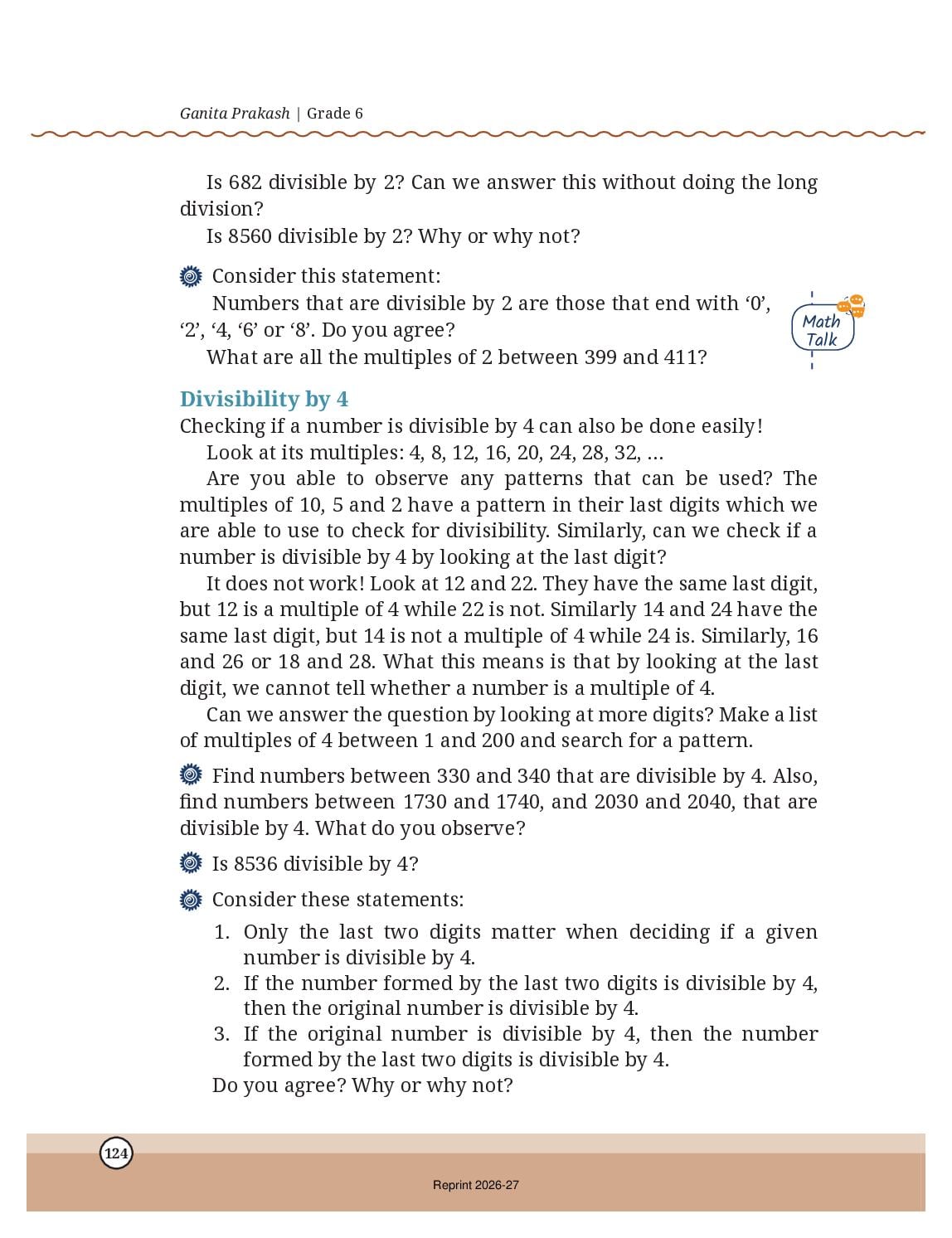
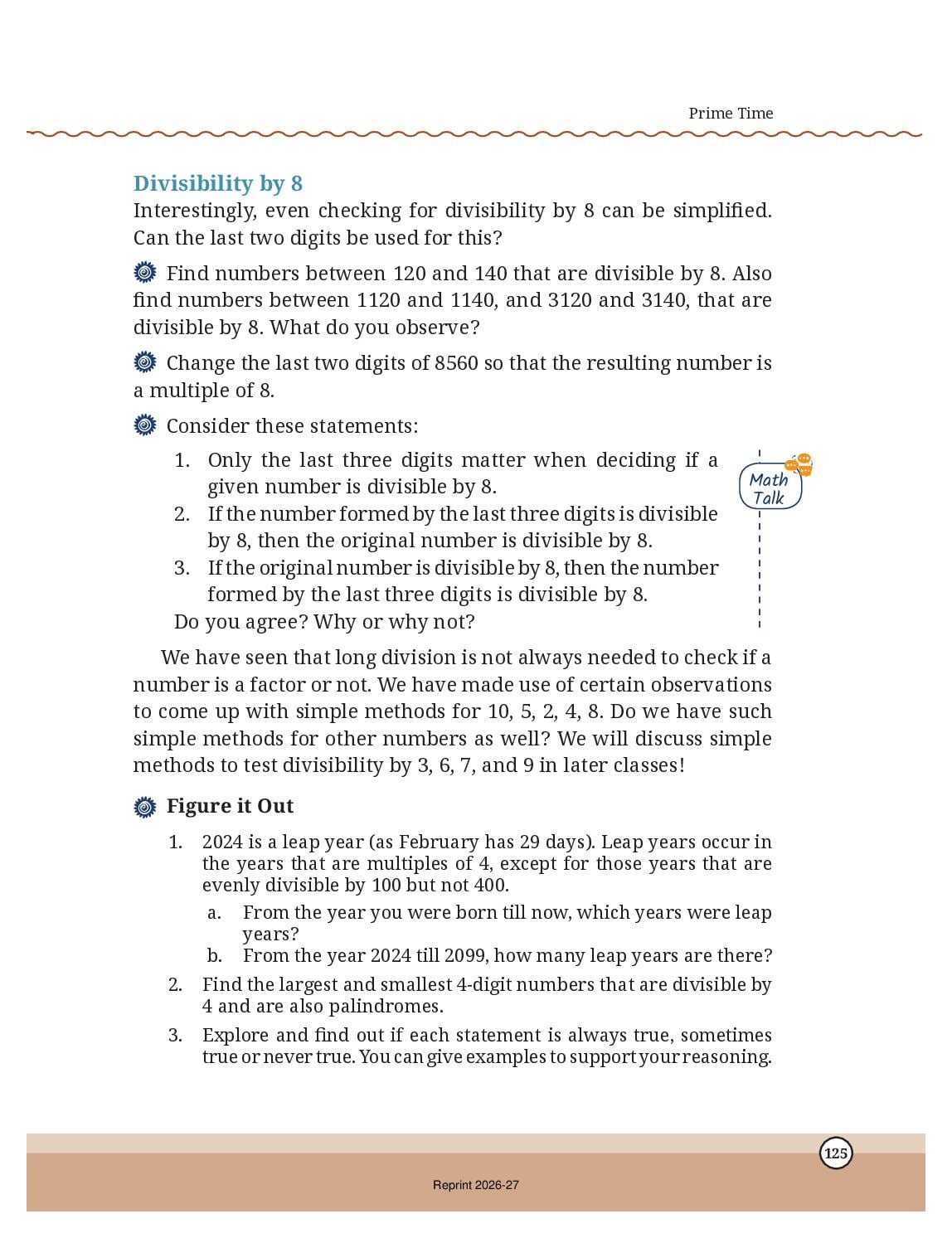
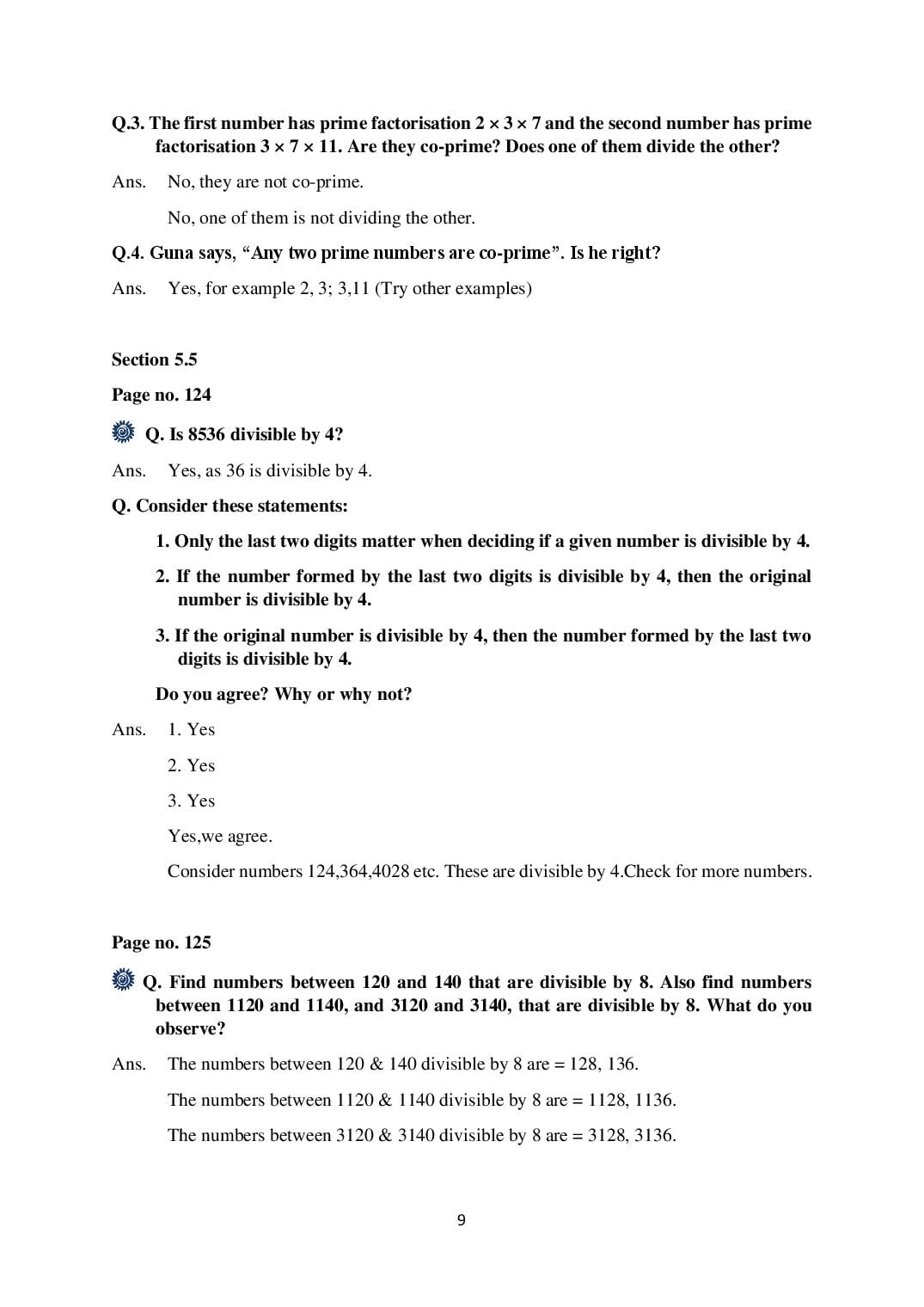
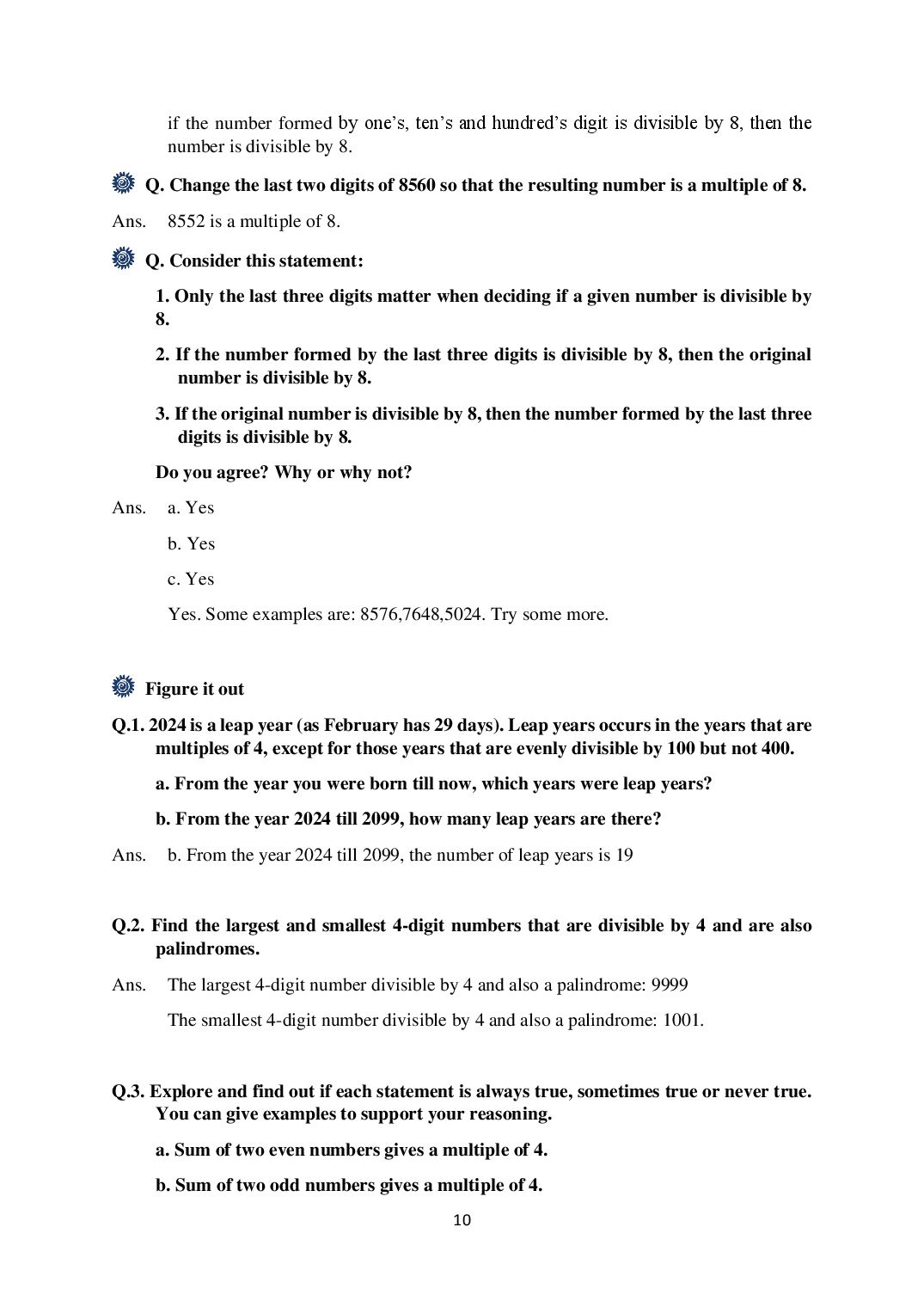
- Divisibility tests: the last digit decides for 10, 5 and 2; the last two digits decide for 4; the last three digits decide for 8.
Quick revision – Prime Time
| Term | What it means | Example from the chapter | How to spot it |
|---|---|---|---|
| Multiple | The result of multiplying a number by 1, 2, 3, … | 3, 6, 9, 12, … are multiples of 3 | Is it in that number’s table? |
| Factor (divisor) | A number that divides another exactly | 1, 2, 3, 4, 6, 8, 12, 24 are the factors of 24 | Does the division leave remainder 0? |
| Common multiple | A multiple of both numbers | 15, 30, 45, 60 for 3 and 5 | The ‘idli-vada’ numbers |
| Common factor | A factor of both numbers | 1 and 2 for 14 and 36 | Jump sizes that reach both treasures |
| Prime number | Has exactly two factors — 1 and itself | 2, 3, 5, 7, 11, 13, 17, 19 | Only one rectangular arrangement |
| Composite number | Has more than two factors | 4, 6, 8, 9, 10, 12, 14, 15 | More than one rectangle possible |
| The number 1 | Neither prime nor composite | 1 has only one factor | It stands alone |
| Sieve of Eratosthenes | Circle a number, cross out its later multiples | 25 primes lie below 100 | Whatever is left circled is prime |
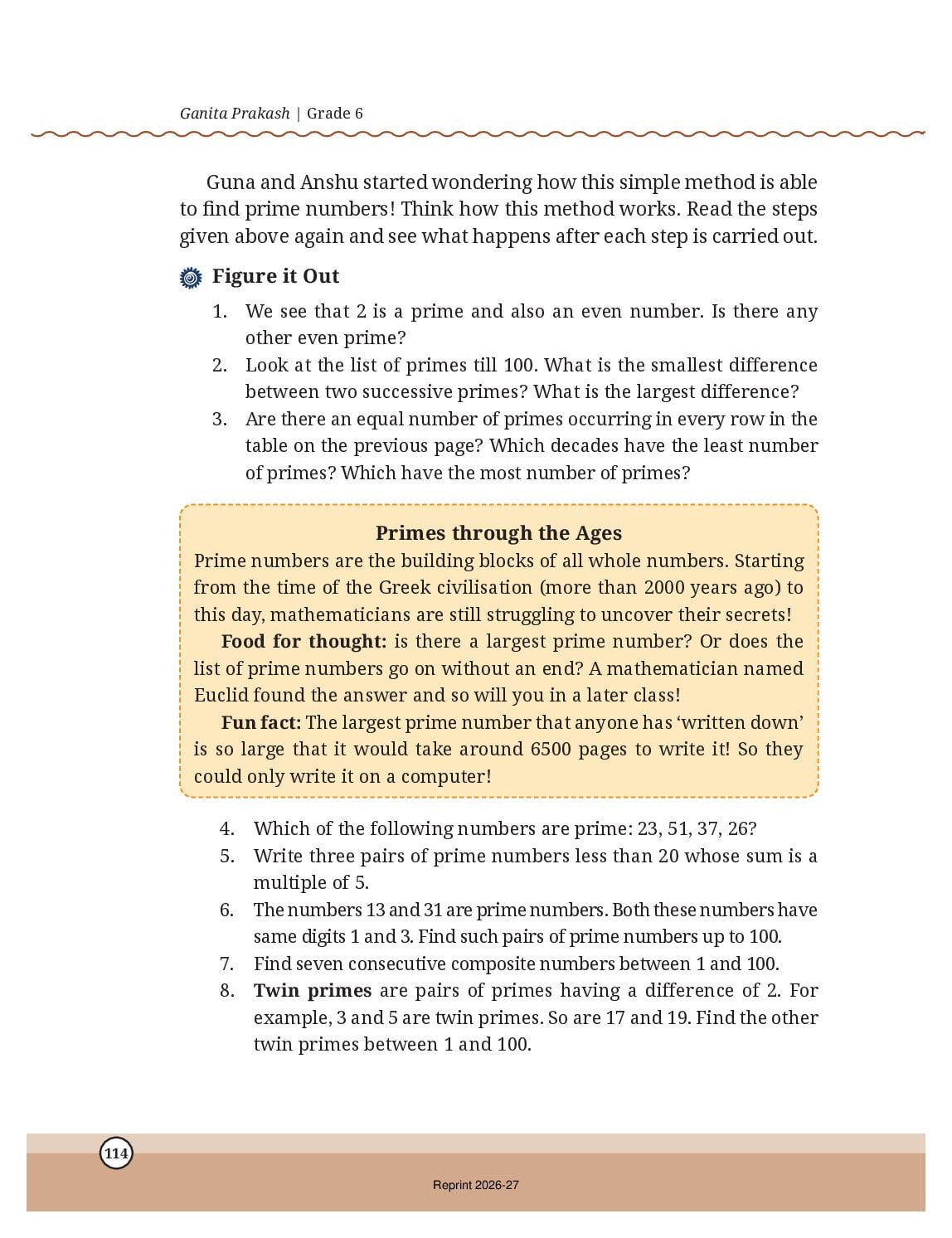
| Twin primes | A pair of primes differing by 2 | 3 & 5, 11 & 13, 71 & 73 | Difference is exactly 2 |
| Co-prime numbers | No common factor other than 1 | 4 and 9; 40 and 231 | No common prime factor |
| Prime factorisation | A number written as a product of primes | 84 = 2 × 2 × 3 × 7 | Keep breaking till only primes are left |
| Perfect number | Sum of all its factors = twice the number | 6 and 28 | 1 + 2 + 3 + 6 = 12 = 2 × 6 |
Old NCERT vs New – Class 6 Maths
This chapter is from Ganita Prakash, the new NCERT Class 6 Maths book (NCF-SE 2023, used from 2024-25). It replaced the old book “Mathematics”, so chapter numbers and names differ from older PDFs.
Solutions and All Chapters
Answers to the exercises and the full chapter list of Ganita Prakash:
Prime Time – Overview
| Class | Class 6 |
| Subject | Maths |
| Book | Ganita Prakash – new NCERT book |
| Chapter | 5 of 10 – Prime Time |
| Book pages | 107 – 128 |
| Edition | NCERT Reprint 2026-27 |
| Session | 2026-27 |
| Free – read online or download |
Class 6 Maths Chapter 5 – FAQs
Where can I download Prime Time Class 6 PDF?
From the download table on this page – the chapter PDF is free, and the full book is linked too.
What is Class 6 Maths Chapter 5 about?
A multiple of a number is what you get on multiplying it by 1, 2, 3, … A factor (or divisor) of a number divides it exactly, leaving remainder 0. Numbers that are multiples of both numbers are their common multiples; numbers that divide both are their common factors.
Is Prime Time from the new NCERT Class 6 Maths book?
Yes. It is chapter 5 of ganita prakash, the new NCERT Class 6 Maths book for 2026-27.
Is this the latest NCERT edition for 2026-27?
Yes – the PDF is NCERT’s latest edition for the 2026-27 session.
Where are the NCERT Solutions for Class 6 Maths Chapter 5?
Open the NCERT Solutions link above for answers to the exercise questions.