NCERT Solutions for Class 6 Maths Chapter 5 Prime Time provide clear, step-by-step answers to every exercise and in-text question from the chapter Prime Time of the NCERT textbook Ganita Prakash. Prepared by subject experts as per the latest NCERT (CBSE) syllabus for 2026-27, these NCERT Solutions for Class 6 Maths help you understand each concept, write exam-ready answers, and check your own solutions. You can read them online below or download the free Class 6 Maths Chapter 5 question-answer PDF.
NCERT Solutions for Class 6 Maths Chapter 5 Prime Time
- Class: Class 6
- Subject: Maths
- Chapter: Chapter 5 – Prime Time
- Textbook: Ganita Prakash (NCERT)
- Study material: NCERT Solutions – questions with answers, free PDF
These solutions answer all the exercise questions of Chapter 5 Prime Time — including the in-text questions, short-answer and long-answer questions, and activities — with complete explanations so you can follow the method, not just the final answer. Read the full solutions below.
NCERT Solutions Class 6 Maths Chapter 5 Prime Time View Download
NCERT Solutions for Class 6 Maths Chapter 5 PDF Download
You can read the NCERT Solutions for Class 6 Maths Chapter 5 online above, or download the complete question-answer PDF to study Prime Time offline at any time.
NCERT Solutions for Class 6 Maths Chapter 5 PDF Download Link – Click Here to Download Solutions PDF
Questions Covered in This Chapter
These NCERT Solutions answer all 79 questions of this chapter. The questions solved are:
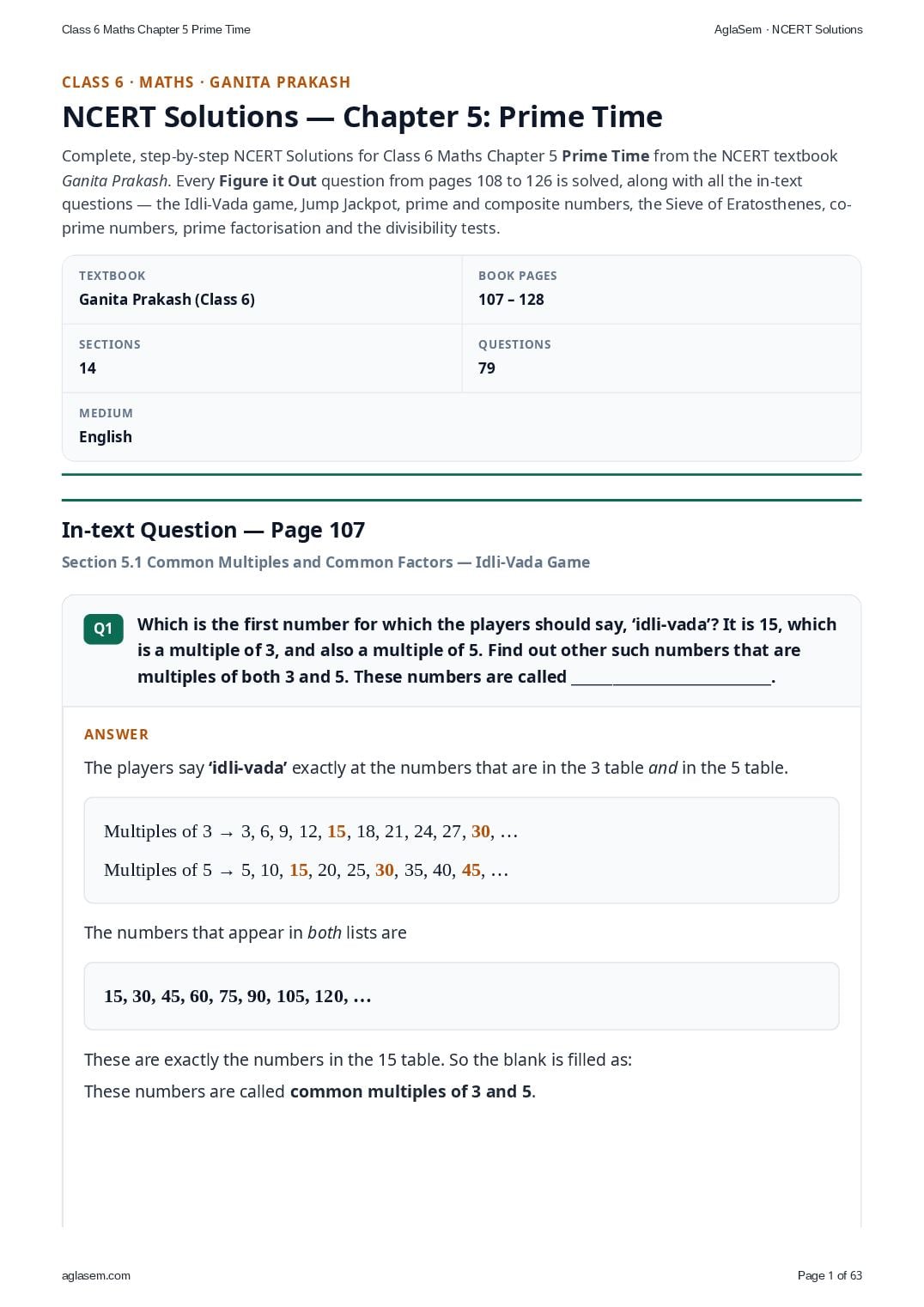
- Which is the first number for which the players should say, ‘idli-vada’? It is 15, which is a multiple of 3, and also a multiple of 5. Find out other such numbers that are multiples of both 3 and 5. These numbers are called _____________________________.
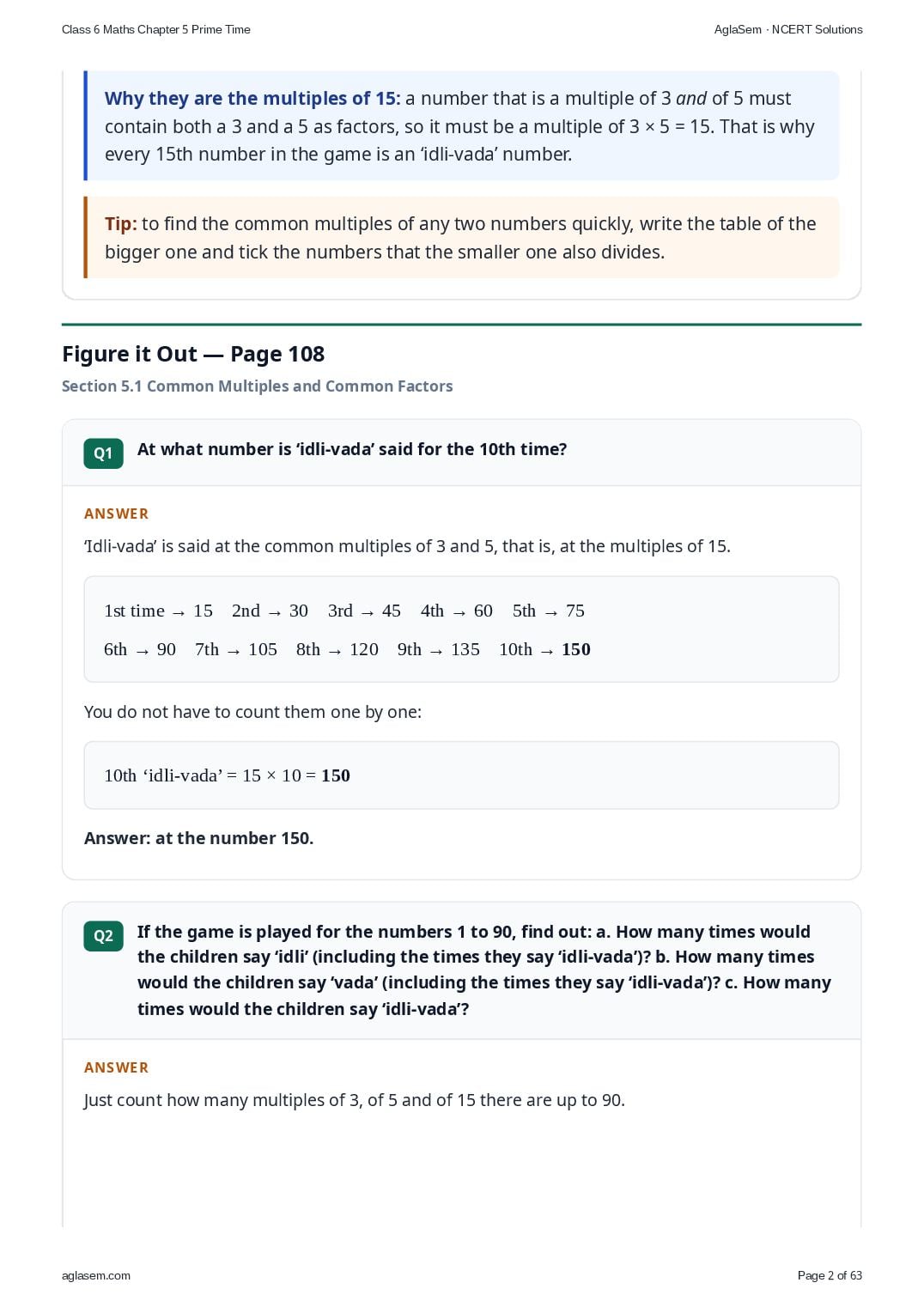
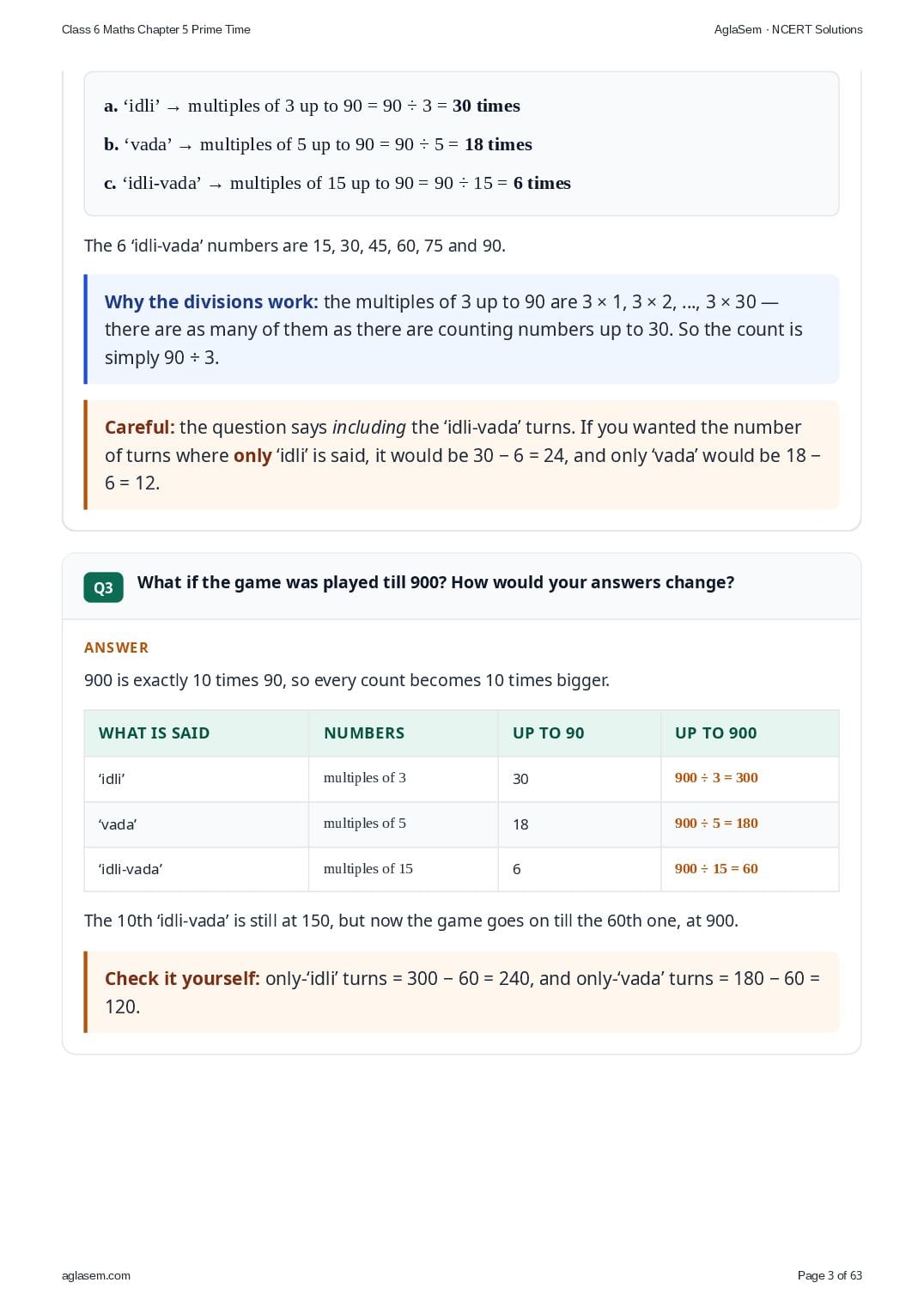
- At what number is ‘idli-vada’ said for the 10th time?
- If the game is played for the numbers 1 to 90, find out: a. How many times would the children say ‘idli’ (including the times they say ‘idli-vada’)? b. How many times would the children say ‘vada’ (including the times they say ‘idli-vada’)? c. How many times would the children say ‘idli-vada’?
- What if the game was played till 900? How would your answers change?
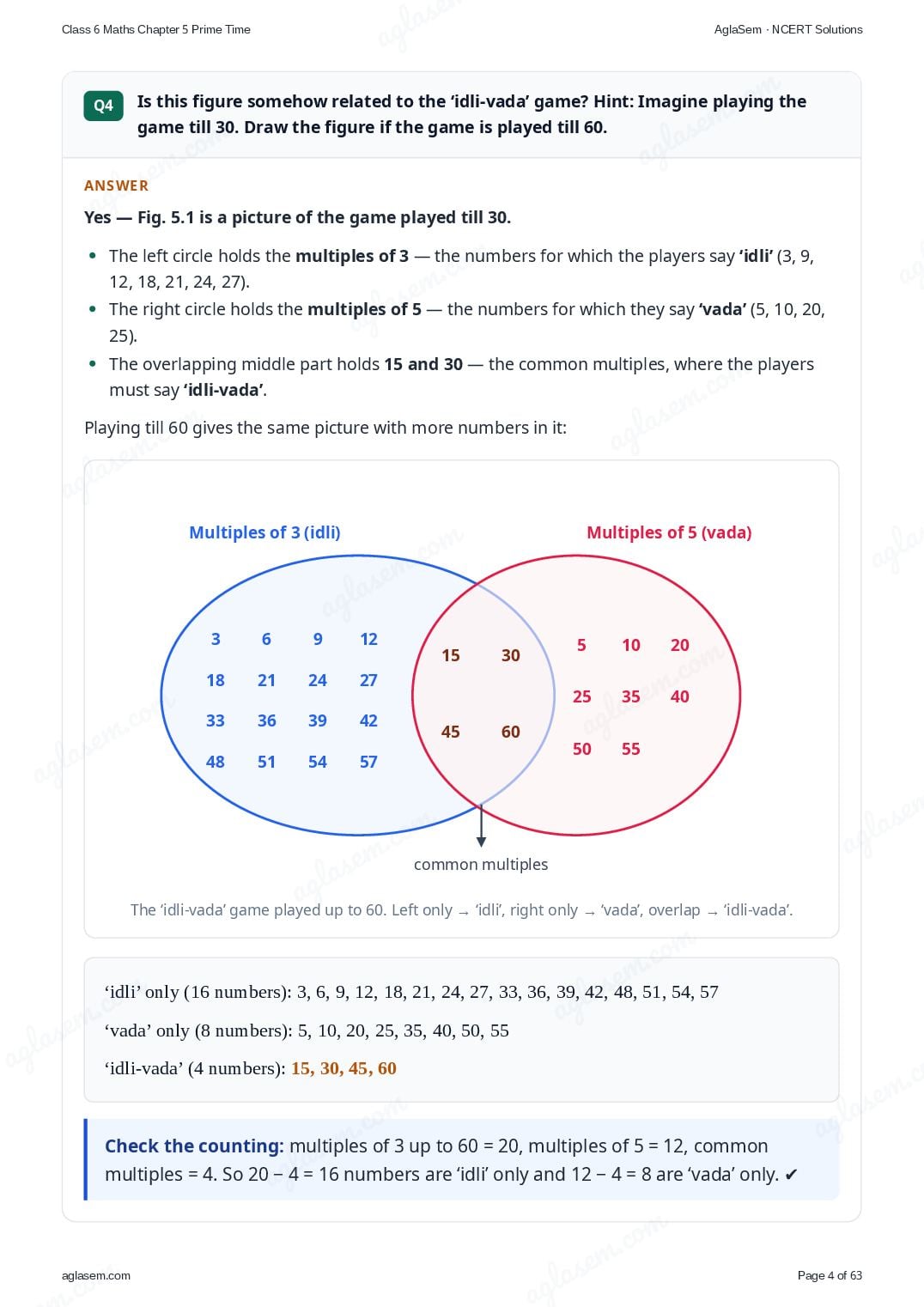
- Is this figure somehow related to the ‘idli-vada’ game? Hint: Imagine playing the game till 30. Draw the figure if the game is played till 60.
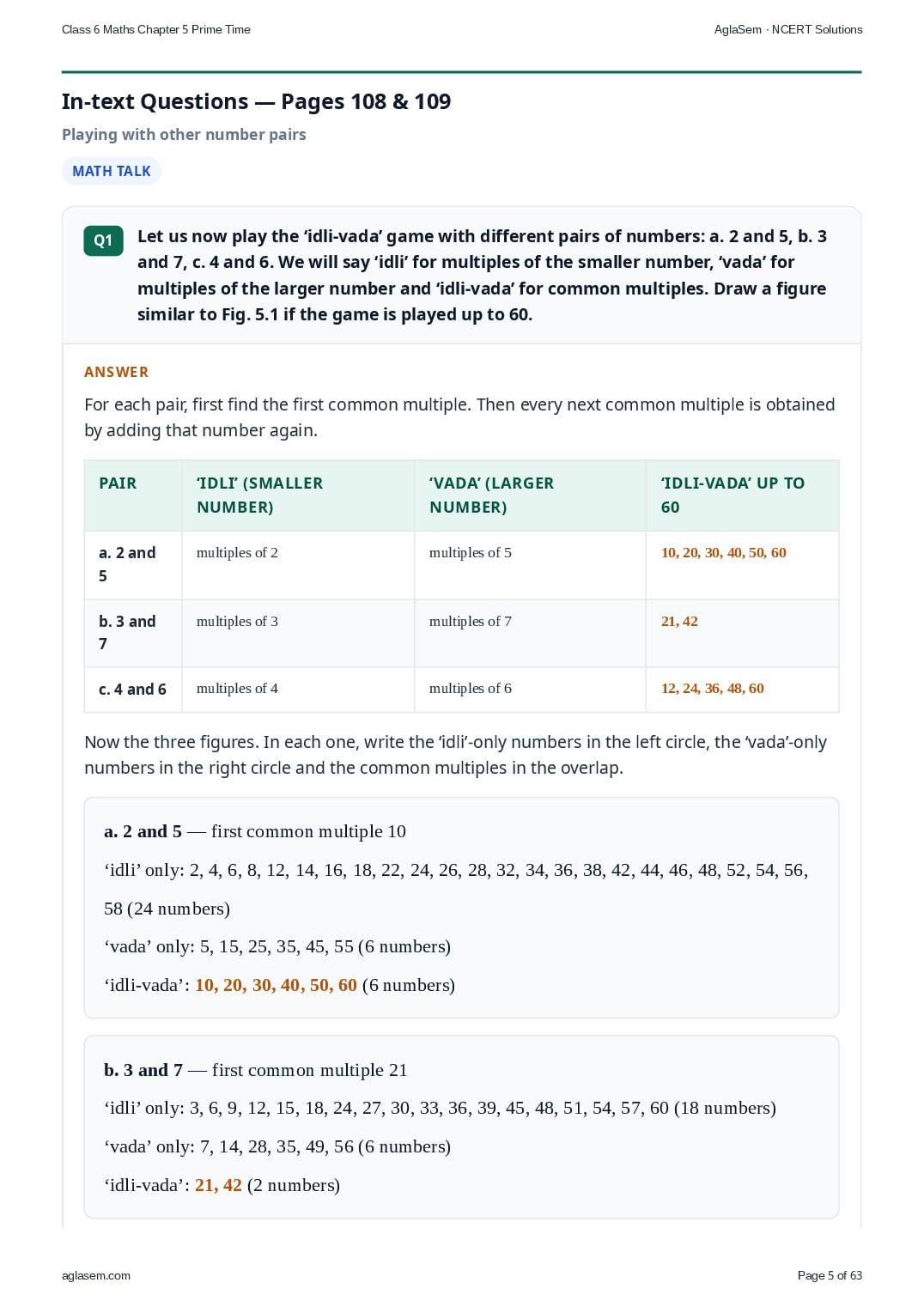
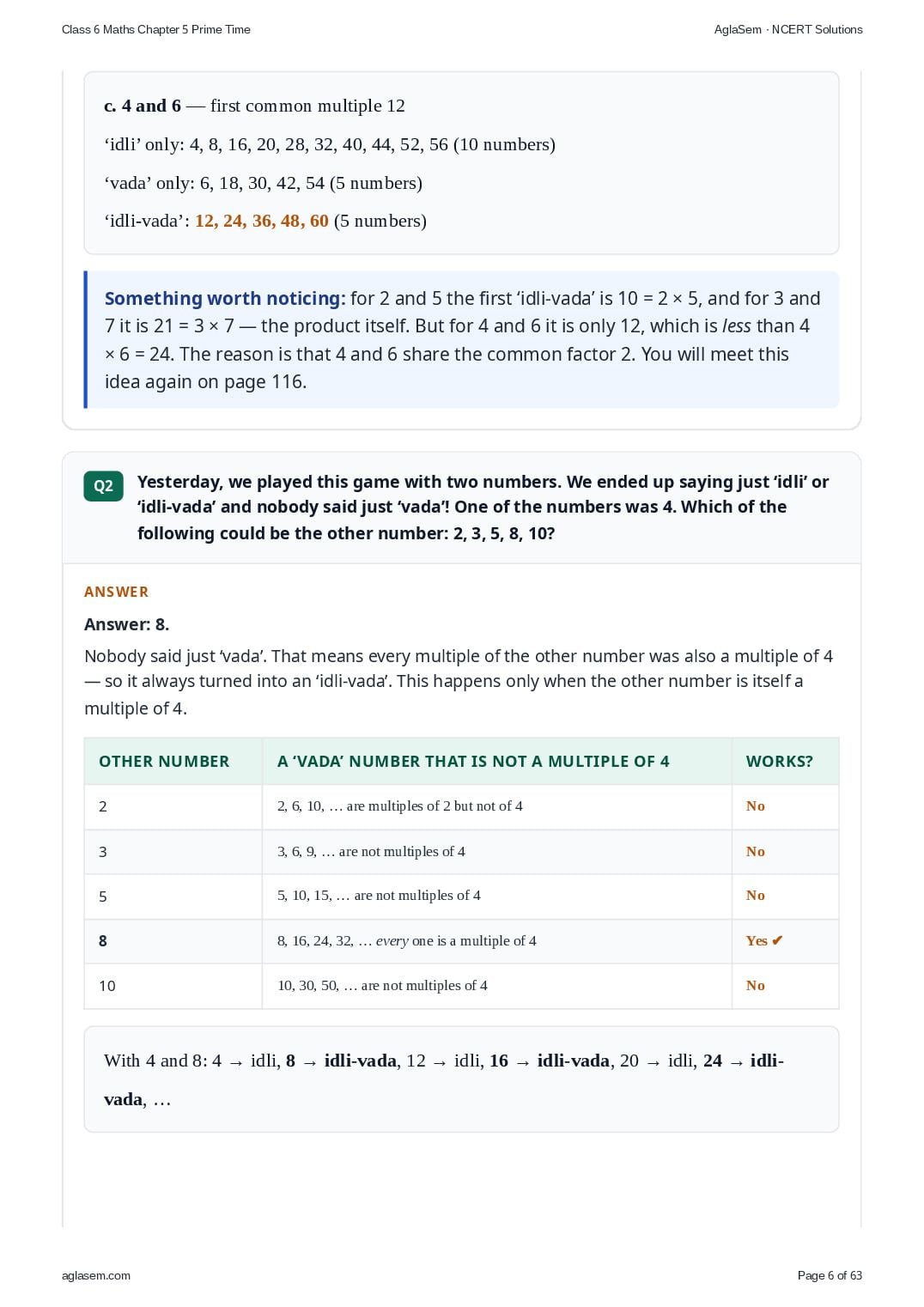
- Let us now play the ‘idli-vada’ game with different pairs of numbers: a. 2 and 5, b. 3 and 7, c. 4 and 6. We will say ‘idli’ for multiples of the smaller number, ‘vada’ for multiples of the larger number and ‘idli-vada’ for common multiples. Draw a figure similar to Fig. 5.1 if the game is played up to 60.
- Yesterday, we played this game with two numbers. We ended up saying just ‘idli’ or ‘idli-vada’ and nobody said just ‘vada’! One of the numbers was 4. Which of the following could be the other number: 2, 3, 5, 8, 10?
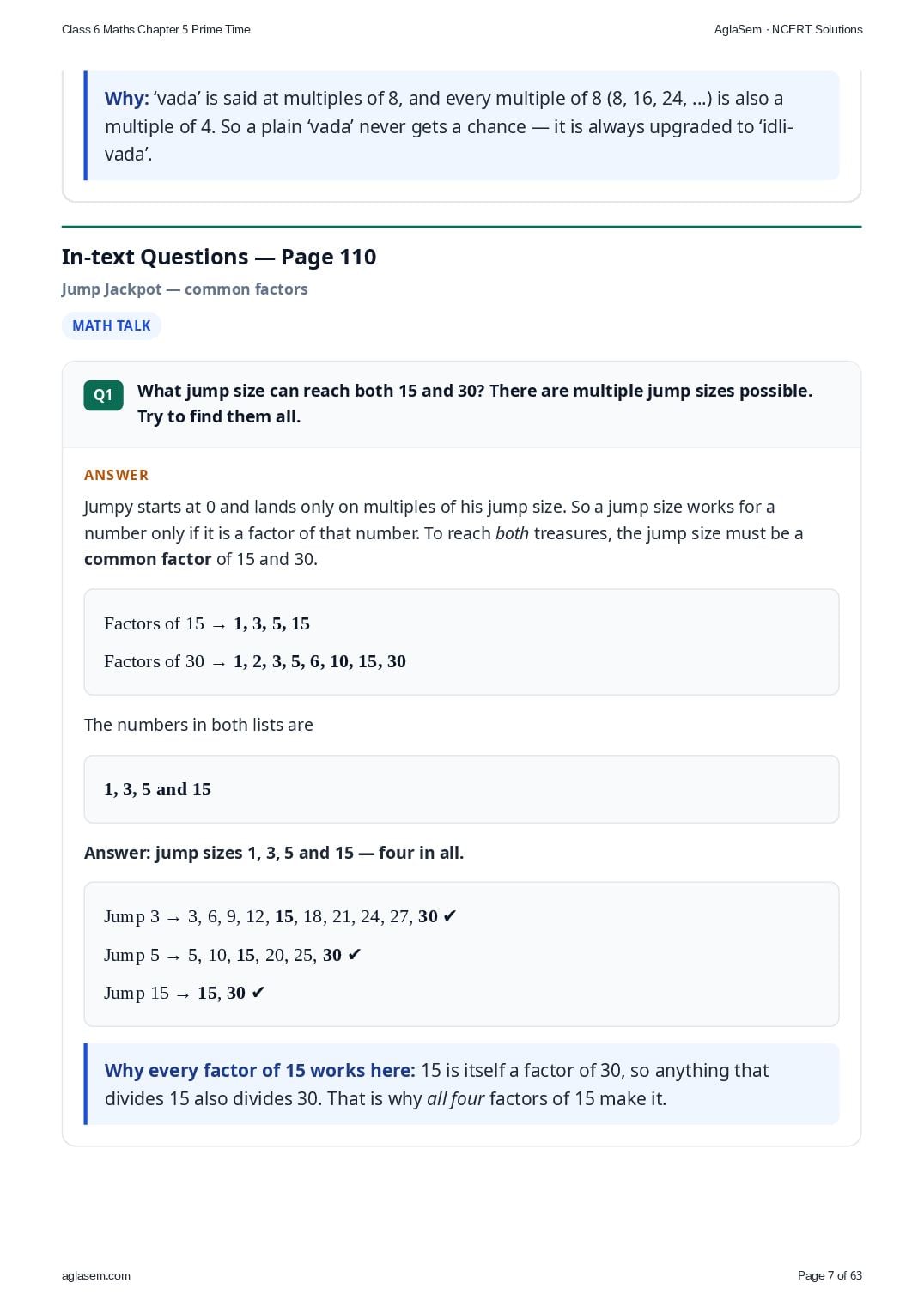
- What jump size can reach both 15 and 30? There are multiple jump sizes possible. Try to find them all.
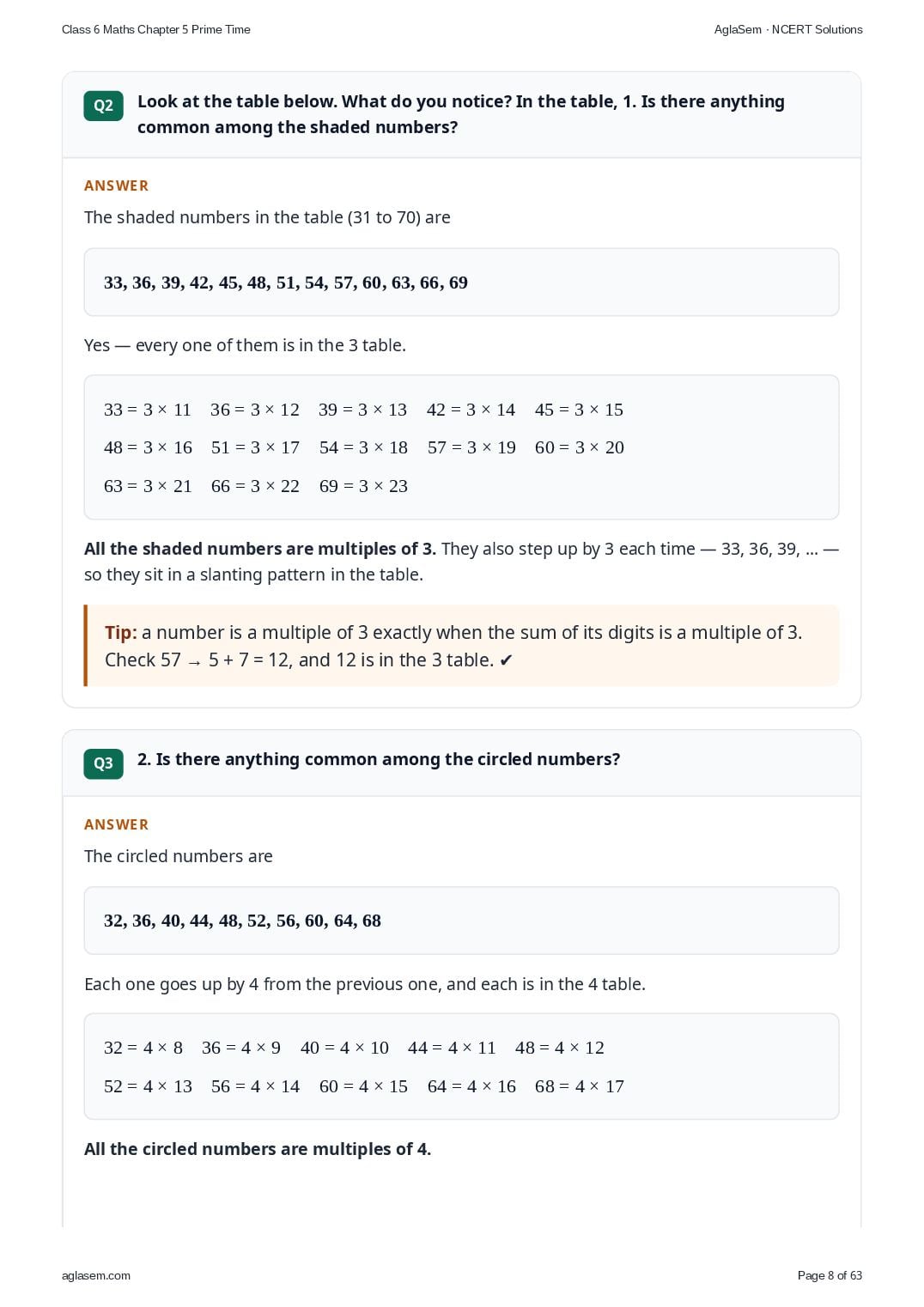
- Look at the table below. What do you notice? In the table, 1. Is there anything common among the shaded numbers?
- 2. Is there anything common among the circled numbers?
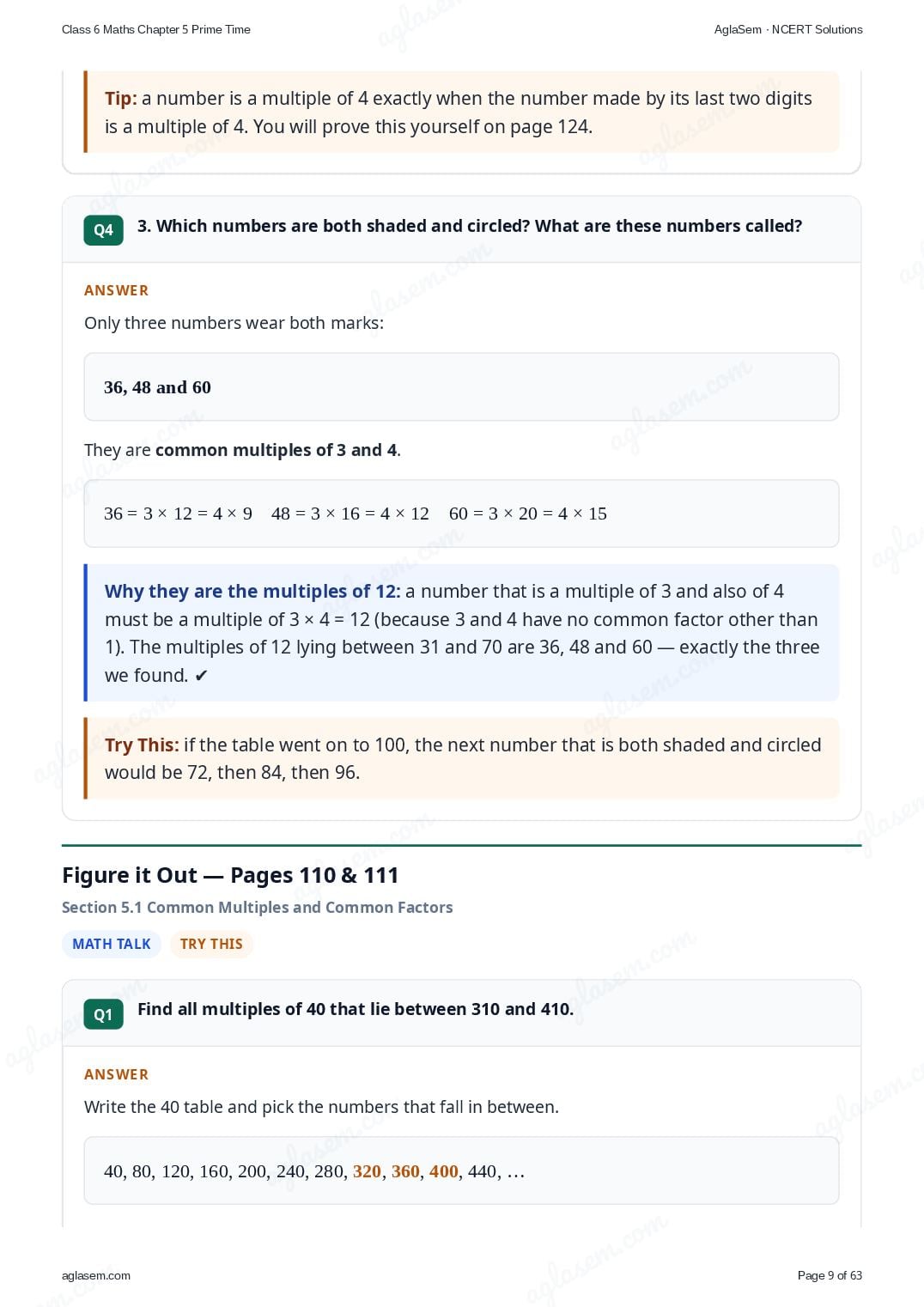
- 3. Which numbers are both shaded and circled? What are these numbers called?
- Find all multiples of 40 that lie between 310 and 410.
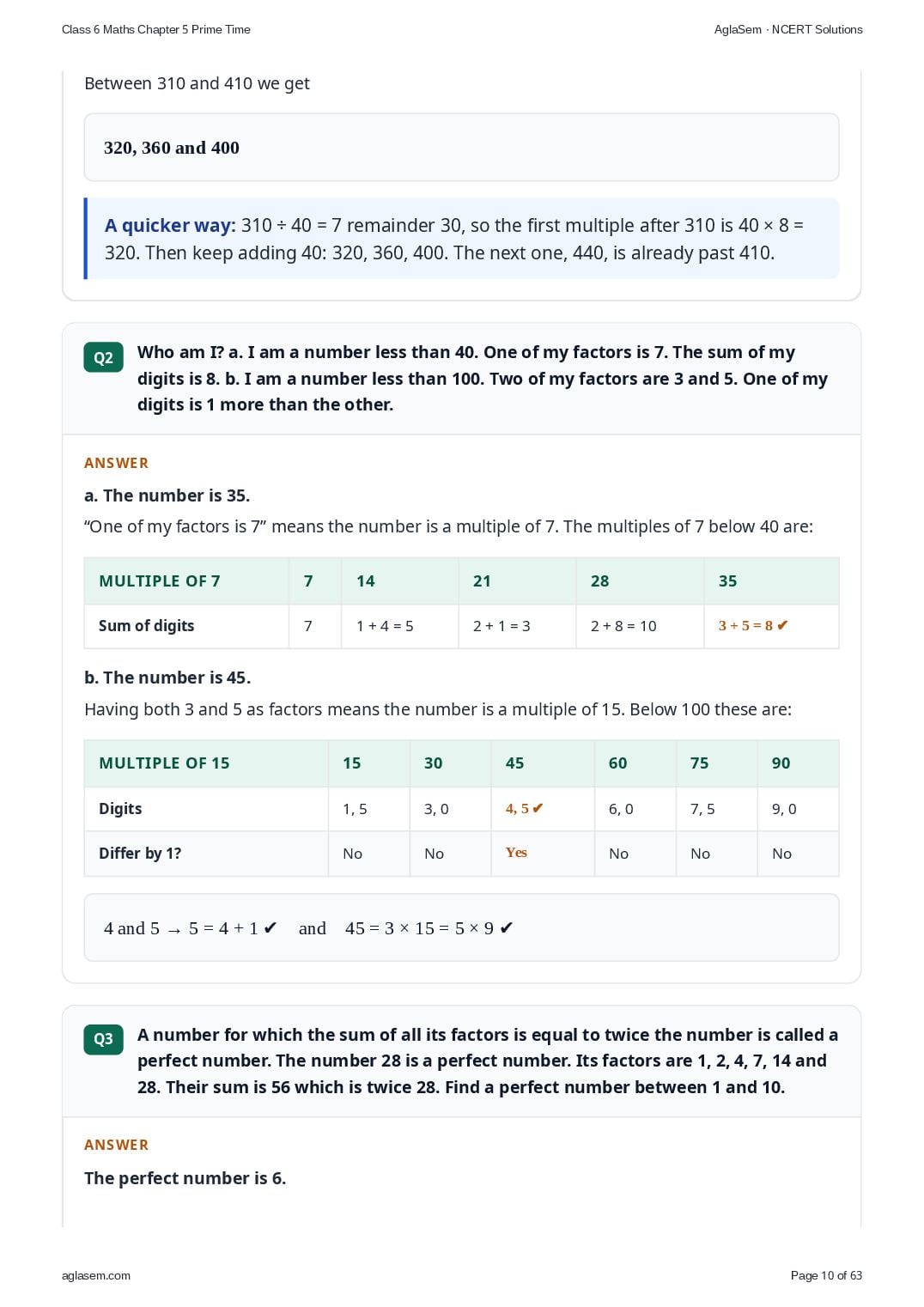
- Who am I? a. I am a number less than 40. One of my factors is 7. The sum of my digits is 8. b. I am a number less than 100. Two of my factors are 3 and 5. One of my digits is 1 more than the other.
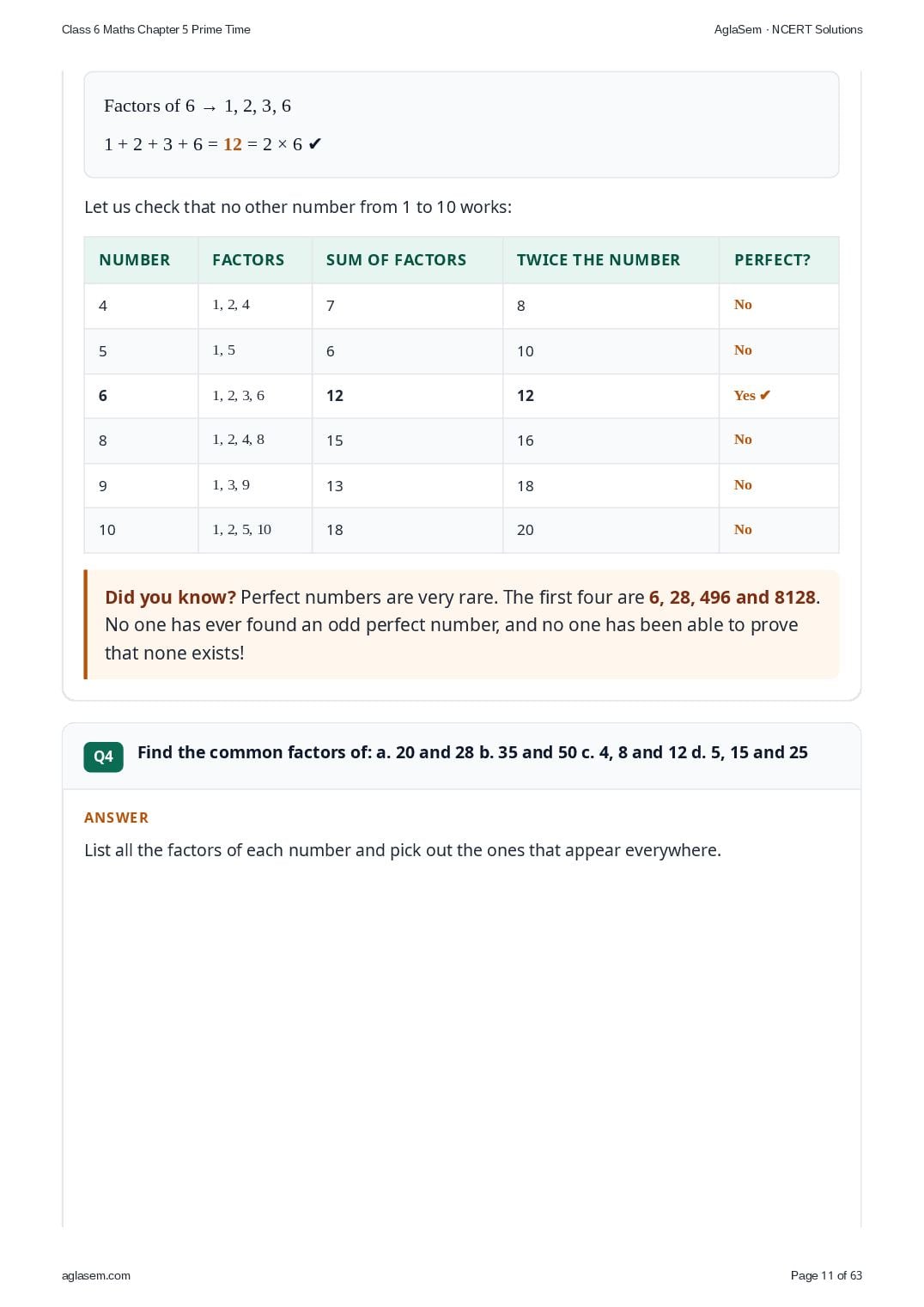
- A number for which the sum of all its factors is equal to twice the number is called a perfect number. The number 28 is a perfect number. Its factors are 1, 2, 4, 7, 14 and 28. Their sum is 56 which is twice 28. Find a perfect number between 1 and 10.
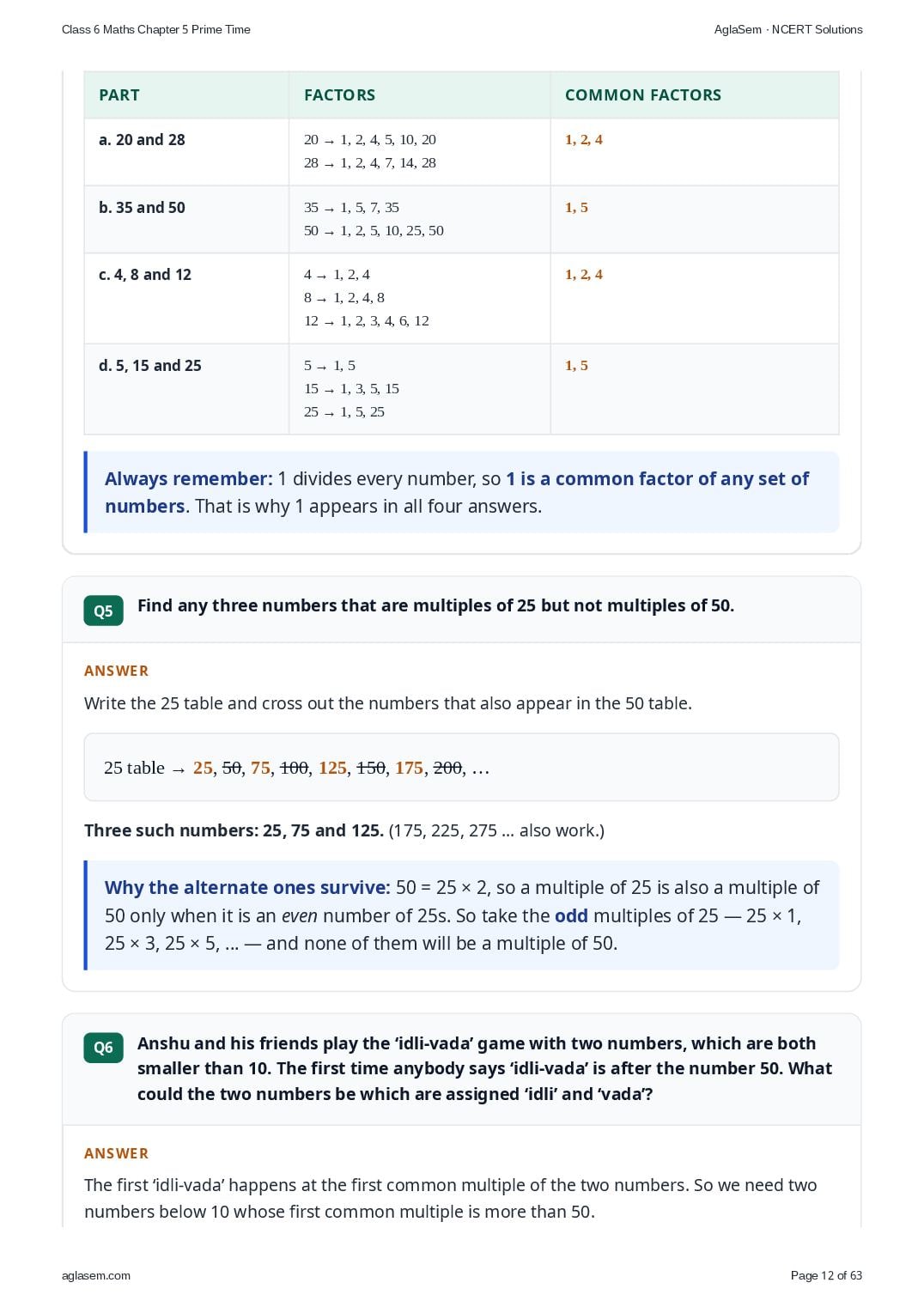
- Find the common factors of: a. 20 and 28 b. 35 and 50 c. 4, 8 and 12 d. 5, 15 and 25
- Find any three numbers that are multiples of 25 but not multiples of 50.
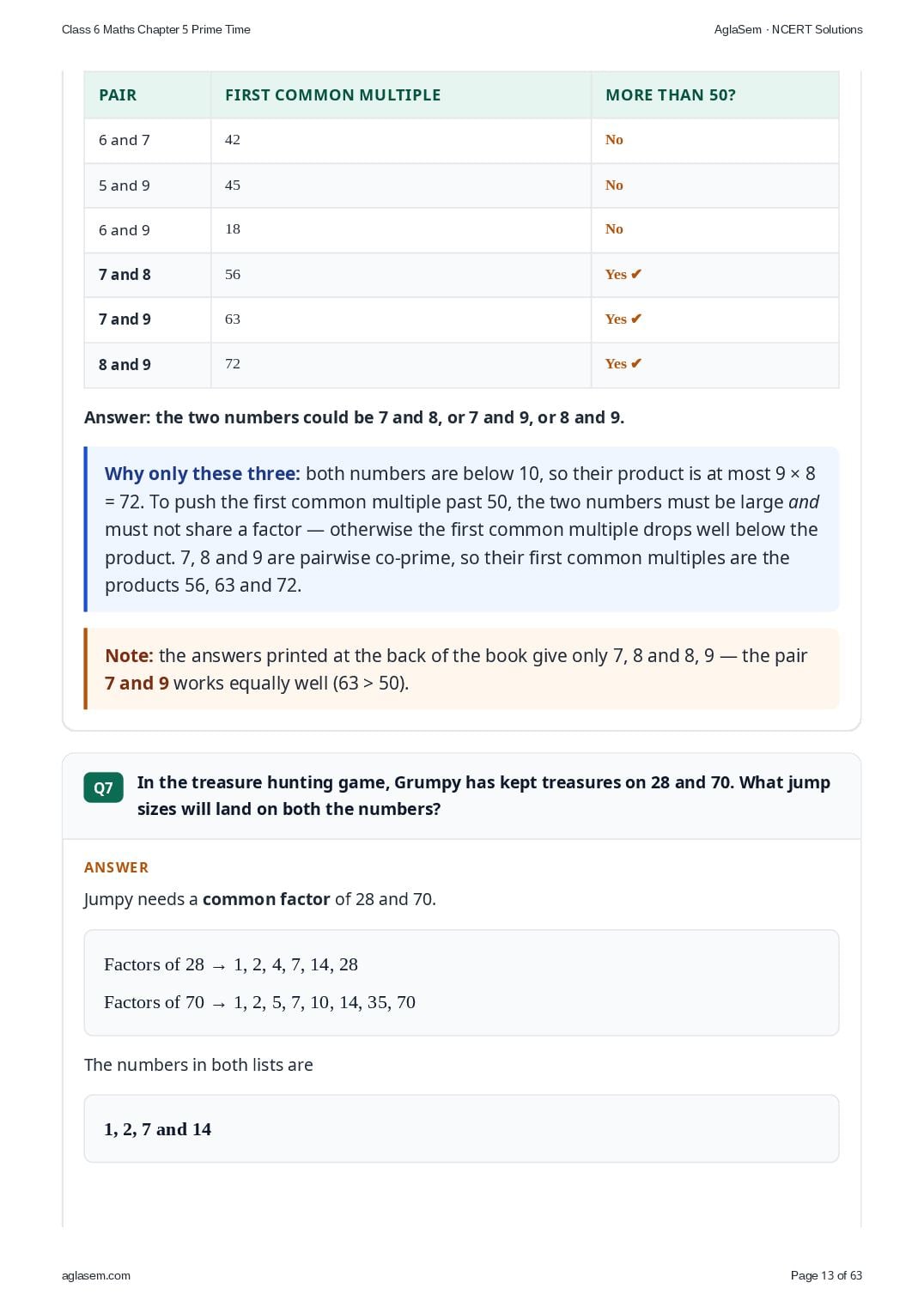
- Anshu and his friends play the ‘idli-vada’ game with two numbers, which are both smaller than 10. The first time anybody says ‘idli-vada’ is after the number 50. What could the two numbers be which are assigned ‘idli’ and ‘vada’?
- In the treasure hunting game, Grumpy has kept treasures on 28 and 70. What jump sizes will land on both the numbers?
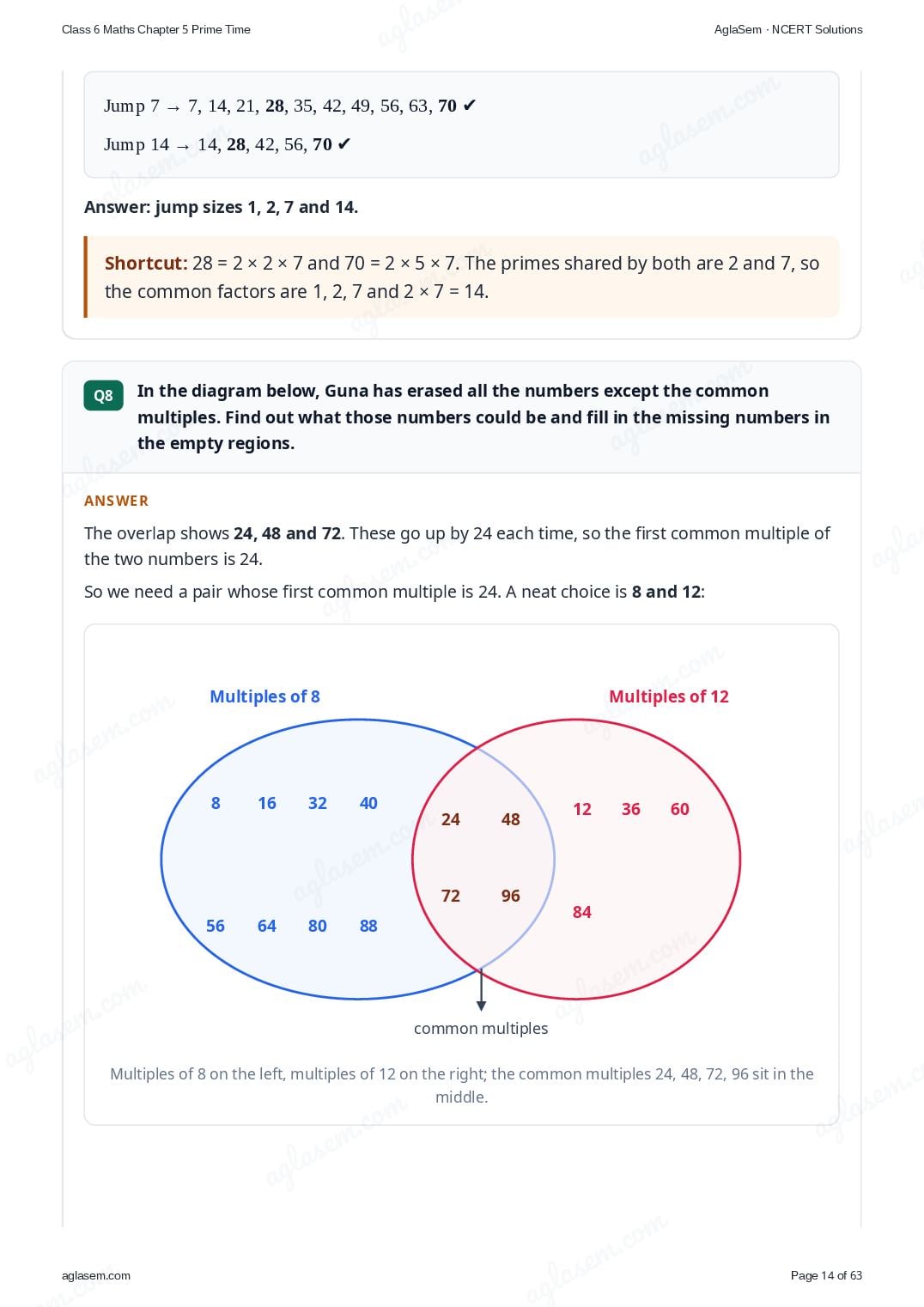
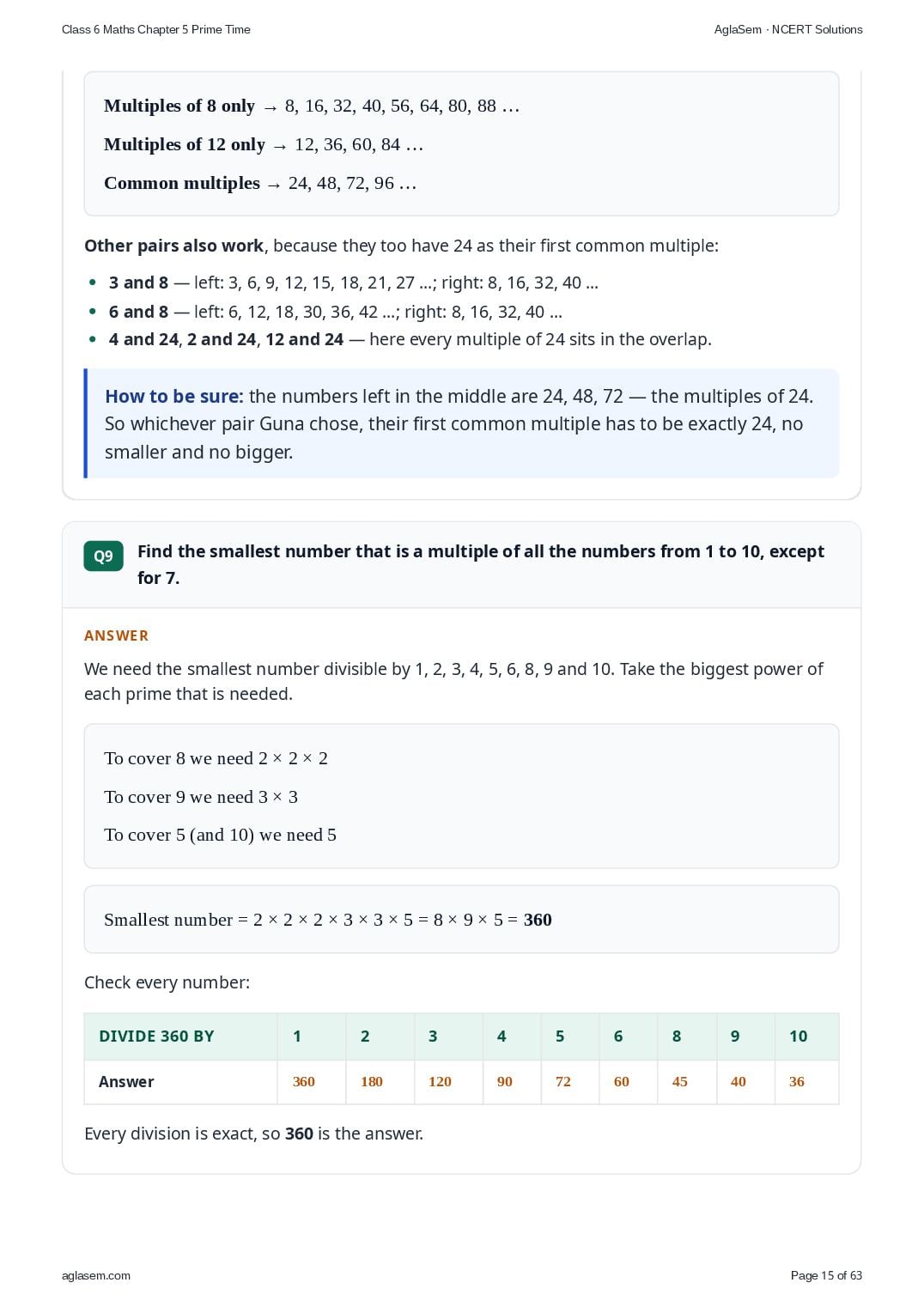
- In the diagram below, Guna has erased all the numbers except the common multiples. Find out what those numbers could be and fill in the missing numbers in the empty regions.
- Find the smallest number that is a multiple of all the numbers from 1 to 10, except for 7.
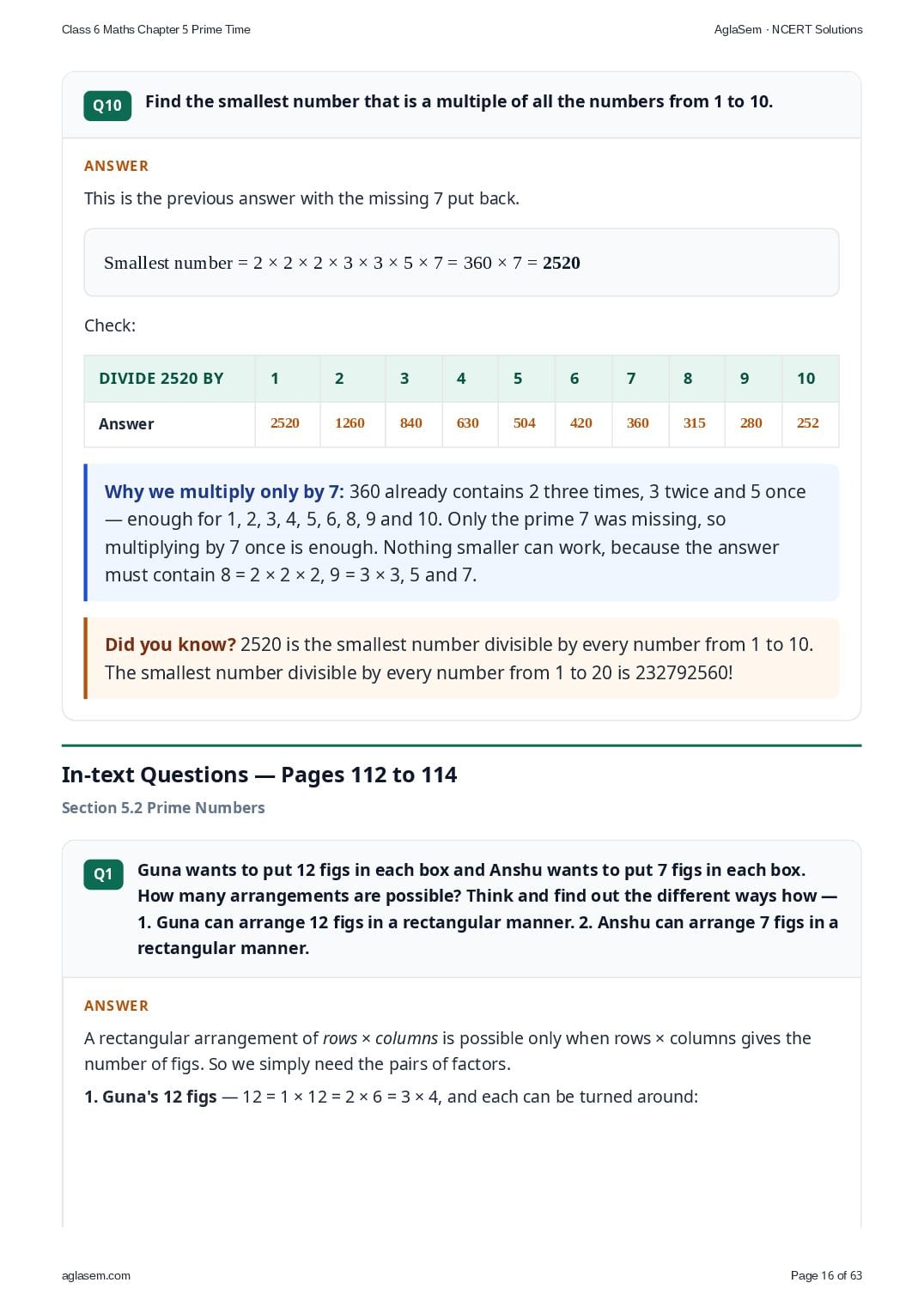
- Find the smallest number that is a multiple of all the numbers from 1 to 10.
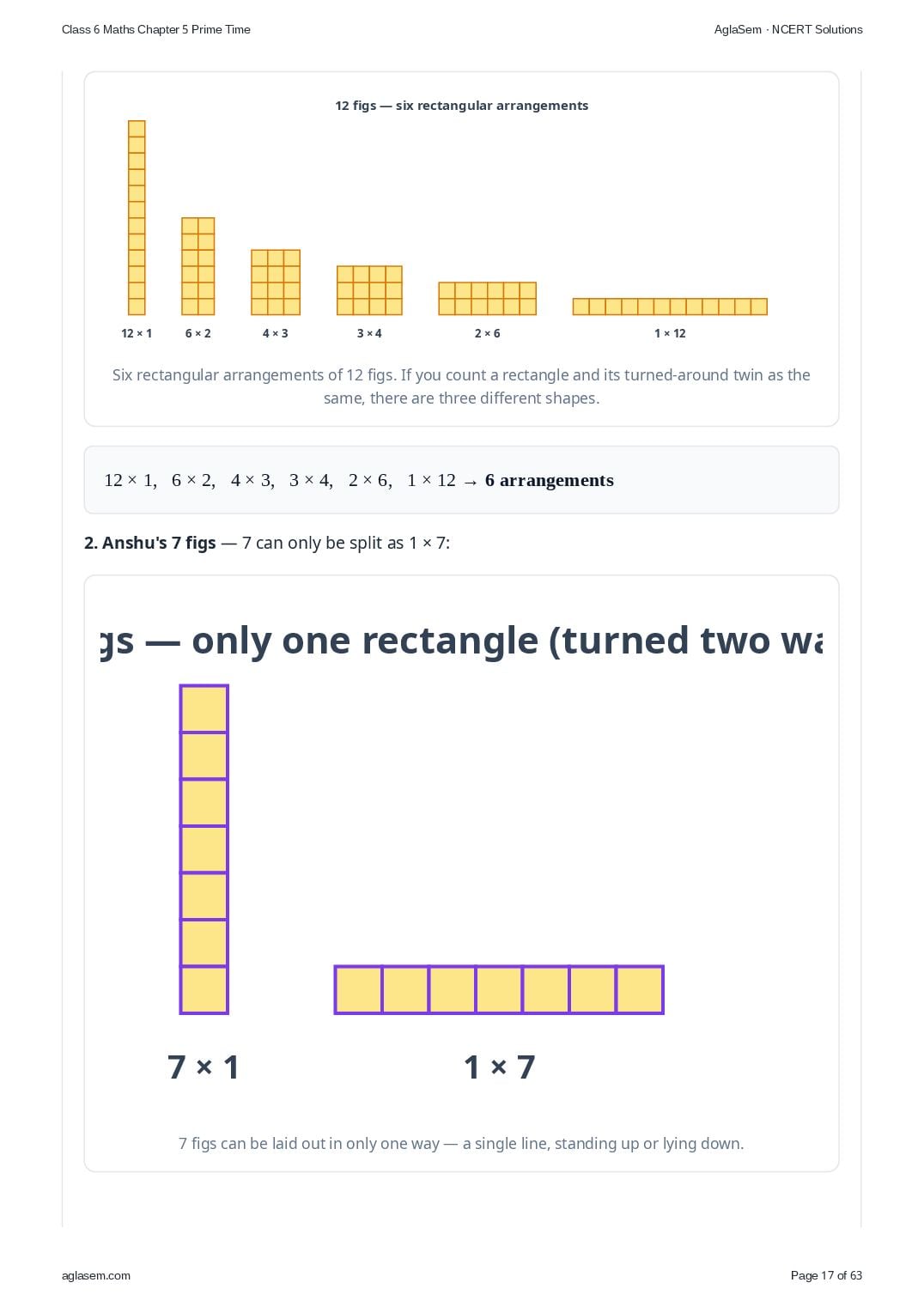
- Guna wants to put 12 figs in each box and Anshu wants to put 7 figs in each box. How many arrangements are possible? Think and find out the different ways how — 1. Guna can arrange 12 figs in a rectangular manner. 2. Anshu can arrange 7 figs in a rectangular manner.
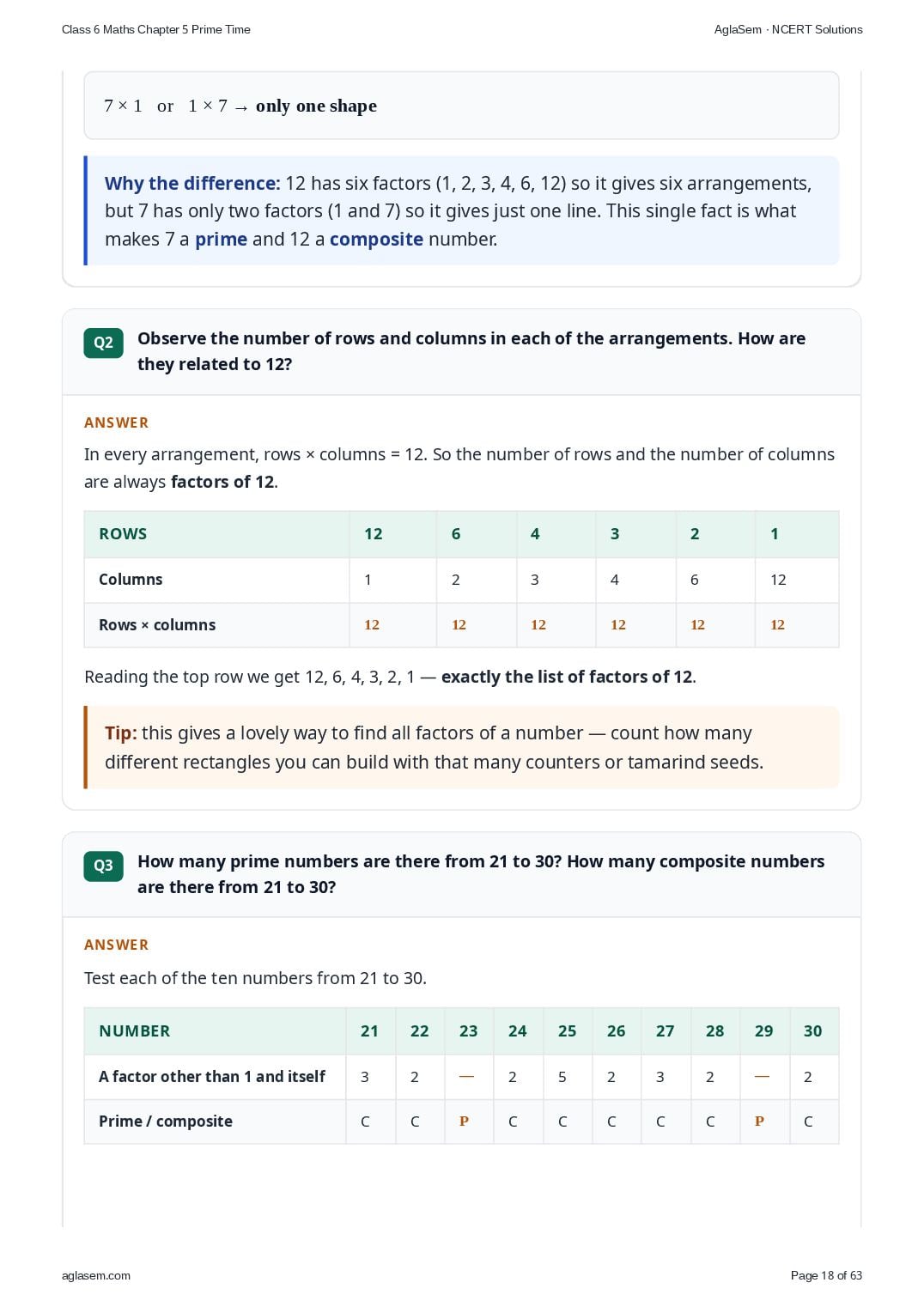
- Observe the number of rows and columns in each of the arrangements. How are they related to 12?
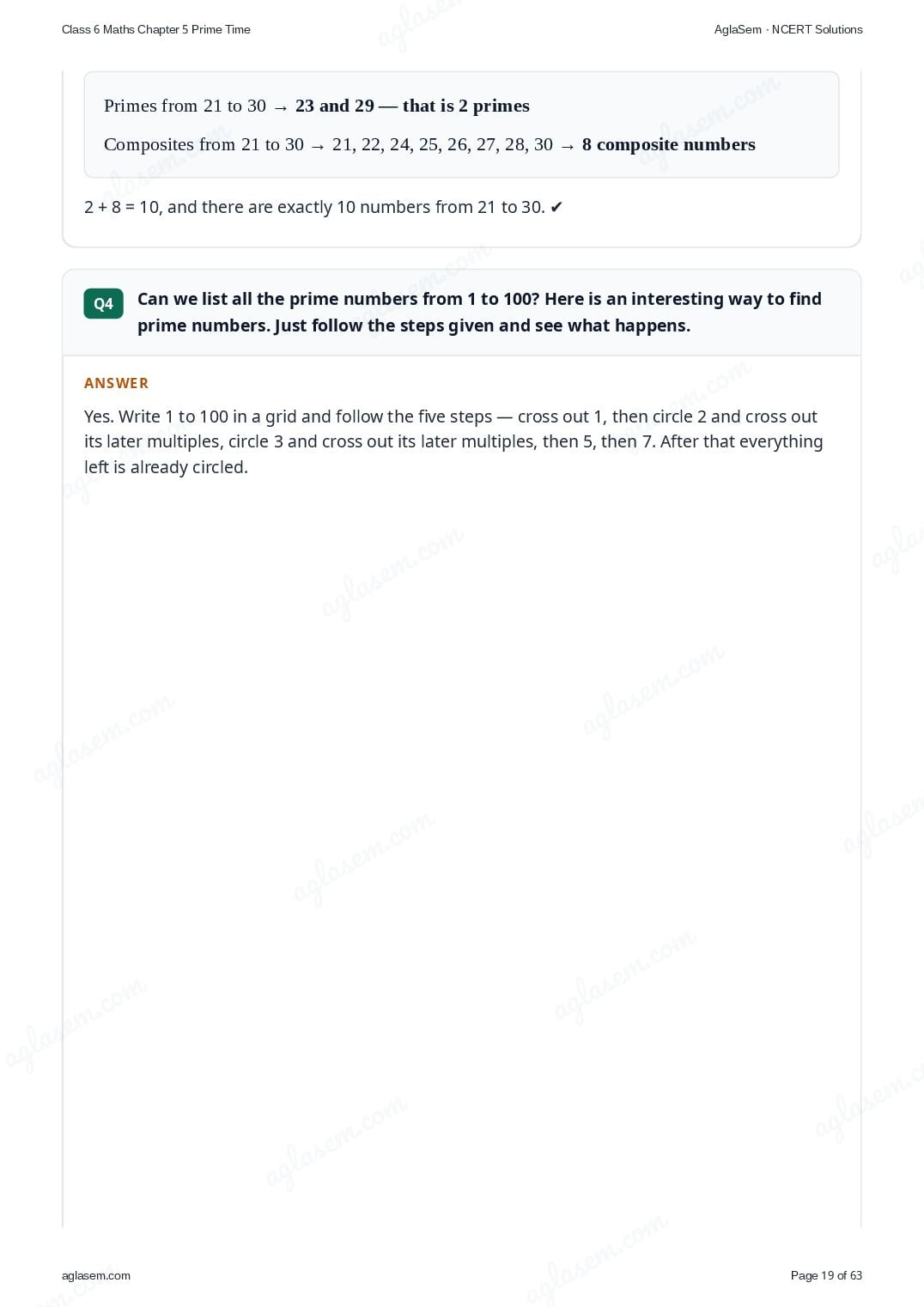
- How many prime numbers are there from 21 to 30? How many composite numbers are there from 21 to 30?
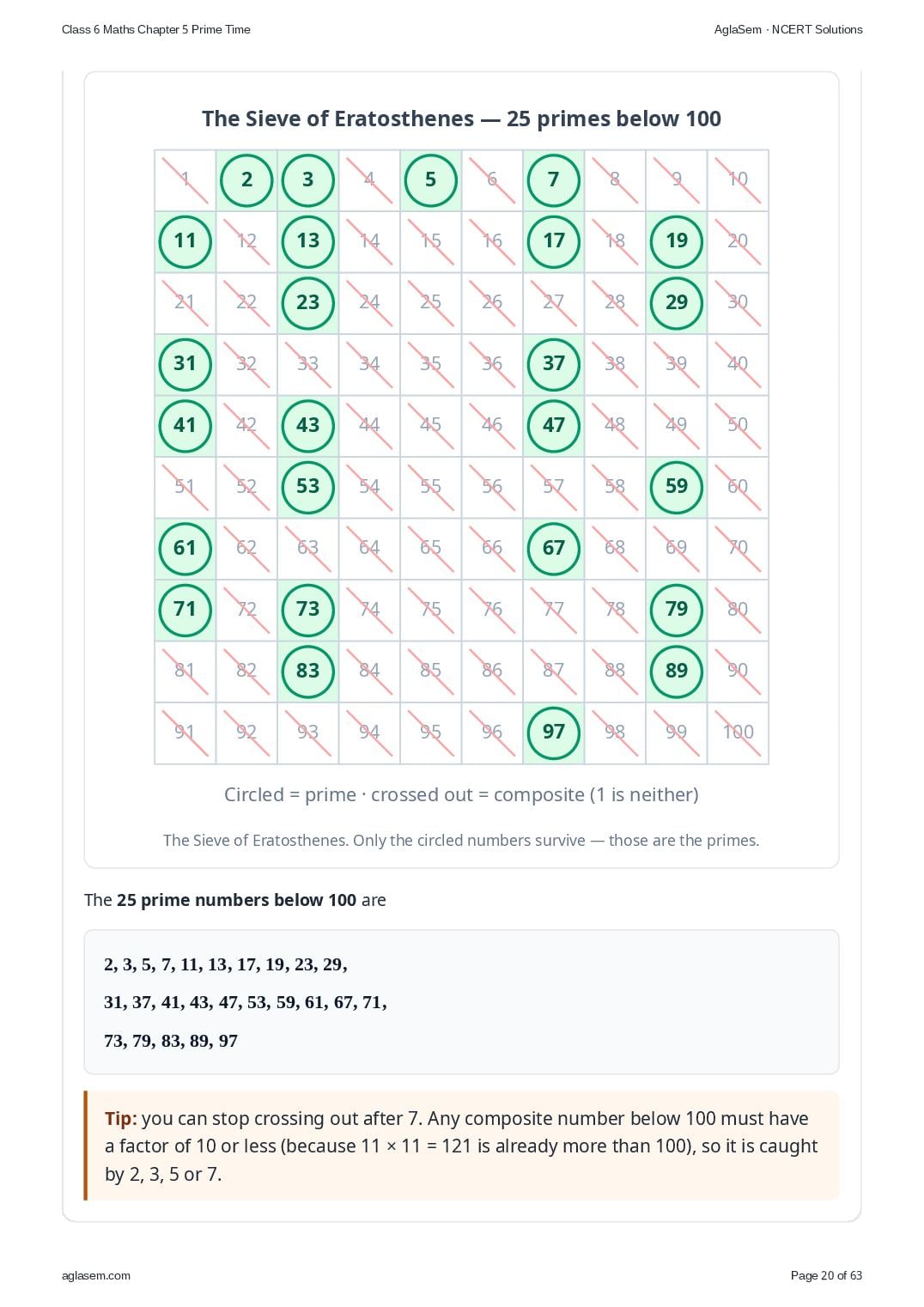
- Can we list all the prime numbers from 1 to 100? Here is an interesting way to find prime numbers. Just follow the steps given and see what happens.
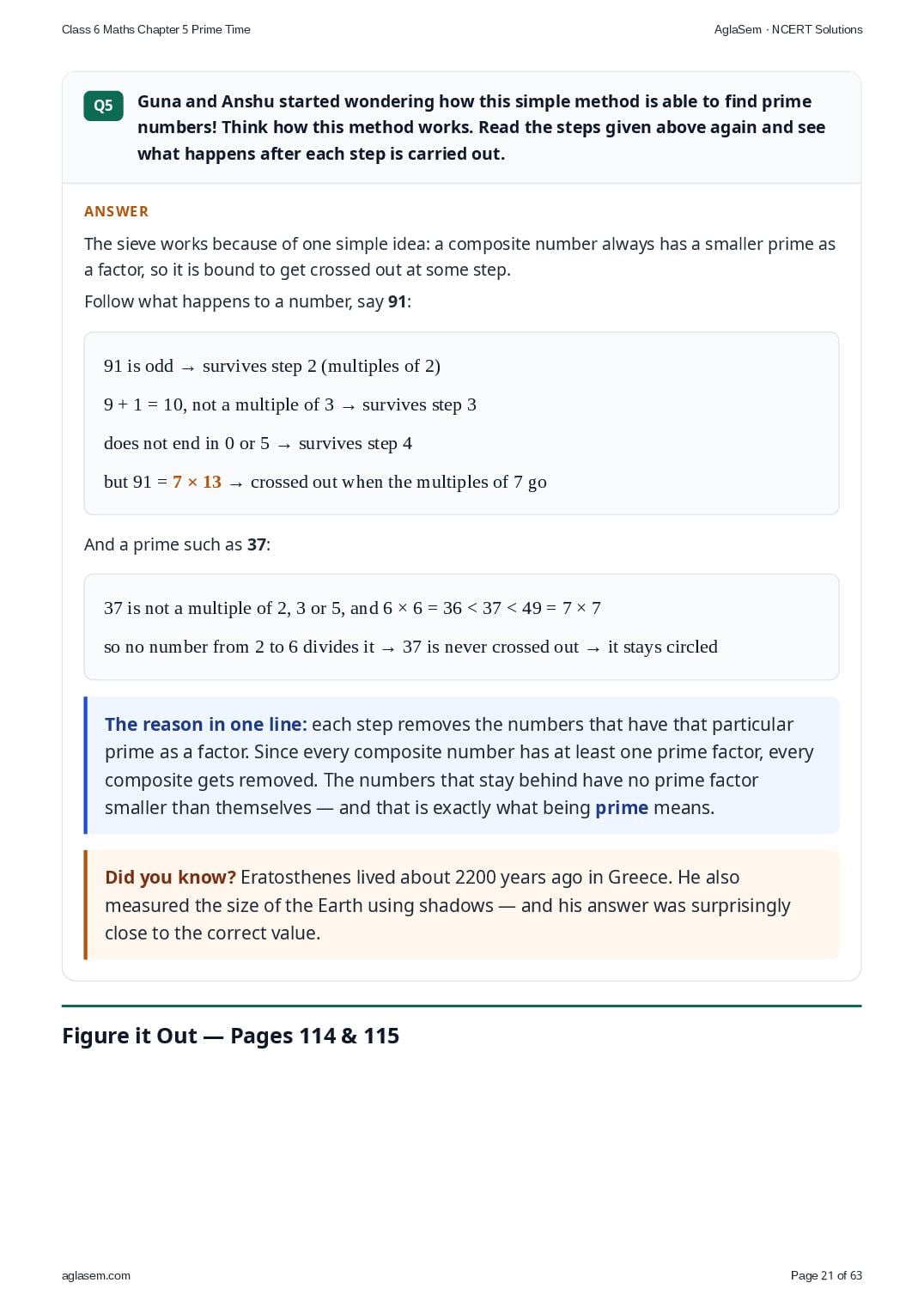
- Guna and Anshu started wondering how this simple method is able to find prime numbers! Think how this method works. Read the steps given above again and see what happens after each step is carried out.
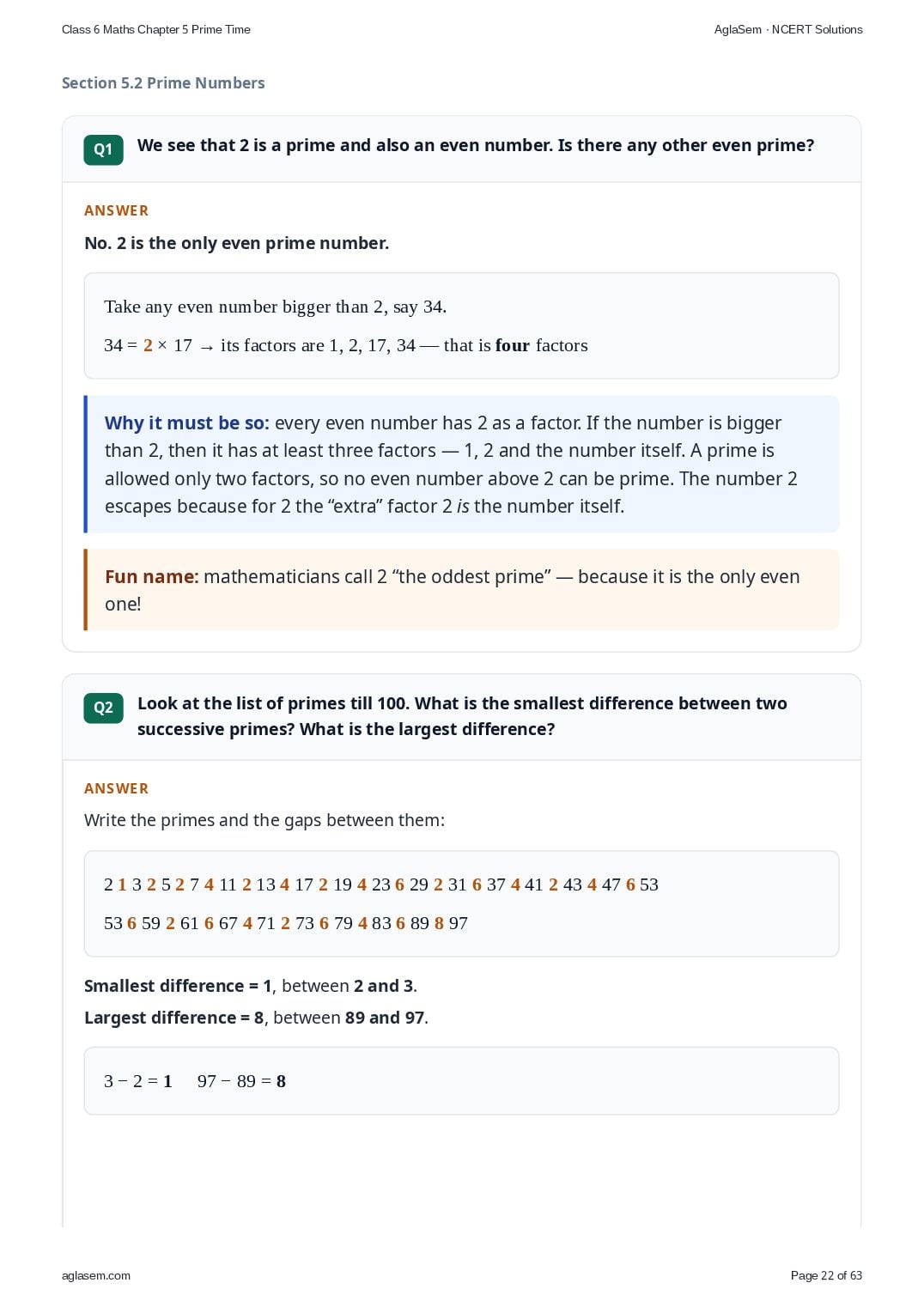
- We see that 2 is a prime and also an even number. Is there any other even prime?
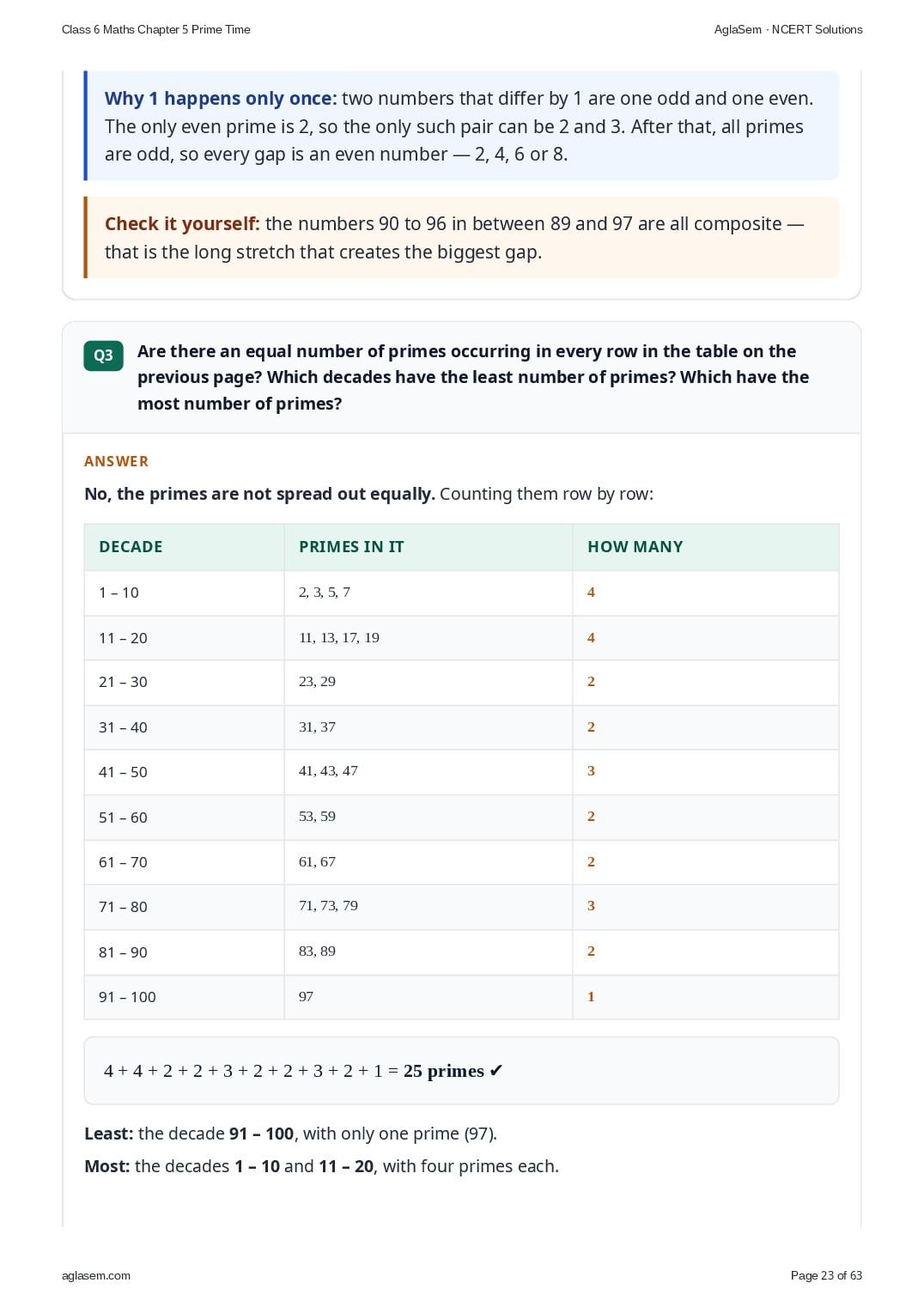
- Look at the list of primes till 100. What is the smallest difference between two successive primes? What is the largest difference?
- Are there an equal number of primes occurring in every row in the table on the previous page? Which decades have the least number of primes? Which have the most number of primes?
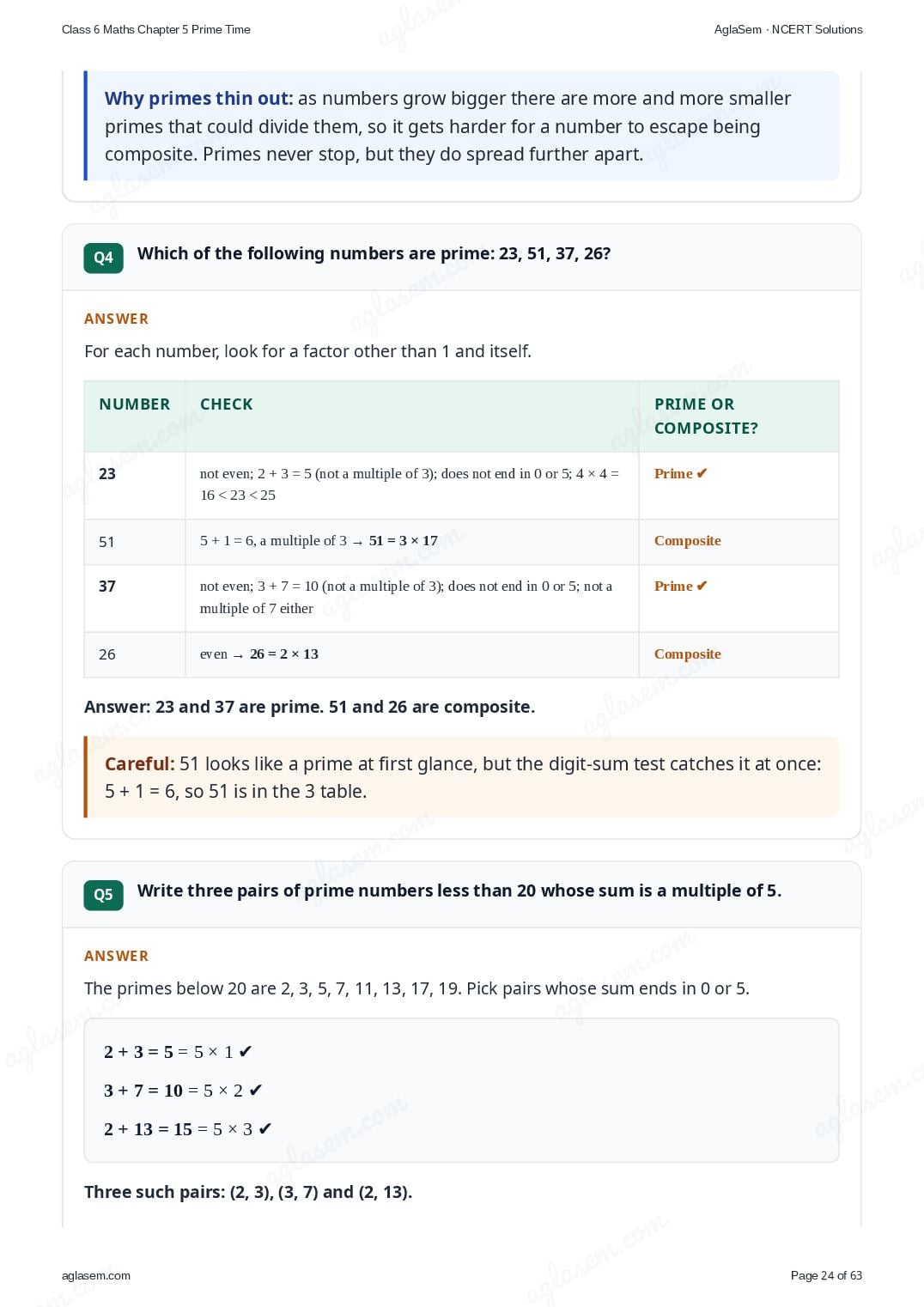
- Which of the following numbers are prime: 23, 51, 37, 26?
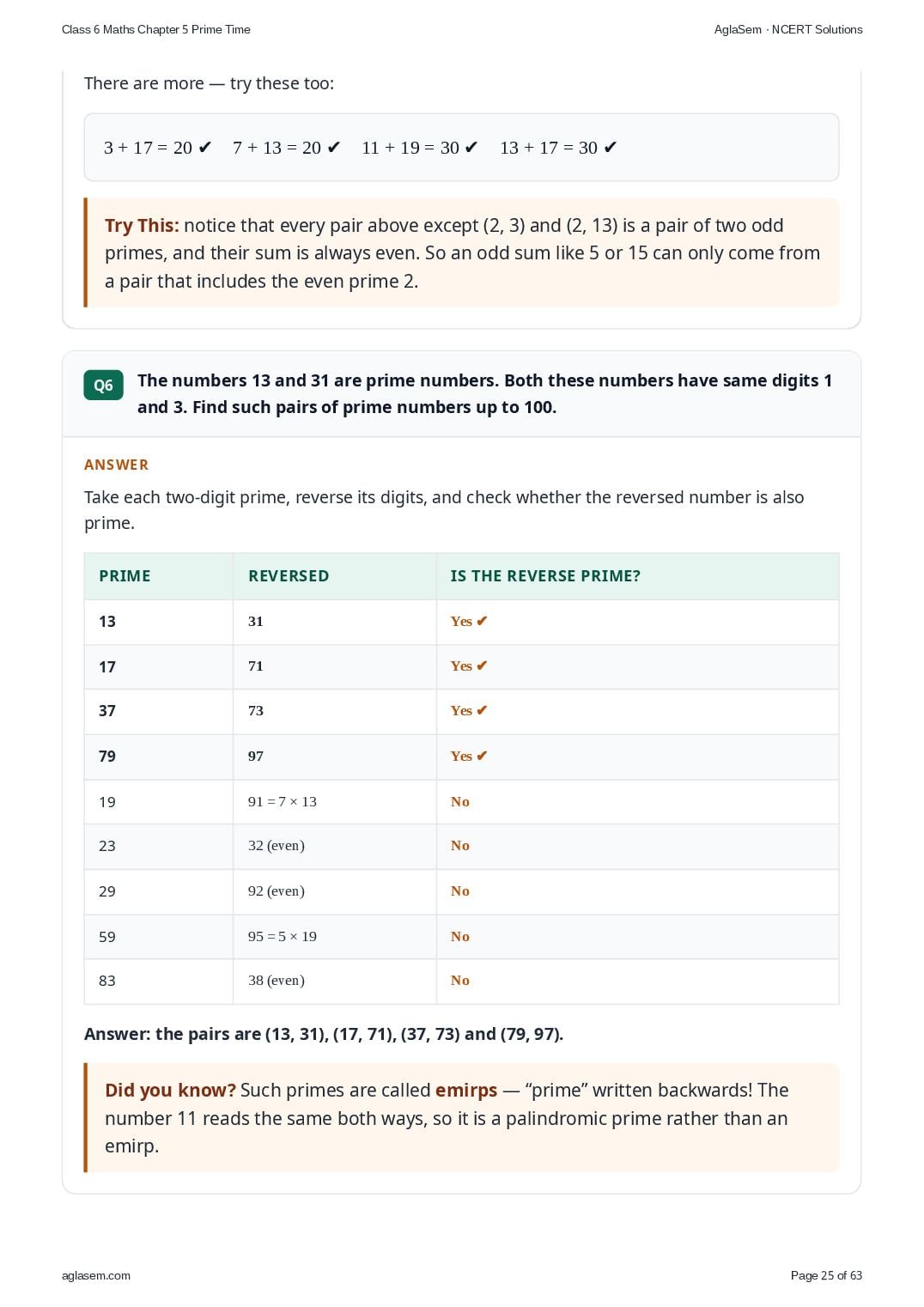
- Write three pairs of prime numbers less than 20 whose sum is a multiple of 5.
- The numbers 13 and 31 are prime numbers. Both these numbers have same digits 1 and 3. Find such pairs of prime numbers up to 100.
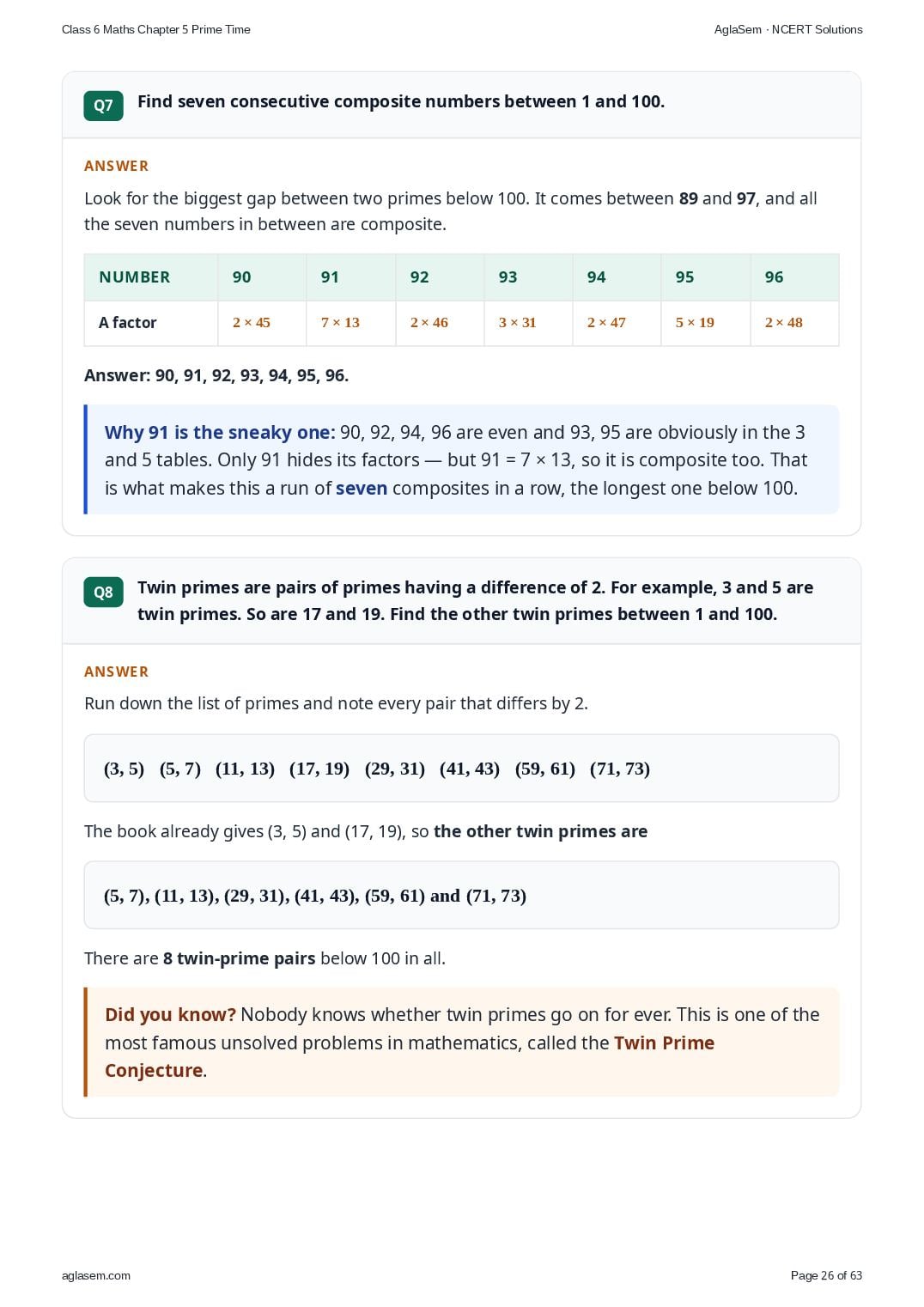
- Find seven consecutive composite numbers between 1 and 100.
- Twin primes are pairs of primes having a difference of 2. For example, 3 and 5 are twin primes. So are 17 and 19. Find the other twin primes between 1 and 100.
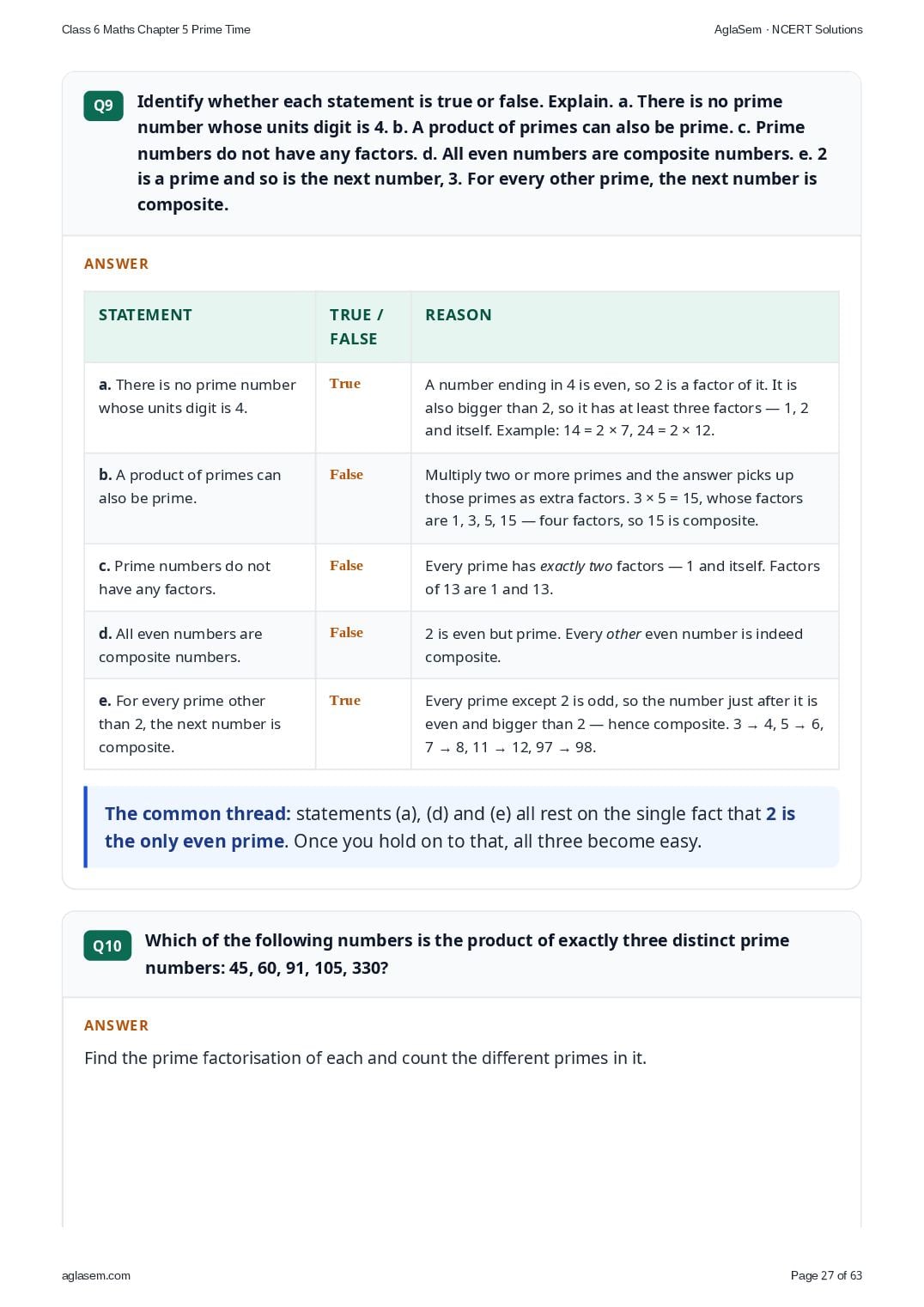
- Identify whether each statement is true or false. Explain. a. There is no prime number whose units digit is 4. b. A product of primes can also be prime. c. Prime numbers do not have any factors. d. All even numbers are composite numbers. e. 2 is a prime and so is the next number, 3. For every other prime, the next number is composite.
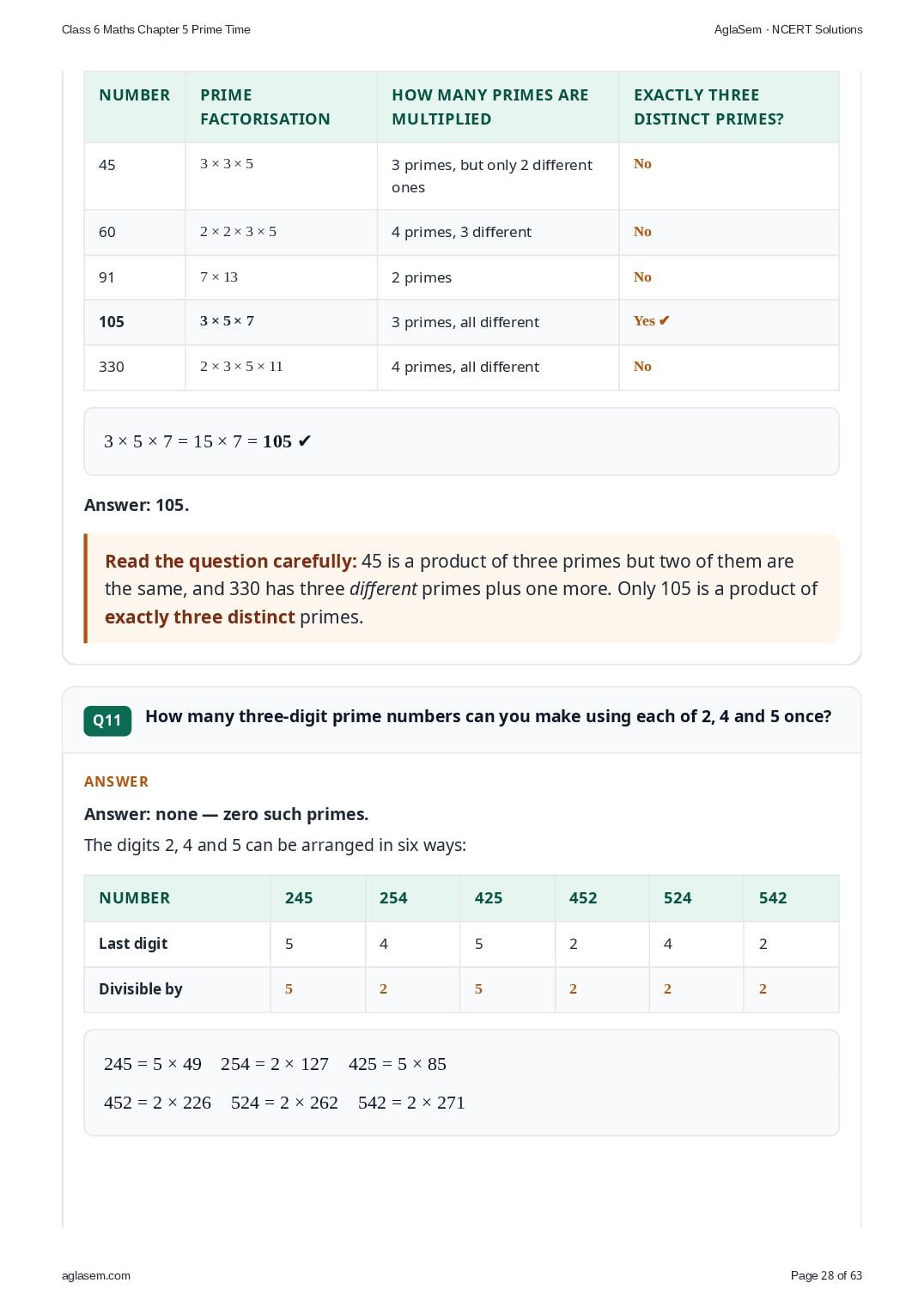
- Which of the following numbers is the product of exactly three distinct prime numbers: 45, 60, 91, 105, 330?
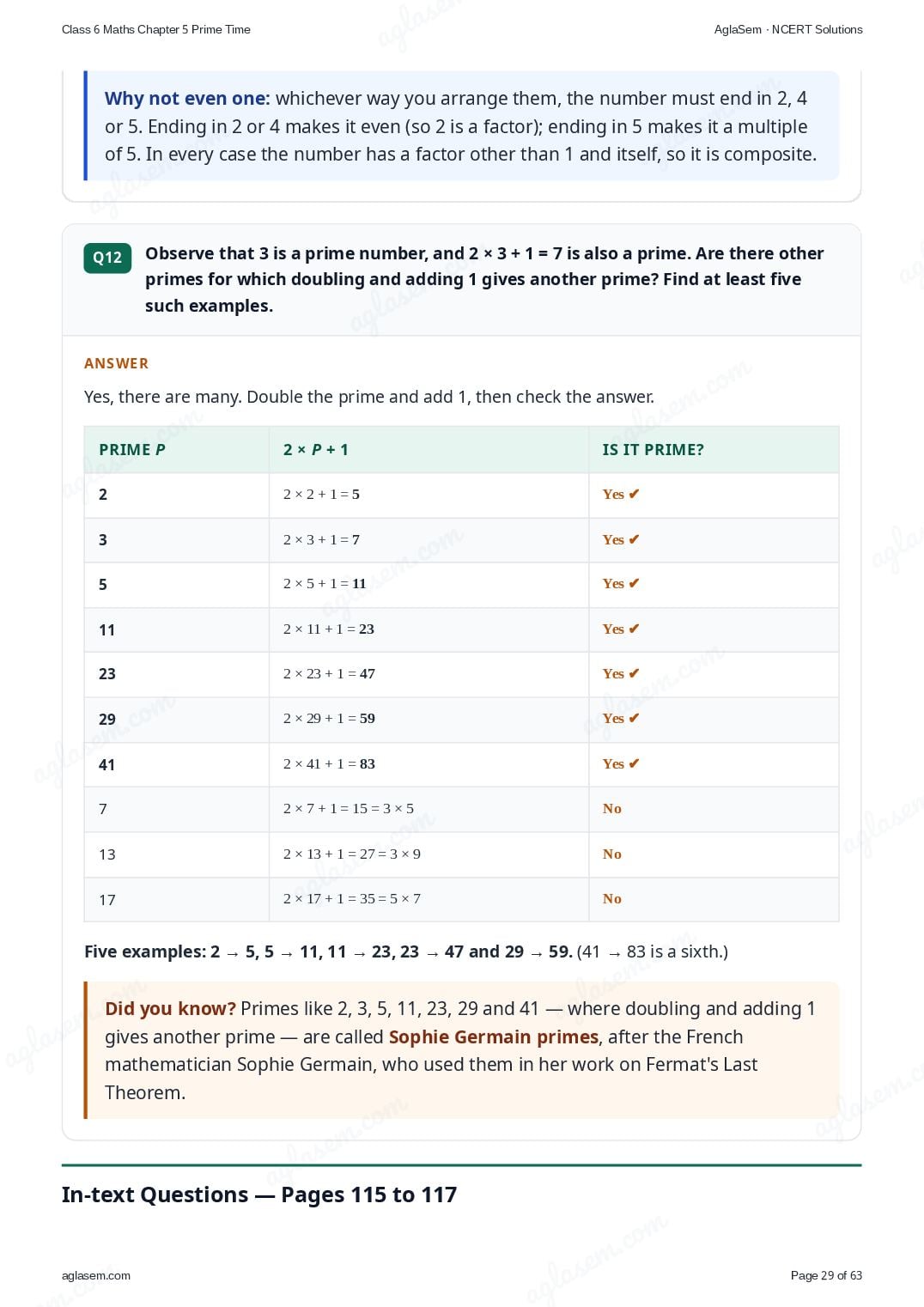
- How many three-digit prime numbers can you make using each of 2, 4 and 5 once?
- Observe that 3 is a prime number, and 2 × 3 + 1 = 7 is also a prime. Are there other primes for which doubling and adding 1 gives another prime? Find at least five such examples.
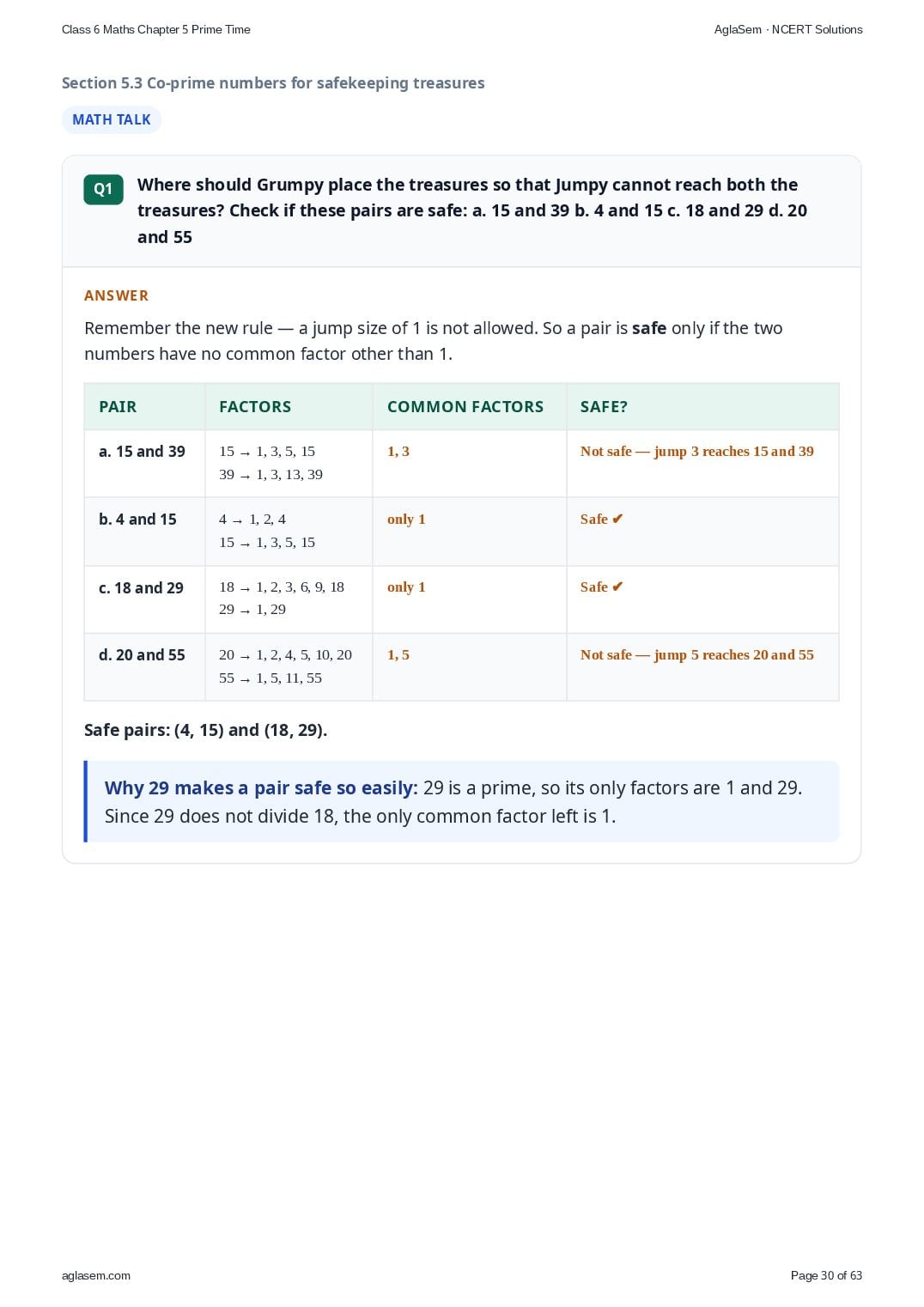
- Where should Grumpy place the treasures so that Jumpy cannot reach both the treasures? Check if these pairs are safe: a. 15 and 39 b. 4 and 15 c. 18 and 29 d. 20 and 55
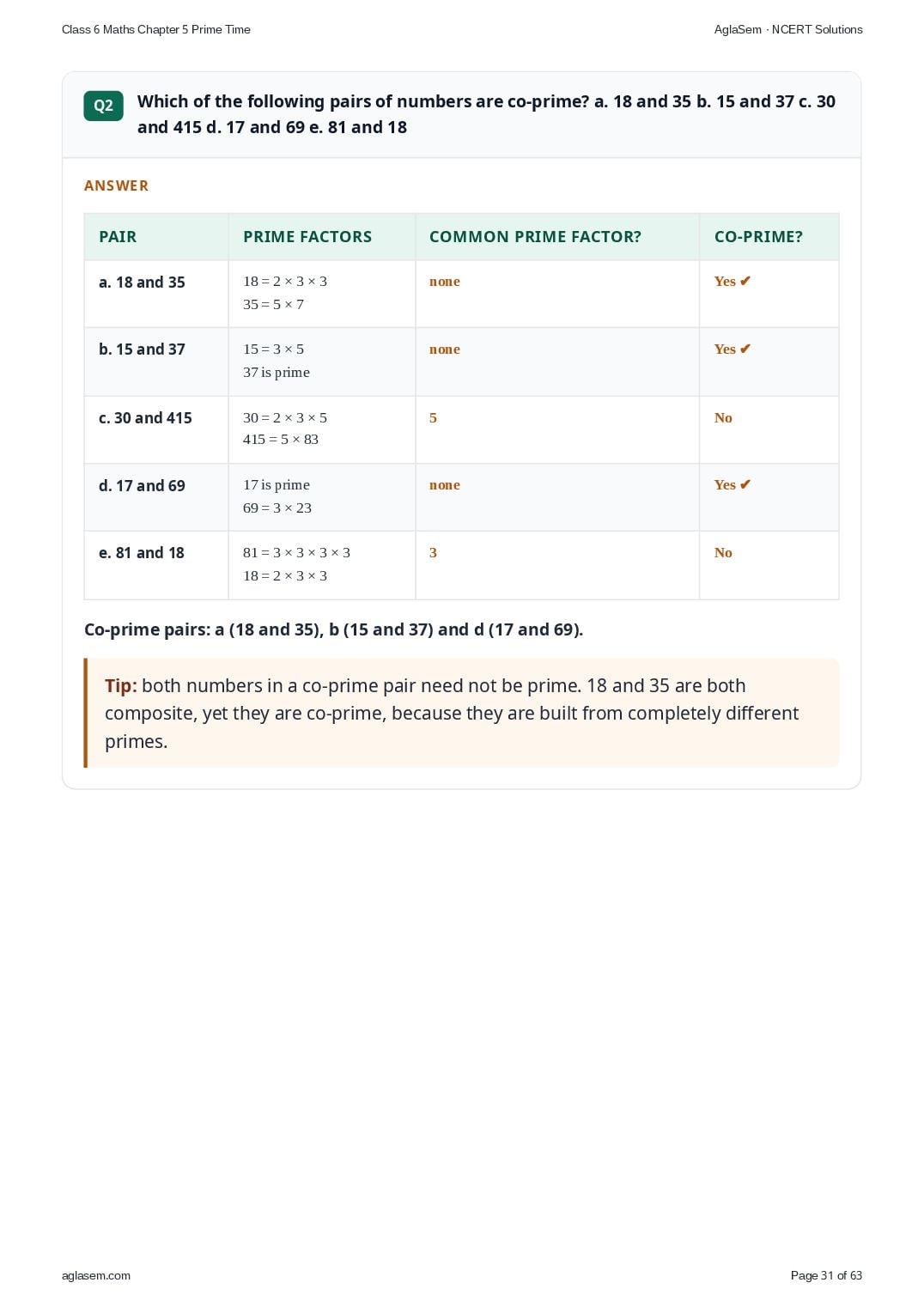
- Which of the following pairs of numbers are co-prime? a. 18 and 35 b. 15 and 37 c. 30 and 415 d. 17 and 69 e. 81 and 18
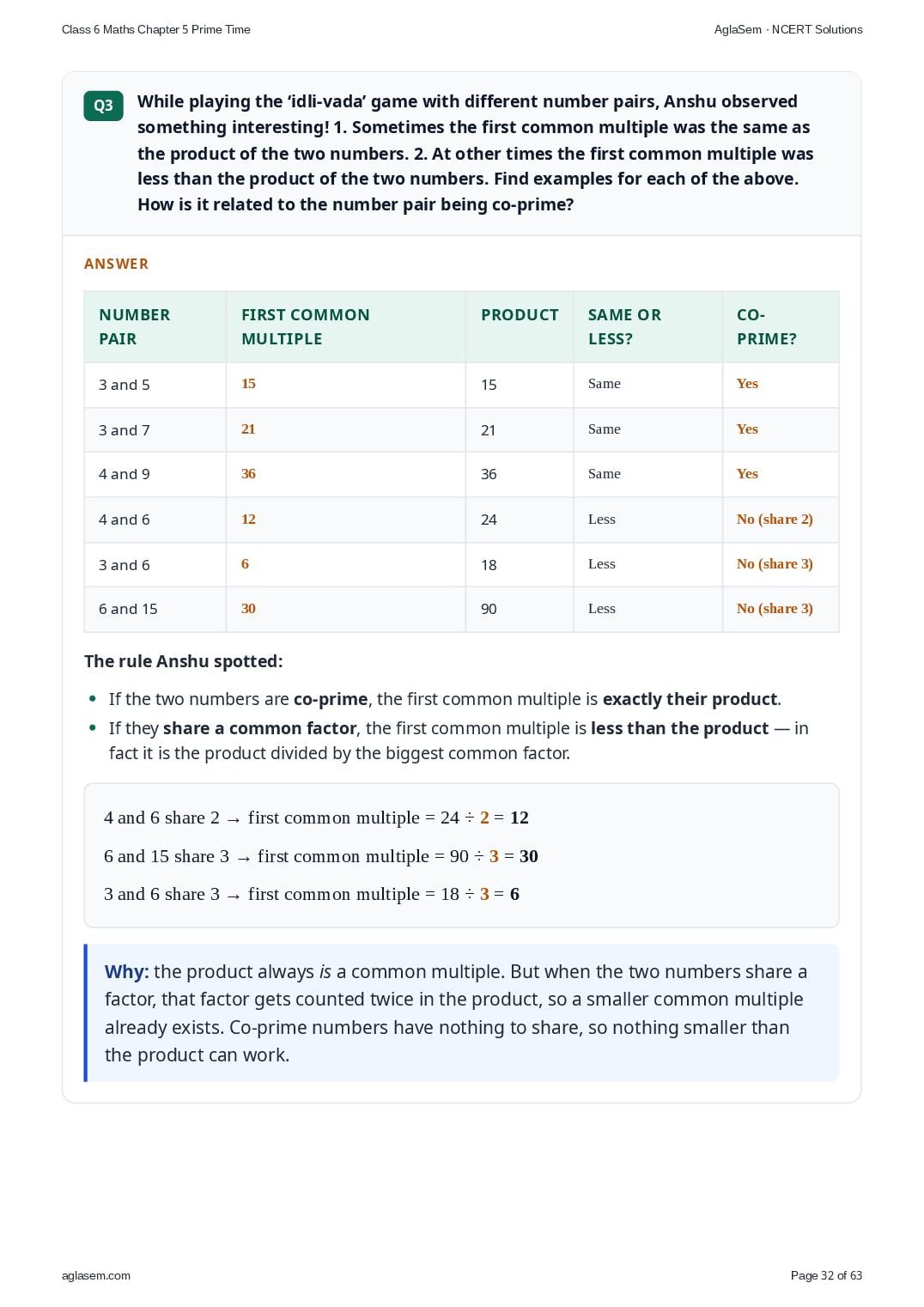
- While playing the ‘idli-vada’ game with different number pairs, Anshu observed something interesting! 1. Sometimes the first common multiple was the same as the product of the two numbers. 2. At other times the first common multiple was less than the product of the two numbers. Find examples for each of the above. How is it related to the number pair being co-prime?
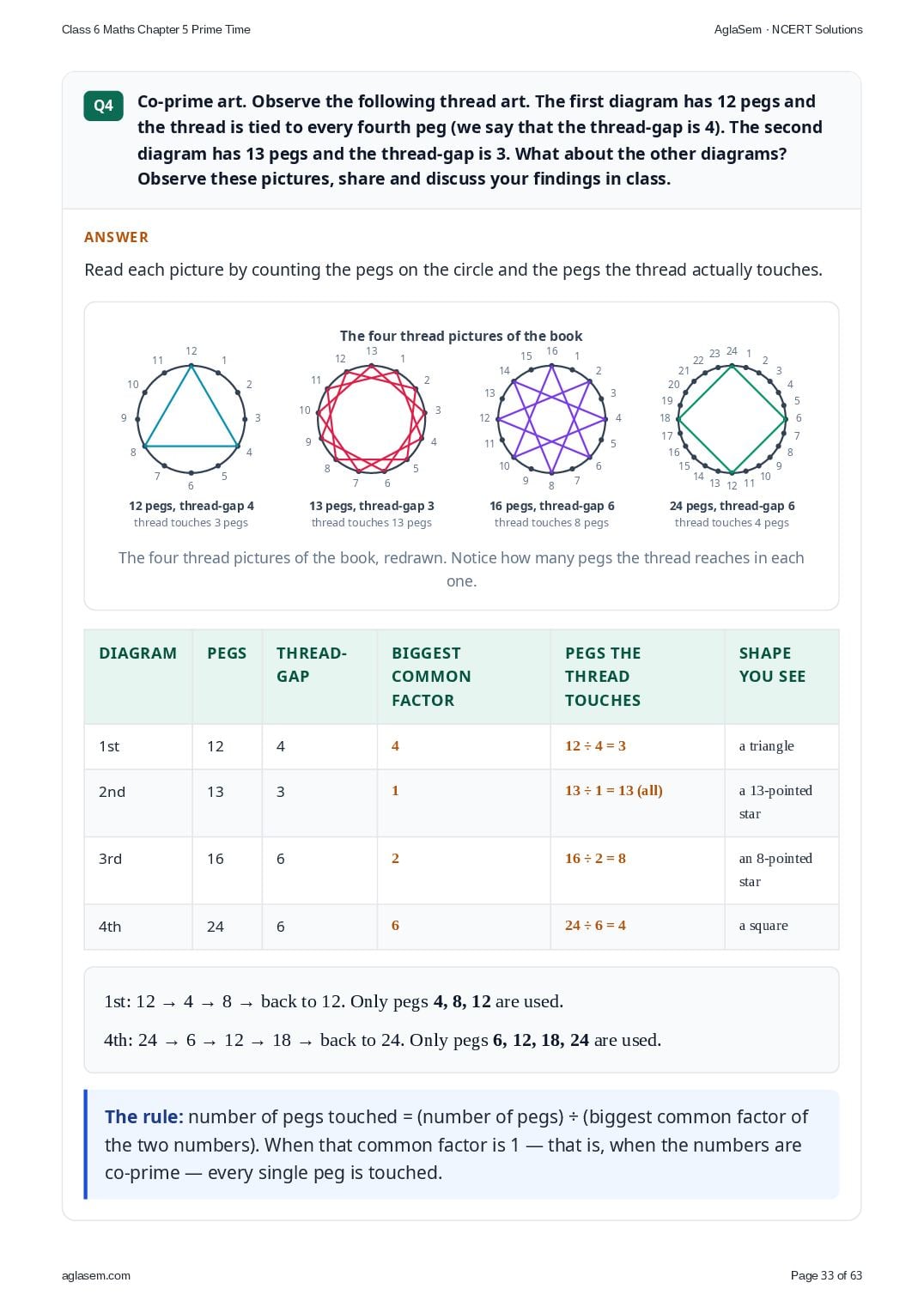
- Co-prime art. Observe the following thread art. The first diagram has 12 pegs and the thread is tied to every fourth peg (we say that the thread-gap is 4). The second diagram has 13 pegs and the thread-gap is 3. What about the other diagrams? Observe these pictures, share and discuss your findings in class.
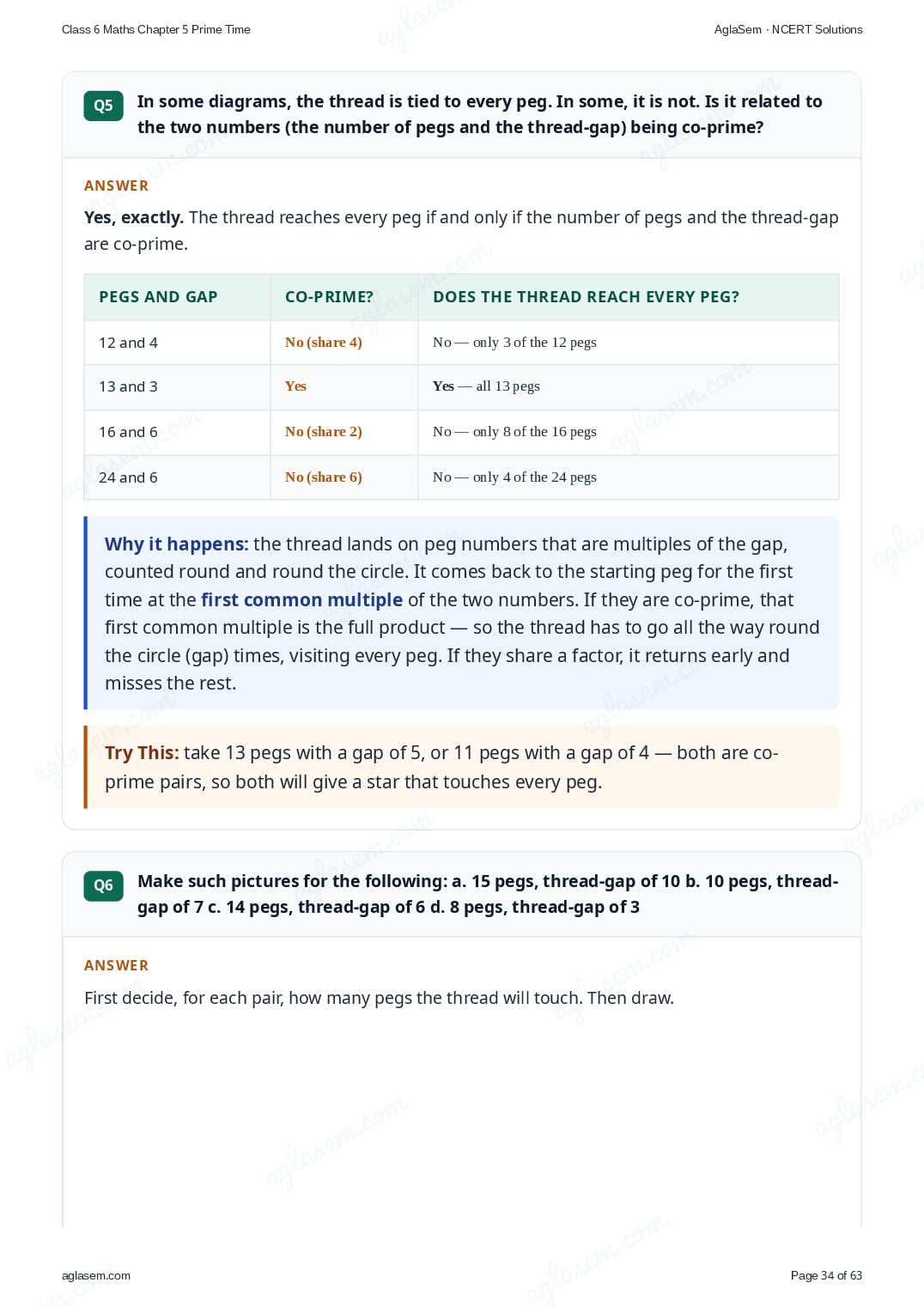
- In some diagrams, the thread is tied to every peg. In some, it is not. Is it related to the two numbers (the number of pegs and the thread-gap) being co-prime?
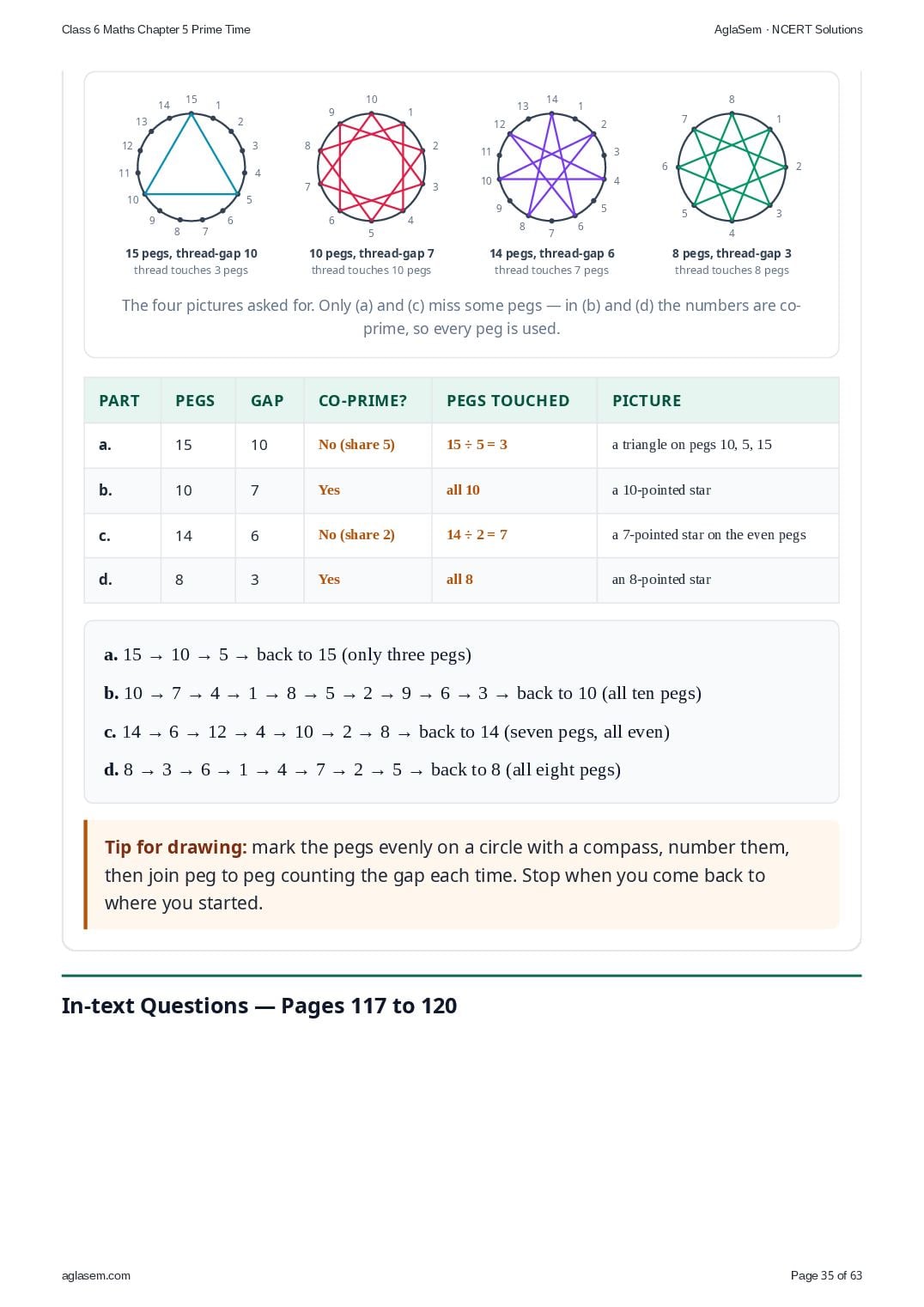
- Make such pictures for the following: a. 15 pegs, thread-gap of 10 b. 10 pegs, thread-gap of 7 c. 14 pegs, thread-gap of 6 d. 8 pegs, thread-gap of 3
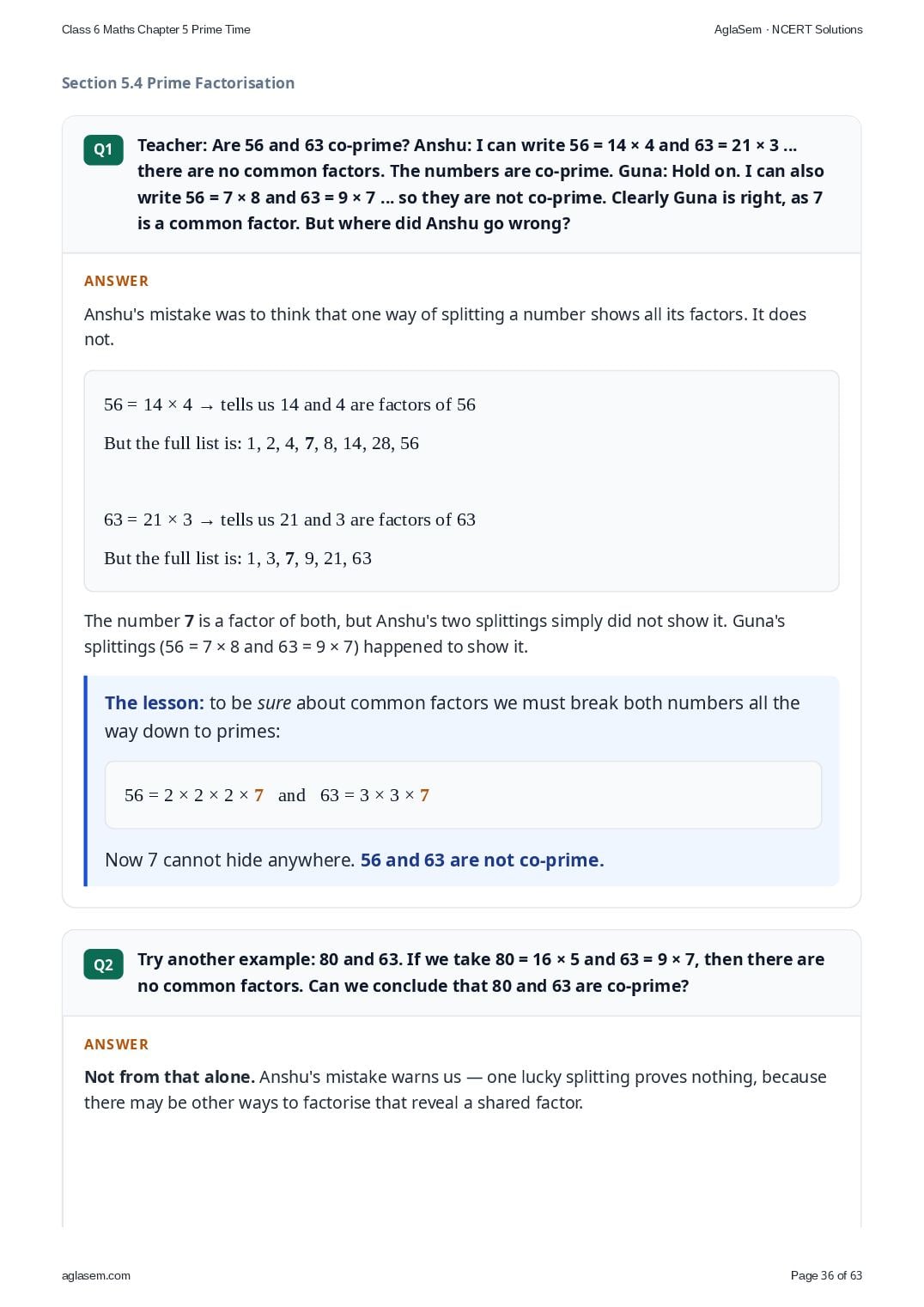
- Teacher: Are 56 and 63 co-prime? Anshu: I can write 56 = 14 × 4 and 63 = 21 × 3 … there are no common factors. The numbers are co-prime. Guna: Hold on. I can also write 56 = 7 × 8 and 63 = 9 × 7 … so they are not co-prime. Clearly Guna is right, as 7 is a common factor. But where did Anshu go wrong?
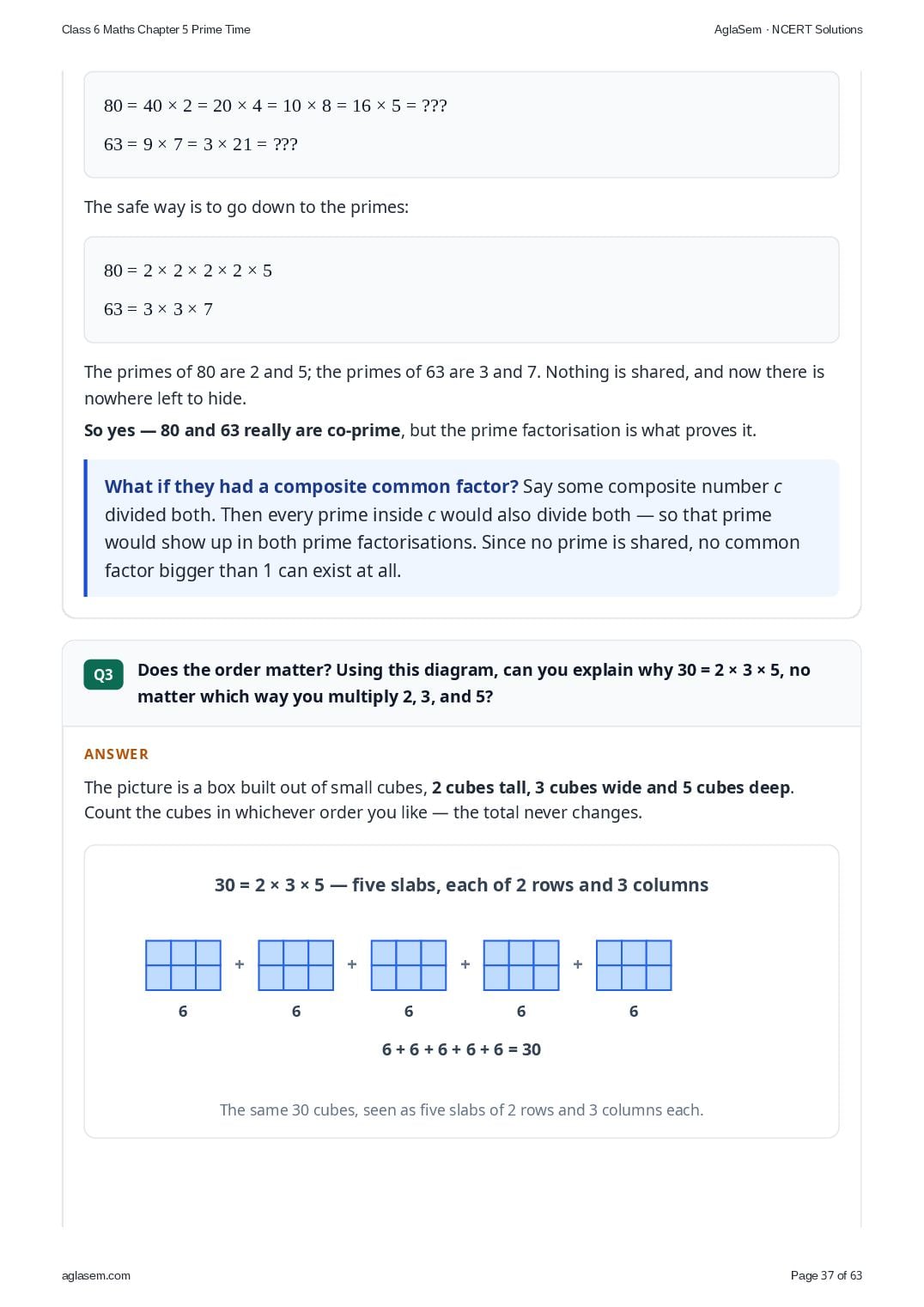
- Try another example: 80 and 63. If we take 80 = 16 × 5 and 63 = 9 × 7, then there are no common factors. Can we conclude that 80 and 63 are co-prime?
- Does the order matter? Using this diagram, can you explain why 30 = 2 × 3 × 5, no matter which way you multiply 2, 3, and 5?
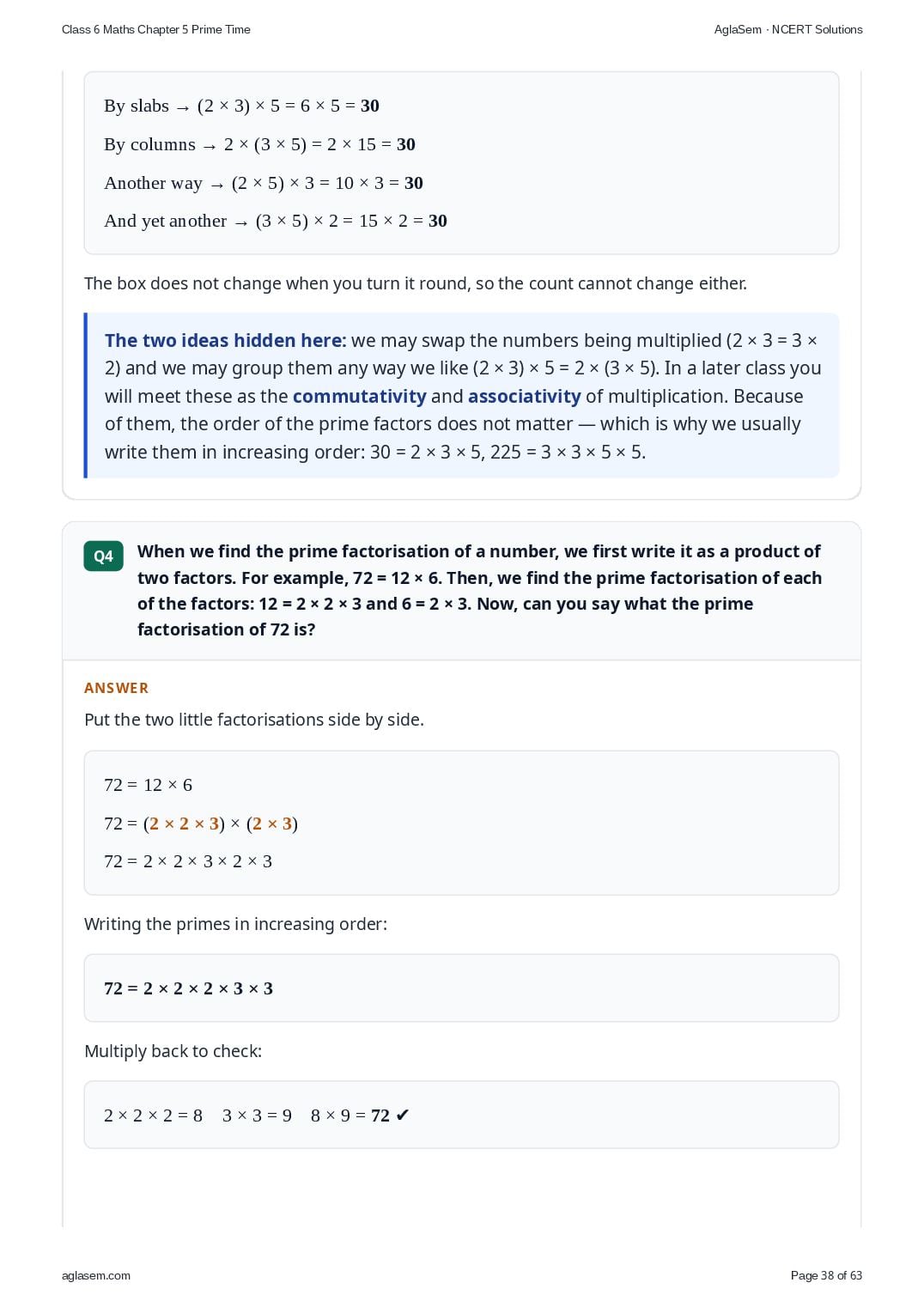
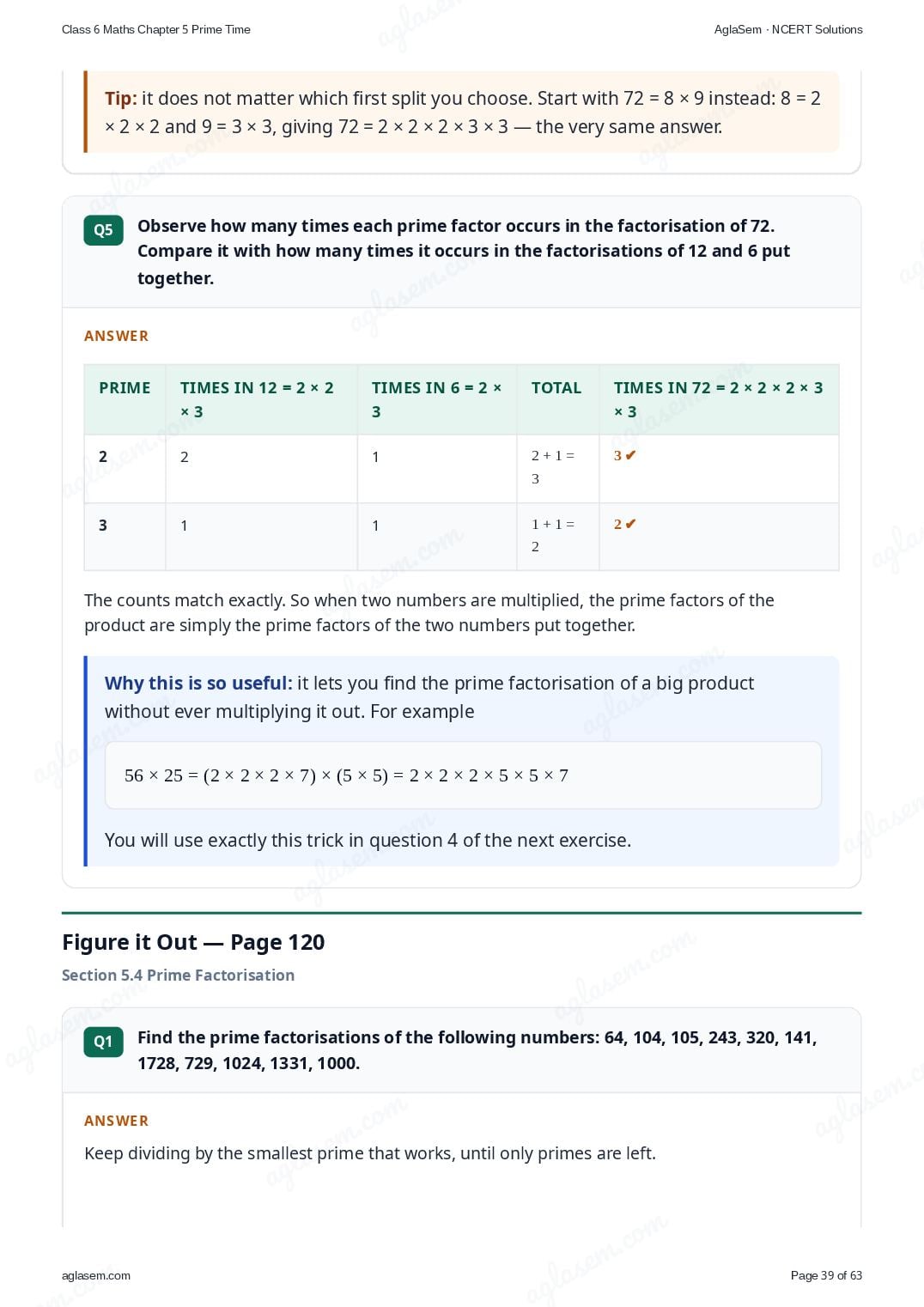
- When we find the prime factorisation of a number, we first write it as a product of two factors. For example, 72 = 12 × 6. Then, we find the prime factorisation of each of the factors: 12 = 2 × 2 × 3 and 6 = 2 × 3. Now, can you say what the prime factorisation of 72 is?
- Observe how many times each prime factor occurs in the factorisation of 72. Compare it with how many times it occurs in the factorisations of 12 and 6 put together.
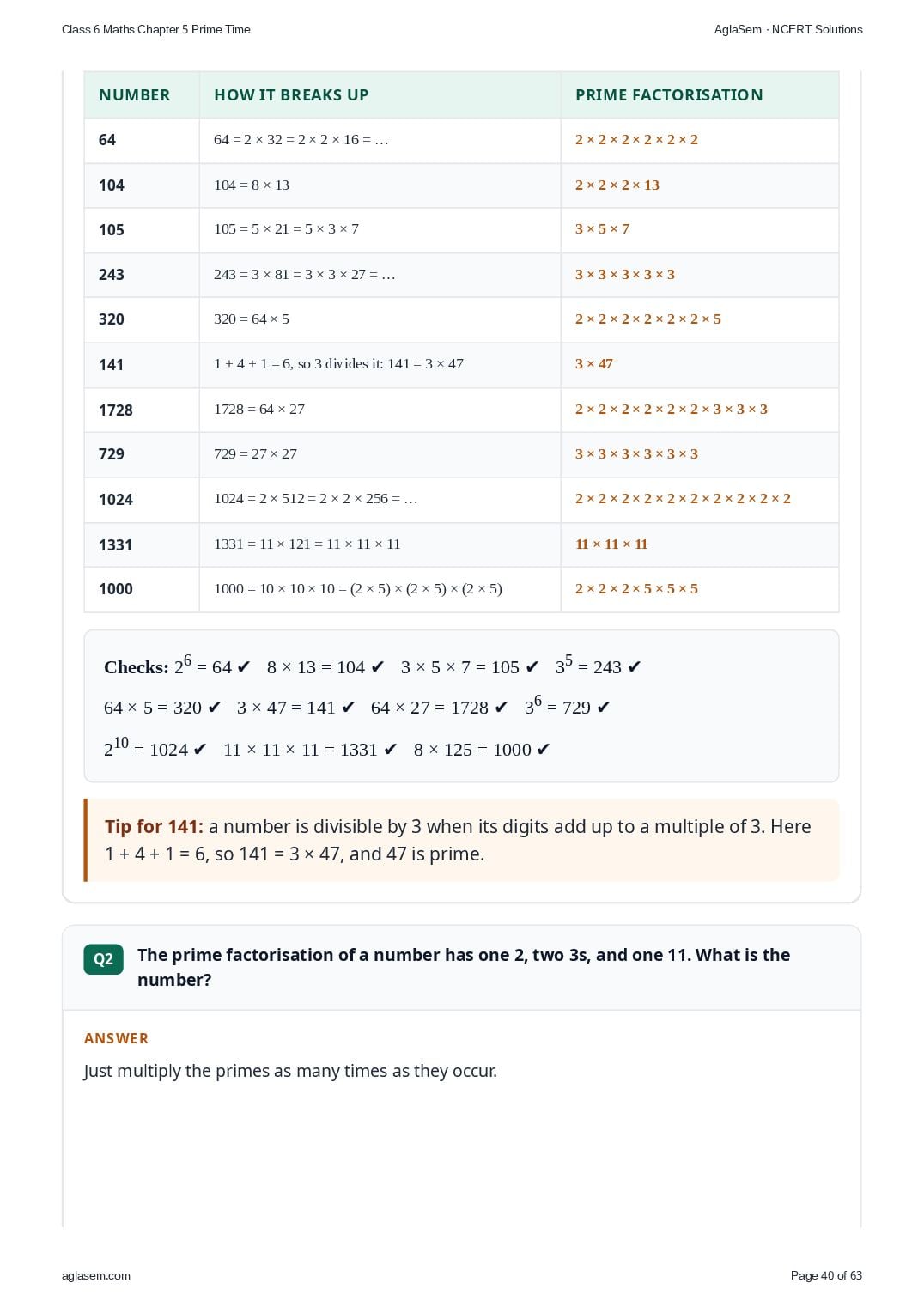
- Find the prime factorisations of the following numbers: 64, 104, 105, 243, 320, 141, 1728, 729, 1024, 1331, 1000.
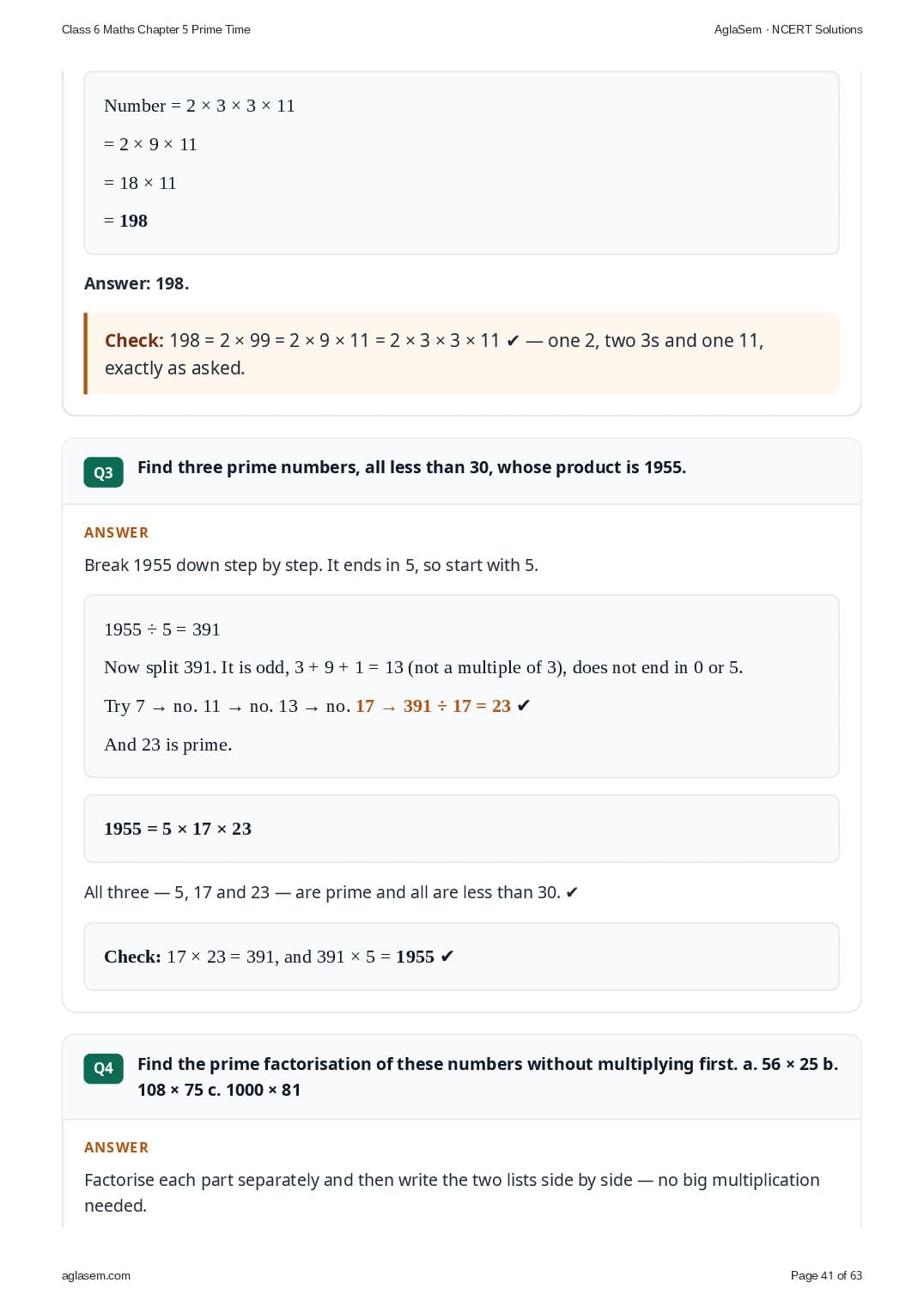
- The prime factorisation of a number has one 2, two 3s, and one 11. What is the number?
- Find three prime numbers, all less than 30, whose product is 1955.
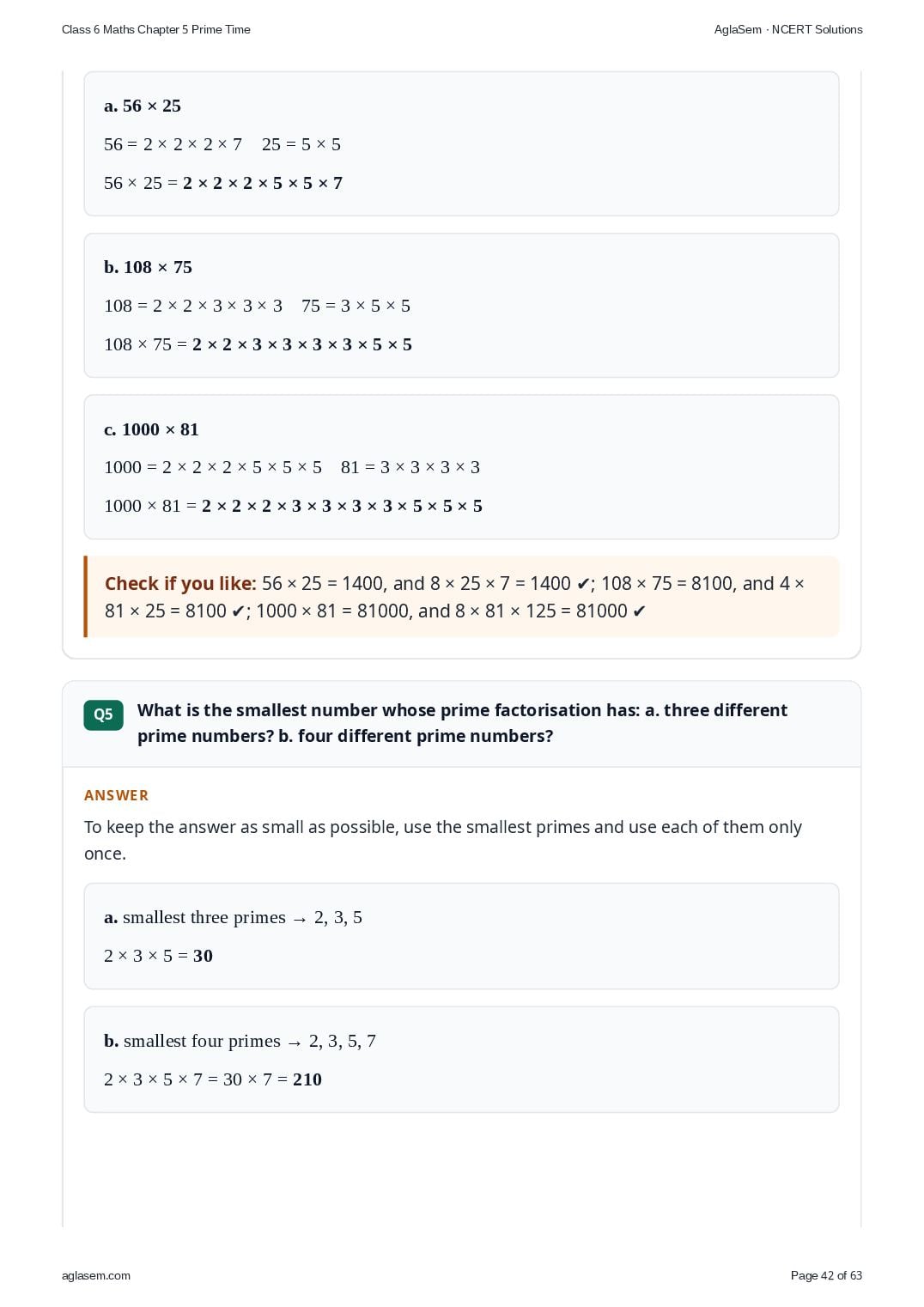
- Find the prime factorisation of these numbers without multiplying first. a. 56 × 25 b. 108 × 75 c. 1000 × 81
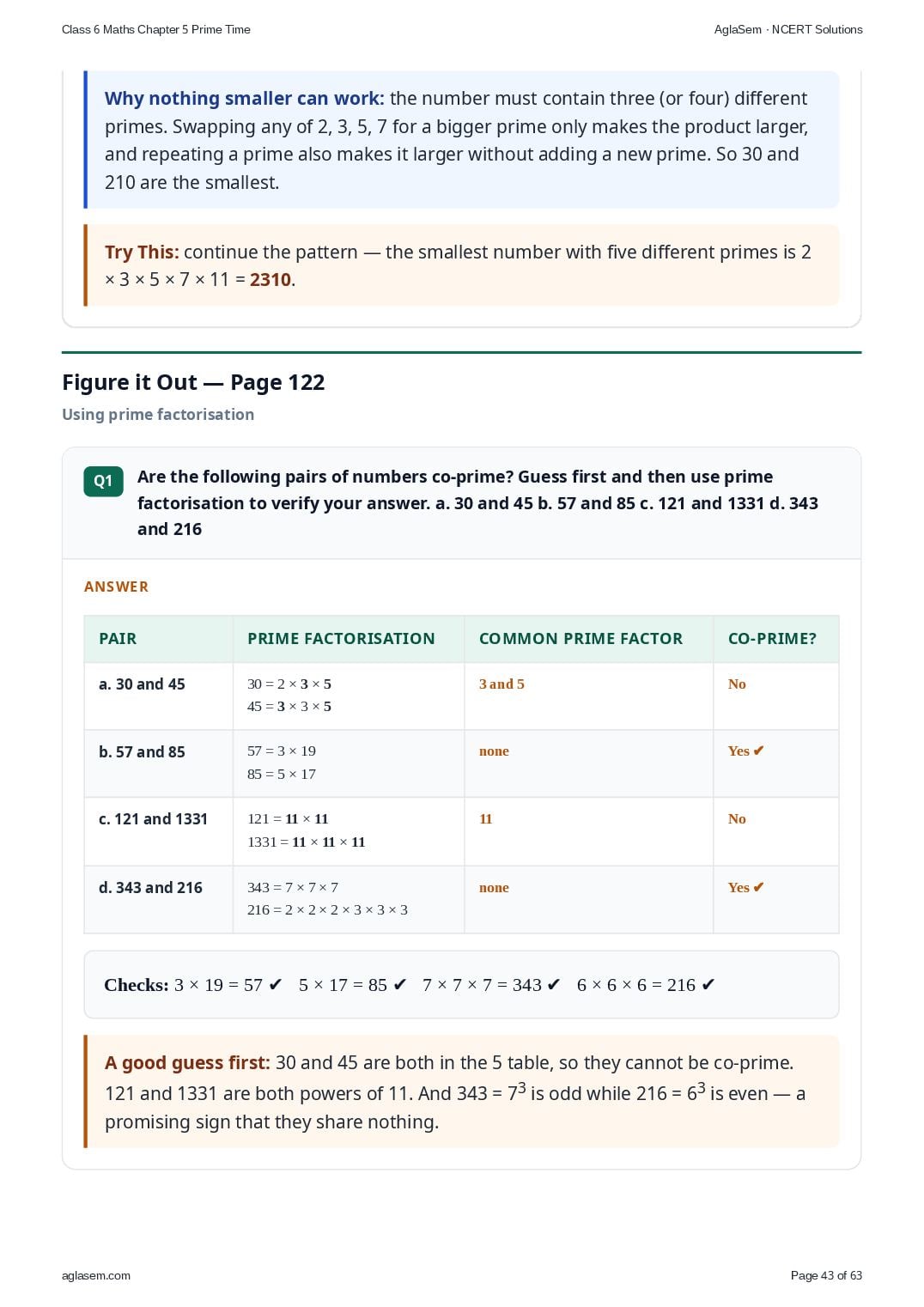
- What is the smallest number whose prime factorisation has: a. three different prime numbers? b. four different prime numbers?
- Are the following pairs of numbers co-prime? Guess first and then use prime factorisation to verify your answer. a. 30 and 45 b. 57 and 85 c. 121 and 1331 d. 343 and 216
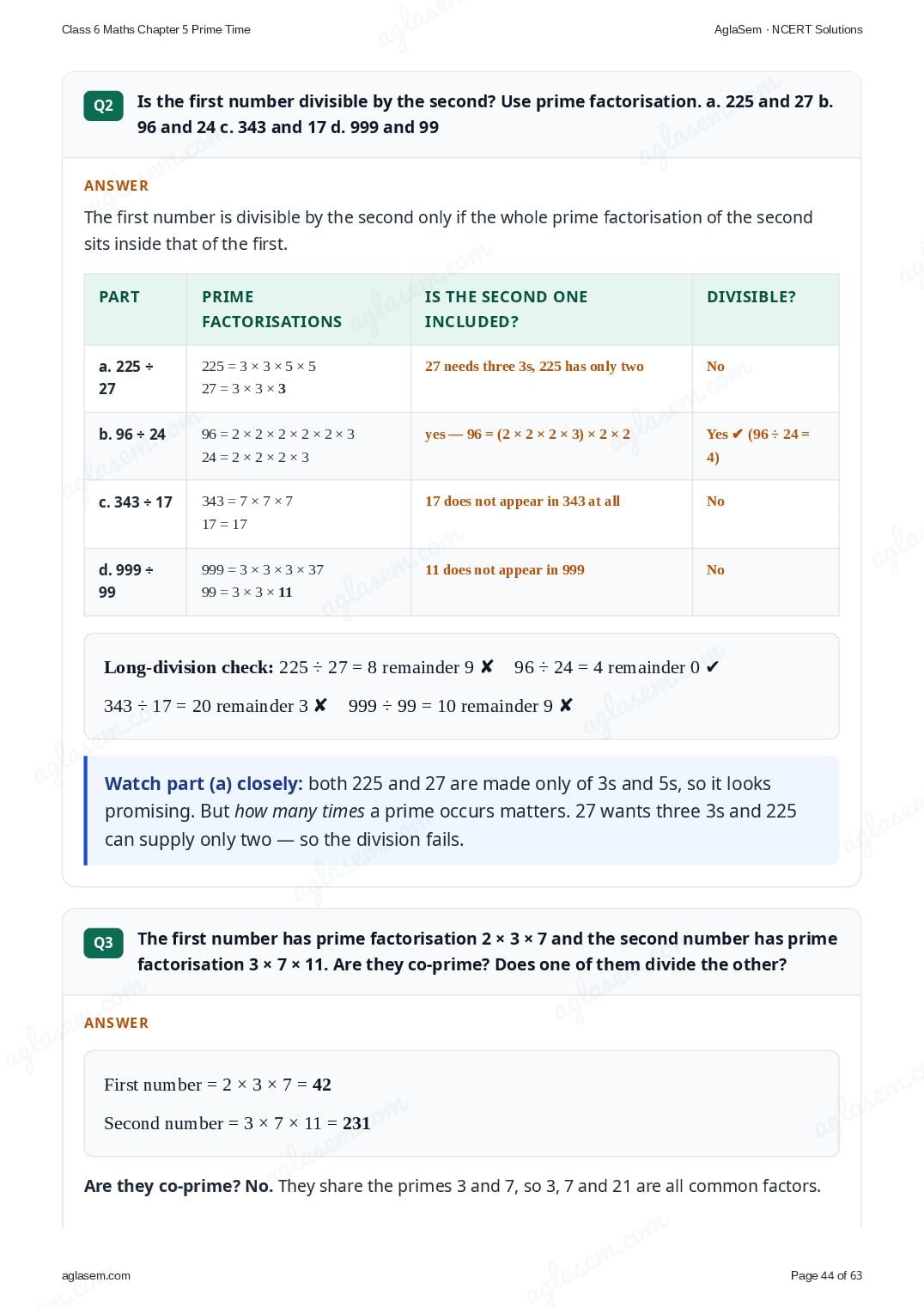
- Is the first number divisible by the second? Use prime factorisation. a. 225 and 27 b. 96 and 24 c. 343 and 17 d. 999 and 99
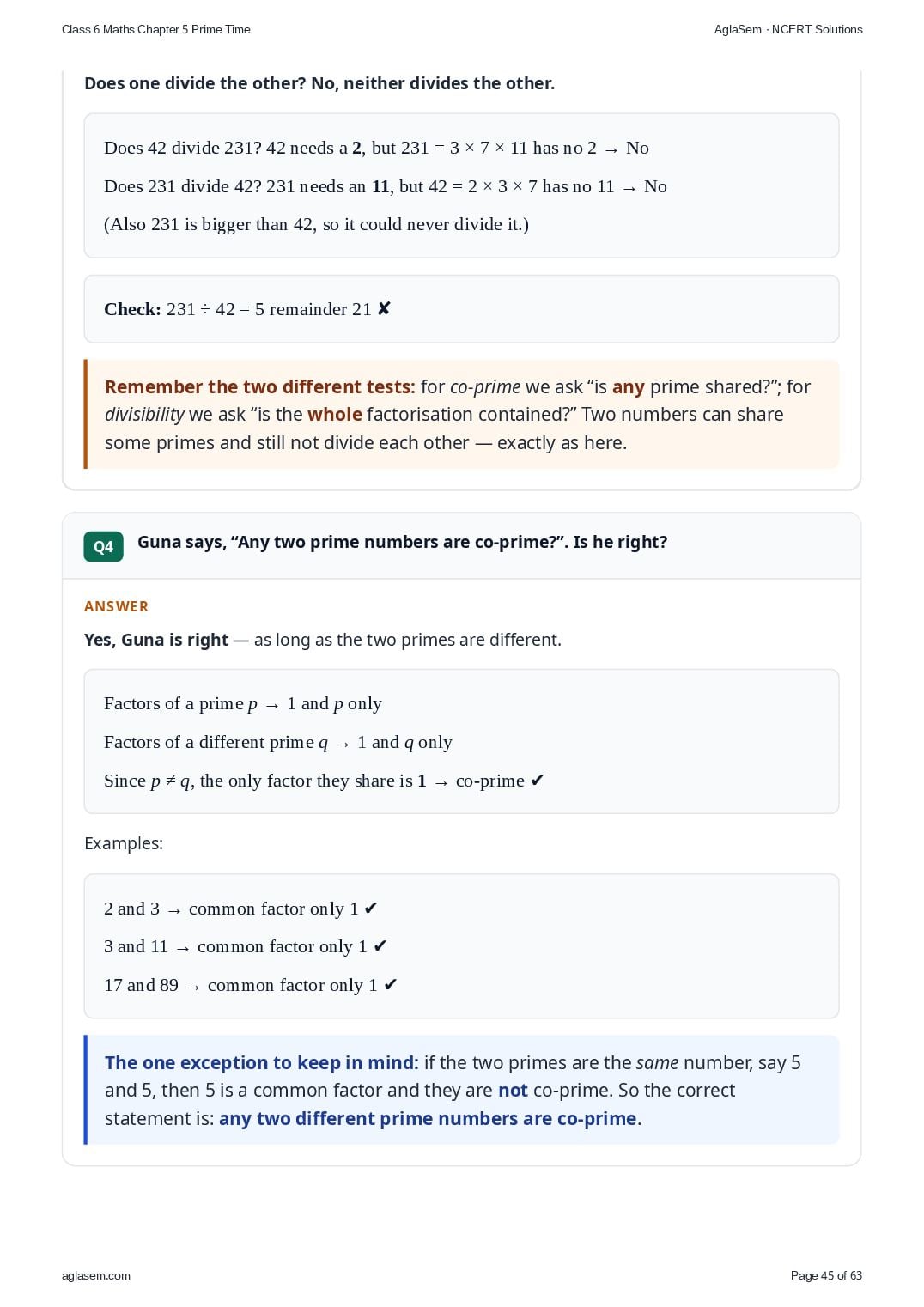
- The first number has prime factorisation 2 × 3 × 7 and the second number has prime factorisation 3 × 7 × 11. Are they co-prime? Does one of them divide the other?
- Guna says, “Any two prime numbers are co-prime?”. Is he right?
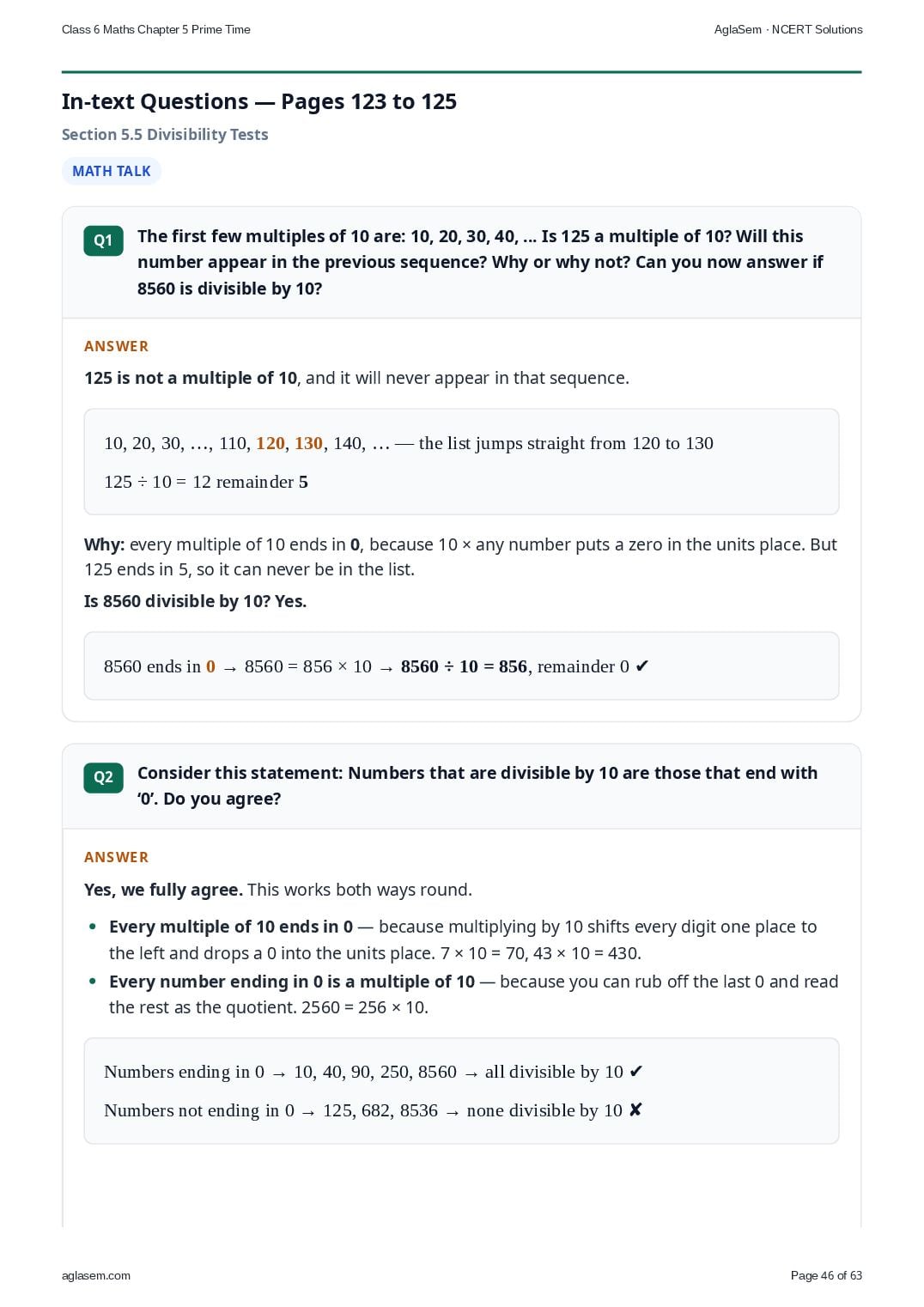
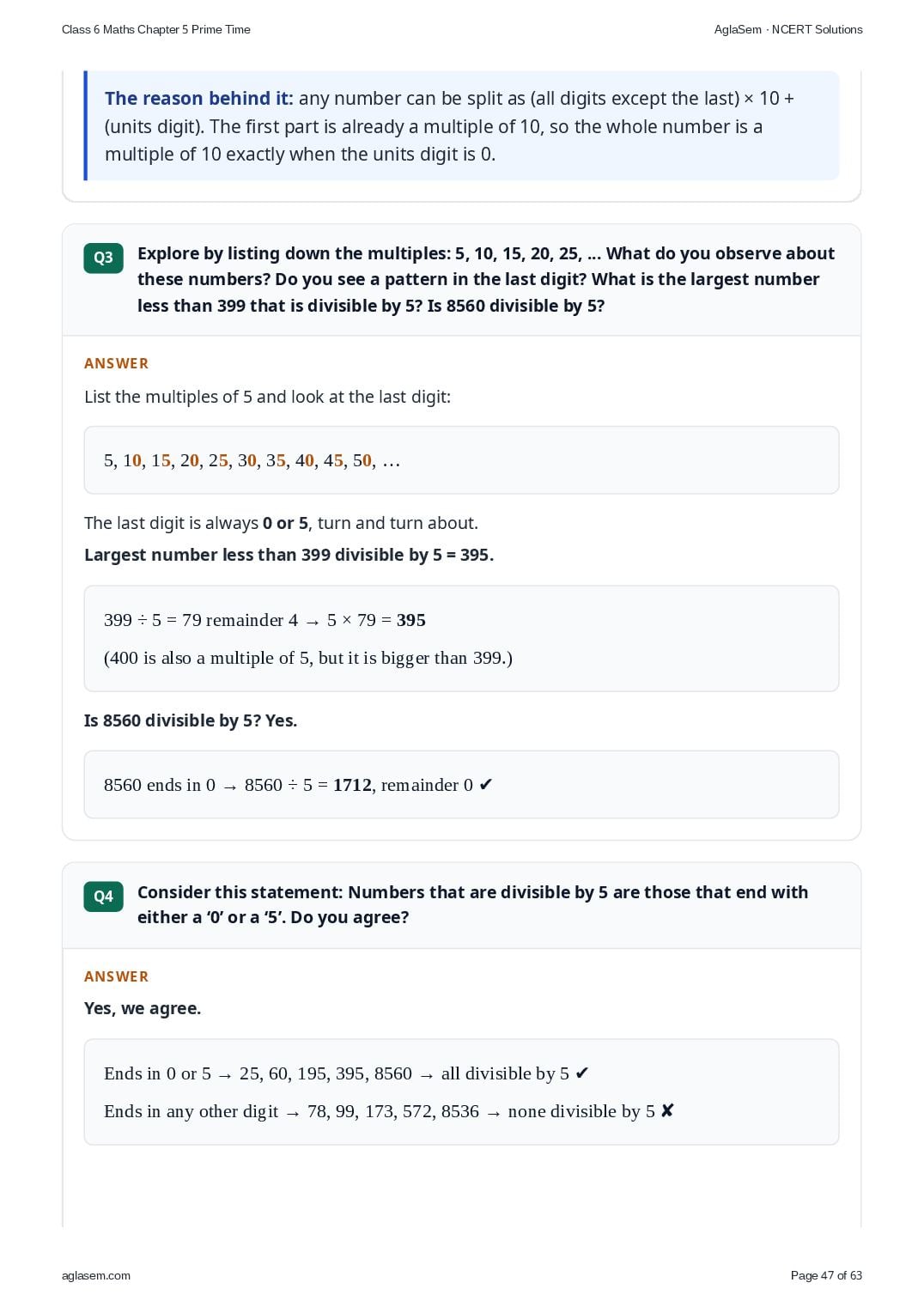
- The first few multiples of 10 are: 10, 20, 30, 40, … Is 125 a multiple of 10? Will this number appear in the previous sequence? Why or why not? Can you now answer if 8560 is divisible by 10?
- Consider this statement: Numbers that are divisible by 10 are those that end with ‘0’. Do you agree?
- Explore by listing down the multiples: 5, 10, 15, 20, 25, … What do you observe about these numbers? Do you see a pattern in the last digit? What is the largest number less than 399 that is divisible by 5? Is 8560 divisible by 5?
- Consider this statement: Numbers that are divisible by 5 are those that end with either a ‘0’ or a ‘5’. Do you agree?
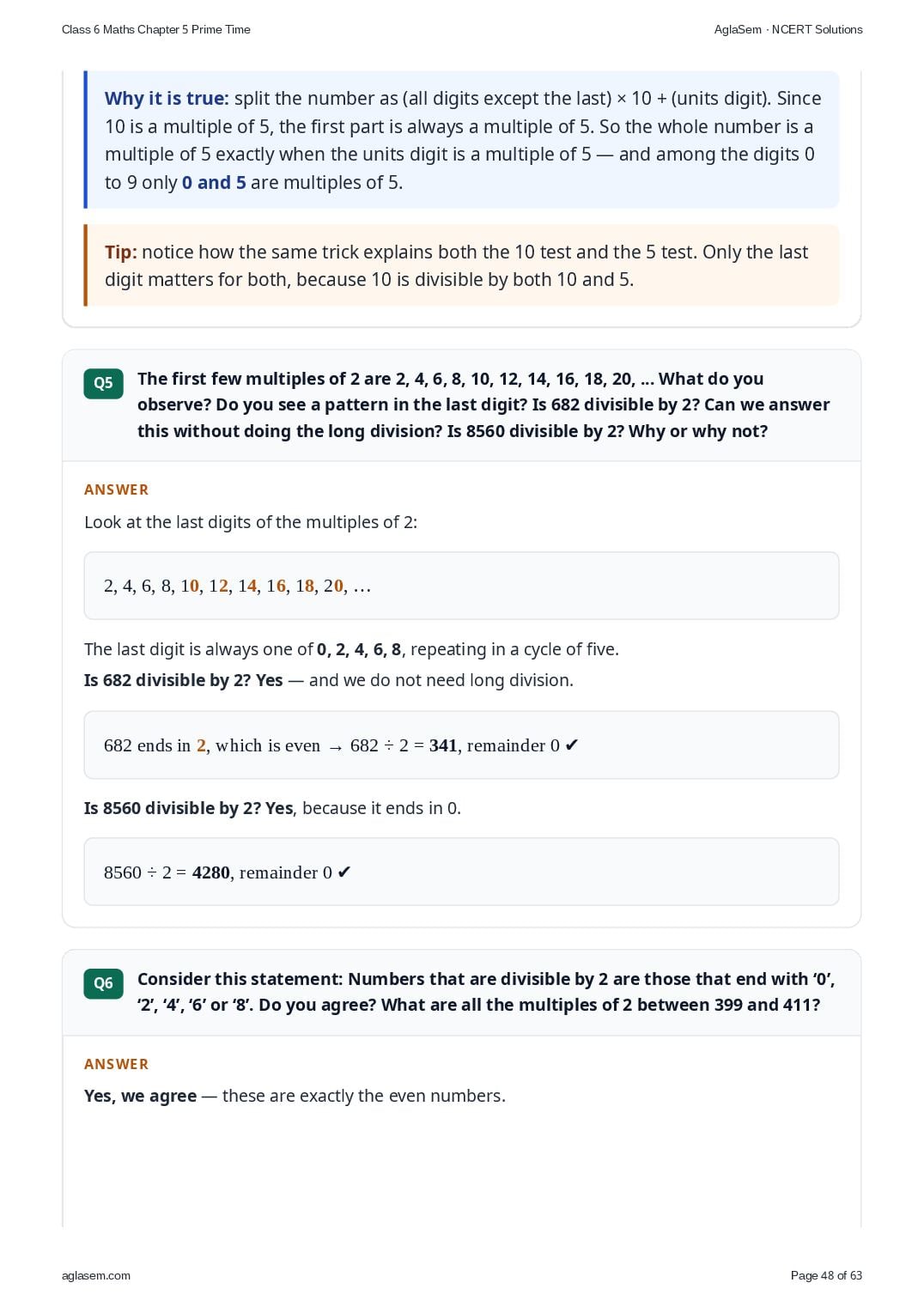
- The first few multiples of 2 are 2, 4, 6, 8, 10, 12, 14, 16, 18, 20, … What do you observe? Do you see a pattern in the last digit? Is 682 divisible by 2? Can we answer this without doing the long division? Is 8560 divisible by 2? Why or why not?
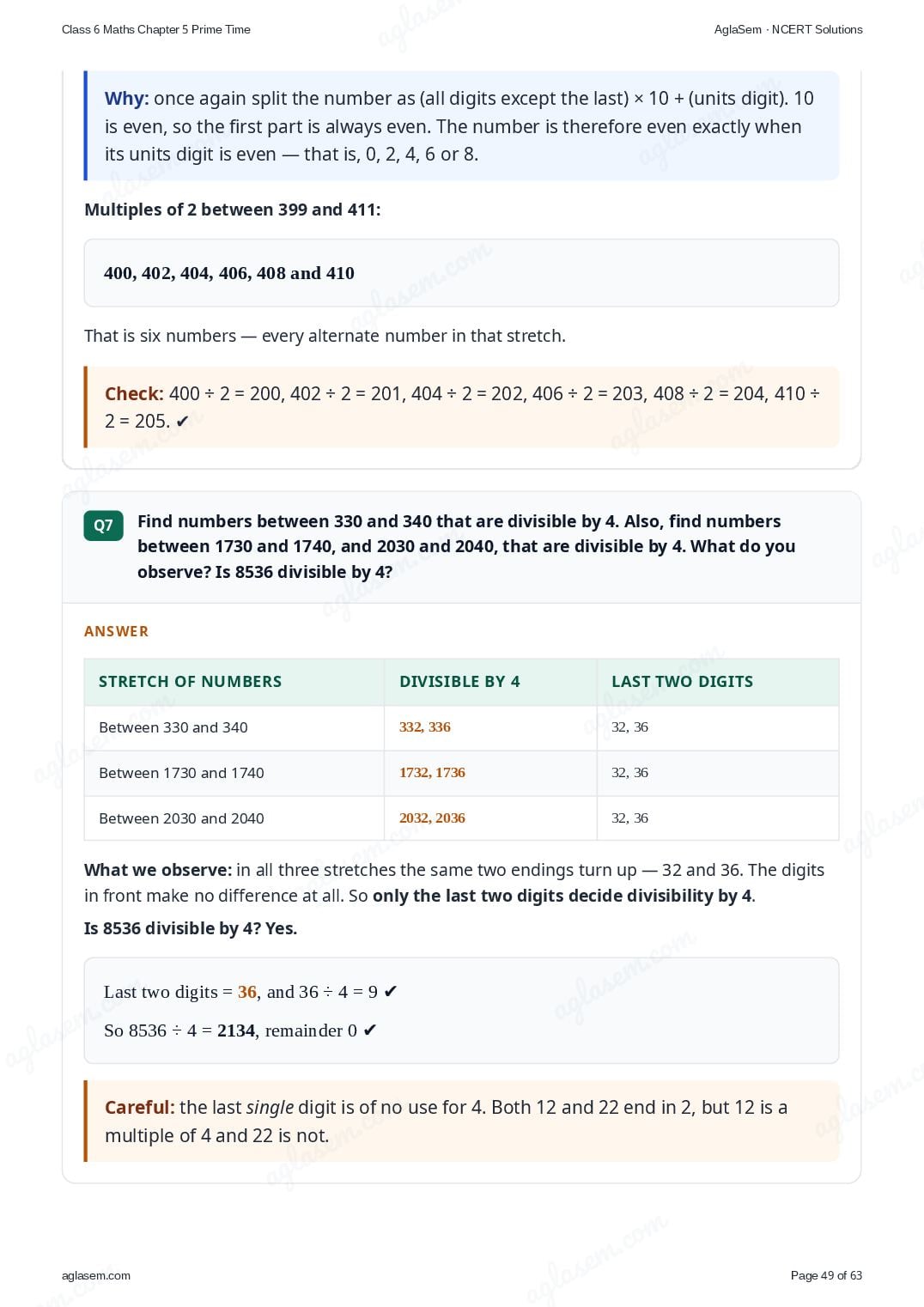
- Consider this statement: Numbers that are divisible by 2 are those that end with ‘0’, ‘2’, ‘4’, ‘6’ or ‘8’. Do you agree? What are all the multiples of 2 between 399 and 411?
- Find numbers between 330 and 340 that are divisible by 4. Also, find numbers between 1730 and 1740, and 2030 and 2040, that are divisible by 4. What do you observe? Is 8536 divisible by 4?
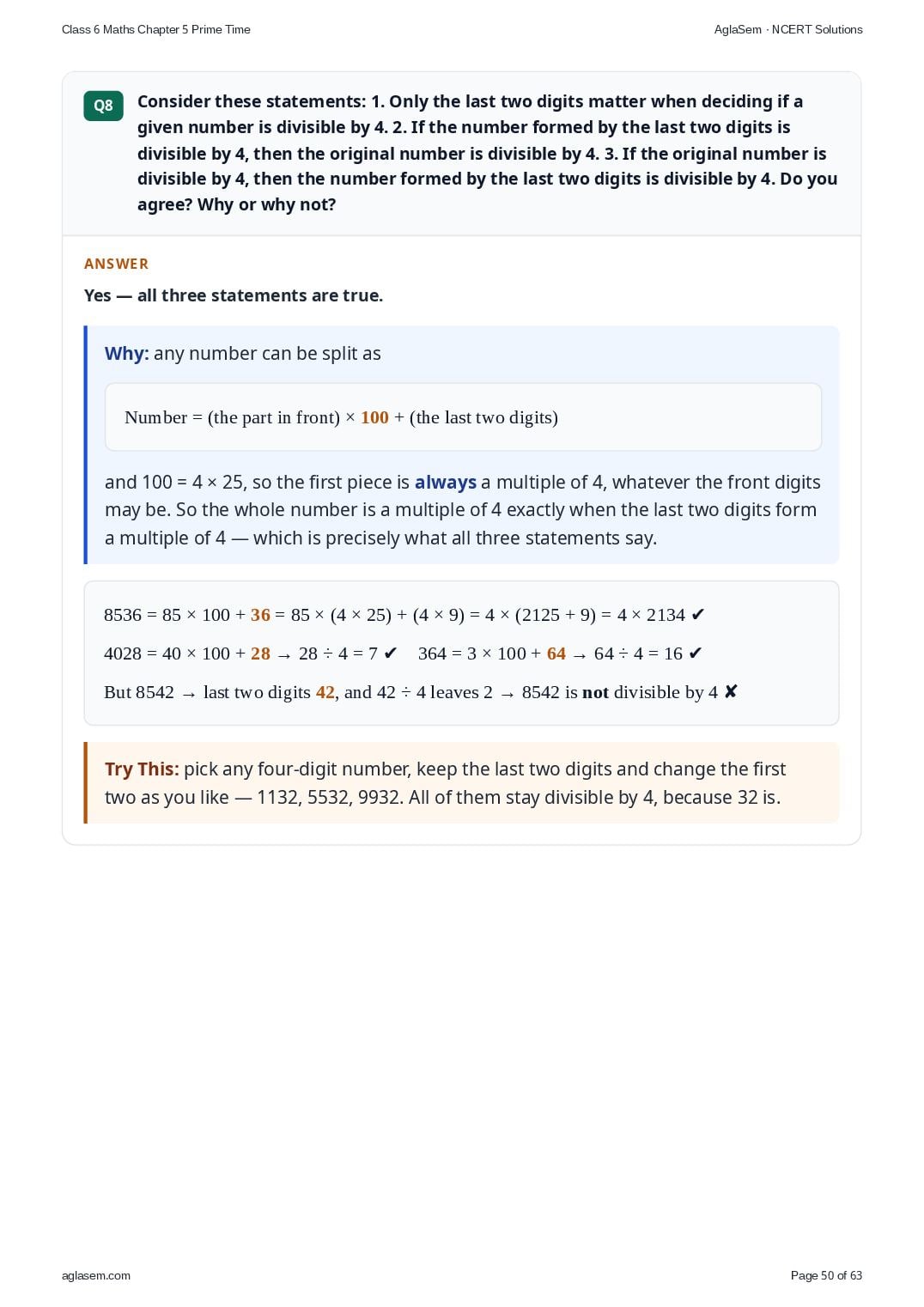
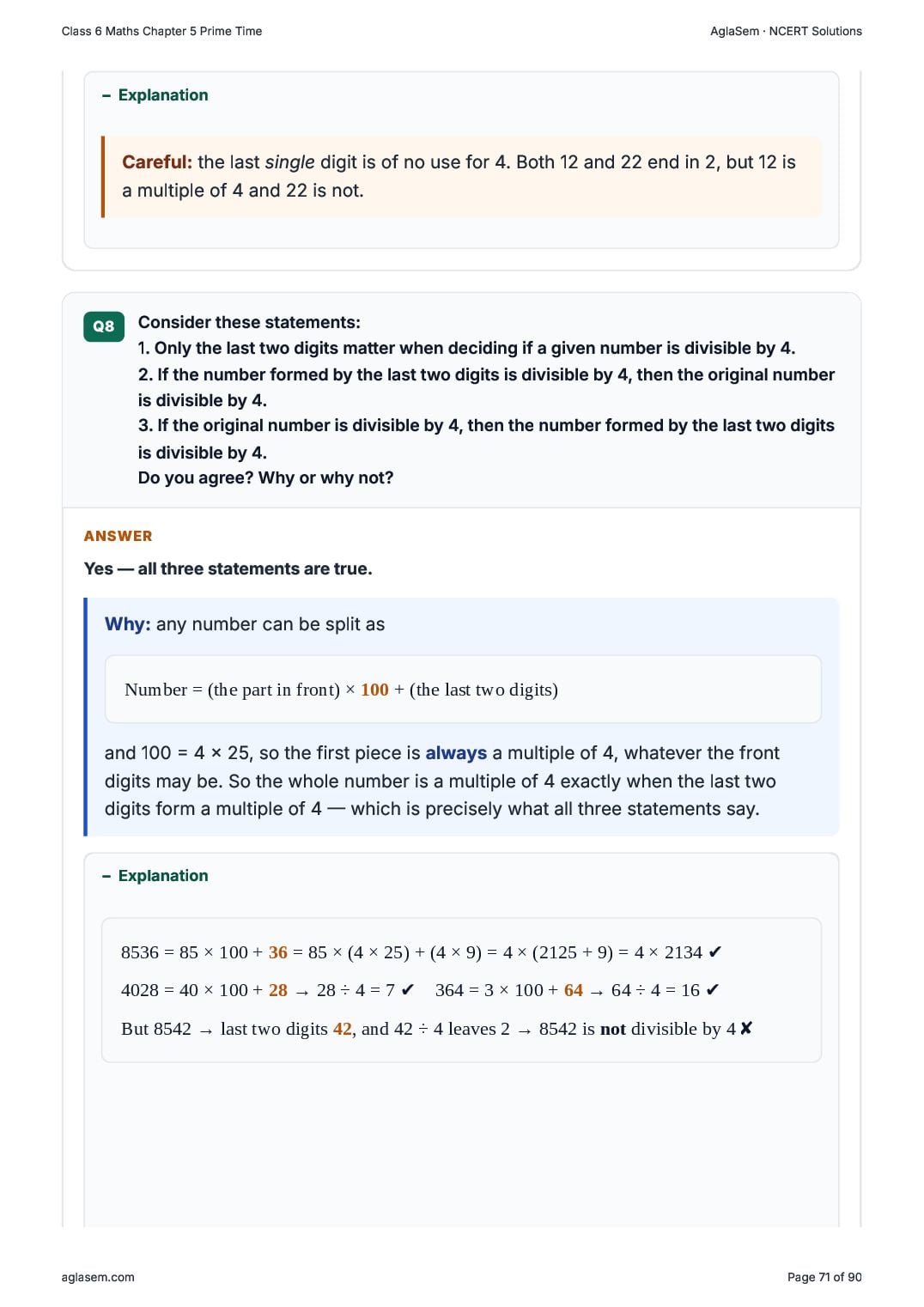
- Consider these statements: 1. Only the last two digits matter when deciding if a given number is divisible by 4. 2. If the number formed by the last two digits is divisible by 4, then the original number is divisible by 4. 3. If the original number is divisible by 4, then the number formed by the last two digits is divisible by 4. Do you agree? Why or why not?
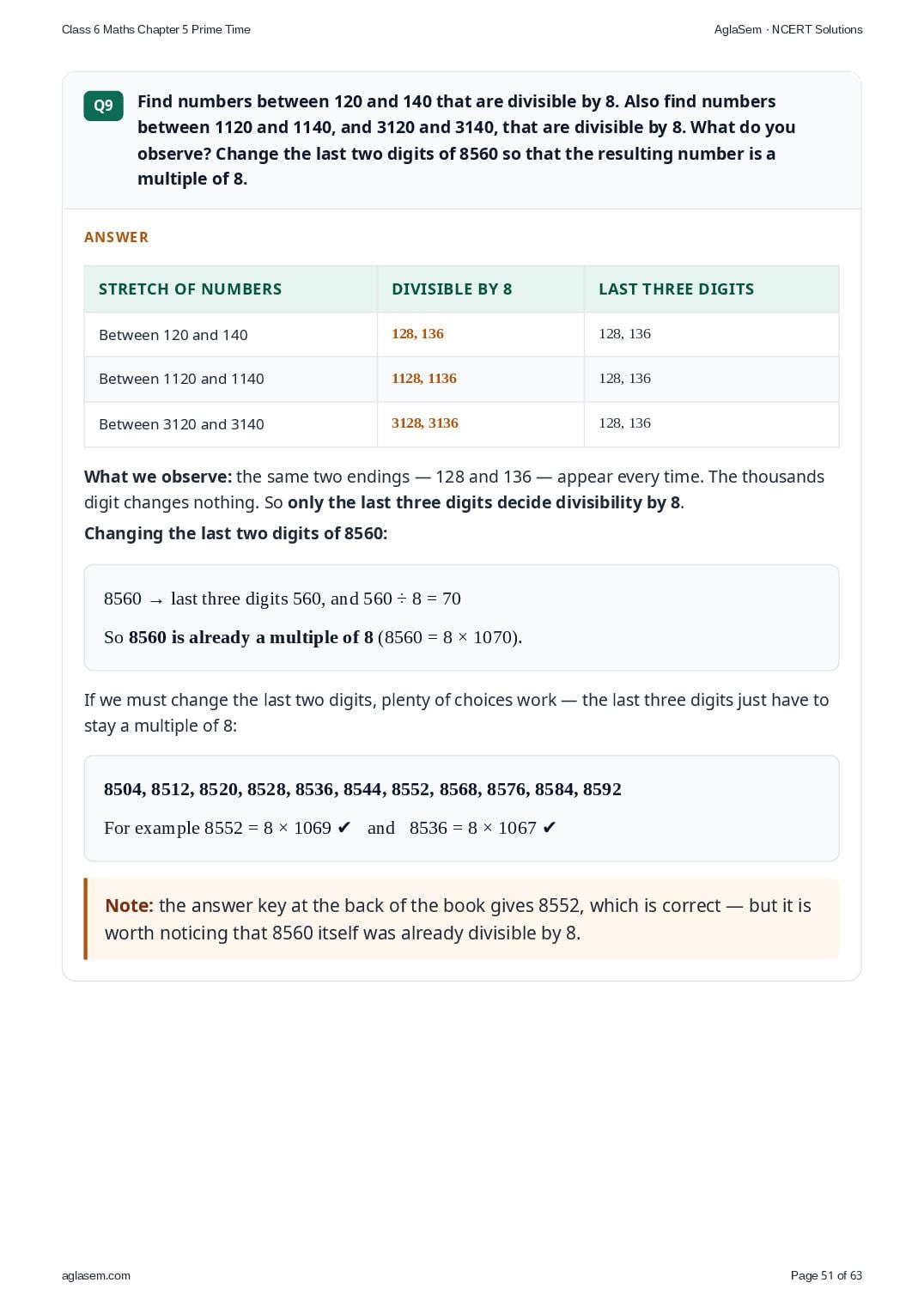
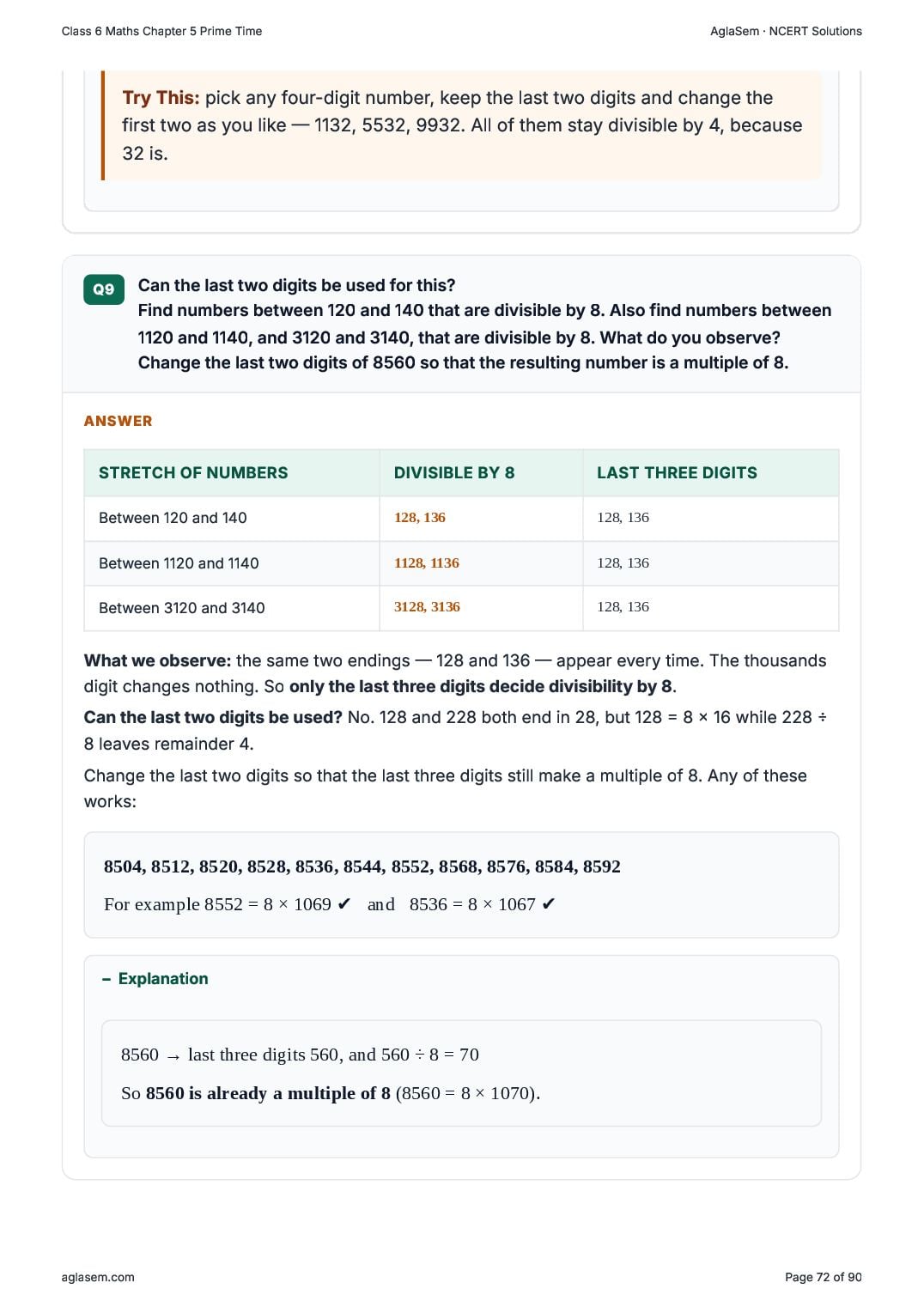
- Find numbers between 120 and 140 that are divisible by 8. Also find numbers between 1120 and 1140, and 3120 and 3140, that are divisible by 8. What do you observe? Change the last two digits of 8560 so that the resulting number is a multiple of 8.
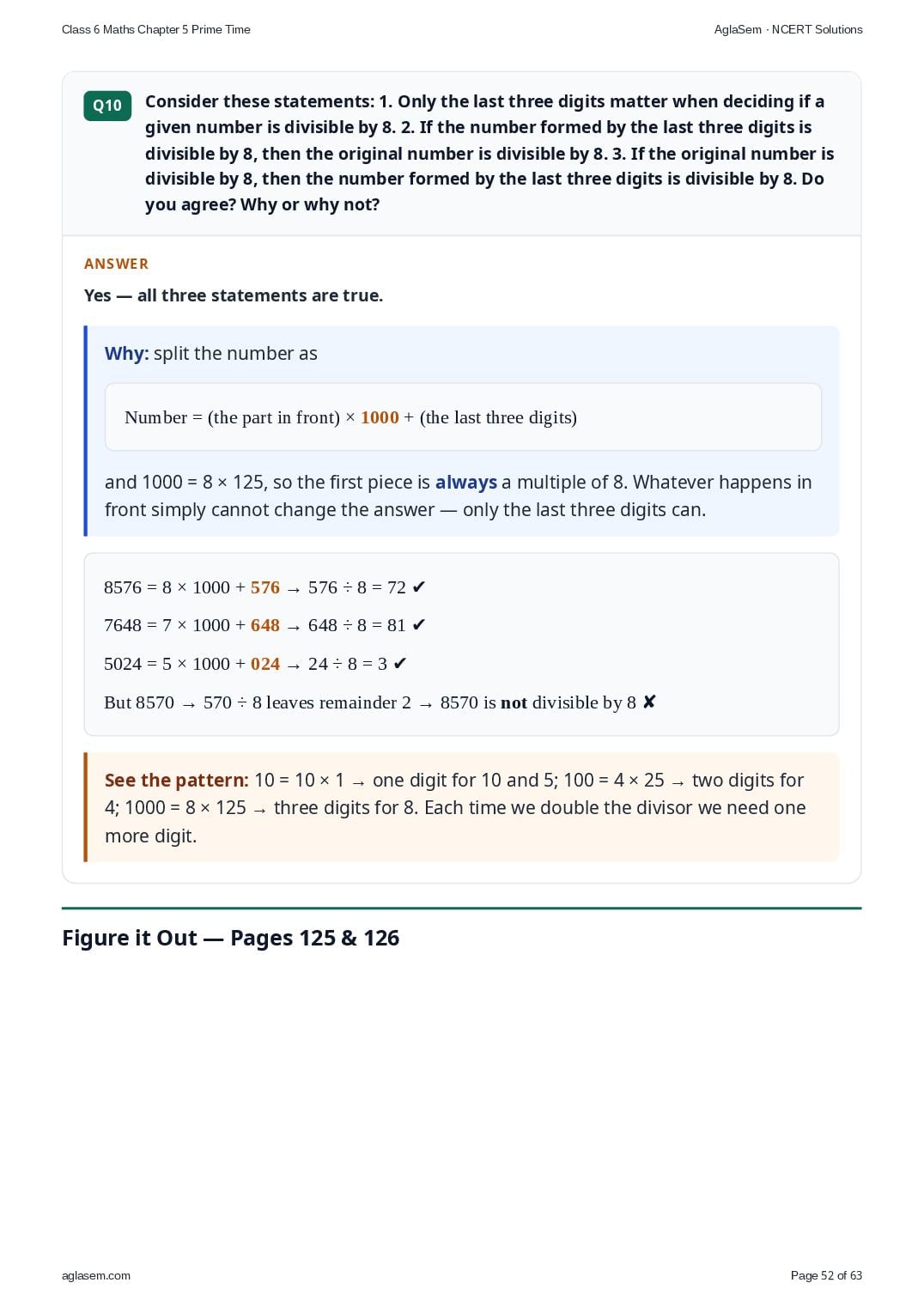
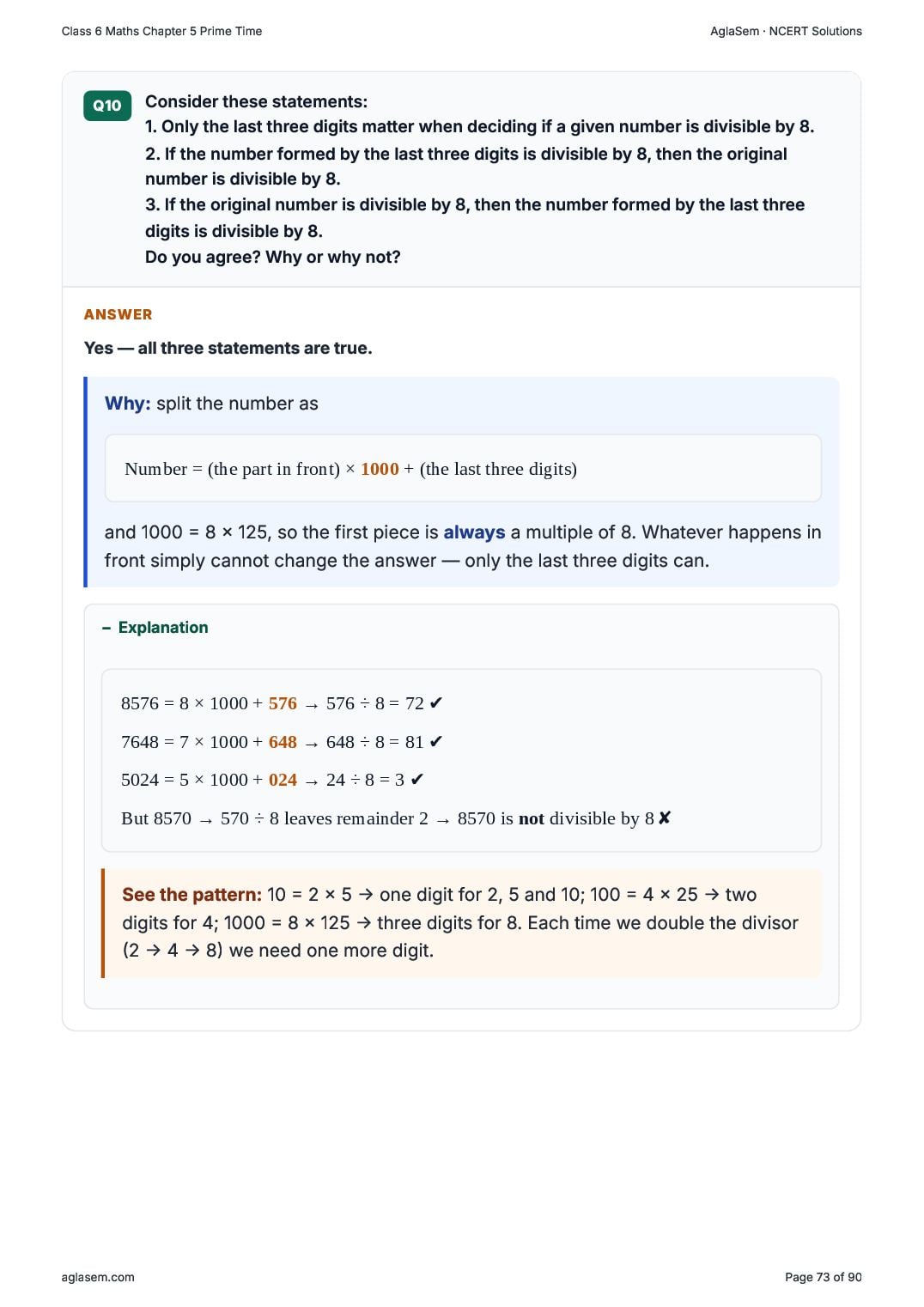
- Consider these statements: 1. Only the last three digits matter when deciding if a given number is divisible by 8. 2. If the number formed by the last three digits is divisible by 8, then the original number is divisible by 8. 3. If the original number is divisible by 8, then the number formed by the last three digits is divisible by 8. Do you agree? Why or why not?
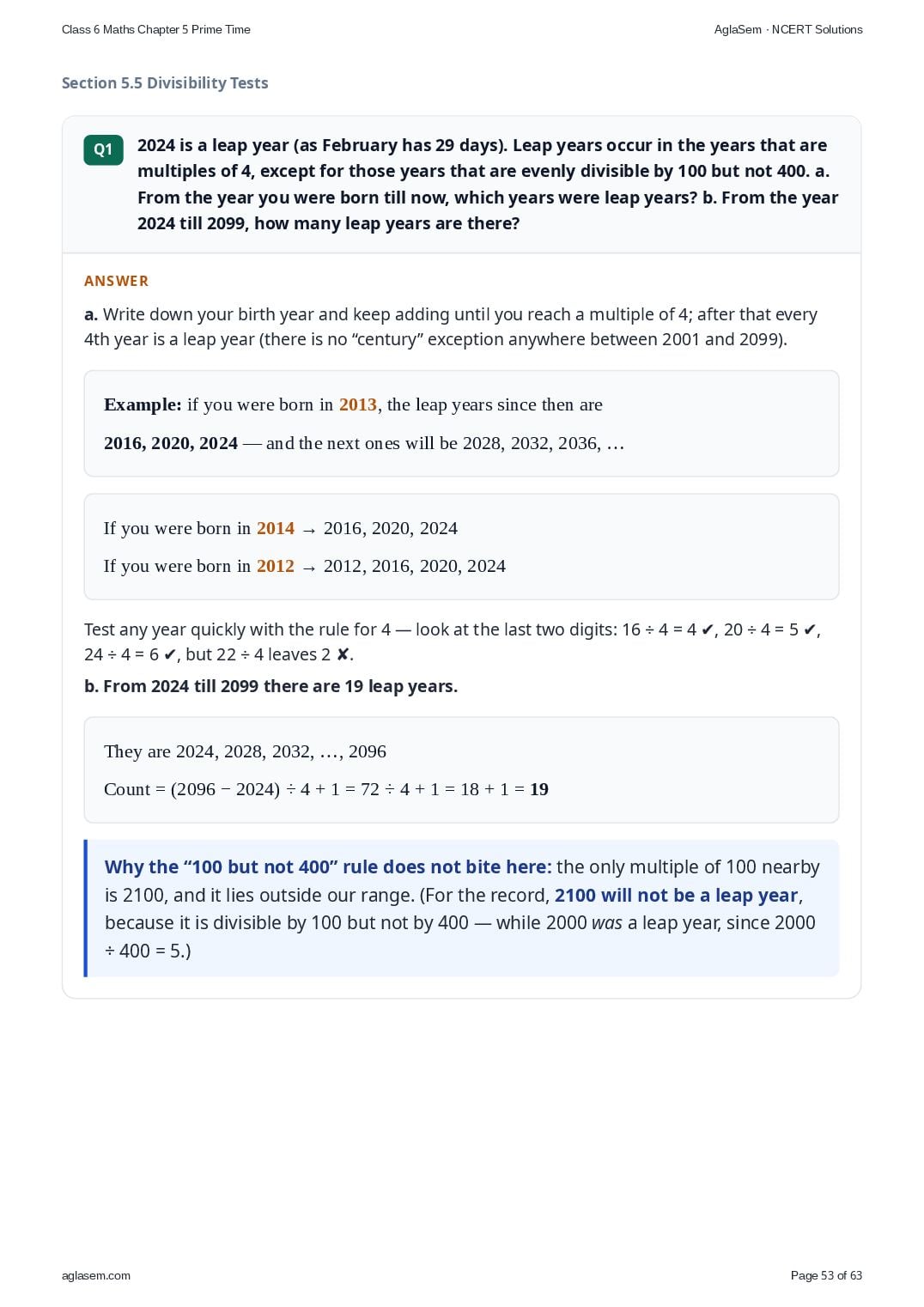
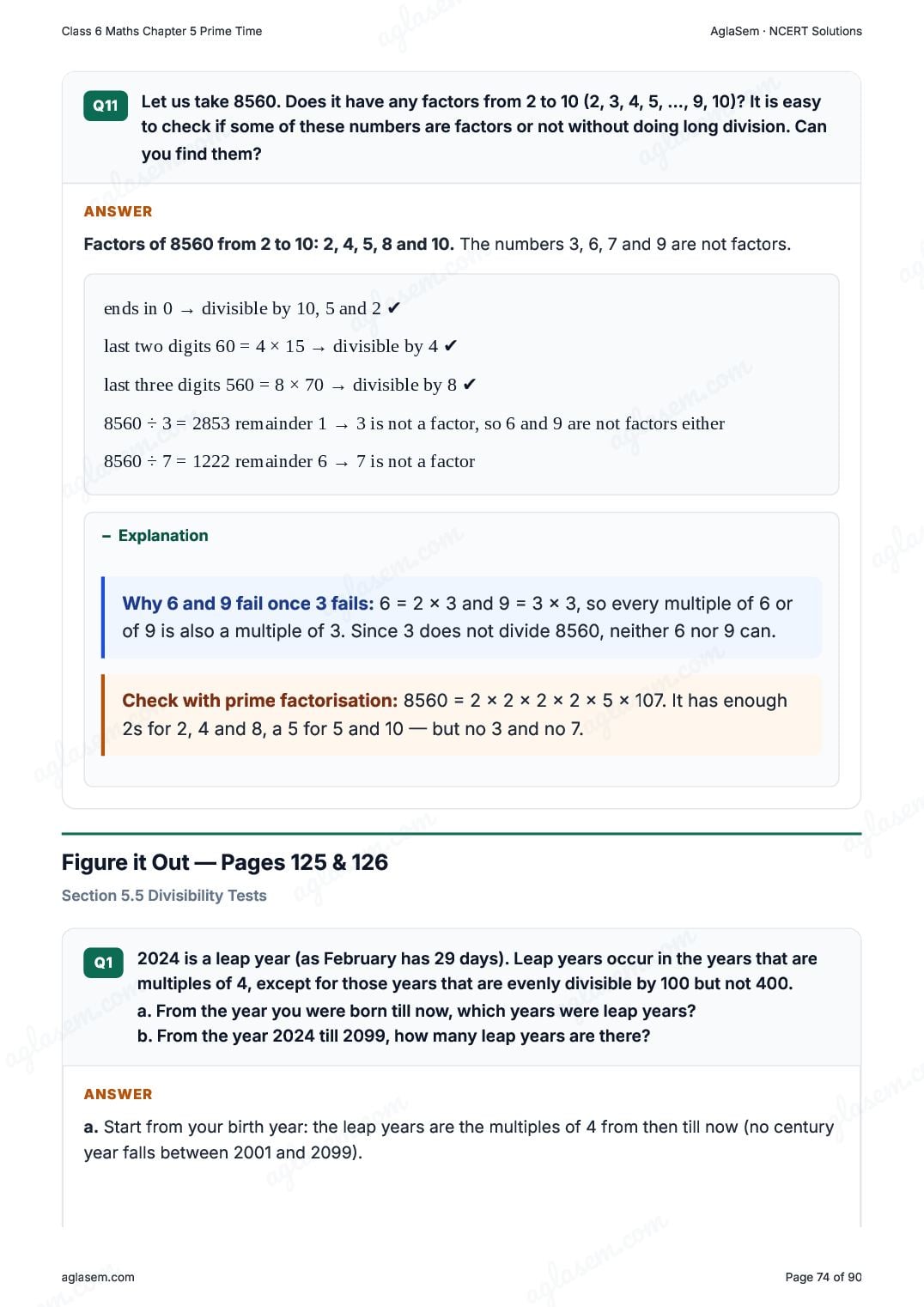
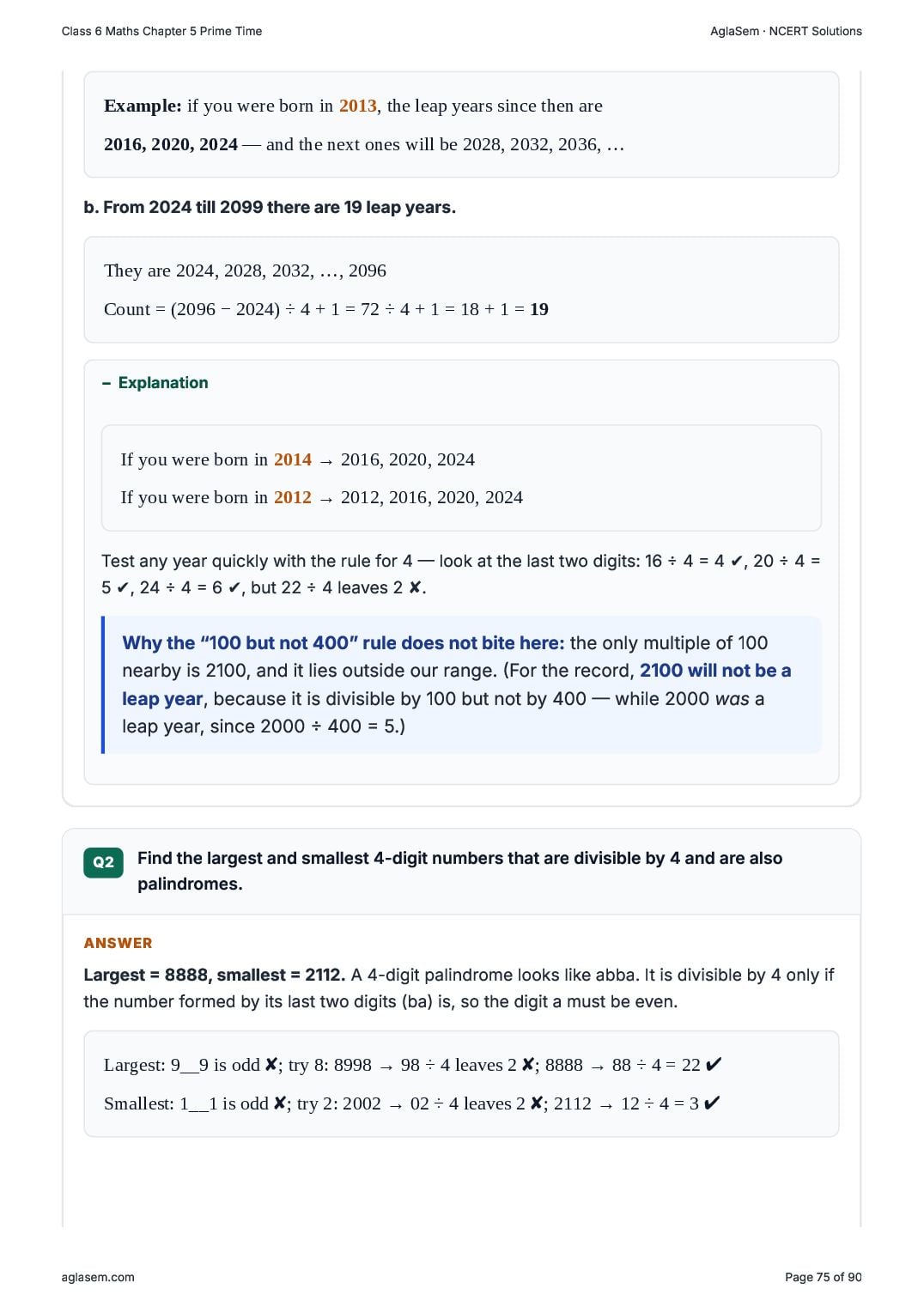
- 2024 is a leap year (as February has 29 days). Leap years occur in the years that are multiples of 4, except for those years that are evenly divisible by 100 but not 400. a. From the year you were born till now, which years were leap years? b. From the year 2024 till 2099, how many leap years are there?
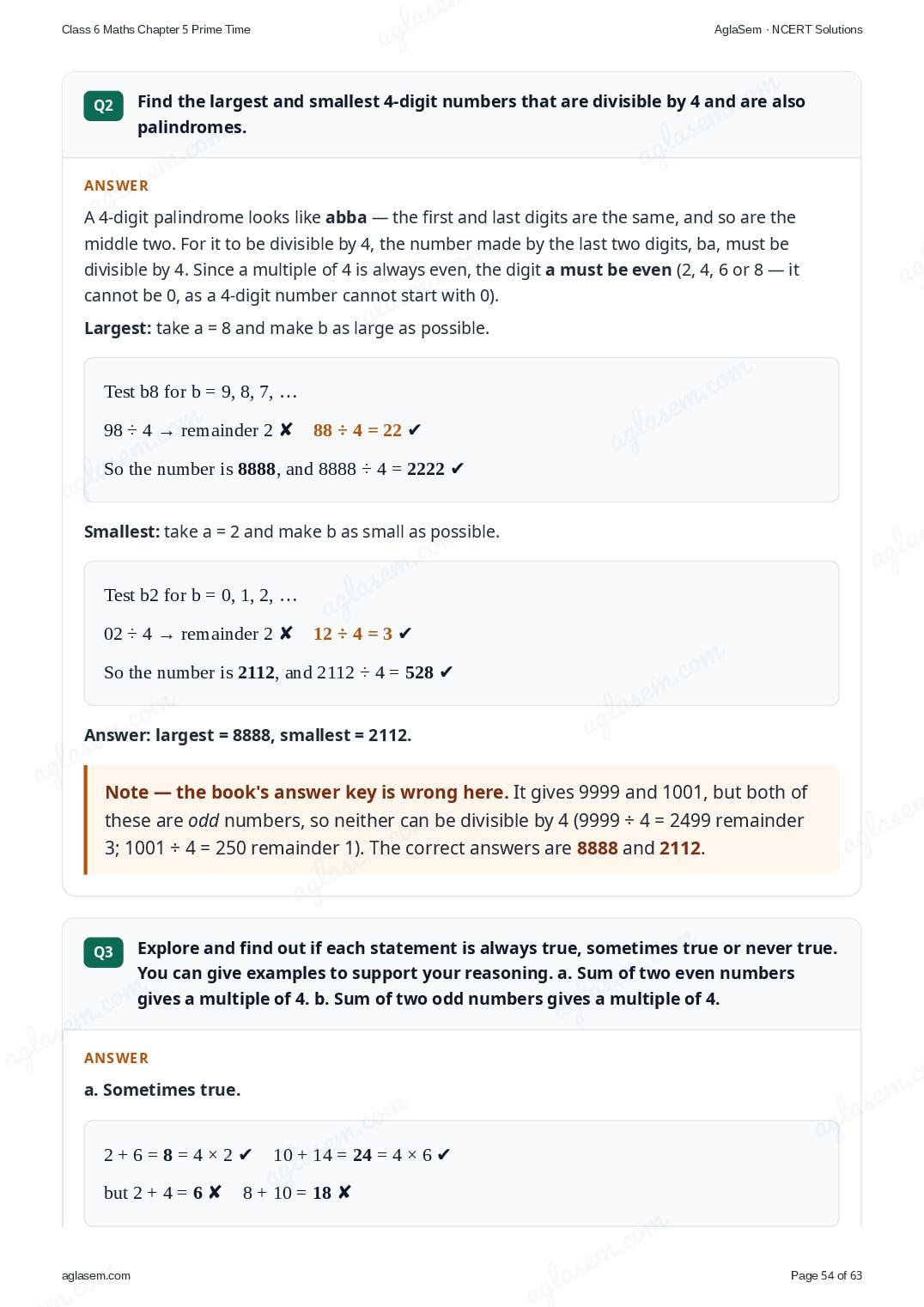
- Find the largest and smallest 4-digit numbers that are divisible by 4 and are also palindromes.
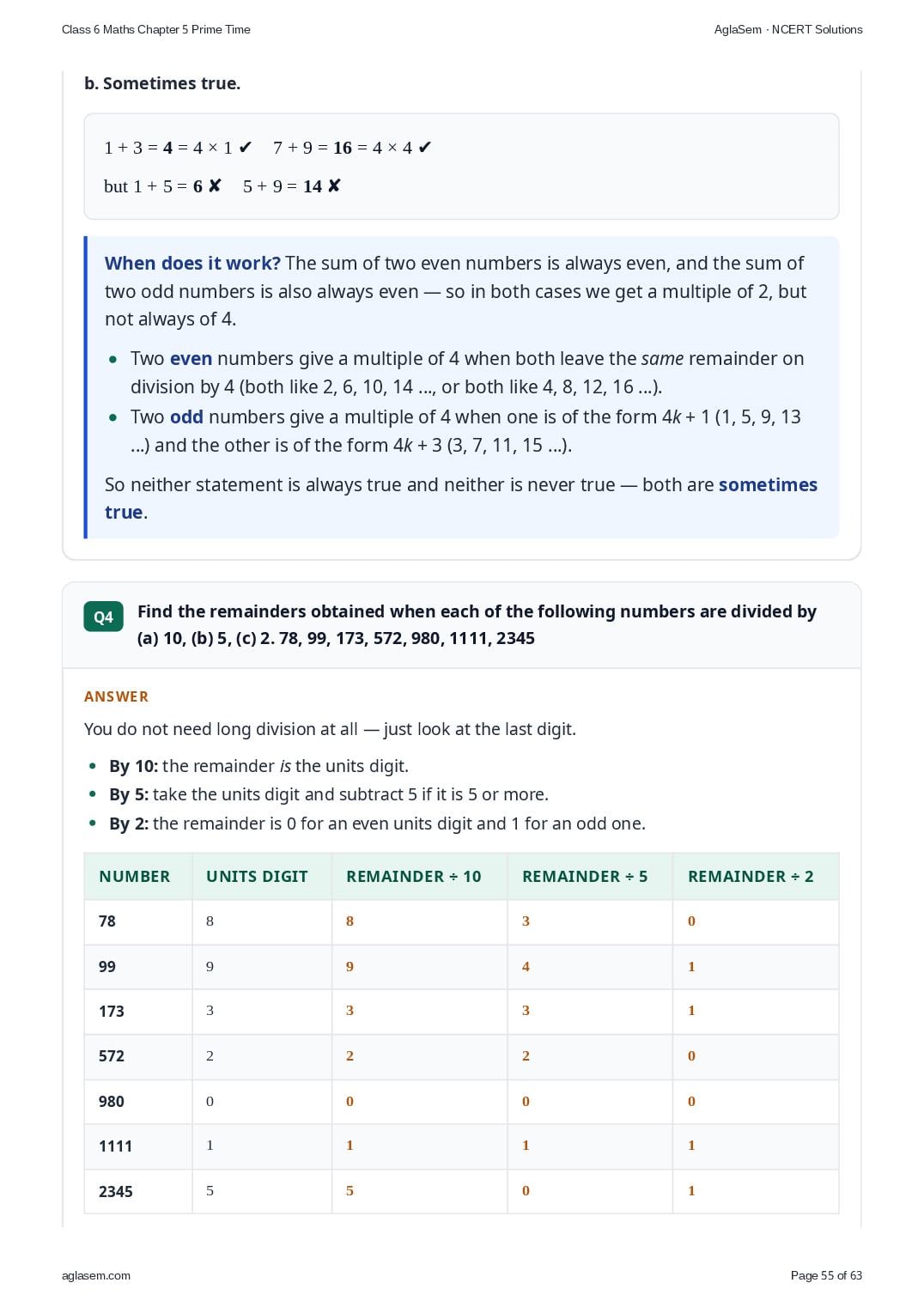
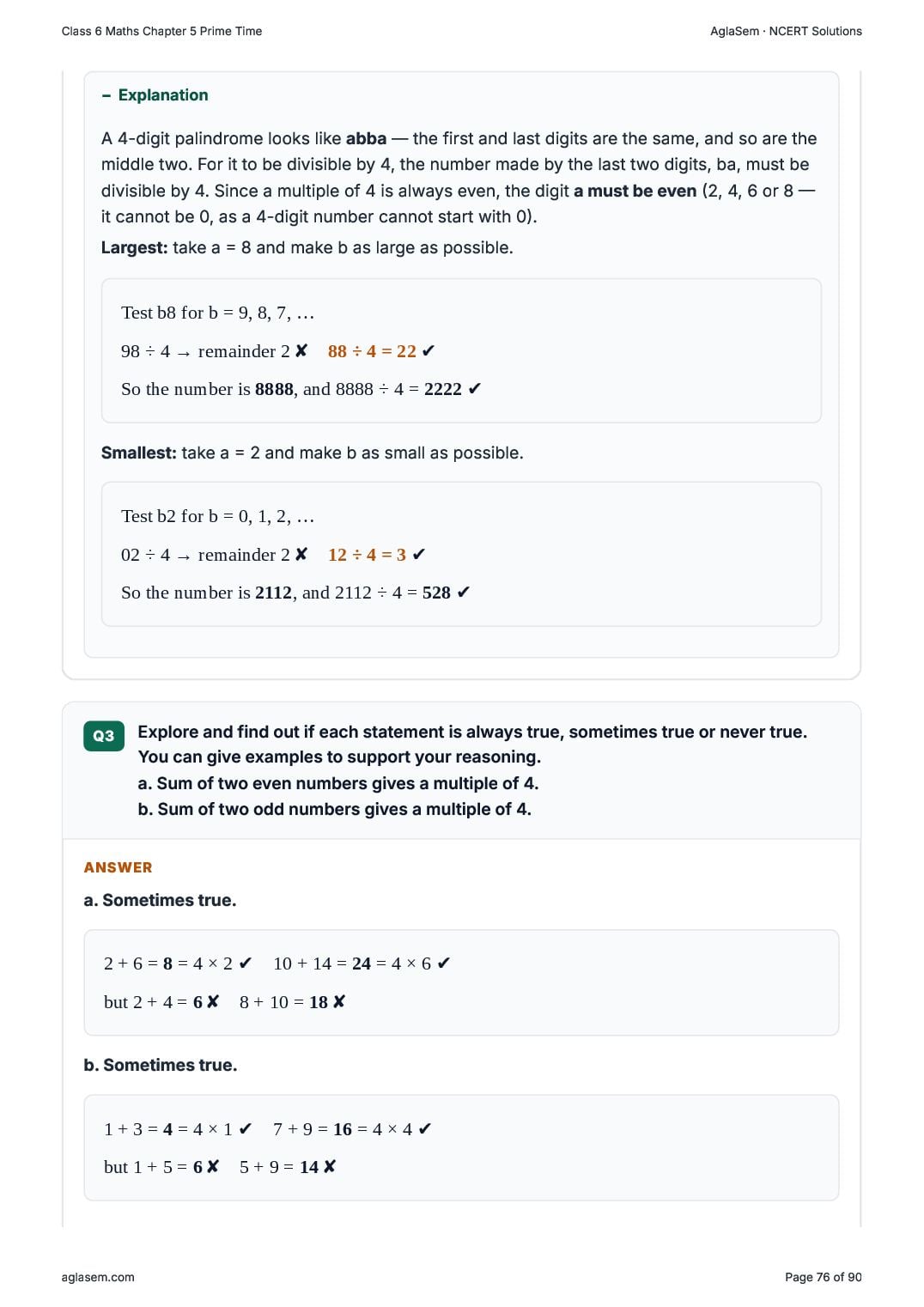
- Explore and find out if each statement is always true, sometimes true or never true. You can give examples to support your reasoning. a. Sum of two even numbers gives a multiple of 4. b. Sum of two odd numbers gives a multiple of 4.
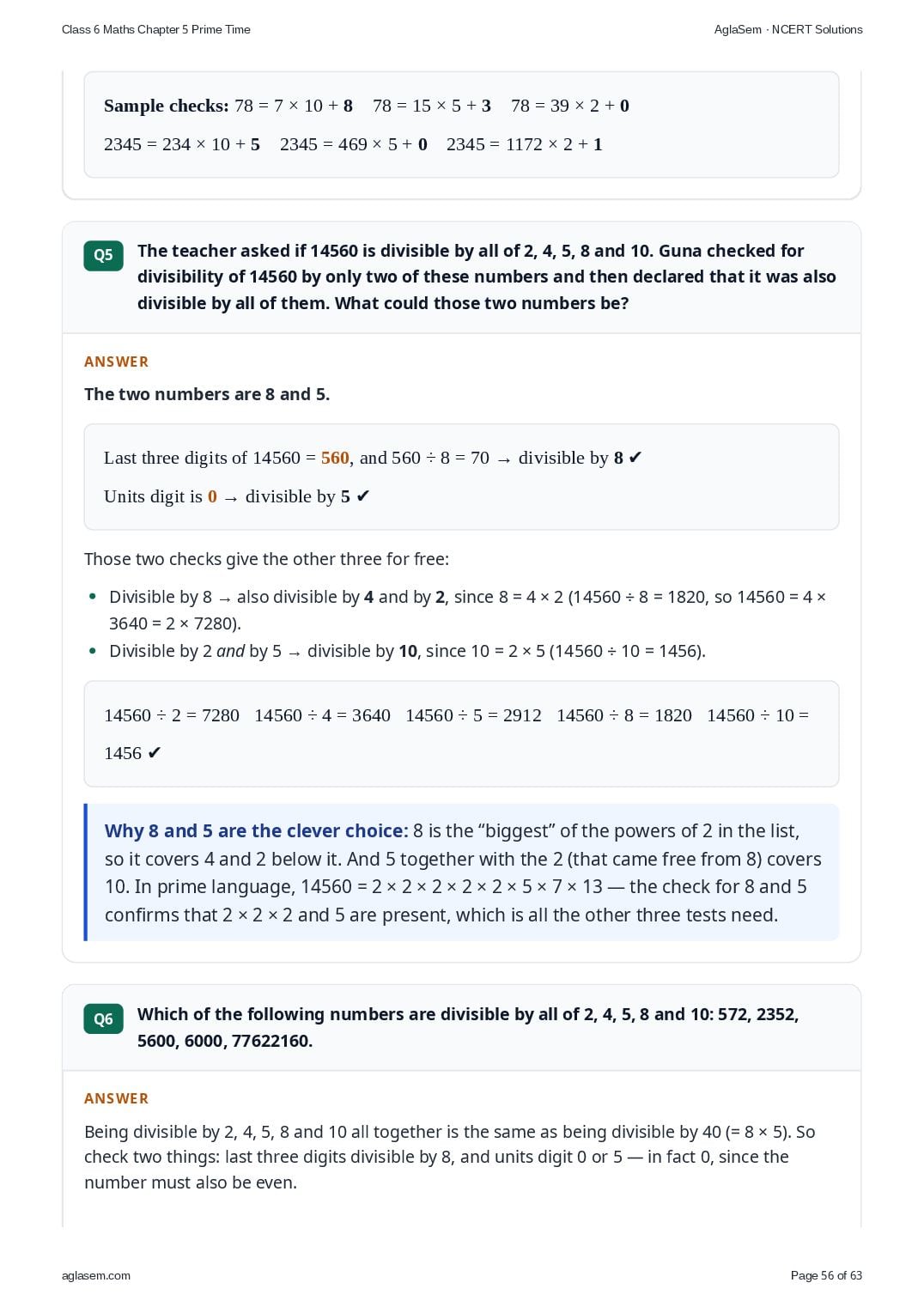
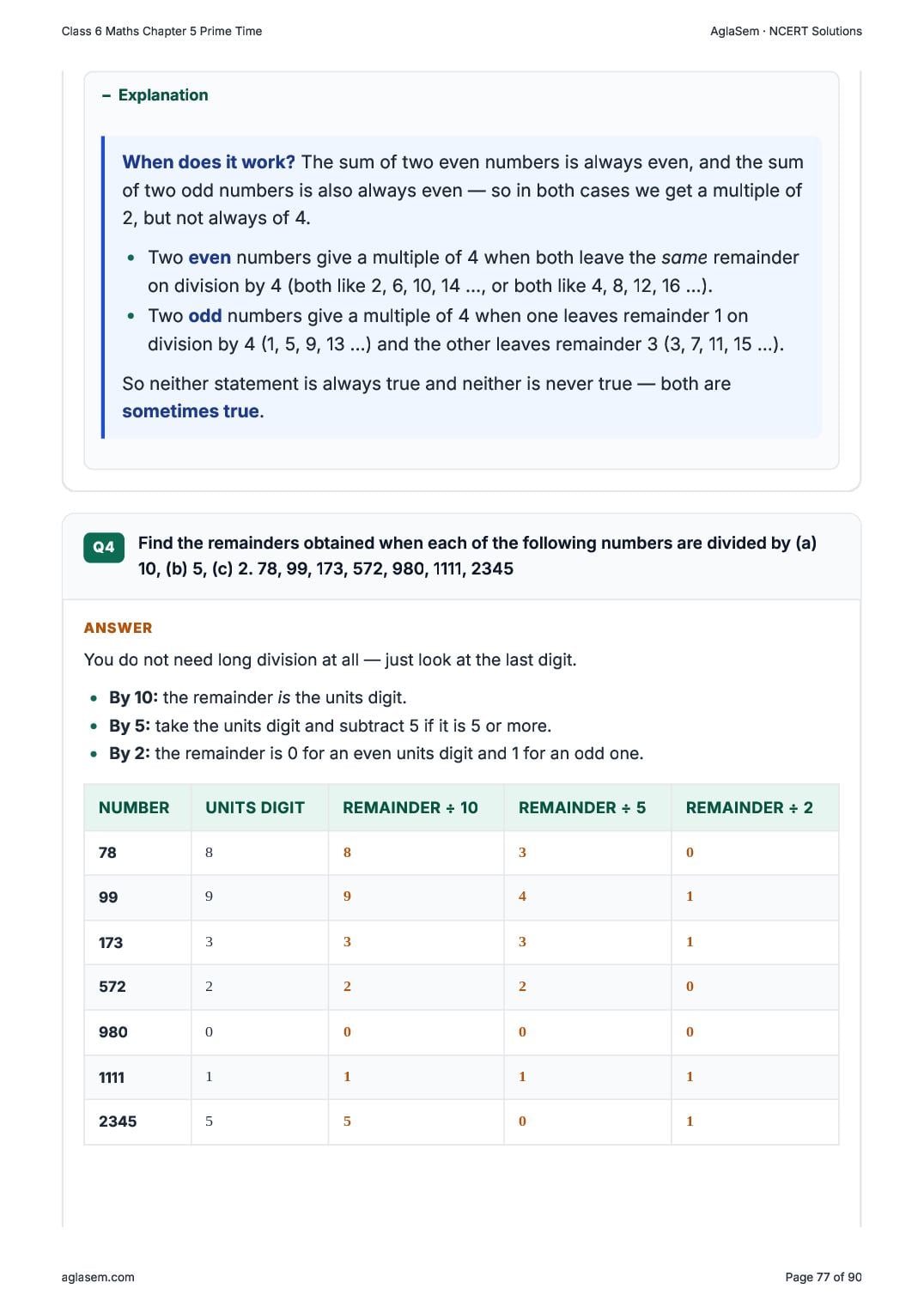
- Find the remainders obtained when each of the following numbers are divided by (a) 10, (b) 5, (c) 2. 78, 99, 173, 572, 980, 1111, 2345
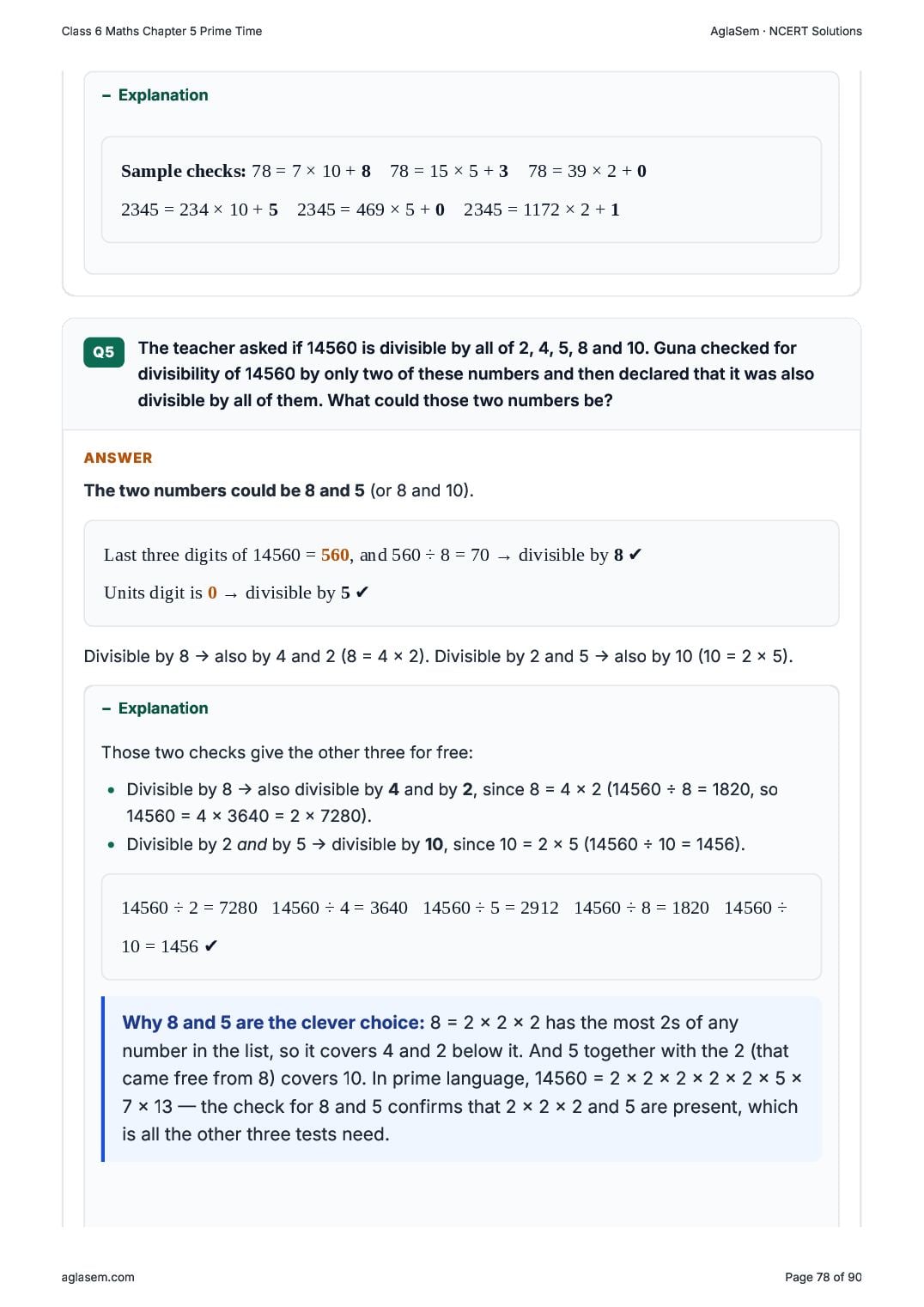
- The teacher asked if 14560 is divisible by all of 2, 4, 5, 8 and 10. Guna checked for divisibility of 14560 by only two of these numbers and then declared that it was also divisible by all of them. What could those two numbers be?
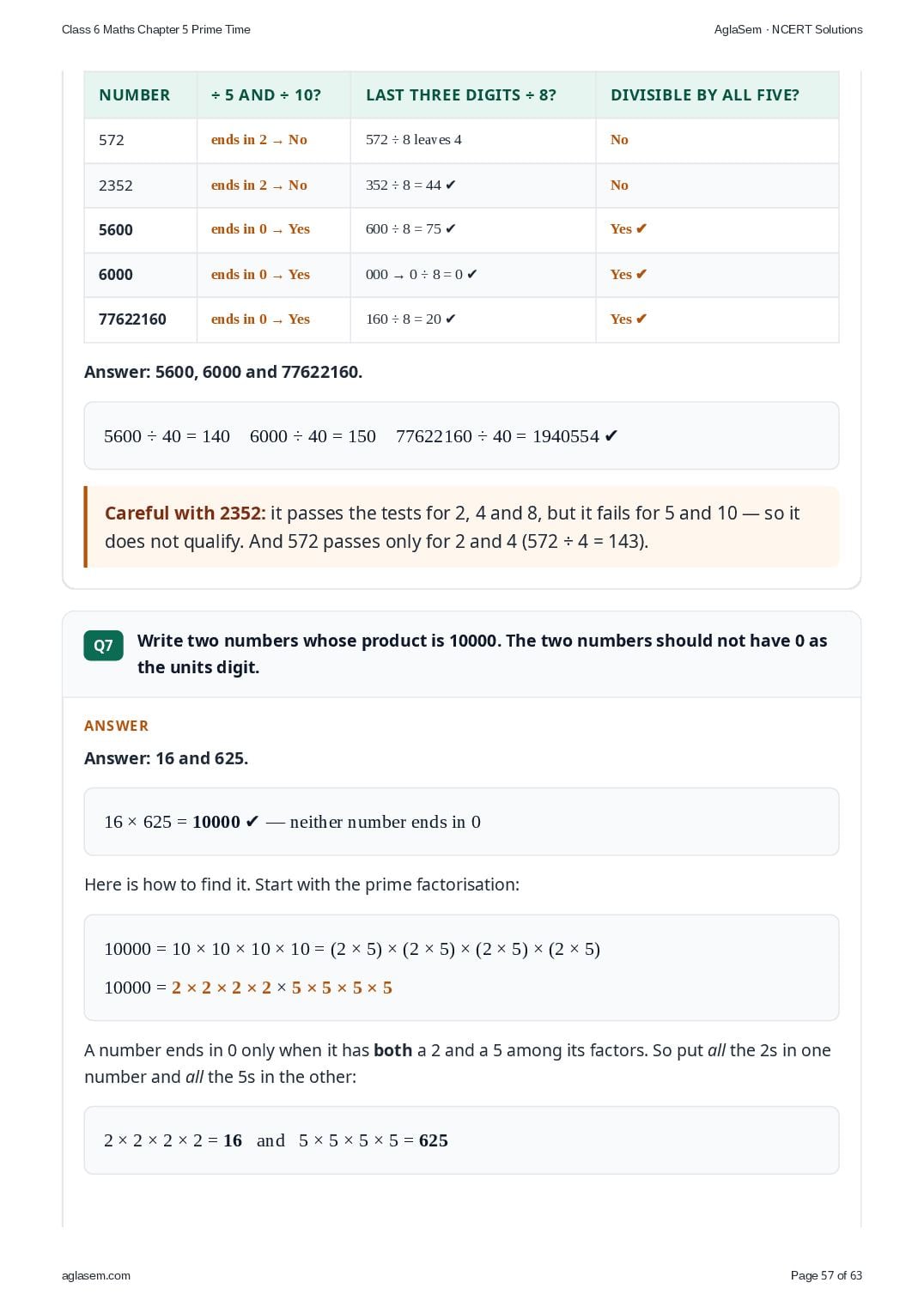
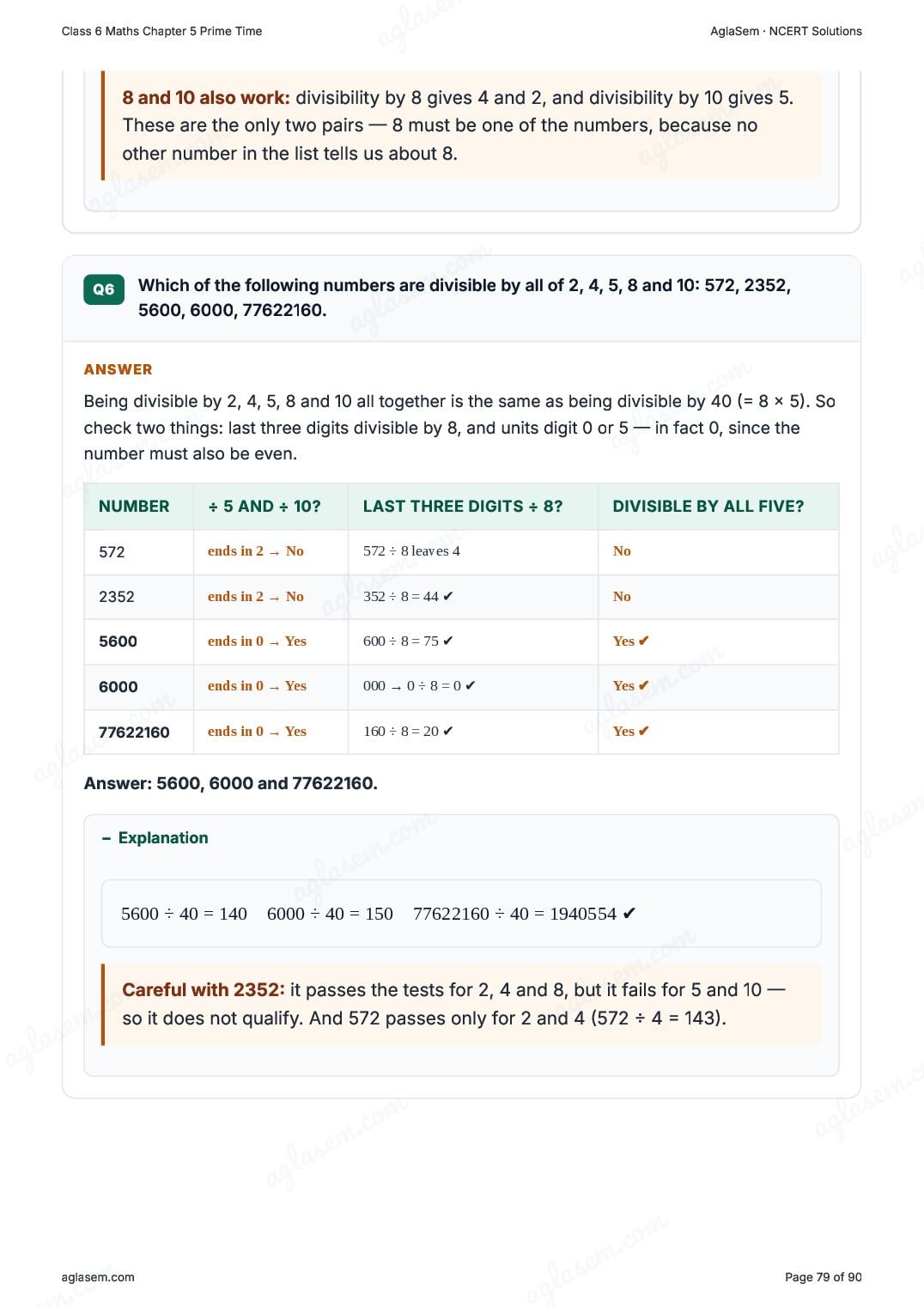
- Which of the following numbers are divisible by all of 2, 4, 5, 8 and 10: 572, 2352, 5600, 6000, 77622160.
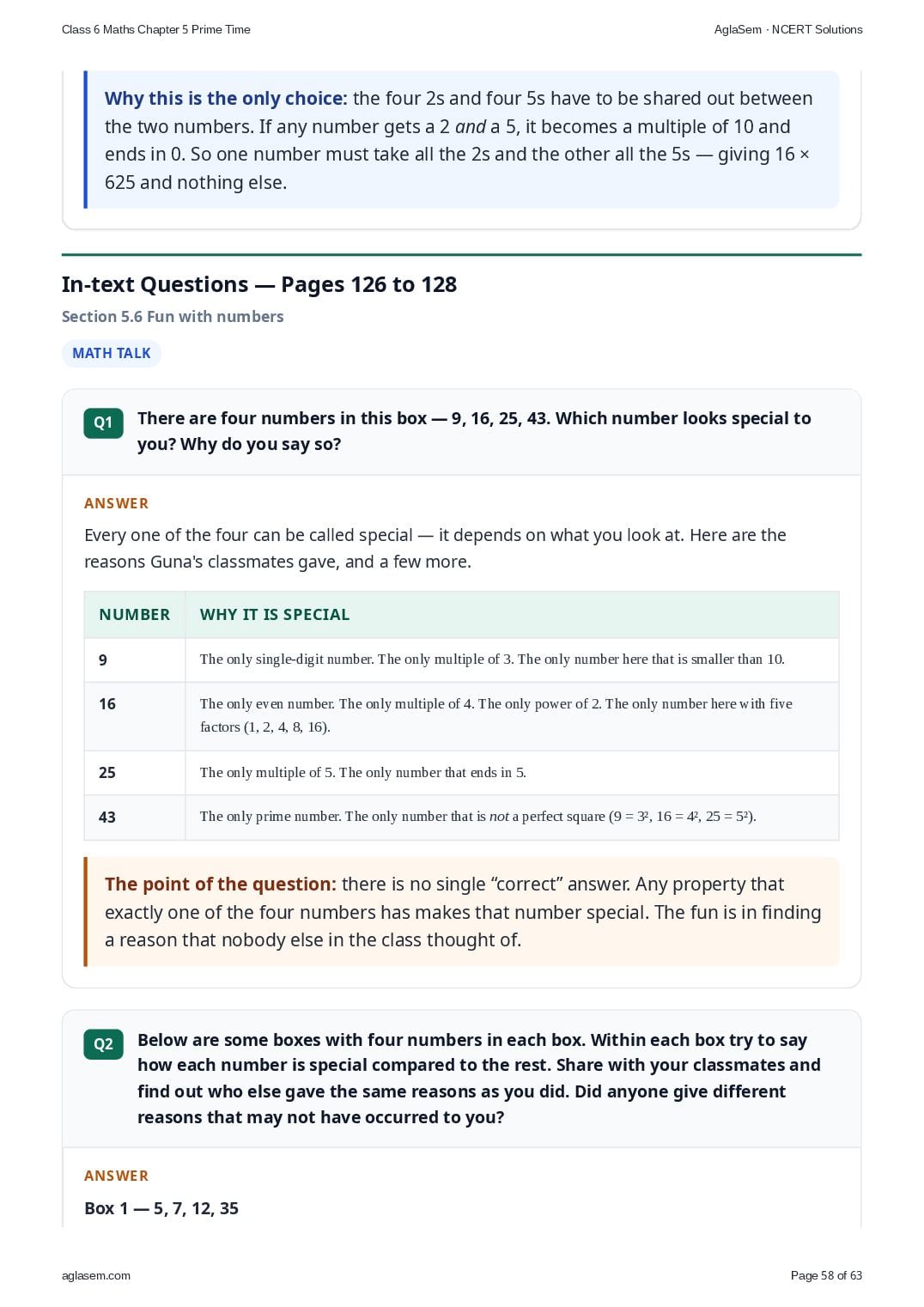
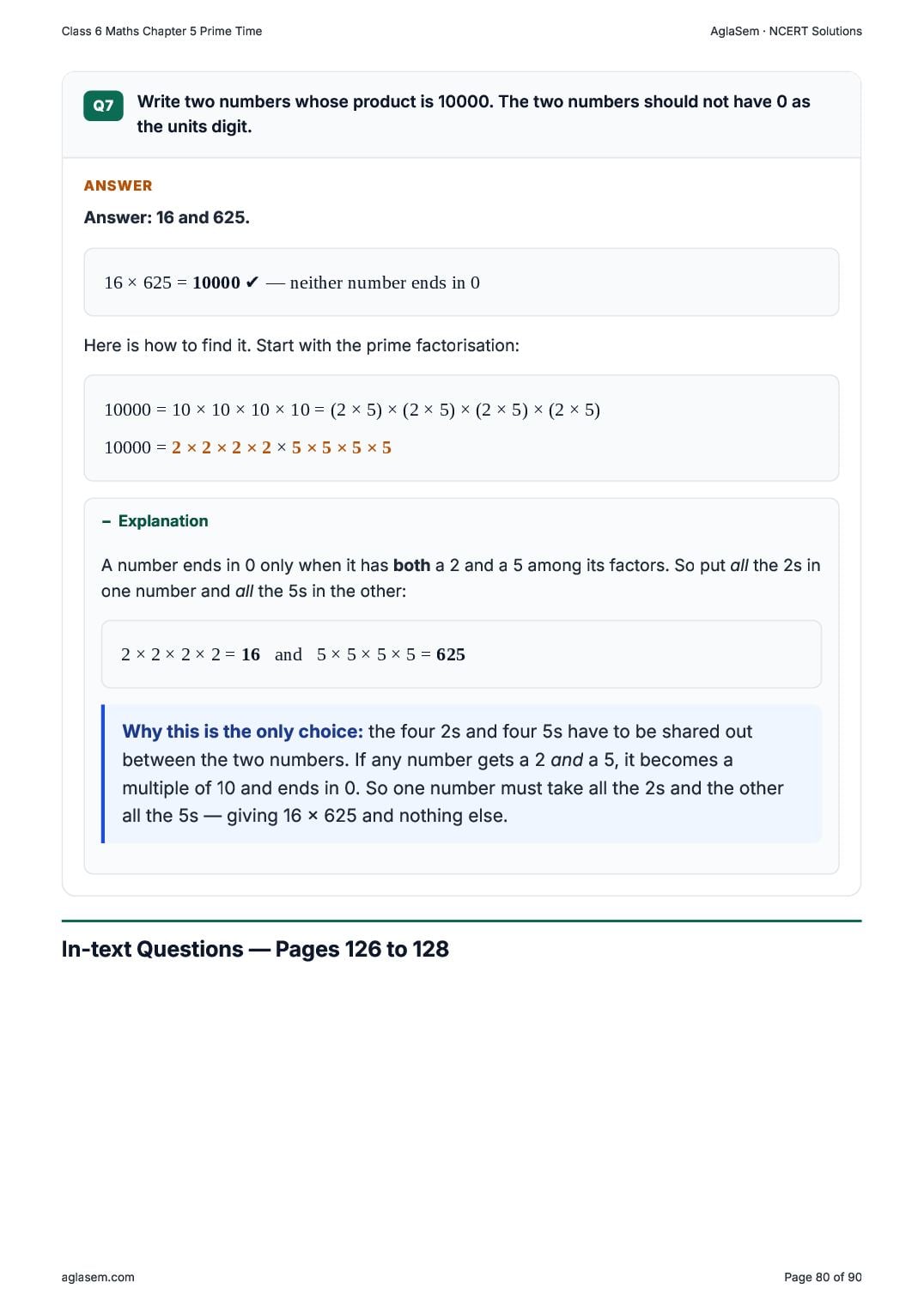
- Write two numbers whose product is 10000. The two numbers should not have 0 as the units digit.
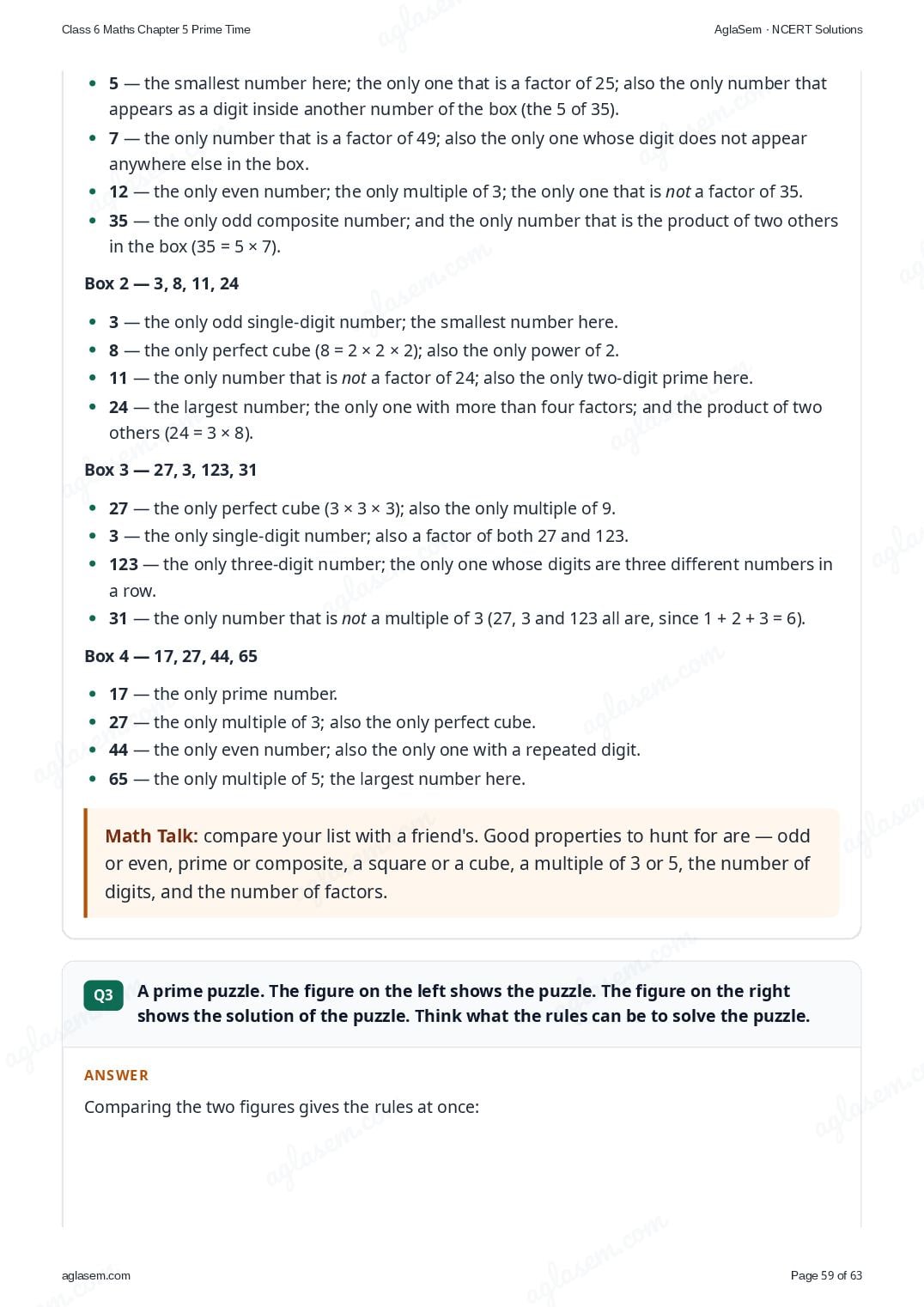
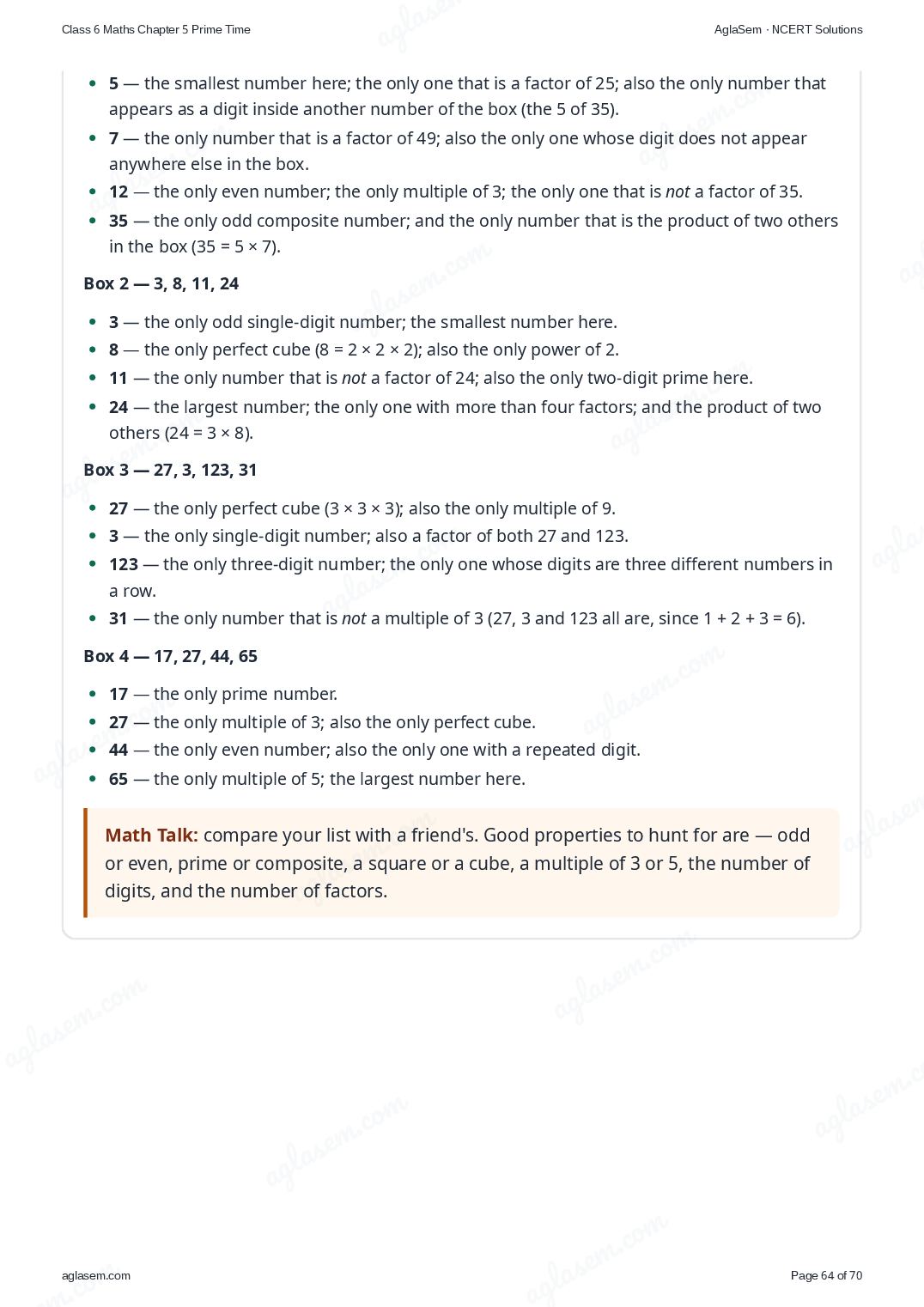
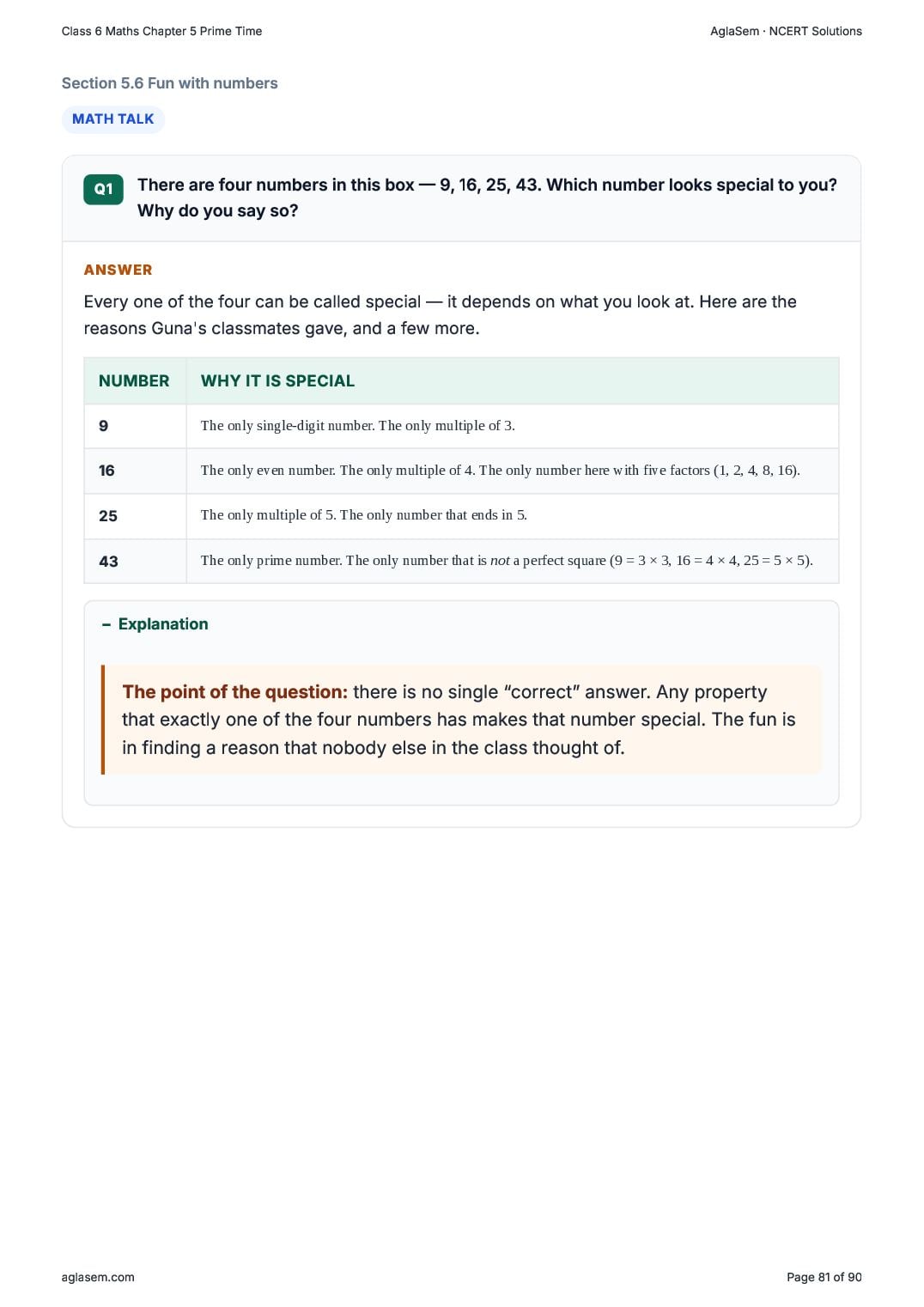
- There are four numbers in this box — 9, 16, 25, 43. Which number looks special to you? Why do you say so?
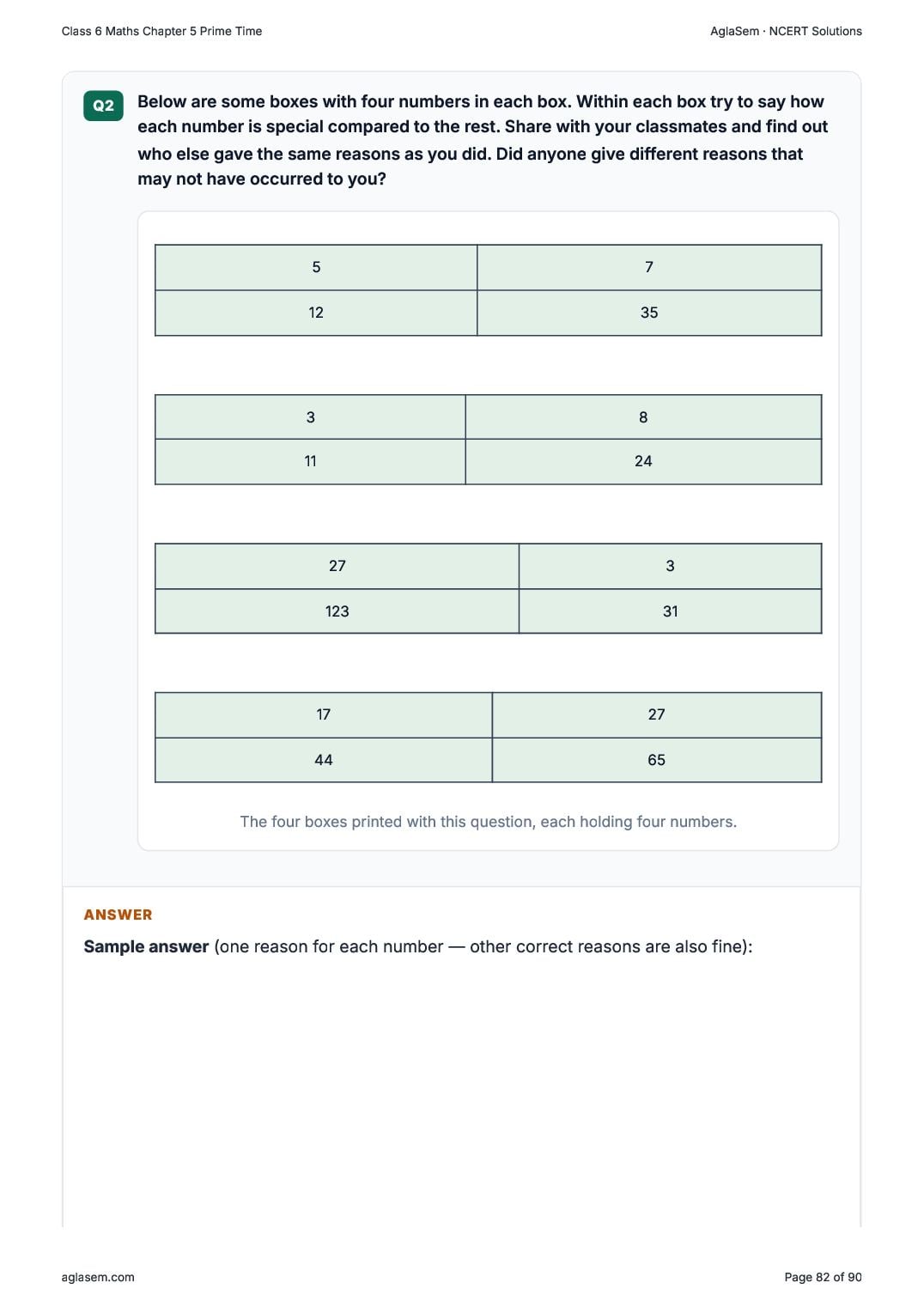
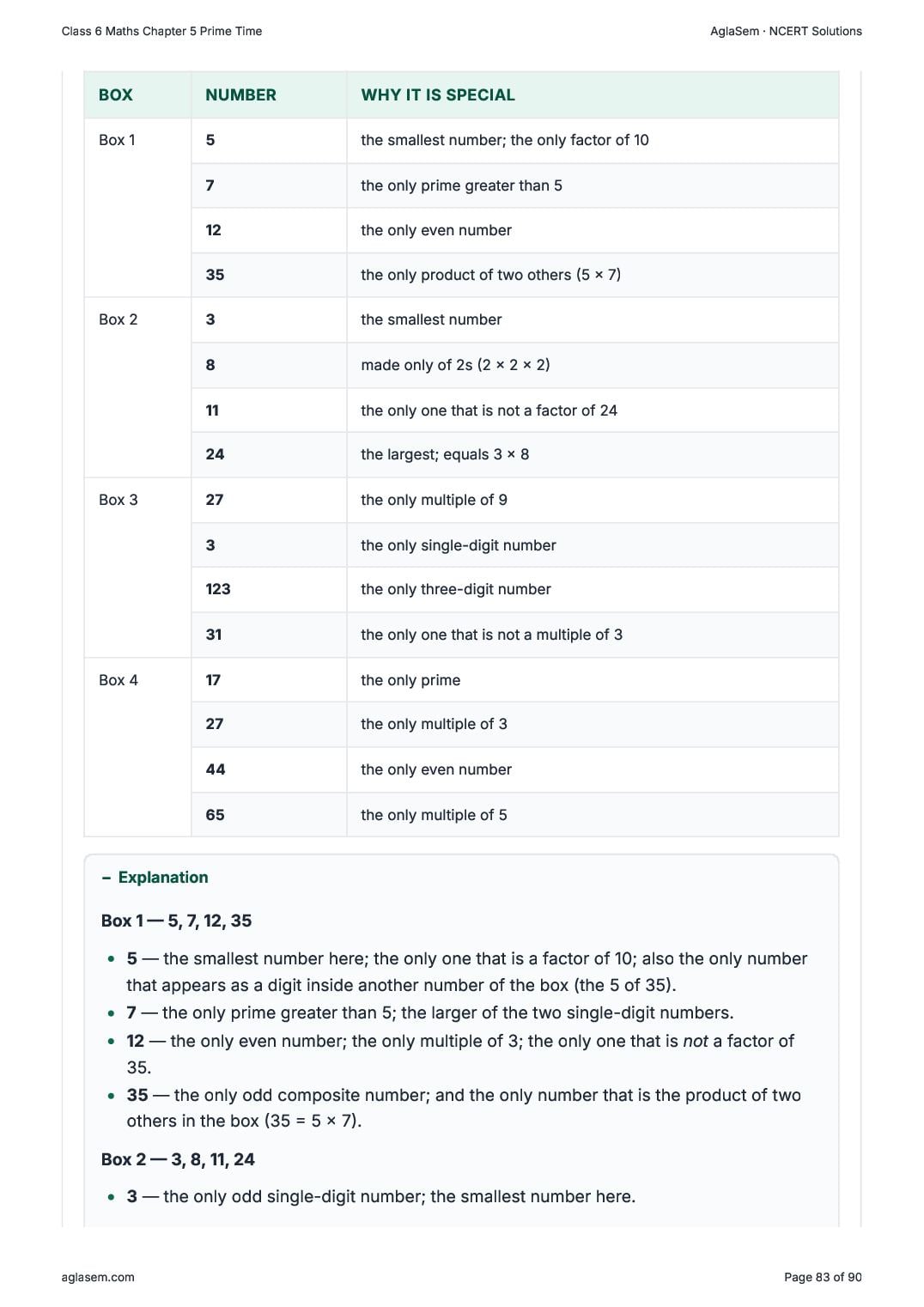
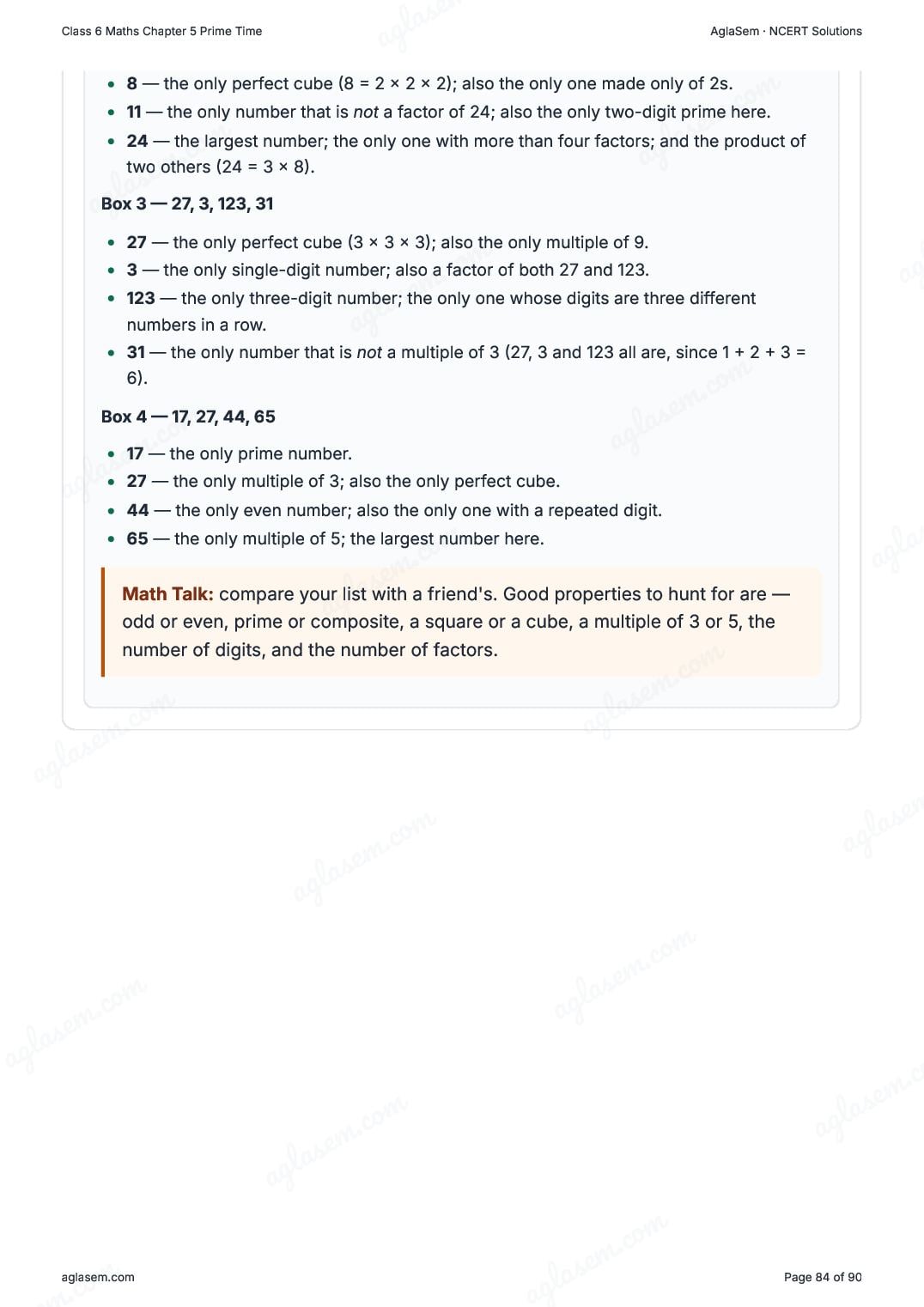
- Below are some boxes with four numbers in each box. Within each box try to say how each number is special compared to the rest. Share with your classmates and find out who else gave the same reasons as you did. Did anyone give different reasons that may not have occurred to you?
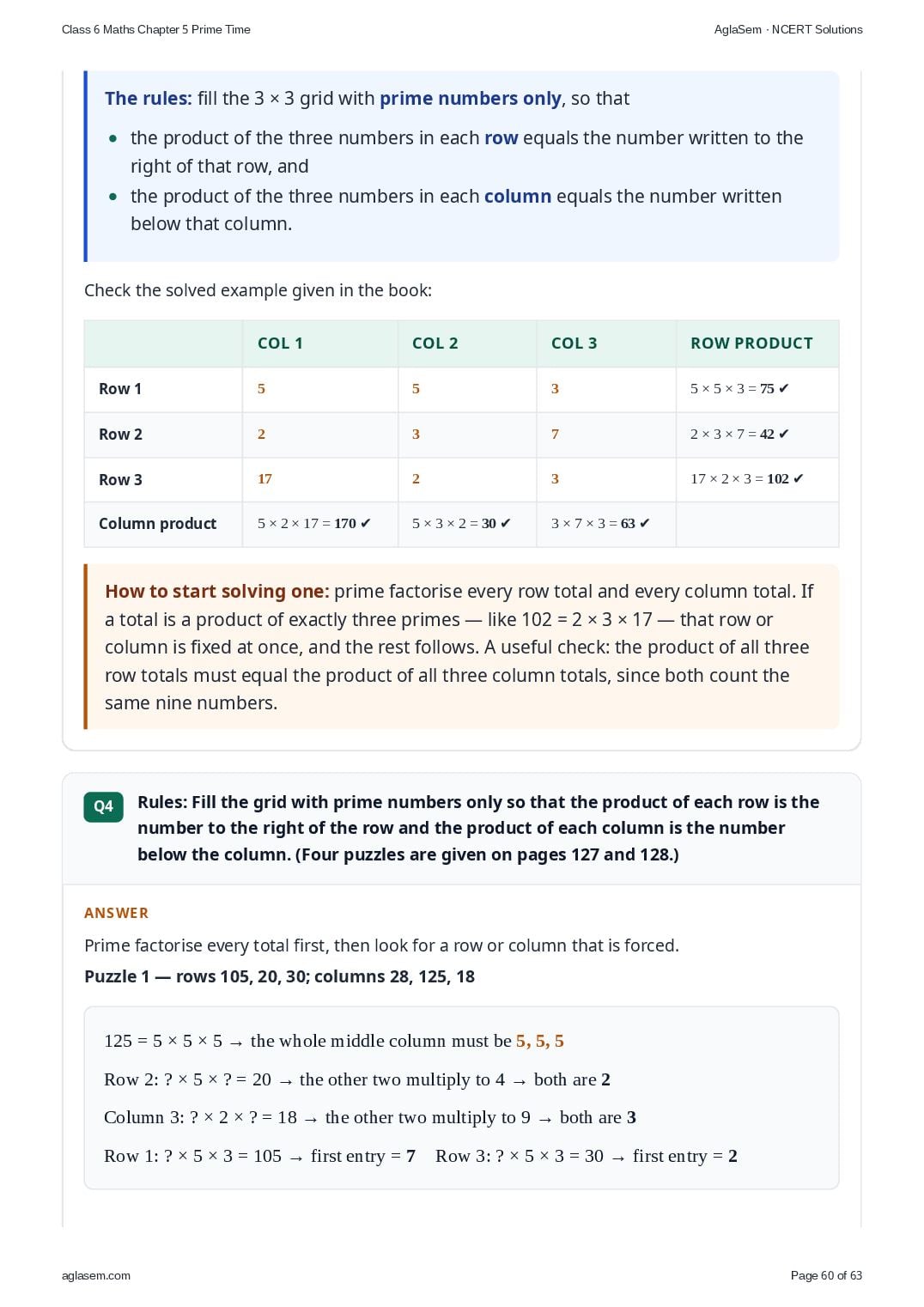
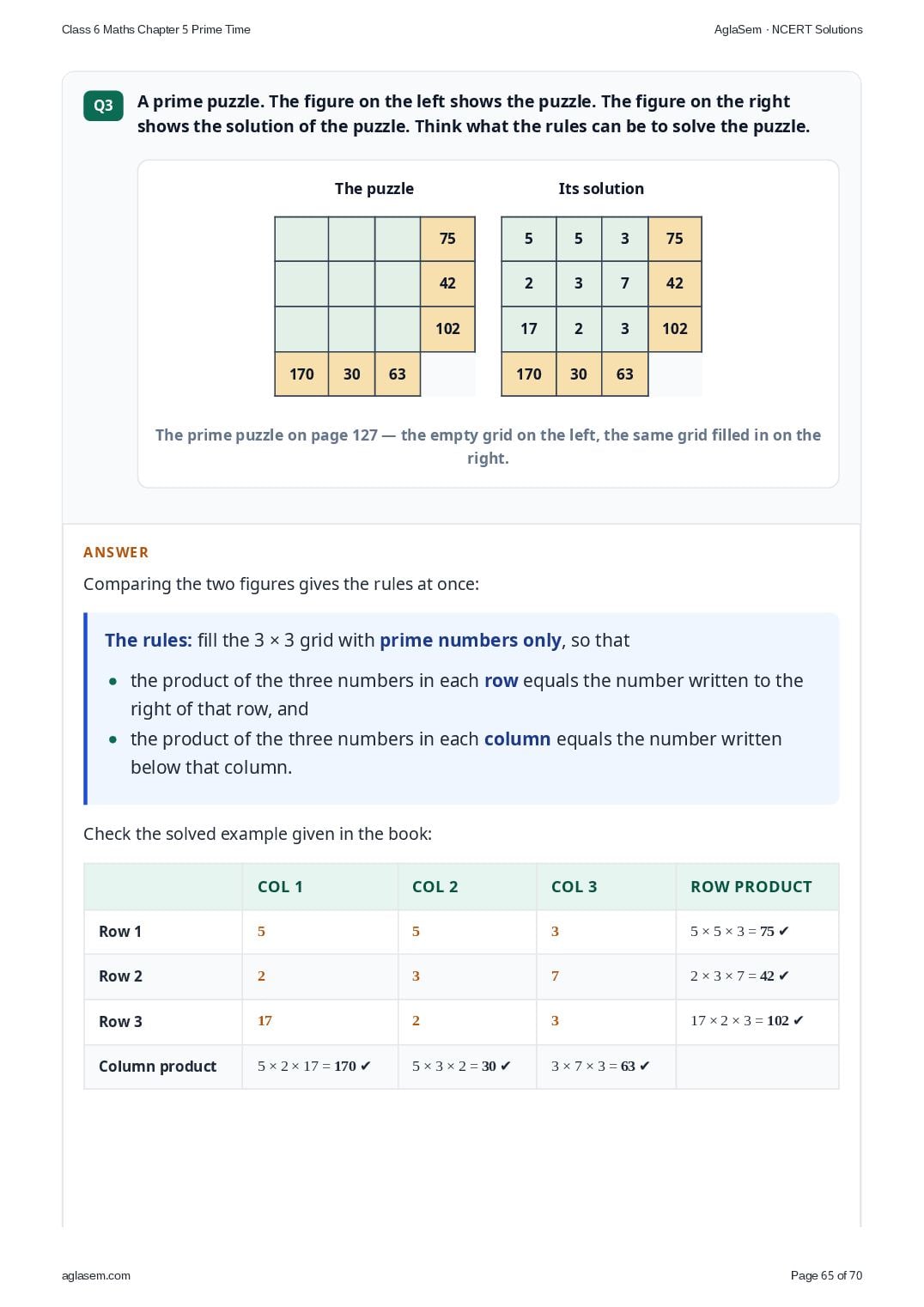
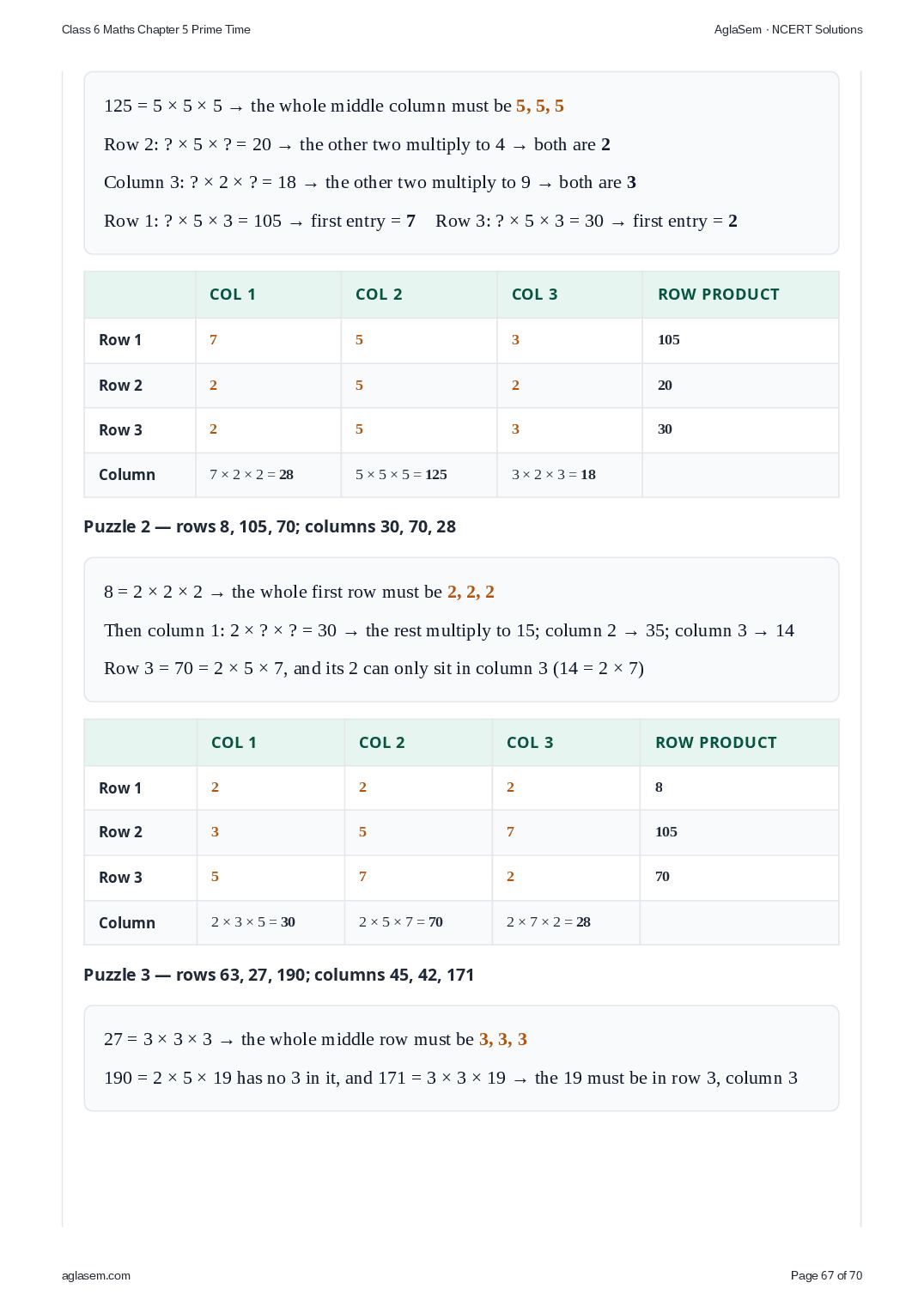
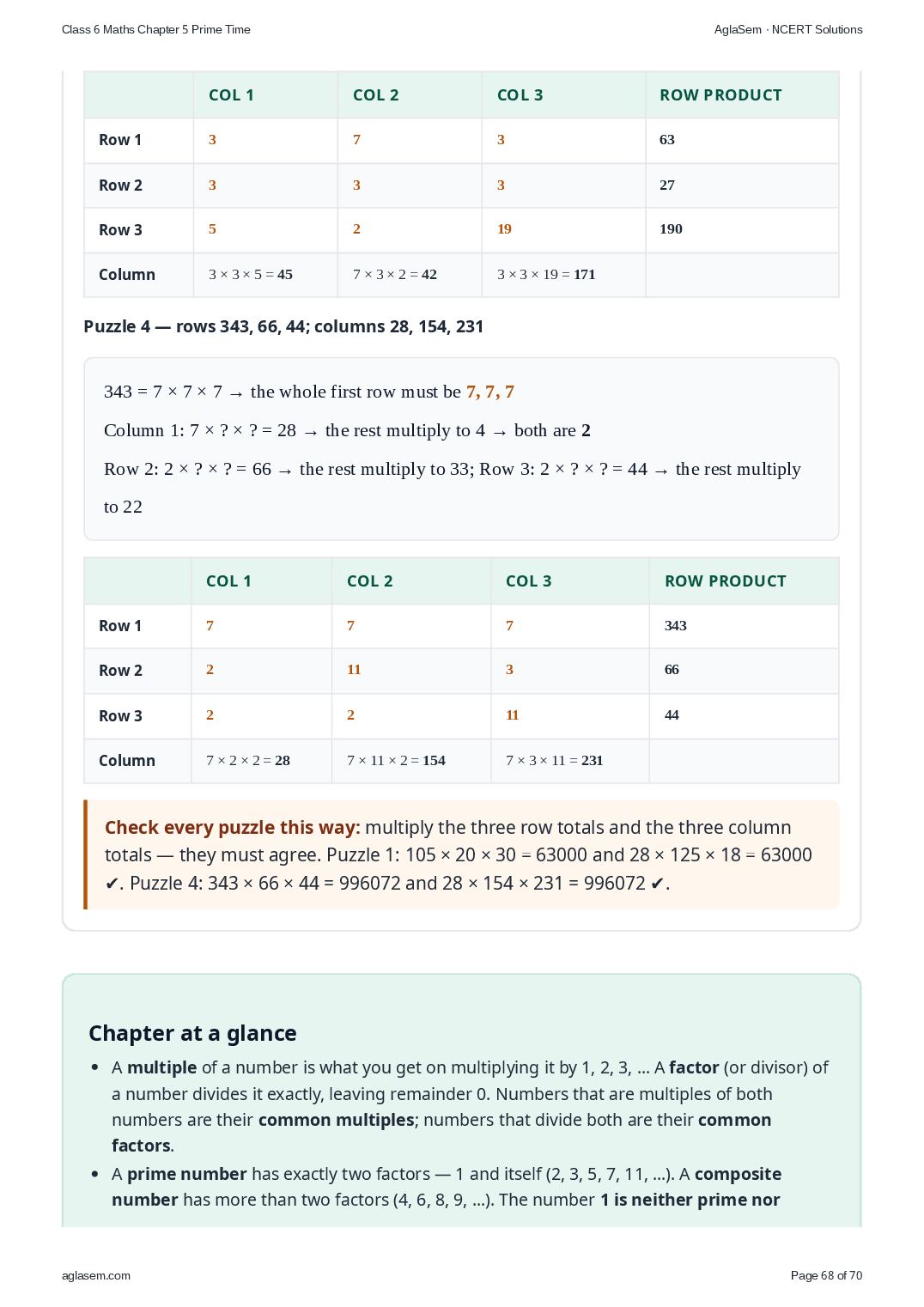
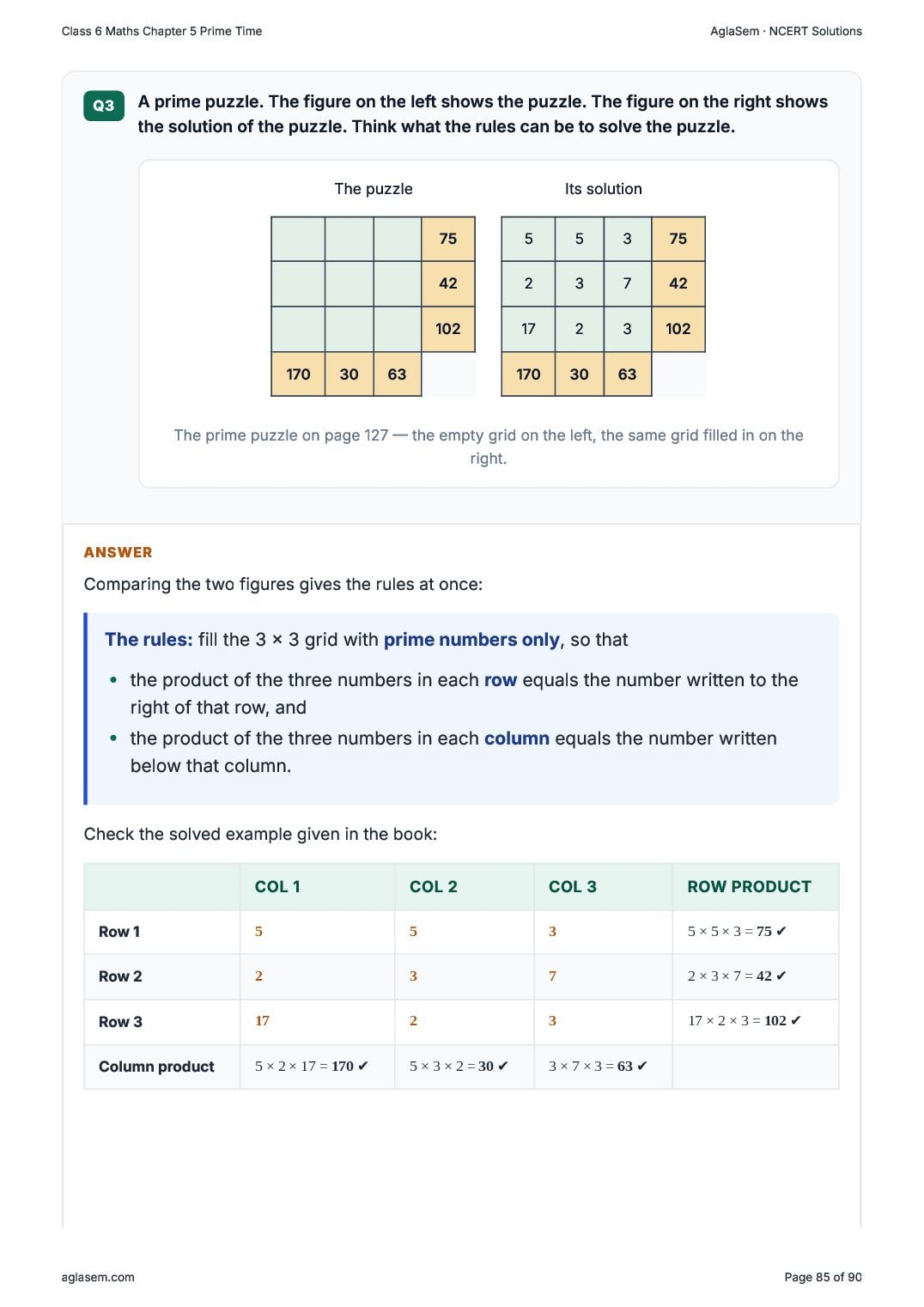
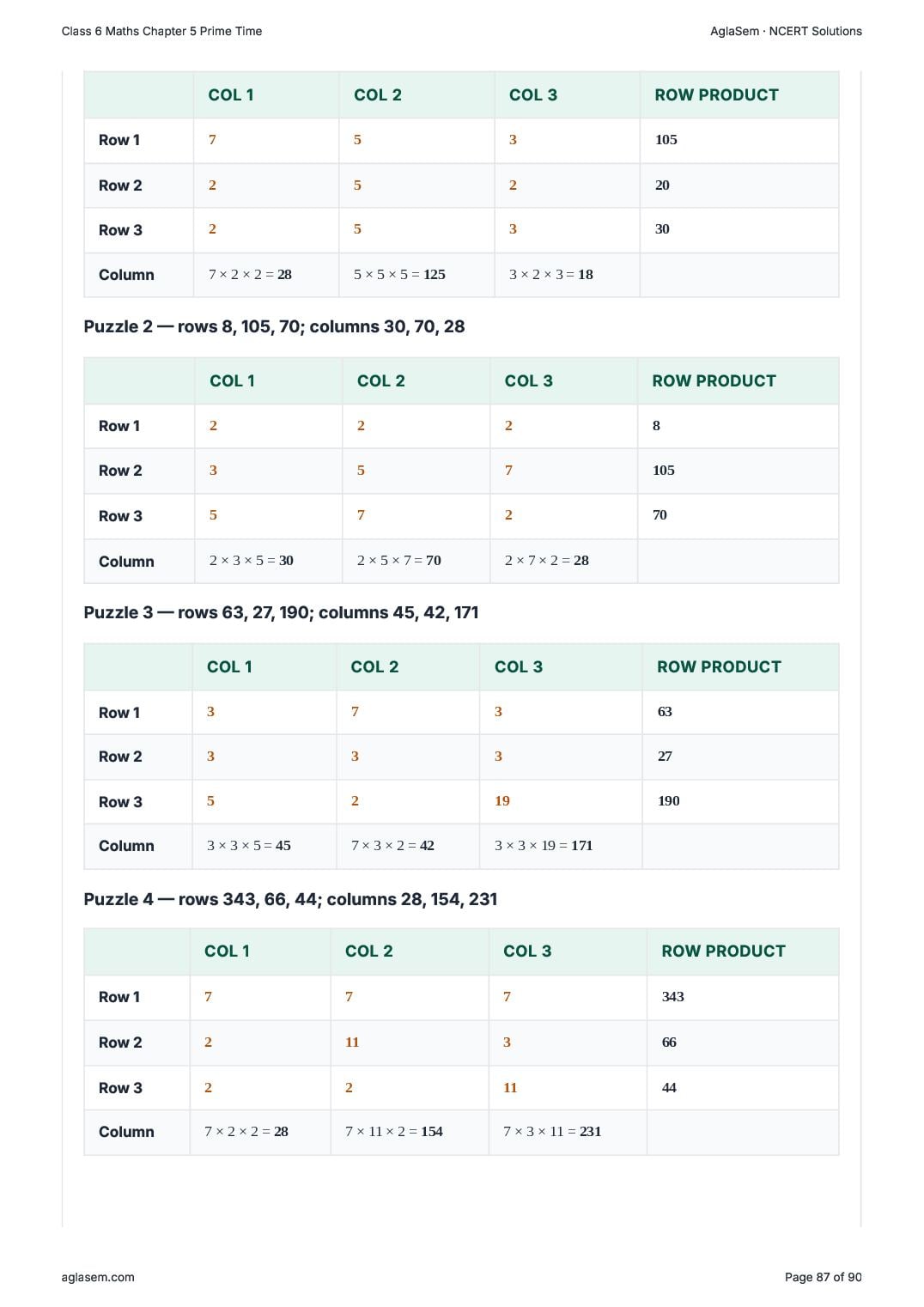
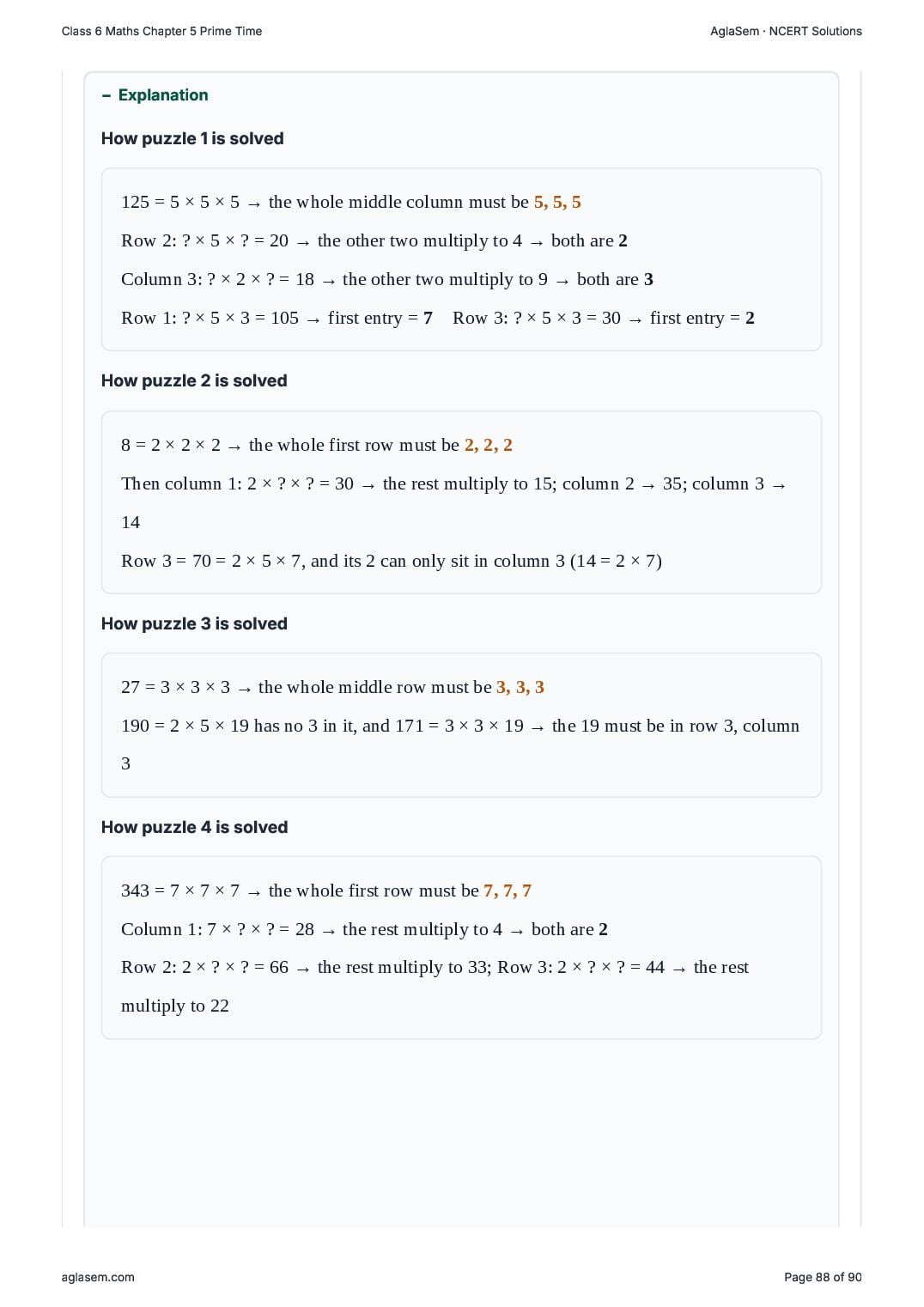
- A prime puzzle. The figure on the left shows the puzzle. The figure on the right shows the solution of the puzzle. Think what the rules can be to solve the puzzle.
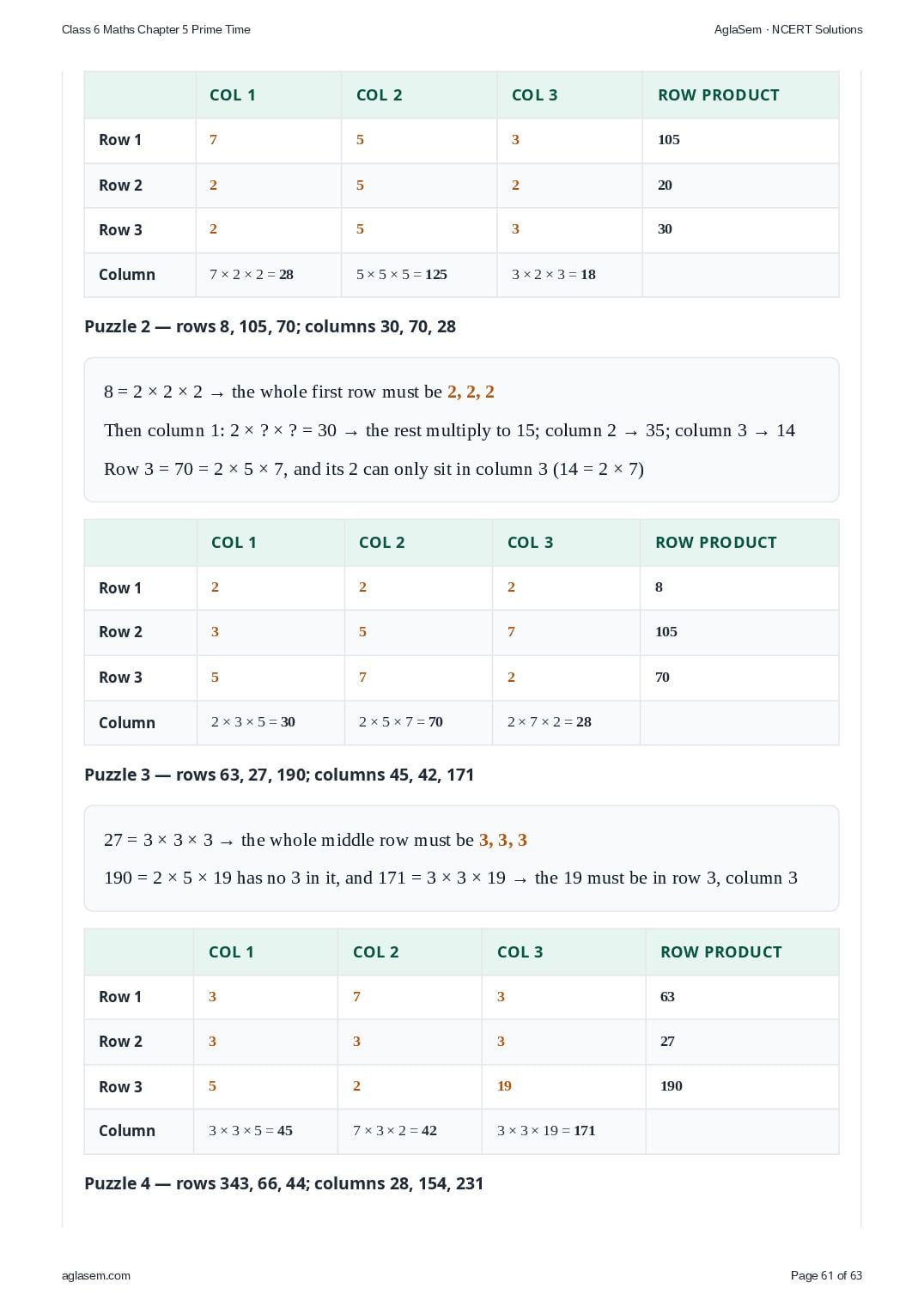
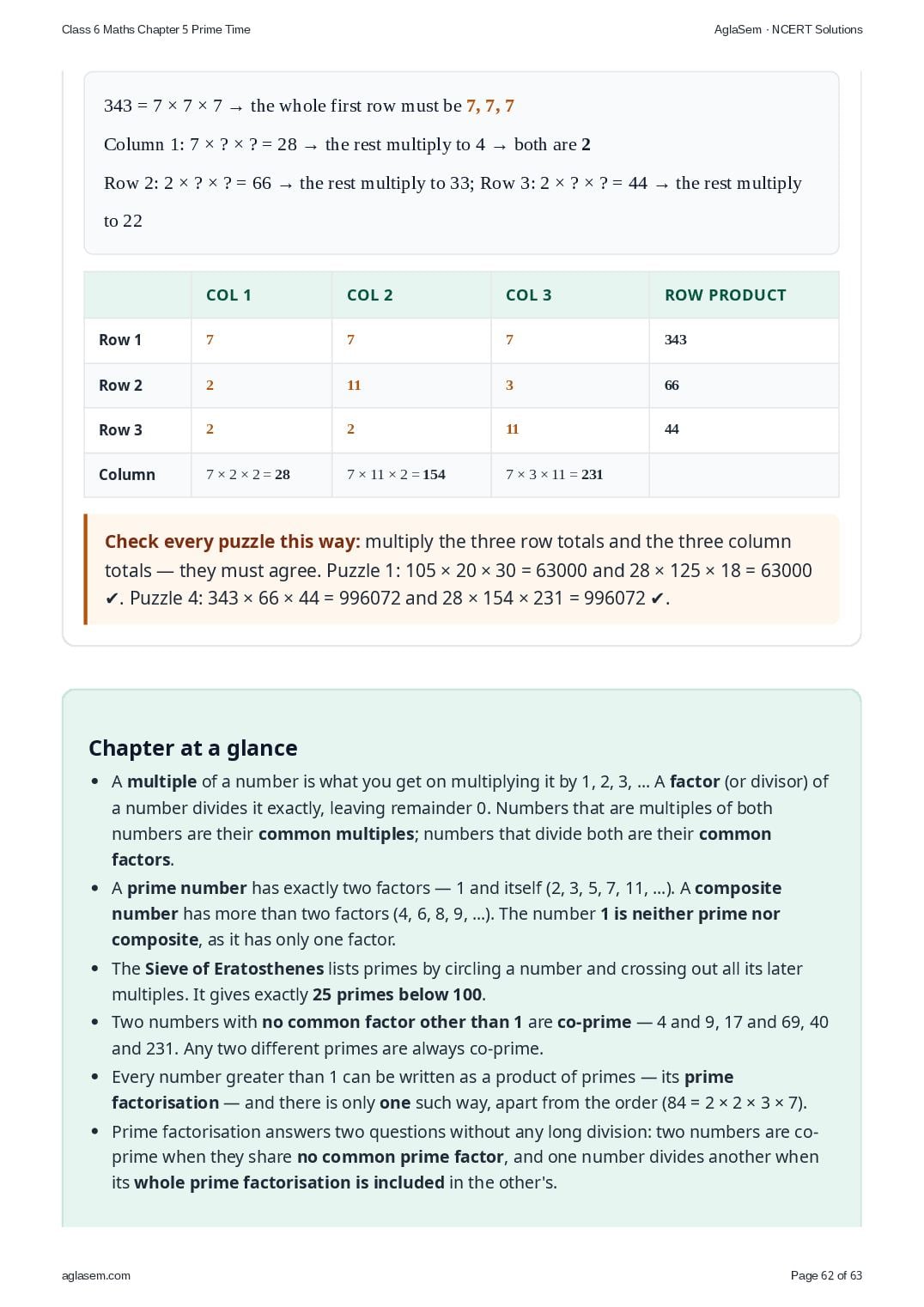
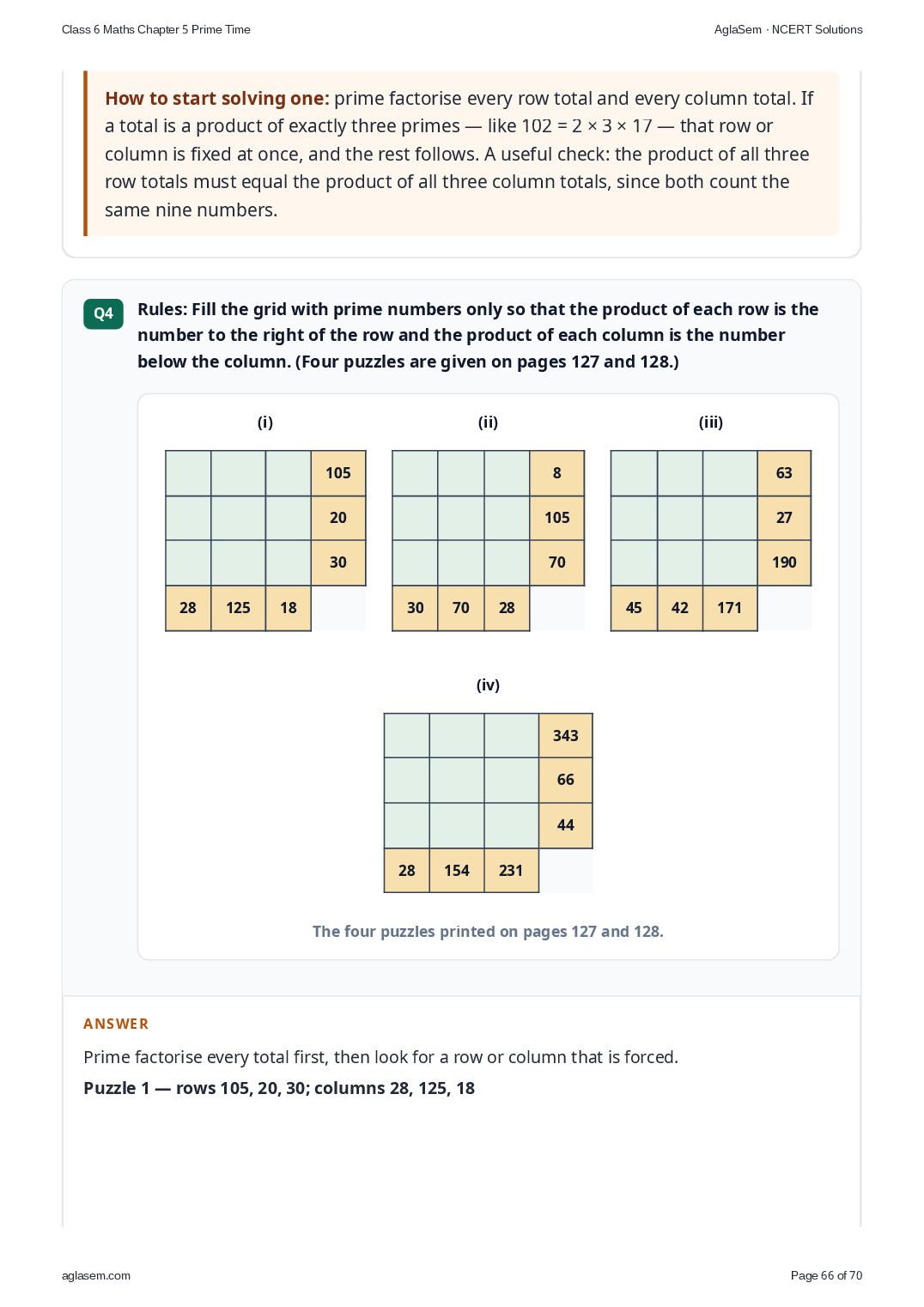
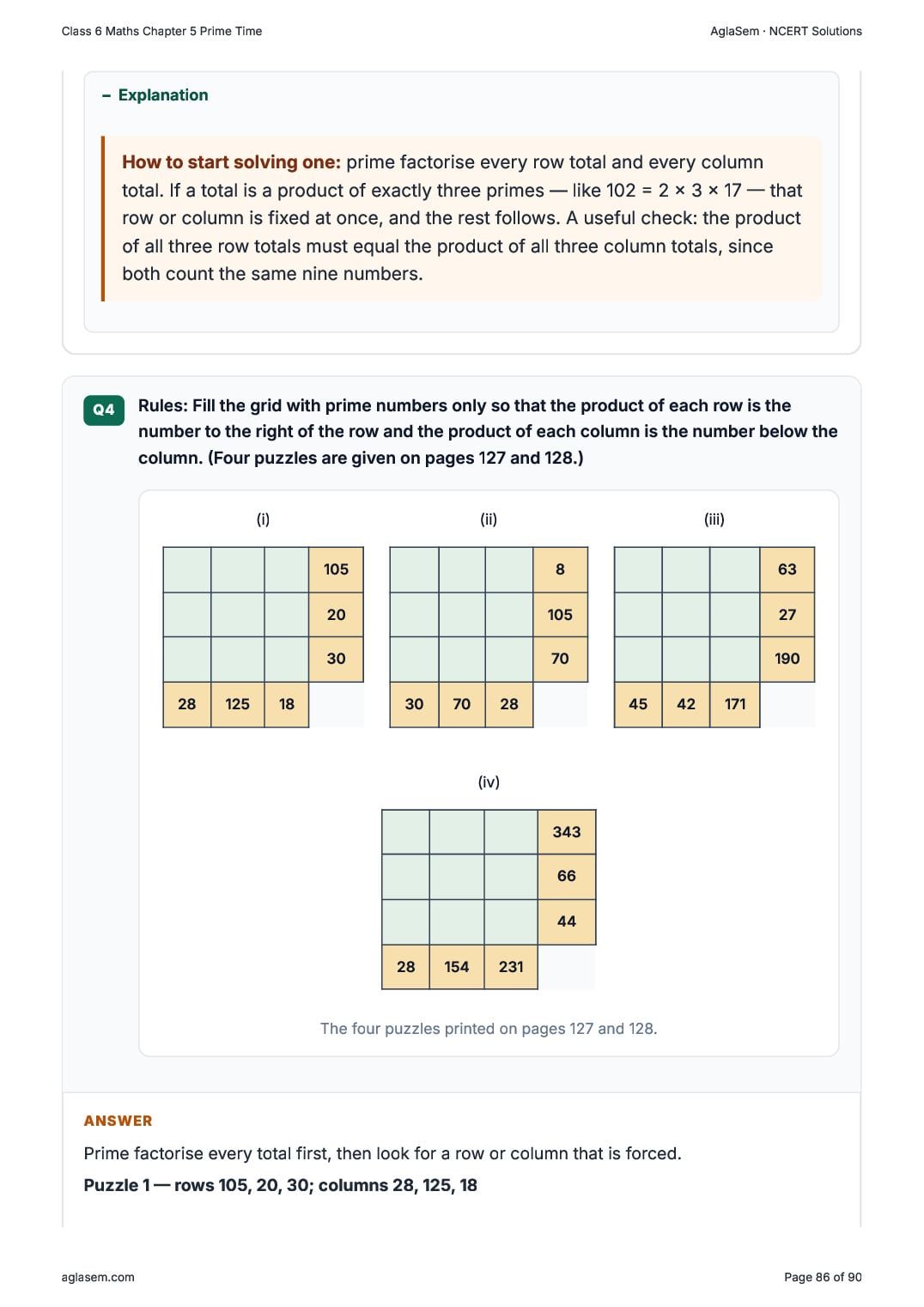
- Rules: Fill the grid with prime numbers only so that the product of each row is the number to the right of the row and the product of each column is the number below the column. (Four puzzles are given on pages 127 and 128.)
Chapter at a Glance
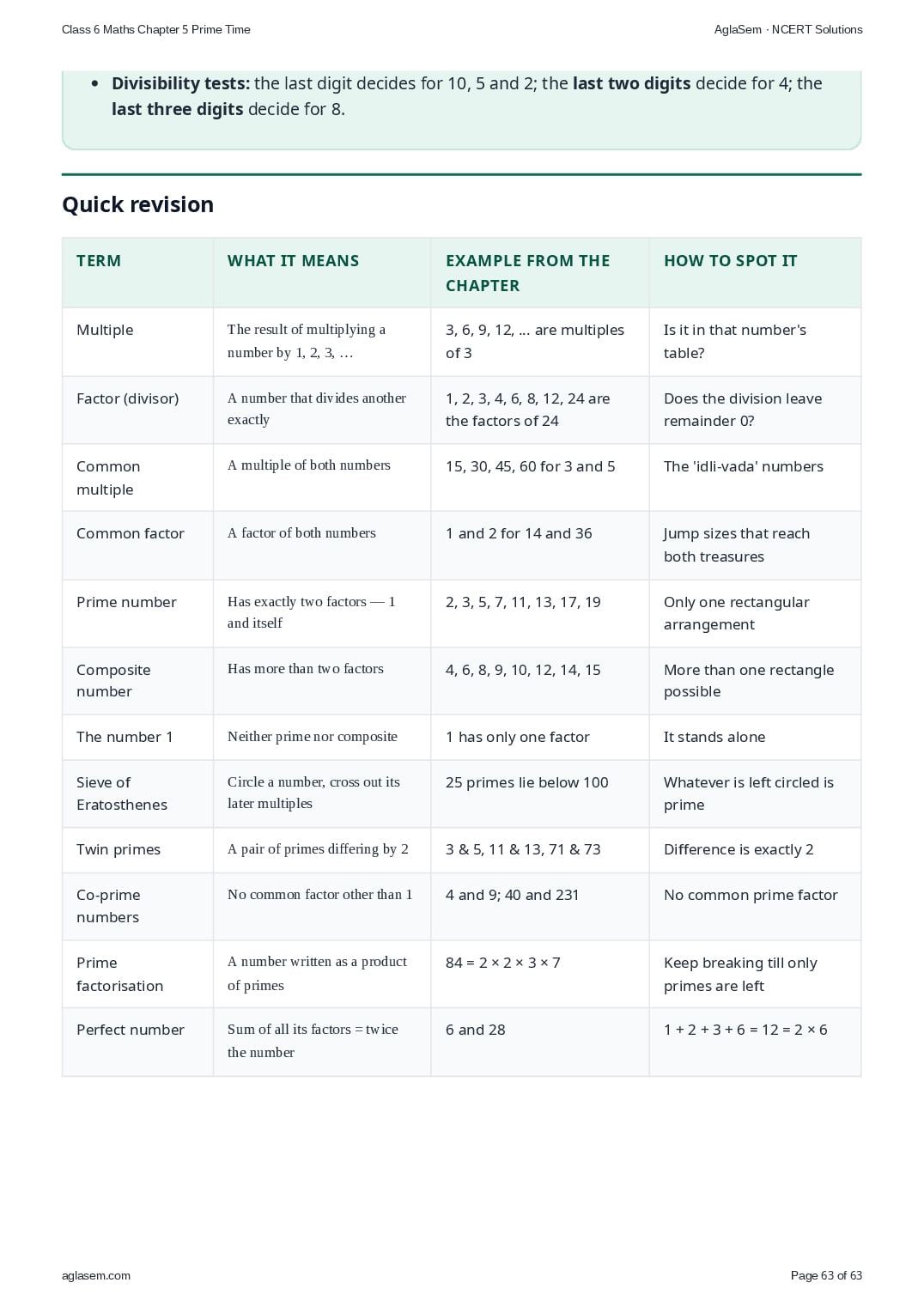
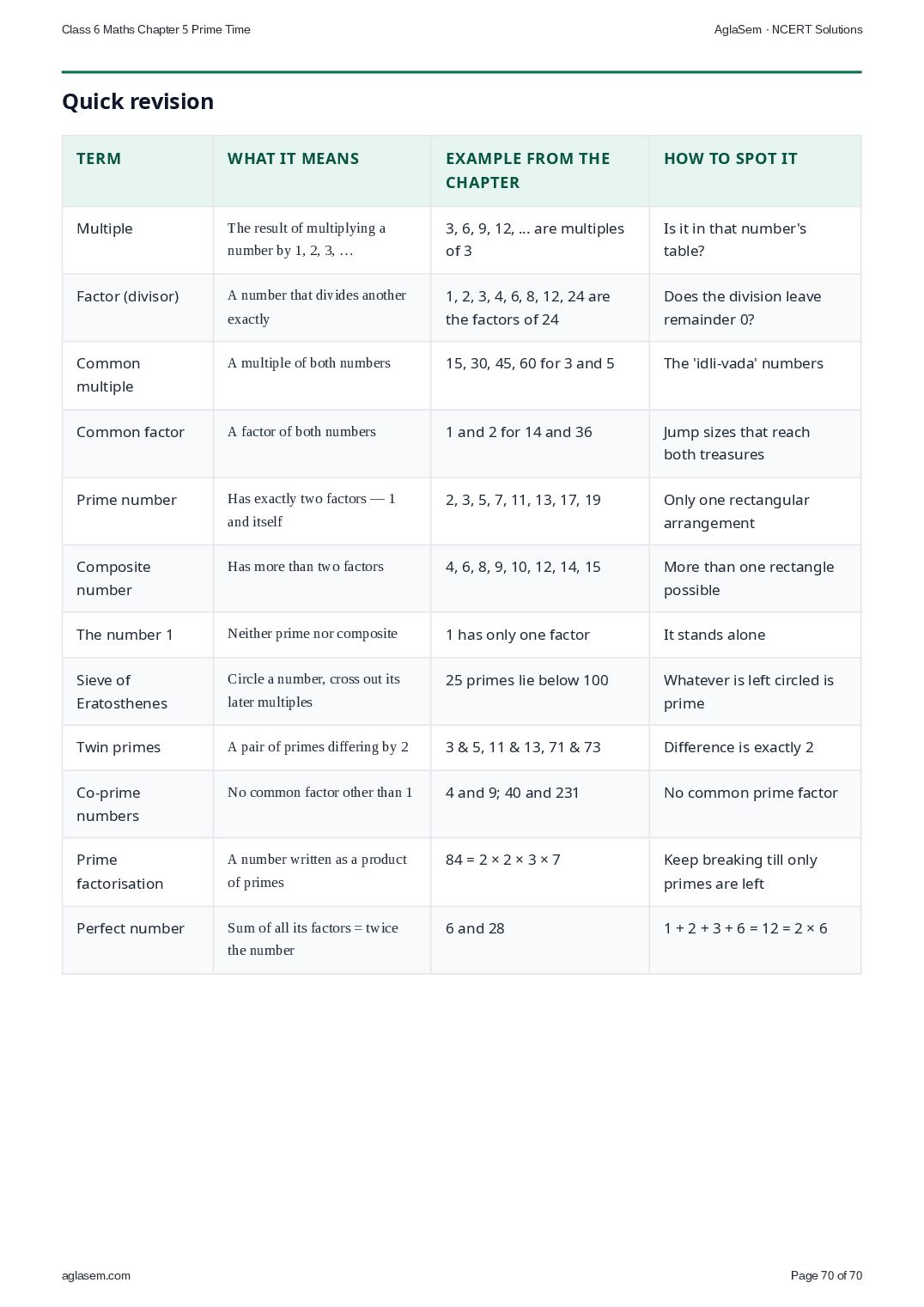
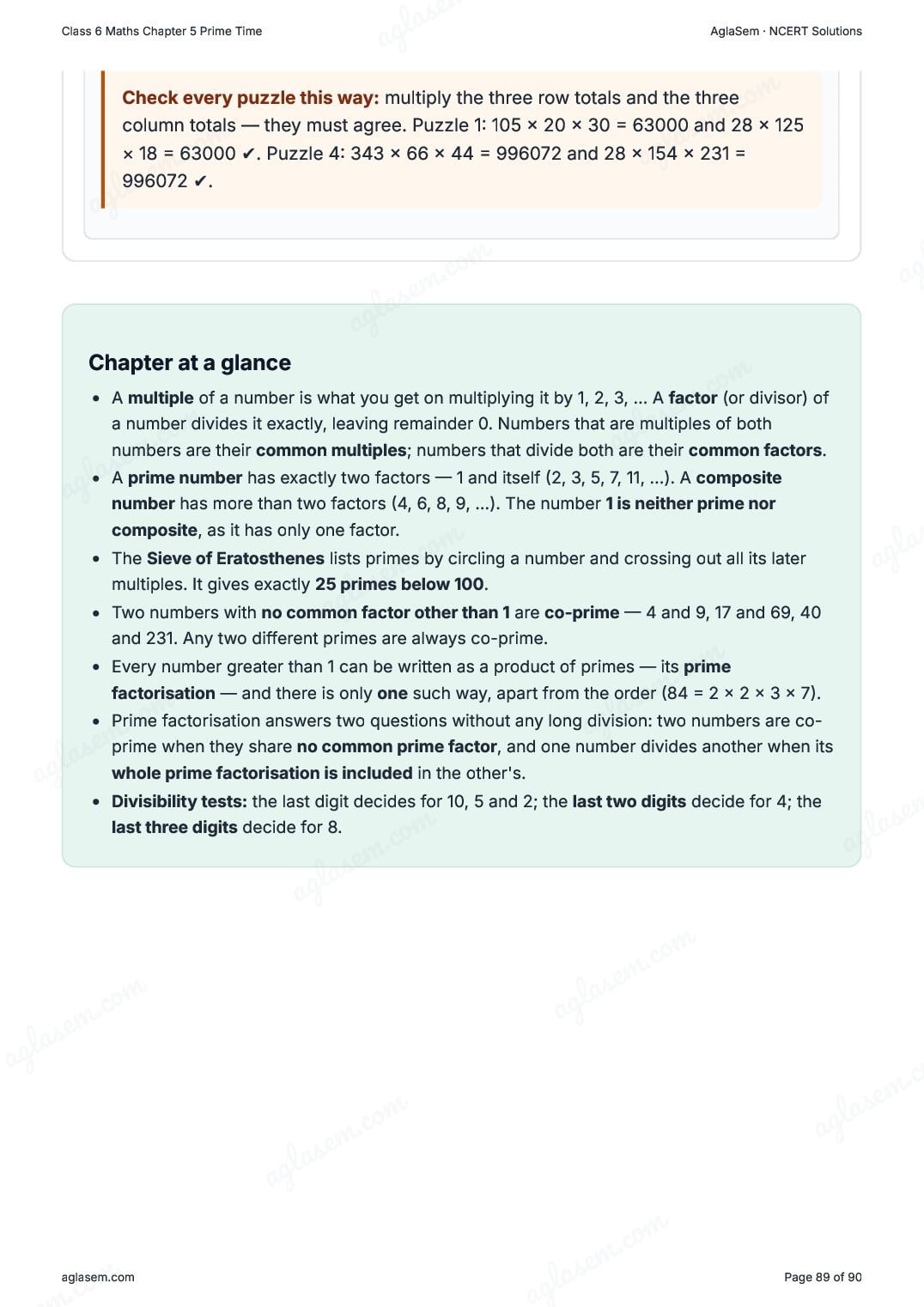
- A multiple of a number is what you get on multiplying it by 1, 2, 3, … A factor (or divisor) of a number divides it exactly, leaving remainder 0. Numbers that are multiples of both numbers are their common multiples ; numbers that divide both are their common factors .
- A prime number has exactly two factors — 1 and itself (2, 3, 5, 7, 11, …). A composite number has more than two factors (4, 6, 8, 9, …). The number 1 is neither prime nor composite , as it has only one factor.
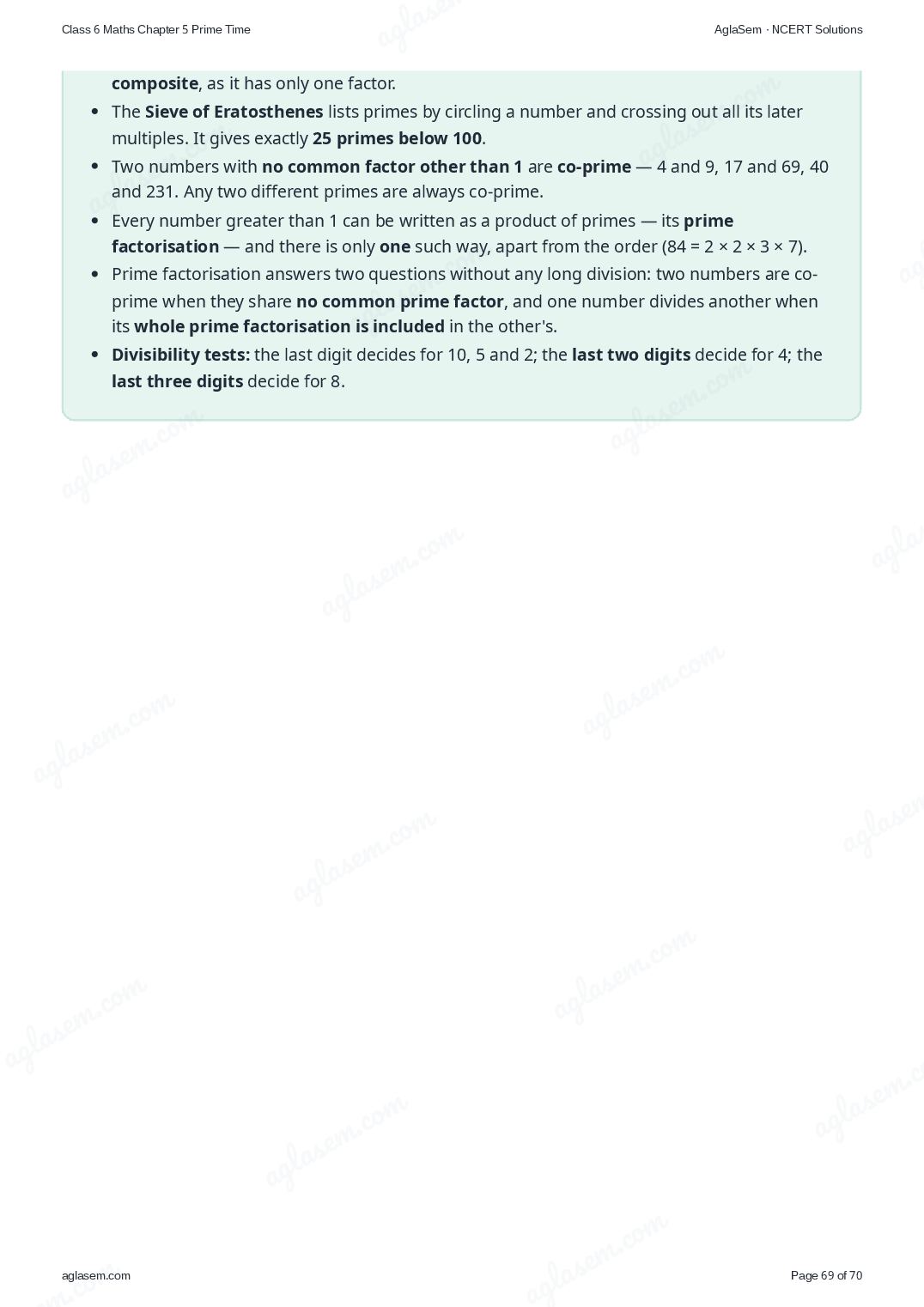
- The Sieve of Eratosthenes lists primes by circling a number and crossing out all its later multiples. It gives exactly 25 primes below 100 .
- Two numbers with no common factor other than 1 are co-prime — 4 and 9, 17 and 69, 40 and 231. Any two different primes are always co-prime.
- Every number greater than 1 can be written as a product of primes — its prime factorisation — and there is only one such way, apart from the order (84 = 2 × 2 × 3 × 7).
- Prime factorisation answers two questions without any long division: two numbers are co-prime when they share no common prime factor , and one number divides another when its whole prime factorisation is included in the other's.
- Divisibility tests: the last digit decides for 10, 5 and 2; the last two digits decide for 4; the last three digits decide for 8.
How to Download NCERT Solutions for Class 6 Maths Chapter 5 PDF
Follow these simple steps to get the Prime Time questions-and-answers PDF from Ganita Prakash.
- Search NCERT Solutions for Class 6 Maths Chapter 5 aglasem and open this page.
- Read the exercise questions with answers for Prime Time shown above.
- Click the Download PDF link to save the Prime Time solutions to your device.
NCERT Solutions for Class 6 Maths – All Chapters
There are more chapters to study besides Prime Time in Maths. Here are the NCERT Solutions for all chapters of Class 6 Maths.
- Chapter 1 Patterns in Mathematics
- Chapter 2 Lines and Angles
- Chapter 3 Number Play
- Chapter 4 Data Handling and Presentation
- Chapter 5 Prime Time
- Chapter 6 Perimeter and Area
- Chapter 7 Fractions
- Chapter 8 Playing with Constructions
- Chapter 9 Symmetry
- Chapter 10 the Other Side of Zero
NCERT Solutions for Class 6 – All Subjects
Just like Chapter 5 of Maths, you can get the exercise questions with answers for every other subject of Class 6. Here are the NCERT Solutions for all subjects of Class 6.
NCERT Solutions for Class 6 Maths Chapter 5 – An Overview
The key highlights of this study material are as follows.
| Aspects | Details |
|---|---|
| Class | Class 6 |
| Subject | Maths |
| Chapter Number | Chapter 5 |
| Chapter Name | Prime Time |
| Book Name | Ganita Prakash |
| Book By | NCERT (National Council of Educational Research and Training) |
| Educational Resource Here | NCERT Solutions of Class 6 Maths Chapter 5 for all exercises |
| More Questions Answers of This Subject | NCERT Solutions for Class 6 Maths |
| Download Book Chapter | NCERT Book Class 6 Maths |
| All Questions Answers For This Class | NCERT Solutions for Class 6 |
| Complete Solutions | NCERT Solutions |
NCERT Solutions for Class 6 Maths Chapter 5 Prime Time – FAQs
What are the NCERT Solutions for Class 6 Maths Chapter 5 Prime Time?
They are the complete, step-by-step answers to all the exercise and in-text questions of Chapter 5 Prime Time from the NCERT Class 6 Maths textbook Ganita Prakash, written by experts as per the latest NCERT syllabus.
How can I download the Class 6 Maths Chapter 5 solutions PDF for free?
Open this page on aglasem, read the Prime Time questions with answers, and click the “Download Solutions PDF” link. The Class 6 Maths Chapter 5 NCERT Solutions PDF is completely free to download.
Are these NCERT Solutions as per the latest 2026-27 syllabus?
Yes. The NCERT Solutions for Class 6 Maths Chapter 5 are based on the latest NCERT textbook Ganita Prakash and the current 2026-27 CBSE syllabus, so the questions and answers match what you study in class.
Where can I get NCERT Solutions for the other chapters of Class 6 Maths?
You can find the answers to every chapter on the NCERT Solutions for Class 6 Maths page, and solutions for every subject on the NCERT Solutions for Class 6 page.
How do NCERT Solutions help in exam preparation?
They show the correct method to solve each question, help you write answers the way they are expected in exams, let you check and correct your own work, and save revision time — which together improve your marks in Class 6 Maths.
If you have any queries on NCERT Solutions for Class 6 Maths Chapter 5 Prime Time, then please ask in the comments below.