NCERT Solutions for Class 6 Maths Chapter 8 Playing with Constructions provide clear, step-by-step answers to every exercise and in-text question from the chapter Playing with Constructions of the NCERT textbook Ganita Prakash. Prepared by subject experts as per the latest NCERT (CBSE) syllabus for 2026-27, these NCERT Solutions for Class 6 Maths help you understand each concept, write exam-ready answers, and check your own solutions. You can read them online below or download the free Class 6 Maths Chapter 8 question-answer PDF.
NCERT Solutions for Class 6 Maths Chapter 8 Playing with Constructions
- Class: Class 6
- Subject: Maths
- Chapter: Chapter 8 – Playing with Constructions
- Textbook: Ganita Prakash (NCERT)
- Study material: NCERT Solutions – questions with answers, free PDF
These solutions answer all the exercise questions of Chapter 8 Playing with Constructions — including the in-text questions, short-answer and long-answer questions, and activities — with complete explanations so you can follow the method, not just the final answer. Read the full solutions below.
NCERT Solutions Class 6 Maths Chapter 8 Playing with Constructions View Download


NCERT Solutions for Class 6 Maths Chapter 8 PDF Download
You can read the NCERT Solutions for Class 6 Maths Chapter 8 online above, or download the complete question-answer PDF to study Playing with Constructions offline at any time.
NCERT Solutions for Class 6 Maths Chapter 8 PDF Download Link – Click Here to Download Solutions PDF
Questions Covered in This Chapter
These NCERT Solutions answer all 66 questions of this chapter. The questions solved are:
- Observe the way a compass is made. What can one draw with the compass? Explore!
- Mark a point ‘P’ in your notebook. Then, mark as many points as possible, in different directions, that are 4 cm away from P. Think: Imagine marking all the points of 4 cm distance from the point P. How would they look?
- You can start by marking a few points of distance 4 cm from P using the compass. How can this be done?
- Take a point on the circle. What will be its distance from P— equal to 4 cm, less than 4 cm or greater than 4 cm? Similarly, what will be the distance between P and another point on the circle?
- Having explored the use of a compass, go ahead and recreate the images in Fig. 8.1. Can you make the figures look as good as the figures shown there? Also, has the use of instruments made the construction easier?
- A Person. How will you draw this?
- Wavy Wave. Construct this. (As the length of the central line is not specified, we can take it to be of any length. Let us take AB to be the central line such that the length of AB is 8 cm. Here, the first wave is drawn as a half circle.)
- What radius should be taken in the compass to get this half circle? What should be the length of AX?
- Take a central line of a different length and try to draw the wave on it.
- Try to recreate the figure where the waves are smaller than a half circle (as appearing in the neck of the figure, ‘A Person’). The challenge here is to get both the waves to be identical. This may be tricky!
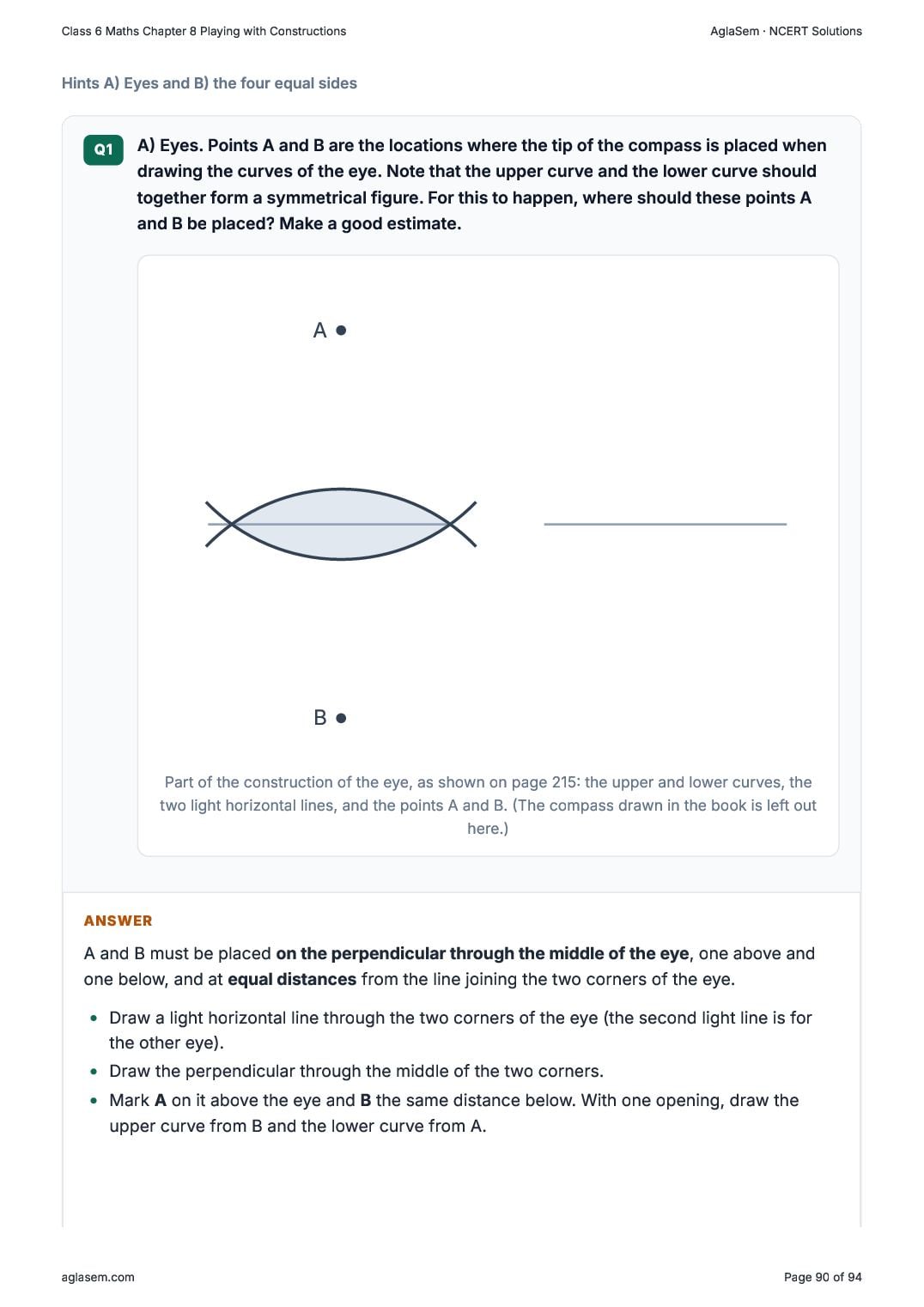
- Eyes. How do you draw these eyes with a compass? (For a hint, go to the end of the chapter.)
- Make other artwork of your choice with a ruler and a compass.
- So, can a rectangle be named using any combination of the labels around its corners? For example, it cannot be named ABDC or ACBD. Can you see what names are allowed and what names are not?
- Which of the following is not a name for this square? 1. PQSR 2. SPQR 3. RSPQ 4. QRSP
- Here is a square piece of paper having all its sides equal in length and all angles equal to 90°. It is rotated as shown in the figure. Is it still a square?
- Draw the rectangle and four squares configuration (shown in Fig. 8.3) on a dot paper. What did you do to recreate this figure so that the four squares are placed symmetrically around the rectangle? Discuss with your classmates.
- Identify if there are any squares in this collection. Use measurements if needed.
- Think: Is it possible to reason out if the sides are equal or not, and if the angles are right or not without using any measuring instruments in the above figure? Can we do this by only looking at the position of corners in the dot grid?
- Draw at least 3 rotated squares and rectangles on a dot grid. Draw them such that their corners are on the dots. Verify if the squares and rectangles that you have drawn satisfy their respective properties.
- Now, let us start constructing squares and rectangles. How would you construct a square with a side of 6 cm?
- Can you see why PS should be 6 cm long?
- How long is the side RS and what are the measures of ∠R and ∠S?
- Draw a rectangle with sides of length 4 cm and 6 cm. After drawing, check if it satisfies both the rectangle properties.
- Draw a rectangle of sides 2 cm and 10 cm. After drawing, check if it satisfies both the rectangle properties.
- Is it possible to construct a 4-sided figure in which — all the angles are equal to 90º but opposite sides are not equal?
- Construct a rectangle ABCD with AB = 7 cm and BC = 4 cm. Imagine X to be a point that can be moved anywhere along the side AD. Similarly, imagine Y to be a point that can be moved anywhere along the side BC.
- At which positions will the points X and Y be at their closest? When do you think they will be the farthest? What does your intuition say? Discuss with your classmates.
- How does the minimum distance between the points X and Y compare to the length of AB?
- How will you keep track of the lengths XY for different positions of X and Y? Is there a shorthand way of writing it down? (When X is 5 mm away from A and Y is 3 cm away from B, XY = ___ cm ___ mm; when X is 1 cm away from A and Y is 1 cm away from B, XY = ___ cm ___ mm; when X is 2 cm away from A and Y is 4 cm away from B, XY = ___ cm ___ mm.)
- Have you checked what happens to the length XY when X and Y are placed at the same distance away from A and B, respectively? (5 mm and 5 mm; 1 cm and 1 cm; 1 cm 5 mm and 1 cm 5 mm.) In each of these cases, observe 1. how the length XY compares to that of AB and 2. the shape of the 4-sided figure ABYX.
- How does the farthest distance between X and Y compare with the length of AC? BD?
- Breaking Rectangles. Construct a rectangle that can be divided into 3 identical squares as shown in the figure.
- Explore: What about constructing a rectangle that can be divided into two identical squares? Can you try it? It is wise to first plan and then construct. But how do we plan? Can you think of a way?
- To draw the rectangle ACDF, one could assign any length to AF. For example, if we assign AF = 4 cm, then what must the length of AC be? Explore: Can the rectangle now be completed?
- In fact, one could proceed by drawing AF without even measuring its length using a ruler. As, AB = AF, we need to somehow transfer the length of AF to get the point B. How do we do it without a ruler? Can it be done using a compass?
- Give the lengths of the sides of a rectangle that cannot be divided into — two identical squares; three identical squares.
- A Square within a Rectangle. Construct a rectangle of sides 8 cm and 4 cm. How will you construct a square inside, as shown in the figure, such that the centre of the square is the same as the centre of the rectangle? (Hint: Draw a rough figure. What will be the sidelength of the square? What will be the distance between the corners of the square and the outer rectangle?)
- Falling Squares. Construct three squares of side 4 cm arranged as shown (make sure that the squares are aligned the way they are shown). Now, try this with a square of side 3 cm, a square of side 5 cm and a square of side 7 cm.
- Shadings. Construct this. Choose measurements of your choice. Note that the larger 4-sided figure is a square and so are the smaller ones.
- Square with a Hole. Observe that the circular hole is the same as the centre of the square. (Hint: Think where the centre of the circle should be.)
- Square with more Holes. Construct this.
- Square with Curves. This is a square with 8 cm sidelengths. (Hint: Think where the tip of the compass can be placed to get all the 4 arcs to bulge uniformly from each of the sides. Try it out!)
- Consider a rectangle PQRS. Join PR and QS. Compare the lengths of the diagonals. First predict the answer. Then construct a rectangle marking the points as shown and measure the diagonals.
- Observe that a diagonal divides each of the pair of opposite angles into two smaller angles. The diagonal PR divides angle R into g and h, and angle P into c and d. Are g and h equal? Are c and d equal? First predict the answers, and then measure the angles. What do you observe? Identify pairs of angles that are equal.
- Explore: How should the rectangle be constructed so that the diagonal divides the opposite angles into equal parts?
- In your experimentation, did you consider the case when all four sides of the rectangle are equal? That is, did you consider the case of a square? See what happens in this special case!
- What general laws did you observe with respect to the angles and sides? Try to frame and discuss them with your classmates. How can one be sure if the laws that you have observed will always be true?
- Construct a rectangle in which one of the diagonals divides the opposite angles into 60° and 30°.
- Now ∠A is divided into two angles. One measures 60°. Check what the other angle is.
- Construct a rectangle where one of its sides is 5 cm and the length of a diagonal is 7 cm.
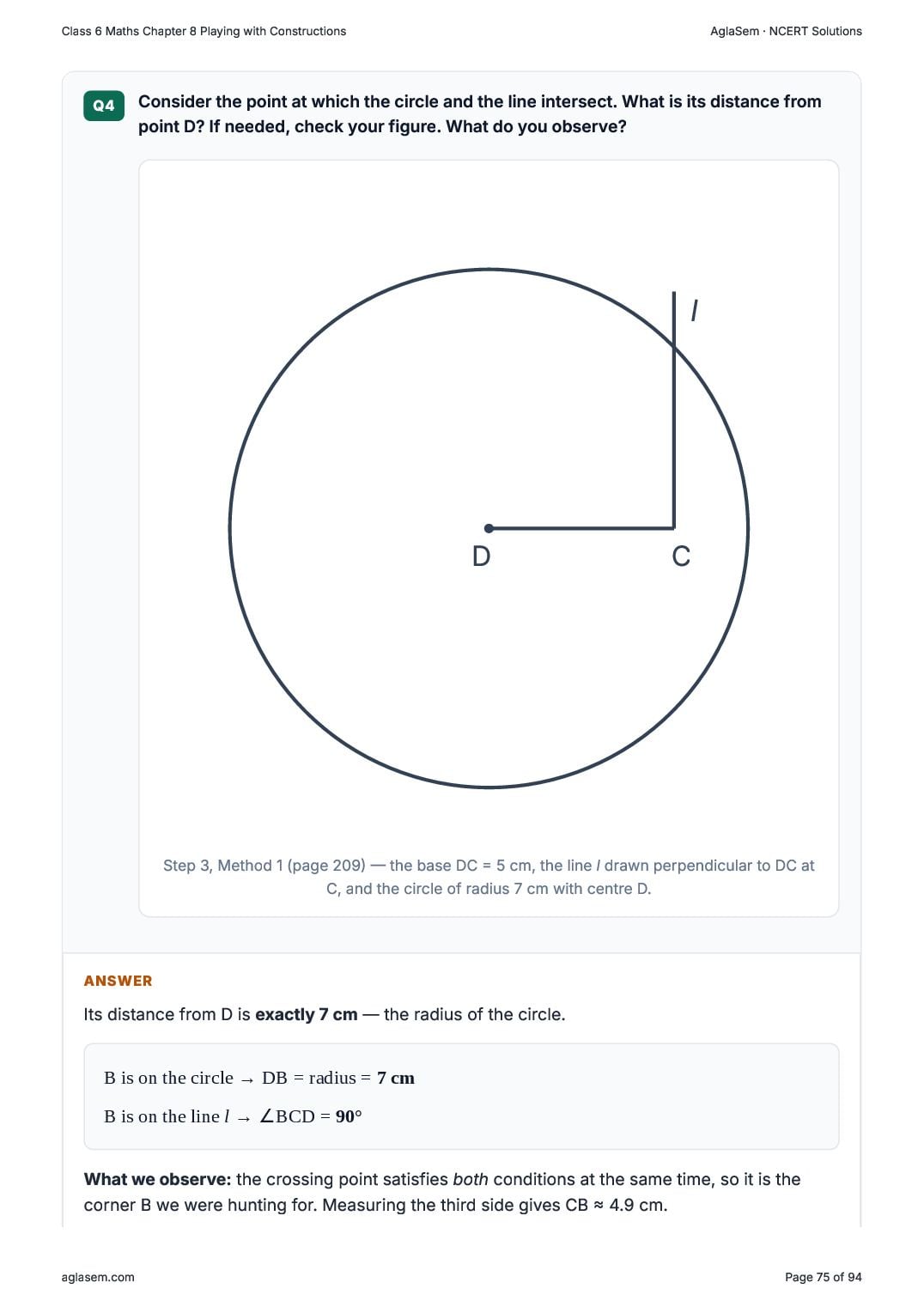
- Consider the point at which the circle and the line intersect. What is its distance from point D? If needed, check your figure. What do you observe?
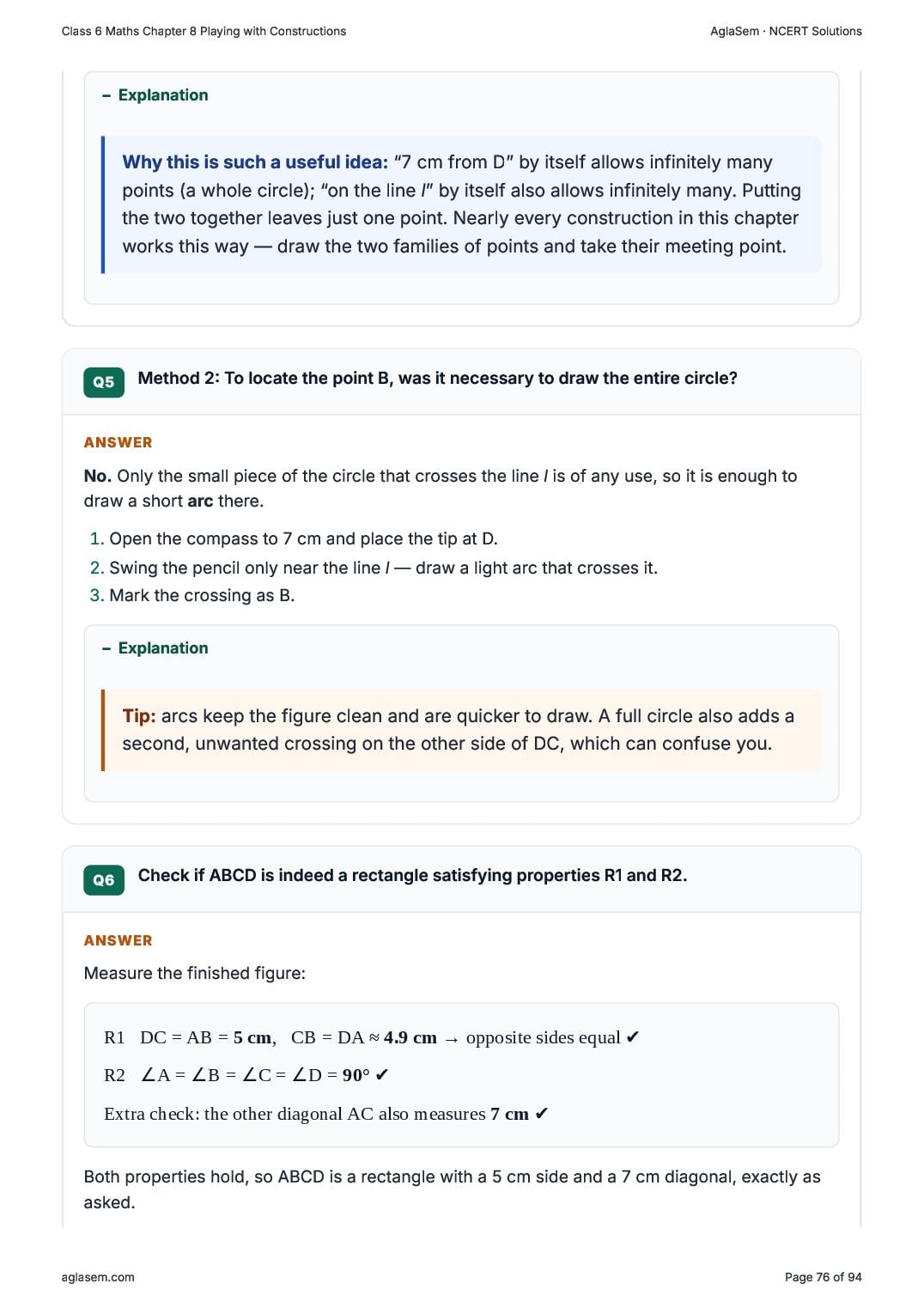
- Method 2: To locate the point B, was it necessary to draw the entire circle?
- Check if ABCD is indeed a rectangle satisfying properties R1 and R2.
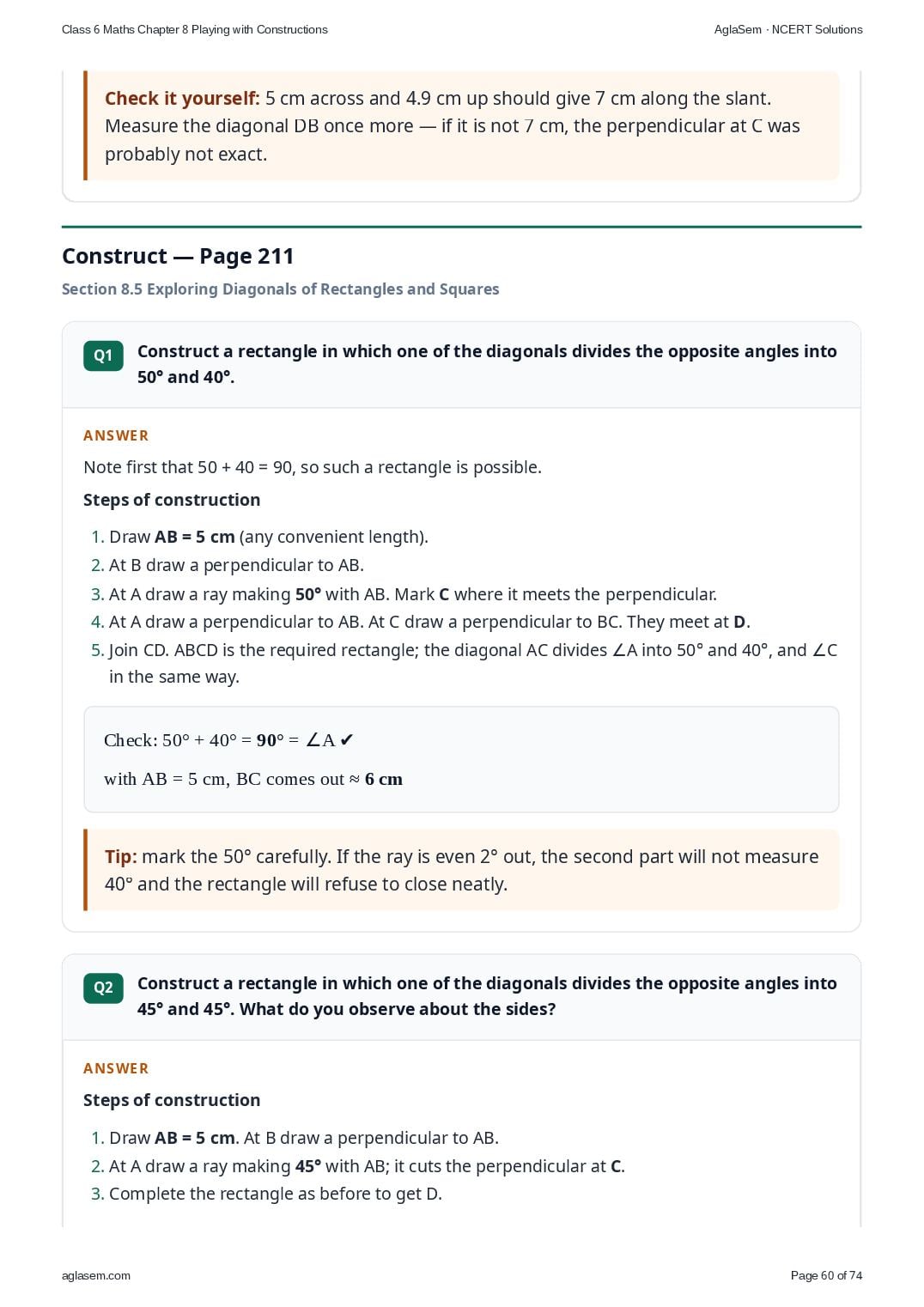
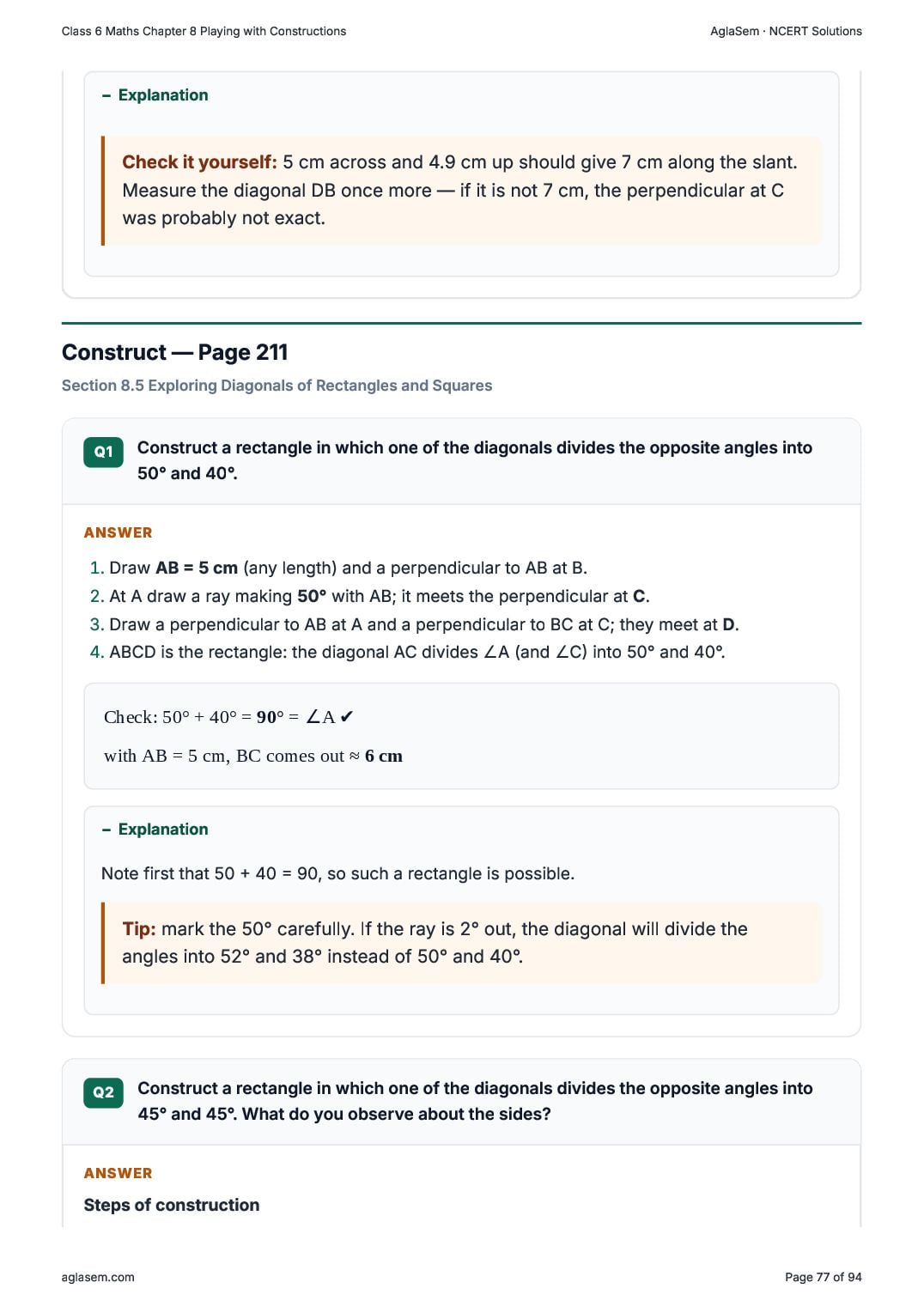
- Construct a rectangle in which one of the diagonals divides the opposite angles into 50° and 40°.
- Construct a rectangle in which one of the diagonals divides the opposite angles into 45° and 45°. What do you observe about the sides?
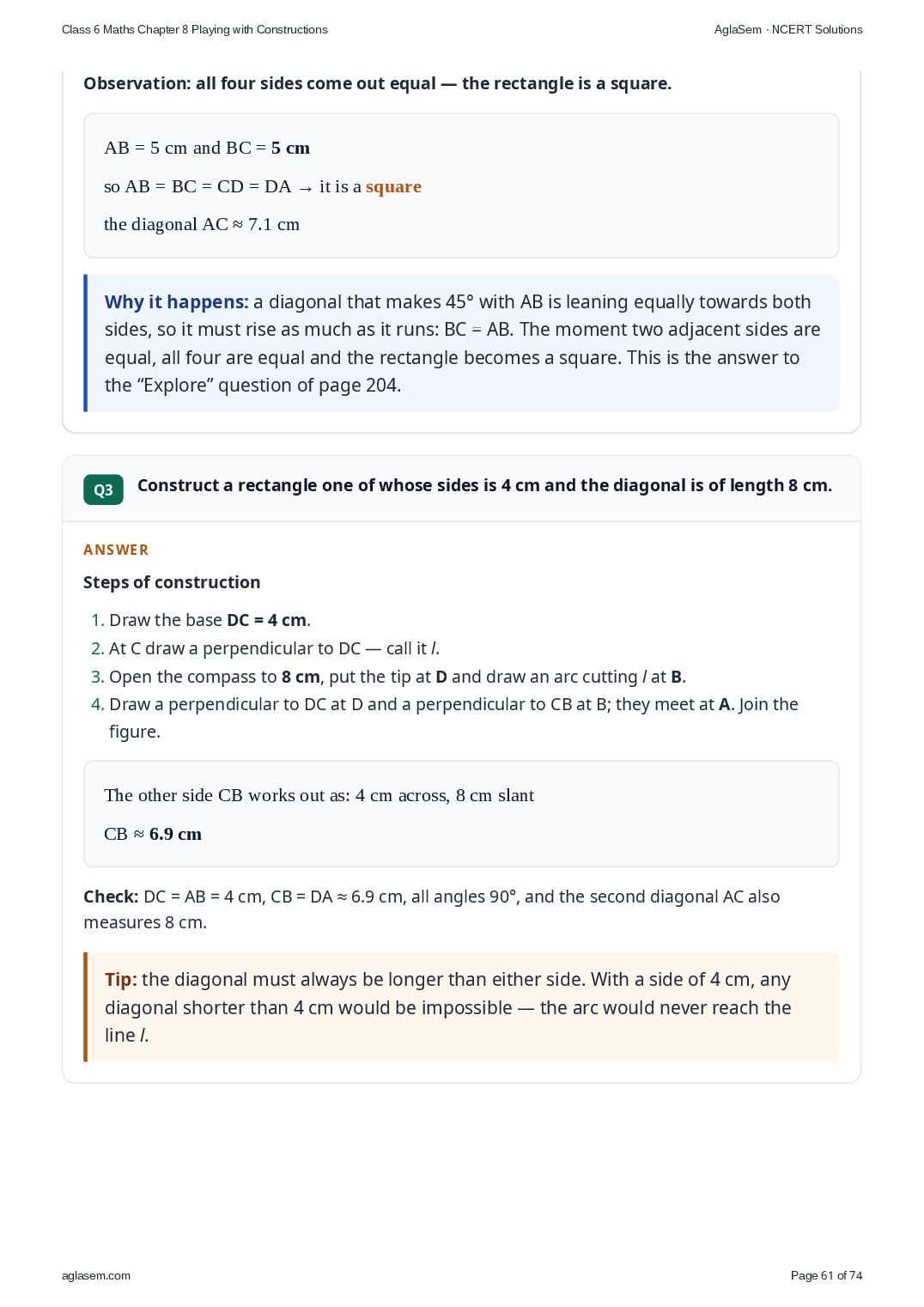
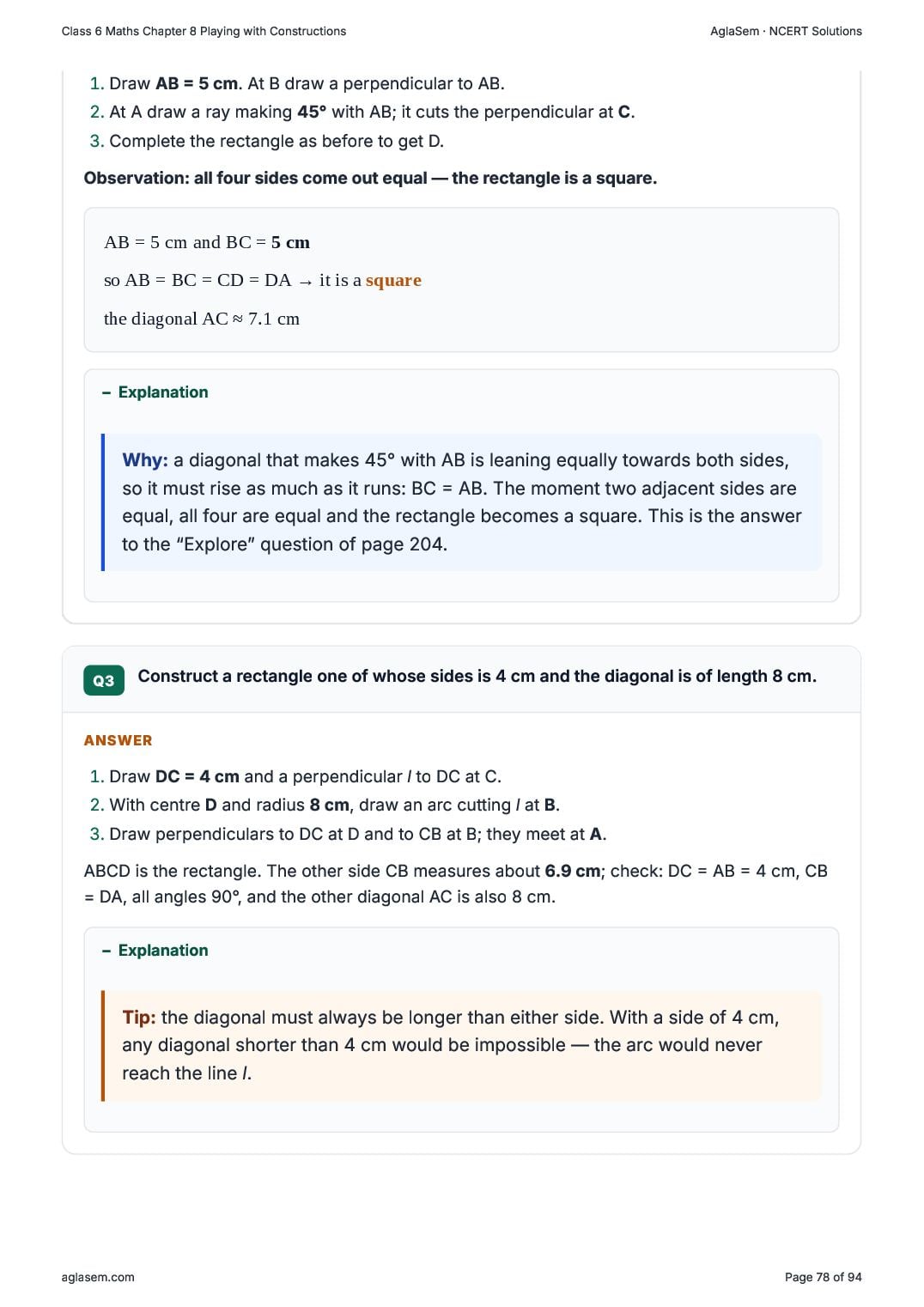
- Construct a rectangle one of whose sides is 4 cm and the diagonal is of length 8 cm.
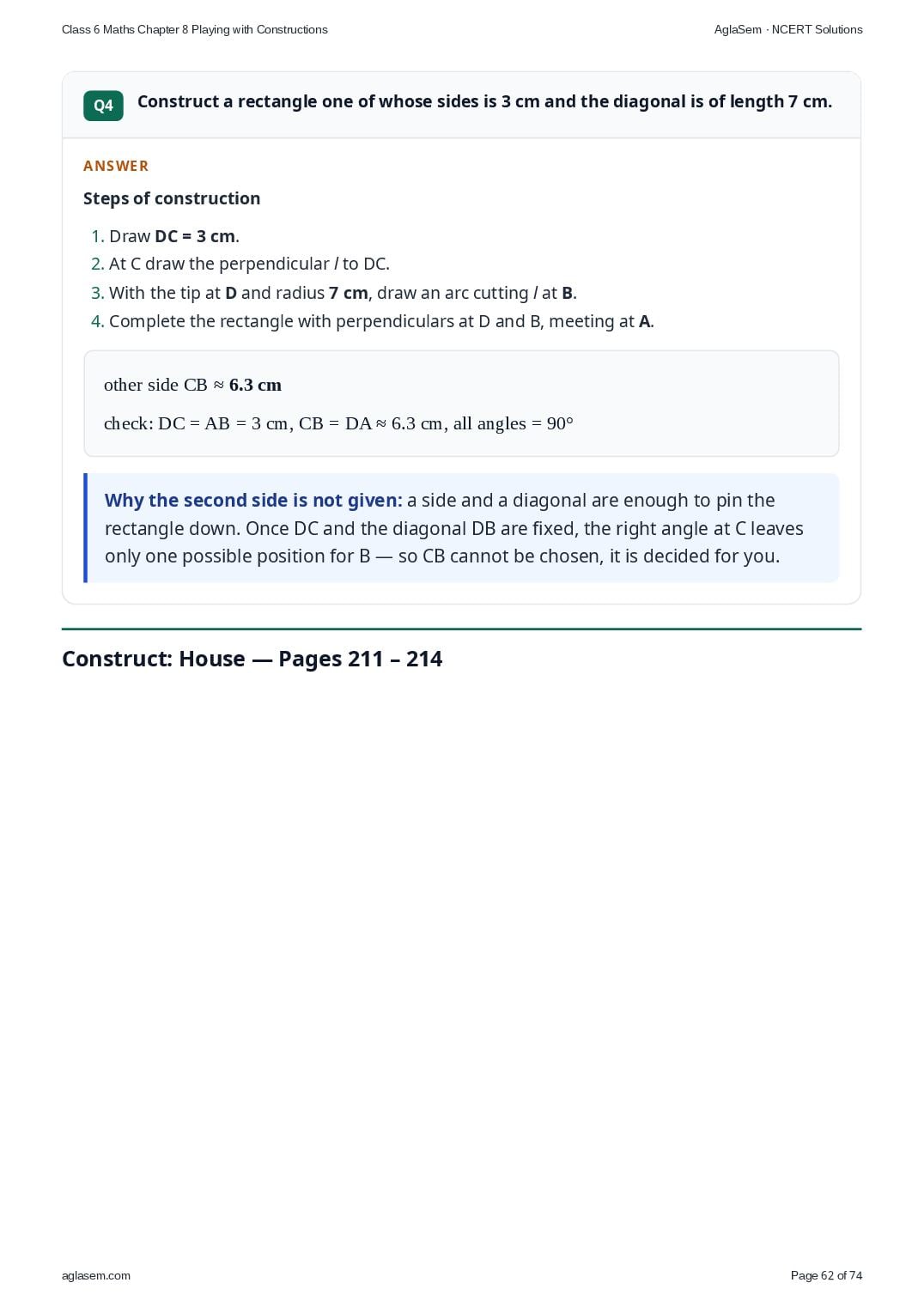
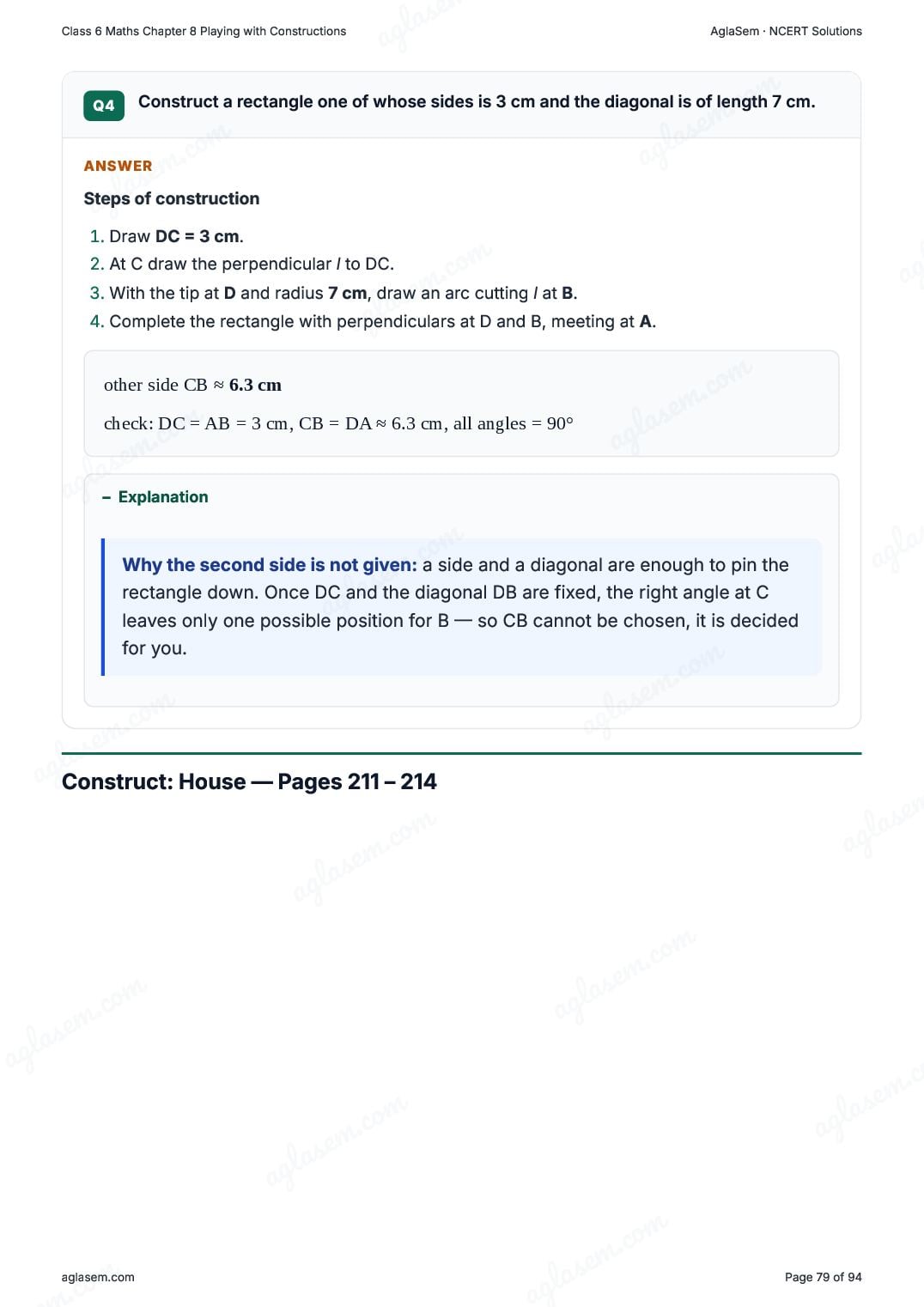
- Construct a rectangle one of whose sides is 3 cm and the diagonal is of length 7 cm.
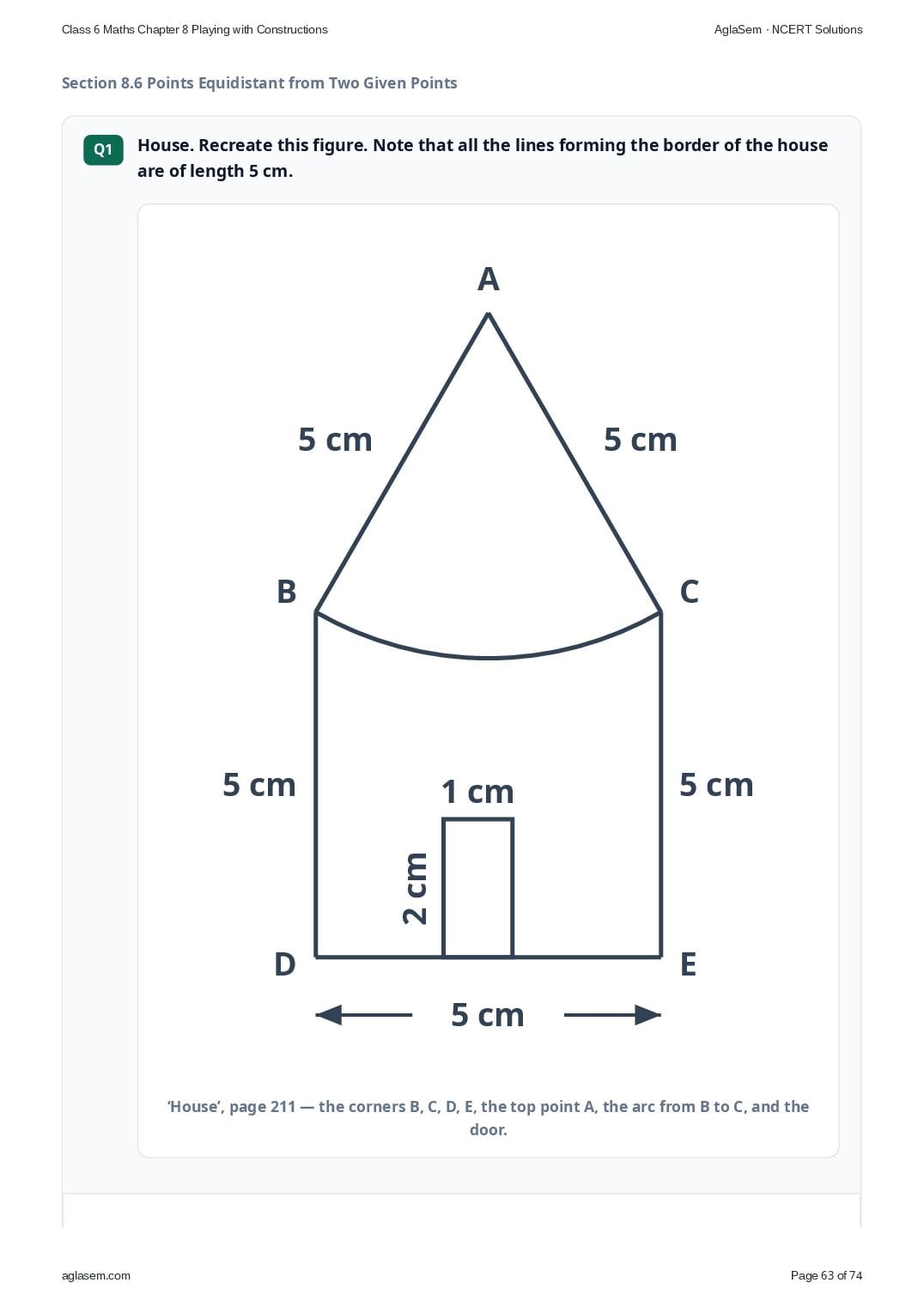
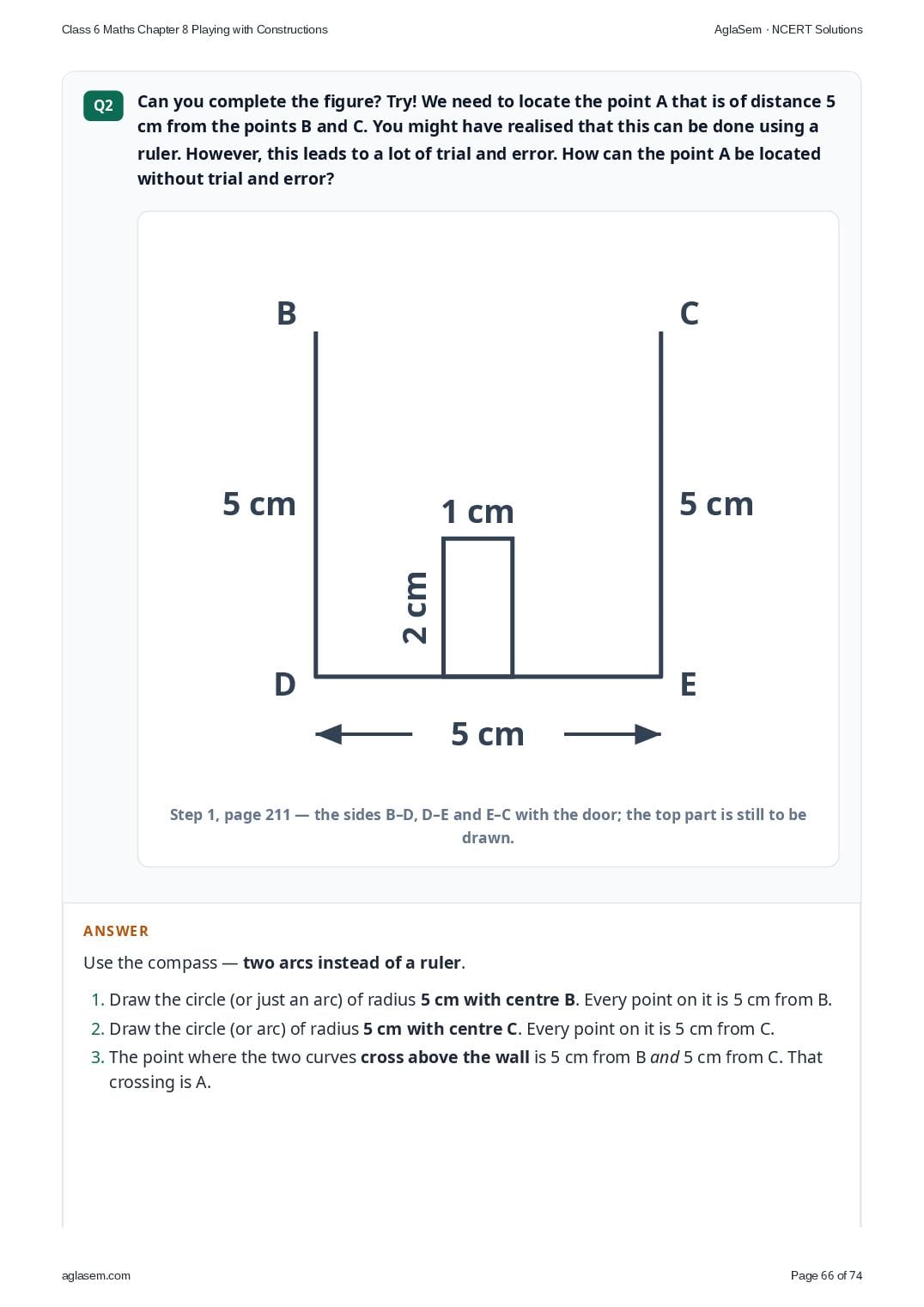
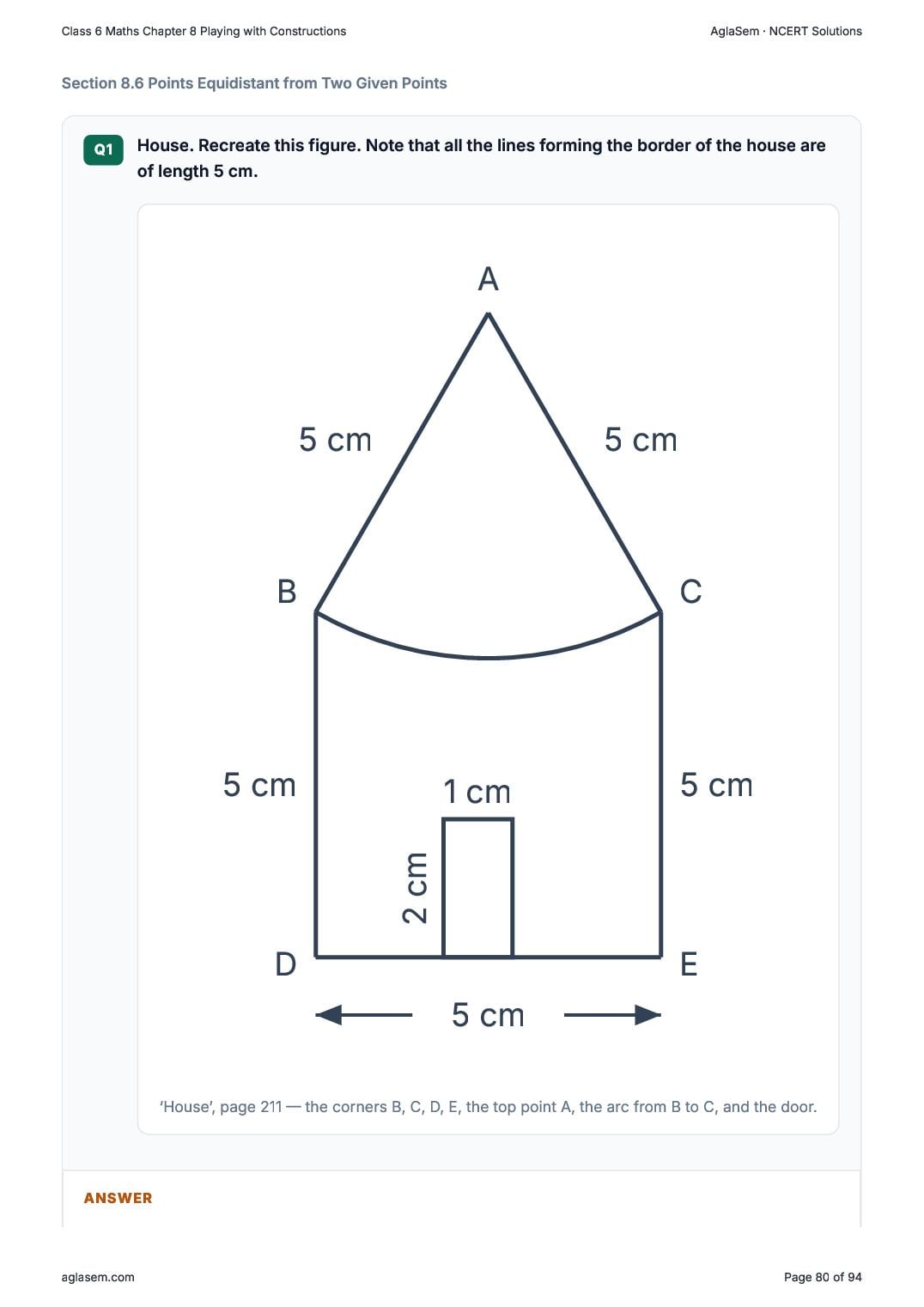
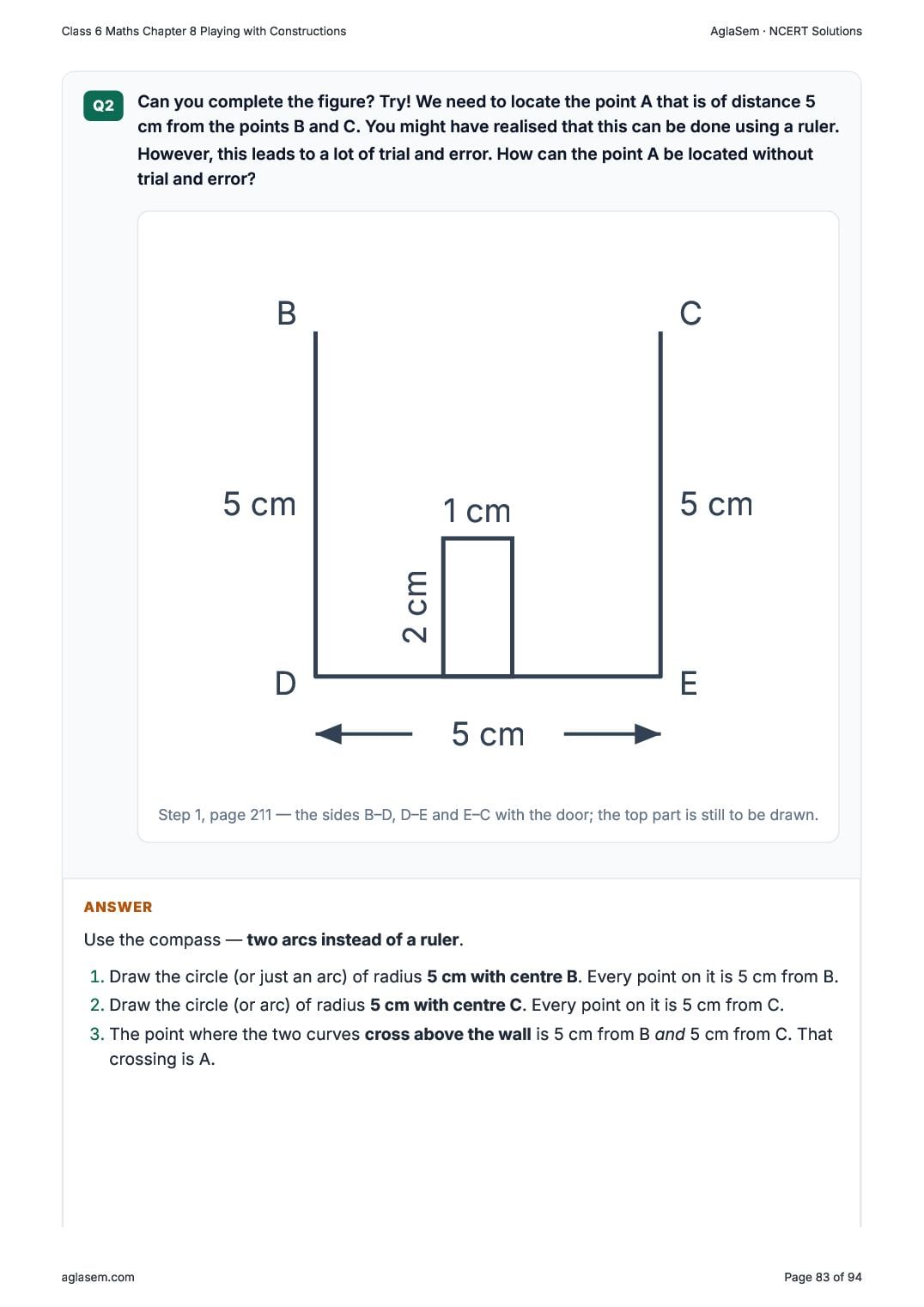
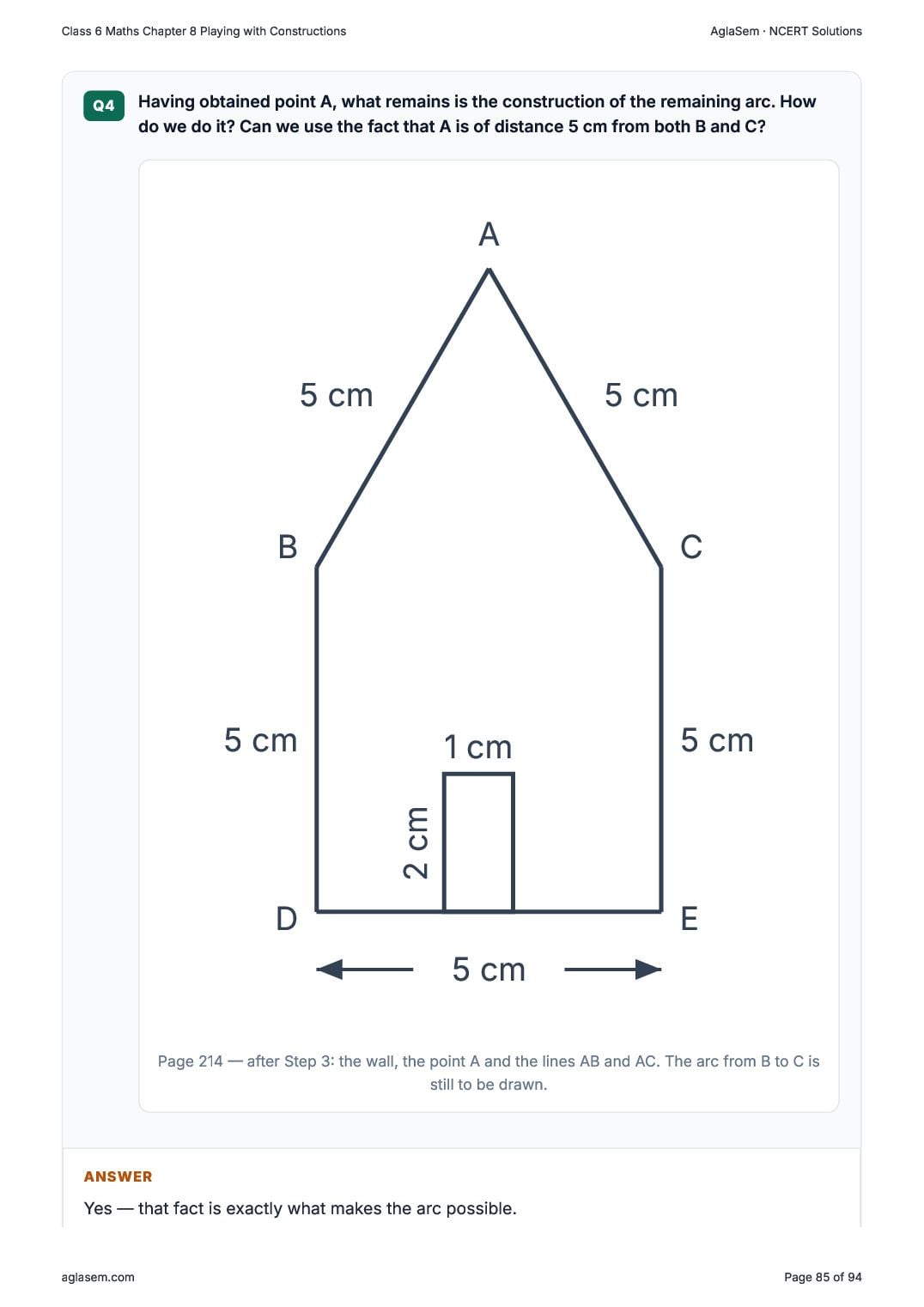
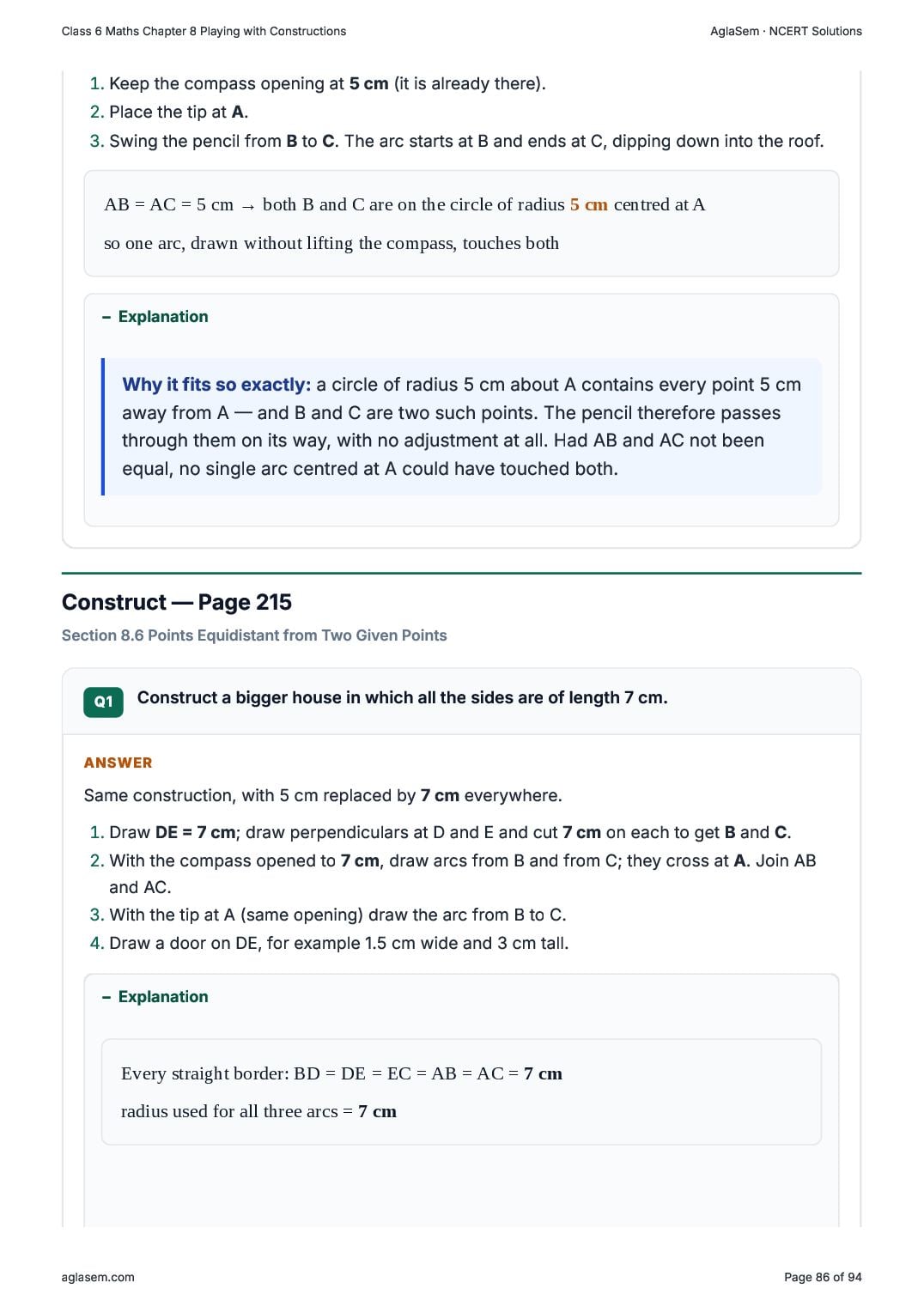
- House. Recreate this figure. Note that all the lines forming the border of the house are of length 5 cm.
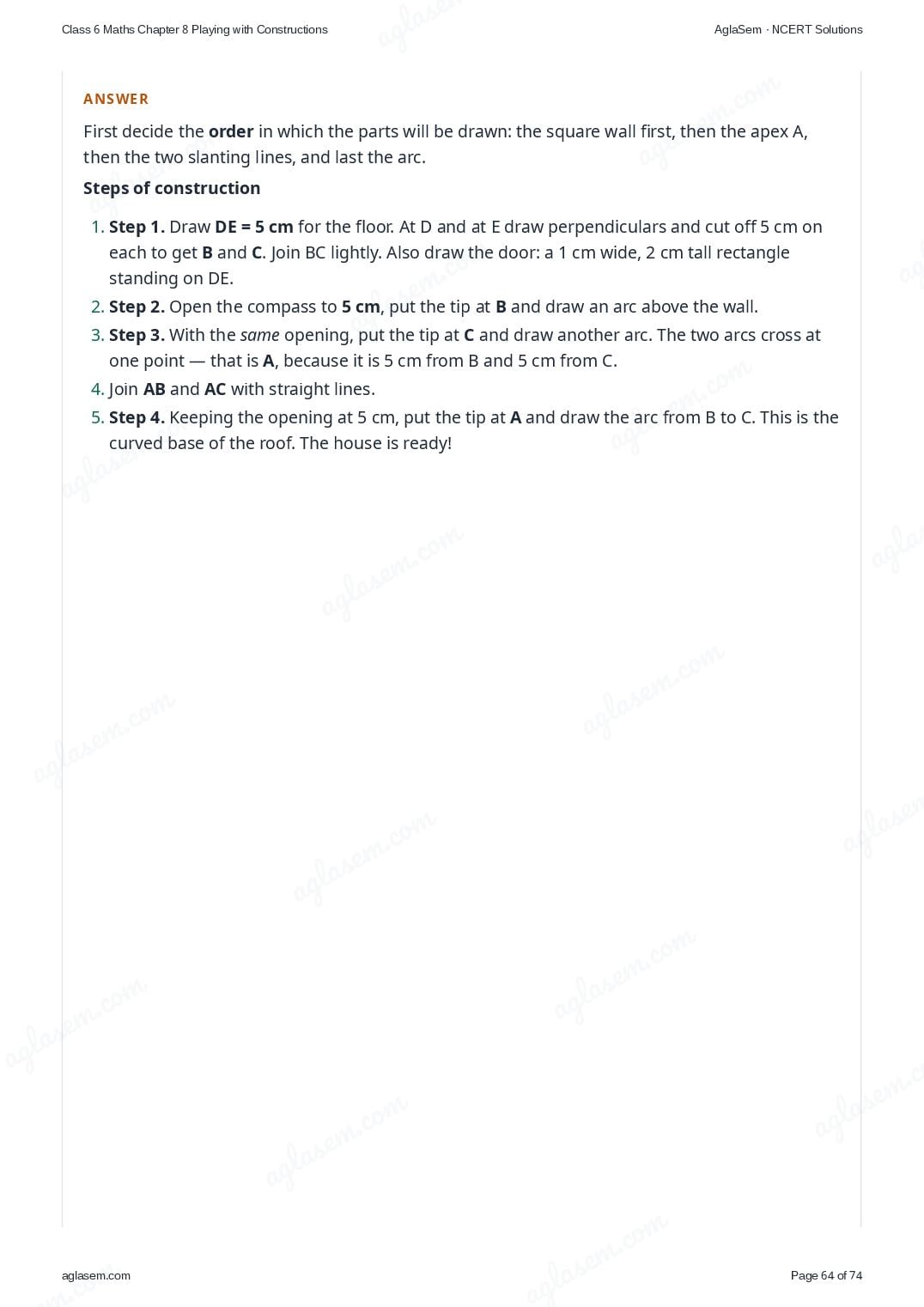
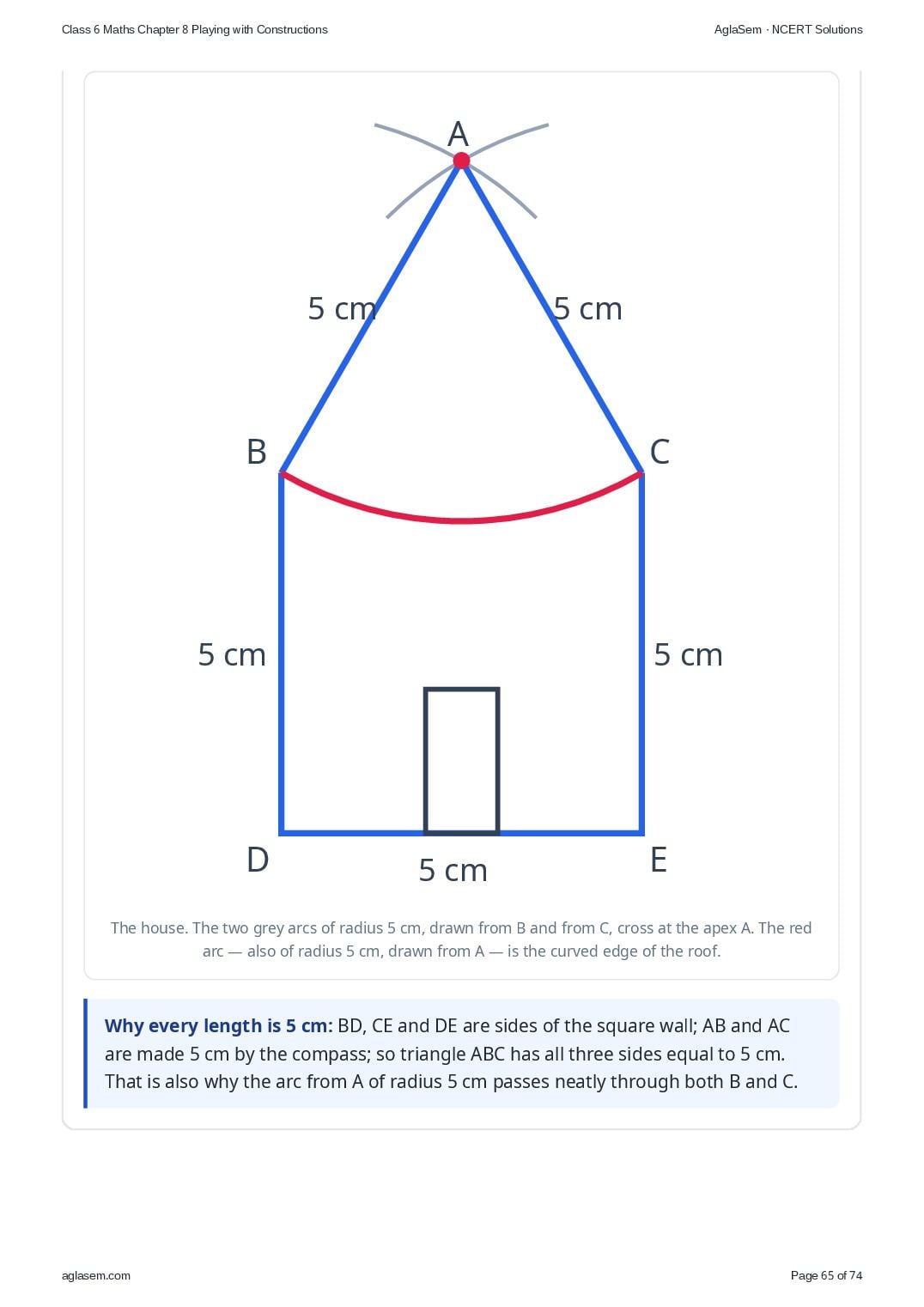
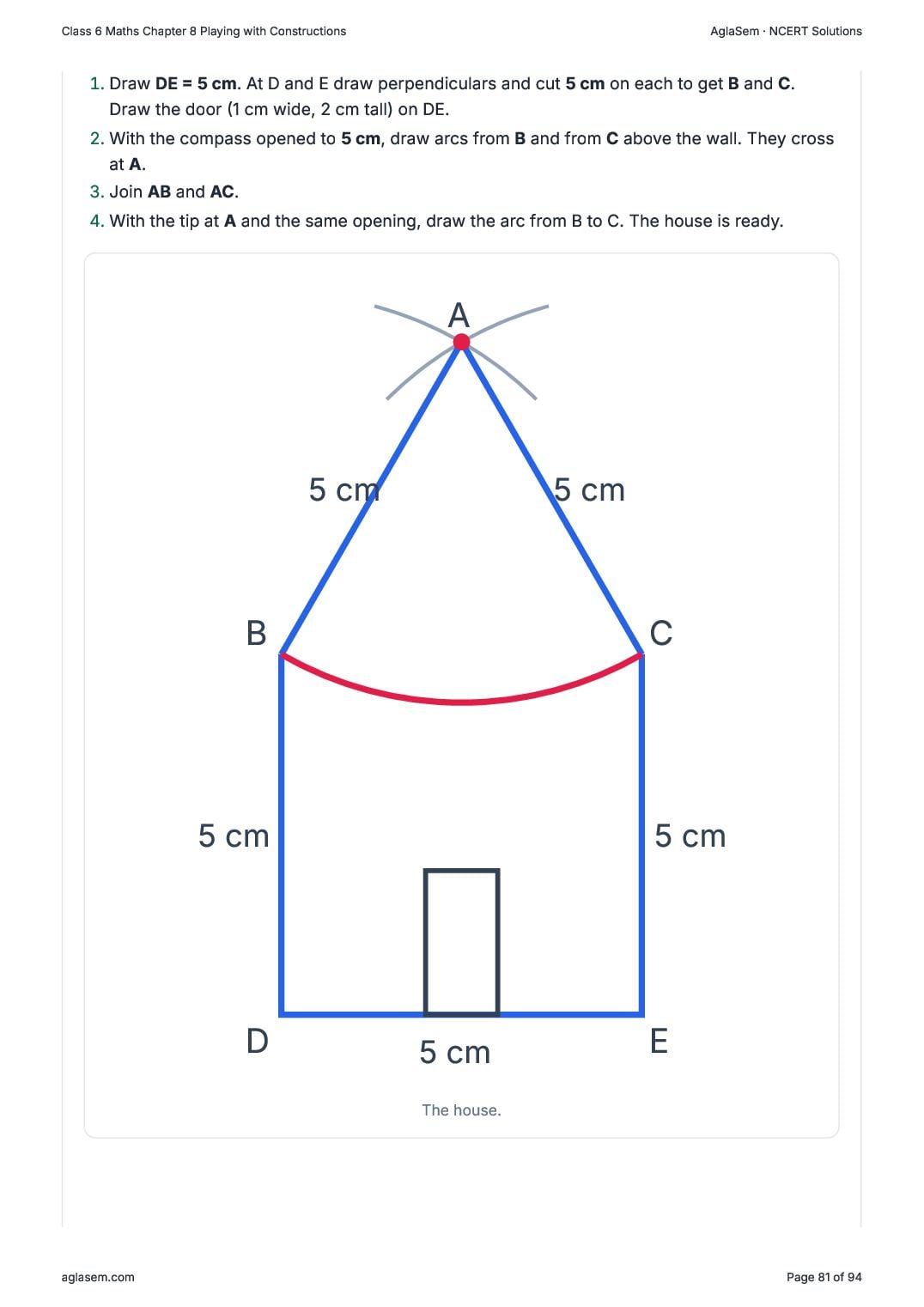
- Can you complete the figure? Try! We need to locate the point A that is of distance 5 cm from the points B and C. You might have realised that this can be done using a ruler. However, this leads to a lot of trial and error. How can the point A be located without trial and error?
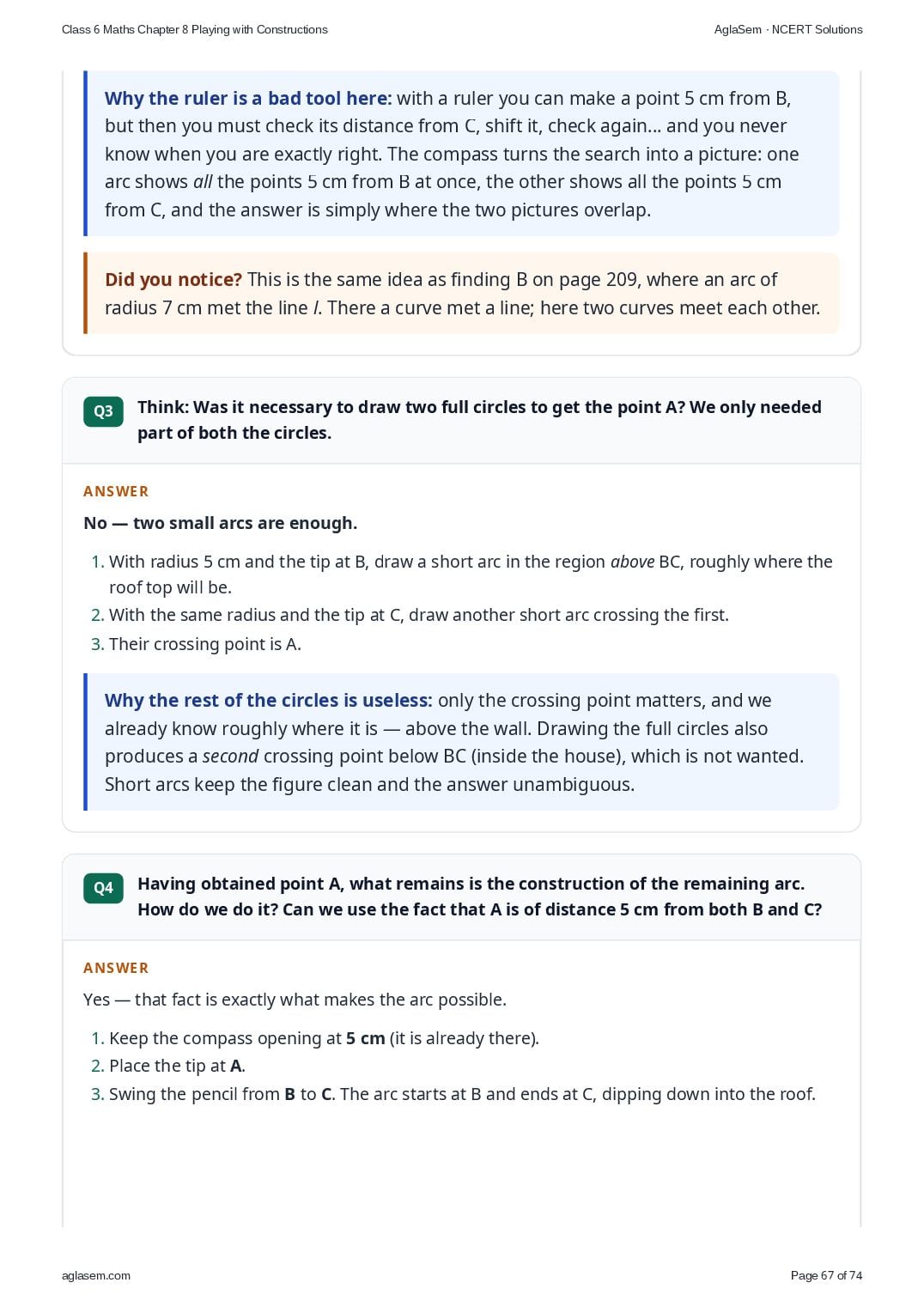
- Think: Was it necessary to draw two full circles to get the point A? We only needed part of both the circles.
- Having obtained point A, what remains is the construction of the remaining arc. How do we do it? Can we use the fact that A is of distance 5 cm from both B and C?
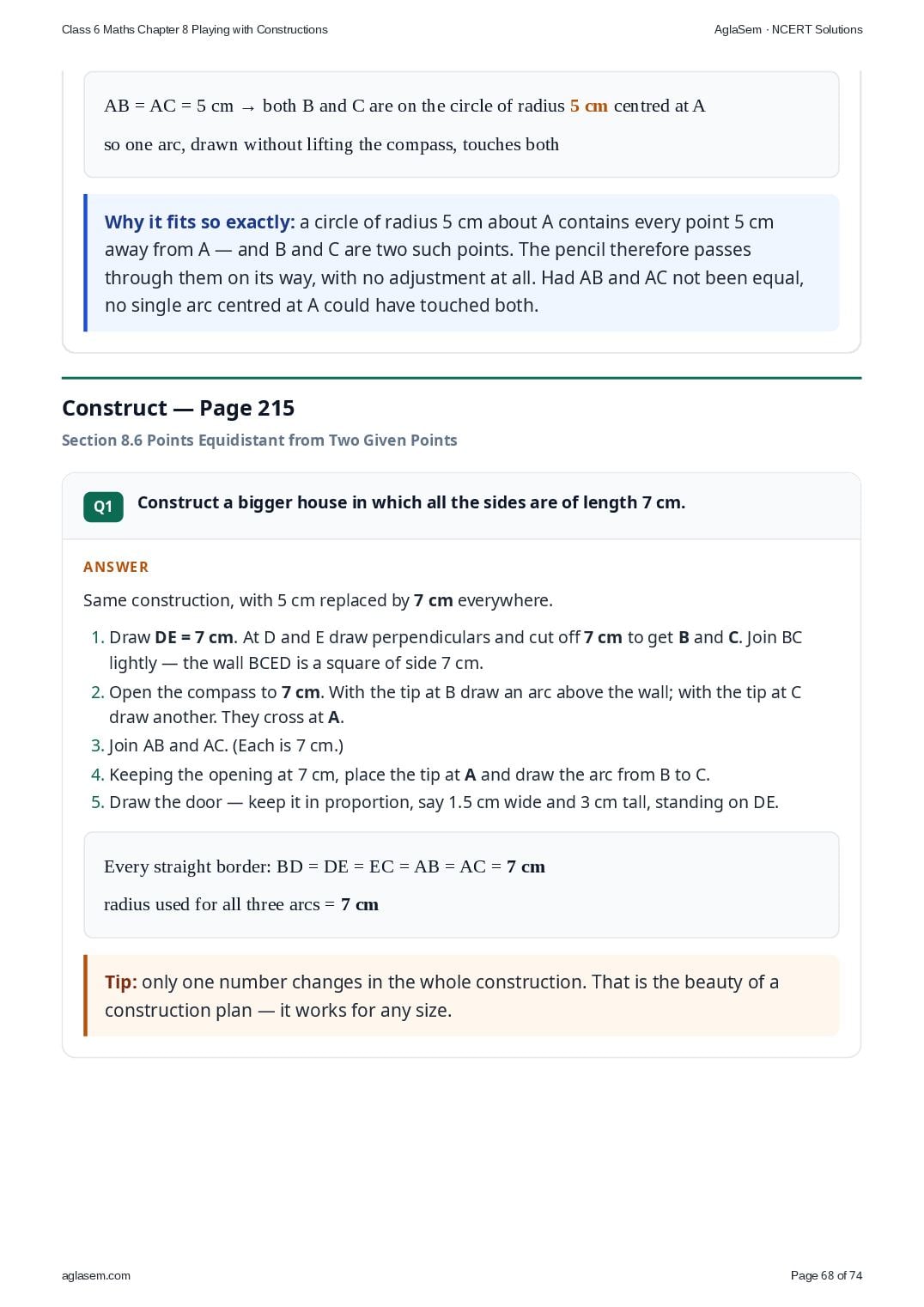
- Construct a bigger house in which all the sides are of length 7 cm.
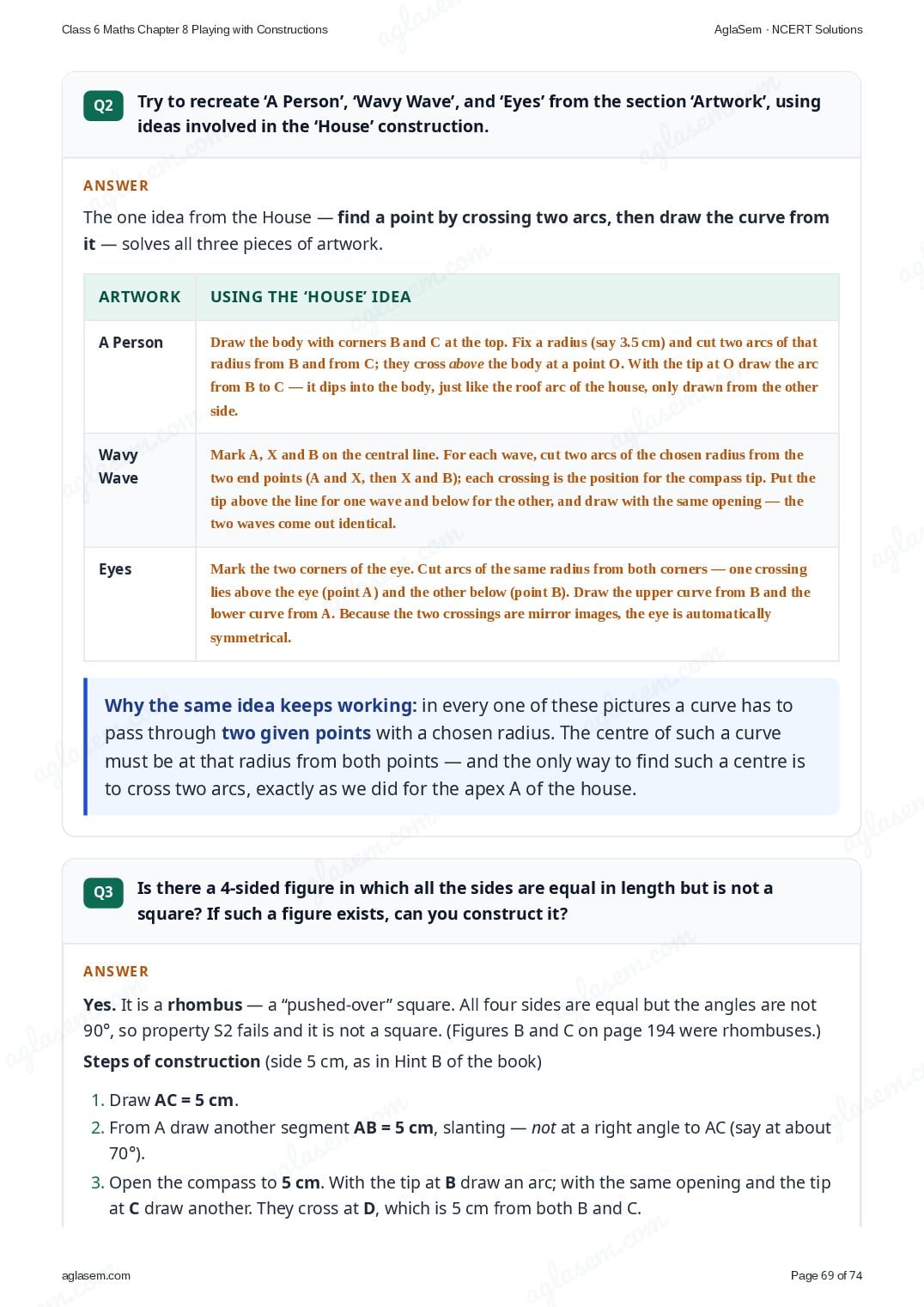
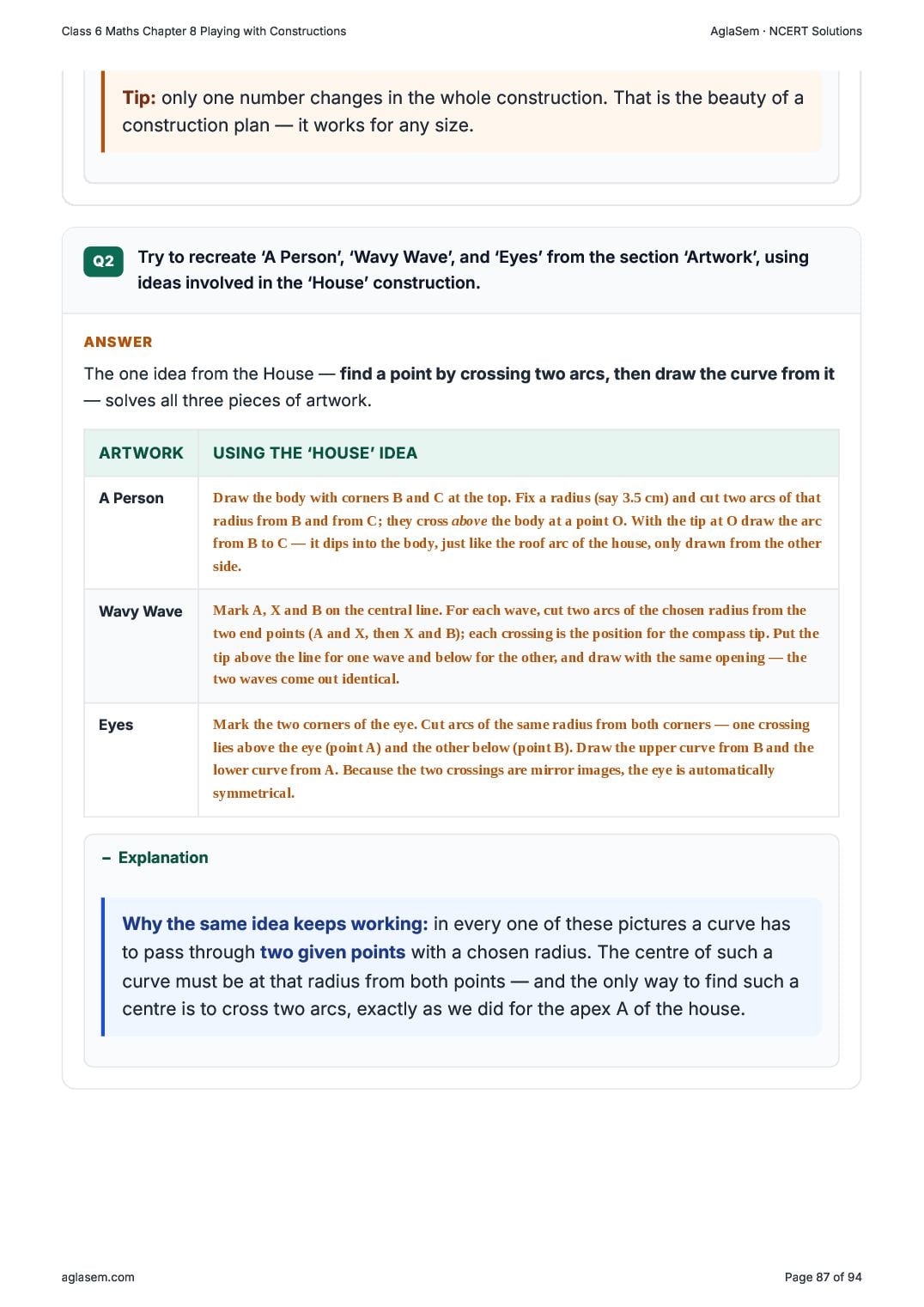
- Try to recreate ‘A Person’, ‘Wavy Wave’, and ‘Eyes’ from the section ‘Artwork’, using ideas involved in the ‘House’ construction.
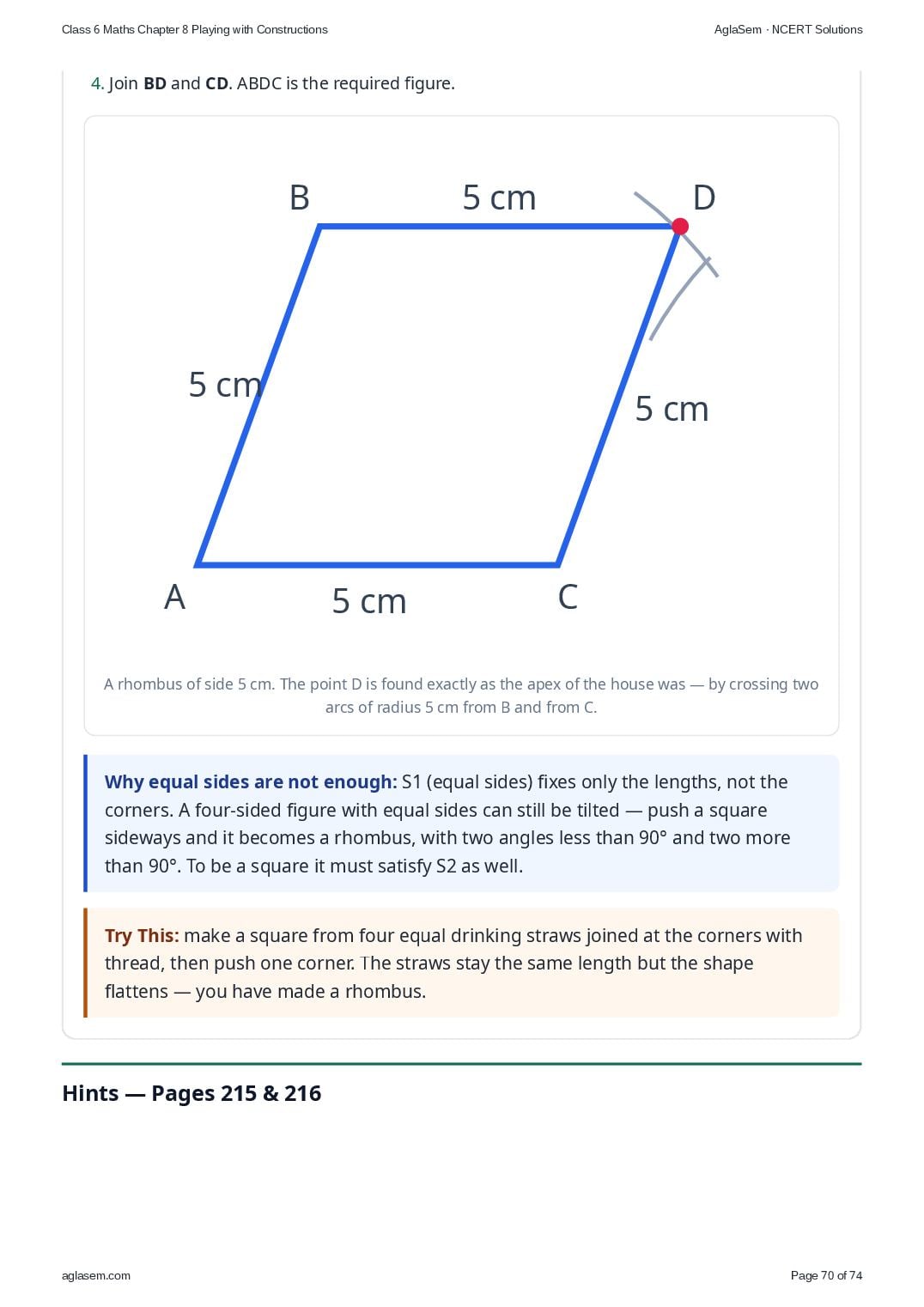
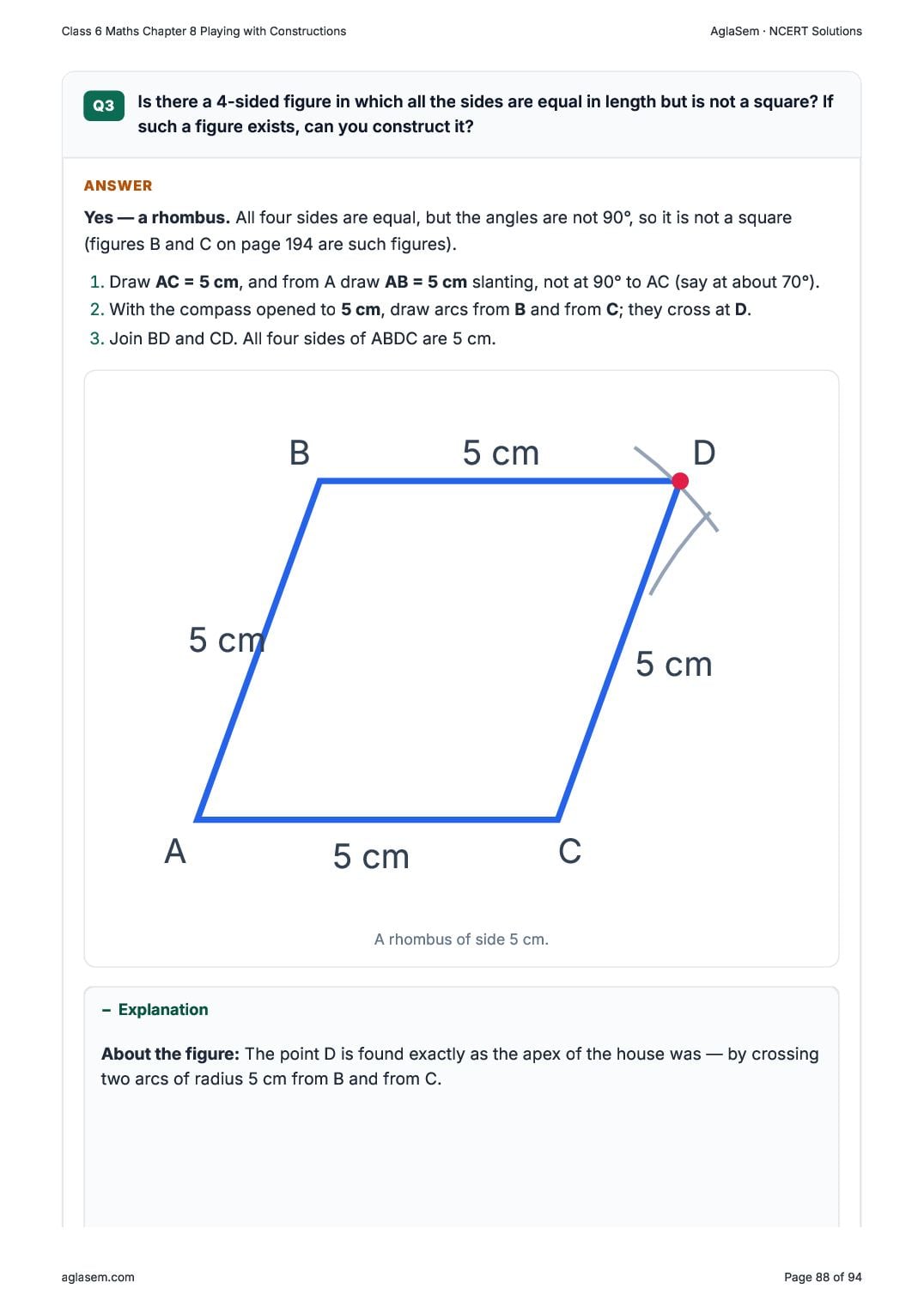
- Is there a 4-sided figure in which all the sides are equal in length but is not a square? If such a figure exists, can you construct it?
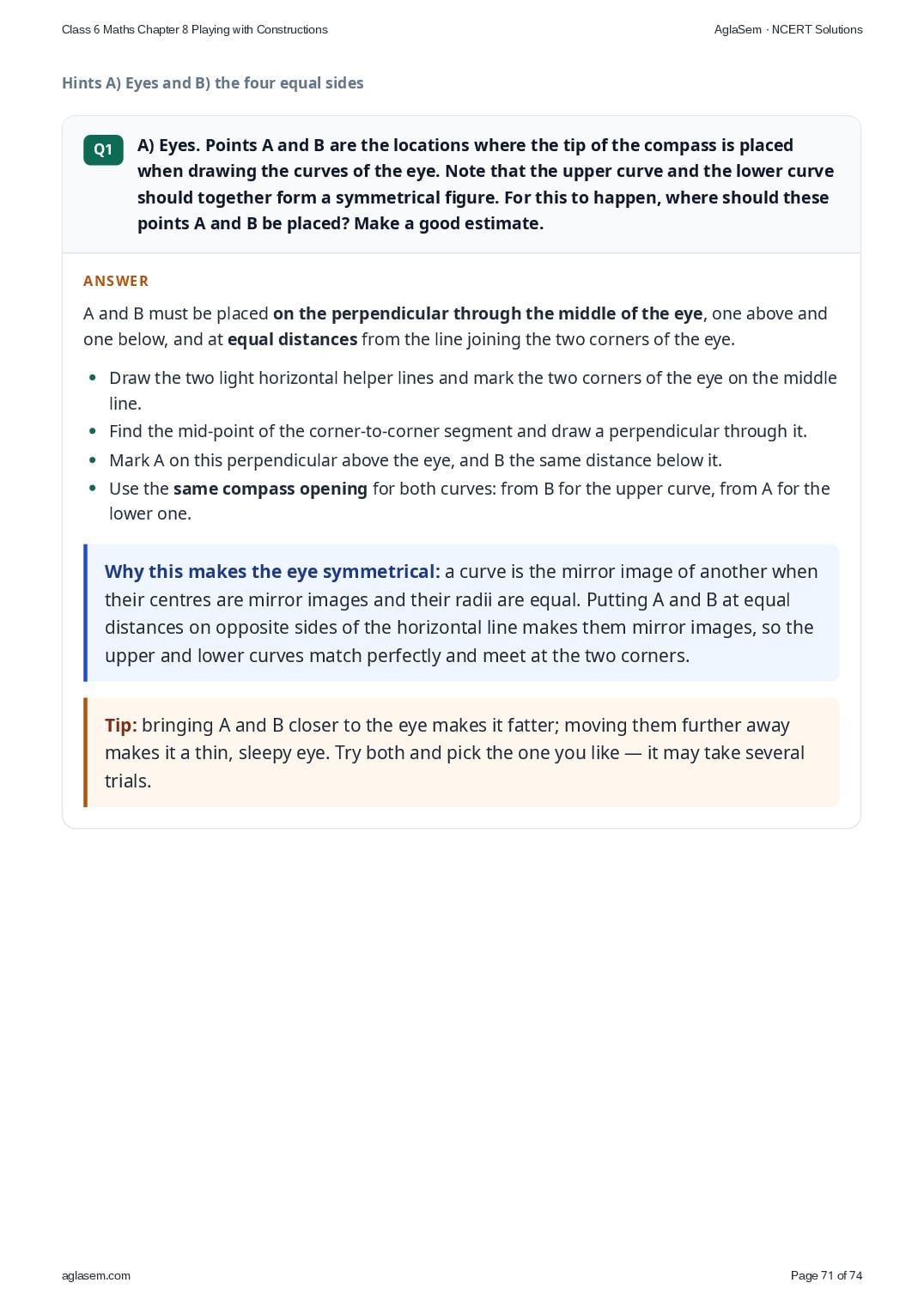
- A) Eyes. Points A and B are the locations where the tip of the compass is placed when drawing the curves of the eye. Note that the upper curve and the lower curve should together form a symmetrical figure. For this to happen, where should these points A and B be placed? Make a good estimate.
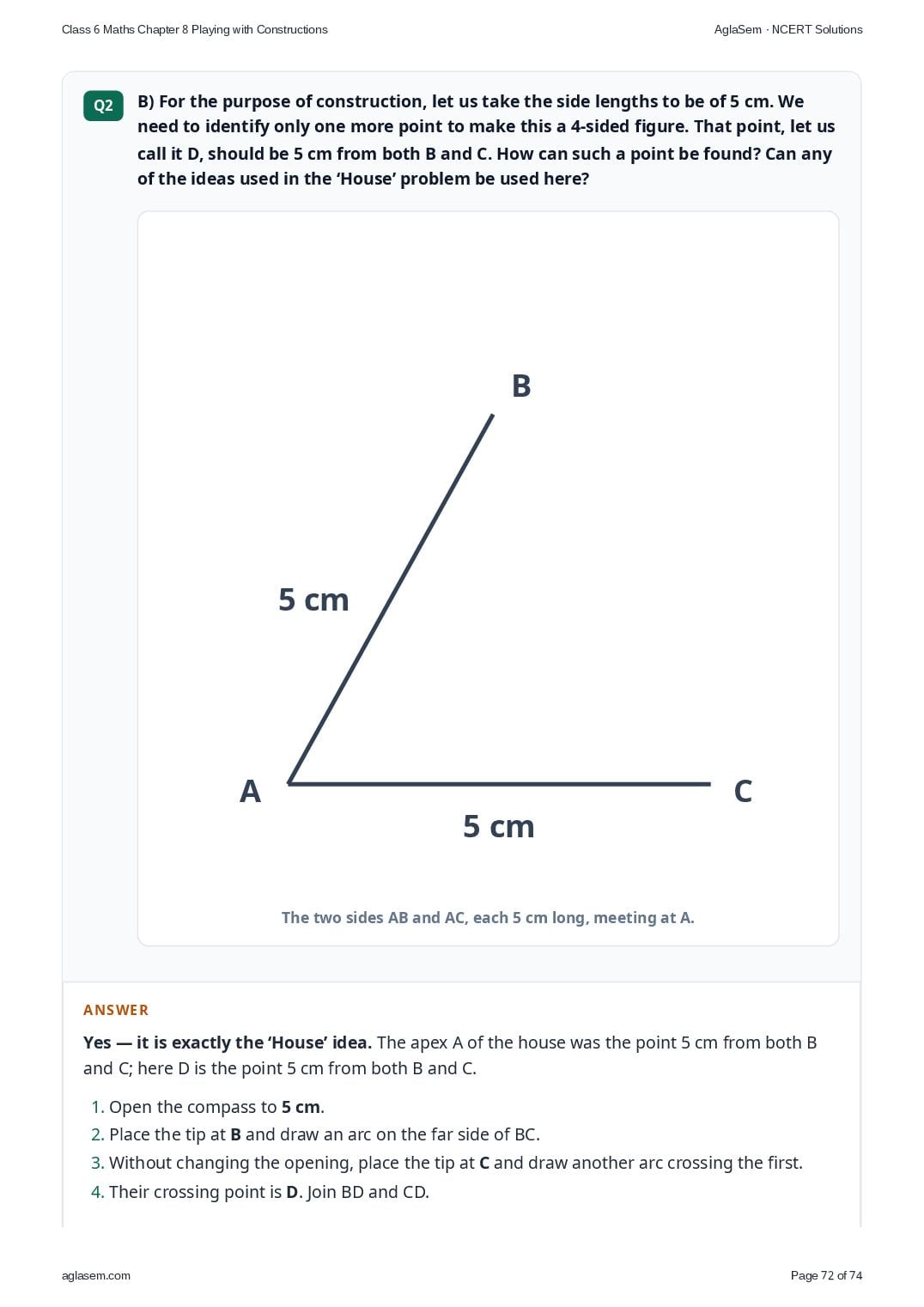
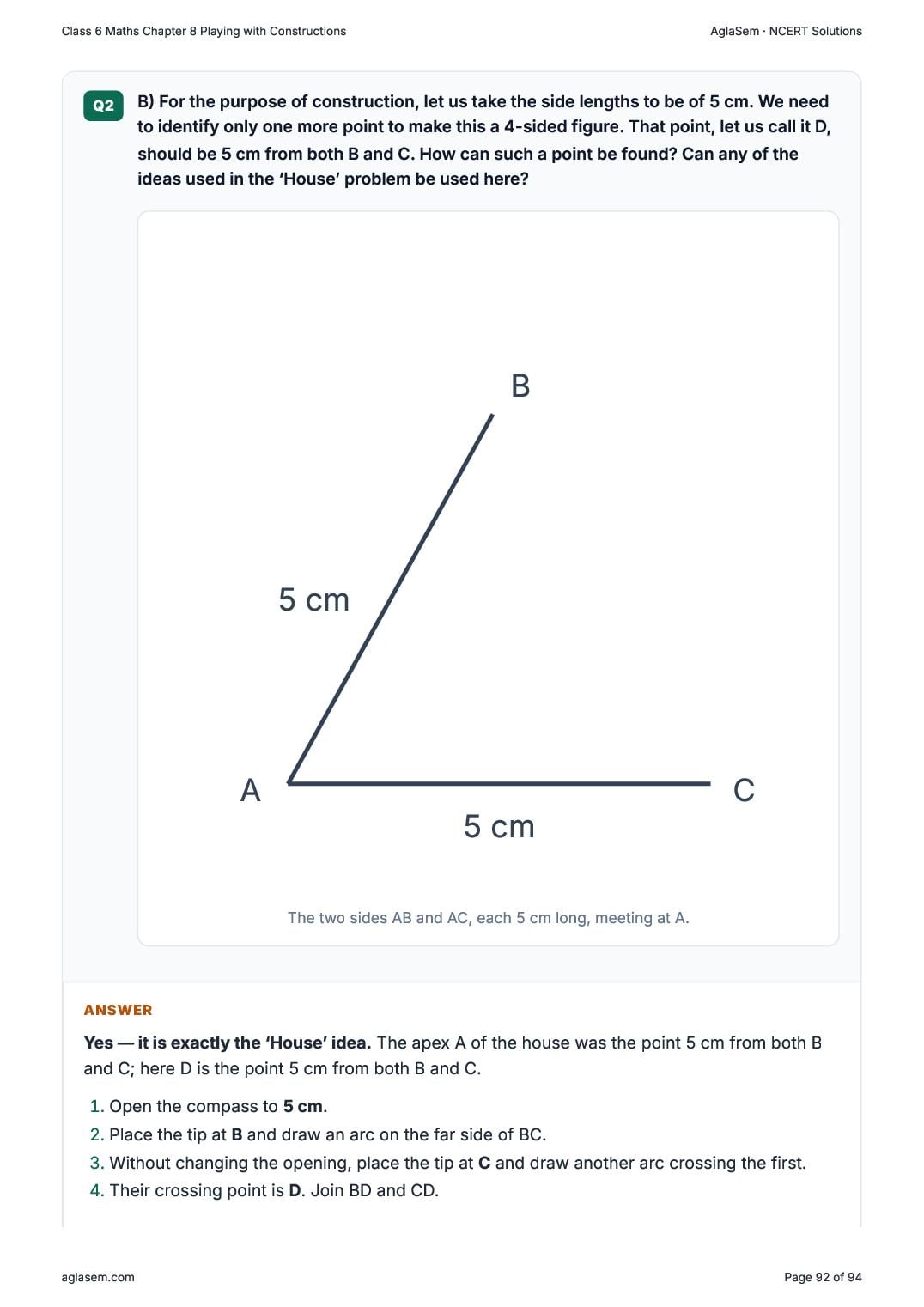
- B) For the purpose of construction, let us take the side lengths to be of 5 cm. We need to identify only one more point to make this a 4-sided figure. That point, let us call it D, should be 5 cm from both B and C. How can such a point be found? Can any of the ideas used in the ‘House’ problem be used here?
Chapter at a Glance
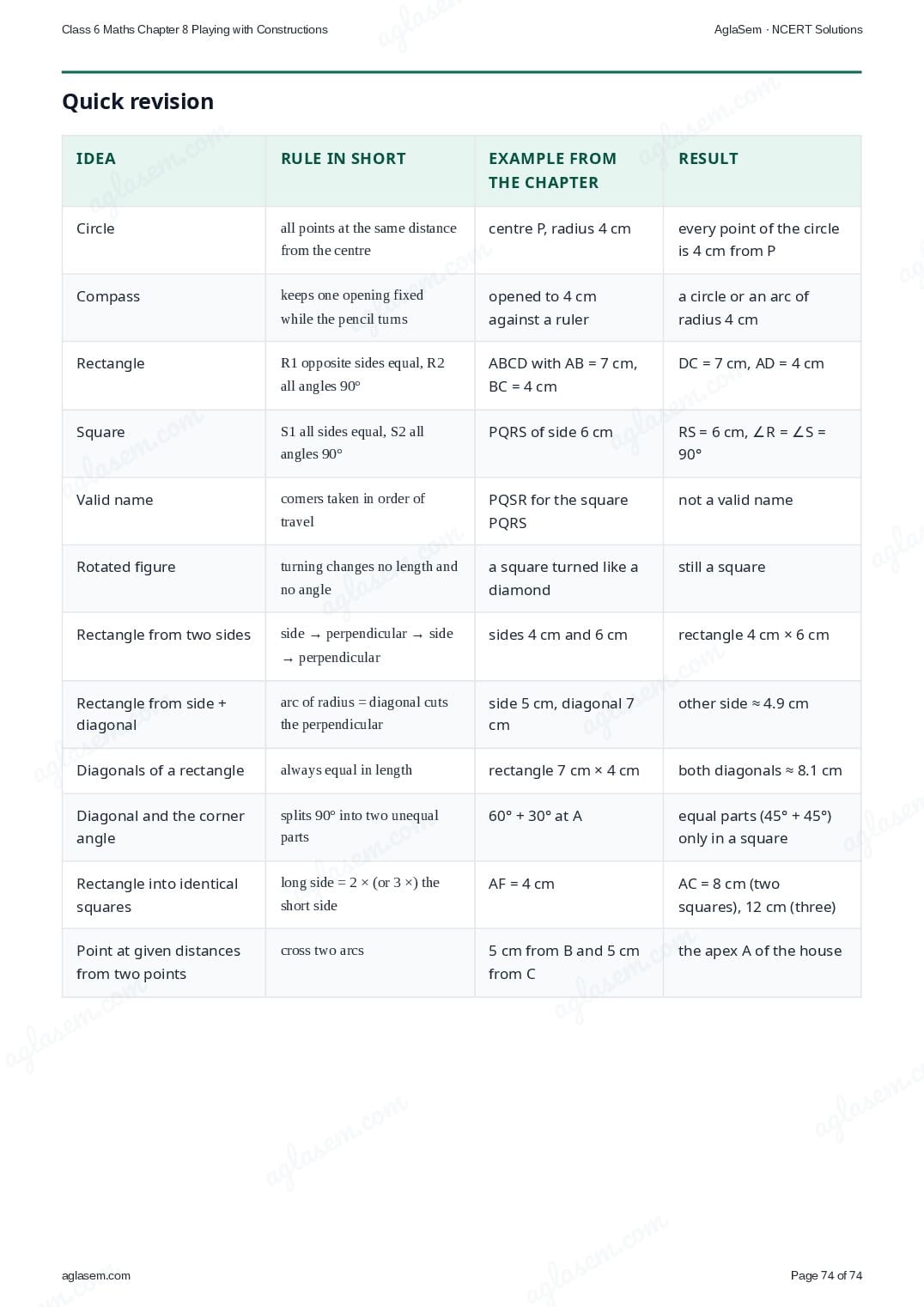
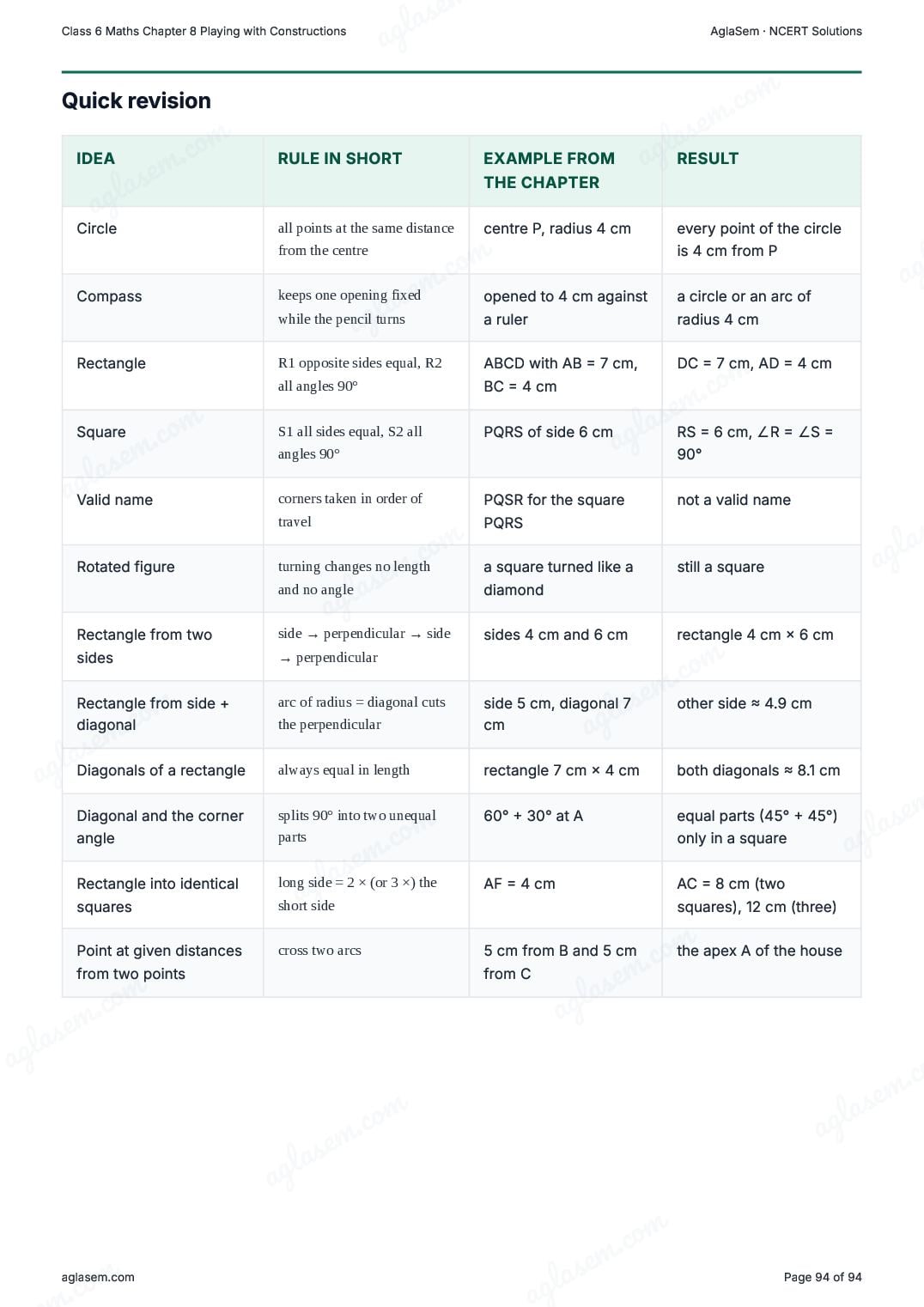
- A circle is the set of all points at the same distance from one fixed point. That point is the centre and the fixed distance is the radius . This is why a compass — which keeps its opening fixed — draws circles and arcs.
- A rectangle obeys two rules: R1 opposite sides are equal, R2 all four angles are 90°. A square obeys S1 all sides equal and S2 all angles 90°. Turning (rotating) a figure changes neither its sides nor its angles, so a rotated square is still a square.
- A figure is named by travelling around its boundary — ABCD, BCDA, DCBA are all valid names of the same rectangle, but ABDC is not.
- The best way to construct a figure is to draw a rough diagram first , mark on it everything you know, and then decide the order in which the points can be located.
- A rectangle can be constructed when two sides are given, or when one side and a diagonal are given — in the second case an arc of radius equal to the diagonal cuts the perpendicular at the missing corner.
- To find a point at given distances from two known points, draw two arcs and take their crossing point. This one idea builds the House, the eyes, the wavy wave and the rhombus.
How to Download NCERT Solutions for Class 6 Maths Chapter 8 PDF
Follow these simple steps to get the Playing with Constructions questions-and-answers PDF from Ganita Prakash.
- Search NCERT Solutions for Class 6 Maths Chapter 8 aglasem and open this page.
- Read the exercise questions with answers for Playing with Constructions shown above.
- Click the Download PDF link to save the Playing with Constructions solutions to your device.
NCERT Solutions for Class 6 Maths – All Chapters
There are more chapters to study besides Playing with Constructions in Maths. Here are the NCERT Solutions for all chapters of Class 6 Maths.
- Chapter 1 Patterns in Mathematics
- Chapter 2 Lines and Angles
- Chapter 3 Number Play
- Chapter 4 Data Handling and Presentation
- Chapter 5 Prime Time
- Chapter 6 Perimeter and Area
- Chapter 7 Fractions
- Chapter 8 Playing with Constructions
- Chapter 9 Symmetry
- Chapter 10 the Other Side of Zero
NCERT Solutions for Class 6 – All Subjects
Just like Chapter 8 of Maths, you can get the exercise questions with answers for every other subject of Class 6. Here are the NCERT Solutions for all subjects of Class 6.
NCERT Solutions for Class 6 Maths Chapter 8 – An Overview
The key highlights of this study material are as follows.
| Aspects | Details |
|---|---|
| Class | Class 6 |
| Subject | Maths |
| Chapter Number | Chapter 8 |
| Chapter Name | Playing with Constructions |
| Book Name | Ganita Prakash |
| Book By | NCERT (National Council of Educational Research and Training) |
| Educational Resource Here | NCERT Solutions of Class 6 Maths Chapter 8 for all exercises |
| More Questions Answers of This Subject | NCERT Solutions for Class 6 Maths |
| Download Book Chapter | NCERT Book Class 6 Maths |
| All Questions Answers For This Class | NCERT Solutions for Class 6 |
| Complete Solutions | NCERT Solutions |
NCERT Solutions for Class 6 Maths Chapter 8 Playing with Constructions – FAQs
What are the NCERT Solutions for Class 6 Maths Chapter 8 Playing with Constructions?
They are the complete, step-by-step answers to all the exercise and in-text questions of Chapter 8 Playing with Constructions from the NCERT Class 6 Maths textbook Ganita Prakash, written by experts as per the latest NCERT syllabus.
How can I download the Class 6 Maths Chapter 8 solutions PDF for free?
Open this page on aglasem, read the Playing with Constructions questions with answers, and click the “Download Solutions PDF” link. The Class 6 Maths Chapter 8 NCERT Solutions PDF is completely free to download.
Are these NCERT Solutions as per the latest 2026-27 syllabus?
Yes. The NCERT Solutions for Class 6 Maths Chapter 8 are based on the latest NCERT textbook Ganita Prakash and the current 2026-27 CBSE syllabus, so the questions and answers match what you study in class.
Where can I get NCERT Solutions for the other chapters of Class 6 Maths?
You can find the answers to every chapter on the NCERT Solutions for Class 6 Maths page, and solutions for every subject on the NCERT Solutions for Class 6 page.
How do NCERT Solutions help in exam preparation?
They show the correct method to solve each question, help you write answers the way they are expected in exams, let you check and correct your own work, and save revision time — which together improve your marks in Class 6 Maths.
If you have any queries on NCERT Solutions for Class 6 Maths Chapter 8 Playing with Constructions, then please ask in the comments below.