NCERT Solutions for Class 6 Maths Chapter 1 Patterns in Mathematics provide clear, step-by-step answers to every exercise and in-text question from the chapter Patterns in Mathematics of the NCERT textbook Ganita Prakash. Prepared by subject experts as per the latest NCERT (CBSE) syllabus for 2026-27, these NCERT Solutions for Class 6 Maths help you understand each concept, write exam-ready answers, and check your own solutions. You can read them online below or download the free Class 6 Maths Chapter 1 question-answer PDF.
NCERT Solutions for Class 6 Maths Chapter 1 Patterns in Mathematics
- Class: Class 6
- Subject: Maths
- Chapter: Chapter 1 – Patterns in Mathematics
- Textbook: Ganita Prakash (NCERT)
- Study material: NCERT Solutions – questions with answers, free PDF
These solutions answer all the exercise questions of Chapter 1 Patterns in Mathematics — including the in-text questions, short-answer and long-answer questions, and activities — with complete explanations so you can follow the method, not just the final answer. Read the full solutions below.
NCERT Solutions Class 6 Maths Chapter 1 Patterns in Mathematics View Download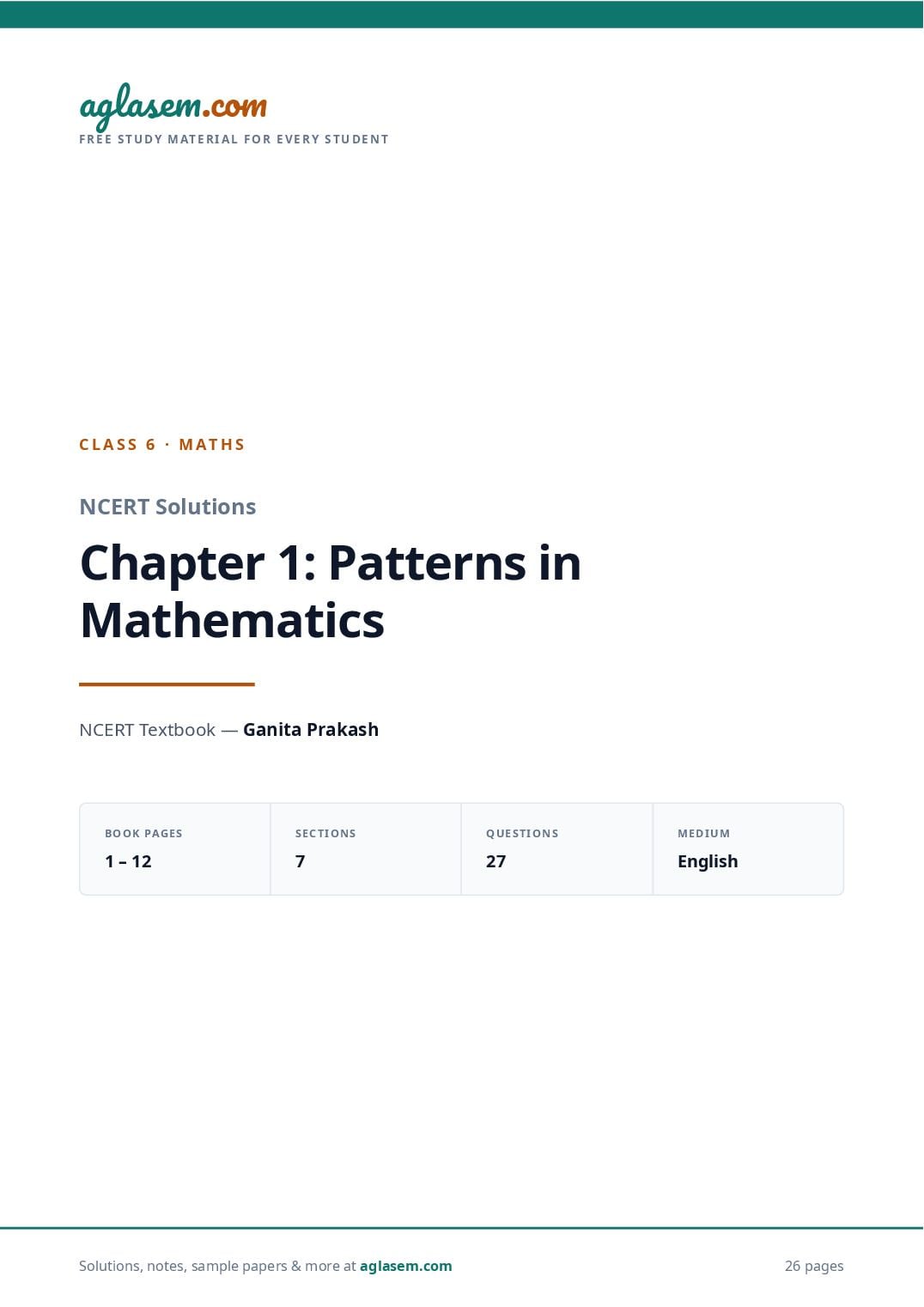
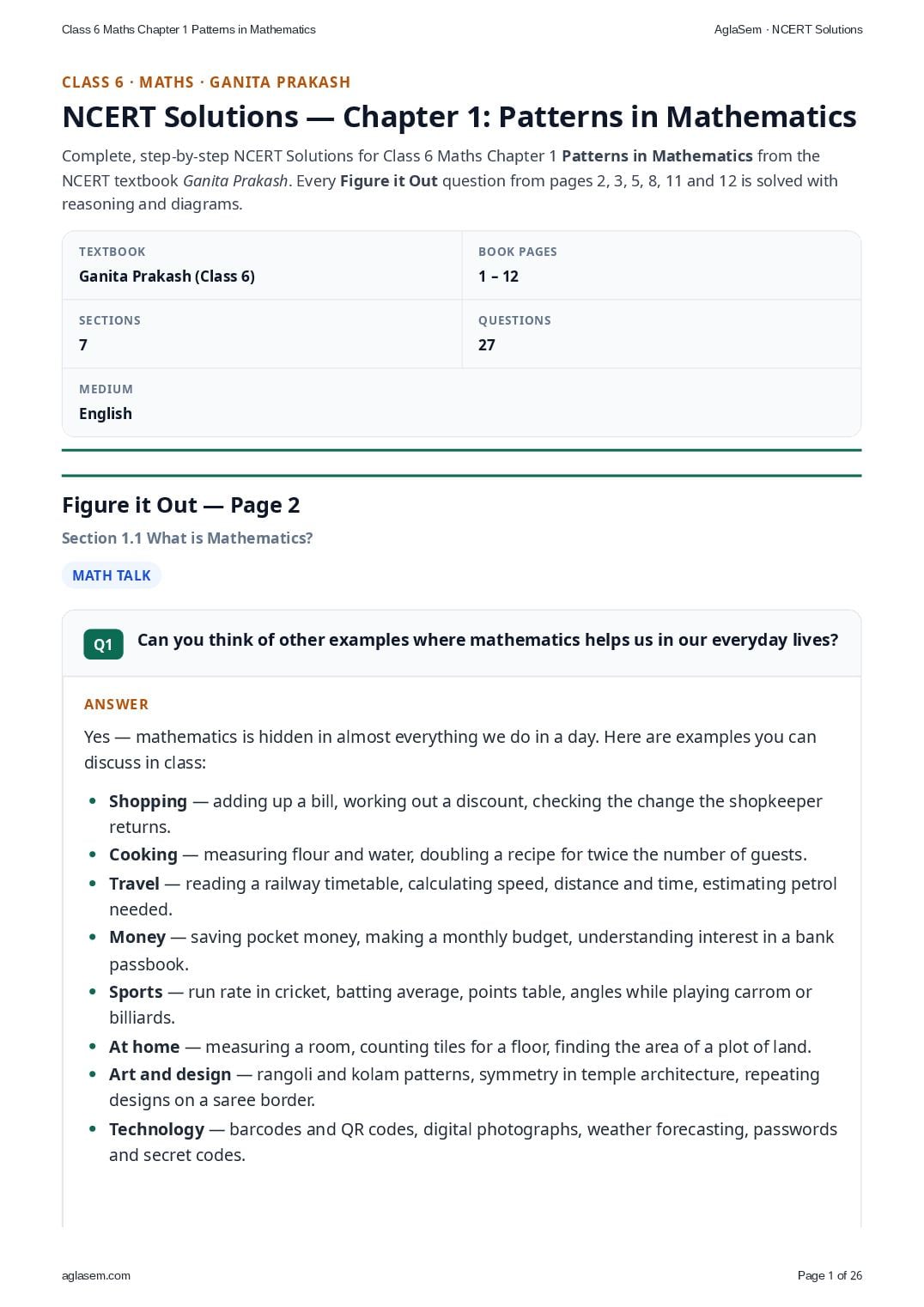
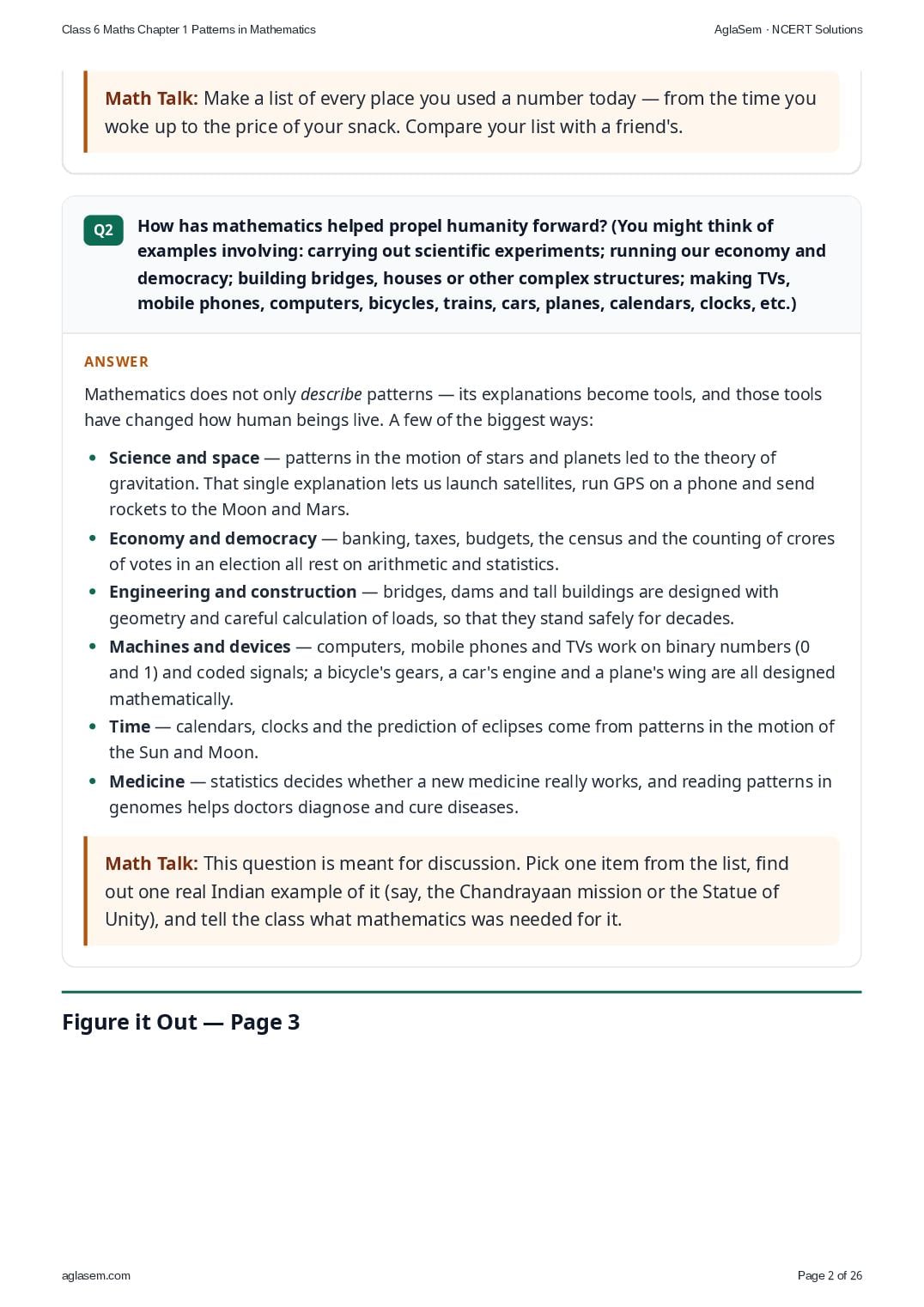
NCERT Solutions for Class 6 Maths Chapter 1 PDF Download
You can read the NCERT Solutions for Class 6 Maths Chapter 1 online above, or download the complete question-answer PDF to study Patterns in Mathematics offline at any time.
NCERT Solutions for Class 6 Maths Chapter 1 PDF Download Link – Click Here to Download Solutions PDF
Questions Covered in This Chapter
These NCERT Solutions answer all 27 questions of this chapter. The questions solved are:
- Can you think of other examples where mathematics helps us in our everyday lives?
- How has mathematics helped propel humanity forward? (You might think of examples involving: carrying out scientific experiments; running our economy and democracy; building bridges, houses or other complex structures; making TVs, mobile phones, computers, bicycles, trains, cars, planes, calendars, clocks, etc.)
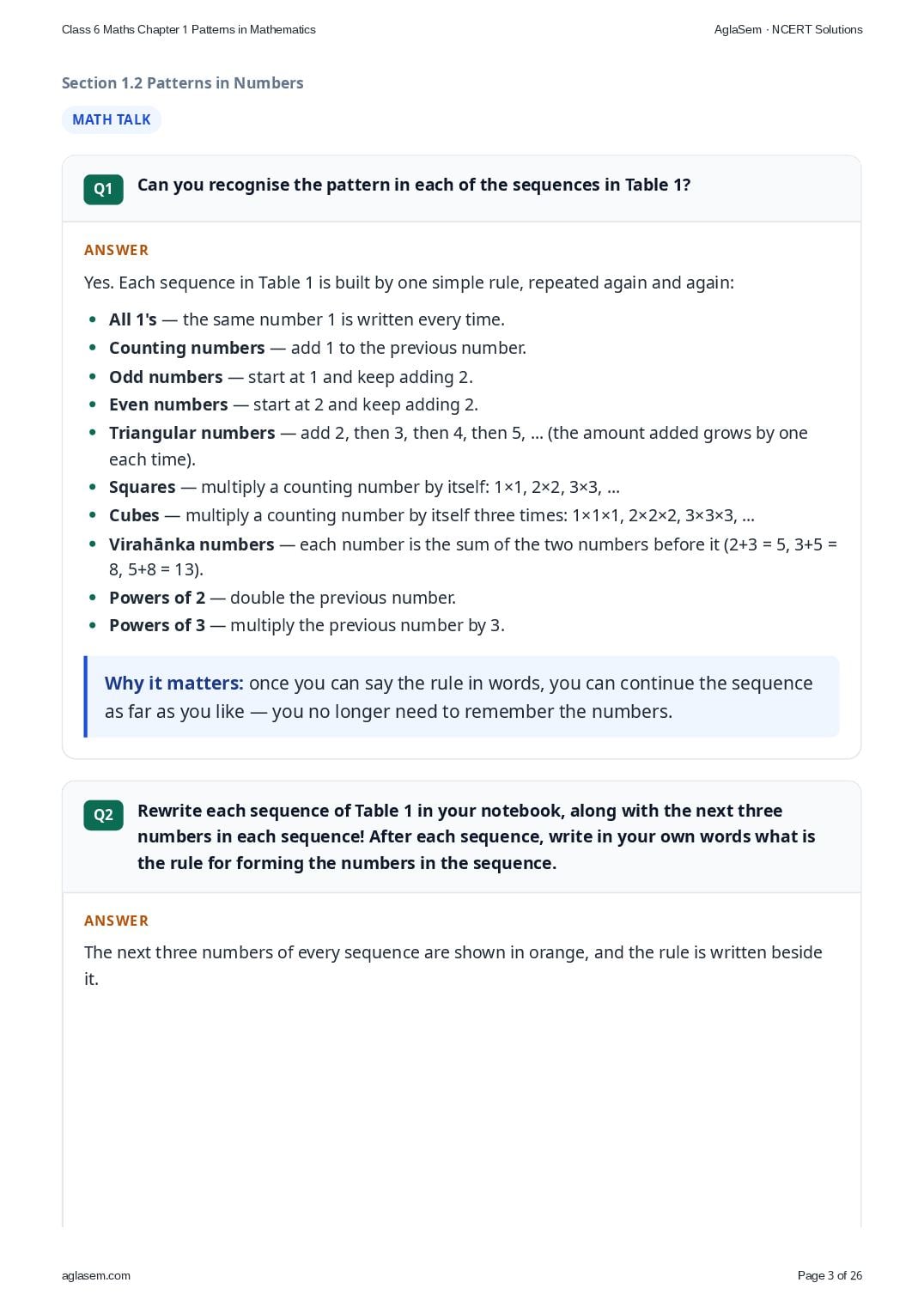
- Can you recognise the pattern in each of the sequences in Table 1?
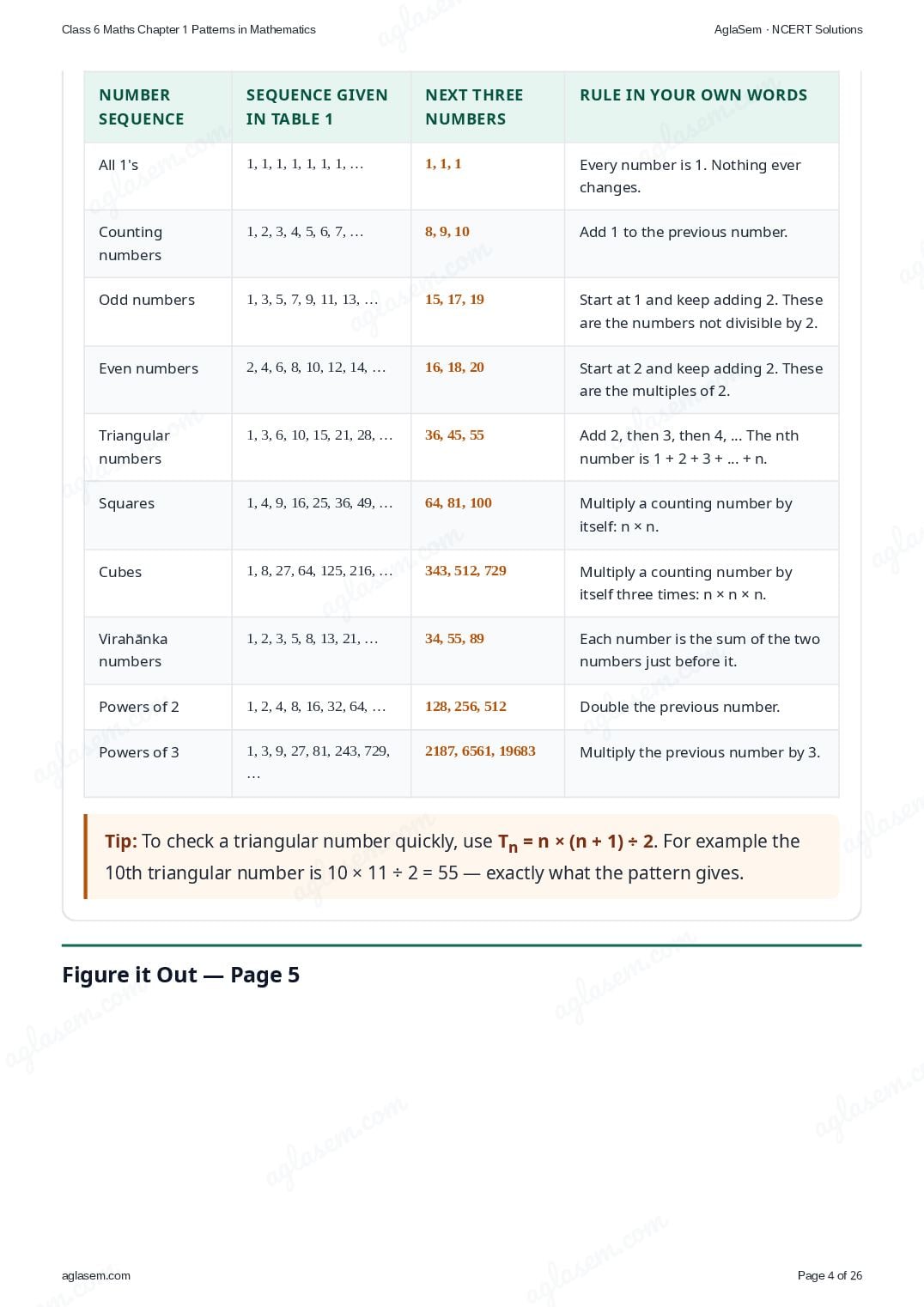
- Rewrite each sequence of Table 1 in your notebook, along with the next three numbers in each sequence! After each sequence, write in your own words what is the rule for forming the numbers in the sequence.
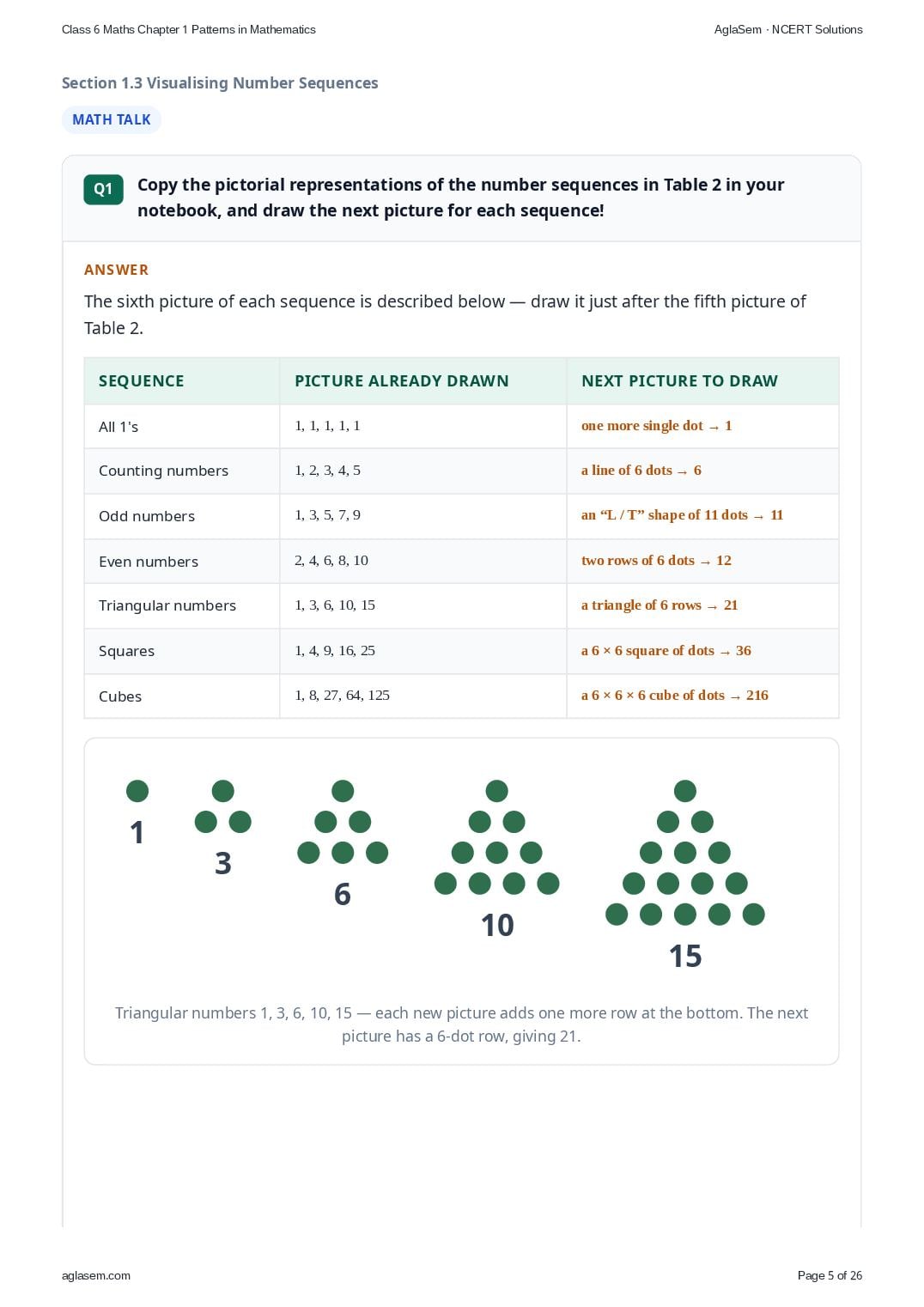
- Copy the pictorial representations of the number sequences in Table 2 in your notebook, and draw the next picture for each sequence!
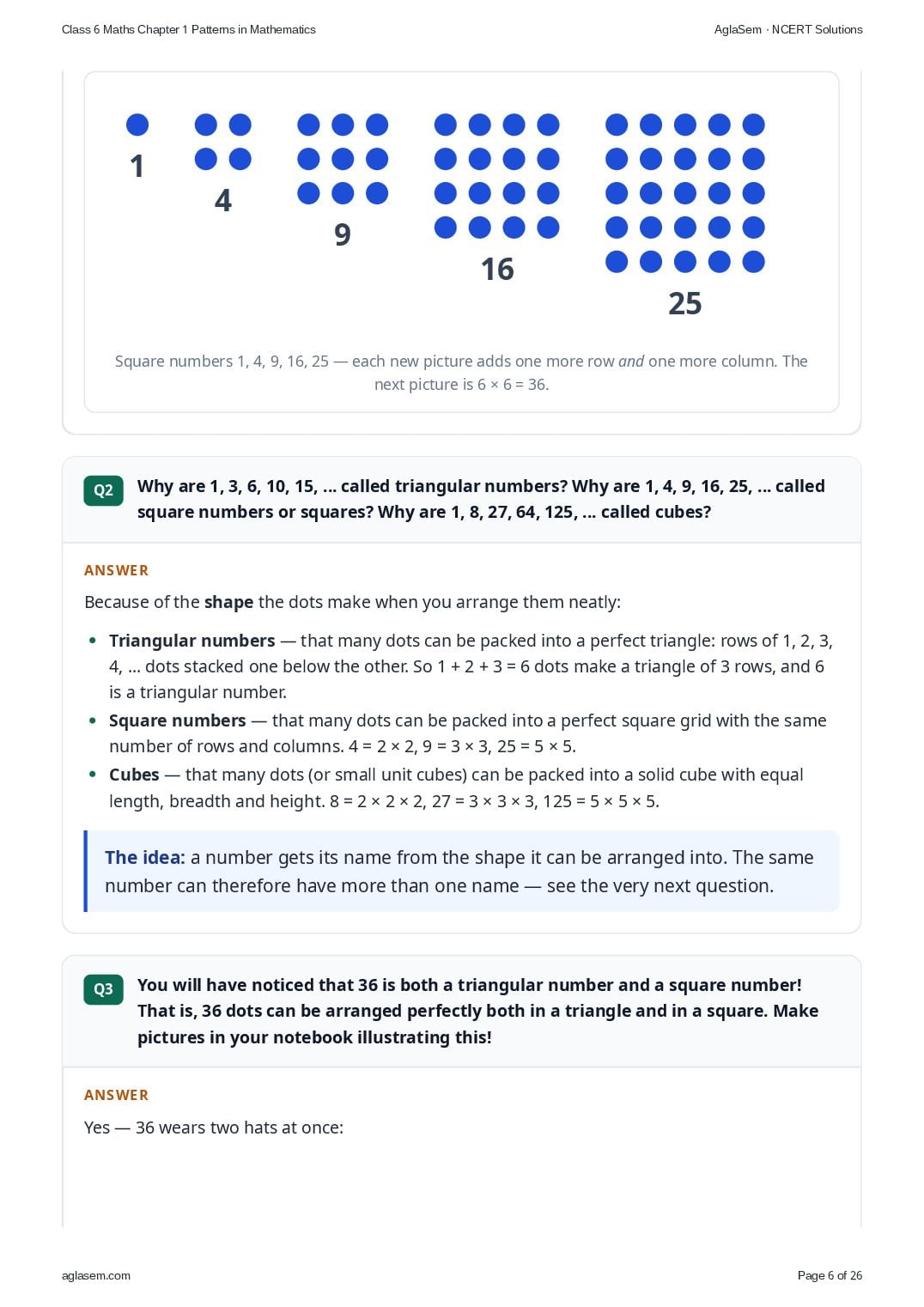
- Why are 1, 3, 6, 10, 15, … called triangular numbers? Why are 1, 4, 9, 16, 25, … called square numbers or squares? Why are 1, 8, 27, 64, 125, … called cubes?
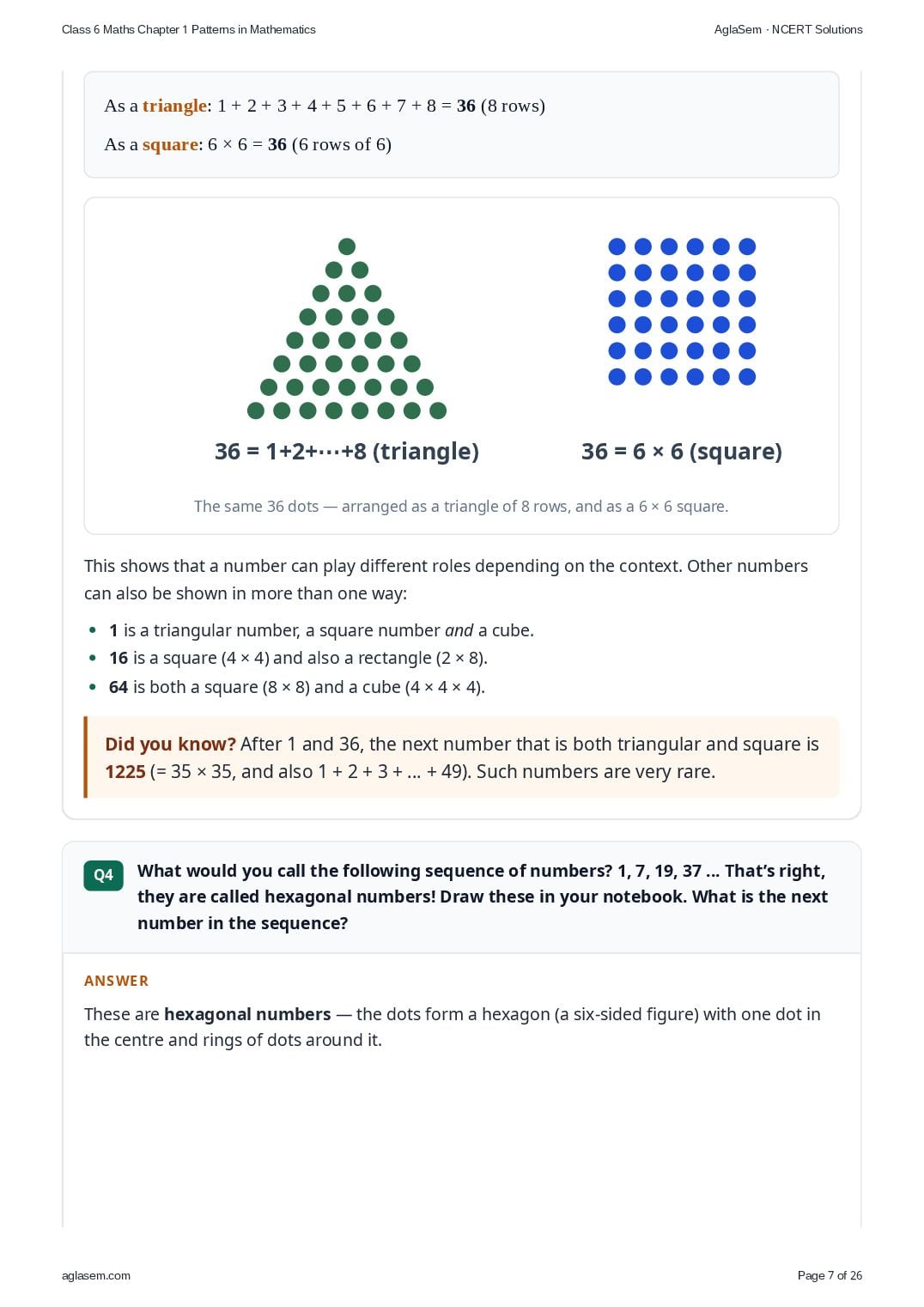
- You will have noticed that 36 is both a triangular number and a square number! That is, 36 dots can be arranged perfectly both in a triangle and in a square. Make pictures in your notebook illustrating this!
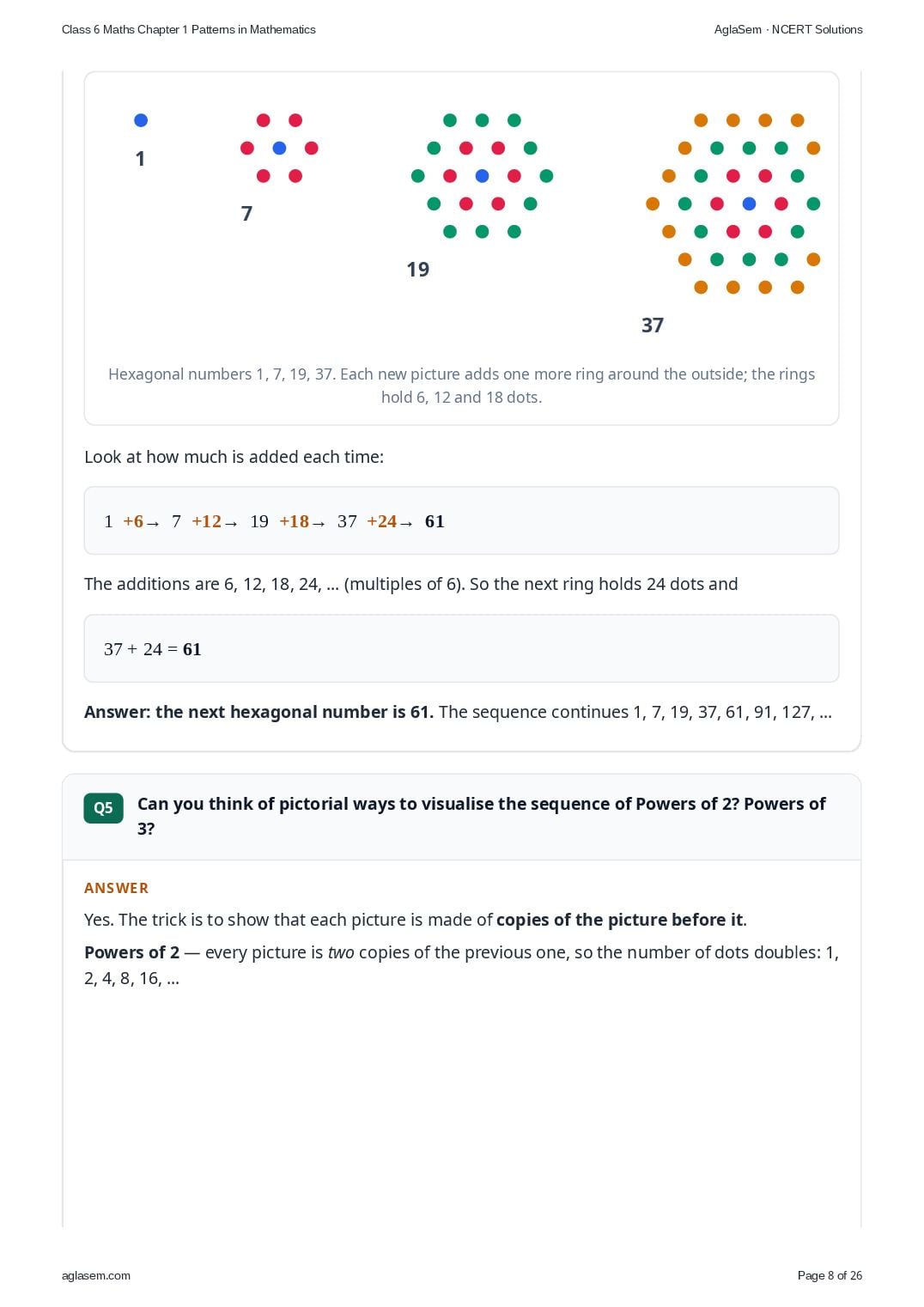
- What would you call the following sequence of numbers? 1, 7, 19, 37 … That’s right, they are called hexagonal numbers! Draw these in your notebook. What is the next number in the sequence?
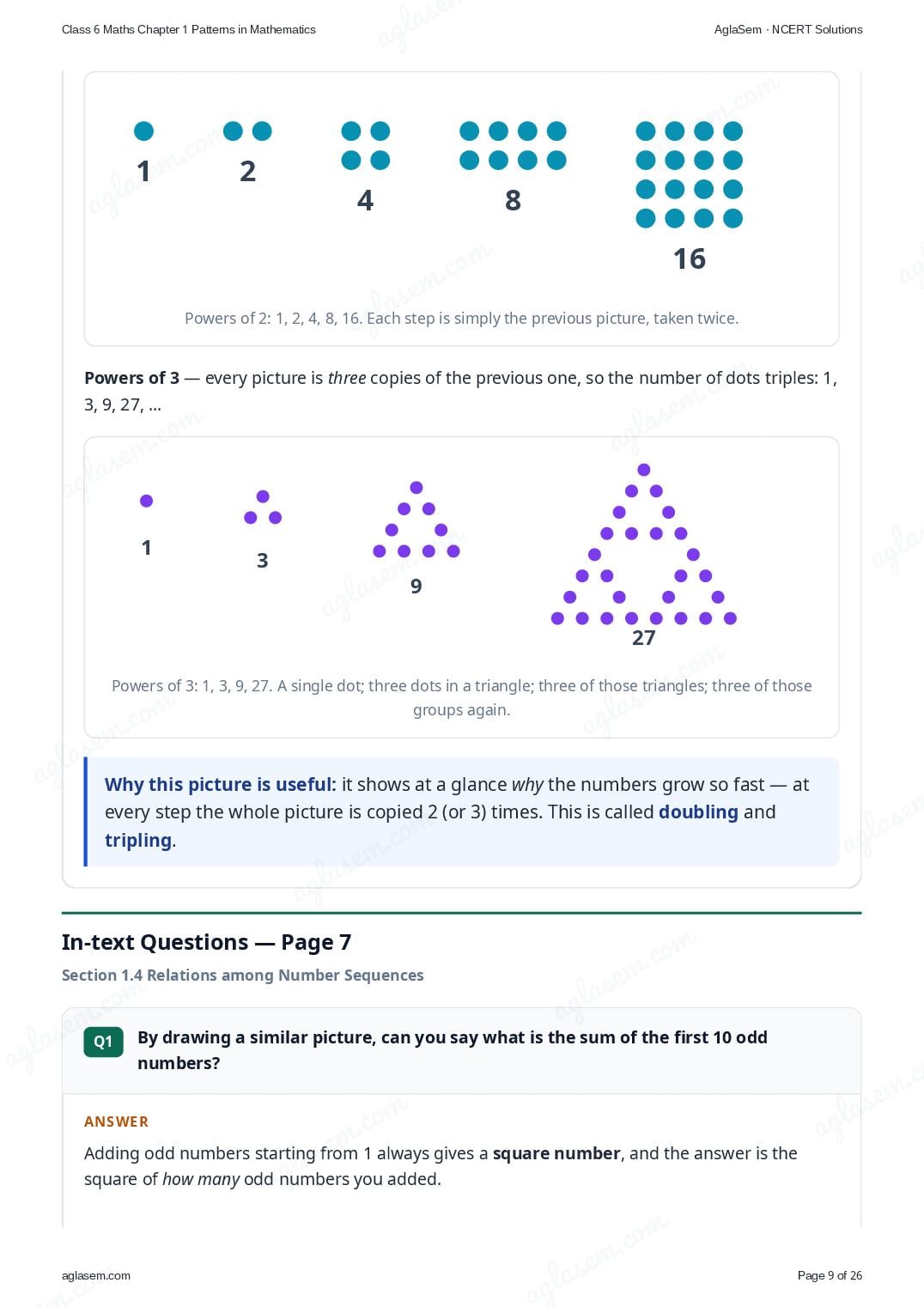
- Can you think of pictorial ways to visualise the sequence of Powers of 2? Powers of 3?
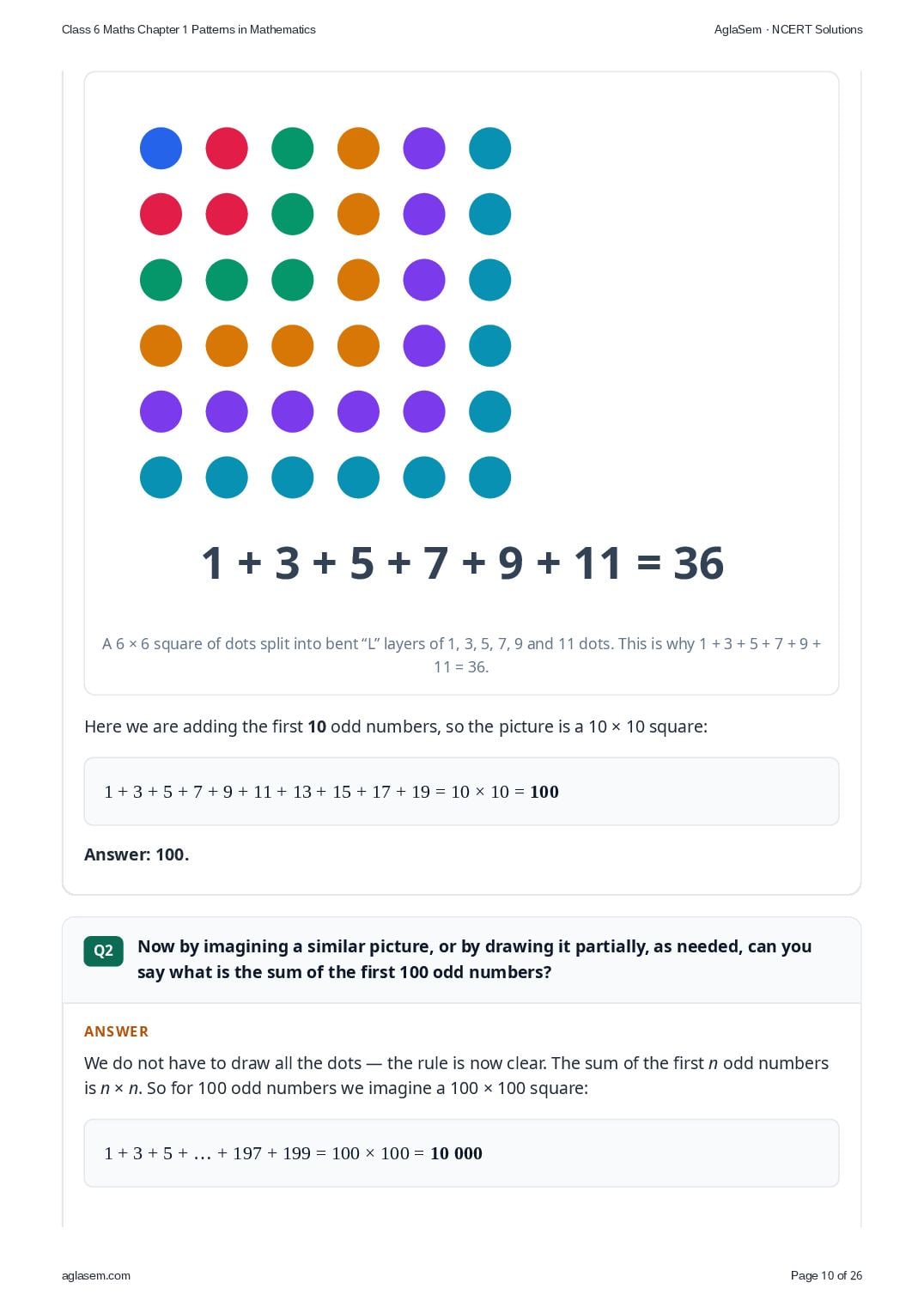
- By drawing a similar picture, can you say what is the sum of the first 10 odd numbers?
- Now by imagining a similar picture, or by drawing it partially, as needed, can you say what is the sum of the first 100 odd numbers?
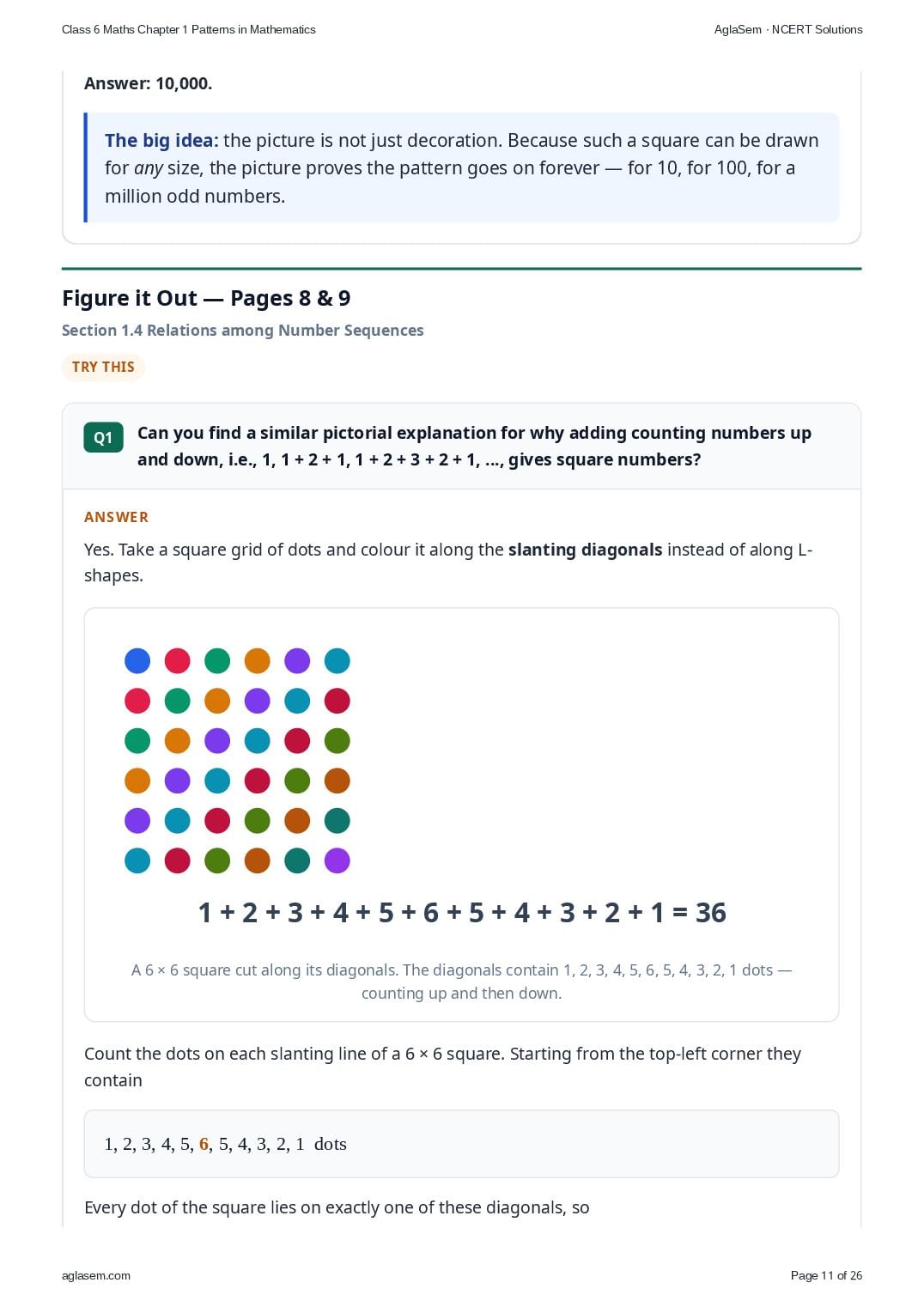
- Can you find a similar pictorial explanation for why adding counting numbers up and down, i.e., 1, 1 + 2 + 1, 1 + 2 + 3 + 2 + 1, …, gives square numbers?
- By imagining a large version of your picture, or drawing it partially, as needed, can you see what will be the value of 1 + 2 + 3 + … + 99 + 100 + 99 + … + 3 + 2 + 1?
- Which sequence do you get when you start to add the All 1’s sequence up? What sequence do you get when you add the All 1’s sequence up and down?
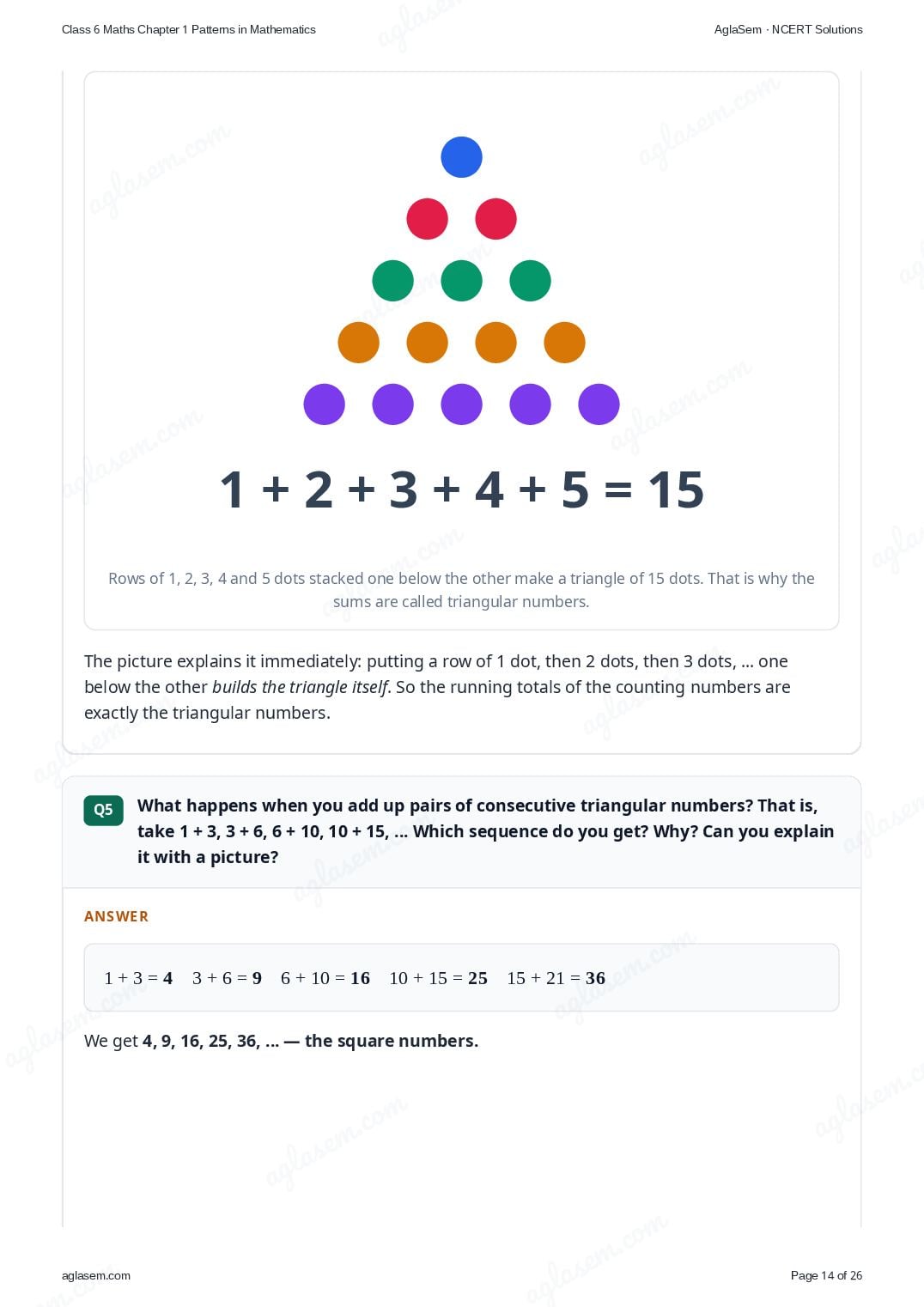
- Which sequence do you get when you start to add the counting numbers up? Can you give a smaller pictorial explanation?
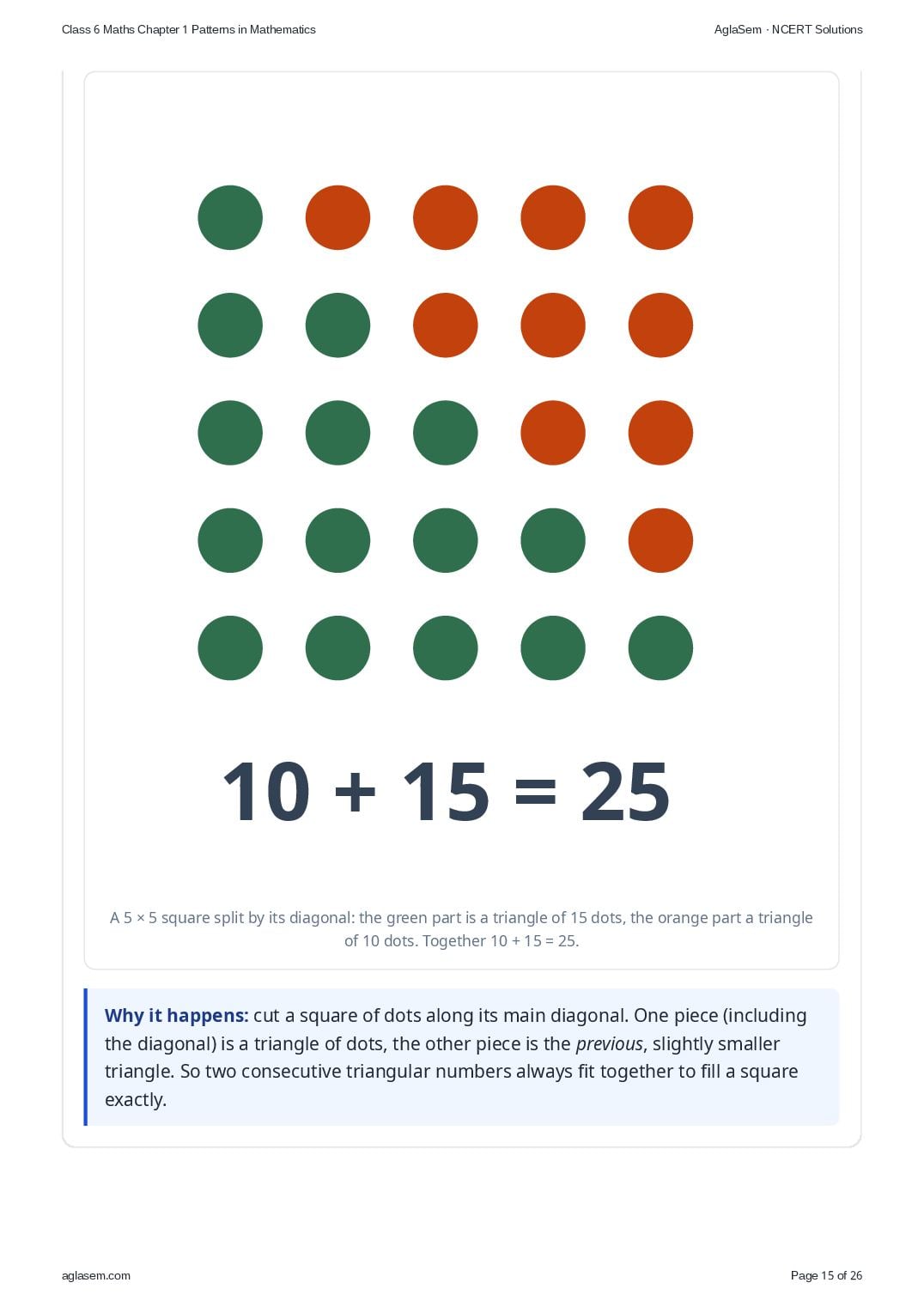
- What happens when you add up pairs of consecutive triangular numbers? That is, take 1 + 3, 3 + 6, 6 + 10, 10 + 15, … Which sequence do you get? Why? Can you explain it with a picture?
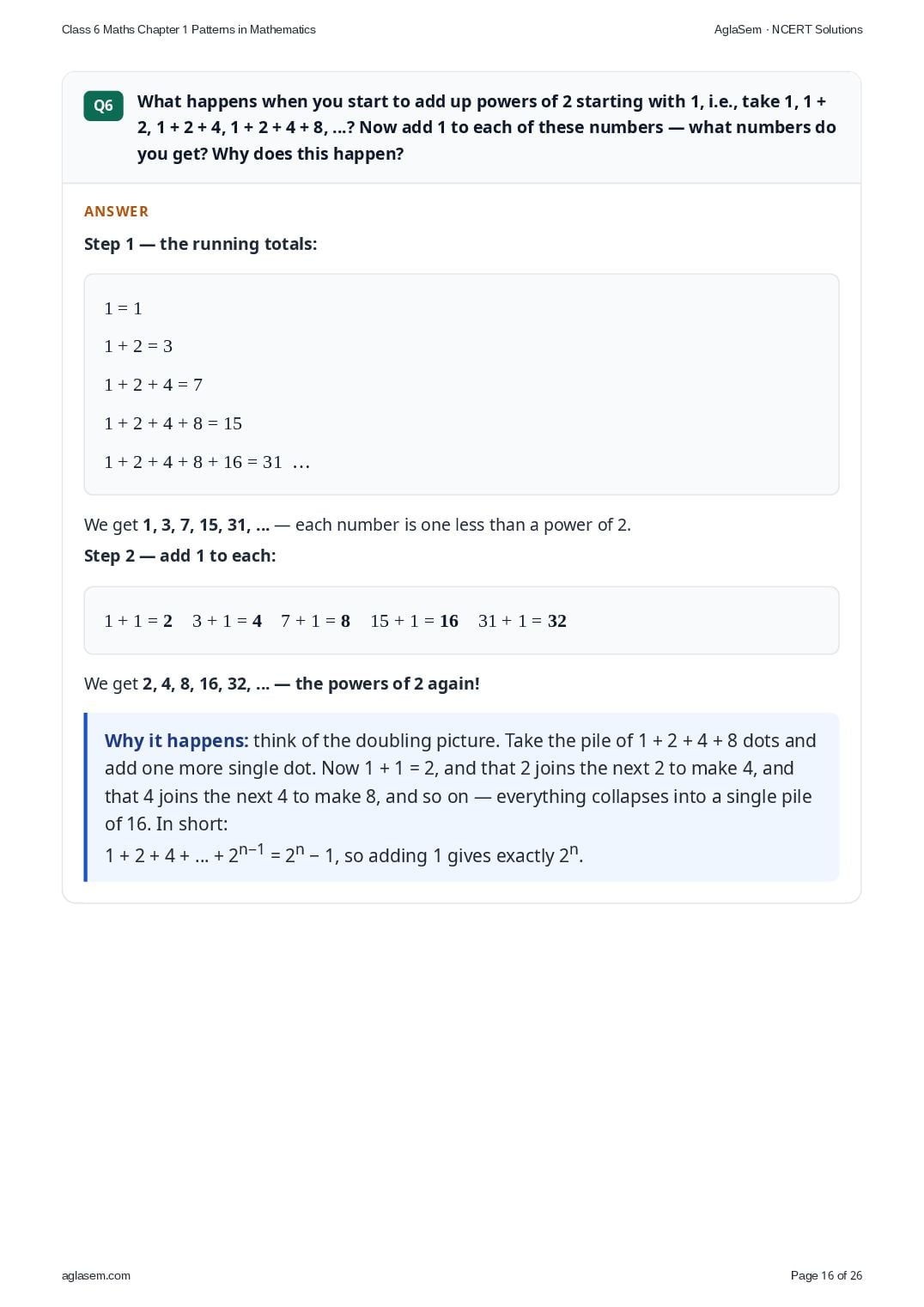
- What happens when you start to add up powers of 2 starting with 1, i.e., take 1, 1 + 2, 1 + 2 + 4, 1 + 2 + 4 + 8, …? Now add 1 to each of these numbers — what numbers do you get? Why does this happen?
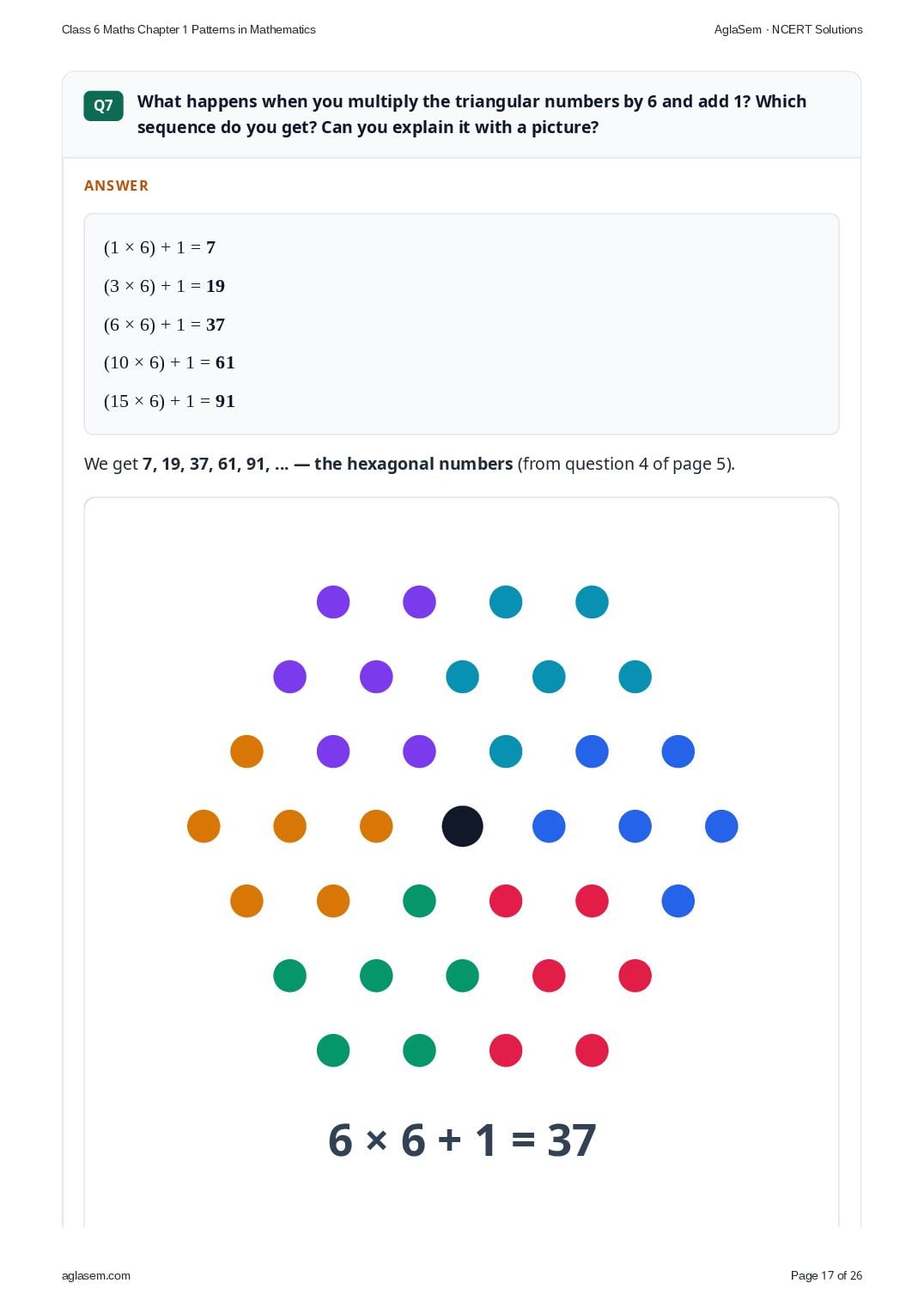
- What happens when you multiply the triangular numbers by 6 and add 1? Which sequence do you get? Can you explain it with a picture?
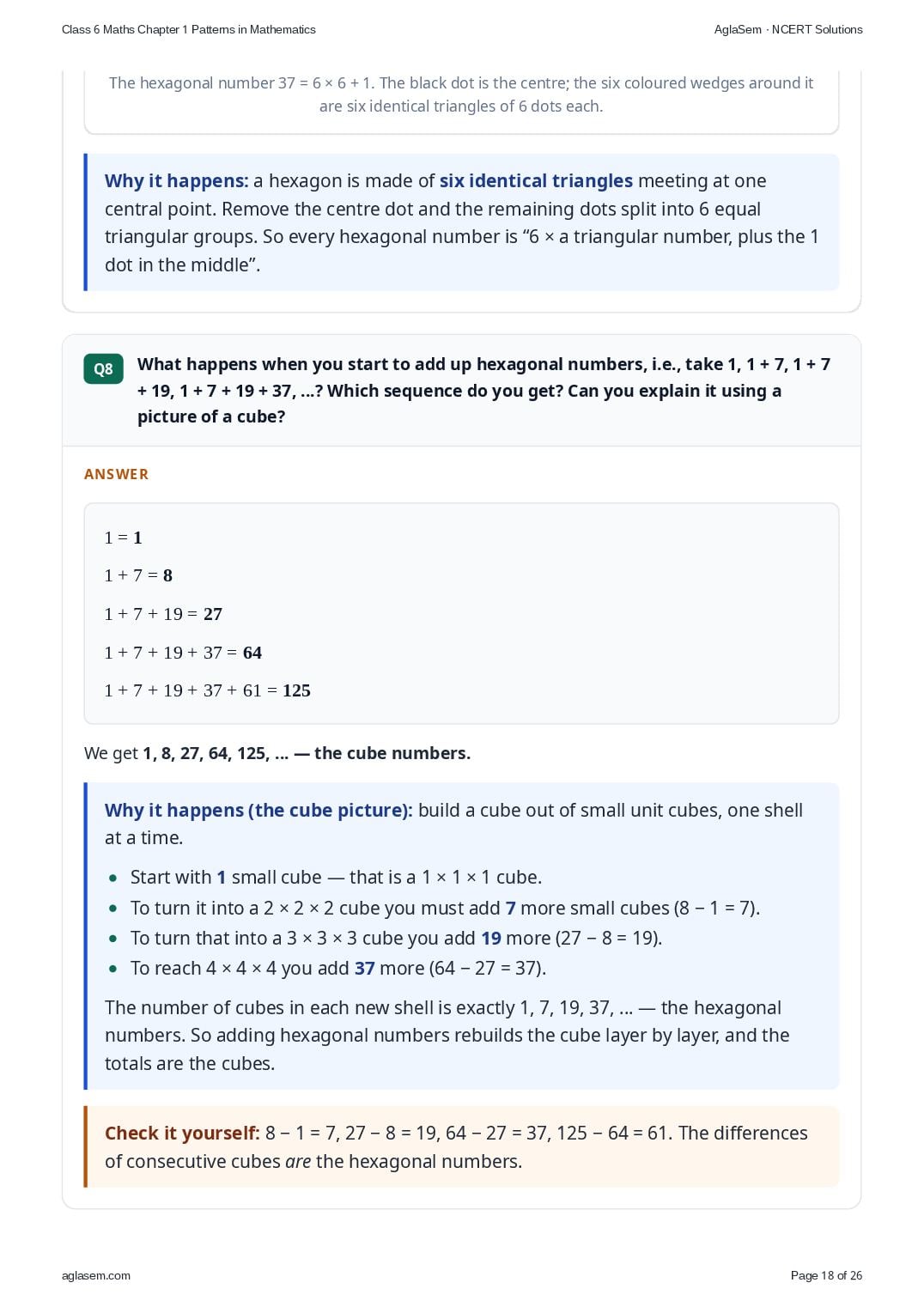
- What happens when you start to add up hexagonal numbers, i.e., take 1, 1 + 7, 1 + 7 + 19, 1 + 7 + 19 + 37, …? Which sequence do you get? Can you explain it using a picture of a cube?
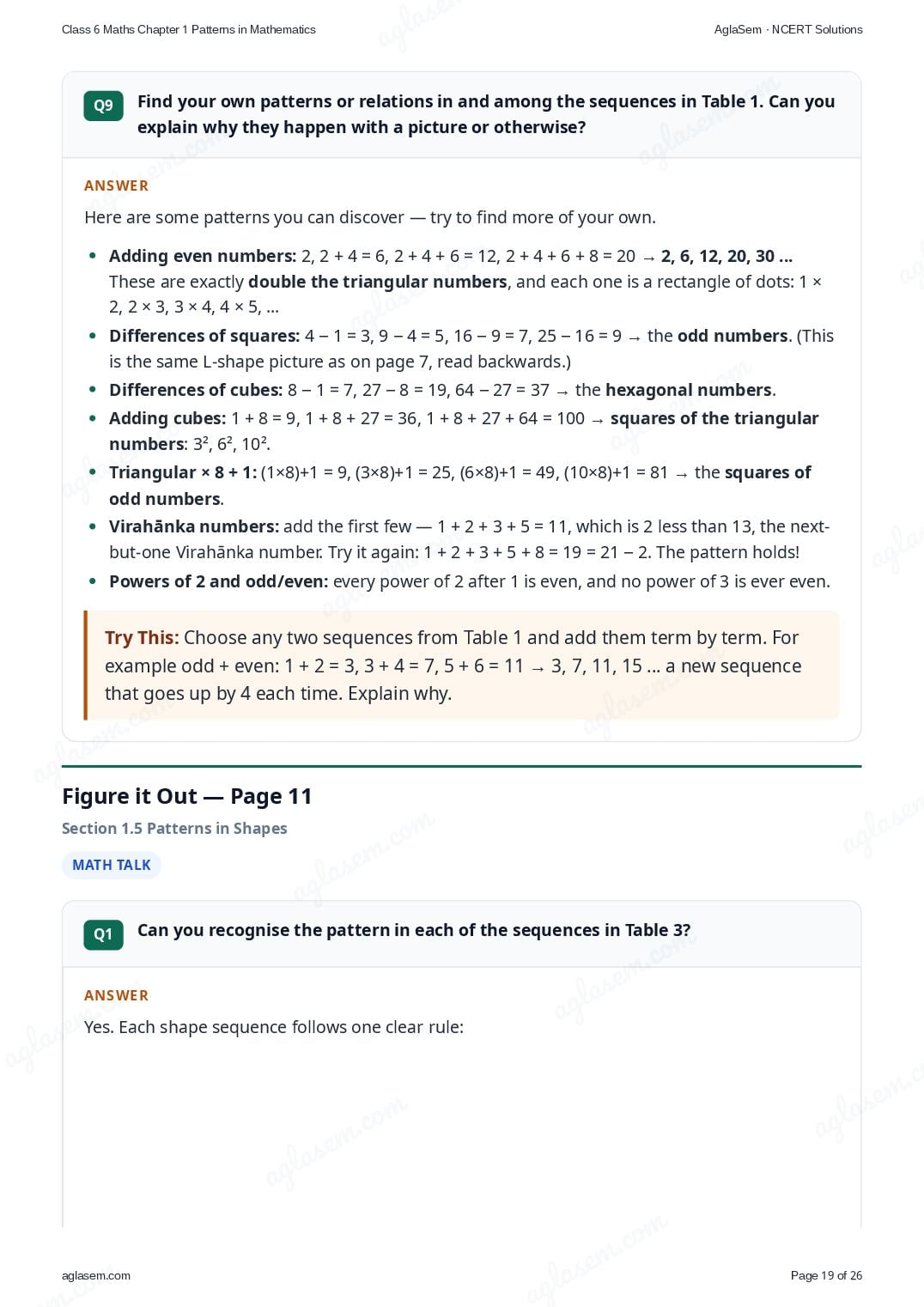
- Find your own patterns or relations in and among the sequences in Table 1. Can you explain why they happen with a picture or otherwise?
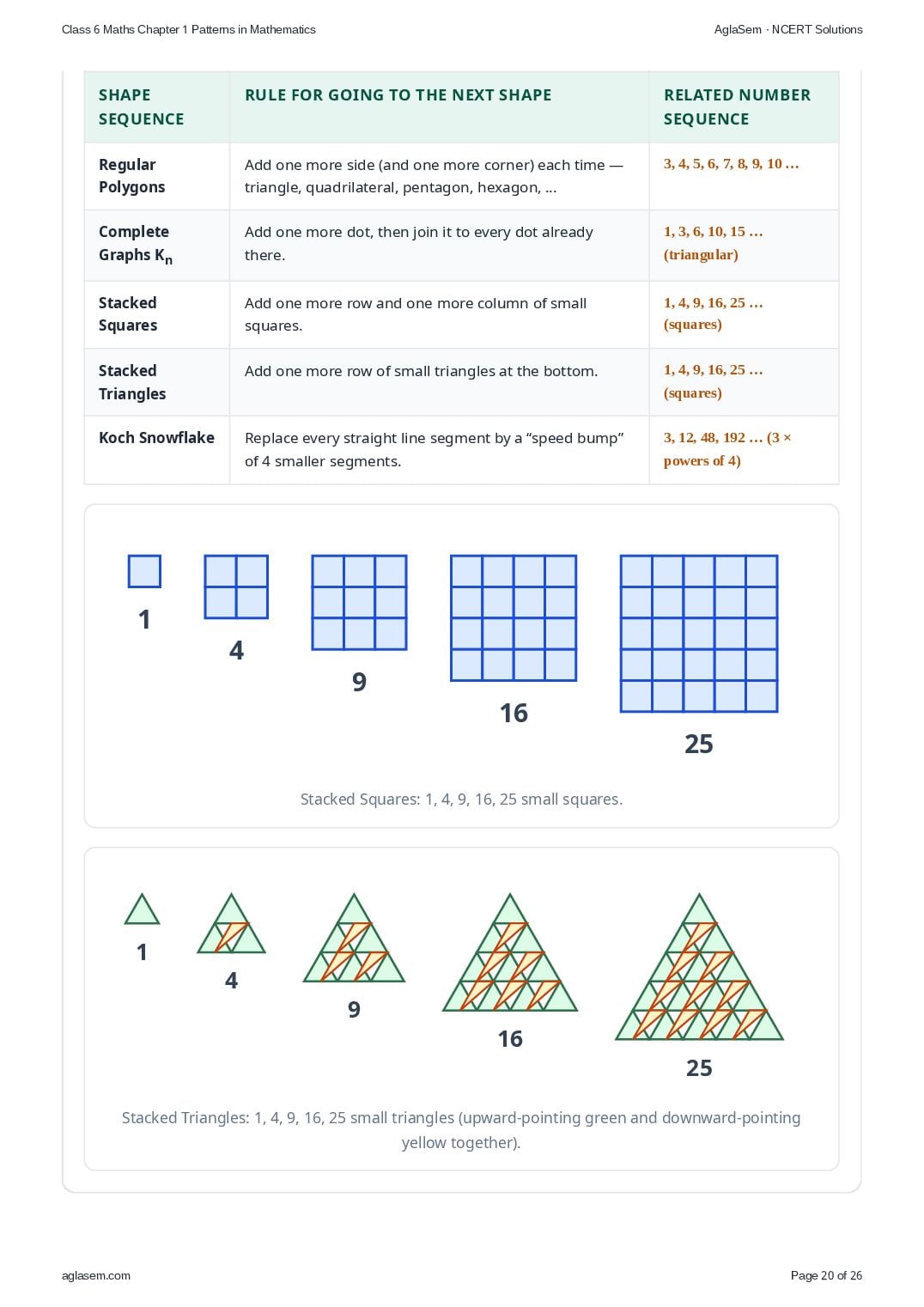
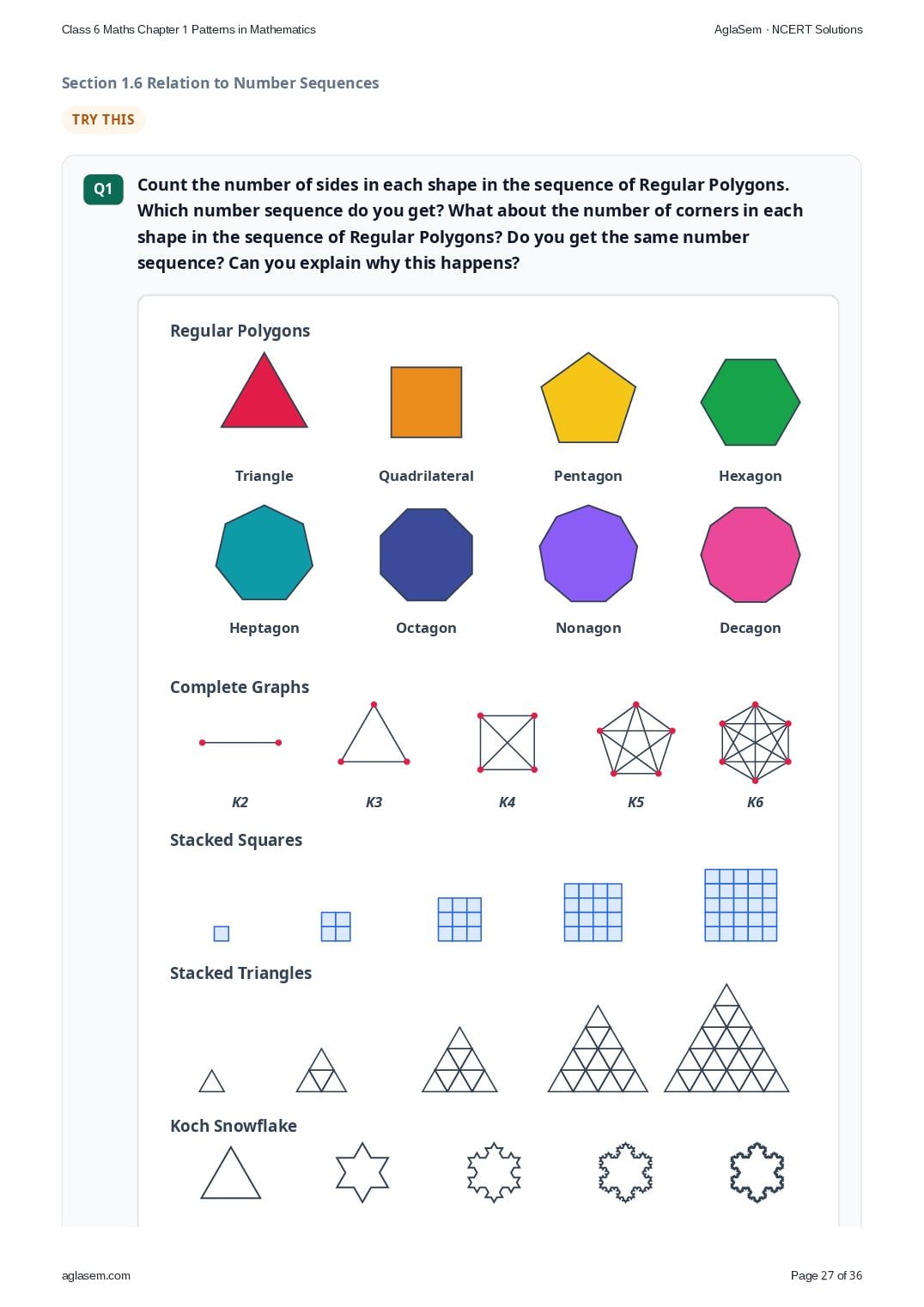
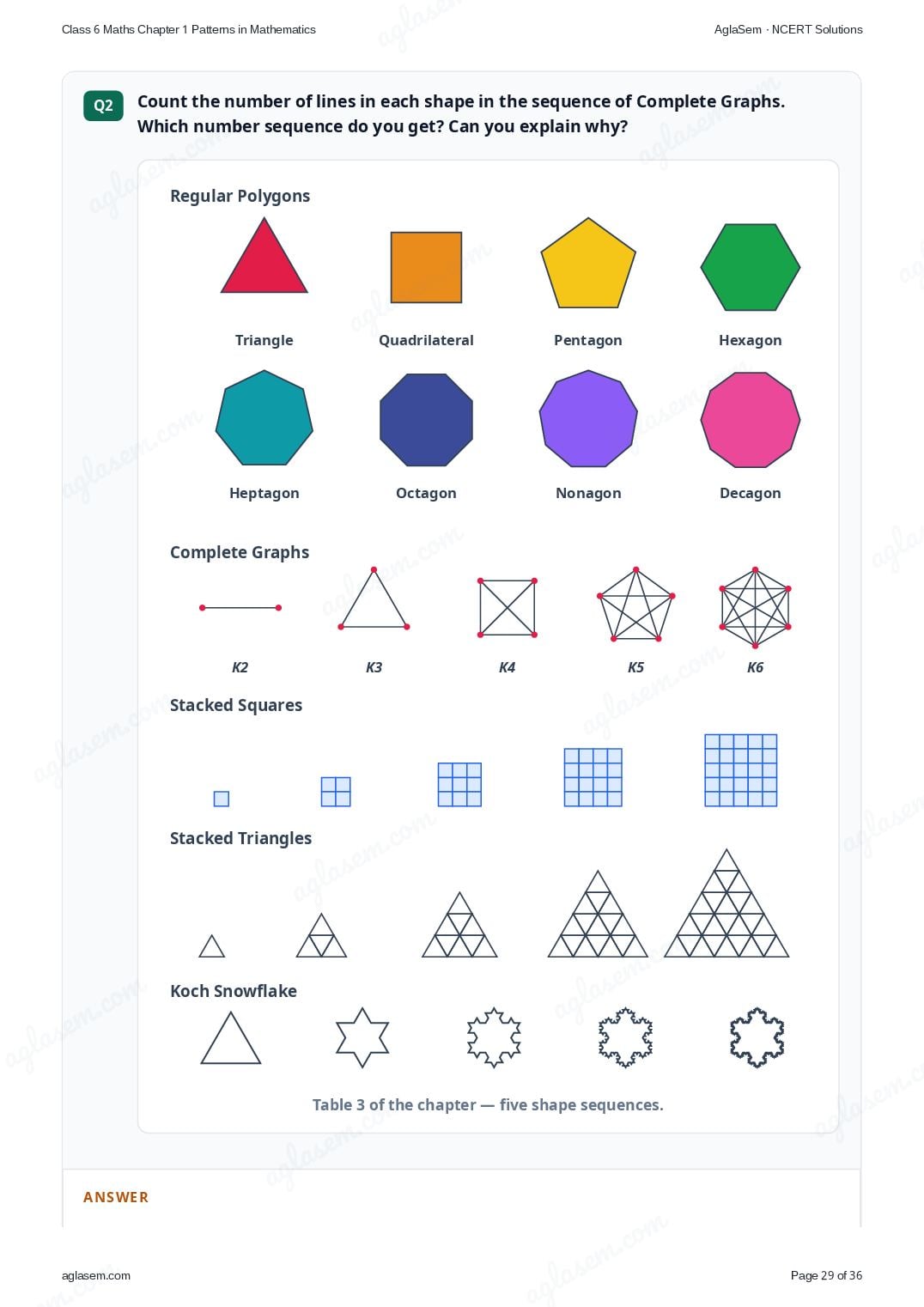
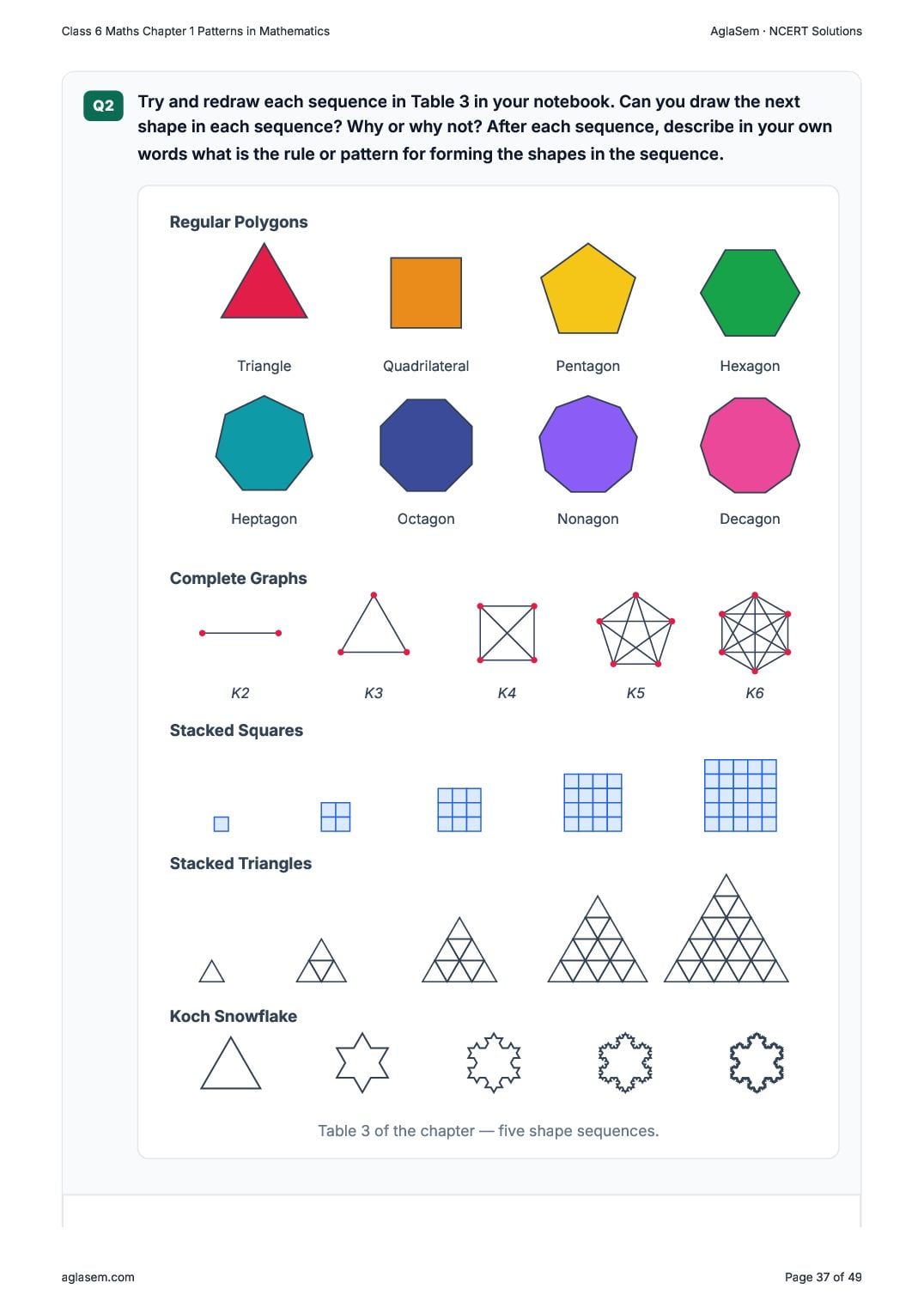
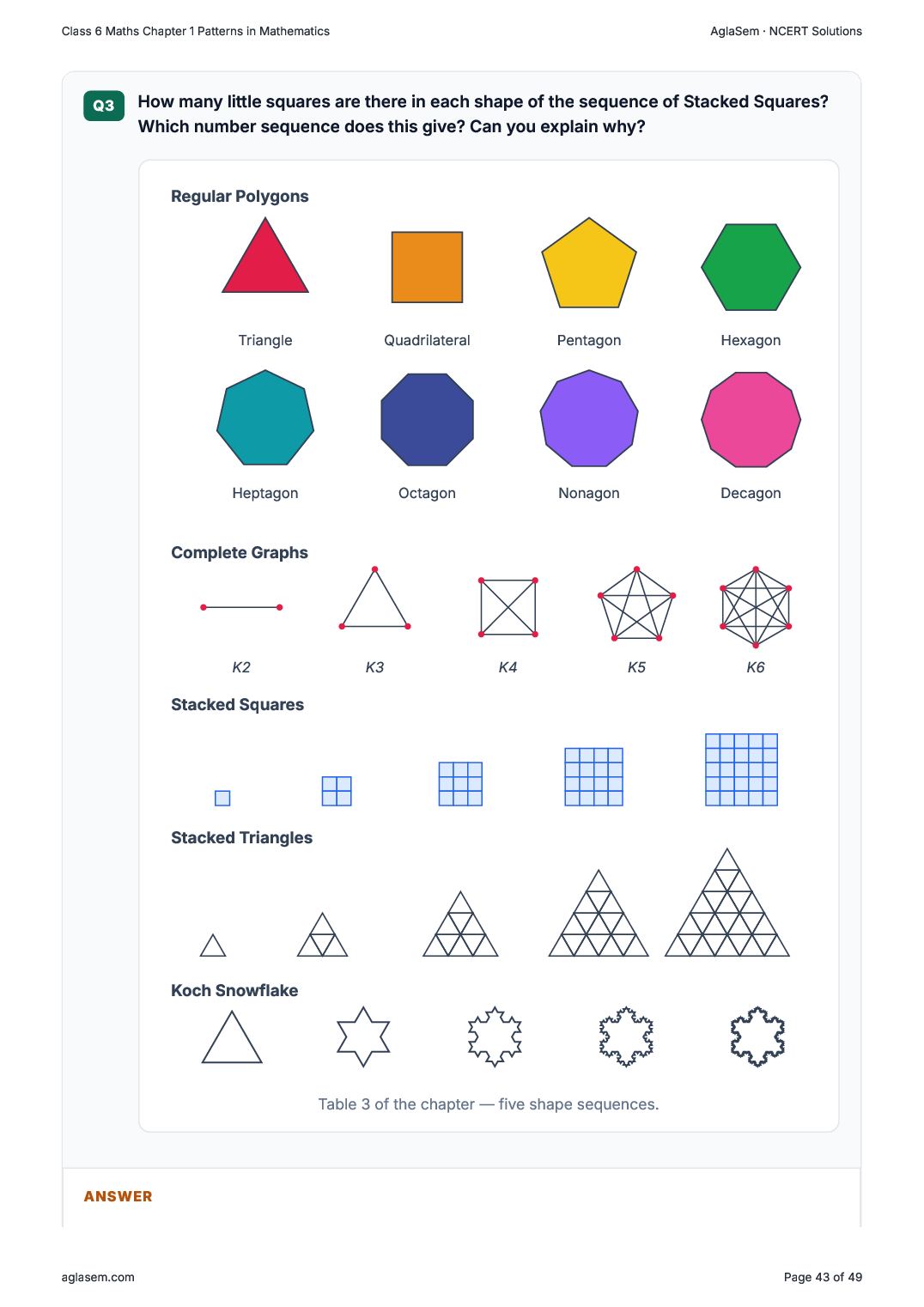
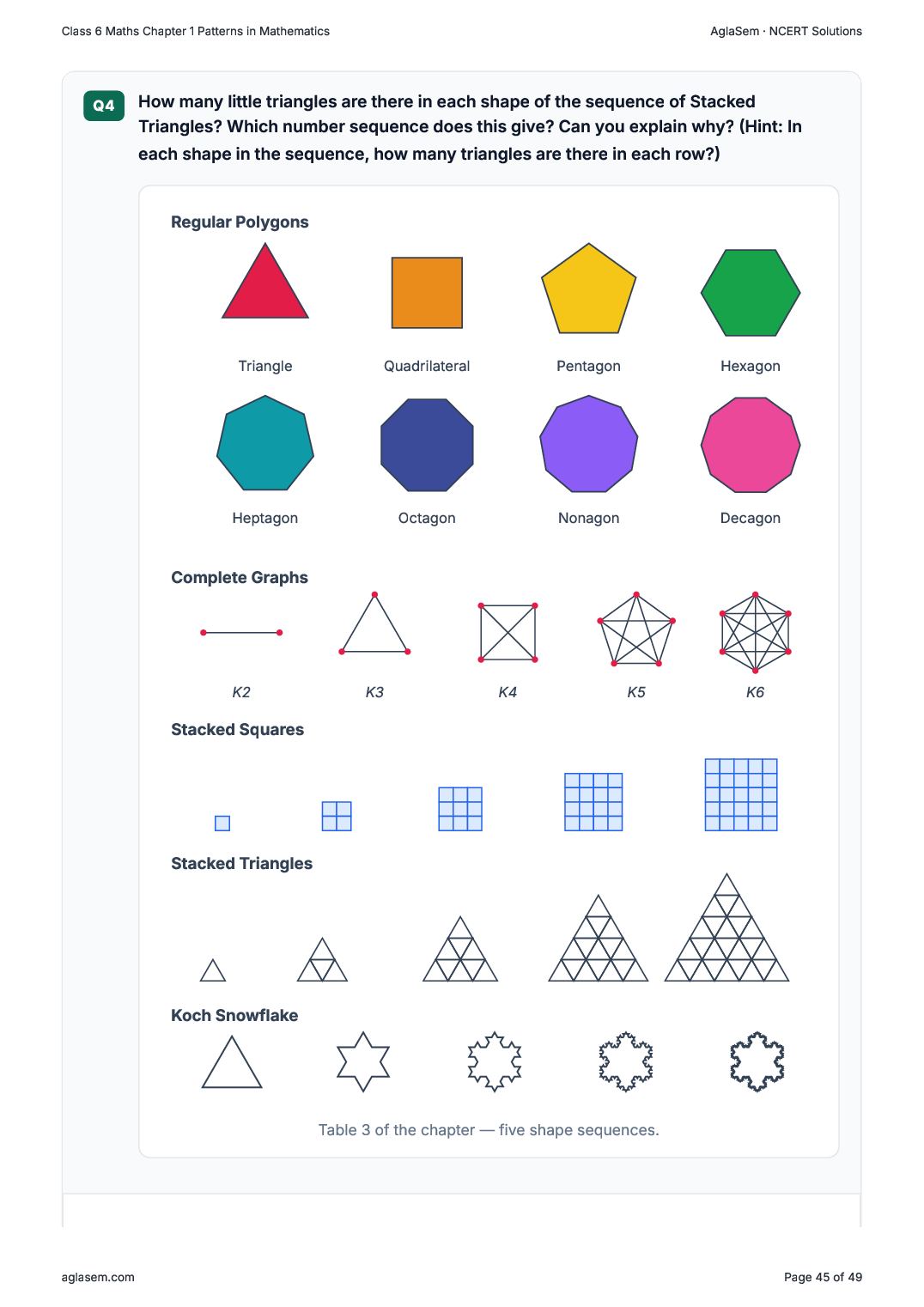
- Can you recognise the pattern in each of the sequences in Table 3?
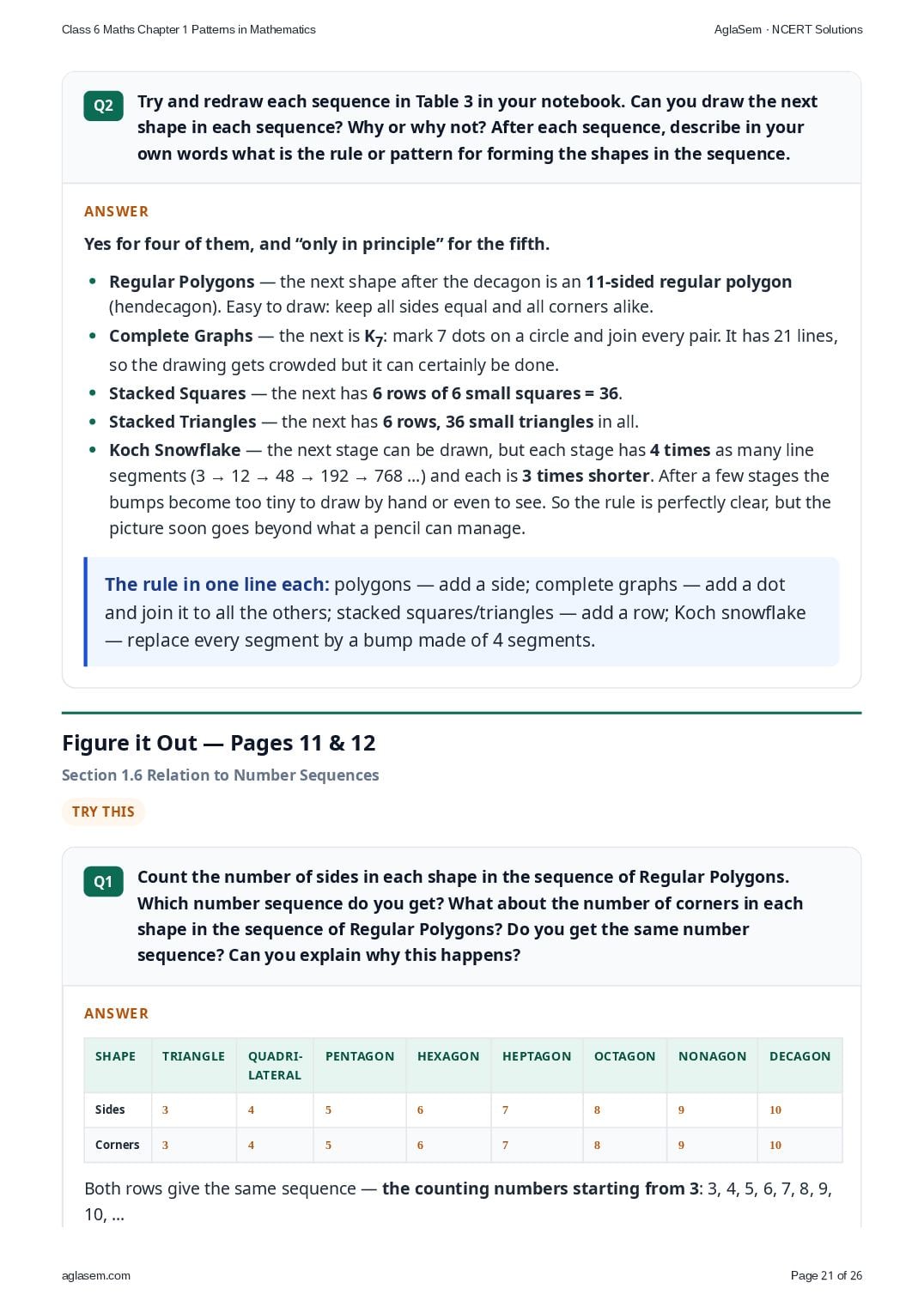
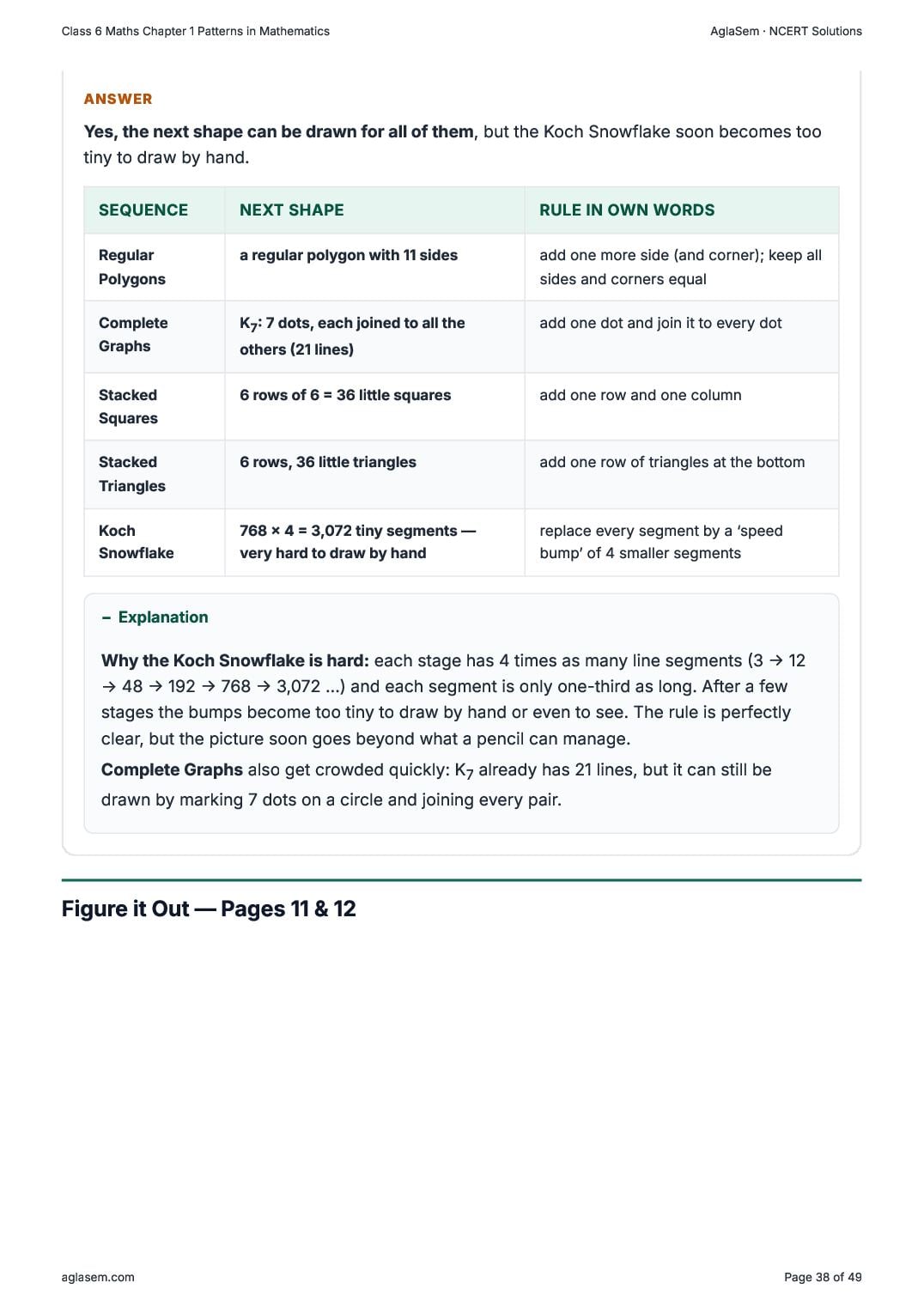
- Try and redraw each sequence in Table 3 in your notebook. Can you draw the next shape in each sequence? Why or why not? After each sequence, describe in your own words what is the rule or pattern for forming the shapes in the sequence.
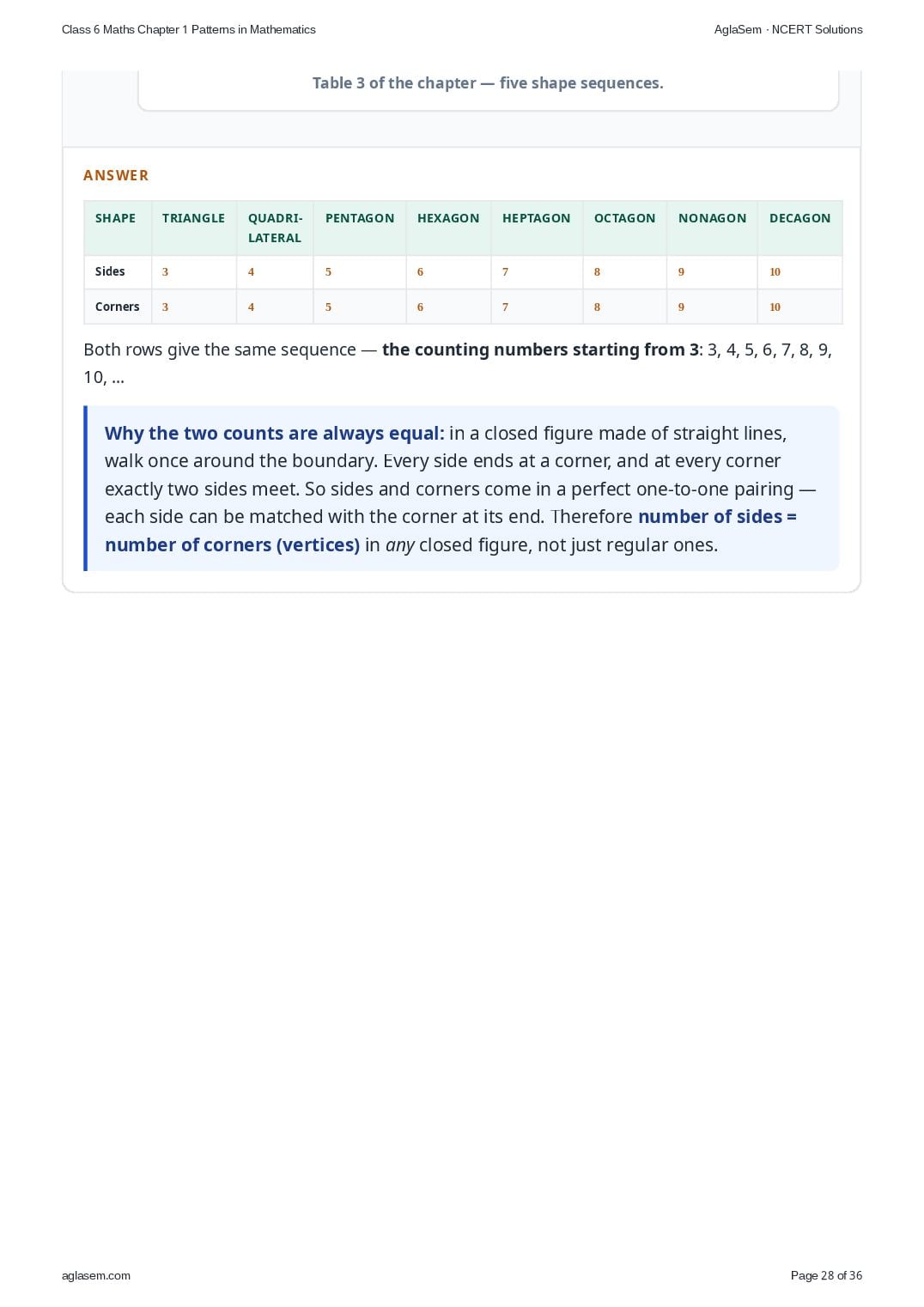
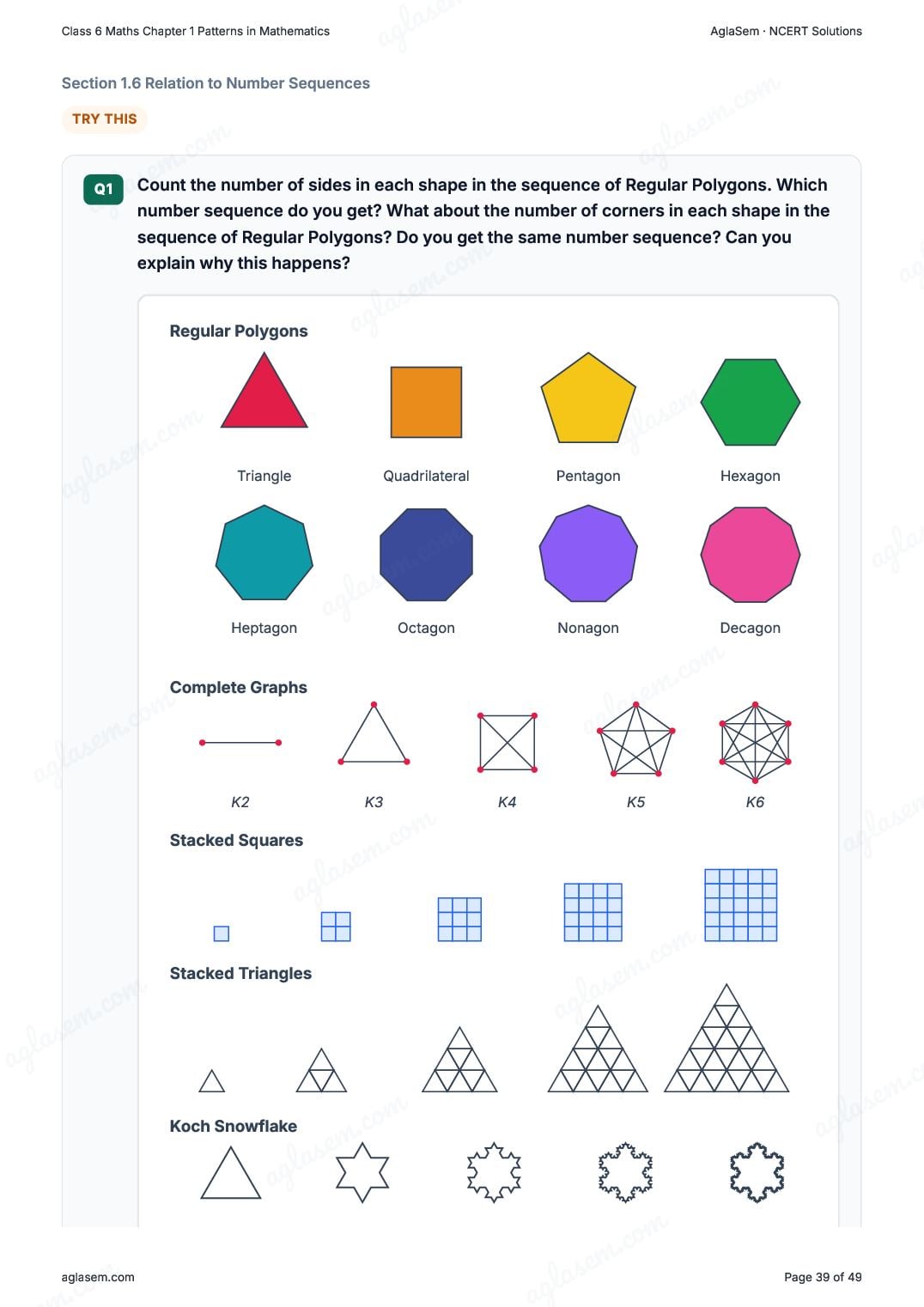
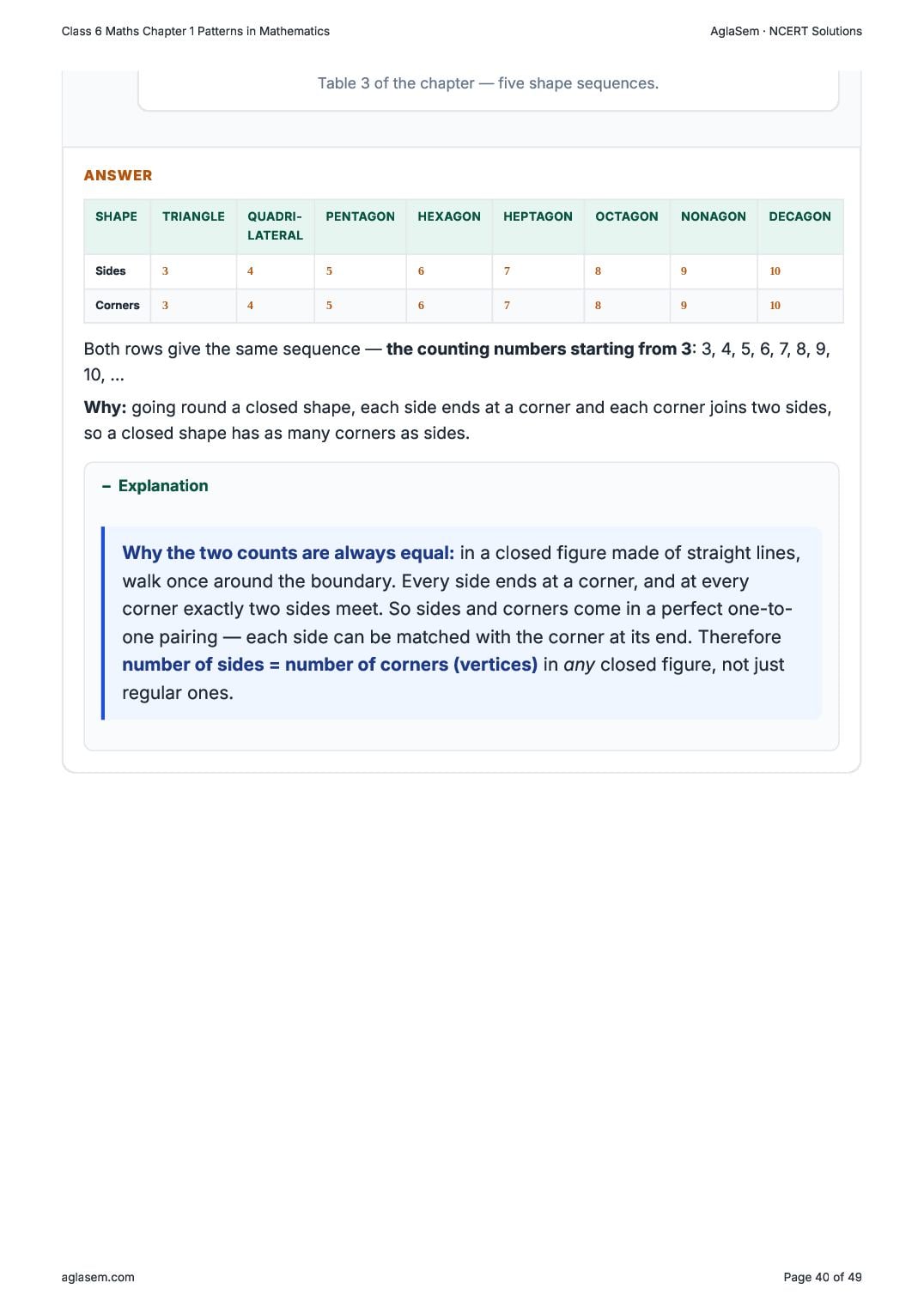
- Count the number of sides in each shape in the sequence of Regular Polygons. Which number sequence do you get? What about the number of corners in each shape in the sequence of Regular Polygons? Do you get the same number sequence? Can you explain why this happens?
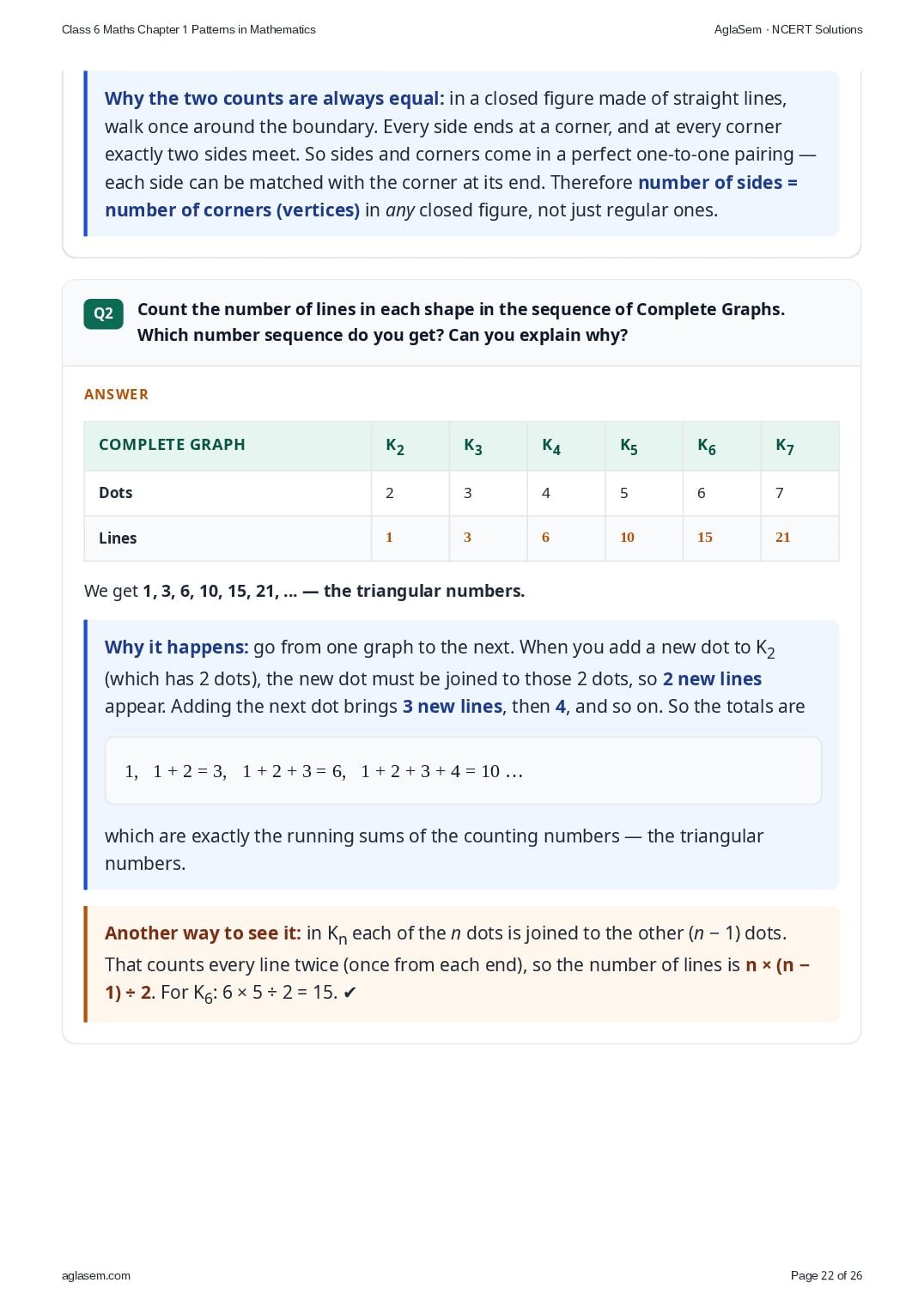
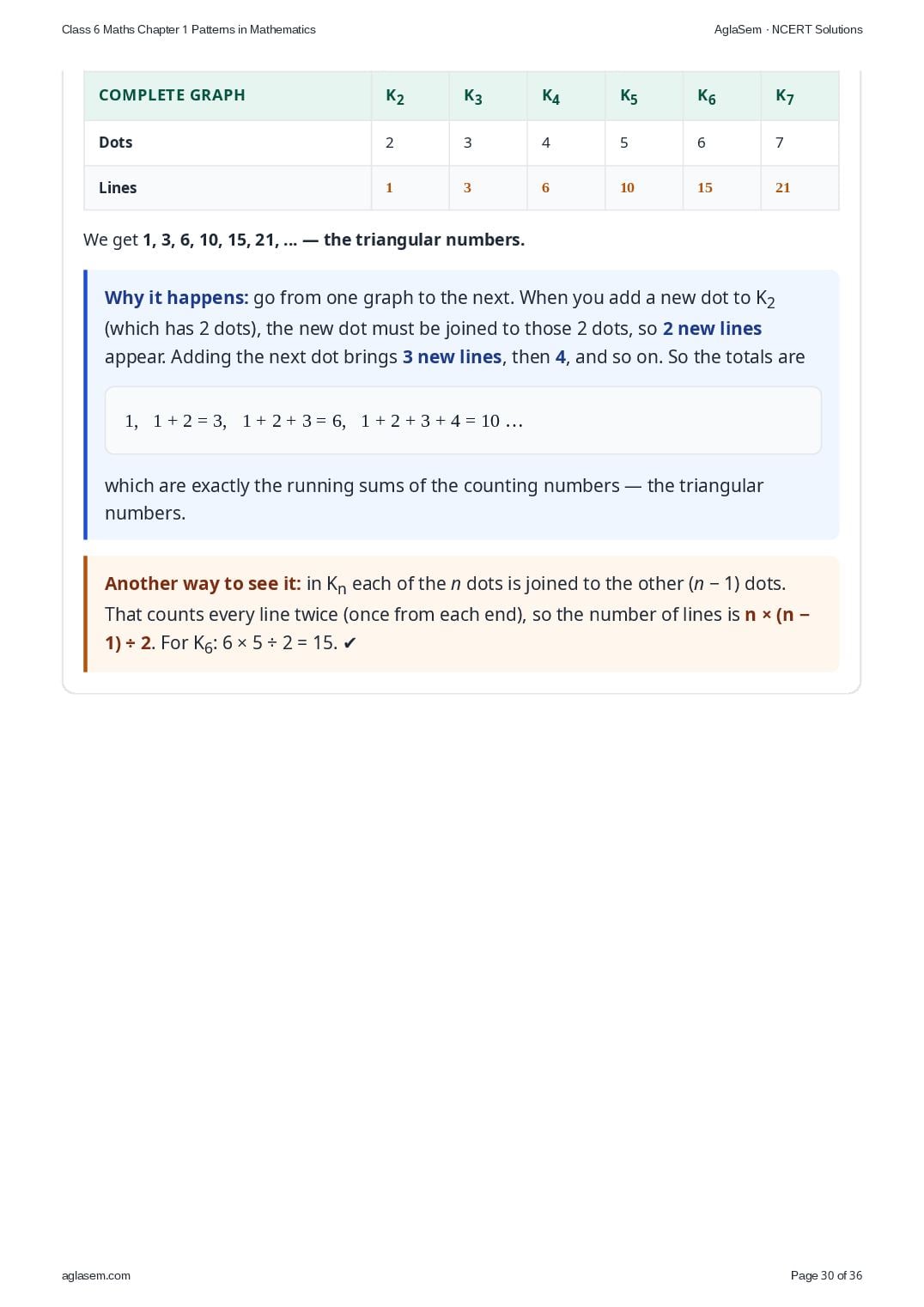
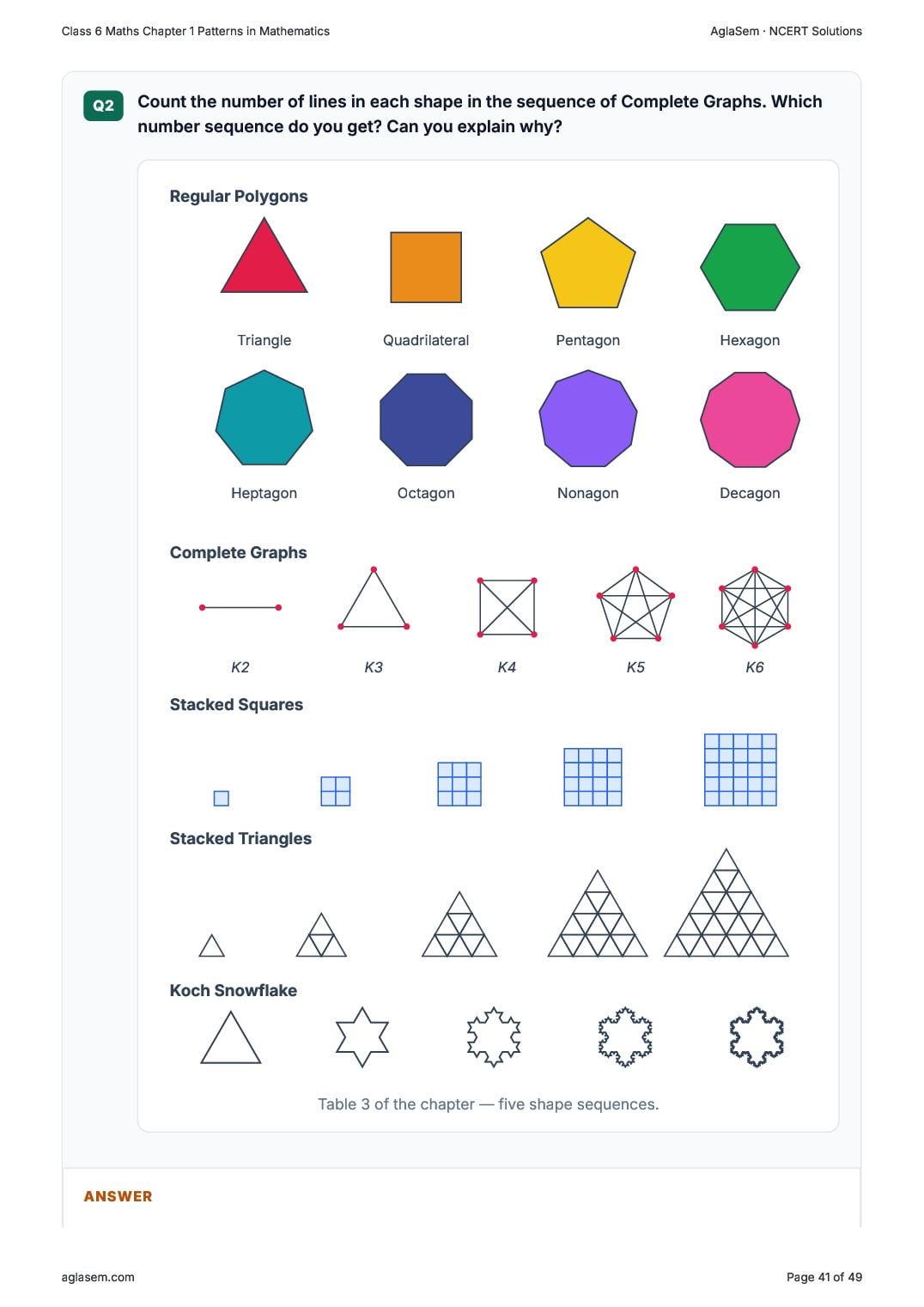
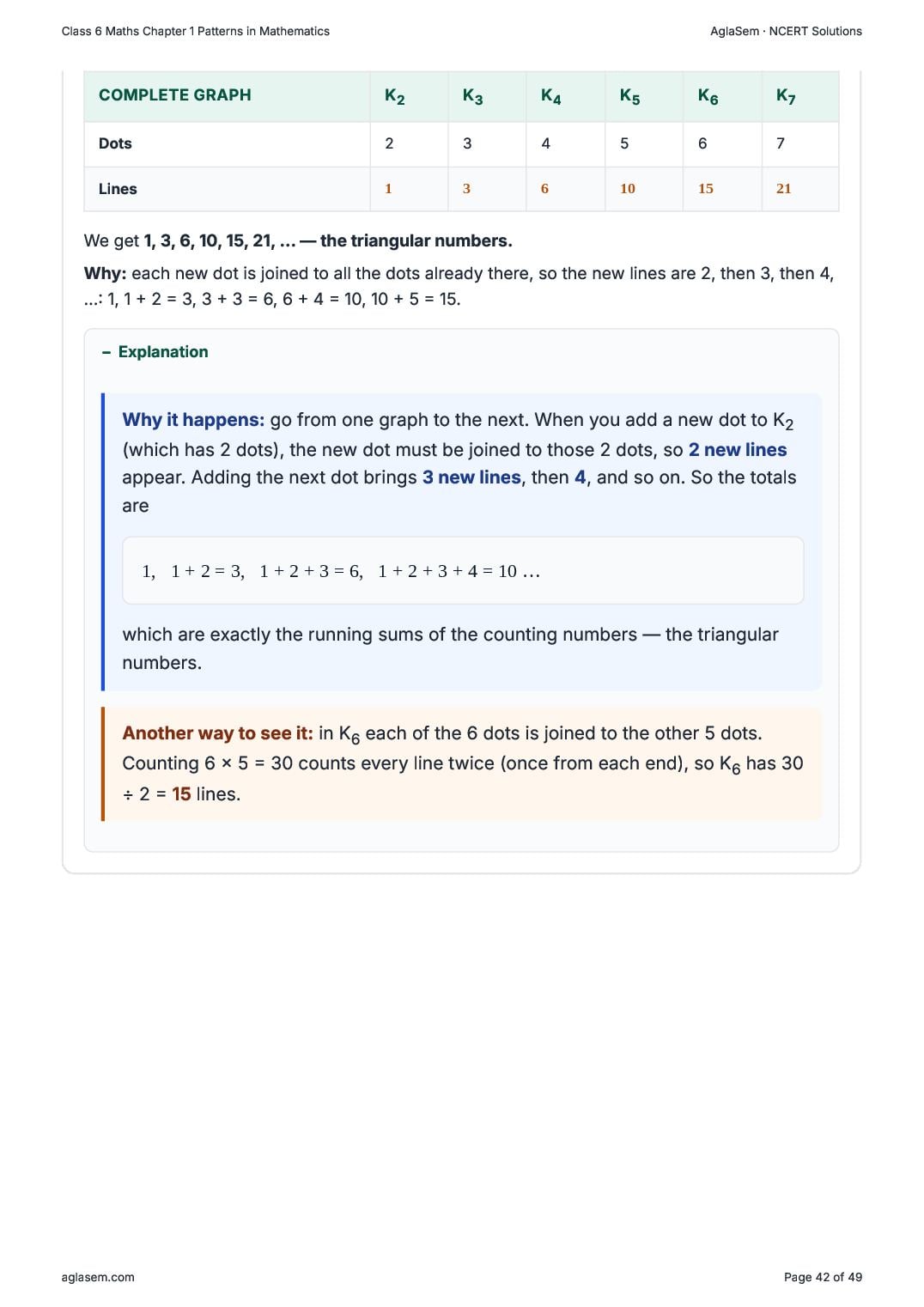
- Count the number of lines in each shape in the sequence of Complete Graphs. Which number sequence do you get? Can you explain why?
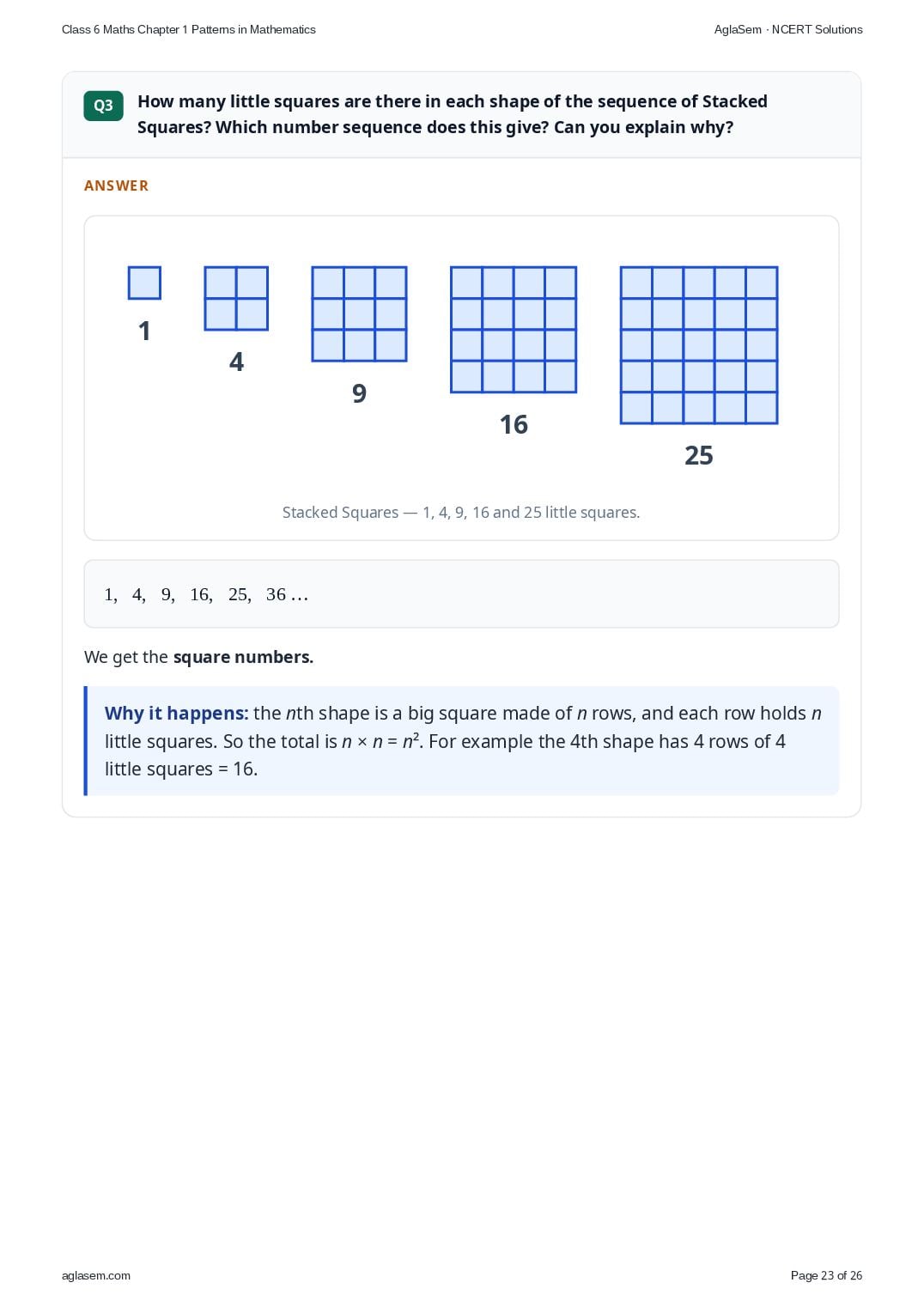
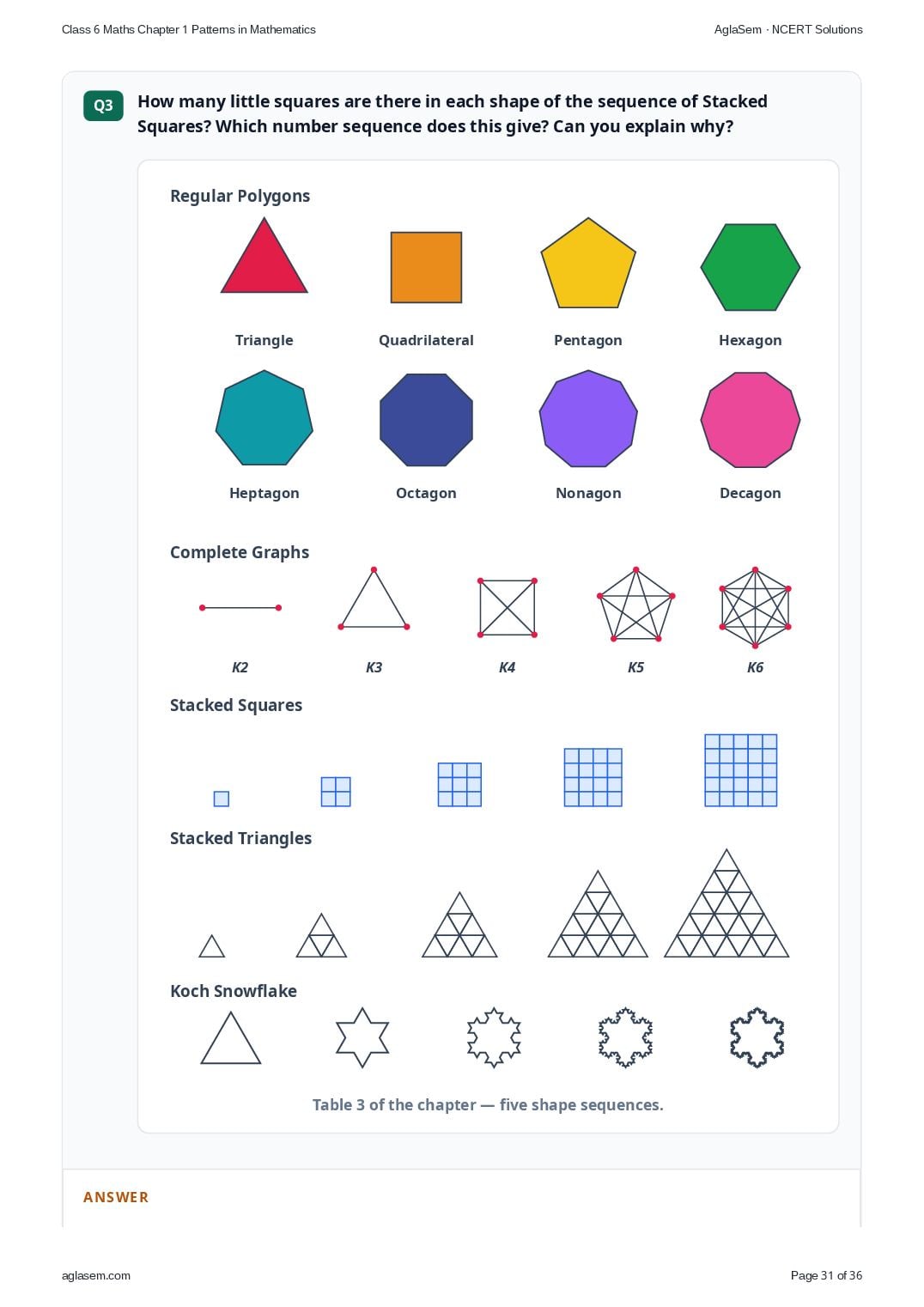
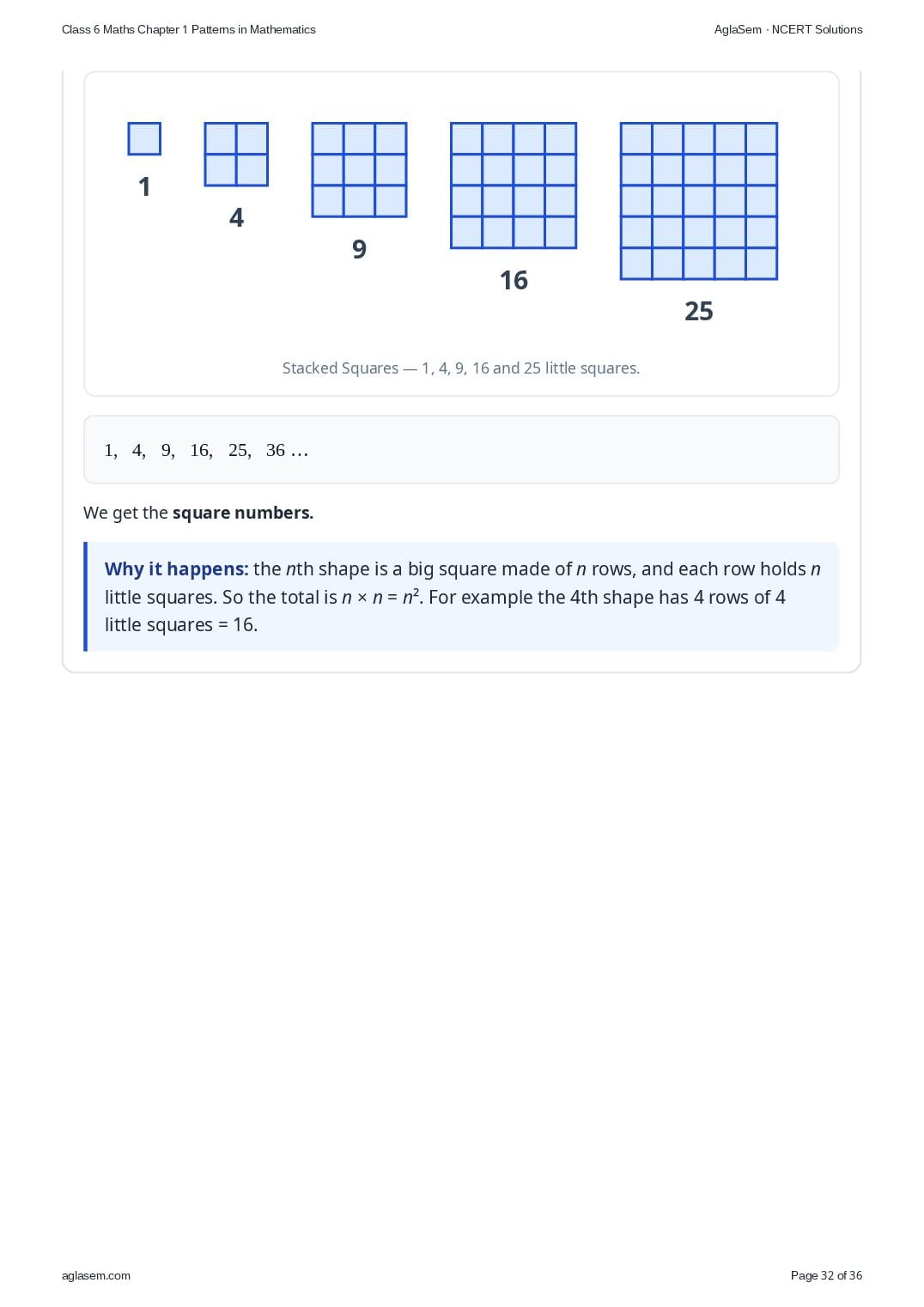
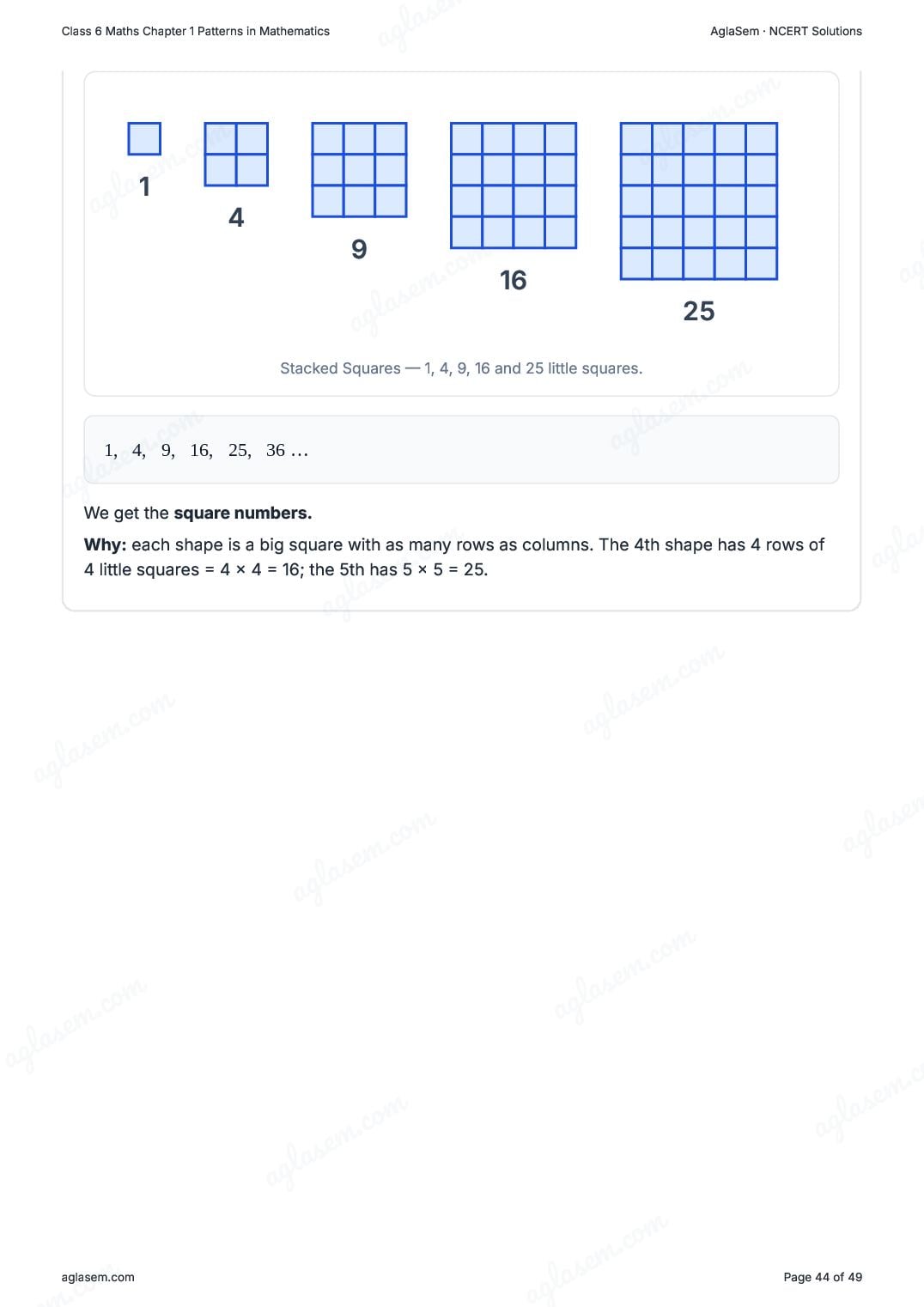
- How many little squares are there in each shape of the sequence of Stacked Squares? Which number sequence does this give? Can you explain why?
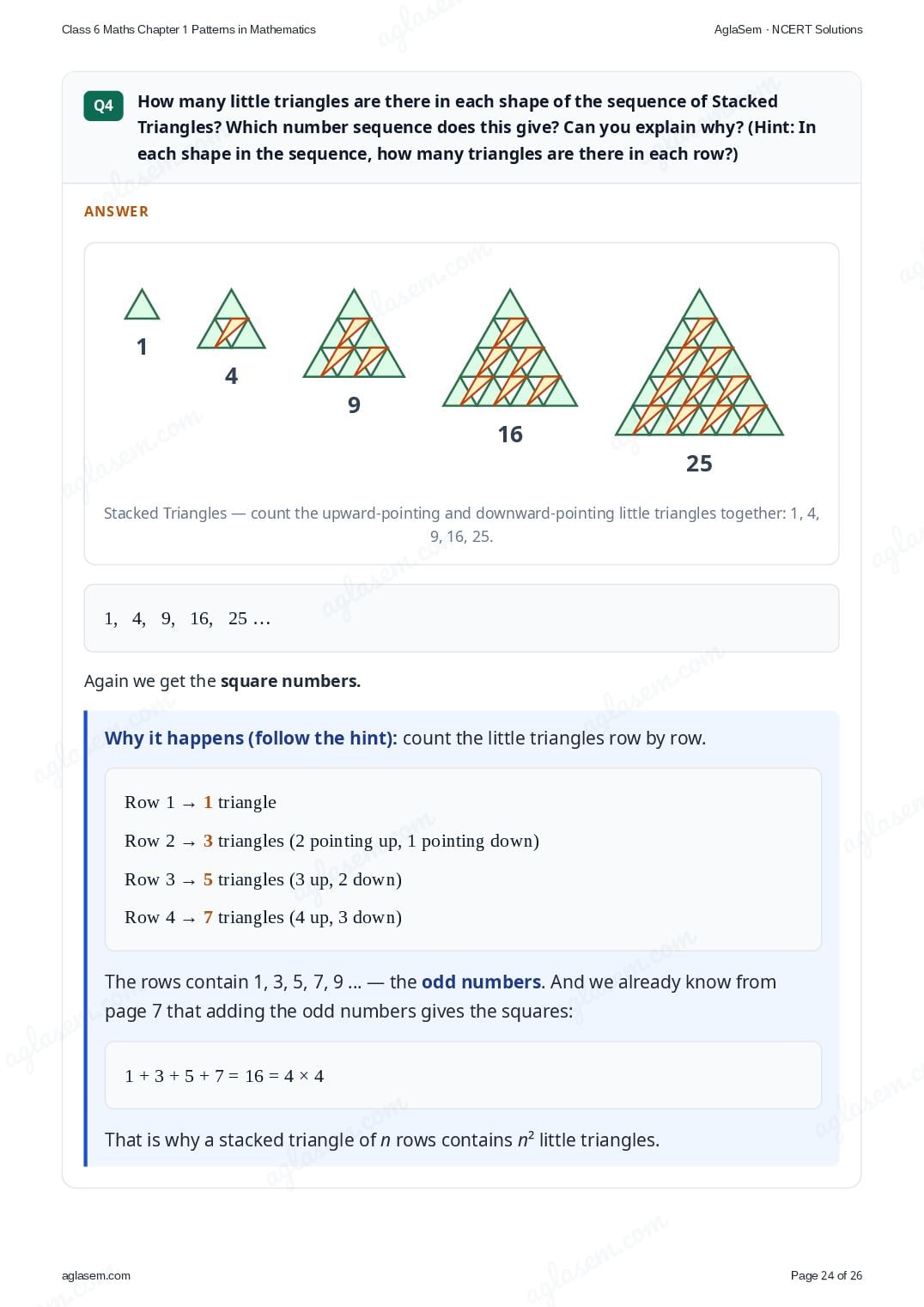
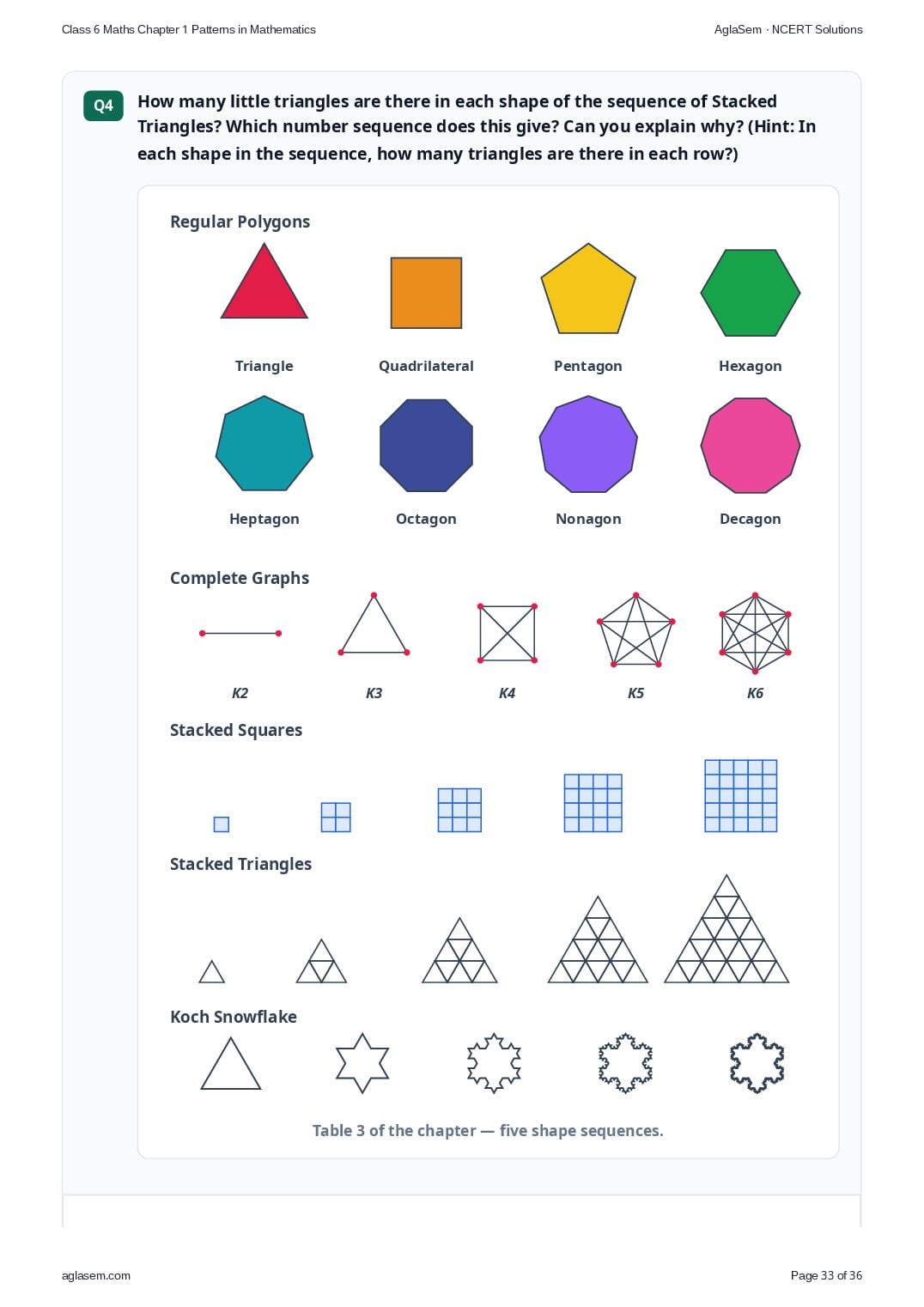
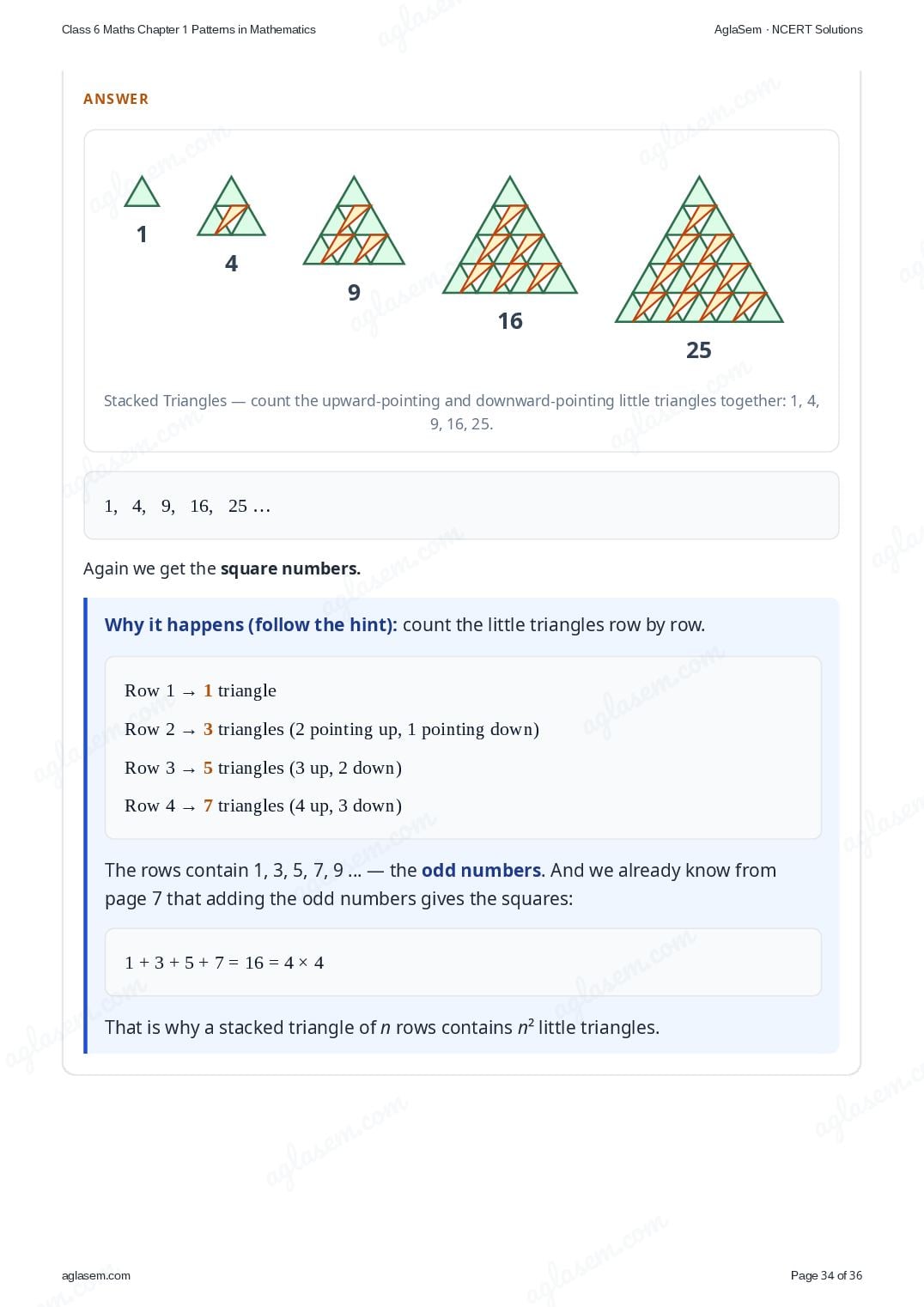
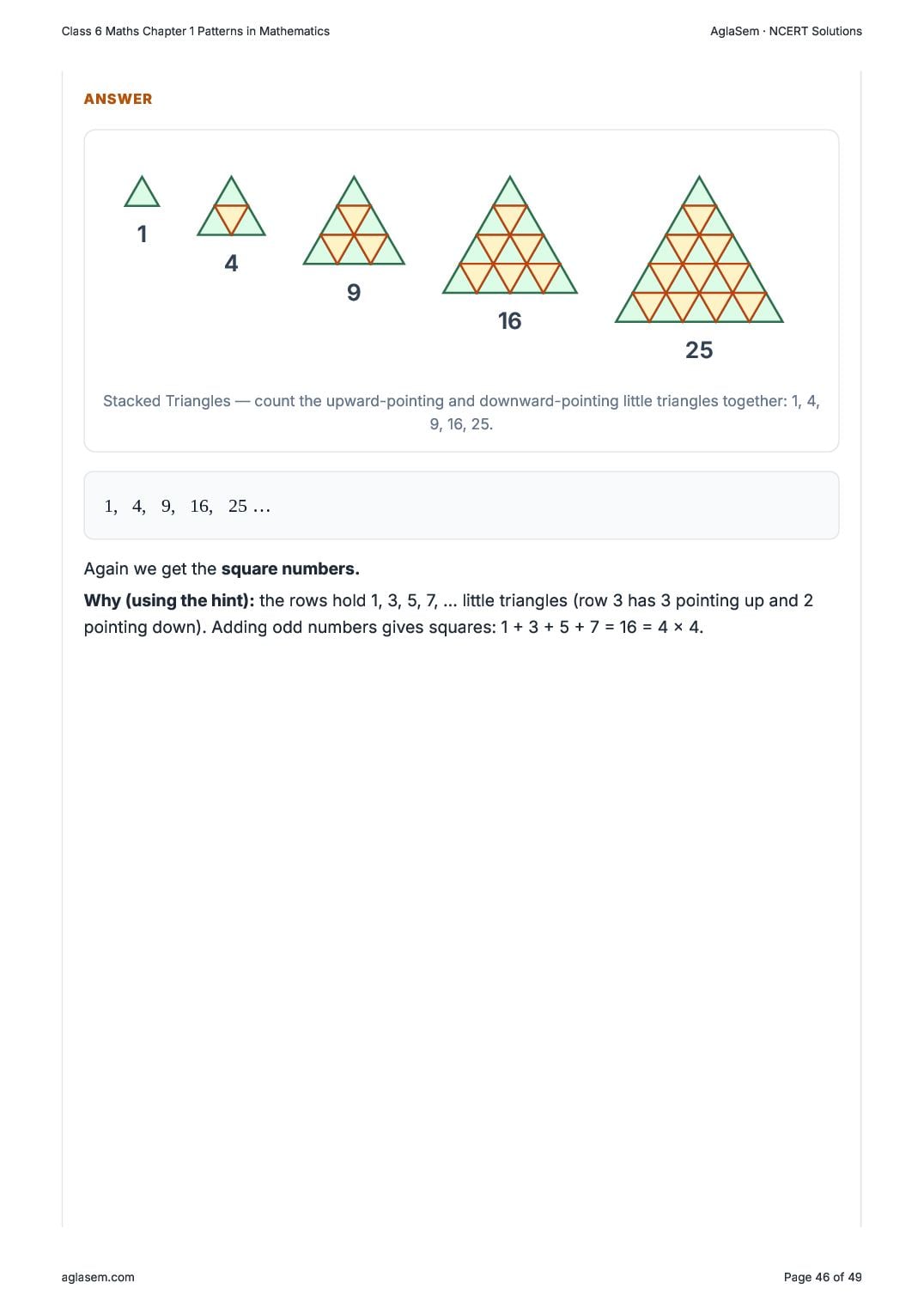
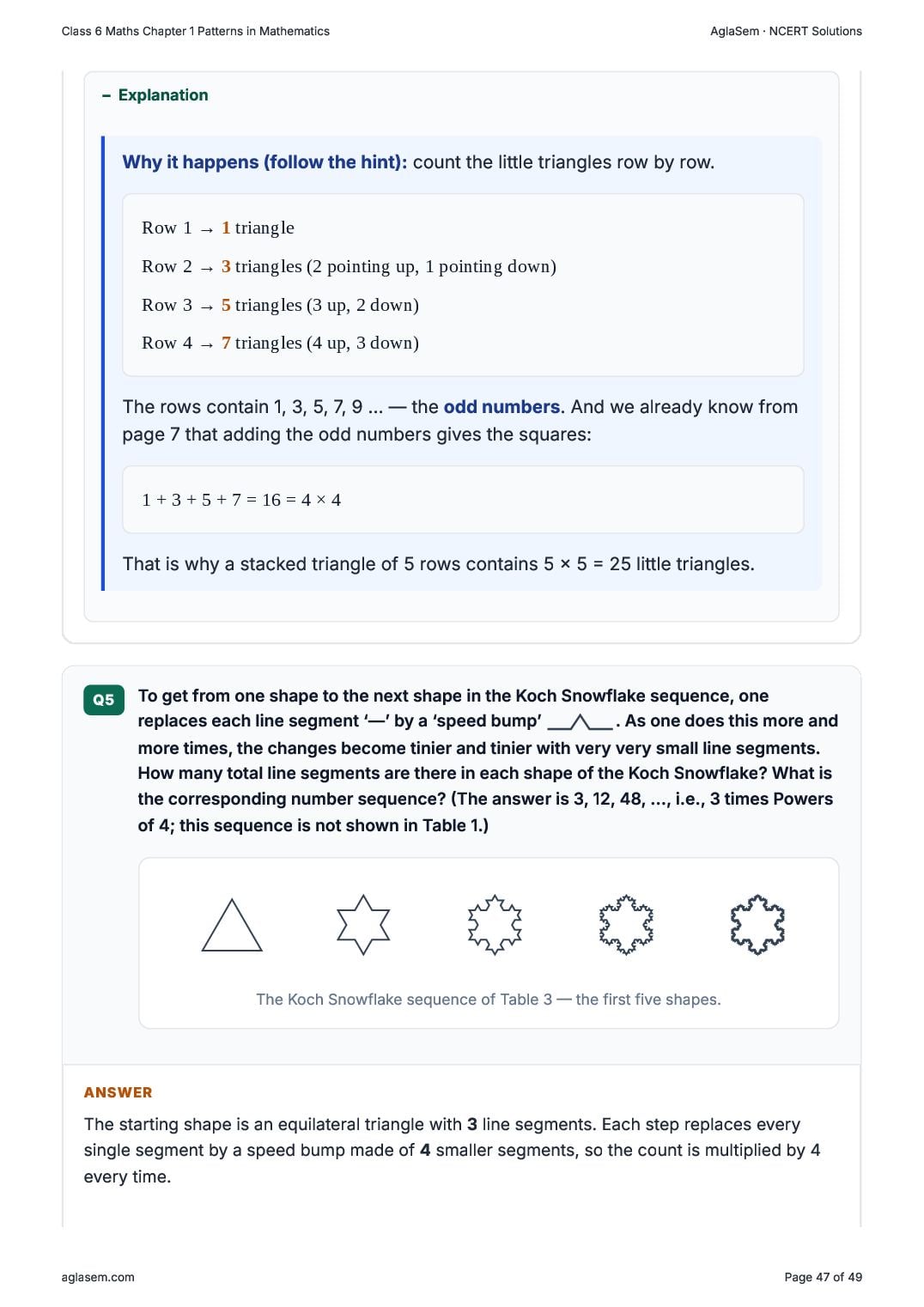
- How many little triangles are there in each shape of the sequence of Stacked Triangles? Which number sequence does this give? Can you explain why? (Hint: In each shape in the sequence, how many triangles are there in each row?)
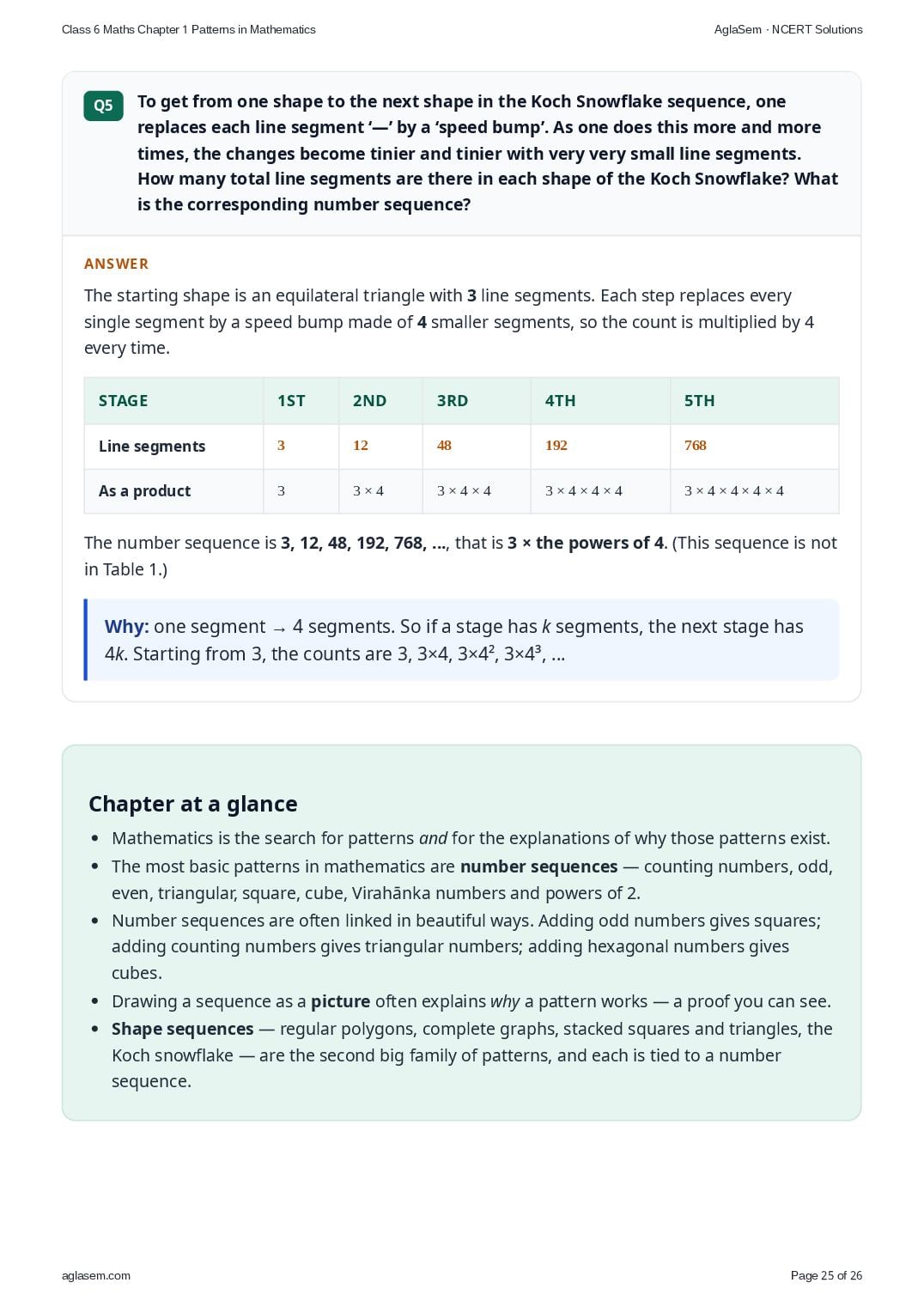
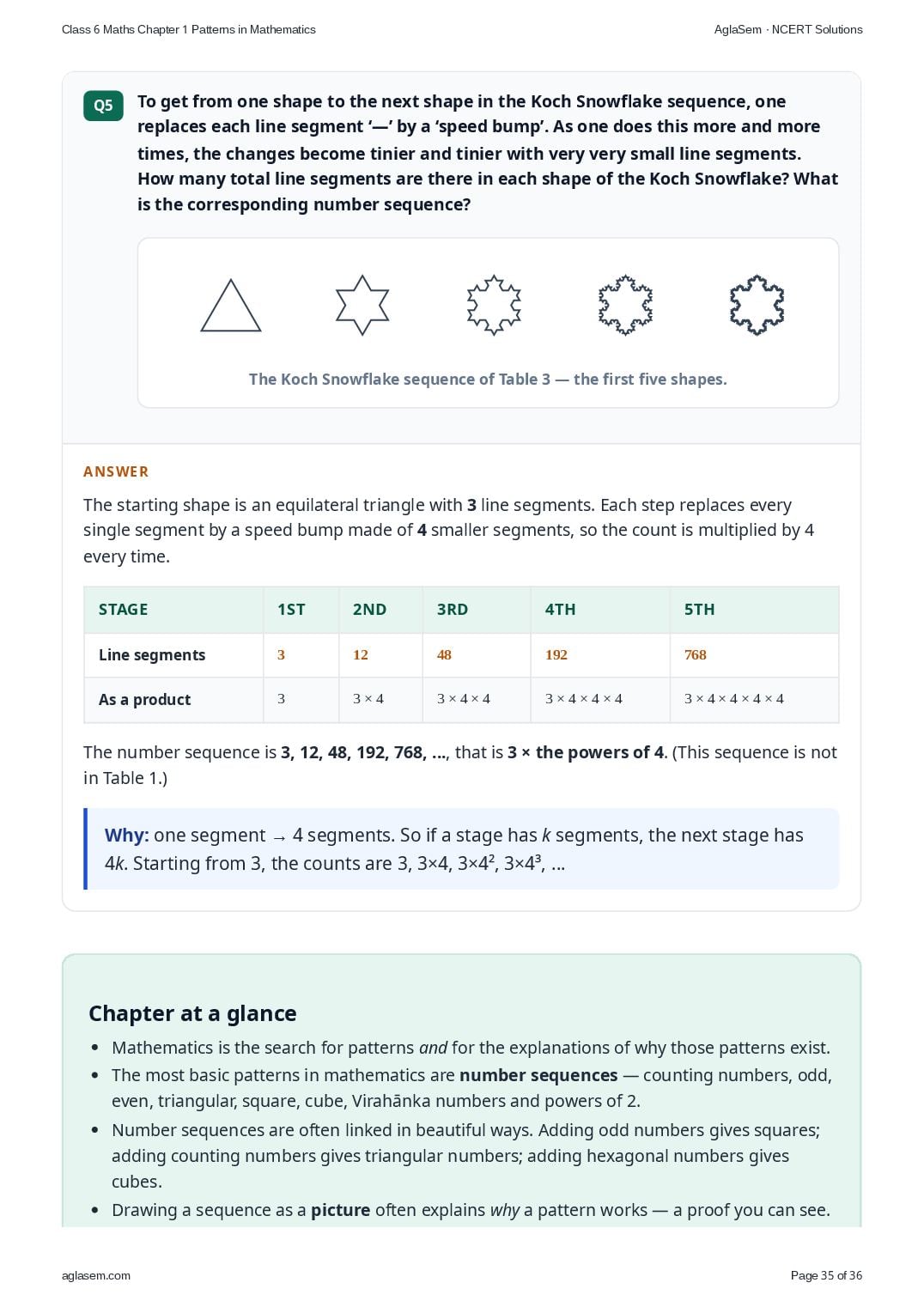
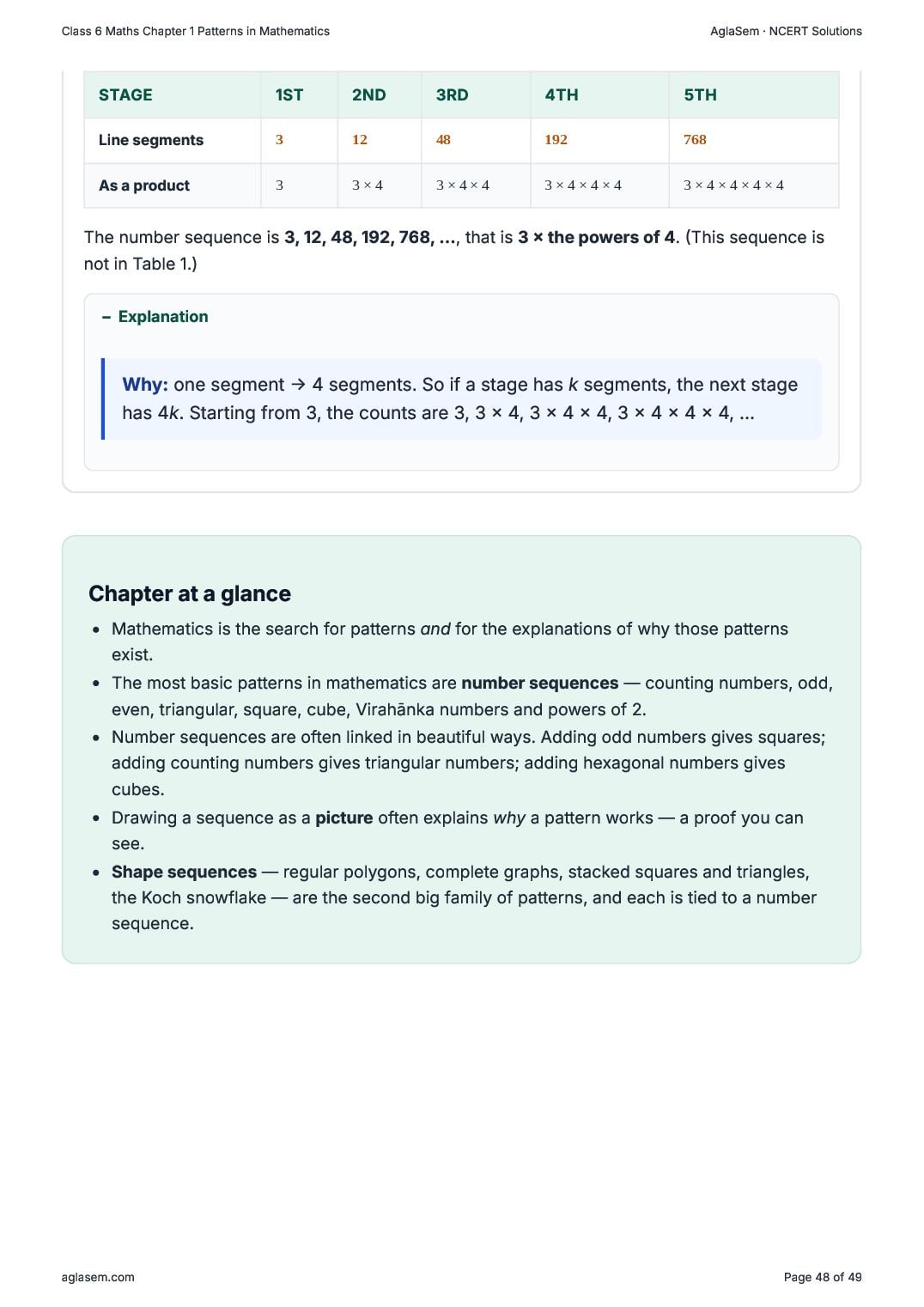
- To get from one shape to the next shape in the Koch Snowflake sequence, one replaces each line segment ‘—’ by a ‘speed bump’. As one does this more and more times, the changes become tinier and tinier with very very small line segments. How many total line segments are there in each shape of the Koch Snowflake? What is the corresponding number sequence?
Chapter at a Glance
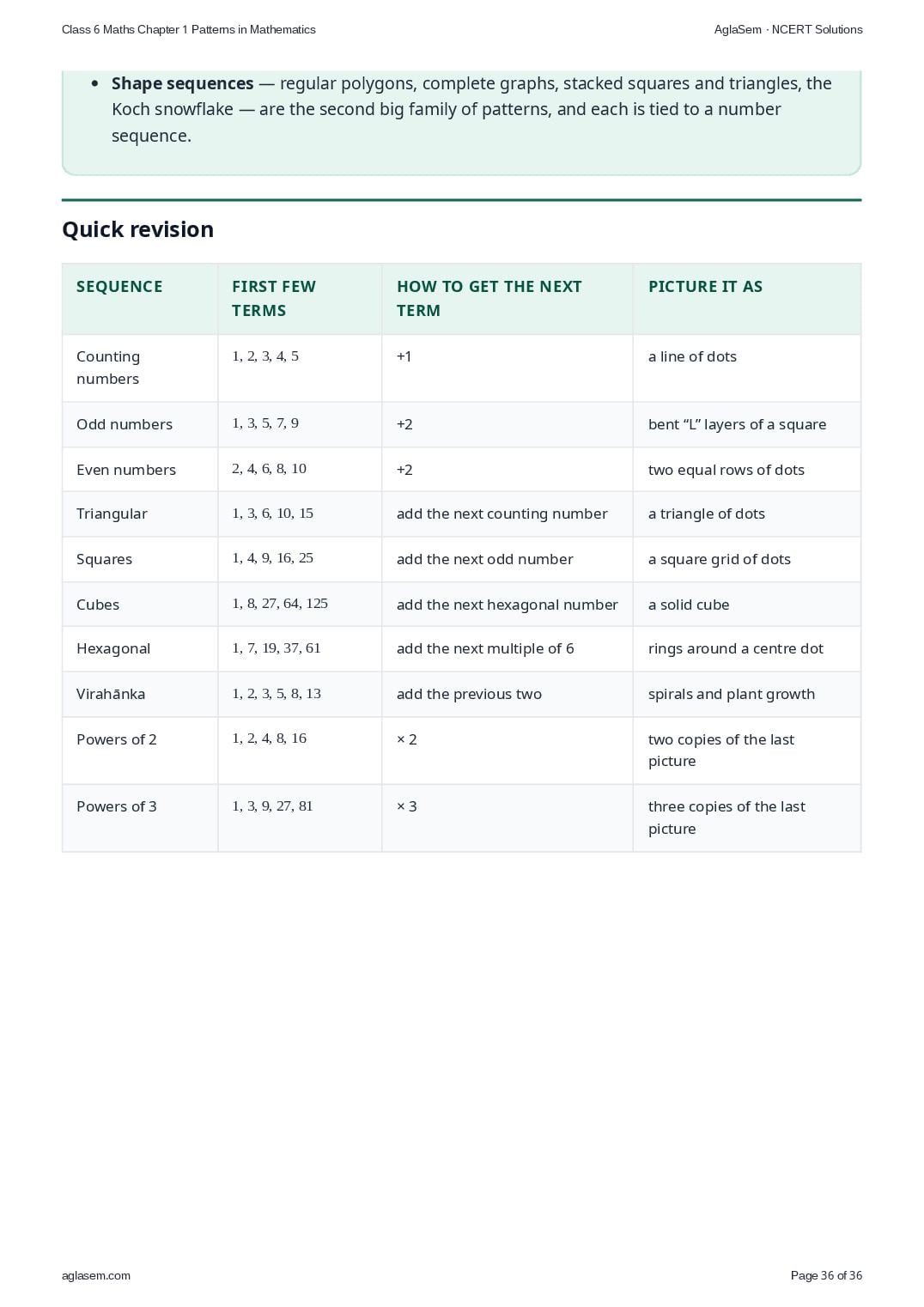
- Mathematics is the search for patterns and for the explanations of why those patterns exist.
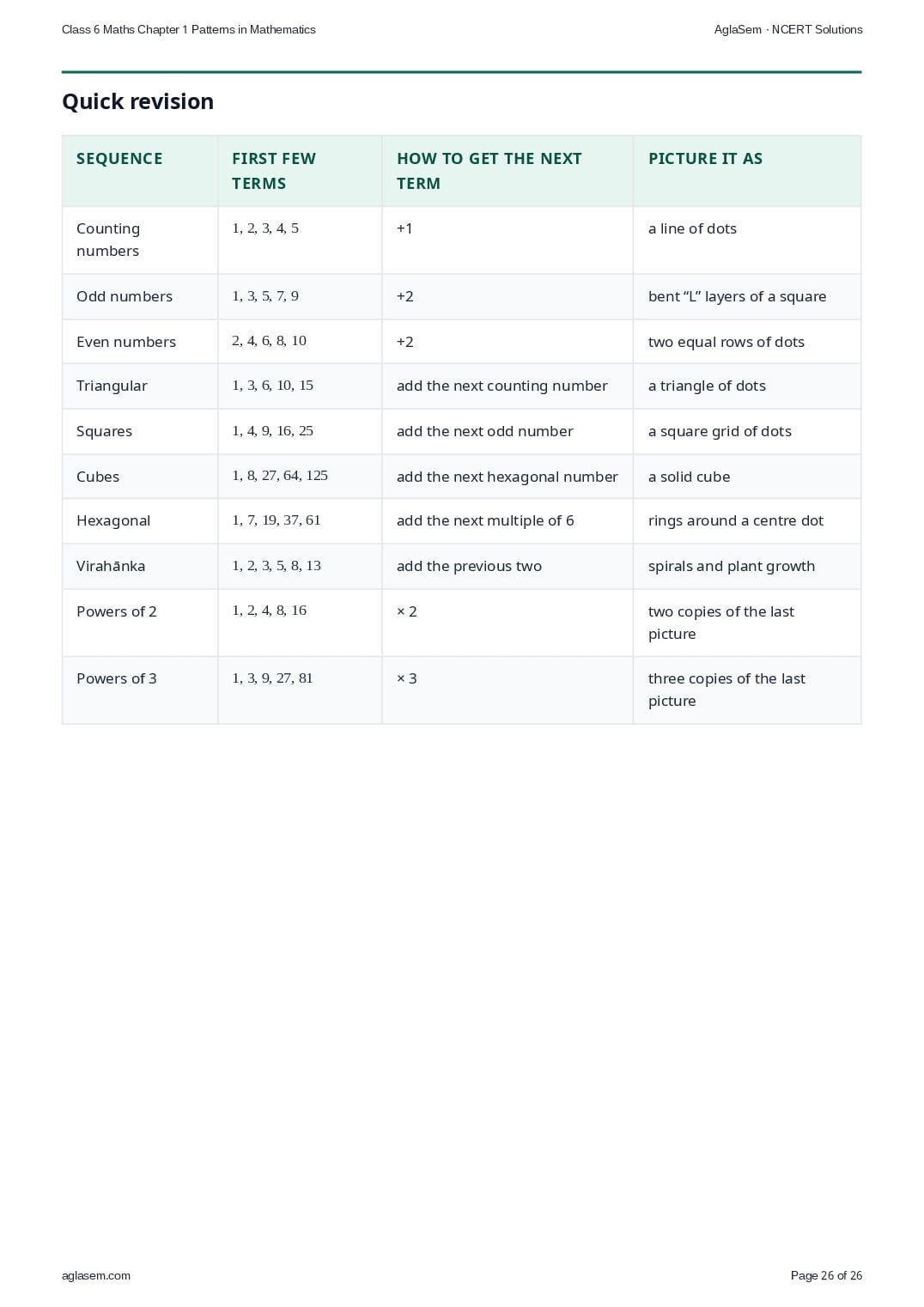
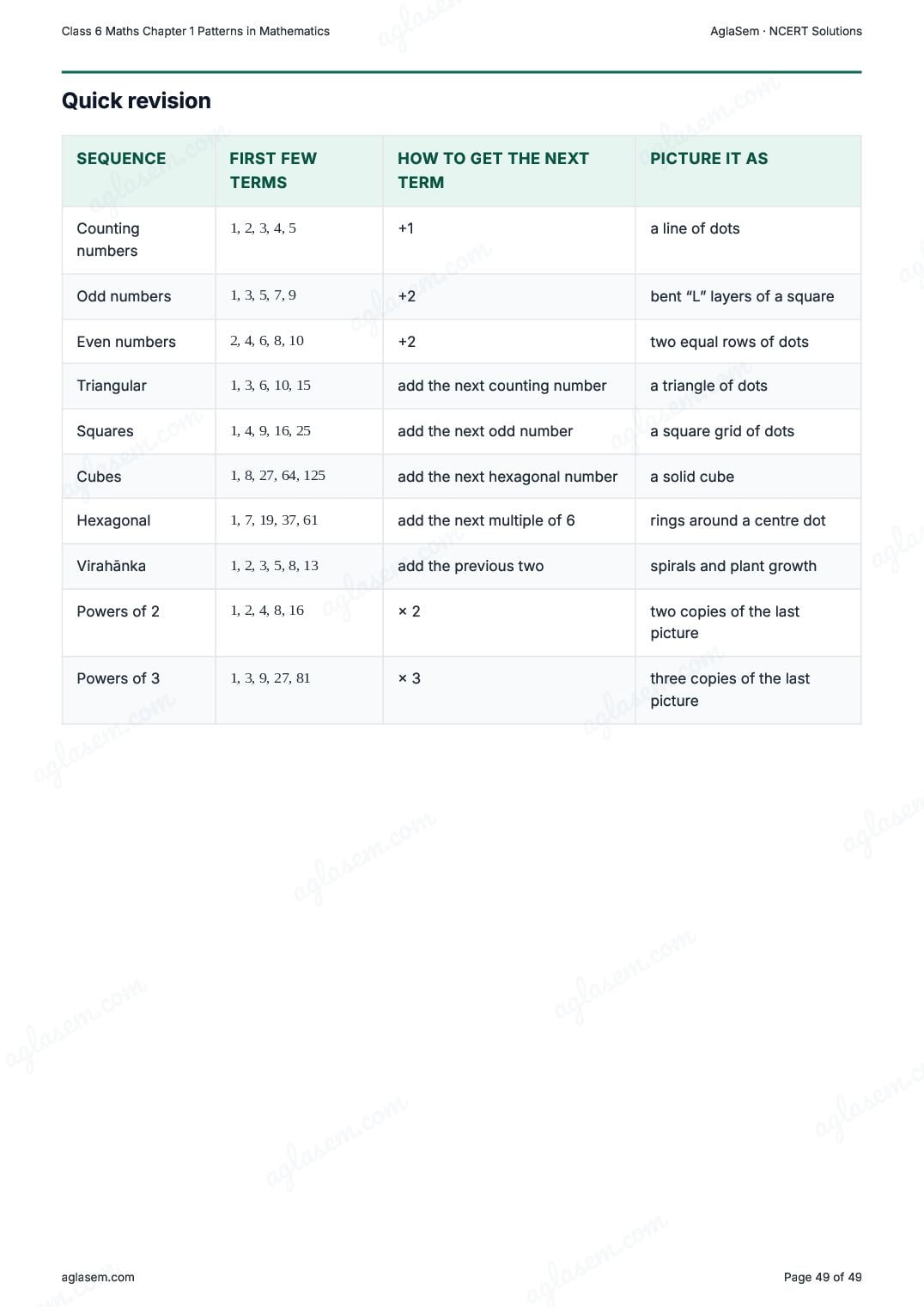
- The most basic patterns in mathematics are number sequences — counting numbers, odd, even, triangular, square, cube, Virahānka numbers and powers of 2.
- Number sequences are often linked in beautiful ways. Adding odd numbers gives squares; adding counting numbers gives triangular numbers; adding hexagonal numbers gives cubes.
- Drawing a sequence as a picture often explains why a pattern works — a proof you can see.
- Shape sequences — regular polygons, complete graphs, stacked squares and triangles, the Koch snowflake — are the second big family of patterns, and each is tied to a number sequence.
How to Download NCERT Solutions for Class 6 Maths Chapter 1 PDF
Follow these simple steps to get the Patterns in Mathematics questions-and-answers PDF from Ganita Prakash.
- Search NCERT Solutions for Class 6 Maths Chapter 1 aglasem and open this page.
- Read the exercise questions with answers for Patterns in Mathematics shown above.
- Click the Download PDF link to save the Patterns in Mathematics solutions to your device.
NCERT Solutions for Class 6 Maths – All Chapters
There are more chapters to study besides Patterns in Mathematics in Maths. Here are the NCERT Solutions for all chapters of Class 6 Maths.
- Chapter 1 Patterns in Mathematics
- Chapter 2 Lines and Angles
- Chapter 3 Number Play
- Chapter 4 Data Handling and Presentation
- Chapter 5 Prime Time
- Chapter 6 Perimeter and Area
- Chapter 7 Fractions
- Chapter 8 Playing with Constructions
- Chapter 9 Symmetry
- Chapter 10 the Other Side of Zero
NCERT Solutions for Class 6 – All Subjects
Just like Chapter 1 of Maths, you can get the exercise questions with answers for every other subject of Class 6. Here are the NCERT Solutions for all subjects of Class 6.
NCERT Solutions for Class 6 Maths Chapter 1 – An Overview
The key highlights of this study material are as follows.
| Aspects | Details |
|---|---|
| Class | Class 6 |
| Subject | Maths |
| Chapter Number | Chapter 1 |
| Chapter Name | Patterns in Mathematics |
| Book Name | Ganita Prakash |
| Book By | NCERT (National Council of Educational Research and Training) |
| Educational Resource Here | NCERT Solutions of Class 6 Maths Chapter 1 for all exercises |
| More Questions Answers of This Subject | NCERT Solutions for Class 6 Maths |
| Download Book Chapter | NCERT Book Class 6 Maths |
| All Questions Answers For This Class | NCERT Solutions for Class 6 |
| Complete Solutions | NCERT Solutions |
NCERT Solutions for Class 6 Maths Chapter 1 Patterns in Mathematics – FAQs
What are the NCERT Solutions for Class 6 Maths Chapter 1 Patterns in Mathematics?
They are the complete, step-by-step answers to all the exercise and in-text questions of Chapter 1 Patterns in Mathematics from the NCERT Class 6 Maths textbook Ganita Prakash, written by experts as per the latest NCERT syllabus.
How can I download the Class 6 Maths Chapter 1 solutions PDF for free?
Open this page on aglasem, read the Patterns in Mathematics questions with answers, and click the “Download Solutions PDF” link. The Class 6 Maths Chapter 1 NCERT Solutions PDF is completely free to download.
Are these NCERT Solutions as per the latest 2026-27 syllabus?
Yes. The NCERT Solutions for Class 6 Maths Chapter 1 are based on the latest NCERT textbook Ganita Prakash and the current 2026-27 CBSE syllabus, so the questions and answers match what you study in class.
Where can I get NCERT Solutions for the other chapters of Class 6 Maths?
You can find the answers to every chapter on the NCERT Solutions for Class 6 Maths page, and solutions for every subject on the NCERT Solutions for Class 6 page.
How do NCERT Solutions help in exam preparation?
They show the correct method to solve each question, help you write answers the way they are expected in exams, let you check and correct your own work, and save revision time — which together improve your marks in Class 6 Maths.
If you have any queries on NCERT Solutions for Class 6 Maths Chapter 1 Patterns in Mathematics, then please ask in the comments below.