NCERT Solutions for Class 6 Maths Chapter 7 Fractions provide clear, step-by-step answers to every exercise and in-text question from the chapter Fractions of the NCERT textbook Ganita Prakash. Prepared by subject experts as per the latest NCERT (CBSE) syllabus for 2026-27, these NCERT Solutions for Class 6 Maths help you understand each concept, write exam-ready answers, and check your own solutions. You can read them online below or download the free Class 6 Maths Chapter 7 question-answer PDF.
NCERT Solutions for Class 6 Maths Chapter 7 Fractions
- Class: Class 6
- Subject: Maths
- Chapter: Chapter 7 – Fractions
- Textbook: Ganita Prakash (NCERT)
- Study material: NCERT Solutions – questions with answers, free PDF
These solutions answer all the exercise questions of Chapter 7 Fractions — including the in-text questions, short-answer and long-answer questions, and activities — with complete explanations so you can follow the method, not just the final answer. Read the full solutions below.
NCERT Solutions Class 6 Maths Chapter 7 Fractions View Download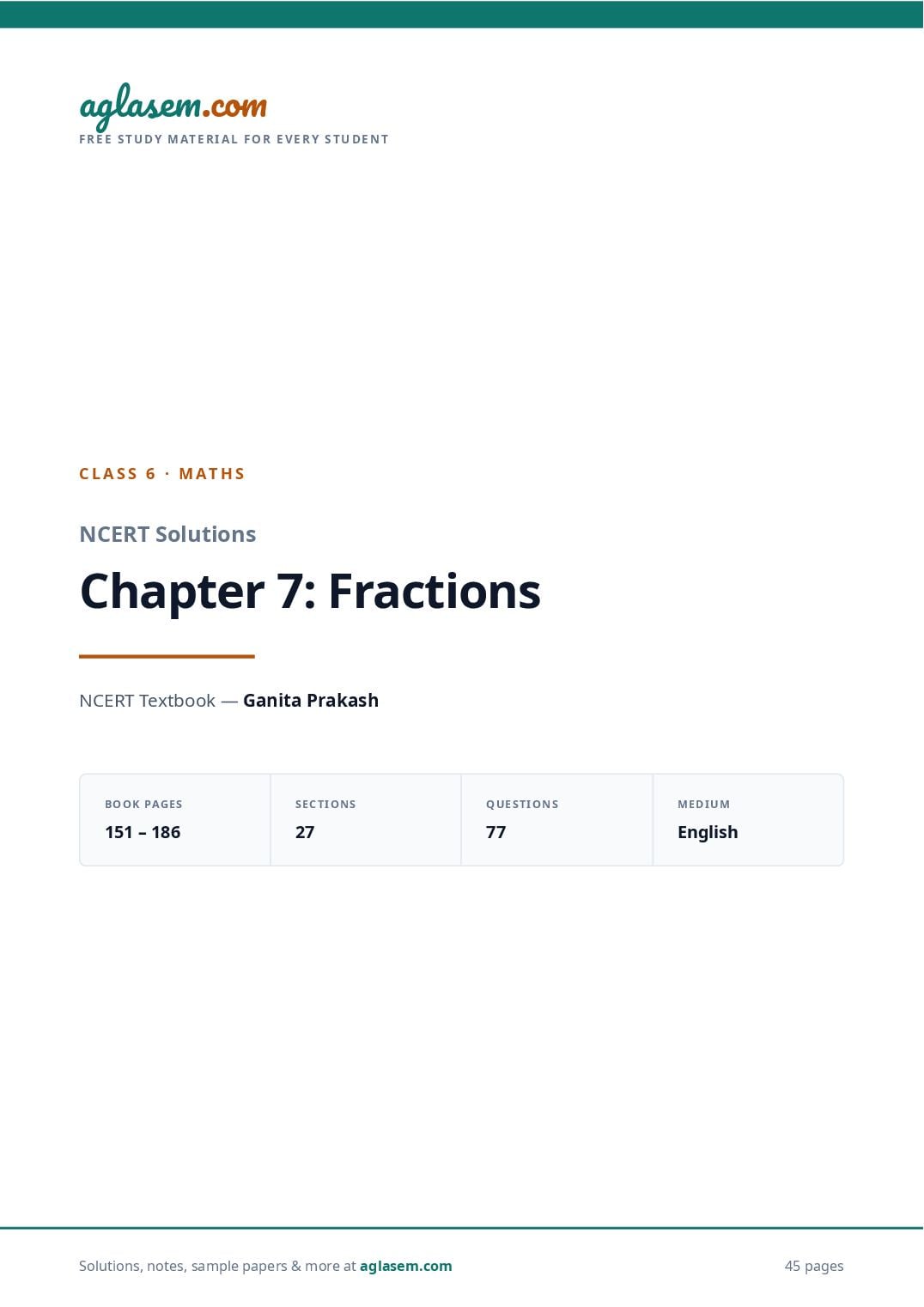
NCERT Solutions for Class 6 Maths Chapter 7 PDF Download
You can read the NCERT Solutions for Class 6 Maths Chapter 7 online above, or download the complete question-answer PDF to study Fractions offline at any time.
NCERT Solutions for Class 6 Maths Chapter 7 PDF Download Link – Click Here to Download Solutions PDF
Questions Covered in This Chapter
These NCERT Solutions answer all 77 questions of this chapter. The questions solved are:
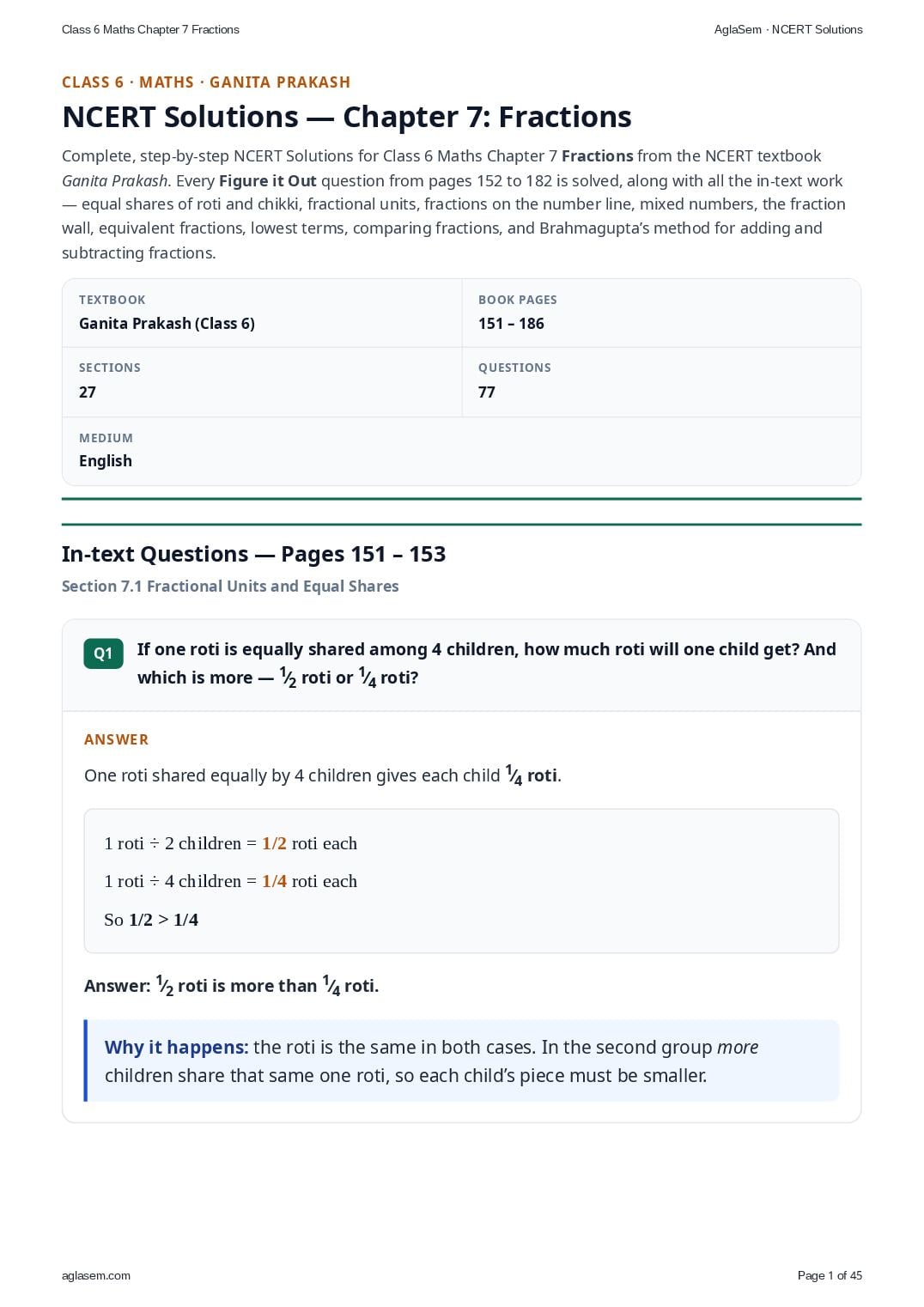
- If one roti is equally shared among 4 children, how much roti will one child get? And which is more — 1 ⁄ 2 roti or 1 ⁄ 4 roti?
- Which fraction is greater — 1 ⁄ 5 or 1 ⁄ 9 ?
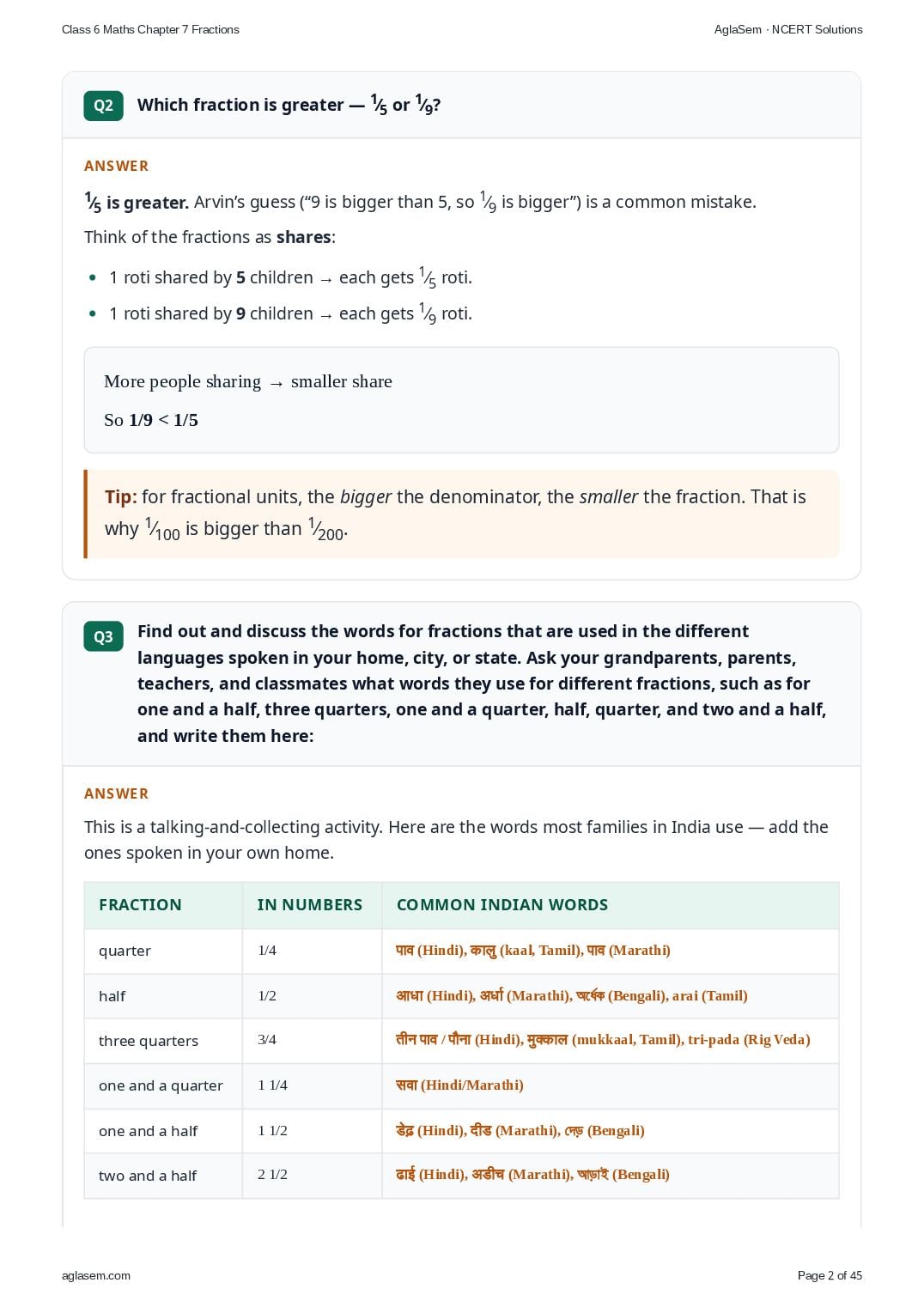
- Find out and discuss the words for fractions that are used in the different languages spoken in your home, city, or state. Ask your grandparents, parents, teachers, and classmates what words they use for different fractions, such as for one and a half, three quarters, one and a quarter, half, quarter, and two and a half, and write them here:
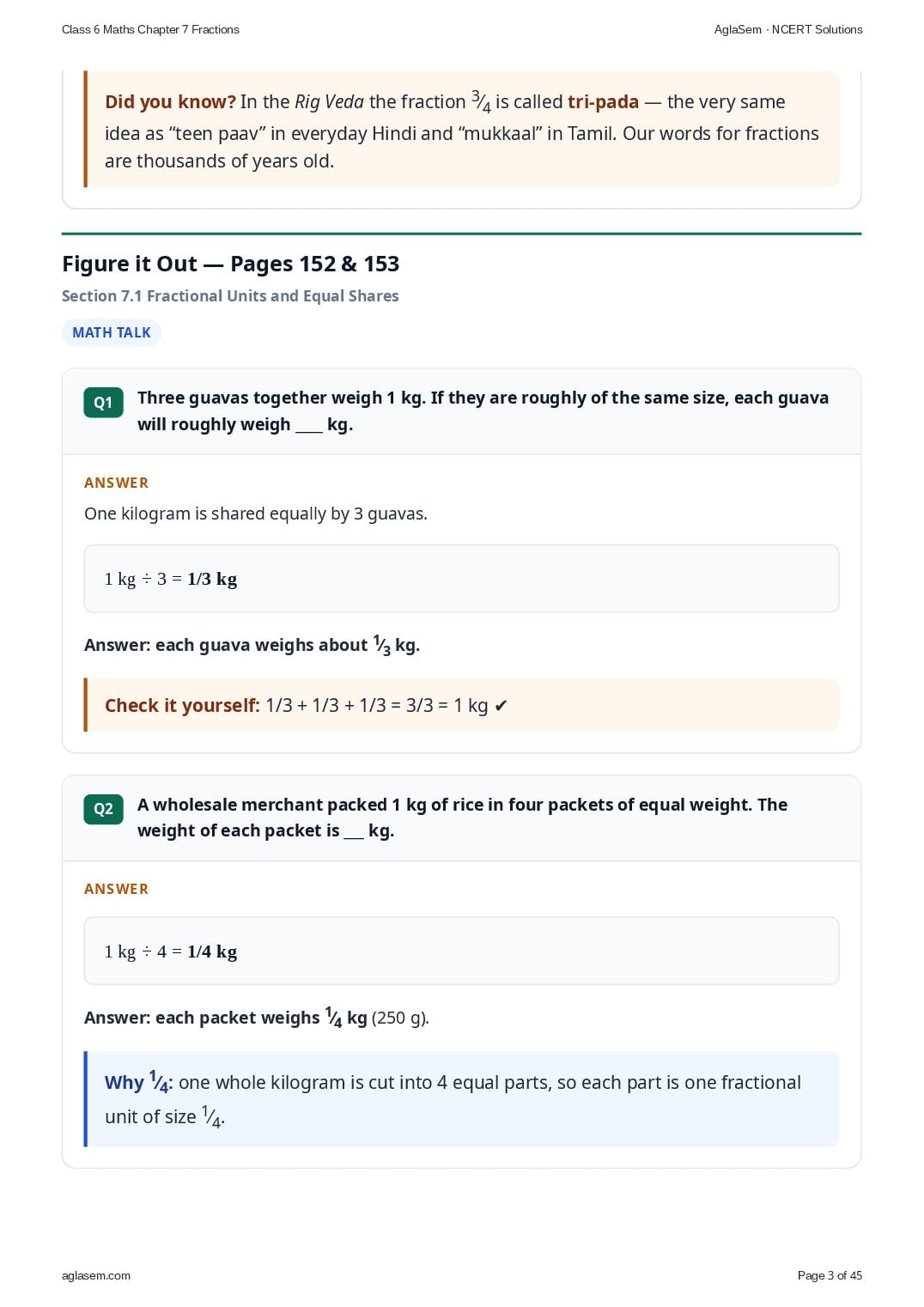
- Three guavas together weigh 1 kg. If they are roughly of the same size, each guava will roughly weigh ____ kg.
- A wholesale merchant packed 1 kg of rice in four packets of equal weight. The weight of each packet is ___ kg.
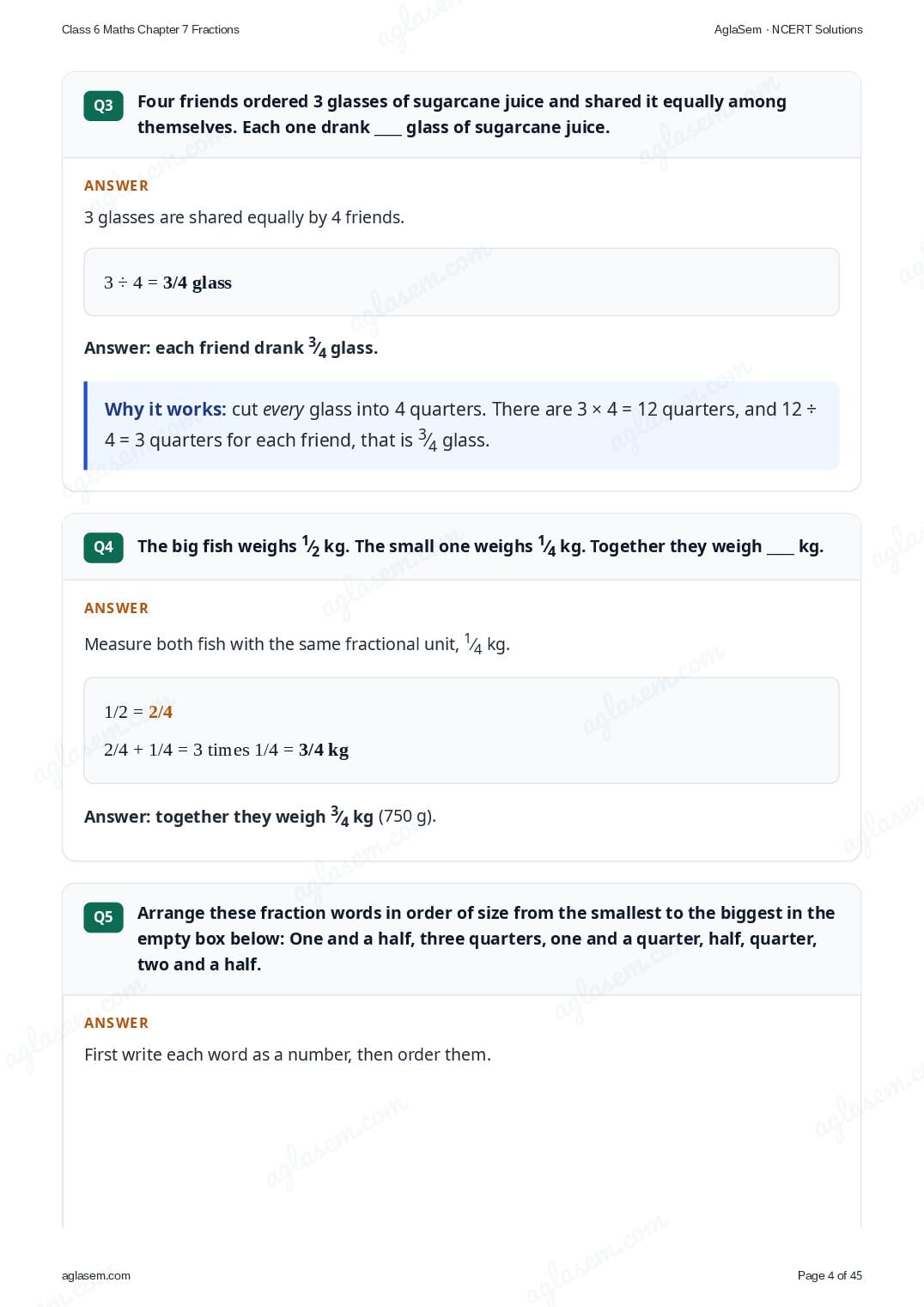
- Four friends ordered 3 glasses of sugarcane juice and shared it equally among themselves. Each one drank ____ glass of sugarcane juice.
- The big fish weighs 1 ⁄ 2 kg. The small one weighs 1 ⁄ 4 kg. Together they weigh ____ kg.
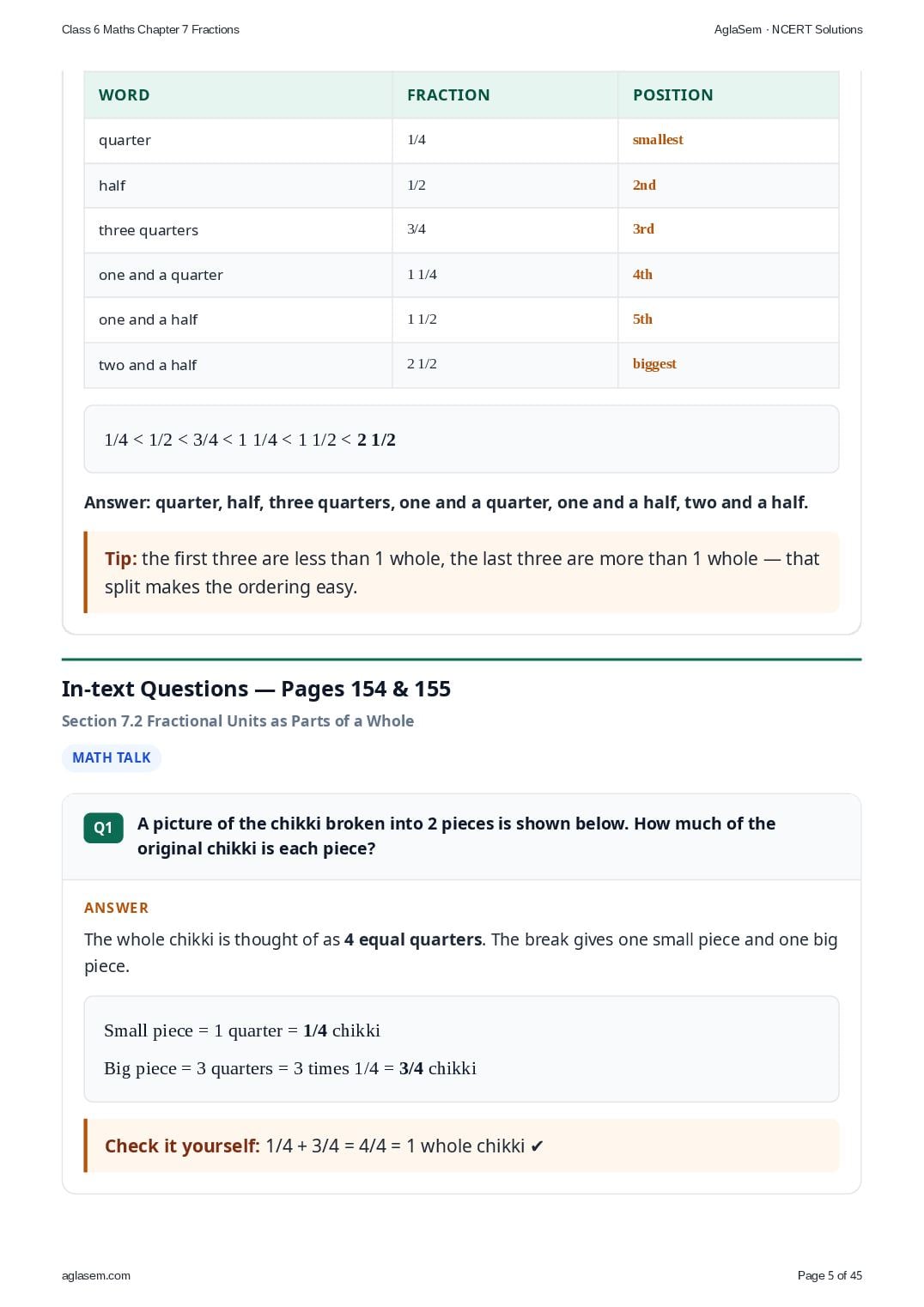
- Arrange these fraction words in order of size from the smallest to the biggest in the empty box below: One and a half, three quarters, one and a quarter, half, quarter, two and a half.
- A picture of the chikki broken into 2 pieces is shown below. How much of the original chikki is each piece?
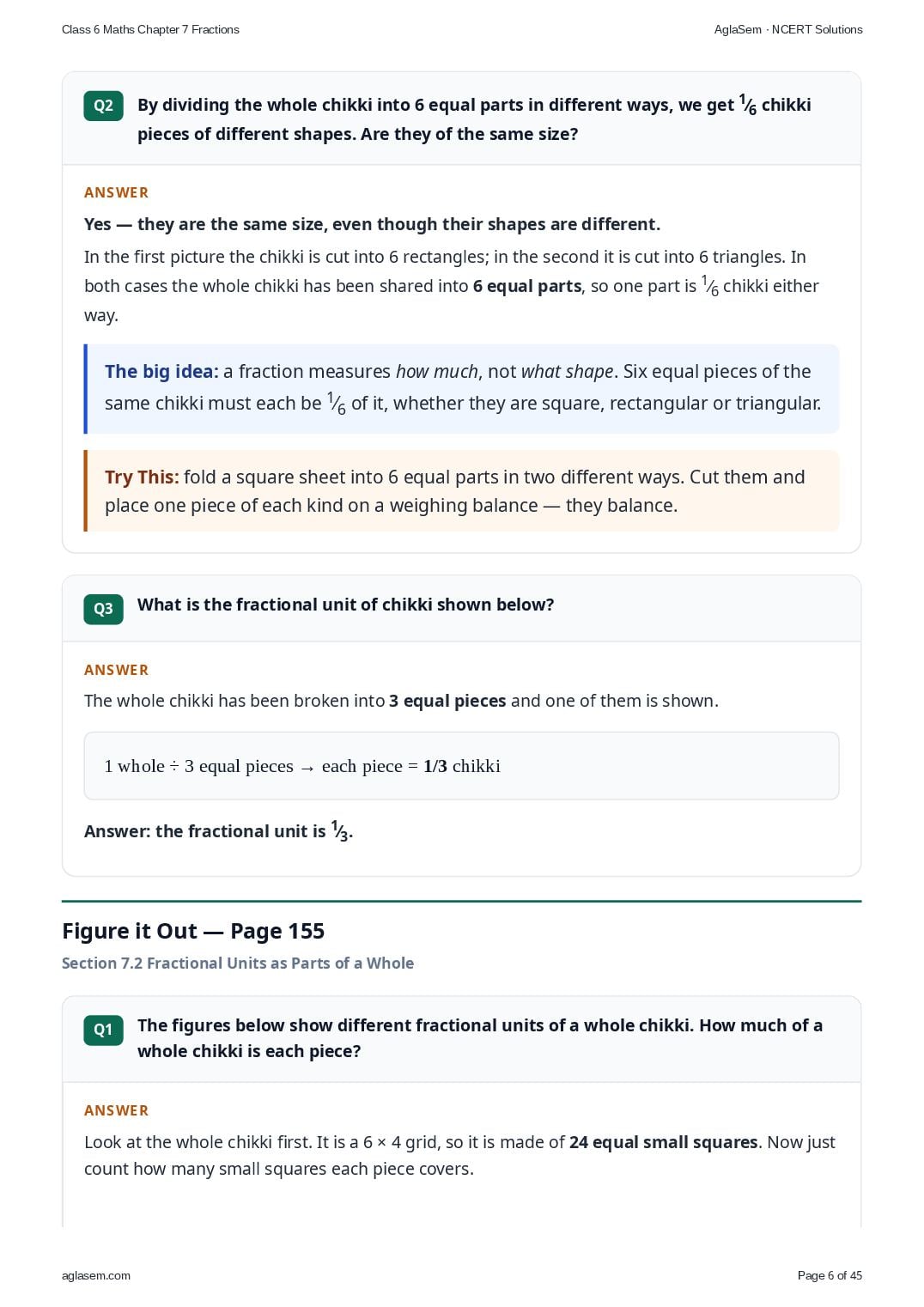
- By dividing the whole chikki into 6 equal parts in different ways, we get 1 ⁄ 6 chikki pieces of different shapes. Are they of the same size?
- What is the fractional unit of chikki shown below?
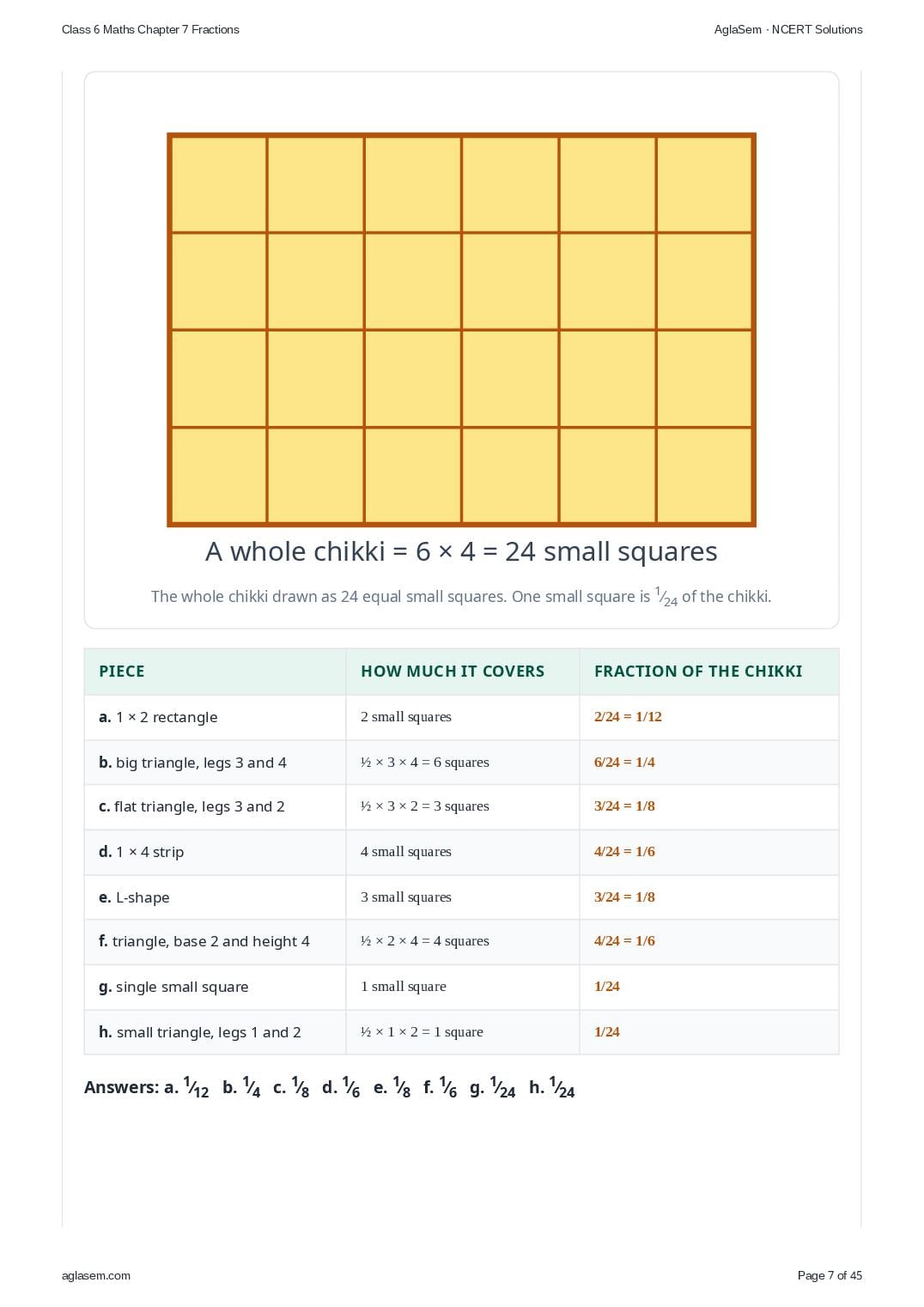
- The figures below show different fractional units of a whole chikki. How much of a whole chikki is each piece?
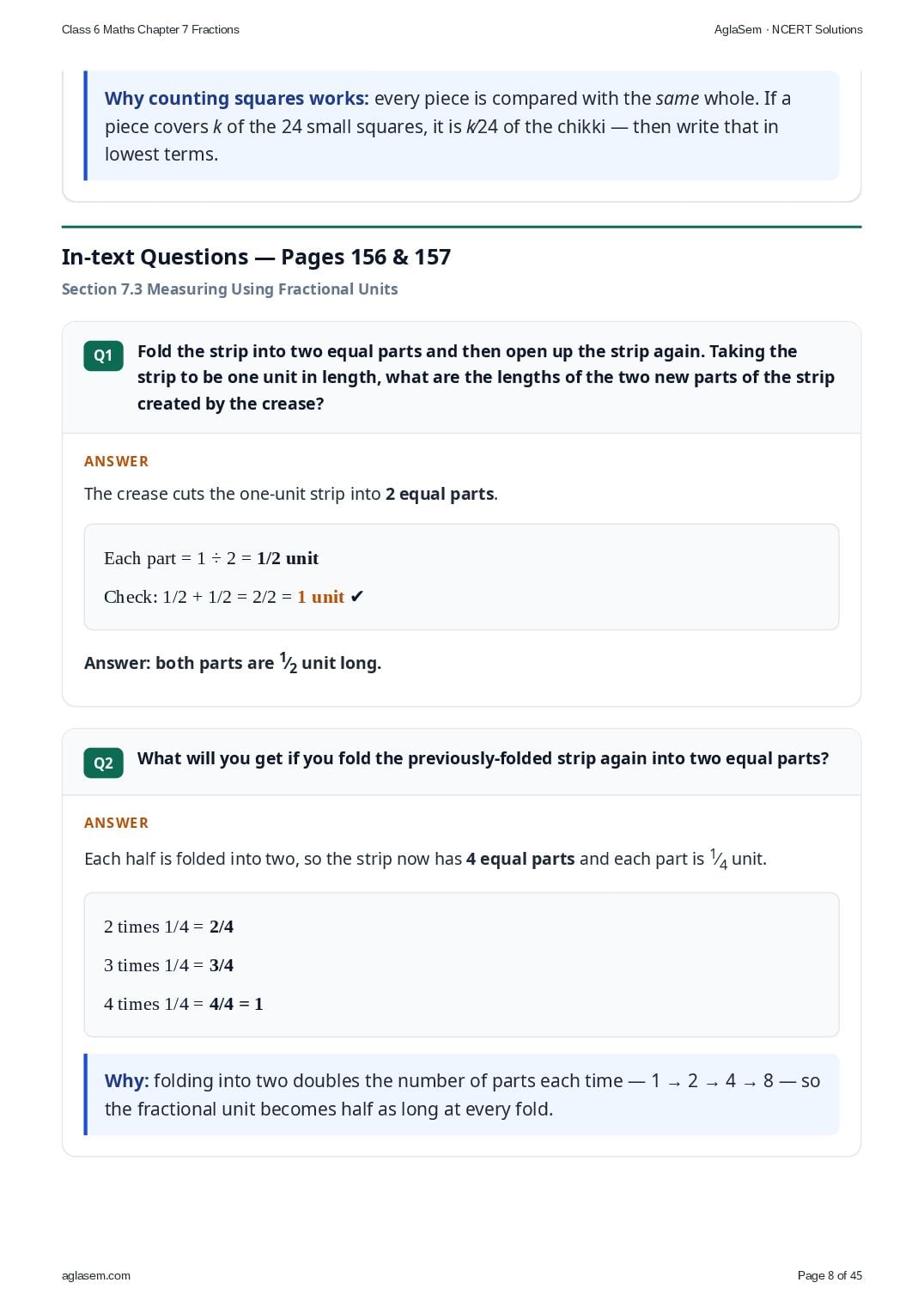
- Fold the strip into two equal parts and then open up the strip again. Taking the strip to be one unit in length, what are the lengths of the two new parts of the strip created by the crease?
- What will you get if you fold the previously-folded strip again into two equal parts?
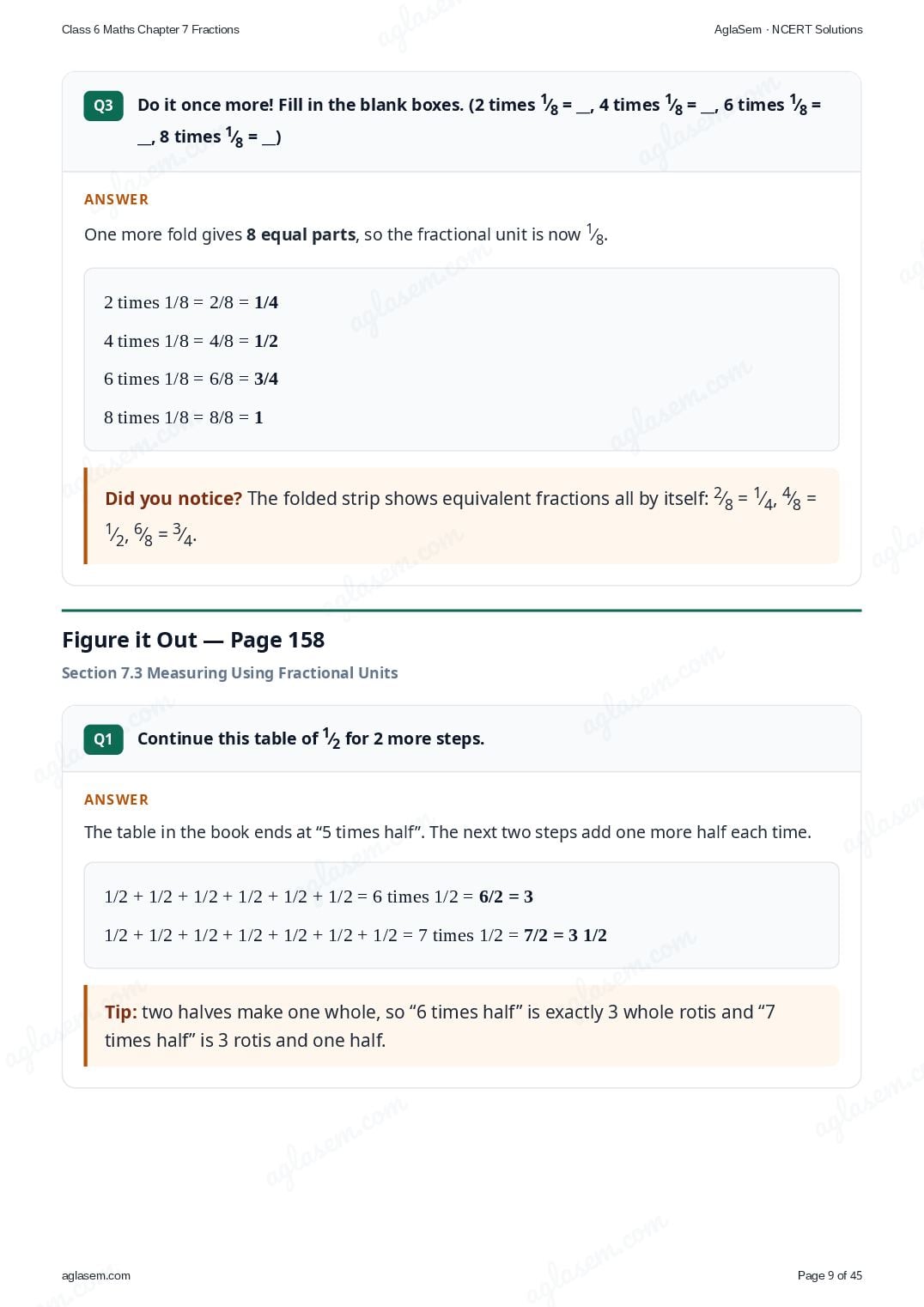
- Do it once more! Fill in the blank boxes. (2 times 1 ⁄ 8 = __, 4 times 1 ⁄ 8 = __, 6 times 1 ⁄ 8 = __, 8 times 1 ⁄ 8 = __)
- Continue this table of 1 ⁄ 2 for 2 more steps.
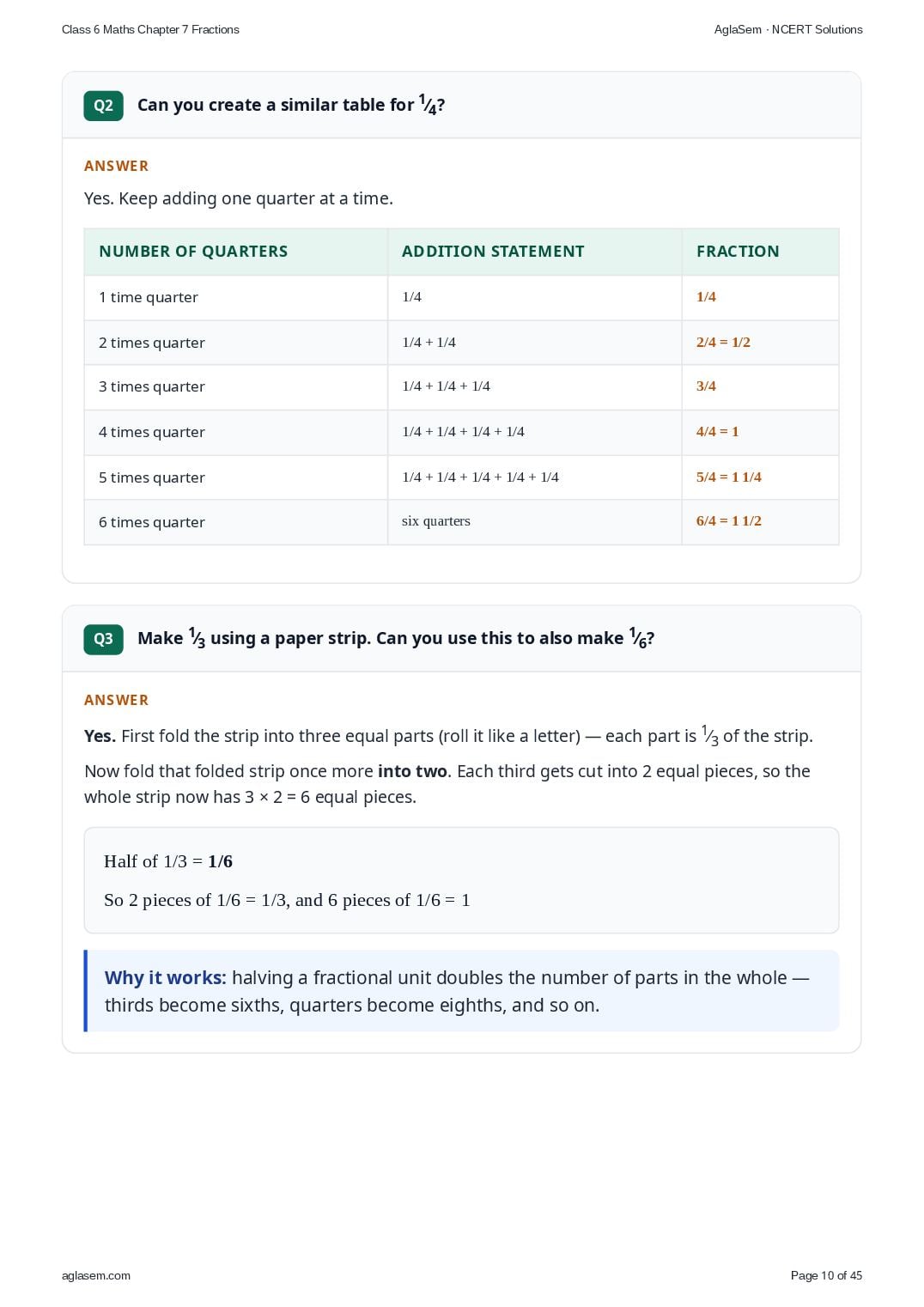
- Can you create a similar table for 1 ⁄ 4 ?
- Make 1 ⁄ 3 using a paper strip. Can you use this to also make 1 ⁄ 6 ?
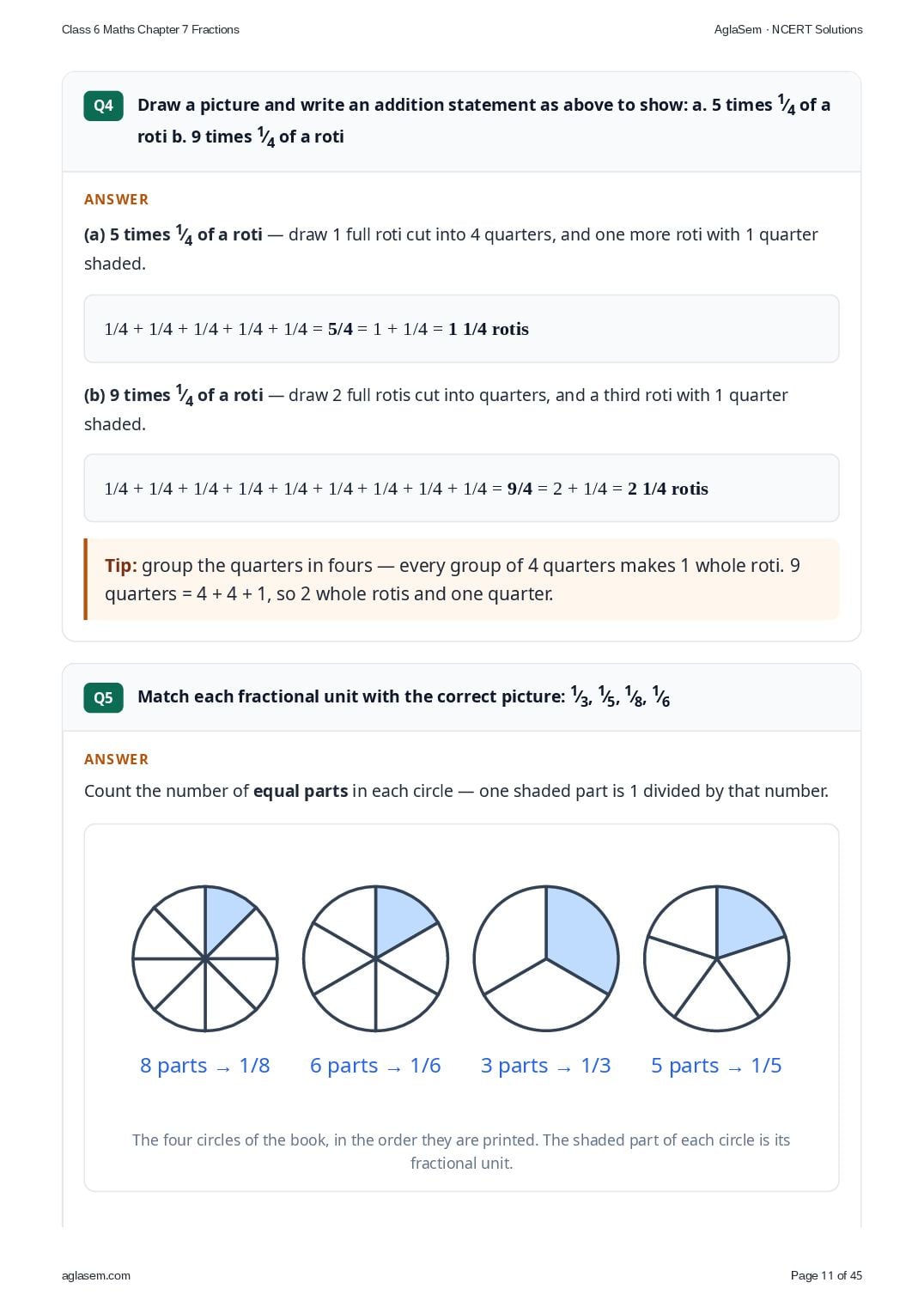
- Draw a picture and write an addition statement as above to show: a. 5 times 1 ⁄ 4 of a roti b. 9 times 1 ⁄ 4 of a roti
- Match each fractional unit with the correct picture: 1 ⁄ 3 , 1 ⁄ 5 , 1 ⁄ 8 , 1 ⁄ 6
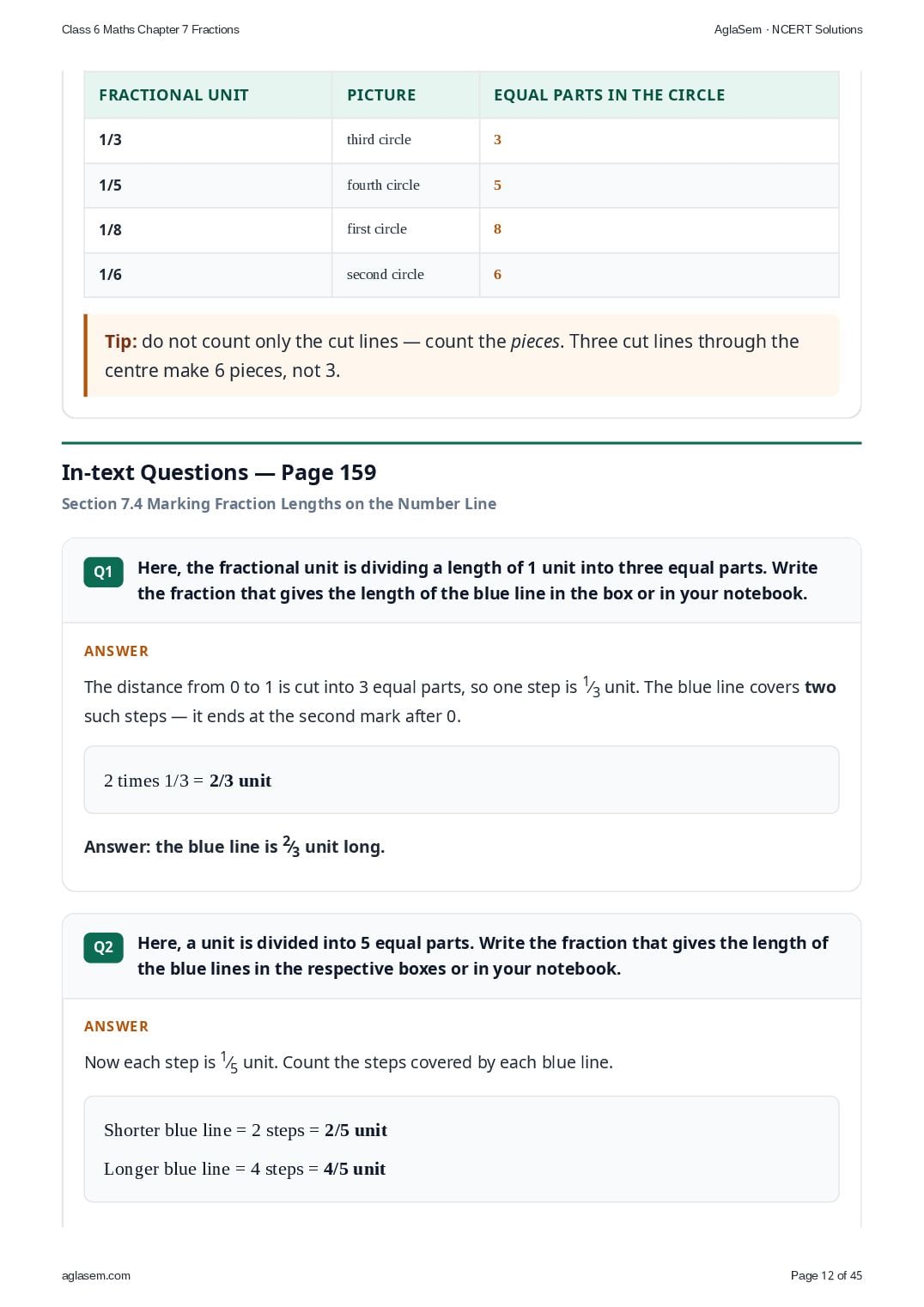
- Here, the fractional unit is dividing a length of 1 unit into three equal parts. Write the fraction that gives the length of the blue line in the box or in your notebook.
- Here, a unit is divided into 5 equal parts. Write the fraction that gives the length of the blue lines in the respective boxes or in your notebook.
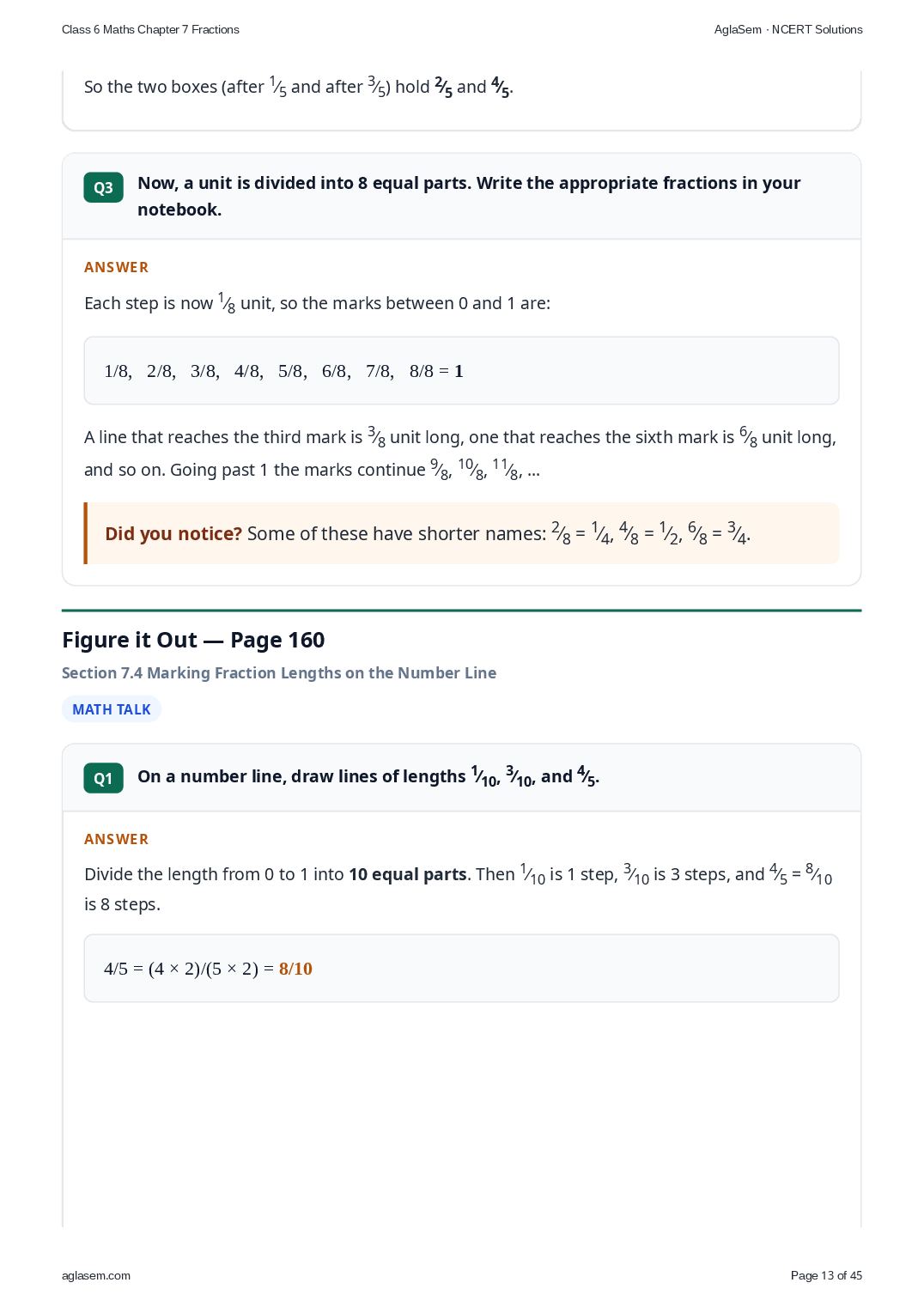
- Now, a unit is divided into 8 equal parts. Write the appropriate fractions in your notebook.
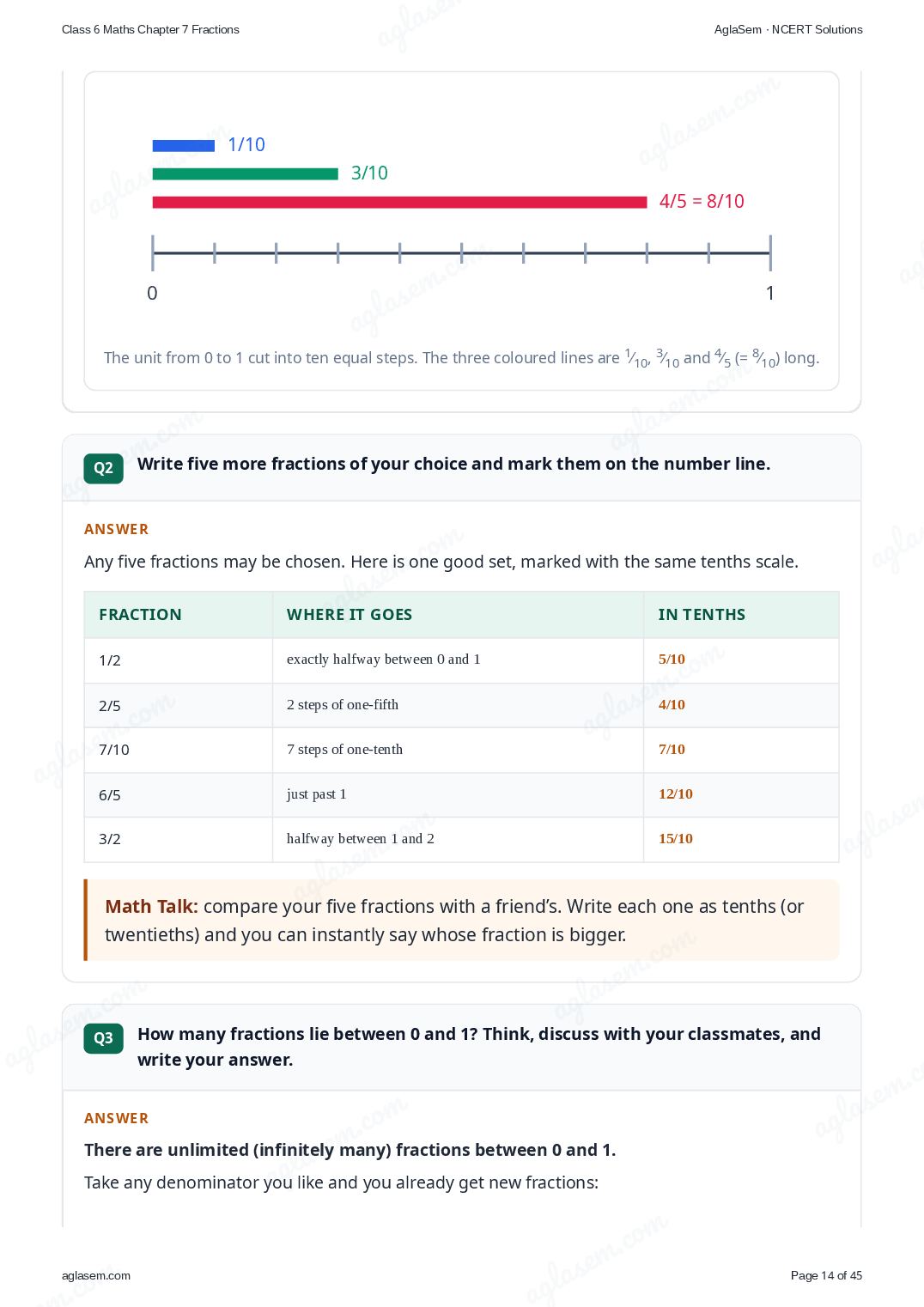
- On a number line, draw lines of lengths 1 ⁄ 10 , 3 ⁄ 10 , and 4 ⁄ 5 .
- Write five more fractions of your choice and mark them on the number line.
- How many fractions lie between 0 and 1? Think, discuss with your classmates, and write your answer.
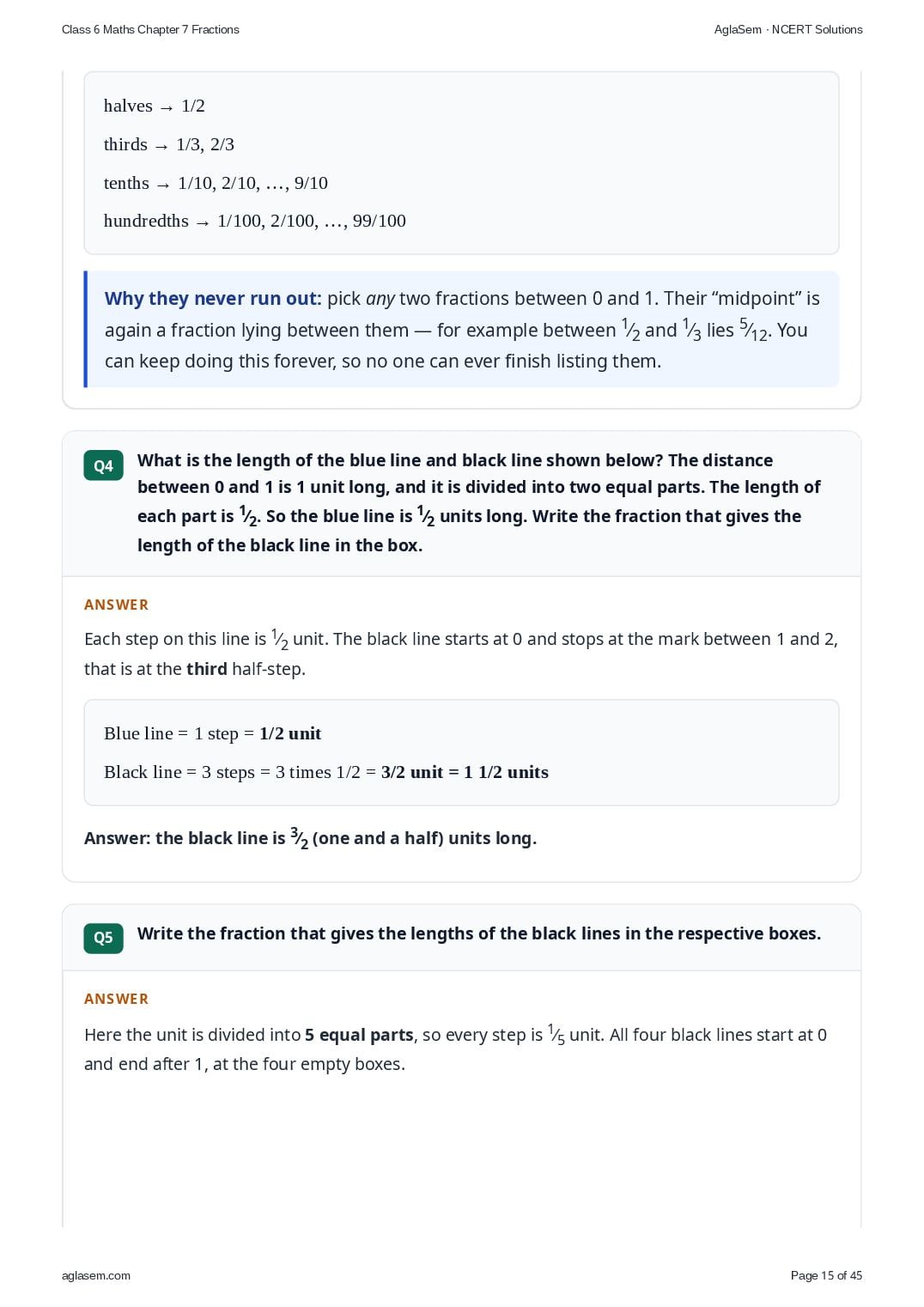
- What is the length of the blue line and black line shown below? The distance between 0 and 1 is 1 unit long, and it is divided into two equal parts. The length of each part is 1 ⁄ 2 . So the blue line is 1 ⁄ 2 units long. Write the fraction that gives the length of the black line in the box.
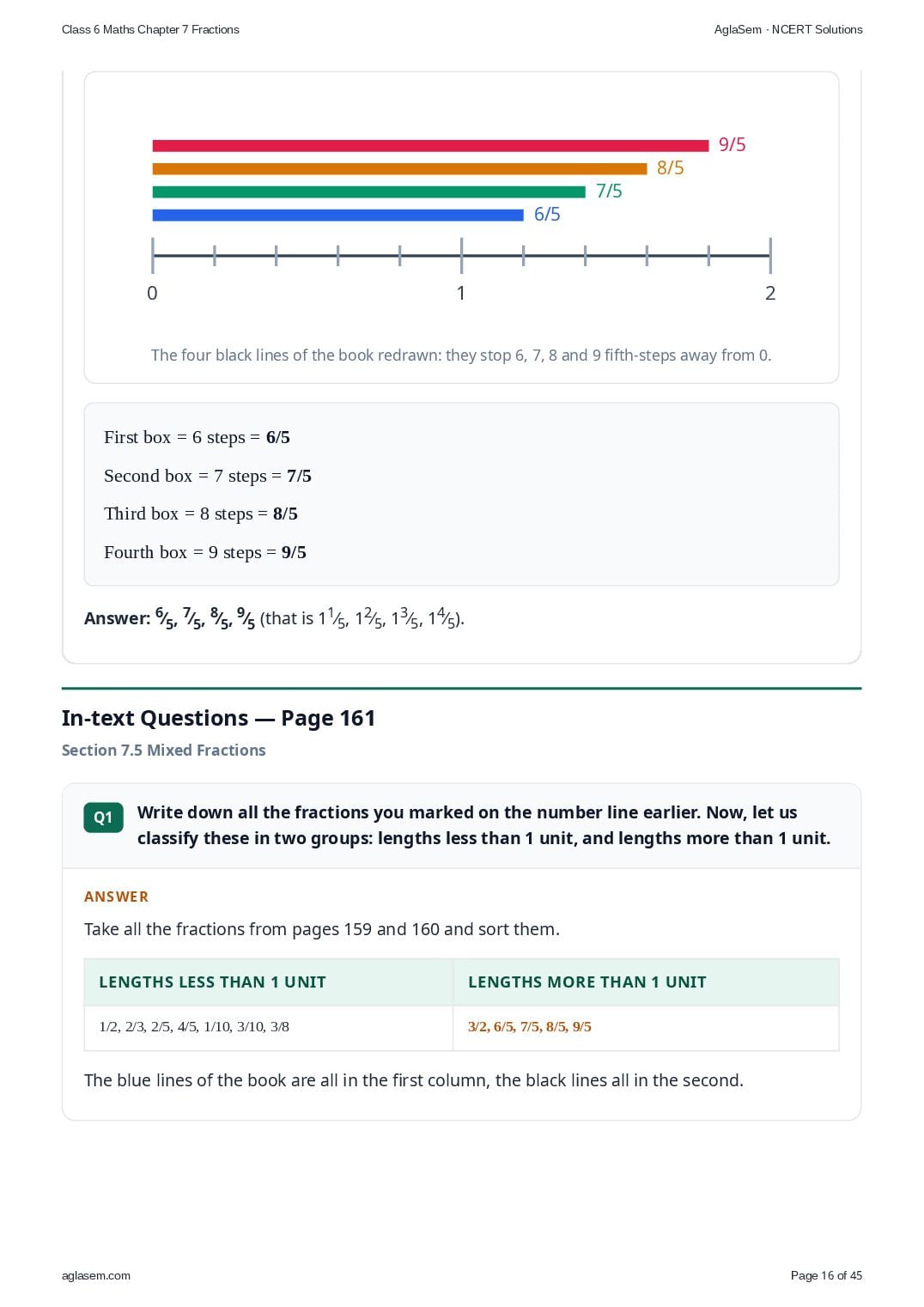
- Write the fraction that gives the lengths of the black lines in the respective boxes.
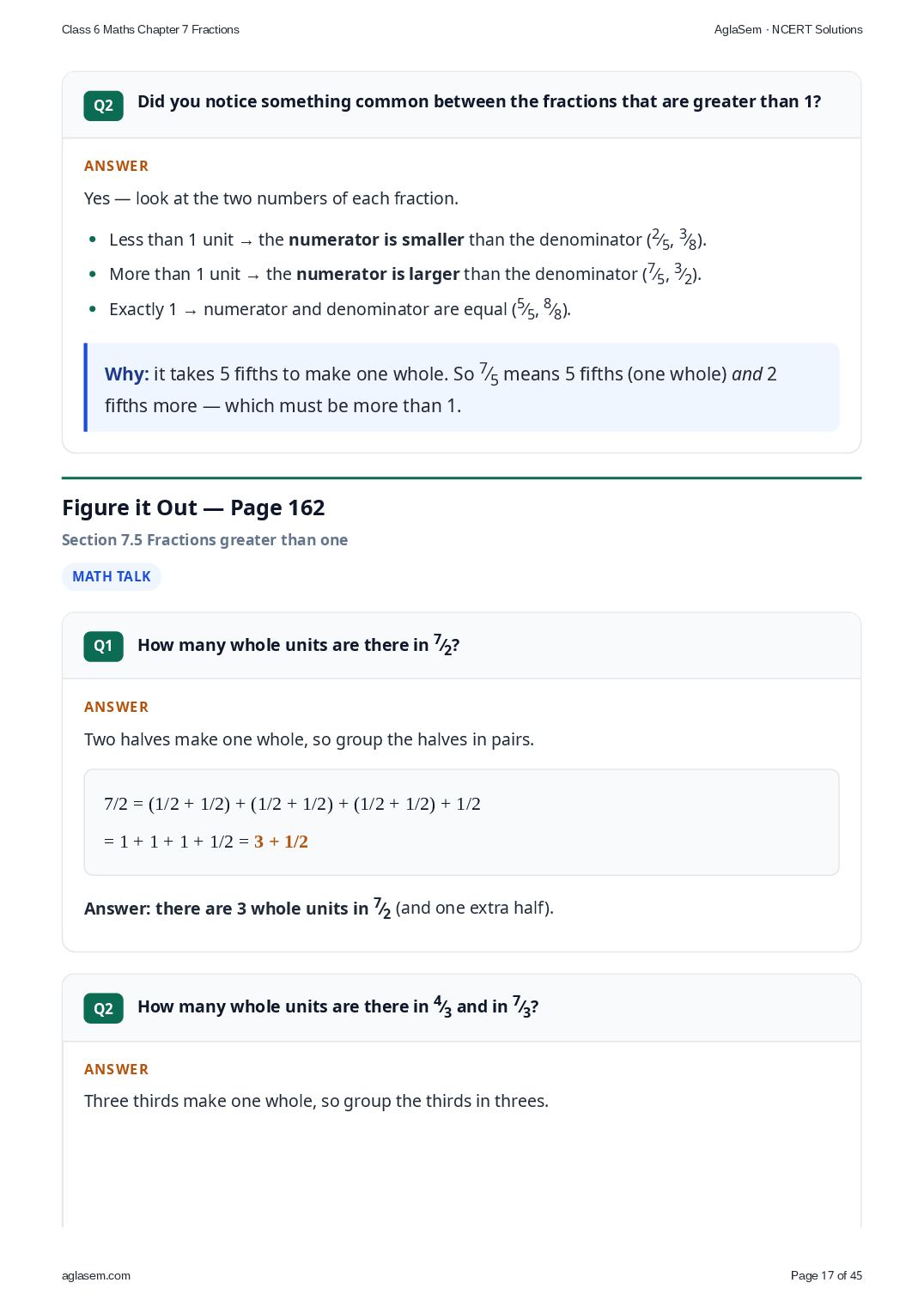
- Write down all the fractions you marked on the number line earlier. Now, let us classify these in two groups: lengths less than 1 unit, and lengths more than 1 unit.
- Did you notice something common between the fractions that are greater than 1?
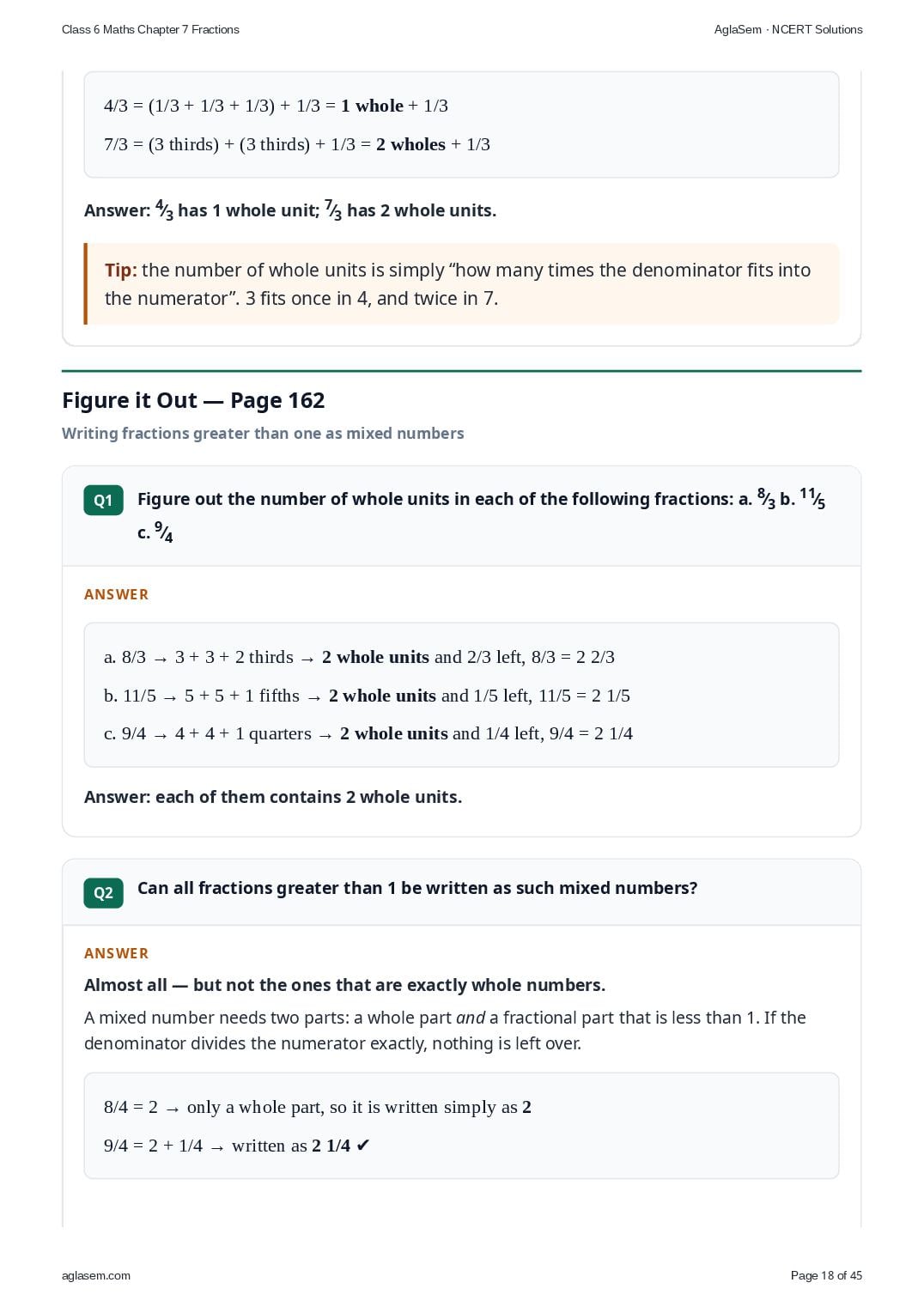
- How many whole units are there in 7 ⁄ 2 ?
- How many whole units are there in 4 ⁄ 3 and in 7 ⁄ 3 ?
- Figure out the number of whole units in each of the following fractions: a. 8 ⁄ 3 b. 11 ⁄ 5 c. 9 ⁄ 4
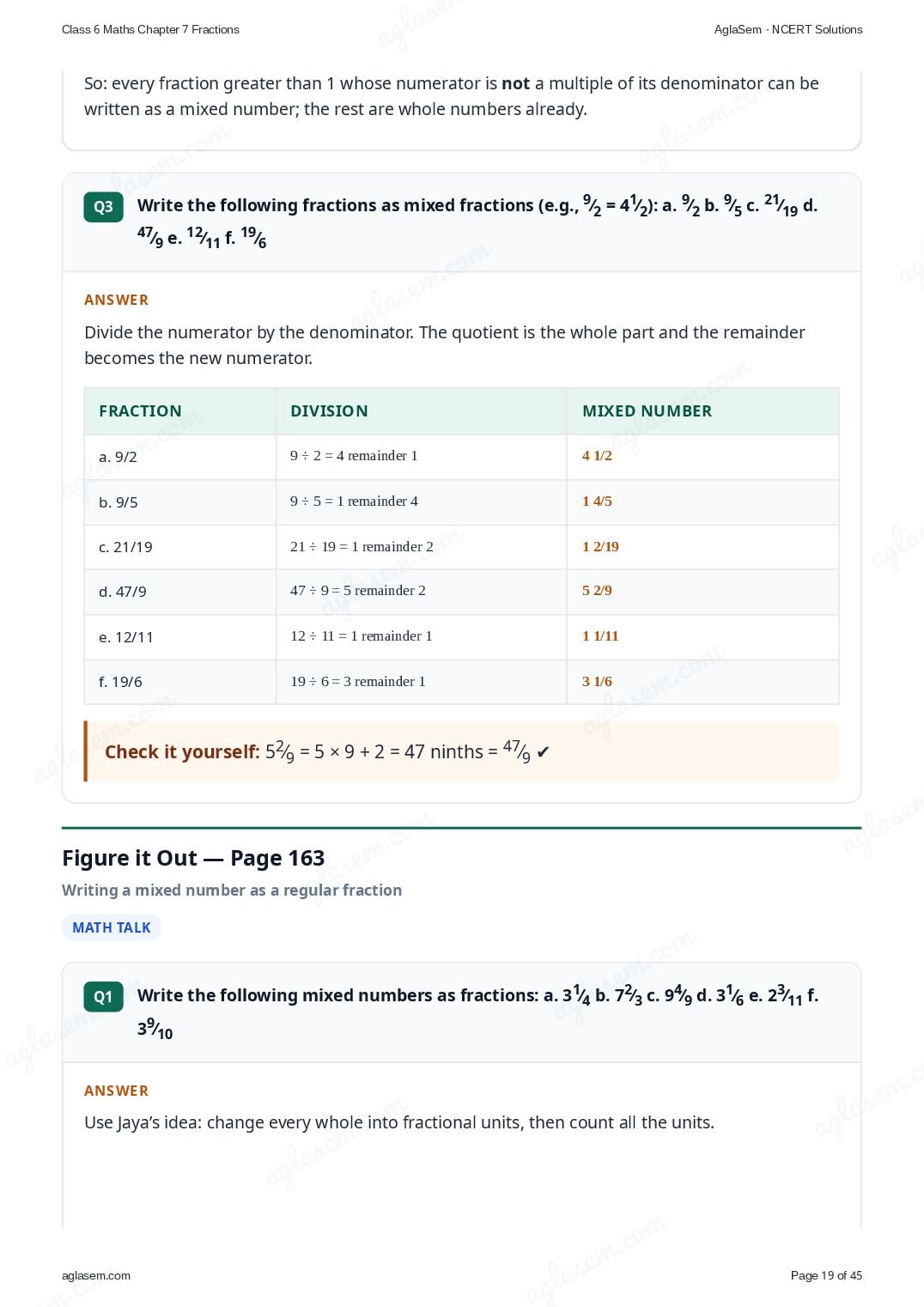
- Can all fractions greater than 1 be written as such mixed numbers?
- Write the following fractions as mixed fractions (e.g., 9 ⁄ 2 = 4 1 ⁄ 2 ): a. 9 ⁄ 2 b. 9 ⁄ 5 c. 21 ⁄ 19 d. 47 ⁄ 9 e. 12 ⁄ 11 f. 19 ⁄ 6
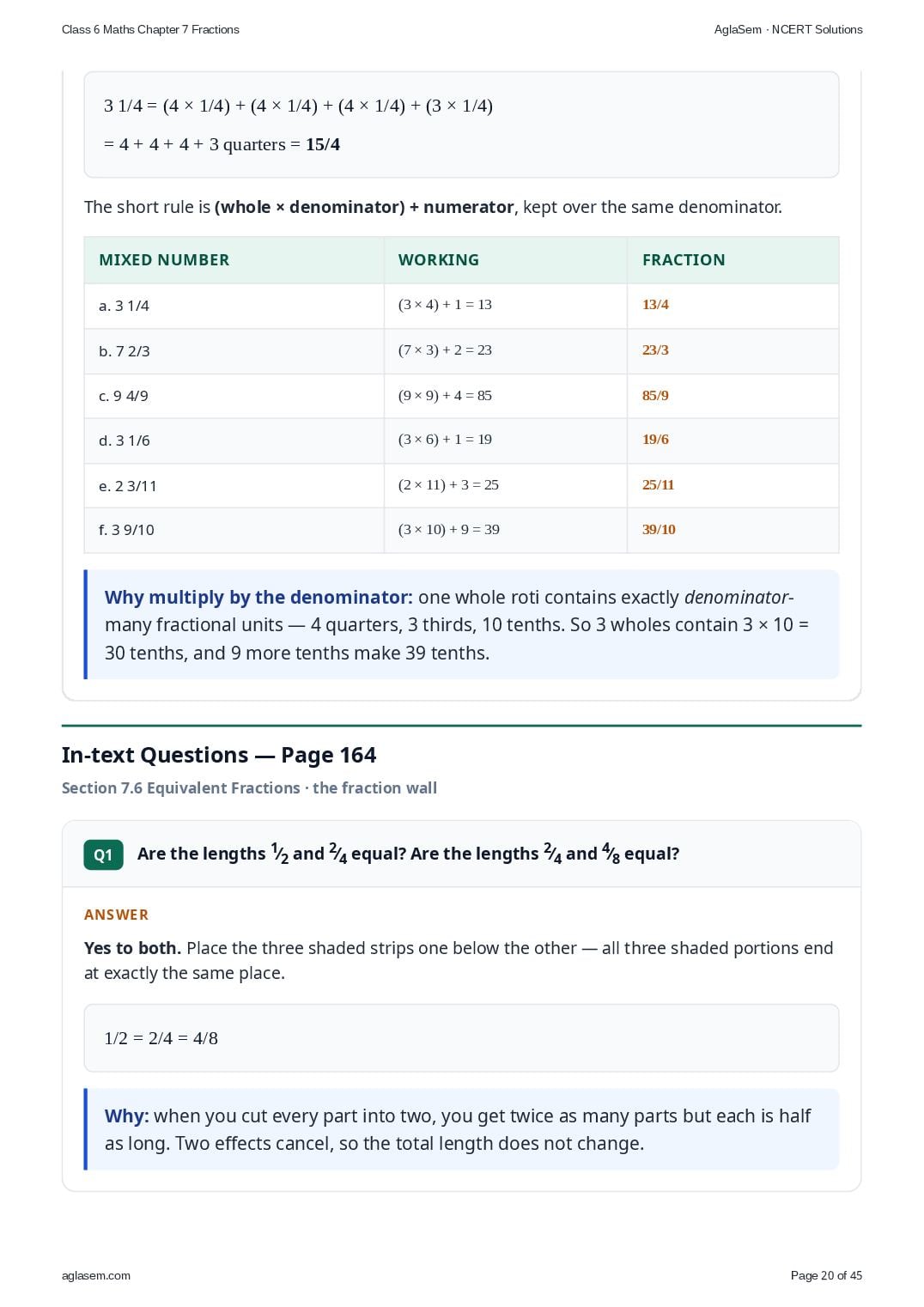
- Write the following mixed numbers as fractions: a. 3 1 ⁄ 4 b. 7 2 ⁄ 3 c. 9 4 ⁄ 9 d. 3 1 ⁄ 6 e. 2 3 ⁄ 11 f. 3 9 ⁄ 10
- Are the lengths 1 ⁄ 2 and 2 ⁄ 4 equal? Are the lengths 2 ⁄ 4 and 4 ⁄ 8 equal?
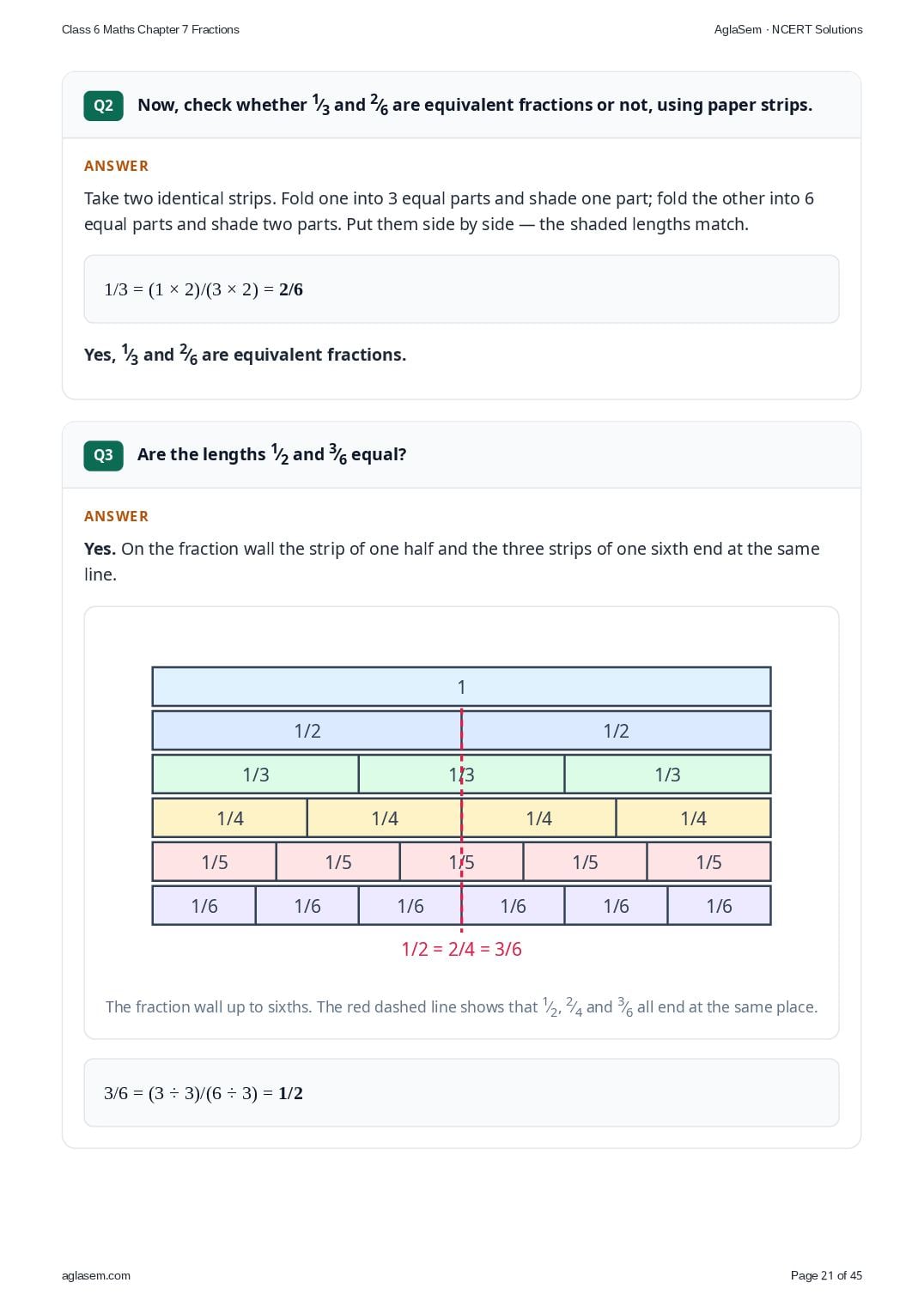
- Now, check whether 1 ⁄ 3 and 2 ⁄ 6 are equivalent fractions or not, using paper strips.
- Are the lengths 1 ⁄ 2 and 3 ⁄ 6 equal?
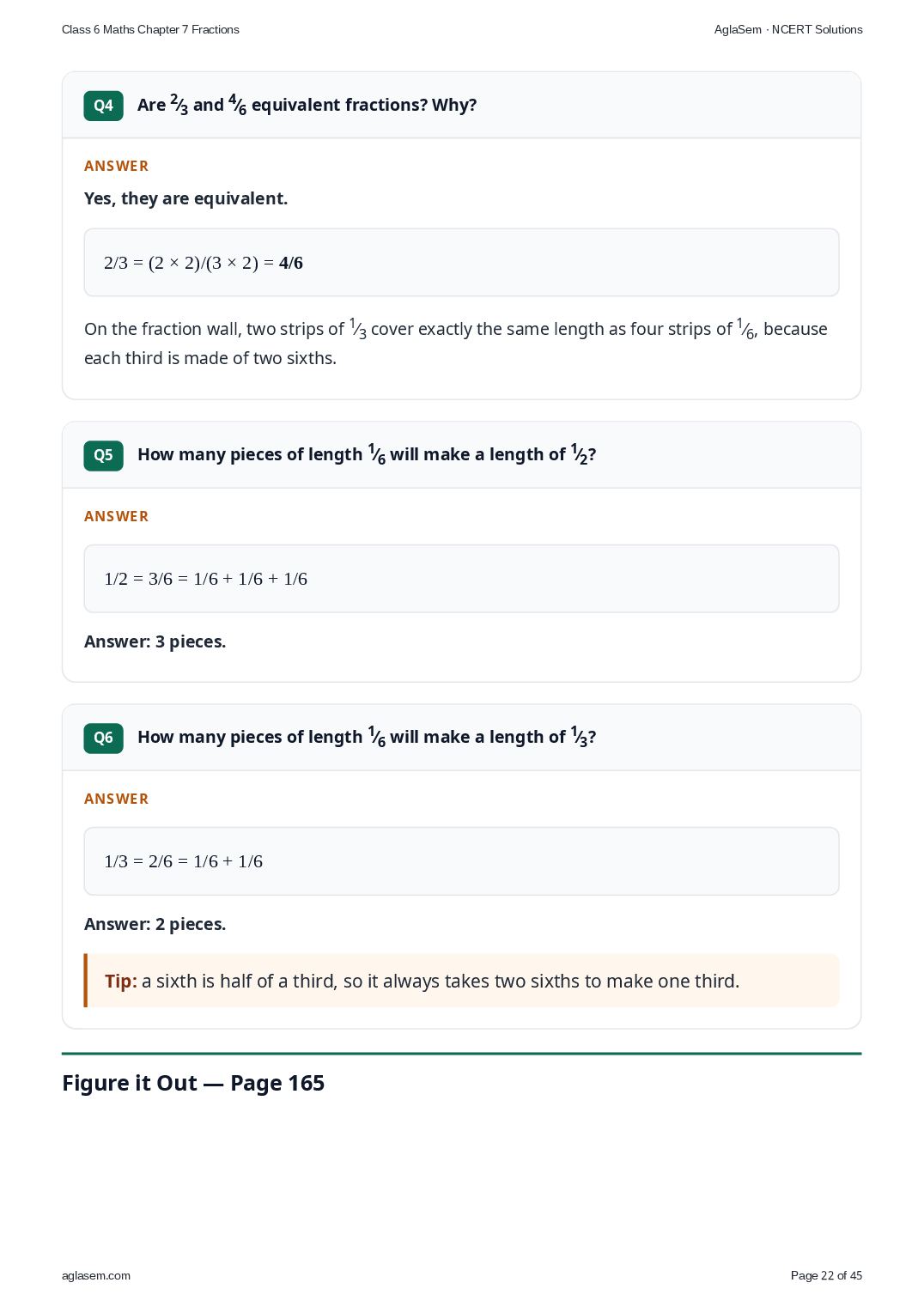
- Are 2 ⁄ 3 and 4 ⁄ 6 equivalent fractions? Why?
- How many pieces of length 1 ⁄ 6 will make a length of 1 ⁄ 2 ?
- How many pieces of length 1 ⁄ 6 will make a length of 1 ⁄ 3 ?
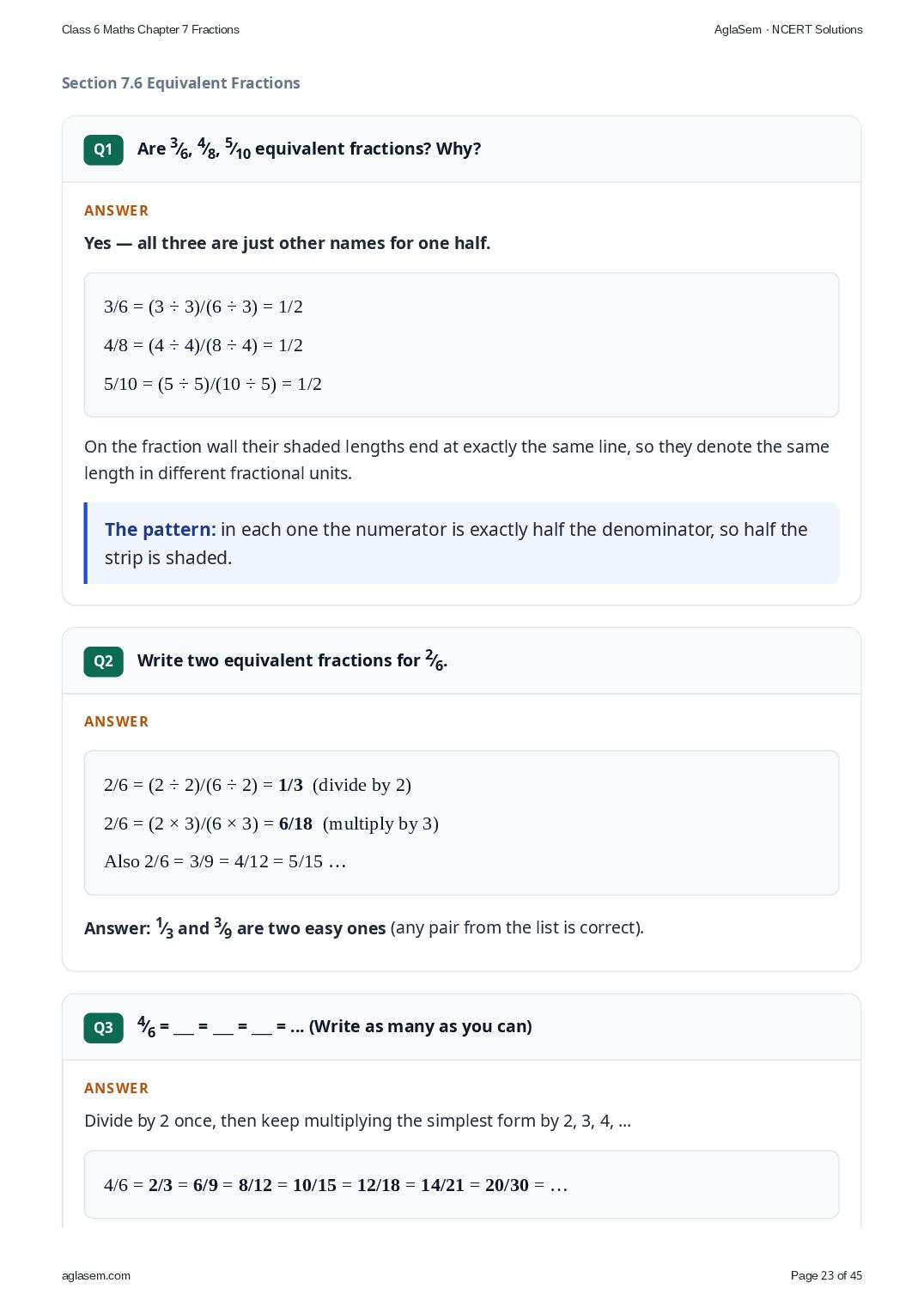
- Are 3 ⁄ 6 , 4 ⁄ 8 , 5 ⁄ 10 equivalent fractions? Why?
- Write two equivalent fractions for 2 ⁄ 6 .
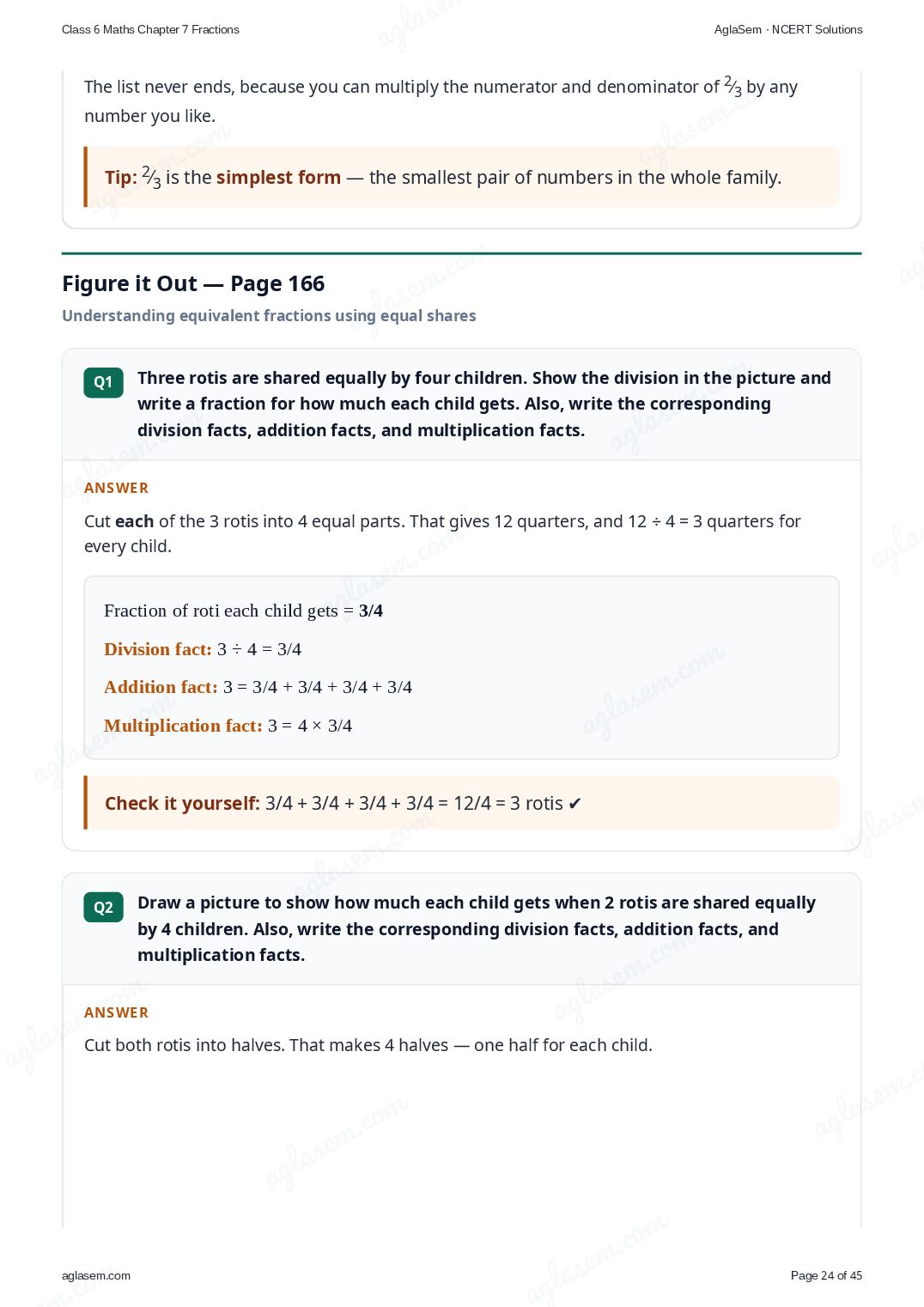
- 4 ⁄ 6 = ___ = ___ = ___ = … (Write as many as you can)
- Three rotis are shared equally by four children. Show the division in the picture and write a fraction for how much each child gets. Also, write the corresponding division facts, addition facts, and multiplication facts.
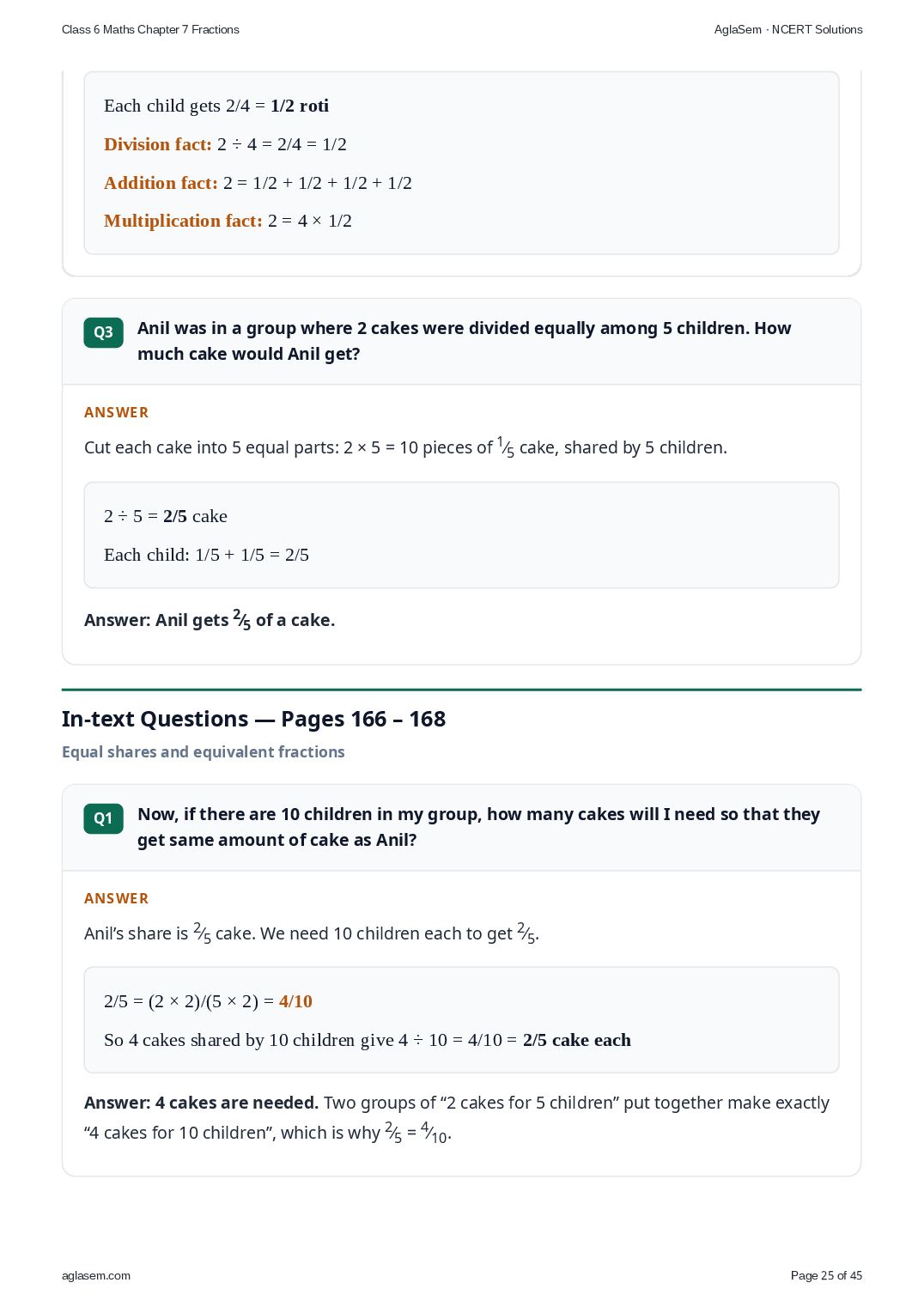
- Draw a picture to show how much each child gets when 2 rotis are shared equally by 4 children. Also, write the corresponding division facts, addition facts, and multiplication facts.
- Anil was in a group where 2 cakes were divided equally among 5 children. How much cake would Anil get?
- Now, if there are 10 children in my group, how many cakes will I need so that they get same amount of cake as Anil?
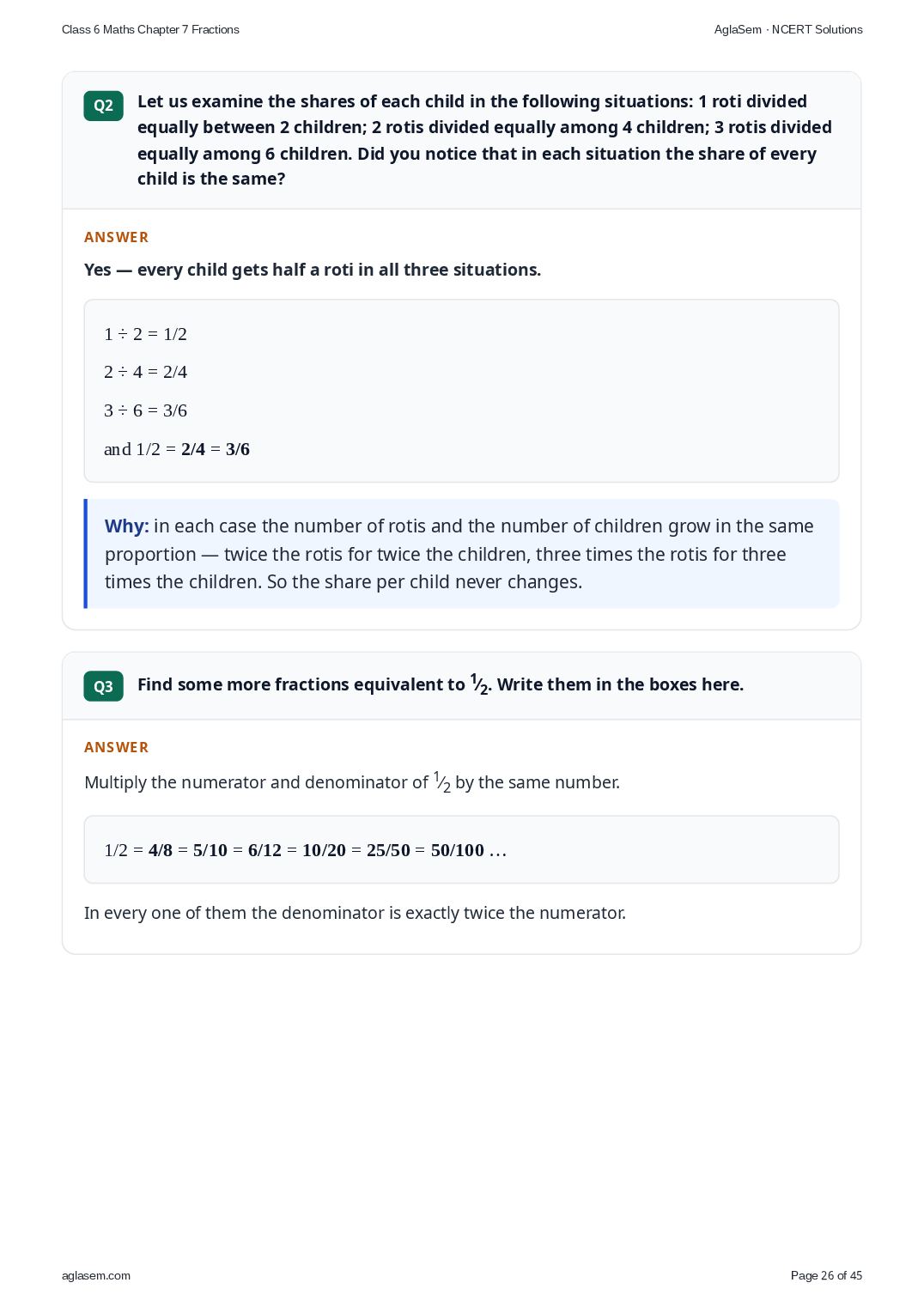
- Let us examine the shares of each child in the following situations: 1 roti divided equally between 2 children; 2 rotis divided equally among 4 children; 3 rotis divided equally among 6 children. Did you notice that in each situation the share of every child is the same?
- Find some more fractions equivalent to 1 ⁄ 2 . Write them in the boxes here.
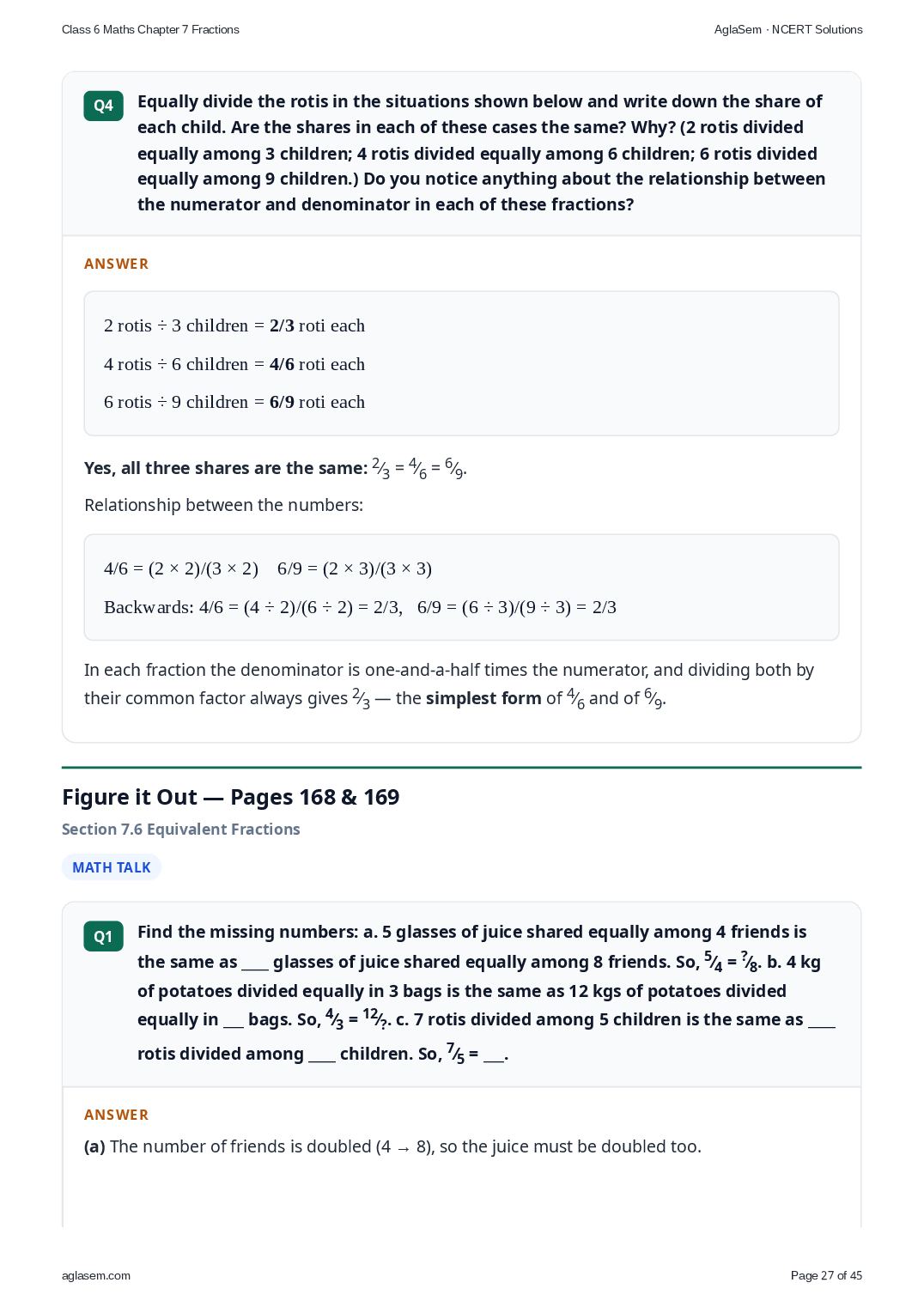
- Equally divide the rotis in the situations shown below and write down the share of each child. Are the shares in each of these cases the same? Why? (2 rotis divided equally among 3 children; 4 rotis divided equally among 6 children; 6 rotis divided equally among 9 children.) Do you notice anything about the relationship between the numerator and denominator in each of these fractions?
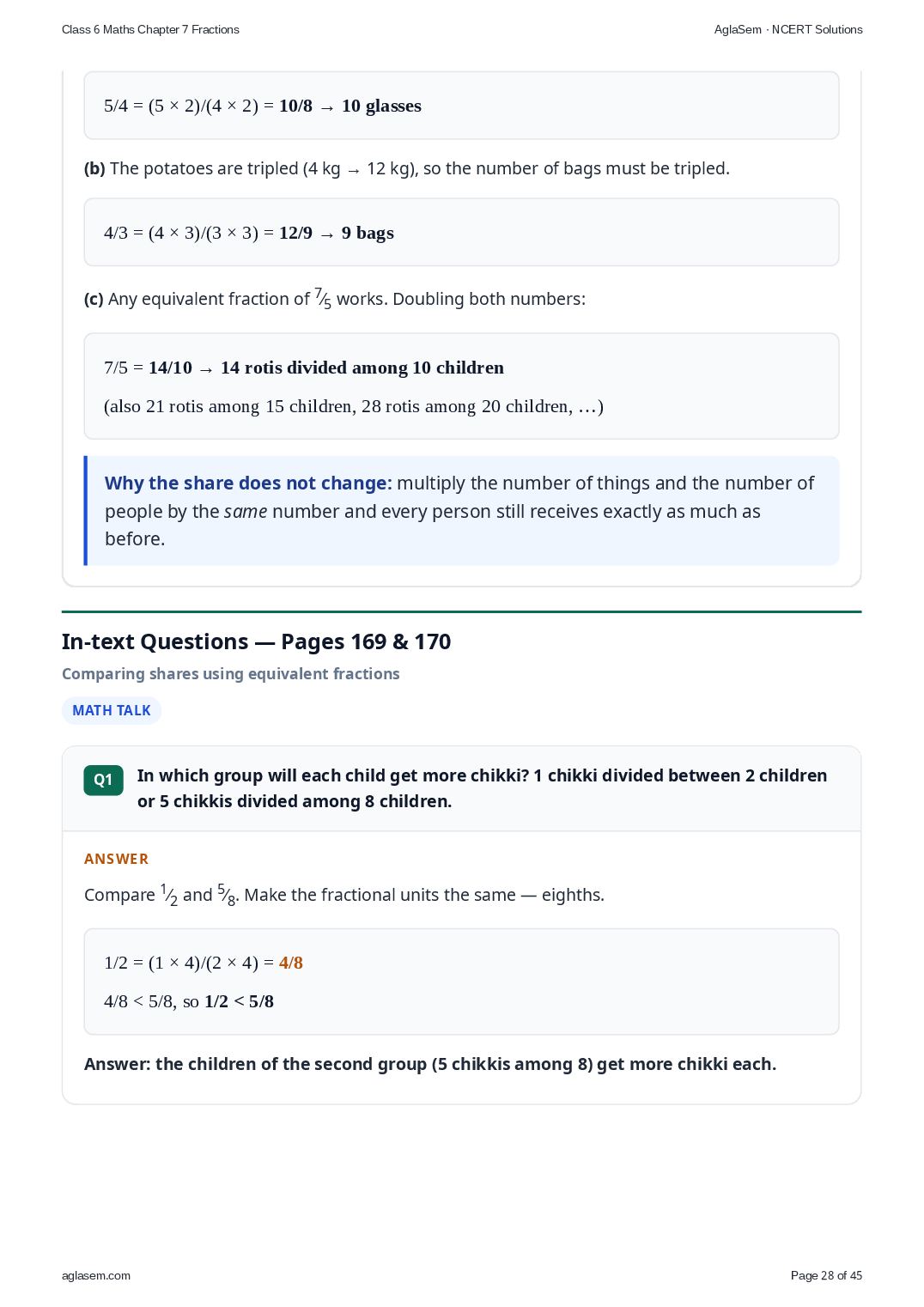
- Find the missing numbers: a. 5 glasses of juice shared equally among 4 friends is the same as ____ glasses of juice shared equally among 8 friends. So, 5 ⁄ 4 = ? ⁄ 8 . b. 4 kg of potatoes divided equally in 3 bags is the same as 12 kgs of potatoes divided equally in ___ bags. So, 4 ⁄ 3 = 12 ⁄ ? . c. 7 rotis divided among 5 children is the same as ____ rotis divided among ____ children. So, 7 ⁄ 5 = ___.
- In which group will each child get more chikki? 1 chikki divided between 2 children or 5 chikkis divided among 8 children.
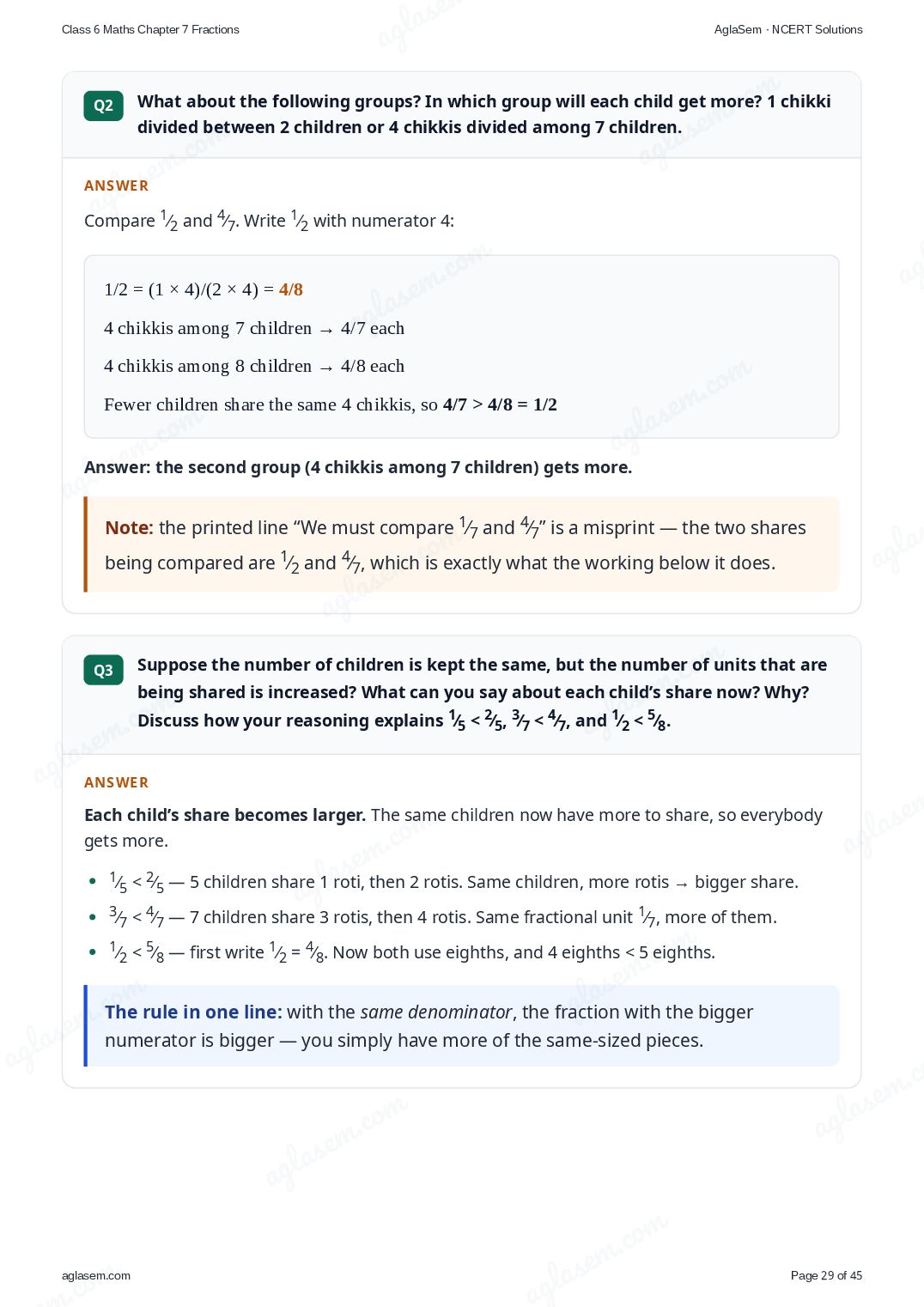
- What about the following groups? In which group will each child get more? 1 chikki divided between 2 children or 4 chikkis divided among 7 children.
- Suppose the number of children is kept the same, but the number of units that are being shared is increased? What can you say about each child’s share now? Why? Discuss how your reasoning explains 1 ⁄ 5 < 2 ⁄ 5 , 3 ⁄ 7 < 4 ⁄ 7 , and 1 ⁄ 2 < 5 ⁄ 8 .
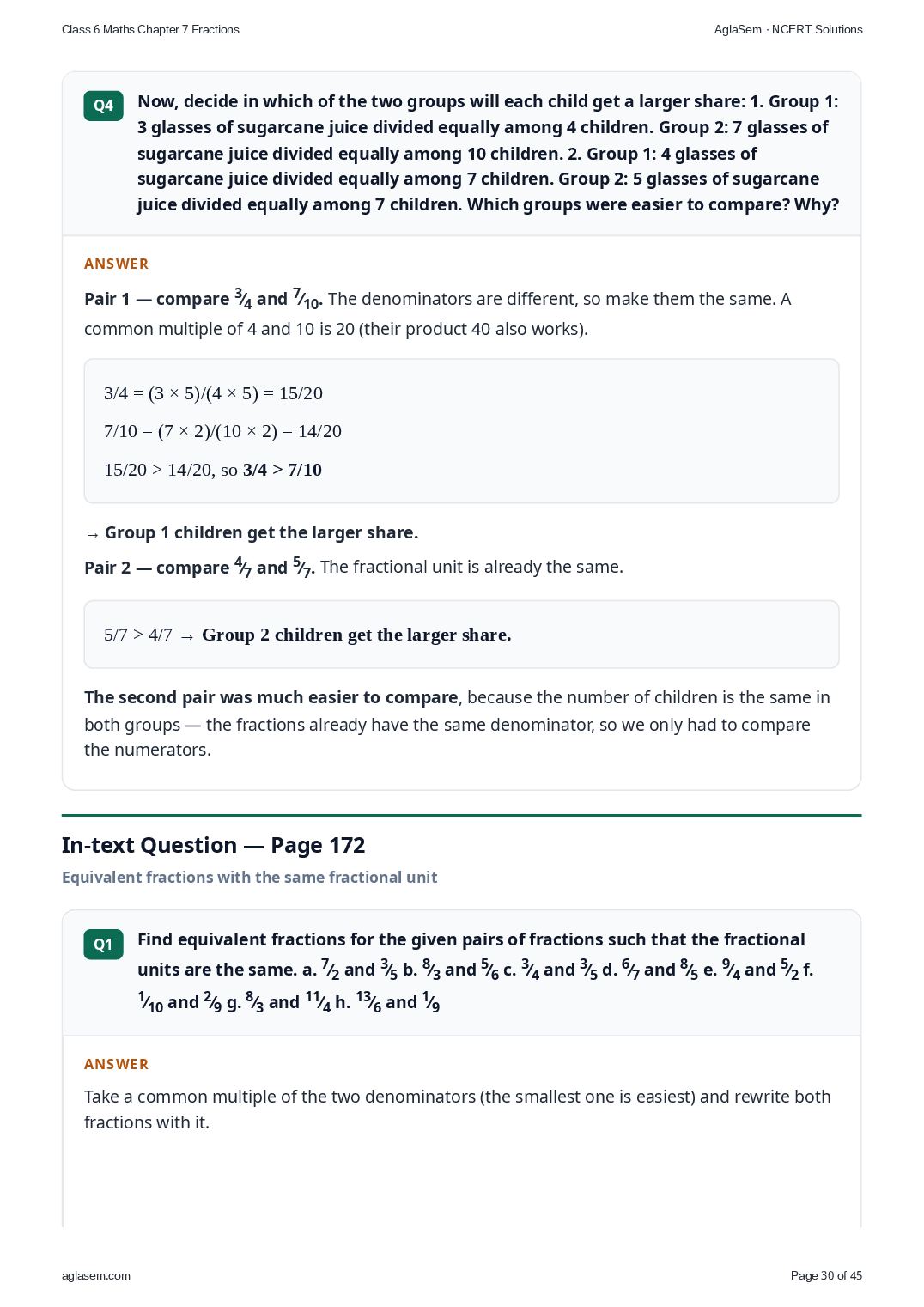
- Now, decide in which of the two groups will each child get a larger share: 1. Group 1: 3 glasses of sugarcane juice divided equally among 4 children. Group 2: 7 glasses of sugarcane juice divided equally among 10 children. 2. Group 1: 4 glasses of sugarcane juice divided equally among 7 children. Group 2: 5 glasses of sugarcane juice divided equally among 7 children. Which groups were easier to compare? Why?
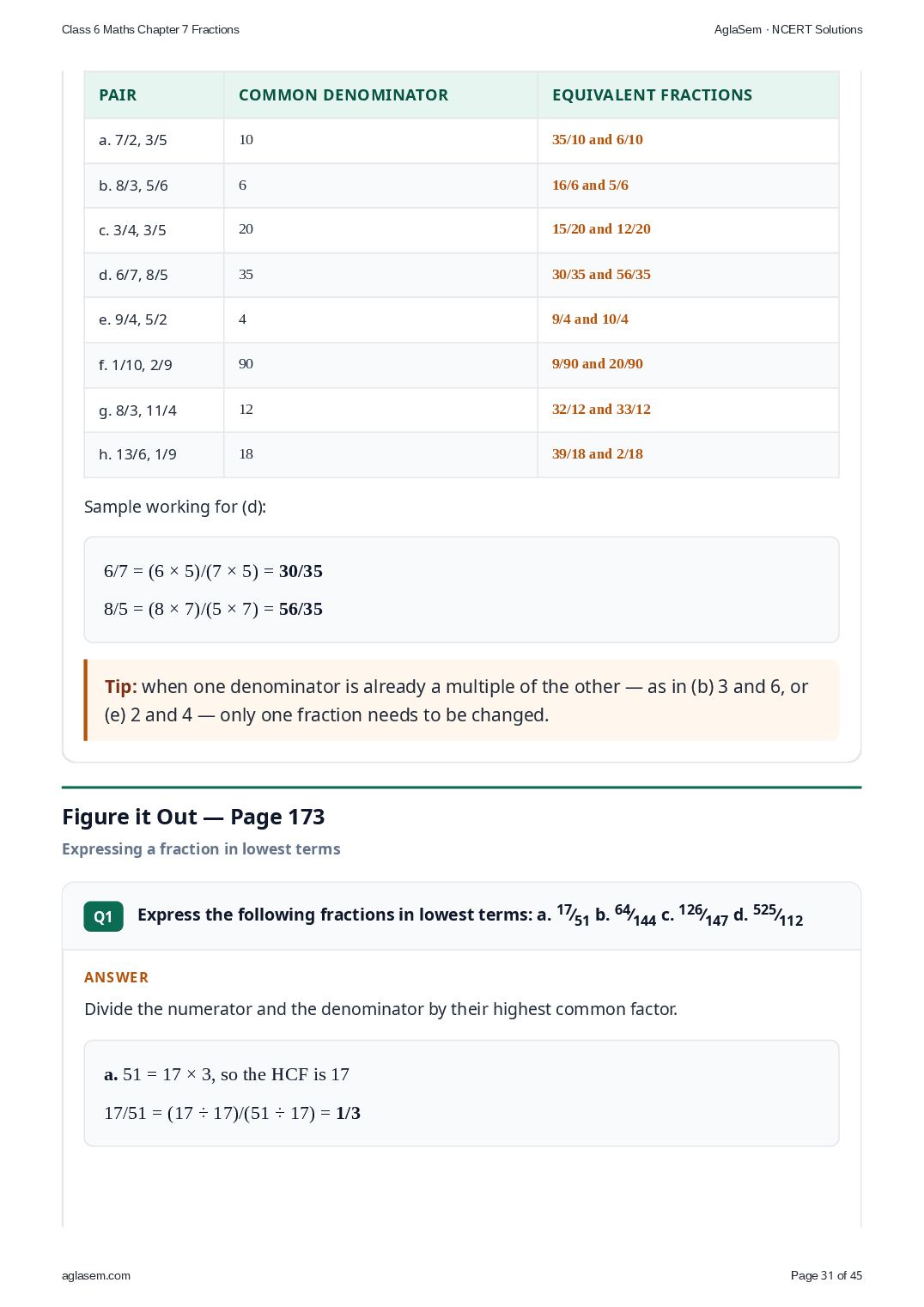
- Find equivalent fractions for the given pairs of fractions such that the fractional units are the same. a. 7 ⁄ 2 and 3 ⁄ 5 b. 8 ⁄ 3 and 5 ⁄ 6 c. 3 ⁄ 4 and 3 ⁄ 5 d. 6 ⁄ 7 and 8 ⁄ 5 e. 9 ⁄ 4 and 5 ⁄ 2 f. 1 ⁄ 10 and 2 ⁄ 9 g. 8 ⁄ 3 and 11 ⁄ 4 h. 13 ⁄ 6 and 1 ⁄ 9
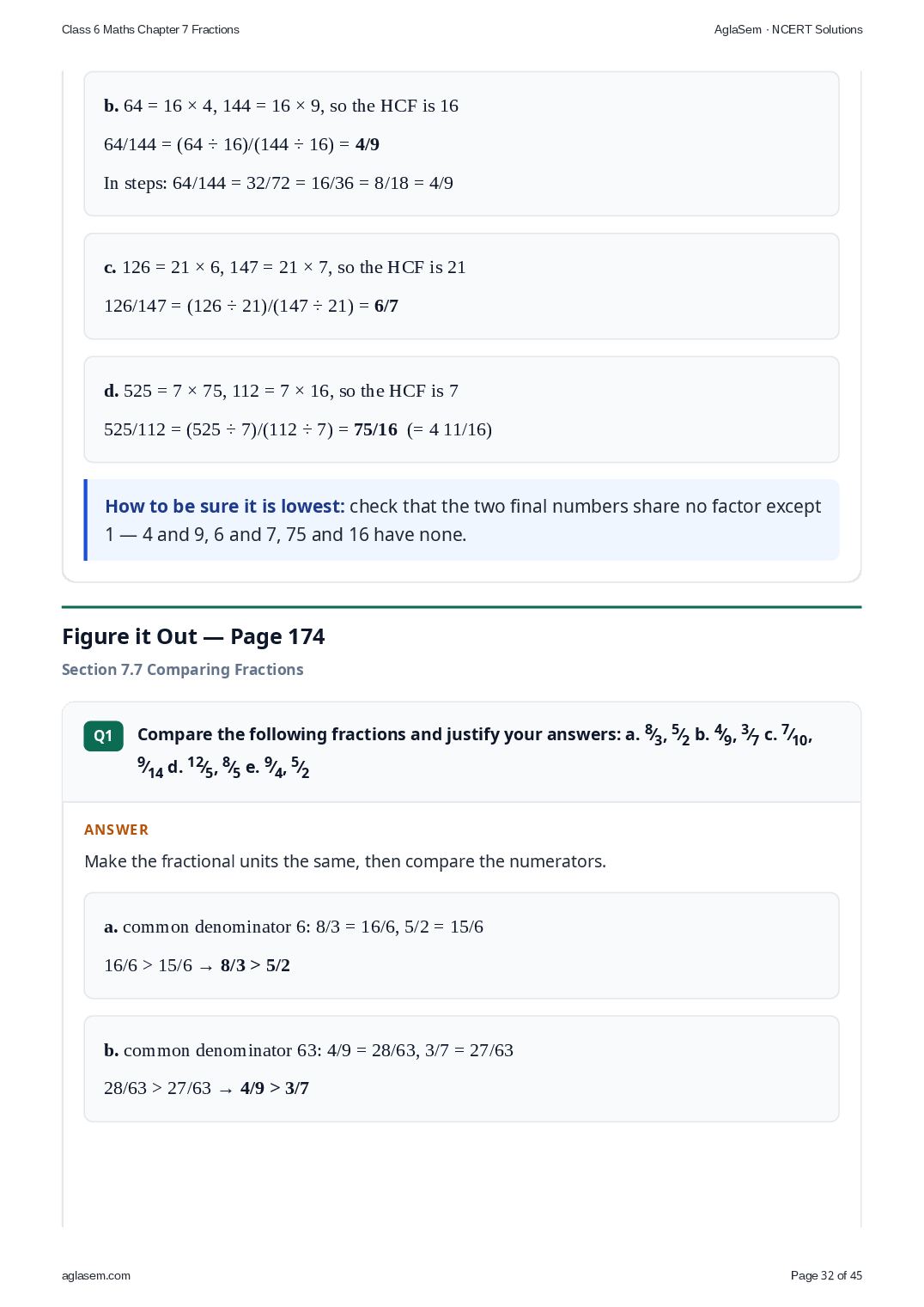
- Express the following fractions in lowest terms: a. 17 ⁄ 51 b. 64 ⁄ 144 c. 126 ⁄ 147 d. 525 ⁄ 112
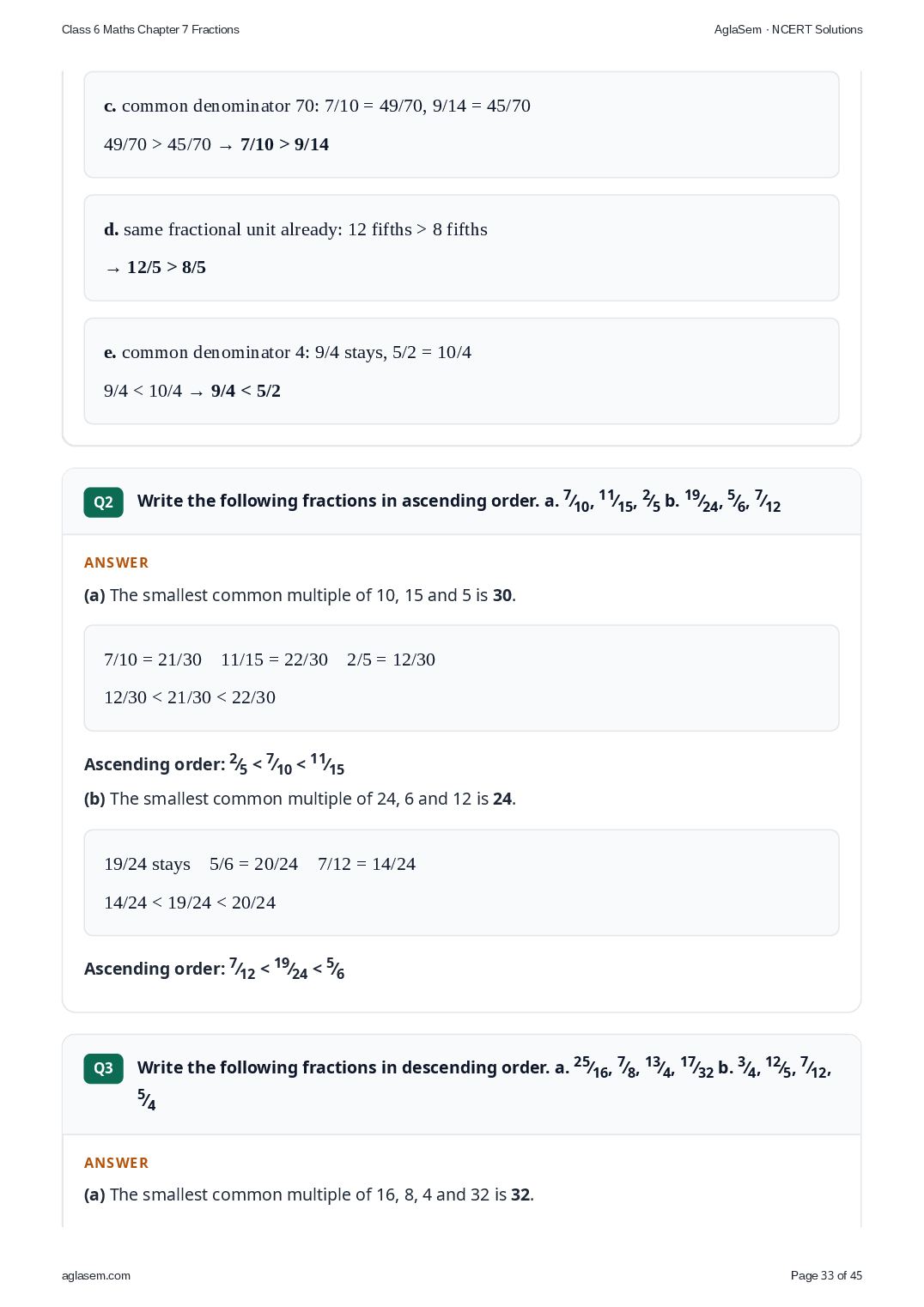
- Compare the following fractions and justify your answers: a. 8 ⁄ 3 , 5 ⁄ 2 b. 4 ⁄ 9 , 3 ⁄ 7 c. 7 ⁄ 10 , 9 ⁄ 14 d. 12 ⁄ 5 , 8 ⁄ 5 e. 9 ⁄ 4 , 5 ⁄ 2
- Write the following fractions in ascending order. a. 7 ⁄ 10 , 11 ⁄ 15 , 2 ⁄ 5 b. 19 ⁄ 24 , 5 ⁄ 6 , 7 ⁄ 12
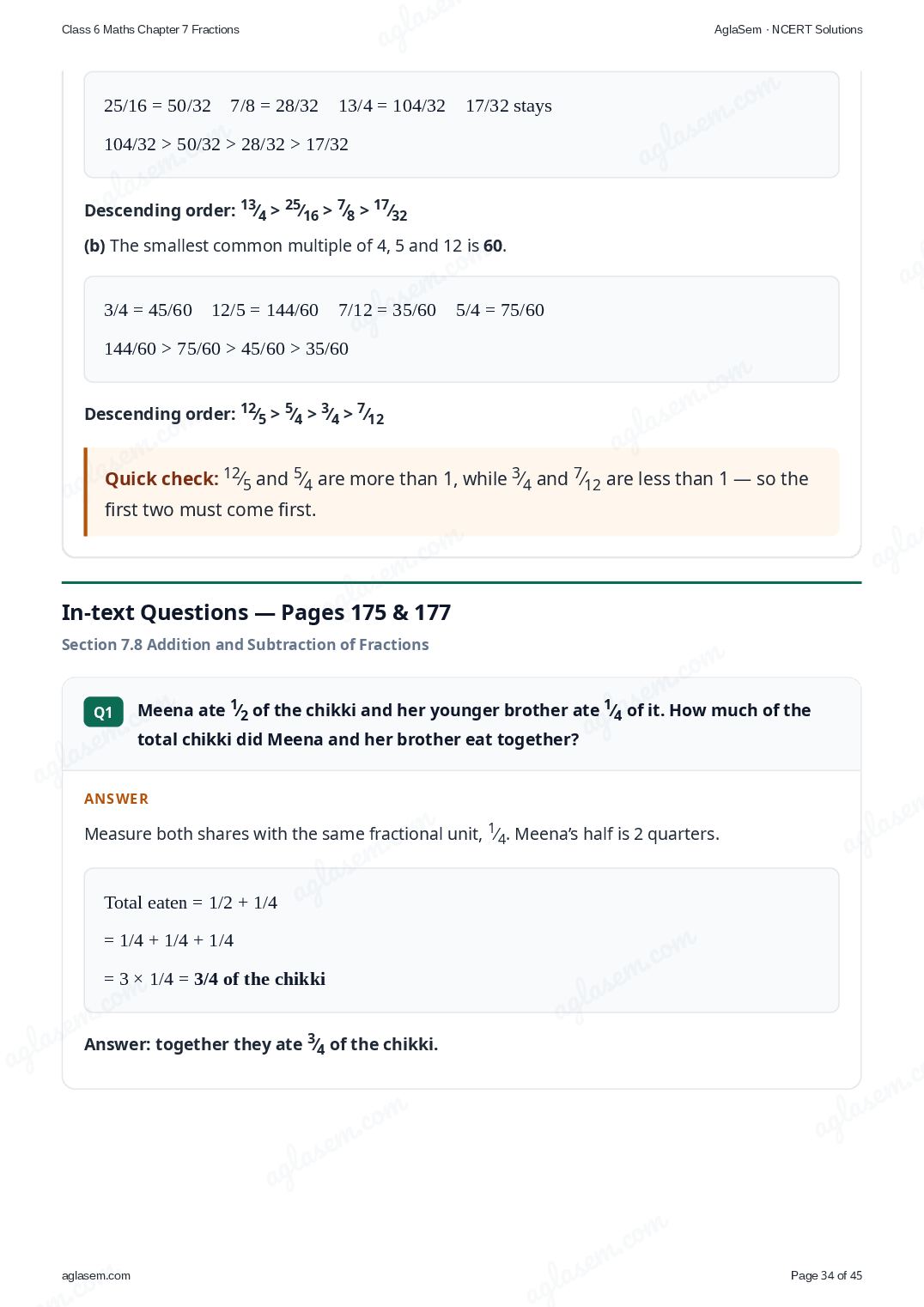
- Write the following fractions in descending order. a. 25 ⁄ 16 , 7 ⁄ 8 , 13 ⁄ 4 , 17 ⁄ 32 b. 3 ⁄ 4 , 12 ⁄ 5 , 7 ⁄ 12 , 5 ⁄ 4
- Meena ate 1 ⁄ 2 of the chikki and her younger brother ate 1 ⁄ 4 of it. How much of the total chikki did Meena and her brother eat together?
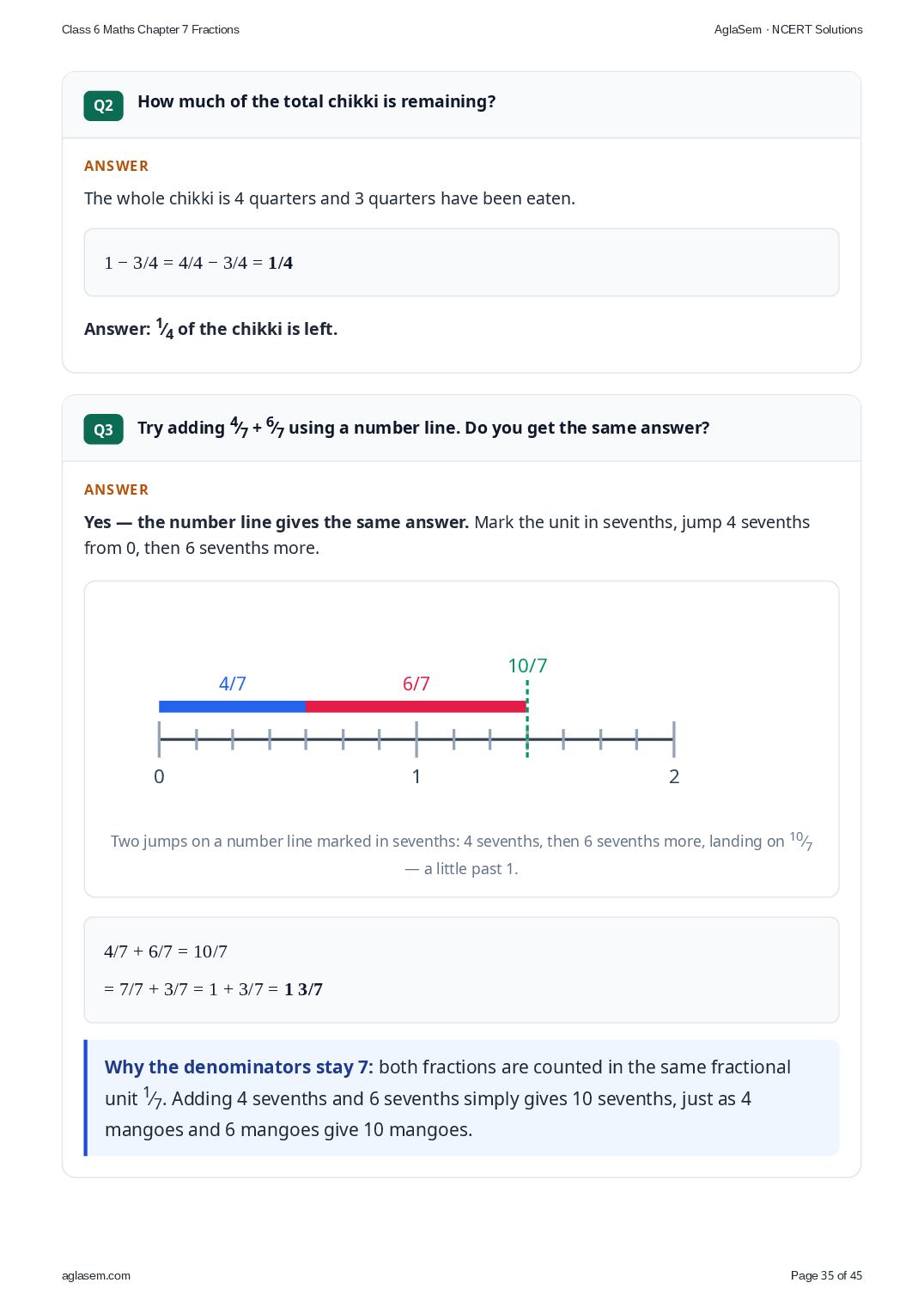
- How much of the total chikki is remaining?
- Try adding 4 ⁄ 7 + 6 ⁄ 7 using a number line. Do you get the same answer?
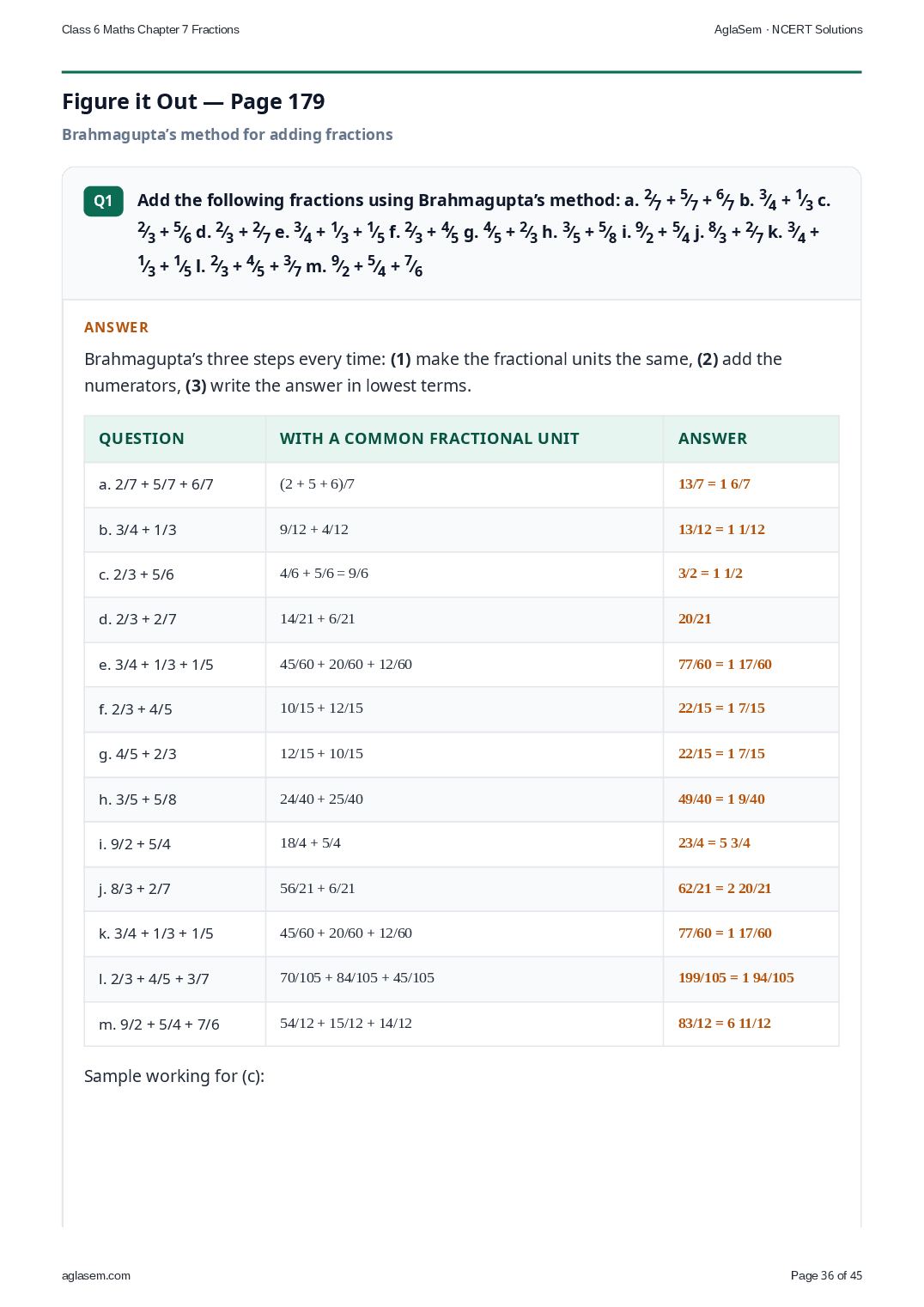
- Add the following fractions using Brahmagupta’s method: a. 2 ⁄ 7 + 5 ⁄ 7 + 6 ⁄ 7 b. 3 ⁄ 4 + 1 ⁄ 3 c. 2 ⁄ 3 + 5 ⁄ 6 d. 2 ⁄ 3 + 2 ⁄ 7 e. 3 ⁄ 4 + 1 ⁄ 3 + 1 ⁄ 5 f. 2 ⁄ 3 + 4 ⁄ 5 g. 4 ⁄ 5 + 2 ⁄ 3 h. 3 ⁄ 5 + 5 ⁄ 8 i. 9 ⁄ 2 + 5 ⁄ 4 j. 8 ⁄ 3 + 2 ⁄ 7 k. 3 ⁄ 4 + 1 ⁄ 3 + 1 ⁄ 5 l. 2 ⁄ 3 + 4 ⁄ 5 + 3 ⁄ 7 m. 9 ⁄ 2 + 5 ⁄ 4 + 7 ⁄ 6
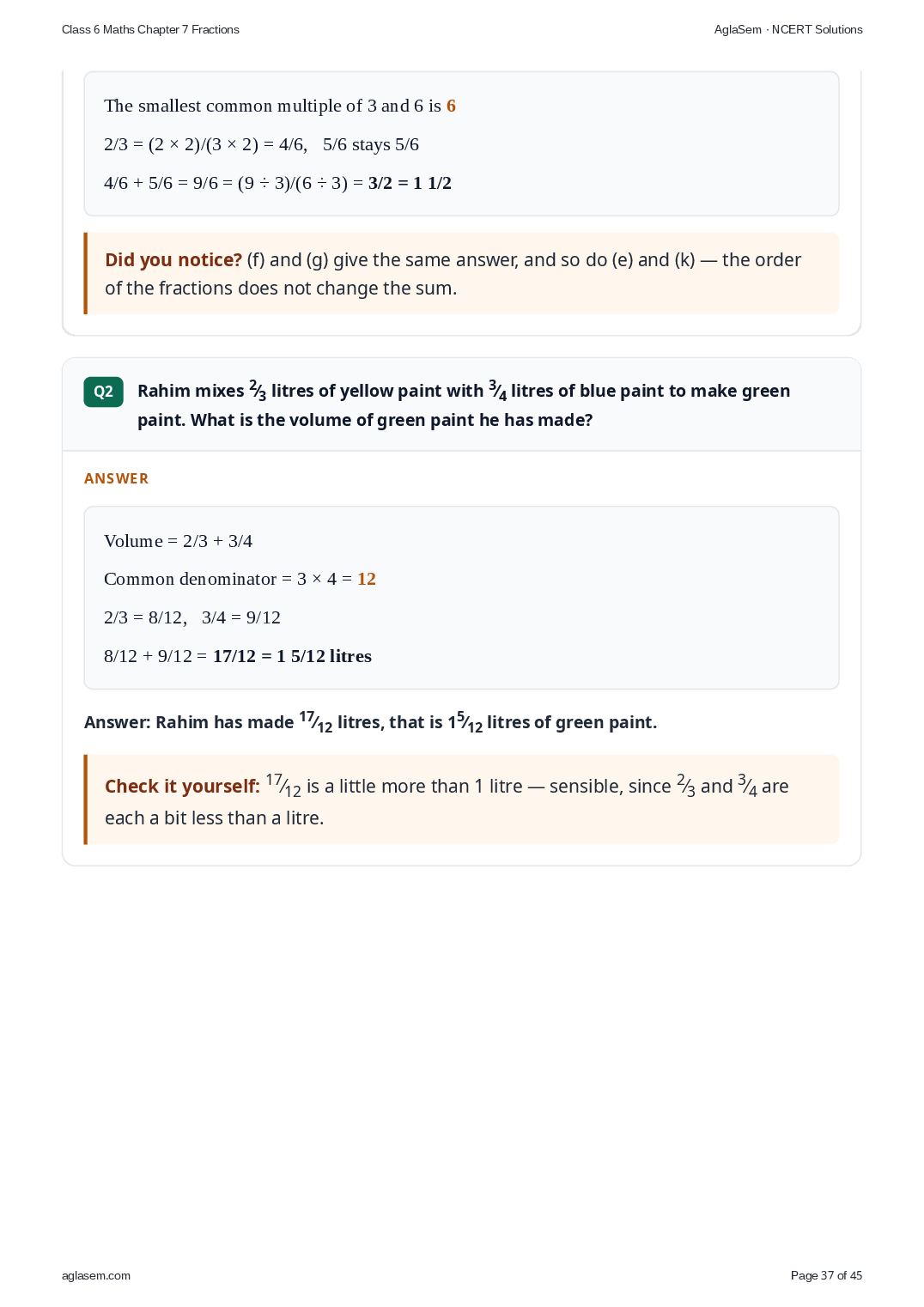
- Rahim mixes 2 ⁄ 3 litres of yellow paint with 3 ⁄ 4 litres of blue paint to make green paint. What is the volume of green paint he has made?
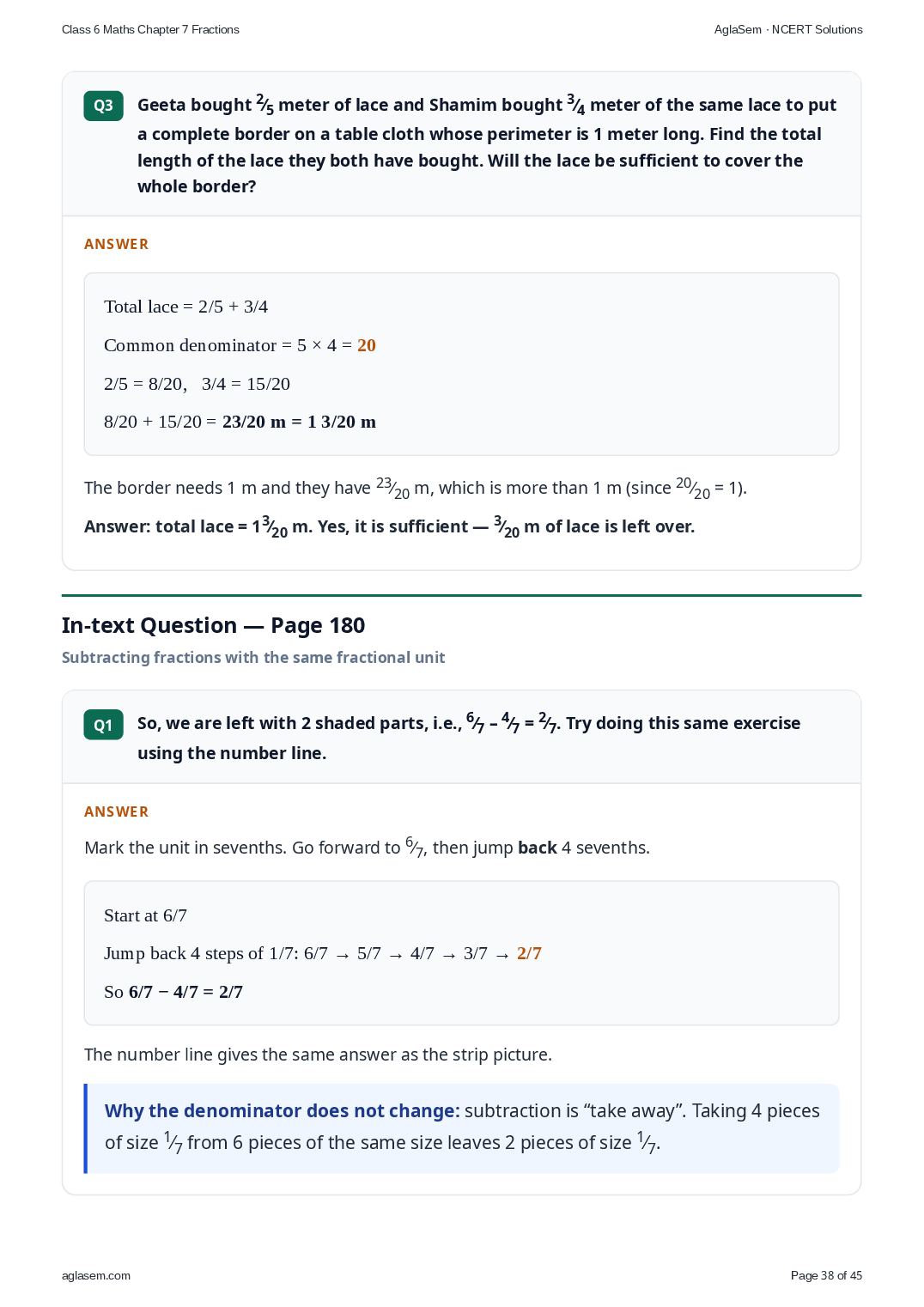
- Geeta bought 2 ⁄ 5 meter of lace and Shamim bought 3 ⁄ 4 meter of the same lace to put a complete border on a table cloth whose perimeter is 1 meter long. Find the total length of the lace they both have bought. Will the lace be sufficient to cover the whole border?
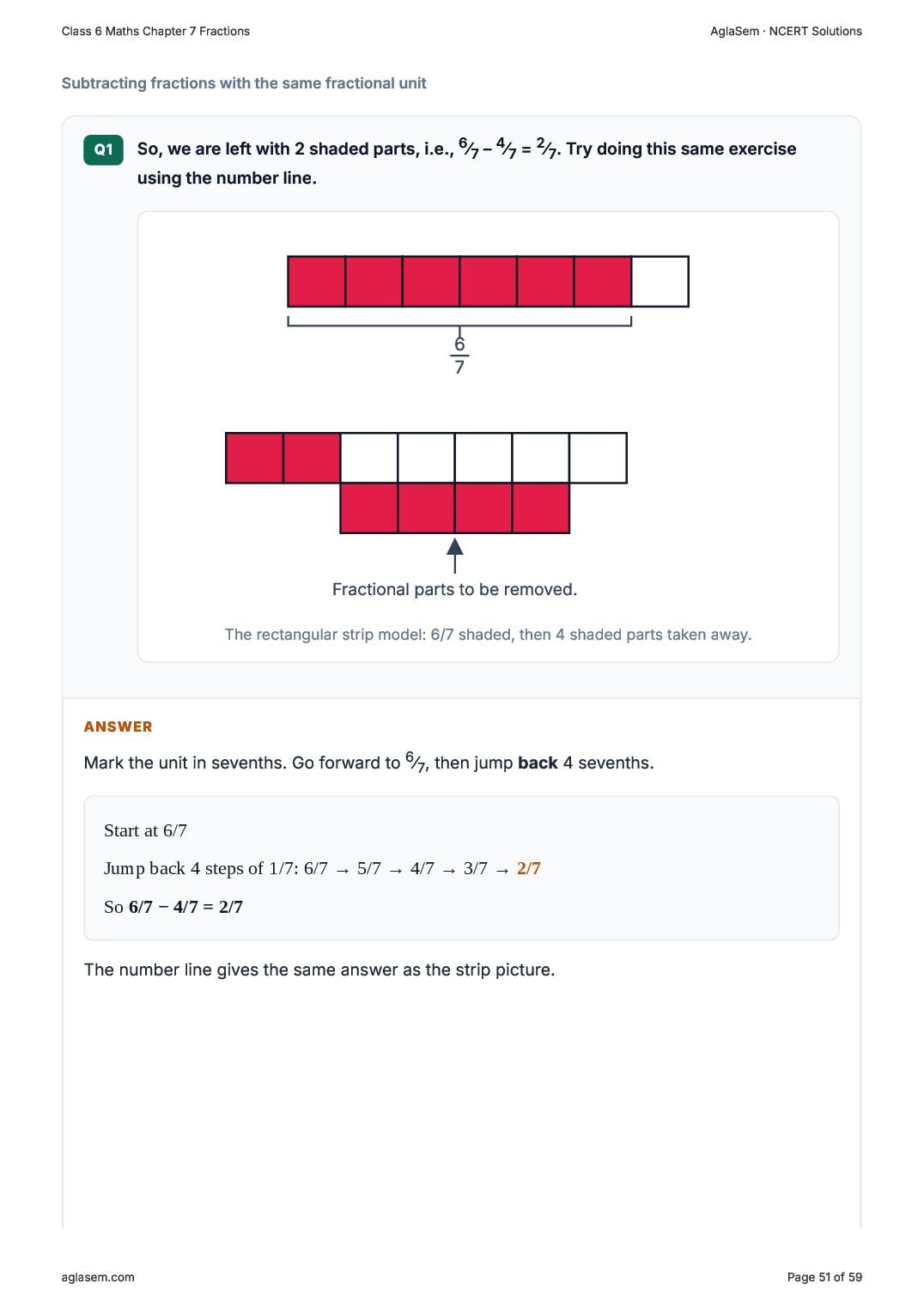
- So, we are left with 2 shaded parts, i.e., 6 ⁄ 7 – 4 ⁄ 7 = 2 ⁄ 7 . Try doing this same exercise using the number line.
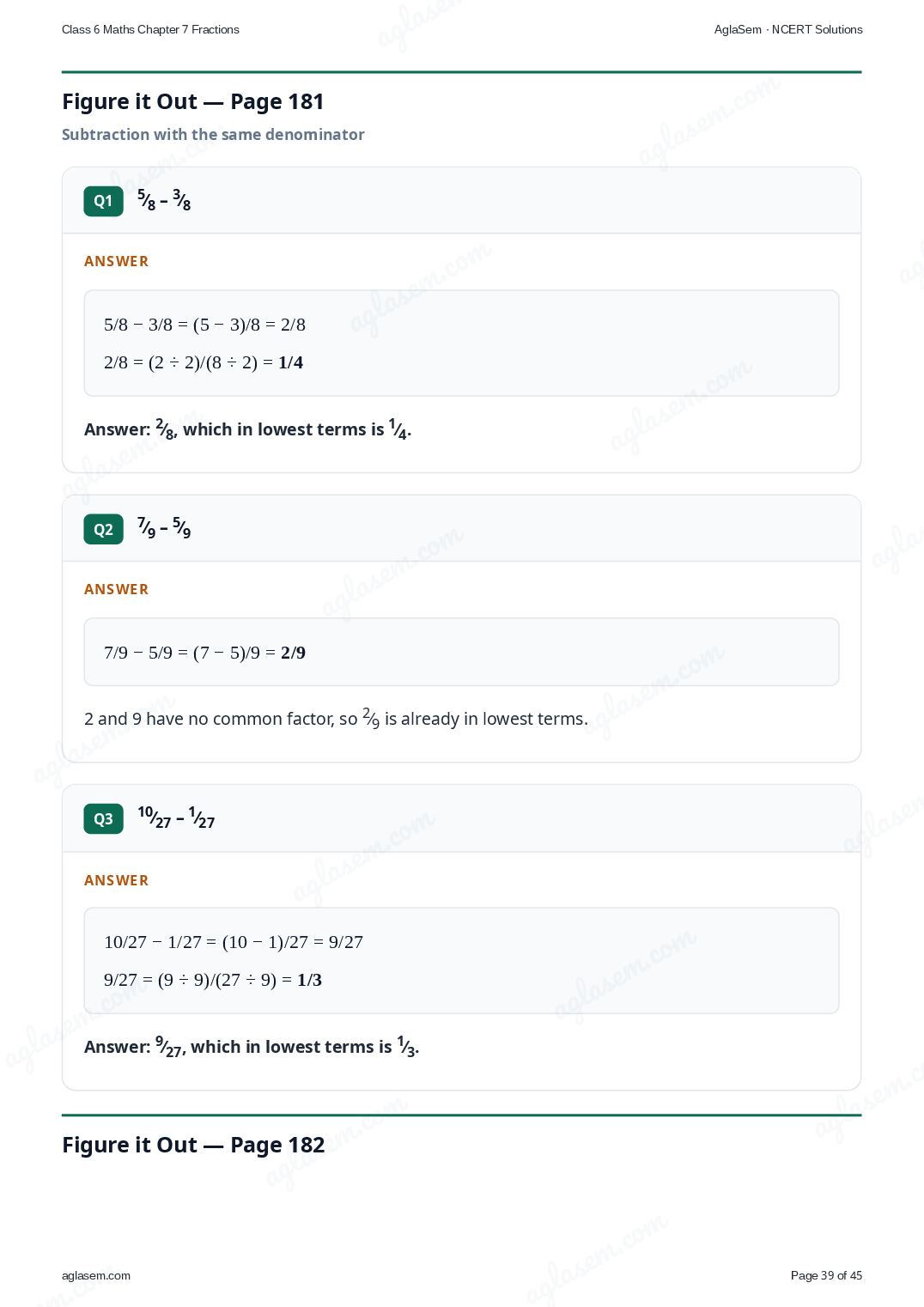
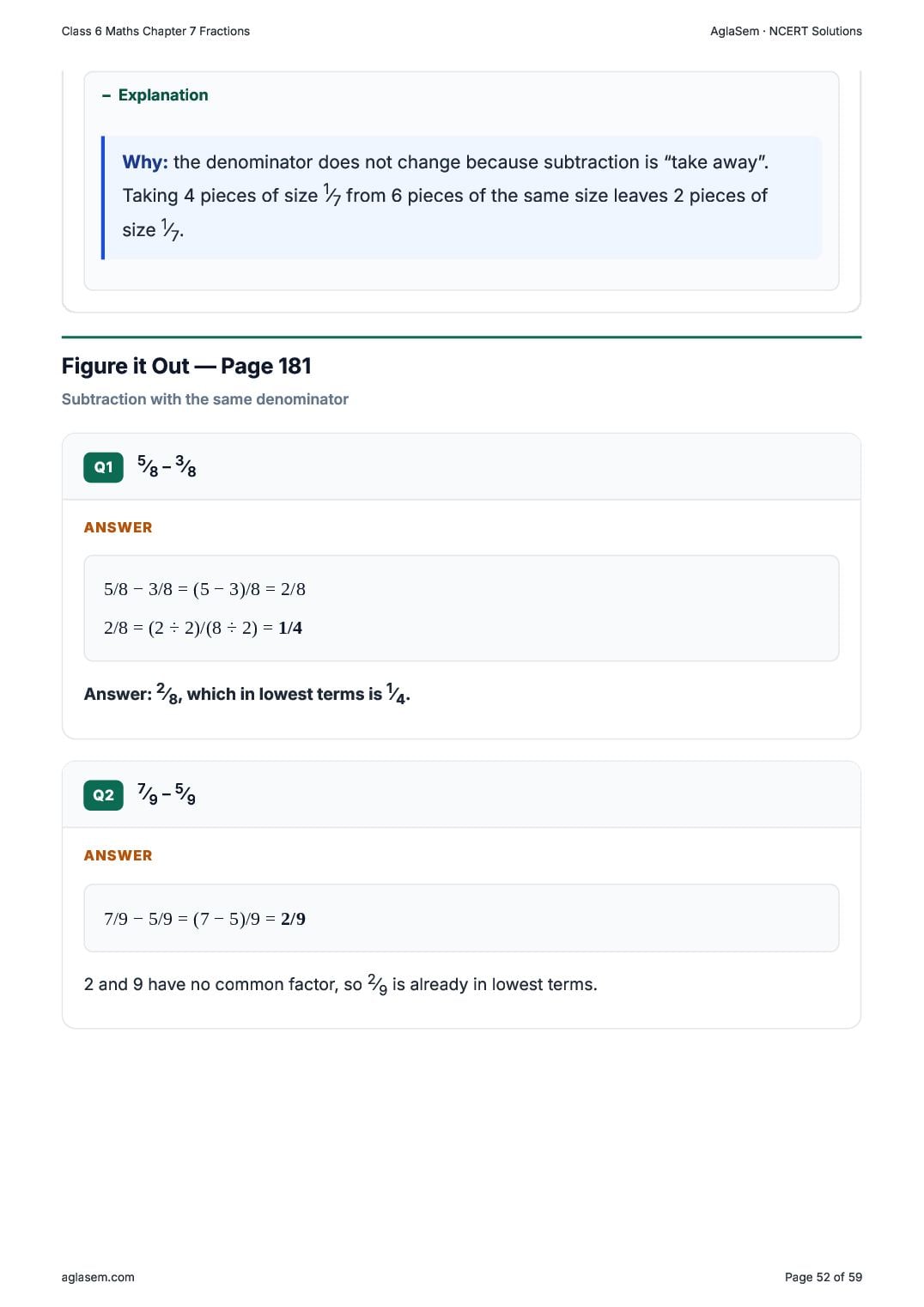
- 5 ⁄ 8 – 3 ⁄ 8
- 7 ⁄ 9 – 5 ⁄ 9
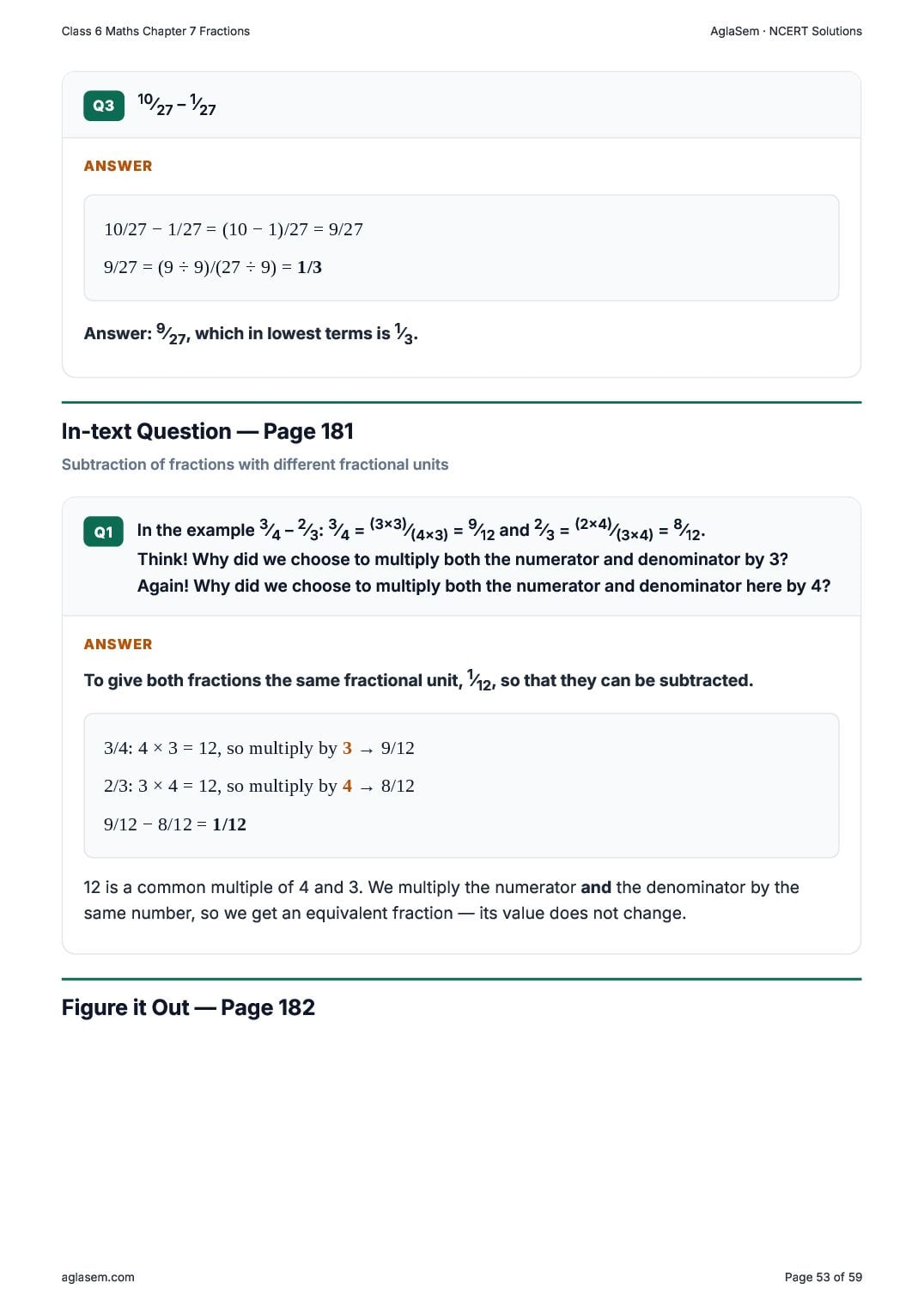
- 10 ⁄ 27 – 1 ⁄ 27
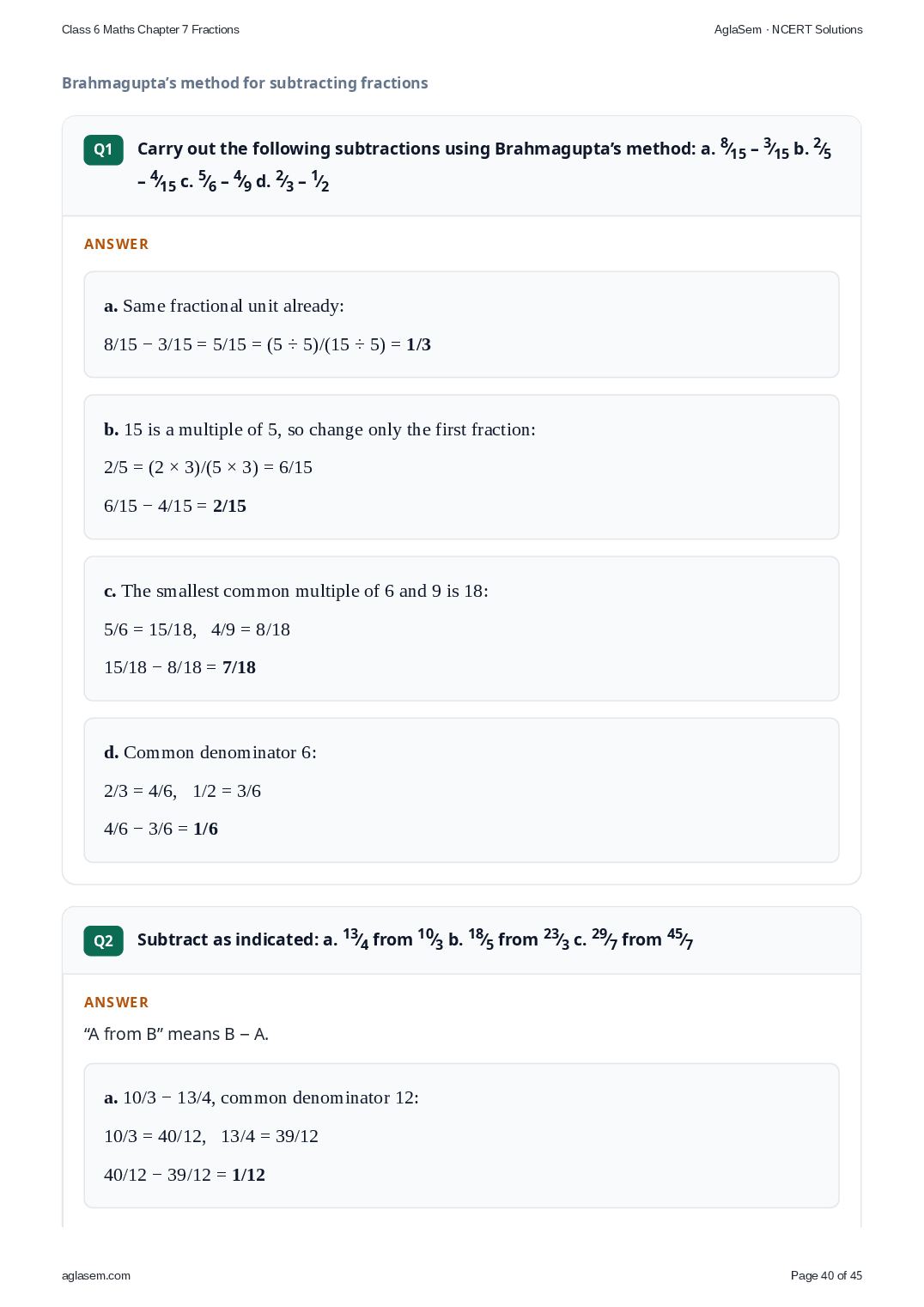
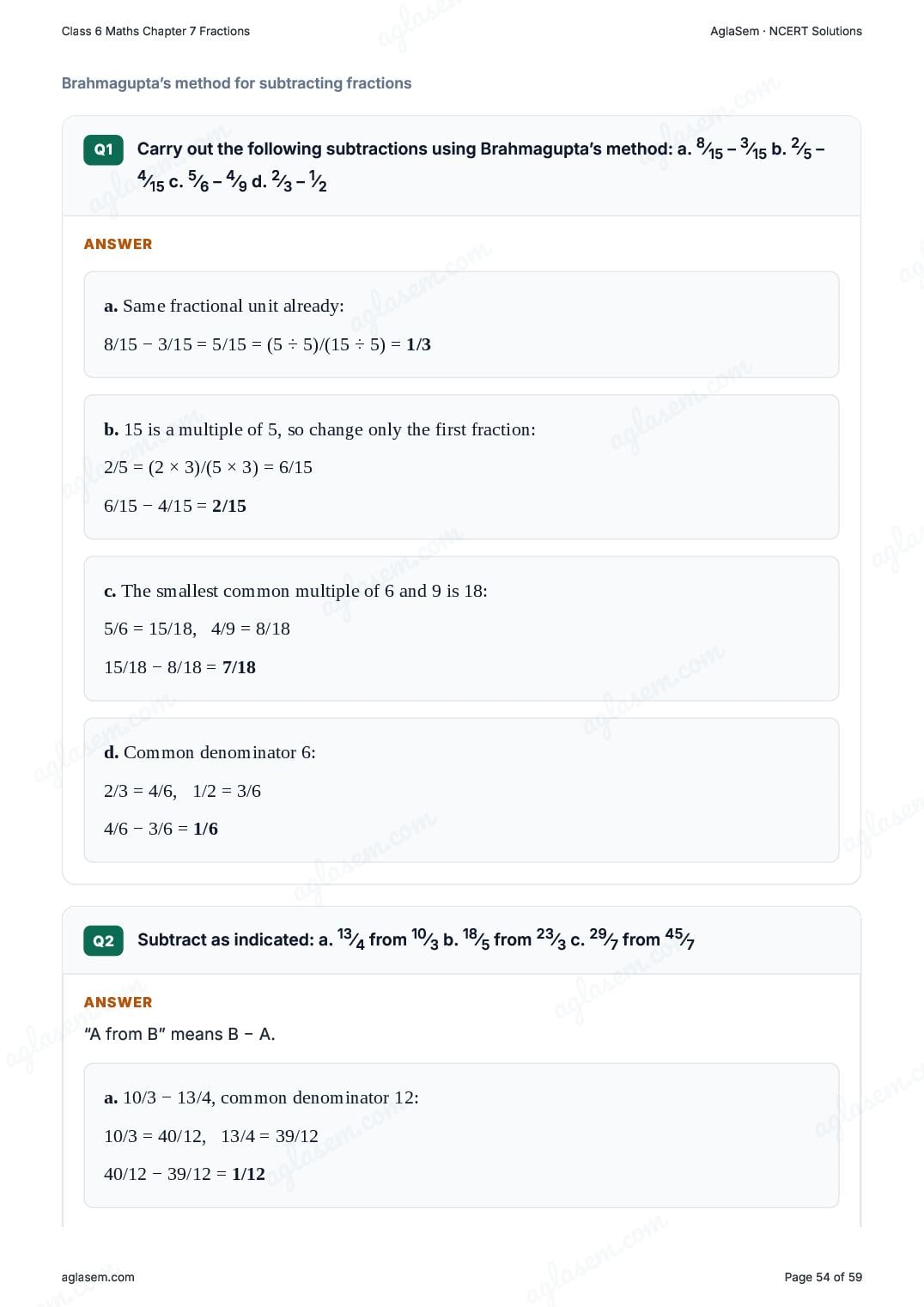
- Carry out the following subtractions using Brahmagupta’s method: a. 8 ⁄ 15 – 3 ⁄ 15 b. 2 ⁄ 5 – 4 ⁄ 15 c. 5 ⁄ 6 – 4 ⁄ 9 d. 2 ⁄ 3 – 1 ⁄ 2
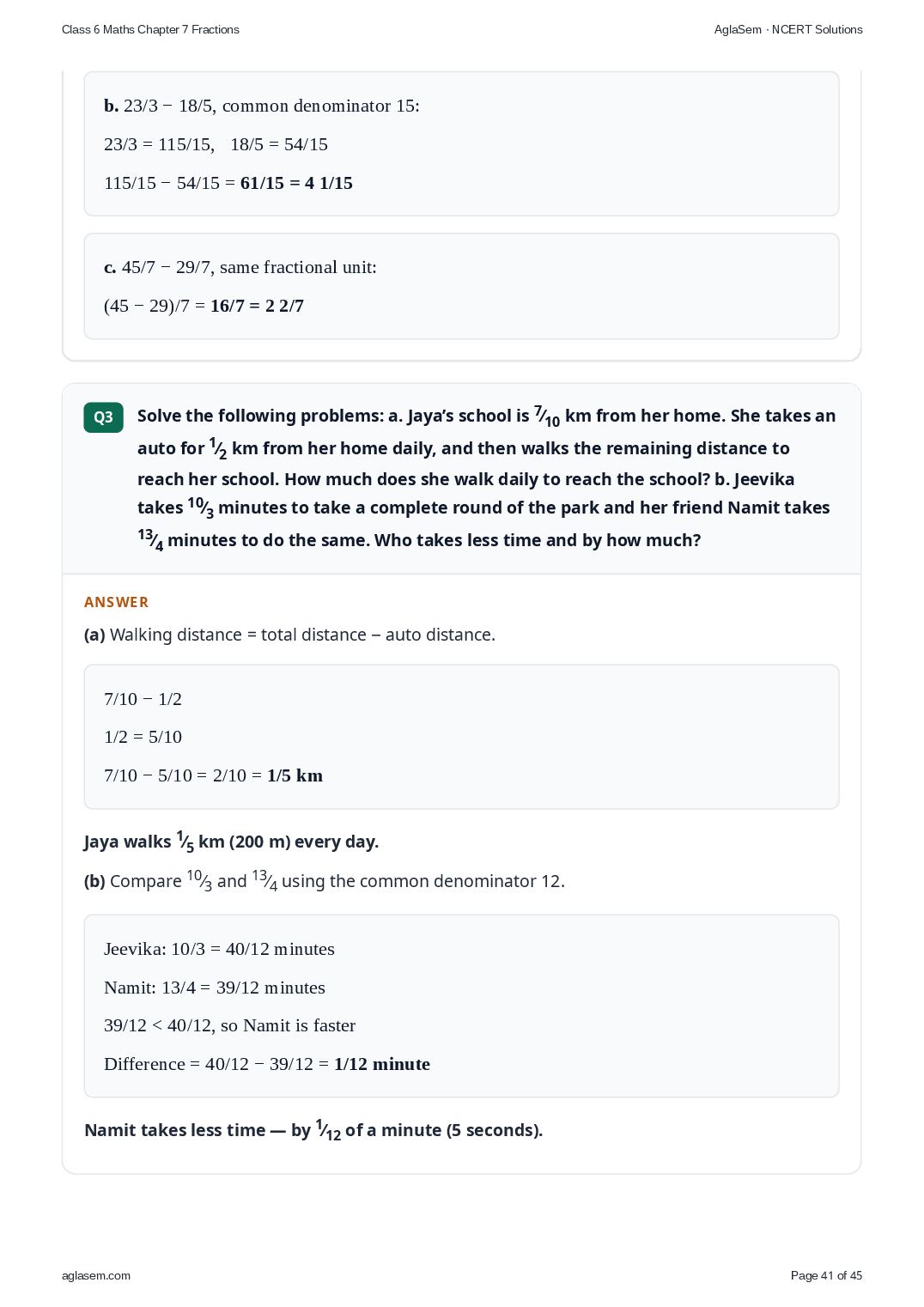
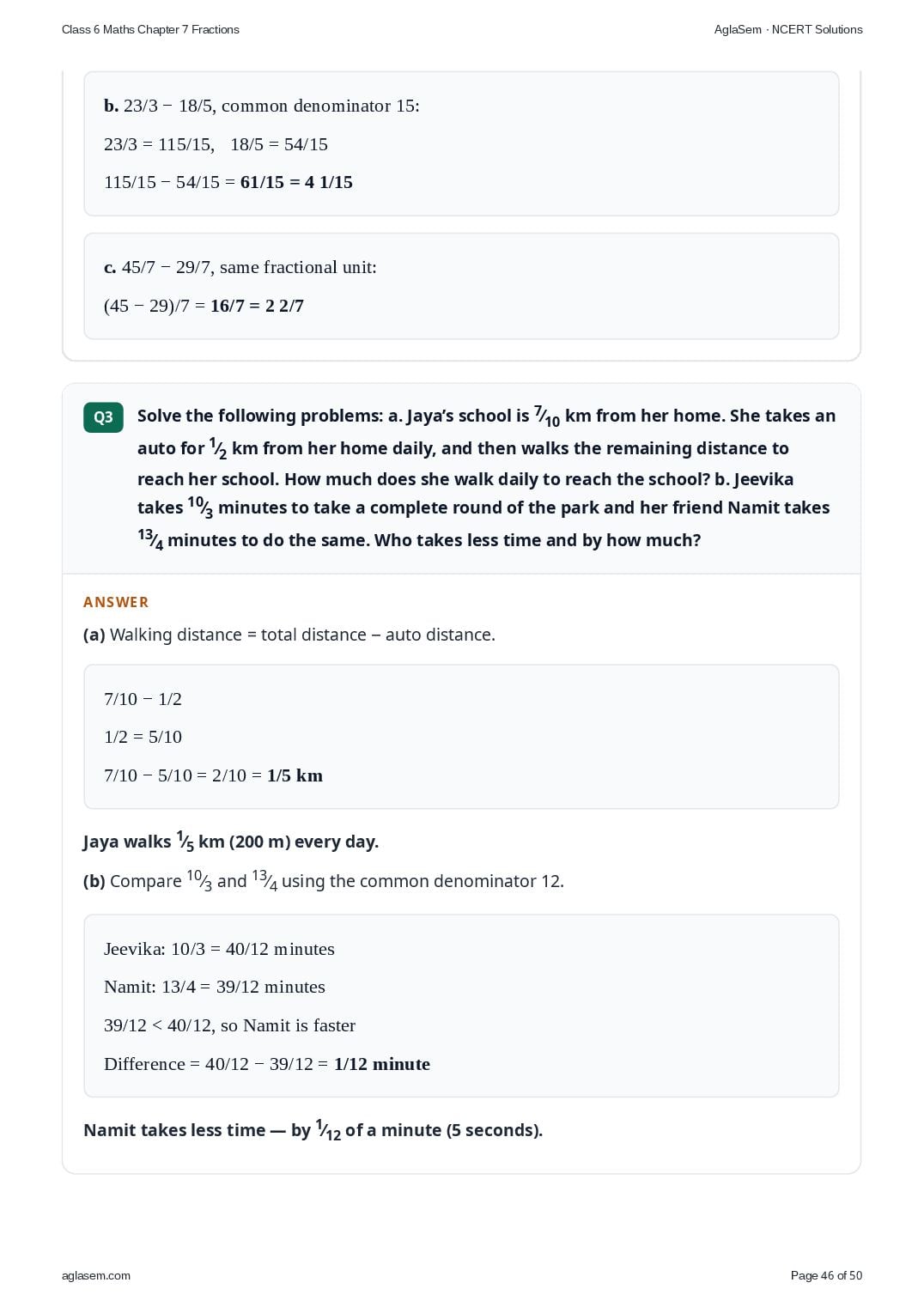
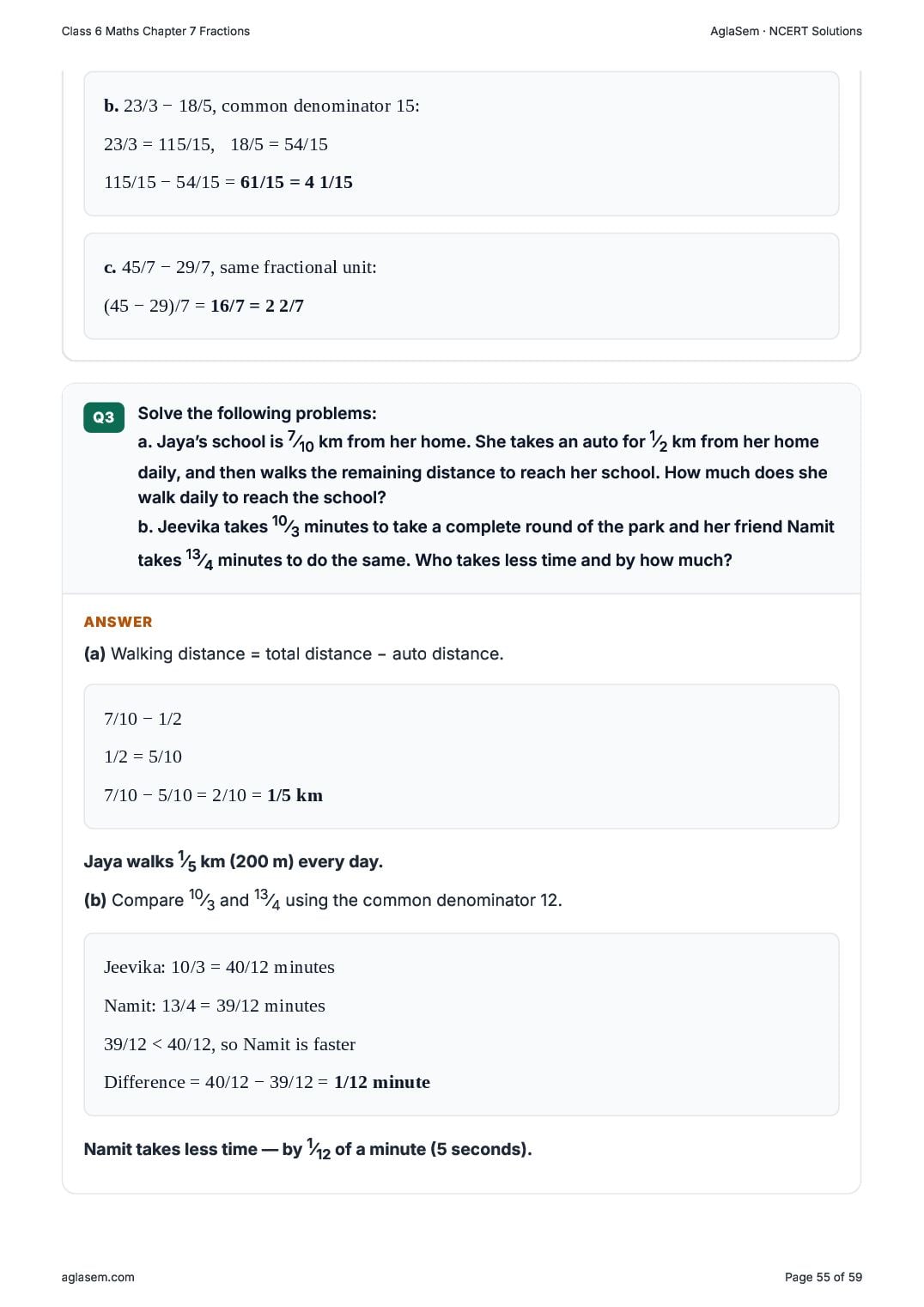
- Subtract as indicated: a. 13 ⁄ 4 from 10 ⁄ 3 b. 18 ⁄ 5 from 23 ⁄ 3 c. 29 ⁄ 7 from 45 ⁄ 7
- Solve the following problems: a. Jaya’s school is 7 ⁄ 10 km from her home. She takes an auto for 1 ⁄ 2 km from her home daily, and then walks the remaining distance to reach her school. How much does she walk daily to reach the school? b. Jeevika takes 10 ⁄ 3 minutes to take a complete round of the park and her friend Namit takes 13 ⁄ 4 minutes to do the same. Who takes less time and by how much?
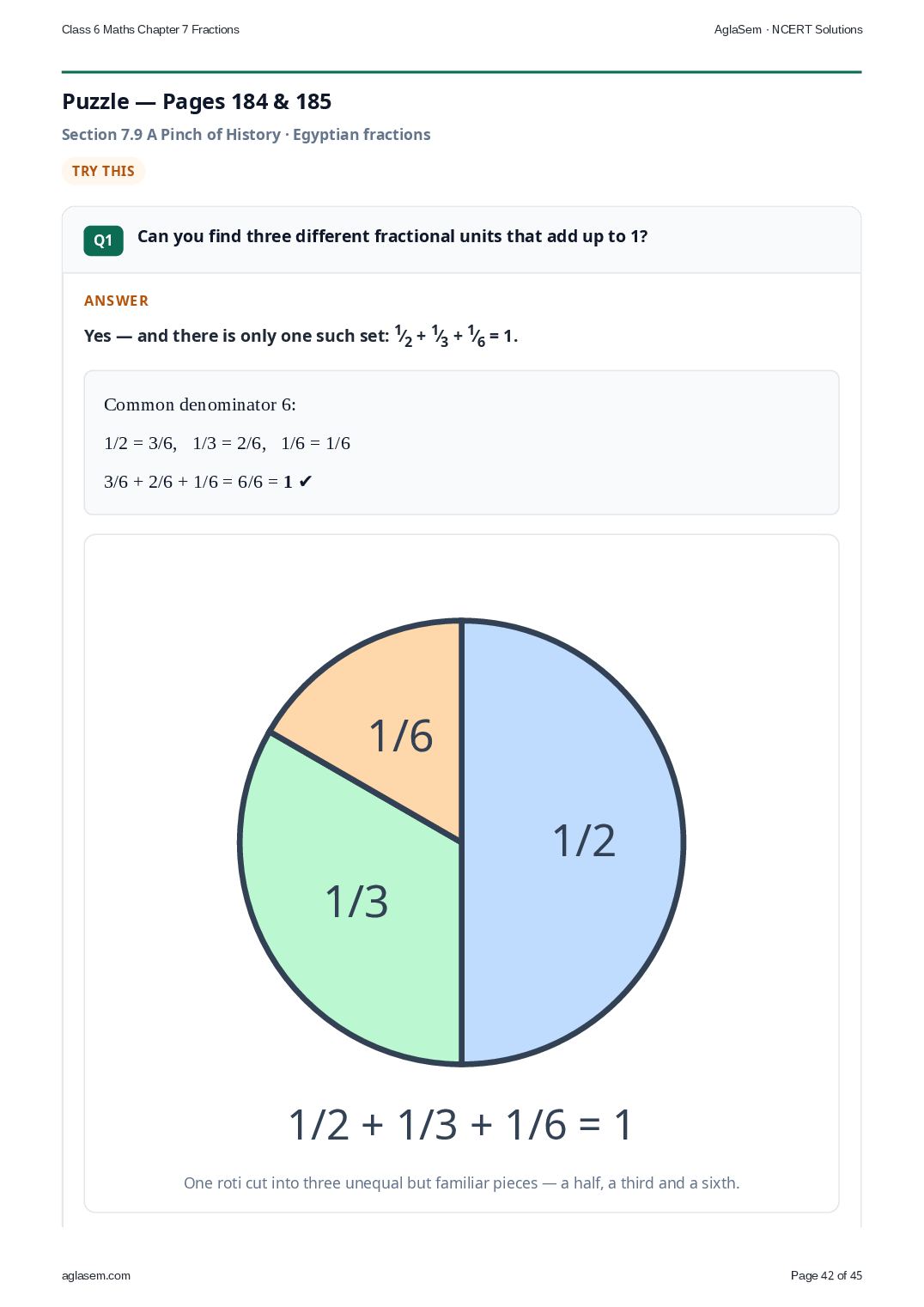
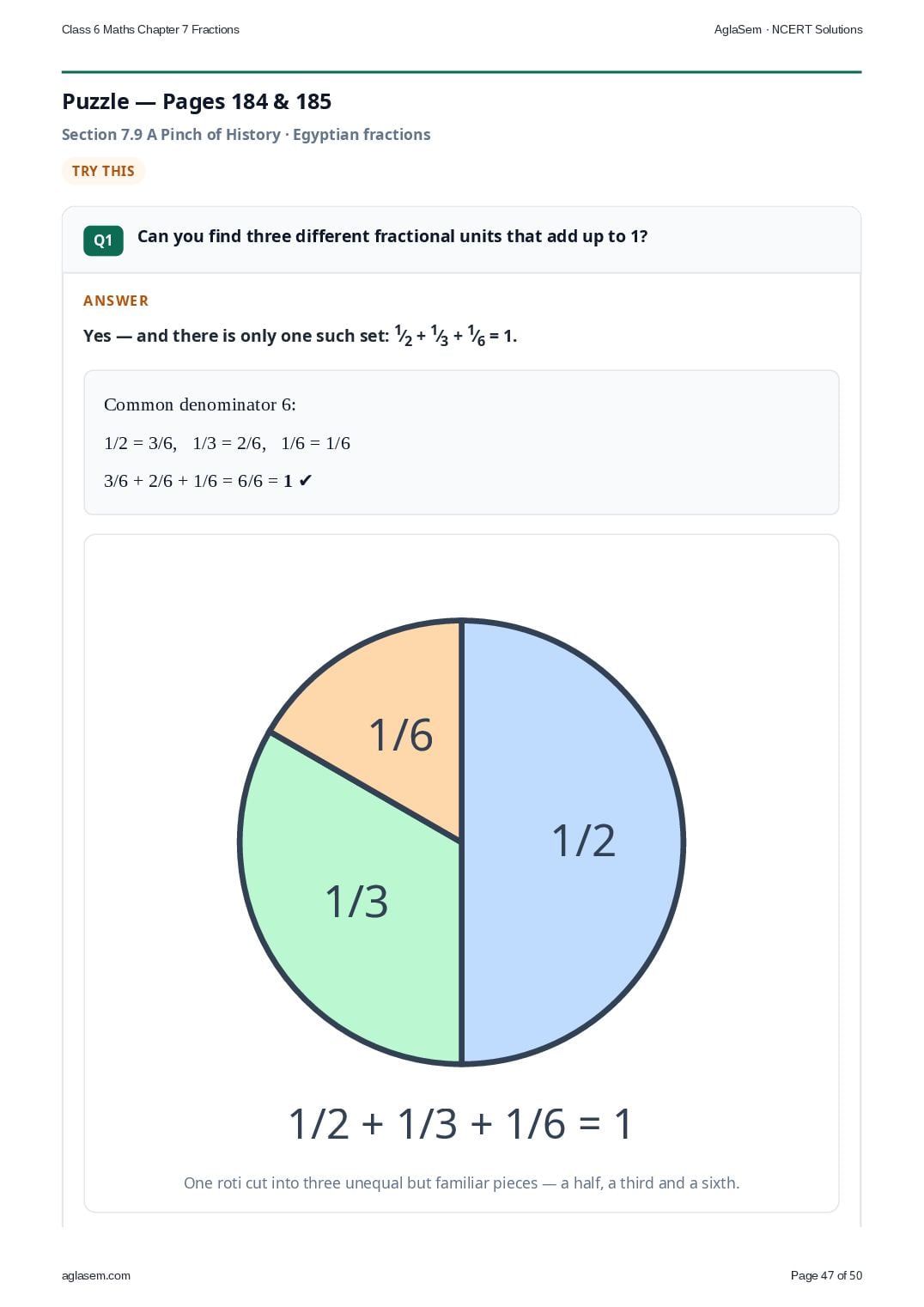
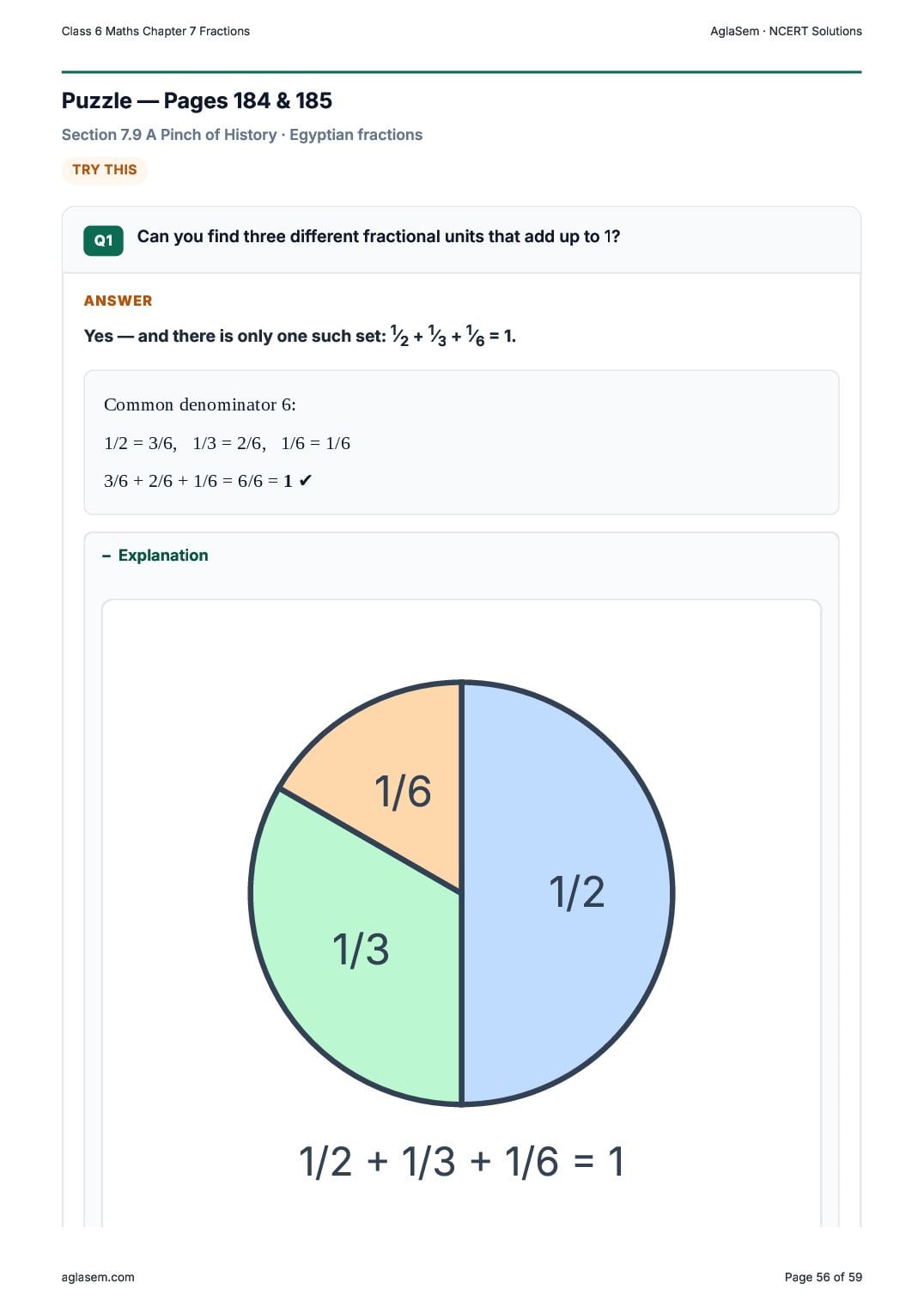
- Can you find three different fractional units that add up to 1?
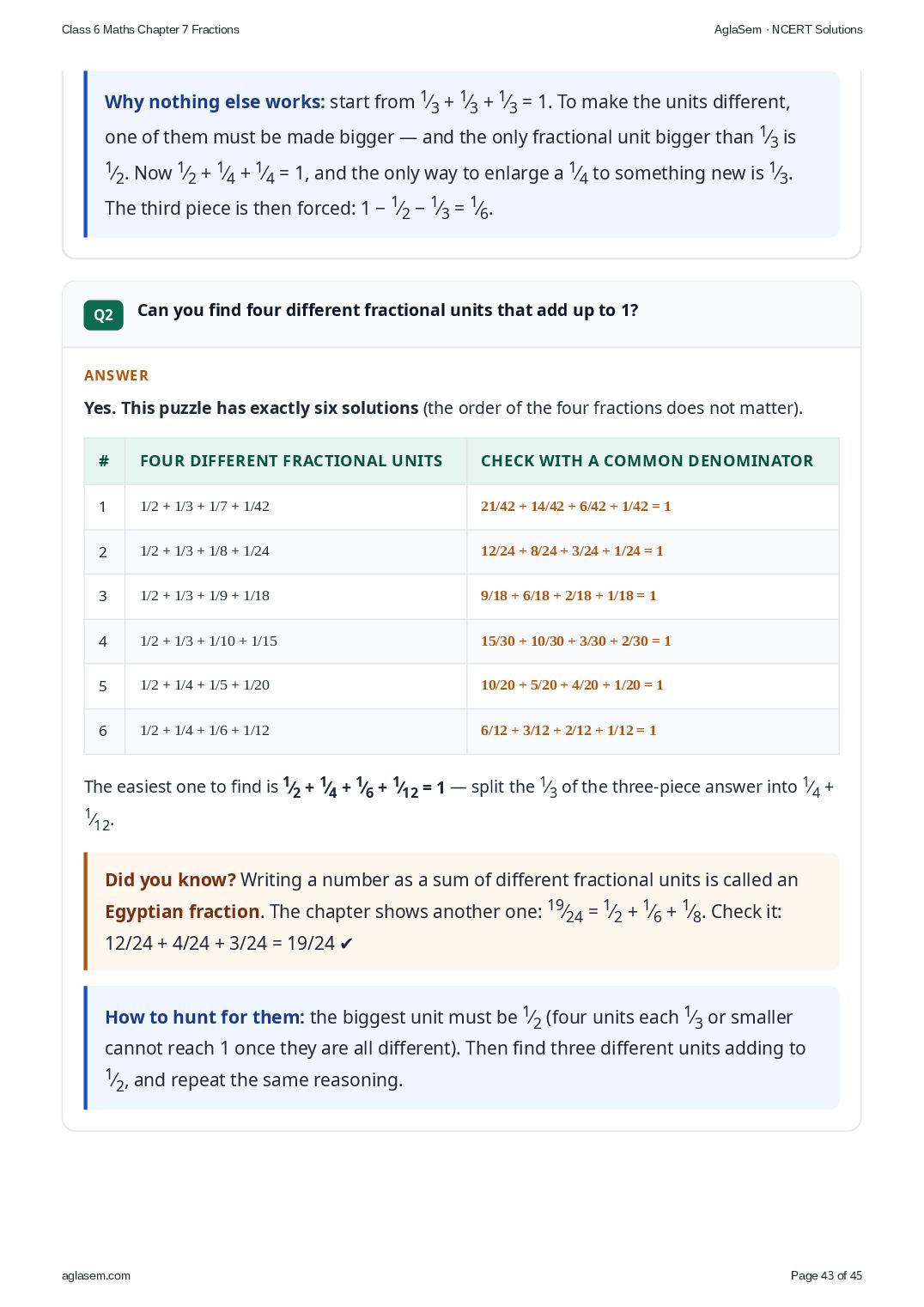
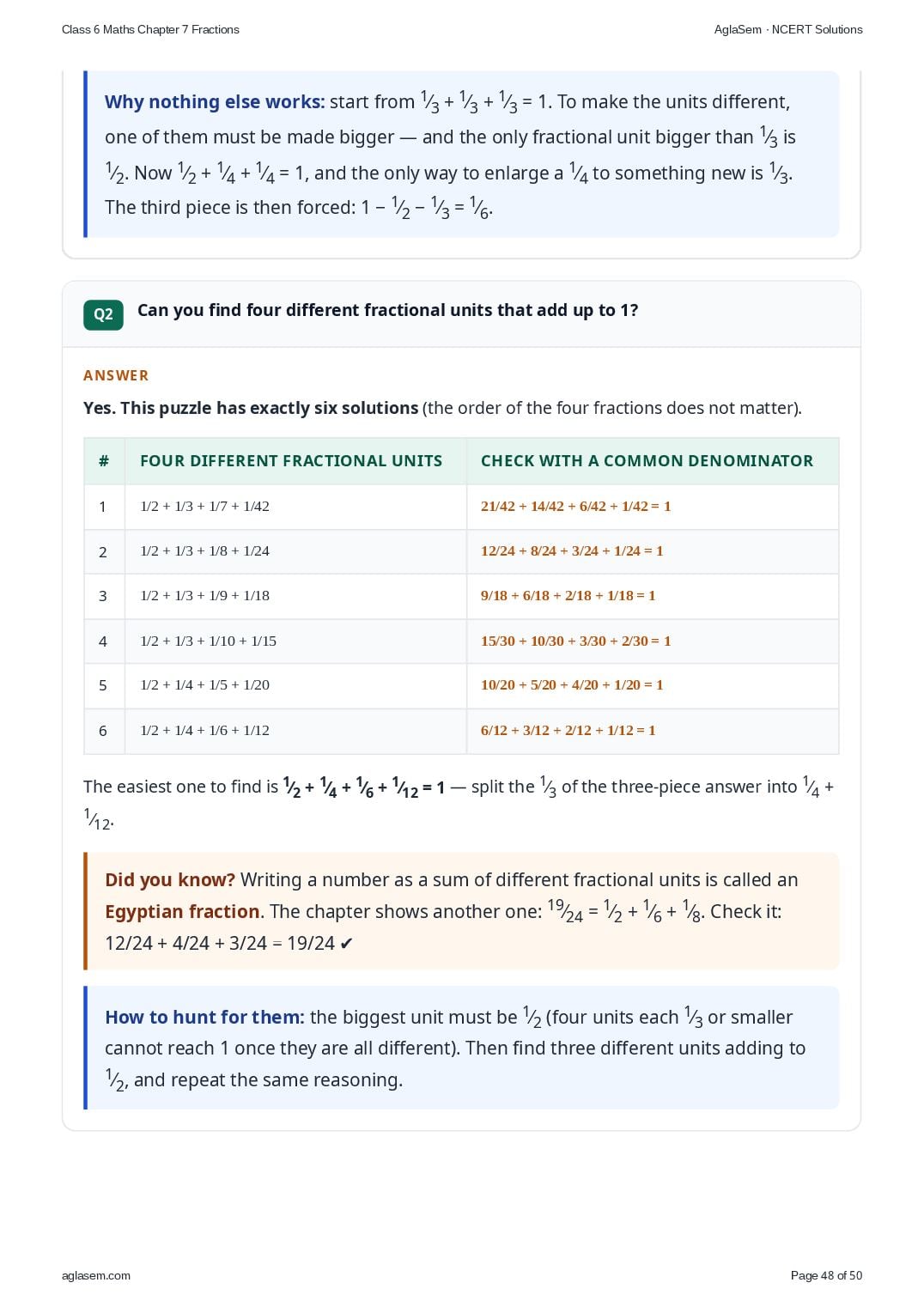
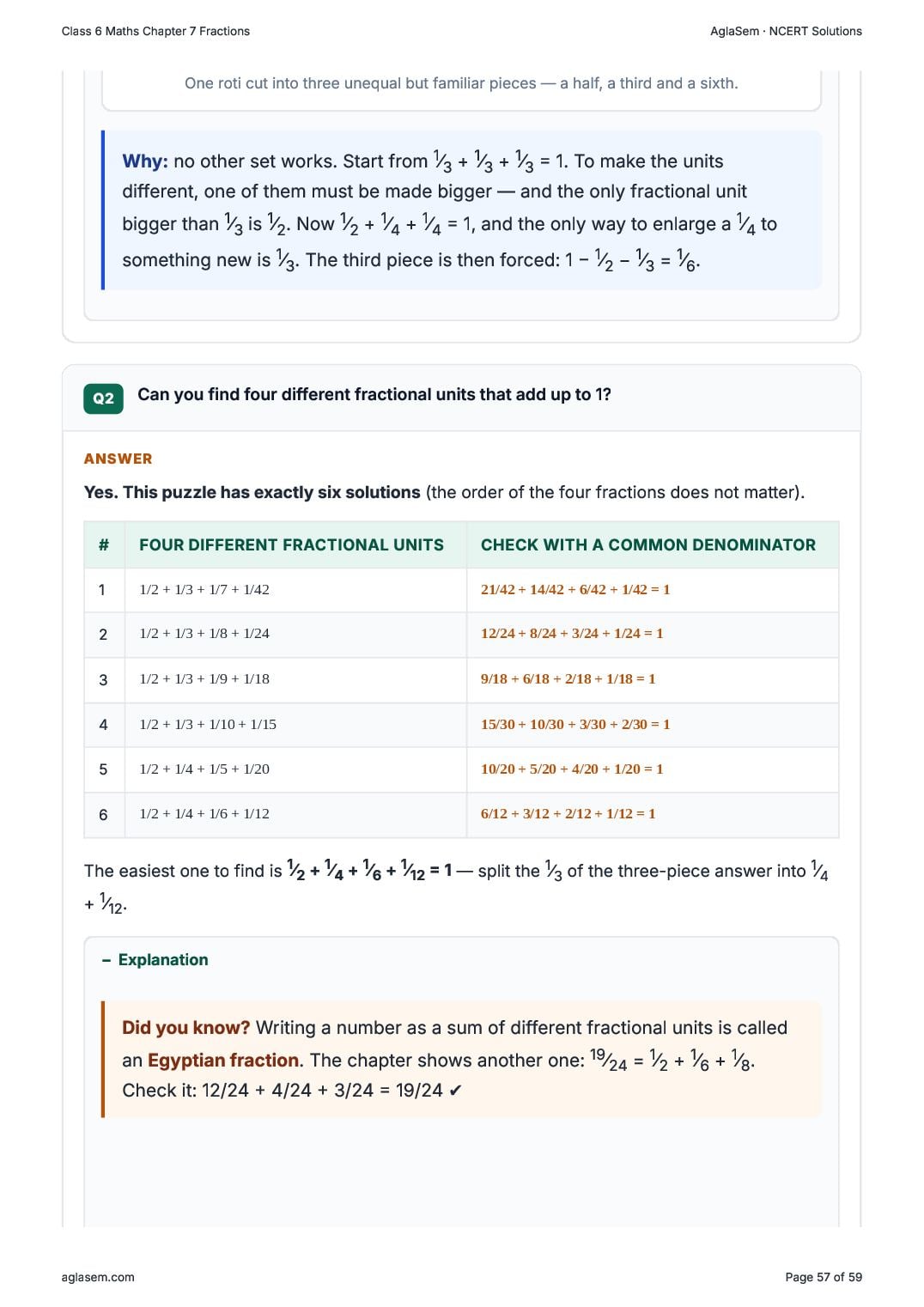
- Can you find four different fractional units that add up to 1?
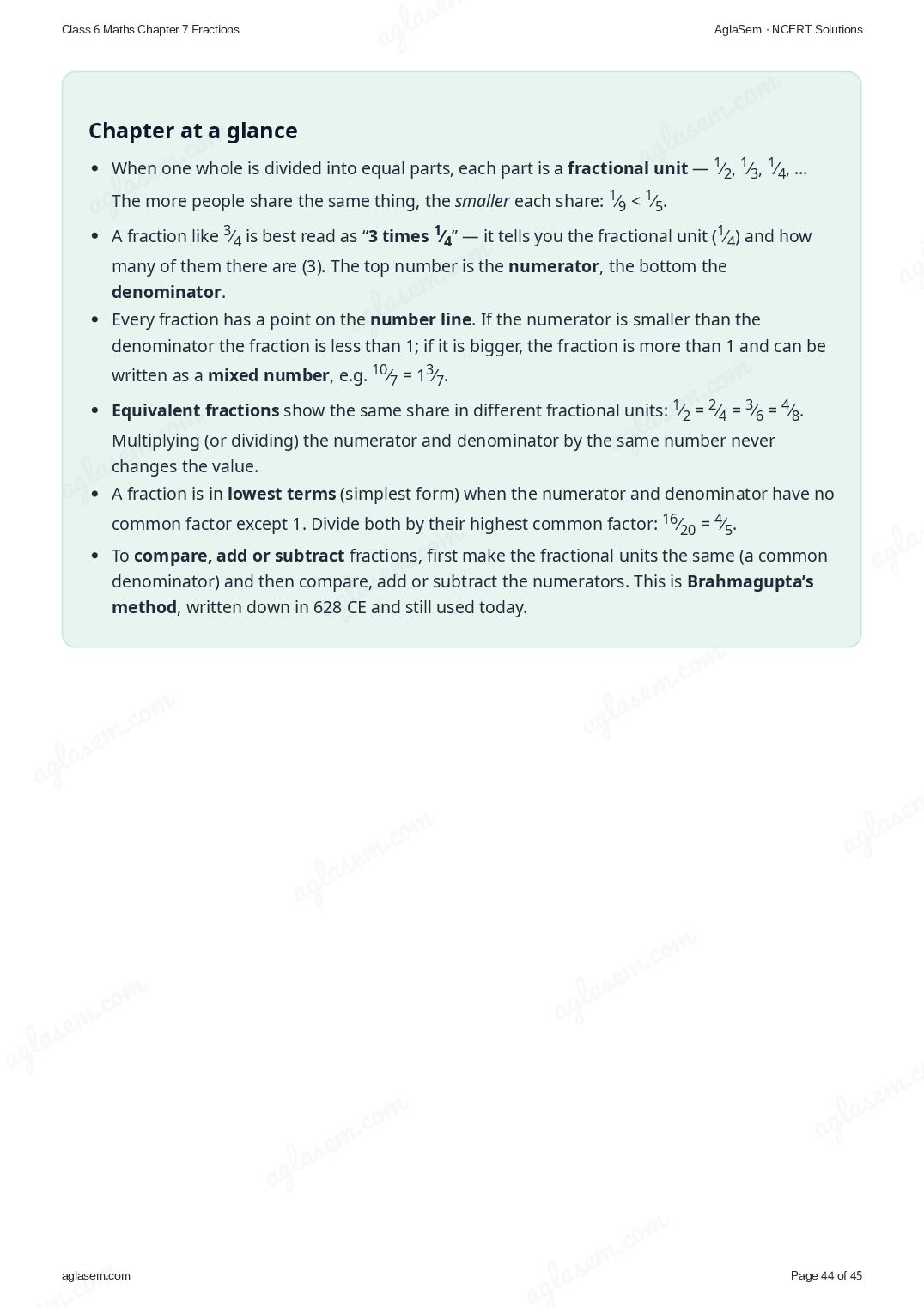
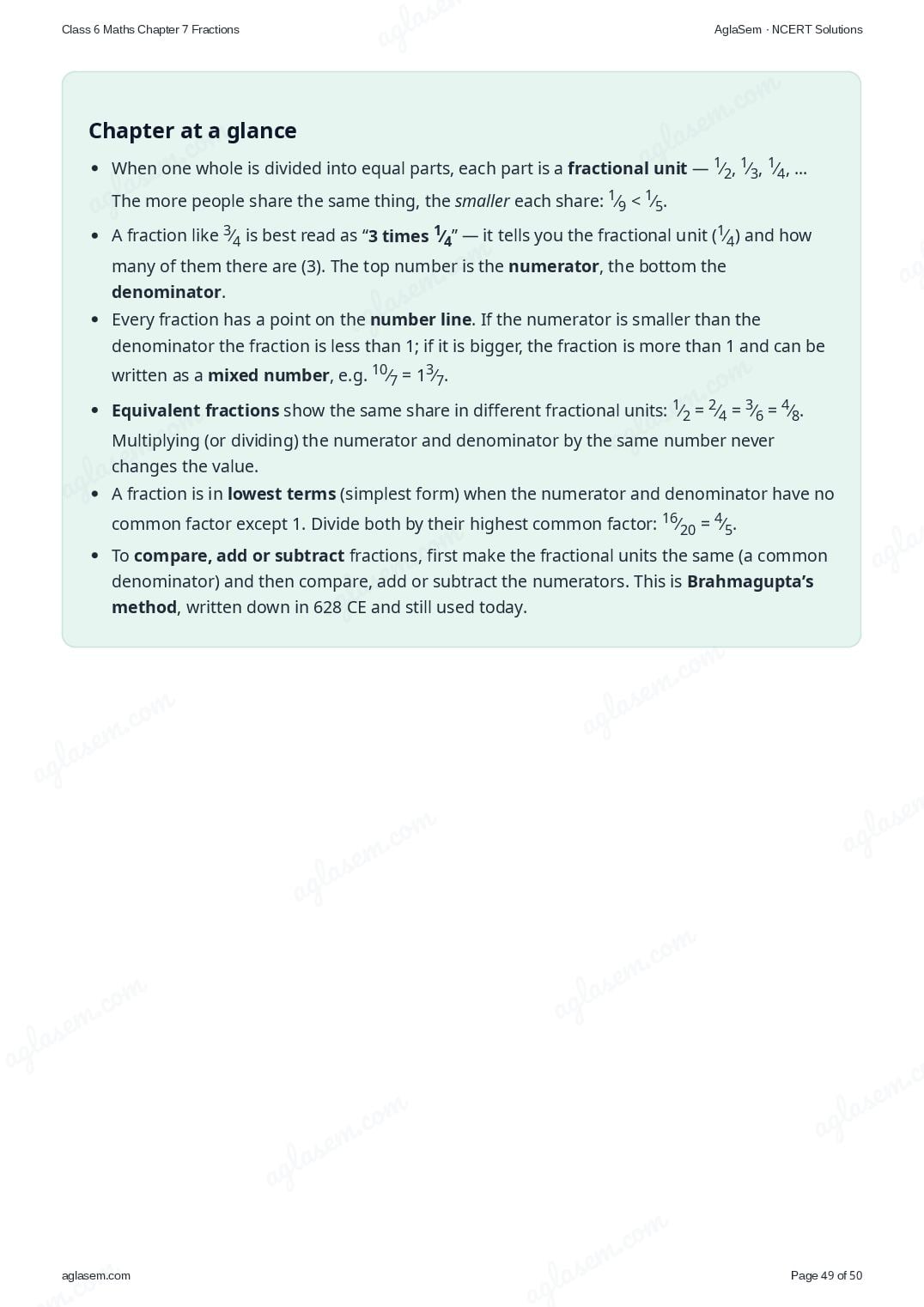
Chapter at a Glance
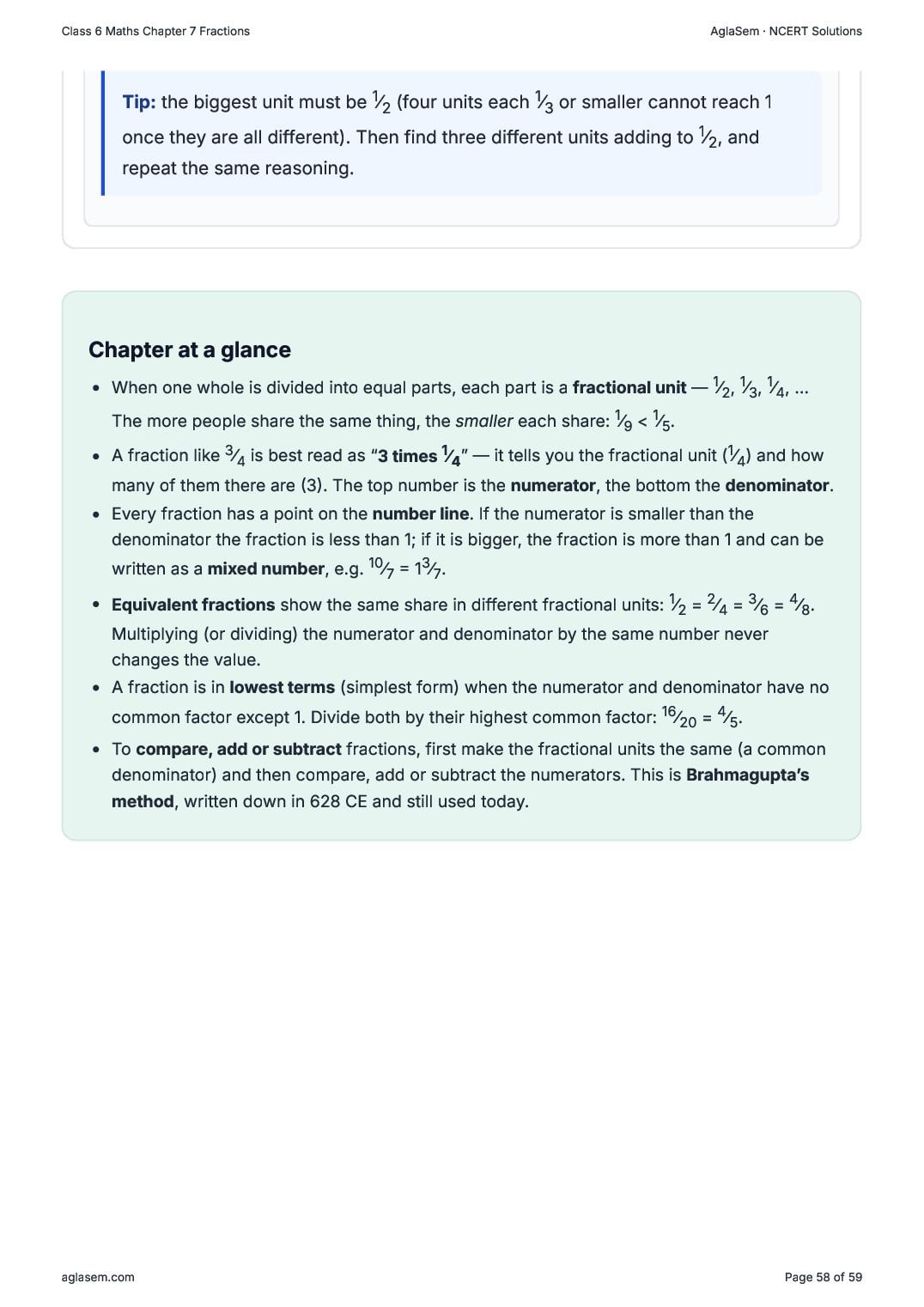
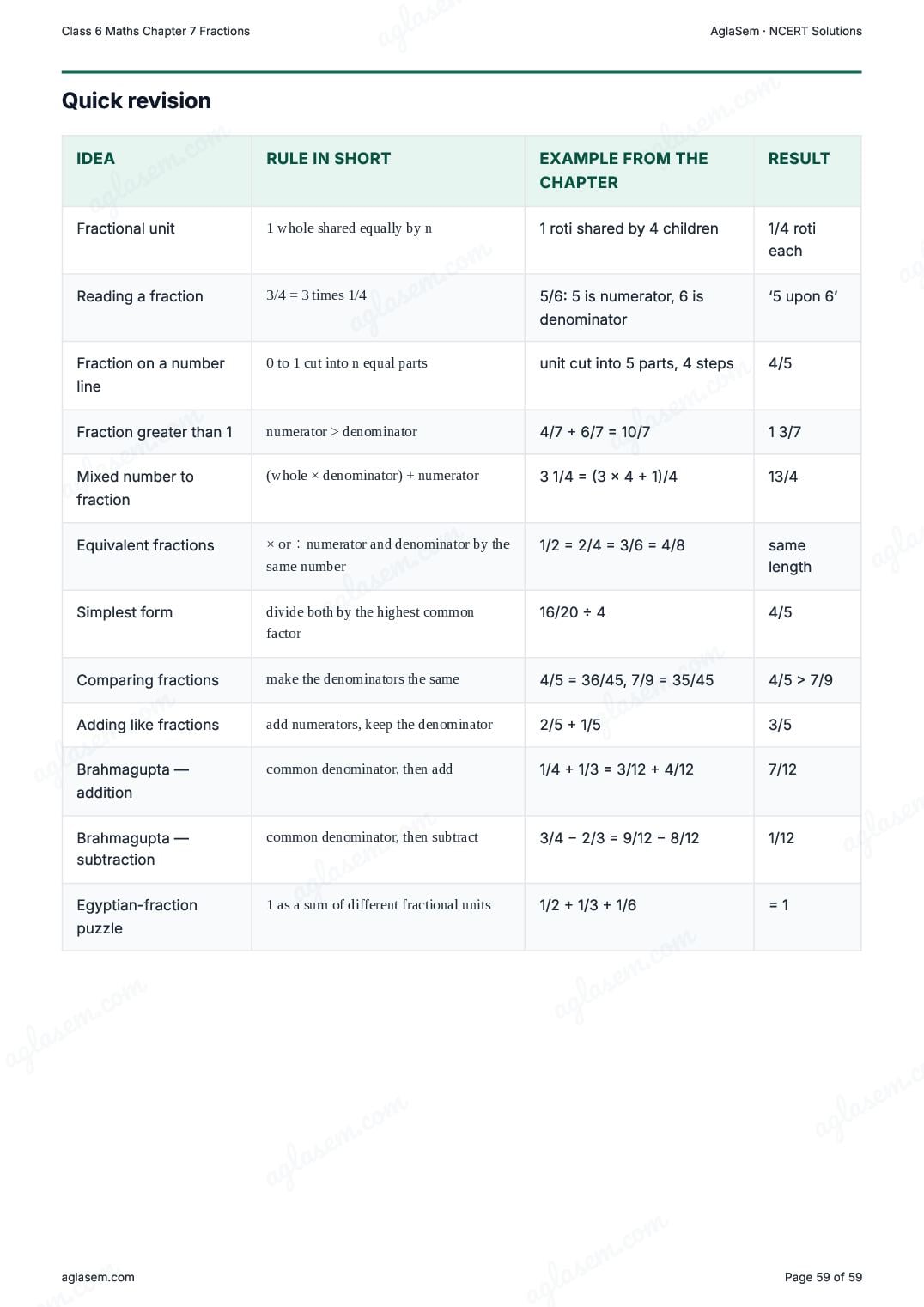
- When one whole is divided into equal parts, each part is a fractional unit — 1 ⁄ 2 , 1 ⁄ 3 , 1 ⁄ 4 , … The more people share the same thing, the smaller each share: 1 ⁄ 9 < 1 ⁄ 5 .
- A fraction like 3 ⁄ 4 is best read as “ 3 times 1 ⁄ 4 ” — it tells you the fractional unit ( 1 ⁄ 4 ) and how many of them there are (3). The top number is the numerator , the bottom the denominator .
- Every fraction has a point on the number line . If the numerator is smaller than the denominator the fraction is less than 1; if it is bigger, the fraction is more than 1 and can be written as a mixed number , e.g. 10 ⁄ 7 = 1 3 ⁄ 7 .
- Equivalent fractions show the same share in different fractional units: 1 ⁄ 2 = 2 ⁄ 4 = 3 ⁄ 6 = 4 ⁄ 8 . Multiplying (or dividing) the numerator and denominator by the same number never changes the value.
- A fraction is in lowest terms (simplest form) when the numerator and denominator have no common factor except 1. Divide both by their highest common factor: 16 ⁄ 20 = 4 ⁄ 5 .
- To compare, add or subtract fractions, first make the fractional units the same (a common denominator) and then compare, add or subtract the numerators. This is Brahmagupta’s method , written down in 628 CE and still used today.
How to Download NCERT Solutions for Class 6 Maths Chapter 7 PDF
Follow these simple steps to get the Fractions questions-and-answers PDF from Ganita Prakash.
- Search NCERT Solutions for Class 6 Maths Chapter 7 aglasem and open this page.
- Read the exercise questions with answers for Fractions shown above.
- Click the Download PDF link to save the Fractions solutions to your device.
NCERT Solutions for Class 6 Maths – All Chapters
There are more chapters to study besides Fractions in Maths. Here are the NCERT Solutions for all chapters of Class 6 Maths.
- Chapter 1 Patterns in Mathematics
- Chapter 2 Lines and Angles
- Chapter 3 Number Play
- Chapter 4 Data Handling and Presentation
- Chapter 5 Prime Time
- Chapter 6 Perimeter and Area
- Chapter 7 Fractions
- Chapter 8 Playing with Constructions
- Chapter 9 Symmetry
- Chapter 10 the Other Side of Zero
NCERT Solutions for Class 6 – All Subjects
Just like Chapter 7 of Maths, you can get the exercise questions with answers for every other subject of Class 6. Here are the NCERT Solutions for all subjects of Class 6.
NCERT Solutions for Class 6 Maths Chapter 7 – An Overview
The key highlights of this study material are as follows.
| Aspects | Details |
|---|---|
| Class | Class 6 |
| Subject | Maths |
| Chapter Number | Chapter 7 |
| Chapter Name | Fractions |
| Book Name | Ganita Prakash |
| Book By | NCERT (National Council of Educational Research and Training) |
| Educational Resource Here | NCERT Solutions of Class 6 Maths Chapter 7 for all exercises |
| More Questions Answers of This Subject | NCERT Solutions for Class 6 Maths |
| Download Book Chapter | NCERT Book Class 6 Maths |
| All Questions Answers For This Class | NCERT Solutions for Class 6 |
| Complete Solutions | NCERT Solutions |
NCERT Solutions for Class 6 Maths Chapter 7 Fractions – FAQs
What are the NCERT Solutions for Class 6 Maths Chapter 7 Fractions?
They are the complete, step-by-step answers to all the exercise and in-text questions of Chapter 7 Fractions from the NCERT Class 6 Maths textbook Ganita Prakash, written by experts as per the latest NCERT syllabus.
How can I download the Class 6 Maths Chapter 7 solutions PDF for free?
Open this page on aglasem, read the Fractions questions with answers, and click the “Download Solutions PDF” link. The Class 6 Maths Chapter 7 NCERT Solutions PDF is completely free to download.
Are these NCERT Solutions as per the latest 2026-27 syllabus?
Yes. The NCERT Solutions for Class 6 Maths Chapter 7 are based on the latest NCERT textbook Ganita Prakash and the current 2026-27 CBSE syllabus, so the questions and answers match what you study in class.
Where can I get NCERT Solutions for the other chapters of Class 6 Maths?
You can find the answers to every chapter on the NCERT Solutions for Class 6 Maths page, and solutions for every subject on the NCERT Solutions for Class 6 page.
How do NCERT Solutions help in exam preparation?
They show the correct method to solve each question, help you write answers the way they are expected in exams, let you check and correct your own work, and save revision time — which together improve your marks in Class 6 Maths.
If you have any queries on NCERT Solutions for Class 6 Maths Chapter 7 Fractions, then please ask in the comments below.