NCERT Solutions for Class 6 Maths Chapter 6 Perimeter and Area provide clear, step-by-step answers to every exercise and in-text question from the chapter Perimeter and Area of the NCERT textbook Ganita Prakash. Prepared by subject experts as per the latest NCERT (CBSE) syllabus for 2026-27, these NCERT Solutions for Class 6 Maths help you understand each concept, write exam-ready answers, and check your own solutions. You can read them online below or download the free Class 6 Maths Chapter 6 question-answer PDF.
NCERT Solutions for Class 6 Maths Chapter 6 Perimeter and Area
- Class: Class 6
- Subject: Maths
- Chapter: Chapter 6 – Perimeter and Area
- Textbook: Ganita Prakash (NCERT)
- Study material: NCERT Solutions – questions with answers, free PDF
These solutions answer all the exercise questions of Chapter 6 Perimeter and Area — including the in-text questions, short-answer and long-answer questions, and activities — with complete explanations so you can follow the method, not just the final answer. Read the full solutions below.
NCERT Solutions Class 6 Maths Chapter 6 Perimeter and Area View Download


NCERT Solutions for Class 6 Maths Chapter 6 PDF Download
You can read the NCERT Solutions for Class 6 Maths Chapter 6 online above, or download the complete question-answer PDF to study Perimeter and Area offline at any time.
NCERT Solutions for Class 6 Maths Chapter 6 PDF Download Link – Click Here to Download Solutions PDF
Questions Covered in This Chapter
These NCERT Solutions answer all 71 questions of this chapter. The questions solved are:
- Find the missing terms: a. Perimeter of a rectangle = 14 cm; breadth = 2 cm; length = ?. b. Perimeter of a square = 20 cm; side of a length = ?. c. Perimeter of a rectangle = 12 m; length = 3 m; breadth = ?.
- A rectangle having sidelengths 5 cm and 3 cm is made using a piece of wire. If the wire is straightened and then bent to form a square, what will be the length of a side of the square?
- Find the length of the third side of a triangle having a perimeter of 55 cm and having two sides of length 20 cm and 14 cm, respectively.
- What would be the cost of fencing a rectangular park whose length is 150 m and breadth is 120 m, if the fence costs ₹40 per metre?
- A piece of string is 36 cm long. What will be the length of each side, if it is used to form: a. A square, b. A triangle with all sides of equal length, and c. A hexagon (a six sided closed figure) with sides of equal length?
- A farmer has a rectangular field having length 230 m and breadth 160 m. He wants to fence it with 3 rounds of rope as shown. What is the total length of rope needed?
- Find out the total distance Akshi has covered in 5 rounds.
- Find out the total distance Toshi has covered in 7 rounds. Who ran a longer distance?
- Think and mark the positions as directed— a. Mark ‘A’ at the point where Akshi will be after she ran 250 m. b. Mark ‘B’ at the point where Akshi will be after she ran 500 m. c. Now, Akshi ran 1000 m. How many full rounds has she finished running around her track? Mark her position as ‘C’. d. Mark ‘X’ at the point where Toshi will be after she ran 250 m. e. Mark ‘Y’ at the point where Toshi will be after she ran 500 m. f. Now, Toshi ran 1000 m. How many full rounds has she finished running around her track? Mark her position as ‘Z’.
- Deep Dive: In races, usually there is a common finish line for all the runners. Here are two square running tracks with the inner track of 100 m each side and outer track of 150 m each side. The common finishing line for both runners is shown by the flags in the figure which are in the center of one of the sides of the tracks. If the total race is of 350 m, then we have to find out where the starting positions of the two runners should be on these two tracks so that they both have a common finishing line after they run for 350 m. Mark the starting points of the runner on the inner track as ‘A’ and the runner on the outer track as ‘B’.
- Estimate and Verify: Take a rough sheet of paper or a sheet of newspaper. Make a few random shapes by cutting the paper in different ways. Estimate the total length of the boundaries of each shape then use a scale or measuring tape to measure and verify the perimeter for each shape.
- Akshi says that the perimeter of this triangle shape is 9 units. Toshi says it can’t be 9 units and the perimeter will be more than 9 units. What do you think?
- Write the perimeters of the figures below in terms of straight and diagonal units.
- What is a similarity between a square and an equilateral triangle?
- Find various objects from your surroundings that have regular shapes and find their perimeters. Also, generalise your understanding for the perimeter of other regular polygons.
- Split and rejoin: A rectangular paper chit of dimension 6 cm × 4 cm is cut as shown into two equal pieces. These two pieces are joined in different ways. For example, the arrangement a. has a perimeter of 28 cm. Find out the length of the boundary (i.e., the perimeter) of each of the other arrangements below.
- Arrange the two pieces to form a figure with a perimeter of 22 cm.
- Area of a square = ________ Area of a rectangle = _______
- The area of a rectangular garden 25 m long is 300 sq m. What is the width of the garden?
- What is the cost of tiling a rectangular plot of land 500 m long and 200 m wide at the rate of ₹8 per hundred sq m?
- A rectangular coconut grove is 100 m long and 50 m wide. If each coconut tree requires 25 sq m, what is the maximum number of trees that can be planted in this grove?
- By splitting the following figures into rectangles, find their areas (all measures are given in metres).
- Explore and figure out how many pieces have the same area.
- How many times bigger is Shape D as compared to Shape C? What is the relationship between Shapes C, D and E?
- Which shape has more area: Shape D or F? Give reasons for your answer.
- Which shape has more area: Shape F or G? Give reasons for your answer.
- What is the area of Shape A as compared to Shape G? Is it twice as big? Four times as big?
- Can you now figure out the area of the big square formed with all seven pieces in terms of the area of Shape C?
- Arrange these 7 pieces to form a rectangle. What will be the area of this rectangle in terms of the area of Shape C now? Give reasons for your answer.
- Are the perimeters of the square and the rectangle formed from these 7 pieces different or the same? Give an explanation for your answer.
- Look at the figures below and guess which one of them has a larger area.
- Find the area of the following figures.
- Why is area generally measured using squares? Draw a circle on a graph sheet with diameter (breadth) of length 3. Count the squares and use them to estimate the area of the circular region.
- Try using different shapes (triangle and rectangle) to fill the given space (without overlaps and gaps) and find out the merits associated with using a square shape to find the area rather than another shape. List out the points that make a square the best shape to use to measure area.
- Find the area (in square metres) of the floor outside of the corridor.
- Find the area (in square metres) occupied by your school playground.
- On a squared grid paper (1 square = 1 square unit), make as many rectangles as you can whose lengths and widths are a whole number of units such that the area of the rectangle is 24 square units. a. Which rectangle has the greatest perimeter? b. Which rectangle has the least perimeter?
- If you take a rectangle of area 32 sq cm, what will your answers be? Given any area, is it possible to predict the shape of the rectangle with the greatest perimeter as well as the least perimeter? Give examples and reasons for your answer.
- Check! whether the two triangles overlap each other exactly. Do they have the same area?
- Can you draw any inferences from this exercise? Please write it here.
- Now, see the figures below. Is the area of the blue rectangle more or less than the area of the yellow triangle? Or is it the same? Why?
- Can you see some relationship between the blue rectangle and the yellow triangle and their areas? Write the relationship here.
- Find the area of blue triangle BAD. __________
- Find the area of red triangle ABE. ___________
- Area of rectangle ABCD = ________________
- Conclusion ____________________________________________________
- Find the areas of the figures below by dividing them into rectangles and triangles.
- Observe these two figures. Is there any similarity or difference between the two?
- Using 9 unit squares, solve the following. 1. What is the smallest perimeter possible?
- 2. What is the largest perimeter possible?
- 3. Make a figure with a perimeter of 18 units.
- 4. Can you make other shaped figures for each of the above three perimeters, or is there only one shape with that perimeter? What is your reasoning?
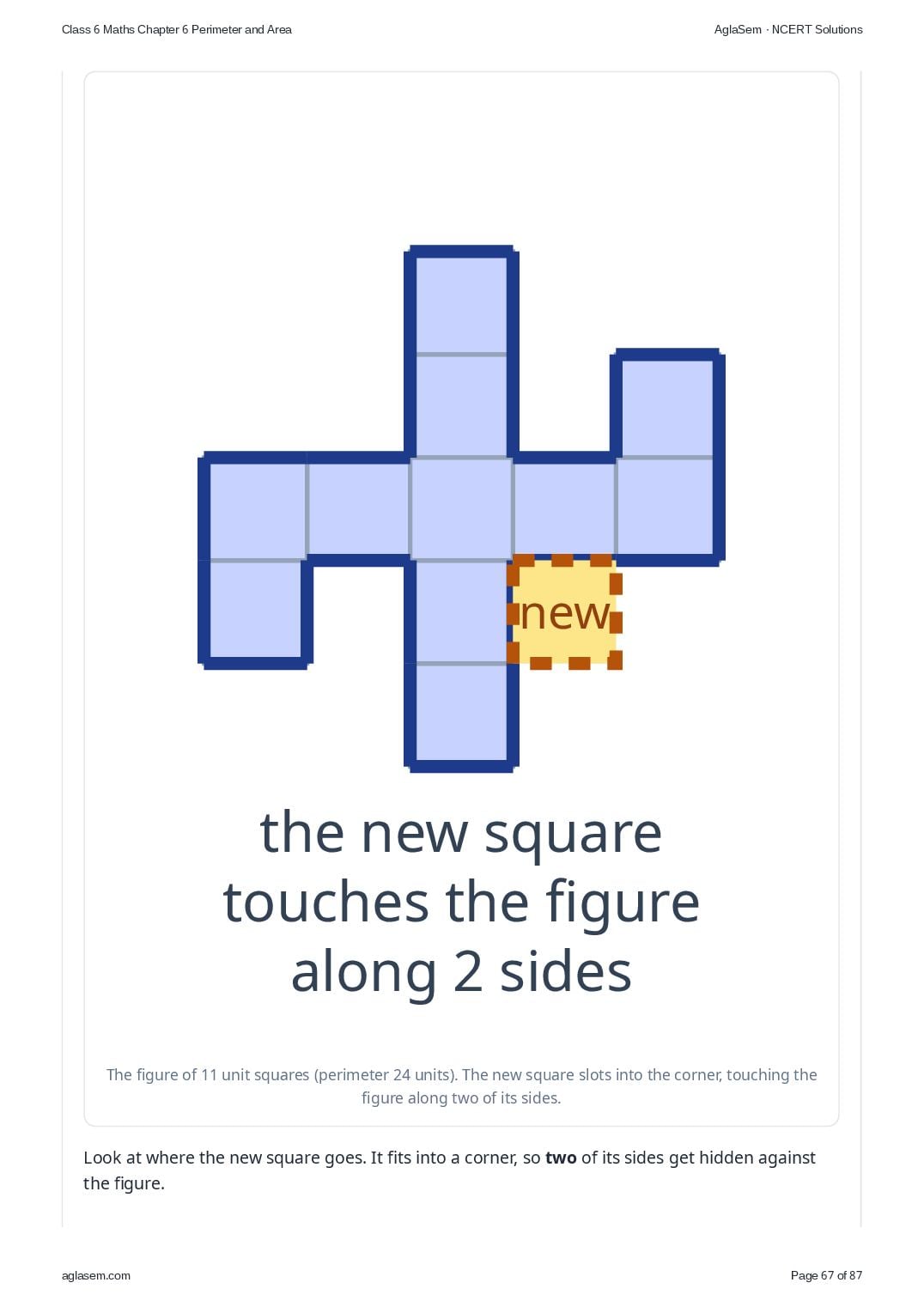
- Let’s do something tricky now! We have a figure below having perimeter 24 units. Without calculating all over again, observe, think and find out what will be the change in the perimeter if a new square is attached as shown on the right.
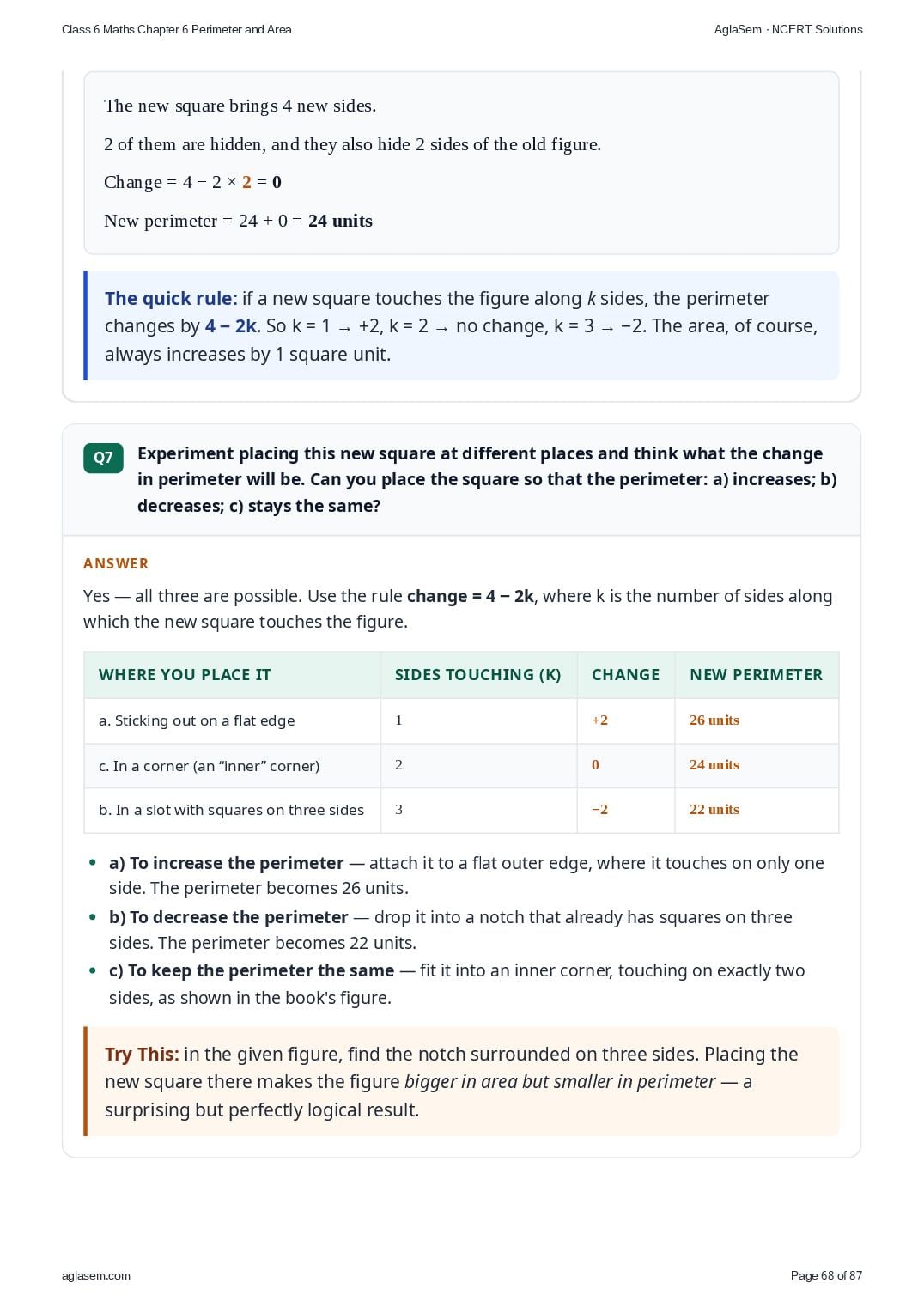
- Experiment placing this new square at different places and think what the change in perimeter will be. Can you place the square so that the perimeter: a) increases; b) decreases; c) stays the same?
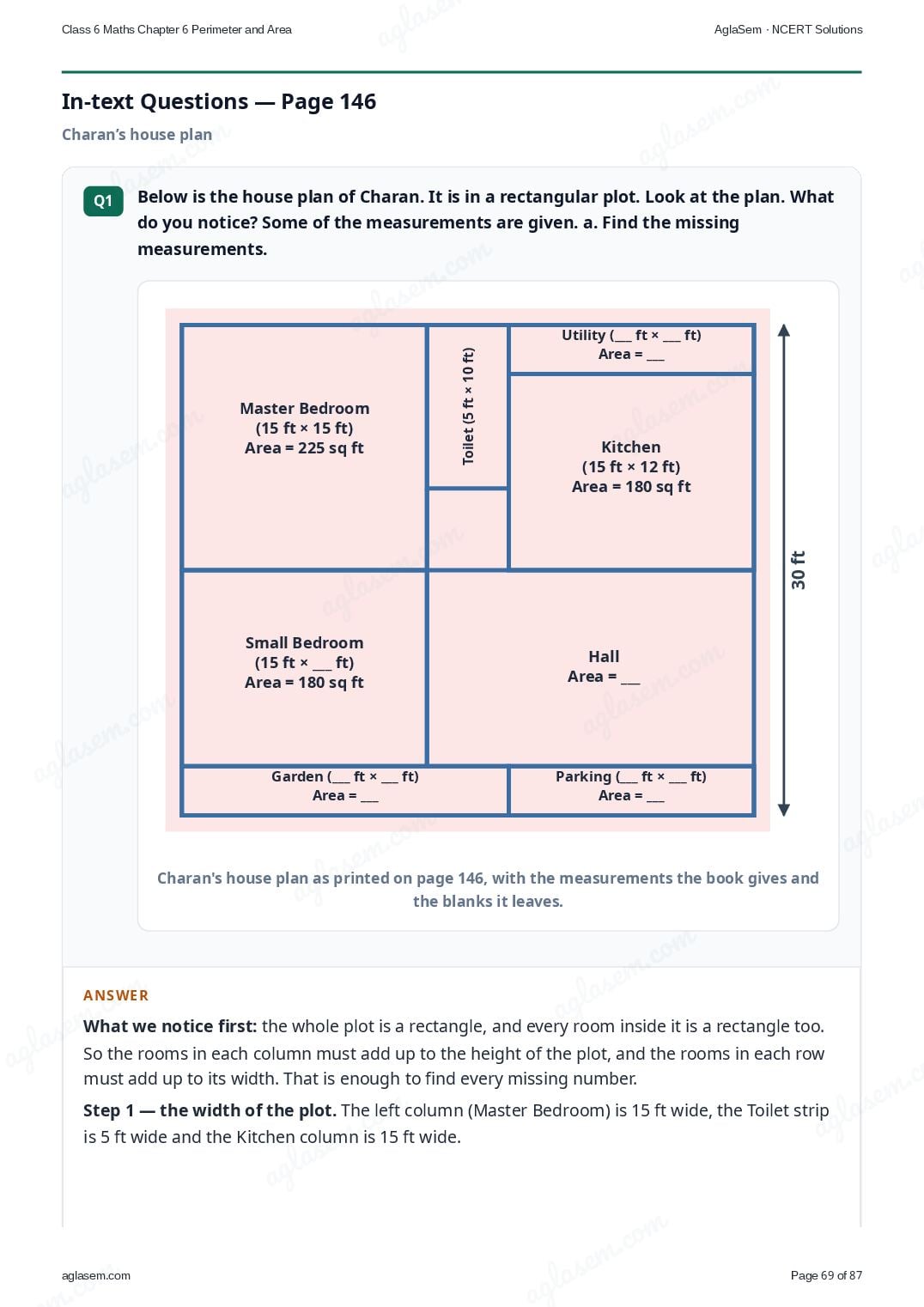
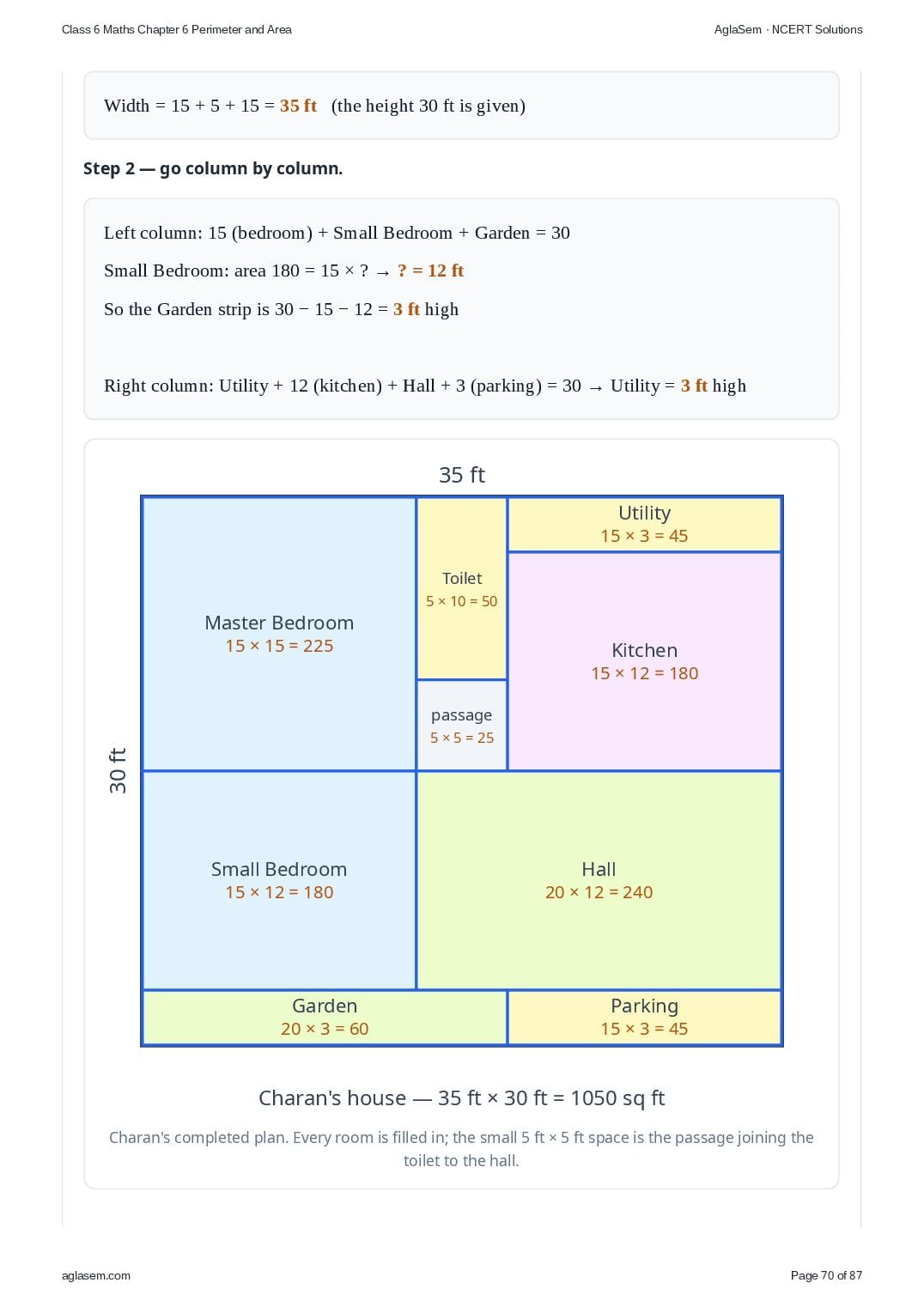
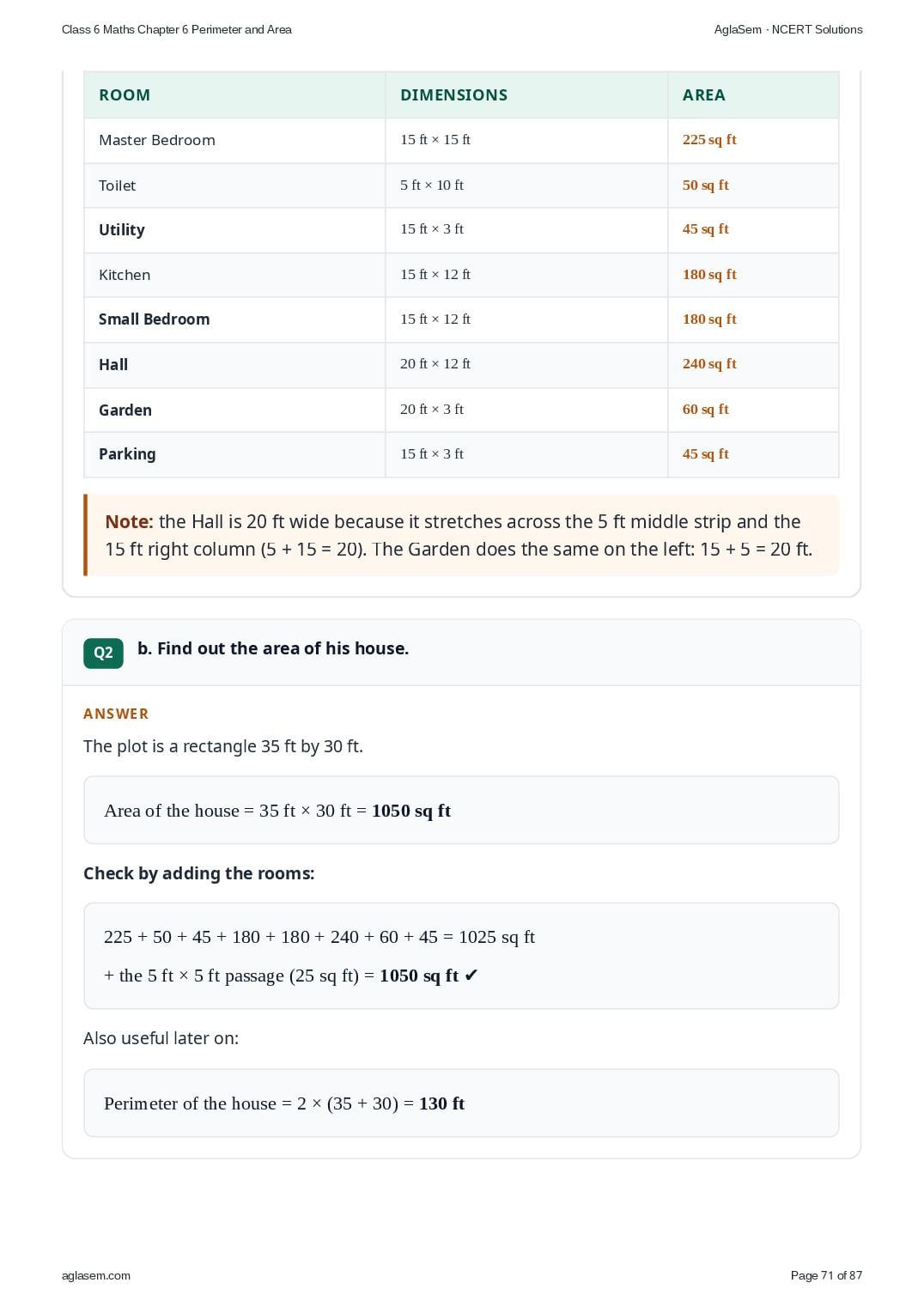
- Below is the house plan of Charan. It is in a rectangular plot. Look at the plan. What do you notice? Some of the measurements are given. a. Find the missing measurements.
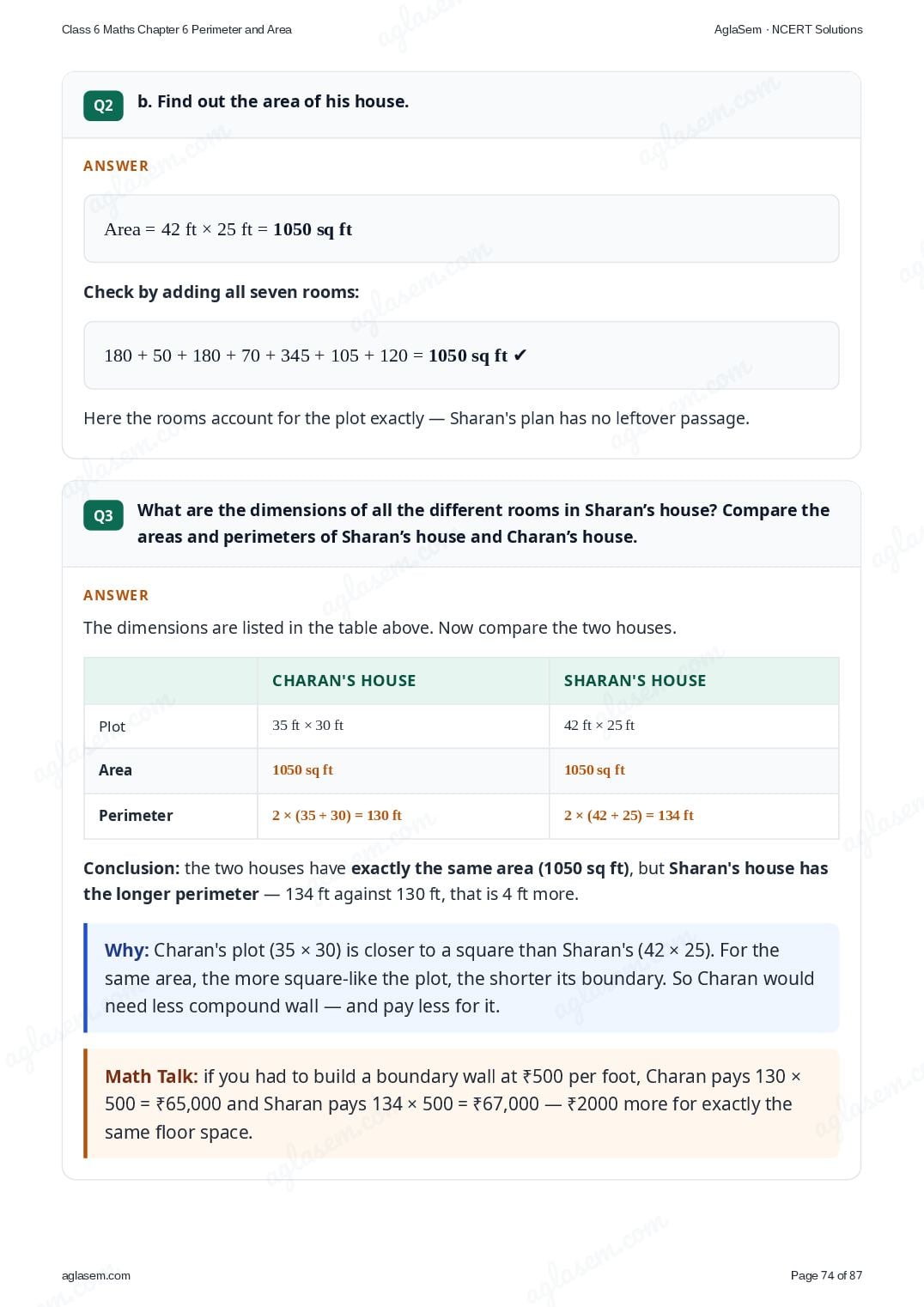
- b. Find out the area of his house.
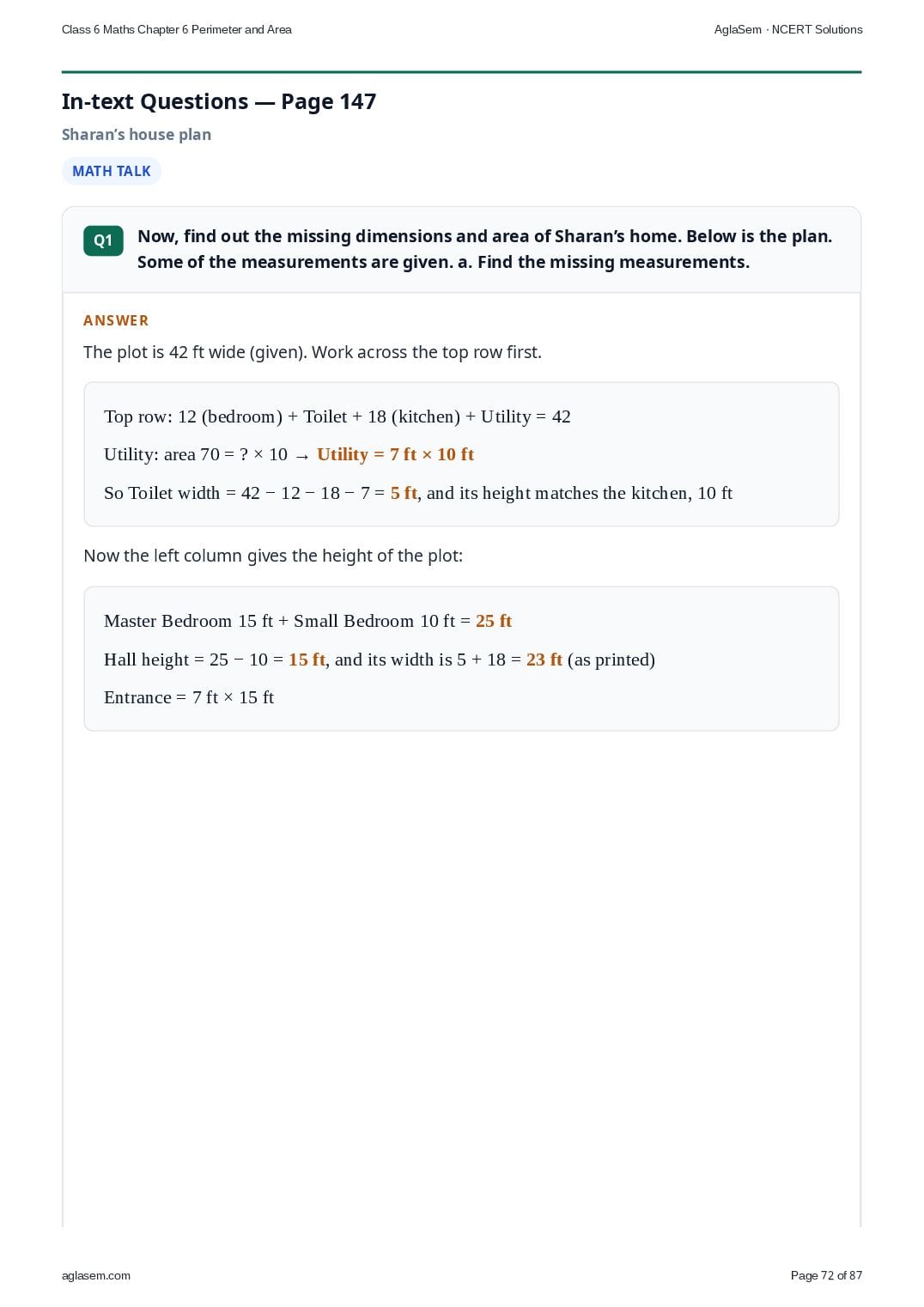
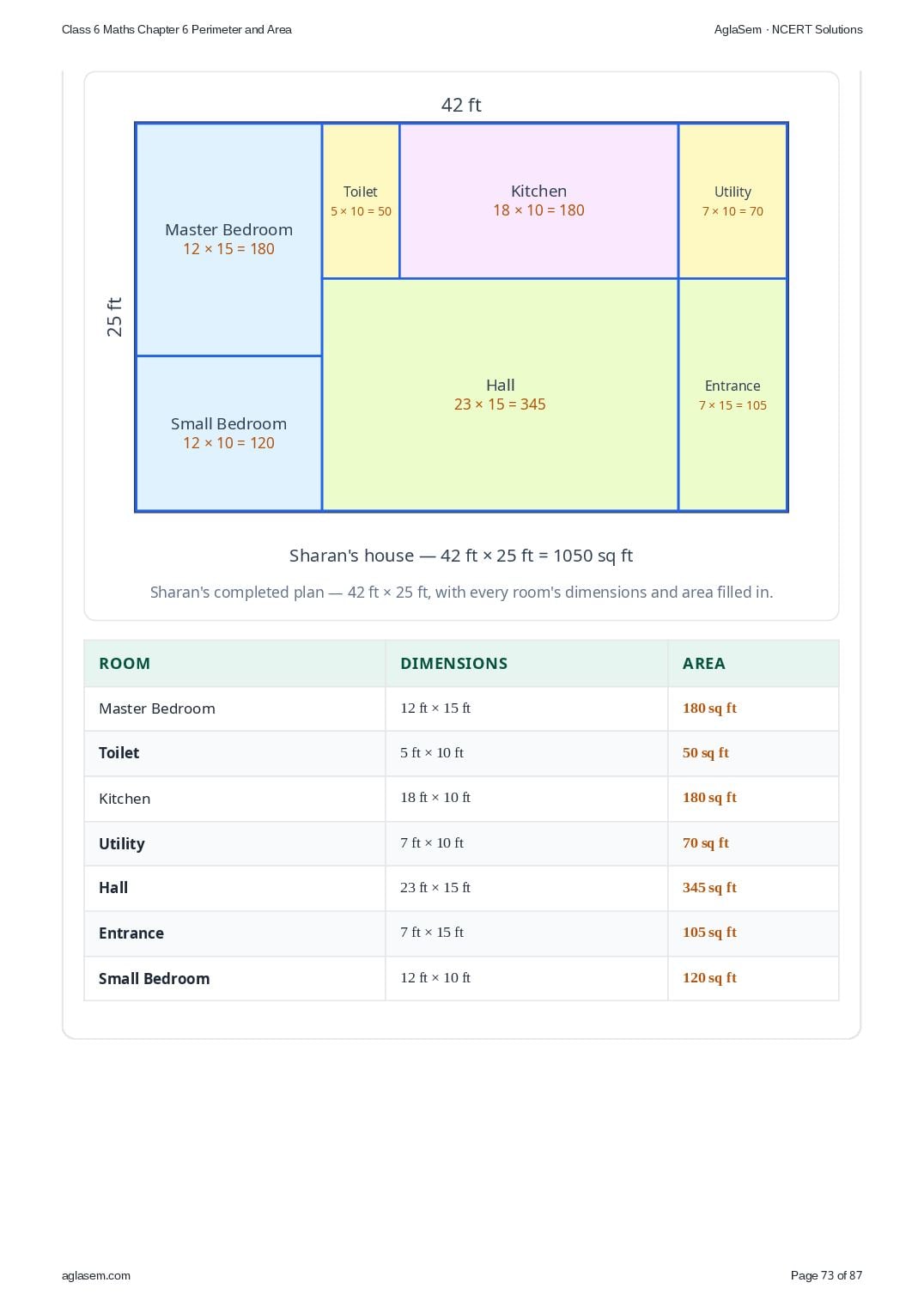
- Now, find out the missing dimensions and area of Sharan’s home. Below is the plan. Some of the measurements are given. a. Find the missing measurements.
- b. Find out the area of his house.
- What are the dimensions of all the different rooms in Sharan’s house? Compare the areas and perimeters of Sharan’s house and Charan’s house.
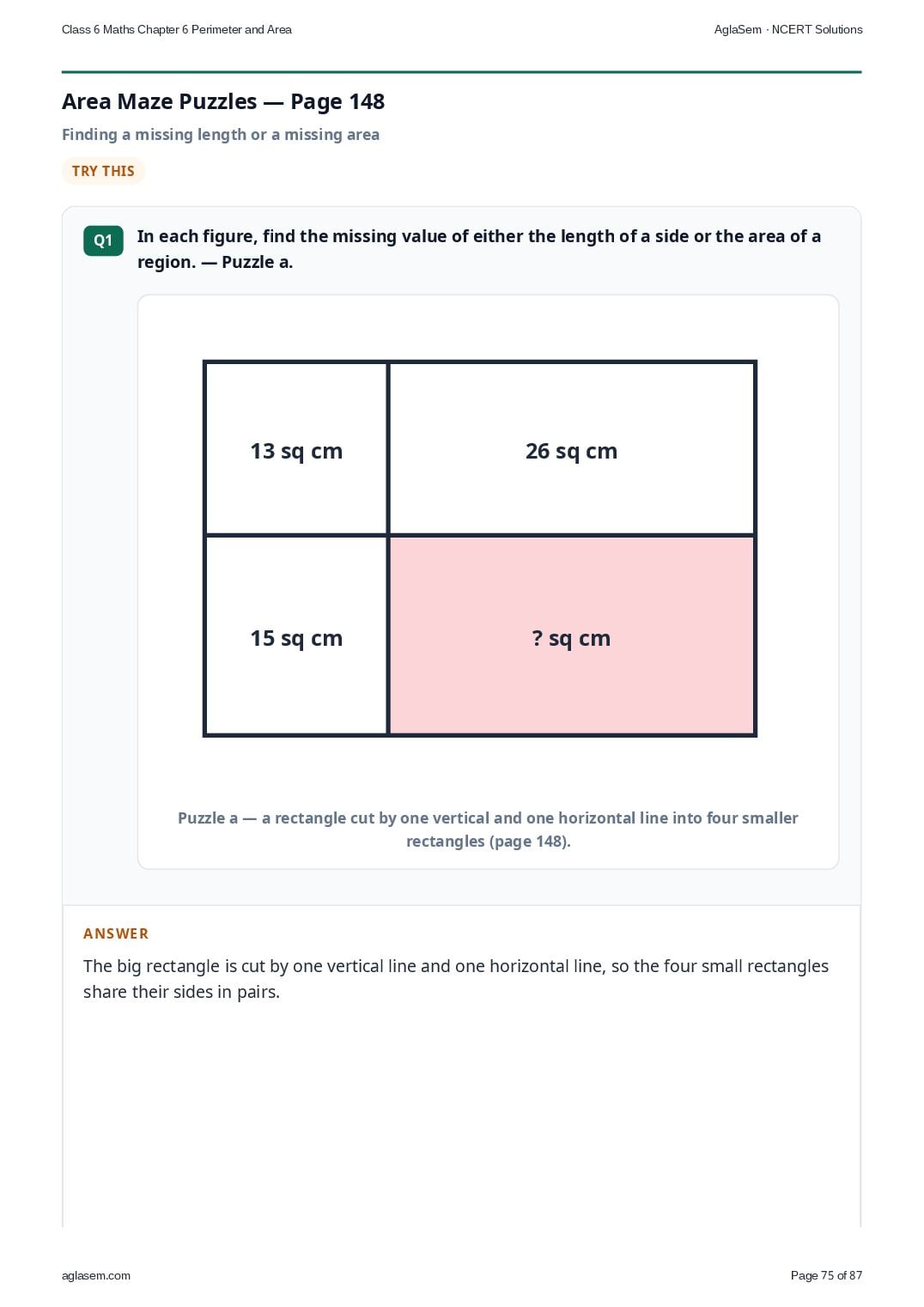
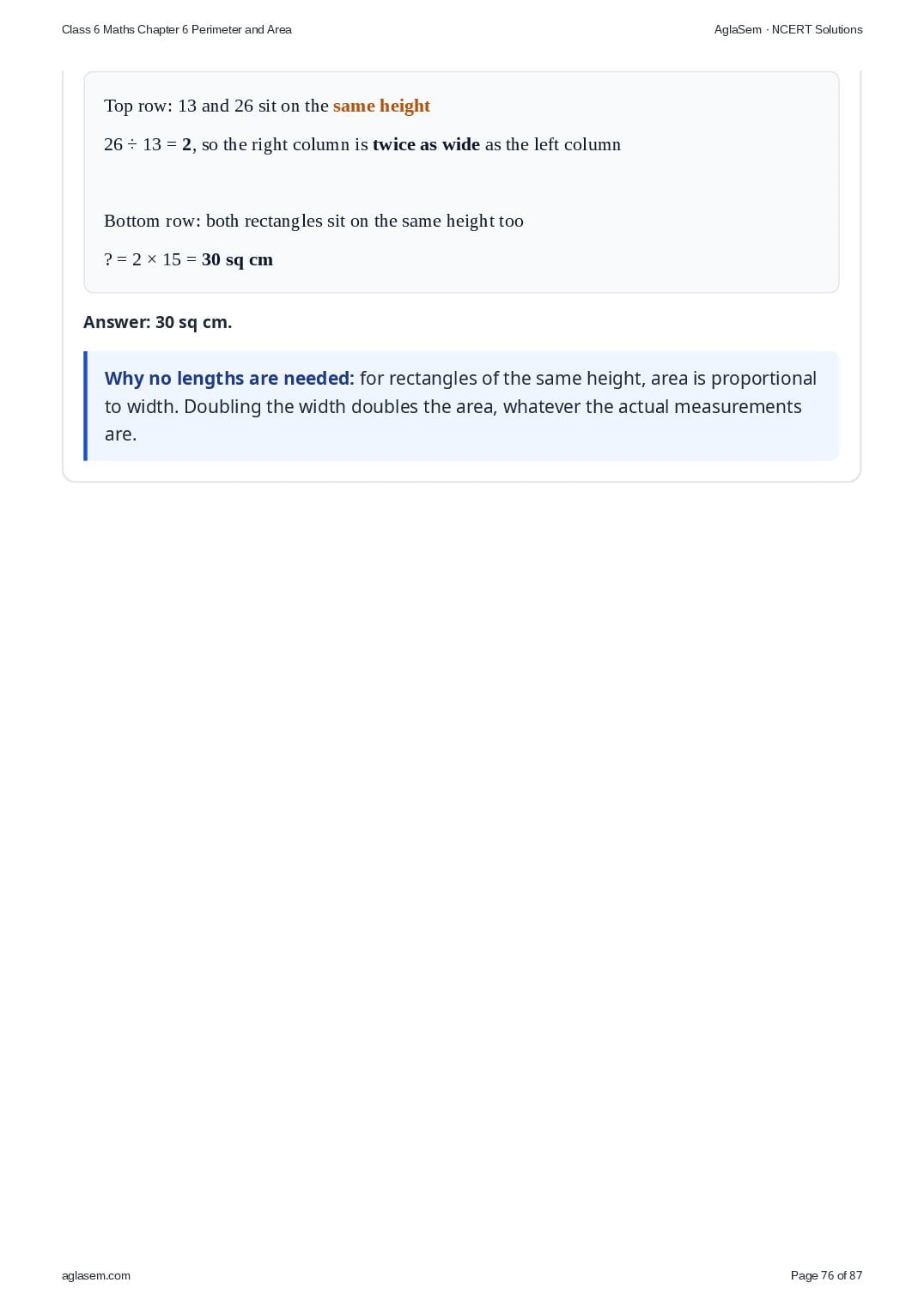
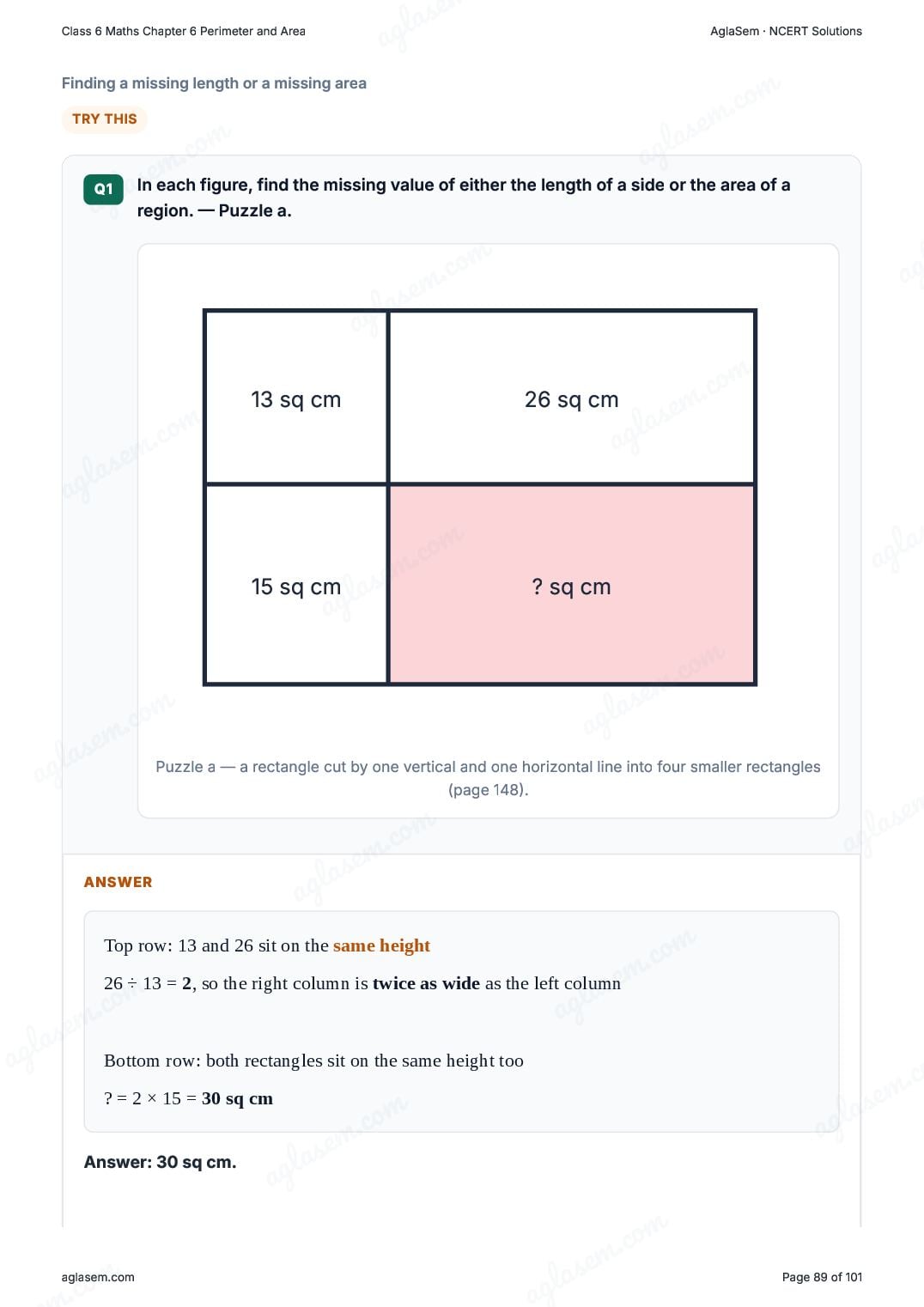
- In each figure, find the missing value of either the length of a side or the area of a region. — Puzzle a. (Four rectangles of areas 13 sq cm, 26 sq cm, 15 sq cm and ? sq cm.)
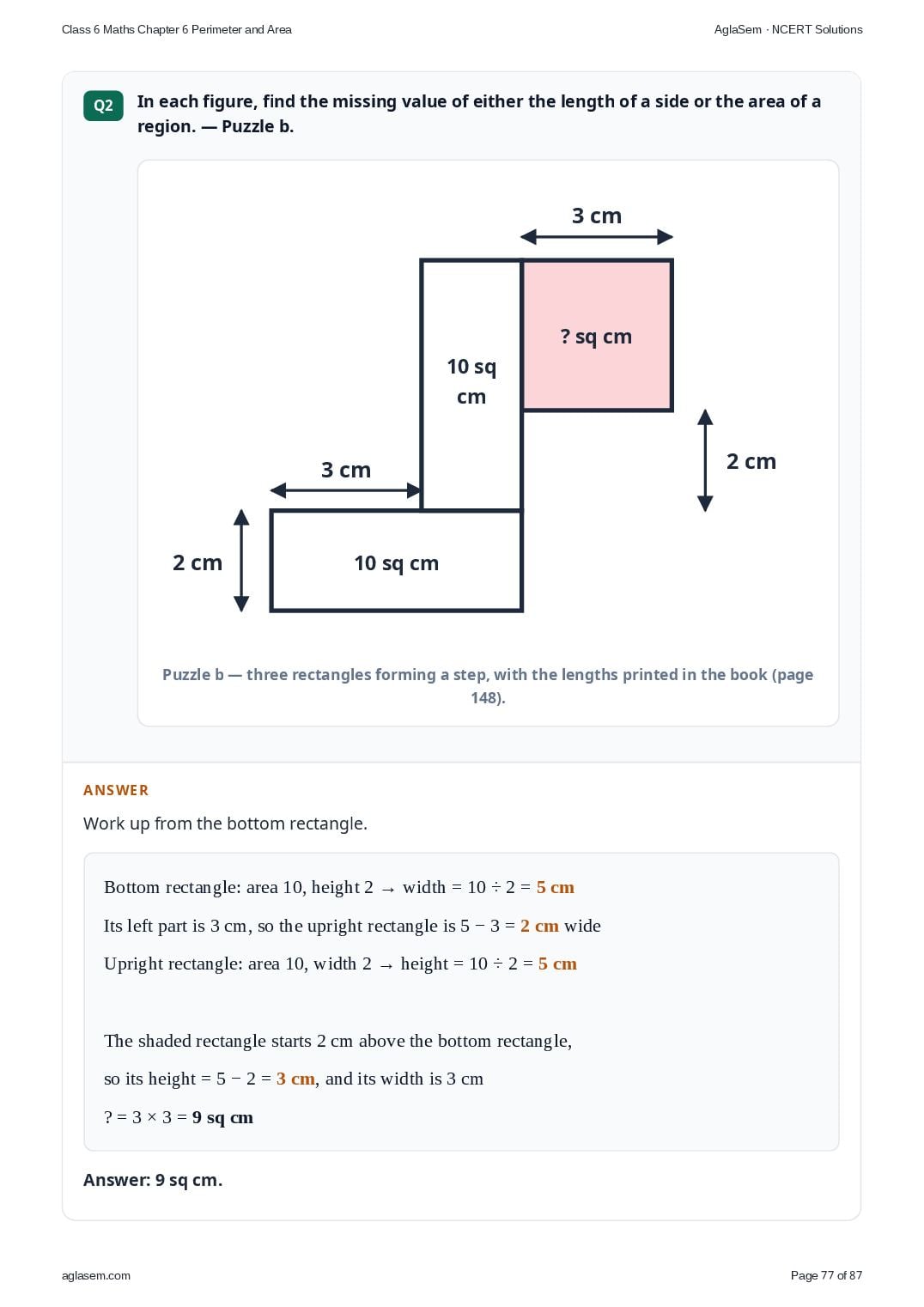
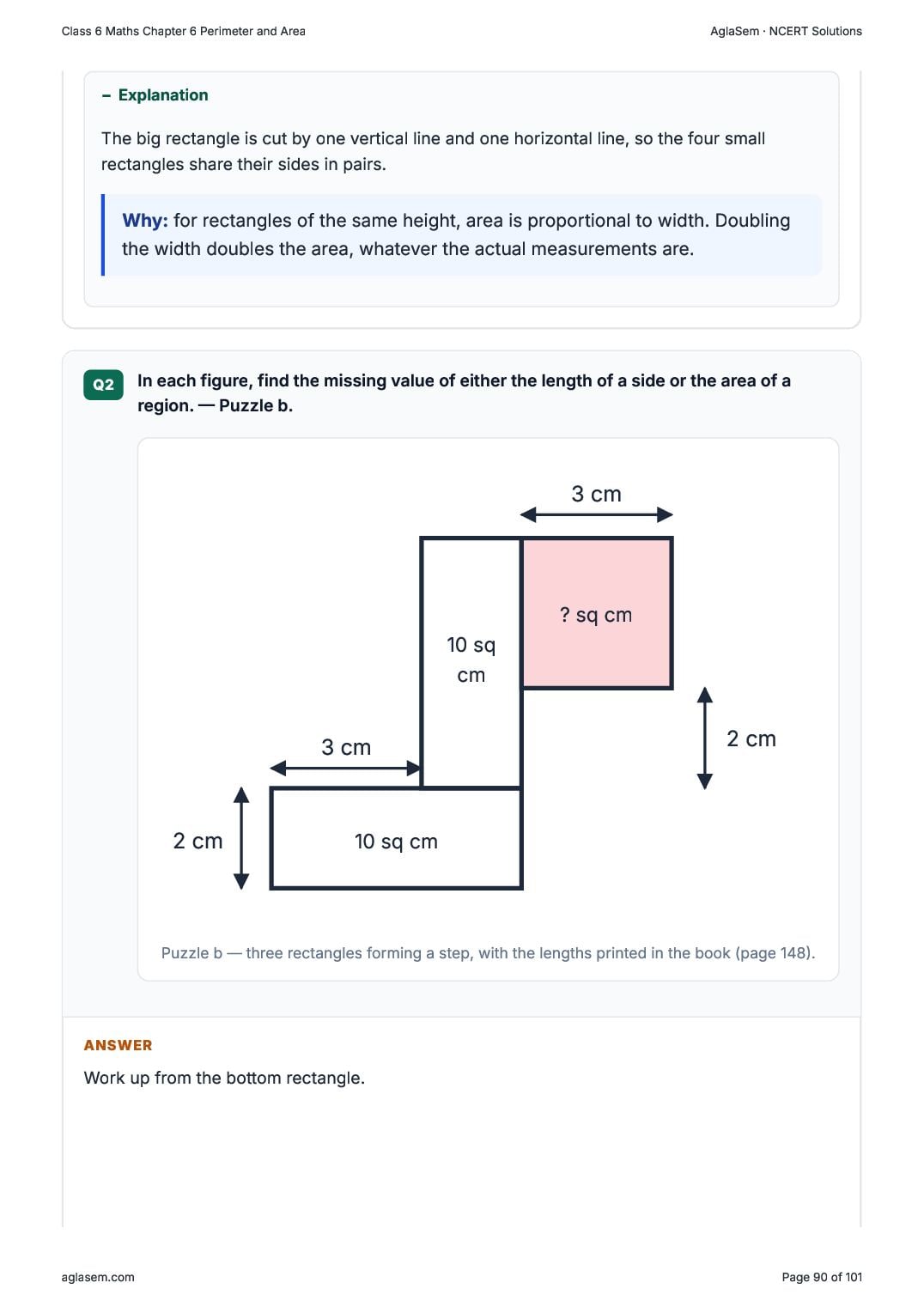
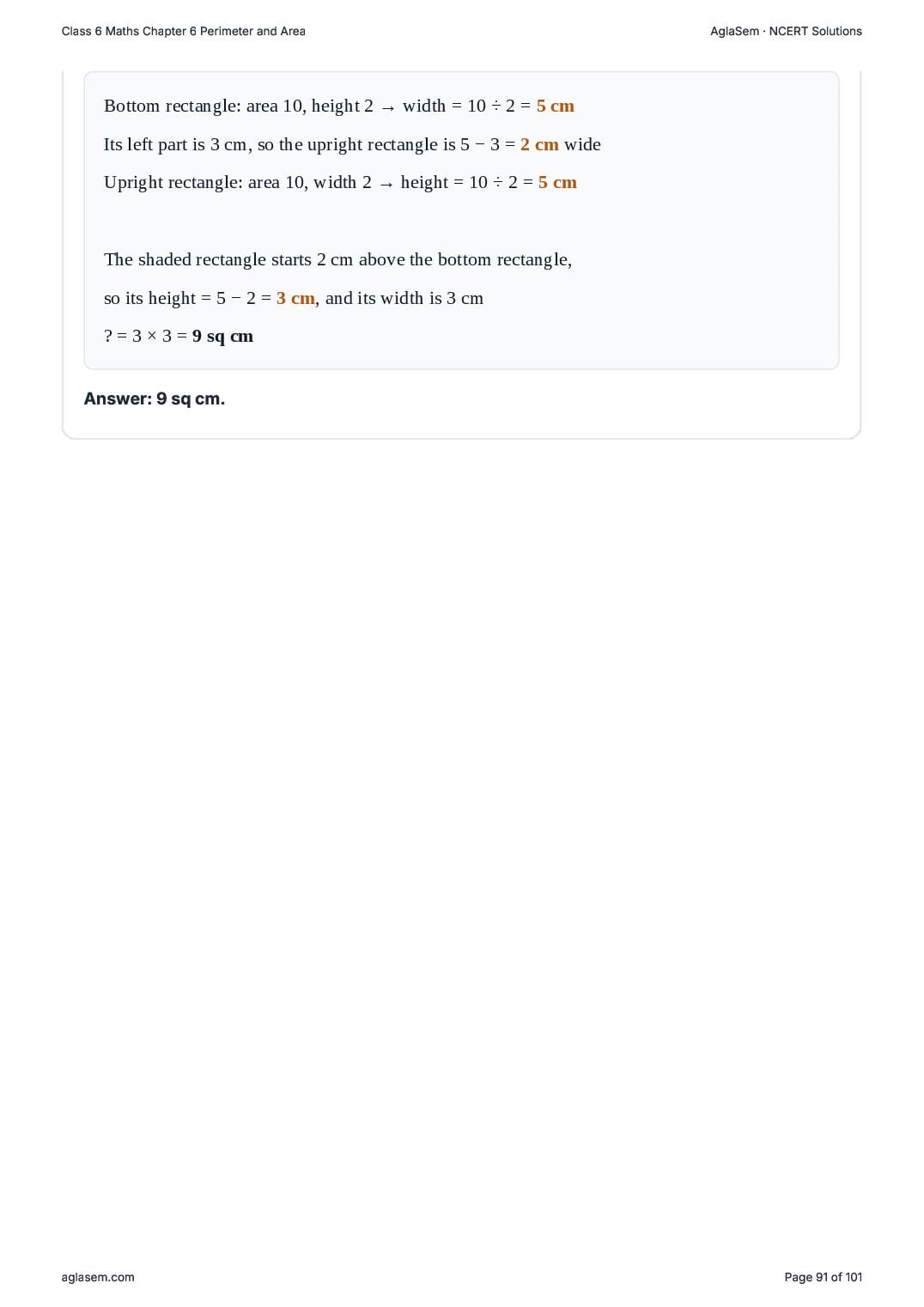
- In each figure, find the missing value of either the length of a side or the area of a region. — Puzzle b. (Three rectangles: 10 sq cm with height 2 cm, 10 sq cm, and ? sq cm of width 3 cm.)
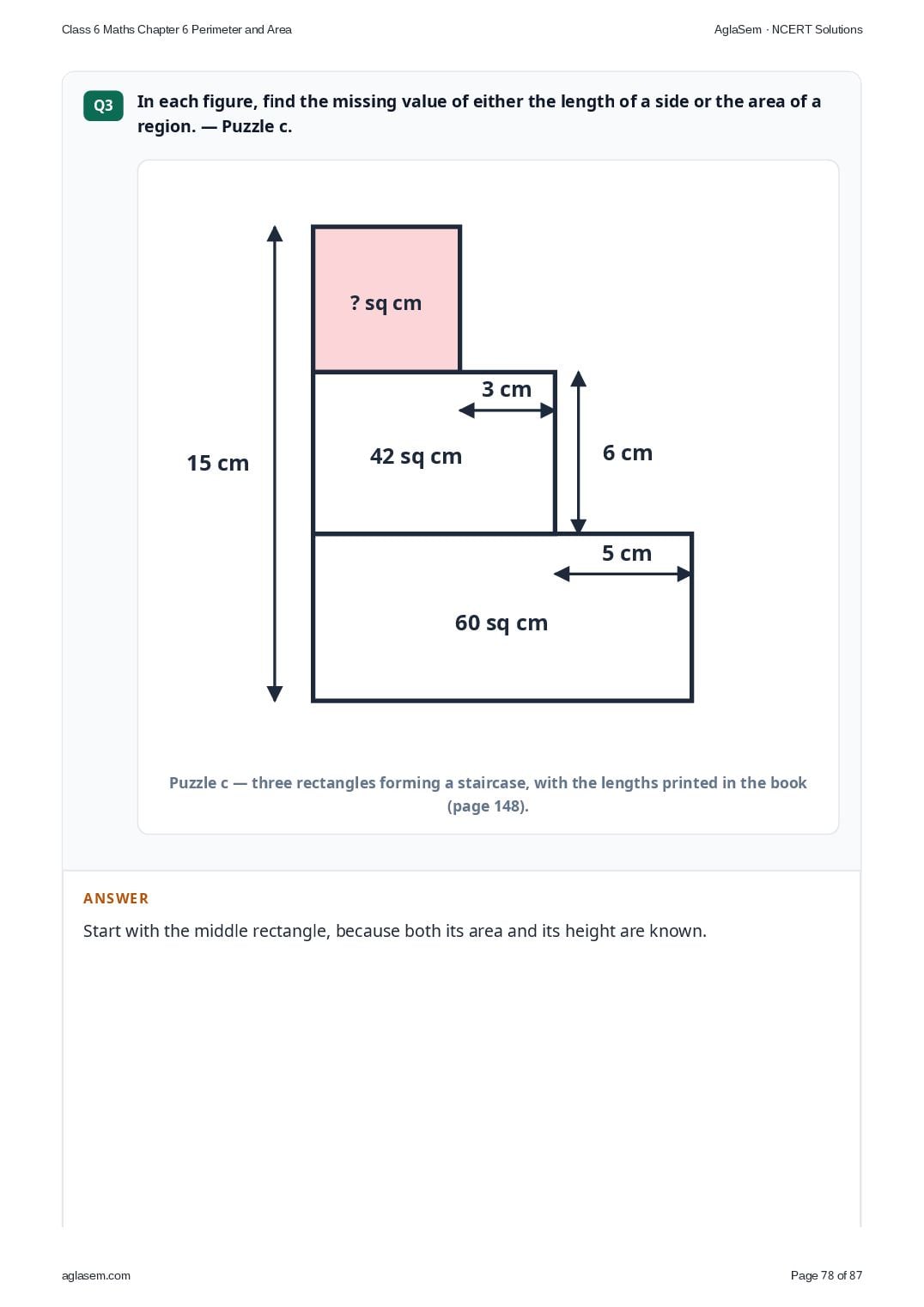
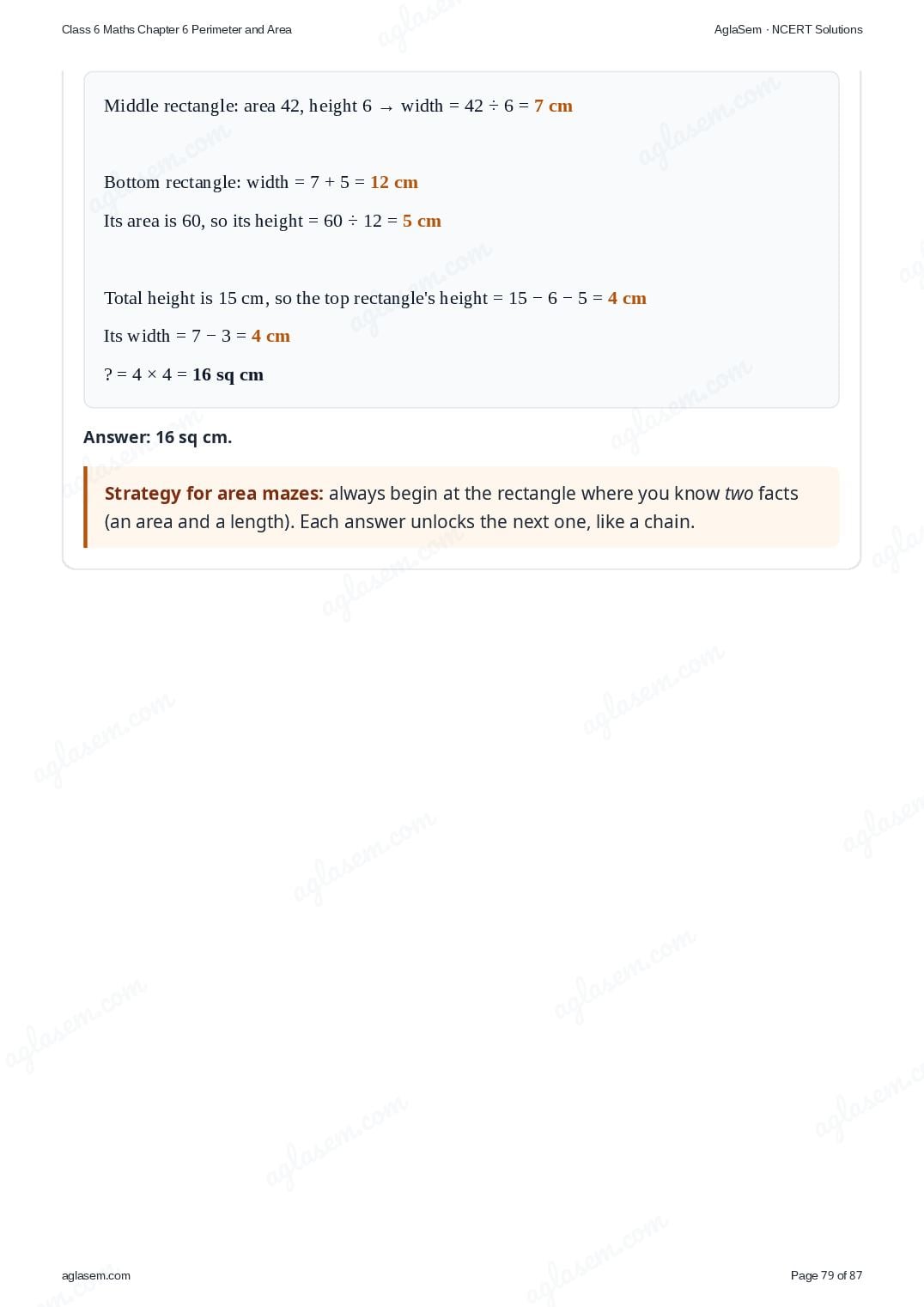
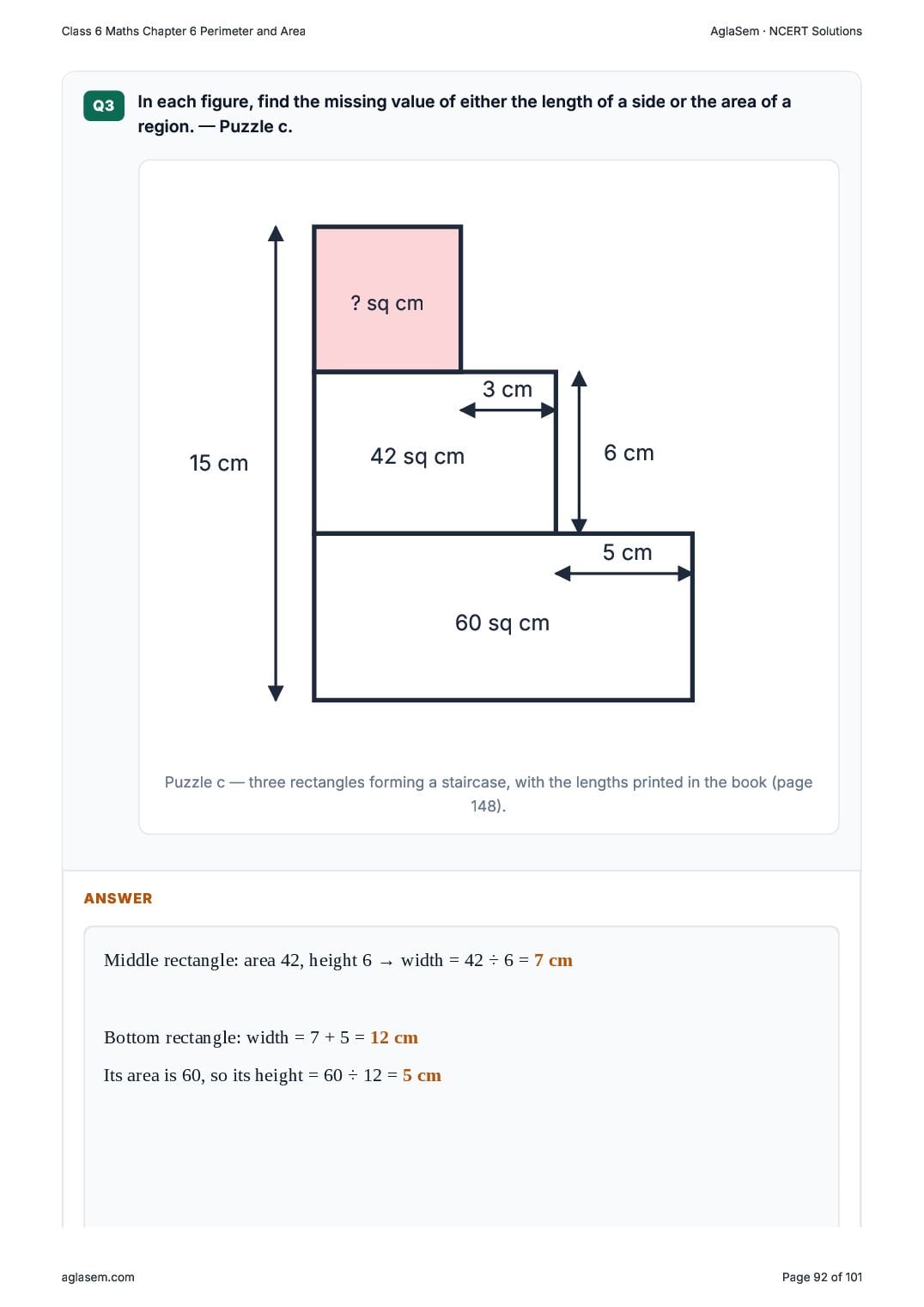
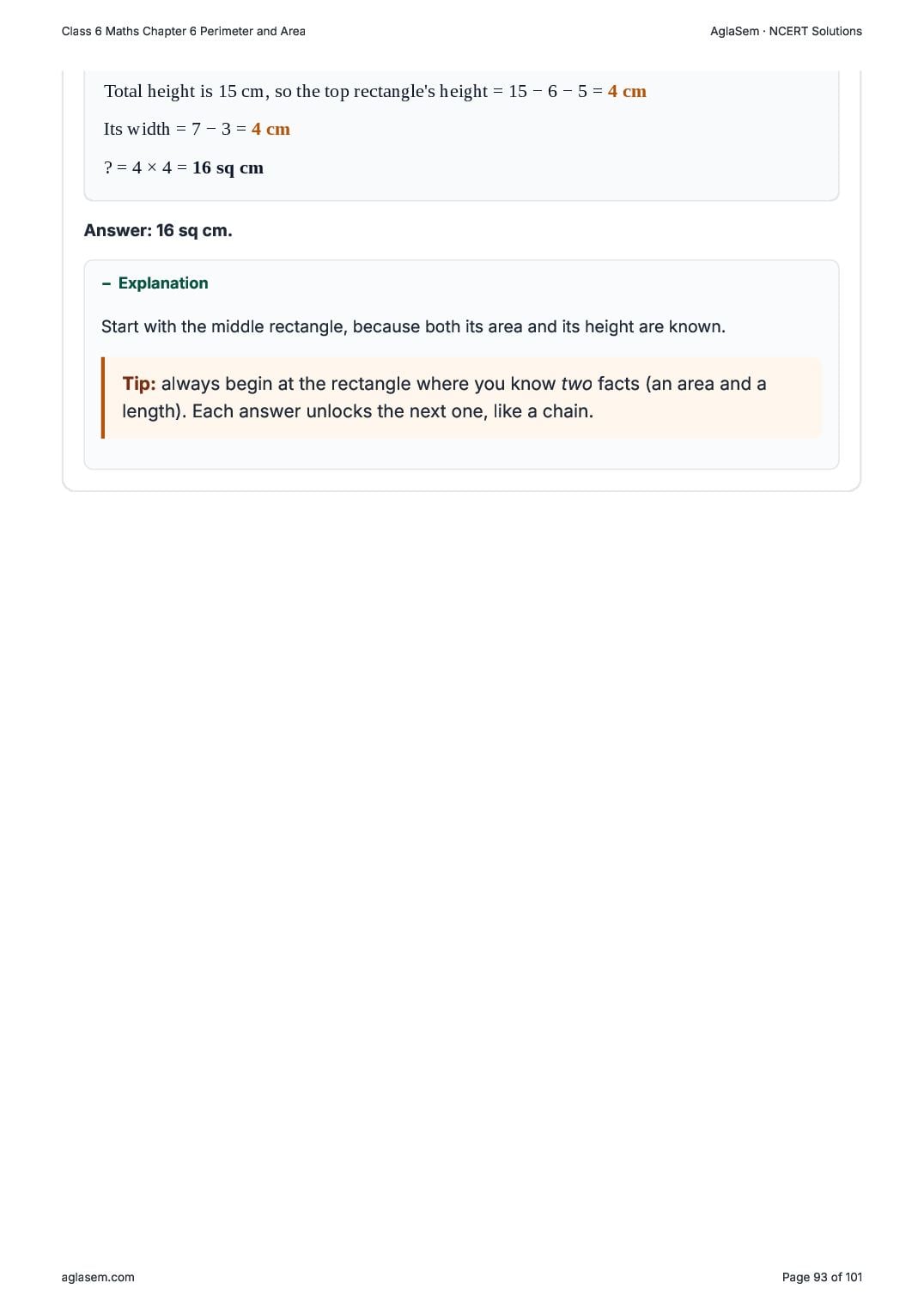
- In each figure, find the missing value of either the length of a side or the area of a region. — Puzzle c. (A staircase of three rectangles: ? sq cm, 42 sq cm and 60 sq cm, with total height 15 cm.)
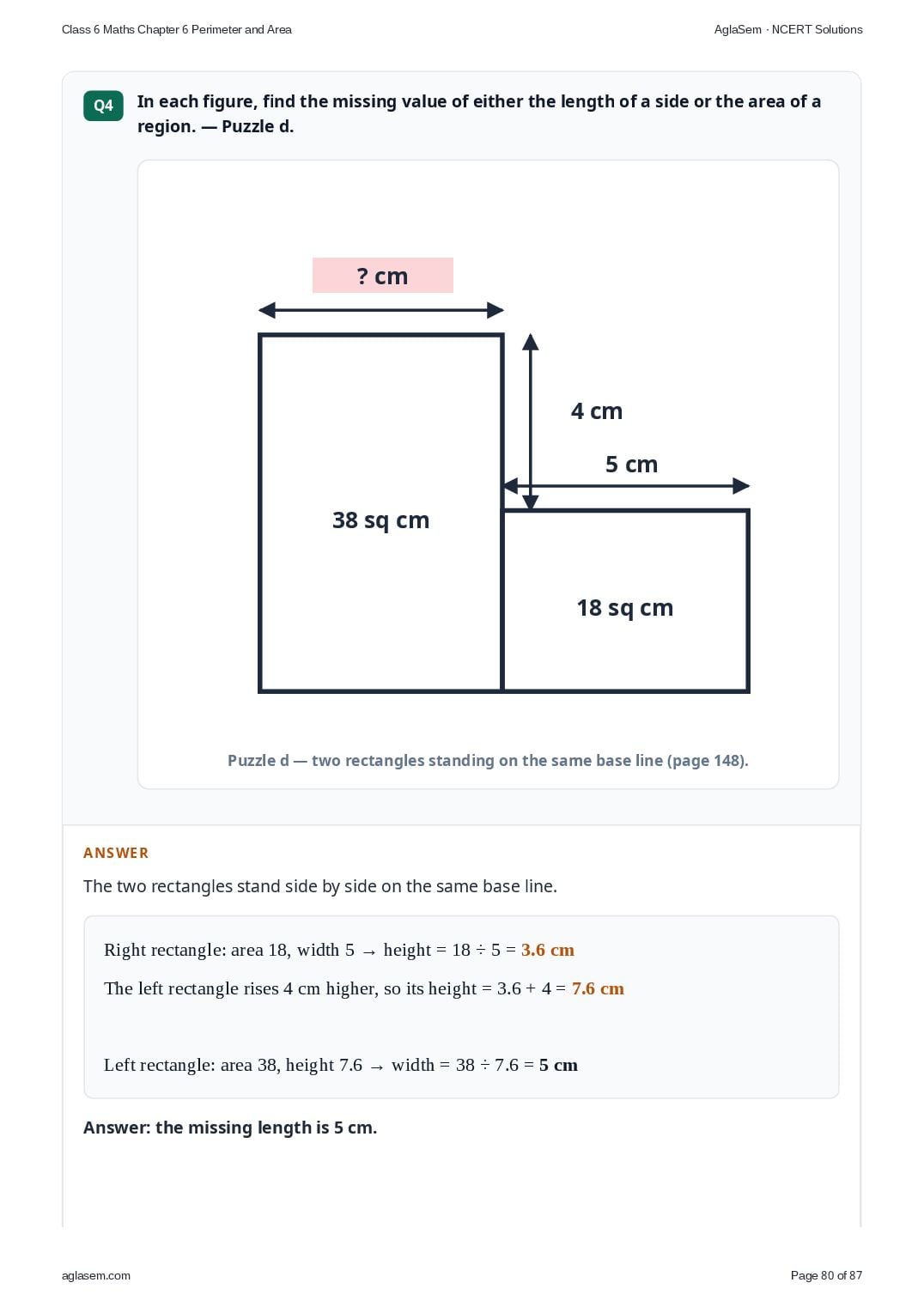
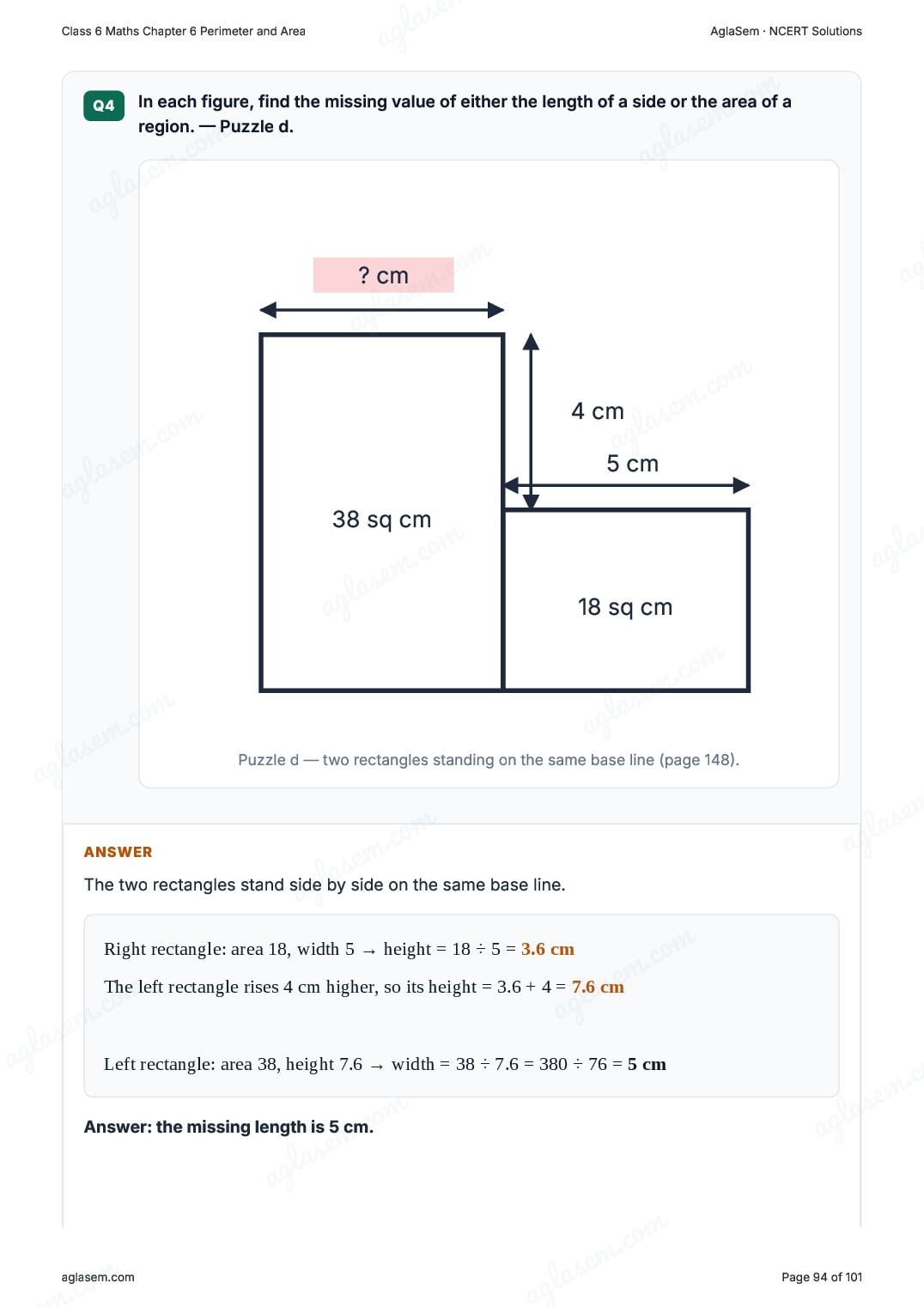
- In each figure, find the missing value of either the length of a side or the area of a region. — Puzzle d. (Two rectangles of areas 38 sq cm and 18 sq cm; find the missing length ? cm.)
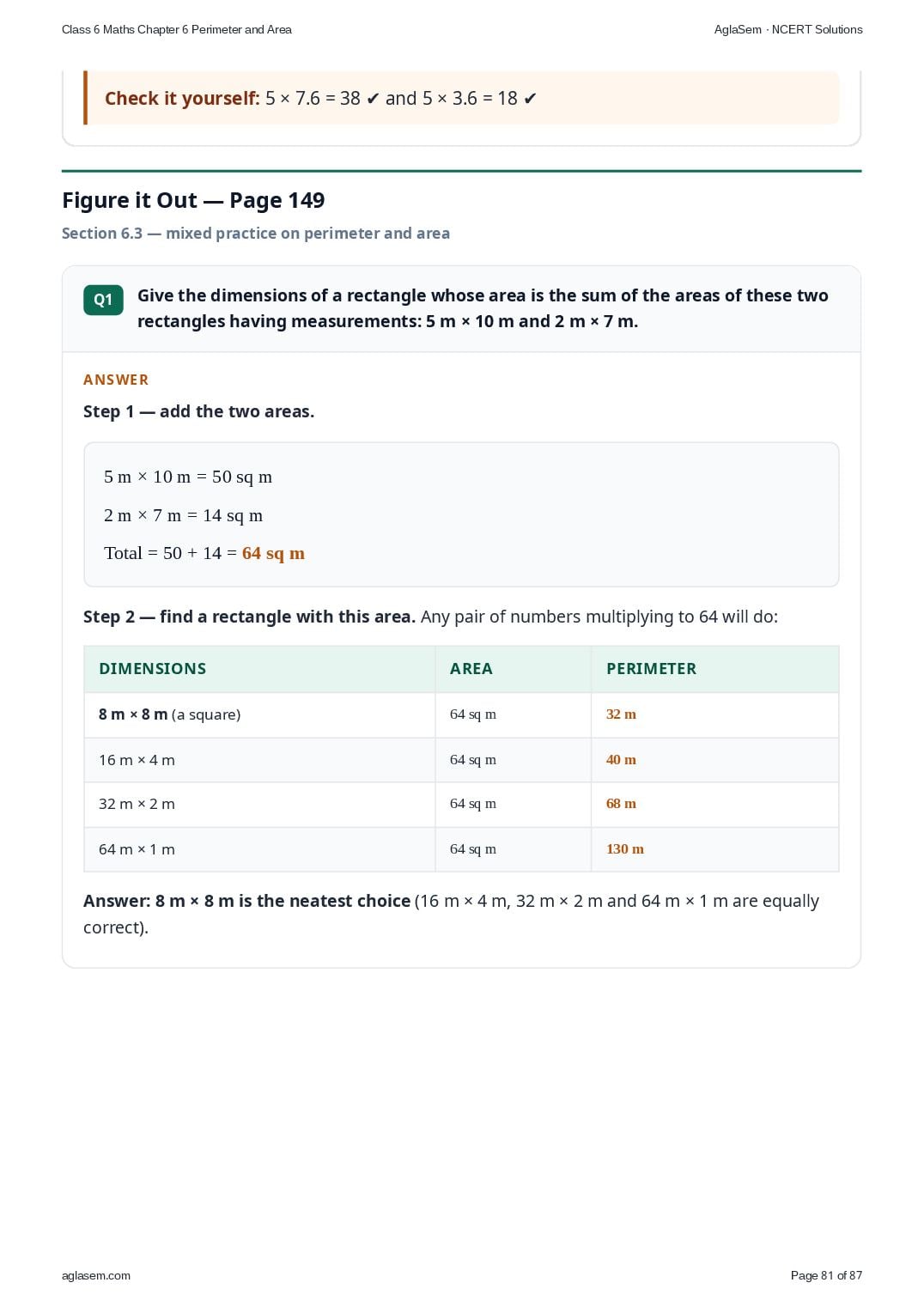
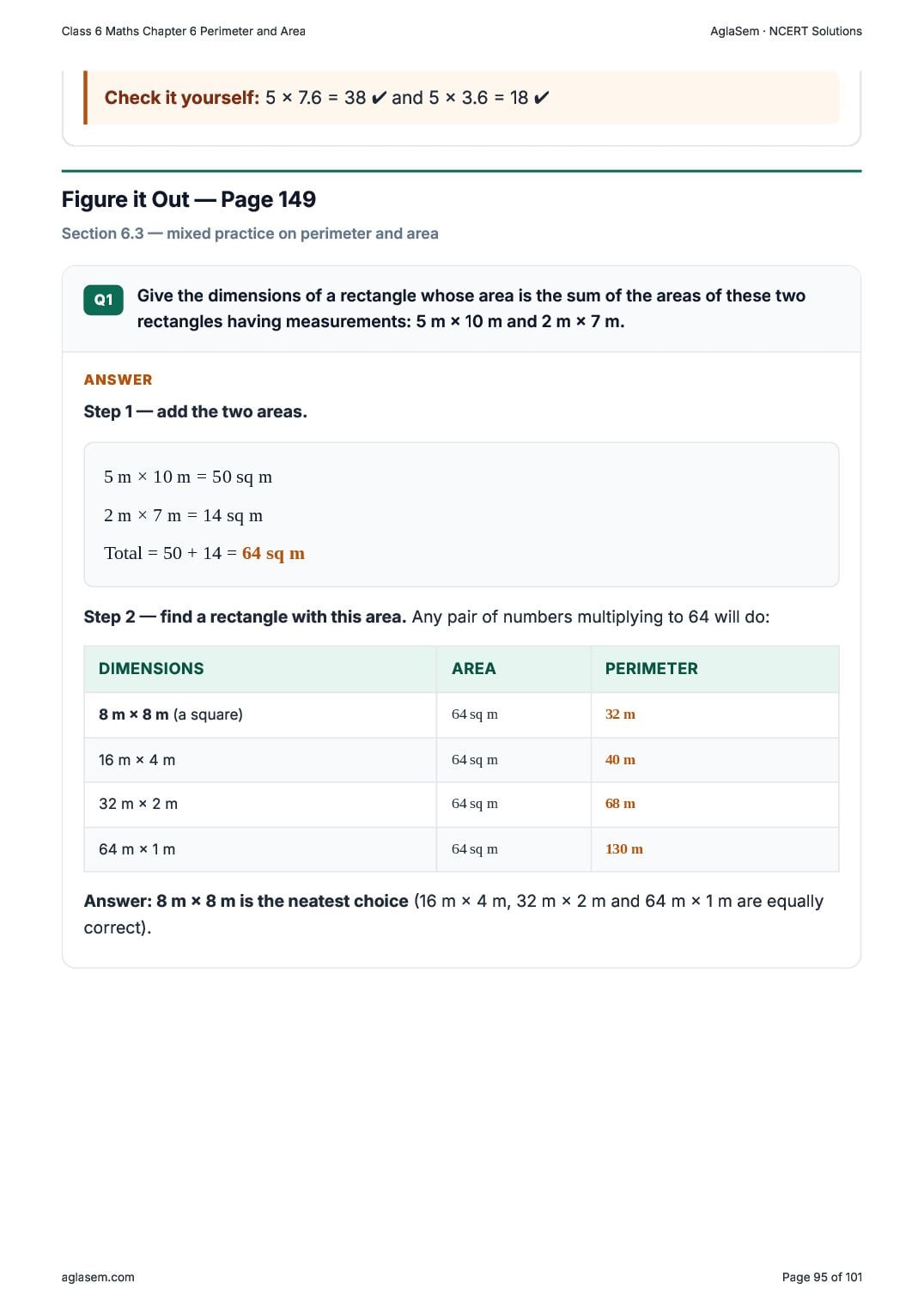
- Give the dimensions of a rectangle whose area is the sum of the areas of these two rectangles having measurements: 5 m × 10 m and 2 m × 7 m.
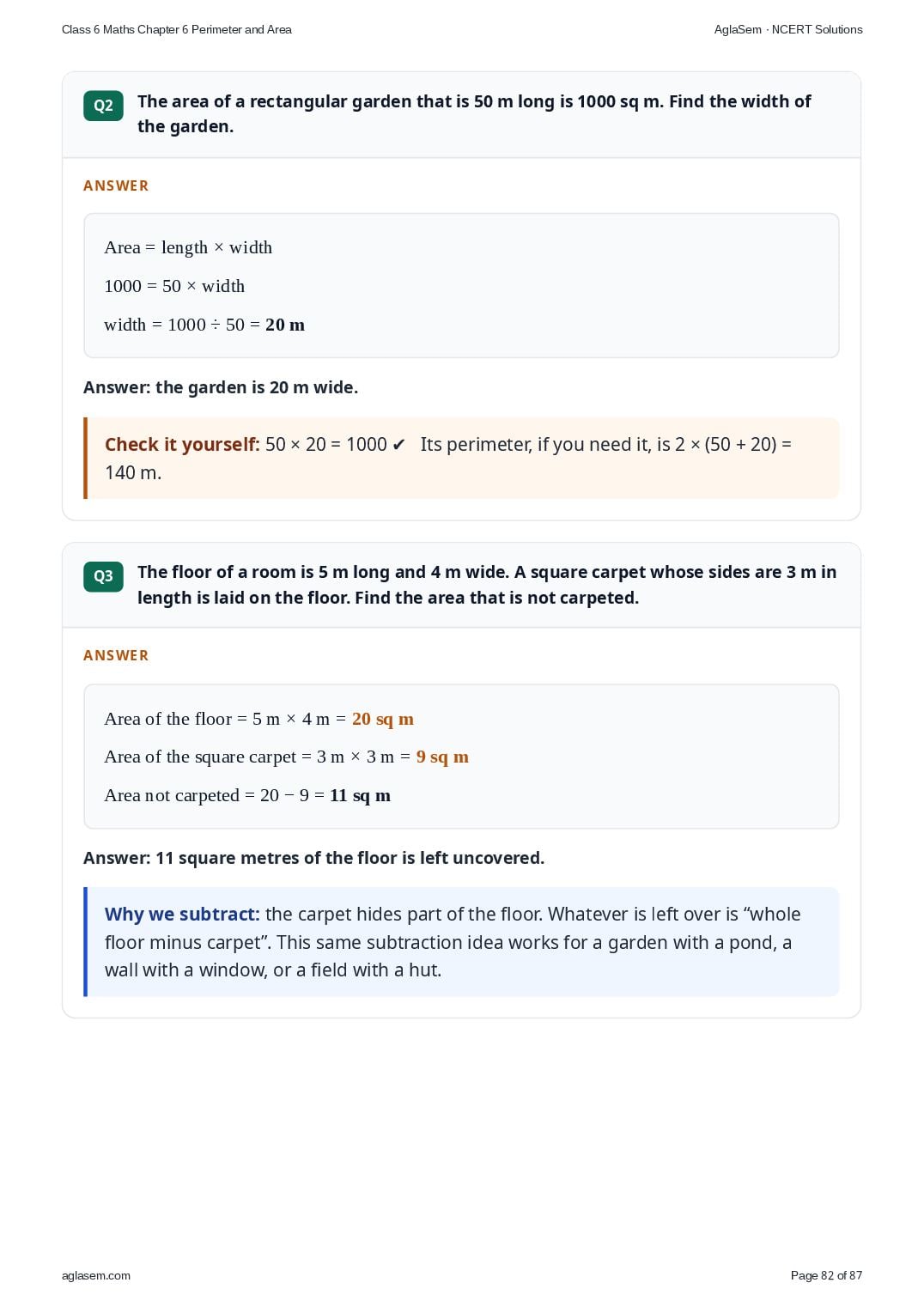
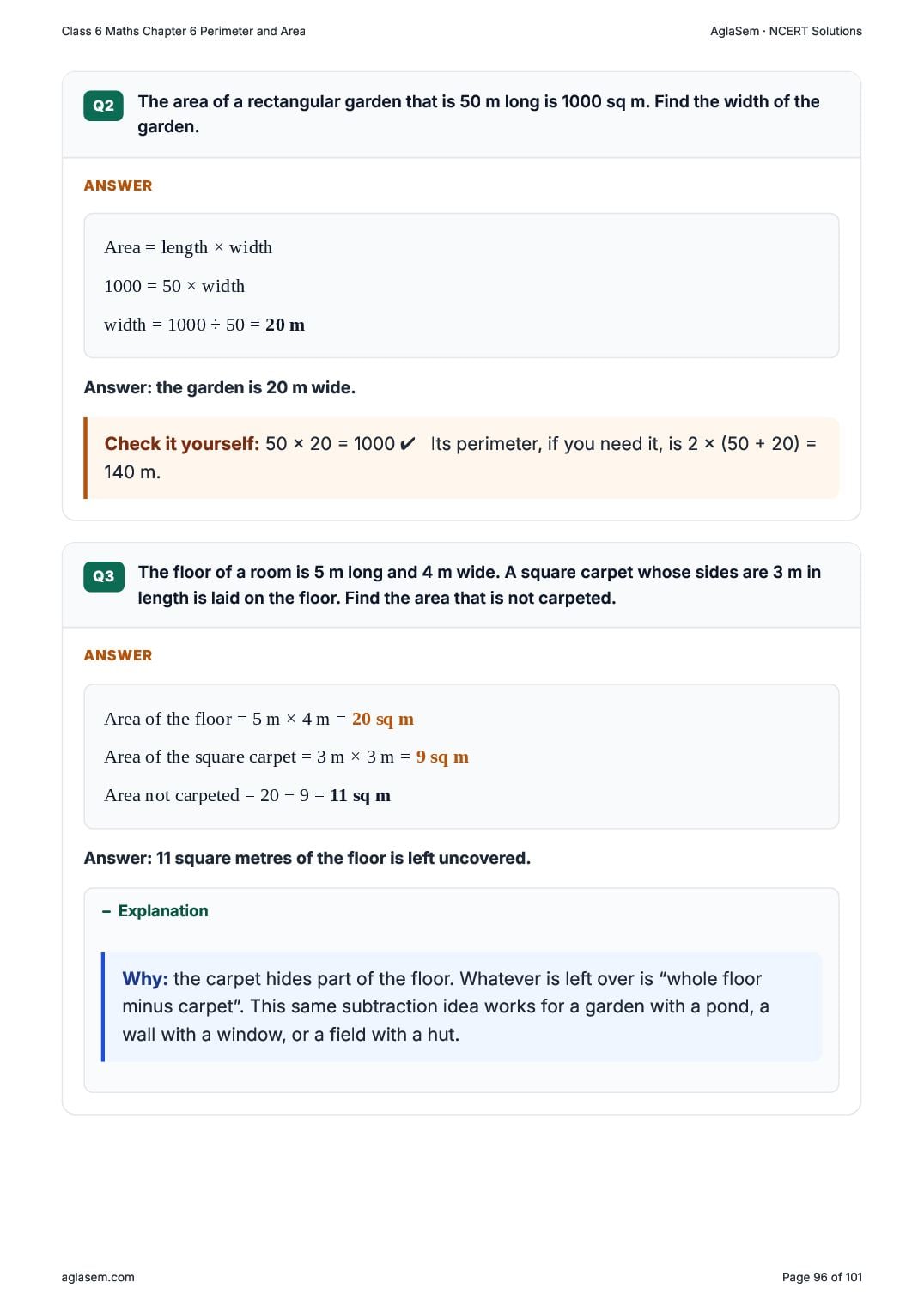
- The area of a rectangular garden that is 50 m long is 1000 sq m. Find the width of the garden.
- The floor of a room is 5 m long and 4 m wide. A square carpet whose sides are 3 m in length is laid on the floor. Find the area that is not carpeted.
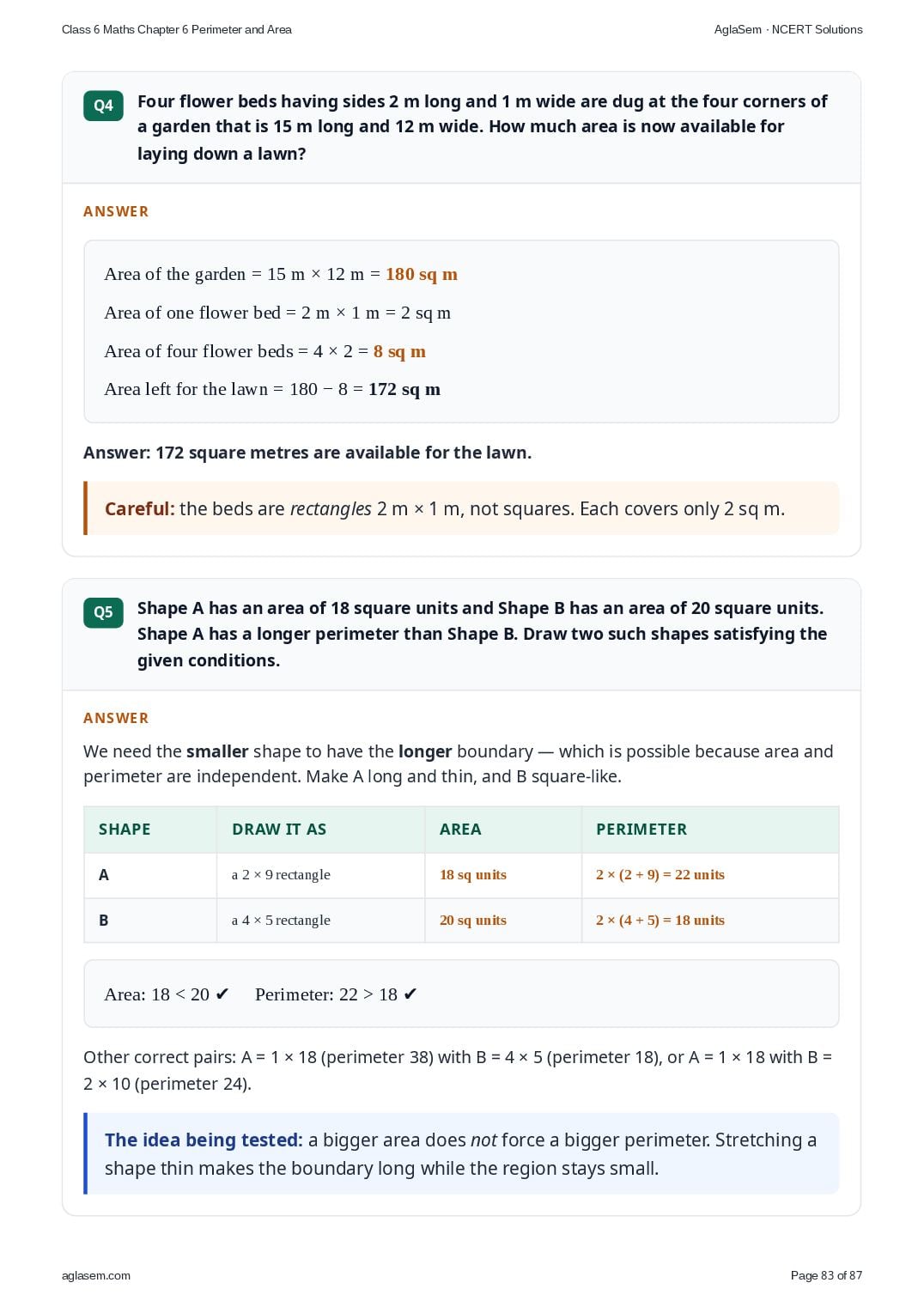
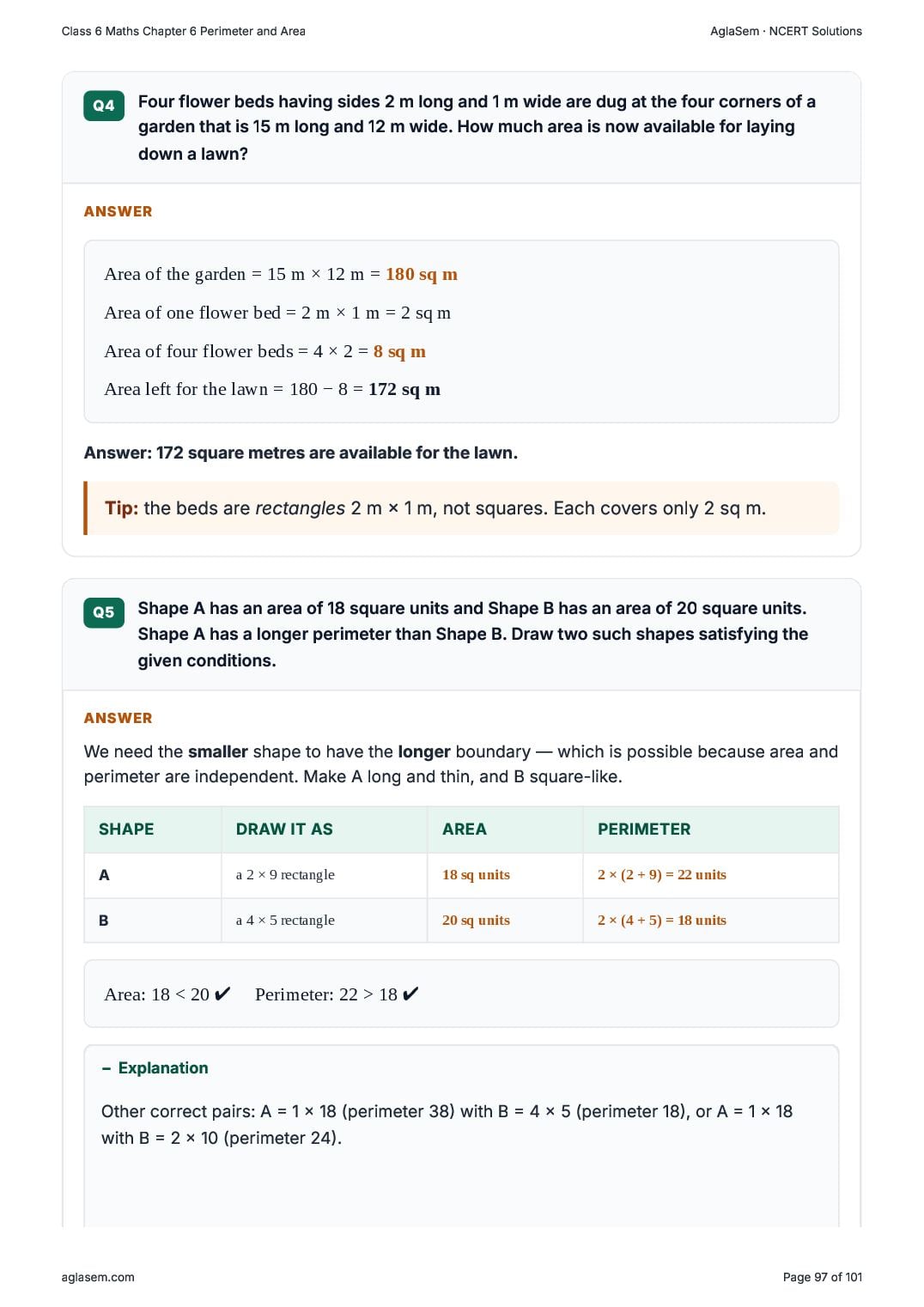
- Four flower beds having sides 2 m long and 1 m wide are dug at the four corners of a garden that is 15 m long and 12 m wide. How much area is now available for laying down a lawn?
- Shape A has an area of 18 square units and Shape B has an area of 20 square units. Shape A has a longer perimeter than Shape B. Draw two such shapes satisfying the given conditions.
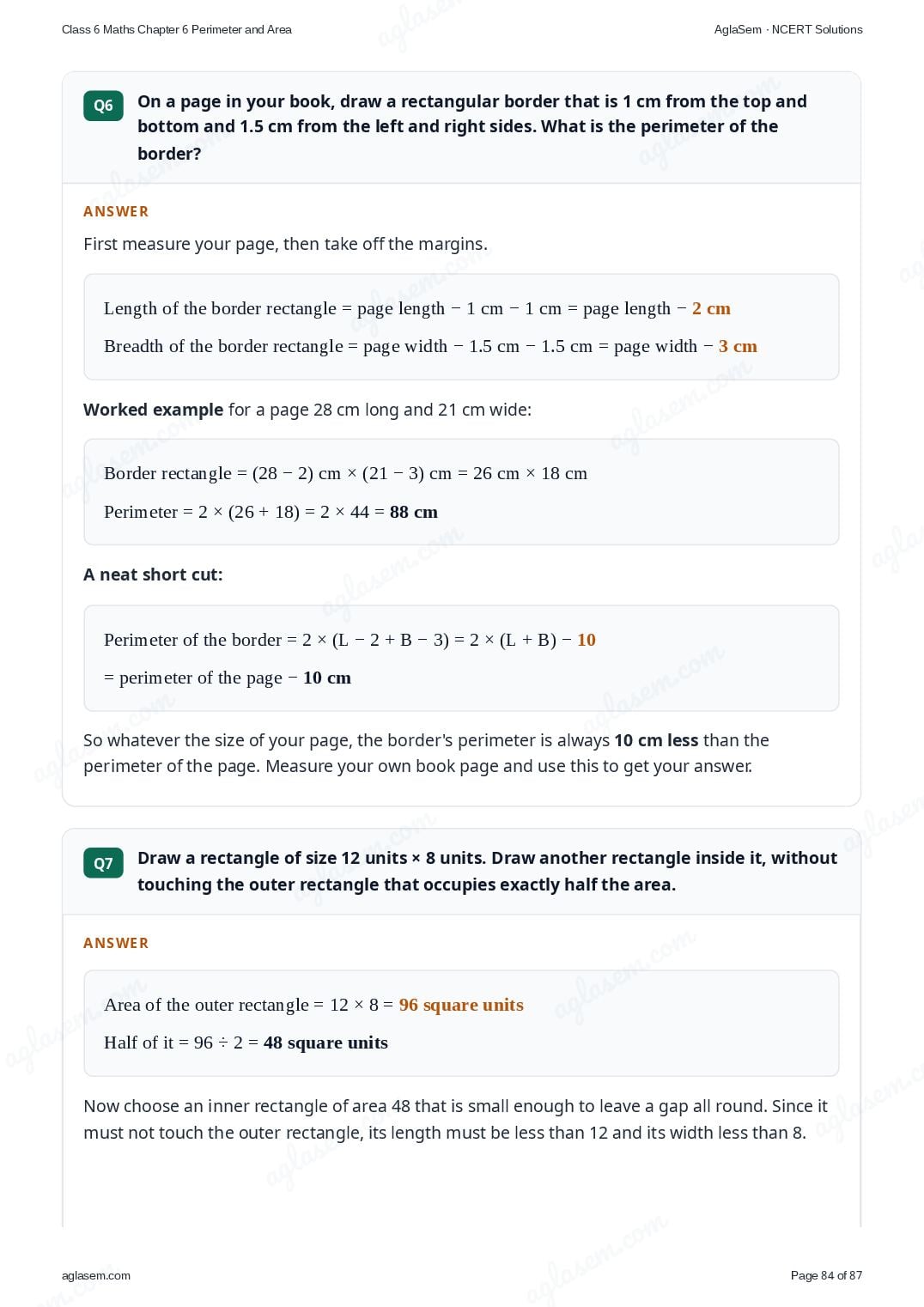
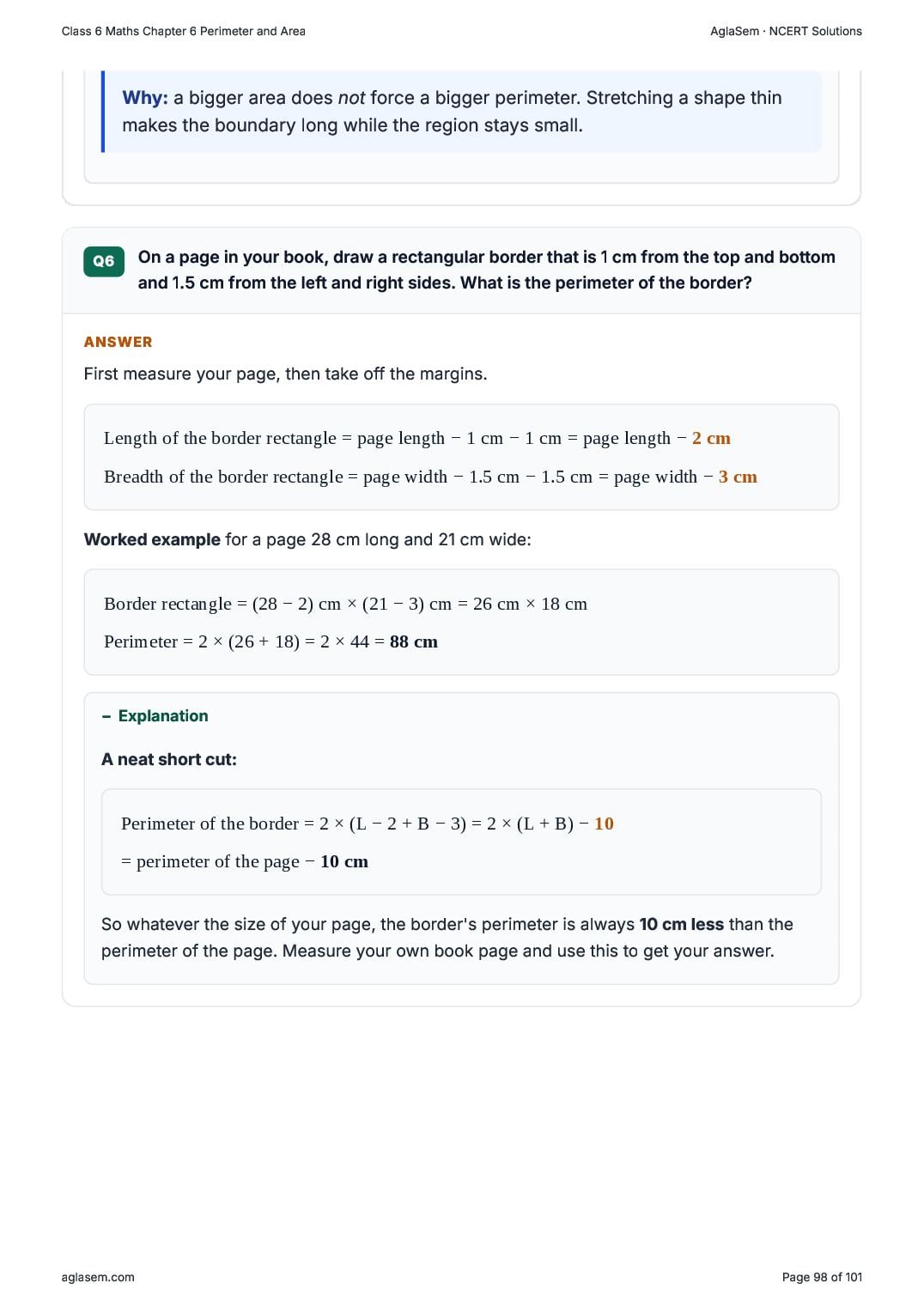
- On a page in your book, draw a rectangular border that is 1 cm from the top and bottom and 1.5 cm from the left and right sides. What is the perimeter of the border?
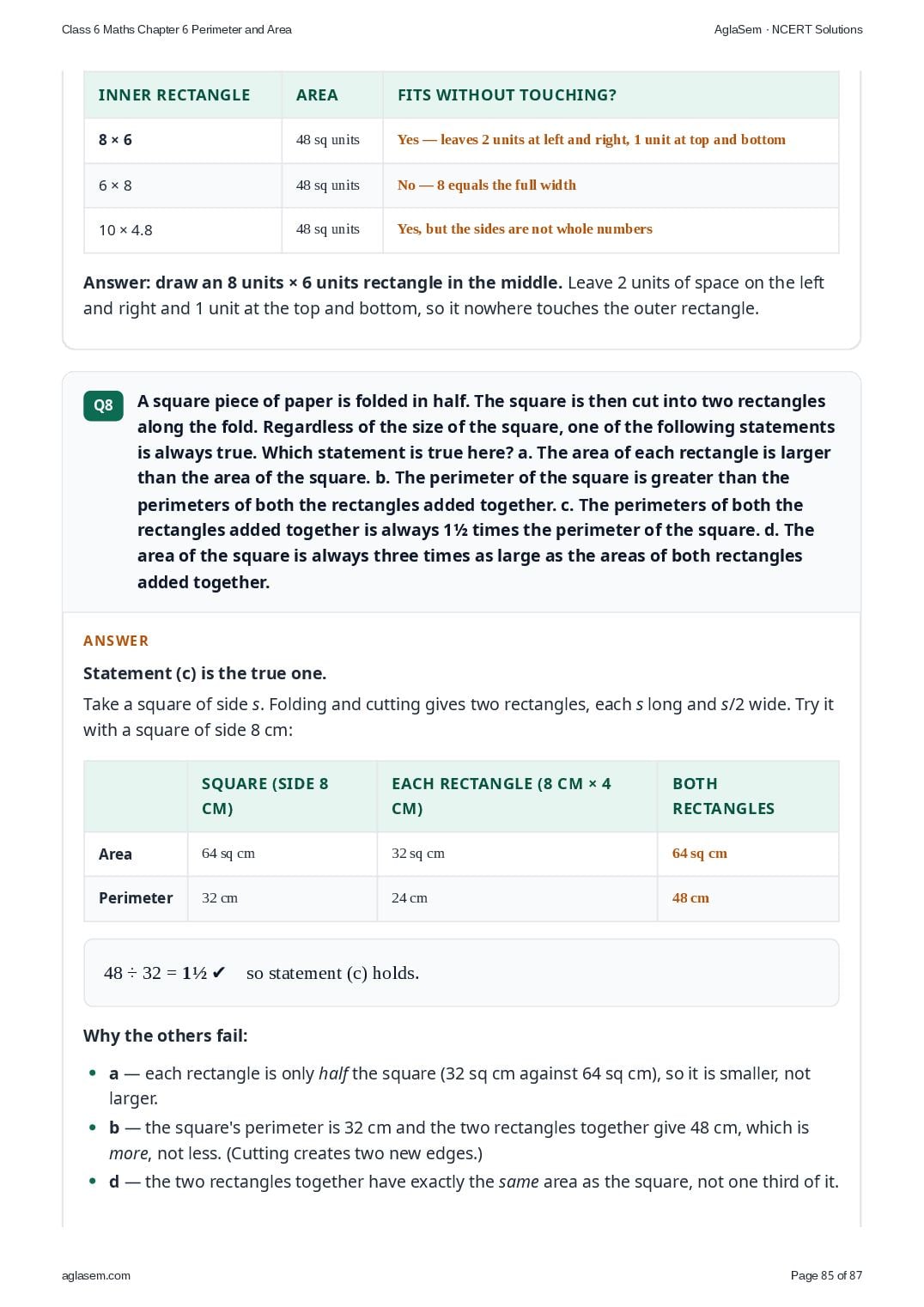
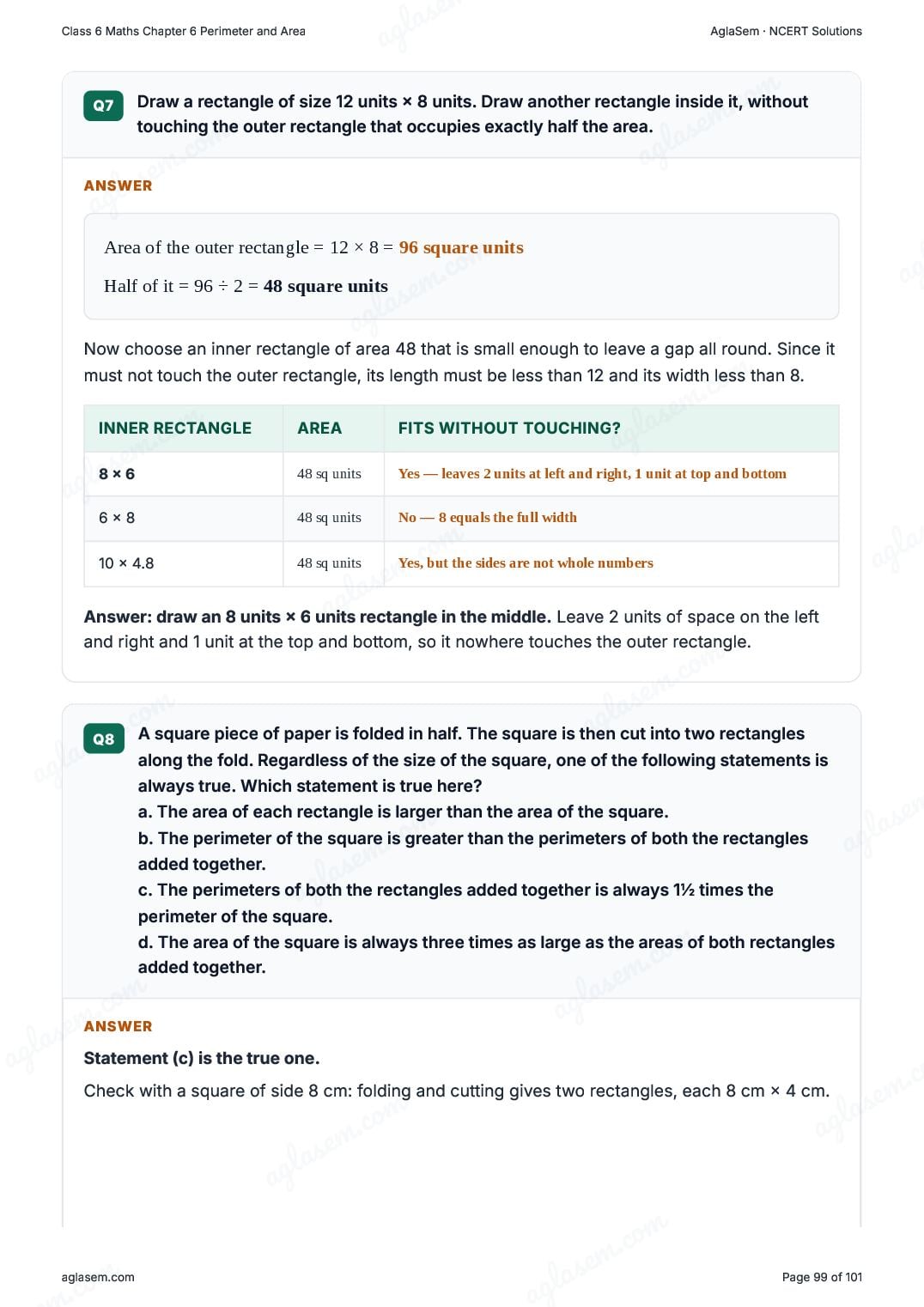
- Draw a rectangle of size 12 units × 8 units. Draw another rectangle inside it, without touching the outer rectangle that occupies exactly half the area.
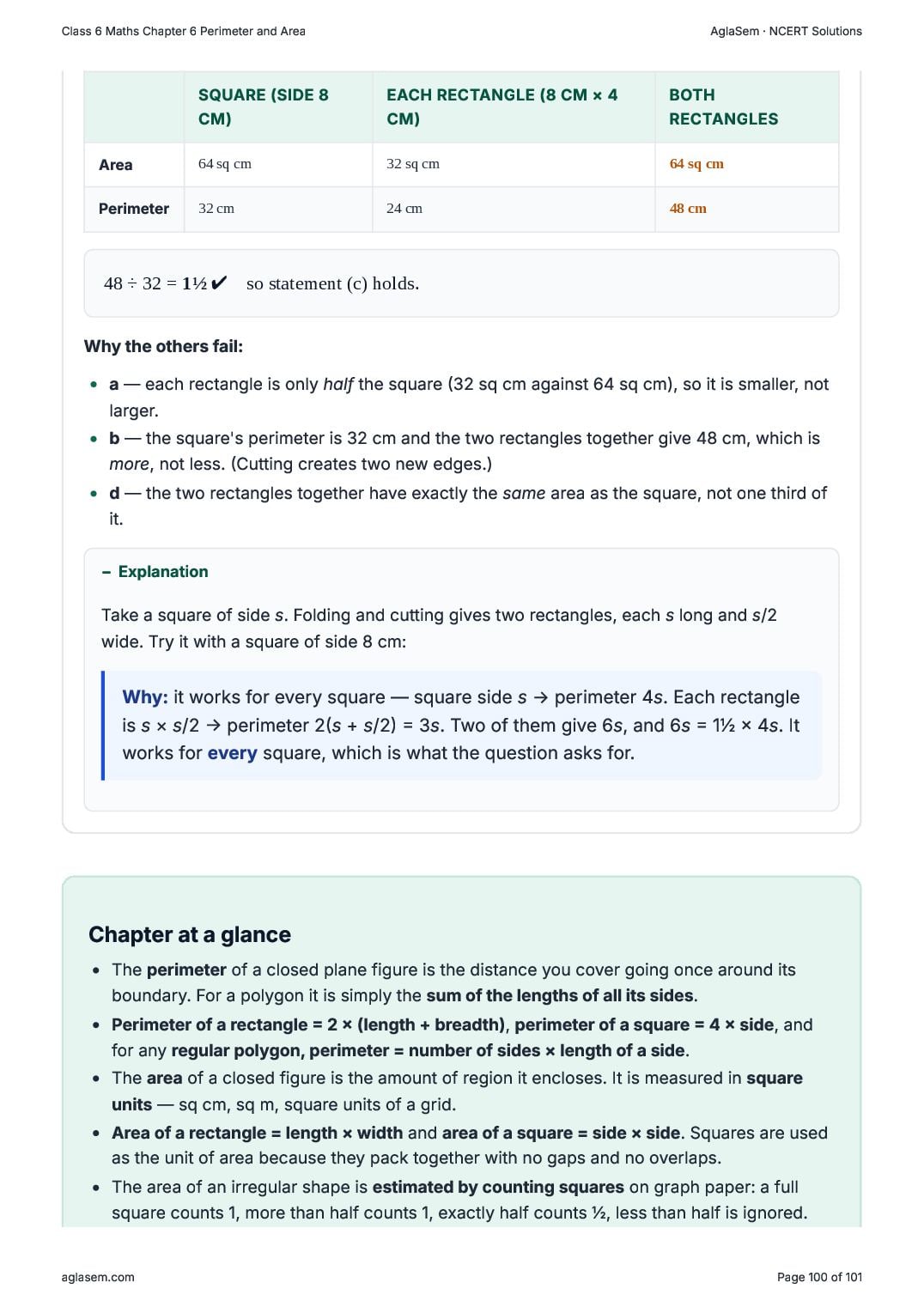
- A square piece of paper is folded in half. The square is then cut into two rectangles along the fold. Regardless of the size of the square, one of the following statements is always true. Which statement is true here? a. The area of each rectangle is larger than the area of the square. b. The perimeter of the square is greater than the perimeters of both the rectangles added together. c. The perimeters of both the rectangles added together is always 1½ times the perimeter of the square. d. The area of the square is always three times as large as the areas of both rectangles added together.
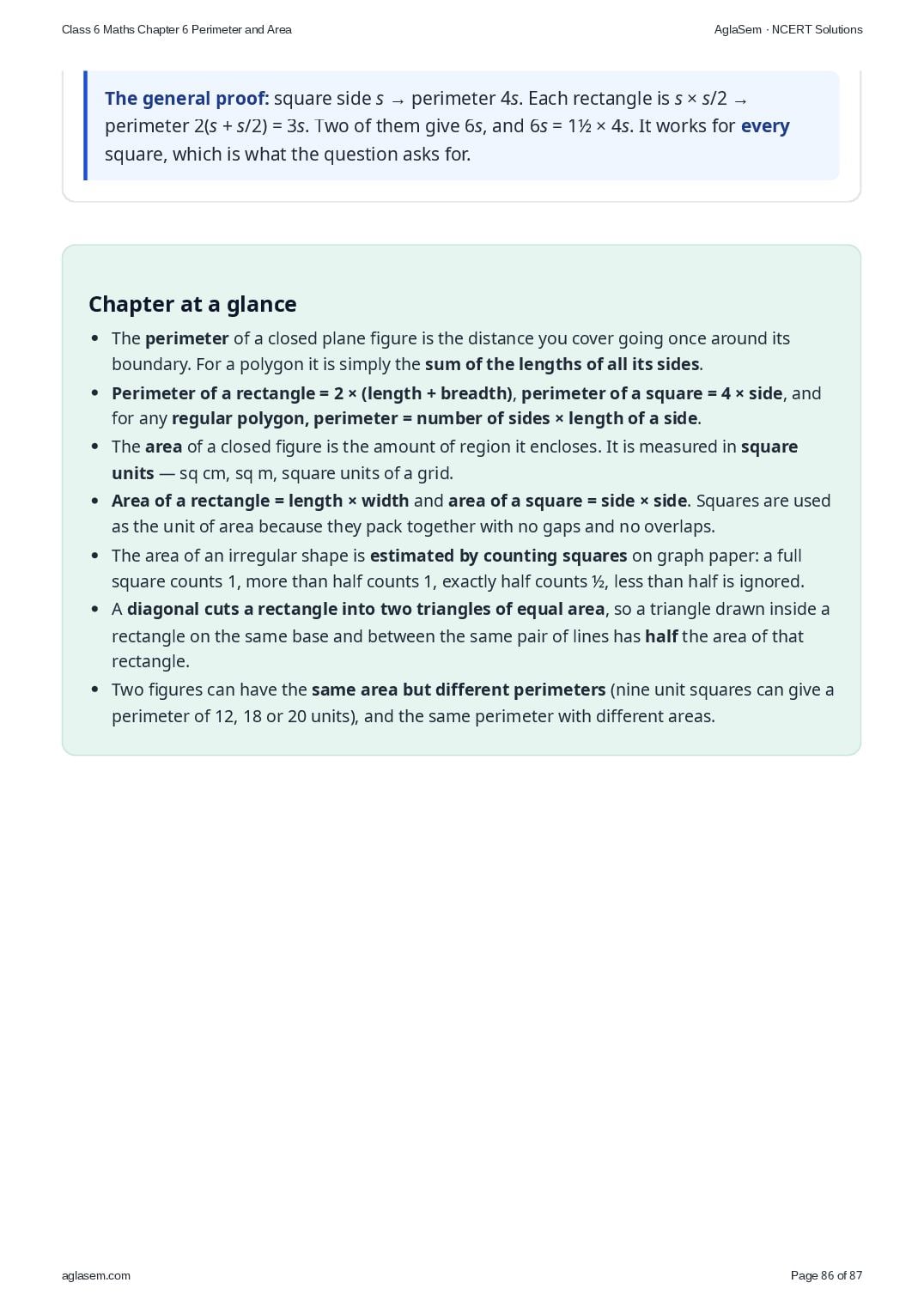
Chapter at a Glance
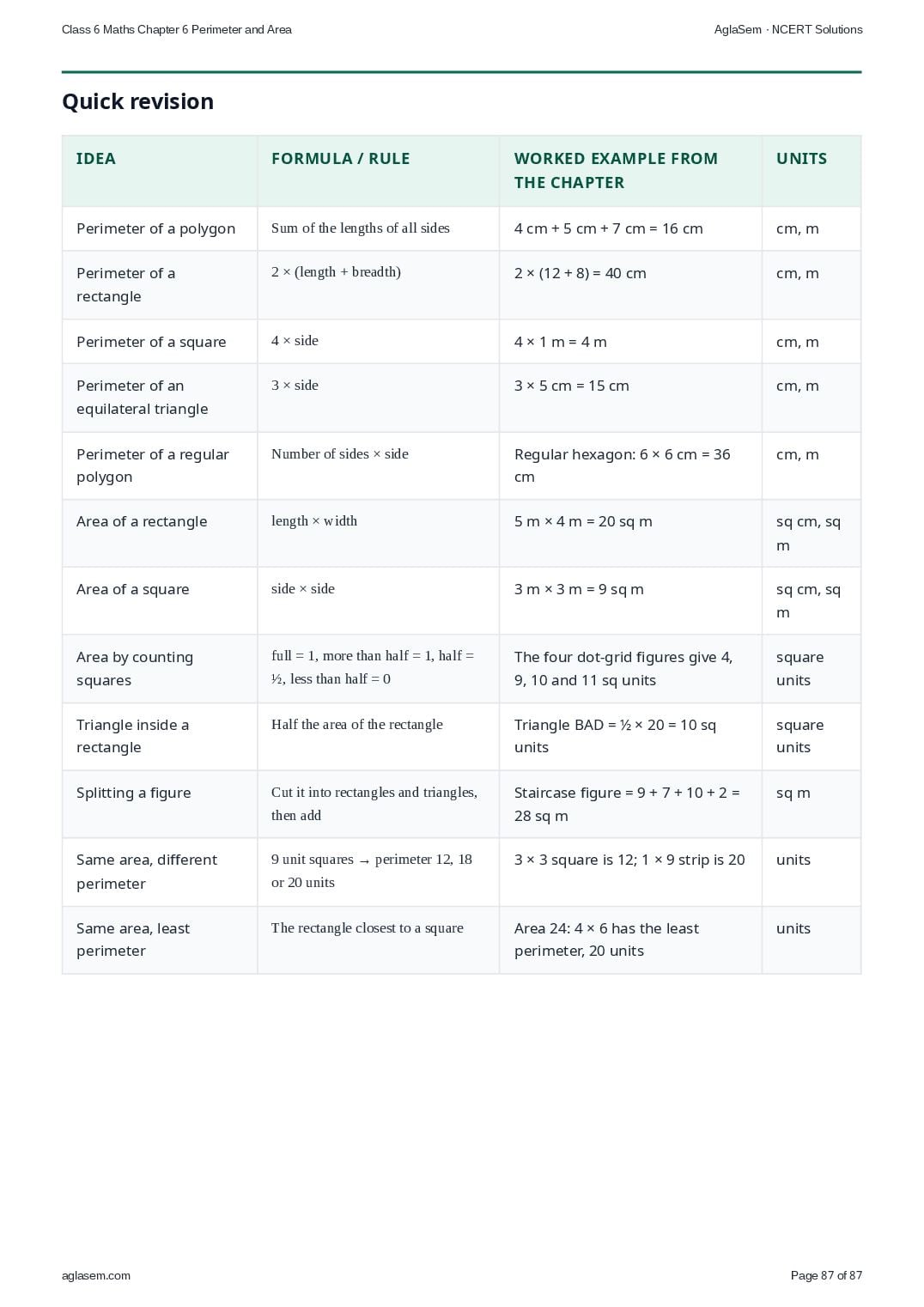
- The perimeter of a closed plane figure is the distance you cover going once around its boundary. For a polygon it is simply the sum of the lengths of all its sides .
- Perimeter of a rectangle = 2 × (length + breadth) , perimeter of a square = 4 × side , and for any regular polygon, perimeter = number of sides × length of a side .
- The area of a closed figure is the amount of region it encloses. It is measured in square units — sq cm, sq m, square units of a grid.
- Area of a rectangle = length × width and area of a square = side × side . Squares are used as the unit of area because they pack together with no gaps and no overlaps.
- The area of an irregular shape is estimated by counting squares on graph paper: a full square counts 1, more than half counts 1, exactly half counts ½, less than half is ignored.
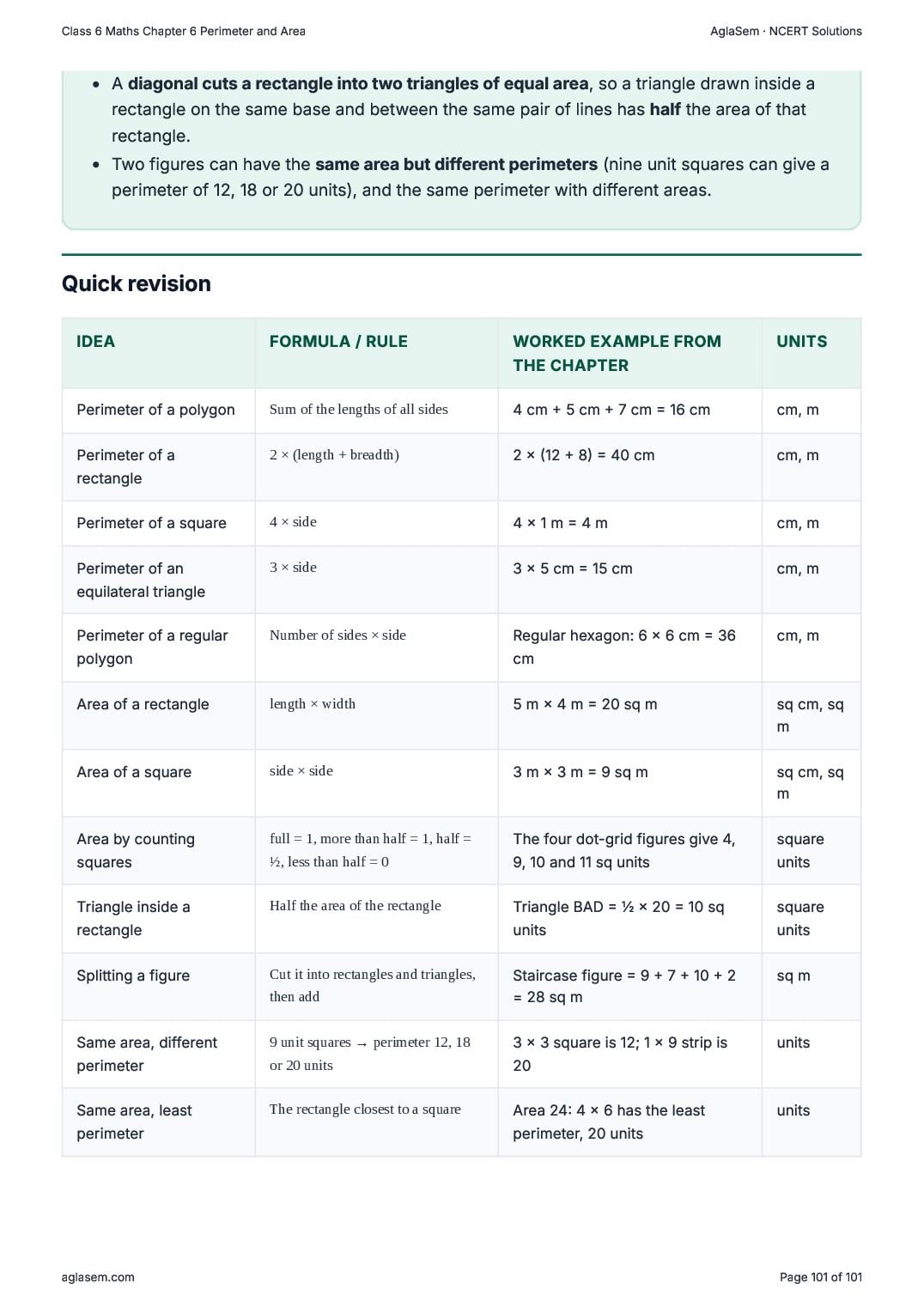
- A diagonal cuts a rectangle into two triangles of equal area , so a triangle drawn inside a rectangle on the same base and between the same pair of lines has half the area of that rectangle.
- Two figures can have the same area but different perimeters (nine unit squares can give a perimeter of 12, 18 or 20 units), and the same perimeter with different areas.
How to Download NCERT Solutions for Class 6 Maths Chapter 6 PDF
Follow these simple steps to get the Perimeter and Area questions-and-answers PDF from Ganita Prakash.
- Search NCERT Solutions for Class 6 Maths Chapter 6 aglasem and open this page.
- Read the exercise questions with answers for Perimeter and Area shown above.
- Click the Download PDF link to save the Perimeter and Area solutions to your device.
NCERT Solutions for Class 6 Maths – All Chapters
There are more chapters to study besides Perimeter and Area in Maths. Here are the NCERT Solutions for all chapters of Class 6 Maths.
- Chapter 1 Patterns in Mathematics
- Chapter 2 Lines and Angles
- Chapter 3 Number Play
- Chapter 4 Data Handling and Presentation
- Chapter 5 Prime Time
- Chapter 6 Perimeter and Area
- Chapter 7 Fractions
- Chapter 8 Playing with Constructions
- Chapter 9 Symmetry
- Chapter 10 the Other Side of Zero
NCERT Solutions for Class 6 – All Subjects
Just like Chapter 6 of Maths, you can get the exercise questions with answers for every other subject of Class 6. Here are the NCERT Solutions for all subjects of Class 6.
NCERT Solutions for Class 6 Maths Chapter 6 – An Overview
The key highlights of this study material are as follows.
| Aspects | Details |
|---|---|
| Class | Class 6 |
| Subject | Maths |
| Chapter Number | Chapter 6 |
| Chapter Name | Perimeter and Area |
| Book Name | Ganita Prakash |
| Book By | NCERT (National Council of Educational Research and Training) |
| Educational Resource Here | NCERT Solutions of Class 6 Maths Chapter 6 for all exercises |
| More Questions Answers of This Subject | NCERT Solutions for Class 6 Maths |
| Download Book Chapter | NCERT Book Class 6 Maths |
| All Questions Answers For This Class | NCERT Solutions for Class 6 |
| Complete Solutions | NCERT Solutions |
NCERT Solutions for Class 6 Maths Chapter 6 Perimeter and Area – FAQs
What are the NCERT Solutions for Class 6 Maths Chapter 6 Perimeter and Area?
They are the complete, step-by-step answers to all the exercise and in-text questions of Chapter 6 Perimeter and Area from the NCERT Class 6 Maths textbook Ganita Prakash, written by experts as per the latest NCERT syllabus.
How can I download the Class 6 Maths Chapter 6 solutions PDF for free?
Open this page on aglasem, read the Perimeter and Area questions with answers, and click the “Download Solutions PDF” link. The Class 6 Maths Chapter 6 NCERT Solutions PDF is completely free to download.
Are these NCERT Solutions as per the latest 2026-27 syllabus?
Yes. The NCERT Solutions for Class 6 Maths Chapter 6 are based on the latest NCERT textbook Ganita Prakash and the current 2026-27 CBSE syllabus, so the questions and answers match what you study in class.
Where can I get NCERT Solutions for the other chapters of Class 6 Maths?
You can find the answers to every chapter on the NCERT Solutions for Class 6 Maths page, and solutions for every subject on the NCERT Solutions for Class 6 page.
How do NCERT Solutions help in exam preparation?
They show the correct method to solve each question, help you write answers the way they are expected in exams, let you check and correct your own work, and save revision time — which together improve your marks in Class 6 Maths.
If you have any queries on NCERT Solutions for Class 6 Maths Chapter 6 Perimeter and Area, then please ask in the comments below.