NCERT Solutions for Class 6 Maths Chapter 9 Symmetry provide clear, step-by-step answers to every exercise and in-text question from the chapter Symmetry of the NCERT textbook Ganita Prakash. Prepared by subject experts as per the latest NCERT (CBSE) syllabus for 2026-27, these NCERT Solutions for Class 6 Maths help you understand each concept, write exam-ready answers, and check your own solutions. You can read them online below or download the free Class 6 Maths Chapter 9 question-answer PDF.
NCERT Solutions for Class 6 Maths Chapter 9 Symmetry
- Class: Class 6
- Subject: Maths
- Chapter: Chapter 9 – Symmetry
- Textbook: Ganita Prakash (NCERT)
- Study material: NCERT Solutions – questions with answers, free PDF
These solutions answer all the exercise questions of Chapter 9 Symmetry — including the in-text questions, short-answer and long-answer questions, and activities — with complete explanations so you can follow the method, not just the final answer. Read the full solutions below.
NCERT Solutions Class 6 Maths Chapter 9 Symmetry View Download


NCERT Solutions for Class 6 Maths Chapter 9 PDF Download
You can read the NCERT Solutions for Class 6 Maths Chapter 9 online above, or download the complete question-answer PDF to study Symmetry offline at any time.
NCERT Solutions for Class 6 Maths Chapter 9 PDF Download Link – Click Here to Download Solutions PDF
Questions Covered in This Chapter
These NCERT Solutions answer all 58 questions of this chapter. The questions solved are:
- The flower looks the same from many different angles. What about the butterfly? No doubt, the colours are very attractive. But what else about the butterfly appeals to you?
- In these pictures, it appears that some parts of the figure are repeated and these repetitions seem to occur in a definite pattern. Can you see what repeats in the beautiful rangoli figure?
- What about the pinwheel? Can you spot which pattern is repeating? Hint: Look at the hexagon first. Now, can you say what figure repeats along each side of the hexagon? What is the shape of the figure that is stuck to each side? Do you recognise it? How do these shapes move as you move along the boundary of the hexagon?
- What are the symmetries that you see in these beautiful structures? (Taj Mahal and Gopuram)
- Do you see any line of symmetry in the figures at the start of the chapter? What about in the picture of the cloud?
- For each of the following figures, identify the line(s) of symmetry if it exists.
- Is there any other way to fold the square so that the two halves overlap? How many lines of symmetry does the square shape have?
- Thus, figures can have multiple lines of symmetry. The figures below also have multiple lines of symmetry. Can you find them all?
- We saw that the diagonal of a square is also a line of symmetry. Let us take a rectangle that is not a square. Is its diagonal a line of symmetry? First, see the rectangle and answer this question. Then, take a rectangular piece of paper and check if the two parts overlap by folding it along its diagonal. What do you observe?
- What if we reflect along the diagonal from A to C? Where do points A, B, C and D go? What if we reflect along the horizontal line of symmetry?
- Ink Blot Devils: Take a piece of paper. Fold it in half. Open the paper and spill a few drops of ink (or paint) on one half. Now press the halves together and then open the paper again. • What do you see? • Is the resulting figure symmetric? • If yes, where is the line of symmetry? • Is there any other line along which it can be folded to produce two identical parts?
- In these two figures, a sheet of paper is folded and a cut is made along the dotted line shown. Draw a sketch of how the paper will look when unfolded. Do you see a line of symmetry in this figure? What is it?
- Use thin rectangular coloured paper. Fold it several times and create some intricate patterns by cutting the paper, like the one shown here. Identify the lines of symmetry in the repeating design. Use such decorative paper cut-outs for festive occasions.
- In each of the following figures, a hole was punched in a folded square sheet of paper and then the paper was unfolded. Identify the line along which the paper was folded. Figure (d) was created by punching a single hole. How was the paper folded?
- Given the line(s) of symmetry, find the other hole(s):
- Here are some questions on paper cutting. Consider a vertical fold. We represent it this way: (Vertical Fold). Similarly, a horizontal fold is represented as follows: (Horizontal Fold).
- After each of the following cuts, predict the shape of the hole when the paper is opened. After you have made your prediction, make the cutouts and verify your answer.
- Suppose you have to get each of these shapes with some folds and a single straight cut. How will you do it? a. The hole in the centre is a square. b. The hole in the centre is a square. Note: For the above two questions, check if the 4-sided figures in the centre satisfy both the properties of a square.
- How many lines of symmetry do these shapes have? a. (a square standing on a corner, and an eight-pointed star) b. A triangle with equal sides and equal angles. c. A hexagon with equal sides and equal angles.
- Trace each figure and draw the lines of symmetry, if any:
- Find the lines of symmetry for the kolam below.
- Draw the following. a. A triangle with exactly one line of symmetry. b. A triangle with exactly three lines of symmetry. c. A triangle with no line of symmetry. Is it possible to draw a triangle with exactly two lines of symmetry?
- Draw the following. In each case, the figure should contain at least one curved boundary. a. A figure with exactly one line of symmetry. b. A figure with exactly two lines of symmetry. c. A figure with exactly four lines of symmetry.
- Copy the following on squared paper. Complete them so that the blue line is a line of symmetry. Problem (a) has been done for you. Hint: For (c) and (f), see if rotating the book helps!
- Copy the following drawing on squared paper. Complete each one of them so that the resulting figure has the two blue lines as lines of symmetry.
- Copy the following on a dot grid. For each figure draw two more lines to make a shape that has a line of symmetry.
- Will the windmill above look exactly the same when rotated through an angle of less than 90°?
- Thus, we see that the windmill has 4 angles of symmetry. Do you know of any other shape that has exactly four angles of symmetry?
- How many angles of symmetry does a square have? How much rotation does it require to get the initial square? Do you know where to mark the centre of rotation? What are the other angles of symmetry?
- Consider this figure, a picture with 4 radial arms. How many angles of symmetry does it have? What are they? Note that the angle between adjacent central dotted lines is 90°.
- Can you change the angles between the radial arms so that the figure still has 4 angles of symmetry? Try drawing it.
- How will you modify the figure above so that it has only two angles of symmetry?
- Let us try with 3 radial arms as in the figure below. How many angles of symmetry does it have and what are they? Trace and cut out a copy of this figure. By rotating the cutout over this figure determine its angles of rotation.
- However, can anything in the figure be changed to make it have 3 angles of symmetry? Can it be done by changing the angles between the dotted lines? Observe that ∠A must overlap ∠B, ∠B must overlap ∠C and ∠C must overlap ∠A. So, ∠A = ∠B = ∠C. What must this angle be? Now how many angles of rotation does the figure have and what are they?
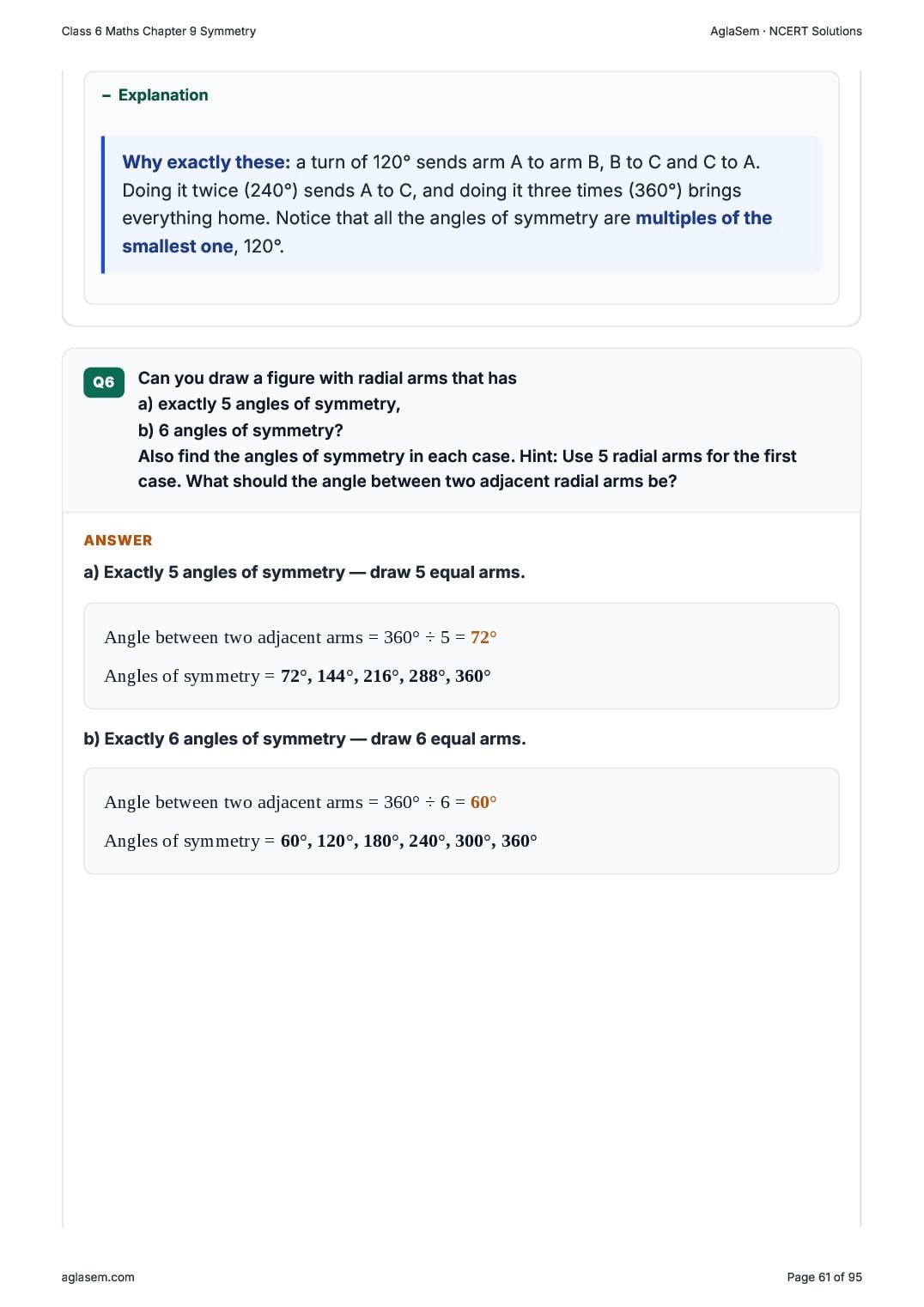
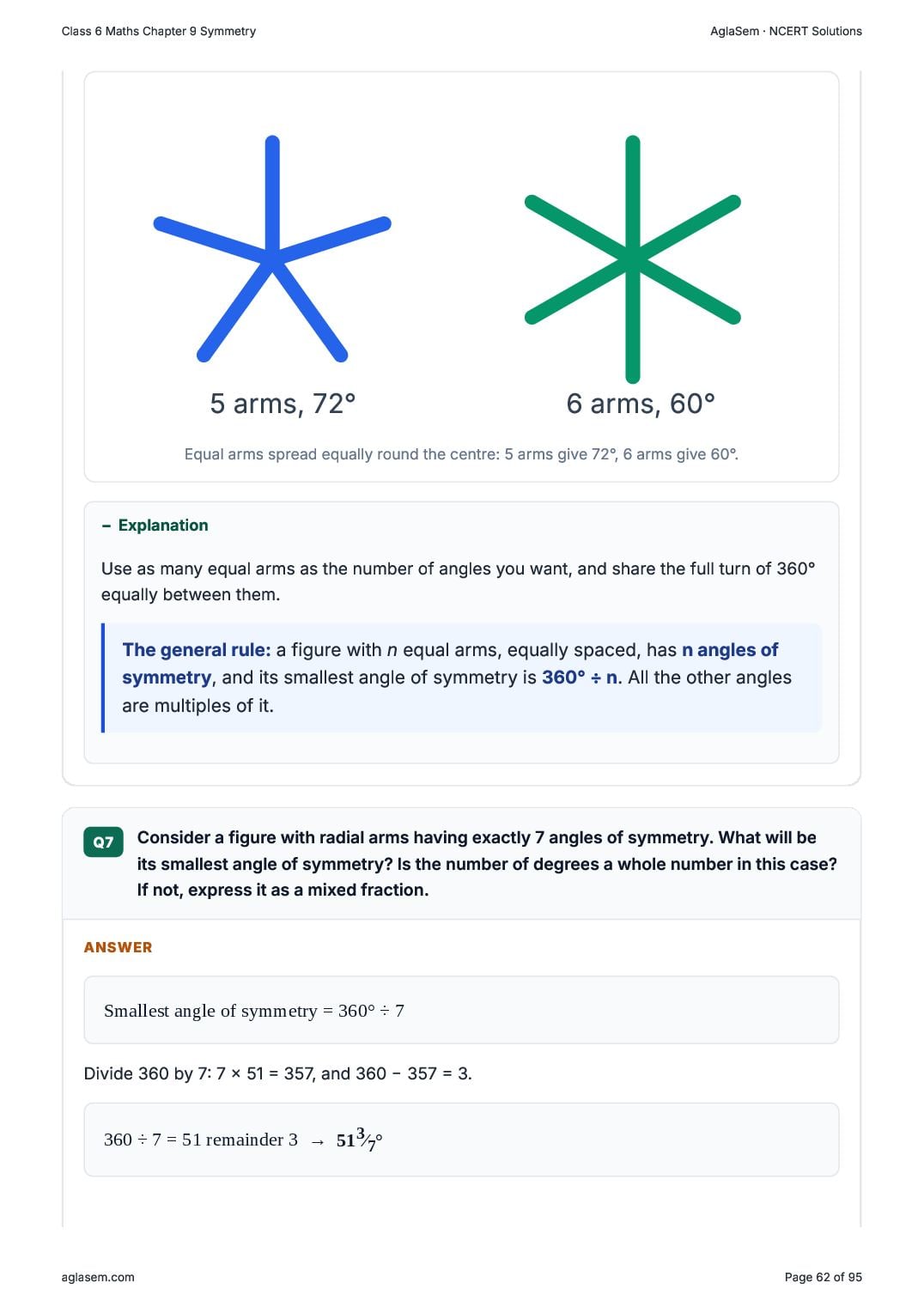
- Can you draw a figure with radial arms that has a) exactly 5 angles of symmetry, b) 6 angles of symmetry? Also find the angles of symmetry in each case. Hint: Use 5 radial arms for the first case. What should the angle between two adjacent radial arms be?
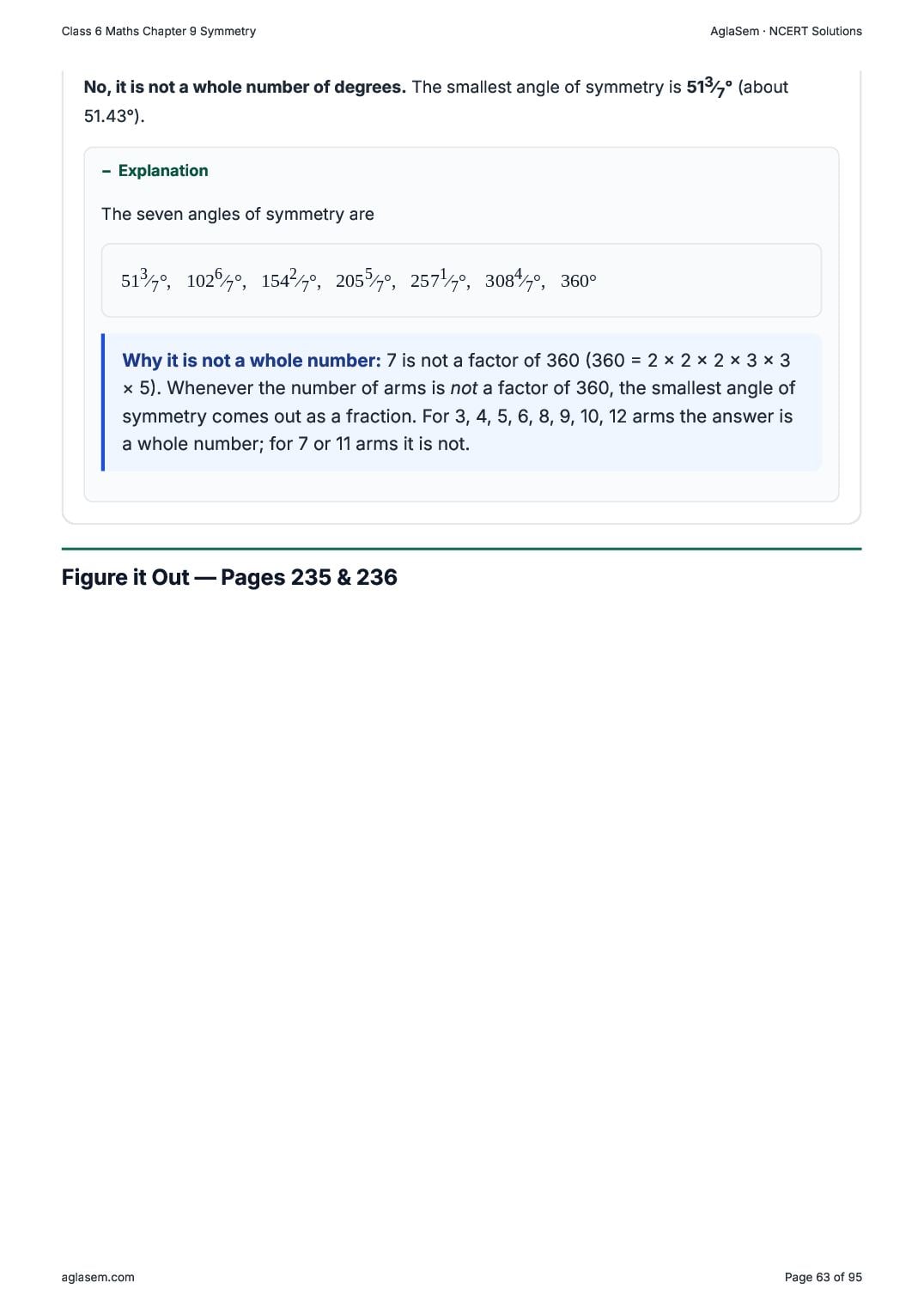
- Consider a figure with radial arms having exactly 7 angles of symmetry. What will be its smallest angle of symmetry? Is the number of degrees a whole number in this case? If not, express it as a mixed fraction.
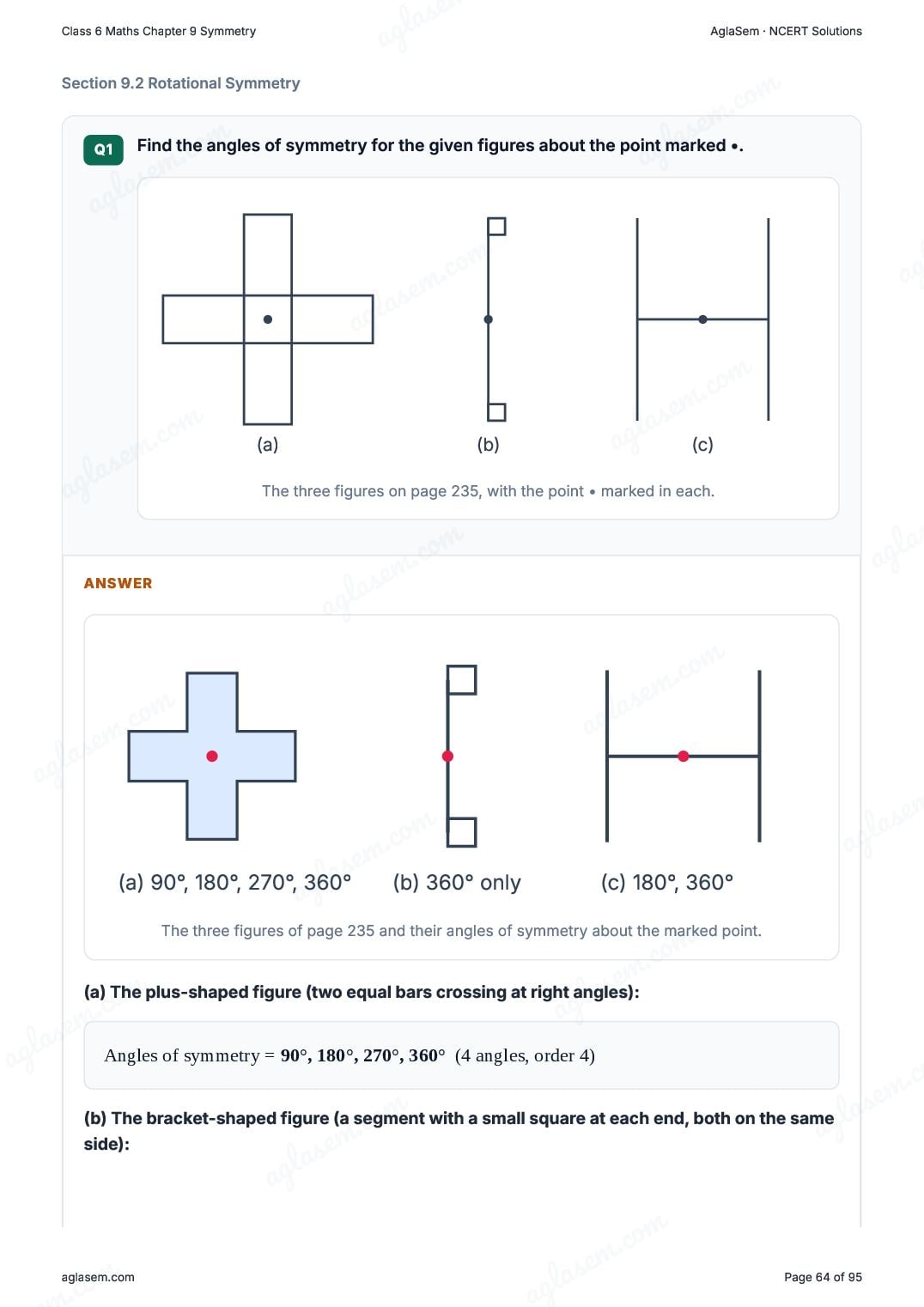
- Find the angles of symmetry for the given figures about the point marked •.
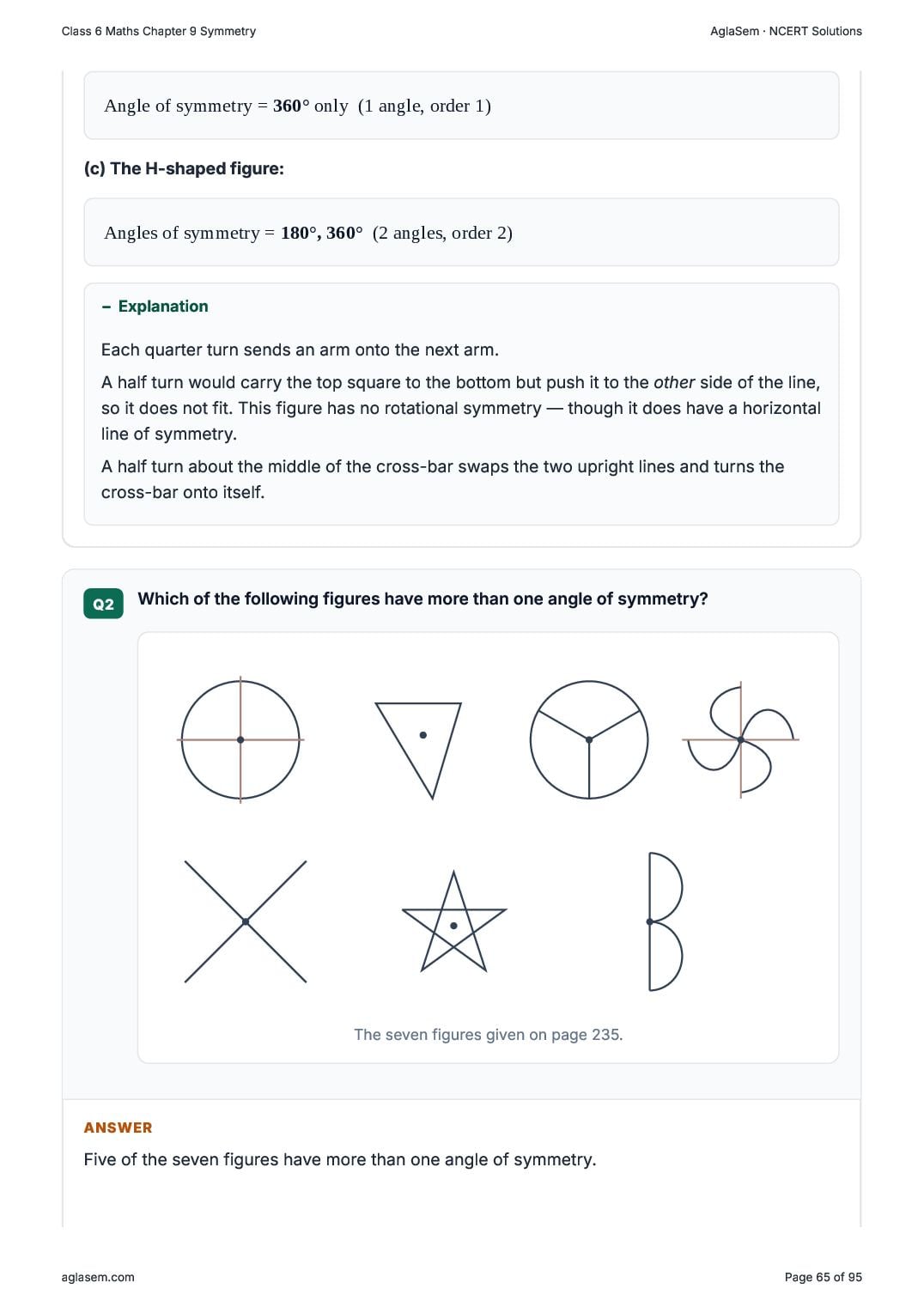
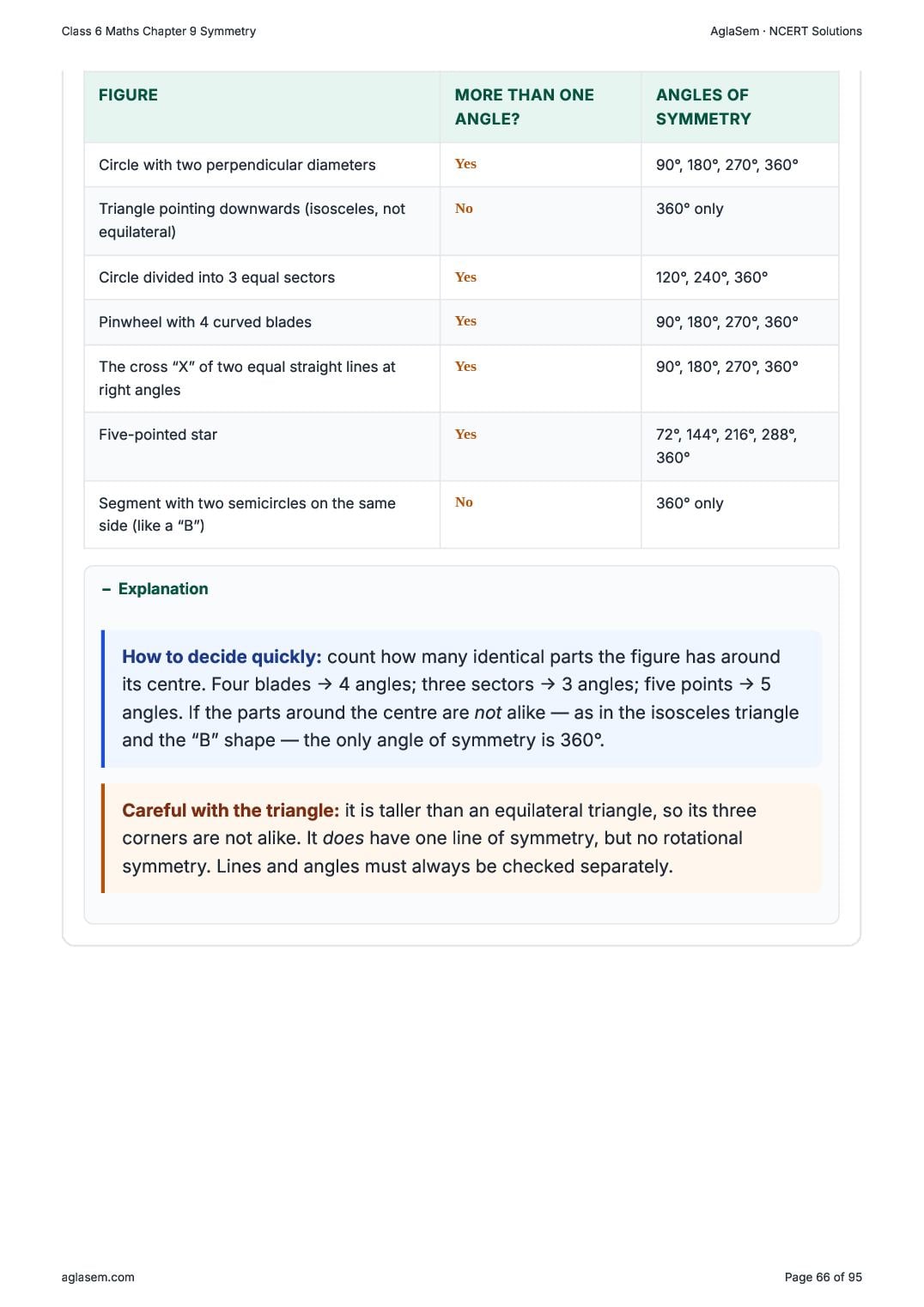
- Which of the following figures have more than one angle of symmetry?
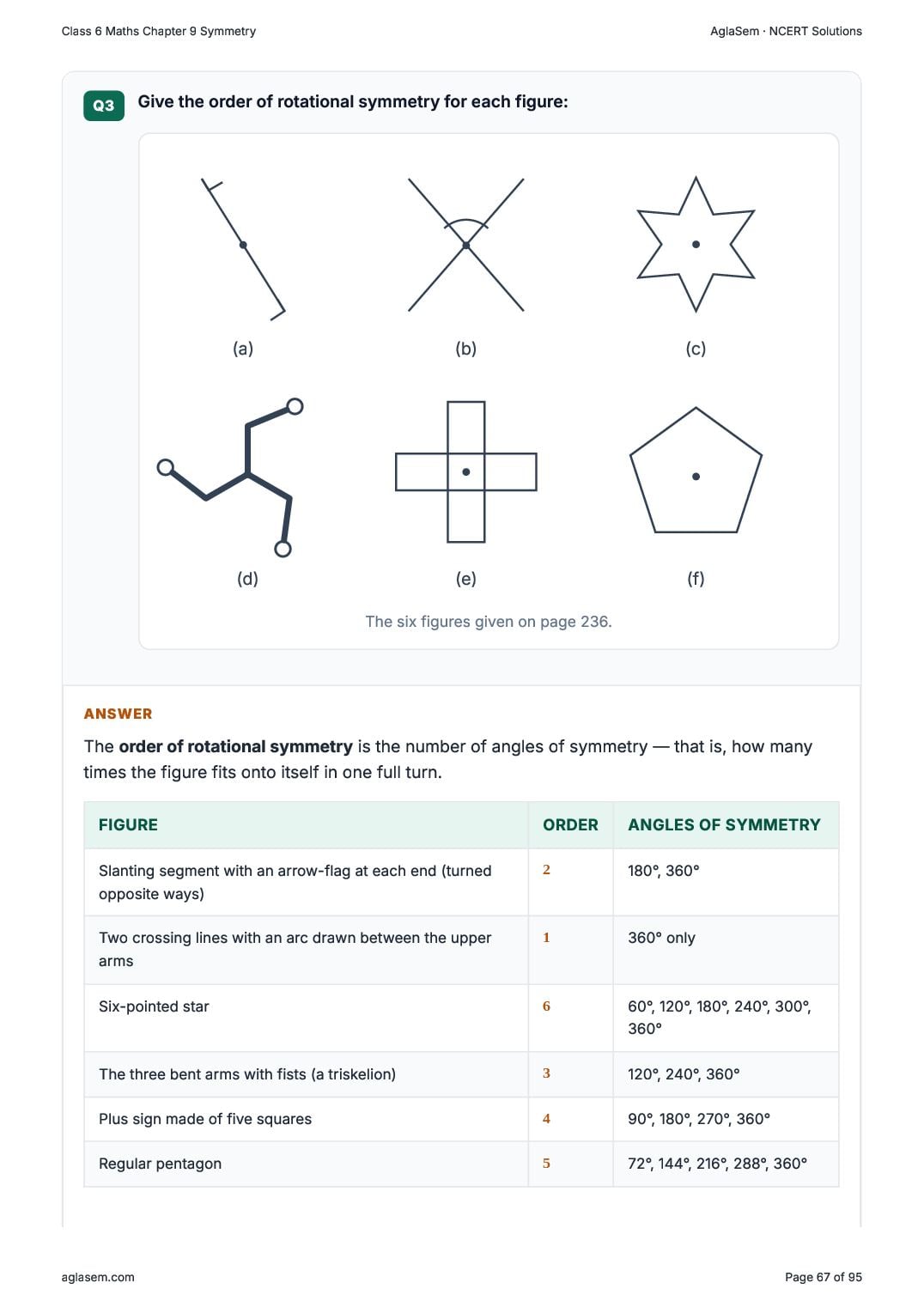
- Give the order of rotational symmetry for each figure:
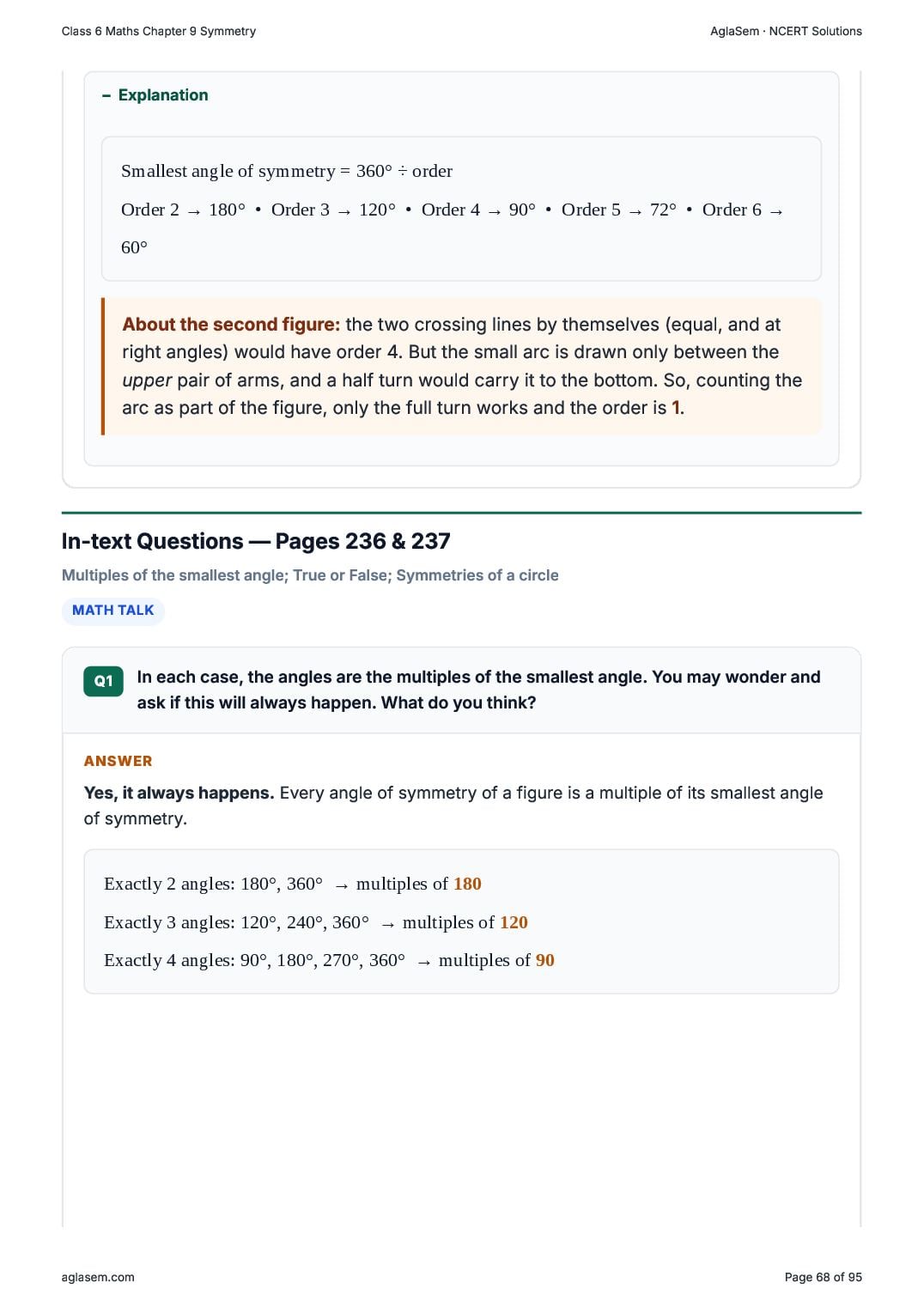
- In each case, the angles are the multiples of the smallest angle. You may wonder and ask if this will always happen. What do you think?
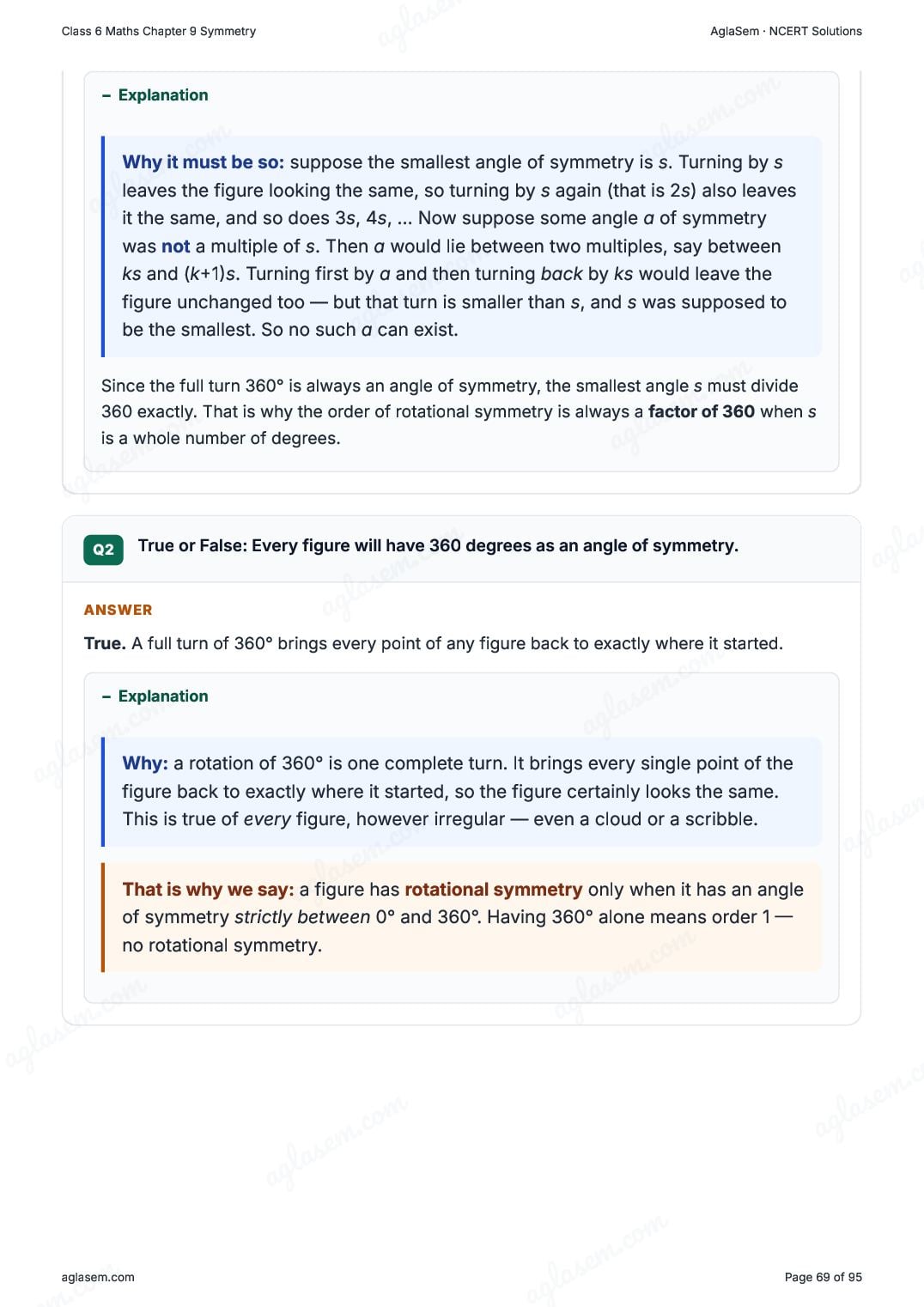
- True or False: Every figure will have 360 degrees as an angle of symmetry.
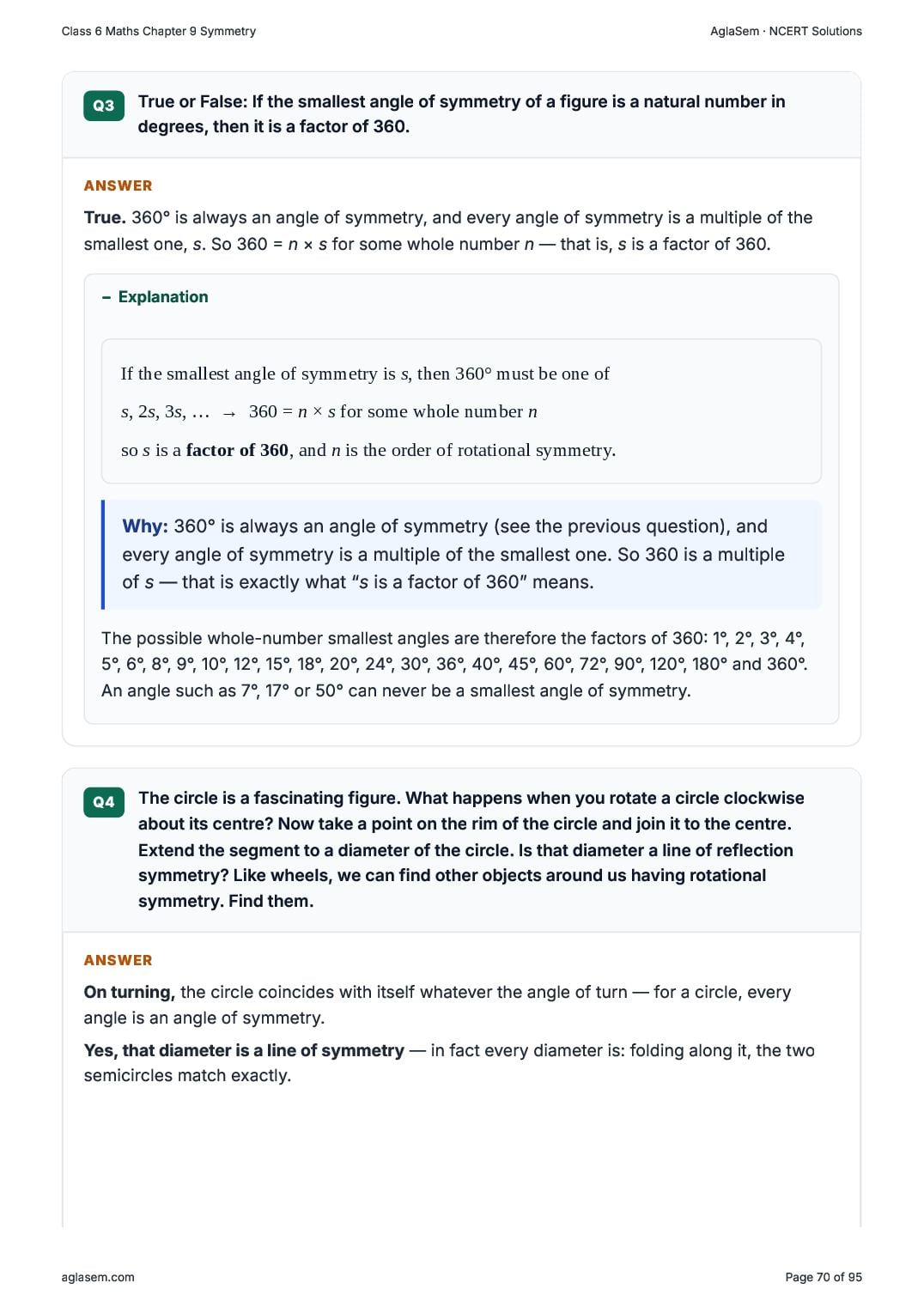
- True or False: If the smallest angle of symmetry of a figure is a natural number in degrees, then it is a factor of 360.
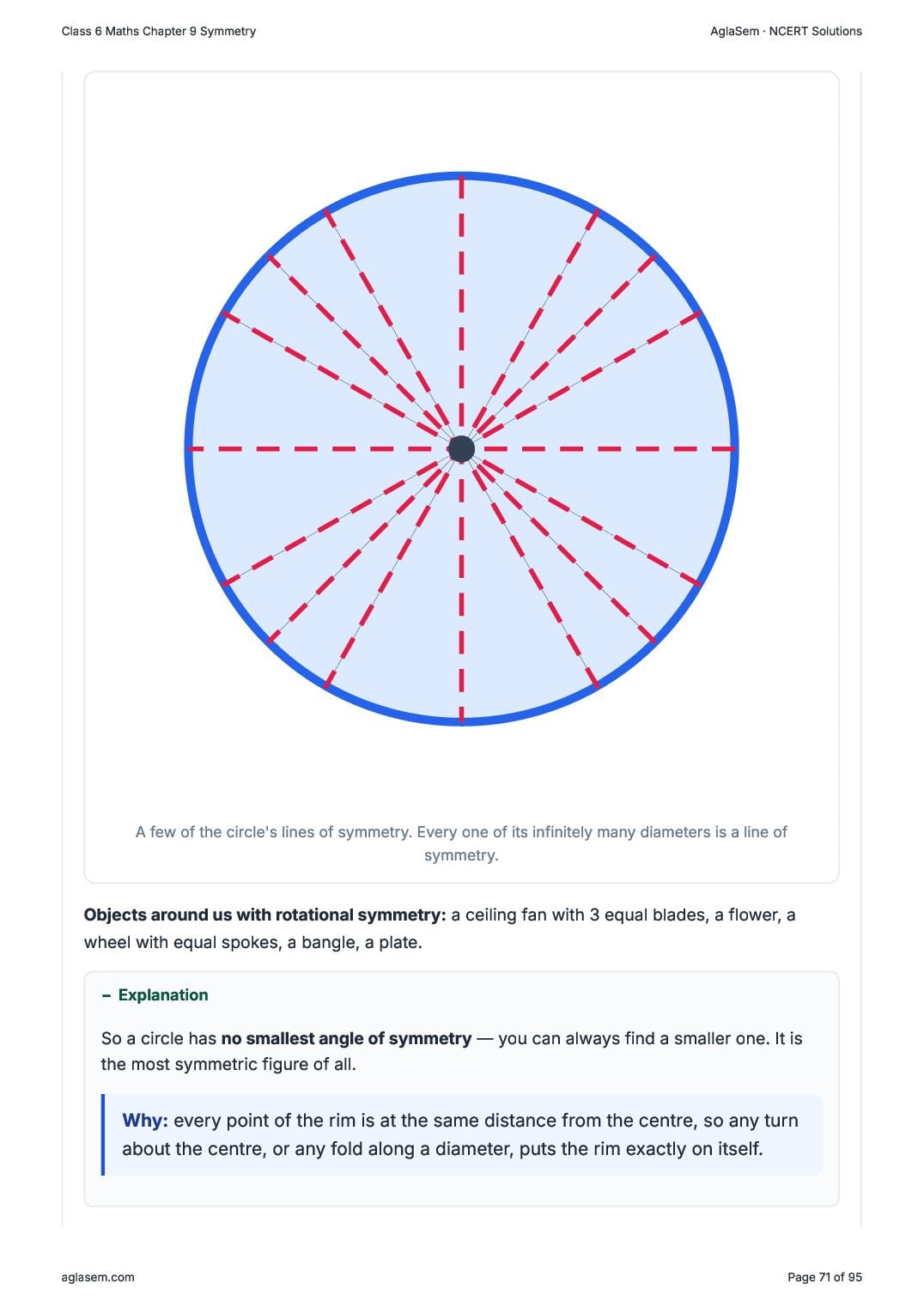
- The circle is a fascinating figure. What happens when you rotate a circle clockwise about its centre? Now take a point on the rim of the circle and join it to the centre. Extend the segment to a diameter of the circle. Is that diameter a line of reflection symmetry?
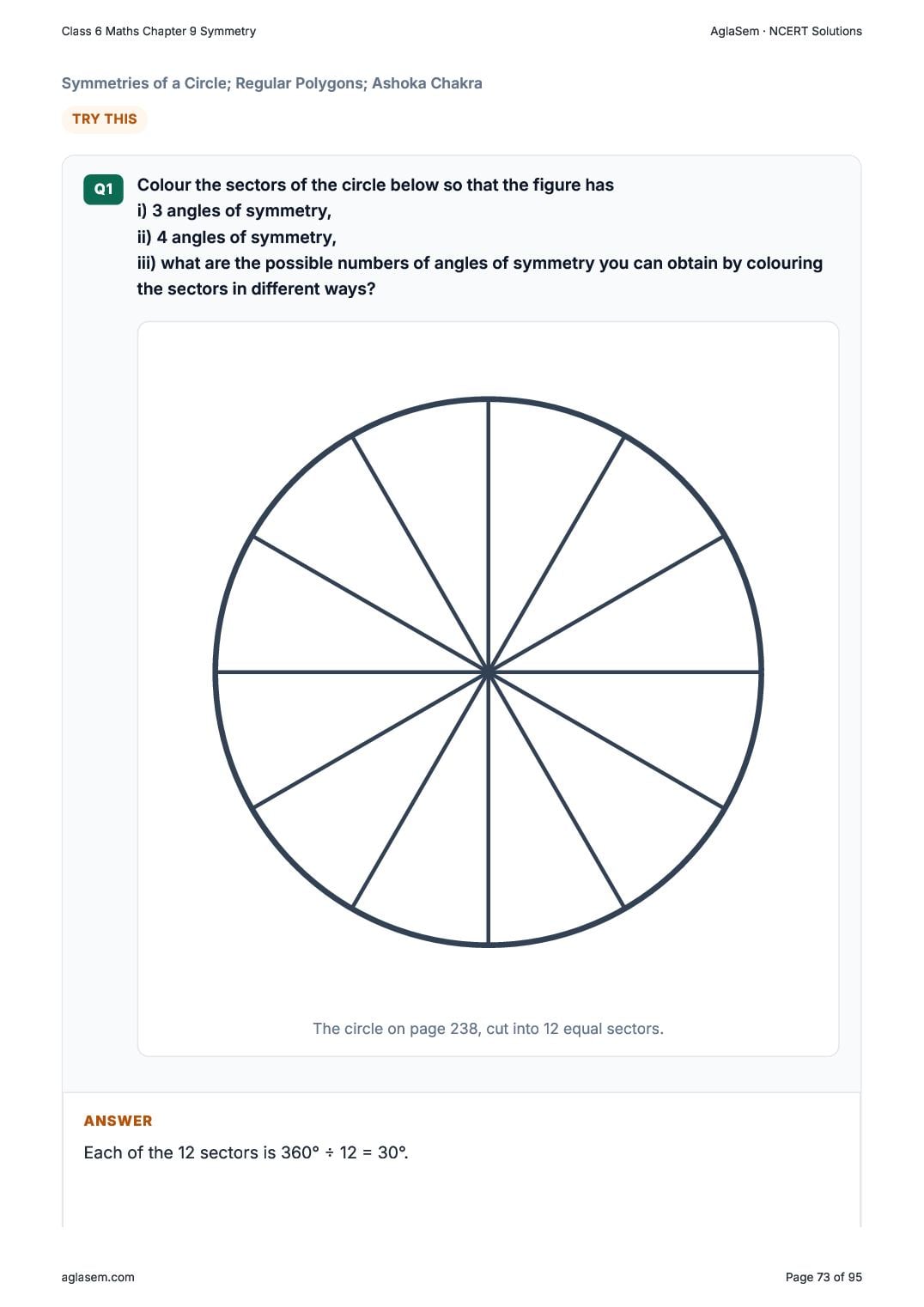
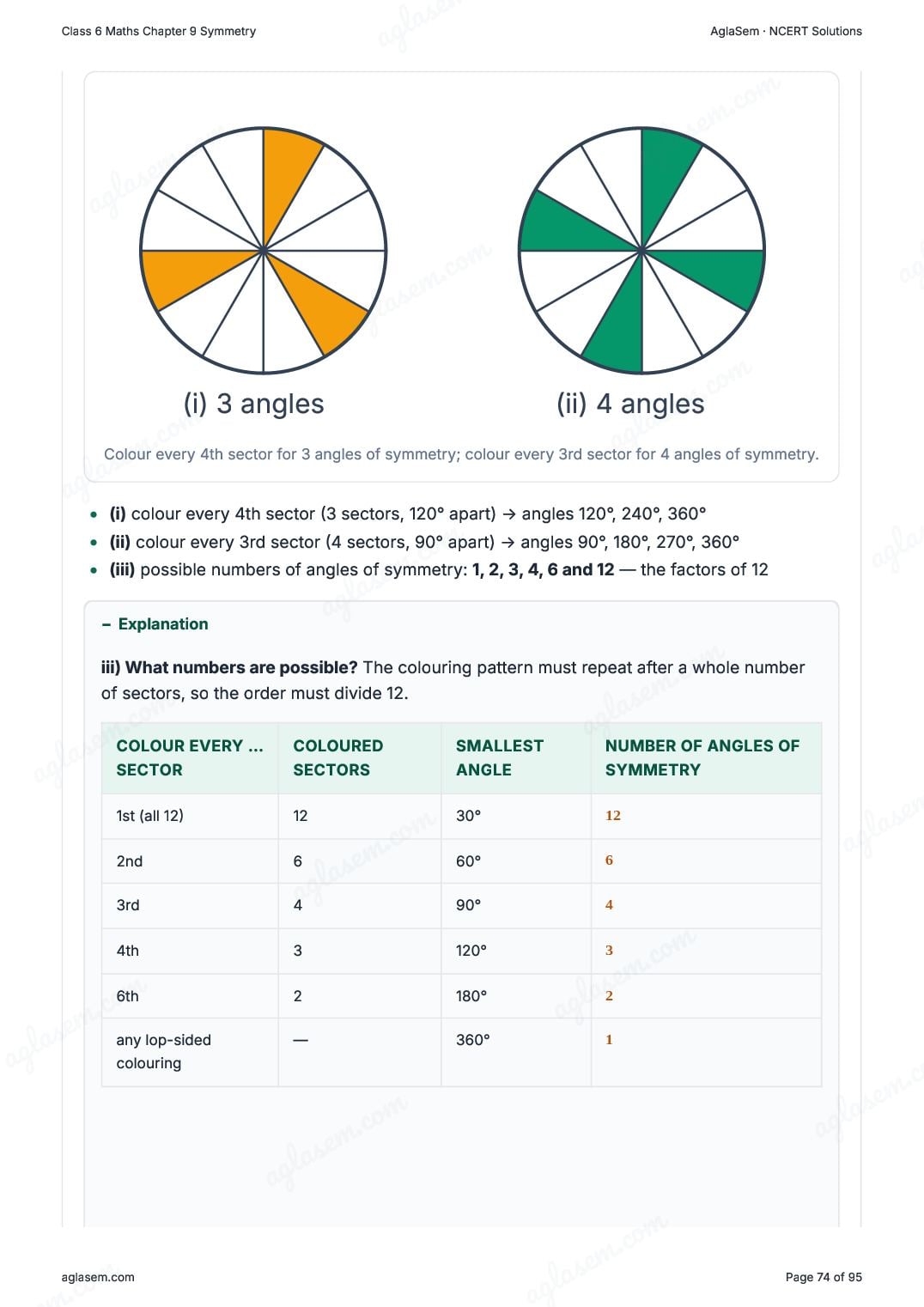
- Colour the sectors of the circle below so that the figure has i) 3 angles of symmetry, ii) 4 angles of symmetry, iii) what are the possible numbers of angles of symmetry you can obtain by colouring the sectors in different ways?
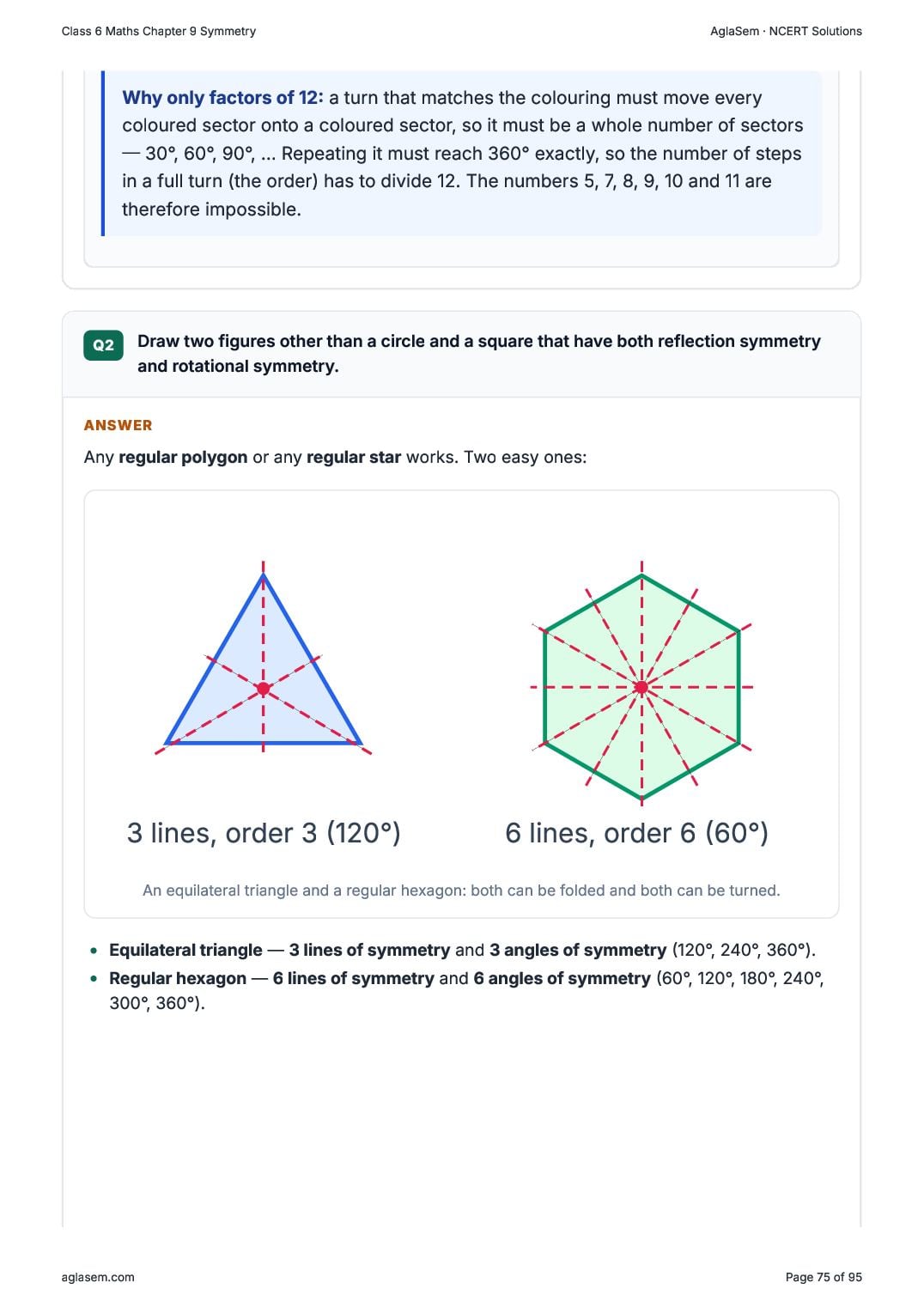
- Draw two figures other than a circle and a square that have both reflection symmetry and rotational symmetry.
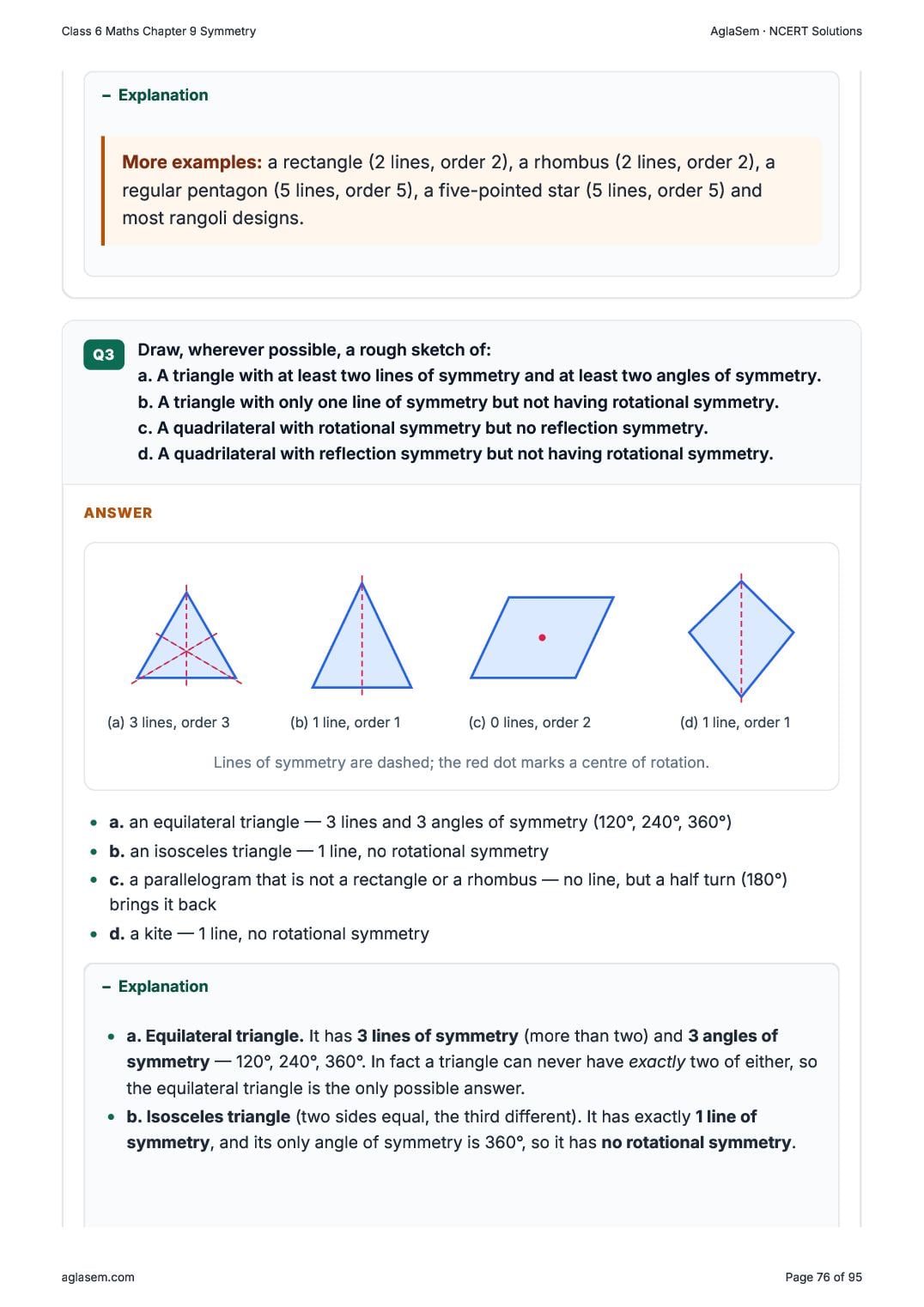
- Draw, wherever possible, a rough sketch of: a. A triangle with at least two lines of symmetry and at least two angles of symmetry. b. A triangle with only one line of symmetry but not having rotational symmetry. c. A quadrilateral with rotational symmetry but no reflection symmetry. d. A quadrilateral with reflection symmetry but not having rotational symmetry.
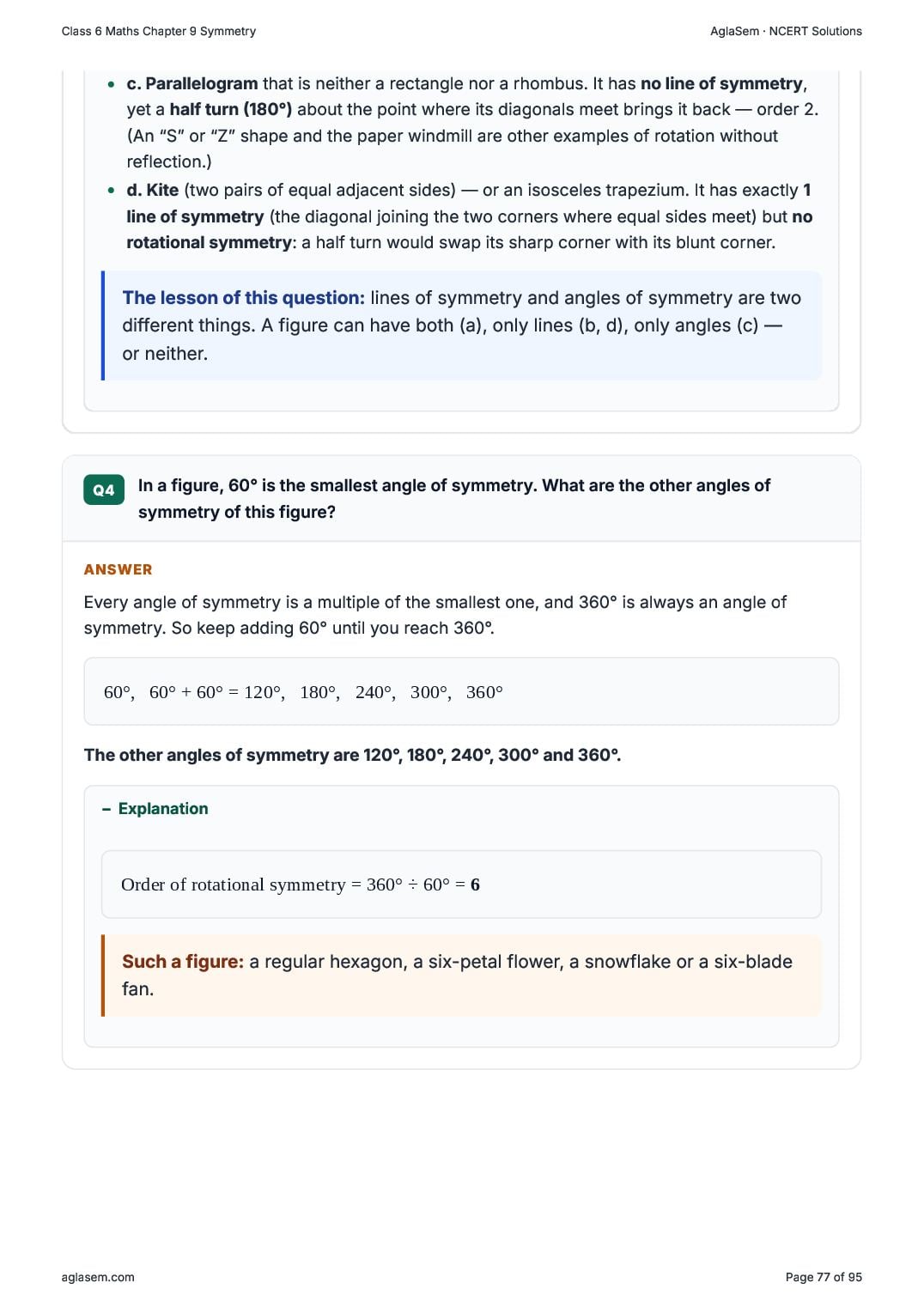
- In a figure, 60° is the smallest angle of symmetry. What are the other angles of symmetry of this figure?
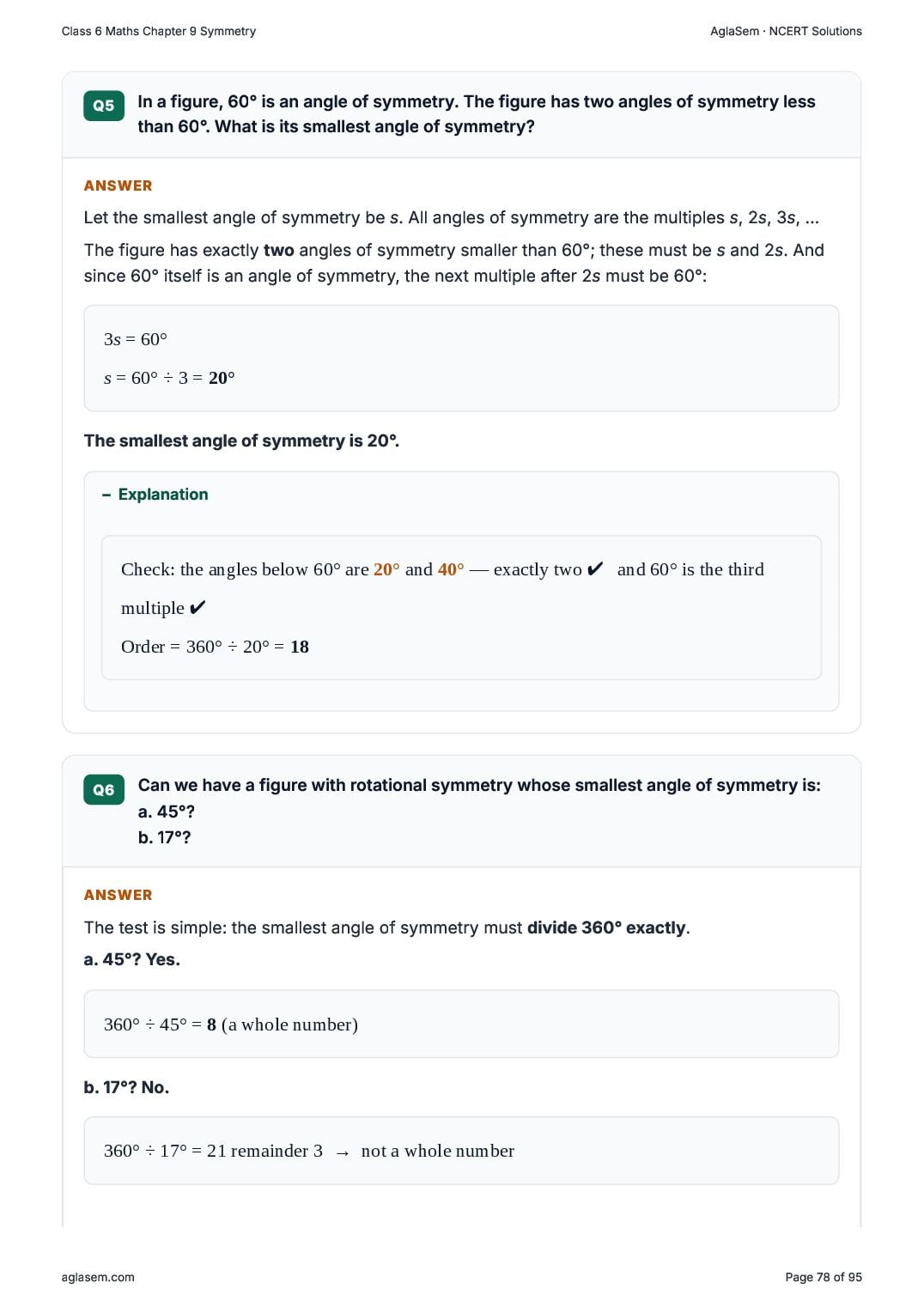
- In a figure, 60° is an angle of symmetry. The figure has two angles of symmetry less than 60°. What is its smallest angle of symmetry?
- Can we have a figure with rotational symmetry whose smallest angle of symmetry is: a. 45°? b. 17°?
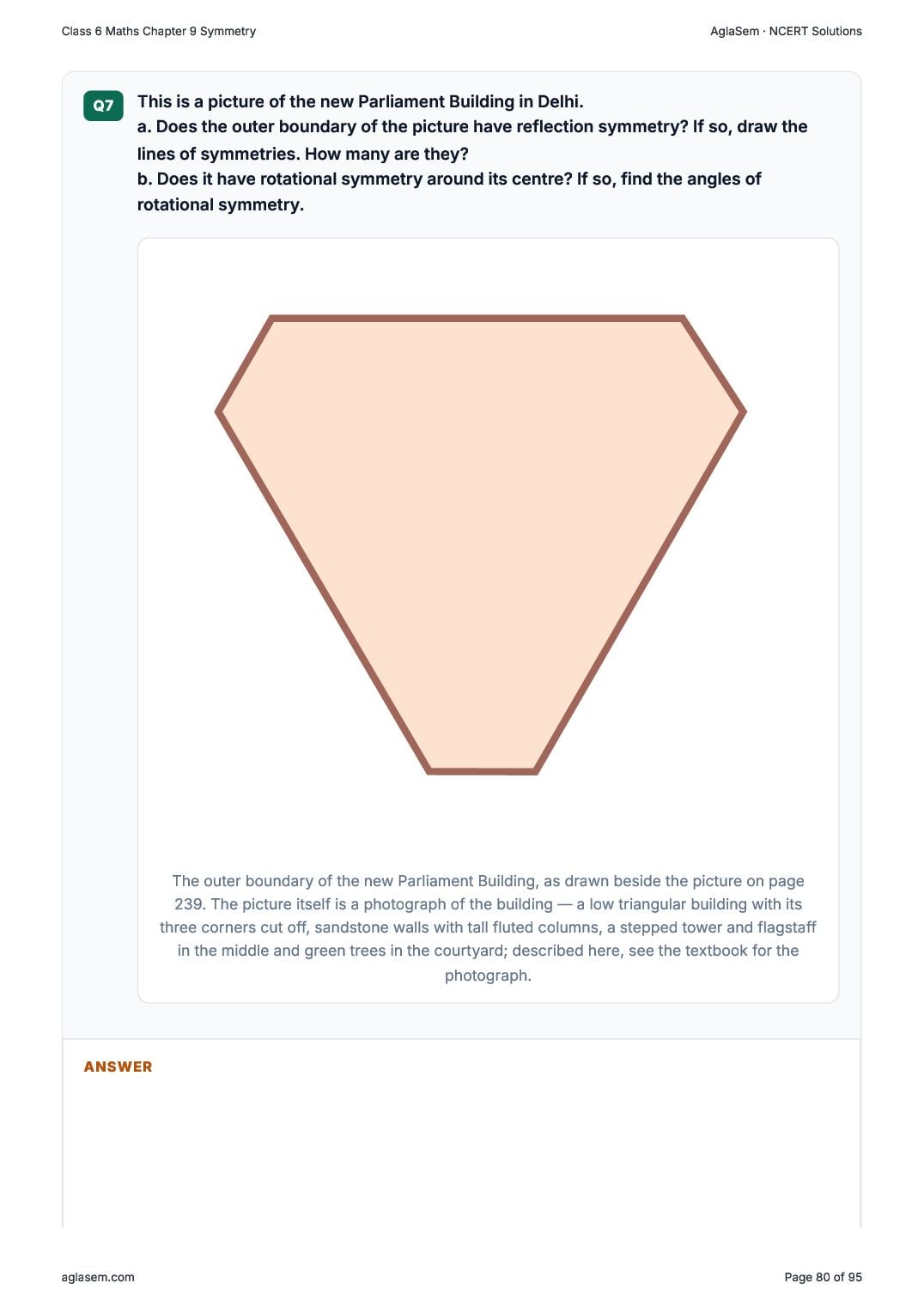
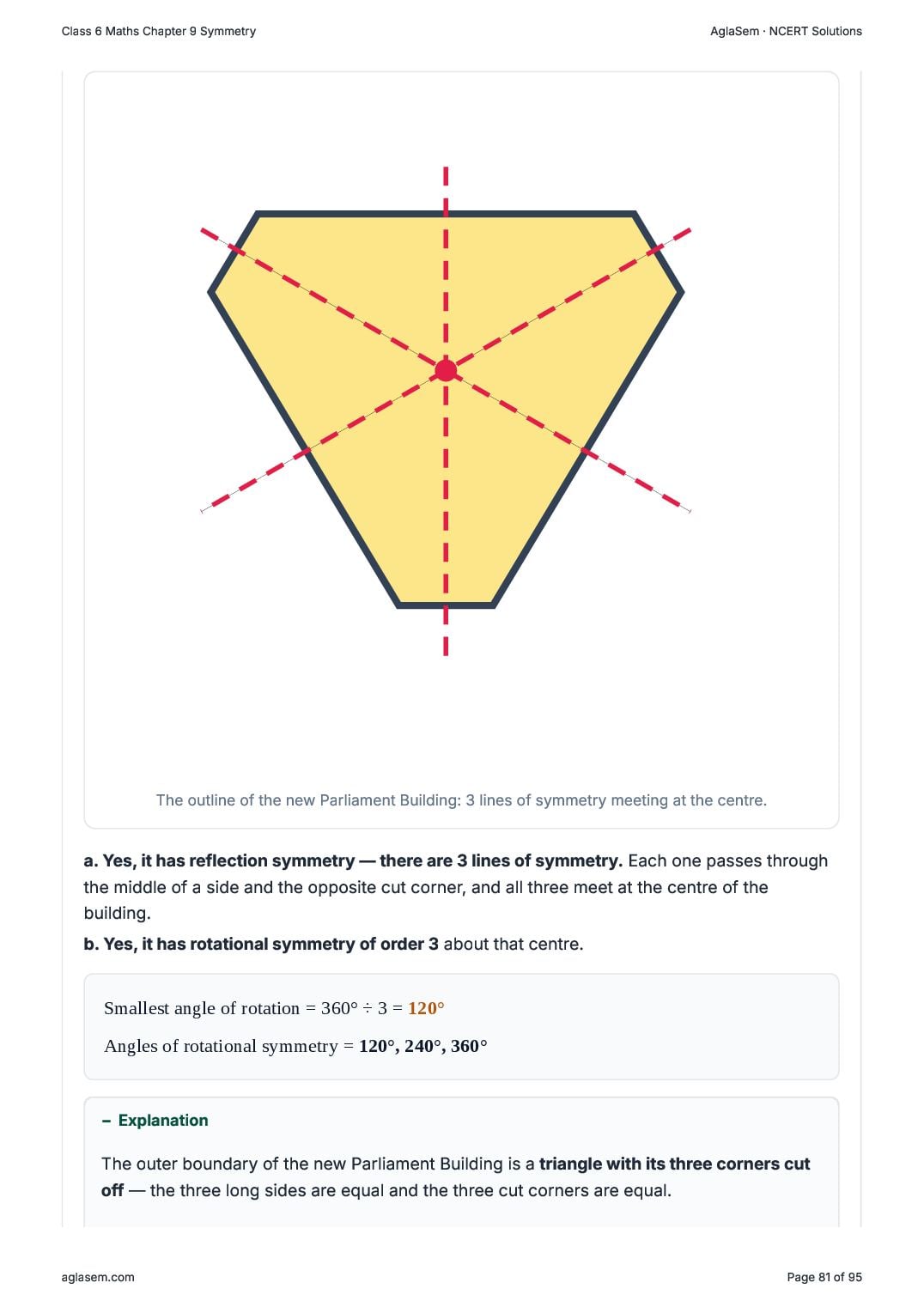
- This is a picture of the new Parliament Building in Delhi. a. Does the outer boundary of the picture have reflection symmetry? If so, draw the lines of symmetries. How many are they? b. Does it have rotational symmetry around its centre? If so, find the angles of rotational symmetry.
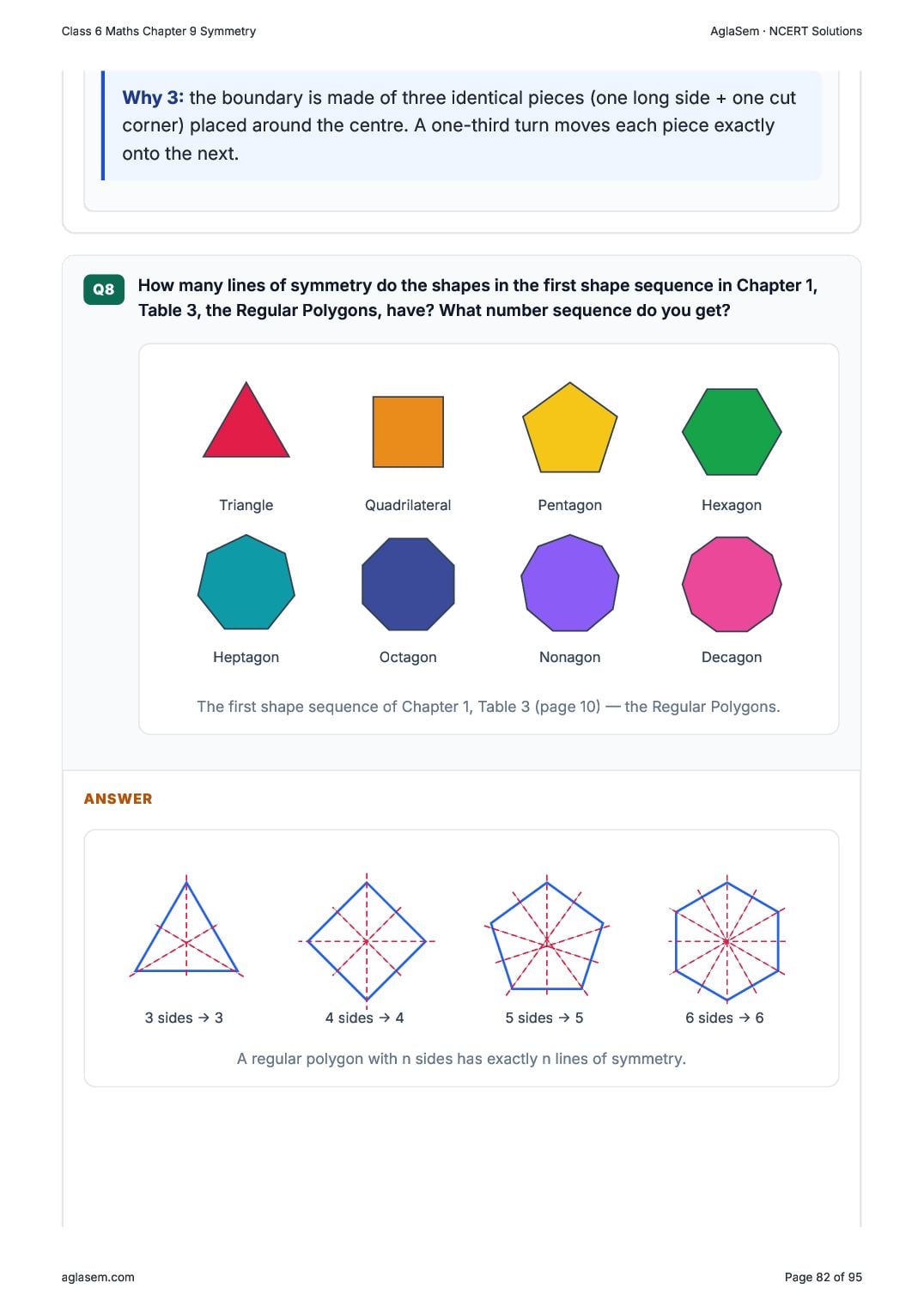
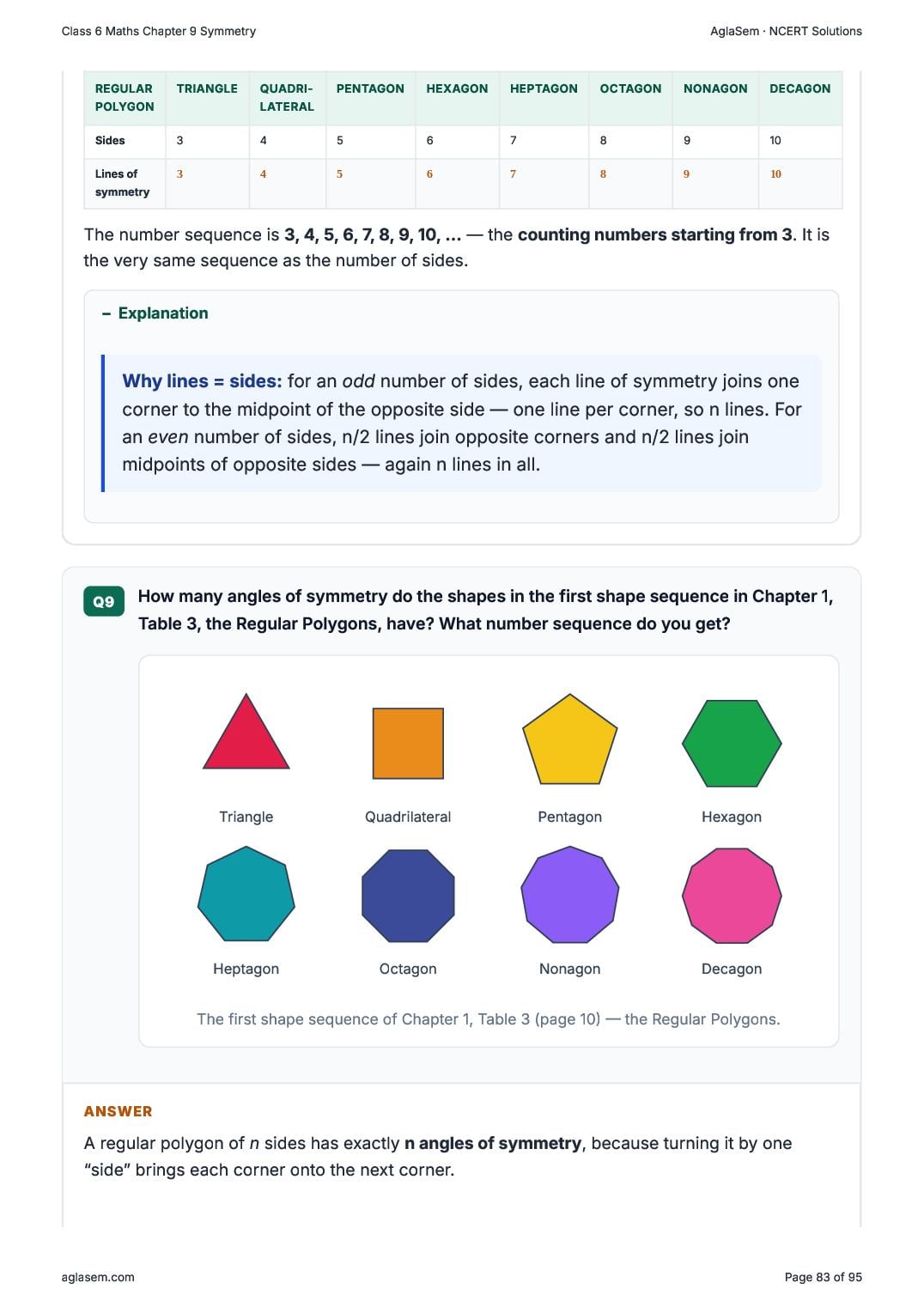
- How many lines of symmetry do the shapes in the first shape sequence in Chapter 1, Table 3, the Regular Polygons, have? What number sequence do you get?
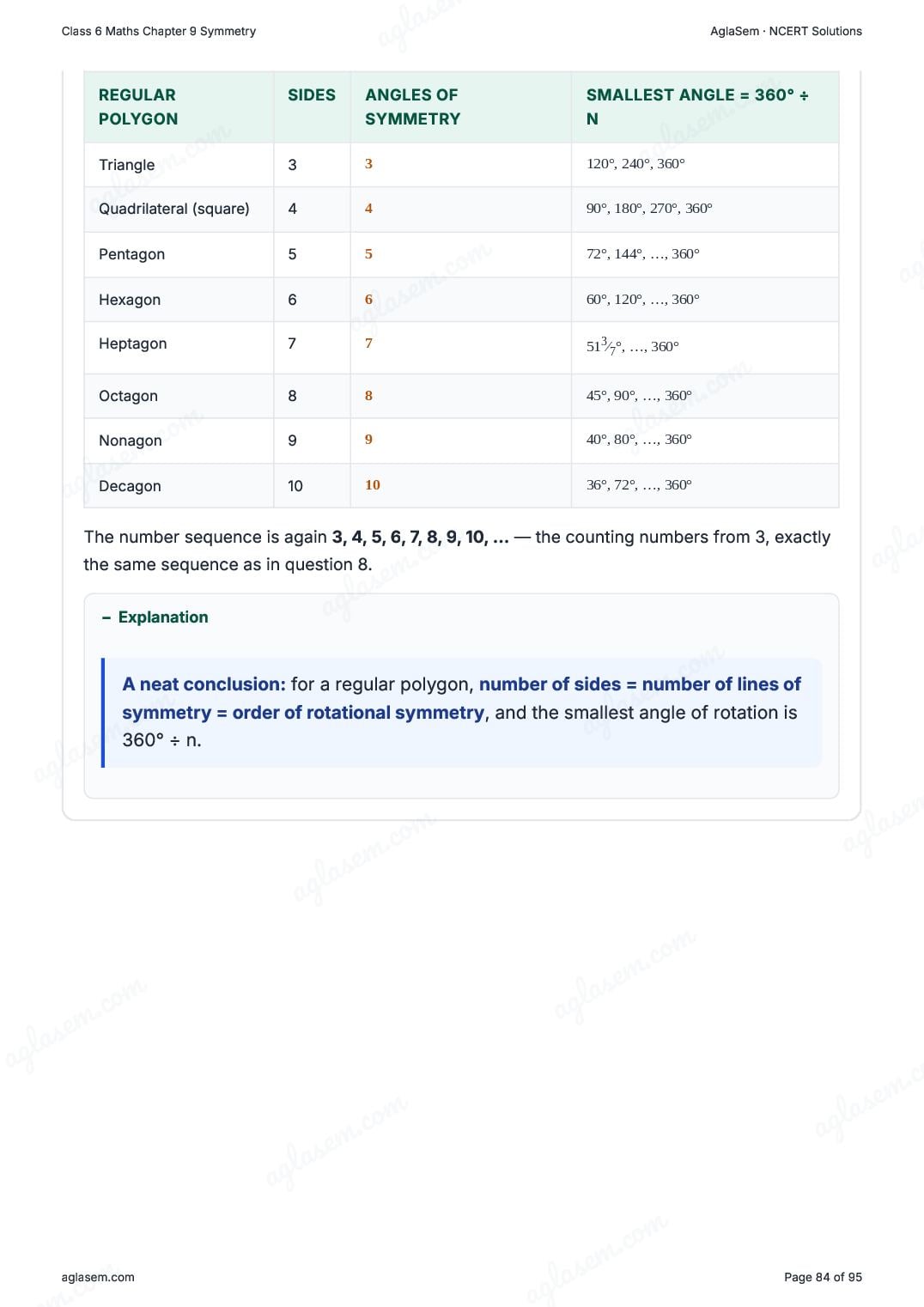
- How many angles of symmetry do the shapes in the first shape sequence in Chapter 1, Table 3, the Regular Polygons, have? What number sequence do you get?
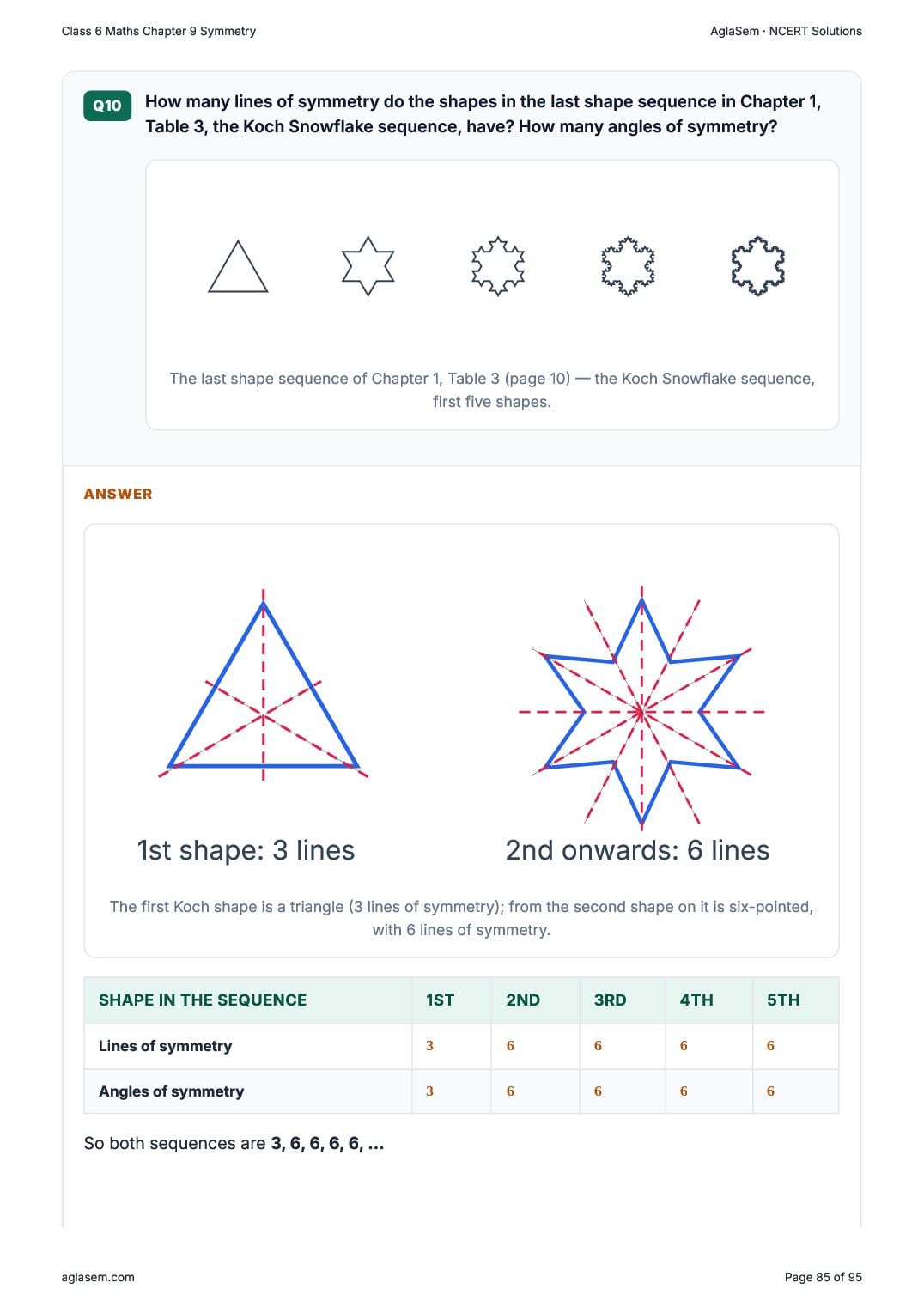
- How many lines of symmetry do the shapes in the last shape sequence in Chapter 1, Table 3, the Koch Snowflake sequence, have? How many angles of symmetry?
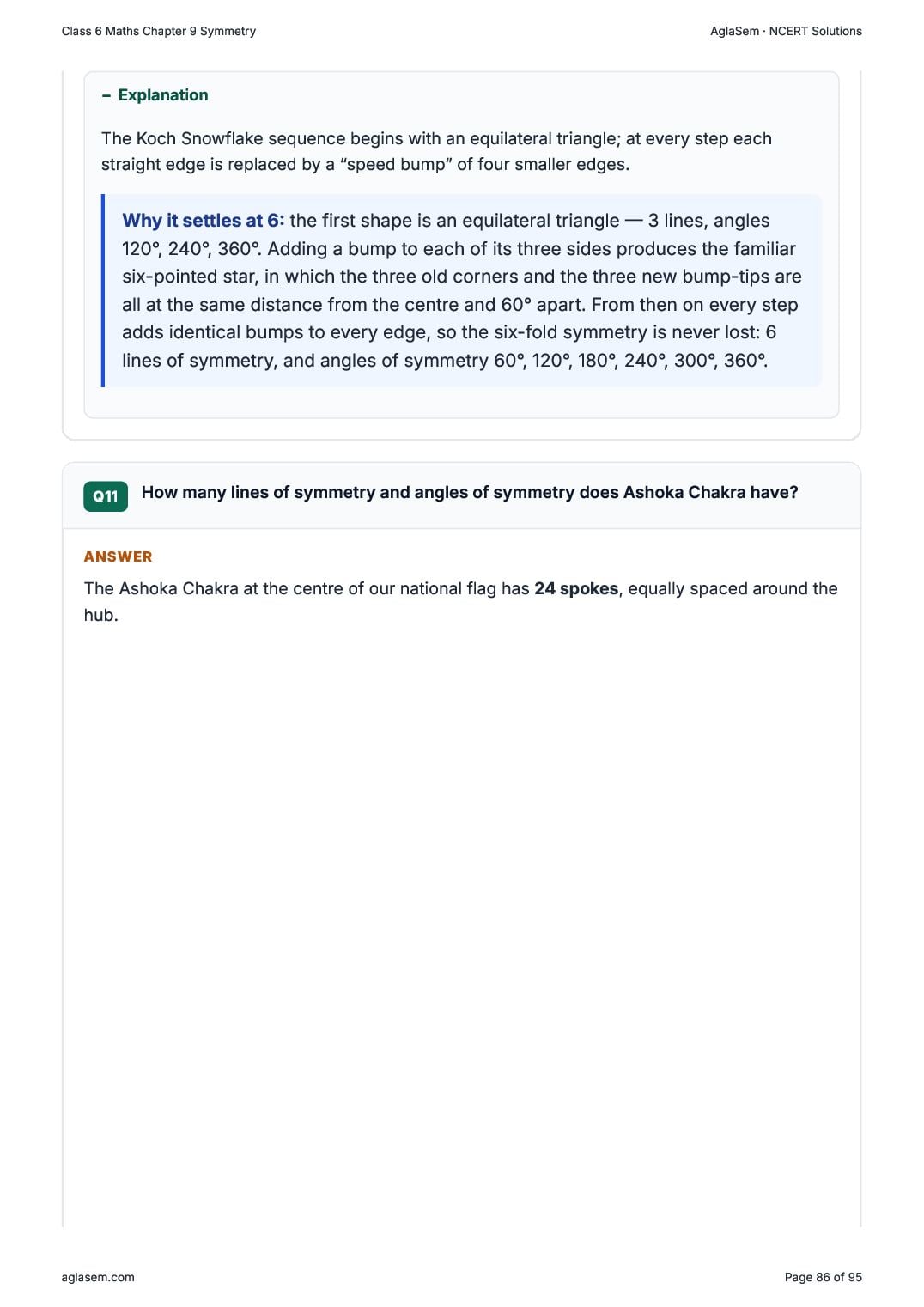
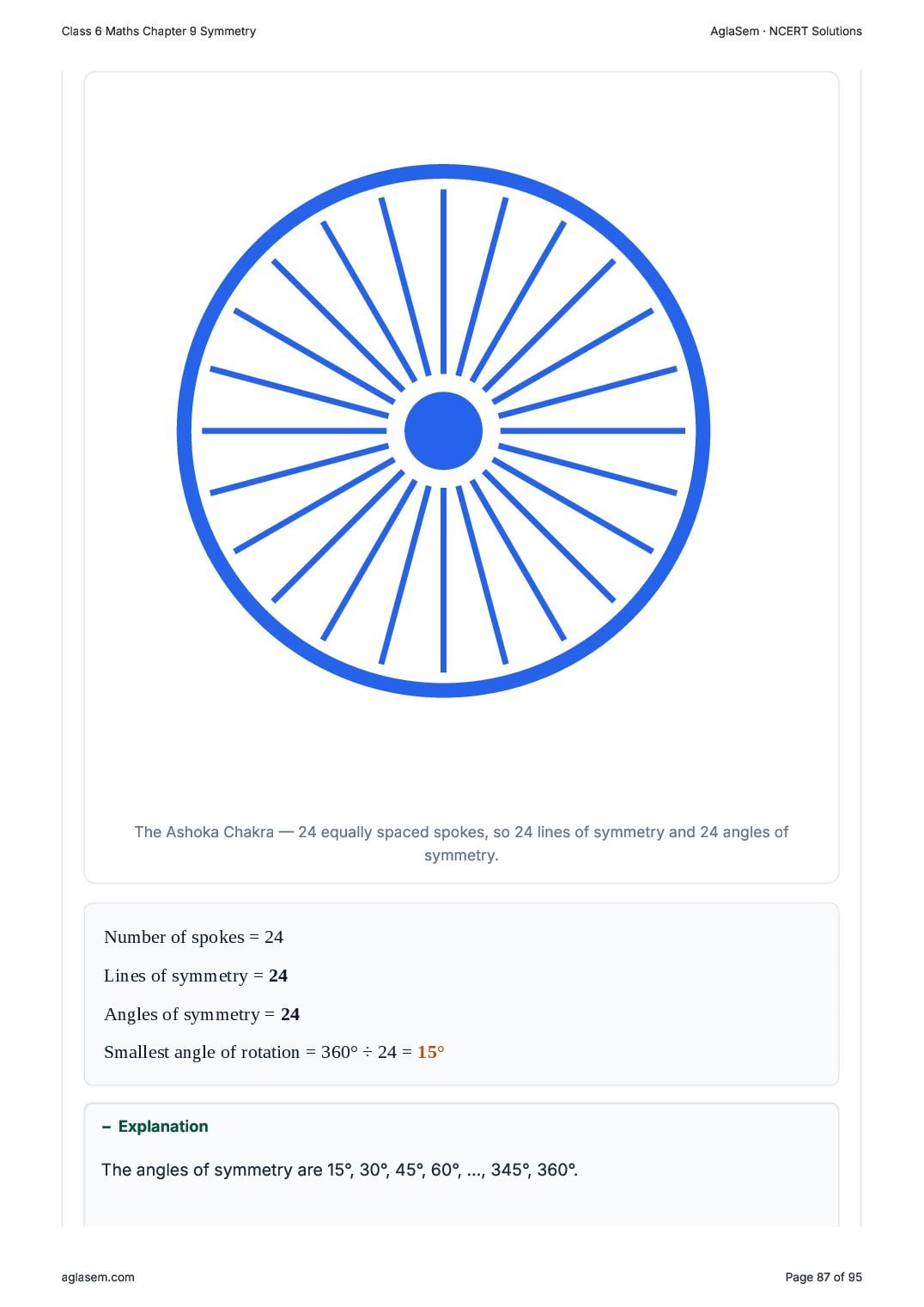
- How many lines of symmetry and angles of symmetry does Ashoka Chakra have?
- Use the colour tiles given at the end of the book to complete the following figure so that it has exactly 2 lines of symmetry.
- Use 16 such tiles to make figures that have exactly: 1 line of symmetry; 2 lines of symmetry.
- Use these tiles in making creative symmetric designs.
- Draw a 6 by 6 grid. Two players take turns covering two adjacent squares by drawing a line. The line can be placed either way: horizontally or vertically. The lines cannot overlap. The game goes on till a player is not able to place any more lines. The player who is not able to place any more lines loses. With what strategy can one play to win this game?
Chapter at a Glance
- A figure has symmetry when a part of it is repeated in a definite pattern. The flower, the butterfly, the rangoli and the pinwheel are symmetrical; a cloud is not.
- A line that cuts a figure into two parts that exactly overlap when folded along it is a line of symmetry (axis of symmetry). Such a figure is also said to have reflection symmetry . A figure may have many lines of symmetry — a square has 4, a regular hexagon has 6, a circle has infinitely many.
- If a figure looks exactly the same after being turned through an angle about a fixed point, that angle is an angle of symmetry and the fixed point is the centre of rotation . Since a 360° turn always brings a figure back, 360° is an angle of symmetry of every figure .
- The number of angles of symmetry is the order of rotational symmetry . The smallest angle of symmetry = 360° ÷ order , and every other angle of symmetry is a multiple of it. A figure has rotational symmetry only when its order is more than 1.
- A regular polygon of n sides has exactly n lines of symmetry and order of rotational symmetry n , so its smallest angle of rotation is 360° ÷ n.
- Lines of symmetry and angles of symmetry are independent : an isosceles triangle has a line but no rotational symmetry; a parallelogram (and a windmill) has rotational symmetry but no line of symmetry; a square has both.
How to Download NCERT Solutions for Class 6 Maths Chapter 9 PDF
Follow these simple steps to get the Symmetry questions-and-answers PDF from Ganita Prakash.
- Search NCERT Solutions for Class 6 Maths Chapter 9 aglasem and open this page.
- Read the exercise questions with answers for Symmetry shown above.
- Click the Download PDF link to save the Symmetry solutions to your device.
NCERT Solutions for Class 6 Maths – All Chapters
There are more chapters to study besides Symmetry in Maths. Here are the NCERT Solutions for all chapters of Class 6 Maths.
- Chapter 1 Patterns in Mathematics
- Chapter 2 Lines and Angles
- Chapter 3 Number Play
- Chapter 4 Data Handling and Presentation
- Chapter 5 Prime Time
- Chapter 6 Perimeter and Area
- Chapter 7 Fractions
- Chapter 8 Playing with Constructions
- Chapter 9 Symmetry
- Chapter 10 the Other Side of Zero
NCERT Solutions for Class 6 – All Subjects
Just like Chapter 9 of Maths, you can get the exercise questions with answers for every other subject of Class 6. Here are the NCERT Solutions for all subjects of Class 6.
NCERT Solutions for Class 6 Maths Chapter 9 – An Overview
The key highlights of this study material are as follows.
| Aspects | Details |
|---|---|
| Class | Class 6 |
| Subject | Maths |
| Chapter Number | Chapter 9 |
| Chapter Name | Symmetry |
| Book Name | Ganita Prakash |
| Book By | NCERT (National Council of Educational Research and Training) |
| Educational Resource Here | NCERT Solutions of Class 6 Maths Chapter 9 for all exercises |
| More Questions Answers of This Subject | NCERT Solutions for Class 6 Maths |
| Download Book Chapter | NCERT Book Class 6 Maths |
| All Questions Answers For This Class | NCERT Solutions for Class 6 |
| Complete Solutions | NCERT Solutions |
NCERT Solutions for Class 6 Maths Chapter 9 Symmetry – FAQs
What are the NCERT Solutions for Class 6 Maths Chapter 9 Symmetry?
They are the complete, step-by-step answers to all the exercise and in-text questions of Chapter 9 Symmetry from the NCERT Class 6 Maths textbook Ganita Prakash, written by experts as per the latest NCERT syllabus.
How can I download the Class 6 Maths Chapter 9 solutions PDF for free?
Open this page on aglasem, read the Symmetry questions with answers, and click the “Download Solutions PDF” link. The Class 6 Maths Chapter 9 NCERT Solutions PDF is completely free to download.
Are these NCERT Solutions as per the latest 2026-27 syllabus?
Yes. The NCERT Solutions for Class 6 Maths Chapter 9 are based on the latest NCERT textbook Ganita Prakash and the current 2026-27 CBSE syllabus, so the questions and answers match what you study in class.
Where can I get NCERT Solutions for the other chapters of Class 6 Maths?
You can find the answers to every chapter on the NCERT Solutions for Class 6 Maths page, and solutions for every subject on the NCERT Solutions for Class 6 page.
How do NCERT Solutions help in exam preparation?
They show the correct method to solve each question, help you write answers the way they are expected in exams, let you check and correct your own work, and save revision time — which together improve your marks in Class 6 Maths.
If you have any queries on NCERT Solutions for Class 6 Maths Chapter 9 Symmetry, then please ask in the comments below.