NCERT Exemplar Class 12 Biology Chapter 7 Evolution – the extra practice questions NCERT publishes for the chapter (MCQs, very short, short and long answer questions) with their answers.
NCERT Exemplar Class 12 Biology Chapter 7 Evolution PDF
| Chapter | Download | |
|---|---|---|
| Exemplar PDF | Evolution | View PDF |
Read Online

NCERT Exemplar Class 12 Biology Chapter 7 Evolution – Questions and Answers
Multiple Choice Questions
- Which of the following is used as an atmospheric pollution indicator? a. Lepidoptera b. Lichens c. Lycopersicon d. Lycopodium
- The theory of spontaneous generation stated that: a. life arose from living forms only b. life can arise from both living and non-living c. life can arise from non-living things only. d. life arises spontaneously, neither from living nor from the non-living.
- Animal husbandry and plant breeding programmes are the examples of: a. reverse evolution b. artificial selection c. mutation d. natural selection
- Palaentological evidences for evolution refer to the: a. development of embryo b. homologous organs c. fossils d. analogous organs.
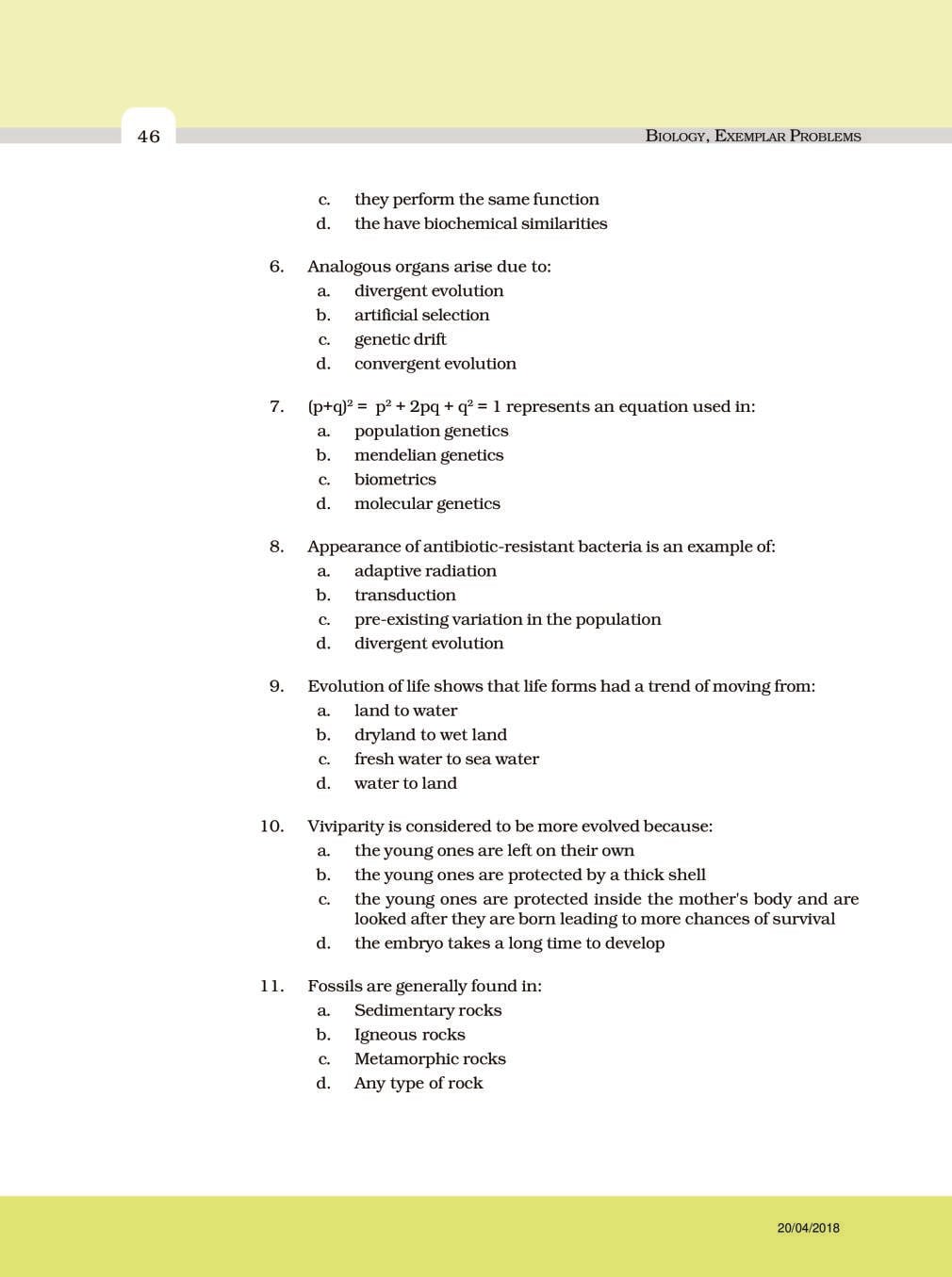
- The bones of forelimbs of whale, bat, cheetah and man are similar in structure, because: a. one organism has given rise to another b. they share a common ancestor c. they perform the same function d. the have biochemical similarities
- Analogous organs arise due to: a. divergent evolution b. artificial selection c. genetic drift d. convergent evolution
- (p+q)2 = P2 + 2pq + q2 = 1 represents an equation used in: a. population genetics b. mendelian genetics c. biometrics d. molecular genetics
- Appearance of antibiotic-resistant bacteria is an example of: a. adaptive radiation b. transduction c. pre-existing variation in the population d. divergent evolution
- Evolution of life shows that life forms had a trend of moving from: a. land to water b. dryland to wet land c. fresh water to sea water d. water to land
- Viviparity is considered to be more evolved because: a. the young ones are left on their own b. the young ones are protected by a thick shell c. the young ones are protected inside the mother’s body and are looked after they are born leading to more chances of survival d. the embryo takes a long time to develop
- Fossils are generally found in: a. Sedimentary rocks b. Igneous rocks c. Metamorphic rocks d. Any type of rock
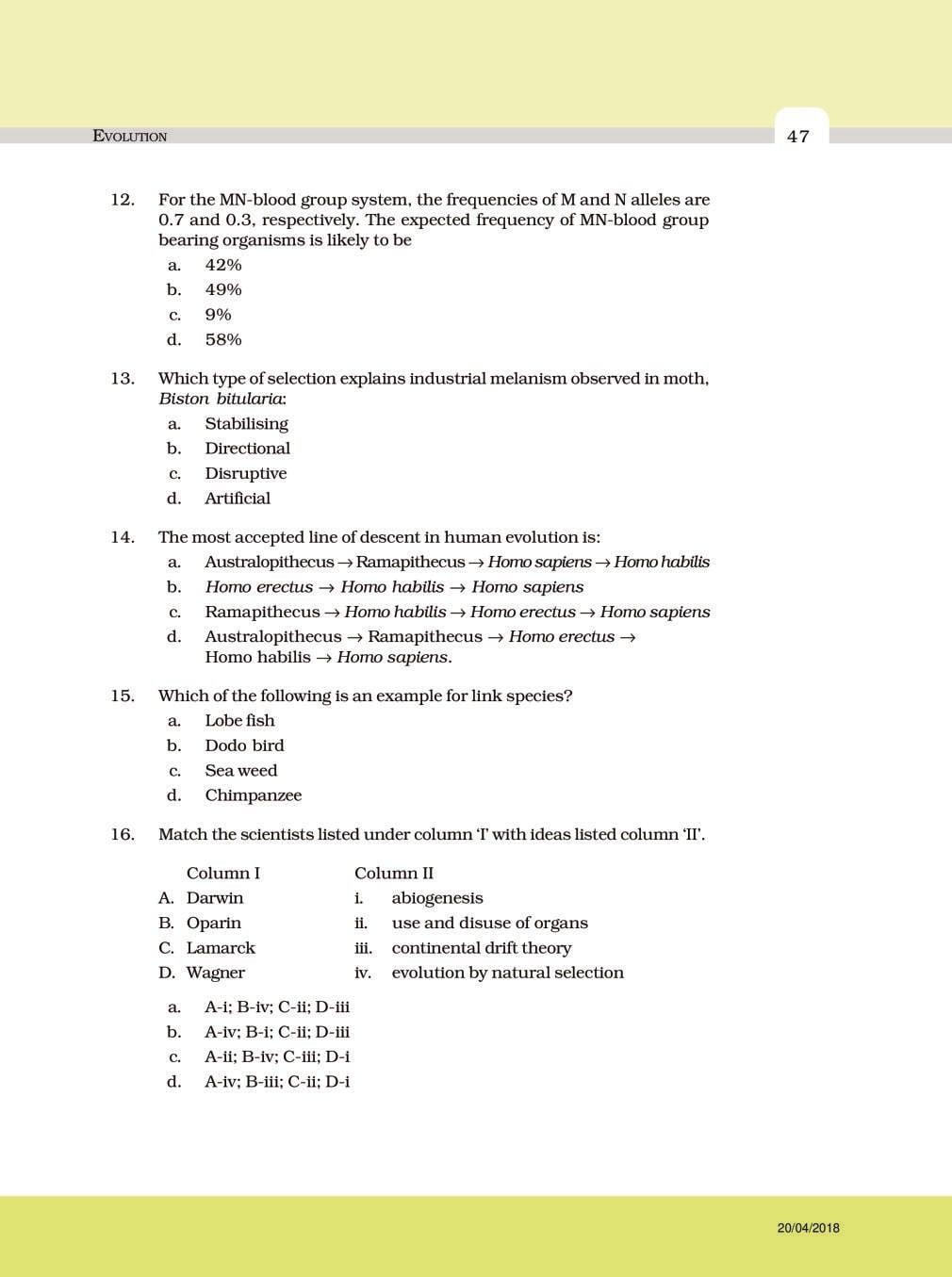
- For the MN-blood group system, the frequencies of M and N alleles are 0.7 and 0.3, respectively. The expected frequency of MN-blood group bearing organisms is likely to be a. 42% b. 49% c. 9% d. 58%
- Which type of selection is industrial melanism observed in moth, Biston bitularia: a. Stabilising b. Directional c. Disruptive d. Artificial
- The most accepted line of descent in human evolution is: a. Australopithecus → Ramapithecus → Homo sapiens → homo habilis b. Homo erectus → Homo habilis → Homo sapiens c. Ramapithecus → Homo habilis → Homo erectus → Homo sapiens d. Australopithecus → Ramapithecus → Homo erectus → Homo habilis → Homo sapiens.
- Which of the following is an example for link species? a. Lobe fish b. Dodo bird c. Sea weed d. Tyrannosaurus rex
- Match the scientists listed under column ‘A’ with ideas listed column ‘B’.
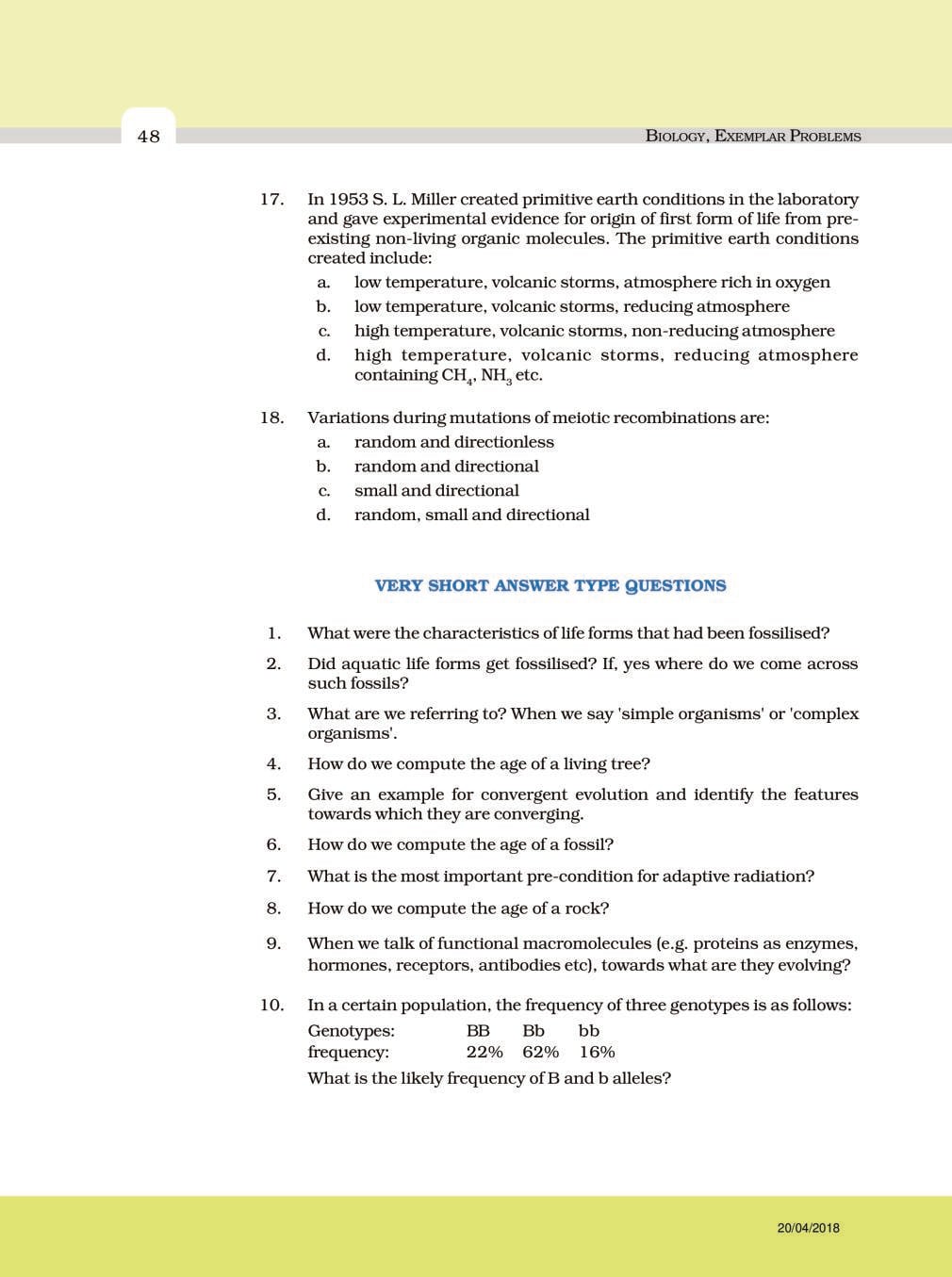
a. i-M; ii-P; iii-N; iv-O b. i-P; ii-M; iii-N; iv-O c. i-N; ii-P; iii-O; iv-M d. i-p; ii-O; iii-N; iv-MColumn 1 Column 2 i. Darwin M. abiogenesis ii. Oparin N. use and disuse of organs iii. Lamarck O. continental drift theory iv. Wagner P. evolution by natural selection - In 1953 S. L. Miller created primitive earth conditions in the laboratory and gave experimental evidence for origin of first form of life from pre- existing non-living organic molecules. The primitive earth conditions created include: a. low temperature, volcanic storms, atmosphere rich in oxygen b. low temperature, volcanic storms, reducing atmosphere c. high temperature, volcanic storms, non-reducing atmosphere d. high temperature, volcanic storms, reducing atmosphere containing CH4, NH3 etc.
- Variations during mutations of meiotic recombinations are: a. random and directionless b. random and directional c. random and small d. random, small and directional
Very Short Answer Type Questions
- What were the characteristics of life forms that had been fossilised?
- Did aquatic life forms get fossilised? If, yes where do we come across such fossils?
- What are we referring to? When we say ‘simple organisms’ or ‘complex organisms’.
- How do we compute the age of a living tree?
- Give an example for convergent evolution and identify the features towards which they are converging.
- How do we compute the age of a fossil?
- What is the most important pre-condition for adaptive radiation?
- How do we compute the age of a rock?
- When we talk of functional macromolecules (e.g. proteins as enzymes, hormones, receptors, antibodies etc), towards what are they evolving?
- In a certain population, the frequency of three genotypes is as follows:
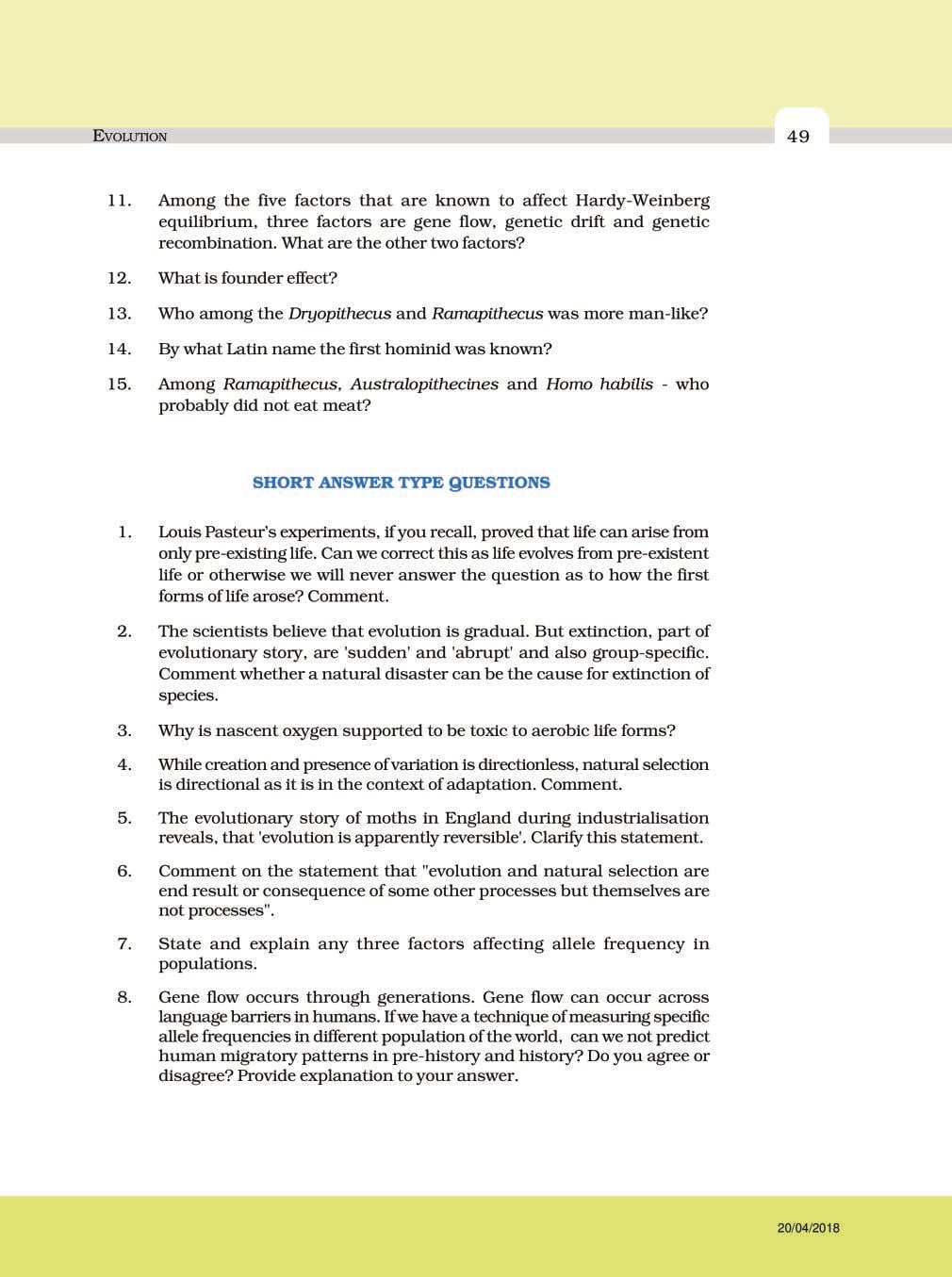
What is the likely frequency of B and b alleles?Genotypes: BB Bb bb frequency: 22% 62% 16% - Among the five factors that are known to affect Hardy-Weinberg equilibrium, three factors are gene flow, genetic drift and genetic recombination. What are the other two factors?
- What is founder effect?
- Who among the Dryopithecus and Ramapithecus was more man-like?
- By what Latin name the first hominid was known?
- Among Ramapithecus, Australopithecines and Homo habilis – who probably did not eat meat?
Short Answer Type Questions
- Louis Pasteur’s experiments, if you recall, proved that life can arise from only pre-existing life. Can we correct this as life evolves from pre-existent life or otherwise we will never answer the question as to how the first forms of life arose? Comment.
- The scientists believe that evolution is gradual. But extinction, part of evolutionary story, are ‘sudden’ and ‘abrupt’ and also group-specific. Comment whether a natural disaster can be the cause for extinction of species.
- Why is nascent oxygen supported to be toxic to aerobic life forms?
- While creation and presence of variation is directionless, natural selection is directional as it is in the context of adaptation. Comment.
- The evolutionary story of moths in England during industrialisation reveals, that ‘evolution is apparently reversible’. Clarify this statement.
- Comment on the statement that “evolution and natural selection are end result or consequence of some other processes but themselves are not processes”.
- State and explain any three factors affecting allele frequency in populations.
- Gene flow occurs through generations. Gene flow can occur across language barriers in humans. If we have a technique of measuring specific allele frequencies in different population of the world, can we not predict human migratory patterns in pre-history and history? Do you agree or disagree? Provide explanation to your answer.
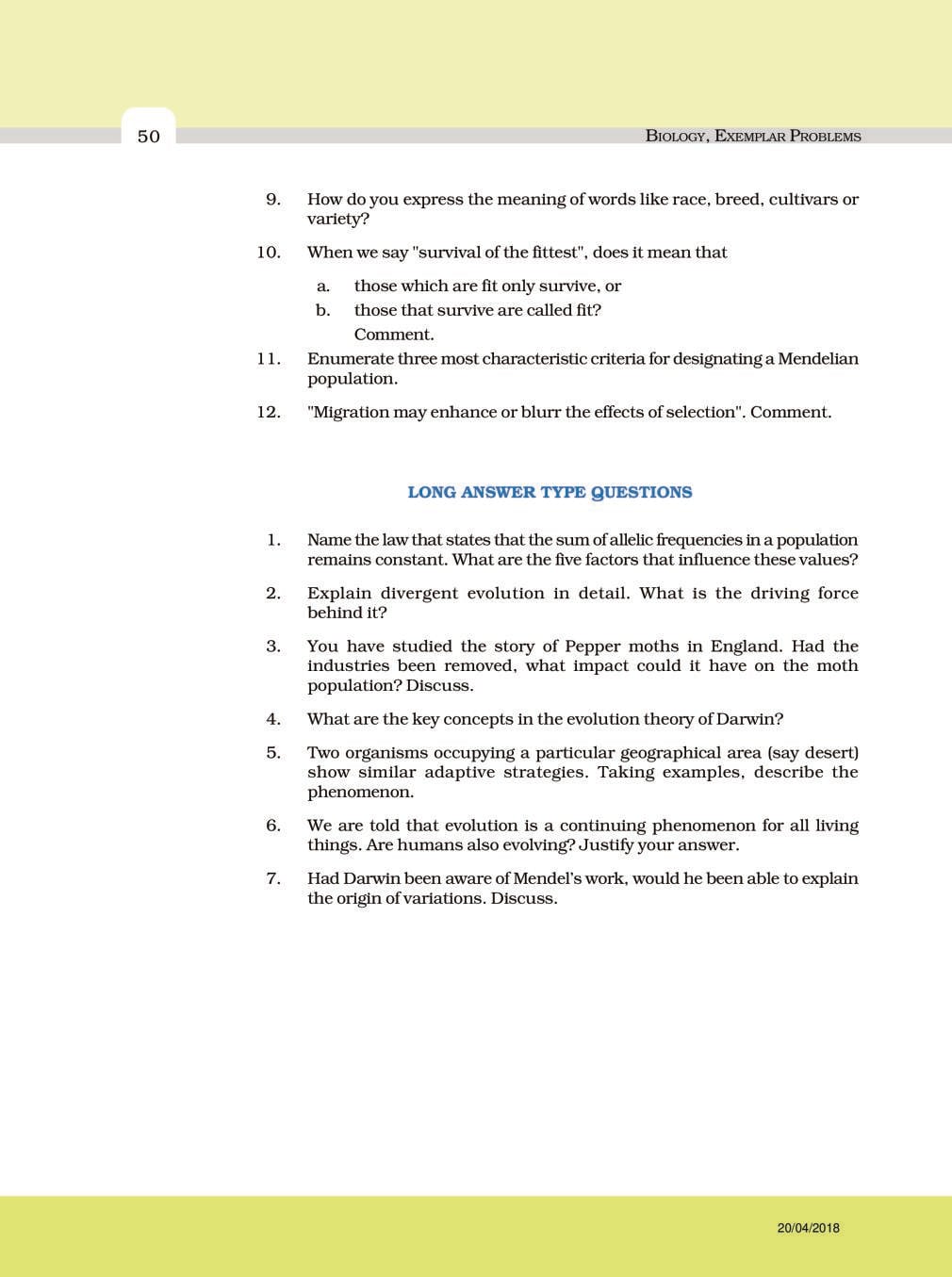
- How do you express the meaning of words like race, breed, cultivars or variety?
- When we say “survival of the fittest”, does it mean that a. those which are fit only survive, or b. those that survive are called fit? Comment.
- Enumerate three most characteristic criteria for designating a Mendelian population.
- “Migration may enhance or blurr the effects of selection”. Comment.
Long Answer Type Questions
- Name the law that states that the sum of allelic frequencies in a population remains constant. What are the five factors that influence these values?
- Explain divergent evolution in detail. What is the driving force behind it?
- You have studied the story of Pepper moths in England. Had the industries been removed, what impact could it have on the moth population? Discuss.
- What are the key concepts in the evolution theory of Darwin?
- Two organisms occupying a particular geographical area (say desert) show similar adaptive strategies. Taking examples, describe the phenomenon.
- We are told that evolution is a continuing phenomenon for all living things. Are humans also evolving? Justify your answer.
- Had Darwin been aware of Mendel’s work, would he been able to explain the origin of variations. Discuss.
| « Previous | Next » |
Answers to Multiple Choice Questions
| 1-b | 2-c | 3-b | 4-c | 5-b | 6-d |
| 7-a | 8-c | 9-d | 10-c | 11-a | 12-a |
| 13-b | 14-c | 15-d | 16-b | 17-d | 18-a |
NCERT Exemplar Class 12 Biology Chapter 7 Evolution – Overview
| Class | Class 12 |
| Subject | Biology |
| Chapter | 7 – Evolution |
| Session | 2027 |
| Format | PDF – read online or download |
Chapter 7 of 16 – Biology
- Previous: Chapter 6 Molecular Basis of Inheritance
- Next: Chapter 8 Human Health and Diseases
- All chapters: NCERT Exemplar Class 12 Biology
Also for This Chapter
NCERT Exemplar Class 12 Biology Chapter 7 Evolution – Overview
| Class | Class 12 |
| Subject | Biology |
| Chapter | 7 – Evolution |
| Session | 2027 |
| Format | PDF – read online or download |
NCERT Exemplar Class 12 Biology Chapter 7 – FAQs
Where can I download NCERT Exemplar Class 12 Biology Chapter 7 Evolution PDF?
From the download table on this page – it is free.
Is this for the 2027 session?
Yes, it follows the latest NCERT Class 12 Biology book for 2027.
How should I use these exemplar problems?
Read the chapter in the NCERT book first, attempt the questions yourself, then check your answers here.
Chapter 7 of 16 – Biology
- Previous: Chapter 6 Molecular Basis of Inheritance
- Next: Chapter 8 Human Health and Diseases
- All chapters: NCERT Exemplar Class 12 Biology
Also for This Chapter
- NCERT Book Class 12 Biology Chapter 7
- NCERT Solutions Class 12 Biology Chapter 7
- Class 12 Biology Notes – Evolution
NCERT Exemplar Class 12 Biology Chapter 7 Evolution – Overview
| Class | Class 12 |
| Subject | Biology |
| Chapter | 7 – Evolution |
| Session | 2027 |
| Format | PDF – read online or download |
NCERT Exemplar Class 12 Biology Chapter 7 – FAQs
Where can I download NCERT Exemplar Class 12 Biology Chapter 7 Evolution PDF?
From the download table on this page – it is free.
Is this for the 2027 session?
Yes, it follows the latest NCERT Class 12 Biology book for 2027.
How should I use these exemplar problems?
Read the chapter in the NCERT book first, attempt the questions yourself, then check your answers here.