NCERT Solutions for Class 3 English Santoor Chapter 4 Out in the Garden – step-by-step answers to every exercise and in-text question of the chapter, as per the latest NCERT syllabus for 2027. Read them online or download the free question-answer PDF.
Chapter 4 of Santoor opens Unit 2, Toys and Games. Out in the Garden is a happy little poem of six short stanzas. A child plays in the garden on every fine day — first with a ball, then with a kite, and then with friends. The book does not give the poet’s name. This page also covers the unit’s Picture reading spread on pages 36–38, which comes just before the chapter and shows a village full of children at play.
NCERT Solutions for Class 3 English Santoor Chapter 4 Out in the Garden PDF
All the answers are on this page below. The PDF also explains every answer – why it is right and how to check it – so download it for revision.
| Chapter | Download | |
|---|---|---|
| Solutions PDF | Out in the Garden | View PDF |
Summary and word meanings
Out in the Garden (poem)
Summary
- A child likes to play in the garden every fine day.
- First, the child bounces, throws and catches a ball.
- Next, the child tugs, pulls and flies a kite.
- Then the child plays happily in the garden with friends.
- Together they run, skip, jump, sway, slide and swing.
- The poem tells us that playing outside is great fun.
सारांश (हिन्दी में)
- एक बच्चा हर अच्छे दिन बगीचे में खेलना पसंद करता है।
- पहले वह गेंद को उछालता, फेंकता और पकड़ता है।
- फिर वह पतंग को झटके से खींचता है और उसे उड़ाता है।
- अंत में वह दोस्तों के साथ दौड़ता, कूदता, झूमता, फिसलता और झूला झूलता है।
Word meanings
| Word | Meaning | हिंदी अर्थ | In the text |
|---|---|---|---|
| garden | a piece of land near a house where plants and flowers grow | बगीचा | “Out in the garden” |
| fine day | a bright, sunny day with nice weather | अच्छे मौसम वाला दिन | “Each fine day” |
| bounce | to hit a ball on the ground so that it jumps back up | (गेंद को) टप्पा खिलाना, उछालना | “I bounce my ball” |
| throw | to send something through the air with your hand | फेंकना | “I throw my ball” |
| catch | to hold something that is coming through the air | पकड़ना | “I catch my ball” |
| kite | a light toy of paper and sticks that flies on a long string | पतंग | “With my kite” |
| tug | to give a quick, hard pull | झटके से खींचना | “I tug my kite” |
| pull | to move something towards yourself | खींचना | “I pull my kite” |
| fly | to make something go up and stay high in the air | उड़ाना | “I fly my kite” |
| skip | to move along with small, light jumps | उछलते-कूदते चलना | “We run and skip” |
| sway | to move slowly from side to side | झूमना, इधर-उधर हिलना | “We jump and sway” |
| slide | to move smoothly down a slide in the park | फिसलना | “We slide and swing” |
| swing | to move forwards and backwards on a swing | झूला झूलना | “We slide and swing” |
NCERT Solutions for Class 3 English Santoor Chapter 4 Out in the Garden – Questions and Answers
All 36 questions of the chapter (textbook pages 39 – 43) are answered below, in the order of the book – in-text questions, activities and the end-of-chapter exercises. Each answer is written the way you would write it in the exam.
Picture reading — Pages 36–38Unit 2: Toys and Games — Look at the picture and answer.
1. Count how many there are and write in the blanks:
children ________, girls ________, boys ________, women ________ and animals ________

children 16, girls 7, boys 9, women 3 and animals 0
Check: 7 girls + 9 boys = 16 children.
2. What games are the children playing?
The children are playing marbles, hopscotch, spinning tops and blind man’s buff.
Two girls are holding hands and going round and round.
3. Children are playing in the open space in front of their houses. Where do you usually play?
4. Some children are not playing games. What are they doing?
- A girl is reading a newspaper.
- A boy stands near her and listens.
- A boy with crutches sits on the ground and watches.
- A girl sits near a woman and helps her with the flowers.
- A boy stands near the door with a kite.
5. There are some women in the picture. What are they doing?
Three women are sitting on the veranda. They are working.
- One woman is cleaning grain in a flat basket.
- One woman is making a garland of marigold flowers.
- One woman has a plate of flowers in front of her.
6. Who is reading the newspaper?
A girl is reading the newspaper. She wears a red top. She holds the paper open with both hands. A boy stands near her and listens.
7. What are the children playing with?
The children are playing with marbles, tops and a kite.
For blind man’s buff, they use a cloth to tie over the eyes.
8. What is the old man doing?
The old man is standing and watching the children play.
He wears a cap and spectacles. His hands are behind his back, and he is smiling.
9. What is your favourite game?
10. If you were in the picture, which game would you play?
Choose one game from the picture: marbles, hopscotch, spinning tops or blind man’s buff.
Picture reading — Page 38A. Point out the following in the picture.
1. The boys are playing with marbles.
Point to the two boys sitting on their heels, near the old man.
One boy hits a marble with his finger. Many marbles lie on the ground near a small hole.
Many children call this game kanche or goli.
2. A girl is playing hopscotch.
Point to the girl hopping on the squares drawn on the ground, near the house.
She wears a red top and a blue skirt. One foot is up in the air. The squares have numbers in them.
3. A boy and a girl are spinning tops.
Point to the girl and the boy at the bottom of the picture.
The girl holds her top. The boy holds the string. One top is spinning on the ground near them.
In many homes a top is called a lattu.
4. A boy is blindfolded.
Point to the boy with a red cloth tied over his eyes, at the back, near the trees.
His hands are stretched out. He tries to catch the children near him. This game is called blind man’s buff.
5. A boy is holding a kite.
Point to the boy standing at the door of the house.
He wears a pink shirt. He holds a green kite in his hand. He is not flying it yet.
Picture reading — Page 38B. Identify the playthings used to play. Write their names below.
1.
Marbles
Marbles are small, round glass balls. Two boys in the big picture are playing with them.
Write the name in your mother tongue too, for example kanche or goli.
2.
A top (a spinning top)
We wind a string round it and pull. Then it spins on its point.
Write the name in your mother tongue too, for example lattu or bambaram.
3.
A skipping rope
It is a long rope with a handle at each end. We swing it over our head and jump over it.
Write the name in your mother tongue too, for example rassi.
Let us recite — Pages 39–40Out in the Garden (poem)
Each fine day.
With my ball,
I like to play.
I bounce my ball,
I throw my ball.
I catch my ball,
On each fine day.
Out in the garden,
Each fine day.
With my kite,
I like to play.
I tug my kite,
I pull my kite.
I fly my kite,
On each fine day.
Out in the garden,
Each fine day.
With my friends,
I like to play.
We run and skip,
We jump and sway.
We slide and swing,
On each fine day.
Read the poem aloud two times. Clap at the end of each line.
The child plays in the garden on every fine day — first with a ball, then with a kite, and then with friends.
Rhyming words: day, play, sway.
Let us think — Page 41A. Answer the following.
1. What are the children doing with the ball?
They bounce the ball, throw it and catch it.
The poem says, “I bounce my ball, / I throw my ball. / I catch my ball.”
2. How are children playing with the kite?
They tug the kite, pull it and fly it.
The poem says, “I tug my kite, / I pull my kite. / I fly my kite.”
3. Where are the children playing?
They are playing out in the garden.
The poem says, “Out in the garden, / Each fine day.”
Let us think — Page 41B. Think and answer.
1. Where do you play?
2. What games do you play outside?
Other outdoor games are kabaddi, hopscotch, skipping and tug of war.
3. What happens if we are not careful while playing outside?
If we are not careful, we can get hurt.
- We can trip and fall, and hurt a knee.
- The ball can hit a friend or break a window.
- We can run on to the road in front of a vehicle.
Let us speak — Pages 41–42Look at some more games. Talk about what you know.
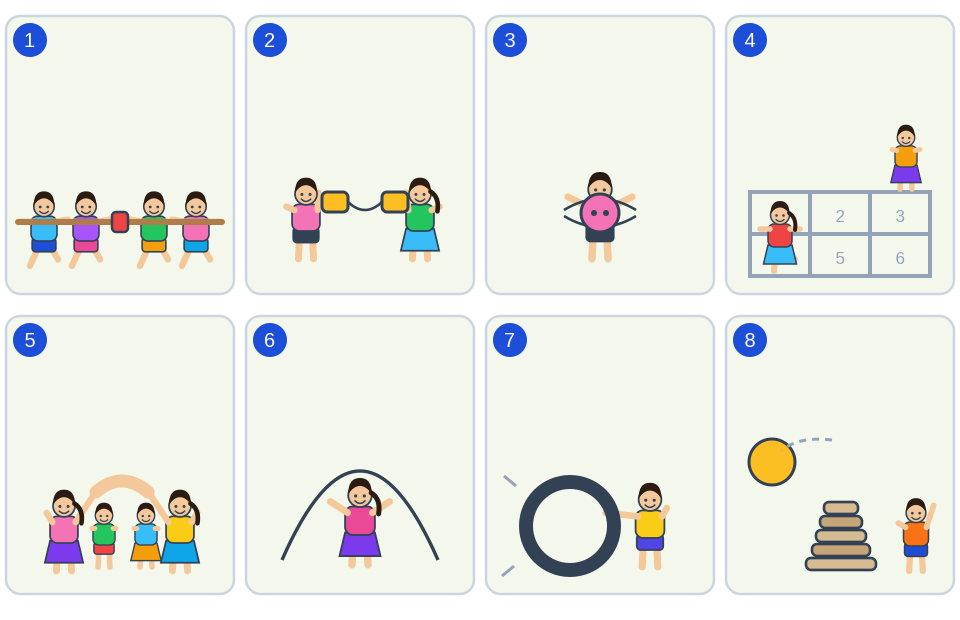
Yes. Here are the names of the eight games, in the same order as the pictures.
| Picture | The game | What the players do |
|---|---|---|
| 1 | Tug of war | Two teams pull one rope, each to its own side. |
| 2 | Cup telephone | Two cups are joined with a string. One speaks, one listens. |
| 3 | Spinning disc | A disc on a loop of thread is spun fast with both hands. |
| 4 | Hopscotch | You hop on squares drawn on the ground. |
| 5 | Pass under the gate | Two children make a gate with their hands. The others pass under it. |
| 6 | Skipping | You swing a rope over your head and jump over it. |
| 7 | Rolling a tyre | You push an old tyre with your hand and run beside it. |
| 8 | Seven stones | You throw a ball at a pile of flat stones and knock it down. |
Say yes or no for each game. Then say its name in your own language. Some names children use:
| The game | Some names children use |
|---|---|
| Tug of war | rassa-kashi |
| Cup telephone | telephone, dibba-phone |
| Spinning disc | chakri, bhaunri |
| Hopscotch | stapu, kith-kith, nondi, kunte bille |
| Pass under the gate | poshampa |
| Skipping | rassi kood |
| Rolling a tyre | tyre race, chakka |
| Seven stones | lagori, pittu, satoliya |
Pick one game from the pictures and talk about it.
Let us learn — Pages 42–43Combine these words using ‘and’ and write them in the blanks. One has been done for you.
Combine these words using ‘and’ and write them in the blanks. One has been done for you.
1. give, take — give and take
give and take — the book has done this one for you.
My own sentence: Good friends always give and take.
Combine these words using ‘and’ and write them in the blanks. One has been done for you.
2. sing, dance
sing and dance
Both words are things we do. We put and in the middle to join them.
My own sentence: We sing and dance on our school day.
Combine these words using ‘and’ and write them in the blanks. One has been done for you.
3. eat, drink
eat and drink
We put and in the middle to join the two words.
My own sentence: I eat and drink before I go out to play.
Combine these words using ‘and’ and write them in the blanks. One has been done for you.
4. catch, throw
catch and throw
Keep the words in the book’s order, and put and in the middle.
My own sentence: We catch and throw the ball in the garden.
Combine these words using ‘and’ and write them in the blanks. One has been done for you.
5. run, catch
run and catch
First we run, then we catch. The word and joins the two actions.
My own sentence: In kho-kho we run and catch our friends.
__________________________________________
__________________________________________
- read and write
- hop and jump
My own sentences: I read and write every day. The children hop and jump in the park.
Let us do — Page 43Paper Bag Puppet
Materials required: Paper bags, a pencil, colour pencils or sketch pens, woollen threads and gum.
Process: 1. Take a used paper bag with a base. 2. Fold the base upward. 3. Hold it upside down with the handle downwards. 4. Draw the upper lip on the line of the flap of the base. 5. Draw the lower lip right below the upper lip. 6. Then draw the face and colour it. Decorate it. 7. Slide your hand into the bag. 8. Bend your fingers inside the bag. 9. Now, you can make your puppet talk.
- Take a used paper bag with a base.
- Fold the base up.
- Turn the bag upside down.
- Draw the upper lip on the flap line.
- Draw the lower lip below it.
- Draw the face, colour it and decorate it.
- Slide your hand into the bag.
- Bend your fingers inside the flap.
- Make your puppet talk!
Put your hand in the bag. Bend and open your fingers. The mouth shuts and opens, so the puppet talks.
My puppet: Hello! I am Chintu. Who are you?
Friend’s puppet: I am Guddi. Let us play in the garden!
Chapter 4 of 12 – Santoor
- Previous: Chapter 3 Best Friends
- Next: Chapter 5 Talking Toys
- All chapters: NCERT Solutions Class 3 English
Also for This Chapter
NCERT Solutions Class 3 English Santoor Chapter 4 Out in the Garden – Overview
| Class | Class 3 |
| Subject | English |
| Book | Santoor |
| Chapter | 4 – Out in the Garden |
| Textbook pages | 39 – 43 |
| Questions solved | 36 |
| Session | 2027 |
| Format | Full answers on this page + PDF |
NCERT Solutions Class 3 English Chapter 4 – FAQs
Where can I download NCERT Solutions Class 3 English Santoor Chapter 4 Out in the Garden PDF?
Read every answer on this page, or download the free PDF from the table at the top.
Is this for the 2027 session?
Yes, it follows the latest NCERT Class 3 English book for 2027.
How many questions are solved in NCERT Class 3 English Chapter 4?
All 36 questions of the chapter (textbook pages 39 – 43) – the in-text questions, activities and the end-of-chapter exercises.
How should I use these solutions?
Read the chapter in the NCERT book first, attempt the questions yourself, then check your answers here.