NCERT Solutions for Class 9 Maths Chapter 7 The Mathematics of Maybe Introduction to Probability provide clear, step-by-step answers to every exercise and in-text question from the chapter The Mathematics of Maybe Introduction to Probability of the NCERT textbook Ganita Manjari. Prepared by subject experts as per the latest NCERT (CBSE) syllabus for 2026-27, these NCERT Solutions for Class 9 Maths help you understand each concept, write exam-ready answers, and check your own solutions. You can read them online below or download the free Class 9 Maths Chapter 7 question-answer PDF.
NCERT Solutions for Class 9 Maths Chapter 7 The Mathematics of Maybe Introduction to Probability
- Class: Class 9
- Subject: Maths
- Chapter: Chapter 7 – The Mathematics of Maybe Introduction to Probability
- Textbook: Ganita Manjari (NCERT)
- Study material: NCERT Solutions – questions with answers, free PDF
These solutions answer all the exercise questions of Chapter 7 The Mathematics of Maybe Introduction to Probability — including the in-text questions, short-answer and long-answer questions, and activities — with complete explanations so you can follow the method, not just the final answer. Read the full solutions below.
NCERT Solutions Class 9 Maths Chapter 7 the Mathematics of Maybe Introduction to Probability View Download
NCERT Solutions for Class 9 Maths Chapter 7 PDF Download
You can read the NCERT Solutions for Class 9 Maths Chapter 7 online above, or download the complete question-answer PDF to study The Mathematics of Maybe Introduction to Probability offline at any time.
NCERT Solutions for Class 9 Maths Chapter 7 PDF Download Link – Click Here to Download Solutions PDF
Questions Covered in This Chapter
These NCERT Solutions answer all 35 questions of this chapter. The questions solved are:
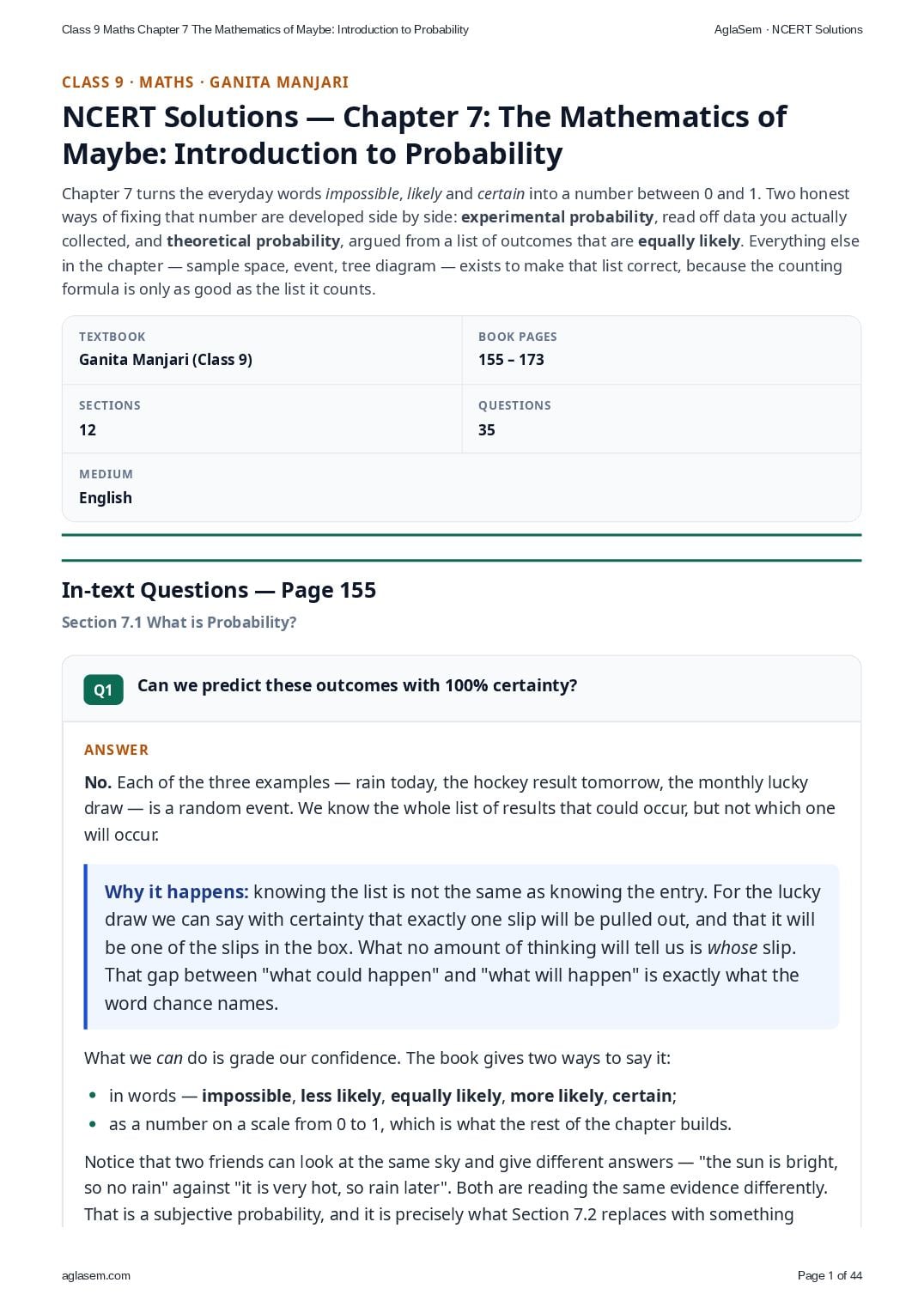
- Can we predict these outcomes with 100% certainty?
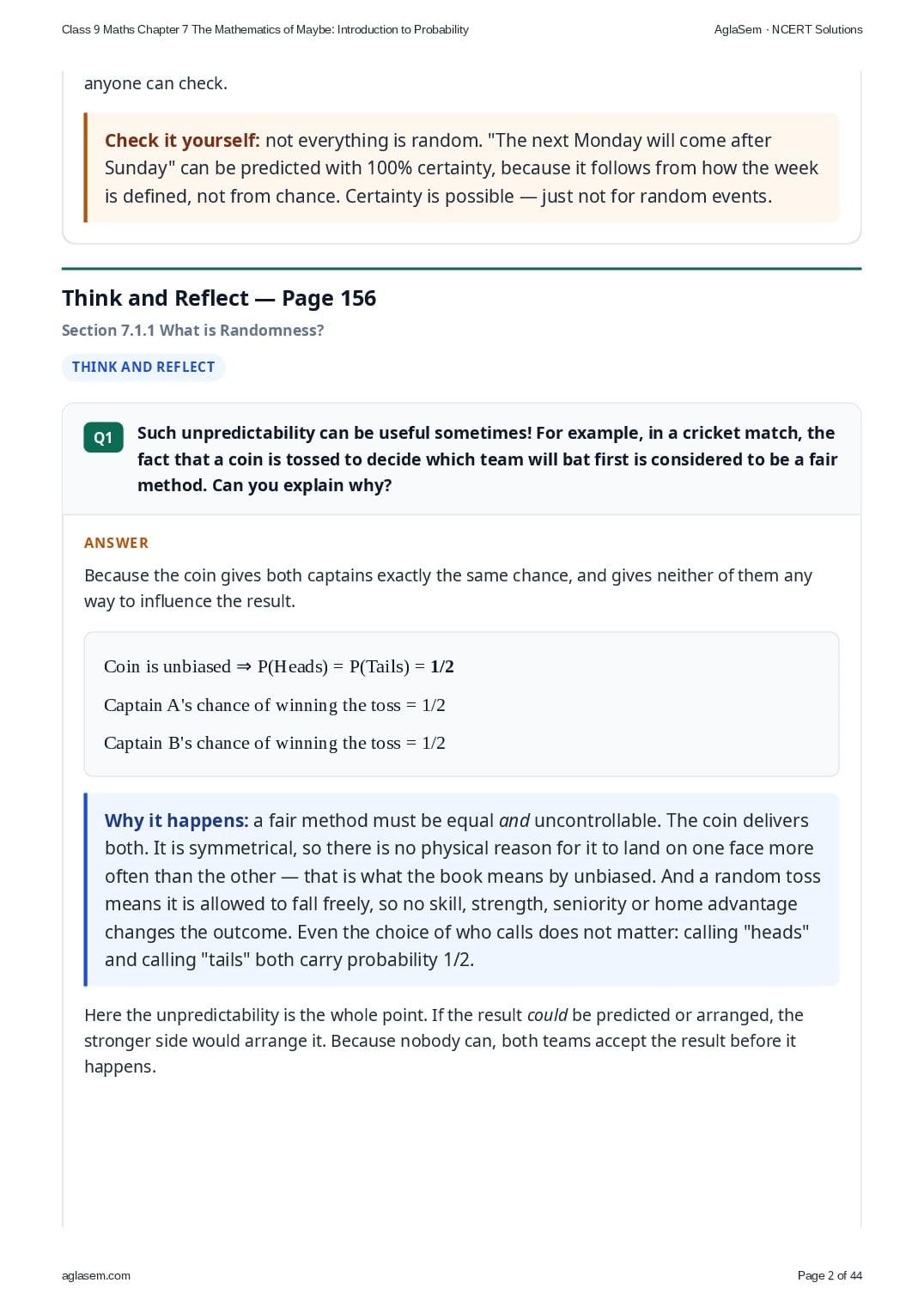
- Such unpredictability can be useful sometimes! For example, in a cricket match, the fact that a coin is tossed to decide which team will bat first is considered to be a fair method. Can you explain why?
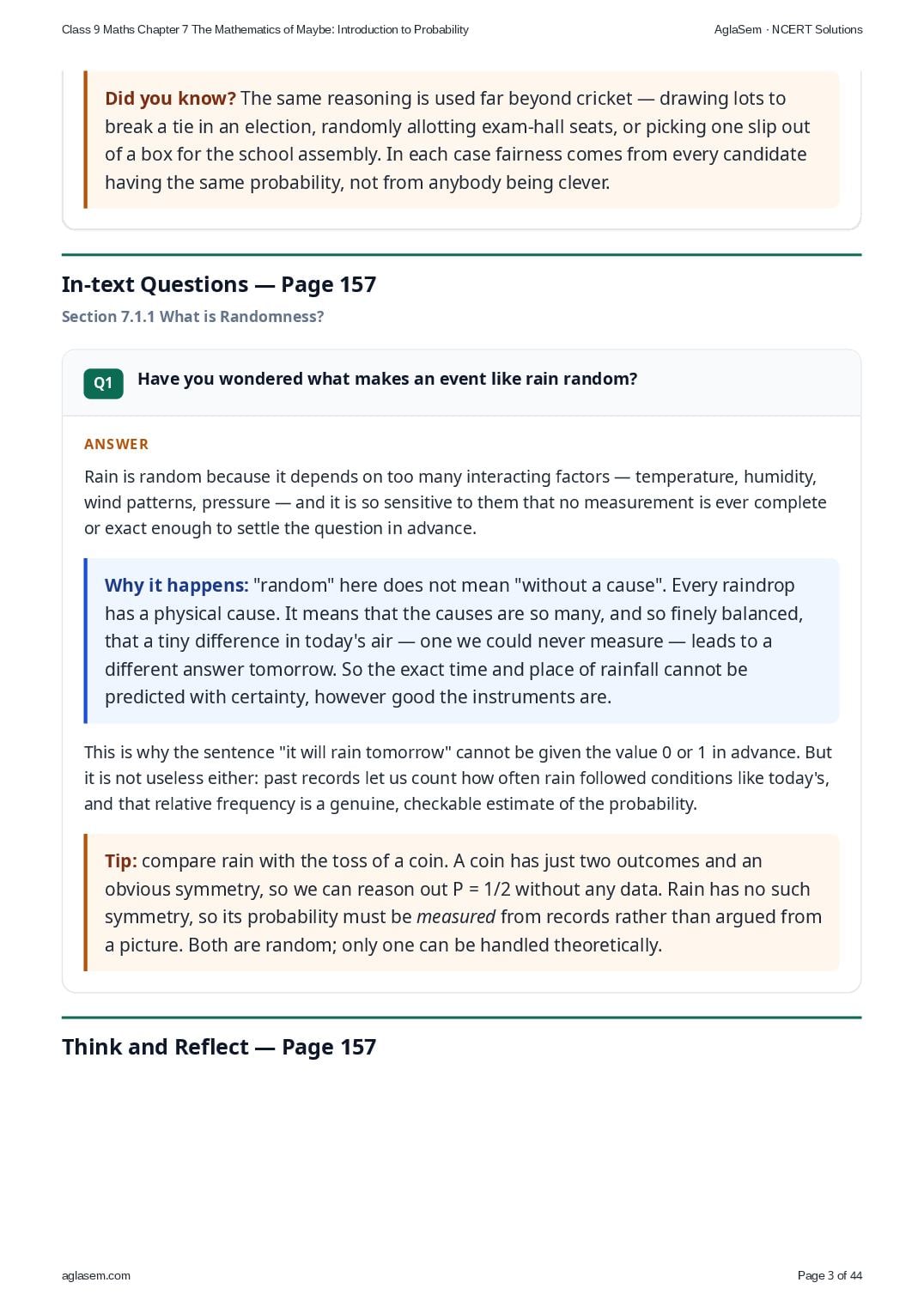
- Have you wondered what makes an event like rain random?
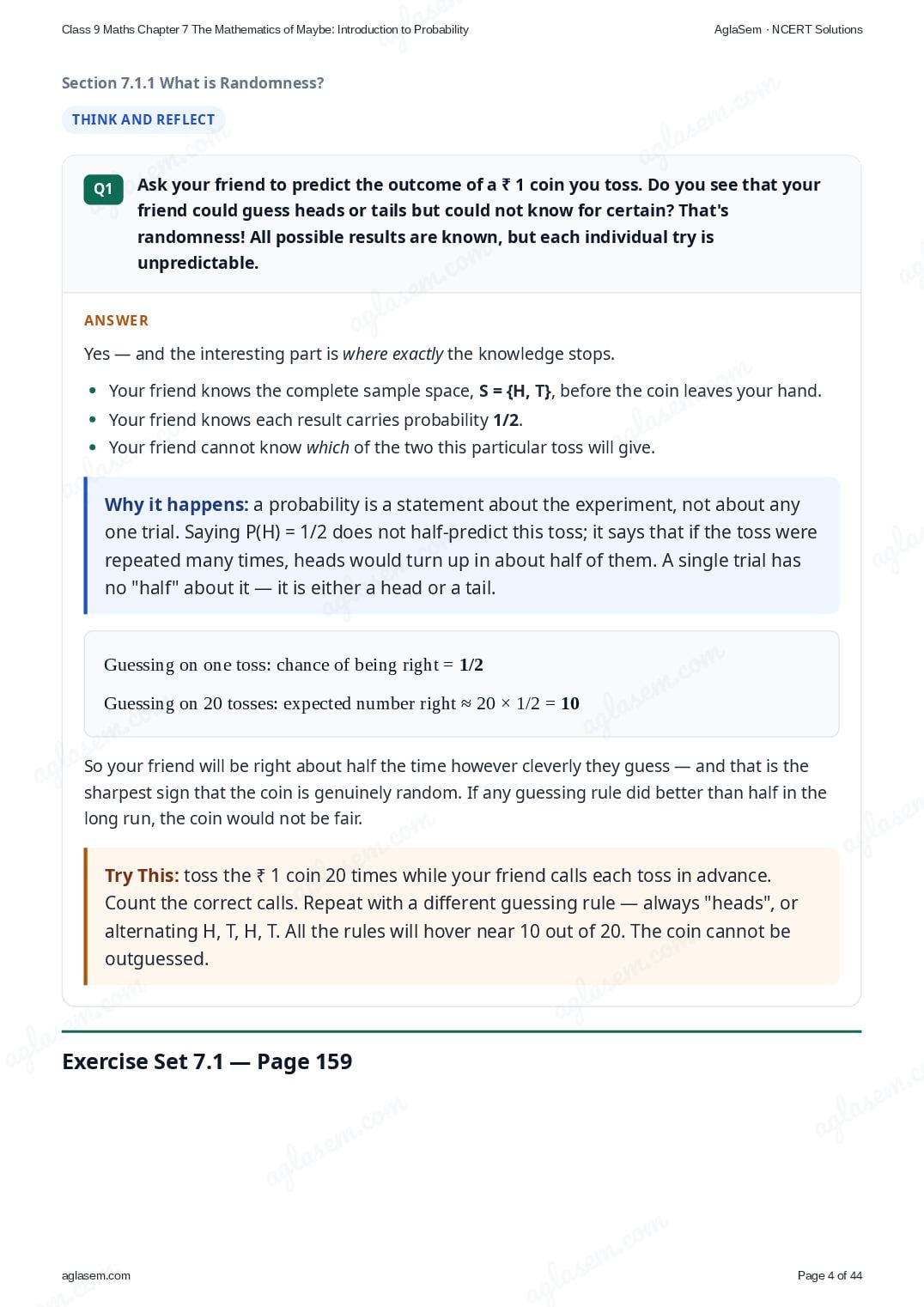
- Ask your friend to predict the outcome of a ₹ 1 coin you toss. Do you see that your friend could guess heads or tails but could not know for certain? That's randomness! All possible results are known, but each individual try is unpredictable.
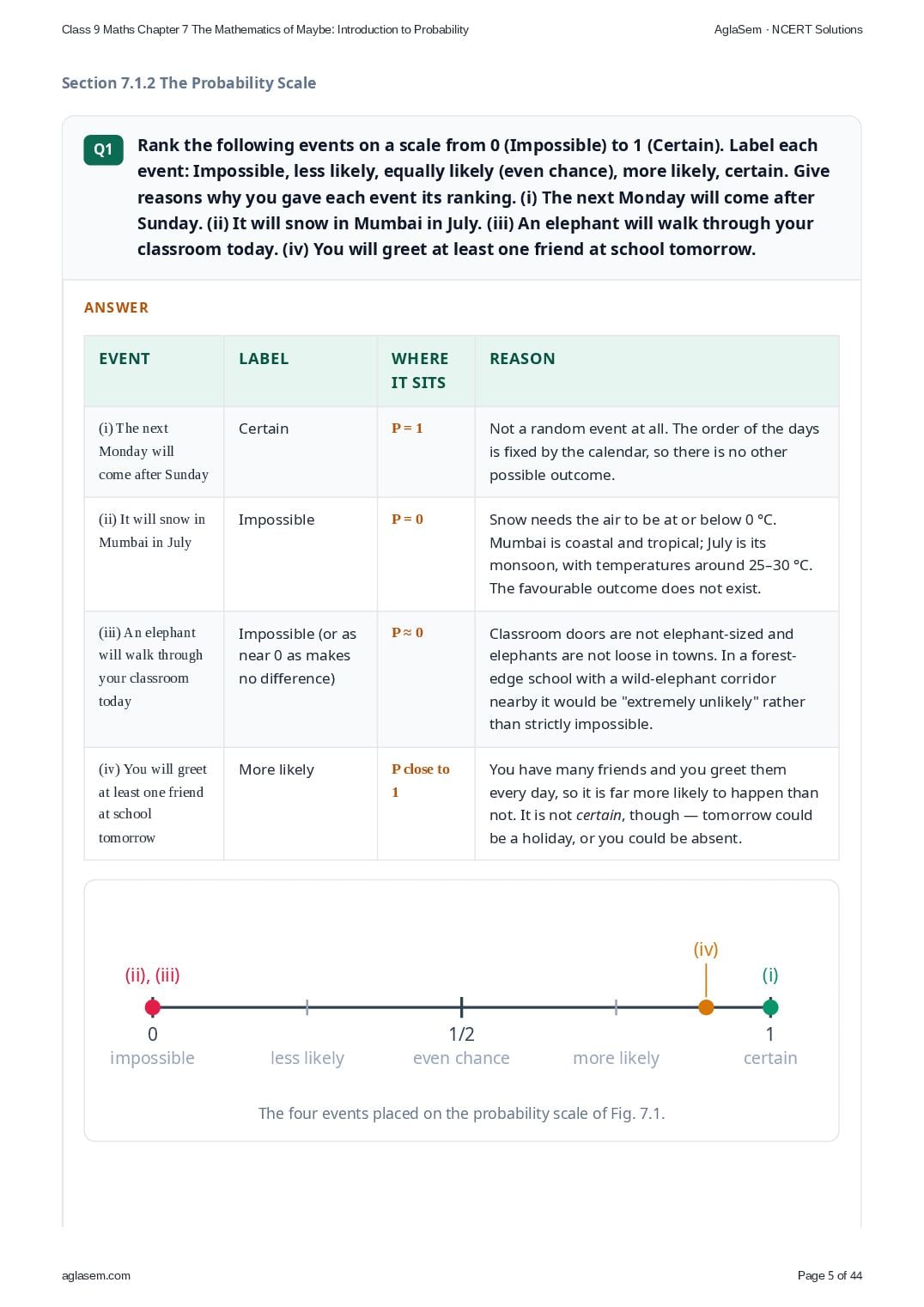
- Rank the following events on a scale from 0 (Impossible) to 1 (Certain). Label each event: Impossible, less likely, equally likely (even chance), more likely, certain. Give reasons why you gave each event its ranking. (i) The next Monday will come after Sunday. (ii) It will snow in Mumbai in July. (iii) An elephant will walk through your classroom today. (iv) You will greet at least one friend at school tomorrow.
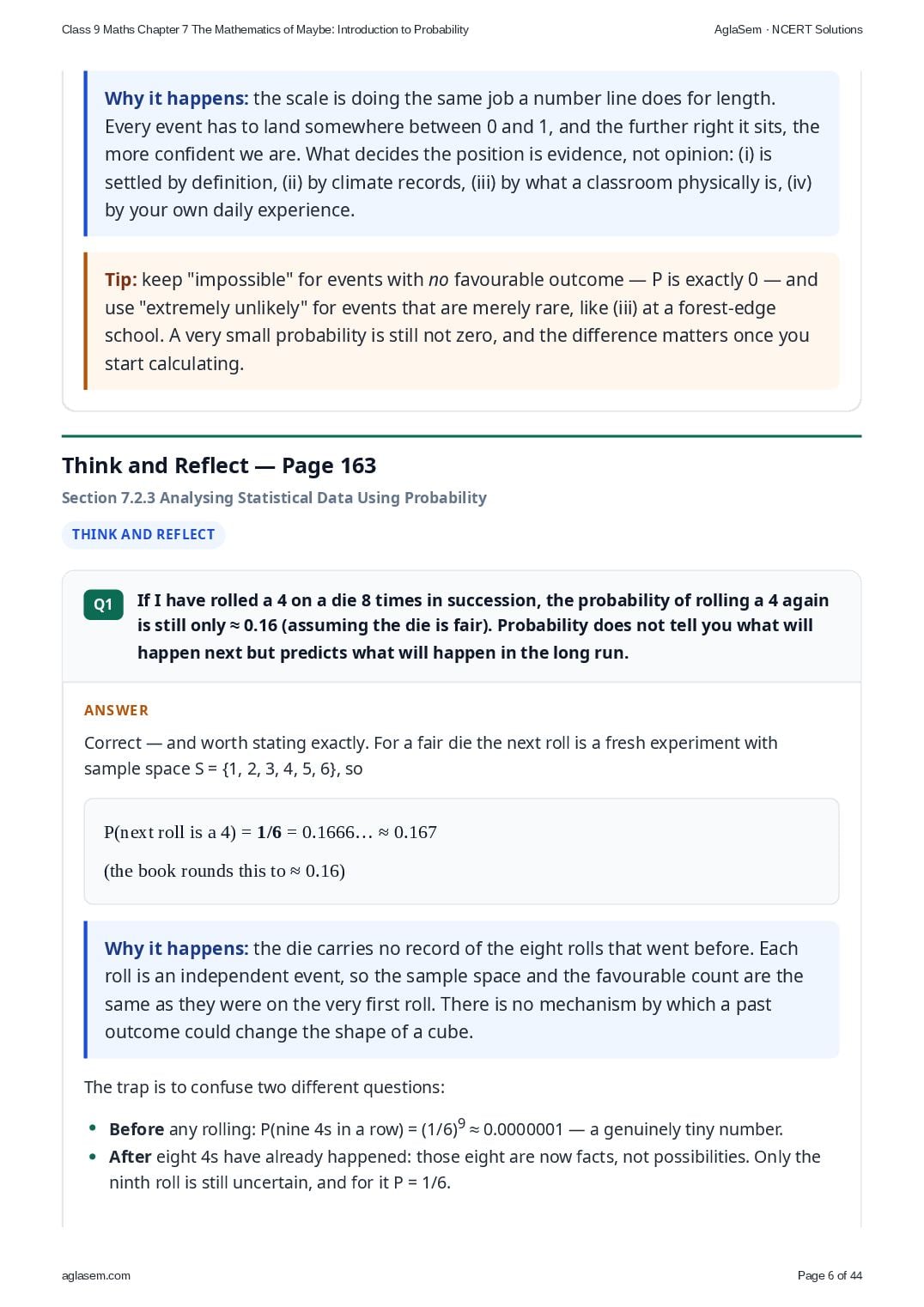
- If I have rolled a 4 on a die 8 times in succession, the probability of rolling a 4 again is still only ≈ 0.16 (assuming the die is fair). Probability does not tell you what will happen next but predicts what will happen in the long run.
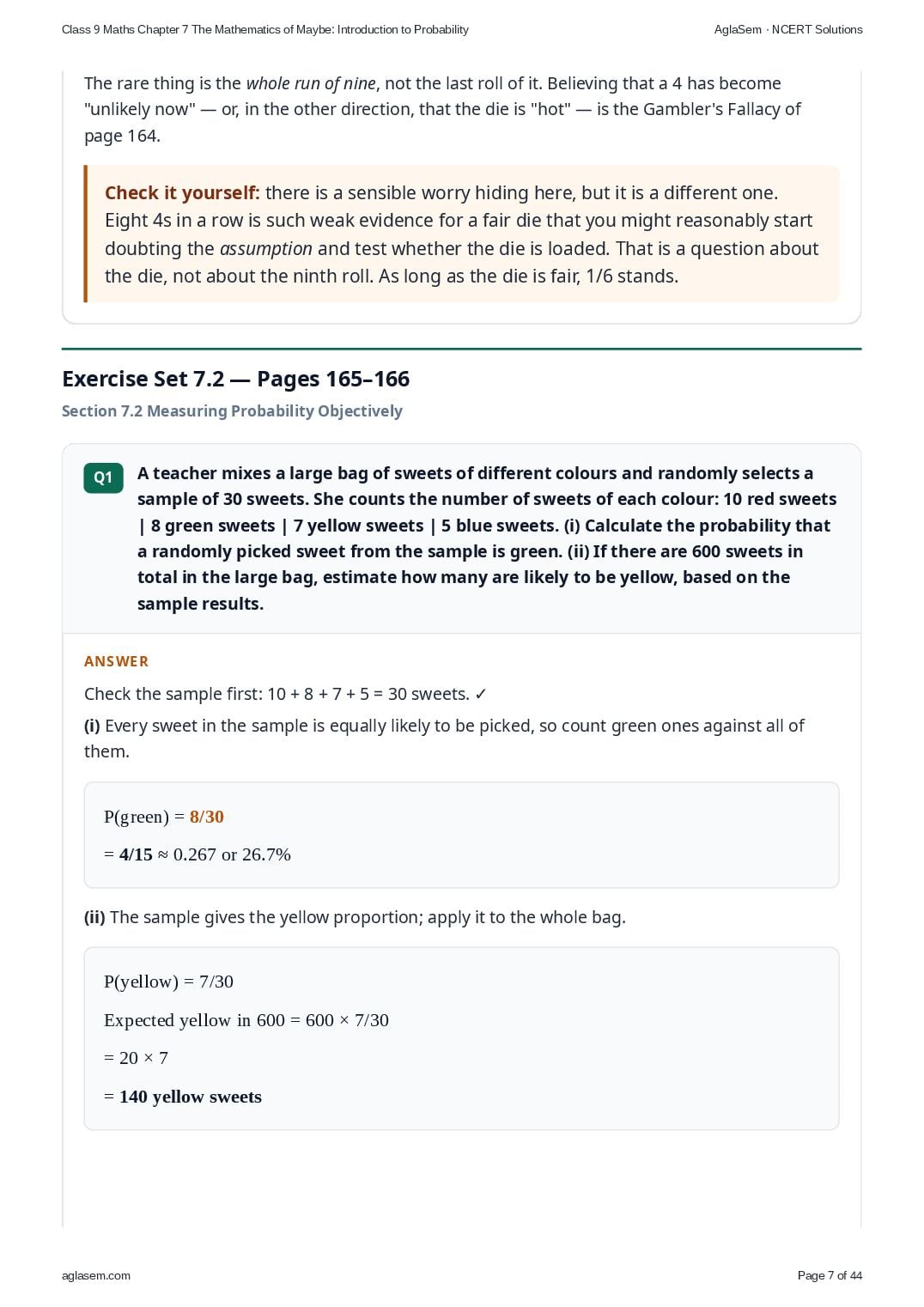
- A teacher mixes a large bag of sweets of different colours and randomly selects a sample of 30 sweets. She counts the number of sweets of each colour: 10 red sweets | 8 green sweets | 7 yellow sweets | 5 blue sweets. (i) Calculate the probability that a randomly picked sweet from the sample is green. (ii) If there are 600 sweets in total in the large bag, estimate how many are likely to be yellow, based on the sample results.
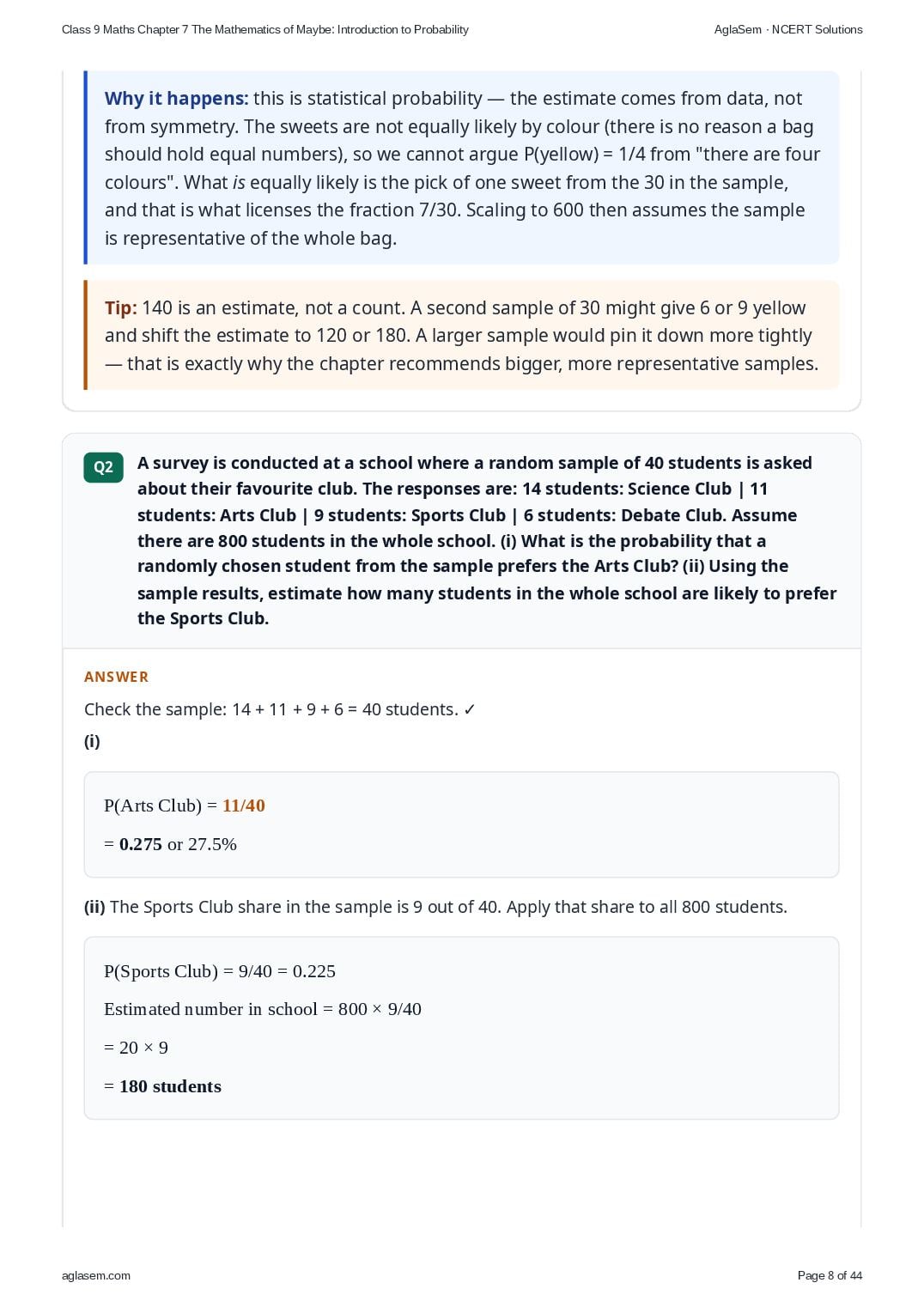
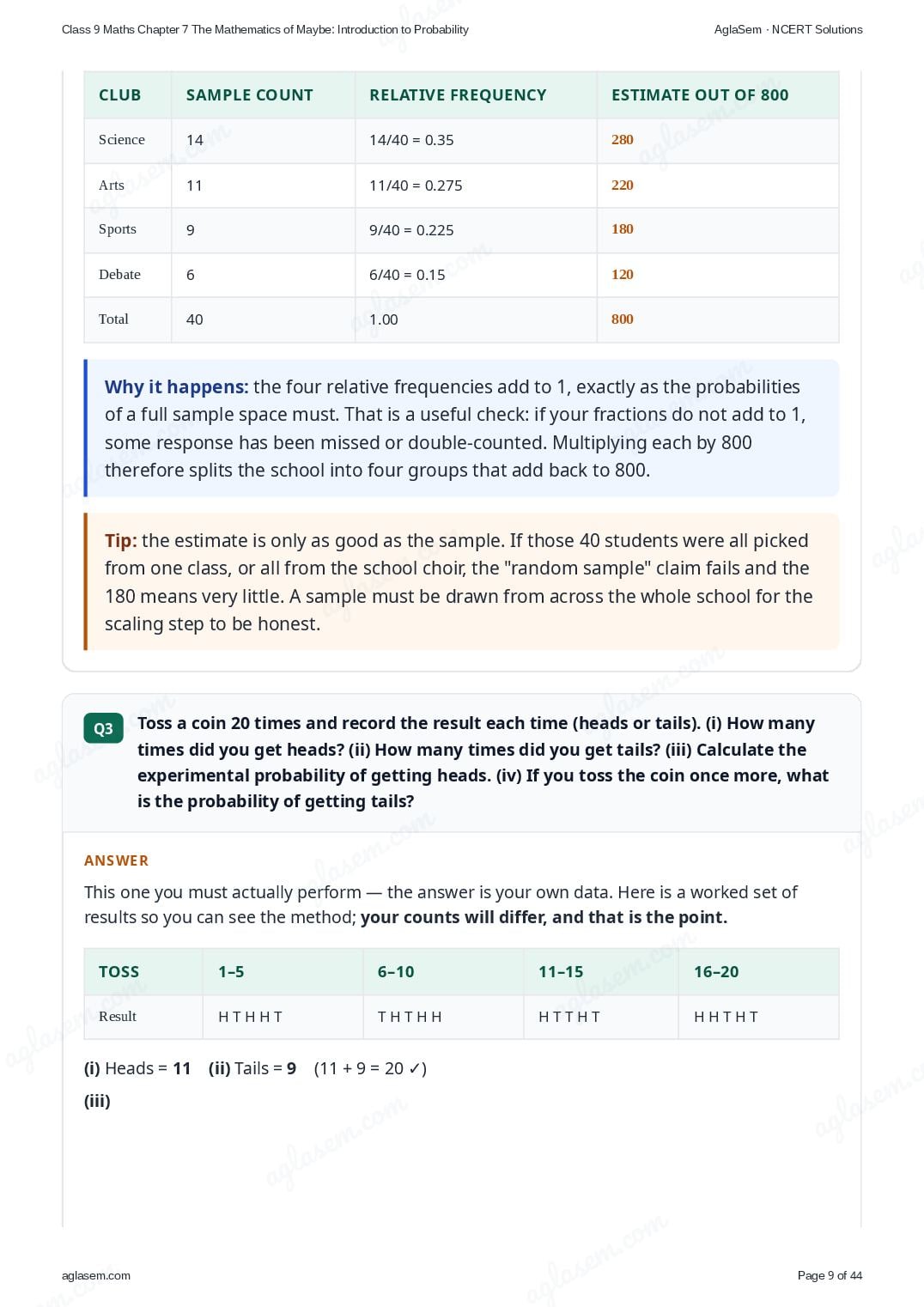
- A survey is conducted at a school where a random sample of 40 students is asked about their favourite club. The responses are: 14 students: Science Club | 11 students: Arts Club | 9 students: Sports Club | 6 students: Debate Club. Assume there are 800 students in the whole school. (i) What is the probability that a randomly chosen student from the sample prefers the Arts Club? (ii) Using the sample results, estimate how many students in the whole school are likely to prefer the Sports Club.
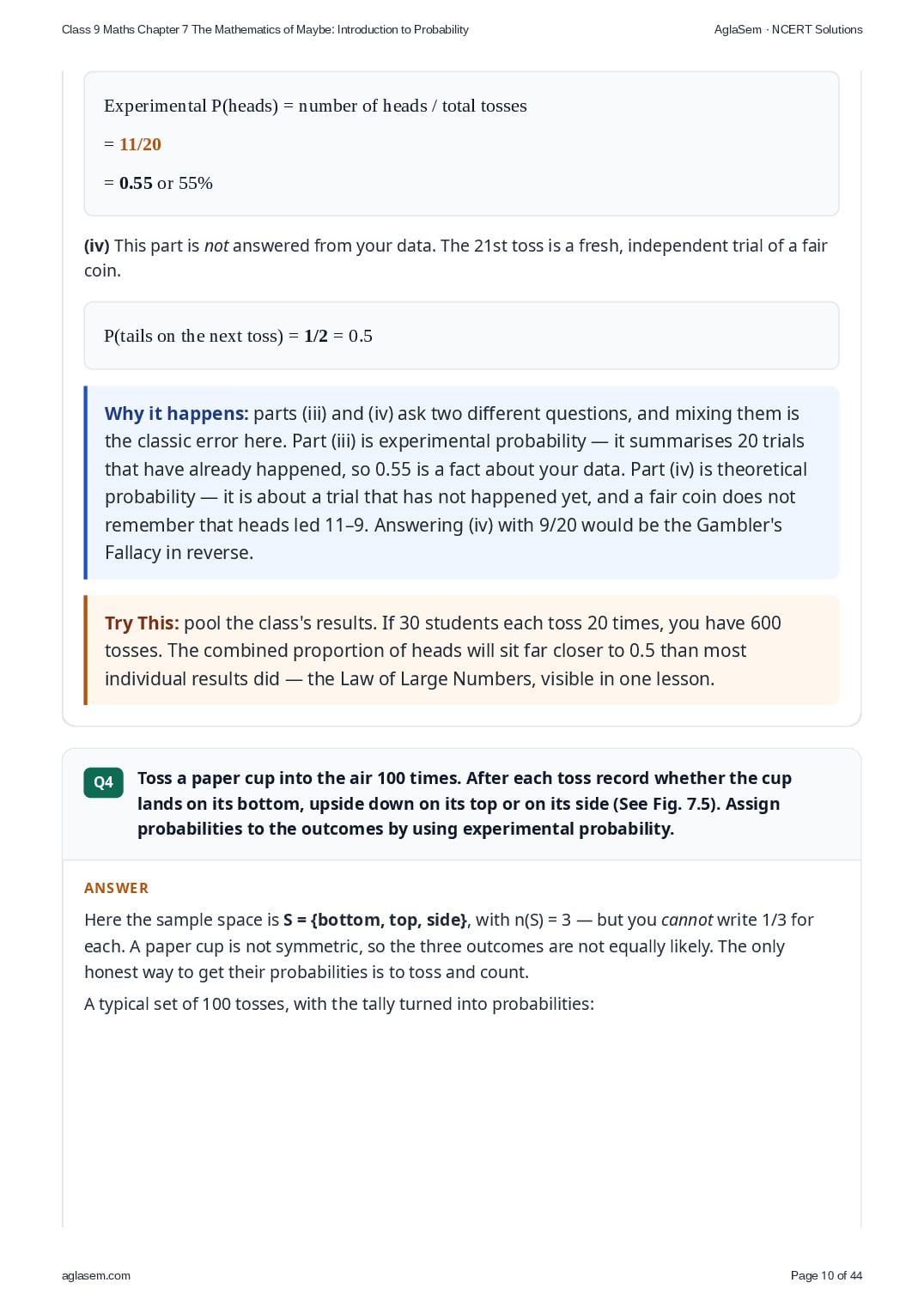
- Toss a coin 20 times and record the result each time (heads or tails). (i) How many times did you get heads? (ii) How many times did you get tails? (iii) Calculate the experimental probability of getting heads. (iv) If you toss the coin once more, what is the probability of getting tails?
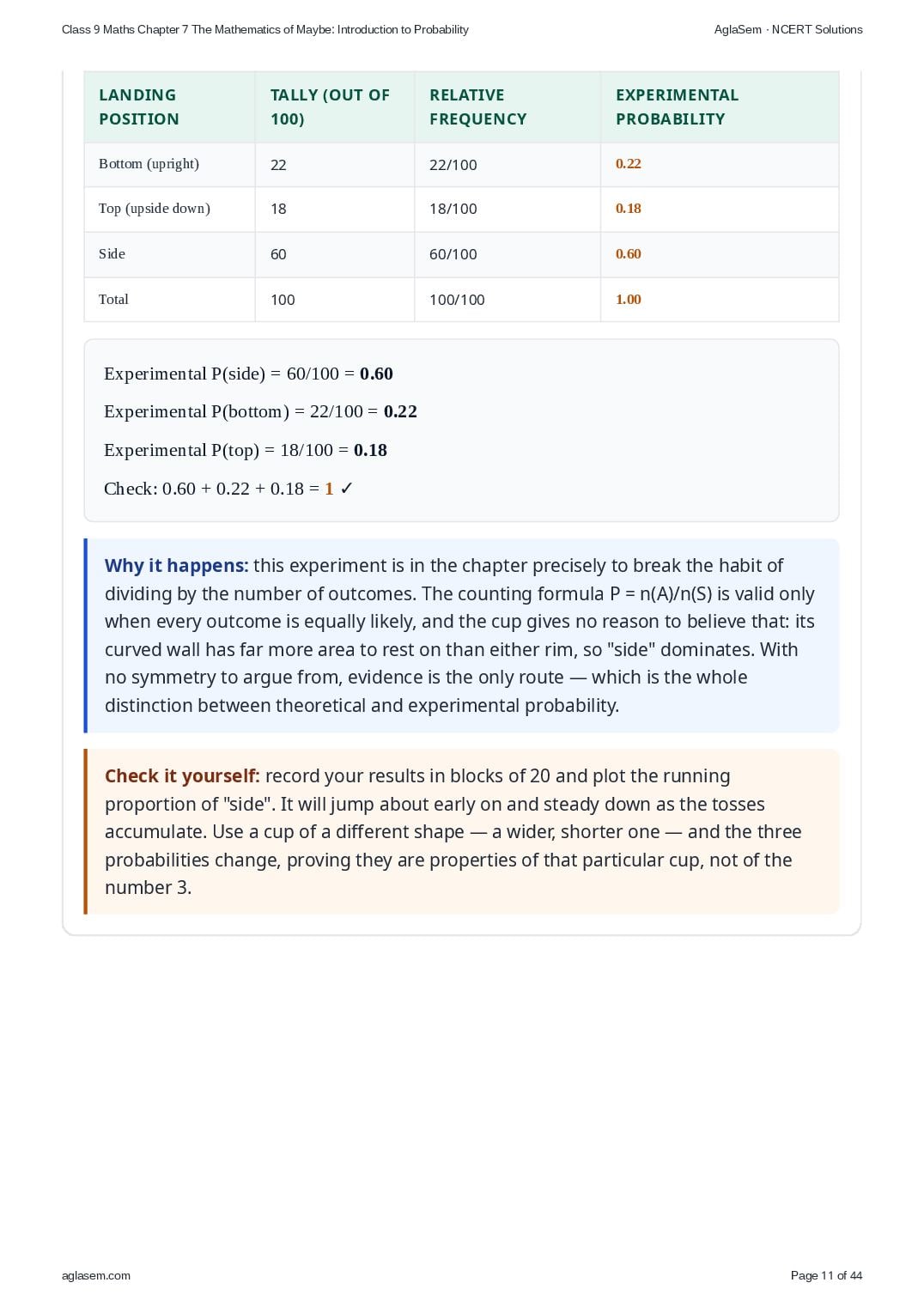
- Toss a paper cup into the air 100 times. After each toss record whether the cup lands on its bottom, upside down on its top or on its side (See Fig. 7.5). Assign probabilities to the outcomes by using experimental probability.
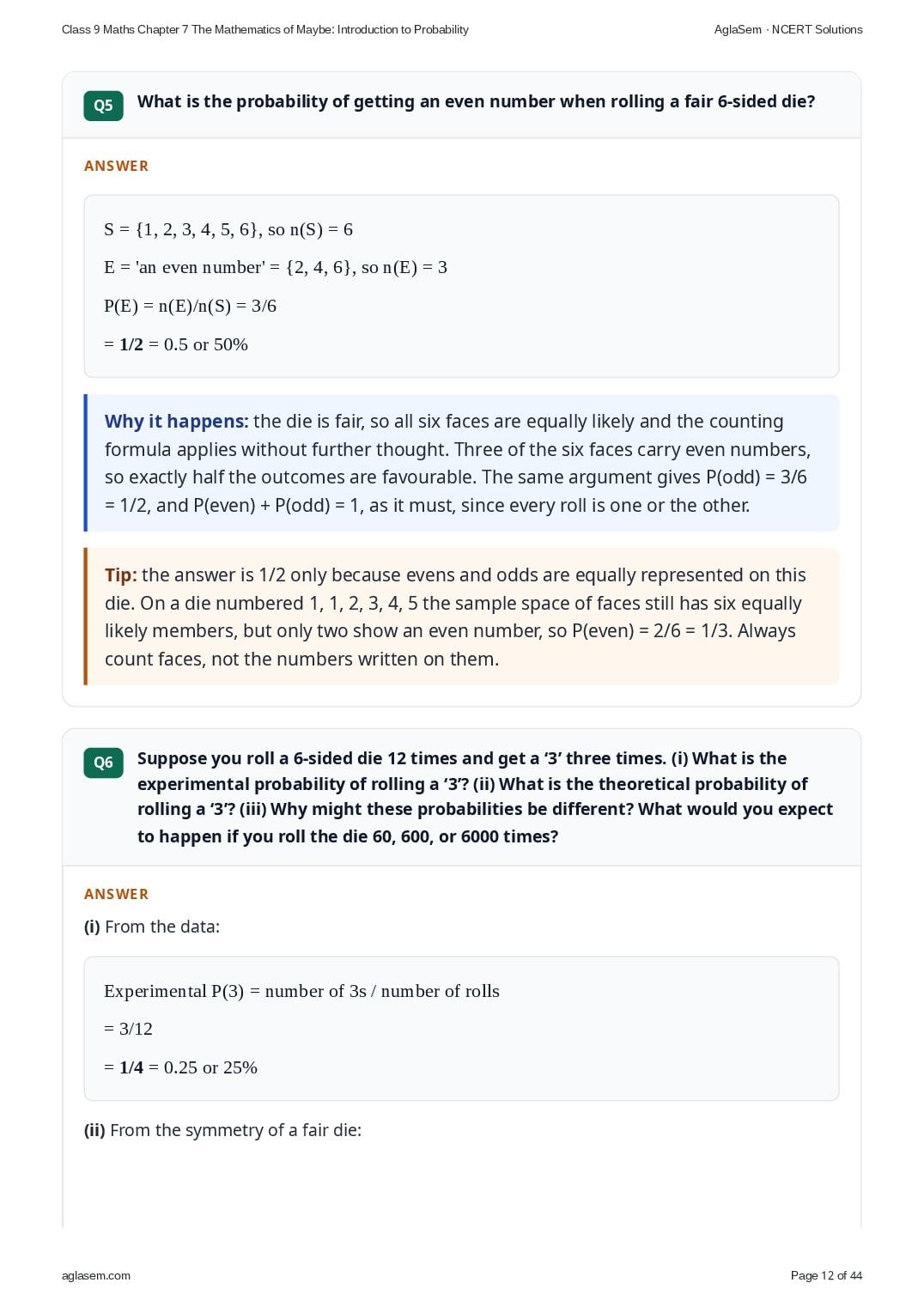
- What is the probability of getting an even number when rolling a fair 6-sided die?
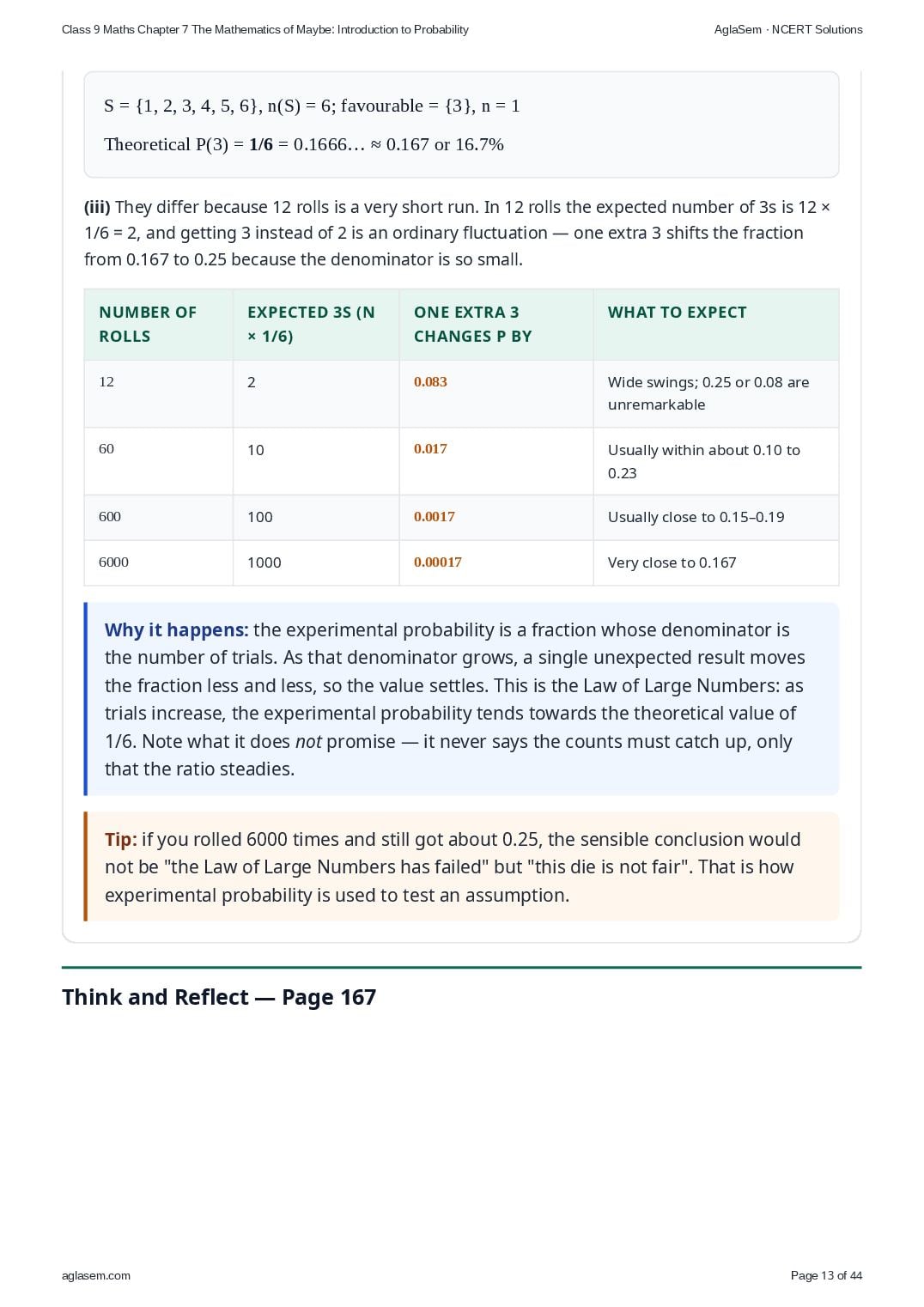
- Suppose you roll a 6-sided die 12 times and get a ‘3’ three times. (i) What is the experimental probability of rolling a ‘3’? (ii) What is the theoretical probability of rolling a ‘3’? (iii) Why might these probabilities be different? What would you expect to happen if you roll the die 60, 600, or 6000 times?
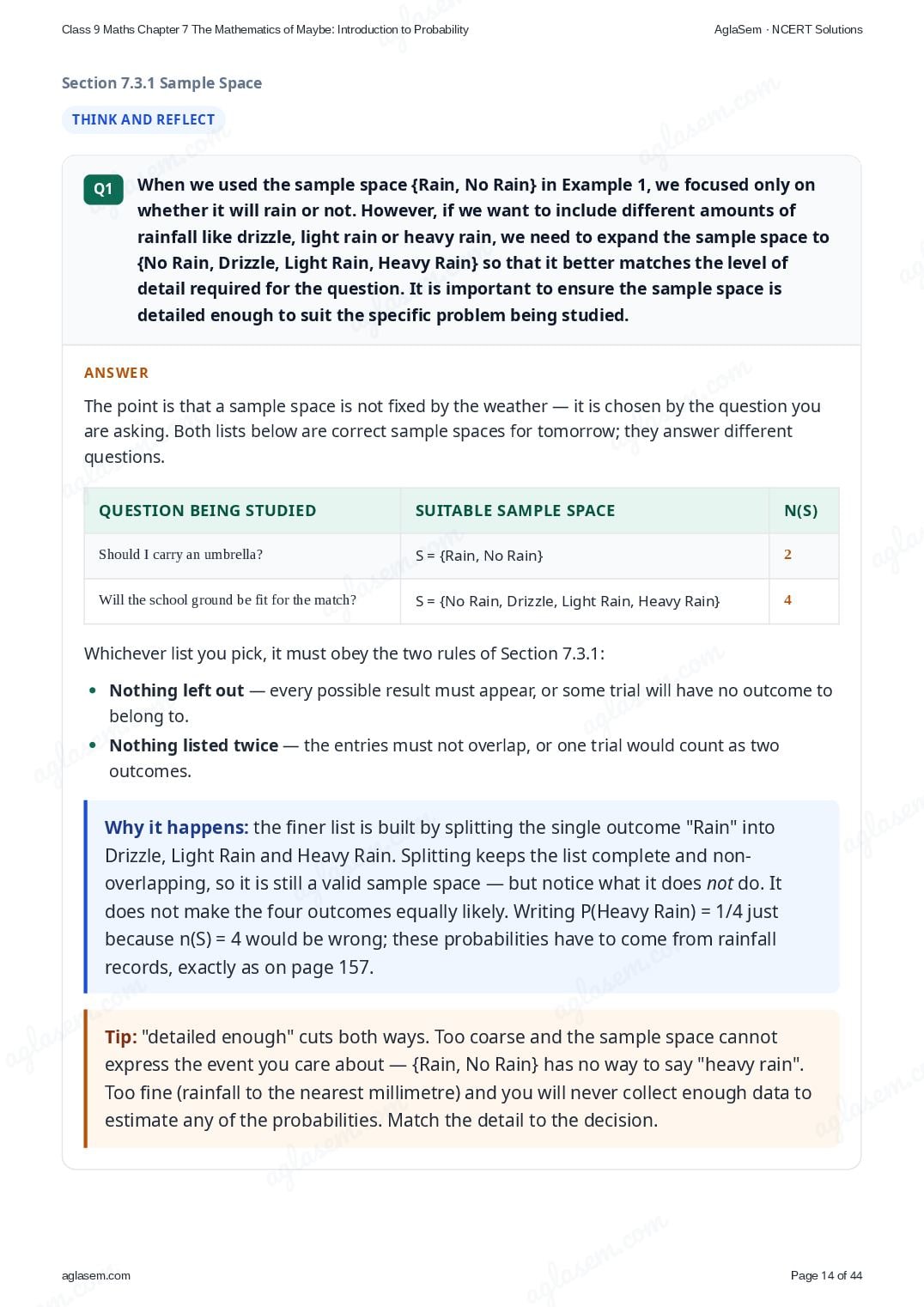
- When we used the sample space {Rain, No Rain} in Example 1, we focused only on whether it will rain or not. However, if we want to include different amounts of rainfall like drizzle, light rain or heavy rain, we need to expand the sample space to {No Rain, Drizzle, Light Rain, Heavy Rain} so that it better matches the level of detail required for the question. It is important to ensure the sample space is detailed enough to suit the specific problem being studied.
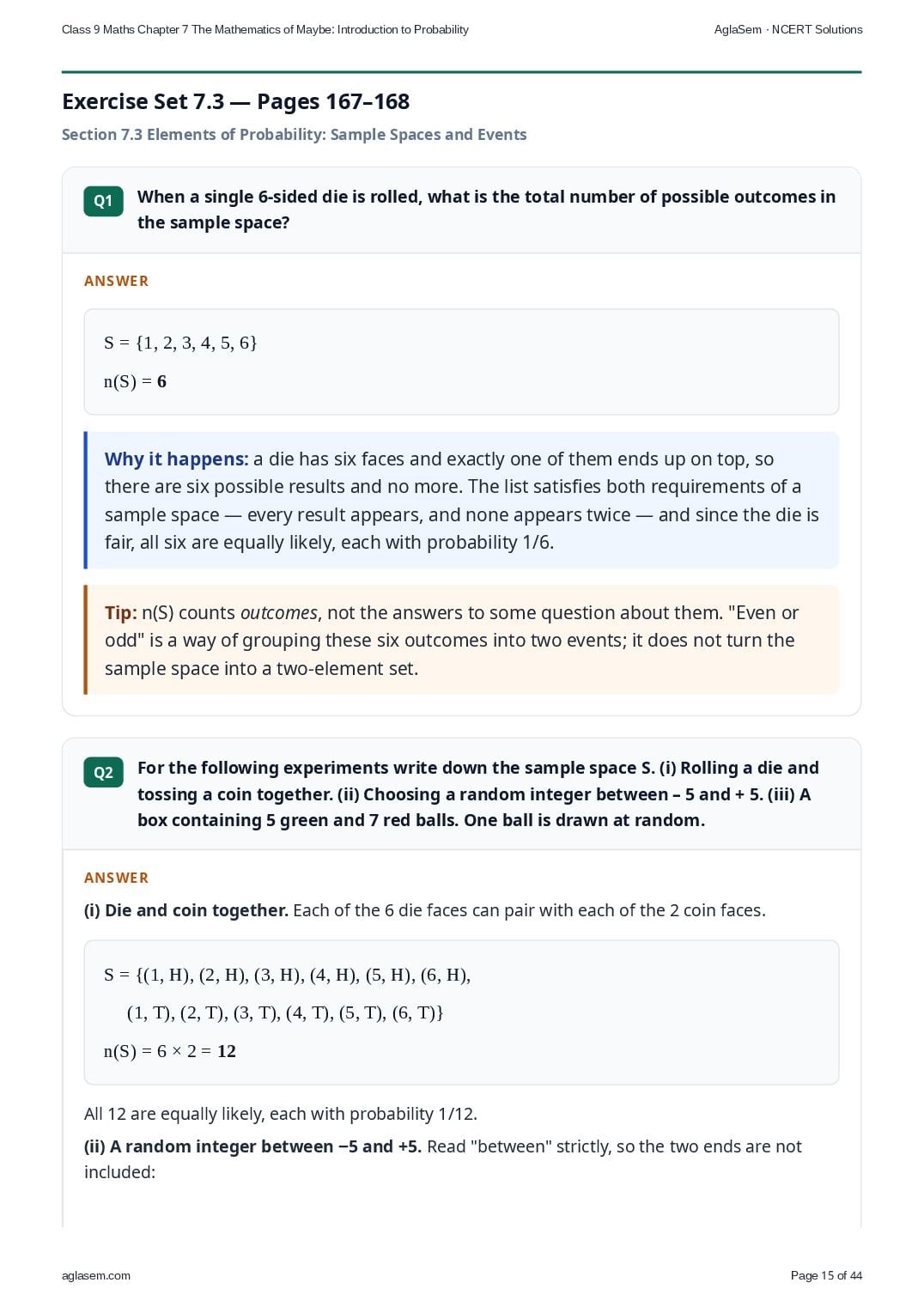
- When a single 6-sided die is rolled, what is the total number of possible outcomes in the sample space?
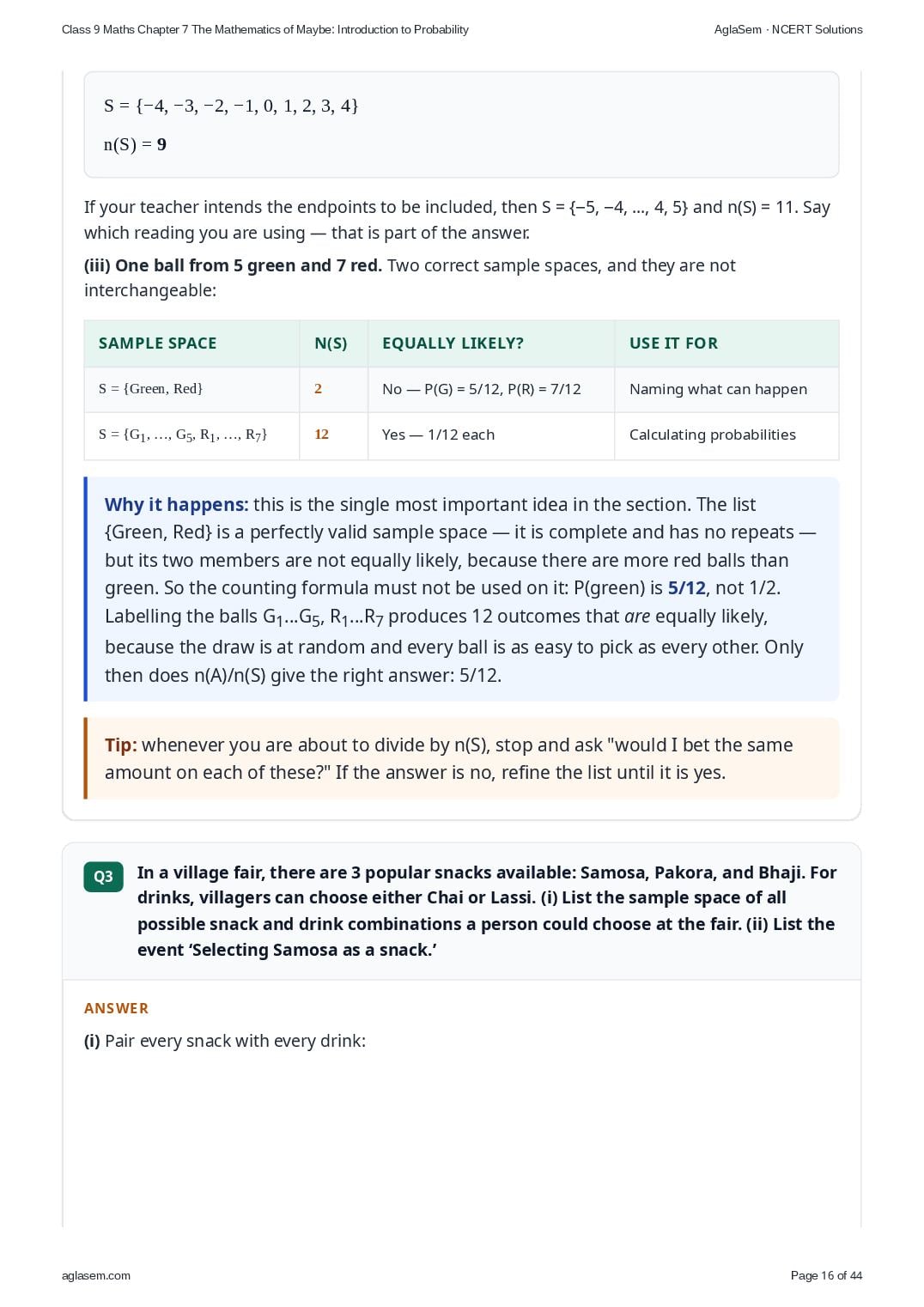
- For the following experiments write down the sample space S. (i) Rolling a die and tossing a coin together. (ii) Choosing a random integer between – 5 and + 5. (iii) A box containing 5 green and 7 red balls. One ball is drawn at random.
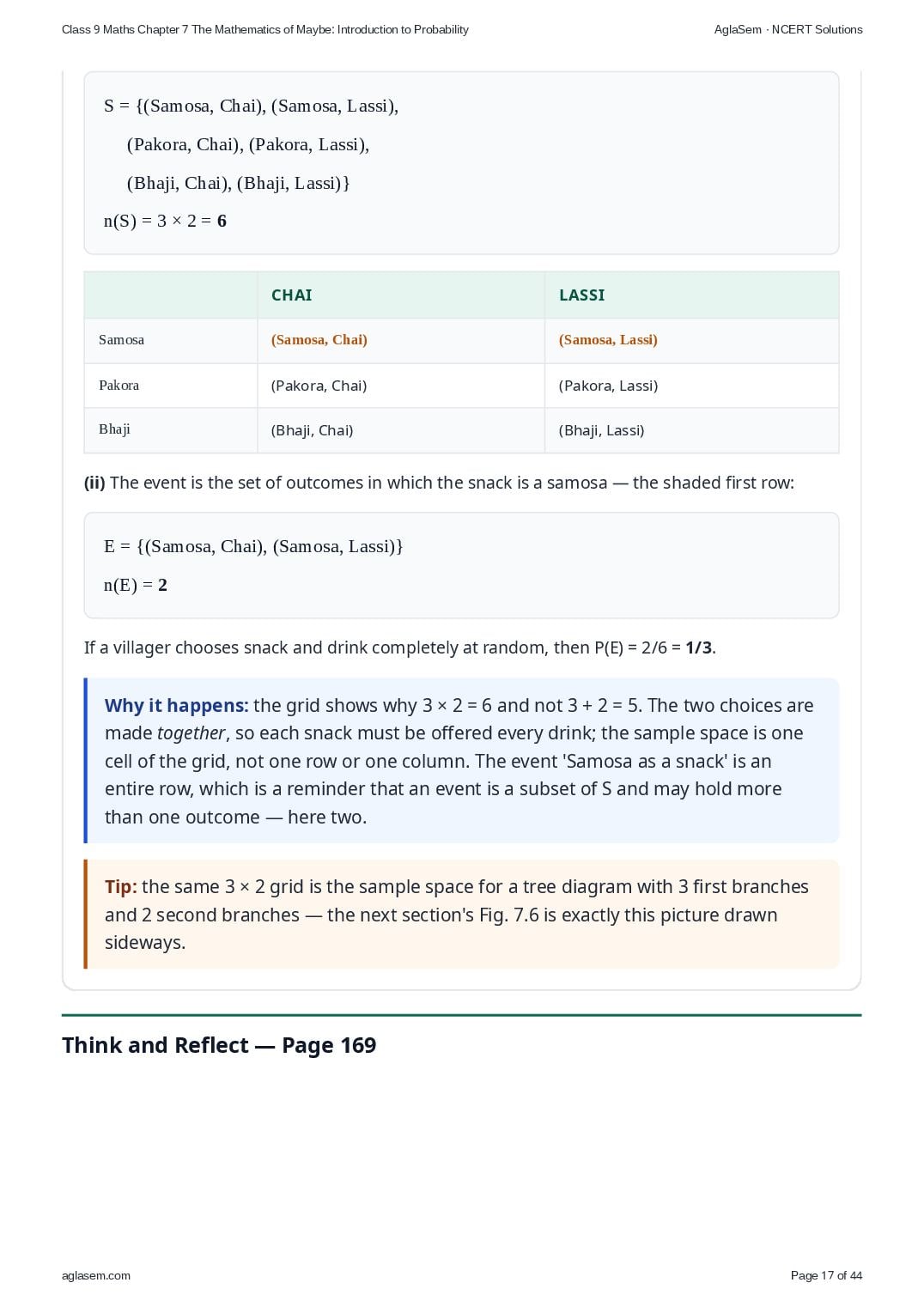
- In a village fair, there are 3 popular snacks available: Samosa, Pakora, and Bhaji. For drinks, villagers can choose either Chai or Lassi. (i) List the sample space of all possible snack and drink combinations a person could choose at the fair. (ii) List the event ‘Selecting Samosa as a snack.’
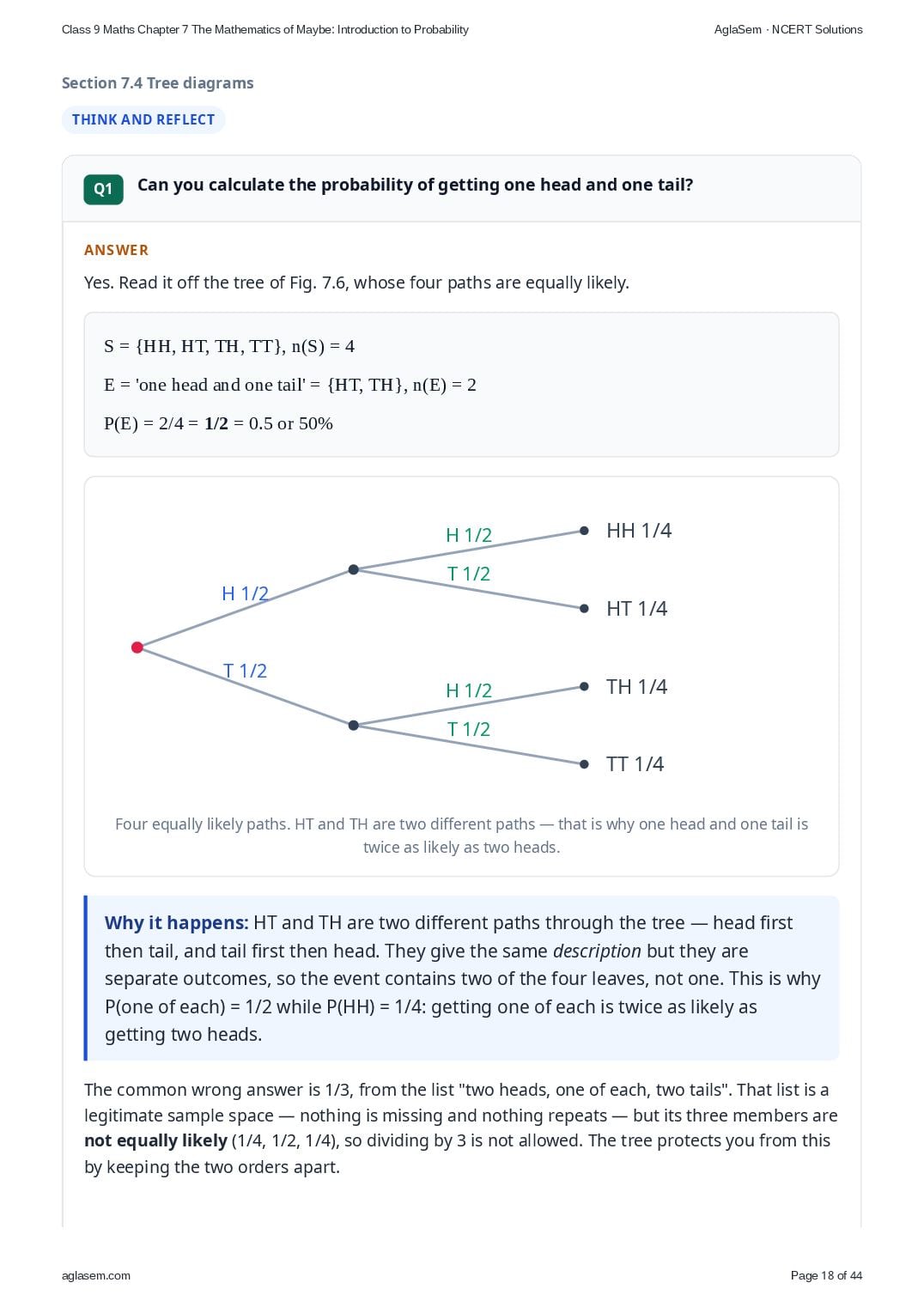
- Can you calculate the probability of getting one head and one tail?
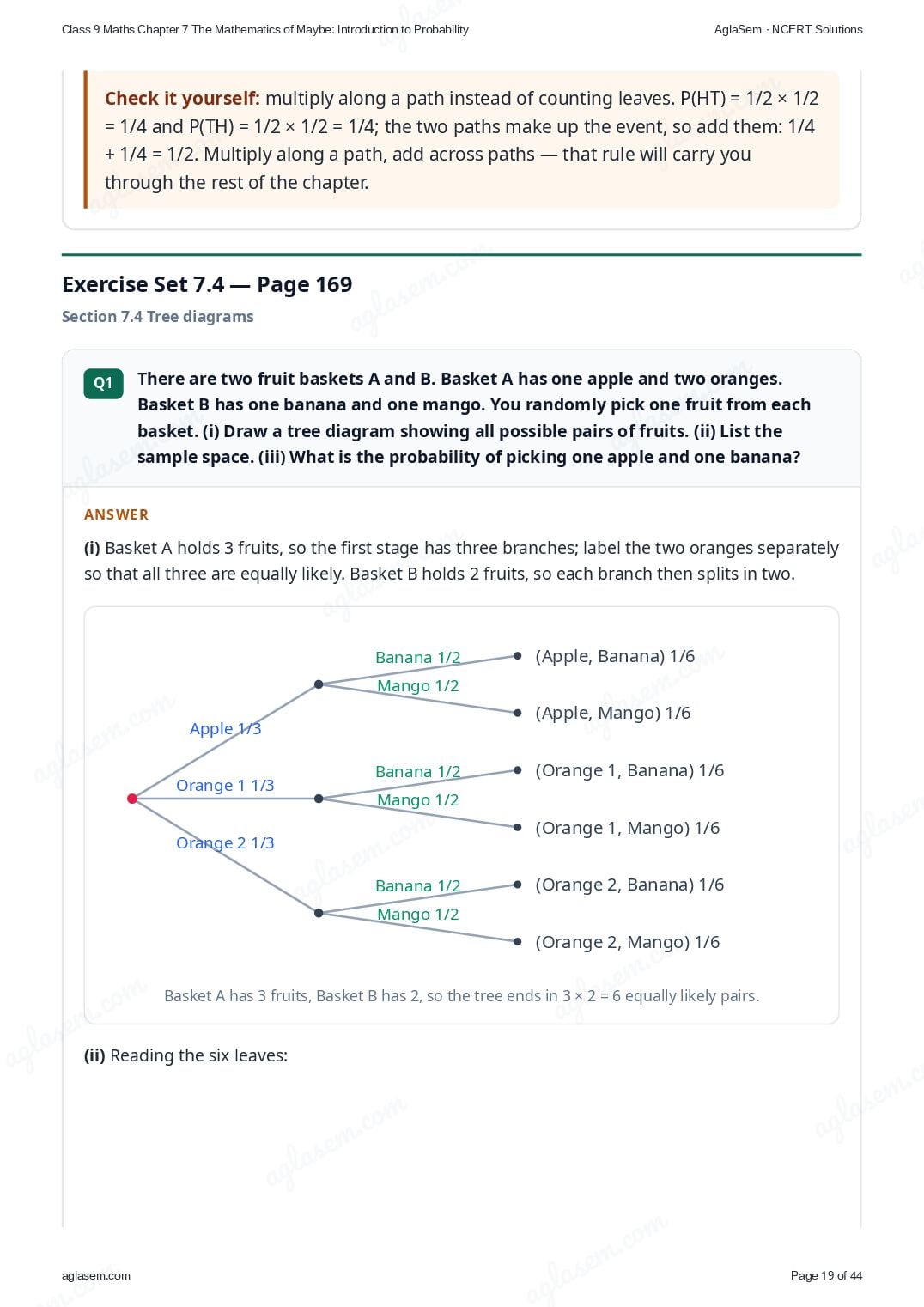
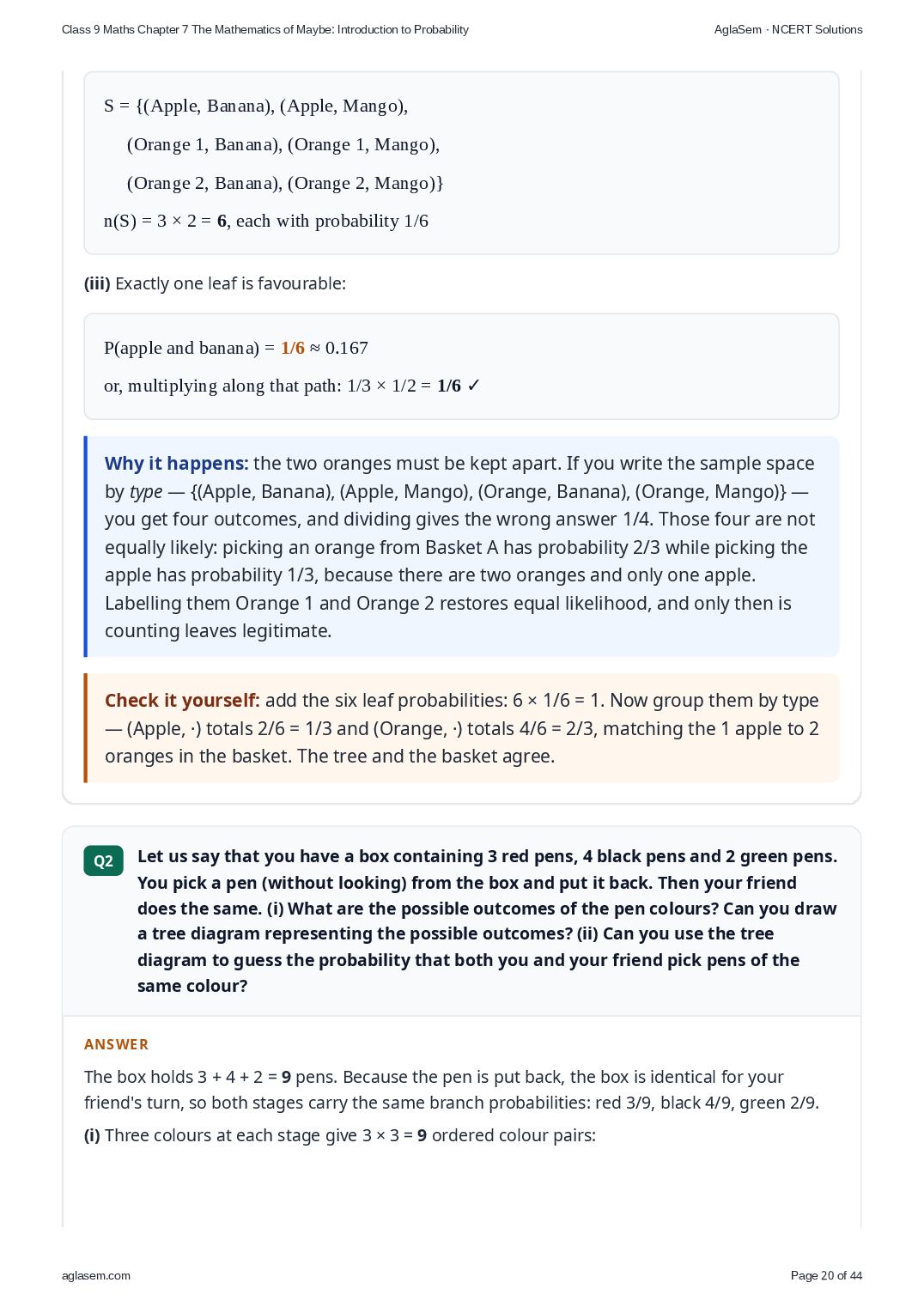
- There are two fruit baskets A and B. Basket A has one apple and two oranges. Basket B has one banana and one mango. You randomly pick one fruit from each basket. (i) Draw a tree diagram showing all possible pairs of fruits. (ii) List the sample space. (iii) What is the probability of picking one apple and one banana?
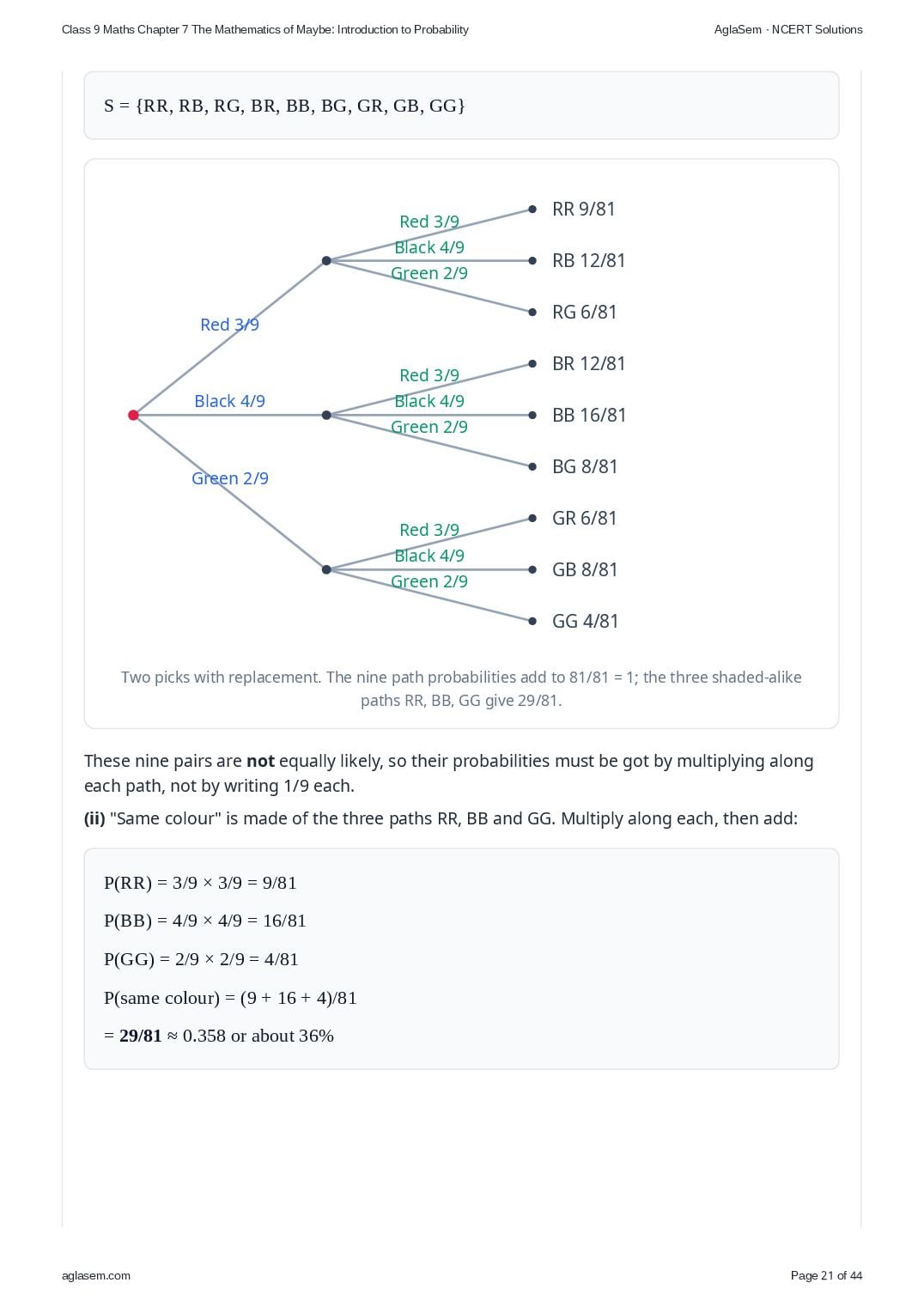
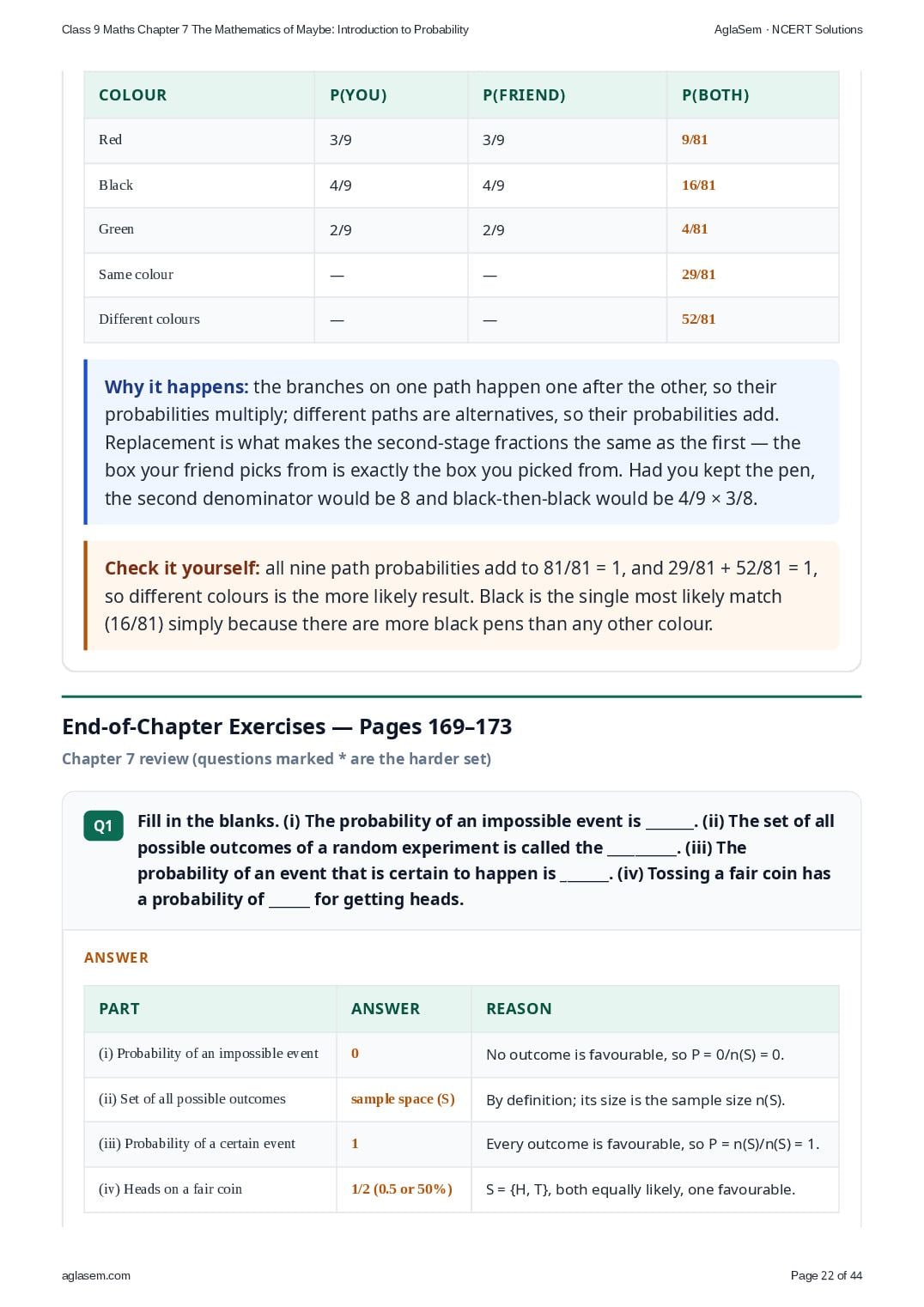
- Let us say that you have a box containing 3 red pens, 4 black pens and 2 green pens. You pick a pen (without looking) from the box and put it back. Then your friend does the same. (i) What are the possible outcomes of the pen colours? Can you draw a tree diagram representing the possible outcomes? (ii) Can you use the tree diagram to guess the probability that both you and your friend pick pens of the same colour?
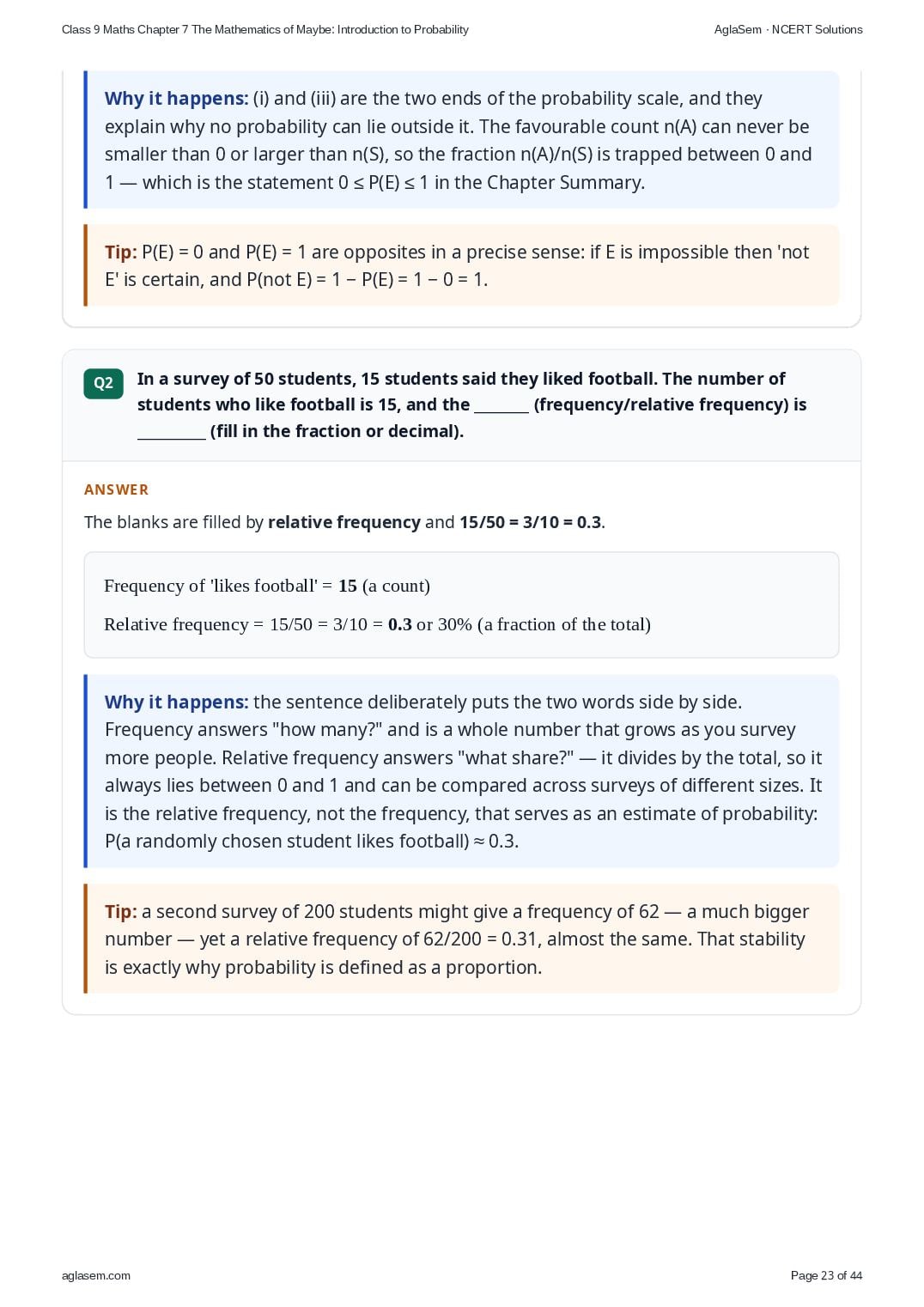
- Fill in the blanks. (i) The probability of an impossible event is _______. (ii) The set of all possible outcomes of a random experiment is called the __________. (iii) The probability of an event that is certain to happen is _______. (iv) Tossing a fair coin has a probability of ______ for getting heads.
- In a survey of 50 students, 15 students said they liked football. The number of students who like football is 15, and the ________ (frequency/relative frequency) is __________ (fill in the fraction or decimal).
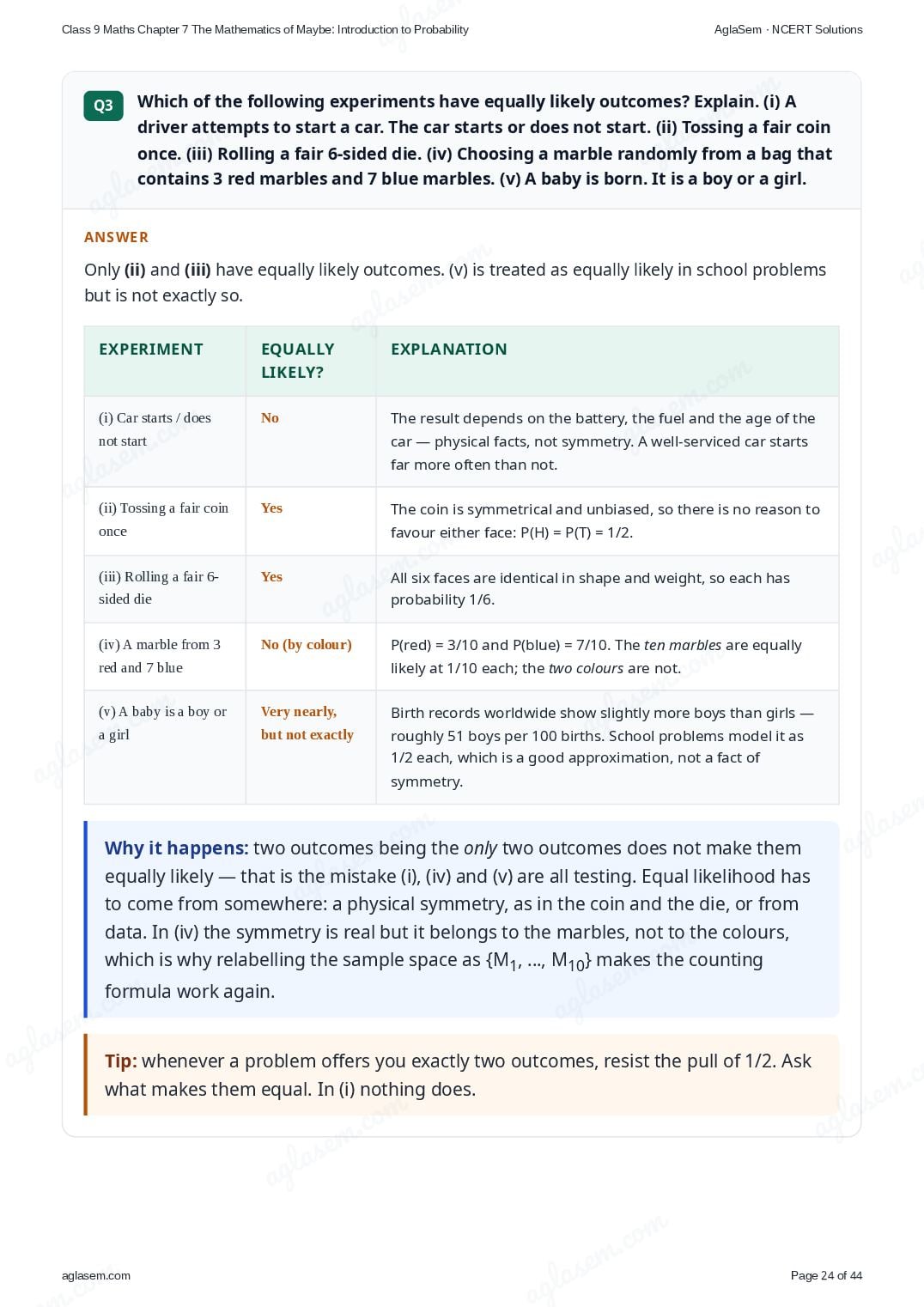
- Which of the following experiments have equally likely outcomes? Explain. (i) A driver attempts to start a car. The car starts or does not start. (ii) Tossing a fair coin once. (iii) Rolling a fair 6-sided die. (iv) Choosing a marble randomly from a bag that contains 3 red marbles and 7 blue marbles. (v) A baby is born. It is a boy or a girl.
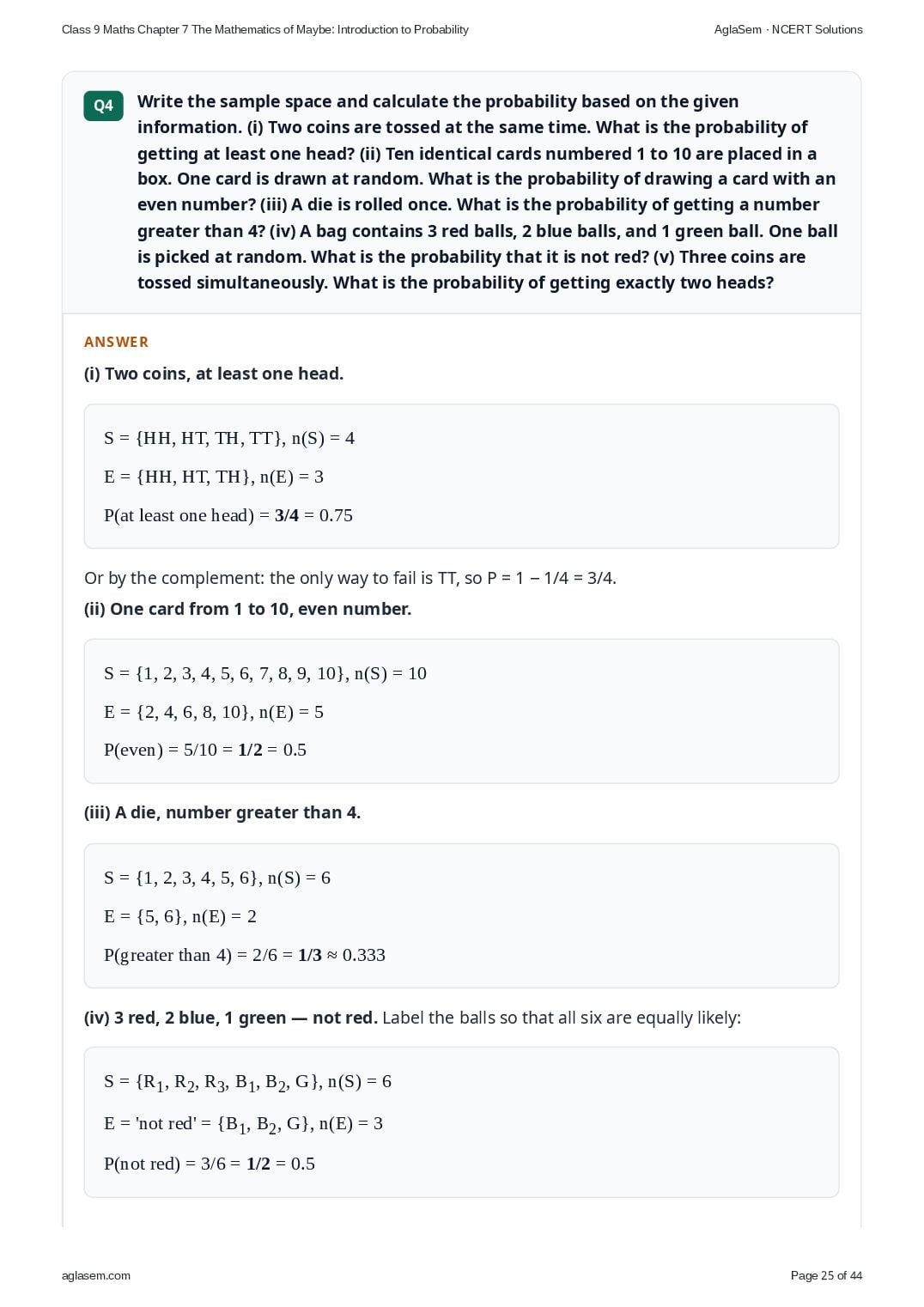
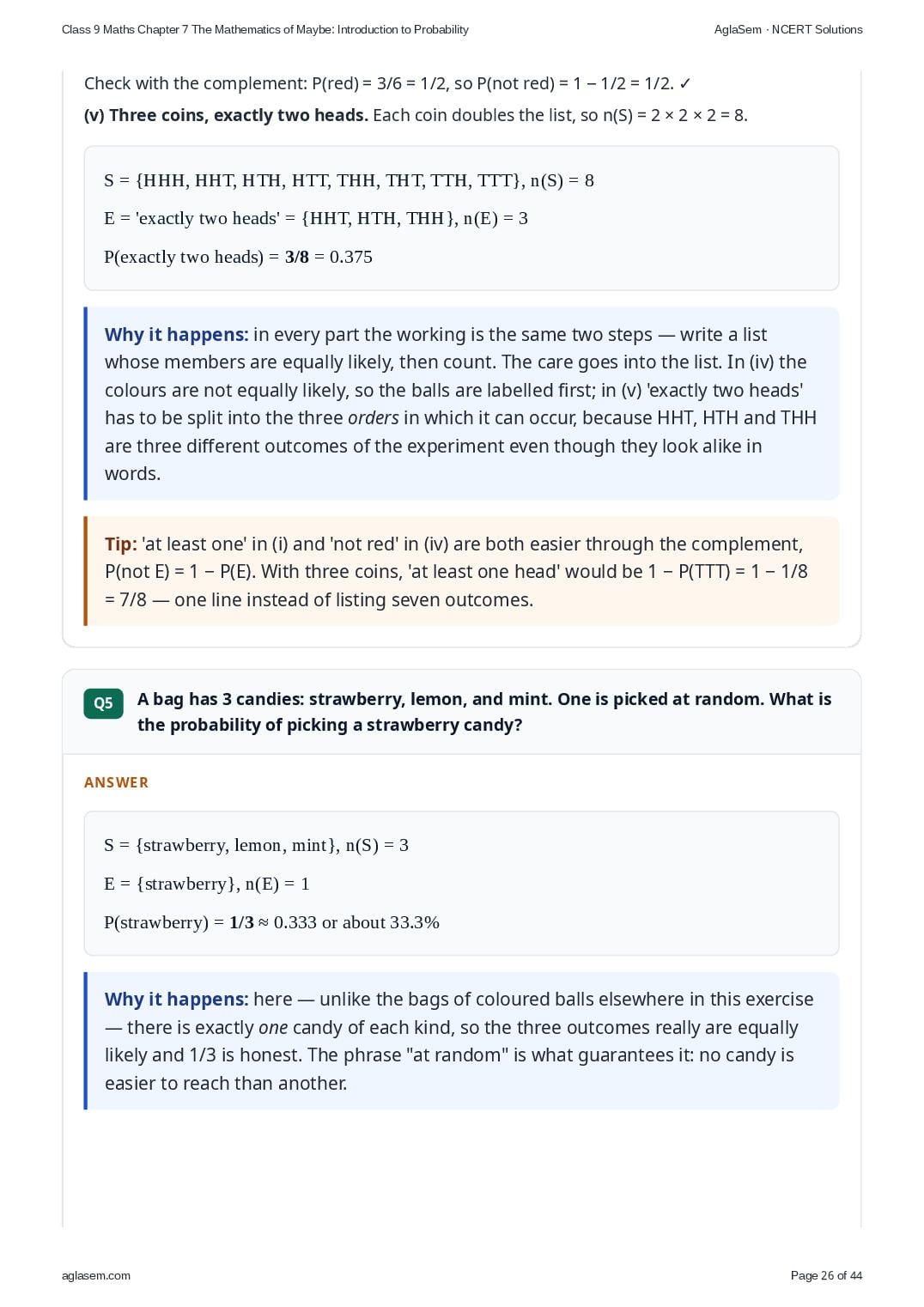
- Write the sample space and calculate the probability based on the given information. (i) Two coins are tossed at the same time. What is the probability of getting at least one head? (ii) Ten identical cards numbered 1 to 10 are placed in a box. One card is drawn at random. What is the probability of drawing a card with an even number? (iii) A die is rolled once. What is the probability of getting a number greater than 4? (iv) A bag contains 3 red balls, 2 blue balls, and 1 green ball. One ball is picked at random. What is the probability that it is not red? (v) Three coins are tossed simultaneously. What is the probability of getting exactly two heads?
- A bag has 3 candies: strawberry, lemon, and mint. One is picked at random. What is the probability of picking a strawberry candy?
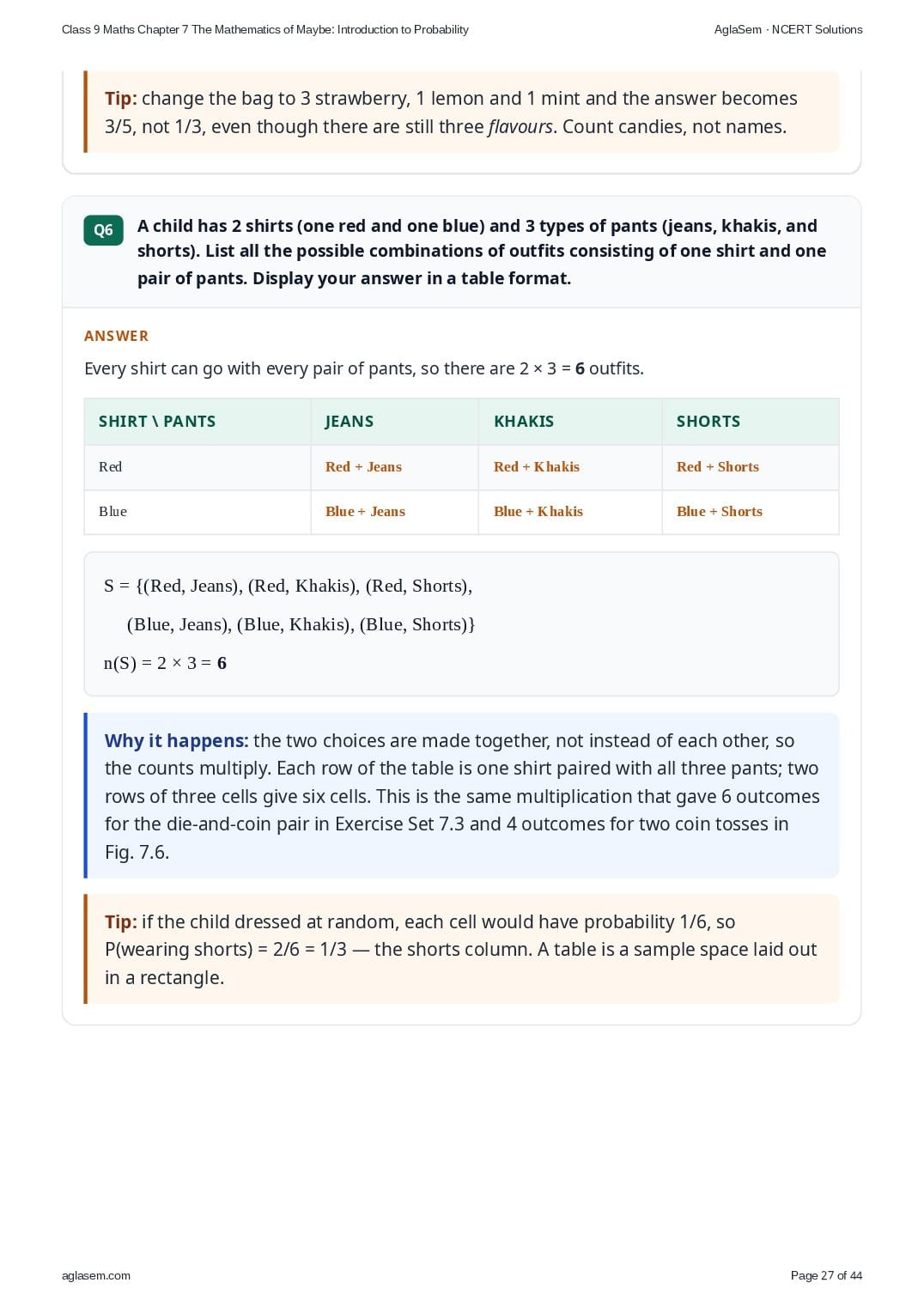
- A child has 2 shirts (one red and one blue) and 3 types of pants (jeans, khakis, and shorts). List all the possible combinations of outfits consisting of one shirt and one pair of pants. Display your answer in a table format.
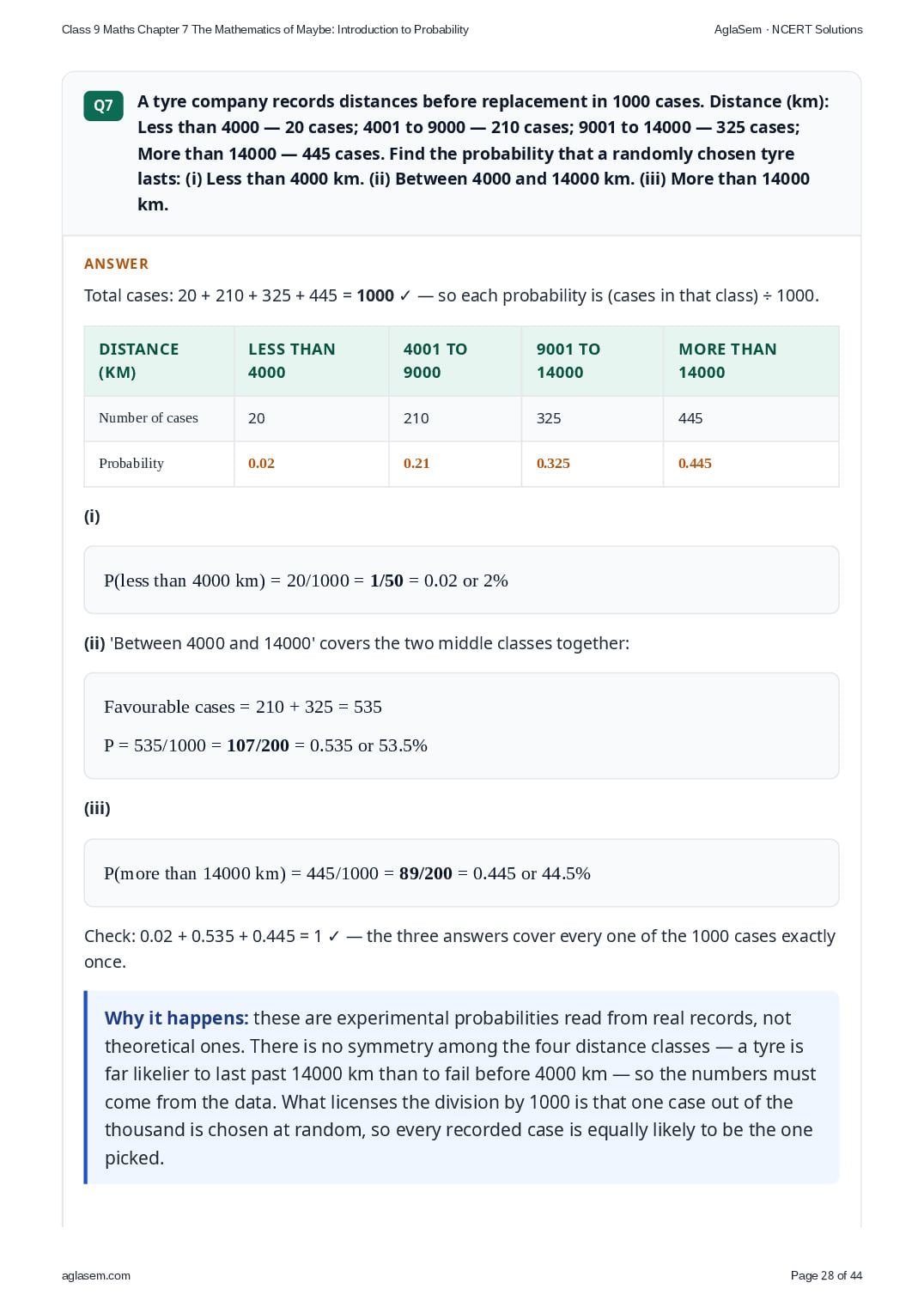
- A tyre company records distances before replacement in 1000 cases. Distance (km): Less than 4000 — 20 cases; 4001 to 9000 — 210 cases; 9001 to 14000 — 325 cases; More than 14000 — 445 cases. Find the probability that a randomly chosen tyre lasts: (i) Less than 4000 km. (ii) Between 4000 and 14000 km. (iii) More than 14000 km.
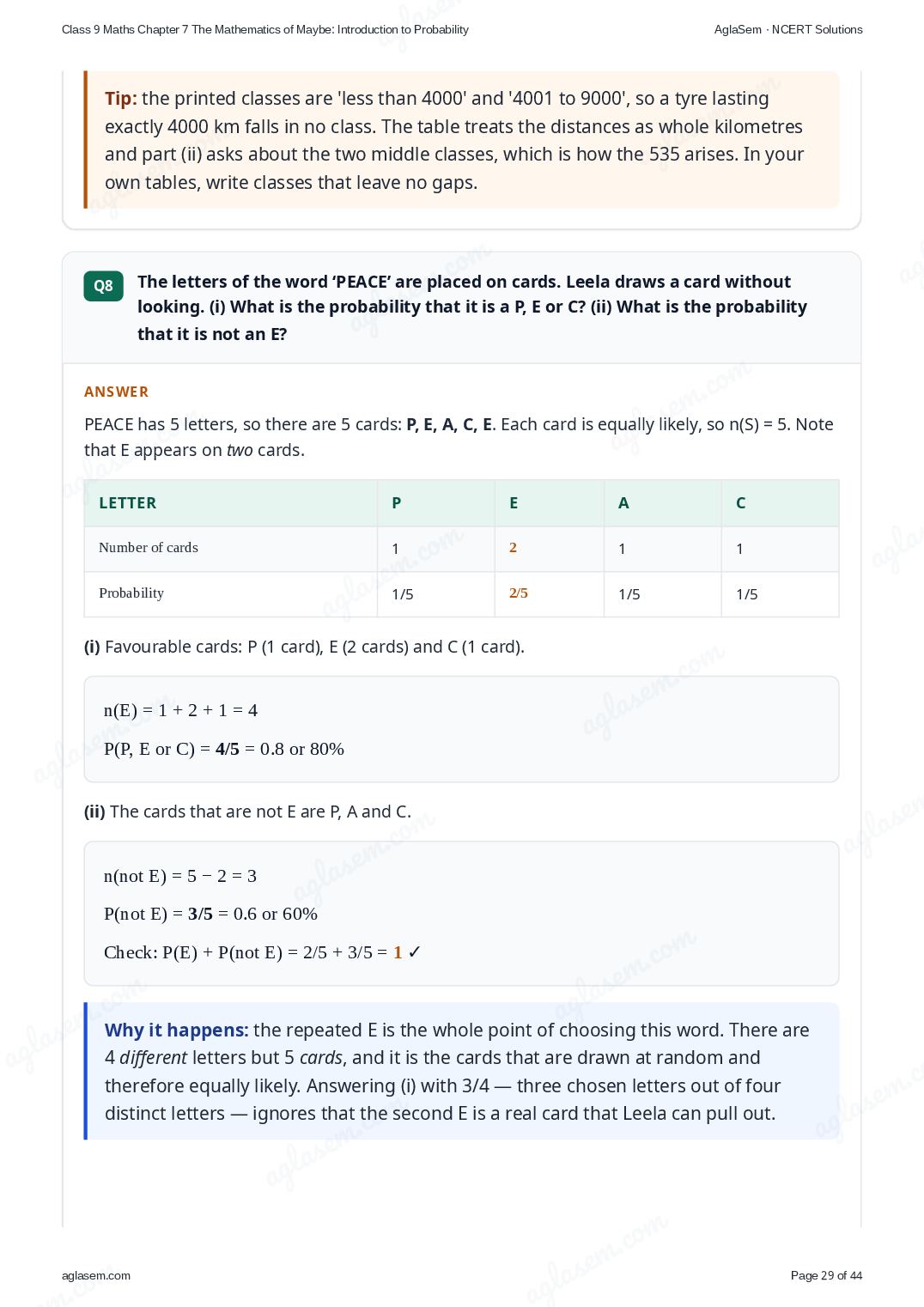
- The letters of the word ‘PEACE’ are placed on cards. Leela draws a card without looking. (i) What is the probability that it is a P, E or C? (ii) What is the probability that it is not an E?
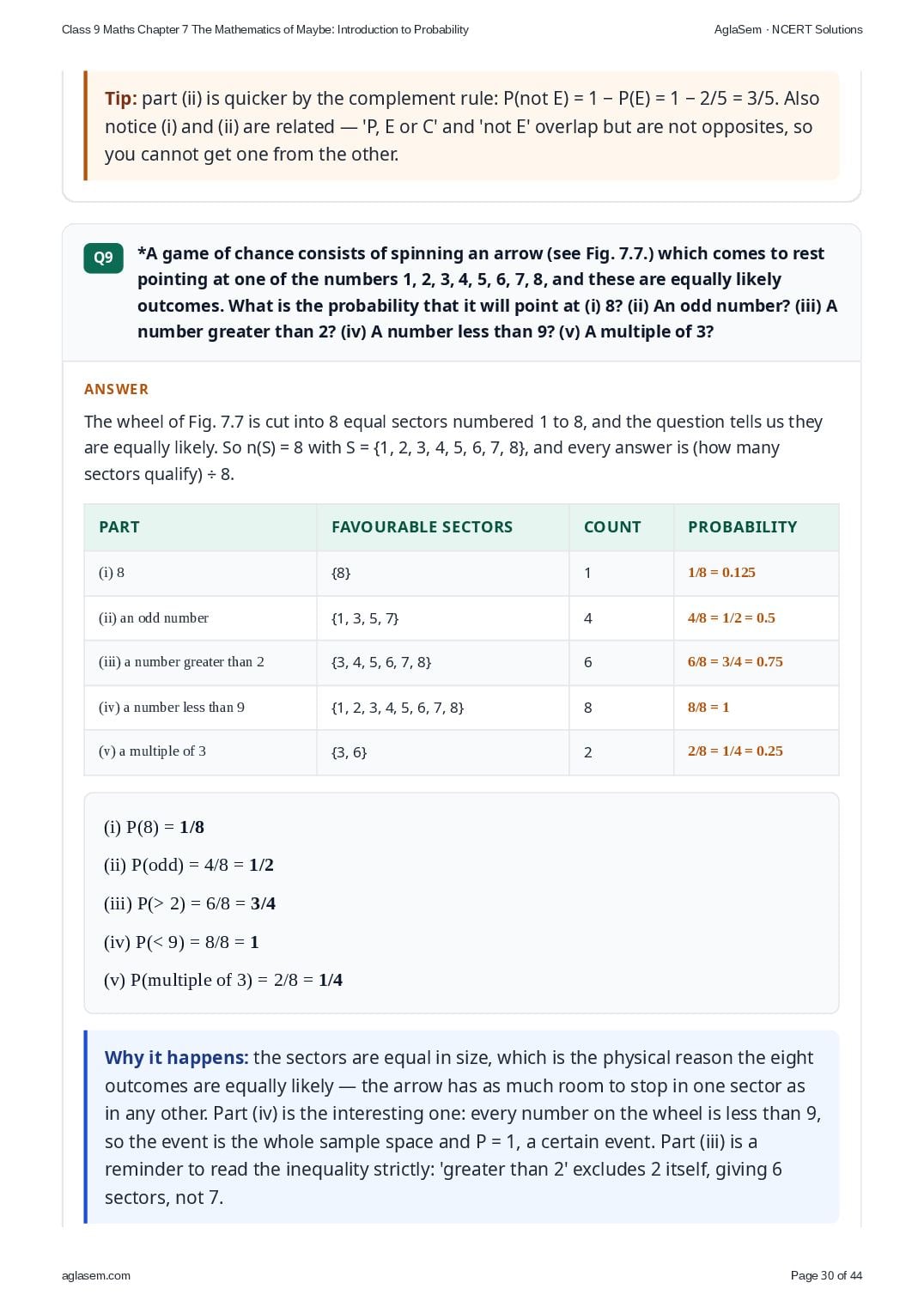
- *A game of chance consists of spinning an arrow (see Fig. 7.7.) which comes to rest pointing at one of the numbers 1, 2, 3, 4, 5, 6, 7, 8, and these are equally likely outcomes. What is the probability that it will point at (i) 8? (ii) An odd number? (iii) A number greater than 2? (iv) A number less than 9? (v) A multiple of 3?
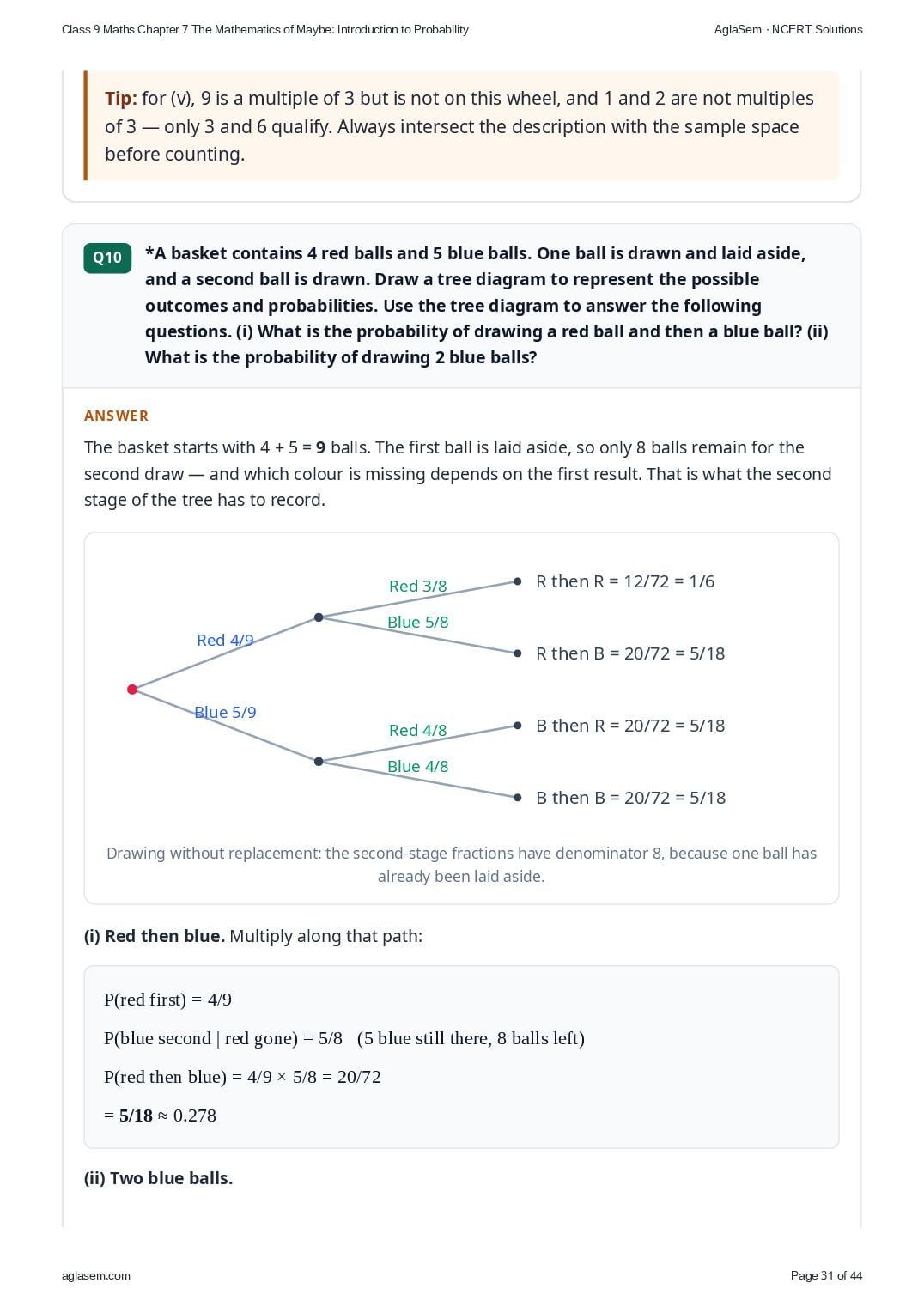
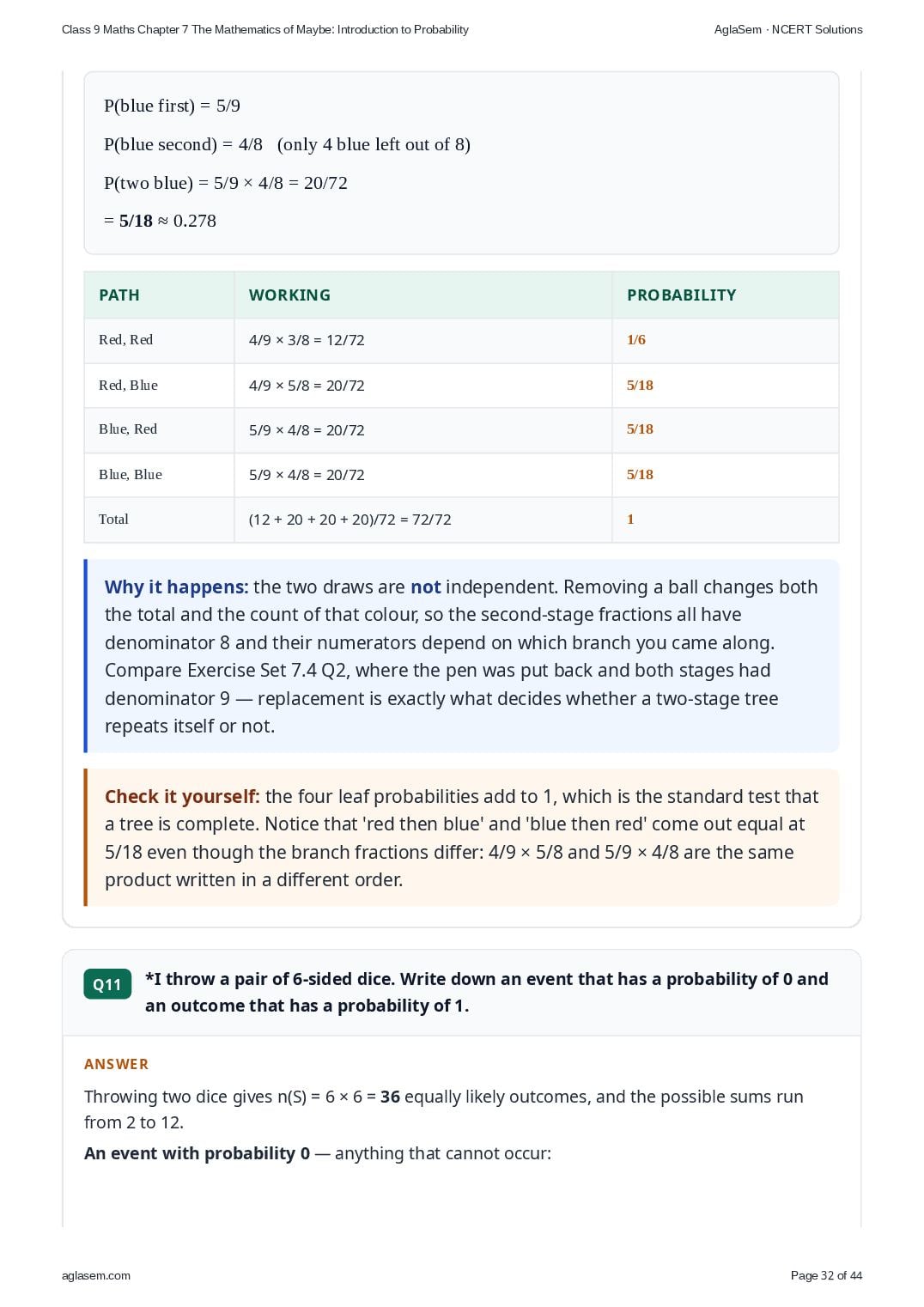
- *A basket contains 4 red balls and 5 blue balls. One ball is drawn and laid aside, and a second ball is drawn. Draw a tree diagram to represent the possible outcomes and probabilities. Use the tree diagram to answer the following questions. (i) What is the probability of drawing a red ball and then a blue ball? (ii) What is the probability of drawing 2 blue balls?
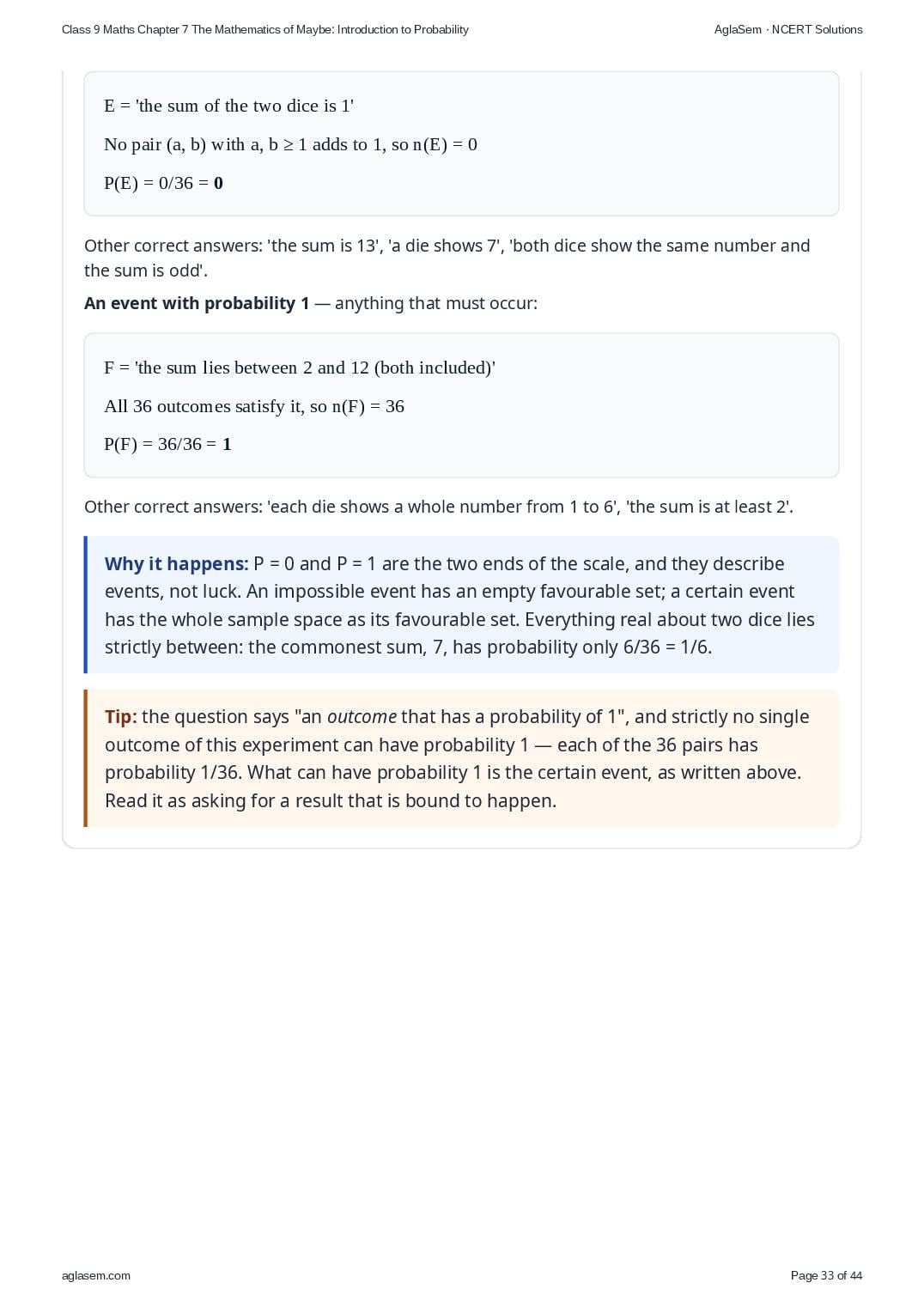
- *I throw a pair of 6-sided dice. Write down an event that has a probability of 0 and an outcome that has a probability of 1.
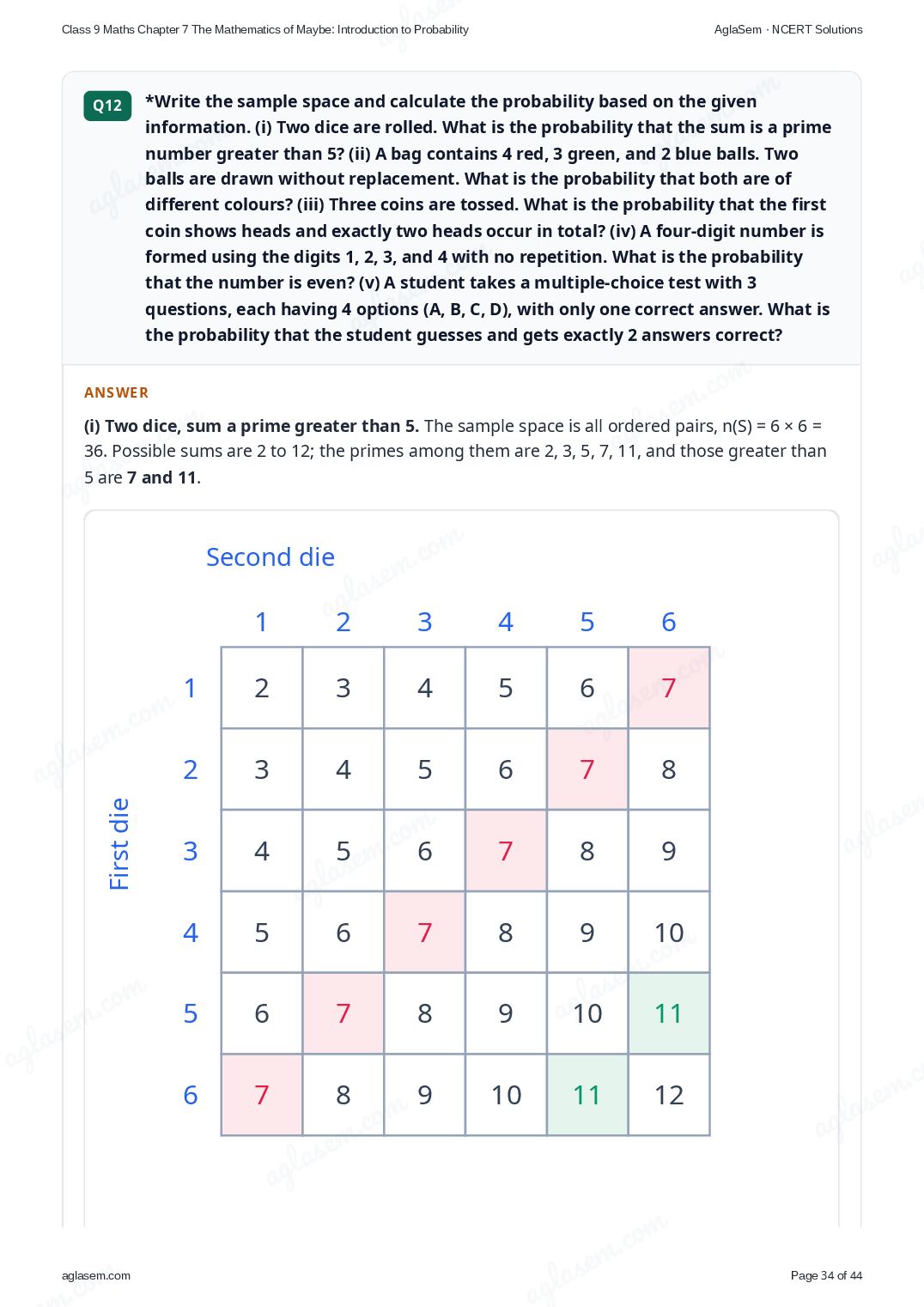
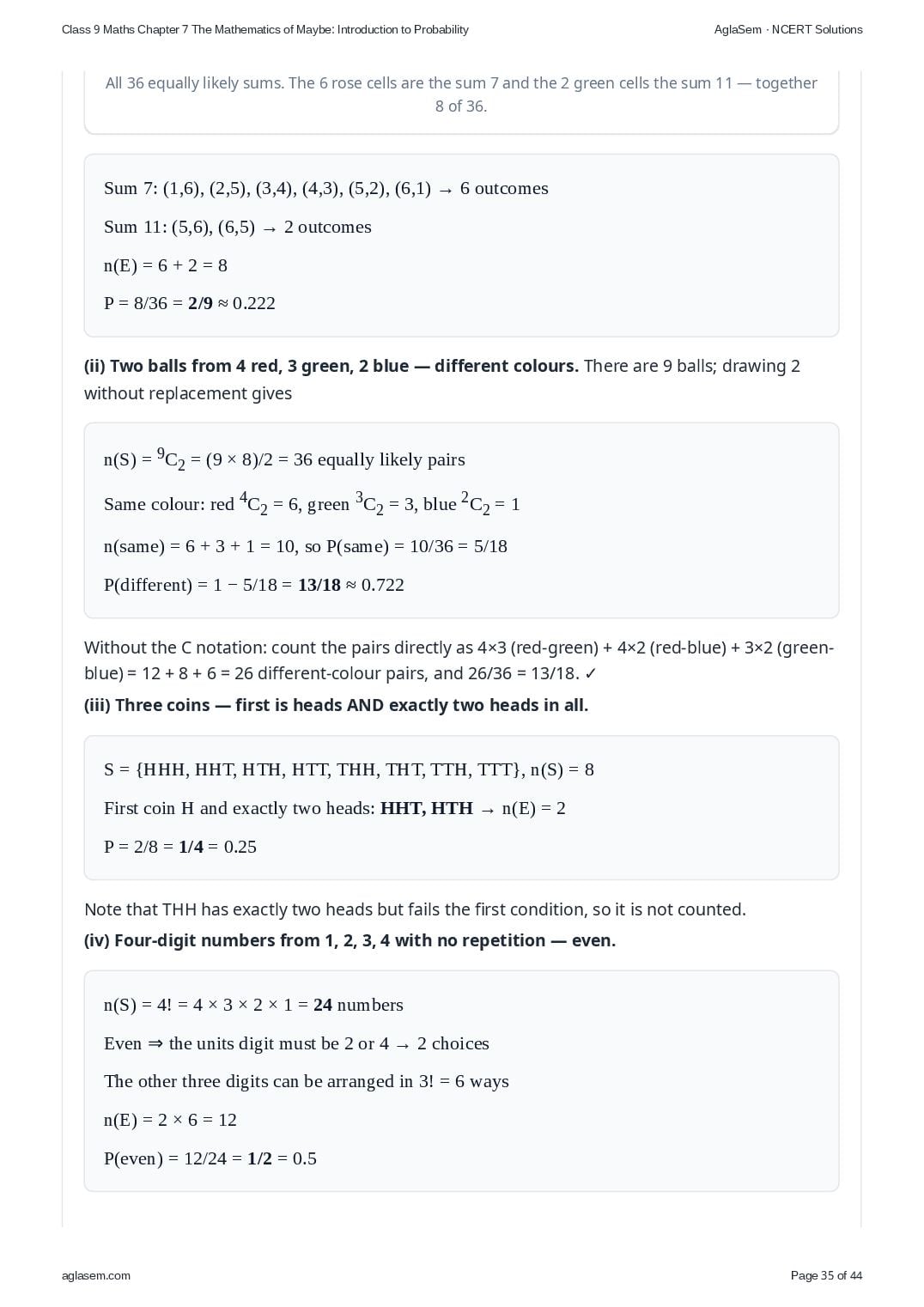
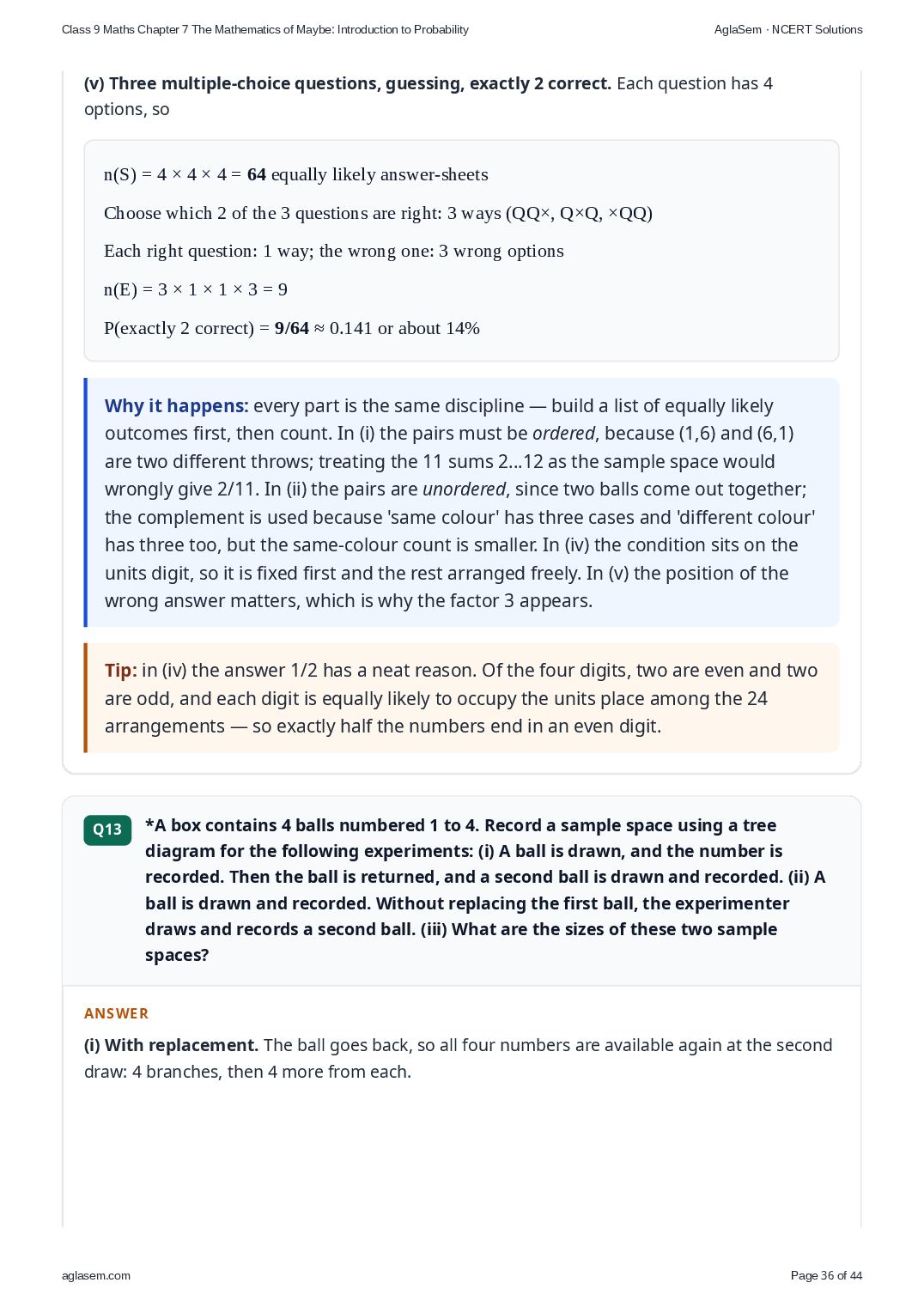
- *Write the sample space and calculate the probability based on the given information. (i) Two dice are rolled. What is the probability that the sum is a prime number greater than 5? (ii) A bag contains 4 red, 3 green, and 2 blue balls. Two balls are drawn without replacement. What is the probability that both are of different colours? (iii) Three coins are tossed. What is the probability that the first coin shows heads and exactly two heads occur in total? (iv) A four-digit number is formed using the digits 1, 2, 3, and 4 with no repetition. What is the probability that the number is even? (v) A student takes a multiple-choice test with 3 questions, each having 4 options (A, B, C, D), with only one correct answer. What is the probability that the student guesses and gets exactly 2 answers correct?
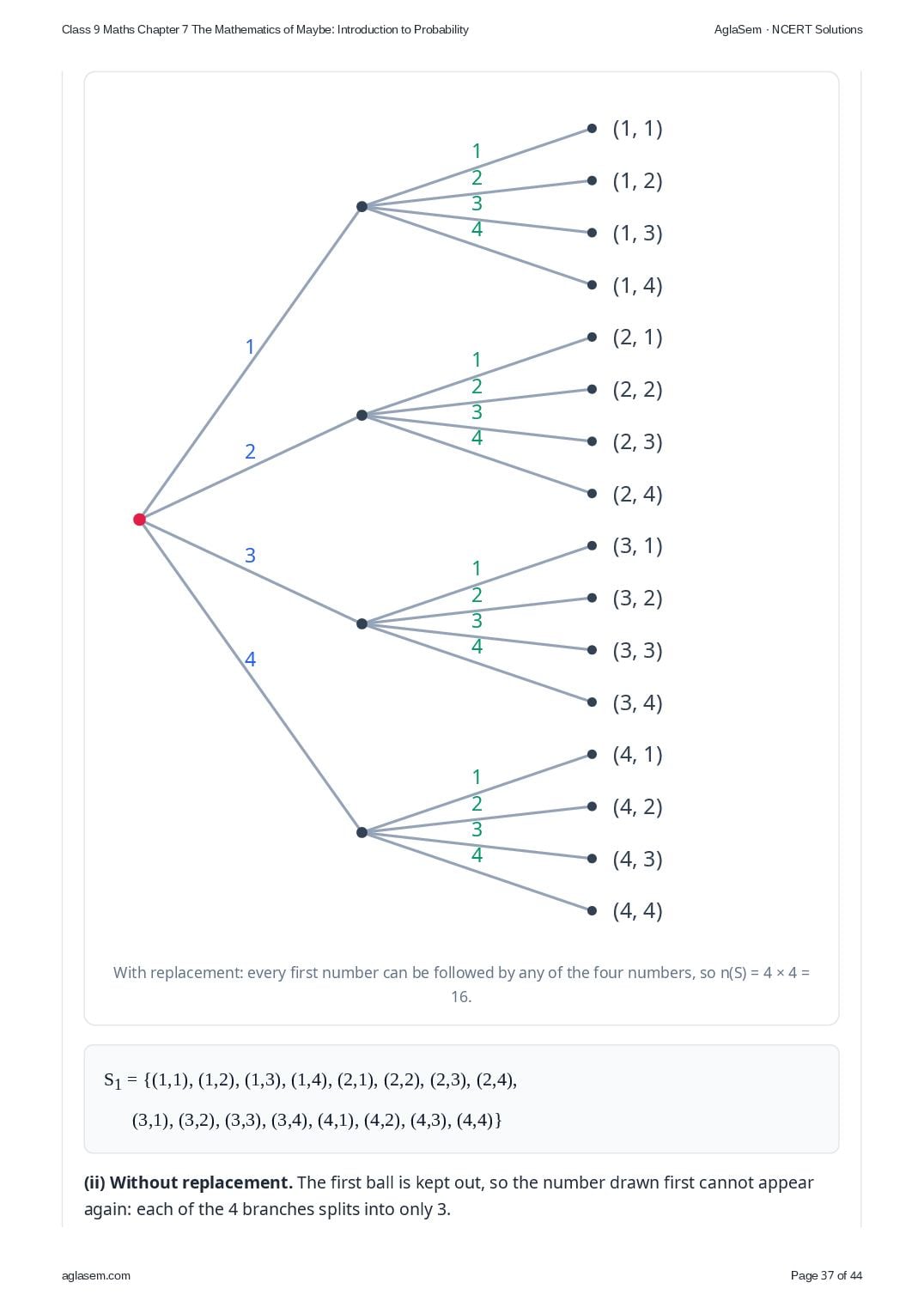
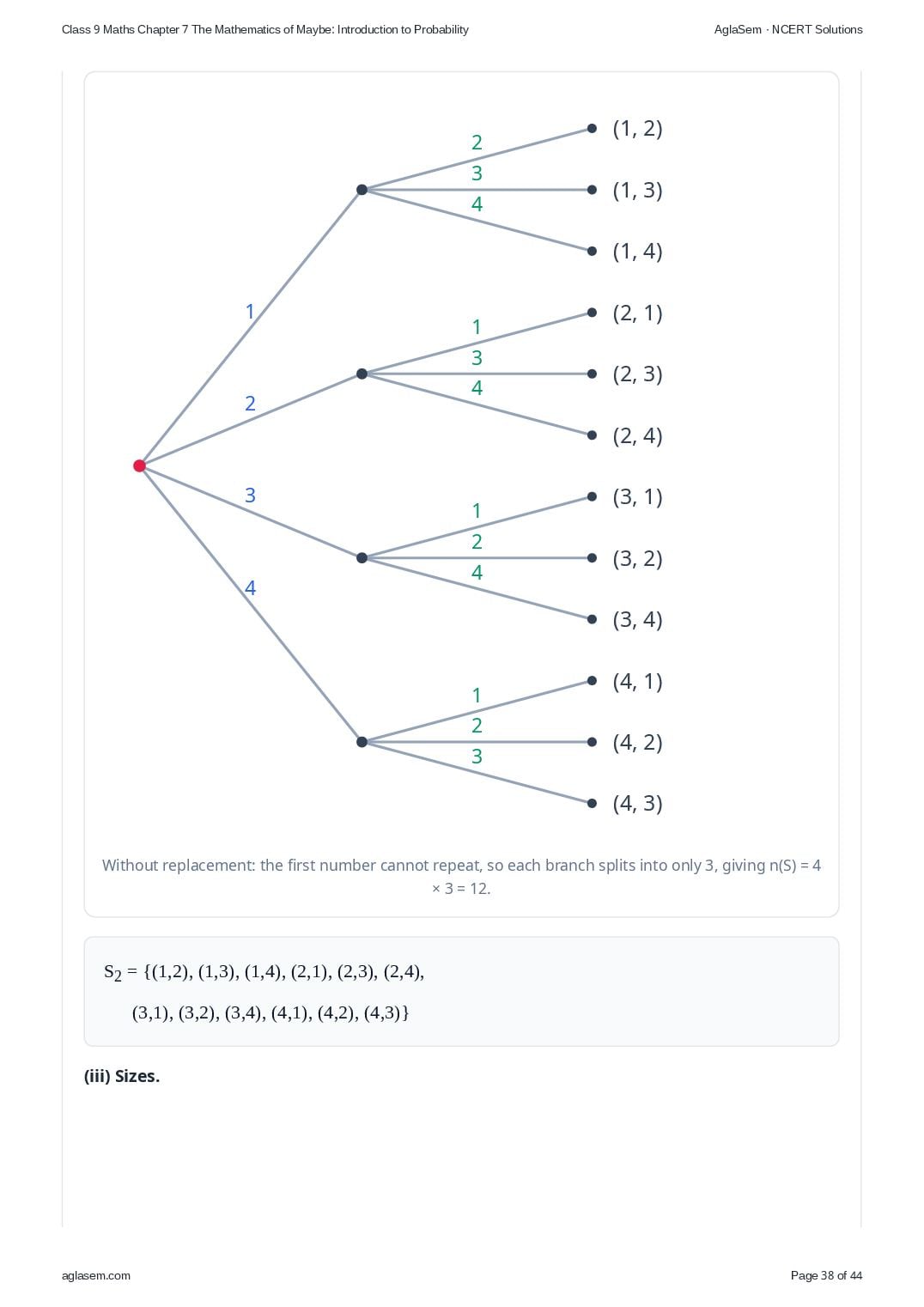
- *A box contains 4 balls numbered 1 to 4. Record a sample space using a tree diagram for the following experiments: (i) A ball is drawn, and the number is recorded. Then the ball is returned, and a second ball is drawn and recorded. (ii) A ball is drawn and recorded. Without replacing the first ball, the experimenter draws and records a second ball. (iii) What are the sizes of these two sample spaces?
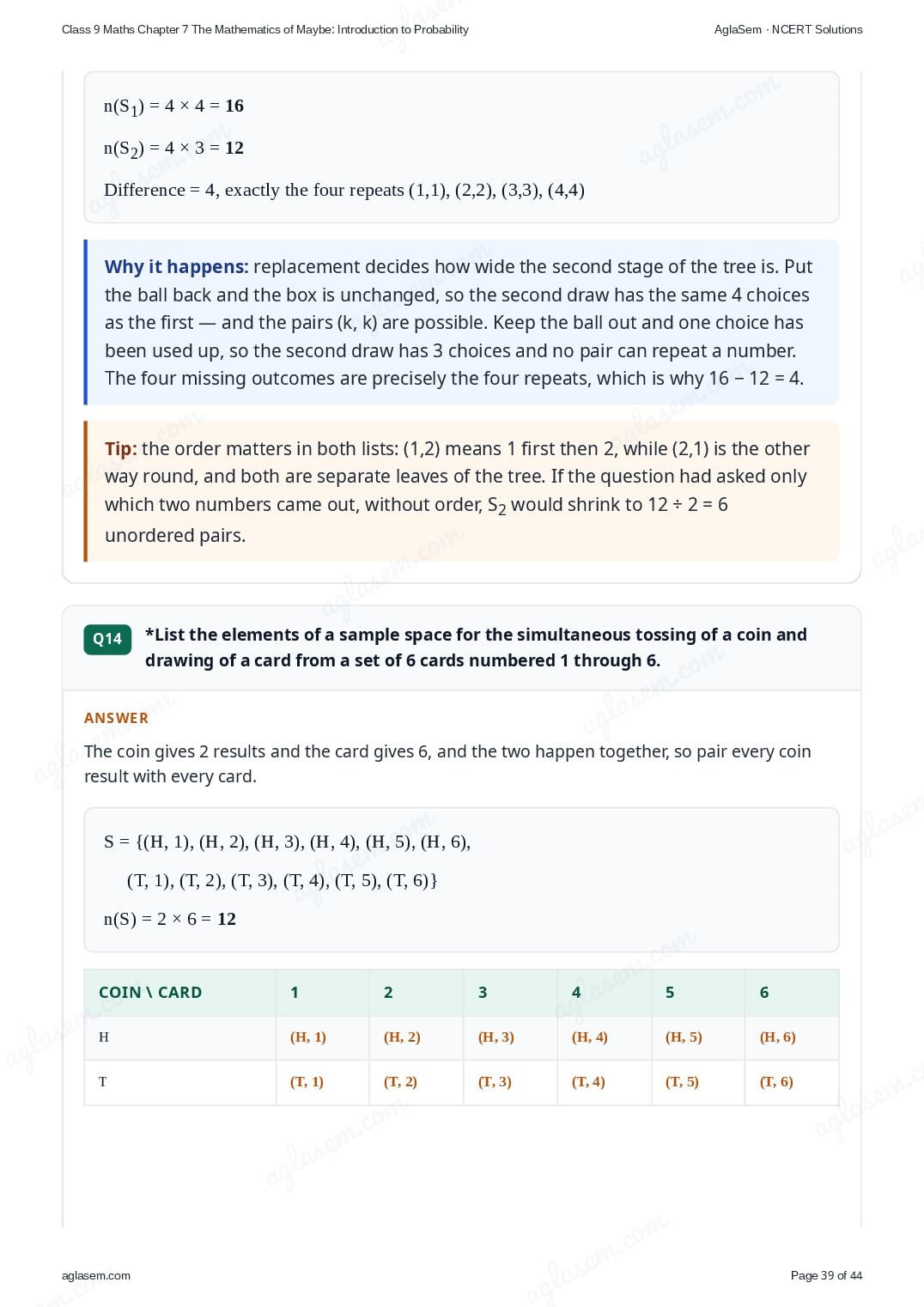
- *List the elements of a sample space for the simultaneous tossing of a coin and drawing of a card from a set of 6 cards numbered 1 through 6.
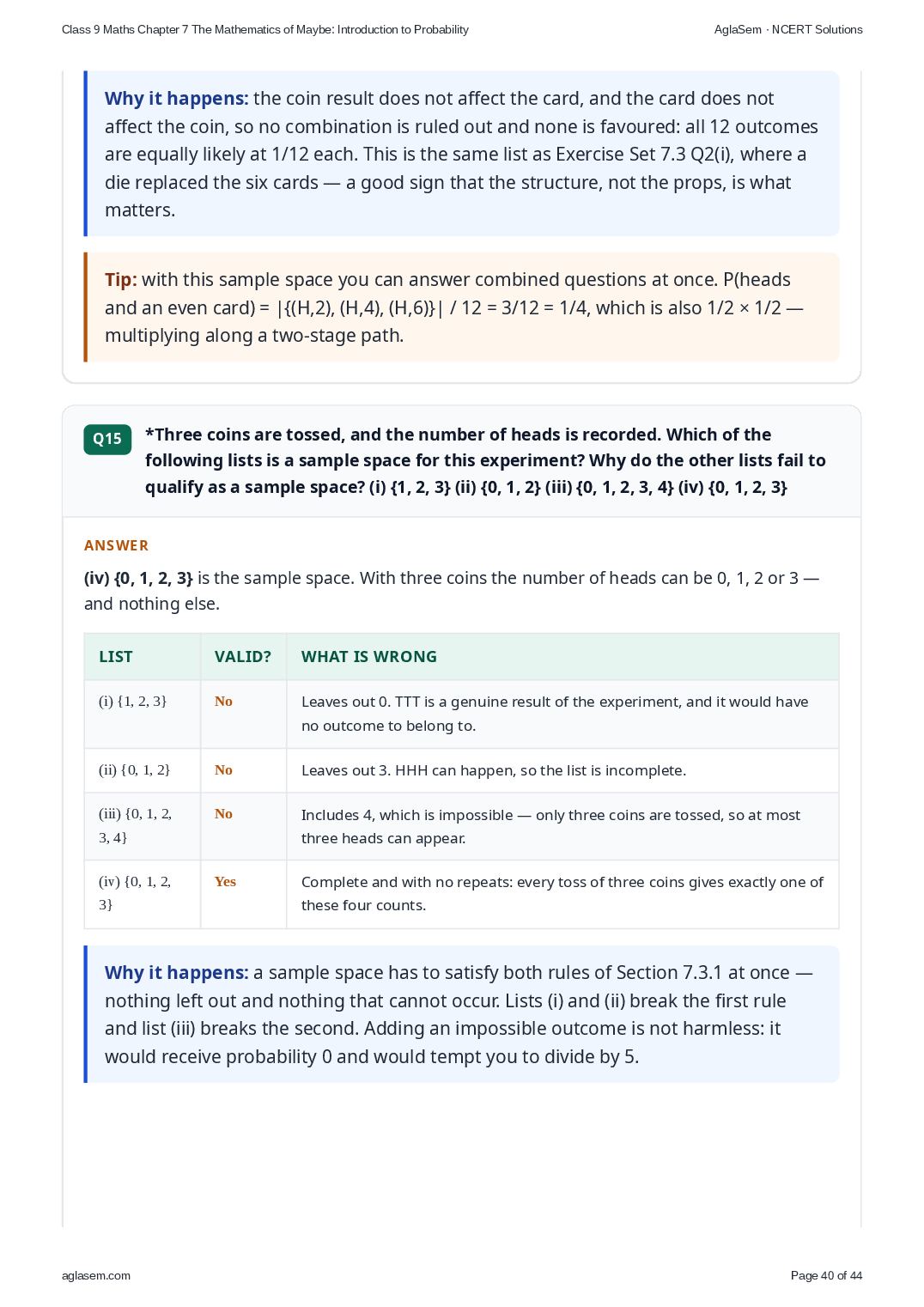
- *Three coins are tossed, and the number of heads is recorded. Which of the following lists is a sample space for this experiment? Why do the other lists fail to qualify as a sample space? (i) {1, 2, 3} (ii) {0, 1, 2} (iii) {0, 1, 2, 3, 4} (iv) {0, 1, 2, 3}
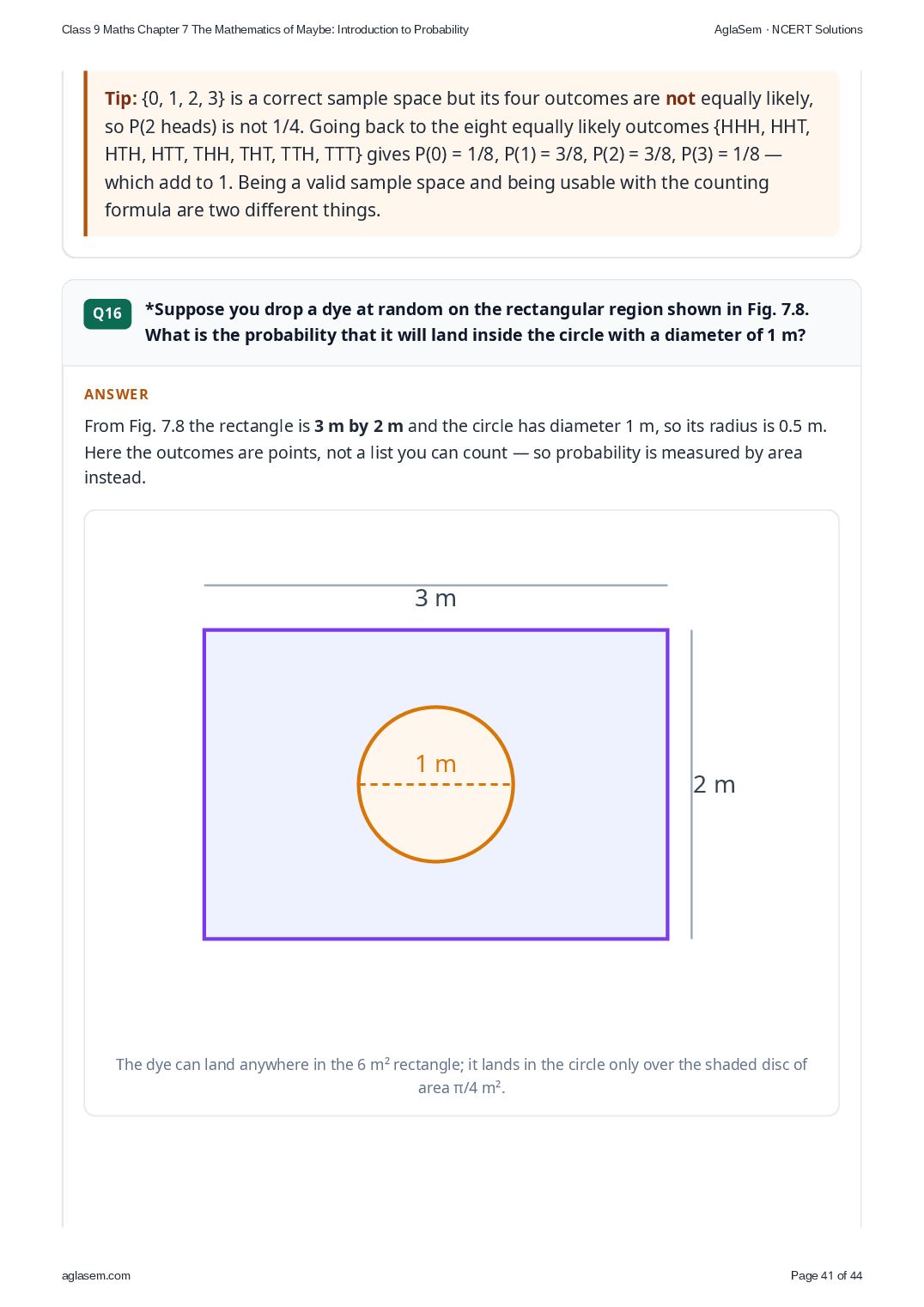
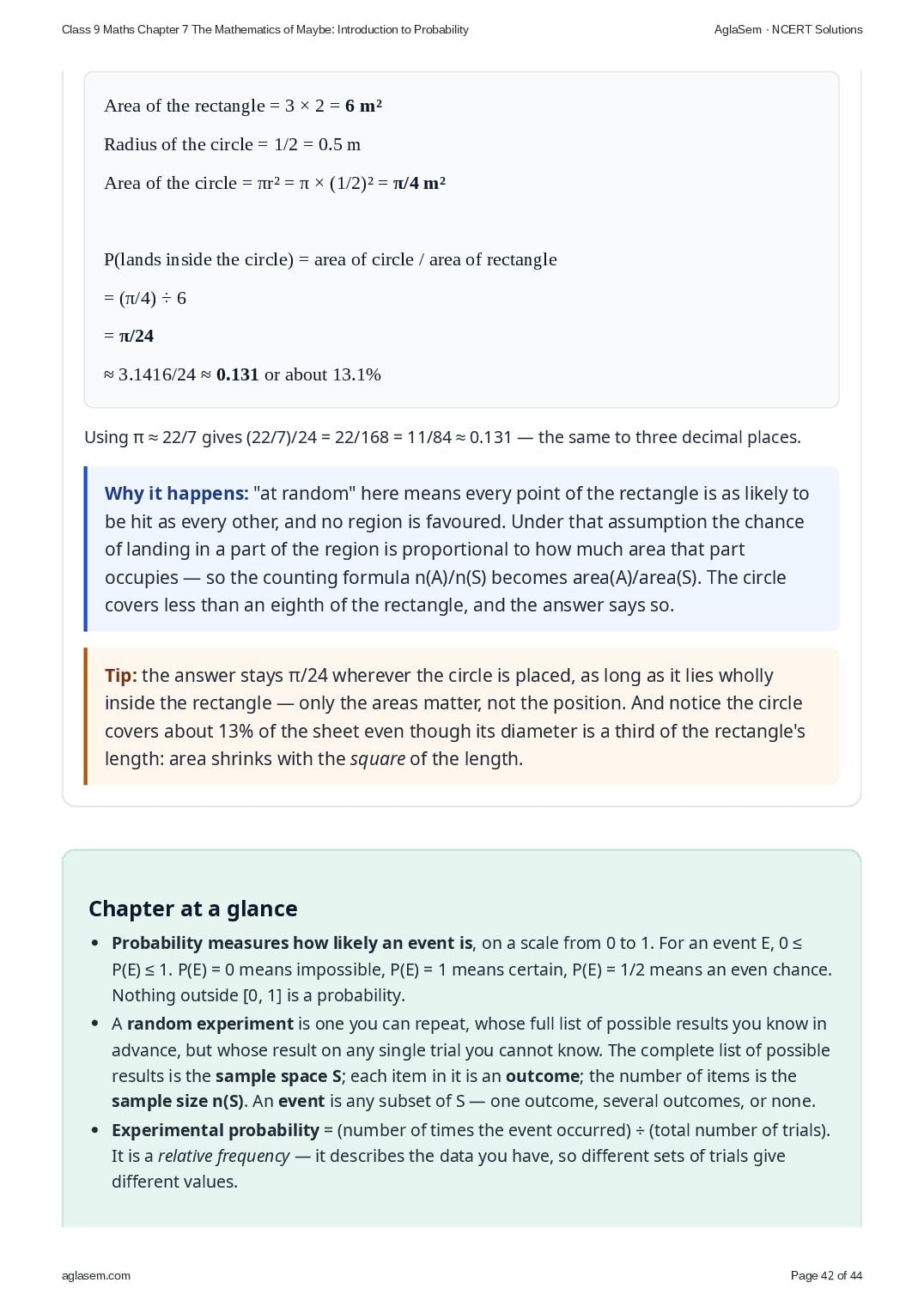
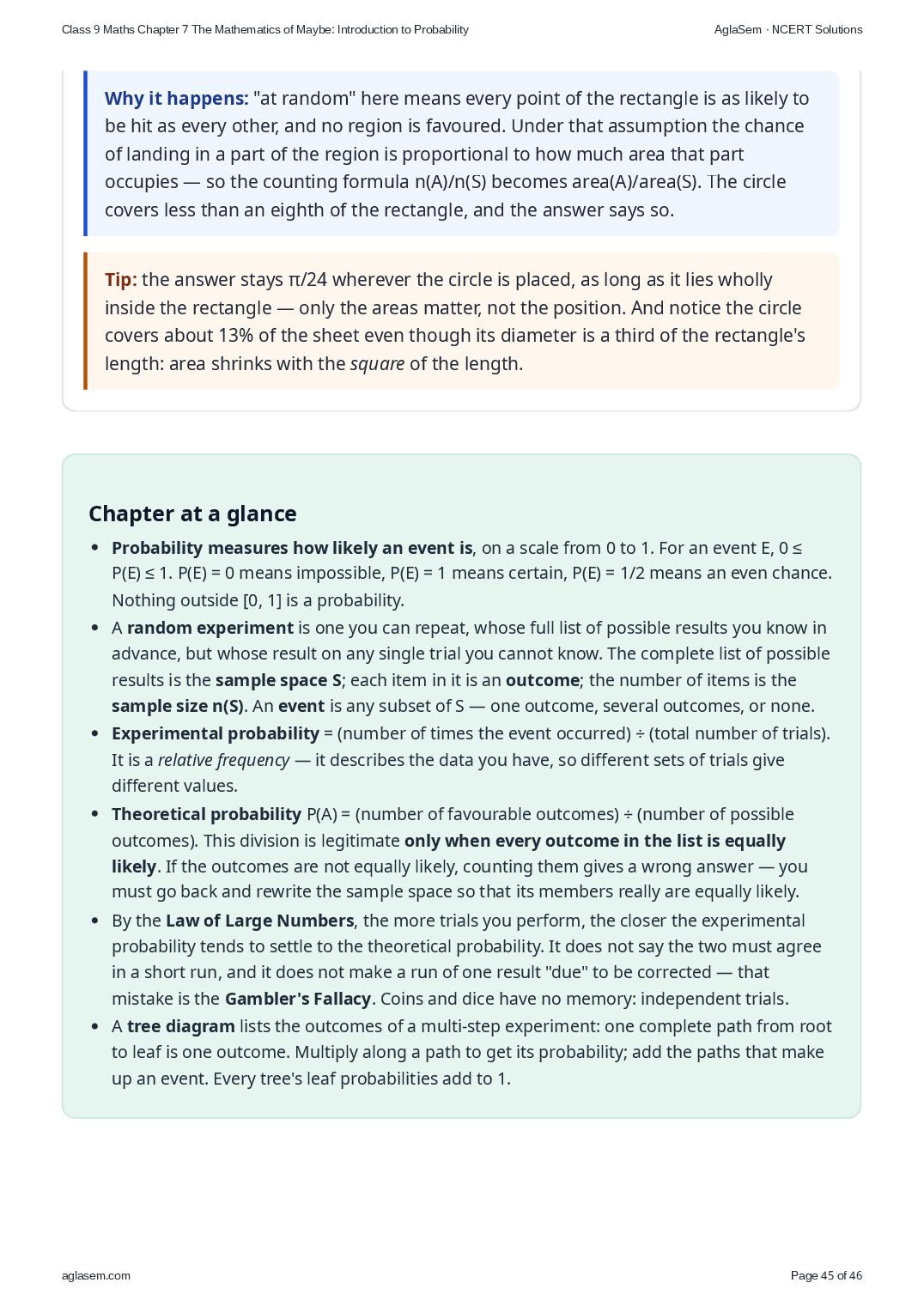
- *Suppose you drop a dye at random on the rectangular region shown in Fig. 7.8. What is the probability that it will land inside the circle with a diameter of 1 m?
Chapter at a Glance
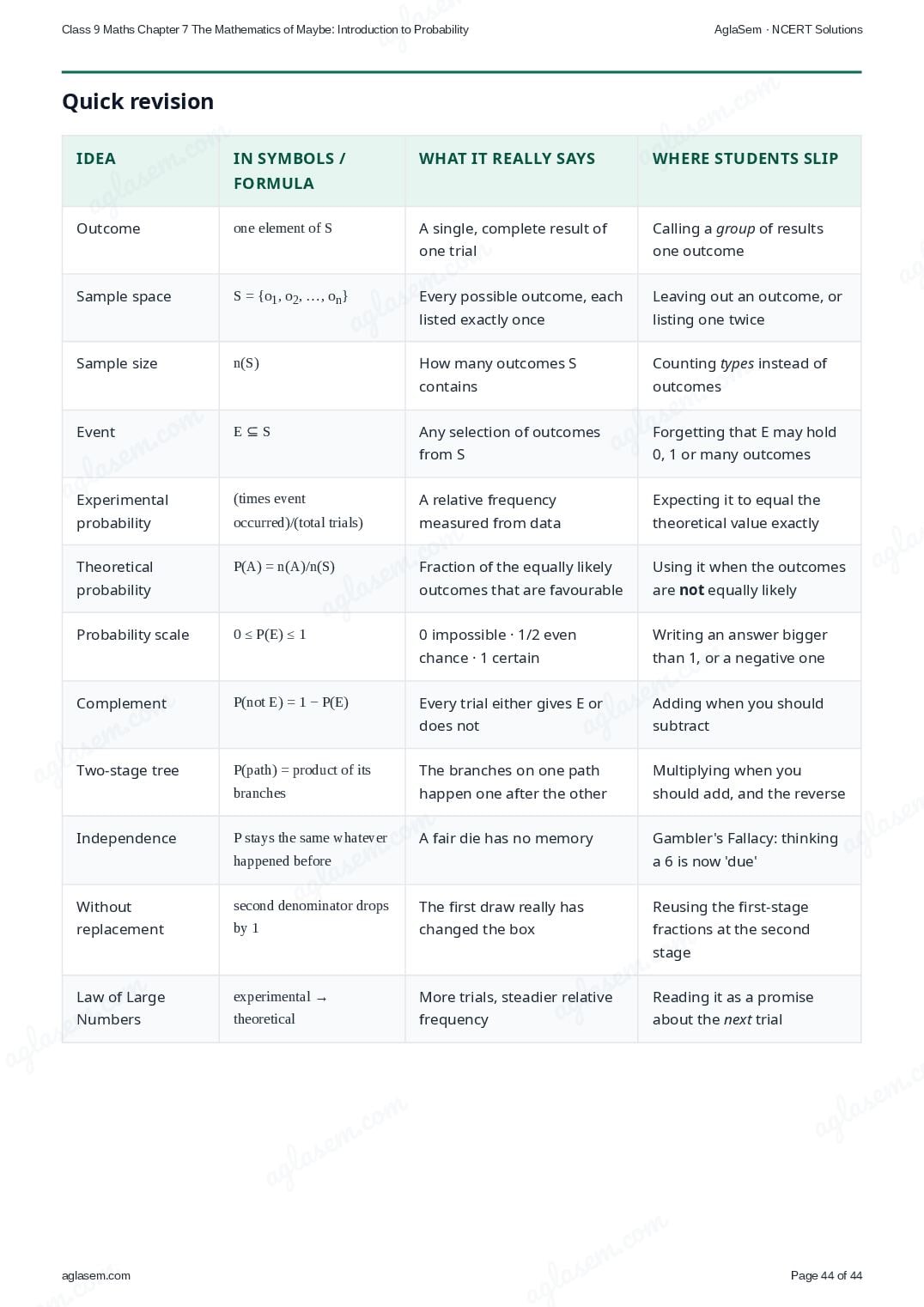
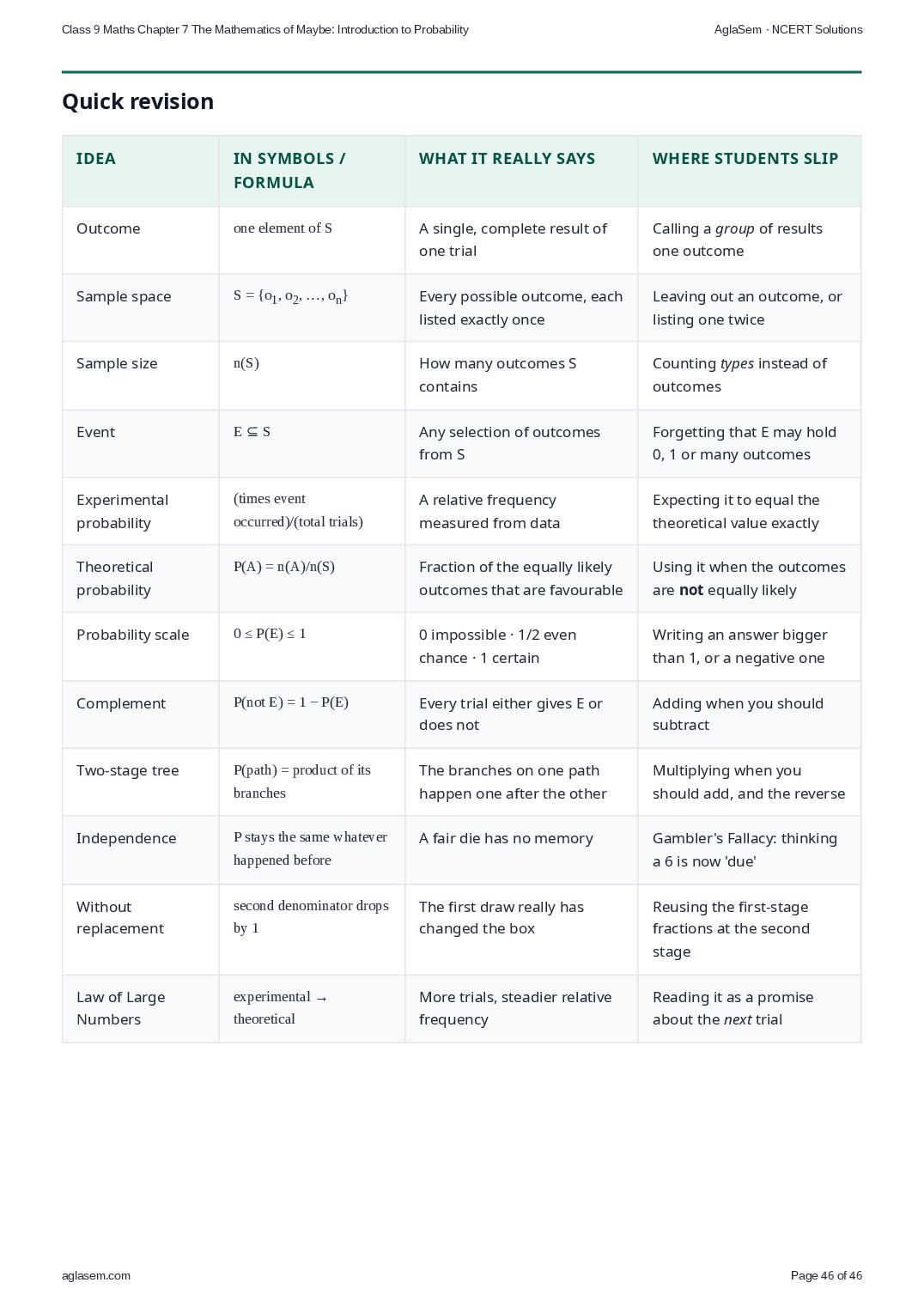
- Probability measures how likely an event is , on a scale from 0 to 1. For an event E, 0 ≤ P(E) ≤ 1. P(E) = 0 means impossible, P(E) = 1 means certain, P(E) = 1/2 means an even chance. Nothing outside [0, 1] is a probability.
- A random experiment is one you can repeat, whose full list of possible results you know in advance, but whose result on any single trial you cannot know. The complete list of possible results is the sample space S ; each item in it is an outcome ; the number of items is the sample size n(S) . An event is any subset of S — one outcome, several outcomes, or none.
- Experimental probability = (number of times the event occurred) ÷ (total number of trials). It is a relative frequency — it describes the data you have, so different sets of trials give different values.
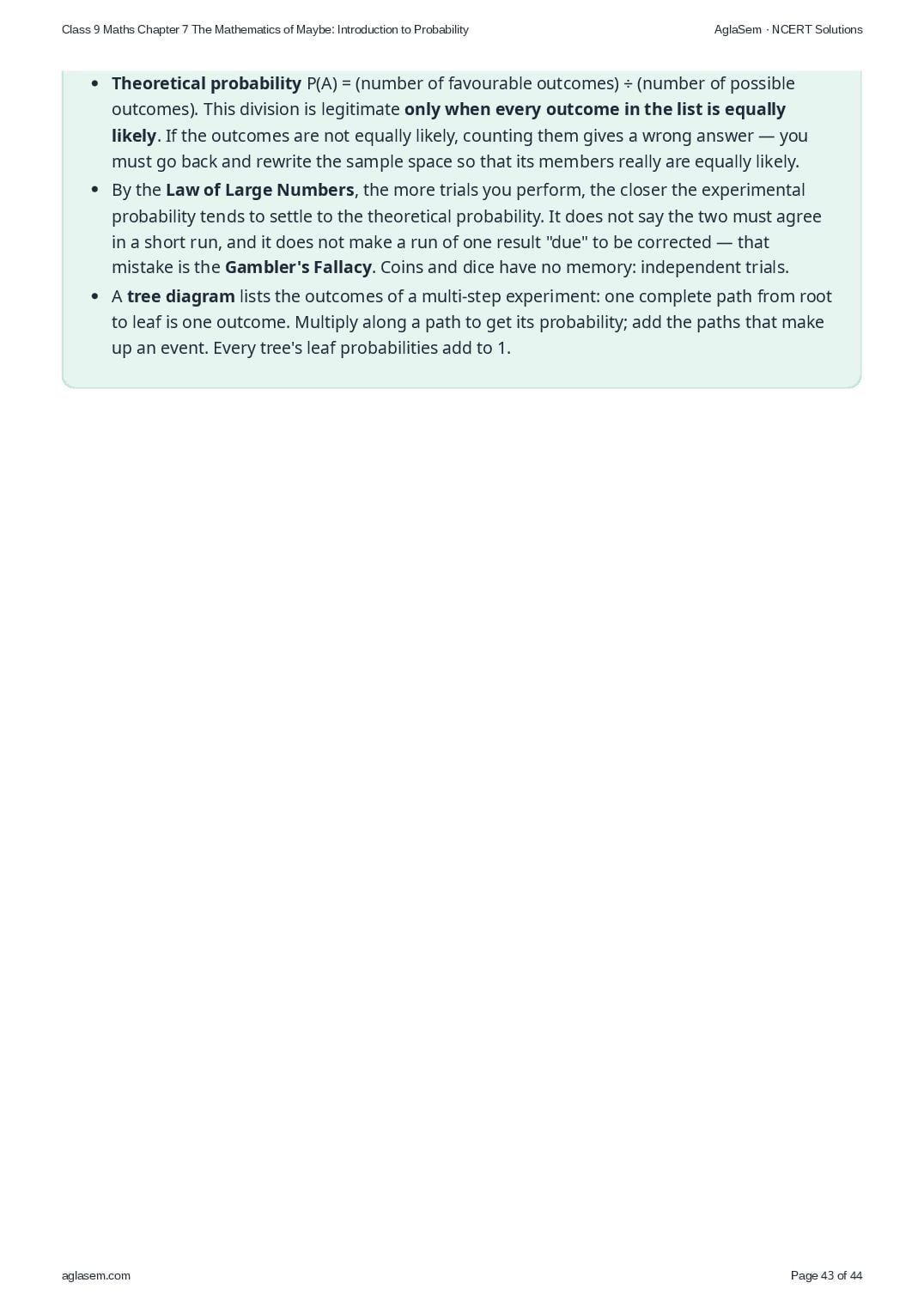
- Theoretical probability P(A) = (number of favourable outcomes) ÷ (number of possible outcomes). This division is legitimate only when every outcome in the list is equally likely . If the outcomes are not equally likely, counting them gives a wrong answer — you must go back and rewrite the sample space so that its members really are equally likely.
- By the Law of Large Numbers , the more trials you perform, the closer the experimental probability tends to settle to the theoretical probability. It does not say the two must agree in a short run, and it does not make a run of one result "due" to be corrected — that mistake is the Gambler's Fallacy . Coins and dice have no memory: independent trials.
- A tree diagram lists the outcomes of a multi-step experiment: one complete path from root to leaf is one outcome. Multiply along a path to get its probability; add the paths that make up an event. Every tree's leaf probabilities add to 1.
How to Download NCERT Solutions for Class 9 Maths Chapter 7 PDF
Follow these simple steps to get the The Mathematics of Maybe Introduction to Probability questions-and-answers PDF from Ganita Manjari.
- Search NCERT Solutions for Class 9 Maths Chapter 7 aglasem and open this page.
- Read the exercise questions with answers for The Mathematics of Maybe Introduction to Probability shown above.
- Click the Download PDF link to save the The Mathematics of Maybe Introduction to Probability solutions to your device.
NCERT Solutions for Class 9 Maths – All Chapters
There are more chapters to study besides The Mathematics of Maybe Introduction to Probability in Maths. Here are the NCERT Solutions for all chapters of Class 9 Maths.
- Chapter 1 Orienting Yourself the Use of Coordinates
- Chapter 2 Introduction to Linear Polynomials
- Chapter 3 The World of Numbers
- Chapter 4 Exploring Algebraic Identities
- Chapter 5 I M Up and Down and Round and Round
- Chapter 6 Measuring Space Perimeter and Area
- Chapter 7 The Mathematics of Maybe Introduction to Probability
- Chapter 8 Predicting What Comes Next Exploring Sequences and Progressions
NCERT Solutions for Class 9 – All Subjects
Just like Chapter 7 of Maths, you can get the exercise questions with answers for every other subject of Class 9. Here are the NCERT Solutions for all subjects of Class 9.
NCERT Solutions for Class 9 Maths Chapter 7 – An Overview
The key highlights of this study material are as follows.
| Aspects | Details |
|---|---|
| Class | Class 9 |
| Subject | Maths |
| Chapter Number | Chapter 7 |
| Chapter Name | The Mathematics of Maybe Introduction to Probability |
| Book Name | Ganita Manjari |
| Book By | NCERT (National Council of Educational Research and Training) |
| Educational Resource Here | NCERT Solutions of Class 9 Maths Chapter 7 for all exercises |
| More Questions Answers of This Subject | NCERT Solutions for Class 9 Maths |
| Download Book Chapter | NCERT Book Class 9 Maths |
| All Questions Answers For This Class | NCERT Solutions for Class 9 |
| Complete Solutions | NCERT Solutions |
NCERT Solutions for Class 9 Maths Chapter 7 The Mathematics of Maybe Introduction to Probability – FAQs
What are the NCERT Solutions for Class 9 Maths Chapter 7 The Mathematics of Maybe Introduction to Probability?
They are the complete, step-by-step answers to all the exercise and in-text questions of Chapter 7 The Mathematics of Maybe Introduction to Probability from the NCERT Class 9 Maths textbook Ganita Manjari, written by experts as per the latest NCERT syllabus.
How can I download the Class 9 Maths Chapter 7 solutions PDF for free?
Open this page on aglasem, read the The Mathematics of Maybe Introduction to Probability questions with answers, and click the “Download Solutions PDF” link. The Class 9 Maths Chapter 7 NCERT Solutions PDF is completely free to download.
Are these NCERT Solutions as per the latest 2026-27 syllabus?
Yes. The NCERT Solutions for Class 9 Maths Chapter 7 are based on the latest NCERT textbook Ganita Manjari and the current 2026-27 CBSE syllabus, so the questions and answers match what you study in class.
Where can I get NCERT Solutions for the other chapters of Class 9 Maths?
You can find the answers to every chapter on the NCERT Solutions for Class 9 Maths page, and solutions for every subject on the NCERT Solutions for Class 9 page.
How do NCERT Solutions help in exam preparation?
They show the correct method to solve each question, help you write answers the way they are expected in exams, let you check and correct your own work, and save revision time — which together improve your marks in Class 9 Maths.
If you have any queries on NCERT Solutions for Class 9 Maths Chapter 7 The Mathematics of Maybe Introduction to Probability, then please ask in the comments below.