NCERT Solutions for Class 9 Maths Chapter 6 Measuring Space Perimeter and Area provide clear, step-by-step answers to every exercise and in-text question from the chapter Measuring Space Perimeter and Area of the NCERT textbook Ganita Manjari. Prepared by subject experts as per the latest NCERT (CBSE) syllabus for 2026-27, these NCERT Solutions for Class 9 Maths help you understand each concept, write exam-ready answers, and check your own solutions. You can read them online below or download the free Class 9 Maths Chapter 6 question-answer PDF.
NCERT Solutions for Class 9 Maths Chapter 6 Measuring Space Perimeter and Area
- Class: Class 9
- Subject: Maths
- Chapter: Chapter 6 – Measuring Space Perimeter and Area
- Textbook: Ganita Manjari (NCERT)
- Study material: NCERT Solutions – questions with answers, free PDF
These solutions answer all the exercise questions of Chapter 6 Measuring Space Perimeter and Area — including the in-text questions, short-answer and long-answer questions, and activities — with complete explanations so you can follow the method, not just the final answer. Read the full solutions below.
NCERT Solutions Class 9 Maths Chapter 6 Measuring Space Perimeter and Area View Download
NCERT Solutions for Class 9 Maths Chapter 6 PDF Download
You can read the NCERT Solutions for Class 9 Maths Chapter 6 online above, or download the complete question-answer PDF to study Measuring Space Perimeter and Area offline at any time.
NCERT Solutions for Class 9 Maths Chapter 6 PDF Download Link – Click Here to Download Solutions PDF
Questions Covered in This Chapter
These NCERT Solutions answer all 80 questions of this chapter. The questions solved are:
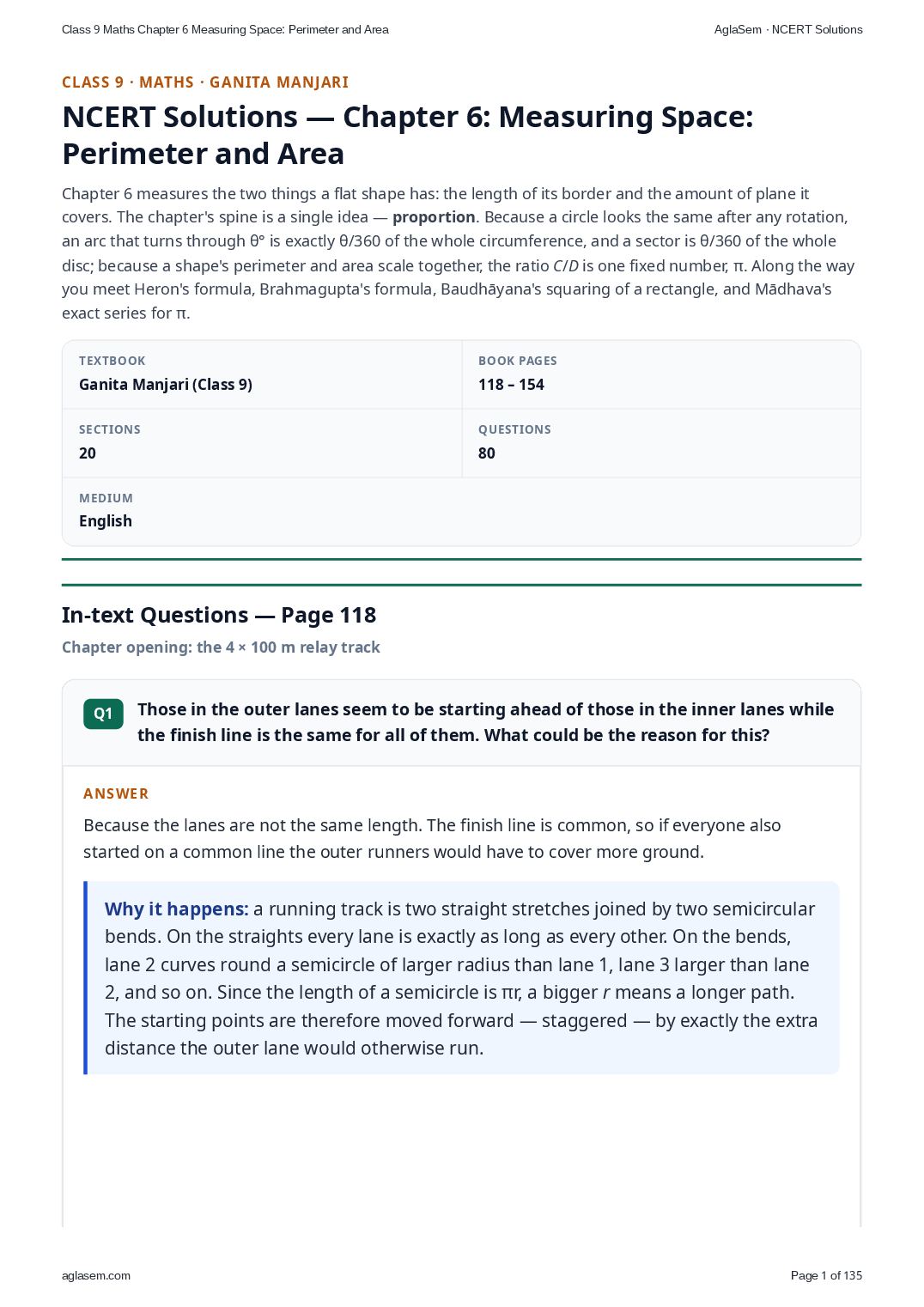
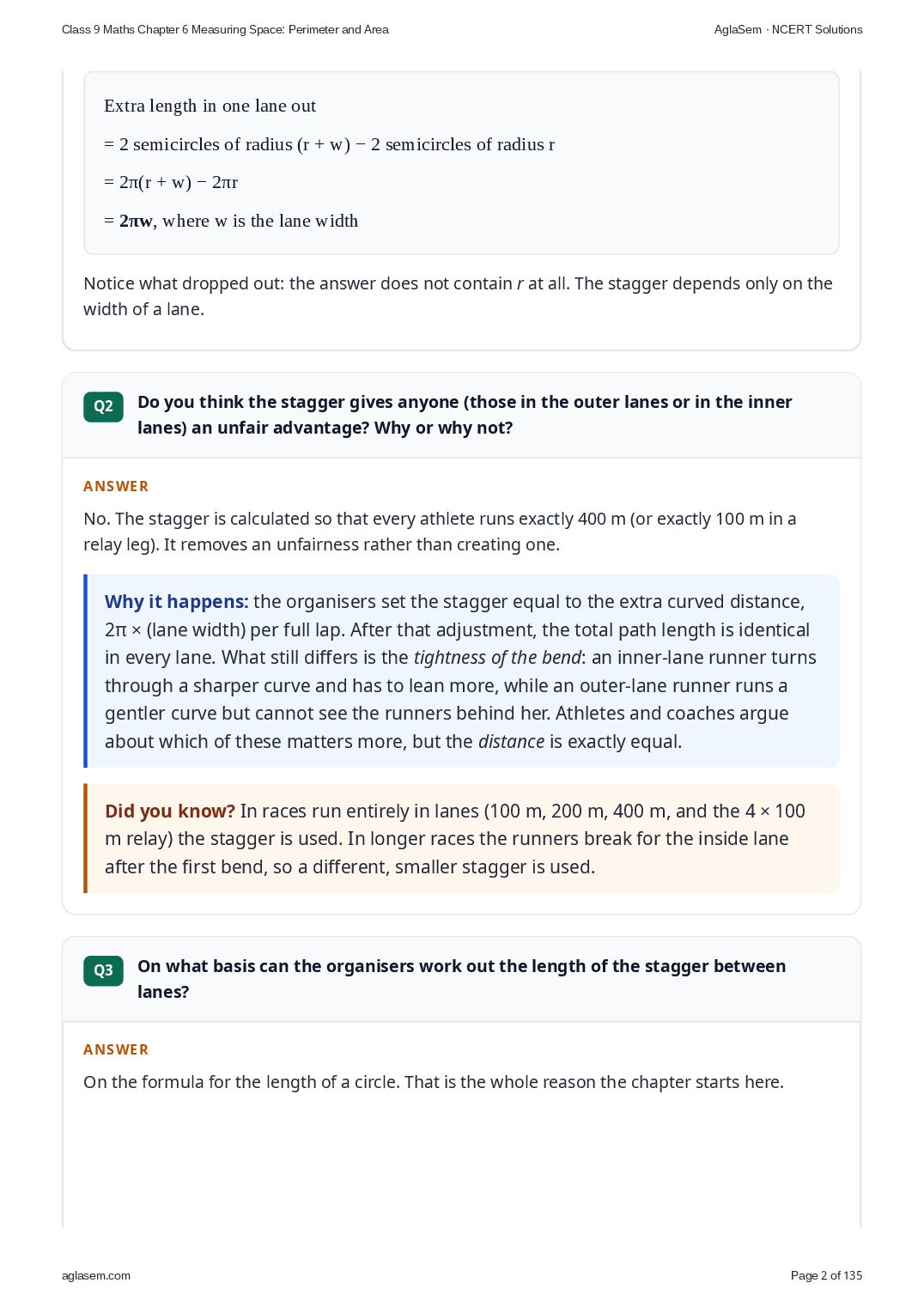
- Those in the outer lanes seem to be starting ahead of those in the inner lanes while the finish line is the same for all of them. What could be the reason for this?
- Do you think the stagger gives anyone (those in the outer lanes or in the inner lanes) an unfair advantage? Why or why not?
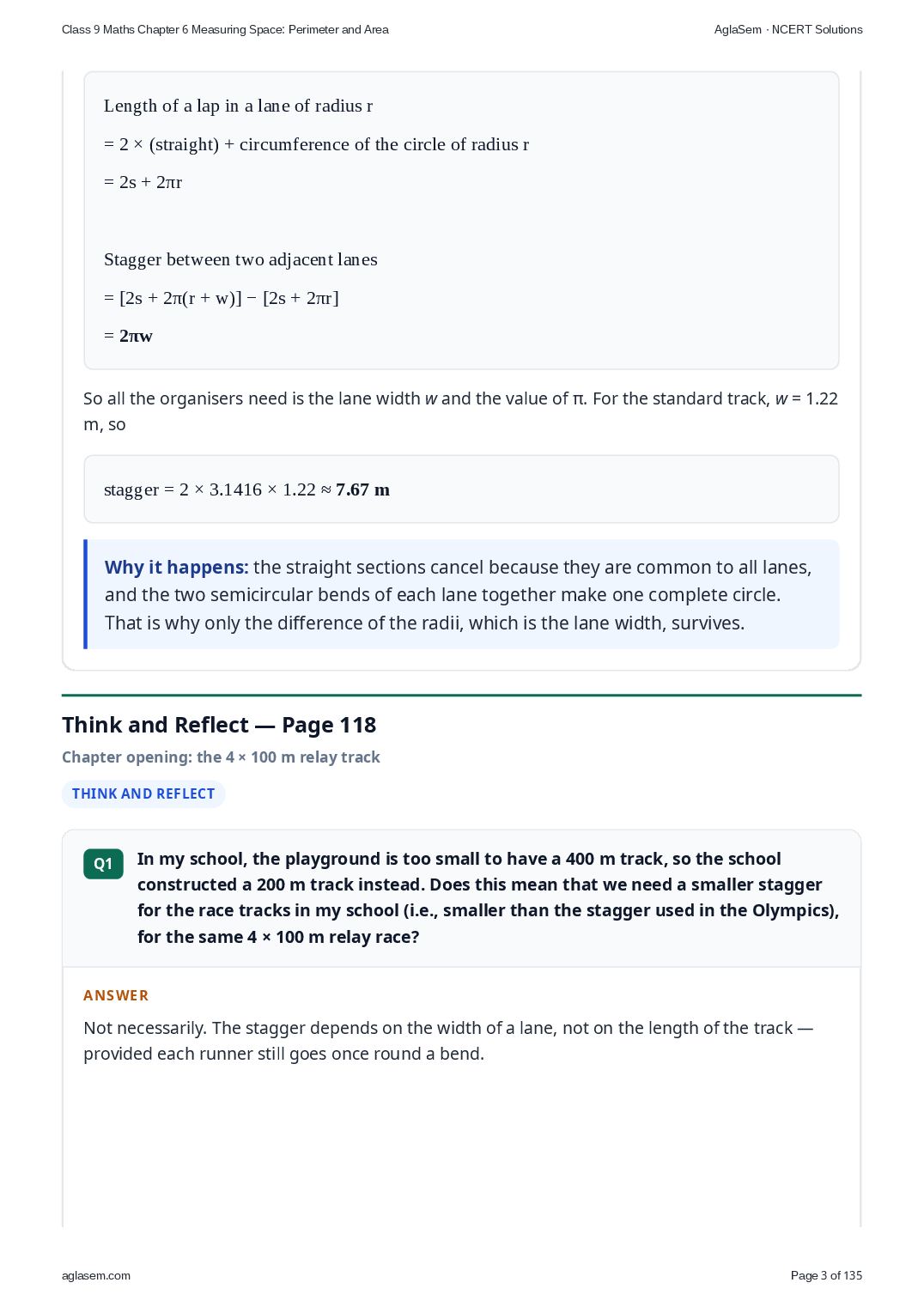
- On what basis can the organisers work out the length of the stagger between lanes?
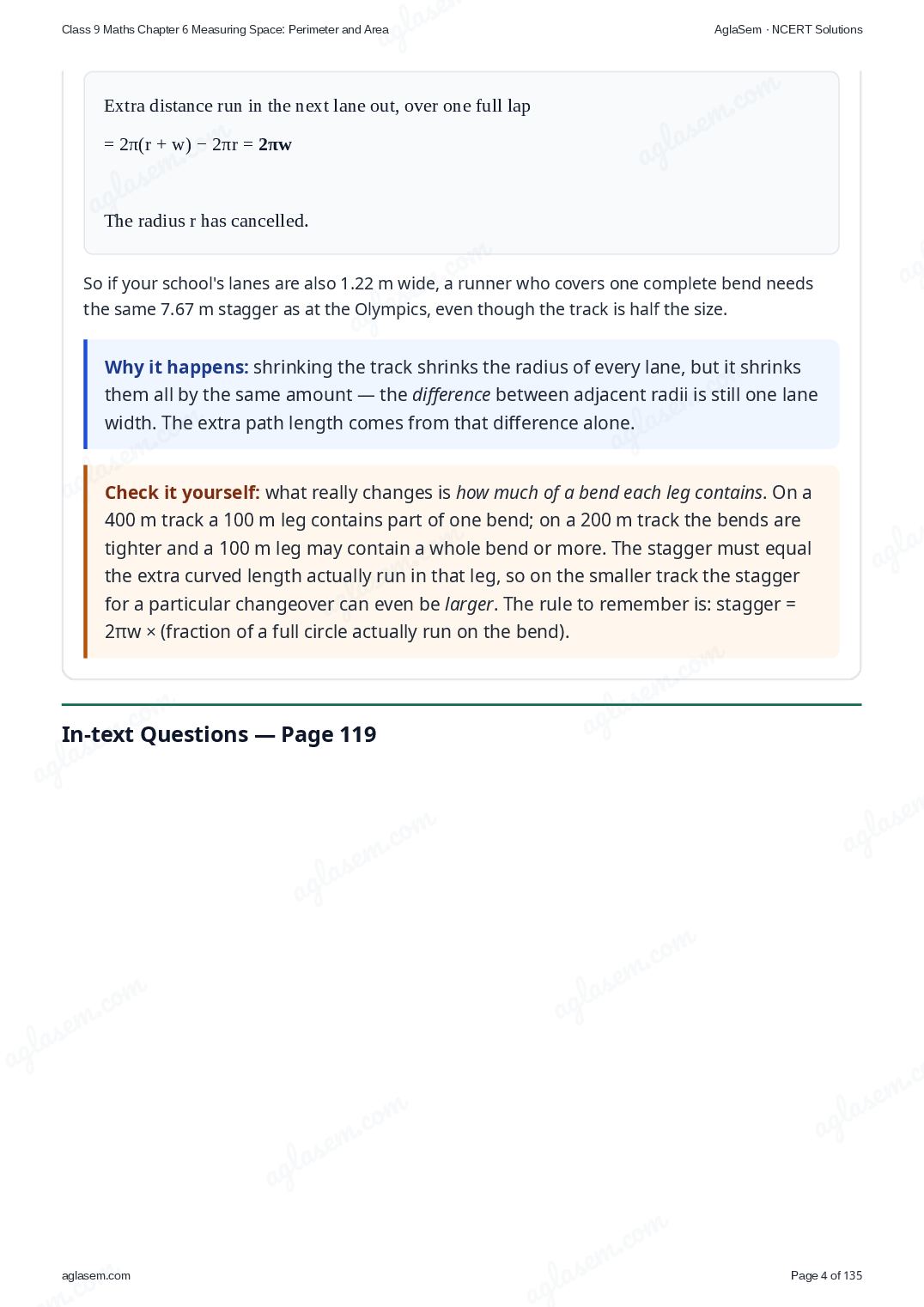
- In my school, the playground is too small to have a 400 m track, so the school constructed a 200 m track instead. Does this mean that we need a smaller stagger for the race tracks in my school (i.e., smaller than the stagger used in the Olympics), for the same 4 × 100 m relay race?
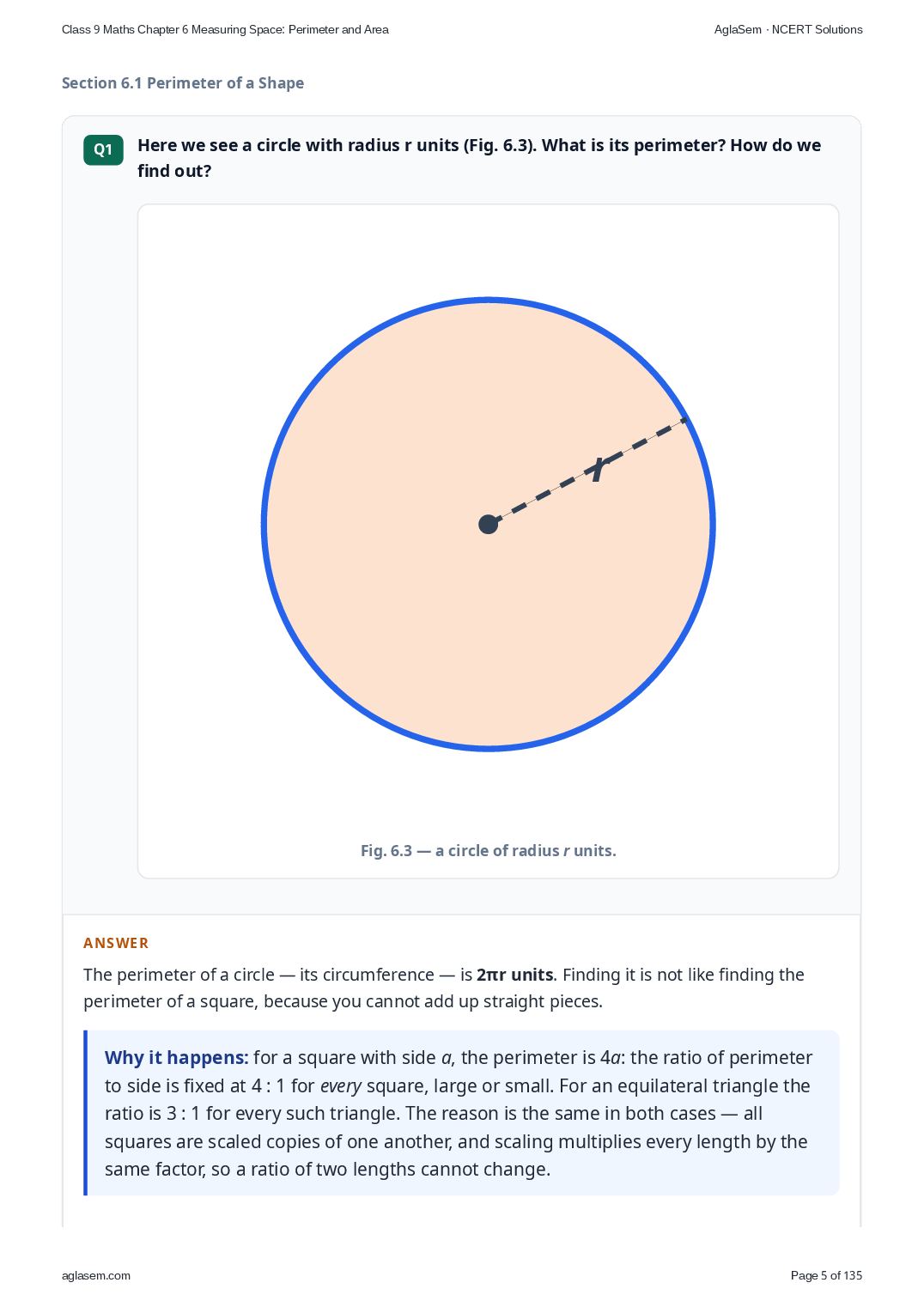
- Here we see a circle with radius r units (Fig. 6.3). What is its perimeter? How do we find out?
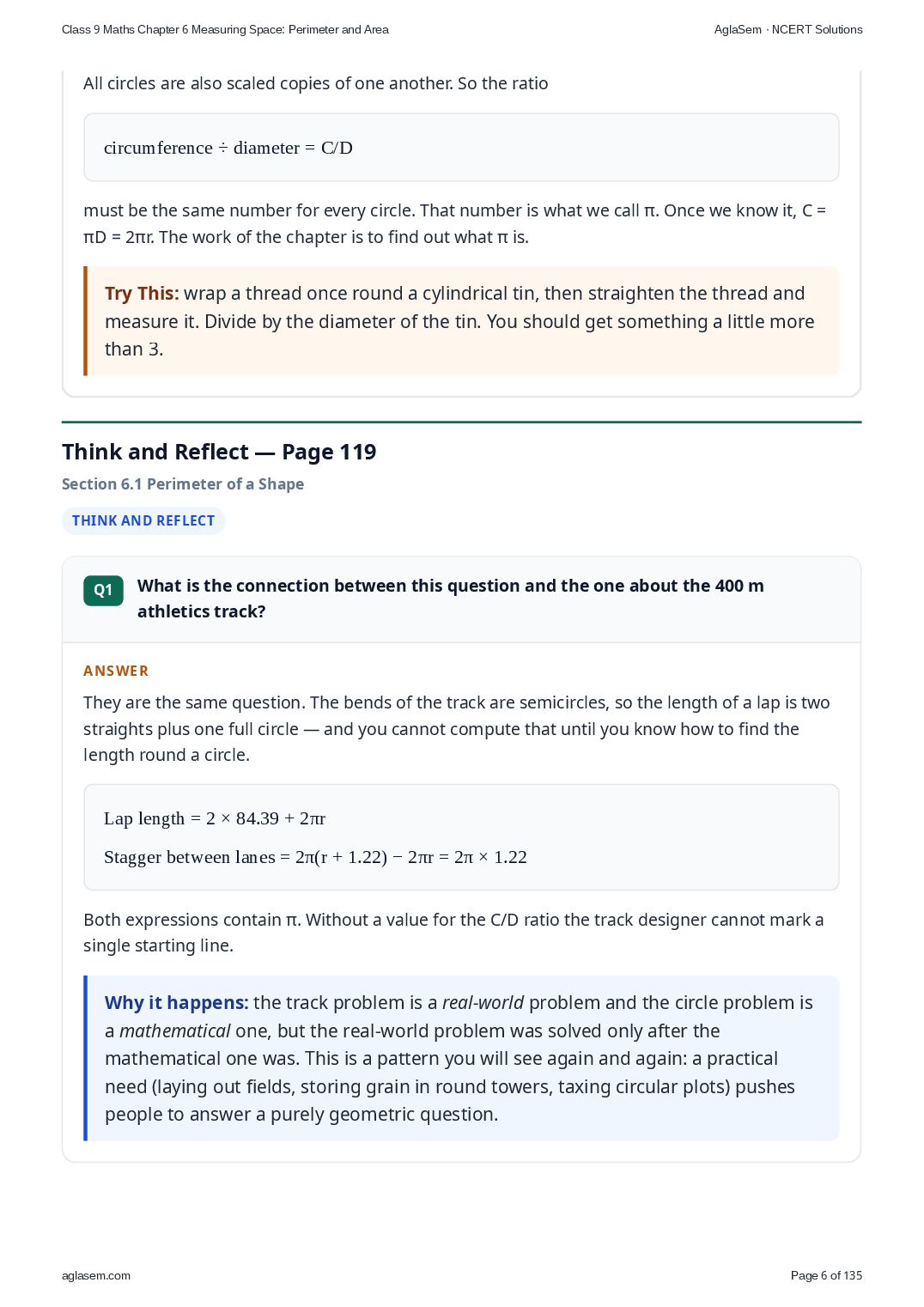
- What is the connection between this question and the one about the 400 m athletics track?
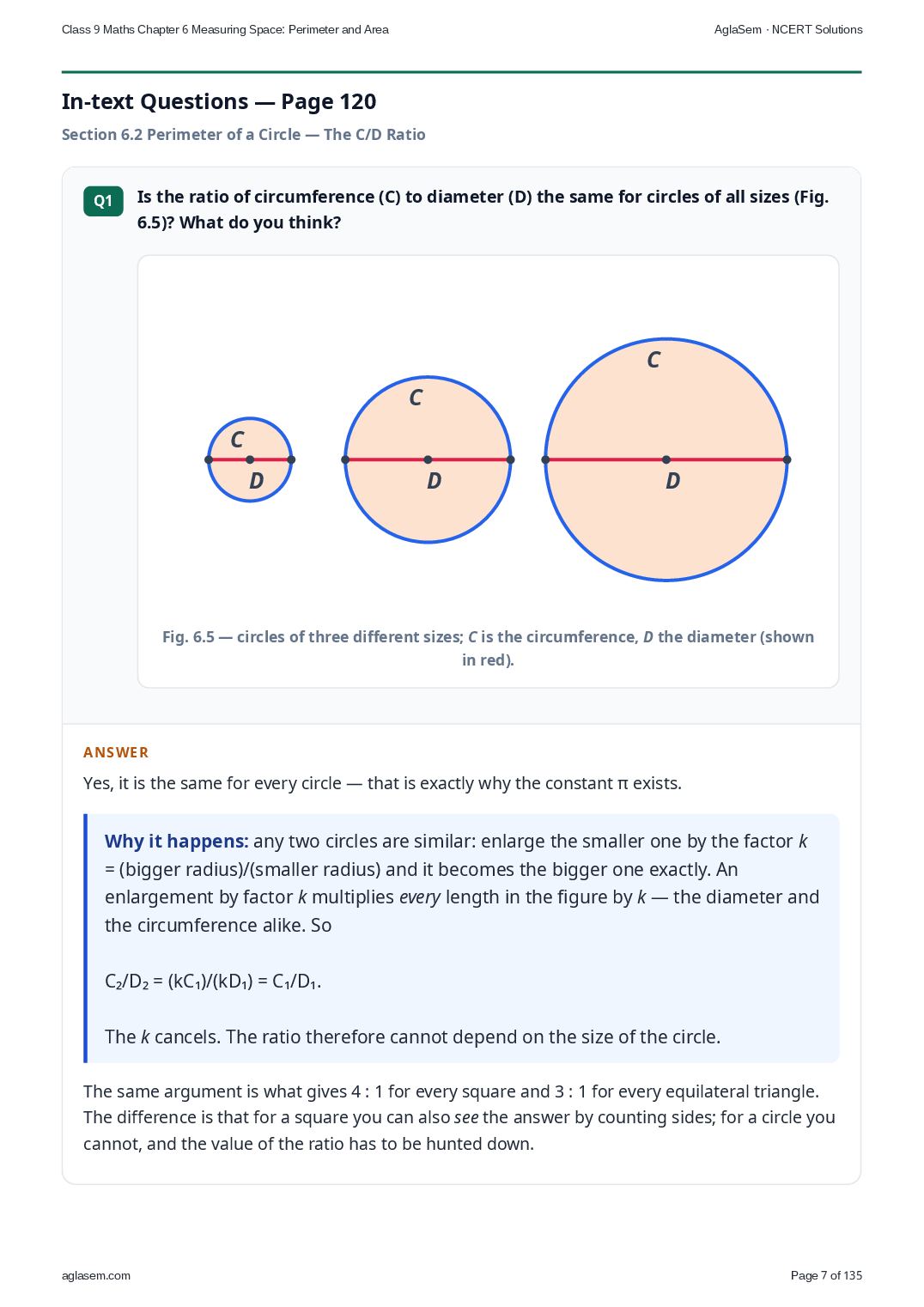
- Is the ratio of circumference (C) to diameter (D) the same for circles of all sizes (Fig. 6.5)? What do you think?
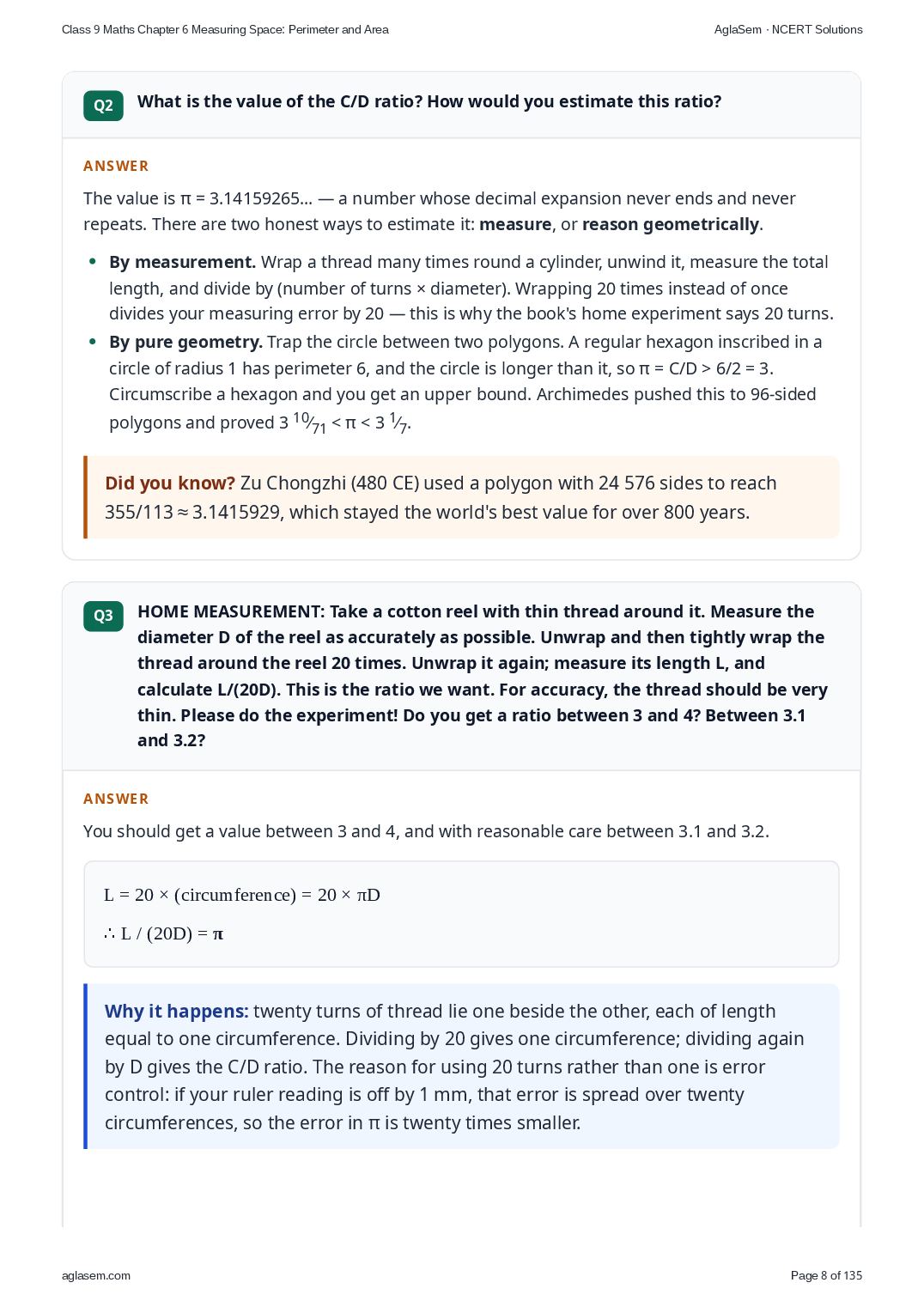
- What is the value of the C/D ratio? How would you estimate this ratio?
- HOME MEASUREMENT: Take a cotton reel with thin thread around it. Measure the diameter D of the reel as accurately as possible. Unwrap and then tightly wrap the thread around the reel 20 times. Unwrap it again; measure its length L, and calculate L/(20D). This is the ratio we want. For accuracy, the thread should be very thin. Please do the experiment! Do you get a ratio between 3 and 4? Between 3.1 and 3.2?
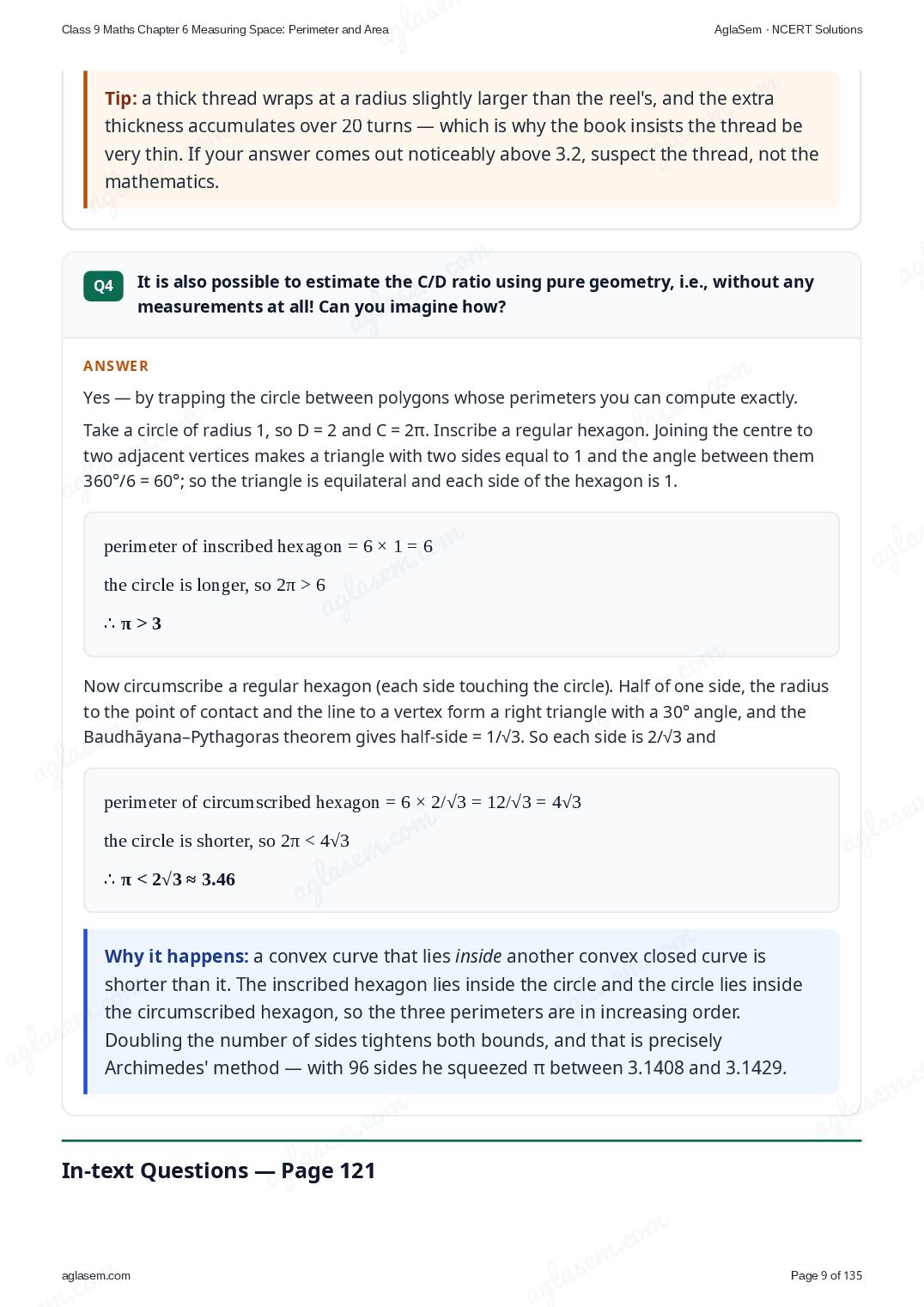
- It is also possible to estimate the C/D ratio using pure geometry, i.e., without any measurements at all! Can you imagine how?
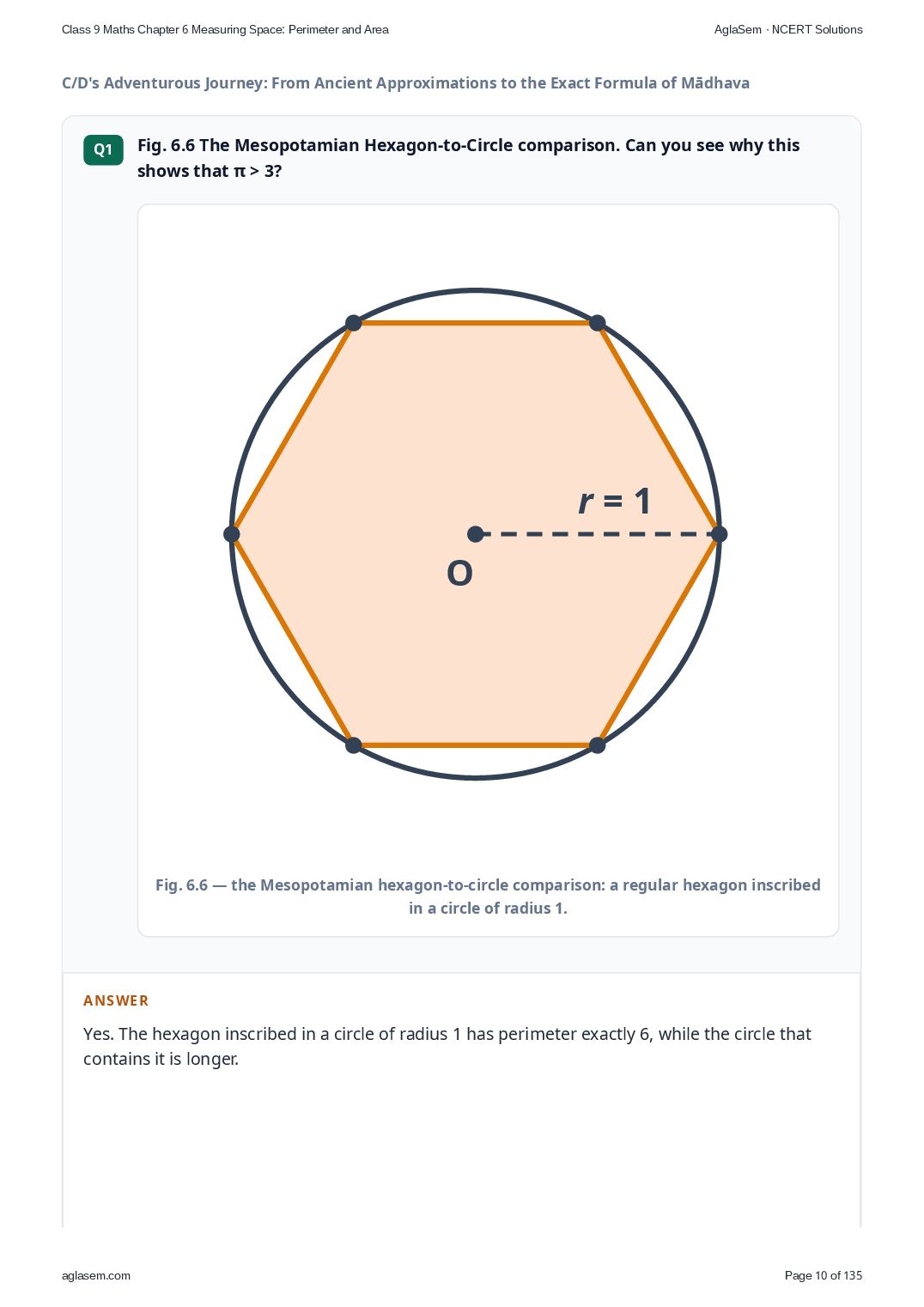
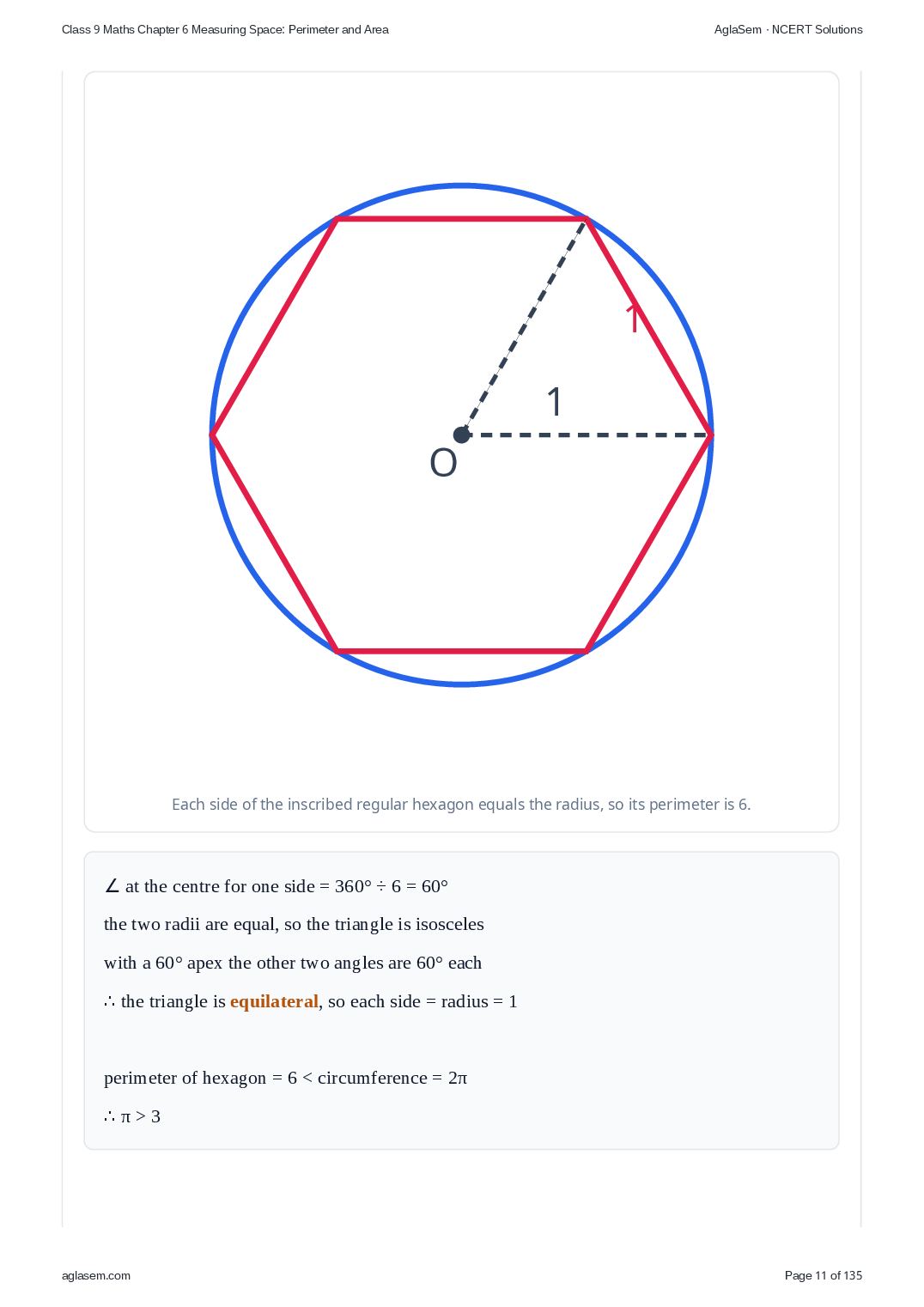
- Fig. 6.6 The Mesopotamian Hexagon-to-Circle comparison. Can you see why this shows that π > 3?
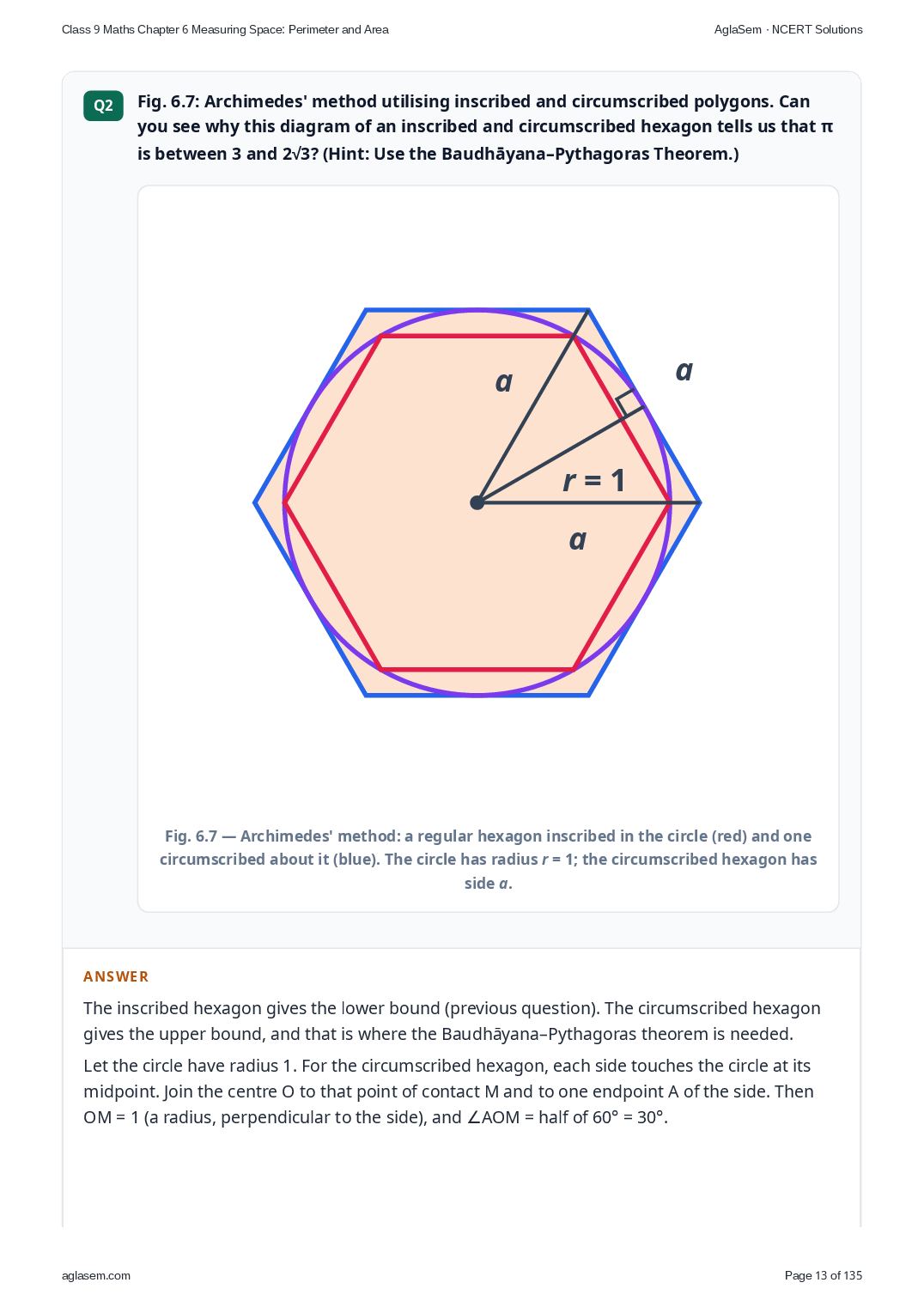
- Fig. 6.7: Archimedes' method utilising inscribed and circumscribed polygons. Can you see why this diagram of an inscribed and circumscribed hexagon tells us that π is between 3 and 2√3? (Hint: Use the Baudhāyana–Pythagoras Theorem.)
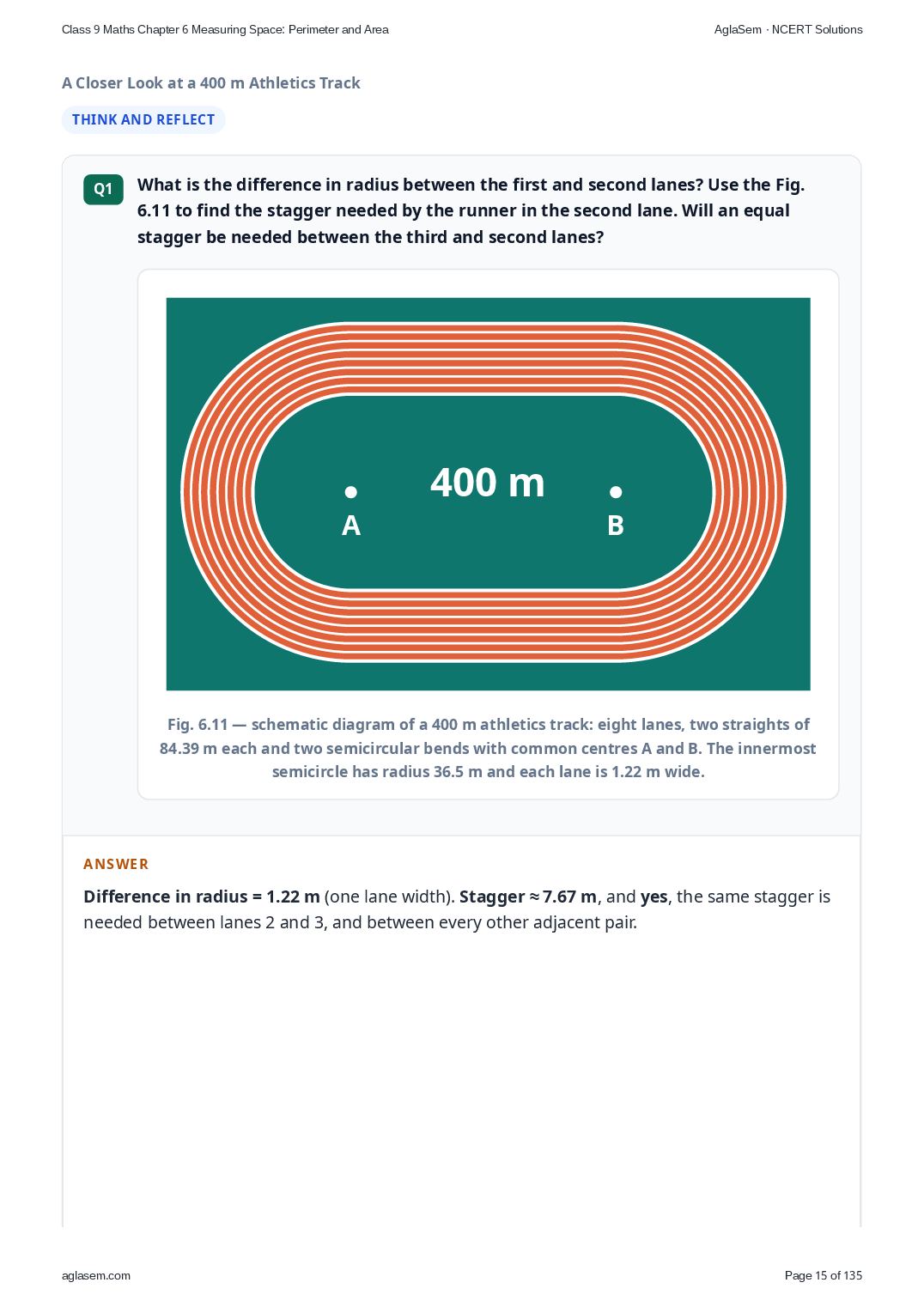
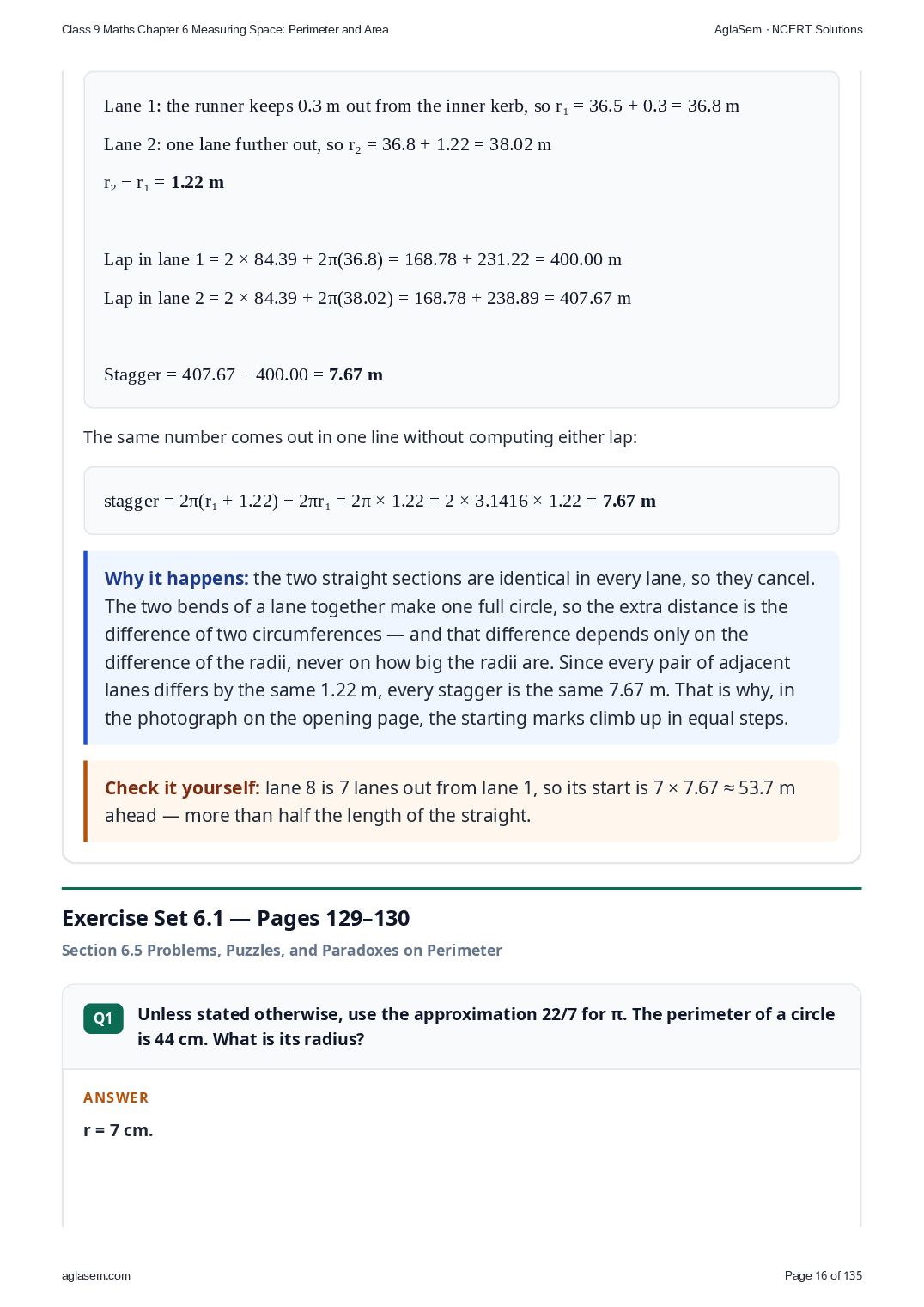
- What is the difference in radius between the first and second lanes? Use the Fig. 6.11 to find the stagger needed by the runner in the second lane. Will an equal stagger be needed between the third and second lanes?
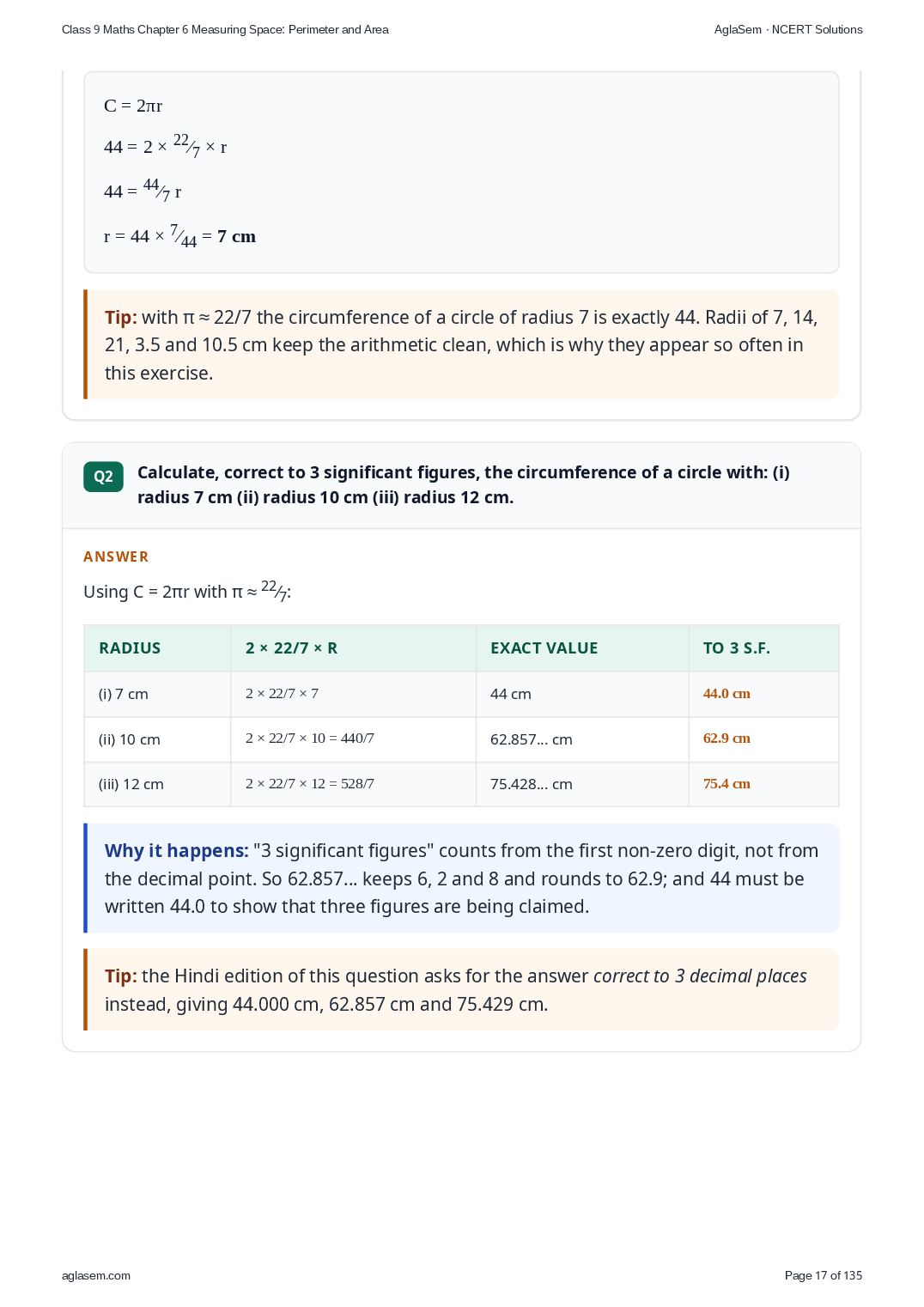
- Unless stated otherwise, use the approximation 22/7 for π. The perimeter of a circle is 44 cm. What is its radius?
- Calculate, correct to 3 significant figures, the circumference of a circle with: (i) radius 7 cm (ii) radius 10 cm (iii) radius 12 cm.
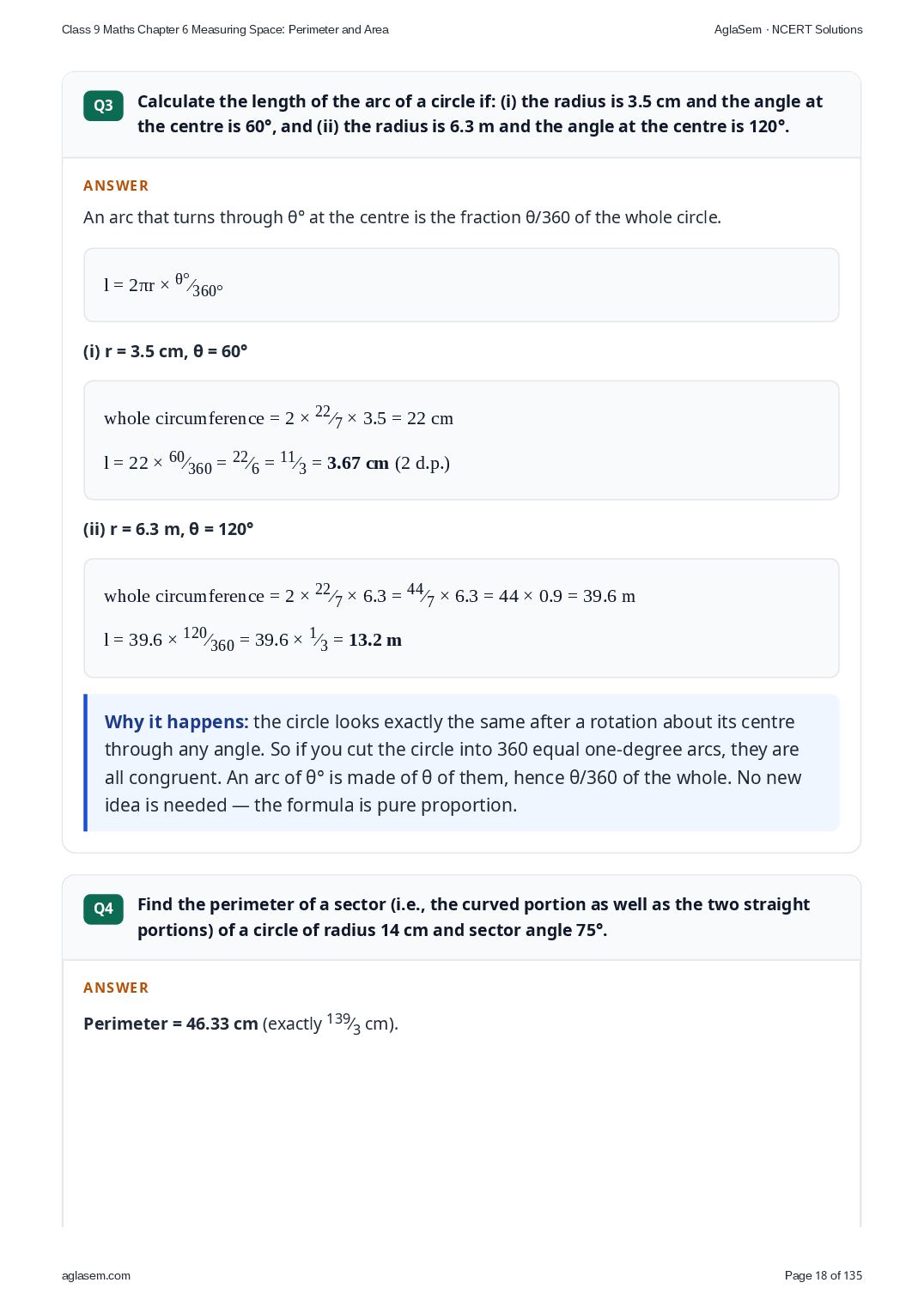
- Calculate the length of the arc of a circle if: (i) the radius is 3.5 cm and the angle at the centre is 60°, and (ii) the radius is 6.3 m and the angle at the centre is 120°.
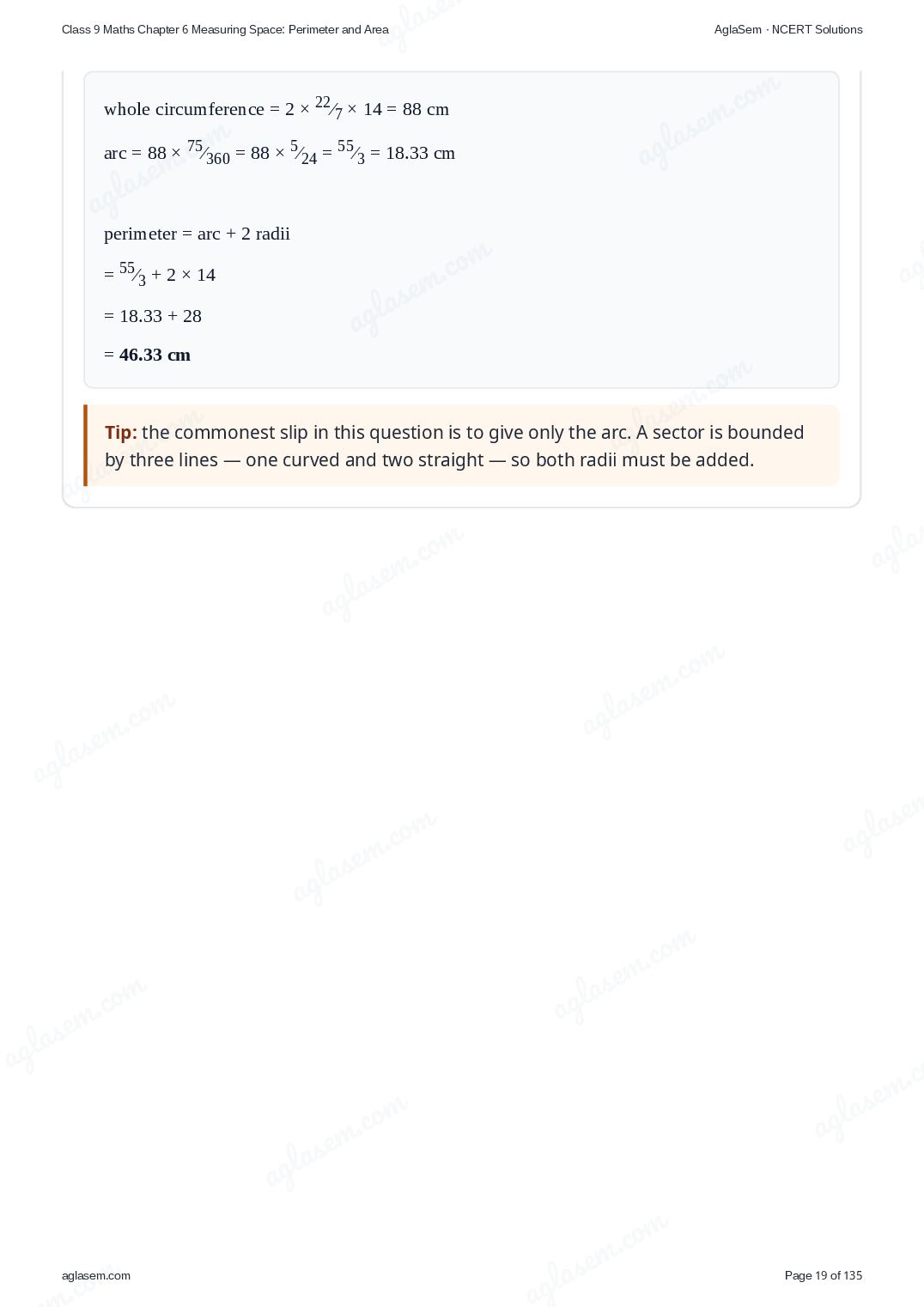
- Find the perimeter of a sector (i.e., the curved portion as well as the two straight portions) of a circle of radius 14 cm and sector angle 75°.
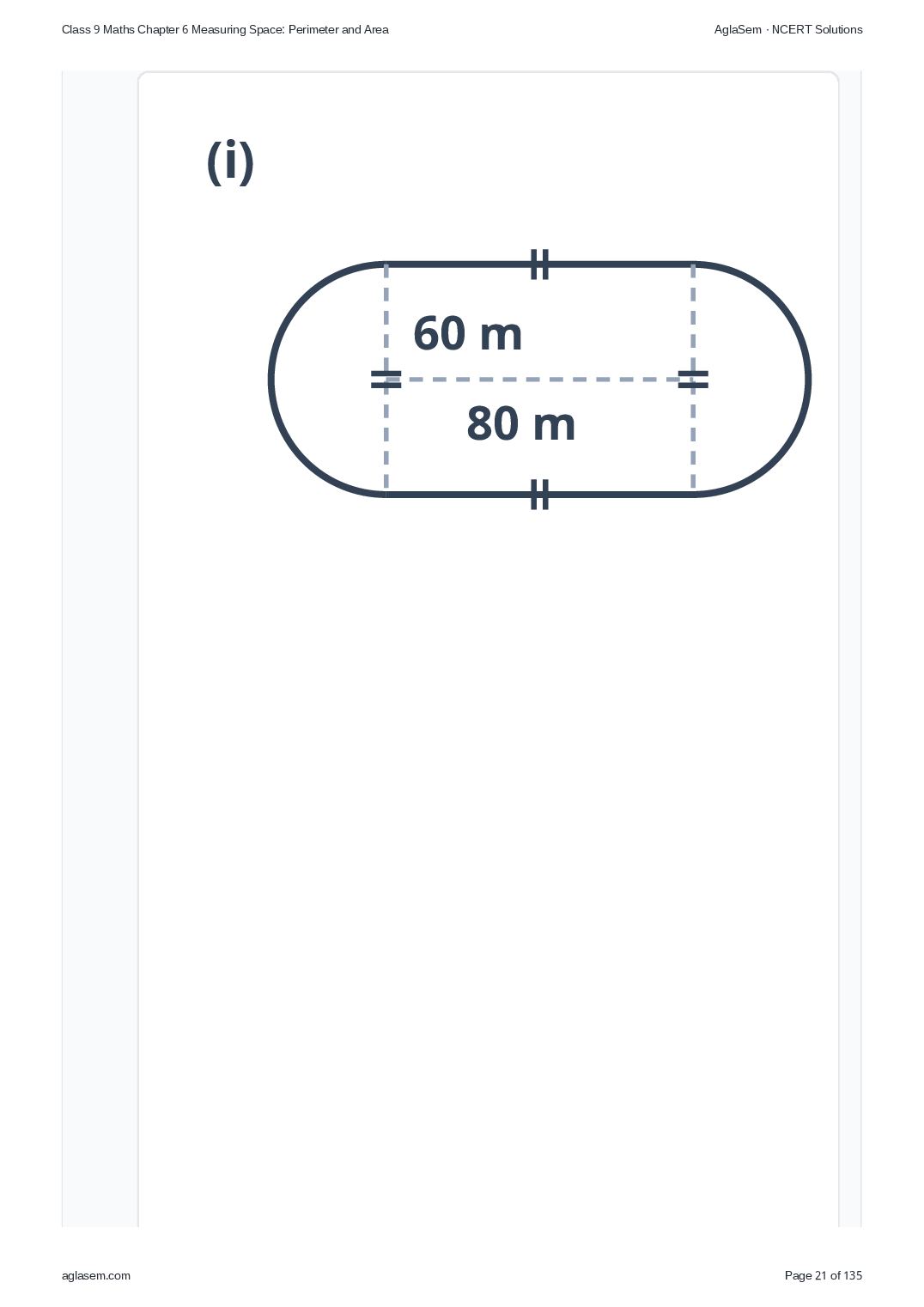
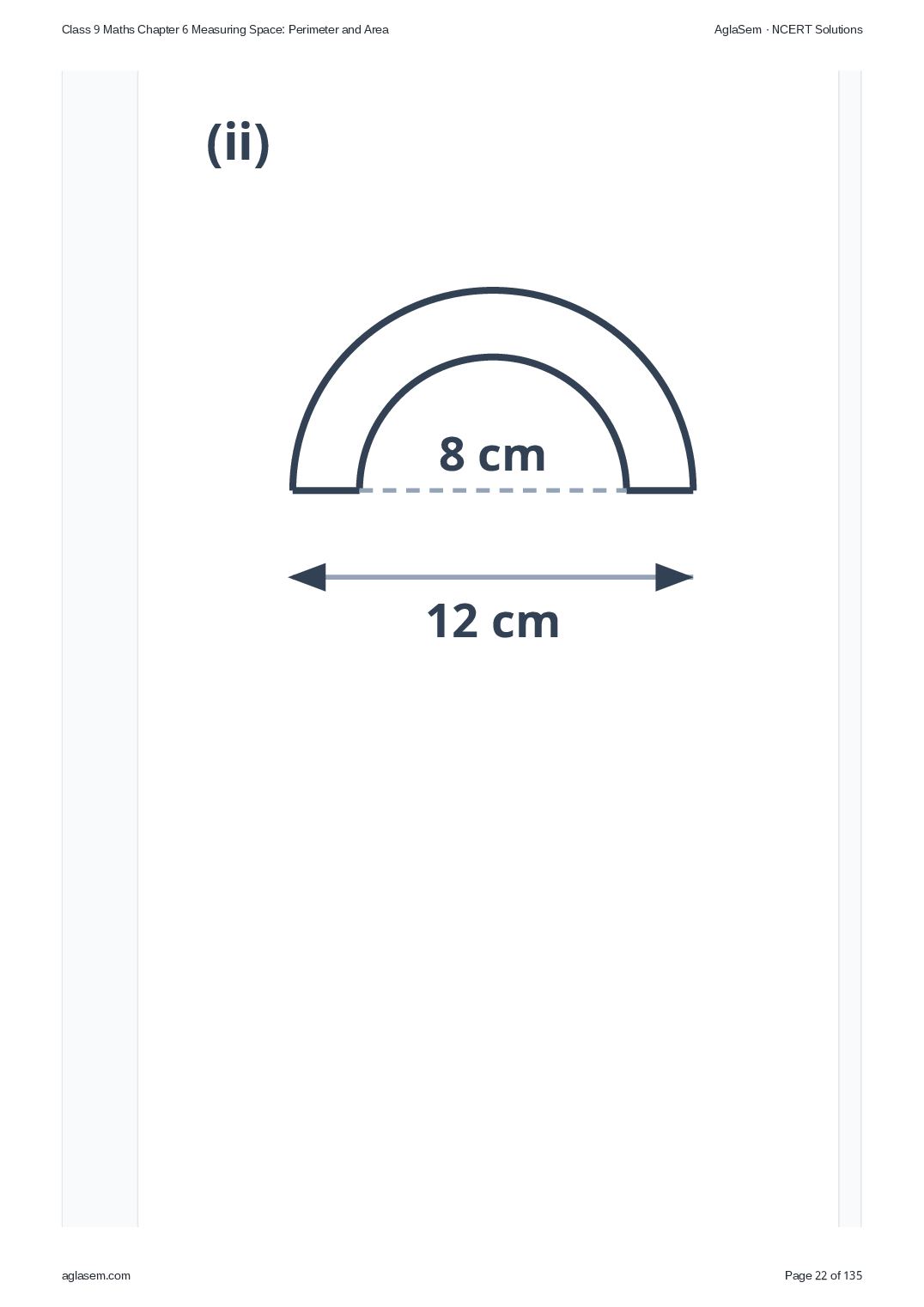
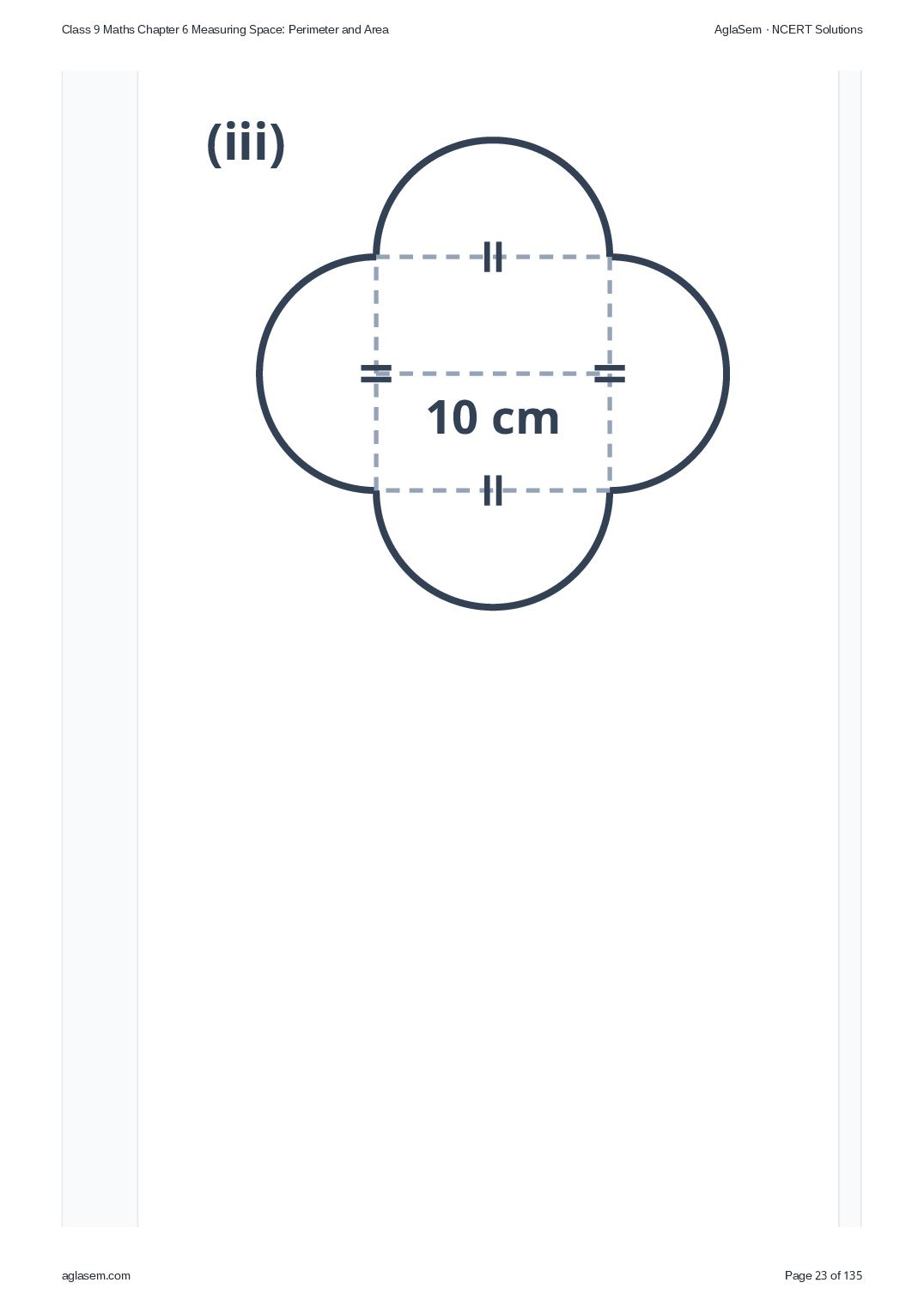
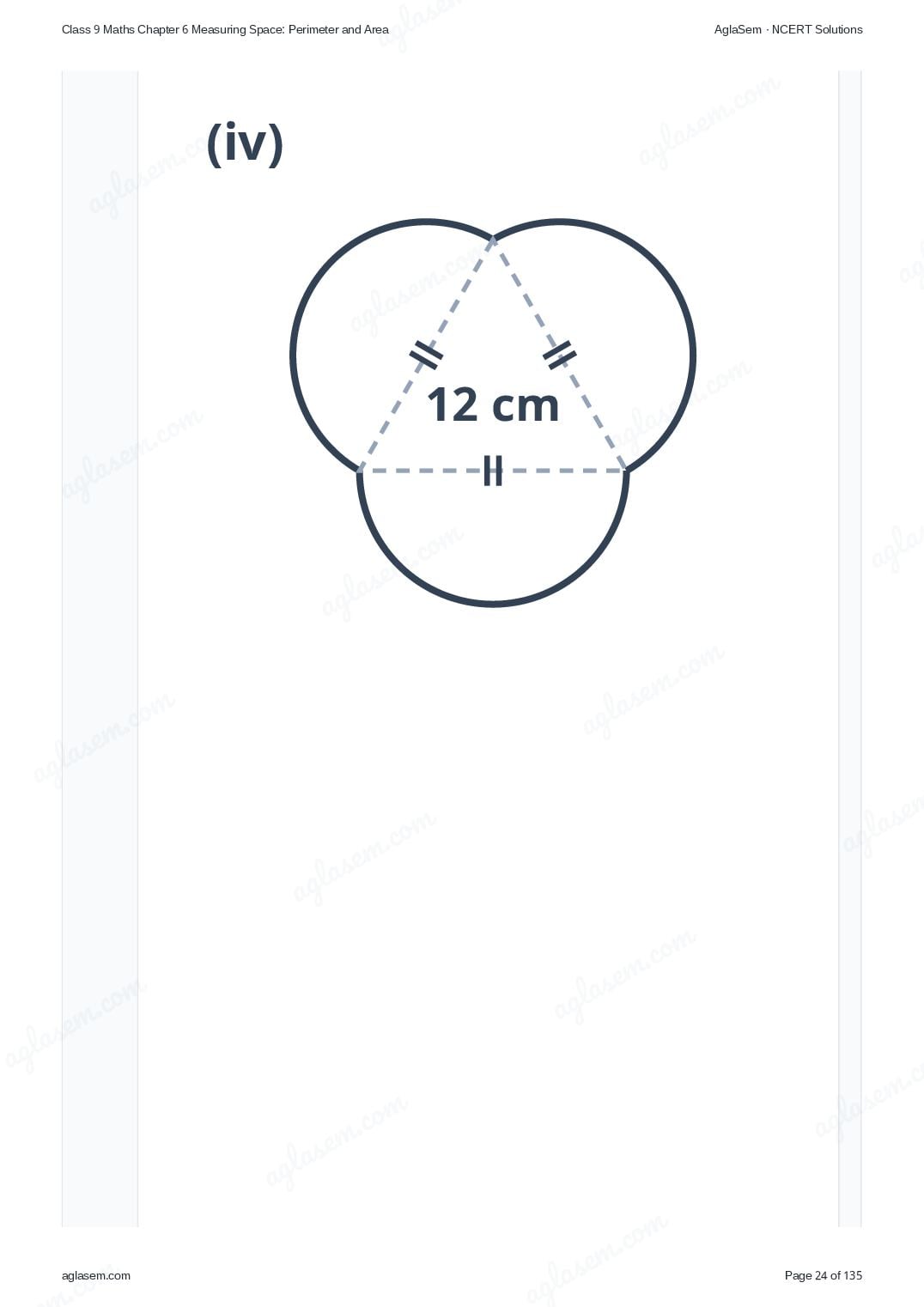
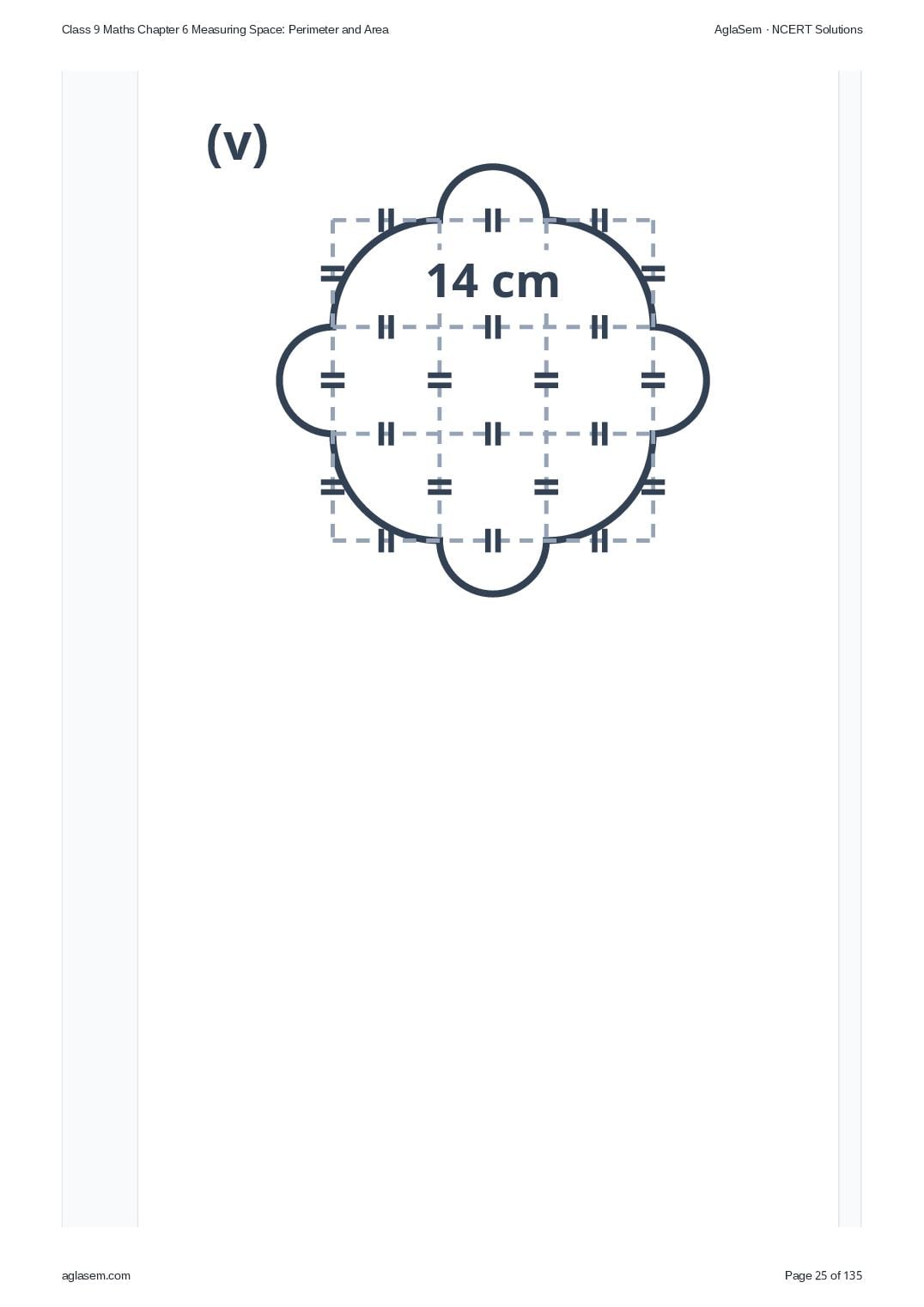
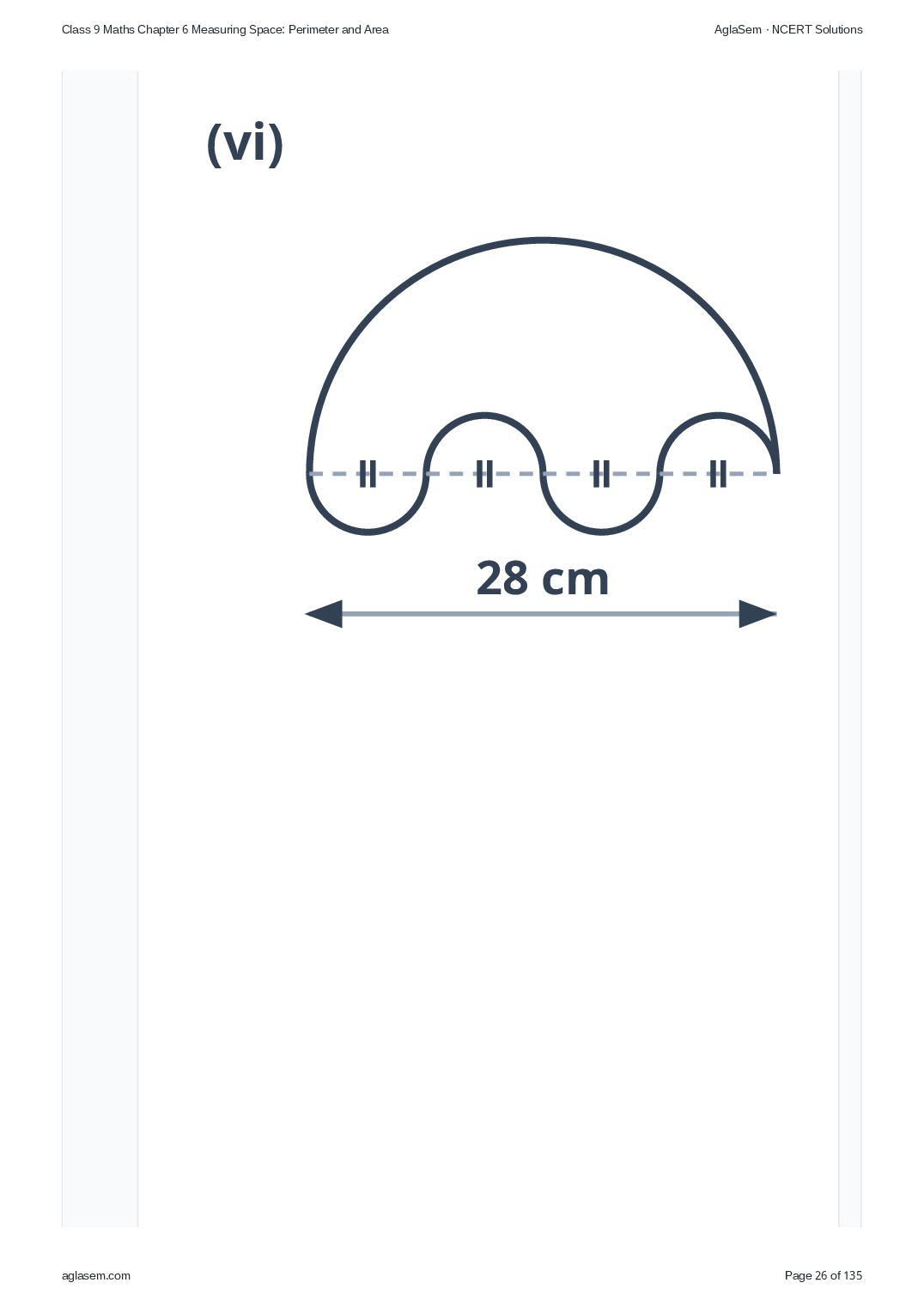
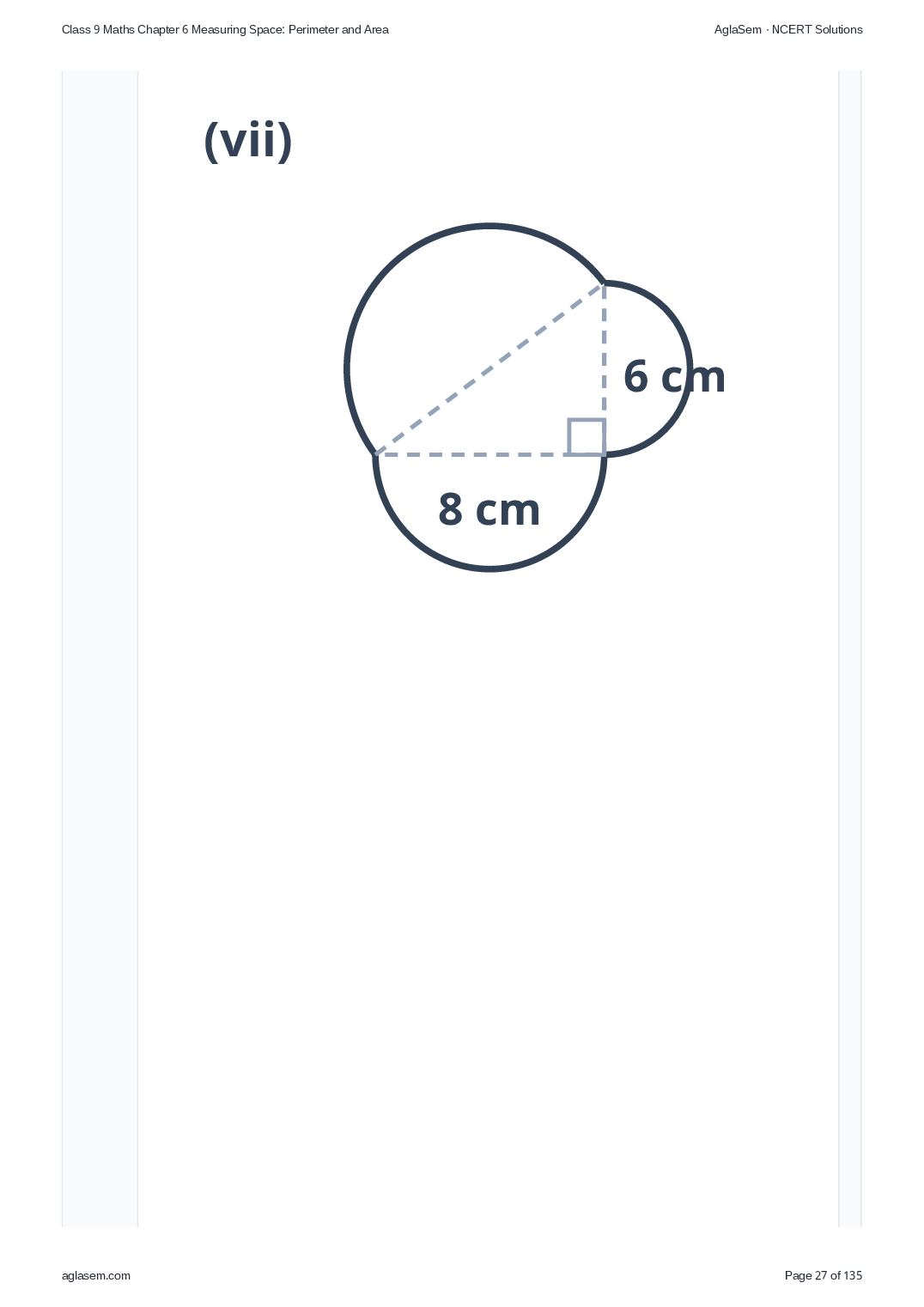
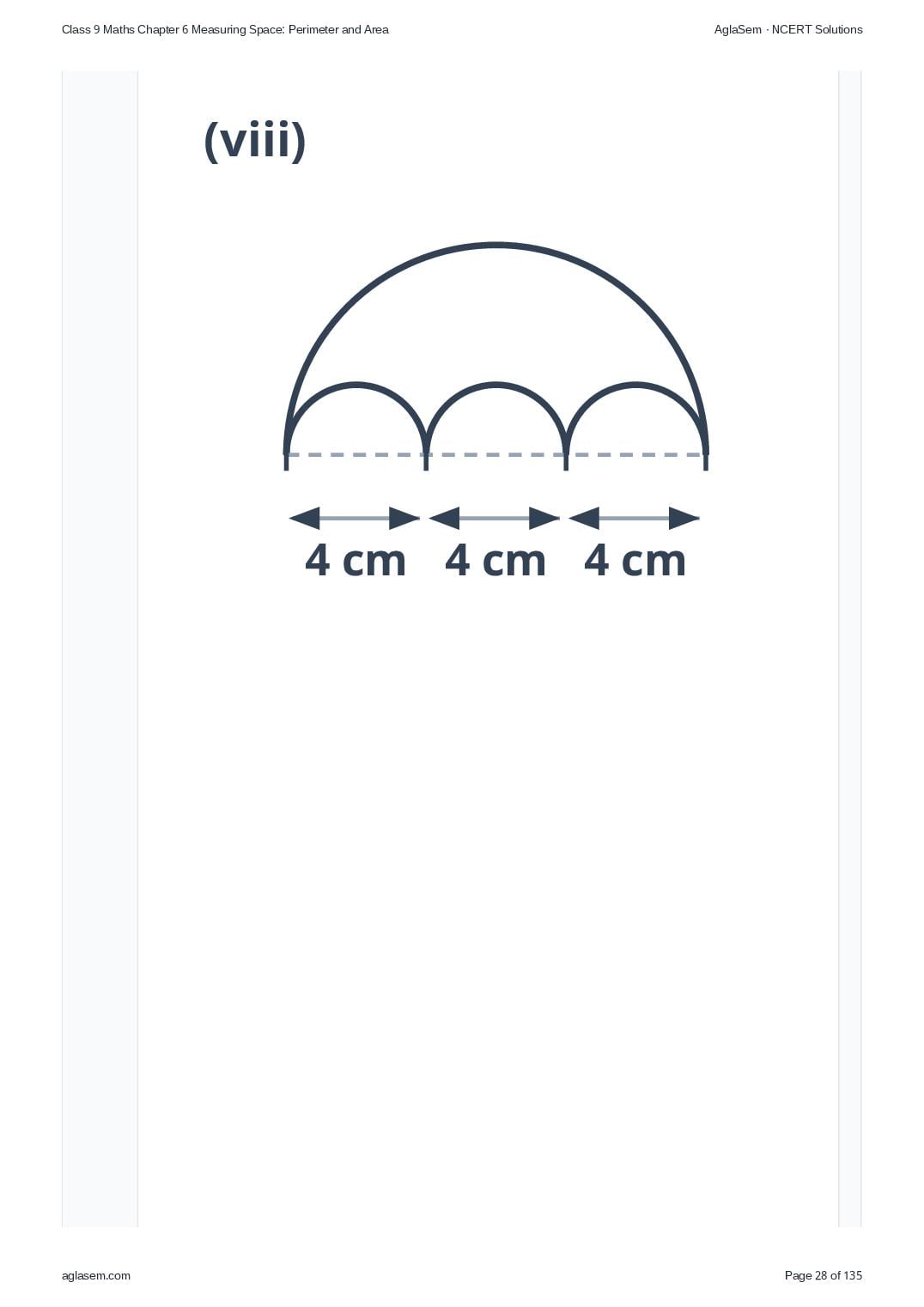
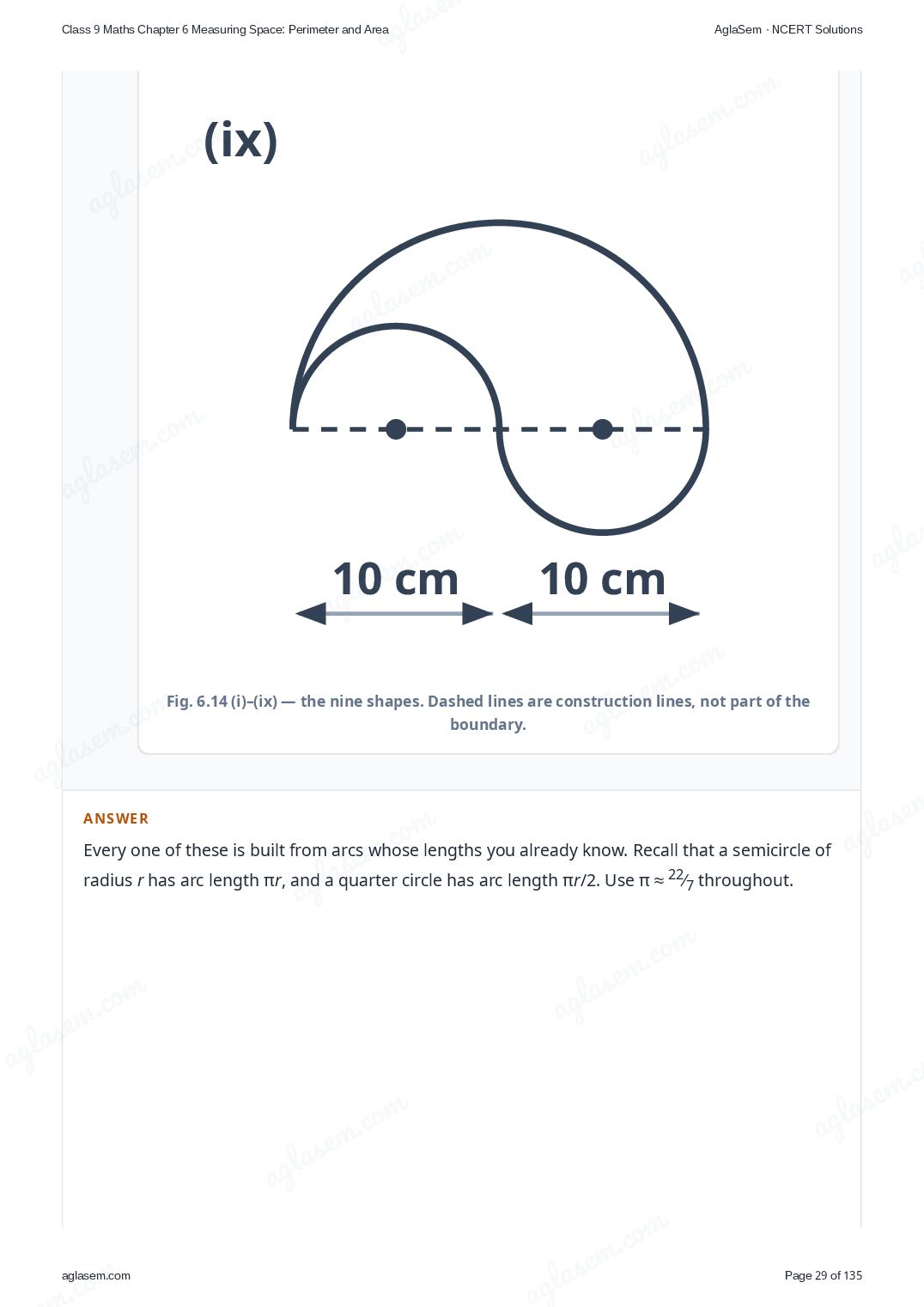
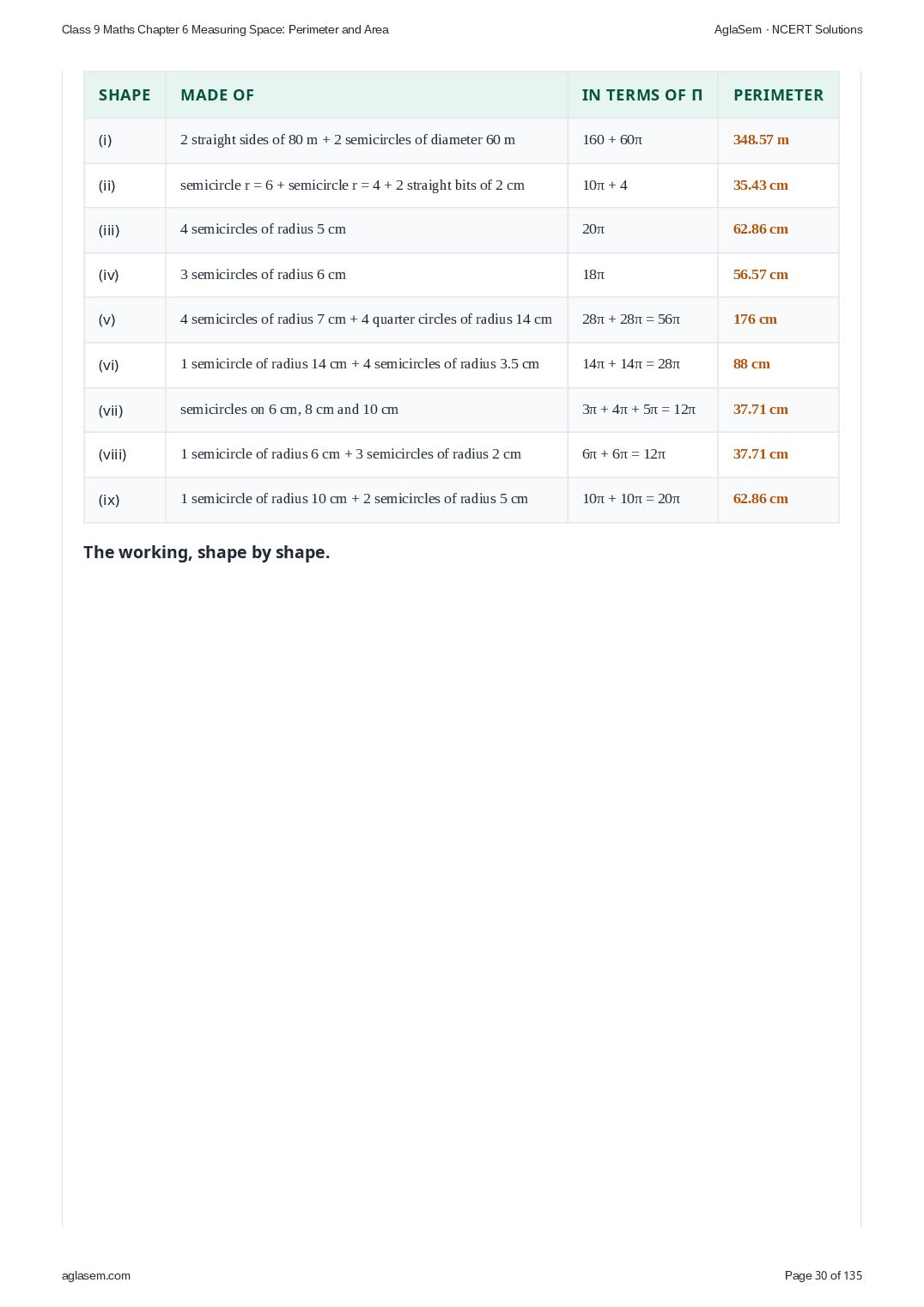
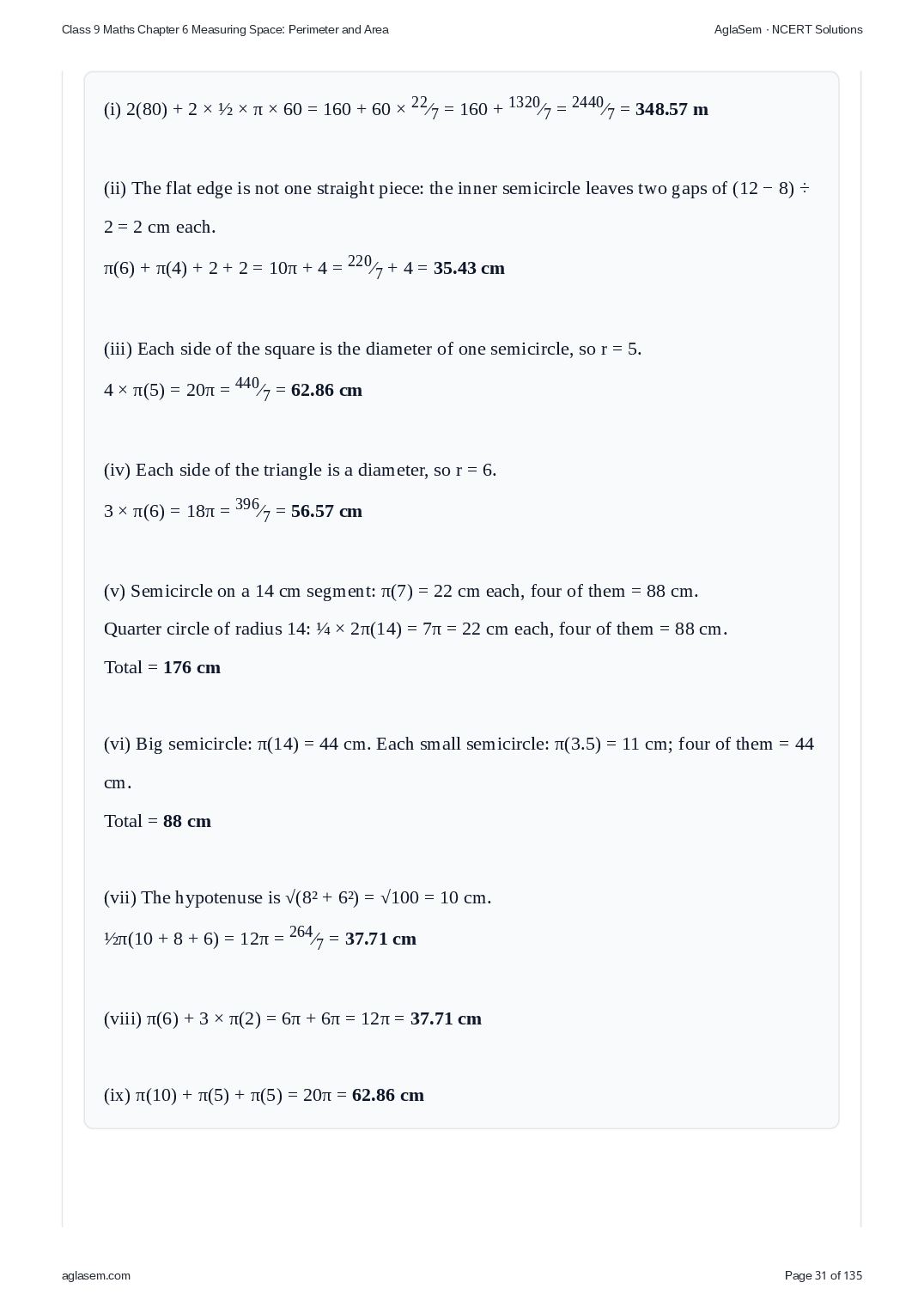
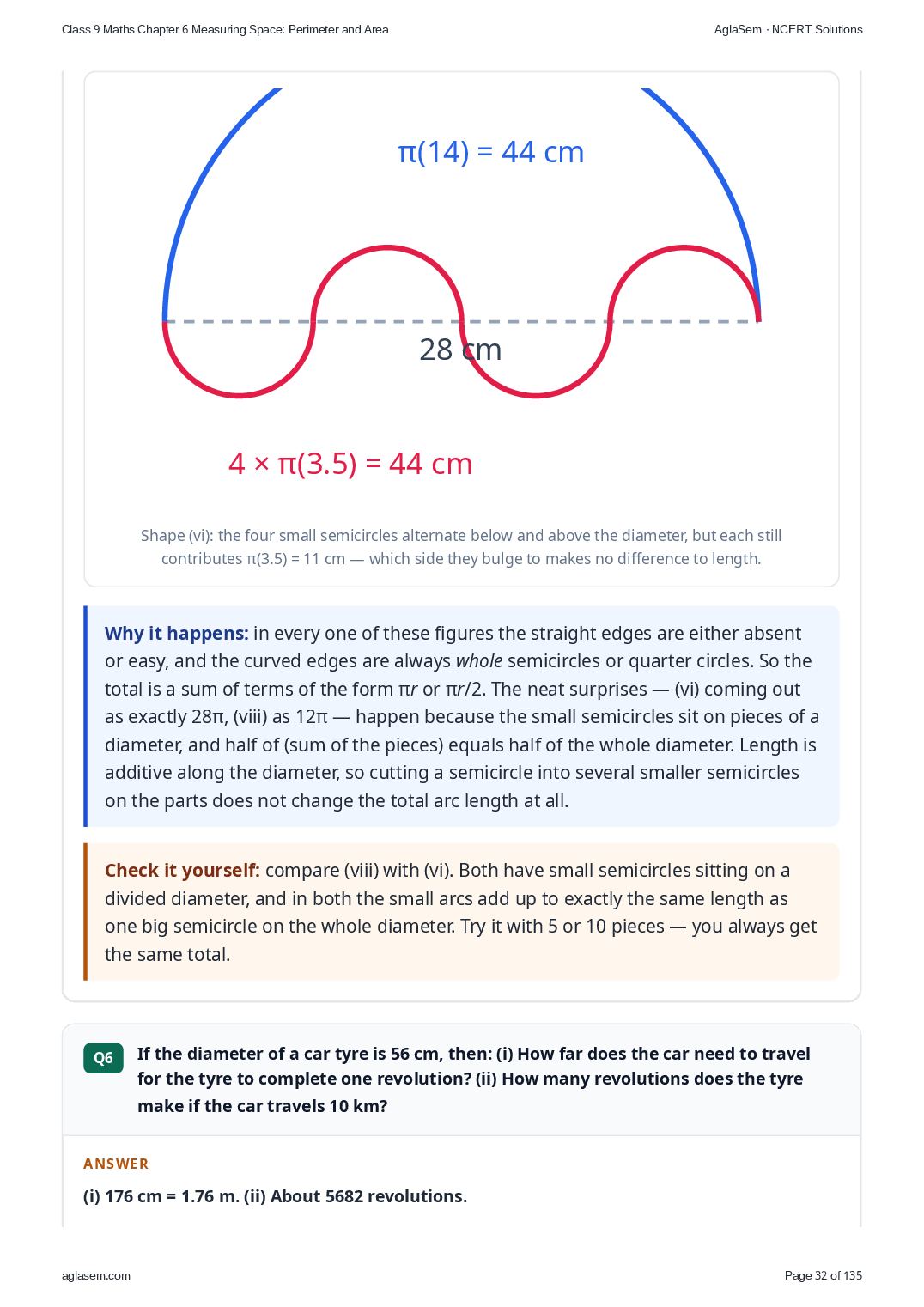
- Find the perimeters of the following shapes (taking the arcs to be quarter or half or three-quarters of a circle, as appropriate) (Fig. 6.14i to 6.14ix): (i) a rectangle 80 m by 60 m with a semicircle on each of the two shorter sides; (ii) a half-ring whose outer semicircle has diameter 12 cm and inner semicircle diameter 8 cm; (iii) a square of side 10 cm with a semicircle drawn outwards on each side; (iv) an equilateral triangle of side 12 cm with a semicircle drawn outwards on each side; (v) a square divided into a 3 × 3 grid of cells of side 14 cm, with a semicircle drawn outwards on the middle third of each side and a quarter circle of radius 14 cm at each corner; (vi) a semicircle of diameter 28 cm, with the diameter divided into four equal parts and a semicircle of diameter 7 cm drawn on each part, alternately below and above the diameter; (vii) semicircles drawn outwards on the three sides of a right-angled triangle whose legs are 8 cm and 6 cm; (viii) a semicircle of diameter 12 cm with three semicircles of diameter 4 cm each drawn on its diameter; (ix) a semicircle of diameter 20 cm, together with a semicircle of diameter 10 cm above the left half of the diameter and a semicircle of diameter 10 cm below the right half.
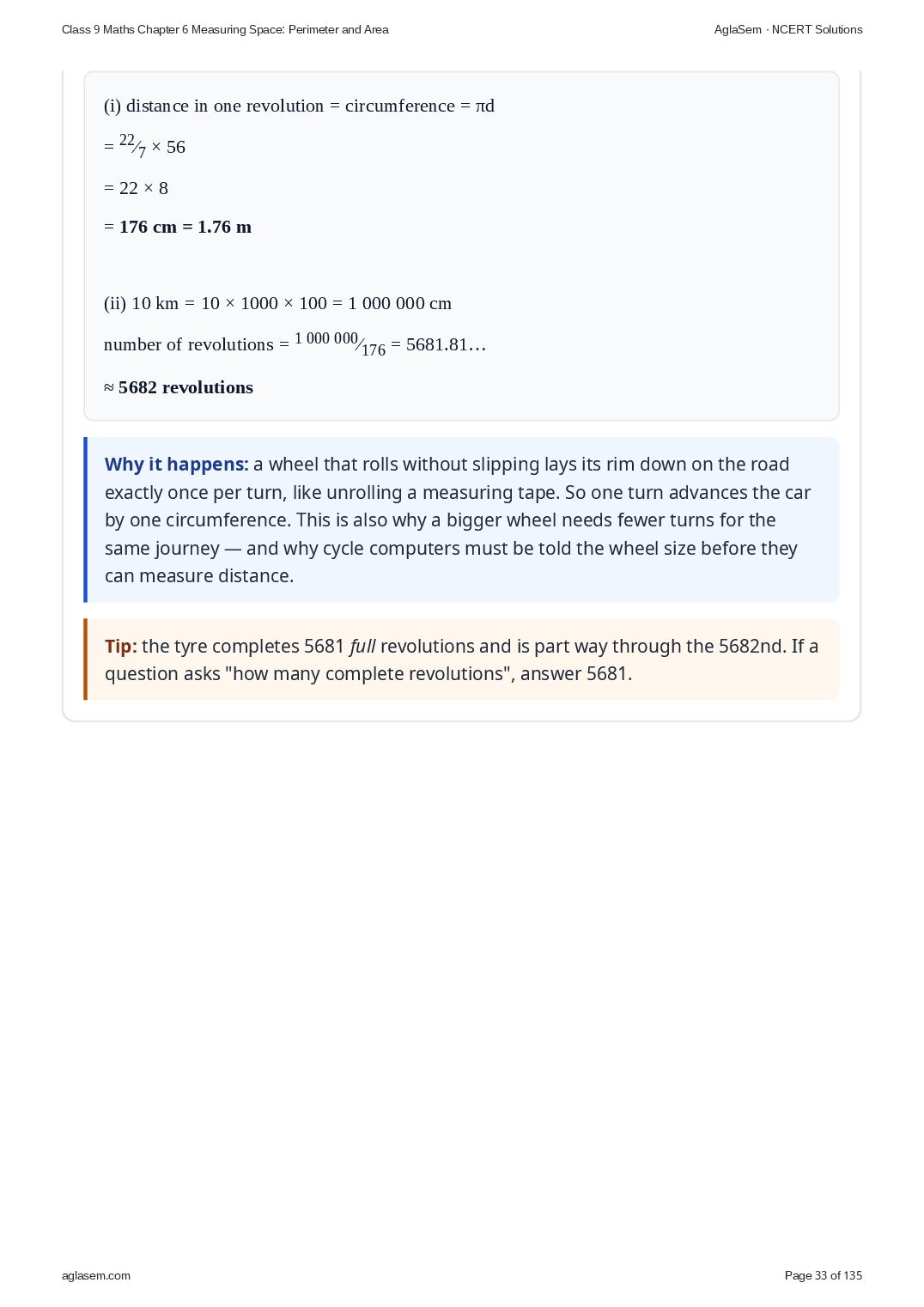
- If the diameter of a car tyre is 56 cm, then: (i) How far does the car need to travel for the tyre to complete one revolution? (ii) How many revolutions does the tyre make if the car travels 10 km?
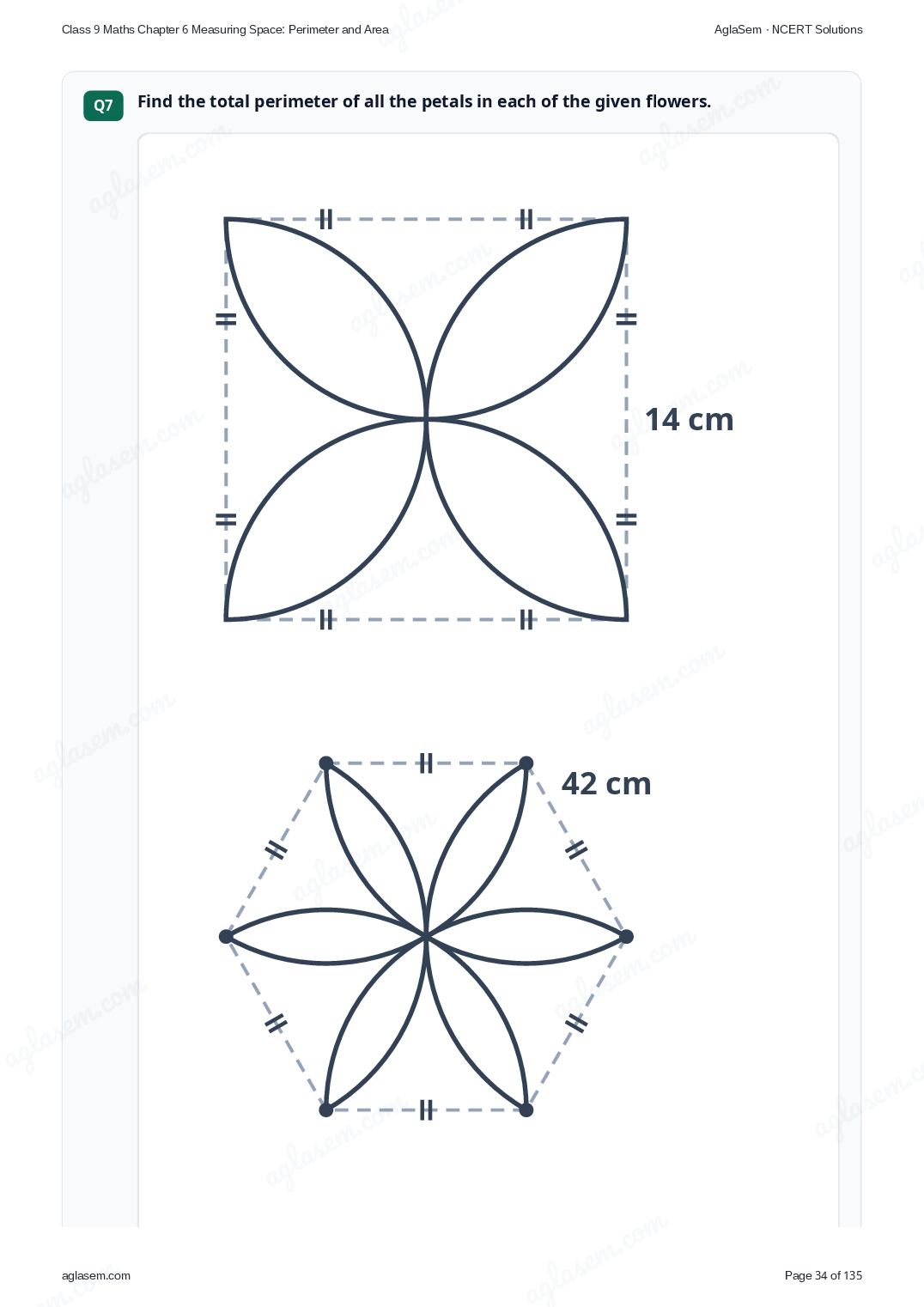
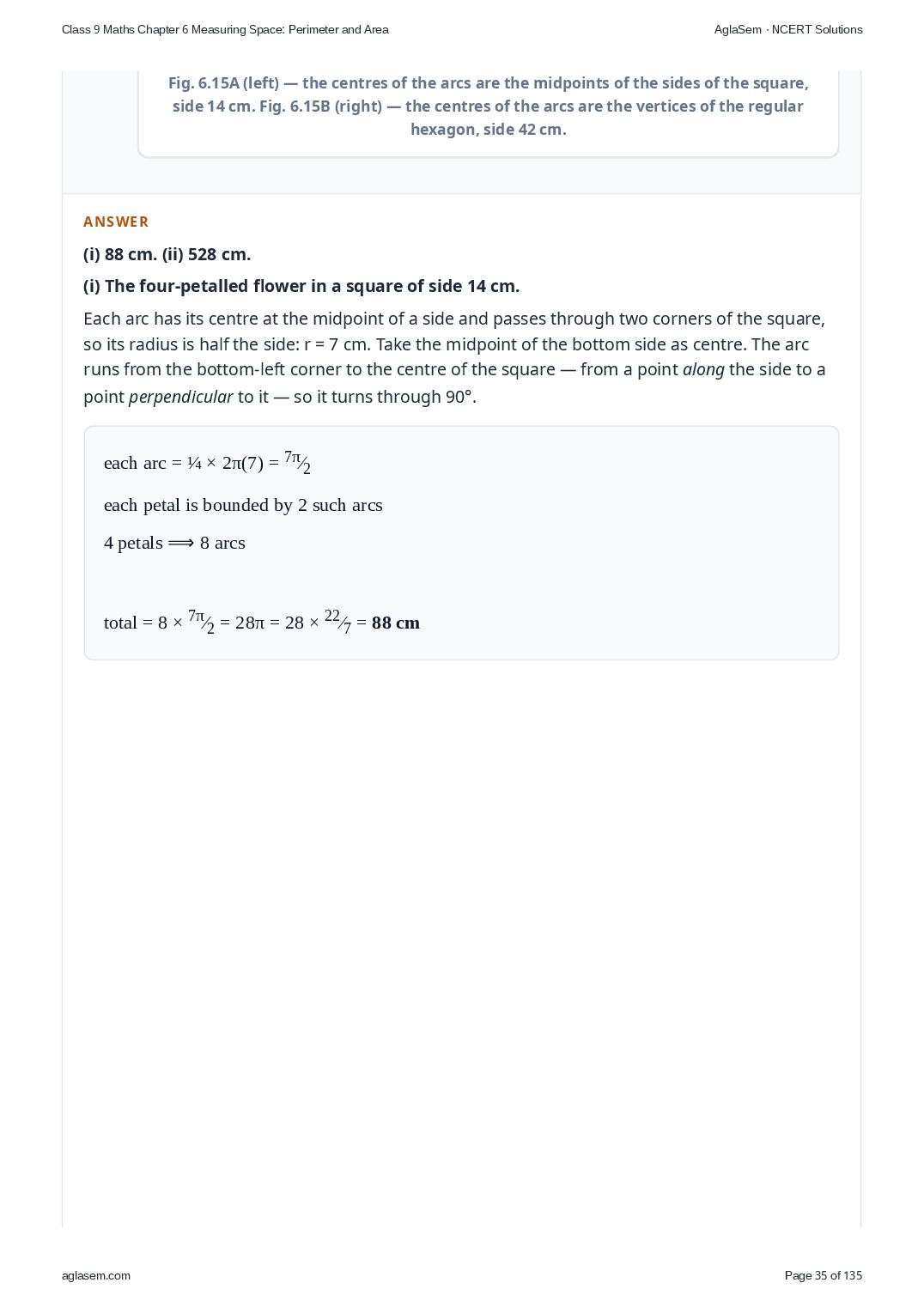
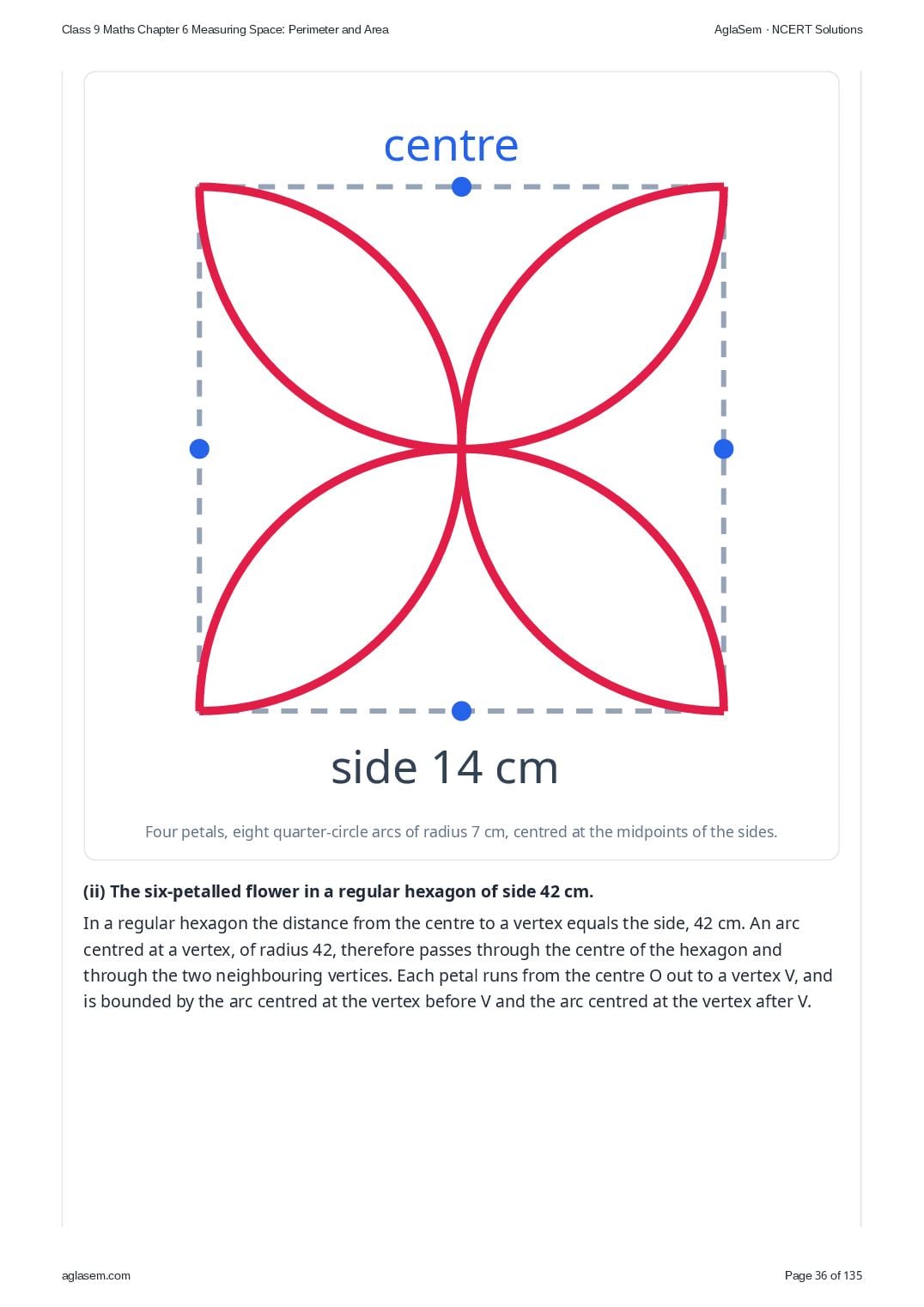
- Find the total perimeter of all the petals in each of the given flowers. (i) Fig. 6.15A: a square of side 14 cm, the centres of the arcs being the midpoints of the sides of the square. (ii) Fig. 6.15B: a regular hexagon of side 42 cm, the centres of the arcs being the vertices of the hexagon.
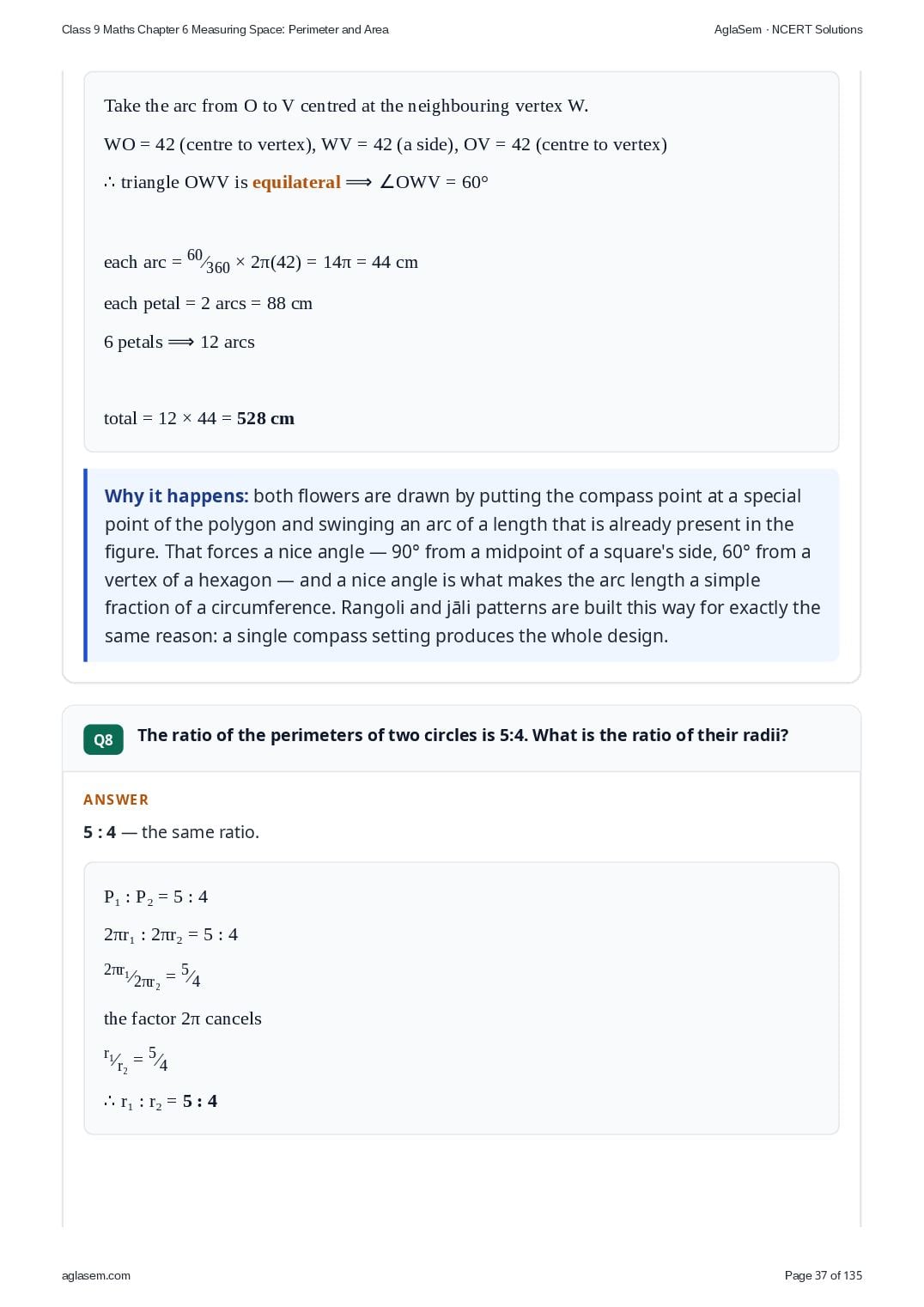
- The ratio of the perimeters of two circles is 5:4. What is the ratio of their radii?
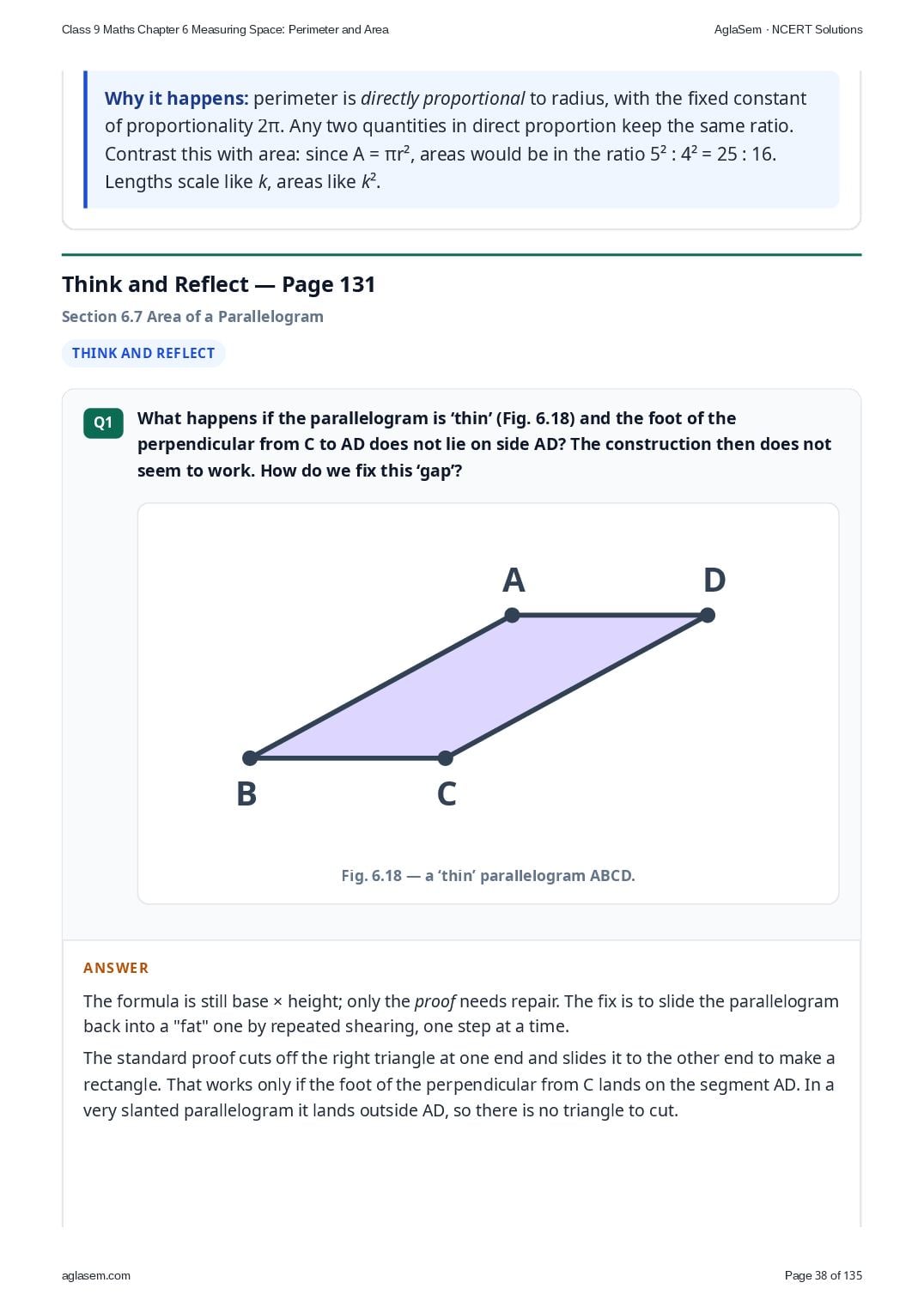
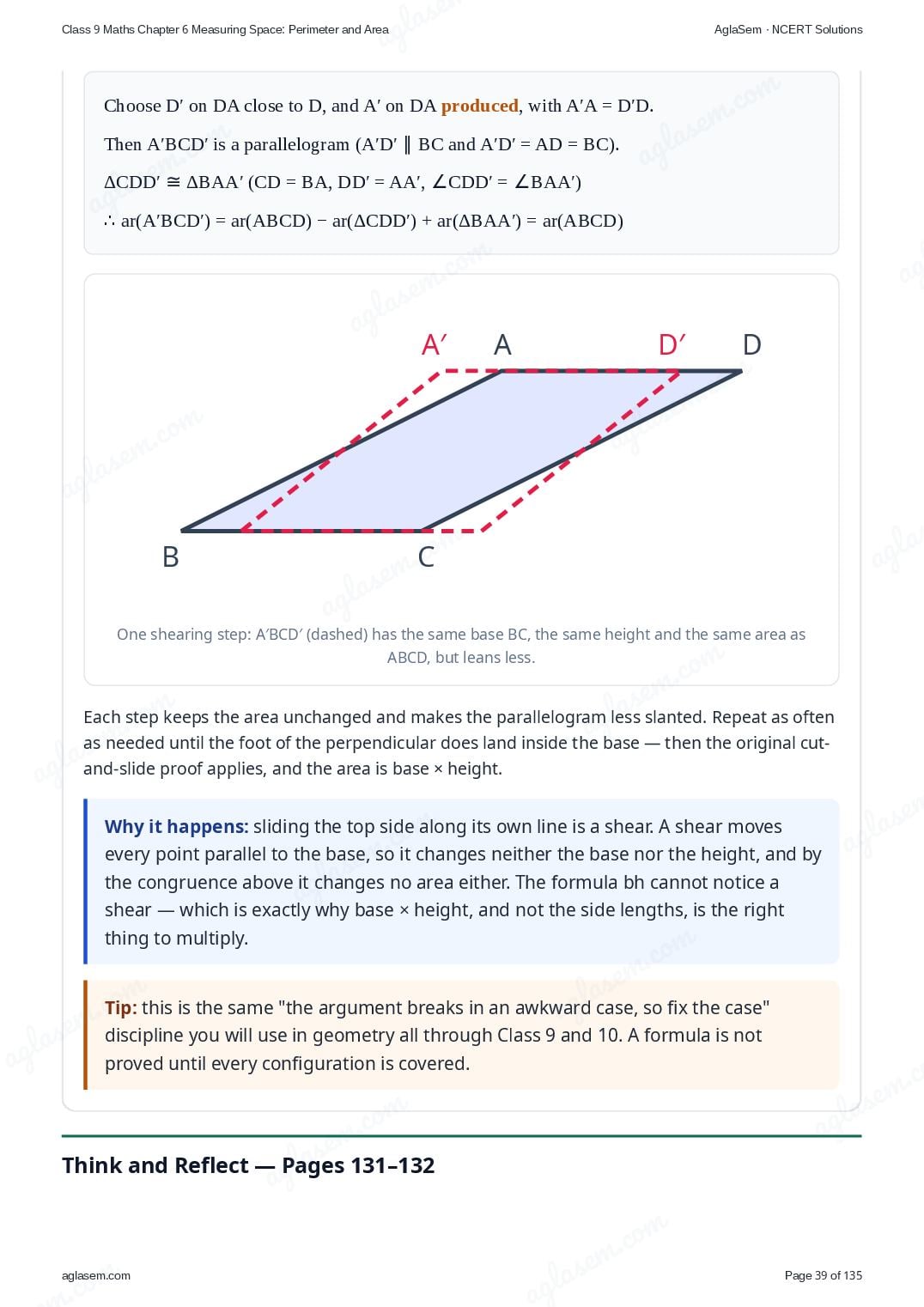
- What happens if the parallelogram is ‘thin’ (Fig. 6.18) and the foot of the perpendicular from C to AD does not lie on side AD? The construction then does not seem to work. How do we fix this ‘gap’?
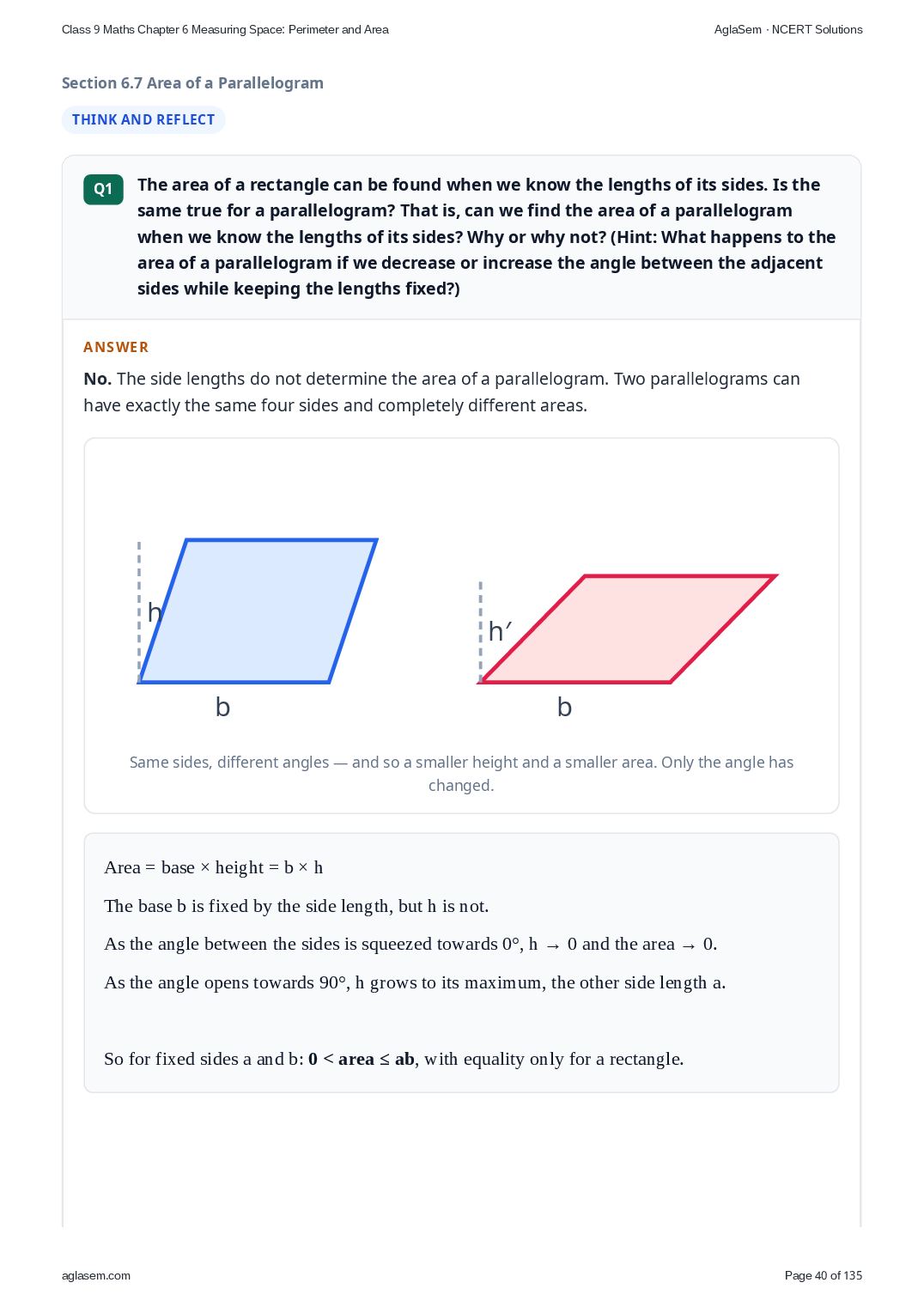
- The area of a rectangle can be found when we know the lengths of its sides. Is the same true for a parallelogram? That is, can we find the area of a parallelogram when we know the lengths of its sides? Why or why not? (Hint: What happens to the area of a parallelogram if we decrease or increase the angle between the adjacent sides while keeping the lengths fixed?)
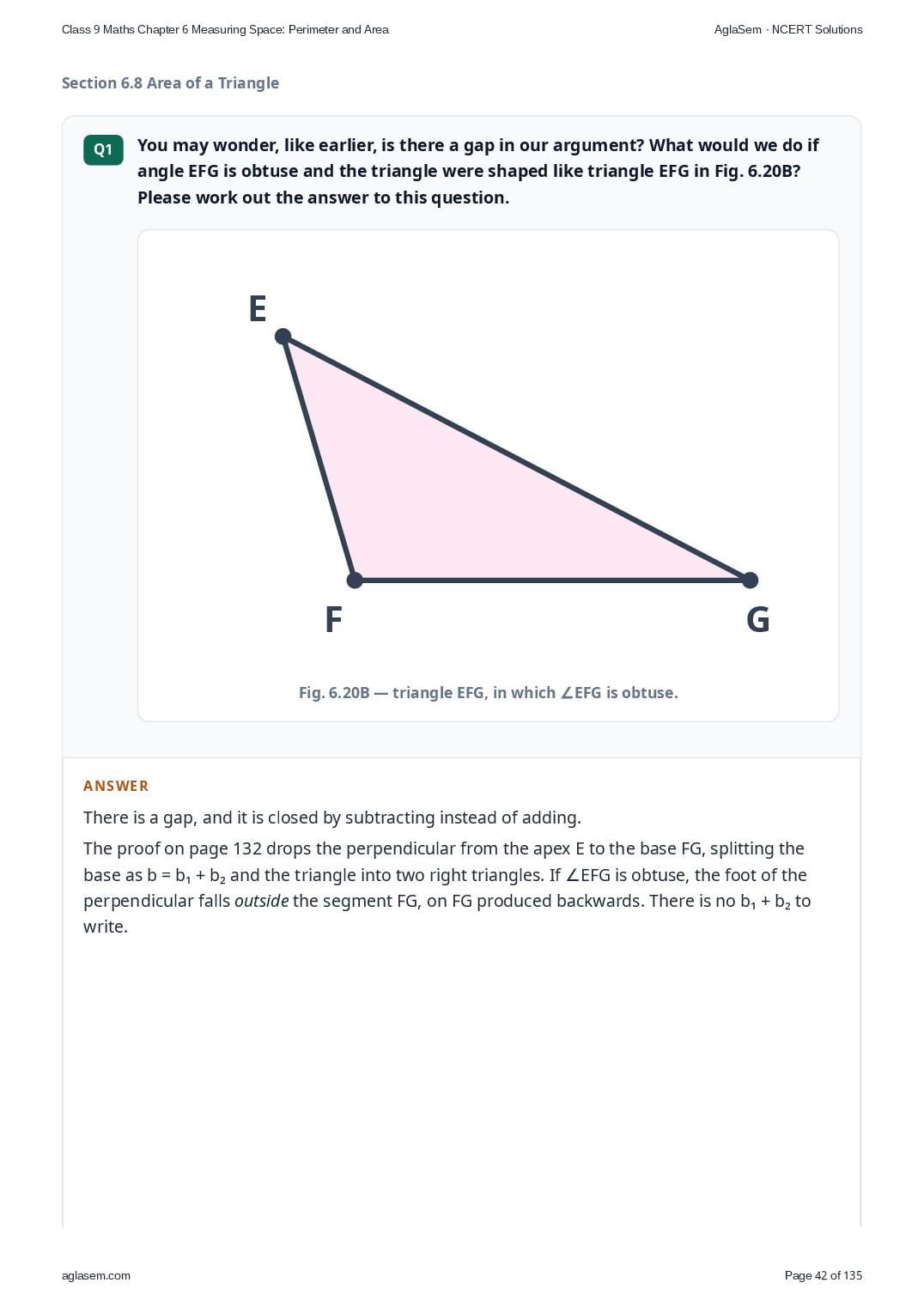
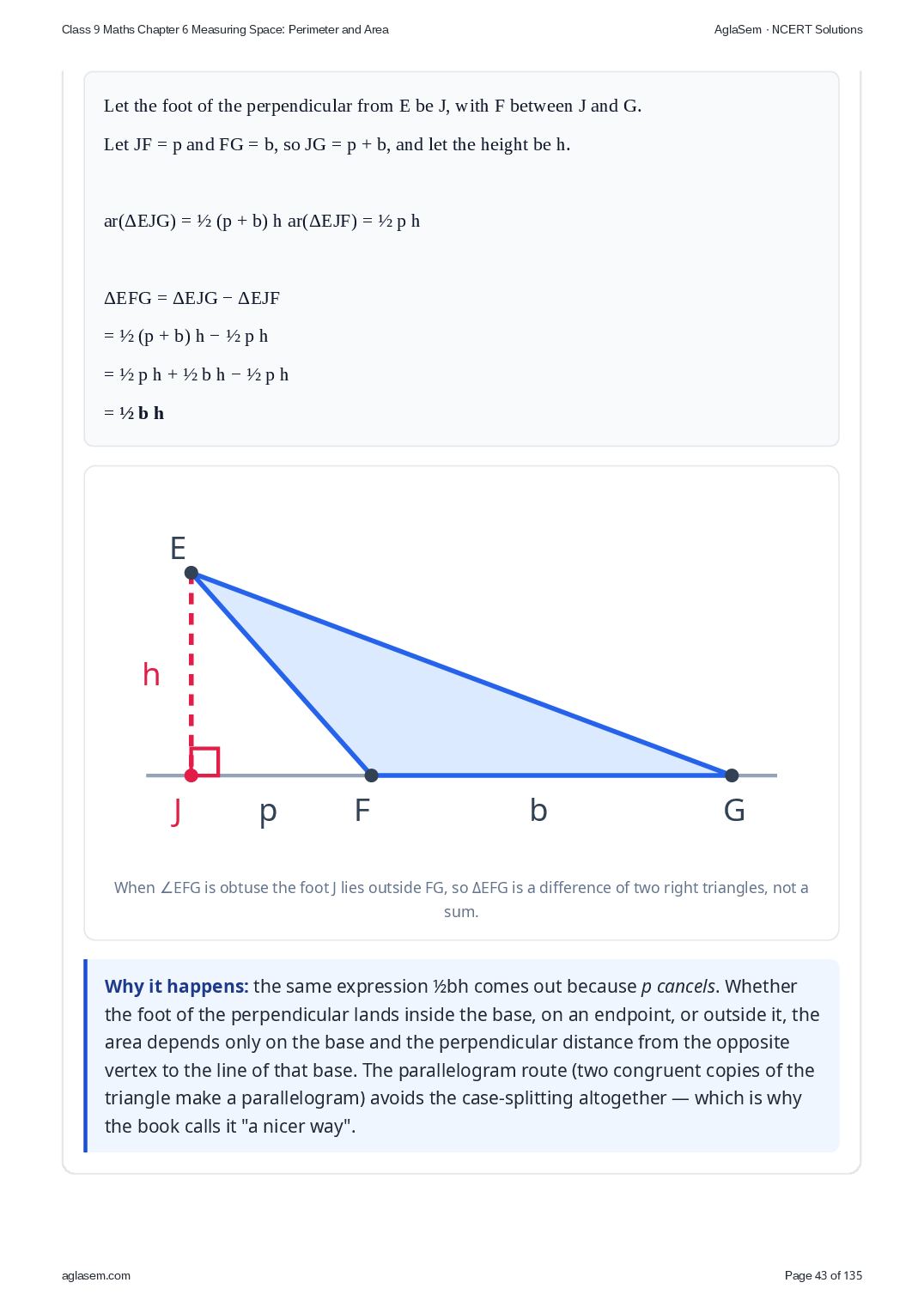
- You may wonder, like earlier, is there a gap in our argument? What would we do if angle EFG is obtuse and the triangle were shaped like triangle EFG in Fig. 6.20B? Please work out the answer to this question.
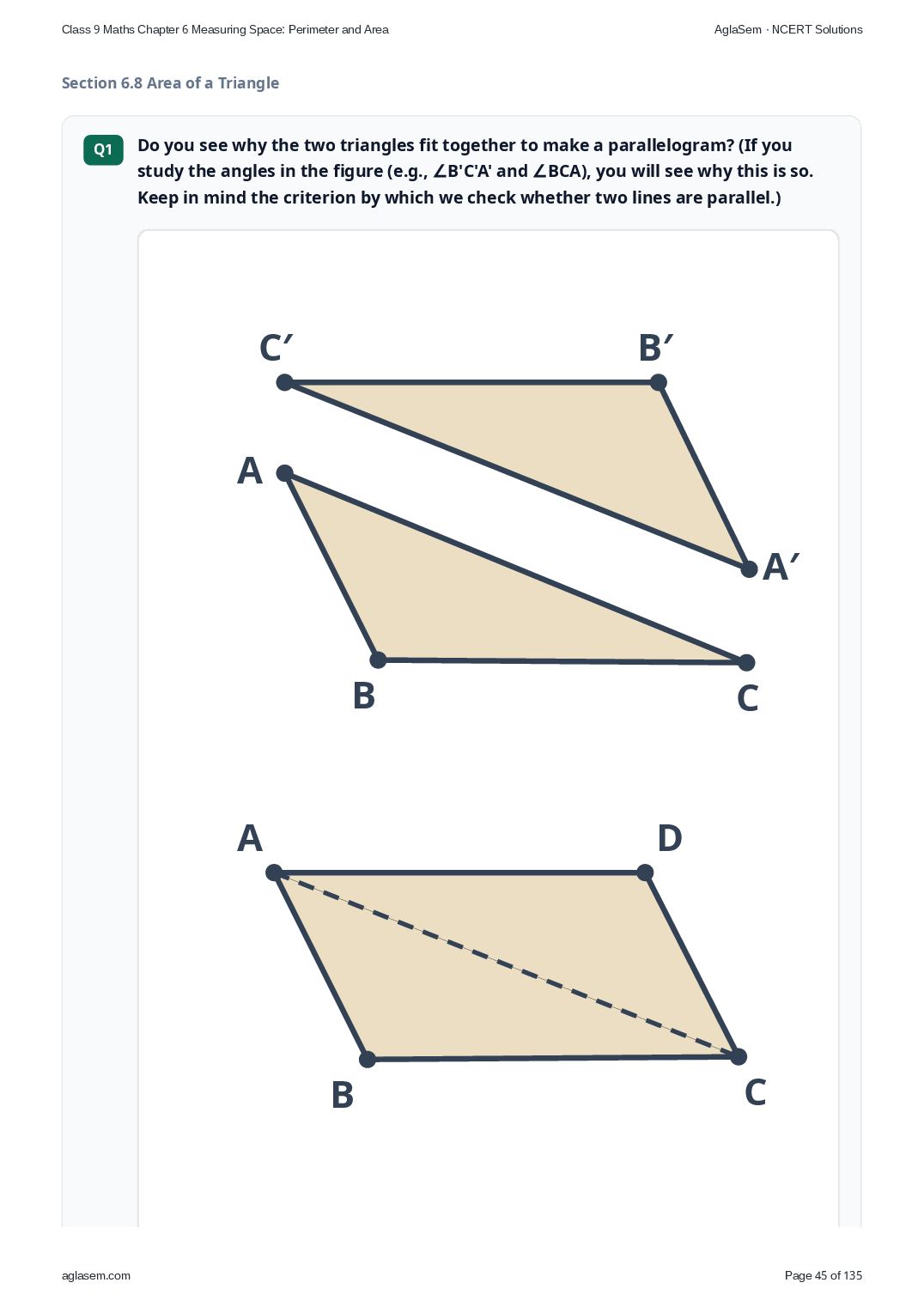
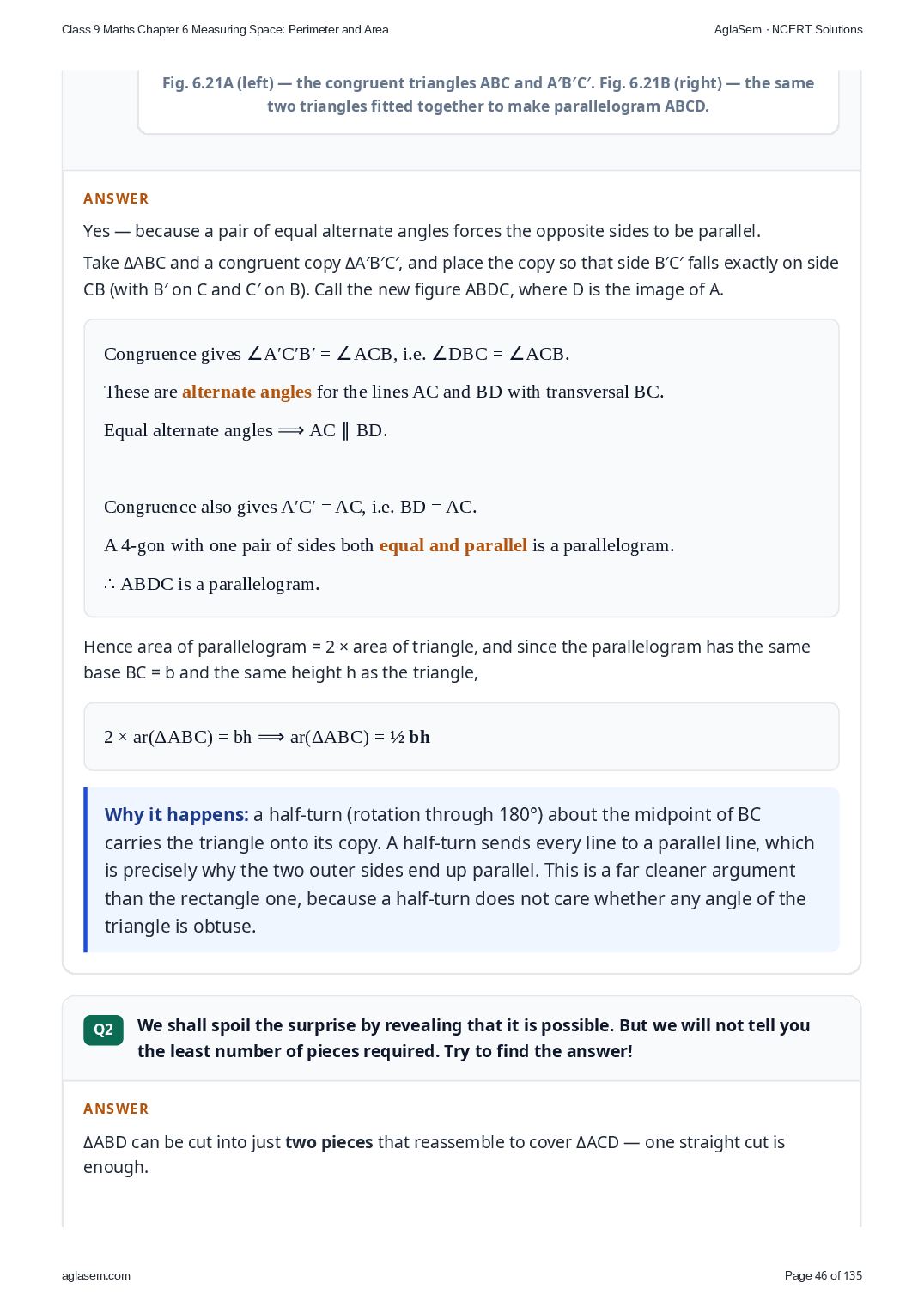
- Do you see why the two triangles fit together to make a parallelogram? (If you study the angles in the figure (e.g., ∠B'C'A' and ∠BCA), you will see why this is so. Keep in mind the criterion by which we check whether two lines are parallel.)
- We shall spoil the surprise by revealing that it is possible. But we will not tell you the least number of pieces required. Try to find the answer!
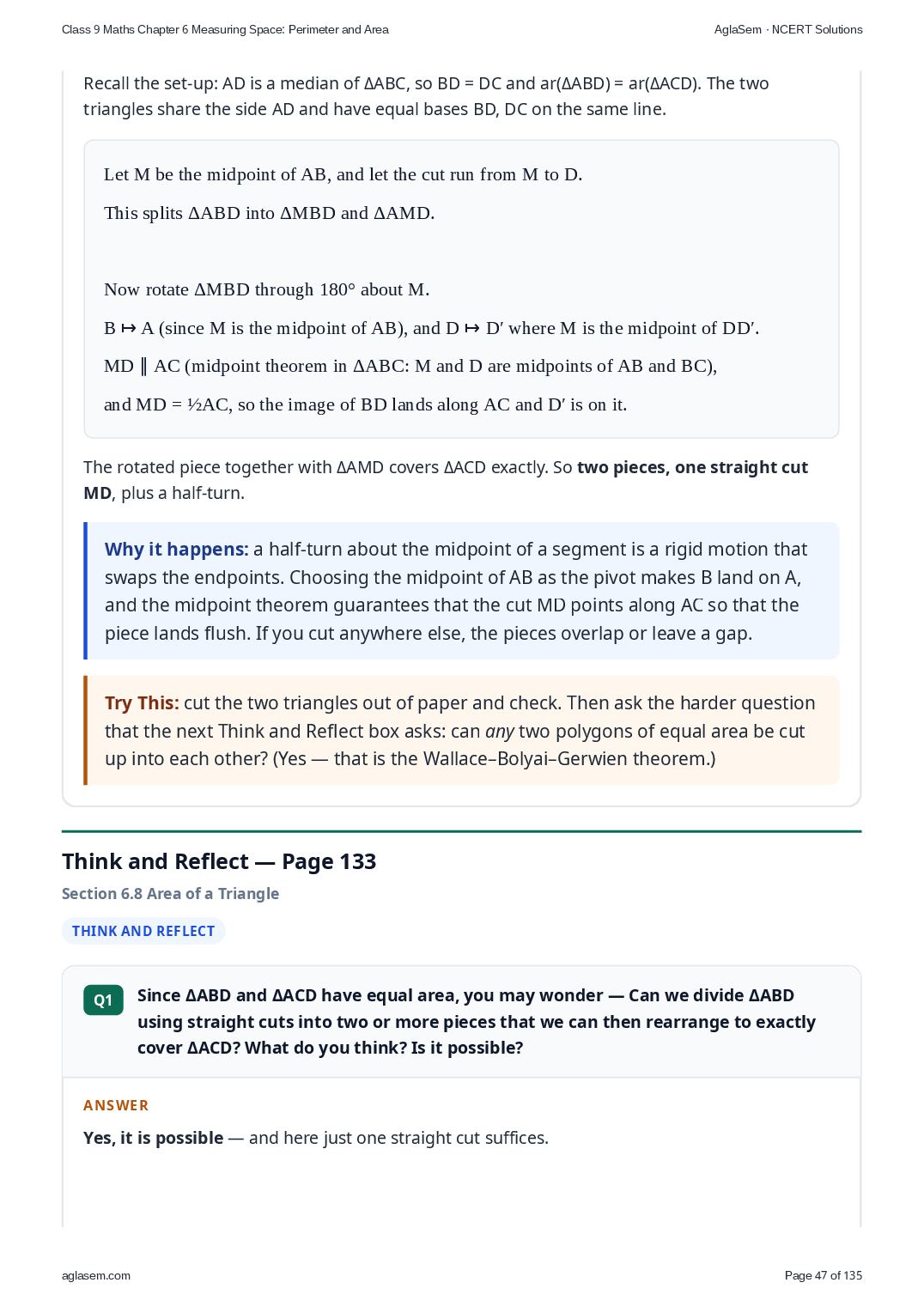
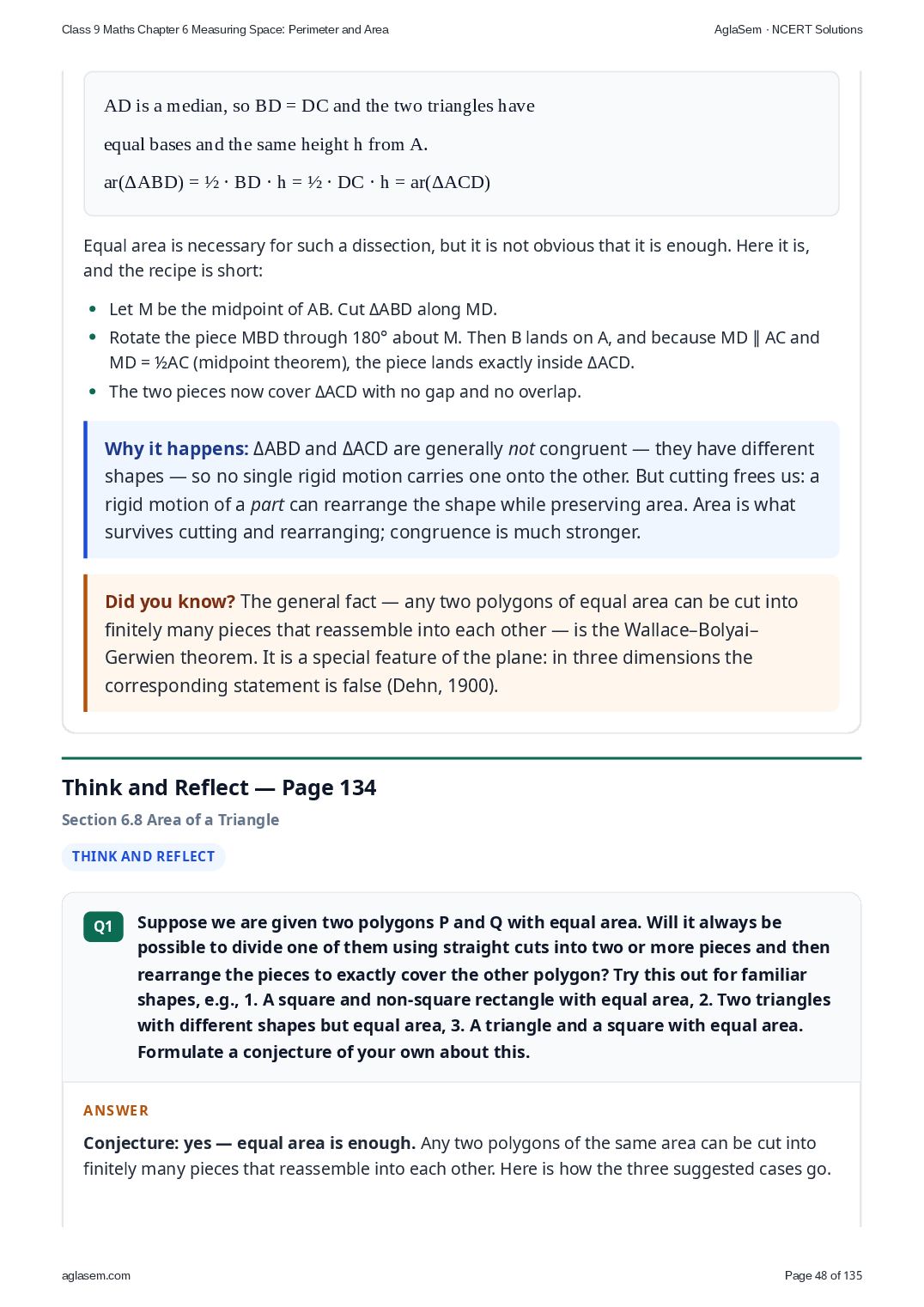
- Since ΔABD and ΔACD have equal area, you may wonder — Can we divide ΔABD using straight cuts into two or more pieces that we can then rearrange to exactly cover ΔACD? What do you think? Is it possible?
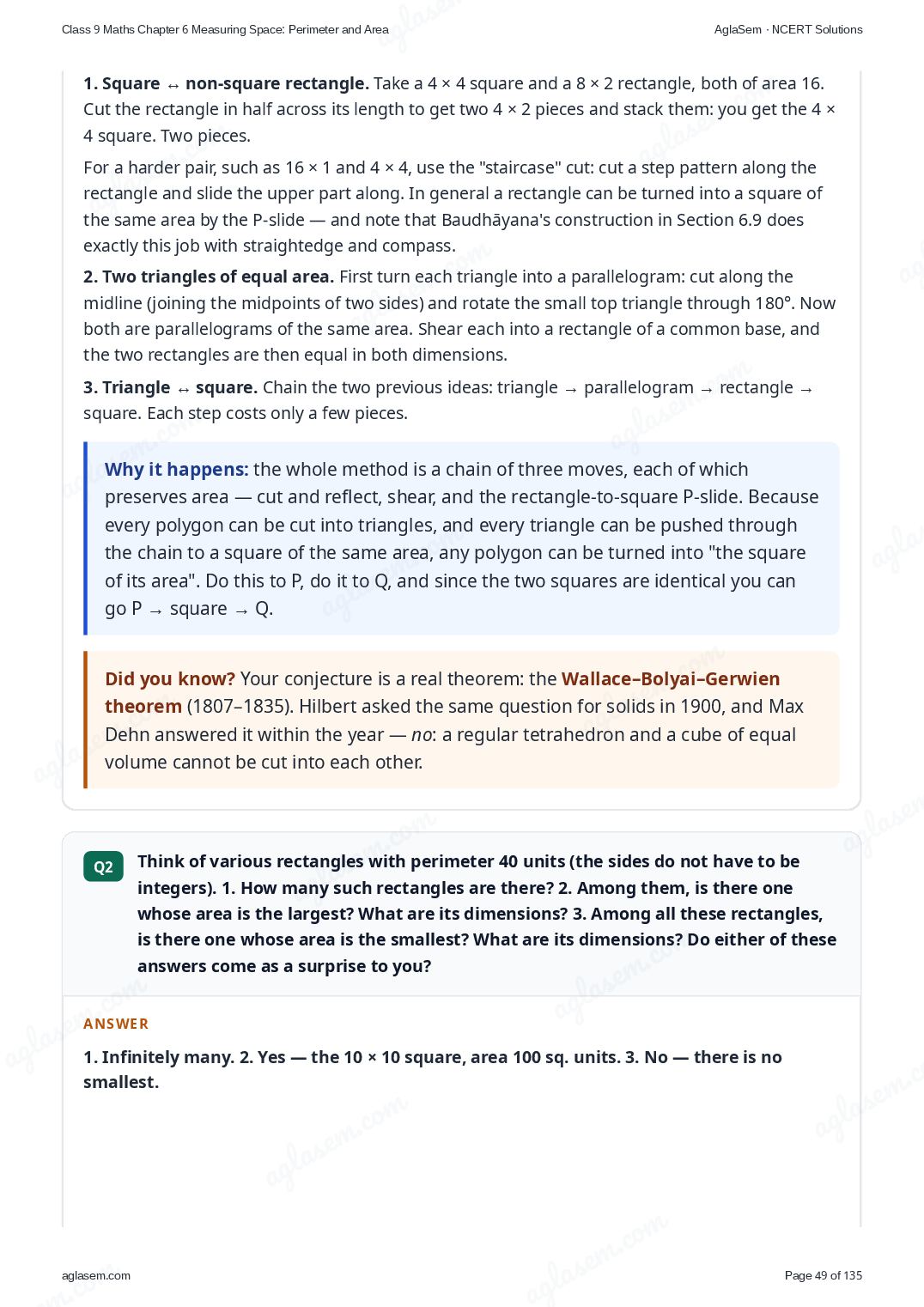
- Suppose we are given two polygons P and Q with equal area. Will it always be possible to divide one of them using straight cuts into two or more pieces and then rearrange the pieces to exactly cover the other polygon? Try this out for familiar shapes, e.g., 1. A square and non-square rectangle with equal area, 2. Two triangles with different shapes but equal area, 3. A triangle and a square with equal area. Formulate a conjecture of your own about this.
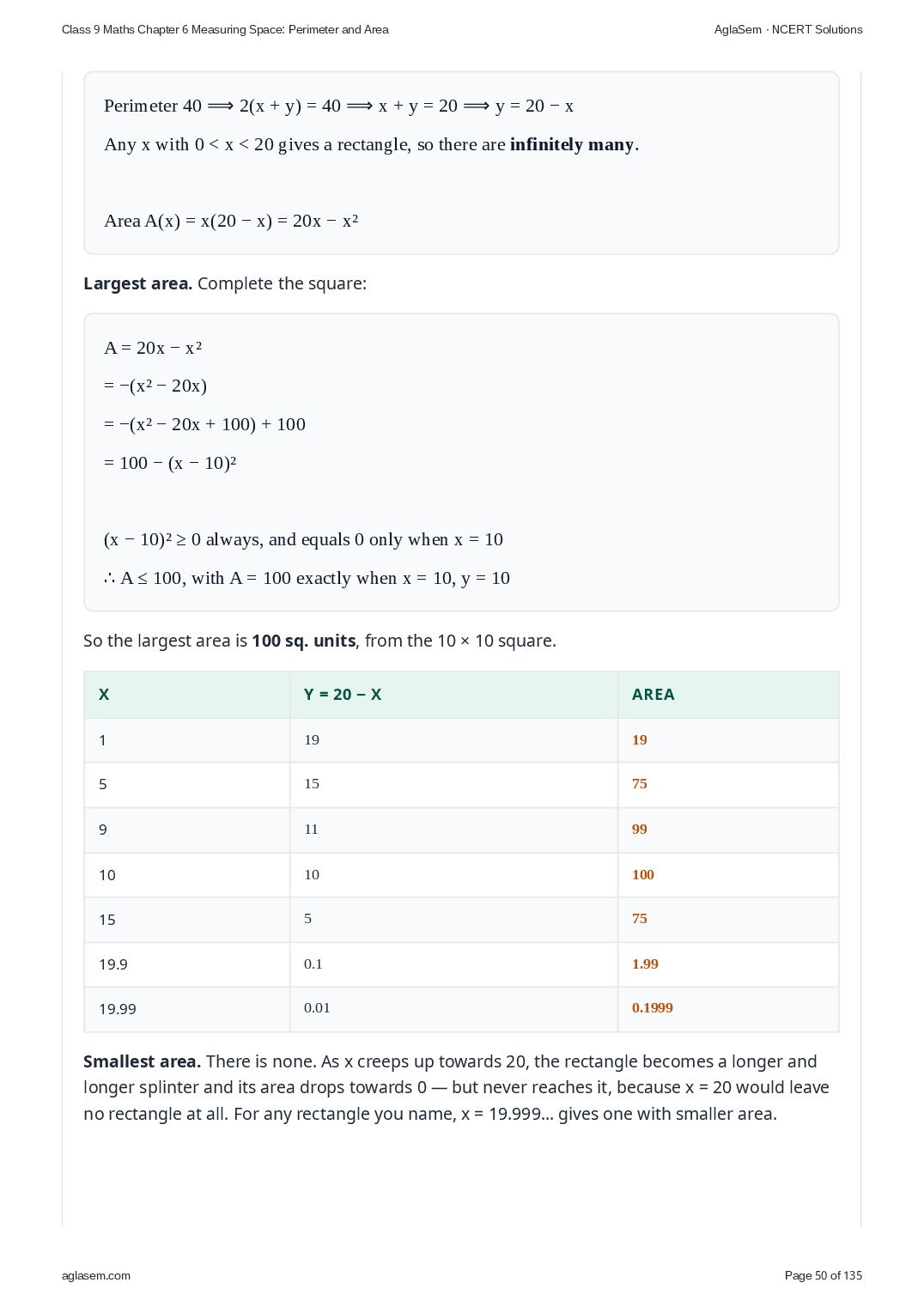
- Think of various rectangles with perimeter 40 units (the sides do not have to be integers). 1. How many such rectangles are there? 2. Among them, is there one whose area is the largest? What are its dimensions? 3. Among all these rectangles, is there one whose area is the smallest? What are its dimensions? Do either of these answers come as a surprise to you?
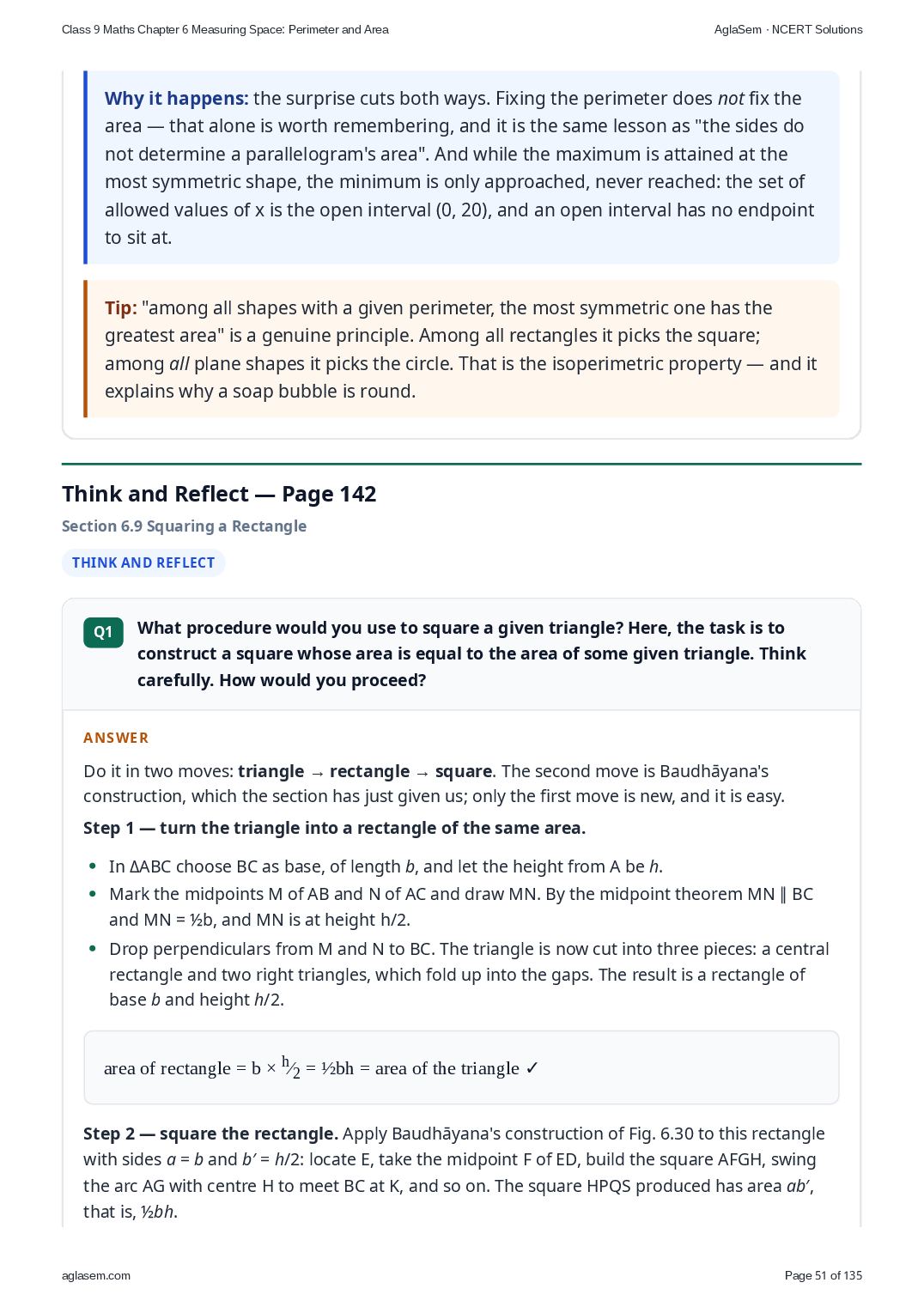
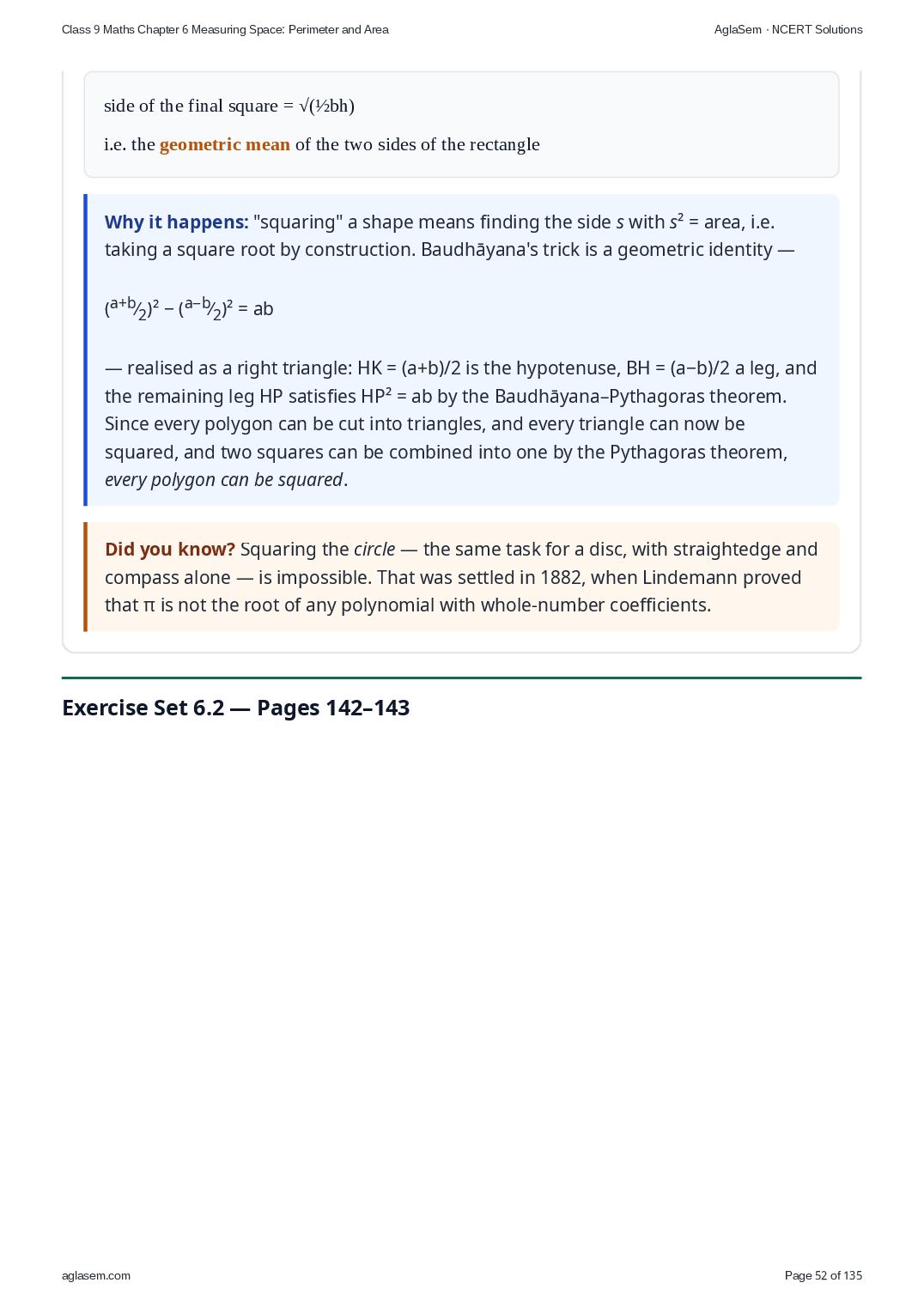
- What procedure would you use to square a given triangle? Here, the task is to construct a square whose area is equal to the area of some given triangle. Think carefully. How would you proceed?
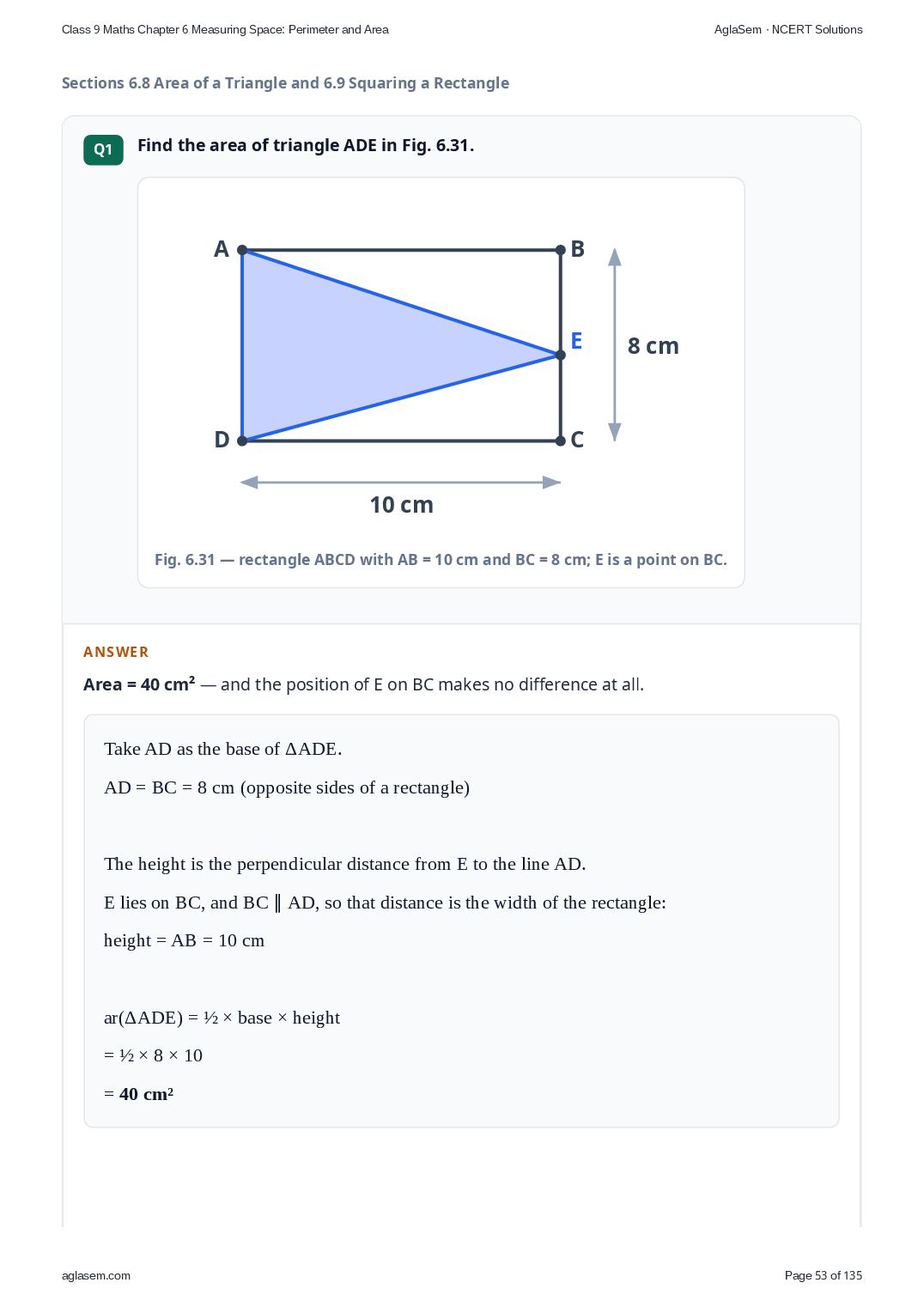
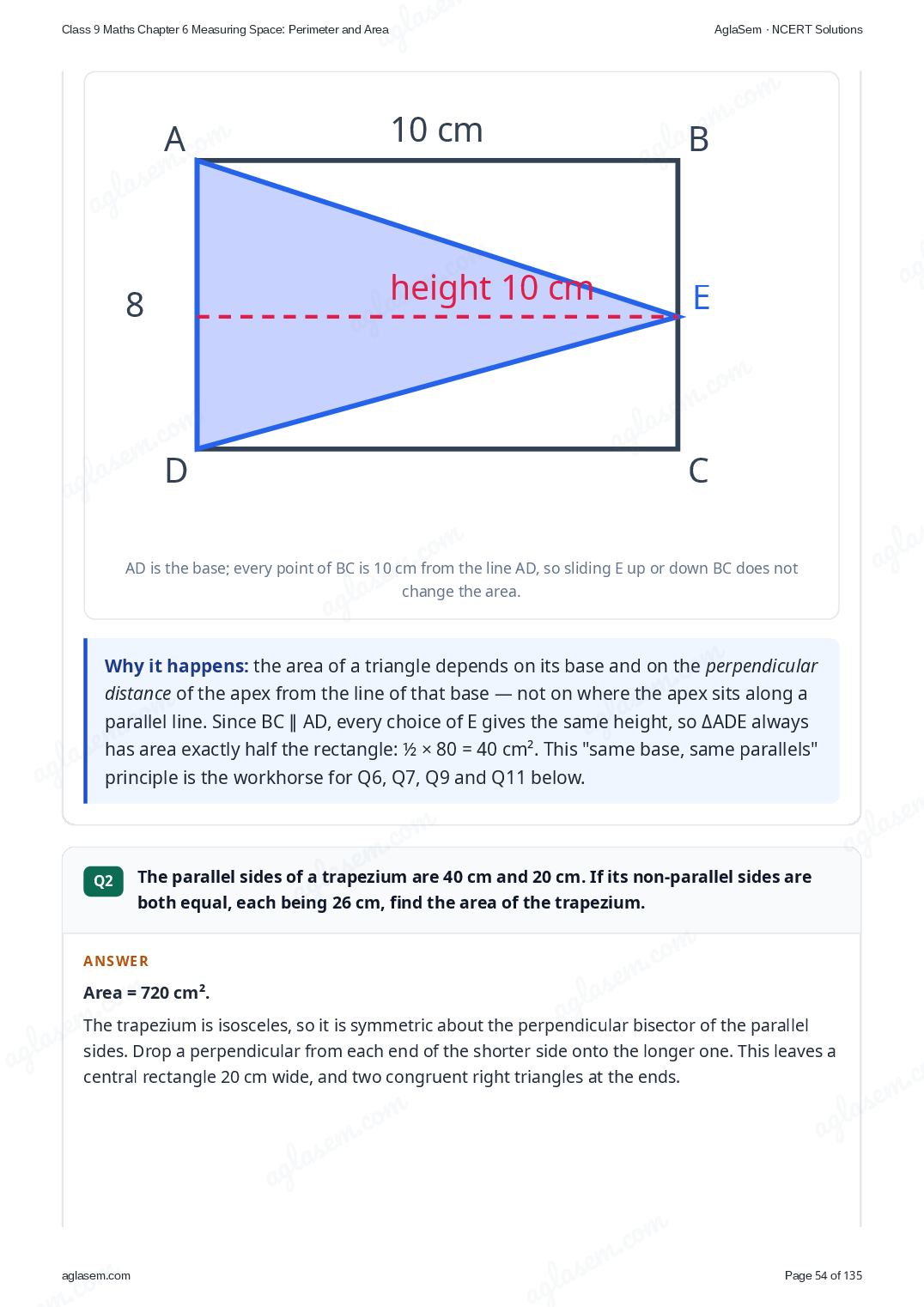
- Find the area of triangle ADE in Fig. 6.31. (ABCD is a rectangle with AB = 10 cm and BC = 8 cm; A is the top-left corner, B the top-right, C the bottom-right and D the bottom-left; E is a point on side BC.)
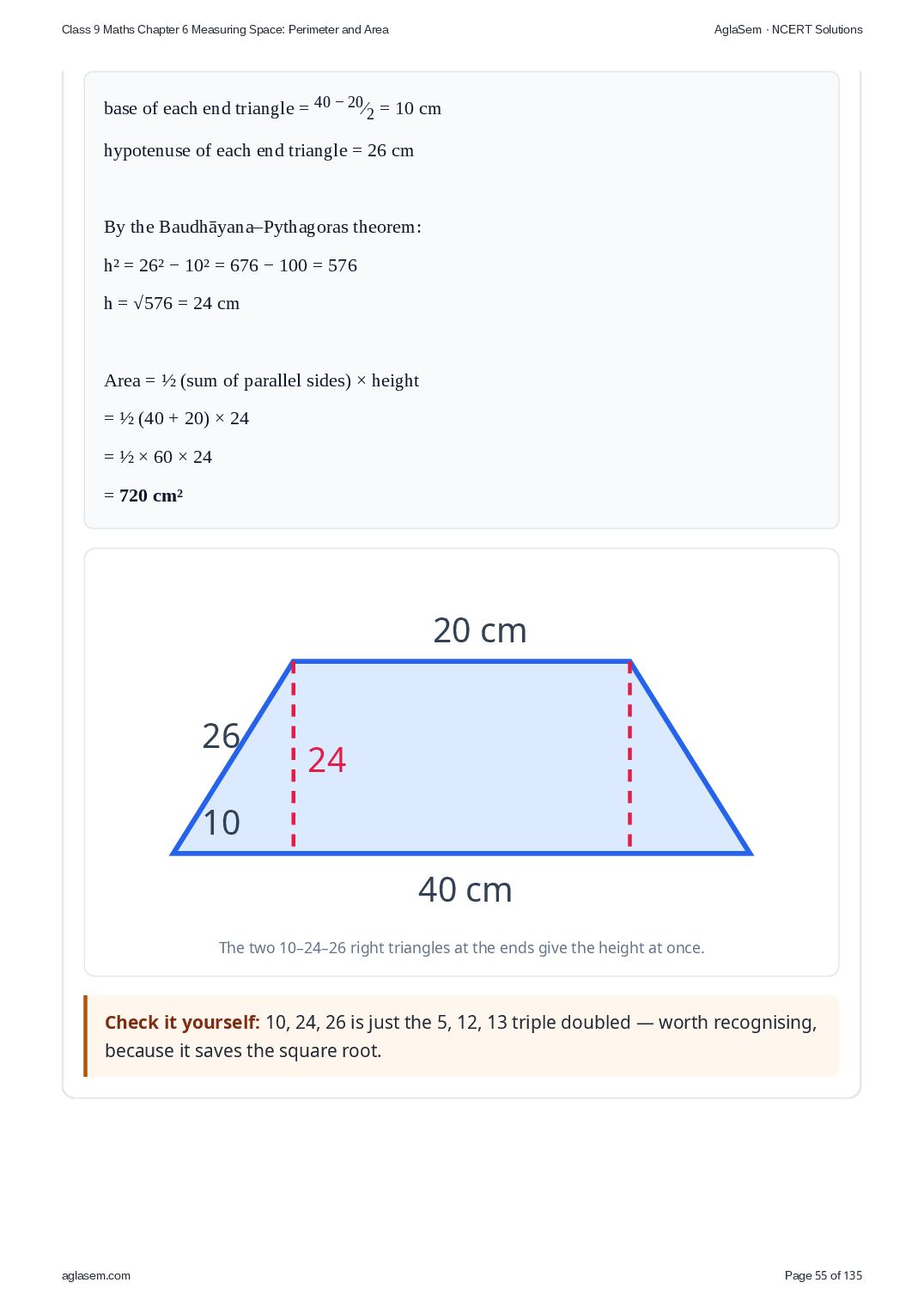
- The parallel sides of a trapezium are 40 cm and 20 cm. If its non-parallel sides are both equal, each being 26 cm, find the area of the trapezium.
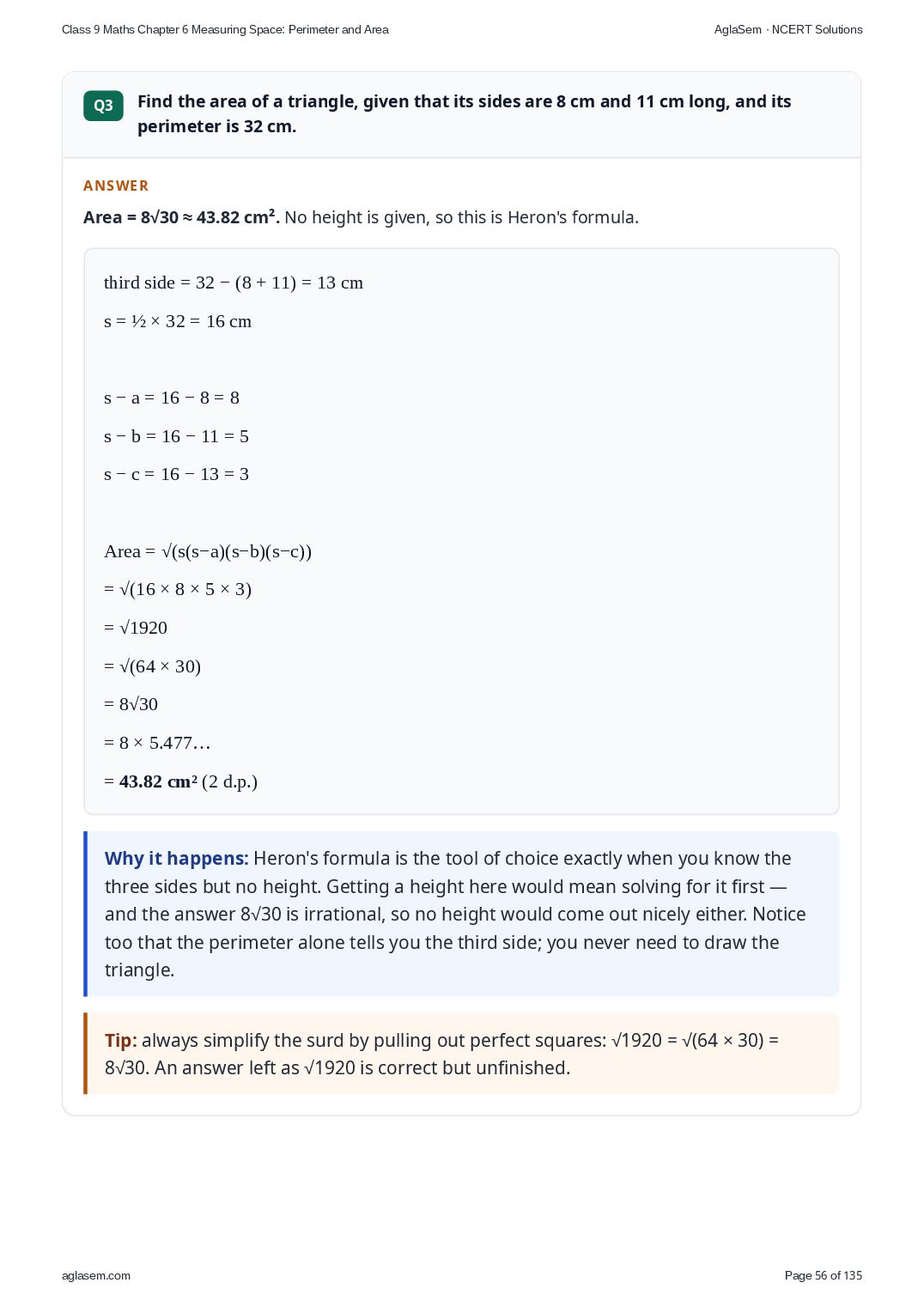
- Find the area of a triangle, given that its sides are 8 cm and 11 cm long, and its perimeter is 32 cm.
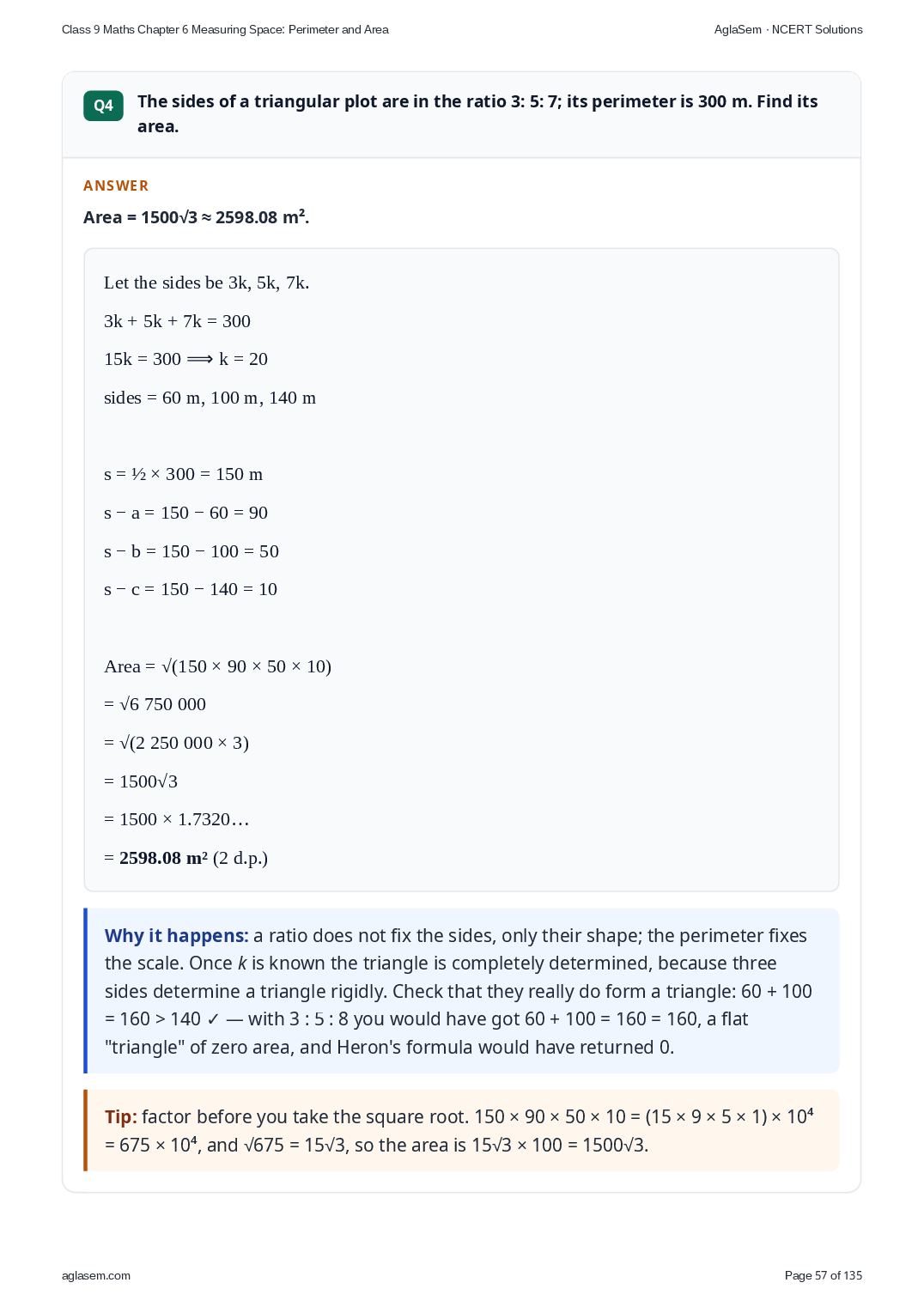
- The sides of a triangular plot are in the ratio 3: 5: 7; its perimeter is 300 m. Find its area.
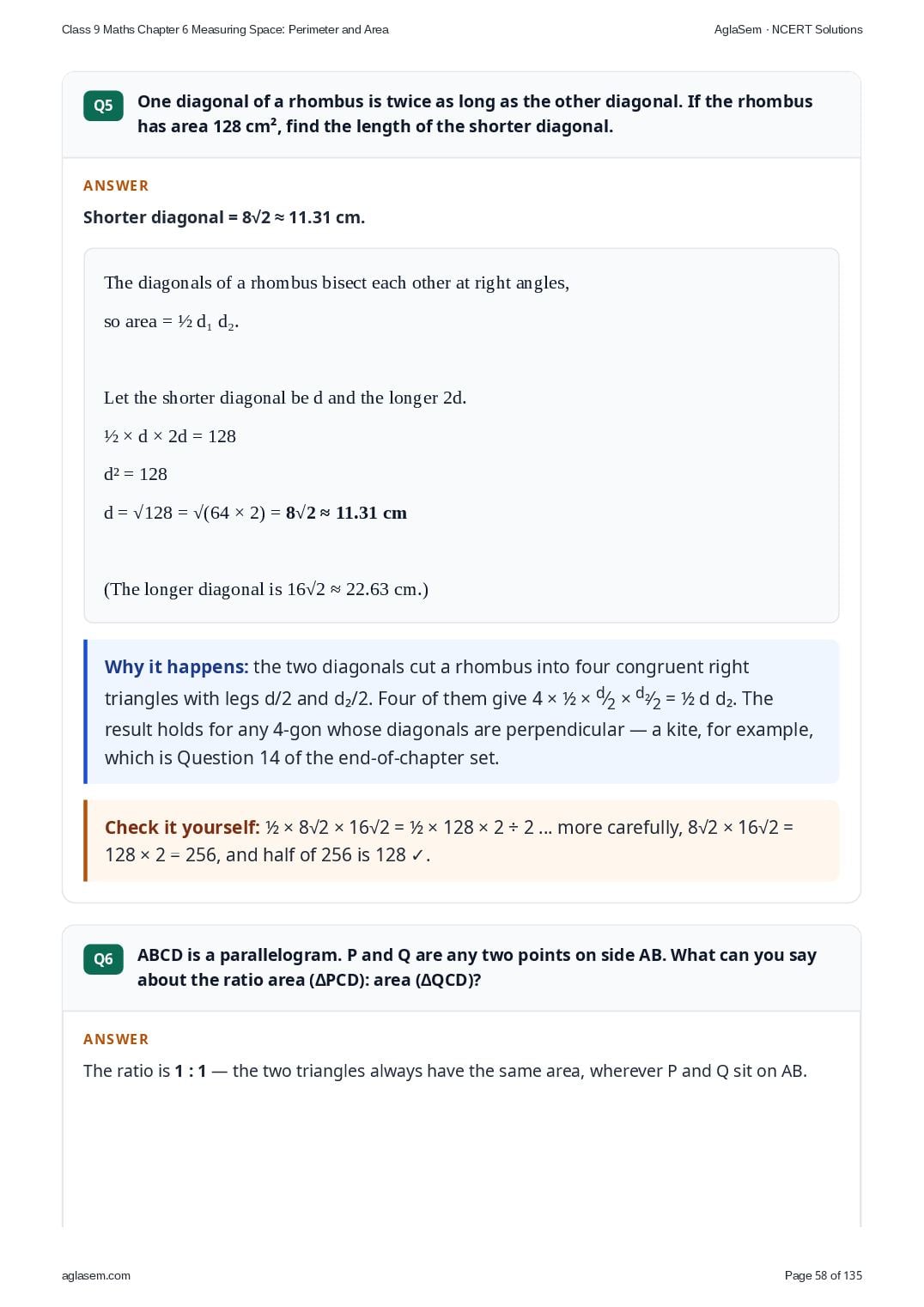
- One diagonal of a rhombus is twice as long as the other diagonal. If the rhombus has area 128 cm², find the length of the shorter diagonal.
- ABCD is a parallelogram. P and Q are any two points on side AB. What can you say about the ratio area (∆PCD): area (∆QCD)?
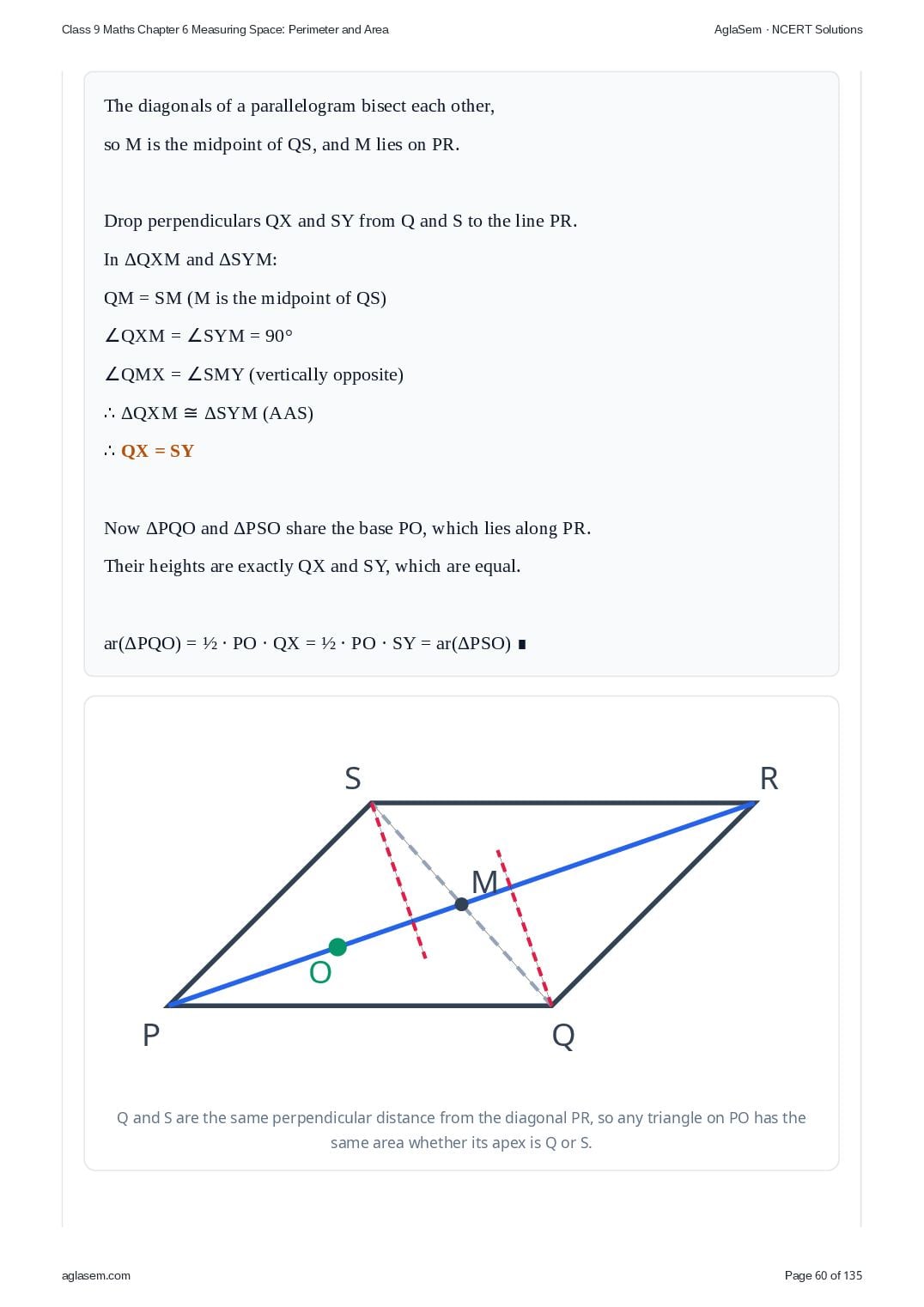
- O is any point on the diagonal PR of a parallelogram PQRS. Prove that the areas of triangles PSO and PQO are equal.
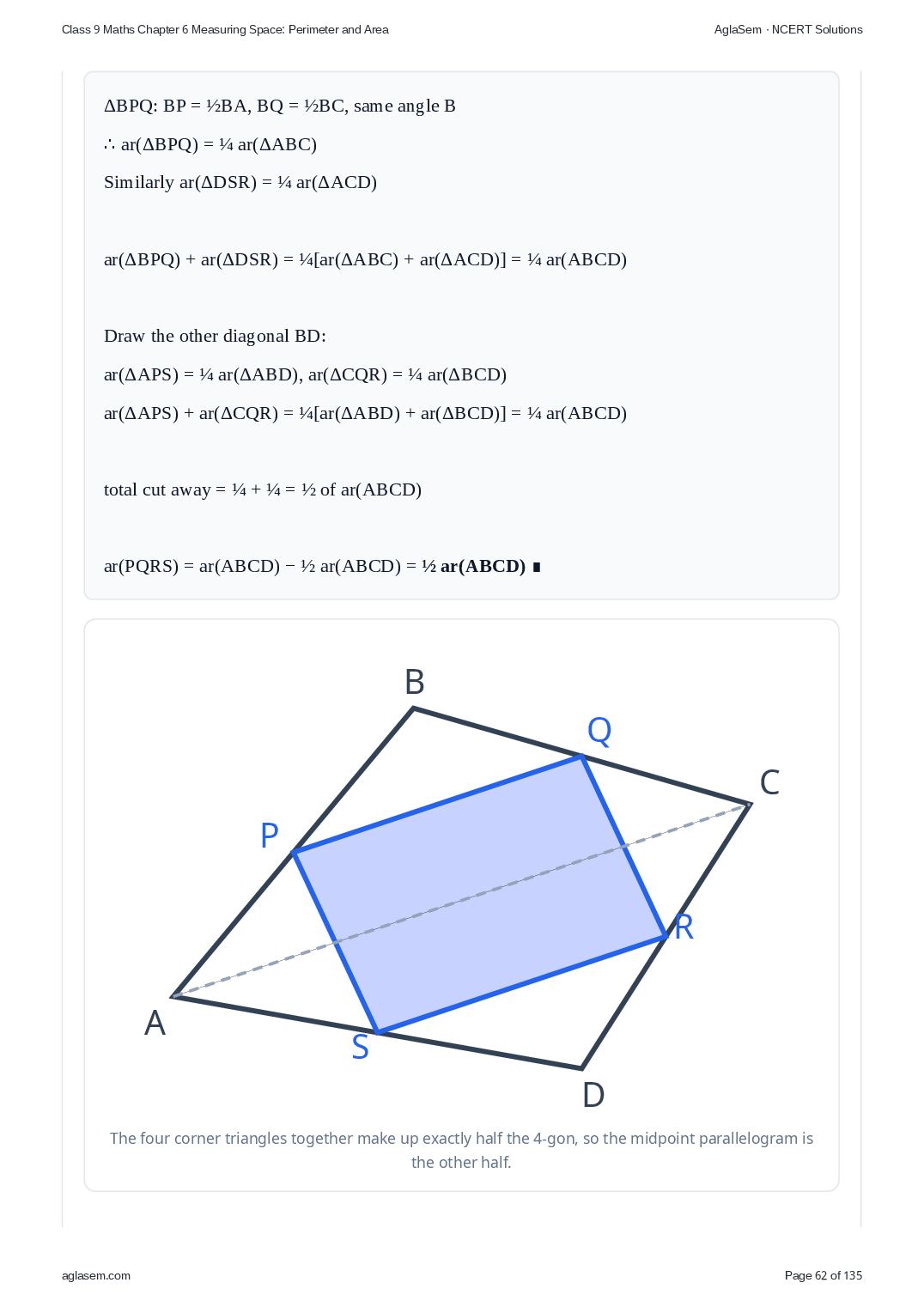
- If the mid-points of the sides of a 4-gon (also known as a quadrilateral, but we prefer to call it a ‘4-gon’) are joined in order, prove that the area of the parallelogram thus formed will be half of the area of the given 4-gon.
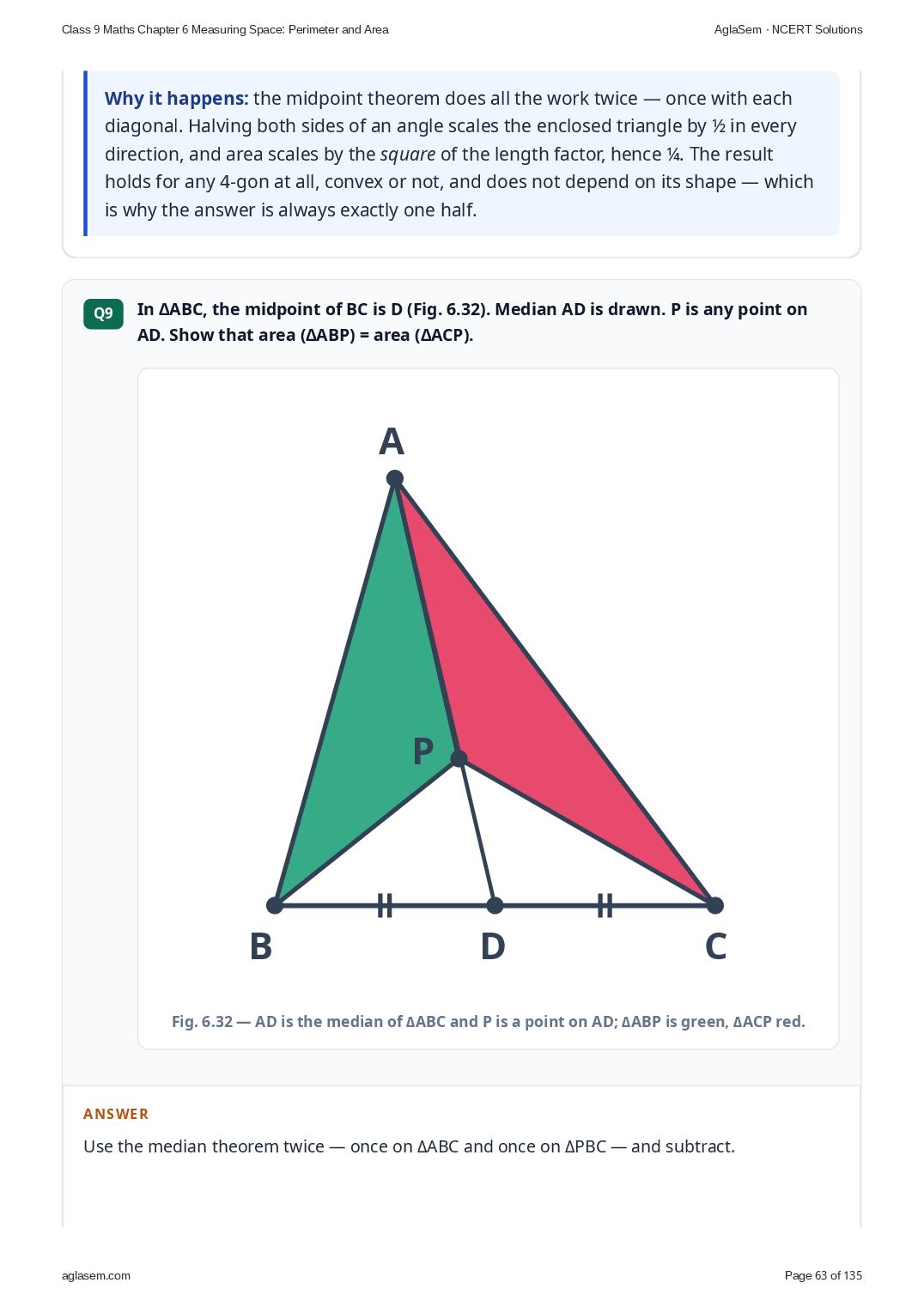
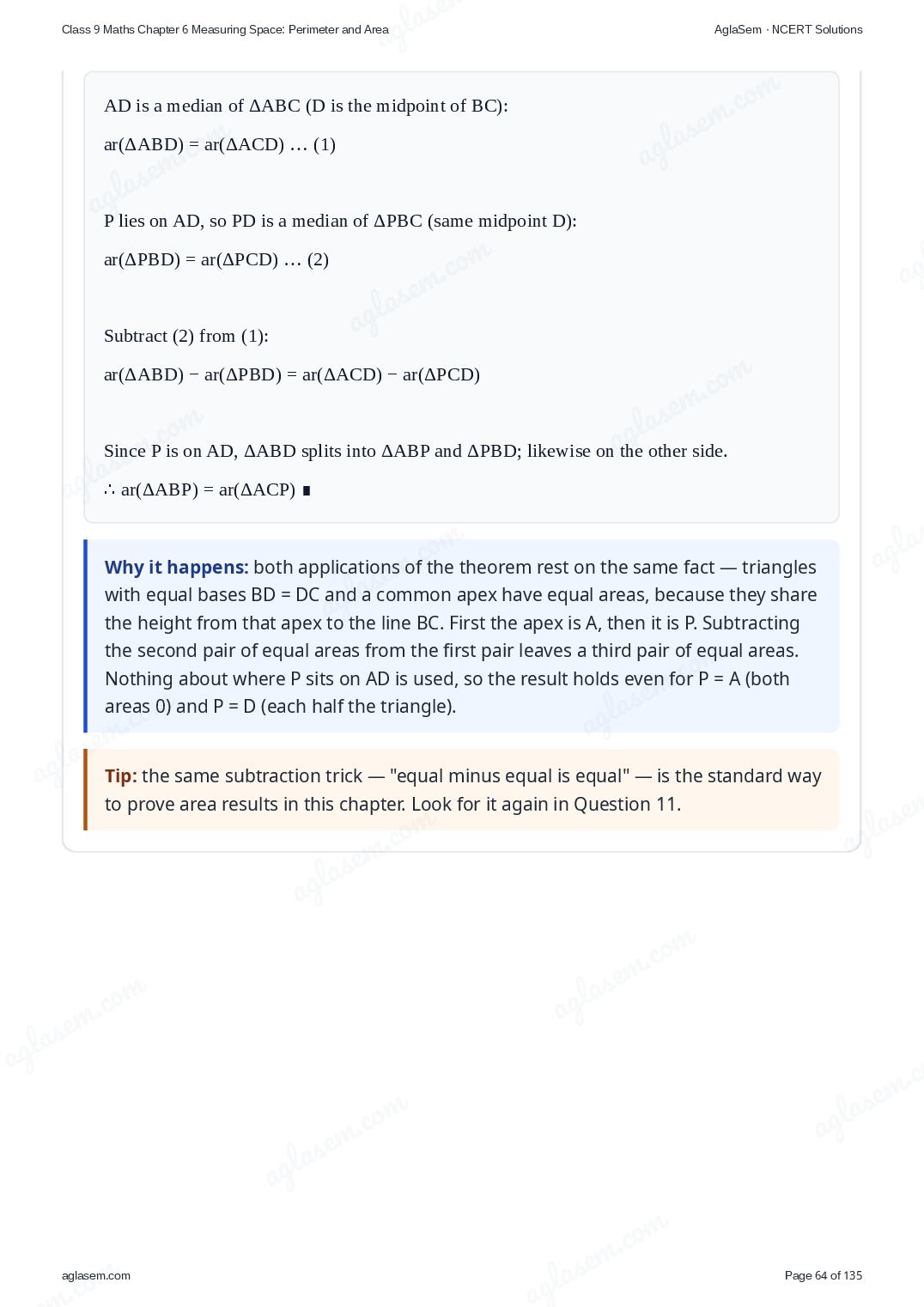
- In ∆ABC, the midpoint of BC is D (Fig. 6.32). Median AD is drawn. P is any point on AD. Show that area (∆ABP) = area (∆ACP).
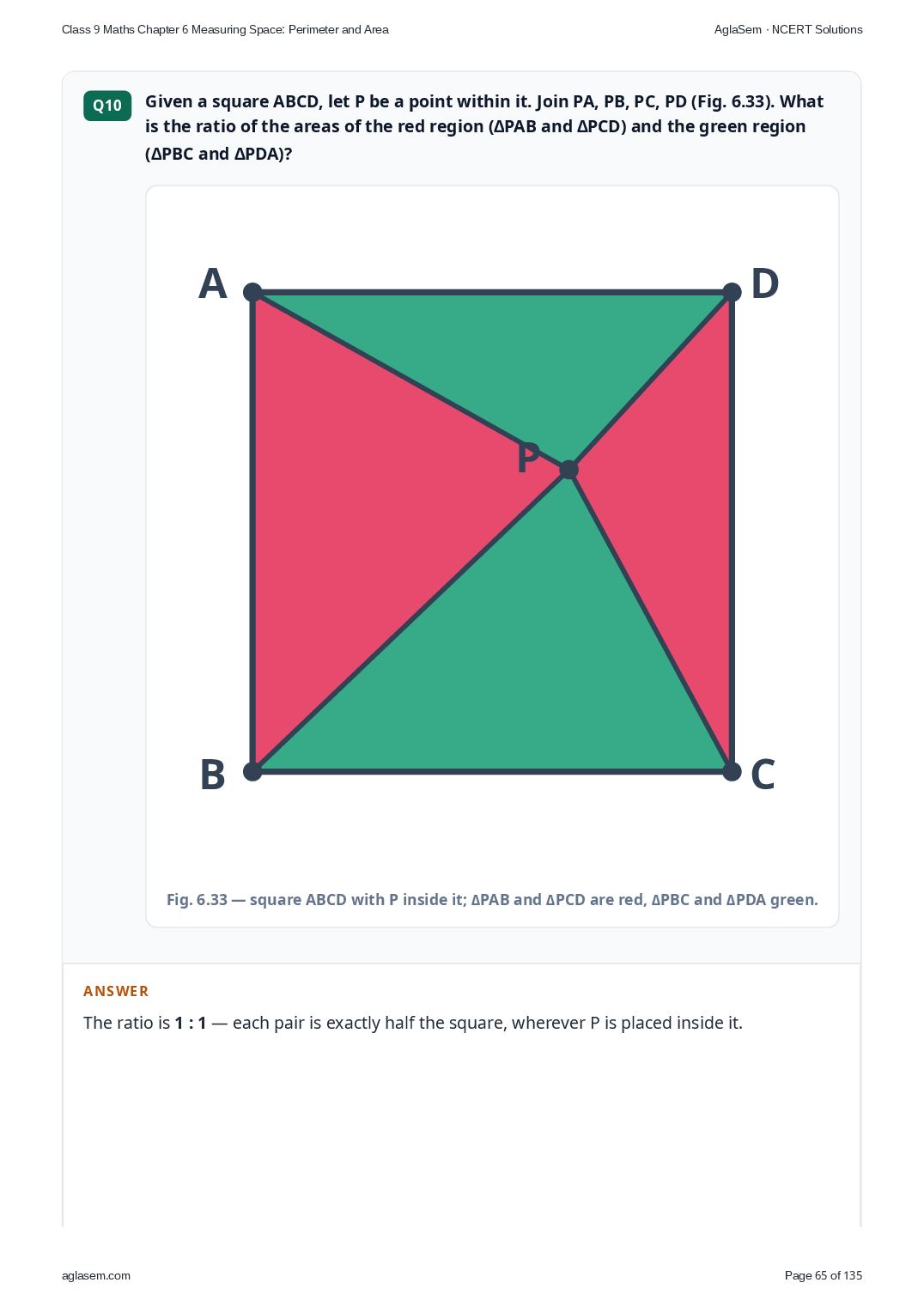
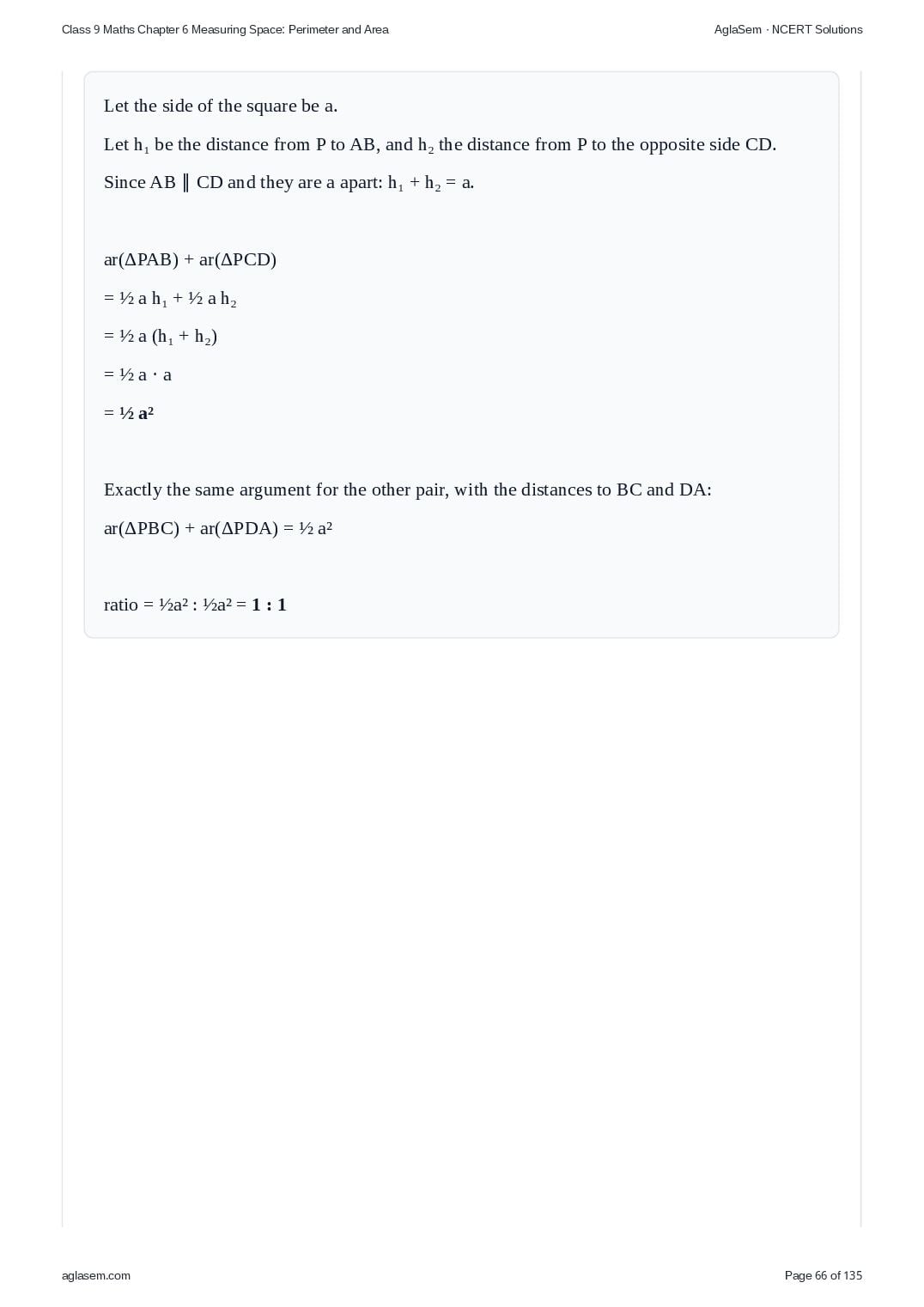
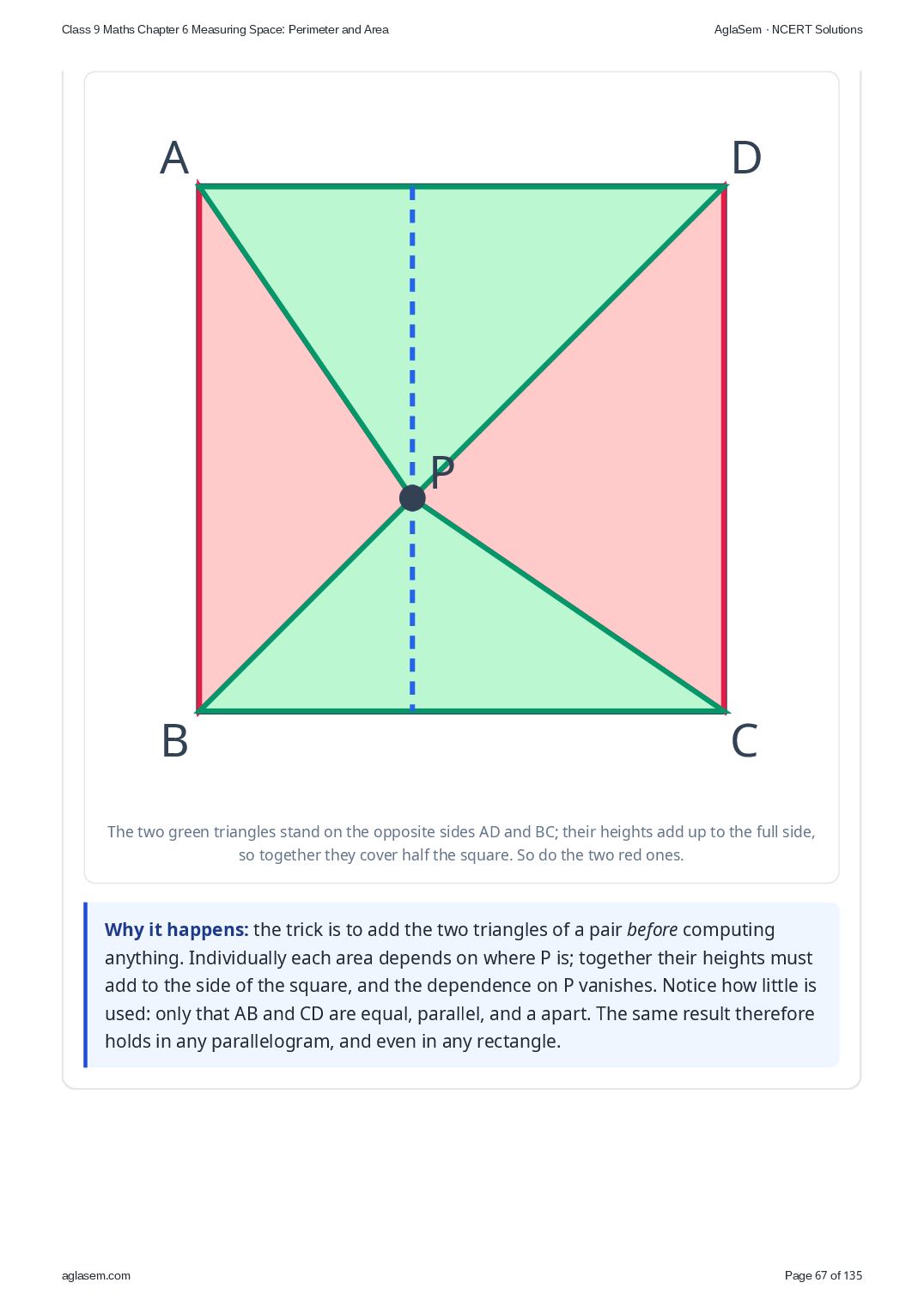
- Given a square ABCD, let P be a point within it. Join PA, PB, PC, PD (Fig. 6.33). What is the ratio of the areas of the red region (∆PAB and ∆PCD) and the green region (∆PBC and ∆PDA)?
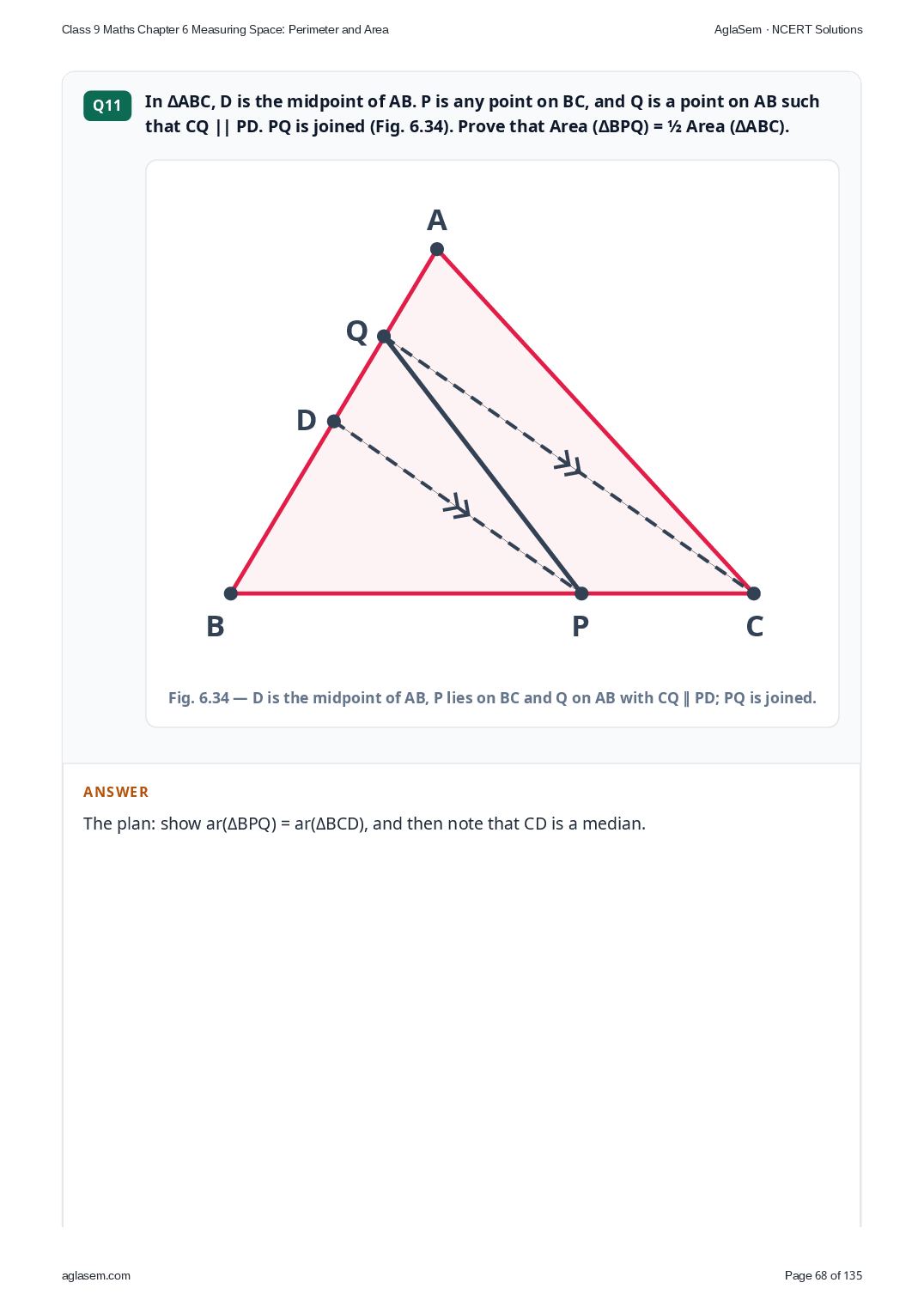
- In ∆ABC, D is the midpoint of AB. P is any point on BC, and Q is a point on AB such that CQ || PD. PQ is joined (Fig. 6.34). Prove that Area (∆BPQ) = ½ Area (∆ABC).
- Why were human beings so fond of using circular shapes? Was this only for practical reasons, or could there have been other reasons too? What kinds of uses have human beings found for the circular shape?
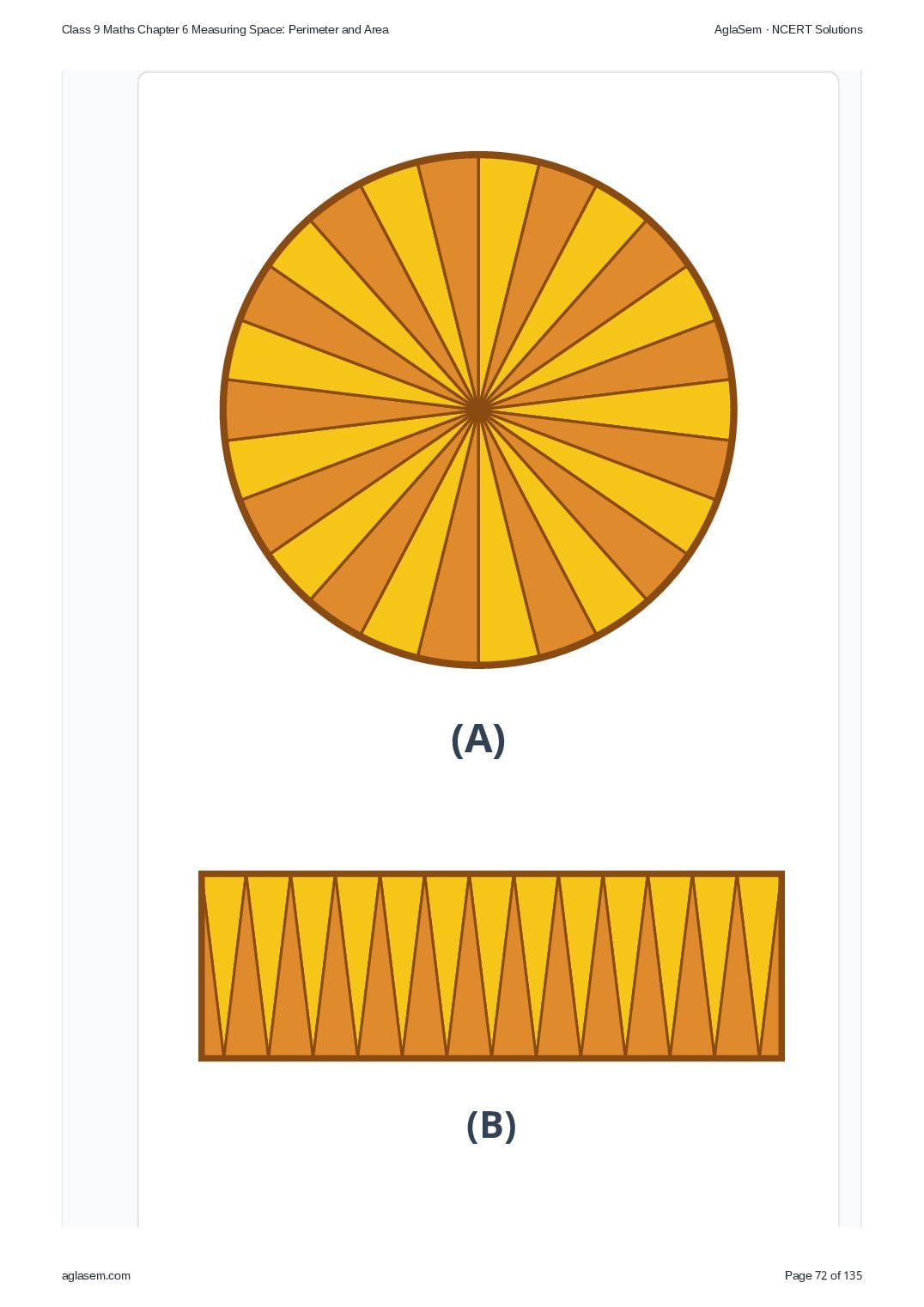
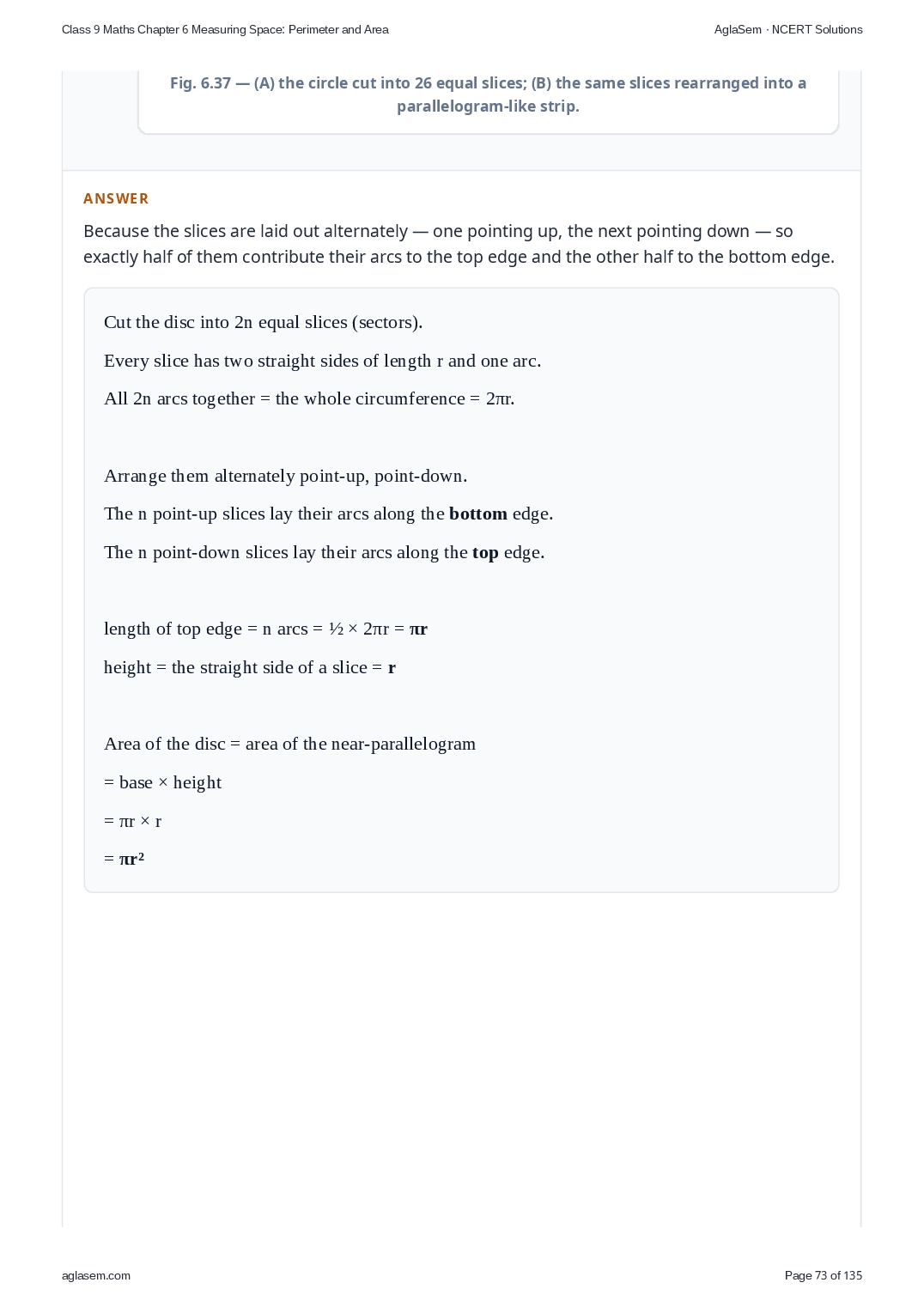
- As the slices become smaller and smaller, the arcs in Fig. 6.37B become more and more closer to a line. This makes the figure more and more closer to a parallelogram with base = half the circumference (why?) = πr, height = radius r.
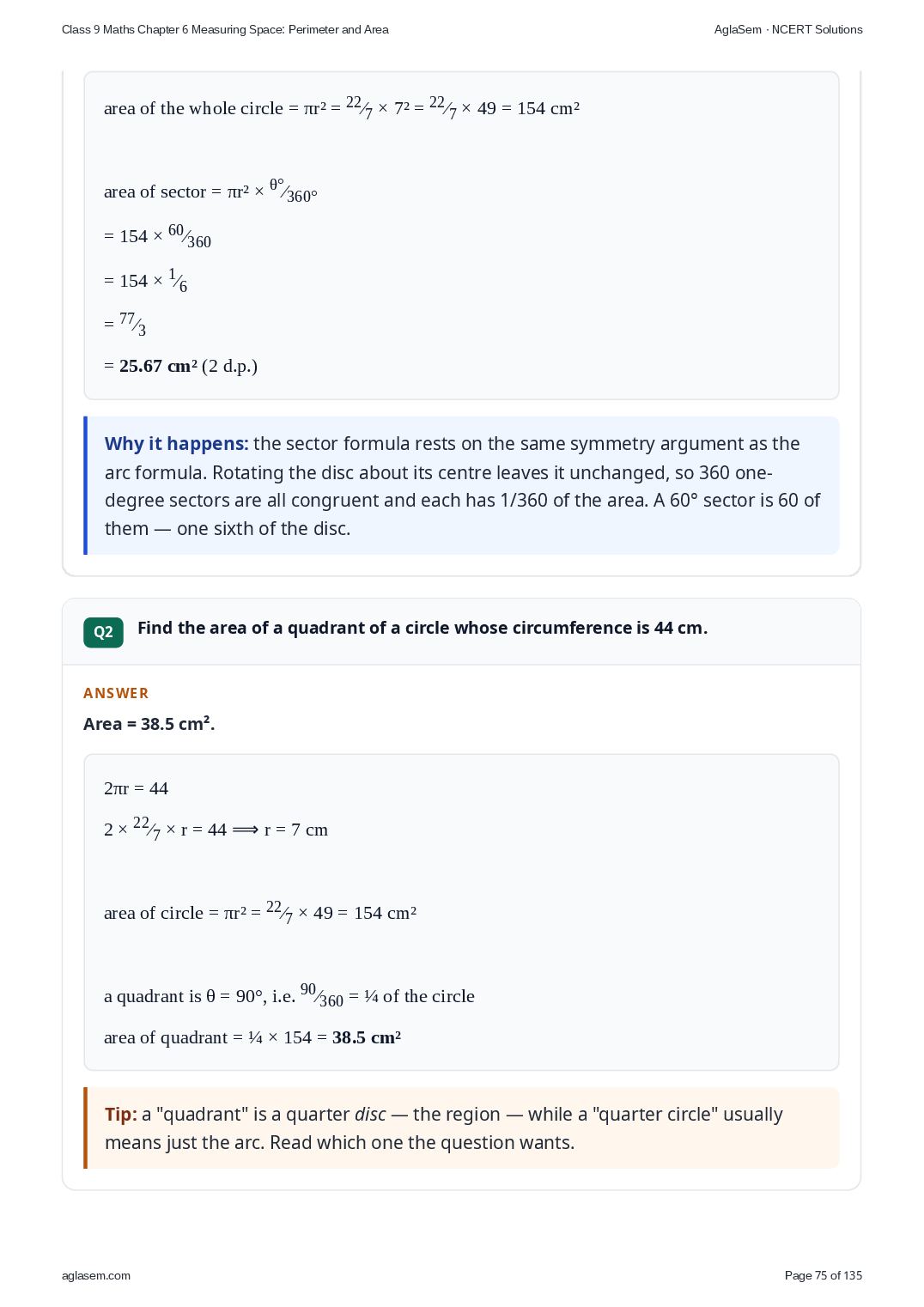
- Unless stated otherwise, use the approximation 22/7 for π. Find the area of a sector of a circle with radius 7 cm if the angle of the sector is 60°.
- Find the area of a quadrant of a circle whose circumference is 44 cm.
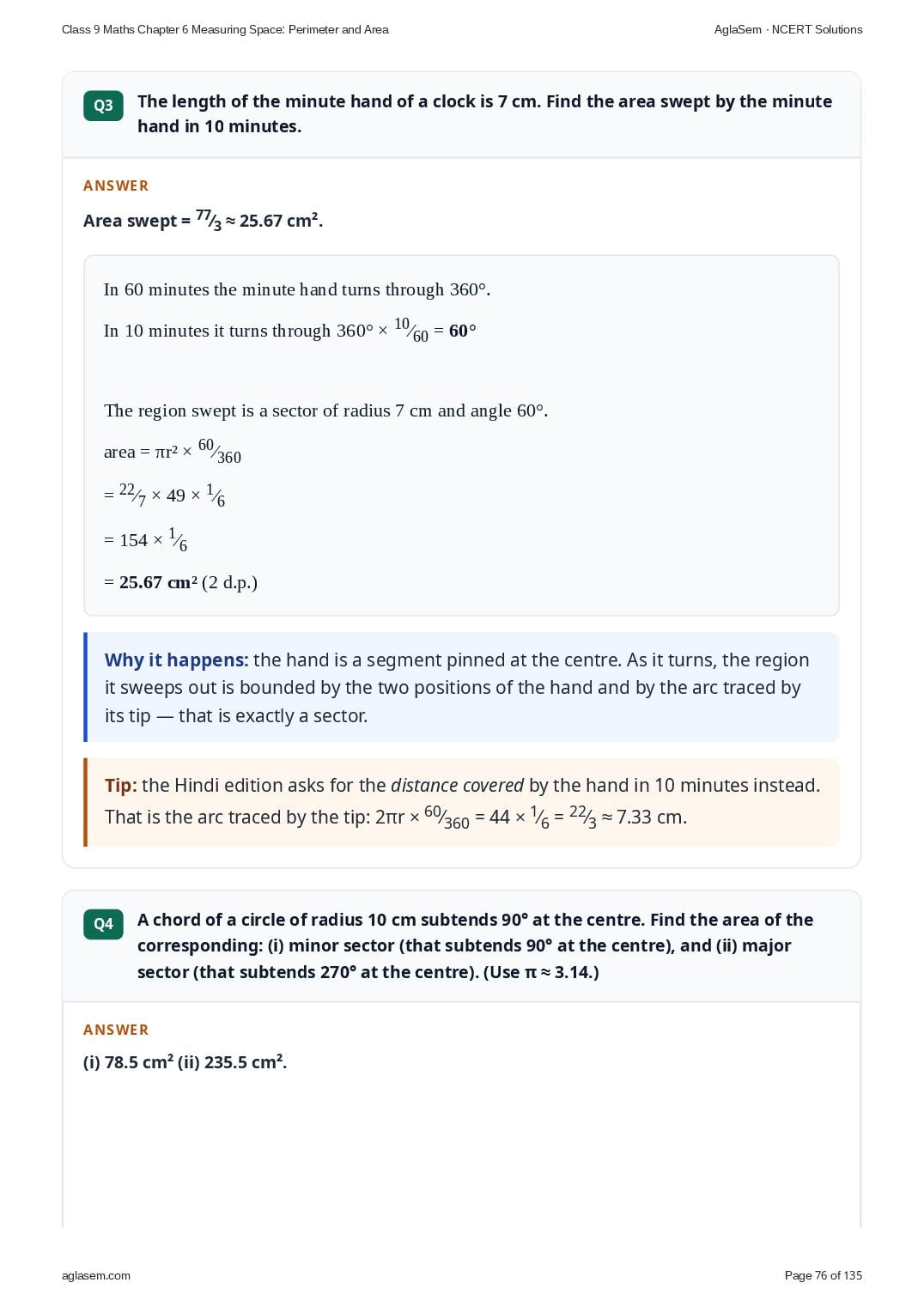
- The length of the minute hand of a clock is 7 cm. Find the area swept by the minute hand in 10 minutes.
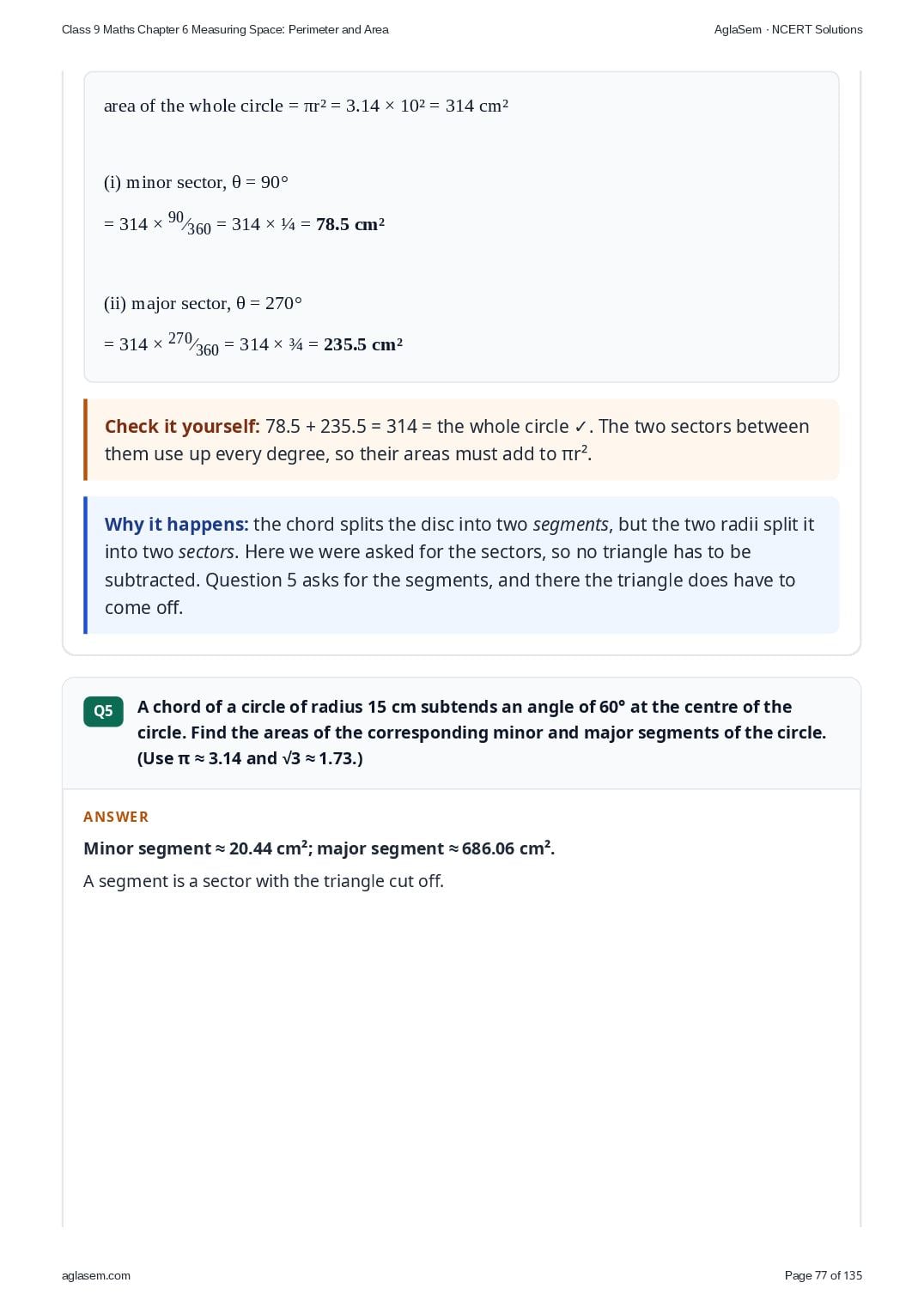
- A chord of a circle of radius 10 cm subtends 90° at the centre. Find the area of the corresponding: (i) minor sector (that subtends 90° at the centre), and (ii) major sector (that subtends 270° at the centre). (Use π ≈ 3.14.)
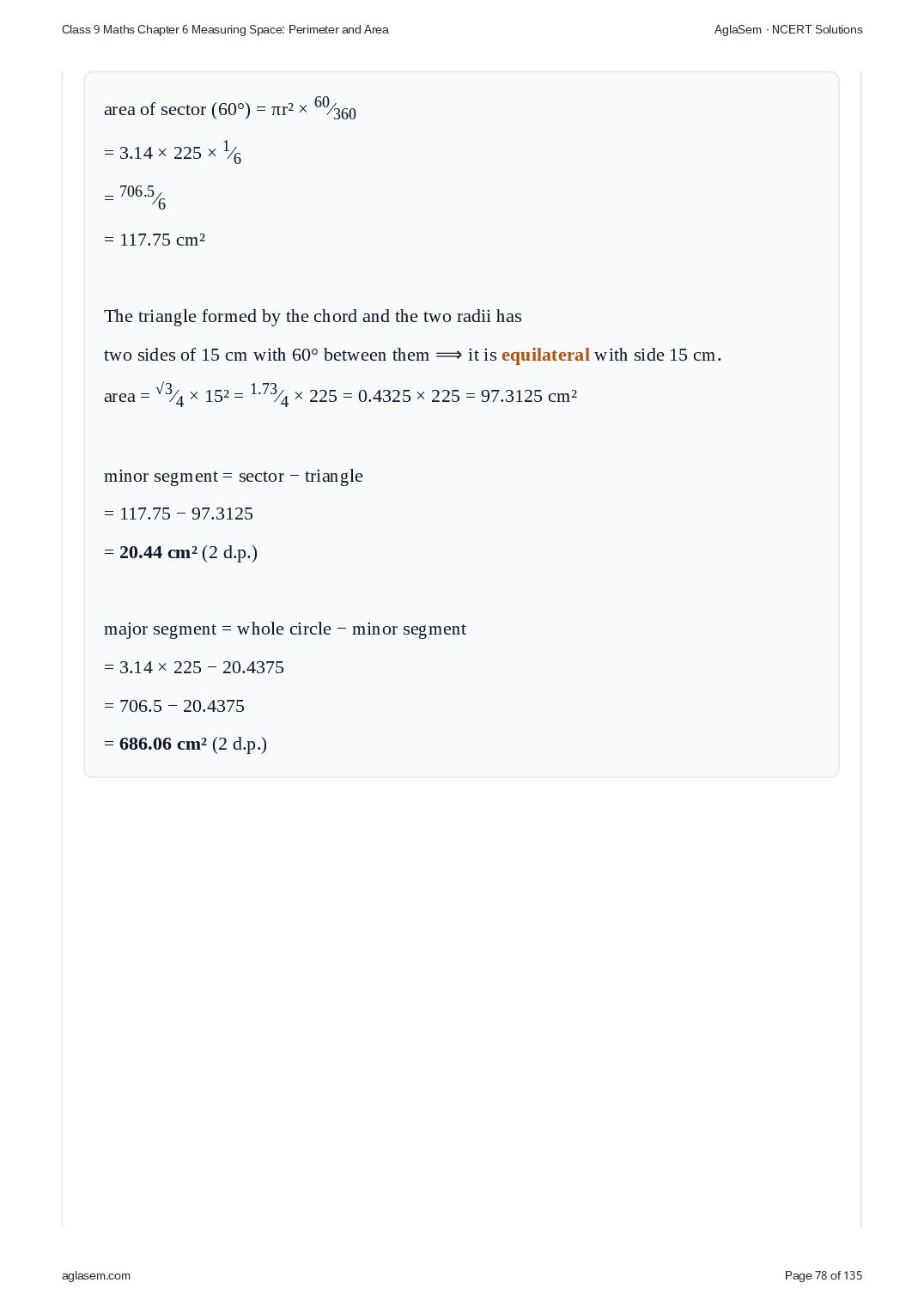
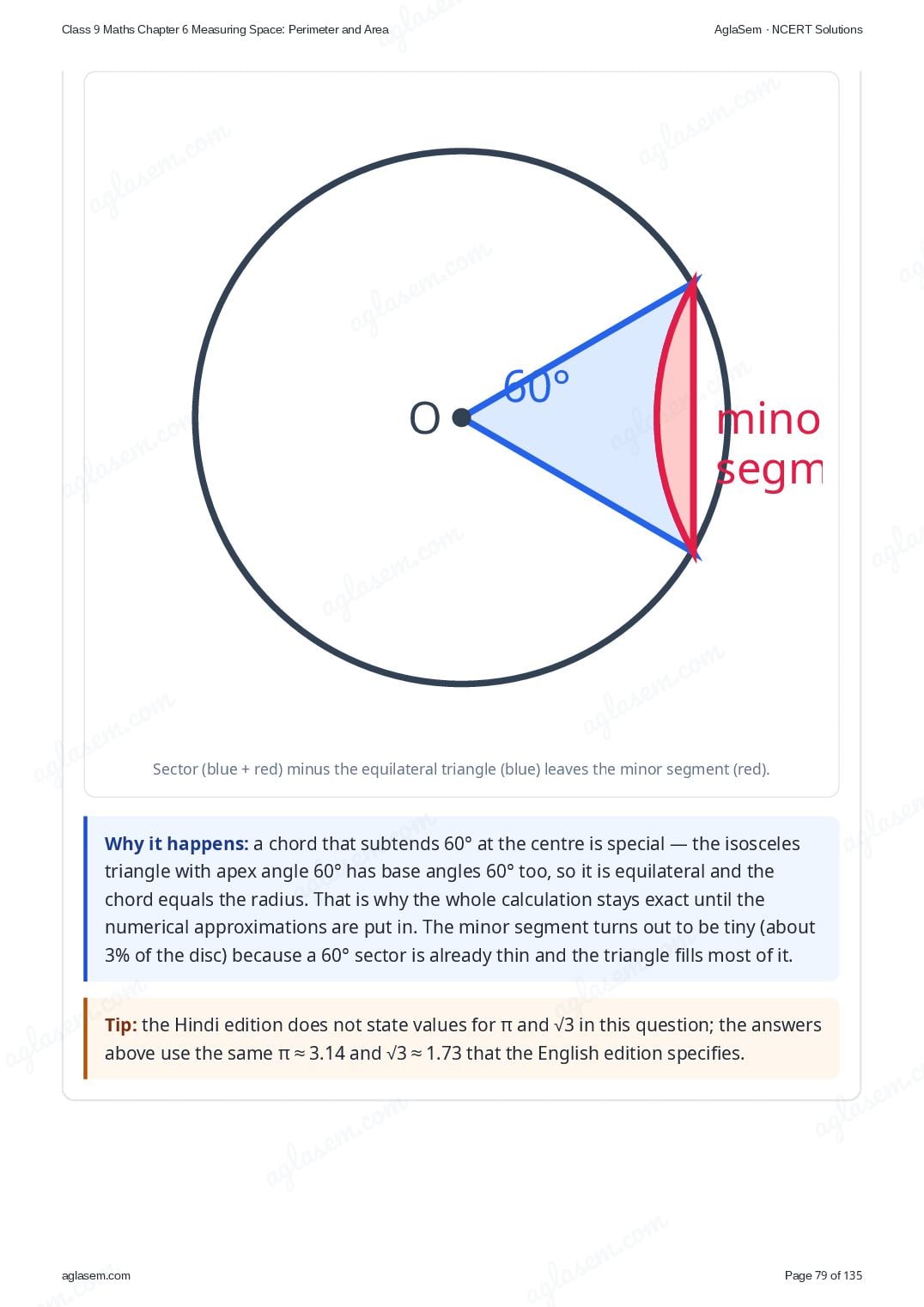
- A chord of a circle of radius 15 cm subtends an angle of 60° at the centre of the circle. Find the areas of the corresponding minor and major segments of the circle. (Use π ≈ 3.14 and √3 ≈ 1.73.)
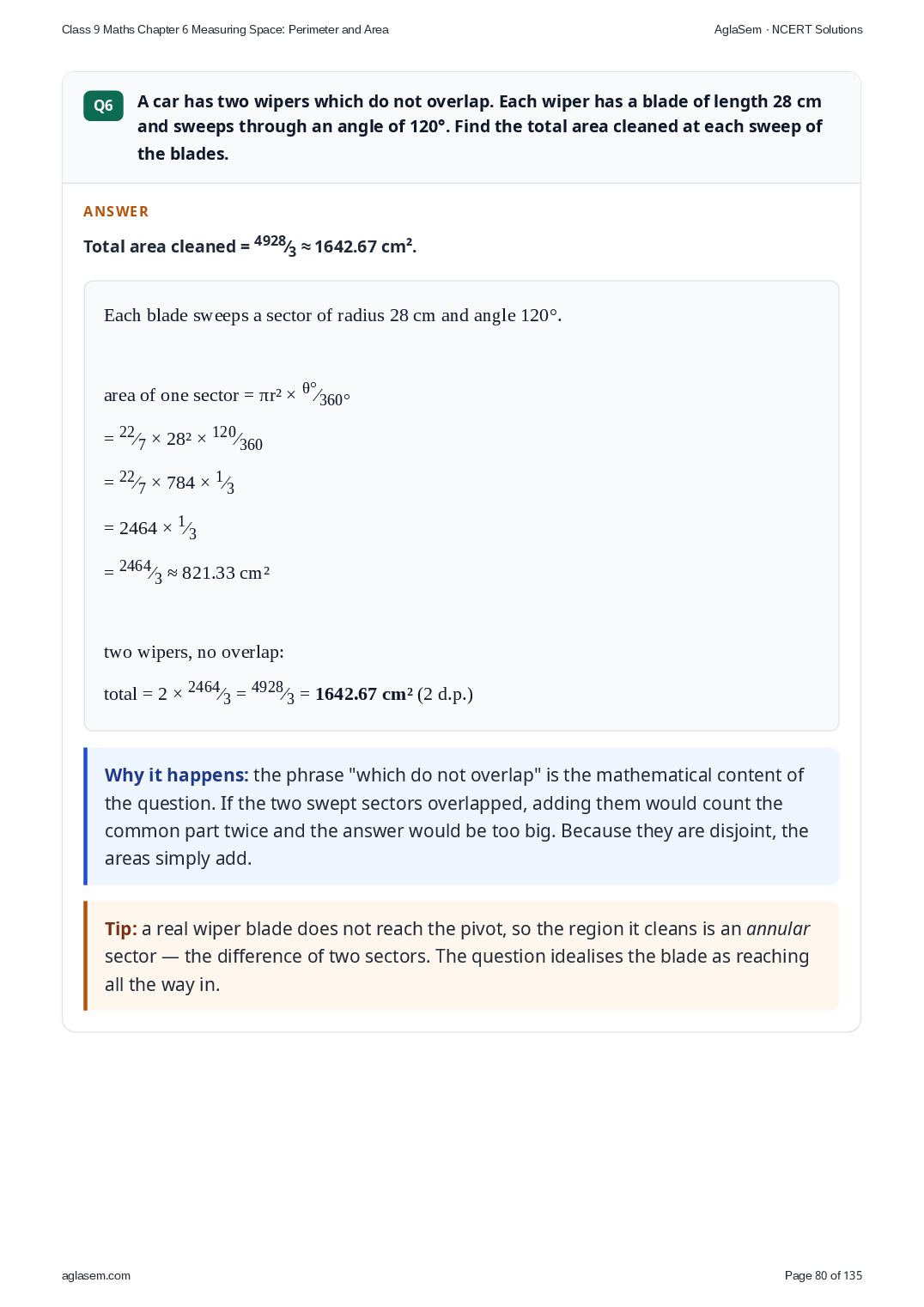
- A car has two wipers which do not overlap. Each wiper has a blade of length 28 cm and sweeps through an angle of 120°. Find the total area cleaned at each sweep of the blades.
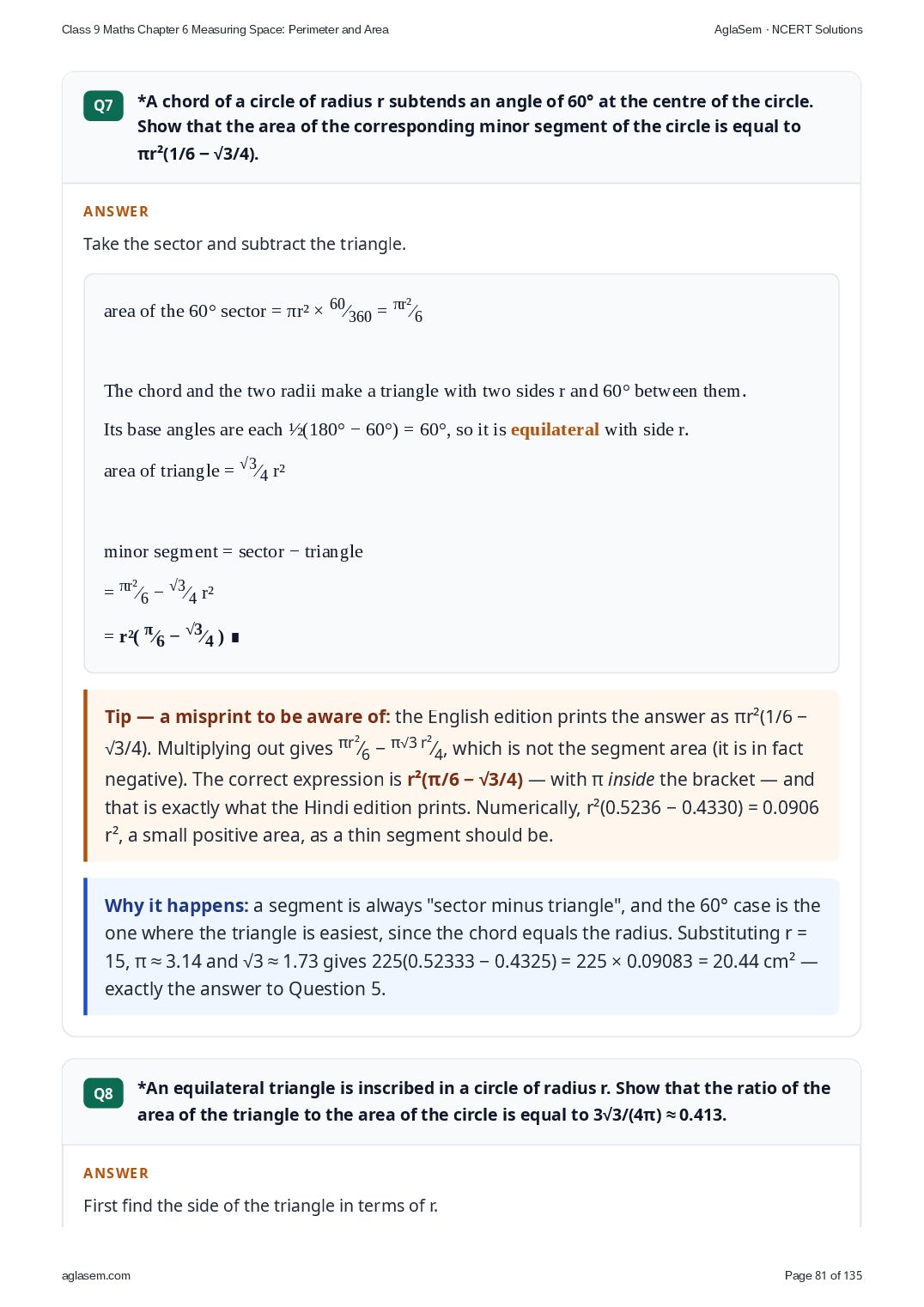
- *A chord of a circle of radius r subtends an angle of 60° at the centre of the circle. Show that the area of the corresponding minor segment of the circle is equal to πr²(1/6 − √3/4).
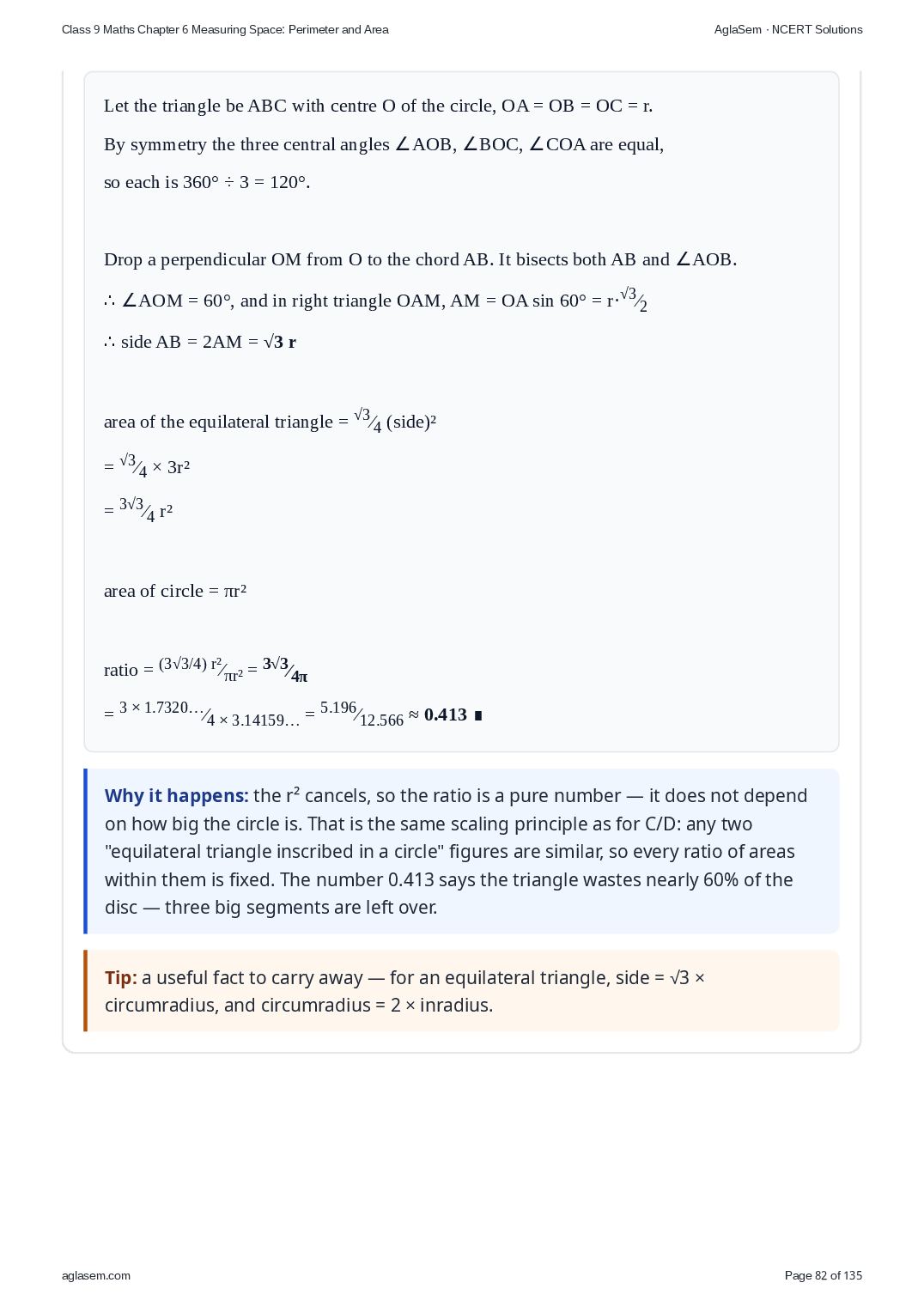
- *An equilateral triangle is inscribed in a circle of radius r. Show that the ratio of the area of the triangle to the area of the circle is equal to 3√3/(4π) ≈ 0.413.
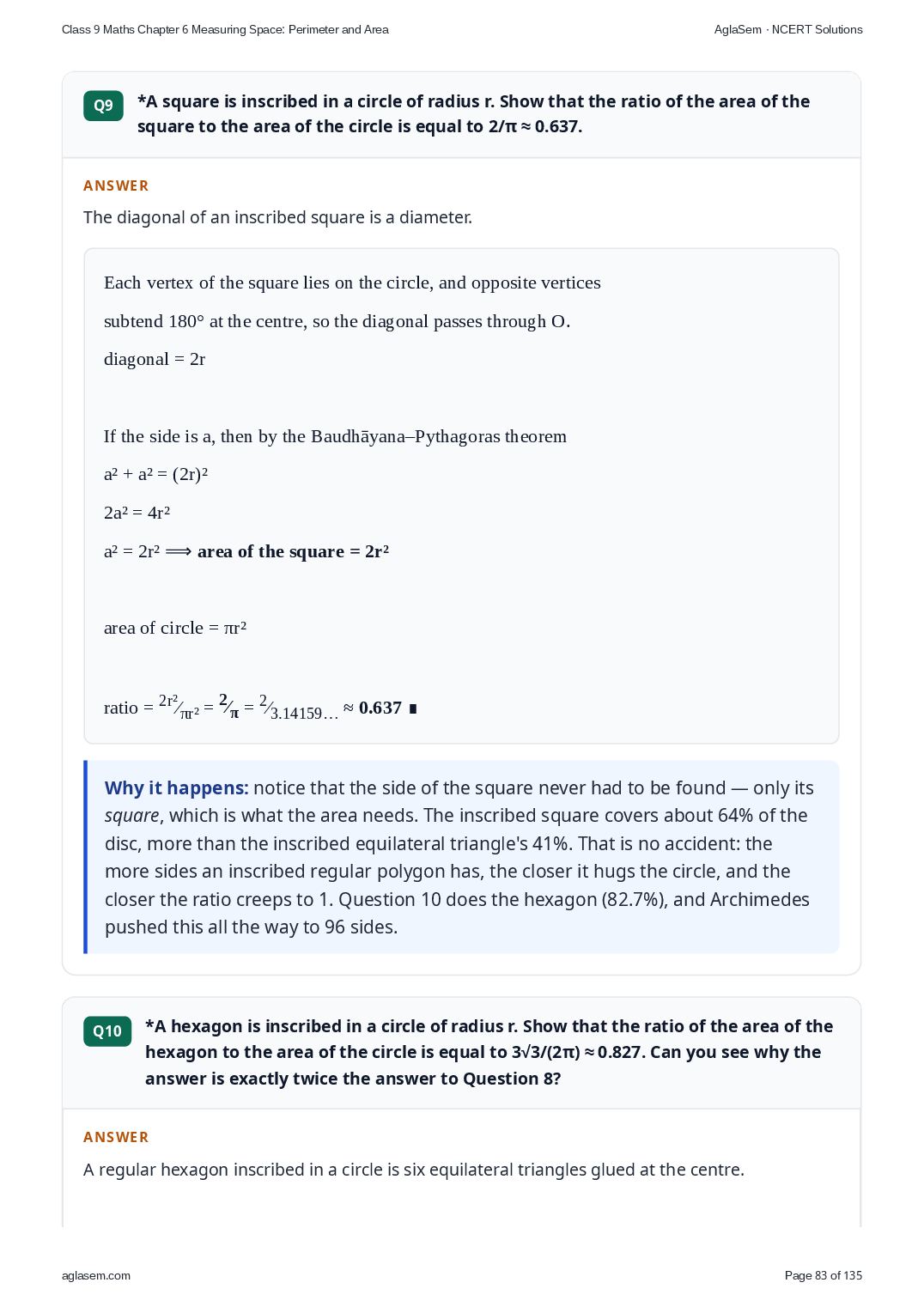
- *A square is inscribed in a circle of radius r. Show that the ratio of the area of the square to the area of the circle is equal to 2/π ≈ 0.637.
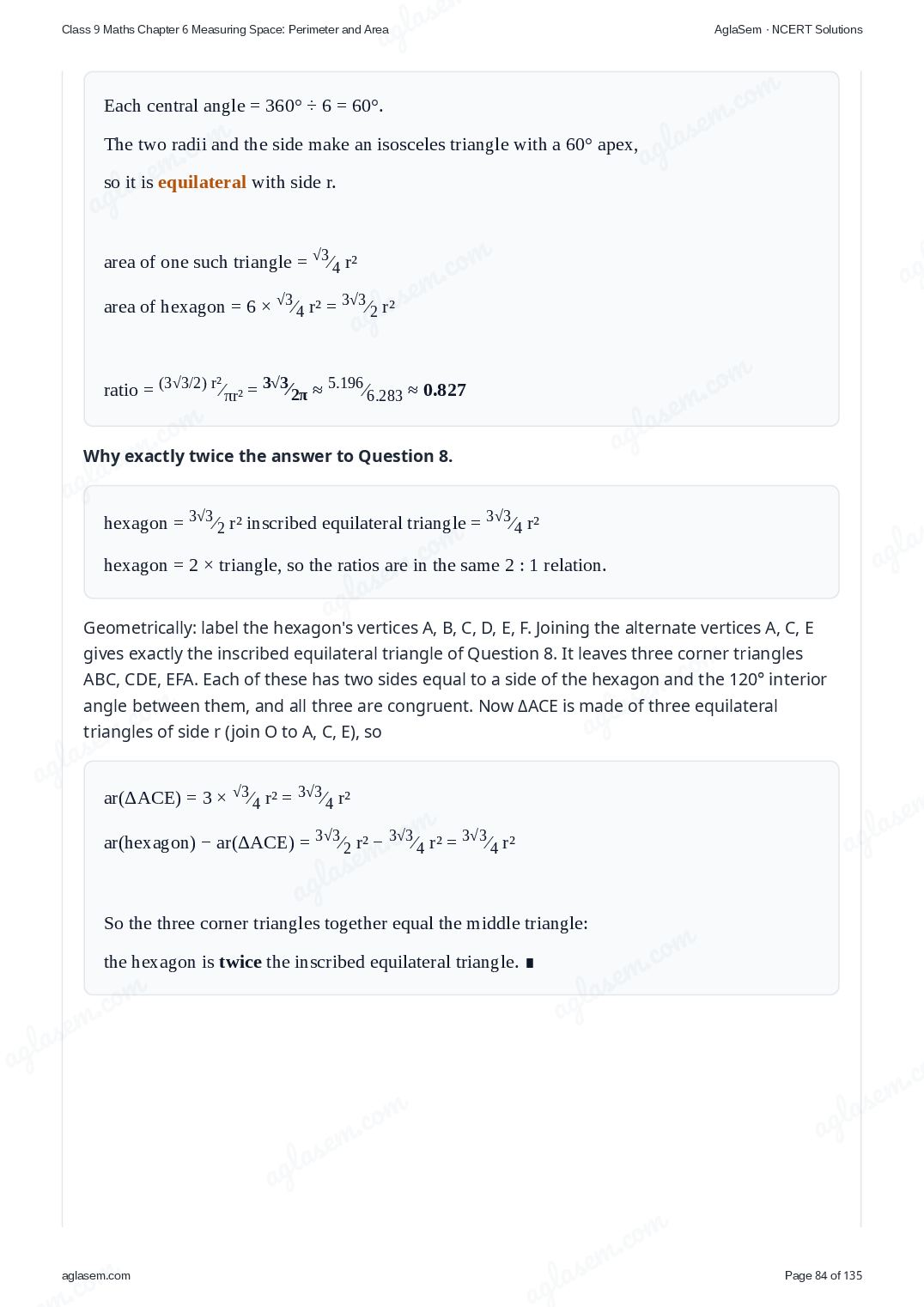
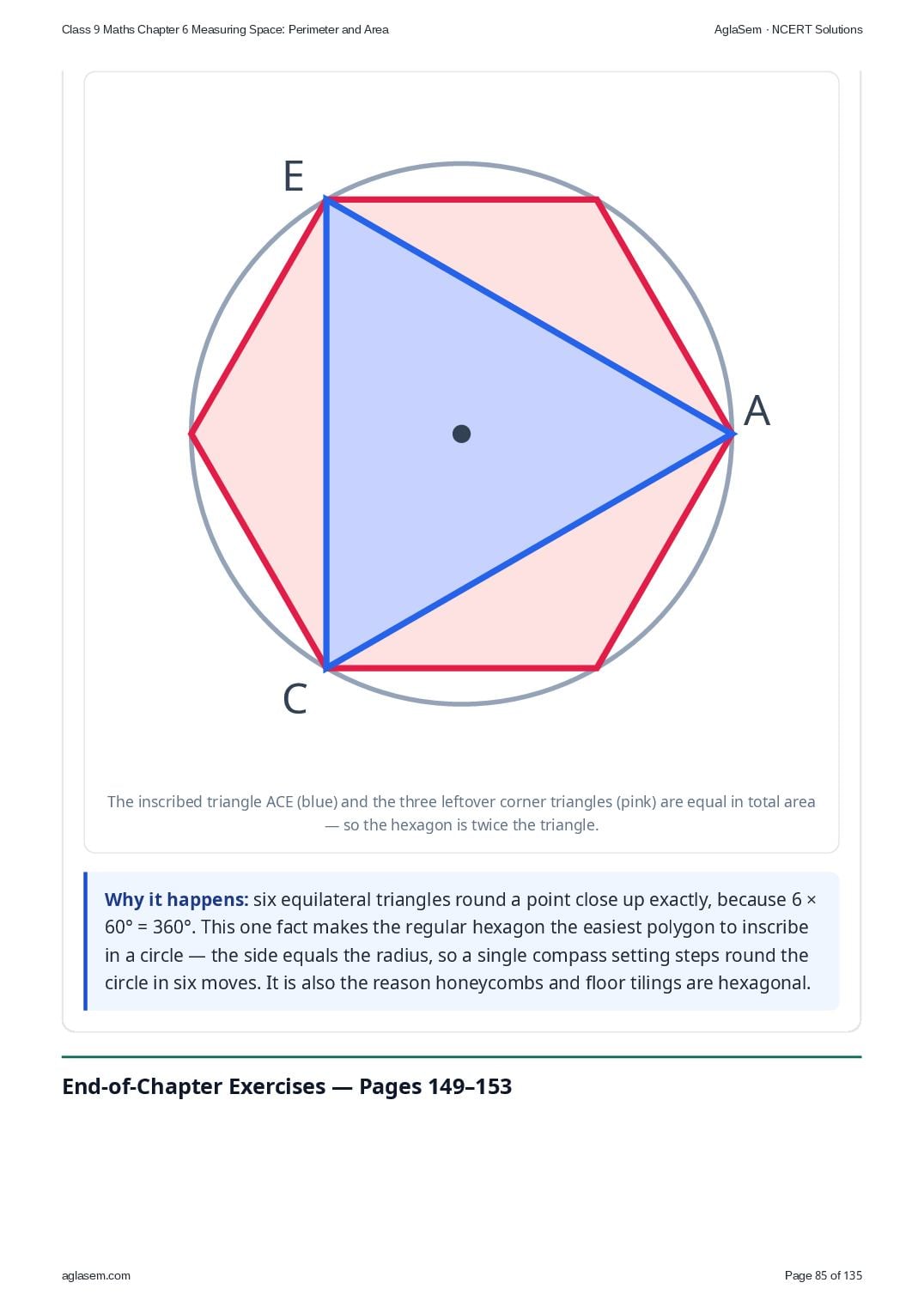
- *A hexagon is inscribed in a circle of radius r. Show that the ratio of the area of the hexagon to the area of the circle is equal to 3√3/(2π) ≈ 0.827. Can you see why the answer is exactly twice the answer to Question 8?
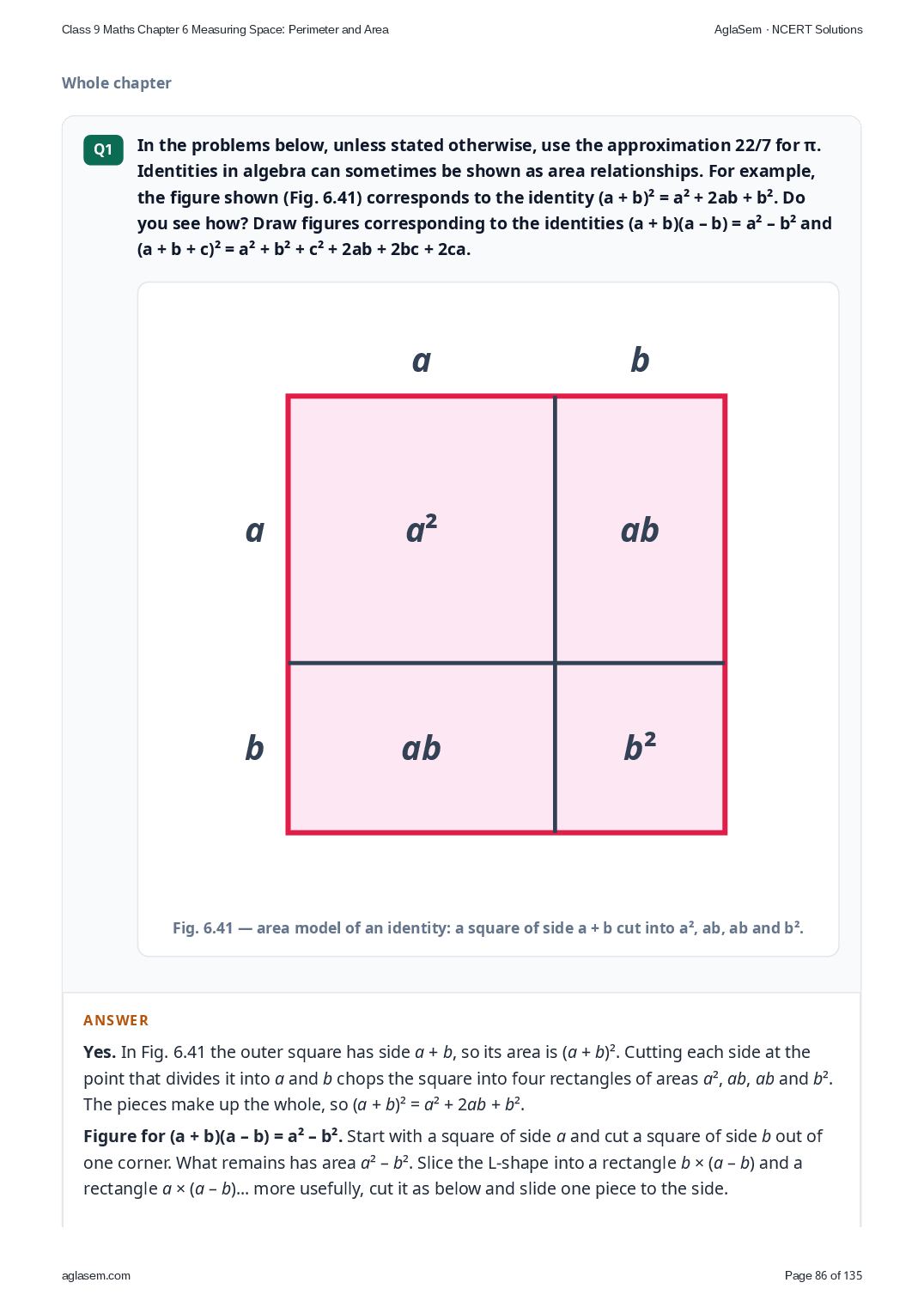
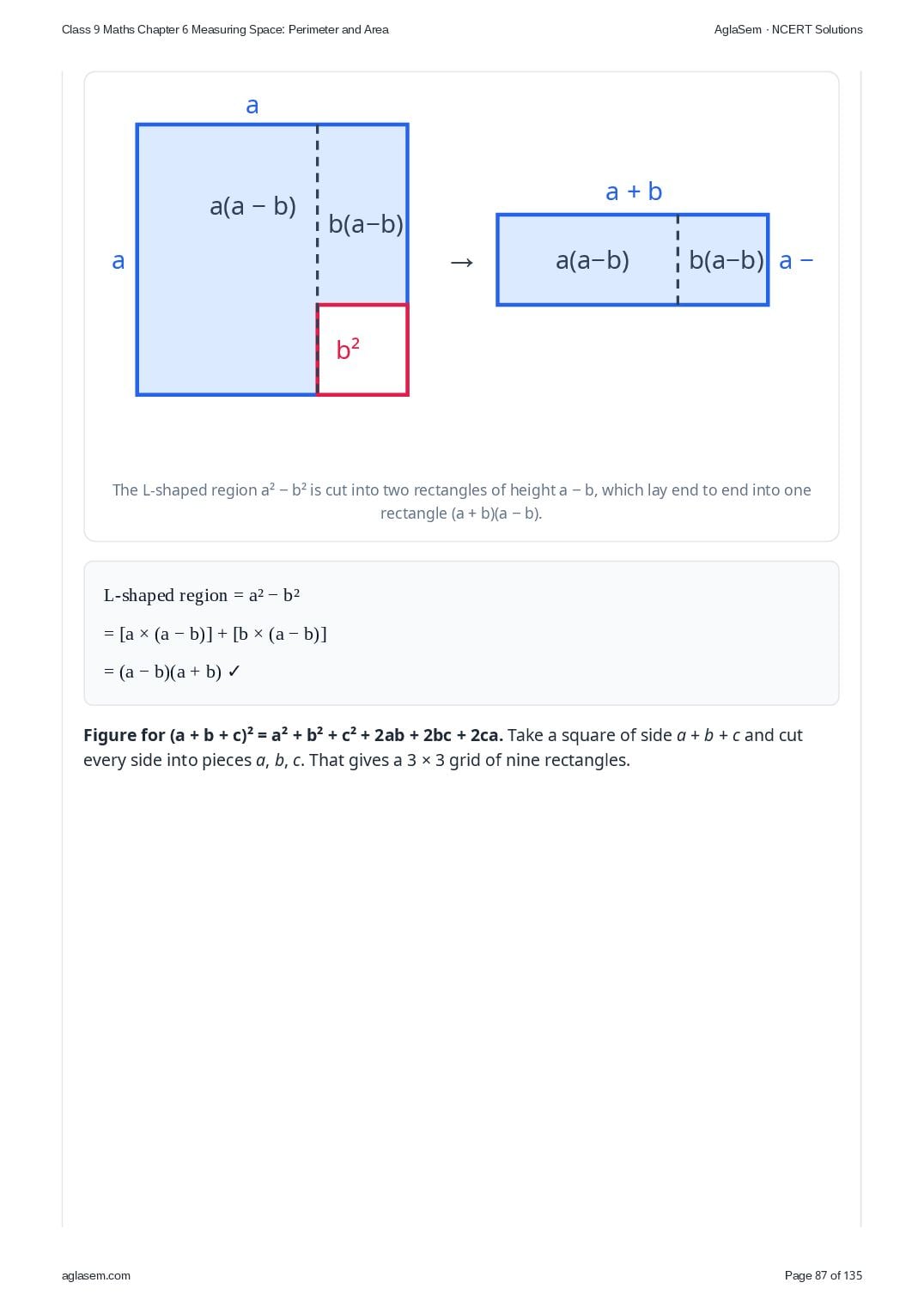
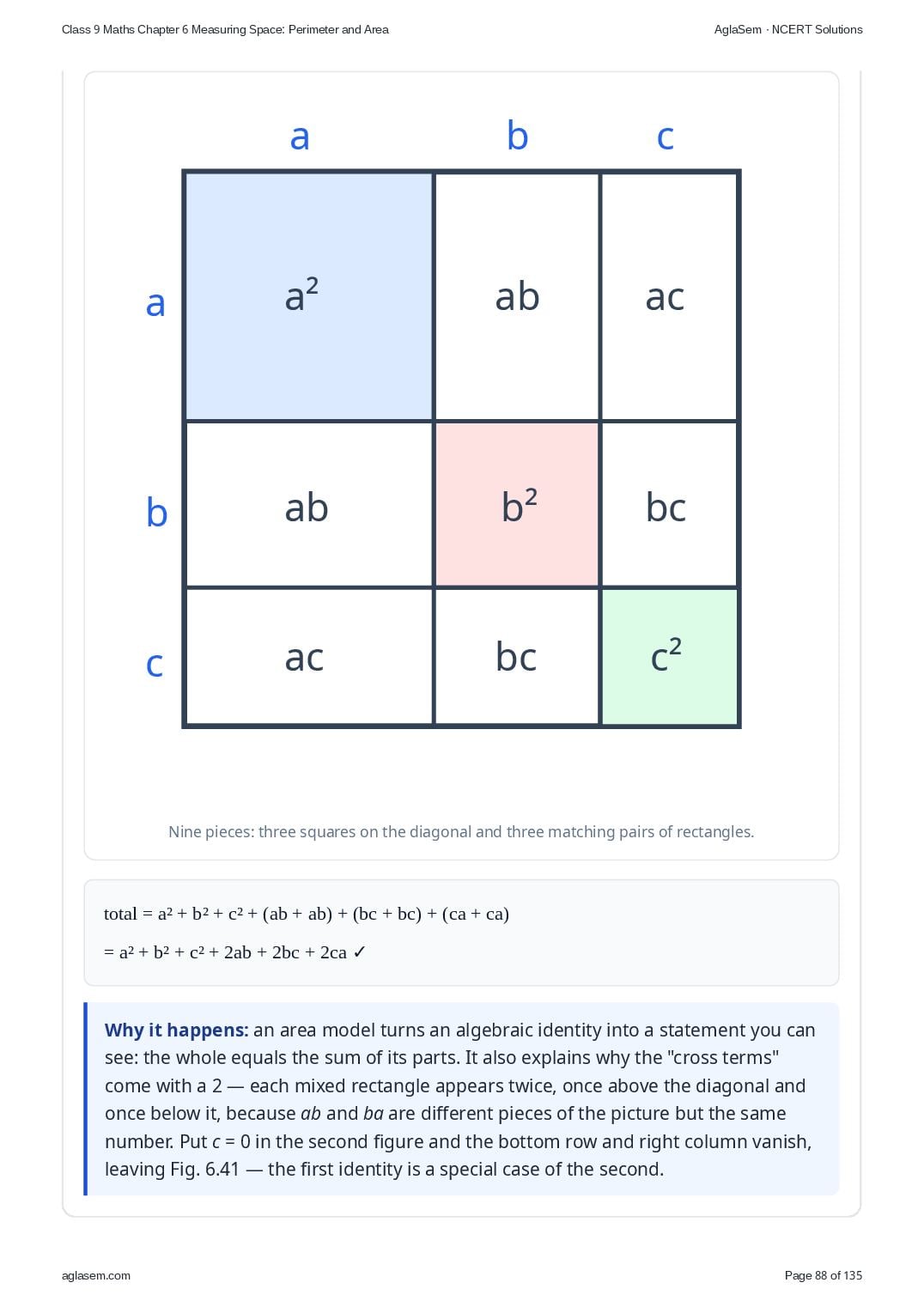
- In the problems below, unless stated otherwise, use the approximation 22/7 for π. Identities in algebra can sometimes be shown as area relationships. For example, the figure shown (Fig. 6.41: a square of side a + b cut into a², ab, ab and b²) corresponds to the identity (a + b)² = a² + 2ab + b². Do you see how? Draw figures corresponding to the identities (a + b)(a – b) = a² – b² and (a + b + c)² = a² + b² + c² + 2ab + 2bc + 2ca.
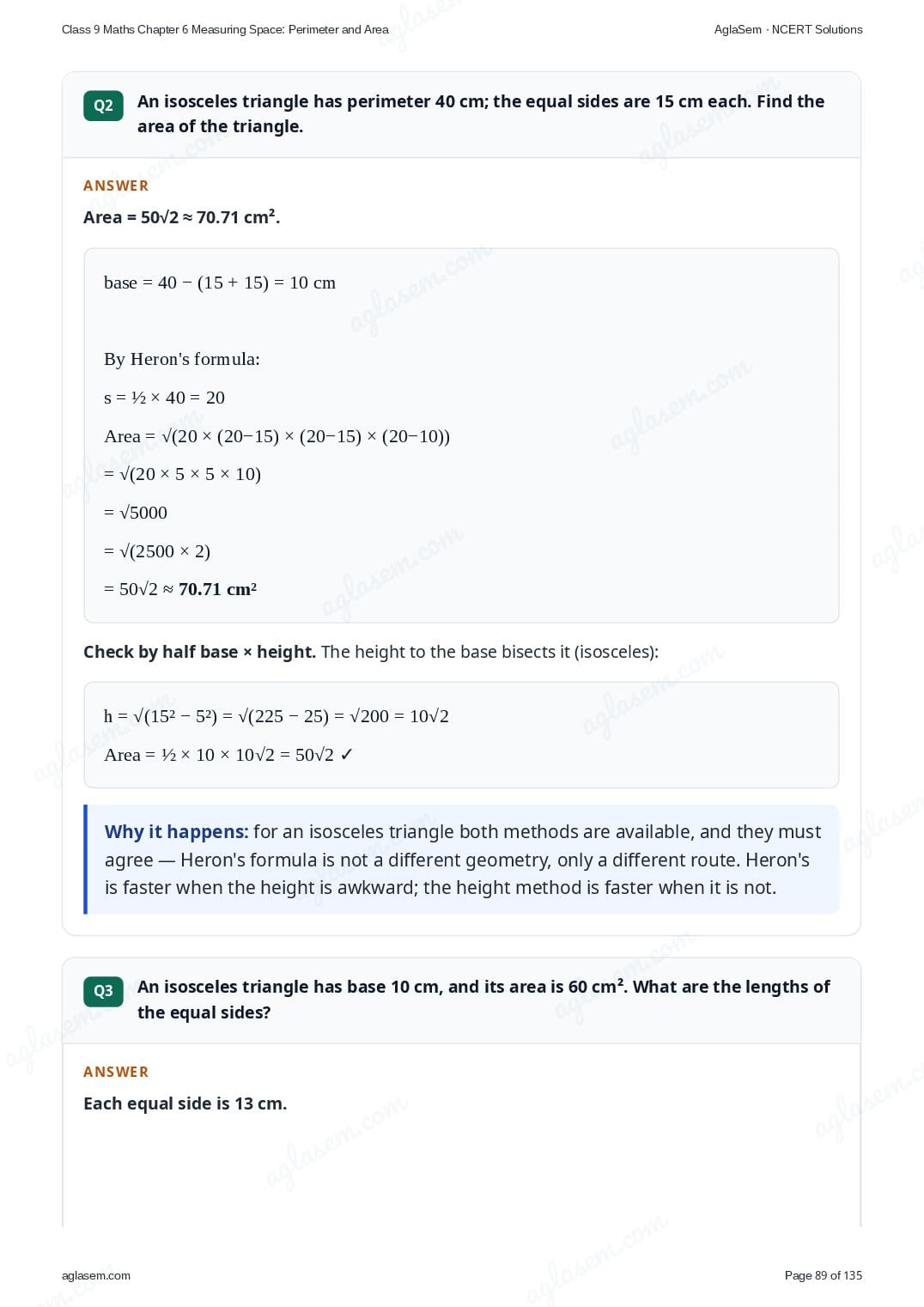
- An isosceles triangle has perimeter 40 cm; the equal sides are 15 cm each. Find the area of the triangle.
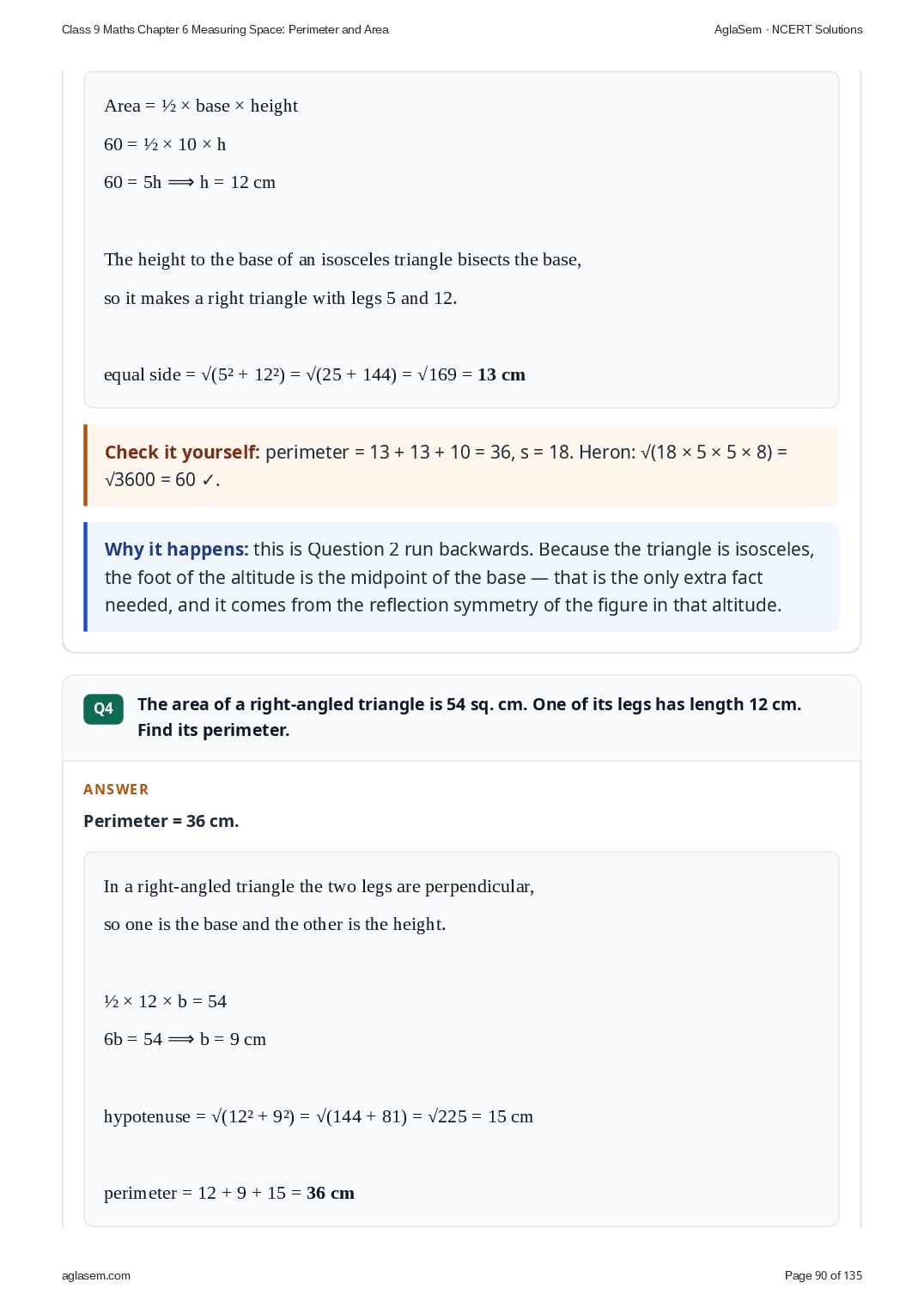
- An isosceles triangle has base 10 cm, and its area is 60 cm². What are the lengths of the equal sides?
- The area of a right-angled triangle is 54 sq. cm. One of its legs has length 12 cm. Find its perimeter.
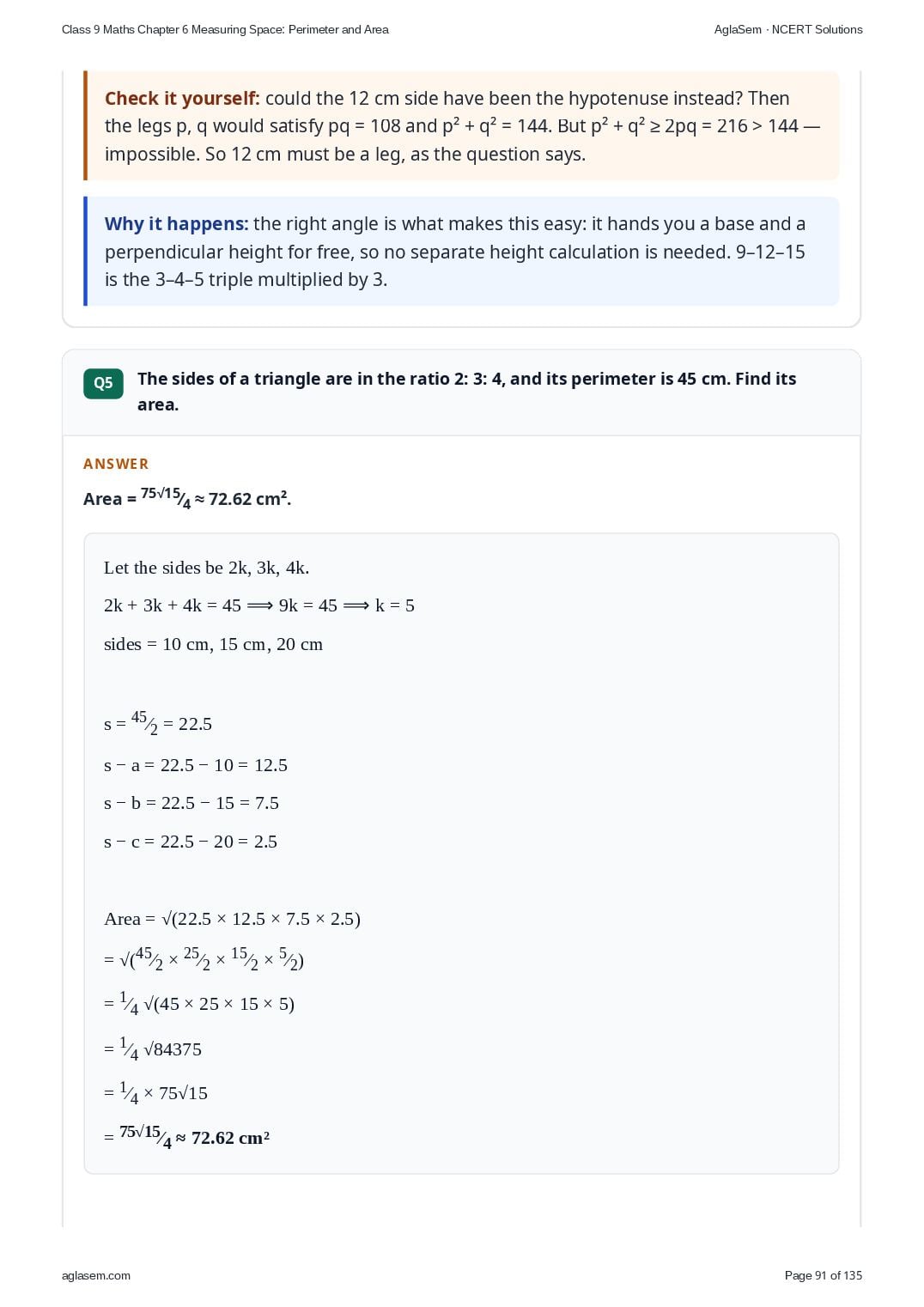
- The sides of a triangle are in the ratio 2: 3: 4, and its perimeter is 45 cm. Find its area.
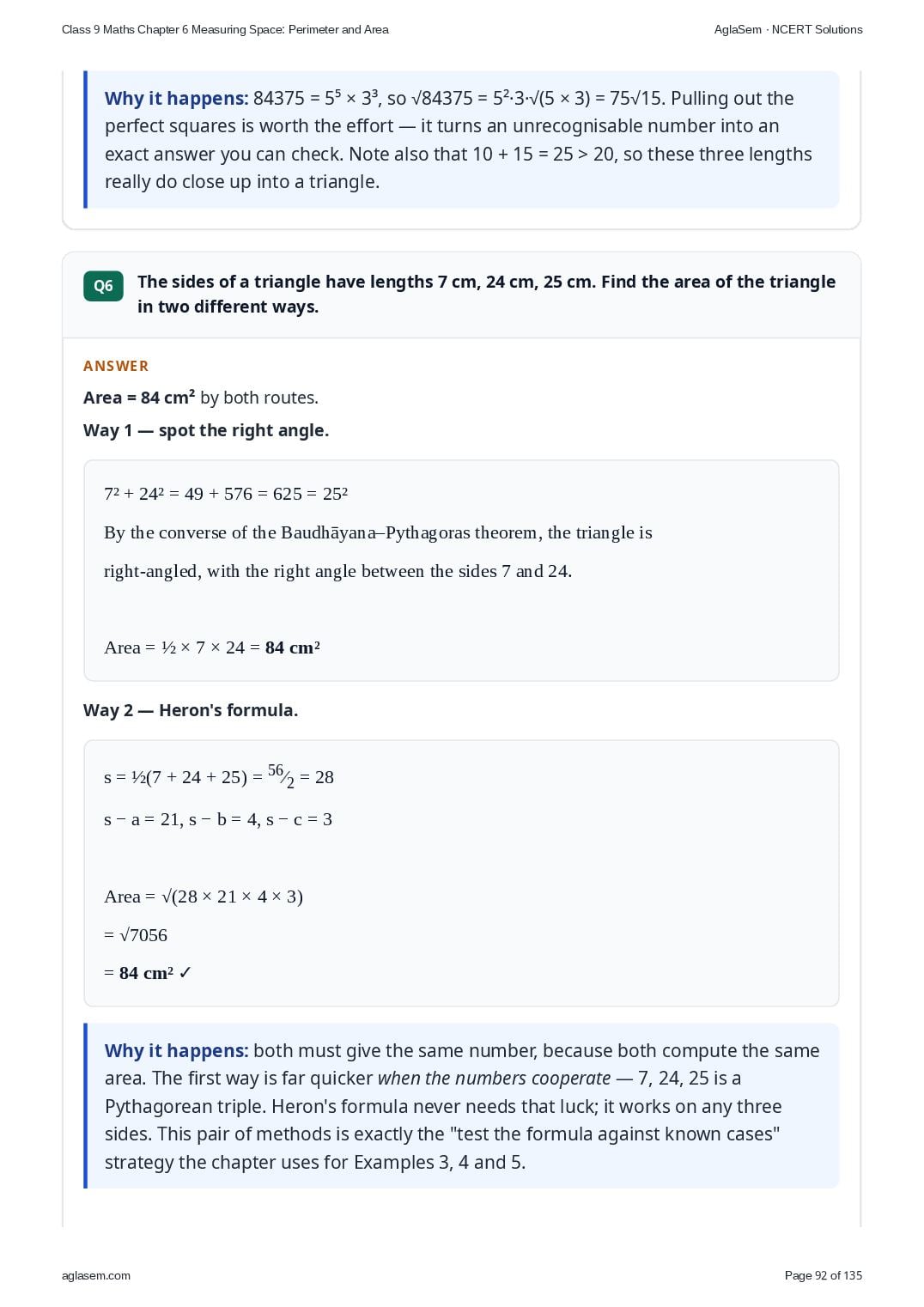
- The sides of a triangle have lengths 7 cm, 24 cm, 25 cm. Find the area of the triangle in two different ways.
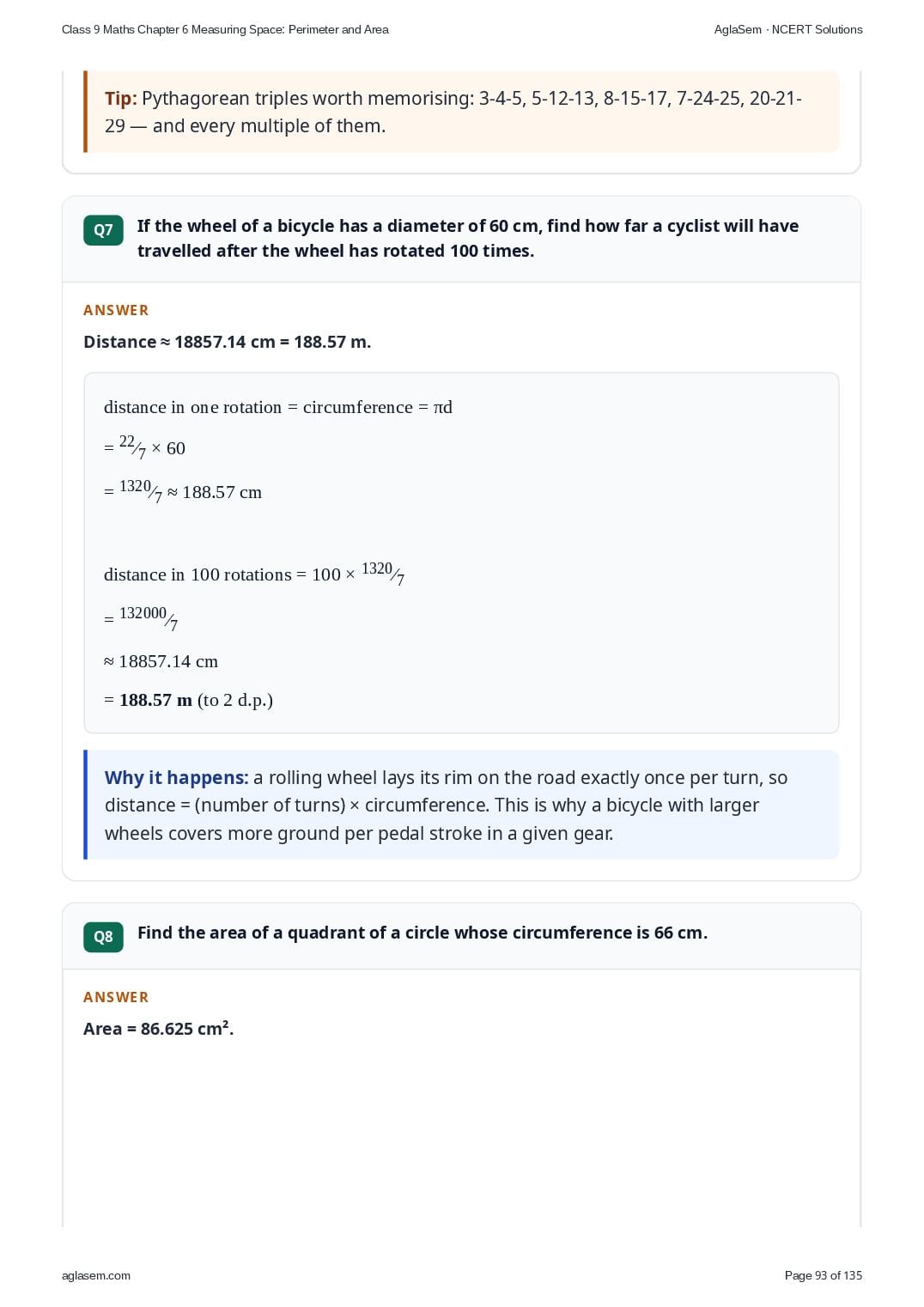
- If the wheel of a bicycle has a diameter of 60 cm, find how far a cyclist will have travelled after the wheel has rotated 100 times.
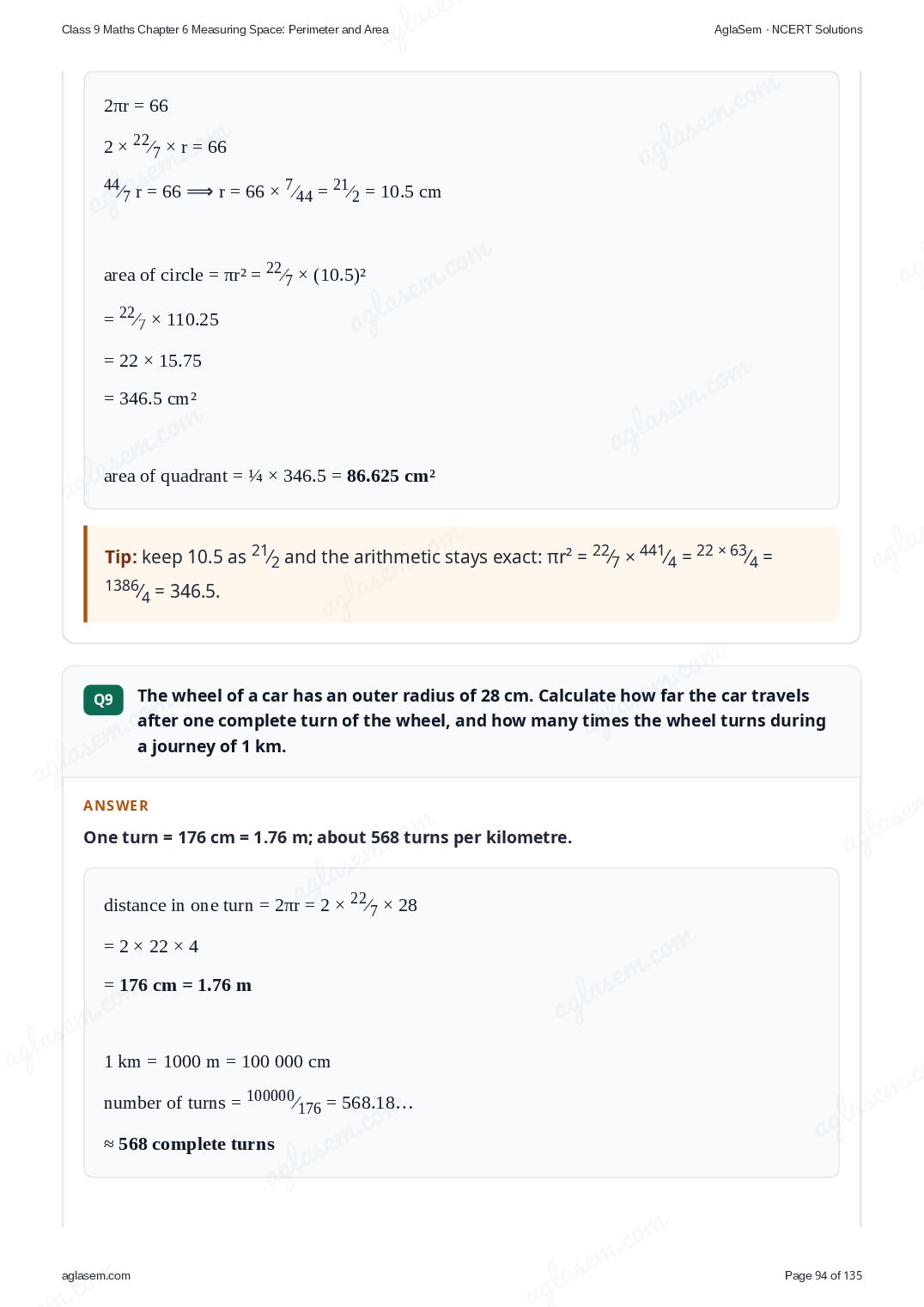
- Find the area of a quadrant of a circle whose circumference is 66 cm.
- The wheel of a car has an outer radius of 28 cm. Calculate how far the car travels after one complete turn of the wheel, and how many times the wheel turns during a journey of 1 km.
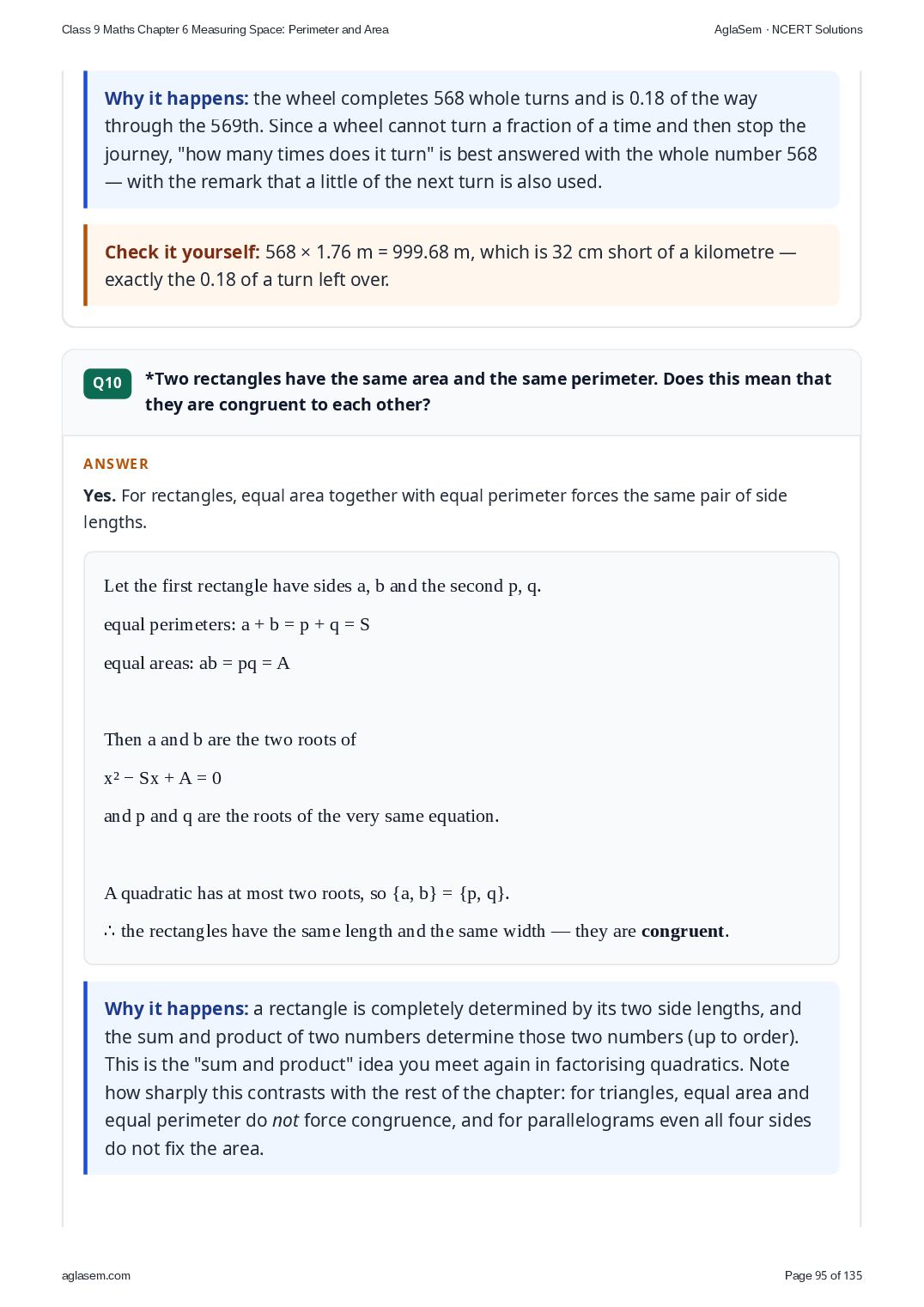
- *Two rectangles have the same area and the same perimeter. Does this mean that they are congruent to each other?
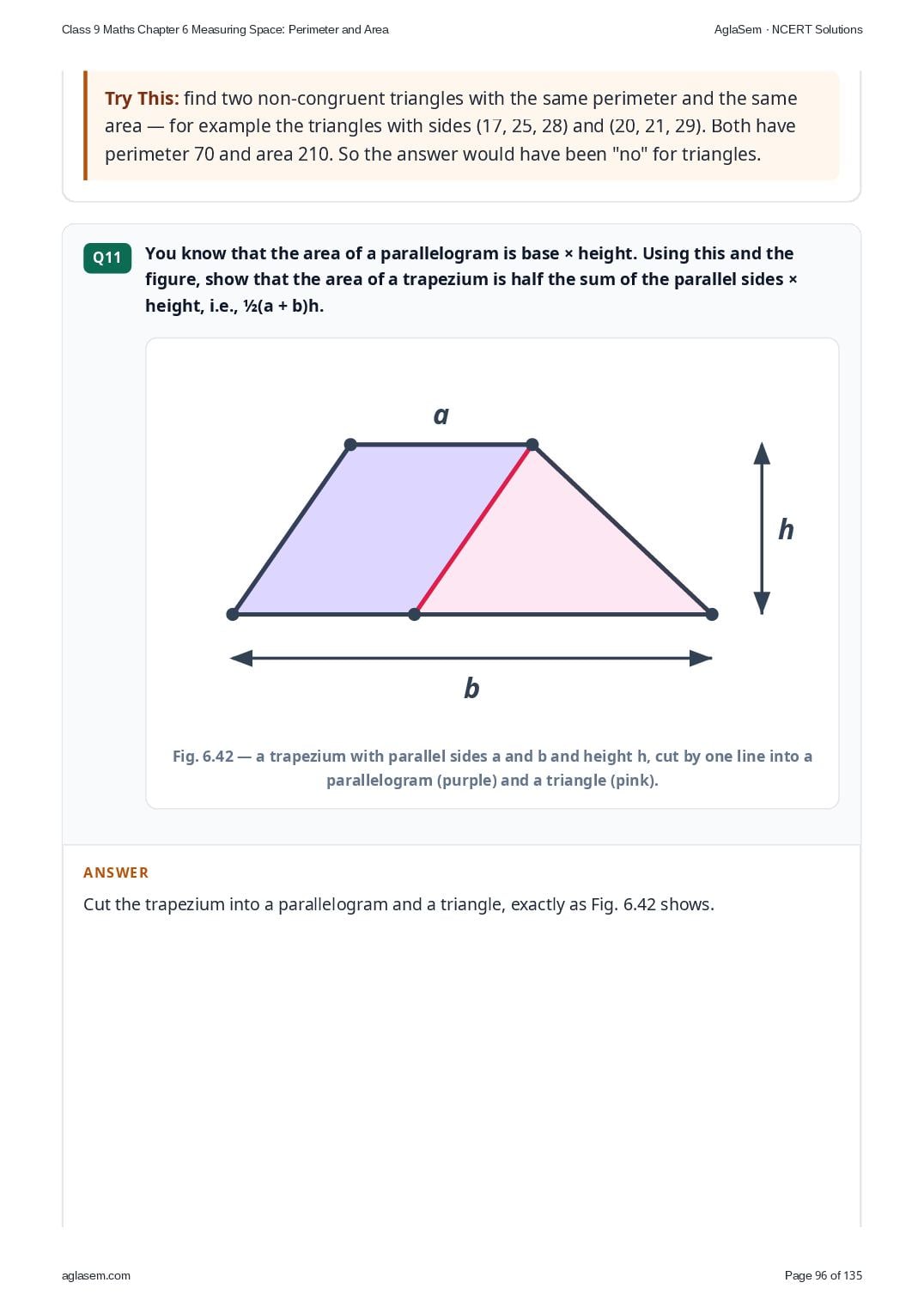
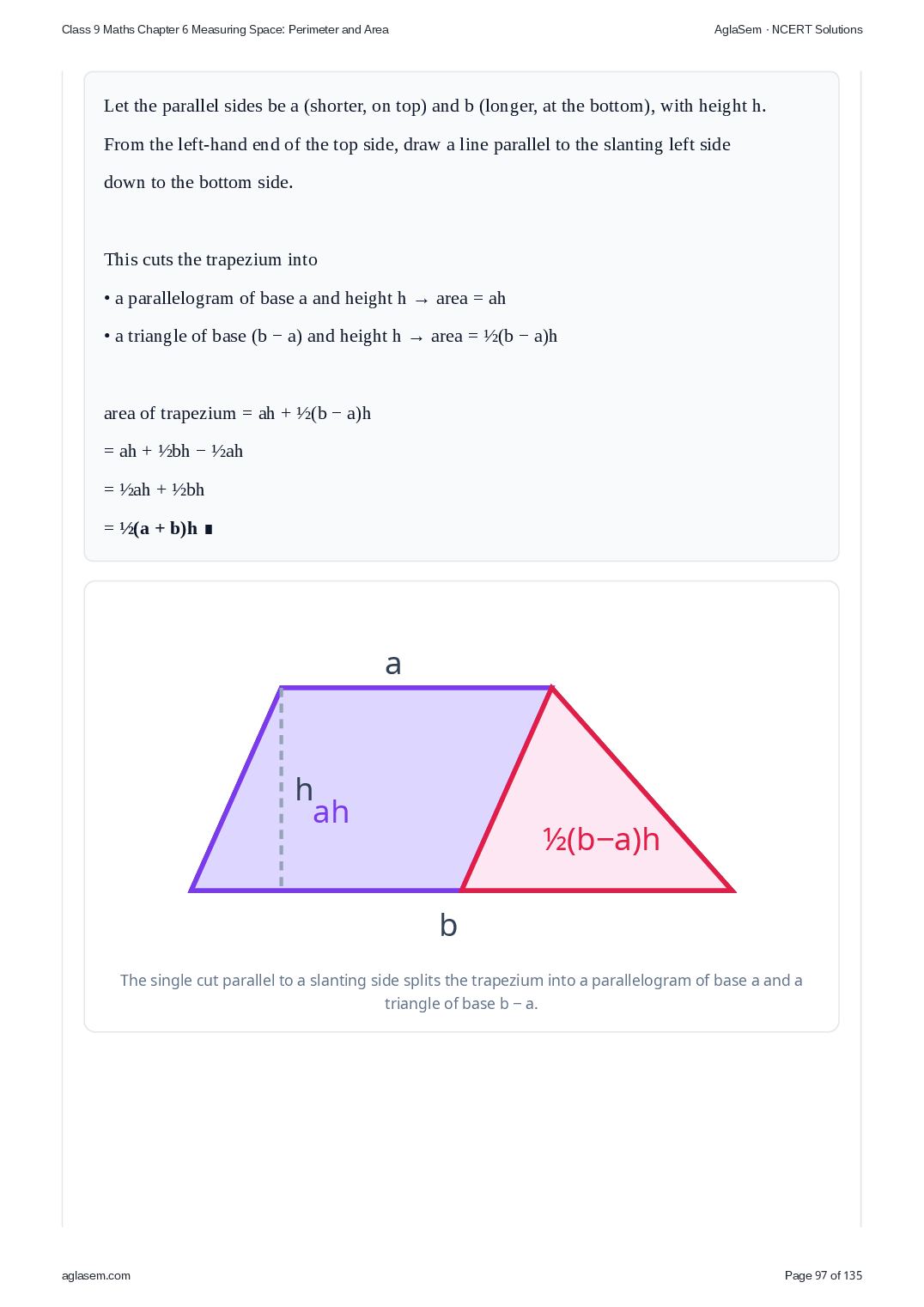
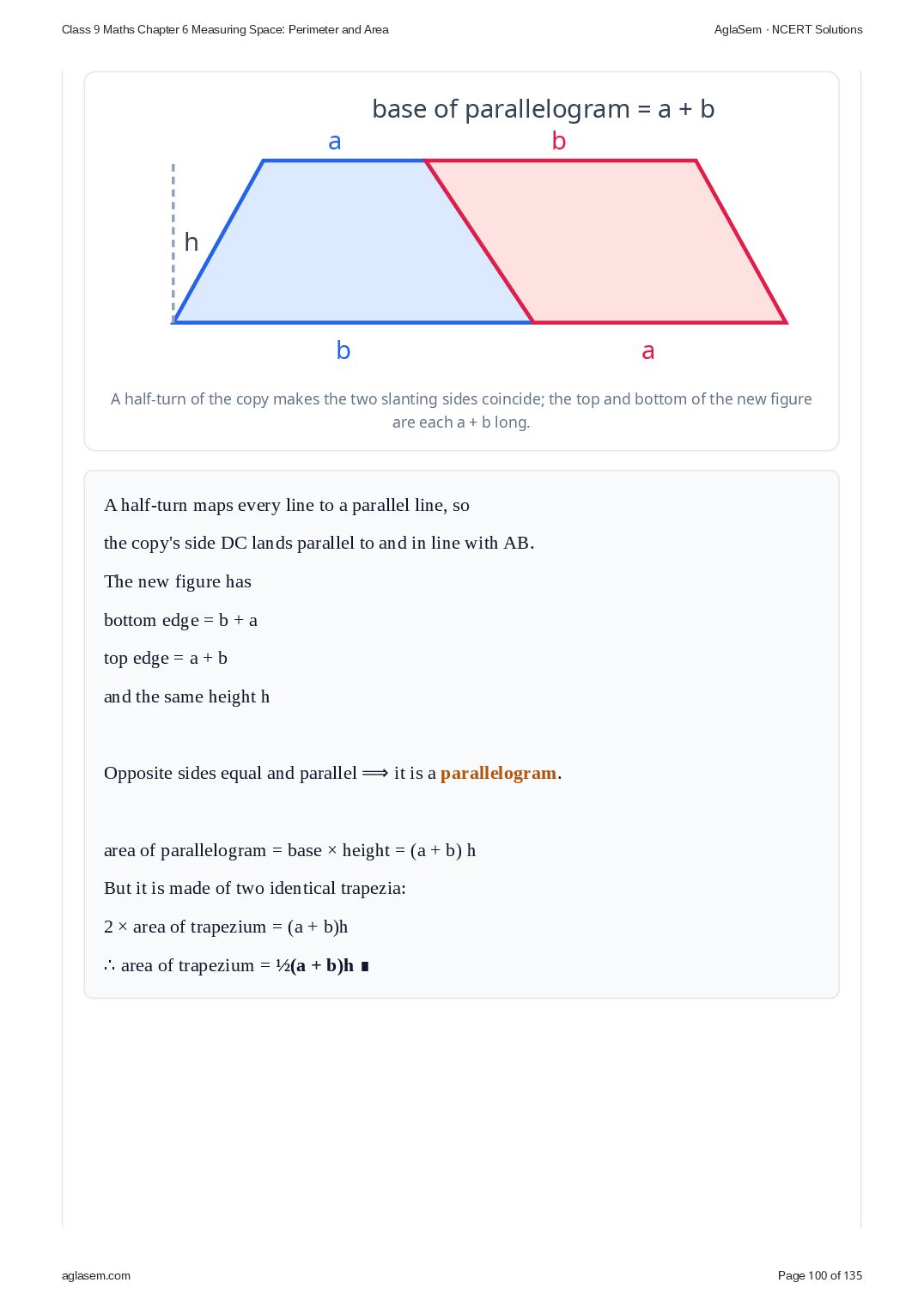
- You know that the area of a parallelogram is base × height. Using this and the figure, show that the area of a trapezium is half the sum of the parallel sides × height, i.e., ½(a + b)h. (Fig. 6.42: a trapezium with parallel sides a and b, height h.)
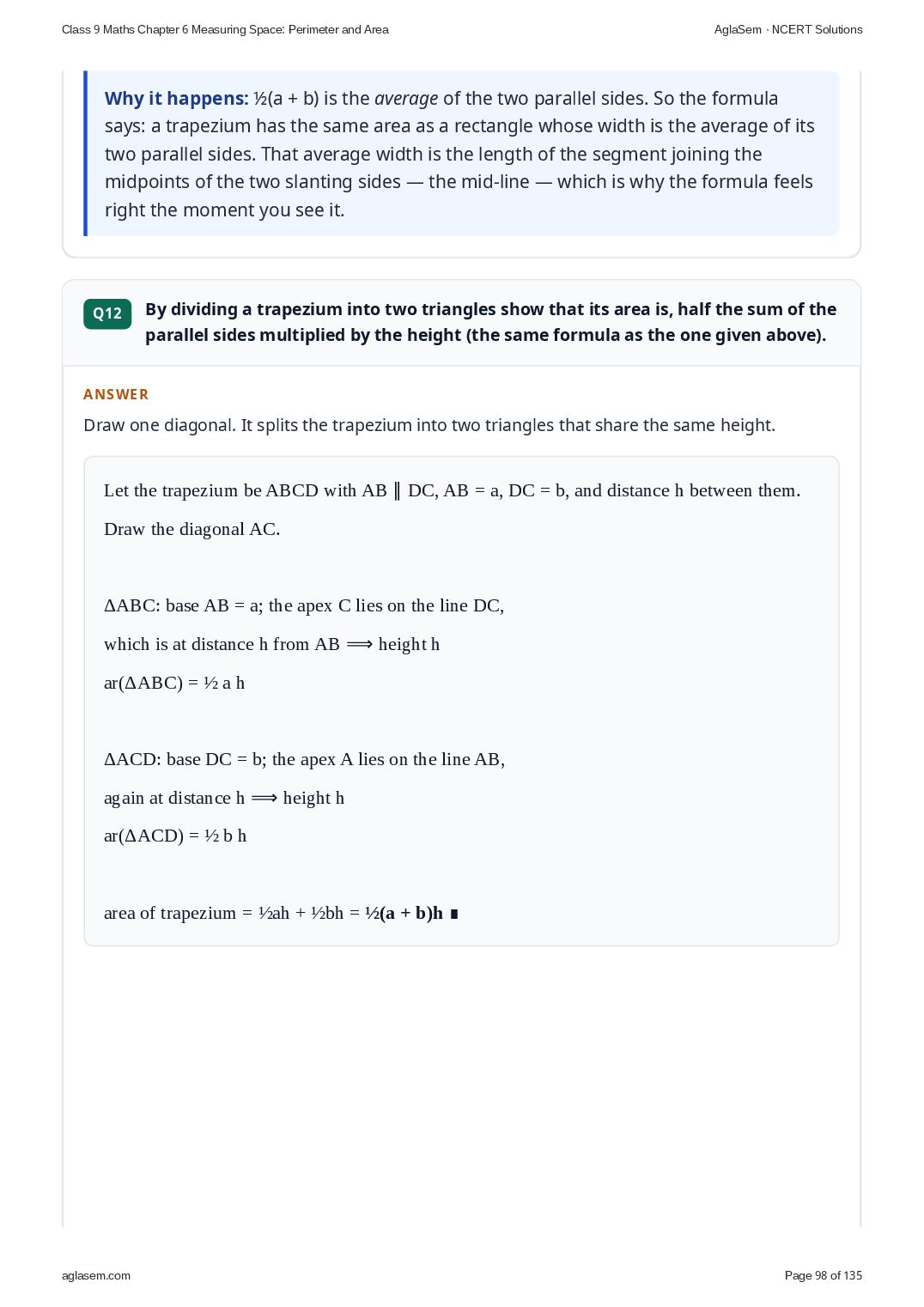
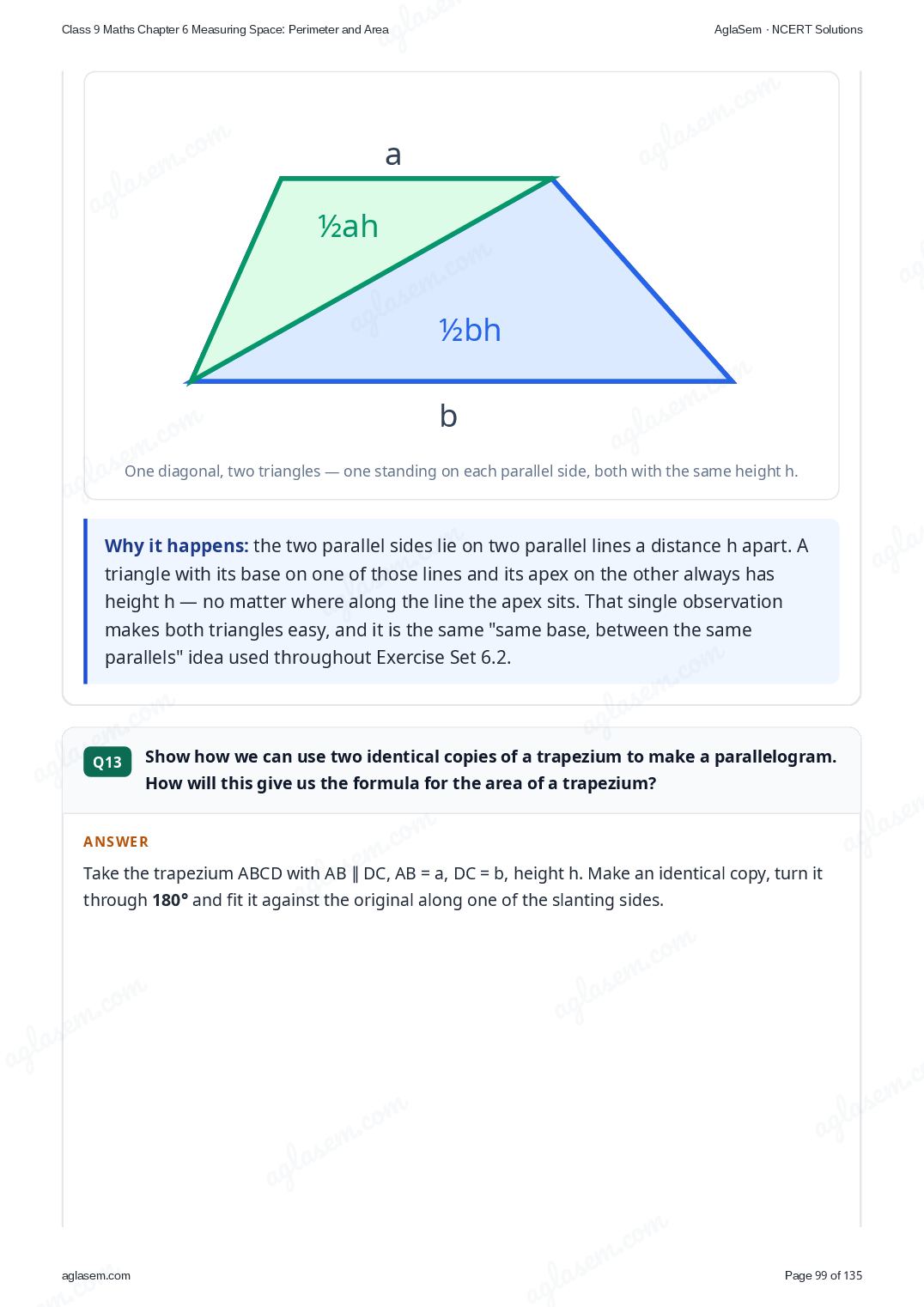
- By dividing a trapezium into two triangles show that its area is, half the sum of the parallel sides multiplied by the height (the same formula as the one given above).
- Show how we can use two identical copies of a trapezium to make a parallelogram. How will this give us the formula for the area of a trapezium?
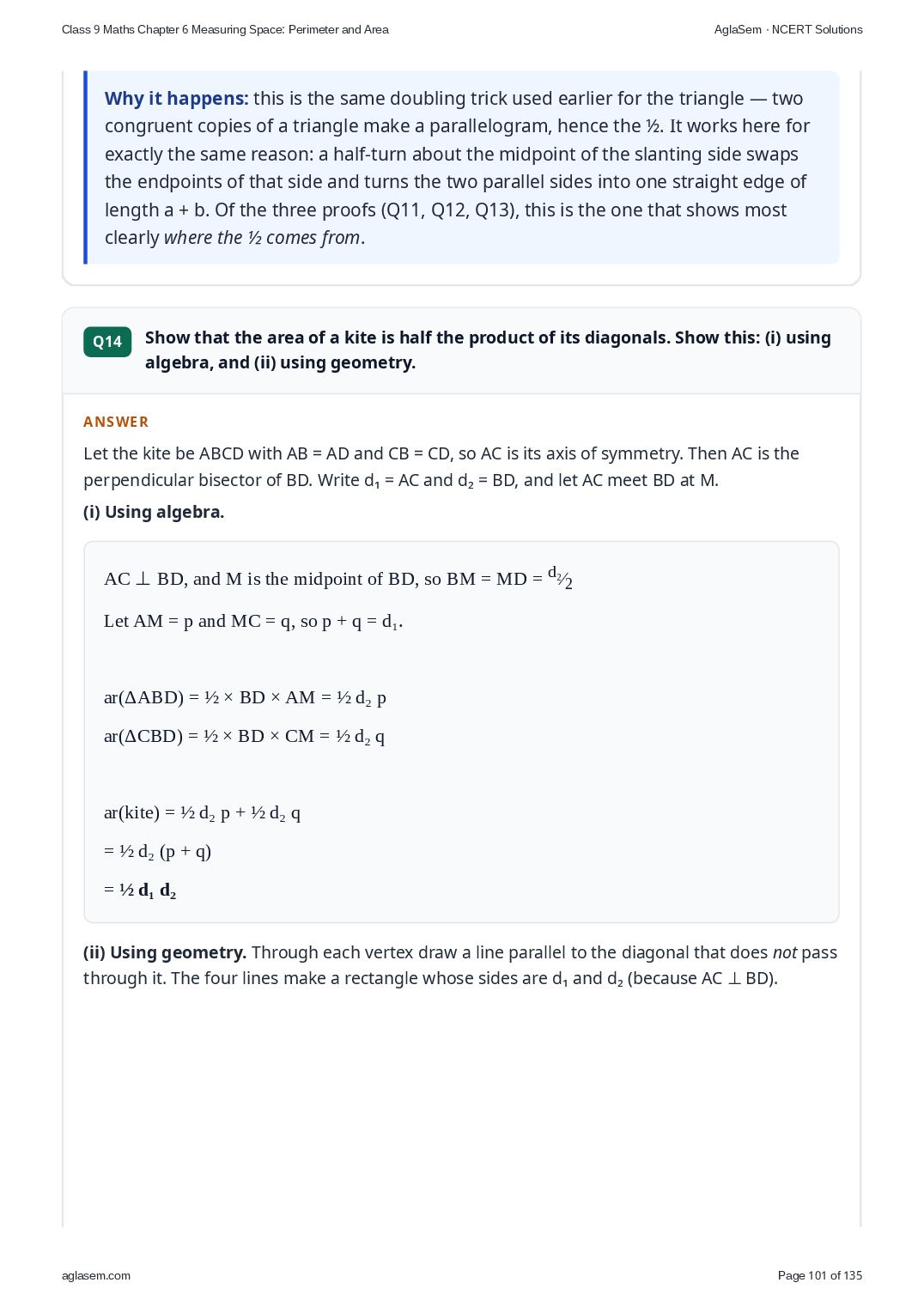
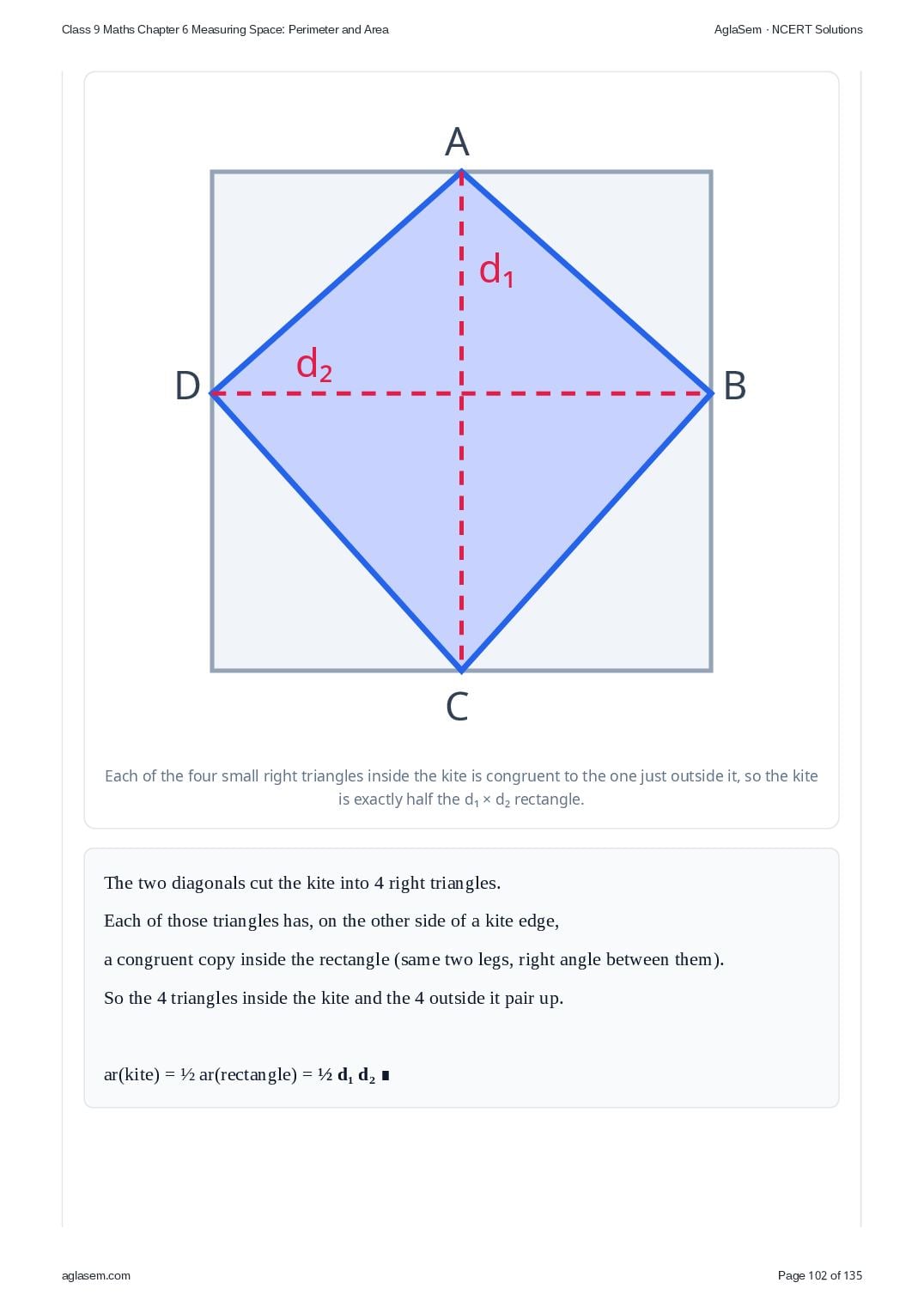
- Show that the area of a kite is half the product of its diagonals. Show this: (i) using algebra, and (ii) using geometry.
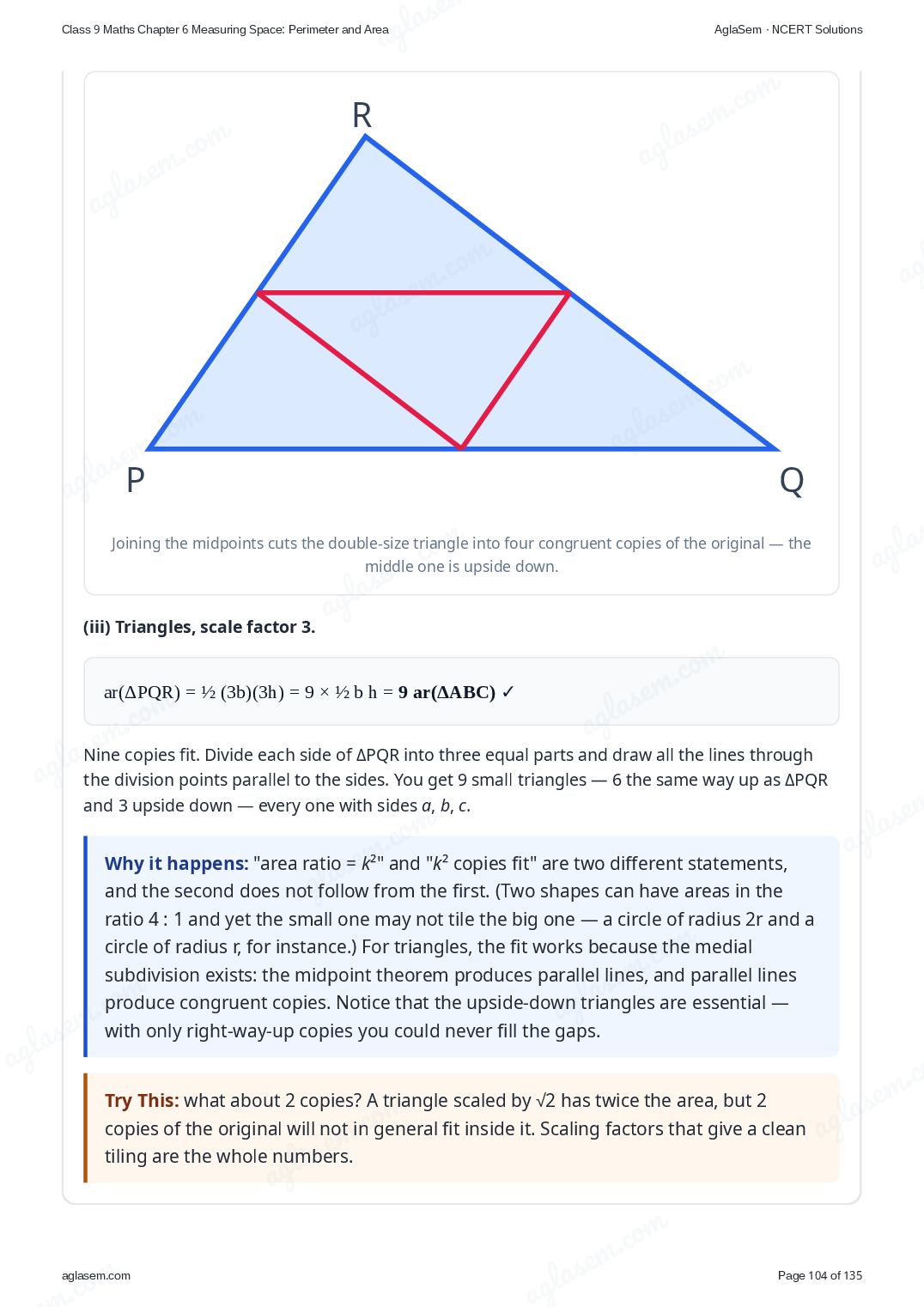
- Three problems about fitting congruent shapes together: (i) Rectangle ABCD has sides a, b, and rectangle PQRS has sides 2a, 2b. Show that PQRS has 4 times the area of ABCD. Does this mean that 4 copies of rectangle ABCD will fit into rectangle PQRS? Check and see! (ii) ∆ABC has sides a, b, c, and ∆PQR has sides 2a, 2b, 2c. Show that ∆PQR has 4 times the area of ∆ABC. Does this mean that 4 copies of ∆ABC will fit into ∆PQR? Check and see! (iii) ∆ABC has sides a, b, c, and ∆PQR has sides 3a, 3b, 3c. Show that ∆PQR has 9 times the area of ∆ABC. Does this mean that 9 copies of ∆ABC will fit into ∆PQR? Check and see!
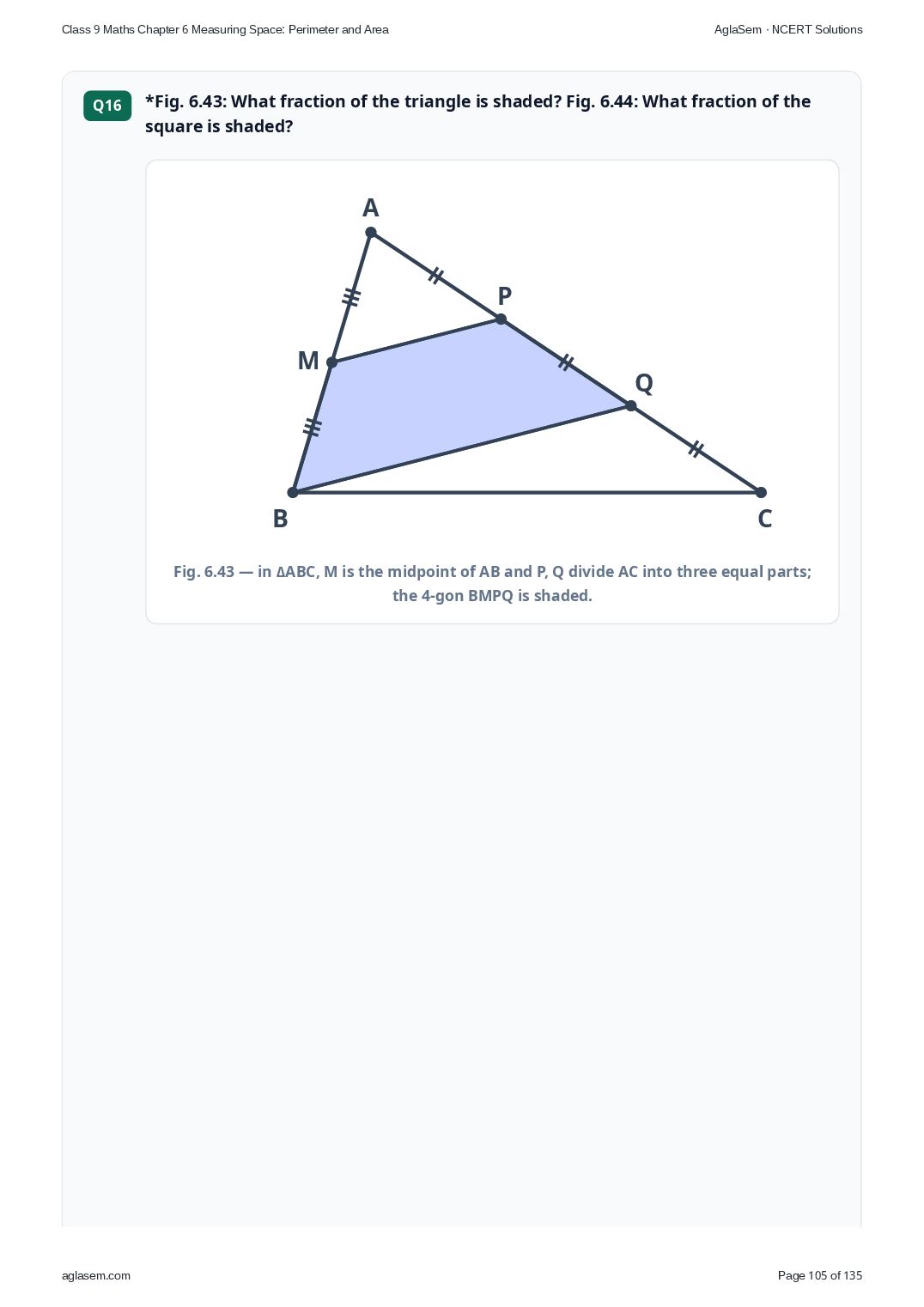
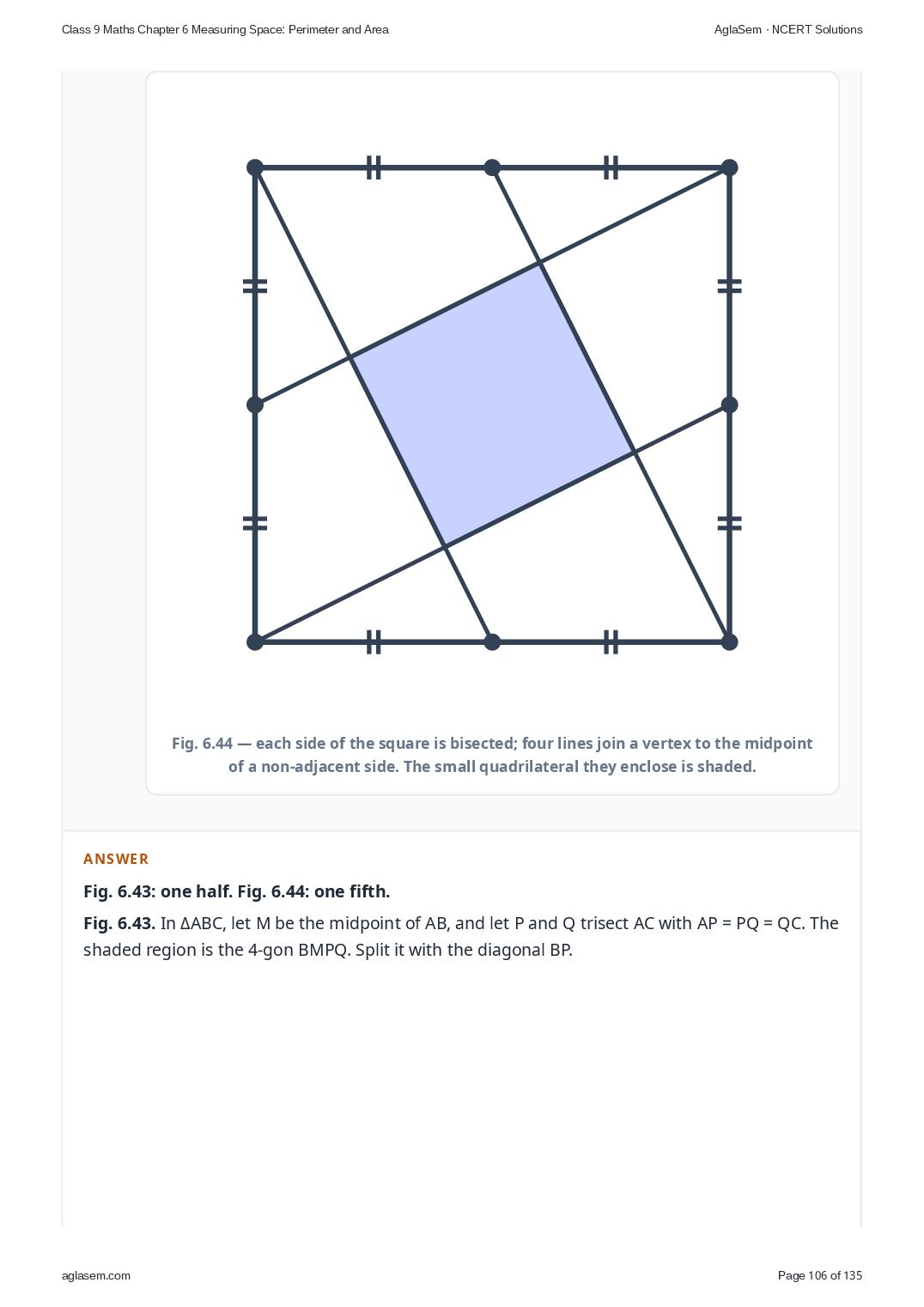
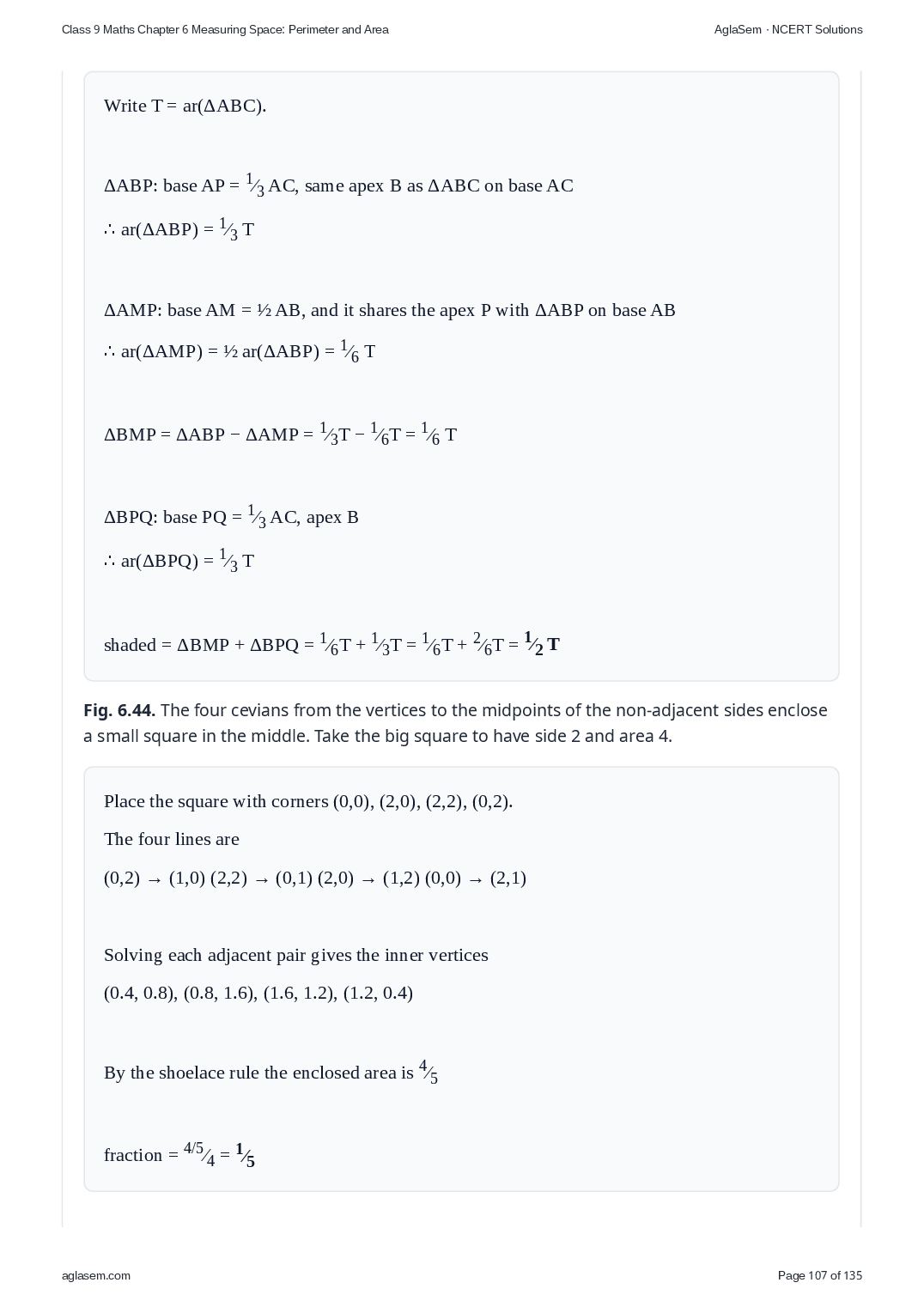
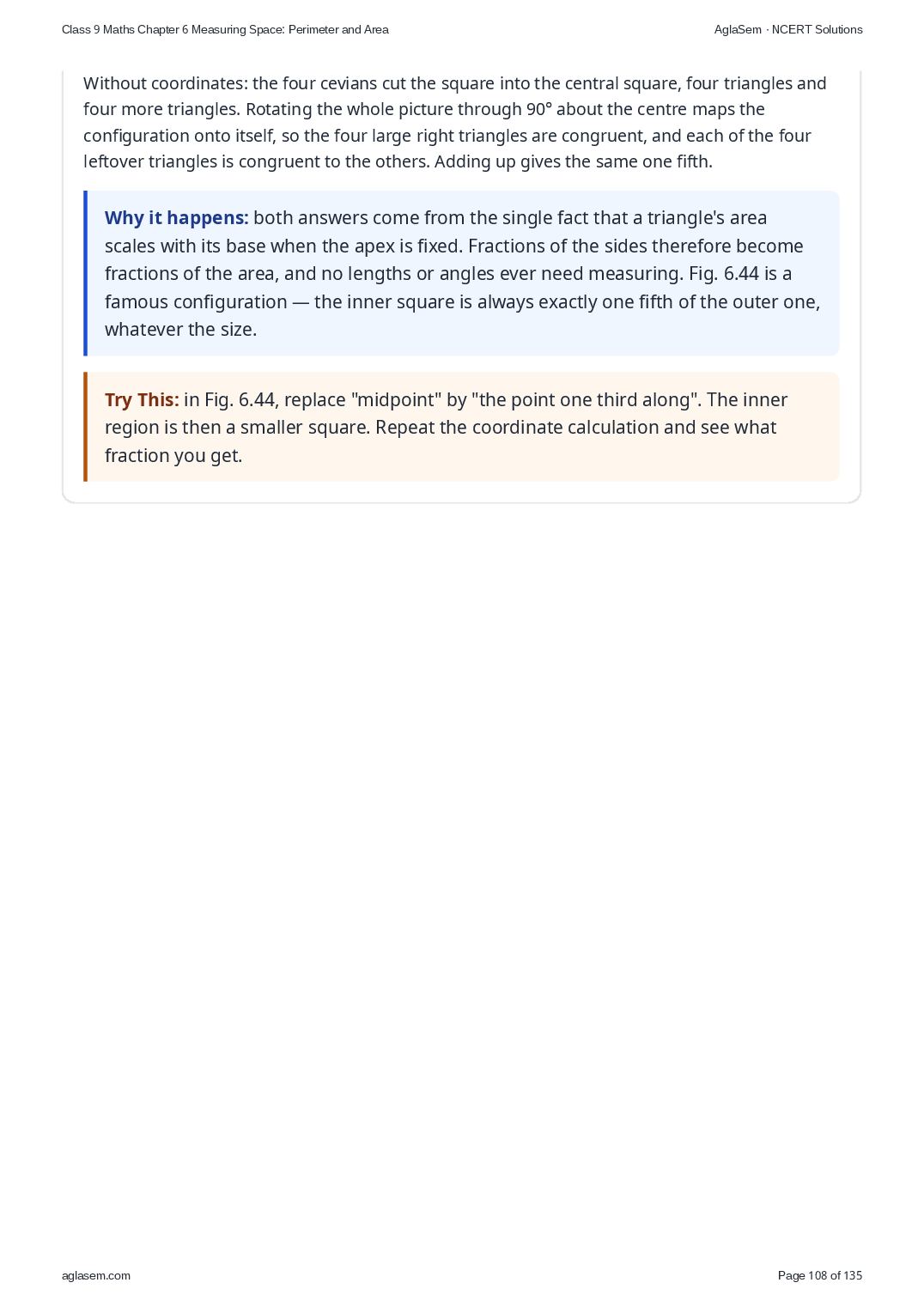
- *Fig. 6.43: What fraction of the triangle is shaded? (In ΔABC, M is the midpoint of AB, and AC is divided into three equal parts at P and Q; the shaded region is the 4-gon B, M, P, Q.) Fig. 6.44: What fraction of the square is shaded? (Each side of the square is bisected, and four lines are drawn, each joining a vertex to the midpoint of a non-adjacent side, in rotational order; the shaded region is the small quadrilateral they enclose.)
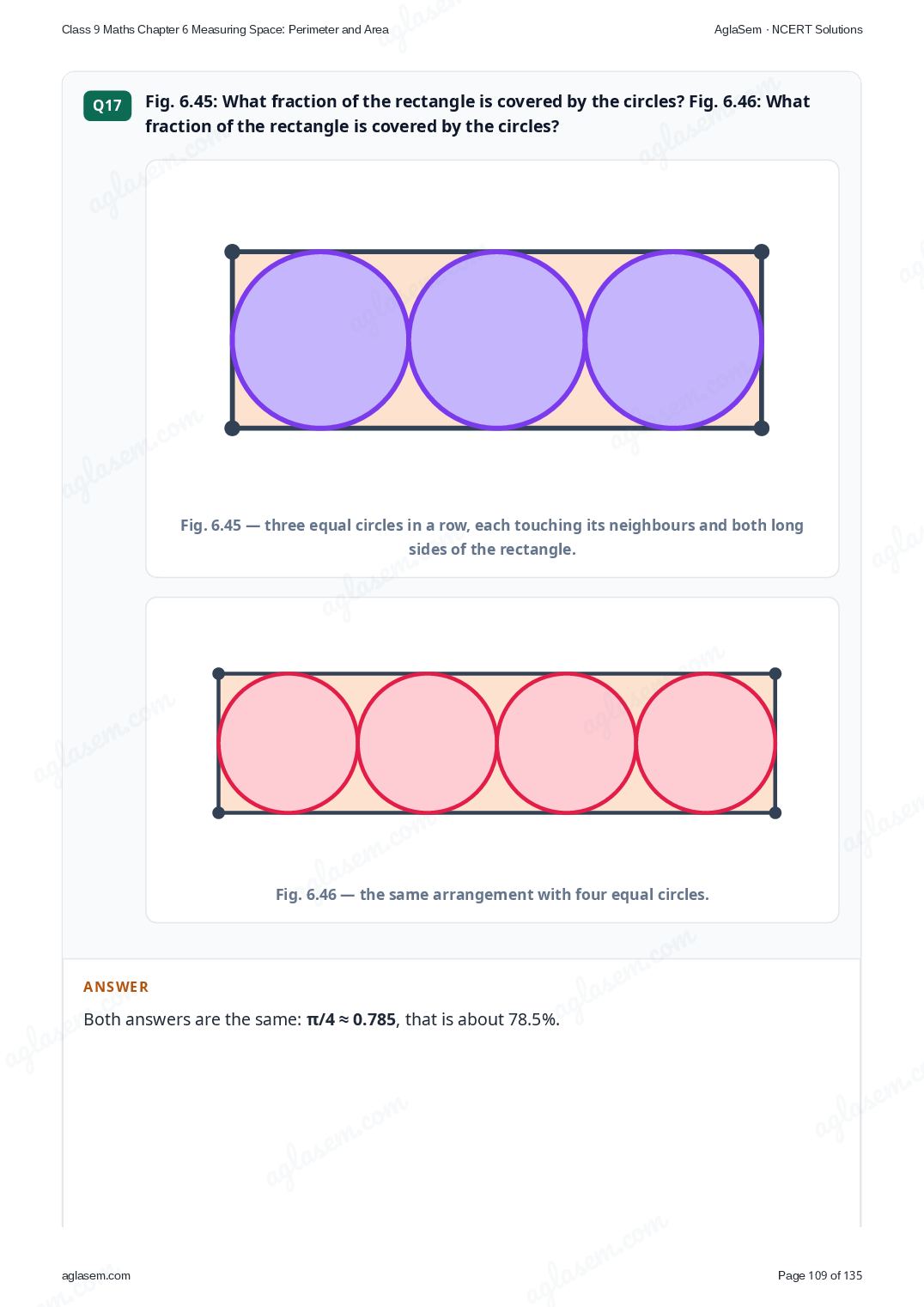
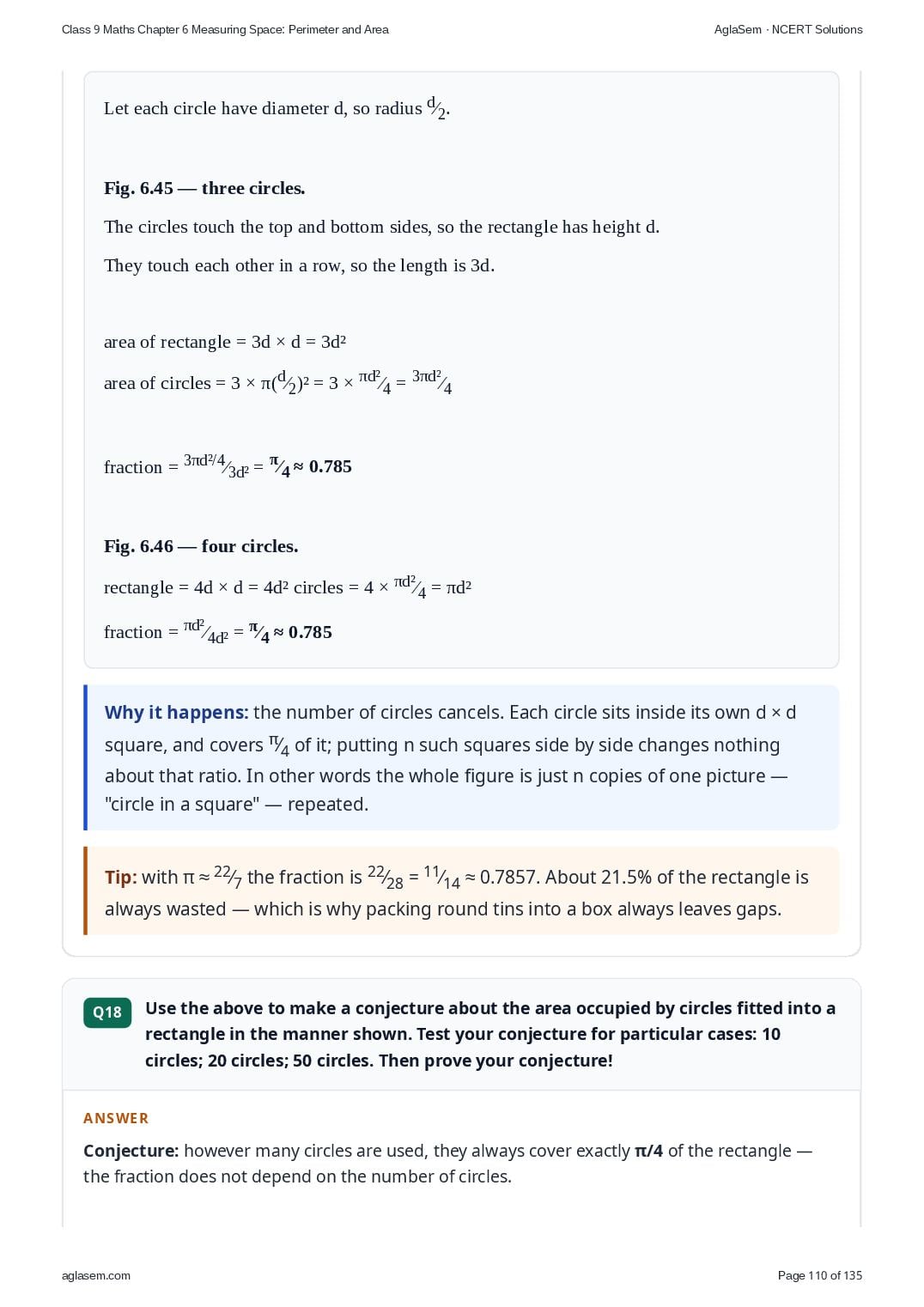
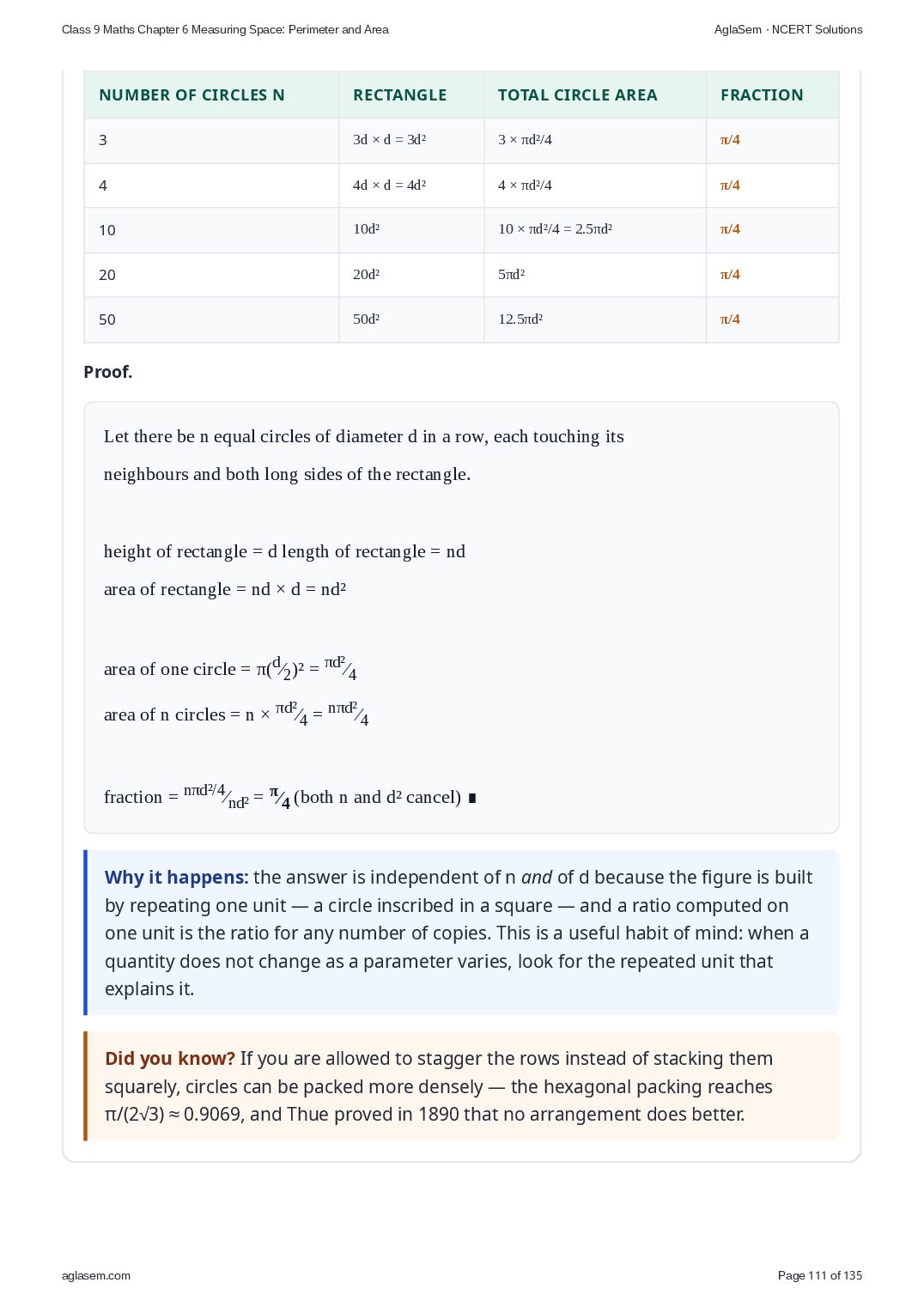
- Fig. 6.45: What fraction of the rectangle is covered by the circles? (Three equal circles in a row, each touching its neighbours and the two long sides of the rectangle.) Fig. 6.46: What fraction of the rectangle is covered by the circles? (The same arrangement with four circles.)
- Use the above to make a conjecture about the area occupied by circles fitted into a rectangle in the manner shown. Test your conjecture for particular cases: 10 circles; 20 circles; 50 circles. Then prove your conjecture!
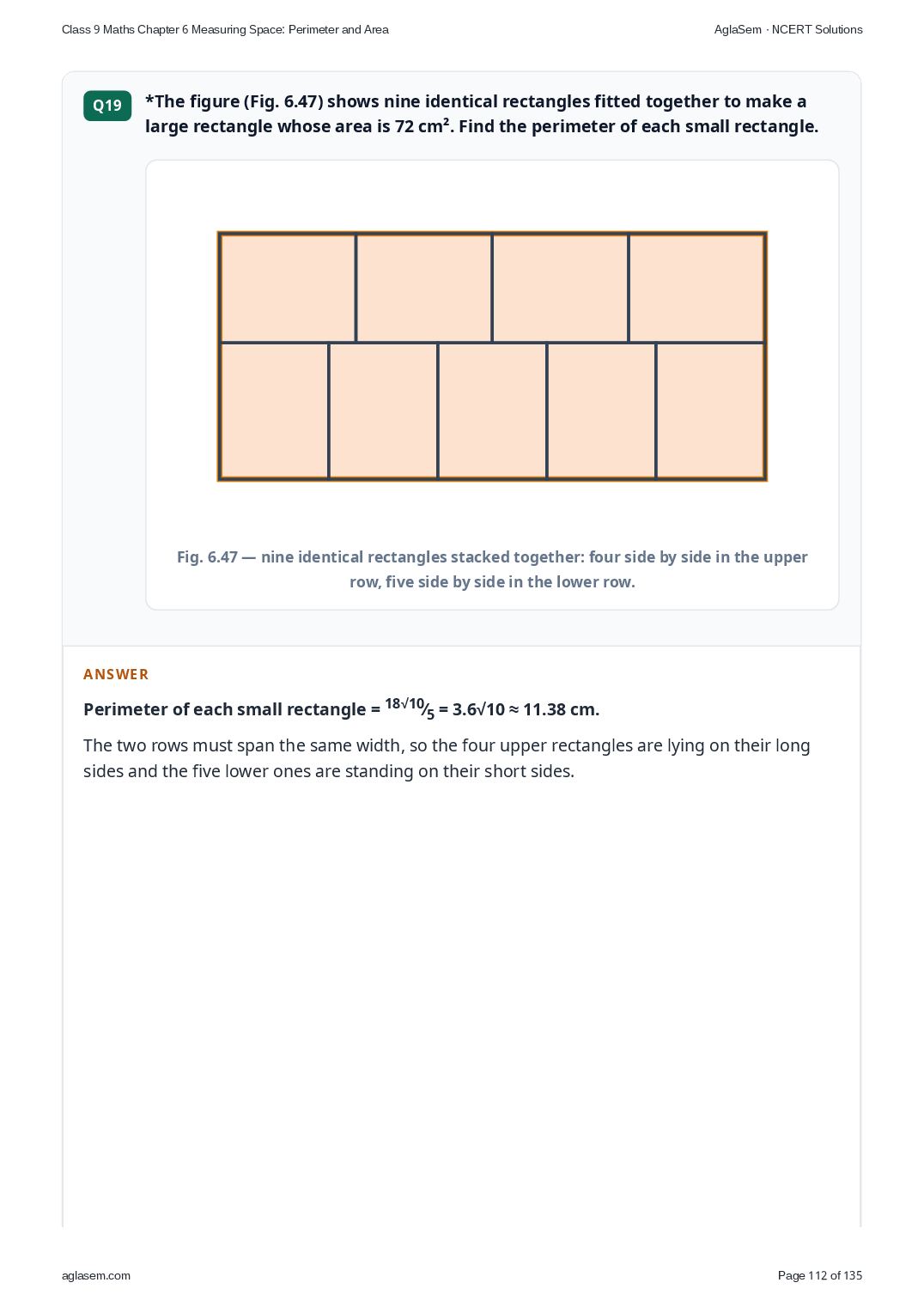
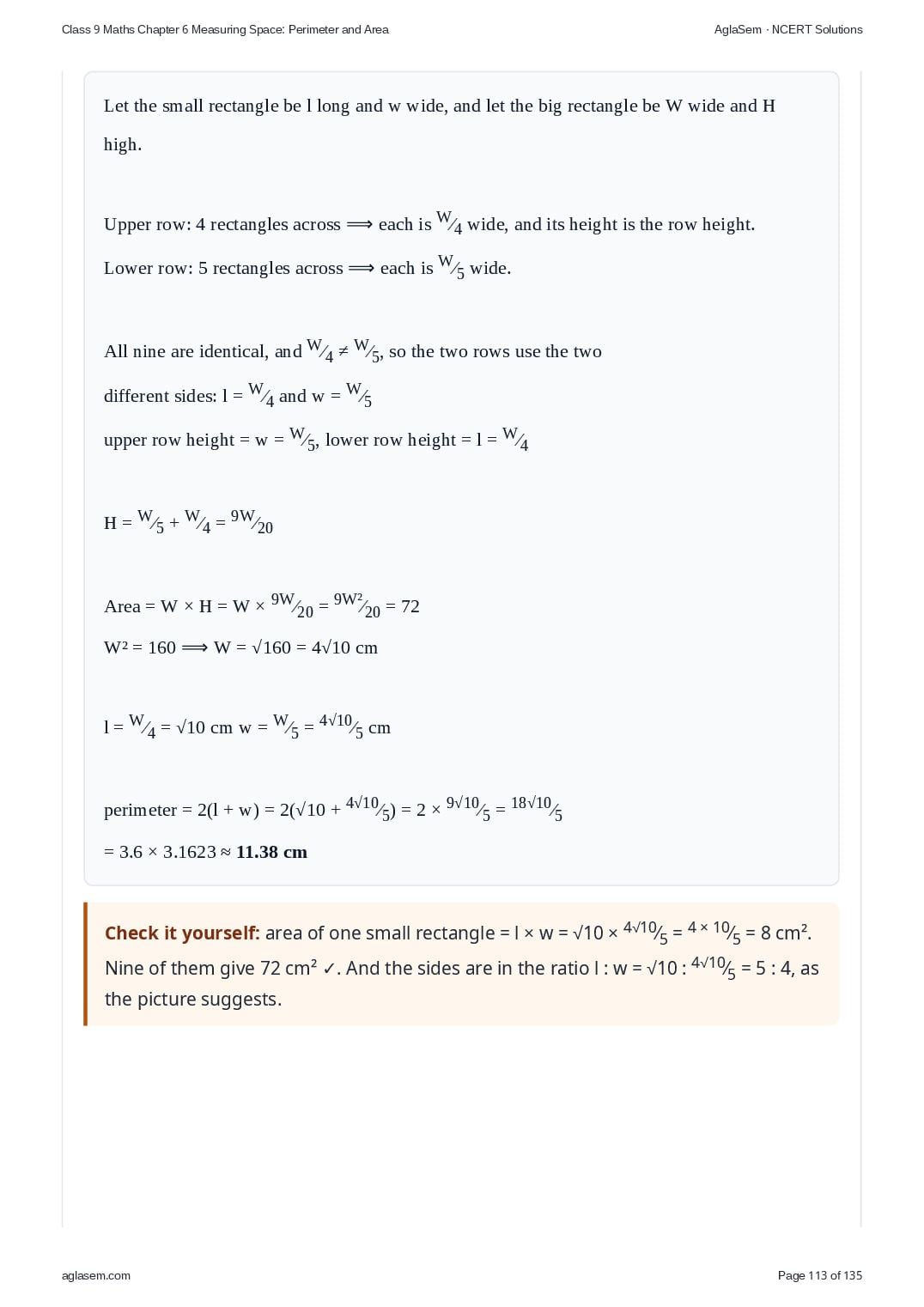
- *The figure (Fig. 6.47) shows nine identical rectangles fitted together to make a large rectangle whose area is 72 cm². Find the perimeter of each small rectangle. (Four rectangles lie side by side in the upper row and five lie side by side in the lower row.)
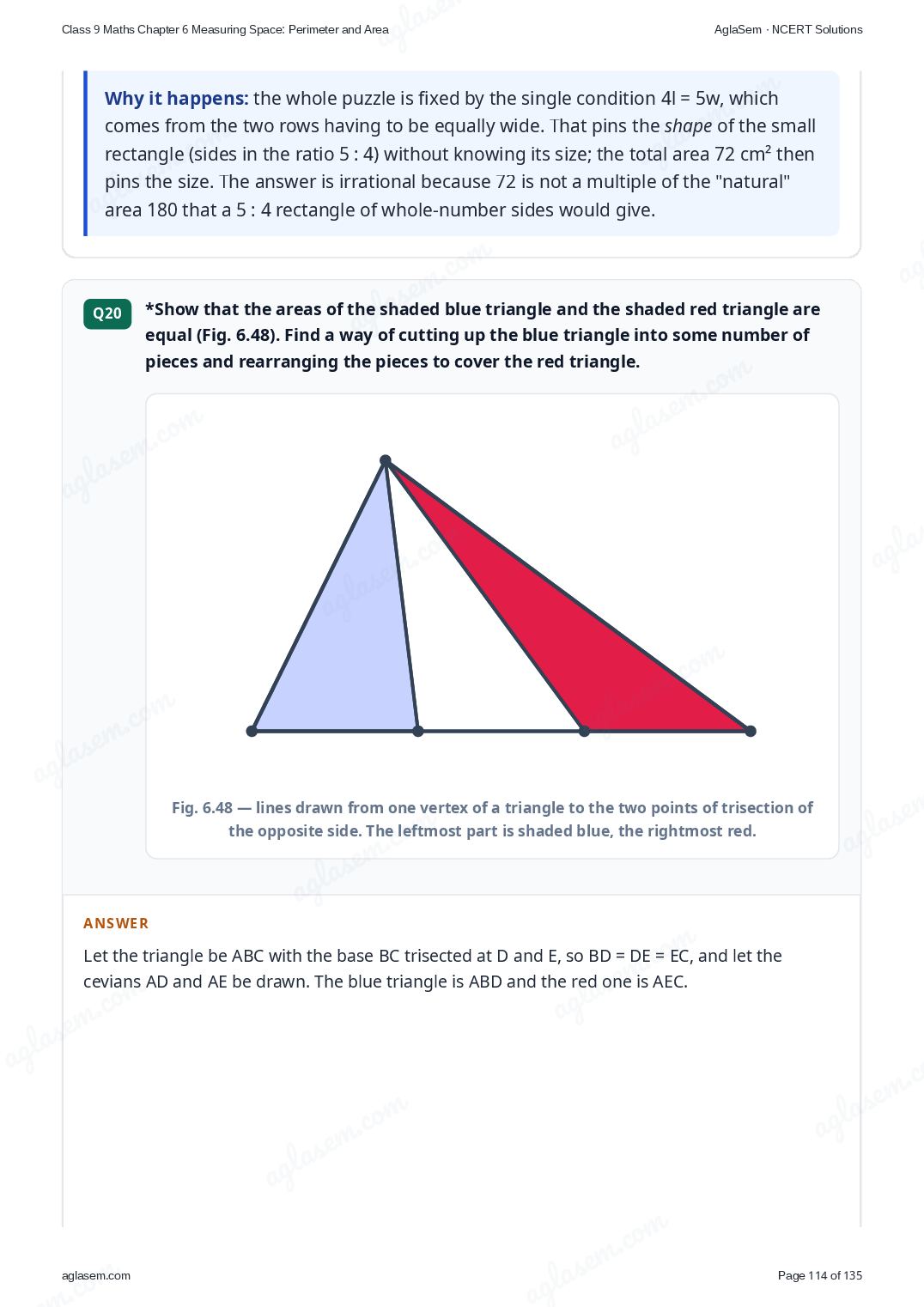
- *Show that the areas of the shaded blue triangle and the shaded red triangle are equal (Fig. 6.48: lines are drawn from one vertex of a triangle to the two points of trisection of the opposite side; the blue triangle is the leftmost of the three parts and the red one is the rightmost). Find a way of cutting up the blue triangle into some number of pieces and rearranging the pieces to cover the red triangle.
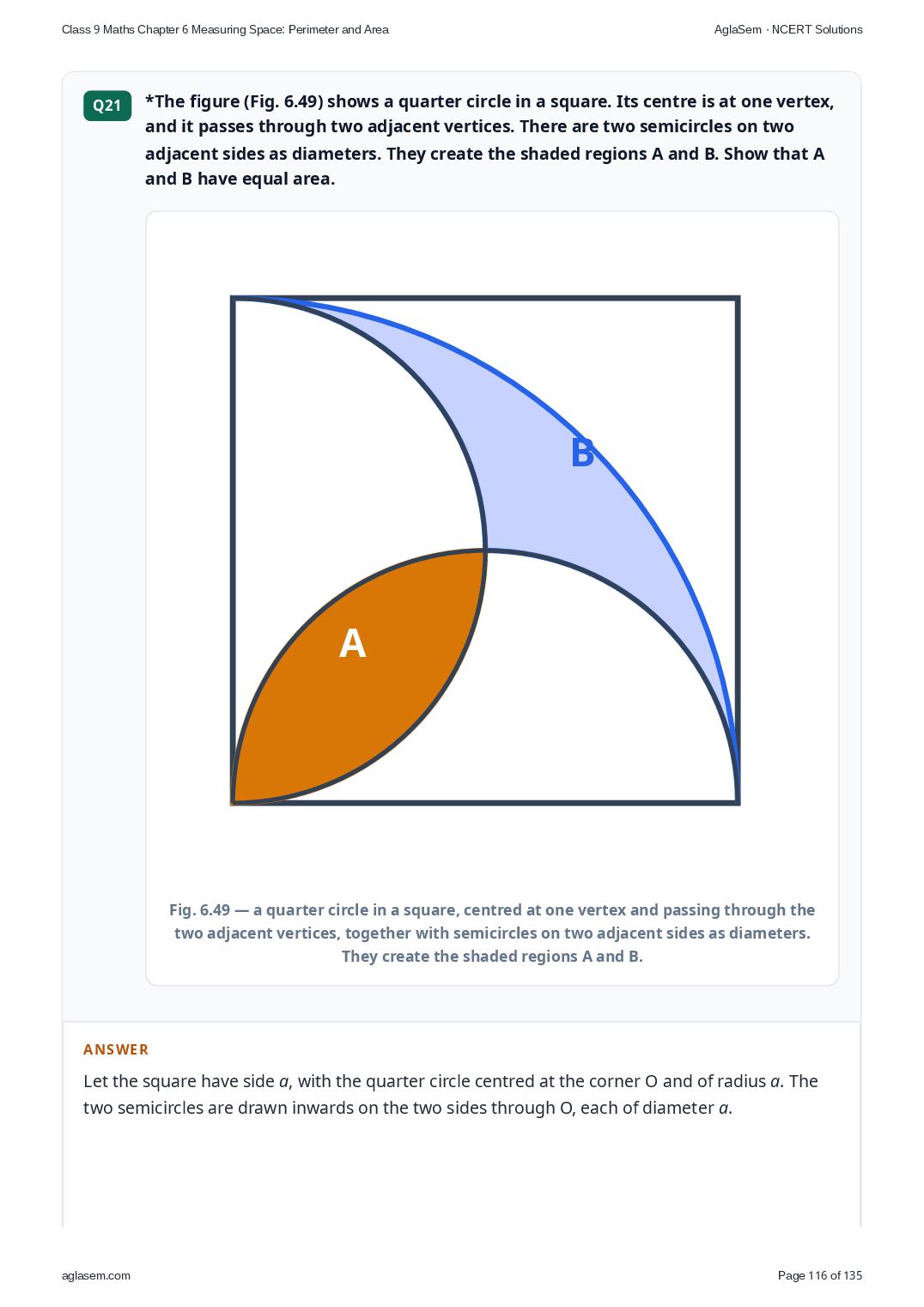
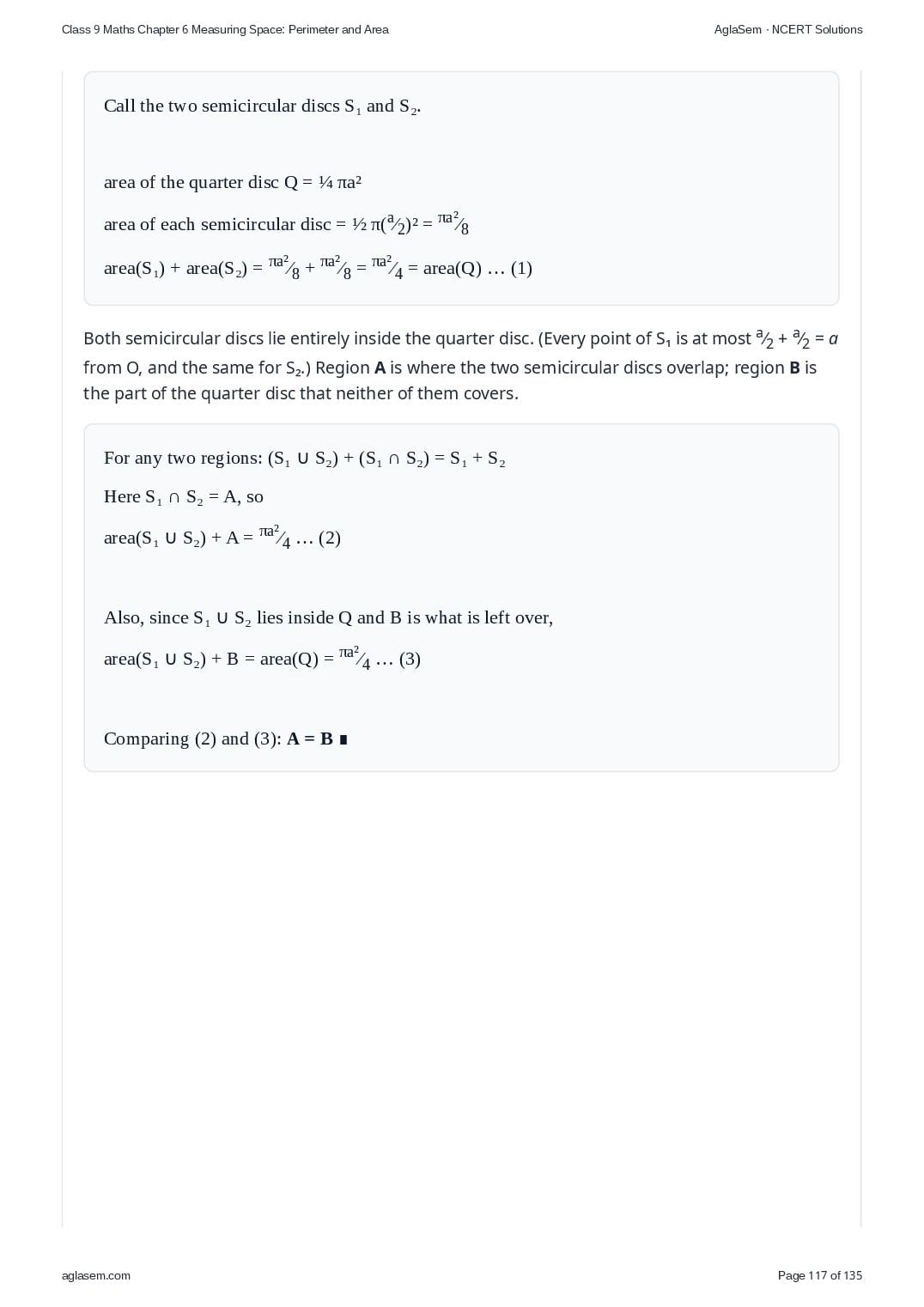
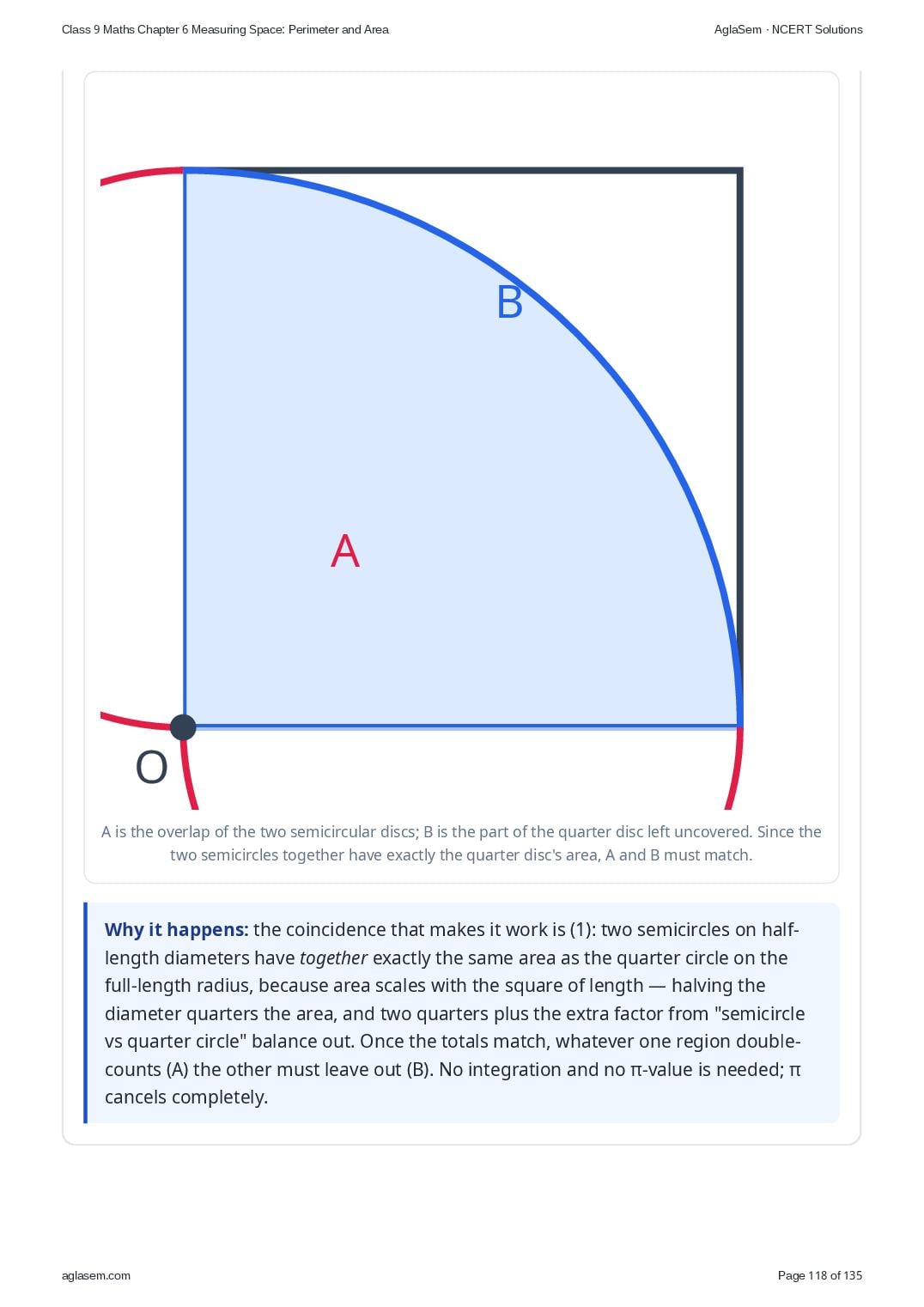
- *The figure (Fig. 6.49) shows a quarter circle in a square. Its centre is at one vertex, and it passes through two adjacent vertices. There are two semicircles on two adjacent sides as diameters. They create the shaded regions A and B. Show that A and B have equal area.
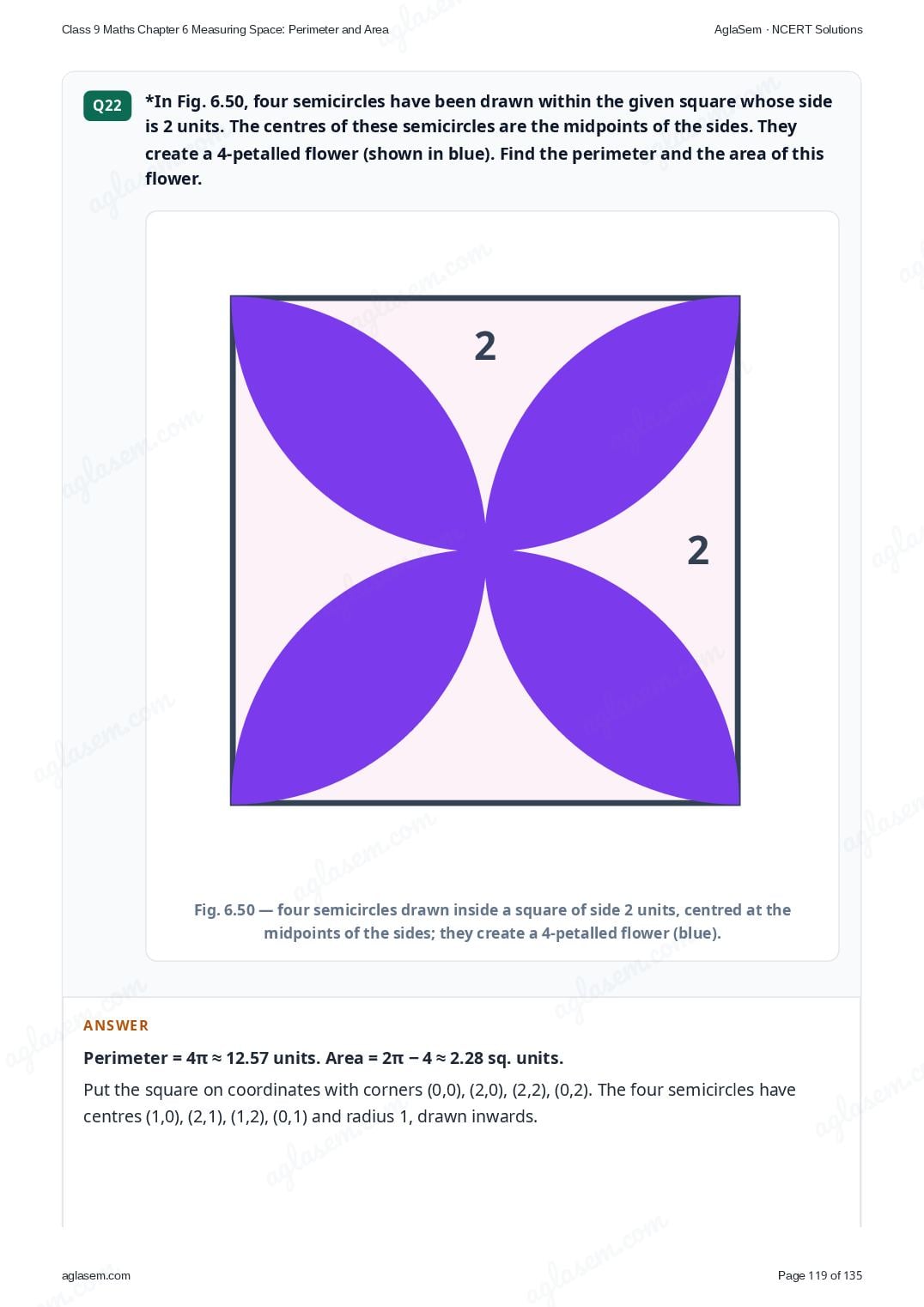
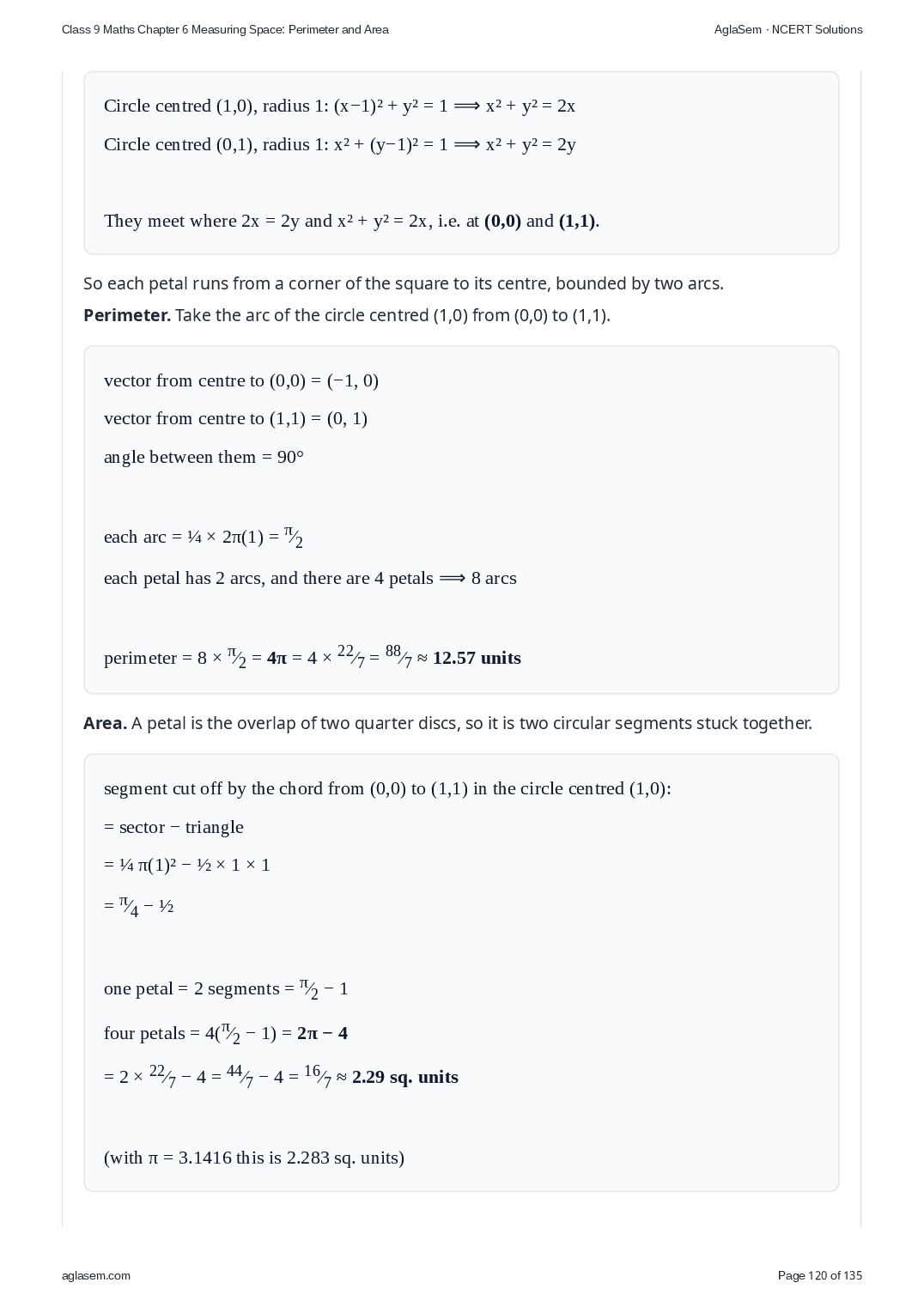
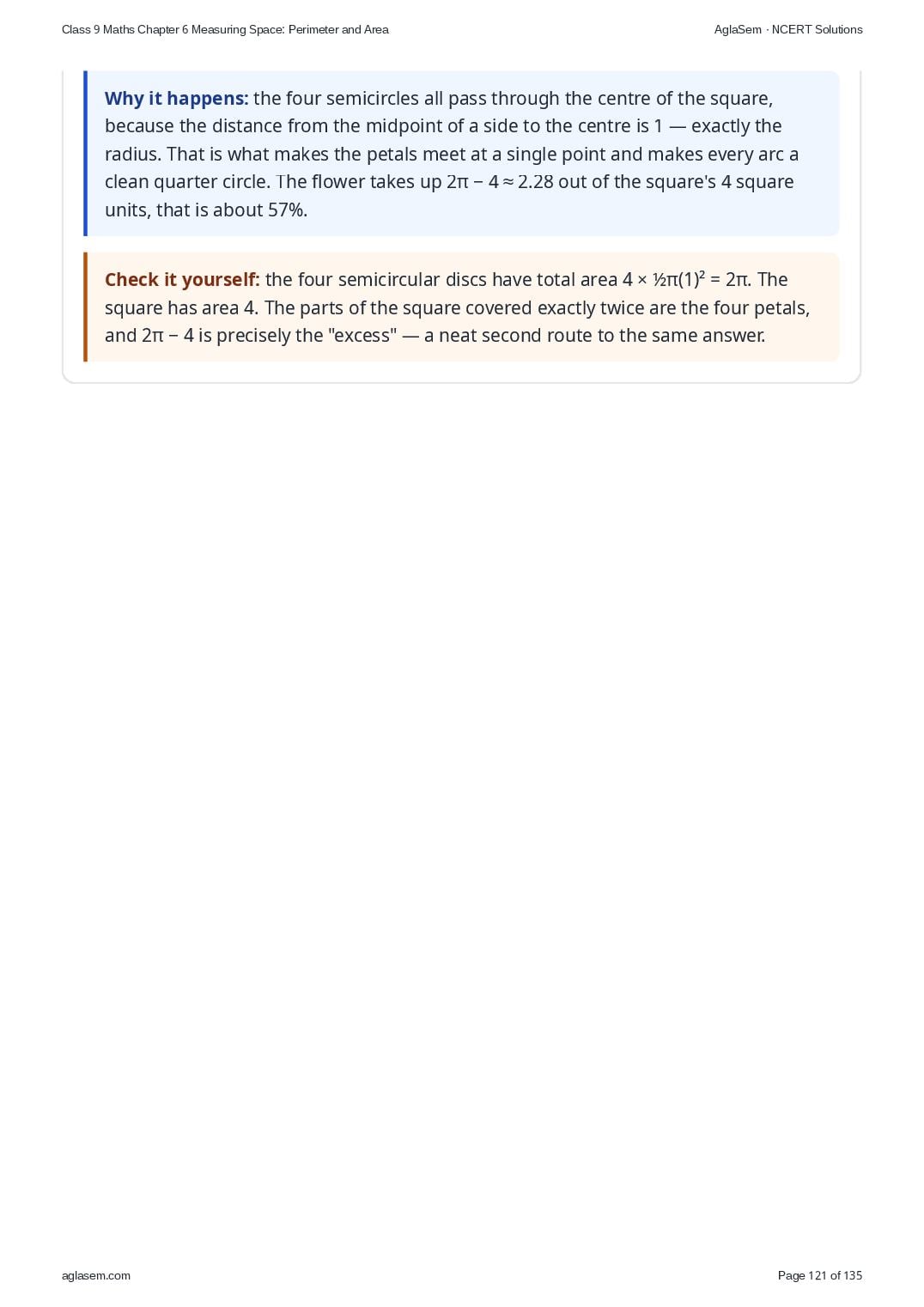
- *In Fig. 6.50, four semicircles have been drawn within the given square whose side is 2 units. The centres of these semicircles are the midpoints of the sides. They create a 4-petalled flower (shown in blue). Find the perimeter and the area of this flower.
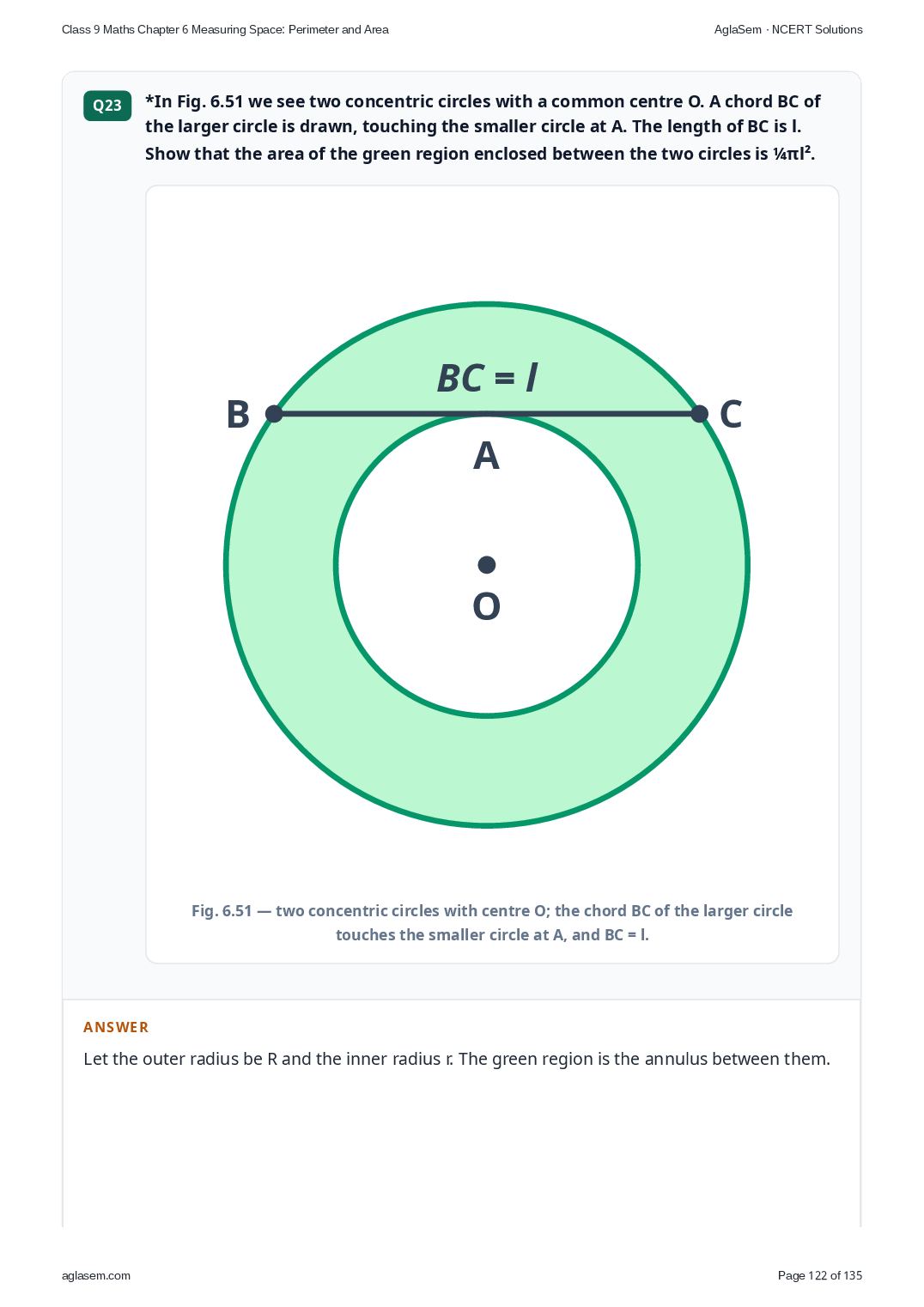
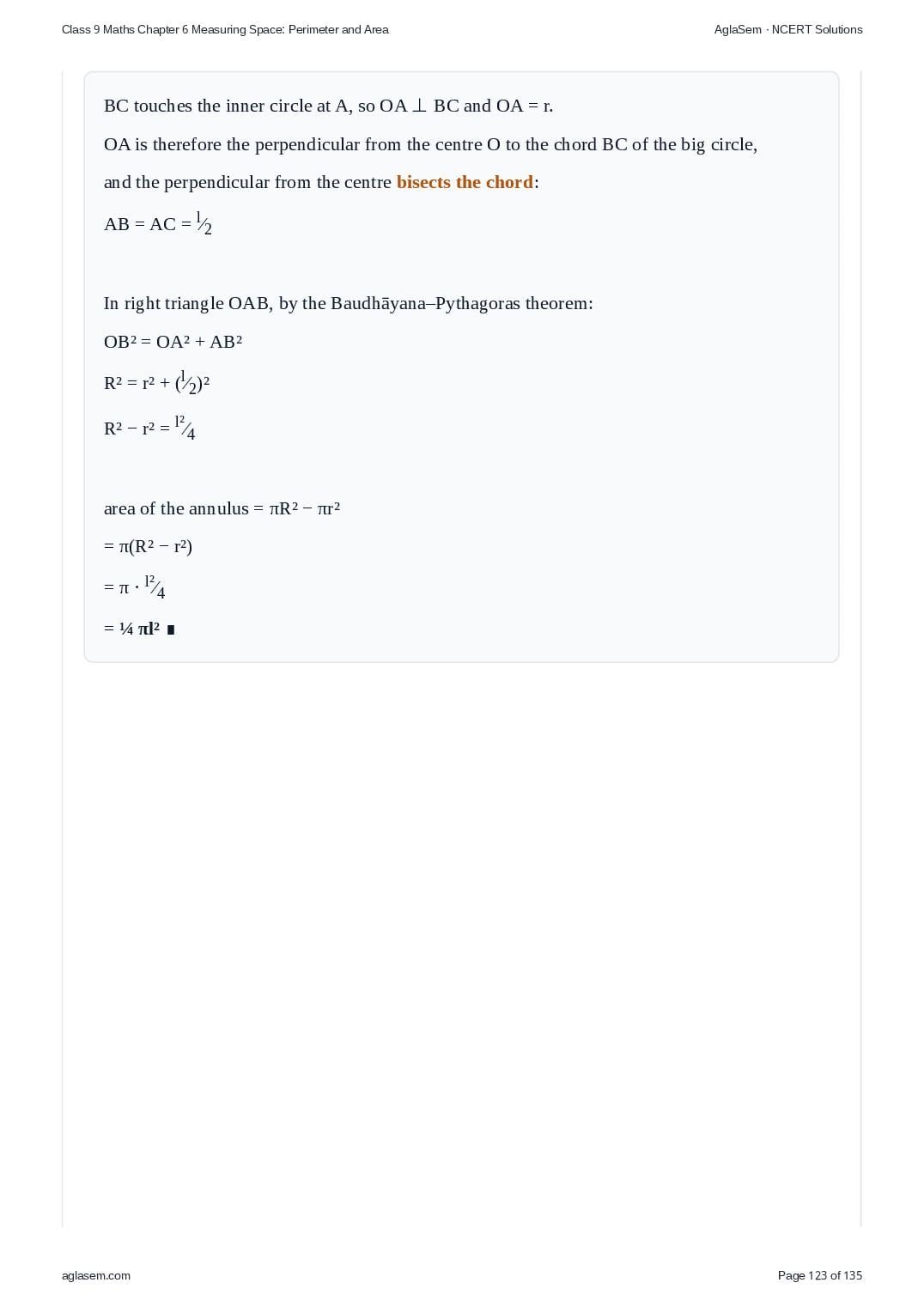
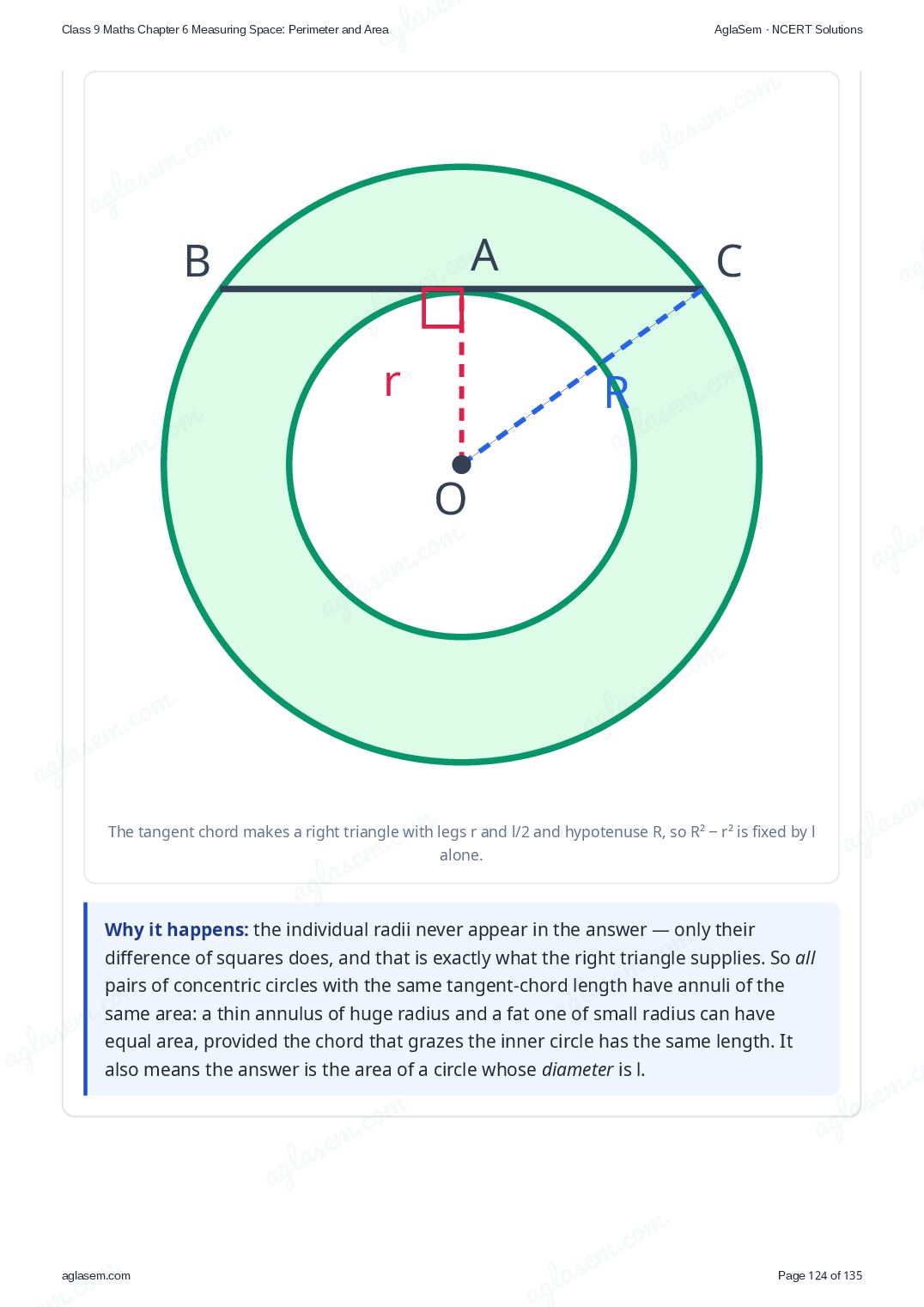
- *In Fig. 6.51 we see two concentric circles with a common centre O. A chord BC of the larger circle is drawn, touching the smaller circle at A. The length of BC is l. Show that the area of the green region enclosed between the two circles is ¼πl².
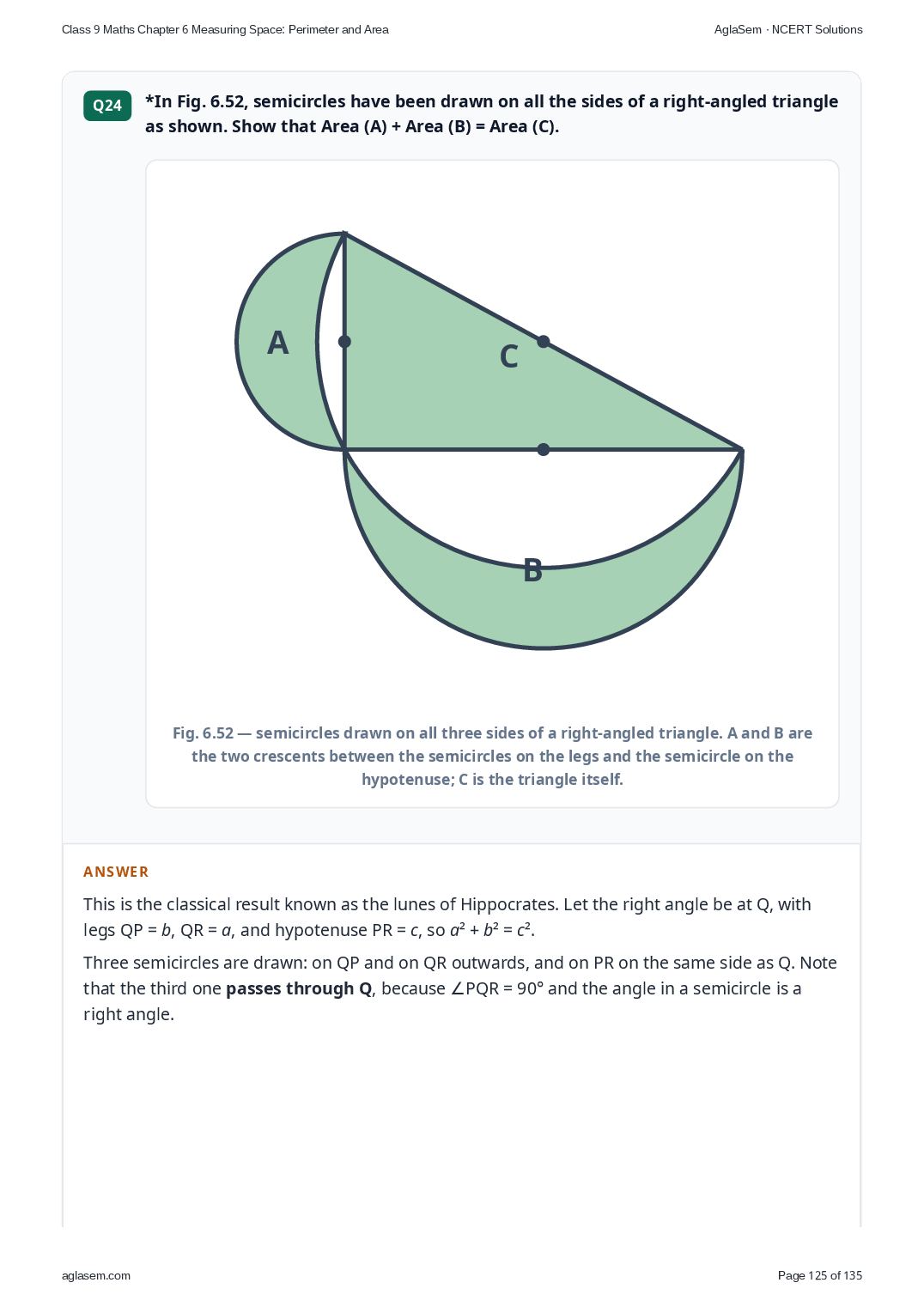
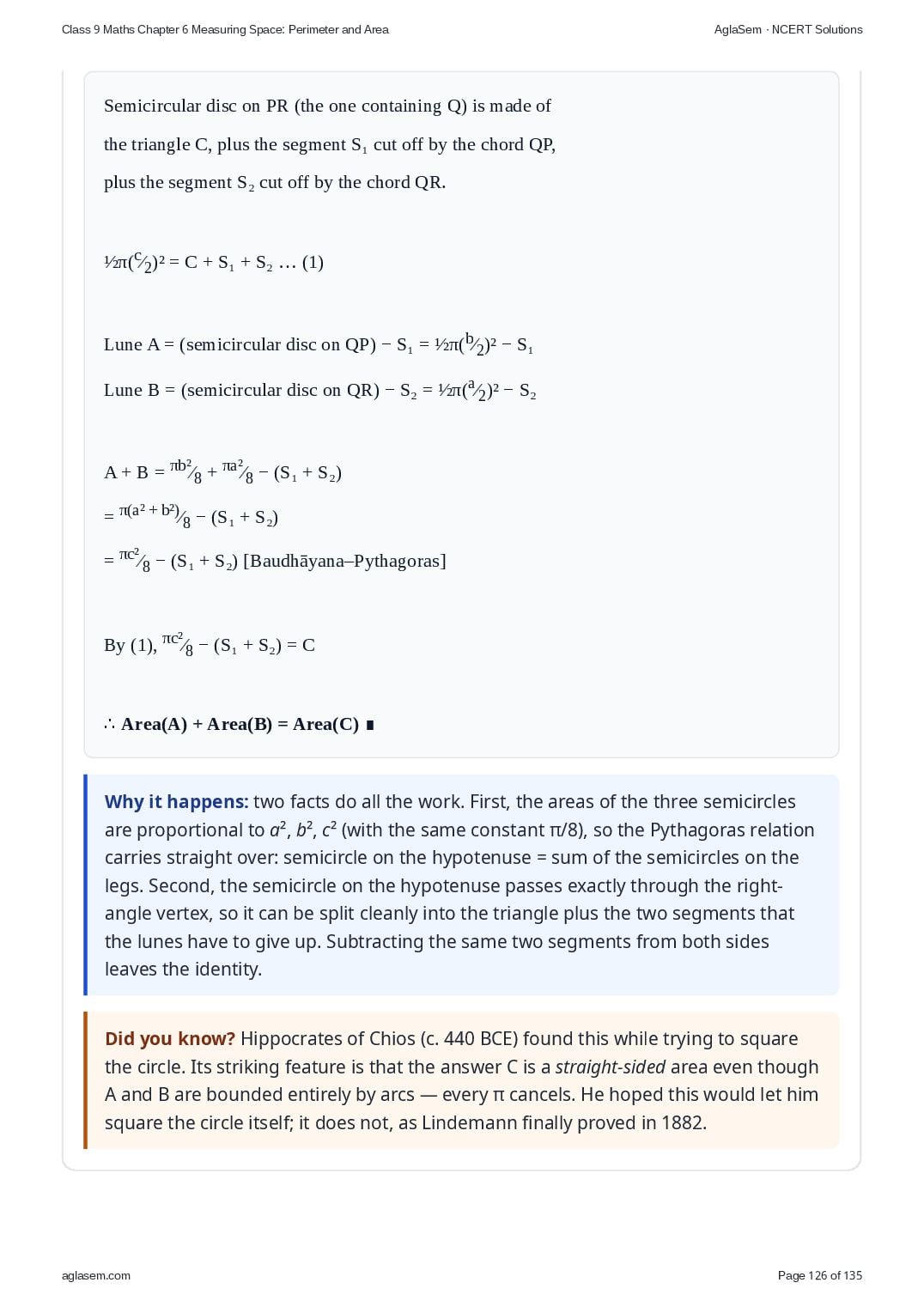
- *In Fig. 6.52, semicircles have been drawn on all the sides of a right-angled triangle as shown. Show that Area (A) + Area (B) = Area (C). (A and B are the two crescent-shaped regions between the semicircles on the legs and the semicircle on the hypotenuse; C is the triangle itself.)
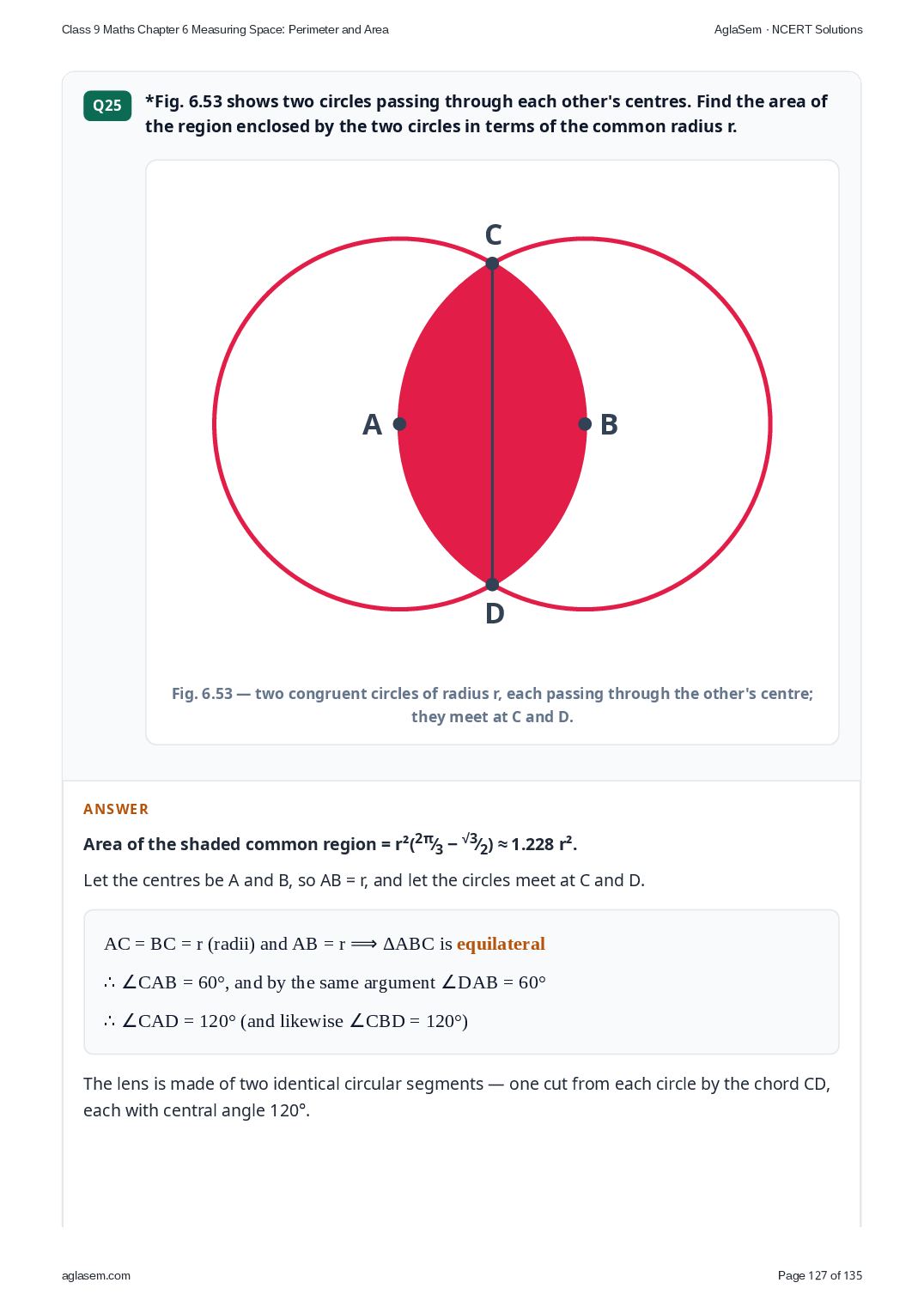
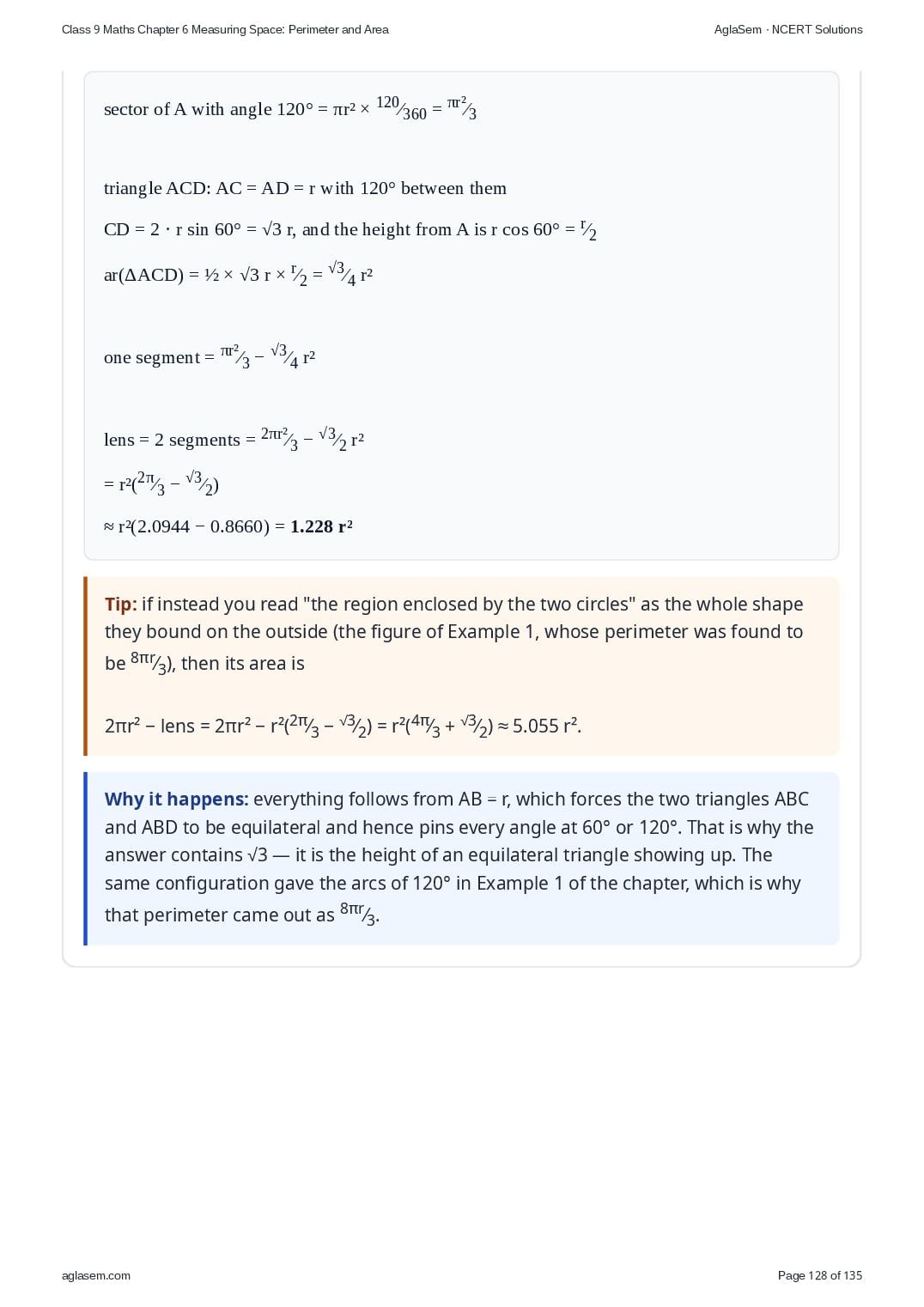
- *Fig. 6.53 shows two circles passing through each other's centres. Find the area of the region enclosed by the two circles in terms of the common radius r. (The shaded region is the lens-shaped part common to both circles, with vertices C and D.)
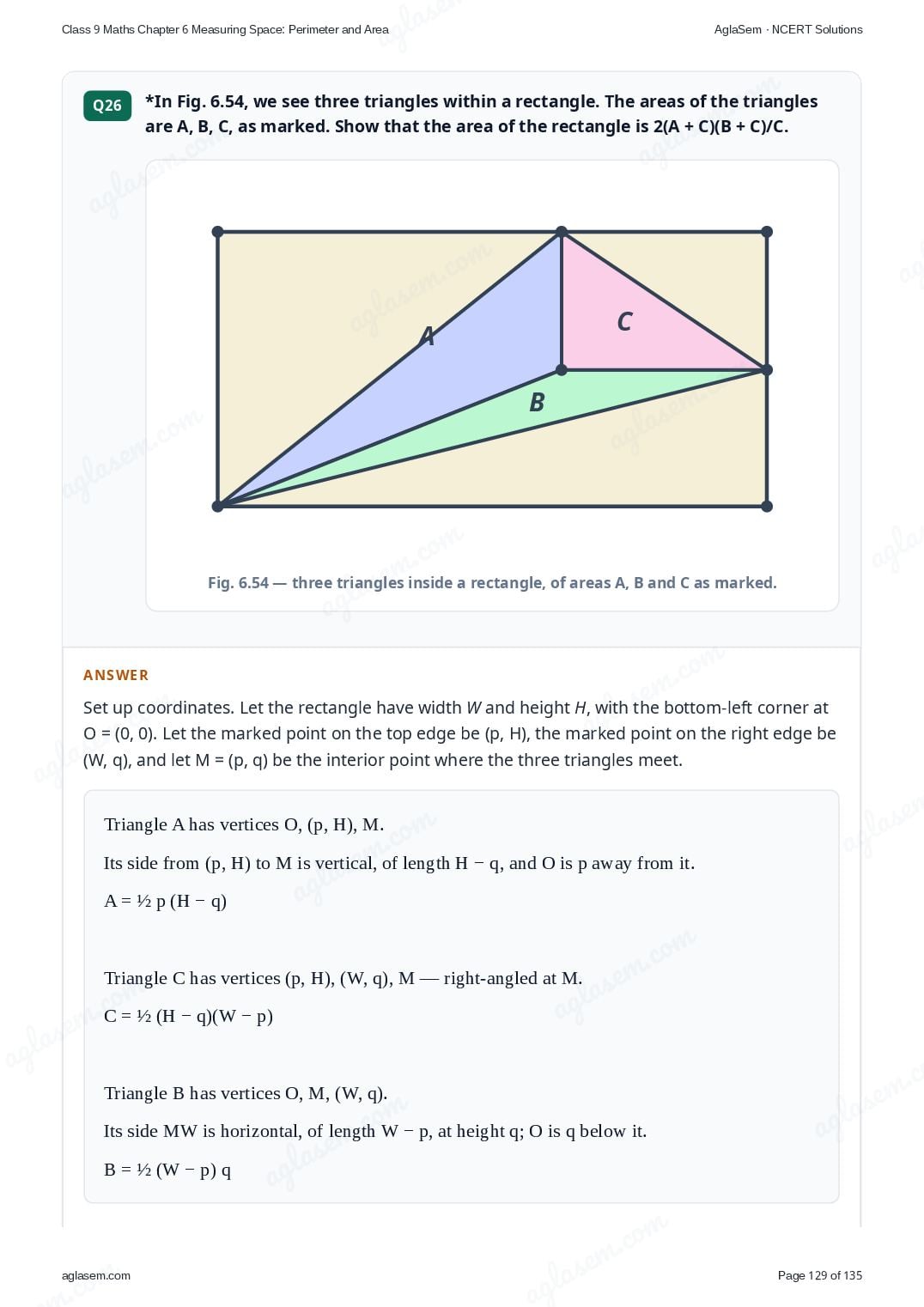
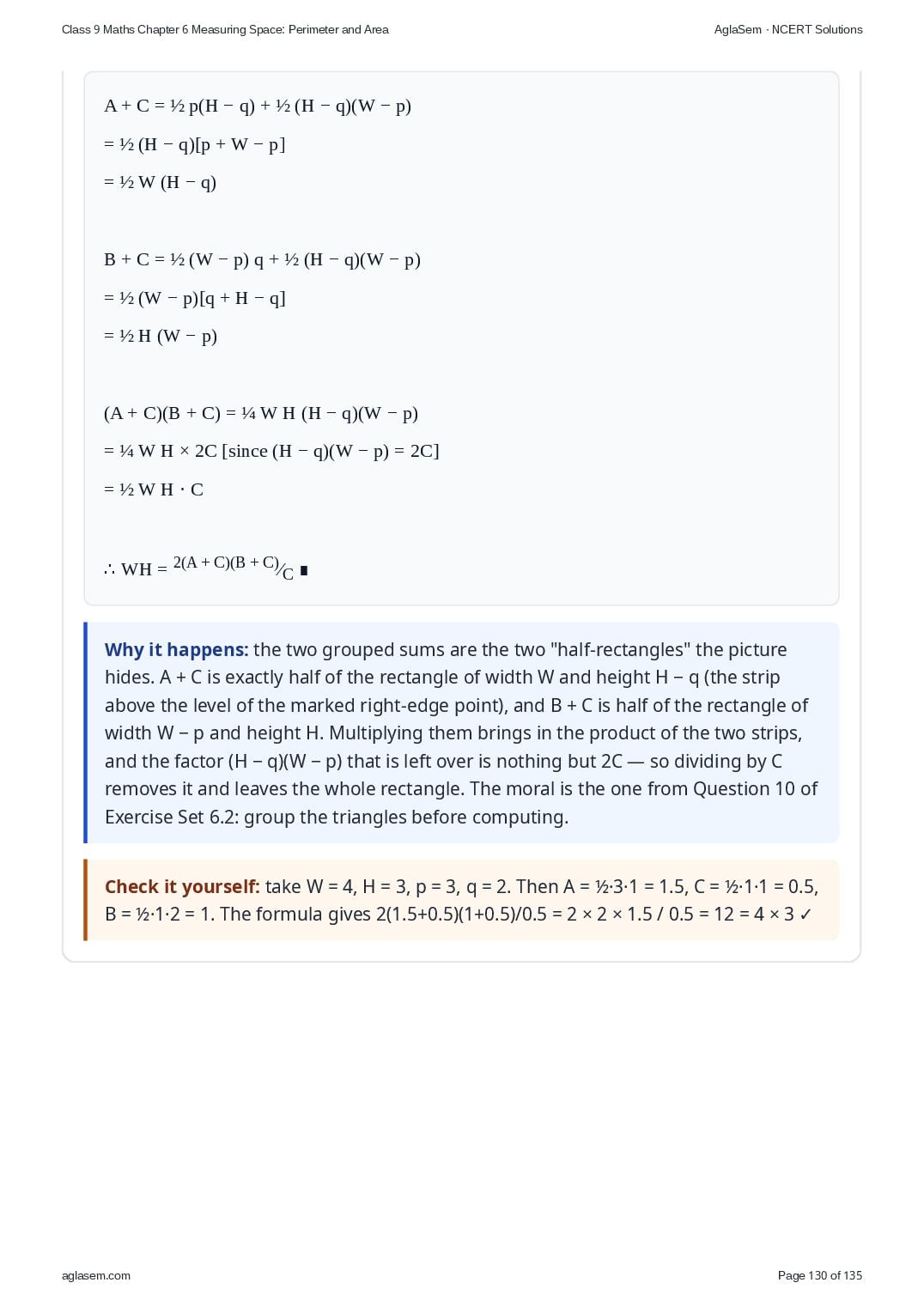
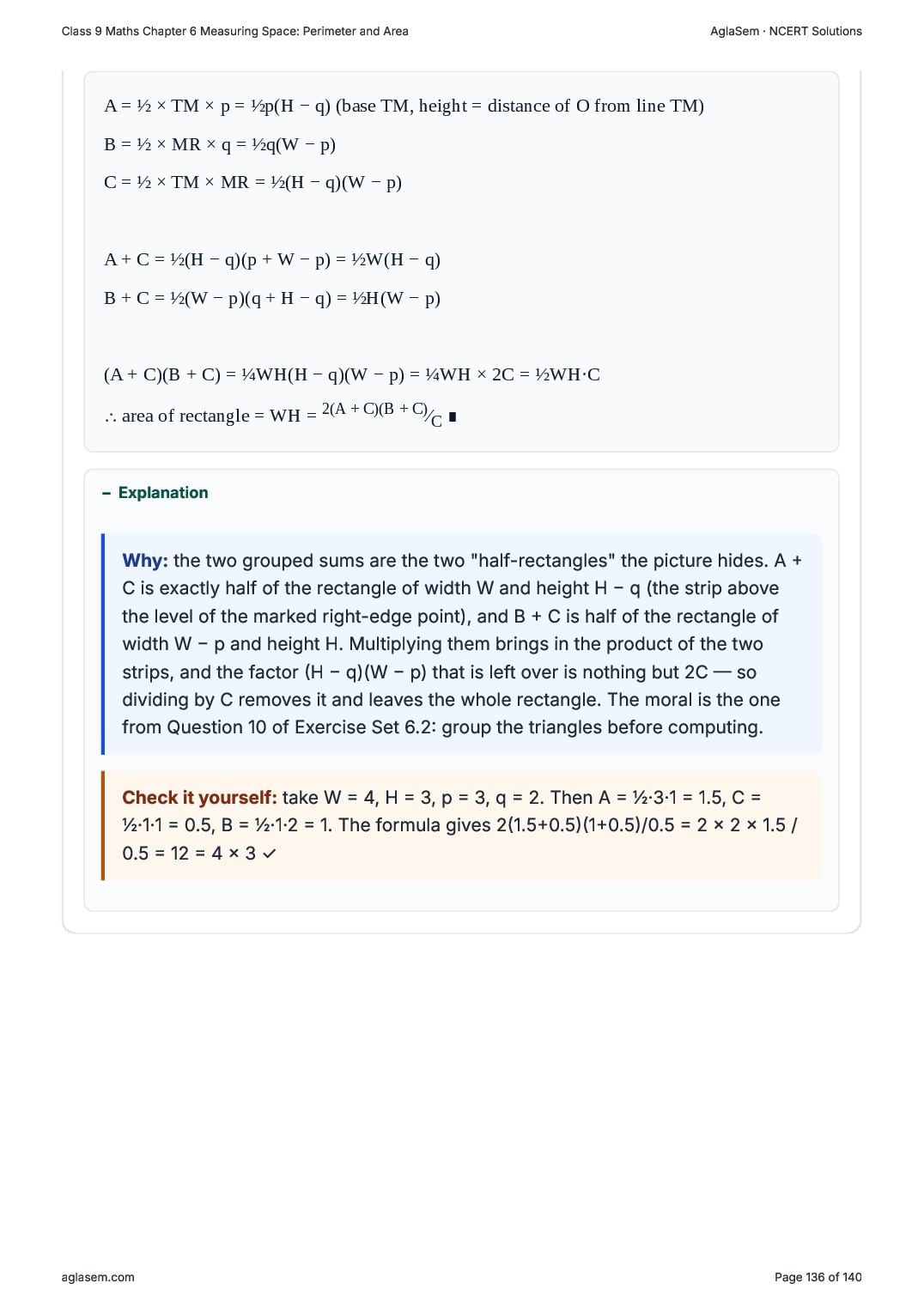
- *In Fig. 6.54, we see three triangles within a rectangle. The areas of the triangles are A, B, C, as marked. Show that the area of the rectangle is 2(A + C)(B + C)/C.
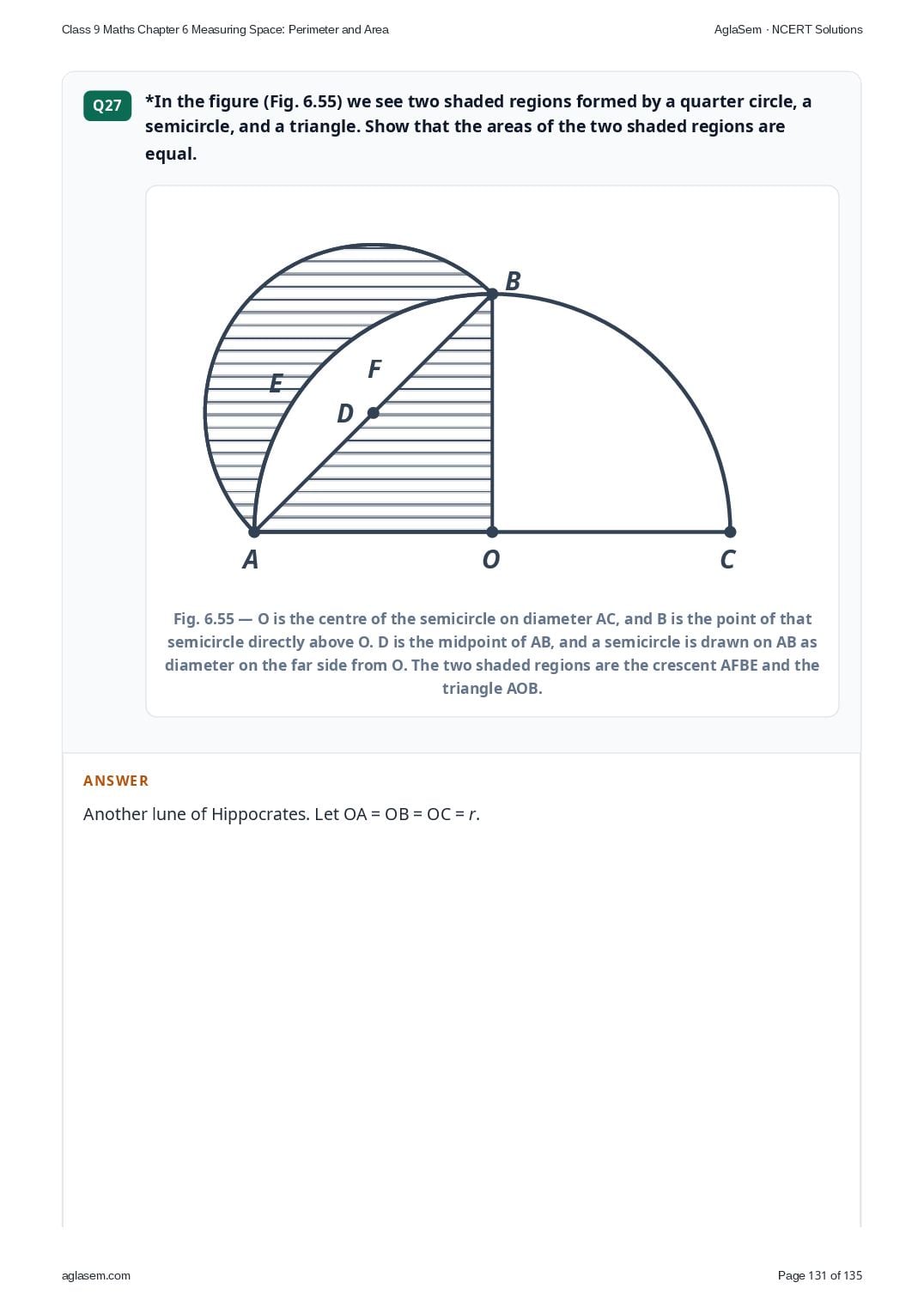
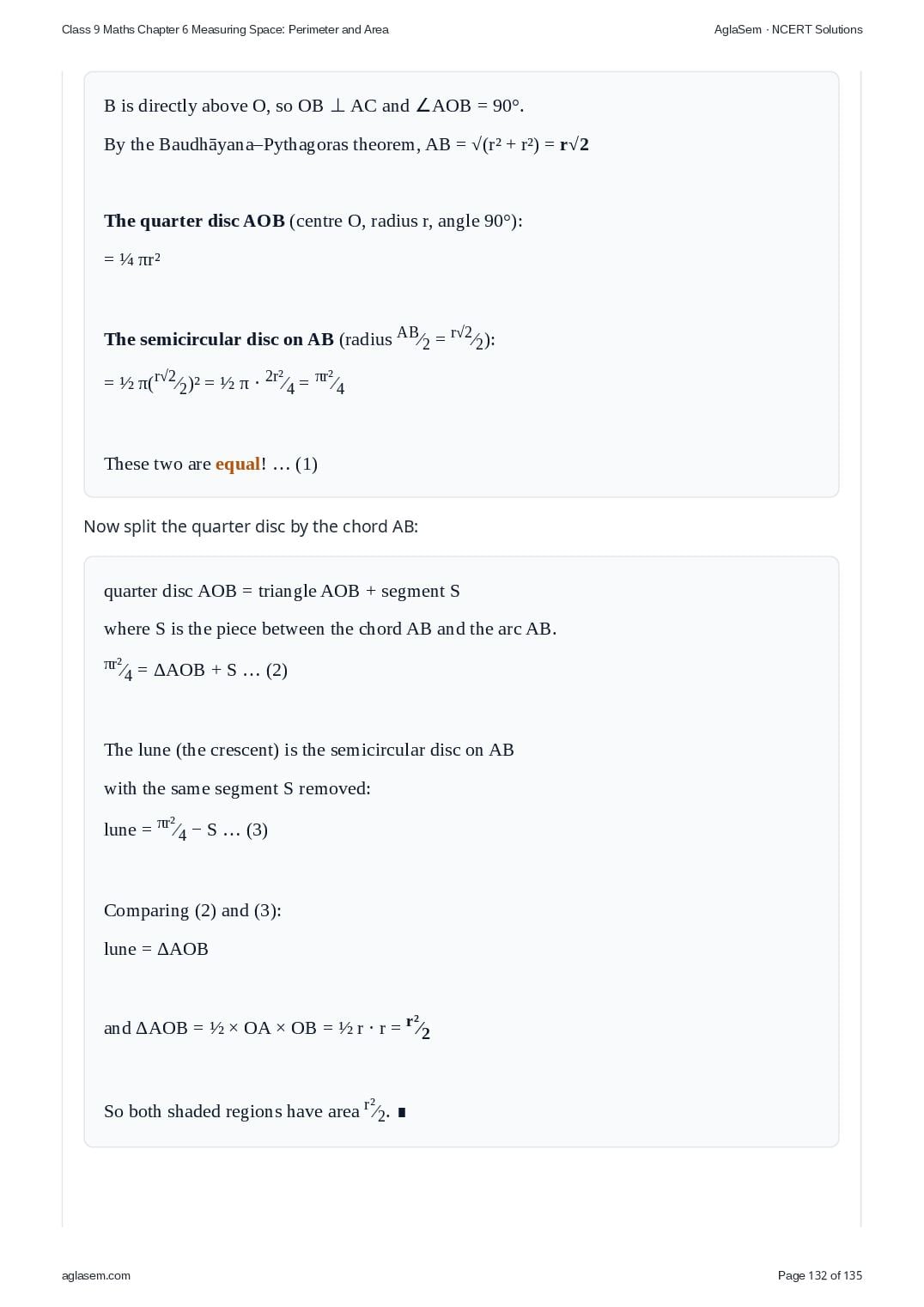
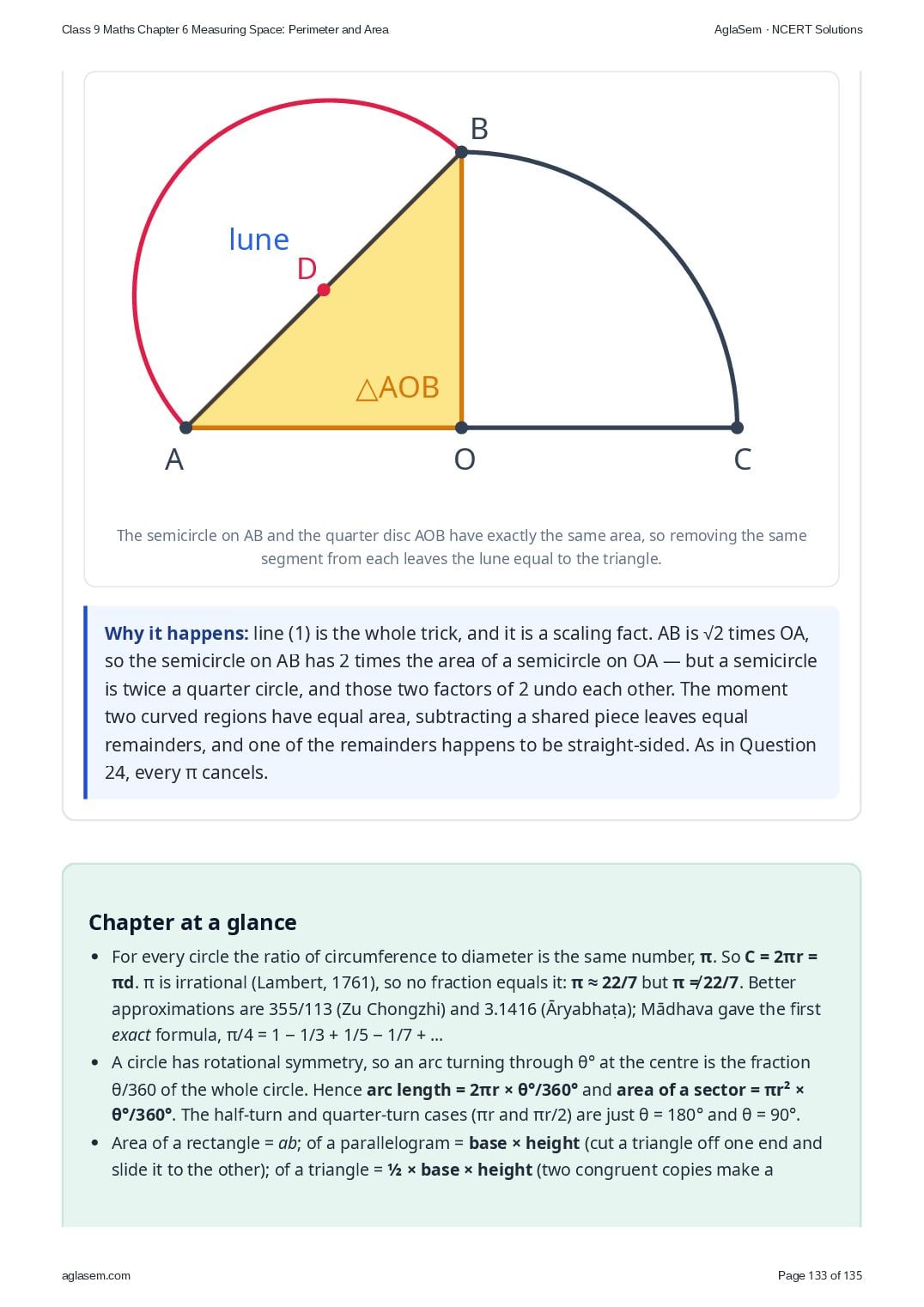
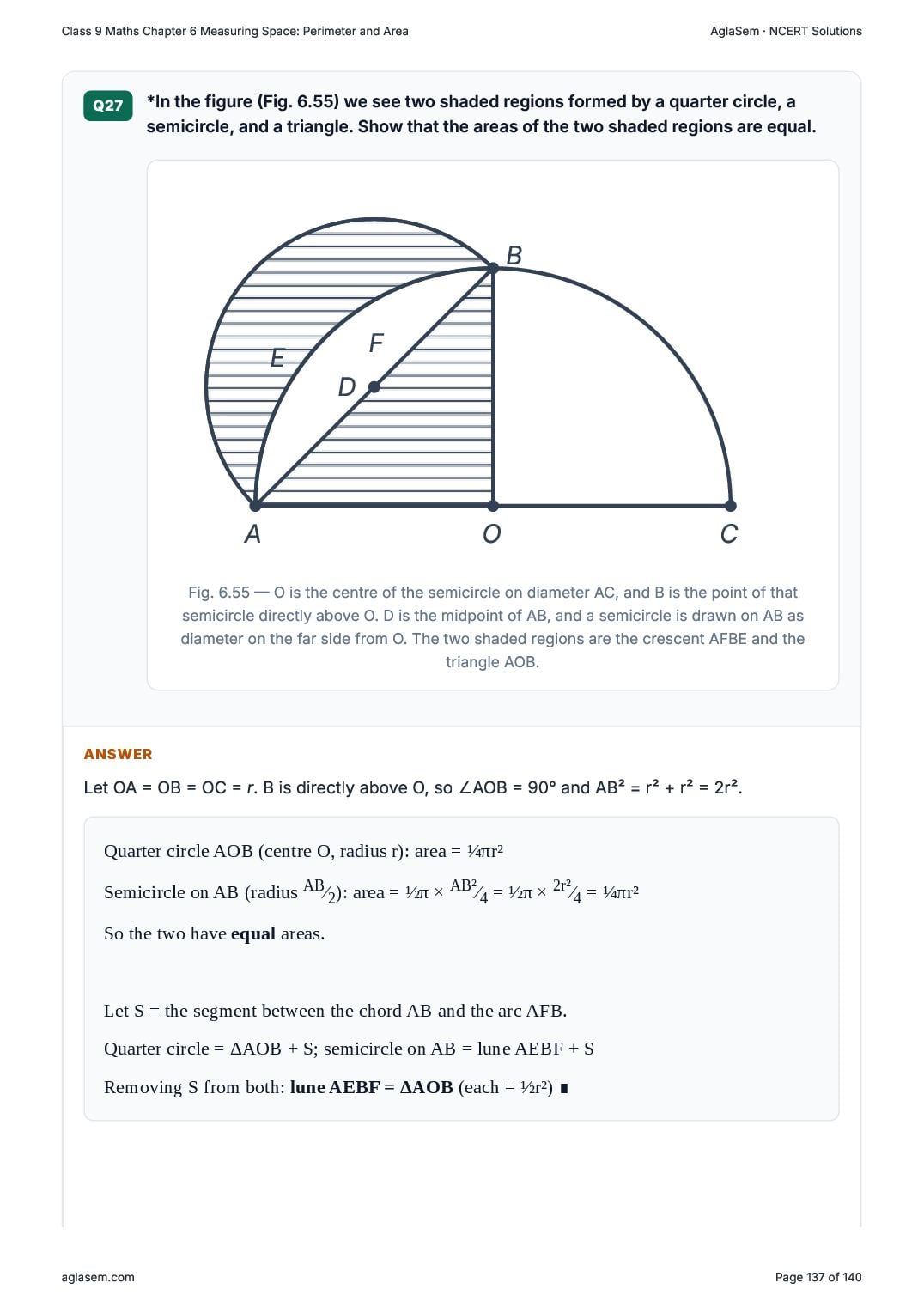
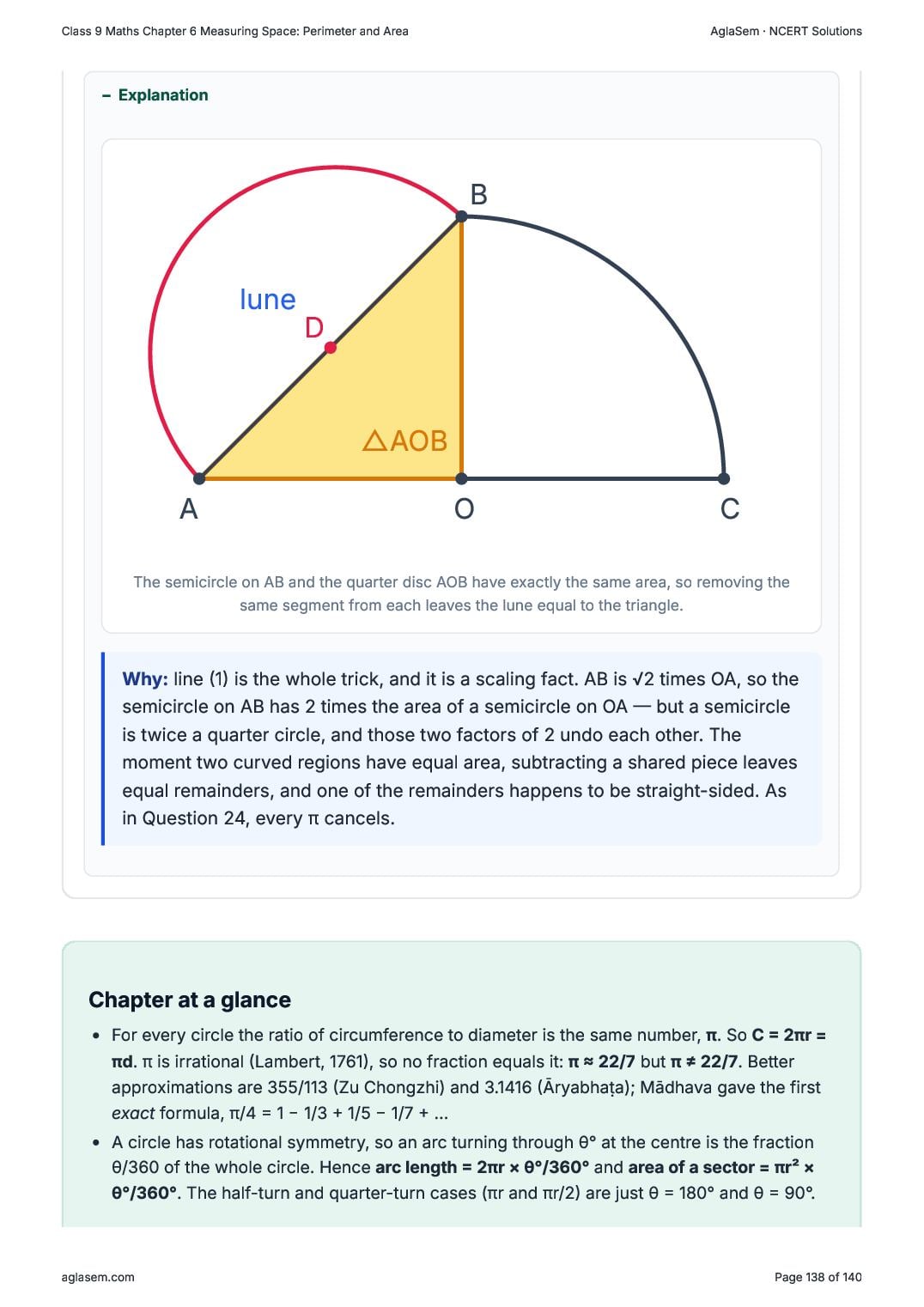
- *In the figure (Fig. 6.55) we see two shaded regions formed by a quarter circle, a semicircle, and a triangle. Show that the areas of the two shaded regions are equal. (O is the centre of a semicircle on diameter AC; B is the point of that semicircle directly above O; D is the midpoint of AB, and a semicircle is drawn on AB as diameter, on the far side from O. One shaded region is the crescent between that semicircle and the arc AB of the big circle; the other is the triangle AOB.)
Chapter at a Glance
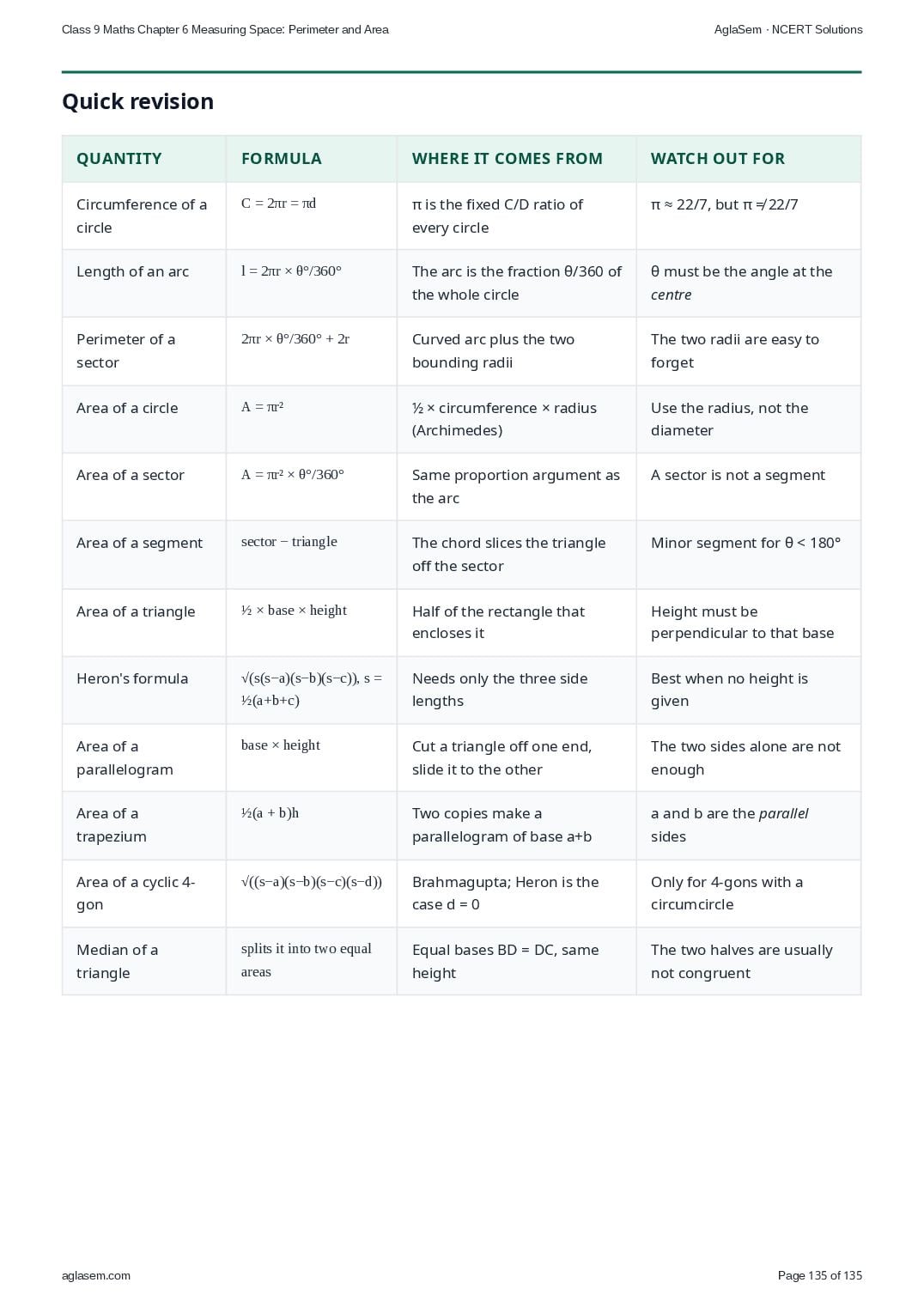
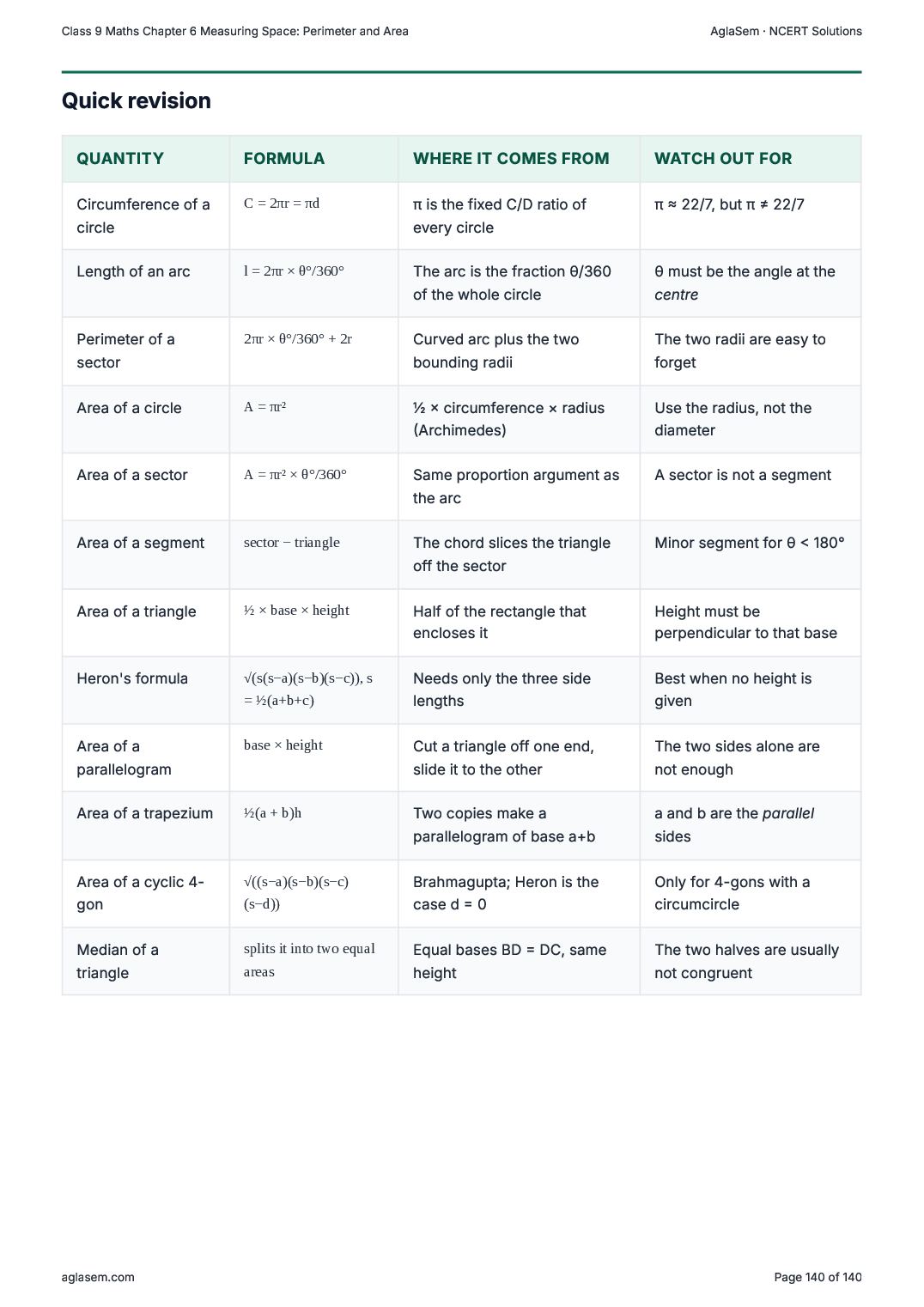
- For every circle the ratio of circumference to diameter is the same number, π . So C = 2πr = πd . π is irrational (Lambert, 1761), so no fraction equals it: π ≈ 22/7 but π ≠ 22/7 . Better approximations are 355/113 (Zu Chongzhi) and 3.1416 (Āryabhaṭa); Mādhava gave the first exact formula, π/4 = 1 − 1/3 + 1/5 − 1/7 + …
- A circle has rotational symmetry, so an arc turning through θ° at the centre is the fraction θ/360 of the whole circle. Hence arc length = 2πr × θ°/360° and area of a sector = πr² × θ°/360° . The half-turn and quarter-turn cases (πr and πr/2) are just θ = 180° and θ = 90°.
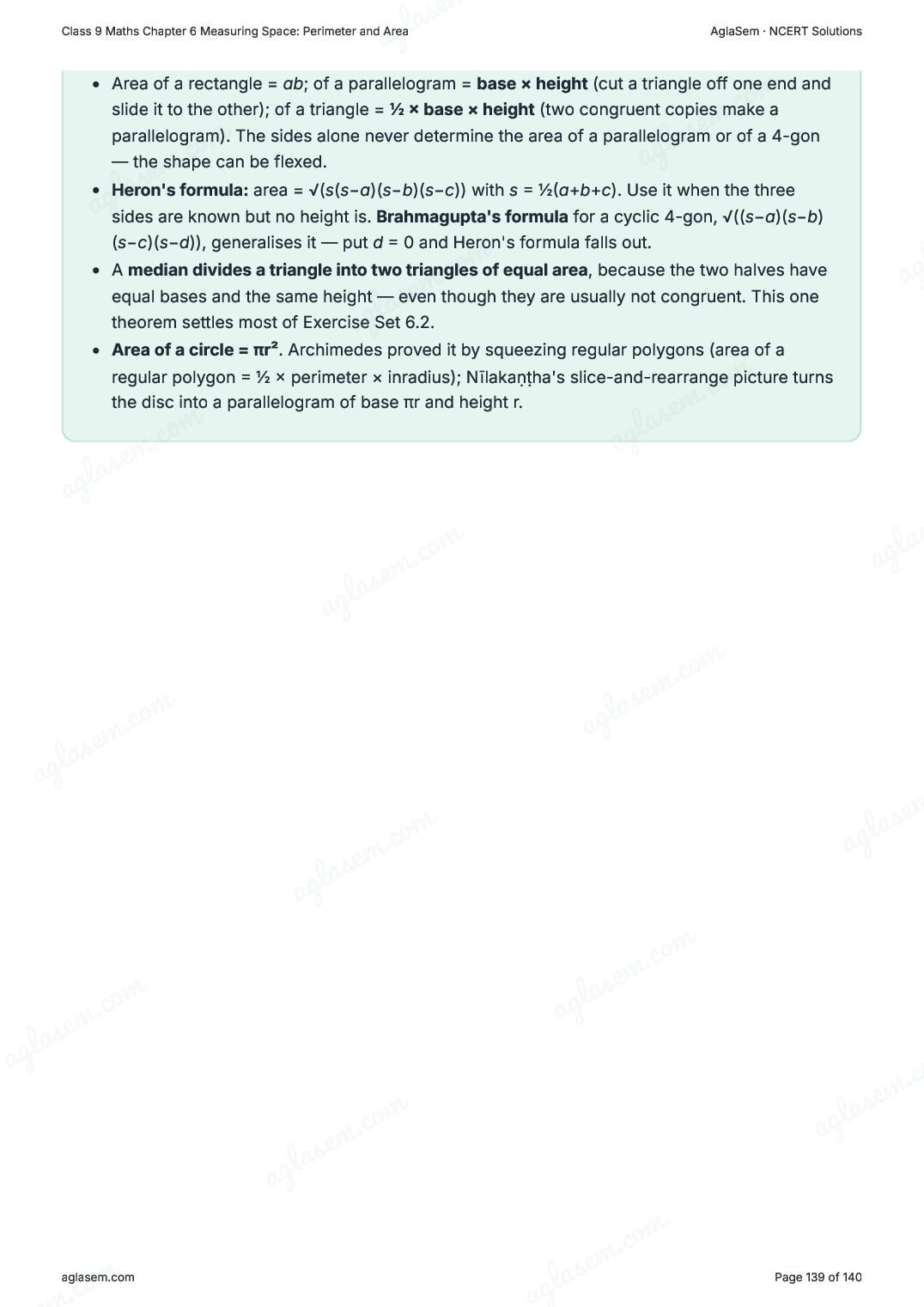
- Area of a rectangle = ab ; of a parallelogram = base × height (cut a triangle off one end and slide it to the other); of a triangle = ½ × base × height (two congruent copies make a parallelogram). The sides alone never determine the area of a parallelogram or of a 4-gon — the shape can be flexed.
- Heron's formula: area = √( s ( s − a )( s − b )( s − c )) with s = ½( a + b + c ). Use it when the three sides are known but no height is. Brahmagupta's formula for a cyclic 4-gon, √(( s − a )( s − b )( s − c )( s − d )), generalises it — put d = 0 and Heron's formula falls out.
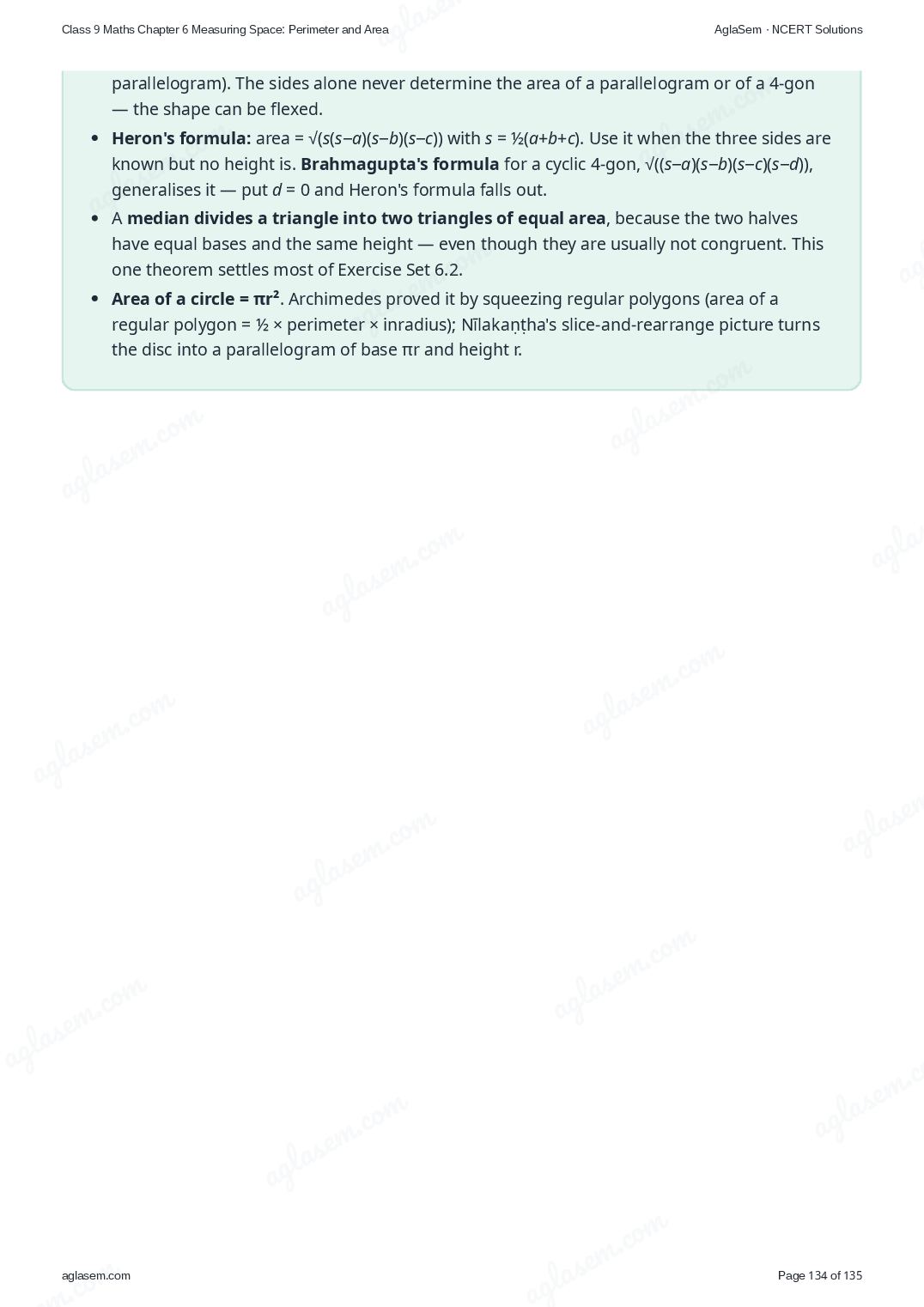
- A median divides a triangle into two triangles of equal area , because the two halves have equal bases and the same height — even though they are usually not congruent. This one theorem settles most of Exercise Set 6.2.
- Area of a circle = πr² . Archimedes proved it by squeezing regular polygons (area of a regular polygon = ½ × perimeter × inradius); Nīlakaṇṭha's slice-and-rearrange picture turns the disc into a parallelogram of base πr and height r.
How to Download NCERT Solutions for Class 9 Maths Chapter 6 PDF
Follow these simple steps to get the Measuring Space Perimeter and Area questions-and-answers PDF from Ganita Manjari.
- Search NCERT Solutions for Class 9 Maths Chapter 6 aglasem and open this page.
- Read the exercise questions with answers for Measuring Space Perimeter and Area shown above.
- Click the Download PDF link to save the Measuring Space Perimeter and Area solutions to your device.
NCERT Solutions for Class 9 Maths – All Chapters
There are more chapters to study besides Measuring Space Perimeter and Area in Maths. Here are the NCERT Solutions for all chapters of Class 9 Maths.
- Chapter 1 Orienting Yourself the Use of Coordinates
- Chapter 2 Introduction to Linear Polynomials
- Chapter 3 The World of Numbers
- Chapter 4 Exploring Algebraic Identities
- Chapter 5 I M Up and Down and Round and Round
- Chapter 6 Measuring Space Perimeter and Area
- Chapter 7 The Mathematics of Maybe Introduction to Probability
- Chapter 8 Predicting What Comes Next Exploring Sequences and Progressions
NCERT Solutions for Class 9 – All Subjects
Just like Chapter 6 of Maths, you can get the exercise questions with answers for every other subject of Class 9. Here are the NCERT Solutions for all subjects of Class 9.
NCERT Solutions for Class 9 Maths Chapter 6 – An Overview
The key highlights of this study material are as follows.
| Aspects | Details |
|---|---|
| Class | Class 9 |
| Subject | Maths |
| Chapter Number | Chapter 6 |
| Chapter Name | Measuring Space Perimeter and Area |
| Book Name | Ganita Manjari |
| Book By | NCERT (National Council of Educational Research and Training) |
| Educational Resource Here | NCERT Solutions of Class 9 Maths Chapter 6 for all exercises |
| More Questions Answers of This Subject | NCERT Solutions for Class 9 Maths |
| Download Book Chapter | NCERT Book Class 9 Maths |
| All Questions Answers For This Class | NCERT Solutions for Class 9 |
| Complete Solutions | NCERT Solutions |
NCERT Solutions for Class 9 Maths Chapter 6 Measuring Space Perimeter and Area – FAQs
What are the NCERT Solutions for Class 9 Maths Chapter 6 Measuring Space Perimeter and Area?
They are the complete, step-by-step answers to all the exercise and in-text questions of Chapter 6 Measuring Space Perimeter and Area from the NCERT Class 9 Maths textbook Ganita Manjari, written by experts as per the latest NCERT syllabus.
How can I download the Class 9 Maths Chapter 6 solutions PDF for free?
Open this page on aglasem, read the Measuring Space Perimeter and Area questions with answers, and click the “Download Solutions PDF” link. The Class 9 Maths Chapter 6 NCERT Solutions PDF is completely free to download.
Are these NCERT Solutions as per the latest 2026-27 syllabus?
Yes. The NCERT Solutions for Class 9 Maths Chapter 6 are based on the latest NCERT textbook Ganita Manjari and the current 2026-27 CBSE syllabus, so the questions and answers match what you study in class.
Where can I get NCERT Solutions for the other chapters of Class 9 Maths?
You can find the answers to every chapter on the NCERT Solutions for Class 9 Maths page, and solutions for every subject on the NCERT Solutions for Class 9 page.
How do NCERT Solutions help in exam preparation?
They show the correct method to solve each question, help you write answers the way they are expected in exams, let you check and correct your own work, and save revision time — which together improve your marks in Class 9 Maths.
If you have any queries on NCERT Solutions for Class 9 Maths Chapter 6 Measuring Space Perimeter and Area, then please ask in the comments below.