NCERT Solutions for Class 9 Maths Chapter 4 Exploring Algebraic Identities provide clear, step-by-step answers to every exercise and in-text question from the chapter Exploring Algebraic Identities of the NCERT textbook Ganita Manjari. Prepared by subject experts as per the latest NCERT (CBSE) syllabus for 2026-27, these NCERT Solutions for Class 9 Maths help you understand each concept, write exam-ready answers, and check your own solutions. You can read them online below or download the free Class 9 Maths Chapter 4 question-answer PDF.
NCERT Solutions for Class 9 Maths Chapter 4 Exploring Algebraic Identities
- Class: Class 9
- Subject: Maths
- Chapter: Chapter 4 – Exploring Algebraic Identities
- Textbook: Ganita Manjari (NCERT)
- Study material: NCERT Solutions – questions with answers, free PDF
These solutions answer all the exercise questions of Chapter 4 Exploring Algebraic Identities — including the in-text questions, short-answer and long-answer questions, and activities — with complete explanations so you can follow the method, not just the final answer. Read the full solutions below.
NCERT Solutions Class 9 Maths Chapter 4 Exploring Algebraic Identities View Download
NCERT Solutions for Class 9 Maths Chapter 4 PDF Download
You can read the NCERT Solutions for Class 9 Maths Chapter 4 online above, or download the complete question-answer PDF to study Exploring Algebraic Identities offline at any time.
NCERT Solutions for Class 9 Maths Chapter 4 PDF Download Link – Click Here to Download Solutions PDF
Questions Covered in This Chapter
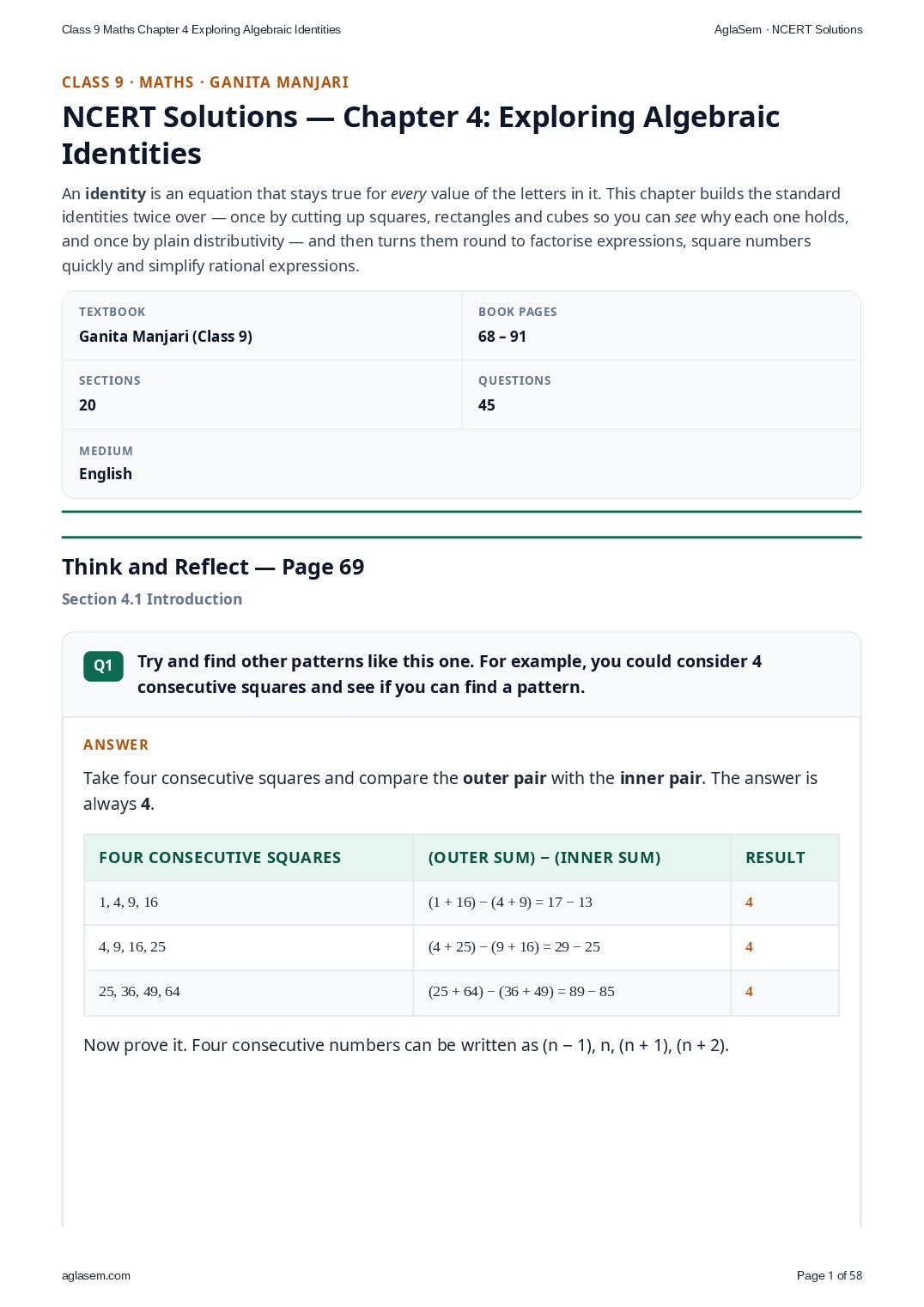
These NCERT Solutions answer all 45 questions of this chapter. The questions solved are:
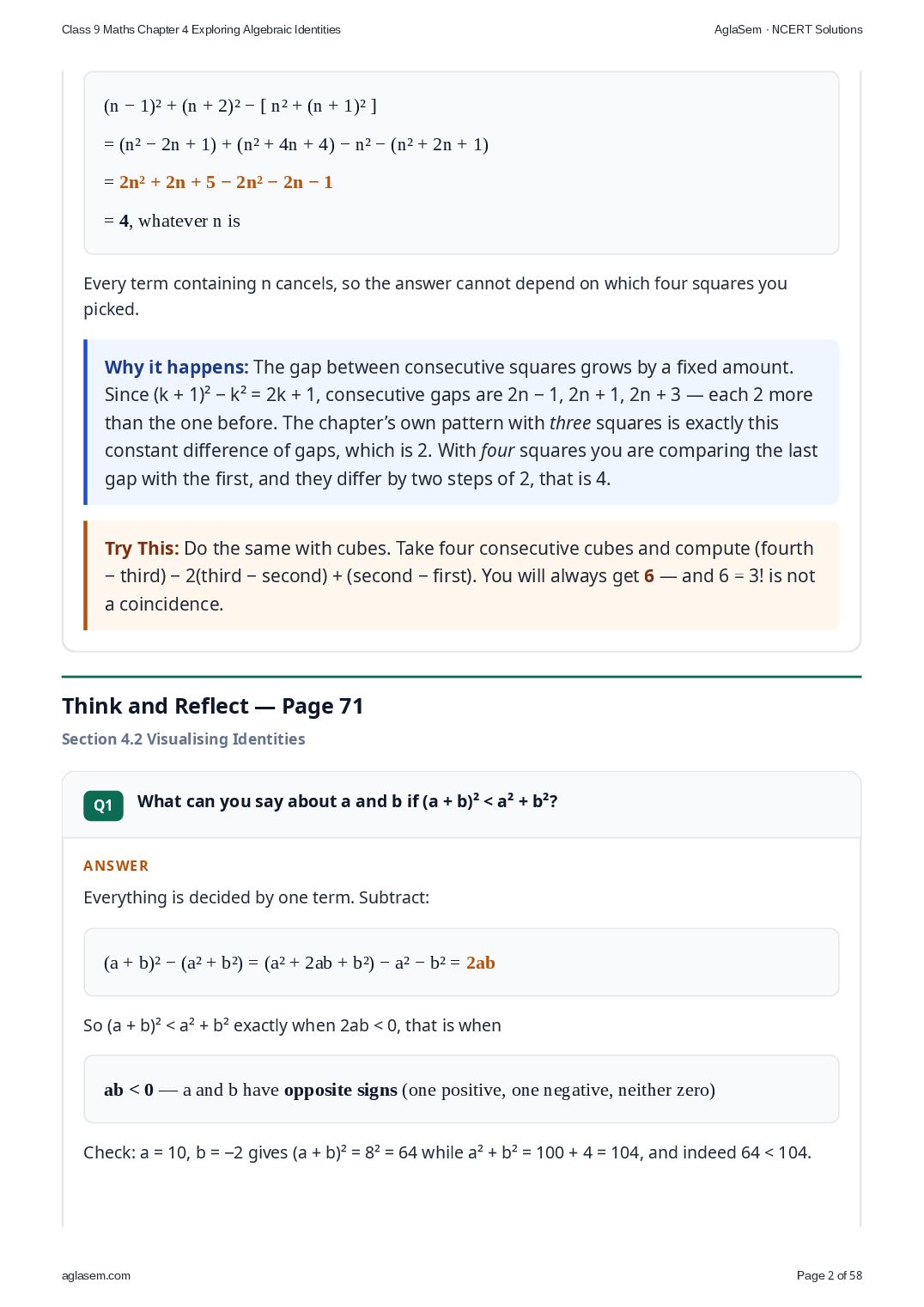
- Try and find other patterns like this one. For example, you could consider 4 consecutive squares and see if you can find a pattern.
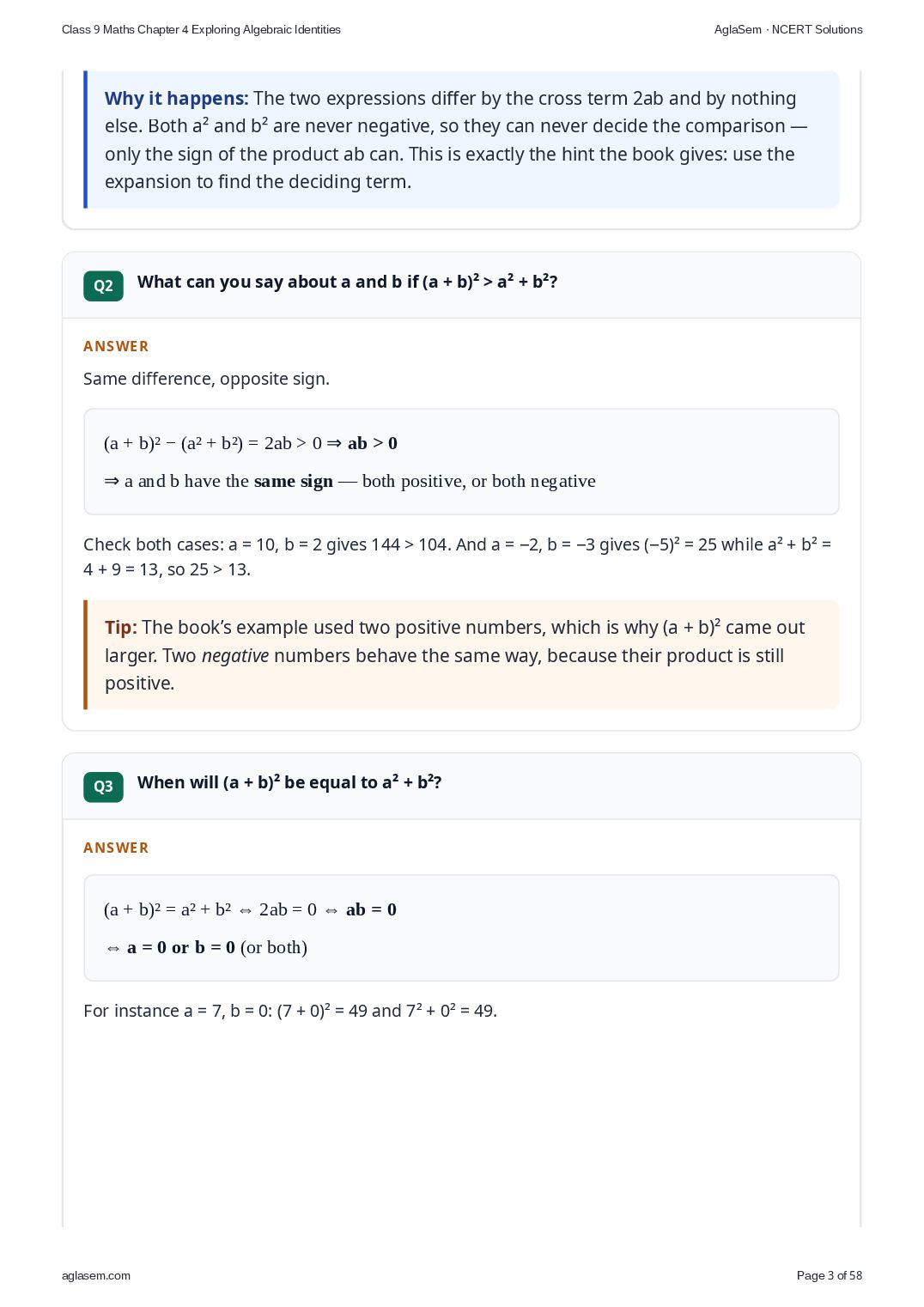
- What can you say about a and b if (a + b)² < a² + b²?
- What can you say about a and b if (a + b)² > a² + b²?
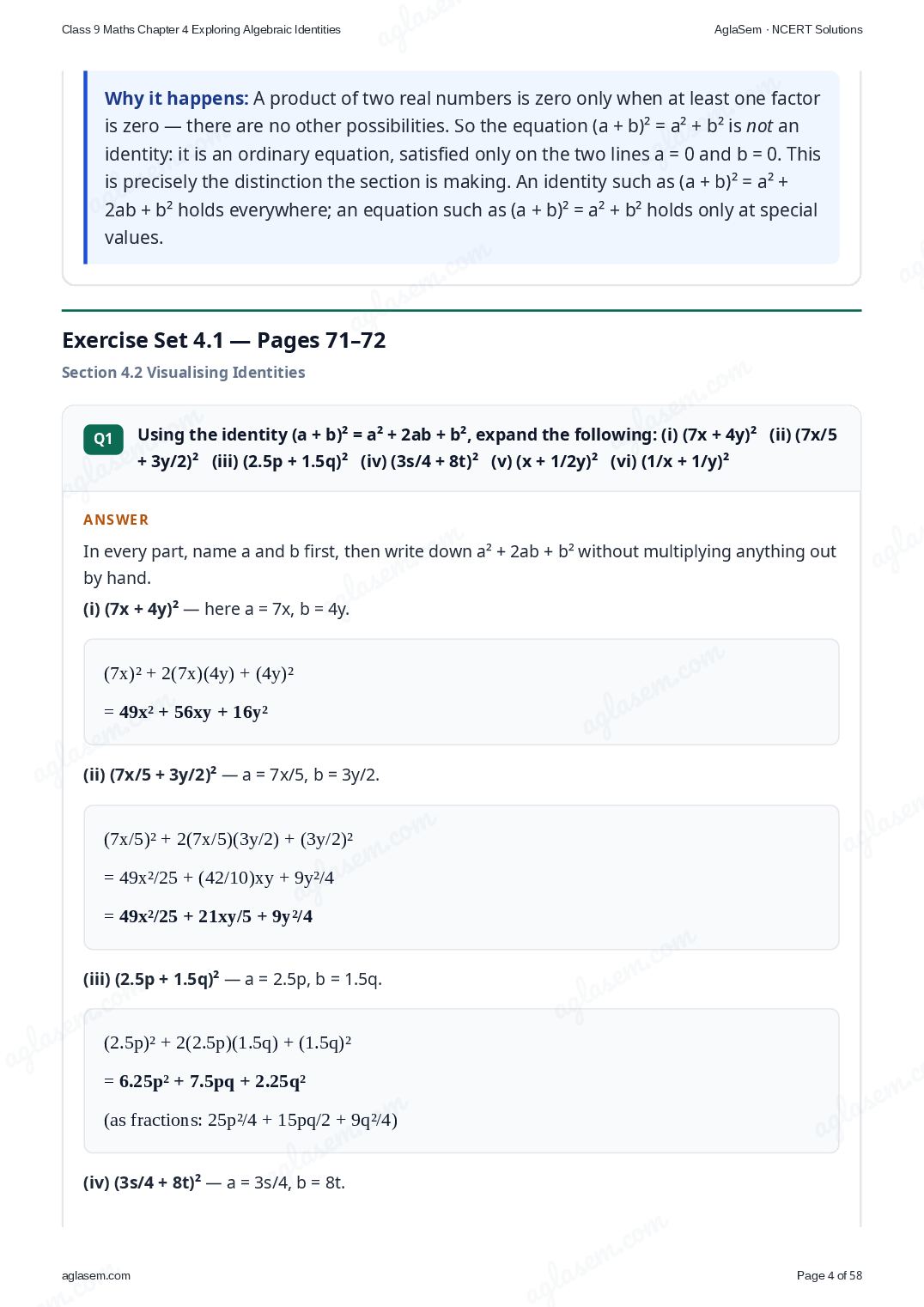
- When will (a + b)² be equal to a² + b²?
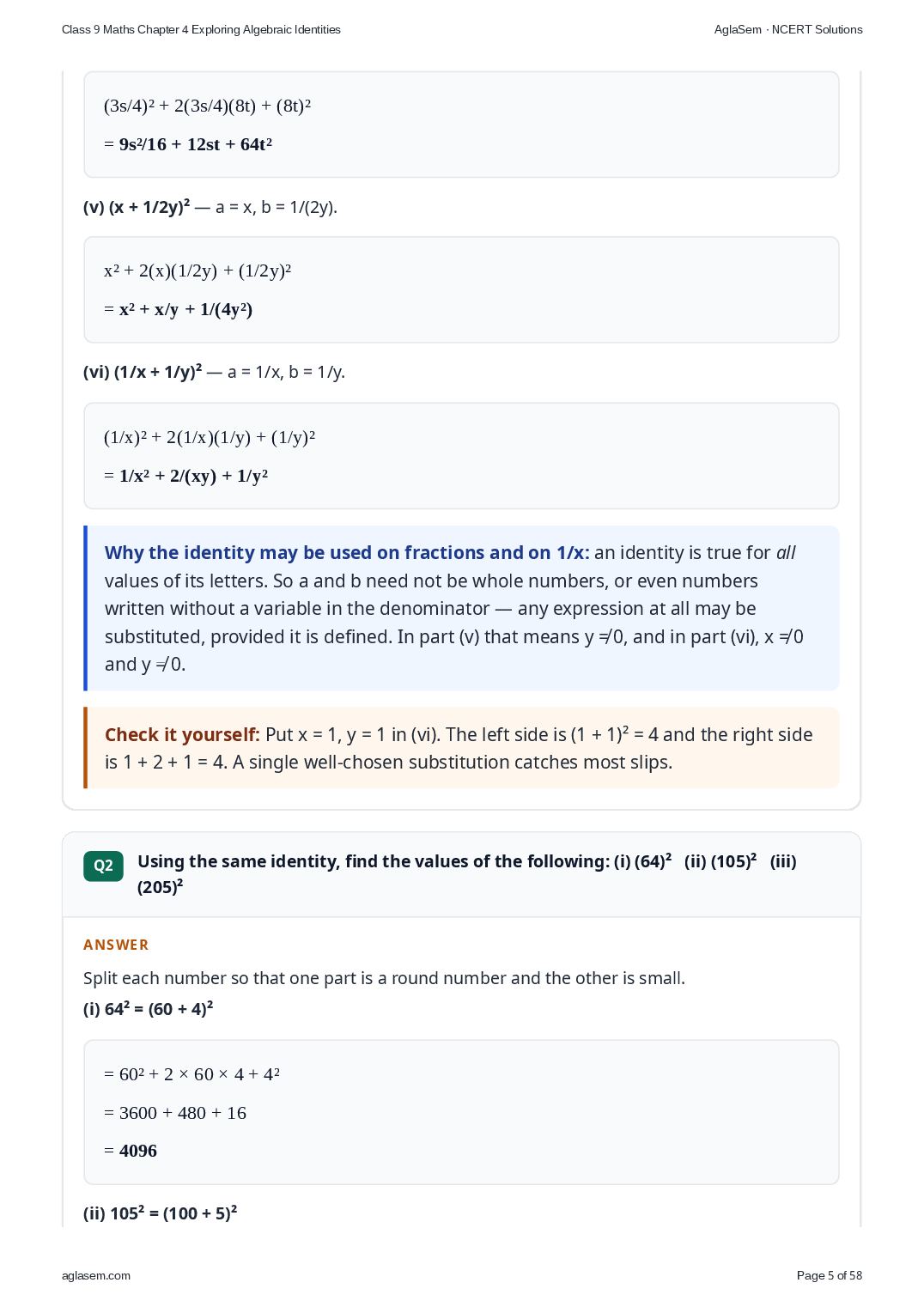
- Using the identity (a + b)² = a² + 2ab + b², expand the following: (i) (7x + 4y)² (ii) (7x/5 + 3y/2)² (iii) (2.5p + 1.5q)² (iv) (3s/4 + 8t)² (v) (x + 1/2y)² (vi) (1/x + 1/y)²
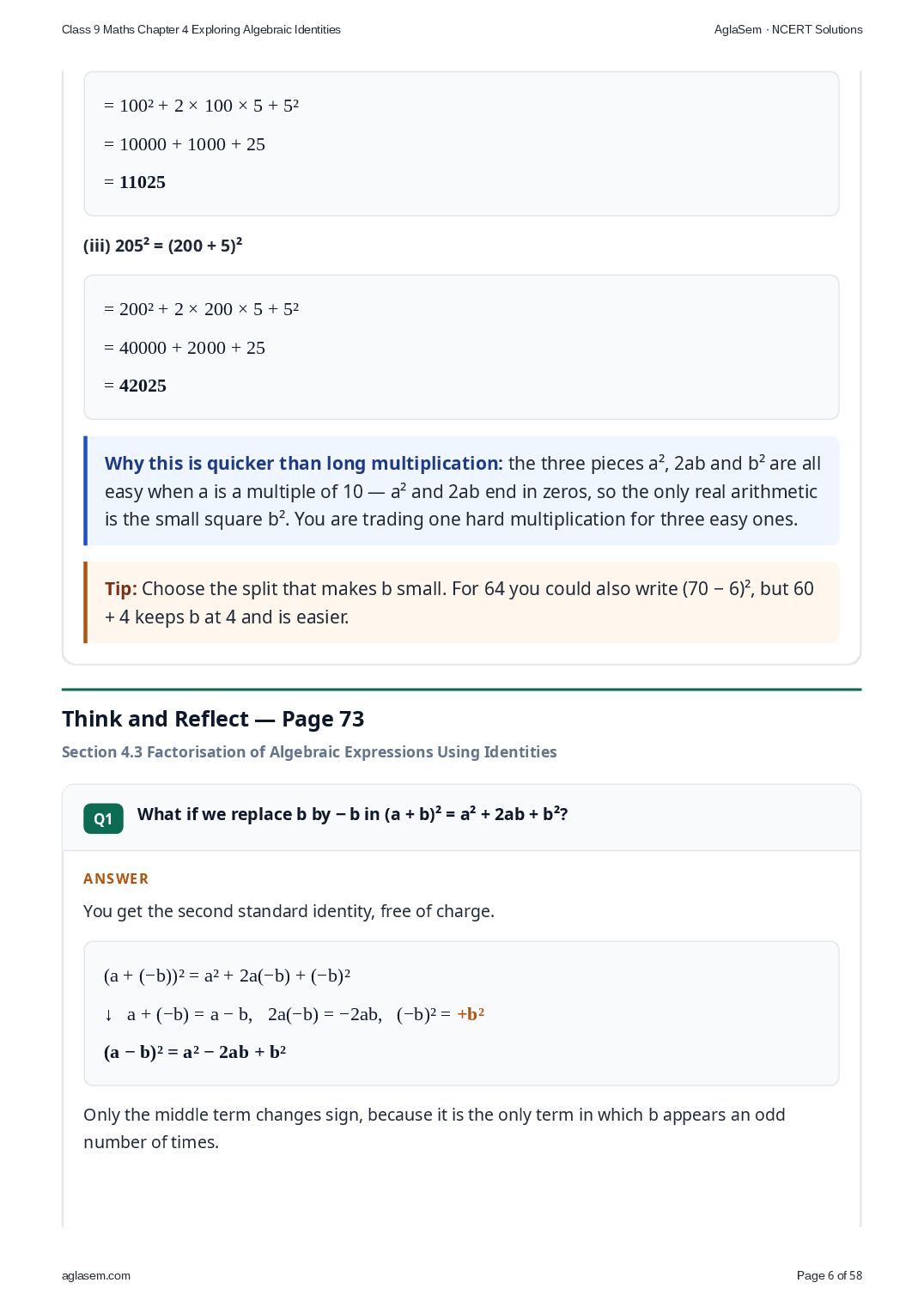
- Using the same identity, find the values of the following: (i) (64)² (ii) (105)² (iii) (205)²
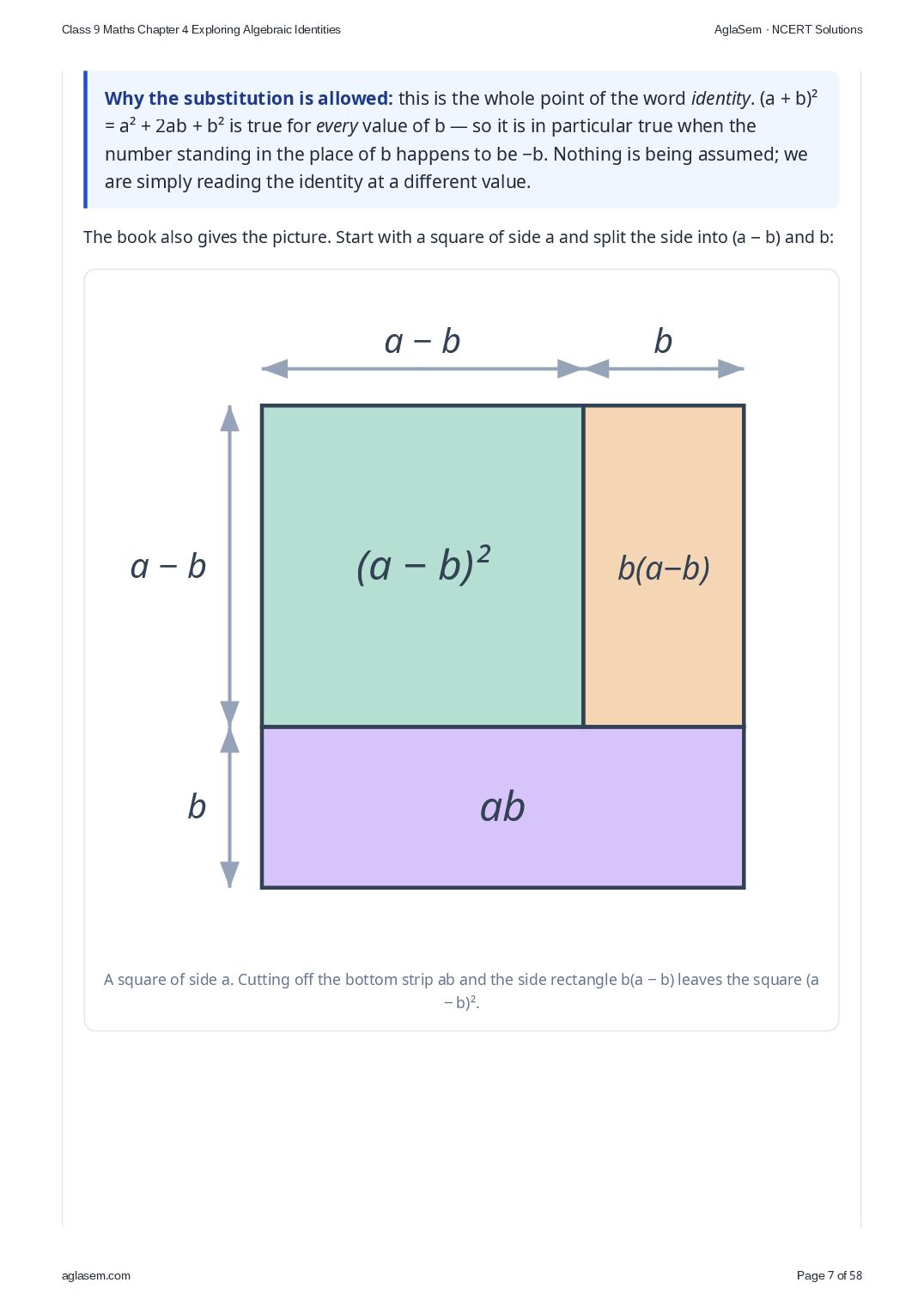
- What if we replace b by − b in (a + b)² = a² + 2ab + b²?
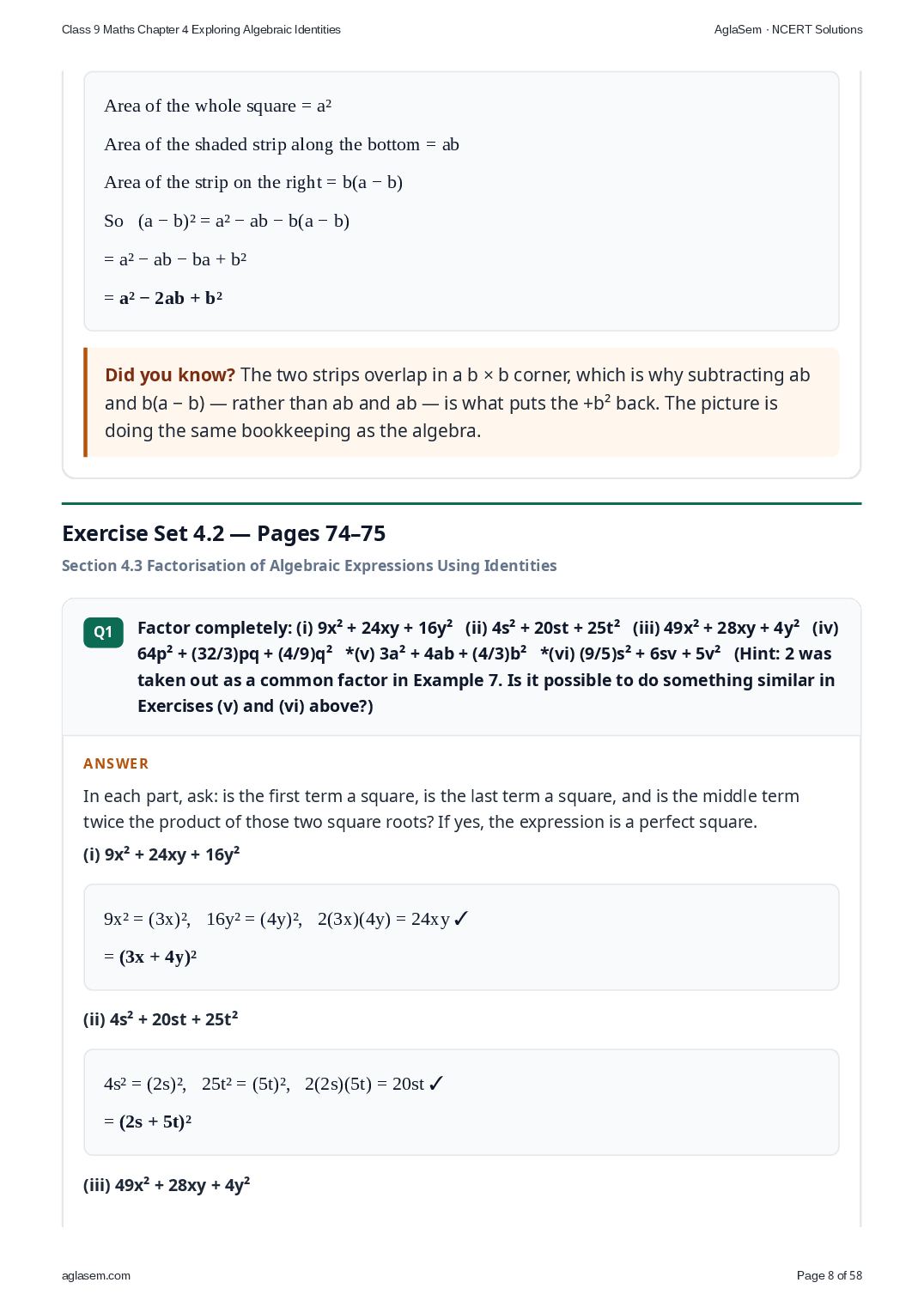
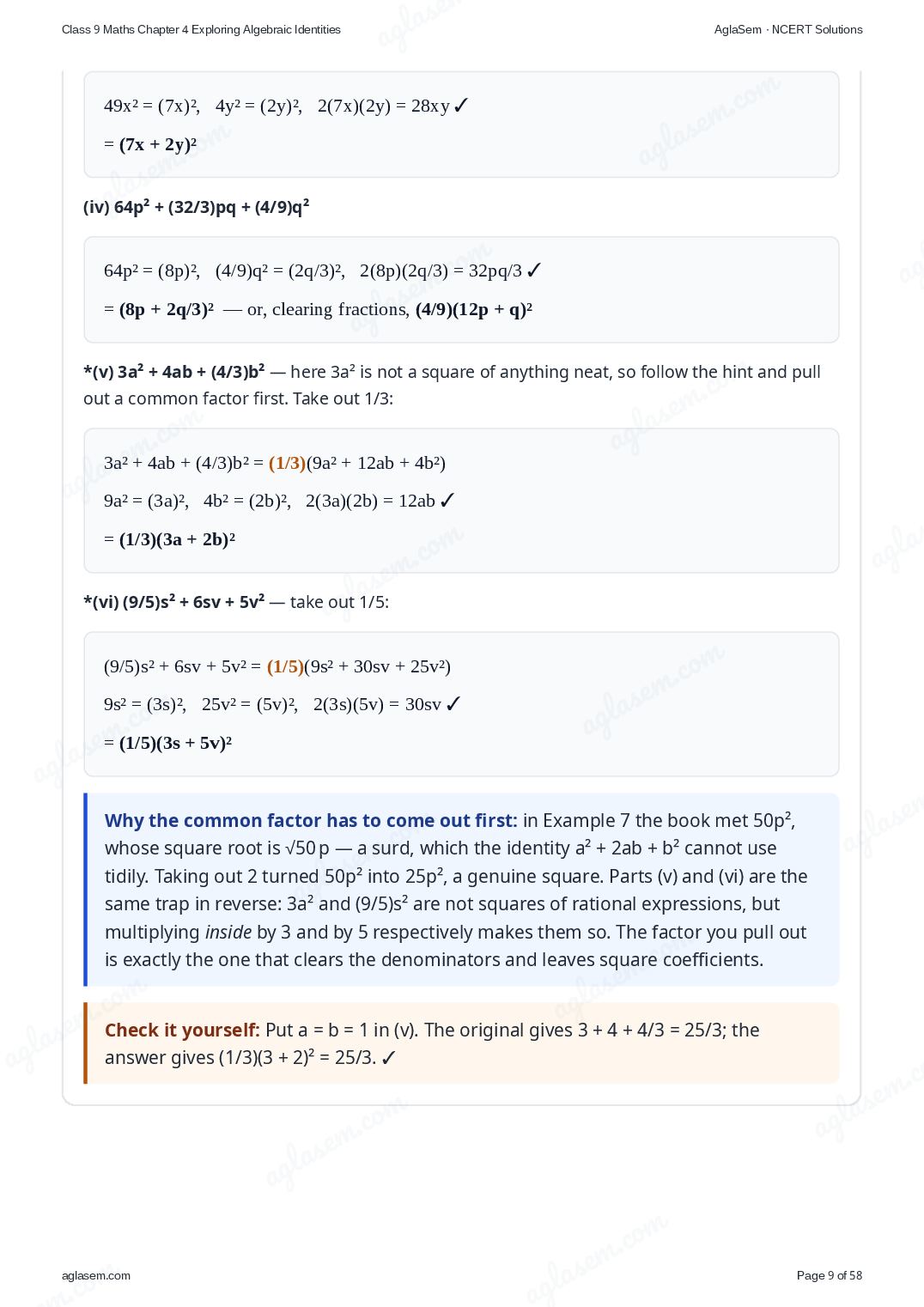
- Factor completely: (i) 9x² + 24xy + 16y² (ii) 4s² + 20st + 25t² (iii) 49x² + 28xy + 4y² (iv) 64p² + (32/3)pq + (4/9)q² *(v) 3a² + 4ab + (4/3)b² *(vi) (9/5)s² + 6sv + 5v² (Hint: 2 was taken out as a common factor in Example 7. Is it possible to do something similar in Exercises (v) and (vi) above?)
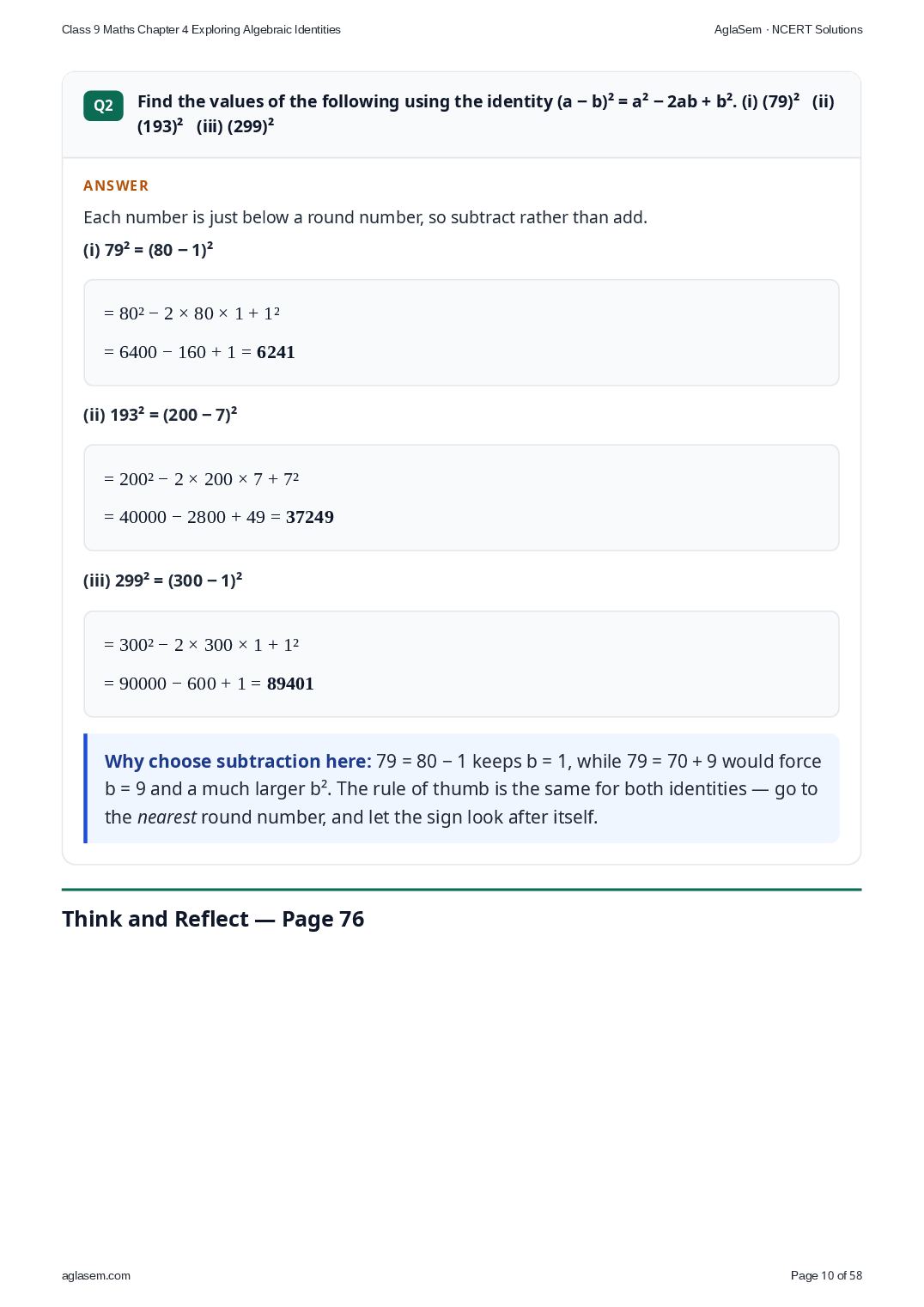
- Find the values of the following using the identity (a − b)² = a² − 2ab + b². (i) (79)² (ii) (193)² (iii) (299)²
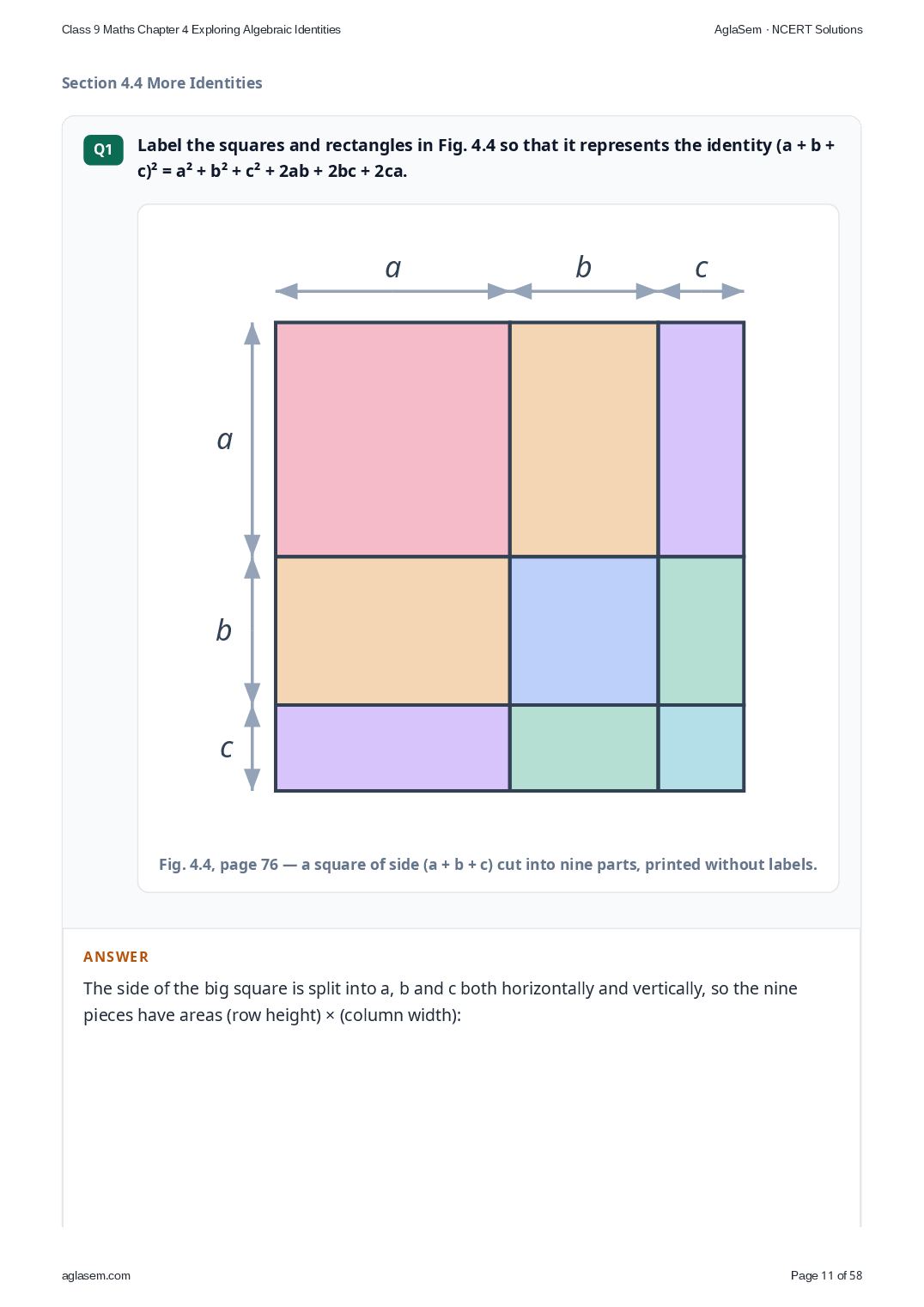
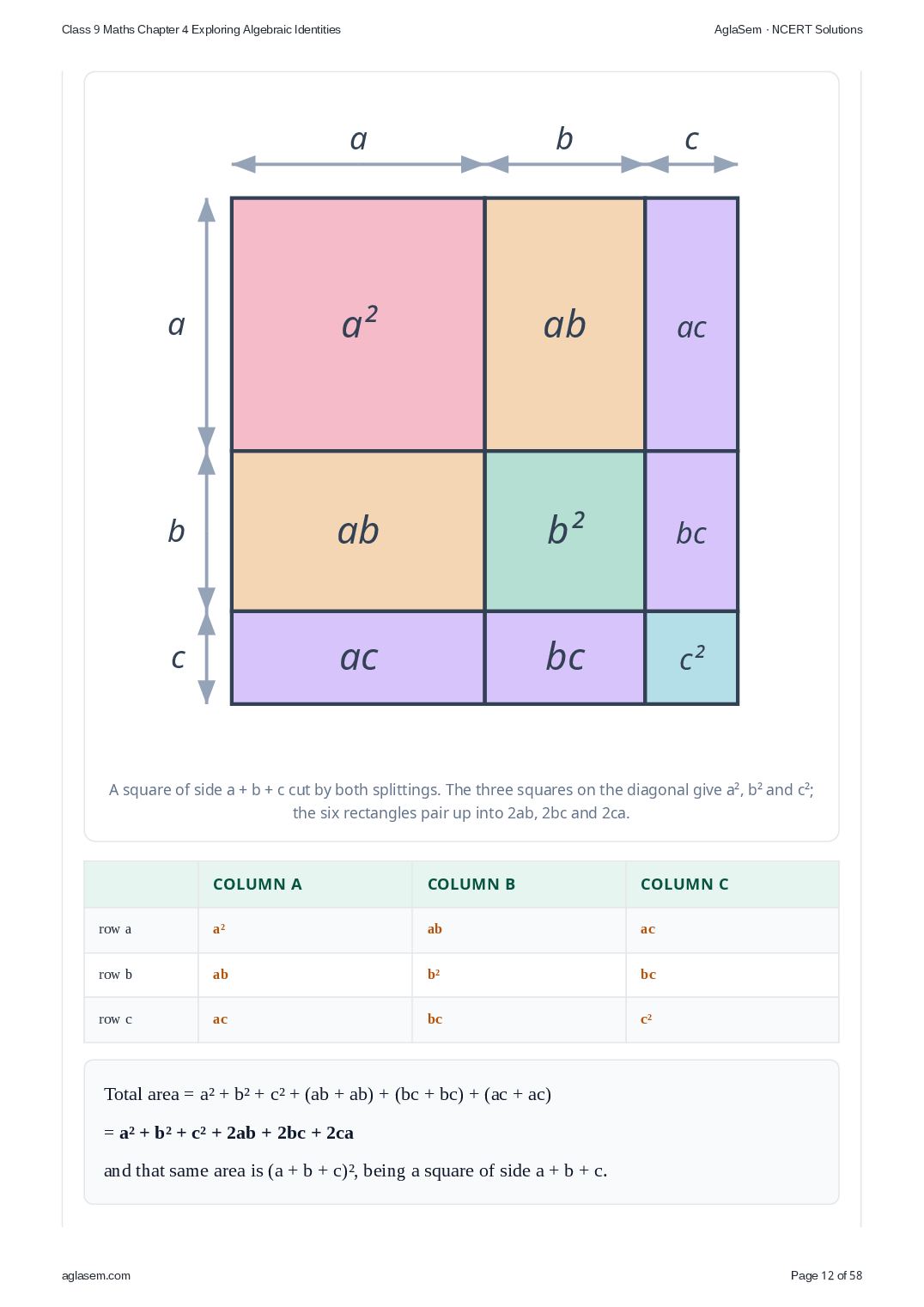
- Label the squares and rectangles in Fig. 4.4 so that it represents the identity (a + b + c)² = a² + b² + c² + 2ab + 2bc + 2ca.
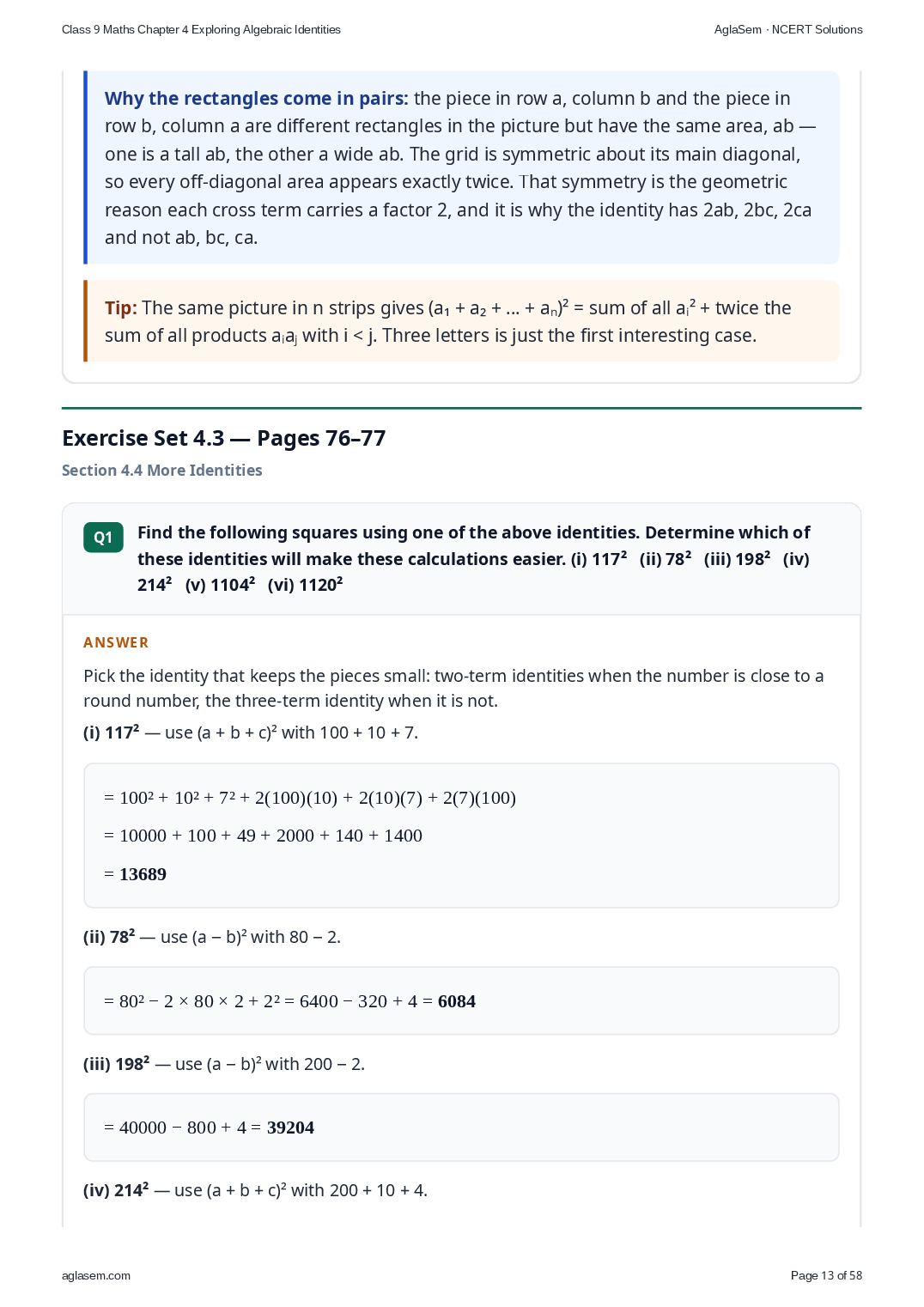
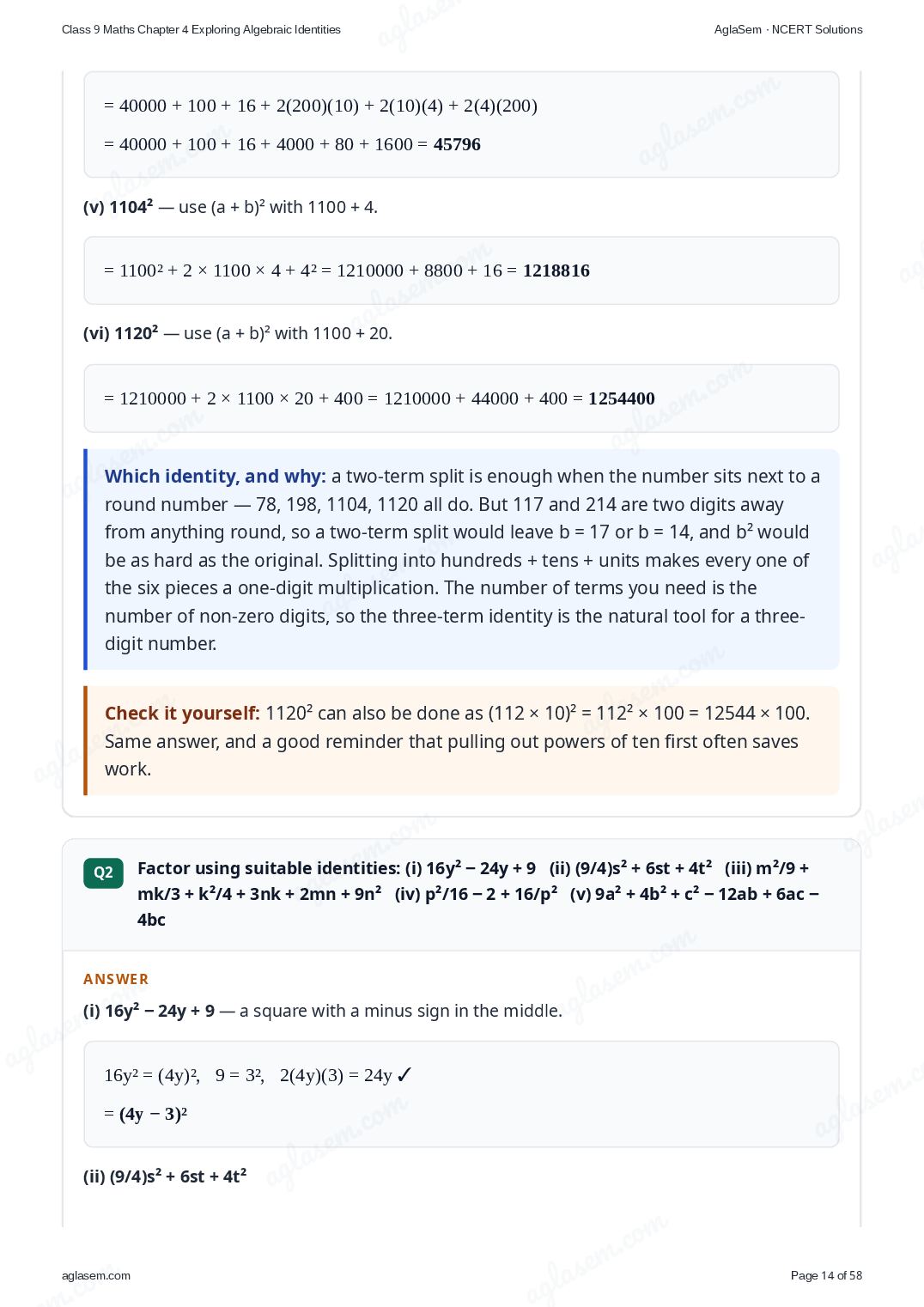
- Find the following squares using one of the above identities. Determine which of these identities will make these calculations easier. (i) 117² (ii) 78² (iii) 198² (iv) 214² (v) 1104² (vi) 1120²
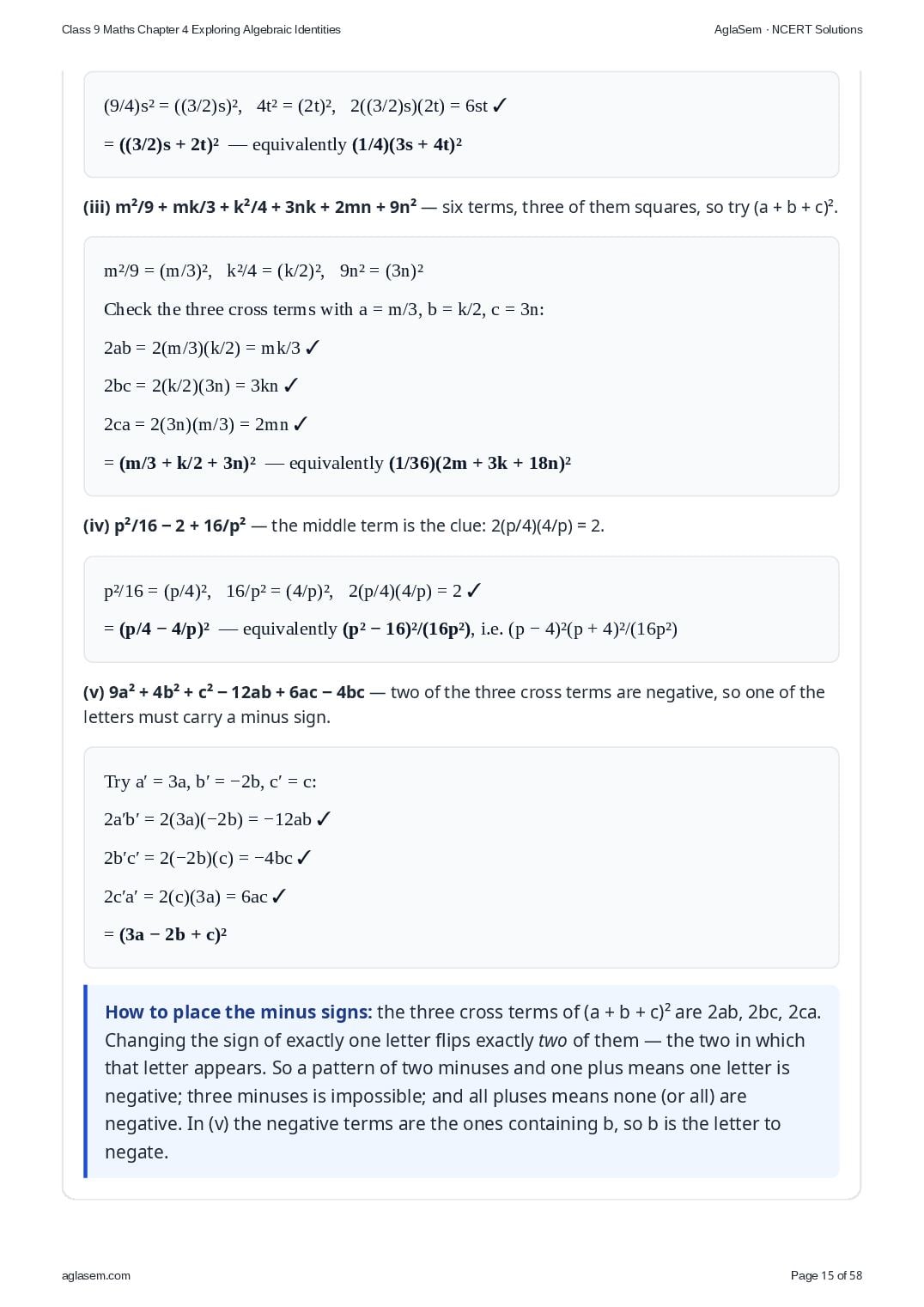
- Factor using suitable identities: (i) 16y² − 24y + 9 (ii) (9/4)s² + 6st + 4t² (iii) m²/9 + mk/3 + k²/4 + 3nk + 2mn + 9n² (iv) p²/16 − 2 + 16/p² (v) 9a² + 4b² + c² − 12ab + 6ac − 4bc
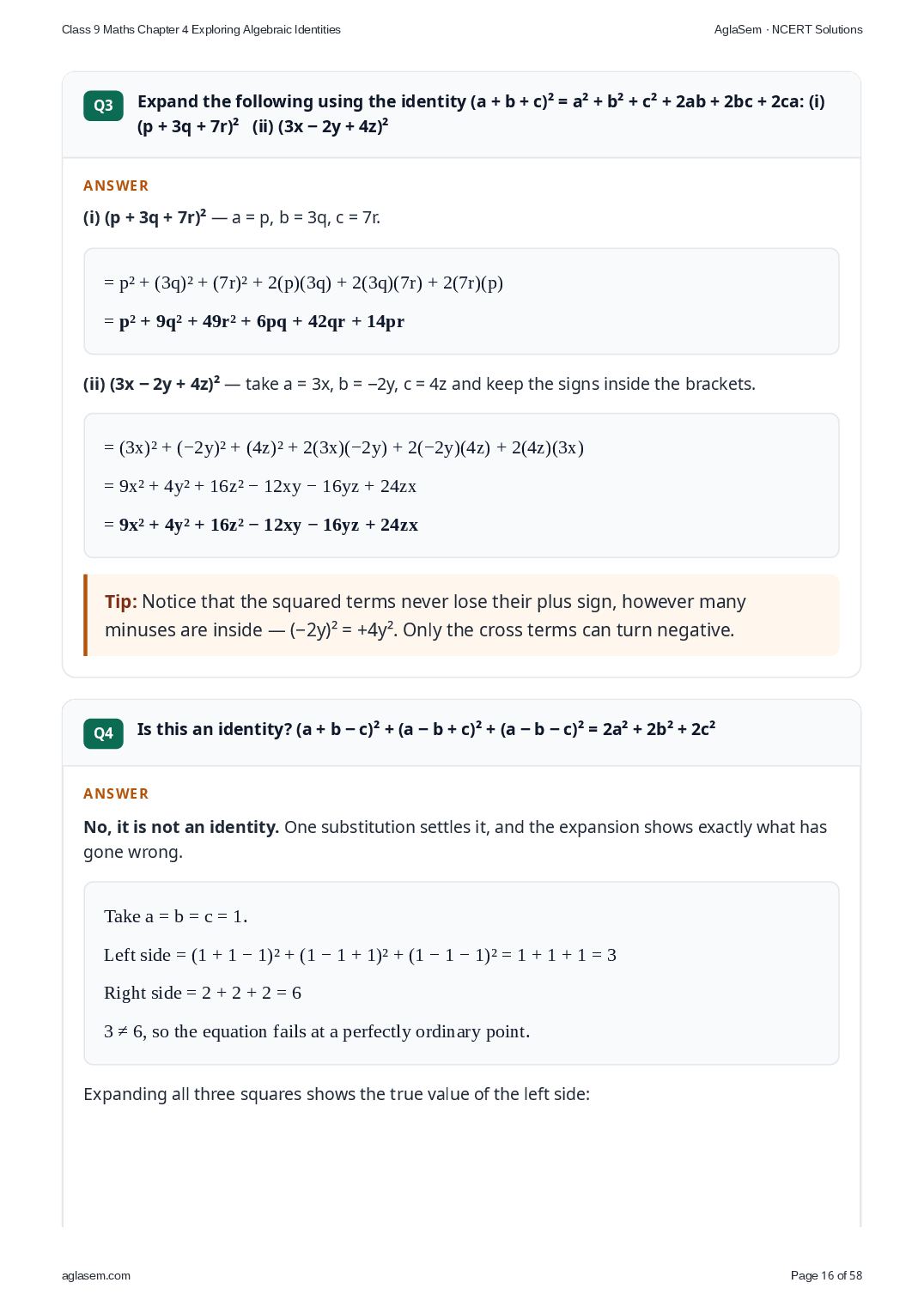
- Expand the following using the identity (a + b + c)² = a² + b² + c² + 2ab + 2bc + 2ca: (i) (p + 3q + 7r)² (ii) (3x − 2y + 4z)²
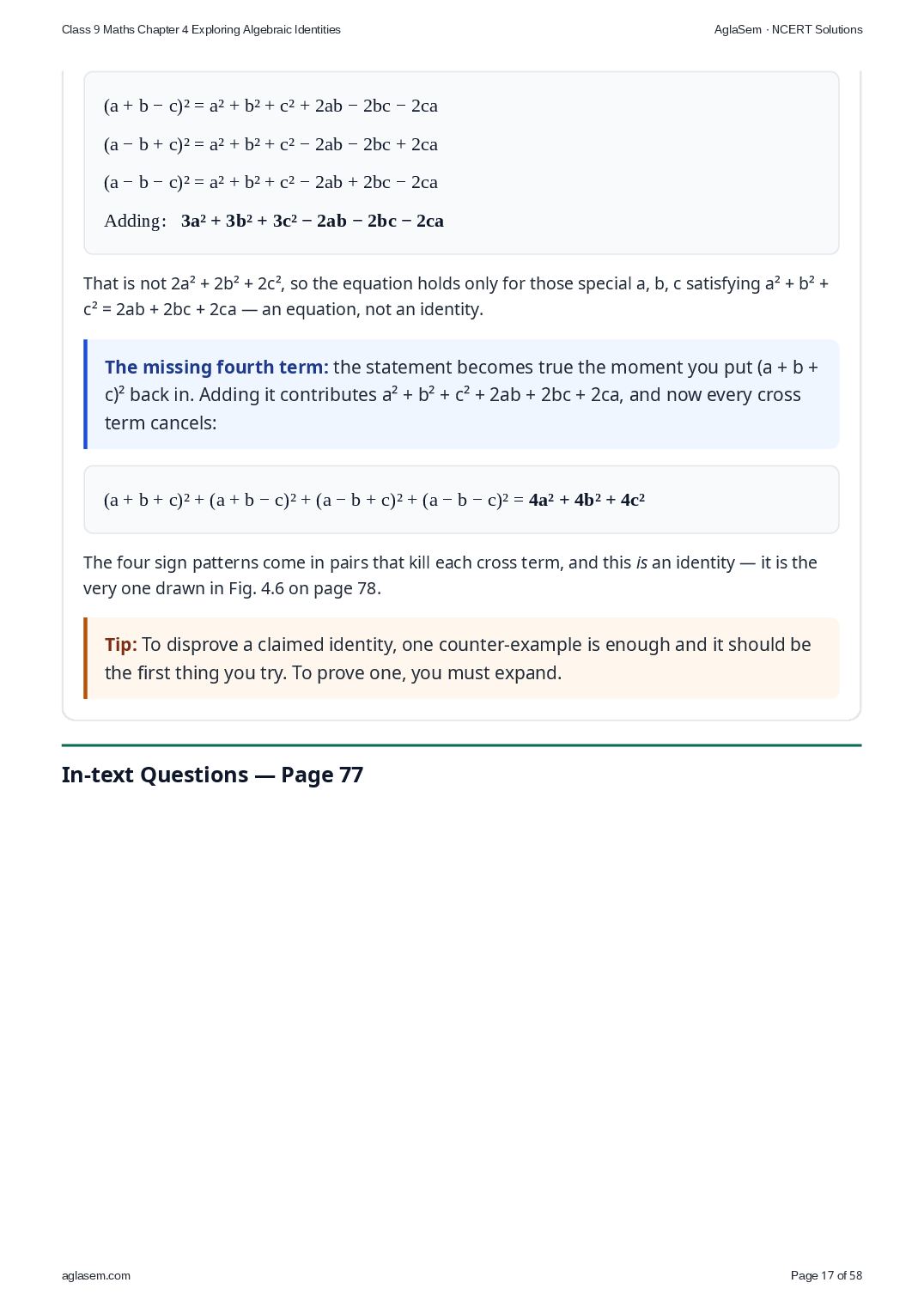
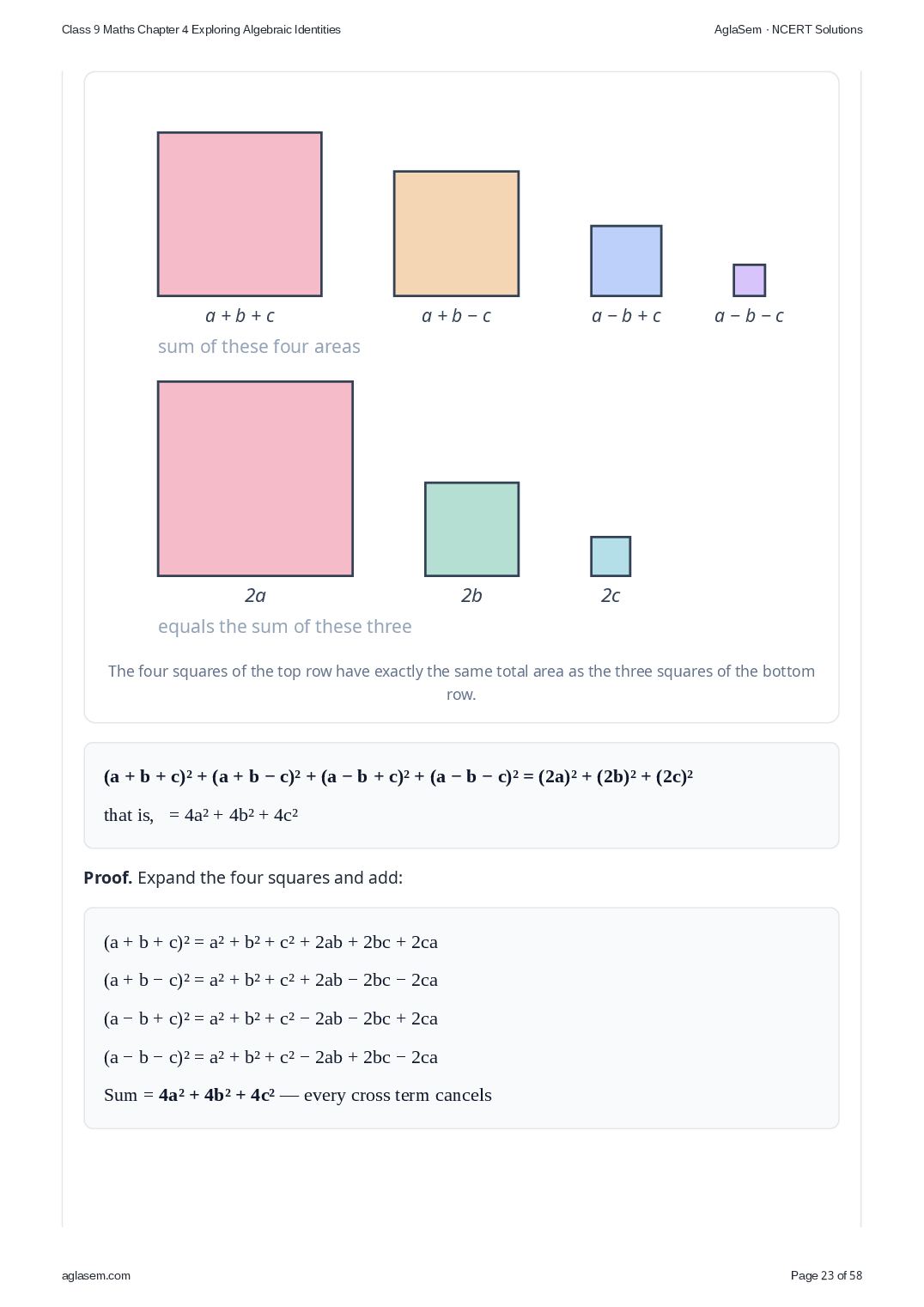
- Is this an identity? (a + b − c)² + (a − b + c)² + (a − b − c)² = 2a² + 2b² + 2c²
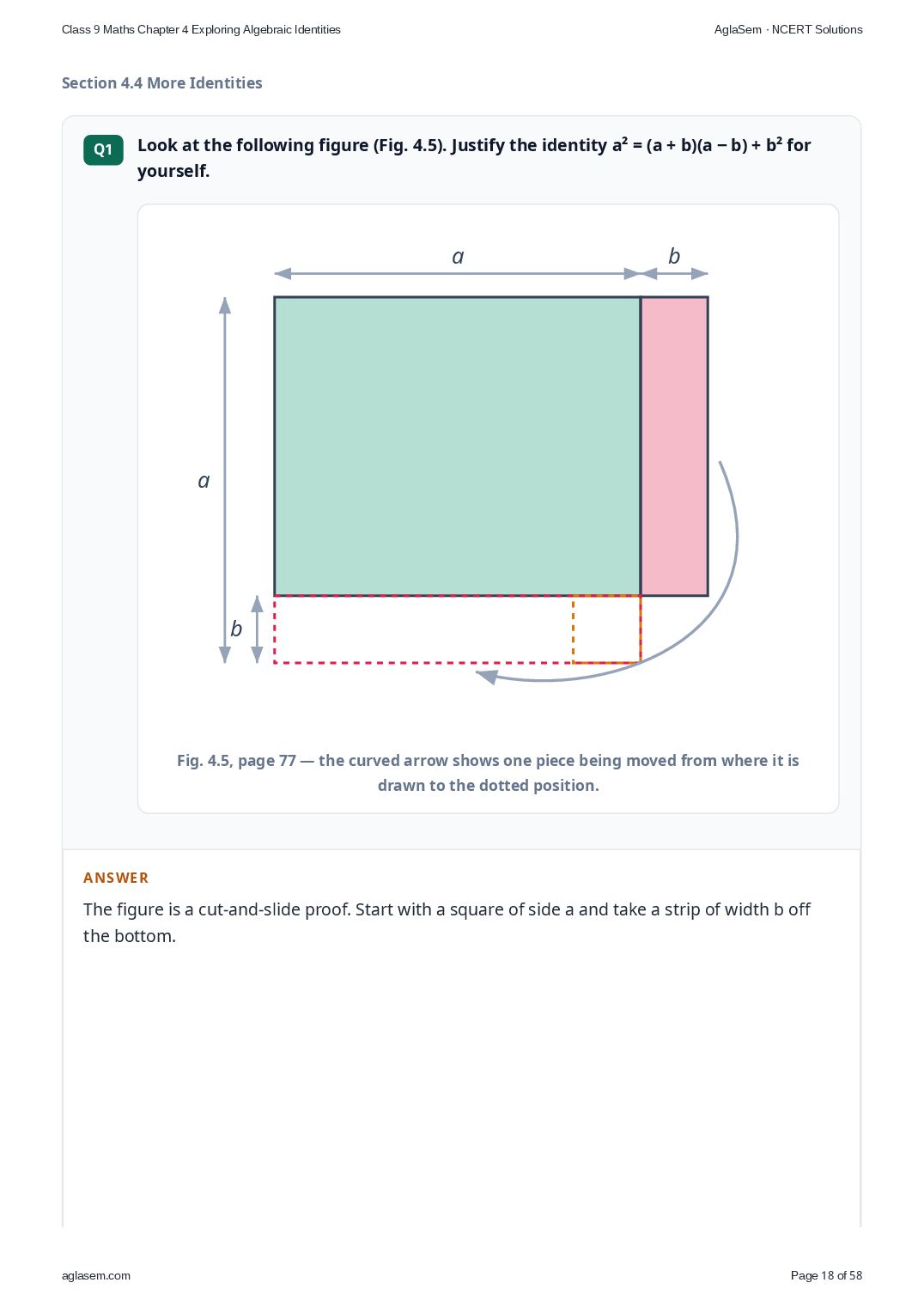
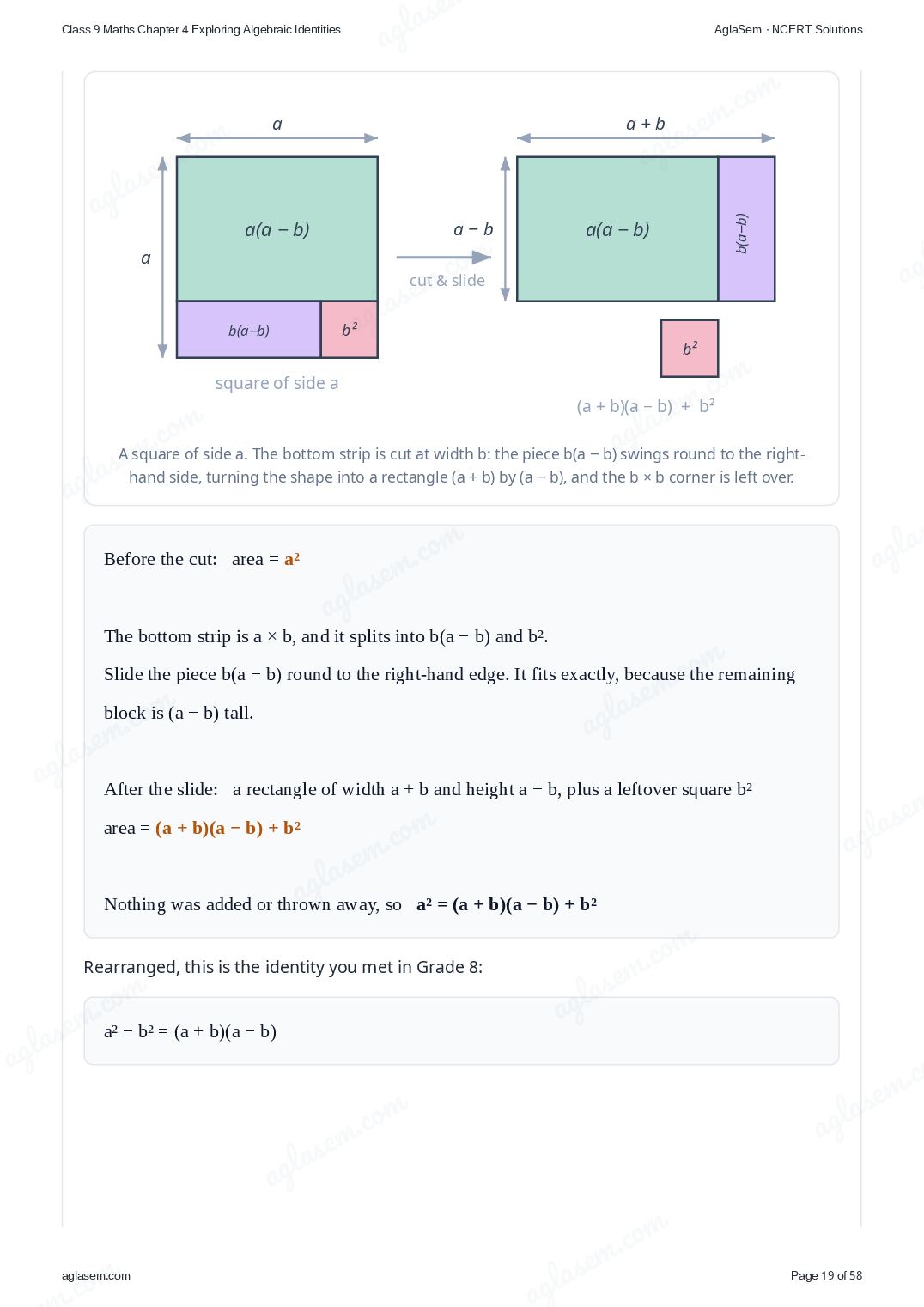
- Look at the following figure (Fig. 4.5). Justify the identity a² = (a + b)(a − b) + b² for yourself.
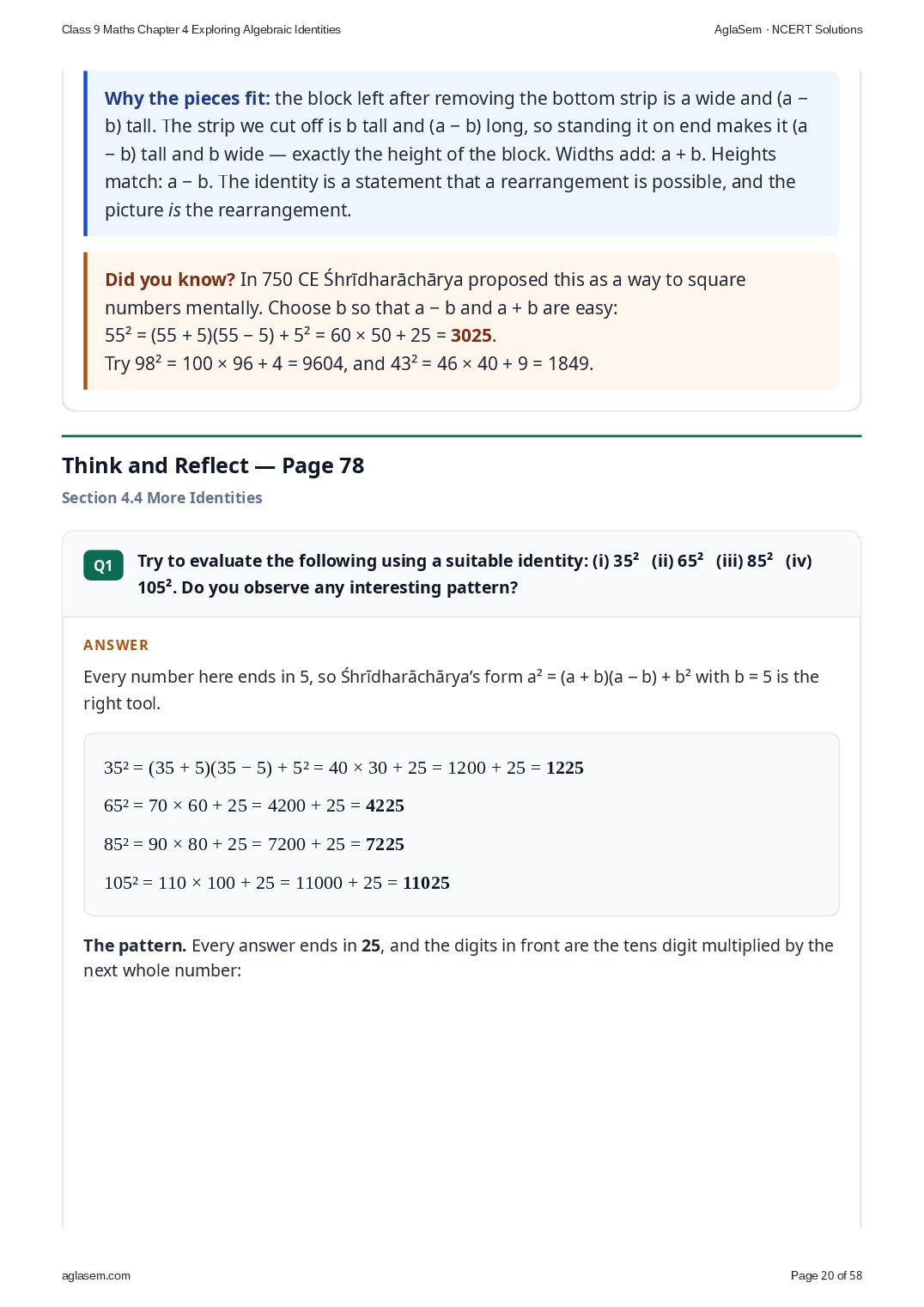
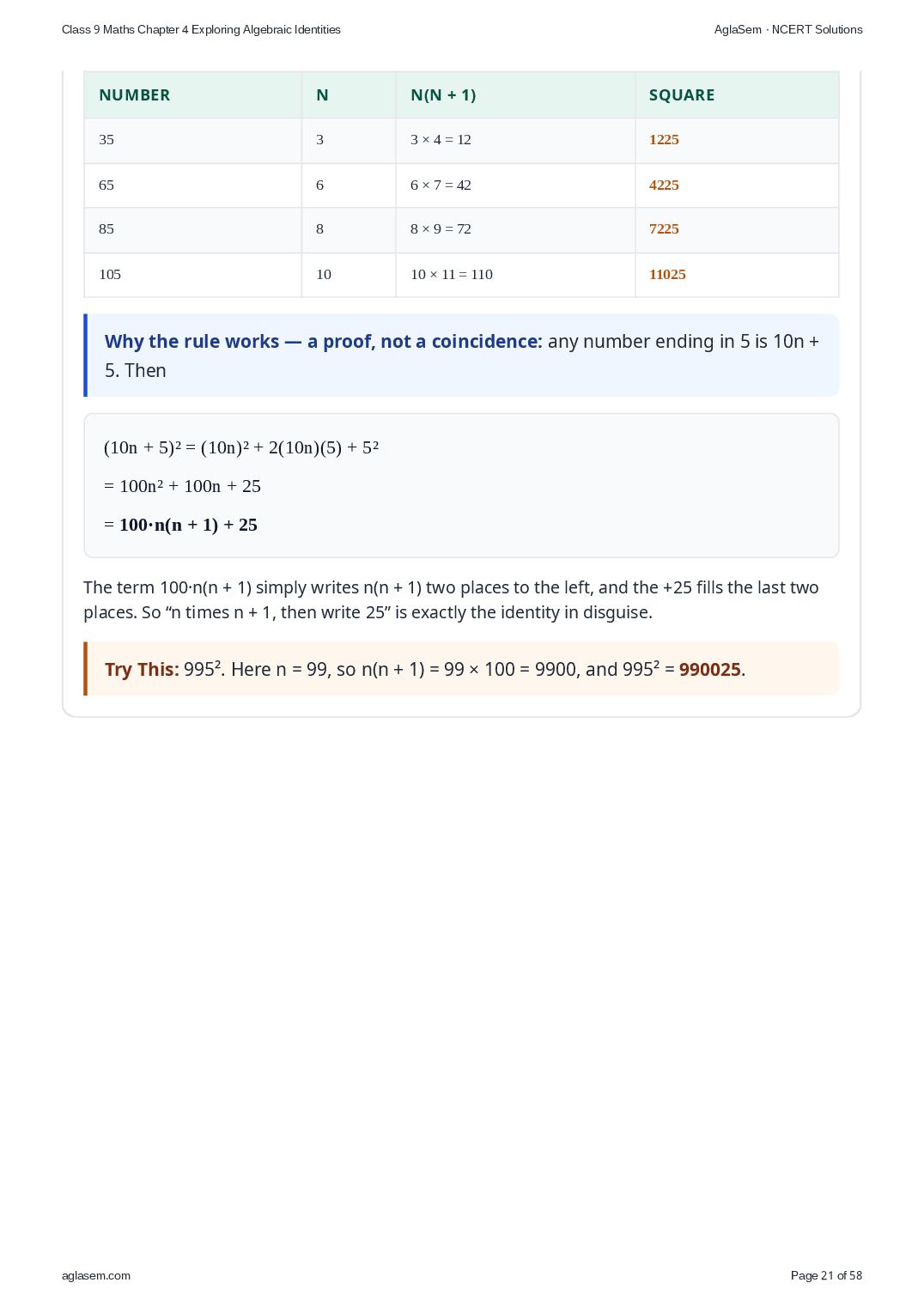
- Try to evaluate the following using a suitable identity: (i) 35² (ii) 65² (iii) 85² (iv) 105². Do you observe any interesting pattern?
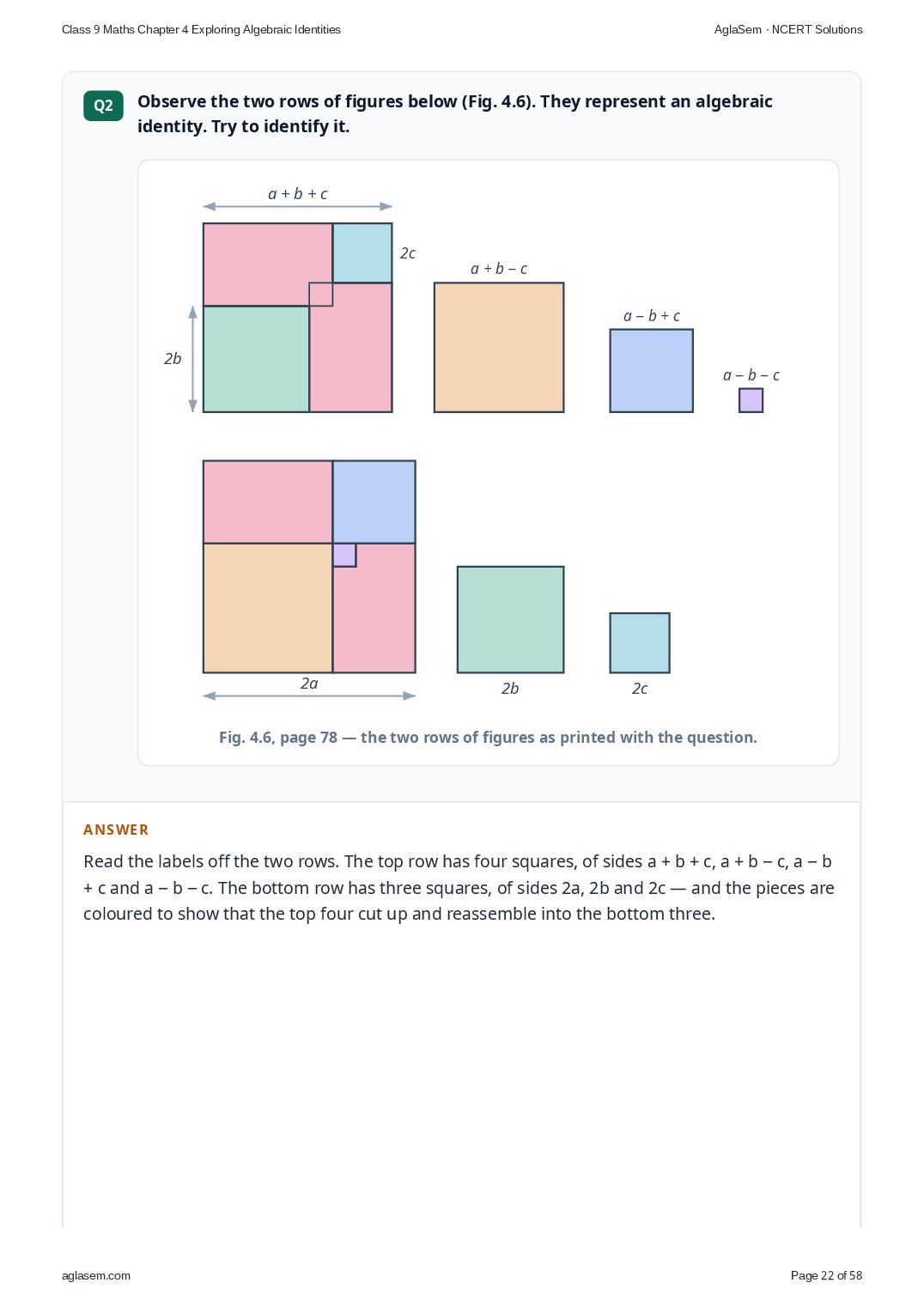
- Observe the two rows of figures below (Fig. 4.6). They represent an algebraic identity. Try to identify it.
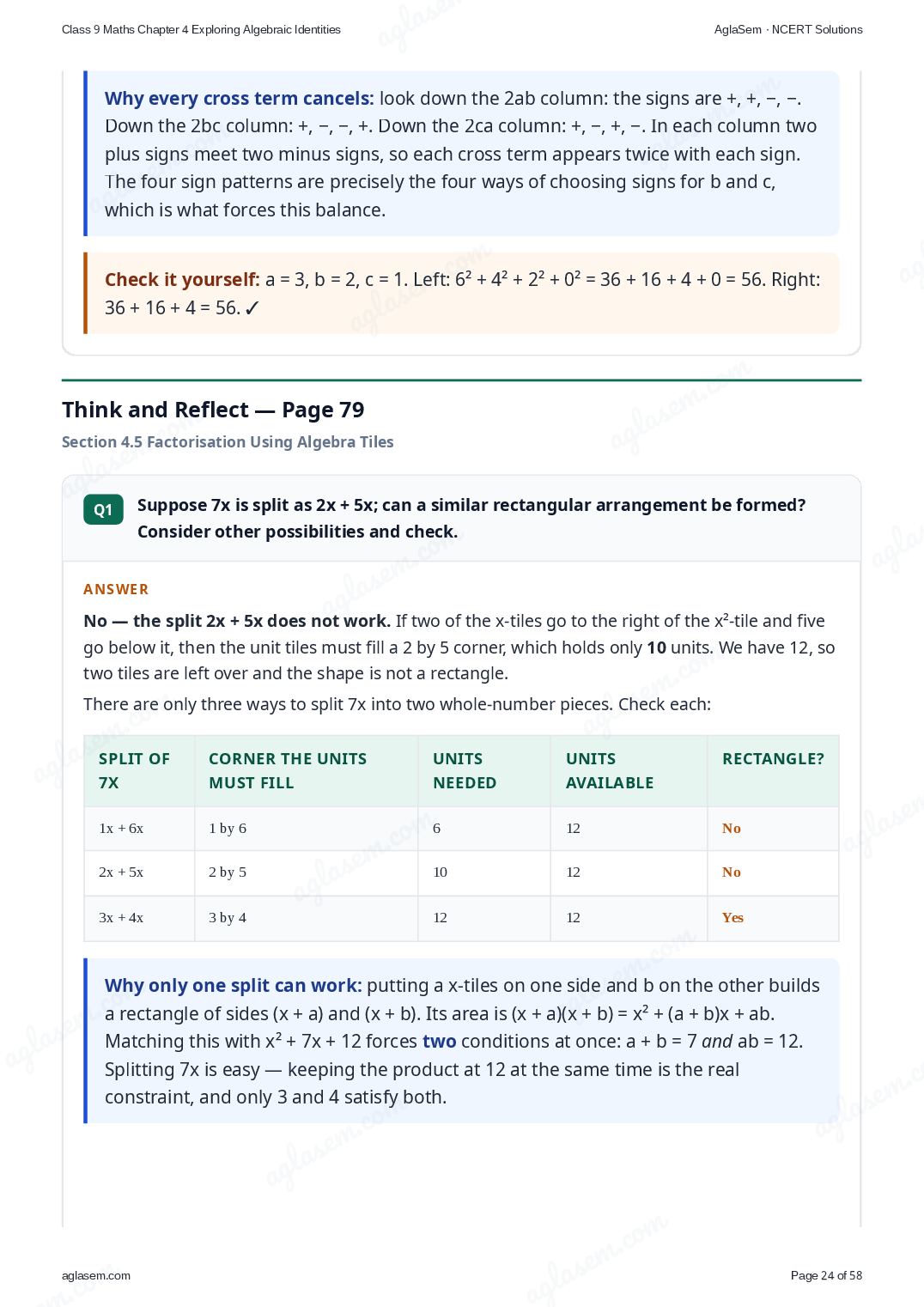
- Suppose 7x is split as 2x + 5x; can a similar rectangular arrangement be formed? Consider other possibilities and check.
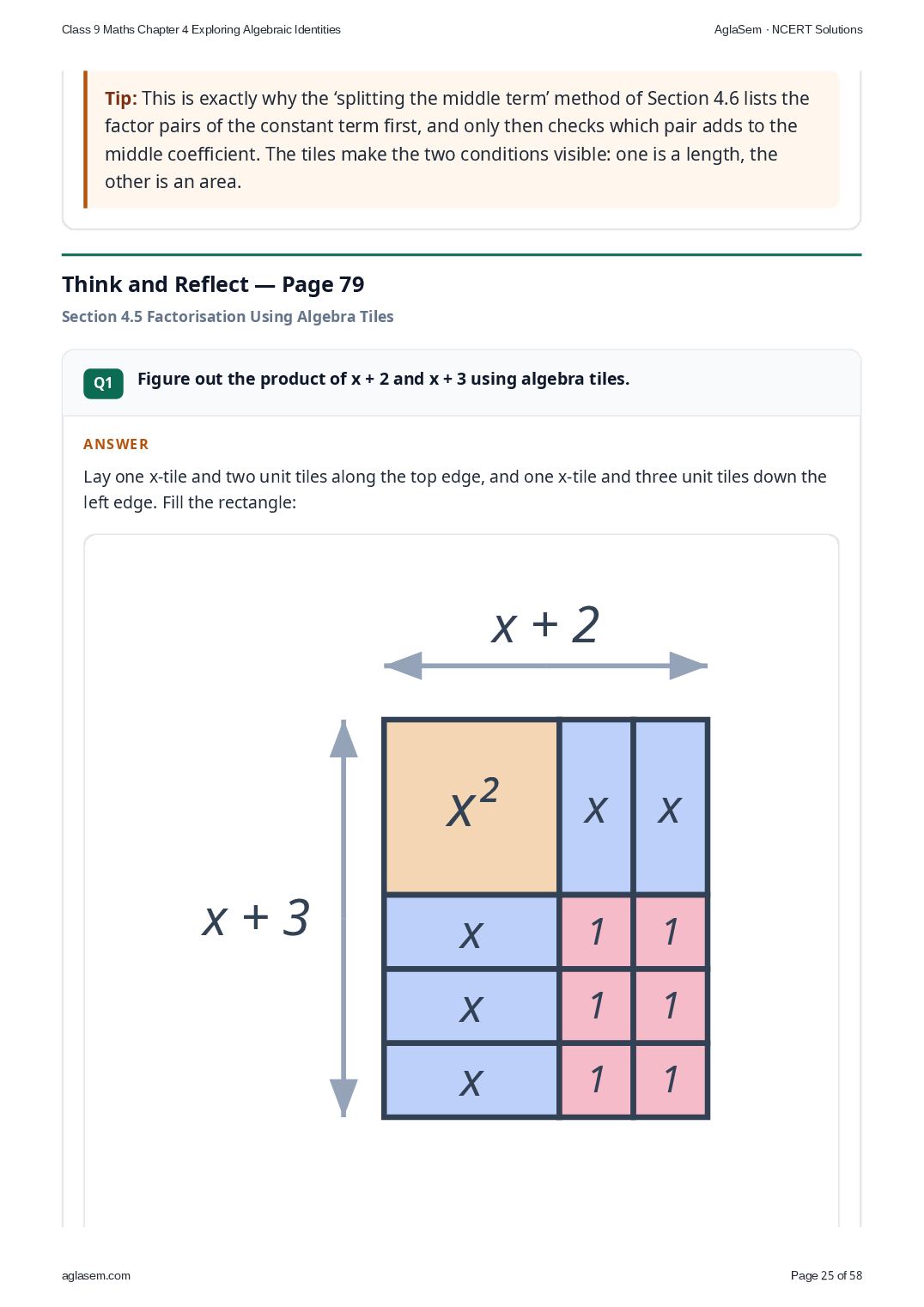
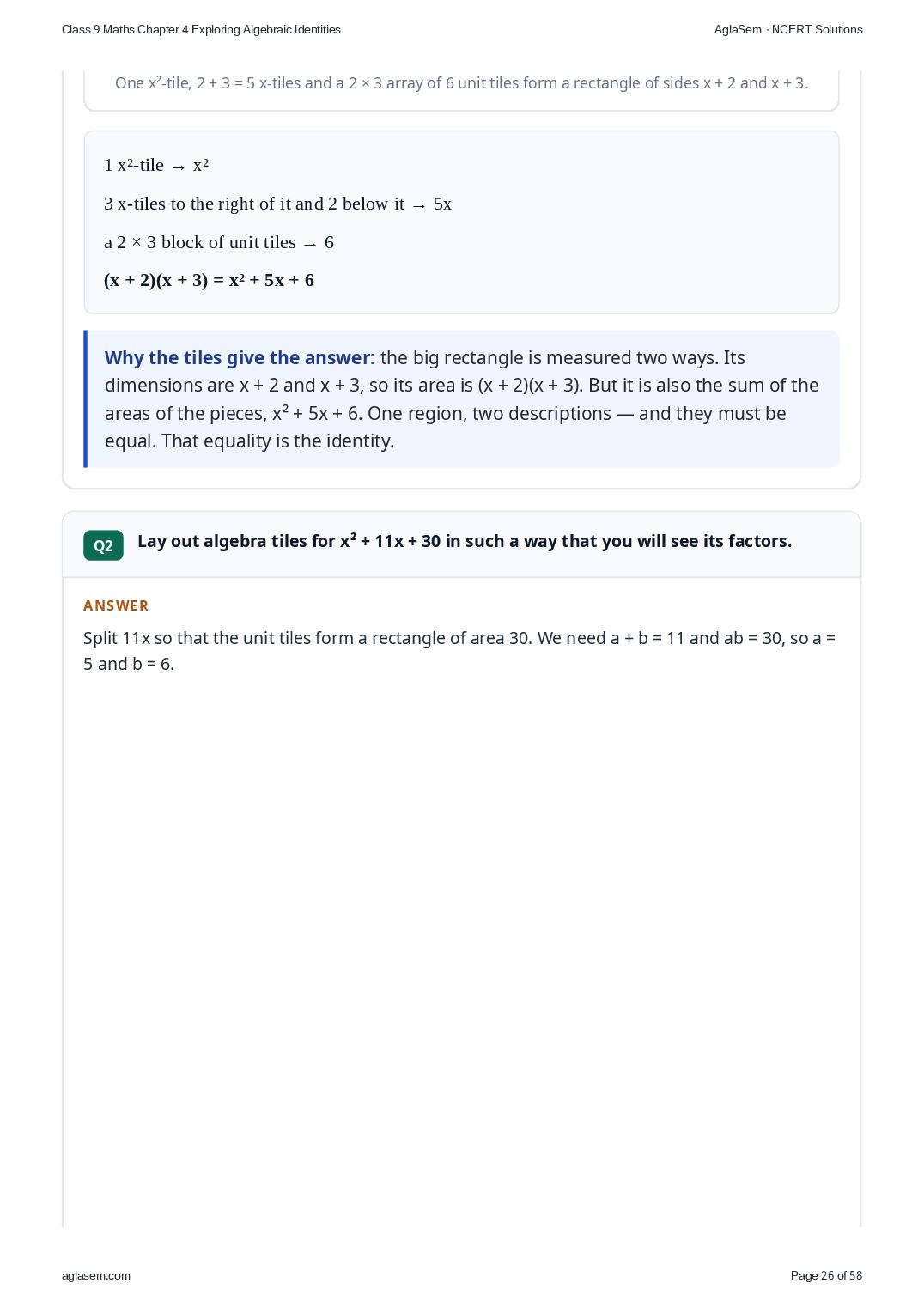
- Figure out the product of x + 2 and x + 3 using algebra tiles.
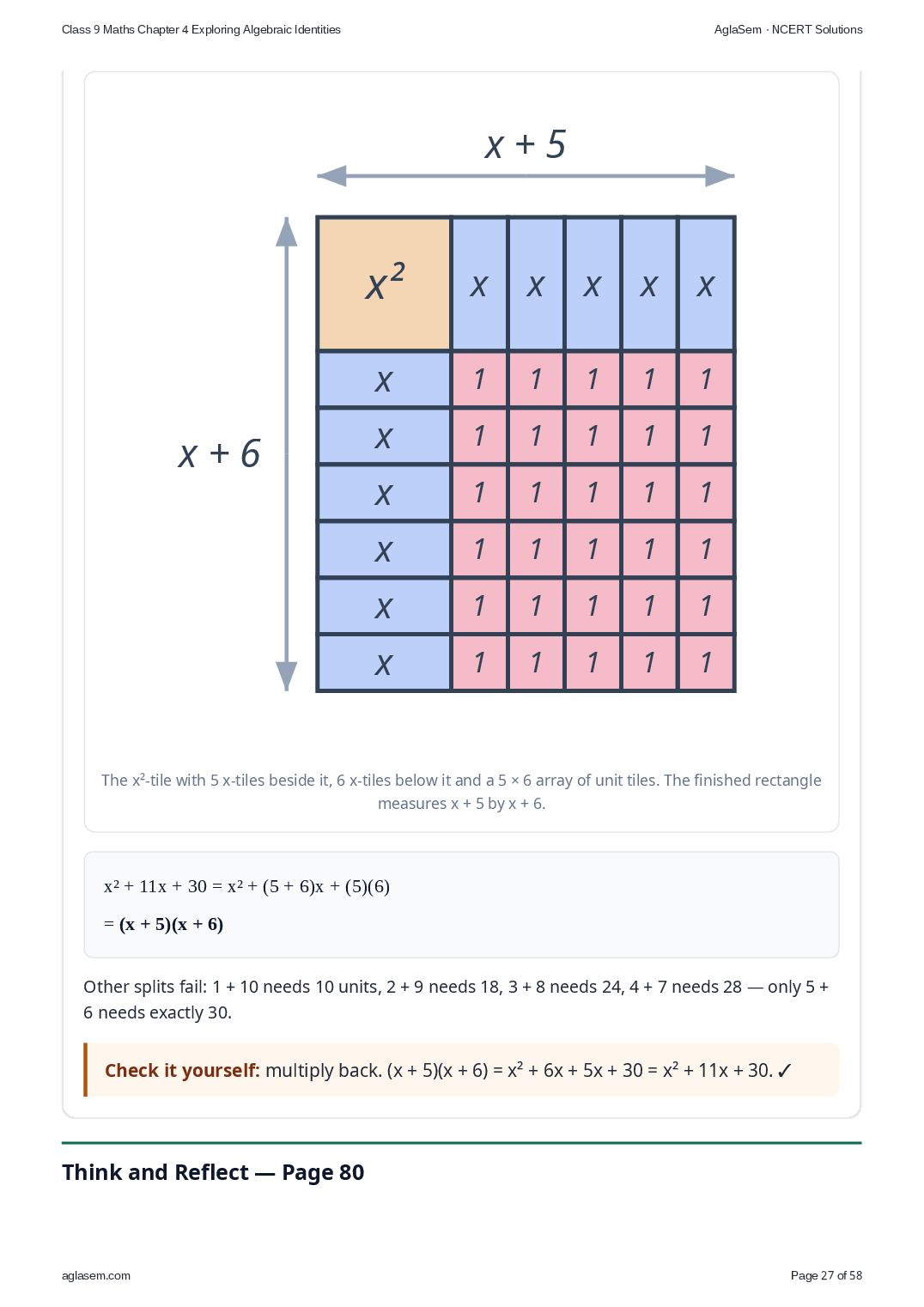
- Lay out algebra tiles for x² + 11x + 30 in such a way that you will see its factors.
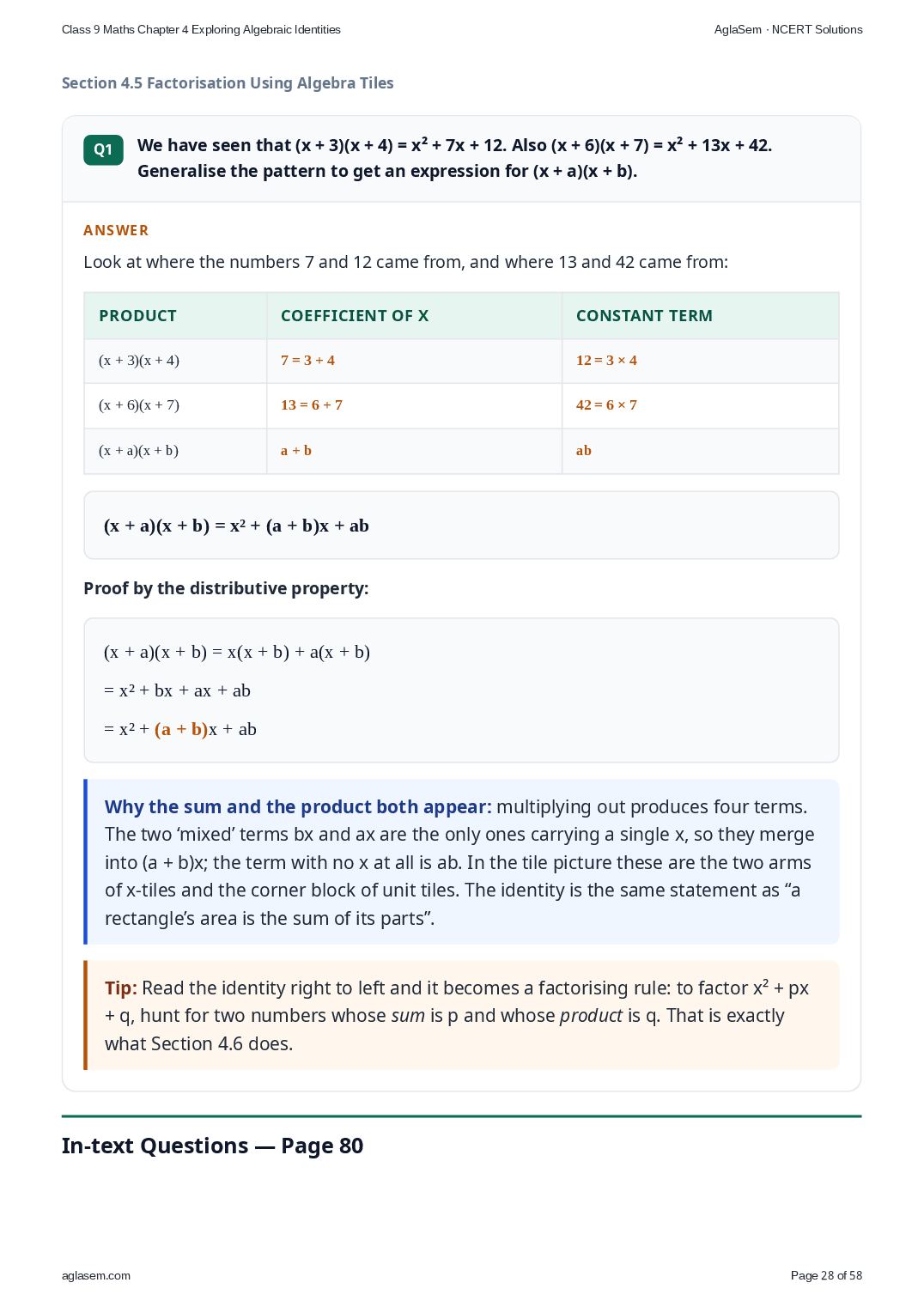
- We have seen that (x + 3)(x + 4) = x² + 7x + 12. Also (x + 6)(x + 7) = x² + 13x + 42. Generalise the pattern to get an expression for (x + a)(x + b).
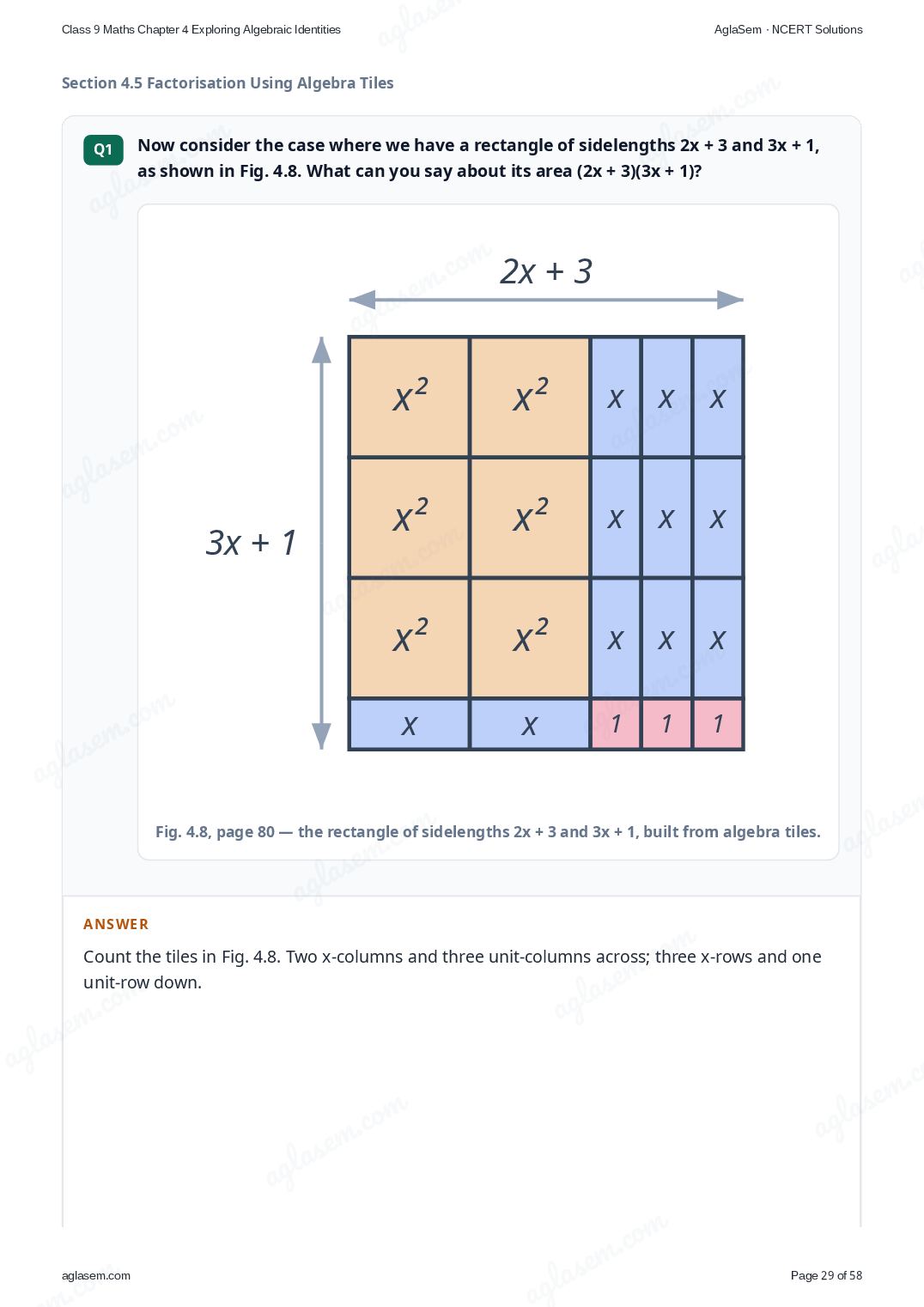
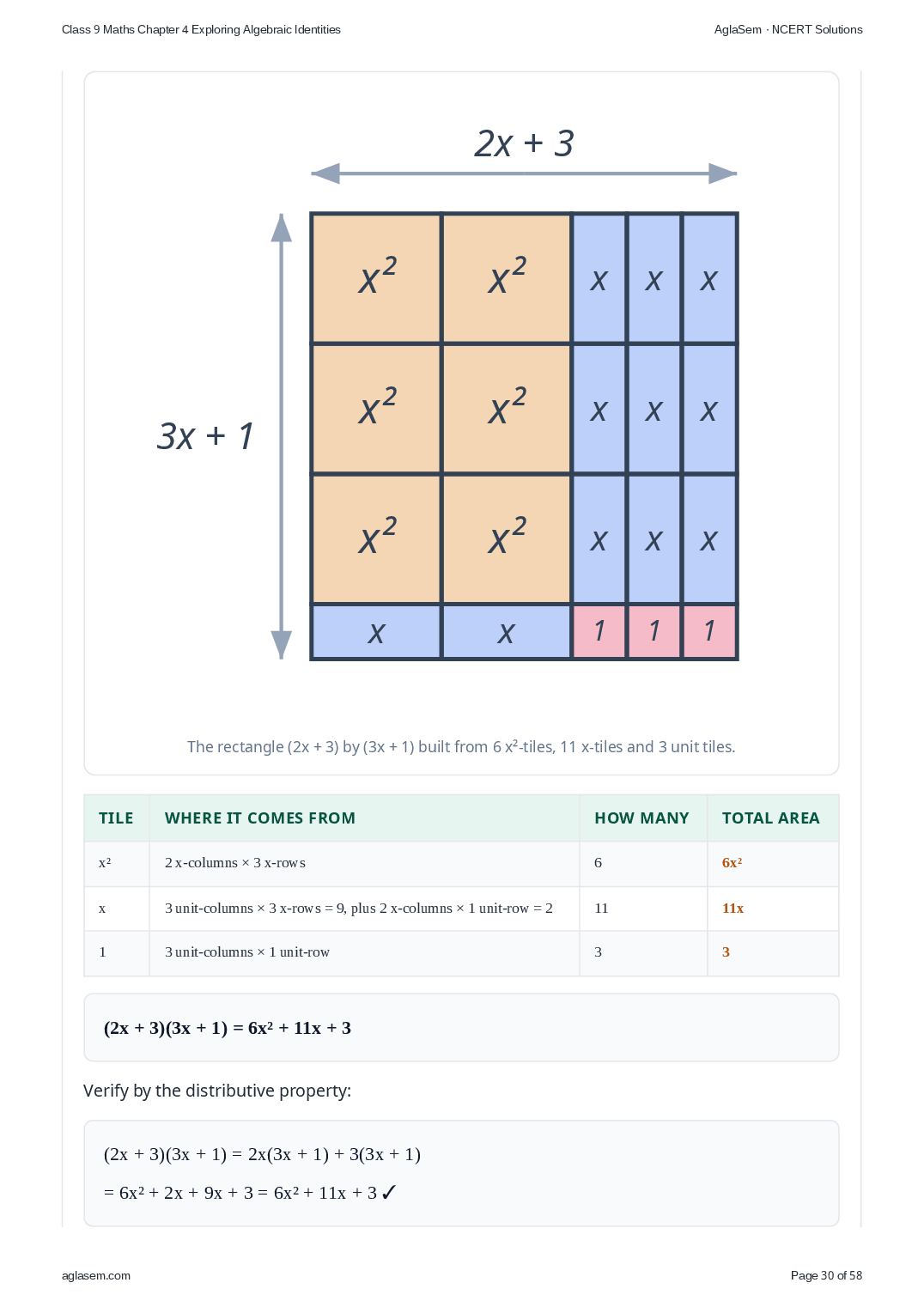
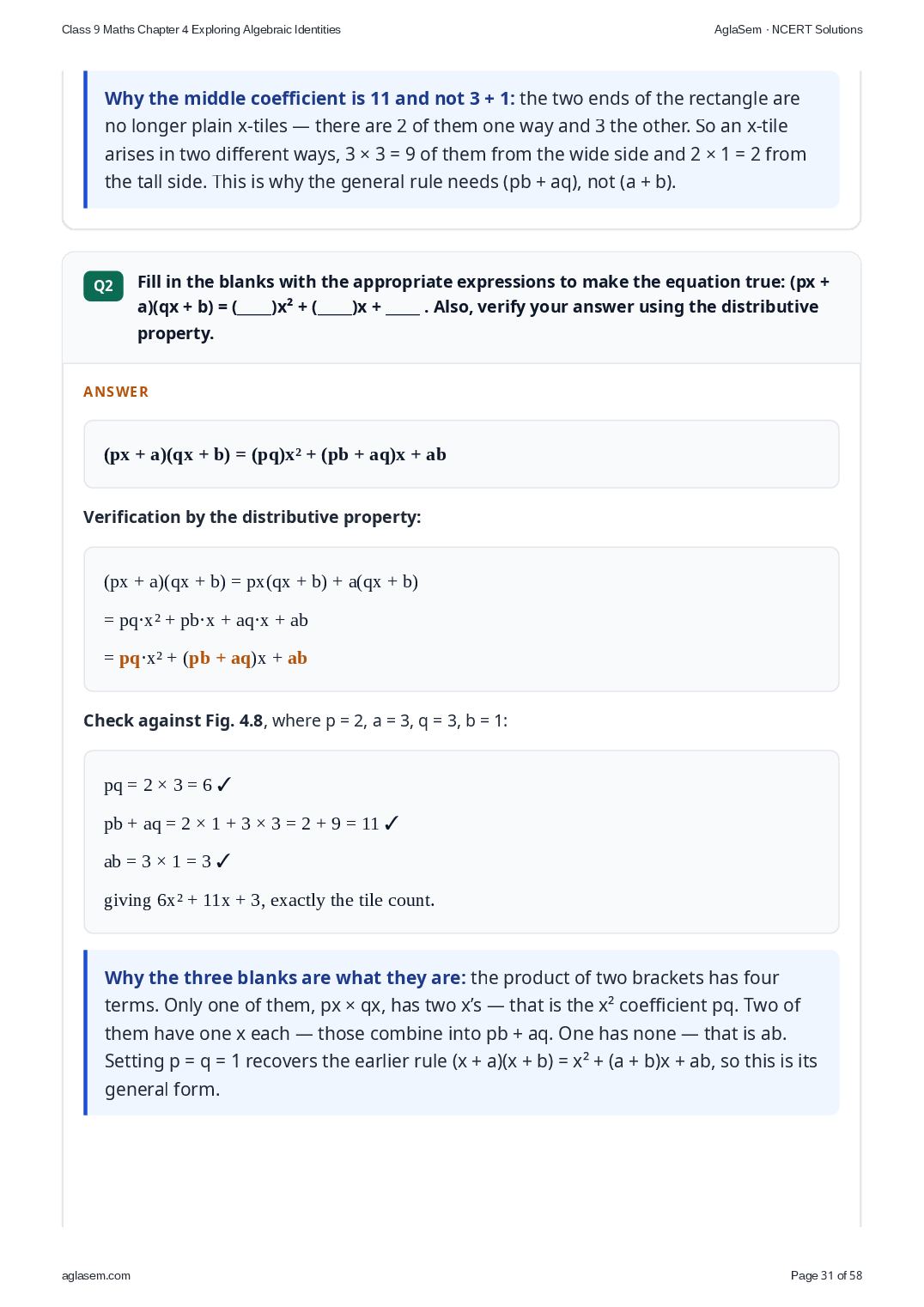
- Now consider the case where we have a rectangle of sidelengths 2x + 3 and 3x + 1, as shown in Fig. 4.8. What can you say about its area (2x + 3)(3x + 1)?
- Fill in the blanks with the appropriate expressions to make the equation true: (px + a)(qx + b) = (_____)x² + (_____)x + _____ . Also, verify your answer using the distributive property.
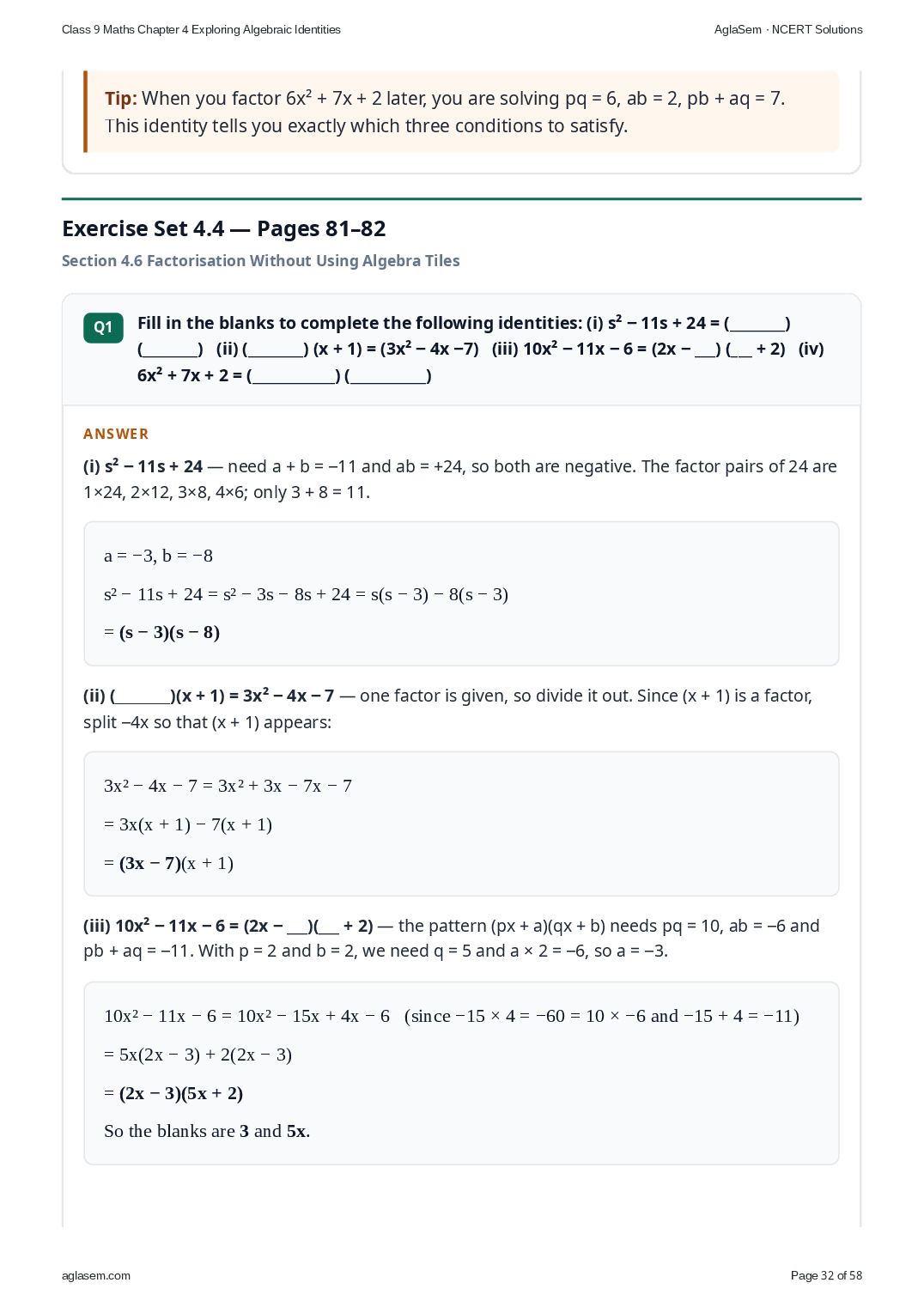
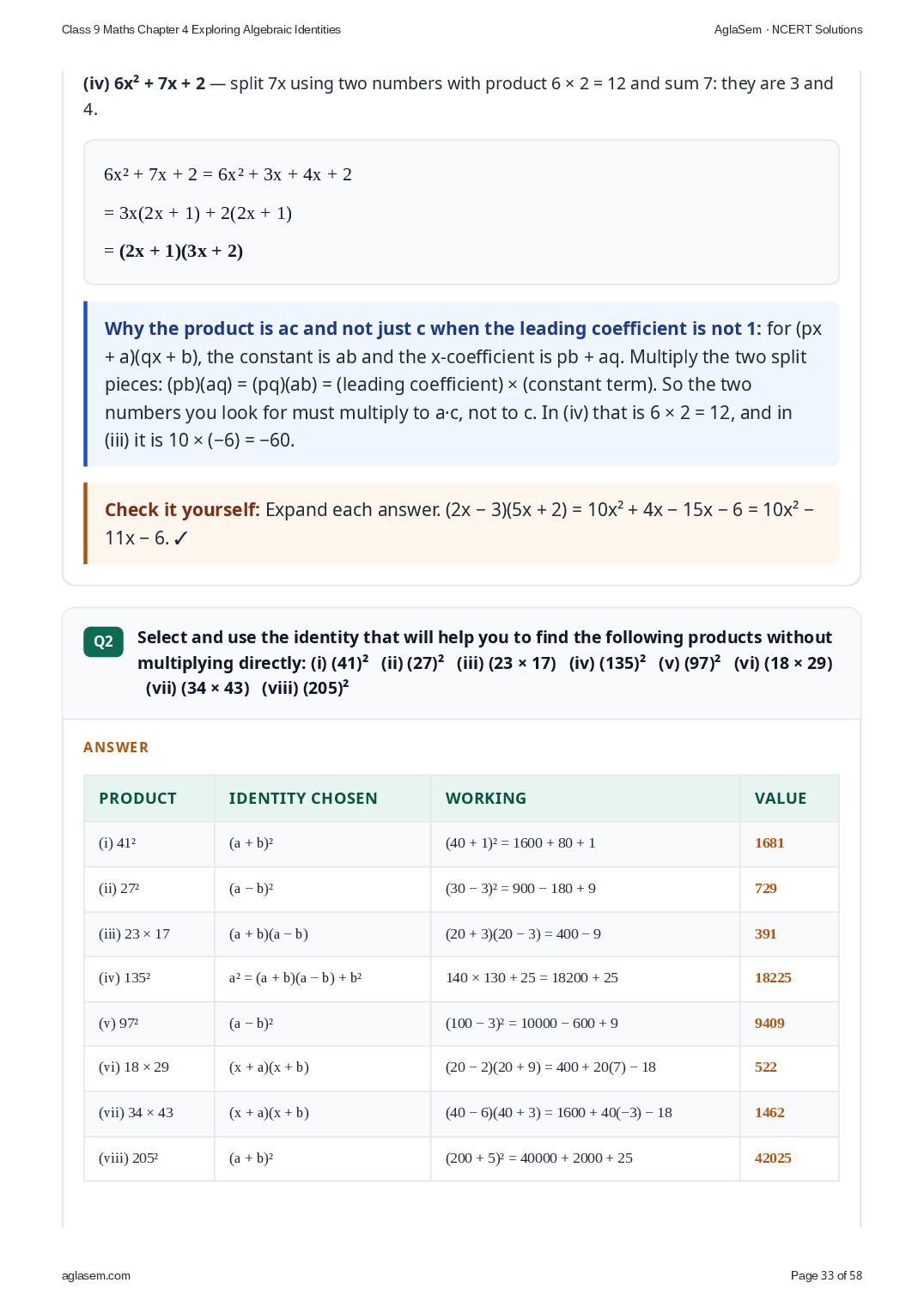
- Fill in the blanks to complete the following identities: (i) s² − 11s + 24 = (________) (________) (ii) (________) (x + 1) = (3x² − 4x −7) (iii) 10x² − 11x − 6 = (2x − ___) (___ + 2) (iv) 6x² + 7x + 2 = (____________) (___________)
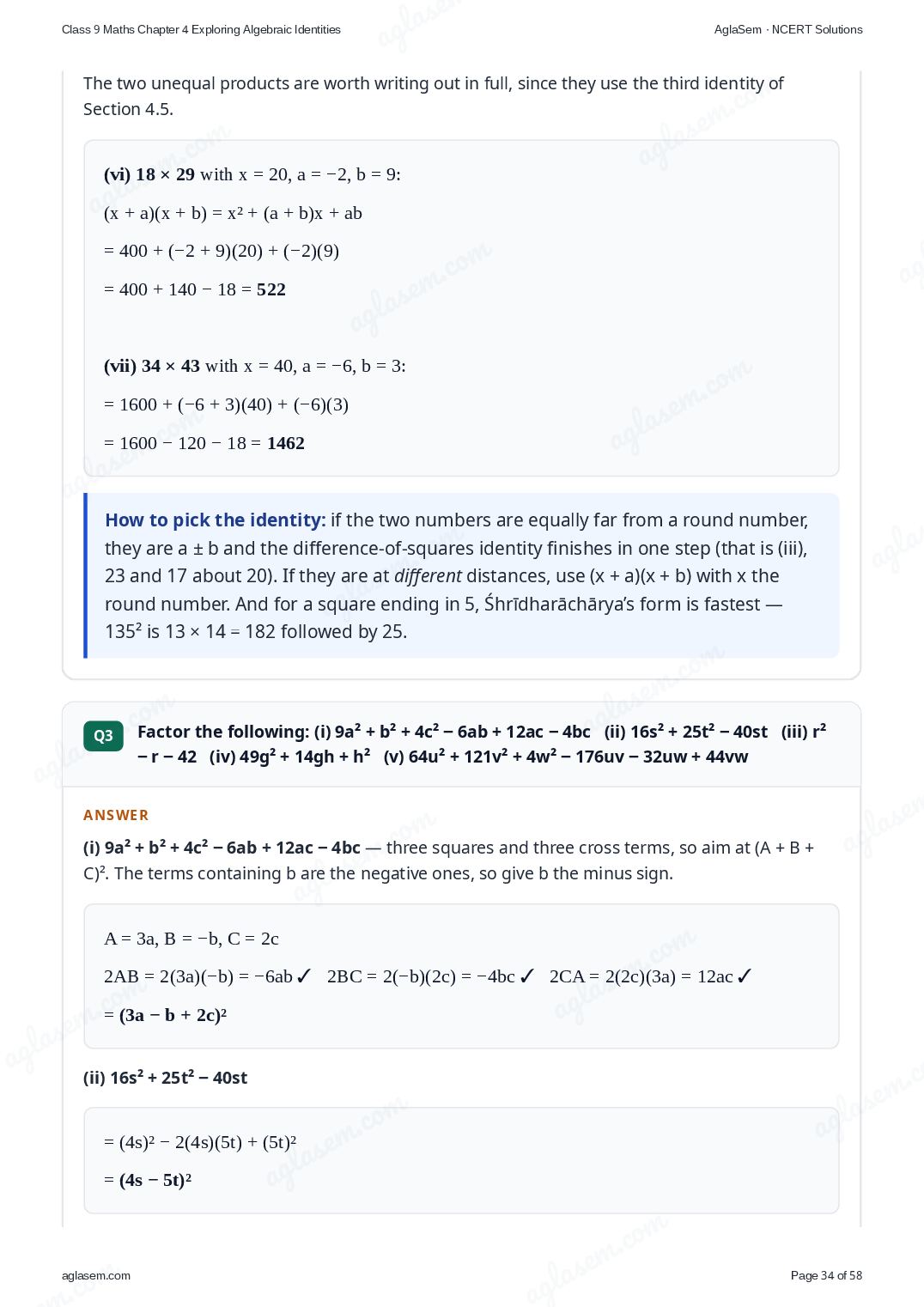
- Select and use the identity that will help you to find the following products without multiplying directly: (i) (41)² (ii) (27)² (iii) (23 × 17) (iv) (135)² (v) (97)² (vi) (18 × 29) (vii) (34 × 43) (viii) (205)²
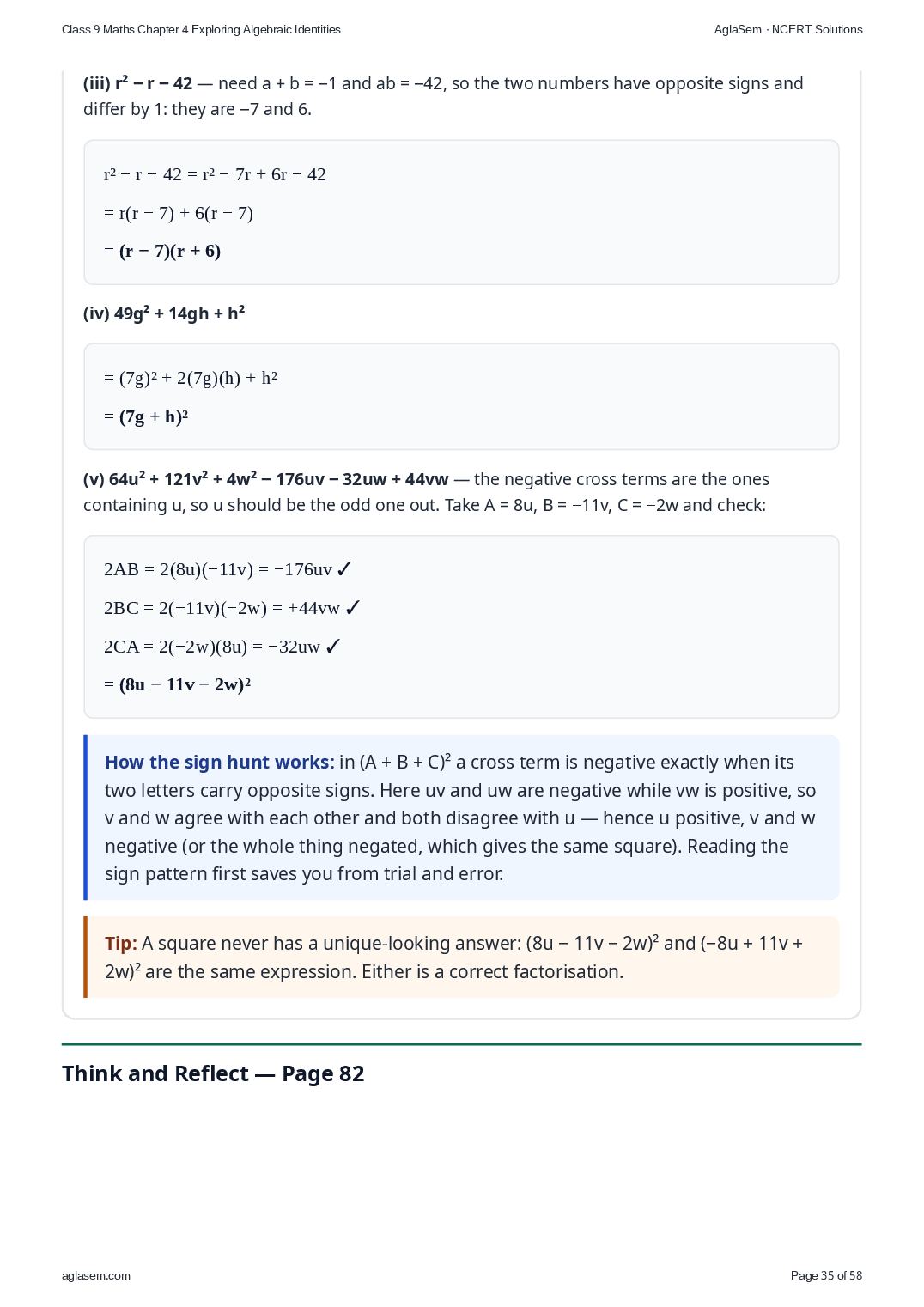
- Factor the following: (i) 9a² + b² + 4c² − 6ab + 12ac − 4bc (ii) 16s² + 25t² − 40st (iii) r² − r − 42 (iv) 49g² + 14gh + h² (v) 64u² + 121v² + 4w² − 176uv − 32uw + 44vw
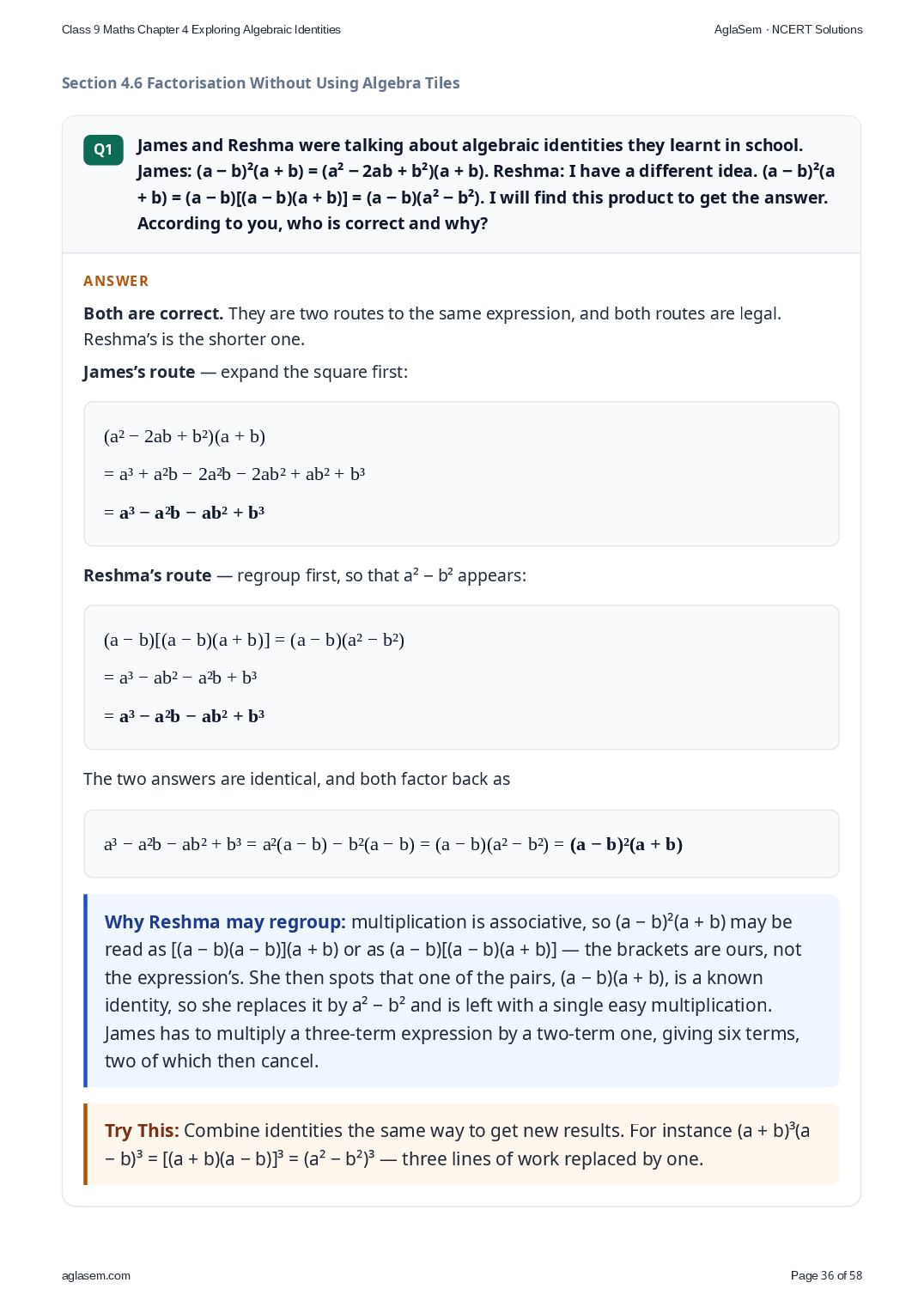
- James and Reshma were talking about algebraic identities they learnt in school. James: (a − b)²(a + b) = (a² − 2ab + b²)(a + b). Reshma: I have a different idea. (a − b)²(a + b) = (a − b)[(a − b)(a + b)] = (a − b)(a² − b²). I will find this product to get the answer. According to you, who is correct and why?
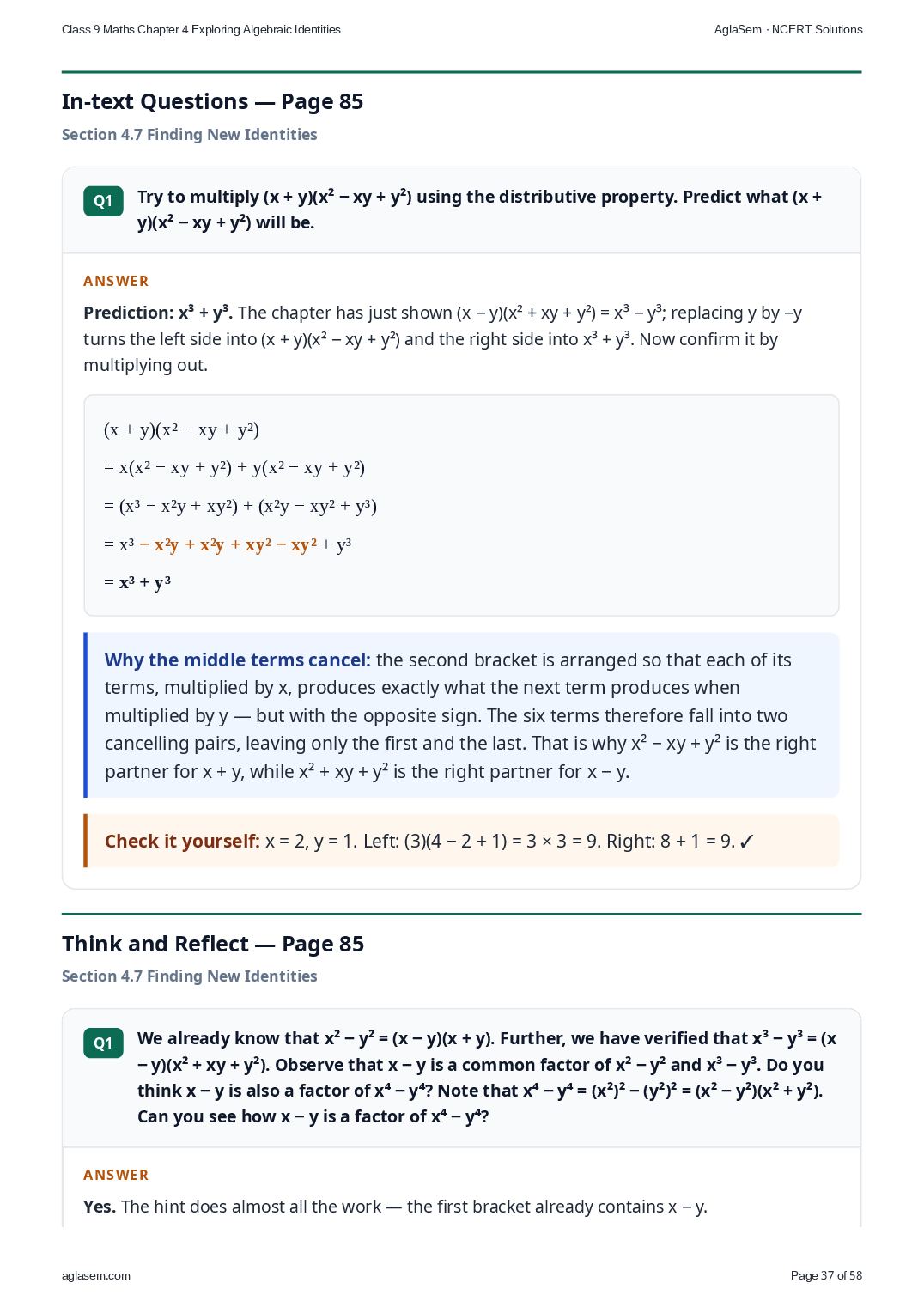
- Try to multiply (x + y)(x² − xy + y²) using the distributive property. Predict what (x + y)(x² − xy + y²) will be.
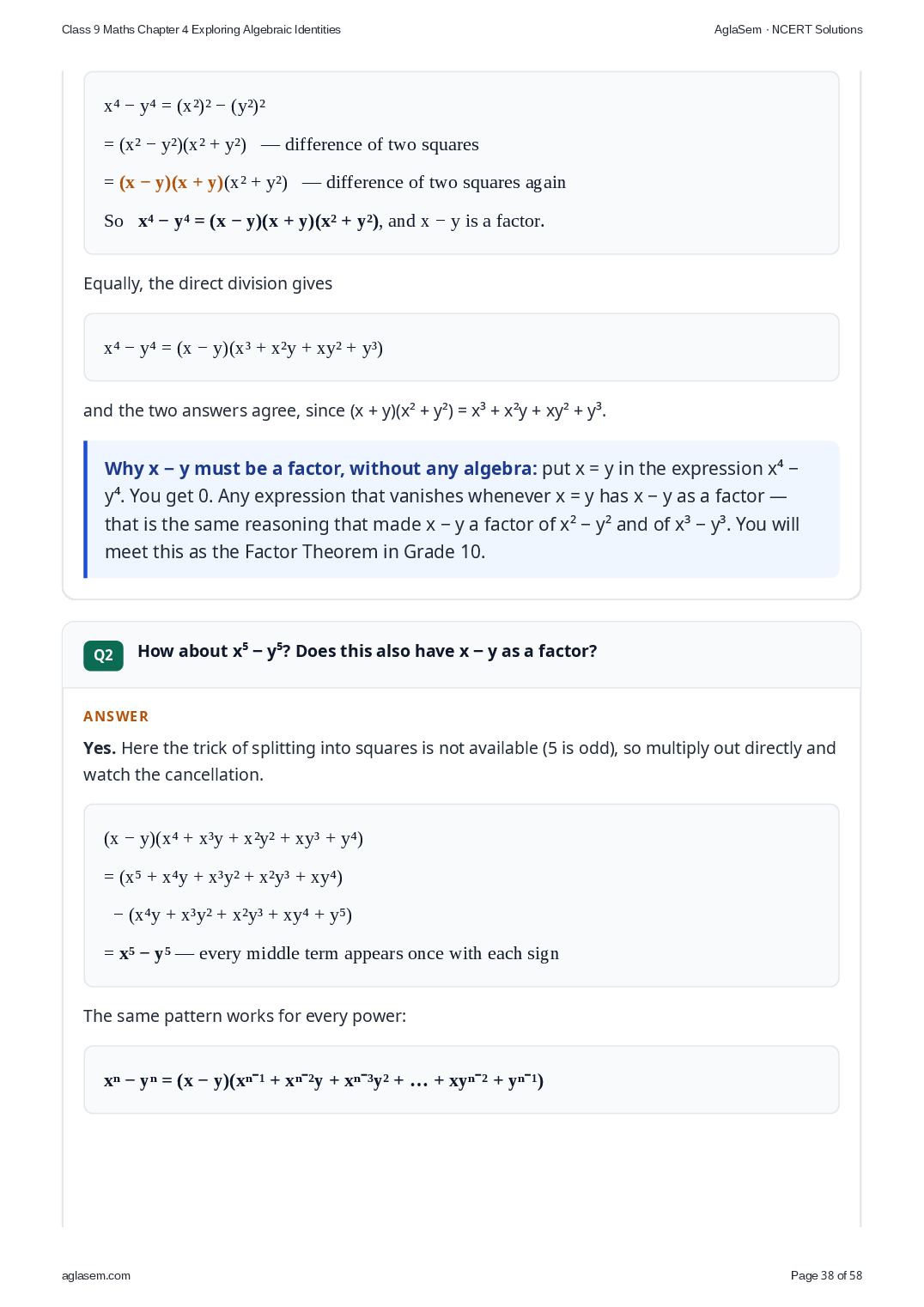
- We already know that x² − y² = (x − y)(x + y). Further, we have verified that x³ − y³ = (x − y)(x² + xy + y²). Observe that x − y is a common factor of x² − y² and x³ − y³. Do you think x − y is also a factor of x⁴ − y⁴? Note that x⁴ − y⁴ = (x²)² − (y²)² = (x² − y²)(x² + y²). Can you see how x − y is a factor of x⁴ − y⁴?
- How about x⁵ − y⁵? Does this also have x − y as a factor?
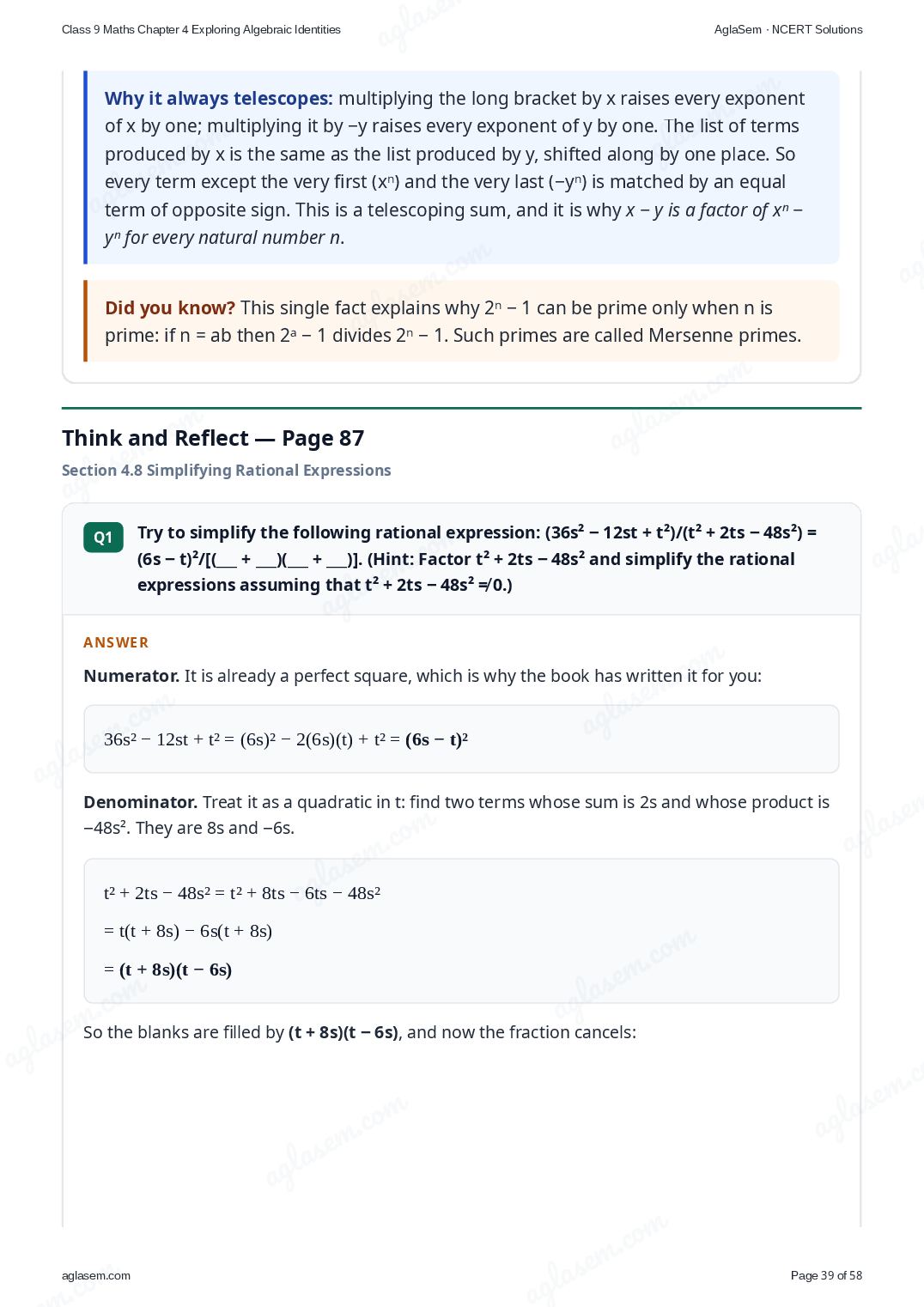
- Try to simplify the following rational expression: (36s² − 12st + t²)/(t² + 2ts − 48s²) = (6s − t)²/[(___ + ___)(___ + ___)]. (Hint: Factor t² + 2ts − 48s² and simplify the rational expressions assuming that t² + 2ts − 48s² ≠ 0.)
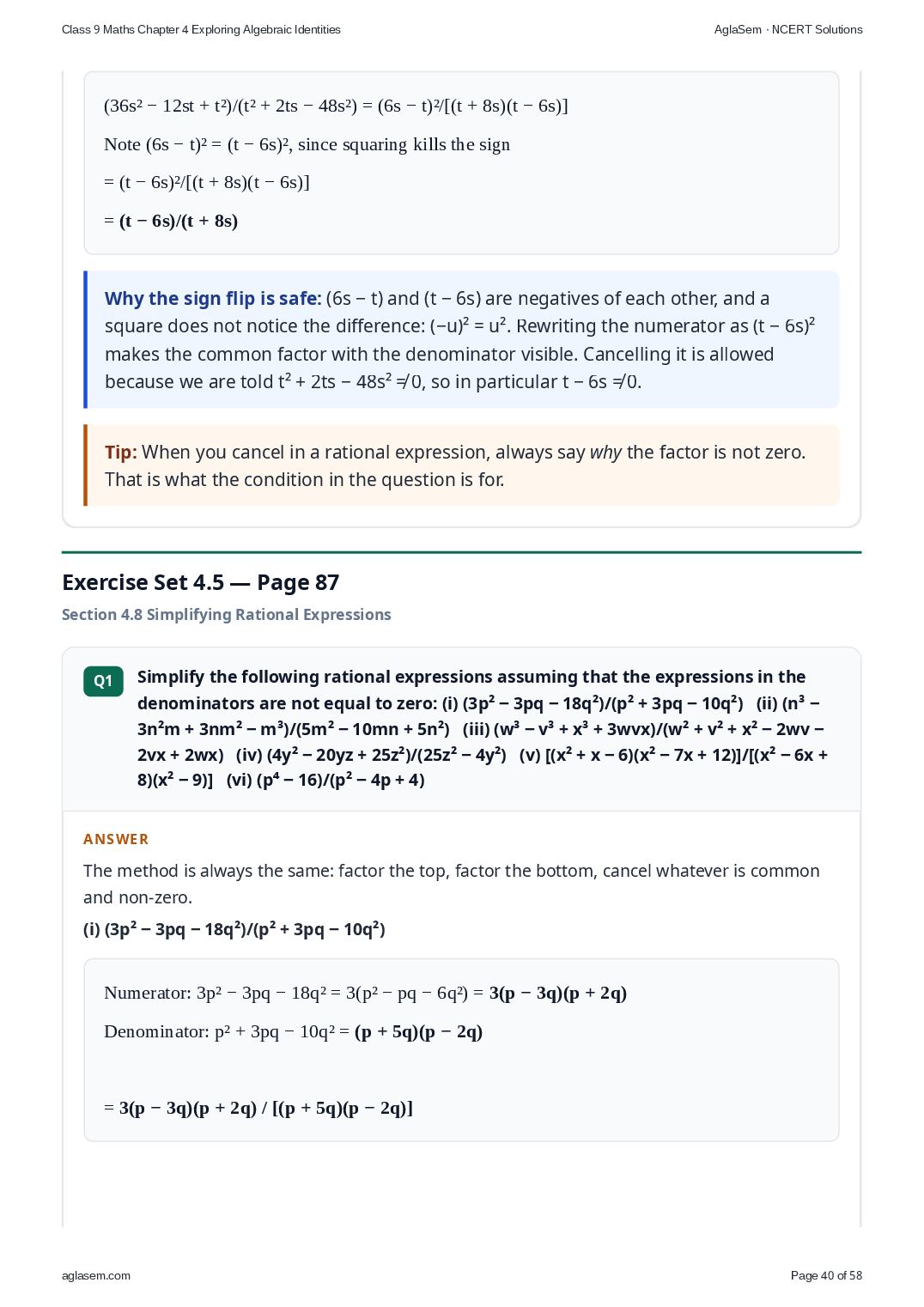
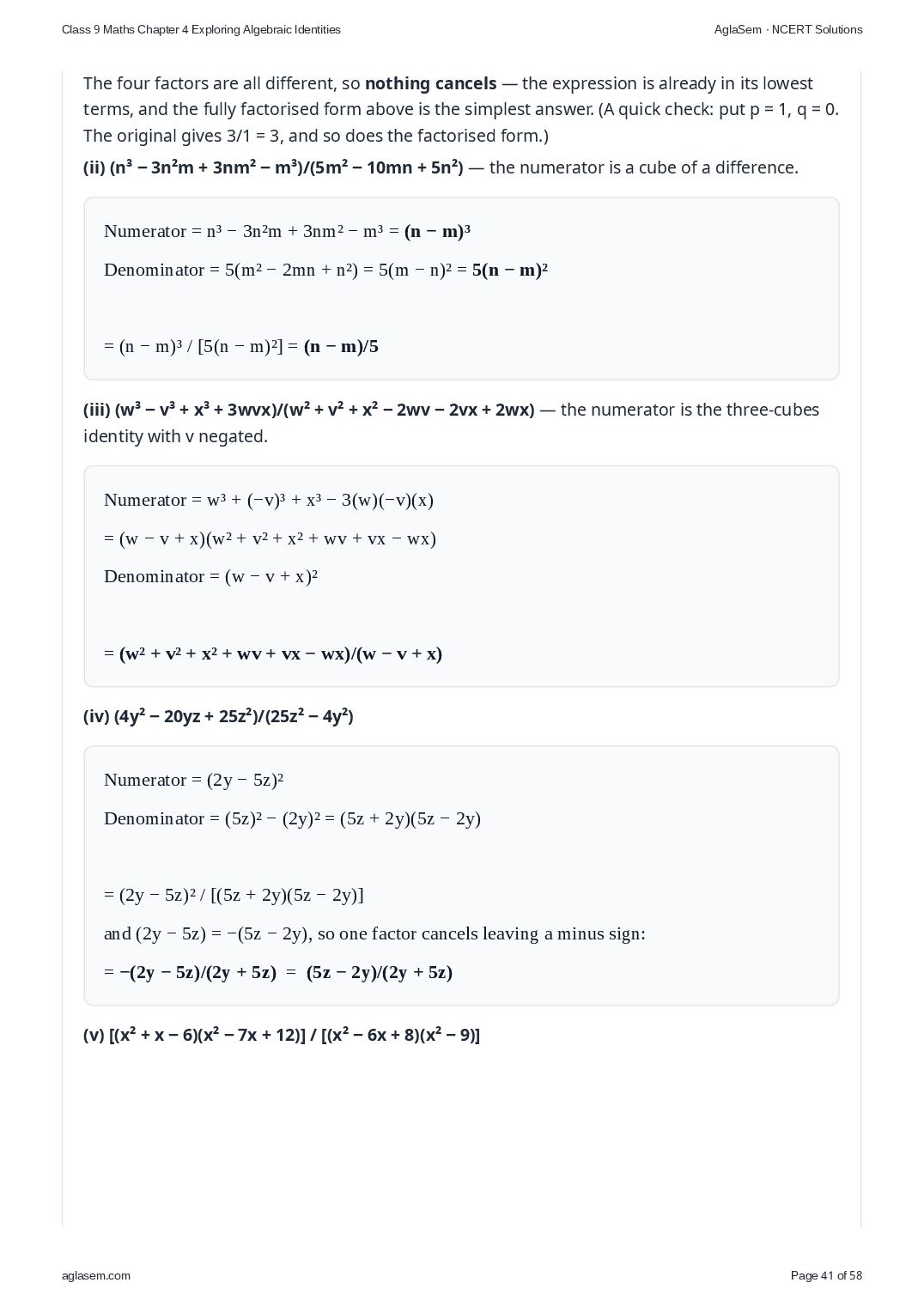
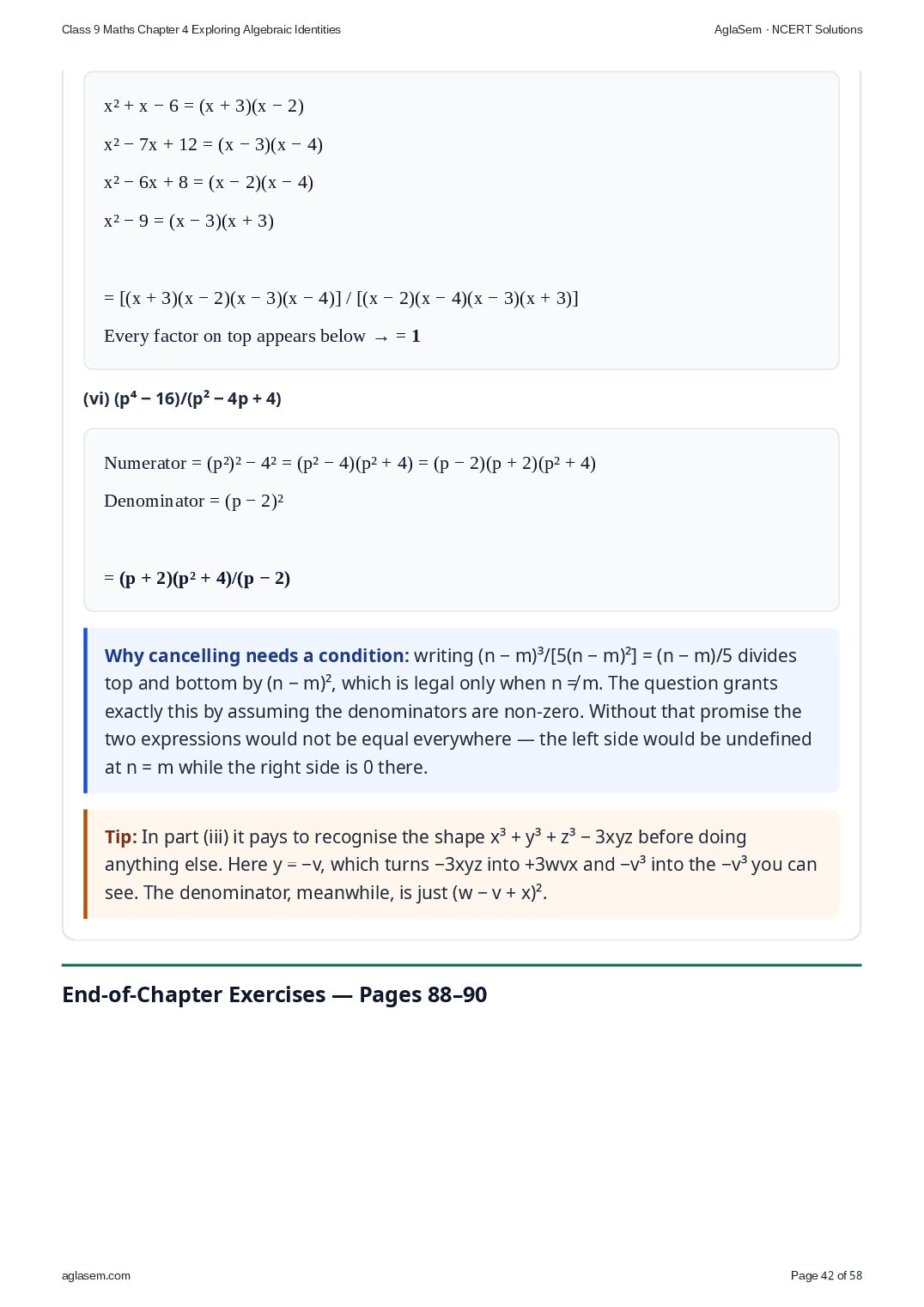
- Simplify the following rational expressions assuming that the expressions in the denominators are not equal to zero: (i) (3p² − 3pq − 18q²)/(p² + 3pq − 10q²) (ii) (n³ − 3n²m + 3nm² − m³)/(5m² − 10mn + 5n²) (iii) (w³ − v³ + x³ + 3wvx)/(w² + v² + x² − 2wv − 2vx + 2wx) (iv) (4y² − 20yz + 25z²)/(25z² − 4y²) (v) [(x² + x − 6)(x² − 7x + 12)]/[(x² − 6x + 8)(x² − 9)] (vi) (p⁴ − 16)/(p² − 4p + 4)
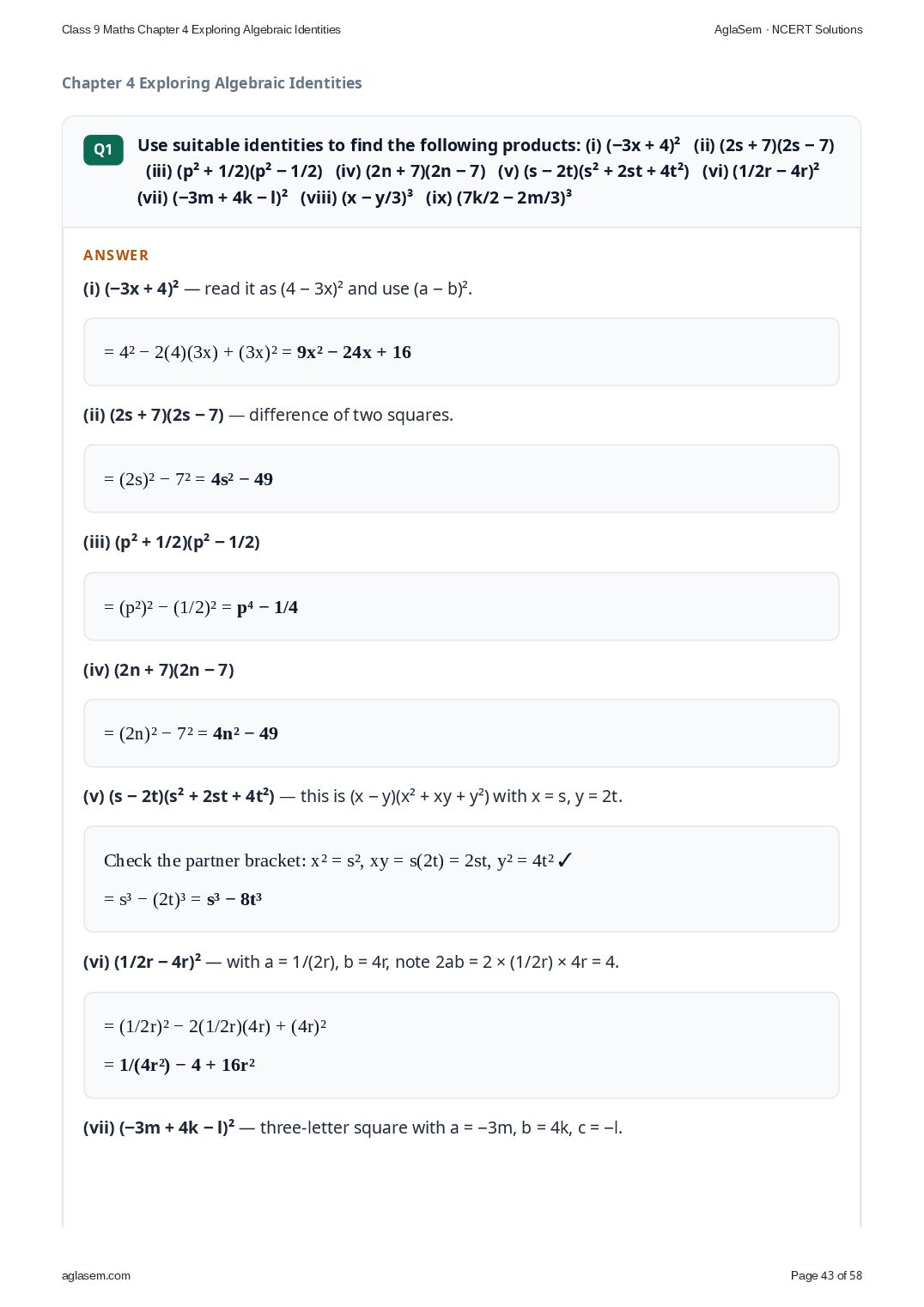
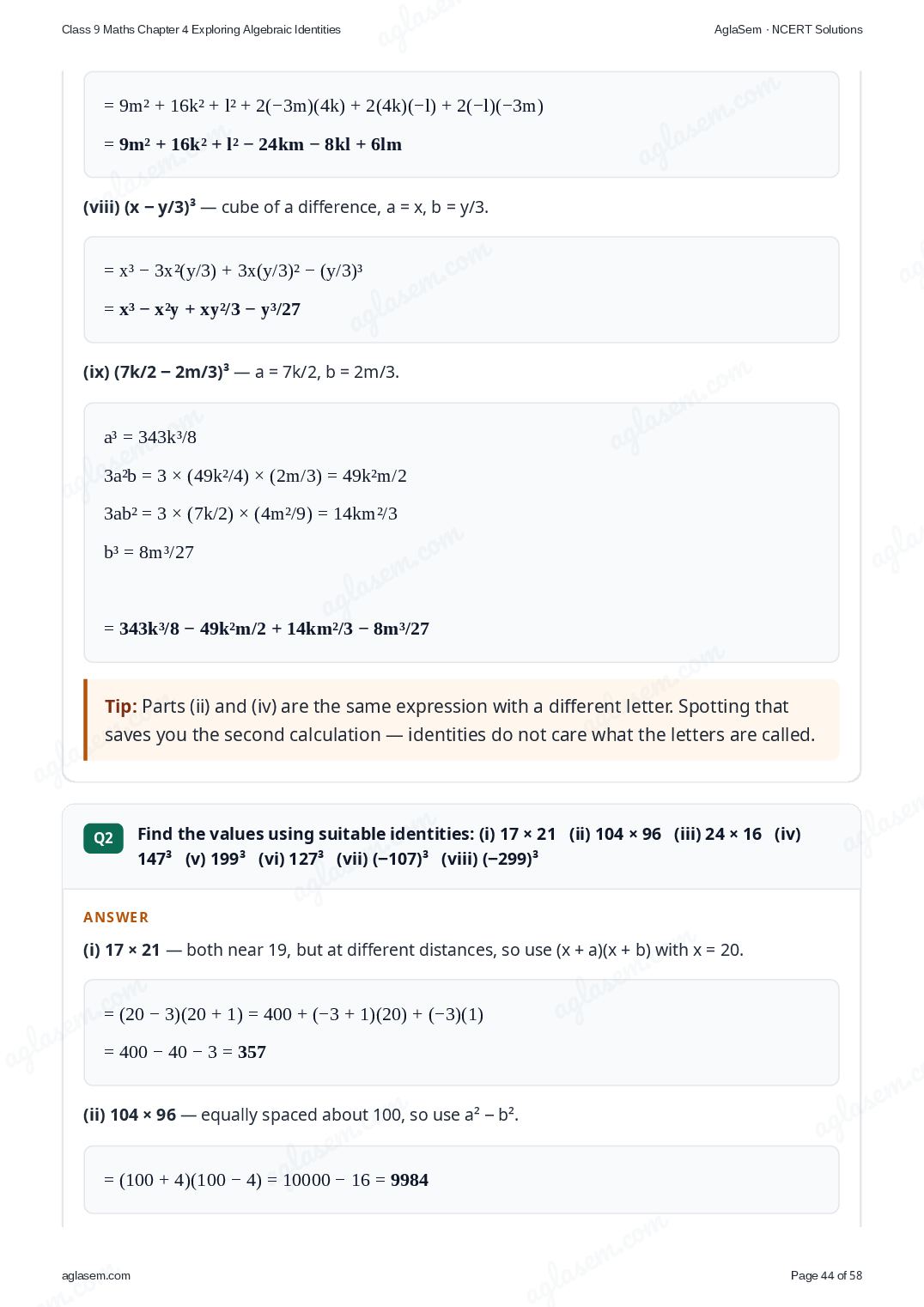
- Use suitable identities to find the following products: (i) (−3x + 4)² (ii) (2s + 7)(2s − 7) (iii) (p² + 1/2)(p² − 1/2) (iv) (2n + 7)(2n − 7) (v) (s − 2t)(s² + 2st + 4t²) (vi) (1/2r − 4r)² (vii) (−3m + 4k − l)² (viii) (x − y/3)³ (ix) (7k/2 − 2m/3)³
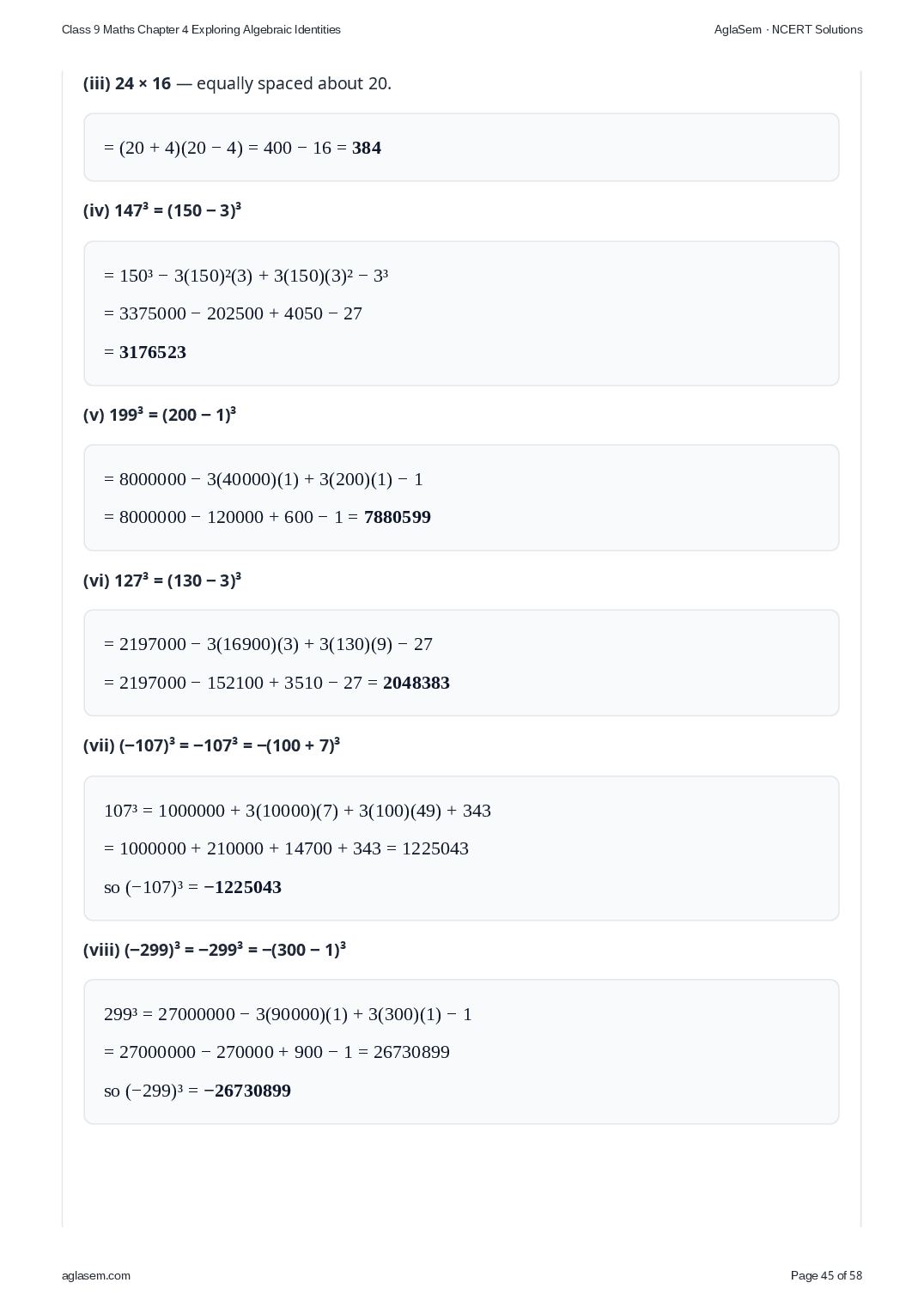
- Find the values using suitable identities: (i) 17 × 21 (ii) 104 × 96 (iii) 24 × 16 (iv) 147³ (v) 199³ (vi) 127³ (vii) (−107)³ (viii) (−299)³
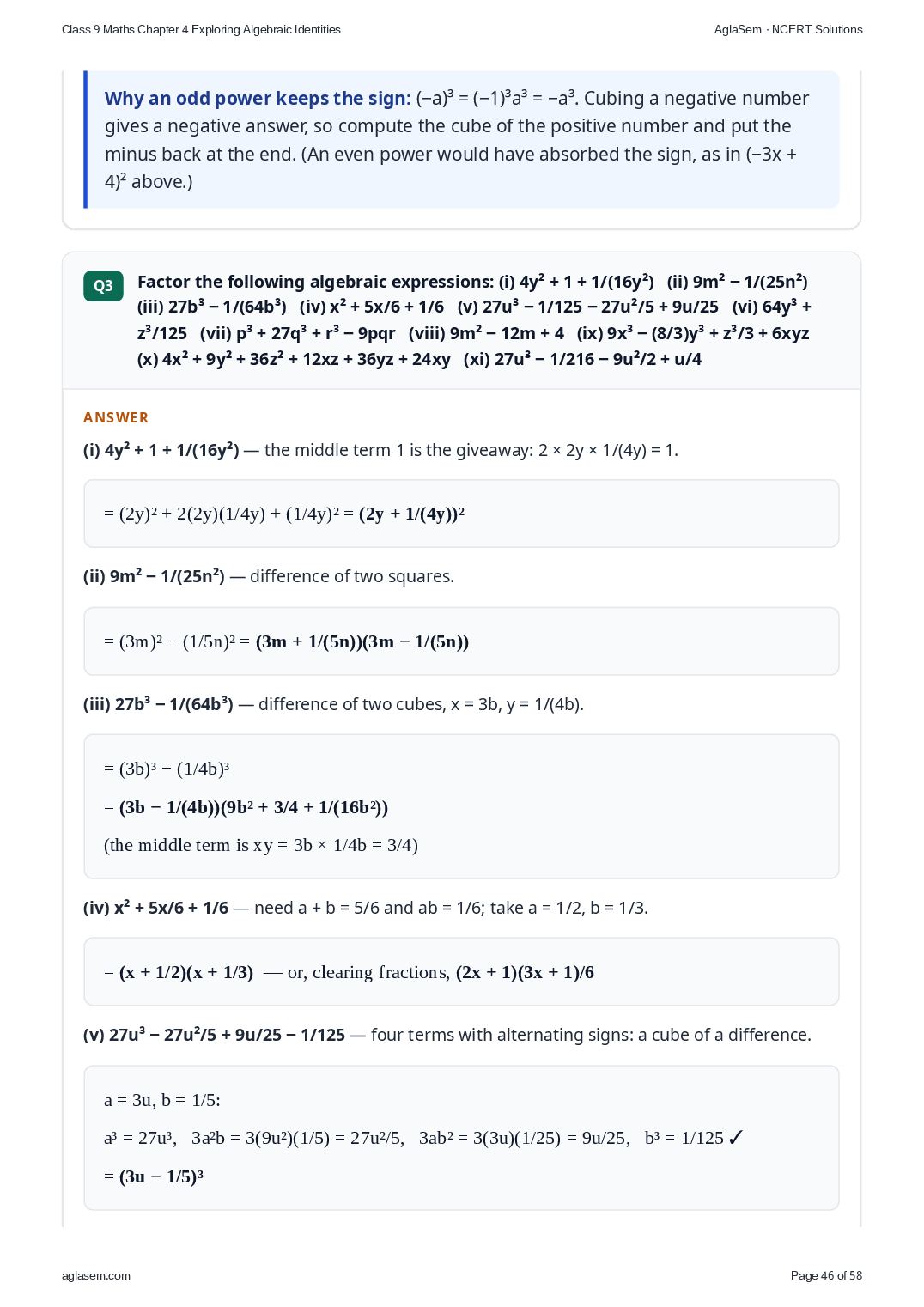
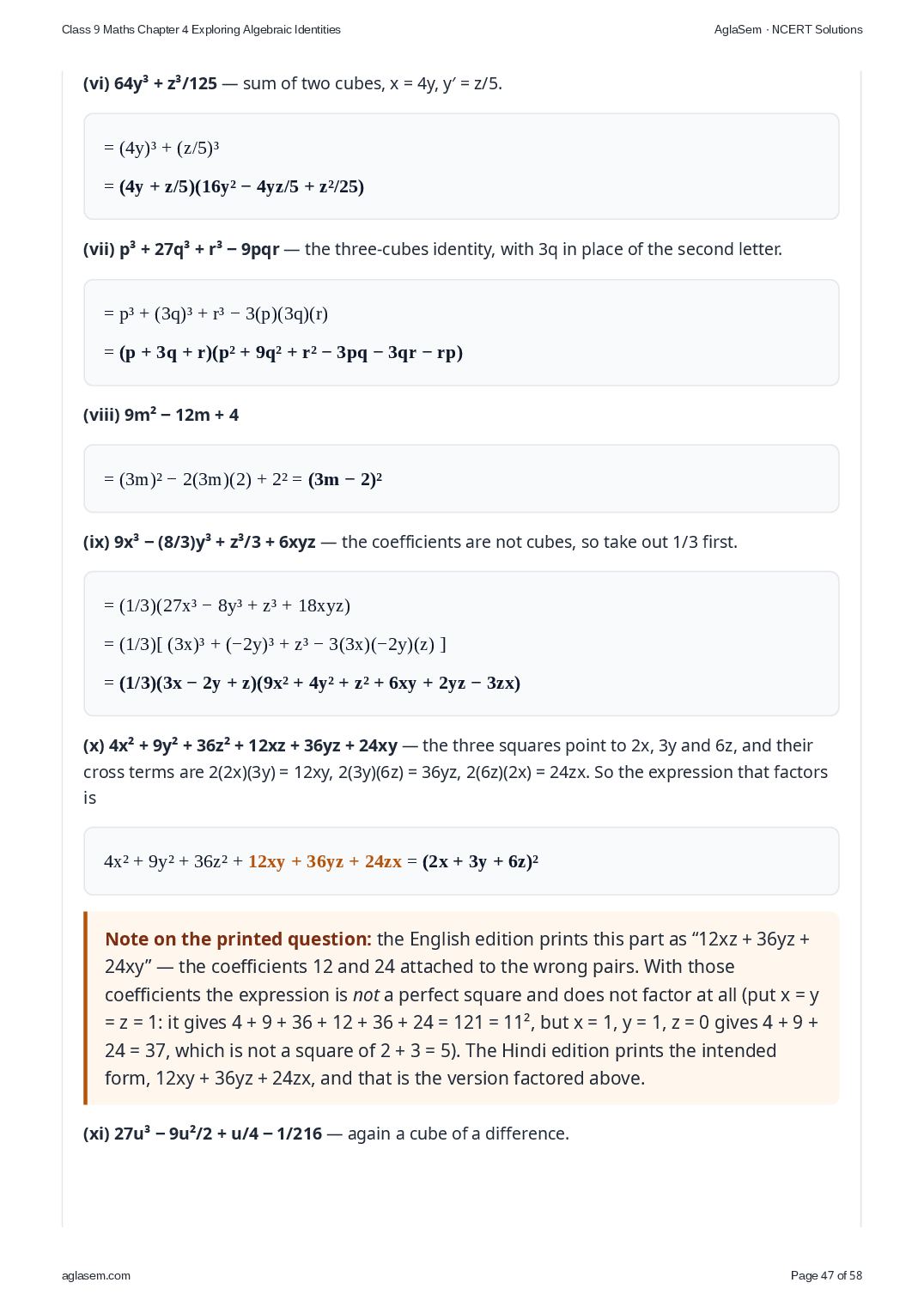
- Factor the following algebraic expressions: (i) 4y² + 1 + 1/(16y²) (ii) 9m² − 1/(25n²) (iii) 27b³ − 1/(64b³) (iv) x² + 5x/6 + 1/6 (v) 27u³ − 1/125 − 27u²/5 + 9u/25 (vi) 64y³ + z³/125 (vii) p³ + 27q³ + r³ − 9pqr (viii) 9m² − 12m + 4 (ix) 9x³ − (8/3)y³ + z³/3 + 6xyz (x) 4x² + 9y² + 36z² + 12xz + 36yz + 24xy (xi) 27u³ − 1/216 − 9u²/2 + u/4
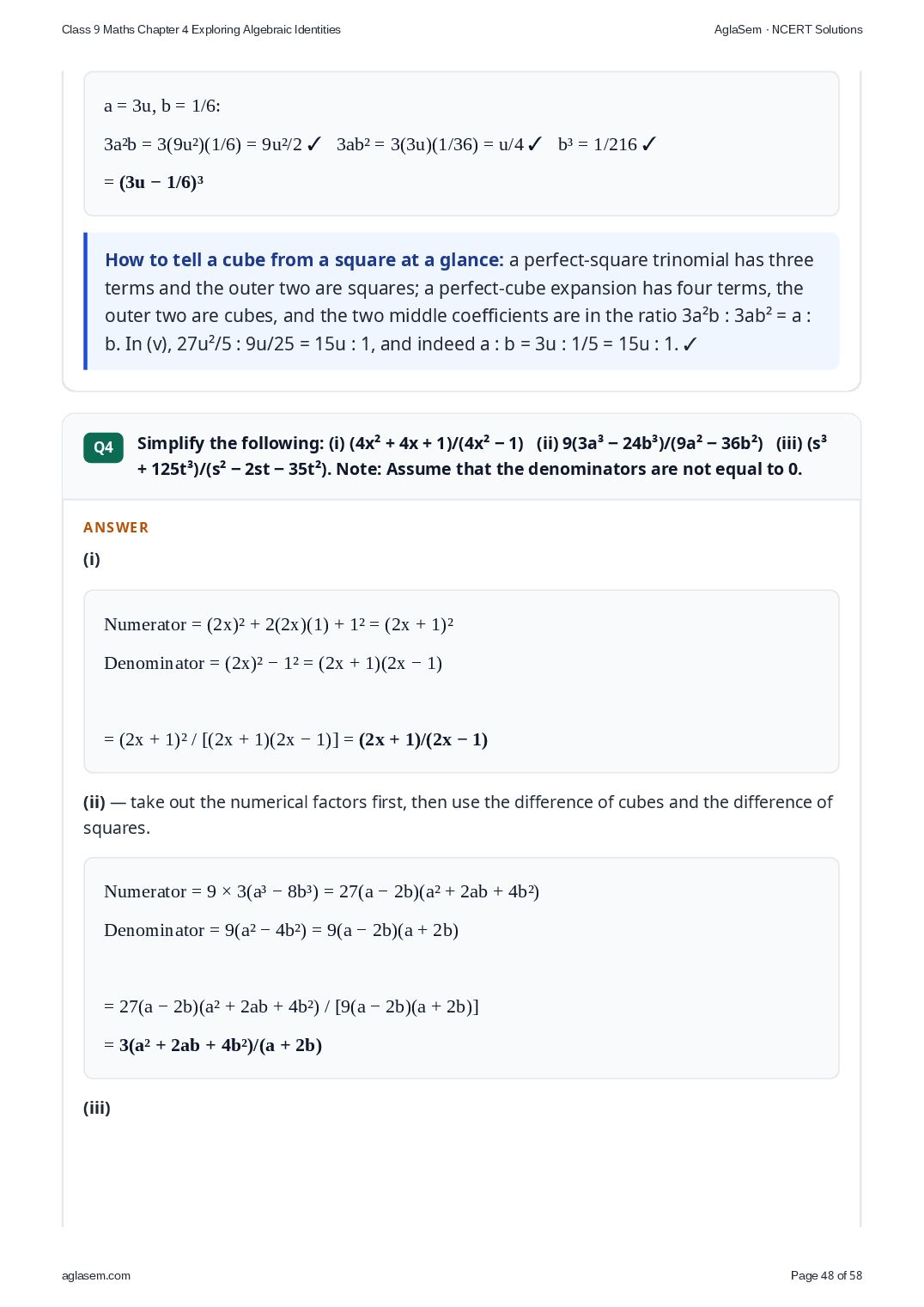
- Simplify the following: (i) (4x² + 4x + 1)/(4x² − 1) (ii) 9(3a³ − 24b³)/(9a² − 36b²) (iii) (s³ + 125t³)/(s² − 2st − 35t²). Note: Assume that the denominators are not equal to 0.
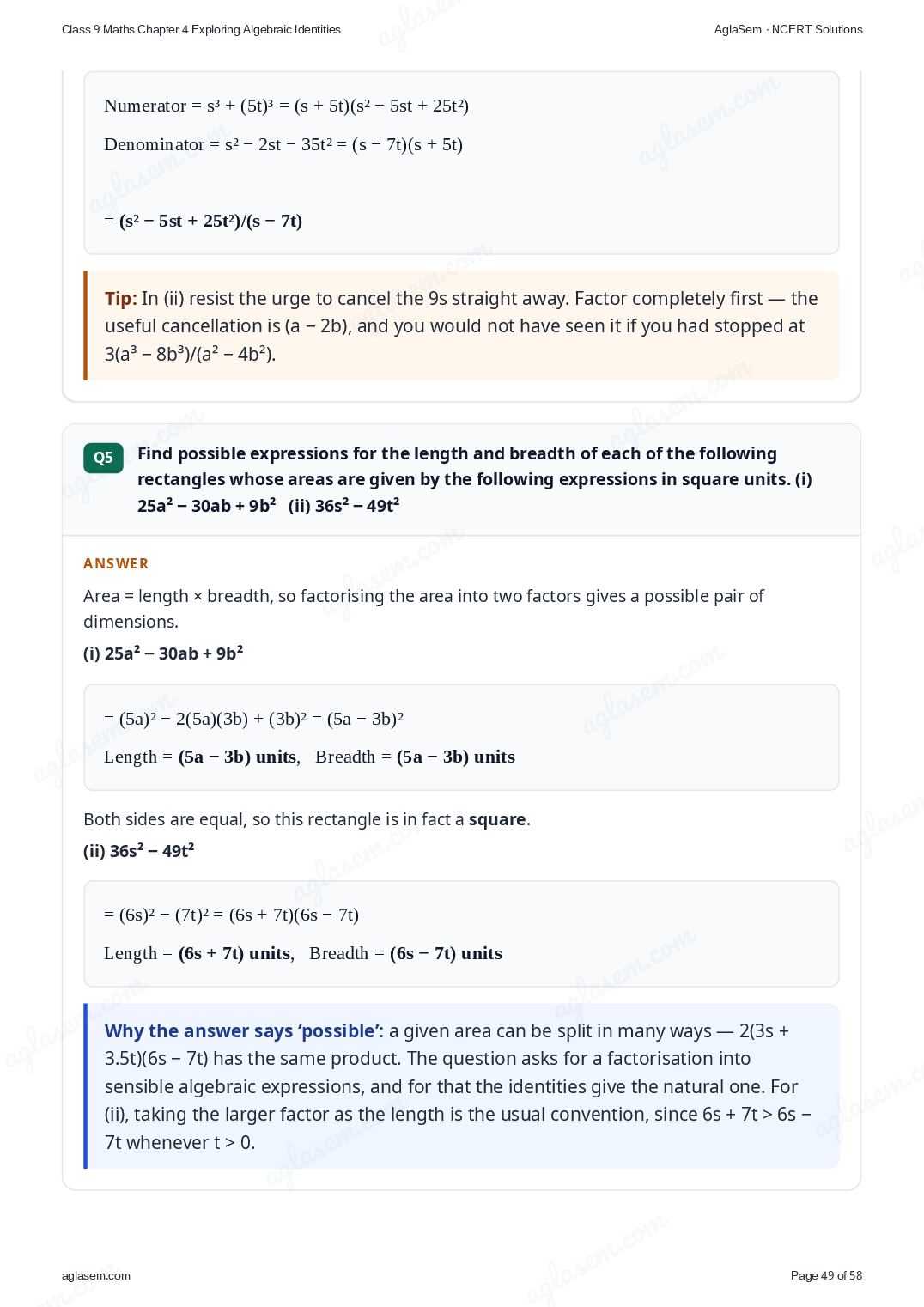
- Find possible expressions for the length and breadth of each of the following rectangles whose areas are given by the following expressions in square units. (i) 25a² − 30ab + 9b² (ii) 36s² − 49t²
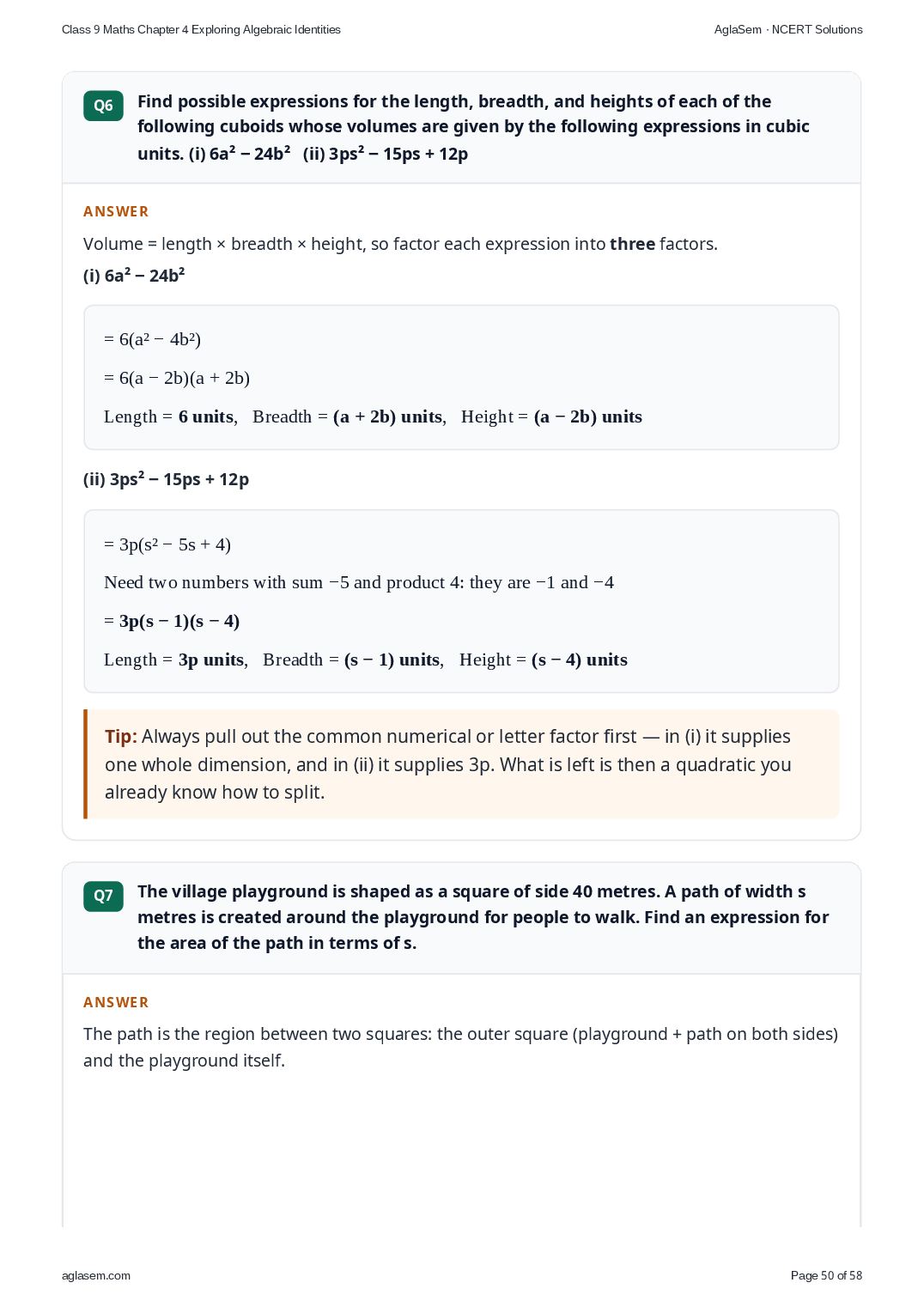
- Find possible expressions for the length, breadth, and heights of each of the following cuboids whose volumes are given by the following expressions in cubic units. (i) 6a² − 24b² (ii) 3ps² − 15ps + 12p
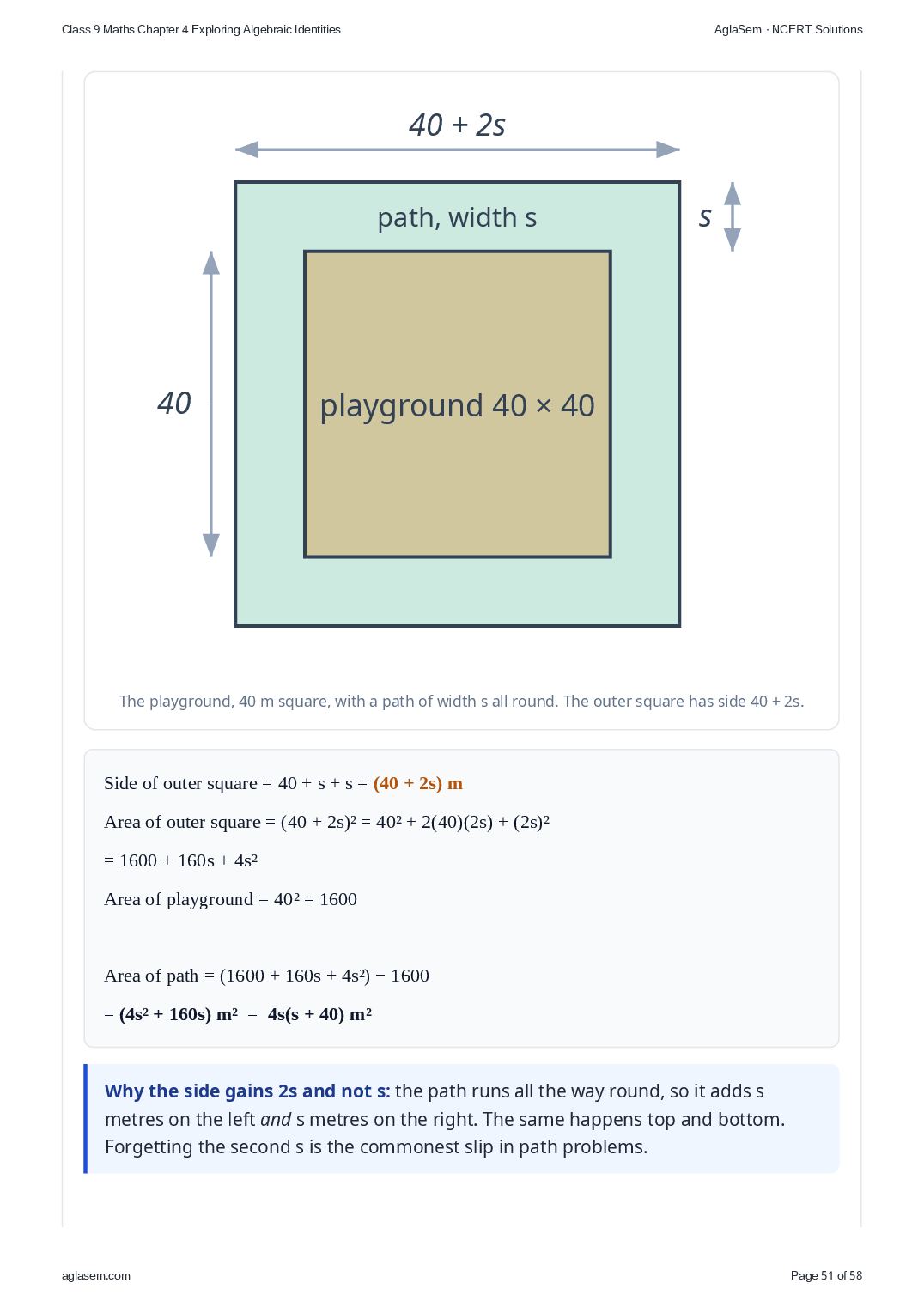
- The village playground is shaped as a square of side 40 metres. A path of width s metres is created around the playground for people to walk. Find an expression for the area of the path in terms of s.
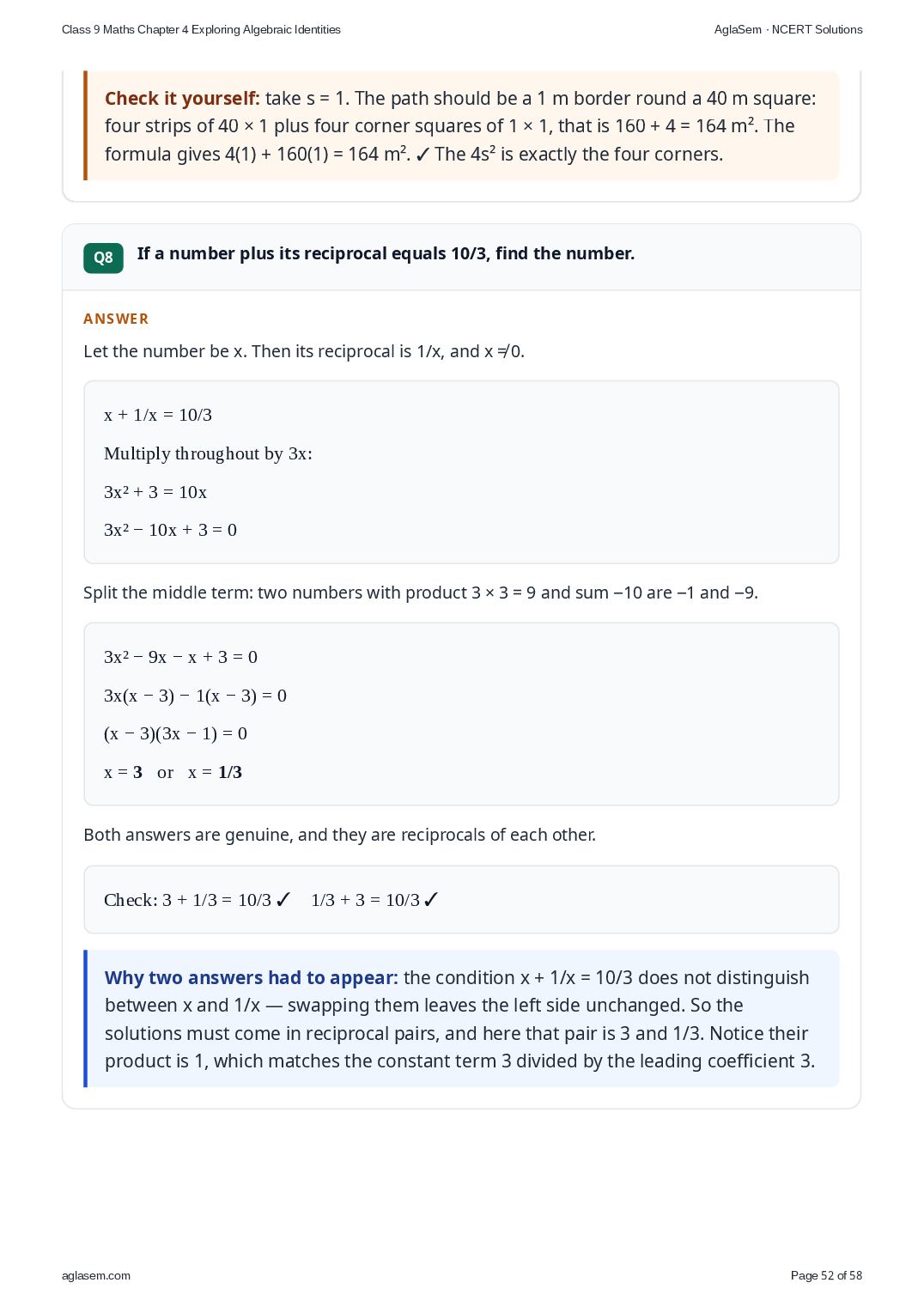
- If a number plus its reciprocal equals 10/3, find the number.
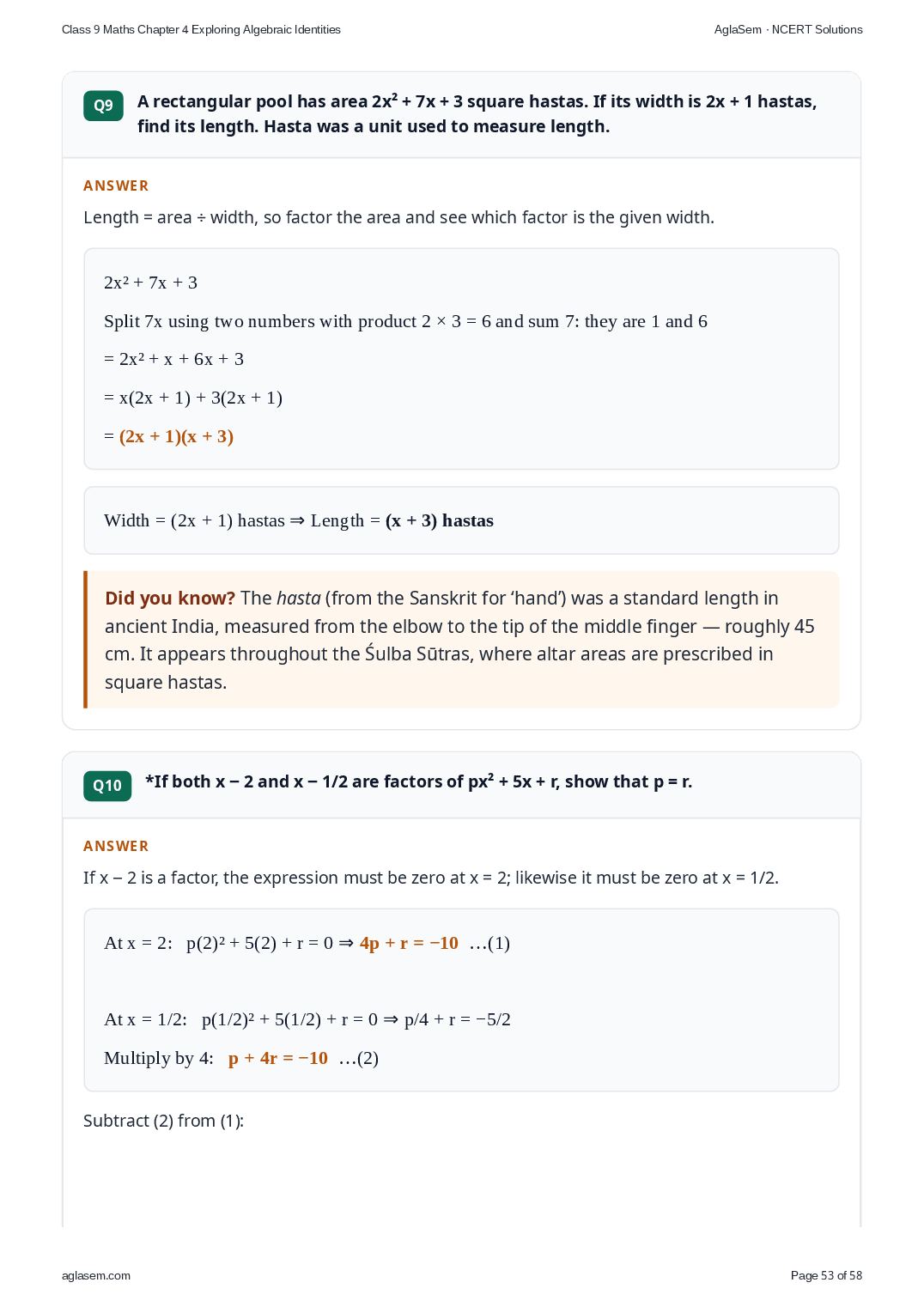
- A rectangular pool has area 2x² + 7x + 3 square hastas. If its width is 2x + 1 hastas, find its length. Hasta was a unit used to measure length.
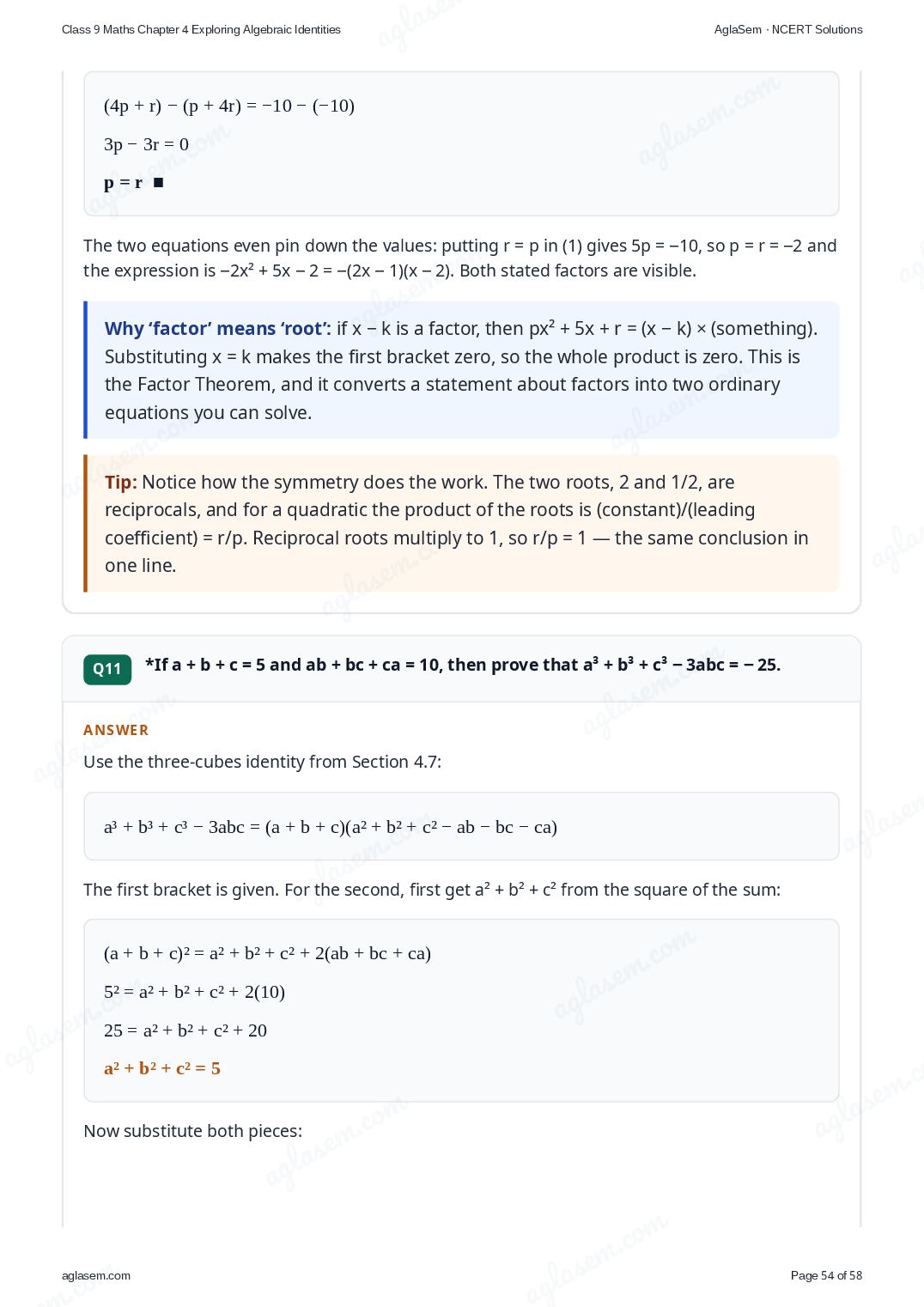
- *If both x − 2 and x − 1/2 are factors of px² + 5x + r, show that p = r.
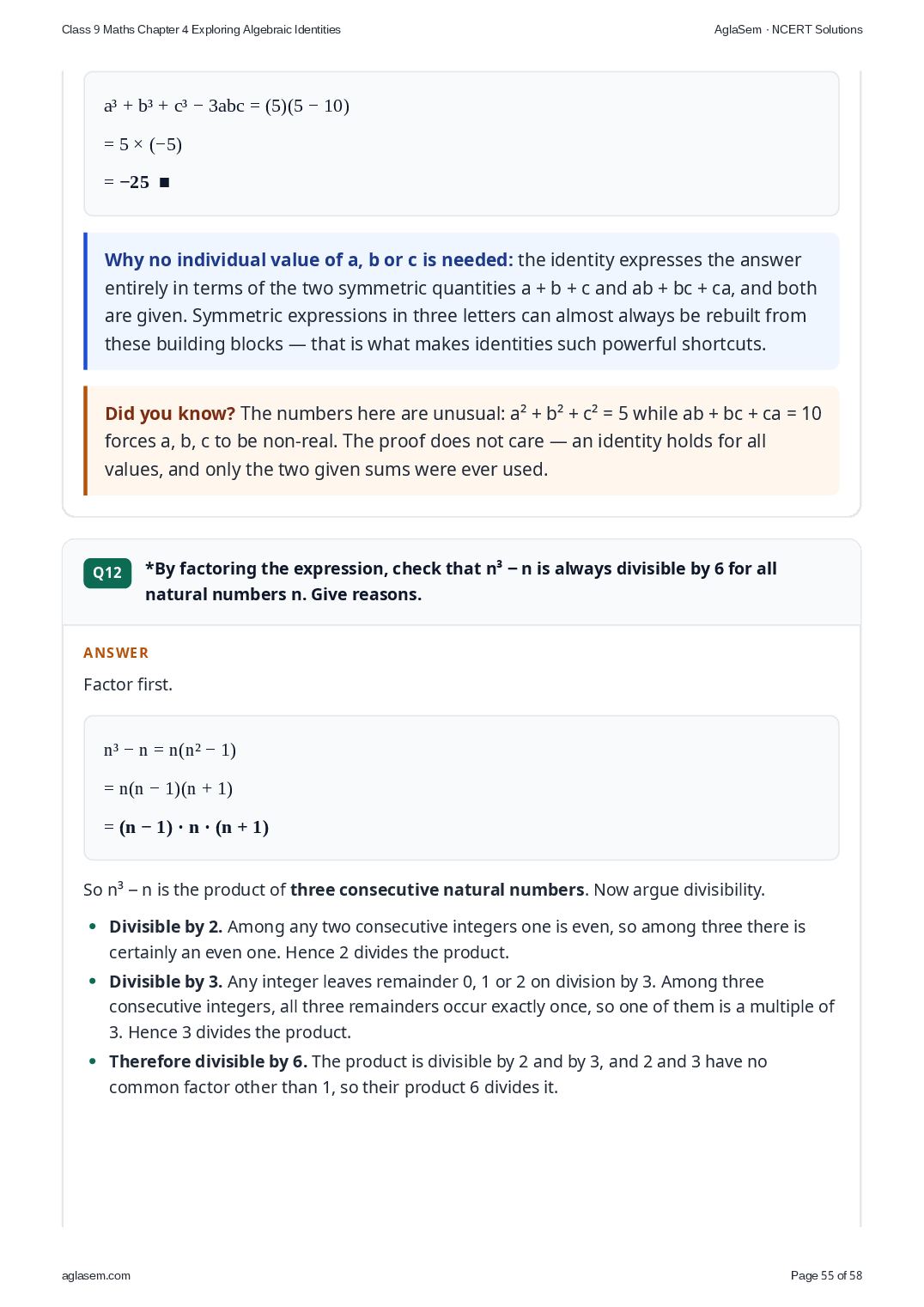
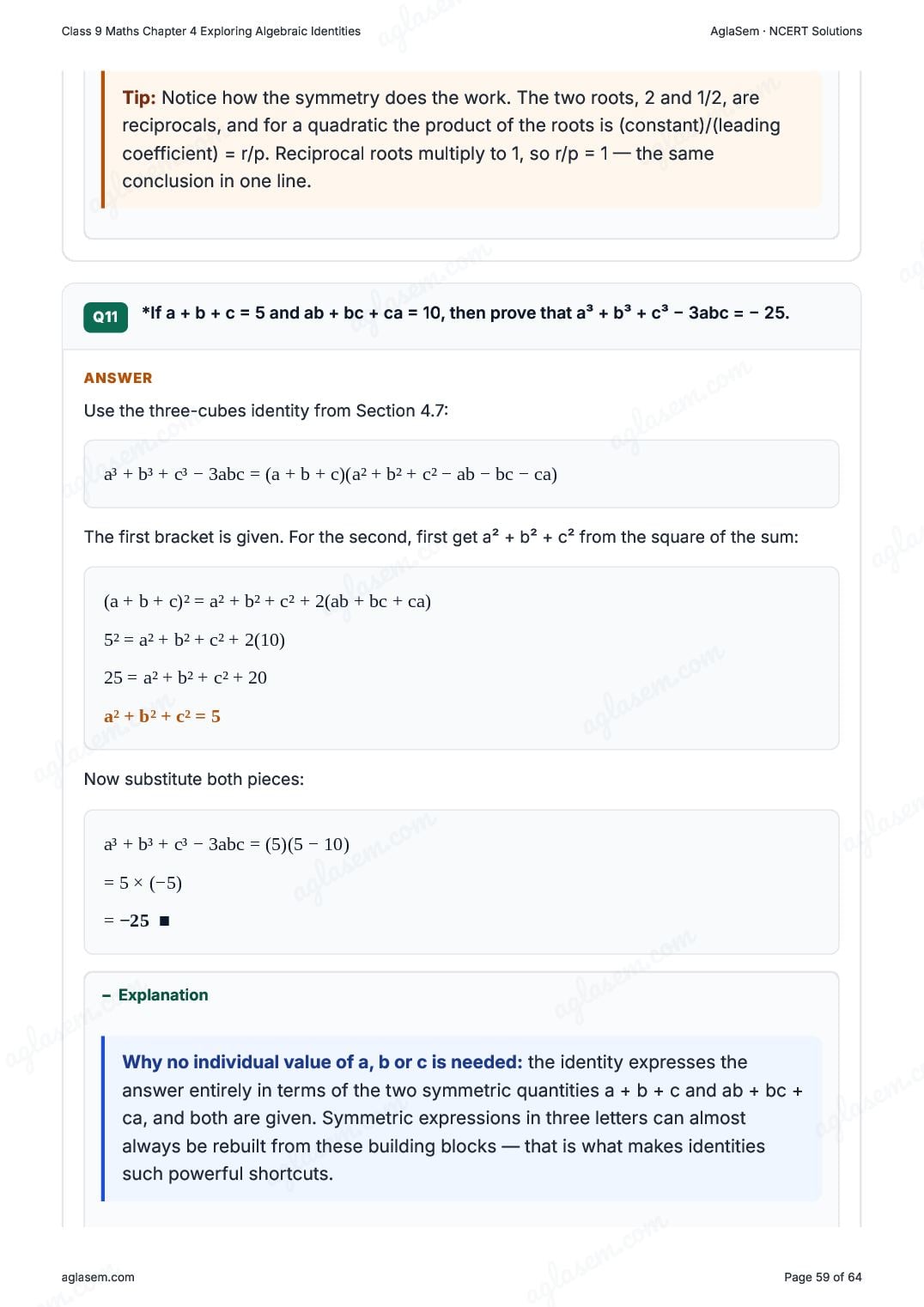
- *If a + b + c = 5 and ab + bc + ca = 10, then prove that a³ + b³ + c³ − 3abc = − 25.
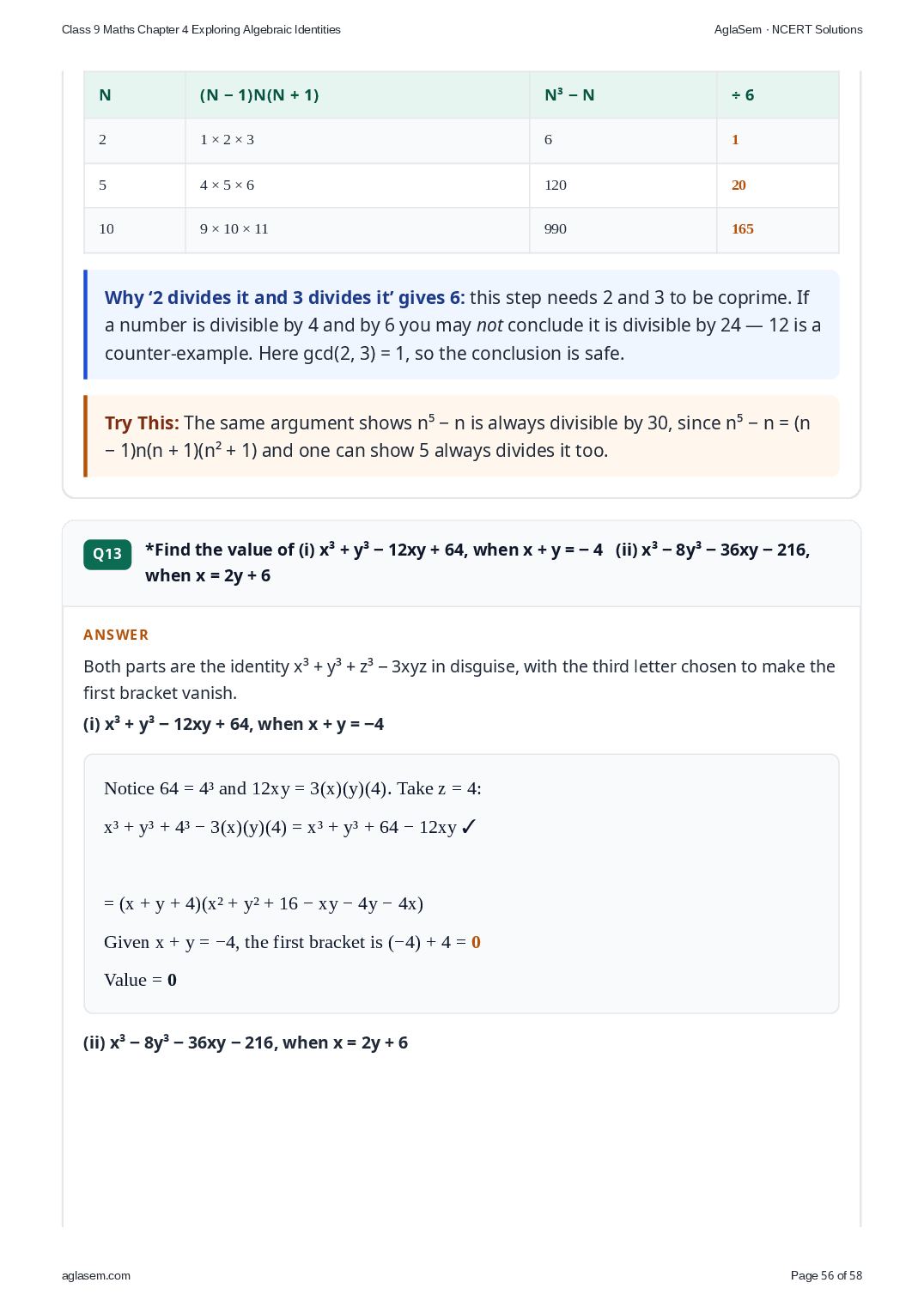
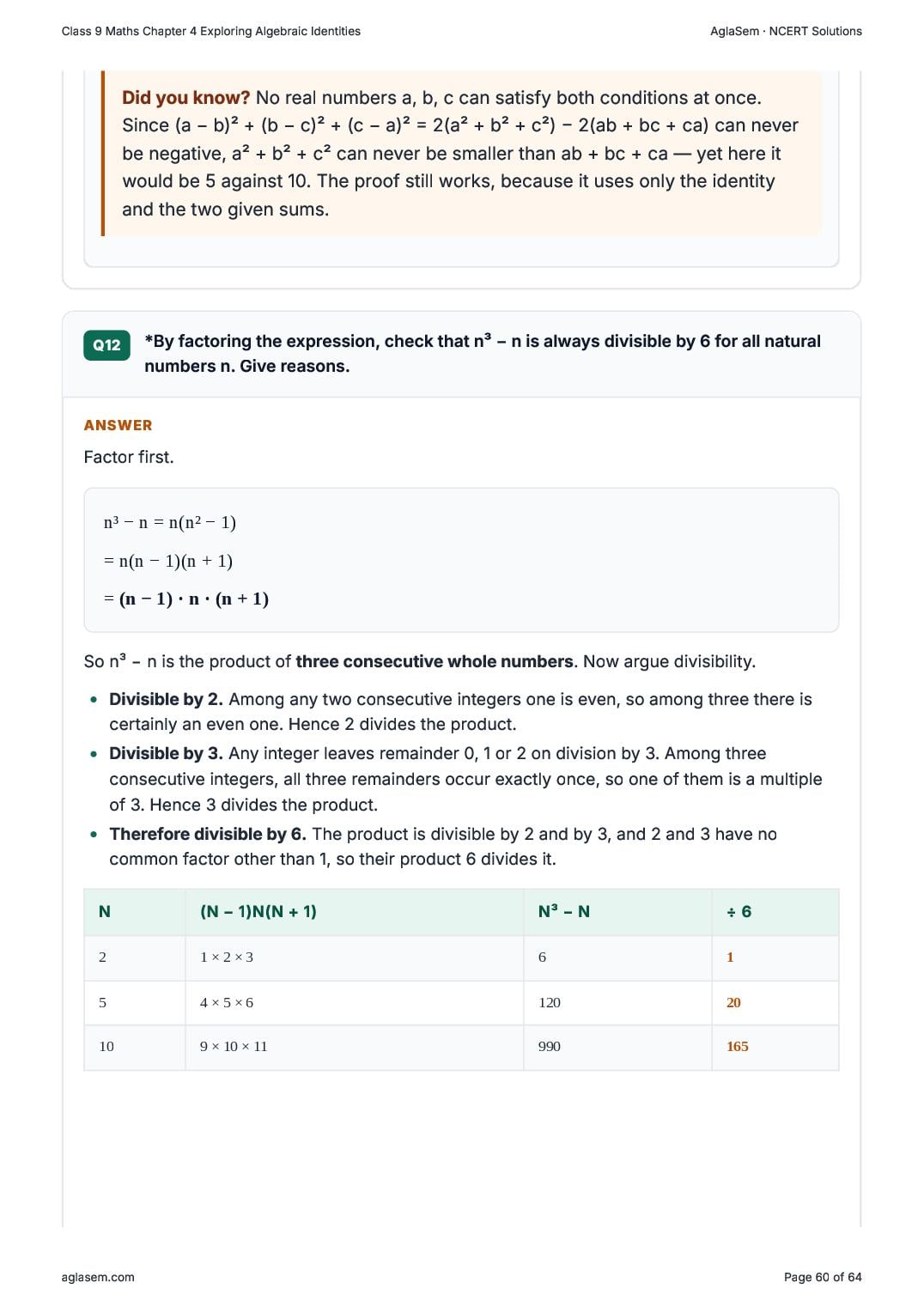
- *By factoring the expression, check that n³ − n is always divisible by 6 for all natural numbers n. Give reasons.
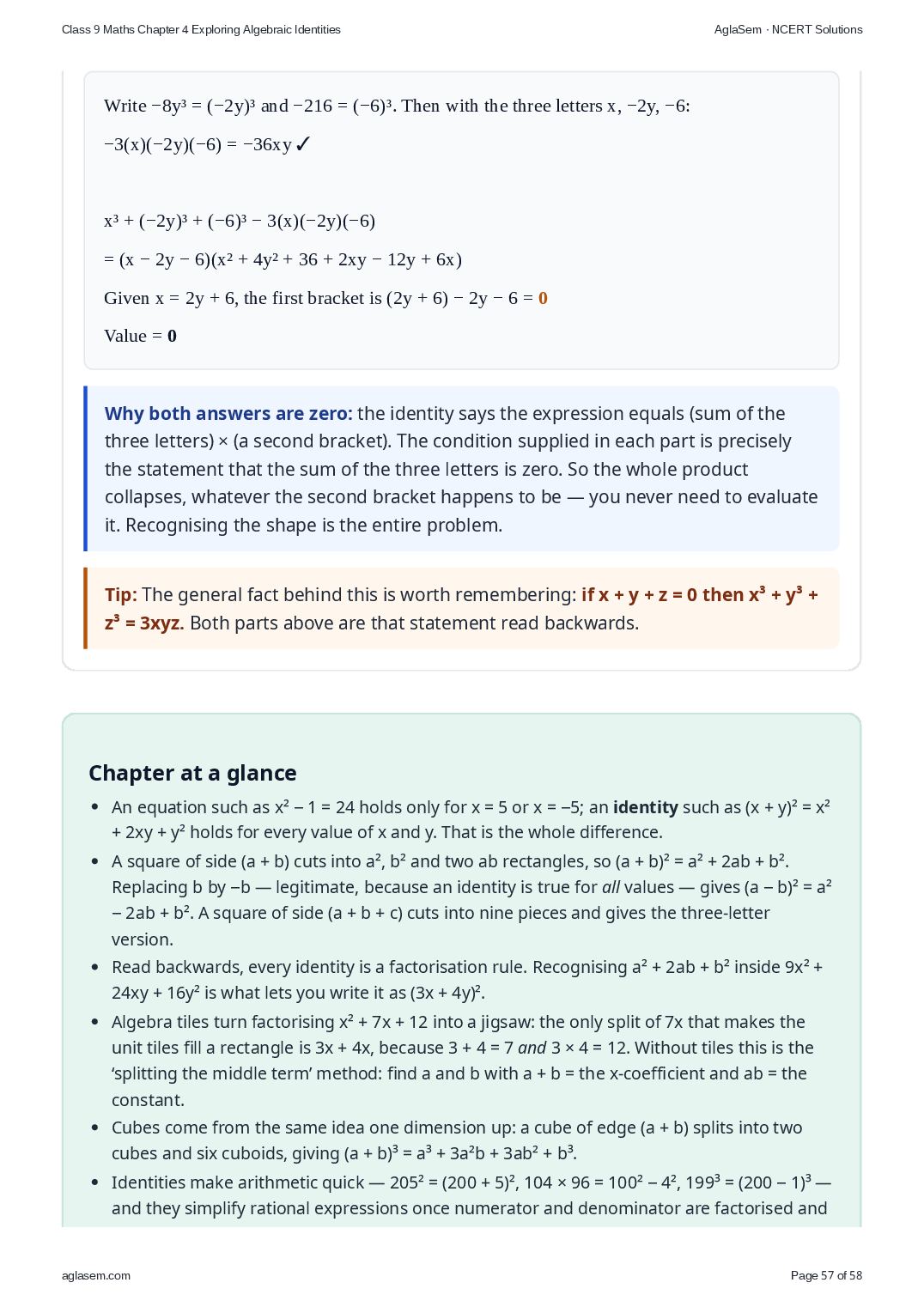
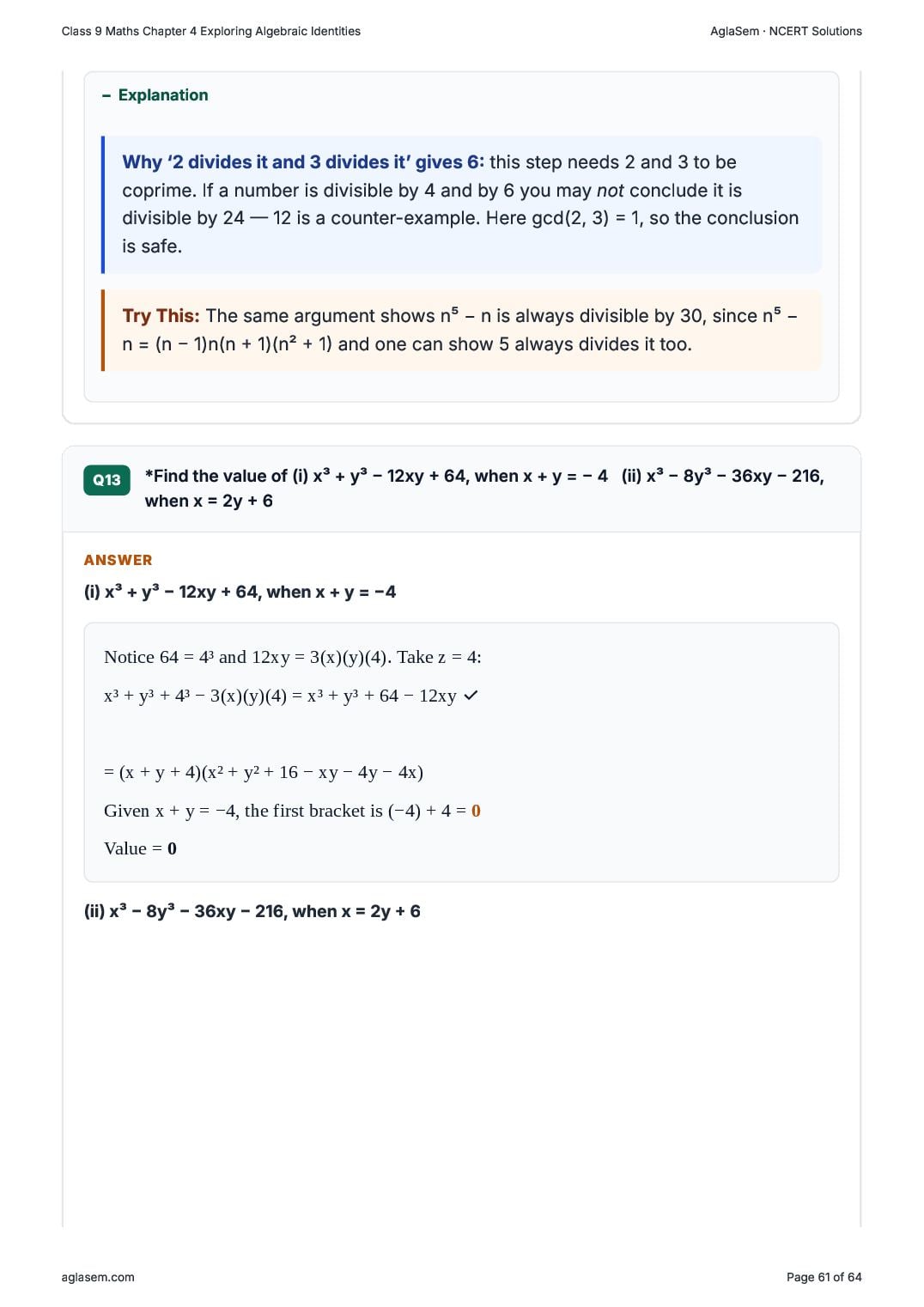
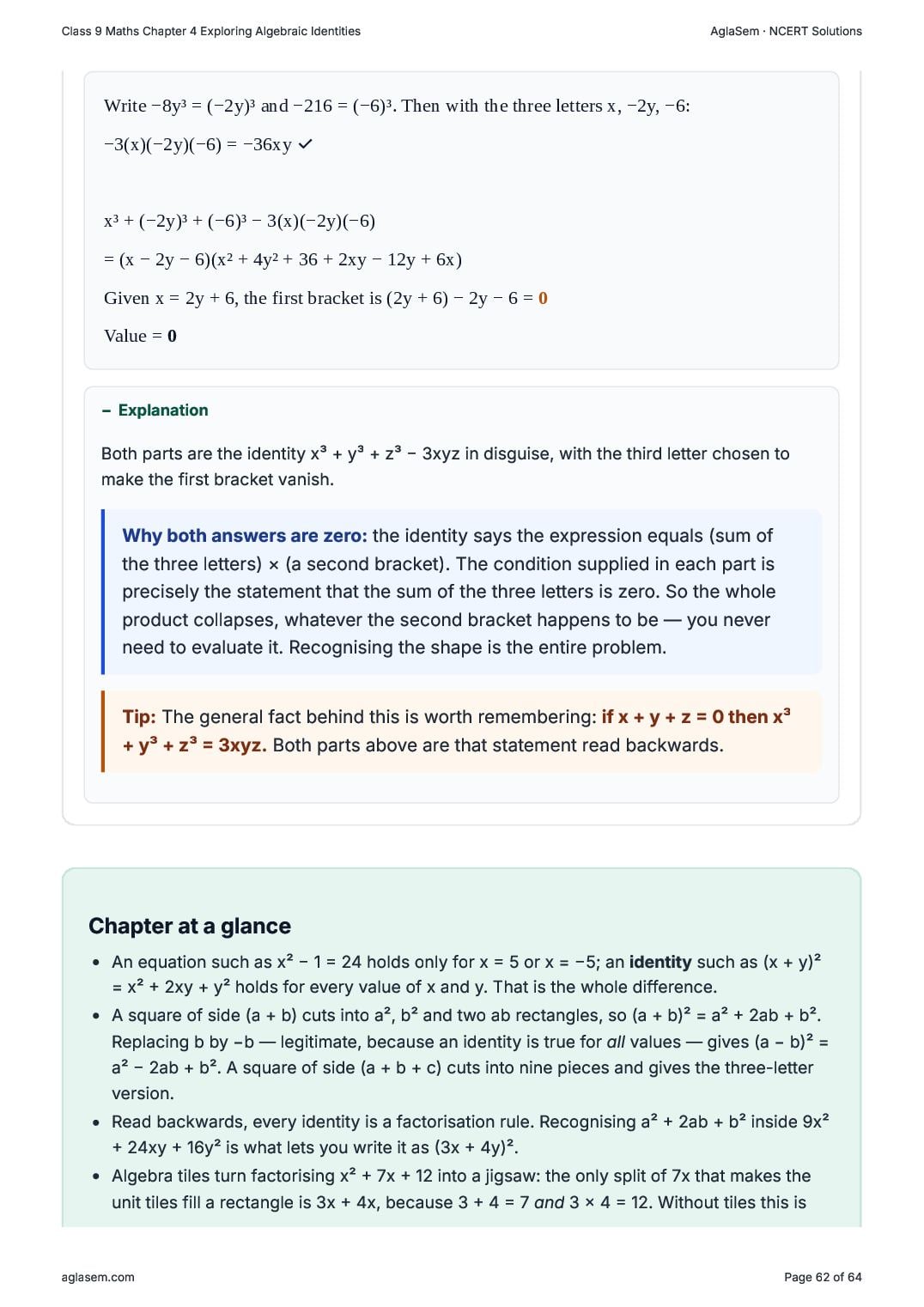
- *Find the value of (i) x³ + y³ − 12xy + 64, when x + y = − 4 (ii) x³ − 8y³ − 36xy − 216, when x = 2y + 6
Chapter at a Glance
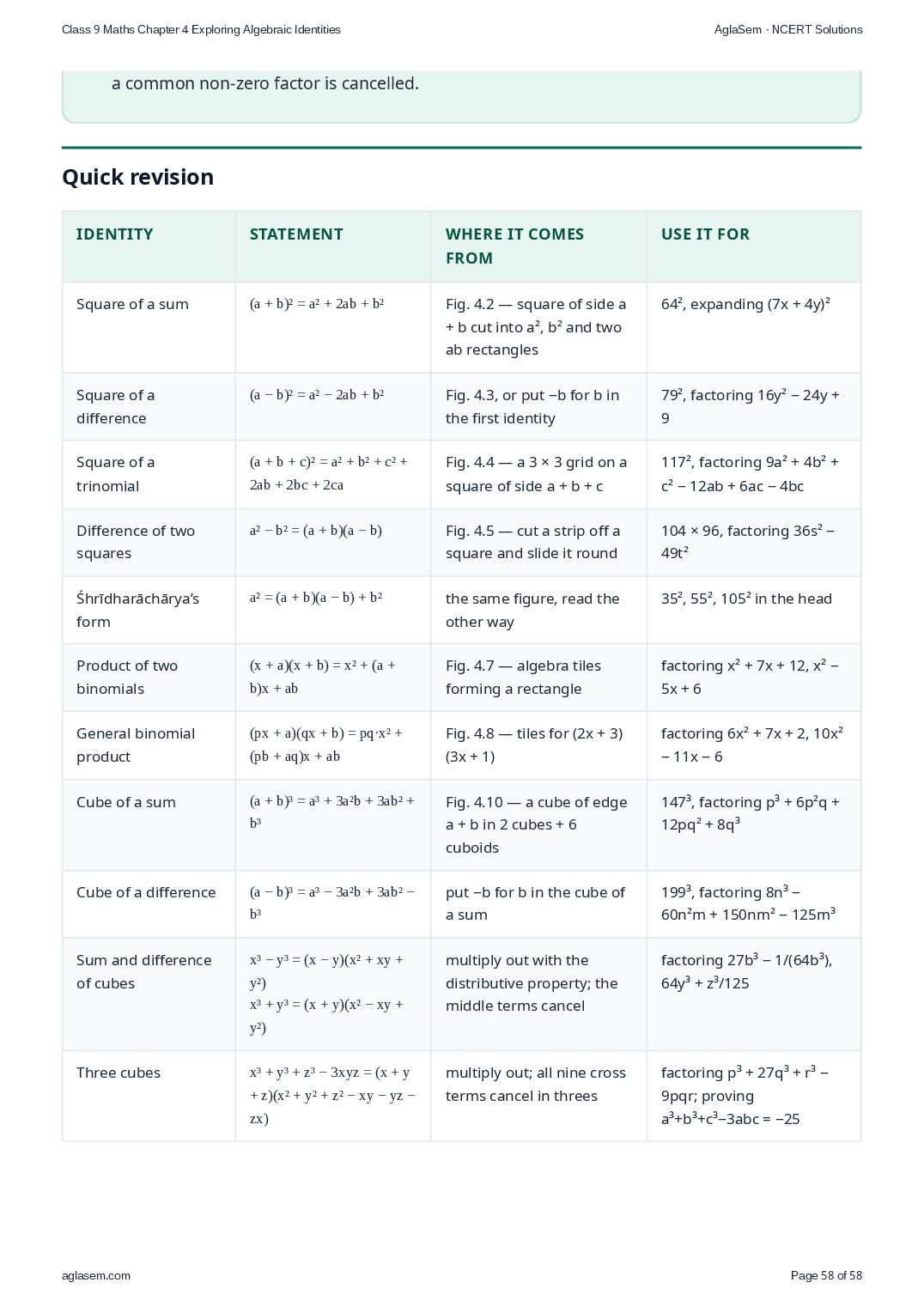
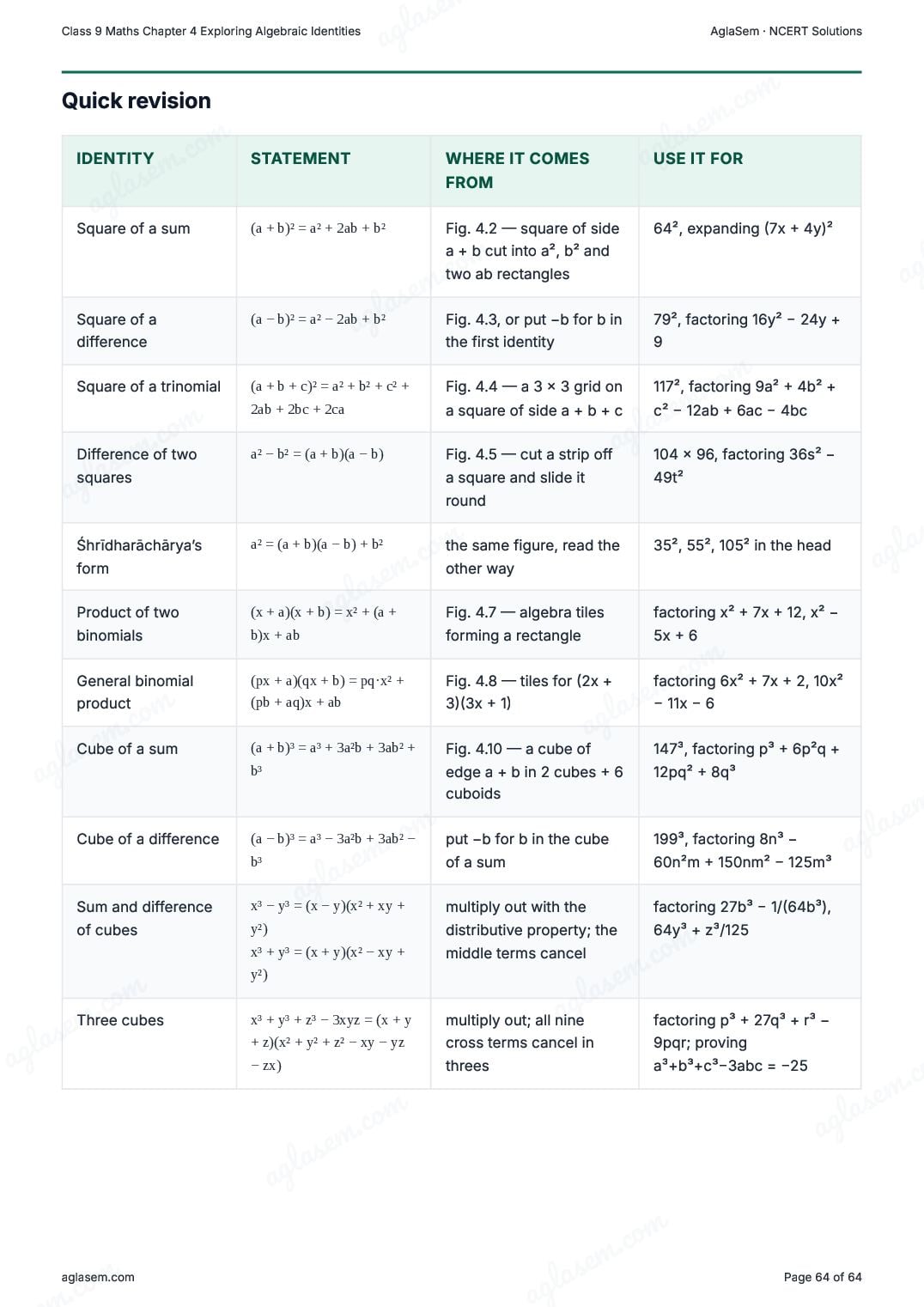
- An equation such as x² − 1 = 24 holds only for x = 5 or x = −5; an identity such as (x + y)² = x² + 2xy + y² holds for every value of x and y. That is the whole difference.
- A square of side (a + b) cuts into a², b² and two ab rectangles, so (a + b)² = a² + 2ab + b². Replacing b by −b — legitimate, because an identity is true for all values — gives (a − b)² = a² − 2ab + b². A square of side (a + b + c) cuts into nine pieces and gives the three-letter version.
- Read backwards, every identity is a factorisation rule. Recognising a² + 2ab + b² inside 9x² + 24xy + 16y² is what lets you write it as (3x + 4y)².
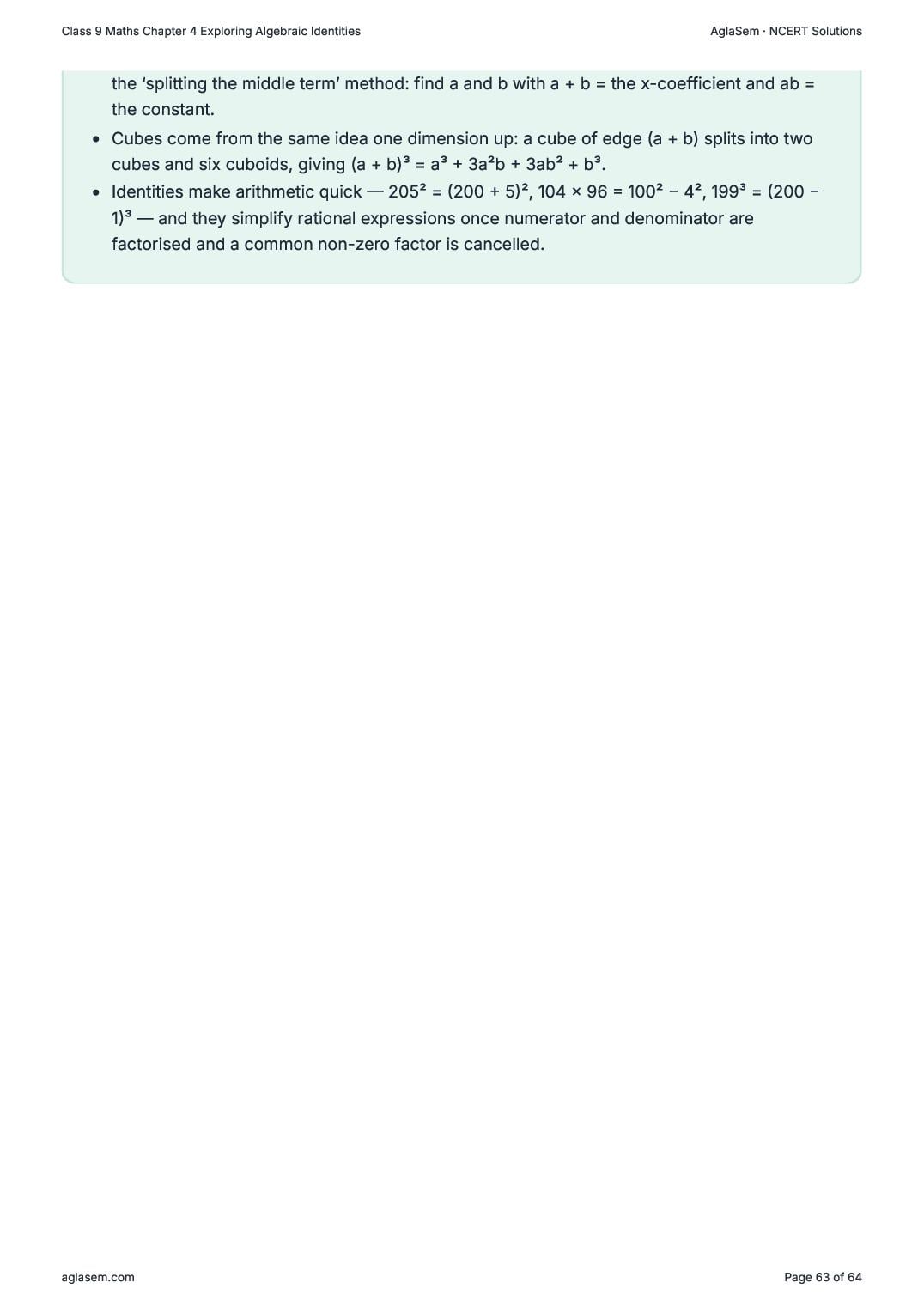
- Algebra tiles turn factorising x² + 7x + 12 into a jigsaw: the only split of 7x that makes the unit tiles fill a rectangle is 3x + 4x, because 3 + 4 = 7 and 3 × 4 = 12. Without tiles this is the ‘splitting the middle term’ method: find a and b with a + b = the x-coefficient and ab = the constant.
- Cubes come from the same idea one dimension up: a cube of edge (a + b) splits into two cubes and six cuboids, giving (a + b)³ = a³ + 3a²b + 3ab² + b³.
- Identities make arithmetic quick — 205² = (200 + 5)², 104 × 96 = 100² − 4², 199³ = (200 − 1)³ — and they simplify rational expressions once numerator and denominator are factorised and a common non-zero factor is cancelled.
How to Download NCERT Solutions for Class 9 Maths Chapter 4 PDF
Follow these simple steps to get the Exploring Algebraic Identities questions-and-answers PDF from Ganita Manjari.
- Search NCERT Solutions for Class 9 Maths Chapter 4 aglasem and open this page.
- Read the exercise questions with answers for Exploring Algebraic Identities shown above.
- Click the Download PDF link to save the Exploring Algebraic Identities solutions to your device.
NCERT Solutions for Class 9 Maths – All Chapters
There are more chapters to study besides Exploring Algebraic Identities in Maths. Here are the NCERT Solutions for all chapters of Class 9 Maths.
- Chapter 1 Orienting Yourself the Use of Coordinates
- Chapter 2 Introduction to Linear Polynomials
- Chapter 3 The World of Numbers
- Chapter 4 Exploring Algebraic Identities
- Chapter 5 I M Up and Down and Round and Round
- Chapter 6 Measuring Space Perimeter and Area
- Chapter 7 The Mathematics of Maybe Introduction to Probability
- Chapter 8 Predicting What Comes Next Exploring Sequences and Progressions
NCERT Solutions for Class 9 – All Subjects
Just like Chapter 4 of Maths, you can get the exercise questions with answers for every other subject of Class 9. Here are the NCERT Solutions for all subjects of Class 9.
NCERT Solutions for Class 9 Maths Chapter 4 – An Overview
The key highlights of this study material are as follows.
| Aspects | Details |
|---|---|
| Class | Class 9 |
| Subject | Maths |
| Chapter Number | Chapter 4 |
| Chapter Name | Exploring Algebraic Identities |
| Book Name | Ganita Manjari |
| Book By | NCERT (National Council of Educational Research and Training) |
| Educational Resource Here | NCERT Solutions of Class 9 Maths Chapter 4 for all exercises |
| More Questions Answers of This Subject | NCERT Solutions for Class 9 Maths |
| Download Book Chapter | NCERT Book Class 9 Maths |
| All Questions Answers For This Class | NCERT Solutions for Class 9 |
| Complete Solutions | NCERT Solutions |
NCERT Solutions for Class 9 Maths Chapter 4 Exploring Algebraic Identities – FAQs
What are the NCERT Solutions for Class 9 Maths Chapter 4 Exploring Algebraic Identities?
They are the complete, step-by-step answers to all the exercise and in-text questions of Chapter 4 Exploring Algebraic Identities from the NCERT Class 9 Maths textbook Ganita Manjari, written by experts as per the latest NCERT syllabus.
How can I download the Class 9 Maths Chapter 4 solutions PDF for free?
Open this page on aglasem, read the Exploring Algebraic Identities questions with answers, and click the “Download Solutions PDF” link. The Class 9 Maths Chapter 4 NCERT Solutions PDF is completely free to download.
Are these NCERT Solutions as per the latest 2026-27 syllabus?
Yes. The NCERT Solutions for Class 9 Maths Chapter 4 are based on the latest NCERT textbook Ganita Manjari and the current 2026-27 CBSE syllabus, so the questions and answers match what you study in class.
Where can I get NCERT Solutions for the other chapters of Class 9 Maths?
You can find the answers to every chapter on the NCERT Solutions for Class 9 Maths page, and solutions for every subject on the NCERT Solutions for Class 9 page.
How do NCERT Solutions help in exam preparation?
They show the correct method to solve each question, help you write answers the way they are expected in exams, let you check and correct your own work, and save revision time — which together improve your marks in Class 9 Maths.
If you have any queries on NCERT Solutions for Class 9 Maths Chapter 4 Exploring Algebraic Identities, then please ask in the comments below.