NCERT Solutions for Class 2 Maths Joyful Mathematics Chapter 11 Data Handling – step-by-step answers to every exercise and in-text question of the chapter, as per the latest NCERT syllabus for 2027. Read them online or download the free question-answer PDF.
This chapter is about collecting and reading data. We count, fill tables and draw faces in a chart.
NCERT Solutions for Class 2 Maths Joyful Mathematics Chapter 11 Data Handling PDF
All the answers are on this page below. The PDF also explains every answer – why it is right and how to check it – so download it for revision.
| Chapter | Download | |
|---|---|---|
| Solutions PDF (English medium) | Data Handling | View PDF |
| Solutions PDF (Hindi medium) | आँकड़ों के साथ कार्य | View PDF |
NCERT Solutions for Class 2 Maths Joyful Mathematics Chapter 11 Data Handling – Questions and Answers
All 72 questions of the chapter (textbook pages 123 – 129) are answered below, in the order of the book – in-text questions, activities and the end-of-chapter exercises. Each answer is written the way you would write it in the exam.
Let us Do — Page 123Favourite Colours
| Colours | Red | Green | Blue | Yellow |
|---|---|---|---|---|
| Number of Children |
Red 1, Green 3, Blue 4, Yellow 2
| Colours | Red | Green | Blue | Yellow |
|---|---|---|---|---|
| Number of Children | 1 | 3 | 4 | 2 |
- Count the children in red: 1.
- Then count green, blue and yellow.
- Check: 1 + 3 + 4 + 2 = 10 children.
A. The most liked colour is ______________________.
The most liked colour is blue.
- Blue has 4 children.
- 4 is the biggest number.
B. The least liked colour is ______________________.
The least liked colour is red.
- Red has only 1 child.
- 1 is the smallest number.
C. Yellow colour is liked more than ______________________.
Yellow colour is liked more than red.
- Yellow has 2 children.
- Red has 1 child.
D. ____________________ colour is liked more than green.
Blue colour is liked more than green.
- Blue has 4 children.
- Green has 3 children.
E. _______________ colour is liked less than _______________.
Red colour is liked less than green.
- Red has 1 child.
- Green has 3 children.
Let us Do — Page 124Picnic Day
Complete the table and fill in the blanks.
| Fruits | Banana | Orange | Apple | Kiwi | Guava |
|---|---|---|---|---|---|
| Number of Children |
Banana 5, Orange 2, Apple 2, Kiwi 1, Guava 3
| Fruits | Banana | Orange | Apple | Kiwi | Guava |
|---|---|---|---|---|---|
| Number of Children | 5 | 2 | 2 | 1 | 3 |
- Look at the fruit each child holds.
- Count one fruit at a time.
- Check: 5 + 2 + 2 + 1 + 3 = 13.
Complete the table and fill in the blanks.
A. How many children are there in the picture? ____________.
There are 13 children.
- Count the top row: 8.
- Count the bottom row: 5.
- 8 and 5 make 13.
Complete the table and fill in the blanks.
B. Number of children who like apples is _______________.
Number of children who like apples is 2.
- Find the red apples.
- Two children hold an apple.
Complete the table and fill in the blanks.
C. Most liked fruit is _______________.
Most liked fruit is banana.
- Banana has 5 children.
- 5 is the biggest number.
Complete the table and fill in the blanks.
D. Least liked fruit is _______________.
Least liked fruit is kiwi.
- Kiwi has only 1 child.
- 1 is the smallest number.
Complete the table and fill in the blanks.
E. Number of children who like guava is _______________ (more than/less than/equal to) the number of children who like apple.
It is more than.
- Guava has 3 children.
- Apple has 2 children.
Complete the table and fill in the blanks.
F. The number of children who like apple is _______________ (more than/less than/equal to) the number of children who like banana.
It is less than.
- Apple has 2 children.
- Banana has 5 children.
Complete the table and fill in the blanks.
G. The number of children who like orange _______________ (more than/less than/equal to) the number of children who like kiwi.
It is more than.
- Orange has 2 children.
- Kiwi has 1 child.
In-text Questions — Page 125How we come to school
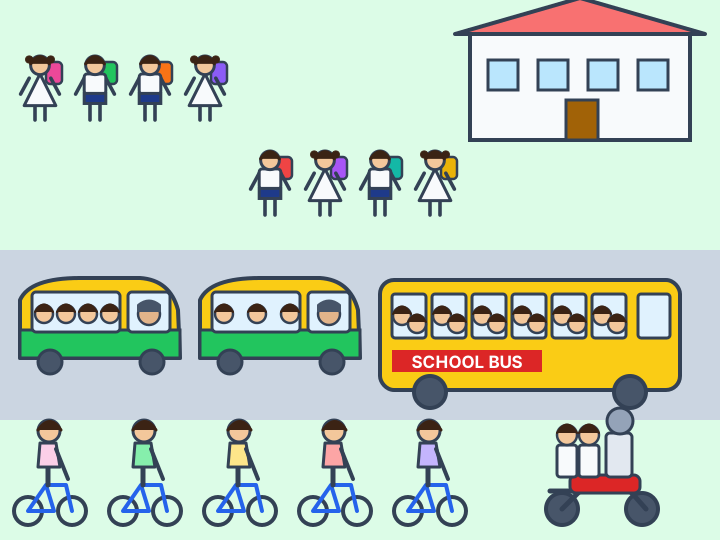
| Mode of coming to school | Number of students |
|---|---|
| On foot | 8 |
| Autorickshaw | |
| Bicycle | |
| Bike | |
| Bus |
On foot 8, Autorickshaw 7, Bicycle 5, Bike 2, Bus 12
| Mode of coming to school | Number of students |
|---|---|
| On foot | 8 |
| Autorickshaw | 7 |
| Bicycle | 5 |
| Bike | 2 |
| Bus | 12 |
- Autos: 4 + 3 = 7.
- Bus: 6 windows, 2 in each = 12.
- Bicycles: 5. Bike: 2 children.
In-text Questions — Page 126A chart of faces: how we come to school
| Mode of coming to school | Number of students |
|---|---|
| On foot | 8 |
| Autorickshaw | 7 |
| Bicycle | 5 |
| Bike | 2 |
| Bus | 12 |
Draw 7 faces for autorickshaw, 12 for bus, 2 for bike and 5 for bicycle.
- Draw one face for each student, in a straight line.
A. Most number of students come to school by _________.
Most number of students come to school by bus.
- The bus line is the tallest.
- It has 12 faces.
B. Least number of students come to school by ________.
Least number of students come to school by bike.
- The bike line is the shortest.
- It has only 2 faces.
C. The number of students who come to school using bus is ________________ (less/more) than the number of students who come using autorickshaw.
It is more.
- Bus has 12 faces.
- Autorickshaw has 7 faces.
D. The number of students who come to school using bike is _________ (more/less) than the number of students who come using bicycle.
It is less.
- Bike has 2 faces.
- Bicycle has 5 faces.
E. The number of students who come to school using ________ is less than the number of students who come using _________.
The number of students who come using bike is less than those who come using on-foot.
- Bike has 2 faces.
- On-foot has 8 faces. 2 is less than 8.
F. The number of students who come to school using ____________ is more than the number of students who come using ________________.
The number of students who come using bus is more than those who come using bicycle.
- Bus has 12 faces.
- Bicycle has 5 faces. 12 is more than 5.
Let us Do — Page 127Games we Play
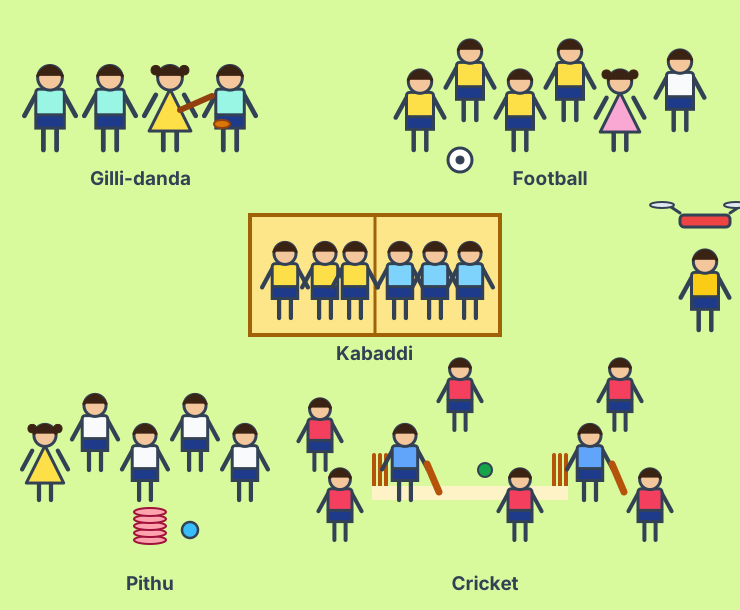
| Games | Number of Students |
|---|---|
| Cricket | |
| Football | |
| Pithu | |
| Gilli-danda | |
| Kabaddi |
Cricket 8, Football 6, Pithu 5, Gilli-danda 4, Kabaddi 6
| Games | Number of Students |
|---|---|
| Cricket | 8 |
| Football | 6 |
| Pithu | 5 |
| Gilli-danda | 4 |
| Kabaddi | 6 |
- Find each game and count its players.
- Do not count the child with the drone.
- Check: 8 + 6 + 5 + 4 + 6 = 29.
In-text Questions — Page 128A chart of faces: games we play
| Games | Number of Students |
|---|---|
| Cricket | 8 |
| Football | 6 |
| Pithu | 5 |
| Gilli-danda | 4 |
| Kabaddi | 6 |
Draw 4 faces for Gilli-danda, 6 for Kabaddi, 5 for Pithu, 6 for football and 8 for cricket.
- Careful: the chart order is not the table order.
The most liked game is cricket.
- Cricket has the tallest line.
- It has 8 faces.
The least liked game is gilli-danda.
- Gilli-danda has the shortest line.
- It has 4 faces.
Pithu is liked more than gilli-danda.
- Pithu has 5 faces.
- Gilli-danda has 4 faces.
Cricket is liked more than football.
- Cricket has 8 faces.
- Football has 6 faces.
Let us Do — Page 128Vegetables we like · People in our homes (pages 128–129)
| Vegetable they like | ||||
| Number of children |
Ask, count, then fill the table.
| Vegetable they like | Potato | Tomato | Carrot | Peas |
| Number of children | 9 | 6 | 4 | 3 |
- Write four vegetable names in the top row.
- Ask each friend which one they like most.
- Count the answers for each vegetable.
i. Most liked vegetable is _________.
| Vegetable they like | ||||
| Number of children |
Most liked vegetable is potato.
| Vegetable they like | Potato | Tomato | Carrot | Peas |
| Number of children | 9 | 6 | 4 | 3 |
- Look for the biggest number.
- Potato has 9 children.
ii. Least liked vegetable is _________.
| Vegetable they like | ||||
| Number of children |
Least liked vegetable is peas.
| Vegetable they like | Potato | Tomato | Carrot | Peas |
| Number of children | 9 | 6 | 4 | 3 |
- Look for the smallest number.
- Peas has 3 children.
iii. _________ is liked more than _________.
| Vegetable they like | ||||
| Number of children |
Tomato is liked more than carrot.
| Vegetable they like | Potato | Tomato | Carrot | Peas |
| Number of children | 9 | 6 | 4 | 3 |
- Tomato has 6 children.
- Carrot has 4 children.
iv. _________ is liked less than _________.
| Vegetable they like | ||||
| Number of children |
Peas is liked less than carrot.
| Vegetable they like | Potato | Tomato | Carrot | Peas |
| Number of children | 9 | 6 | 4 | 3 |
- Peas has 3 children.
- Carrot has 4 children.
| Number of people living together | How many families |
|---|---|
| 1 People | |
| 2 People | |
| 3 People | |
| 4 People | |
| 5 People | |
| ______ | |
| ______ |
Ask, count, then fill the table.
| Number of people living together | How many families |
|---|---|
| 1 People | 0 |
| 2 People | 1 |
| 3 People | 4 |
| 4 People | 7 |
| 5 People | 3 |
| 6 People | 2 |
| 7 People | 1 |
- Ask each friend: how many people live at home?
- Add 1 next to that number.
- Use the empty rows for 6 or 7 people.
i. Most families have ______ people in their homes.
| Number of people living together | How many families |
|---|---|
| 1 People | |
| 2 People | |
| 3 People | |
| 4 People | |
| 5 People | |
| ______ | |
| ______ |
Most families have 4 people in their homes.
| Number of people living together | How many families |
|---|---|
| 1 People | 0 |
| 2 People | 1 |
| 3 People | 4 |
| 4 People | 7 |
| 5 People | 3 |
| 6 People | 2 |
| 7 People | 1 |
- Look at ‘How many families’.
- The biggest number is 7.
- Those 7 families have 4 people.
ii. The least number of people living in a home is ______.
| Number of people living together | How many families |
|---|---|
| 1 People | |
| 2 People | |
| 3 People | |
| 4 People | |
| 5 People | |
| ______ | |
| ______ |
The least number of people living in a home is 2.
| Number of people living together | How many families |
|---|---|
| 1 People | 0 |
| 2 People | 1 |
| 3 People | 4 |
| 4 People | 7 |
| 5 People | 3 |
| 6 People | 2 |
| 7 People | 1 |
- No family has only 1 person.
- The smallest family has 2 people.
iii. The number of families having 4 people is ______.
| Number of people living together | How many families |
|---|---|
| 1 People | |
| 2 People | |
| 3 People | |
| 4 People | |
| 5 People | |
| ______ | |
| ______ |
The number of families having 4 people is 7.
| Number of people living together | How many families |
|---|---|
| 1 People | 0 |
| 2 People | 1 |
| 3 People | 4 |
| 4 People | 7 |
| 5 People | 3 |
| 6 People | 2 |
| 7 People | 1 |
- Find the row for 4 People.
- Read across: 7 families.
iv. The number of families having more than 4 people is ______.
| Number of people living together | How many families |
|---|---|
| 1 People | |
| 2 People | |
| 3 People | |
| 4 People | |
| 5 People | |
| ______ | |
| ______ |
The number of families having more than 4 people is 6.
| Number of people living together | How many families |
|---|---|
| 1 People | 0 |
| 2 People | 1 |
| 3 People | 4 |
| 4 People | 7 |
| 5 People | 3 |
| 6 People | 2 |
| 7 People | 1 |
- More than 4 means 5, 6 or 7 people (not 4).
- Add: 3 + 2 + 1 = 6.
Project Work — Page 129Families and grandparents
| Families living with | Both grandparents | Only female grandparents | Only male grandparents | No grandparents |
|---|---|---|---|---|
| Number of Families |
Visit, ask, then fill the table.
| Families living with | Both grandparents | Only female grandparents | Only male grandparents | No grandparents |
|---|---|---|---|---|
| Number of Families | 3 | 2 | 1 | 4 |
- First, plan your questions in class.
- Visit families near your home with a grown-up.
- Add 1 in the right box for each family.
We visited 10 families.
| Families living with | Both grandparents | Only female grandparents | Only male grandparents | No grandparents |
|---|---|---|---|---|
| Number of Families | 3 | 2 | 1 | 4 |
- Add the four boxes.
- 3 + 2 + 1 + 4 = 10.
3 families live with both grandparents.
| Families living with | Both grandparents | Only female grandparents | Only male grandparents | No grandparents |
|---|---|---|---|---|
| Number of Families | 3 | 2 | 1 | 4 |
- Find the box ‘Both grandparents’.
- It shows 3.
3 families live with one grandparent.
| Families living with | Both grandparents | Only female grandparents | Only male grandparents | No grandparents |
|---|---|---|---|---|
| Number of Families | 3 | 2 | 1 | 4 |
- Only female grandparents: 2.
- Only male grandparents: 1.
- Add: 2 + 1 = 3.
4 families live without grandparents.
| Families living with | Both grandparents | Only female grandparents | Only male grandparents | No grandparents |
|---|---|---|---|---|
| Number of Families | 3 | 2 | 1 | 4 |
- Find the box ‘No grandparents’.
- It shows 4.
Puzzles — Page 130The book’s end-of-book puzzles · A and B
Join each pair as shown.
- Join the short pairs first: star, circle, triangle.
The boxes are 2, 4 and 3.
- Top row: 2 + 2 = 4.
- Bottom row: 1 + 3 = 4.
- Down the middle: 2 + 1 = 3.
Puzzles — Page 131The book’s end-of-book puzzles · C and D
i.
The answer is (c).
- First pair: the inside and outside shapes swap places.
- Each shape keeps its colour.
- So the red circle goes outside and the star goes inside.
ii.
Write 9, then a back-to-front 7.
- The back-to-front 5 turns the right way.
- So the back-to-front 9 becomes 9.
- The 7 is the right way. So it turns back-to-front.
Think of a number
Double that number
Add eight
Minus half of that number
Minus the number you started with
Is the number 4?
Now play this maths trick with your friends.
Yes! The answer is always 4.
- Think of 5. Double it: 10. Add 8: 18.
- Half of 18 is 9. 18 − 9 = 9.
- 9 − 5 = 4!
Puzzles — Page 132The book’s end-of-book puzzles · E and F
The ant can go home in 5 ways.
- Walk only on the lines.
- Always go up or to the left.
- Draw each way in a new colour.
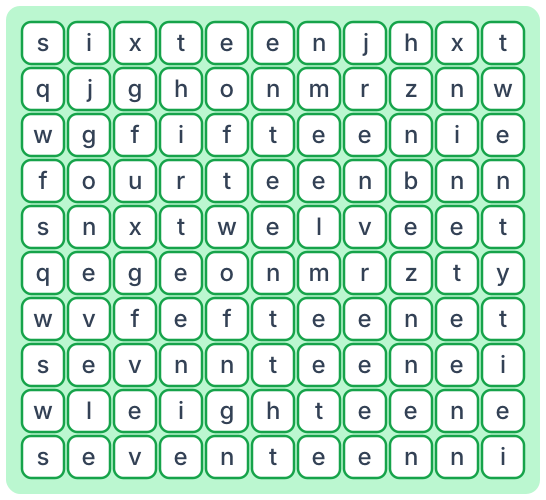
All 10 names are in the grid.
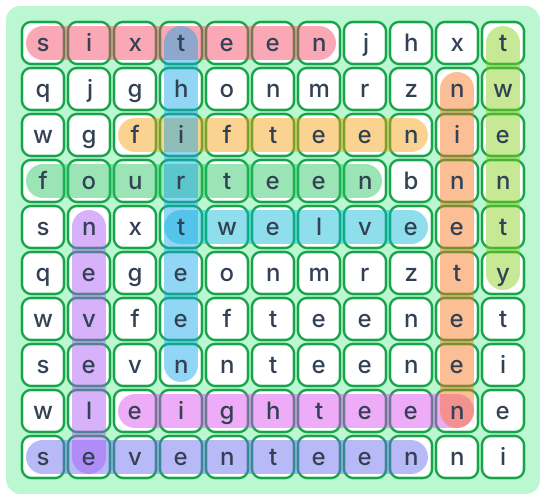
- Most names go across.
- Thirteen, nineteen and twenty go down.
- Eleven goes up, from the bottom.
Puzzles — Page 133The book’s end-of-book puzzles · G, H and I
The right shadow is 3.
- The bug has 2 feelers, 6 arms and 2 feet.
The cat can go home in 3 ways.
- Up, then right.
- Along the slanted line.
- Right, then up.
Take away 2 middle sticks that meet at the centre.
- Now count: 1 big square and 1 small square.
Puzzles — Page 134The book’s end-of-book puzzles · J, K and L
I am in a bicycle,
And in a car and a bus,
I make all vehicles run,
They can’t move if I am flat.
What is my shape?
I am a wheel. My shape is a circle.
- Bicycles, cars and buses all have wheels.
- A flat tyre stops them.
6 + 11 + 13 = 30
- Turn ball 9 upside down. It becomes 6.
- 6 + 11 = 17. 17 + 13 = 30.
33 and 77
- 33 uses only the digit 3.
- 77 uses only the digit 7.
Puzzles — Page 135The book’s end-of-book puzzles · M and N
The path is drawn in red.
- Go up past the cat, then down past the bird.
- Reach the arrow near the tree.
i. Name the animal whom giraffe met first on the path?
The cat.
- Follow the path from the giraffe.
- The cat is the first animal on it.
ii. Name the animal whom giraffe met in the last?
The bird.
- After the cat, the path goes round and down.
- The bird is the last animal before the tree.
iii. Have you ever lost your way to home?
Write your own answer.
- Say yes or no.
- If yes, tell where it happened.
iv. What do you do to remember your way to home?
Write your own answer.
- Look at big things on the way.
- Remember where you turn.
- Learn your home address.
Puzzles — Page 136The book’s end-of-book puzzles · O, P and Q
9 rectangles.
- 4 small squares.
- 4 rectangles made of two small squares.
- 1 big square. 4 + 4 + 1 = 9.
Many answers work. Here is one set.
| Middle | 1 | 2 | 3 | 4 | 5 | 6 |
|---|---|---|---|---|---|---|
| 9 | 18 – 9 | 6 + 3 | 5 + 4 | 10 – 1 | 7 + 2 | 12 – 3 |
| 13 | 10 + 3 | 7 + 6 | 9 + 4 | 20 – 7 | 15 – 2 | 18 – 5 |
| 19 | 10 + 9 | 12 + 7 | 15 + 4 | 20 – 1 | 25 – 6 | 30 – 11 |
- Pick two numbers that add to the middle number.
- Or start bigger and take away.
- Check each one before you write.
Draw 4 fences from the middle.
- From the middle, draw fences up, up-left, down-left and right.
- Check each part: 1 tree, 1 sheep, 1 dog.
Puzzles — Page 137The book’s end-of-book puzzles · R, S, T, U and V
i.
I am 54.
- Hold a mirror next to the number.
- Read the number in the mirror.
ii.
I am 83.
- Both digits are back-to-front.
- In a mirror, 8 stays 8. The 3 turns right.
iii.
I am 69.
- Look at the loops.
- In a mirror, the 6 comes first, then the 9.
iv.
I am 71.
- The flag of 1 points the wrong way.
- In a mirror, you read 7 and then 1.
Put 4 in the circle. Each arm makes 12.
- Put 4 in the middle.
- Put the pairs 1 and 7, 2 and 6, 3 and 5 on the arms.
- Each arm: 4 + 8 = 12.
We cut it 5 times.
- After 5 cuts, the last piece is 1 metre.
- So 5 cuts give 6 pieces.
The number was 9.
- Double means the number, and the same again.
- Which number plus itself makes 18?
- 9 + 9 = 18.
Press 5 + 5 + 5 + 5 + 8 =
- 5 + 5 + 5 + 5 = 20. 20 + 8 = 28.
- Count the keys: 10.
Chapter 11 of 11 – Joyful Mathematics
- Previous: Chapter 10 Fun at the Fair
- All chapters: NCERT Solutions Class 2 Maths
NCERT Solutions Class 2 Maths Joyful Mathematics Chapter 11 Data Handling – Overview
| Class | Class 2 |
| Subject | Maths |
| Book | Joyful Mathematics |
| Chapter | 11 – Data Handling |
| Textbook pages | 123 – 129 |
| Questions solved | 72 |
| Session | 2027 |
| Format | Full answers on this page + PDF |
NCERT Solutions Class 2 Maths Chapter 11 – FAQs
Where can I download NCERT Solutions Class 2 Maths Joyful Mathematics Chapter 11 Data Handling PDF?
Read every answer on this page, or download the free PDF from the table at the top.
Is this for the 2027 session?
Yes, it follows the latest NCERT Class 2 Maths book for 2027.
How many questions are solved in NCERT Class 2 Maths Chapter 11?
All 72 questions of the chapter (textbook pages 123 – 129) – the in-text questions, activities and the end-of-chapter exercises.
How should I use these solutions?
Read the chapter in the NCERT book first, attempt the questions yourself, then check your answers here.