NCERT Solutions for Class 2 Maths Joyful Mathematics Chapter 8 Grouping and Sharing – step-by-step answers to every exercise and in-text question of the chapter, as per the latest NCERT syllabus for 2027. Read them online or download the free question-answer PDF.
This chapter is about equal groups and sharing equally. We learn “times” and the sign ×.
NCERT Solutions for Class 2 Maths Joyful Mathematics Chapter 8 Grouping and Sharing PDF
All the answers are on this page below. The PDF also explains every answer – why it is right and how to check it – so download it for revision.
| Chapter | Download | |
|---|---|---|
| Solutions PDF (English medium) | Grouping and Sharing | View PDF |
| Solutions PDF (Hindi medium) | समूह एवं बँटवारा | View PDF |
NCERT Solutions for Class 2 Maths Joyful Mathematics Chapter 8 Grouping and Sharing – Questions and Answers
All 50 questions of the chapter (textbook pages 83 – 97) are answered below, in the order of the book – in-text questions, activities and the end-of-chapter exercises. Each answer is written the way you would write it in the exam.
In-text Questions — Page 83Grouping and Sharing — wheels on the road
2 + 2 + 2 + 2 = 8
3 + 3 = 6
4 + 4 + ____
4 + 4 + 4 + 4 + 4 + 4 + 4 = 28
- Count the cars. There are 7.
- Each car has 4 wheels.
- Add 4 seven times: 4, 8, 12, 16, 20, 24, 28.
How did you do it Ramya? Can you please explain?
7 times 4 is 28.
- There are 7 cars.
- Each car has 4 wheels. That is 7 groups of 4.
- Add 4 again and again: 4, 8, 12, 16, 20, 24, 28.
Let us Do — Page 84Let us do it for cars
Number of cars = ____
Number of wheels in each car = ____
Number of cars = 7
Number of wheels in each car = 4
- Look at the road picture.
- Count only the cars: 7.
- A car has 4 wheels.
Total wheels = ___ + ___ + ___ + ___ + ___ + ___ + ___ = ___
Total wheels = 4 + 4 + 4 + 4 + 4 + 4 + 4 = 28
- Write 4 for each car.
- There are 7 cars. So write 4 seven times.
- Add: 4, 8, 12, 16, 20, 24, 28.
____ times 4 is ____
7 groups of ____ is ____
____ × ____ = ____
7 times 4 is 28
7 groups of 4 is 28
7 × 4 = 28
- We added 4 seven times.
- So it is 7 times 4.
- Times can be written as ×.
We can write it as 7 fours are 28.
7 fours
- Look at the sum: 4 + 4 + 4 + 4 + 4 + 4 + 4.
- Count the 4s. There are 7.
Let us Do — Page 85Butterflies, octopuses and soldiers
Number of wings in each butterfly = ____
Total number of wings = ___ + ___ + ___ = ___
Butterflies = 3
Wings in each = 2
Total = 2 + 2 + 2 = 6
- Count the butterflies: 3.
- Count the wings on one: 2.
- Add 2 three times: 2, 4, 6.
____ times 2 is 6
3 twos are ____
____ × ____ = ____
3 groups of 2 is 6
3 times 2 is 6
3 twos are 6
3 × 2 = 6
- Each butterfly is a group of 2 wings.
- 3 butterflies make 3 groups of 2.
Number of legs in each octopus = ____
Total number of legs = ___ + ___ = ___
Octopuses = 2
Legs in each = 8
Total = 8 + 8 = 16
- Count the octopuses: 2.
- Count the legs on one: 8.
- Add: 8 + 8 = 16.
2 times ____ is 16
2 eights are ____
____ × ____ = ____
2 groups of 8 is 16
2 times 8 is 16
2 eights are 16
2 × 8 = 16
- Each octopus is a group of 8 legs.
- 2 octopuses make 2 groups of 8.
Number of soldiers in each line = ____
Total number of soldiers = ___ + ___ + ___ + ___ = ___
Lines = 4
Soldiers in each line = 10
Total = 10 + 10 + 10 + 10 = 40
- Count the lines: 4.
- Count the soldiers in one line: 10.
- Count in tens: 10, 20, 30, 40.
4 tens are ____
____ × ____ = ____
4 times 10 is 40
4 tens are 40
4 × 10 = 40
- There are 4 lines of 10.
- That is 4 times 10.
Complete the Table — Page 86One row of the table on each card. The Stars row is done in the book.
| 3 + 3 + 3 + 3 | 4 times 3 | 4 × 3 = 12 Stars |
| 5 + 5 + 5 | ______ | ______ Fingers |
3 times 5 · 3 × 5 = 15 Fingers
- There are 3 hands.
- Each hand has 5 fingers.
- Add: 5, 10, 15.
| 5 + 5 + 5 | 3 times 5 | 3 × 5 = 15 Fingers |
| 3 + 3 + 3 + 3 | 4 times 3 | 4 × 3 = 12 Stars |
| ______ | 6 times 3 | ______ Bananas |
3 + 3 + 3 + 3 + 3 + 3 · 6 × 3 = 18 Bananas
- There are 6 bunches.
- Each bunch has 3 bananas.
- Add 3 six times: 3, 6, 9, 12, 15, 18.
| 3 + 3 + 3 + 3 + 3 + 3 | 6 times 3 | 6 × 3 = 18 Bananas |
| 3 + 3 + 3 + 3 | 4 times 3 | 4 × 3 = 12 Stars |
| ______ | ______ | 4 × 4 = 16 Oranges |
4 + 4 + 4 + 4 · 4 times 4
- There are 4 boxes.
- Each box has 4 oranges.
- Add: 4, 8, 12, 16.
| 4 + 4 + 4 + 4 | 4 times 4 | 4 × 4 = 16 Oranges |
| 3 + 3 + 3 + 3 | 4 times 3 | 4 × 3 = 12 Stars |
| ______ | ______ | 2 × 5 = 10 Pencils |
5 + 5 · 2 times 5
- There are 2 rows of pencils.
- Each row has 5 pencils.
- 5 + 5 = 10.
| 5 + 5 | 2 times 5 | 2 × 5 = 10 Pencils |
| 3 + 3 + 3 + 3 | 4 times 3 | 4 × 3 = 12 Stars |
| ______ | ______ | 3 × 5 = 15 Balls |
5 + 5 + 5 · 3 times 5
- There are 3 rows of balls.
- Each row has 5 balls.
- Add: 5, 10, 15.
| 5 + 5 + 5 | 3 times 5 | 3 × 5 = 15 Balls |
Match the Following — Page 86Match each sum with its times fact and its answer
| 9 + 9 + 9 | 7 fives are | 27 |
| 5 + 5 + 5 + 5 + 5 + 5 + 5 | 4 groups of 10 | 35 |
| 3 + 3 + 3 + 3 + 3 | 3 × 9 | 40 |
| 10 + 10 + 10 + 10 | 3 × 8 | 14 |
| 8 + 8 + 8 | 2 sevens are | 15 |
| 7 + 7 | 5 times 3 | 24 |
The book has matched 3 + 3 + 3 + 3 + 3 → 5 times 3 → 15.
9 + 9 + 9
9 + 9 + 9 → 3 × 9 → 27
- 9 is added 3 times. That is 3 × 9.
- Add: 9 + 9 = 18. 18 + 9 = 27.
| 9 + 9 + 9 | 7 fives are | 27 |
| 5 + 5 + 5 + 5 + 5 + 5 + 5 | 4 groups of 10 | 35 |
| 3 + 3 + 3 + 3 + 3 | 3 × 9 | 40 |
| 10 + 10 + 10 + 10 | 3 × 8 | 14 |
| 8 + 8 + 8 | 2 sevens are | 15 |
| 7 + 7 | 5 times 3 | 24 |
The book has matched 3 + 3 + 3 + 3 + 3 → 5 times 3 → 15.
5 + 5 + 5 + 5 + 5 + 5 + 5
5 + 5 + 5 + 5 + 5 + 5 + 5 → 7 fives are → 35
- Count the 5s. There are 7.
- Count in fives: 5, 10, 15, 20, 25, 30, 35.
| 9 + 9 + 9 | 7 fives are | 27 |
| 5 + 5 + 5 + 5 + 5 + 5 + 5 | 4 groups of 10 | 35 |
| 3 + 3 + 3 + 3 + 3 | 3 × 9 | 40 |
| 10 + 10 + 10 + 10 | 3 × 8 | 14 |
| 8 + 8 + 8 | 2 sevens are | 15 |
| 7 + 7 | 5 times 3 | 24 |
The book has matched 3 + 3 + 3 + 3 + 3 → 5 times 3 → 15.
10 + 10 + 10 + 10
10 + 10 + 10 + 10 → 4 groups of 10 → 40
- There are 4 tens.
- Count in tens: 10, 20, 30, 40.
| 9 + 9 + 9 | 7 fives are | 27 |
| 5 + 5 + 5 + 5 + 5 + 5 + 5 | 4 groups of 10 | 35 |
| 3 + 3 + 3 + 3 + 3 | 3 × 9 | 40 |
| 10 + 10 + 10 + 10 | 3 × 8 | 14 |
| 8 + 8 + 8 | 2 sevens are | 15 |
| 7 + 7 | 5 times 3 | 24 |
The book has matched 3 + 3 + 3 + 3 + 3 → 5 times 3 → 15.
8 + 8 + 8
8 + 8 + 8 → 3 × 8 → 24
- 8 is added 3 times. That is 3 × 8.
- Add: 8 + 8 = 16. 16 + 8 = 24.
| 9 + 9 + 9 | 7 fives are | 27 |
| 5 + 5 + 5 + 5 + 5 + 5 + 5 | 4 groups of 10 | 35 |
| 3 + 3 + 3 + 3 + 3 | 3 × 9 | 40 |
| 10 + 10 + 10 + 10 | 3 × 8 | 14 |
| 8 + 8 + 8 | 2 sevens are | 15 |
| 7 + 7 | 5 times 3 | 24 |
The book has matched 3 + 3 + 3 + 3 + 3 → 5 times 3 → 15.
7 + 7
7 + 7 → 2 sevens are → 14
- 7 is added 2 times.
- 7 + 7 = 14.
Complete the Table — Pages 87–88Complete the Table of 2 · of 3 · of 5 · of 10
| 2 ones are 2 | 2 × 1 = 2 |
| 2 twos are 4 | 2 × 2 = 4 |
| 2 threes are 6 | 2 × 3 = 6 |
| ______ | ______ |
| ______ | ______ |
| ______ | ______ |
| ______ | ______ |
| ______ | ______ |
| ______ | ______ |
| ______ | ______ |
The table of 2: 2, 4, 6, 8, 10, 12, 14, 16, 18, 20
- Each row has 2 groups. Each group gets 1 more.
- So each line is 2 more than the one before.
- Row 4: 2 fours are 8. 2 × 4 = 8.
| 2 ones are 2 | 2 × 1 = 2 |
| 2 twos are 4 | 2 × 2 = 4 |
| 2 threes are 6 | 2 × 3 = 6 |
| 2 fours are 8 | 2 × 4 = 8 |
| 2 fives are 10 | 2 × 5 = 10 |
| 2 sixes are 12 | 2 × 6 = 12 |
| 2 sevens are 14 | 2 × 7 = 14 |
| 2 eights are 16 | 2 × 8 = 16 |
| 2 nines are 18 | 2 × 9 = 18 |
| 2 tens are 20 | 2 × 10 = 20 |
| 3 ones are 3 | 3 × 1 = 3 |
| 3 twos are 6 | 3 × 2 = 6 |
| 3 threes are 9 | 3 × 3 = 9 |
| ______ | ______ |
| ______ | ______ |
| ______ | ______ |
| ______ | ______ |
| ______ | ______ |
| ______ | ______ |
| ______ | ______ |
The table of 3: 3, 6, 9, 12, 15, 18, 21, 24, 27, 30
- Each row has 3 groups. Each group gets 1 more.
- So each line is 3 more than the one before.
- Row 4: 3 fours are 12. 3 × 4 = 12.
| 3 ones are 3 | 3 × 1 = 3 |
| 3 twos are 6 | 3 × 2 = 6 |
| 3 threes are 9 | 3 × 3 = 9 |
| 3 fours are 12 | 3 × 4 = 12 |
| 3 fives are 15 | 3 × 5 = 15 |
| 3 sixes are 18 | 3 × 6 = 18 |
| 3 sevens are 21 | 3 × 7 = 21 |
| 3 eights are 24 | 3 × 8 = 24 |
| 3 nines are 27 | 3 × 9 = 27 |
| 3 tens are 30 | 3 × 10 = 30 |
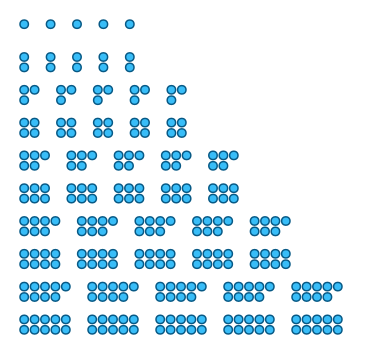
| 5 ones are 5 | 5 × 1 = 5 |
| 5 twos are 10 | 5 × 2 = 10 |
| 5 threes are 15 | 5 × 3 = 15 |
| ______ | ______ |
| ______ | ______ |
| ______ | ______ |
| ______ | ______ |
| ______ | ______ |
| ______ | ______ |
| ______ | ______ |
The table of 5: 5, 10, 15, 20, 25, 30, 35, 40, 45, 50
- Each row has 5 groups. Each group gets 1 more.
- So each line is 5 more than the one before.
- Row 4: 5 fours are 20. 5 × 4 = 20.
| 5 ones are 5 | 5 × 1 = 5 |
| 5 twos are 10 | 5 × 2 = 10 |
| 5 threes are 15 | 5 × 3 = 15 |
| 5 fours are 20 | 5 × 4 = 20 |
| 5 fives are 25 | 5 × 5 = 25 |
| 5 sixes are 30 | 5 × 6 = 30 |
| 5 sevens are 35 | 5 × 7 = 35 |
| 5 eights are 40 | 5 × 8 = 40 |
| 5 nines are 45 | 5 × 9 = 45 |
| 5 tens are 50 | 5 × 10 = 50 |
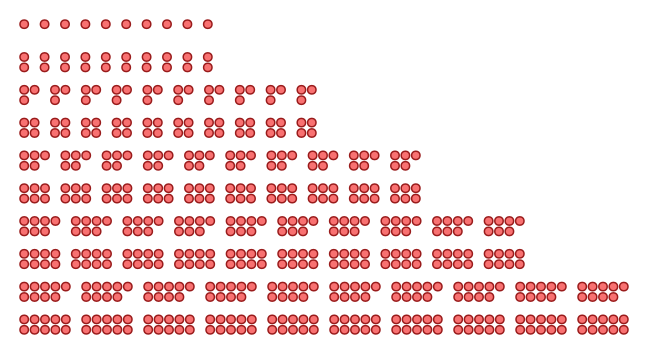
| 10 ones are 10 | 10 × 1 = 10 |
| ______ | ______ |
| ______ | ______ |
| ______ | ______ |
| ______ | ______ |
| ______ | ______ |
| ______ | ______ |
| ______ | ______ |
| ______ | ______ |
| ______ | ______ |
The table of 10: 10, 20, 30, 40, 50, 60, 70, 80, 90, 100
- Each row has 10 groups. Each group gets 1 more.
- So each line is 10 more than the one before.
- Row 2: 10 twos are 20. 10 × 2 = 20.
| 10 ones are 10 | 10 × 1 = 10 |
| 10 twos are 20 | 10 × 2 = 20 |
| 10 threes are 30 | 10 × 3 = 30 |
| 10 fours are 40 | 10 × 4 = 40 |
| 10 fives are 50 | 10 × 5 = 50 |
| 10 sixes are 60 | 10 × 6 = 60 |
| 10 sevens are 70 | 10 × 7 = 70 |
| 10 eights are 80 | 10 × 8 = 80 |
| 10 nines are 90 | 10 × 9 = 90 |
| 10 tens are 100 | 10 × 10 = 100 |
How Many? — Pages 89–90Ram’s and Gopal’s flowers, gulab jamuns and a flower cloth
There are 3 bouquets. 3 groups of 4 flowers 3 × 4 Gopal used 12 flowers in all.
Did you observe something? Discuss.
Test your observation with other examples.
4 × 3 and 3 × 4 are both 12.
- Ram: 3 + 3 + 3 + 3 = 12.
- Gopal: 4 + 4 + 4 = 12.
- Test: 2 × 5 = 10. 5 × 2 = 10 too.
___ times 5 is ____
4 × 5 = _____
There are ____ gulab jamuns.
4 times 5 is 20
4 × 5 = 20
There are 20 gulab jamuns.
- There are 4 columns.
- Each column has 5.
- Count in fives: 5, 10, 15, 20.
___ times 4 is ____
5 × 4 = ______
There are ____ gulab jamuns.
5 times 4 is 20
5 × 4 = 20
There are 20 gulab jamuns.
- There are 5 columns.
- Each column has 4.
- Count in fours: 4, 8, 12, 16, 20.
___ times 4 is ____
6 × 4 = ______
There are ______ flowers.
6 times 4 is 24
6 × 4 = 24
There are 24 flowers.
- There are 6 columns.
- Each column has 4 flowers.
- Count in fours: 4, 8, 12, 16, 20, 24.
__ times 6 is ____
4 × 6 = _____
There are ____ flowers.
4 times 6 is 24
4 × 6 = 24
There are 24 flowers.
- There are 4 columns.
- Each column has 6 flowers.
- Count in sixes: 6, 12, 18, 24.
In-text Questions — Pages 90–91Word problems A to D: equal groups
Number of packets = ____
Number of bindis in each packet = ____
____ groups of ____ bindis.
____ × ____ = ____ bindis
Number of packets = 8
Number of bindis in each packet = 5
8 groups of 5 bindis.
8 × 5 = 40 bindis
- Count in fives, one packet at a time.
- 5, 10, 15, 20, 25, 30, 35, 40.
Number of shirts = ____
Number of buttons on each shirt = ____
____ groups of ____ buttons
____ × ____ = ____ buttons
Number of shirts = 7
Number of buttons on each shirt = 4
7 groups of 4 buttons
7 × 4 = 28 buttons
- Count in fours, one shirt at a time.
- 4, 8, 12, 16, 20, 24, 28.
Number of pencils = ____
Cost of 1 pencil = ____
Cost of 6 pencils = 4 + 4 + 4 + 4 + 4 + 4
____ × ____ = ____
So, Rita will give ₹ ____ to the shopkeeper.
Number of pencils = 6
Cost of 1 pencil = ₹4
6 × 4 = 24
So, Rita will give ₹24 to the shopkeeper.
- Each pencil costs ₹4.
- Add 4 six times: 4, 8, 12, 16, 20, 24.
Number of people sitting in 1 car = ____
Number of people sitting in 8 cars = ____
____ × ____ = ____
____ people can sit in 8 cars.
People in 1 car = 5
People in 8 cars = 40
8 × 5 = 40
40 people can sit in 8 cars.
- Count in fives 8 times: 5, 10, 15, 20, 25, 30, 35, 40.
Making Multiplication Table — Pages 91–92Make a new table by adding two tables. Page 92 also shows the table of 7 from 3 and 4.
| 2 | 4 | 6 | 8 | 10 | 12 | 14 | 16 | 18 | 20 | (Table of 2) | |
| + | 2 | 4 | 6 | 8 | 10 | 12 | 14 | 16 | 18 | 20 | |
| 4 | 8 | 12 | 16 | 20 | 24 | 28 | 32 | 36 | 40 | (Table of 4) |
| 3 | 6 | 12 | 21 | 30 | (Table of 3) | ||||||
| + | 3 | 9 | 18 | 24 | (Table of 3) | ||||||
| 6 | (Table of 6) |
The table of 6: 6, 12, 18, 24, 30, 36, 42, 48, 54, 60
- Fill both rows with the table of 3: 3, 6, 9 … 30.
- Add each column: 3 + 3 = 6, 6 + 6 = 12.
| 3 | 6 | 9 | 12 | 15 | 18 | 21 | 24 | 27 | 30 | (Table of 3) | |
| + | 3 | 6 | 9 | 12 | 15 | 18 | 21 | 24 | 27 | 30 | (Table of 3) |
| 6 | 12 | 18 | 24 | 30 | 36 | 42 | 48 | 54 | 60 | (Table of 6) |
| 2 | 4 | 10 | 14 | 18 | 20 | (Table of 2) | |||||
| + | 6 | 36 | 48 | (Table of 6) | |||||||
| 8 | (Table of 8) |
The table of 8: 8, 16, 24, 32, 40, 48, 56, 64, 72, 80
- Fill the table of 2: 2, 4, 6 … 20.
- Fill the table of 6: 6, 12, 18 … 60.
- Add each column: 2 + 6 = 8, 4 + 12 = 16.
| 2 | 4 | 6 | 8 | 10 | 12 | 14 | 16 | 18 | 20 | (Table of 2) | |
| + | 6 | 12 | 18 | 24 | 30 | 36 | 42 | 48 | 54 | 60 | (Table of 6) |
| 8 | 16 | 24 | 32 | 40 | 48 | 56 | 64 | 72 | 80 | (Table of 8) |
Project Work — Page 92Arrays of 24 objects
| Number of groups | Multiplication facts |
|---|---|
| 3 groups of 4 | 3 × 4 |
| ______ | ______ |
| ______ | ______ |
| ______ | ______ |
| ______ | ______ |
| ______ | ______ |
| ______ | ______ |
| ______ | ______ |
| ______ | ______ |
You can find 8 facts for 24.
- Put the 24 buttons in equal rows.
- Write rows × one row.
| Number of groups | Multiplication facts |
|---|---|
| 3 groups of 4 | 3 × 4 |
| 1 group of 24 | 1 × 24 |
| 2 groups of 12 | 2 × 12 |
| 3 groups of 8 | 3 × 8 |
| 4 groups of 6 | 4 × 6 |
| 6 groups of 4 | 6 × 4 |
| 8 groups of 3 | 8 × 3 |
| 12 groups of 2 | 12 × 2 |
| 24 groups of 1 | 24 × 1 |
Let us Share — Pages 93–94Two brothers share gulab jamuns
8 gulab jamuns
- Look at the big plate at the start.
- Count them one by one: 8.
Yes.
- They shared 1 by 1.
- Each boy got 4 gulab jamuns.
4 each
- 1 for you, 1 for me.
- Then 2, then 3, then 4 each.
- Now the big plate is empty.
Let us Do — Page 94Share equally: bindis and laddoos
6 bindis on each cone.
- Draw 1 bindi on each cone.
- Do it again and again.
- Stop when all 12 are used.
4 laddoos in each plate.
- Count all the laddoos: 7 + 5 = 12.
- Put 1 in each new plate, again and again.
- Each plate gets 4.
How Many Groups? — Page 95Garima makes bracelets
I have made 2 bracelets. Now, 10 beads are left. Let us see how many more can we make.
2 more bracelets. That is 4 bracelets in all.
- Take 5 beads from the 10. 5 are left.
- Take 5 more. 0 are left.
- That makes 2 more bracelets.
Let us Make — Pages 96–97Make equal groups and share equally
How many strings can we make with 21 beads?
3 strings
- Make a group of 7 beads. That is 1 string.
- Keep making groups of 7: 7, 14, 21.
- Count the groups: 3.
How many bracelets can we make with 54 flowers?
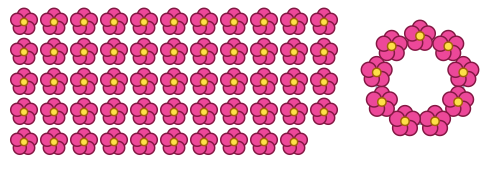
6 bracelets
- Circle 9 flowers. That is 1 bracelet.
- Keep making groups of 9: 9, 18, 27, 36, 45, 54.
- Count the groups: 6.
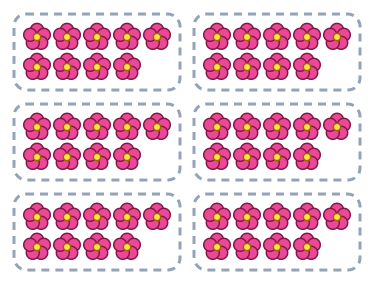
____ vases are needed.
5 vases are needed.
- Put 5 roses in one vase.
- Count in fives: 5, 10, 15, 20, 25.
- That is 5 vases.
There will be ____ candles in each box.
There will be 9 candles in each box.
- Put 1 candle in each box.
- Do it again and again.
- Stop when all 27 are used.
The tailor will be able to put 30 buttons on ____ shirts.
The tailor will be able to put 30 buttons on 5 shirts.
- Make groups of 6 buttons.
- Count: 6, 12, 18, 24, 30.
- That is 5 groups.
Each monkey will get ____ bananas.
Each monkey will get 8 bananas.
- Give 1 banana to each monkey.
- Do it again and again.
- Stop when all 24 are given.
Chapter 8 of 11 – Joyful Mathematics
- Previous: Chapter 7 Rani’s Gift
- Next: Chapter 9 Which Season is it?
- All chapters: NCERT Solutions Class 2 Maths
NCERT Solutions Class 2 Maths Joyful Mathematics Chapter 8 Grouping and Sharing – Overview
| Class | Class 2 |
| Subject | Maths |
| Book | Joyful Mathematics |
| Chapter | 8 – Grouping and Sharing |
| Textbook pages | 83 – 97 |
| Questions solved | 50 |
| Session | 2027 |
| Format | Full answers on this page + PDF |
NCERT Solutions Class 2 Maths Chapter 8 – FAQs
Where can I download NCERT Solutions Class 2 Maths Joyful Mathematics Chapter 8 Grouping and Sharing PDF?
Read every answer on this page, or download the free PDF from the table at the top.
Is this for the 2027 session?
Yes, it follows the latest NCERT Class 2 Maths book for 2027.
How many questions are solved in NCERT Class 2 Maths Chapter 8?
All 50 questions of the chapter (textbook pages 83 – 97) – the in-text questions, activities and the end-of-chapter exercises.
How should I use these solutions?
Read the chapter in the NCERT book first, attempt the questions yourself, then check your answers here.