Download Arithmetic Expressions – NCERT Class 7 Maths Chapter 2 PDF from the new NCERT Class 7 Maths book Ganita Prakash (2026-27). Read the chapter online or download the free PDF. An arithmetic expression is a number phrase like 13 + 2 or 5 × 25; the number it evaluates to is its value.
Arithmetic Expressions PDF – Chapter 2 of Ganita Prakash (Part I)
Read the chapter online or download the PDF.
| Chapter | Download | |
|---|---|---|
| Chapter 2 PDF | Arithmetic Expressions | View PDF |
| Full book | NCERT Class 7 Maths – Ganita Prakash | View Book |
Read Online
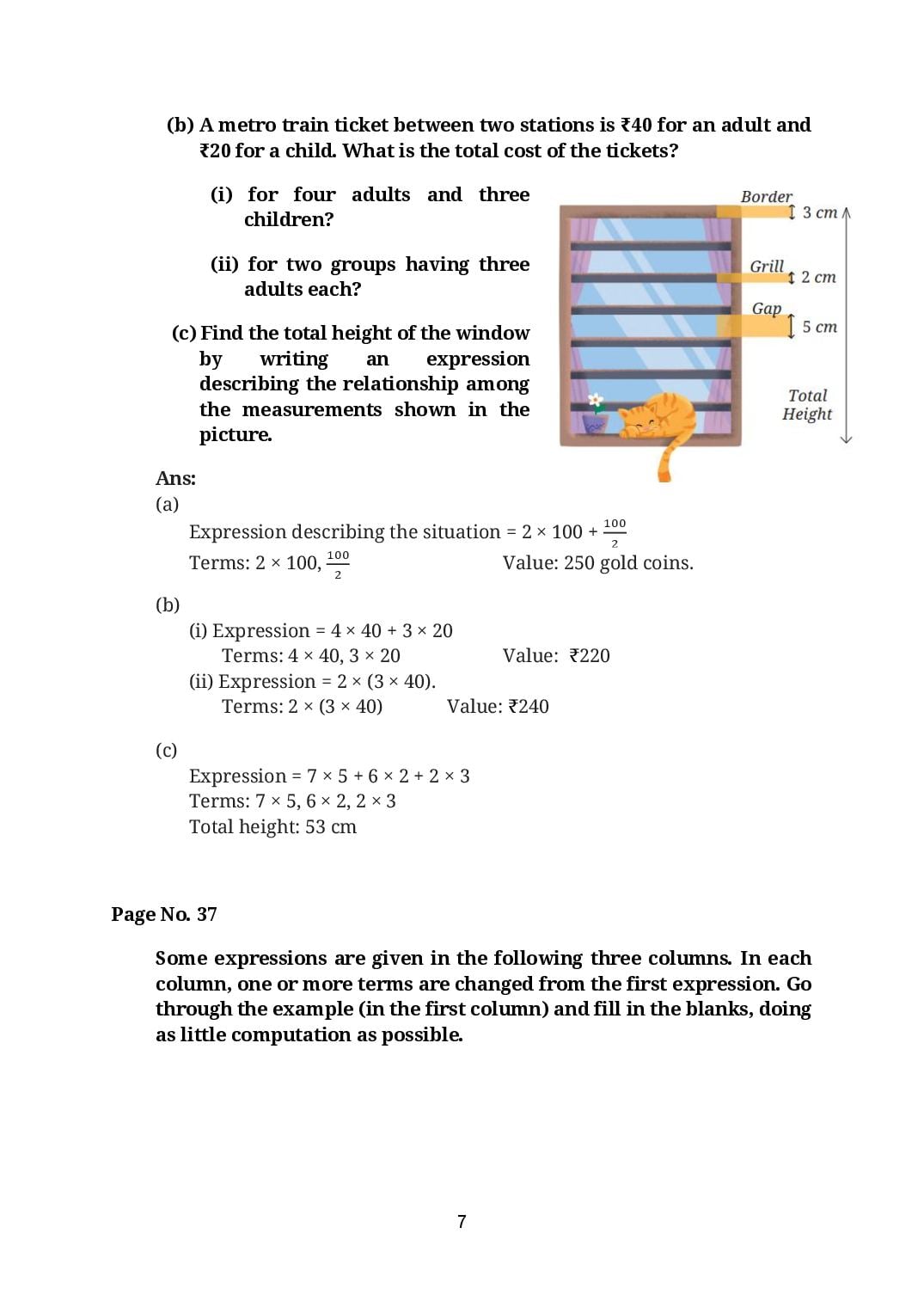
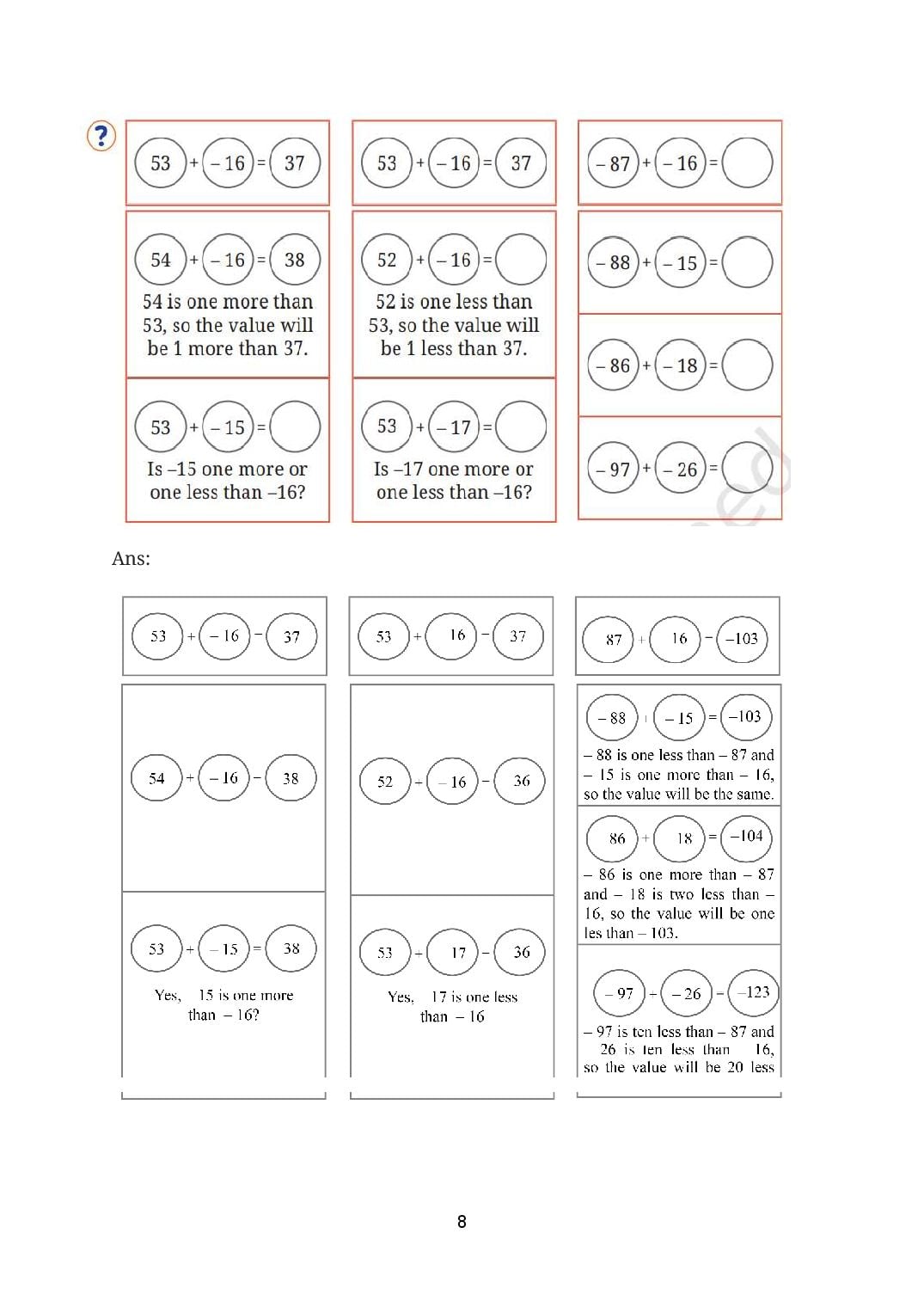
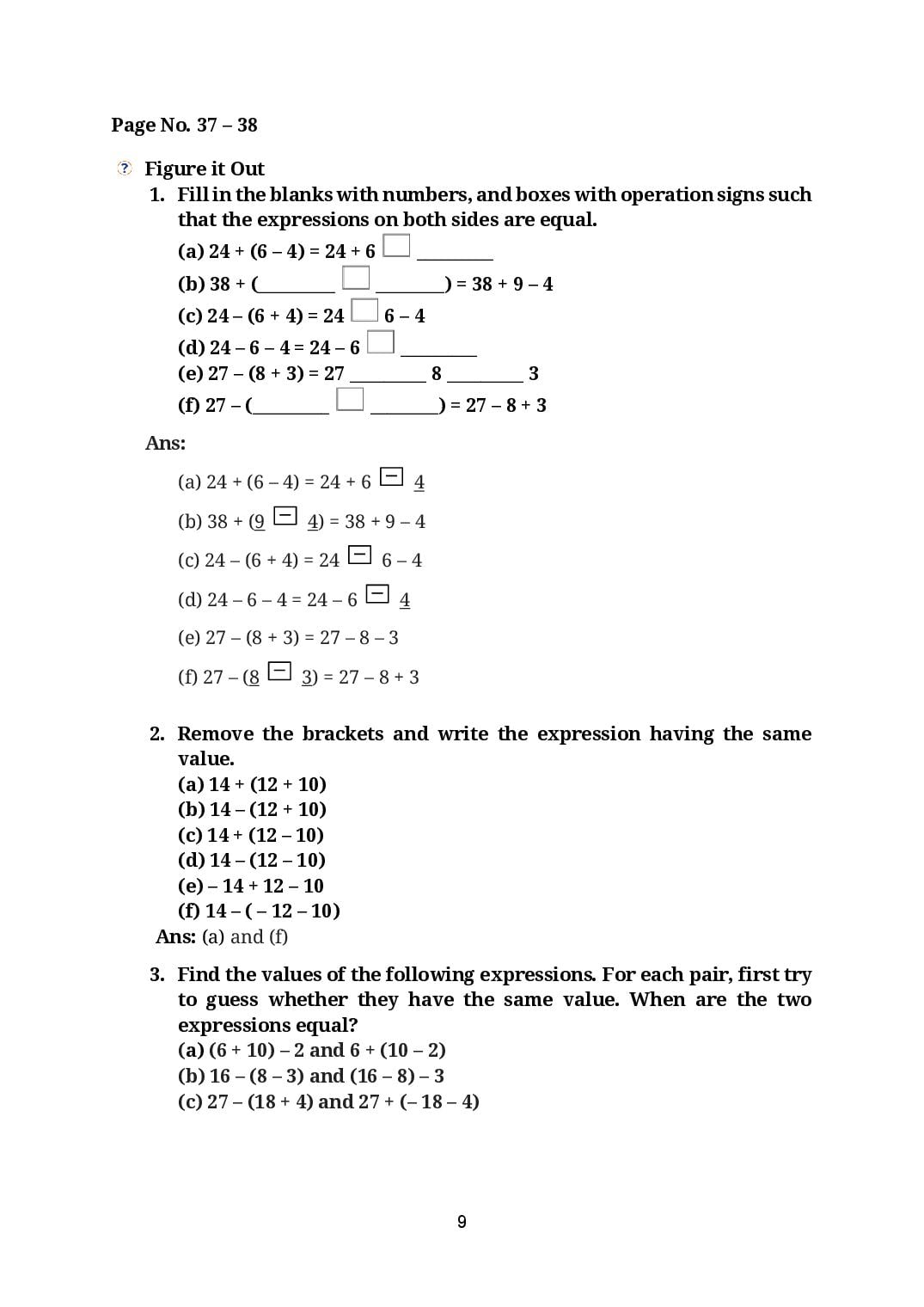
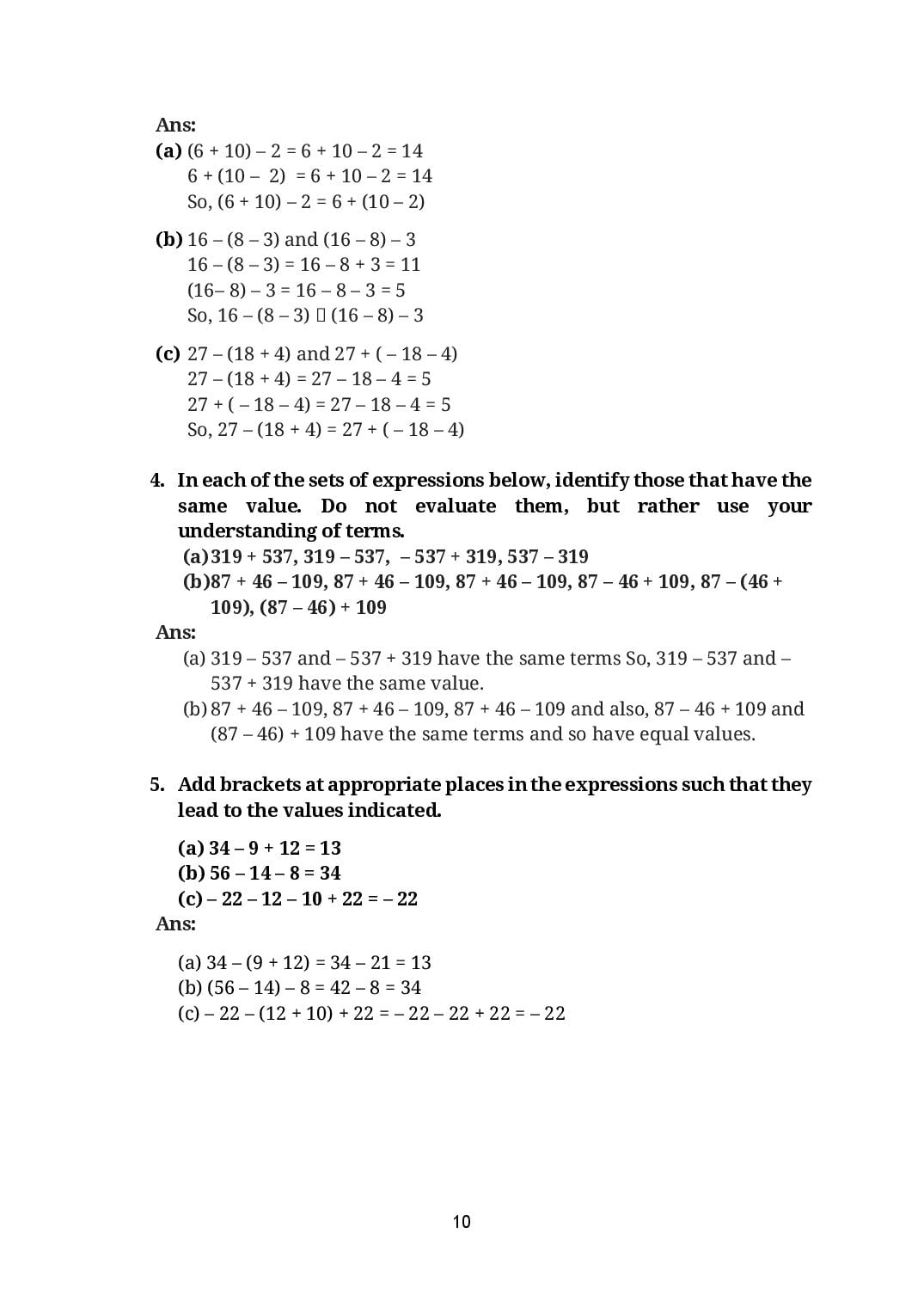
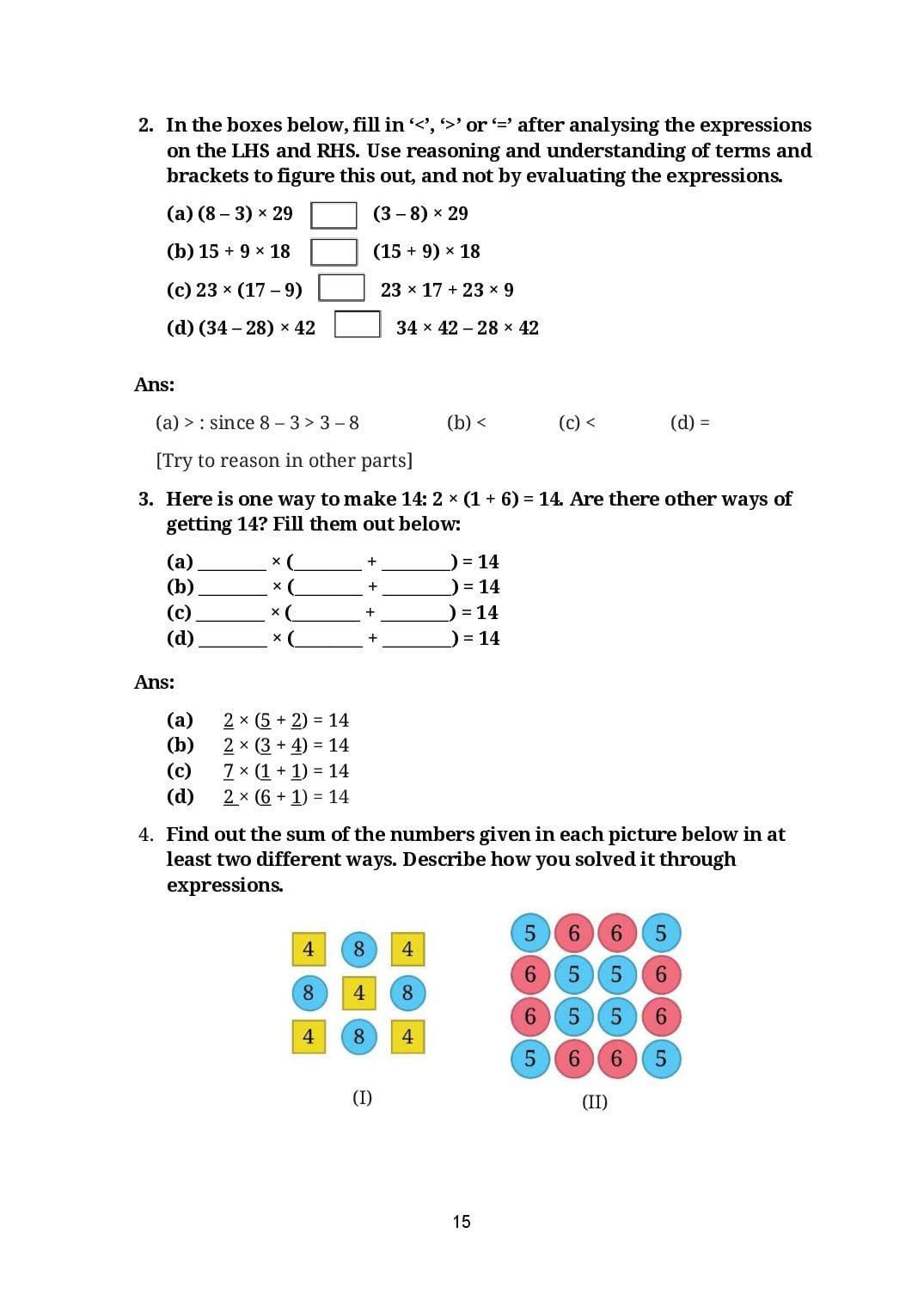
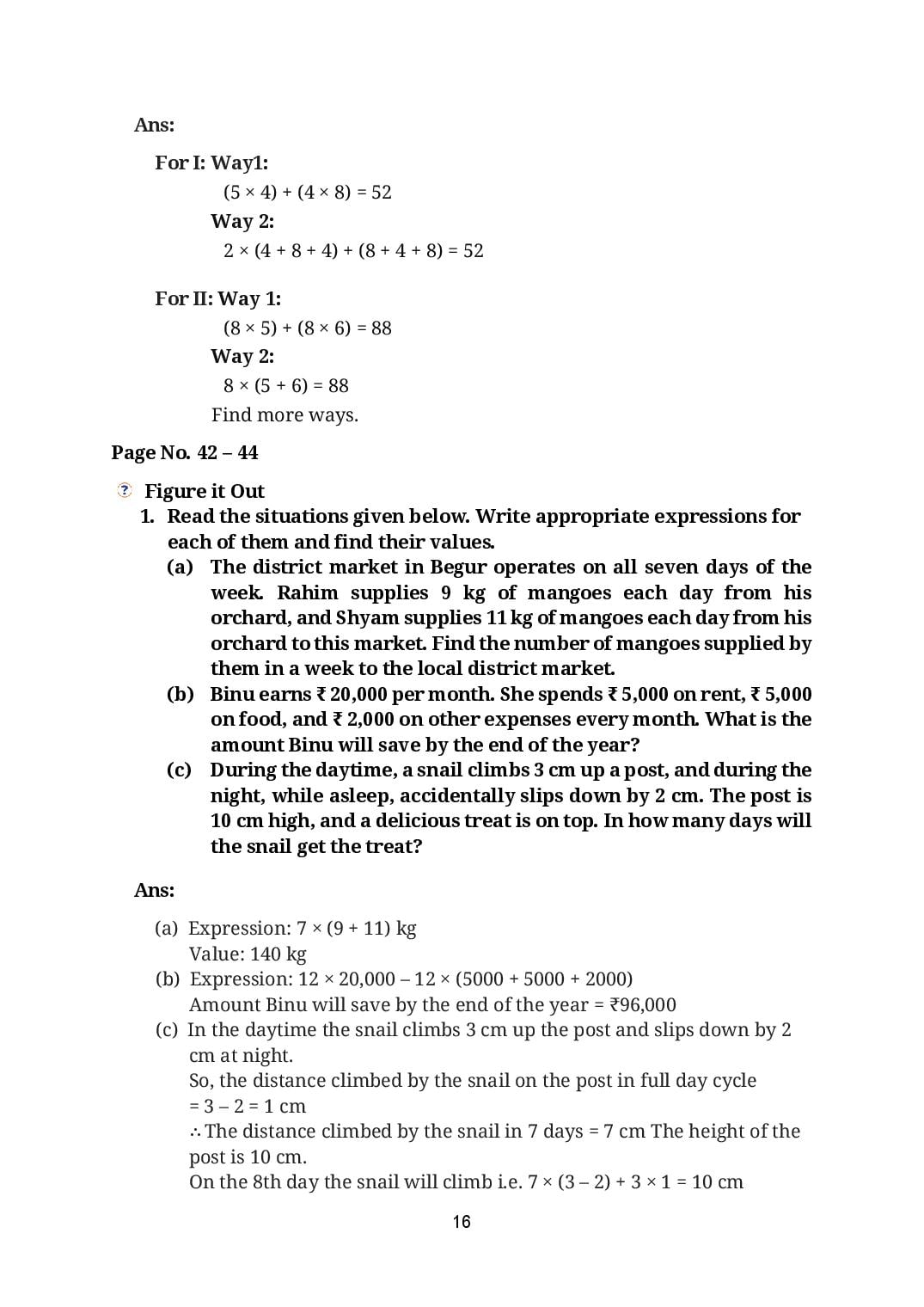
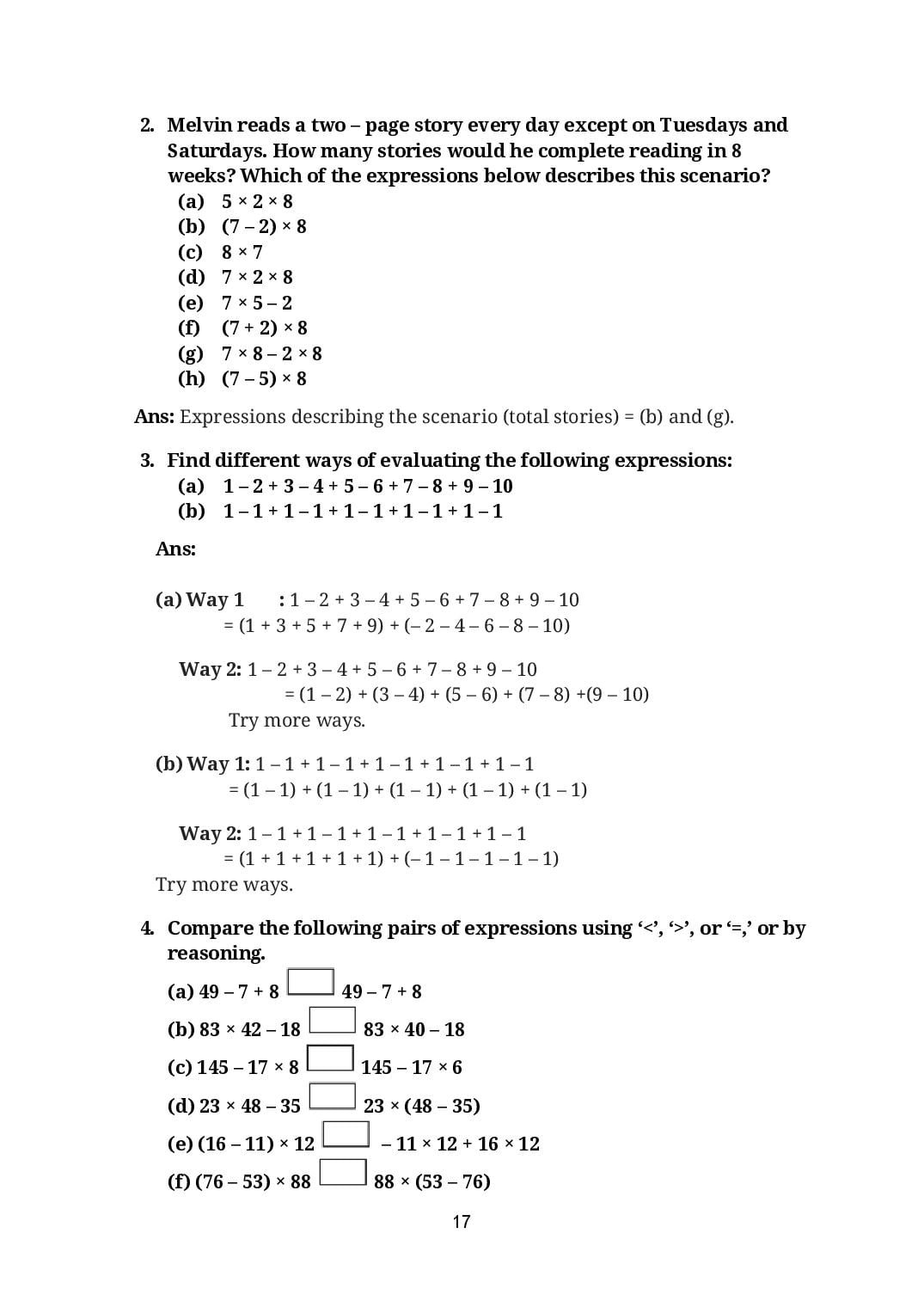
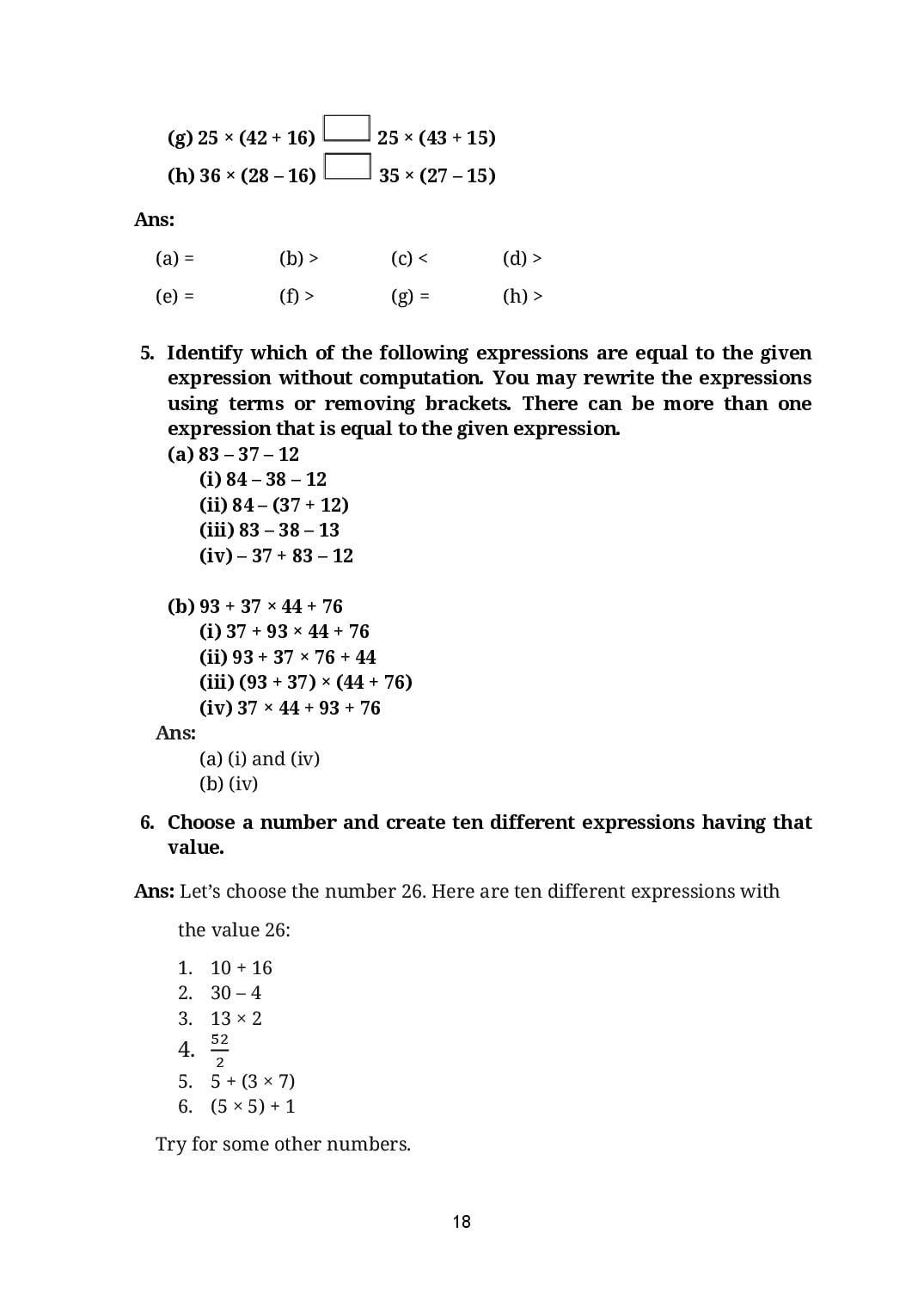
What Is in Arithmetic Expressions? (Class 7 Maths Chapter 2)
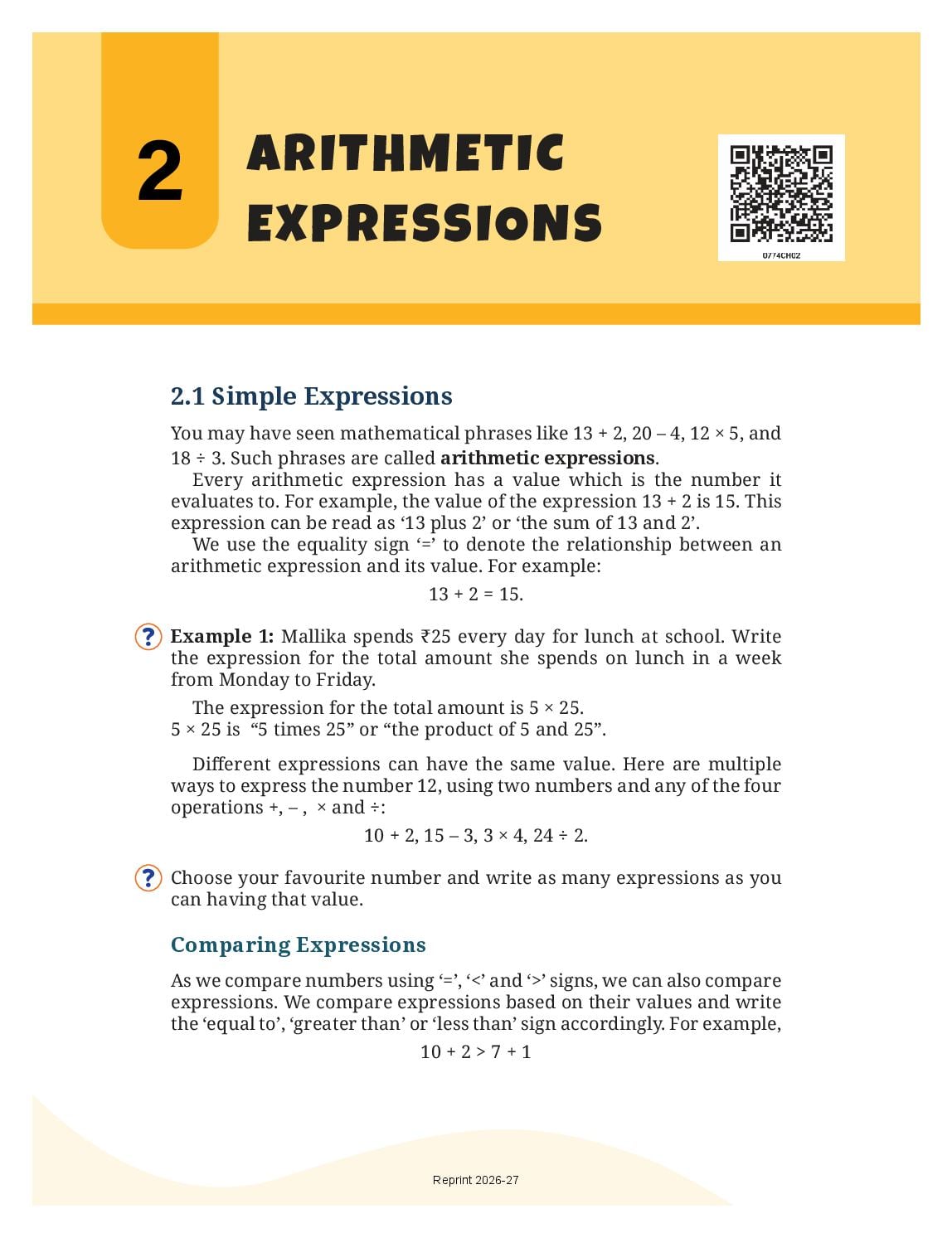
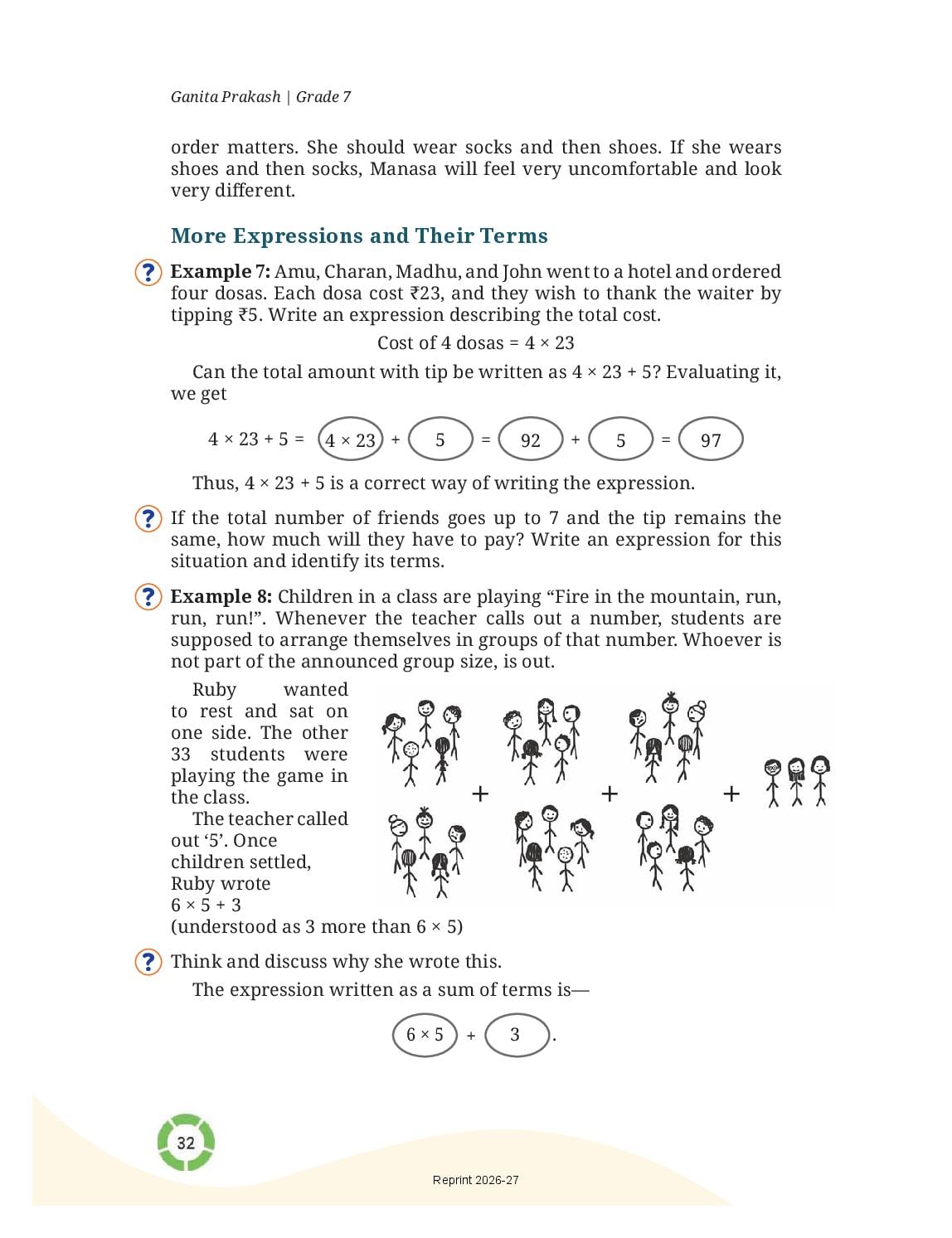
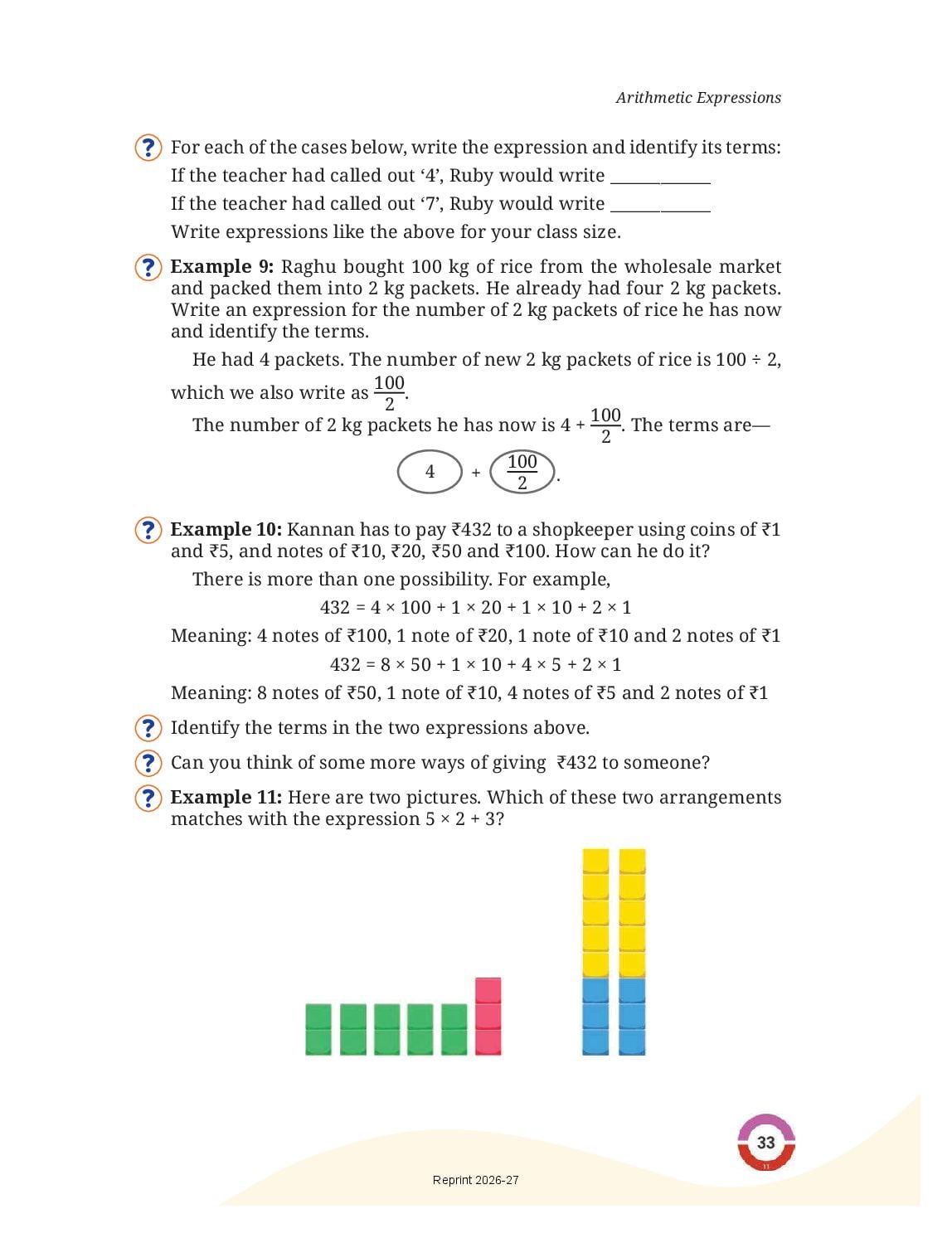
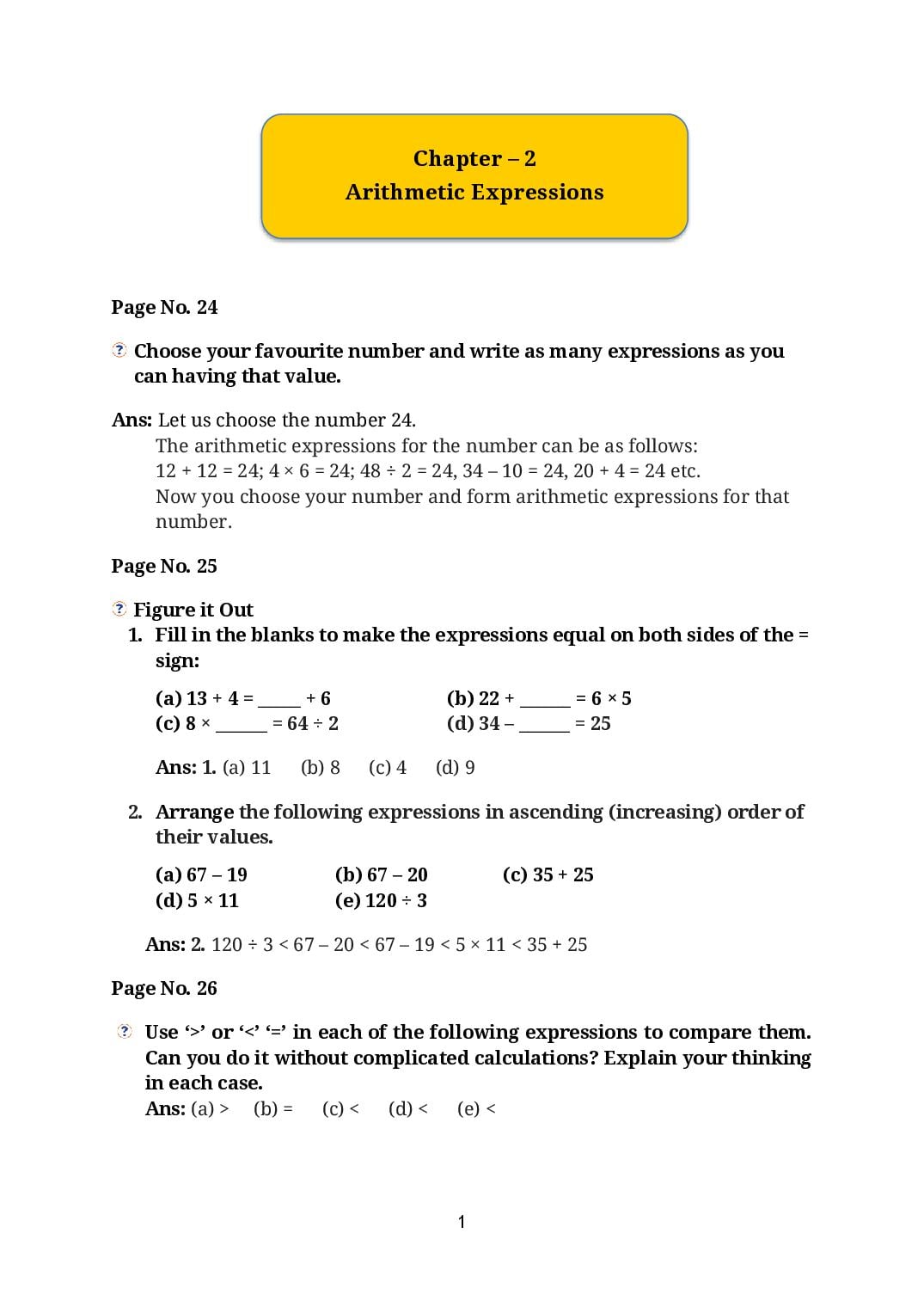
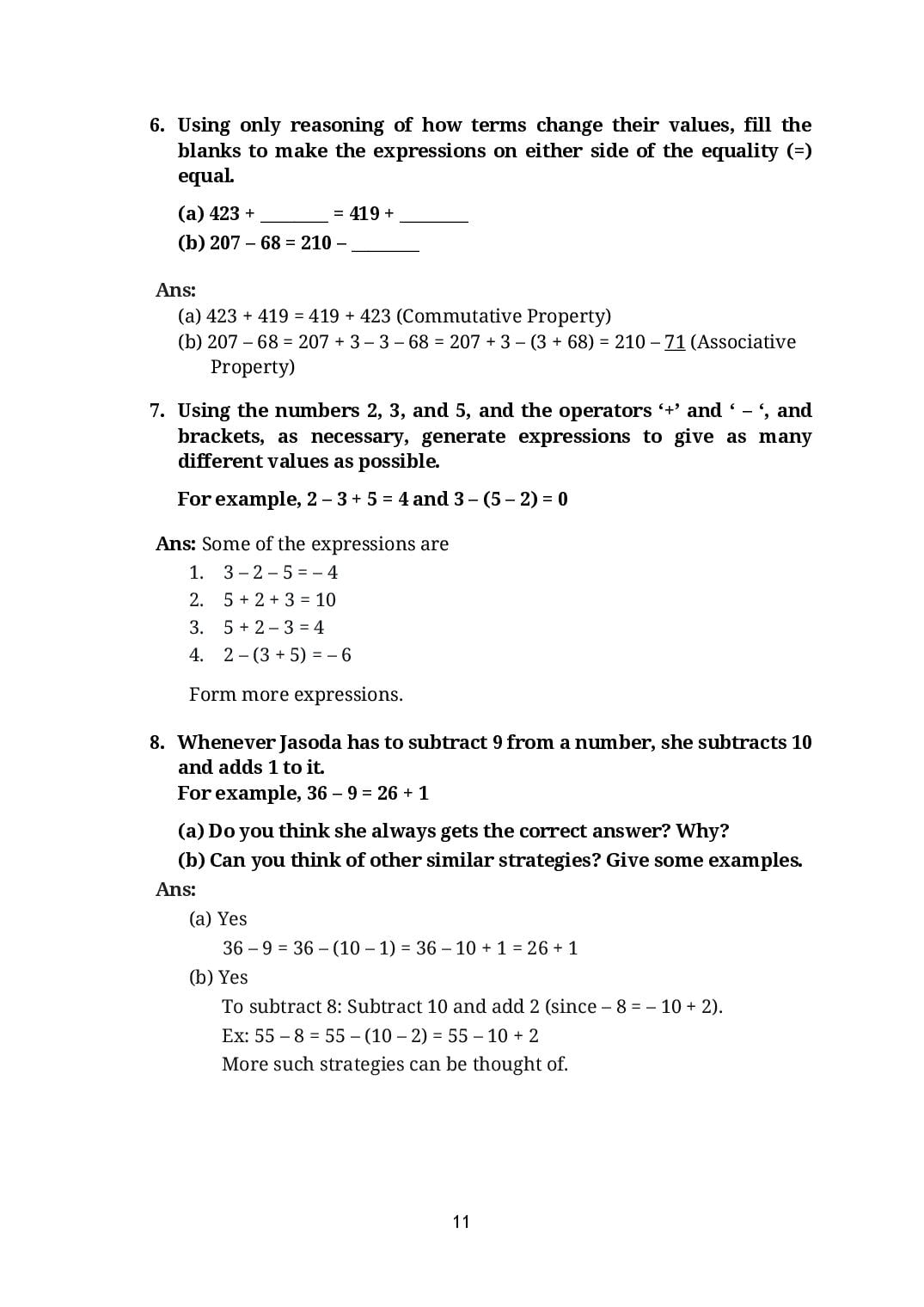
- An arithmetic expression is a number phrase like 13 + 2 or 5 × 25; the number it evaluates to is its value.
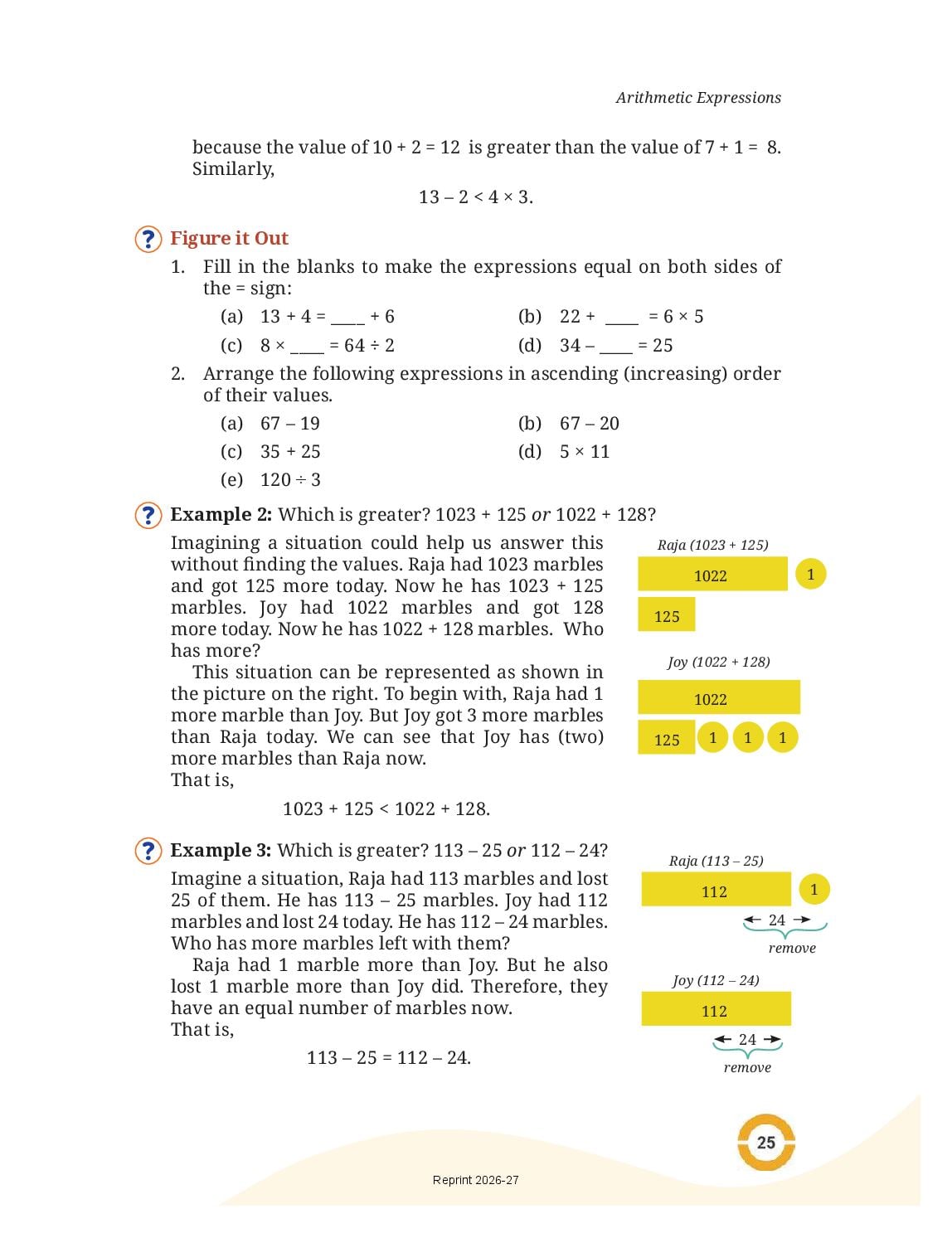
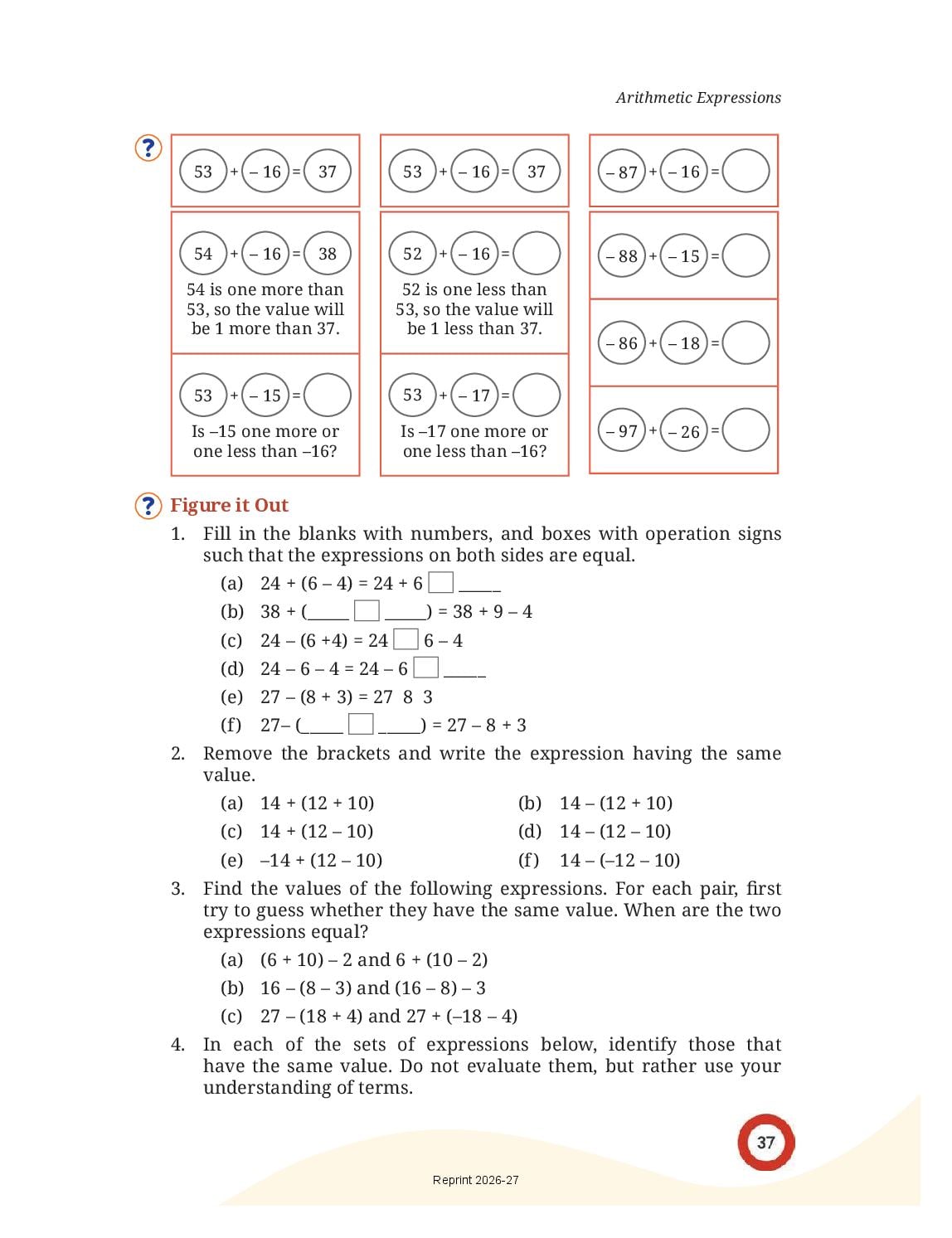
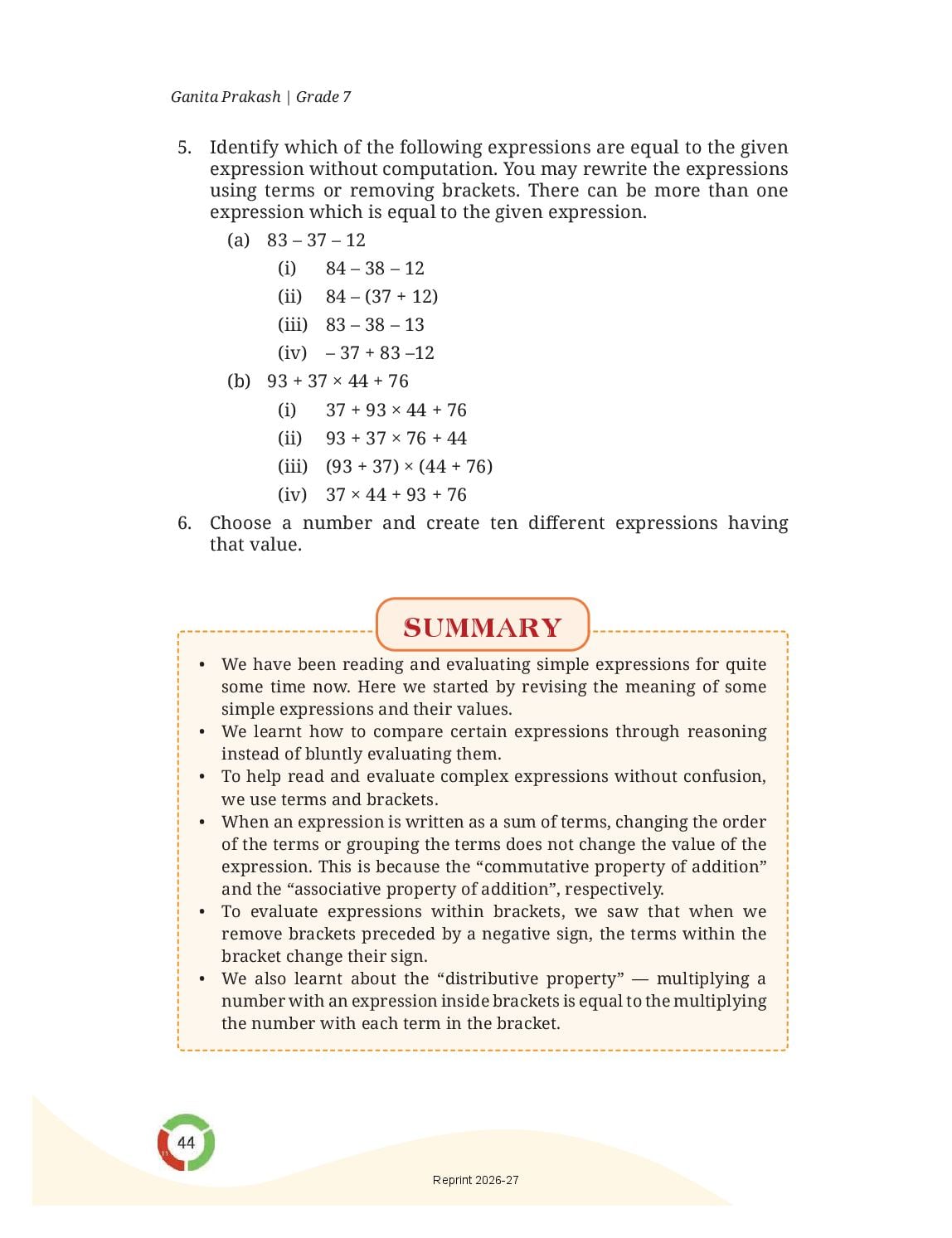
- Two expressions can be compared with =, < or > by looking at how their parts differ — no full calculation needed.
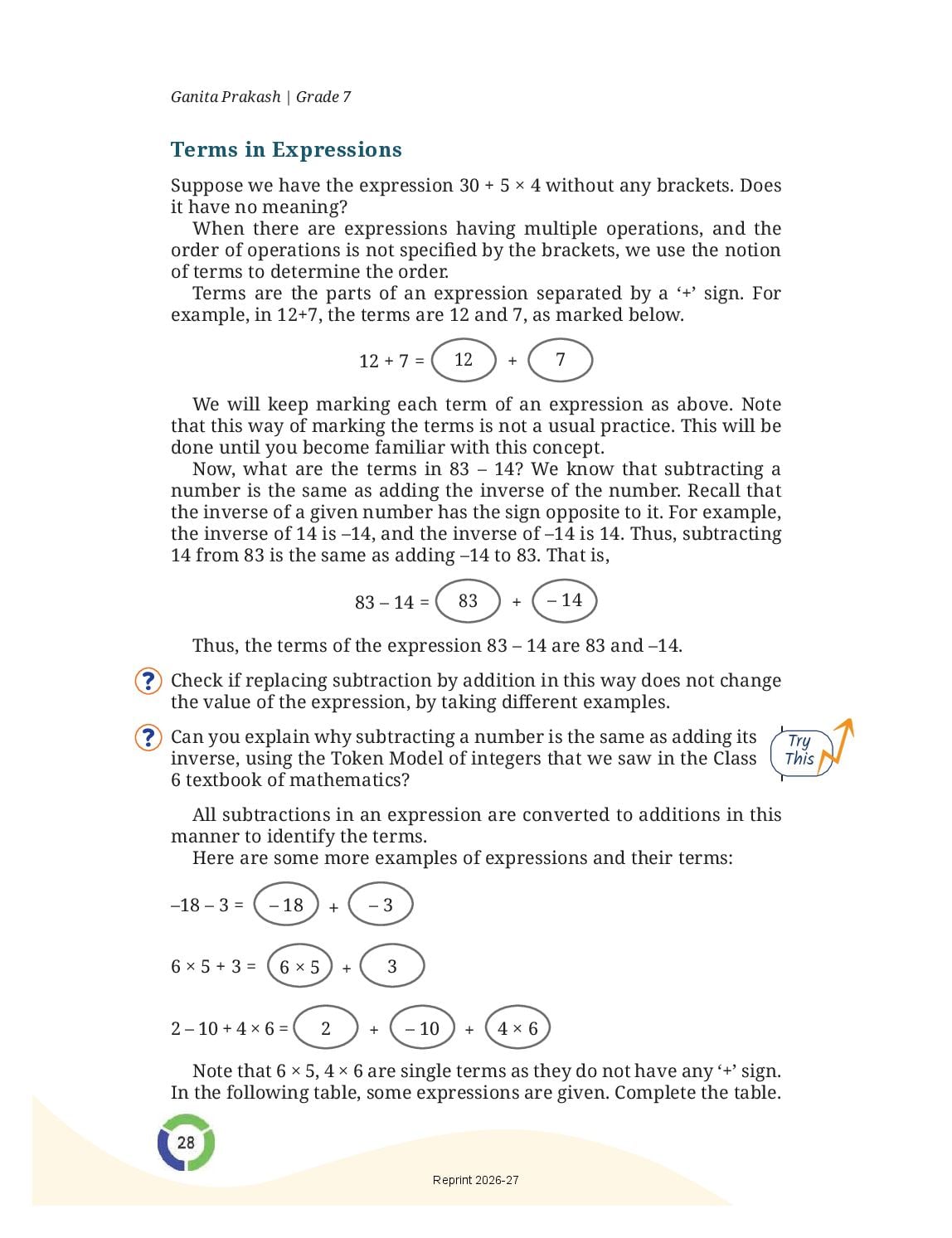
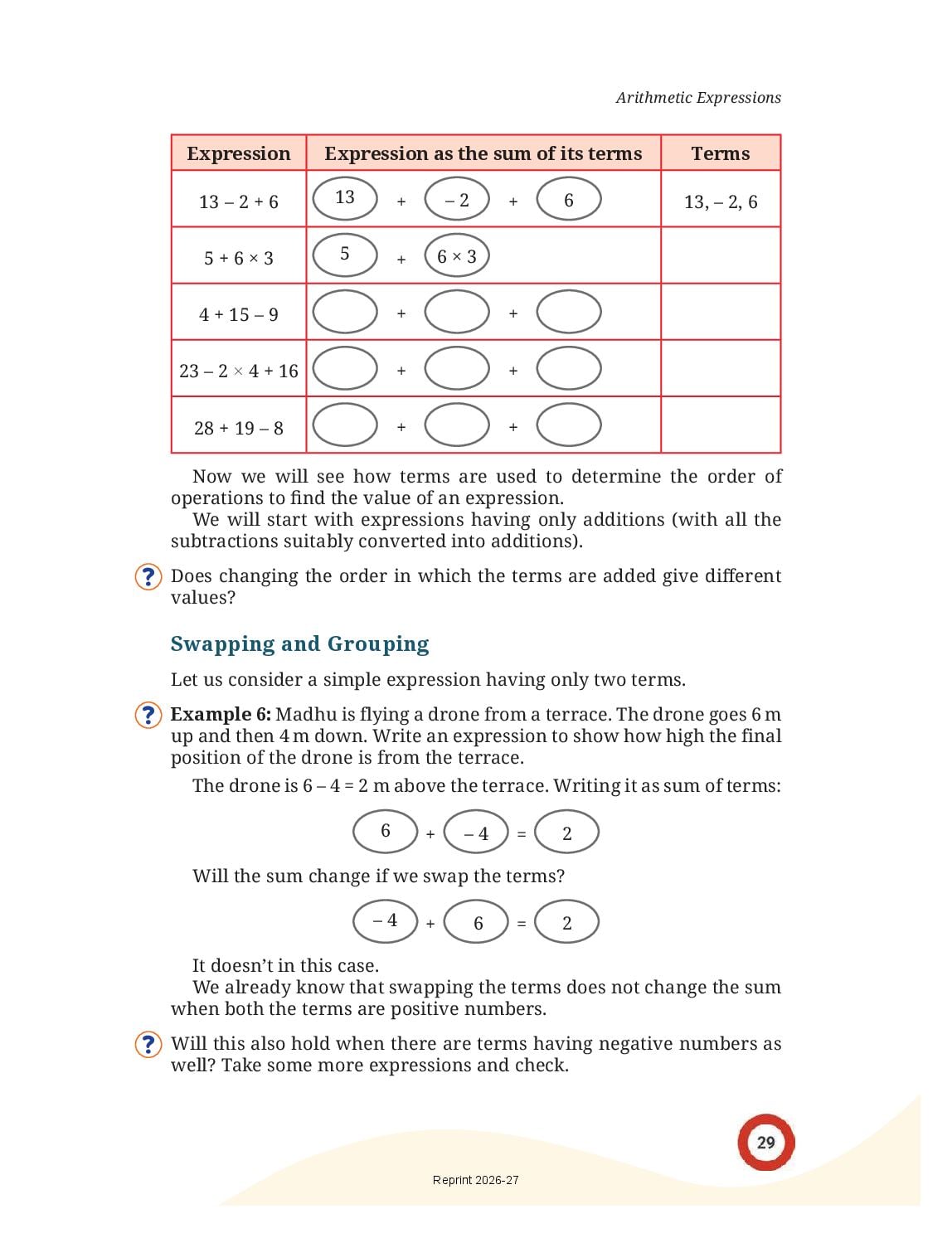
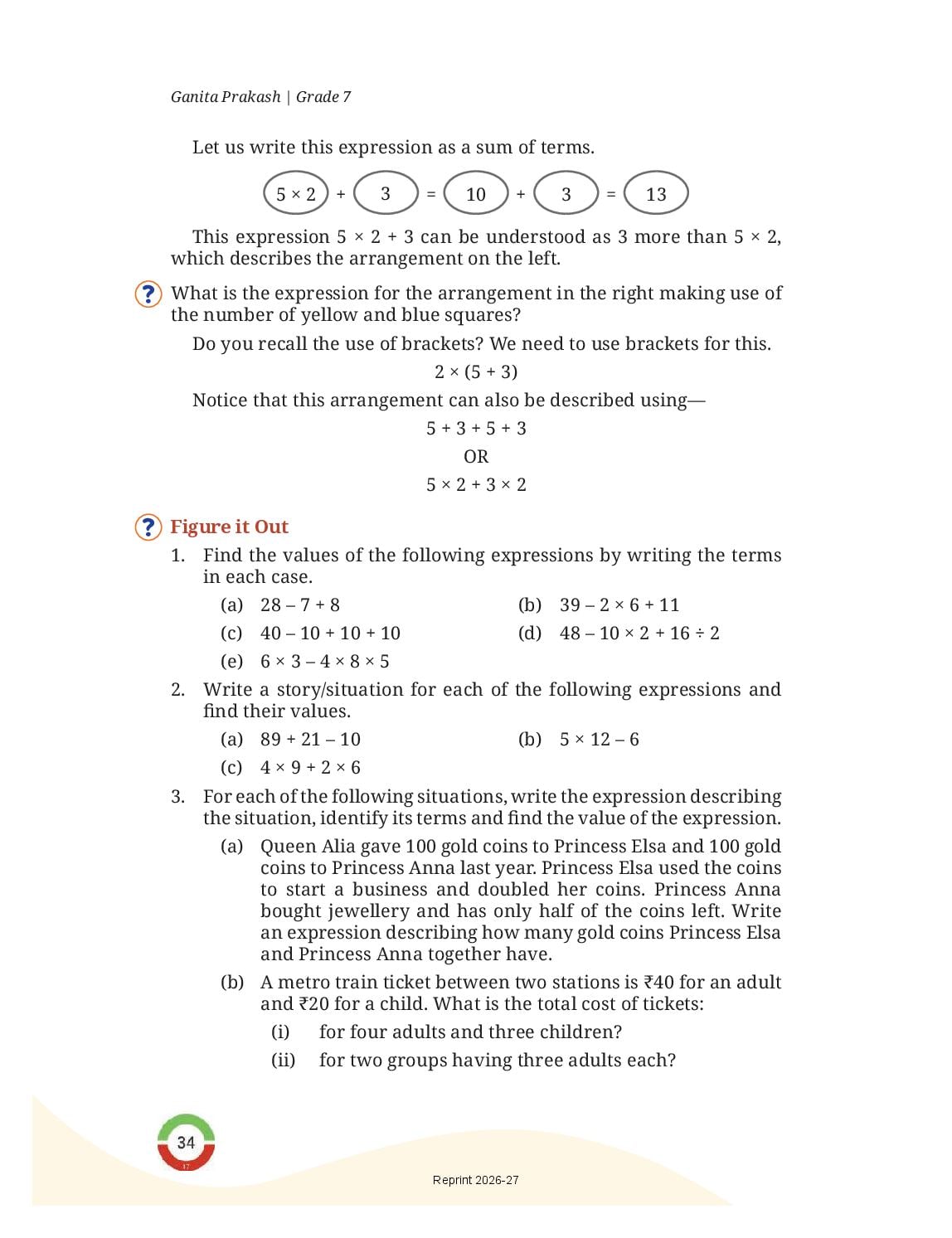
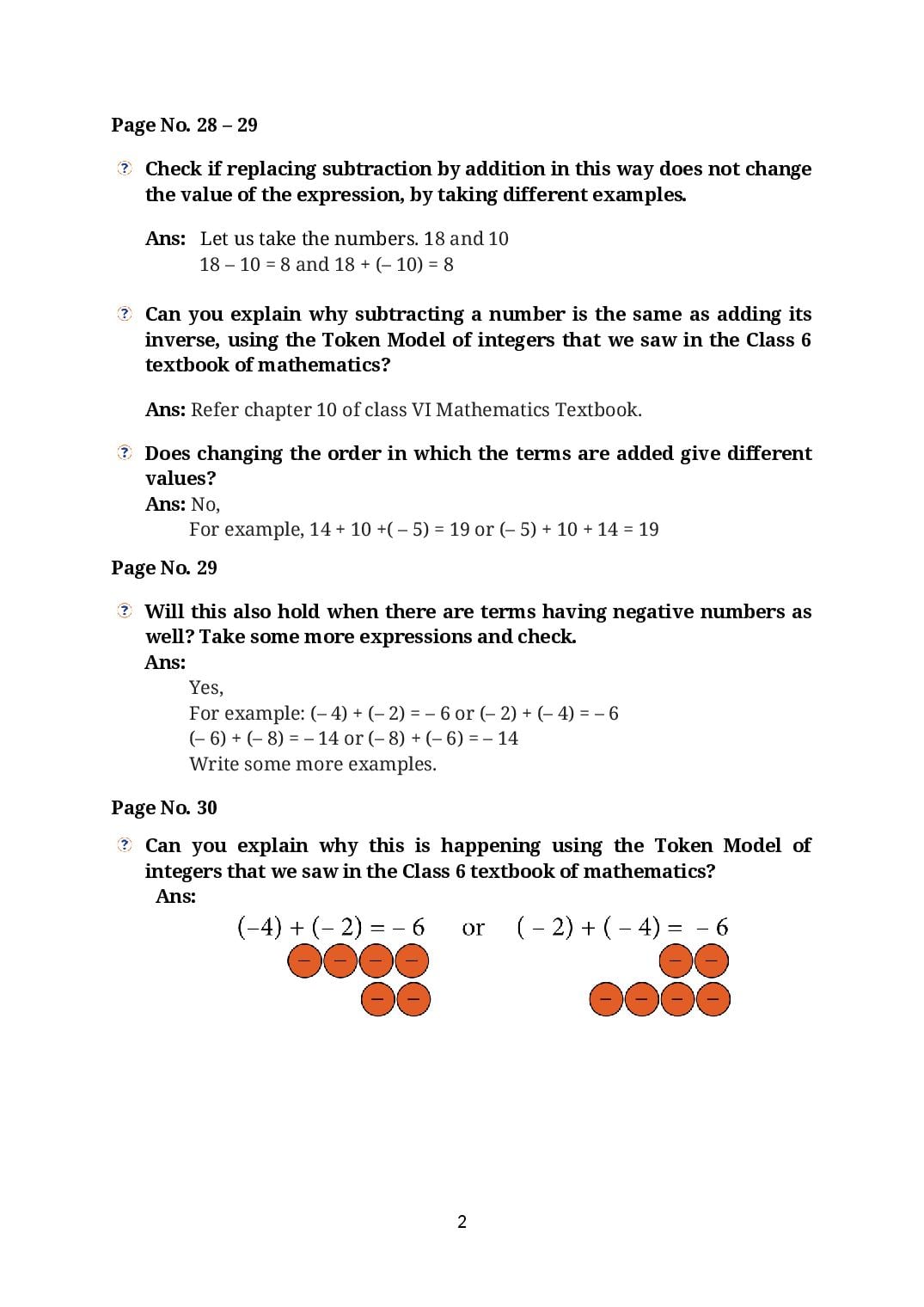
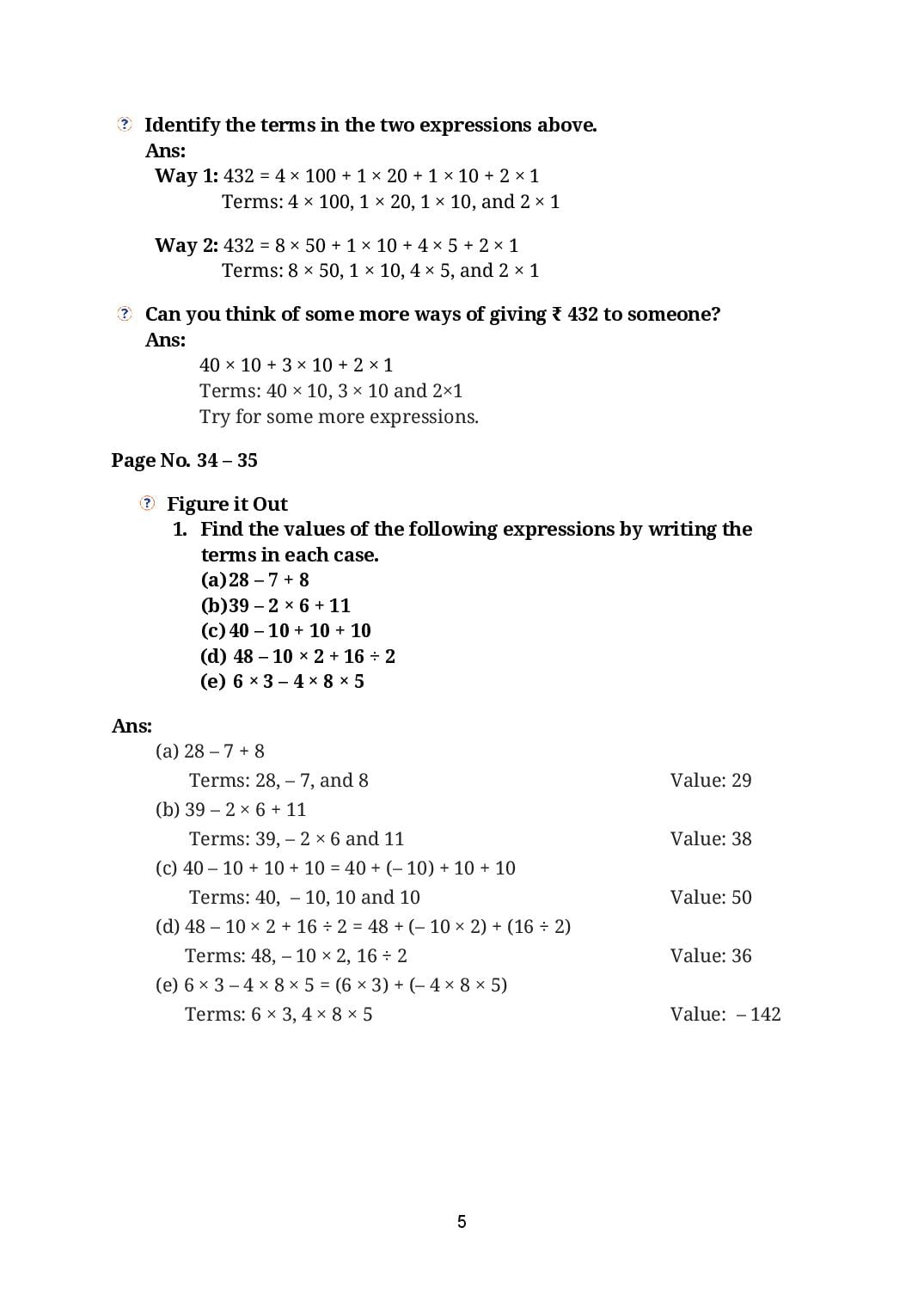
- Terms are the pieces of an expression separated by ‘+’. Every subtraction is first rewritten as adding the inverse, so 83 – 14 has terms 83 and –14.
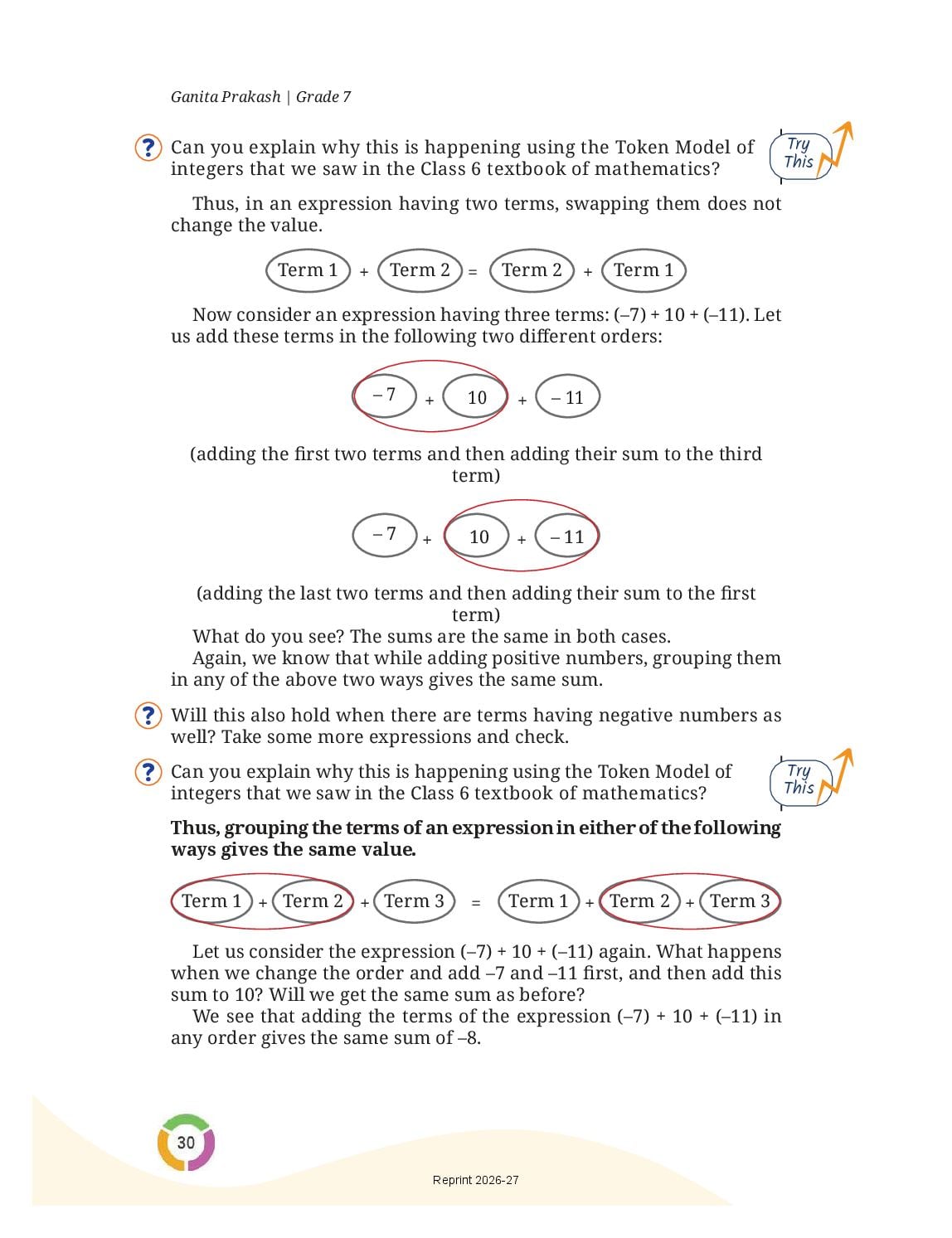
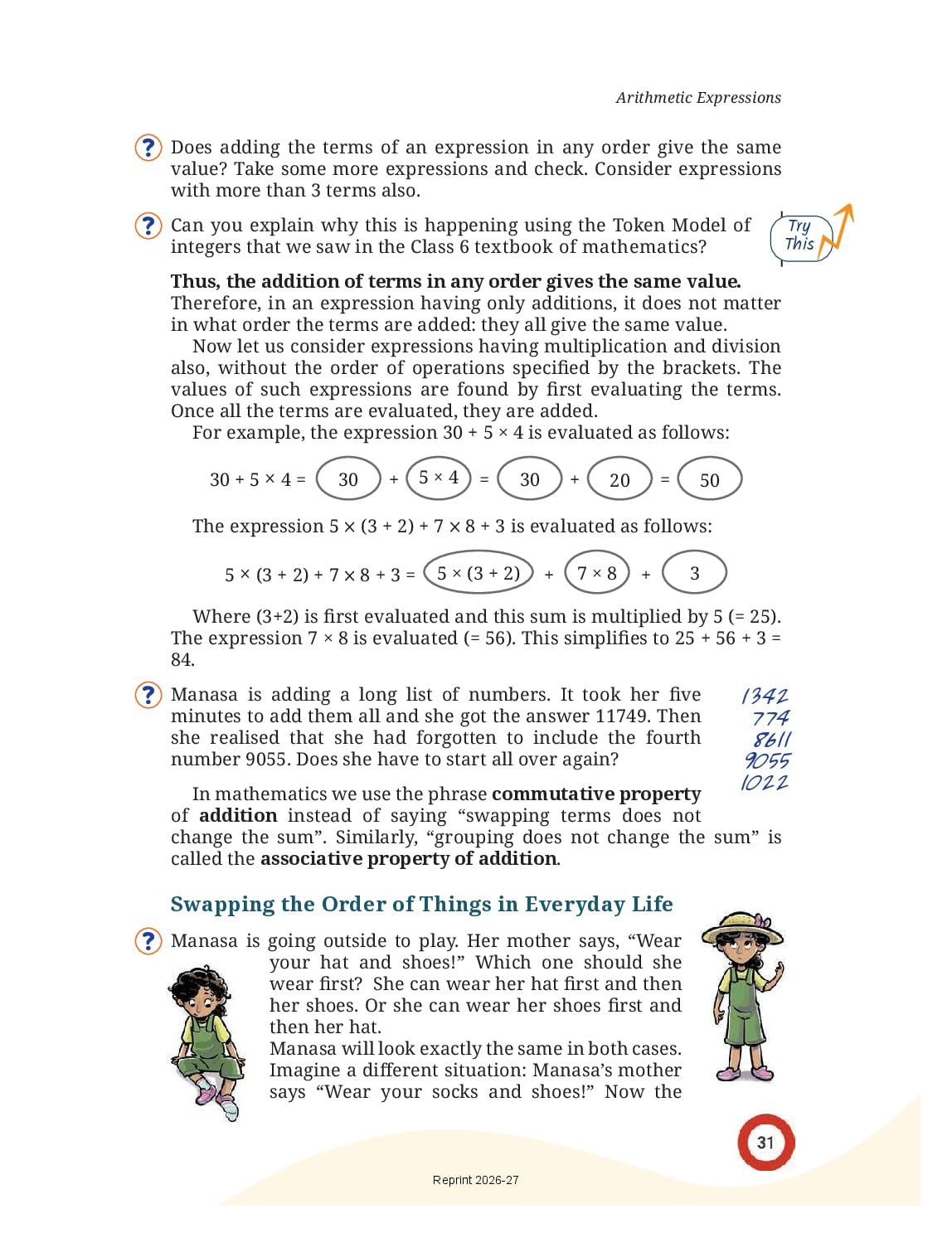
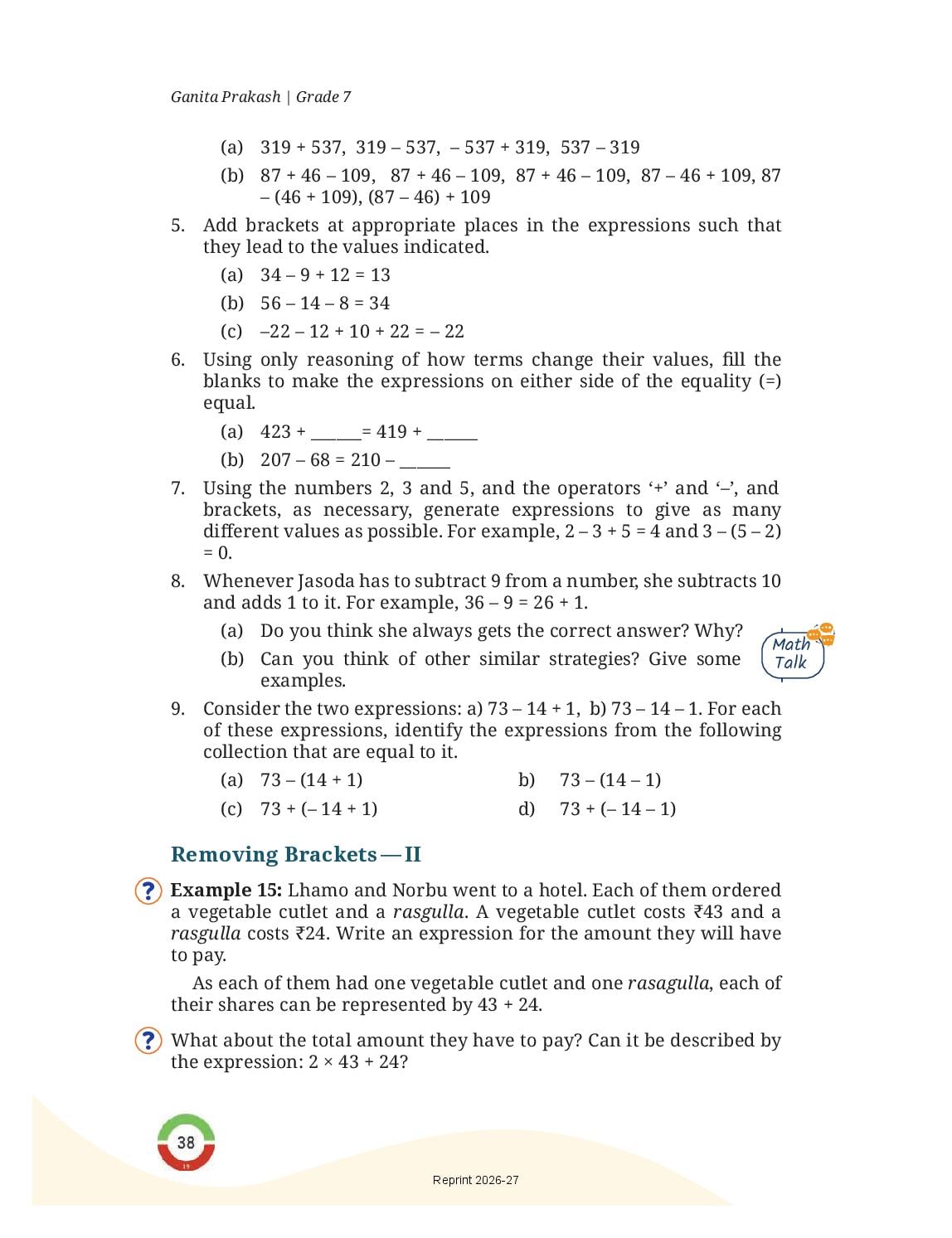
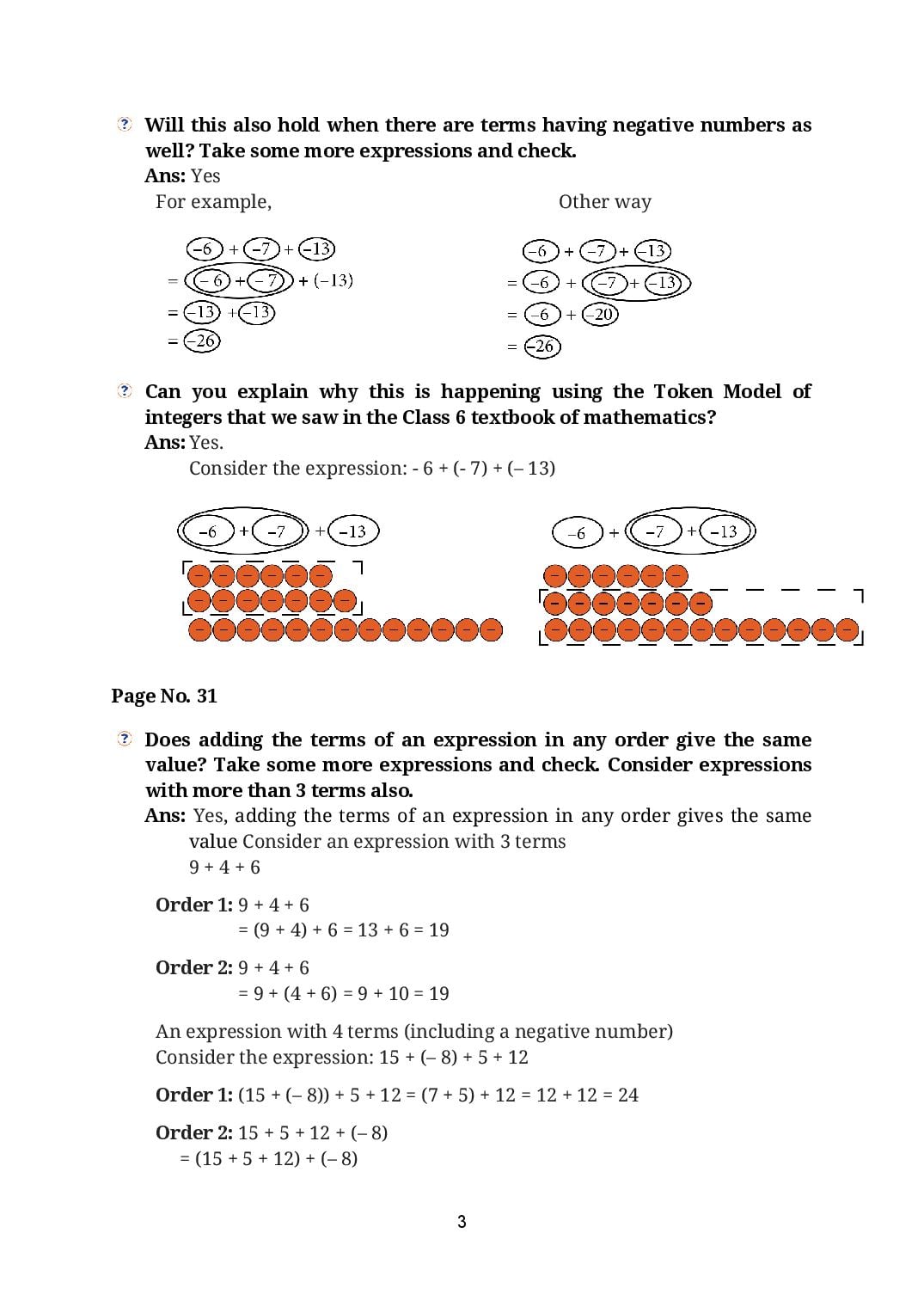
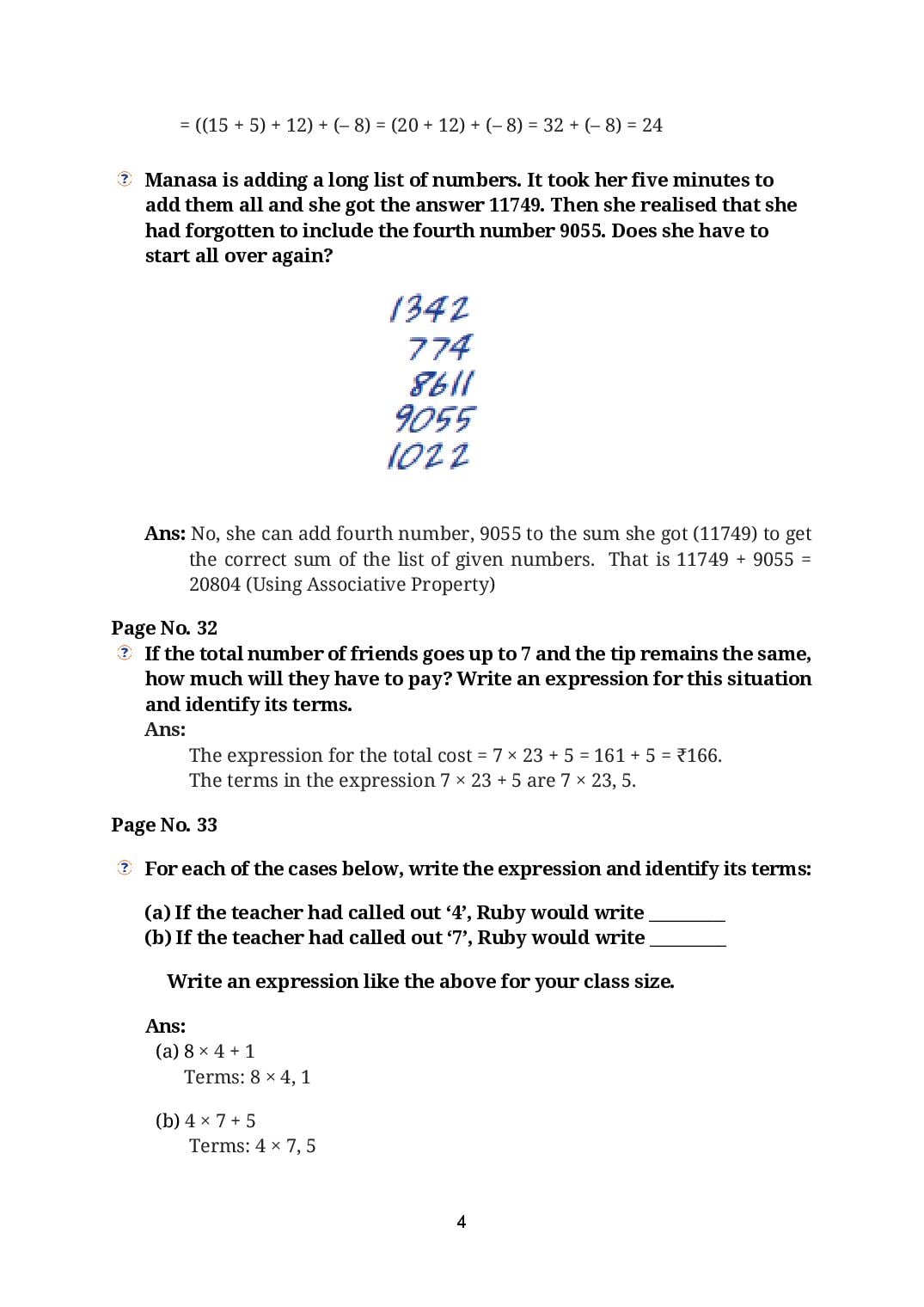
- Terms may be added in any order and in any grouping — the commutative and associative properties of addition.
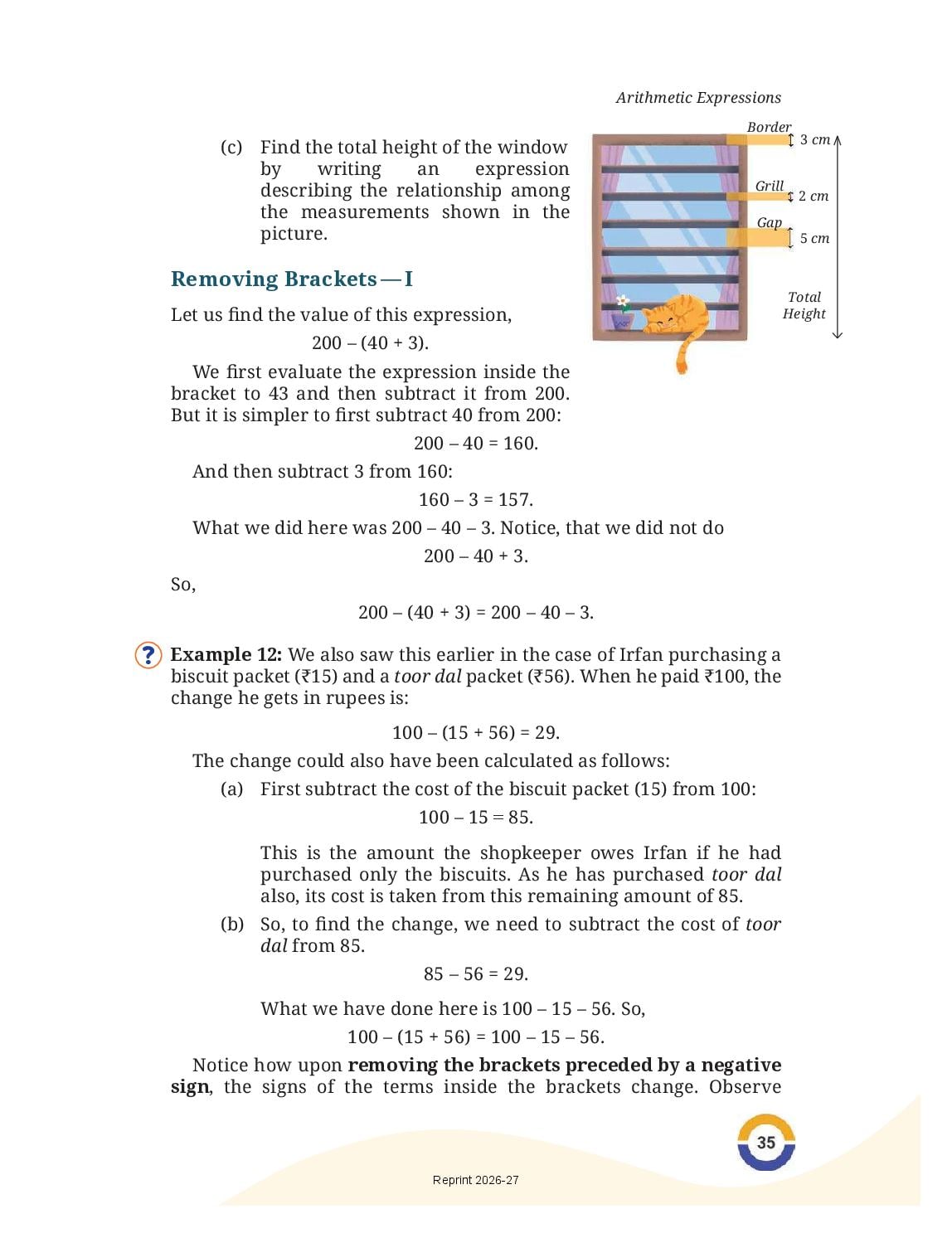
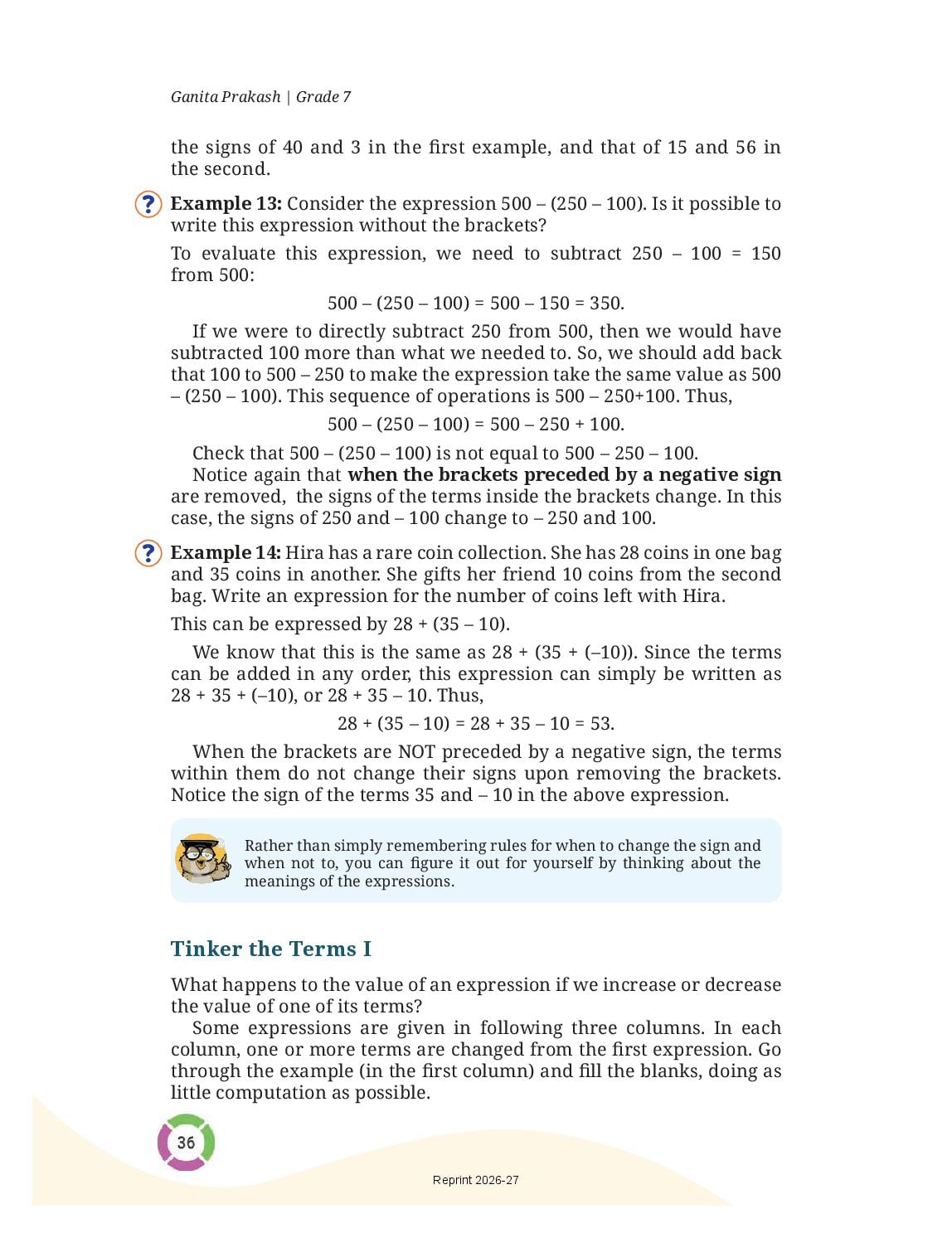
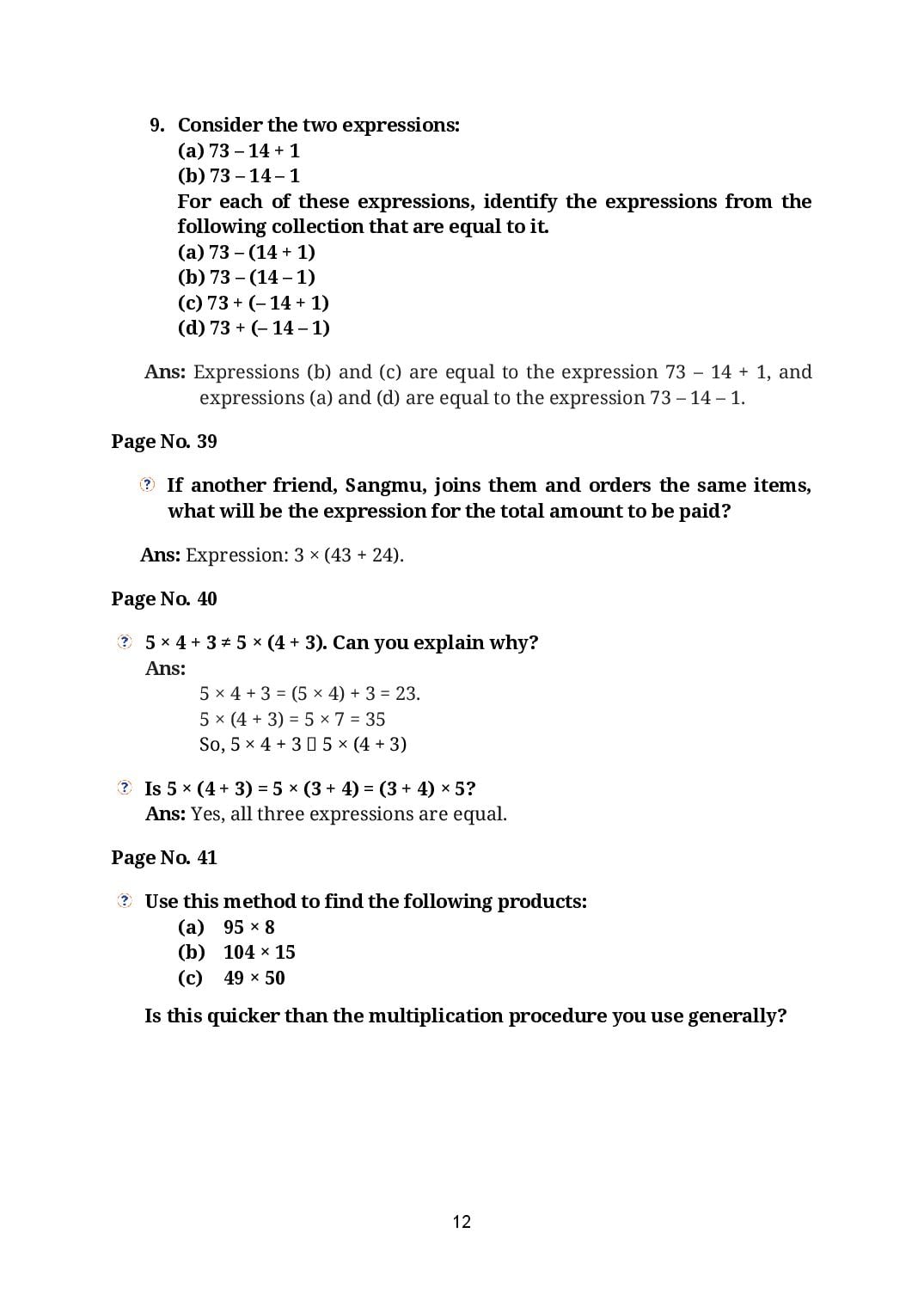
- Removing a bracket that has a minus sign in front of it flips the sign of every term inside it.
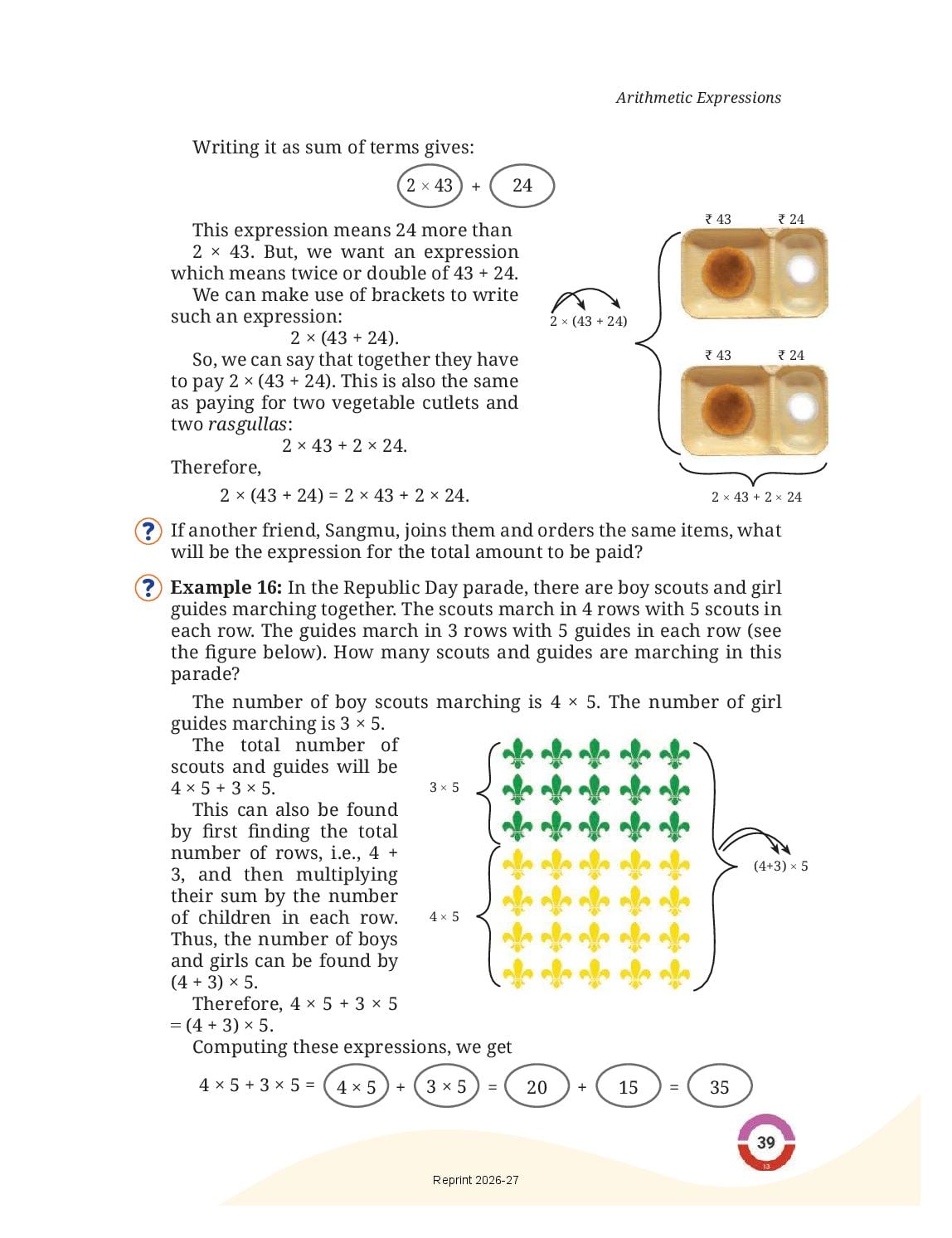
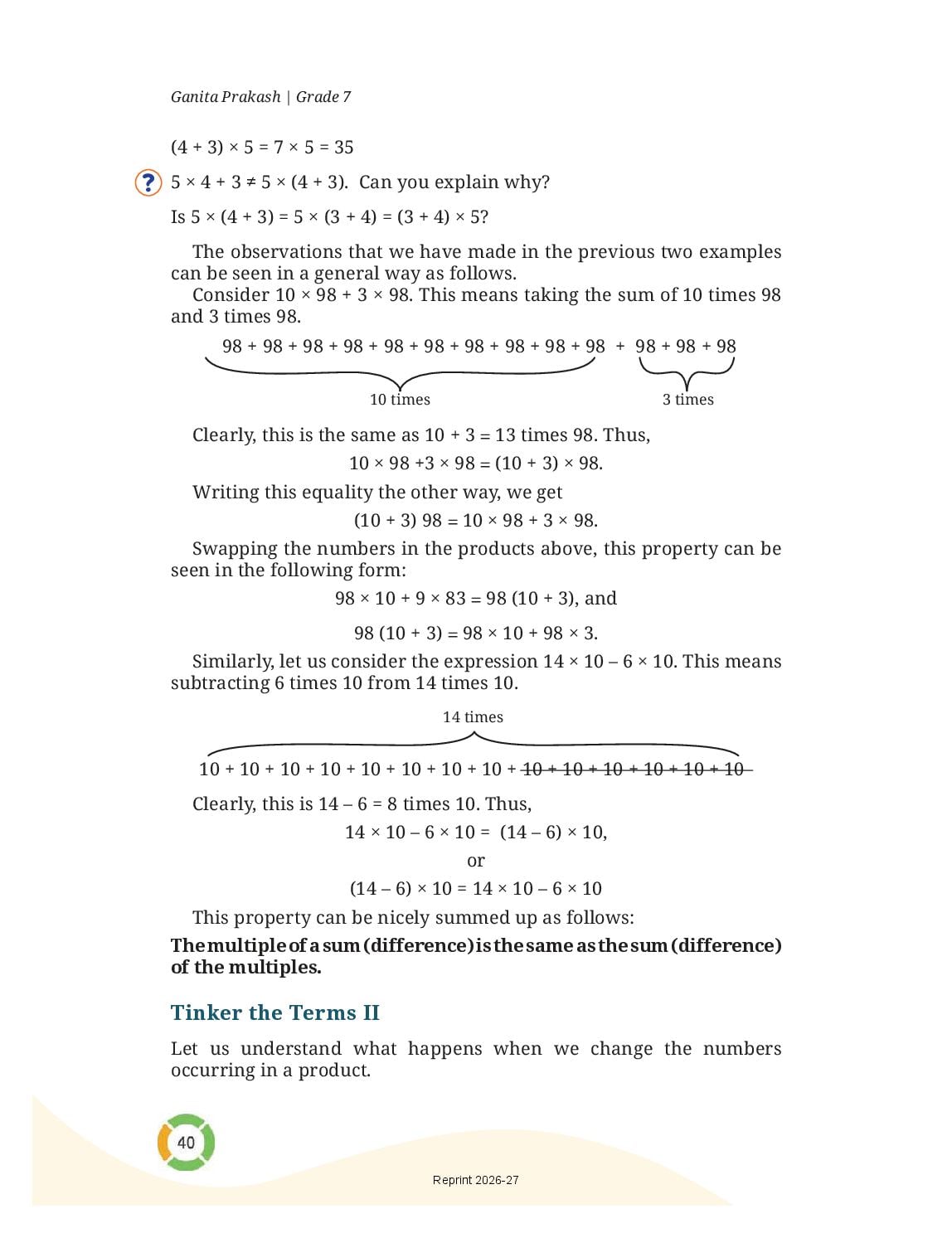
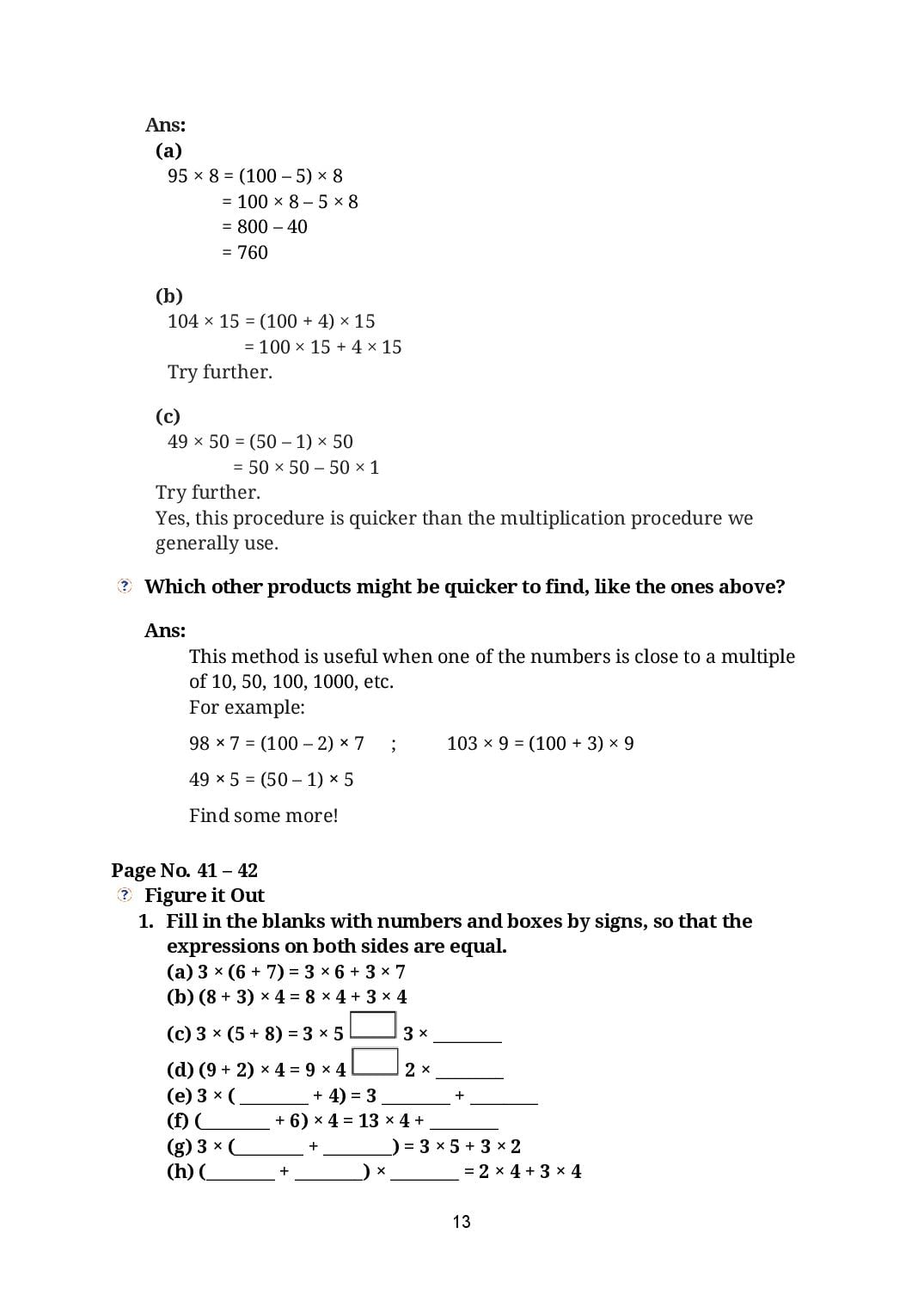
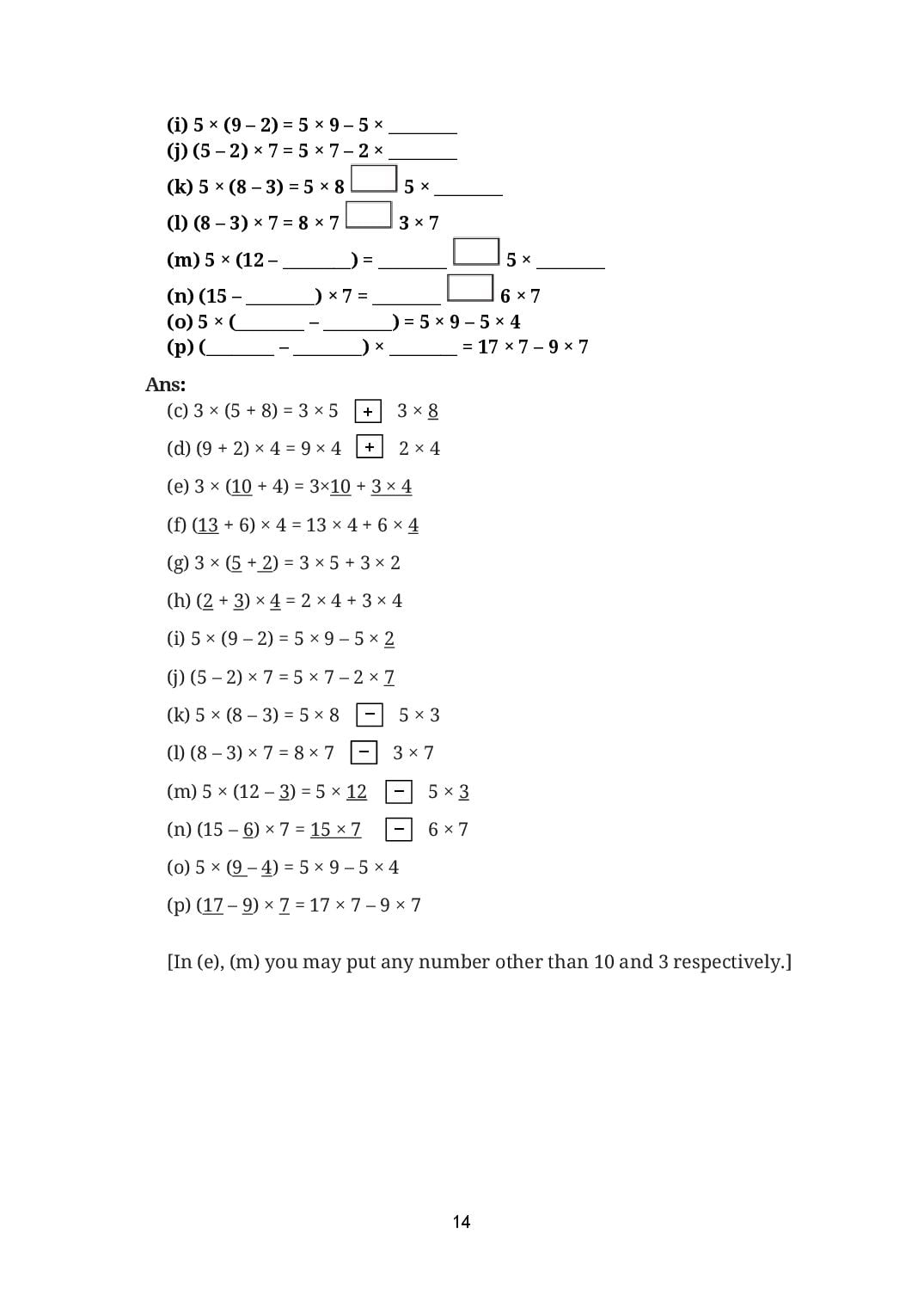
- The distributive property: a × (b + c) = a × b + a × c, and a × (b – c) = a × b – a × c — the multiple of a sum (difference) is the sum (difference) of the multiples.
Quick revision – Arithmetic Expressions
| Idea | What it means | Example | Value |
|---|---|---|---|
| Arithmetic expression | A number phrase built with + – × ÷ | 13 + 2 | 15 |
| Value of an expression | The single number it evaluates to | 5 × 25 | 125 |
| Comparing expressions | Use =, < or > on the two values | 13 – 2 < 4 × 3 | 11 < 12 |
| Term | A part separated by ‘+’ (subtraction → add the inverse) | 83 – 14 = 83 + (–14) | Terms 83, –14 |
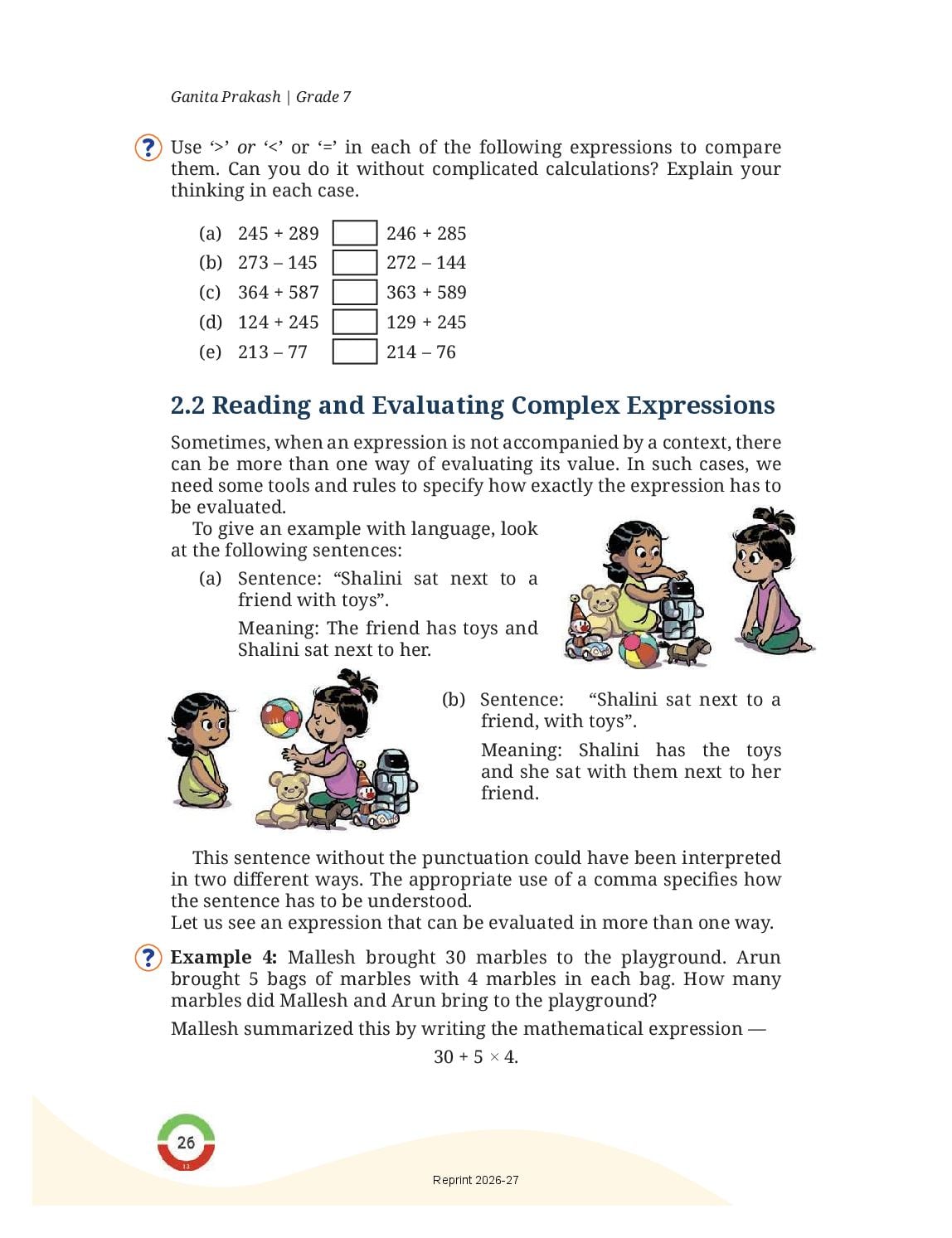
| Product as one term | A × or ÷ chain has no ‘+’, so it is a single term | 30 + 5 × 4 | Terms 30, 5 × 4 |
| Brackets | Evaluate what is inside first | 30 + (5 × 4) | 50 |
| Commutative property | Swapping two terms keeps the sum | 6 + (–4) = (–4) + 6 | 2 |
| Associative property | Grouping terms differently keeps the sum | (–7) + 10 + (–11) | –8 |
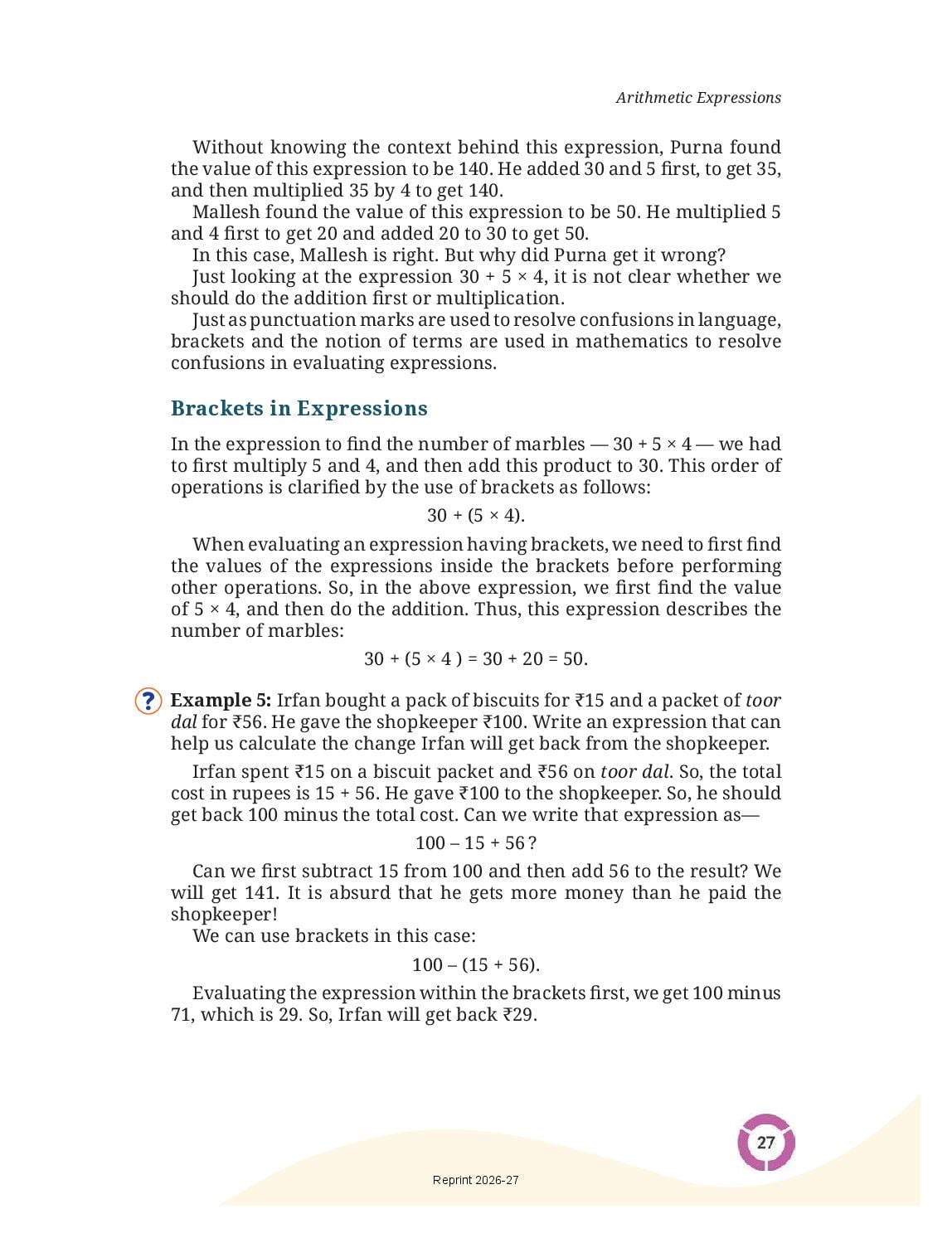
| Bracket after a minus | Signs of all terms inside change | 200 – (40 + 3) = 200 – 40 – 3 | 157 |
| Bracket after a plus | Signs inside stay as they are | 28 + (35 – 10) = 28 + 35 – 10 | 53 |
| Distributive property | Multiply the number into every term | 2 × (43 + 24) = 2 × 43 + 2 × 24 | 134 |
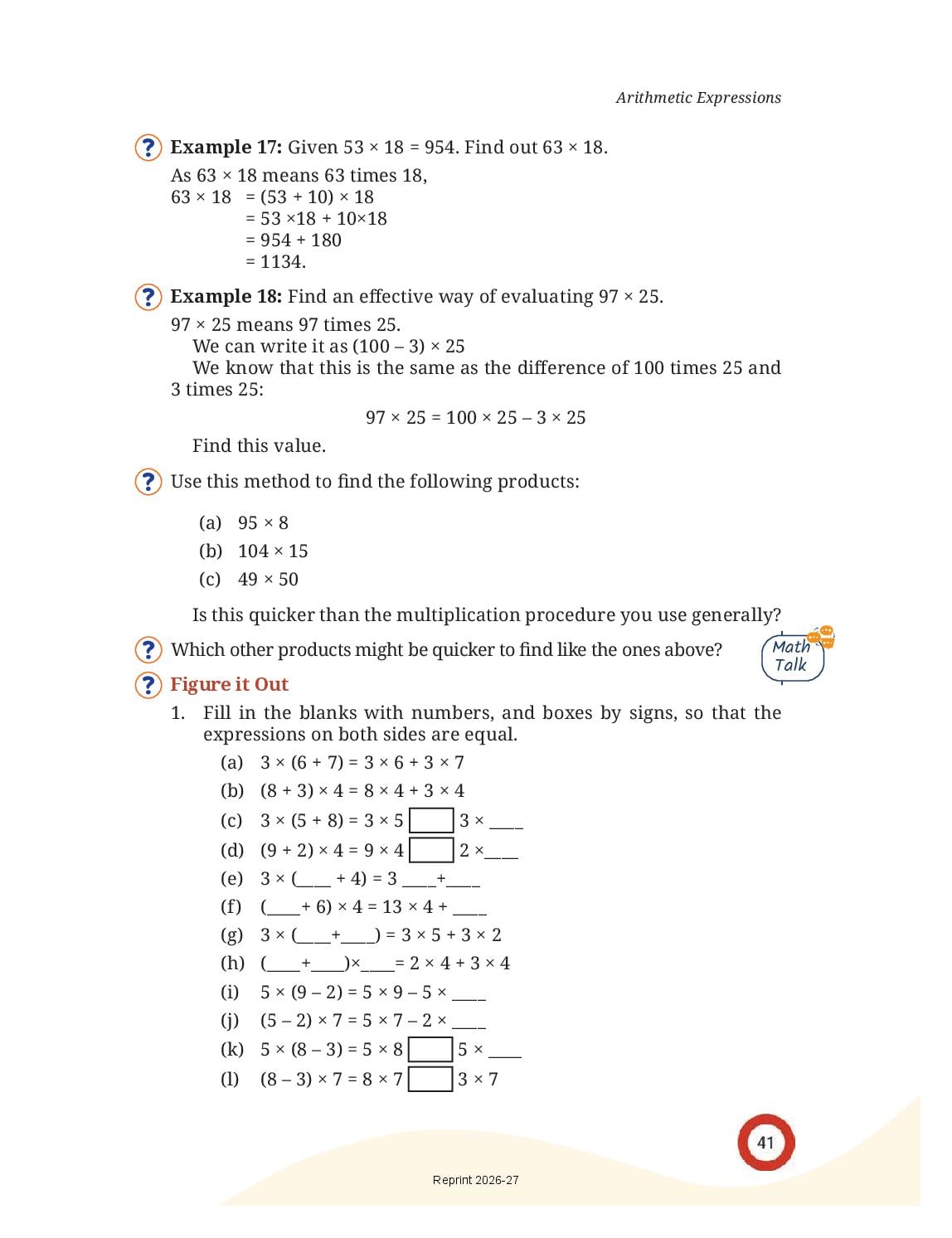
| Smart multiplying | Write a number as a round number ± a little | 97 × 25 = 100 × 25 – 3 × 25 | 2425 |
Old NCERT vs New – Class 7 Maths
This chapter is from Ganita Prakash, the new NCERT Class 7 Maths book (NCF-SE 2023, used from 2025-26). It replaced the old book “Mathematics”, so chapter numbers and names differ from older PDFs.
Solutions and All Chapters
Answers to the exercises and the full chapter list of Ganita Prakash:
Arithmetic Expressions – Overview
| Class | Class 7 |
| Subject | Maths |
| Book | Ganita Prakash – new NCERT book |
| Part | Part I |
| Chapter | 2 of 15 – Arithmetic Expressions |
| Book pages | 24 – 45 |
| Edition | NCERT Reprint 2026-27 |
| Session | 2026-27 |
| Free – read online or download |
Class 7 Maths Chapter 2 – FAQs
Where can I download Arithmetic Expressions Class 7 PDF?
From the download table on this page – the chapter PDF is free, and the full book is linked too.
What is Class 7 Maths Chapter 2 about?
An arithmetic expression is a number phrase like 13 + 2 or 5 × 25; the number it evaluates to is its value.
Is Arithmetic Expressions from the new NCERT Class 7 Maths book?
Yes. It is chapter 2 of ganita prakash (part i), the new NCERT Class 7 Maths book for 2026-27.
Is this the latest NCERT edition for 2026-27?
Yes – the PDF is NCERT’s latest edition for the 2026-27 session.
Where are the NCERT Solutions for Class 7 Maths Chapter 2?
Open the NCERT Solutions link above for answers to the exercise questions.