NCERT Solutions for Class 7 Maths Chapter 2 Arithmetic Expressions provide clear, step-by-step answers to every exercise and in-text question from the chapter Arithmetic Expressions of the NCERT textbook Ganita Prakash. Prepared by subject experts as per the latest NCERT (CBSE) syllabus for 2026-27, these NCERT Solutions for Class 7 Maths help you understand each concept, write exam-ready answers, and check your own solutions. You can read them online below or download the free Class 7 Maths Chapter 2 question-answer PDF.
NCERT Solutions for Class 7 Maths Chapter 2 Arithmetic Expressions
- Class: Class 7
- Subject: Maths
- Chapter: Chapter 2 – Arithmetic Expressions
- Textbook: Ganita Prakash (NCERT)
- Study material: NCERT Solutions – questions with answers, free PDF
These solutions answer all the exercise questions of Chapter 2 Arithmetic Expressions — including the in-text questions, short-answer and long-answer questions, and activities — with complete explanations so you can follow the method, not just the final answer. Read the full solutions below.
NCERT Solutions Class 7 Maths Chapter 2 Arithmetic Expressions View Download
NCERT Solutions for Class 7 Maths Chapter 2 PDF Download
You can read the NCERT Solutions for Class 7 Maths Chapter 2 online above, or download the complete question-answer PDF to study Arithmetic Expressions offline at any time.
NCERT Solutions for Class 7 Maths Chapter 2 PDF Download Link – Click Here to Download Solutions PDF
Questions Covered in This Chapter
These NCERT Solutions answer all 56 questions of this chapter. The questions solved are:
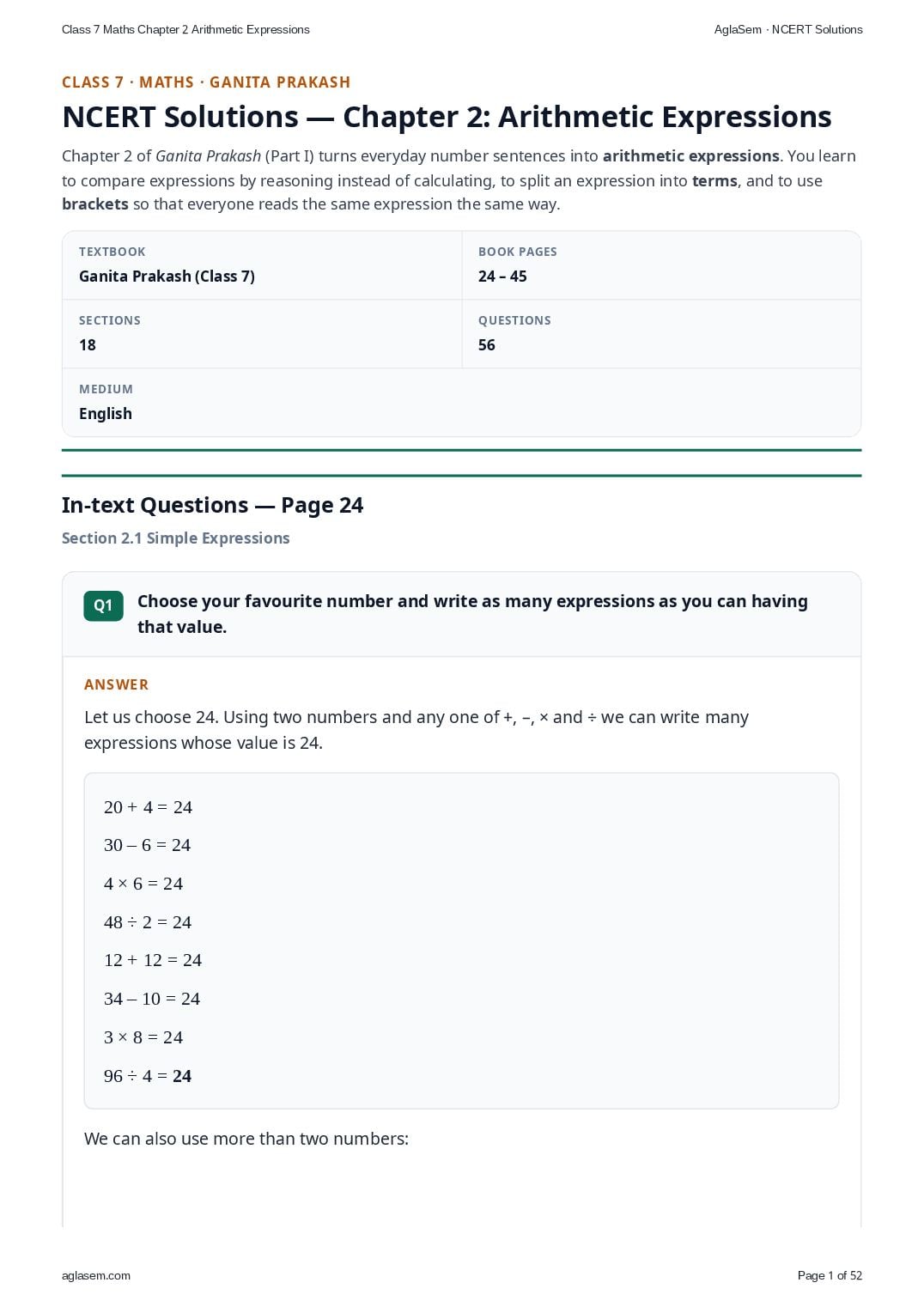
- Choose your favourite number and write as many expressions as you can having that value.
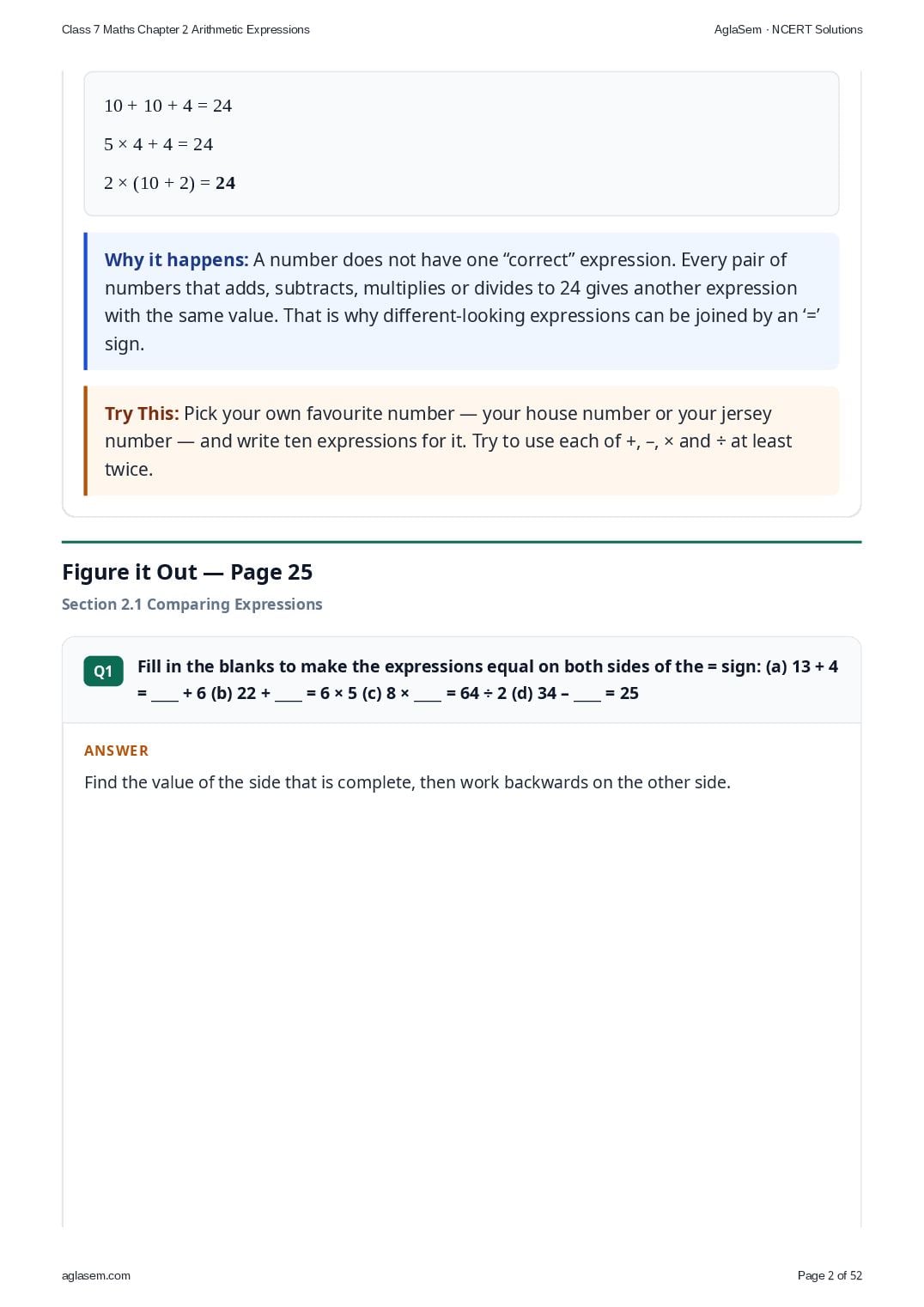
- Fill in the blanks to make the expressions equal on both sides of the = sign: (a) 13 + 4 = ____ + 6 (b) 22 + ____ = 6 × 5 (c) 8 × ____ = 64 ÷ 2 (d) 34 – ____ = 25
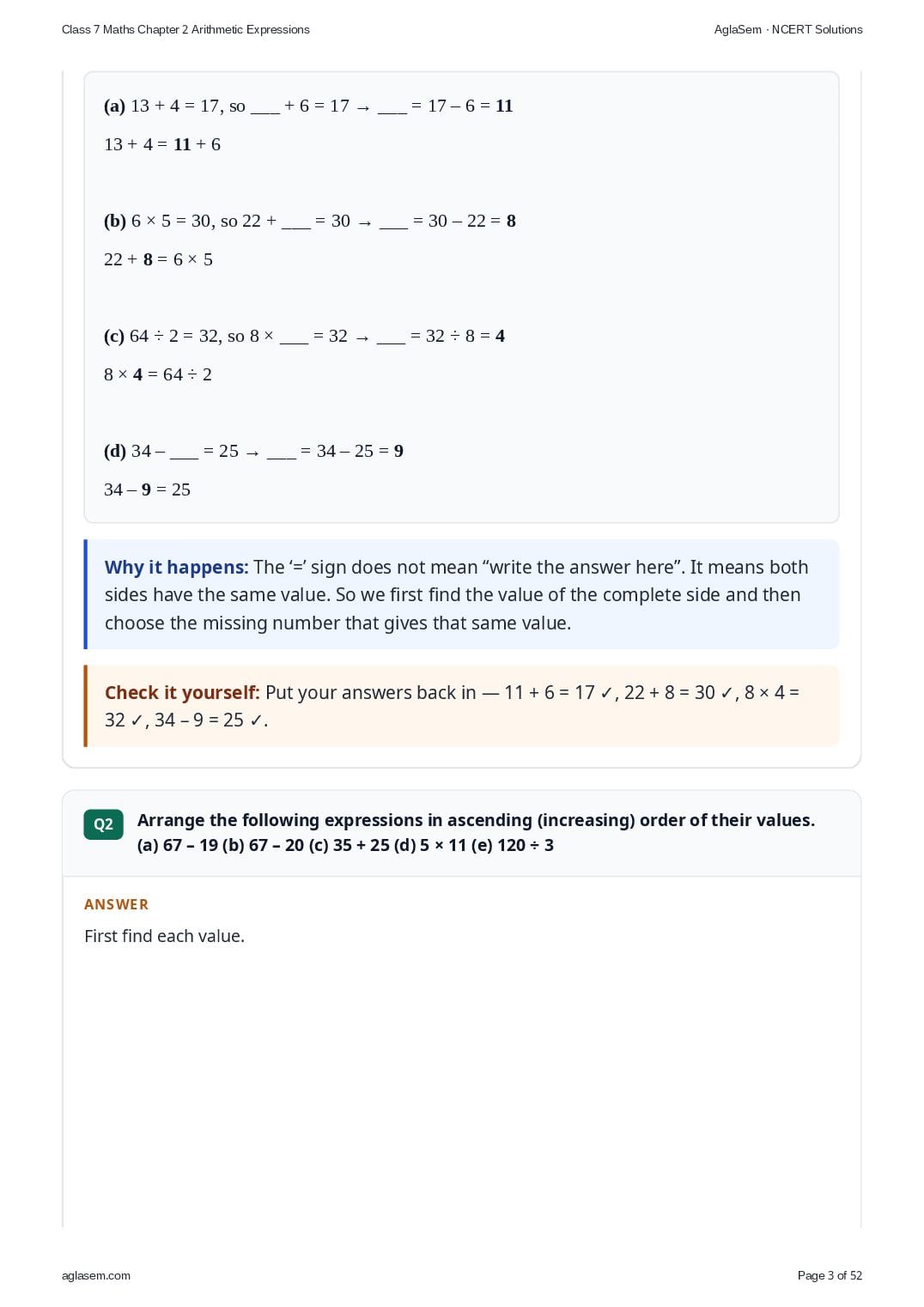
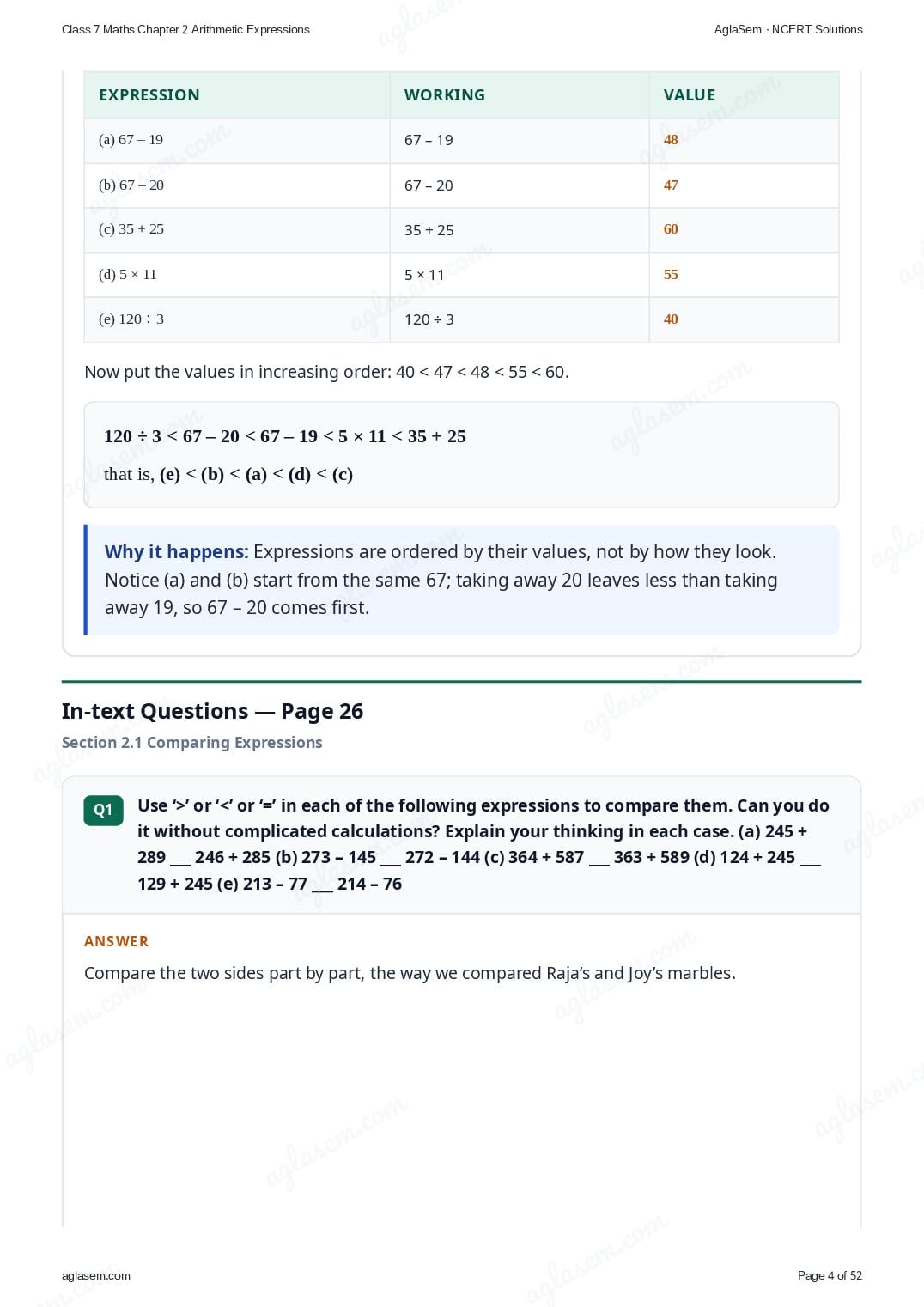
- Arrange the following expressions in ascending (increasing) order of their values. (a) 67 – 19 (b) 67 – 20 (c) 35 + 25 (d) 5 × 11 (e) 120 ÷ 3
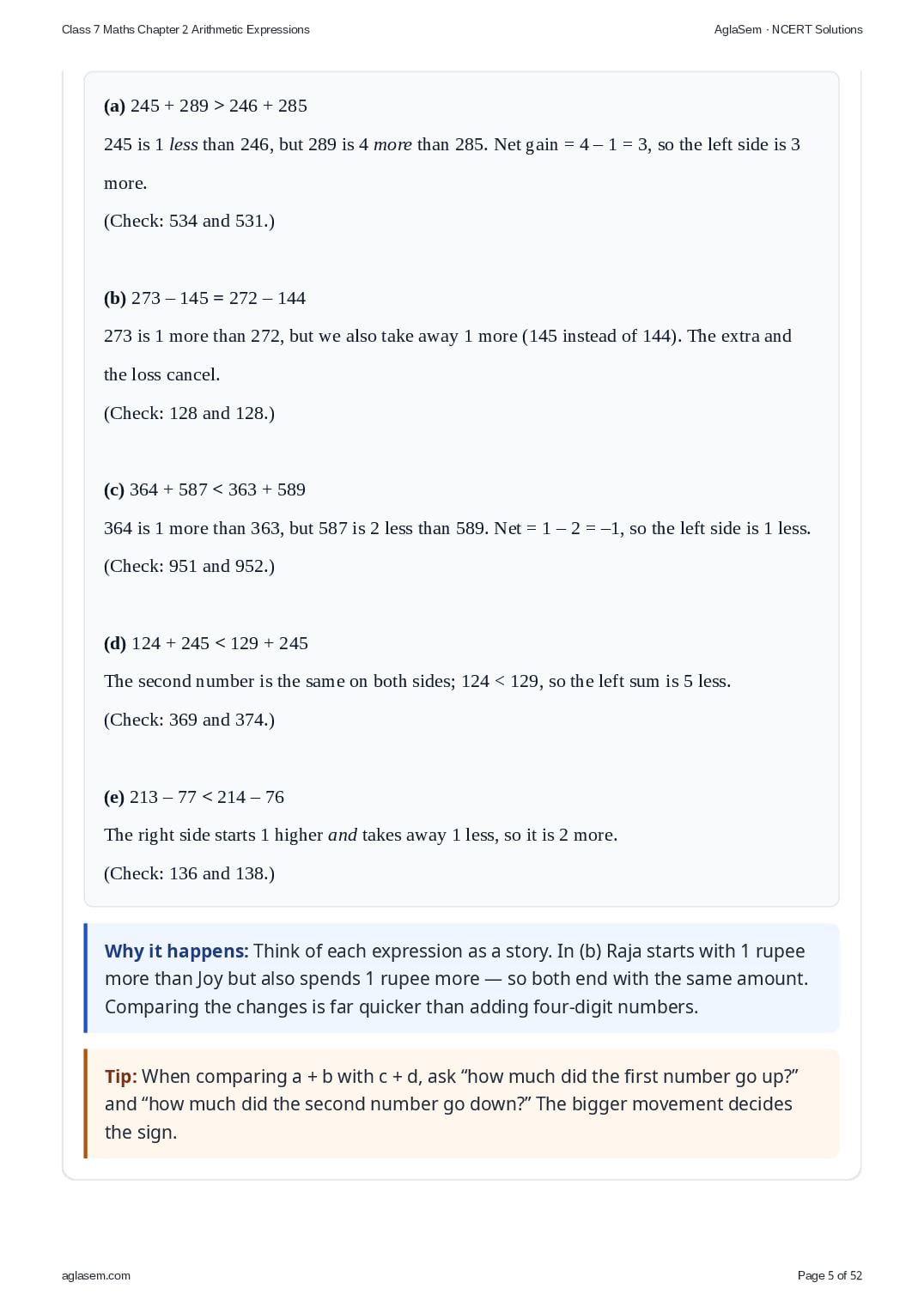
- Use ‘>’ or ‘<’ or ‘=’ in each of the following expressions to compare them. Can you do it without complicated calculations? Explain your thinking in each case. (a) 245 + 289 ___ 246 + 285 (b) 273 – 145 ___ 272 – 144 (c) 364 + 587 ___ 363 + 589 (d) 124 + 245 ___ 129 + 245 (e) 213 – 77 ___ 214 – 76
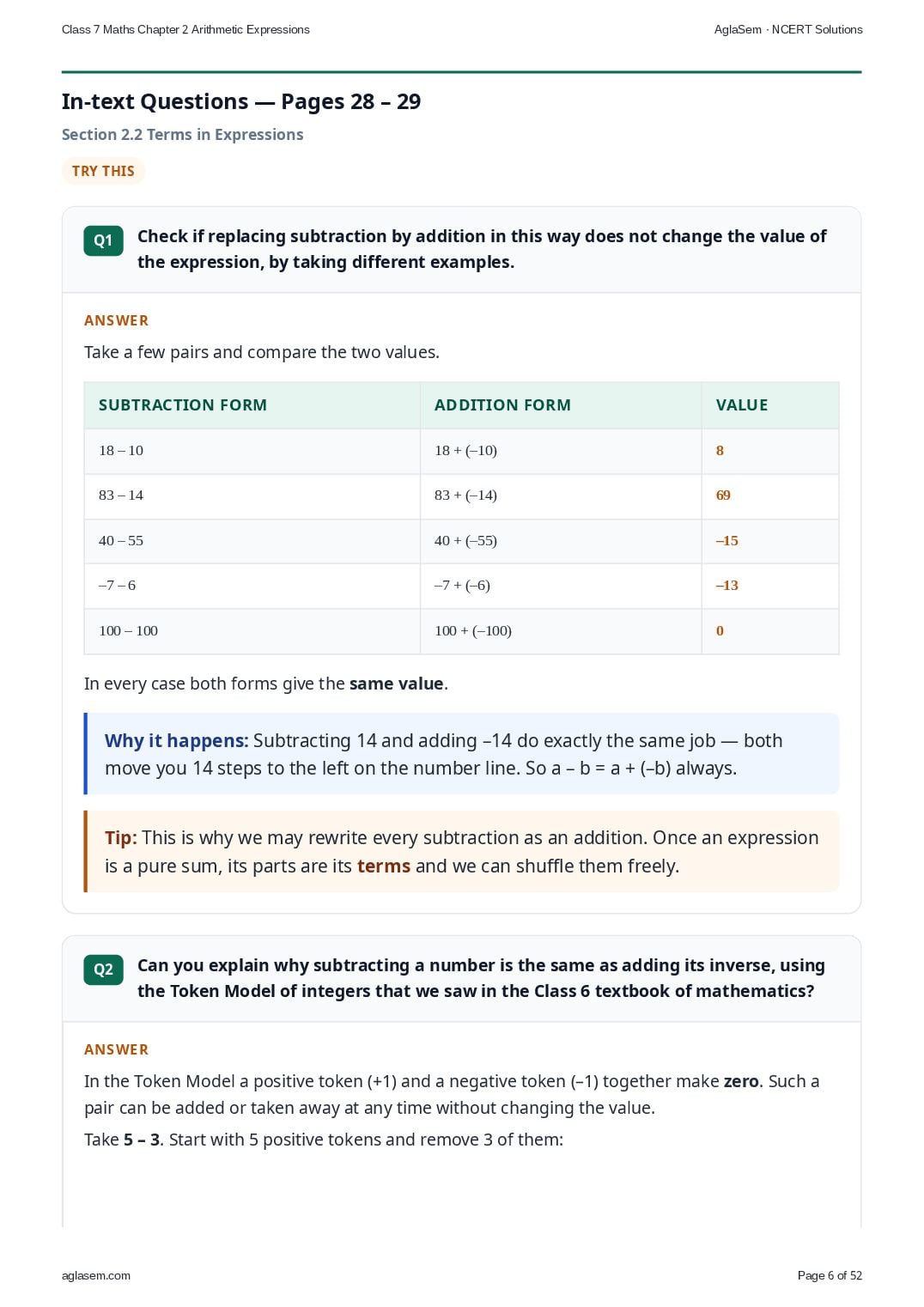
- Check if replacing subtraction by addition in this way does not change the value of the expression, by taking different examples.
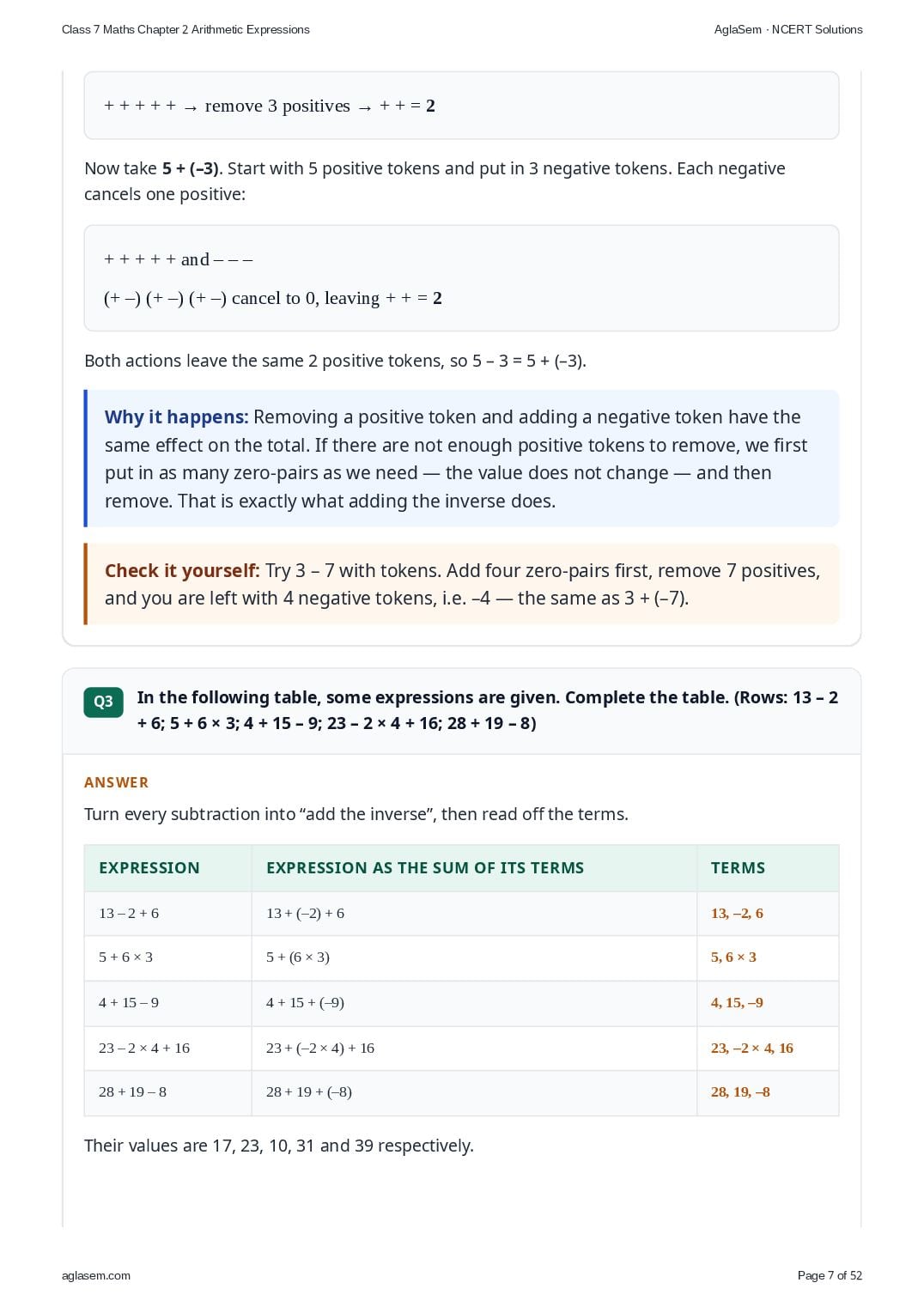
- Can you explain why subtracting a number is the same as adding its inverse, using the Token Model of integers that we saw in the Class 6 textbook of mathematics?
- In the following table, some expressions are given. Complete the table. (Rows: 13 – 2 + 6; 5 + 6 × 3; 4 + 15 – 9; 23 – 2 × 4 + 16; 28 + 19 – 8)
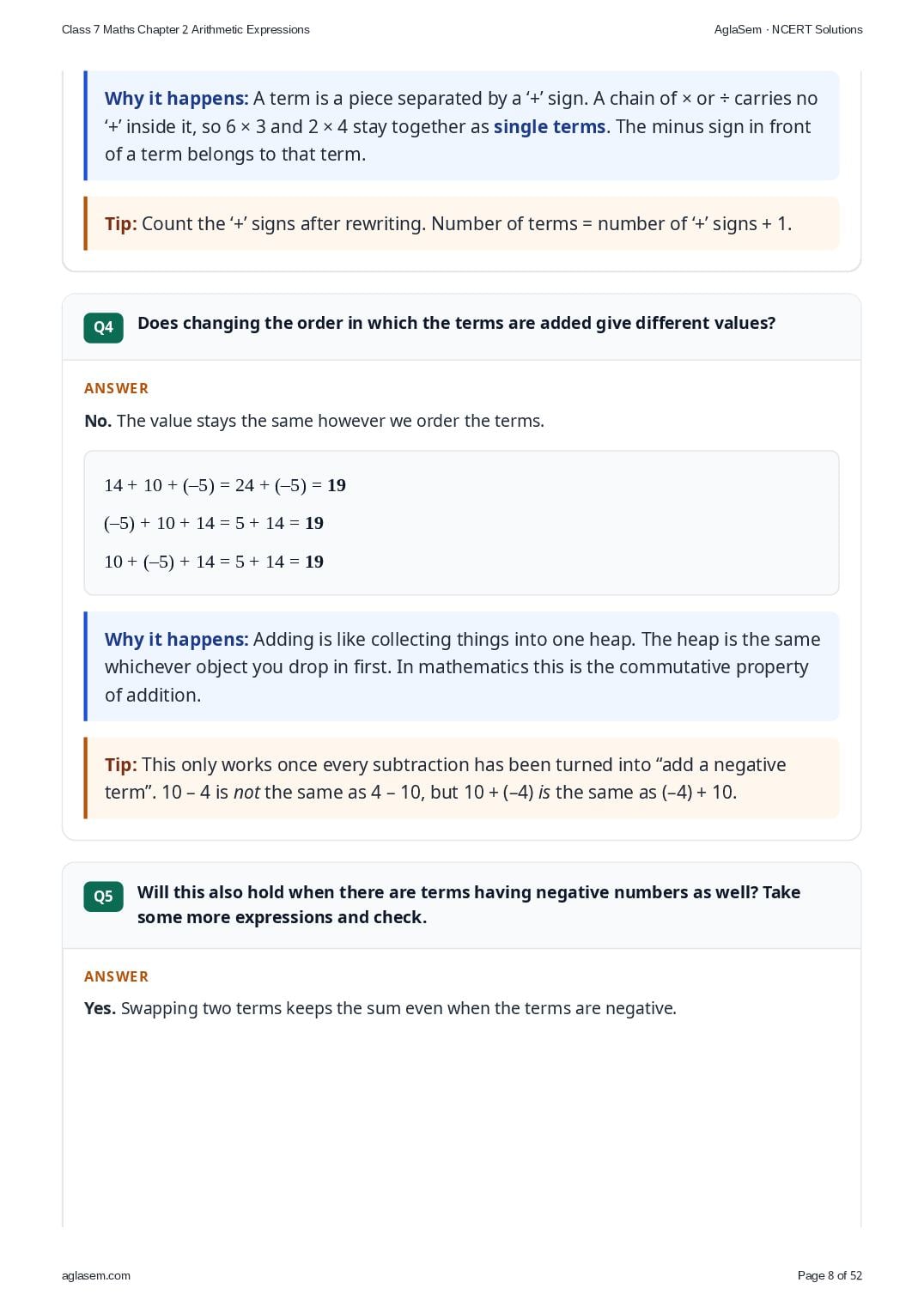
- Does changing the order in which the terms are added give different values?
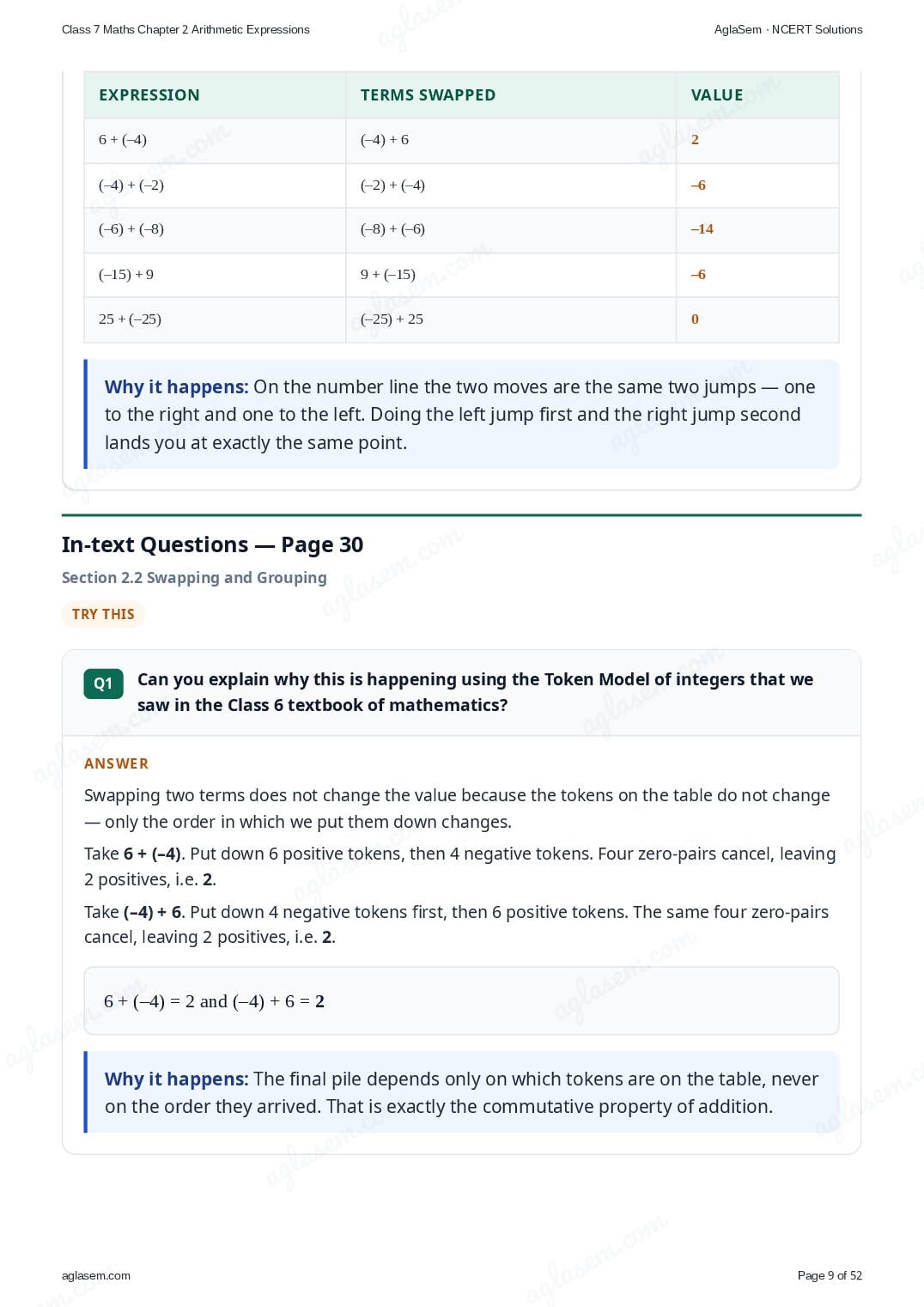
- Will this also hold when there are terms having negative numbers as well? Take some more expressions and check.
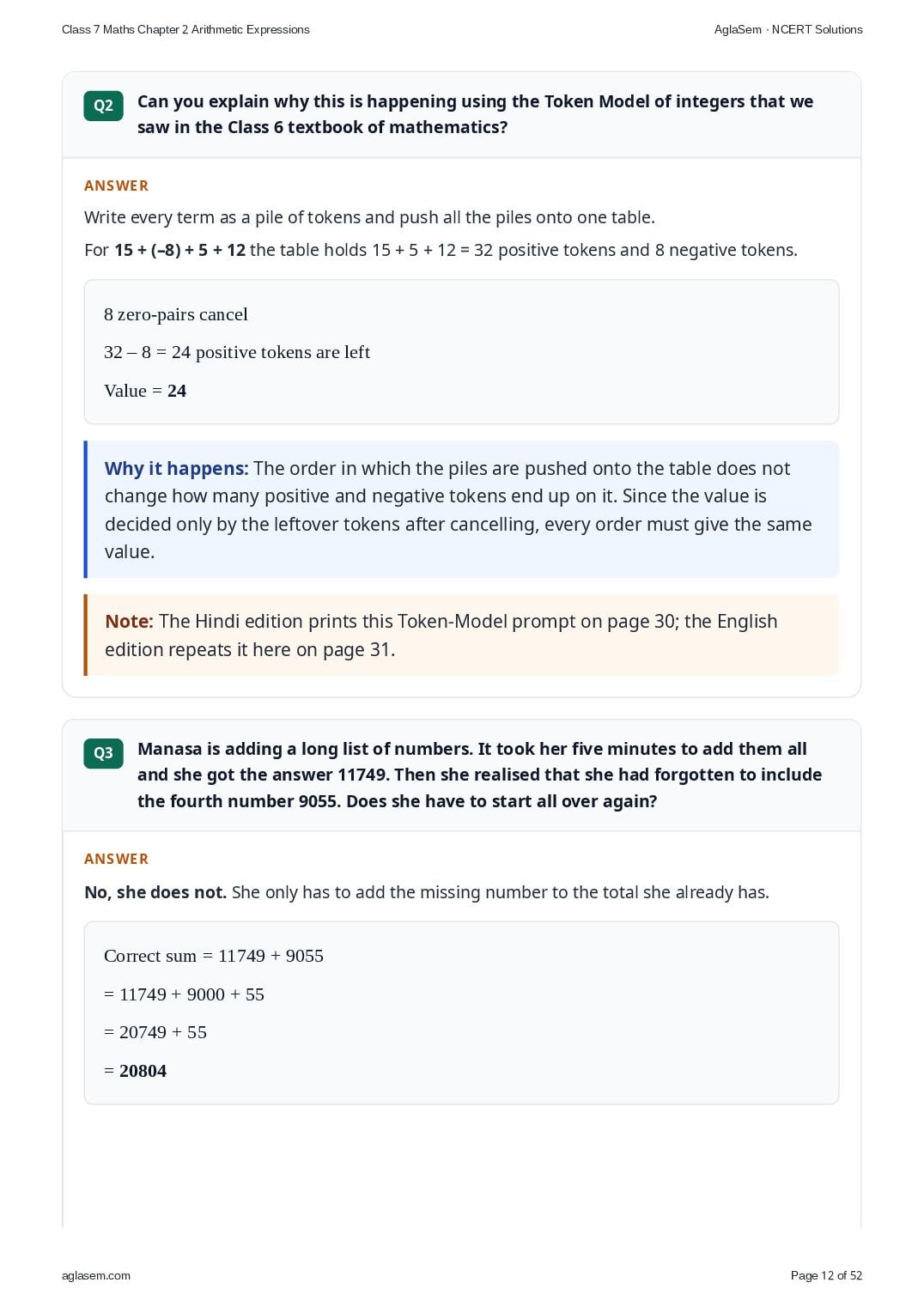
- Can you explain why this is happening using the Token Model of integers that we saw in the Class 6 textbook of mathematics?
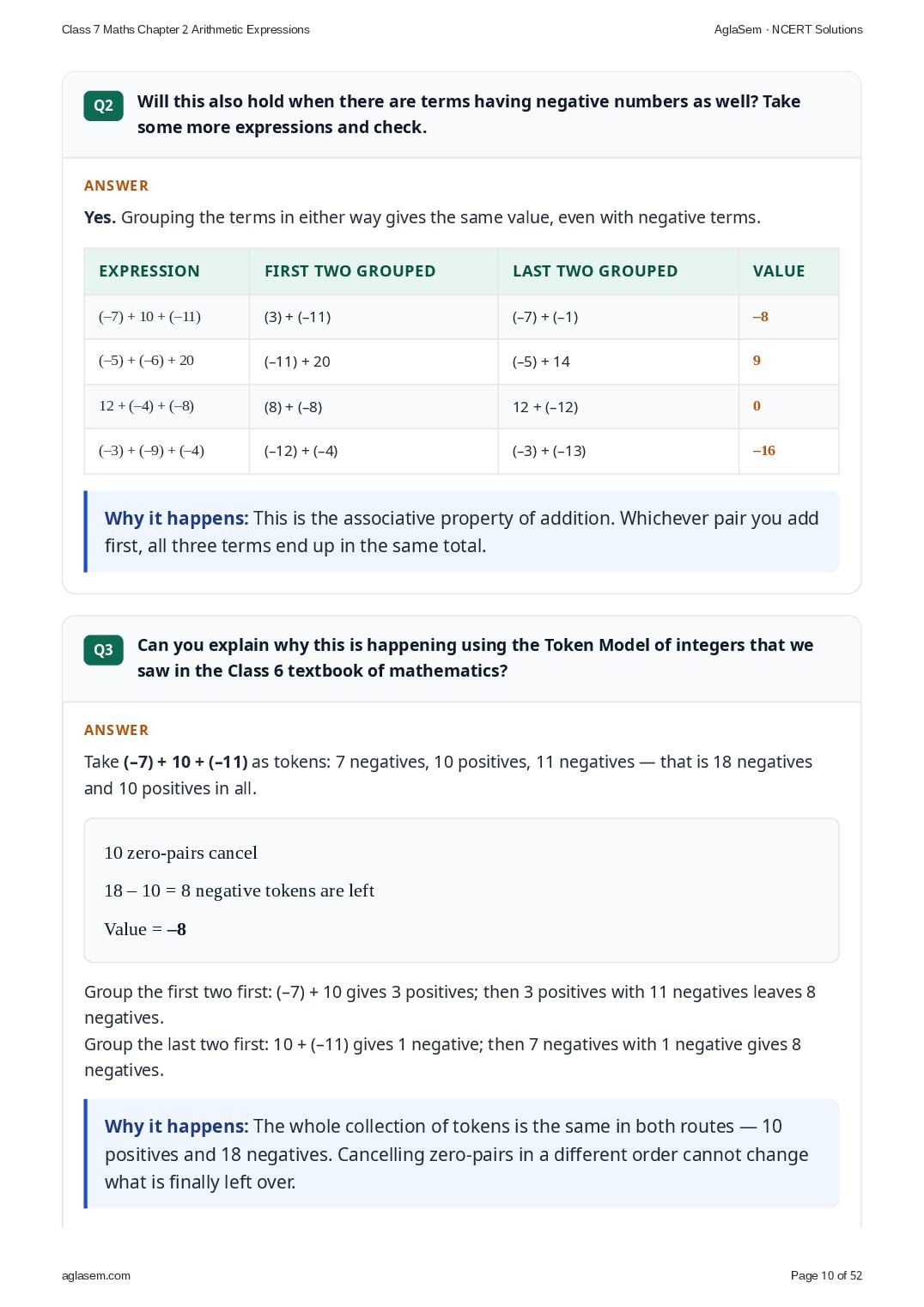
- Will this also hold when there are terms having negative numbers as well? Take some more expressions and check.
- Can you explain why this is happening using the Token Model of integers that we saw in the Class 6 textbook of mathematics?
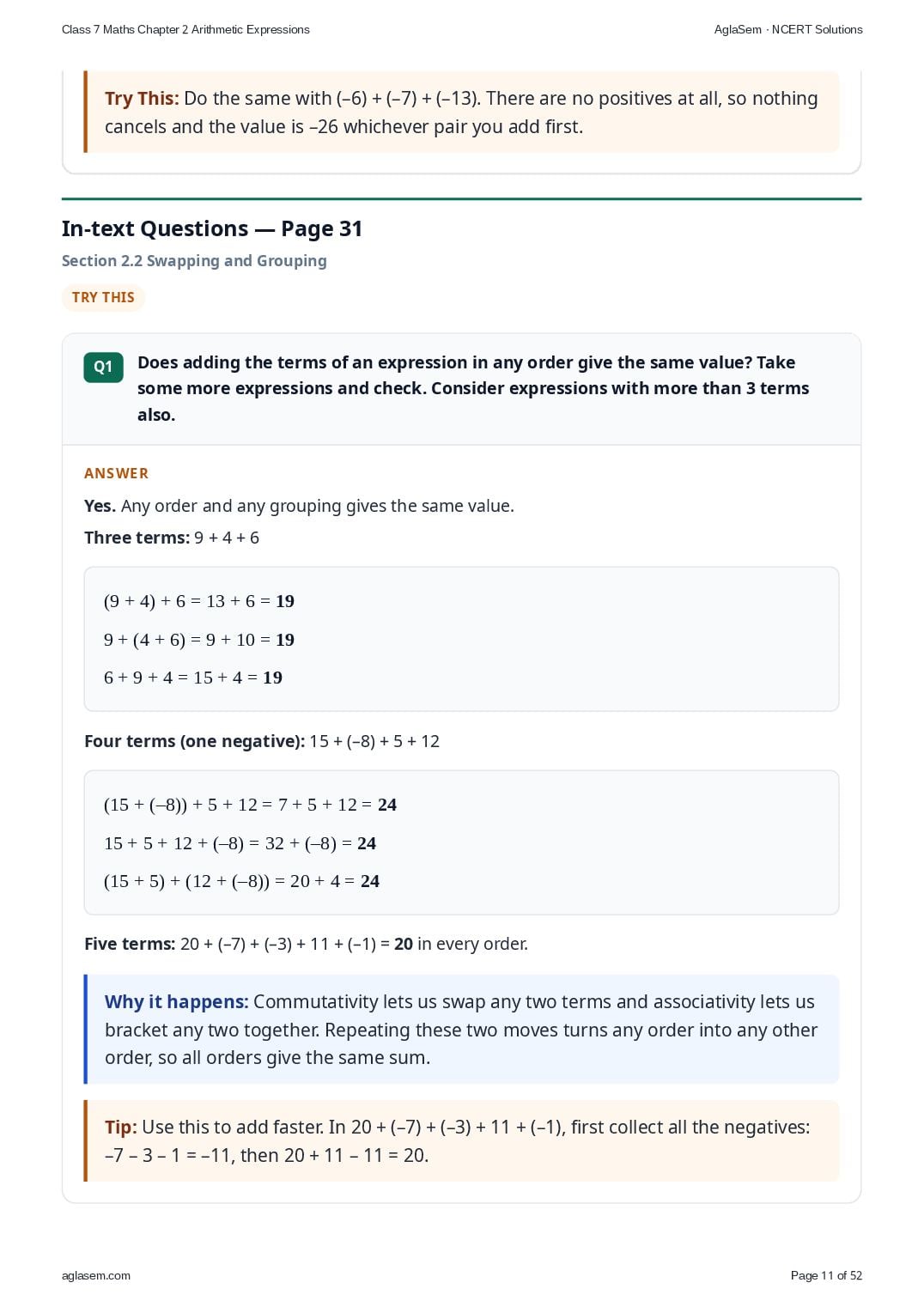
- Does adding the terms of an expression in any order give the same value? Take some more expressions and check. Consider expressions with more than 3 terms also.
- Can you explain why this is happening using the Token Model of integers that we saw in the Class 6 textbook of mathematics?
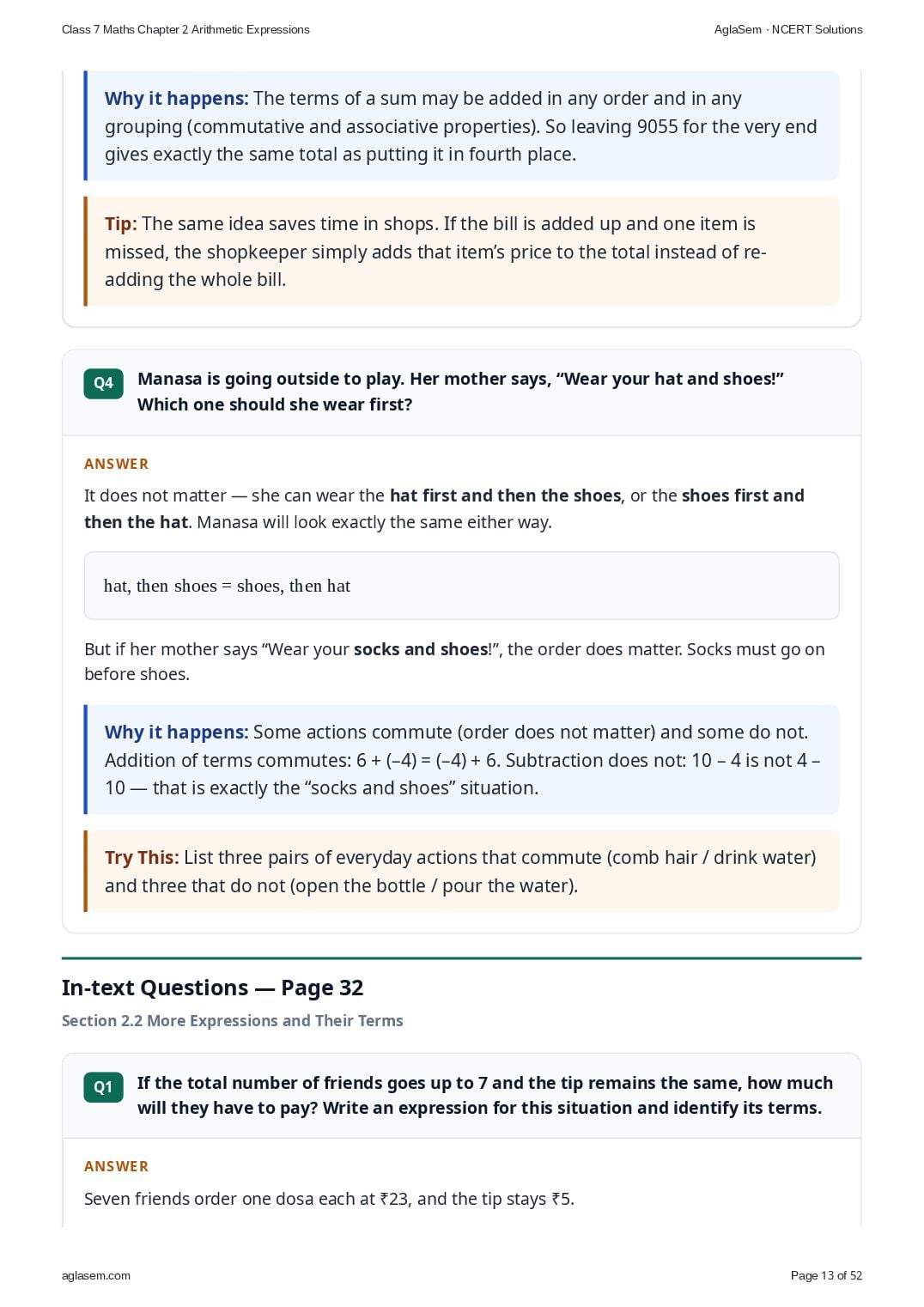
- Manasa is adding a long list of numbers. It took her five minutes to add them all and she got the answer 11749. Then she realised that she had forgotten to include the fourth number 9055. Does she have to start all over again?
- Manasa is going outside to play. Her mother says, “Wear your hat and shoes!” Which one should she wear first?
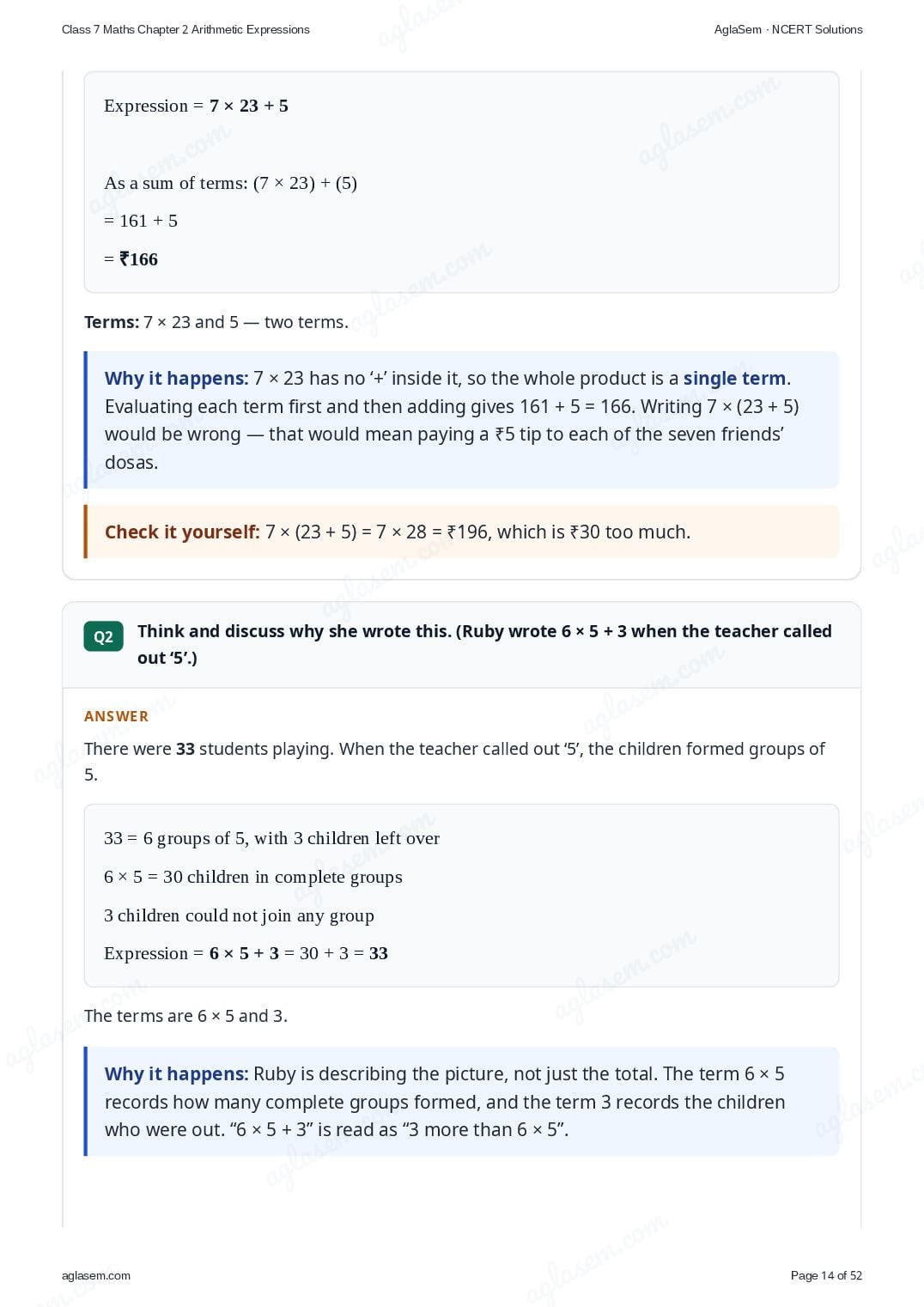
- If the total number of friends goes up to 7 and the tip remains the same, how much will they have to pay? Write an expression for this situation and identify its terms.
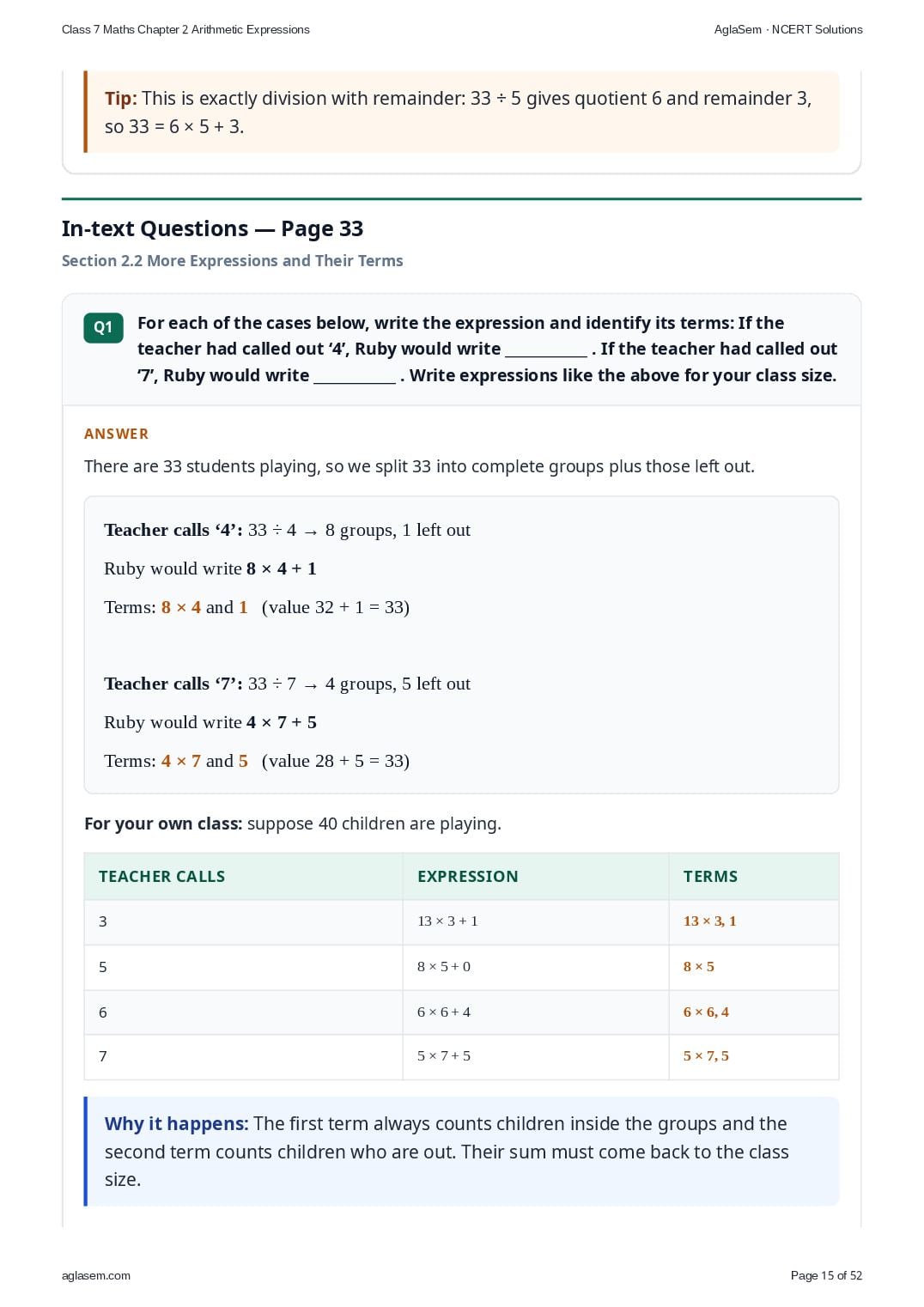
- Think and discuss why she wrote this. (Ruby wrote 6 × 5 + 3 when the teacher called out ‘5’.)
- For each of the cases below, write the expression and identify its terms: If the teacher had called out ‘4’, Ruby would write ____________ . If the teacher had called out ‘7’, Ruby would write ____________ . Write expressions like the above for your class size.
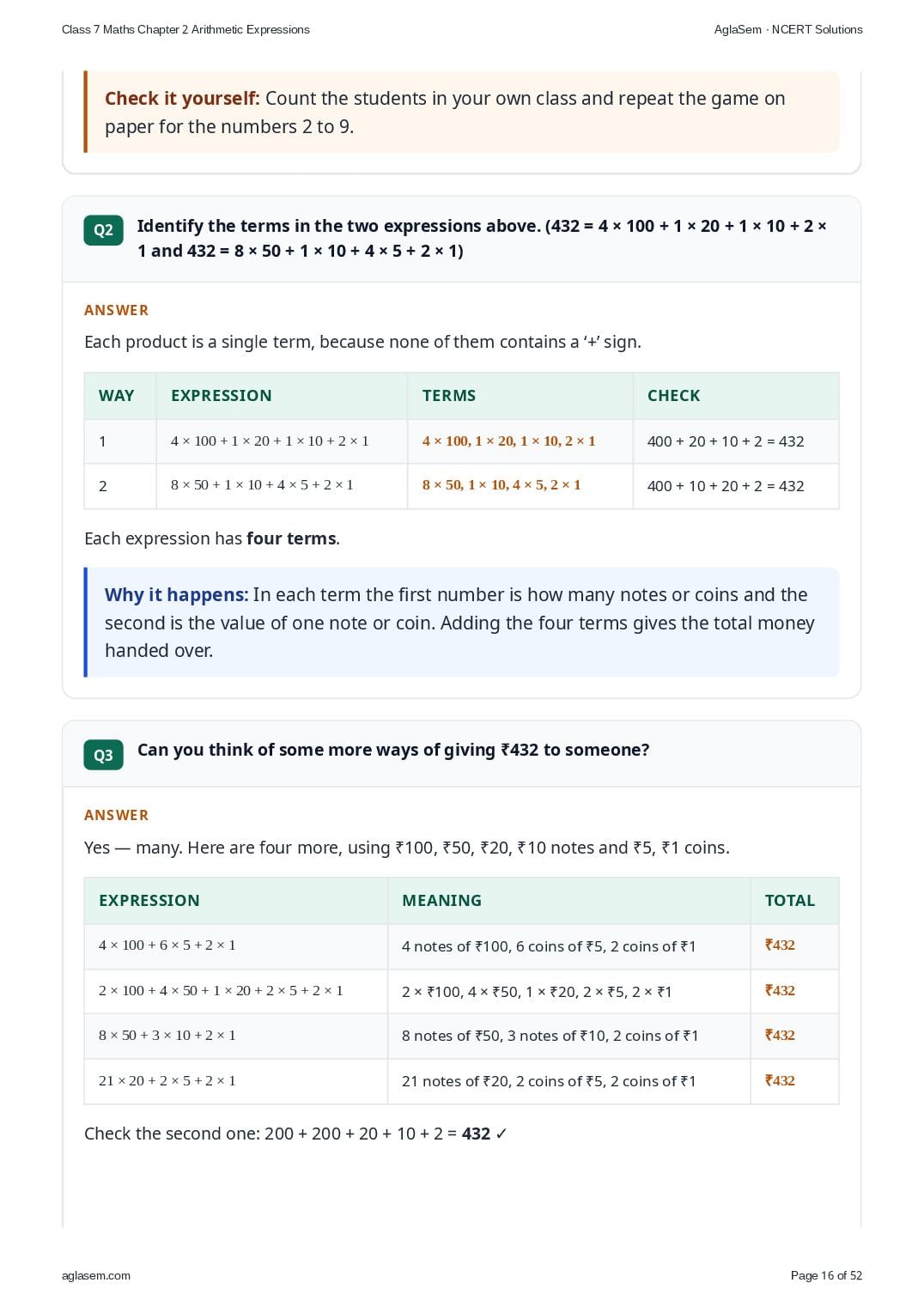
- Identify the terms in the two expressions above. (432 = 4 × 100 + 1 × 20 + 1 × 10 + 2 × 1 and 432 = 8 × 50 + 1 × 10 + 4 × 5 + 2 × 1)
- Can you think of some more ways of giving ₹432 to someone?
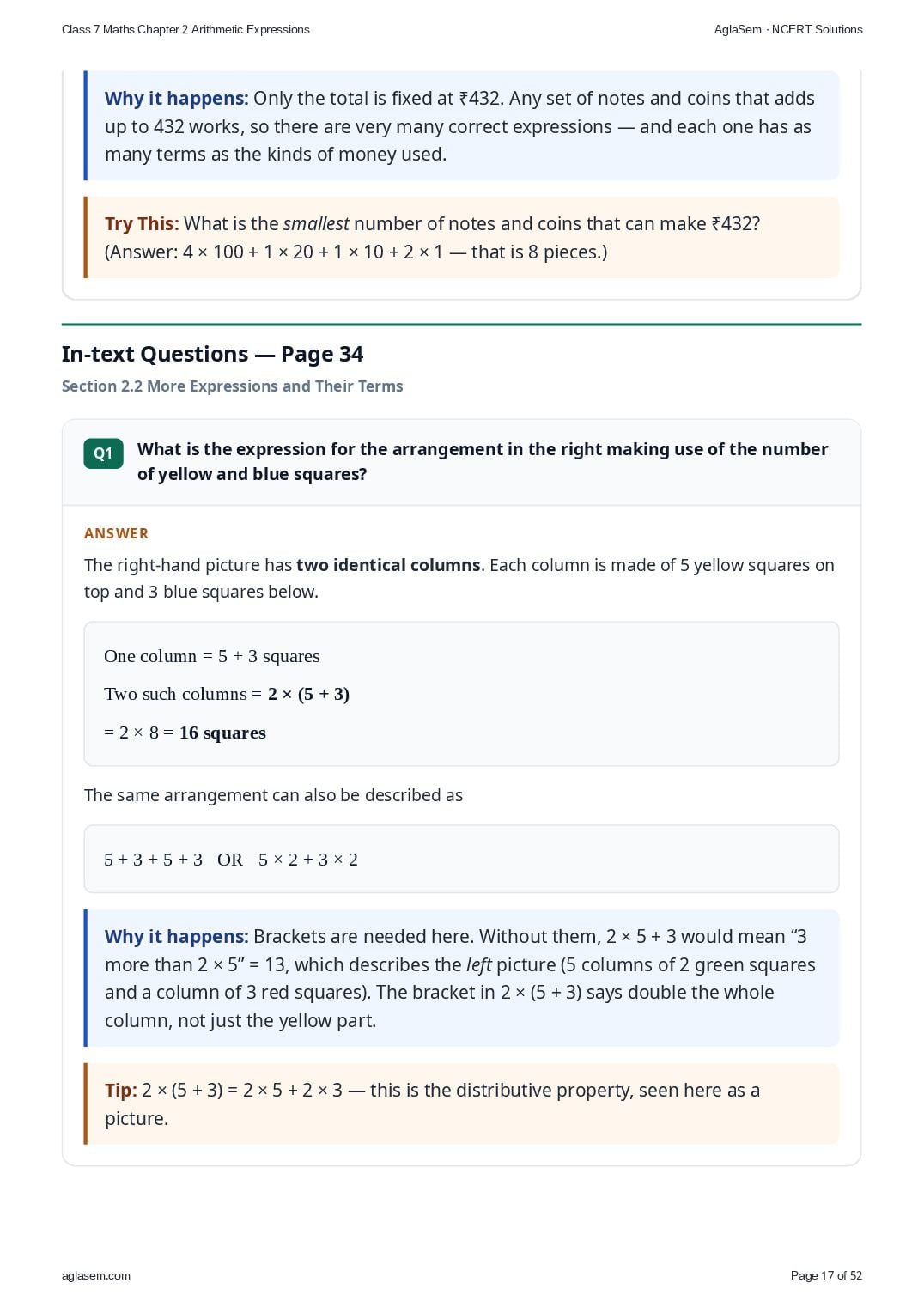
- What is the expression for the arrangement in the right making use of the number of yellow and blue squares?
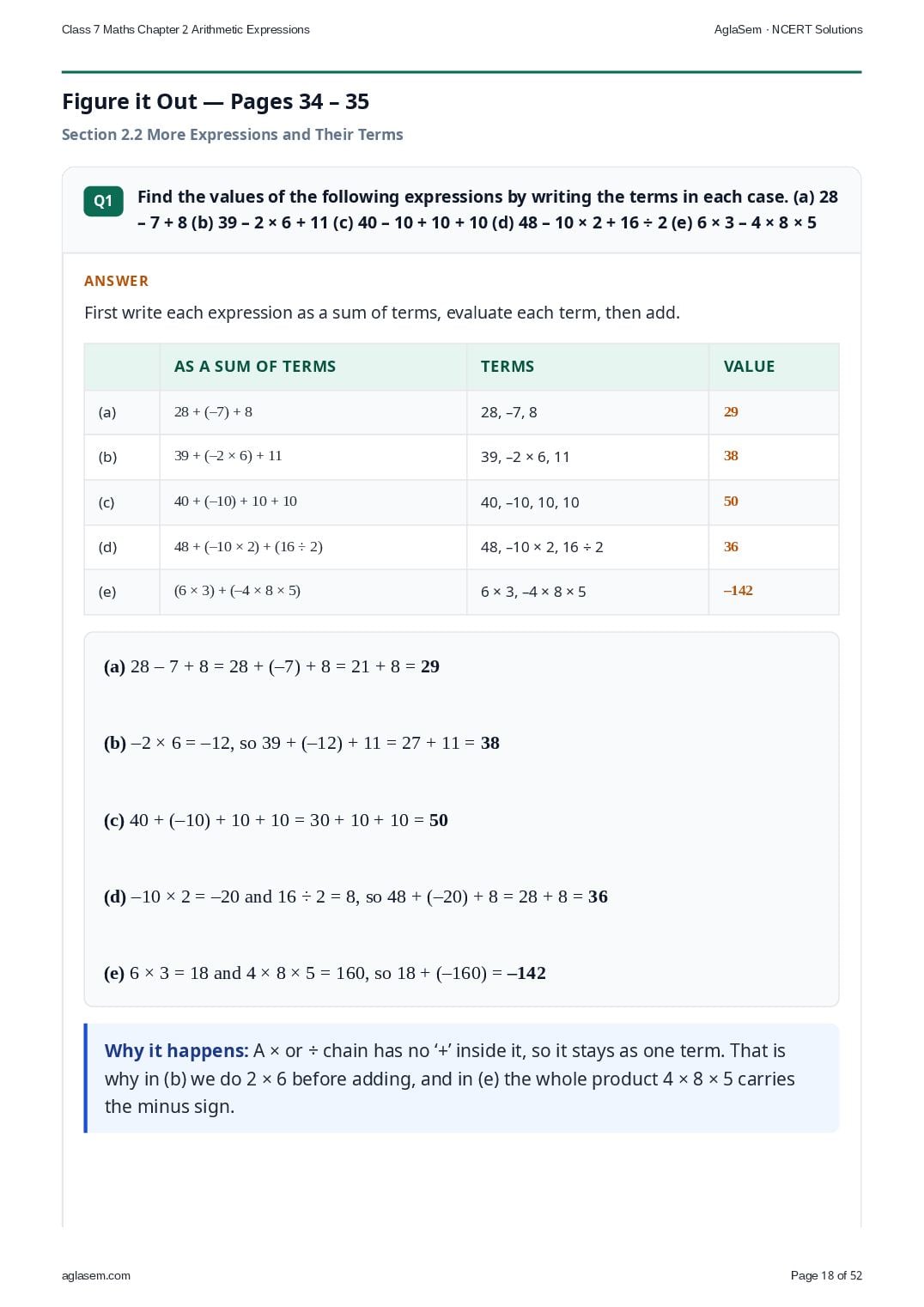
- Find the values of the following expressions by writing the terms in each case. (a) 28 – 7 + 8 (b) 39 – 2 × 6 + 11 (c) 40 – 10 + 10 + 10 (d) 48 – 10 × 2 + 16 ÷ 2 (e) 6 × 3 – 4 × 8 × 5
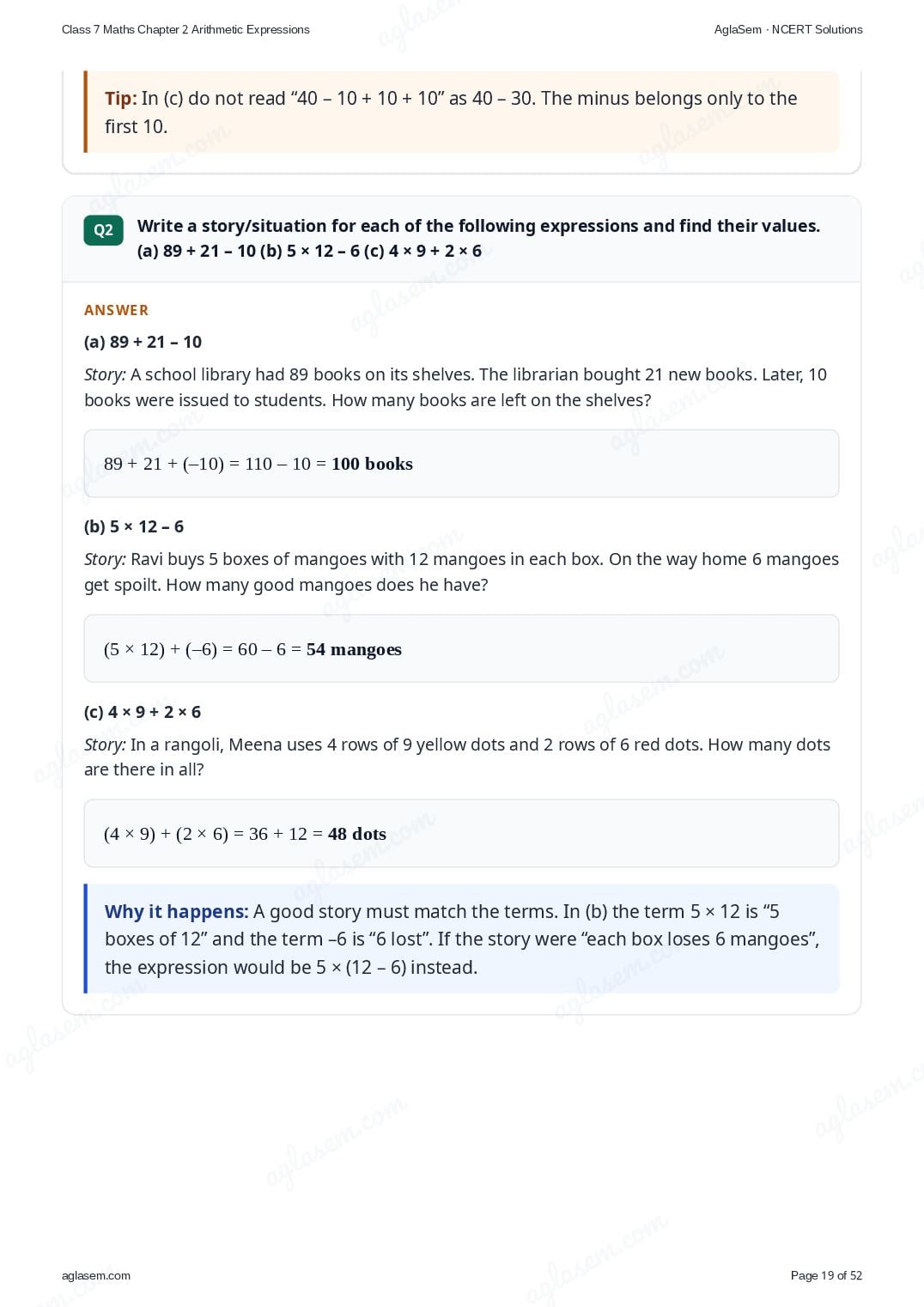
- Write a story/situation for each of the following expressions and find their values. (a) 89 + 21 – 10 (b) 5 × 12 – 6 (c) 4 × 9 + 2 × 6
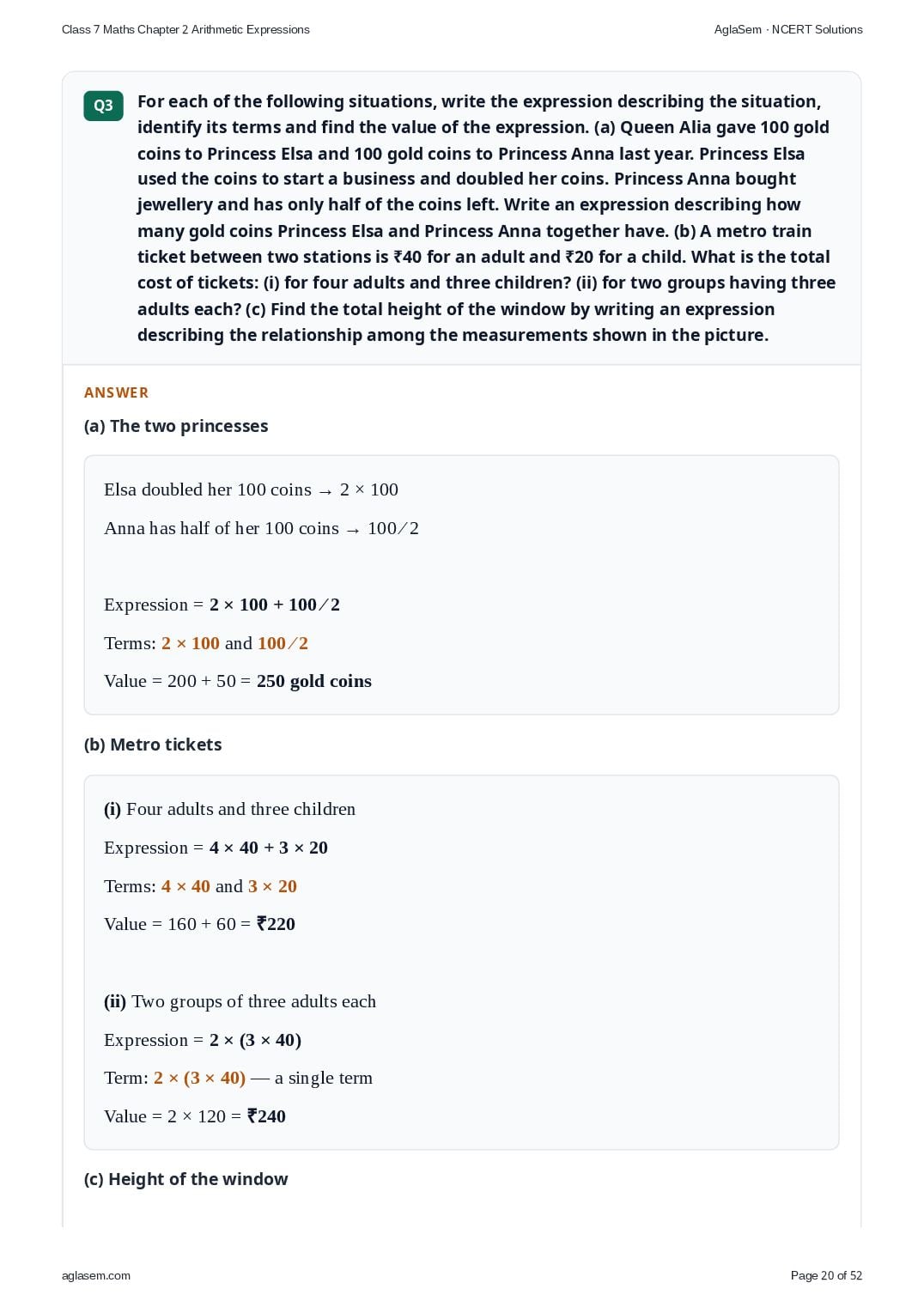
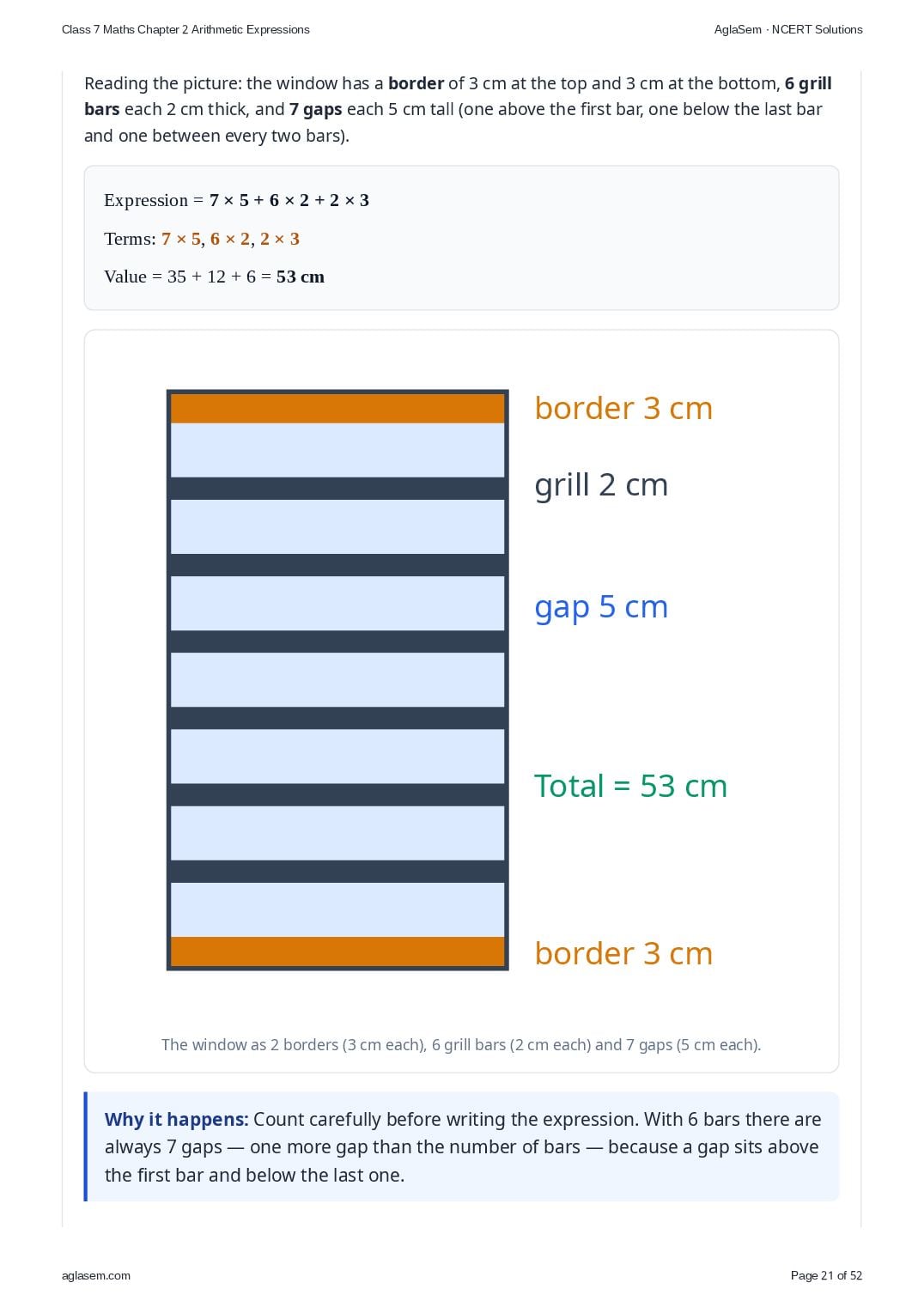
- For each of the following situations, write the expression describing the situation, identify its terms and find the value of the expression. (a) Queen Alia gave 100 gold coins to Princess Elsa and 100 gold coins to Princess Anna last year. Princess Elsa used the coins to start a business and doubled her coins. Princess Anna bought jewellery and has only half of the coins left. Write an expression describing how many gold coins Princess Elsa and Princess Anna together have. (b) A metro train ticket between two stations is ₹40 for an adult and ₹20 for a child. What is the total cost of tickets: (i) for four adults and three children? (ii) for two groups having three adults each? (c) Find the total height of the window by writing an expression describing the relationship among the measurements shown in the picture.
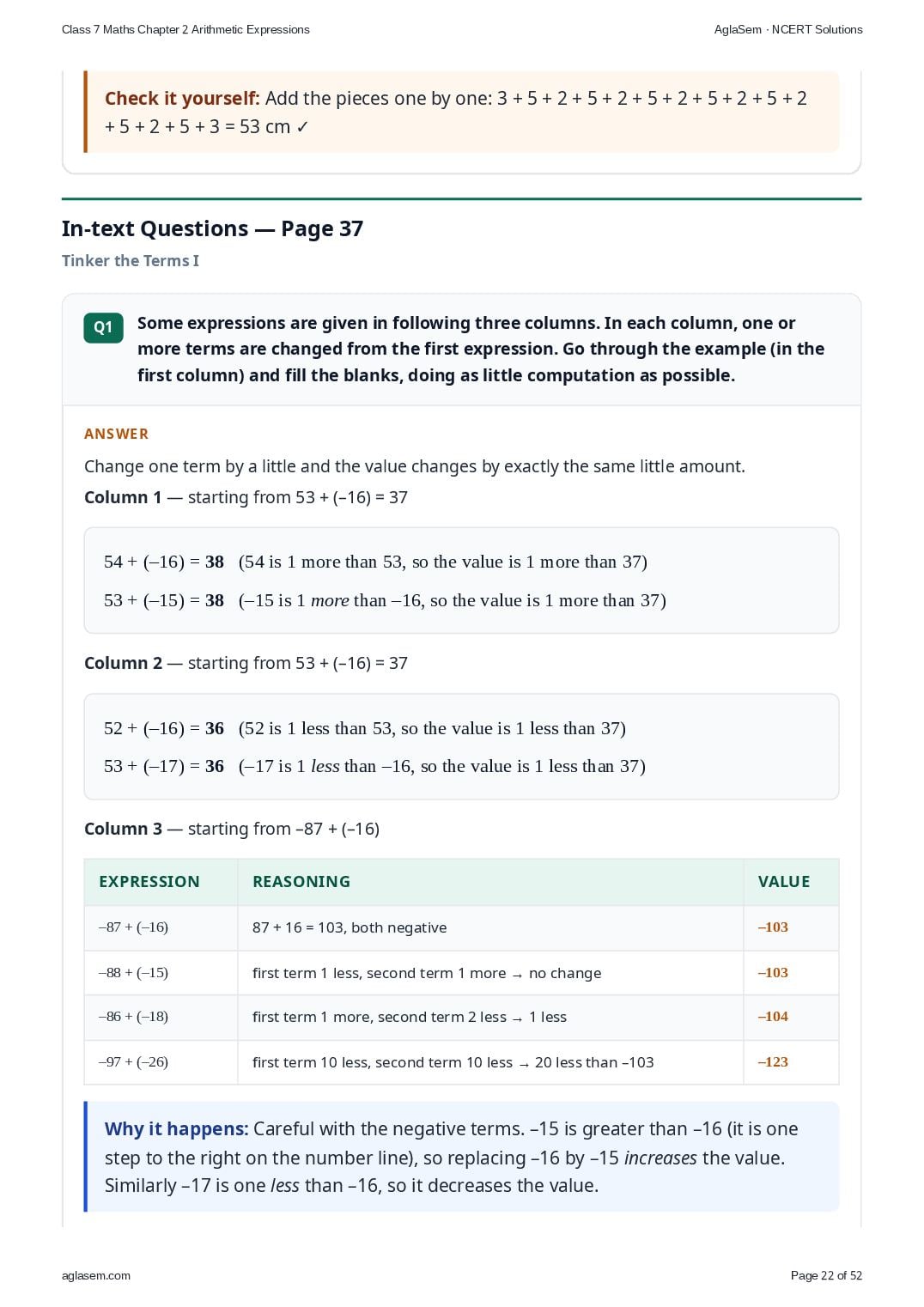
- Some expressions are given in following three columns. In each column, one or more terms are changed from the first expression. Go through the example (in the first column) and fill the blanks, doing as little computation as possible.
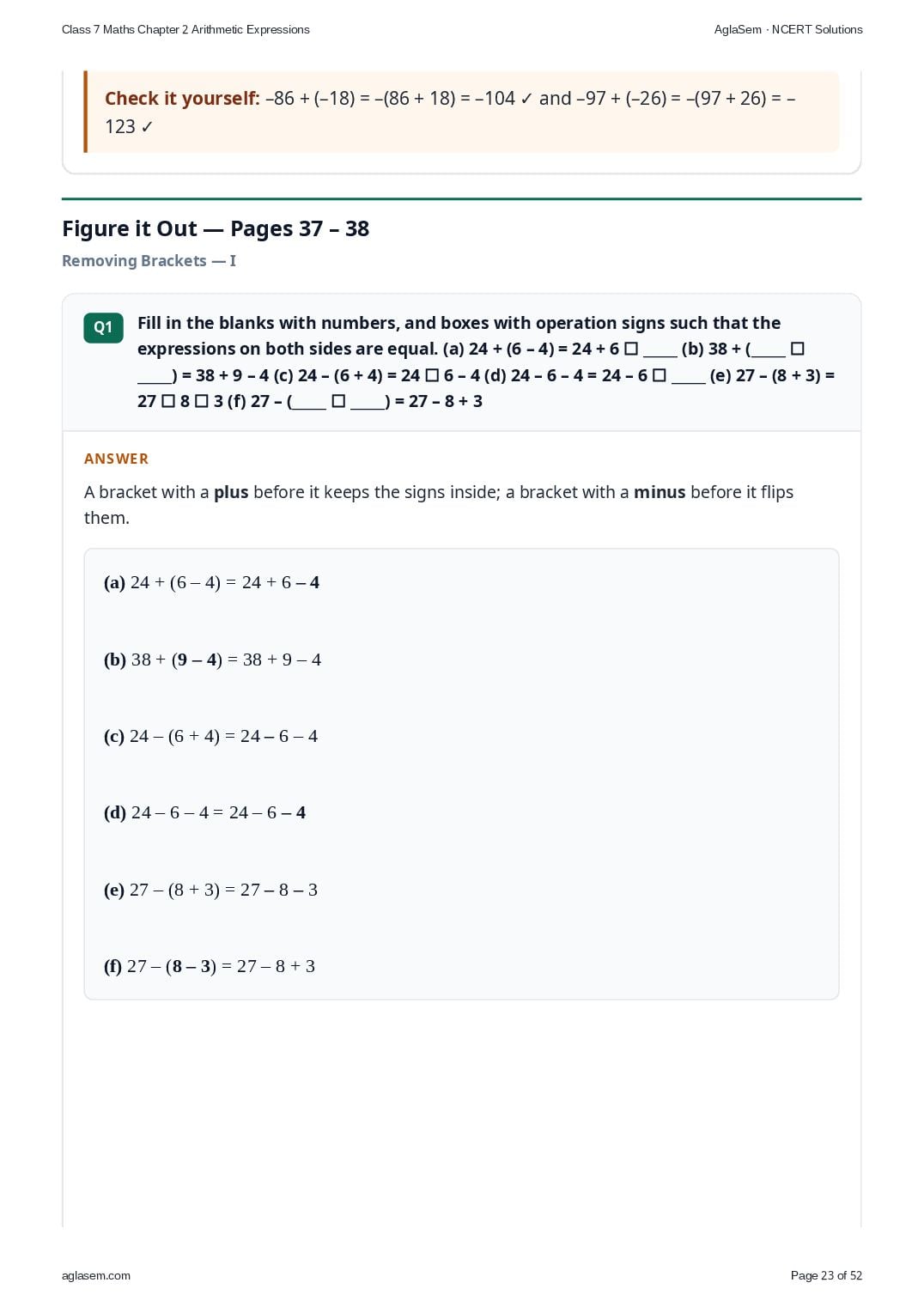
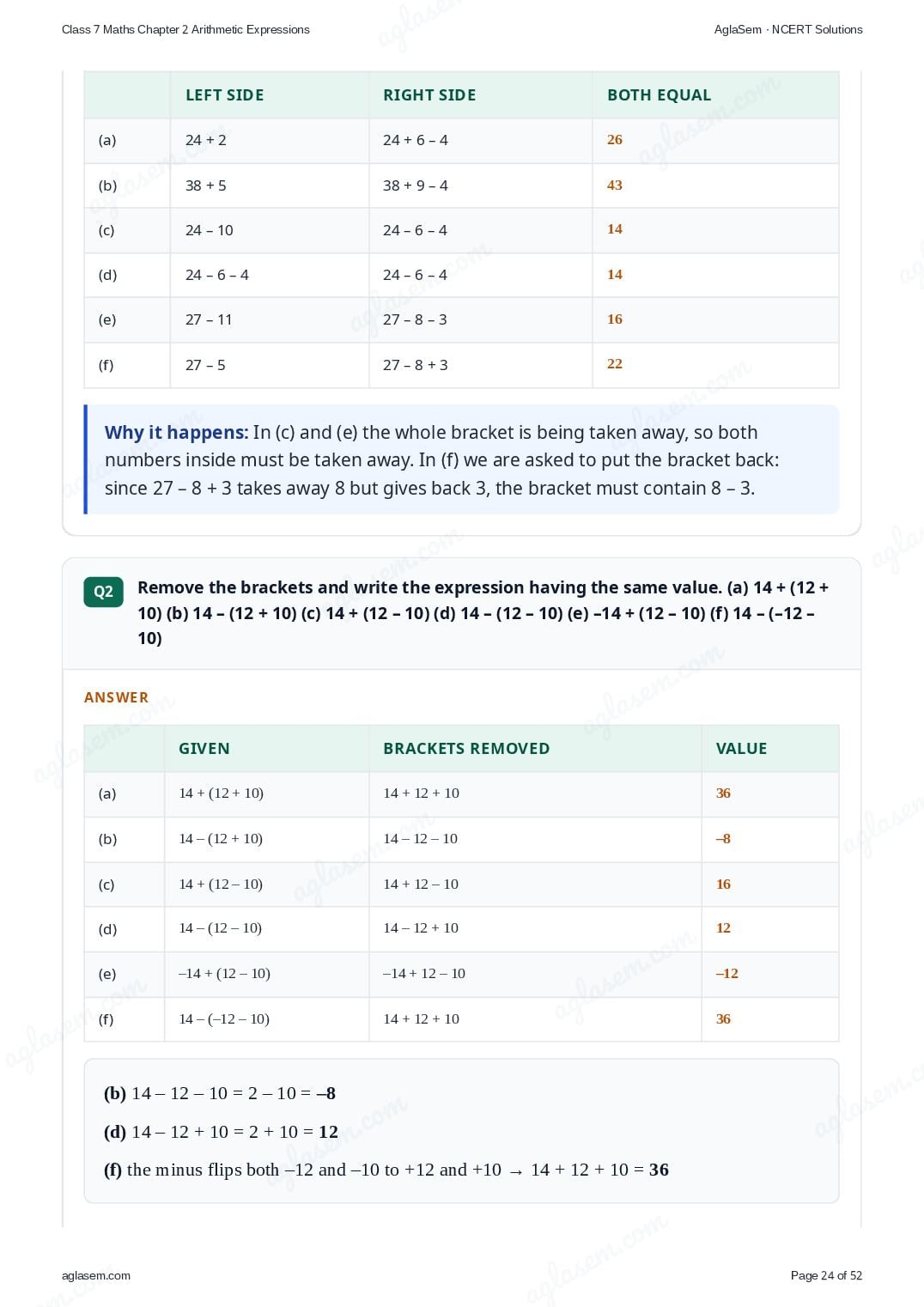
- Fill in the blanks with numbers, and boxes with operation signs such that the expressions on both sides are equal. (a) 24 + (6 – 4) = 24 + 6 ☐ _____ (b) 38 + (_____ ☐ _____) = 38 + 9 – 4 (c) 24 – (6 + 4) = 24 ☐ 6 – 4 (d) 24 – 6 – 4 = 24 – 6 ☐ _____ (e) 27 – (8 + 3) = 27 ☐ 8 ☐ 3 (f) 27 – (_____ ☐ _____) = 27 – 8 + 3
- Remove the brackets and write the expression having the same value. (a) 14 + (12 + 10) (b) 14 – (12 + 10) (c) 14 + (12 – 10) (d) 14 – (12 – 10) (e) –14 + (12 – 10) (f) 14 – (–12 – 10)
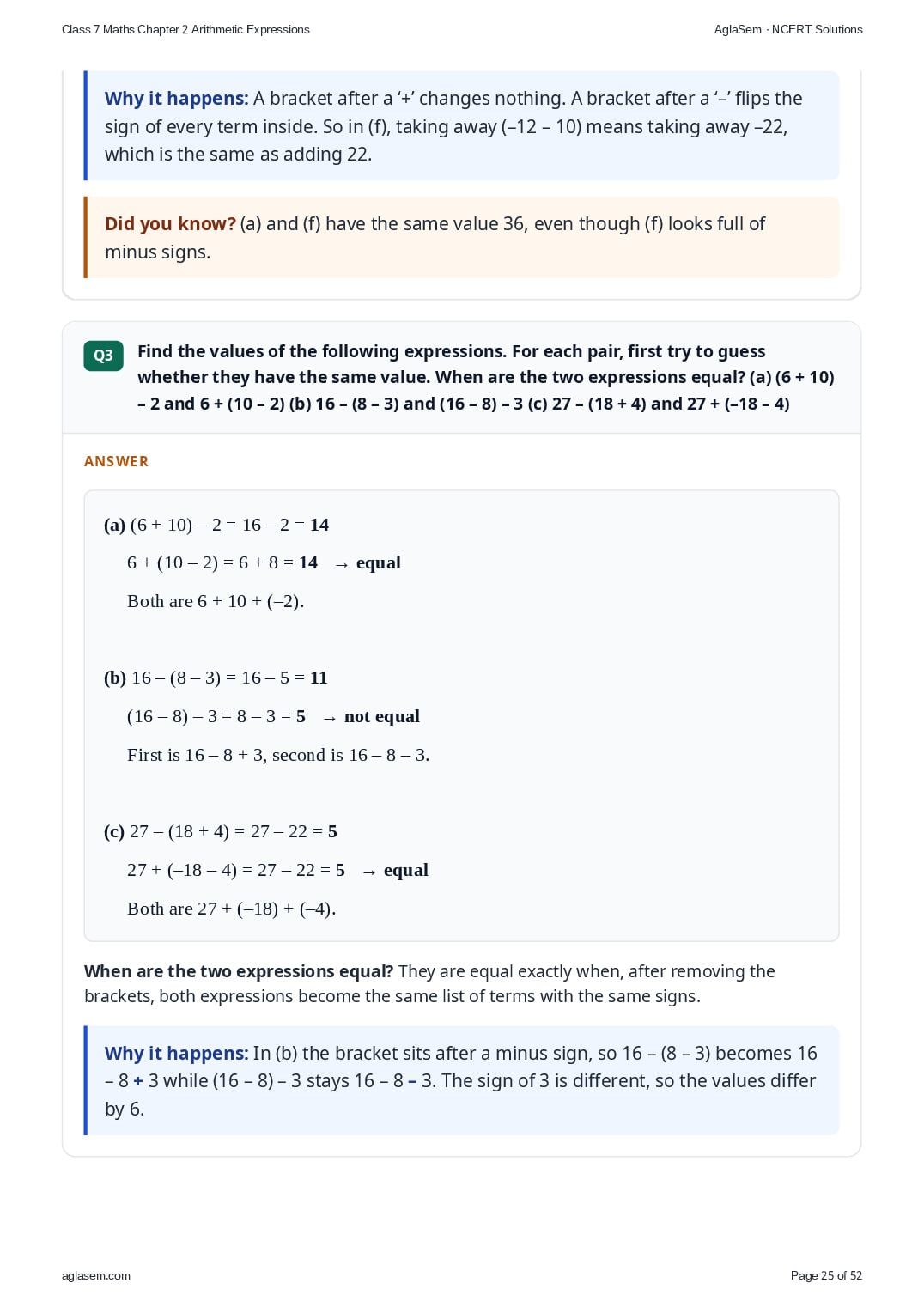
- Find the values of the following expressions. For each pair, first try to guess whether they have the same value. When are the two expressions equal? (a) (6 + 10) – 2 and 6 + (10 – 2) (b) 16 – (8 – 3) and (16 – 8) – 3 (c) 27 – (18 + 4) and 27 + (–18 – 4)
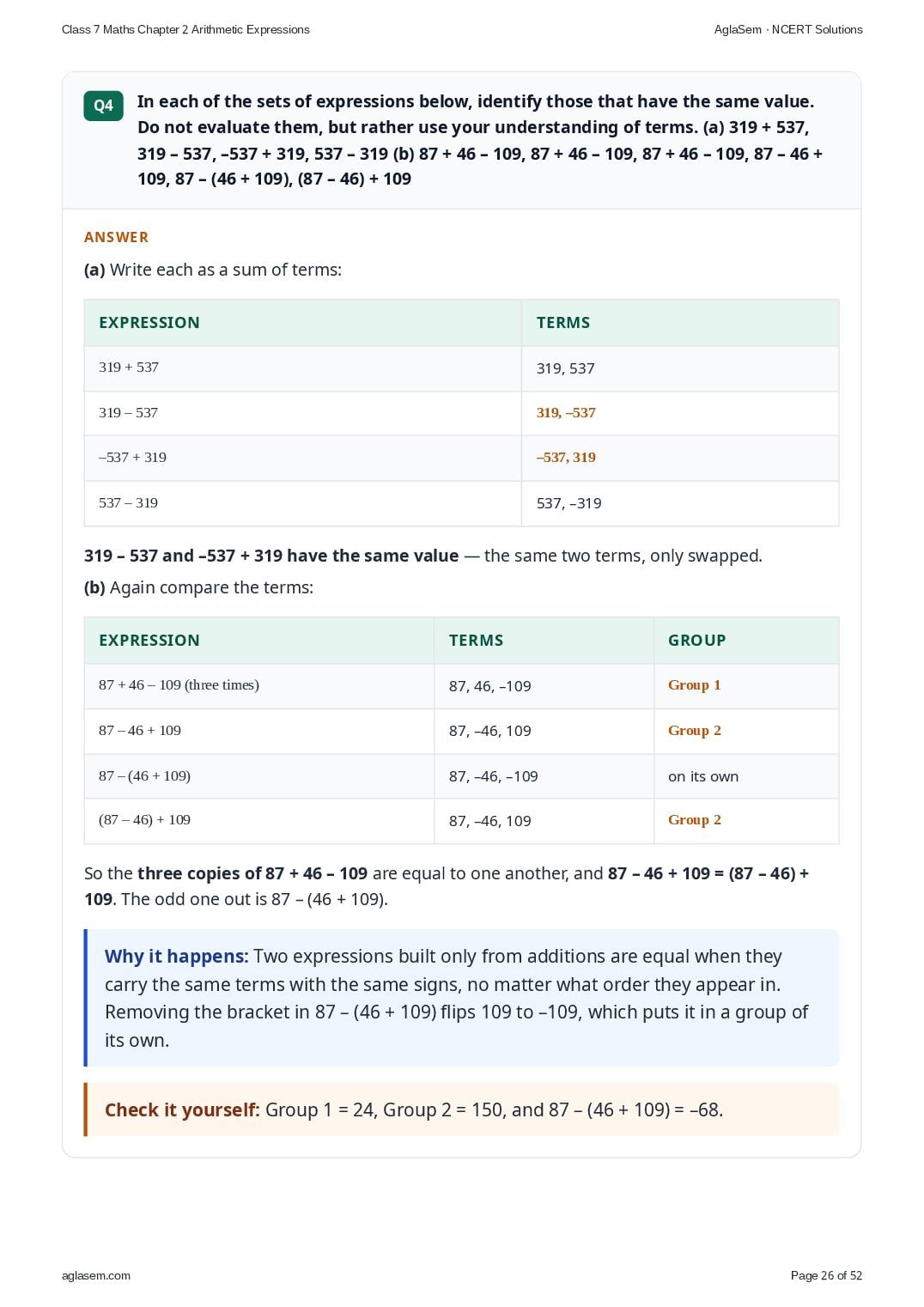
- In each of the sets of expressions below, identify those that have the same value. Do not evaluate them, but rather use your understanding of terms. (a) 319 + 537, 319 – 537, –537 + 319, 537 – 319 (b) 87 + 46 – 109, 87 + 46 – 109, 87 + 46 – 109, 87 – 46 + 109, 87 – (46 + 109), (87 – 46) + 109
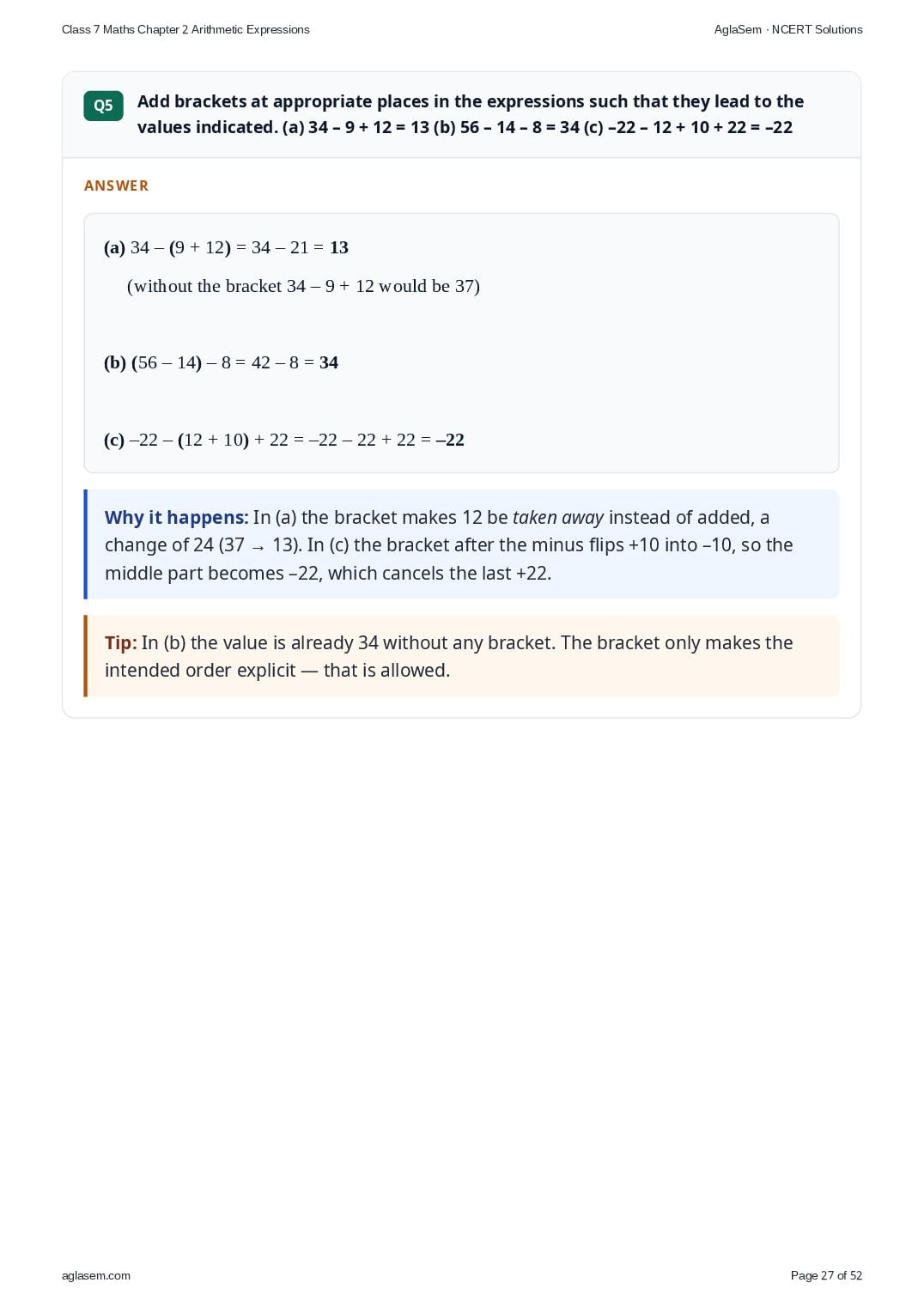
- Add brackets at appropriate places in the expressions such that they lead to the values indicated. (a) 34 – 9 + 12 = 13 (b) 56 – 14 – 8 = 34 (c) –22 – 12 + 10 + 22 = –22
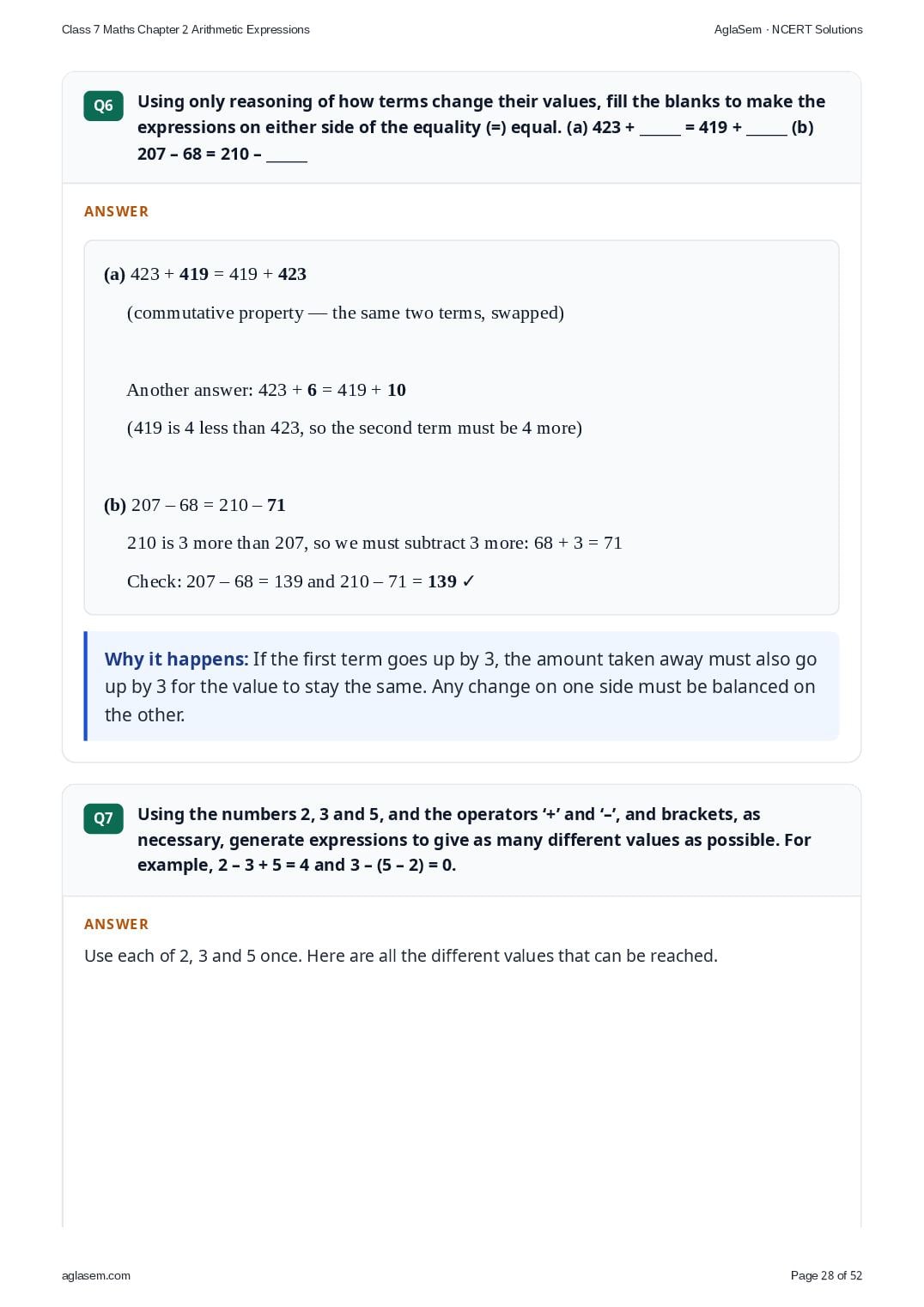
- Using only reasoning of how terms change their values, fill the blanks to make the expressions on either side of the equality (=) equal. (a) 423 + ______ = 419 + ______ (b) 207 – 68 = 210 – ______
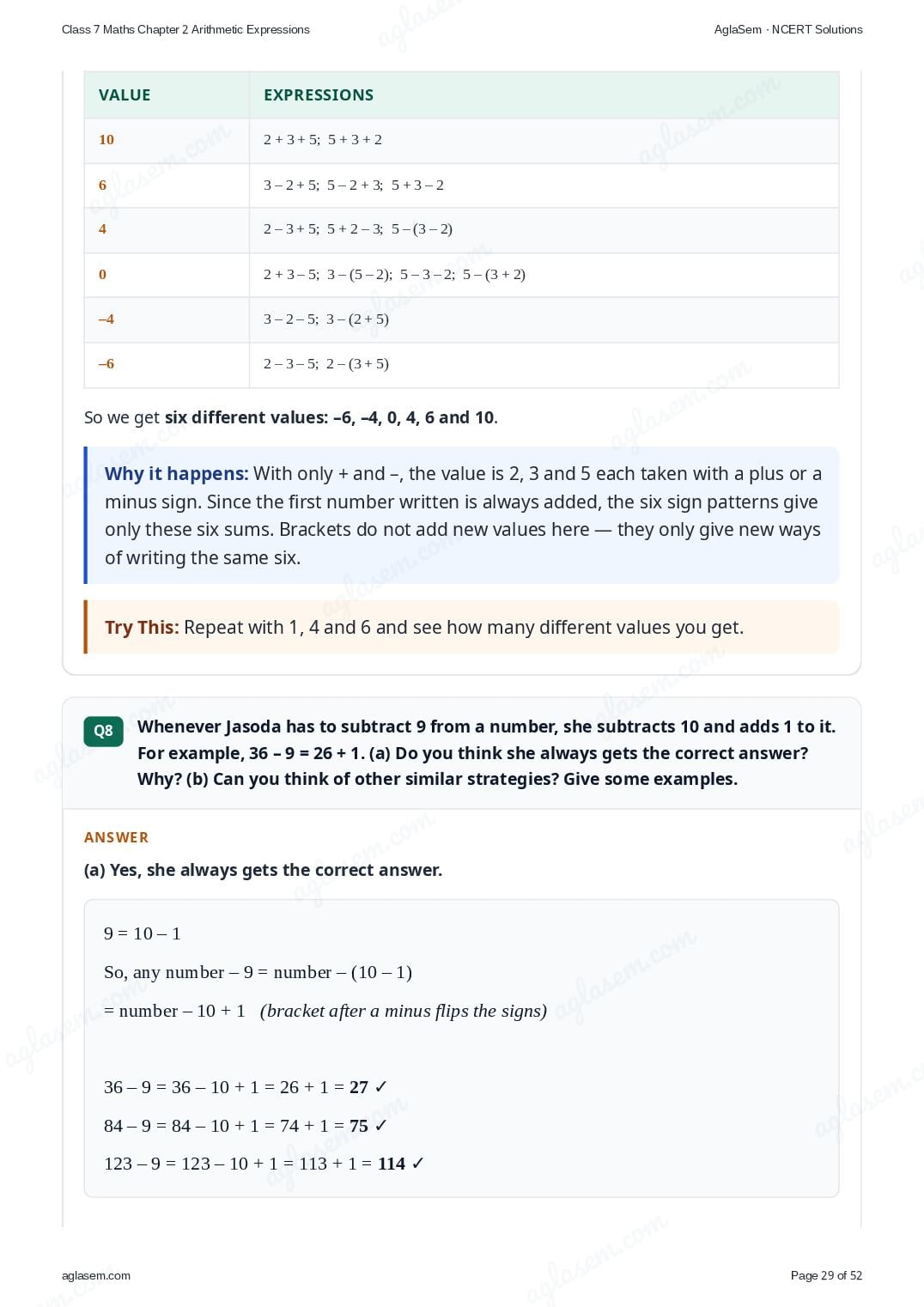
- Using the numbers 2, 3 and 5, and the operators ‘+’ and ‘–’, and brackets, as necessary, generate expressions to give as many different values as possible. For example, 2 – 3 + 5 = 4 and 3 – (5 – 2) = 0.
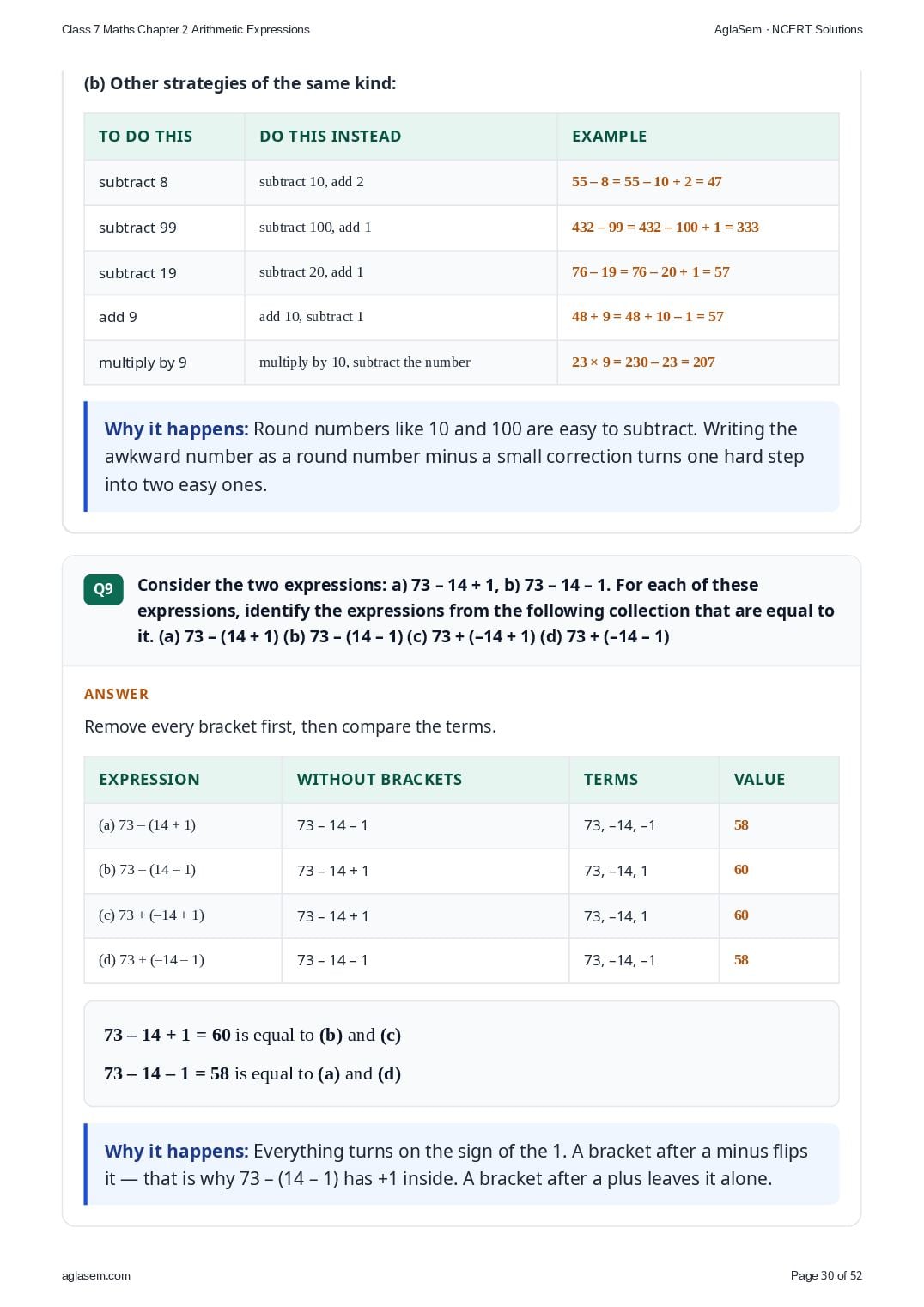
- Whenever Jasoda has to subtract 9 from a number, she subtracts 10 and adds 1 to it. For example, 36 – 9 = 26 + 1. (a) Do you think she always gets the correct answer? Why? (b) Can you think of other similar strategies? Give some examples.
- Consider the two expressions: a) 73 – 14 + 1, b) 73 – 14 – 1. For each of these expressions, identify the expressions from the following collection that are equal to it. (a) 73 – (14 + 1) (b) 73 – (14 – 1) (c) 73 + (–14 + 1) (d) 73 + (–14 – 1)
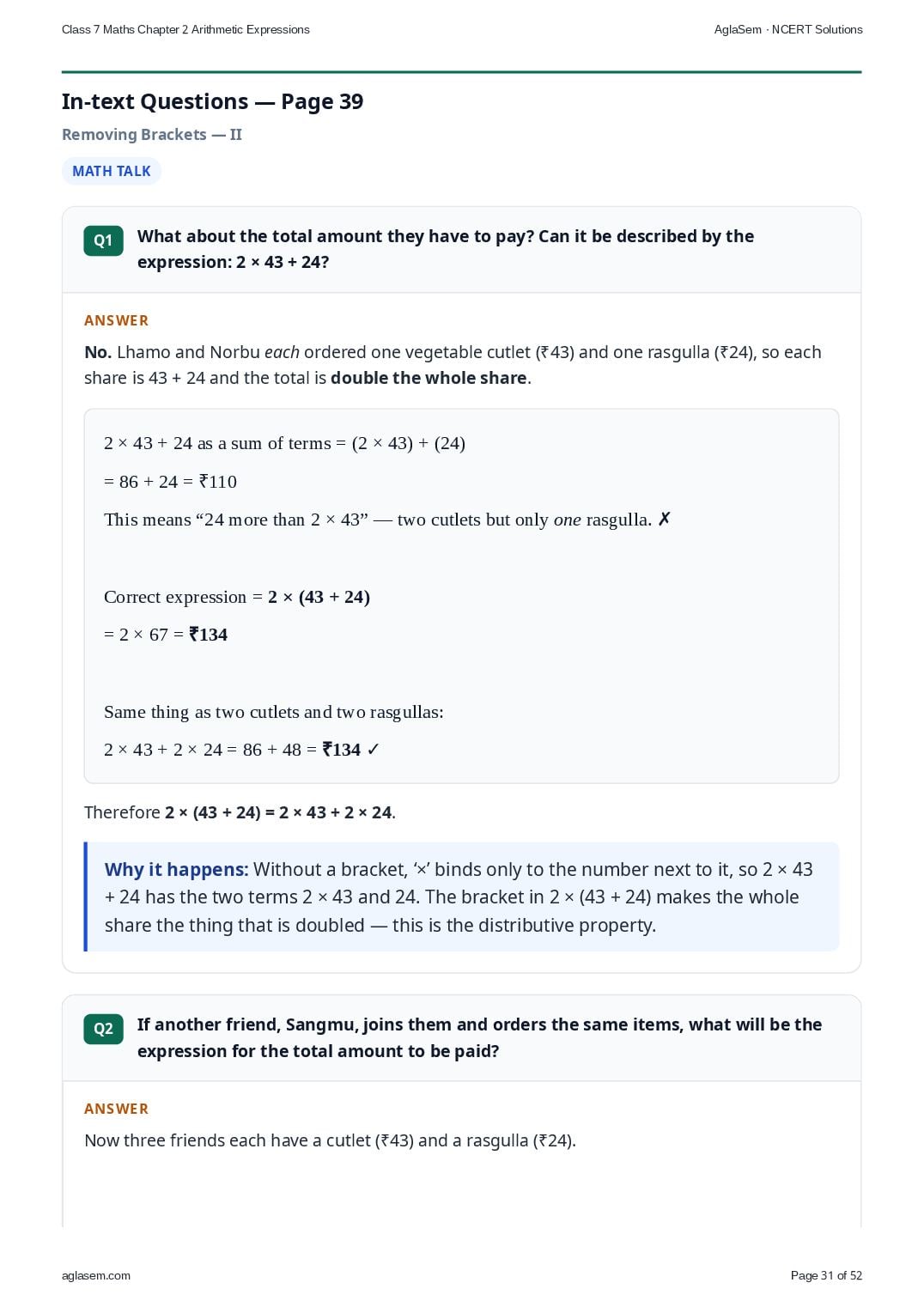
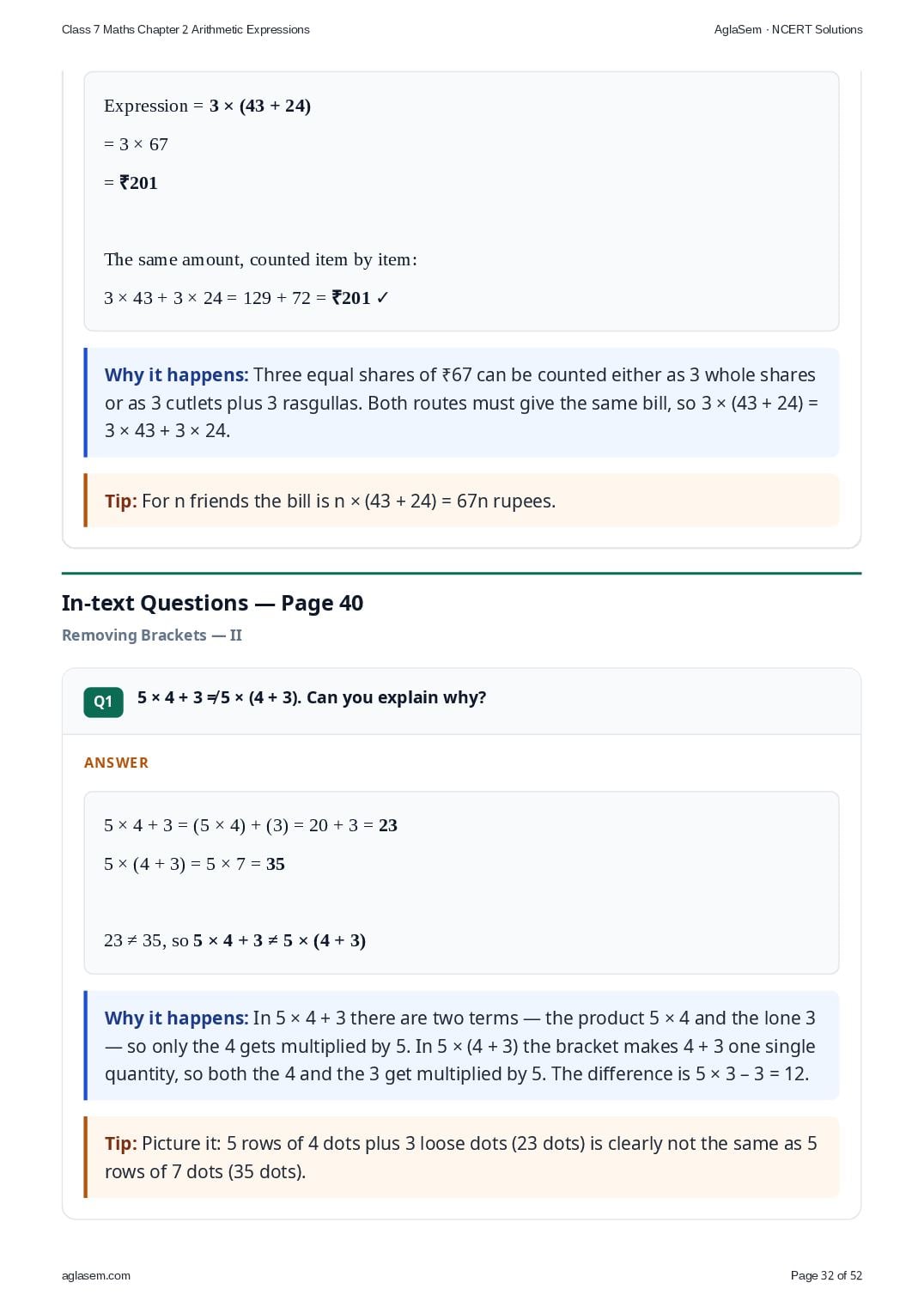
- What about the total amount they have to pay? Can it be described by the expression: 2 × 43 + 24?
- If another friend, Sangmu, joins them and orders the same items, what will be the expression for the total amount to be paid?
- 5 × 4 + 3 ≠ 5 × (4 + 3). Can you explain why?
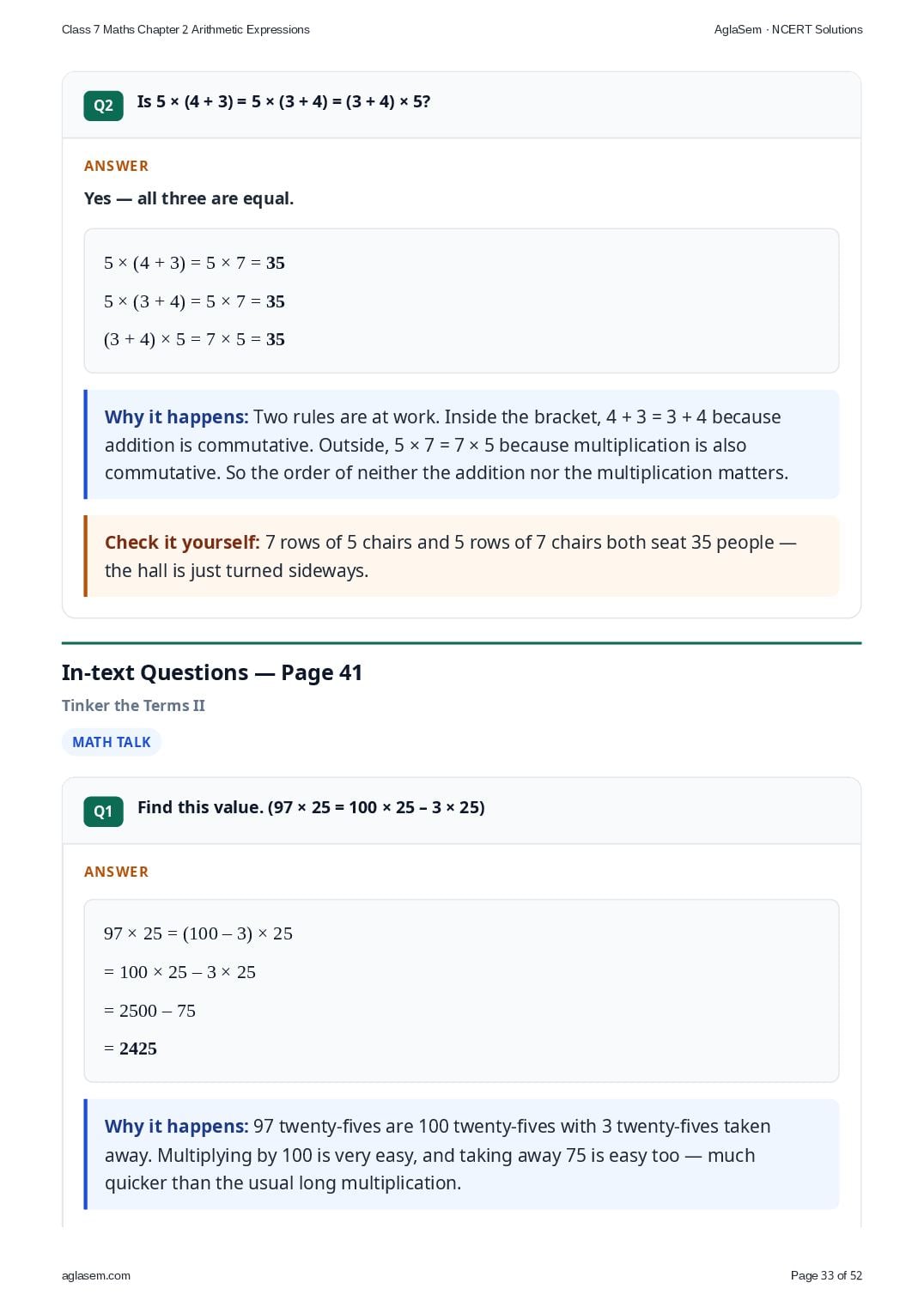
- Is 5 × (4 + 3) = 5 × (3 + 4) = (3 + 4) × 5?
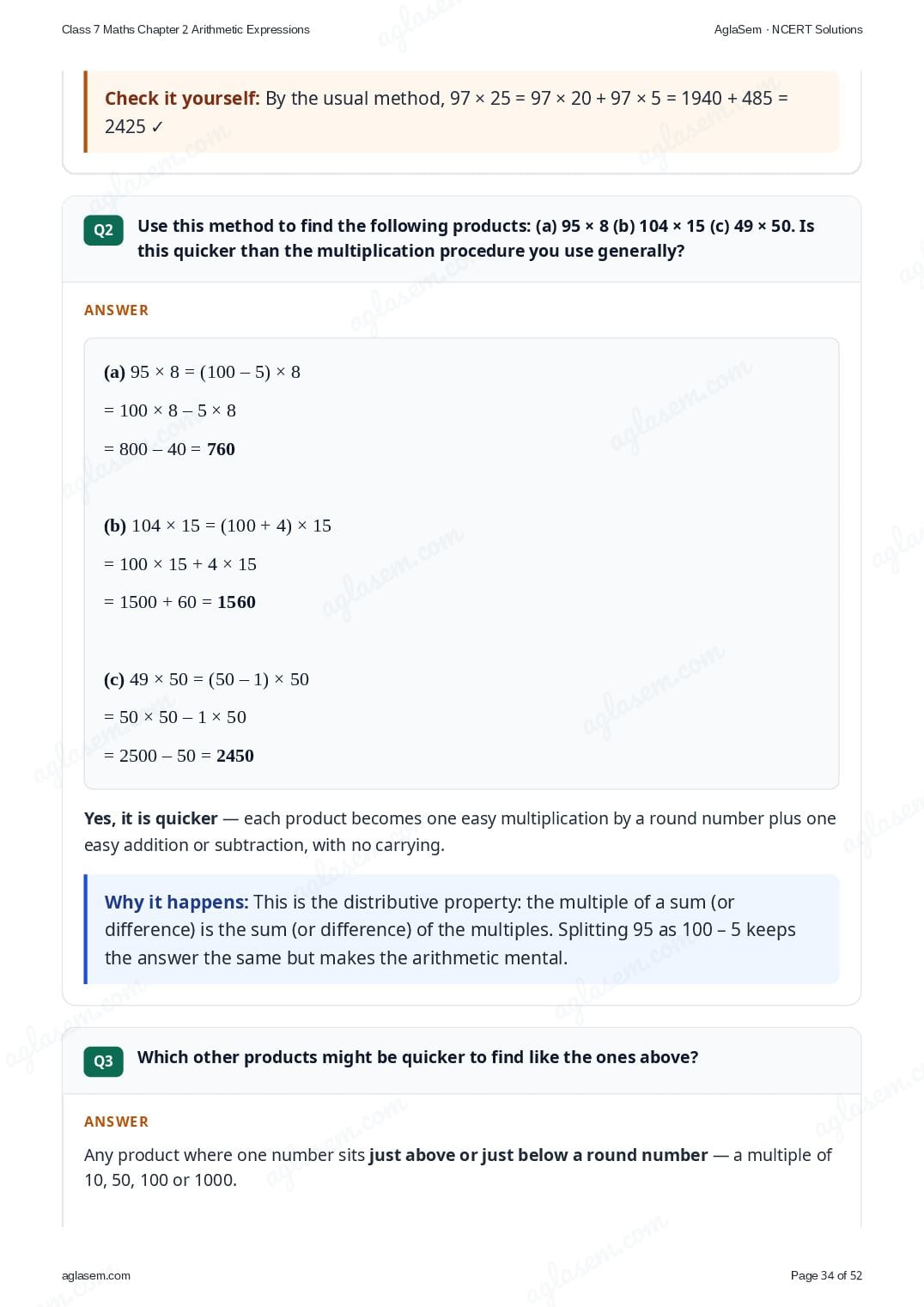
- Find this value. (97 × 25 = 100 × 25 – 3 × 25)
- Use this method to find the following products: (a) 95 × 8 (b) 104 × 15 (c) 49 × 50. Is this quicker than the multiplication procedure you use generally?
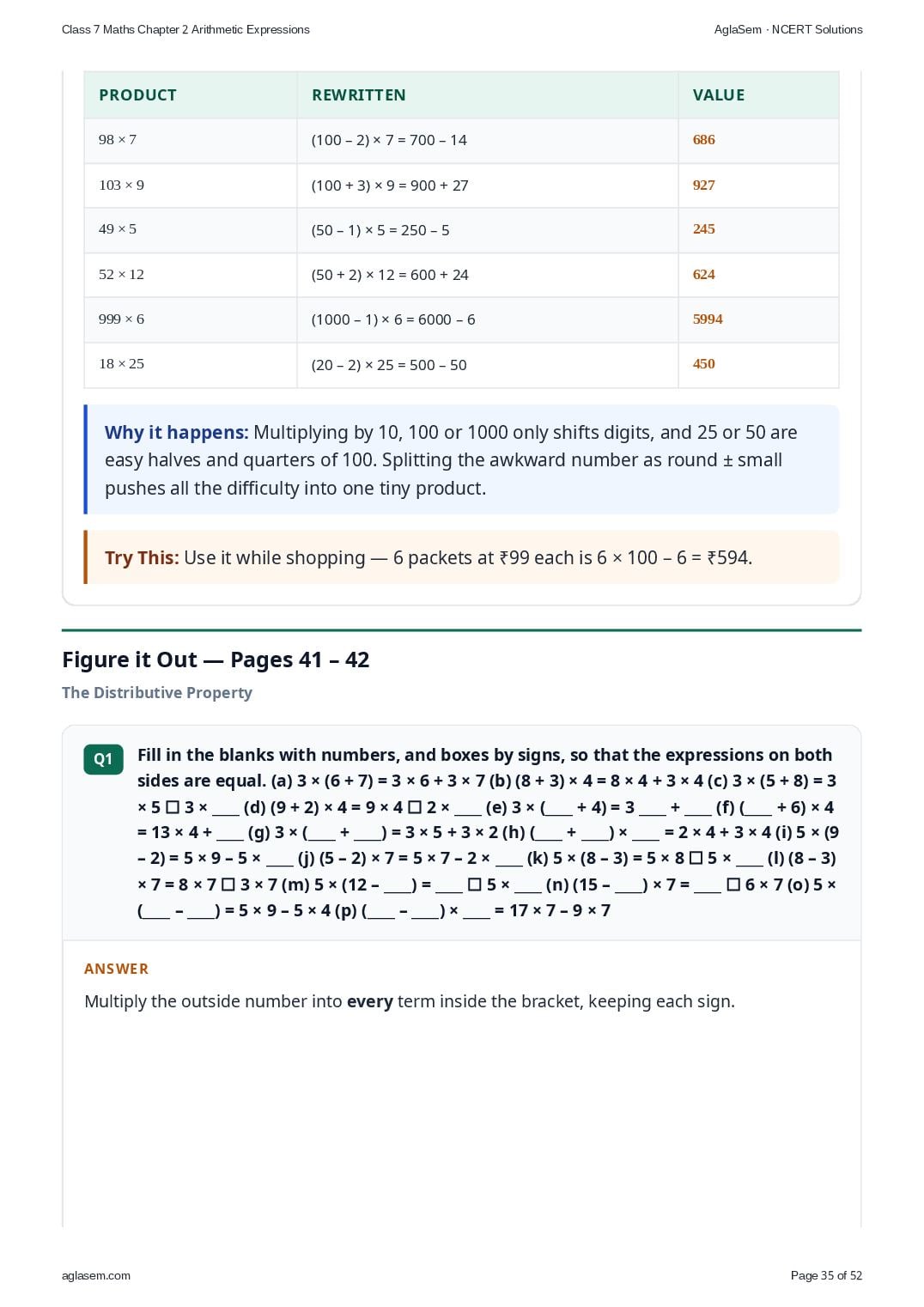
- Which other products might be quicker to find like the ones above?
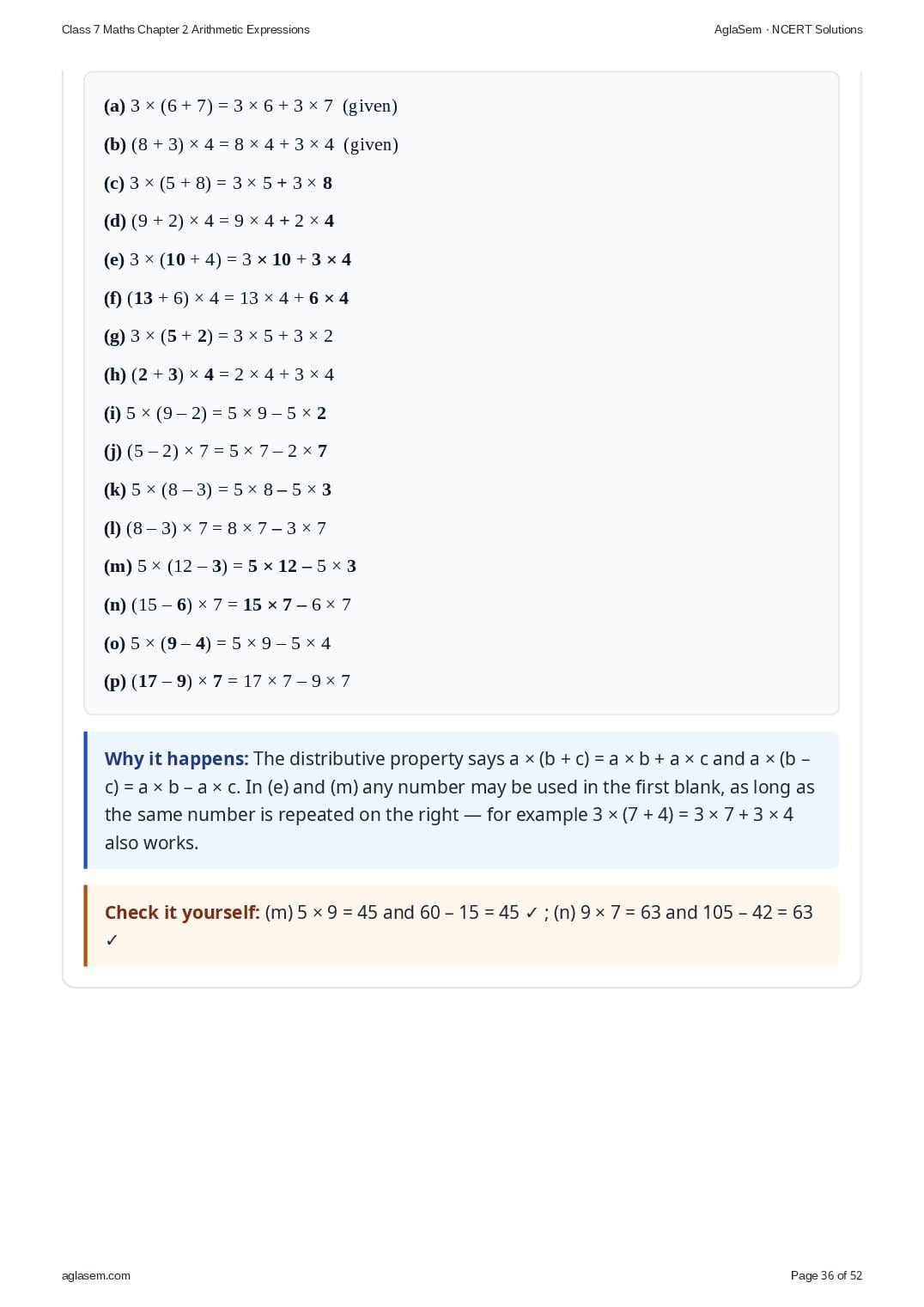
- Fill in the blanks with numbers, and boxes by signs, so that the expressions on both sides are equal. (a) 3 × (6 + 7) = 3 × 6 + 3 × 7 (b) (8 + 3) × 4 = 8 × 4 + 3 × 4 (c) 3 × (5 + 8) = 3 × 5 ☐ 3 × ____ (d) (9 + 2) × 4 = 9 × 4 ☐ 2 × ____ (e) 3 × (____ + 4) = 3 ____ + ____ (f) (____ + 6) × 4 = 13 × 4 + ____ (g) 3 × (____ + ____) = 3 × 5 + 3 × 2 (h) (____ + ____) × ____ = 2 × 4 + 3 × 4 (i) 5 × (9 – 2) = 5 × 9 – 5 × ____ (j) (5 – 2) × 7 = 5 × 7 – 2 × ____ (k) 5 × (8 – 3) = 5 × 8 ☐ 5 × ____ (l) (8 – 3) × 7 = 8 × 7 ☐ 3 × 7 (m) 5 × (12 – ____) = ____ ☐ 5 × ____ (n) (15 – ____) × 7 = ____ ☐ 6 × 7 (o) 5 × (____ – ____) = 5 × 9 – 5 × 4 (p) (____ – ____) × ____ = 17 × 7 – 9 × 7
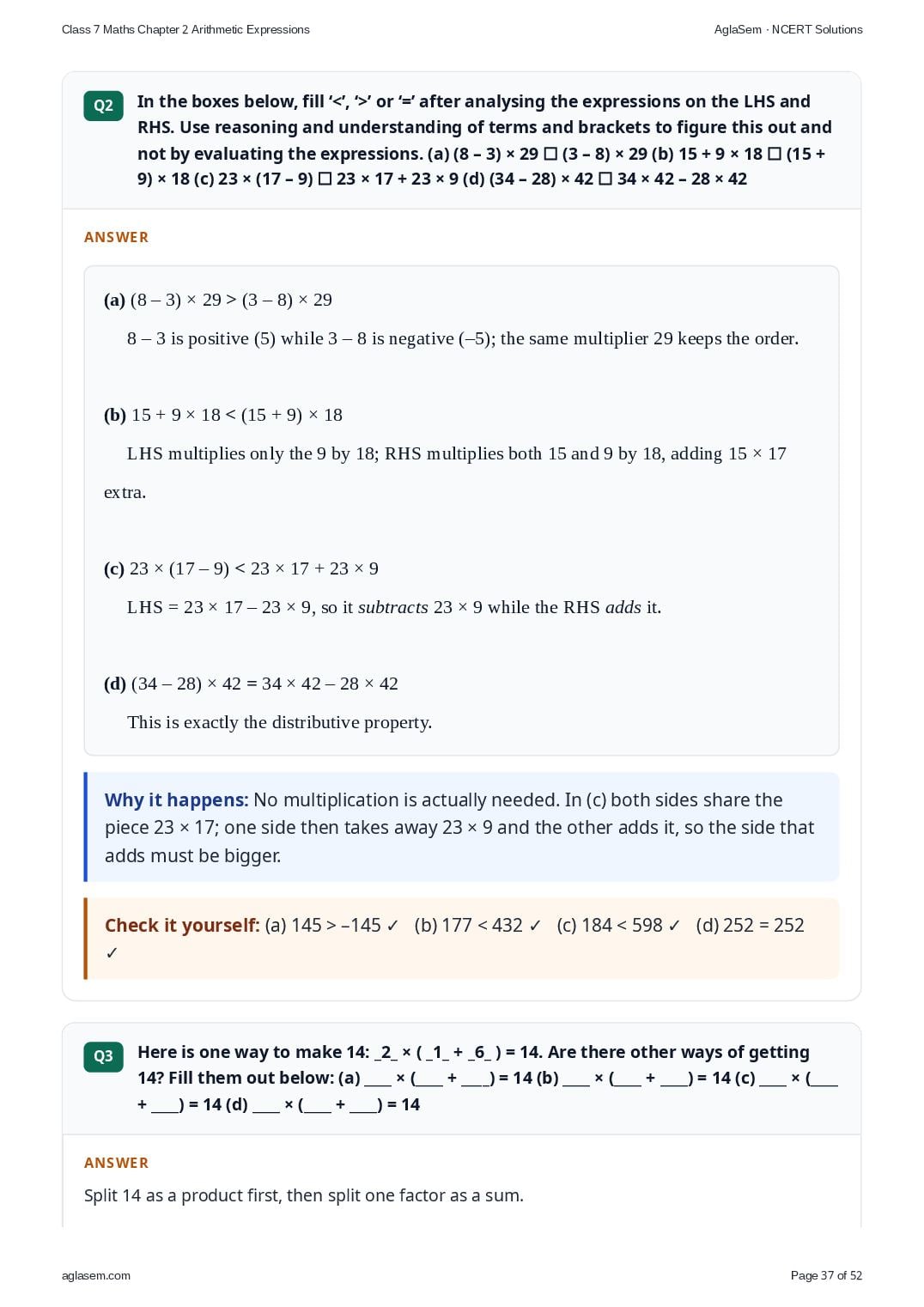
- In the boxes below, fill ‘<’, ‘>’ or ‘=’ after analysing the expressions on the LHS and RHS. Use reasoning and understanding of terms and brackets to figure this out and not by evaluating the expressions. (a) (8 – 3) × 29 ☐ (3 – 8) × 29 (b) 15 + 9 × 18 ☐ (15 + 9) × 18 (c) 23 × (17 – 9) ☐ 23 × 17 + 23 × 9 (d) (34 – 28) × 42 ☐ 34 × 42 – 28 × 42
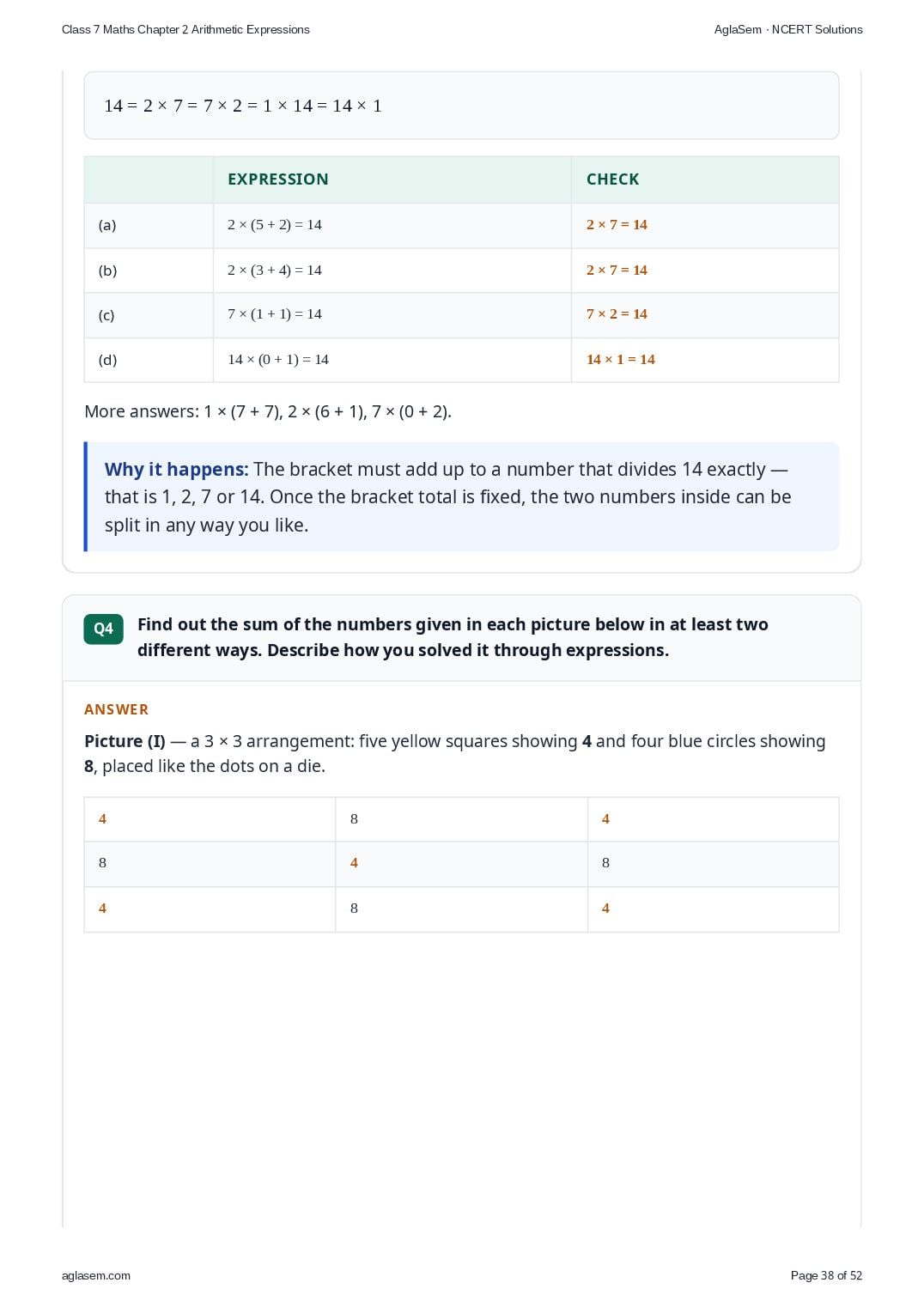
- Here is one way to make 14: _2_ × ( _1_ + _6_ ) = 14. Are there other ways of getting 14? Fill them out below: (a) ____ × (____ + ____) = 14 (b) ____ × (____ + ____) = 14 (c) ____ × (____ + ____) = 14 (d) ____ × (____ + ____) = 14
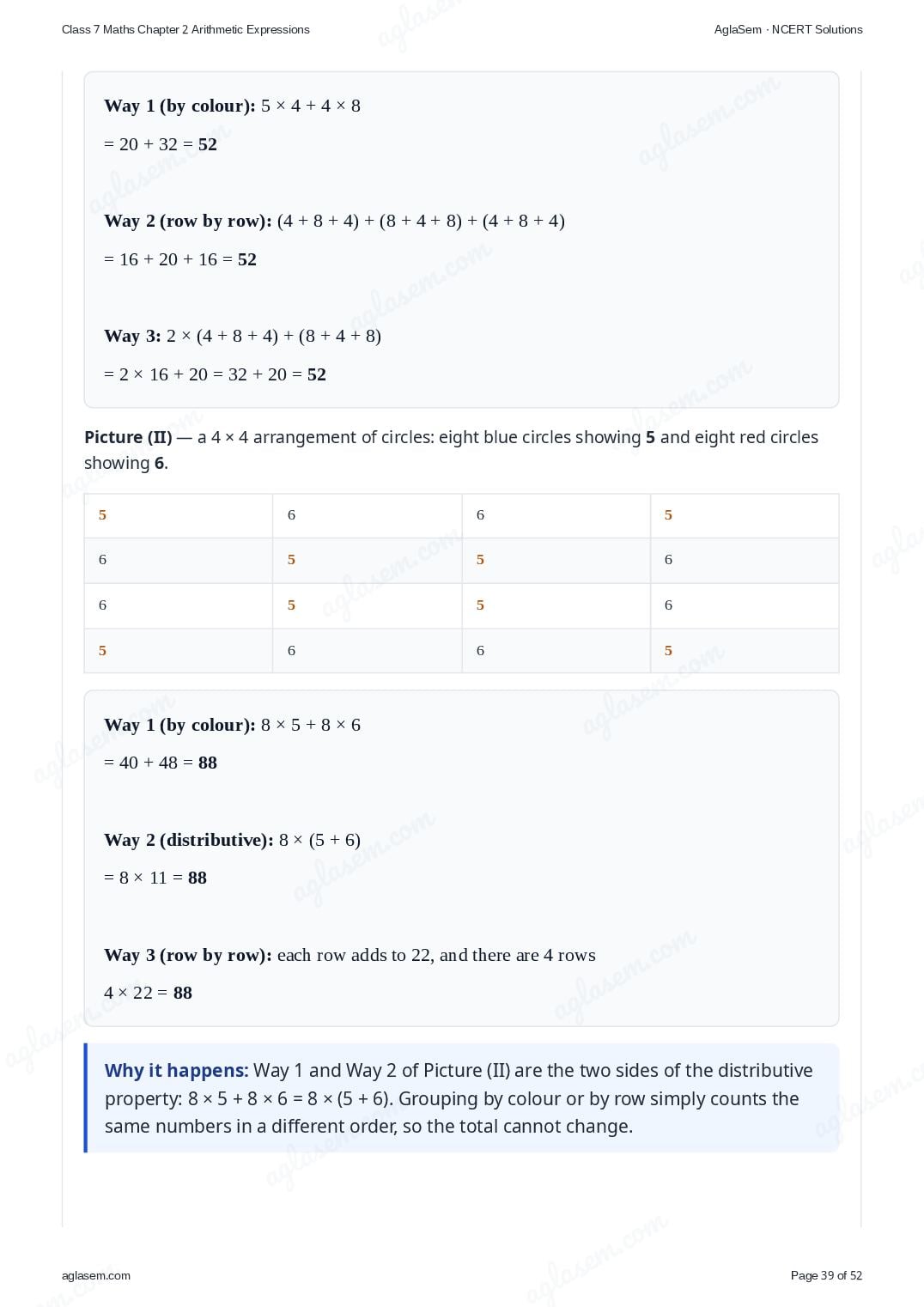
- Find out the sum of the numbers given in each picture below in at least two different ways. Describe how you solved it through expressions.
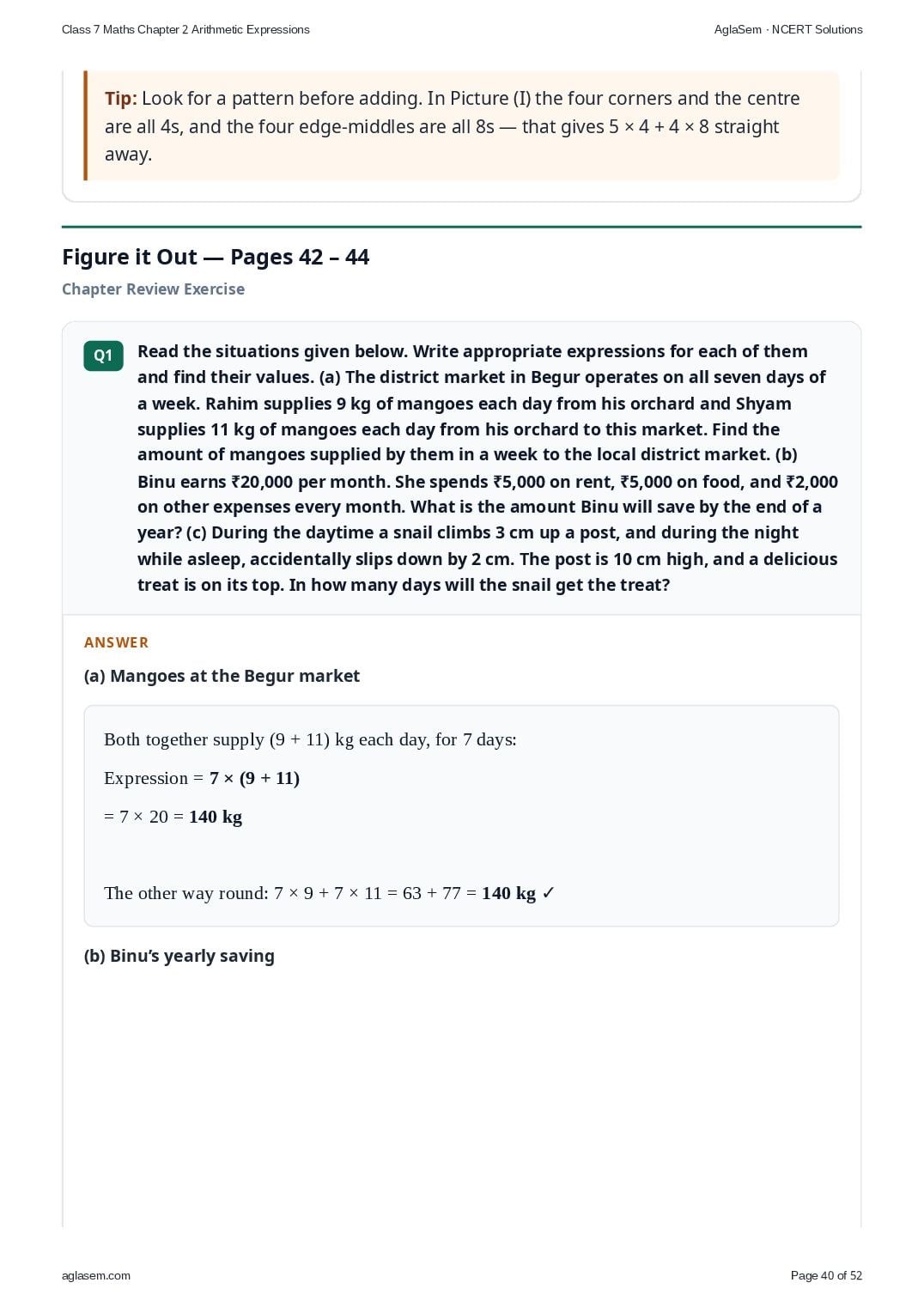
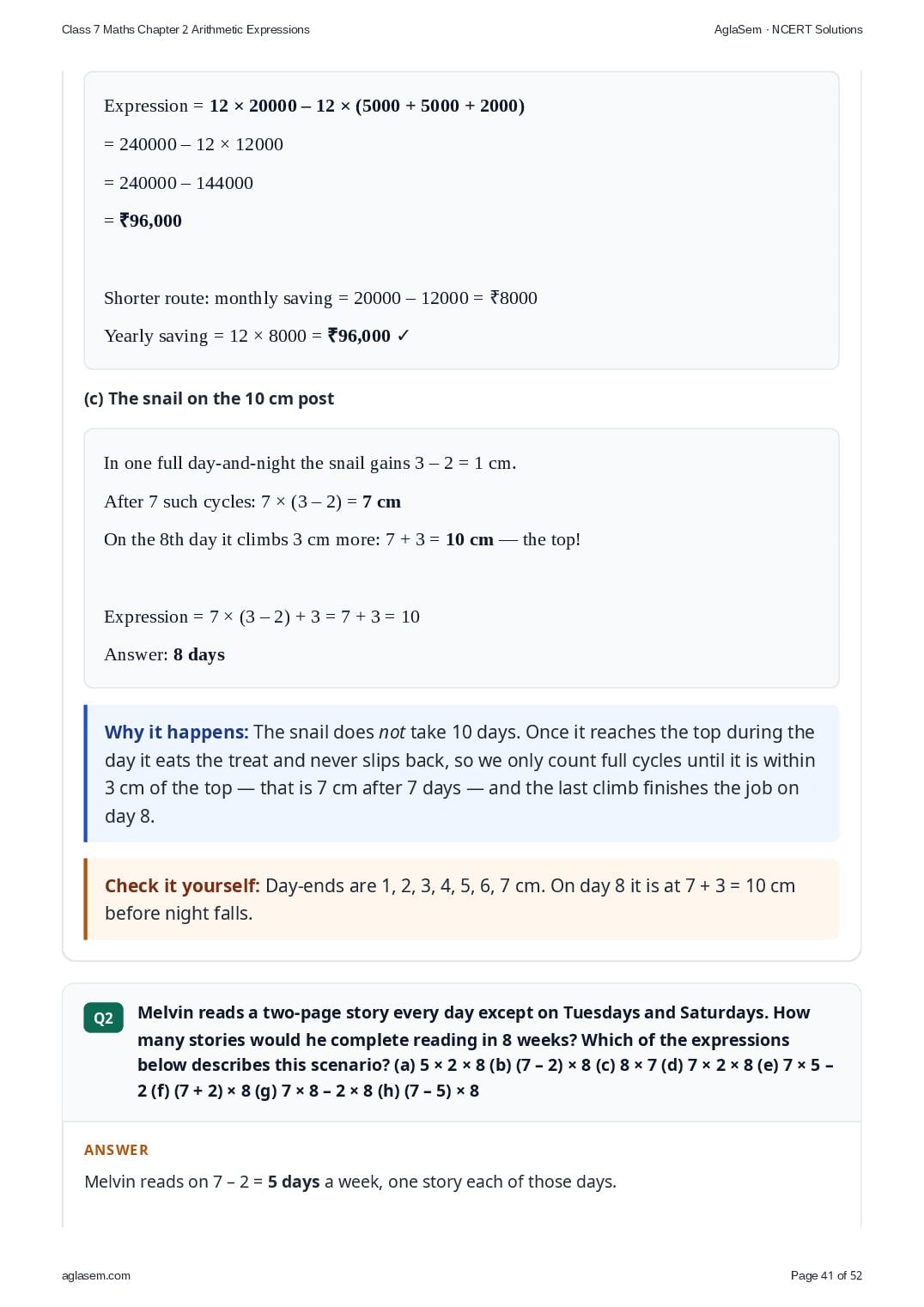
- Read the situations given below. Write appropriate expressions for each of them and find their values. (a) The district market in Begur operates on all seven days of a week. Rahim supplies 9 kg of mangoes each day from his orchard and Shyam supplies 11 kg of mangoes each day from his orchard to this market. Find the amount of mangoes supplied by them in a week to the local district market. (b) Binu earns ₹20,000 per month. She spends ₹5,000 on rent, ₹5,000 on food, and ₹2,000 on other expenses every month. What is the amount Binu will save by the end of a year? (c) During the daytime a snail climbs 3 cm up a post, and during the night while asleep, accidentally slips down by 2 cm. The post is 10 cm high, and a delicious treat is on its top. In how many days will the snail get the treat?
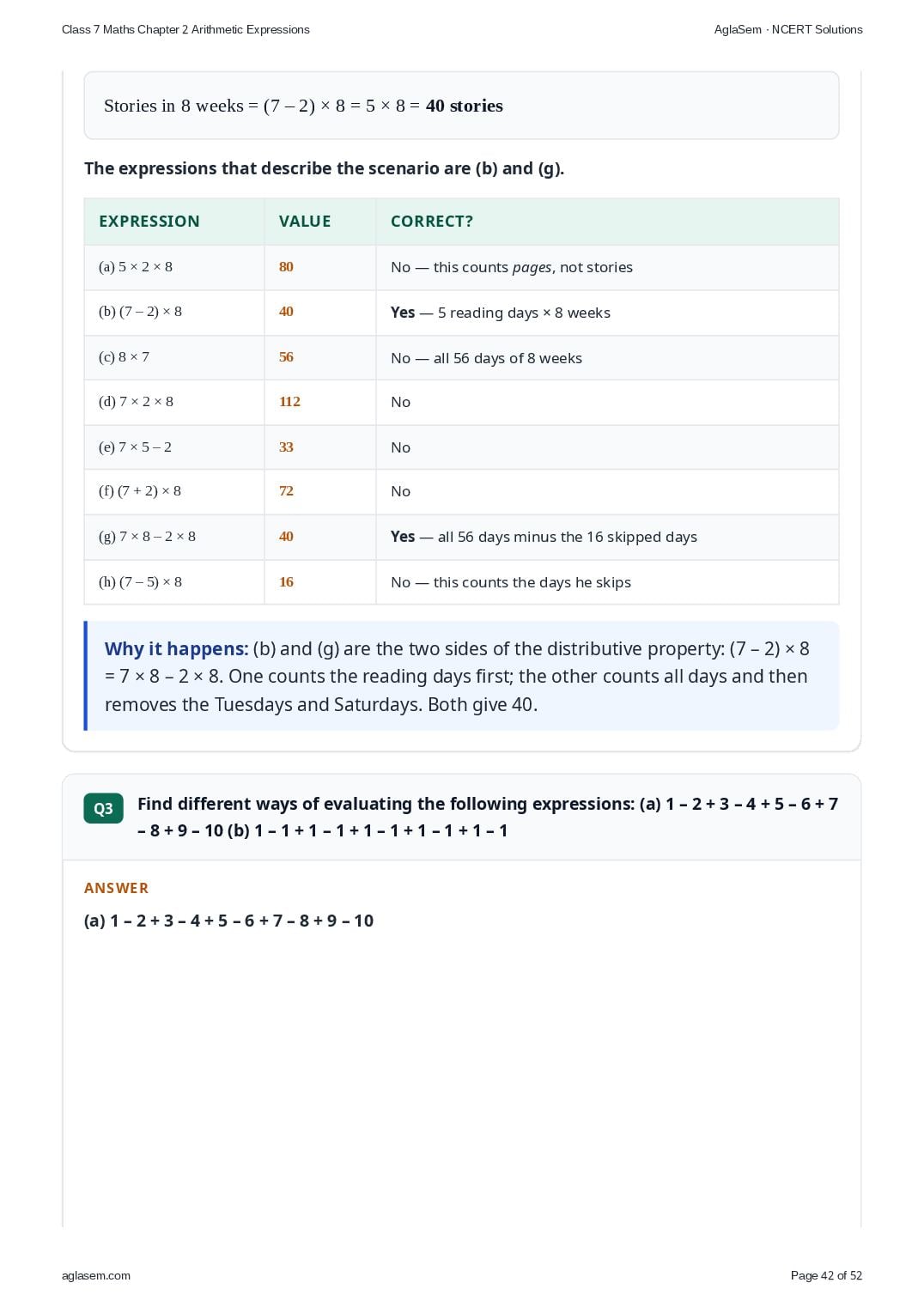
- Melvin reads a two-page story every day except on Tuesdays and Saturdays. How many stories would he complete reading in 8 weeks? Which of the expressions below describes this scenario? (a) 5 × 2 × 8 (b) (7 – 2) × 8 (c) 8 × 7 (d) 7 × 2 × 8 (e) 7 × 5 – 2 (f) (7 + 2) × 8 (g) 7 × 8 – 2 × 8 (h) (7 – 5) × 8
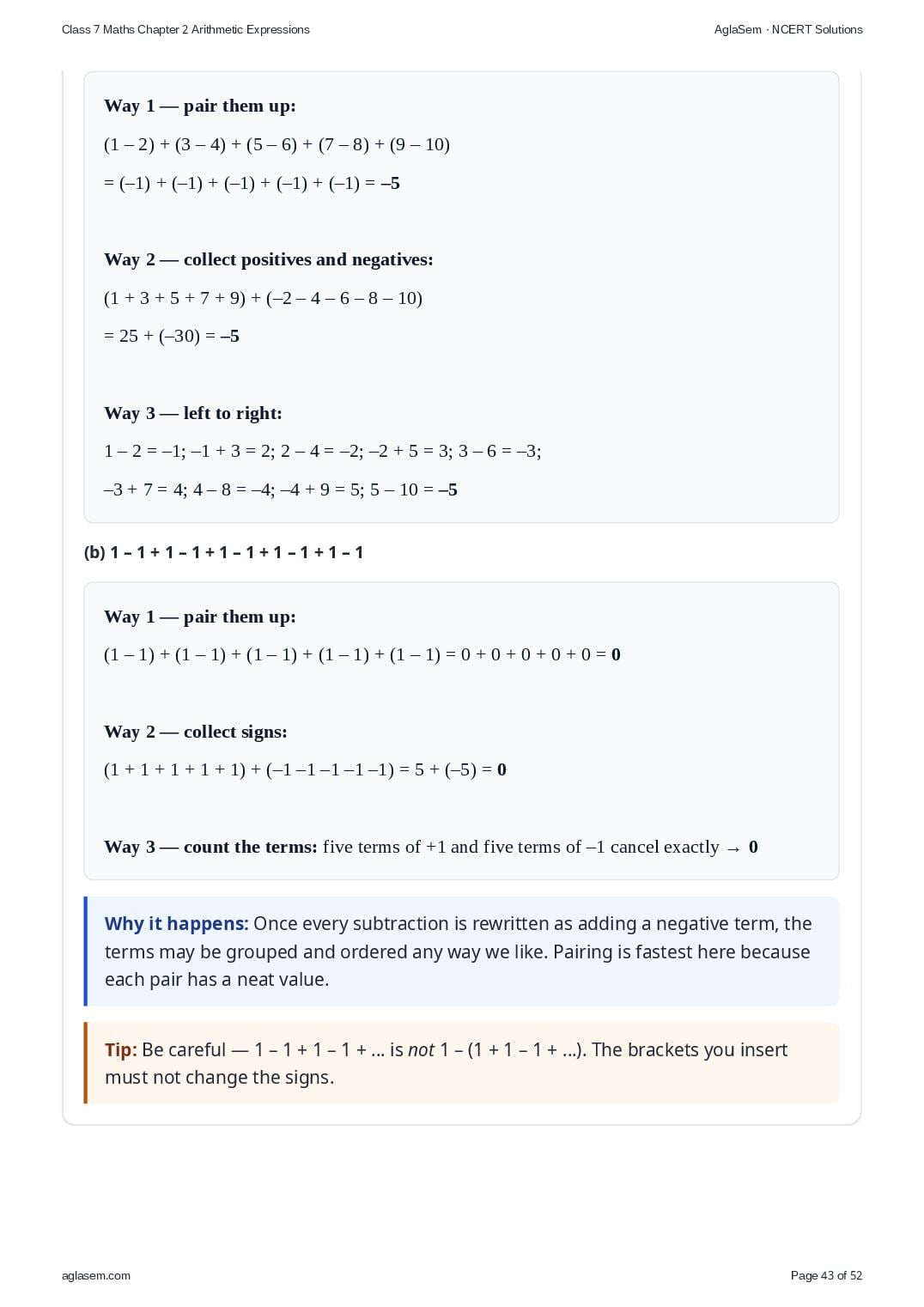
- Find different ways of evaluating the following expressions: (a) 1 – 2 + 3 – 4 + 5 – 6 + 7 – 8 + 9 – 10 (b) 1 – 1 + 1 – 1 + 1 – 1 + 1 – 1 + 1 – 1
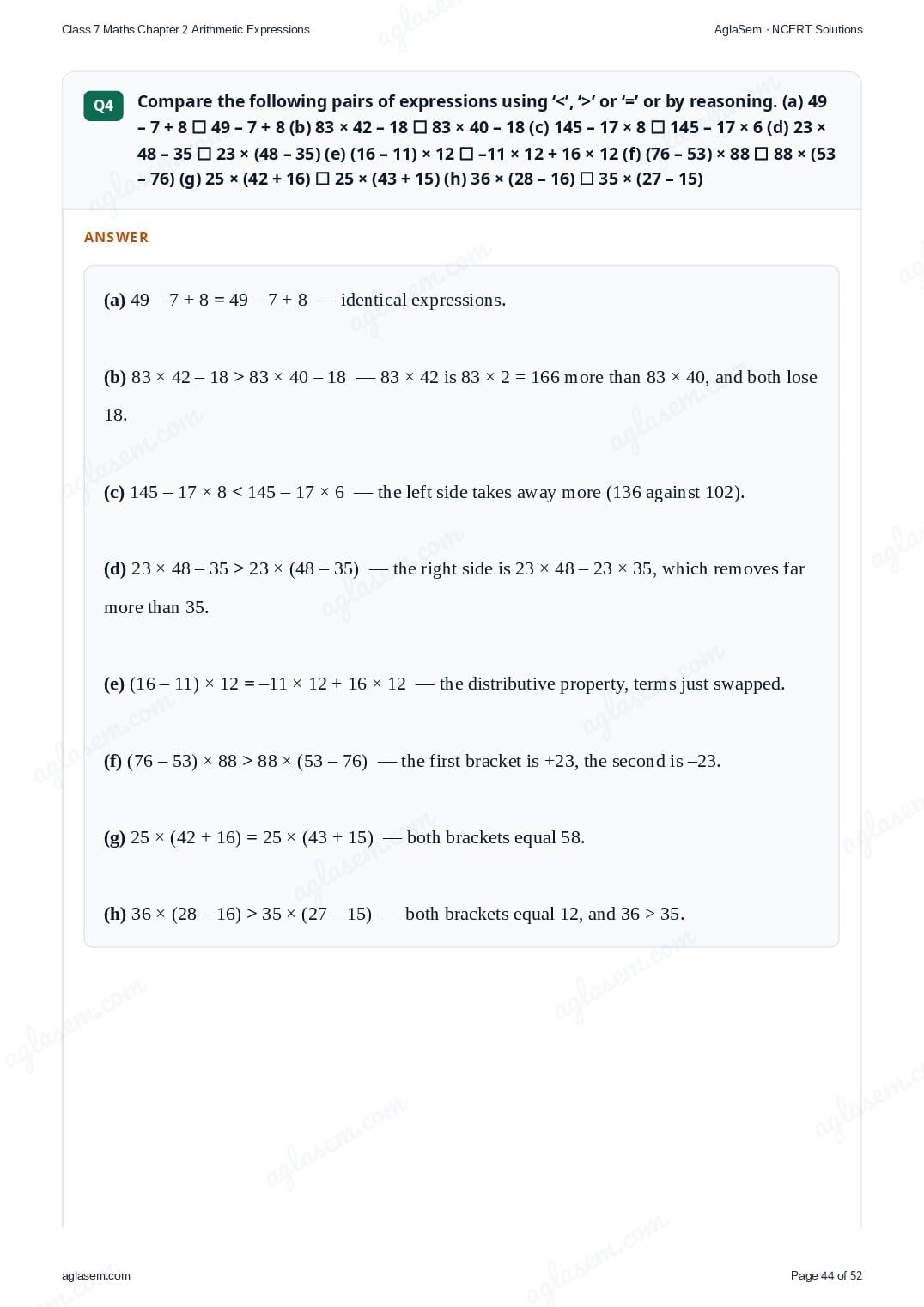
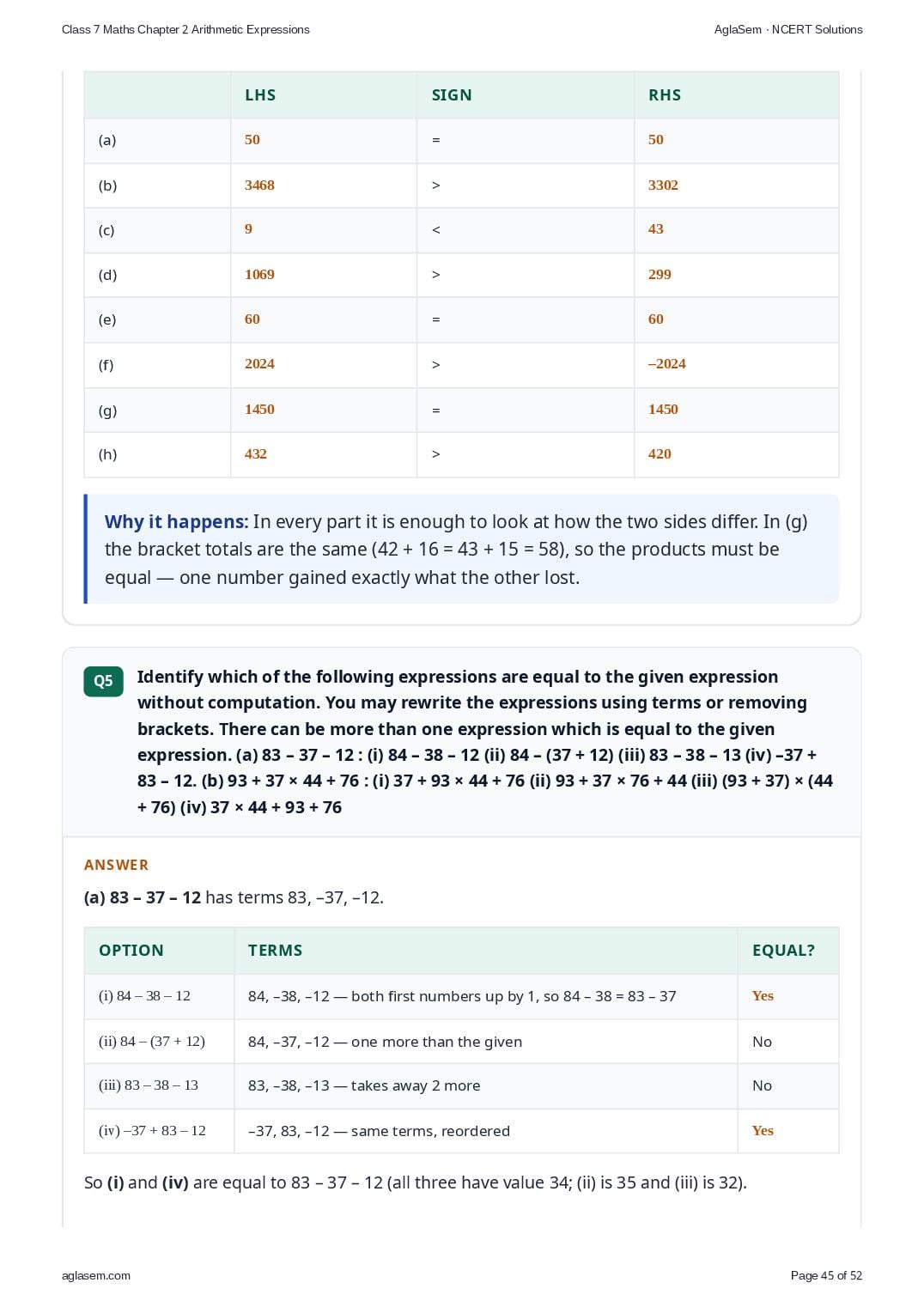
- Compare the following pairs of expressions using ‘<’, ‘>’ or ‘=’ or by reasoning. (a) 49 – 7 + 8 ☐ 49 – 7 + 8 (b) 83 × 42 – 18 ☐ 83 × 40 – 18 (c) 145 – 17 × 8 ☐ 145 – 17 × 6 (d) 23 × 48 – 35 ☐ 23 × (48 – 35) (e) (16 – 11) × 12 ☐ –11 × 12 + 16 × 12 (f) (76 – 53) × 88 ☐ 88 × (53 – 76) (g) 25 × (42 + 16) ☐ 25 × (43 + 15) (h) 36 × (28 – 16) ☐ 35 × (27 – 15)
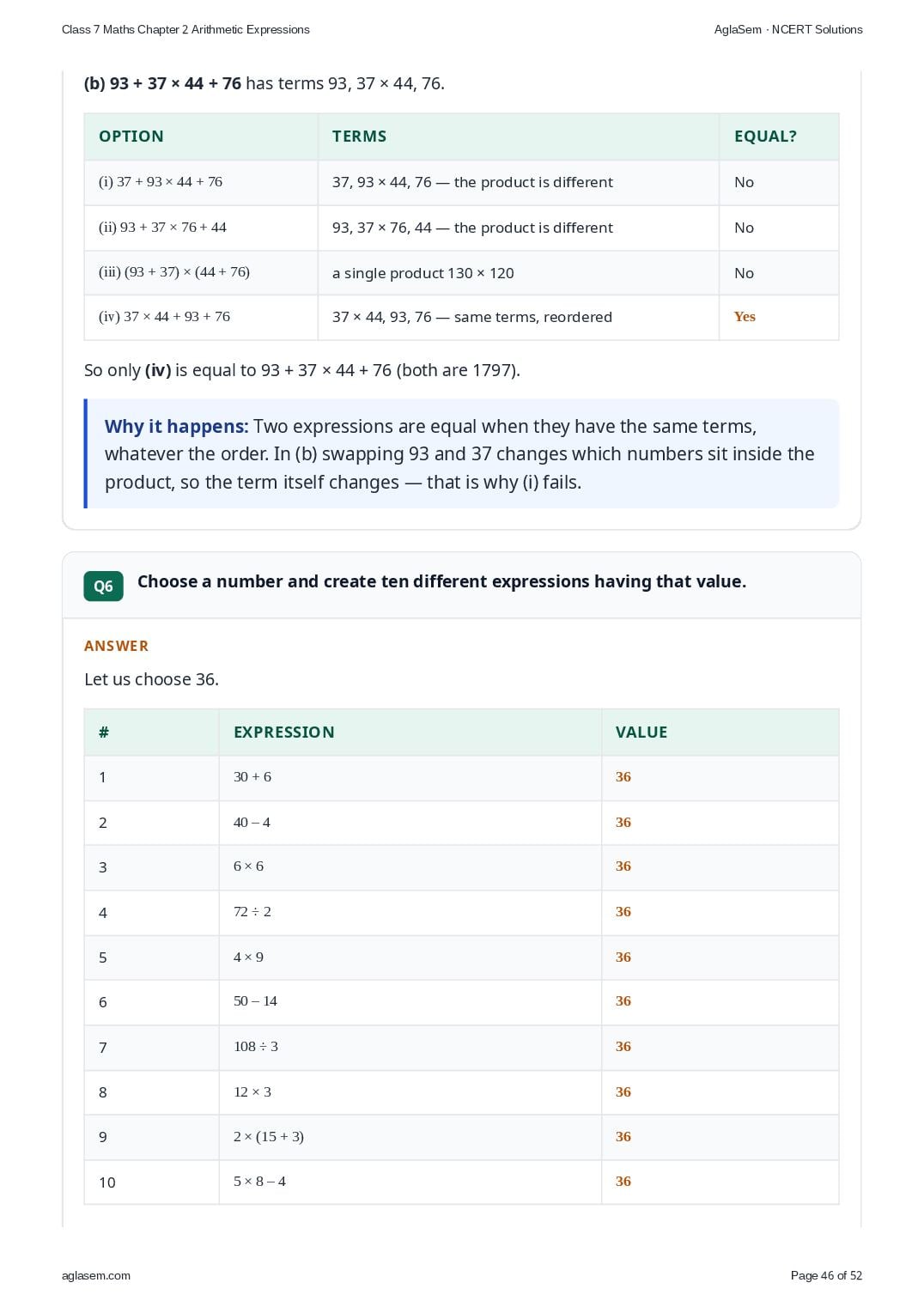
- Identify which of the following expressions are equal to the given expression without computation. You may rewrite the expressions using terms or removing brackets. There can be more than one expression which is equal to the given expression. (a) 83 – 37 – 12 : (i) 84 – 38 – 12 (ii) 84 – (37 + 12) (iii) 83 – 38 – 13 (iv) –37 + 83 – 12. (b) 93 + 37 × 44 + 76 : (i) 37 + 93 × 44 + 76 (ii) 93 + 37 × 76 + 44 (iii) (93 + 37) × (44 + 76) (iv) 37 × 44 + 93 + 76
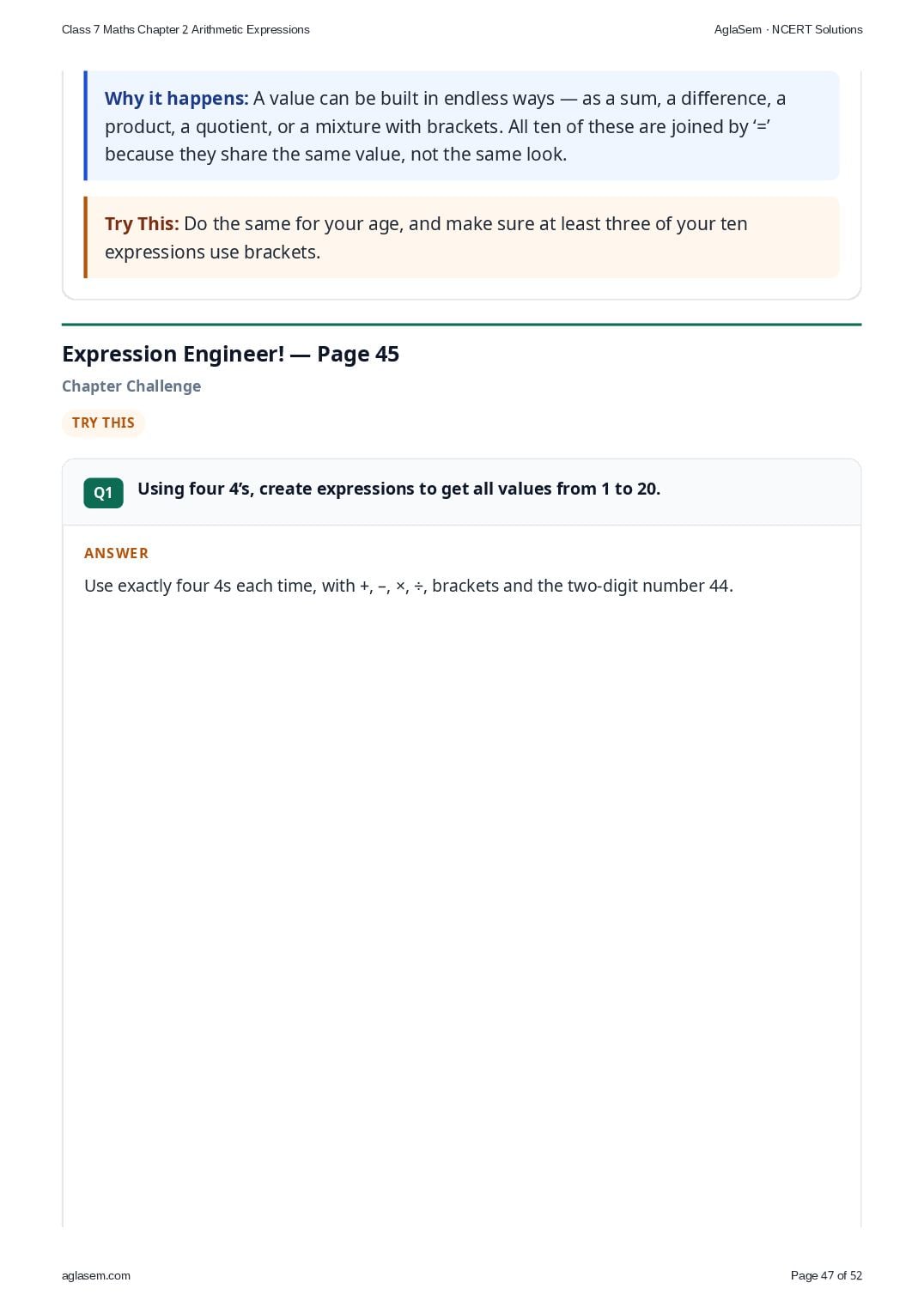
- Choose a number and create ten different expressions having that value.
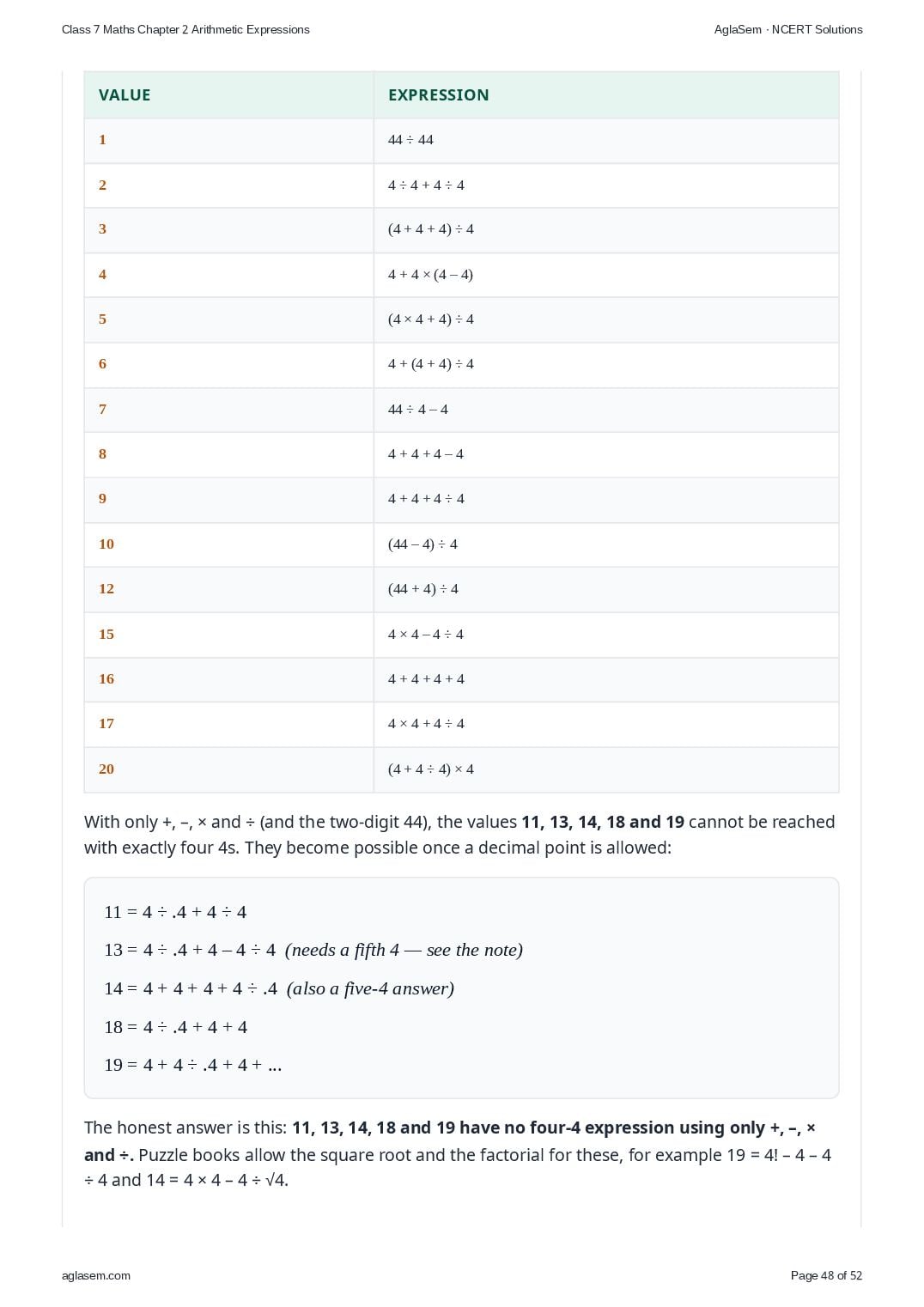
- Using four 4’s, create expressions to get all values from 1 to 20.
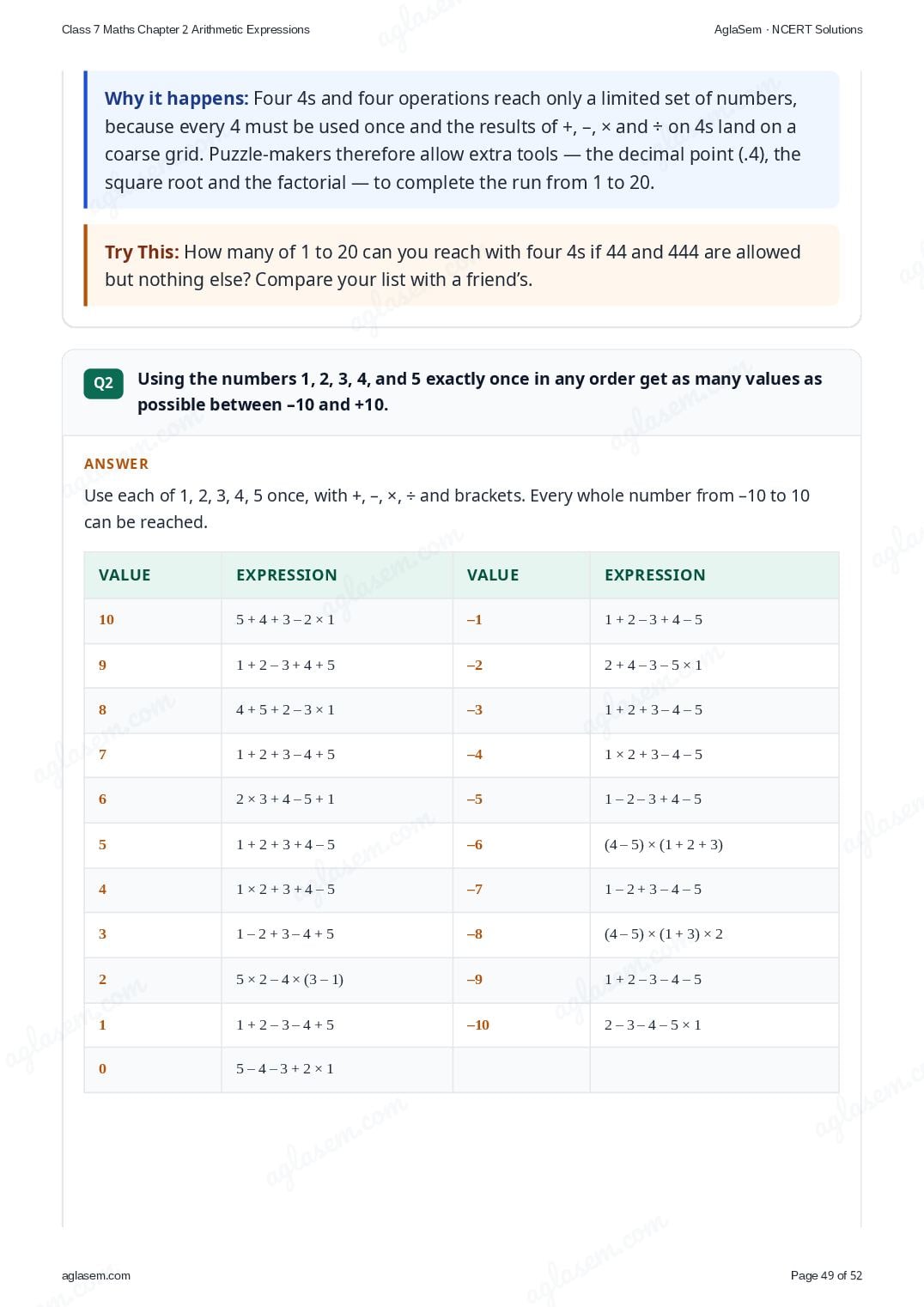
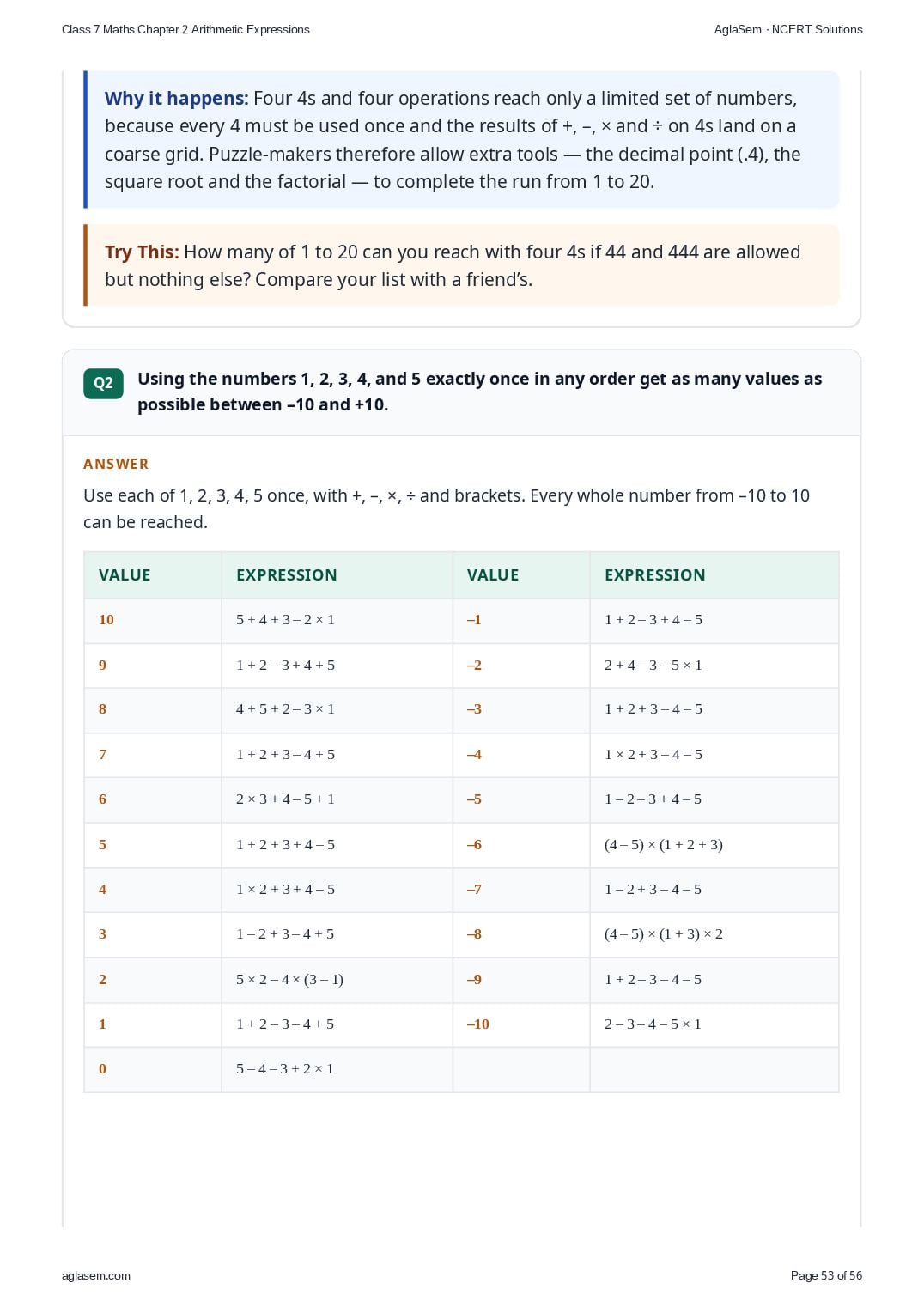
- Using the numbers 1, 2, 3, 4, and 5 exactly once in any order get as many values as possible between –10 and +10.
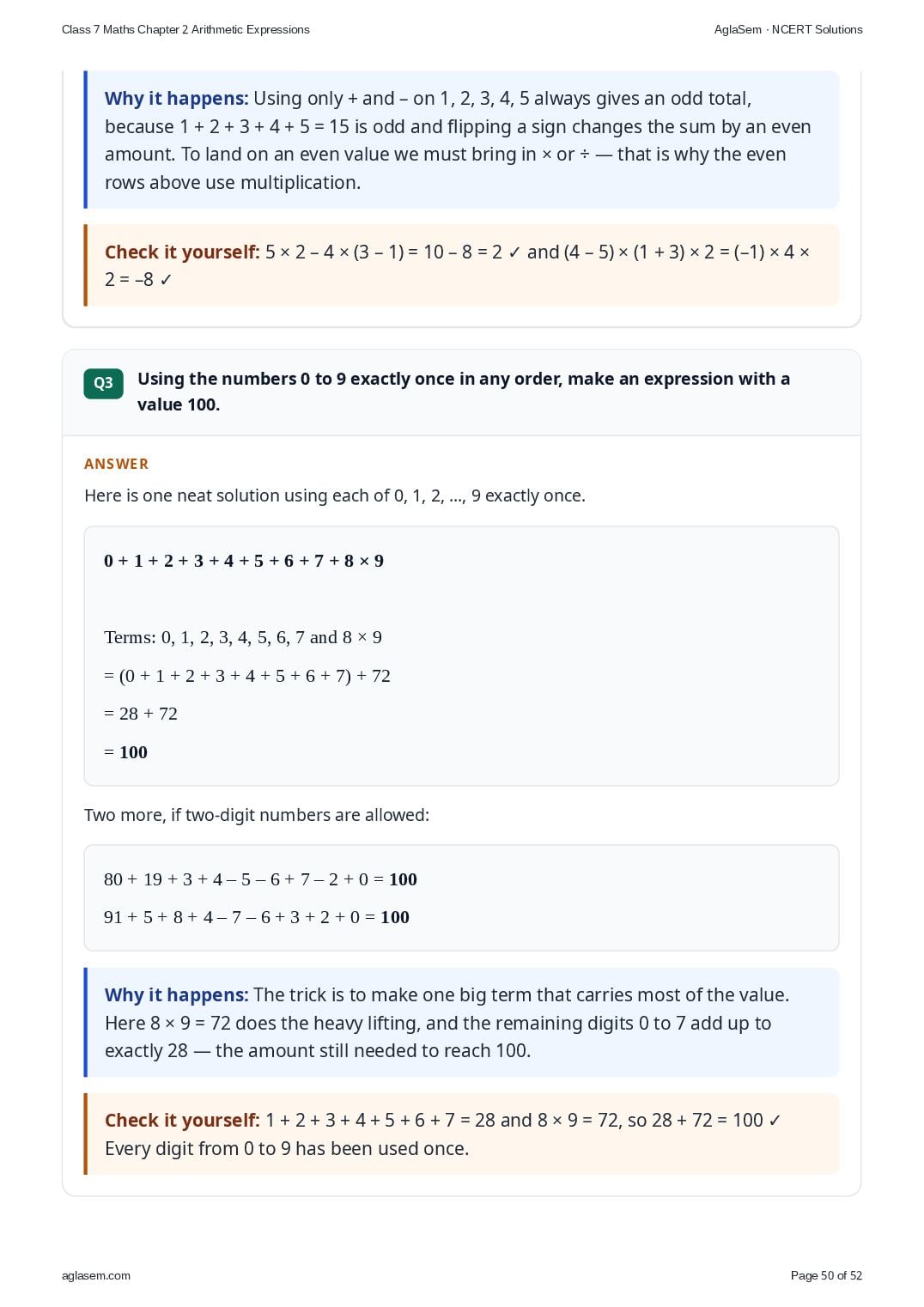
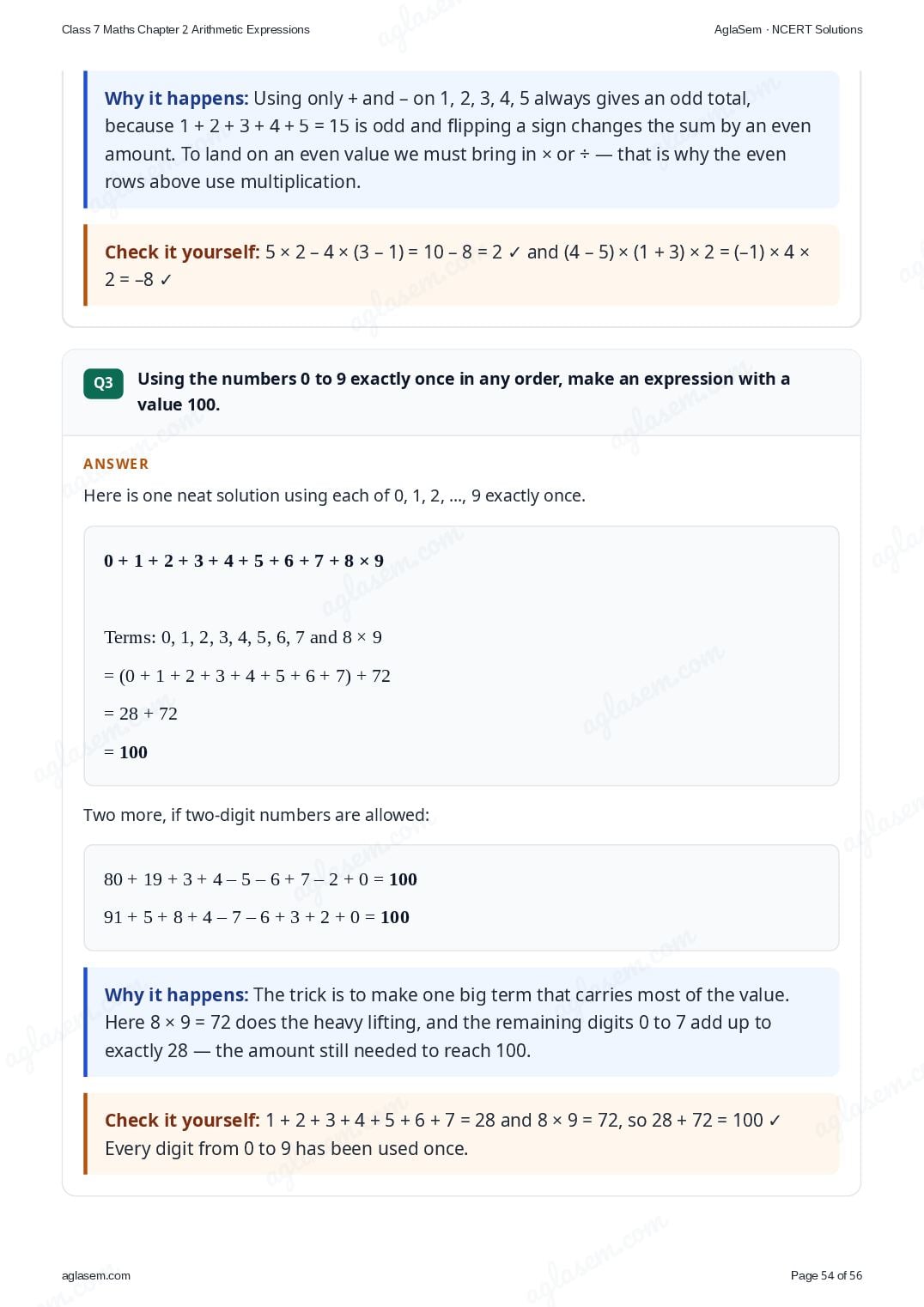
- Using the numbers 0 to 9 exactly once in any order, make an expression with a value 100.
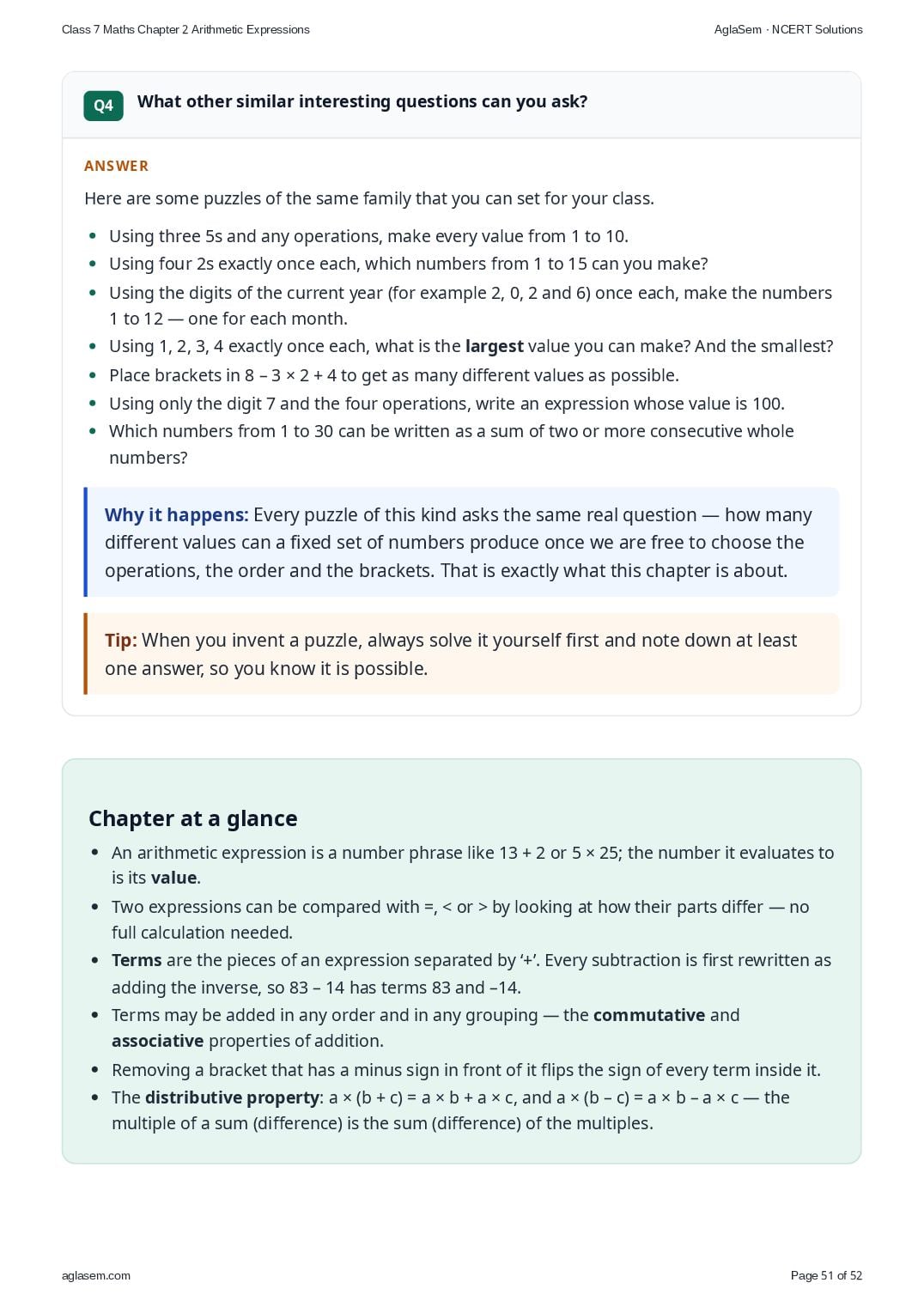
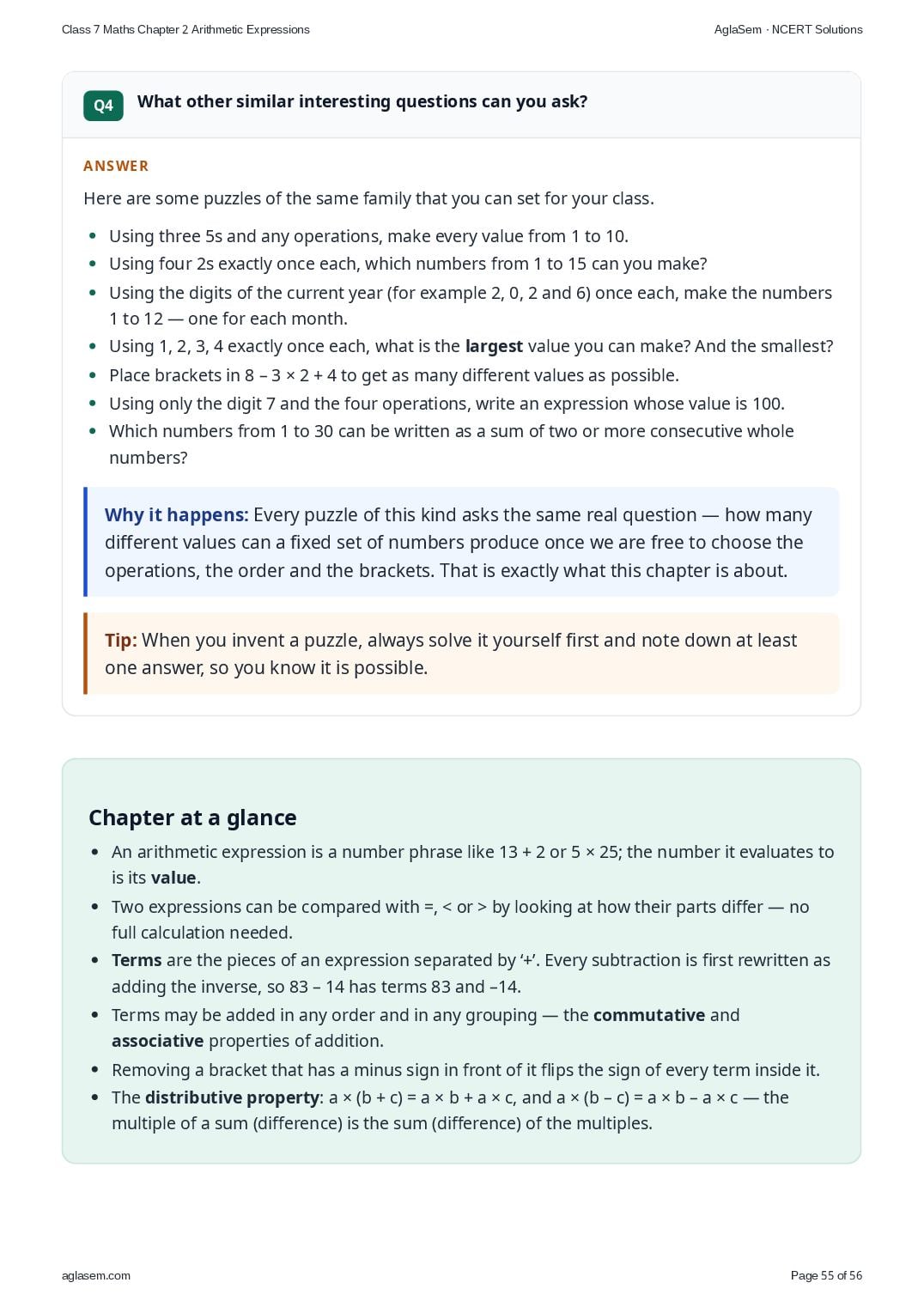
- What other similar interesting questions can you ask?
Chapter at a Glance
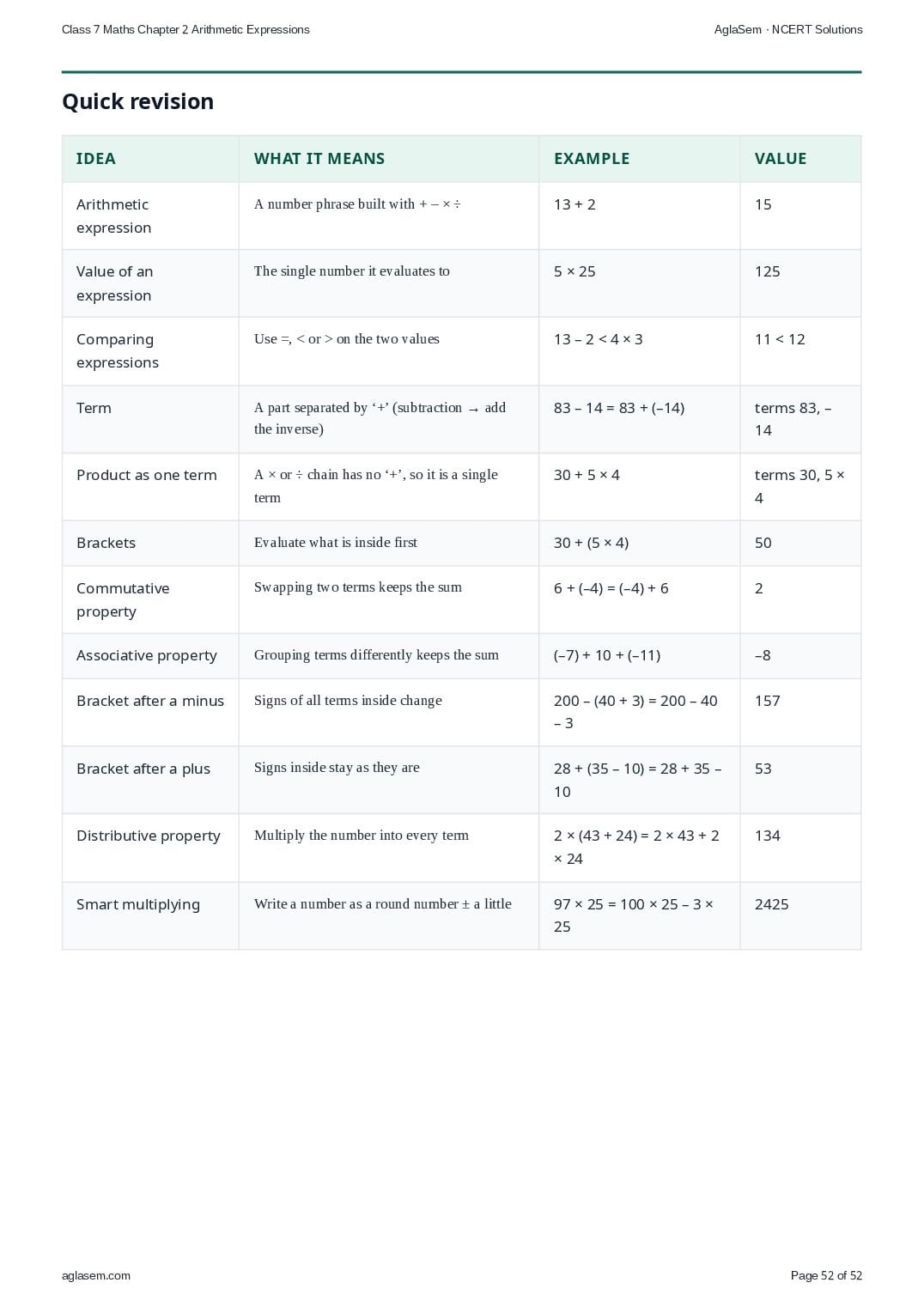
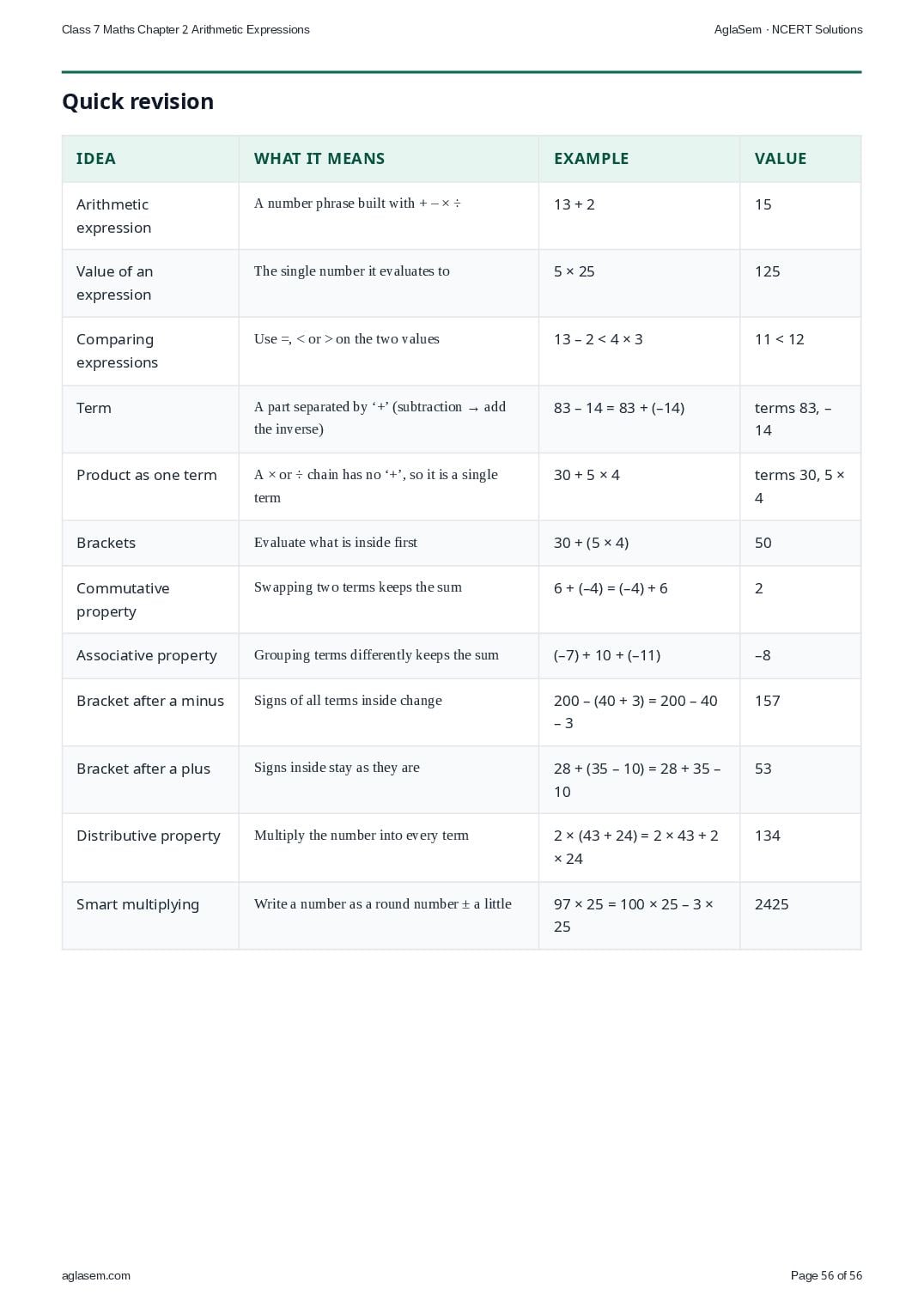
- An arithmetic expression is a number phrase like 13 + 2 or 5 × 25; the number it evaluates to is its value .
- Two expressions can be compared with =, < or > by looking at how their parts differ — no full calculation needed.
- Terms are the pieces of an expression separated by ‘+’. Every subtraction is first rewritten as adding the inverse, so 83 – 14 has terms 83 and –14.
- Terms may be added in any order and in any grouping — the commutative and associative properties of addition.
- Removing a bracket that has a minus sign in front of it flips the sign of every term inside it.
- The distributive property : a × (b + c) = a × b + a × c, and a × (b – c) = a × b – a × c — the multiple of a sum (difference) is the sum (difference) of the multiples.
How to Download NCERT Solutions for Class 7 Maths Chapter 2 PDF
Follow these simple steps to get the Arithmetic Expressions questions-and-answers PDF from Ganita Prakash.
- Search NCERT Solutions for Class 7 Maths Chapter 2 aglasem and open this page.
- Read the exercise questions with answers for Arithmetic Expressions shown above.
- Click the Download PDF link to save the Arithmetic Expressions solutions to your device.
NCERT Solutions for Class 7 Maths – All Chapters
There are more chapters to study besides Arithmetic Expressions in Maths. Here are the NCERT Solutions for all chapters of Class 7 Maths.
- Chapter 1 Large Numbers Around Us
- Chapter 2 Arithmetic Expressions
- Chapter 3 a Peek Beyond the Point
- Chapter 4 Expressions Using Letter Numbers
- Chapter 5 Parallel and Intersecting Lines
- Chapter 6 Number Play
- Chapter 7 a Tale of Three Intersecting Lines
- Chapter 8 Working with Fractions
NCERT Solutions for Class 7 – All Subjects
Just like Chapter 2 of Maths, you can get the exercise questions with answers for every other subject of Class 7. Here are the NCERT Solutions for all subjects of Class 7.
NCERT Solutions for Class 7 Maths Chapter 2 – An Overview
The key highlights of this study material are as follows.
| Aspects | Details |
|---|---|
| Class | Class 7 |
| Subject | Maths |
| Chapter Number | Chapter 2 |
| Chapter Name | Arithmetic Expressions |
| Book Name | Ganita Prakash |
| Book By | NCERT (National Council of Educational Research and Training) |
| Educational Resource Here | NCERT Solutions of Class 7 Maths Chapter 2 for all exercises |
| More Questions Answers of This Subject | NCERT Solutions for Class 7 Maths |
| Download Book Chapter | NCERT Book Class 7 Maths |
| All Questions Answers For This Class | NCERT Solutions for Class 7 |
| Complete Solutions | NCERT Solutions |
NCERT Solutions for Class 7 Maths Chapter 2 Arithmetic Expressions – FAQs
What are the NCERT Solutions for Class 7 Maths Chapter 2 Arithmetic Expressions?
They are the complete, step-by-step answers to all the exercise and in-text questions of Chapter 2 Arithmetic Expressions from the NCERT Class 7 Maths textbook Ganita Prakash, written by experts as per the latest NCERT syllabus.
How can I download the Class 7 Maths Chapter 2 solutions PDF for free?
Open this page on aglasem, read the Arithmetic Expressions questions with answers, and click the “Download Solutions PDF” link. The Class 7 Maths Chapter 2 NCERT Solutions PDF is completely free to download.
Are these NCERT Solutions as per the latest 2026-27 syllabus?
Yes. The NCERT Solutions for Class 7 Maths Chapter 2 are based on the latest NCERT textbook Ganita Prakash and the current 2026-27 CBSE syllabus, so the questions and answers match what you study in class.
Where can I get NCERT Solutions for the other chapters of Class 7 Maths?
You can find the answers to every chapter on the NCERT Solutions for Class 7 Maths page, and solutions for every subject on the NCERT Solutions for Class 7 page.
How do NCERT Solutions help in exam preparation?
They show the correct method to solve each question, help you write answers the way they are expected in exams, let you check and correct your own work, and save revision time — which together improve your marks in Class 7 Maths.
If you have any queries on NCERT Solutions for Class 7 Maths Chapter 2 Arithmetic Expressions, then please ask in the comments below.
