NCERT Solutions for Class 7 Maths Chapter 4 Expressions Using Letter Numbers provide clear, step-by-step answers to every exercise and in-text question from the chapter Expressions Using Letter Numbers of the NCERT textbook Ganita Prakash. Prepared by subject experts as per the latest NCERT (CBSE) syllabus for 2026-27, these NCERT Solutions for Class 7 Maths help you understand each concept, write exam-ready answers, and check your own solutions. You can read them online below or download the free Class 7 Maths Chapter 4 question-answer PDF.
NCERT Solutions for Class 7 Maths Chapter 4 Expressions Using Letter Numbers
- Class: Class 7
- Subject: Maths
- Chapter: Chapter 4 – Expressions Using Letter Numbers
- Textbook: Ganita Prakash (NCERT)
- Study material: NCERT Solutions – questions with answers, free PDF
These solutions answer all the exercise questions of Chapter 4 Expressions Using Letter Numbers — including the in-text questions, short-answer and long-answer questions, and activities — with complete explanations so you can follow the method, not just the final answer. Read the full solutions below.
NCERT Solutions Class 7 Maths Chapter 4 Expressions Using Letter Numbers View Download
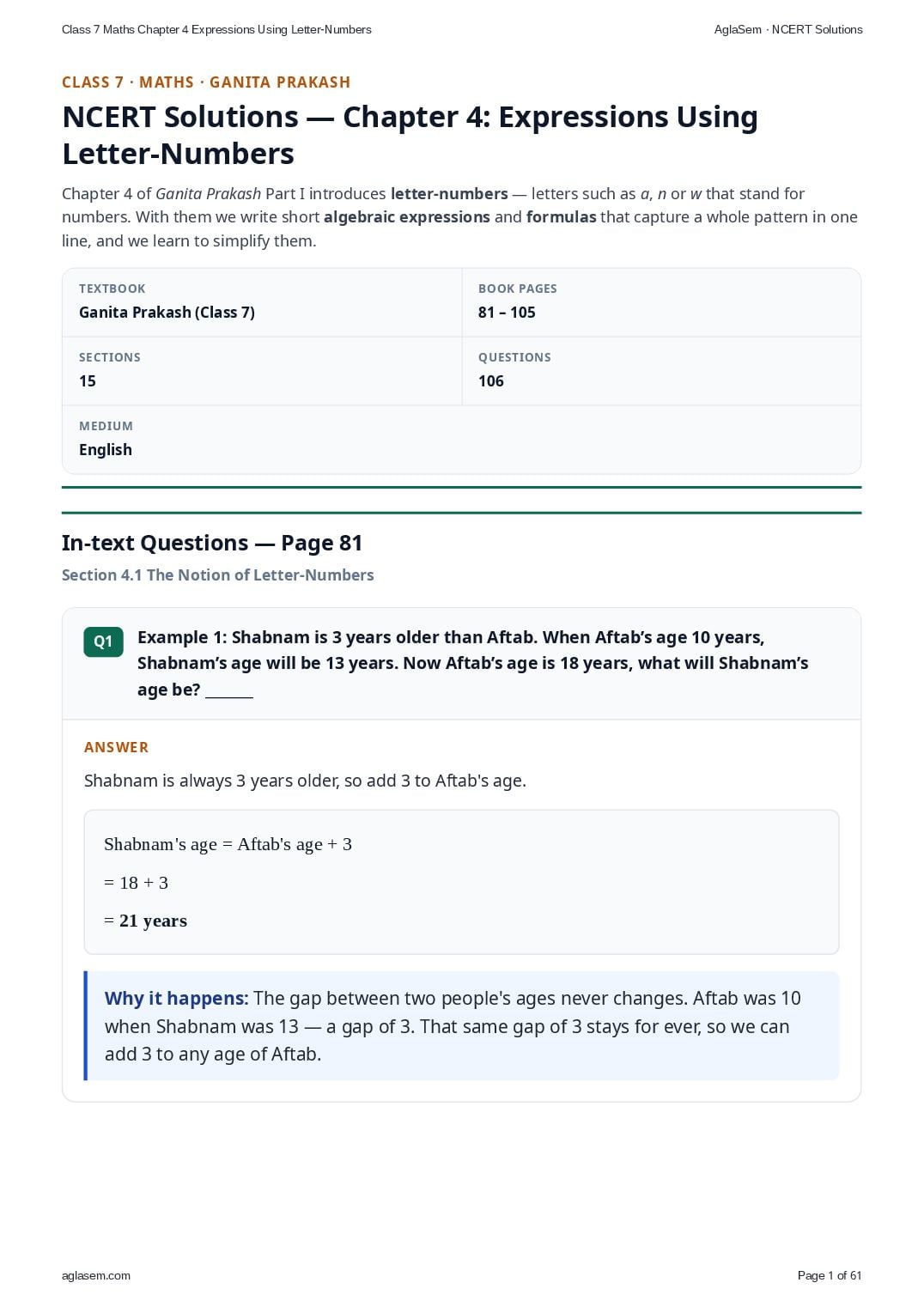
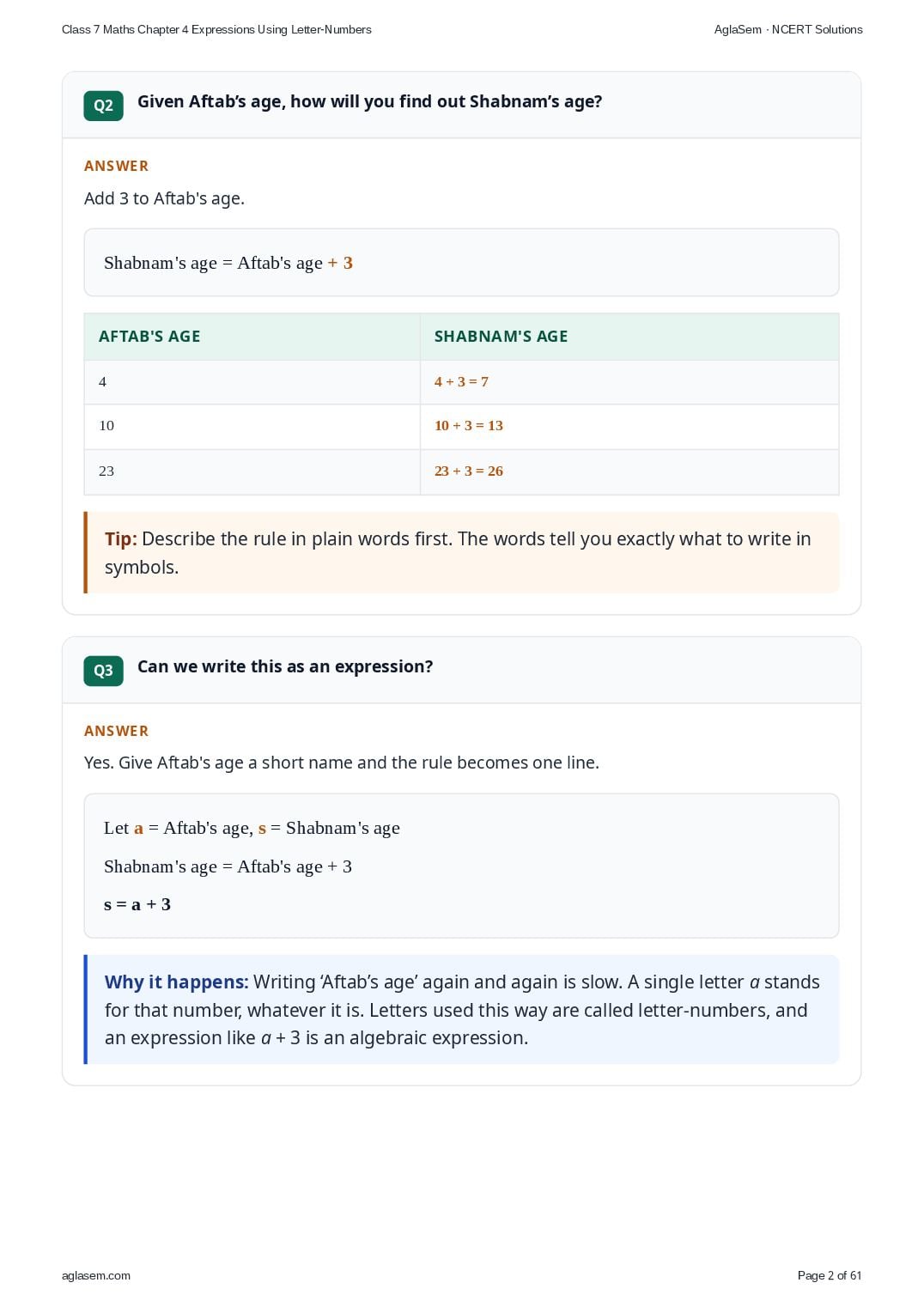
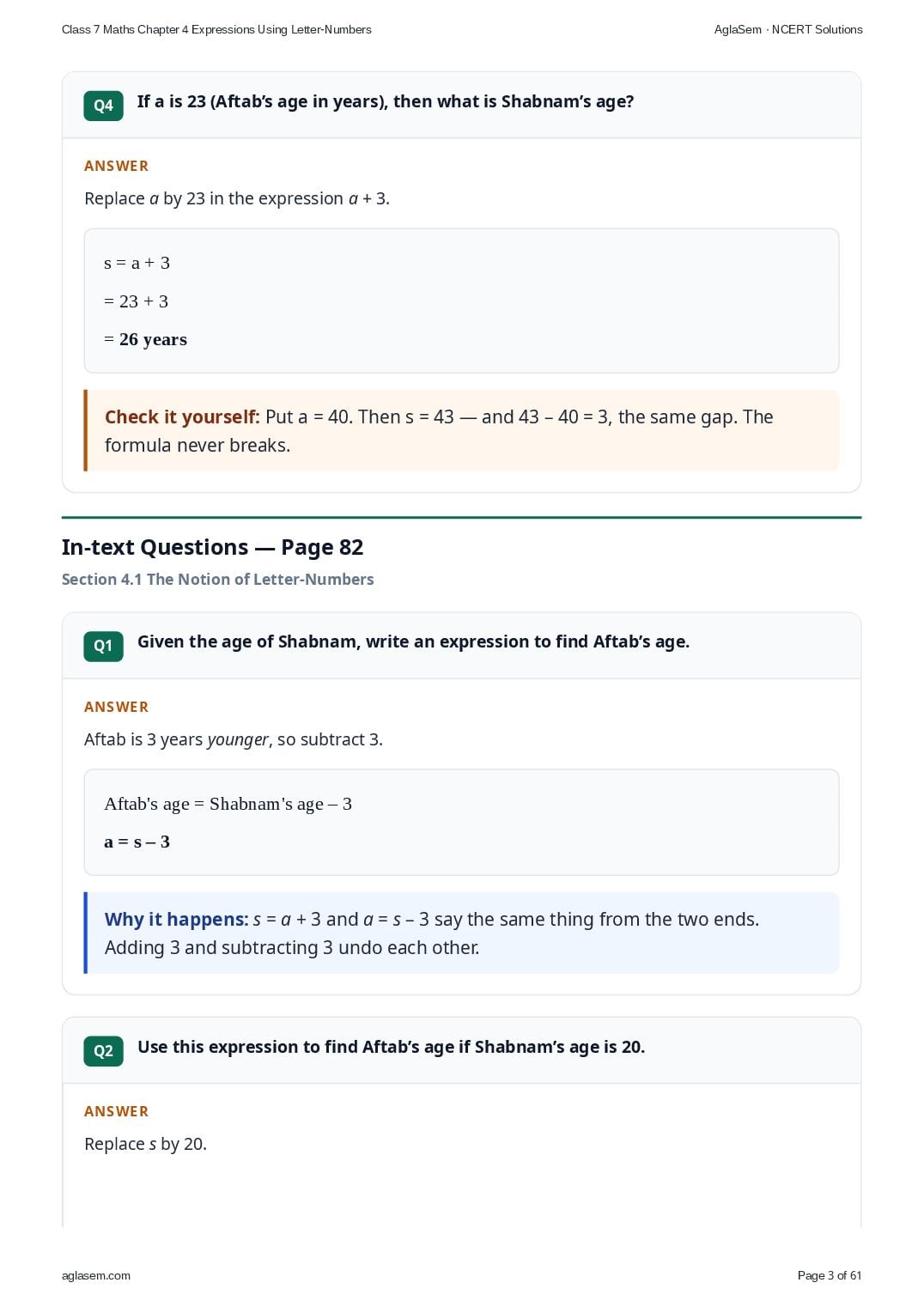
NCERT Solutions for Class 7 Maths Chapter 4 PDF Download
You can read the NCERT Solutions for Class 7 Maths Chapter 4 online above, or download the complete question-answer PDF to study Expressions Using Letter Numbers offline at any time.
NCERT Solutions for Class 7 Maths Chapter 4 PDF Download Link – Click Here to Download Solutions PDF
Questions Covered in This Chapter
These NCERT Solutions answer all 106 questions of this chapter. The questions solved are:
- Example 1: Shabnam is 3 years older than Aftab. When Aftab’s age 10 years, Shabnam’s age will be 13 years. Now Aftab’s age is 18 years, what will Shabnam’s age be? _______
- Given Aftab’s age, how will you find out Shabnam’s age?
- Can we write this as an expression?
- If a is 23 (Aftab’s age in years), then what is Shabnam’s age?
- Given the age of Shabnam, write an expression to find Aftab’s age.
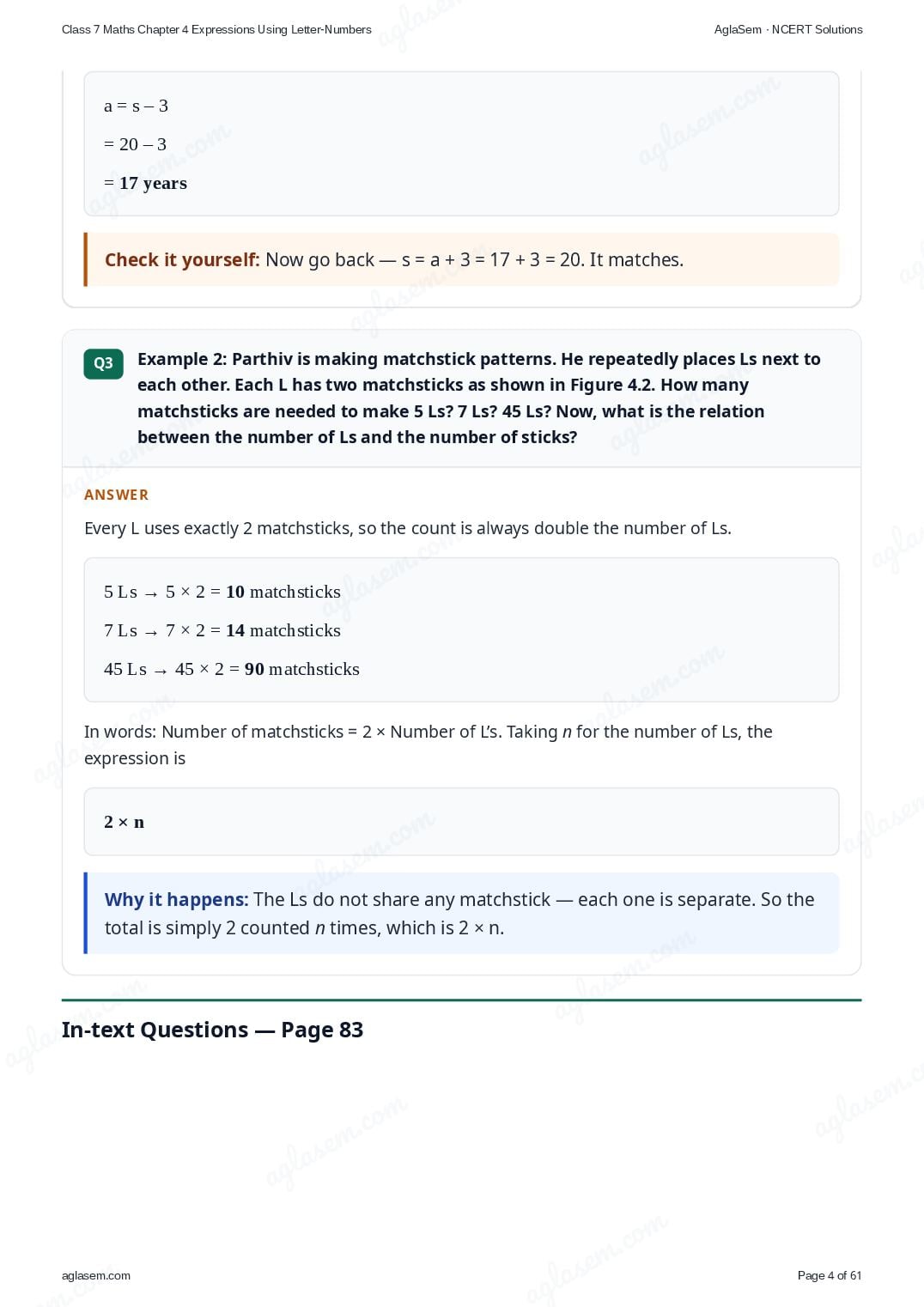
- Use this expression to find Aftab’s age if Shabnam’s age is 20.
- Example 2: Parthiv is making matchstick patterns. He repeatedly places Ls next to each other. Each L has two matchsticks as shown in Figure 4.2. How many matchsticks are needed to make 5 Ls? 7 Ls? 45 Ls? Now, what is the relation between the number of Ls and the number of sticks?
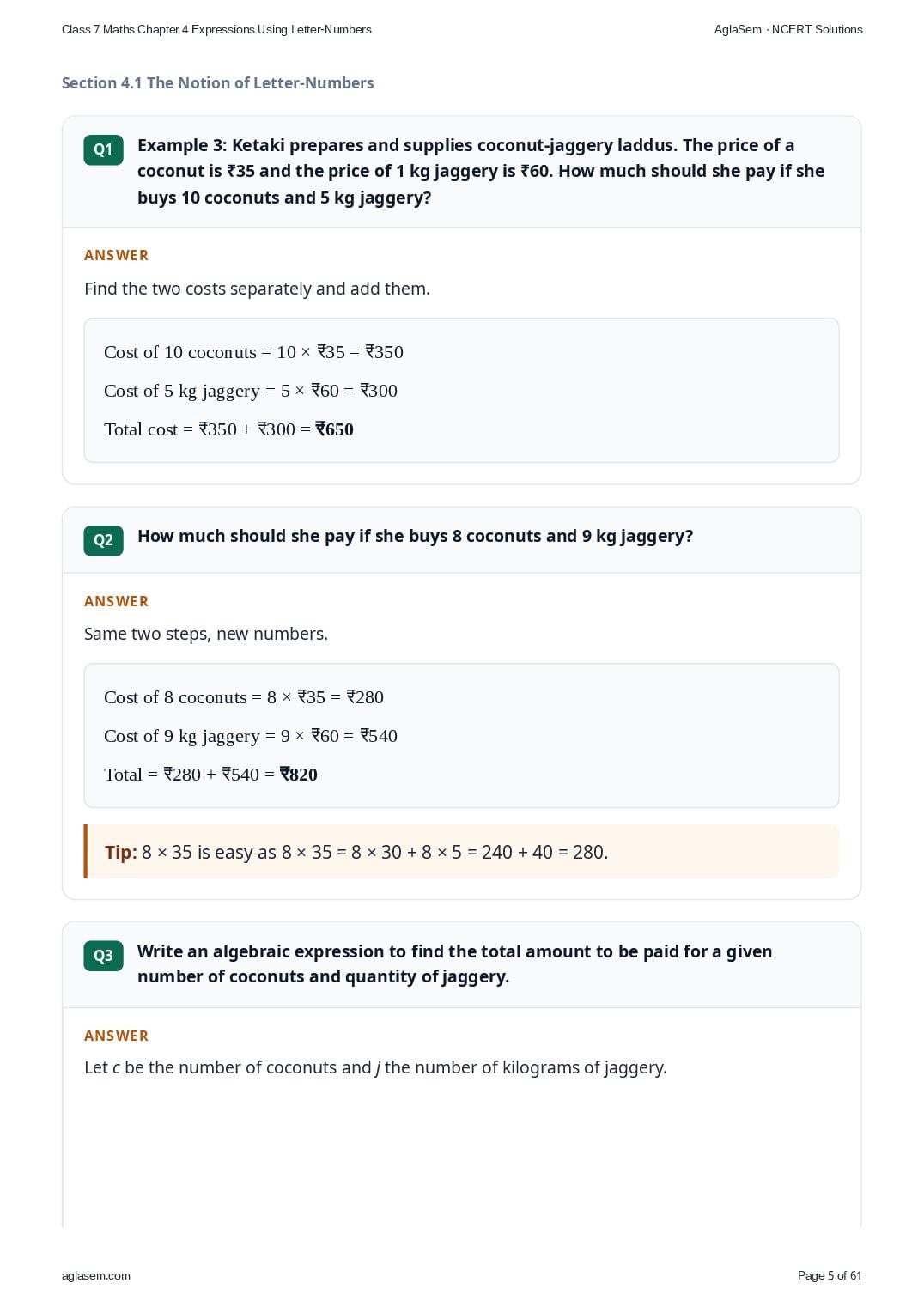
- Example 3: Ketaki prepares and supplies coconut-jaggery laddus. The price of a coconut is ₹35 and the price of 1 kg jaggery is ₹60. How much should she pay if she buys 10 coconuts and 5 kg jaggery?
- How much should she pay if she buys 8 coconuts and 9 kg jaggery?
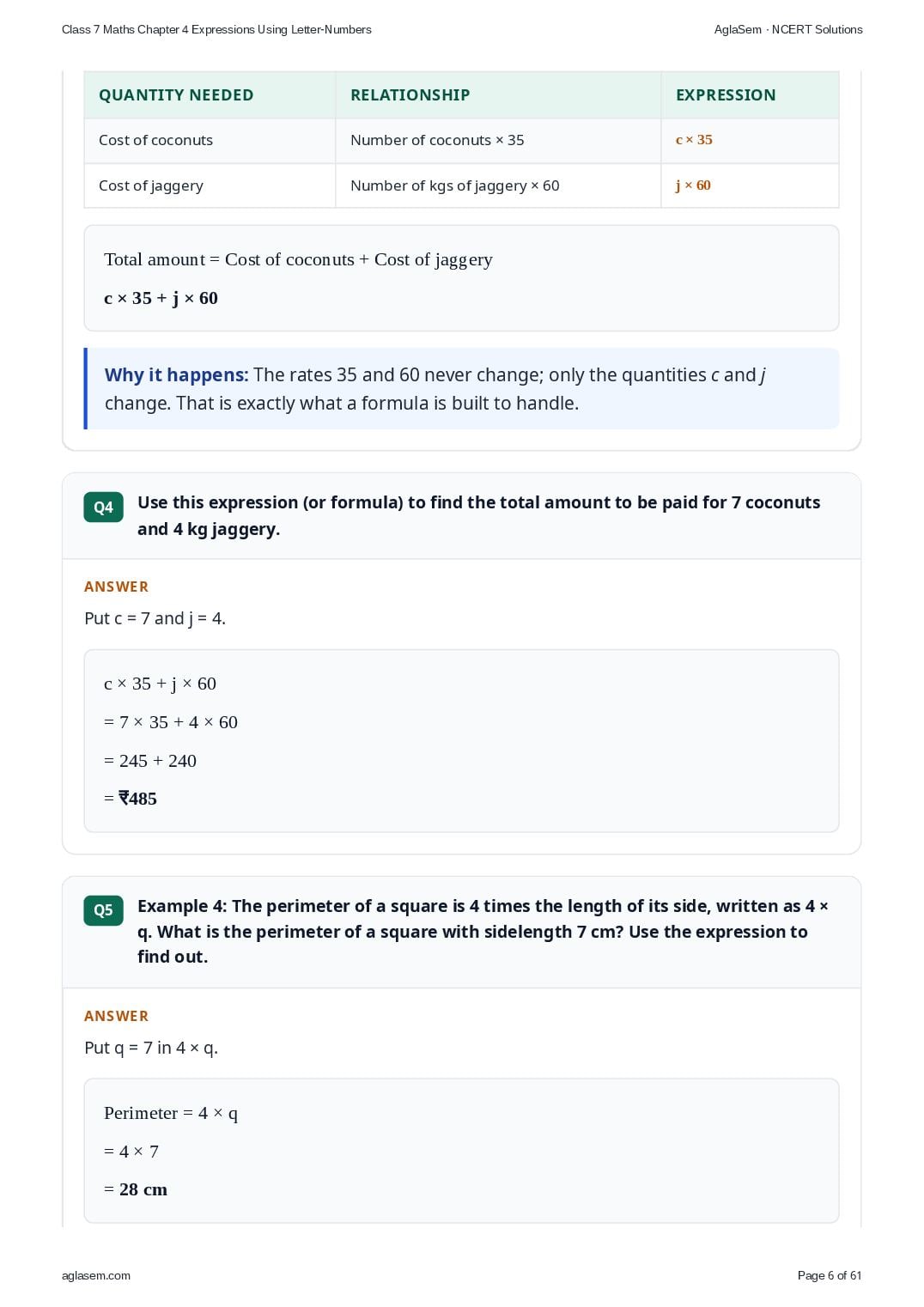
- Write an algebraic expression to find the total amount to be paid for a given number of coconuts and quantity of jaggery.
- Use this expression (or formula) to find the total amount to be paid for 7 coconuts and 4 kg jaggery.
- Example 4: The perimeter of a square is 4 times the length of its side, written as 4 × q. What is the perimeter of a square with sidelength 7 cm? Use the expression to find out.
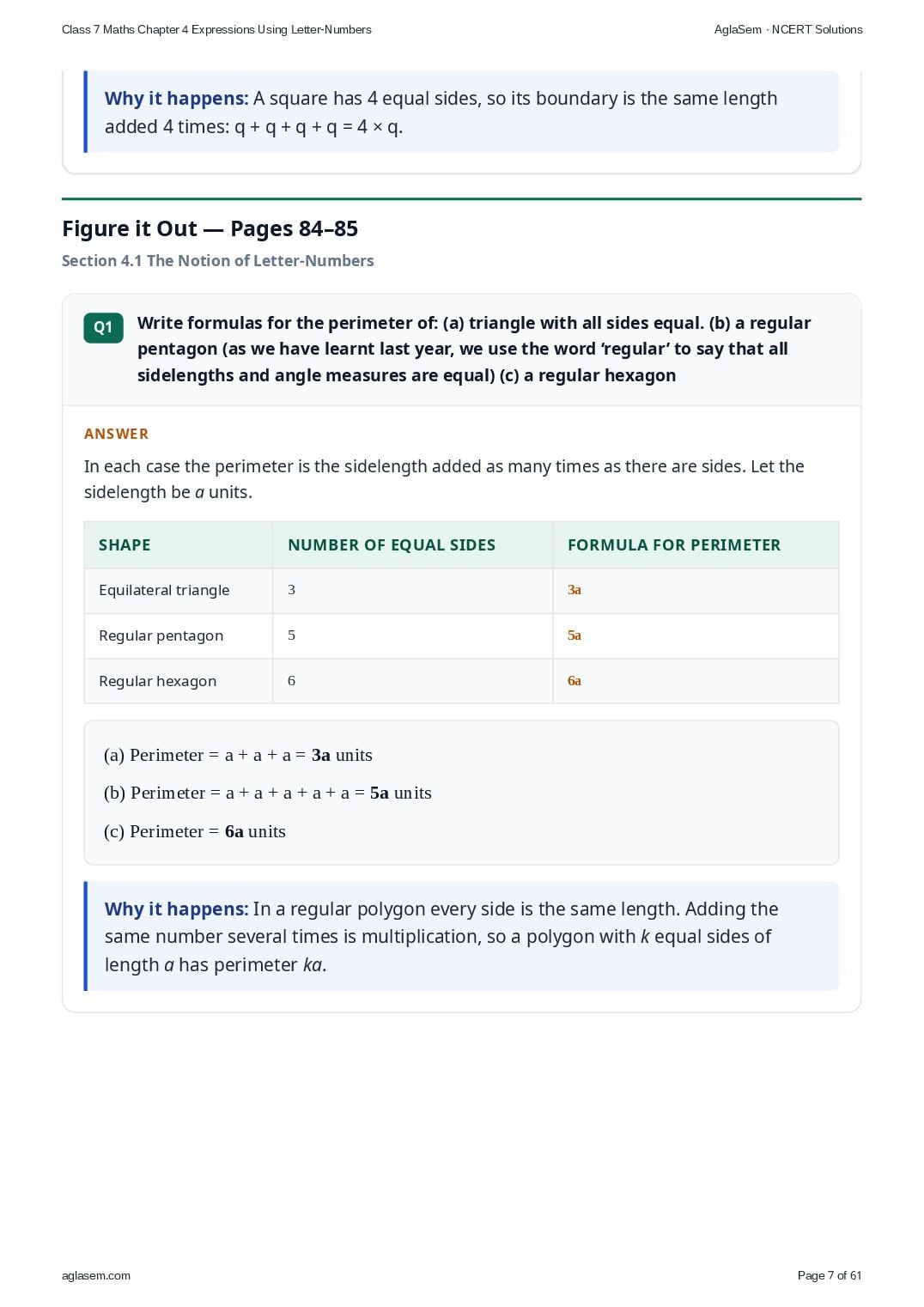
- Write formulas for the perimeter of: (a) triangle with all sides equal. (b) a regular pentagon (as we have learnt last year, we use the word ‘regular’ to say that all sidelengths and angle measures are equal) (c) a regular hexagon
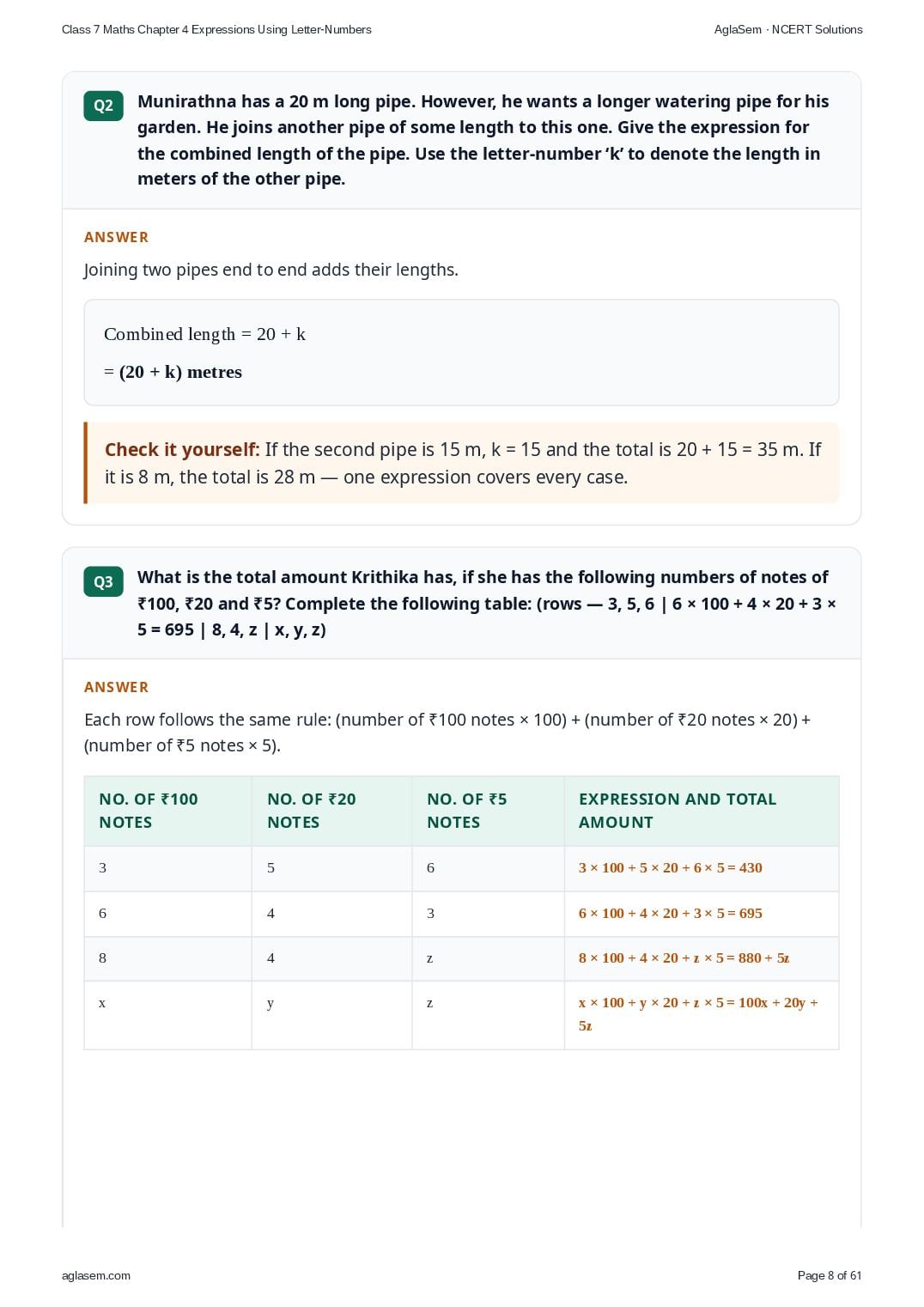
- Munirathna has a 20 m long pipe. However, he wants a longer watering pipe for his garden. He joins another pipe of some length to this one. Give the expression for the combined length of the pipe. Use the letter-number ‘k’ to denote the length in meters of the other pipe.
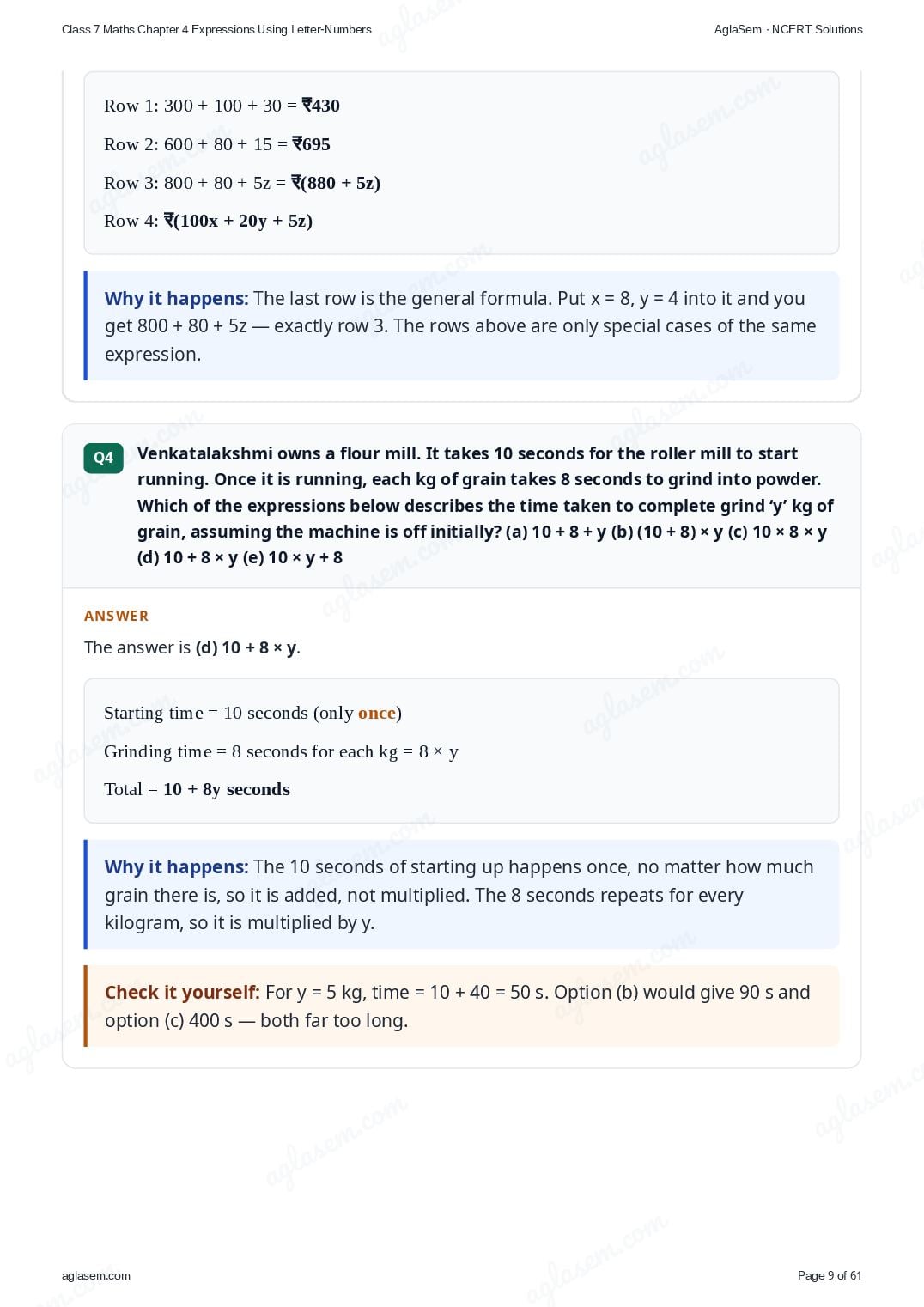
- What is the total amount Krithika has, if she has the following numbers of notes of ₹100, ₹20 and ₹5? Complete the following table: (rows — 3, 5, 6 | 6 × 100 + 4 × 20 + 3 × 5 = 695 | 8, 4, z | x, y, z)
- Venkatalakshmi owns a flour mill. It takes 10 seconds for the roller mill to start running. Once it is running, each kg of grain takes 8 seconds to grind into powder. Which of the expressions below describes the time taken to complete grind ‘y’ kg of grain, assuming the machine is off initially? (a) 10 + 8 + y (b) (10 + 8) × y (c) 10 × 8 × y (d) 10 + 8 × y (e) 10 × y + 8
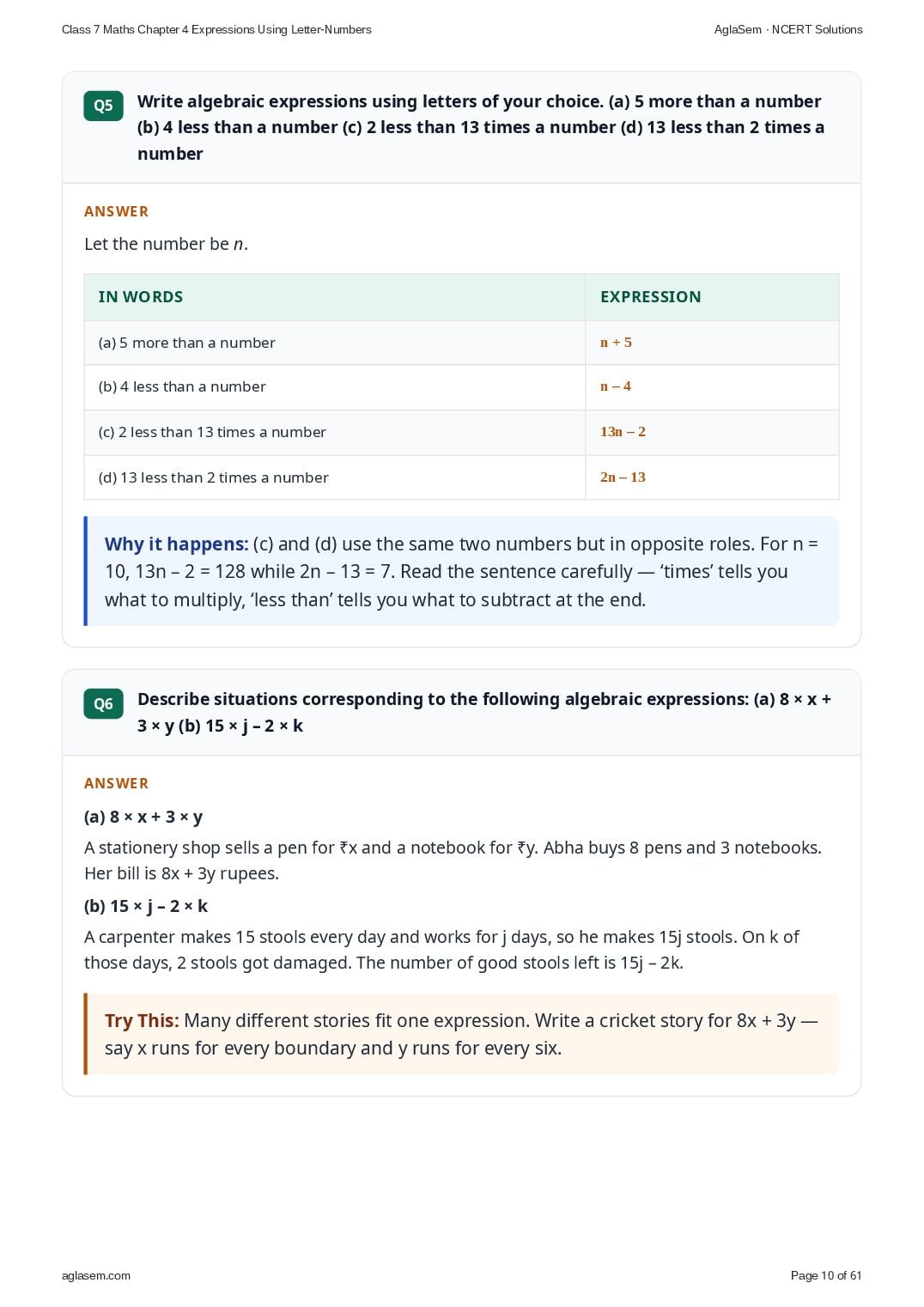
- Write algebraic expressions using letters of your choice. (a) 5 more than a number (b) 4 less than a number (c) 2 less than 13 times a number (d) 13 less than 2 times a number
- Describe situations corresponding to the following algebraic expressions: (a) 8 × x + 3 × y (b) 15 × j – 2 × k
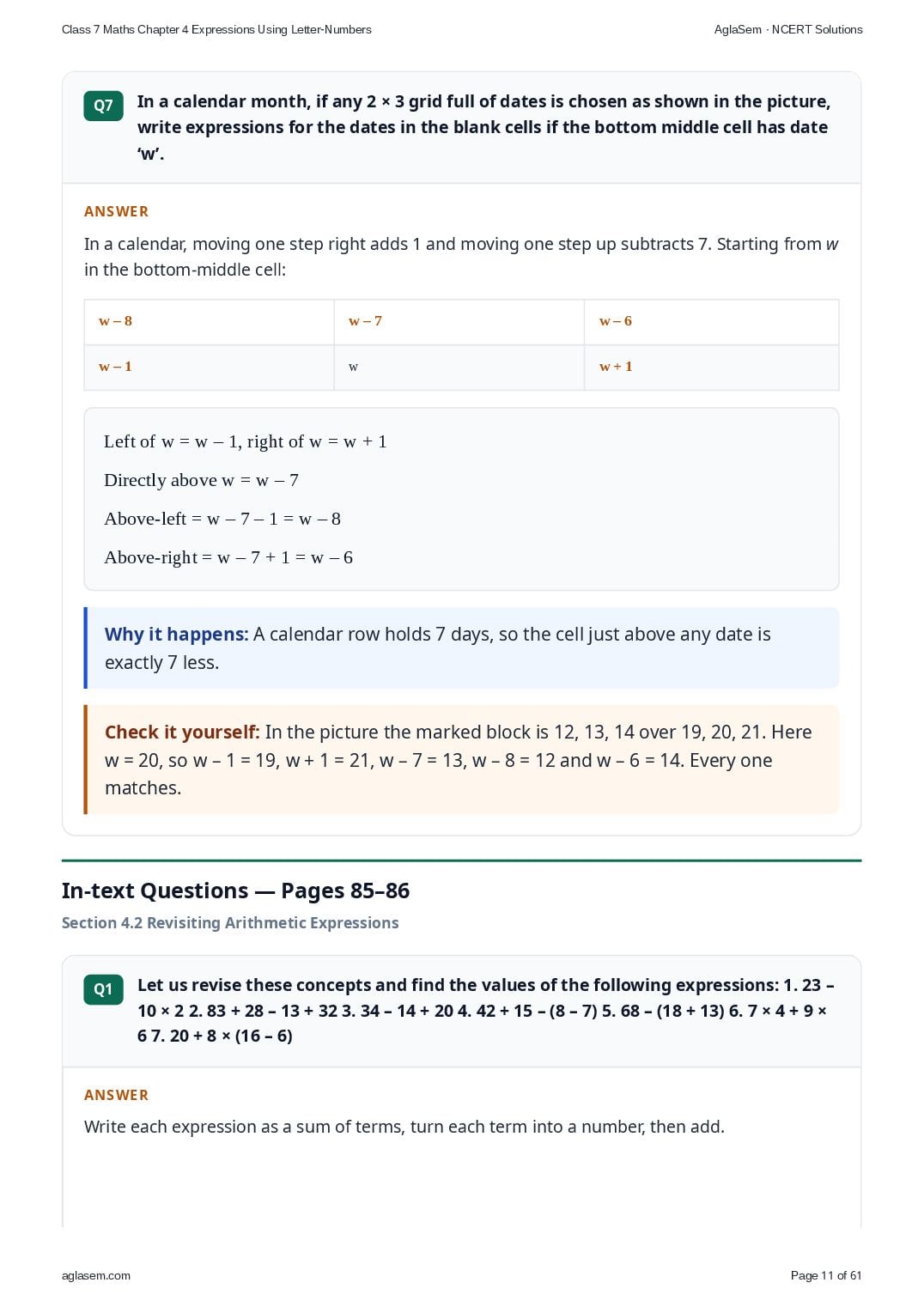
- In a calendar month, if any 2 × 3 grid full of dates is chosen as shown in the picture, write expressions for the dates in the blank cells if the bottom middle cell has date ‘w’.
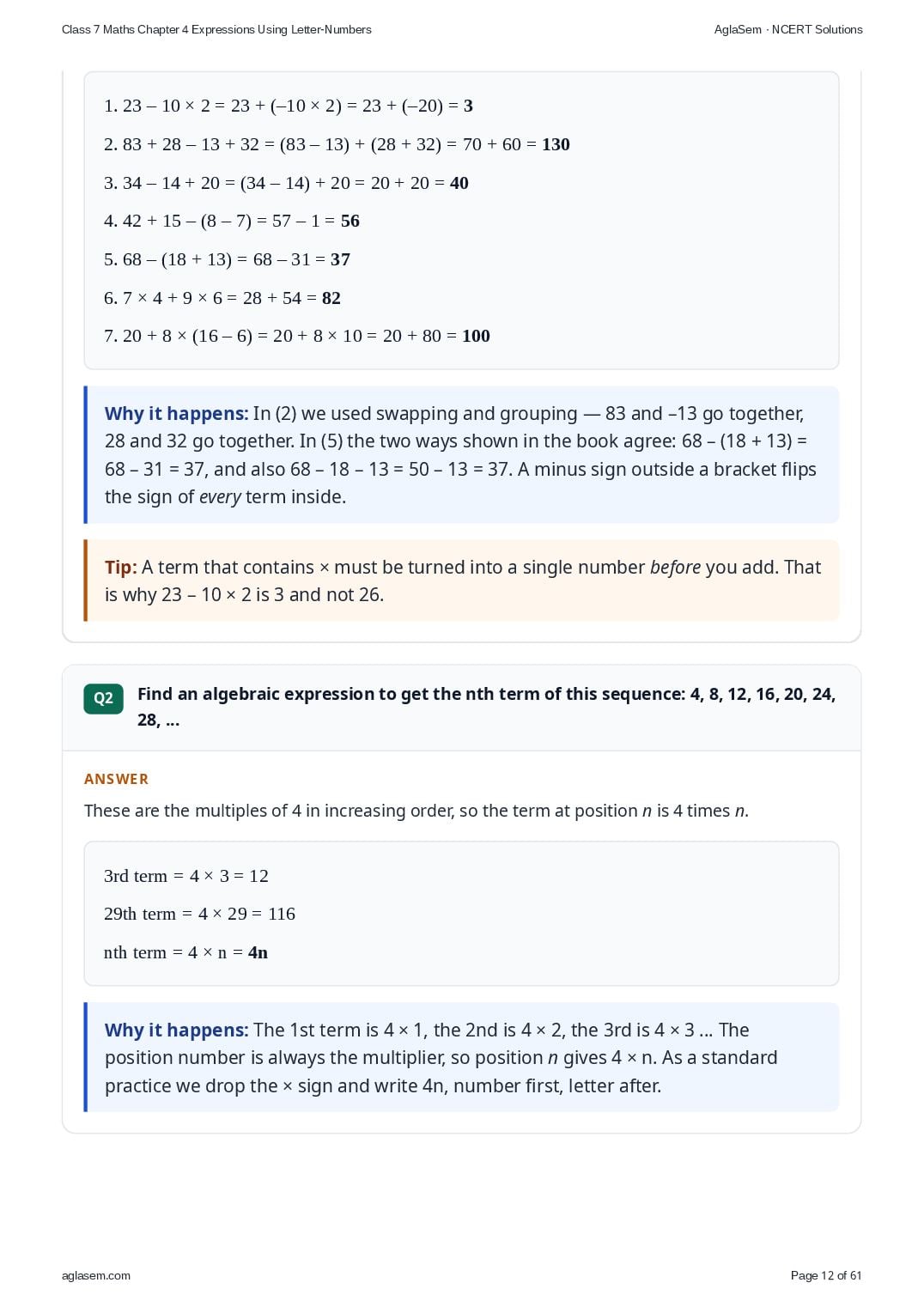
- Let us revise these concepts and find the values of the following expressions: 1. 23 – 10 × 2 2. 83 + 28 – 13 + 32 3. 34 – 14 + 20 4. 42 + 15 – (8 – 7) 5. 68 – (18 + 13) 6. 7 × 4 + 9 × 6 7. 20 + 8 × (16 – 6)
- Find an algebraic expression to get the nth term of this sequence: 4, 8, 12, 16, 20, 24, 28, …
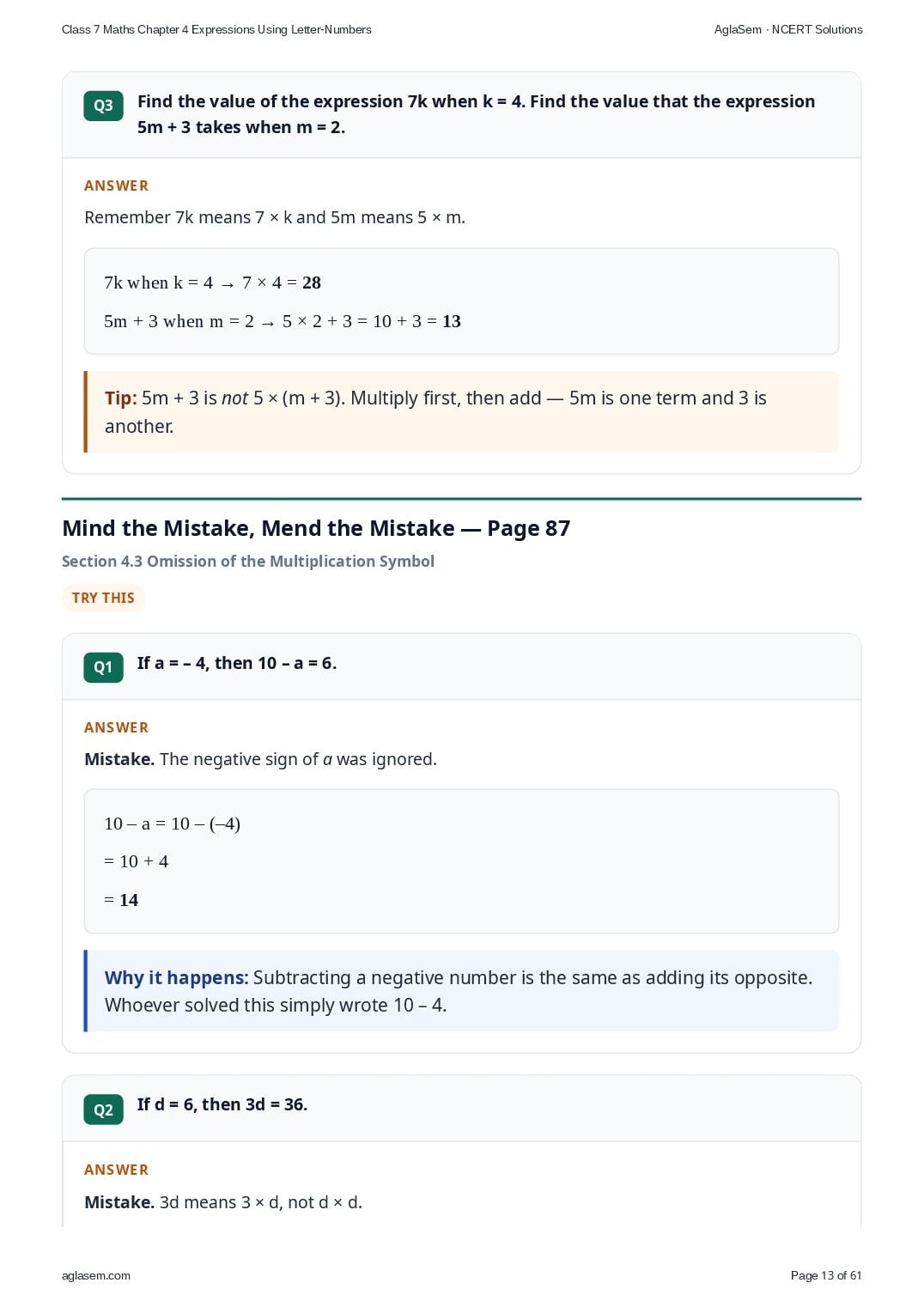
- Find the value of the expression 7k when k = 4. Find the value that the expression 5m + 3 takes when m = 2.
- If a = – 4, then 10 – a = 6.
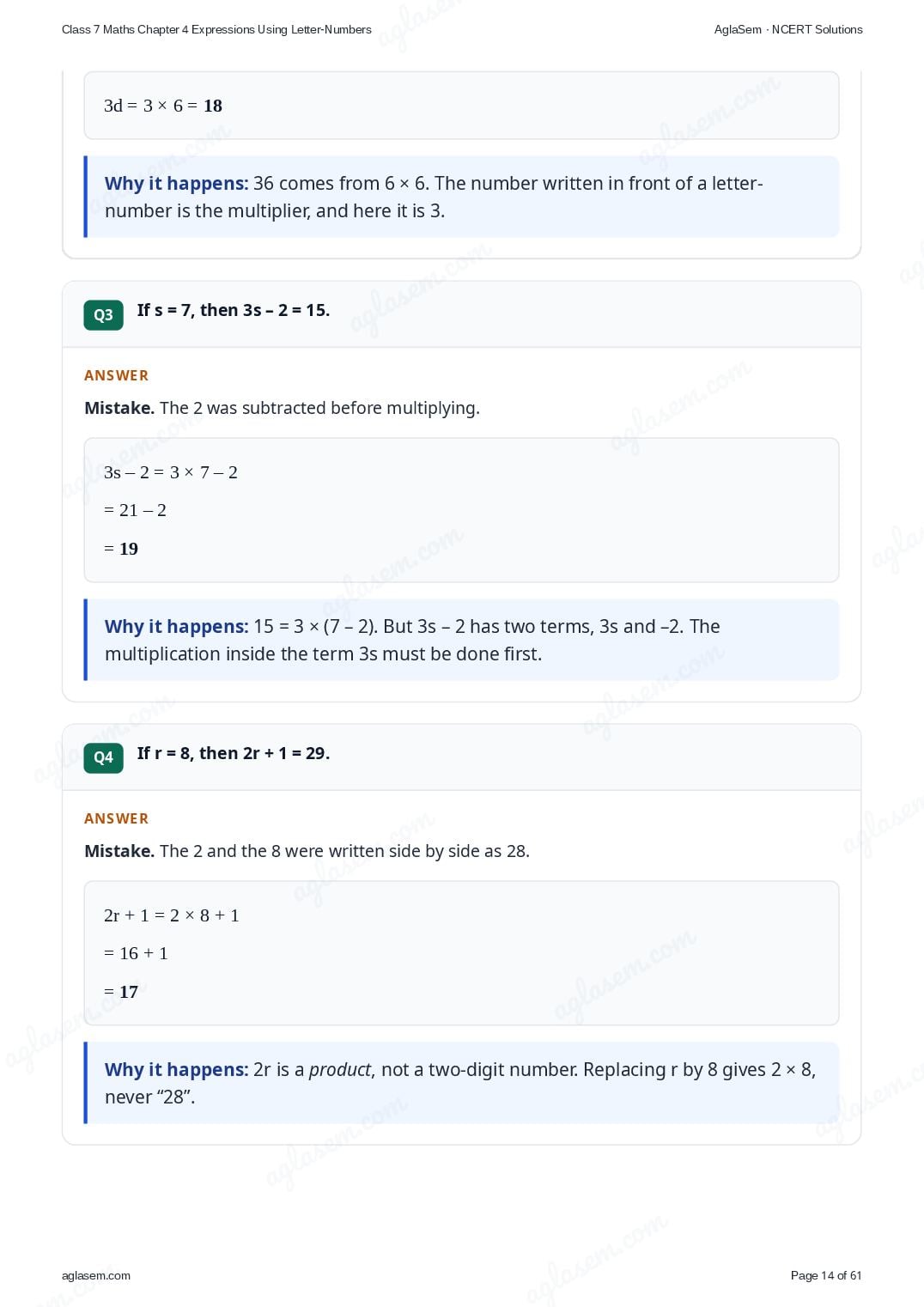
- If d = 6, then 3d = 36.
- If s = 7, then 3s – 2 = 15.
- If r = 8, then 2r + 1 = 29.
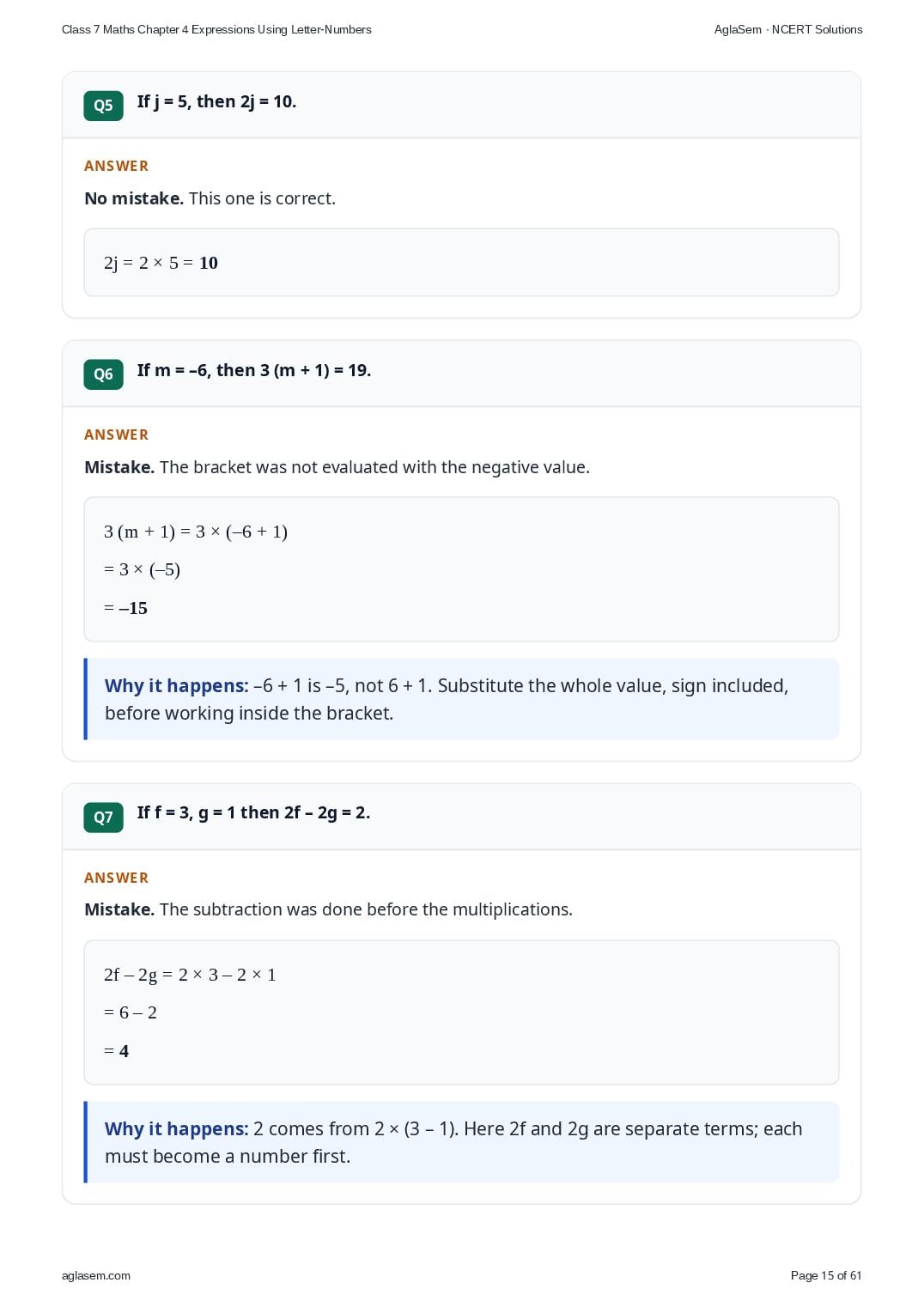
- If j = 5, then 2j = 10.
- If m = –6, then 3 (m + 1) = 19.
- If f = 3, g = 1 then 2f – 2g = 2.
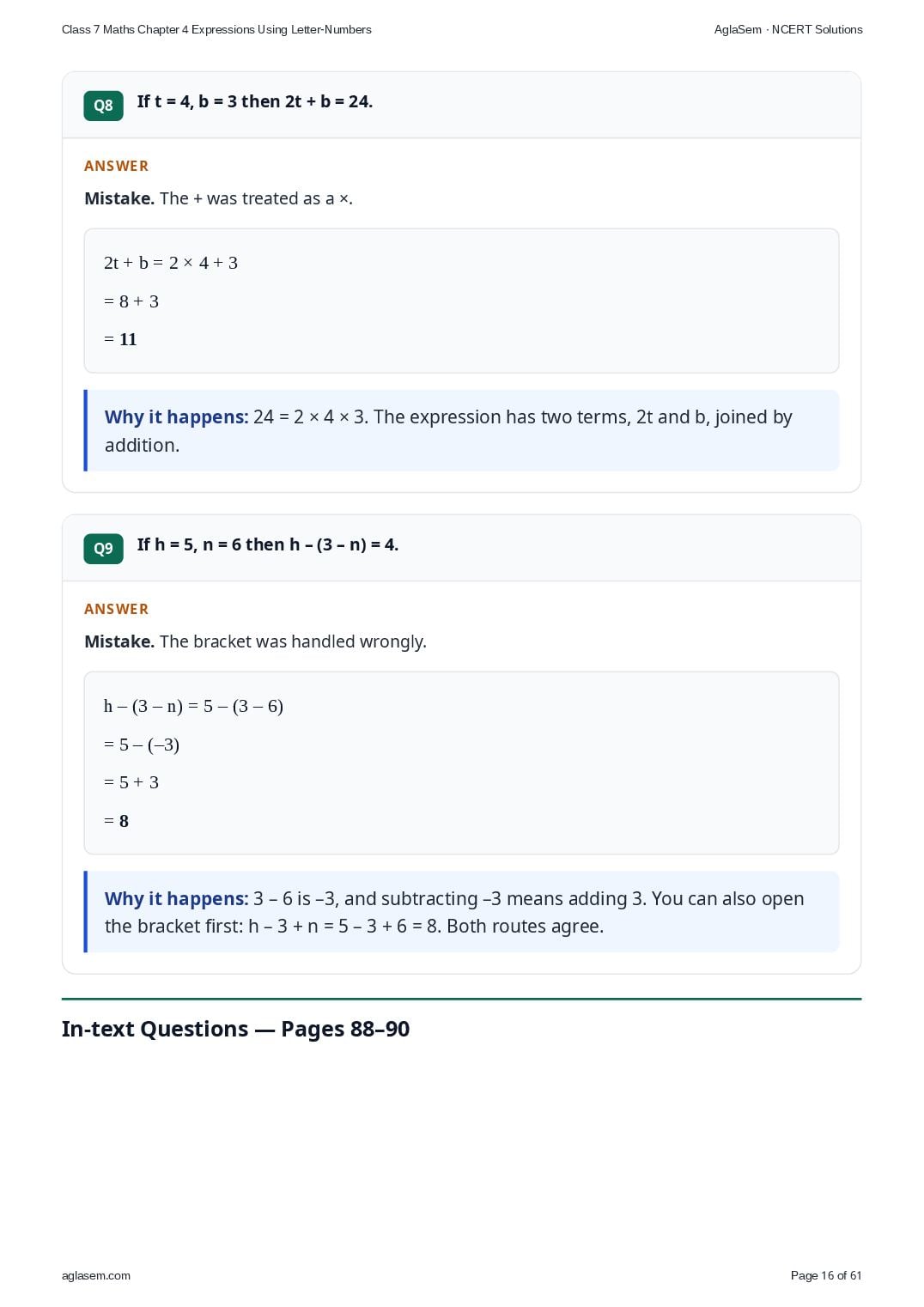
- If t = 4, b = 3 then 2t + b = 24.
- If h = 5, n = 6 then h – (3 – n) = 4.
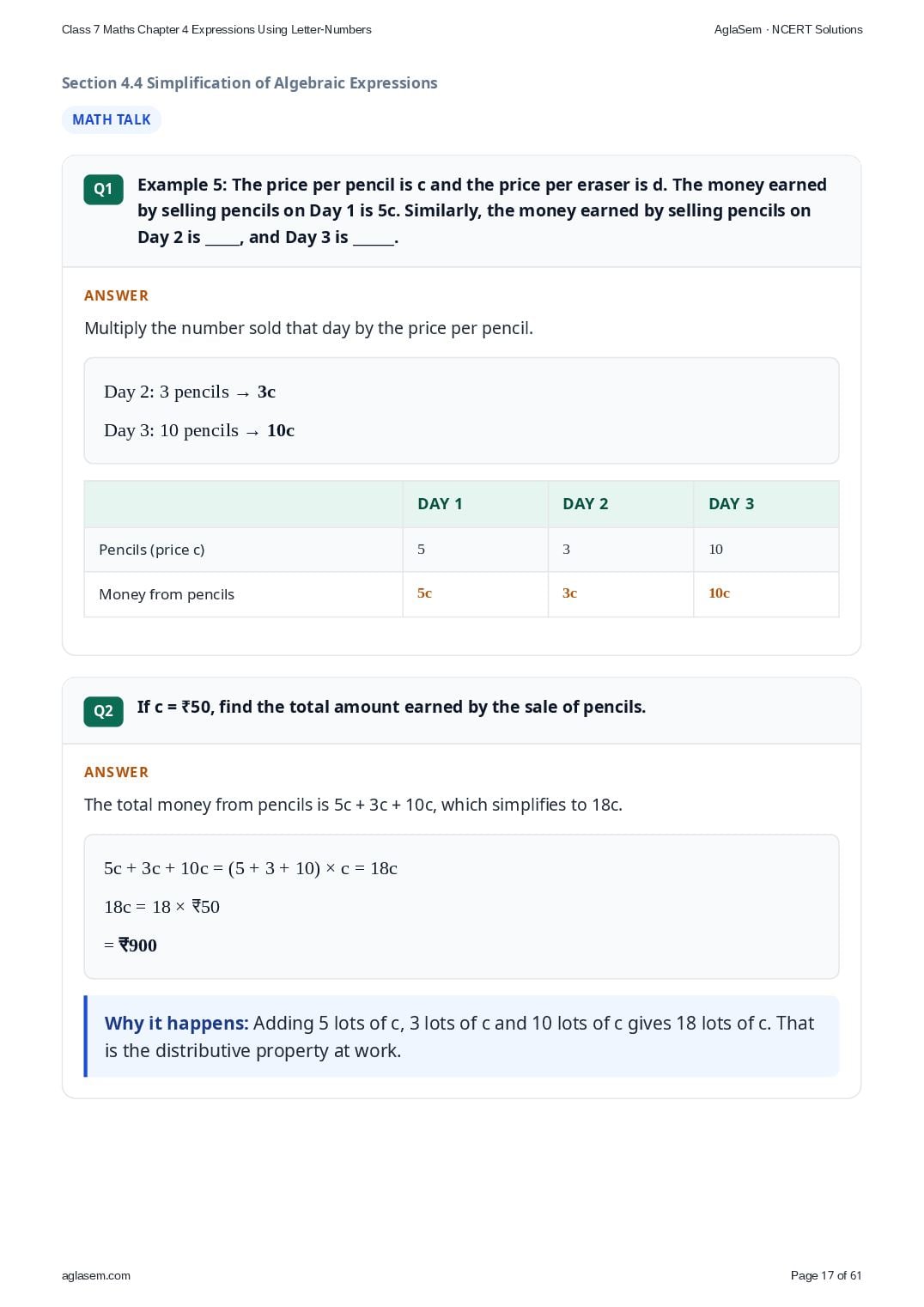
- Example 5: The price per pencil is c and the price per eraser is d. The money earned by selling pencils on Day 1 is 5c. Similarly, the money earned by selling pencils on Day 2 is _____, and Day 3 is ______.
- If c = ₹50, find the total amount earned by the sale of pencils.
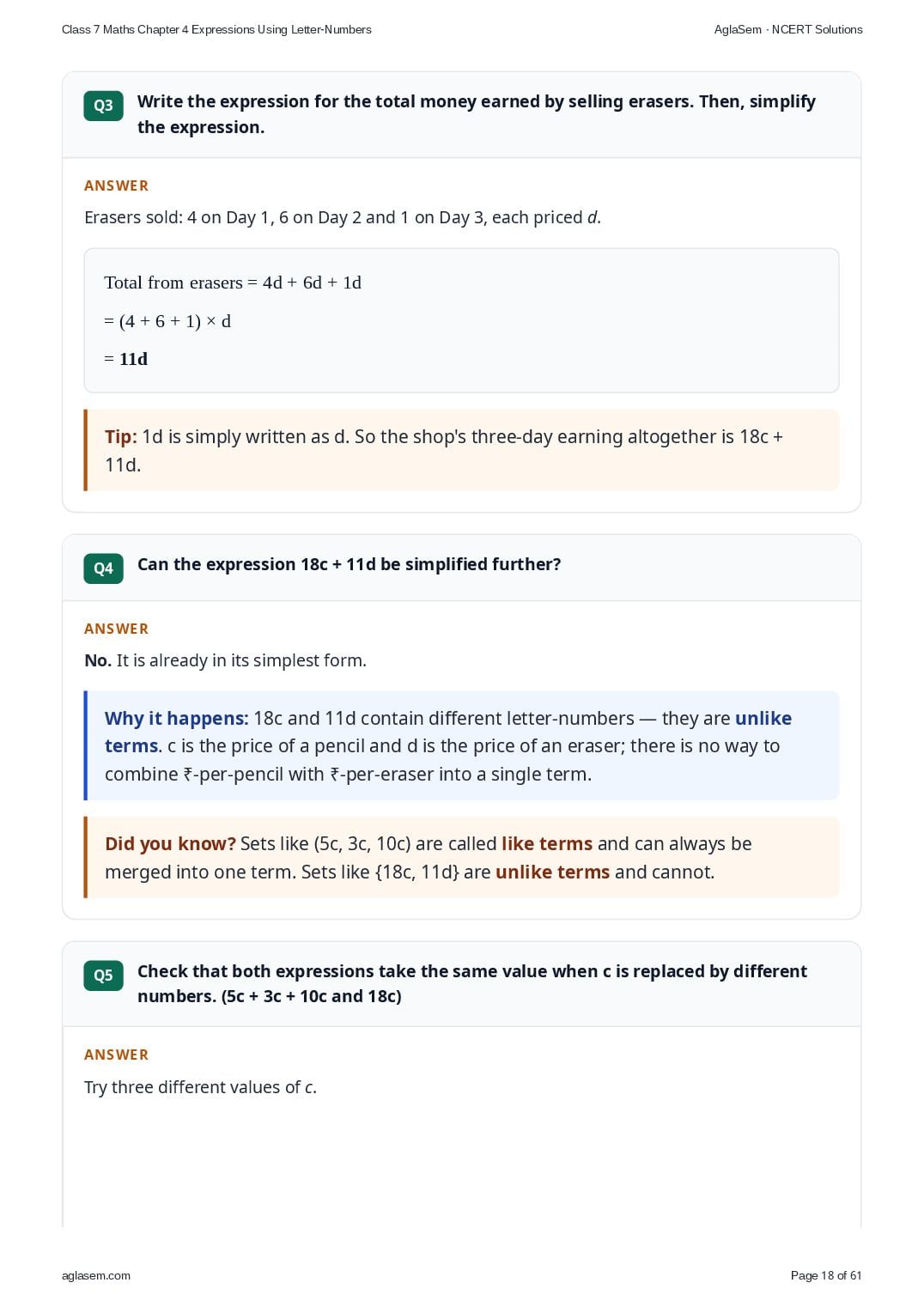
- Write the expression for the total money earned by selling erasers. Then, simplify the expression.
- Can the expression 18c + 11d be simplified further?
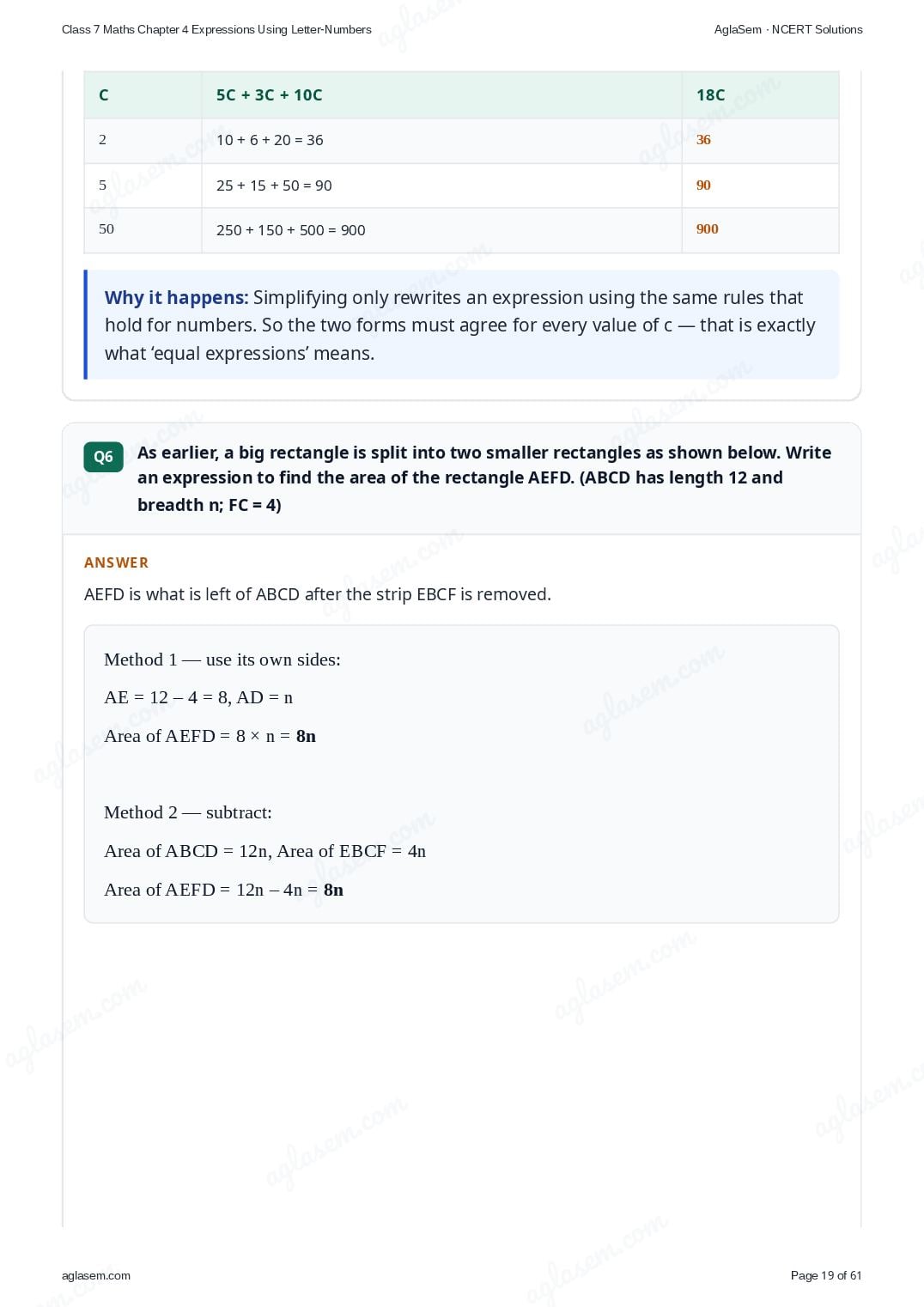
- Check that both expressions take the same value when c is replaced by different numbers. (5c + 3c + 10c and 18c)
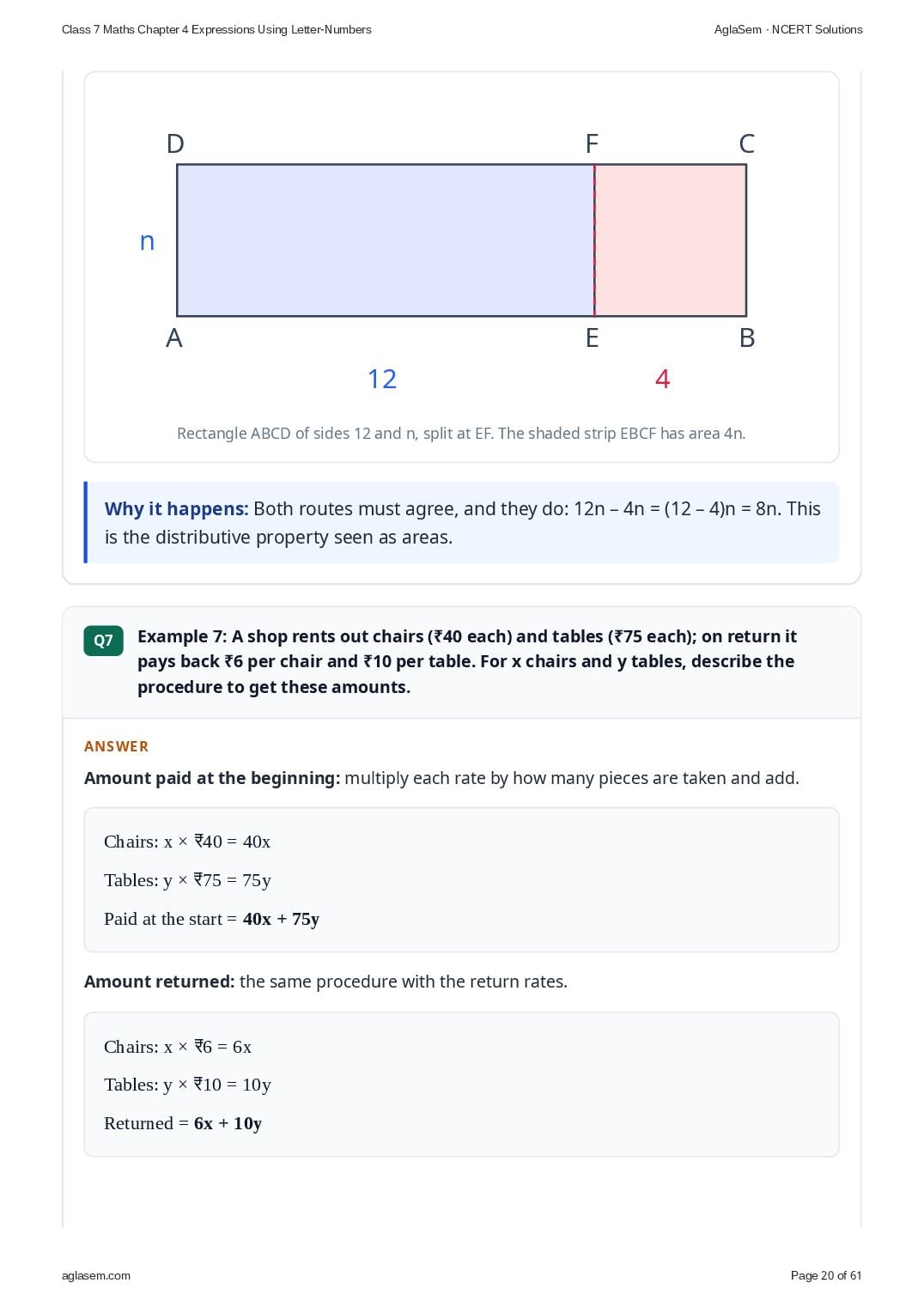
- As earlier, a big rectangle is split into two smaller rectangles as shown below. Write an expression to find the area of the rectangle AEFD. (ABCD has length 12 and breadth n; FC = 4)
- Example 7: A shop rents out chairs (₹40 each) and tables (₹75 each); on return it pays back ₹6 per chair and ₹10 per table. For x chairs and y tables, describe the procedure to get these amounts.
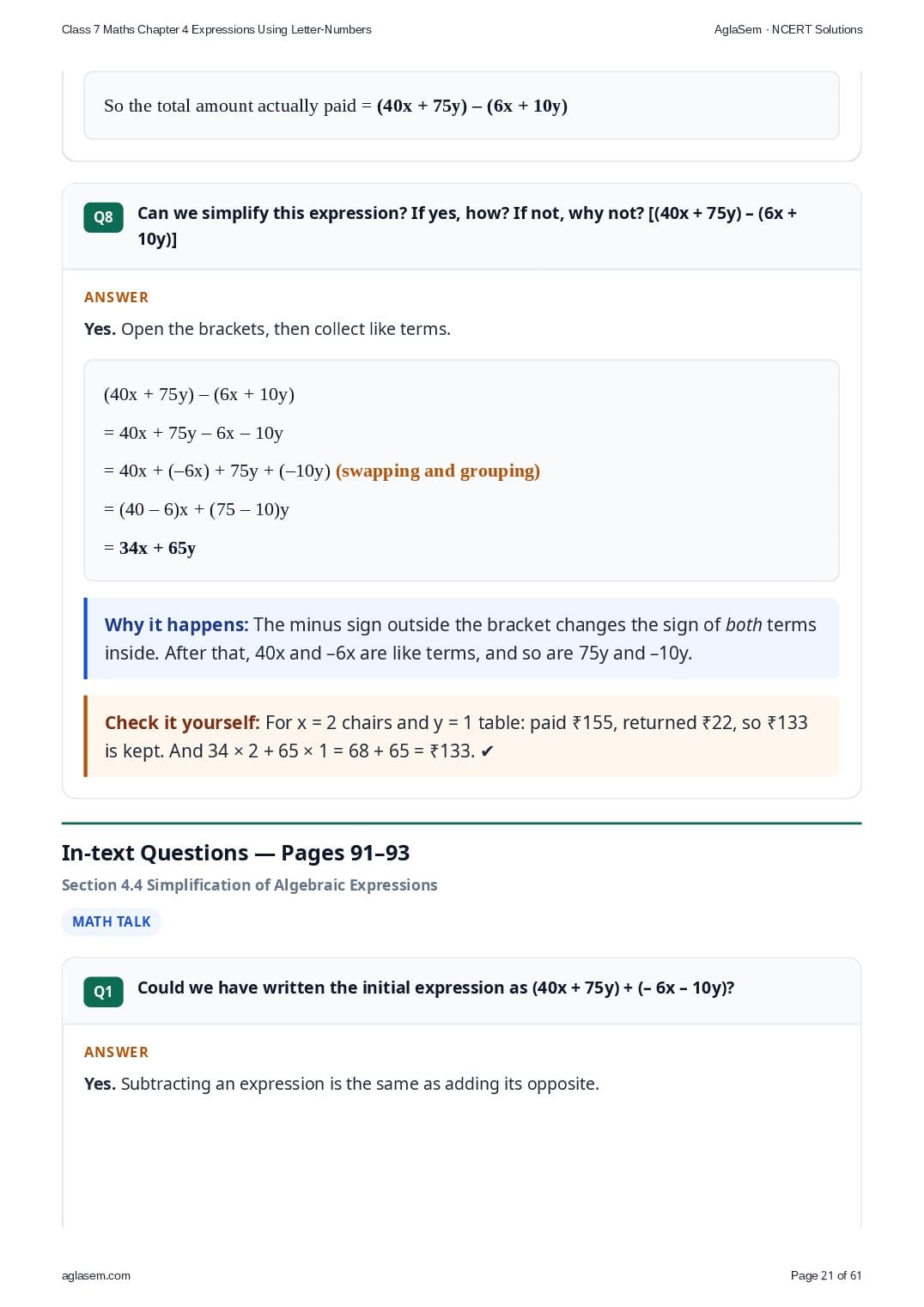
- Can we simplify this expression? If yes, how? If not, why not? [(40x + 75y) – (6x + 10y)]
- Could we have written the initial expression as (40x + 75y) + (– 6x – 10y)?
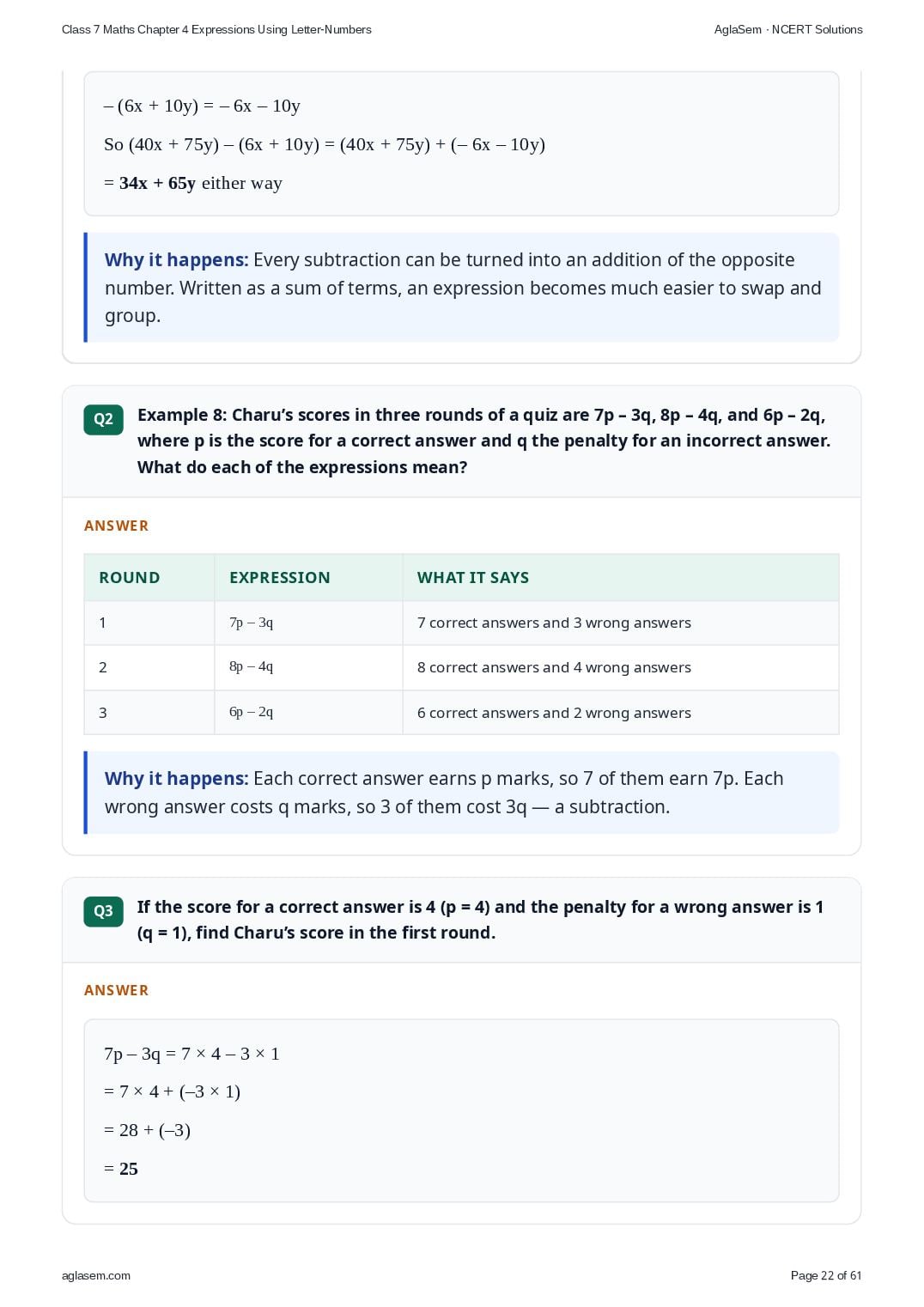
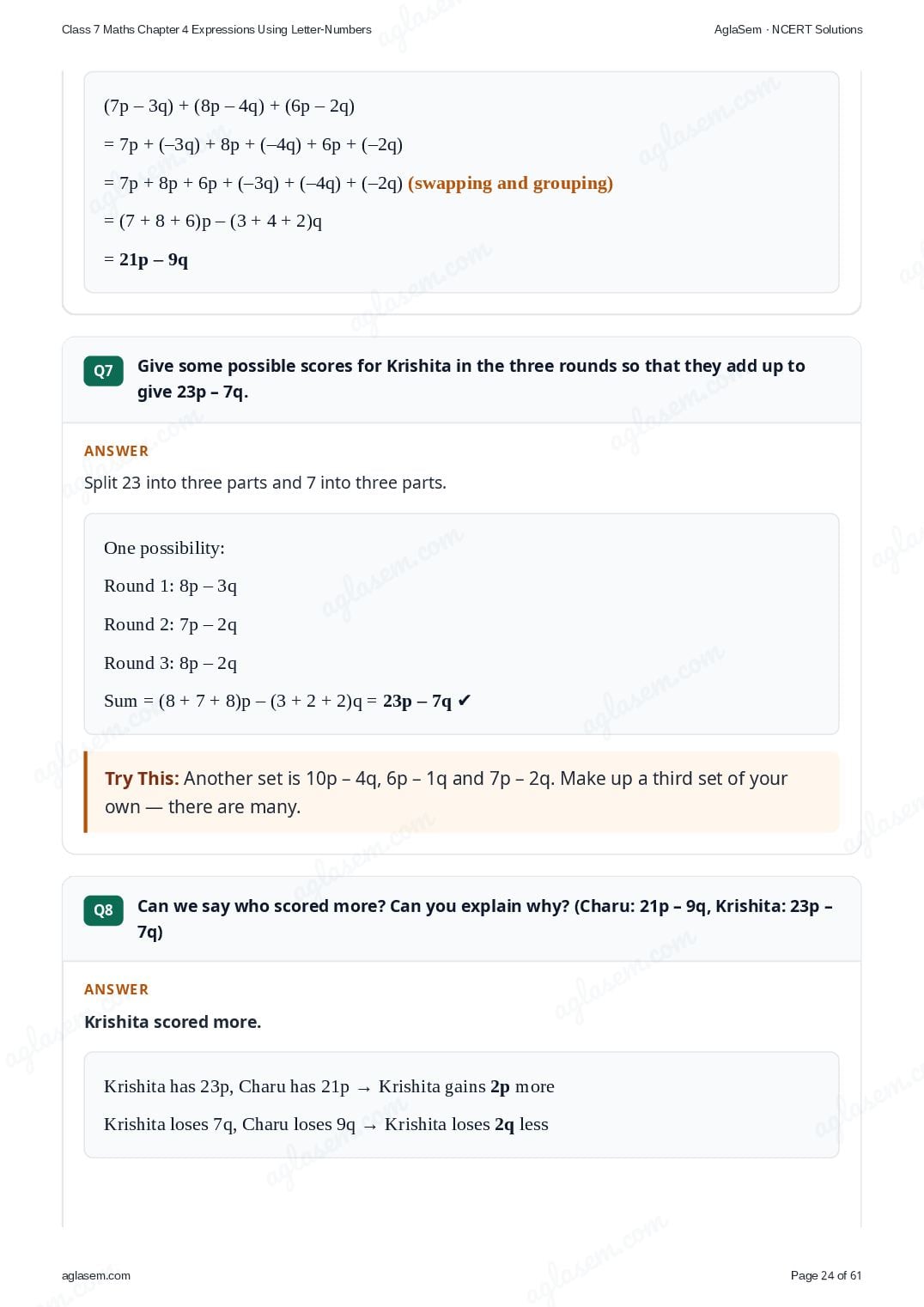
- Example 8: Charu’s scores in three rounds of a quiz are 7p – 3q, 8p – 4q, and 6p – 2q, where p is the score for a correct answer and q the penalty for an incorrect answer. What do each of the expressions mean?
- If the score for a correct answer is 4 (p = 4) and the penalty for a wrong answer is 1 (q = 1), find Charu’s score in the first round.
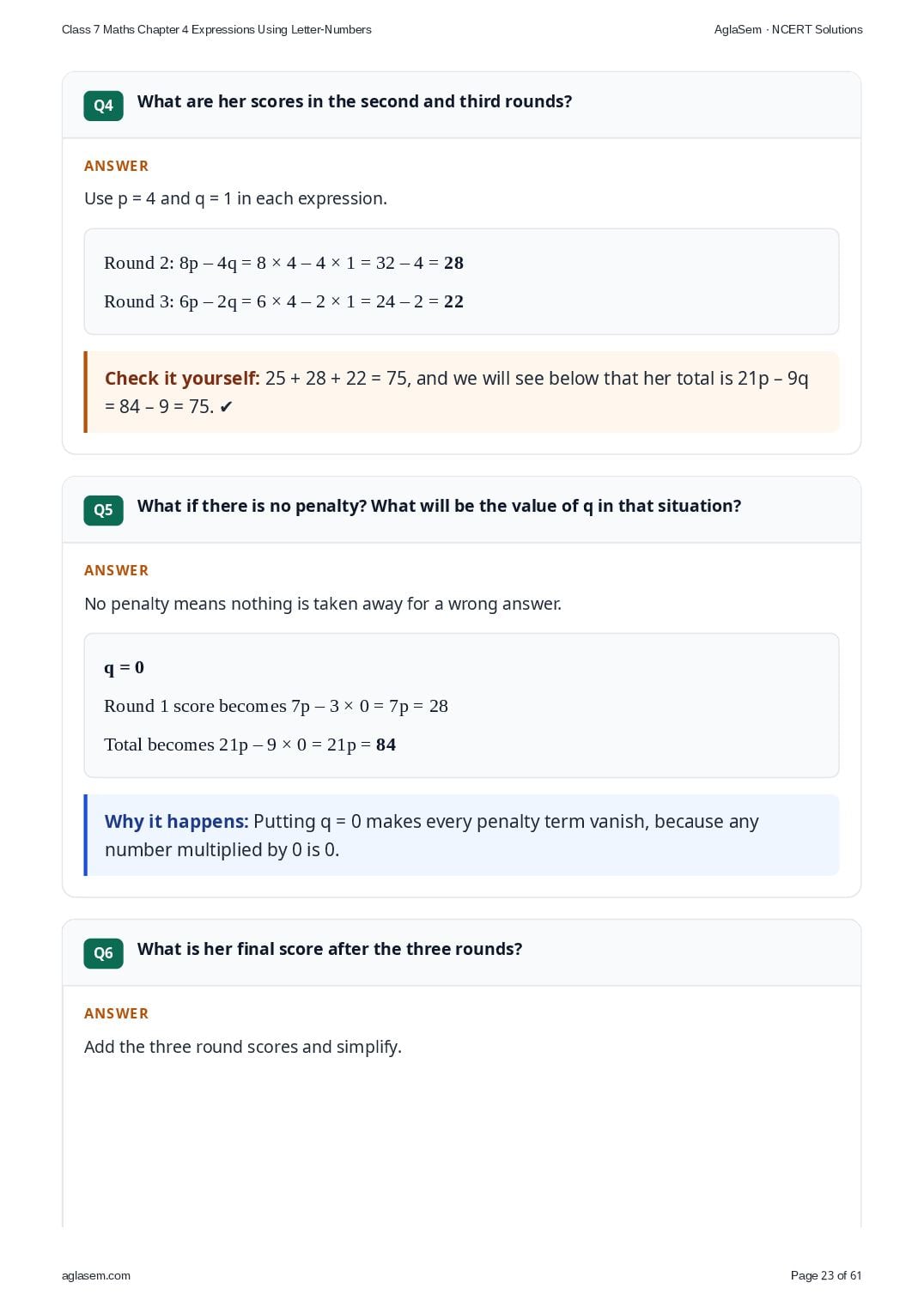
- What are her scores in the second and third rounds?
- What if there is no penalty? What will be the value of q in that situation?
- What is her final score after the three rounds?
- Give some possible scores for Krishita in the three rounds so that they add up to give 23p – 7q.
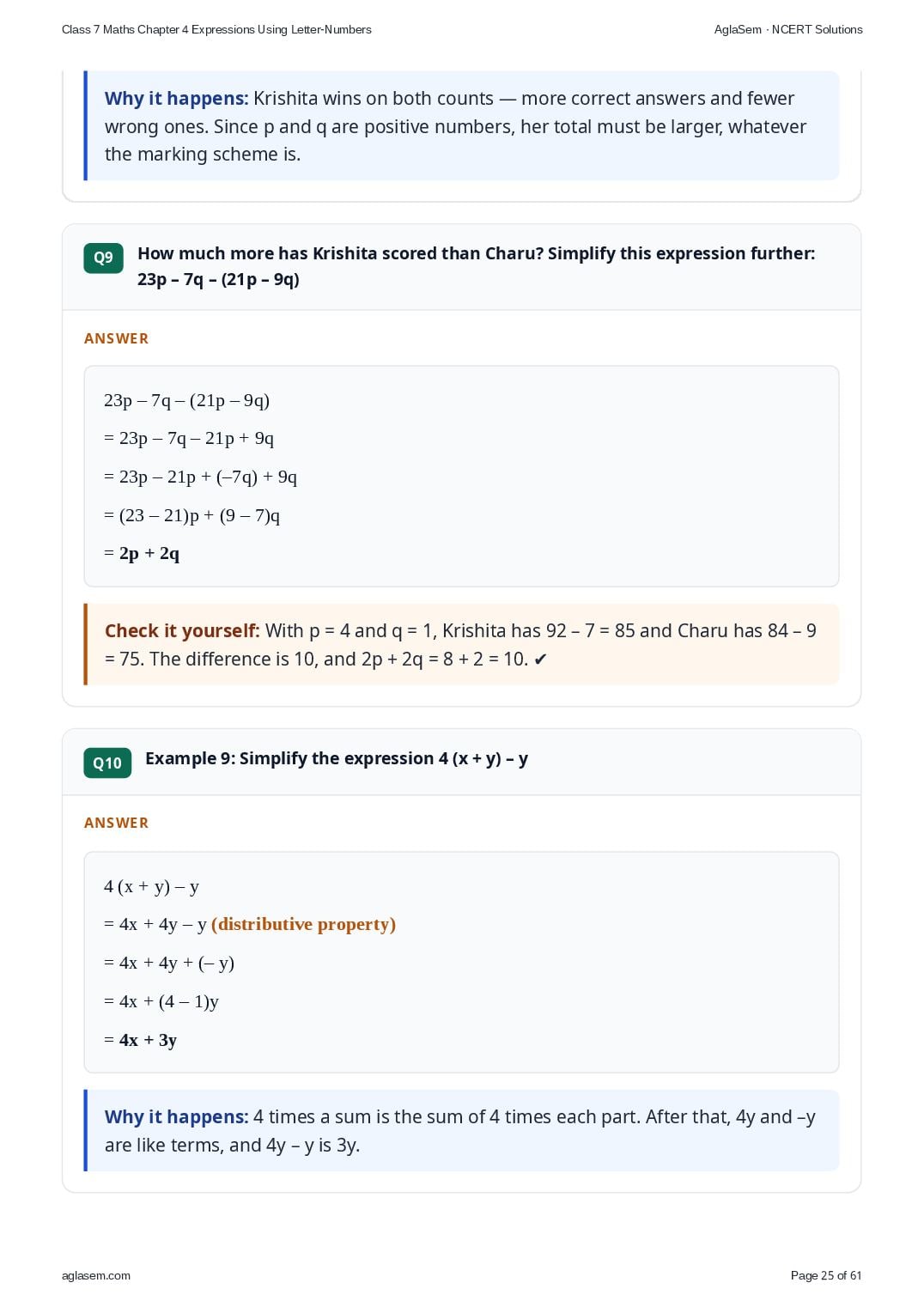
- Can we say who scored more? Can you explain why? (Charu: 21p – 9q, Krishita: 23p – 7q)
- How much more has Krishita scored than Charu? Simplify this expression further: 23p – 7q – (21p – 9q)
- Example 9: Simplify the expression 4 (x + y) – y
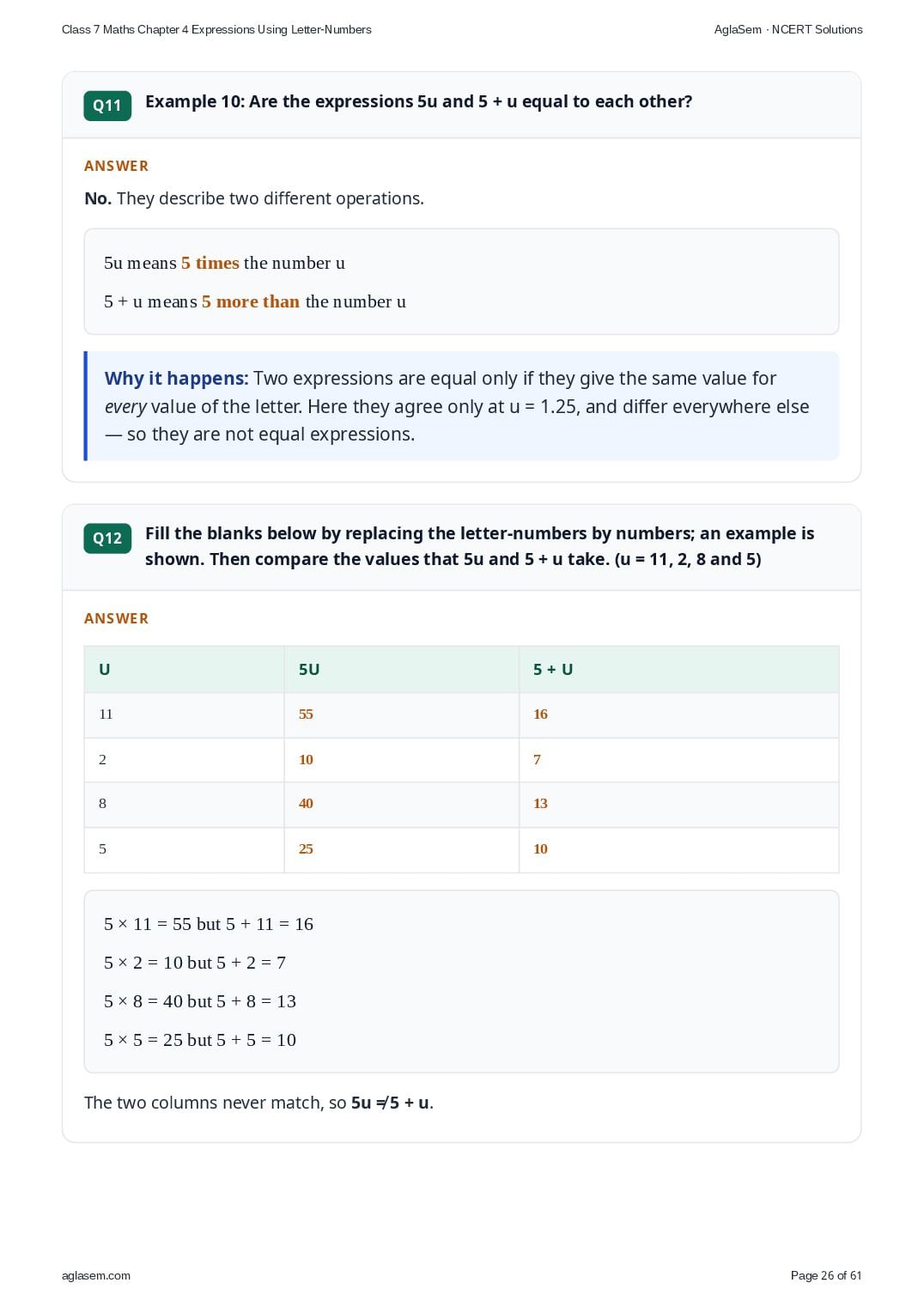
- Example 10: Are the expressions 5u and 5 + u equal to each other?
- Fill the blanks below by replacing the letter-numbers by numbers; an example is shown. Then compare the values that 5u and 5 + u take. (u = 11, 2, 8 and 5)
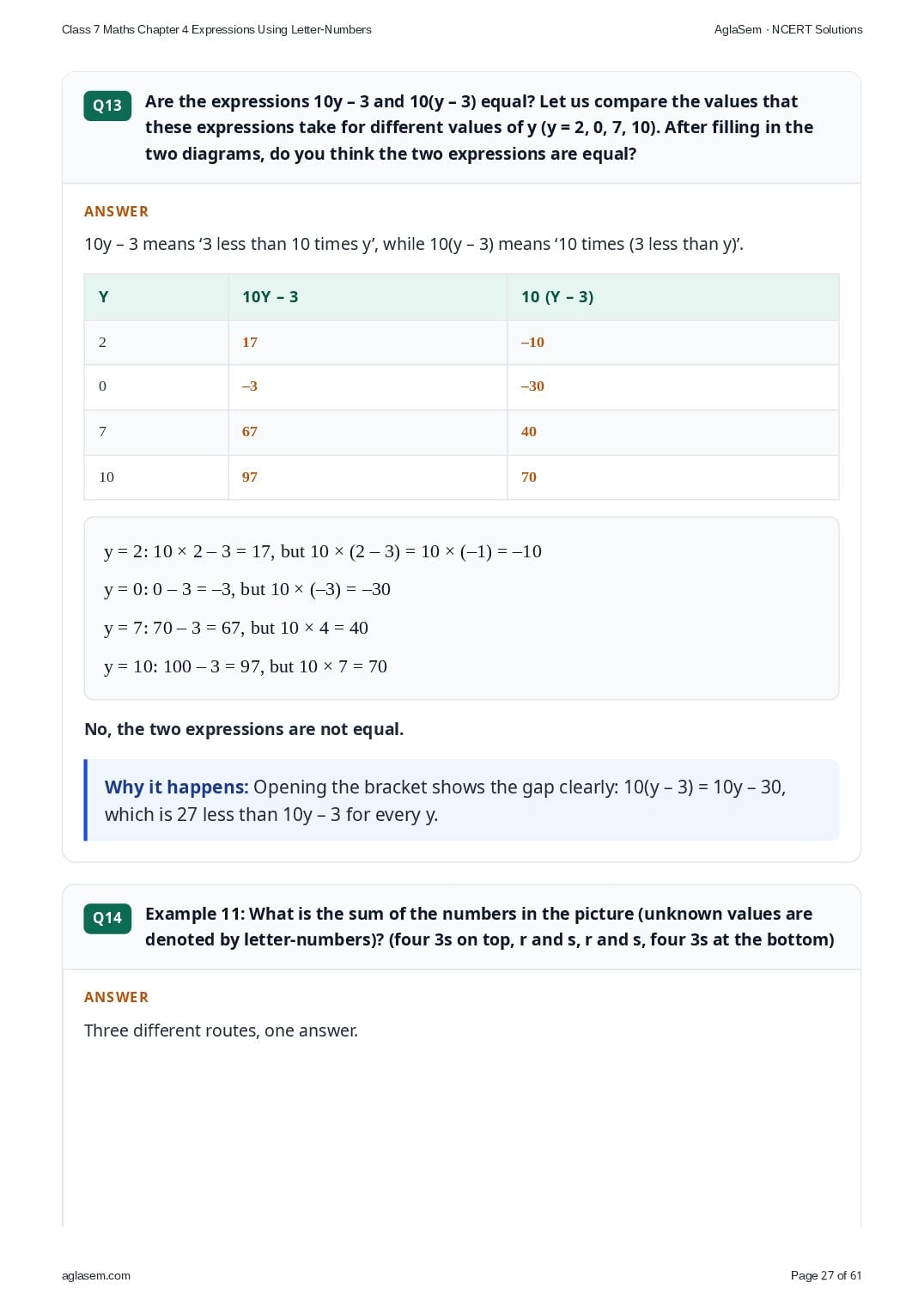
- Are the expressions 10y – 3 and 10(y – 3) equal? Let us compare the values that these expressions take for different values of y (y = 2, 0, 7, 10). After filling in the two diagrams, do you think the two expressions are equal?
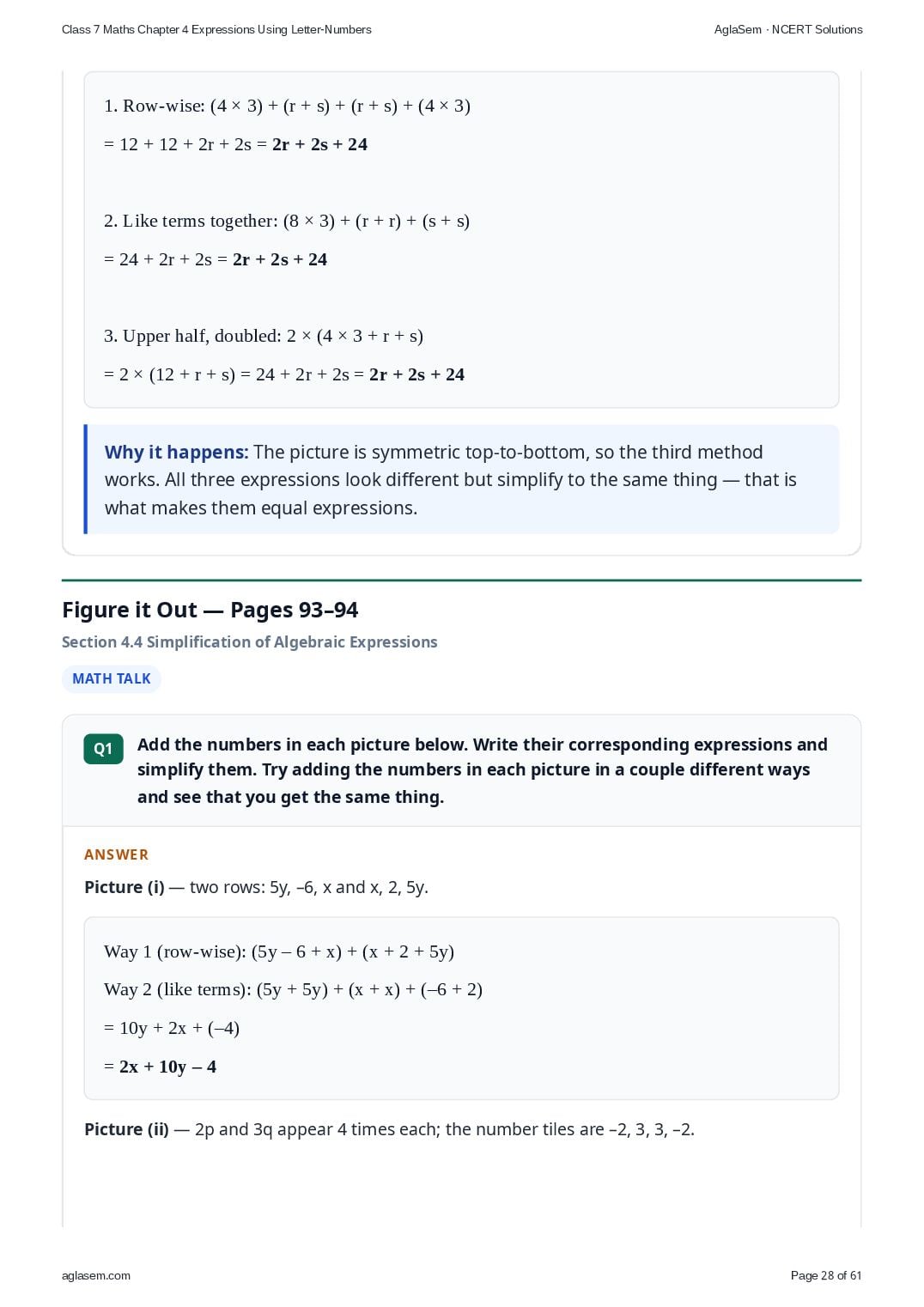
- Example 11: What is the sum of the numbers in the picture (unknown values are denoted by letter-numbers)? (four 3s on top, r and s, r and s, four 3s at the bottom)
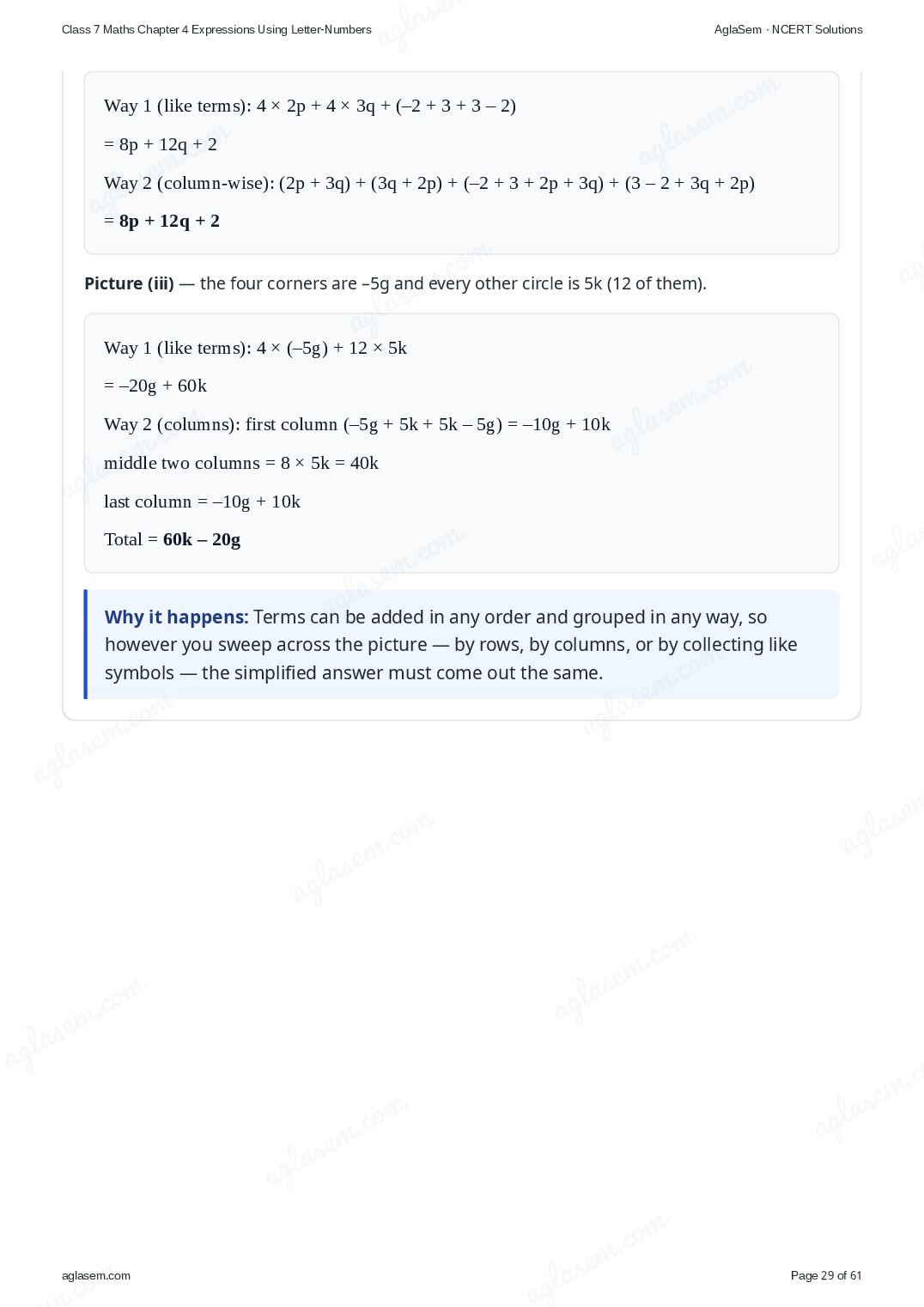
- Add the numbers in each picture below. Write their corresponding expressions and simplify them. Try adding the numbers in each picture in a couple different ways and see that you get the same thing.
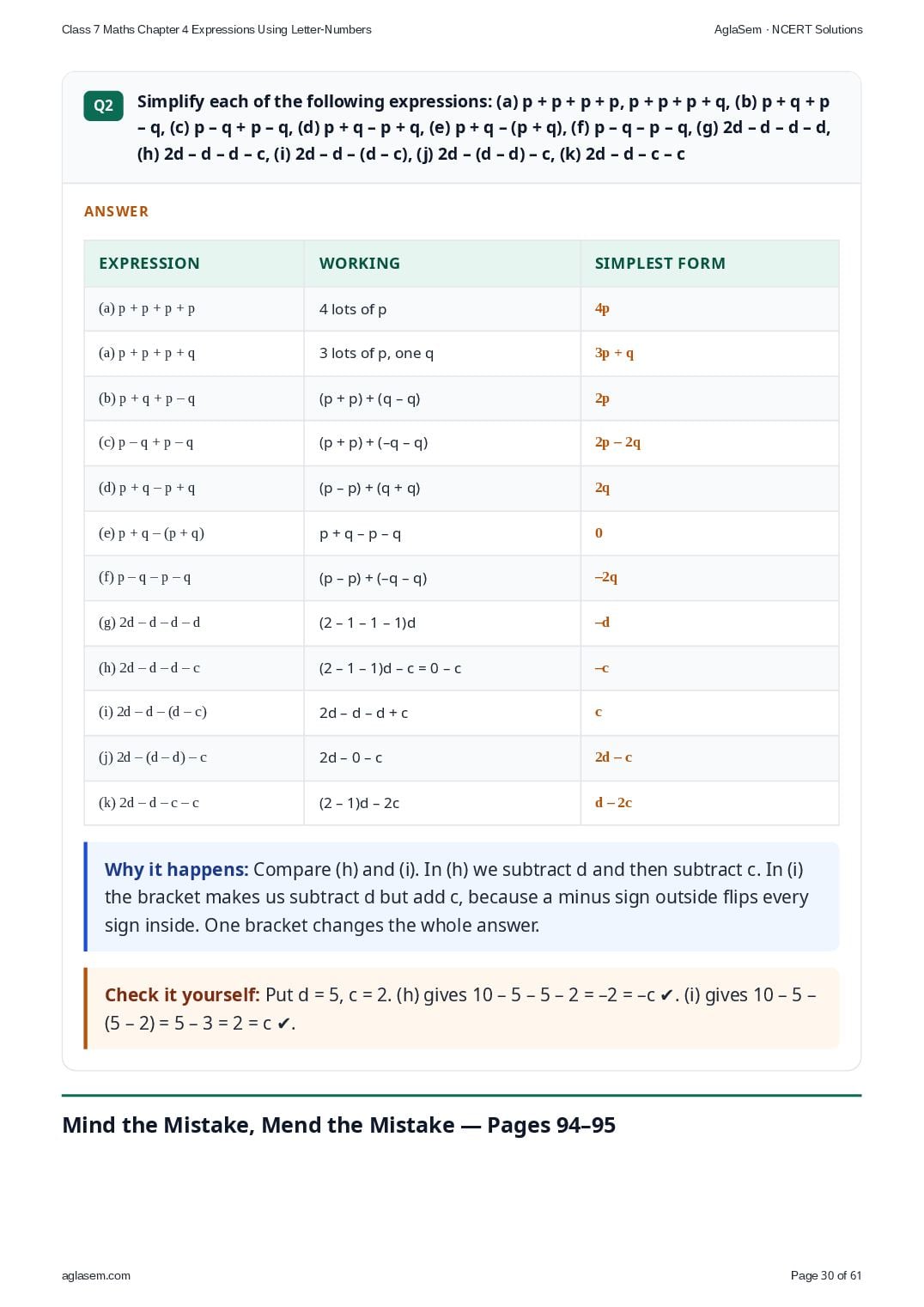
- Simplify each of the following expressions: (a) p + p + p + p, p + p + p + q, (b) p + q + p – q, (c) p – q + p – q, (d) p + q – p + q, (e) p + q – (p + q), (f) p – q – p – q, (g) 2d – d – d – d, (h) 2d – d – d – c, (i) 2d – d – (d – c), (j) 2d – (d – d) – c, (k) 2d – d – c – c
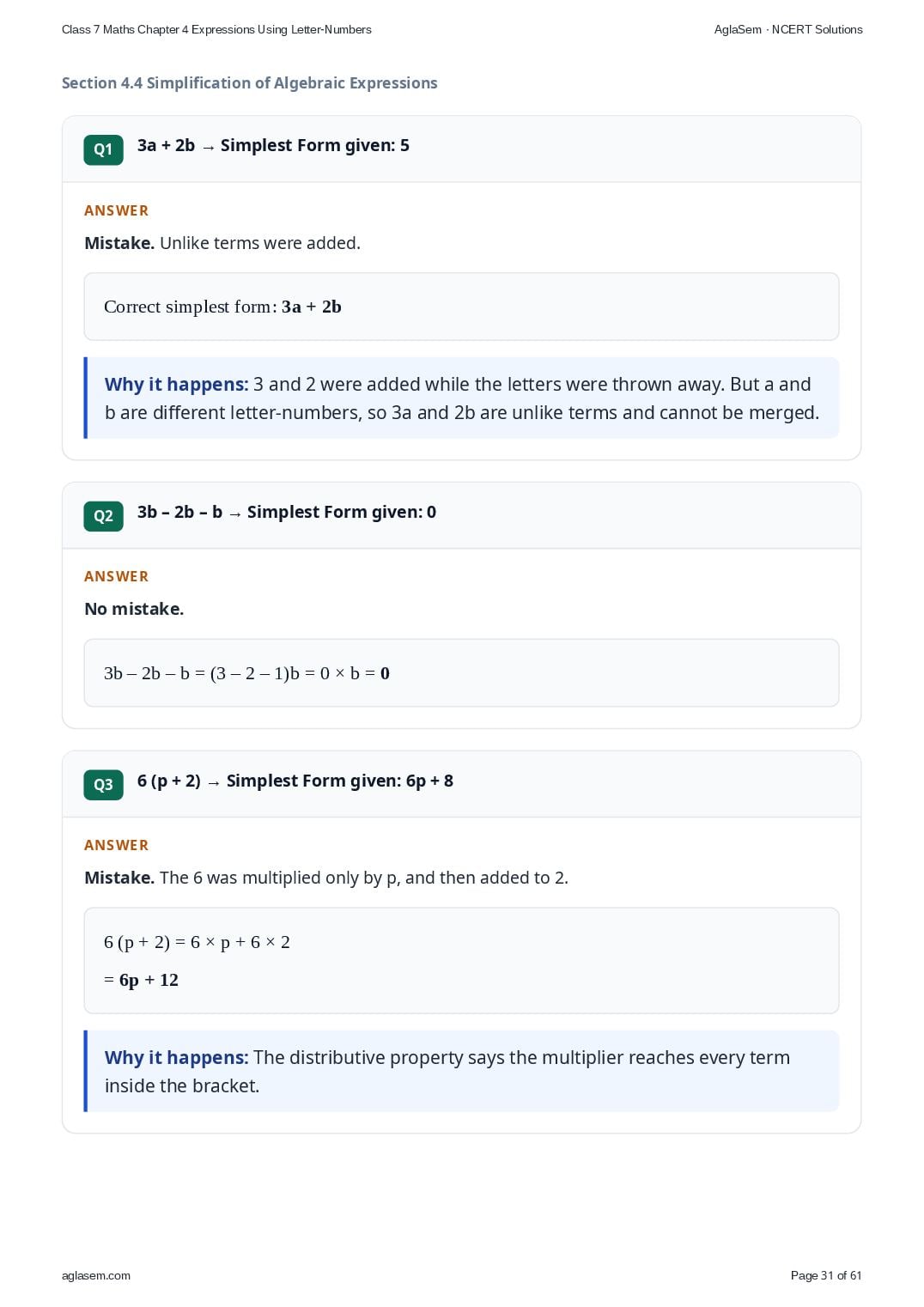
- 3a + 2b → Simplest Form given: 5
- 3b – 2b – b → Simplest Form given: 0
- 6 (p + 2) → Simplest Form given: 6p + 8
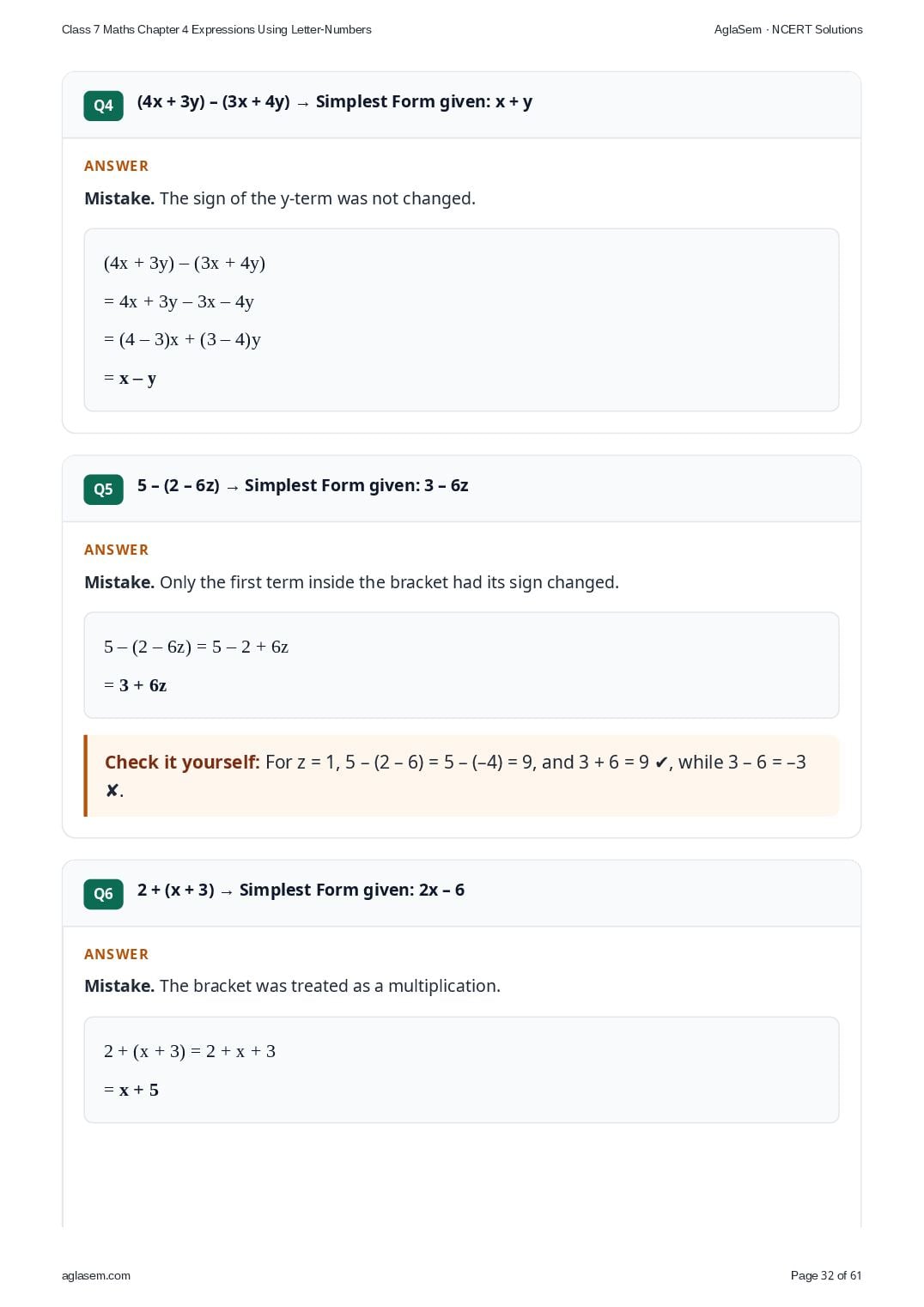
- (4x + 3y) – (3x + 4y) → Simplest Form given: x + y
- 5 – (2 – 6z) → Simplest Form given: 3 – 6z
- 2 + (x + 3) → Simplest Form given: 2x – 6
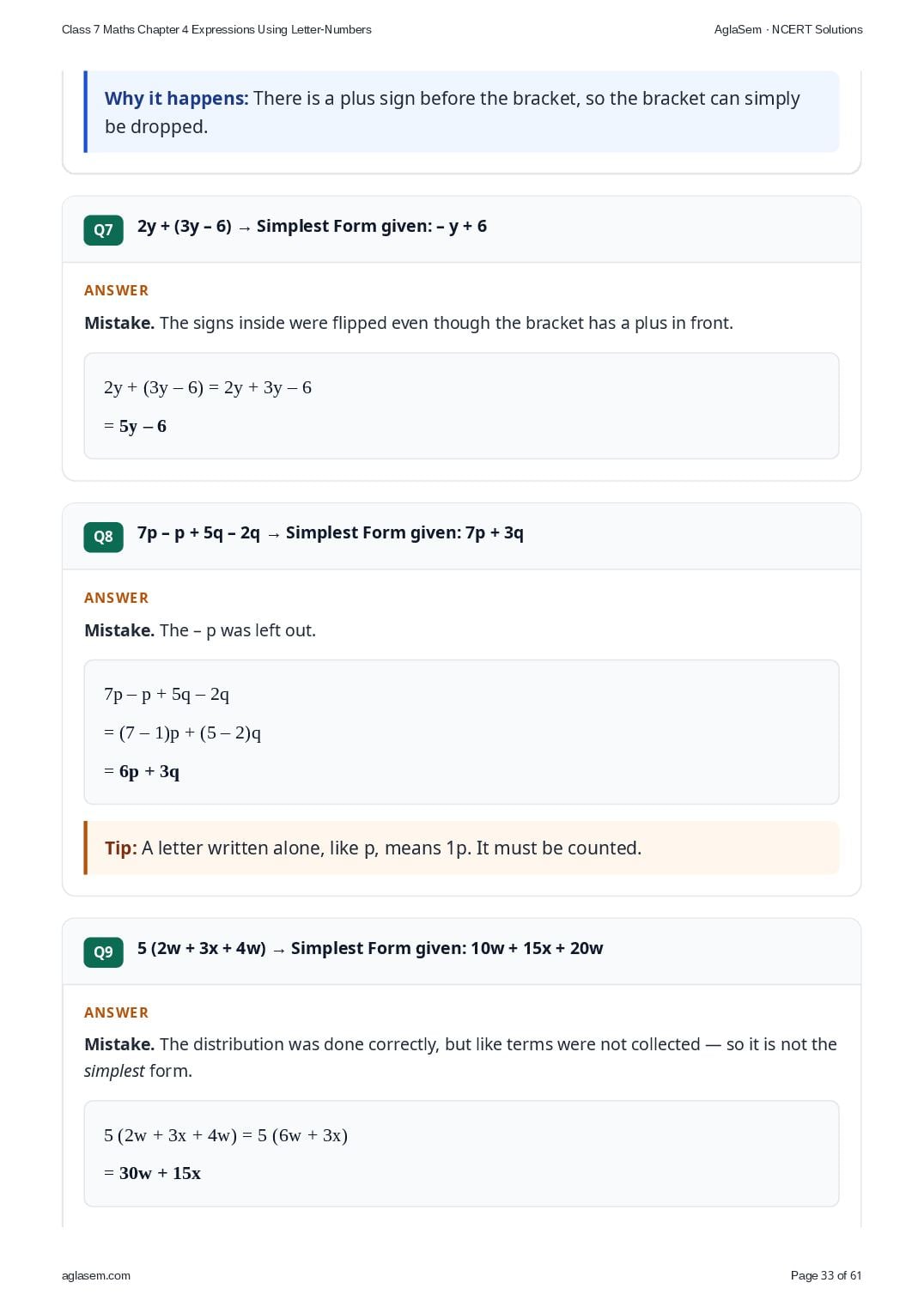
- 2y + (3y – 6) → Simplest Form given: – y + 6
- 7p – p + 5q – 2q → Simplest Form given: 7p + 3q
- 5 (2w + 3x + 4w) → Simplest Form given: 10w + 15x + 20w
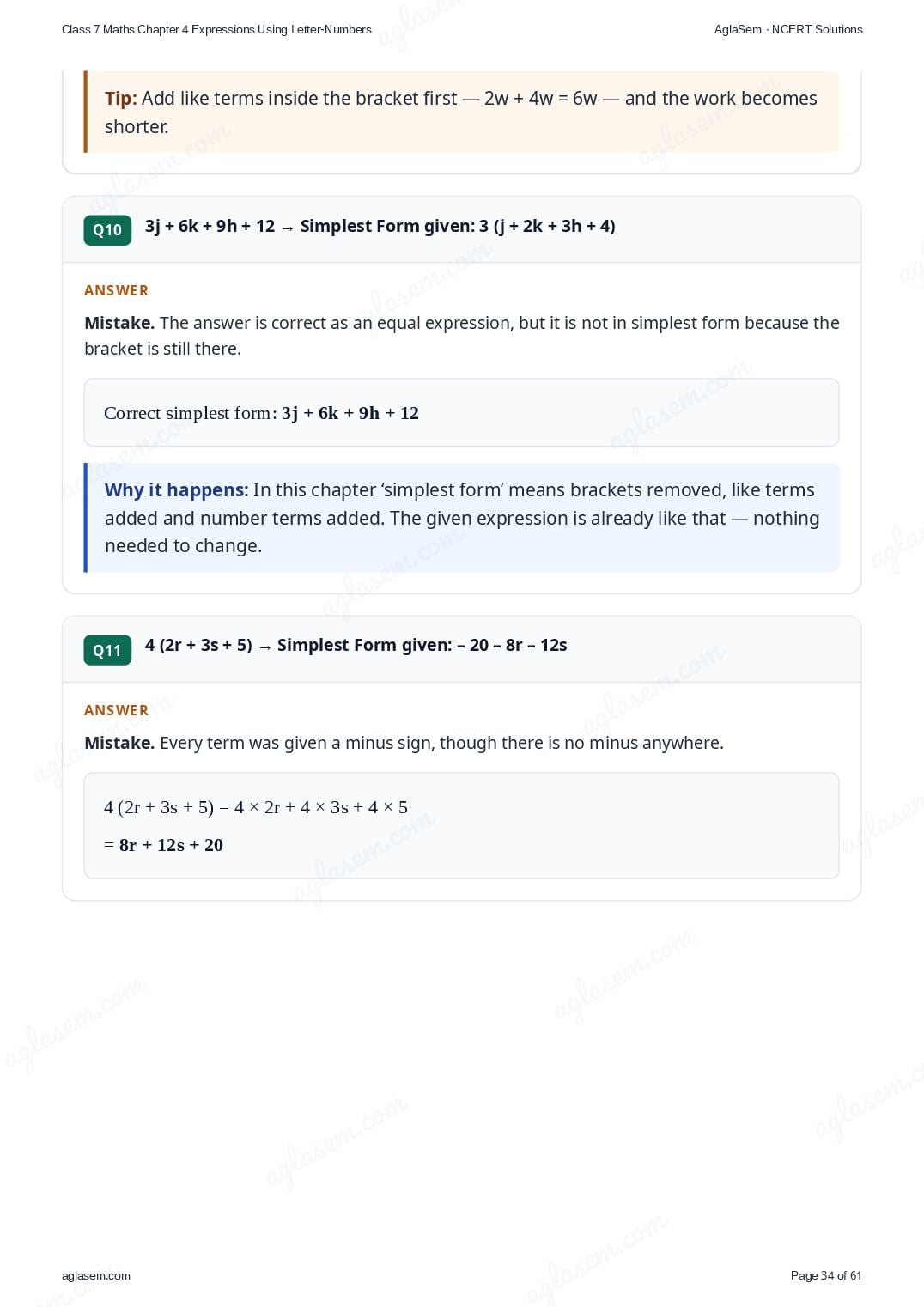
- 3j + 6k + 9h + 12 → Simplest Form given: 3 (j + 2k + 3h + 4)
- 4 (2r + 3s + 5) → Simplest Form given: – 20 – 8r – 12s
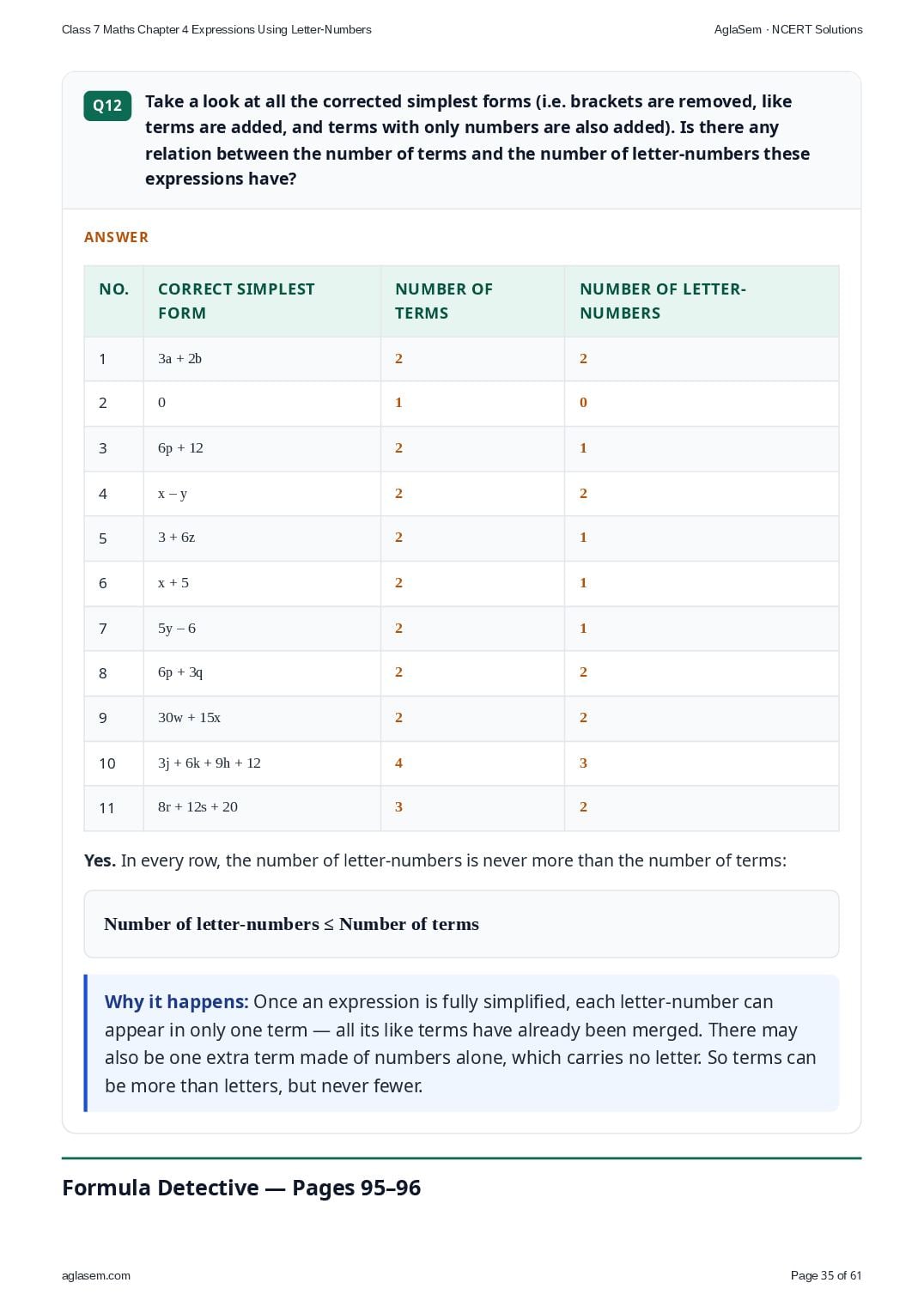
- Take a look at all the corrected simplest forms (i.e. brackets are removed, like terms are added, and terms with only numbers are also added). Is there any relation between the number of terms and the number of letter-numbers these expressions have?
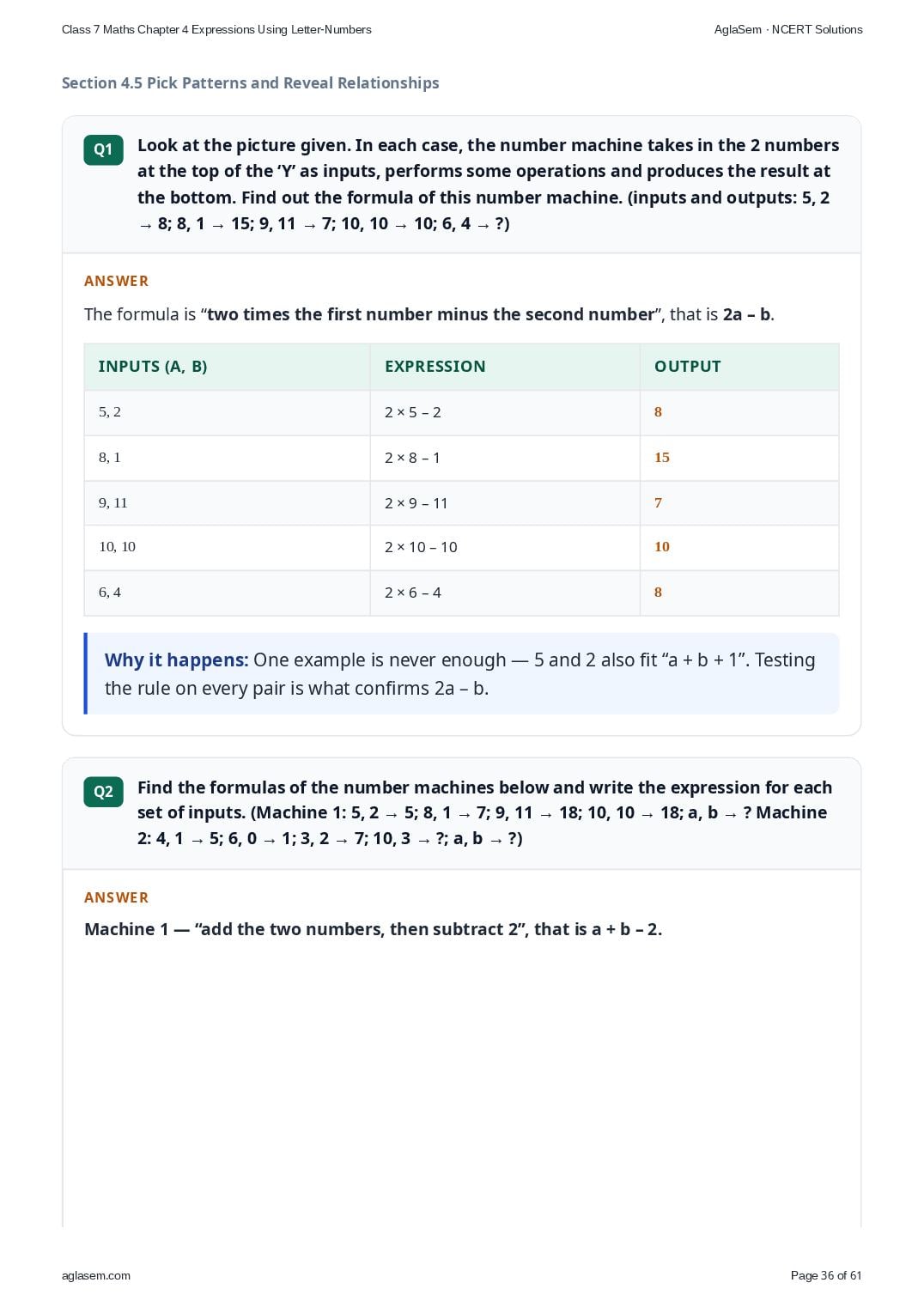
- Look at the picture given. In each case, the number machine takes in the 2 numbers at the top of the ‘Y’ as inputs, performs some operations and produces the result at the bottom. Find out the formula of this number machine. (inputs and outputs: 5, 2 → 8; 8, 1 → 15; 9, 11 → 7; 10, 10 → 10; 6, 4 → ?)
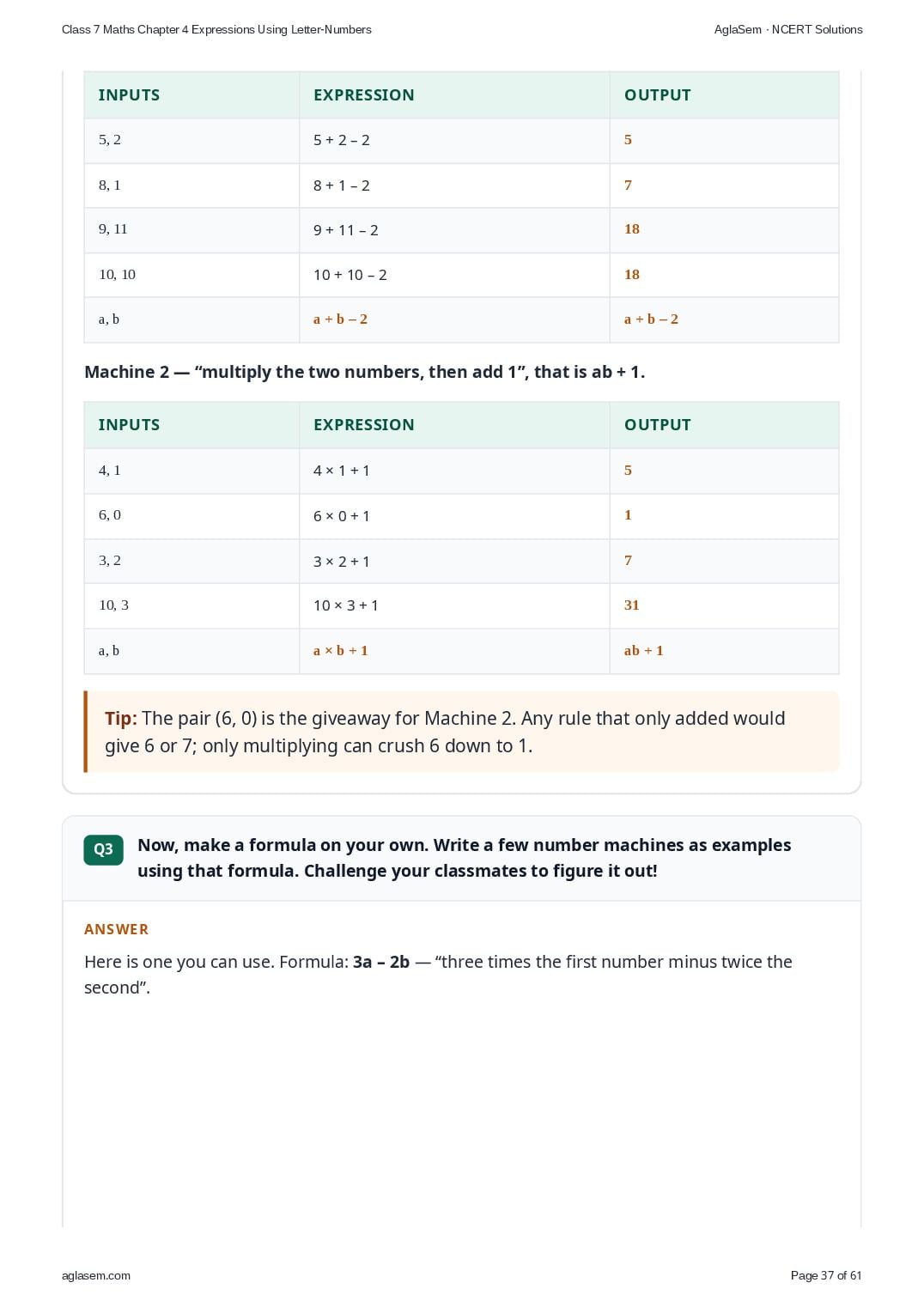
- Find the formulas of the number machines below and write the expression for each set of inputs. (Machine 1: 5, 2 → 5; 8, 1 → 7; 9, 11 → 18; 10, 10 → 18; a, b → ? Machine 2: 4, 1 → 5; 6, 0 → 1; 3, 2 → 7; 10, 3 → ?; a, b → ?)
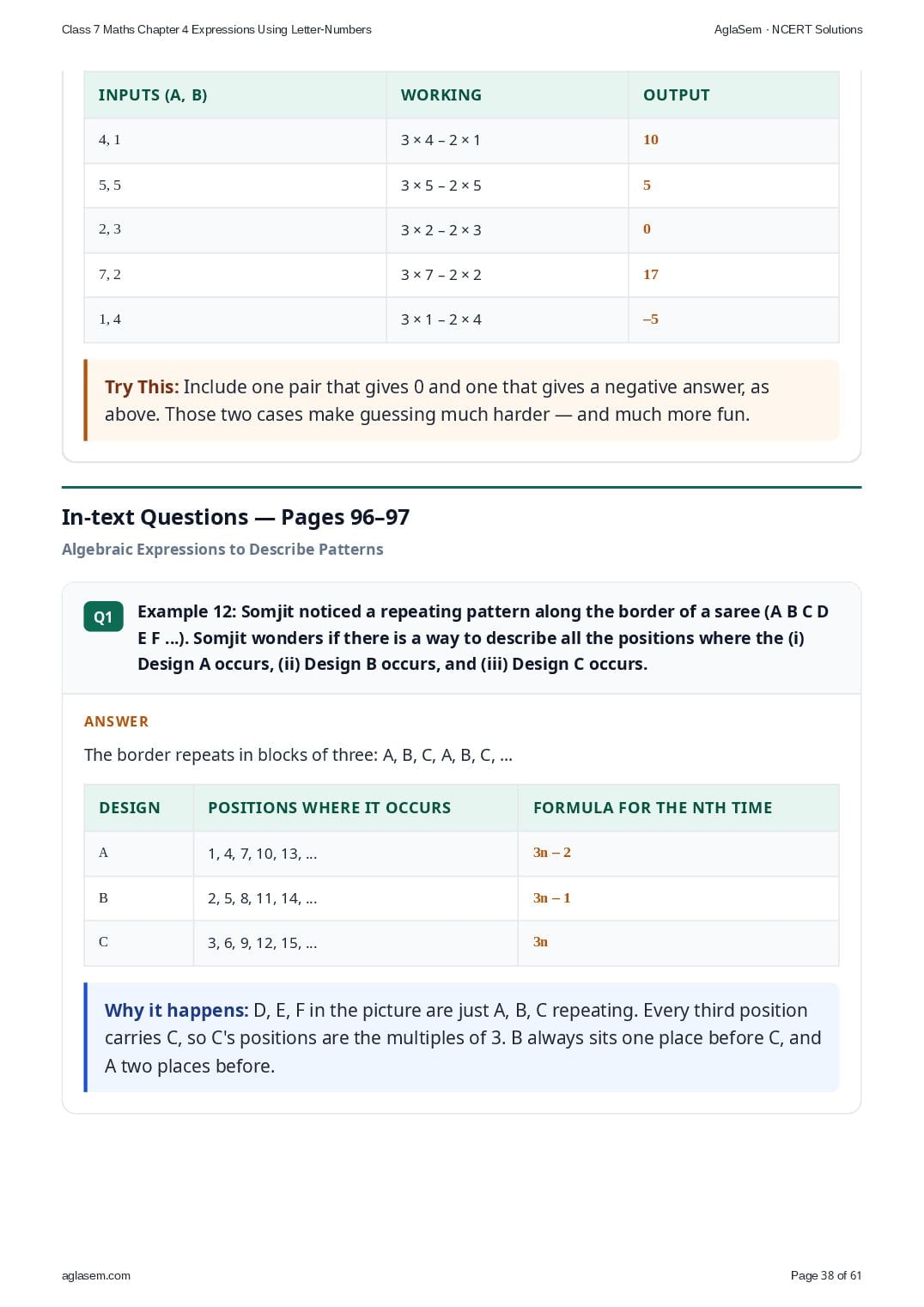
- Now, make a formula on your own. Write a few number machines as examples using that formula. Challenge your classmates to figure it out!
- Example 12: Somjit noticed a repeating pattern along the border of a saree (A B C D E F …). Somjit wonders if there is a way to describe all the positions where the (i) Design A occurs, (ii) Design B occurs, and (iii) Design C occurs.
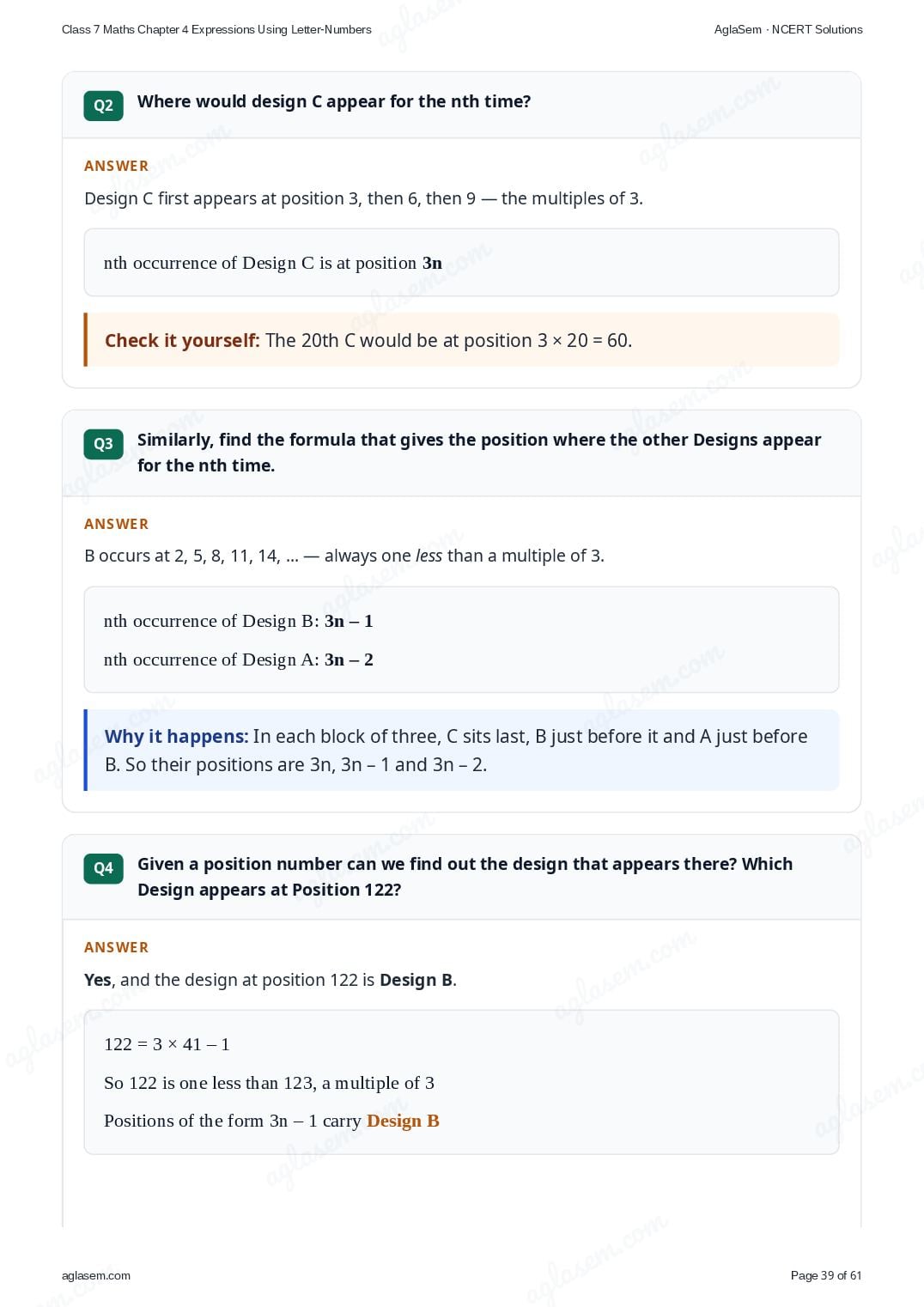
- Where would design C appear for the nth time?
- Similarly, find the formula that gives the position where the other Designs appear for the nth time.
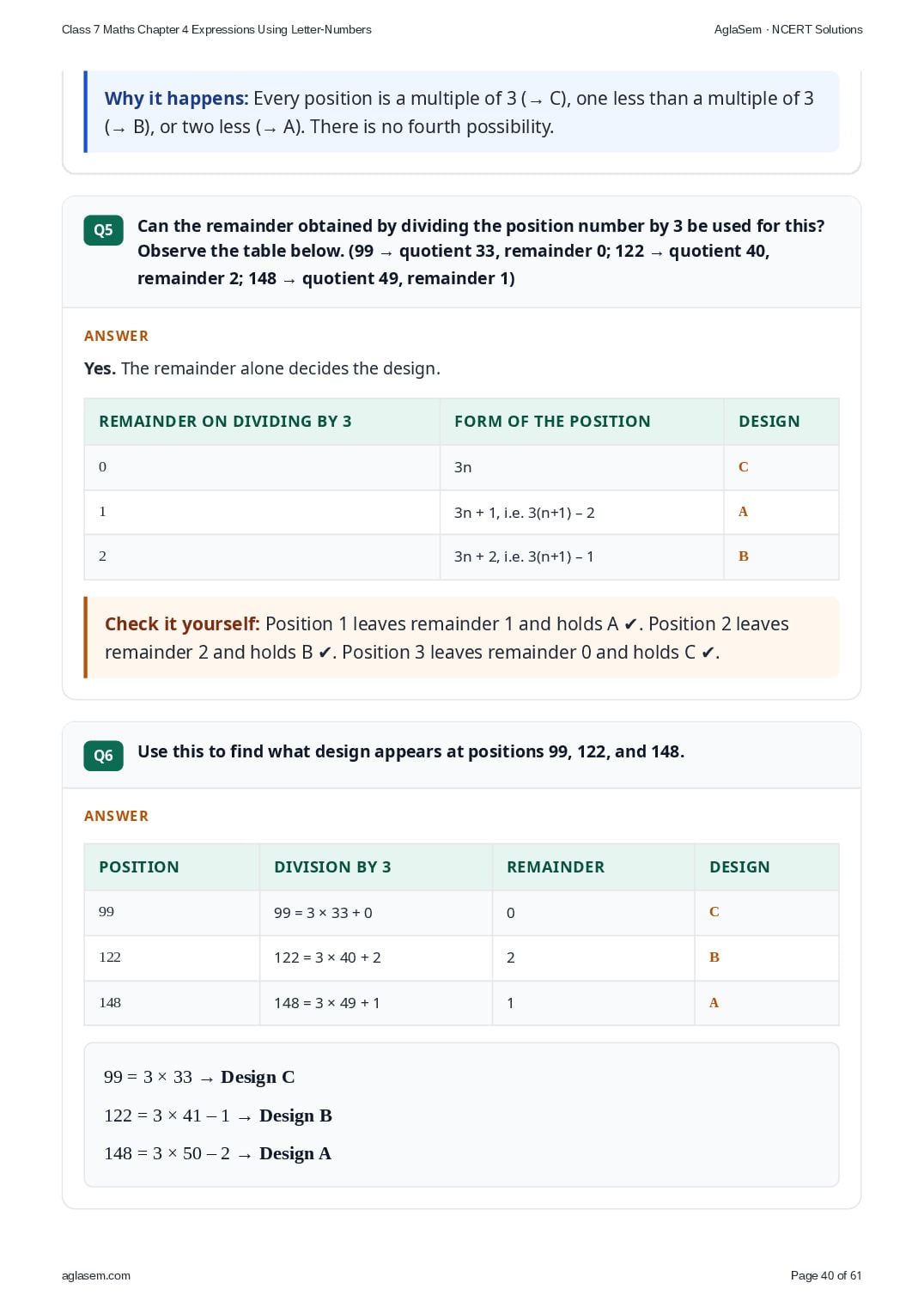
- Given a position number can we find out the design that appears there? Which Design appears at Position 122?
- Can the remainder obtained by dividing the position number by 3 be used for this? Observe the table below. (99 → quotient 33, remainder 0; 122 → quotient 40, remainder 2; 148 → quotient 49, remainder 1)
- Use this to find what design appears at positions 99, 122, and 148.
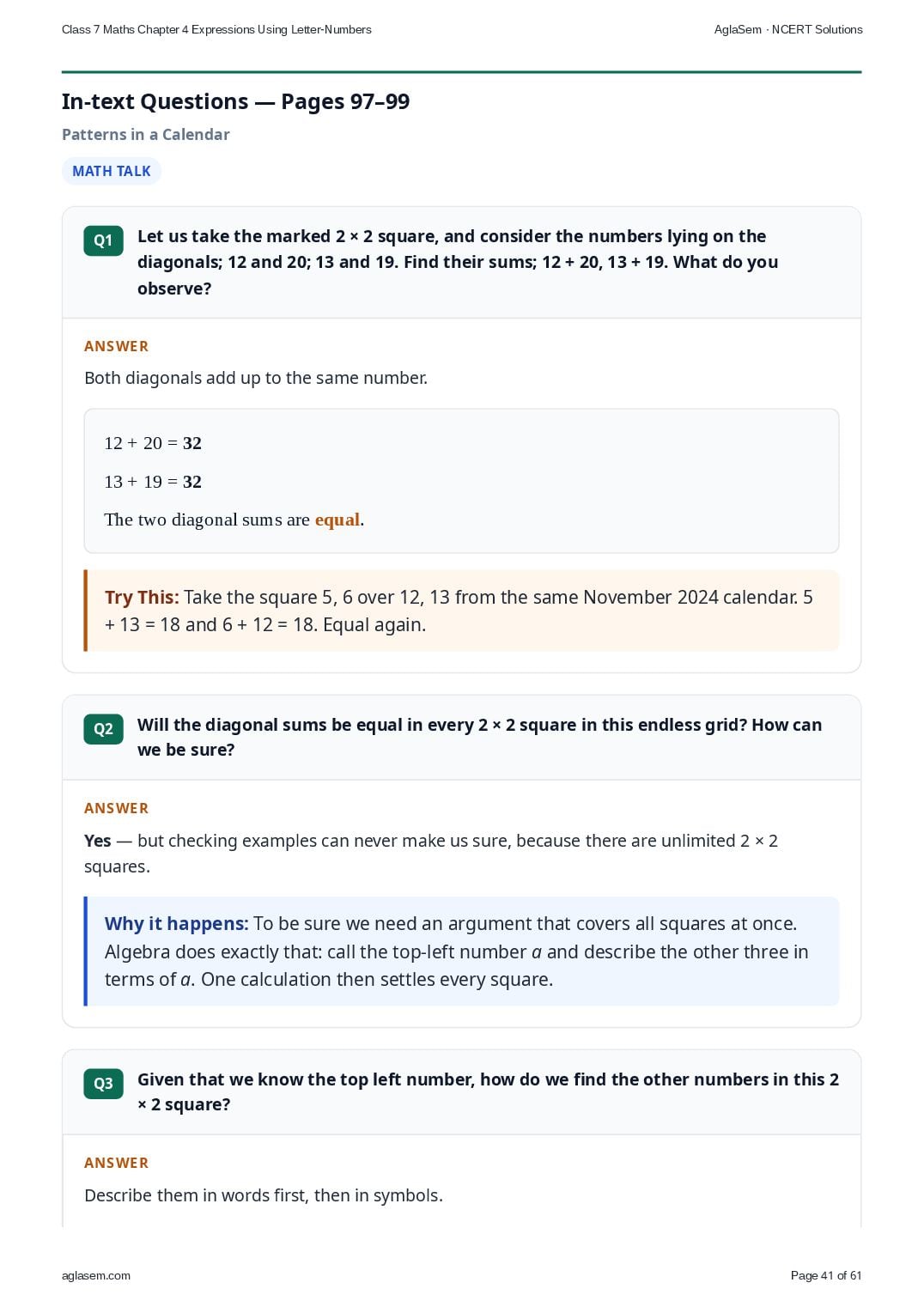
- Let us take the marked 2 × 2 square, and consider the numbers lying on the diagonals; 12 and 20; 13 and 19. Find their sums; 12 + 20, 13 + 19. What do you observe?
- Will the diagonal sums be equal in every 2 × 2 square in this endless grid? How can we be sure?
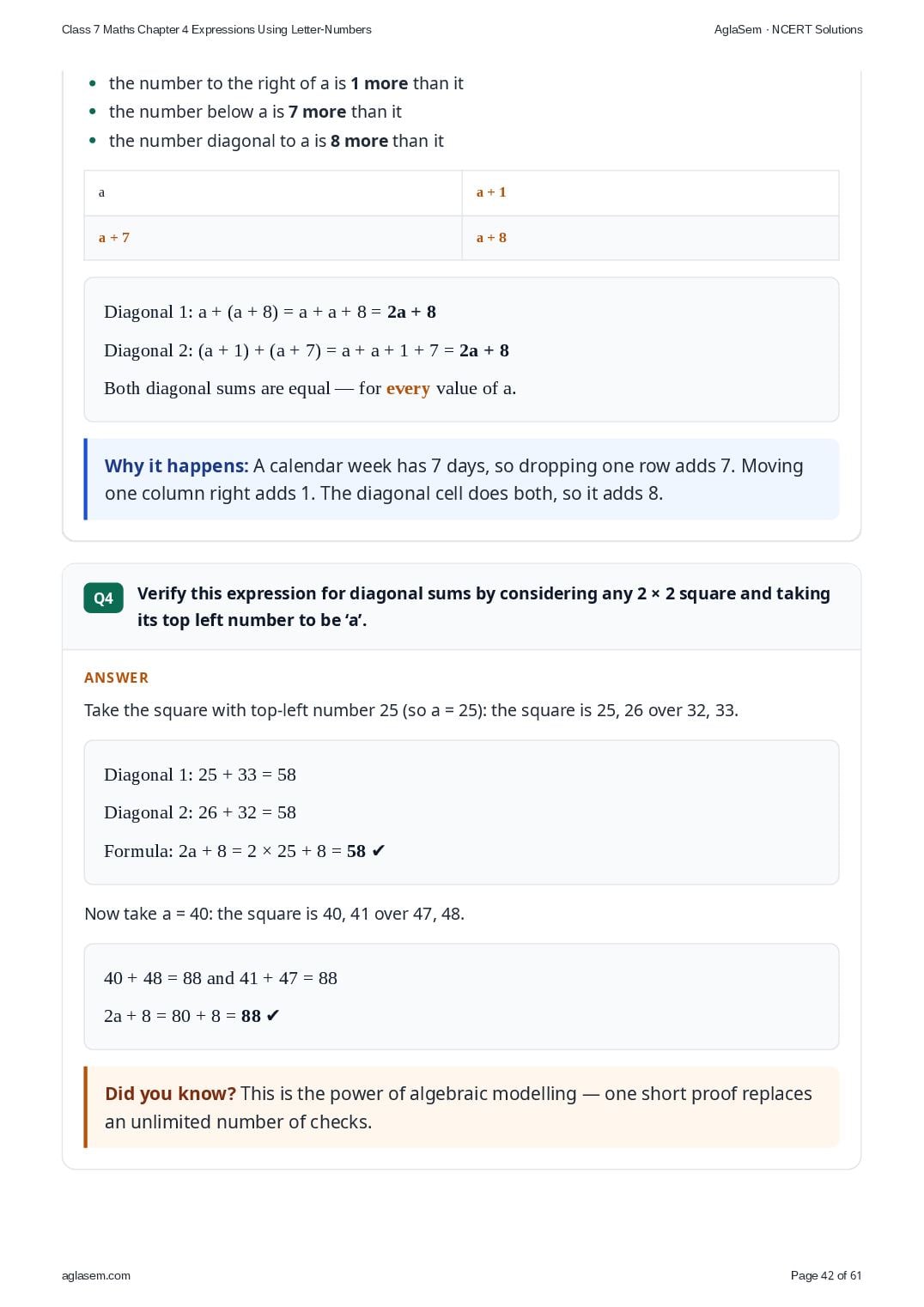
- Given that we know the top left number, how do we find the other numbers in this 2 × 2 square?
- Verify this expression for diagonal sums by considering any 2 × 2 square and taking its top left number to be ‘a’.
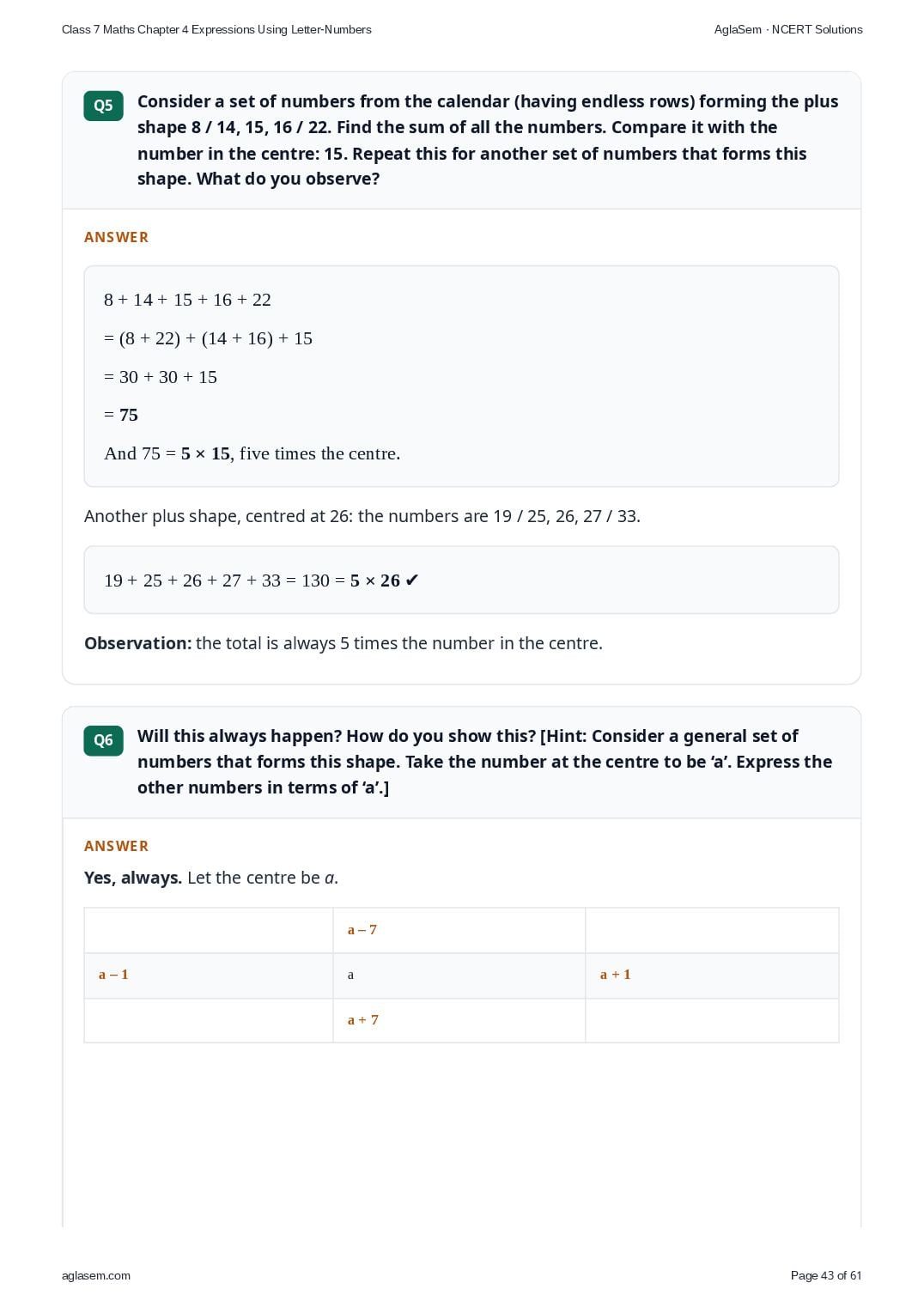
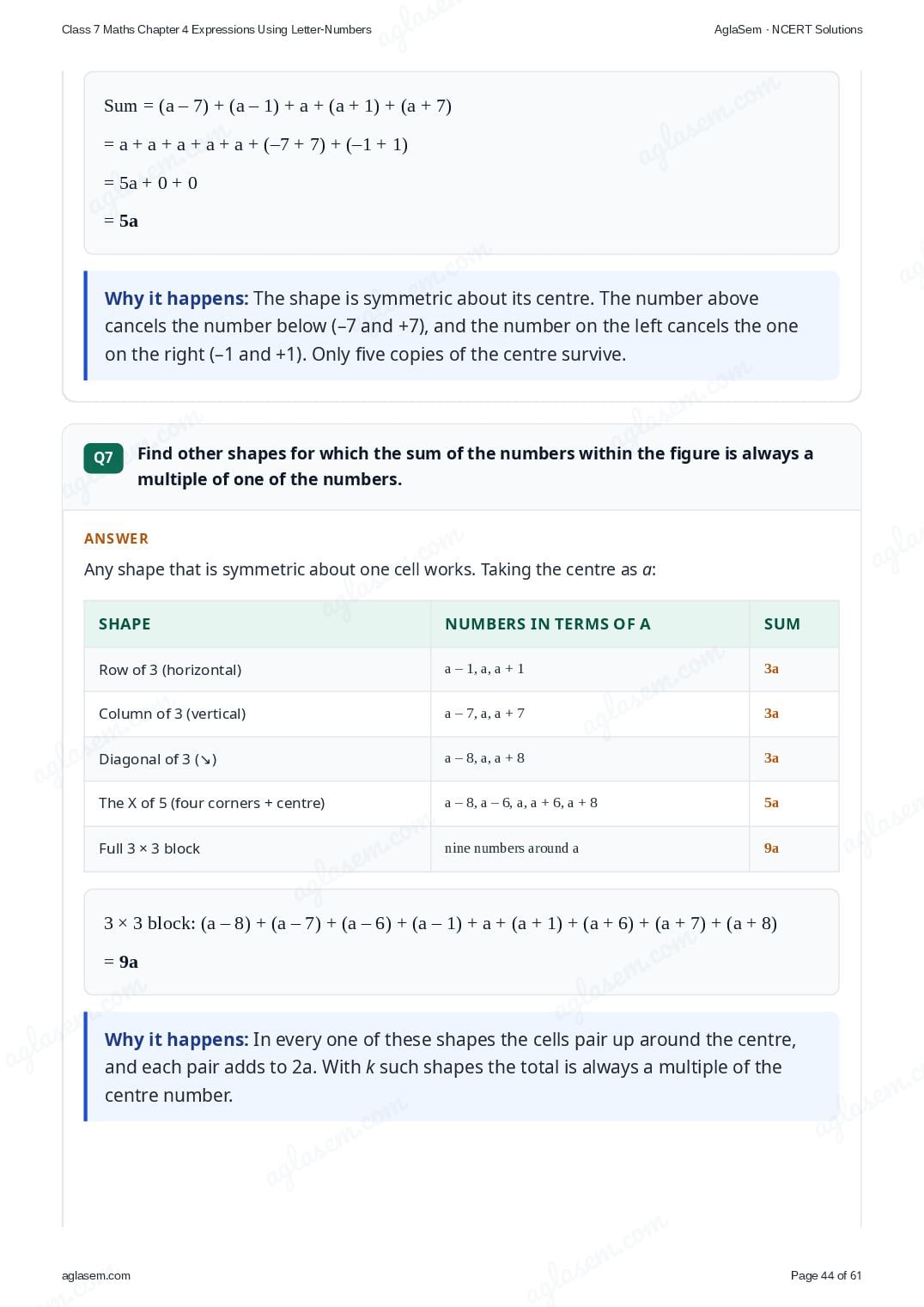
- Consider a set of numbers from the calendar (having endless rows) forming the plus shape 8 / 14, 15, 16 / 22. Find the sum of all the numbers. Compare it with the number in the centre: 15. Repeat this for another set of numbers that forms this shape. What do you observe?
- Will this always happen? How do you show this? [Hint: Consider a general set of numbers that forms this shape. Take the number at the centre to be ‘a’. Express the other numbers in terms of ‘a’.]
- Find other shapes for which the sum of the numbers within the figure is always a multiple of one of the numbers.
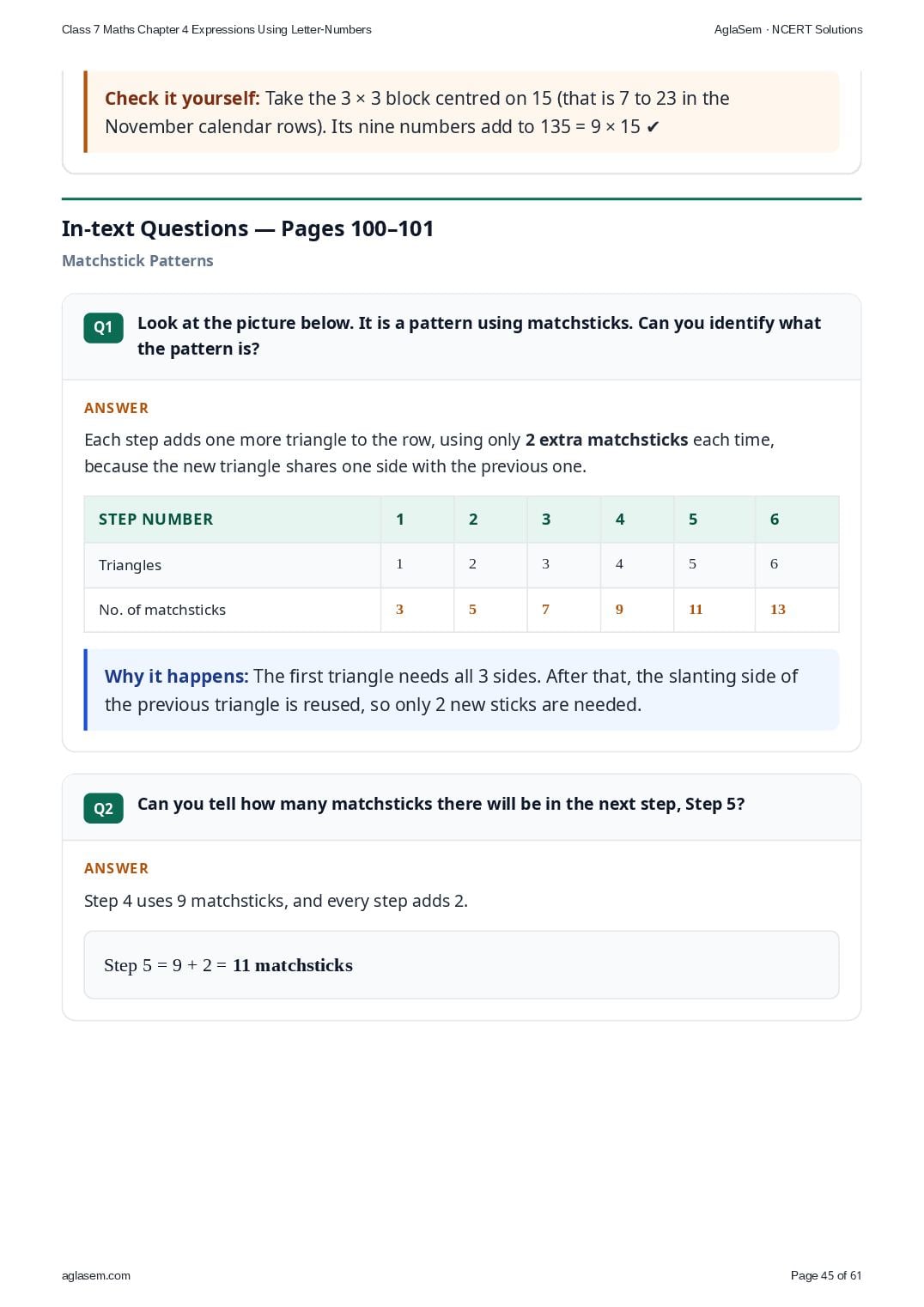
- Look at the picture below. It is a pattern using matchsticks. Can you identify what the pattern is?
- Can you tell how many matchsticks there will be in the next step, Step 5?
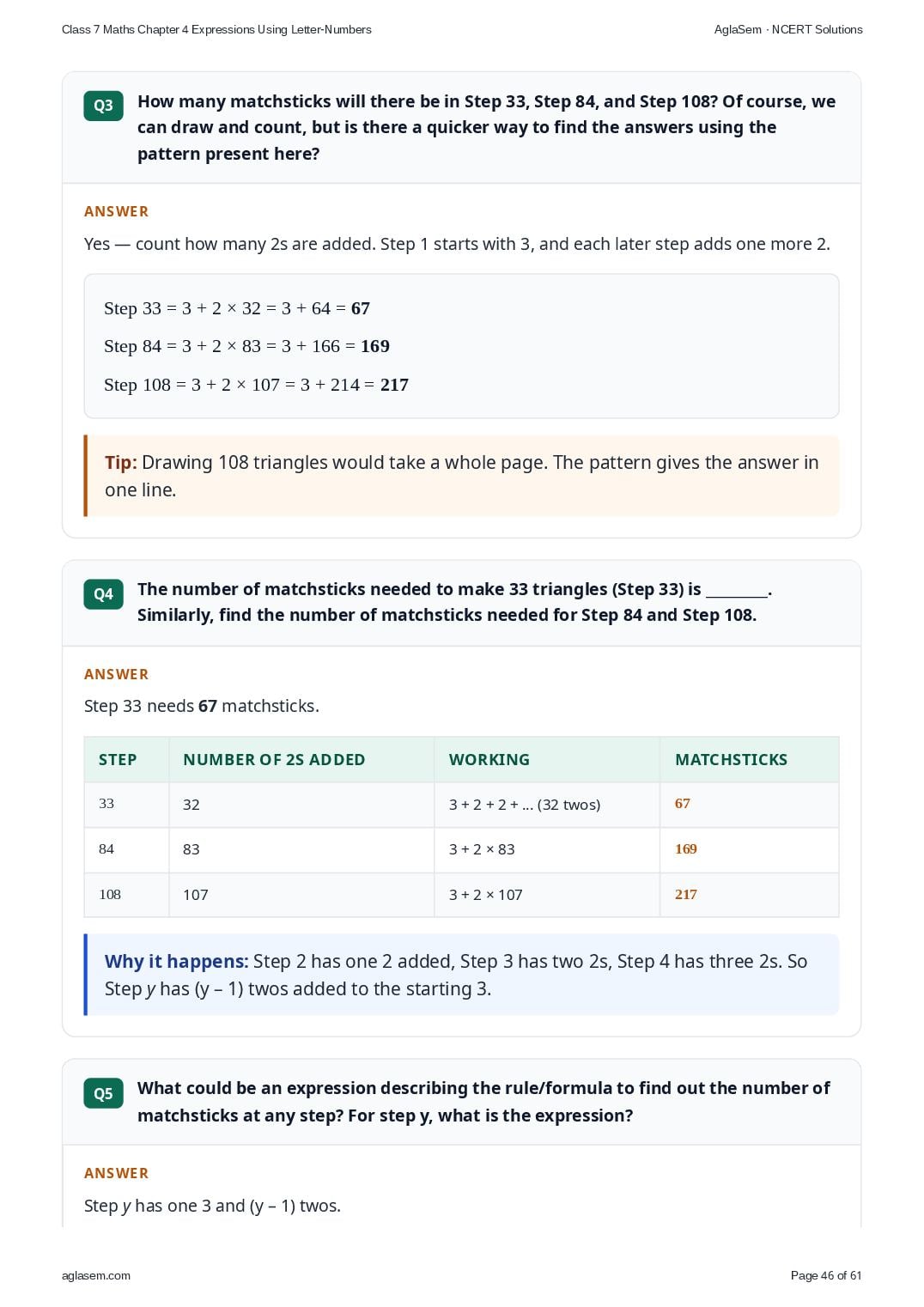
- How many matchsticks will there be in Step 33, Step 84, and Step 108? Of course, we can draw and count, but is there a quicker way to find the answers using the pattern present here?
- The number of matchsticks needed to make 33 triangles (Step 33) is _________. Similarly, find the number of matchsticks needed for Step 84 and Step 108.
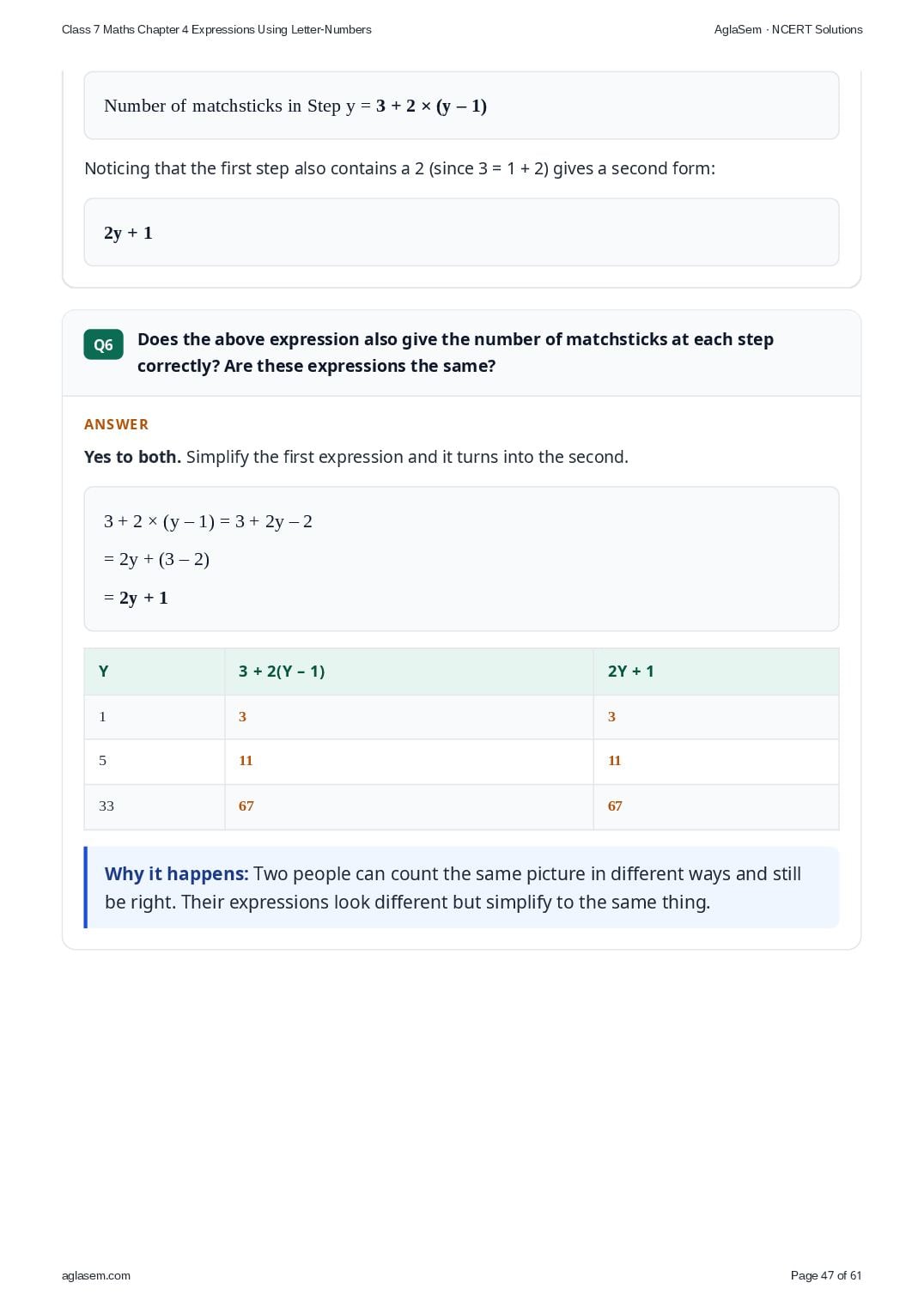
- What could be an expression describing the rule/formula to find out the number of matchsticks at any step? For step y, what is the expression?
- Does the above expression also give the number of matchsticks at each step correctly? Are these expressions the same?
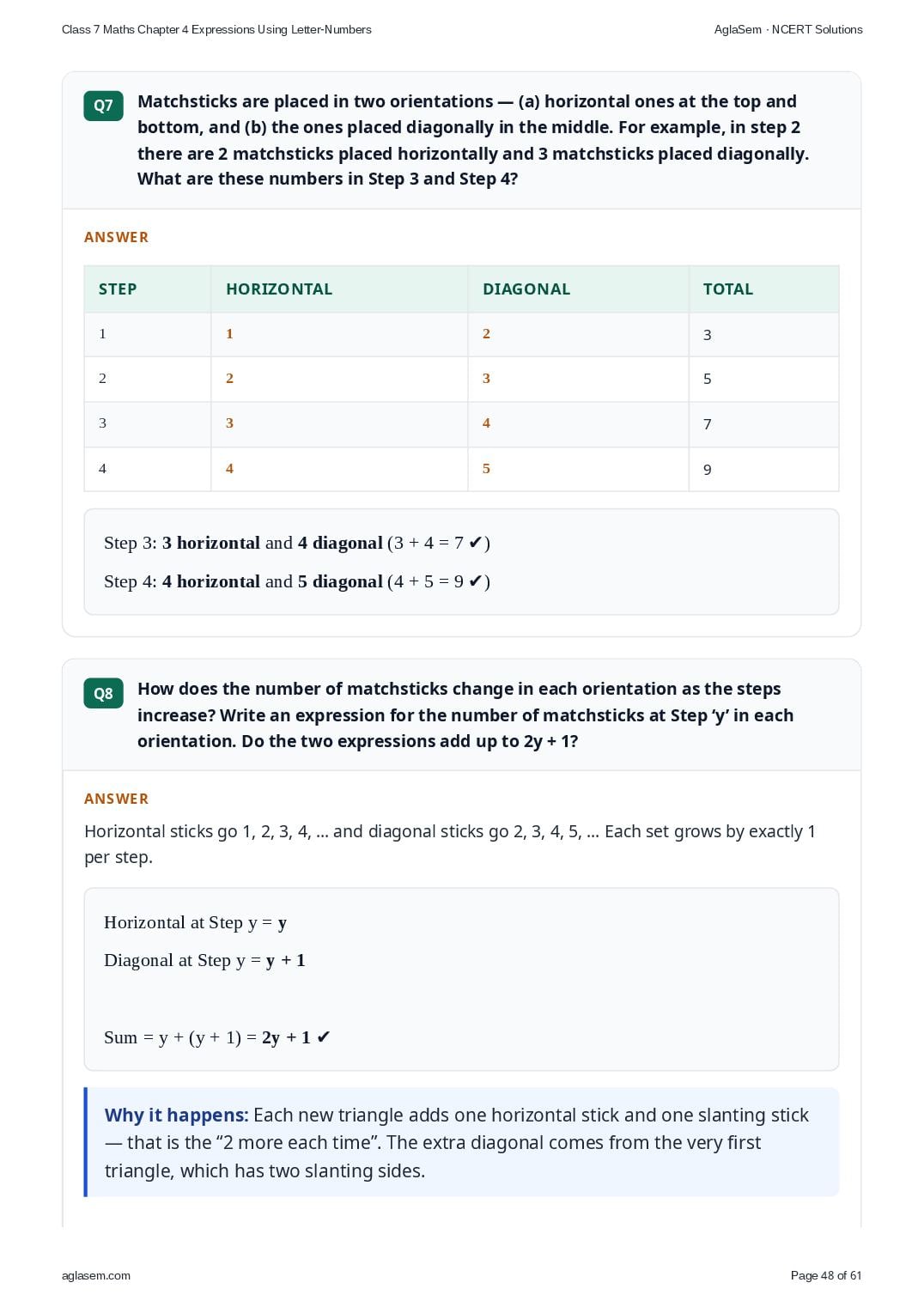
- Matchsticks are placed in two orientations — (a) horizontal ones at the top and bottom, and (b) the ones placed diagonally in the middle. For example, in step 2 there are 2 matchsticks placed horizontally and 3 matchsticks placed diagonally. What are these numbers in Step 3 and Step 4?
- How does the number of matchsticks change in each orientation as the steps increase? Write an expression for the number of matchsticks at Step ‘y’ in each orientation. Do the two expressions add up to 2y + 1?
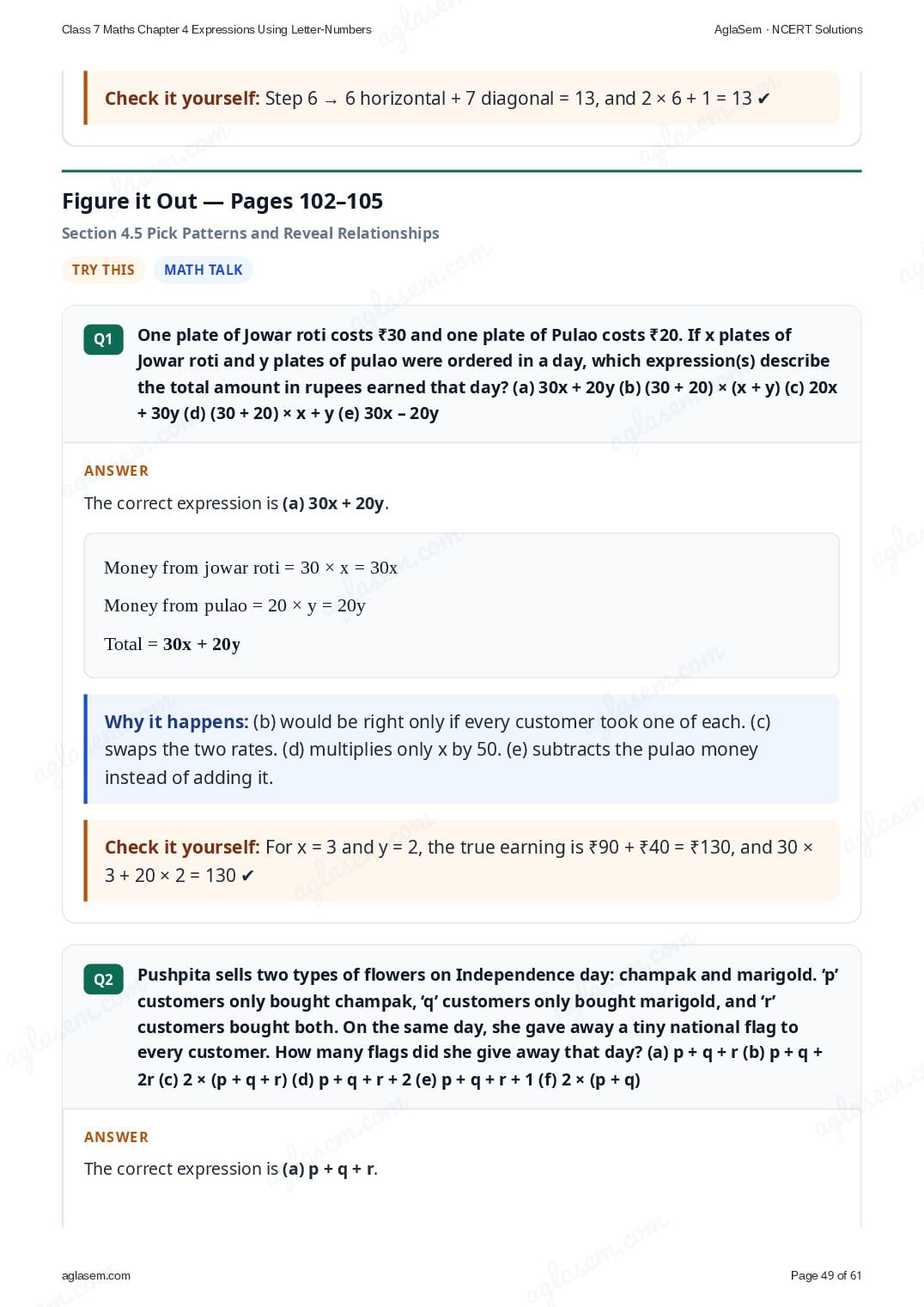
- One plate of Jowar roti costs ₹30 and one plate of Pulao costs ₹20. If x plates of Jowar roti and y plates of pulao were ordered in a day, which expression(s) describe the total amount in rupees earned that day? (a) 30x + 20y (b) (30 + 20) × (x + y) (c) 20x + 30y (d) (30 + 20) × x + y (e) 30x – 20y
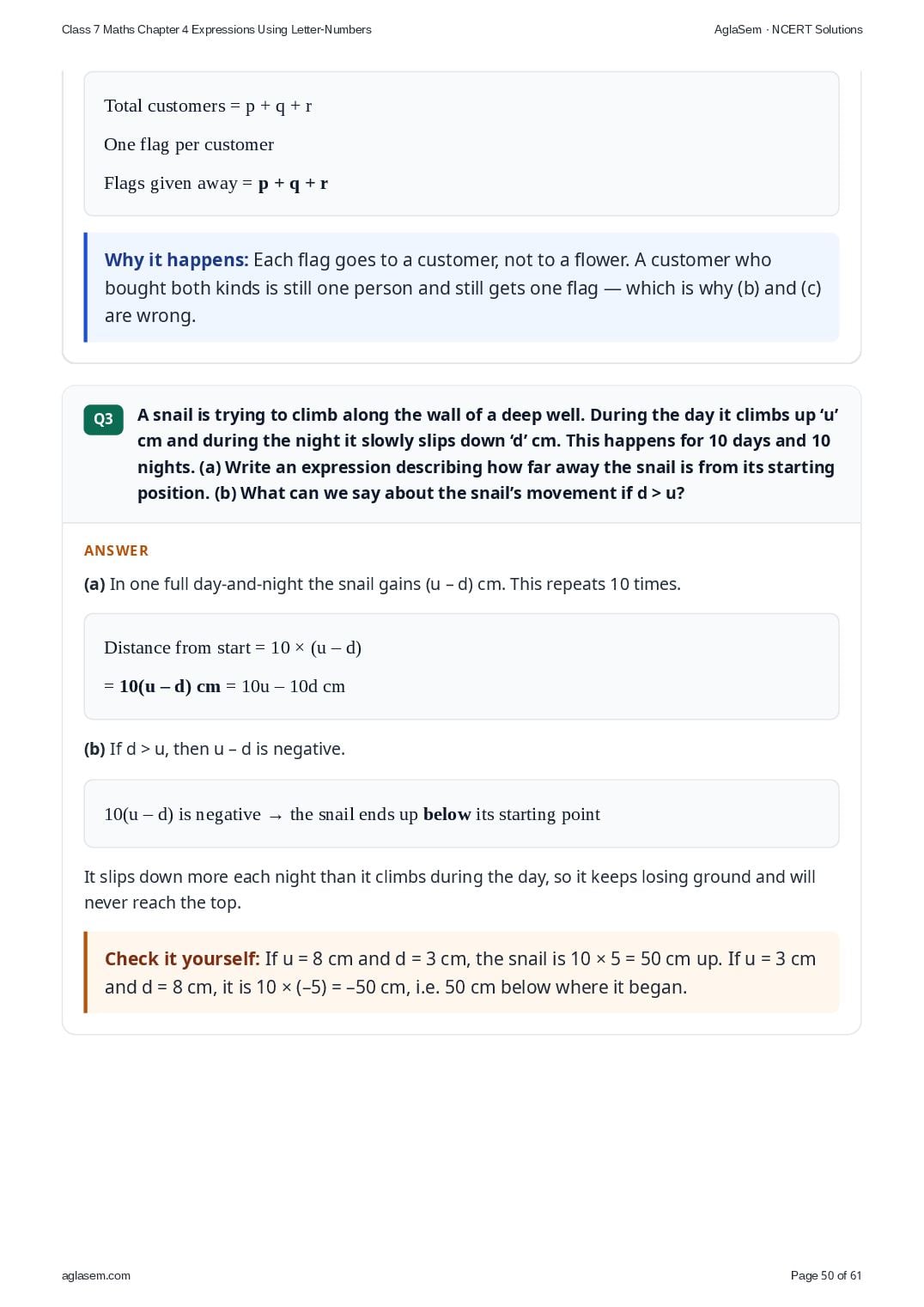
- Pushpita sells two types of flowers on Independence day: champak and marigold. ‘p’ customers only bought champak, ‘q’ customers only bought marigold, and ‘r’ customers bought both. On the same day, she gave away a tiny national flag to every customer. How many flags did she give away that day? (a) p + q + r (b) p + q + 2r (c) 2 × (p + q + r) (d) p + q + r + 2 (e) p + q + r + 1 (f) 2 × (p + q)
- A snail is trying to climb along the wall of a deep well. During the day it climbs up ‘u’ cm and during the night it slowly slips down ‘d’ cm. This happens for 10 days and 10 nights. (a) Write an expression describing how far away the snail is from its starting position. (b) What can we say about the snail’s movement if d > u?
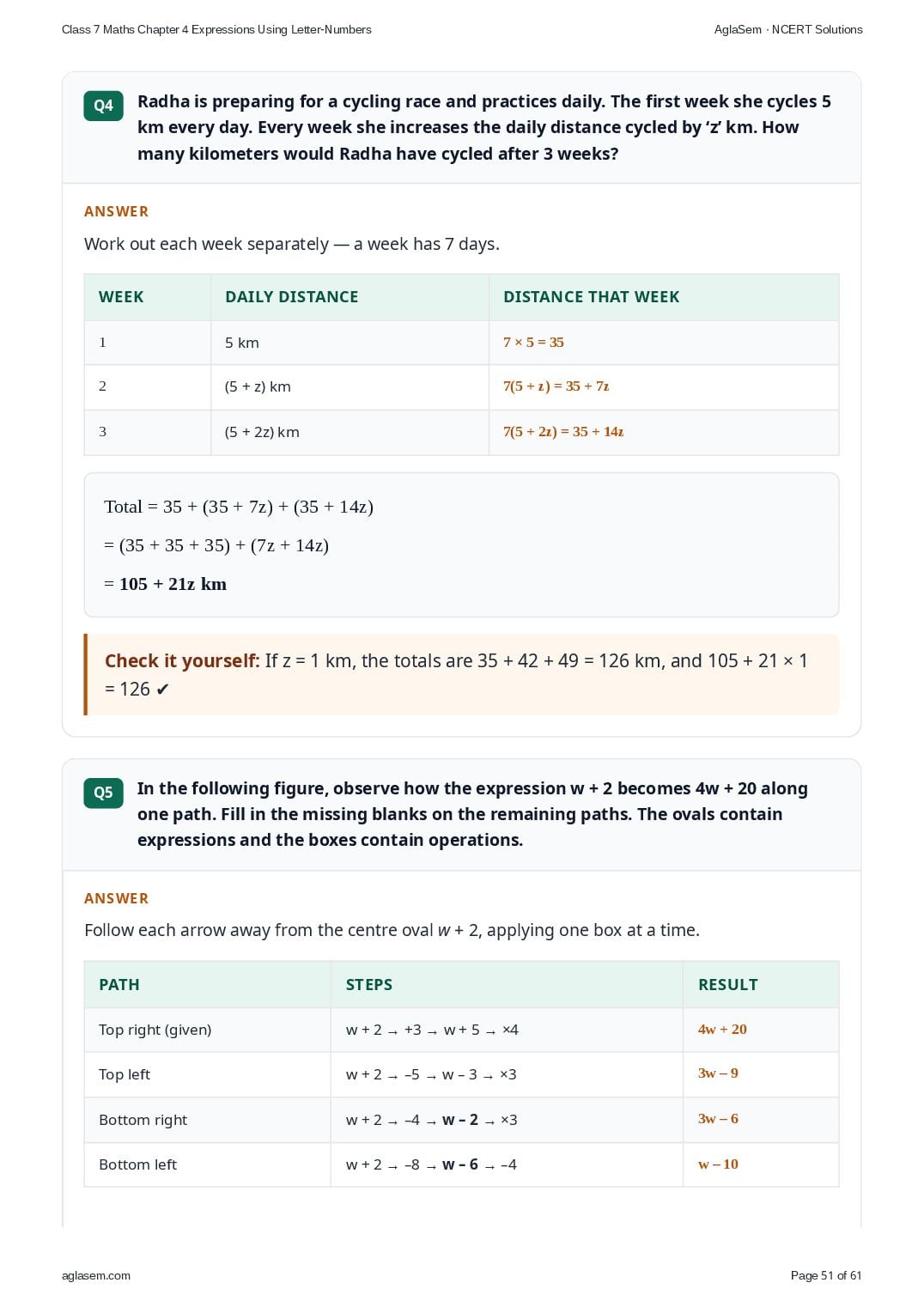
- Radha is preparing for a cycling race and practices daily. The first week she cycles 5 km every day. Every week she increases the daily distance cycled by ‘z’ km. How many kilometers would Radha have cycled after 3 weeks?
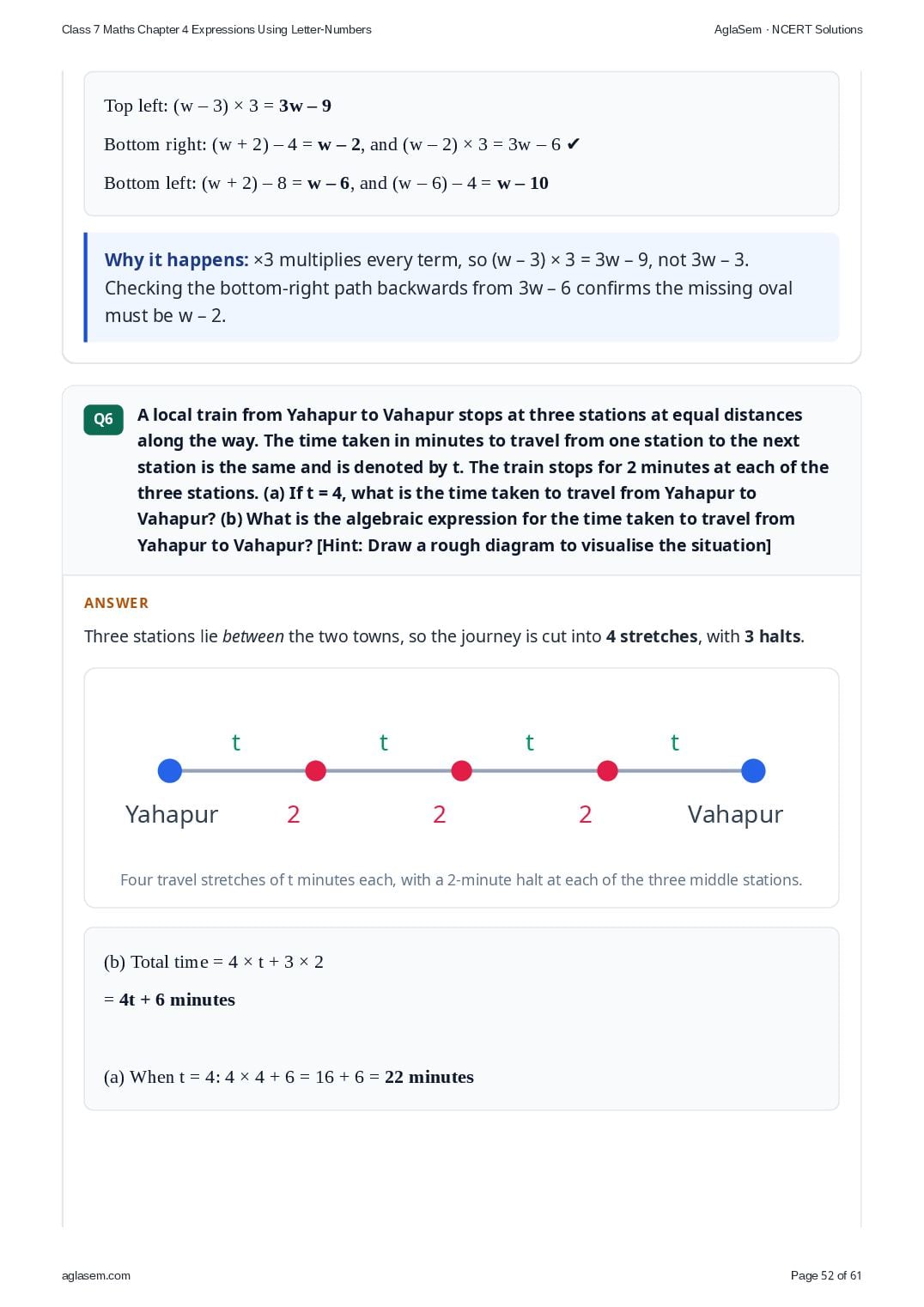
- In the following figure, observe how the expression w + 2 becomes 4w + 20 along one path. Fill in the missing blanks on the remaining paths. The ovals contain expressions and the boxes contain operations.
- A local train from Yahapur to Vahapur stops at three stations at equal distances along the way. The time taken in minutes to travel from one station to the next station is the same and is denoted by t. The train stops for 2 minutes at each of the three stations. (a) If t = 4, what is the time taken to travel from Yahapur to Vahapur? (b) What is the algebraic expression for the time taken to travel from Yahapur to Vahapur? [Hint: Draw a rough diagram to visualise the situation]
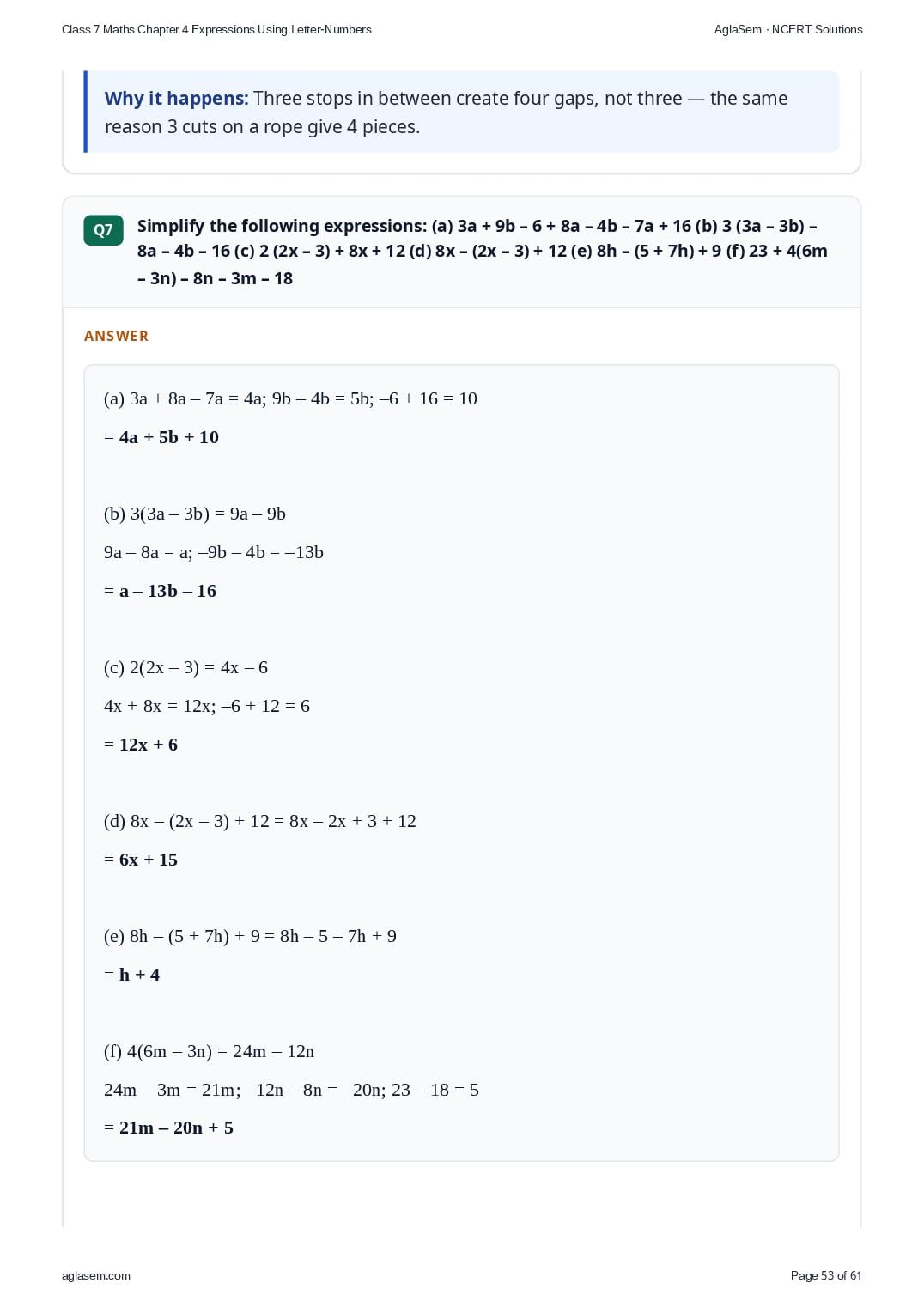
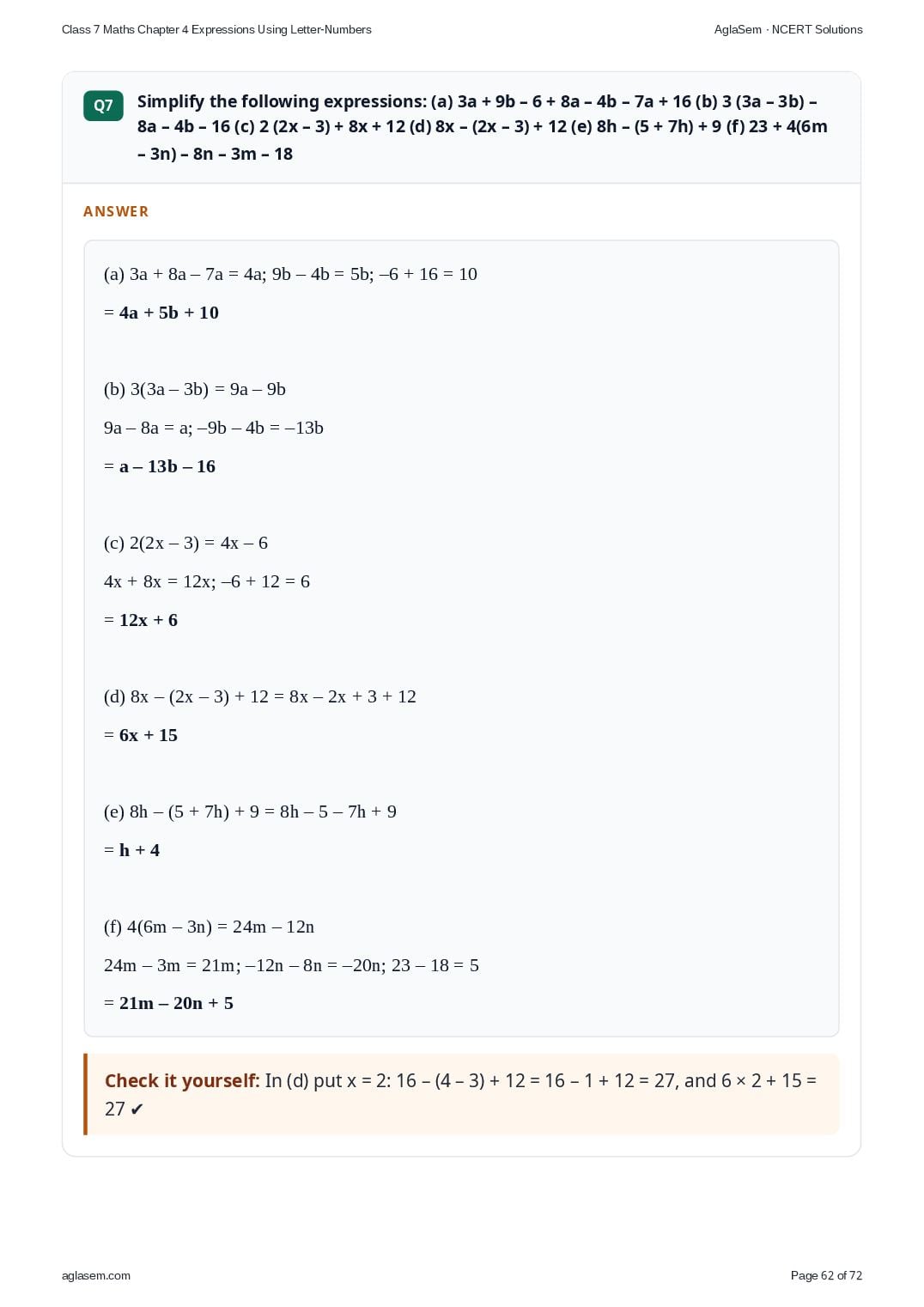
- Simplify the following expressions: (a) 3a + 9b – 6 + 8a – 4b – 7a + 16 (b) 3 (3a – 3b) – 8a – 4b – 16 (c) 2 (2x – 3) + 8x + 12 (d) 8x – (2x – 3) + 12 (e) 8h – (5 + 7h) + 9 (f) 23 + 4(6m – 3n) – 8n – 3m – 18
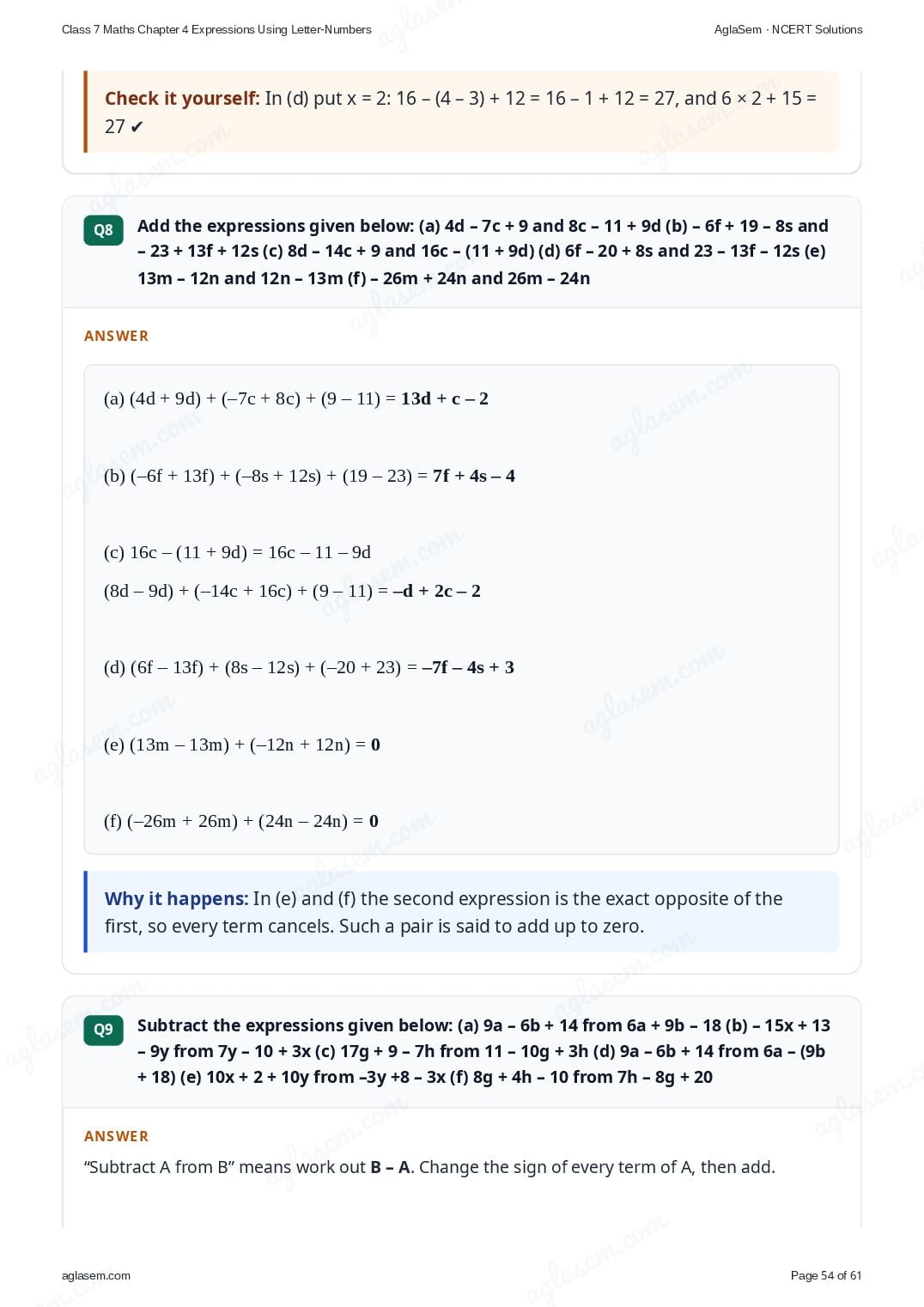
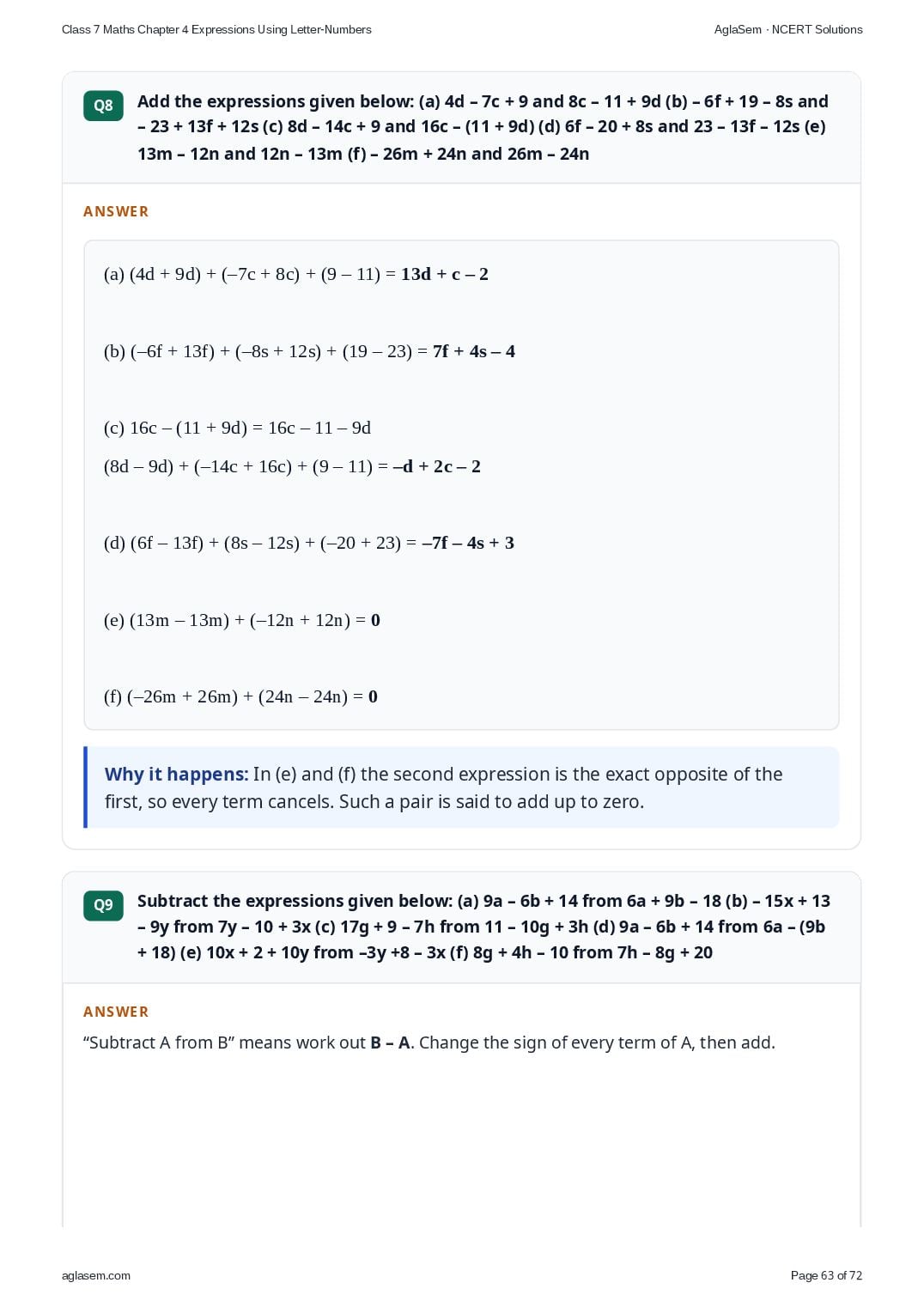
- Add the expressions given below: (a) 4d – 7c + 9 and 8c – 11 + 9d (b) – 6f + 19 – 8s and – 23 + 13f + 12s (c) 8d – 14c + 9 and 16c – (11 + 9d) (d) 6f – 20 + 8s and 23 – 13f – 12s (e) 13m – 12n and 12n – 13m (f) – 26m + 24n and 26m – 24n
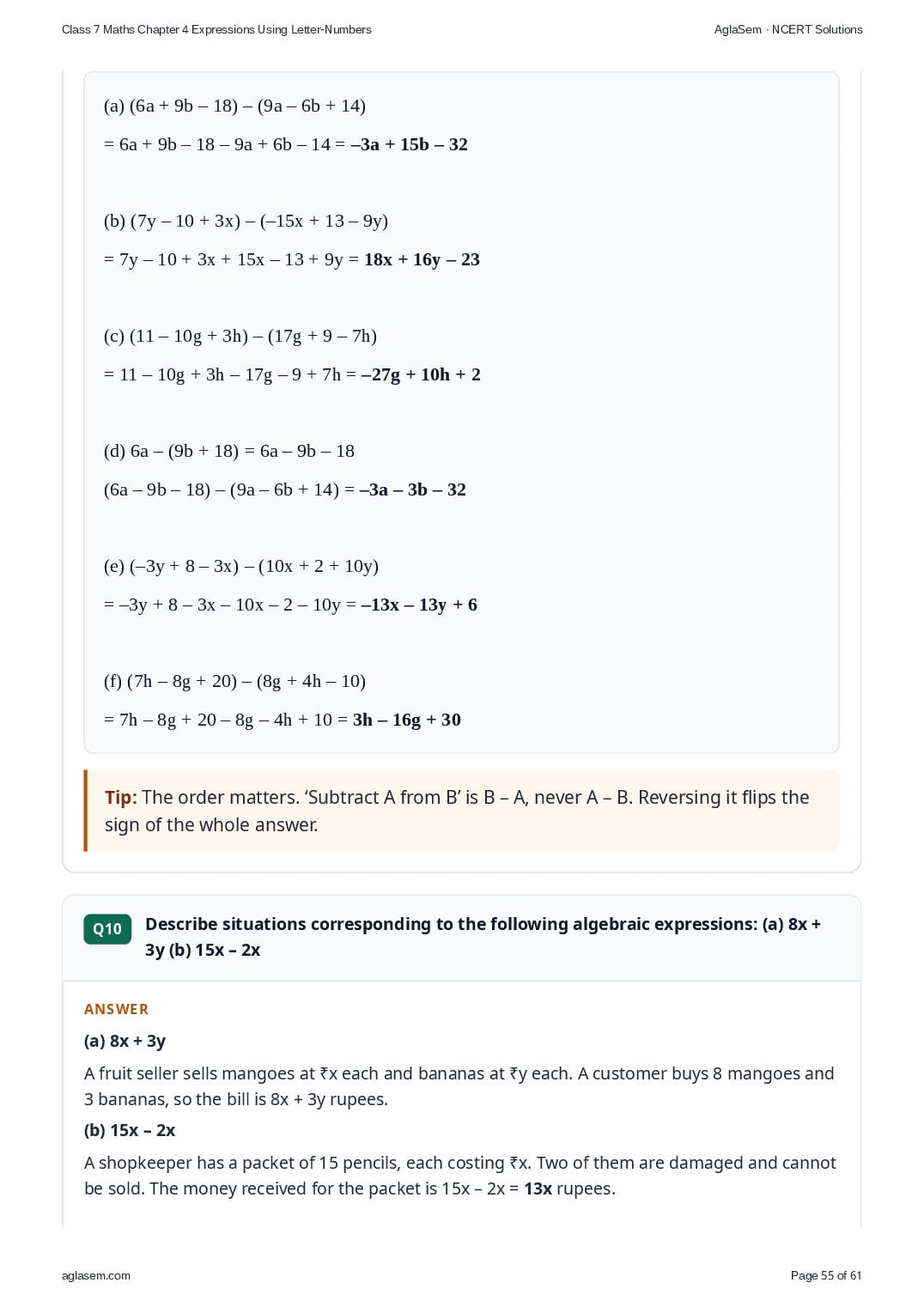
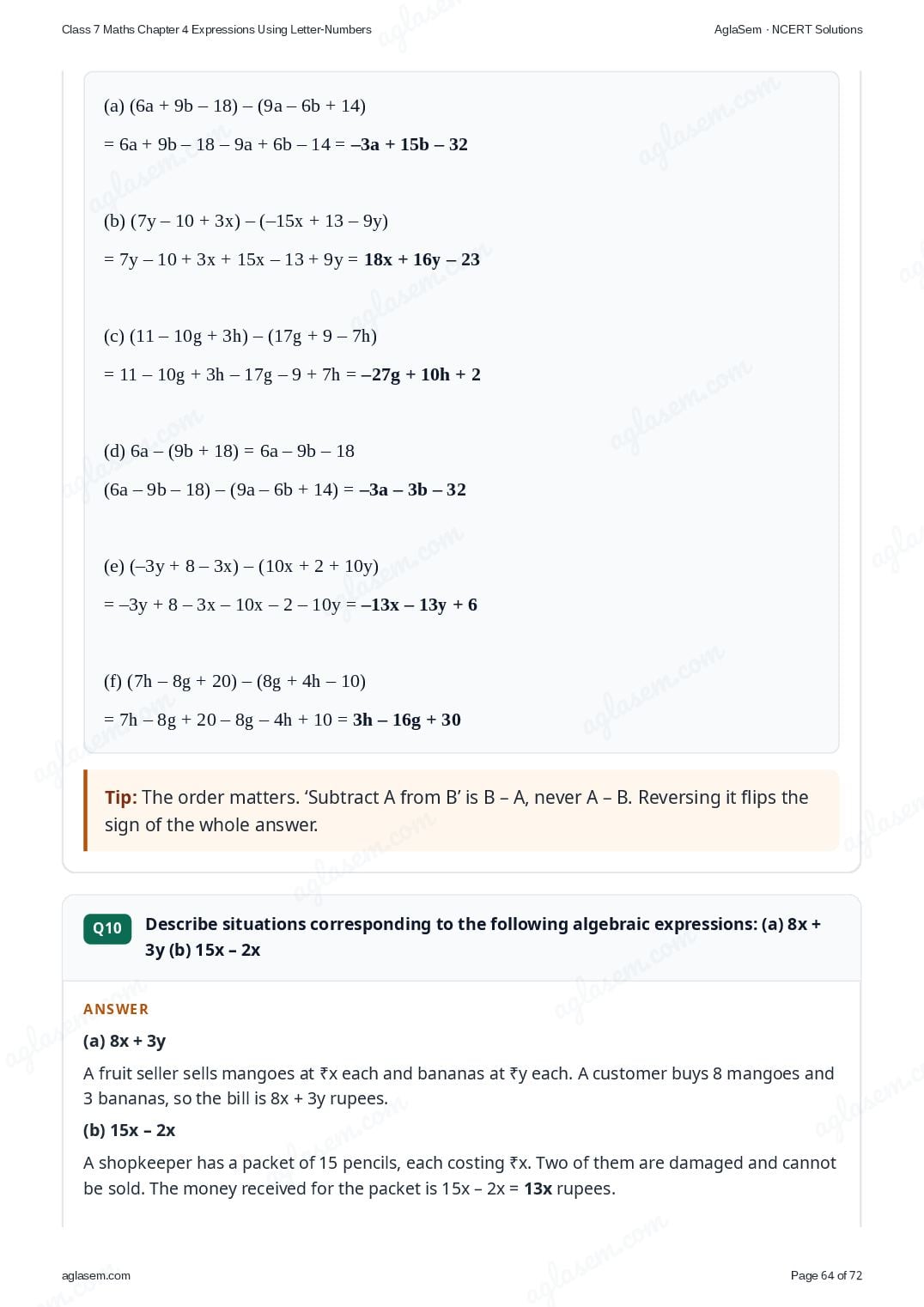
- Subtract the expressions given below: (a) 9a – 6b + 14 from 6a + 9b – 18 (b) – 15x + 13 – 9y from 7y – 10 + 3x (c) 17g + 9 – 7h from 11 – 10g + 3h (d) 9a – 6b + 14 from 6a – (9b + 18) (e) 10x + 2 + 10y from –3y +8 – 3x (f) 8g + 4h – 10 from 7h – 8g + 20
- Describe situations corresponding to the following algebraic expressions: (a) 8x + 3y (b) 15x – 2x
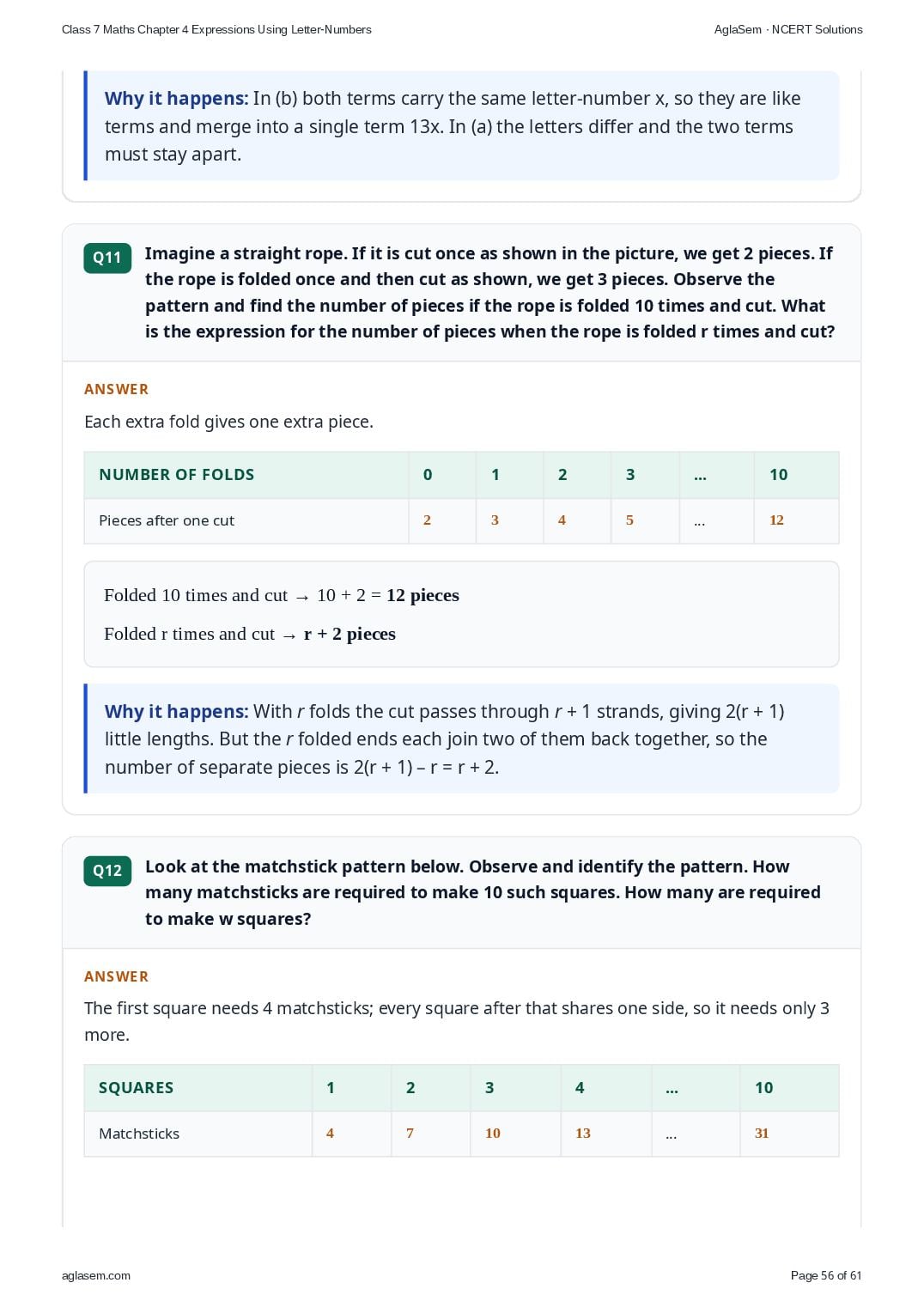
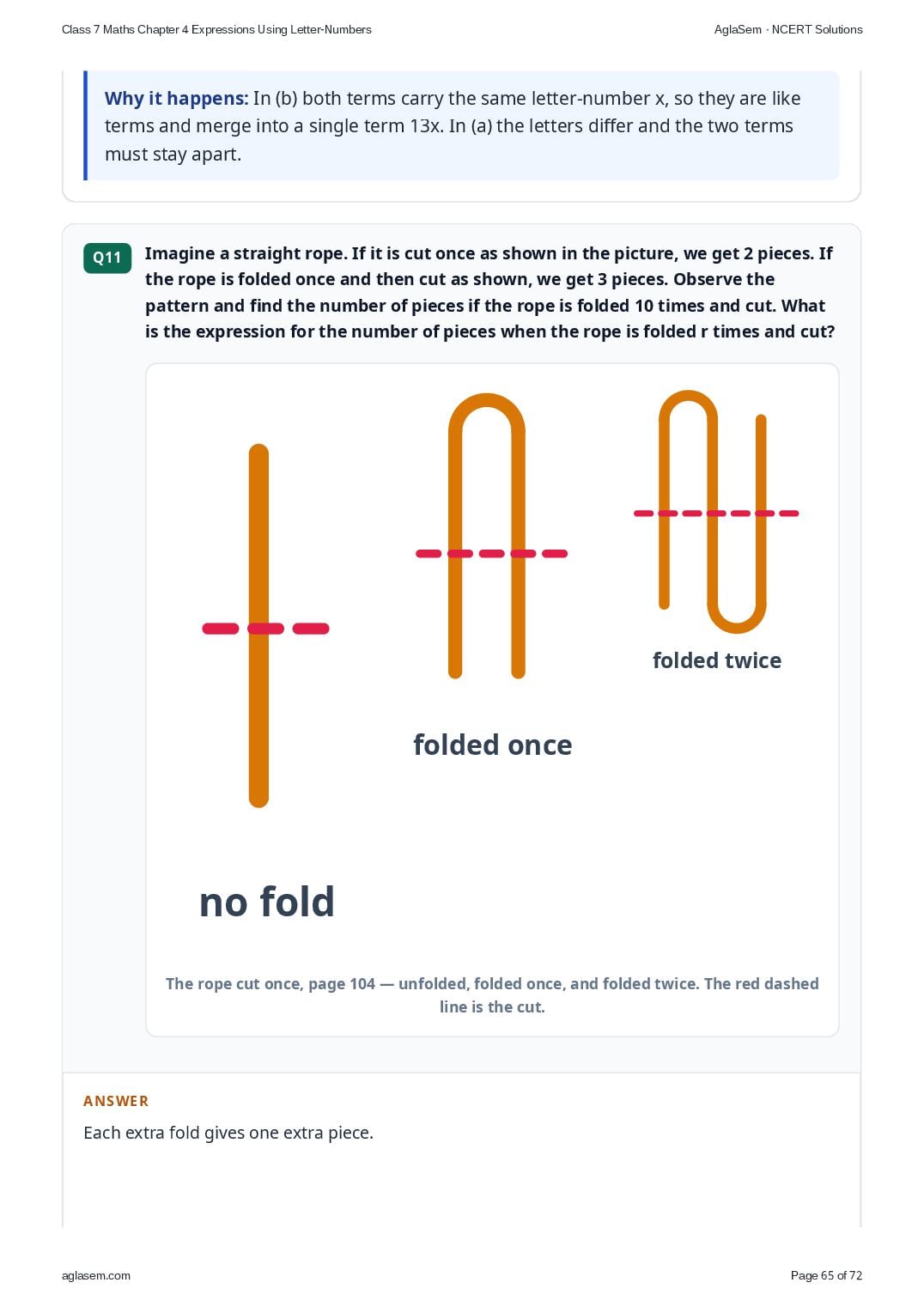
- Imagine a straight rope. If it is cut once as shown in the picture, we get 2 pieces. If the rope is folded once and then cut as shown, we get 3 pieces. Observe the pattern and find the number of pieces if the rope is folded 10 times and cut. What is the expression for the number of pieces when the rope is folded r times and cut?
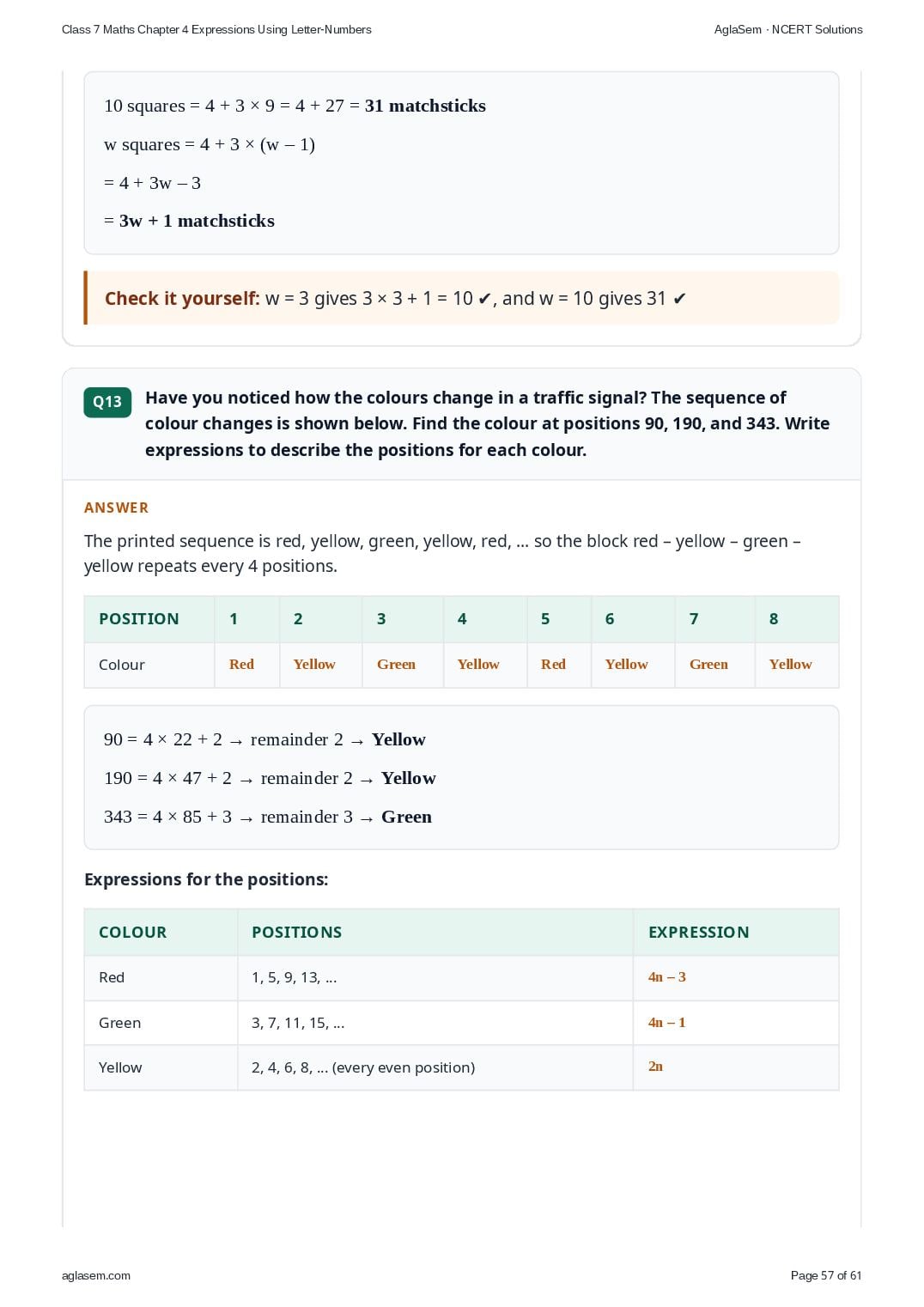
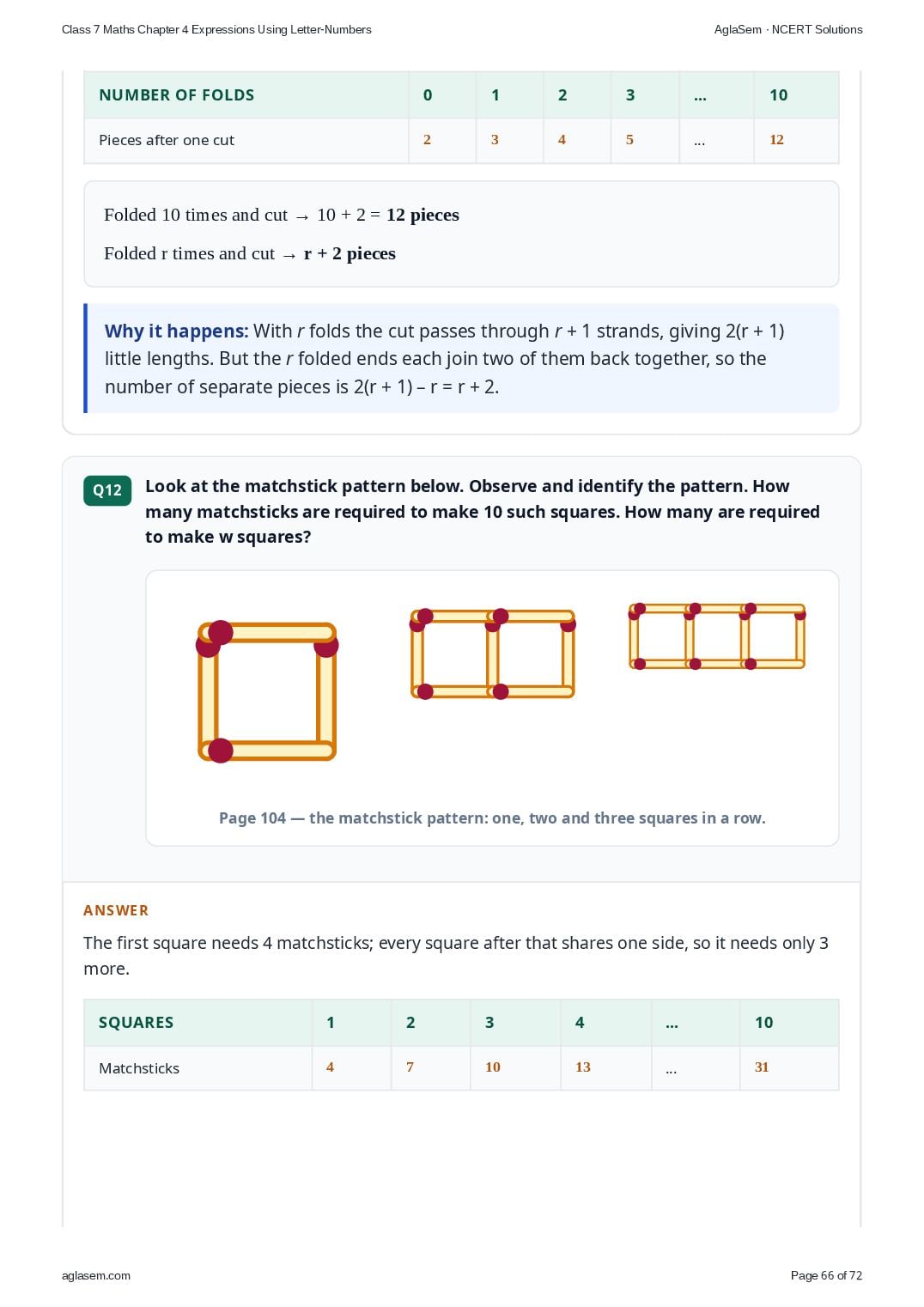
- Look at the matchstick pattern below. Observe and identify the pattern. How many matchsticks are required to make 10 such squares. How many are required to make w squares?
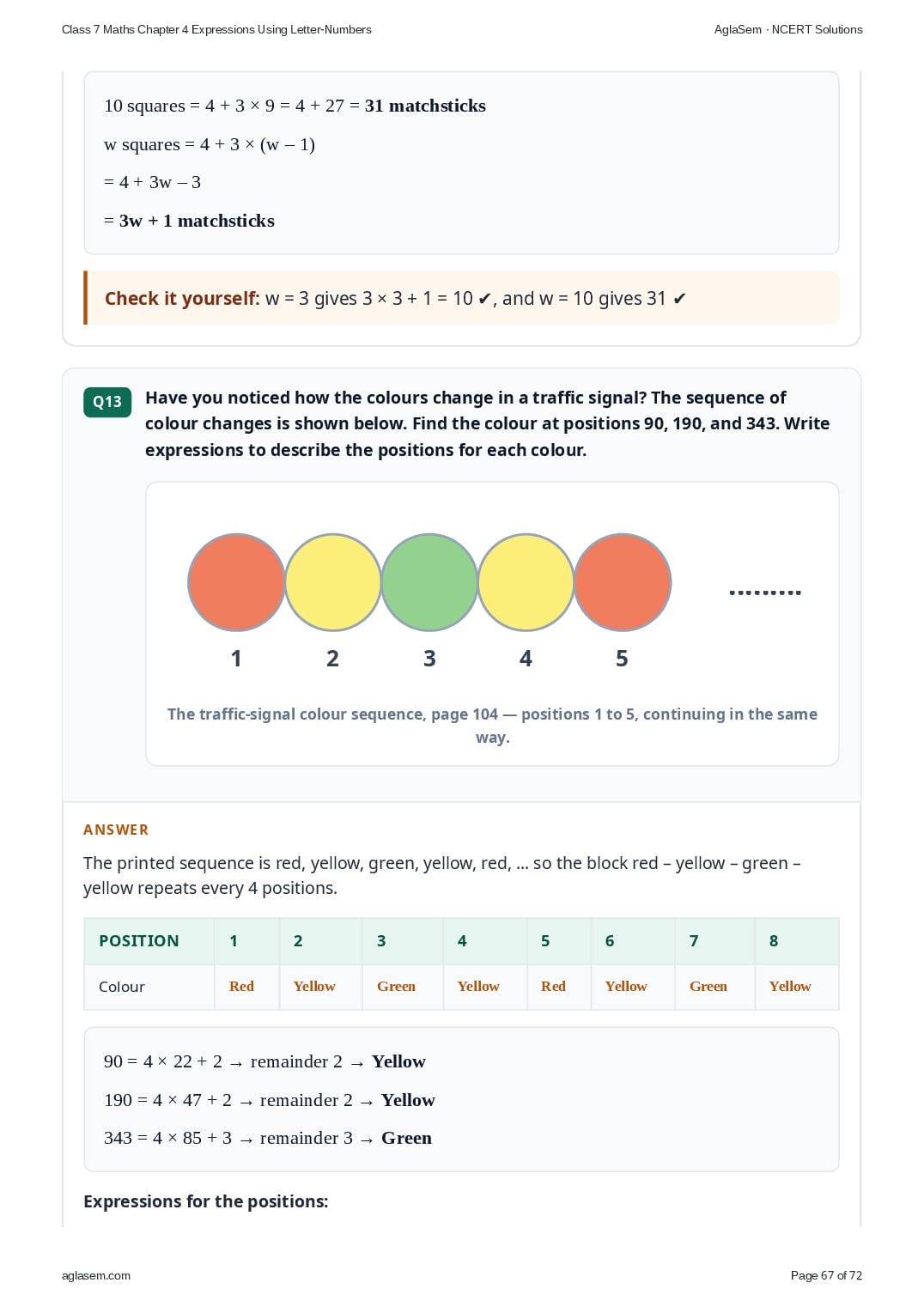
- Have you noticed how the colours change in a traffic signal? The sequence of colour changes is shown below. Find the colour at positions 90, 190, and 343. Write expressions to describe the positions for each colour.
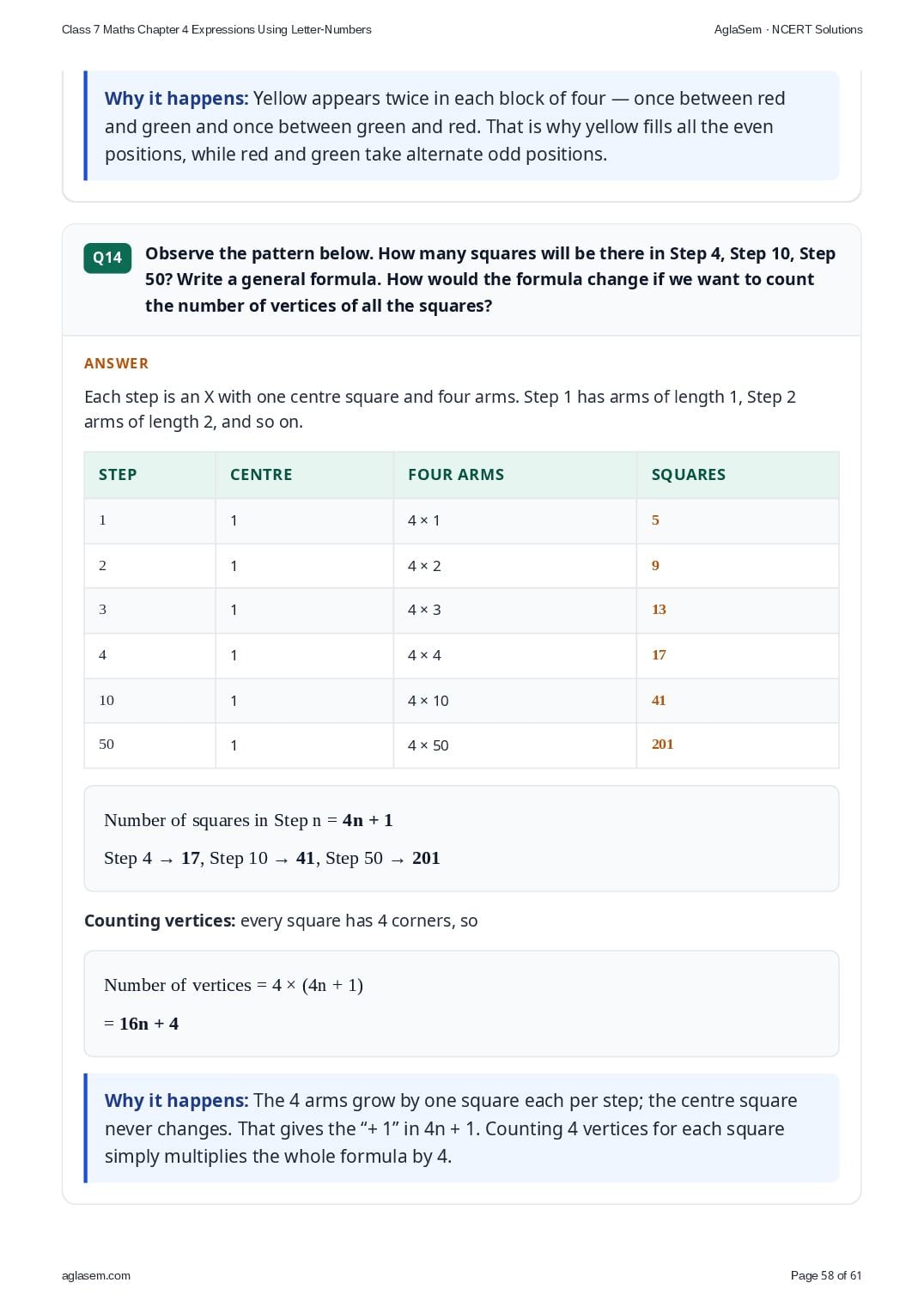
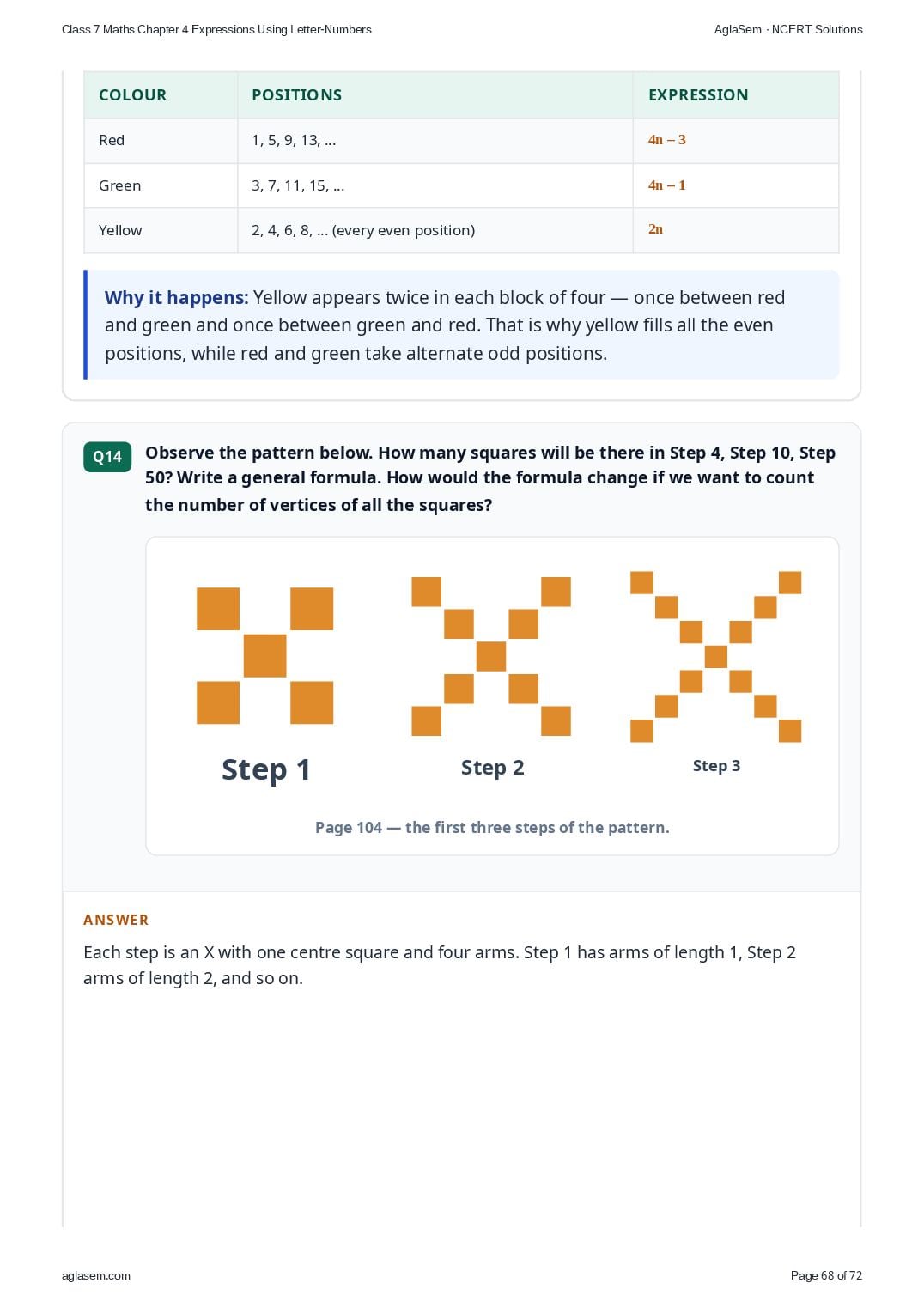
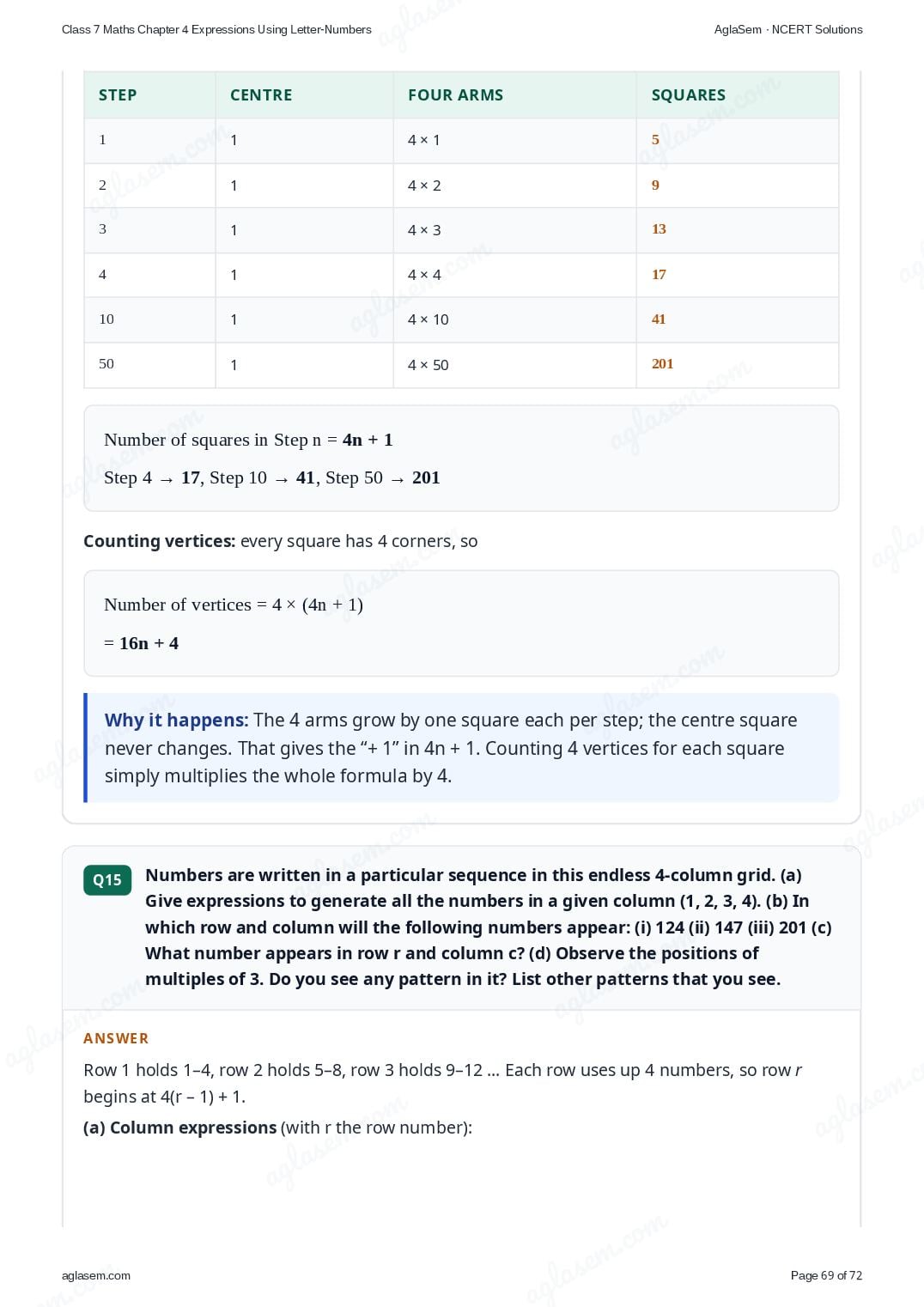
- Observe the pattern below. How many squares will be there in Step 4, Step 10, Step 50? Write a general formula. How would the formula change if we want to count the number of vertices of all the squares?
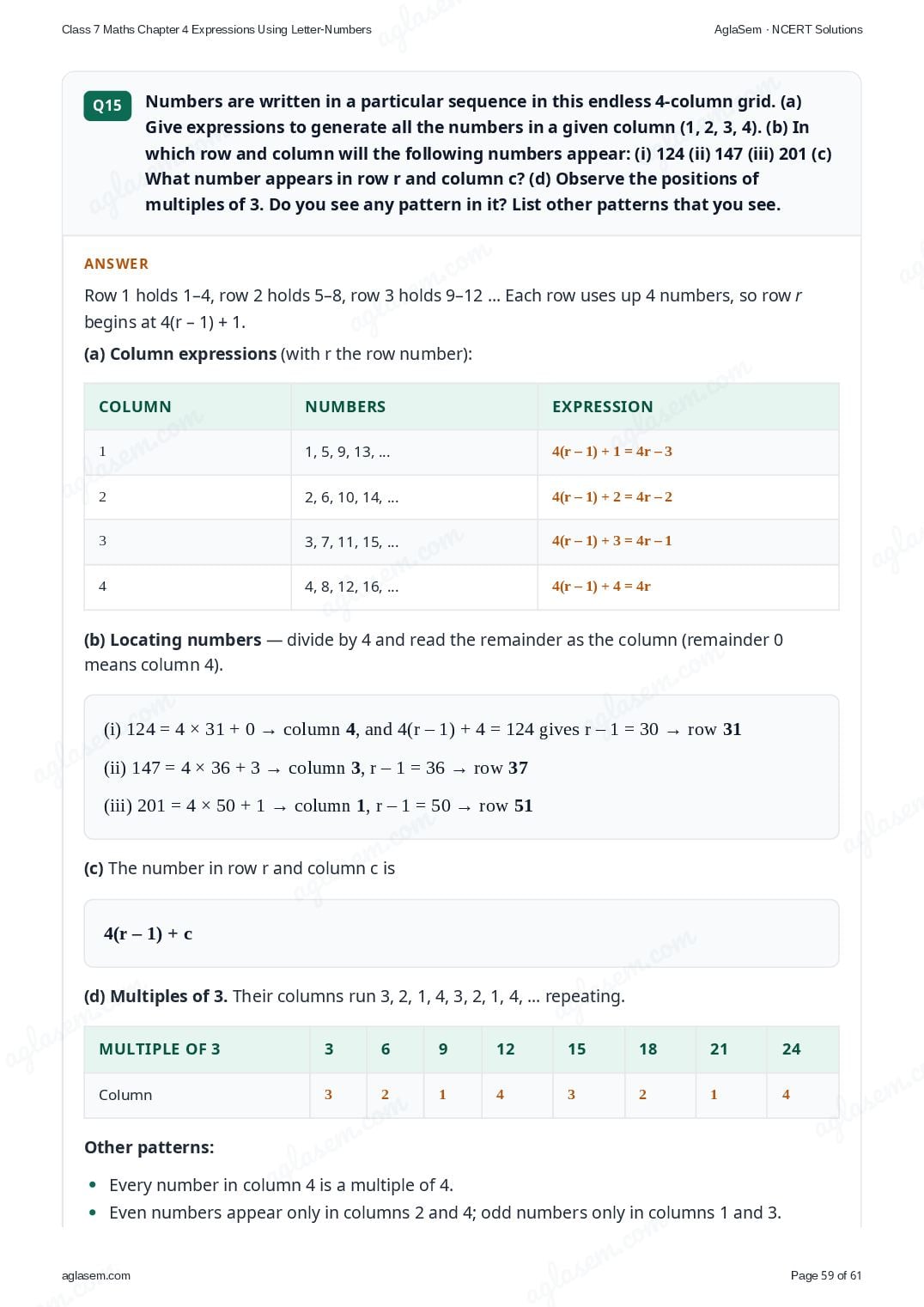
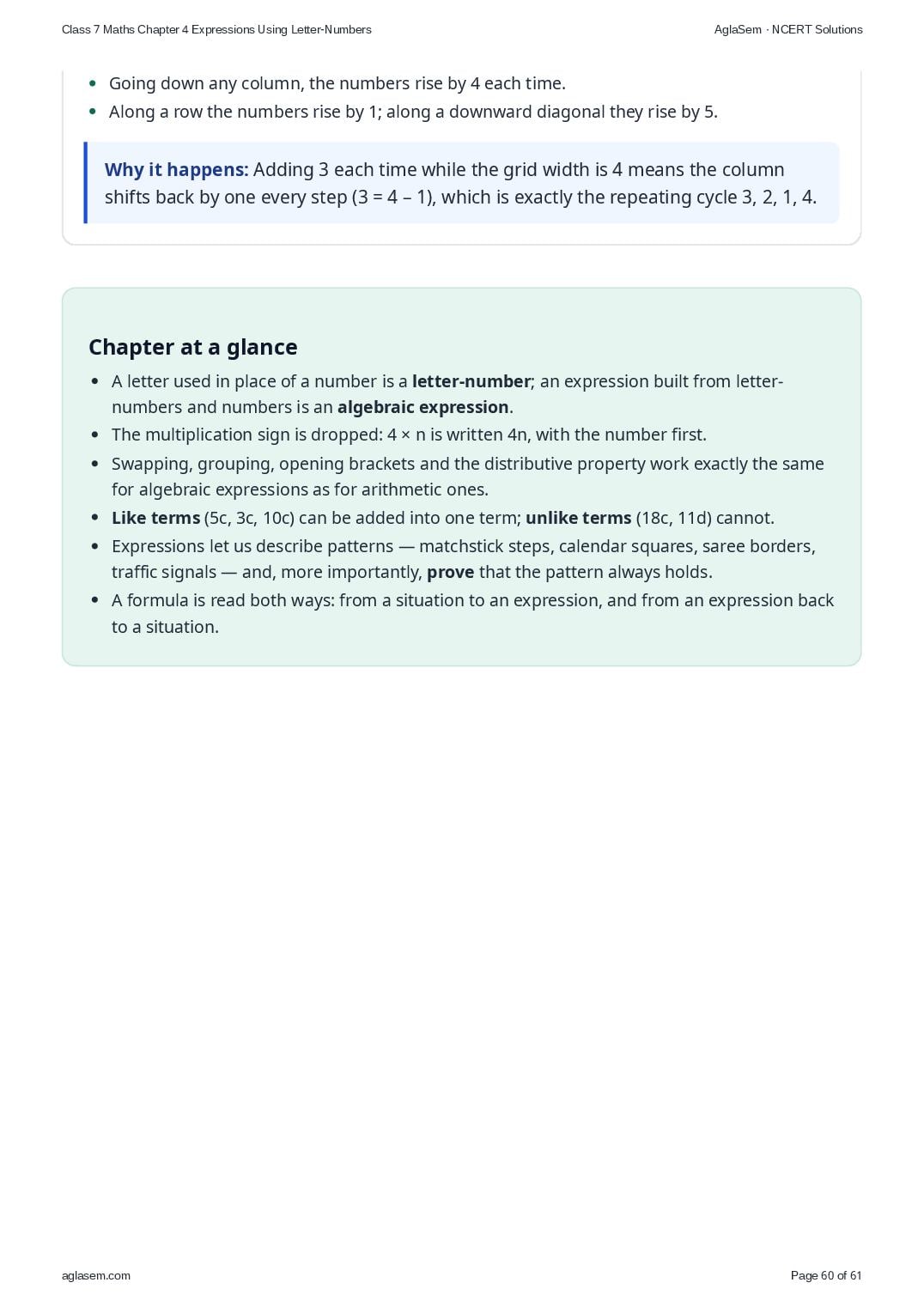
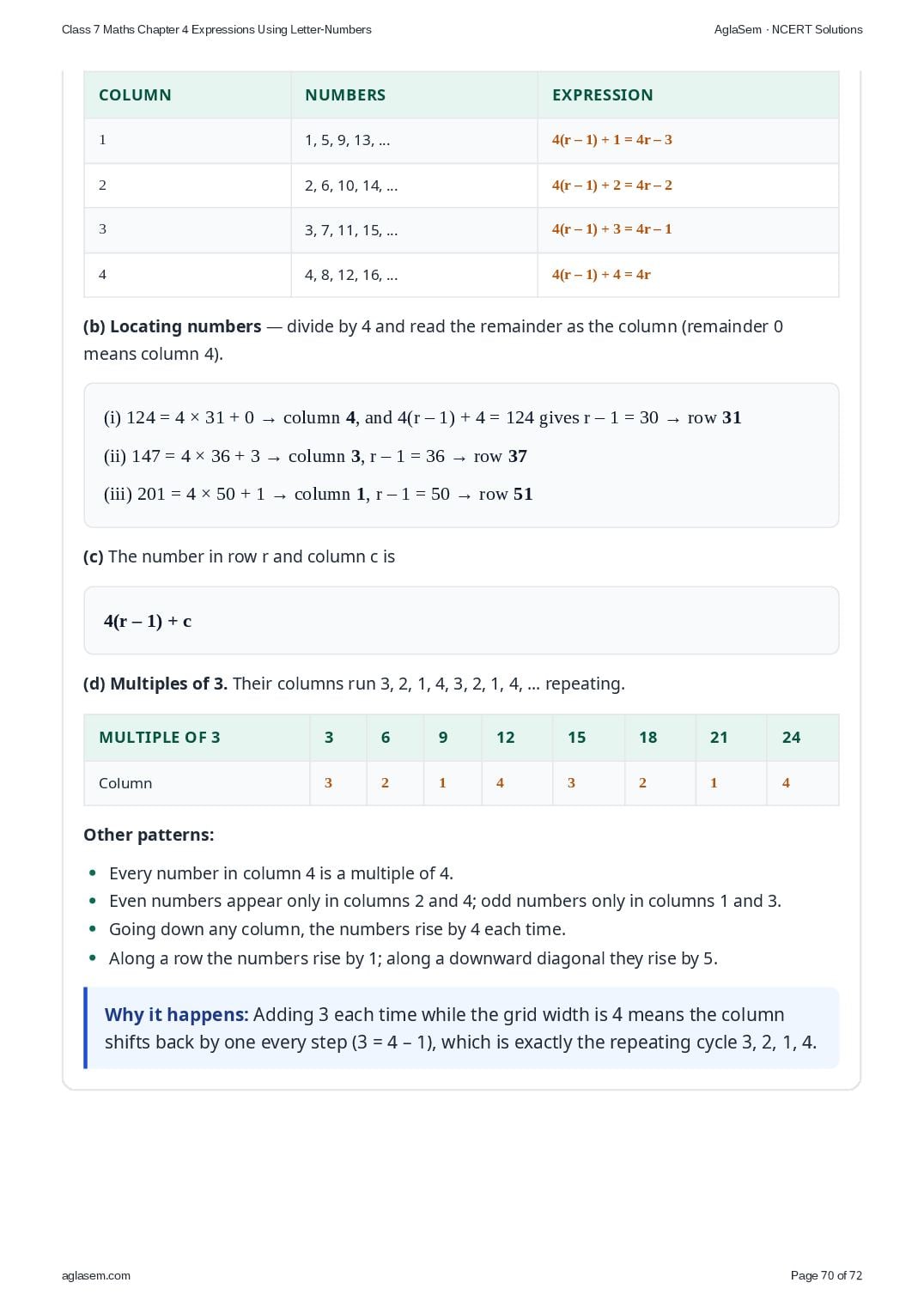
- Numbers are written in a particular sequence in this endless 4-column grid. (a) Give expressions to generate all the numbers in a given column (1, 2, 3, 4). (b) In which row and column will the following numbers appear: (i) 124 (ii) 147 (iii) 201 (c) What number appears in row r and column c? (d) Observe the positions of multiples of 3. Do you see any pattern in it? List other patterns that you see.
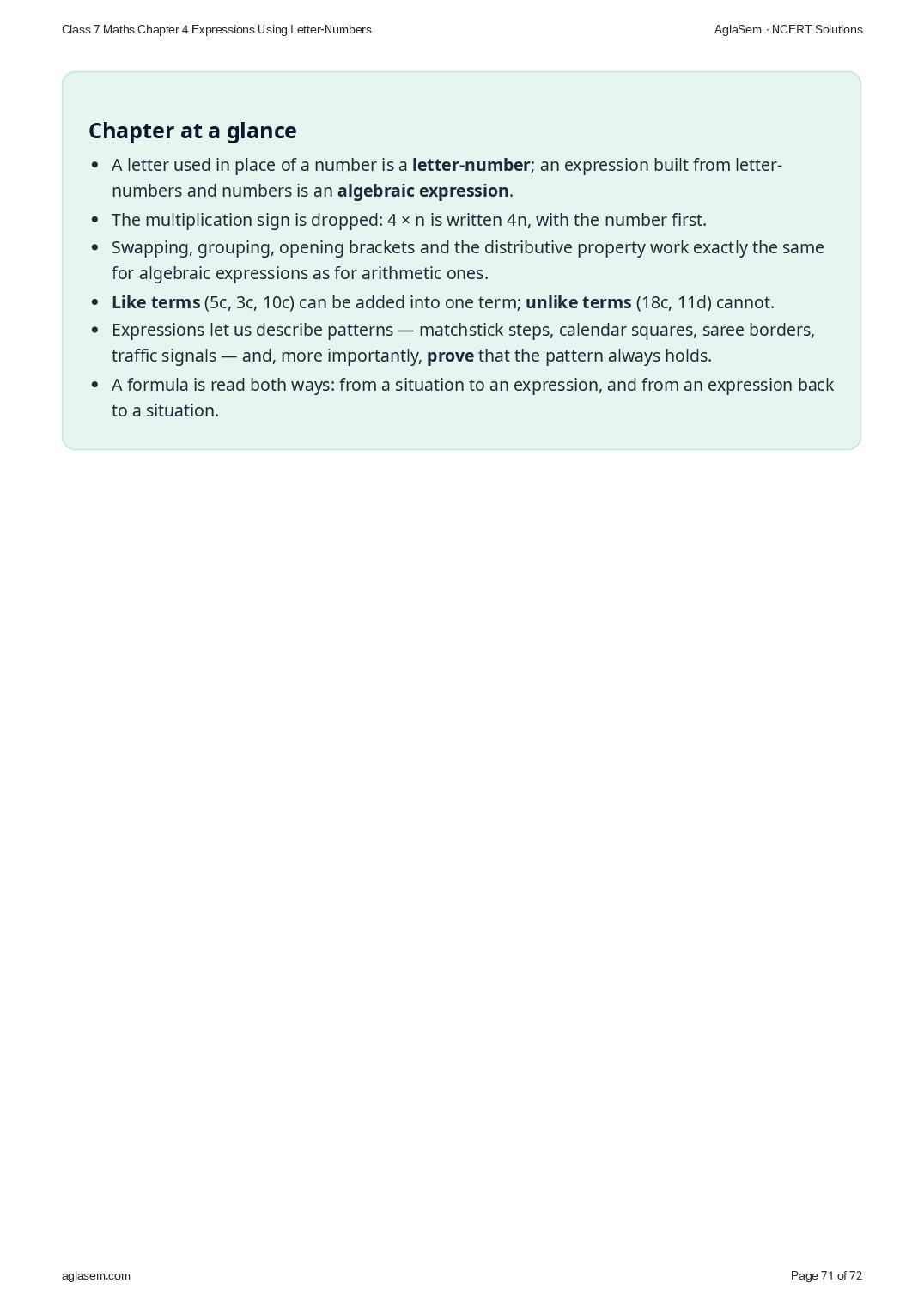
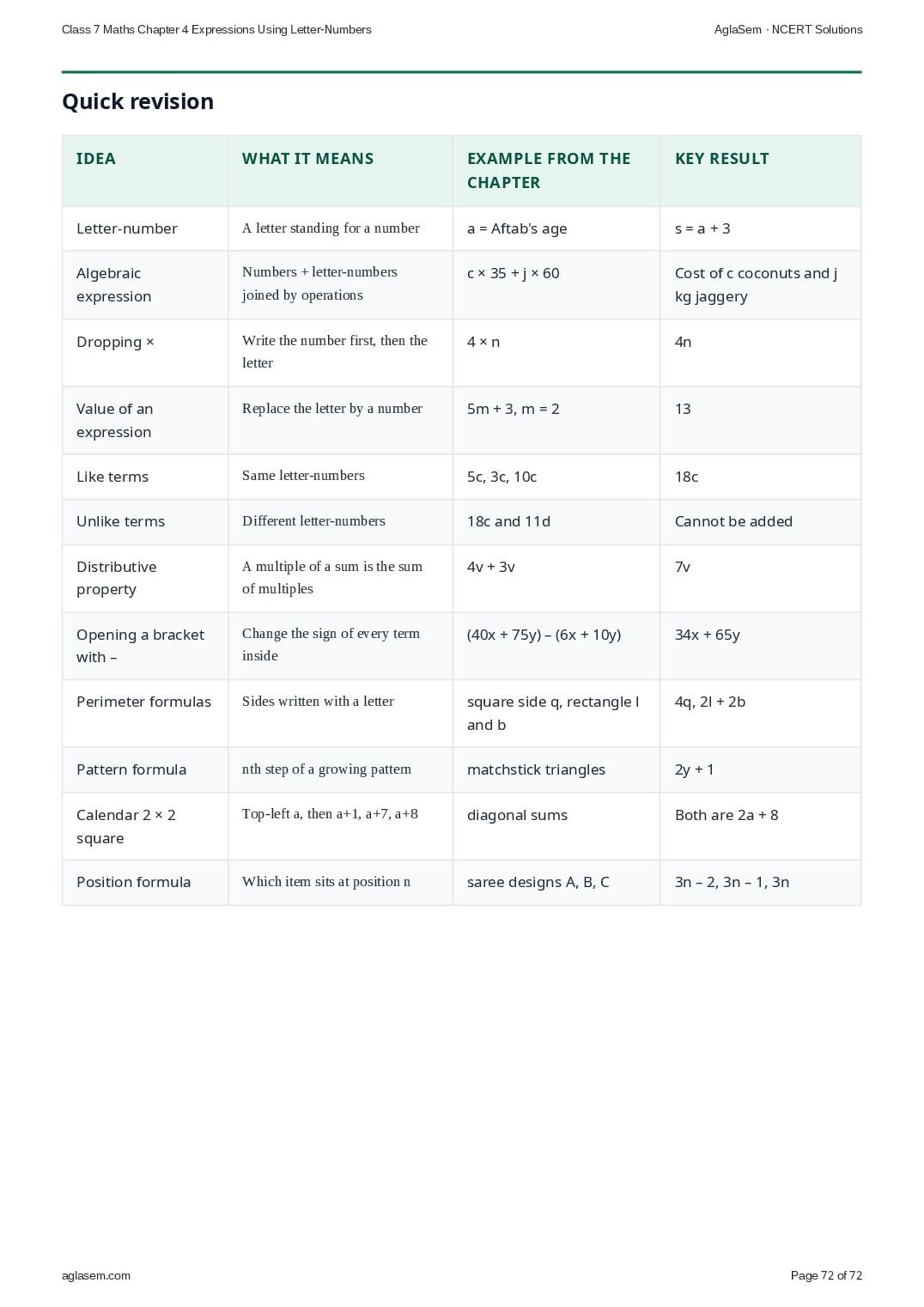
Chapter at a Glance
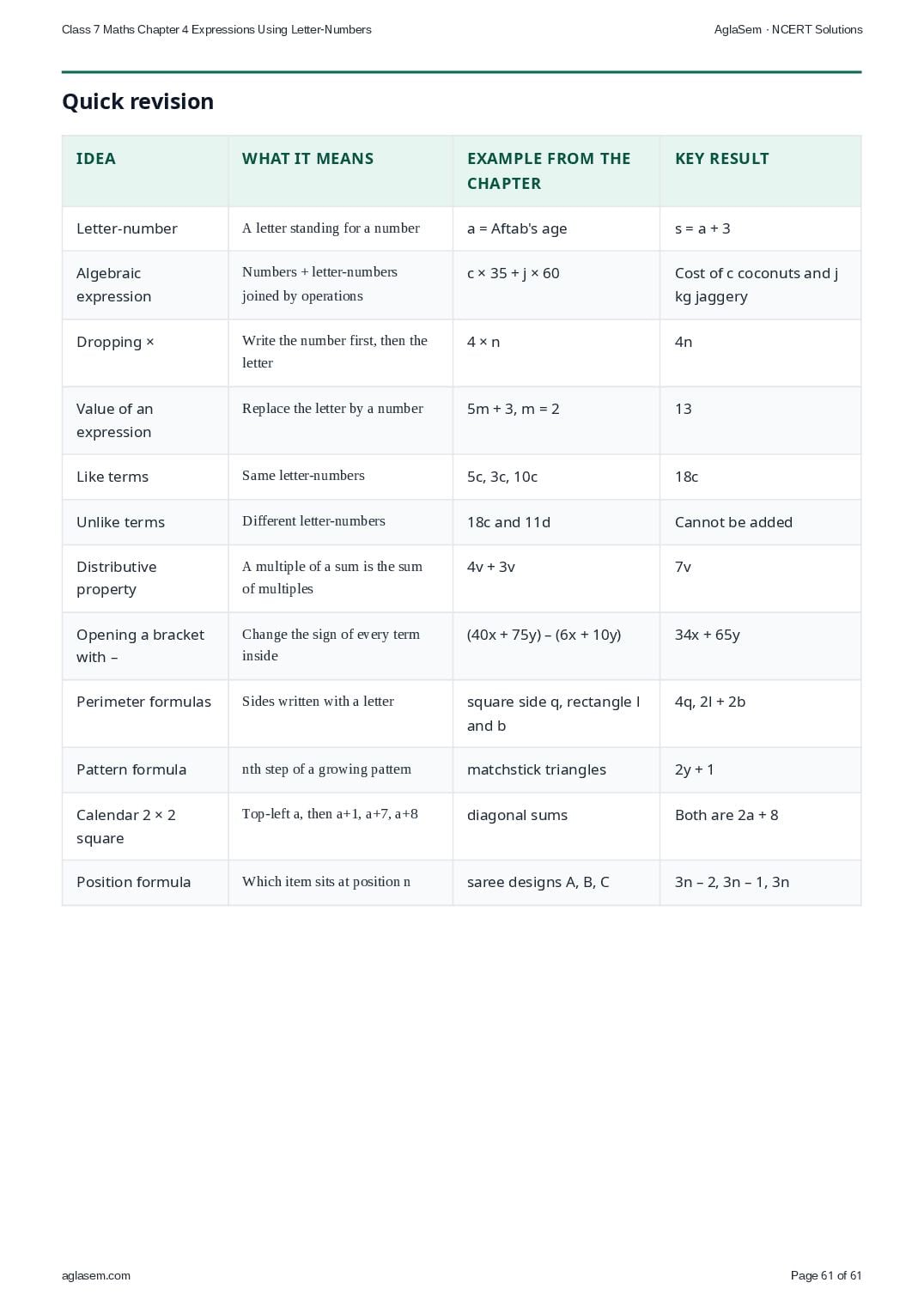
- A letter used in place of a number is a letter-number ; an expression built from letter-numbers and numbers is an algebraic expression .
- The multiplication sign is dropped: 4 × n is written 4n, with the number first.
- Swapping, grouping, opening brackets and the distributive property work exactly the same for algebraic expressions as for arithmetic ones.
- Like terms (5c, 3c, 10c) can be added into one term; unlike terms (18c, 11d) cannot.
- Expressions let us describe patterns — matchstick steps, calendar squares, saree borders, traffic signals — and, more importantly, prove that the pattern always holds.
- A formula is read both ways: from a situation to an expression, and from an expression back to a situation.
How to Download NCERT Solutions for Class 7 Maths Chapter 4 PDF
Follow these simple steps to get the Expressions Using Letter Numbers questions-and-answers PDF from Ganita Prakash.
- Search NCERT Solutions for Class 7 Maths Chapter 4 aglasem and open this page.
- Read the exercise questions with answers for Expressions Using Letter Numbers shown above.
- Click the Download PDF link to save the Expressions Using Letter Numbers solutions to your device.
NCERT Solutions for Class 7 Maths – All Chapters
There are more chapters to study besides Expressions Using Letter Numbers in Maths. Here are the NCERT Solutions for all chapters of Class 7 Maths.
- Chapter 1 Large Numbers Around Us
- Chapter 2 Arithmetic Expressions
- Chapter 3 a Peek Beyond the Point
- Chapter 4 Expressions Using Letter Numbers
- Chapter 5 Parallel and Intersecting Lines
- Chapter 6 Number Play
- Chapter 7 a Tale of Three Intersecting Lines
- Chapter 8 Working with Fractions
NCERT Solutions for Class 7 – All Subjects
Just like Chapter 4 of Maths, you can get the exercise questions with answers for every other subject of Class 7. Here are the NCERT Solutions for all subjects of Class 7.
NCERT Solutions for Class 7 Maths Chapter 4 – An Overview
The key highlights of this study material are as follows.
| Aspects | Details |
|---|---|
| Class | Class 7 |
| Subject | Maths |
| Chapter Number | Chapter 4 |
| Chapter Name | Expressions Using Letter Numbers |
| Book Name | Ganita Prakash |
| Book By | NCERT (National Council of Educational Research and Training) |
| Educational Resource Here | NCERT Solutions of Class 7 Maths Chapter 4 for all exercises |
| More Questions Answers of This Subject | NCERT Solutions for Class 7 Maths |
| Download Book Chapter | NCERT Book Class 7 Maths |
| All Questions Answers For This Class | NCERT Solutions for Class 7 |
| Complete Solutions | NCERT Solutions |
NCERT Solutions for Class 7 Maths Chapter 4 Expressions Using Letter Numbers – FAQs
What are the NCERT Solutions for Class 7 Maths Chapter 4 Expressions Using Letter Numbers?
They are the complete, step-by-step answers to all the exercise and in-text questions of Chapter 4 Expressions Using Letter Numbers from the NCERT Class 7 Maths textbook Ganita Prakash, written by experts as per the latest NCERT syllabus.
How can I download the Class 7 Maths Chapter 4 solutions PDF for free?
Open this page on aglasem, read the Expressions Using Letter Numbers questions with answers, and click the “Download Solutions PDF” link. The Class 7 Maths Chapter 4 NCERT Solutions PDF is completely free to download.
Are these NCERT Solutions as per the latest 2026-27 syllabus?
Yes. The NCERT Solutions for Class 7 Maths Chapter 4 are based on the latest NCERT textbook Ganita Prakash and the current 2026-27 CBSE syllabus, so the questions and answers match what you study in class.
Where can I get NCERT Solutions for the other chapters of Class 7 Maths?
You can find the answers to every chapter on the NCERT Solutions for Class 7 Maths page, and solutions for every subject on the NCERT Solutions for Class 7 page.
How do NCERT Solutions help in exam preparation?
They show the correct method to solve each question, help you write answers the way they are expected in exams, let you check and correct your own work, and save revision time — which together improve your marks in Class 7 Maths.
If you have any queries on NCERT Solutions for Class 7 Maths Chapter 4 Expressions Using Letter Numbers, then please ask in the comments below.
