NCERT Solutions for Class 7 Maths Chapter 11 Finding Common Ground – step-by-step answers to every exercise and in-text question of the chapter, as per the latest NCERT syllabus for 2027. Read them online or download the free question-answer PDF.
Chapter 3 of Ganita Prakash Grade 7 Part II starts with Sameeksha tiling a 12 ft × 16 ft room and ends with a relation that ties two numbers to their HCF and LCM. On the way it builds prime factorisation into a tool: every factor of a number is a subpart of its prime factorisation, and that one idea gives both the HCF and the LCM.
NCERT Solutions for Class 7 Maths Chapter 11 Finding Common Ground PDF
All the answers are on this page below. The PDF also explains every answer – why it is right and how to check it – so download it for revision.
| Chapter | Download | |
|---|---|---|
| Solutions PDF | Finding Common Ground | View PDF |
NCERT Solutions for Class 7 Maths Chapter 11 Finding Common Ground – Questions and Answers
All 85 questions of the chapter (textbook pages Part II, 47 – 66) are answered below, in the order of the book – in-text questions, activities and the end-of-chapter exercises. Each answer is written the way you would write it in the exam.
In-text Questions — Page 47Section 3.1 The Greatest of All
She should buy square tiles of side 4 ft.
The tiles must fit the room exactly, with no cutting.
Along the length: the side of the tile must be a factor of 16
Factors of 12 = 1, 2, 3, 4, 6, 12
Factors of 16 = 1, 2, 4, 8, 16
Common factors = 1, 2, 4
Largest common factor = 4
Because a bigger tile covers more floor, so fewer tiles are needed.
With 1 ft tiles: 192 ÷ 1 = 192 tiles
With 2 ft tiles: 192 ÷ 4 = 48 tiles
With 4 ft tiles: 192 ÷ 16 = 12 tiles
Sameeksha wants as few tiles as possible, so she picks the 4 ft tile.
In-text Questions — Page 48Section 3.1 The Greatest of All — HCF and Lekhana’s rice bags
She should purchase 12 tiles.
Along the length: 16 ÷ 4 = 4 tiles
Total = 3 × 4 = 12 tiles
Checking by area: 192 sq ft ÷ 16 sq ft per tile = 12 tiles ✓
No, the answer would not change. The largest square tile that fits is still 4 ft, so 12 tiles is still the fewest.
So the remaining 16 − 12 = 4 ft must also take a whole number of tiles
So no square tile can be bigger than 4 ft, even if fractions are allowed
Each bag should hold 12 kg.
Factors of 108 = 1, 2, 3, 4, 6, 9, 12, 18, 27, 36, 54, 108
Common factors = 1, 2, 3, 4, 6, 12
HCF = 12
With 12 kg bags:
From the second farm: 108 ÷ 12 = 9 bags
Total = 16 bags
She should choose the largest common factor, 12 kg.
| Bag weight | Bags for 84 kg | Bags for 108 kg | Total bags |
|---|---|---|---|
| 1 kg | 84 | 108 | 192 |
| 2 kg | 42 | 54 | 96 |
| 3 kg | 28 | 36 | 64 |
| 4 kg | 21 | 27 | 48 |
| 6 kg | 14 | 18 | 32 |
| 12 kg | 7 | 9 | 16 |
Try This — Page 48Section 3.1 The Greatest of All — the ‘Jump Jackpot’ game from Grade 6
Jumpy lands only on multiples of his jump size, so the jump size must be a common factor of the two numbers. The longest jump is the largest common factor.
| Numbers | Common factors | Longest jump | |
|---|---|---|---|
| (a) | 14 and 30 | 1, 2 | 2 |
| (b) | 7 and 11 | 1 | 1 |
| (c) | 30 and 50 | 1, 2, 5, 10 | 10 |
| (d) | 28 and 42 | 1, 2, 7, 14 | 14 |
Yes. The longest jump size is exactly the HCF of the two numbers.
Jumpy lands only on multiples of his jump size. To land on both treasure numbers, the jump size must be a factor of both numbers, that is, a common factor. The longest such jump is the highest common factor — the HCF.
In-text Questions — Page 49Section 3.1 Primes and Prime Factorisation
Yes — prime factorisation simplifies it and makes it reliable.
50 → 1, 2, 5, 10, 25, 50
Compare the two lists, pick the largest match = 10
Prime method: 30 = 2 × 3 × 5, 50 = 2 × 5 × 5
Common primes: one 2 and one 5
HCF = 2 × 5 = 10
Yes. The prime factors always come out the same, only the order may differ.
90 = 2 × 45 = 2 × (9 × 5) = 2 × 3 × 3 × 5
Every route ends with one 2, two 3s and one 5.
At each step the number is divided by a prime, and the quotient is written below it. We stop when a prime is left.
30 = 2 × 15 and 15 = 3 × 5 → 30 = 2 × 3 × 5
In-text Questions — Page 50Section 3.1 The Division Method · Factors of a Number Using Prime Factorisation
Collect the primes written on the left, then the prime left at the bottom.
5 | 35
7
105 = 3 × 5 × 7
2 | 30
3 | 15
5
30 = 2 × 3 × 5
Check: 3 × 5 × 7 = 105 ✓ and 2 × 3 × 5 = 30 ✓
Divide by the smallest prime that works, again and again.
2 | 600
2 | 300
2 | 150
3 | 75
5 | 25
5
1200 = 2 × 2 × 2 × 2 × 3 × 5 × 5
Check: 2 × 2 × 2 × 2 = 16, and 16 × 3 = 48, and 48 × 5 × 5 = 48 × 25 = 1200 ✓
The division method is easier.
| Earlier method | Division method |
|---|---|
| You must spot a pair of factors of 1200 yourself | You only test 2, 3, 5, 7 … in order |
| Several unfinished pieces to keep track of (8 and 6 still composite) | One number at a time, written in a neat column |
| Easy to stop too early and leave a composite factor | You stop only when a prime is reached |
Finishing the earlier calculation: 1200 = 40 × 30 = 5 × 8 × 5 × 6 = 5 × (2 × 2 × 2) × 5 × (2 × 3) = 2 × 2 × 2 × 2 × 3 × 5 × 5 — the same answer, but with more bookkeeping.
Yes, 28 is a factor of 840.
Reorder the prime factors so that 2 × 2 × 7 sit together (reordering does not change a product):
= (2 × 2 × 7) × (2 × 3 × 5)
= 28 × 30
So 840 ÷ 28 = 30, a whole number. Hence 28 is a factor.
It should be multiplied by 30.
The primes left over are 2, 3 and 5
2 × 3 × 5 = 30
Check: 28 × 30 = 840 ✓
In-text Questions — Page 51Section 3.1 Factors of a Number Using Prime Factorisation
Yes, 14 is a factor of 840, because 2 × 7 is a subpart of the prime factorisation of 840.
= (2 × 7) × (2 × 2 × 3 × 5)
= 14 × 60
Check: 14 × 60 = 840 ✓
Yes, 2 × 2 × 2 = 8 is a factor of 840, because the prime factorisation of 840 has three 2s.
= 8 × 10⁵
Check: 8 × 105 = 840 ✓
No, 3 × 3 × 3 = 27 is not a factor of 840.
Number of 3s in 840 = only one
27 needs three 3s
Check: 840 ÷ 27 = 31.11… — not a whole number ✗
Yes. Every factor is a subpart of the prime factorisation, so listing all the subparts lists all the factors.
Take 30 = 2 × 3 × 5.
One prime at a time: 2, 3, 5
Two primes together: 2 × 3 = 6, 2 × 5 = 10, 3 × 5 = 15
All three: 2 × 3 × 5 = 30
Factors of 30 = 1, 2, 3, 5, 6, 10, 15, 30
First factorise 225 by the division method.
5 | 45
3 | 9
3 | 3
1
225 = 3 × 3 × 5 × 5
Now form every subpart, systematically:
One prime: 3, 5
Two primes: 3 × 3 = 9, 5 × 5 = 25, 3 × 5 = 15
Three primes: 3 × 3 × 5 = 45, 3 × 5 × 5 = 75
Four primes: 3 × 3 × 5 × 5 = 225
Factors of 225 = 1, 3, 5, 9, 15, 25, 45, 75, 225 — nine factors in all.
Yes, all the factors are in the list. Pair each factor with its partner:
| Pair | Product |
|---|---|
| 1 × 225 | 225 ✓ |
| 3 × 75 | 225 ✓ |
| 5 × 45 | 225 ✓ |
| 9 × 25 | 225 ✓ |
| 15 × 15 | 225 ✓ |
The nine factors fall into four pairs plus the middle one, 15. Nothing is missing, and nothing extra has crept in.
Figure it Out — Page 51Section 3.1 Factors of a Number Using Prime Factorisation
Factorise each number into primes, then build every subpart.
| Number and its prime factorisation | All factors |
|---|---|
| (a) 90 = 2 × 3 × 3 × 5 | 1, 2, 3, 5, 6, 9, 10, 15, 18, 30, 45, 90 (12 factors) |
| (b) 105 = 3 × 5 × 7 | 1, 3, 5, 7, 15, 21, 35, 105 (8 factors) |
| (c) 132 = 2 × 2 × 3 × 11 | 1, 2, 3, 4, 6, 11, 12, 22, 33, 44, 66, 132 (12 factors) |
| (d) 360 = 2 × 2 × 2 × 3 × 3 × 5 | 1, 2, 3, 4, 5, 6, 8, 9, 10, 12, 15, 18, 20, 24, 30, 36, 40, 45, 60, 72, 90, 120, 180, 360 (24 factors) |
| (e) 840 = 2 × 2 × 2 × 3 × 5 × 7 | 1, 2, 3, 4, 5, 6, 7, 8, 10, 12, 14, 15, 20, 21, 24, 28, 30, 35, 40, 42, 56, 60, 70, 84, 105, 120, 140, 168, 210, 280, 420, 840 (32 factors) |
In-text Questions — Pages 51–53Section 3.1 Finding the HCF of Numbers Using Prime Factorisation
Anshu’s claim is false. One counterexample is enough to settle it.
121 = 11 × 11 → 2 prime factors
121 is the larger number, but its factorisation is shorter
The common factors are 1, 3, 5 and 15, and the HCF is 15.
75 = 3 × 5 × 5
A common factor must be a subpart of both lists. Compare them:
| Subpart | Inside 3 × 3 × 5? | Inside 3 × 5 × 5? | Common factor? |
|---|---|---|---|
| 3 | yes | yes | yes |
| 5 | yes | yes | yes |
| 3 × 5 = 15 | yes | yes | yes |
| 3 × 3 = 9 | yes | no (only one 3) | no |
| 5 × 5 = 25 | no (only one 5) | yes | no |
Adding 1, the common factors are 1, 3, 5, 15. The highest is 15.
The common factors are 1, 2, 4, 7, 14 and 28, and the HCF is 28.
84 = 2 × 2 × 3 × 7
Common primes: 2 (112 has four, 84 has two → at most two) and 7 (one each).
| Common subpart | Value |
|---|---|
| 2 | 2 |
| 7 | 7 |
| 2 × 2 | 4 |
| 2 × 7 | 14 |
| 2 × 2 × 7 | 28 |
Check: 112 ÷ 28 = 4 ✓ and 84 ÷ 28 = 3 ✓
The only common factor is 1, so the HCF is 1.
275 = 5 × 5 × 11
Primes in 96: 2, 3
Primes in 275: 5, 11
Shared primes: none
With no prime in common, no subpart other than the empty one is shared. So 1 is the only common factor, and it is also the HCF.
Figure it Out — Page 53Section 3.1 Finding the HCF of Numbers Using Prime Factorisation
Factorise both numbers, keep the shared primes, then list every subpart built from them.
| HCF | Common factors | Working | |
|---|---|---|---|
| (a) 50, 60 | 10 | 1, 2, 5, 10 | 50 = 2 × 5 × 5 60 = 2 × 2 × 3 × 5 shared: one 2, one 5 → 2 × 5 |
| (b) 140, 275 | 5 | 1, 5 | 140 = 2 × 2 × 5 × 7 275 = 5 × 5 × 11 shared: one 5 |
| (c) 77, 725 | 1 | 1 | 77 = 7 × 11 725 = 5 × 5 × 29 shared: none |
| (d) 370, 592 | 74 | 1, 2, 37, 74 | 370 = 2 × 5 × 37 592 = 2 × 2 × 2 × 2 × 37 shared: one 2, one 37 → 2 × 37 |
| (e) 81, 243 | 81 | 1, 3, 9, 27, 81 | 81 = 3 × 3 × 3 × 3 243 = 3 × 3 × 3 × 3 × 3 shared: four 3s → 3 × 3 × 3 × 3 |
In-text Questions — Pages 53–54Section 3.1 Finding the HCF Directly from the Prime Factorisations
Build the HCF prime by prime: keep only the primes that occur in every number, and take each one the fewest number of times it occurs.
Step 2 — mark the primes that appear in all of them
Step 3 — for each such prime, count how many times it occurs in each number and take the minimum
Step 4 — multiply what you have collected
HCF(30, 72) = 6.
72 = 2 × 2 × 2 × 3 × 3
Primes in both: 2 and 3 (5 is only in 30, so it is out)
How many 2s? 30 has one 2, 72 has three 2s. The minimum is one.
How many 3s? 30 has one 3, 72 has two 3s. The minimum is one.
Check: 30 ÷ 6 = 5 ✓ and 72 ÷ 6 = 12 ✓
HCF(225, 750) = 75.
750 = 2 × 3 × 5 × 5 × 5
Primes in both: 3 and 5 (2 is only in 750)
How many 3s? 225 has two, 750 has one. The minimum is one.
How many 5s? 225 has two, 750 has three. The minimum is two.
Check: 225 ÷ 75 = 3 ✓ and 750 ÷ 75 = 10 ✓
Figure it Out — Page 54Section 3.1 Finding the HCF of Numbers Using Prime Factorisation
Factorise, mark the shared primes, take the minimum count of each.
| HCF | Working | |
|---|---|---|
| (a) 24, 180 | 2 × 2 × 3 = 12 | 24 = 2 × 2 × 2 × 3 180 = 2 × 2 × 3 × 3 × 5 shared: two 2s, one 3 |
| (b) 42, 75, 24 | 3 | 42 = 2 × 3 × 7 75 = 3 × 5 × 5 24 = 2 × 2 × 2 × 3 shared: one 3 only (75 has no 2) |
| (c) 240, 378 | 2 × 3 = 6 | 240 = 2 × 2 × 2 × 2 × 3 × 5 378 = 2 × 3 × 3 × 3 × 7 shared: one 2, one 3 |
| (d) 400, 2500 | 2 × 2 × 5 × 5 = 100 | 400 = 2 × 2 × 2 × 2 × 5 × 5 2500 = 2 × 2 × 5 × 5 × 5 × 5 shared: two 2s, two 5s |
| (e) 300, 800 | 2 × 2 × 5 × 5 = 100 | 300 = 2 × 2 × 3 × 5 × 5 800 = 2 × 2 × 2 × 2 × 2 × 5 × 5 shared: two 2s, two 5s |
No. 6, 12, 8 and 18 are not primes, so they still hide common prime factors — for example, 6 and 8 both contain 2. Breaking them into primes shows many common factors:
144 = 8 × 18 = 2 × 2 × 2 × 2 × 3 × 3
Shared: three 2s and two 3s → HCF = 2 × 2 × 2 × 3 × 3 = 72
In-text Questions — Page 55Section 3.2 Least, but not Last!
The shortest common length is 24 cm.
Guna’s torans (multiples of 8): 8, 16, 24, 32, 40, 48, 56, 64, 72, …
Common multiples: 24, 48, 72, …
Lowest common multiple = 24 cm
Anshu uses 24 ÷ 6 = 4 strips; Guna uses 24 ÷ 8 = 3 strips.
No. There is no largest common multiple.
Whatever common multiple you name, add 24 to it
The new number is still a multiple of 6 and still a multiple of 8
So it is a bigger common multiple
After 70 days.
Kabamai’s visits (multiples of 10): 10, 20, 30, 40, 50, 60, 70, …
First day common to both lists = 70
LCM(7, 10) = 7 × 10 = 70
70 days is 10 weeks, and also Kabamai’s 7th visit.
In-text Questions — Page 56Section 3.2 Least, but not Last! — the ‘Idli-Vada’ game from Grade 6
‘Idli-vada’ is called out at the first number that is a multiple of both — the LCM.
| Numbers | Prime factorisations | First ‘idli-vada’ |
|---|---|---|
| (a) 4 and 6 | 4 = 2 × 2, 6 = 2 × 3 | 12 |
| (b) 7 and 11 | 7, 11 (both prime) | 77 |
| (c) 14 and 30 | 14 = 2 × 7, 30 = 2 × 3 × 5 | 210 |
| (d) 15 and 55 | 15 = 3 × 5, 55 = 5 × 11 | 165 |
(b) LCM = 7 × 11 = 77
(c) LCM = 2 × 3 × 5 × 7 = 210
(d) LCM = 3 × 5 × 11 = 165
Yes, always. ‘Idli-vada’ is called only at a number that is a multiple of both numbers — a common multiple. Counting goes up from 1, so the first such number reached is the lowest common multiple, the LCM.
(b) LCM(7, 11) = 77 ✓
(c) LCM(14, 30) = 210 ✓
(d) LCM(15, 55) = 165 ✓
Collect every prime that appears in either number, and take each one the greatest number of times it occurs in either factorisation.
Example: 12 = 2 × 2 × 3 and 18 = 2 × 3 × 3.
3s: 12 has one, 18 has two → take two
LCM = 2 × 2 × 3 × 3 = 36
In-text Questions — Pages 57–58Section 3.2 Finding LCM through Prime Factorisation
Yes, with every multiple.
648 = 36 × 18 = (2 × 2 × 3 × 3) × (2 × 3 × 3) = 2 × 2 × 2 × 3 × 3 × 3 × 3
The block 2 × 2 × 3 × 3 is still sitting inside 648
Every multiple of 36 contains the whole prime factorisation of 36, together with some more prime factors.
Yes. It tells us exactly what a common multiple must contain.
• the whole prime factorisation of a, and
• the whole prime factorisation of b
The smallest such number carries nothing extra
So for each prime, keep just enough copies to cover whichever number needs more of it — the maximum of the two counts.
LCM(14, 35) = 70.
35 = 5 × 7
Primes appearing: 2, 5, 7
2s: one (in 14) → take one
5s: one (in 35) → take one
7s: one in each → take one
LCM = 2 × 5 × 7 = 70
Check: 70 ÷ 14 = 5 ✓ and 70 ÷ 35 = 2 ✓
Yes. 2 × 3 × 5 × 7 = 210 is a common multiple of 14 and 35.
It contains 2 × 7 = 14 as a subpart → 210 = 14 × 15 ✓
It contains 5 × 7 = 35 as a subpart → 210 = 35 × 6 ✓
But it is not the lowest: 210 = 70 × 3, and the extra 3 is not needed by either number.
LCM(96, 360) = 1440.
360 = 2 × 2 × 2 × 3 × 3 × 5
Primes appearing anywhere: 2, 3, 5
How many 2s? 96 has five, 360 has three. Take the maximum, five.
How many 3s? 96 has one, 360 has two. Take two.
How many 5s? 96 has none, 360 has one. Take one.
Because every extra 2 doubles the number without being needed by 96 or by 360.
Six 2s: 1440 × 2 = 2880 — still a common multiple, but bigger
Seven 2s: 1440 × 4 = 5760 — bigger still
Figure it Out — Page 58Section 3.2 Finding LCM through Prime Factorisation
Take every prime that appears, each the maximum number of times.
| LCM | Working | |
|---|---|---|
| (a) 30, 72 | 2 × 2 × 2 × 3 × 3 × 5 = 360 | 30 = 2 × 3 × 5 72 = 2 × 2 × 2 × 3 × 3 most of each: three 2s, two 3s, one 5 |
| (b) 36, 54 | 2 × 2 × 3 × 3 × 3 = 108 | 36 = 2 × 2 × 3 × 3 54 = 2 × 3 × 3 × 3 most of each: two 2s, three 3s |
| (c) 105, 195, 65 | 3 × 5 × 7 × 13 = 1365 | 105 = 3 × 5 × 7 195 = 3 × 5 × 13 65 = 5 × 13 most of each: one 3, one 5, one 7, one 13 |
| (d) 222, 370 | 2 × 3 × 5 × 37 = 1110 | 222 = 2 × 3 × 37 370 = 2 × 5 × 37 most of each: one 2, one 3, one 5, one 37 |
In-text Questions — Pages 58–59Section 3.3 Patterns, Properties, and a Pretty Procedure!
This happens exactly when one number is a factor of the other.
| Pair | Relation | HCF |
|---|---|---|
| 6, 18 | 18 = 6 × 3 | 6 |
| 5, 40 | 40 = 5 × 8 | 5 |
| 12, 60 | 60 = 12 × 5 | 12 |
| 7, 35 | 35 = 7 × 5 | 7 |
| 14, 98 | 98 = 14 × 7 | 14 |
The general statement: if one number is a factor of the other, their HCF is the smaller number — and the other number is a multiple of it.
The other number must be a multiple of the first.
(a) If one number is m, the other could be 2m, 3m, 4m, … — in general am, where a is any positive integer.
(b) If one number is 7k, the other could be any multiple of 7k, that is 7ka for a positive integer a — for instance 14k, 21k, 28k.
Figure it Out — Page 59Section 3.3 Patterns, Properties, and a Pretty Procedure!
Try examples first, then state the rule.
| Pair | General statement | Examples (HCF) |
|---|---|---|
| (a) two consecutive even numbers | Their HCF is always 2. | 6, 8 → 2 14, 16 → 2 30, 32 → 2 |
| (b) two consecutive odd numbers | Their HCF is always 1 — they are co-prime. | 7, 9 → 1 15, 17 → 1 21, 23 → 1 |
| (c) two even numbers | Their HCF is always even (at least 2), but it can be any even number. | 6, 8 → 2 12, 18 → 6 20, 100 → 20 |
| (d) two consecutive numbers | Their HCF is always 1 — they are co-prime. | 8, 9 → 1 20, 21 → 1 99, 100 → 1 |
| (e) two co-prime numbers | Their HCF is 1, by the meaning of co-prime. | 4, 9 → 1 25, 42 → 1 |
(a) More such pairs:
| Pair | Relation | LCM |
|---|---|---|
| 3, 24 | 24 = 3 × 8 | 24 |
| 5, 20 | 20 = 5 × 4 | 20 |
| 7, 21 | 21 = 7 × 3 | 21 |
| 6, 36 | 36 = 6 × 6 | 36 |
| 4, 12 | 12 = 4 × 3 | 12 |
(b) General statement: the LCM is one of the two numbers exactly when one number is a factor of the other — and then the LCM is the larger number.
LCM(n, an) = an
HCF(n, an) = n
| Pair | General statement | Examples (LCM) |
|---|---|---|
| (a) two multiples of 3 | The LCM is always a multiple of 3. | 6, 9 → 18 12, 18 → 36 15, 21 → 105 |
| (b) two consecutive even numbers | The LCM is half the product of the two numbers. | 6, 8 → 24 10, 12 → 60 14, 16 → 112 |
| (c) two consecutive numbers | The LCM is the product of the two numbers. | 8, 9 → 72 11, 12 → 132 20, 21 → 420 |
| (d) two co-prime numbers | The LCM is the product of the two numbers. | 4, 9 → 36 7, 11 → 77 25, 42 → 1050 |
In-text Questions — Pages 59–60Section 3.3 Doubling both numbers · Multiples of the same number
The HCF also doubles.
| Pair | HCF | Doubled pair | New HCF |
|---|---|---|---|
| 270, 50 | 10 | 540, 100 | 20 |
| 12, 18 | 6 | 24, 36 | 12 |
| 30, 72 | 6 | 60, 144 | 12 |
| 7, 11 | 1 | 14, 22 | 2 |
540 = 2 × 2 × 3 × 3 × 3 × 5, 100 = 2 × 2 × 5 × 5 → HCF = 2 × 2 × 5 = 20
HCF = 42, not 14.
14 × 9 = 126 = 2 × 7 × 3 × 3
Shared primes: one 2, one 3, one 7
HCF = 2 × 3 × 7 = 14 × 3 = 42
Check: 84 ÷ 42 = 2 ✓ and 126 ÷ 42 = 3 ✓
Write each number as the common multiplier times the rest. The HCF is the common multiplier times whatever the two rests still share.
| HCF | Working | |
|---|---|---|
| (a) 18 × 10, 18 × 15 | 18 × 5 = 90 | 18 × 10 = 18 × 2 × 5 18 × 15 = 18 × 3 × 5 shared: 18 and 5 |
| (b) 10 × 38, 10 × 21 | 10 | 10 × 38 = 10 × 2 × 19 10 × 21 = 10 × 3 × 7 shared: only 10 |
| (c) 5 × 13, 5 × 20 | 5 | 5 × 13 5 × 20 = 5 × 2 × 2 × 5 shared: only 5 |
| (d) 12 × 16, 12 × 20 | 12 × 4 = 48 | 12 × 16 = 12 × 2 × 2 × 2 × 2 12 × 20 = 12 × 2 × 2 × 5 shared: 12 and 2 × 2 |
In (b) and (c) only.
| Multipliers | Are they co-prime? | HCF = multiplier? |
|---|---|---|
| (a) 10 and 15 (share 5) | no | no — HCF 90, multiplier 18 |
| (b) 38 and 21 | yes | yes — both 10 |
| (c) 13 and 20 | yes | yes — both 5 |
| (d) 16 and 20 (share 4) | no | no — HCF 48, multiplier 12 |
The rule: the HCF equals the common multiplier exactly when the two other multipliers are co-prime (share no factor except 1).
9 × 4, 9 × 25 → 4 and 25 co-prime → HCF = 9 ✓
9 × 4, 9 × 26 → 4 and 26 share 2 → HCF = 9 × 2 = 18 ✗
7 × 6, 7 × 35 → 6 and 35 co-prime → HCF = 7 ✓
In-text Questions — Pages 60–61Section 3.3 Efficient Procedures for HCF and LCM
Both numbers are divided by a common prime at each step, and the two quotients are written in the next row.
2 | 42, 90 → 42 ÷ 2 = 21 and 90 ÷ 2 = 45
3 | 21, 45 → 21 ÷ 3 = 7 and 45 ÷ 3 = 15
7, 15 → 7 and 15 have no common prime factor, so we stop
Multiply the numbers in the left column.
HCF(84, 180) = 2 × 2 × 3 = 12
Check: 84 ÷ 12 = 7 ✓ and 180 ÷ 12 = 15 ✓
Multiply the numbers in the left column of each division.
2 | 300, 150 → 150, 75
5 | 150, 75 → 30, 15
5 | 30, 15 → 6, 3
3 | 6, 3 → 2, 1
2 and 1 have no common factor — stop
HCF = 2 × 5 × 5 × 3 = 150
2 | 630, 770 → 315, 385
5 | 315, 385 → 63, 77
7 | 63, 77 → 9, 11
9 and 11 have no common factor — stop
HCF = 2 × 5 × 7 = 70
Multiply the numbers in the left column together with the two numbers in the last row.
LCM = 2 × 5 × 5 × 3 × 2 × 1 = 300
630 and 770: left column 2, 5, 7 and last row 9, 11
LCM = 2 × 5 × 7 × 9 × 11 = 70 × 99 = 6930
It contains both numbers. The left column is the common part; the last row holds what is left of each number.
630 = 70 × 9 and 770 = 70 × 11, both inside 70 × 9 × 11 = 6930
It is the smallest. Removing any factor would leave out part of one number, and the two numbers in the last row share no factor, so nothing is counted twice.
Try This — Page 62Section 3.3 Efficient Procedures — Guna’s and Anshu’s shortcut
It works because a step of the division never has to be a prime — any common factor will do.
Dividing by 50 is the same as dividing by 2, then 5, then 5 in one go (50 = 2 × 5 × 5). Dividing by 10 is dividing by 2 and 5 together. So the left column still multiplies to the same HCF, and the same LCM follows.
The only rule: each divisor must be a common factor of both numbers, and we must continue until the two numbers left have no common factor.
(a) 90 and 150 — spot the common factor 30 straight away.
3 and 5 share nothing — stop
HCF = 30
LCM = 30 × 3 × 5 = 450
(b) 84 and 132 — both end in an even digit and both have digit sums divisible by 3, so 12 is worth trying.
7 and 11 share nothing — stop
HCF = 12
LCM = 12 × 7 × 11 = 924
In-text Questions — Pages 62–63Section 3.3 Property Involving both the HCF and the LCM
The product is greater, or the two are equal. The LCM is never bigger than the product.
| Pair | Product | LCM | Greater |
|---|---|---|---|
| 6, 8 | 48 | 24 | product |
| 12, 18 | 216 | 36 | product |
| 7, 11 | 77 | 77 | equal |
| 4, 9 | 36 | 36 | equal |
| 15, 25 | 375 | 75 | product |
They are equal exactly when the two numbers are co-prime.
Because the product is itself a common multiple, and the LCM is the smallest common multiple.
a × b = a × b, so a × b is a multiple of a ✓
a × b = b × a, so a × b is a multiple of b ✓
So a × b is a common multiple of a and b
The LCM is the smallest common multiple
Therefore LCM ≤ a × b
LCM(105, 95) = 1995, and it is a factor of the product — multiply it by 5 to get the product.
95 = 5 × 19
LCM = 3 × 5 × 7 × 19 = 1995
Product in factorised form: 105 × 95 = 3 × 5 × 5 × 7 × 19 = 9975
Comparing: 3 × 5 × 5 × 7 × 19 = (3 × 5 × 7 × 19) × 5
So 105 × 95 = LCM × 5
Check: 1995 × 5 = 9975 ✓
In every case the LCM is a factor of the product, and the multiplier is the HCF.
| Multiplier | Working | |
|---|---|---|
| (a) 45, 105 | 15 | 45 = 3 × 3 × 5, 105 = 3 × 5 × 7 LCM = 3 × 3 × 5 × 7 = 315 Product = 4725 = 315 × 15 |
| (b) 275, 352 | 11 | 275 = 5 × 5 × 11, 352 = 2 × 2 × 2 × 2 × 2 × 11 LCM = 2 × 2 × 2 × 2 × 2 × 5 × 5 × 11 = 8800 Product = 96,800 = 8800 × 11 |
| (c) 222, 370 | 74 | 222 = 2 × 3 × 37, 370 = 2 × 5 × 37 LCM = 2 × 3 × 5 × 37 = 1110 Product = 82,140 = 1110 × 74 |
The pattern: product ÷ LCM = HCF, that is, HCF × LCM = product.
Yes. In every case the multiplier turned out to be the HCF.
| Numbers | HCF | LCM | HCF × LCM = Product |
|---|---|---|---|
| 105, 95 | 5 | 1995 | 9975 ✓ |
| 45, 105 | 15 | 315 | 4725 ✓ |
| 275, 352 | 11 | 8800 | 96,800 ✓ |
| 222, 370 | 74 | 1110 | 82,140 ✓ |
Try This — Page 63Section 3.3 Property Involving both the HCF and the LCM
Take 60 = 2 × 2 × 3 × 5 and 90 = 2 × 3 × 3 × 5, and count each prime.
| Prime | In 60, in 90 | In HCF (fewer) | In LCM (more) |
|---|---|---|---|
| 2 | 2, 1 | 1 | 2 |
| 3 | 1, 2 | 1 | 2 |
| 5 | 1, 1 | 1 | 1 |
HCF × LCM = 30 × 180 = 5400
60 × 90 = 5400 ✓
For every prime, the HCF takes the smaller count and the LCM takes the larger count. Together they use exactly the copies found in the two numbers put together. So HCF × LCM = product of the two numbers.
It does not hold in general for three numbers.
| Numbers | HCF × LCM | Product | Equal? |
|---|---|---|---|
| 2, 3, 5 | 1 × 30 = 30 | 30 | yes |
| 2, 4, 8 | 2 × 8 = 16 | 64 | no |
| 4, 6, 9 | 1 × 36 = 36 | 216 | no |
| 6, 10, 15 | 1 × 30 = 30 | 900 | no |
It works only in special cases such as 2, 3, 5, where no two of the numbers share a prime factor.
Figure it Out — Pages 63–64End-of-chapter question set
The blue stars meet next at the 16th star — that is, 12 places after they last met.
Row 2 repeats every 4 stars; its blue stars are at 4, 8, 12, 16, …
They meet at 4, and then after every LCM(6, 4) = 12 stars
Next meeting: 4 + 12 = 16th star
(a) No. (b) No.
| Prime | In 5 × 7 × 11 × 11 | In 5 × 7 × 7 × 11 × 2 |
|---|---|---|
| 2 | 0 times | 1 time |
| 5 | 1 time | 1 time |
| 7 | 1 time | 2 times |
| 11 | 2 times | 1 time |
(a) For the first number to be a multiple of the second, it must contain the second’s whole factorisation. But the second has a 2 and two 7s, and the first has no 2 and only one 7. So no.
(b) For the first to be a factor of the second, the second must contain the first. But the first has two 11s and the second has only one. So no.
(a) 3 × 3 × 5 × 7 × 7 is already prime. 12 × 7 × 11 = (2 × 2 × 3) × 7 × 11.
| Prime | 3 × 3 × 5 × 7 × 7 | 2 × 2 × 3 × 7 × 11 | HCF (min) | LCM (max) |
|---|---|---|---|---|
| 2 | 0 | 2 | 0 | 2 |
| 3 | 2 | 1 | 1 | 2 |
| 5 | 1 | 0 | 0 | 1 |
| 7 | 2 | 1 | 1 | 2 |
| 11 | 0 | 1 | 0 | 1 |
LCM = 2 × 2 × 3 × 3 × 5 × 7 × 7 × 11 = 97020
(b) 45 = 3 × 3 × 5 and 36 = 2 × 2 × 3 × 3.
LCM = 2 × 2 × 3 × 3 × 5 = 180
2 and 33 is one such pair. So are 6 and 11, 3 and 22, and 1 and 66.
For co-prime numbers, LCM = product
So the product must be 66
66 = 2 × 3 × 11
Split the three primes into two groups so that no prime is shared:
| Split | Pair | HCF | LCM |
|---|---|---|---|
| (none) and 2 × 3 × 11 | 1, 66 | 1 | 66 ✓ |
| 2 and 3 × 11 | 2, 33 | 1 | 66 ✓ |
| 3 and 2 × 11 | 3, 22 | 1 | 66 ✓ |
| 11 and 2 × 3 | 11, 6 | 1 | 66 ✓ |
He had 105 cows.
It splits equally into 5 → a multiple of 5
It splits equally into 7 → a multiple of 7
So it is a common multiple of 3, 5 and 7
LCM = 3 × 5 × 7 = 105
Common multiples: 105, 210, 315, …
Less than 200 → only 105
Check: 105 ÷ 3 = 35 cows per gate, 105 ÷ 5 = 21, 105 ÷ 7 = 15 ✓
The cubes that fit are (b) 6 cm, (d) 3 cm and (e) 2 cm.
A cube of side s fills the box with no gaps only if s divides 12, 18 and 36.
| Cube side | 12 ÷ s | 18 ÷ s | 36 ÷ s | Fits? |
|---|---|---|---|---|
| (a) 9 cm | 1.33… | 2 | 4 | no |
| (b) 6 cm | 2 | 3 | 6 | yes |
| (c) 4 cm | 3 | 4.5 | 9 | no |
| (d) 3 cm | 4 | 6 | 12 | yes |
| (e) 2 cm | 6 | 9 | 18 | yes |
HCF = 2 × 3 = 6
Allowed cube sides = the factors of 6 = 1, 2, 3, 6
The answer is (c) 18.
36 = 2 × 2 × 3 × 3
Shared primes: one 2, two 3s
HCF = 2 × 3 × 3 = 18
Check: 306 ÷ 18 = 17 ✓ and 36 ÷ 18 = 2 ✓
| Option | Divides both 306 and 36? |
|---|---|
| (a) 36 | no — 306 ÷ 36 = 8.5 |
| (b) 612 | no — it is bigger than both |
| (c) 18 | yes, and it is the largest ✓ |
| (d) 3 | yes, but smaller than 18 |
| (e) 2 | yes, but smaller than 18 |
| (f) 360 | no — it is bigger than both |
The number is 2100.
3 = 3, 4 = 2 × 2, 5 = 5, 7 = 7
LCM = 2 × 2 × 3 × 5 × 7 = 420
So the number is 420, 840, 1260, 1680, 2100, …
Now test each against the remainder condition.
| Number | ÷ 11 | Remainder |
|---|---|---|
| 420 | 38 × 11 = 418 | 2 |
| 840 | 76 × 11 = 836 | 4 |
| 1260 | 114 × 11 = 1254 | 6 |
| 1680 | 152 × 11 = 1672 | 8 |
| 2100 | 190 × 11 = 2090 | 10 ✓ |
2100 ÷ 3 = 700, ÷ 4 = 525, ÷ 5 = 420, ÷ 7 = 300 ✓
2100 = 11 × 190 + 10 ✓
The possible numbers are (a) 72 and (e) 36.
When a number is called out, the children form groups of that size. Nobody is left out only if the total divides exactly.
6 = 2 × 3, 9 = 3 × 3 → LCM = 2 × 3 × 3 = 18
So the total is 18, 36, 54, 72, 90, 108, …
Some out on 10 → the total is not a multiple of 10
| Option | Possible? | Reason |
|---|---|---|
| (a) 72 | yes ✓ | 72 = 18 × 4, and 72 is not a multiple of 10 |
| (b) 90 | no | 90 = 18 × 5, but 90 is also a multiple of 10, so no one would be out |
| (c) 45 | no | 45 is odd, so not a multiple of 6 |
| (d) 3 | no | 3 is not a multiple of 6 or 9 |
| (e) 36 | yes ✓ | 36 = 18 × 2, and 36 is not a multiple of 10 |
| (f) None of these | no | 72 and 36 work |
Only (c) Greater than both numbers is correct.
For co-prime numbers, LCM = product
LCM(m, n) = m × n
| Statement | Verdict | Reason |
|---|---|---|
| (a) less than both | wrong | m × n is bigger than m and bigger than n |
| (b) in between | wrong | m × n is above both, never between them |
| (c) greater than both | correct ✓ | m × n > m and m × n > n, since both primes are at least 2 |
| (d) less than m × n | wrong | the LCM equals m × n, it is not less |
| (e) greater than m × n | wrong | the LCM can never exceed the product |
The dog catches up in 75 leaps.
Gap closed in one leap = 9 − 7 = 2 ft
Gap to close = 150 ft
Number of leaps = 150 ÷ 2 = 75
The smallest such number is the LCM of the numbers: 360.
2s: most is three (in 8) · 3s: most is two (in 9) · 5s: most is one
LCM = 2 × 2 × 2 × 3 × 3 × 5 = 8 × 9 × 5 = 360
This is the same answer, 360, that we found in Grade 6.
The sum is exactly 1.
The efficient way is to use the LCM of the denominators as the common denominator, instead of multiplying them all together.
LCM = 2 × 2 × 3 × 3 × 5 × 7 = 1260
| Fraction | 1260 ÷ denominator | Equal fraction |
|---|---|---|
| 8/15 | 84 | 672/1260 |
| 1/20 | 63 | 63/1260 |
| 7/36 | 35 | 245/1260 |
| 11/63 | 20 | 220/1260 |
| 1/21 | 60 | 60/1260 |
In-text Question — Page 65Summary — the largest known prime
Writing it out by hand would take you well over a year of non-stop work.
Suppose you write one digit every second, without ever stopping
Seconds needed = 4,10,24,320
Minutes = 4,10,24,320 ÷ 60 ≈ 6,83,739
Hours = 6,83,739 ÷ 60 ≈ 11,396
Days = 11,396 ÷ 24 ≈ 475 days — about 1 year and 4 months
Puzzle Time — Mystery Colours!End-of-chapter puzzle — the coloured rings around the page numbers
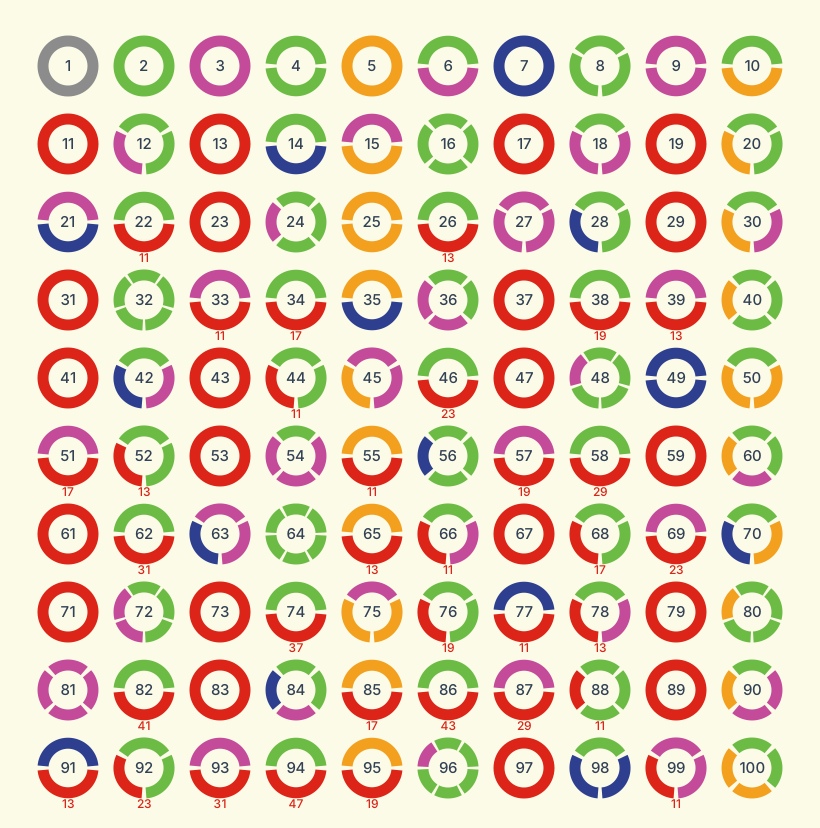
The ring around a number is its prime factorisation, drawn as coloured arcs.
- The ring is cut into as many equal arcs as the number has prime factors, counted with repeats.
- Each arc is coloured by which prime it stands for.
| Prime | Colour of the arc |
|---|---|
| 2 | green |
| 3 | magenta (pink) |
| 5 | orange |
| 7 | blue |
| 11 and bigger primes | red, with the prime in tiny print |
| 1 (no prime factors) | one plain grey ring |
12 = 2 × 2 × 3 → two green arcs, one magenta arc
22 = 2 × 11 → one green arc, one red arc marked 11
Factorise each number, then draw one arc per prime factor.
| Number | Prime factorisation | Design (one arc per prime factor) |
|---|---|---|
| 101 | 101 (prime) | one red ring, marked 101 |
| 102 | 2 × 3 × 17 | green, magenta, red (17) |
| 103 | 103 (prime) | one red ring, marked 103 |
| 104 | 2 × 2 × 2 × 13 | green, green, green, red (13) |
| 105 | 3 × 5 × 7 | magenta, orange, blue |
| 106 | 2 × 53 | green, red (53) |
| 107 | 107 (prime) | one red ring, marked 107 |
| 108 | 2 × 2 × 3 × 3 × 3 | green, green, magenta, magenta, magenta |
| 109 | 109 (prime) | one red ring, marked 109 |
| 110 | 2 × 5 × 11 | green, orange, red (11) |
Chapter 11 of 15 – Maths
- Previous: Chapter 10 Operations with Integers
- Next: Chapter 12 Another Peek Beyond the Point
- All chapters: NCERT Solutions Class 7 Maths
Also for This Chapter
NCERT Solutions Class 7 Maths Chapter 11 Finding Common Ground – Overview
| Class | Class 7 |
| Subject | Maths |
| Chapter | 11 – Finding Common Ground |
| Textbook pages | Part II, 47 – 66 |
| Questions solved | 85 |
| Session | 2027 |
| Format | Full answers on this page + PDF |
NCERT Solutions Class 7 Maths Chapter 11 – FAQs
Where can I download NCERT Solutions Class 7 Maths Chapter 11 Finding Common Ground PDF?
Read every answer on this page, or download the free PDF from the table at the top.
Is this for the 2027 session?
Yes, it follows the latest NCERT Class 7 Maths book for 2027.
How many questions are solved in NCERT Class 7 Maths Chapter 11?
All 85 questions of the chapter (textbook pages Part II, 47 – 66) – the in-text questions, activities and the end-of-chapter exercises.
How should I use these solutions?
Read the chapter in the NCERT book first, attempt the questions yourself, then check your answers here.