NCERT Solutions for Class 7 Maths Chapter 6 Number Play provide clear, step-by-step answers to every exercise and in-text question from the chapter Number Play of the NCERT textbook Ganita Prakash. Prepared by subject experts as per the latest NCERT (CBSE) syllabus for 2026-27, these NCERT Solutions for Class 7 Maths help you understand each concept, write exam-ready answers, and check your own solutions. You can read them online below or download the free Class 7 Maths Chapter 6 question-answer PDF.
NCERT Solutions for Class 7 Maths Chapter 6 Number Play
- Class: Class 7
- Subject: Maths
- Chapter: Chapter 6 – Number Play
- Textbook: Ganita Prakash (NCERT)
- Study material: NCERT Solutions – questions with answers, free PDF
These solutions answer all the exercise questions of Chapter 6 Number Play — including the in-text questions, short-answer and long-answer questions, and activities — with complete explanations so you can follow the method, not just the final answer. Read the full solutions below.
NCERT Solutions Class 7 Maths Chapter 6 Number Play View Download
NCERT Solutions for Class 7 Maths Chapter 6 PDF Download
You can read the NCERT Solutions for Class 7 Maths Chapter 6 online above, or download the complete question-answer PDF to study Number Play offline at any time.
NCERT Solutions for Class 7 Maths Chapter 6 PDF Download Link – Click Here to Download Solutions PDF
Questions Covered in This Chapter
These NCERT Solutions answer all 75 questions of this chapter. The questions solved are:
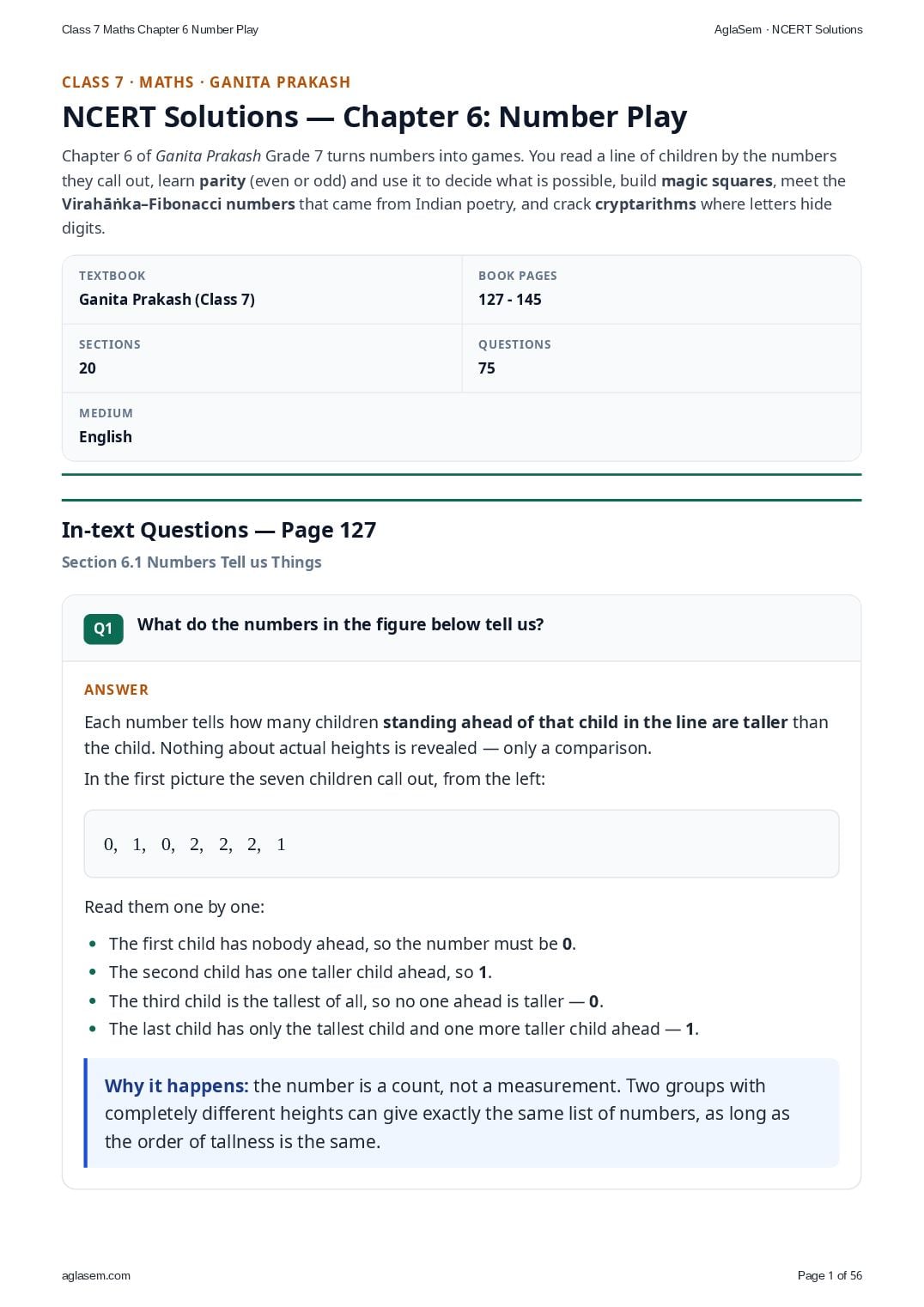
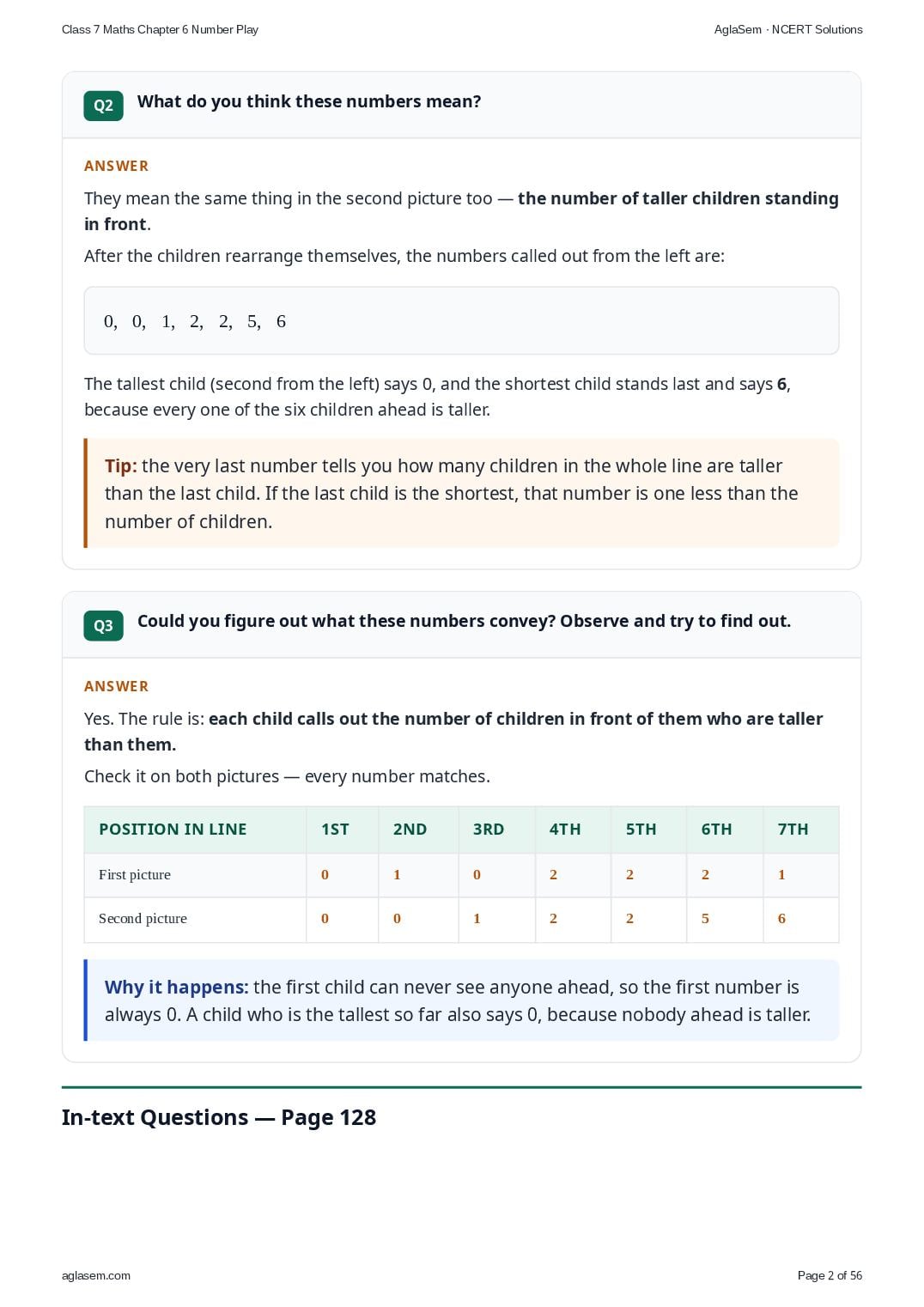
- What do the numbers in the figure below tell us?
- What do you think these numbers mean?
- Could you figure out what these numbers convey? Observe and try to find out.
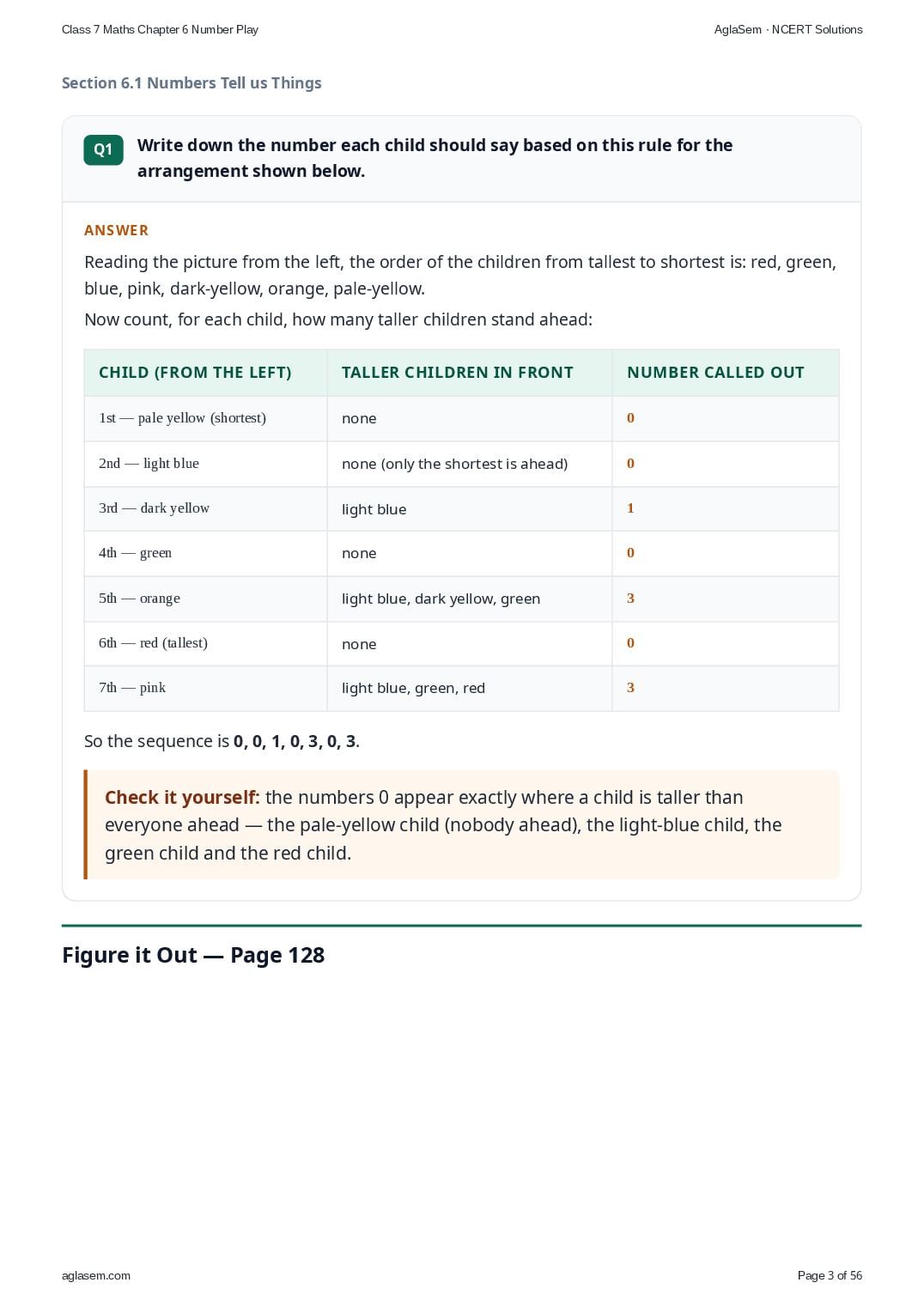
- Write down the number each child should say based on this rule for the arrangement shown below.
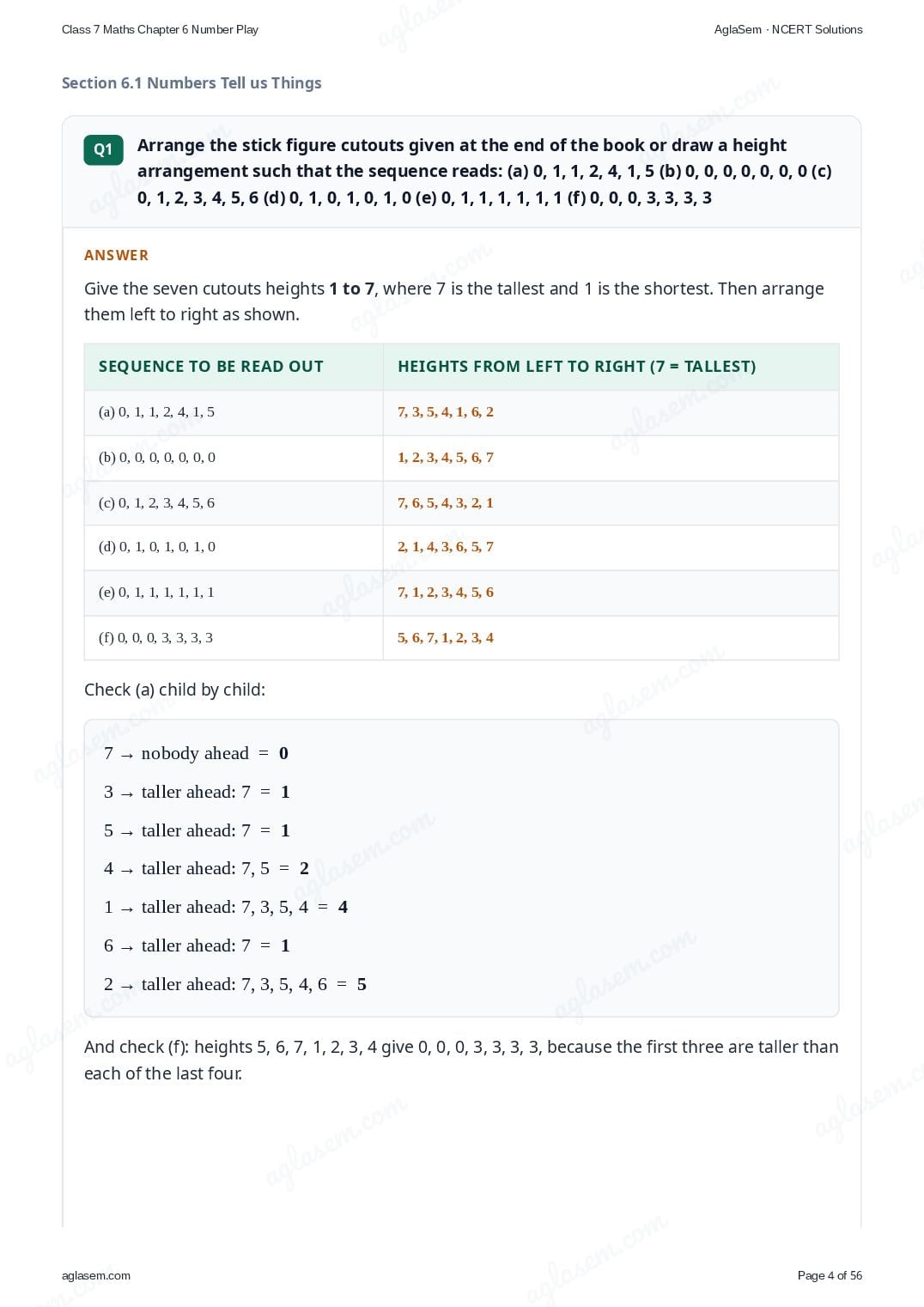
- Arrange the stick figure cutouts given at the end of the book or draw a height arrangement such that the sequence reads: (a) 0, 1, 1, 2, 4, 1, 5 (b) 0, 0, 0, 0, 0, 0, 0 (c) 0, 1, 2, 3, 4, 5, 6 (d) 0, 1, 0, 1, 0, 1, 0 (e) 0, 1, 1, 1, 1, 1, 1 (f) 0, 0, 0, 3, 3, 3, 3
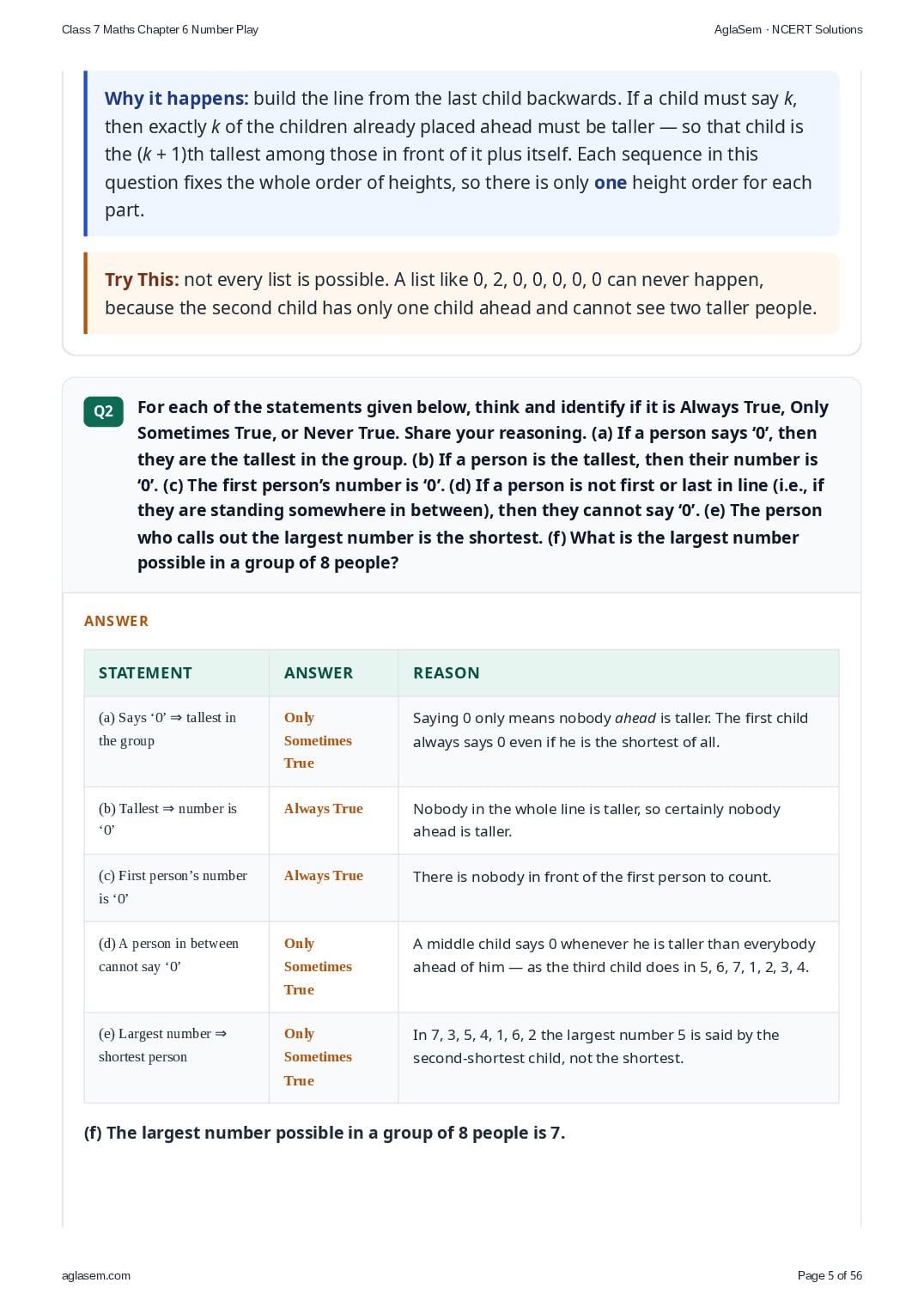
- For each of the statements given below, think and identify if it is Always True, Only Sometimes True, or Never True. Share your reasoning. (a) If a person says ‘0’, then they are the tallest in the group. (b) If a person is the tallest, then their number is ‘0’. (c) The first person’s number is ‘0’. (d) If a person is not first or last in line (i.e., if they are standing somewhere in between), then they cannot say ‘0’. (e) The person who calls out the largest number is the shortest. (f) What is the largest number possible in a group of 8 people?
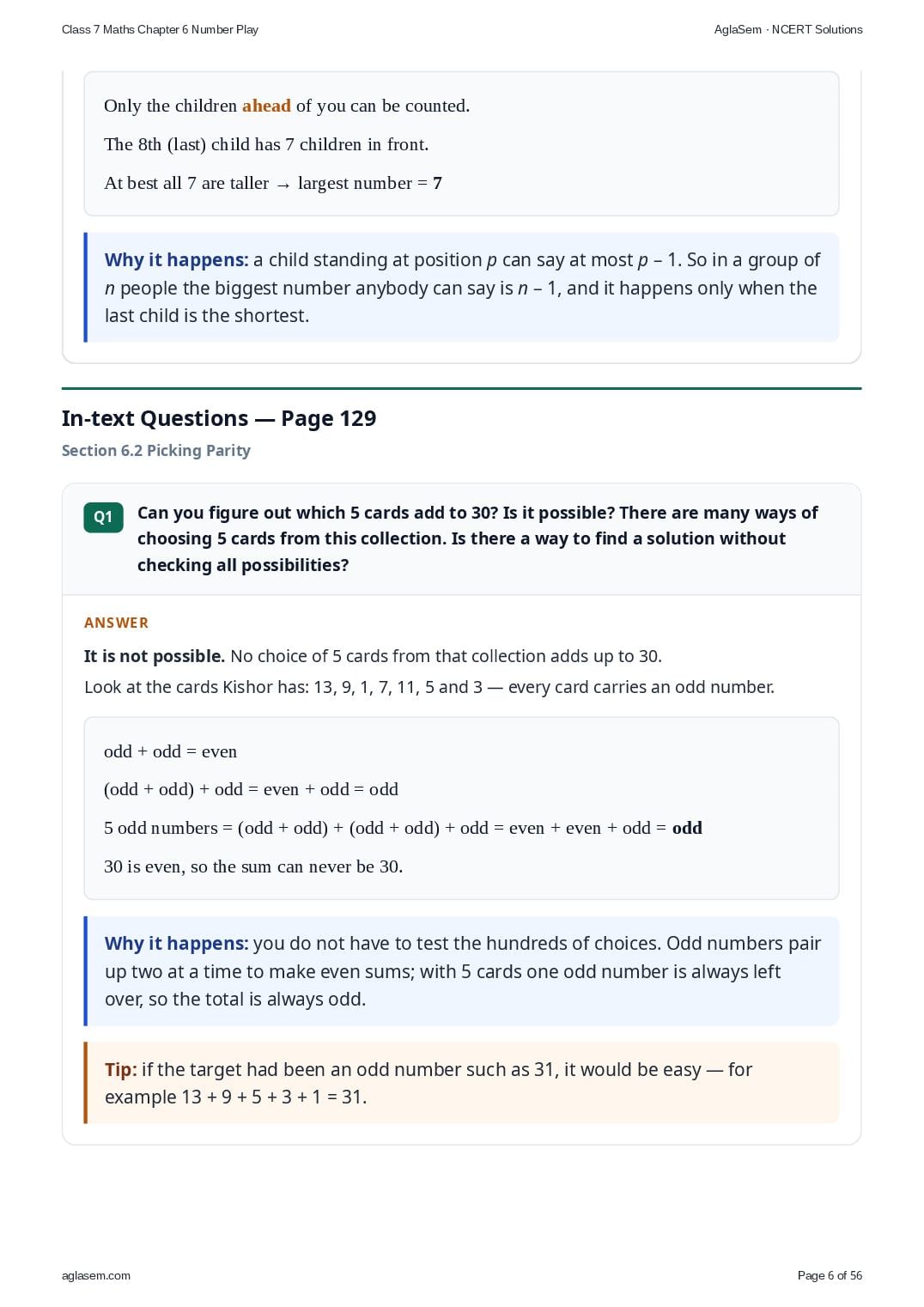
- Can you figure out which 5 cards add to 30? Is it possible? There are many ways of choosing 5 cards from this collection. Is there a way to find a solution without checking all possibilities?
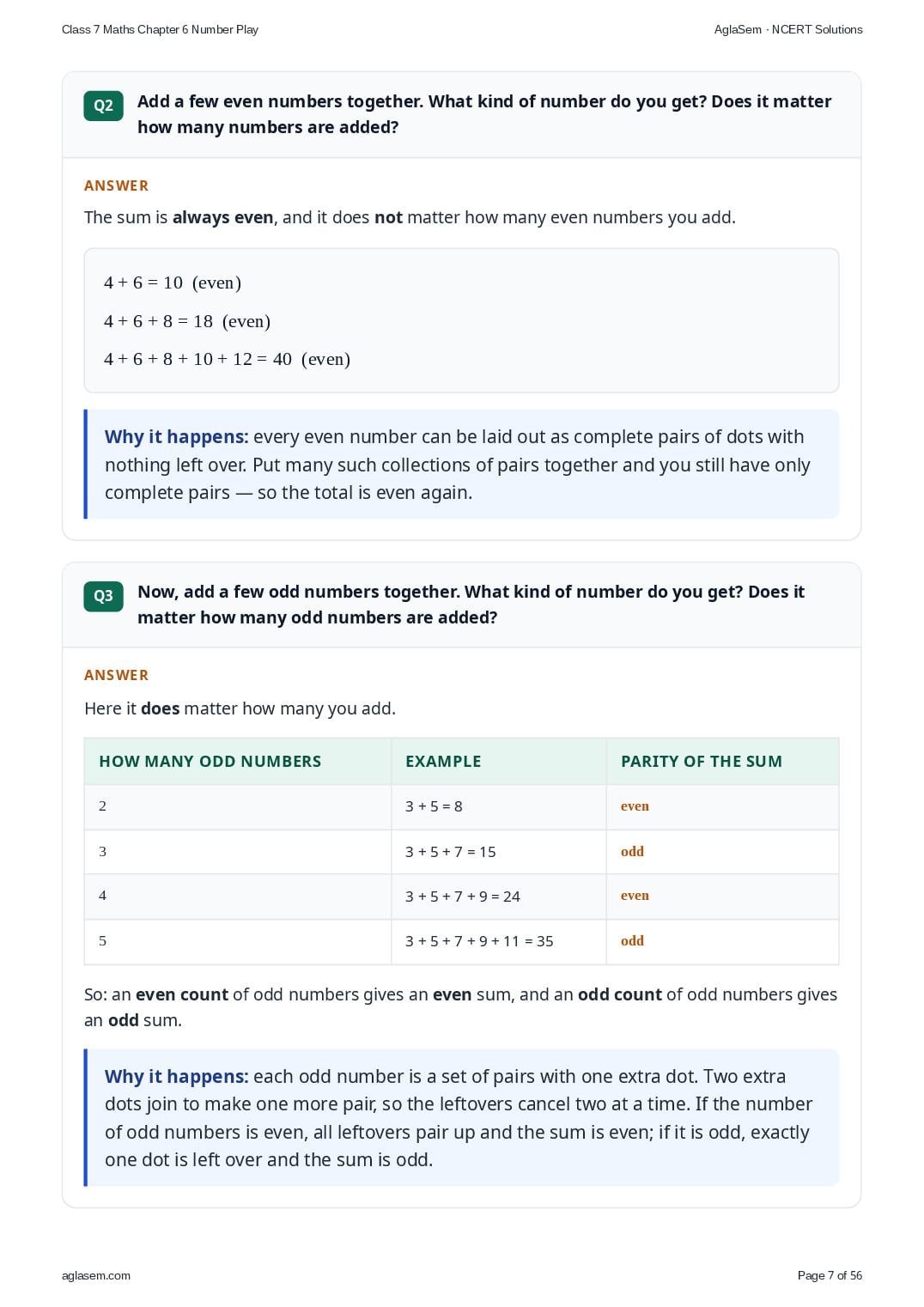
- Add a few even numbers together. What kind of number do you get? Does it matter how many numbers are added?
- Now, add a few odd numbers together. What kind of number do you get? Does it matter how many odd numbers are added?
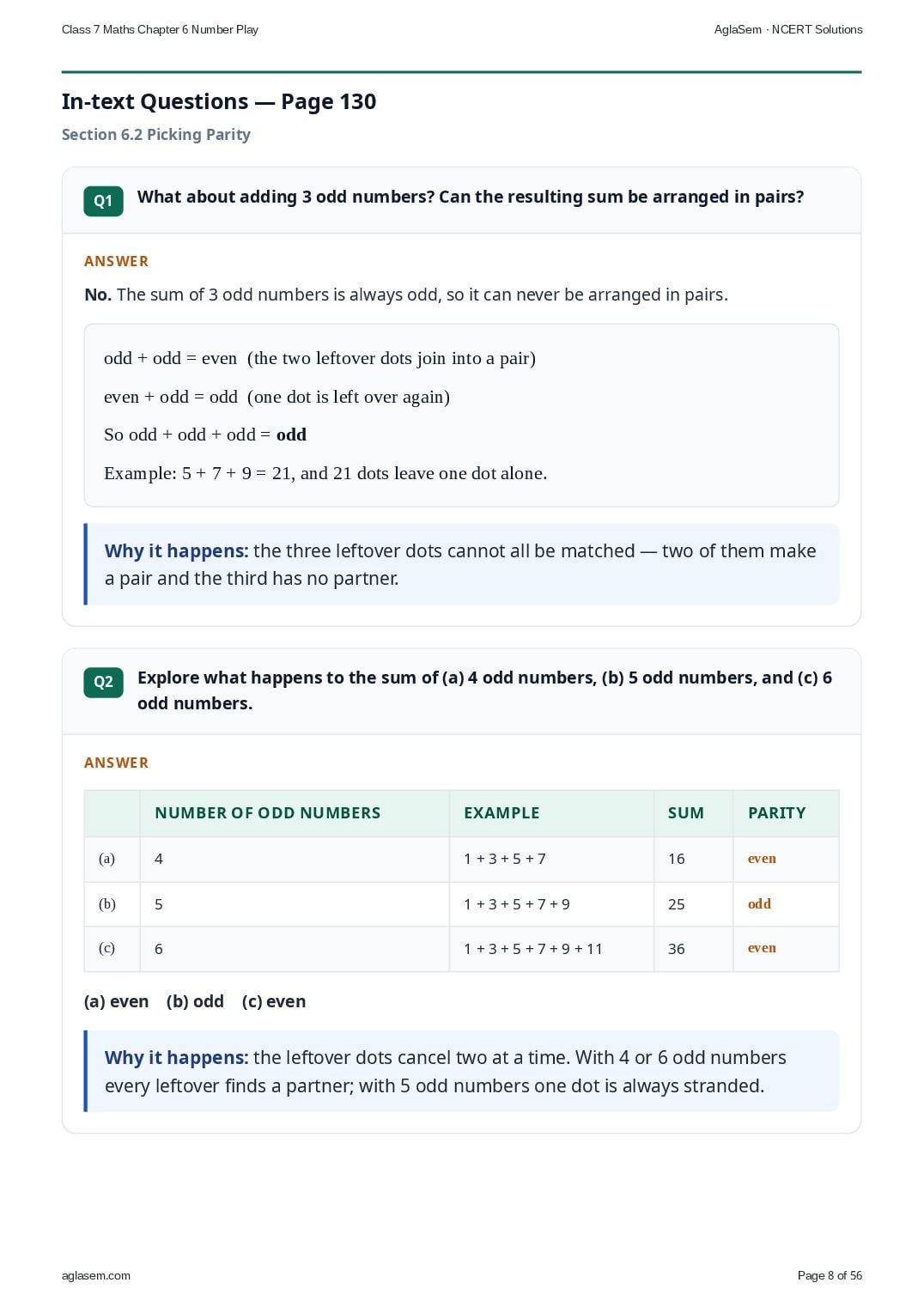
- What about adding 3 odd numbers? Can the resulting sum be arranged in pairs?
- Explore what happens to the sum of (a) 4 odd numbers, (b) 5 odd numbers, and (c) 6 odd numbers.
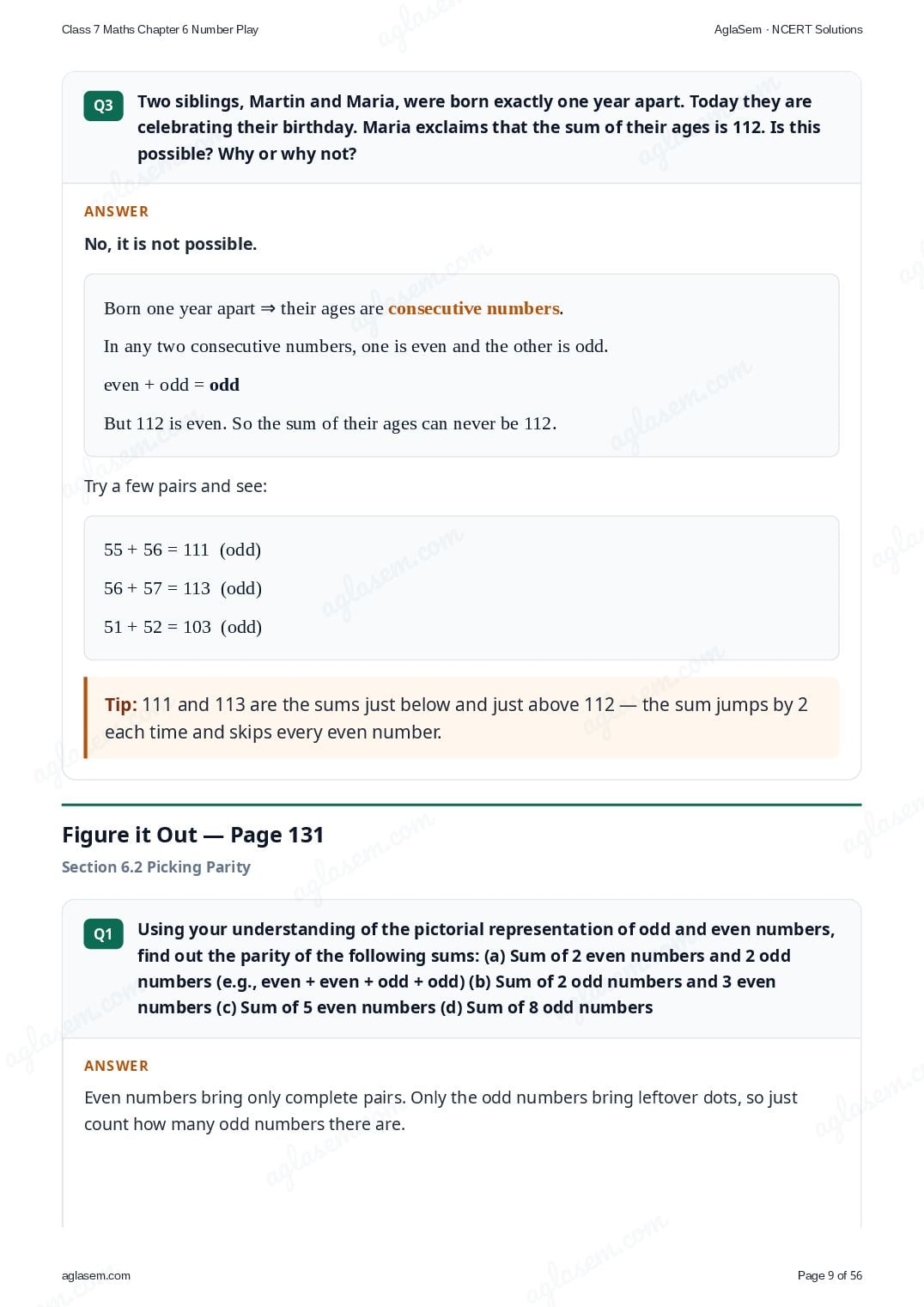
- Two siblings, Martin and Maria, were born exactly one year apart. Today they are celebrating their birthday. Maria exclaims that the sum of their ages is 112. Is this possible? Why or why not?
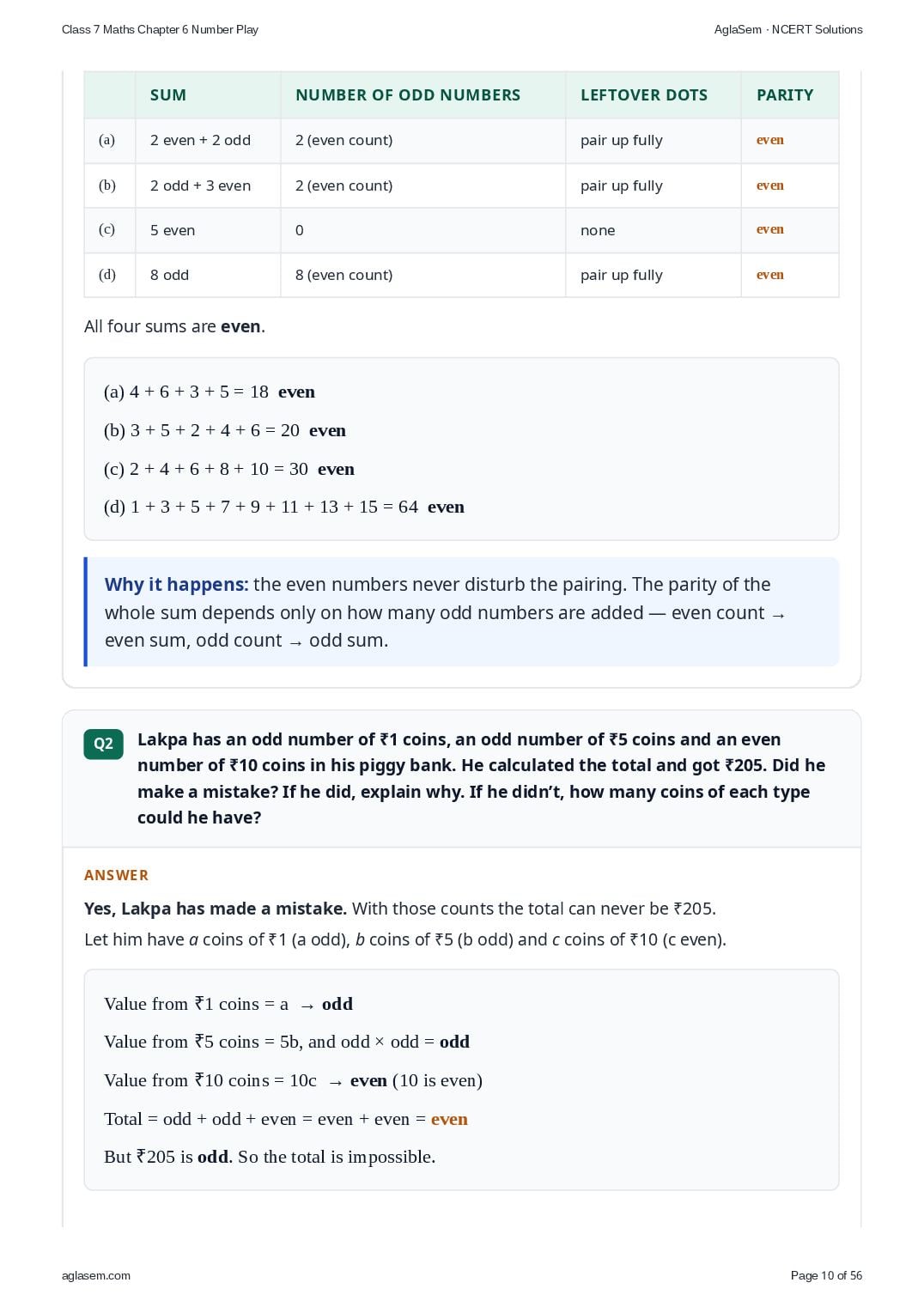
- Using your understanding of the pictorial representation of odd and even numbers, find out the parity of the following sums: (a) Sum of 2 even numbers and 2 odd numbers (e.g., even + even + odd + odd) (b) Sum of 2 odd numbers and 3 even numbers (c) Sum of 5 even numbers (d) Sum of 8 odd numbers
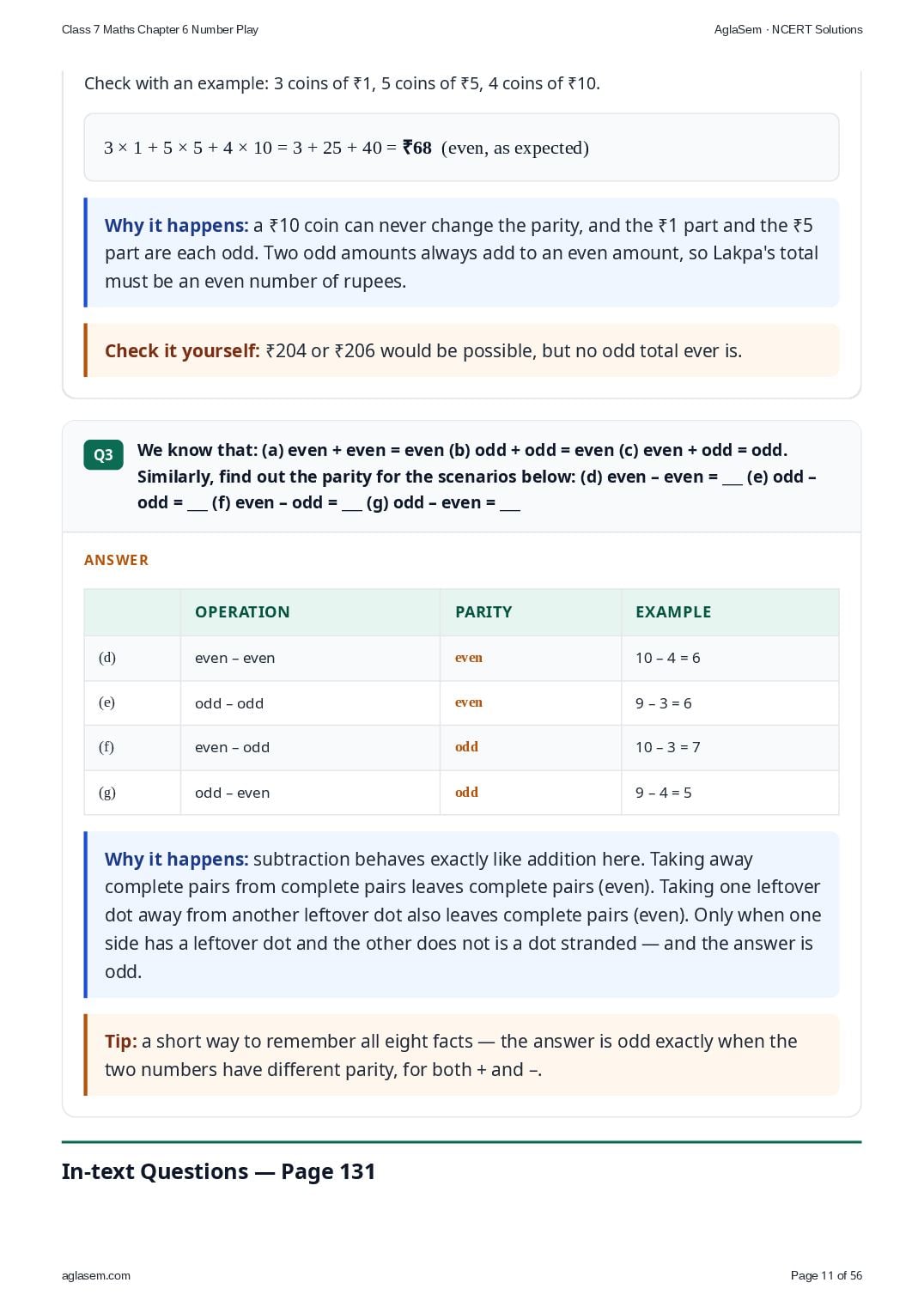
- Lakpa has an odd number of ₹1 coins, an odd number of ₹5 coins and an even number of ₹10 coins in his piggy bank. He calculated the total and got ₹205. Did he make a mistake? If he did, explain why. If he didn’t, how many coins of each type could he have?
- We know that: (a) even + even = even (b) odd + odd = even (c) even + odd = odd. Similarly, find out the parity for the scenarios below: (d) even – even = ___ (e) odd – odd = ___ (f) even – odd = ___ (g) odd – even = ___
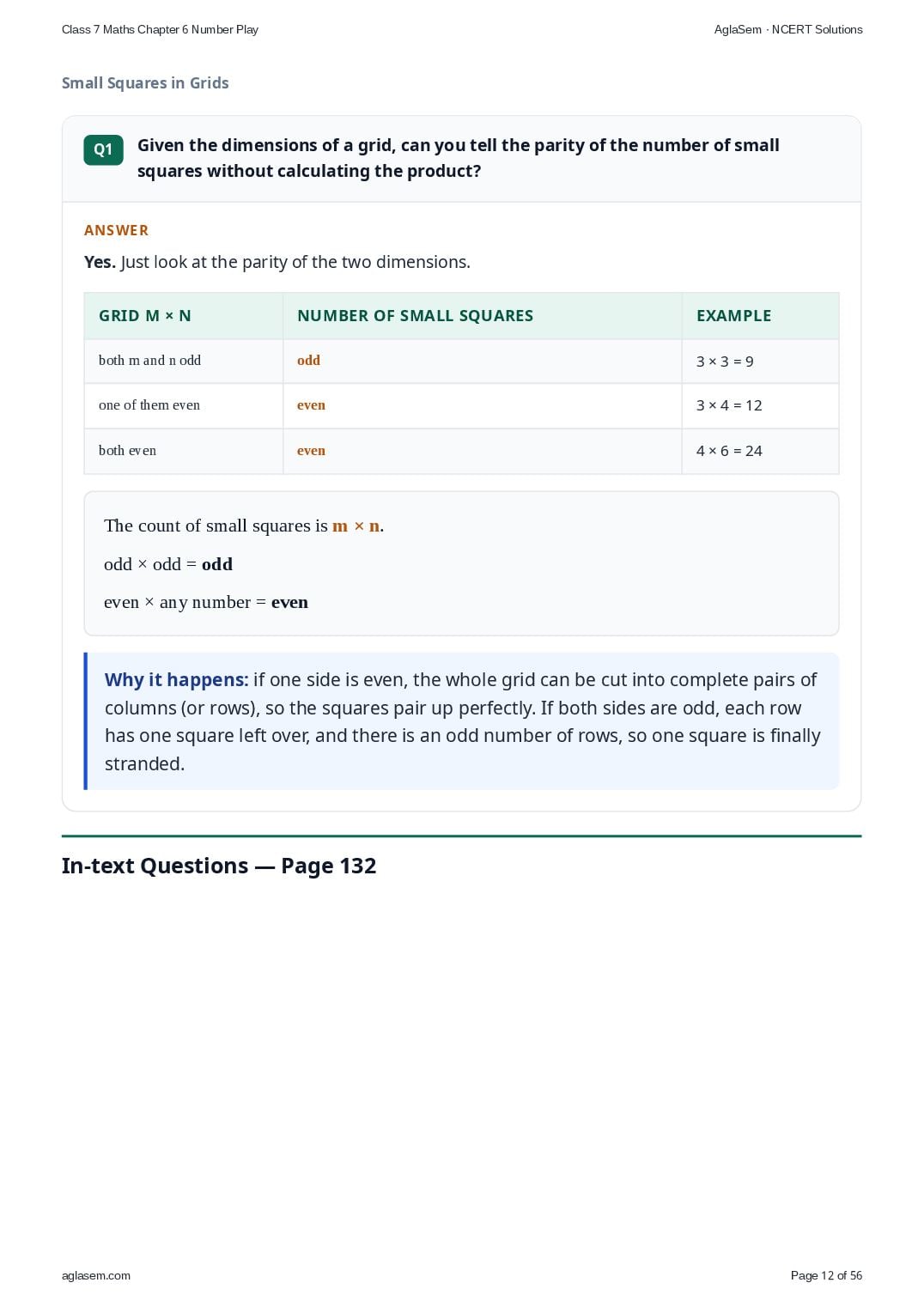
- Given the dimensions of a grid, can you tell the parity of the number of small squares without calculating the product?
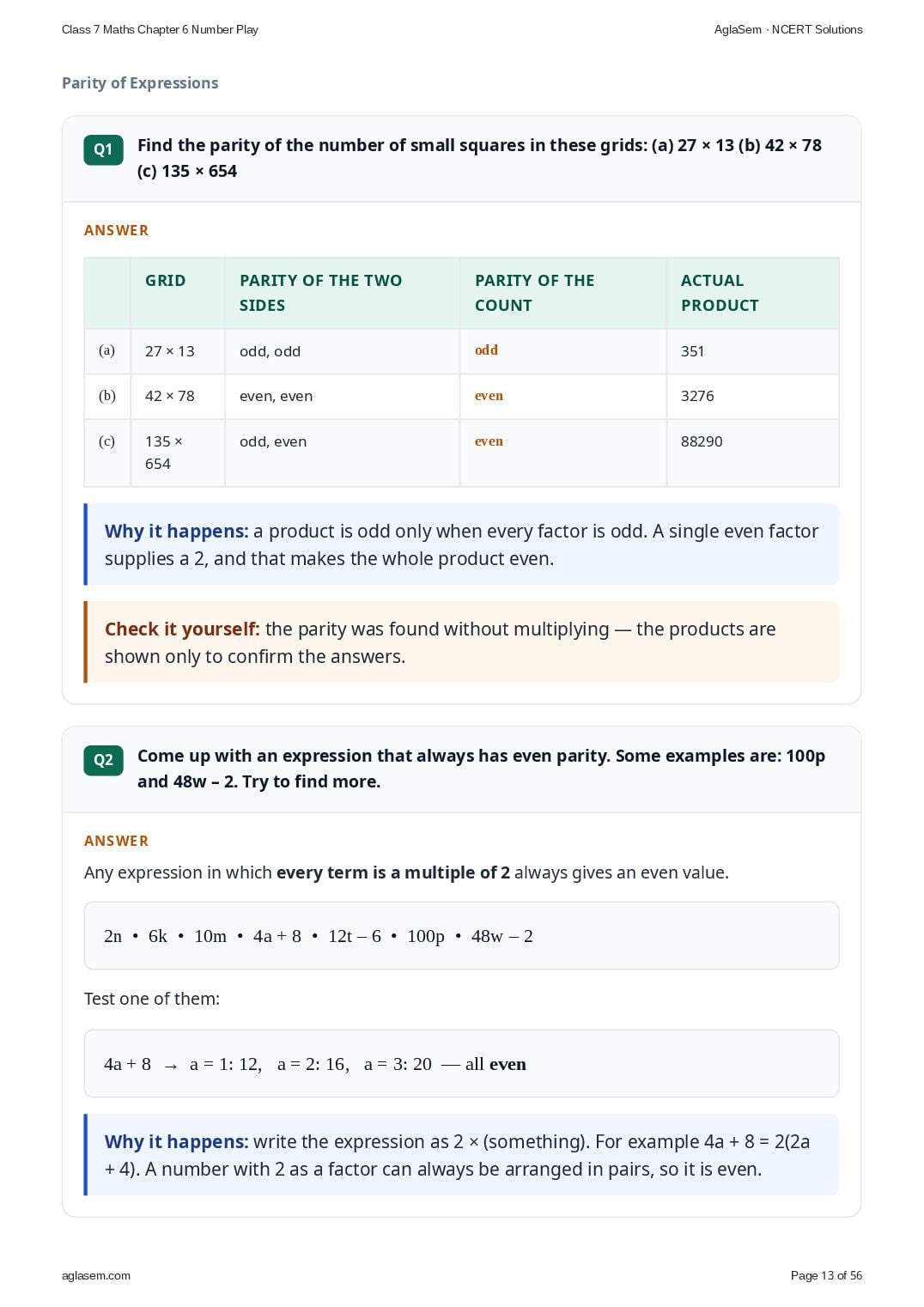
- Find the parity of the number of small squares in these grids: (a) 27 × 13 (b) 42 × 78 (c) 135 × 654
- Come up with an expression that always has even parity. Some examples are: 100p and 48w – 2. Try to find more.
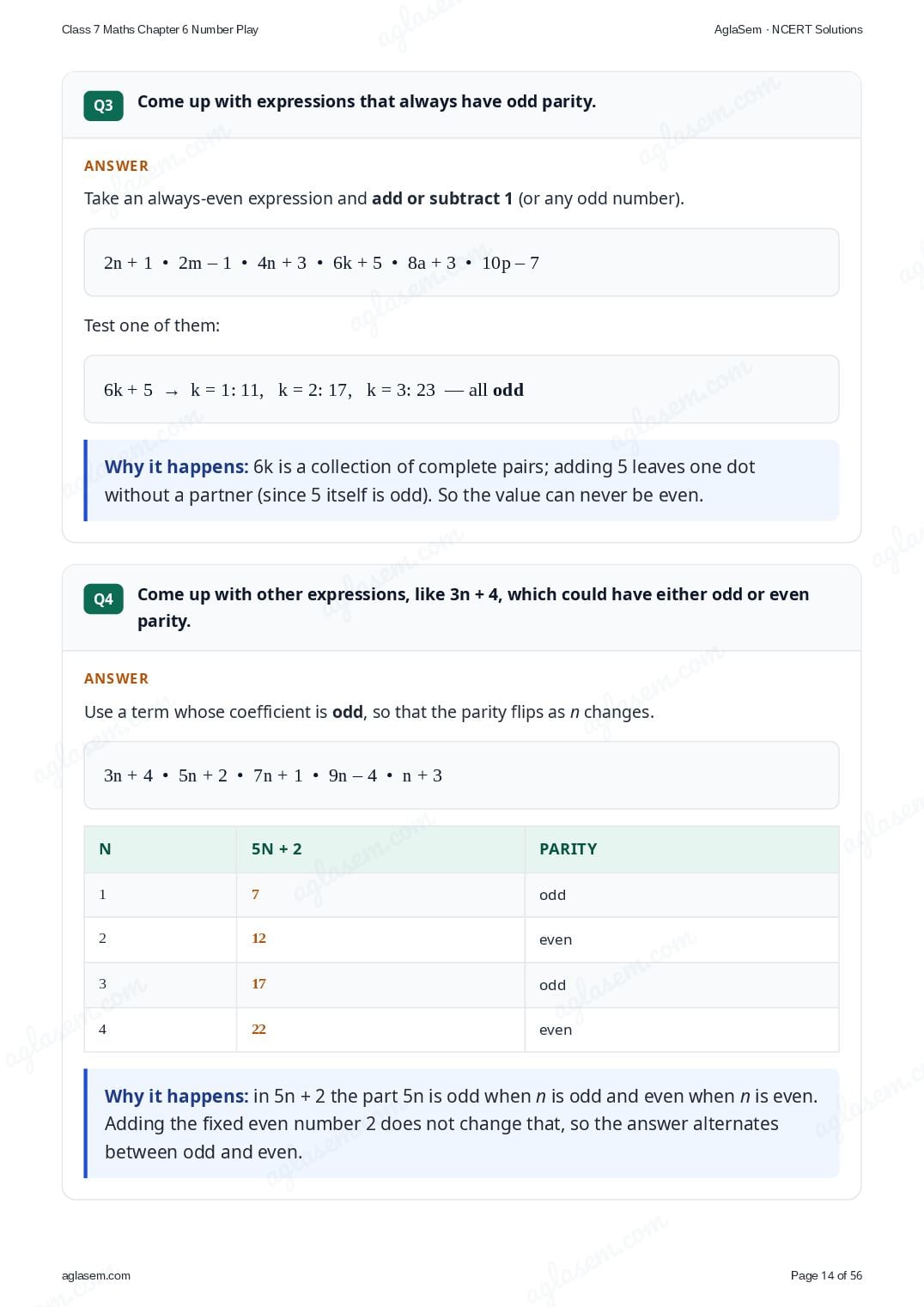
- Come up with expressions that always have odd parity.
- Come up with other expressions, like 3n + 4, which could have either odd or even parity.
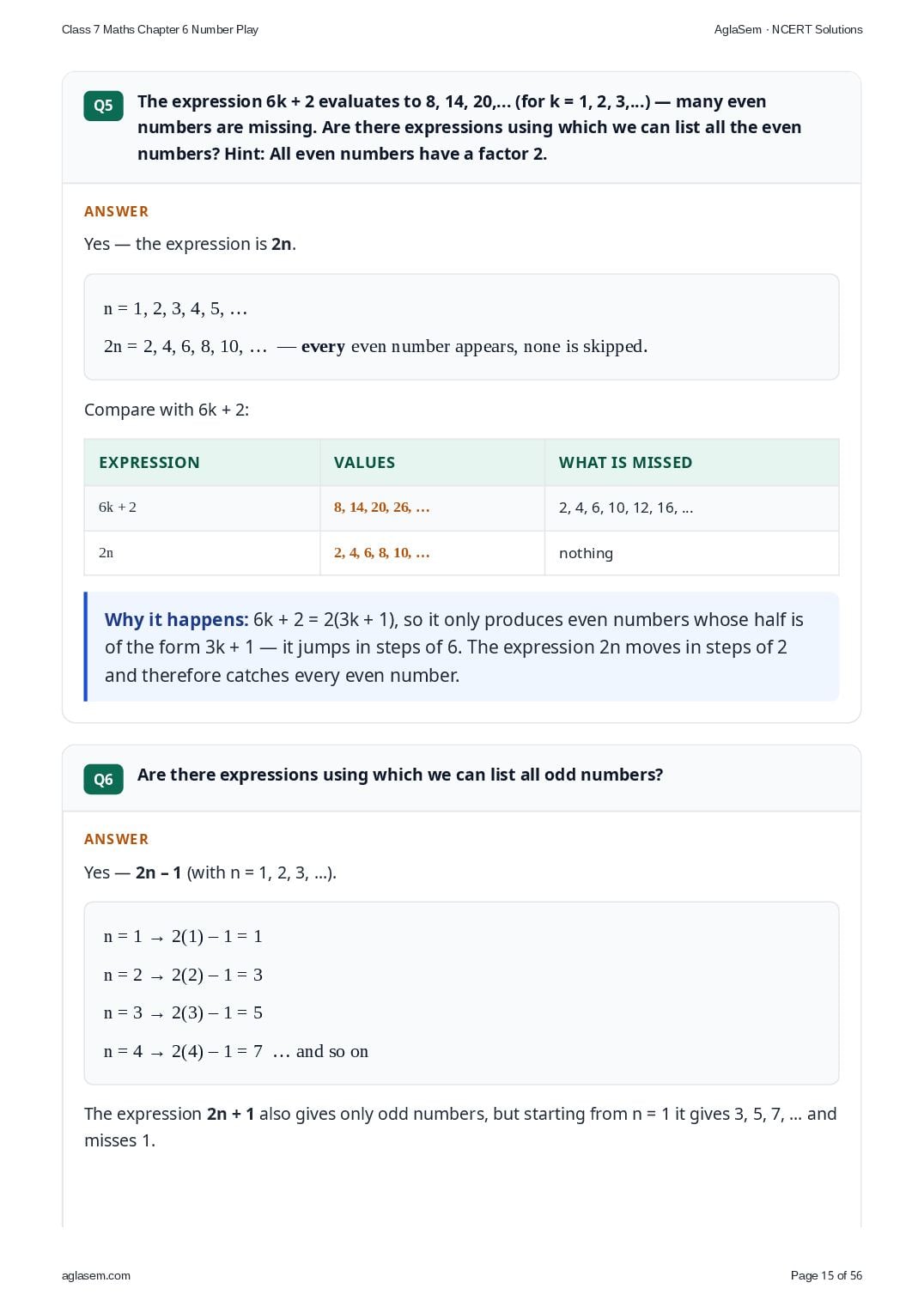
- The expression 6k + 2 evaluates to 8, 14, 20,… (for k = 1, 2, 3,…) — many even numbers are missing. Are there expressions using which we can list all the even numbers? Hint: All even numbers have a factor 2.
- Are there expressions using which we can list all odd numbers?
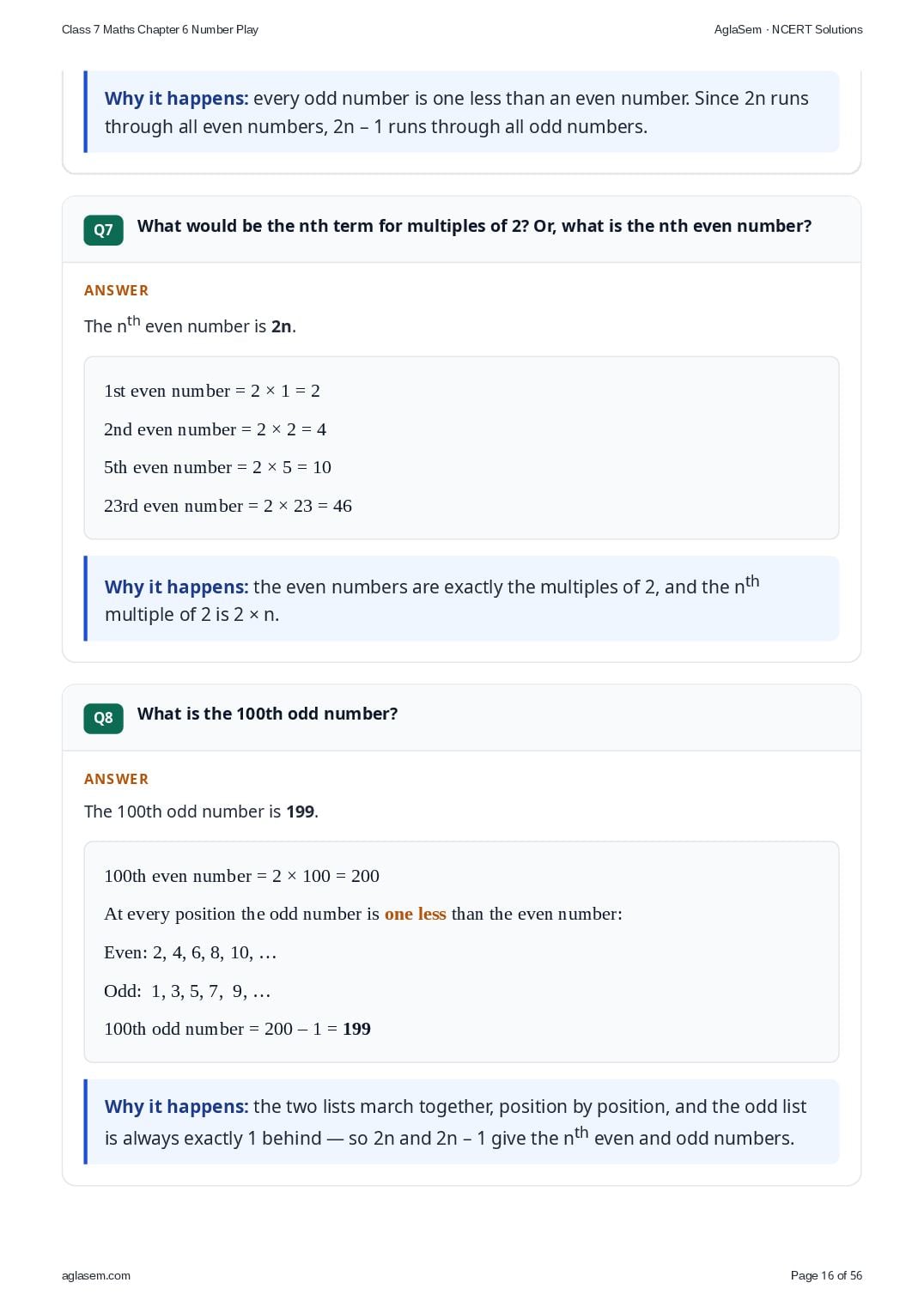
- What would be the nth term for multiples of 2? Or, what is the nth even number?
- What is the 100th odd number?
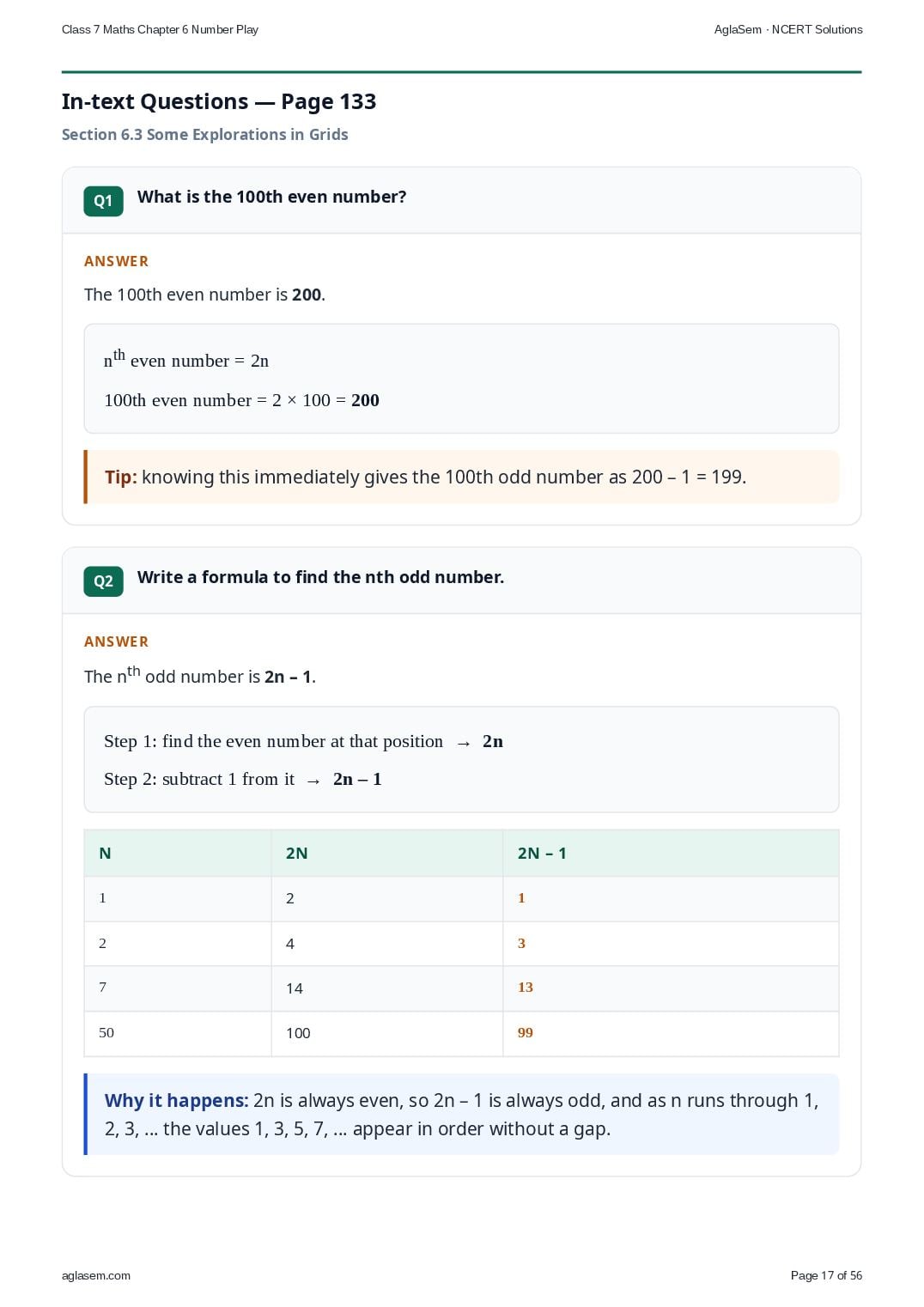
- What is the 100th even number?
- Write a formula to find the nth odd number.
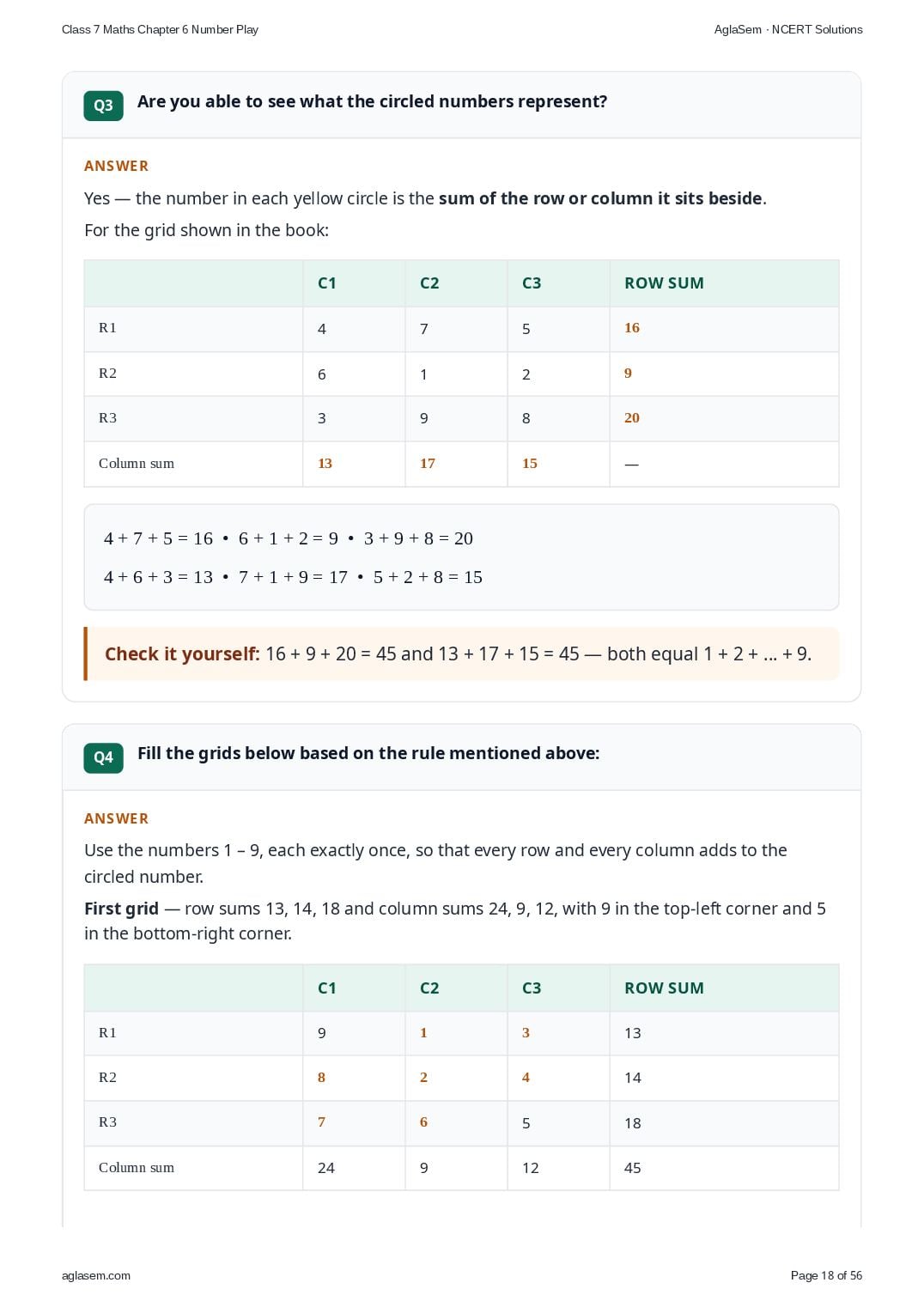
- Are you able to see what the circled numbers represent?
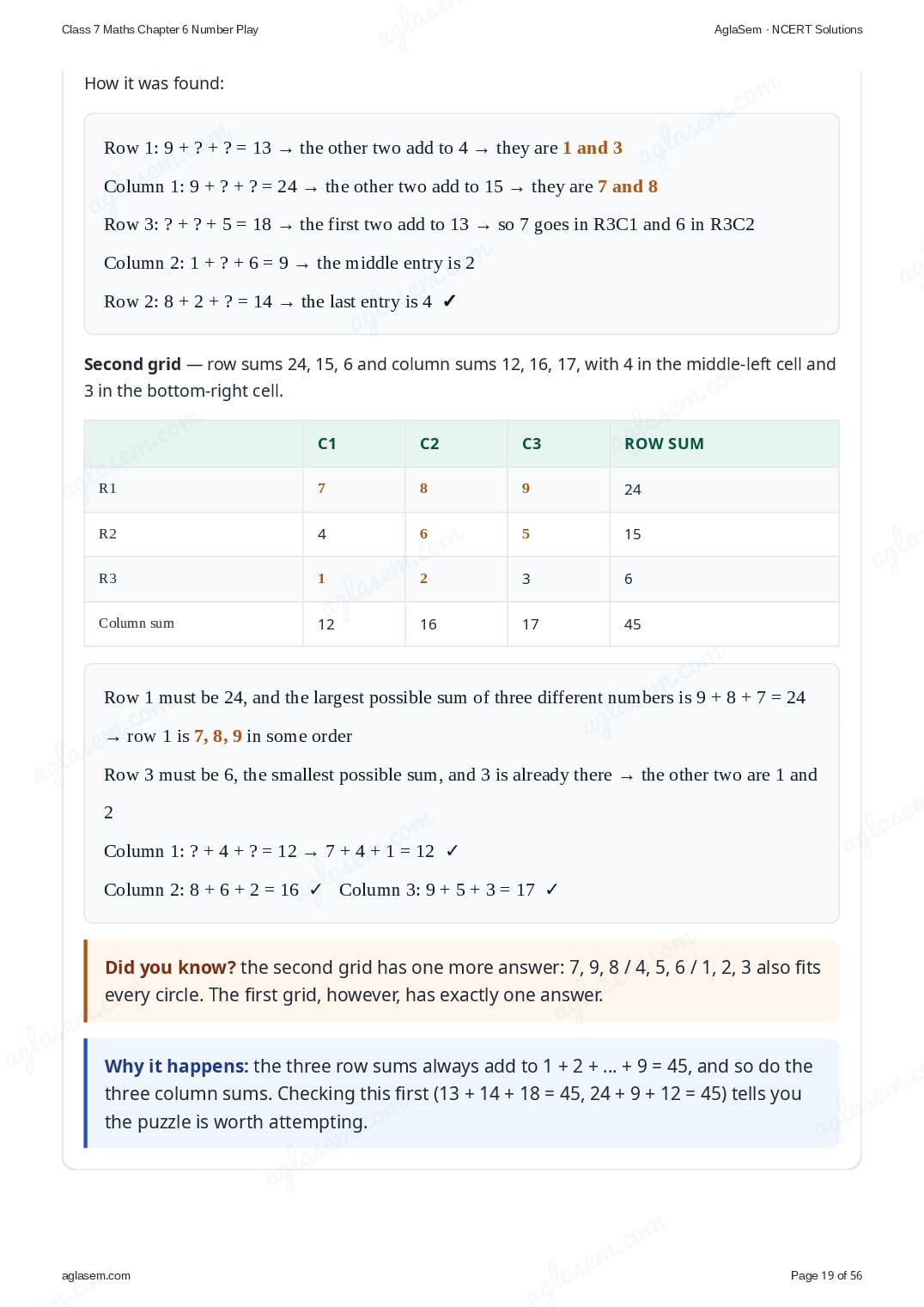
- Fill the grids below based on the rule mentioned above:
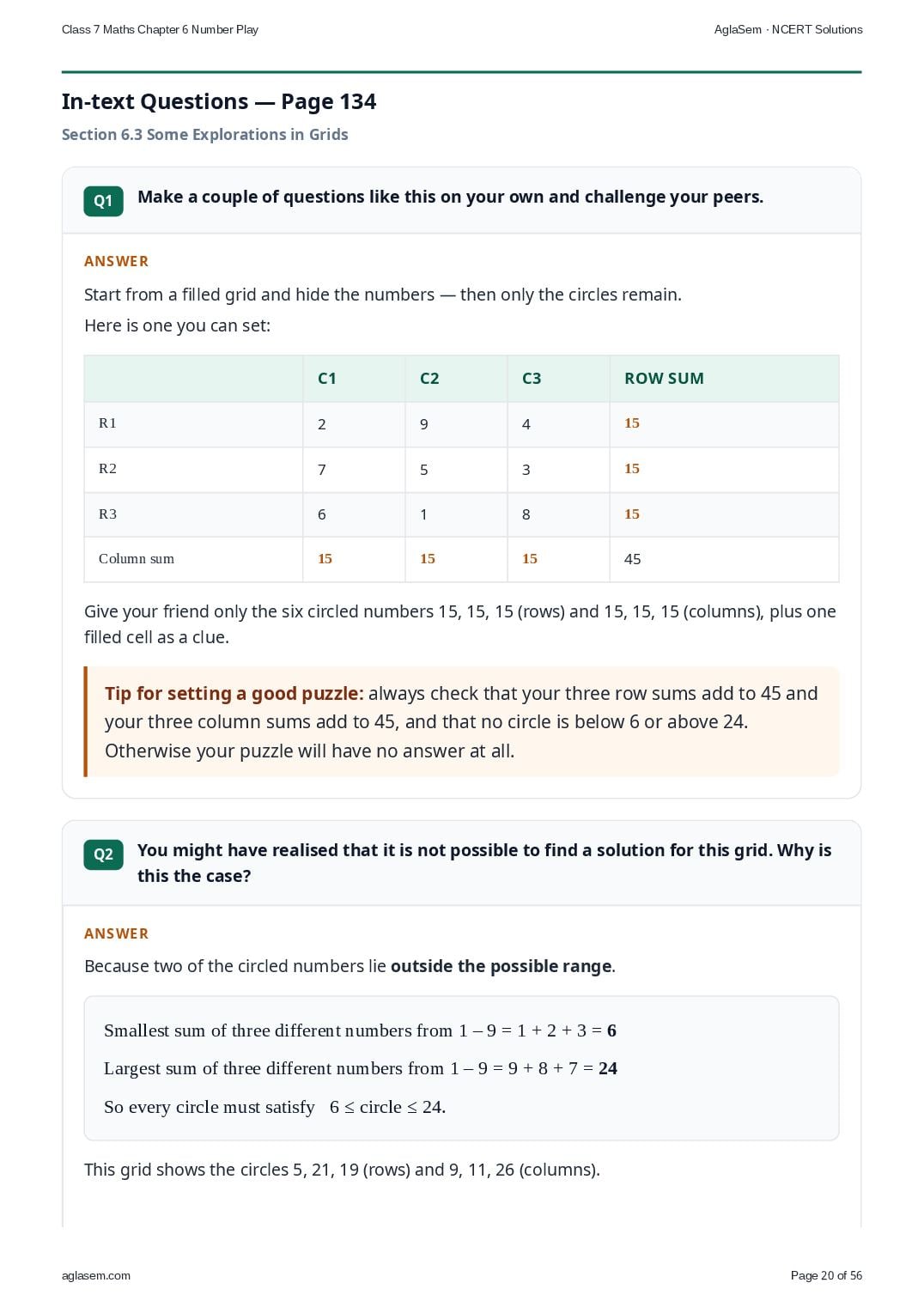
- Make a couple of questions like this on your own and challenge your peers.
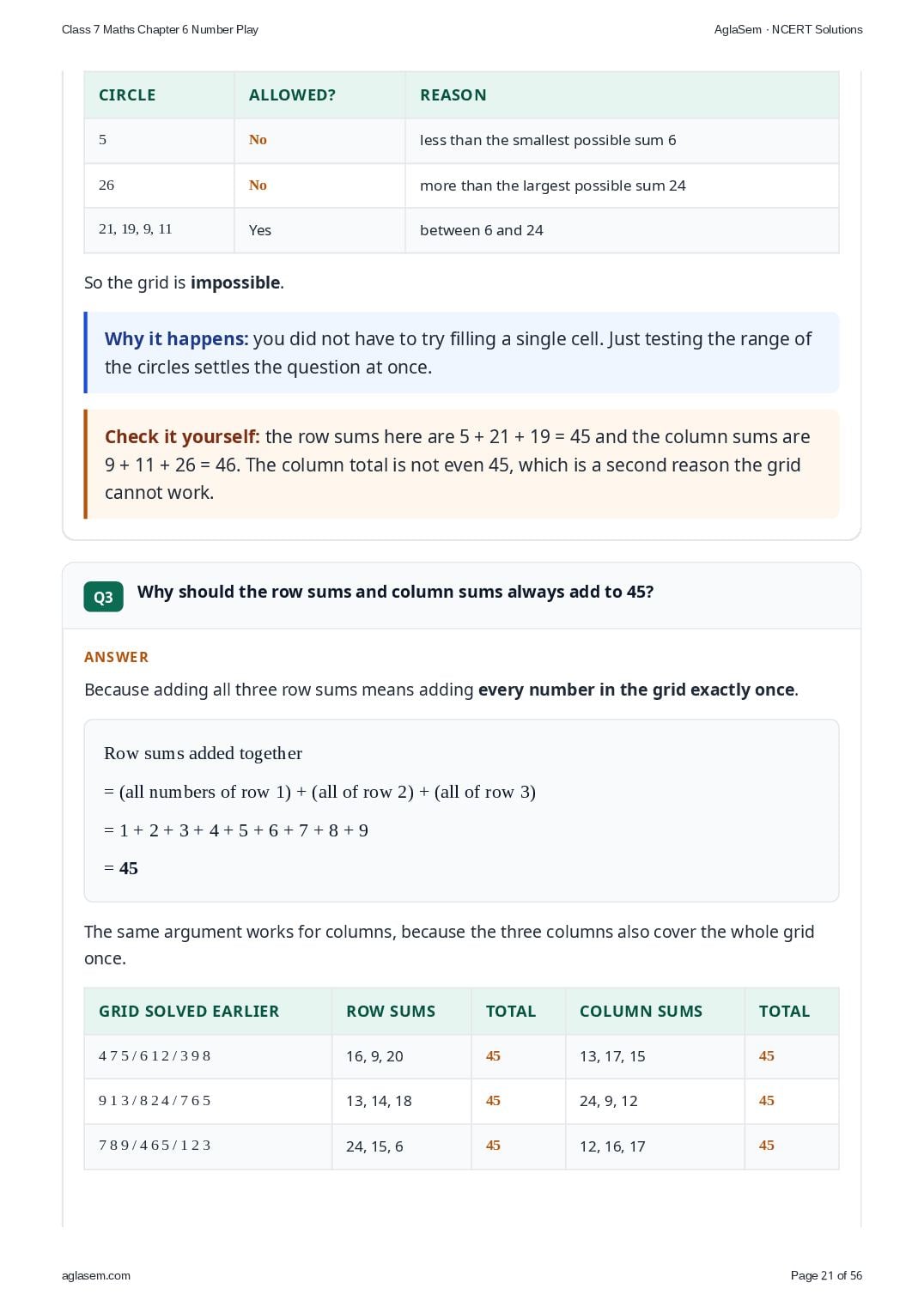
- You might have realised that it is not possible to find a solution for this grid. Why is this the case?
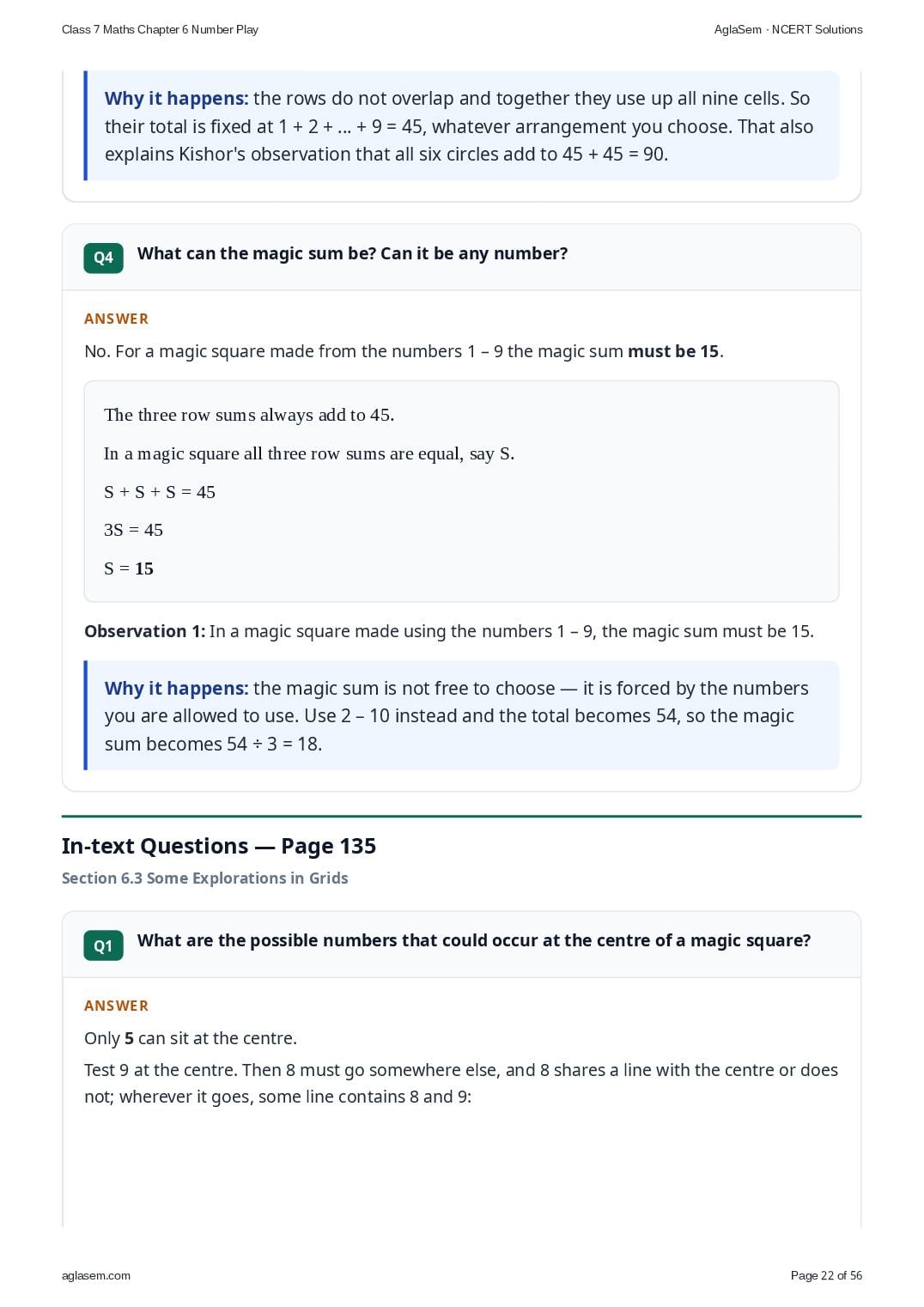
- Why should the row sums and column sums always add to 45?
- What can the magic sum be? Can it be any number?
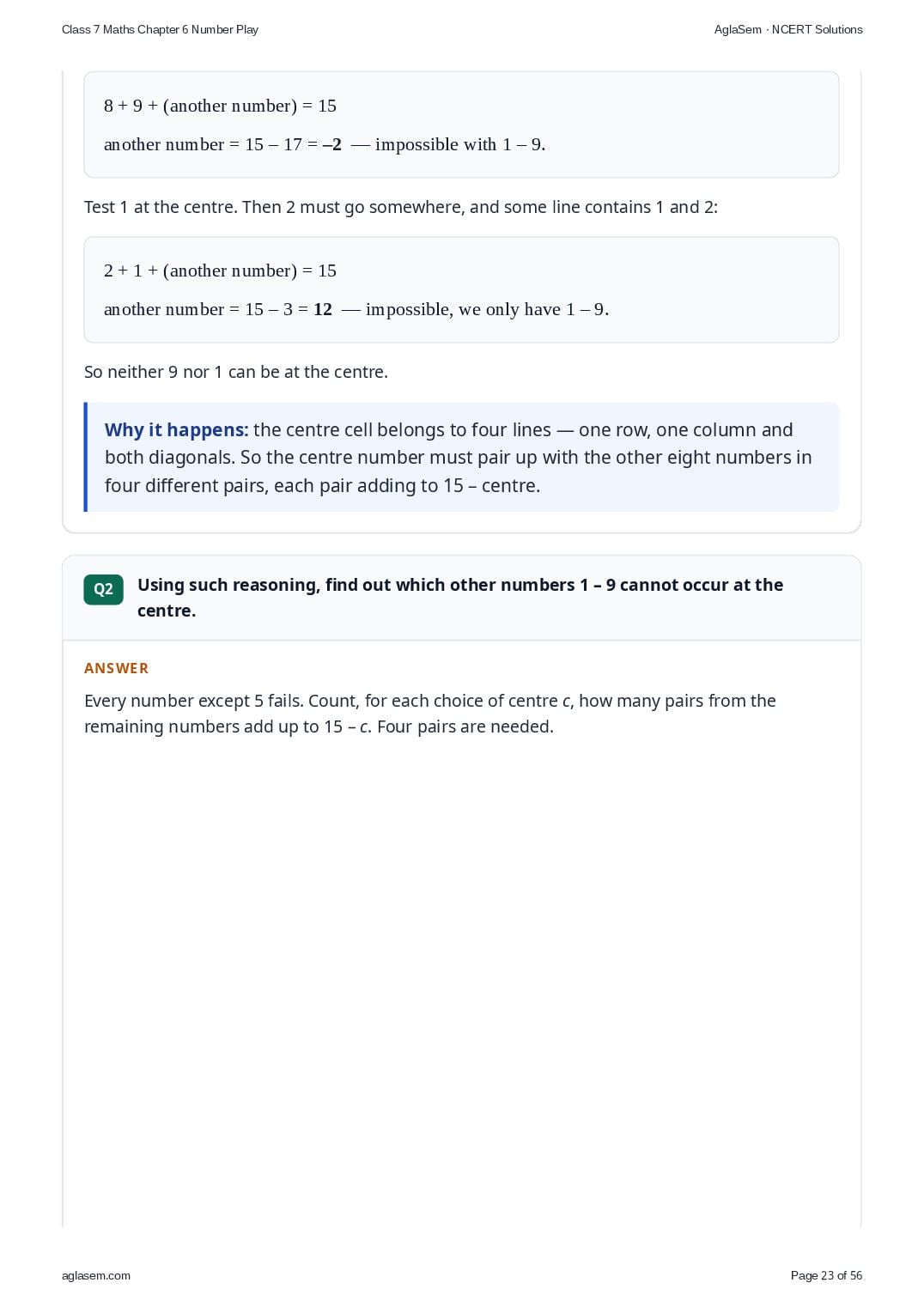
- What are the possible numbers that could occur at the centre of a magic square?
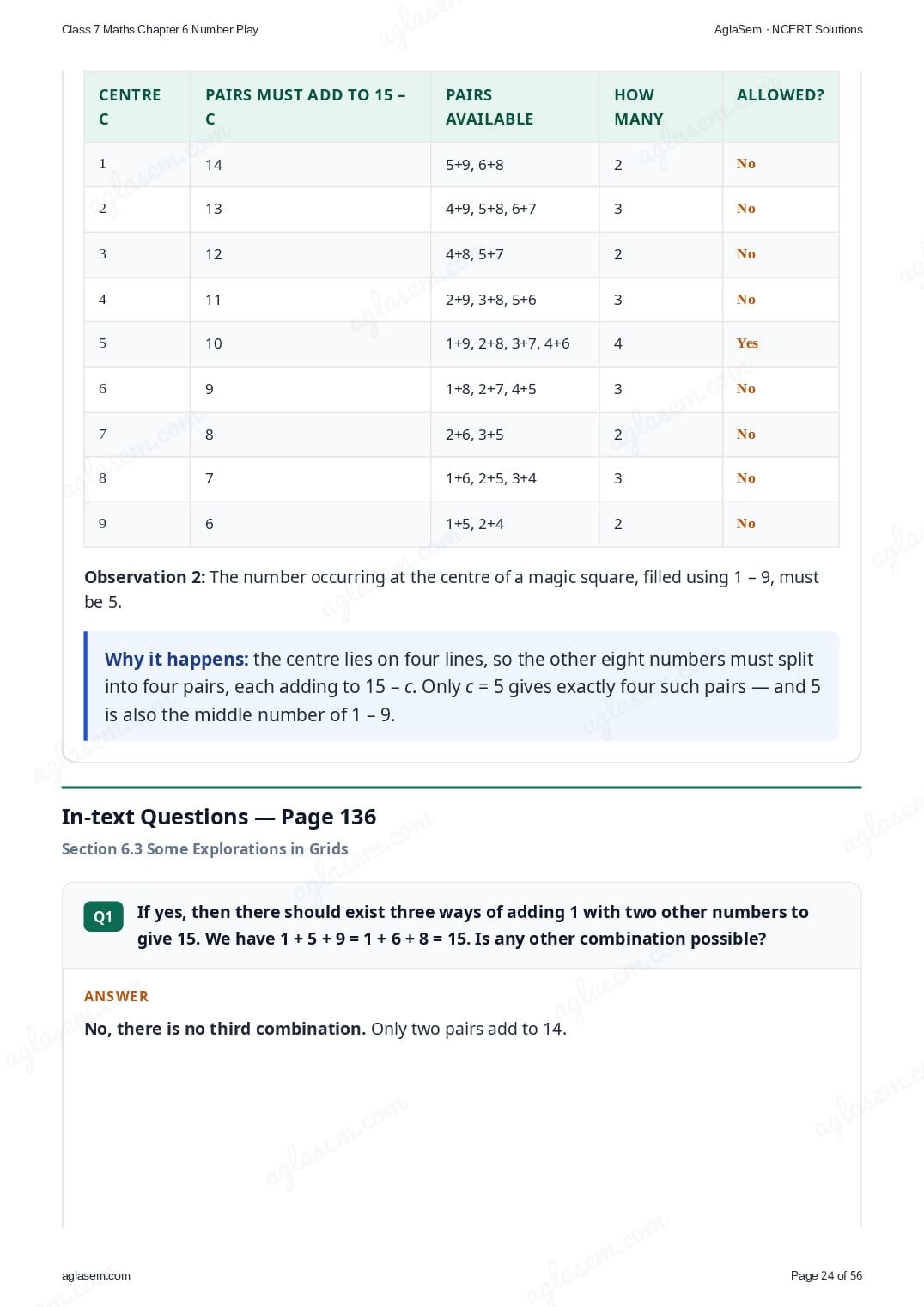
- Using such reasoning, find out which other numbers 1 – 9 cannot occur at the centre.
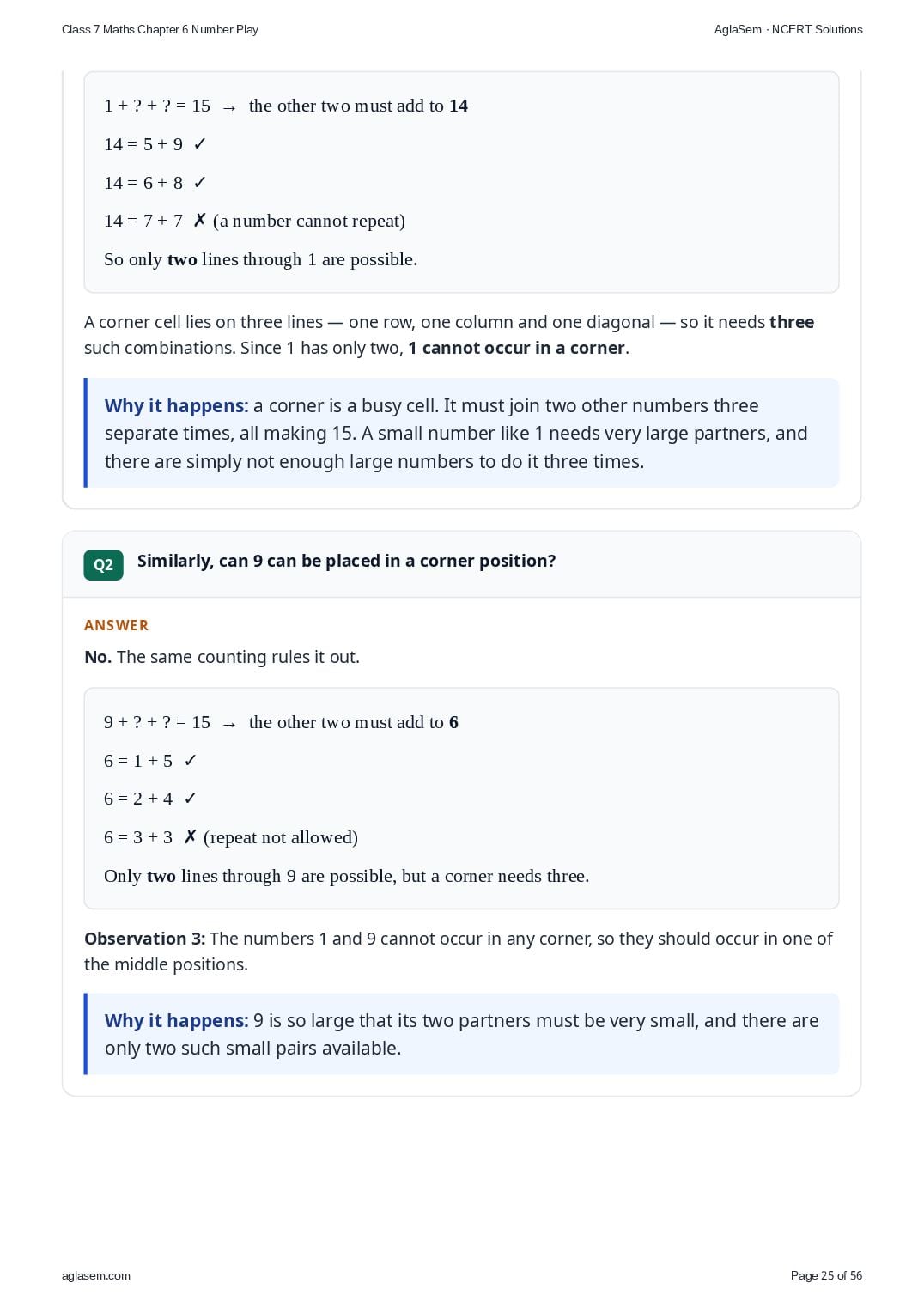
- If yes, then there should exist three ways of adding 1 with two other numbers to give 15. We have 1 + 5 + 9 = 1 + 6 + 8 = 15. Is any other combination possible?
- Similarly, can 9 can be placed in a corner position?
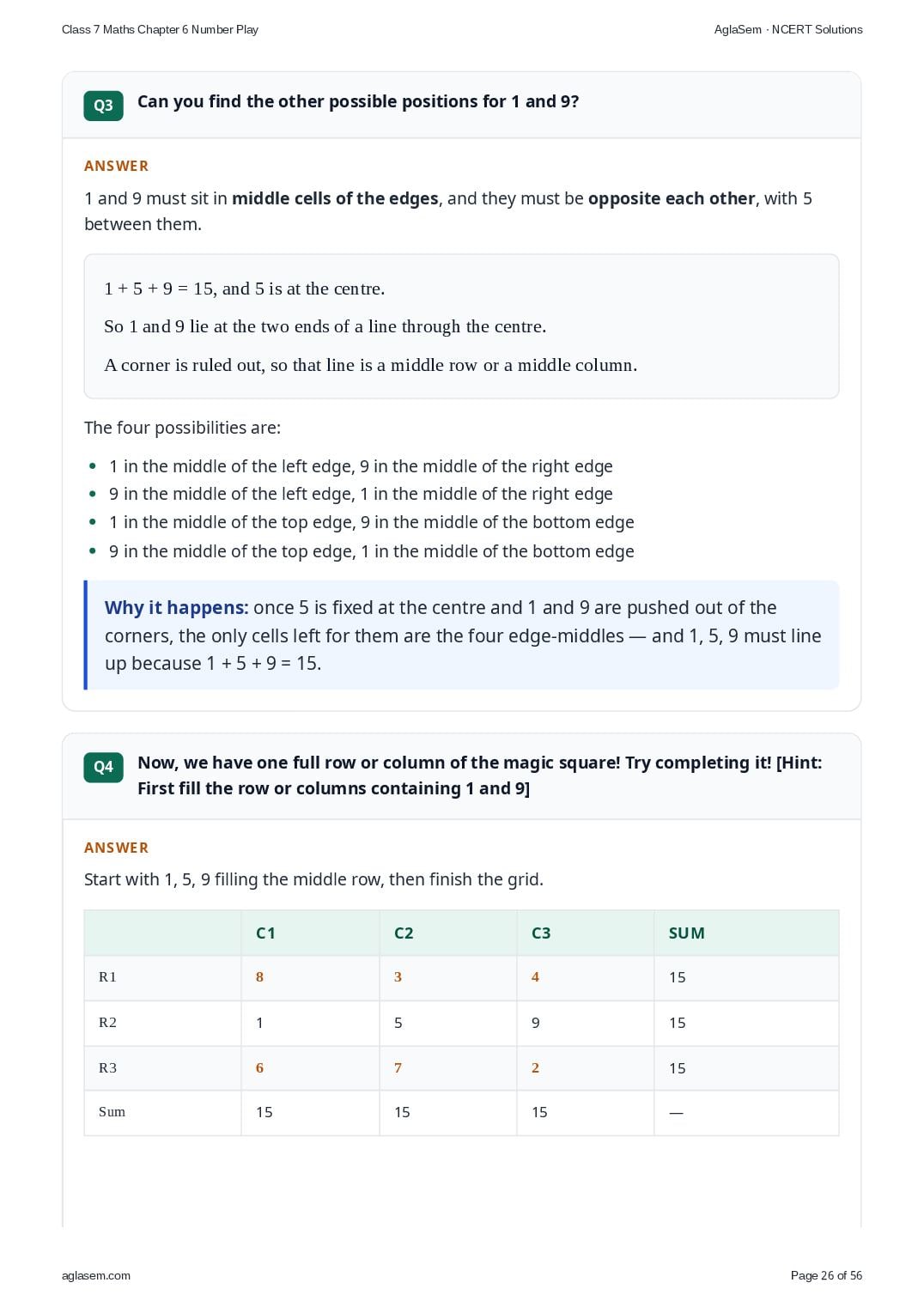
- Can you find the other possible positions for 1 and 9?
- Now, we have one full row or column of the magic square! Try completing it! [Hint: First fill the row or columns containing 1 and 9]
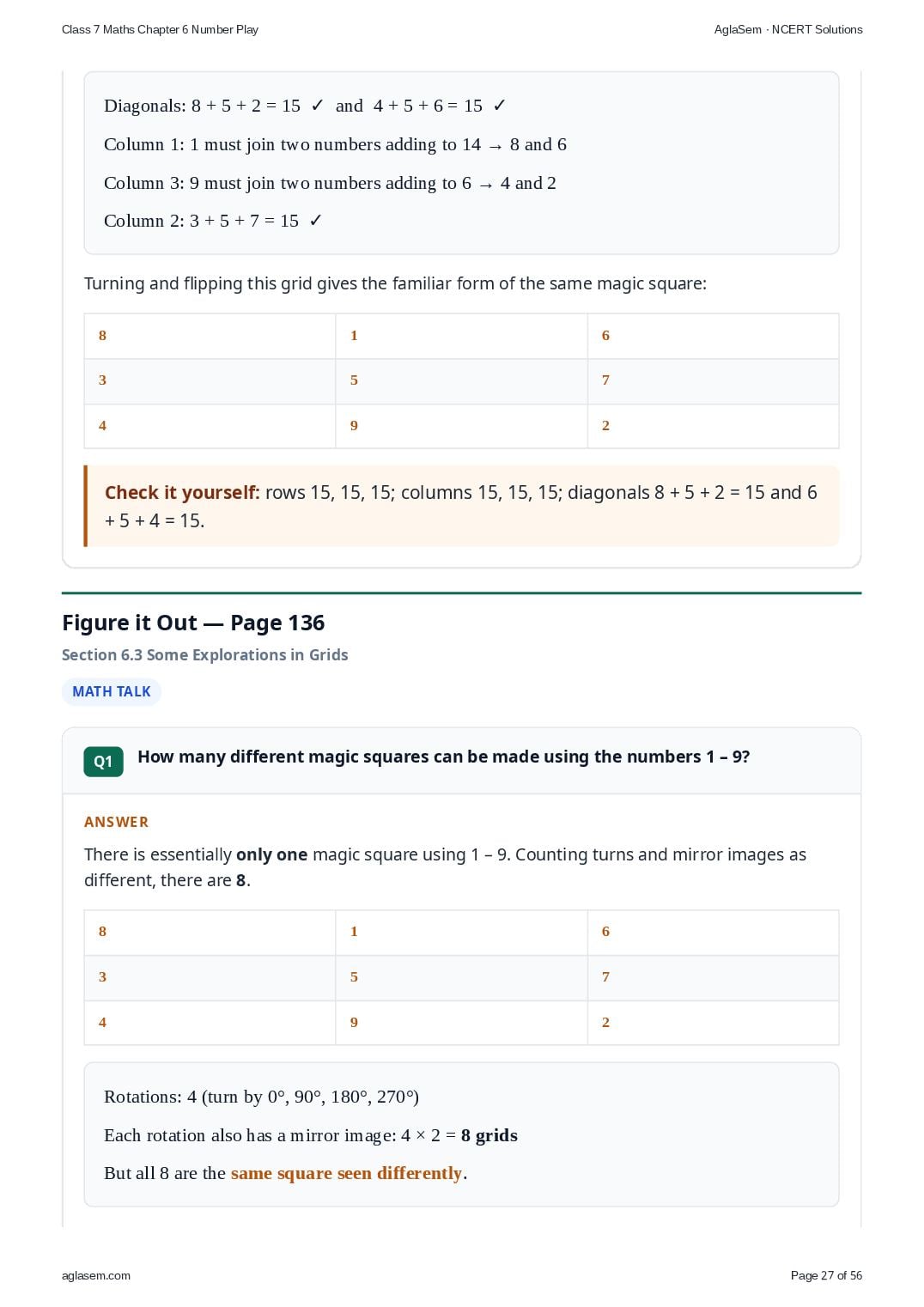
- How many different magic squares can be made using the numbers 1 – 9?
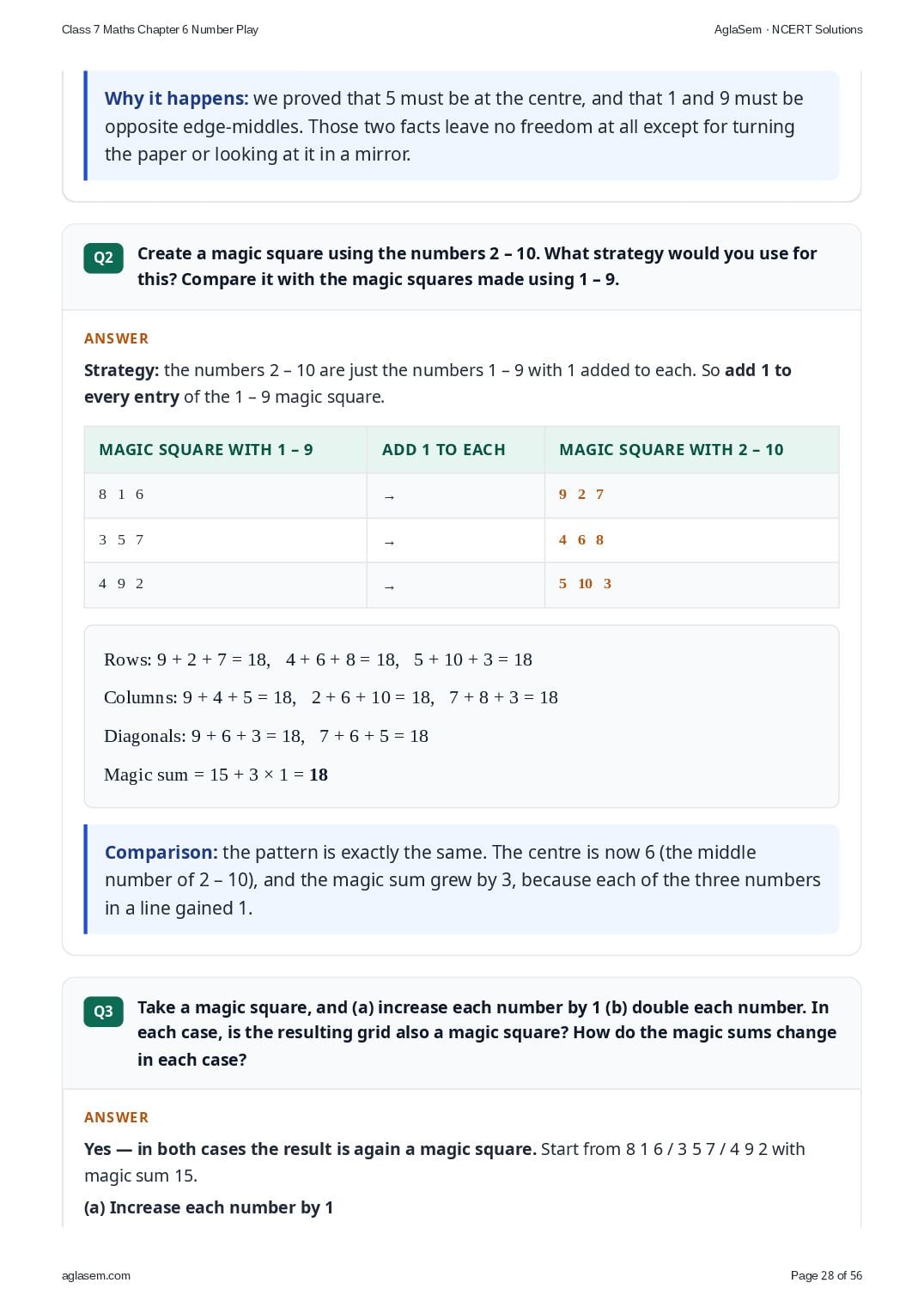
- Create a magic square using the numbers 2 – 10. What strategy would you use for this? Compare it with the magic squares made using 1 – 9.
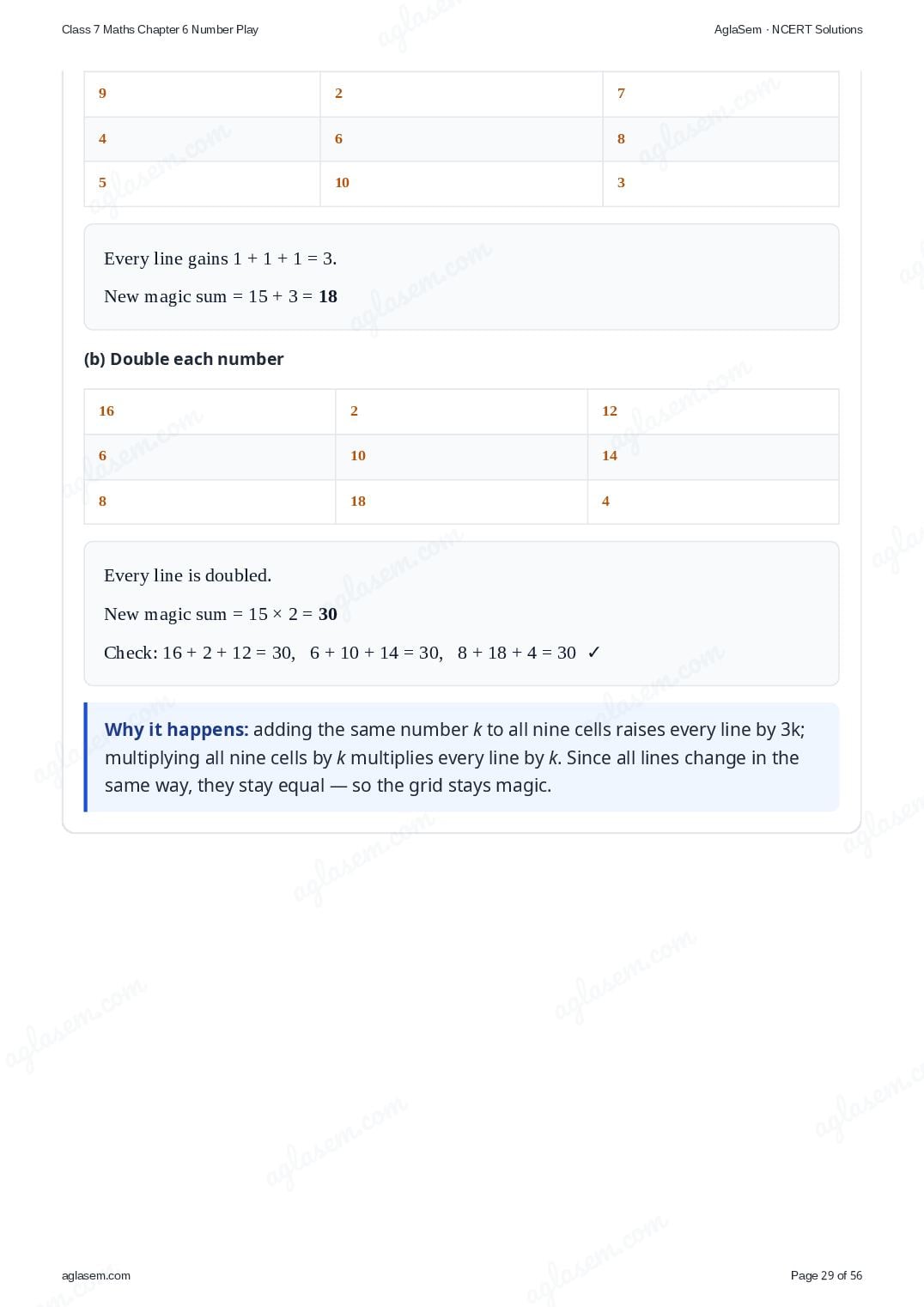
- Take a magic square, and (a) increase each number by 1 (b) double each number. In each case, is the resulting grid also a magic square? How do the magic sums change in each case?
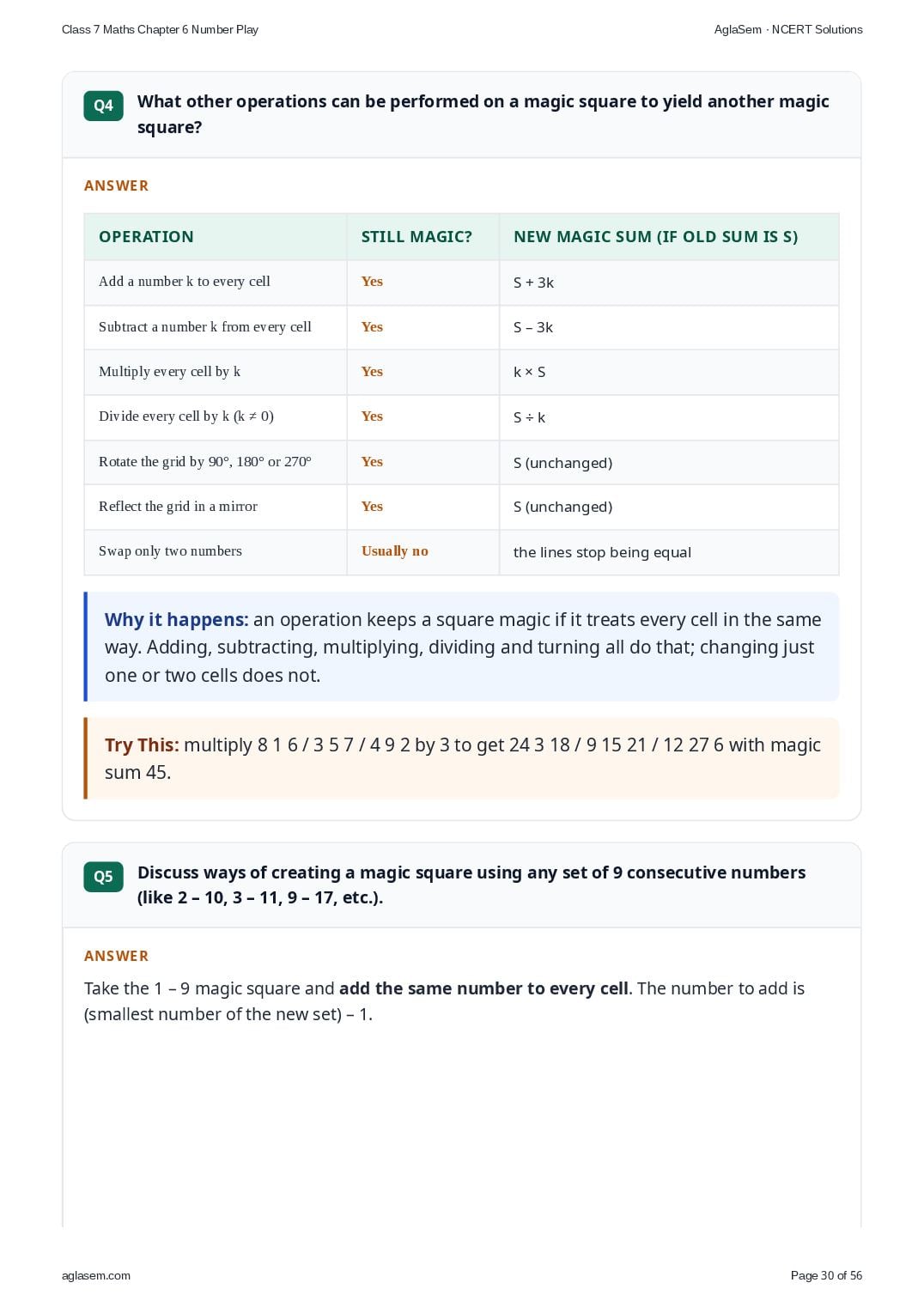
- What other operations can be performed on a magic square to yield another magic square?
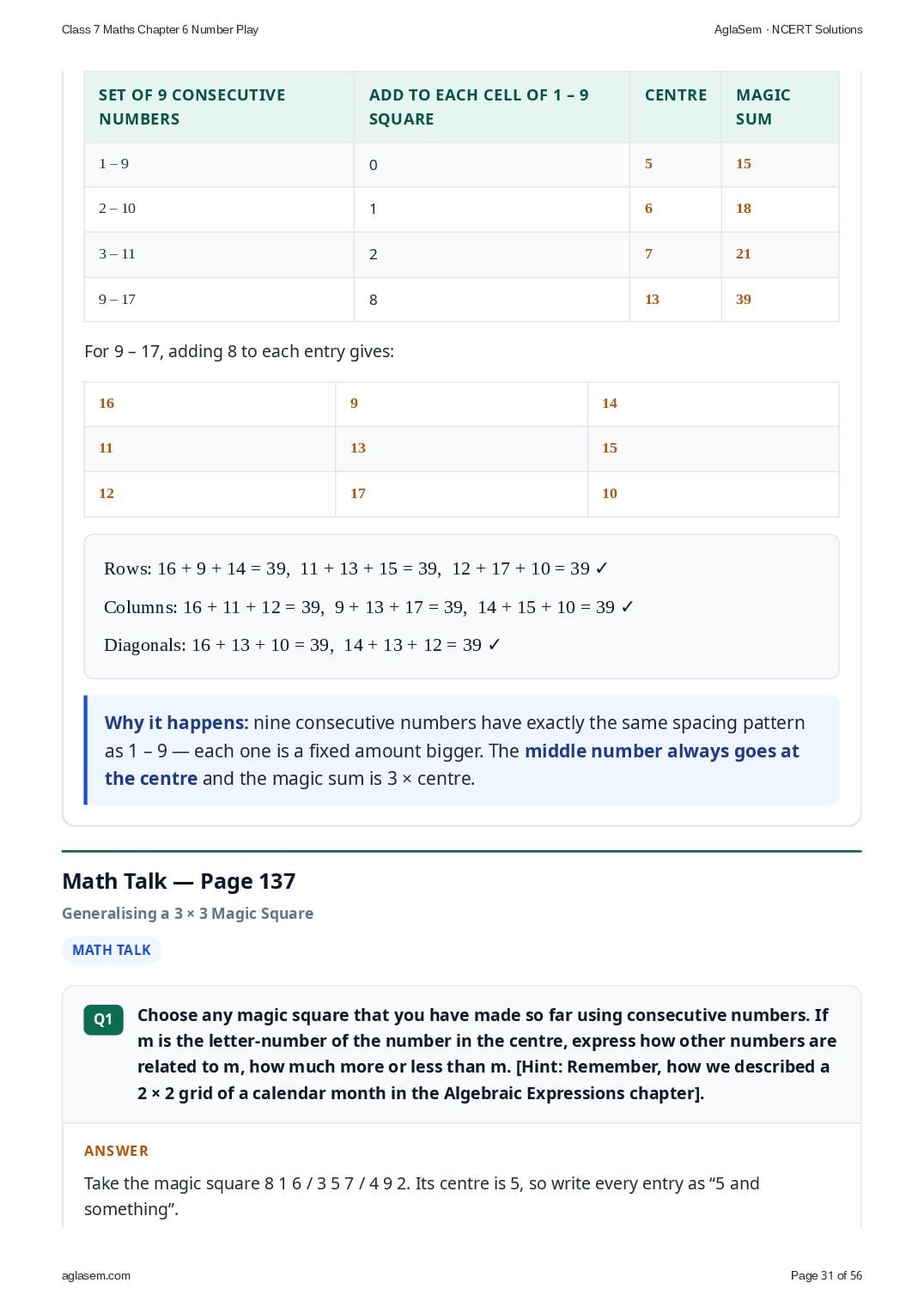
- Discuss ways of creating a magic square using any set of 9 consecutive numbers (like 2 – 10, 3 – 11, 9 – 17, etc.).
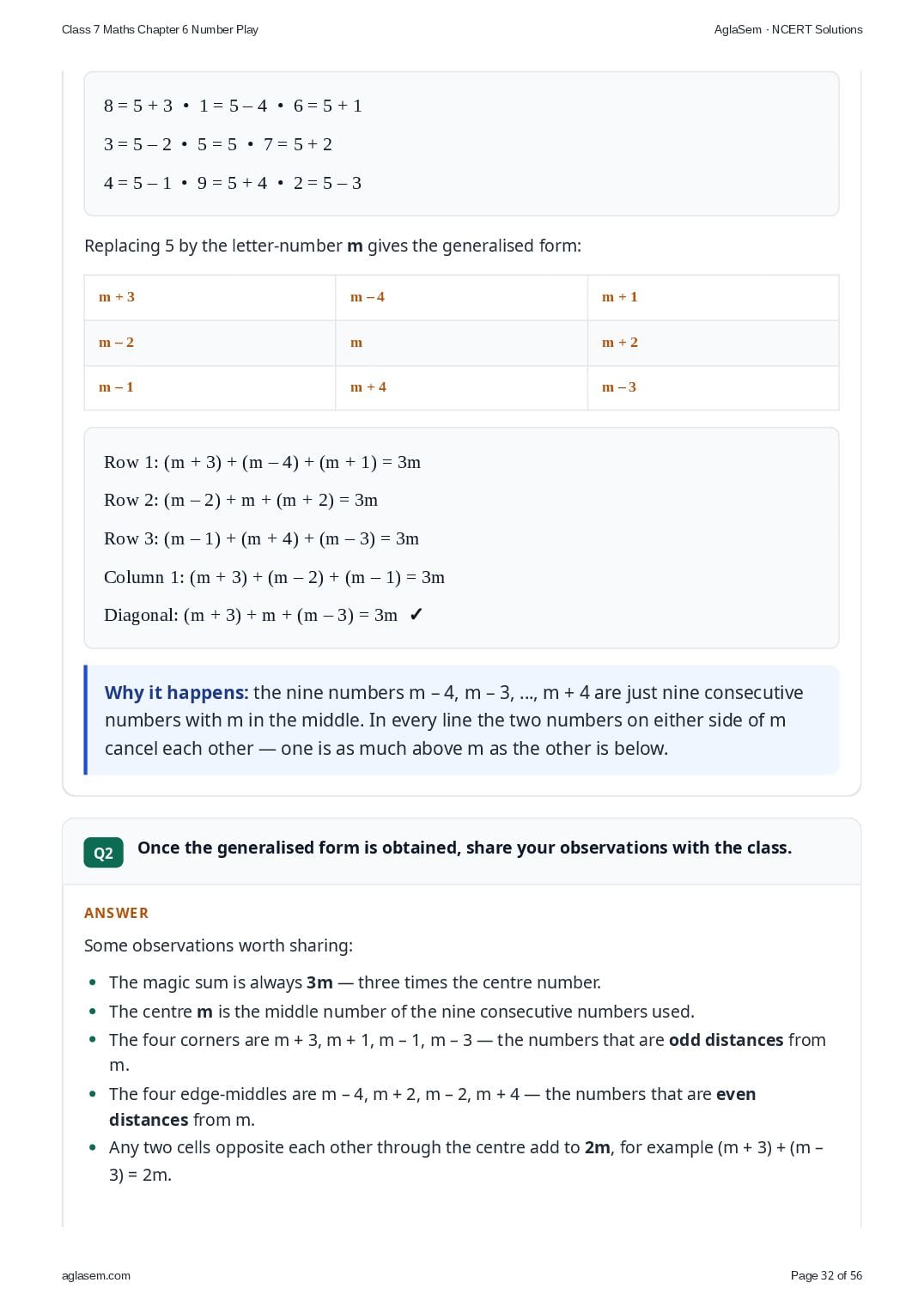
- Choose any magic square that you have made so far using consecutive numbers. If m is the letter-number of the number in the centre, express how other numbers are related to m, how much more or less than m. [Hint: Remember, how we described a 2 × 2 grid of a calendar month in the Algebraic Expressions chapter].
- Once the generalised form is obtained, share your observations with the class.
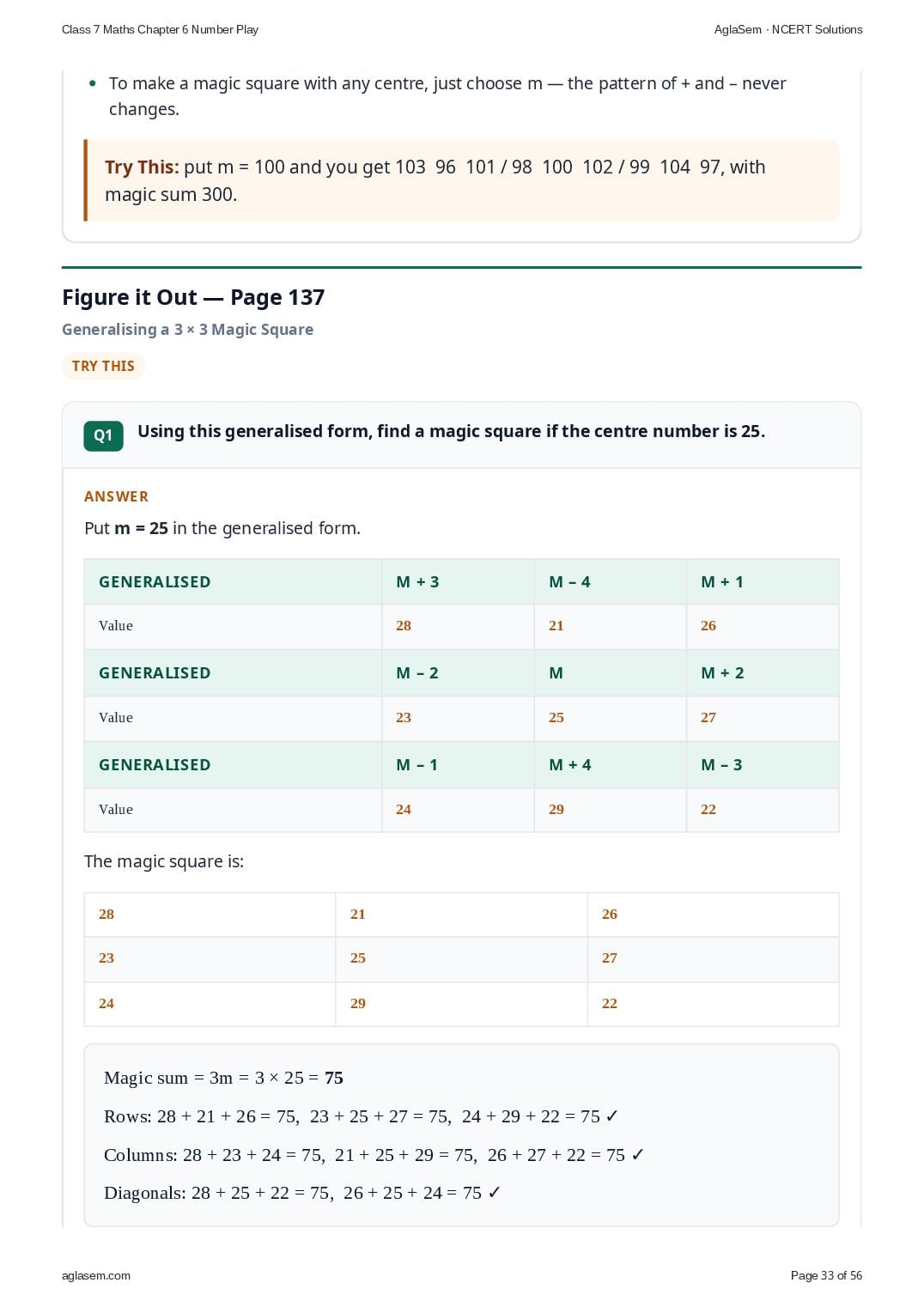
- Using this generalised form, find a magic square if the centre number is 25.
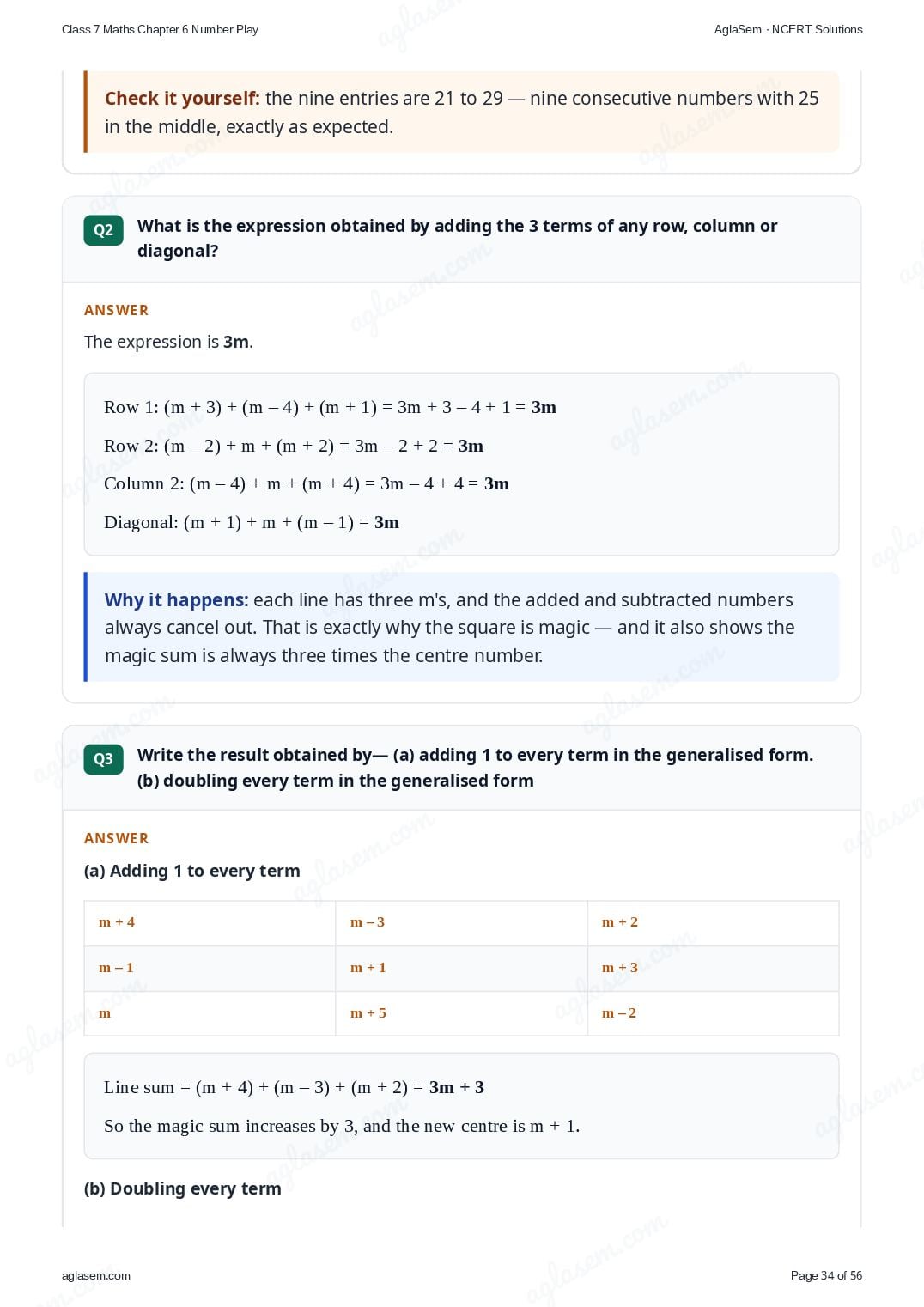
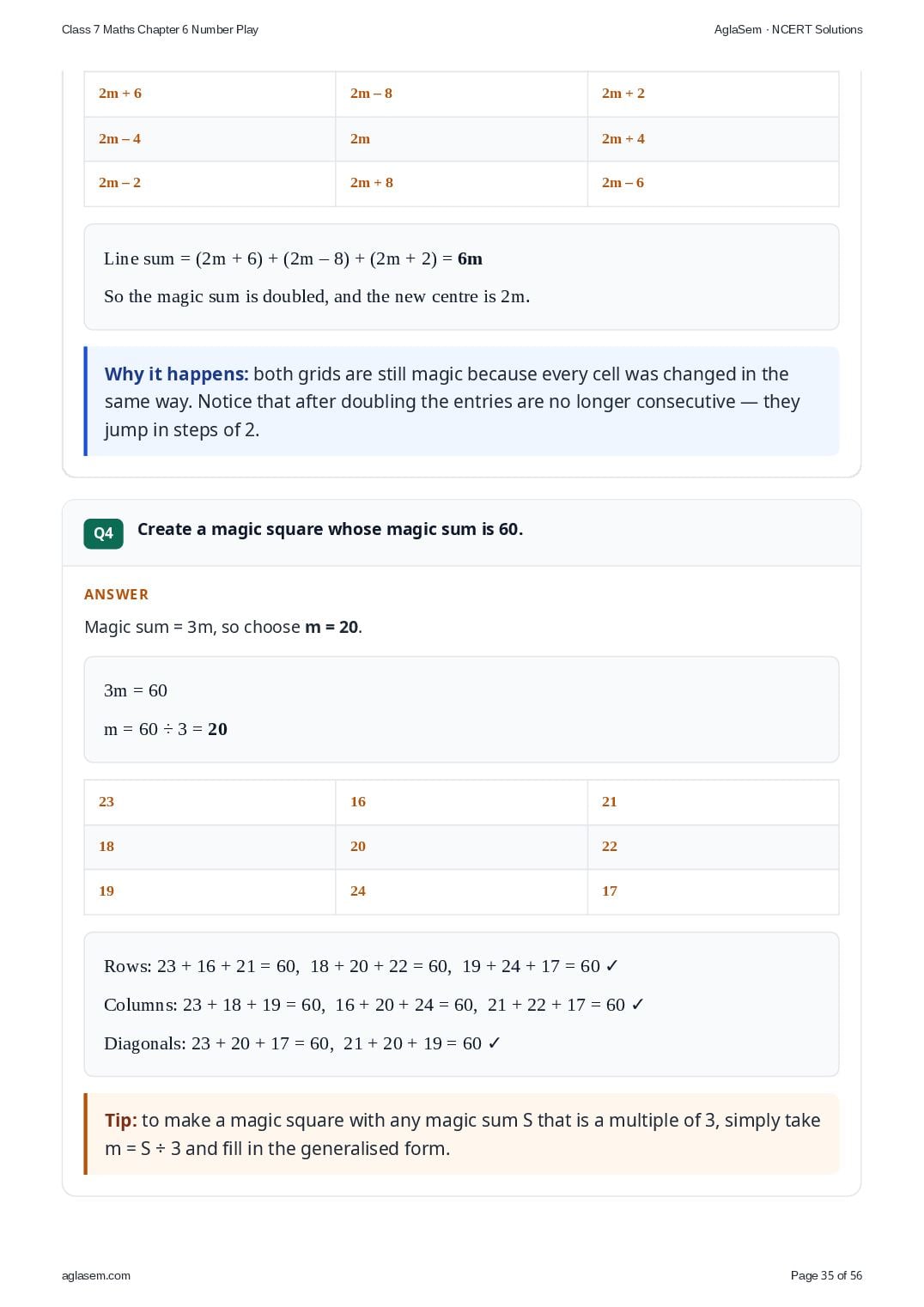
- What is the expression obtained by adding the 3 terms of any row, column or diagonal?
- Write the result obtained by— (a) adding 1 to every term in the generalised form. (b) doubling every term in the generalised form
- Create a magic square whose magic sum is 60.
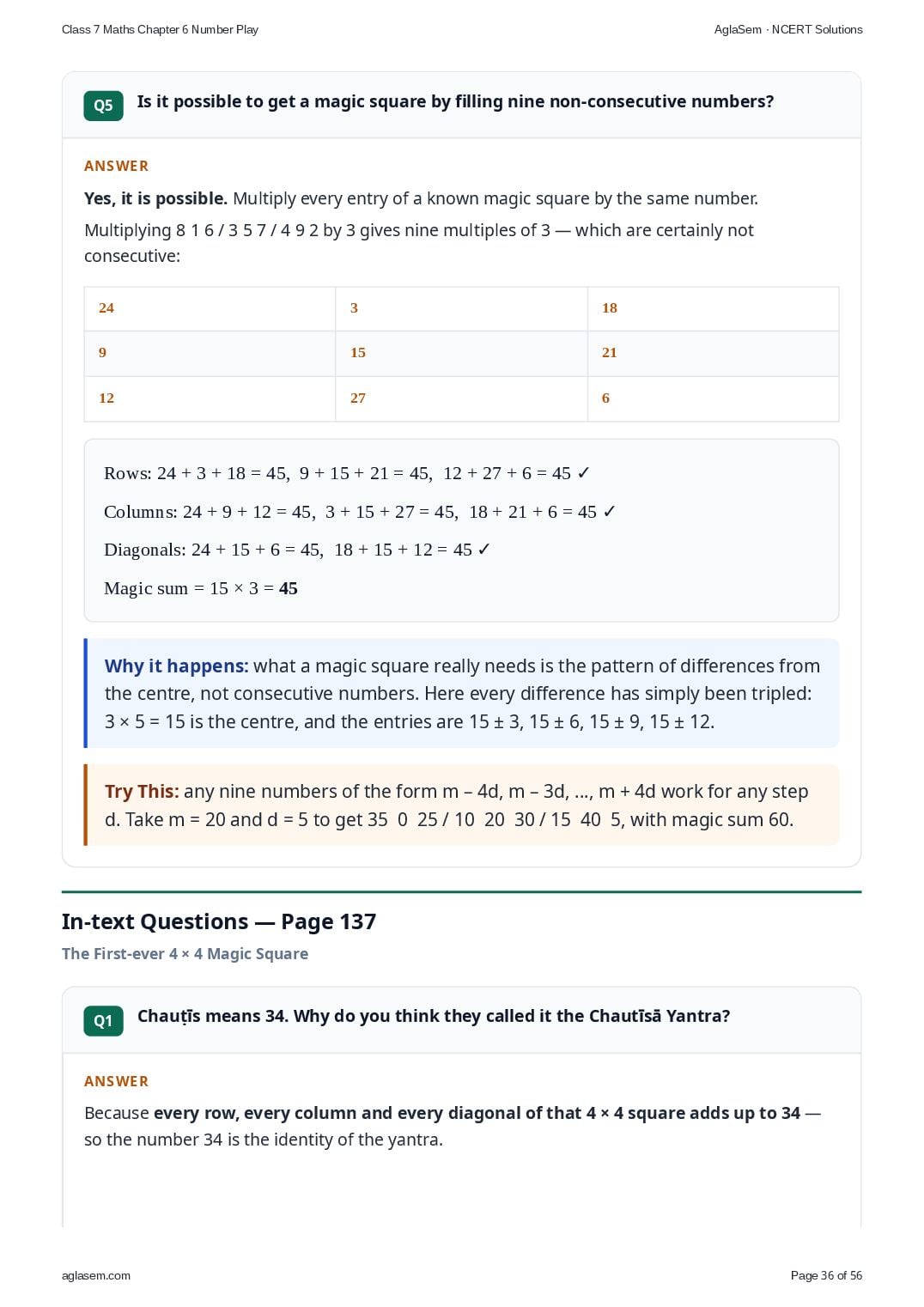
- Is it possible to get a magic square by filling nine non-consecutive numbers?
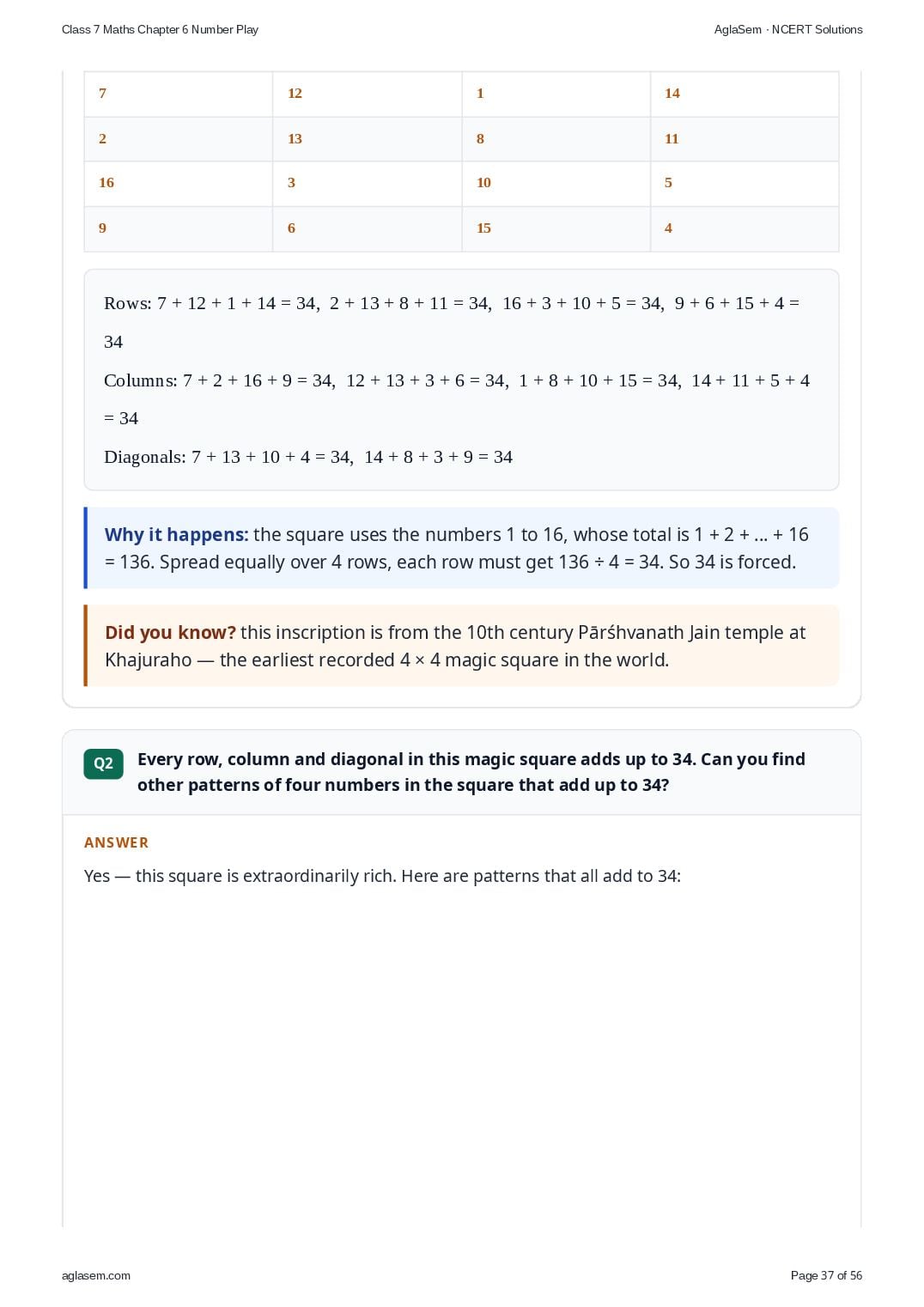
- Chauṭīs means 34. Why do you think they called it the Chautīsā Yantra?
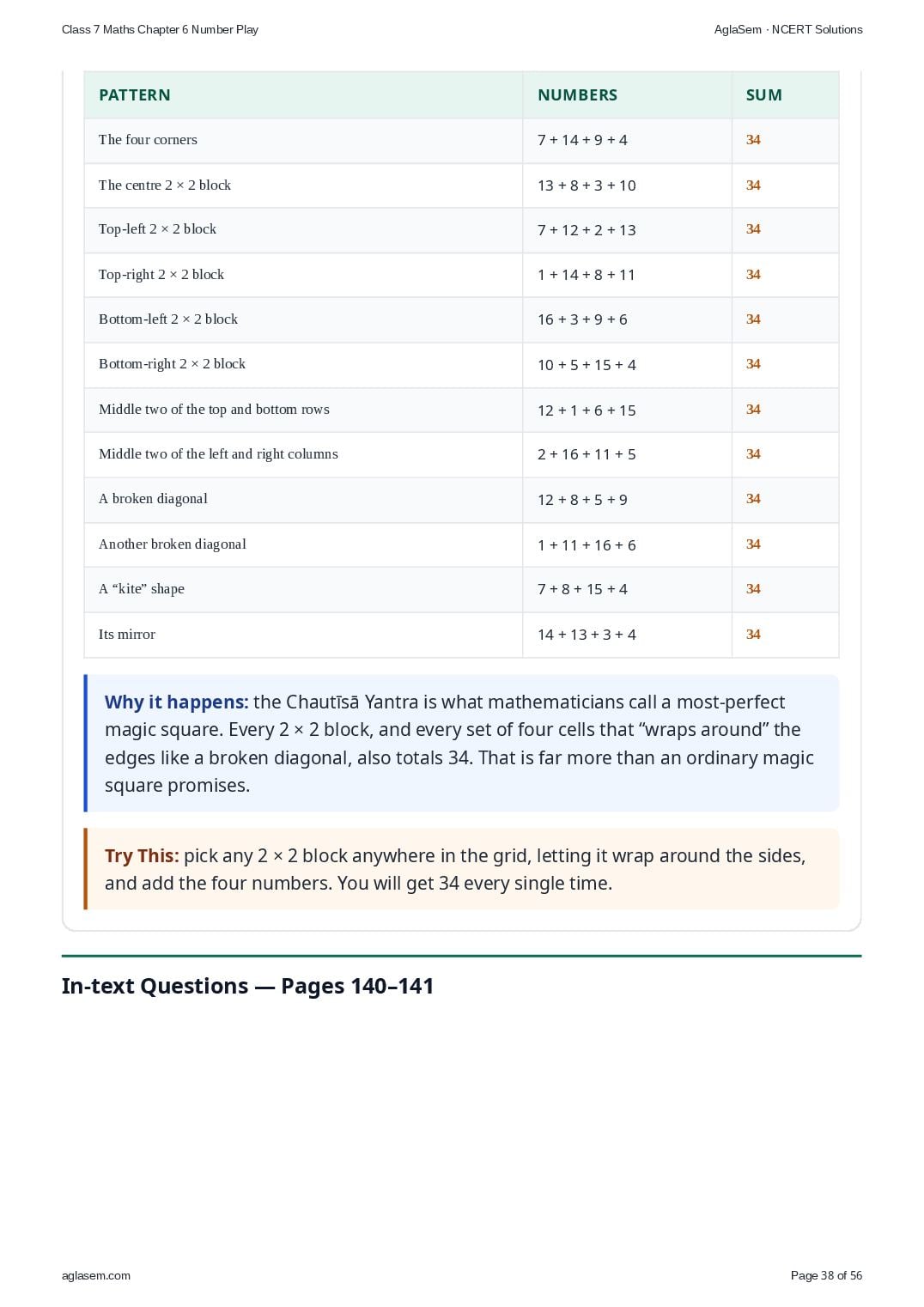
- Every row, column and diagonal in this magic square adds up to 34. Can you find other patterns of four numbers in the square that add up to 34?
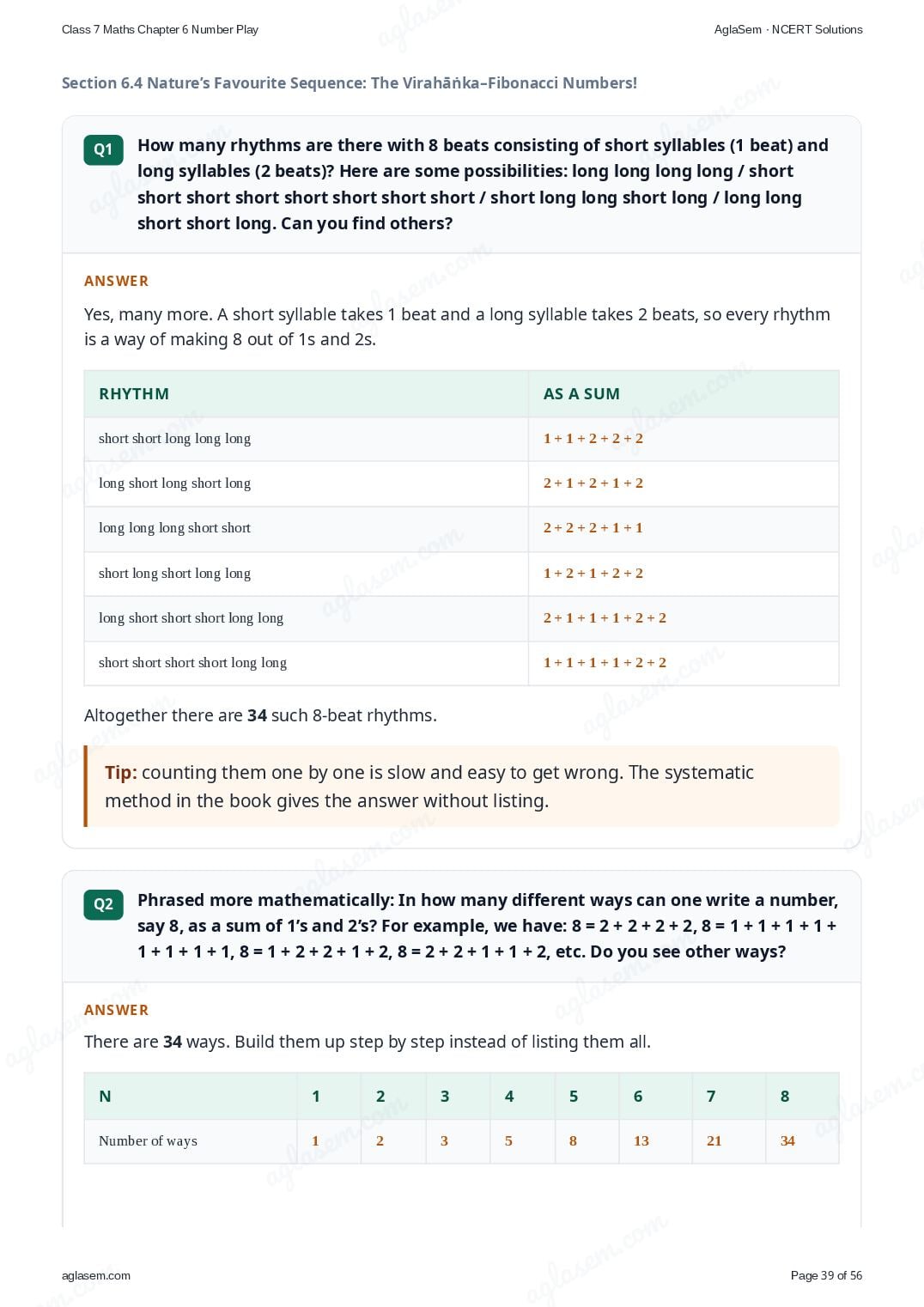
- How many rhythms are there with 8 beats consisting of short syllables (1 beat) and long syllables (2 beats)? Here are some possibilities: long long long long / short short short short short short short short / short long long short long / long long short short long. Can you find others?
- Phrased more mathematically: In how many different ways can one write a number, say 8, as a sum of 1’s and 2’s? For example, we have: 8 = 2 + 2 + 2 + 2, 8 = 1 + 1 + 1 + 1 + 1 + 1 + 1 + 1, 8 = 1 + 2 + 2 + 1 + 2, 8 = 2 + 2 + 1 + 1 + 2, etc. Do you see other ways?
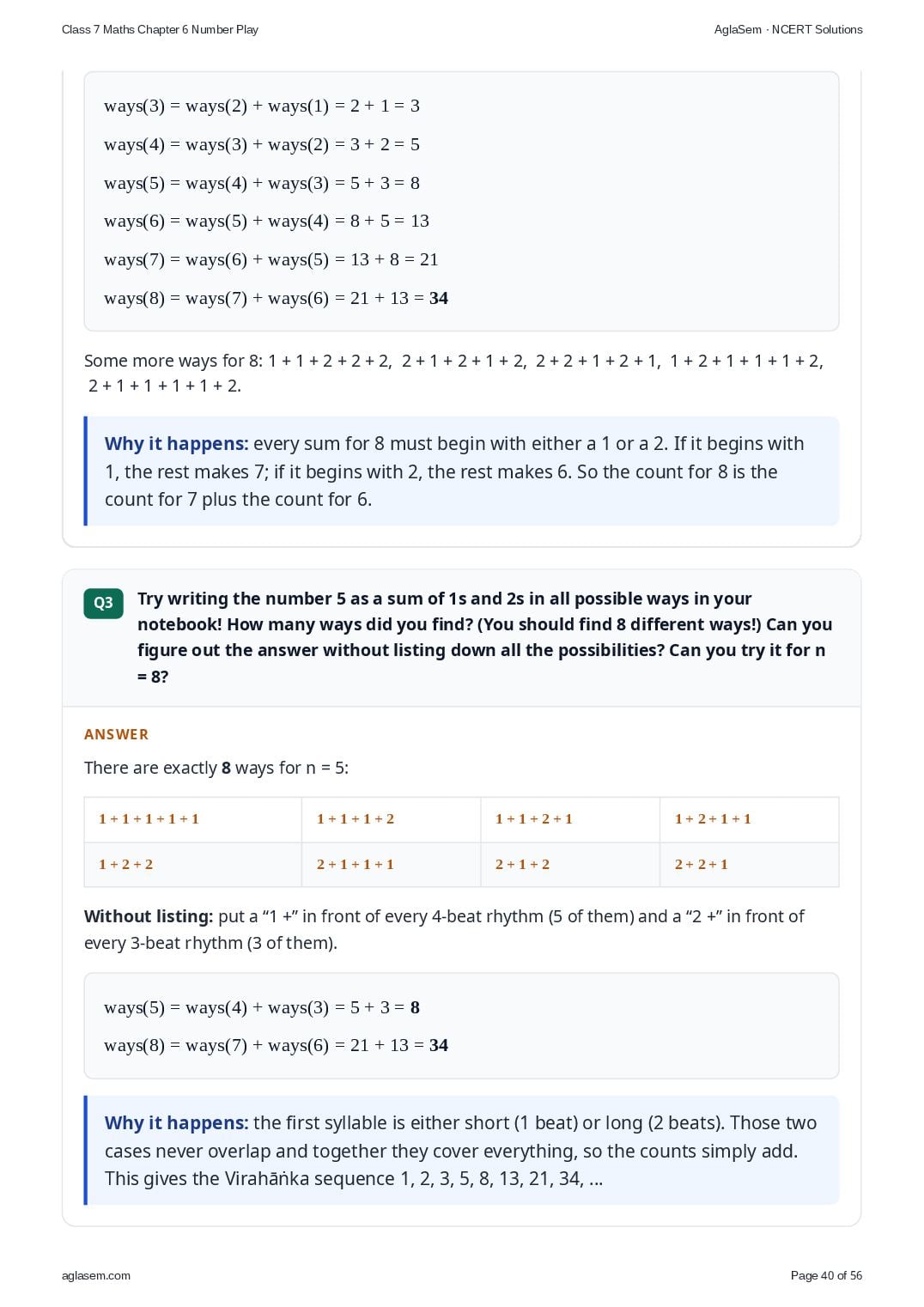
- Try writing the number 5 as a sum of 1s and 2s in all possible ways in your notebook! How many ways did you find? (You should find 8 different ways!) Can you figure out the answer without listing down all the possibilities? Can you try it for n = 8?
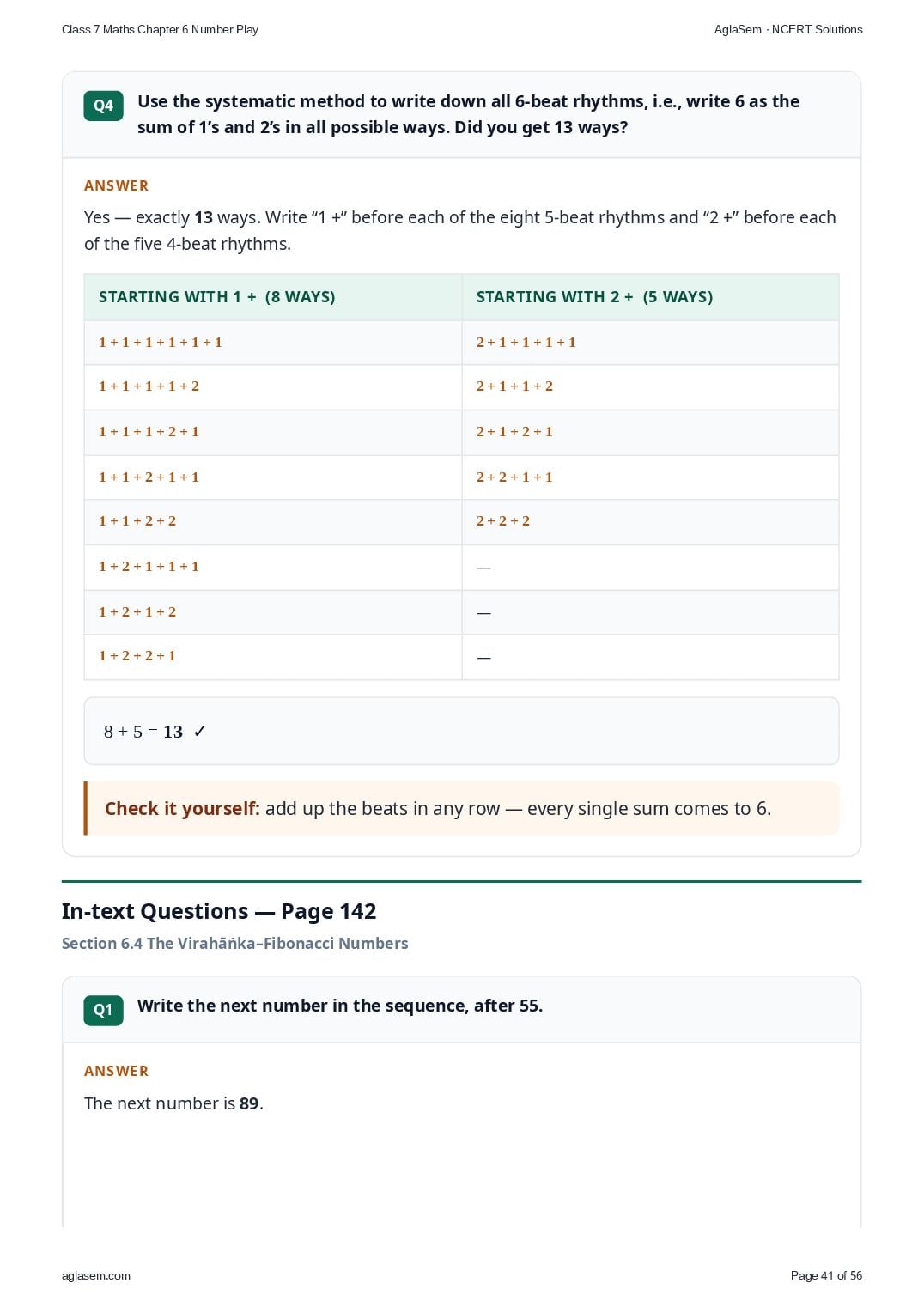
- Use the systematic method to write down all 6-beat rhythms, i.e., write 6 as the sum of 1’s and 2’s in all possible ways. Did you get 13 ways?
- Write the next number in the sequence, after 55.
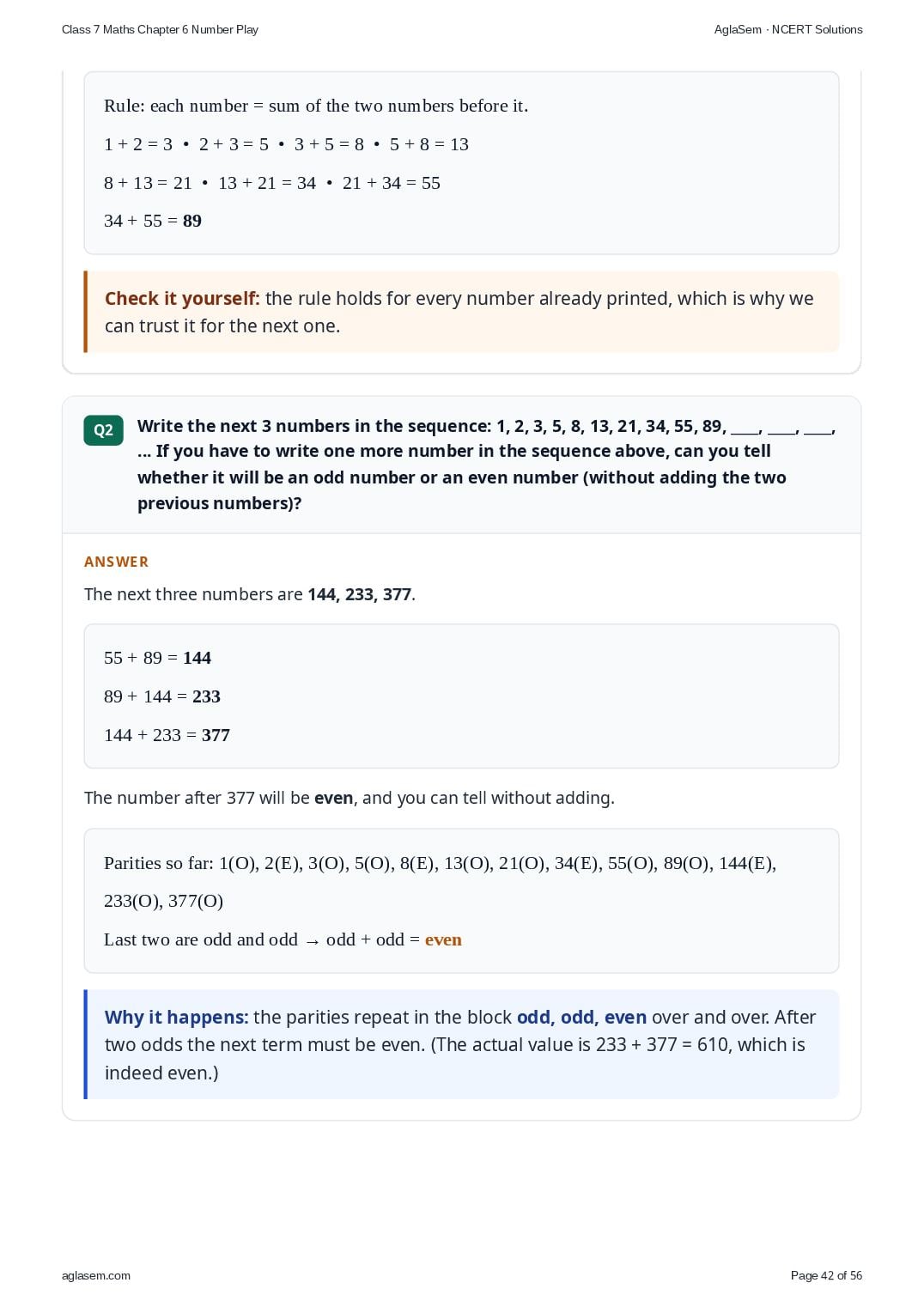
- Write the next 3 numbers in the sequence: 1, 2, 3, 5, 8, 13, 21, 34, 55, 89, ____, ____, ____, … If you have to write one more number in the sequence above, can you tell whether it will be an odd number or an even number (without adding the two previous numbers)?
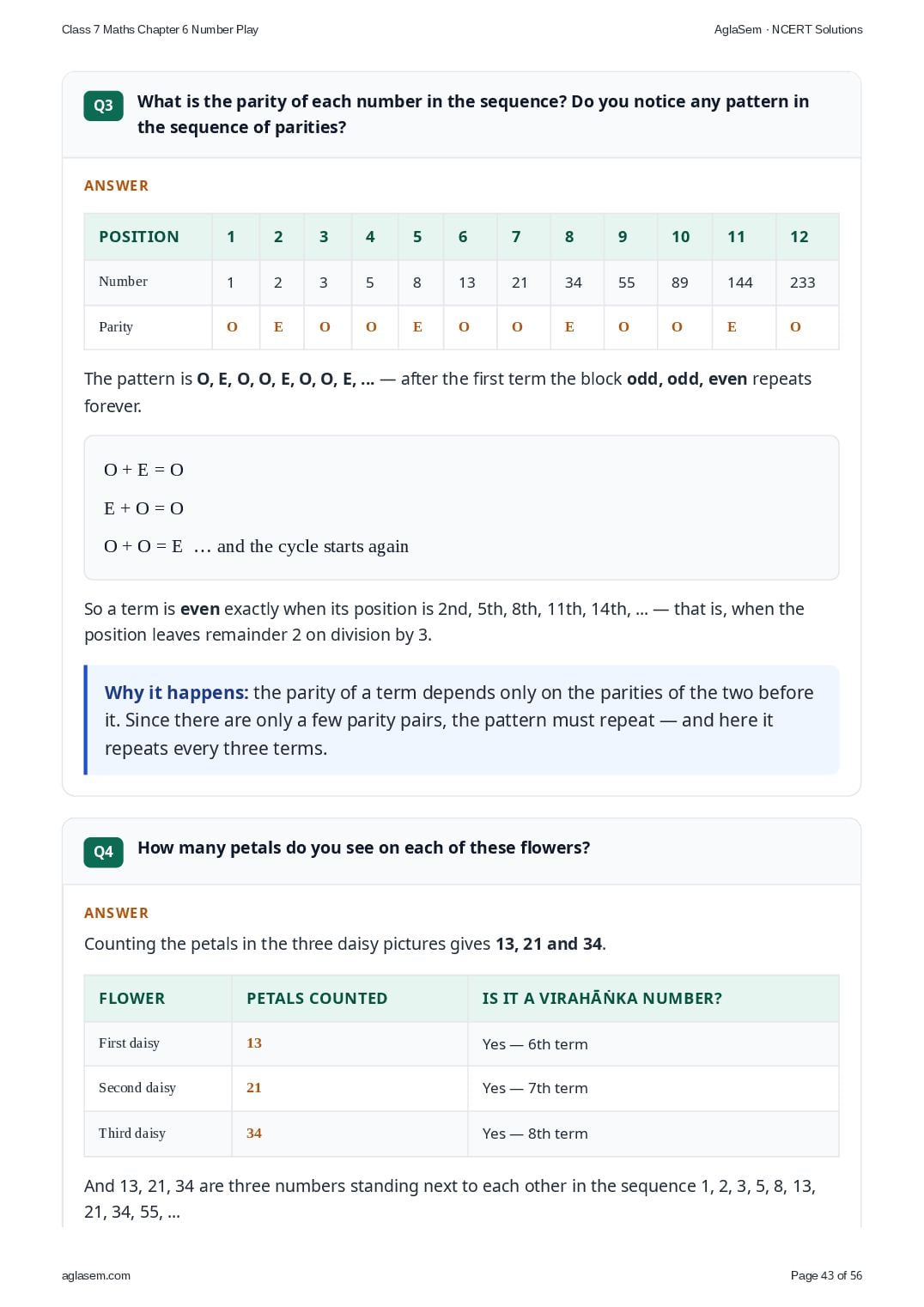
- What is the parity of each number in the sequence? Do you notice any pattern in the sequence of parities?
- How many petals do you see on each of these flowers?
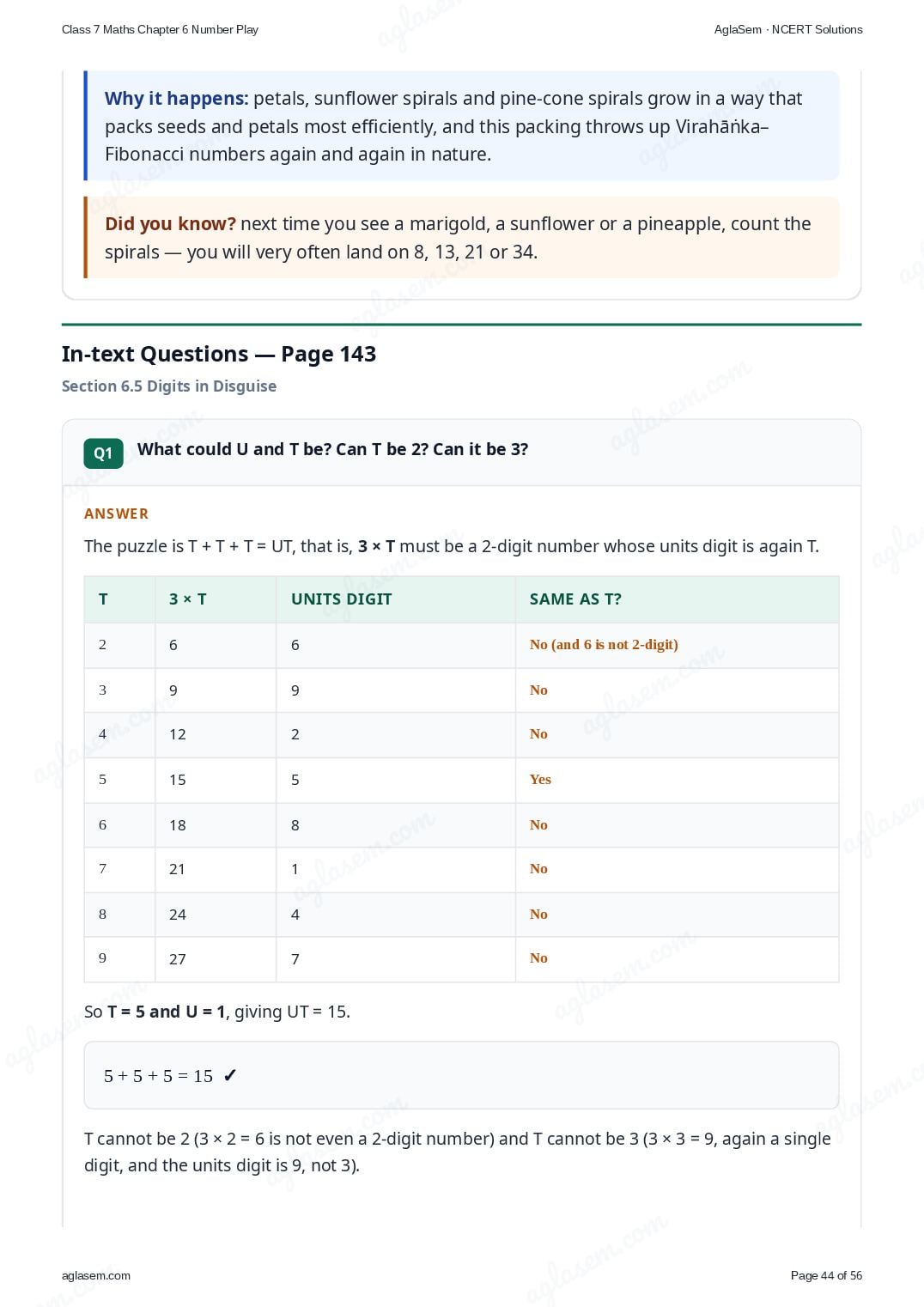
- What could U and T be? Can T be 2? Can it be 3?
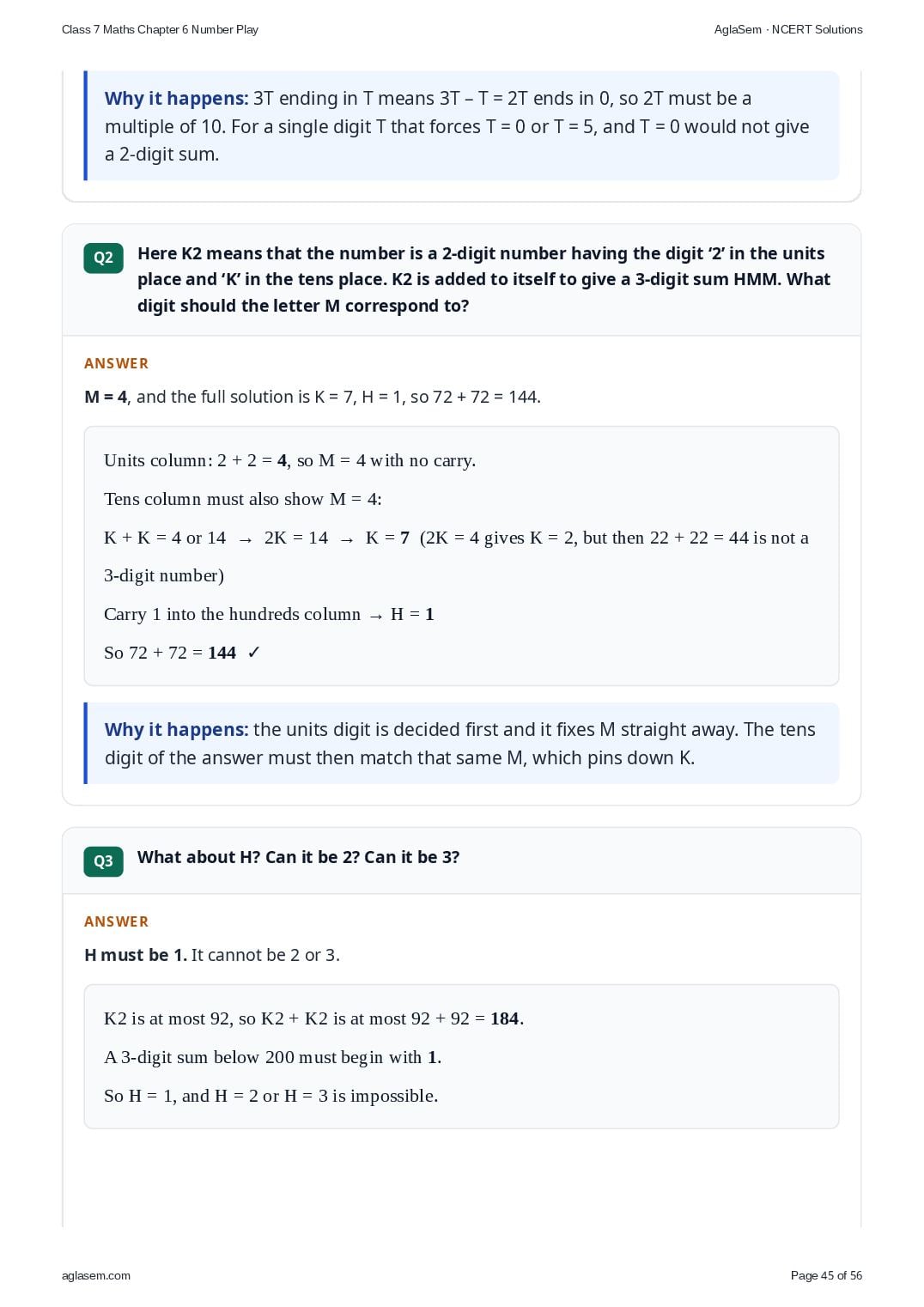
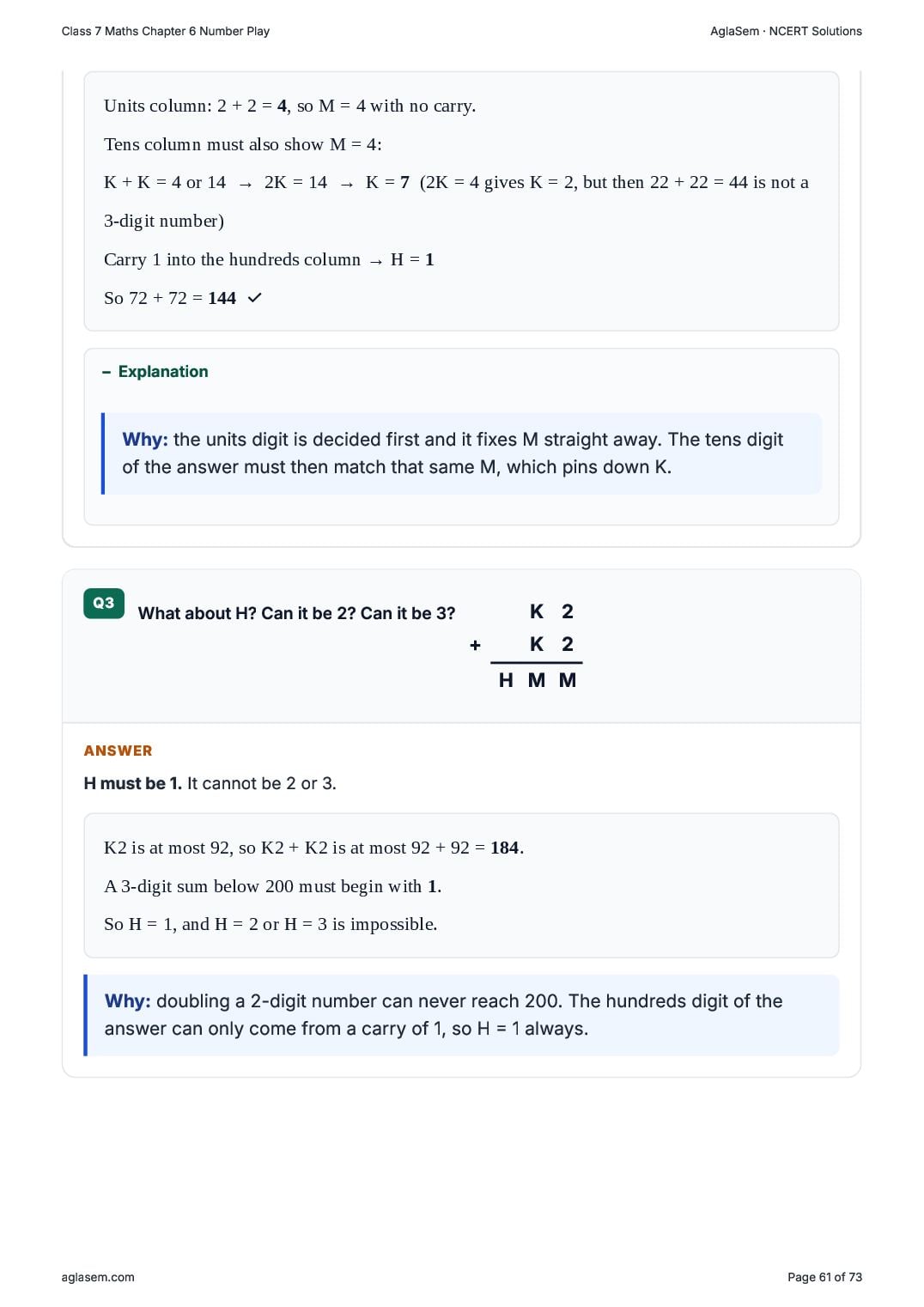
- Here K2 means that the number is a 2-digit number having the digit ‘2’ in the units place and ‘K’ in the tens place. K2 is added to itself to give a 3-digit sum HMM. What digit should the letter M correspond to?
- What about H? Can it be 2? Can it be 3?
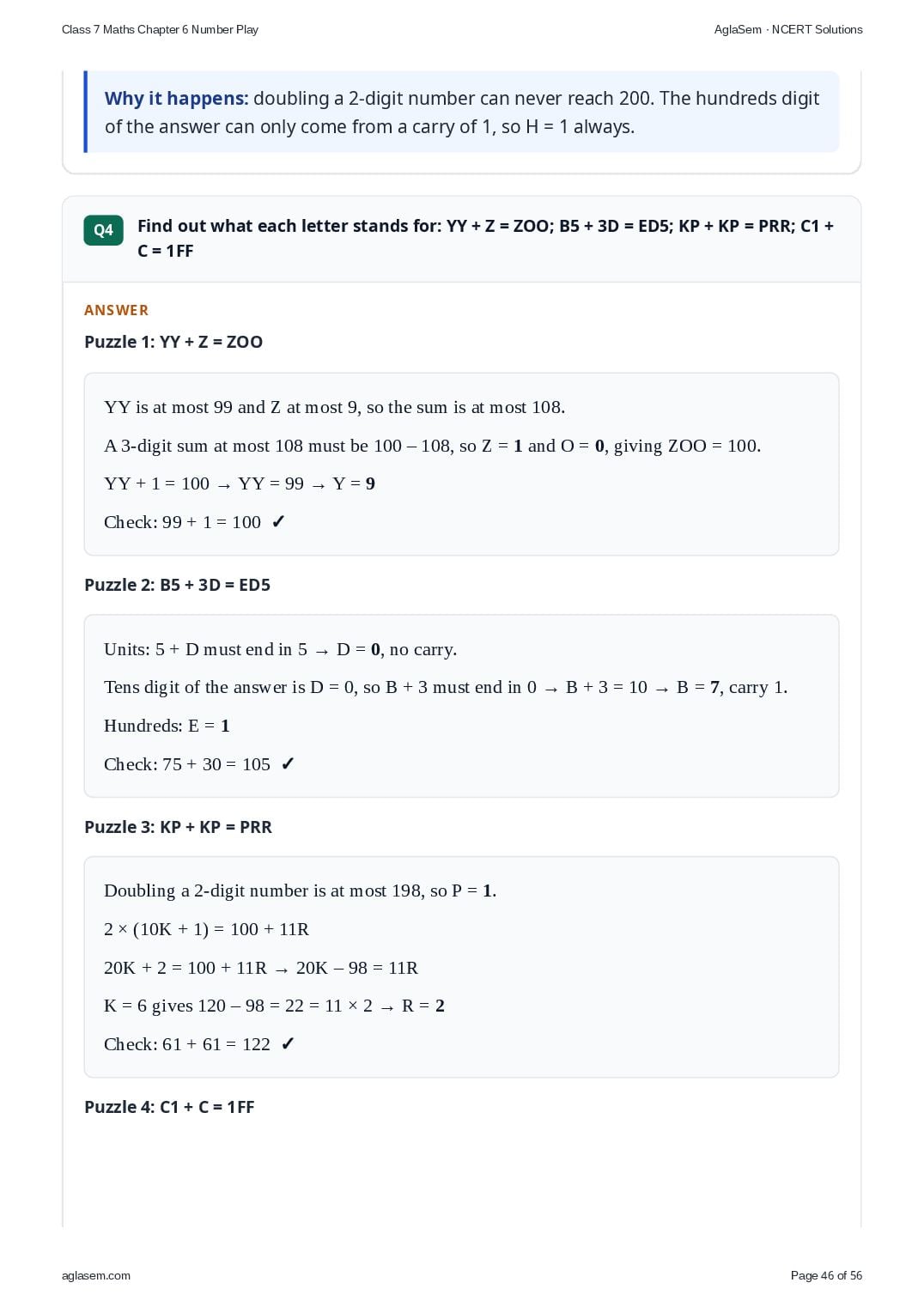
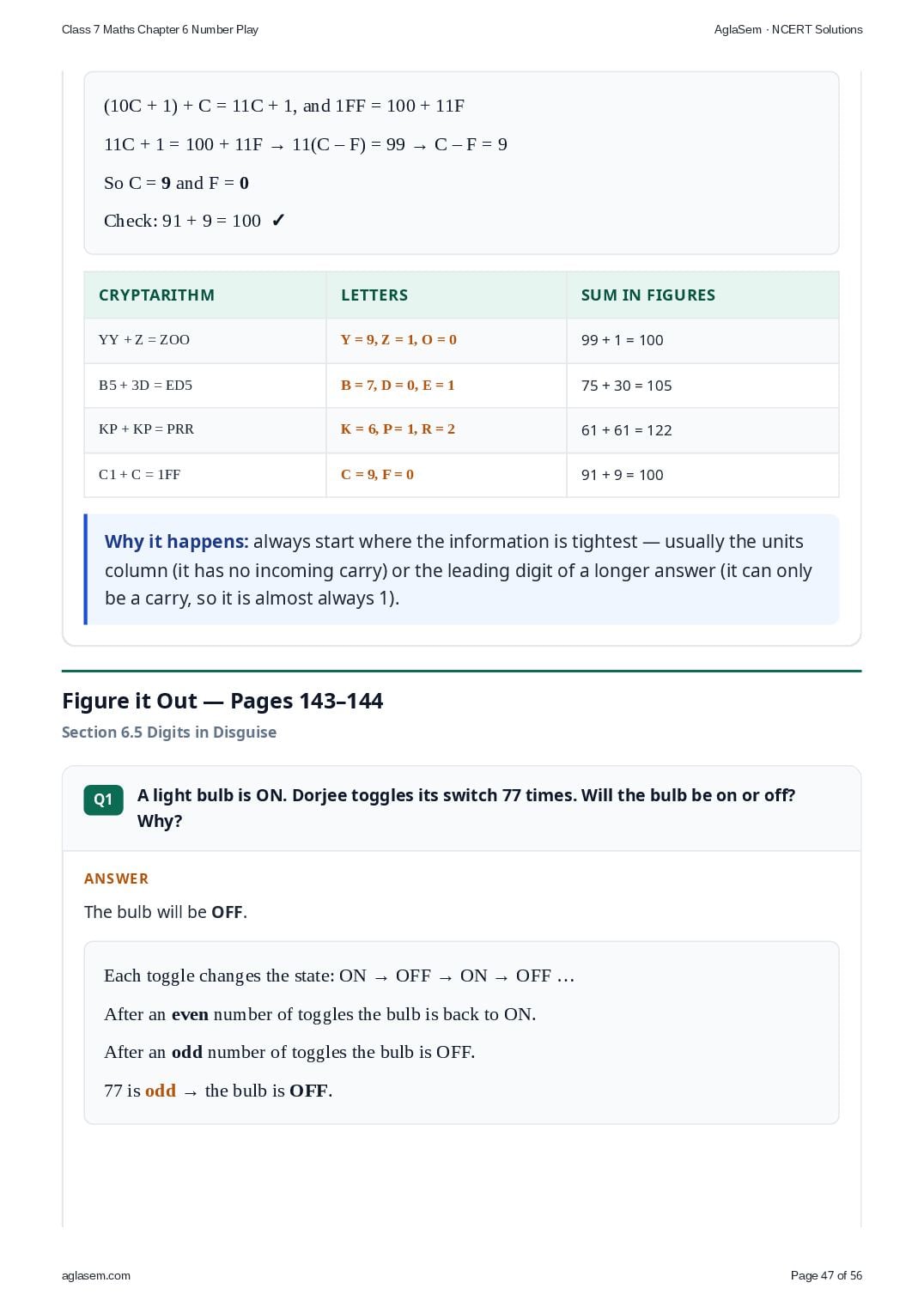
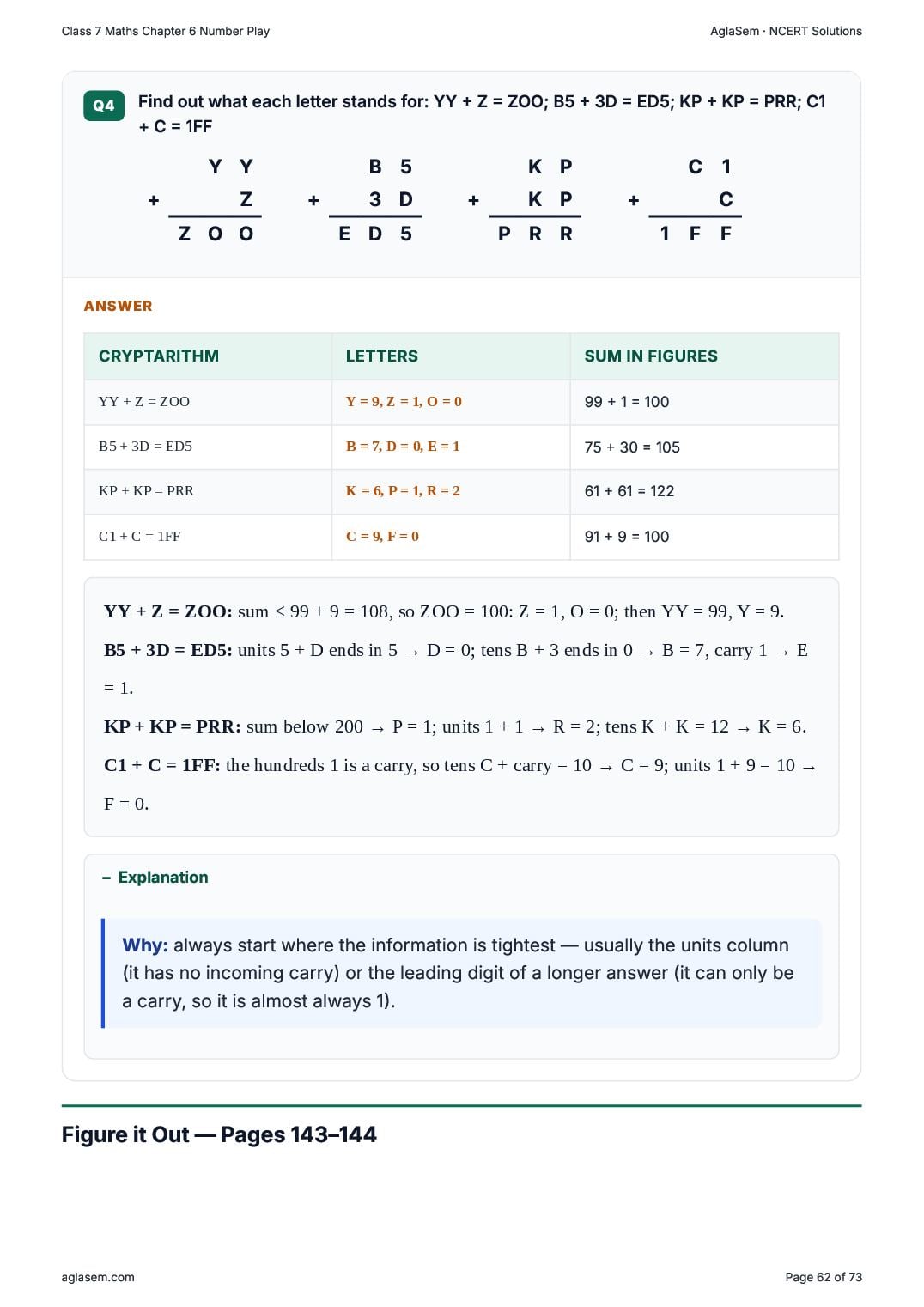
- Find out what each letter stands for: YY + Z = ZOO; B5 + 3D = ED5; KP + KP = PRR; C1 + C = 1FF
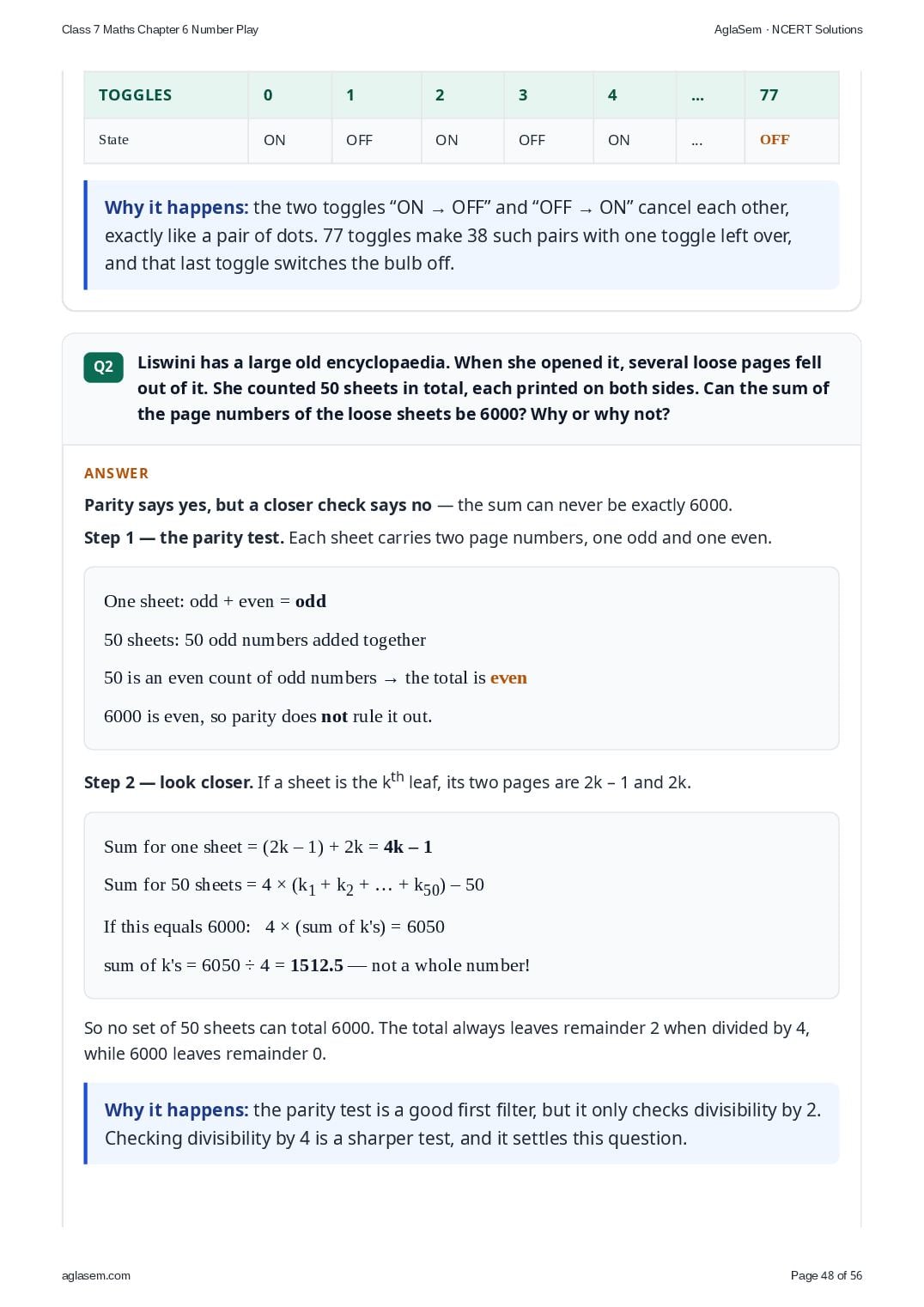
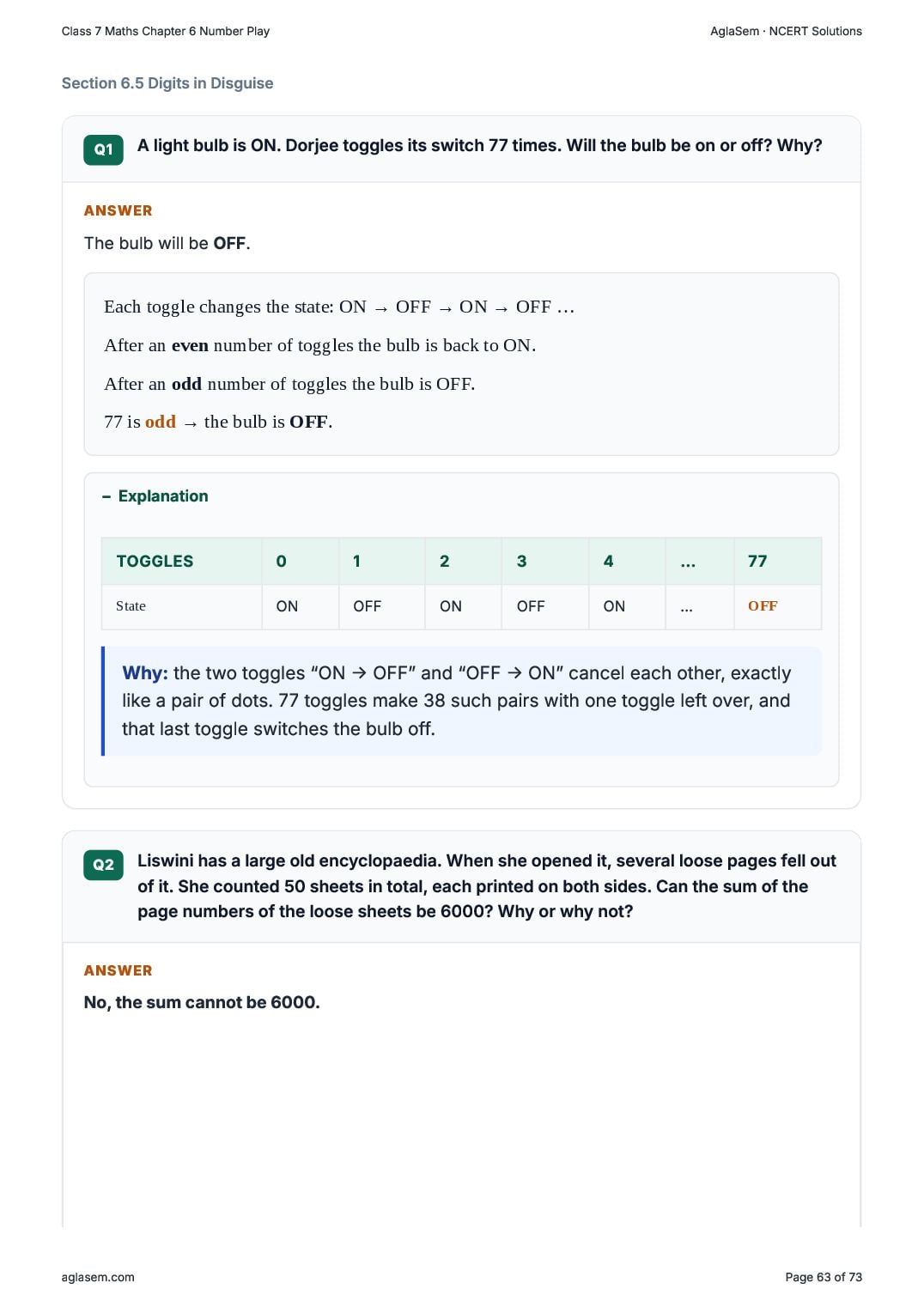
- A light bulb is ON. Dorjee toggles its switch 77 times. Will the bulb be on or off? Why?
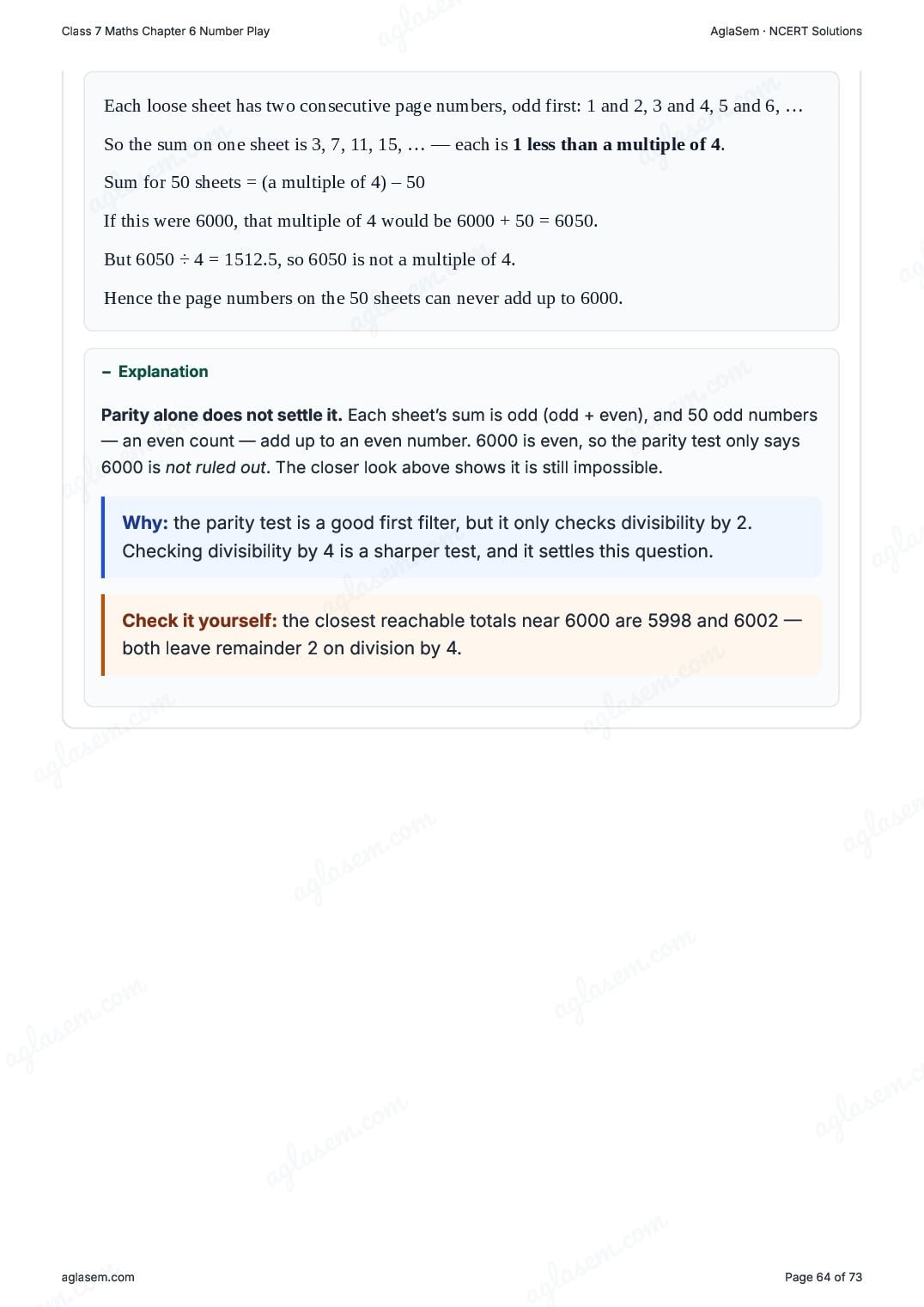
- Liswini has a large old encyclopaedia. When she opened it, several loose pages fell out of it. She counted 50 sheets in total, each printed on both sides. Can the sum of the page numbers of the loose sheets be 6000? Why or why not?
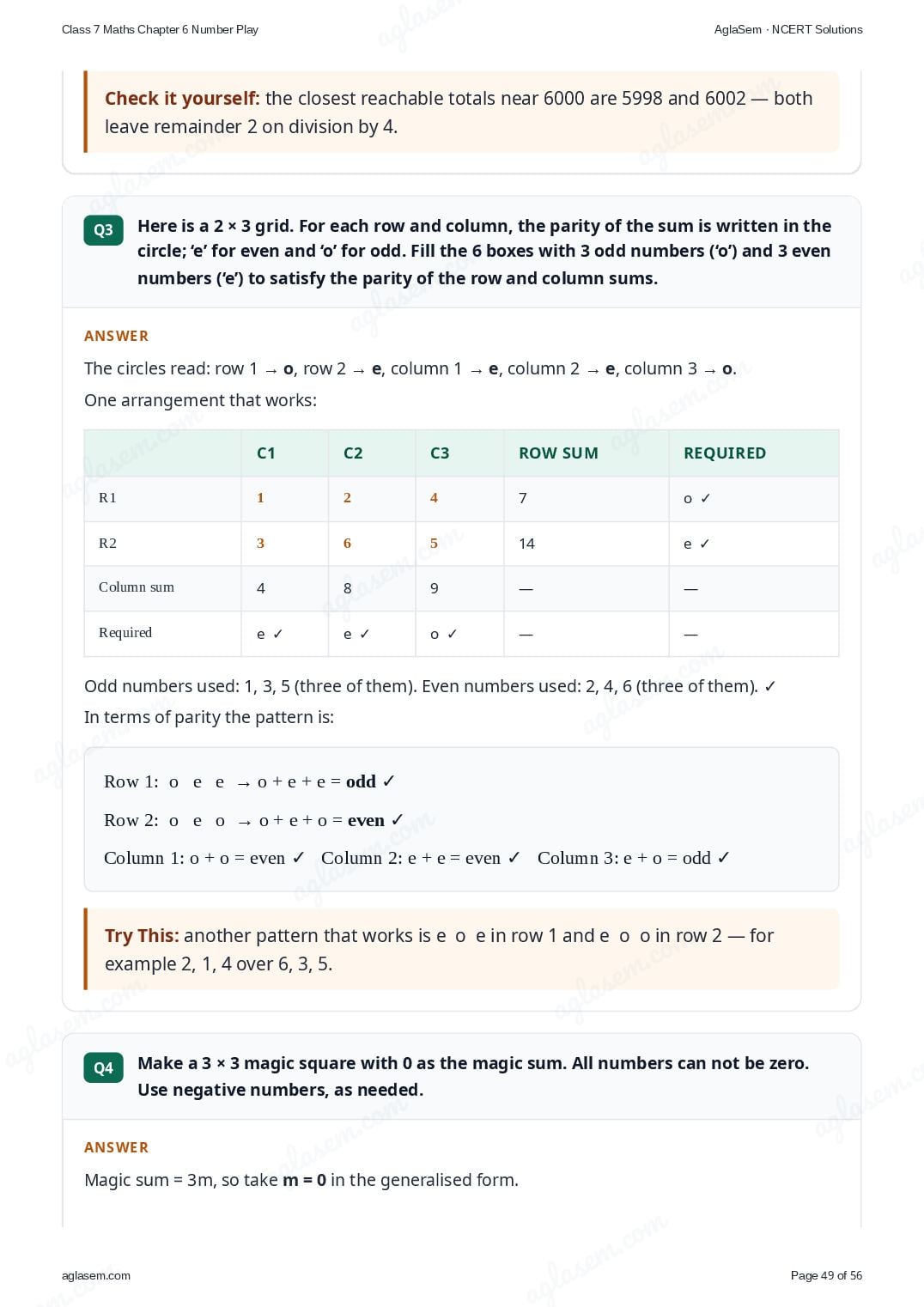
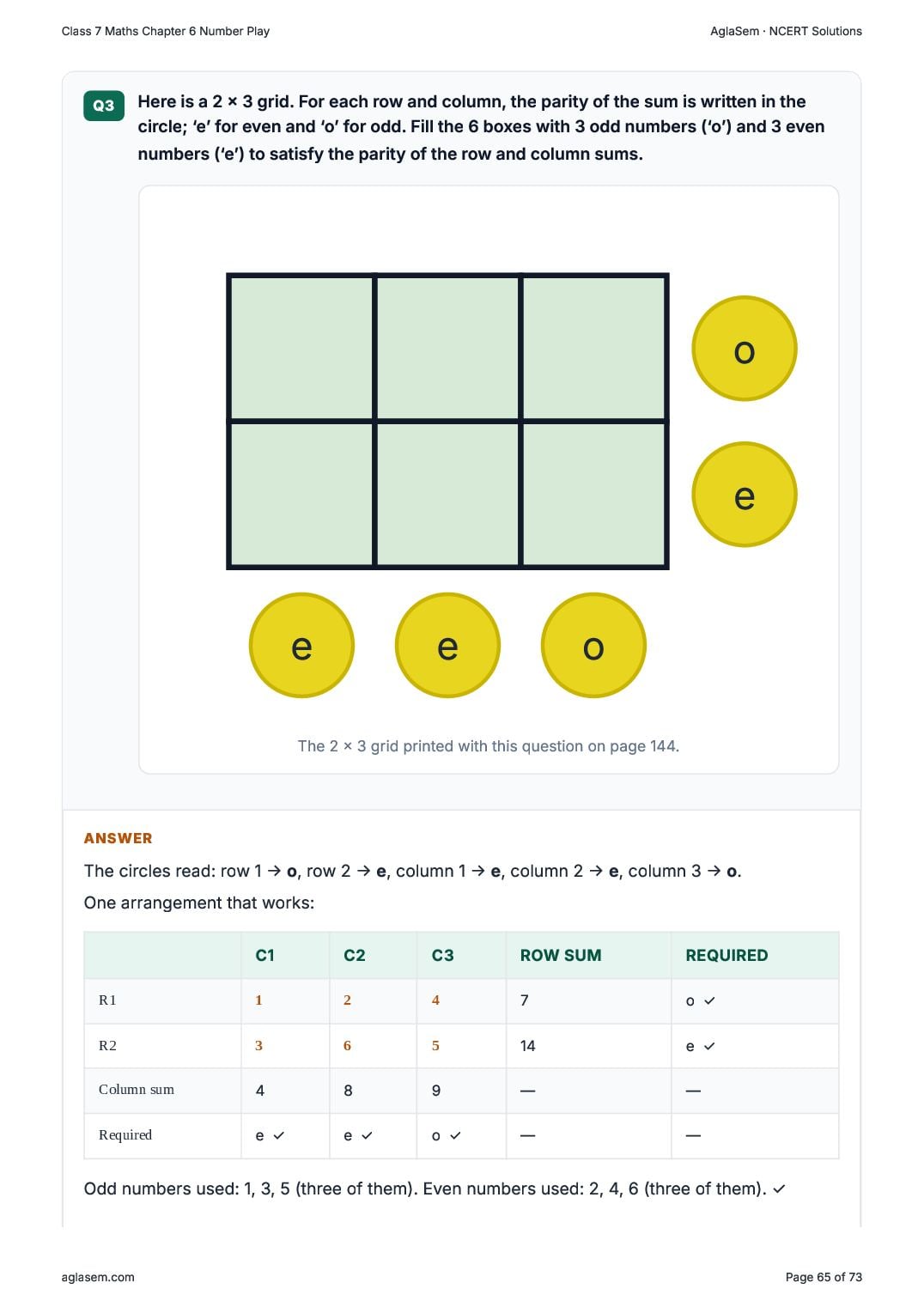
- Here is a 2 × 3 grid. For each row and column, the parity of the sum is written in the circle; ‘e’ for even and ‘o’ for odd. Fill the 6 boxes with 3 odd numbers (‘o’) and 3 even numbers (‘e’) to satisfy the parity of the row and column sums.
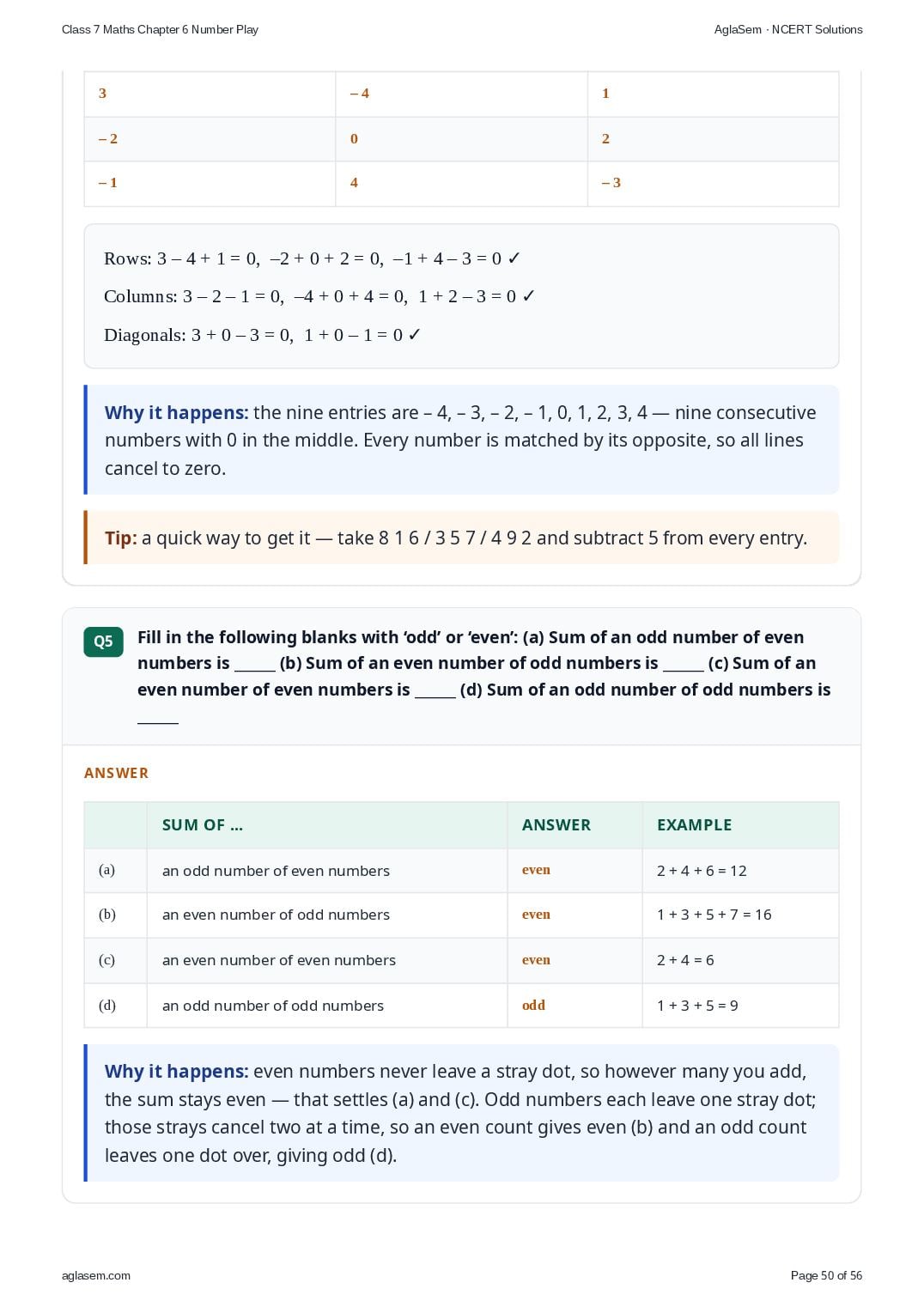
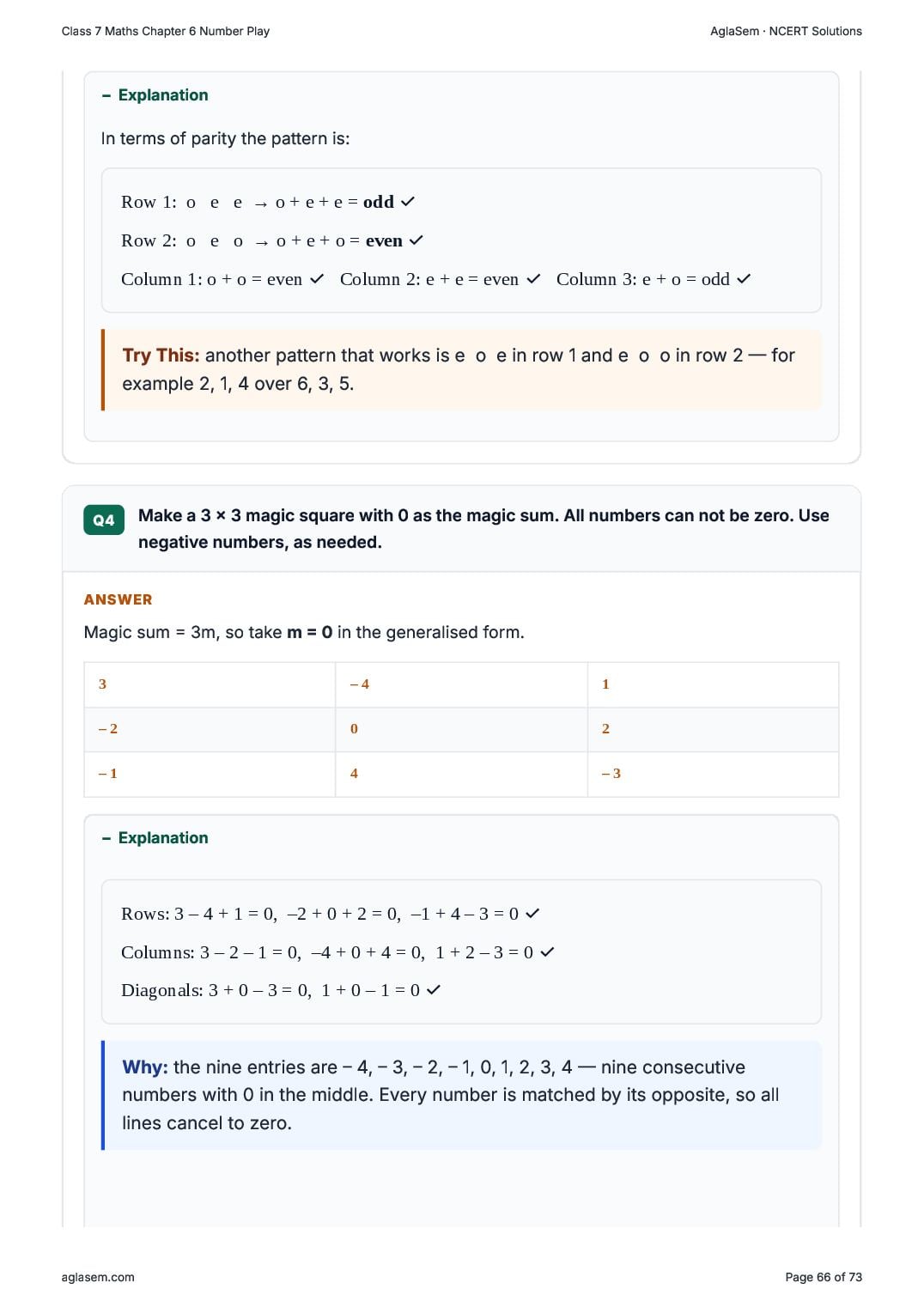
- Make a 3 × 3 magic square with 0 as the magic sum. All numbers can not be zero. Use negative numbers, as needed.
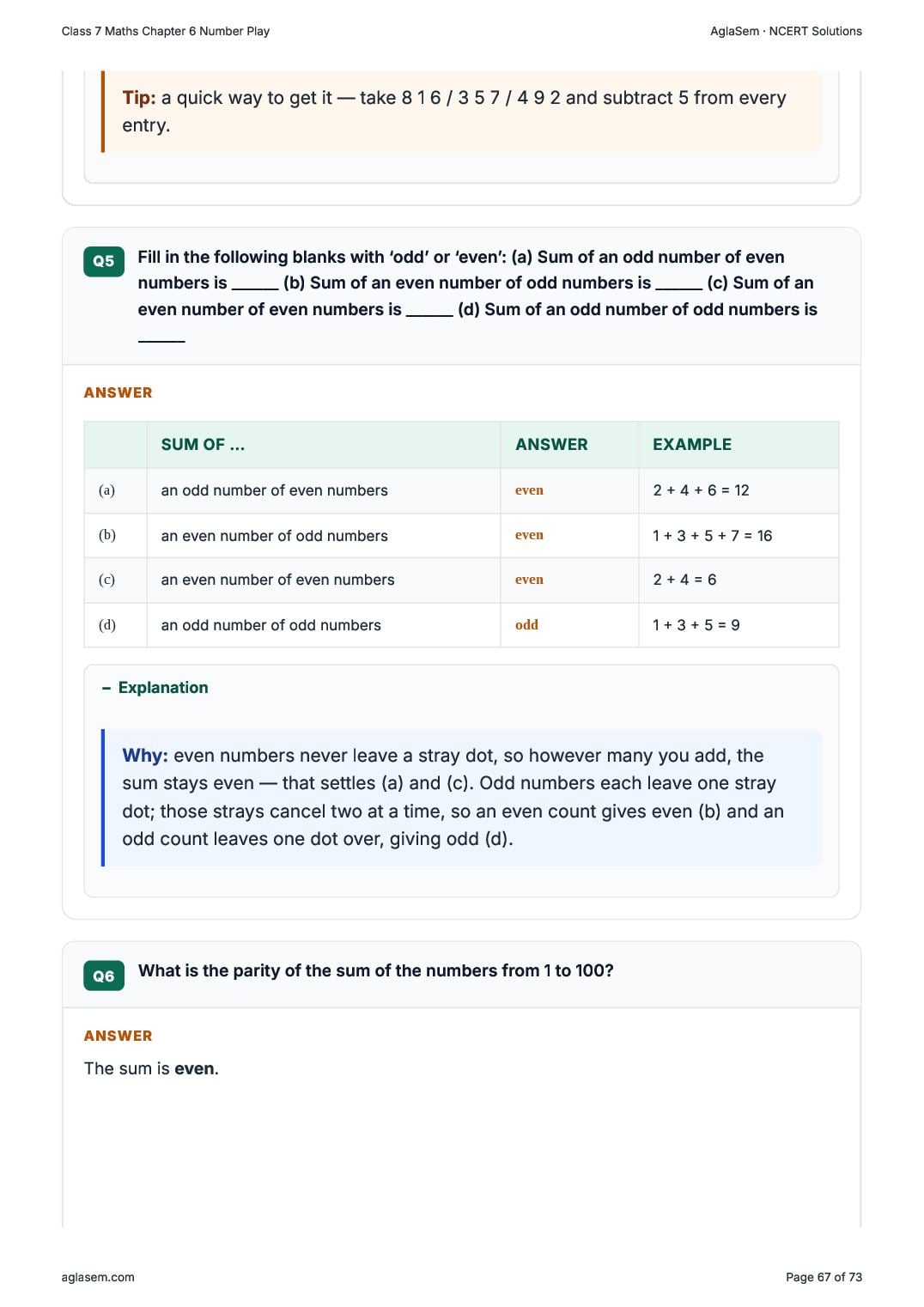
- Fill in the following blanks with ‘odd’ or ‘even’: (a) Sum of an odd number of even numbers is ______ (b) Sum of an even number of odd numbers is ______ (c) Sum of an even number of even numbers is ______ (d) Sum of an odd number of odd numbers is ______
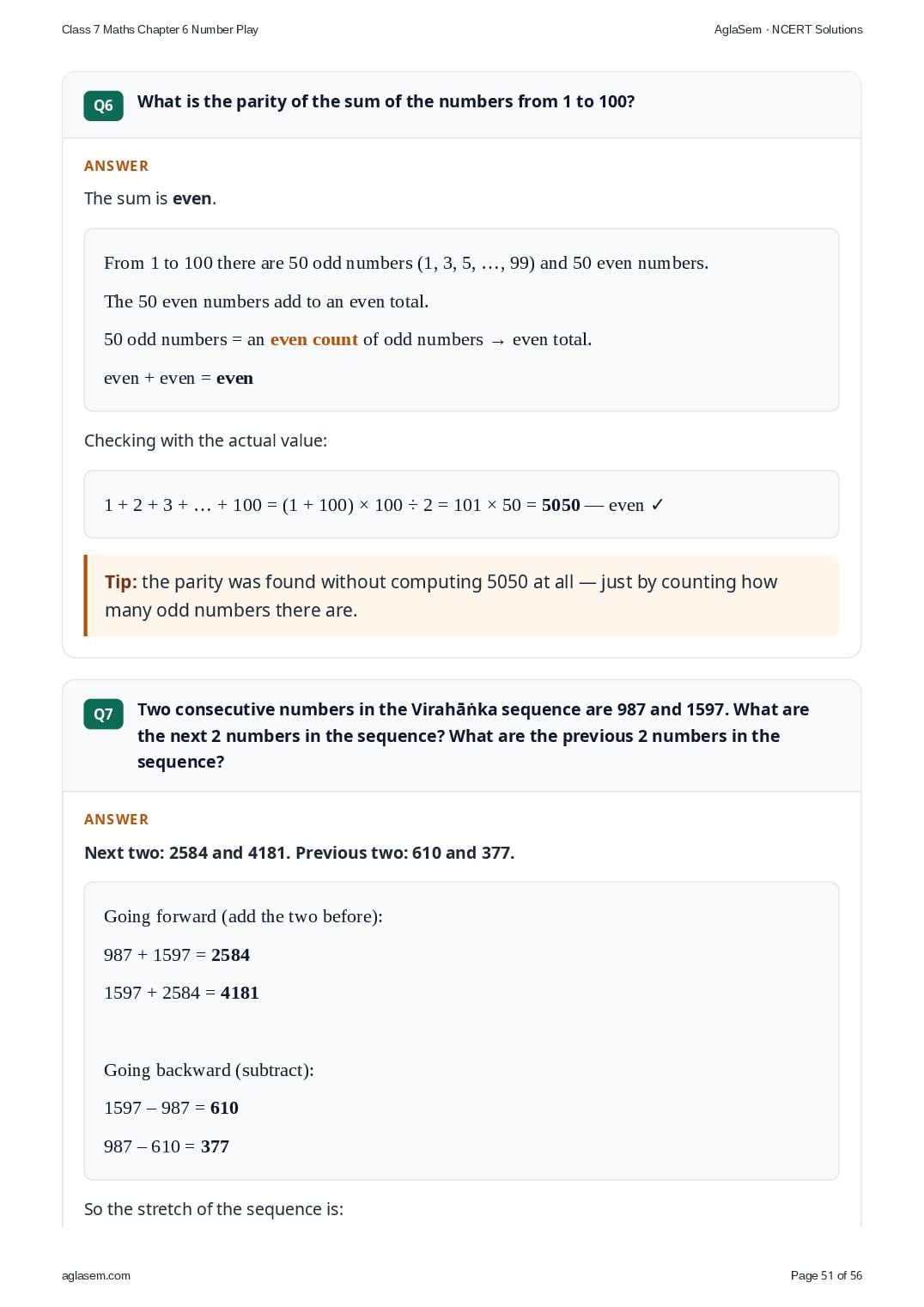
- What is the parity of the sum of the numbers from 1 to 100?
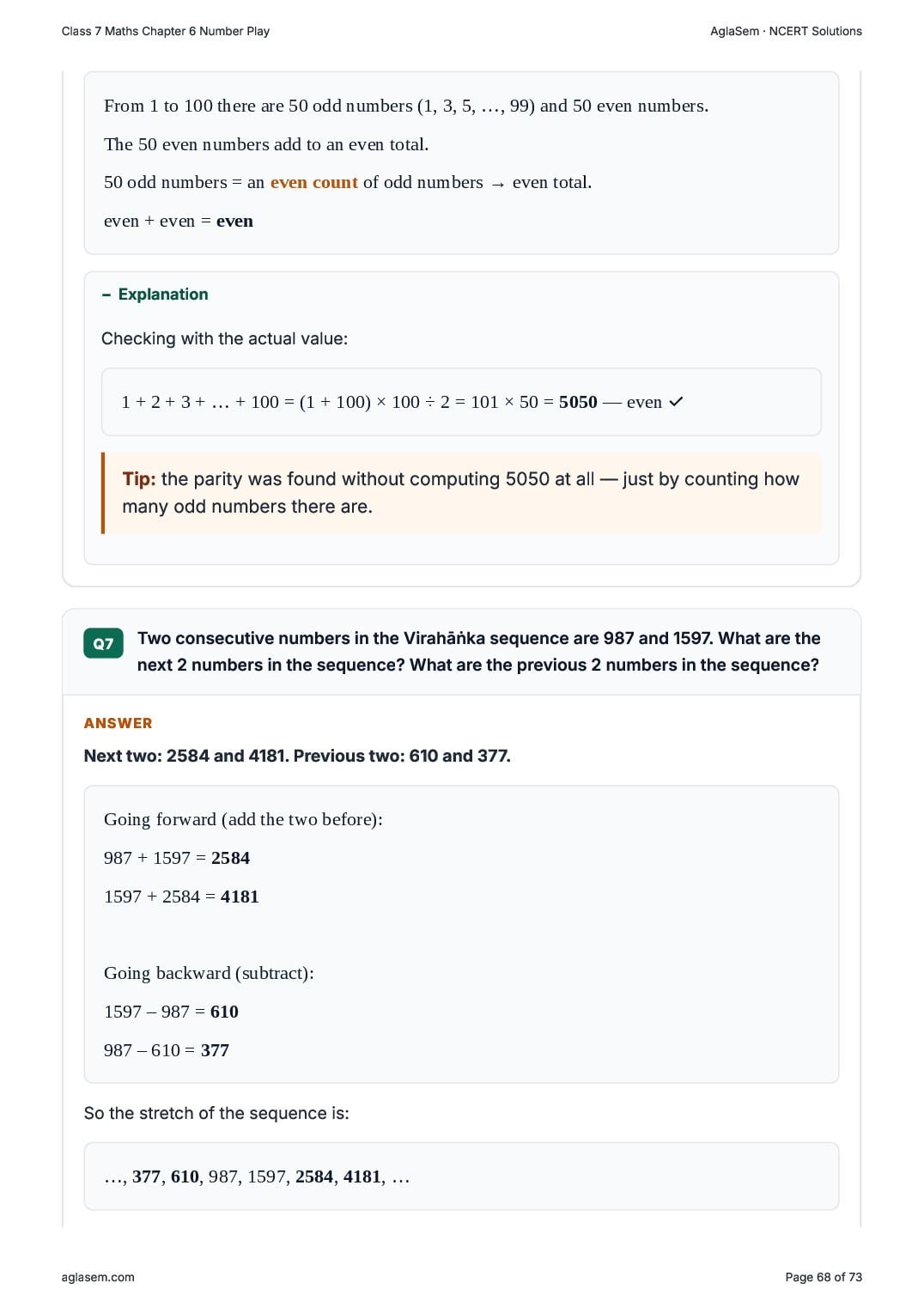
- Two consecutive numbers in the Virahāṅka sequence are 987 and 1597. What are the next 2 numbers in the sequence? What are the previous 2 numbers in the sequence?
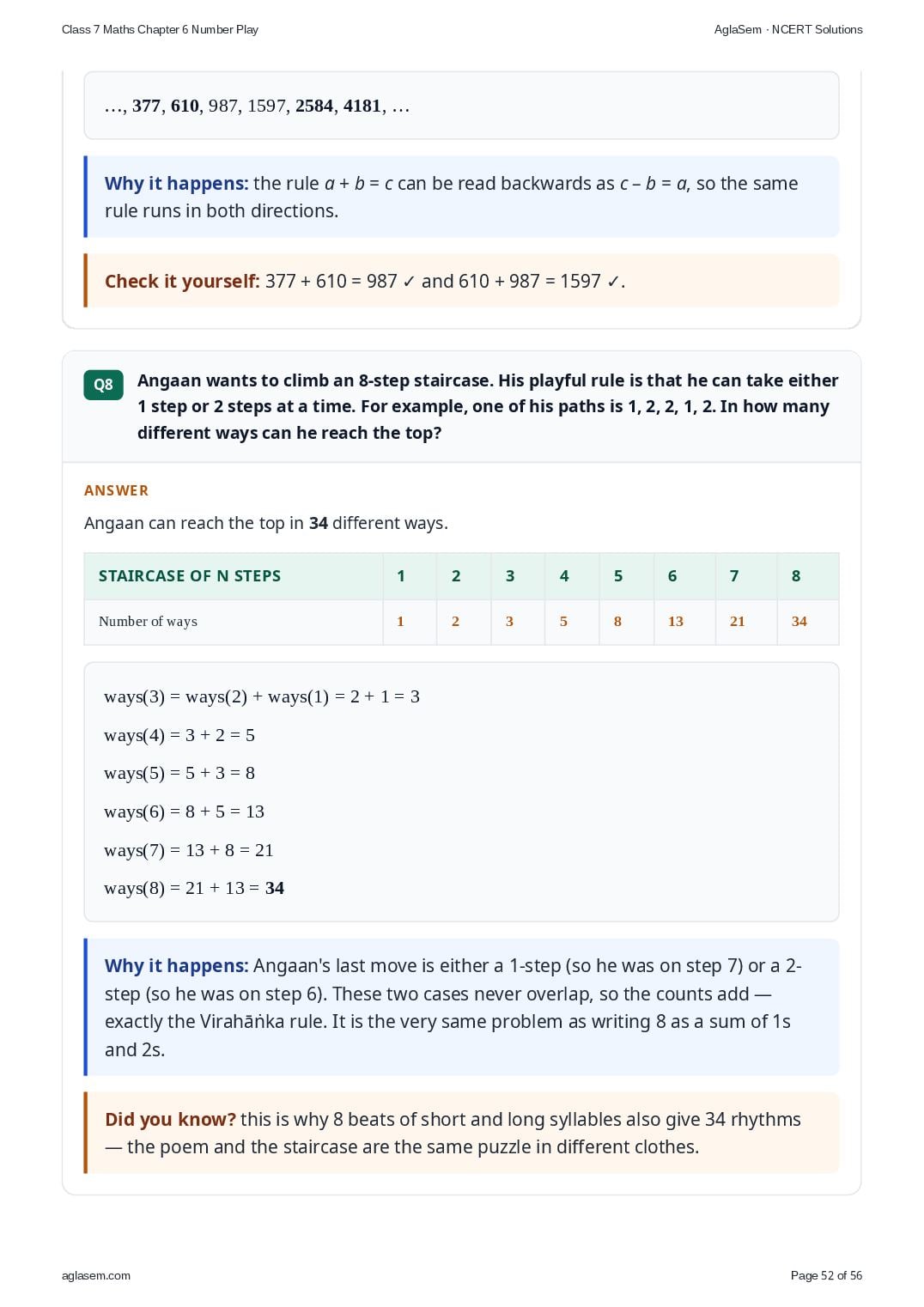
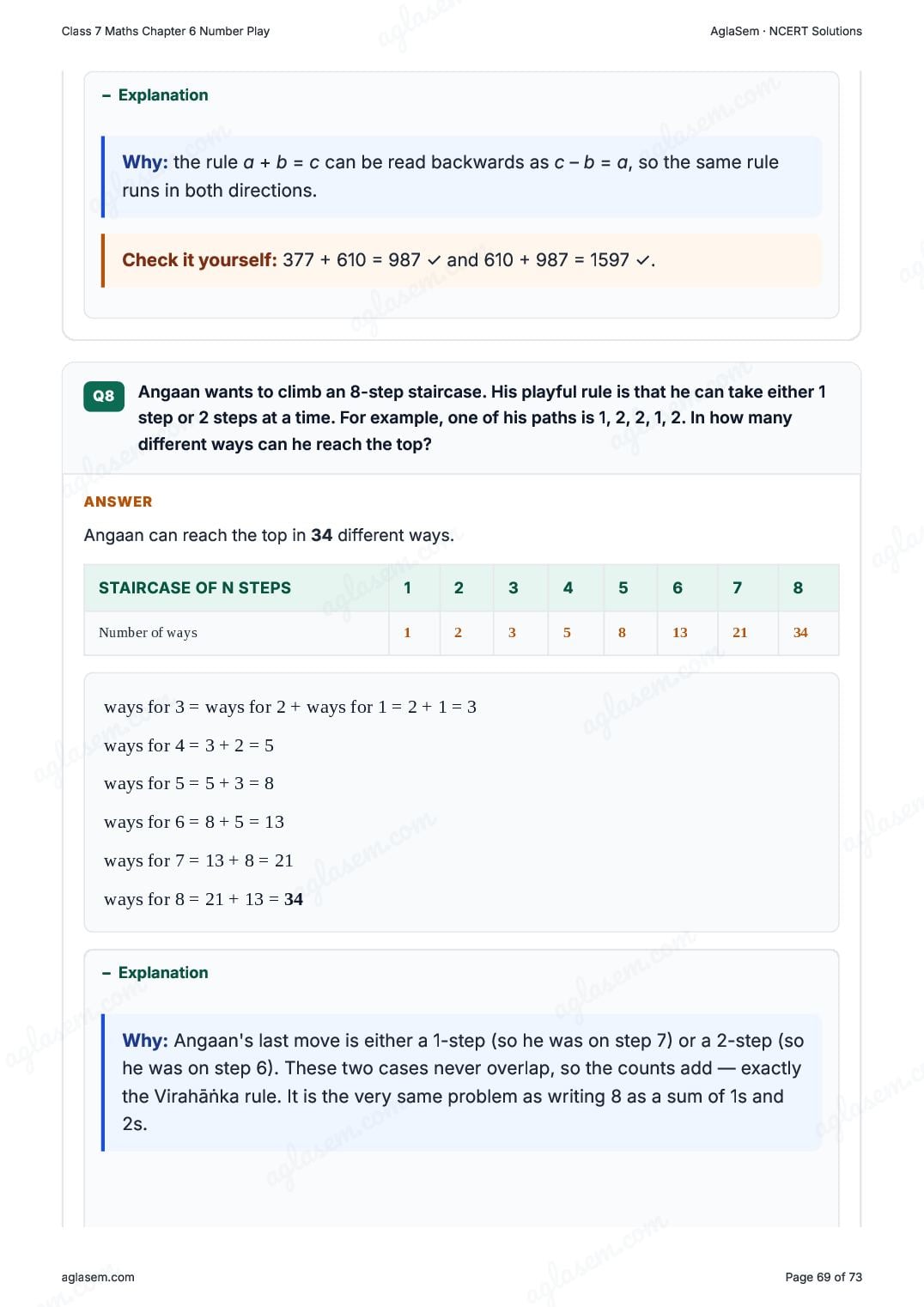
- Angaan wants to climb an 8-step staircase. His playful rule is that he can take either 1 step or 2 steps at a time. For example, one of his paths is 1, 2, 2, 1, 2. In how many different ways can he reach the top?
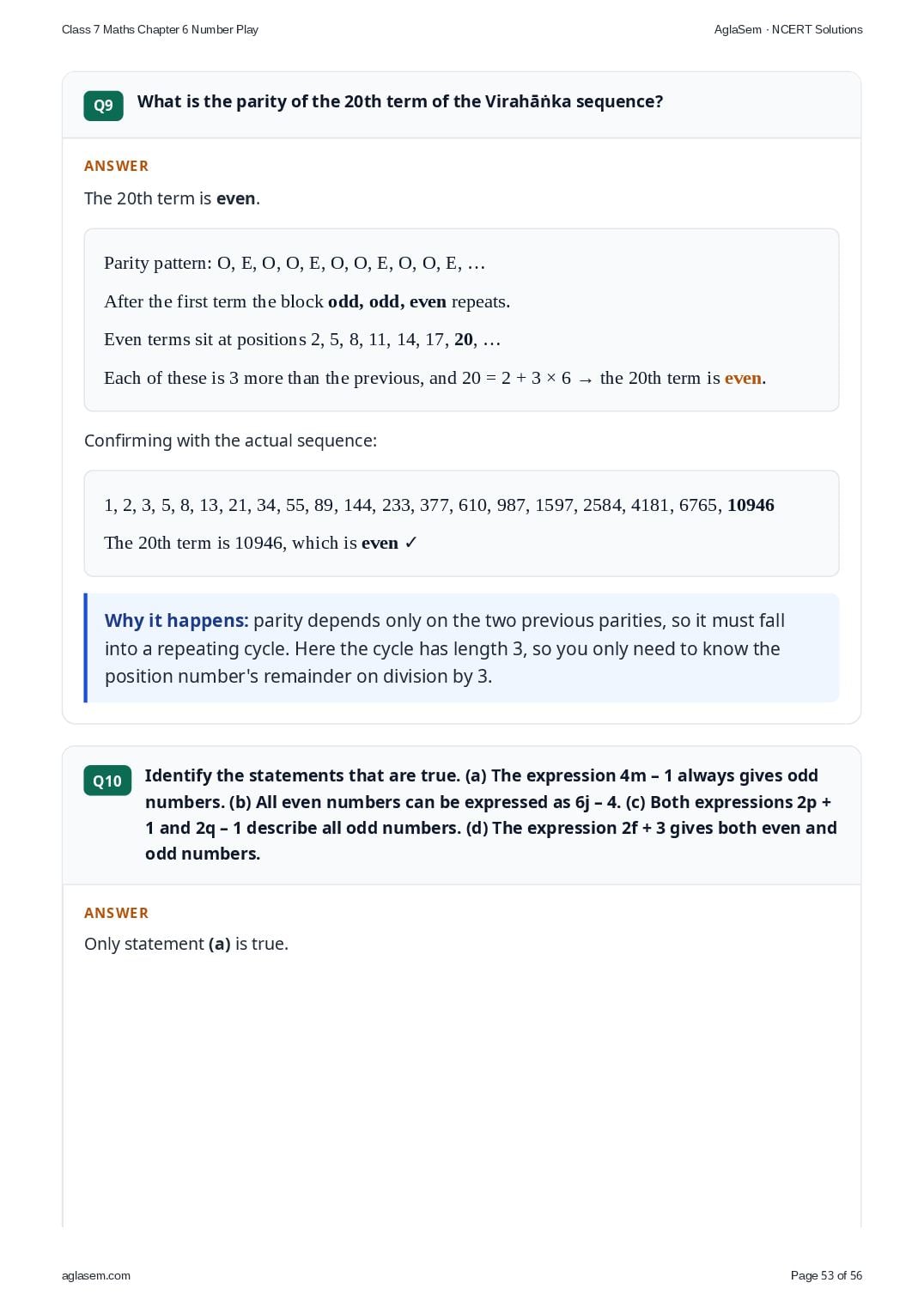
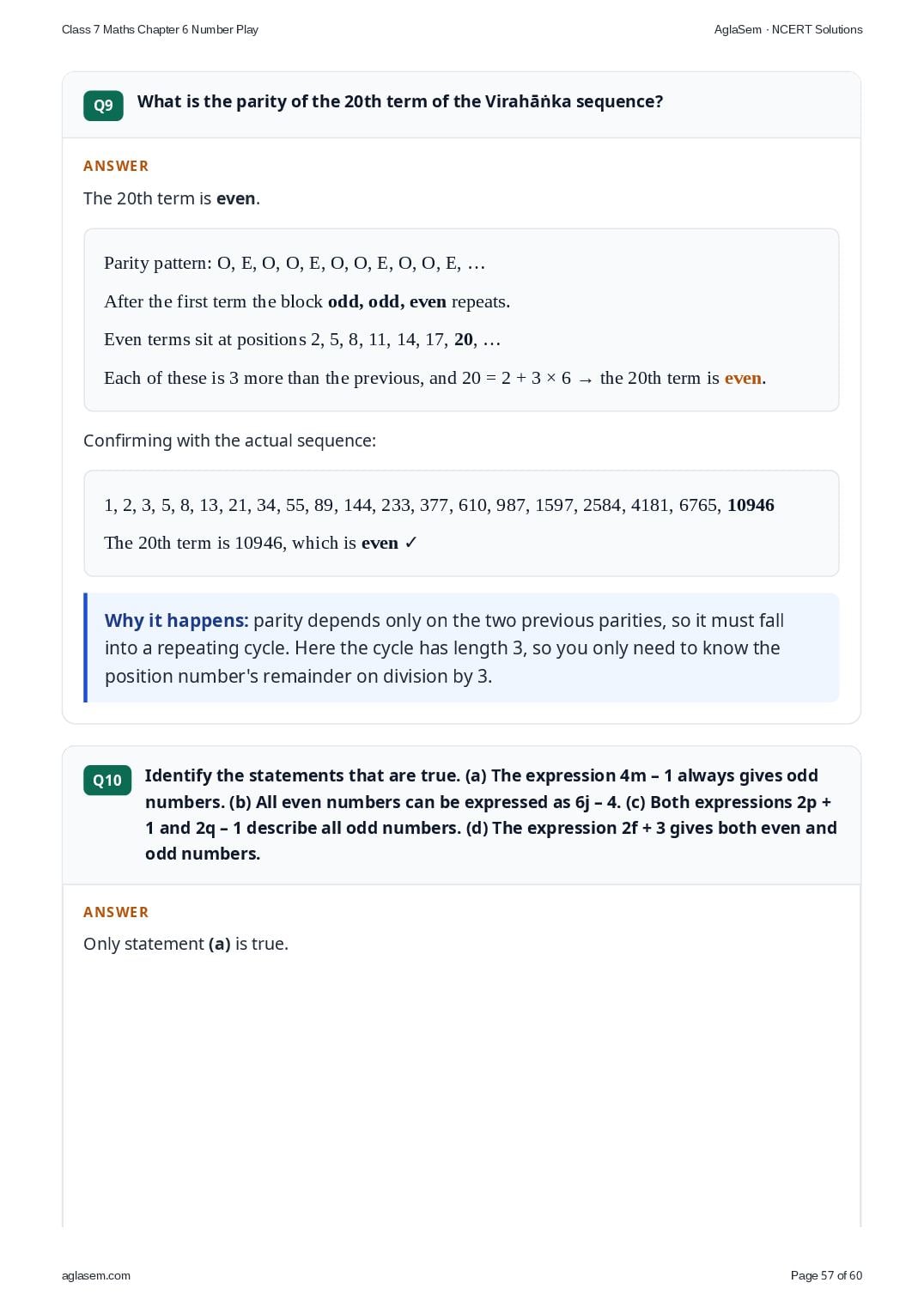
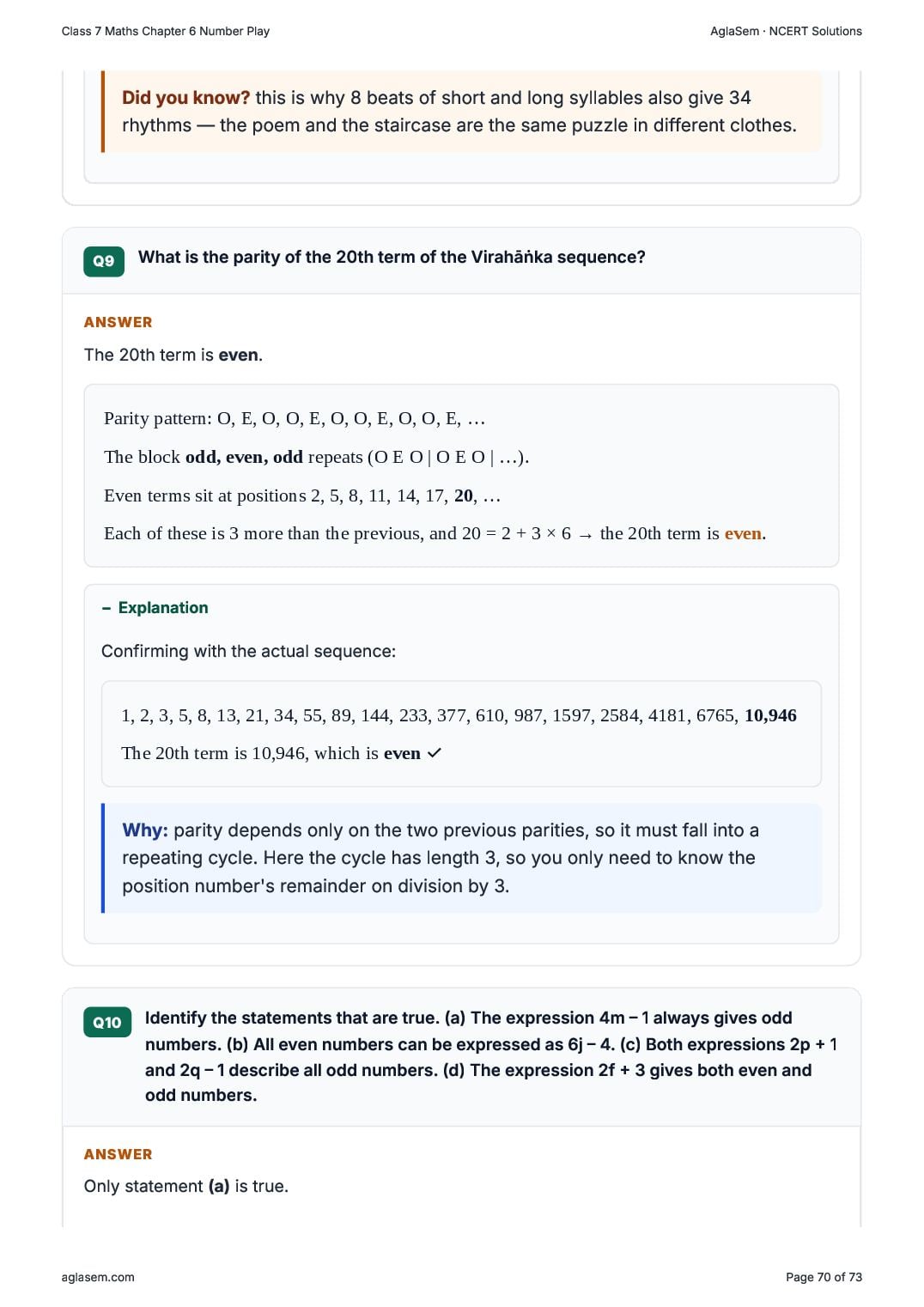
- What is the parity of the 20th term of the Virahāṅka sequence?
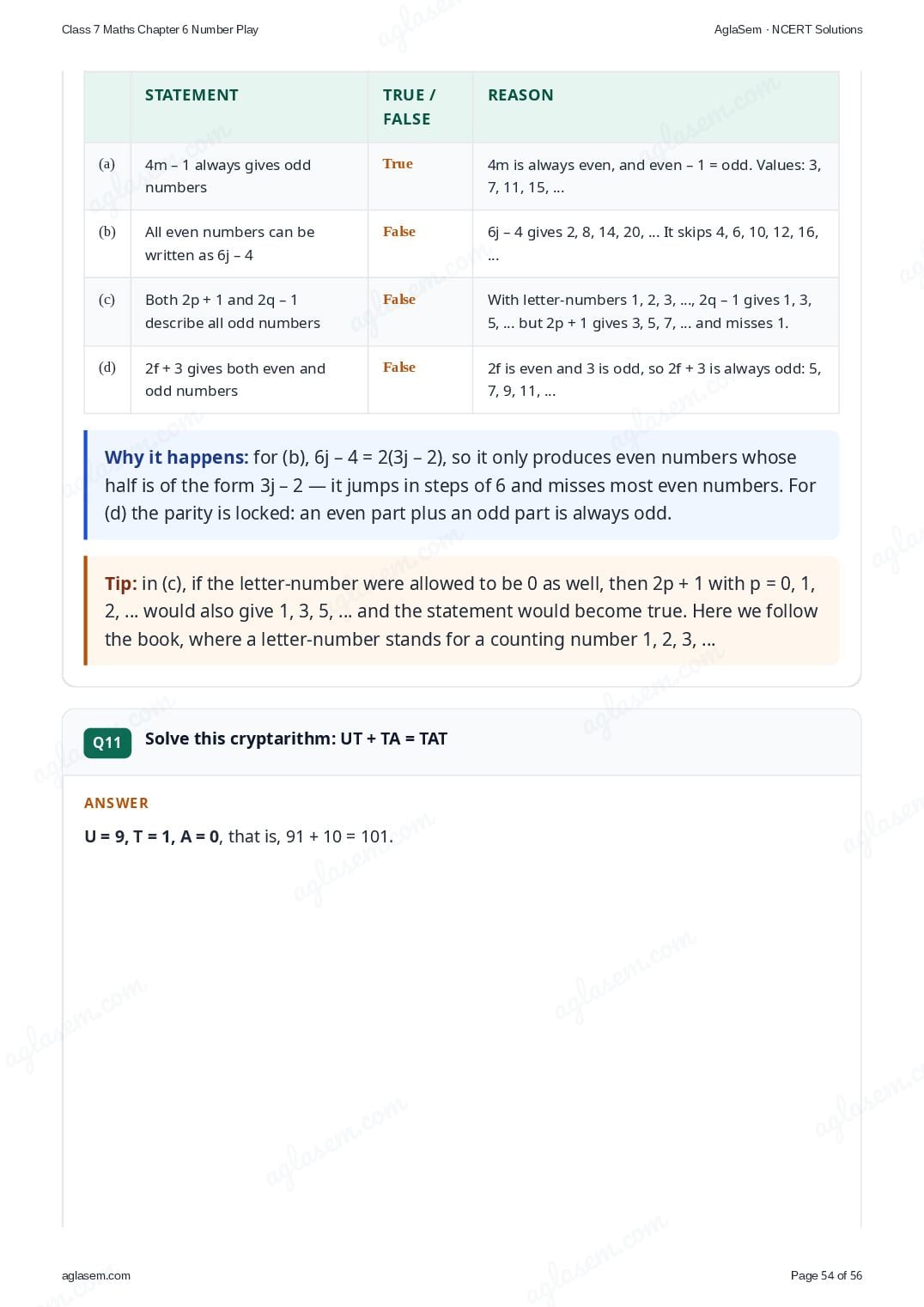
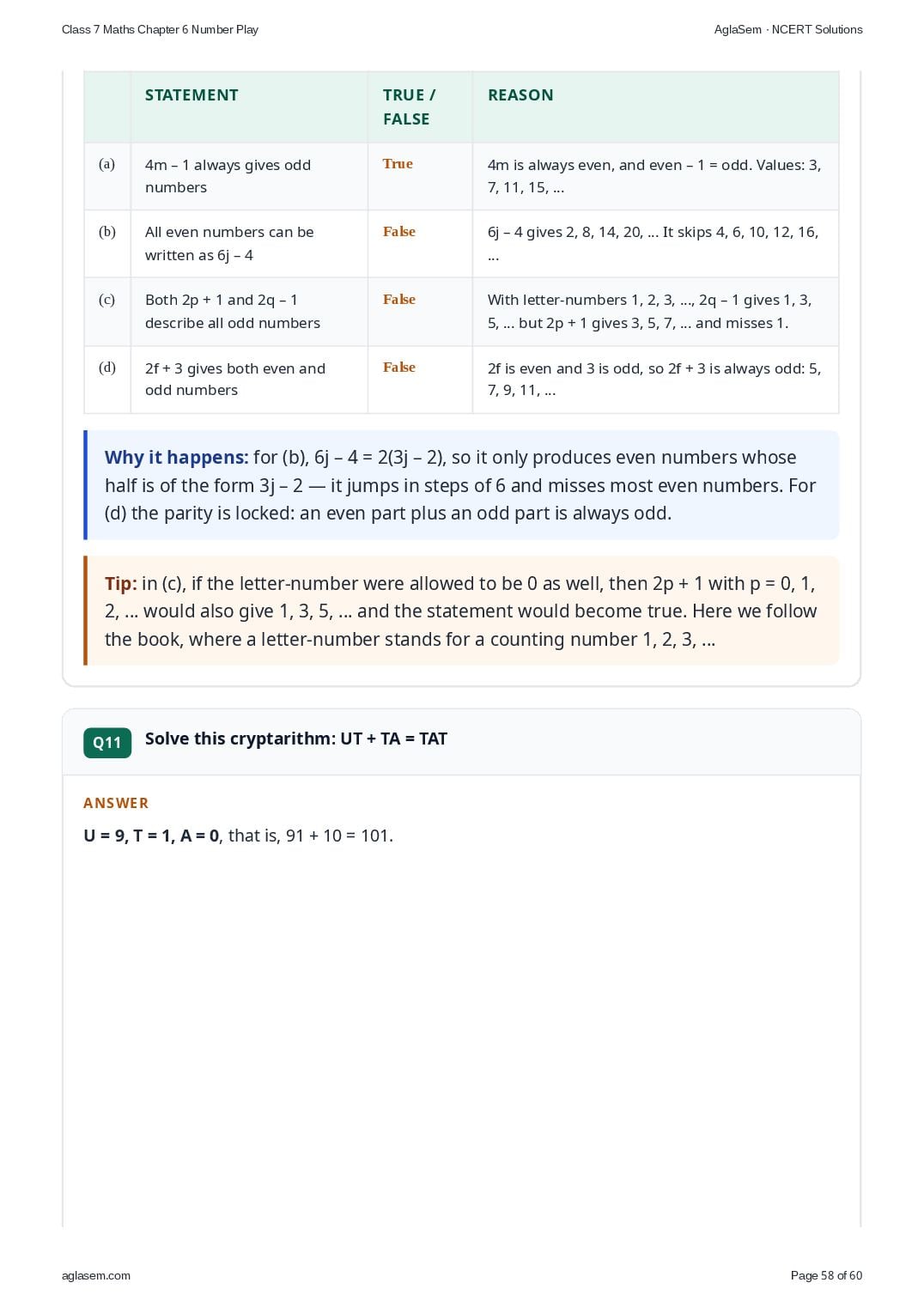
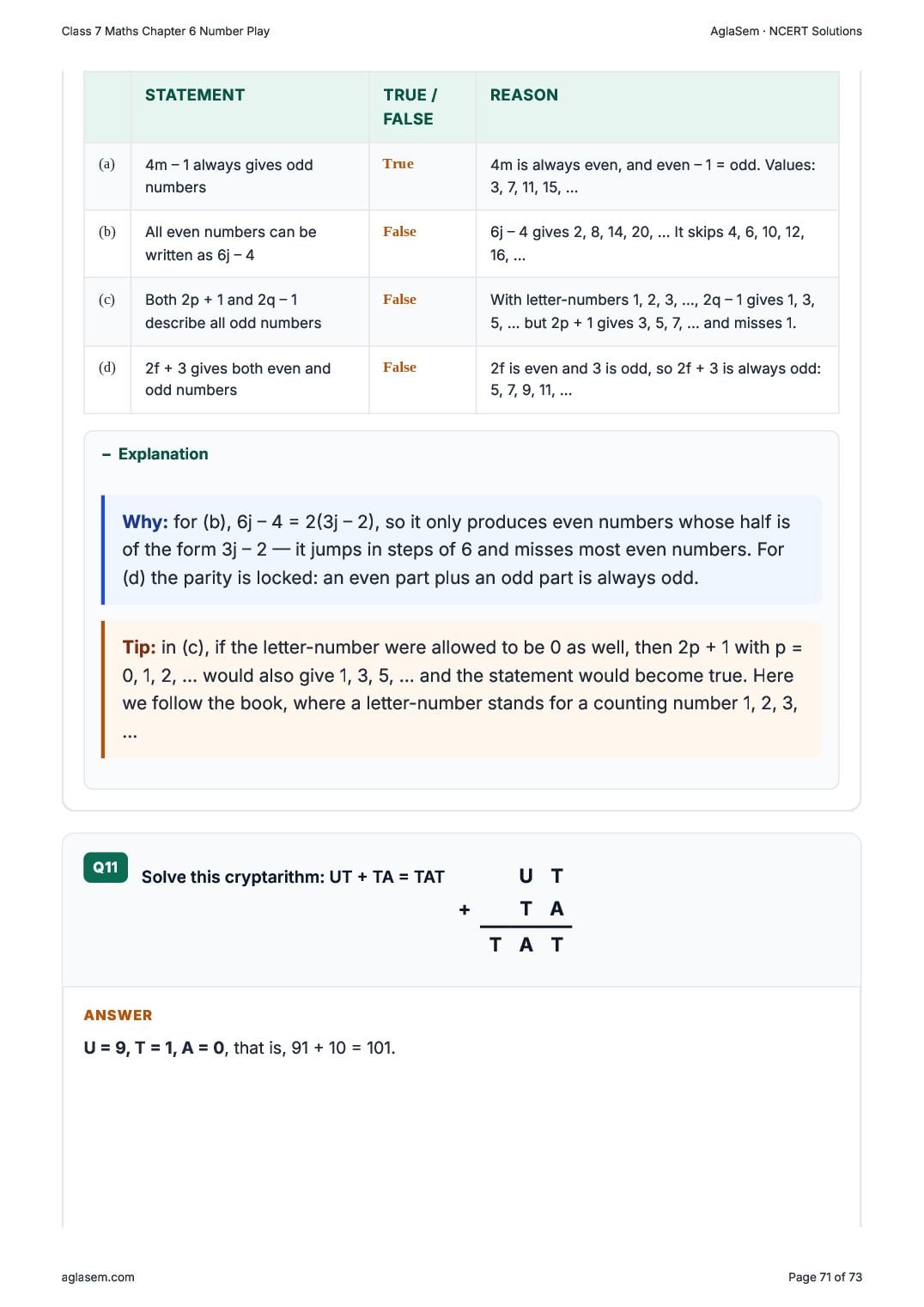
- Identify the statements that are true. (a) The expression 4m – 1 always gives odd numbers. (b) All even numbers can be expressed as 6j – 4. (c) Both expressions 2p + 1 and 2q – 1 describe all odd numbers. (d) The expression 2f + 3 gives both even and odd numbers.
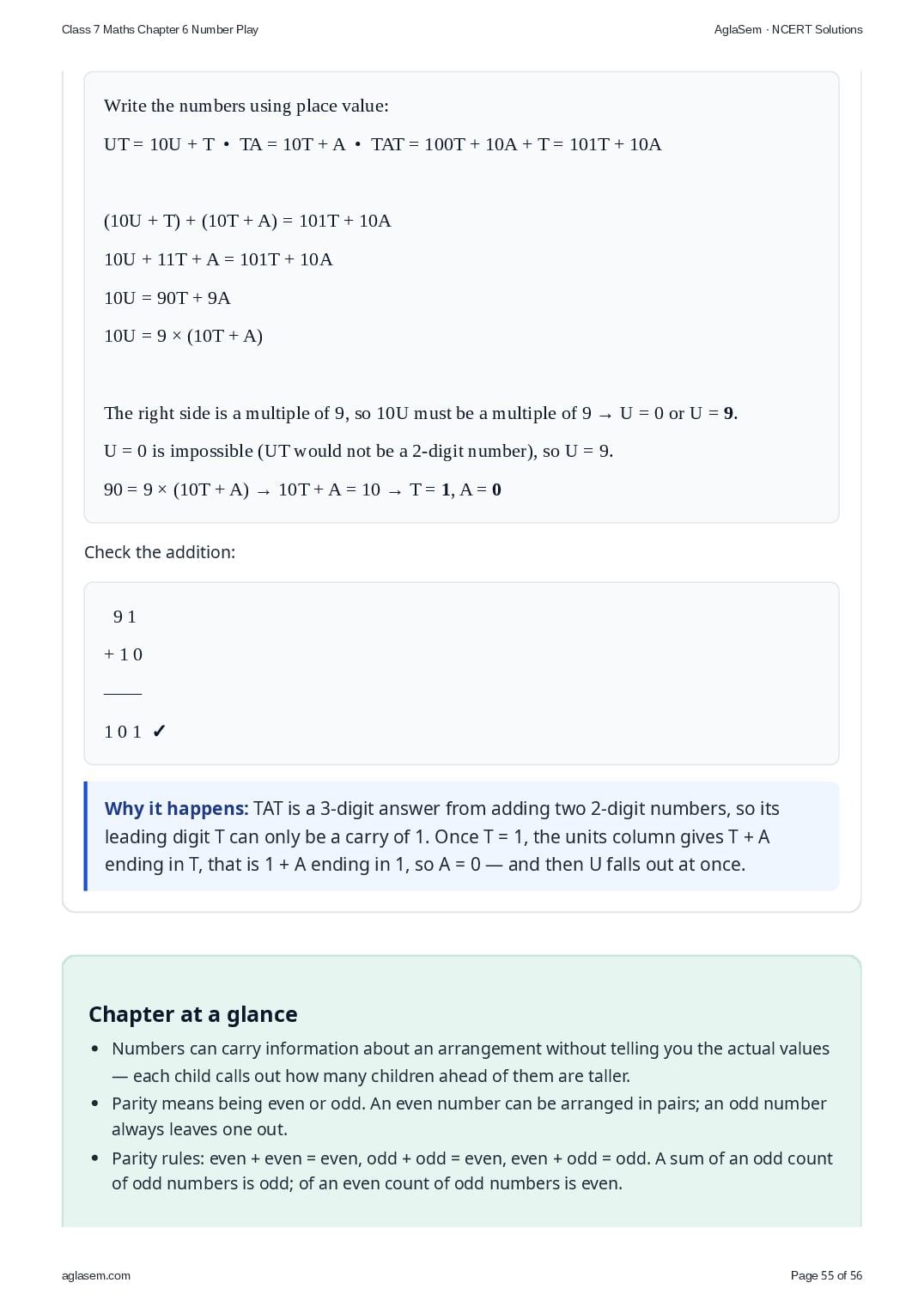
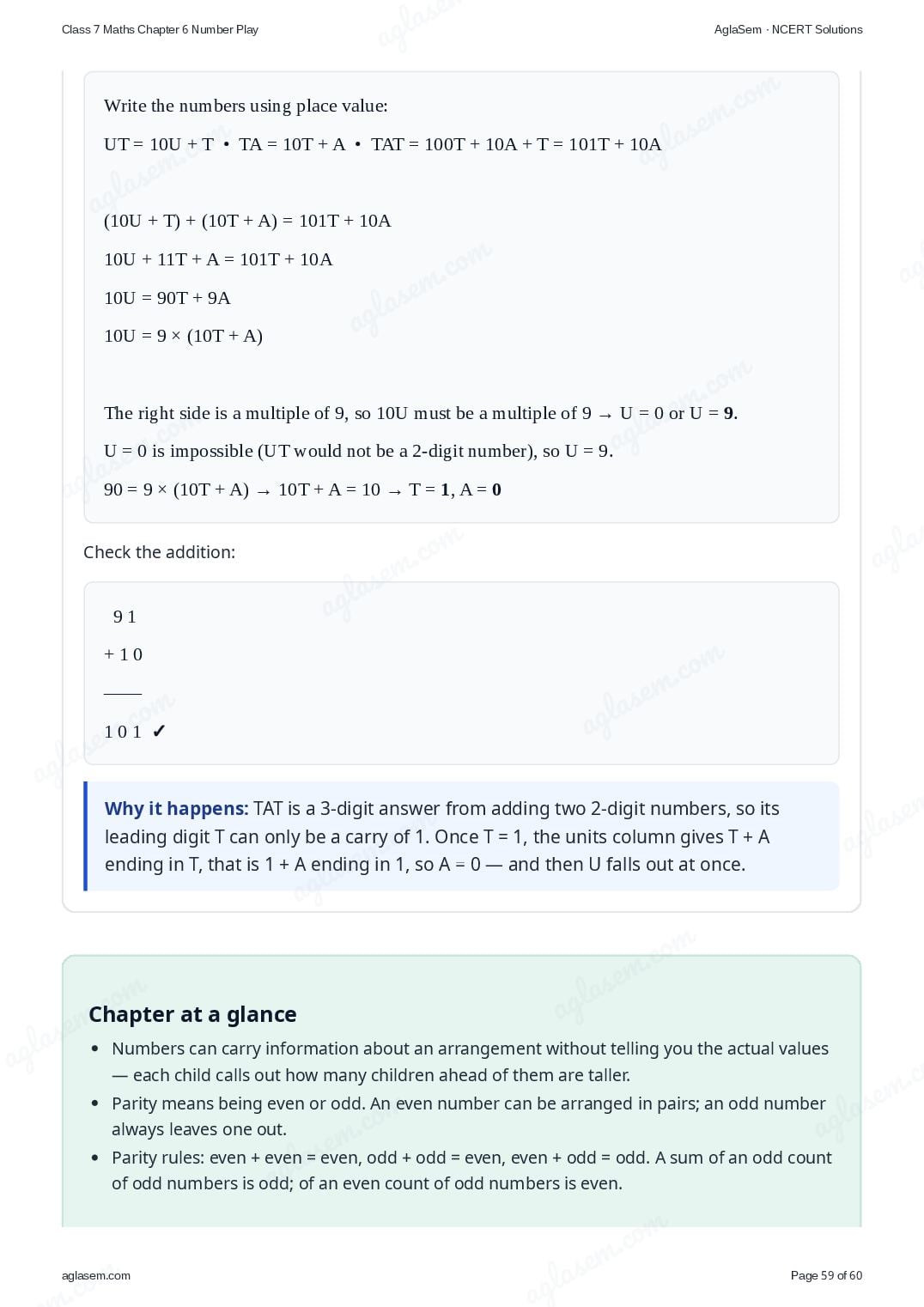
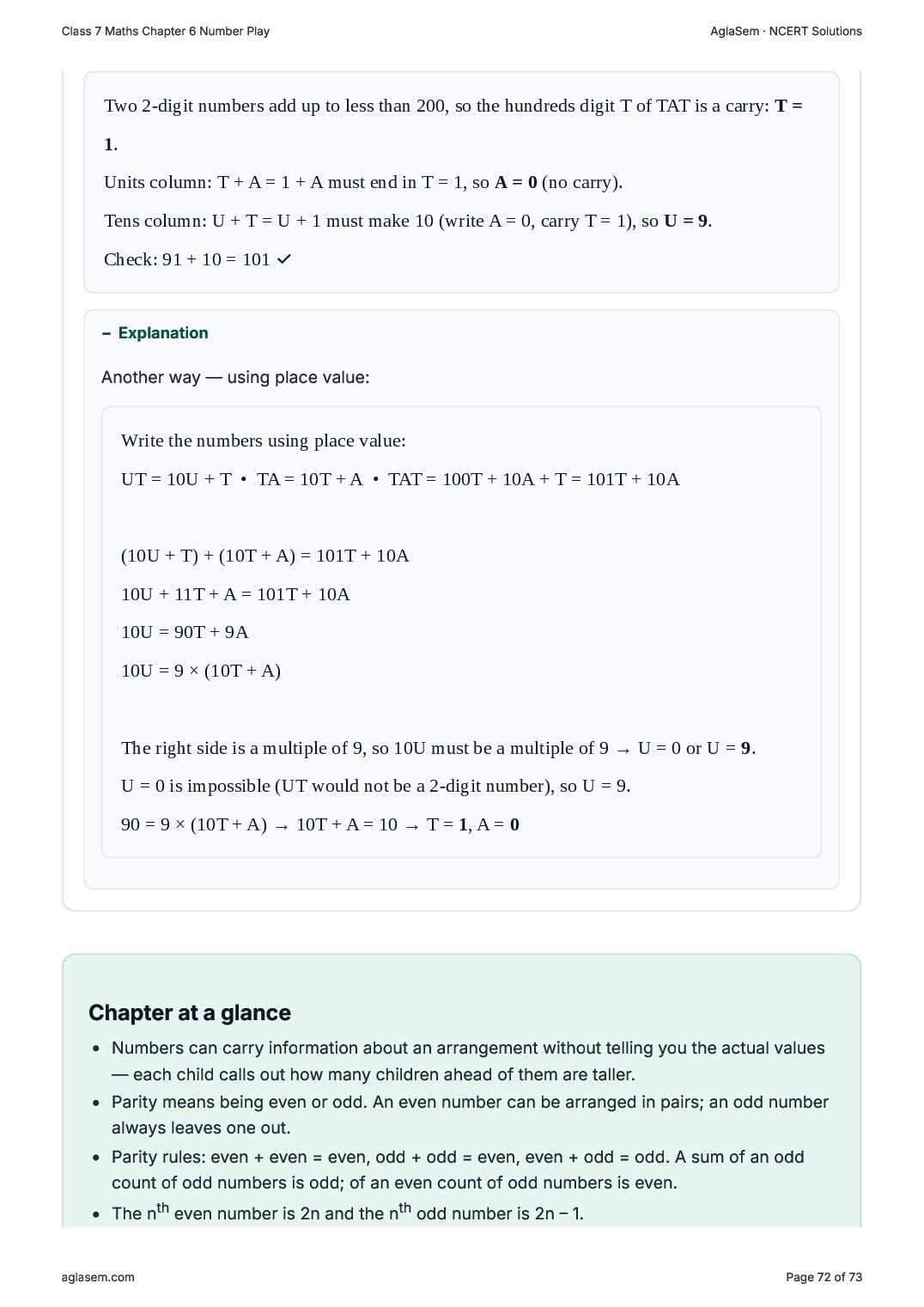
- Solve this cryptarithm: UT + TA = TAT
Chapter at a Glance
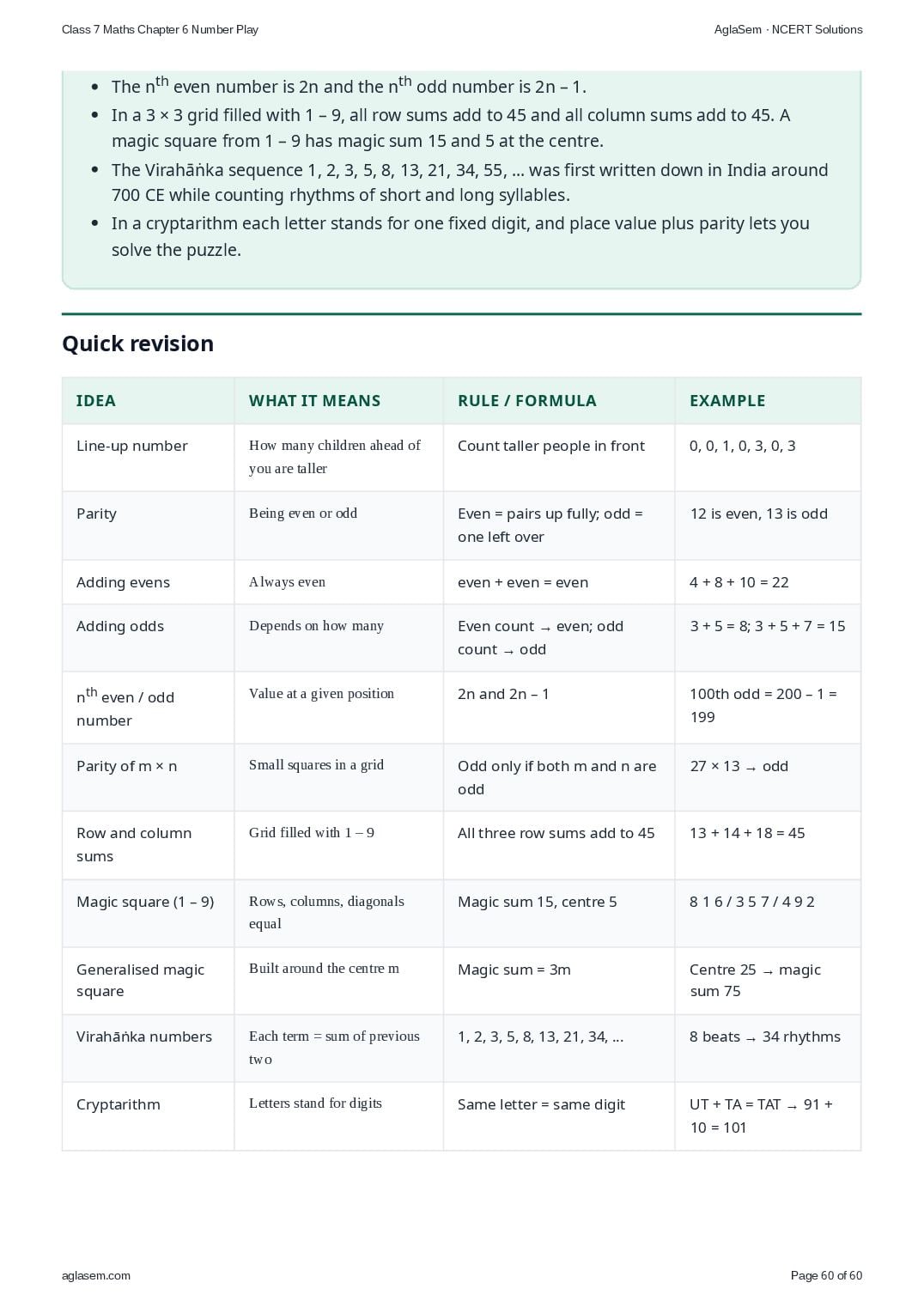
- Numbers can carry information about an arrangement without telling you the actual values — each child calls out how many children ahead of them are taller.
- Parity means being even or odd. An even number can be arranged in pairs; an odd number always leaves one out.
- Parity rules: even + even = even, odd + odd = even, even + odd = odd. A sum of an odd count of odd numbers is odd; of an even count of odd numbers is even.
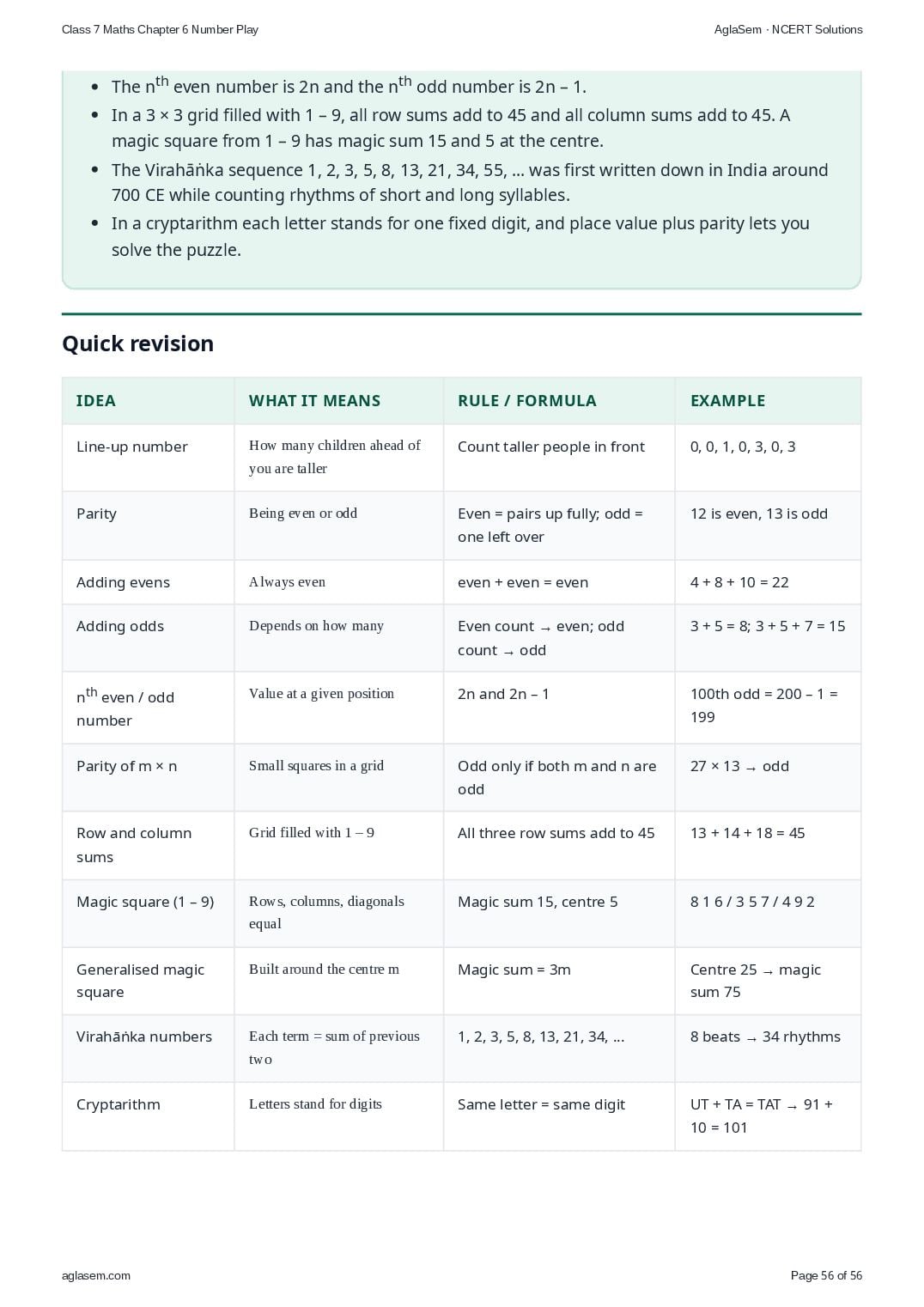
- The n th even number is 2n and the n th odd number is 2n – 1.
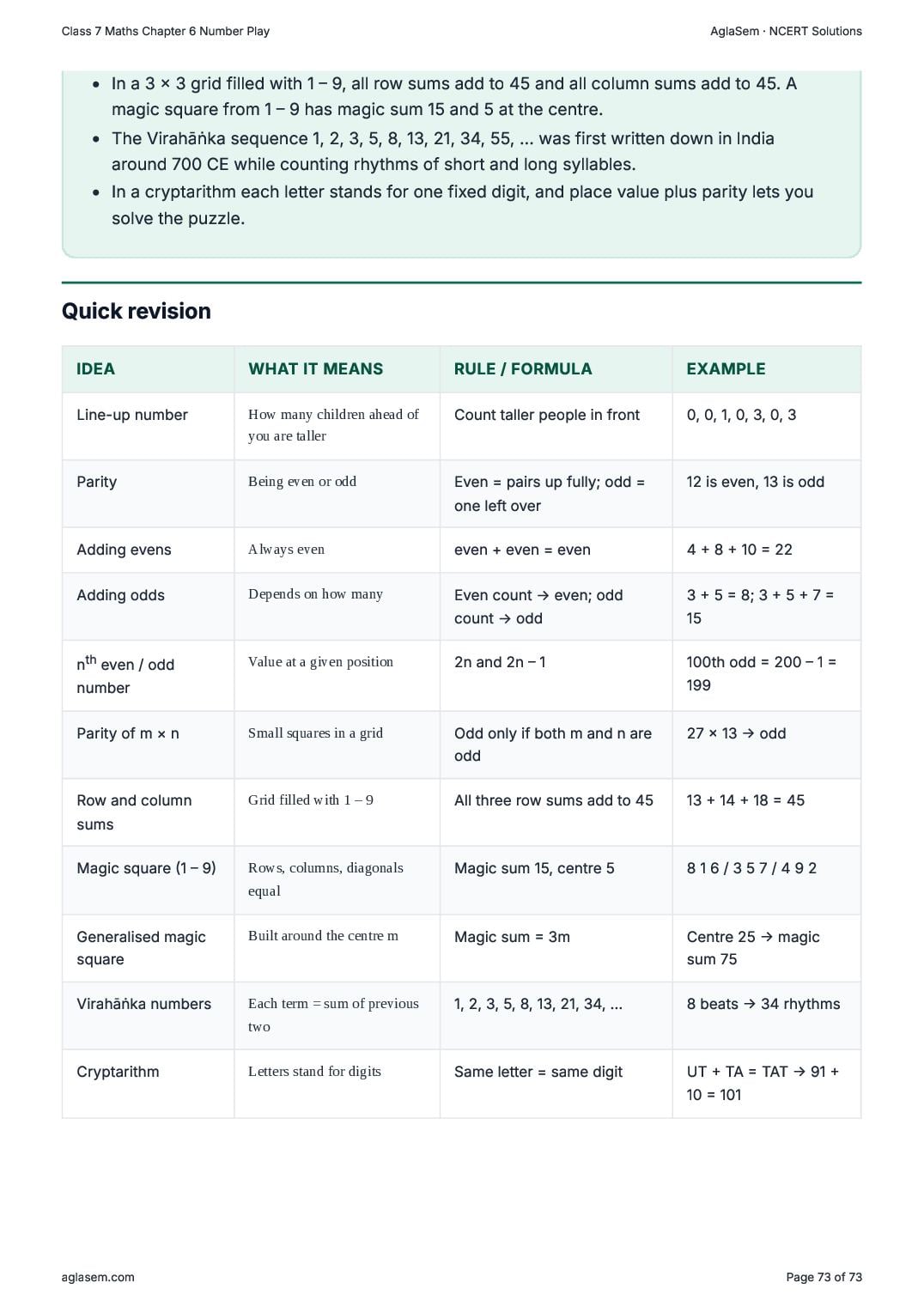
- In a 3 × 3 grid filled with 1 – 9, all row sums add to 45 and all column sums add to 45. A magic square from 1 – 9 has magic sum 15 and 5 at the centre.
- The Virahāṅka sequence 1, 2, 3, 5, 8, 13, 21, 34, 55, … was first written down in India around 700 CE while counting rhythms of short and long syllables.
- In a cryptarithm each letter stands for one fixed digit, and place value plus parity lets you solve the puzzle.
How to Download NCERT Solutions for Class 7 Maths Chapter 6 PDF
Follow these simple steps to get the Number Play questions-and-answers PDF from Ganita Prakash.
- Search NCERT Solutions for Class 7 Maths Chapter 6 aglasem and open this page.
- Read the exercise questions with answers for Number Play shown above.
- Click the Download PDF link to save the Number Play solutions to your device.
NCERT Solutions for Class 7 Maths – All Chapters
There are more chapters to study besides Number Play in Maths. Here are the NCERT Solutions for all chapters of Class 7 Maths.
- Chapter 1 Large Numbers Around Us
- Chapter 2 Arithmetic Expressions
- Chapter 3 a Peek Beyond the Point
- Chapter 4 Expressions Using Letter Numbers
- Chapter 5 Parallel and Intersecting Lines
- Chapter 6 Number Play
- Chapter 7 a Tale of Three Intersecting Lines
- Chapter 8 Working with Fractions
NCERT Solutions for Class 7 – All Subjects
Just like Chapter 6 of Maths, you can get the exercise questions with answers for every other subject of Class 7. Here are the NCERT Solutions for all subjects of Class 7.
NCERT Solutions for Class 7 Maths Chapter 6 – An Overview
The key highlights of this study material are as follows.
| Aspects | Details |
|---|---|
| Class | Class 7 |
| Subject | Maths |
| Chapter Number | Chapter 6 |
| Chapter Name | Number Play |
| Book Name | Ganita Prakash |
| Book By | NCERT (National Council of Educational Research and Training) |
| Educational Resource Here | NCERT Solutions of Class 7 Maths Chapter 6 for all exercises |
| More Questions Answers of This Subject | NCERT Solutions for Class 7 Maths |
| Download Book Chapter | NCERT Book Class 7 Maths |
| All Questions Answers For This Class | NCERT Solutions for Class 7 |
| Complete Solutions | NCERT Solutions |
NCERT Solutions for Class 7 Maths Chapter 6 Number Play – FAQs
What are the NCERT Solutions for Class 7 Maths Chapter 6 Number Play?
They are the complete, step-by-step answers to all the exercise and in-text questions of Chapter 6 Number Play from the NCERT Class 7 Maths textbook Ganita Prakash, written by experts as per the latest NCERT syllabus.
How can I download the Class 7 Maths Chapter 6 solutions PDF for free?
Open this page on aglasem, read the Number Play questions with answers, and click the “Download Solutions PDF” link. The Class 7 Maths Chapter 6 NCERT Solutions PDF is completely free to download.
Are these NCERT Solutions as per the latest 2026-27 syllabus?
Yes. The NCERT Solutions for Class 7 Maths Chapter 6 are based on the latest NCERT textbook Ganita Prakash and the current 2026-27 CBSE syllabus, so the questions and answers match what you study in class.
Where can I get NCERT Solutions for the other chapters of Class 7 Maths?
You can find the answers to every chapter on the NCERT Solutions for Class 7 Maths page, and solutions for every subject on the NCERT Solutions for Class 7 page.
How do NCERT Solutions help in exam preparation?
They show the correct method to solve each question, help you write answers the way they are expected in exams, let you check and correct your own work, and save revision time — which together improve your marks in Class 7 Maths.
If you have any queries on NCERT Solutions for Class 7 Maths Chapter 6 Number Play, then please ask in the comments below.