NCERT Solutions for Class 7 Maths Chapter 3 a Peek Beyond the Point provide clear, step-by-step answers to every exercise and in-text question from the chapter a Peek Beyond the Point of the NCERT textbook Ganita Prakash. Prepared by subject experts as per the latest NCERT (CBSE) syllabus for 2026-27, these NCERT Solutions for Class 7 Maths help you understand each concept, write exam-ready answers, and check your own solutions. You can read them online below or download the free Class 7 Maths Chapter 3 question-answer PDF.
NCERT Solutions for Class 7 Maths Chapter 3 a Peek Beyond the Point
- Class: Class 7
- Subject: Maths
- Chapter: Chapter 3 – a Peek Beyond the Point
- Textbook: Ganita Prakash (NCERT)
- Study material: NCERT Solutions – questions with answers, free PDF
These solutions answer all the exercise questions of Chapter 3 a Peek Beyond the Point — including the in-text questions, short-answer and long-answer questions, and activities — with complete explanations so you can follow the method, not just the final answer. Read the full solutions below.
NCERT Solutions Class 7 Maths Chapter 3 a Peek Beyond the Point View Download
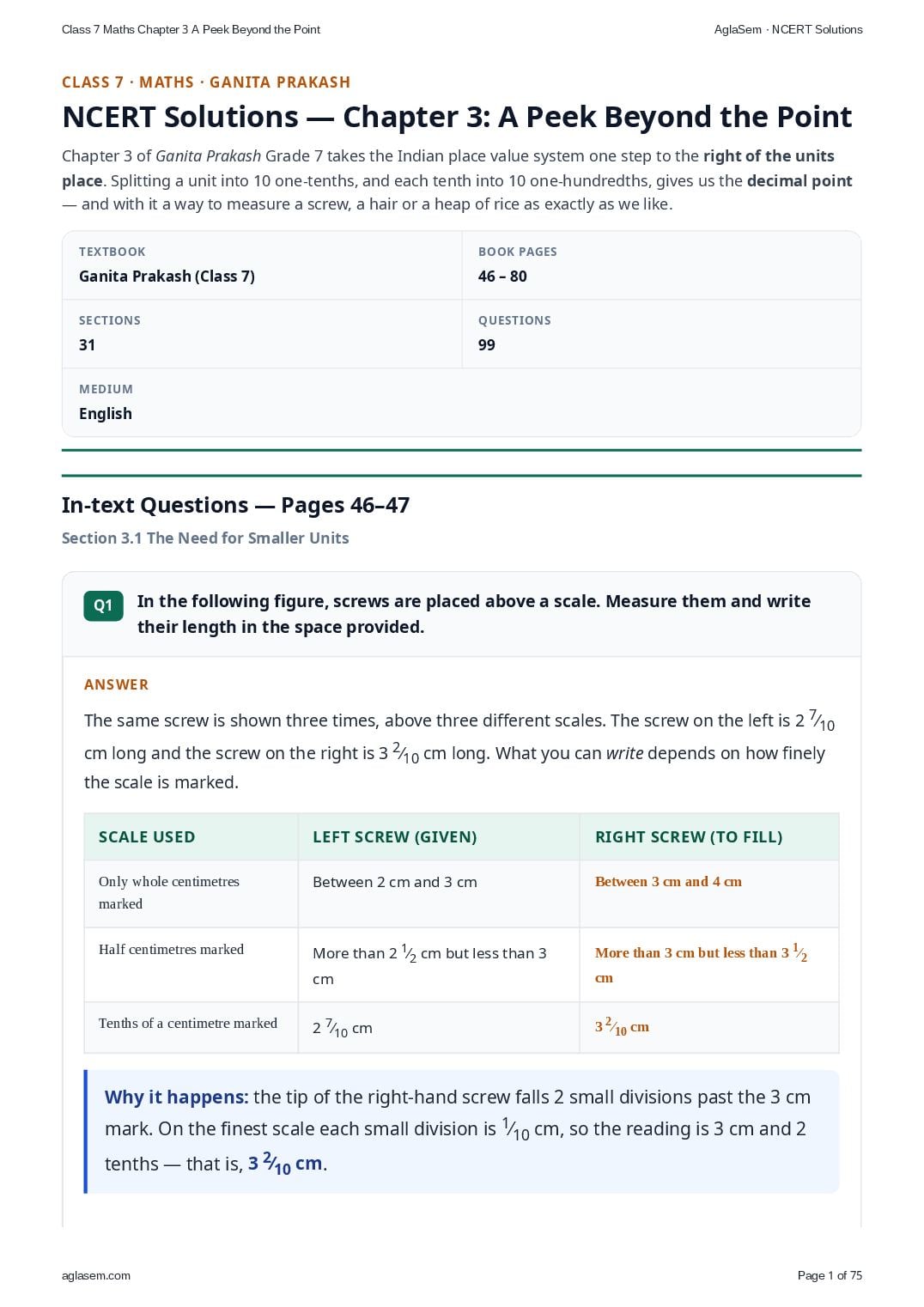
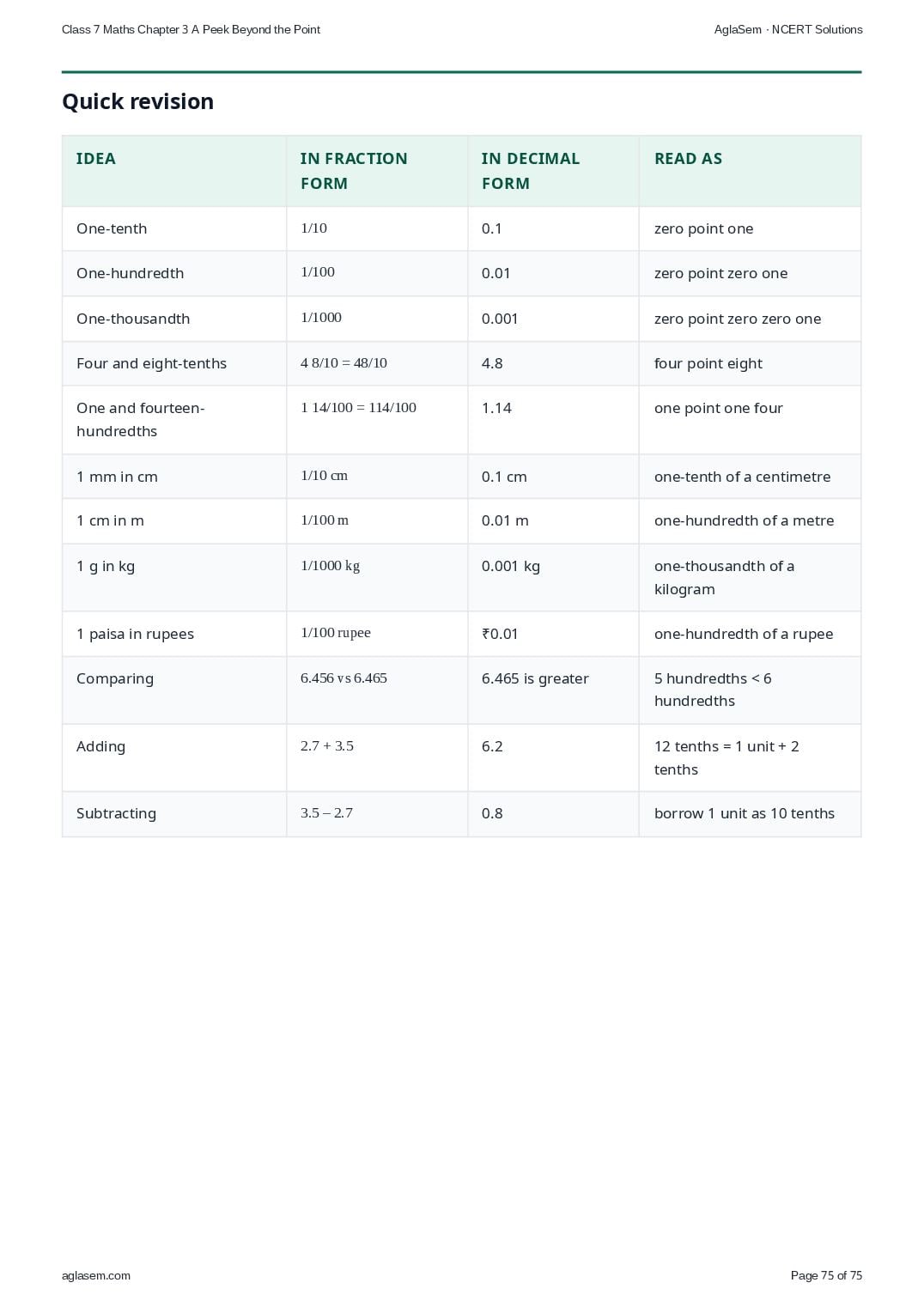
NCERT Solutions for Class 7 Maths Chapter 3 PDF Download
You can read the NCERT Solutions for Class 7 Maths Chapter 3 online above, or download the complete question-answer PDF to study a Peek Beyond the Point offline at any time.
NCERT Solutions for Class 7 Maths Chapter 3 PDF Download Link – Click Here to Download Solutions PDF
Questions Covered in This Chapter
These NCERT Solutions answer all 99 questions of this chapter. The questions solved are:
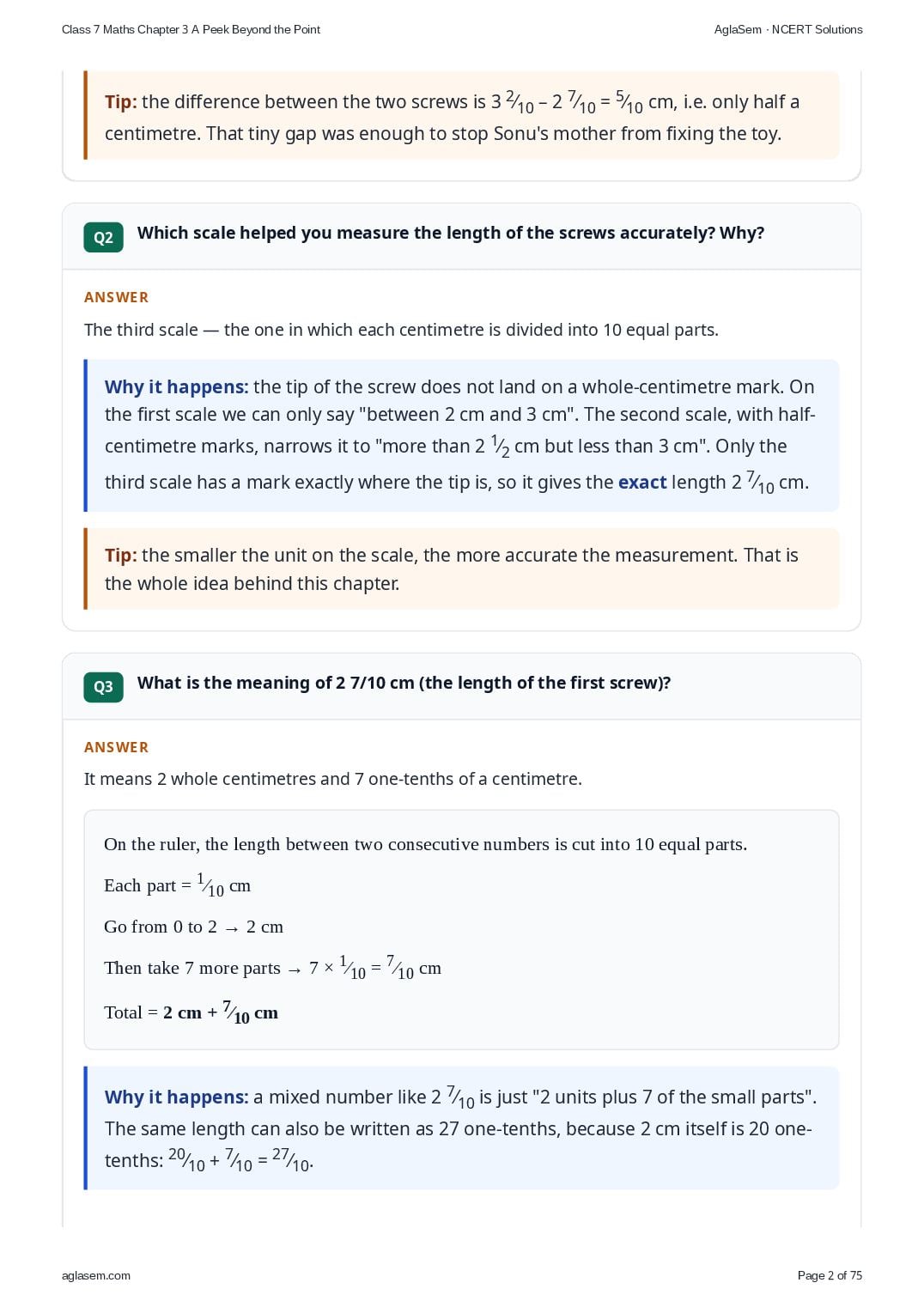
- In the following figure, screws are placed above a scale. Measure them and write their length in the space provided.
- Which scale helped you measure the length of the screws accurately? Why?
- What is the meaning of 2 7/10 cm (the length of the first screw)?
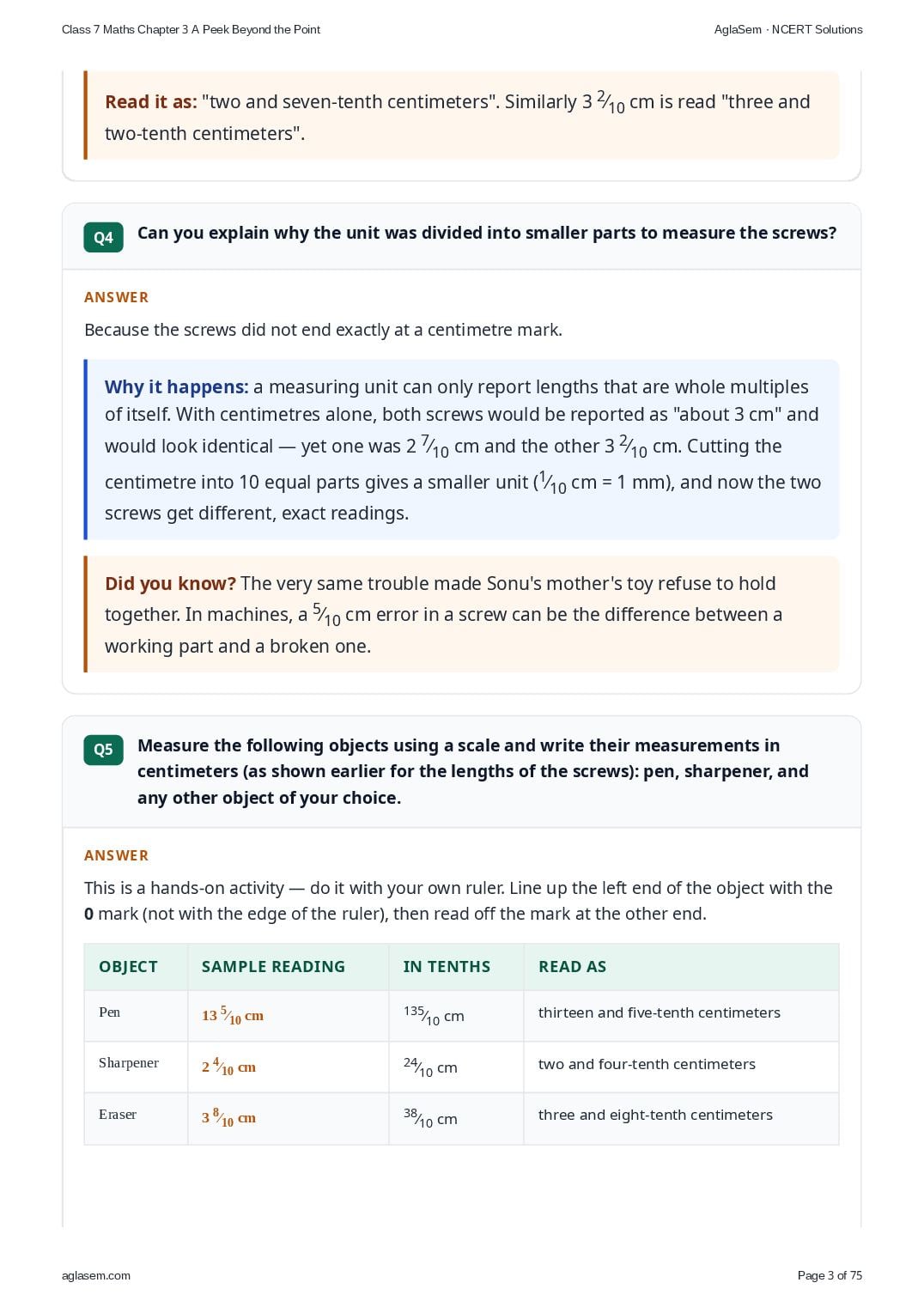
- Can you explain why the unit was divided into smaller parts to measure the screws?
- Measure the following objects using a scale and write their measurements in centimeters (as shown earlier for the lengths of the screws): pen, sharpener, and any other object of your choice.
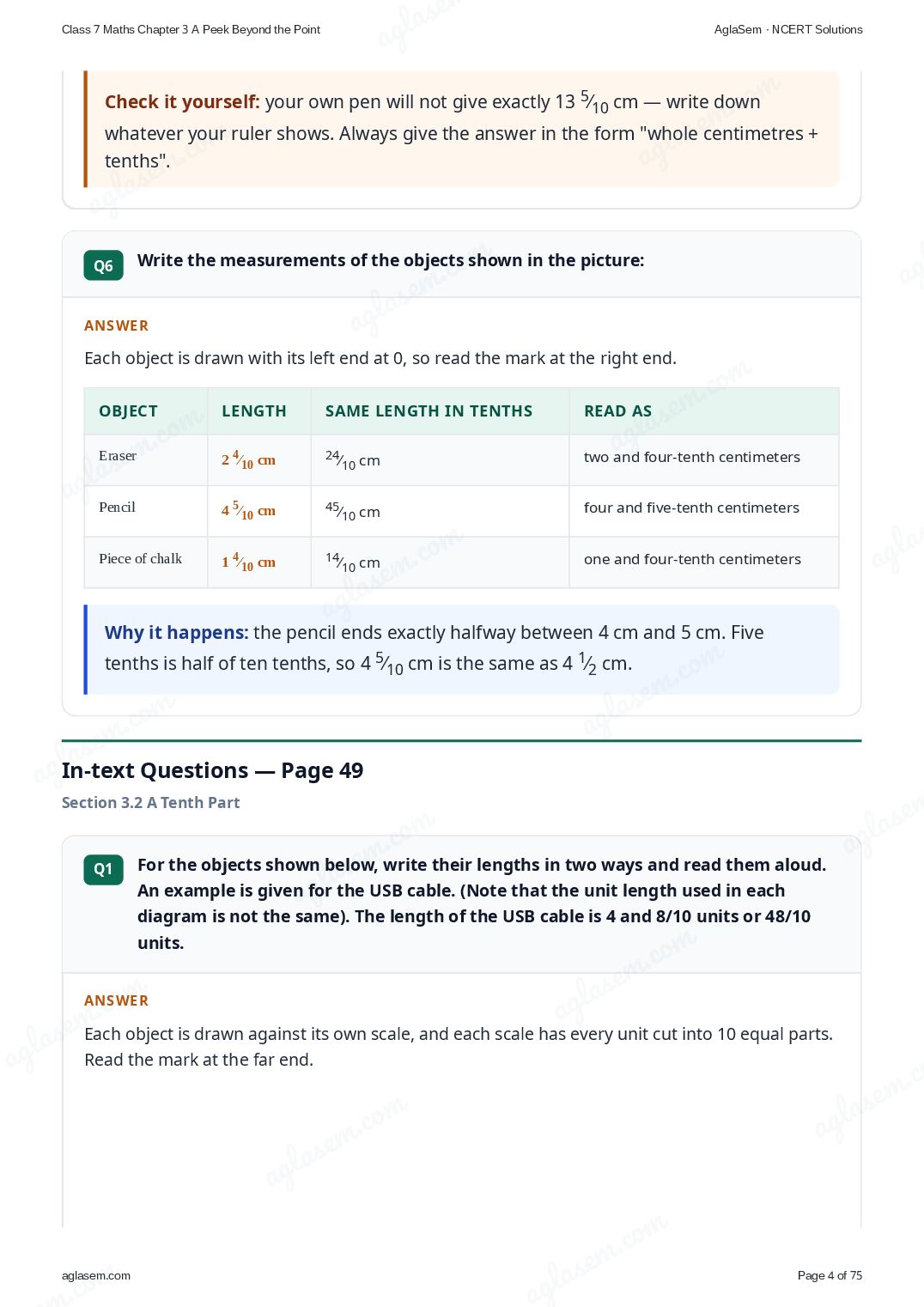
- Write the measurements of the objects shown in the picture:
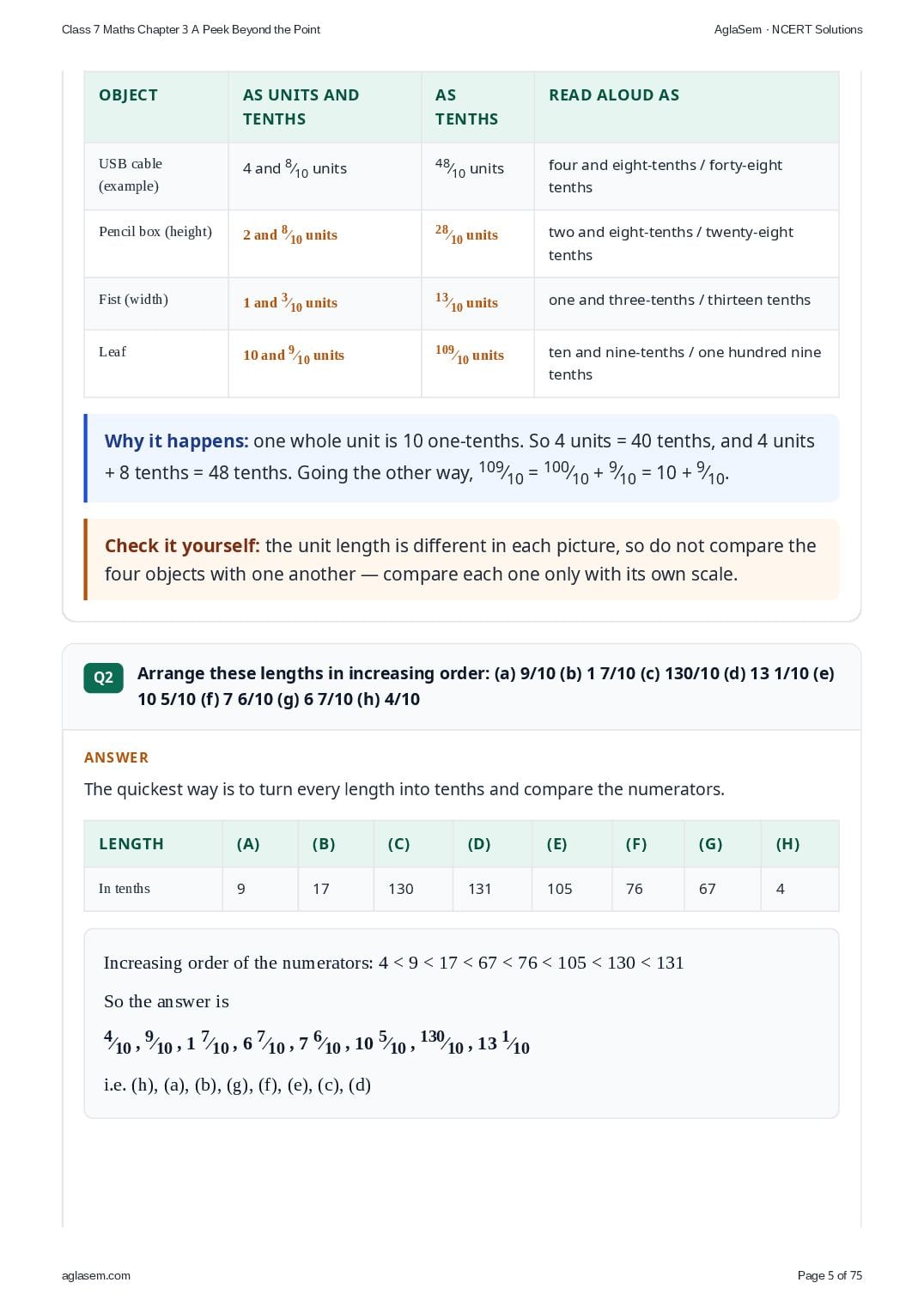
- For the objects shown below, write their lengths in two ways and read them aloud. An example is given for the USB cable. (Note that the unit length used in each diagram is not the same). The length of the USB cable is 4 and 8/10 units or 48/10 units.
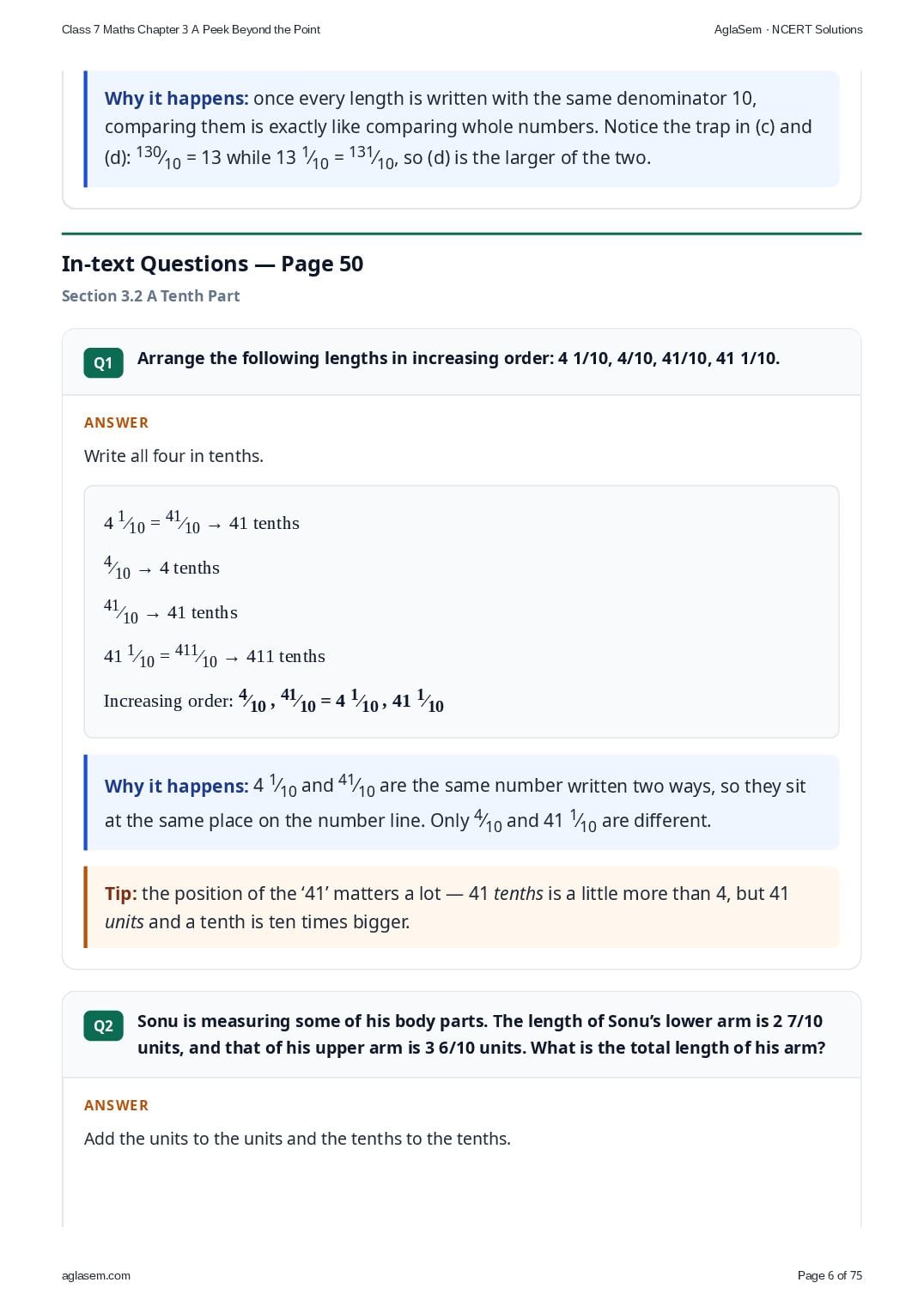
- Arrange these lengths in increasing order: (a) 9/10 (b) 1 7/10 (c) 130/10 (d) 13 1/10 (e) 10 5/10 (f) 7 6/10 (g) 6 7/10 (h) 4/10
- Arrange the following lengths in increasing order: 4 1/10, 4/10, 41/10, 41 1/10.
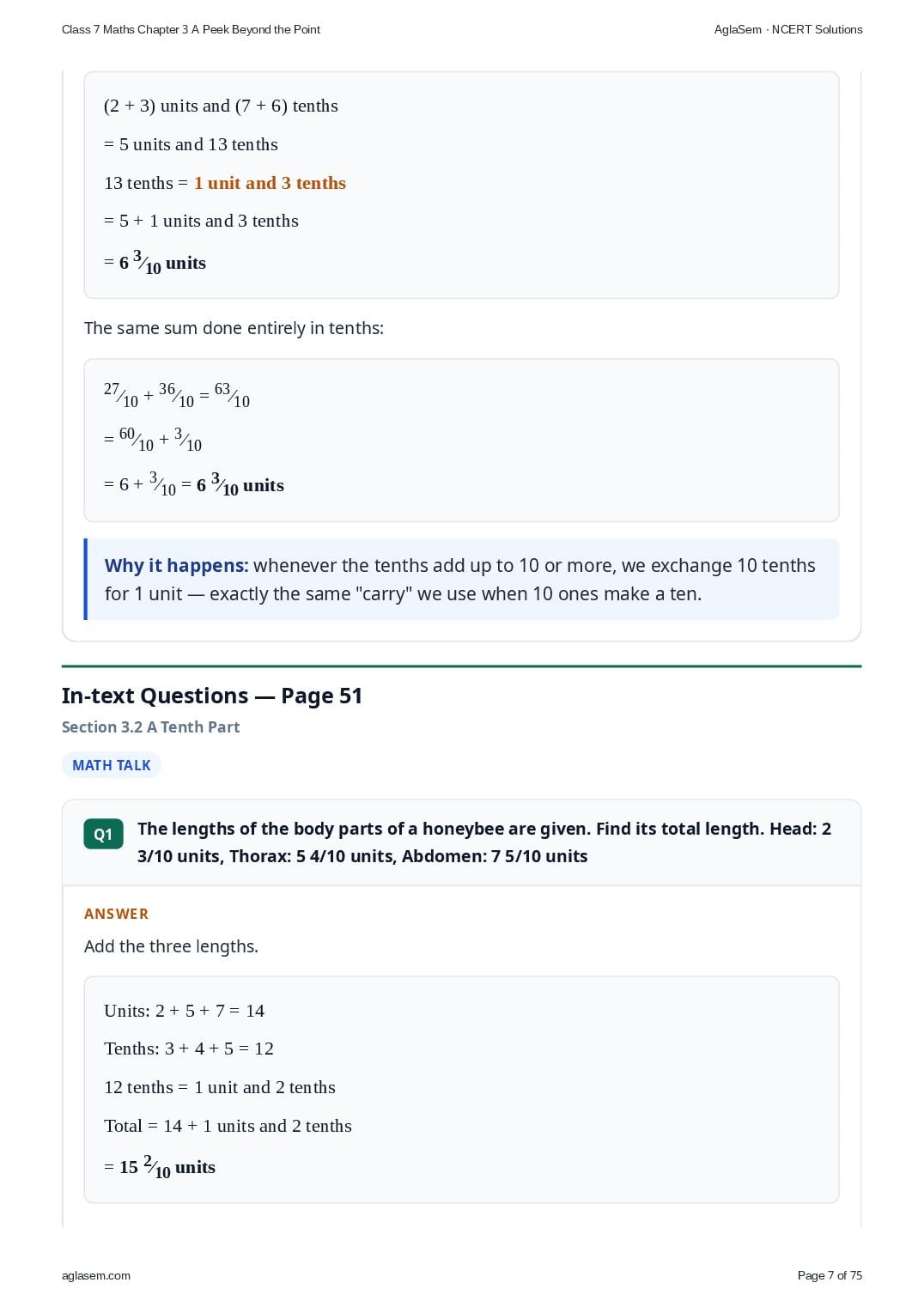
- Sonu is measuring some of his body parts. The length of Sonu’s lower arm is 2 7/10 units, and that of his upper arm is 3 6/10 units. What is the total length of his arm?
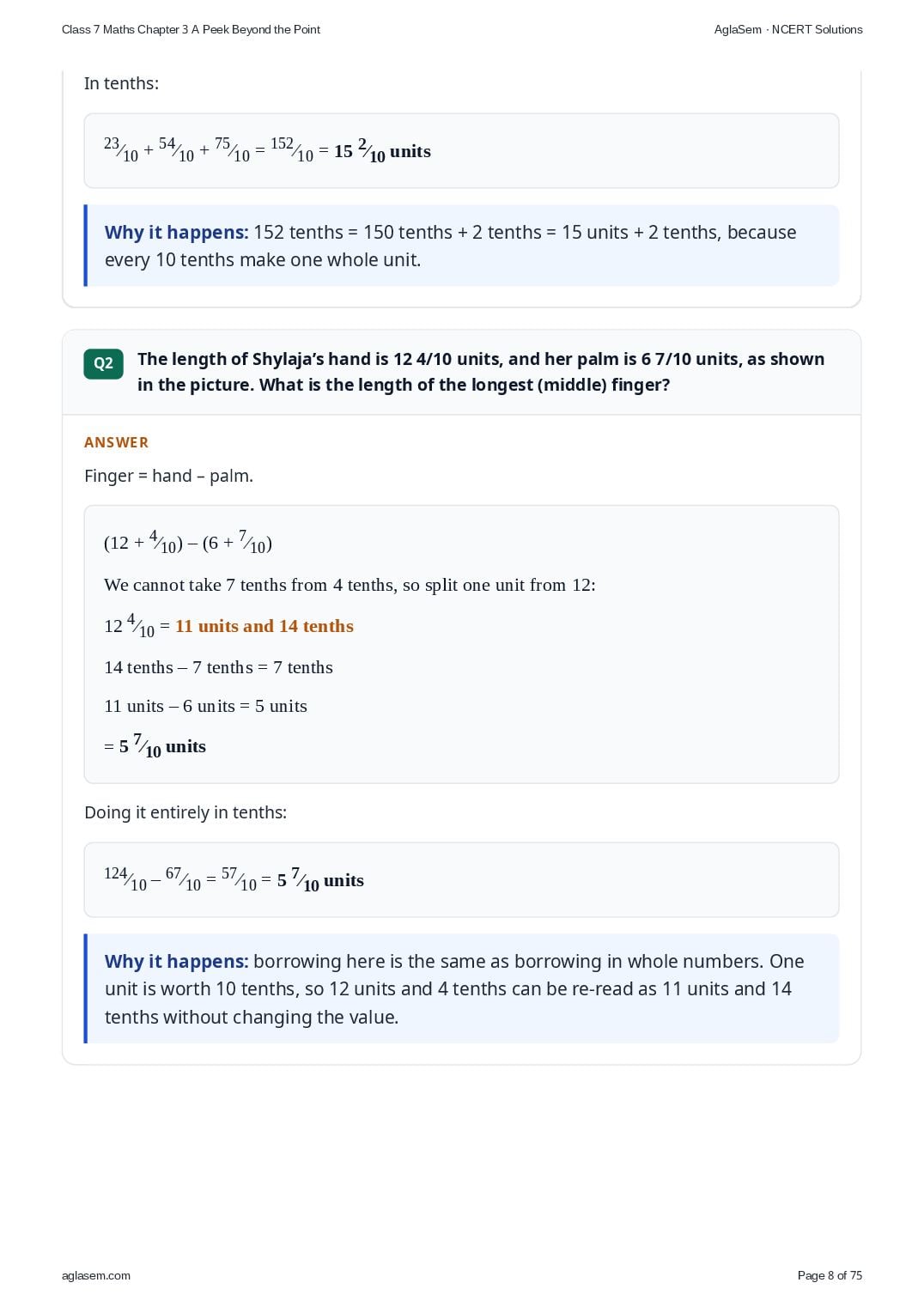
- The lengths of the body parts of a honeybee are given. Find its total length. Head: 2 3/10 units, Thorax: 5 4/10 units, Abdomen: 7 5/10 units
- The length of Shylaja’s hand is 12 4/10 units, and her palm is 6 7/10 units, as shown in the picture. What is the length of the longest (middle) finger?
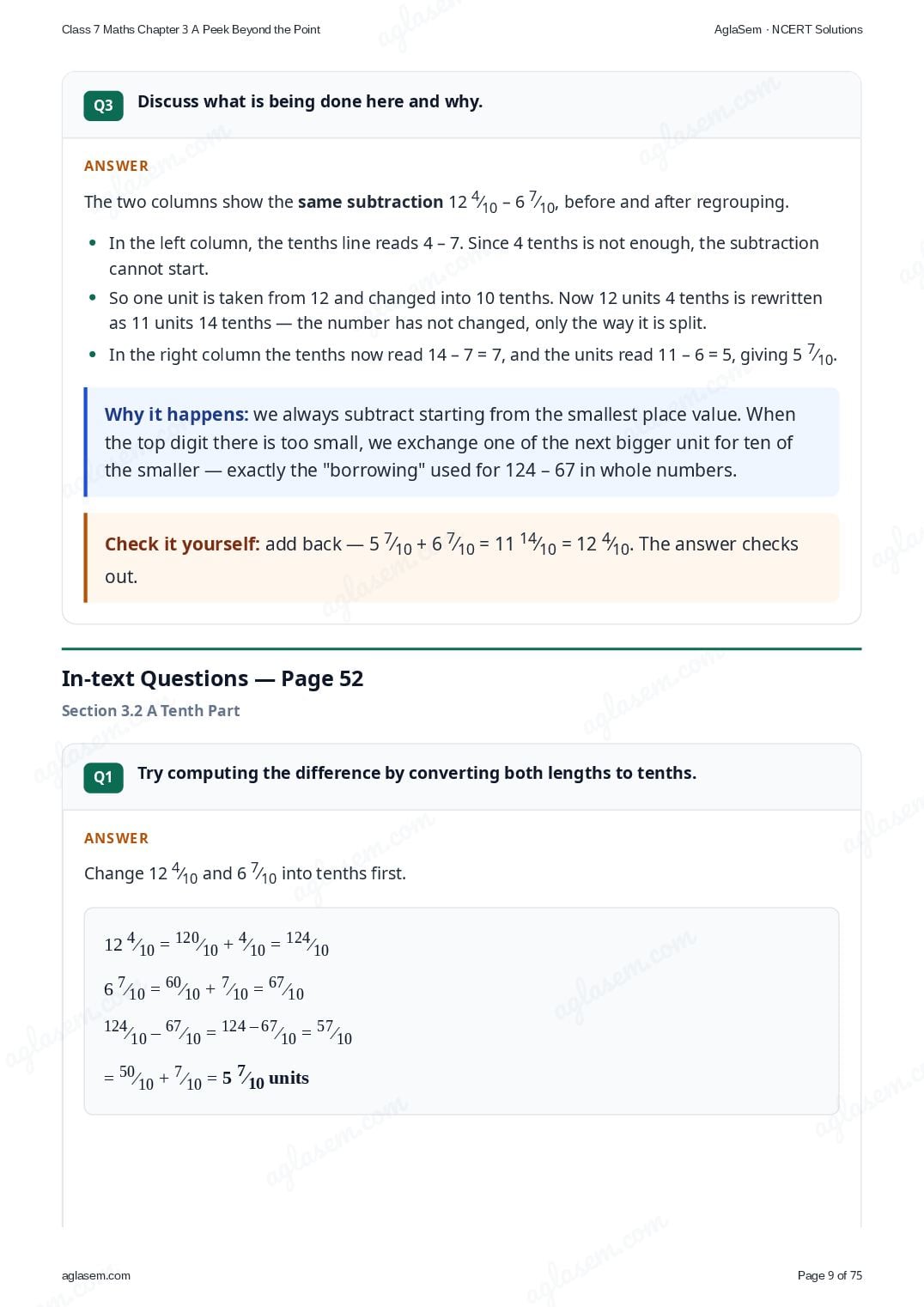
- Discuss what is being done here and why.
- Try computing the difference by converting both lengths to tenths.
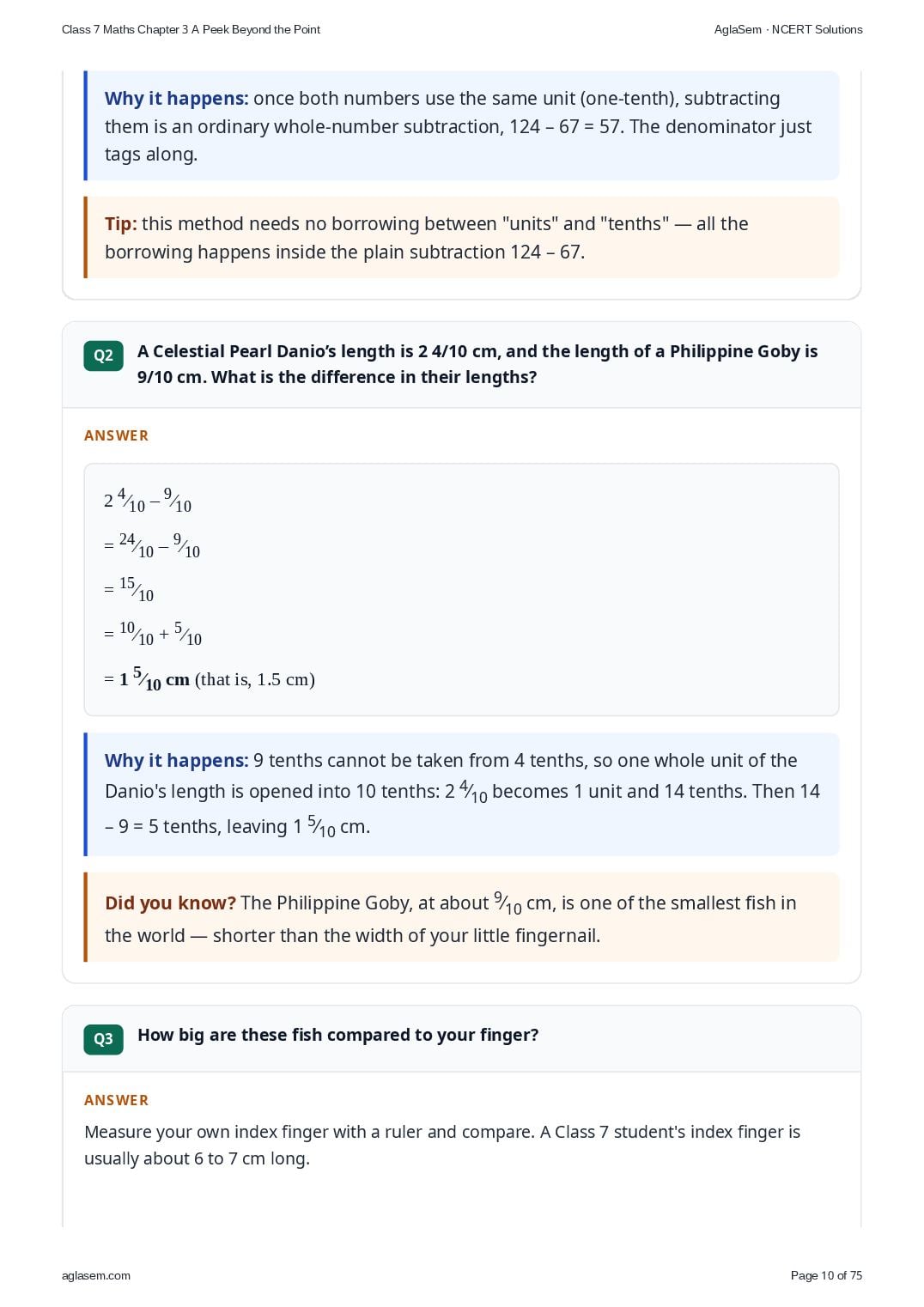
- A Celestial Pearl Danio’s length is 2 4/10 cm, and the length of a Philippine Goby is 9/10 cm. What is the difference in their lengths?
- How big are these fish compared to your finger?
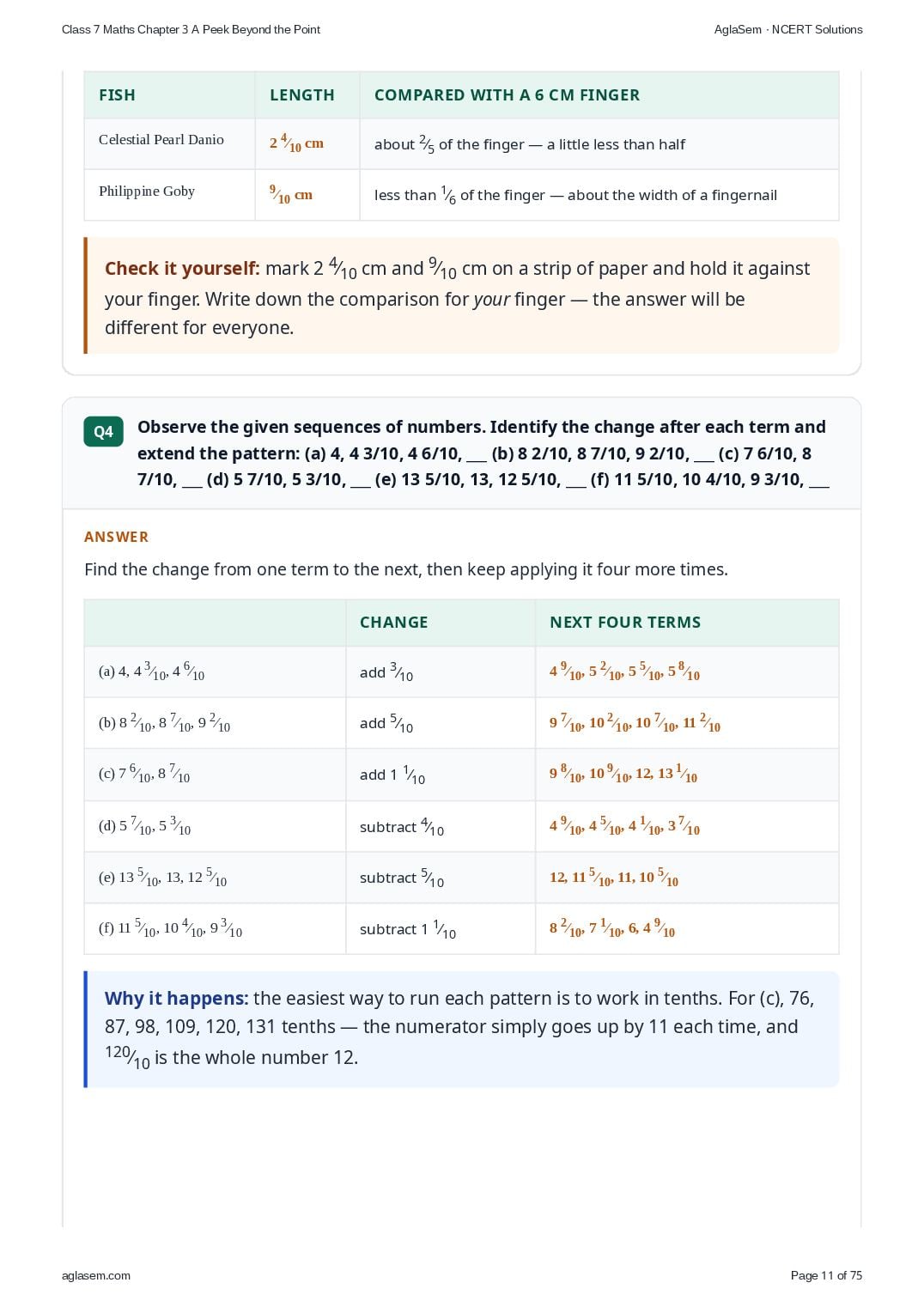
- Observe the given sequences of numbers. Identify the change after each term and extend the pattern: (a) 4, 4 3/10, 4 6/10, ___ (b) 8 2/10, 8 7/10, 9 2/10, ___ (c) 7 6/10, 8 7/10, ___ (d) 5 7/10, 5 3/10, ___ (e) 13 5/10, 13, 12 5/10, ___ (f) 11 5/10, 10 4/10, 9 3/10, ___
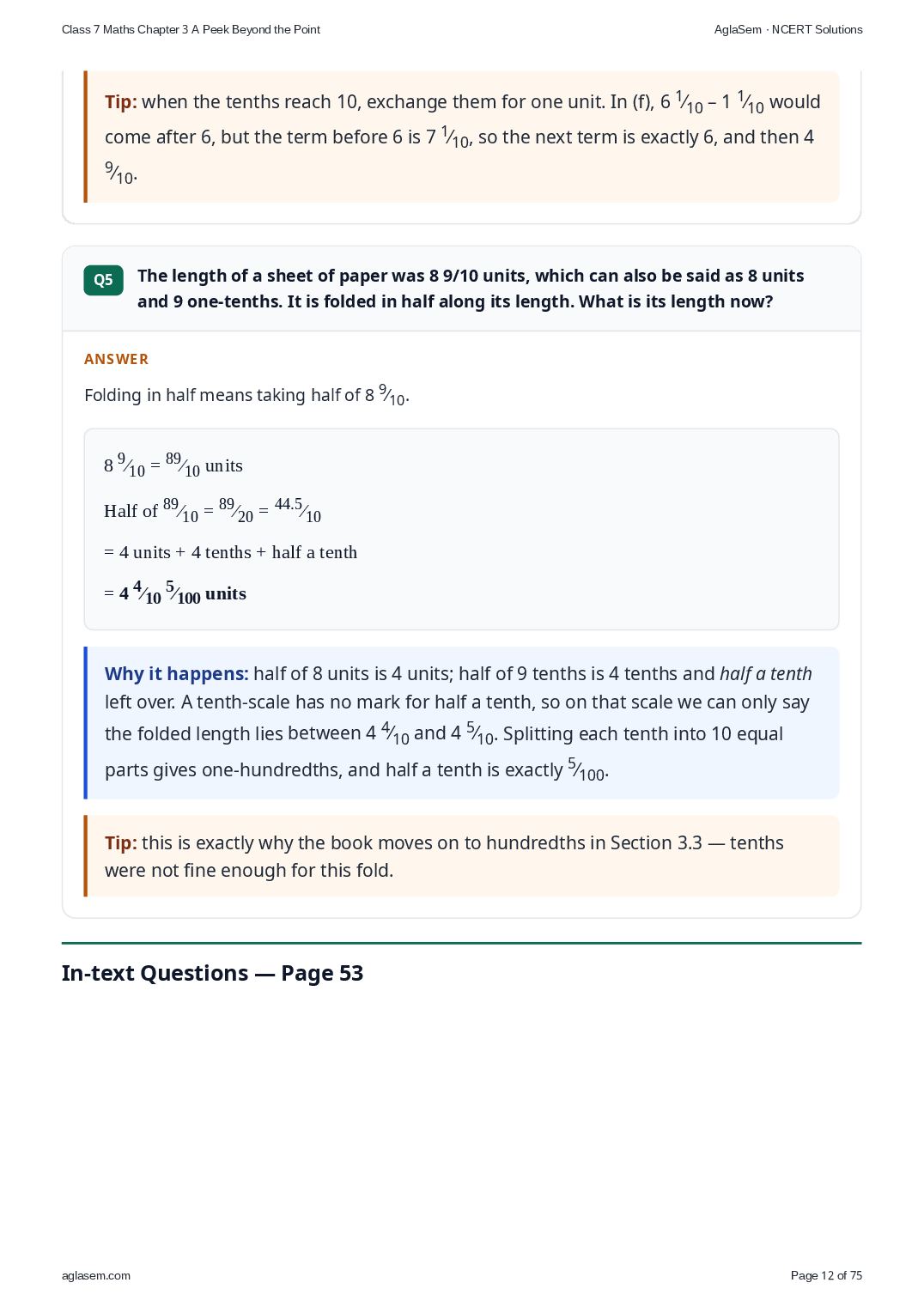
- The length of a sheet of paper was 8 9/10 units, which can also be said as 8 units and 9 one-tenths. It is folded in half along its length. What is its length now?
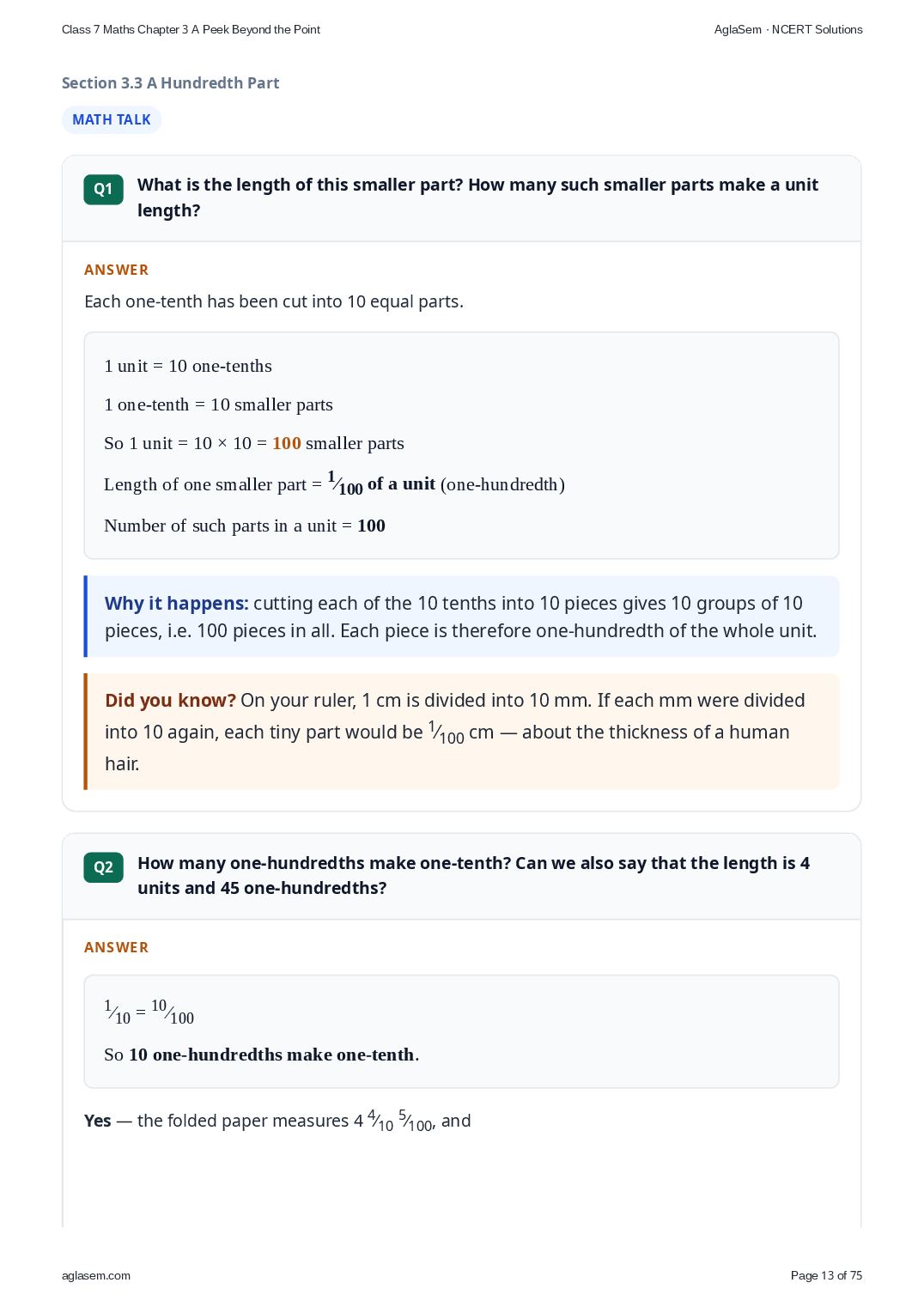
- What is the length of this smaller part? How many such smaller parts make a unit length?
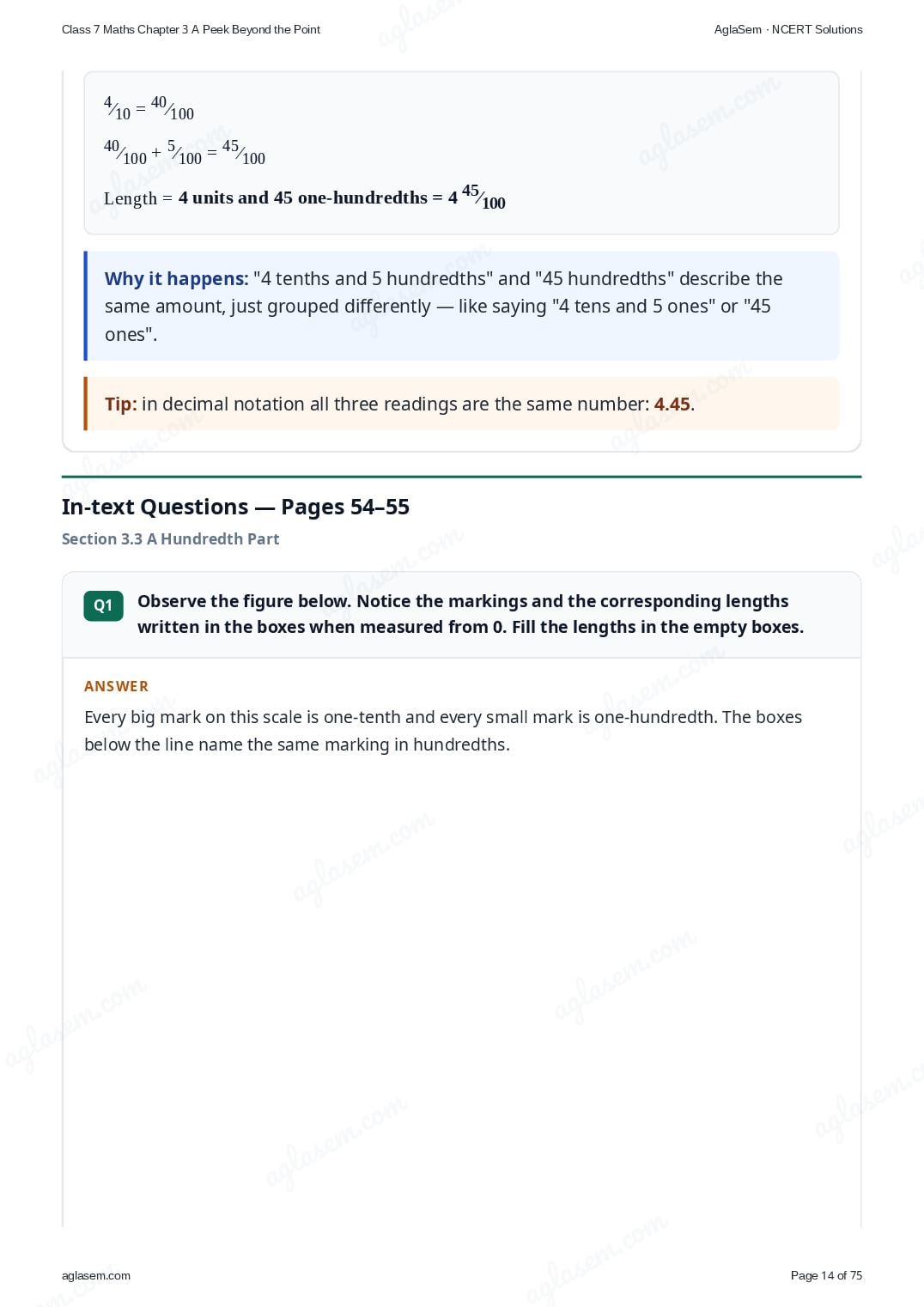
- How many one-hundredths make one-tenth? Can we also say that the length is 4 units and 45 one-hundredths?
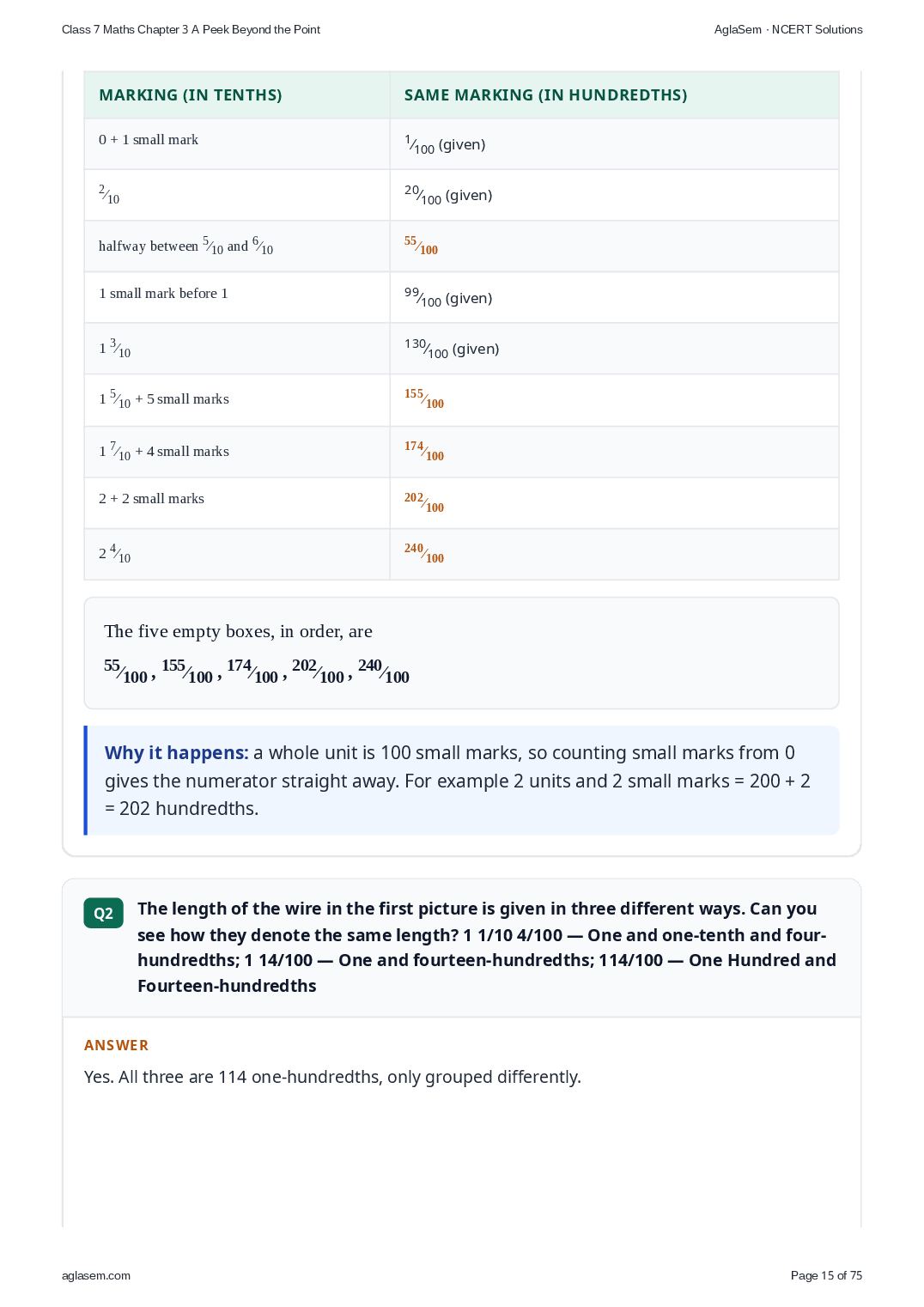
- Observe the figure below. Notice the markings and the corresponding lengths written in the boxes when measured from 0. Fill the lengths in the empty boxes.
- The length of the wire in the first picture is given in three different ways. Can you see how they denote the same length? 1 1/10 4/100 — One and one-tenth and four-hundredths; 1 14/100 — One and fourteen-hundredths; 114/100 — One Hundred and Fourteen-hundredths
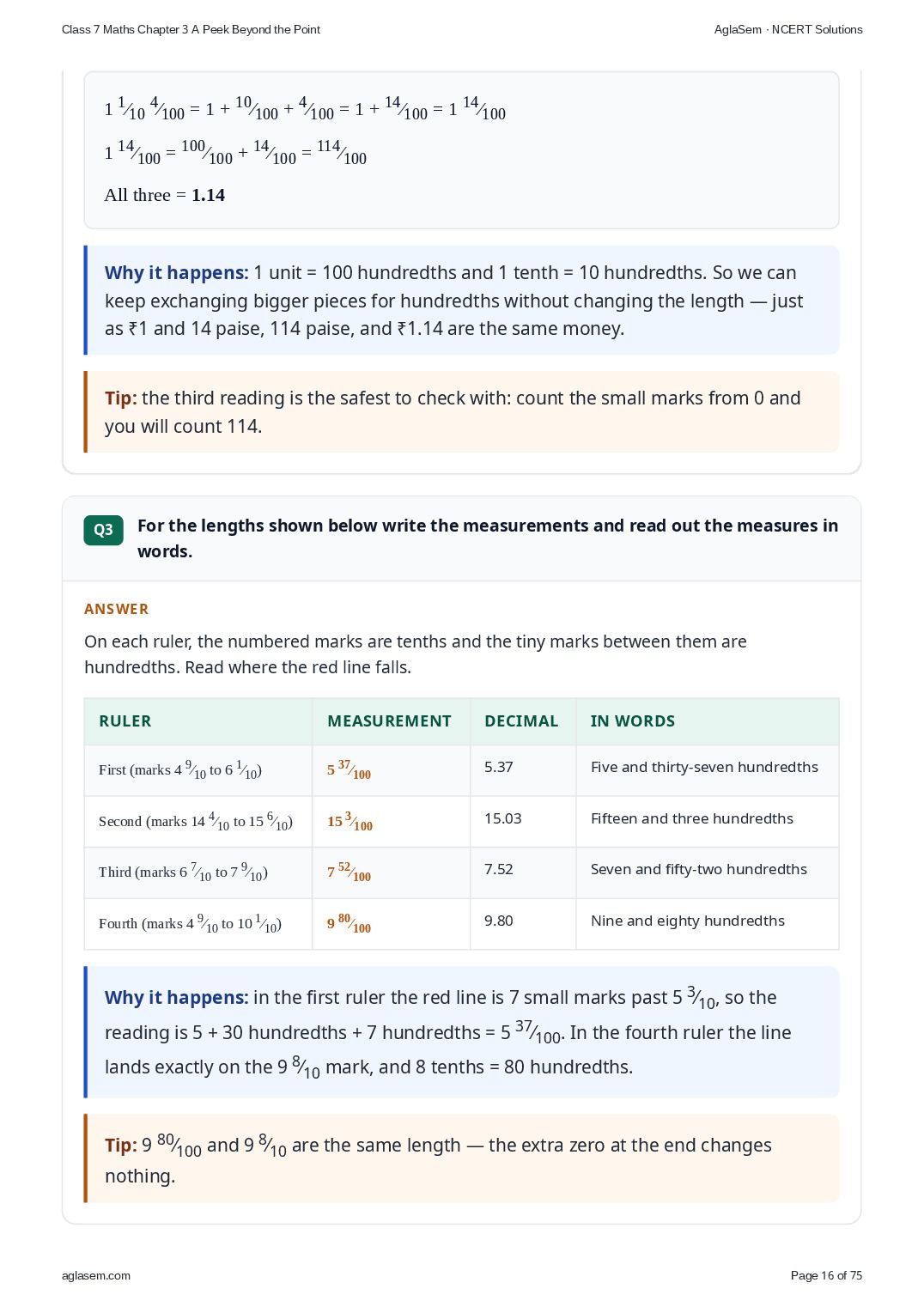
- For the lengths shown below write the measurements and read out the measures in words.
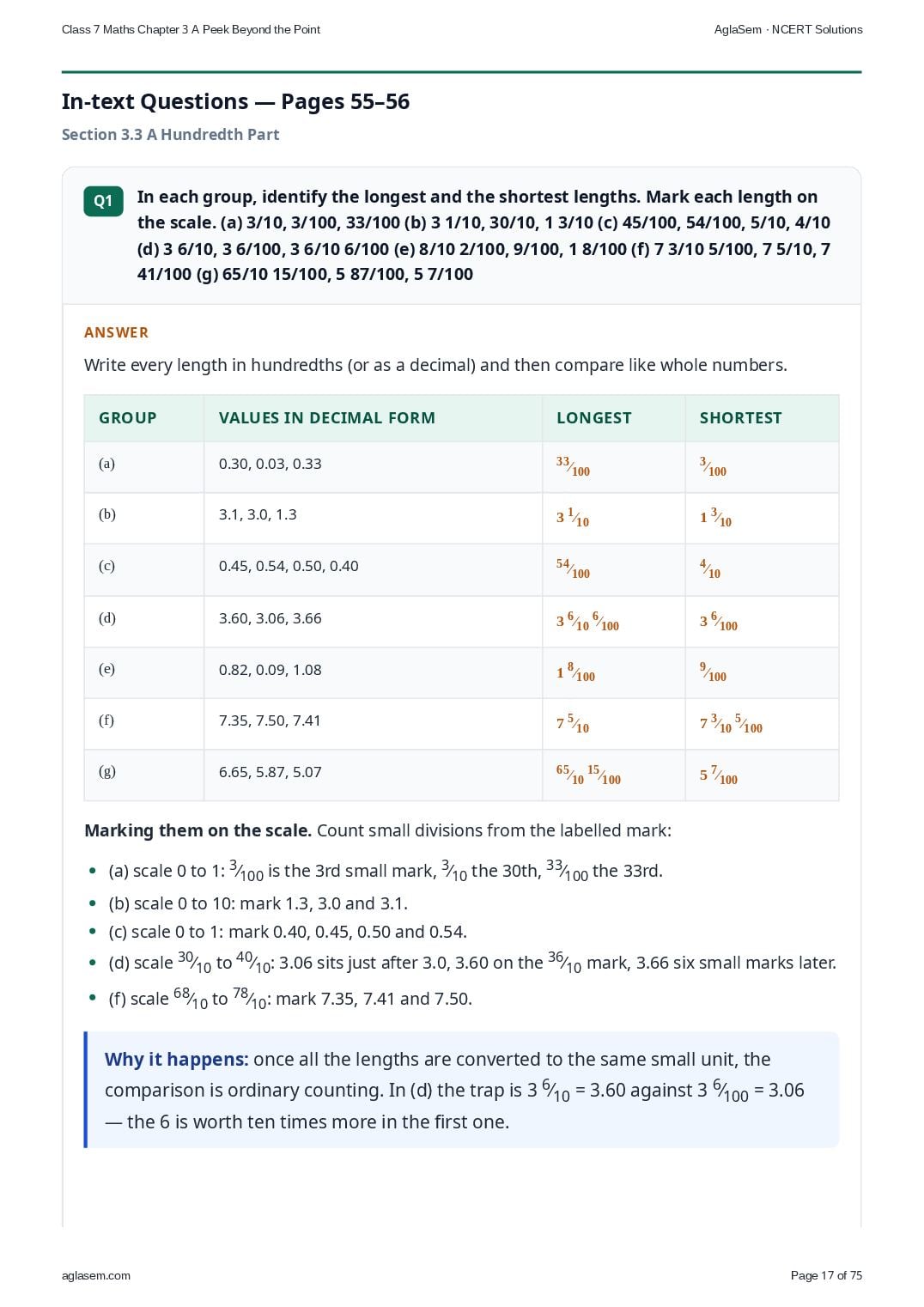
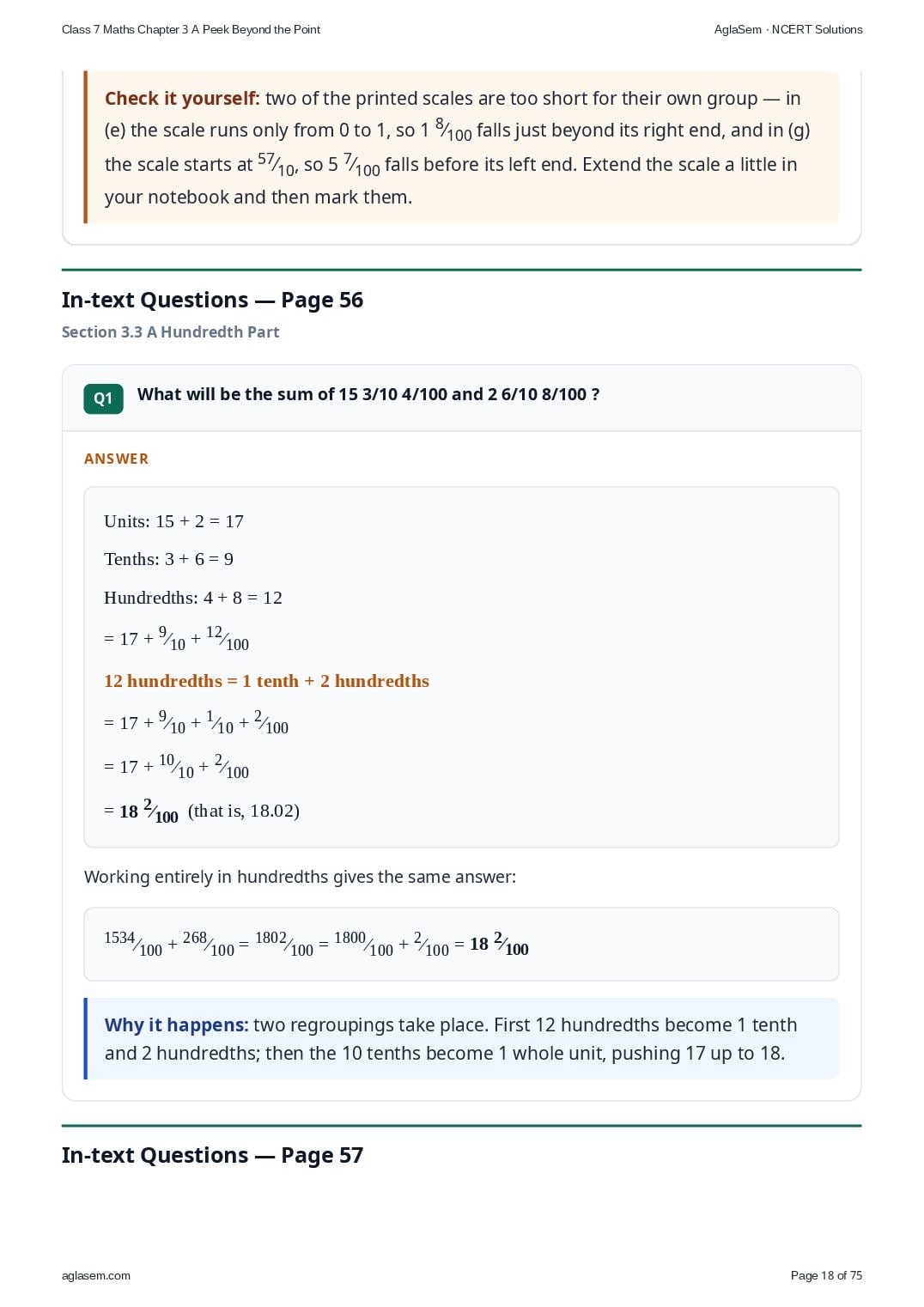
- In each group, identify the longest and the shortest lengths. Mark each length on the scale. (a) 3/10, 3/100, 33/100 (b) 3 1/10, 30/10, 1 3/10 (c) 45/100, 54/100, 5/10, 4/10 (d) 3 6/10, 3 6/100, 3 6/10 6/100 (e) 8/10 2/100, 9/100, 1 8/100 (f) 7 3/10 5/100, 7 5/10, 7 41/100 (g) 65/10 15/100, 5 87/100, 5 7/100
- What will be the sum of 15 3/10 4/100 and 2 6/10 8/100 ?
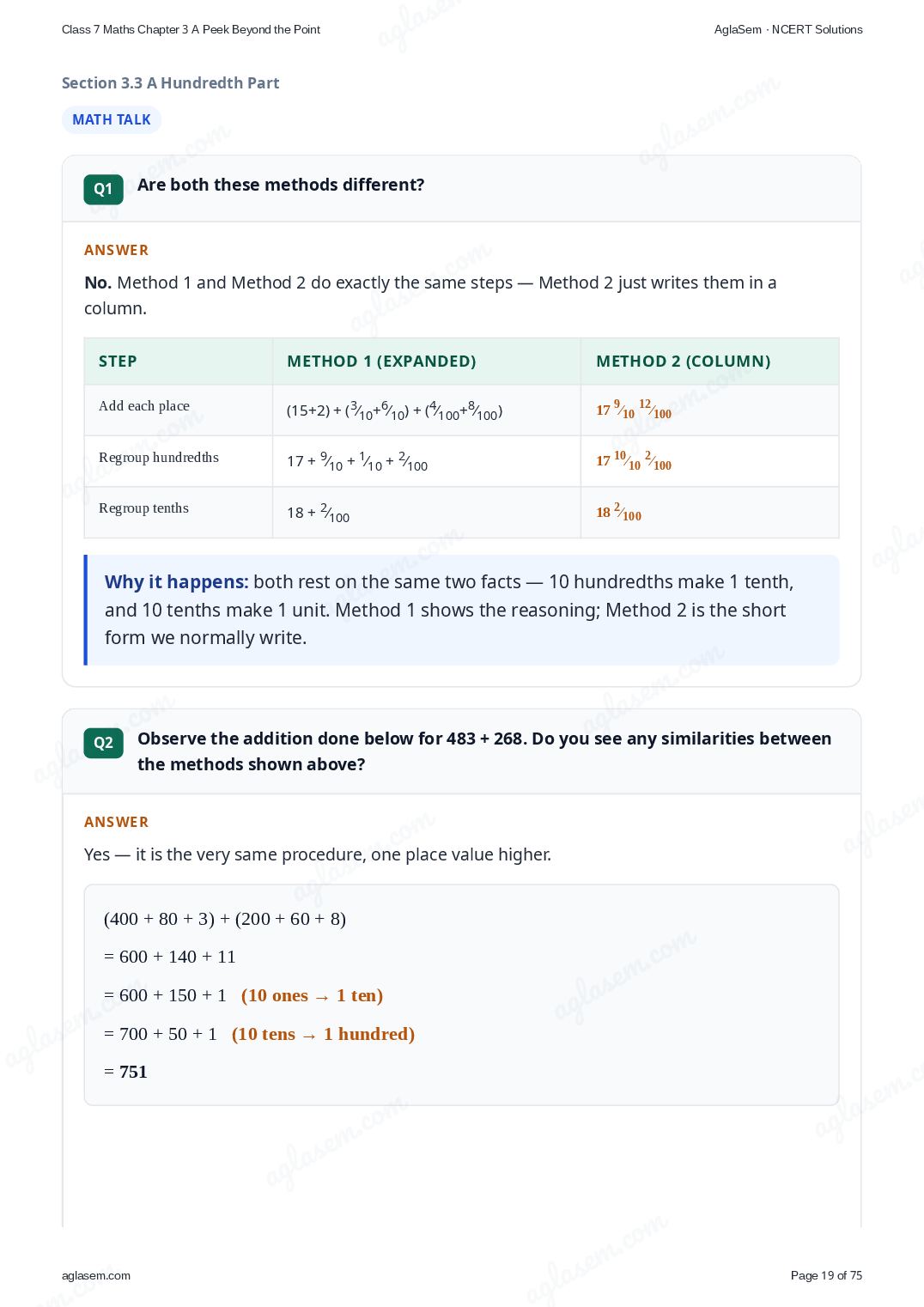
- Are both these methods different?
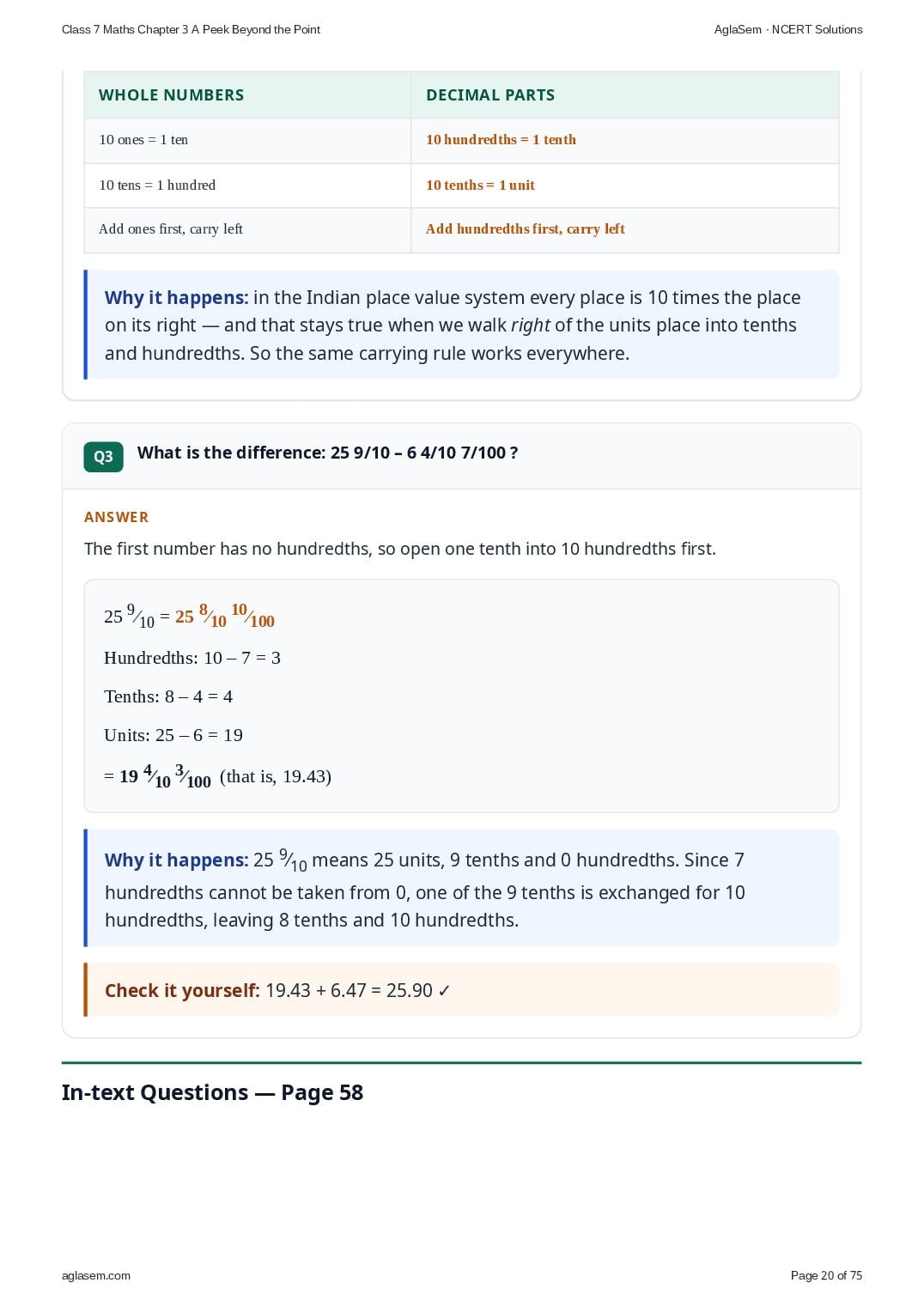
- Observe the addition done below for 483 + 268. Do you see any similarities between the methods shown above?
- What is the difference: 25 9/10 – 6 4/10 7/100 ?
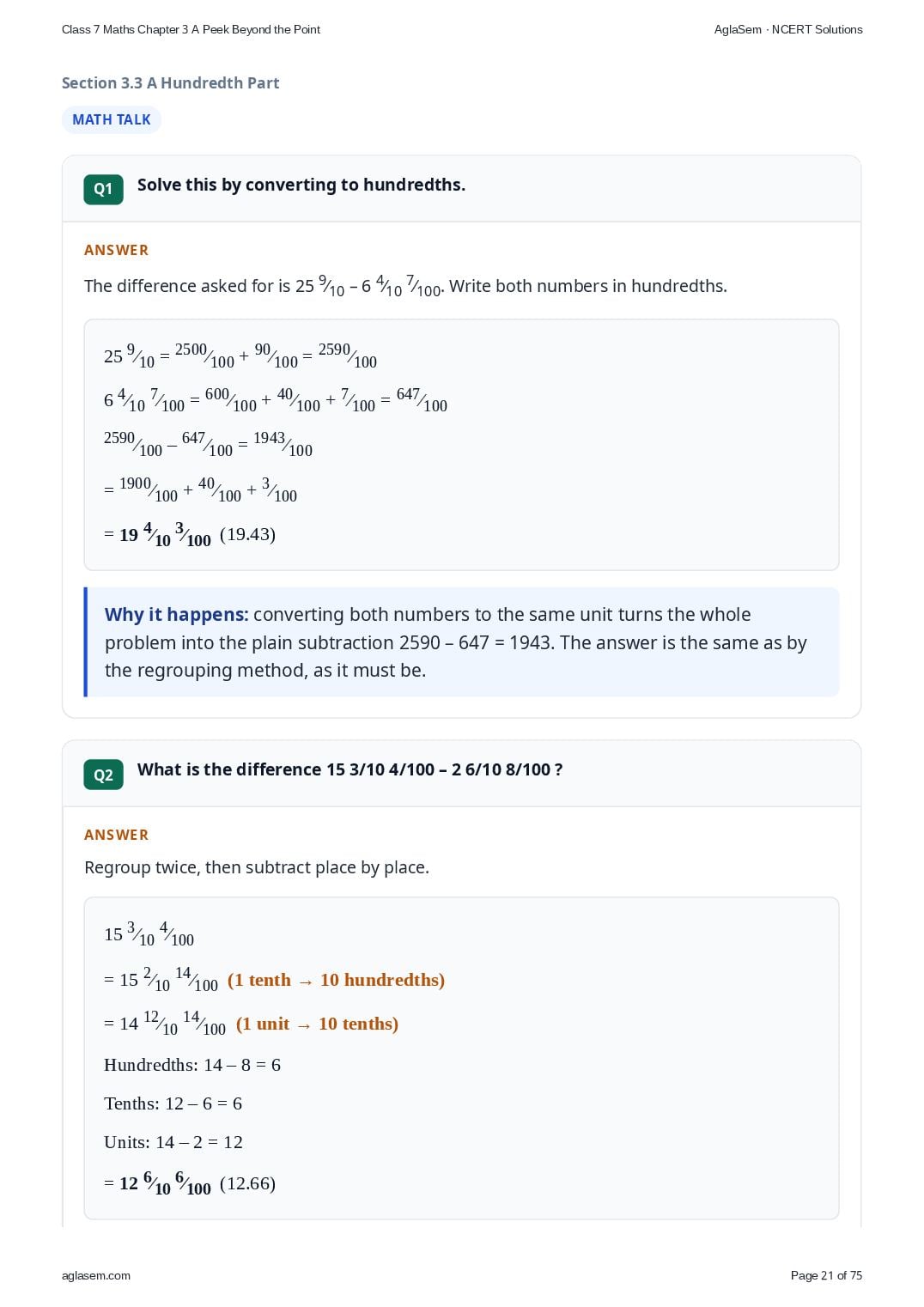
- Solve this by converting to hundredths.
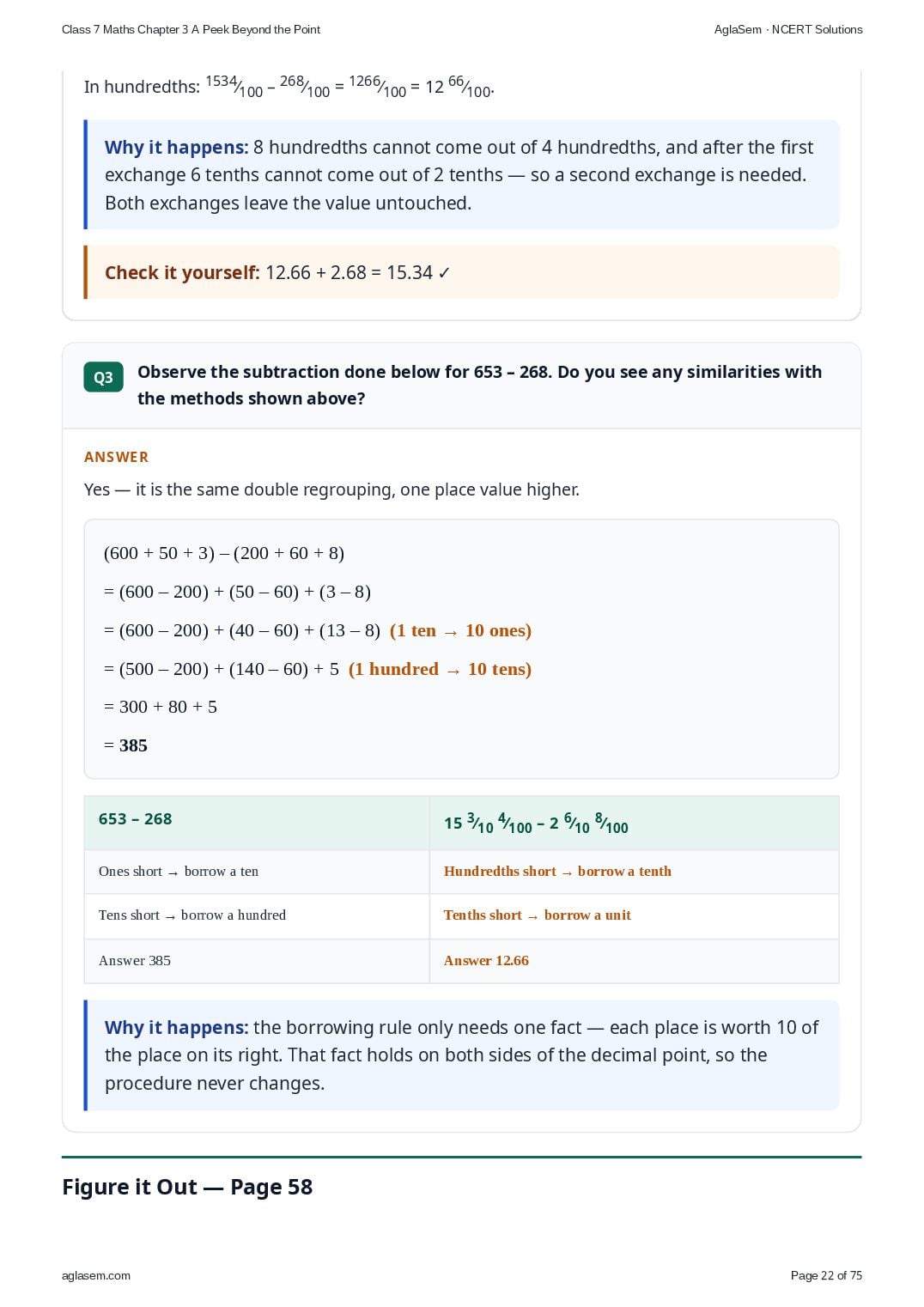
- What is the difference 15 3/10 4/100 – 2 6/10 8/100 ?
- Observe the subtraction done below for 653 – 268. Do you see any similarities with the methods shown above?
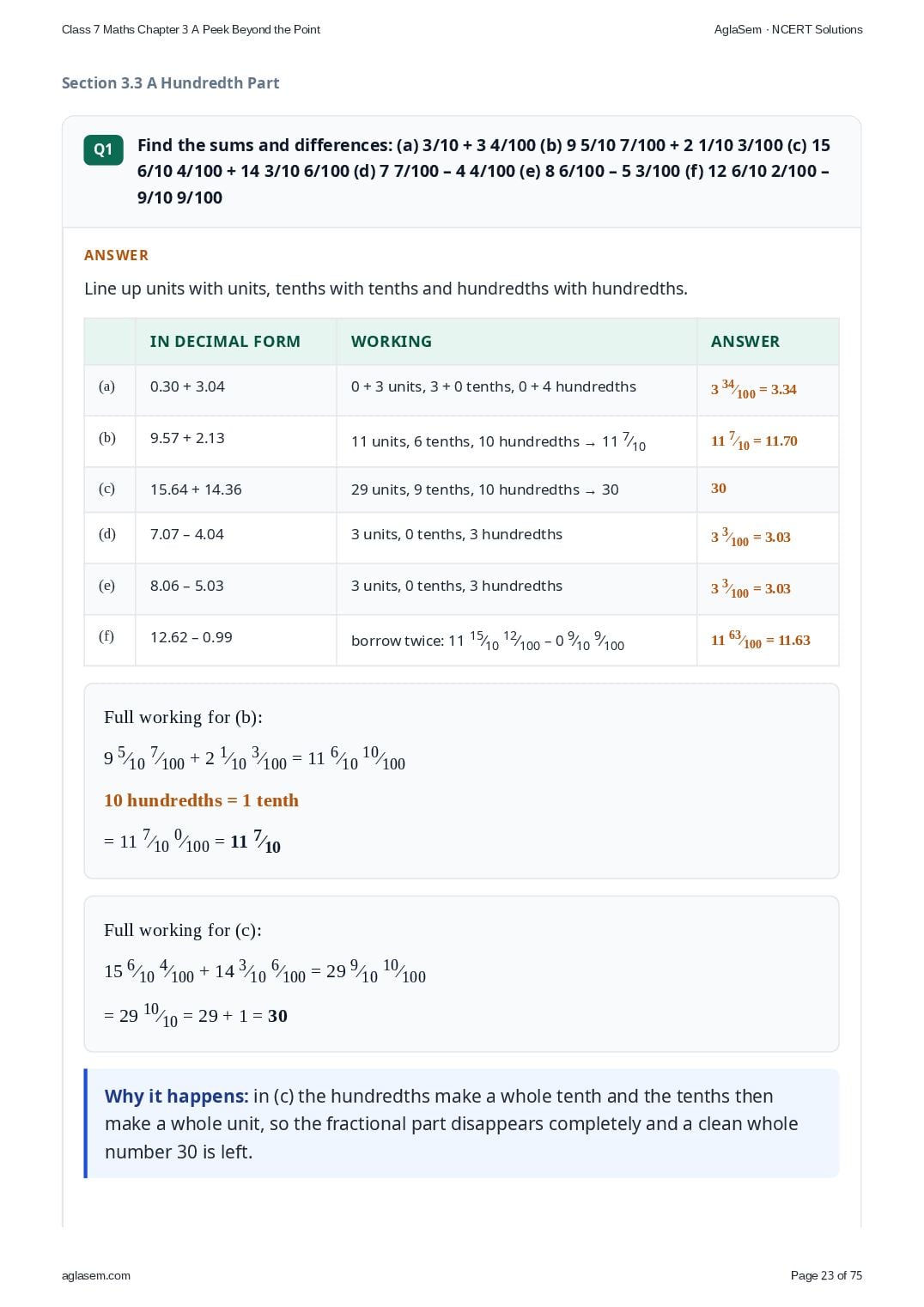
- Find the sums and differences: (a) 3/10 + 3 4/100 (b) 9 5/10 7/100 + 2 1/10 3/100 (c) 15 6/10 4/100 + 14 3/10 6/100 (d) 7 7/100 – 4 4/100 (e) 8 6/100 – 5 3/100 (f) 12 6/10 2/100 – 9/10 9/100
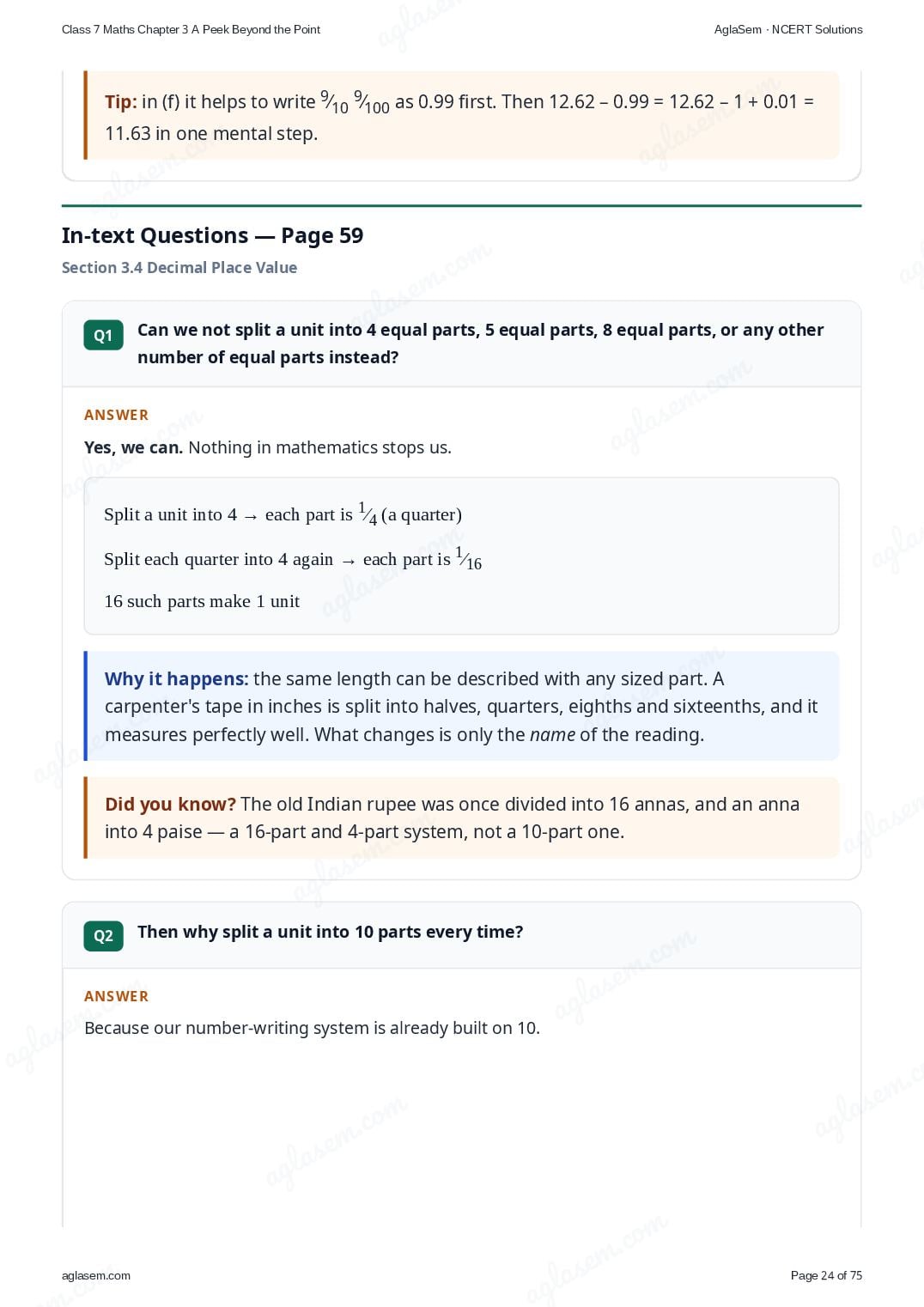
- Can we not split a unit into 4 equal parts, 5 equal parts, 8 equal parts, or any other number of equal parts instead?
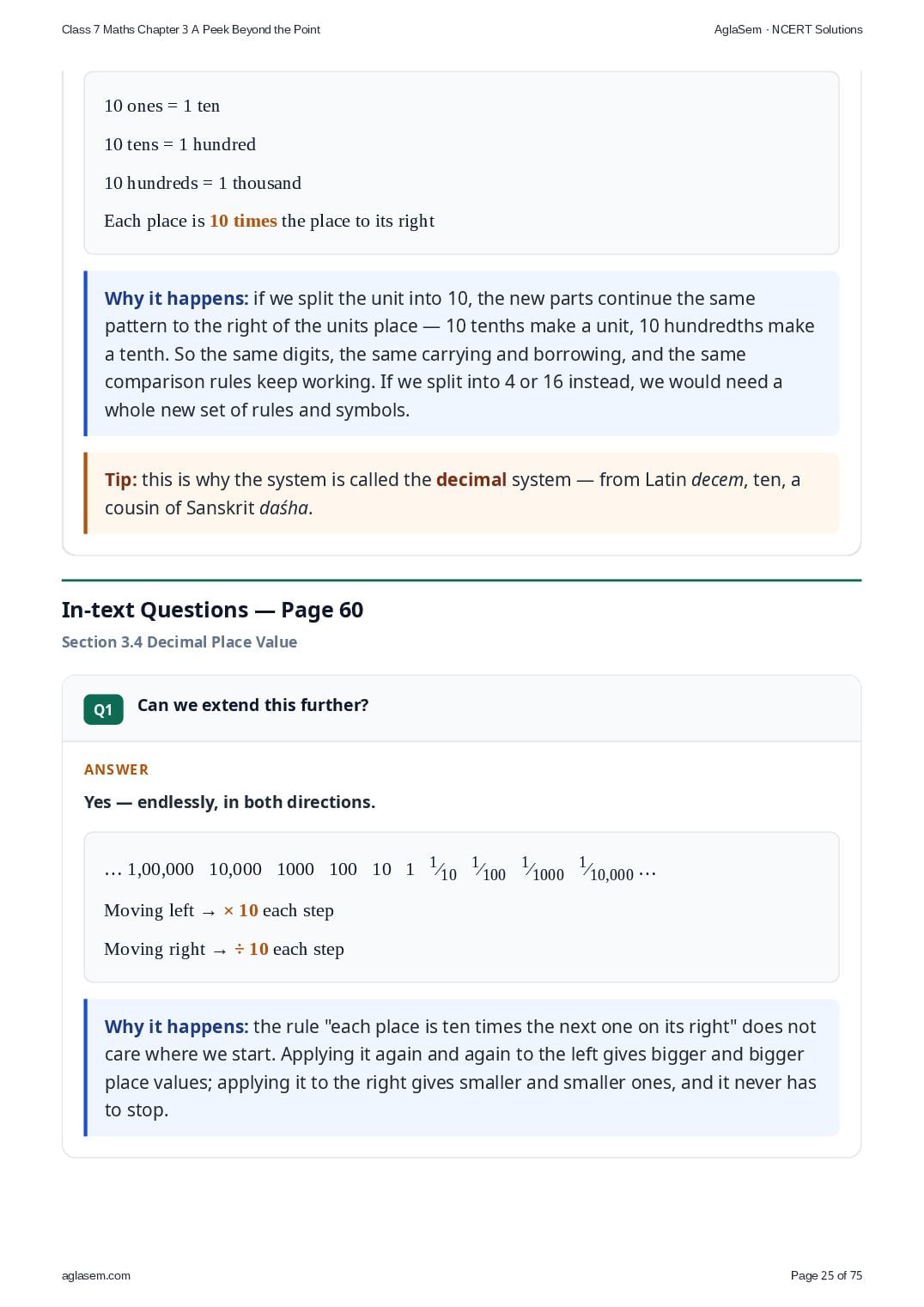
- Then why split a unit into 10 parts every time?
- Can we extend this further?
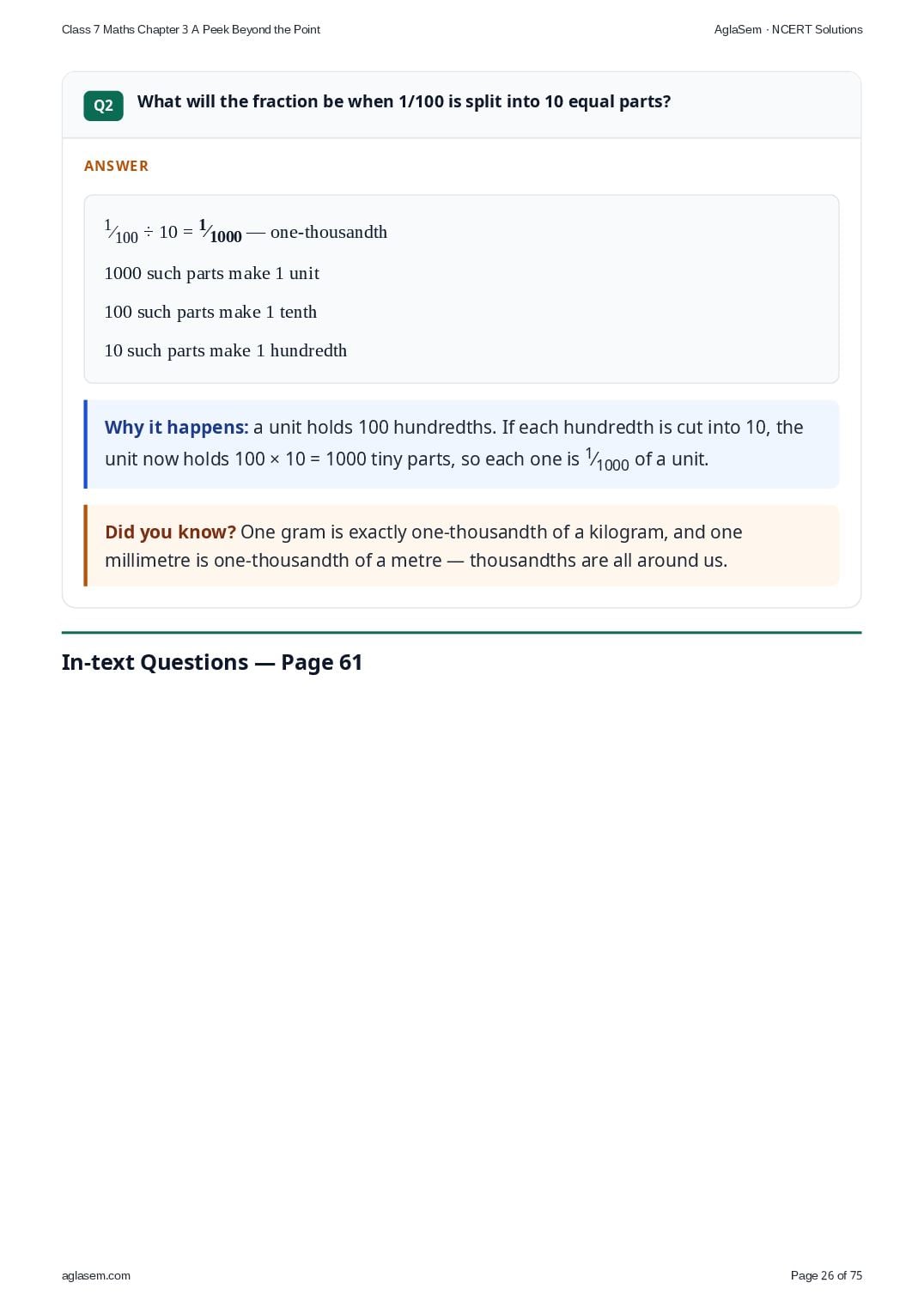
- What will the fraction be when 1/100 is split into 10 equal parts?
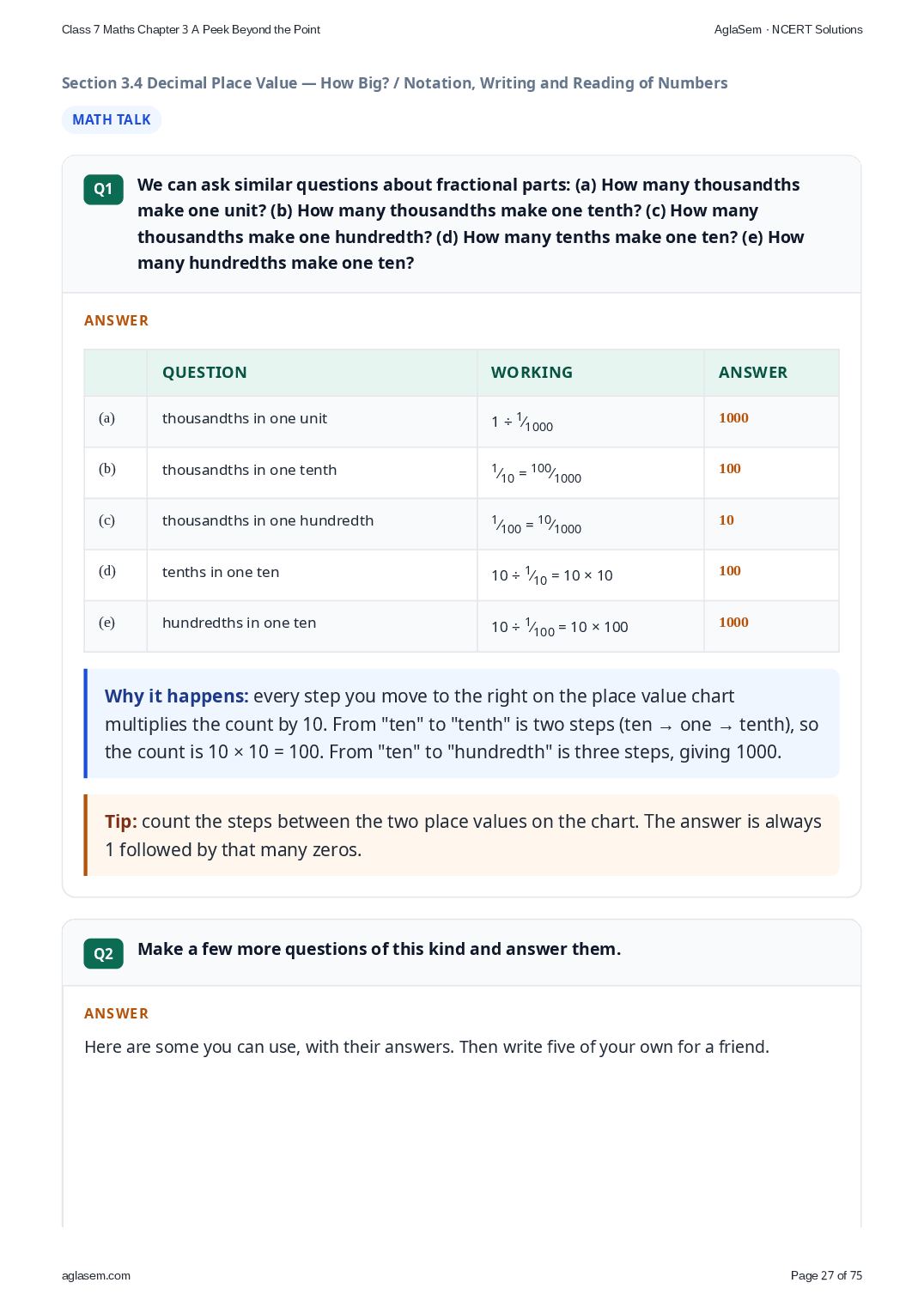
- We can ask similar questions about fractional parts: (a) How many thousandths make one unit? (b) How many thousandths make one tenth? (c) How many thousandths make one hundredth? (d) How many tenths make one ten? (e) How many hundredths make one ten?
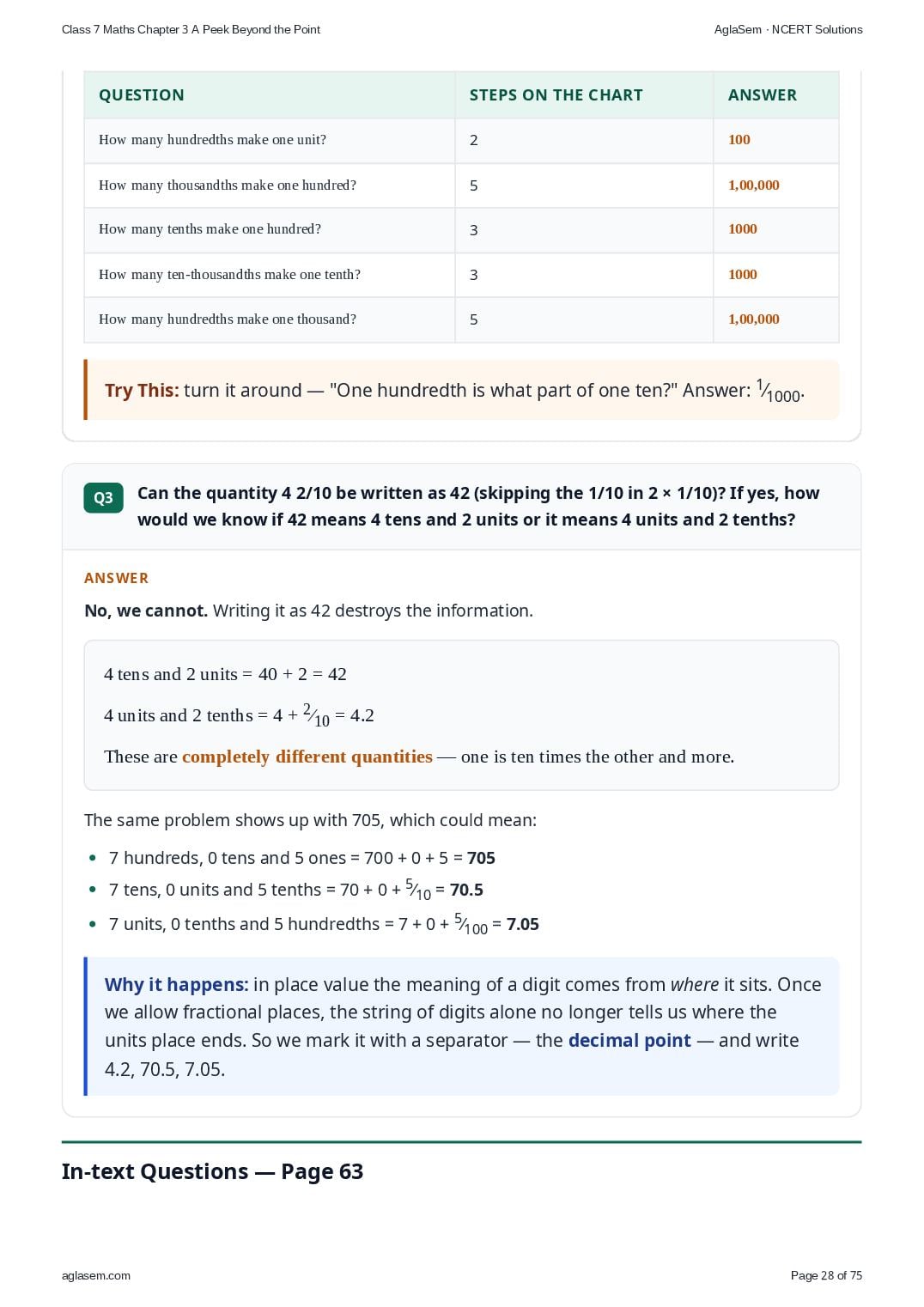
- Make a few more questions of this kind and answer them.
- Can the quantity 4 2/10 be written as 42 (skipping the 1/10 in 2 × 1/10)? If yes, how would we know if 42 means 4 tens and 2 units or it means 4 units and 2 tenths?
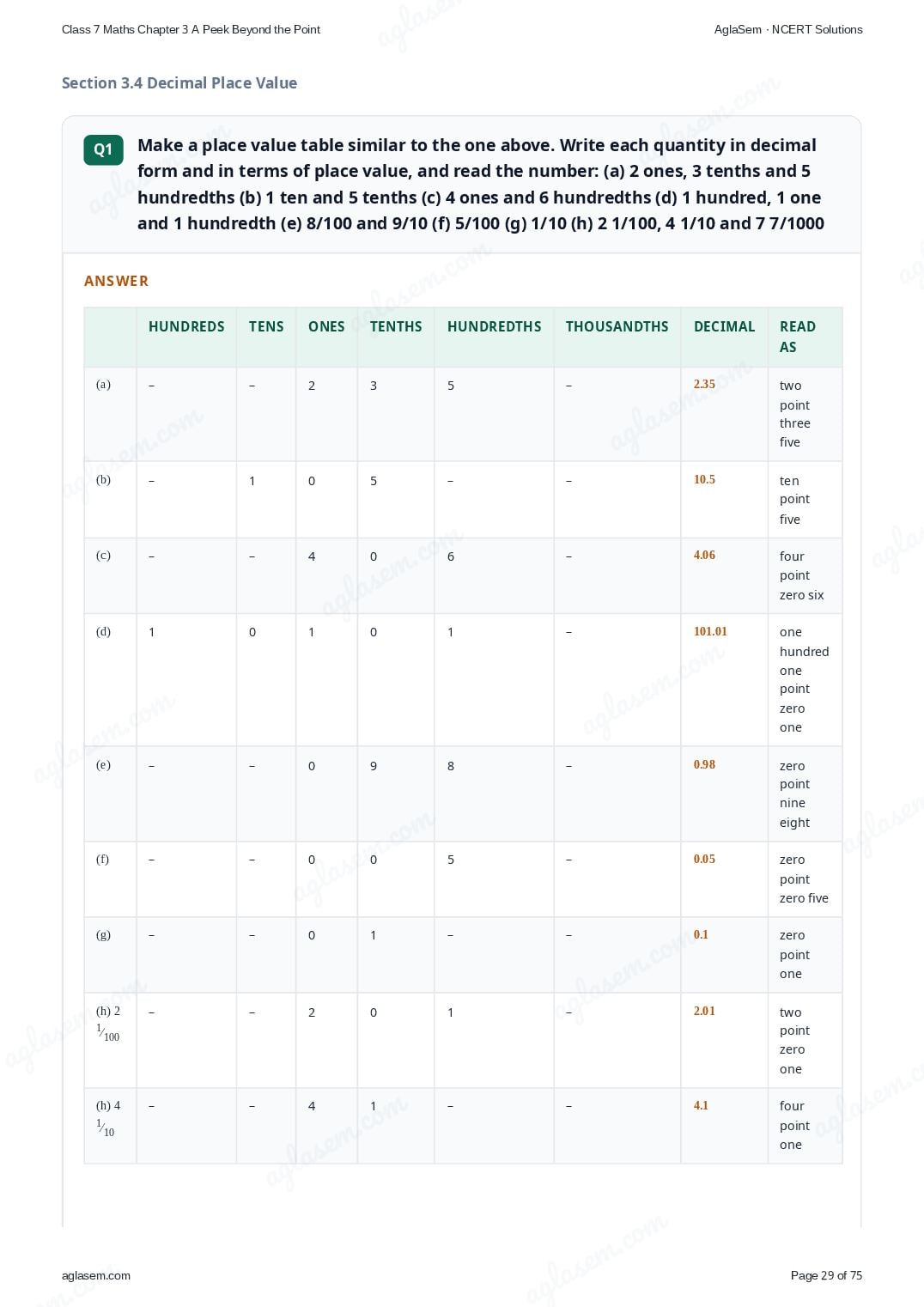
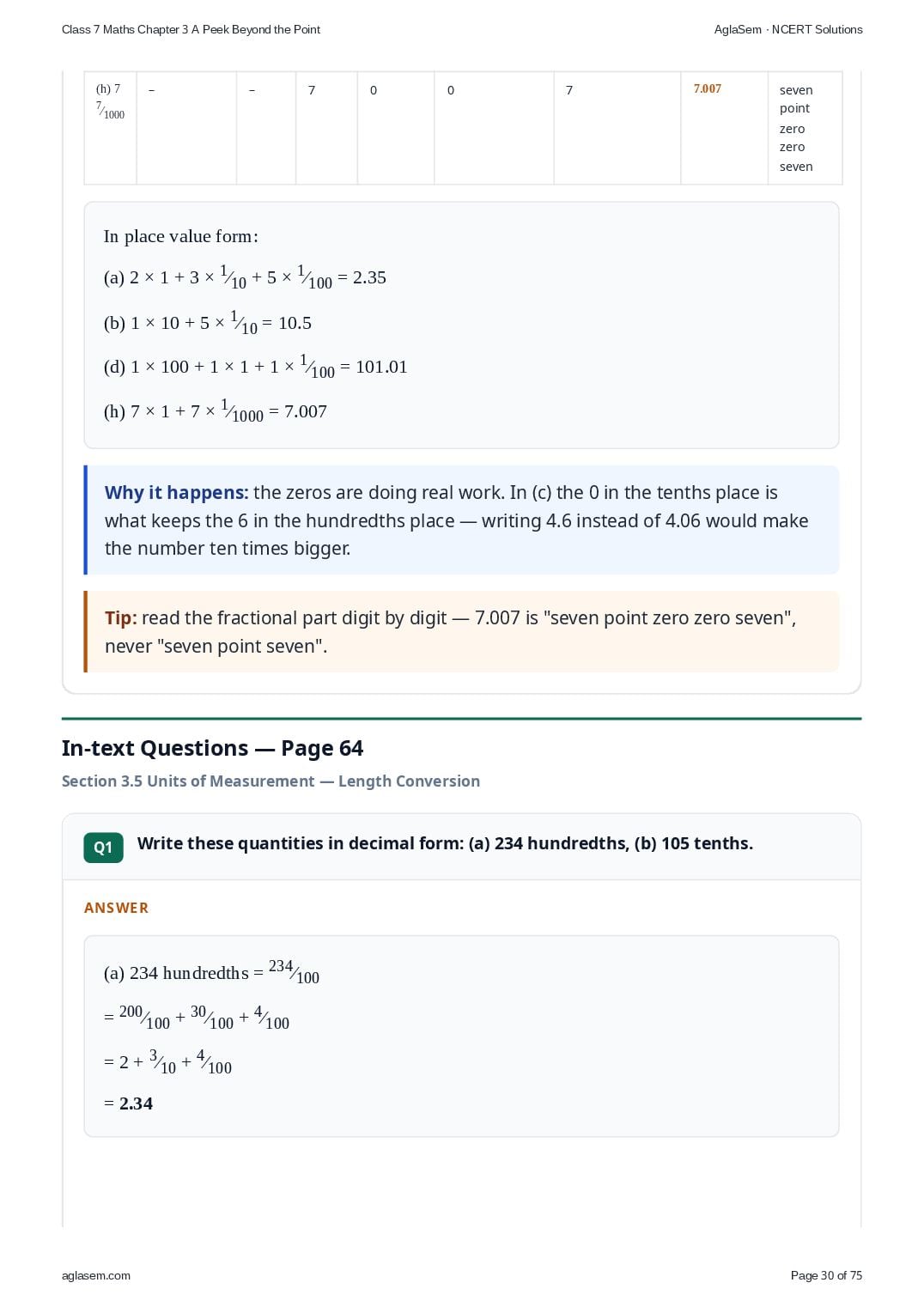
- Make a place value table similar to the one above. Write each quantity in decimal form and in terms of place value, and read the number: (a) 2 ones, 3 tenths and 5 hundredths (b) 1 ten and 5 tenths (c) 4 ones and 6 hundredths (d) 1 hundred, 1 one and 1 hundredth (e) 8/100 and 9/10 (f) 5/100 (g) 1/10 (h) 2 1/100, 4 1/10 and 7 7/1000
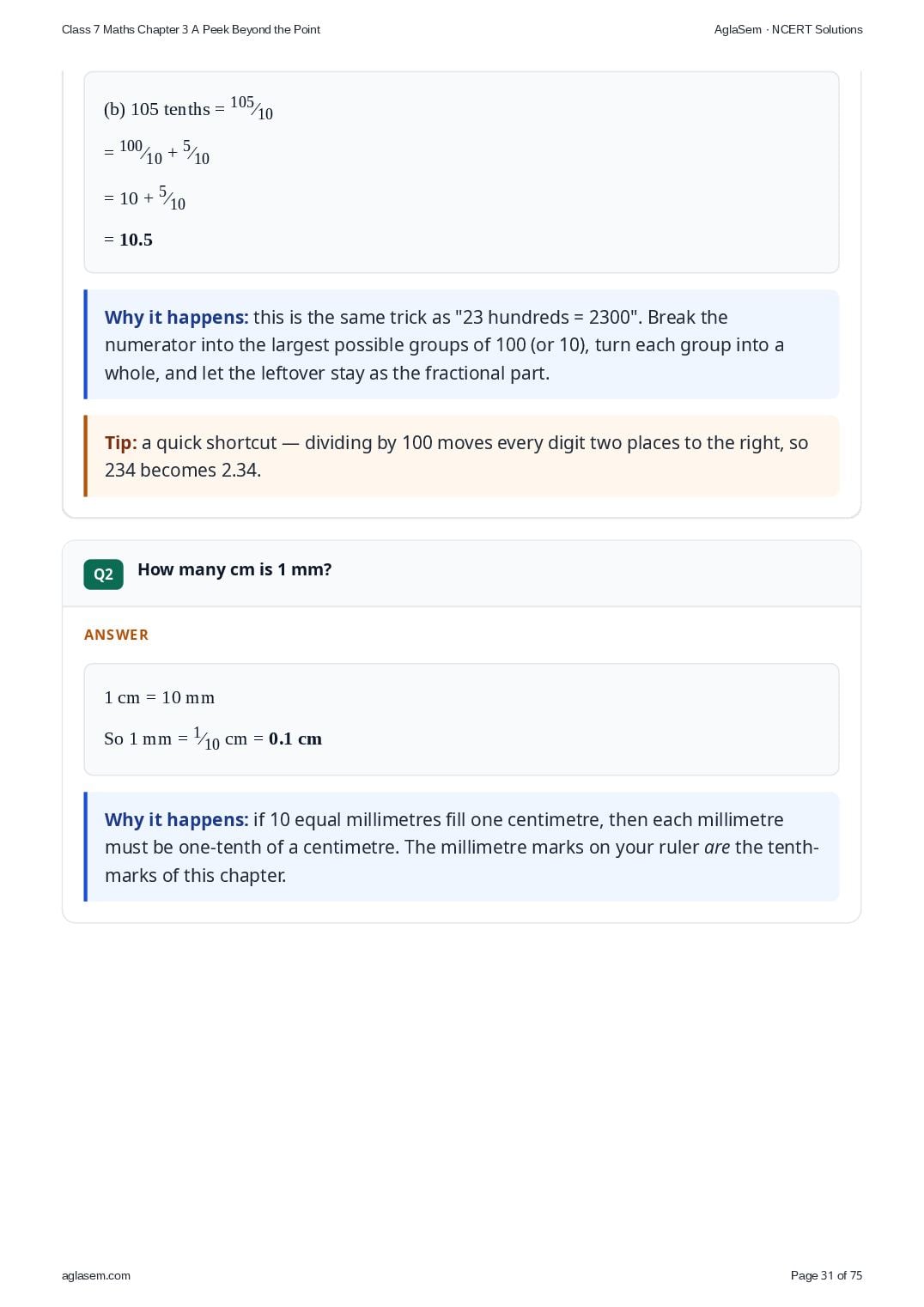
- Write these quantities in decimal form: (a) 234 hundredths, (b) 105 tenths.
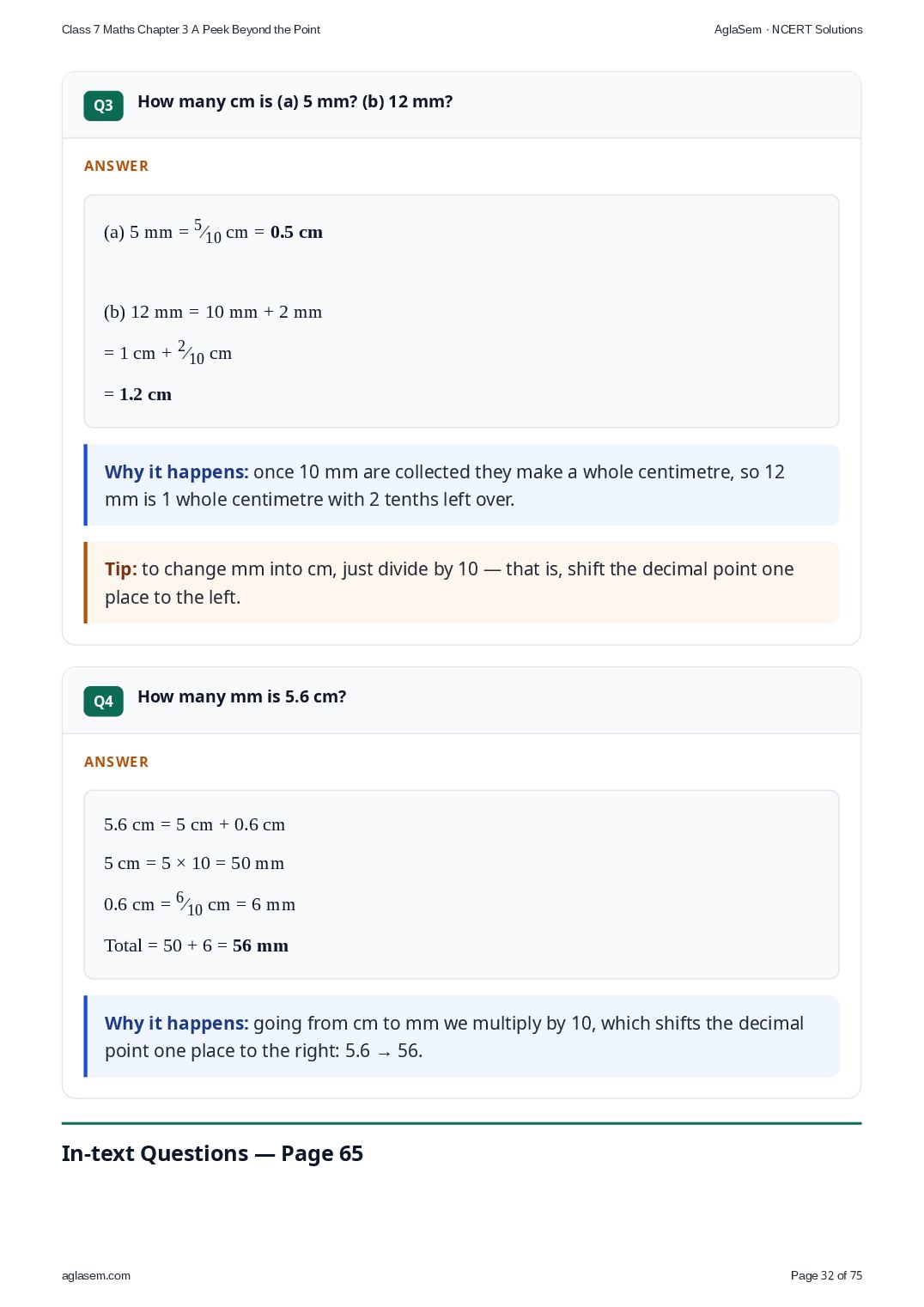
- How many cm is 1 mm?
- How many cm is (a) 5 mm? (b) 12 mm?
- How many mm is 5.6 cm?
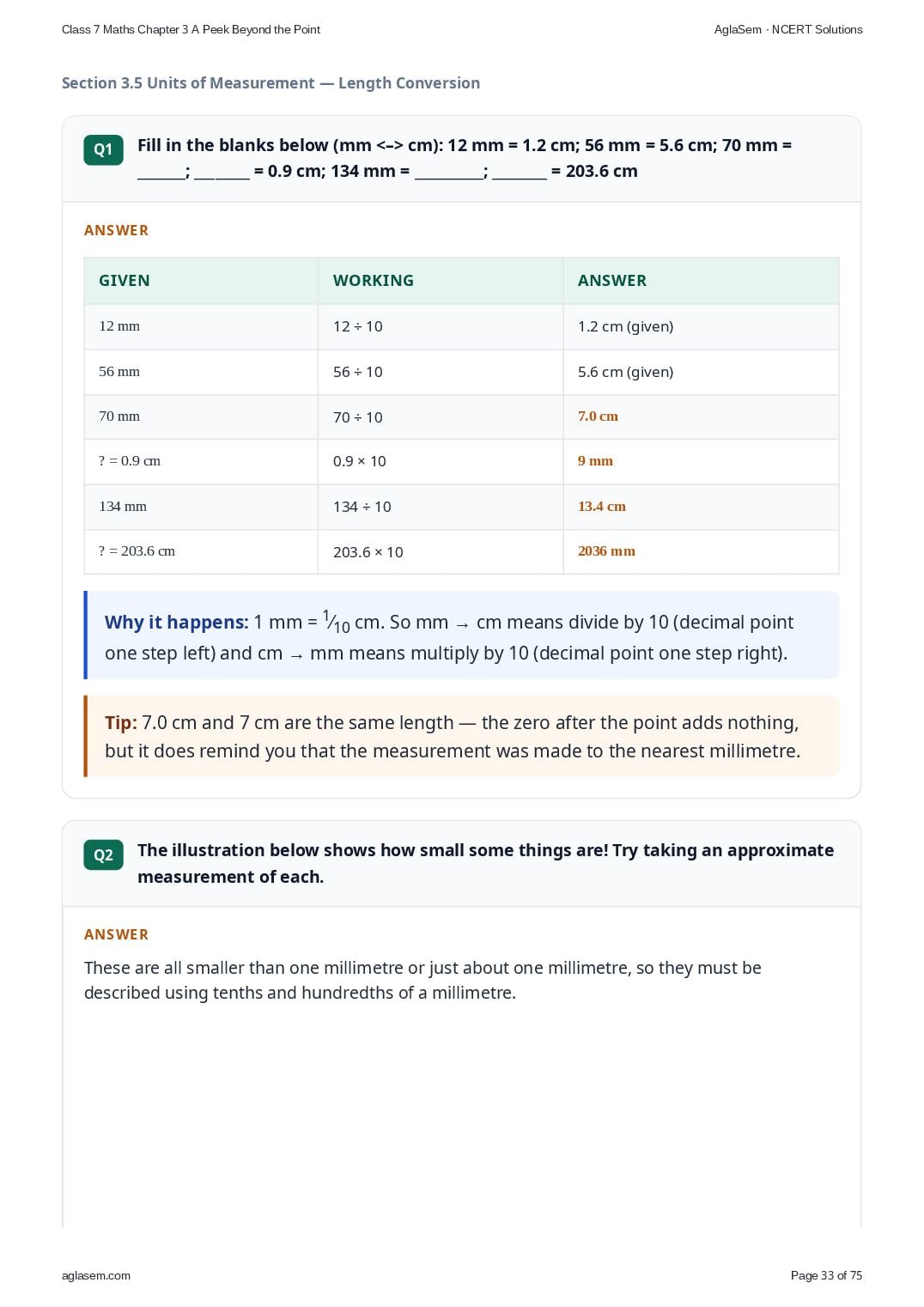
- Fill in the blanks below (mm cm): 12 mm = 1.2 cm; 56 mm = 5.6 cm; 70 mm = _______; ________ = 0.9 cm; 134 mm = __________; ________ = 203.6 cm
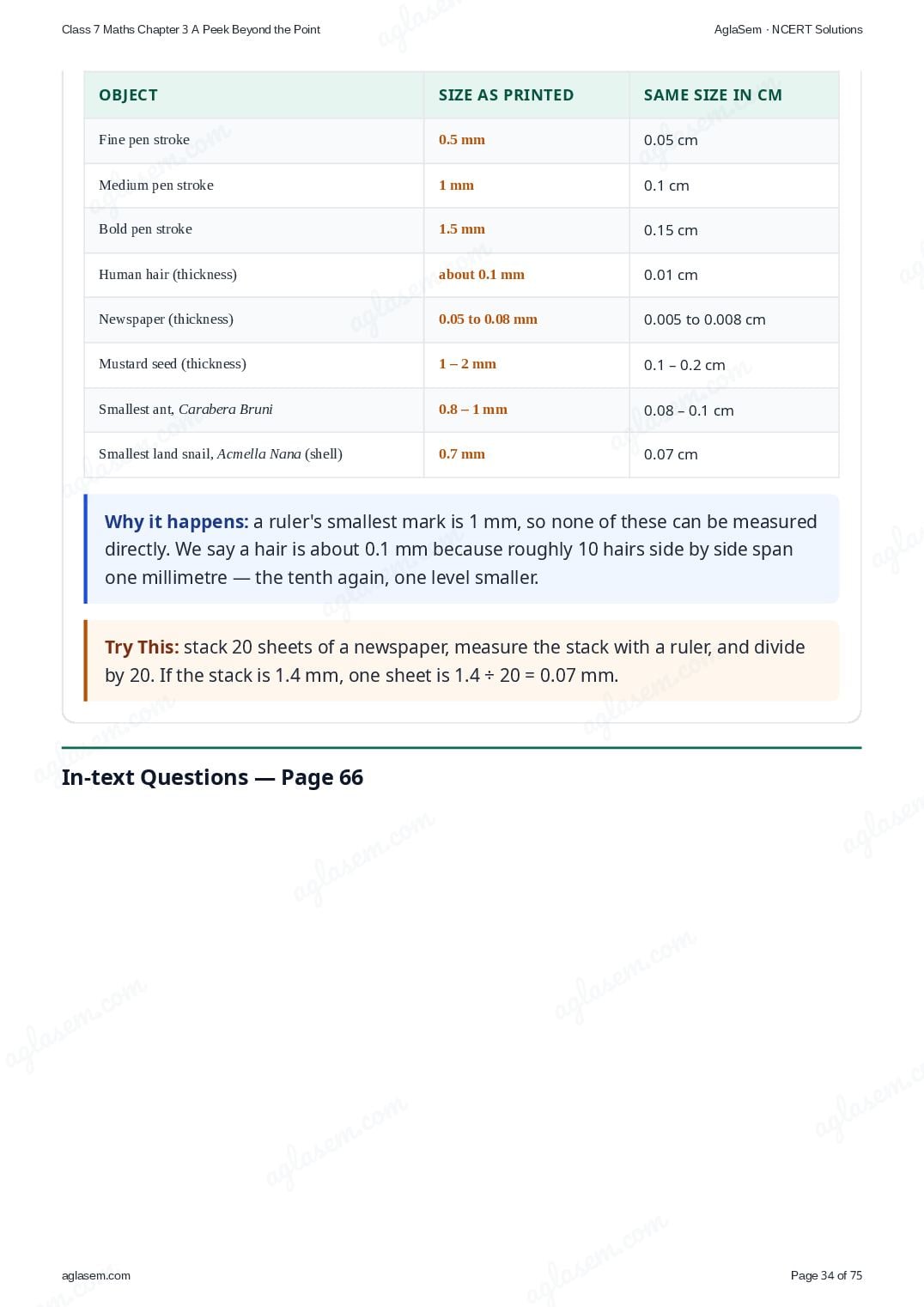
- The illustration below shows how small some things are! Try taking an approximate measurement of each.
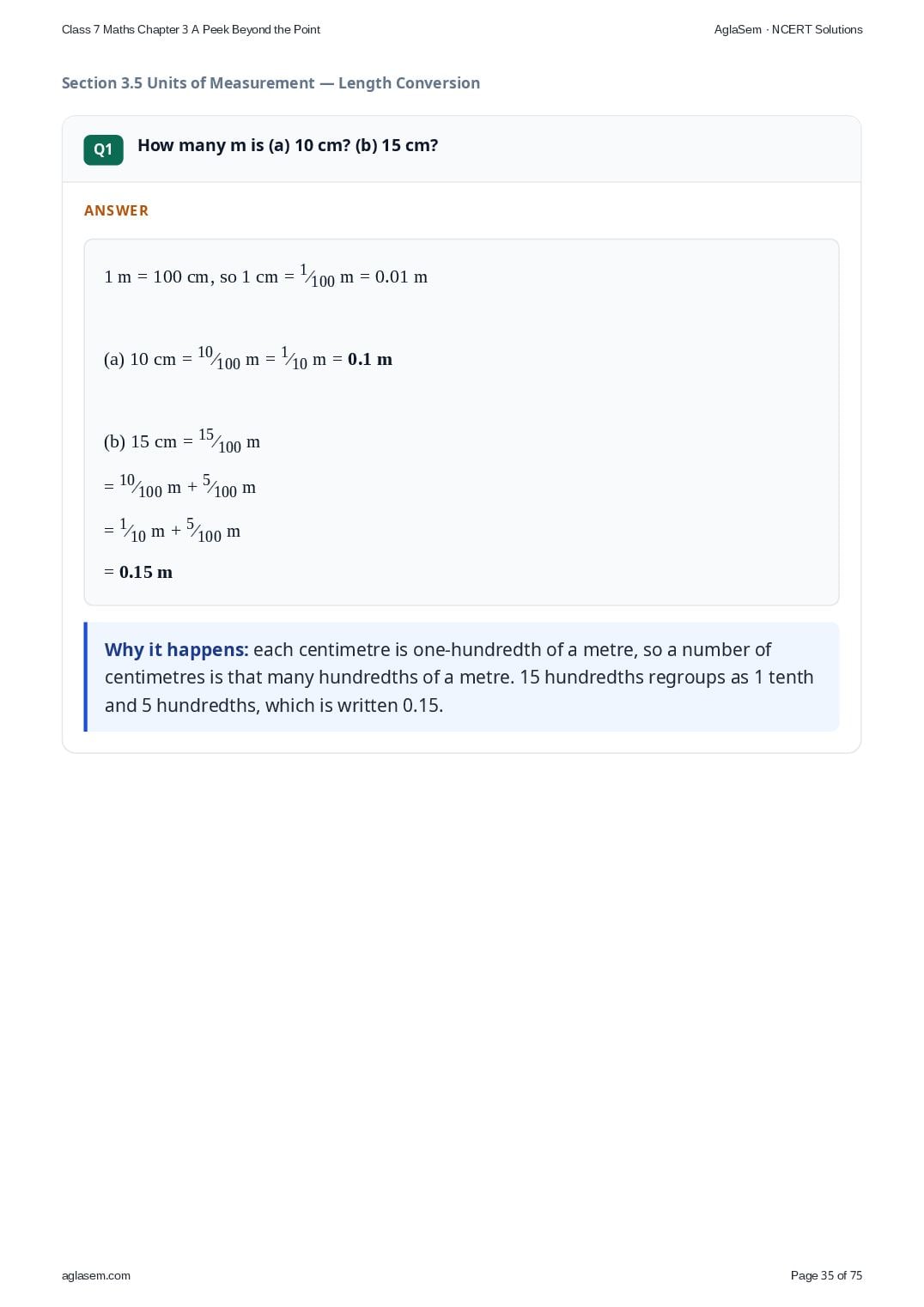
- How many m is (a) 10 cm? (b) 15 cm?
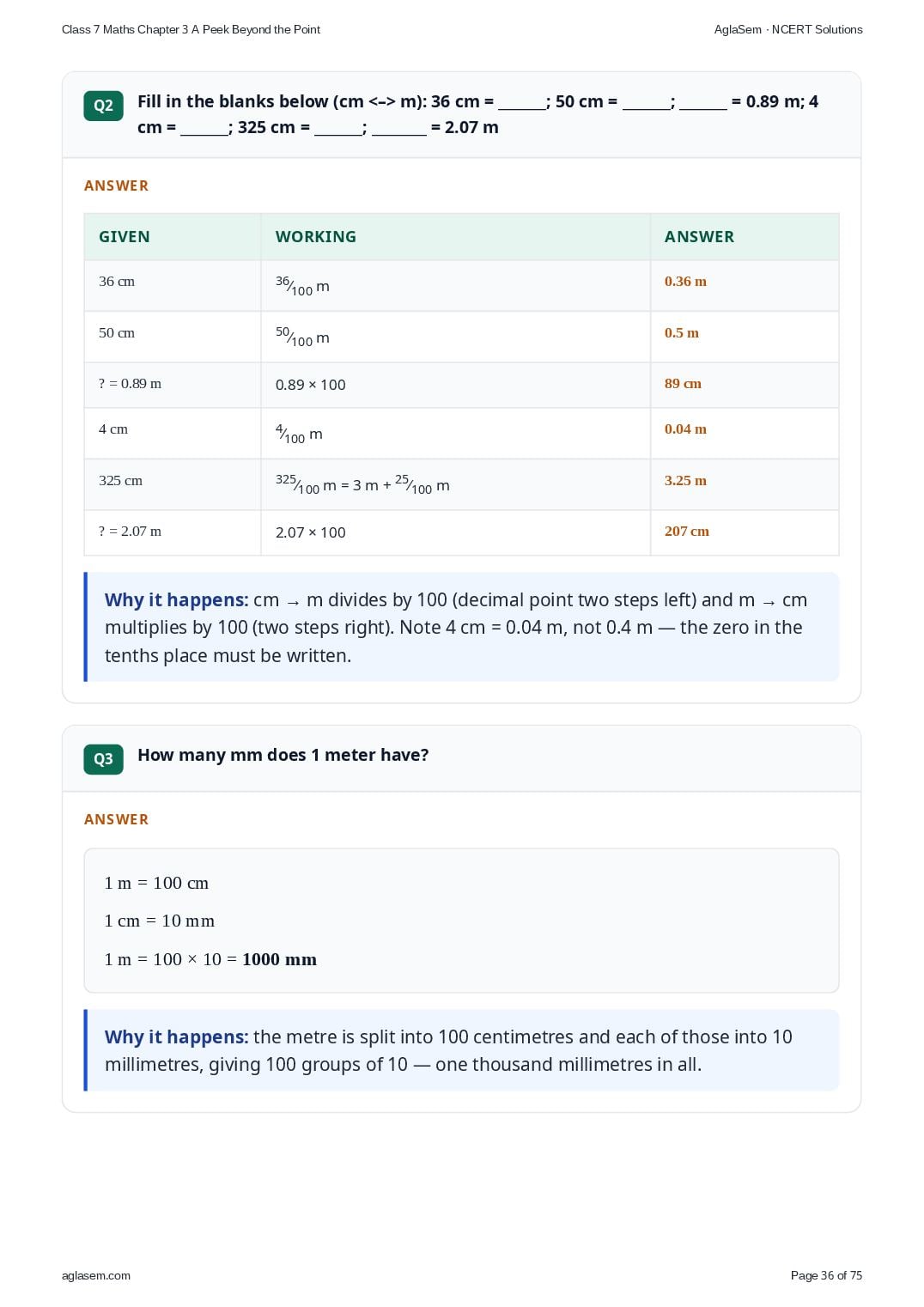
- Fill in the blanks below (cm m): 36 cm = _______; 50 cm = _______; _______ = 0.89 m; 4 cm = _______; 325 cm = _______; ________ = 2.07 m
- How many mm does 1 meter have?
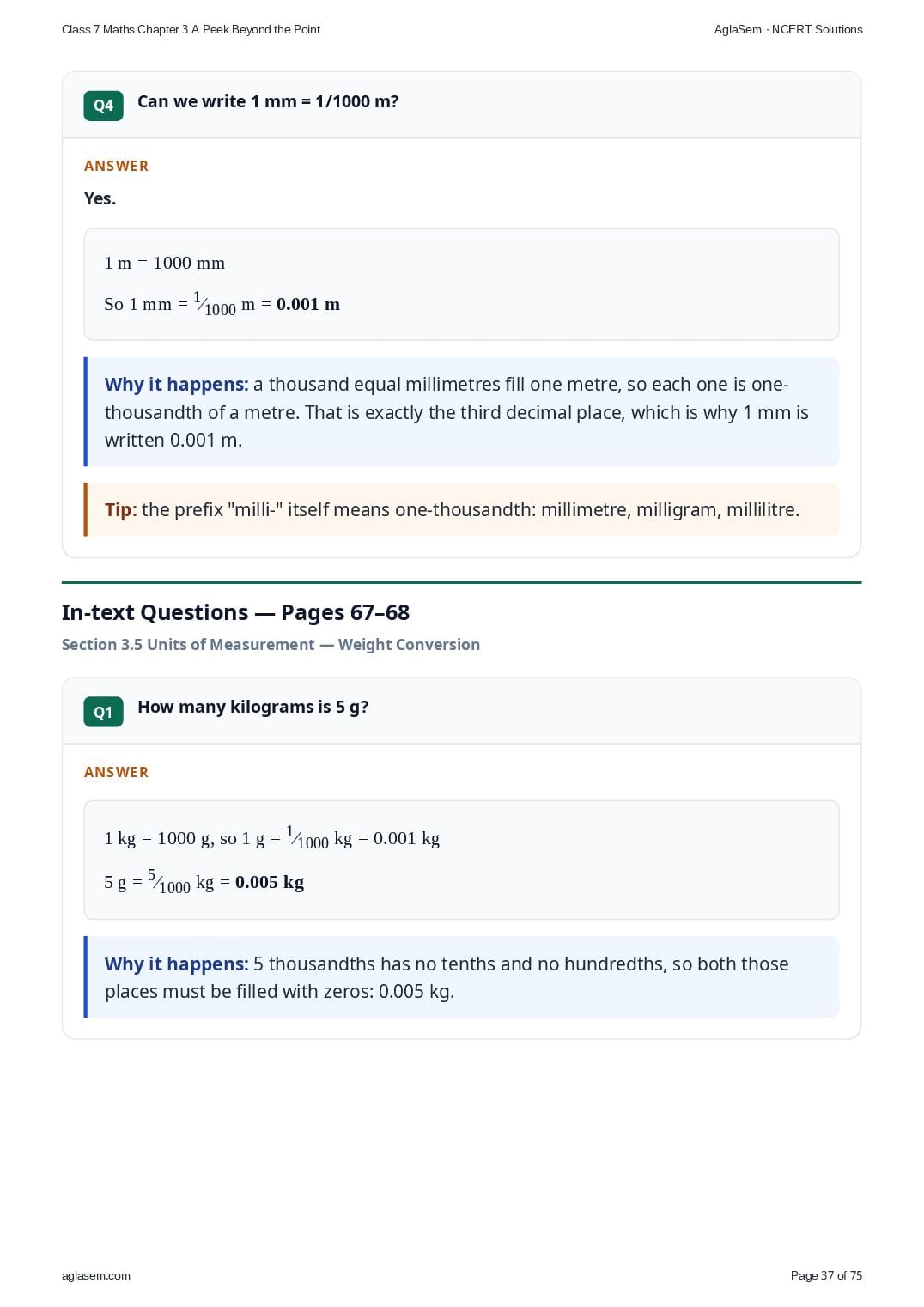
- Can we write 1 mm = 1/1000 m?
- How many kilograms is 5 g?
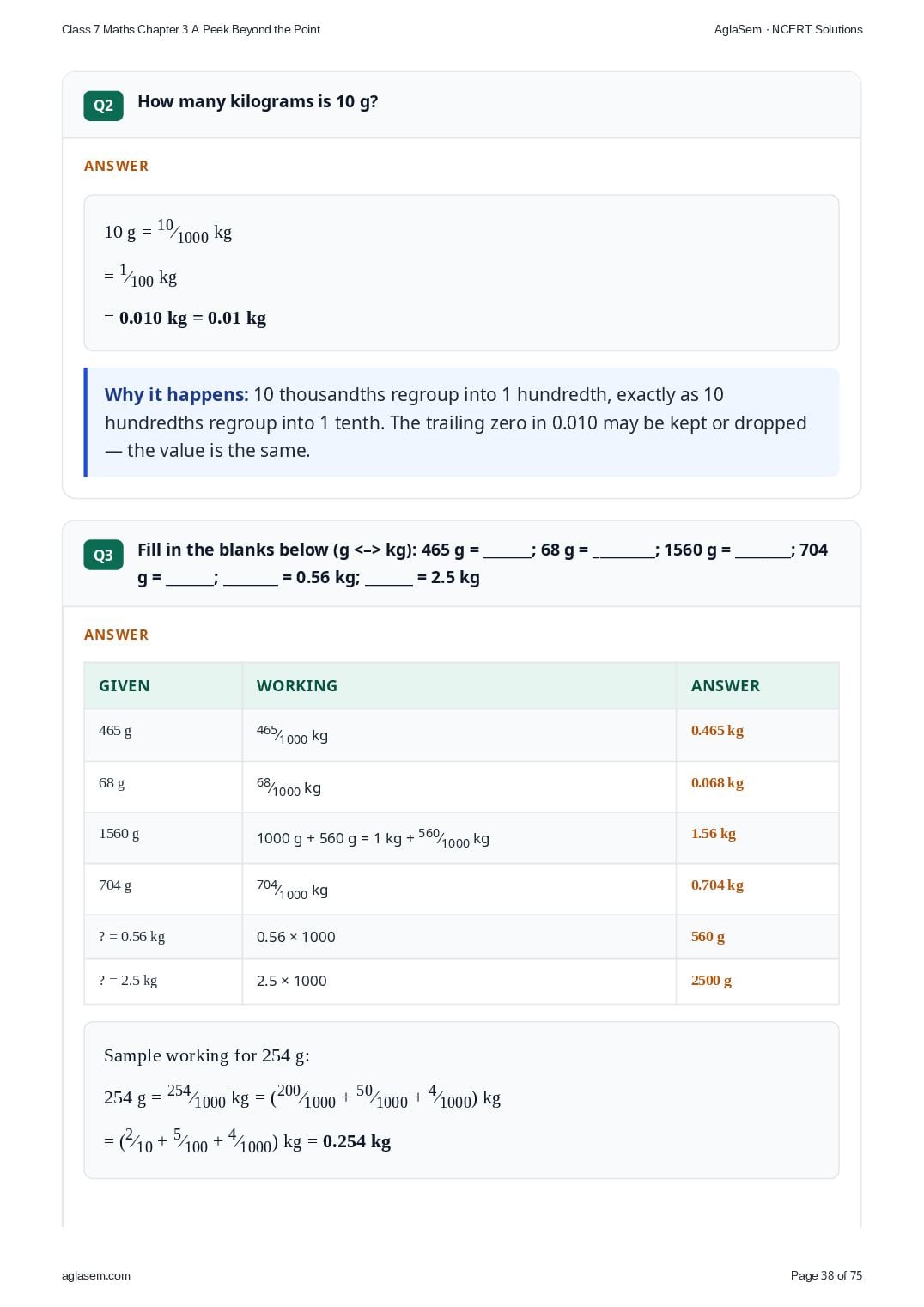
- How many kilograms is 10 g?
- Fill in the blanks below (g kg): 465 g = _______; 68 g = _________; 1560 g = ________; 704 g = _______; ________ = 0.56 kg; _______ = 2.5 kg
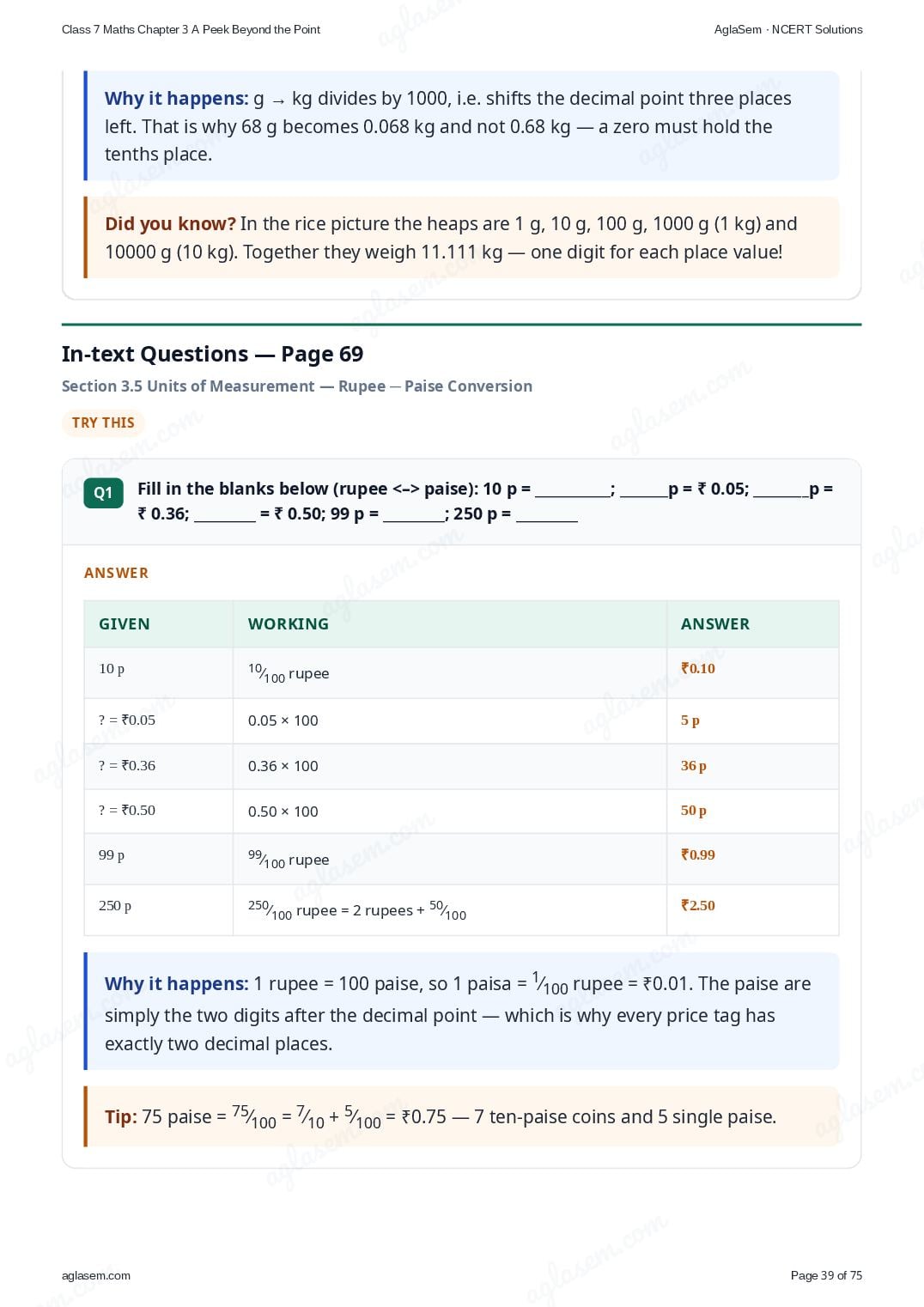
- Fill in the blanks below (rupee paise): 10 p = ___________; _______p = ₹ 0.05; ________p = ₹ 0.36; _________ = ₹ 0.50; 99 p = _________; 250 p = _________
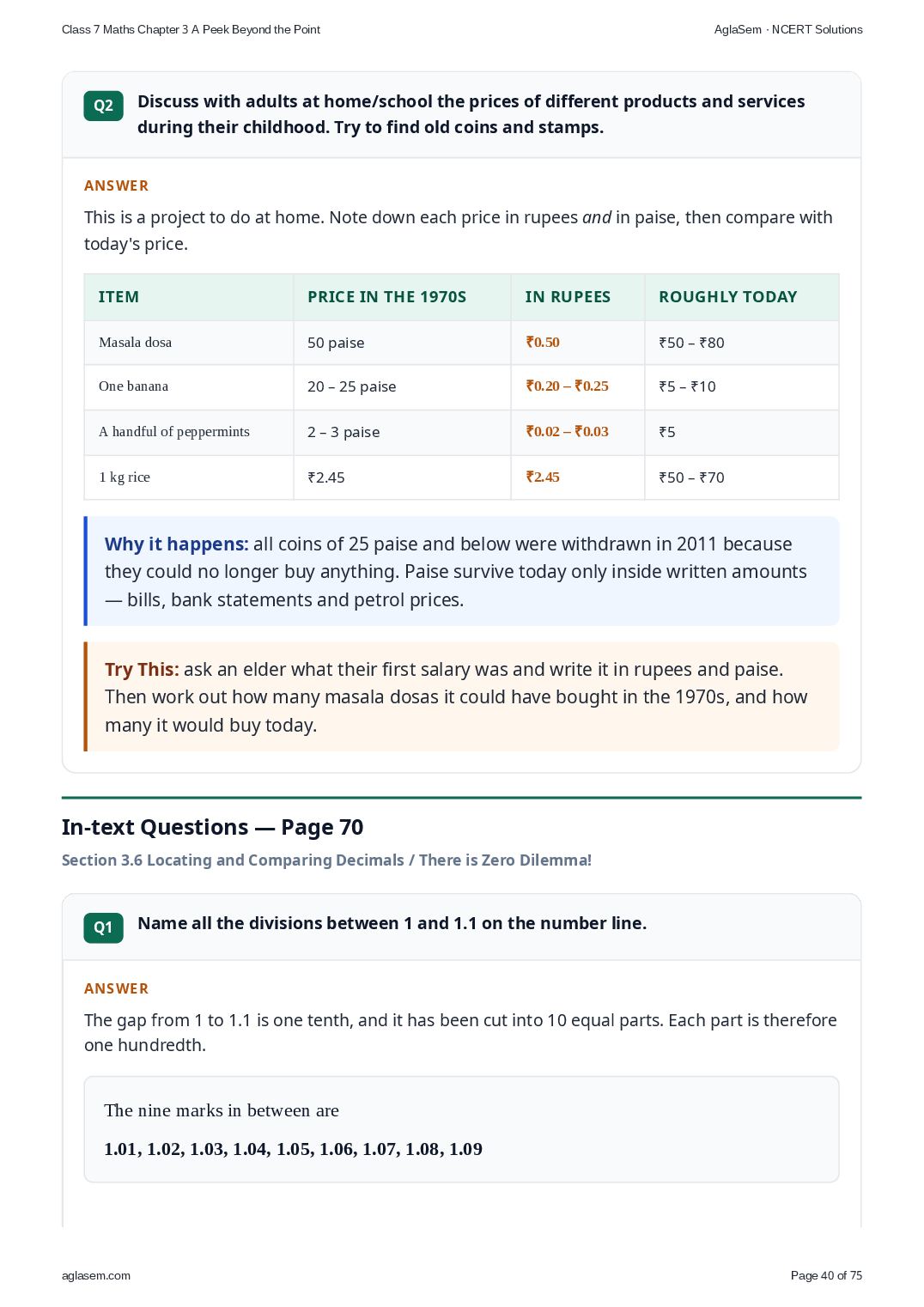
- Discuss with adults at home/school the prices of different products and services during their childhood. Try to find old coins and stamps.
- Name all the divisions between 1 and 1.1 on the number line.
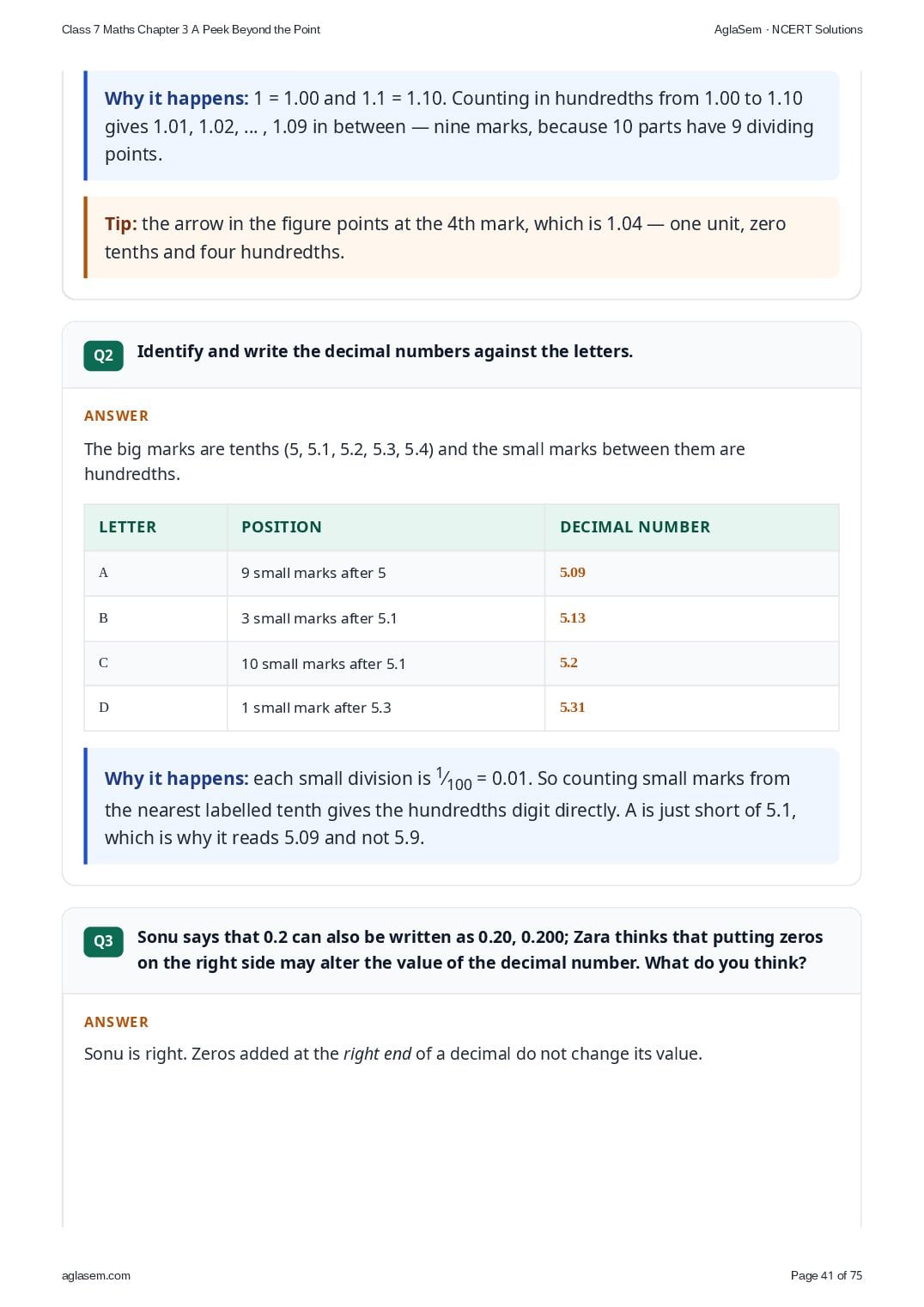
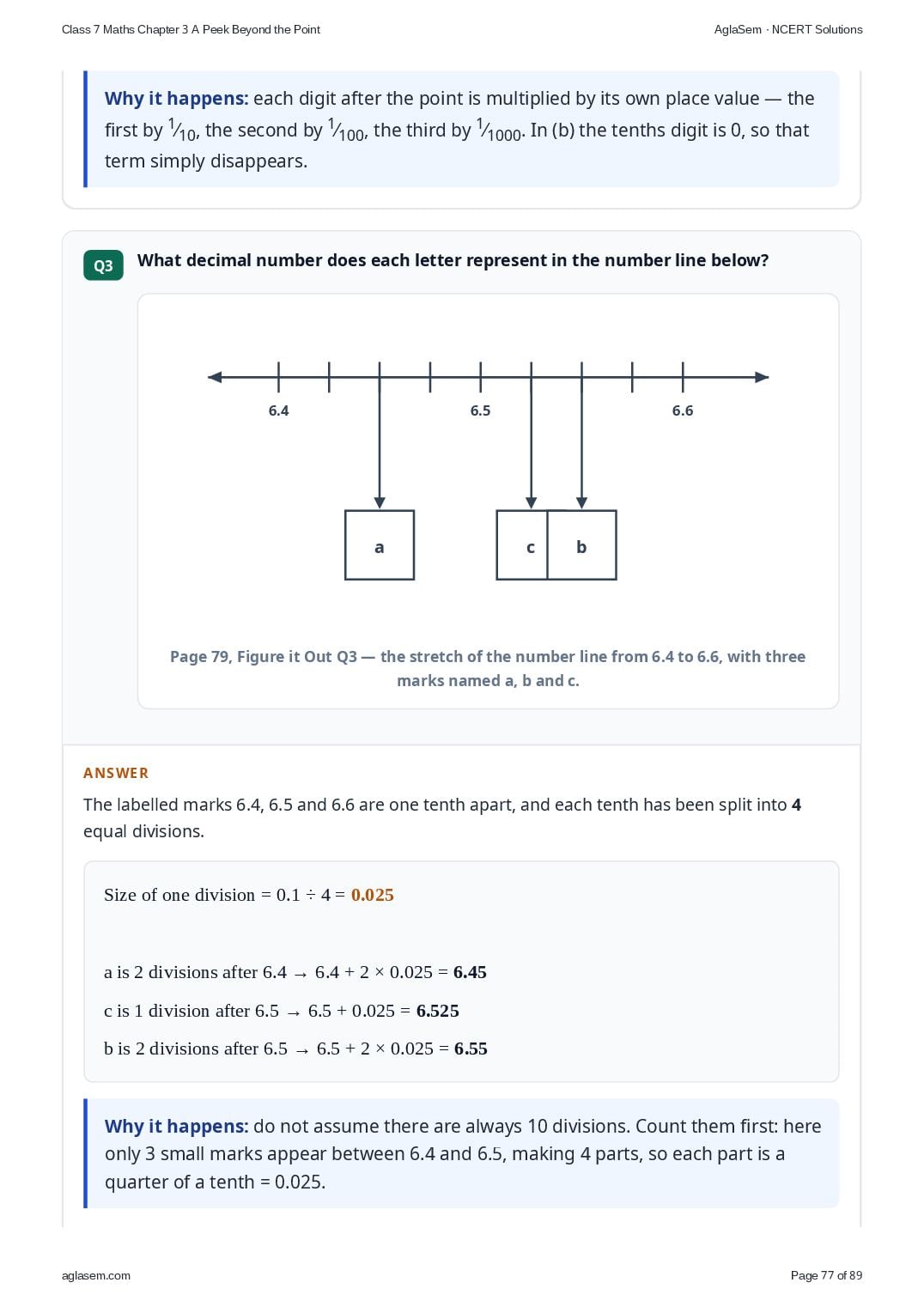
- Identify and write the decimal numbers against the letters.
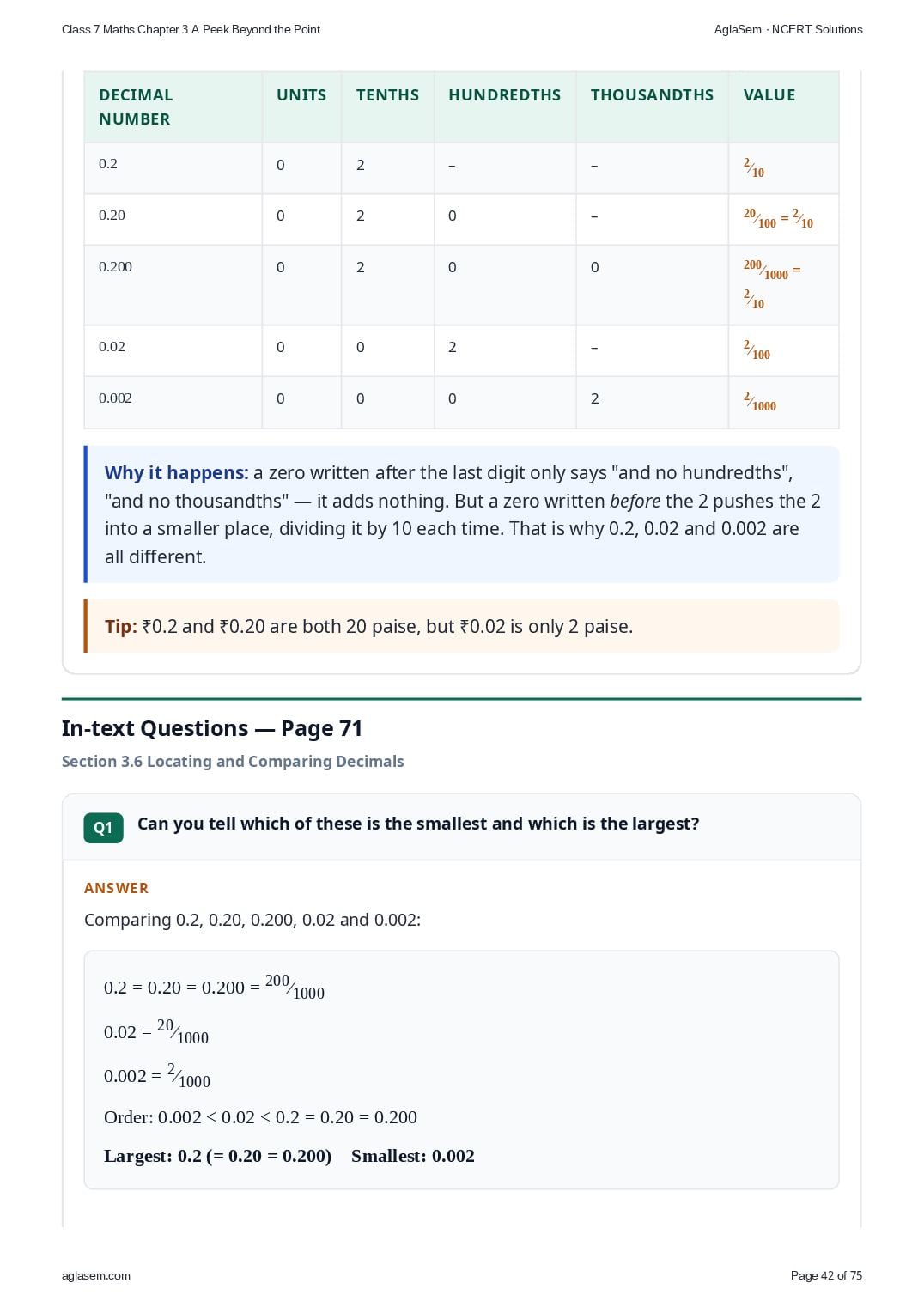
- Sonu says that 0.2 can also be written as 0.20, 0.200; Zara thinks that putting zeros on the right side may alter the value of the decimal number. What do you think?
- Can you tell which of these is the smallest and which is the largest?
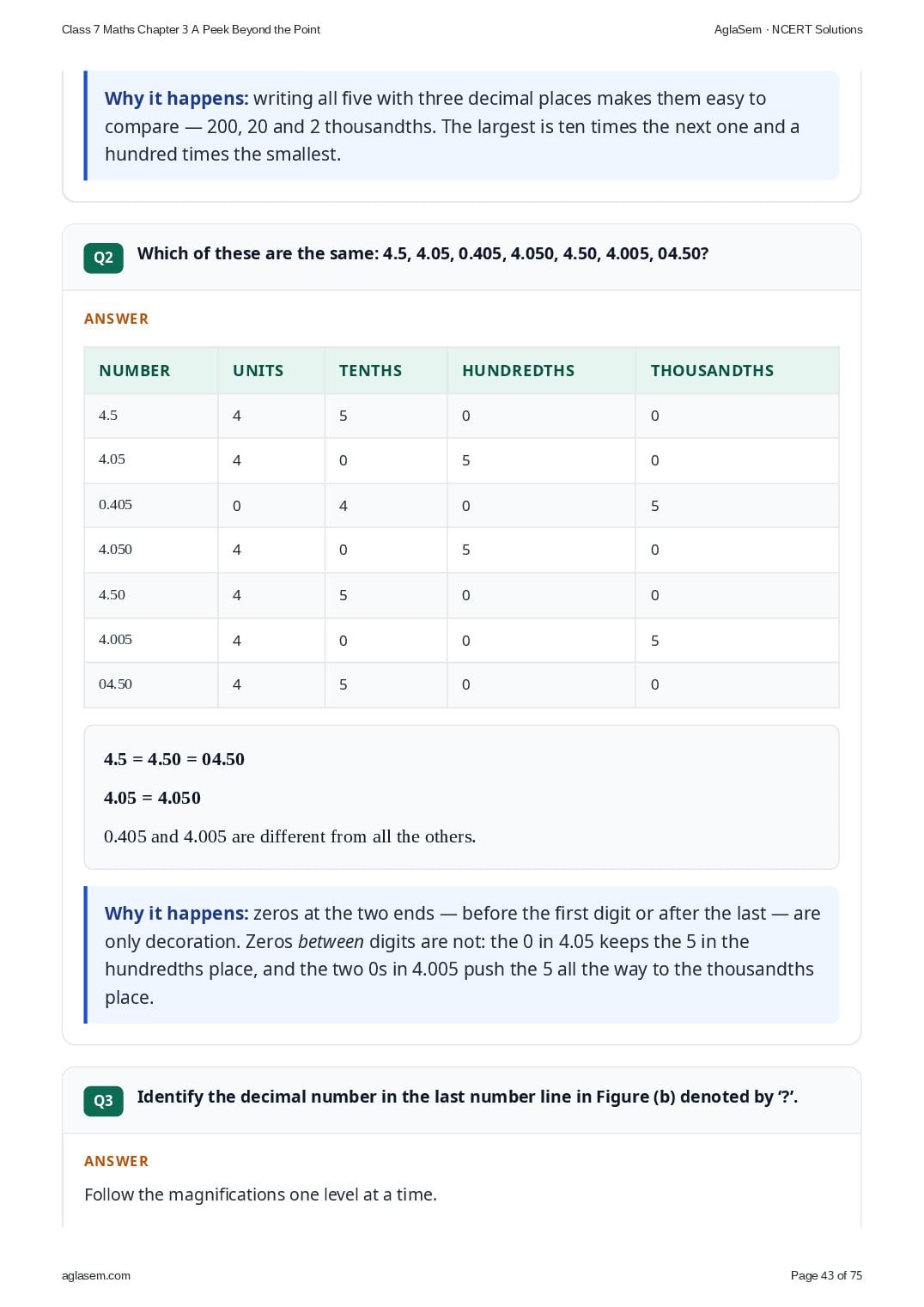
- Which of these are the same: 4.5, 4.05, 0.405, 4.050, 4.50, 4.005, 04.50?
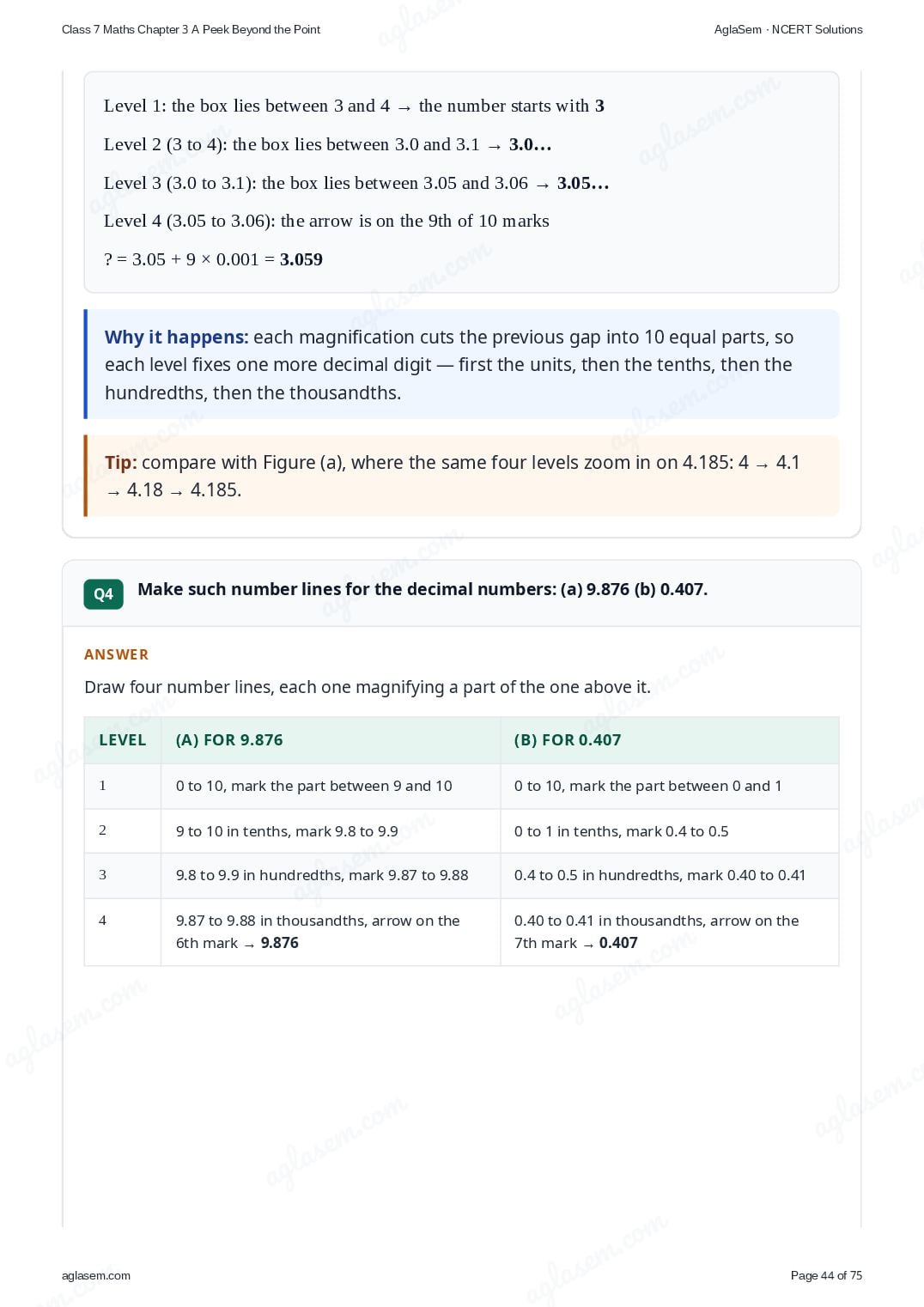
- Identify the decimal number in the last number line in Figure (b) denoted by ‘?’.
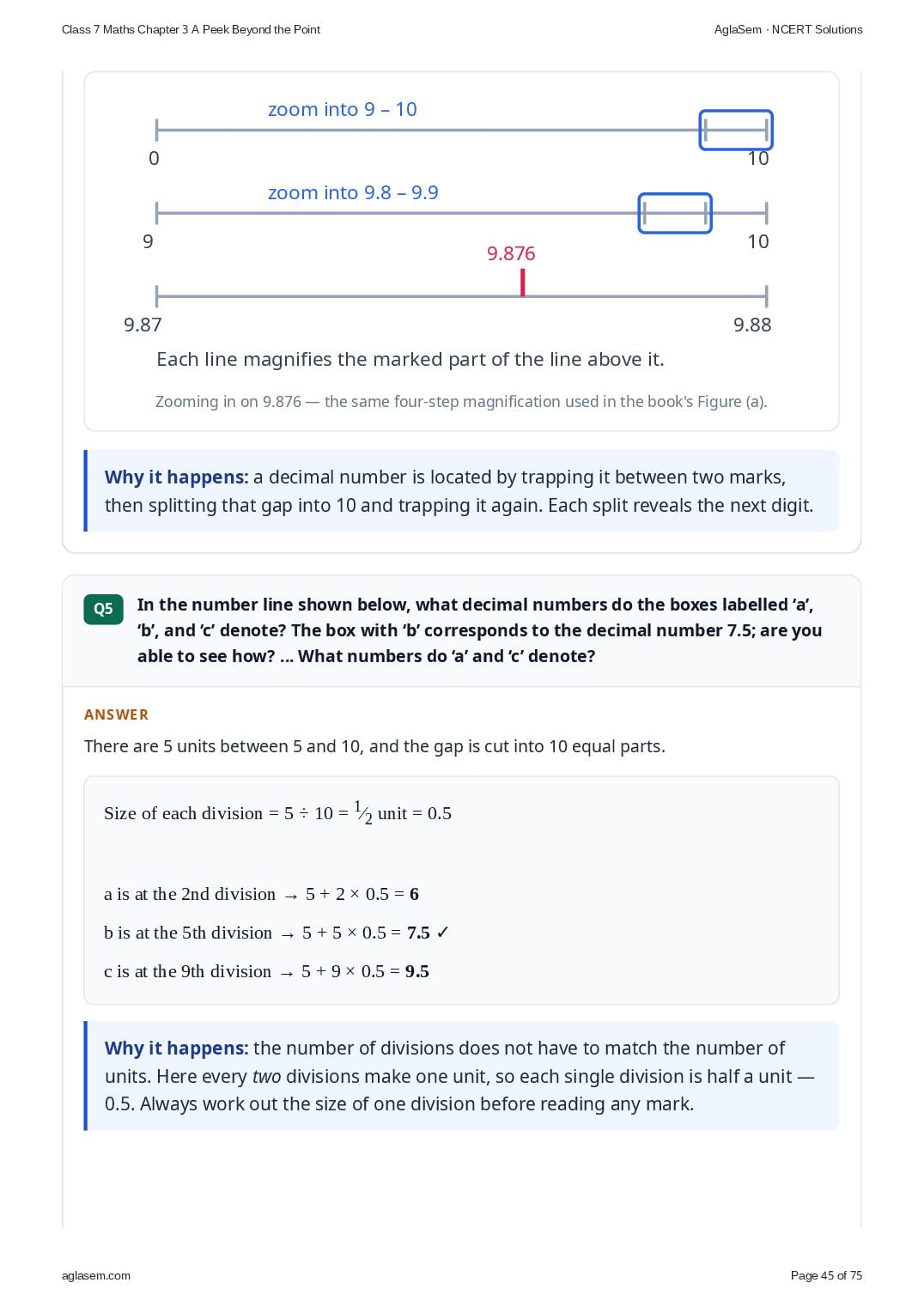
- Make such number lines for the decimal numbers: (a) 9.876 (b) 0.407.
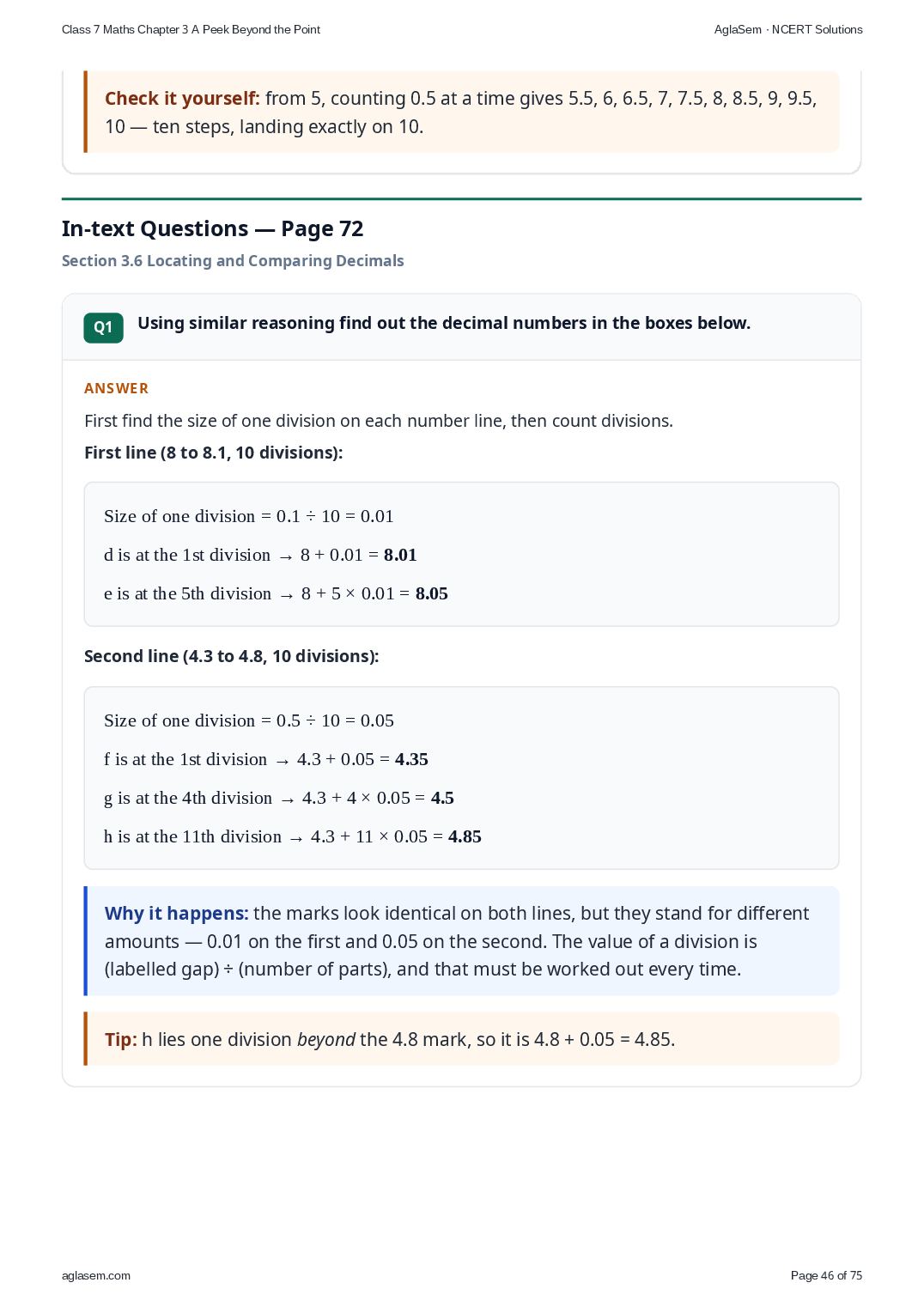
- In the number line shown below, what decimal numbers do the boxes labelled ‘a’, ‘b’, and ‘c’ denote? The box with ‘b’ corresponds to the decimal number 7.5; are you able to see how? … What numbers do ‘a’ and ‘c’ denote?
- Using similar reasoning find out the decimal numbers in the boxes below.
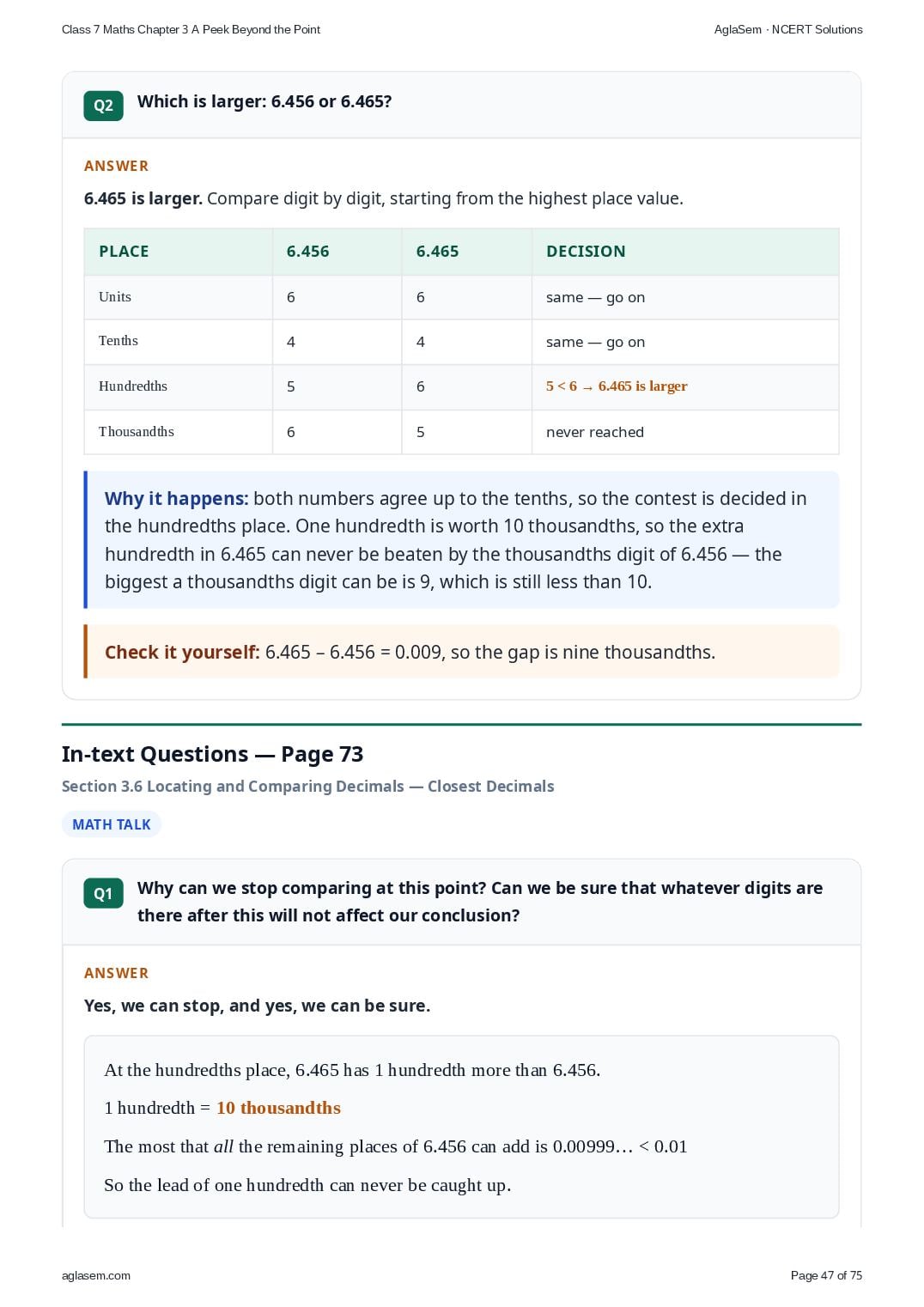
- Which is larger: 6.456 or 6.465?
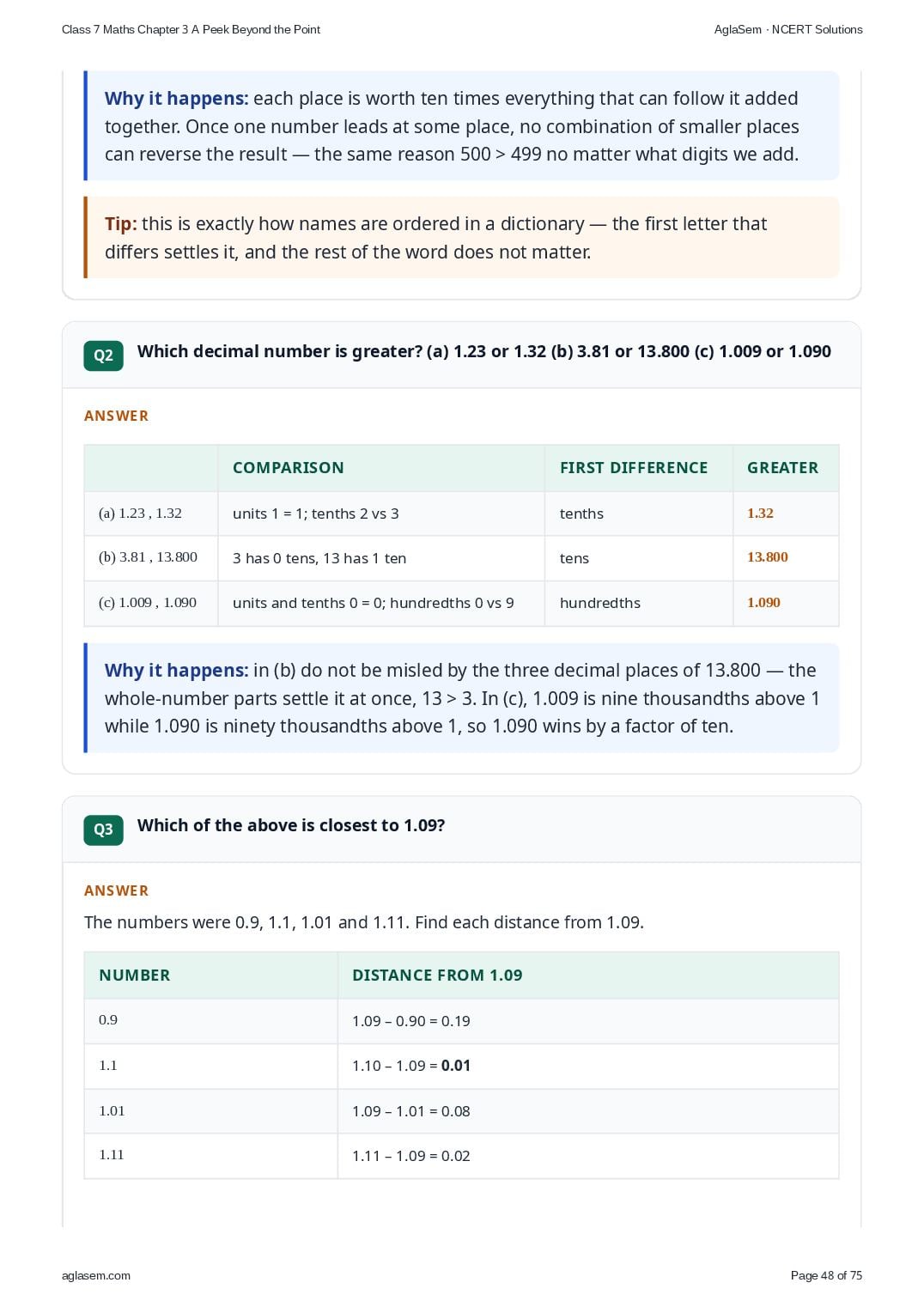
- Why can we stop comparing at this point? Can we be sure that whatever digits are there after this will not affect our conclusion?
- Which decimal number is greater? (a) 1.23 or 1.32 (b) 3.81 or 13.800 (c) 1.009 or 1.090
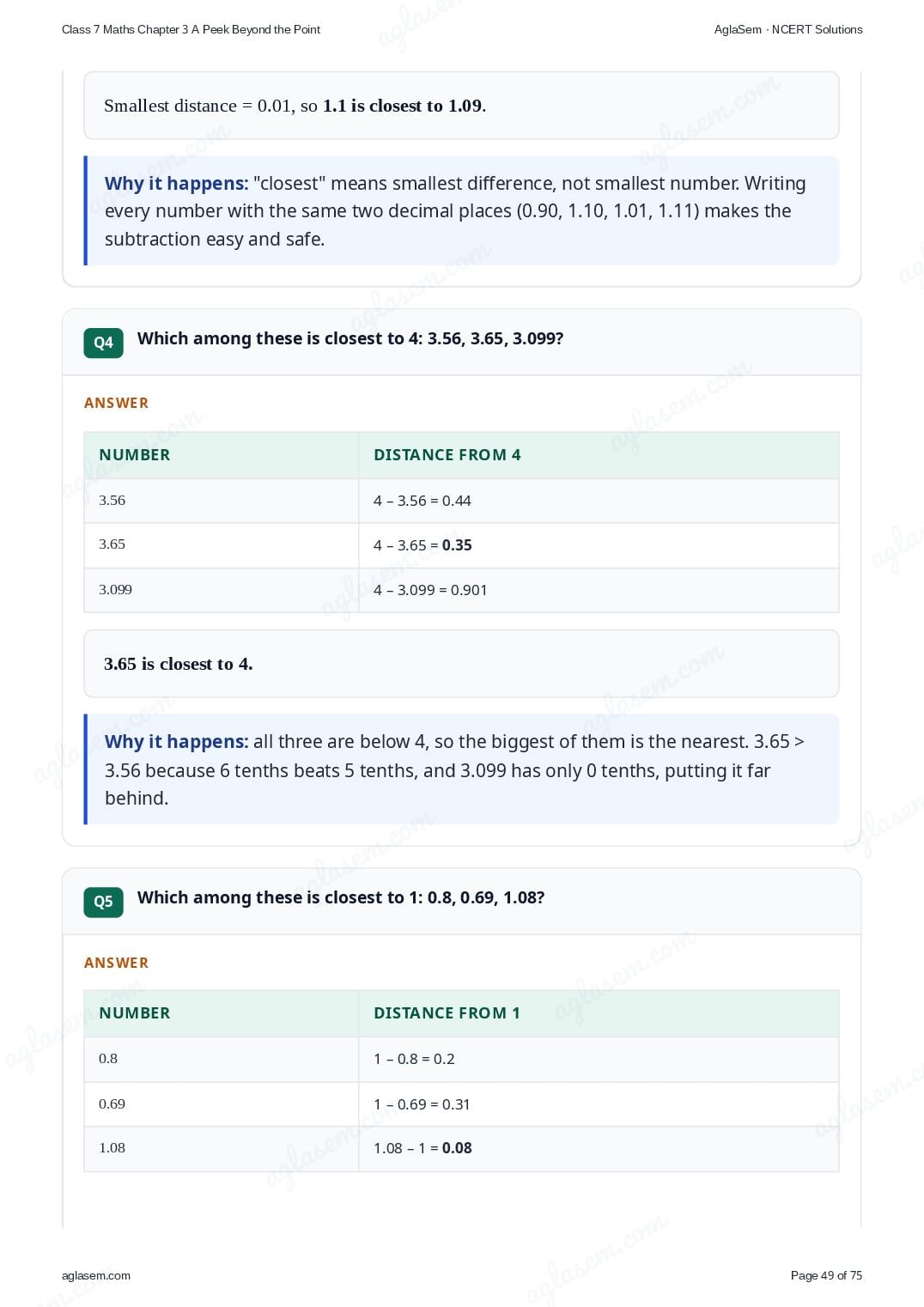
- Which of the above is closest to 1.09?
- Which among these is closest to 4: 3.56, 3.65, 3.099?
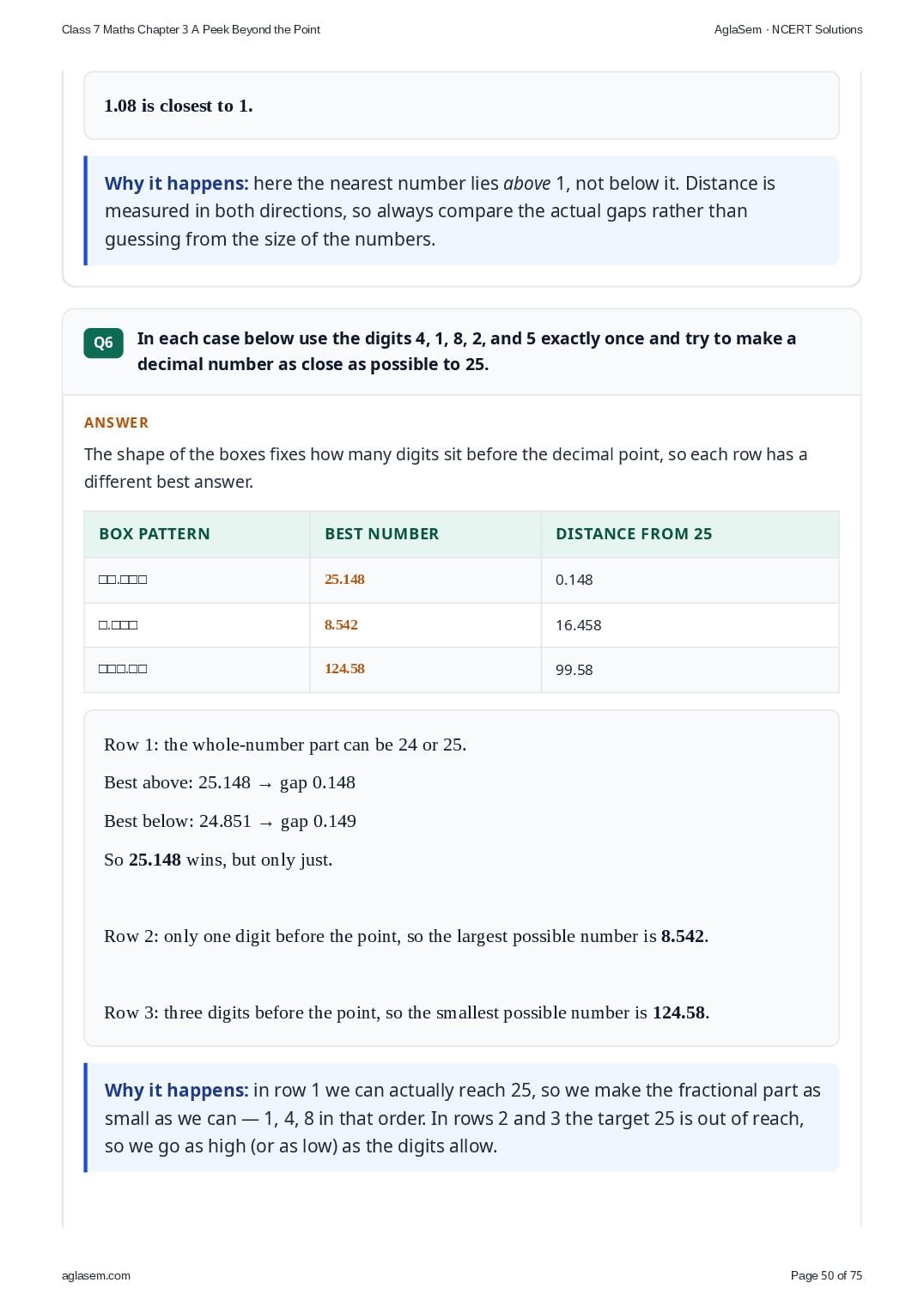
- Which among these is closest to 1: 0.8, 0.69, 1.08?
- In each case below use the digits 4, 1, 8, 2, and 5 exactly once and try to make a decimal number as close as possible to 25.
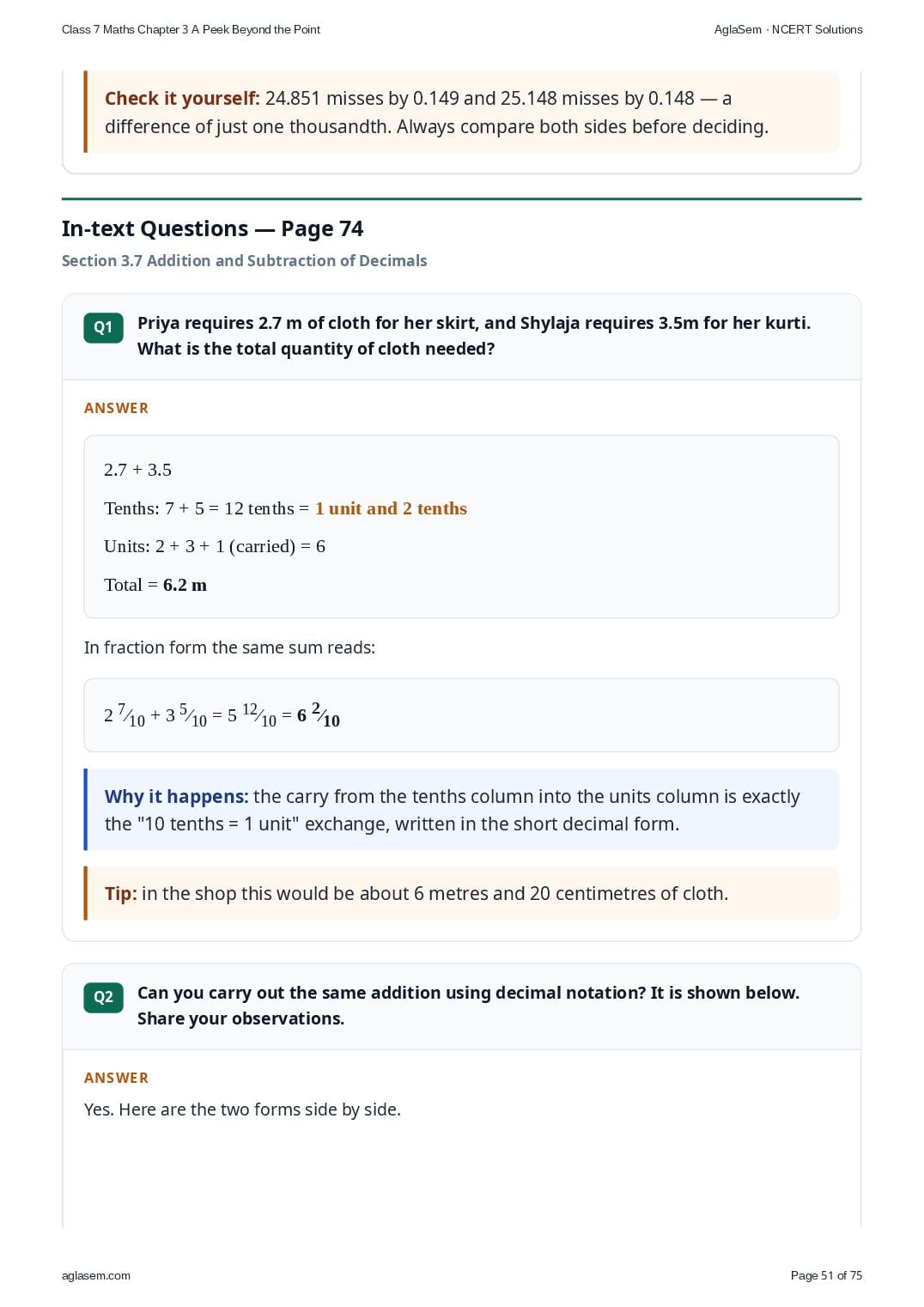
- Priya requires 2.7 m of cloth for her skirt, and Shylaja requires 3.5m for her kurti. What is the total quantity of cloth needed?
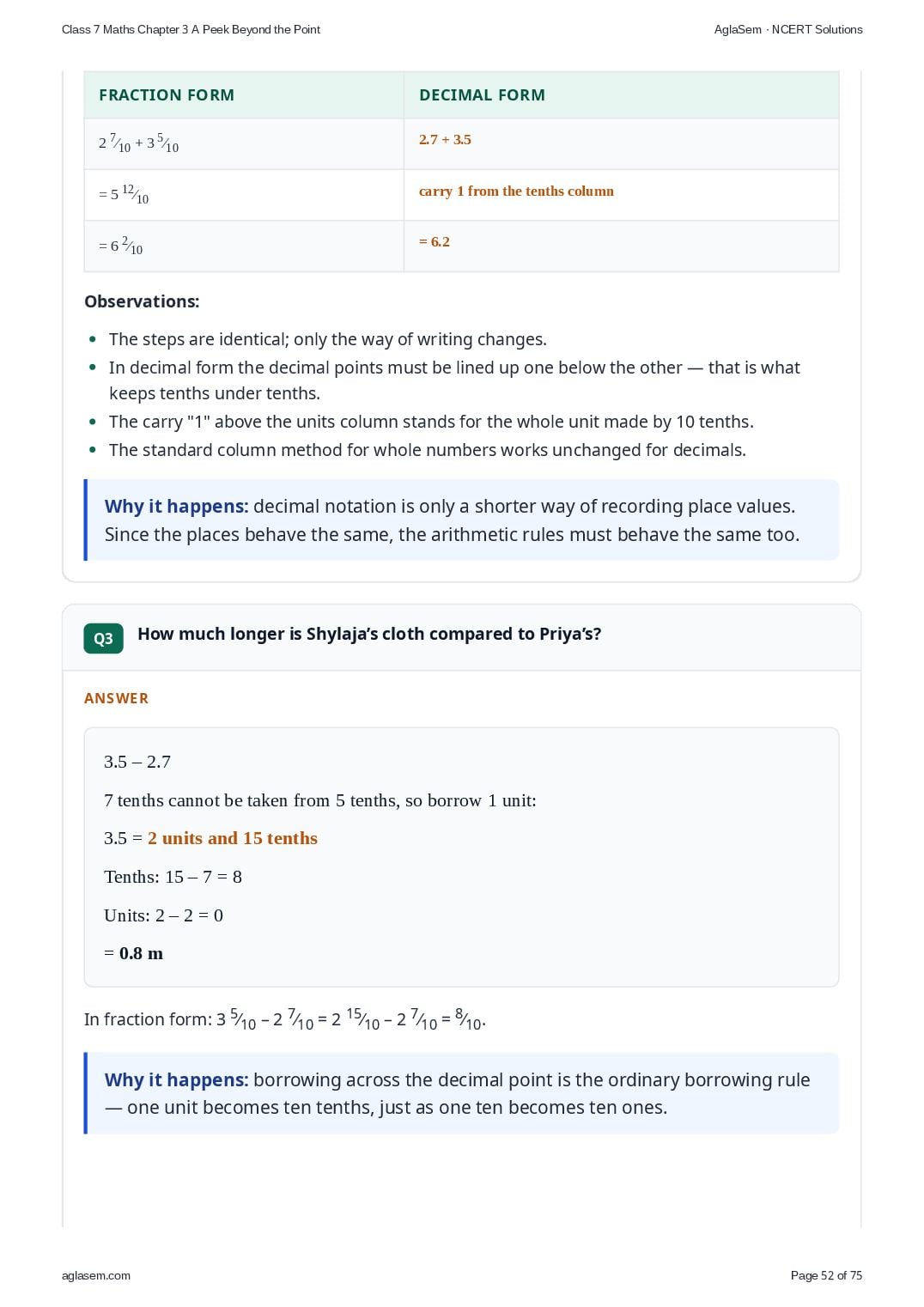
- Can you carry out the same addition using decimal notation? It is shown below. Share your observations.
- How much longer is Shylaja’s cloth compared to Priya’s?
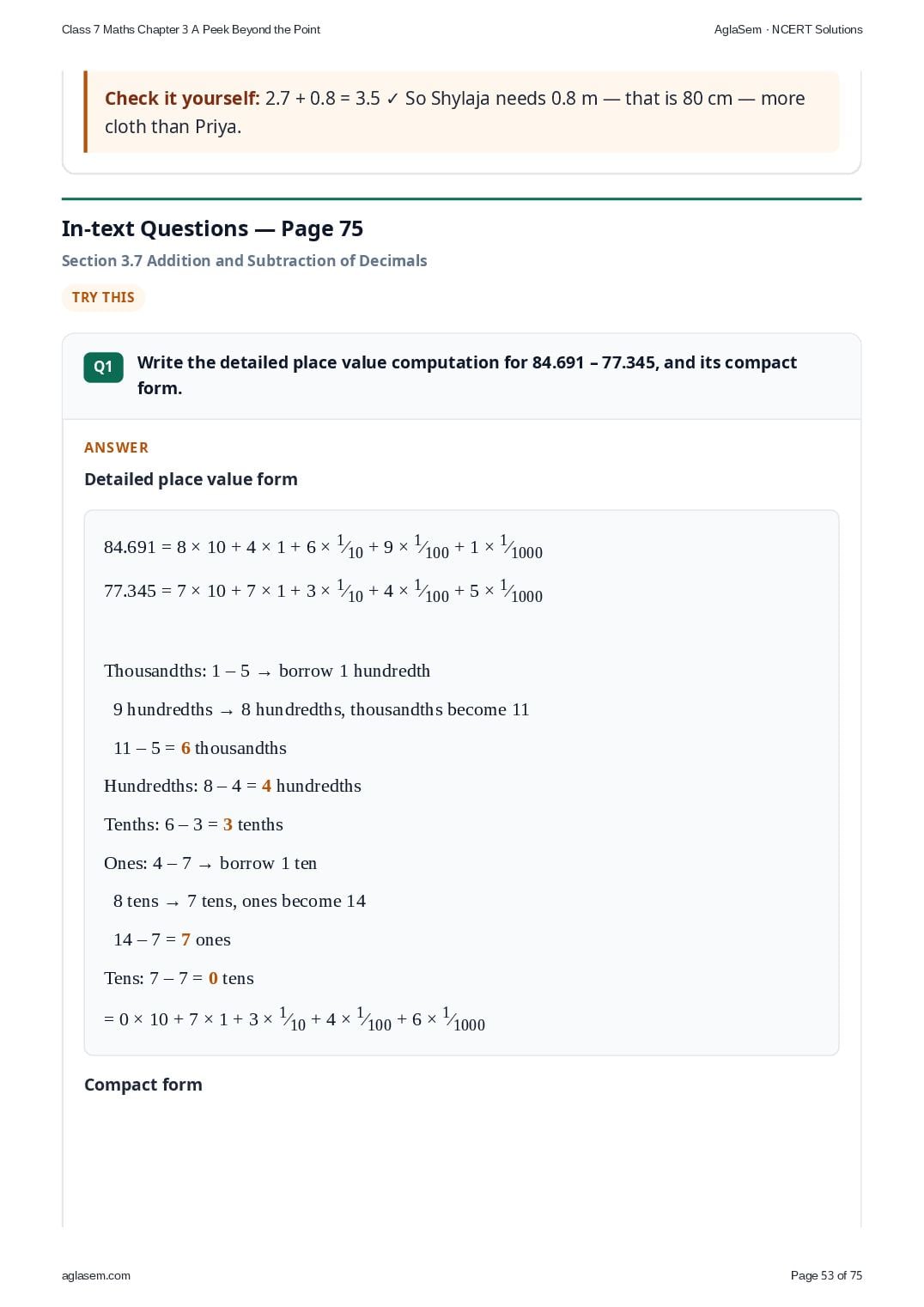
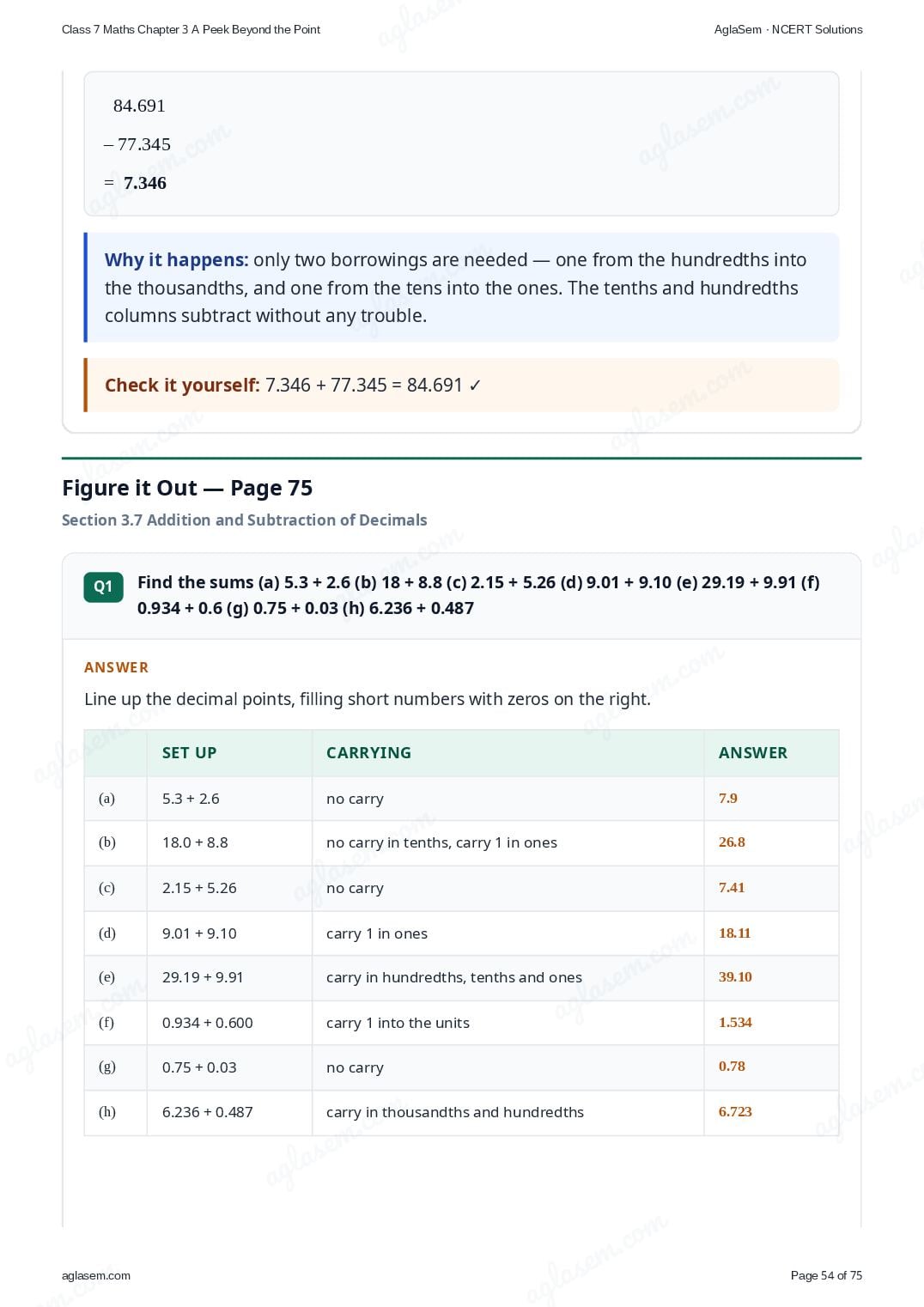
- Write the detailed place value computation for 84.691 – 77.345, and its compact form.
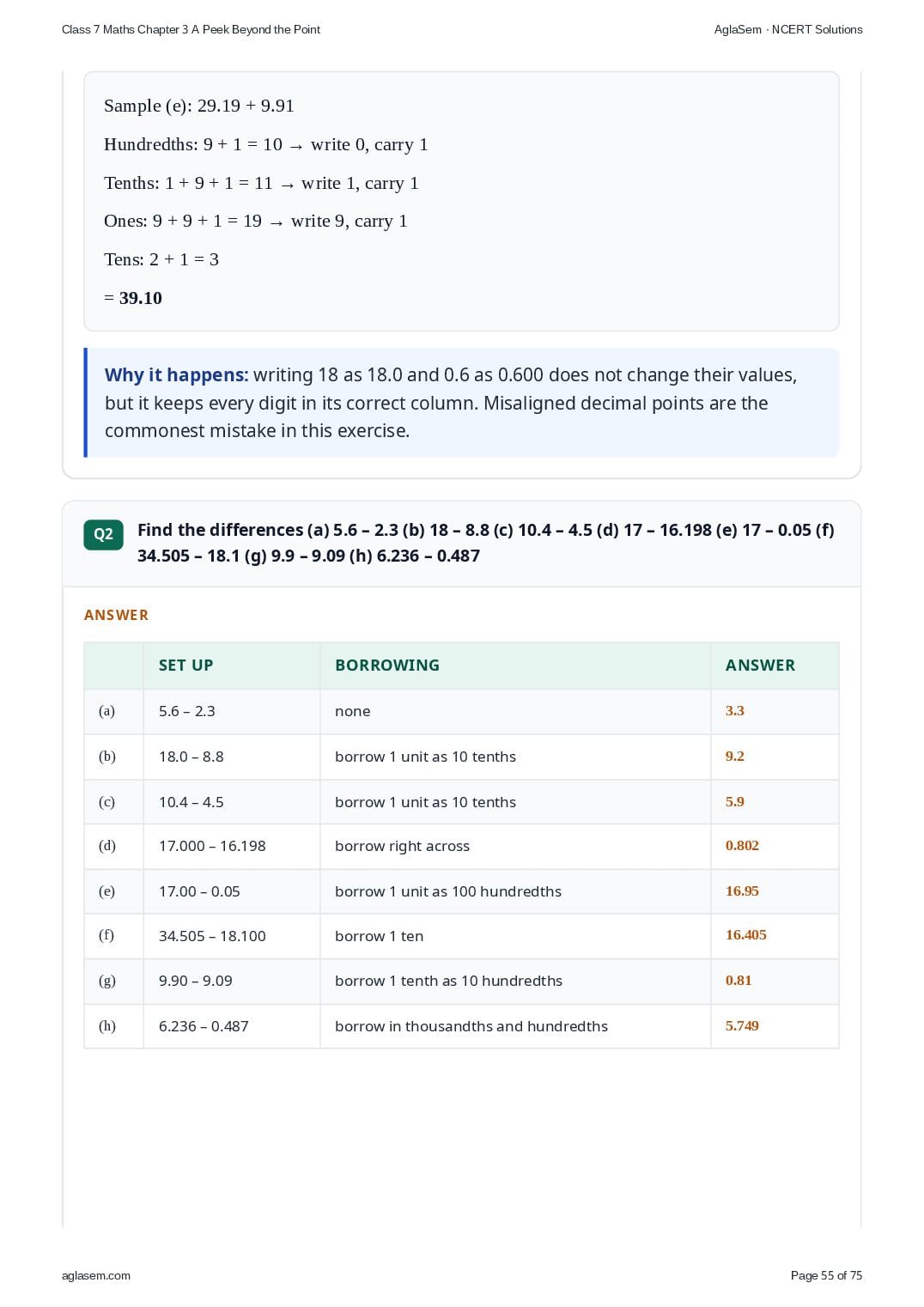
- Find the sums (a) 5.3 + 2.6 (b) 18 + 8.8 (c) 2.15 + 5.26 (d) 9.01 + 9.10 (e) 29.19 + 9.91 (f) 0.934 + 0.6 (g) 0.75 + 0.03 (h) 6.236 + 0.487
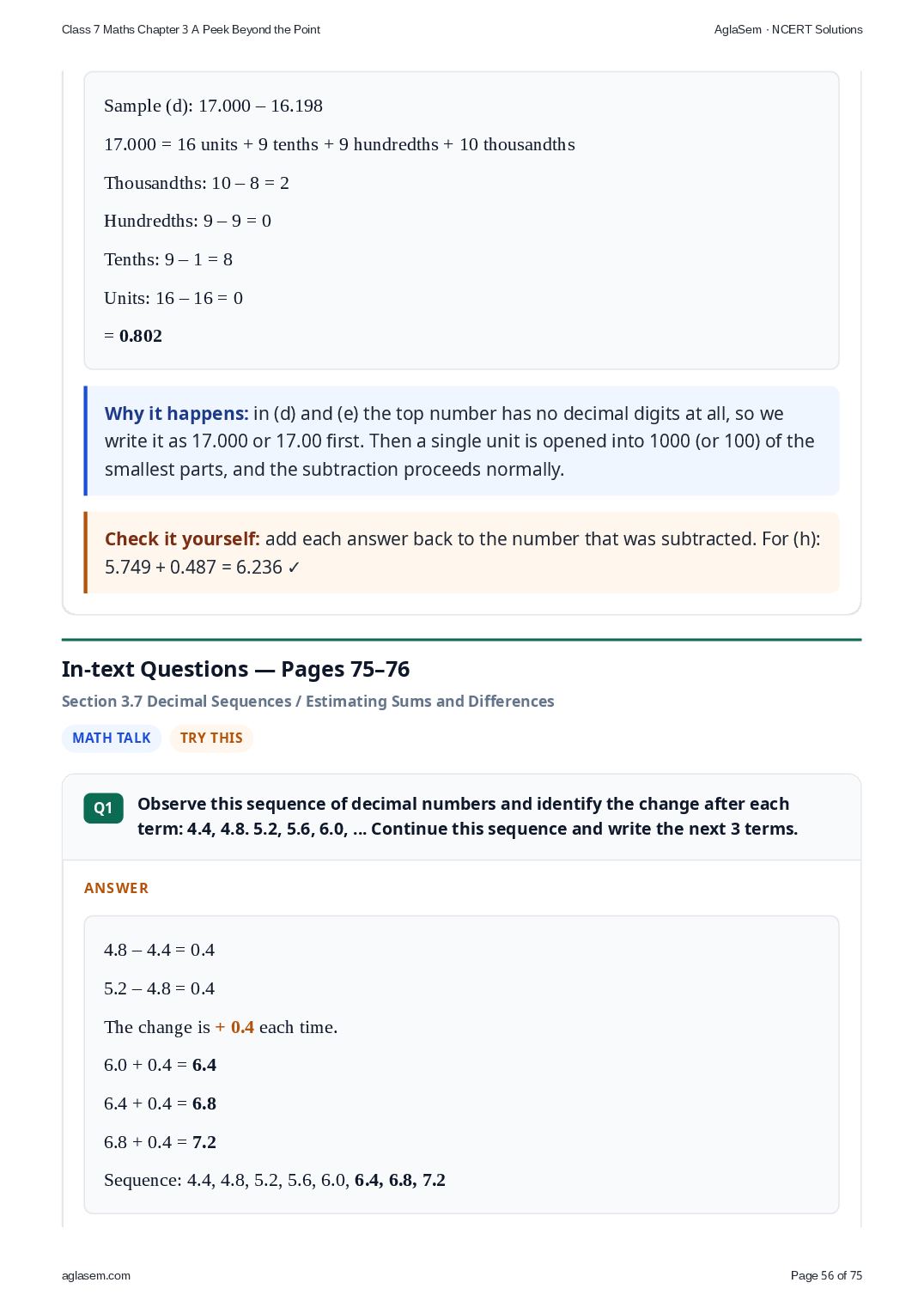
- Find the differences (a) 5.6 – 2.3 (b) 18 – 8.8 (c) 10.4 – 4.5 (d) 17 – 16.198 (e) 17 – 0.05 (f) 34.505 – 18.1 (g) 9.9 – 9.09 (h) 6.236 – 0.487
- Observe this sequence of decimal numbers and identify the change after each term: 4.4, 4.8. 5.2, 5.6, 6.0, … Continue this sequence and write the next 3 terms.
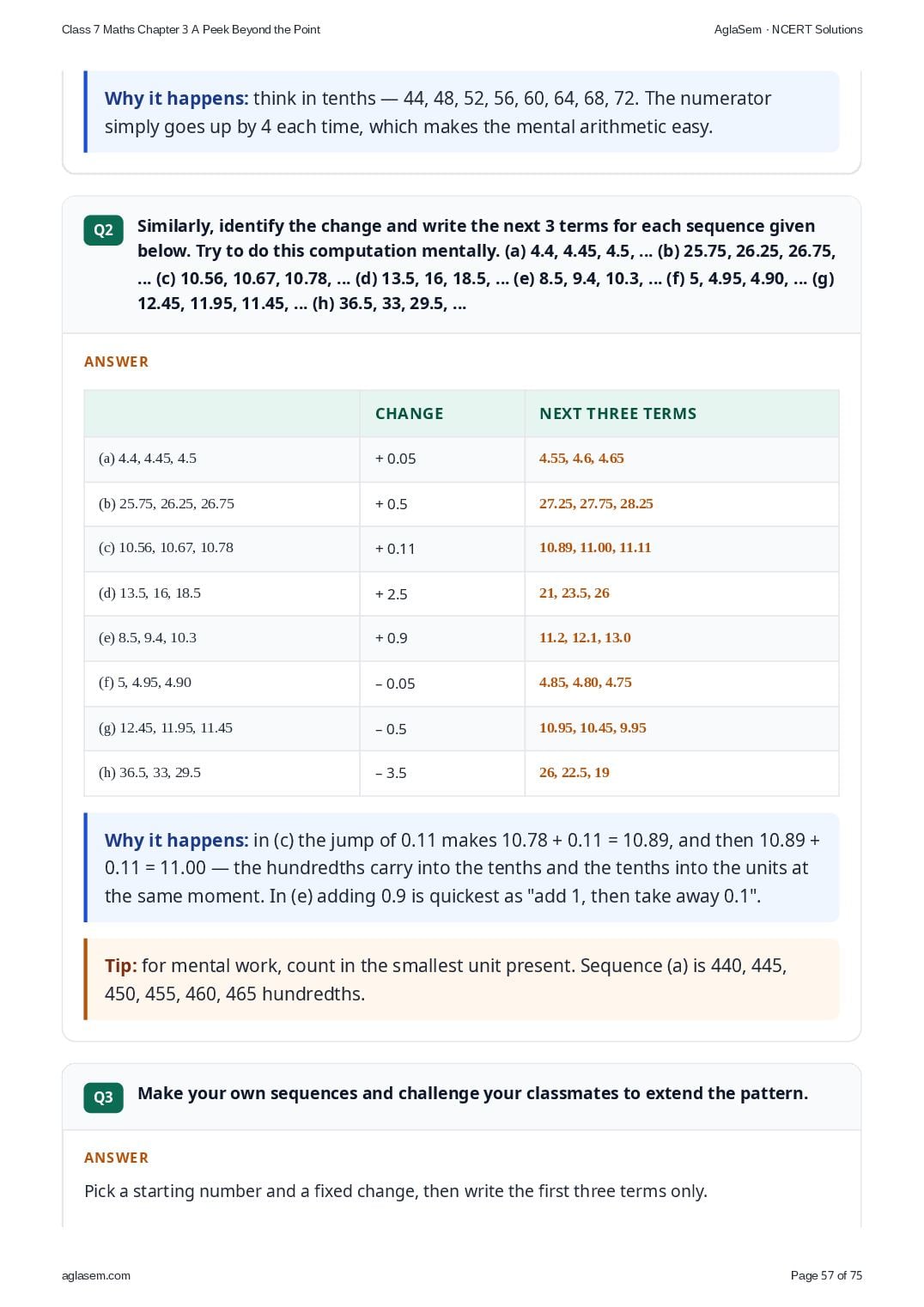
- Similarly, identify the change and write the next 3 terms for each sequence given below. Try to do this computation mentally. (a) 4.4, 4.45, 4.5, … (b) 25.75, 26.25, 26.75, … (c) 10.56, 10.67, 10.78, … (d) 13.5, 16, 18.5, … (e) 8.5, 9.4, 10.3, … (f) 5, 4.95, 4.90, … (g) 12.45, 11.95, 11.45, … (h) 36.5, 33, 29.5, …
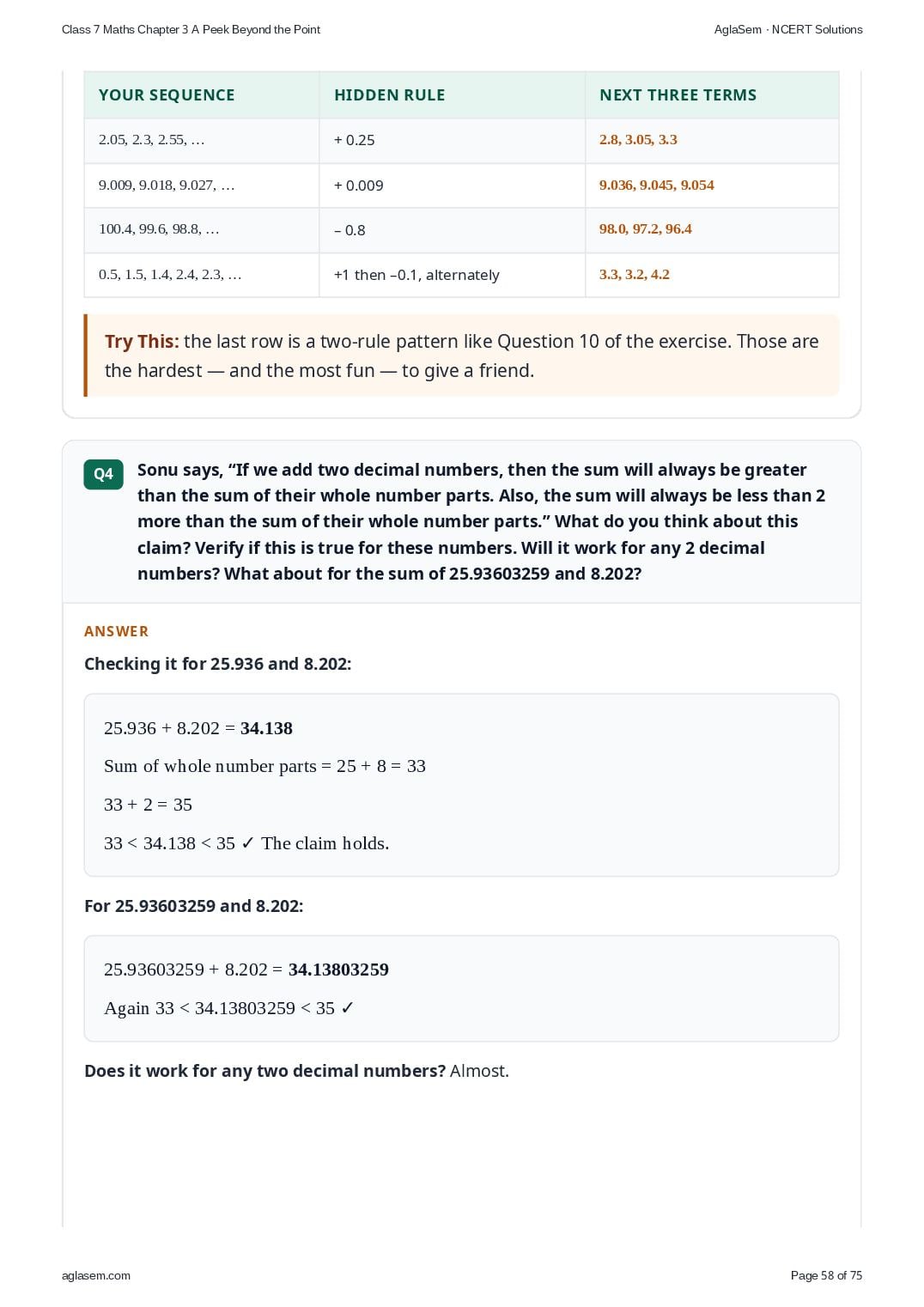
- Make your own sequences and challenge your classmates to extend the pattern.
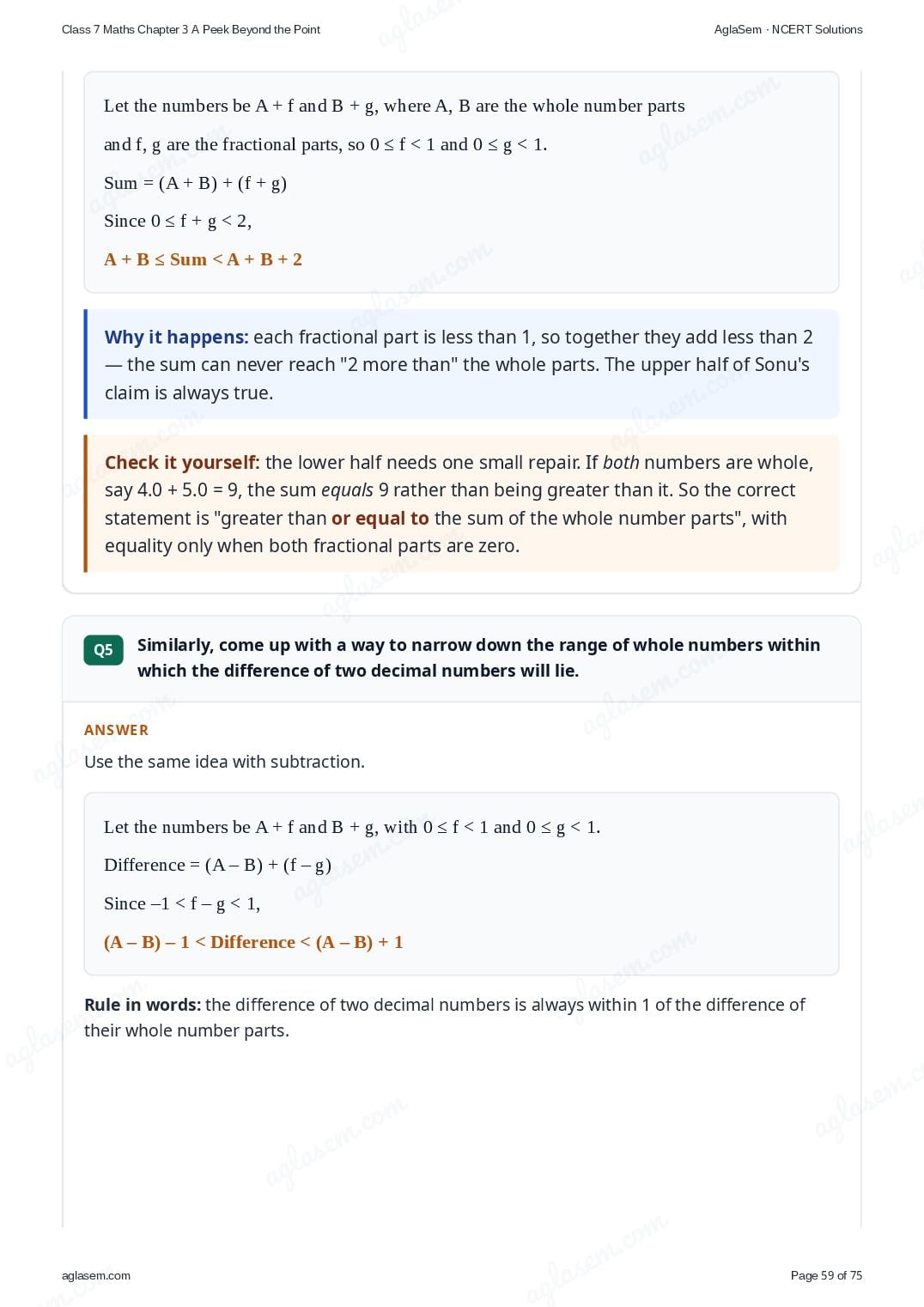
- Sonu says, “If we add two decimal numbers, then the sum will always be greater than the sum of their whole number parts. Also, the sum will always be less than 2 more than the sum of their whole number parts.” What do you think about this claim? Verify if this is true for these numbers. Will it work for any 2 decimal numbers? What about for the sum of 25.93603259 and 8.202?
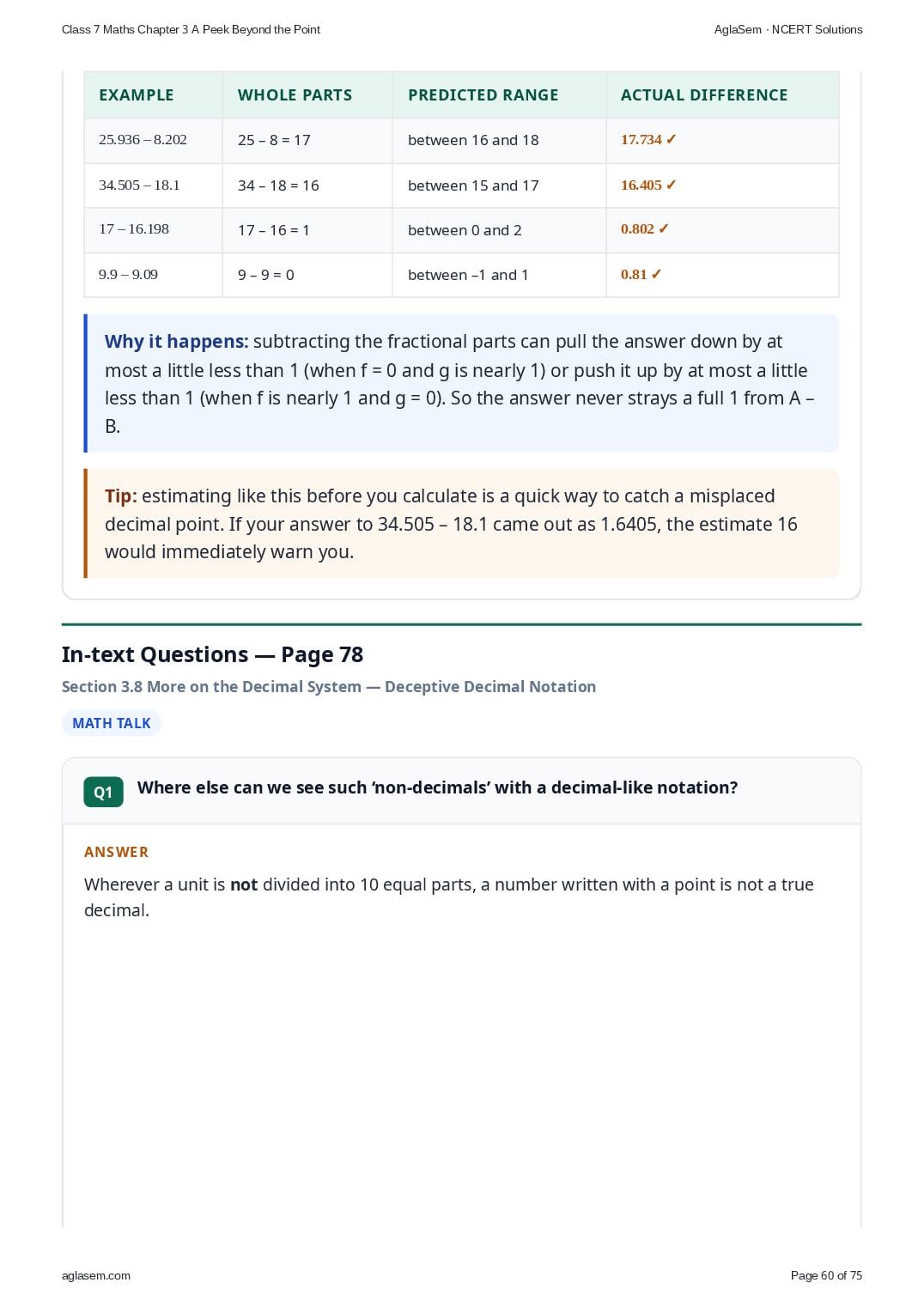
- Similarly, come up with a way to narrow down the range of whole numbers within which the difference of two decimal numbers will lie.
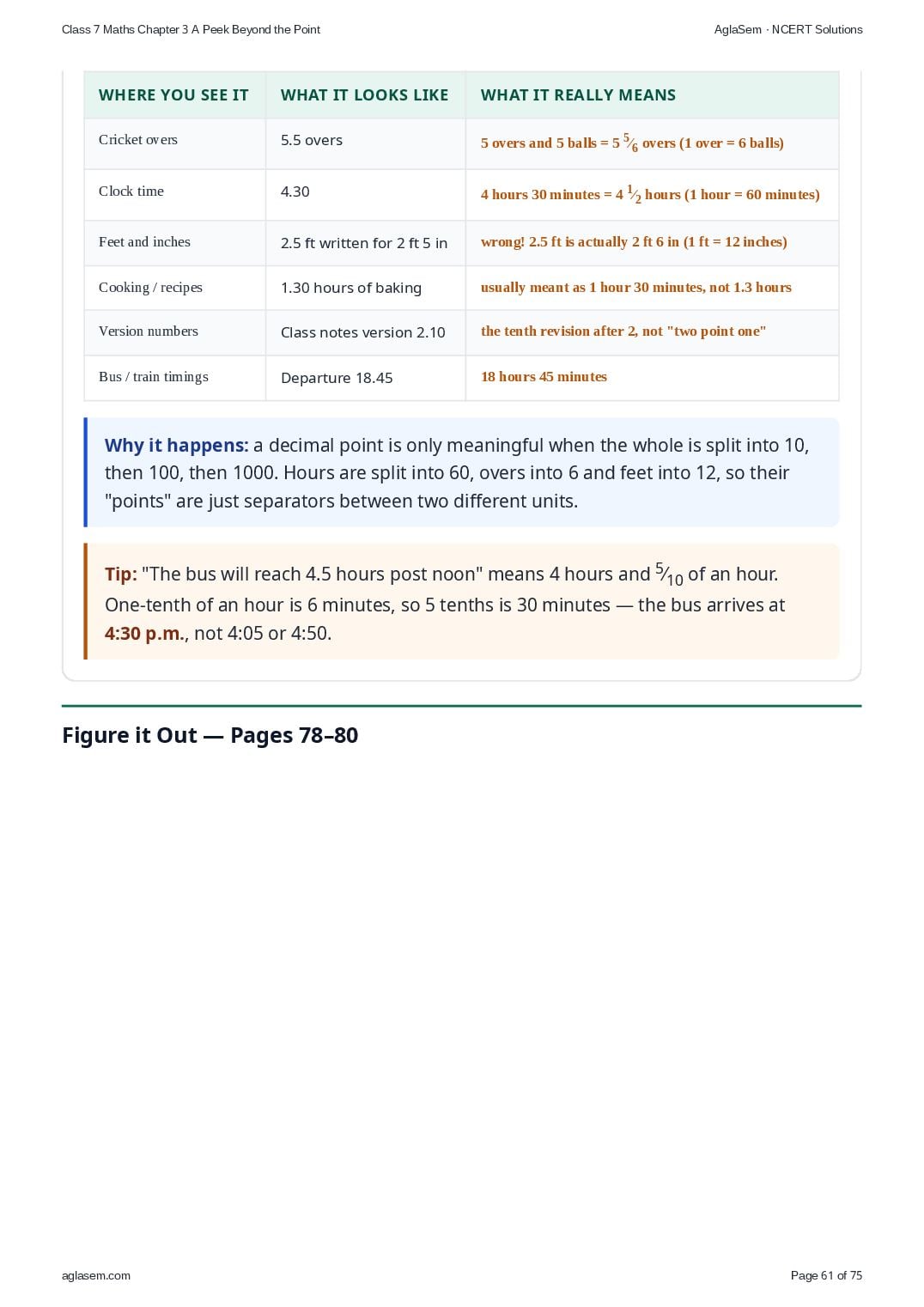
- Where else can we see such ‘non-decimals’ with a decimal-like notation?
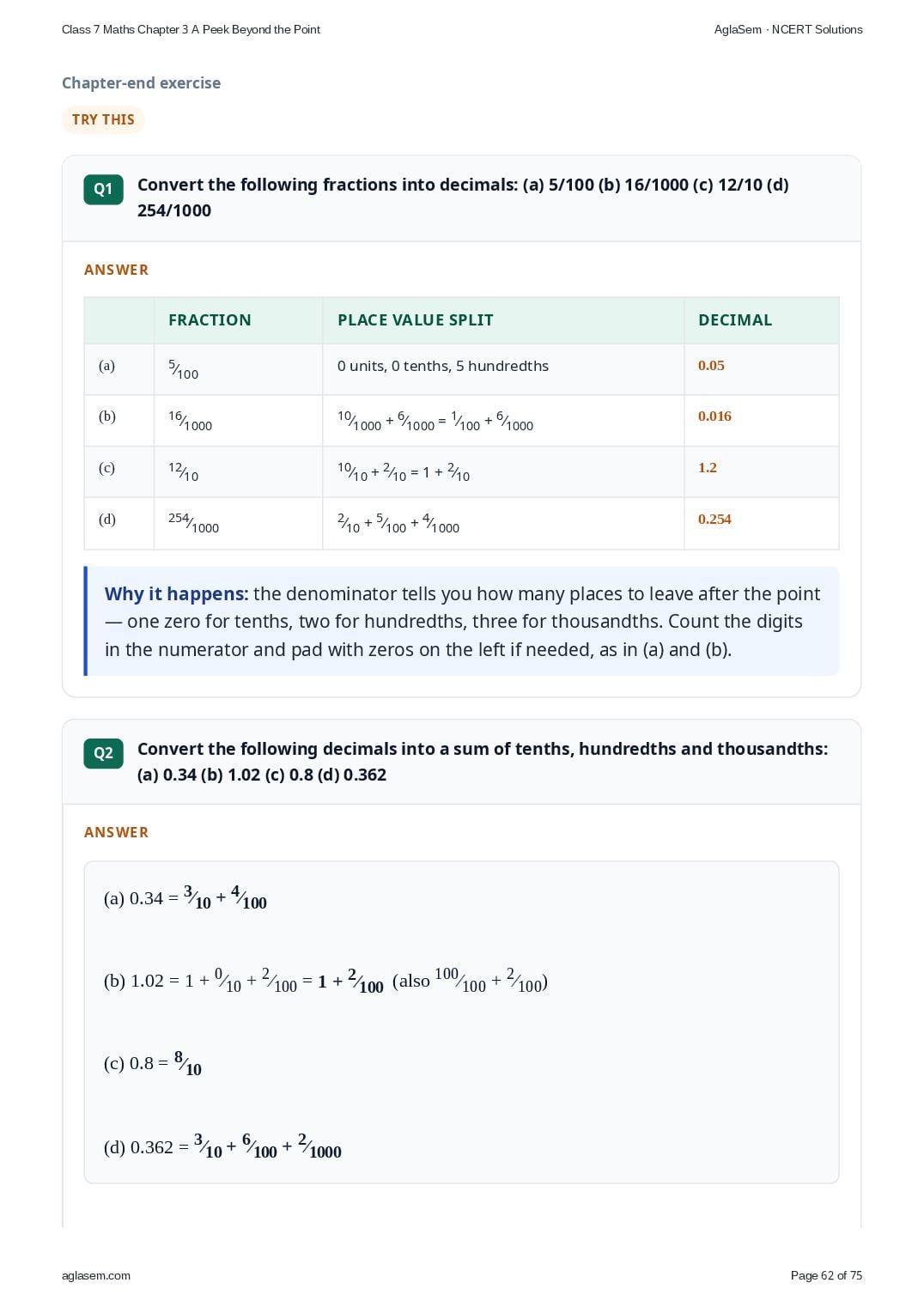
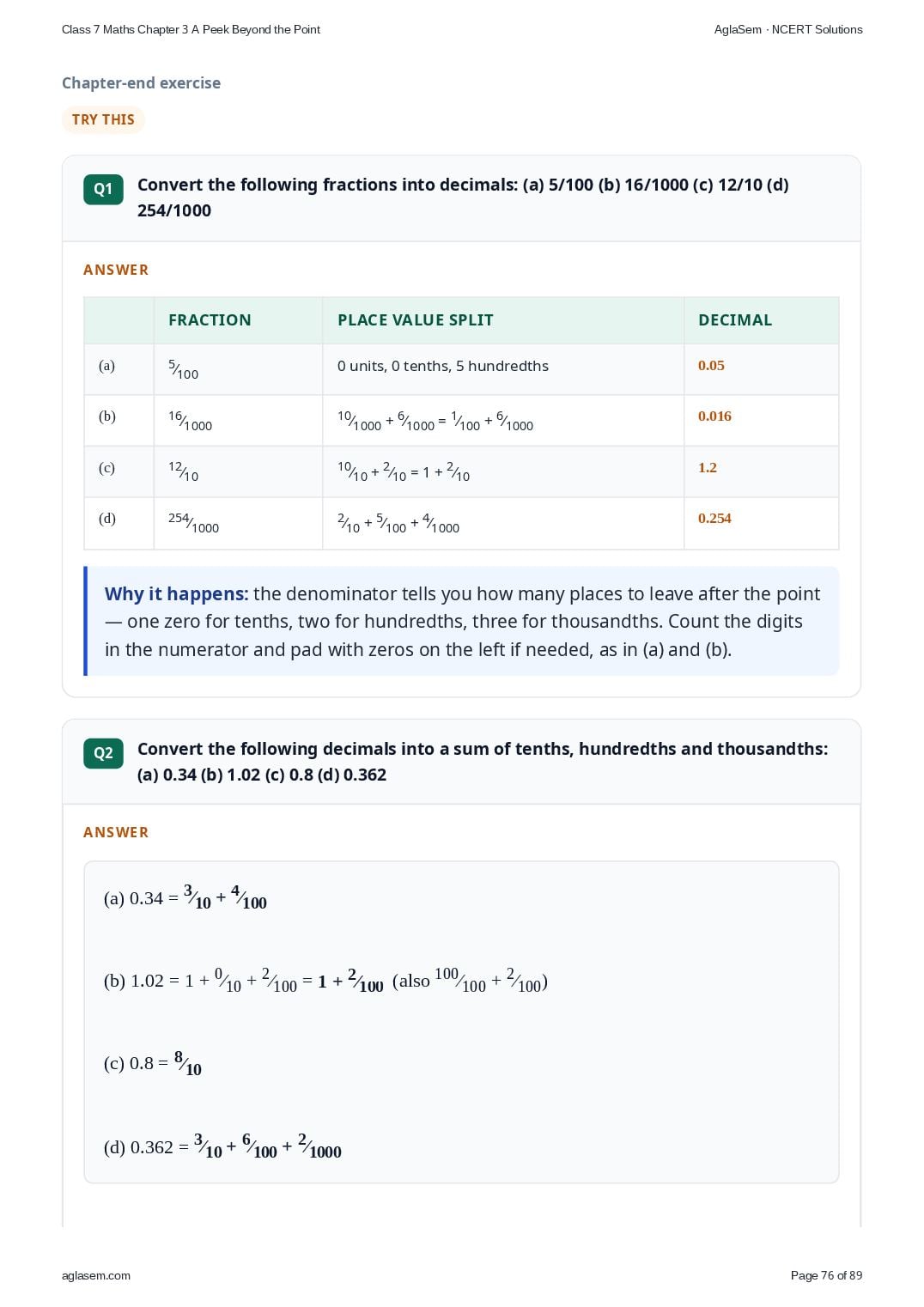
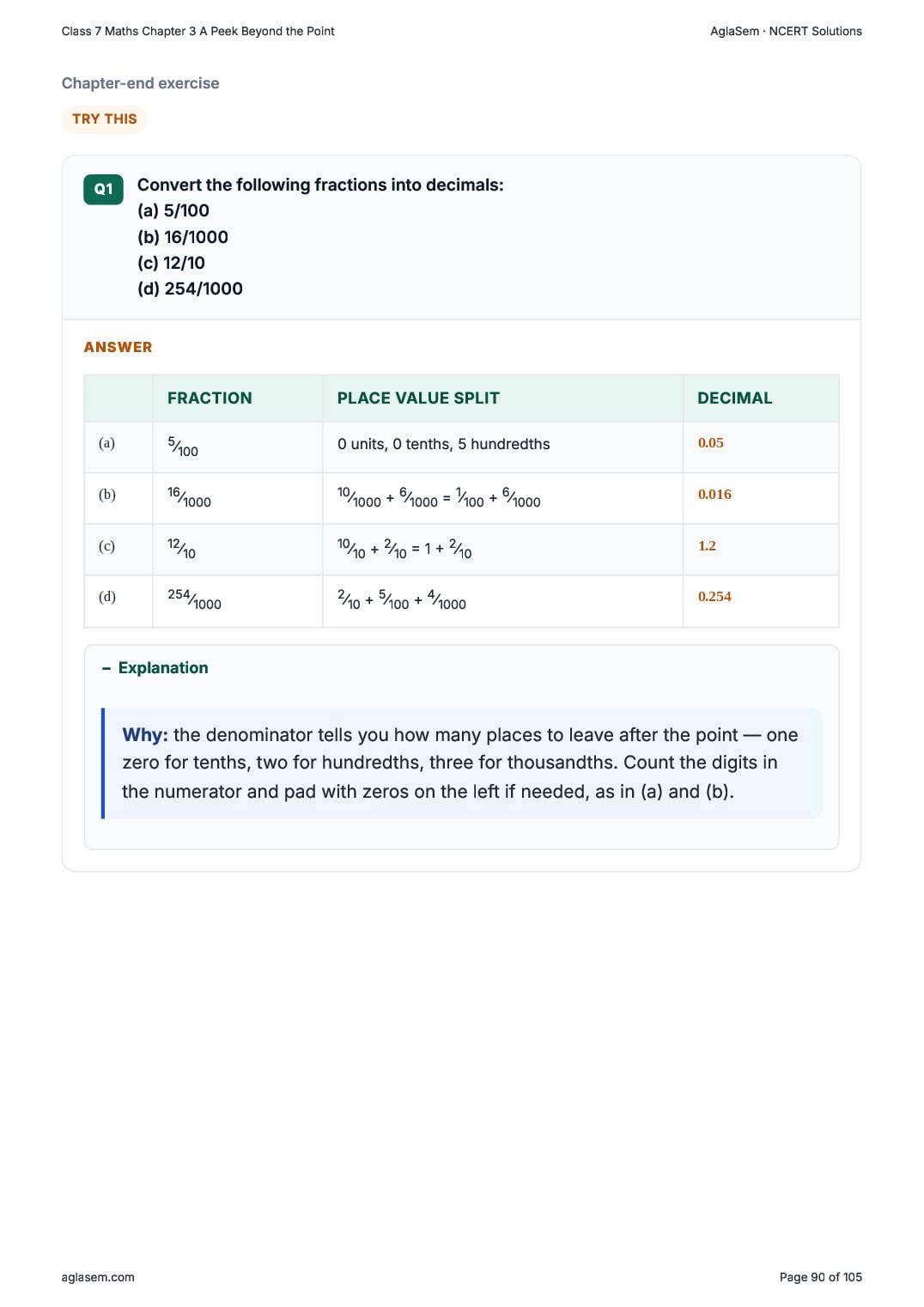
- Convert the following fractions into decimals: (a) 5/100 (b) 16/1000 (c) 12/10 (d) 254/1000
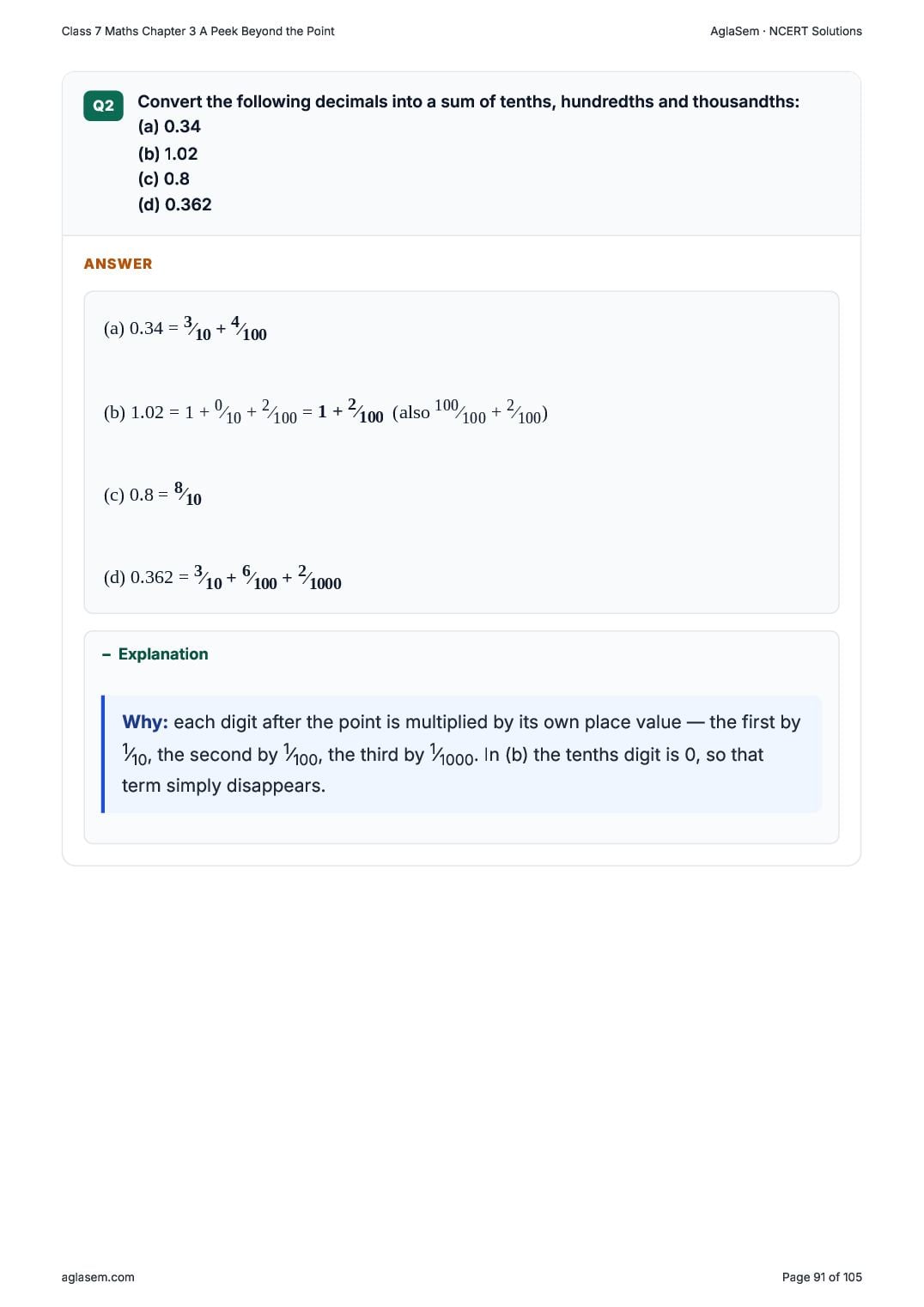
- Convert the following decimals into a sum of tenths, hundredths and thousandths: (a) 0.34 (b) 1.02 (c) 0.8 (d) 0.362
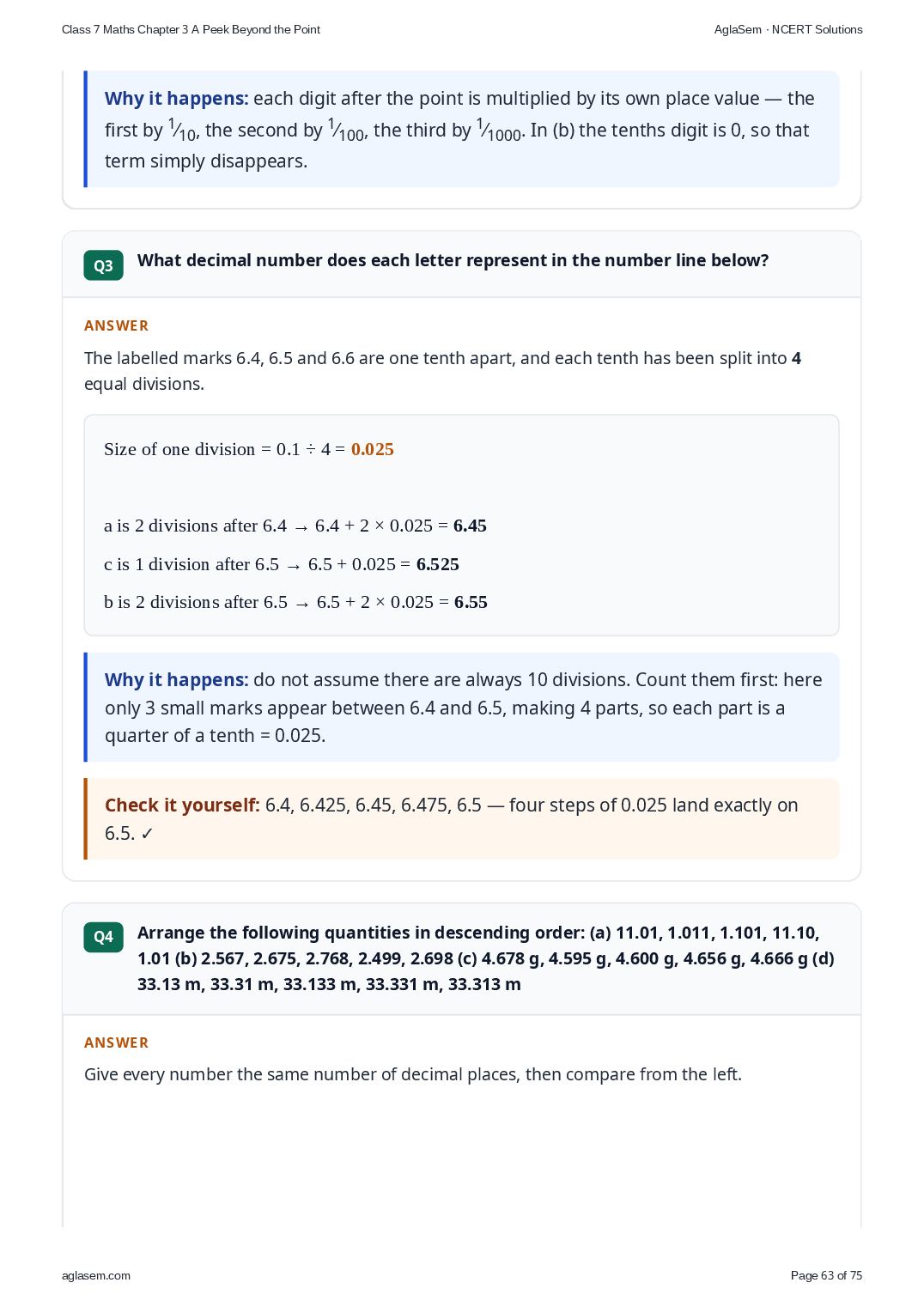
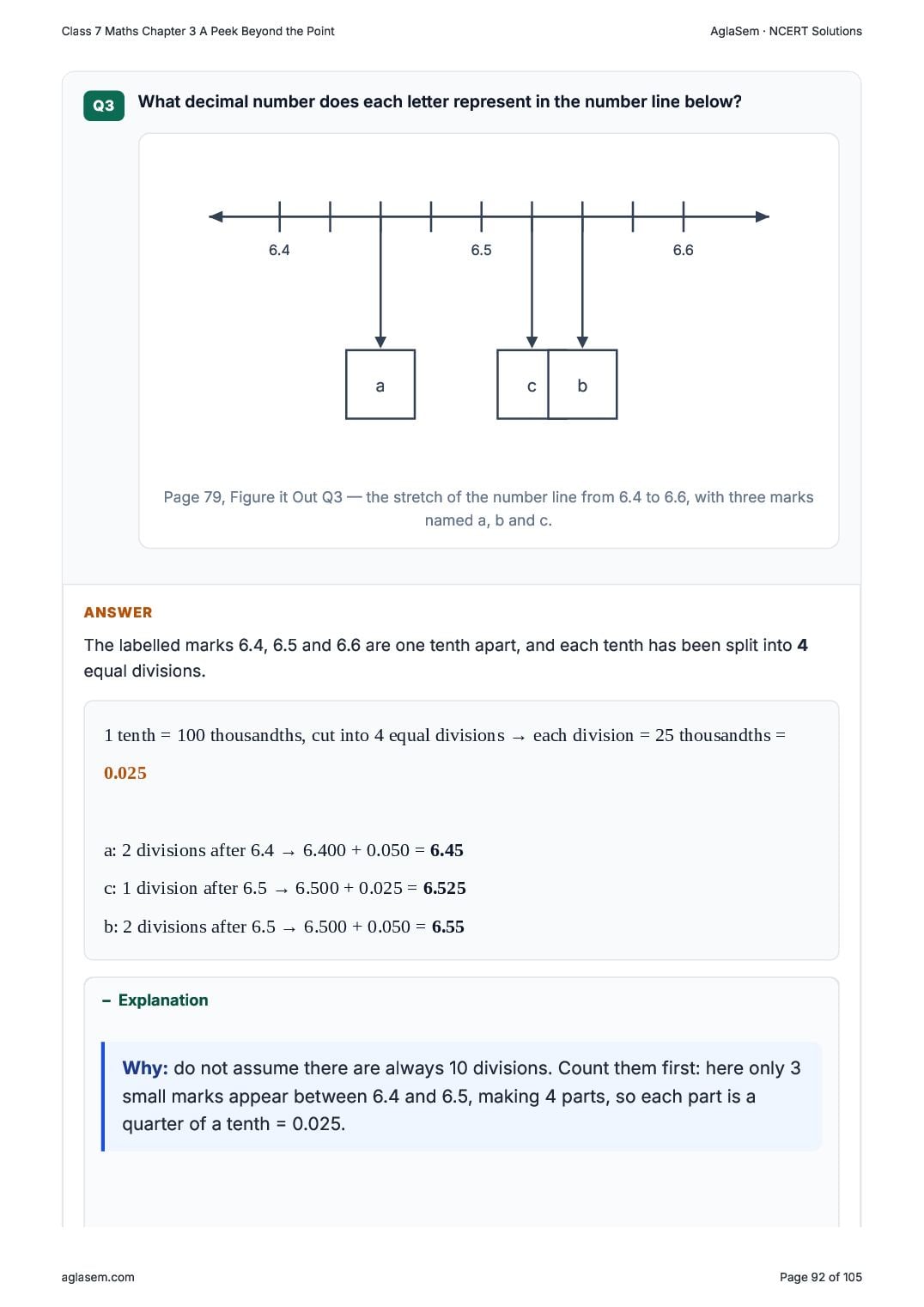
- What decimal number does each letter represent in the number line below?
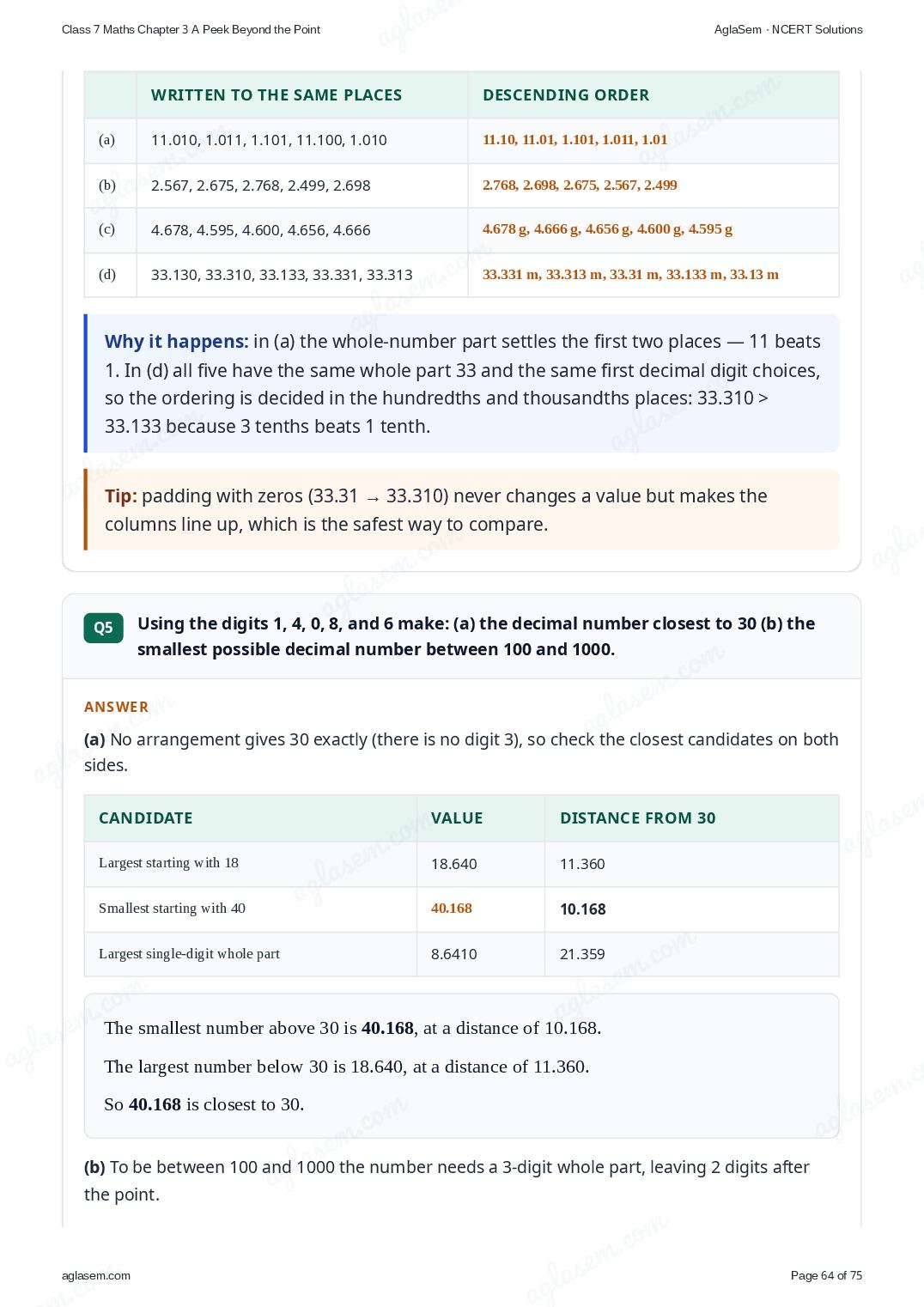
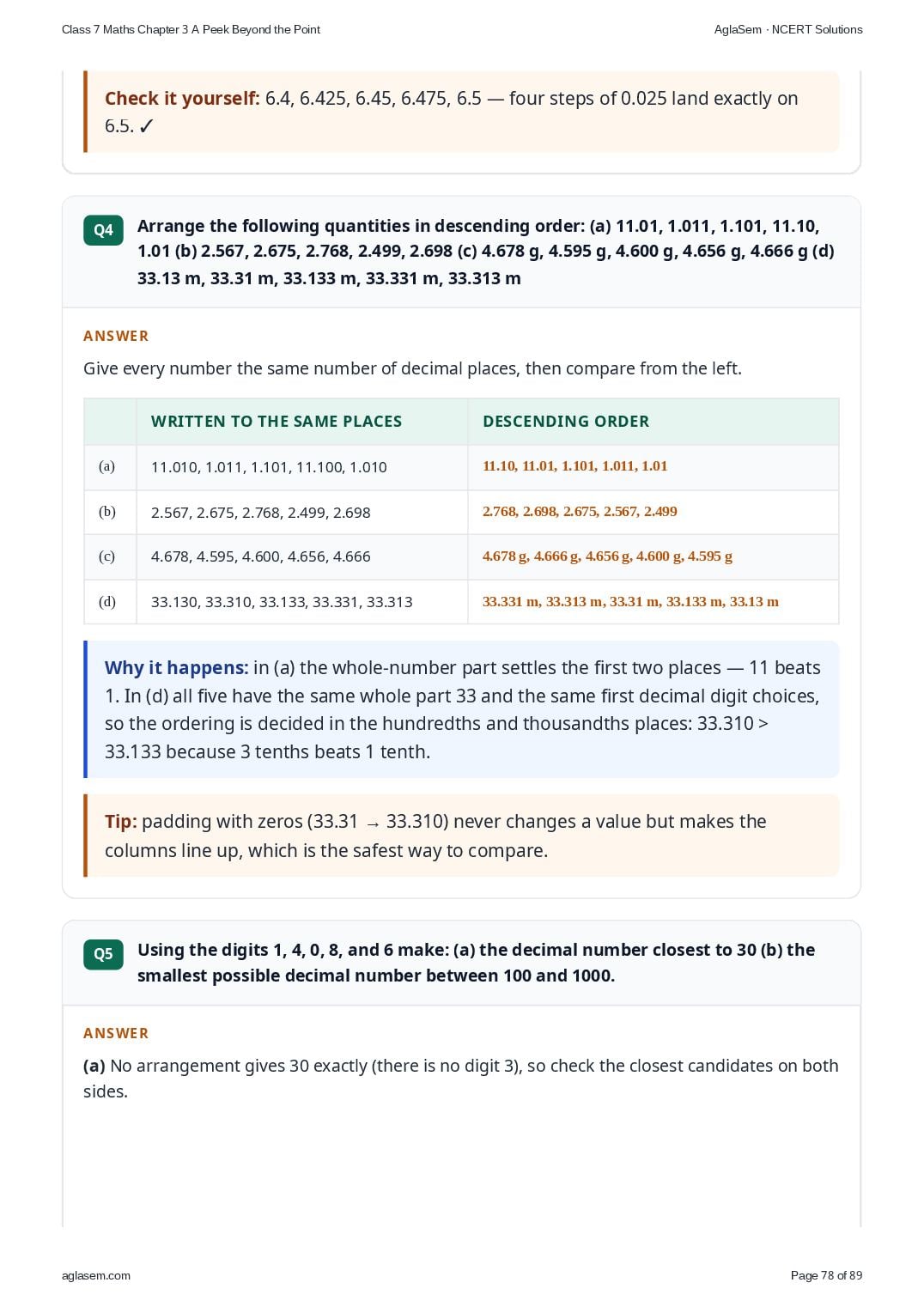
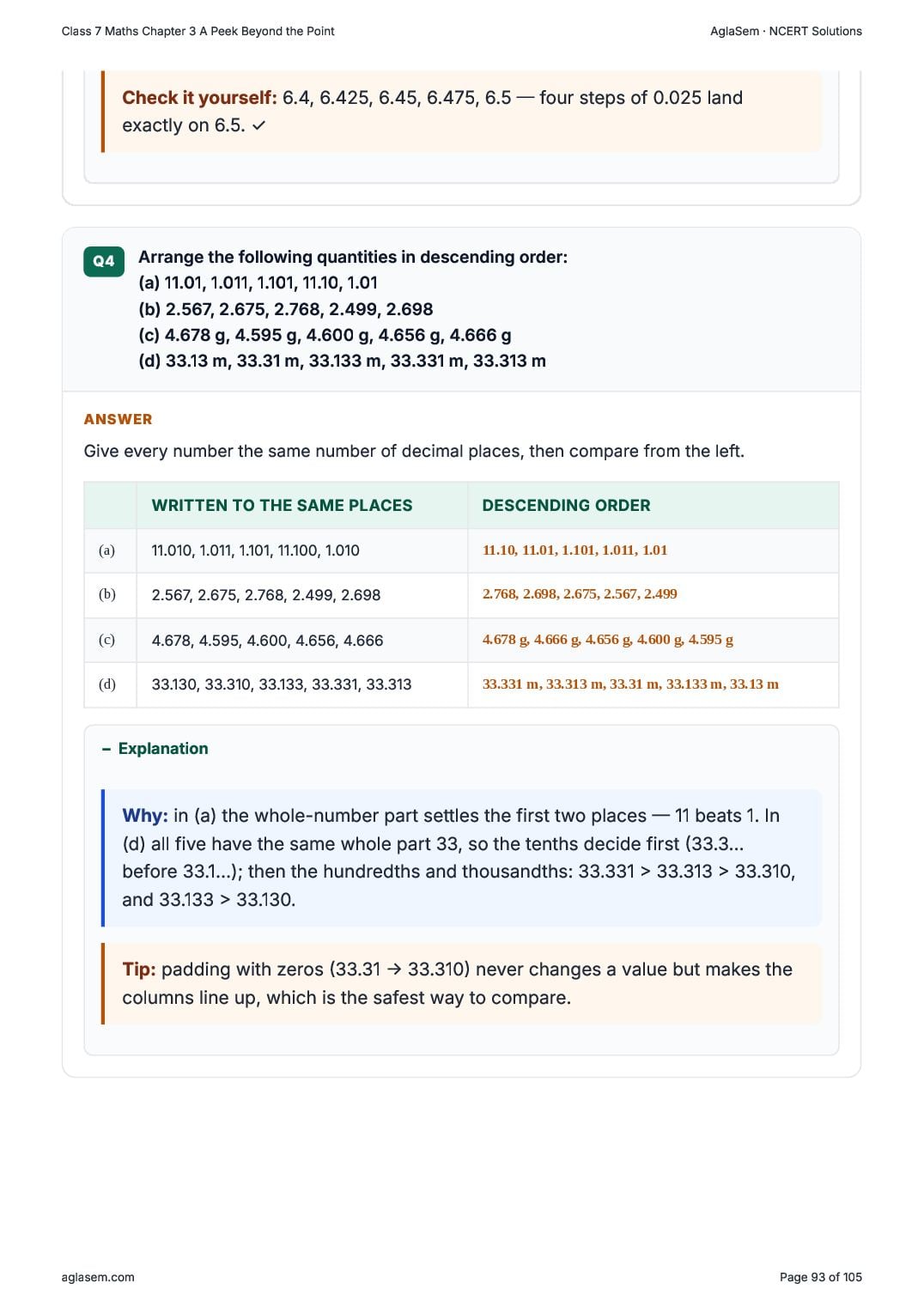
- Arrange the following quantities in descending order: (a) 11.01, 1.011, 1.101, 11.10, 1.01 (b) 2.567, 2.675, 2.768, 2.499, 2.698 (c) 4.678 g, 4.595 g, 4.600 g, 4.656 g, 4.666 g (d) 33.13 m, 33.31 m, 33.133 m, 33.331 m, 33.313 m
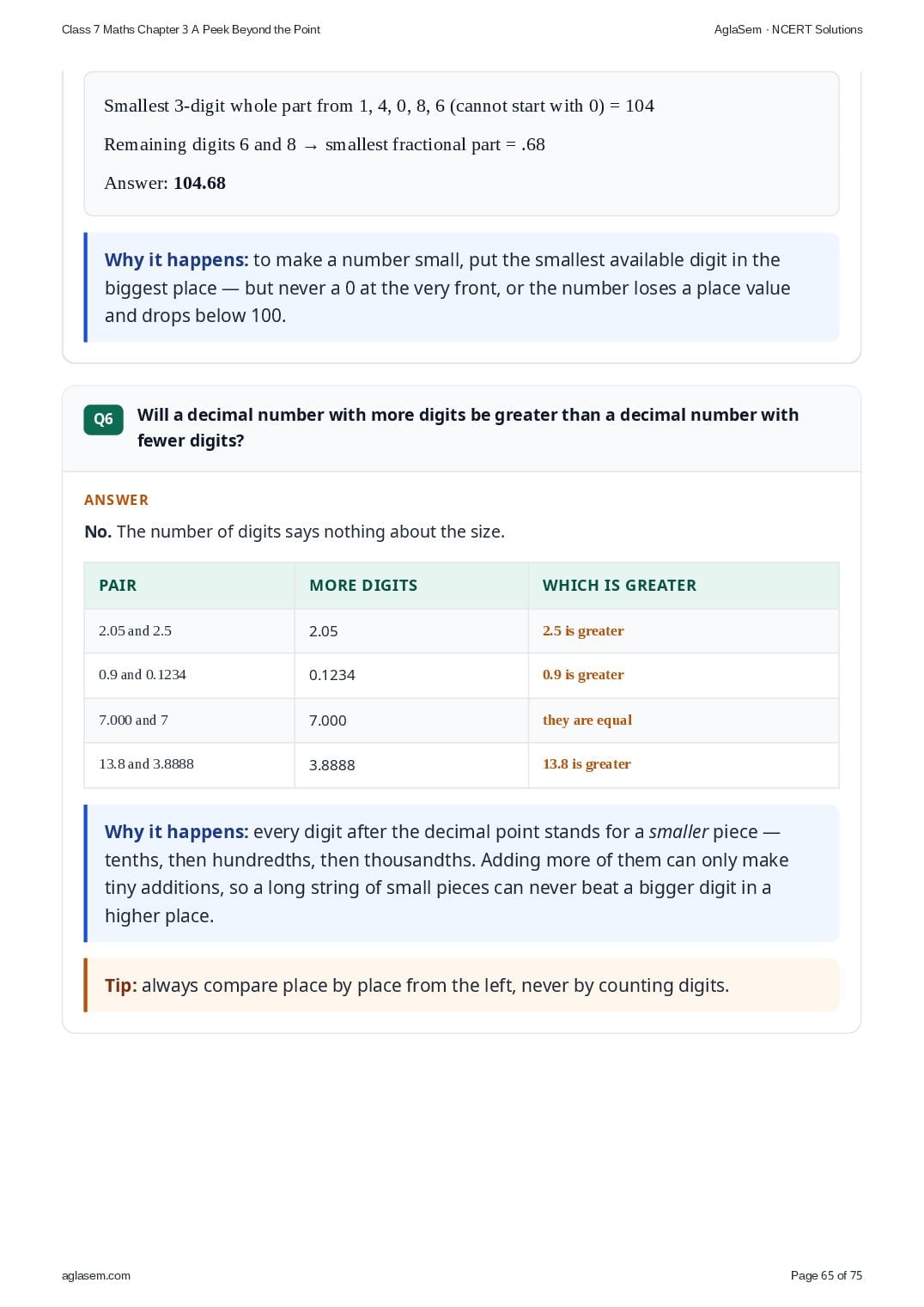
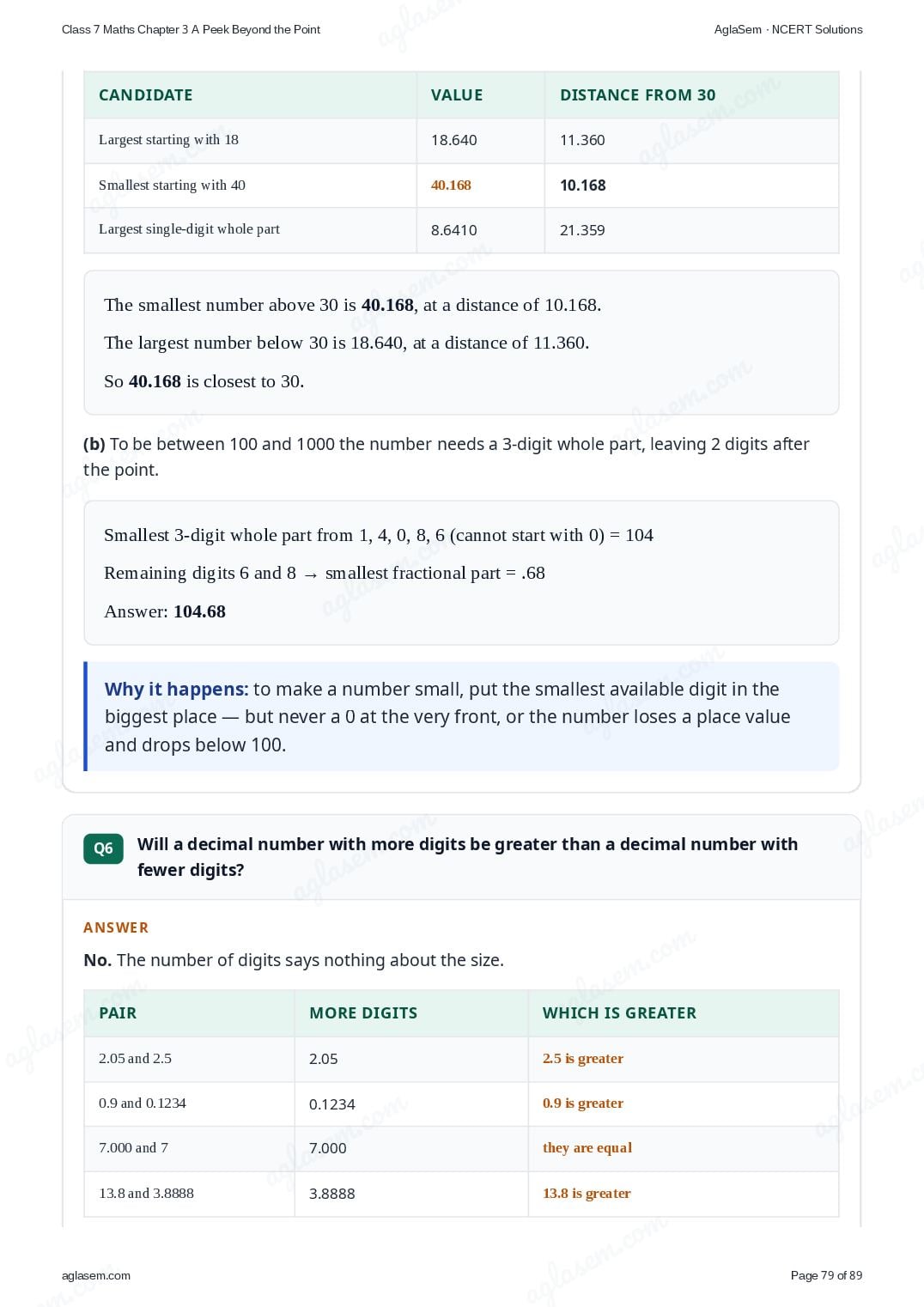
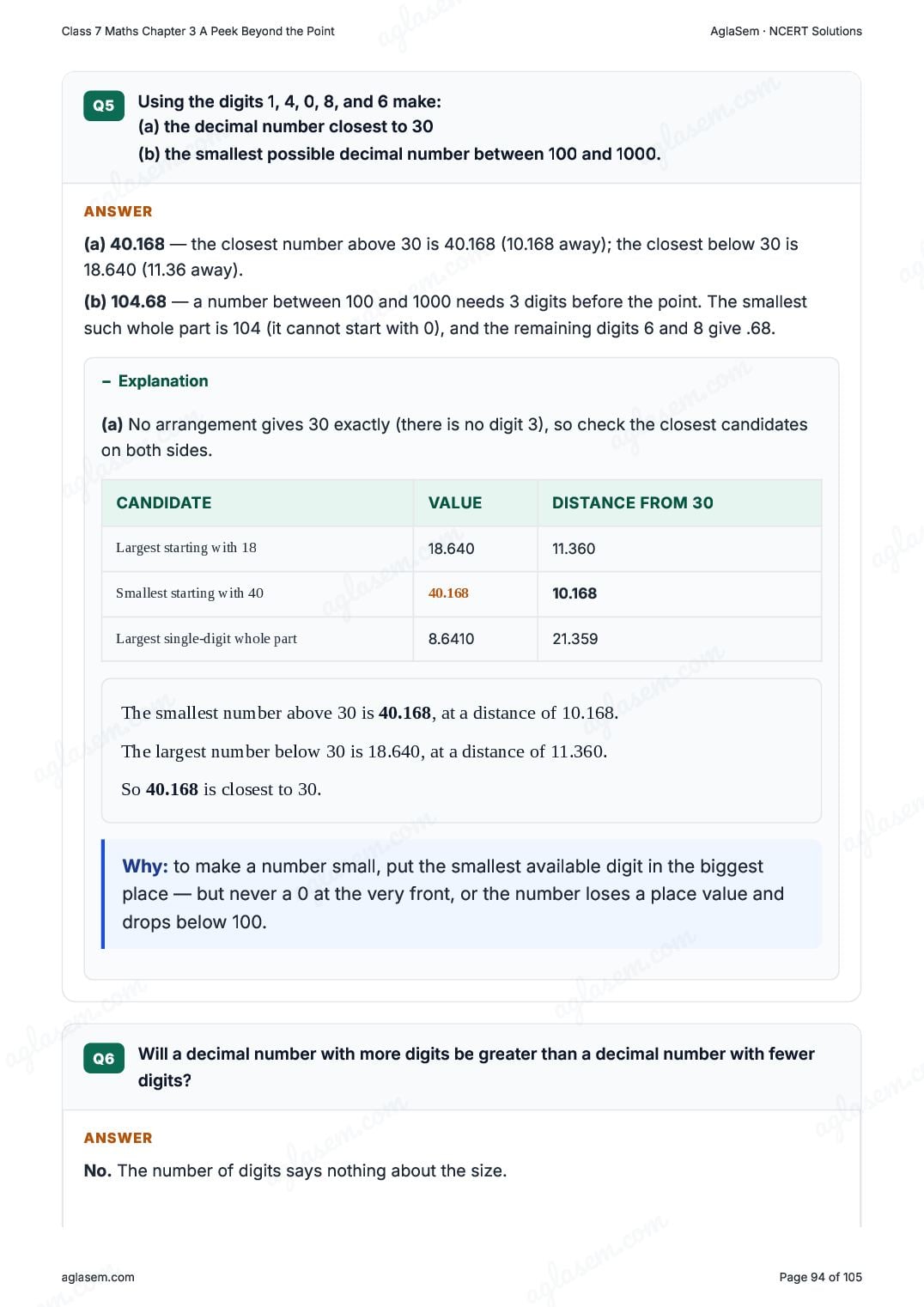
- Using the digits 1, 4, 0, 8, and 6 make: (a) the decimal number closest to 30 (b) the smallest possible decimal number between 100 and 1000.
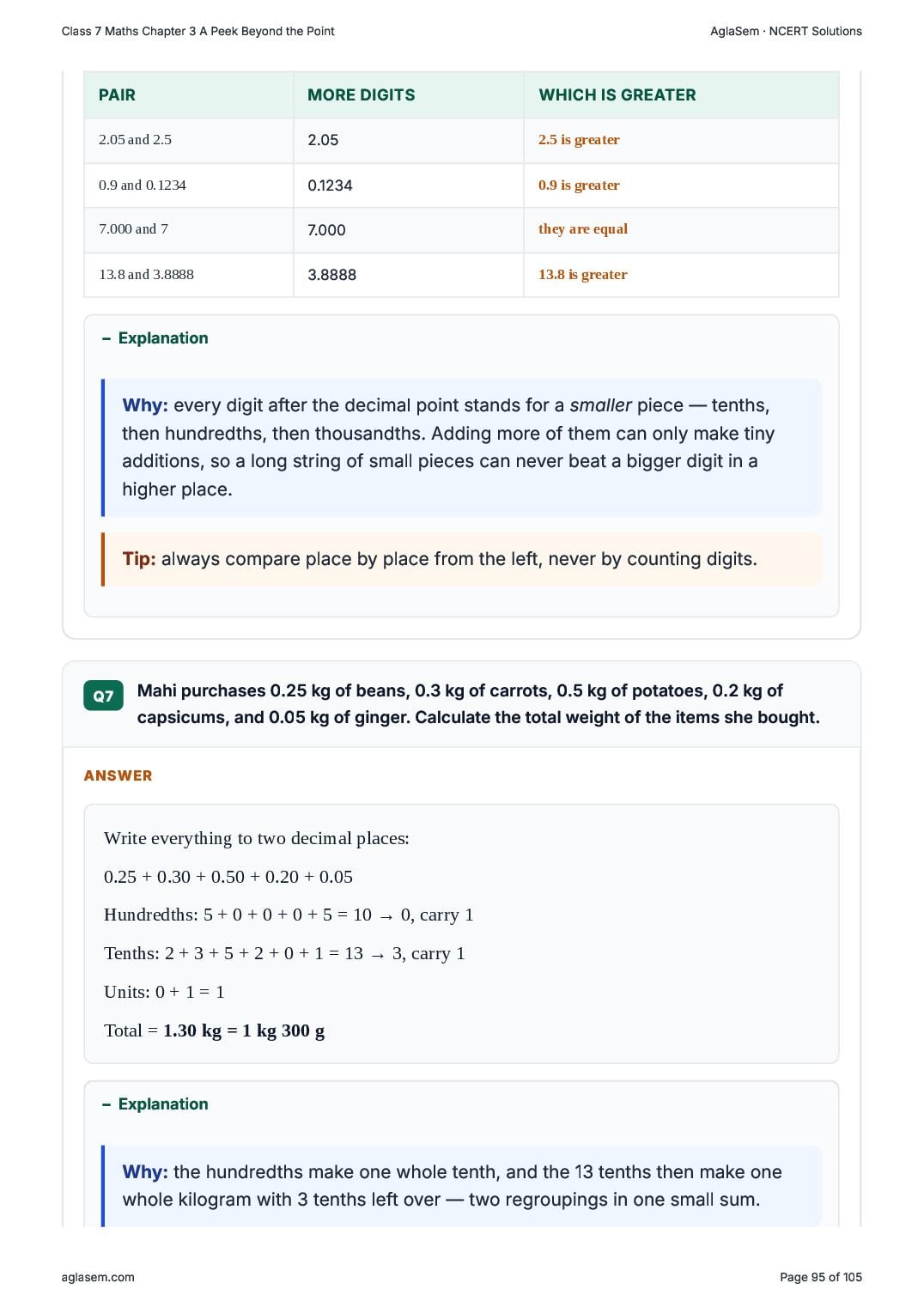
- Will a decimal number with more digits be greater than a decimal number with fewer digits?
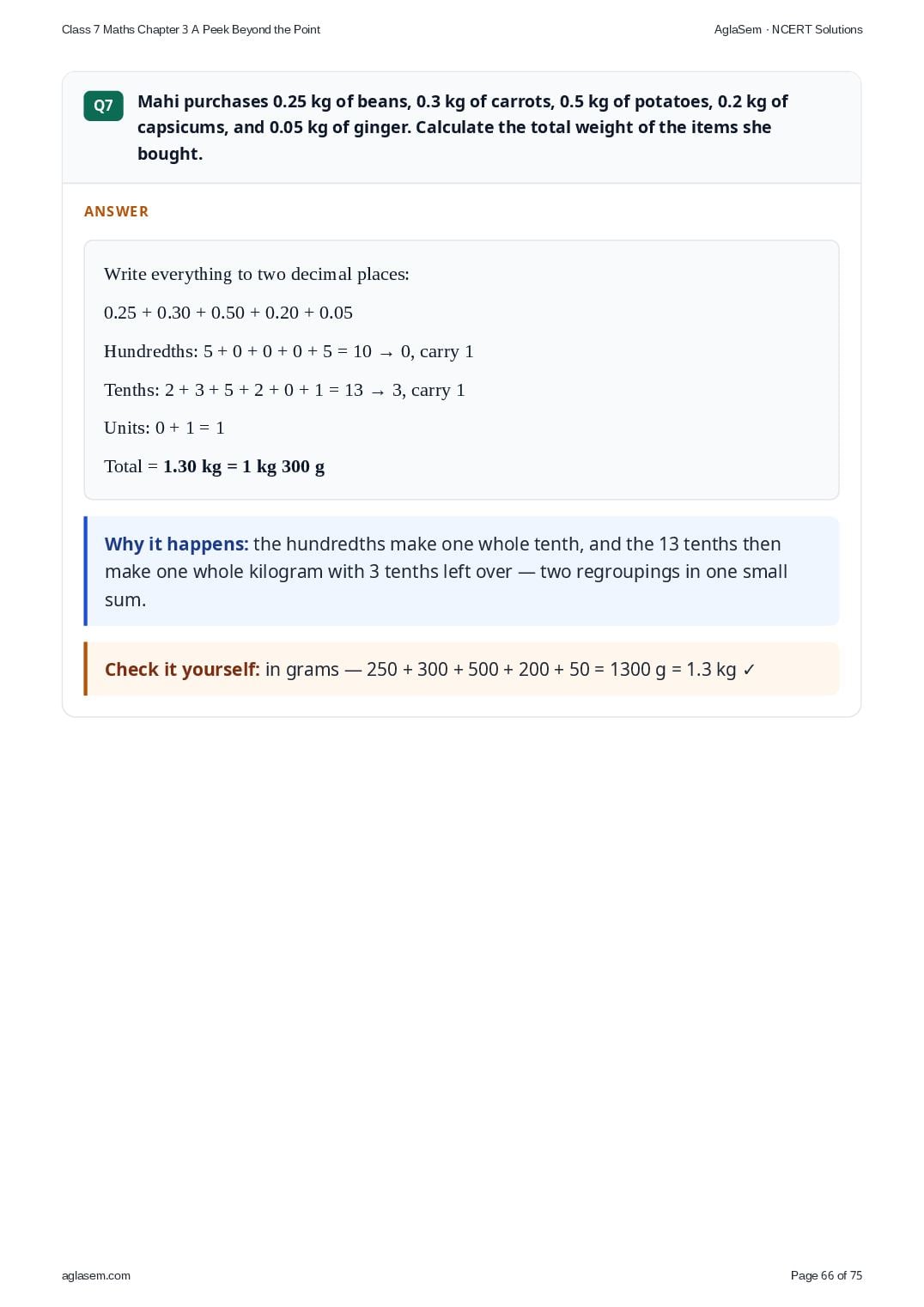
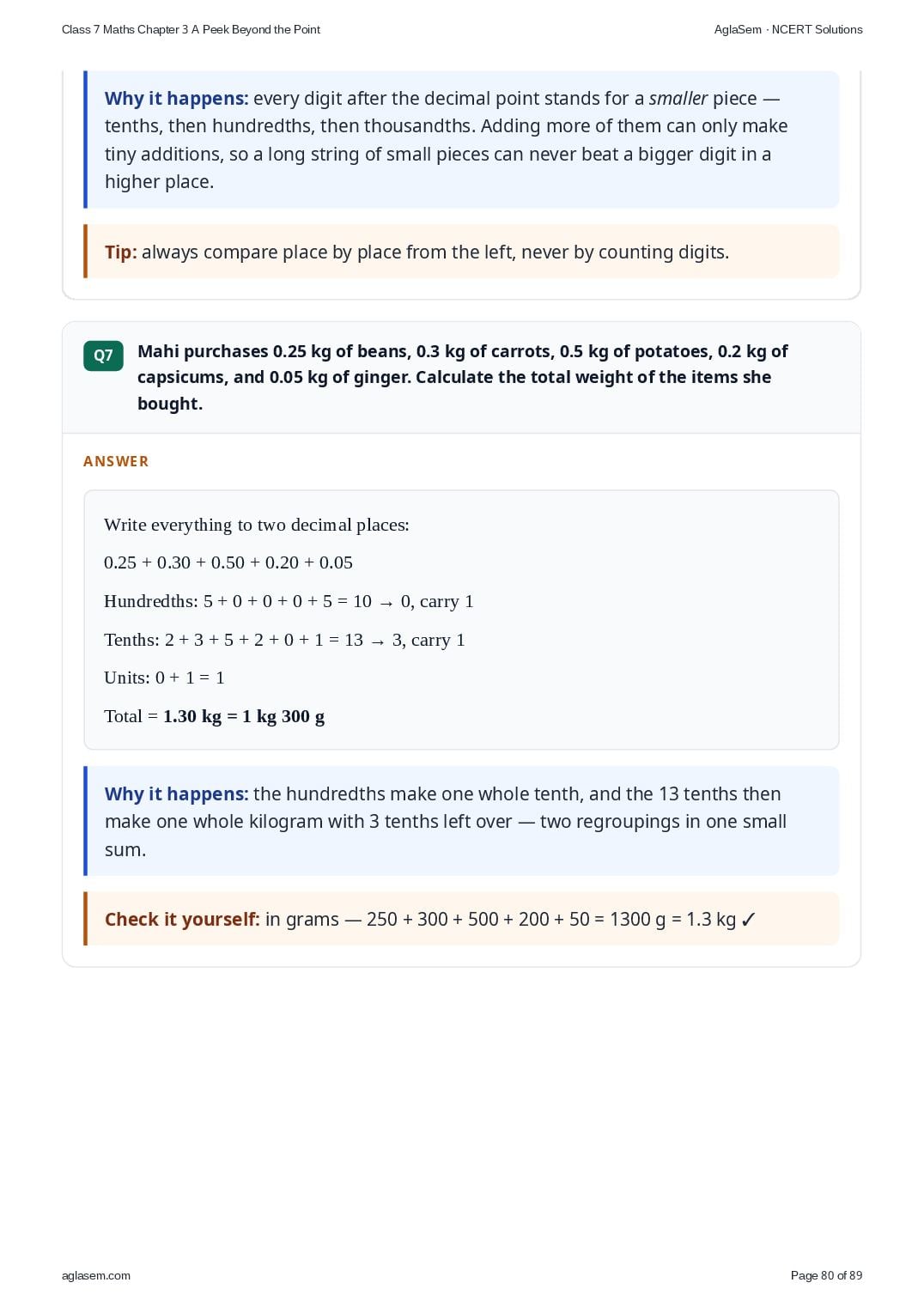
- Mahi purchases 0.25 kg of beans, 0.3 kg of carrots, 0.5 kg of potatoes, 0.2 kg of capsicums, and 0.05 kg of ginger. Calculate the total weight of the items she bought.
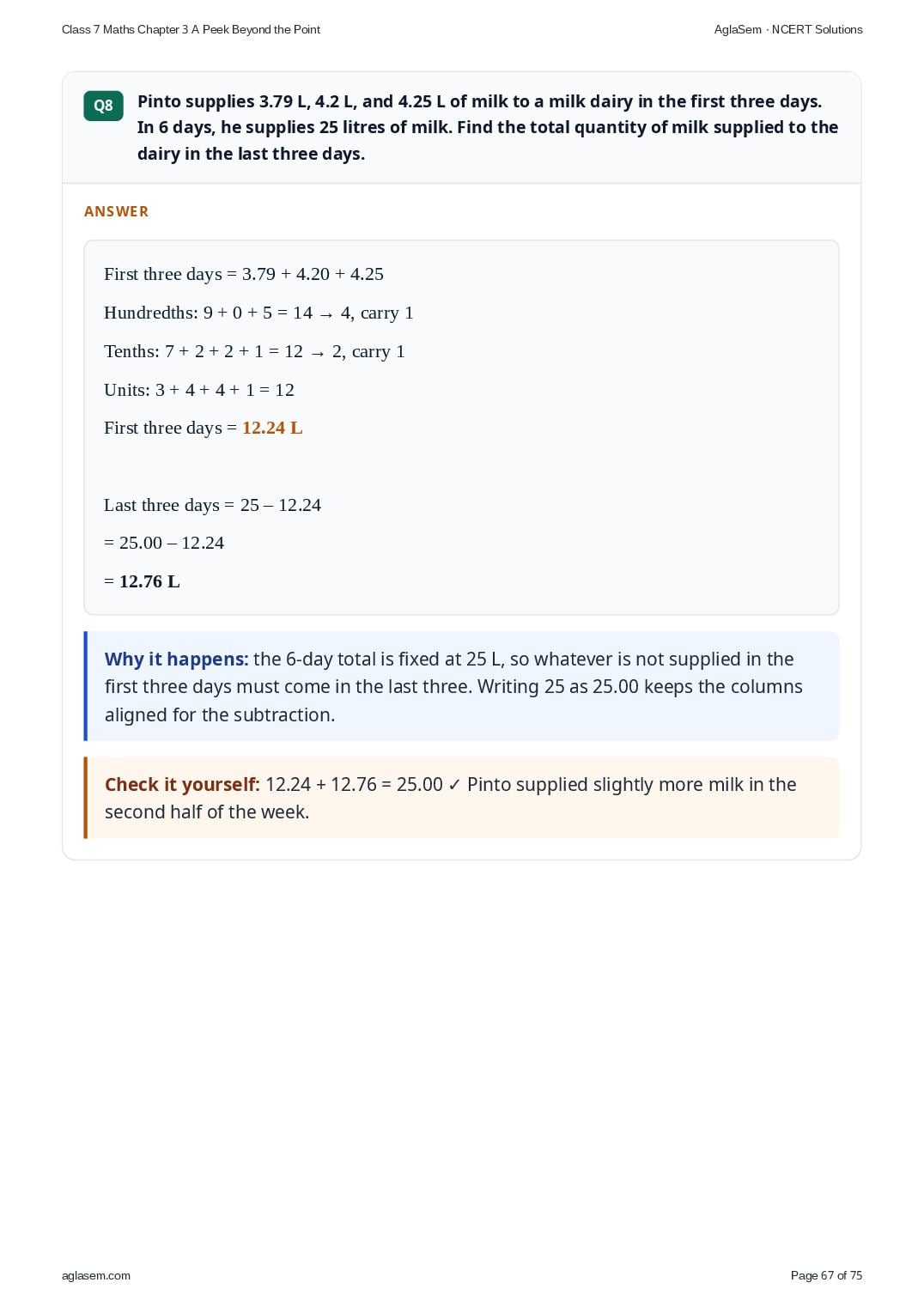
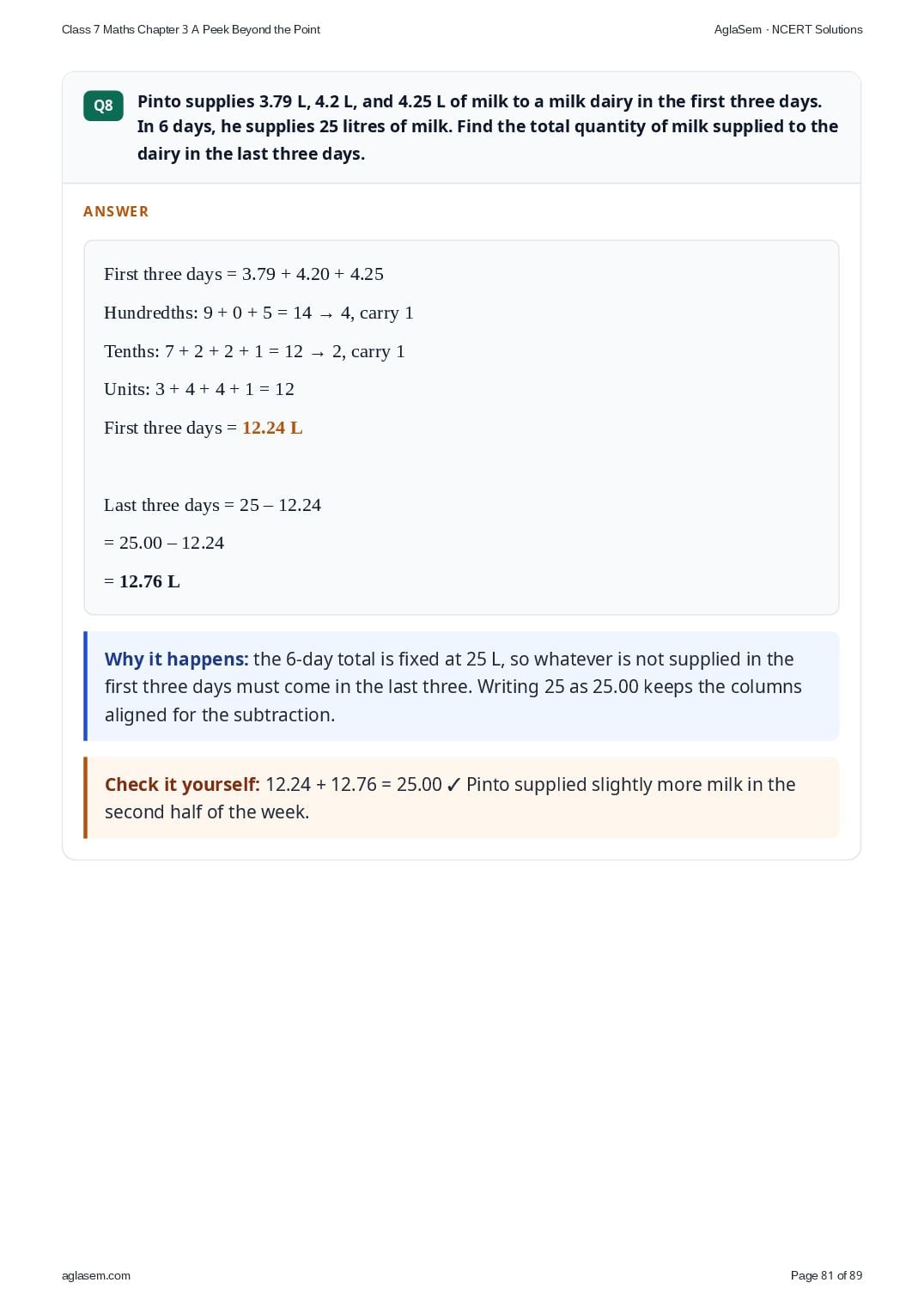
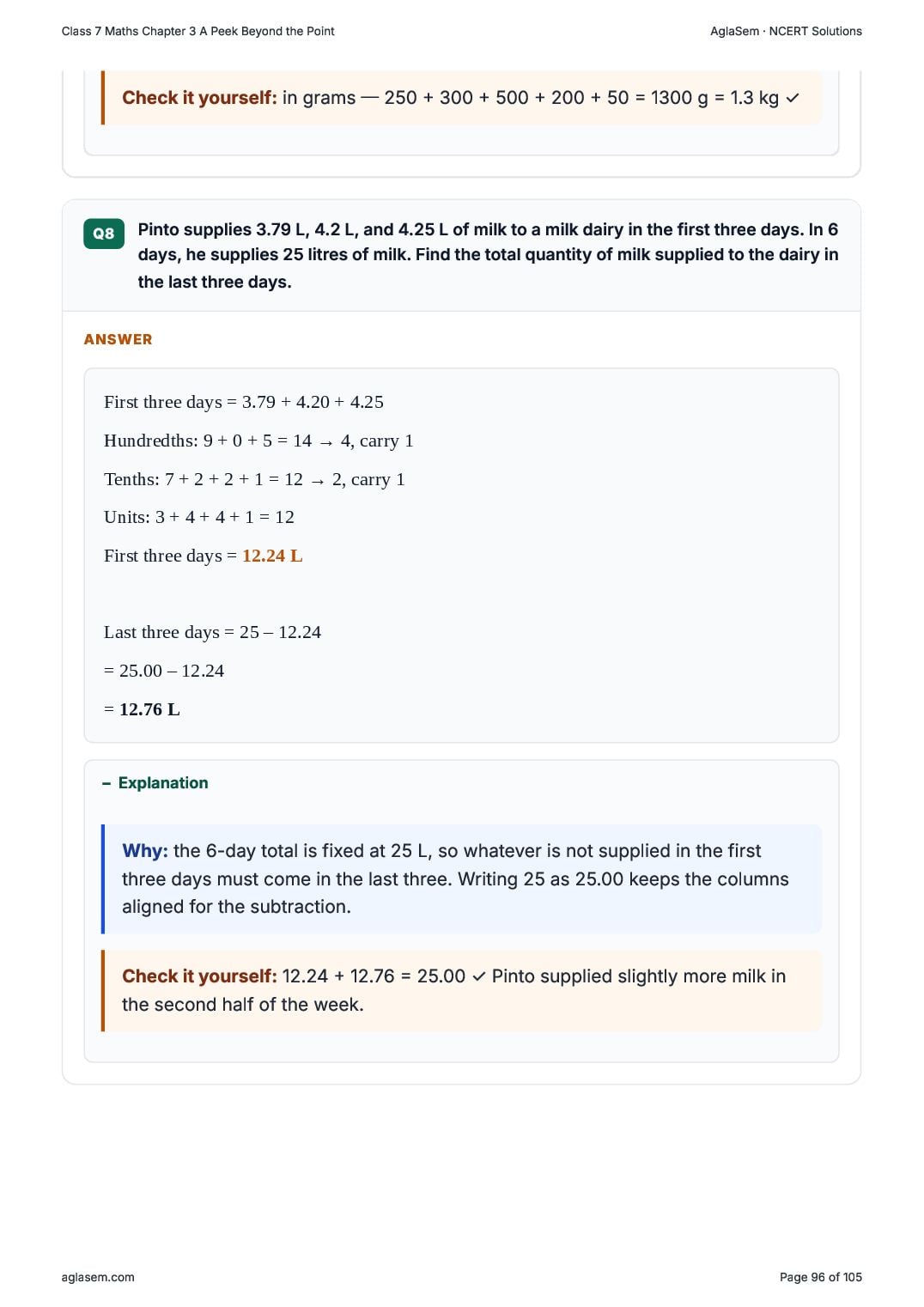
- Pinto supplies 3.79 L, 4.2 L, and 4.25 L of milk to a milk dairy in the first three days. In 6 days, he supplies 25 litres of milk. Find the total quantity of milk supplied to the dairy in the last three days.
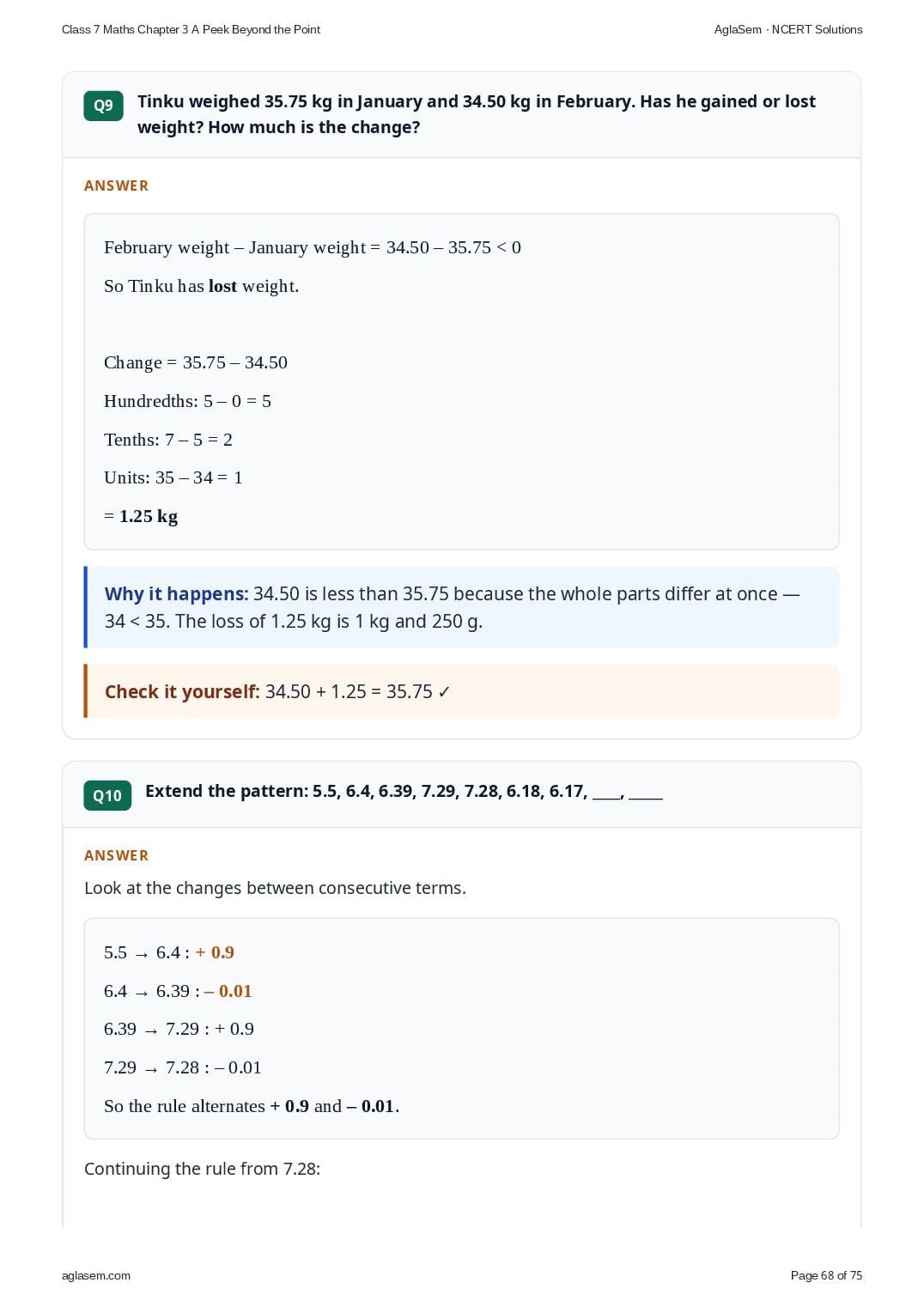
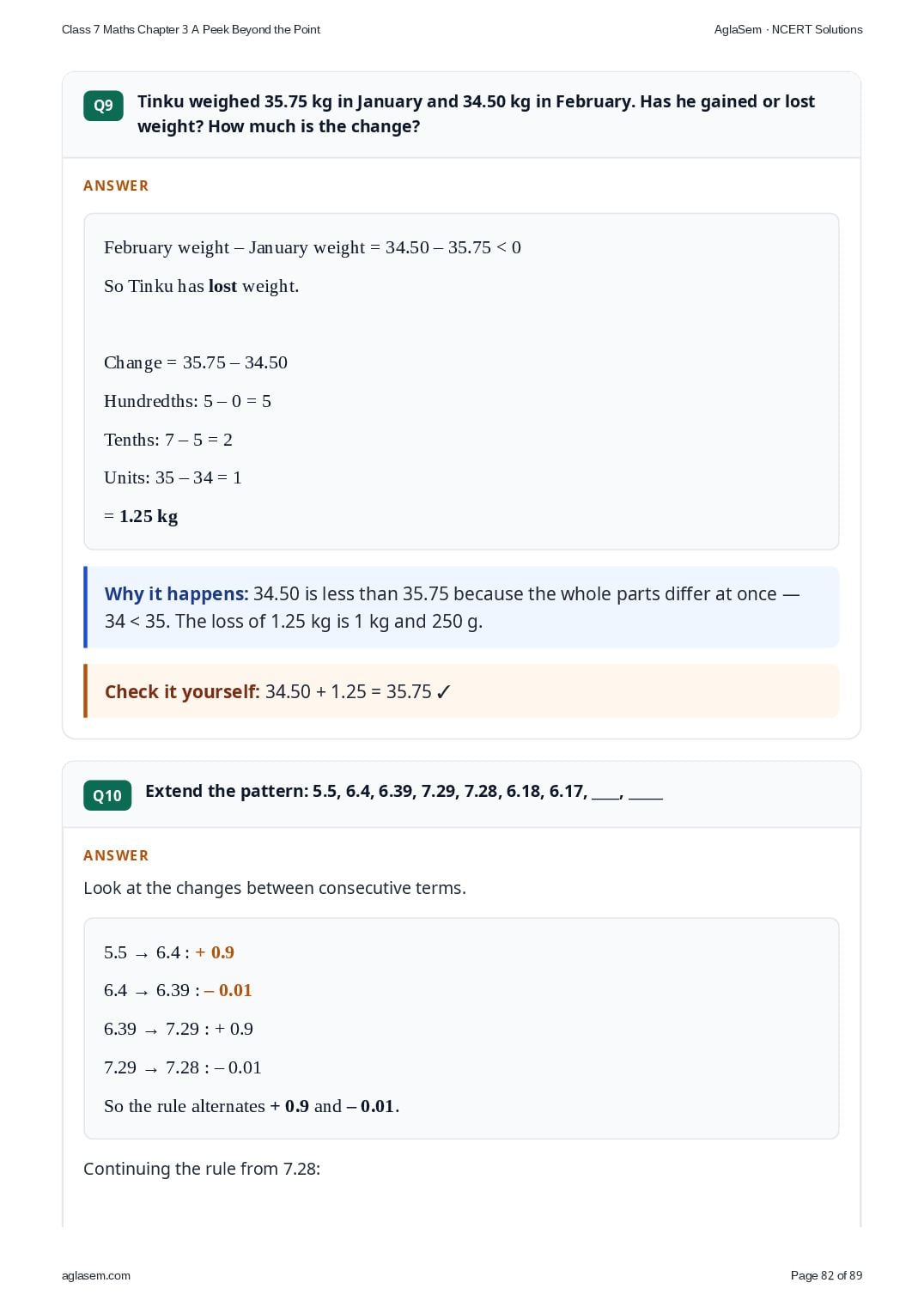
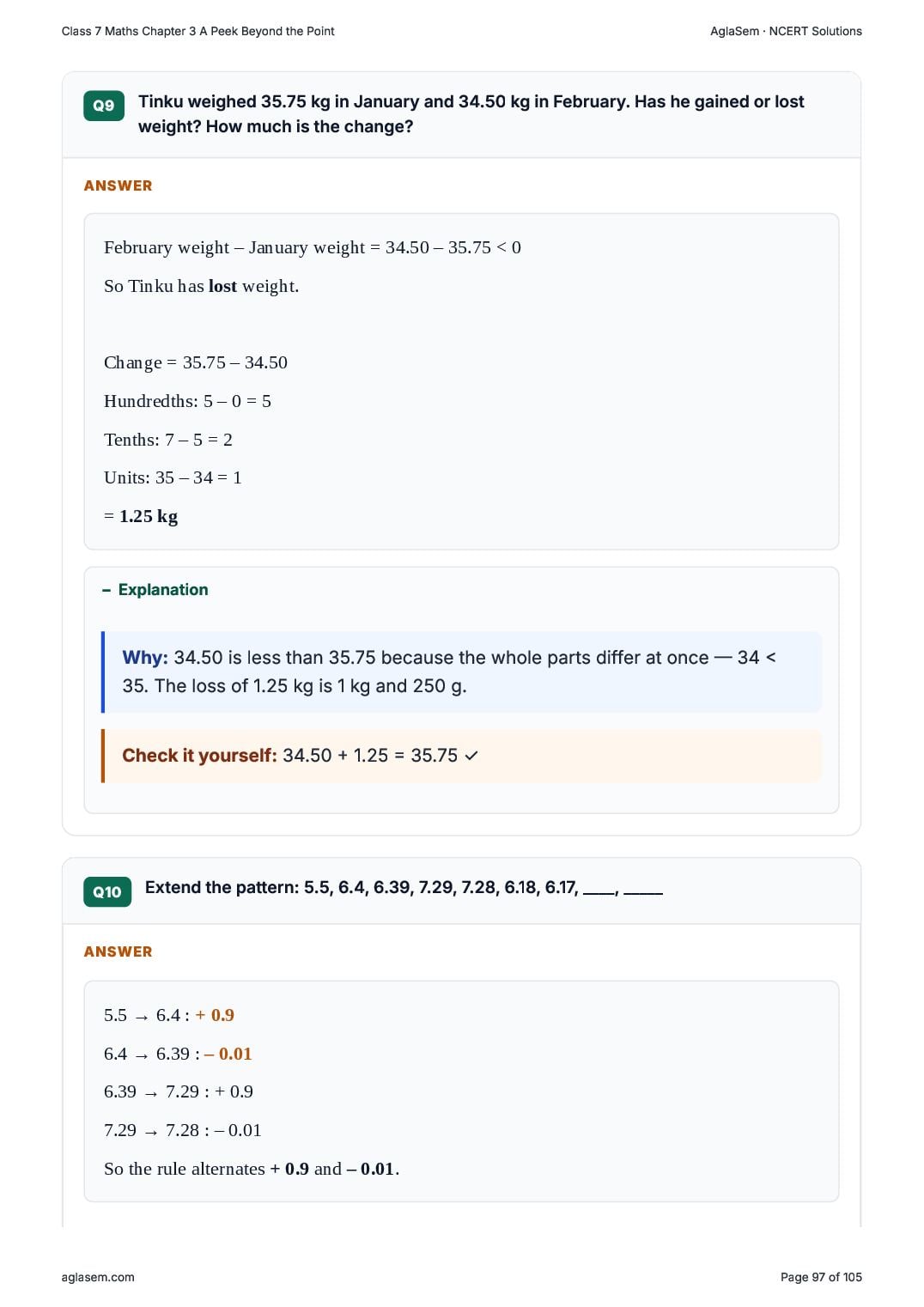
- Tinku weighed 35.75 kg in January and 34.50 kg in February. Has he gained or lost weight? How much is the change?
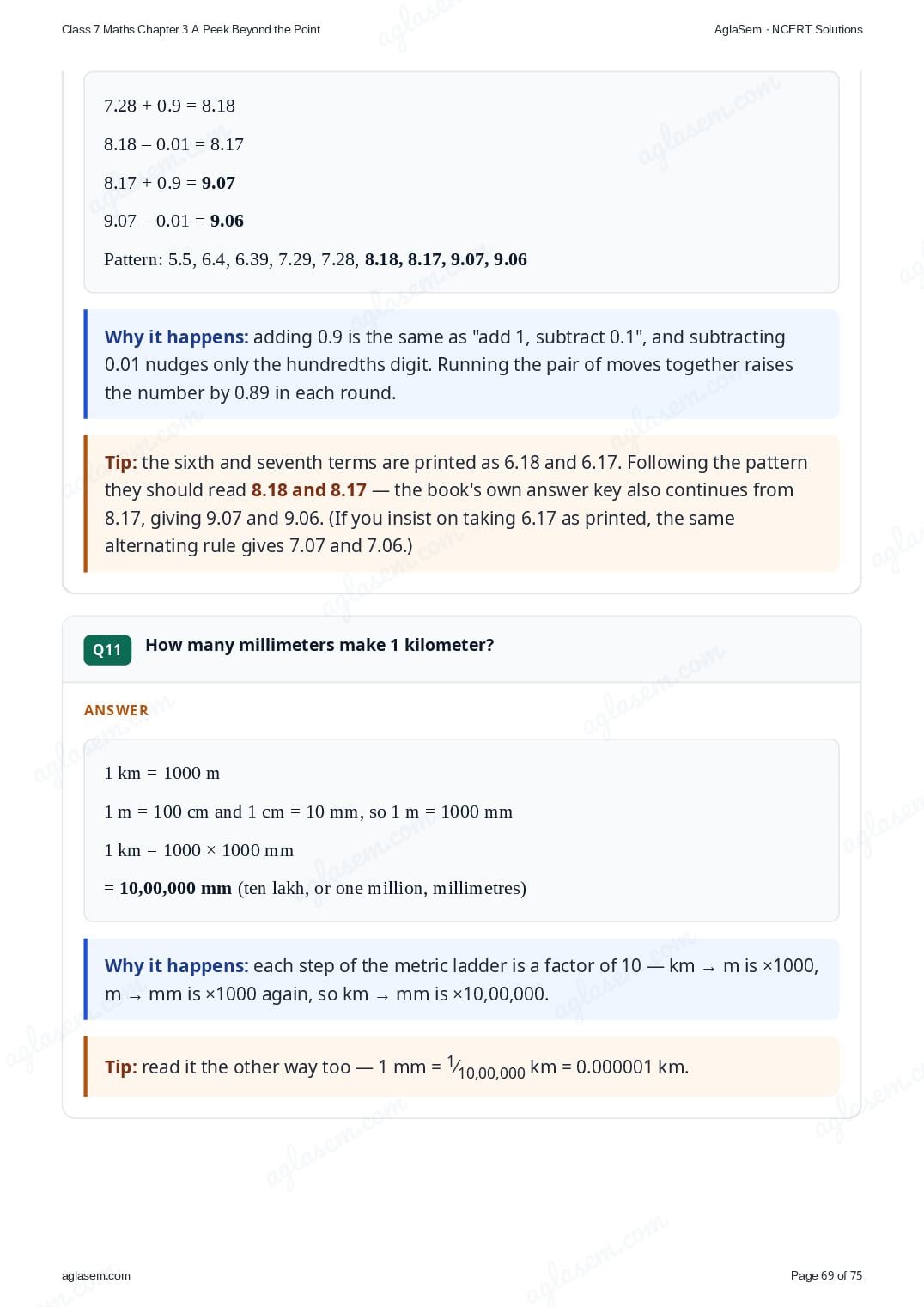
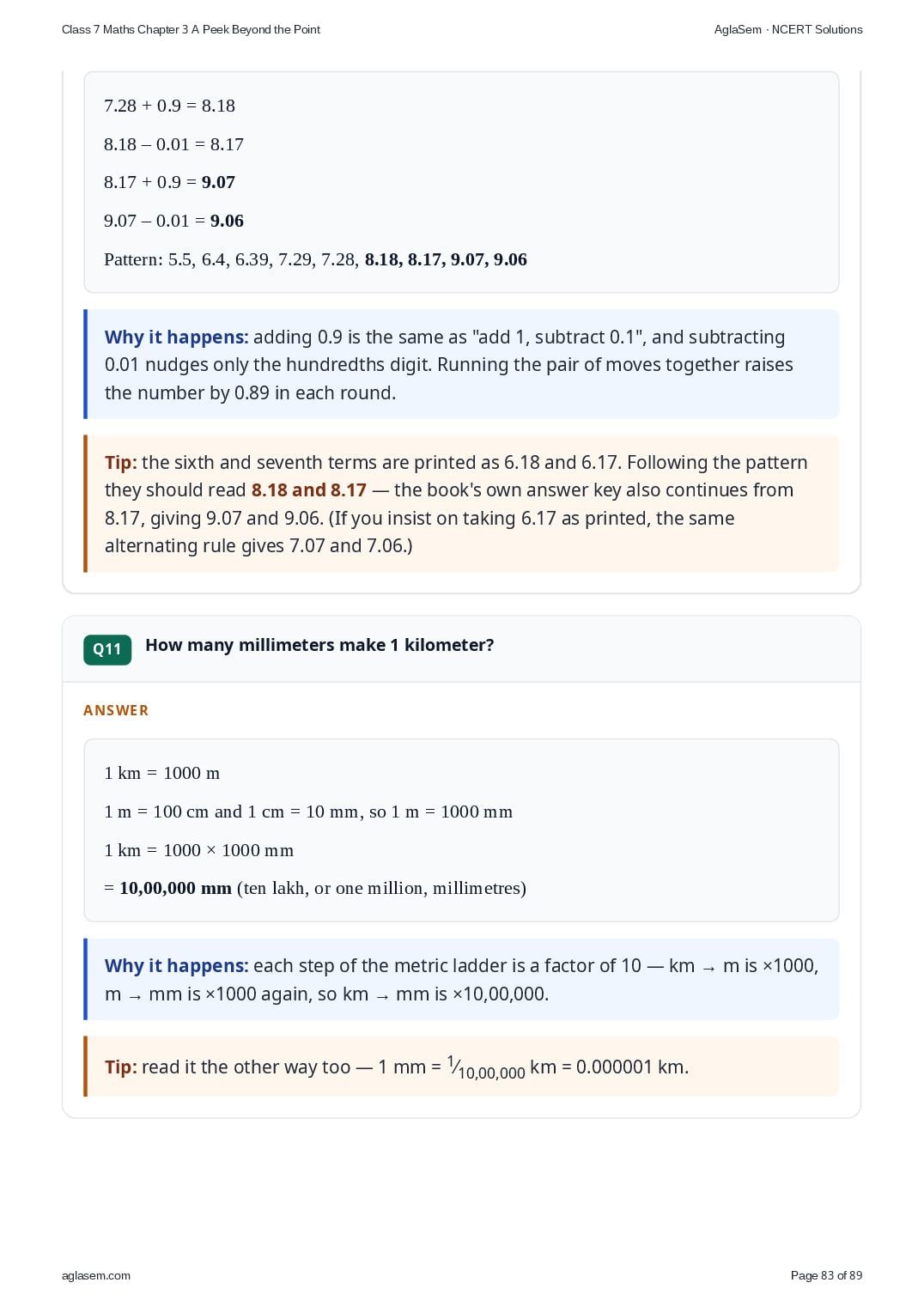
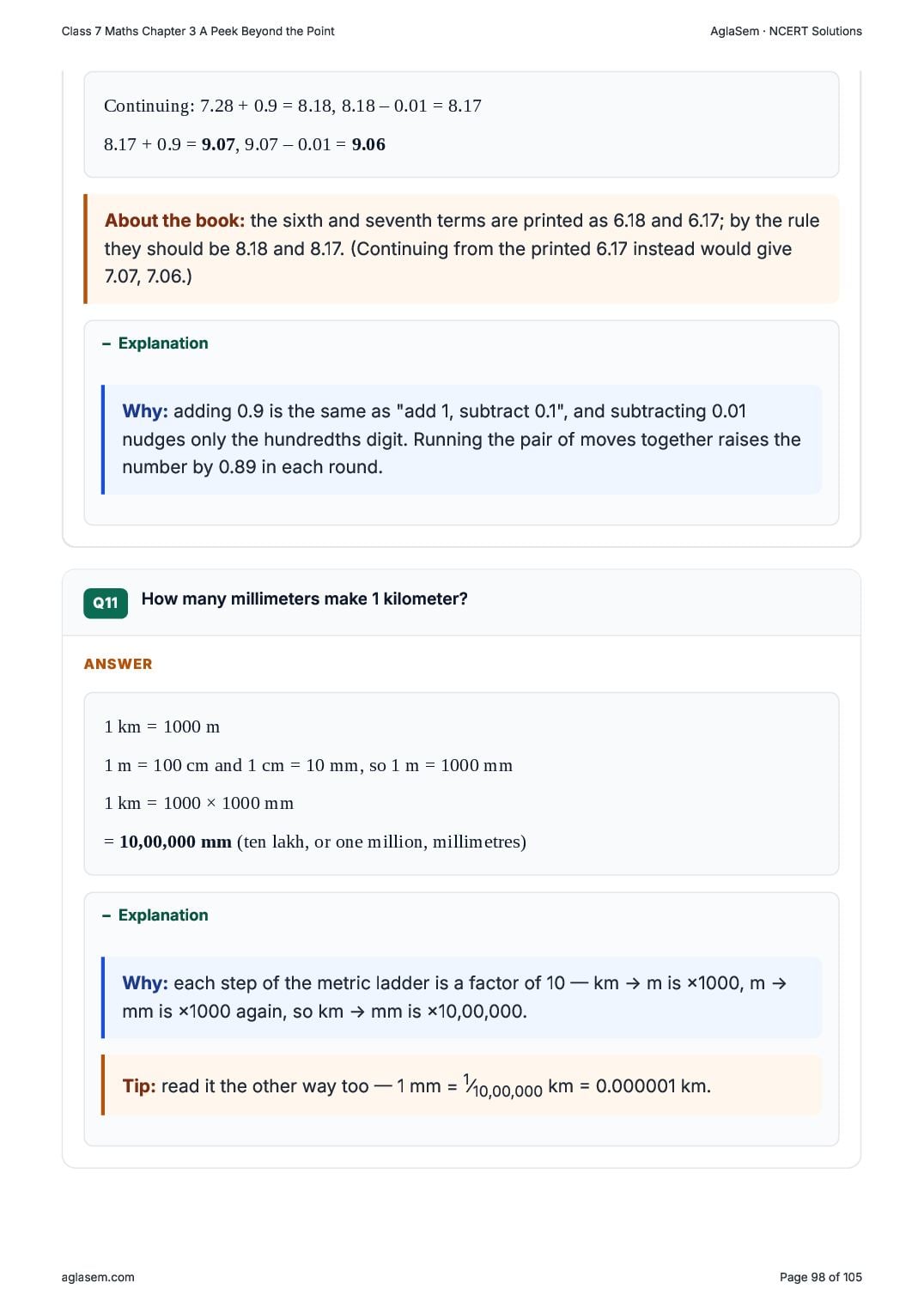
- Extend the pattern: 5.5, 6.4, 6.39, 7.29, 7.28, 6.18, 6.17, ____, _____
- How many millimeters make 1 kilometer?
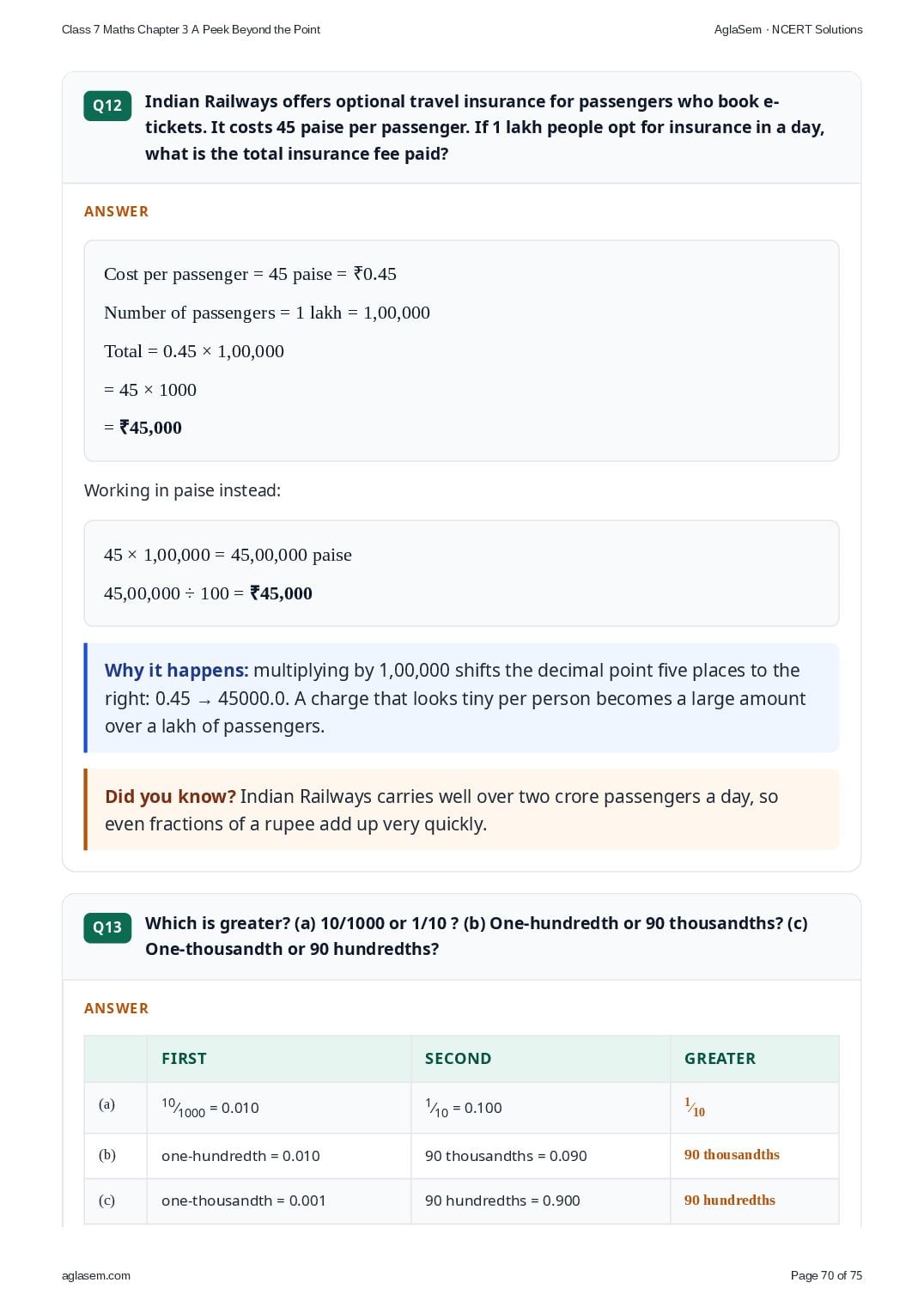
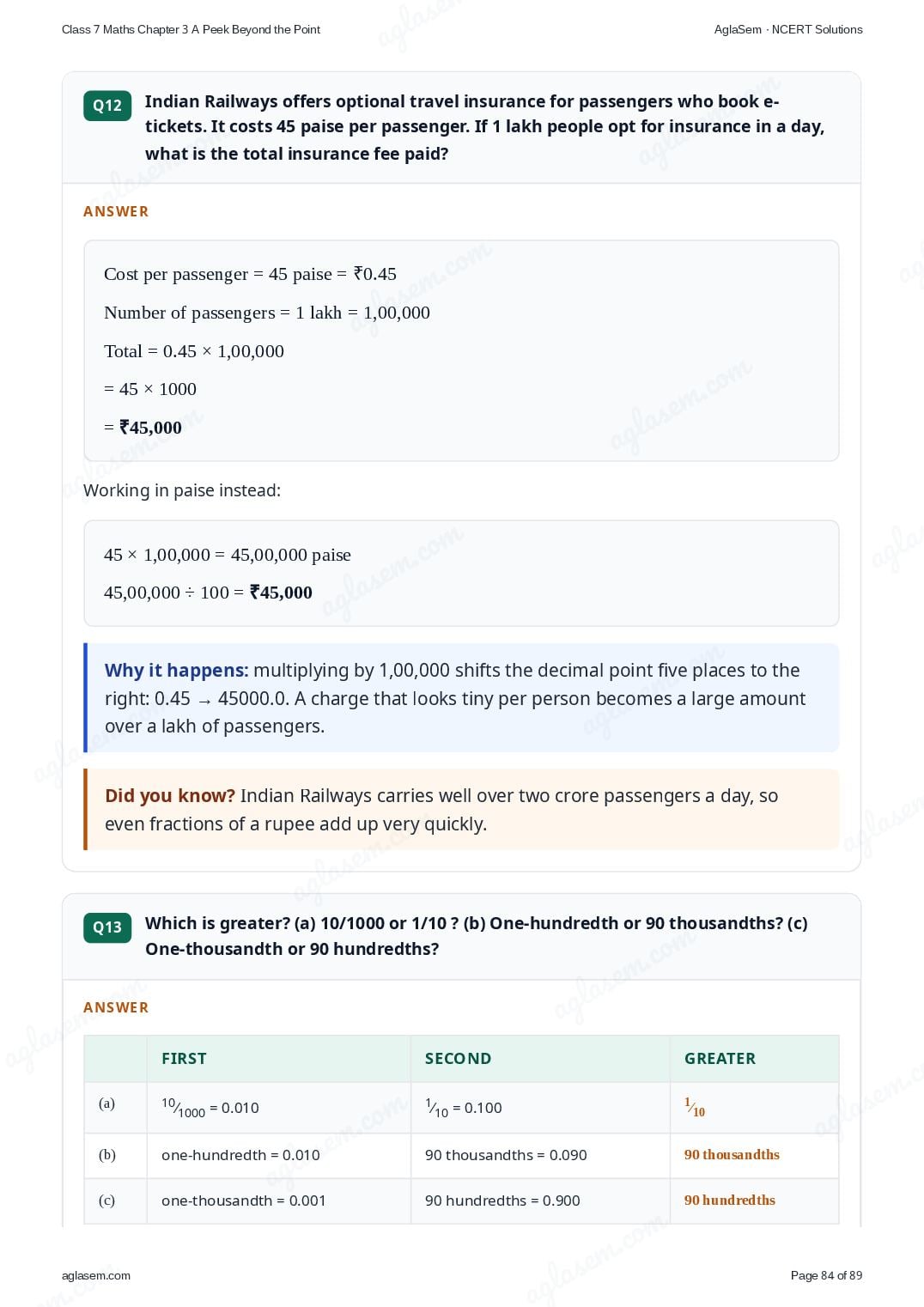
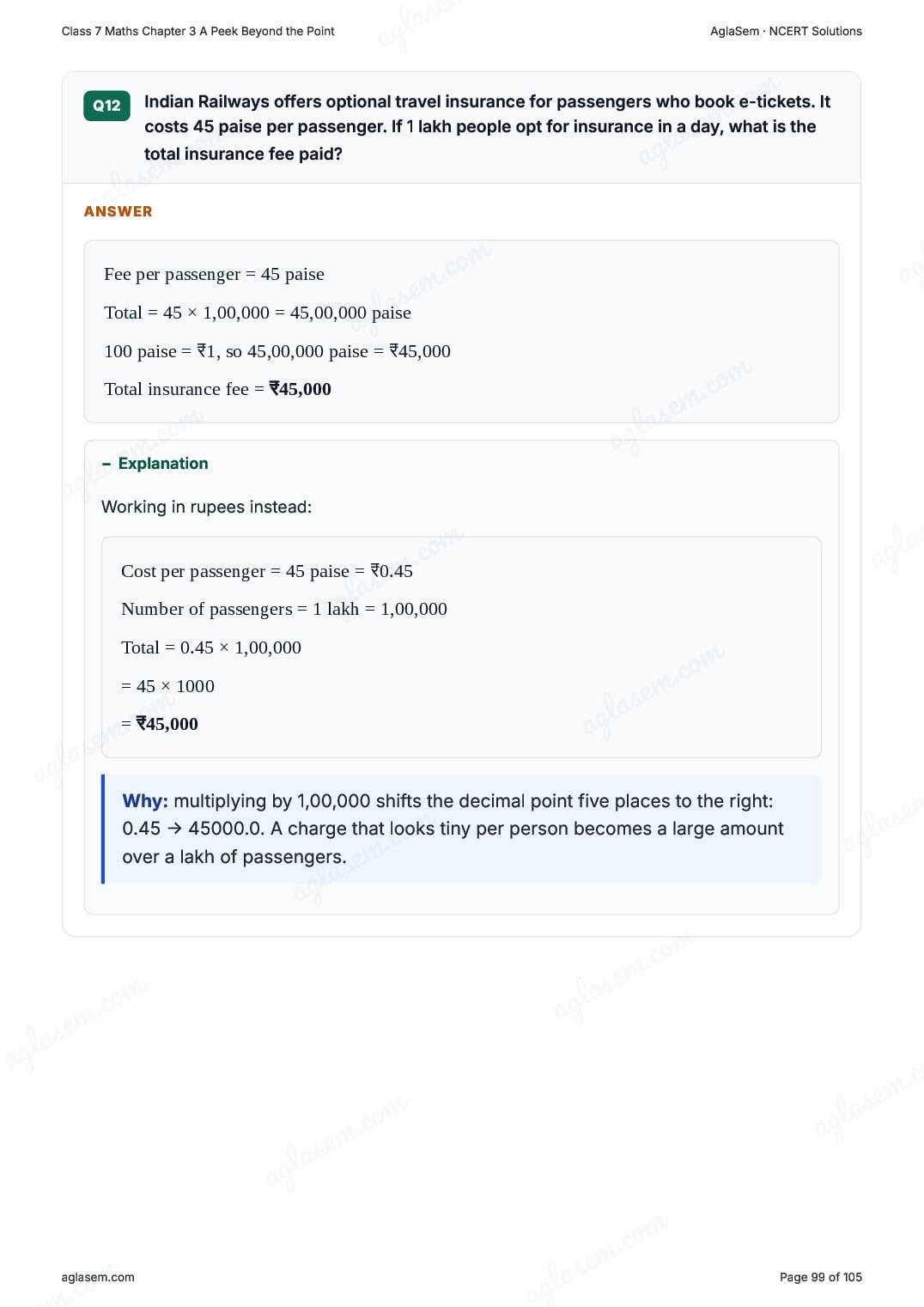
- Indian Railways offers optional travel insurance for passengers who book e-tickets. It costs 45 paise per passenger. If 1 lakh people opt for insurance in a day, what is the total insurance fee paid?
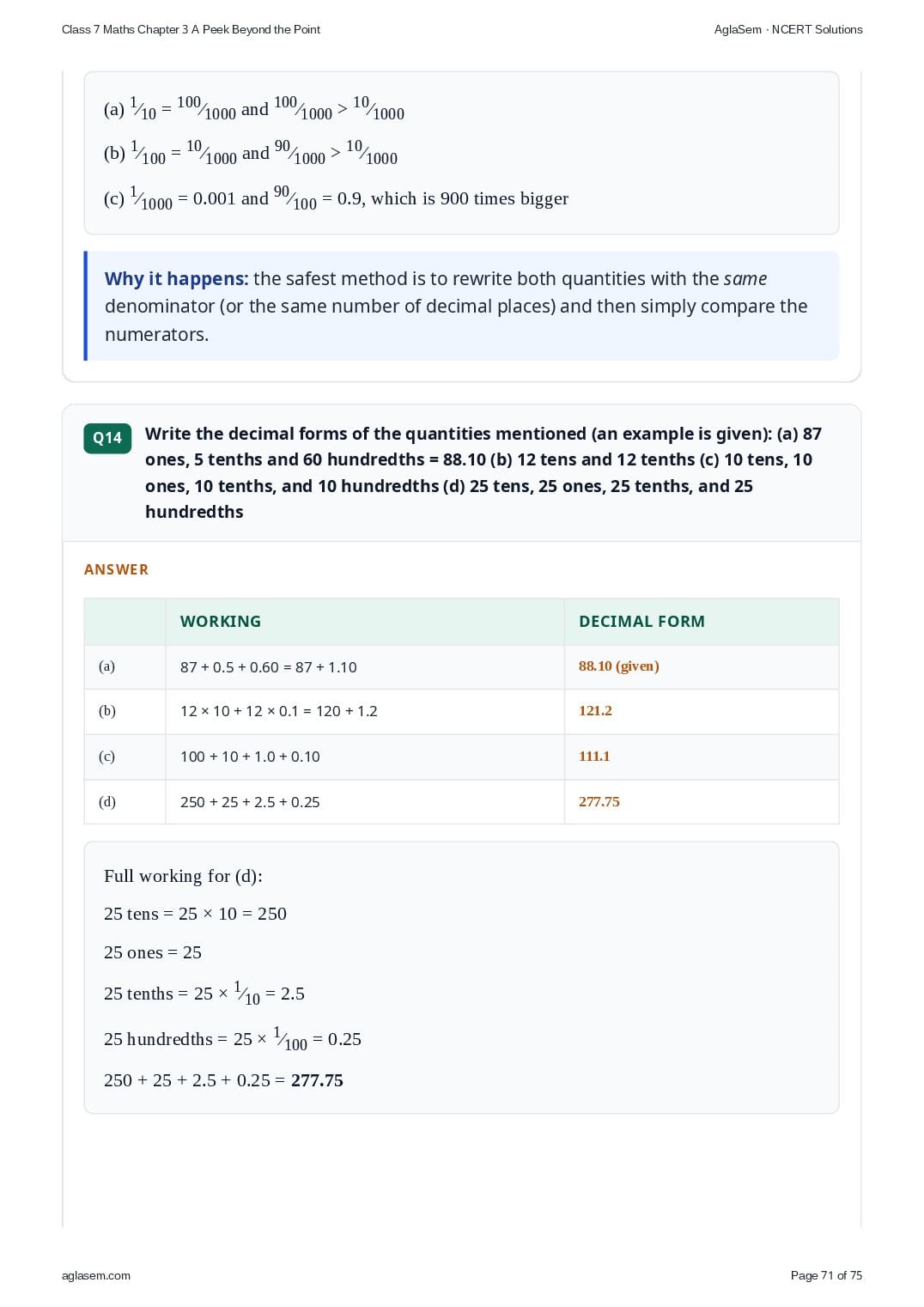
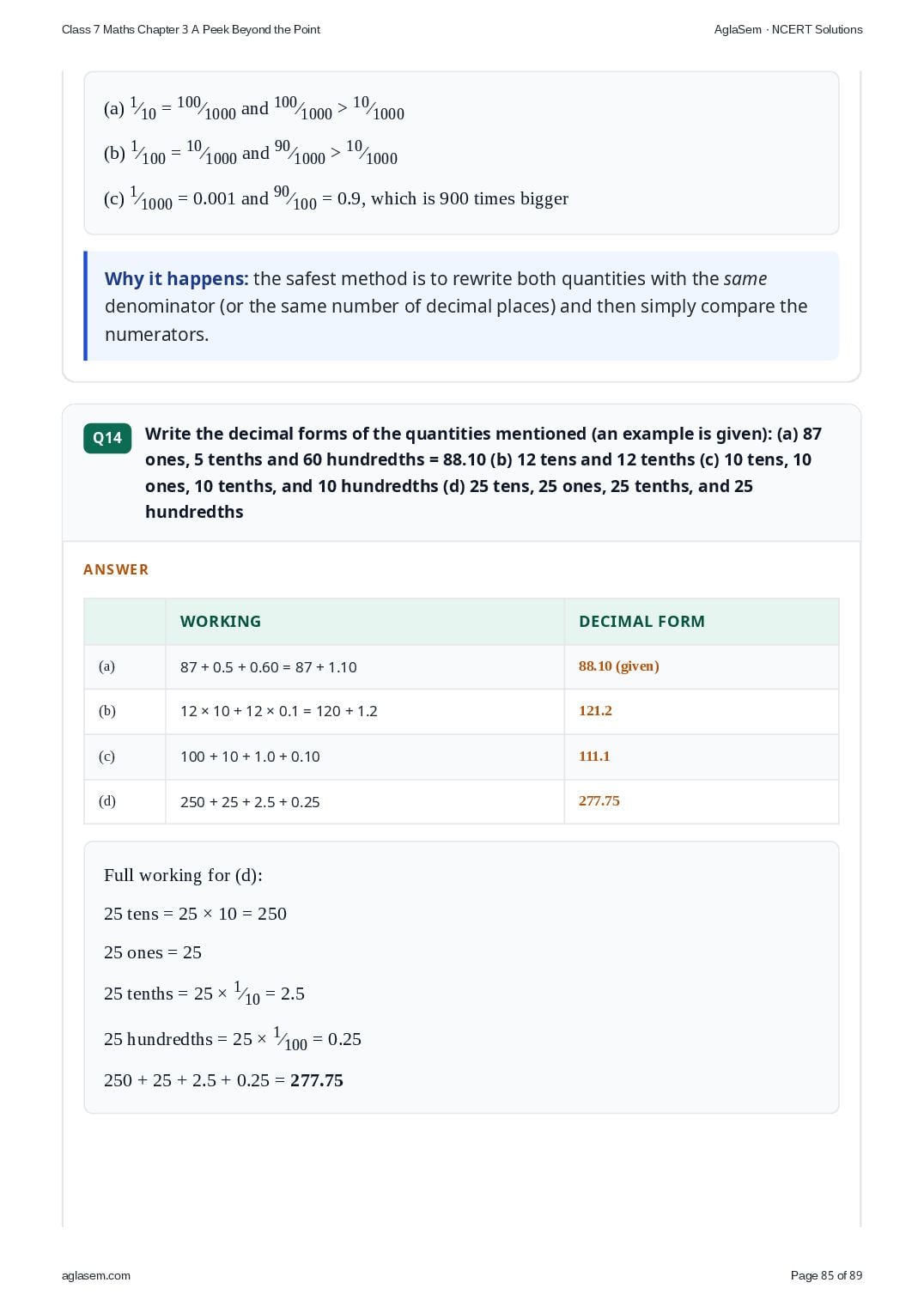
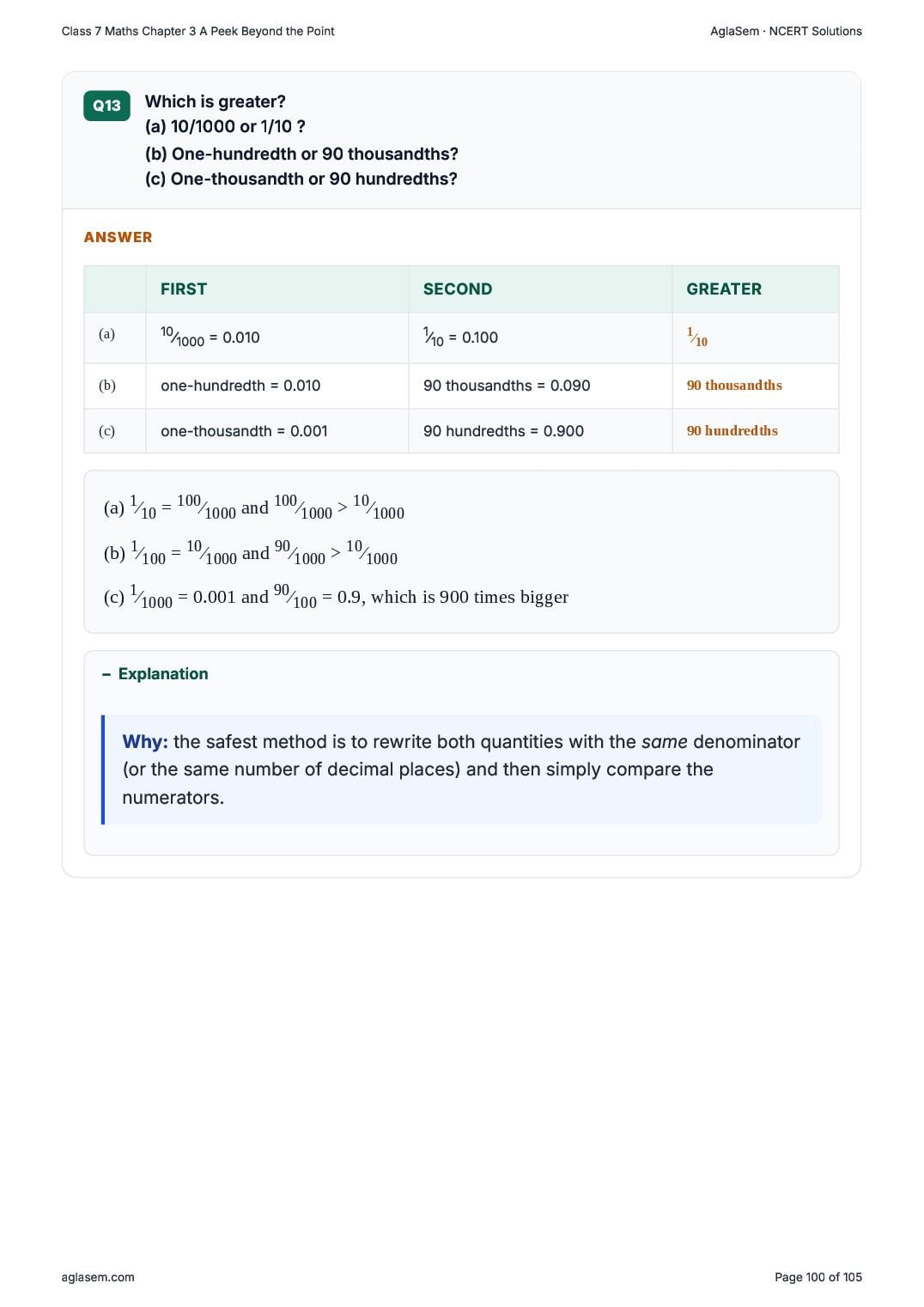
- Which is greater? (a) 10/1000 or 1/10 ? (b) One-hundredth or 90 thousandths? (c) One-thousandth or 90 hundredths?
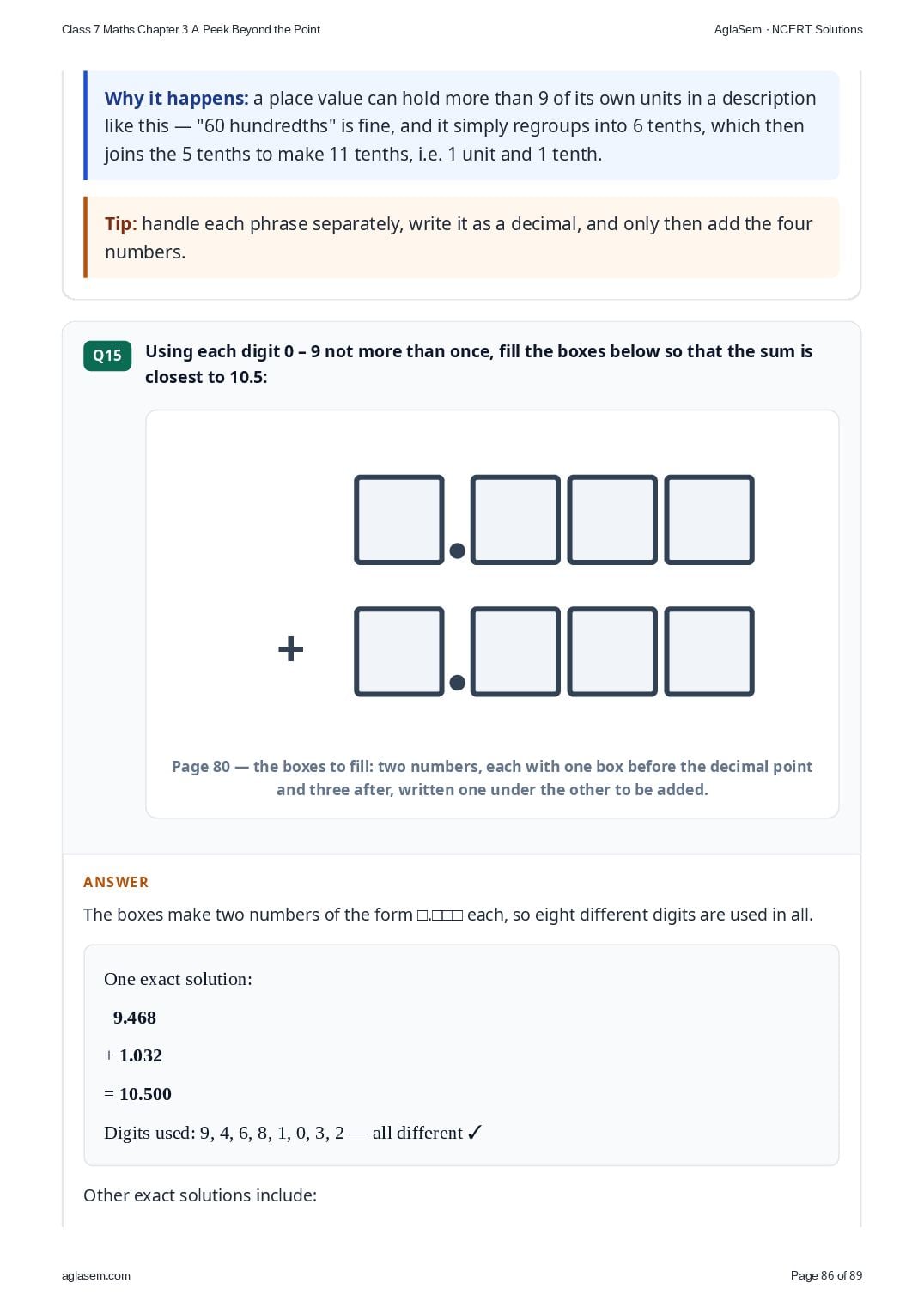
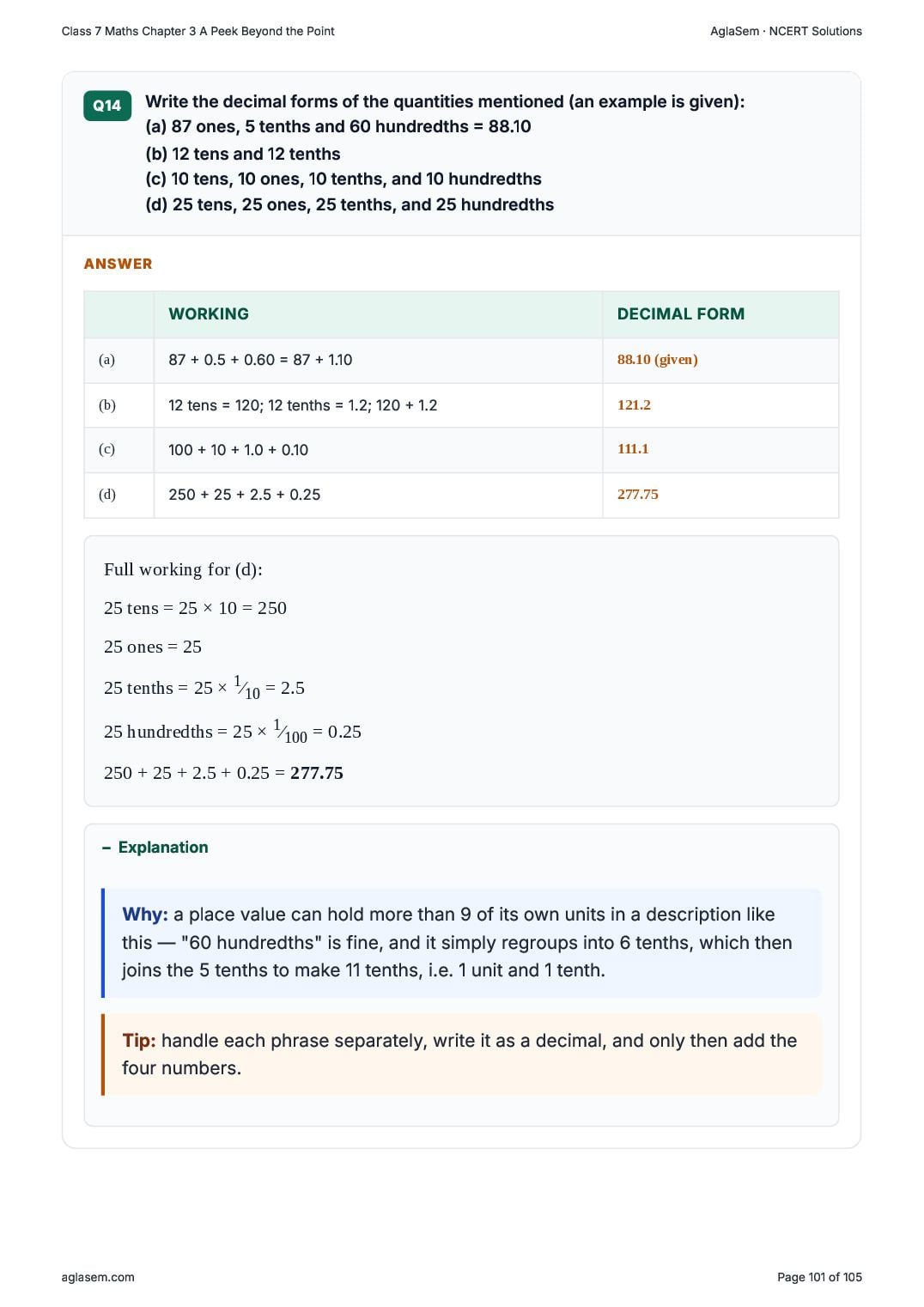
- Write the decimal forms of the quantities mentioned (an example is given): (a) 87 ones, 5 tenths and 60 hundredths = 88.10 (b) 12 tens and 12 tenths (c) 10 tens, 10 ones, 10 tenths, and 10 hundredths (d) 25 tens, 25 ones, 25 tenths, and 25 hundredths
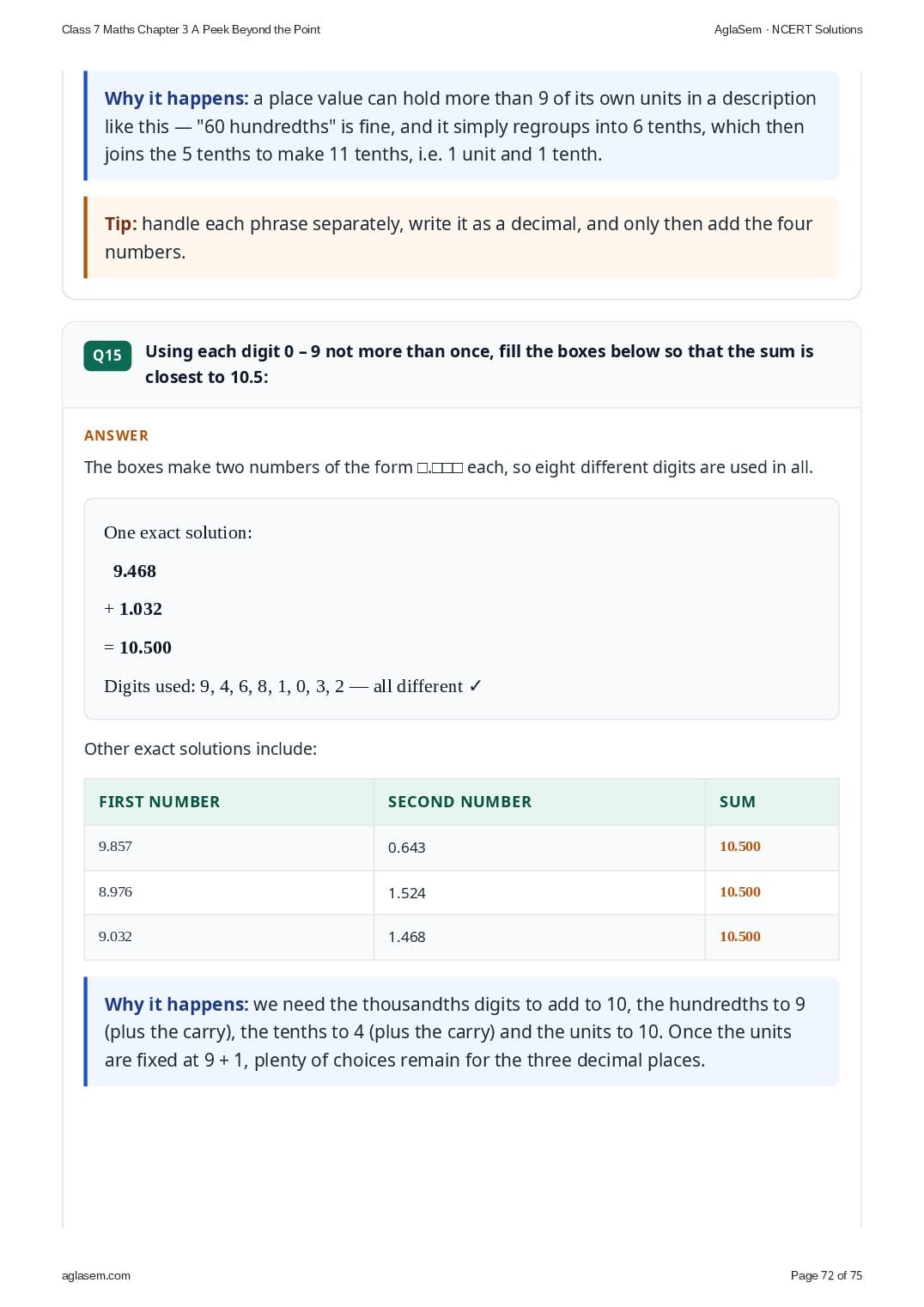
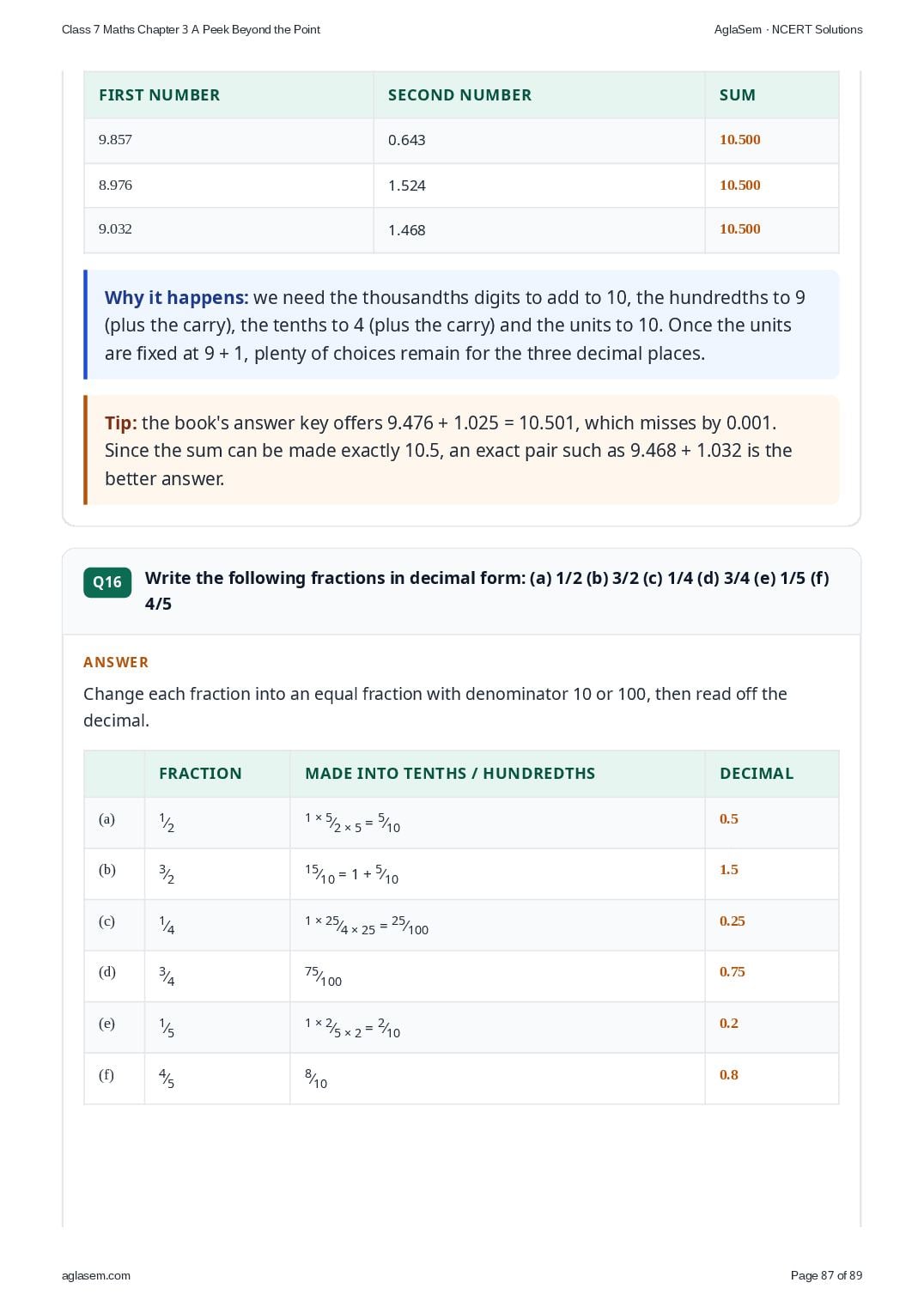
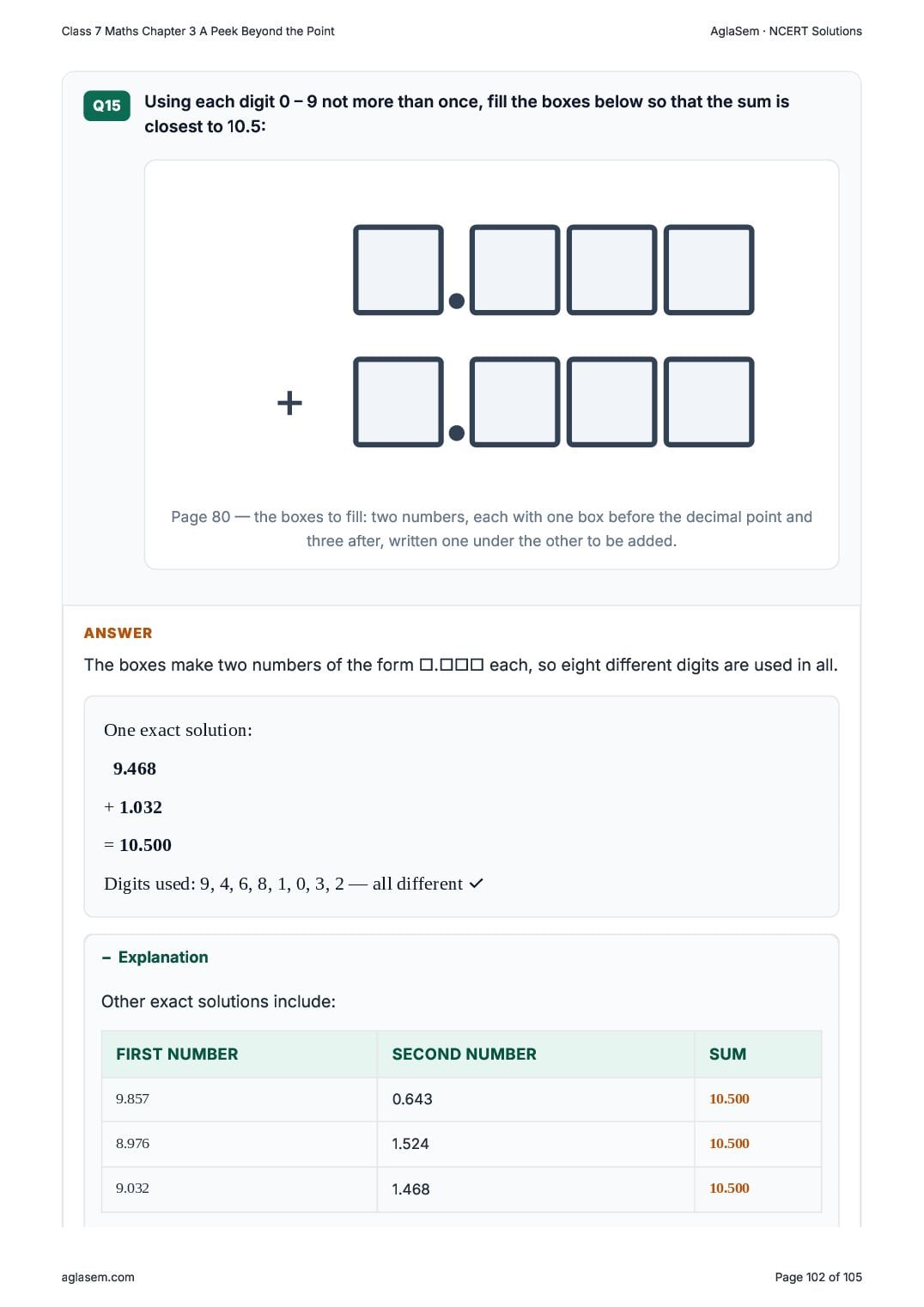
- Using each digit 0 – 9 not more than once, fill the boxes below so that the sum is closest to 10.5:
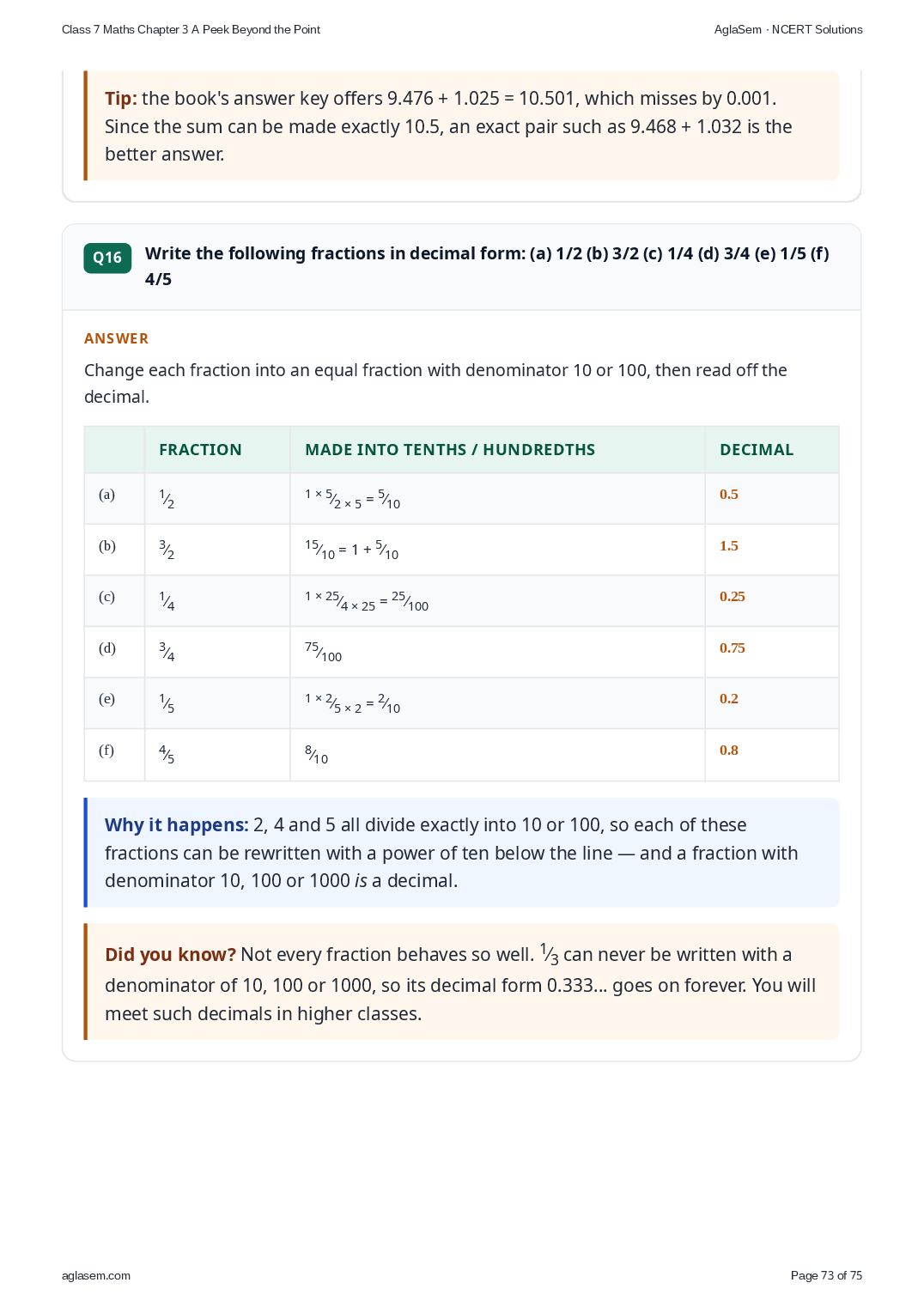
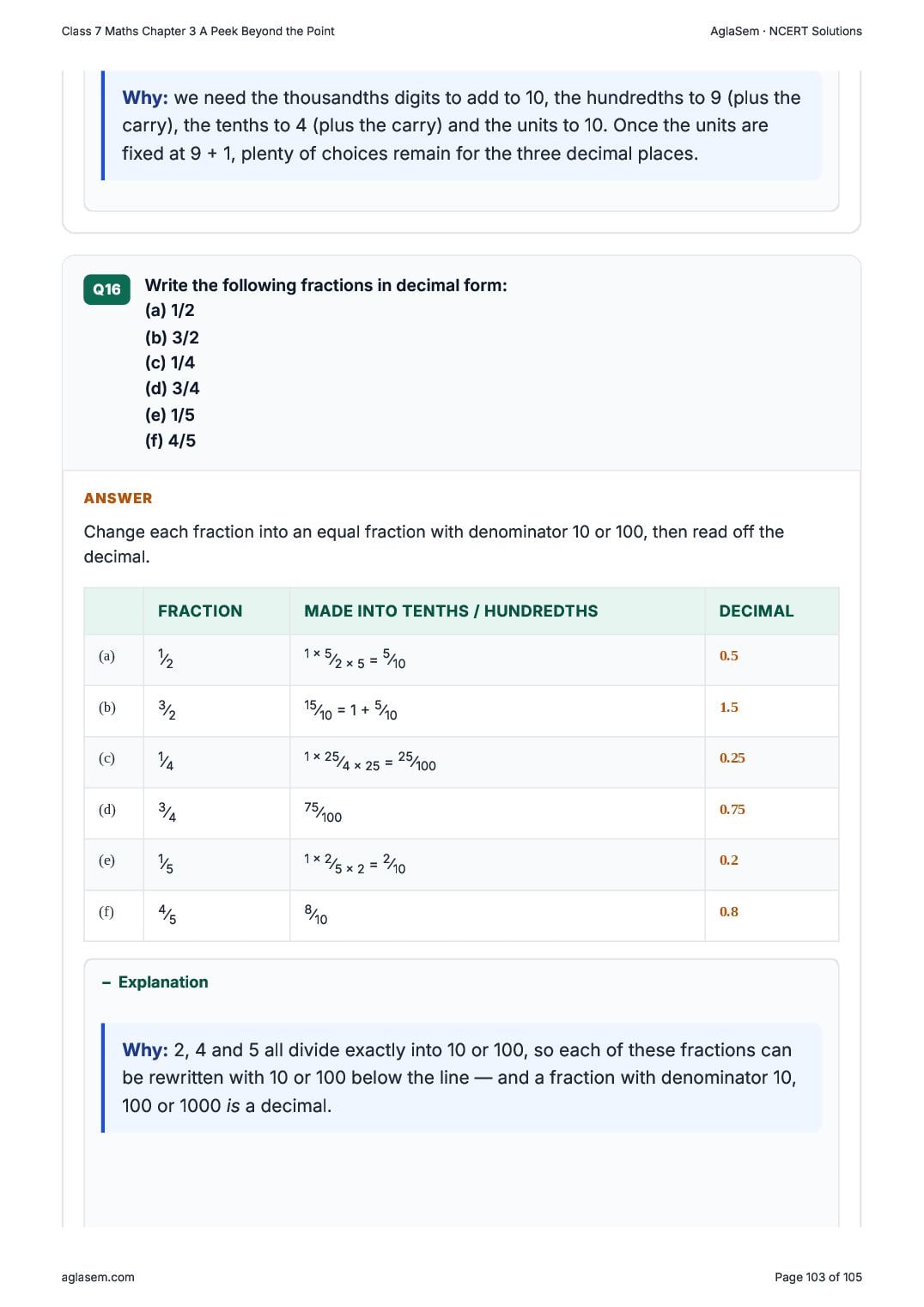
- Write the following fractions in decimal form: (a) 1/2 (b) 3/2 (c) 1/4 (d) 3/4 (e) 1/5 (f) 4/5
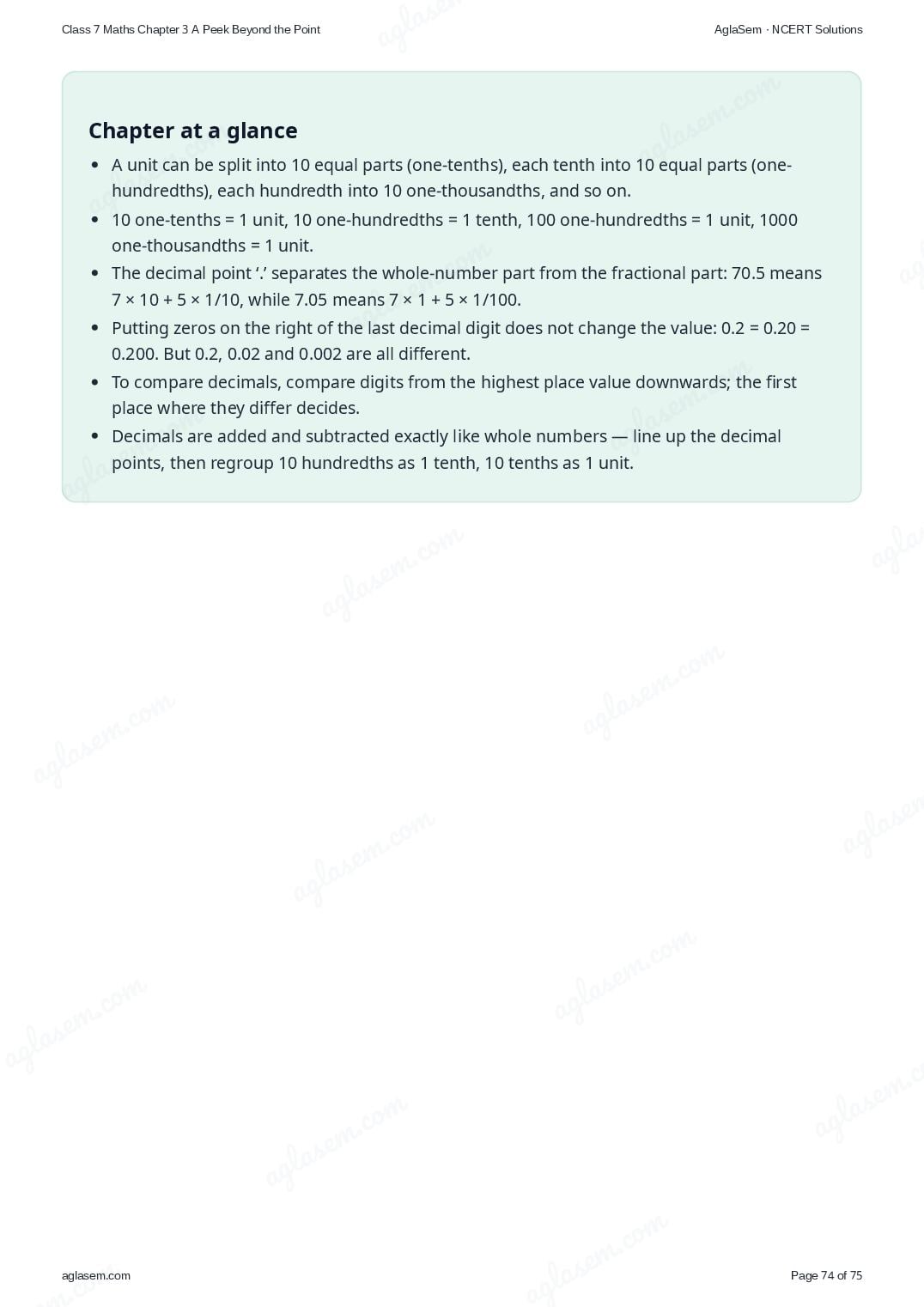
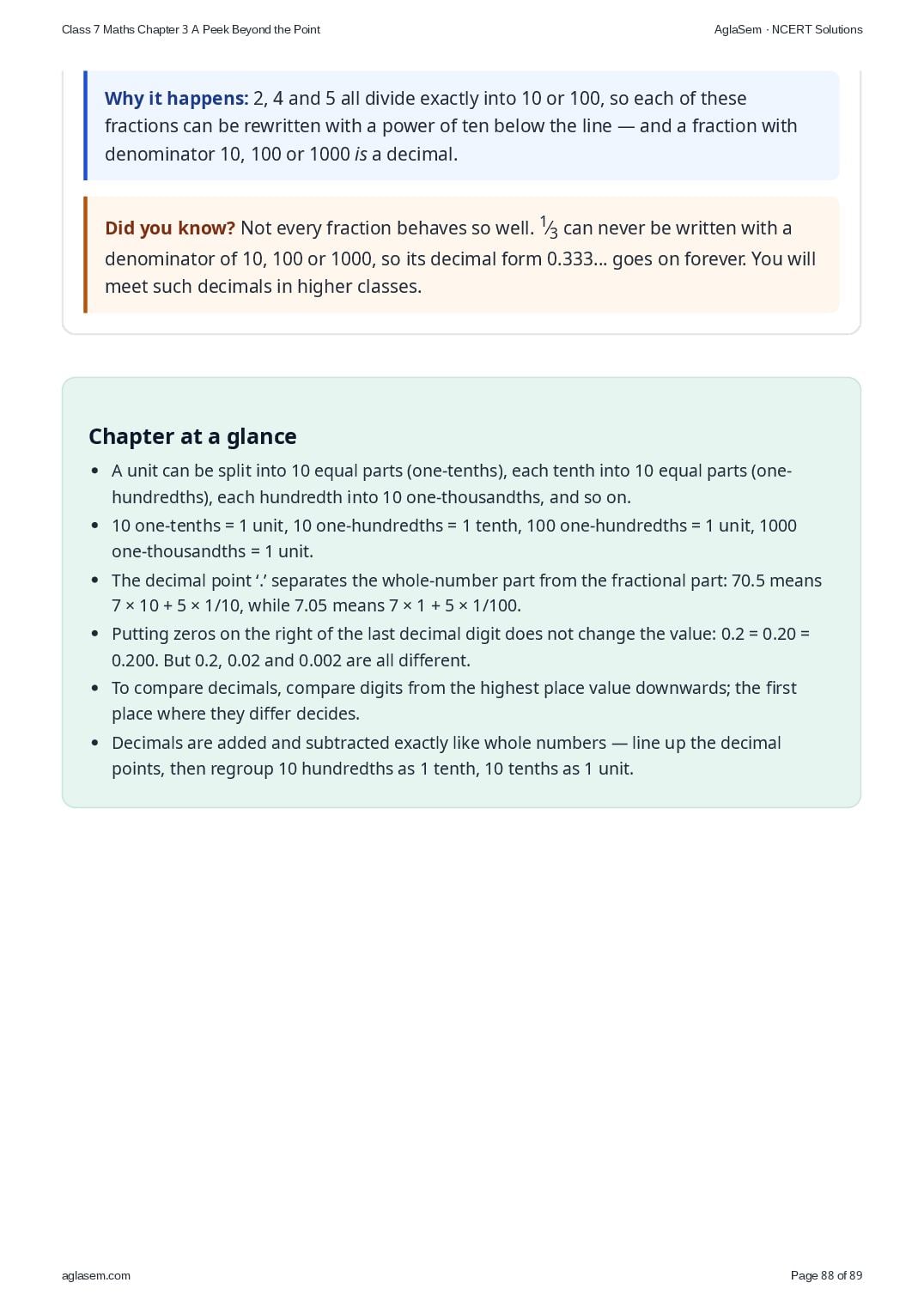
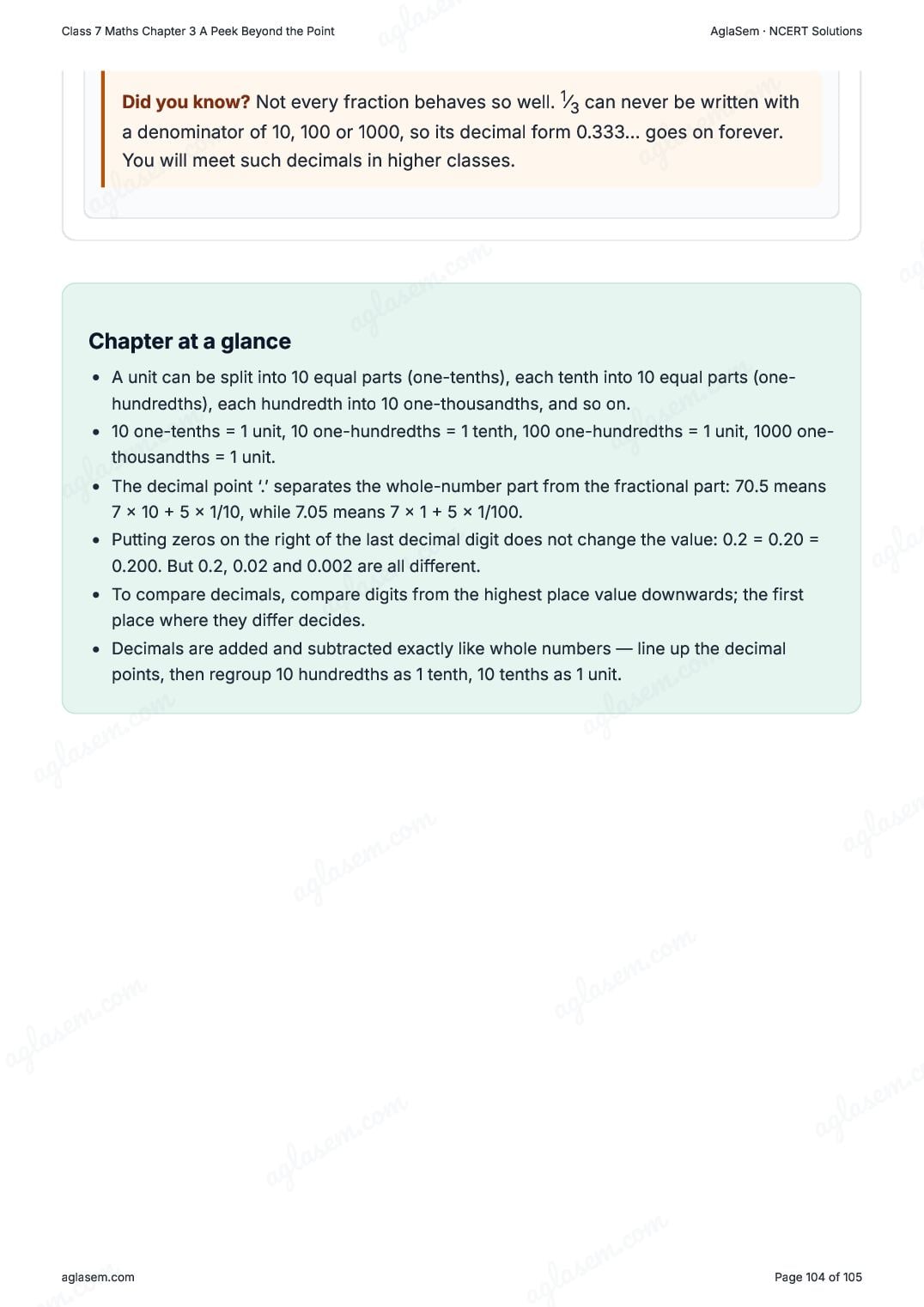
Chapter at a Glance
- A unit can be split into 10 equal parts (one-tenths), each tenth into 10 equal parts (one-hundredths), each hundredth into 10 one-thousandths, and so on.
- 10 one-tenths = 1 unit, 10 one-hundredths = 1 tenth, 100 one-hundredths = 1 unit, 1000 one-thousandths = 1 unit.
- The decimal point ‘.’ separates the whole-number part from the fractional part: 70.5 means 7 × 10 + 5 × 1/10, while 7.05 means 7 × 1 + 5 × 1/100.
- Putting zeros on the right of the last decimal digit does not change the value: 0.2 = 0.20 = 0.200. But 0.2, 0.02 and 0.002 are all different.
- To compare decimals, compare digits from the highest place value downwards; the first place where they differ decides.
- Decimals are added and subtracted exactly like whole numbers — line up the decimal points, then regroup 10 hundredths as 1 tenth, 10 tenths as 1 unit.
How to Download NCERT Solutions for Class 7 Maths Chapter 3 PDF
Follow these simple steps to get the a Peek Beyond the Point questions-and-answers PDF from Ganita Prakash.
- Search NCERT Solutions for Class 7 Maths Chapter 3 aglasem and open this page.
- Read the exercise questions with answers for a Peek Beyond the Point shown above.
- Click the Download PDF link to save the a Peek Beyond the Point solutions to your device.
NCERT Solutions for Class 7 Maths – All Chapters
There are more chapters to study besides a Peek Beyond the Point in Maths. Here are the NCERT Solutions for all chapters of Class 7 Maths.
- Chapter 1 Large Numbers Around Us
- Chapter 2 Arithmetic Expressions
- Chapter 3 a Peek Beyond the Point
- Chapter 4 Expressions Using Letter Numbers
- Chapter 5 Parallel and Intersecting Lines
- Chapter 6 Number Play
- Chapter 7 a Tale of Three Intersecting Lines
- Chapter 8 Working with Fractions
NCERT Solutions for Class 7 – All Subjects
Just like Chapter 3 of Maths, you can get the exercise questions with answers for every other subject of Class 7. Here are the NCERT Solutions for all subjects of Class 7.
NCERT Solutions for Class 7 Maths Chapter 3 – An Overview
The key highlights of this study material are as follows.
| Aspects | Details |
|---|---|
| Class | Class 7 |
| Subject | Maths |
| Chapter Number | Chapter 3 |
| Chapter Name | a Peek Beyond the Point |
| Book Name | Ganita Prakash |
| Book By | NCERT (National Council of Educational Research and Training) |
| Educational Resource Here | NCERT Solutions of Class 7 Maths Chapter 3 for all exercises |
| More Questions Answers of This Subject | NCERT Solutions for Class 7 Maths |
| Download Book Chapter | NCERT Book Class 7 Maths |
| All Questions Answers For This Class | NCERT Solutions for Class 7 |
| Complete Solutions | NCERT Solutions |
NCERT Solutions for Class 7 Maths Chapter 3 a Peek Beyond the Point – FAQs
What are the NCERT Solutions for Class 7 Maths Chapter 3 a Peek Beyond the Point?
They are the complete, step-by-step answers to all the exercise and in-text questions of Chapter 3 a Peek Beyond the Point from the NCERT Class 7 Maths textbook Ganita Prakash, written by experts as per the latest NCERT syllabus.
How can I download the Class 7 Maths Chapter 3 solutions PDF for free?
Open this page on aglasem, read the a Peek Beyond the Point questions with answers, and click the “Download Solutions PDF” link. The Class 7 Maths Chapter 3 NCERT Solutions PDF is completely free to download.
Are these NCERT Solutions as per the latest 2026-27 syllabus?
Yes. The NCERT Solutions for Class 7 Maths Chapter 3 are based on the latest NCERT textbook Ganita Prakash and the current 2026-27 CBSE syllabus, so the questions and answers match what you study in class.
Where can I get NCERT Solutions for the other chapters of Class 7 Maths?
You can find the answers to every chapter on the NCERT Solutions for Class 7 Maths page, and solutions for every subject on the NCERT Solutions for Class 7 page.
How do NCERT Solutions help in exam preparation?
They show the correct method to solve each question, help you write answers the way they are expected in exams, let you check and correct your own work, and save revision time — which together improve your marks in Class 7 Maths.
If you have any queries on NCERT Solutions for Class 7 Maths Chapter 3 a Peek Beyond the Point, then please ask in the comments below.