NCERT Solutions for Class 7 Maths Chapter 8 Working with Fractions provide clear, step-by-step answers to every exercise and in-text question from the chapter Working with Fractions of the NCERT textbook Ganita Prakash. Prepared by subject experts as per the latest NCERT (CBSE) syllabus for 2026-27, these NCERT Solutions for Class 7 Maths help you understand each concept, write exam-ready answers, and check your own solutions. You can read them online below or download the free Class 7 Maths Chapter 8 question-answer PDF.
NCERT Solutions for Class 7 Maths Chapter 8 Working with Fractions
- Class: Class 7
- Subject: Maths
- Chapter: Chapter 8 – Working with Fractions
- Textbook: Ganita Prakash (NCERT)
- Study material: NCERT Solutions – questions with answers, free PDF
These solutions answer all the exercise questions of Chapter 8 Working with Fractions — including the in-text questions, short-answer and long-answer questions, and activities — with complete explanations so you can follow the method, not just the final answer. Read the full solutions below.
NCERT Solutions Class 7 Maths Chapter 8 Working with Fractions View Download
NCERT Solutions for Class 7 Maths Chapter 8 PDF Download
You can read the NCERT Solutions for Class 7 Maths Chapter 8 online above, or download the complete question-answer PDF to study Working with Fractions offline at any time.
NCERT Solutions for Class 7 Maths Chapter 8 PDF Download Link – Click Here to Download Solutions PDF
Questions Covered in This Chapter
These NCERT Solutions answer all 62 questions of this chapter. The questions solved are:
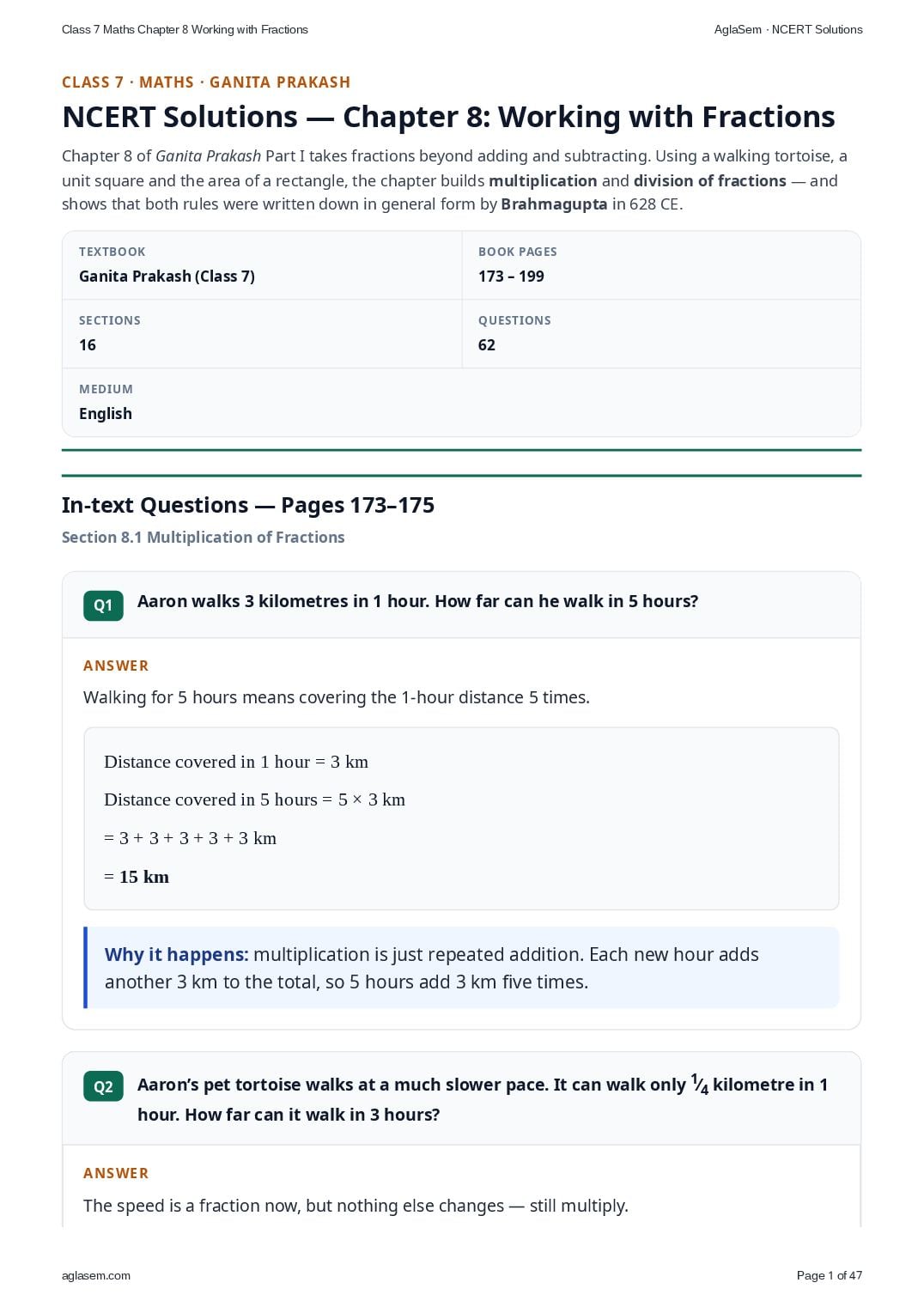
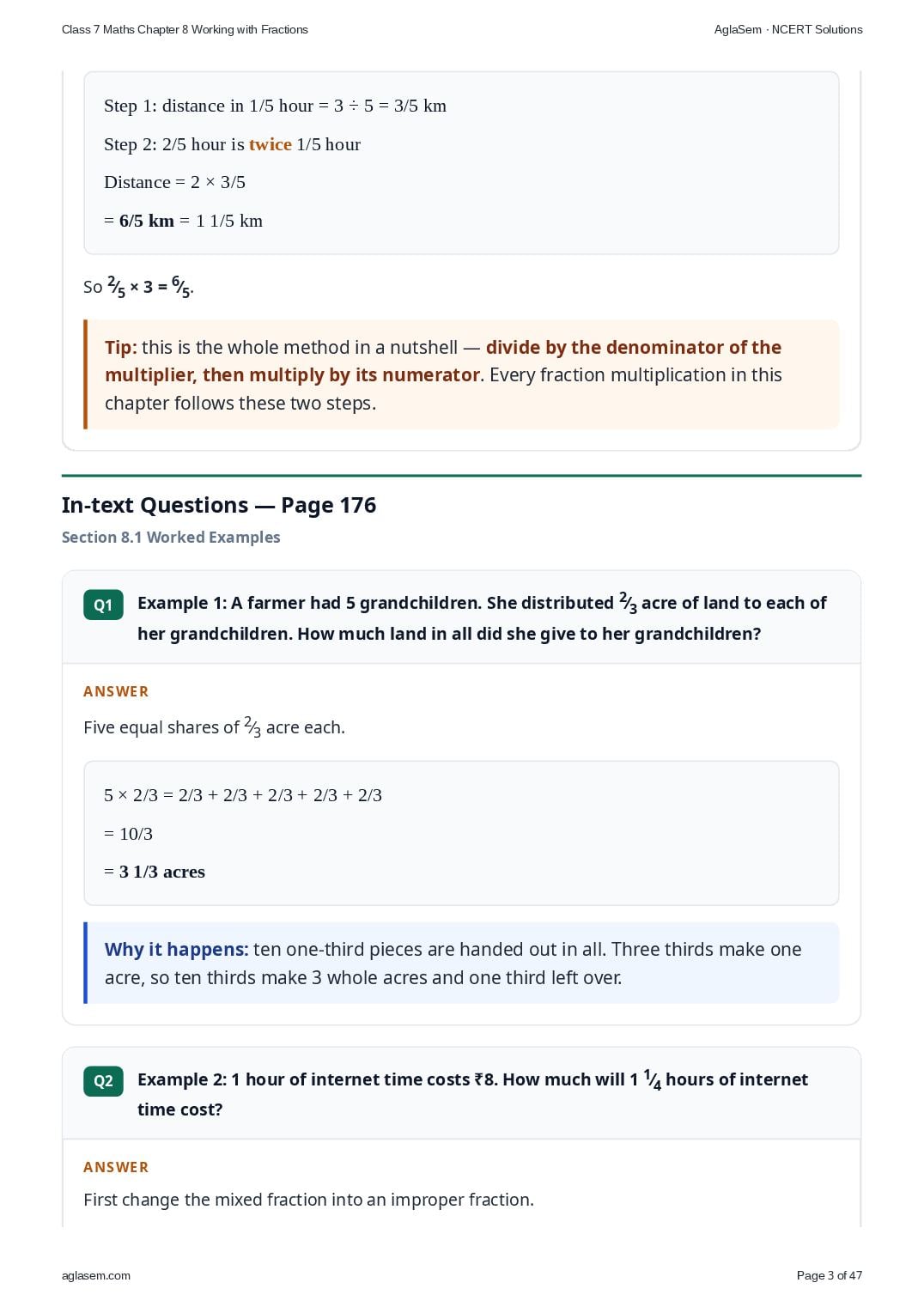
- Aaron walks 3 kilometres in 1 hour. How far can he walk in 5 hours?
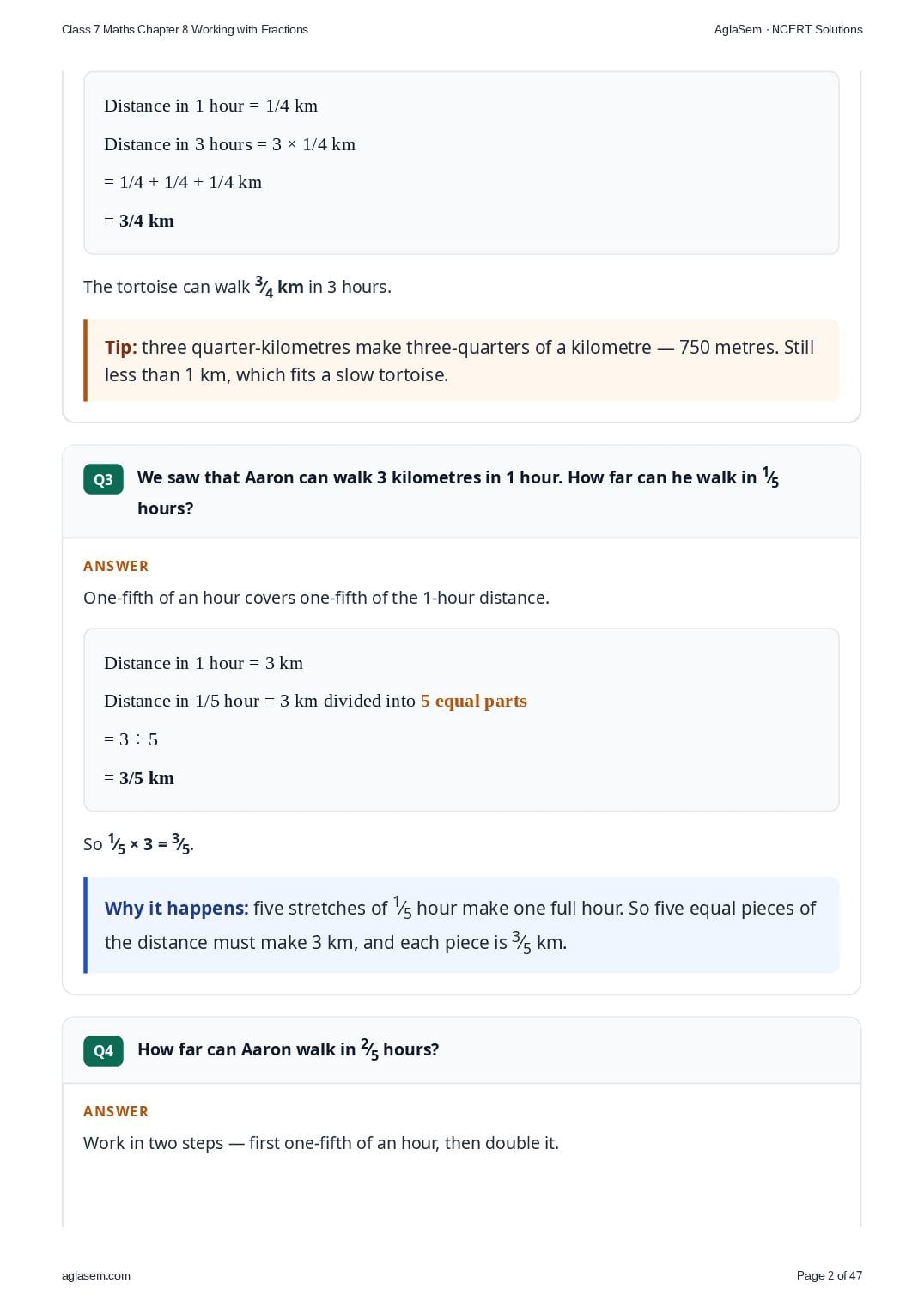
- Aaron’s pet tortoise walks at a much slower pace. It can walk only 1 ⁄ 4 kilometre in 1 hour. How far can it walk in 3 hours?
- We saw that Aaron can walk 3 kilometres in 1 hour. How far can he walk in 1 ⁄ 5 hours?
- How far can Aaron walk in 2 ⁄ 5 hours?
- Example 1: A farmer had 5 grandchildren. She distributed 2 ⁄ 3 acre of land to each of her grandchildren. How much land in all did she give to her grandchildren?
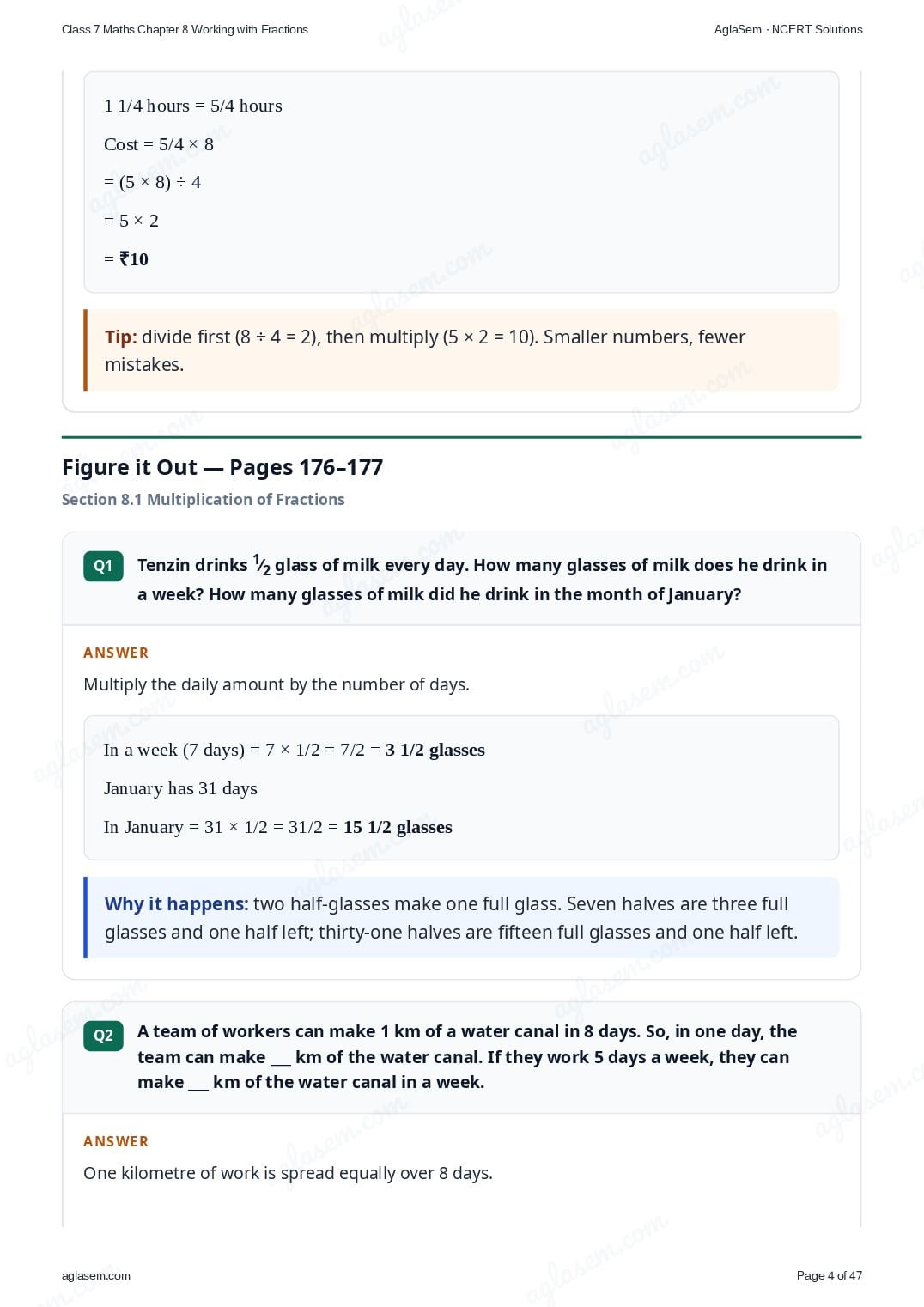
- Example 2: 1 hour of internet time costs ₹8. How much will 1 1 ⁄ 4 hours of internet time cost?
- Tenzin drinks 1 ⁄ 2 glass of milk every day. How many glasses of milk does he drink in a week? How many glasses of milk did he drink in the month of January?
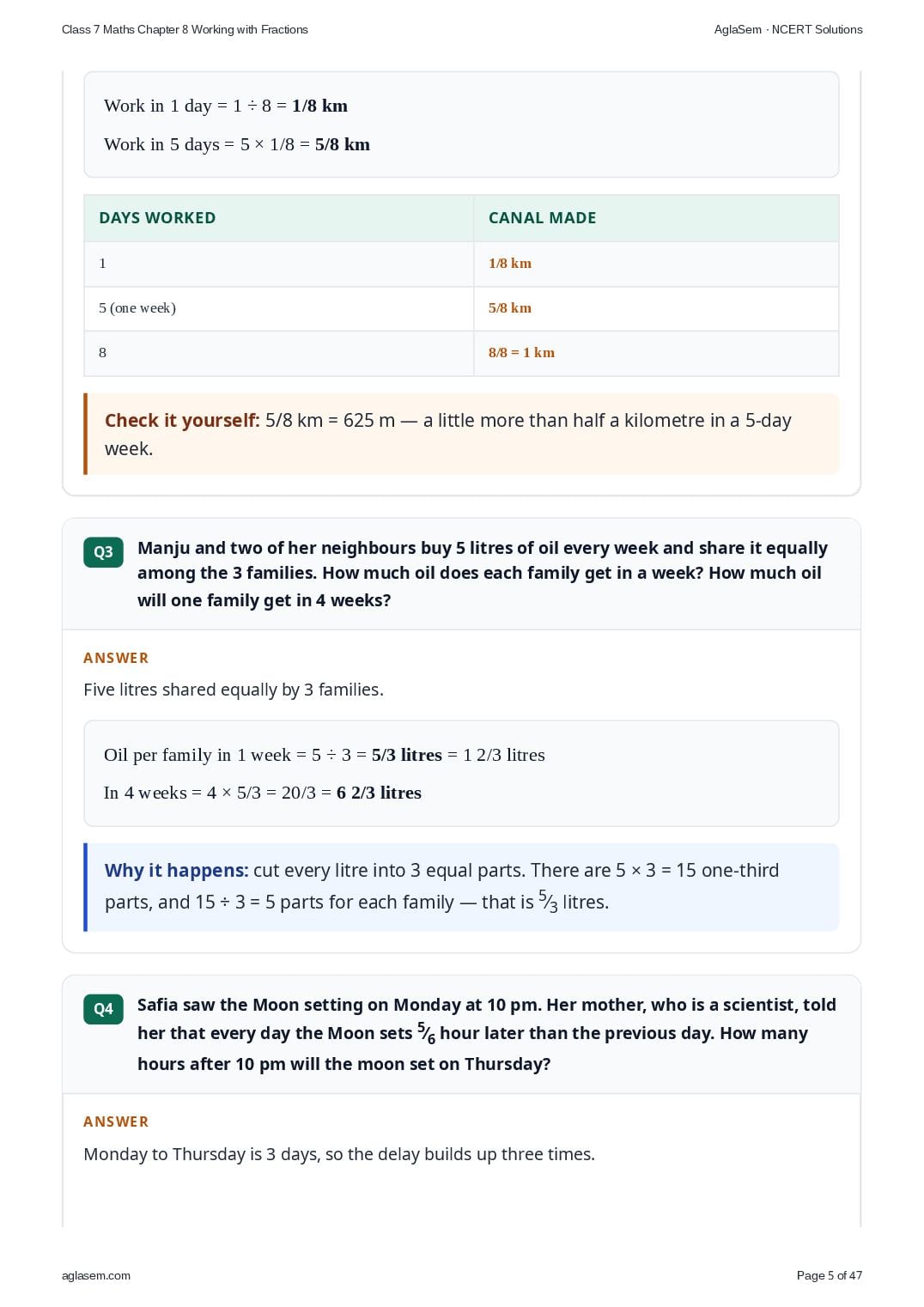
- A team of workers can make 1 km of a water canal in 8 days. So, in one day, the team can make ___ km of the water canal. If they work 5 days a week, they can make ___ km of the water canal in a week.
- Manju and two of her neighbours buy 5 litres of oil every week and share it equally among the 3 families. How much oil does each family get in a week? How much oil will one family get in 4 weeks?
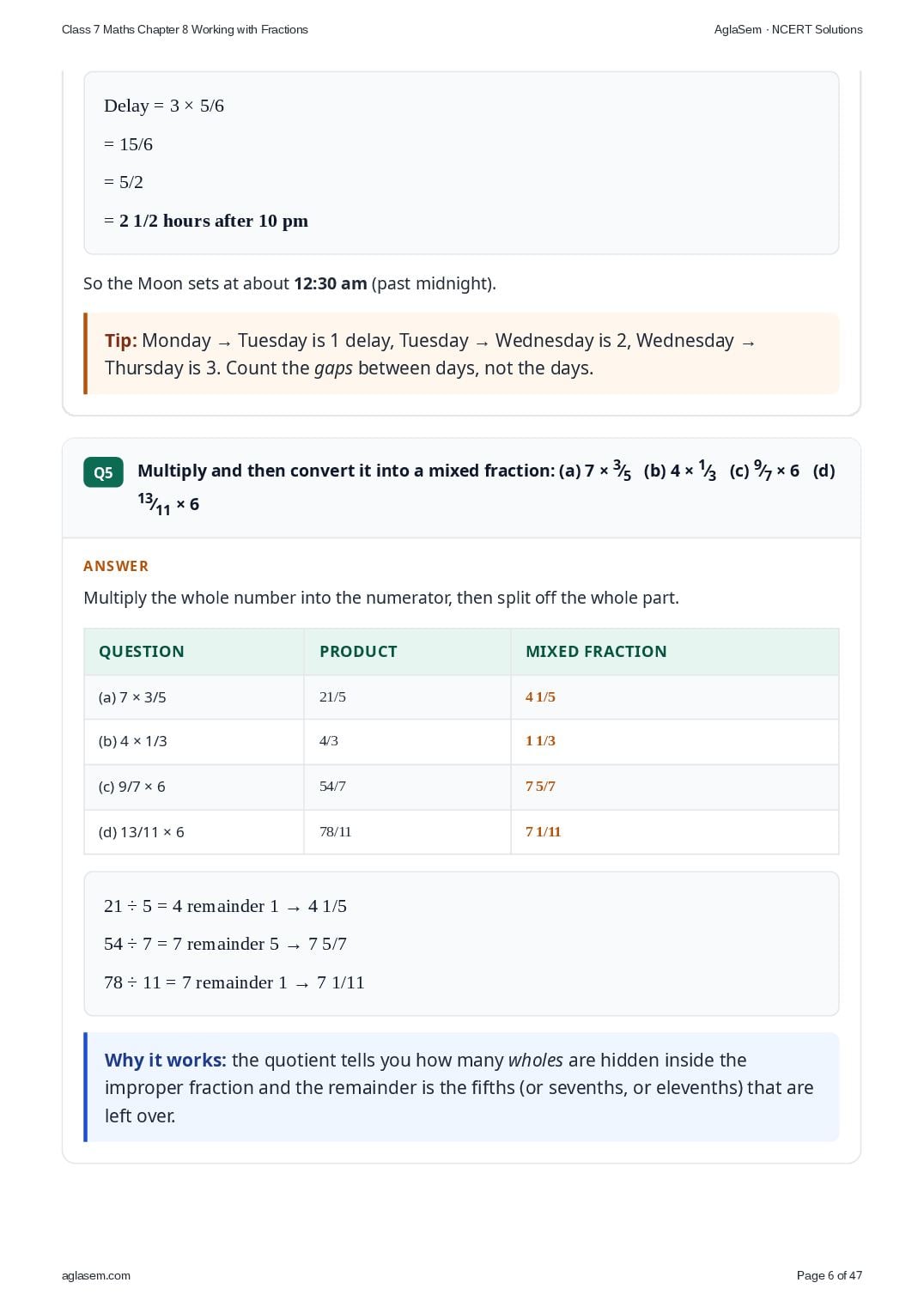
- Safia saw the Moon setting on Monday at 10 pm. Her mother, who is a scientist, told her that every day the Moon sets 5 ⁄ 6 hour later than the previous day. How many hours after 10 pm will the moon set on Thursday?
- Multiply and then convert it into a mixed fraction: (a) 7 × 3 ⁄ 5 (b) 4 × 1 ⁄ 3 (c) 9 ⁄ 7 × 6 (d) 13 ⁄ 11 × 6
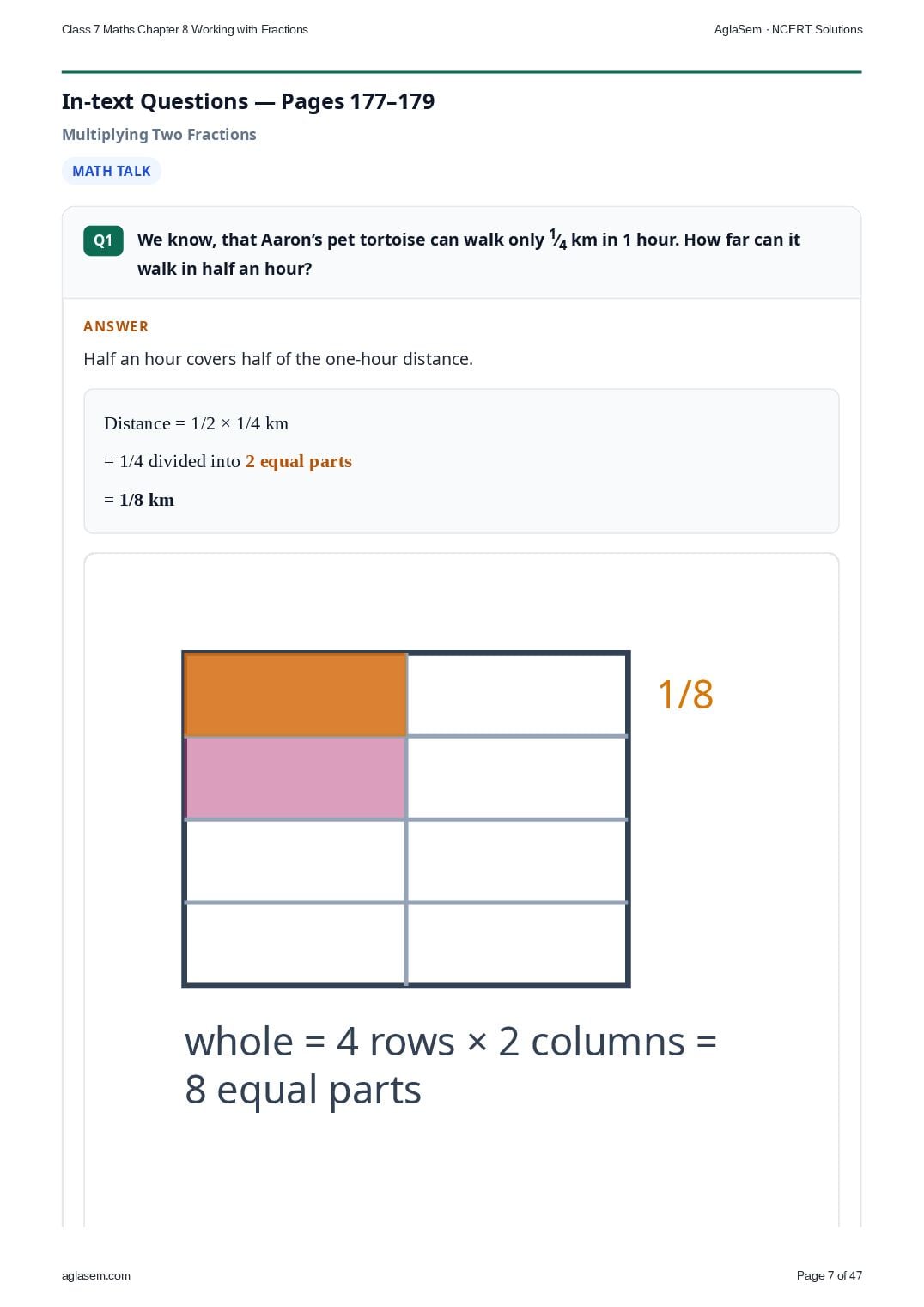
- We know, that Aaron’s pet tortoise can walk only 1 ⁄ 4 km in 1 hour. How far can it walk in half an hour?
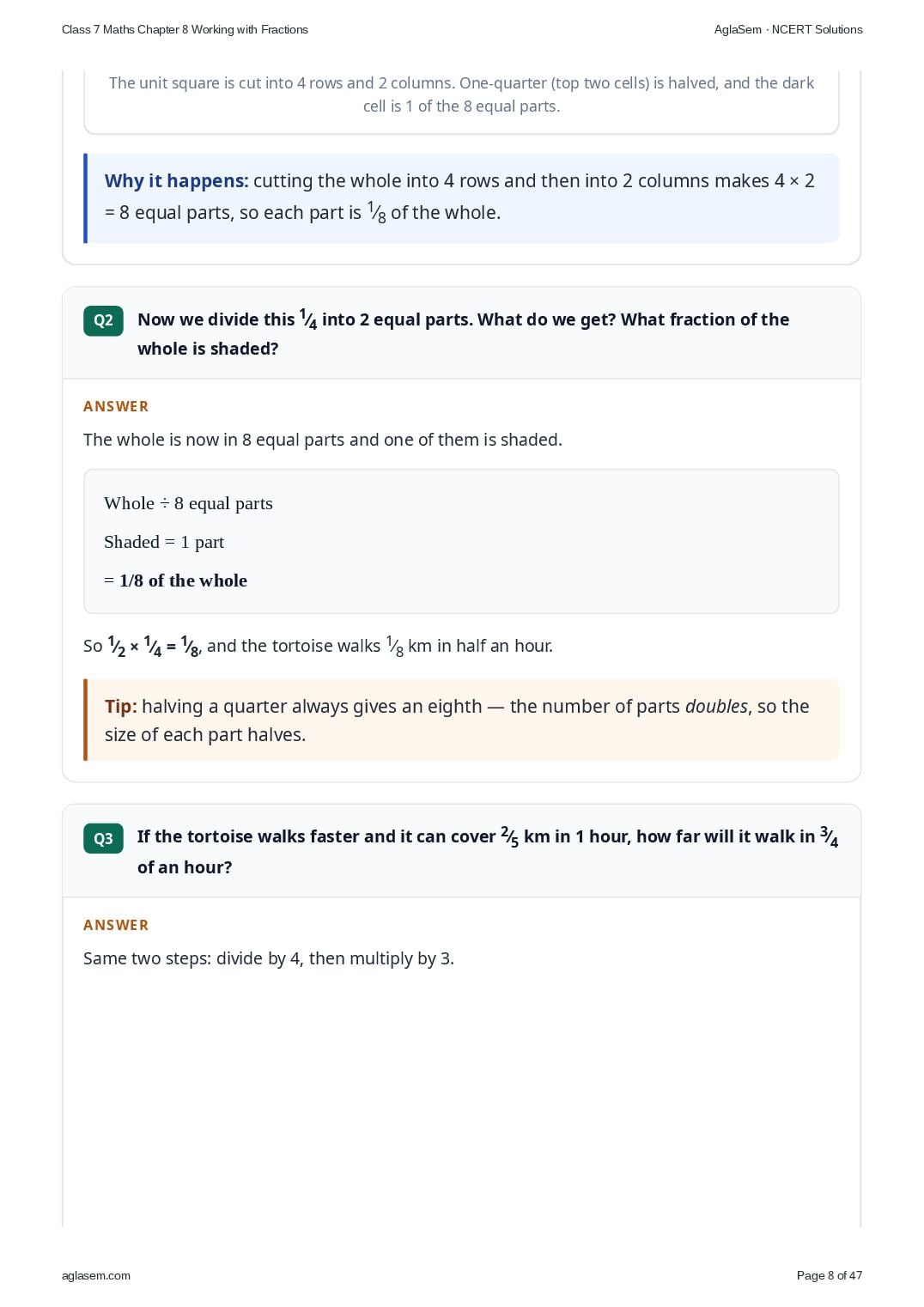
- Now we divide this 1 ⁄ 4 into 2 equal parts. What do we get? What fraction of the whole is shaded?
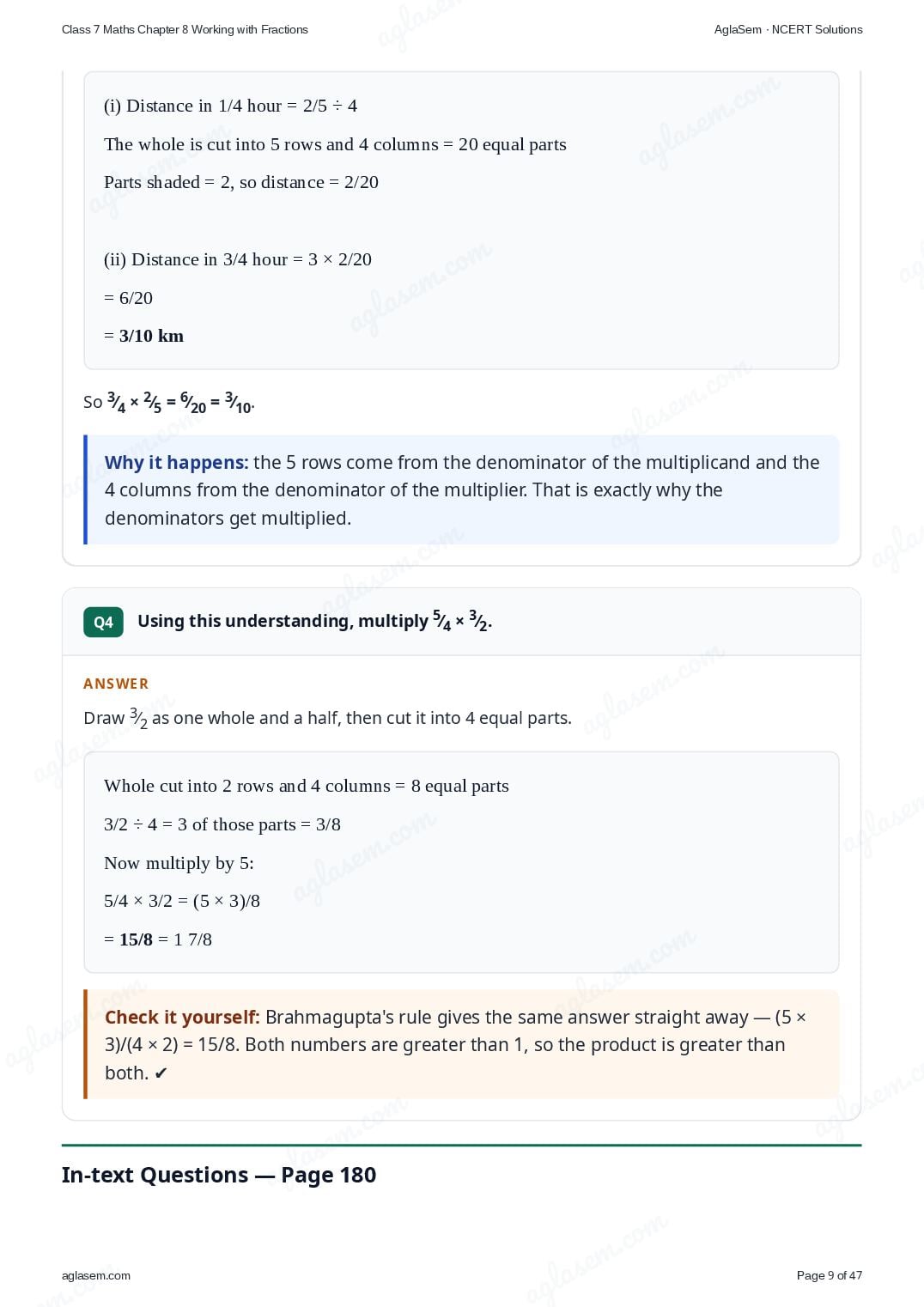
- If the tortoise walks faster and it can cover 2 ⁄ 5 km in 1 hour, how far will it walk in 3 ⁄ 4 of an hour?
- Using this understanding, multiply 5 ⁄ 4 × 3 ⁄ 2 .
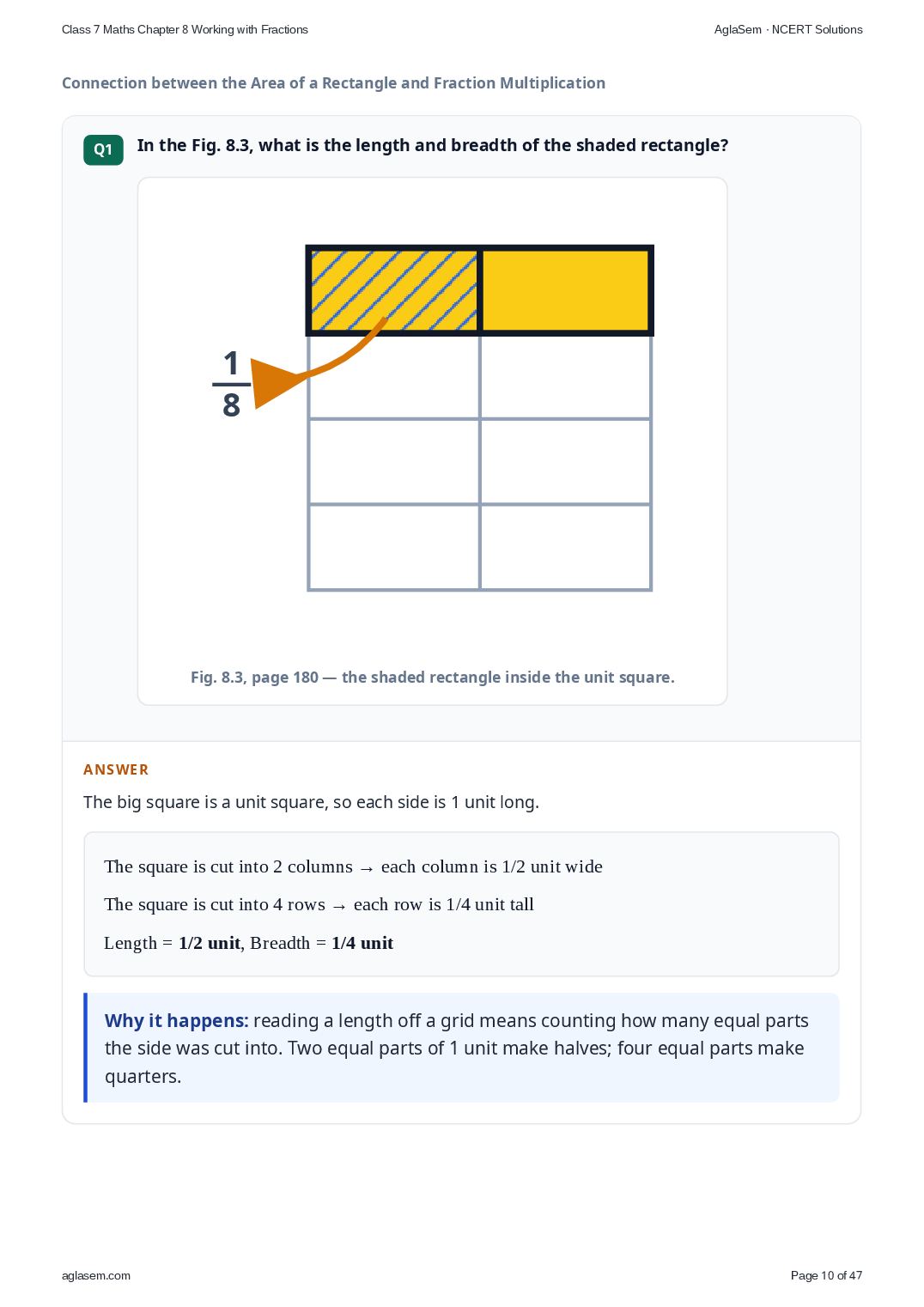
- In the Fig. 8.3, what is the length and breadth of the shaded rectangle?
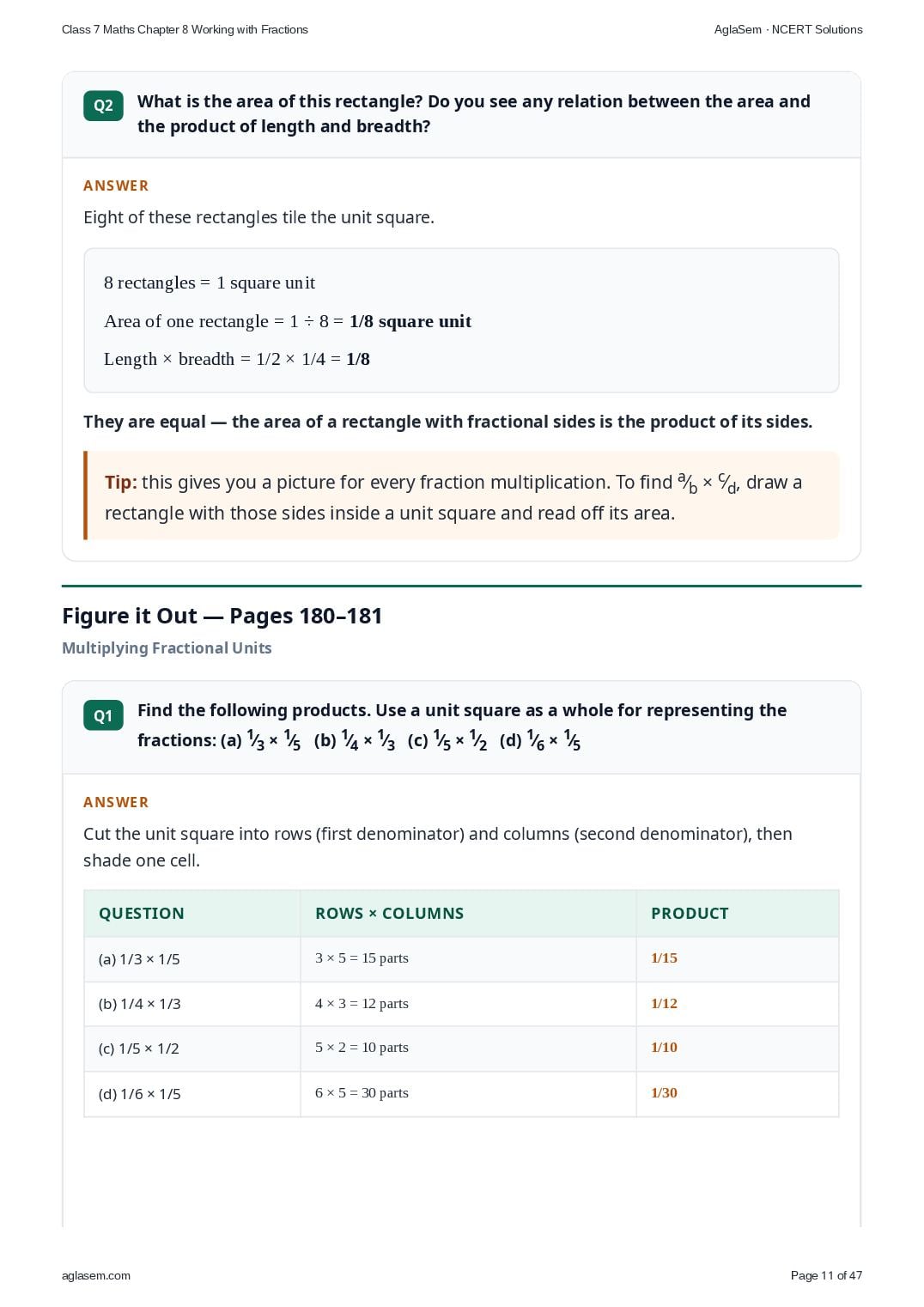
- What is the area of this rectangle? Do you see any relation between the area and the product of length and breadth?
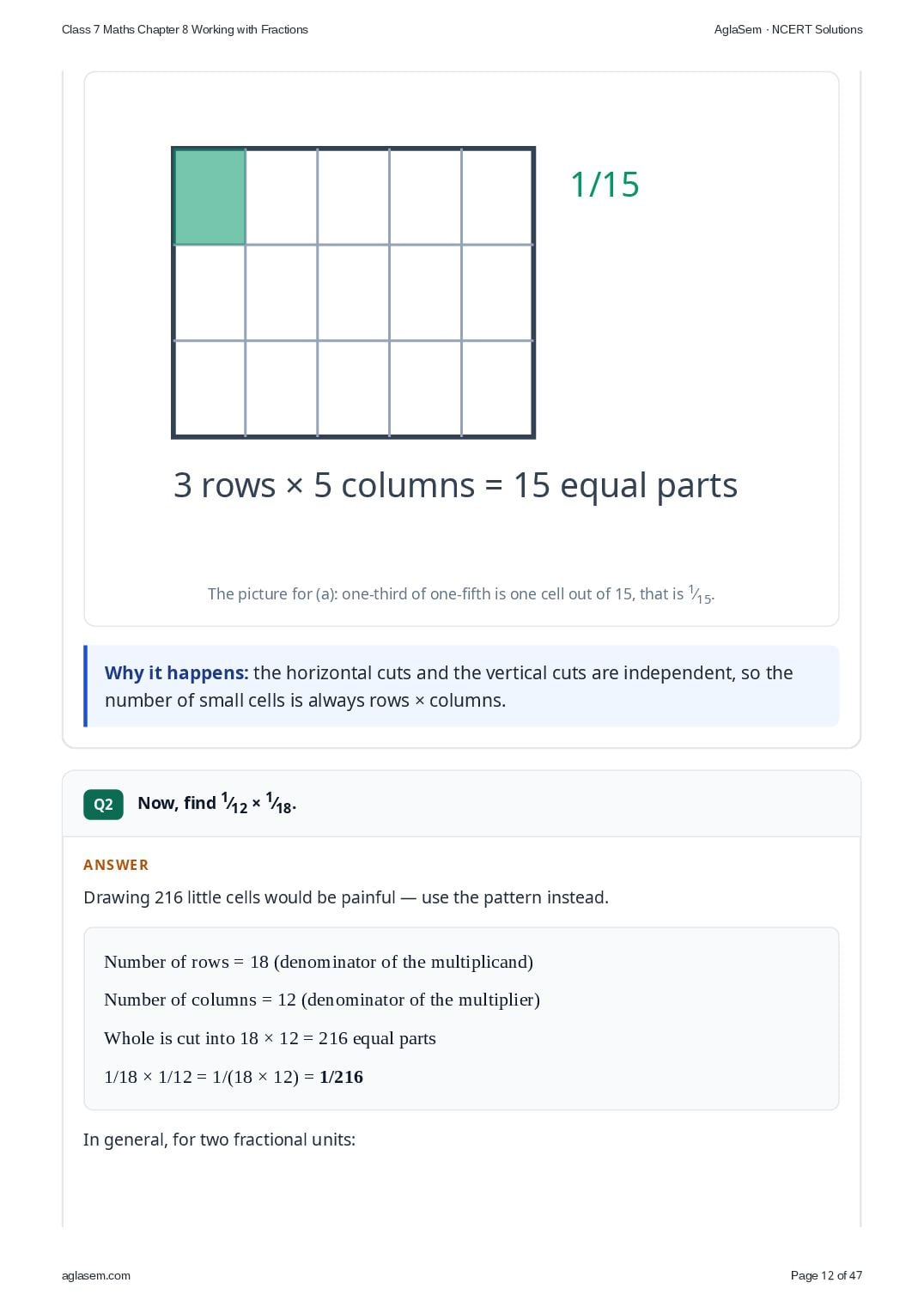
- Find the following products. Use a unit square as a whole for representing the fractions: (a) 1 ⁄ 3 × 1 ⁄ 5 (b) 1 ⁄ 4 × 1 ⁄ 3 (c) 1 ⁄ 5 × 1 ⁄ 2 (d) 1 ⁄ 6 × 1 ⁄ 5
- Now, find 1 ⁄ 12 × 1 ⁄ 18 .
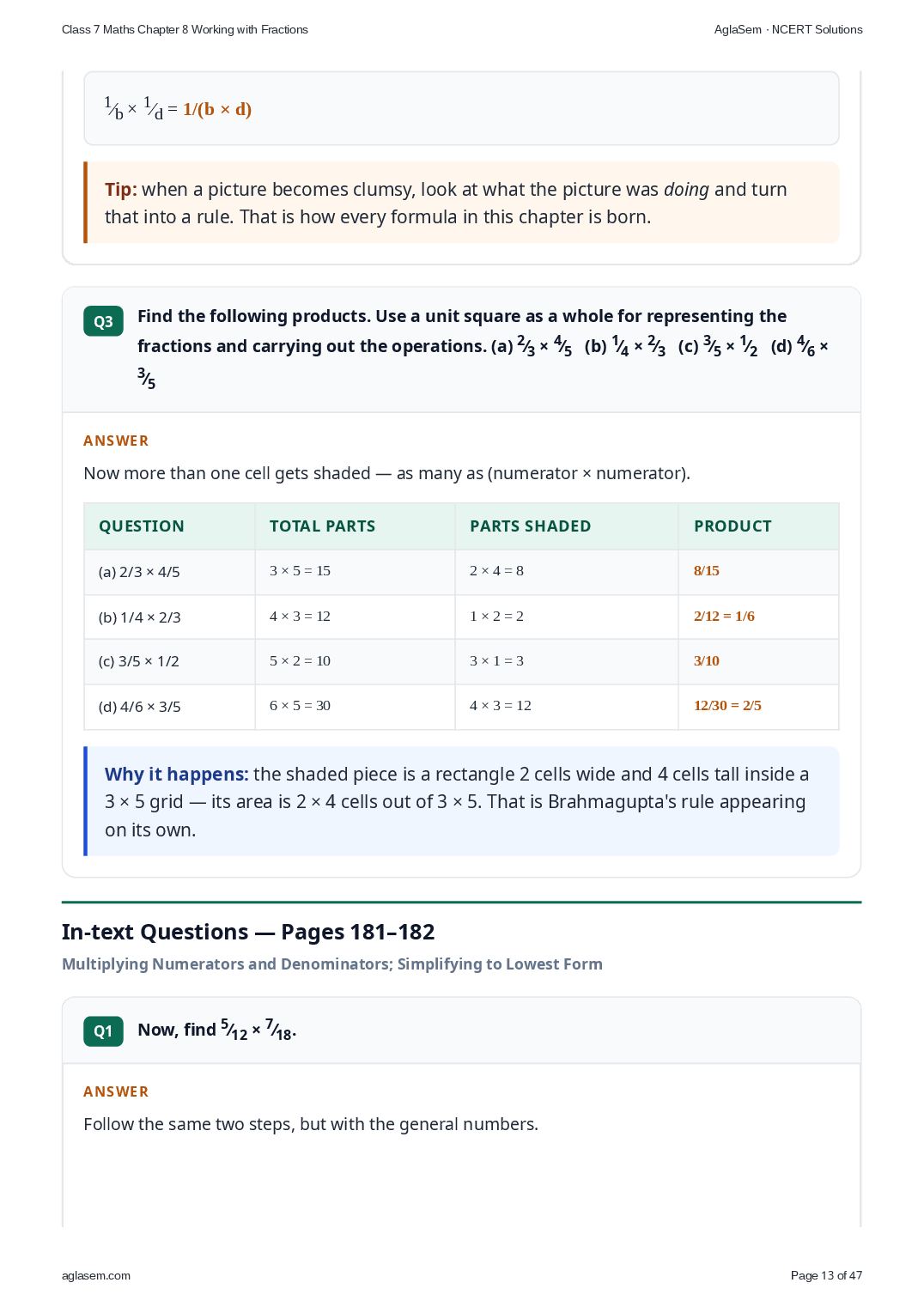
- Find the following products. Use a unit square as a whole for representing the fractions and carrying out the operations. (a) 2 ⁄ 3 × 4 ⁄ 5 (b) 1 ⁄ 4 × 2 ⁄ 3 (c) 3 ⁄ 5 × 1 ⁄ 2 (d) 4 ⁄ 6 × 3 ⁄ 5
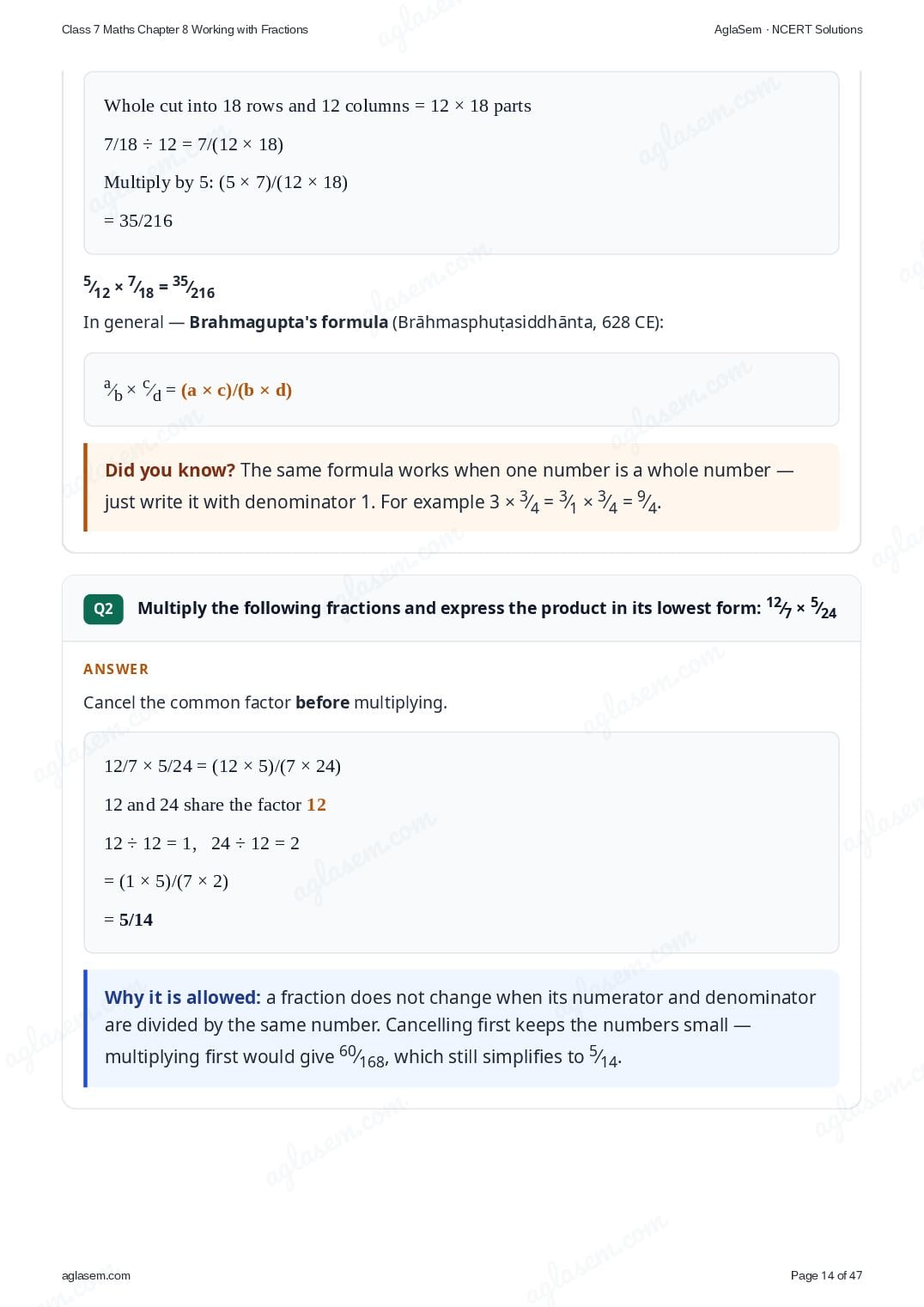
- Now, find 5 ⁄ 12 × 7 ⁄ 18 .
- Multiply the following fractions and express the product in its lowest form: 12 ⁄ 7 × 5 ⁄ 24
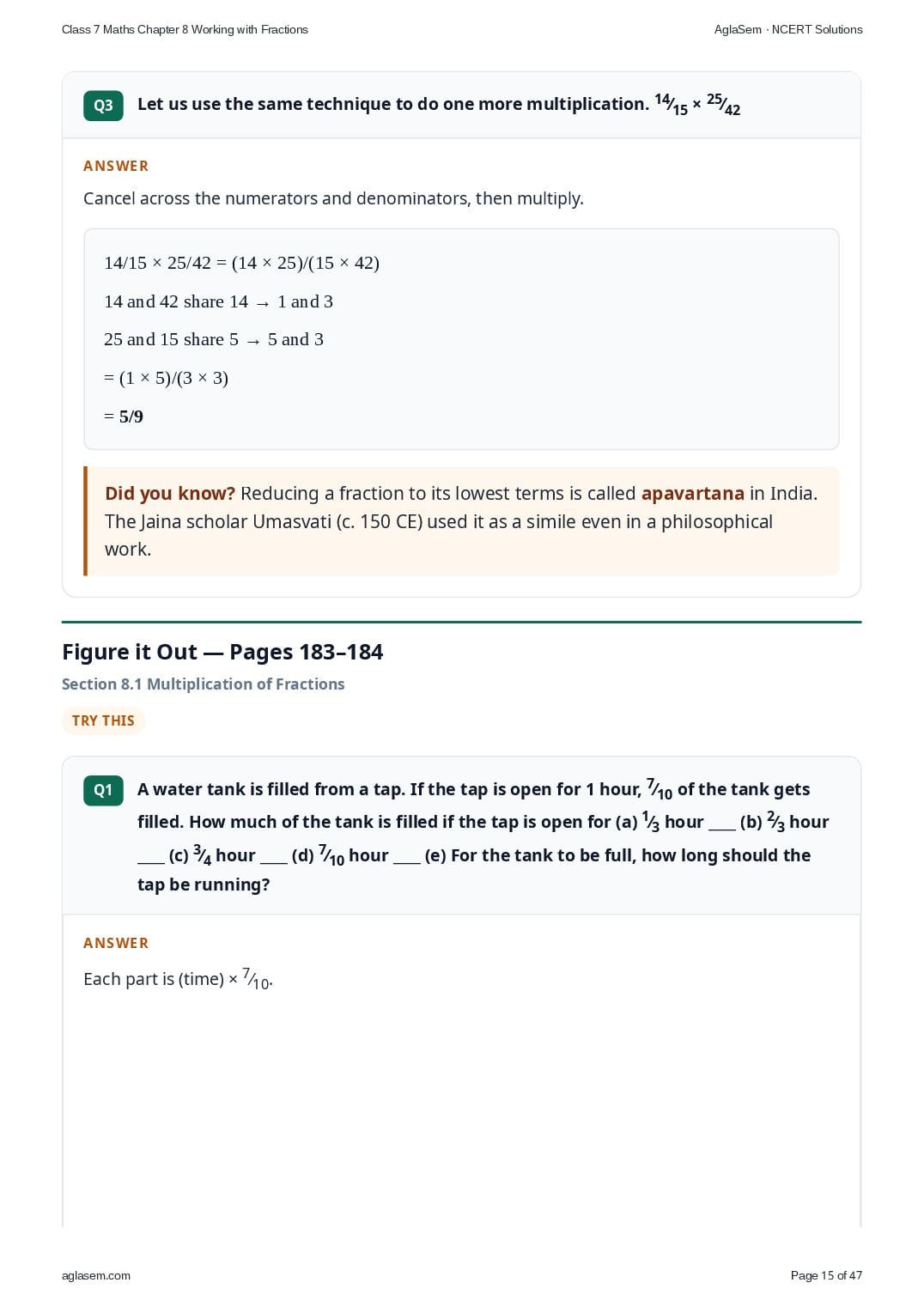
- Let us use the same technique to do one more multiplication. 14 ⁄ 15 × 25 ⁄ 42
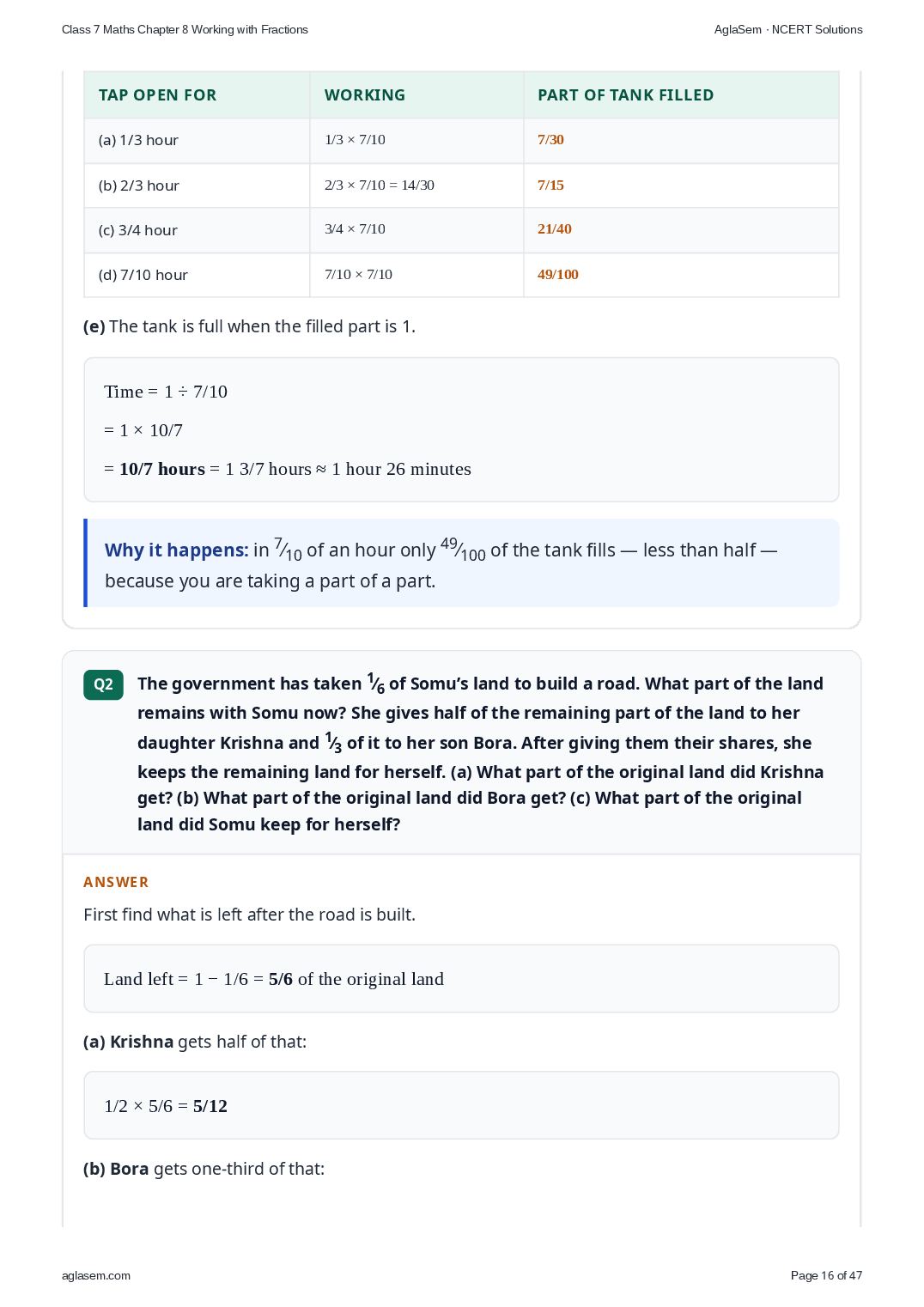
- A water tank is filled from a tap. If the tap is open for 1 hour, 7 ⁄ 10 of the tank gets filled. How much of the tank is filled if the tap is open for (a) 1 ⁄ 3 hour ____ (b) 2 ⁄ 3 hour ____ (c) 3 ⁄ 4 hour ____ (d) 7 ⁄ 10 hour ____ (e) For the tank to be full, how long should the tap be running?
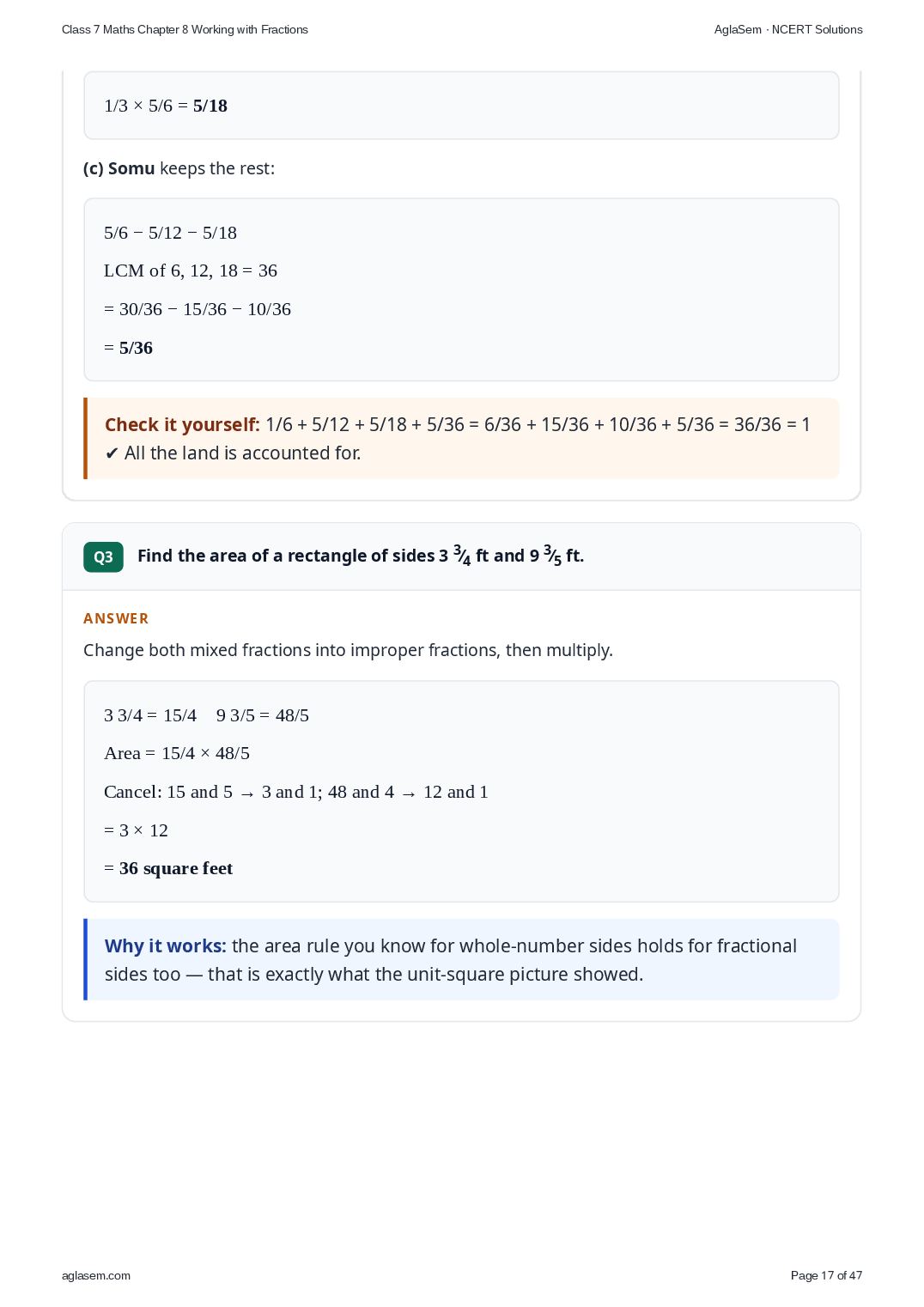
- The government has taken 1 ⁄ 6 of Somu’s land to build a road. What part of the land remains with Somu now? She gives half of the remaining part of the land to her daughter Krishna and 1 ⁄ 3 of it to her son Bora. After giving them their shares, she keeps the remaining land for herself. (a) What part of the original land did Krishna get? (b) What part of the original land did Bora get? (c) What part of the original land did Somu keep for herself?
- Find the area of a rectangle of sides 3 3 ⁄ 4 ft and 9 3 ⁄ 5 ft.
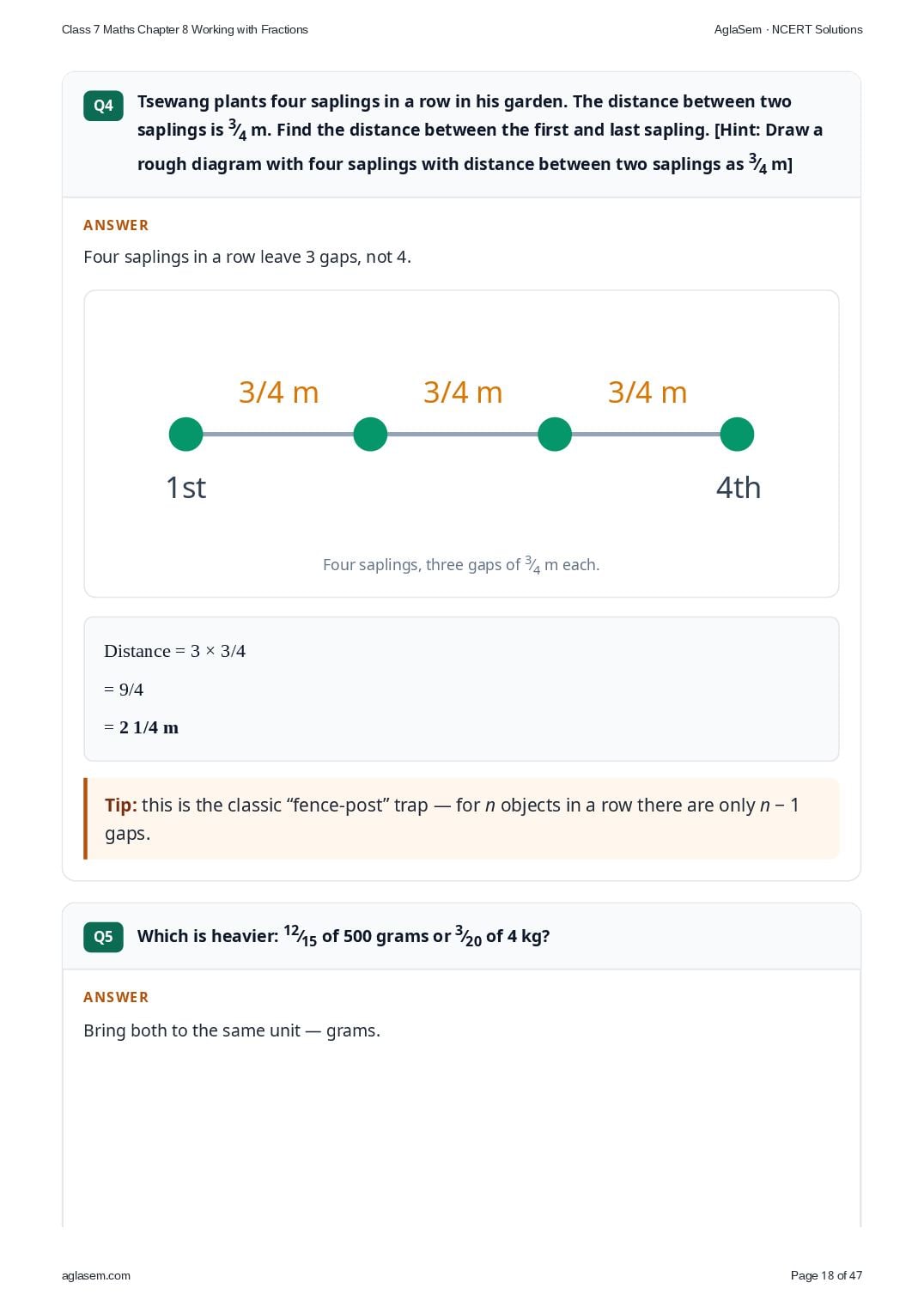
- Tsewang plants four saplings in a row in his garden. The distance between two saplings is 3 ⁄ 4 m. Find the distance between the first and last sapling. [Hint: Draw a rough diagram with four saplings with distance between two saplings as 3 ⁄ 4 m]
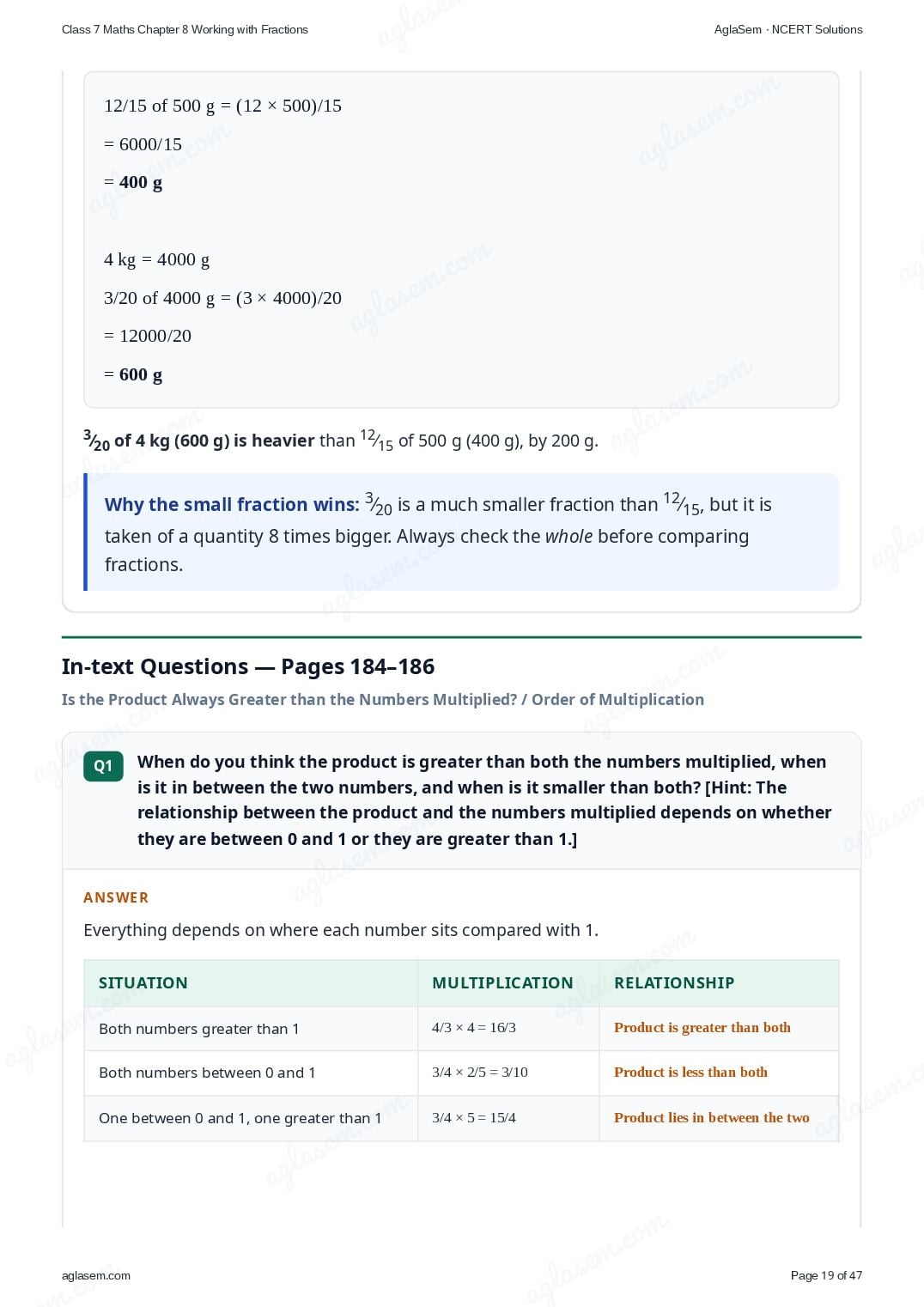
- Which is heavier: 12 ⁄ 15 of 500 grams or 3 ⁄ 20 of 4 kg?
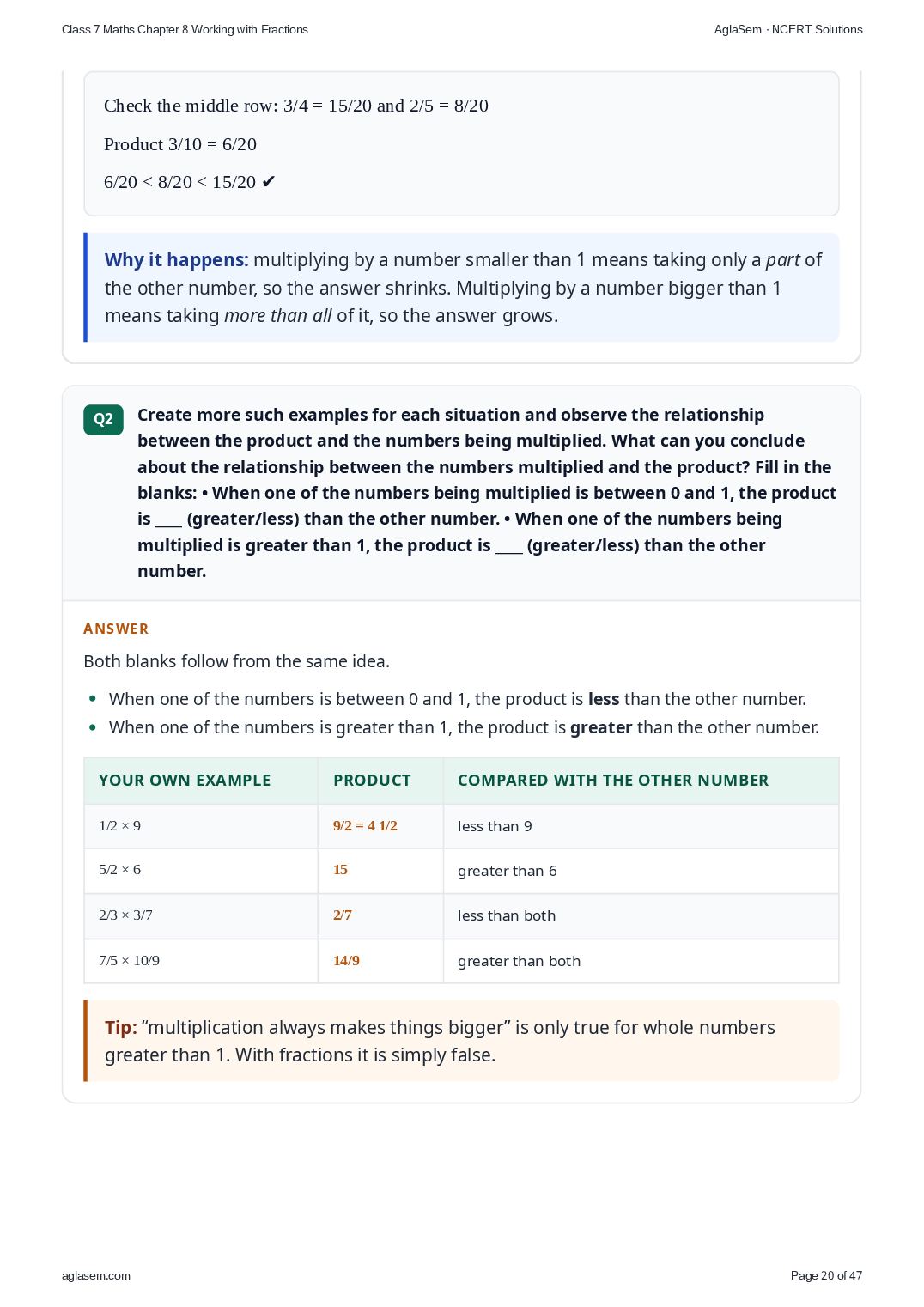
- When do you think the product is greater than both the numbers multiplied, when is it in between the two numbers, and when is it smaller than both? [Hint: The relationship between the product and the numbers multiplied depends on whether they are between 0 and 1 or they are greater than 1.]
- Create more such examples for each situation and observe the relationship between the product and the numbers being multiplied. What can you conclude about the relationship between the numbers multiplied and the product? Fill in the blanks: • When one of the numbers being multiplied is between 0 and 1, the product is ____ (greater/less) than the other number. • When one of the numbers being multiplied is greater than 1, the product is ____ (greater/less) than the other number.
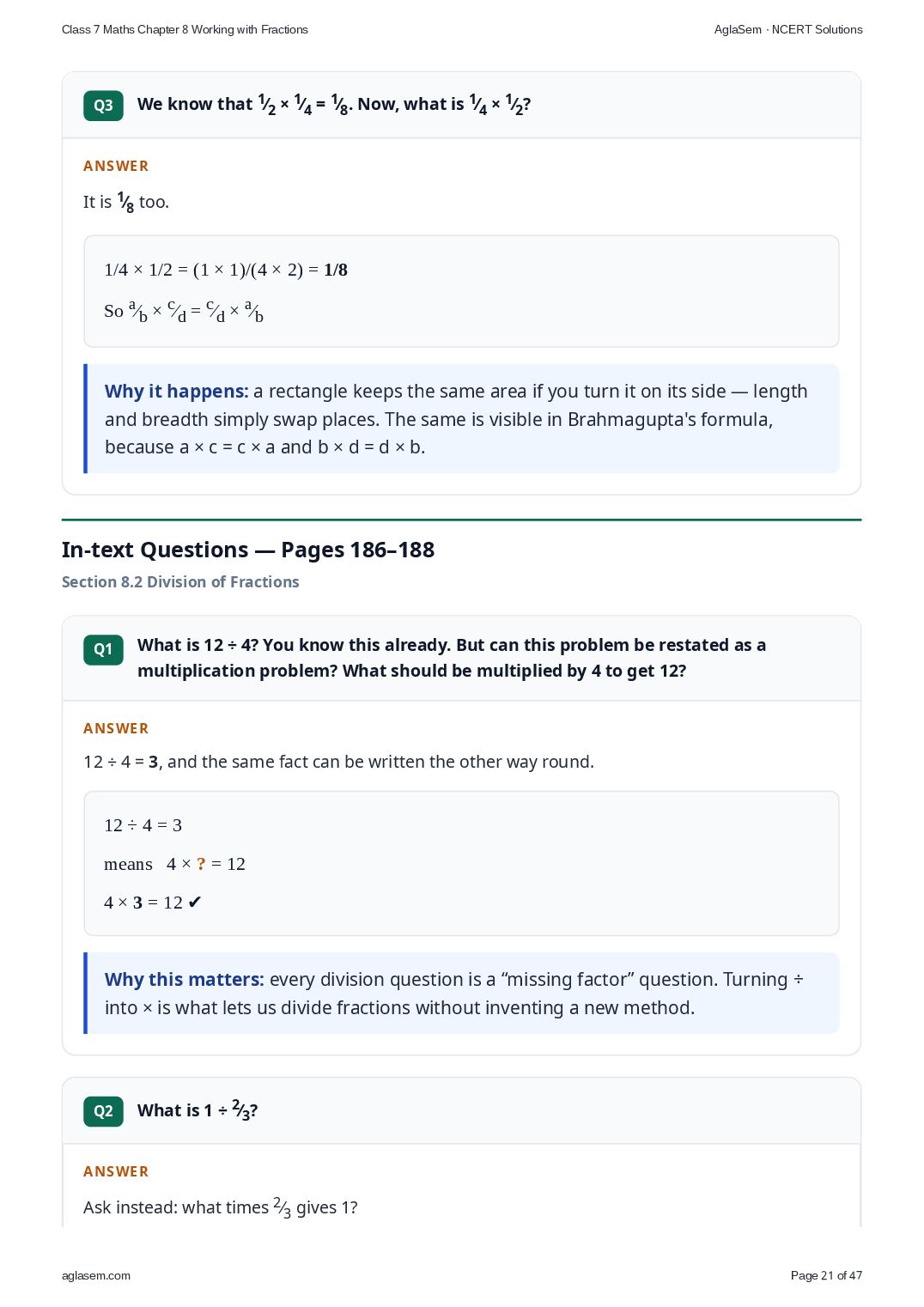
- We know that 1 ⁄ 2 × 1 ⁄ 4 = 1 ⁄ 8 . Now, what is 1 ⁄ 4 × 1 ⁄ 2 ?
- What is 12 ÷ 4? You know this already. But can this problem be restated as a multiplication problem? What should be multiplied by 4 to get 12?
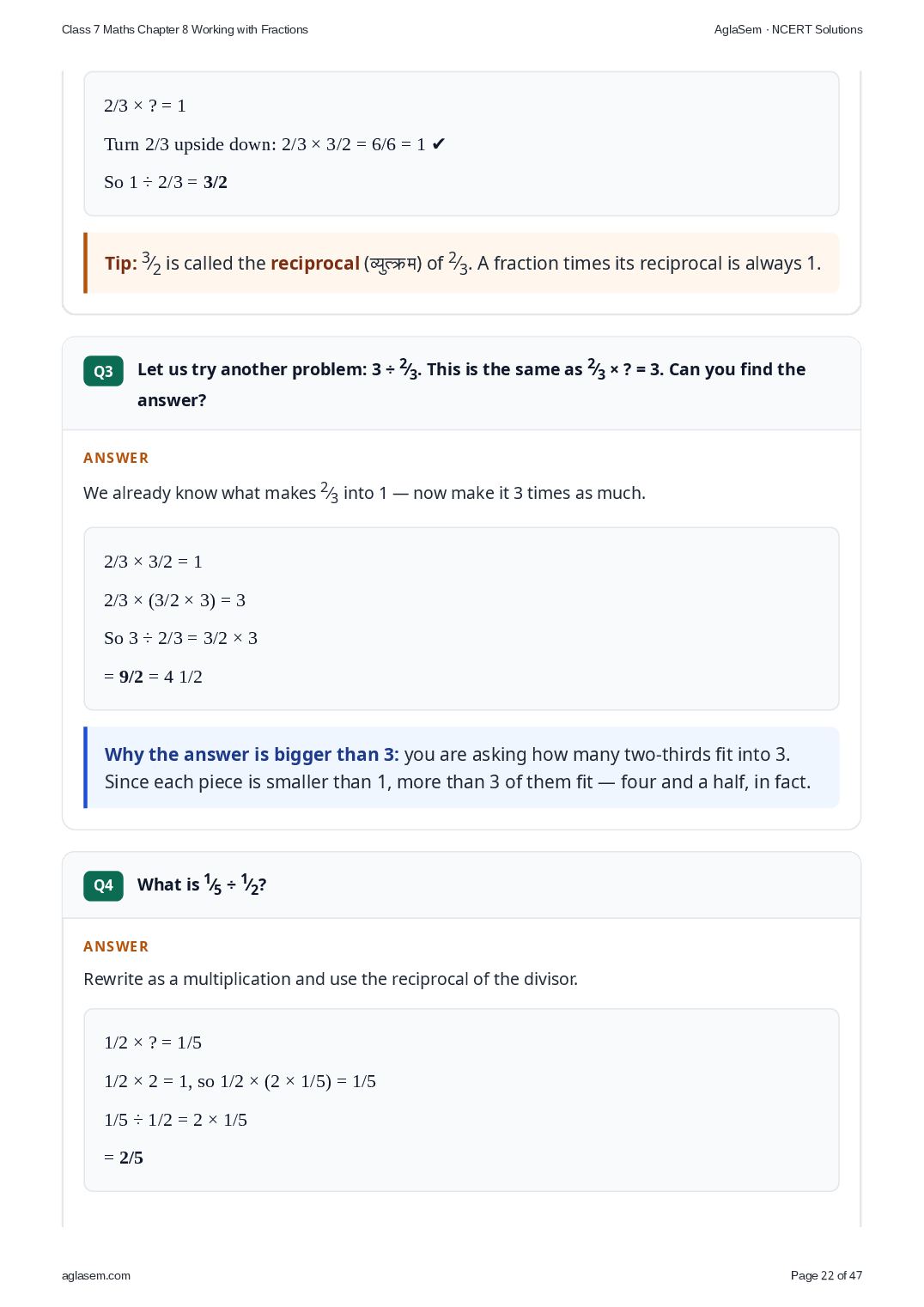
- What is 1 ÷ 2 ⁄ 3 ?
- Let us try another problem: 3 ÷ 2 ⁄ 3 . This is the same as 2 ⁄ 3 × ? = 3. Can you find the answer?
- What is 1 ⁄ 5 ÷ 1 ⁄ 2 ?
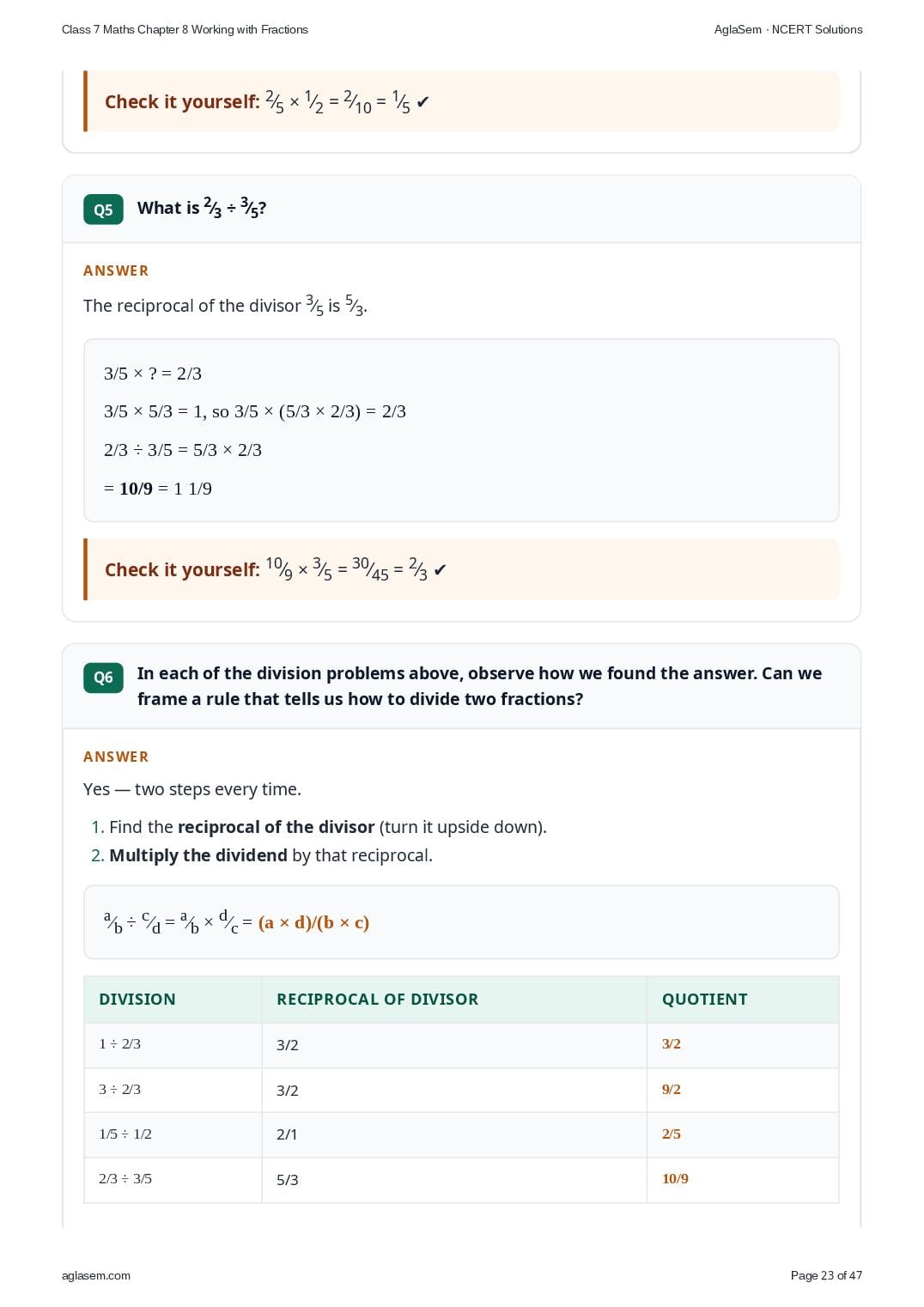
- What is 2 ⁄ 3 ÷ 3 ⁄ 5 ?
- In each of the division problems above, observe how we found the answer. Can we frame a rule that tells us how to divide two fractions?
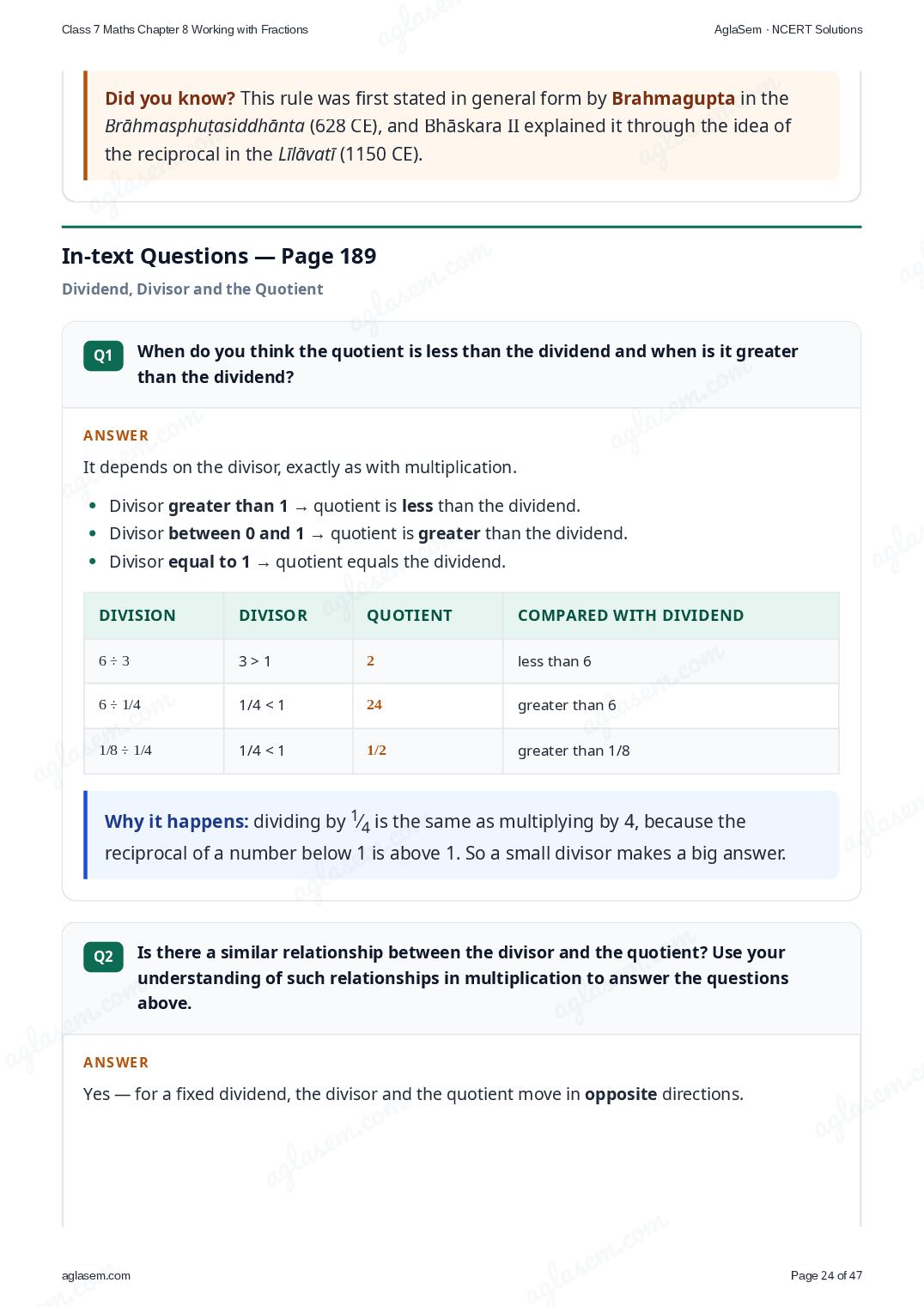
- When do you think the quotient is less than the dividend and when is it greater than the dividend?
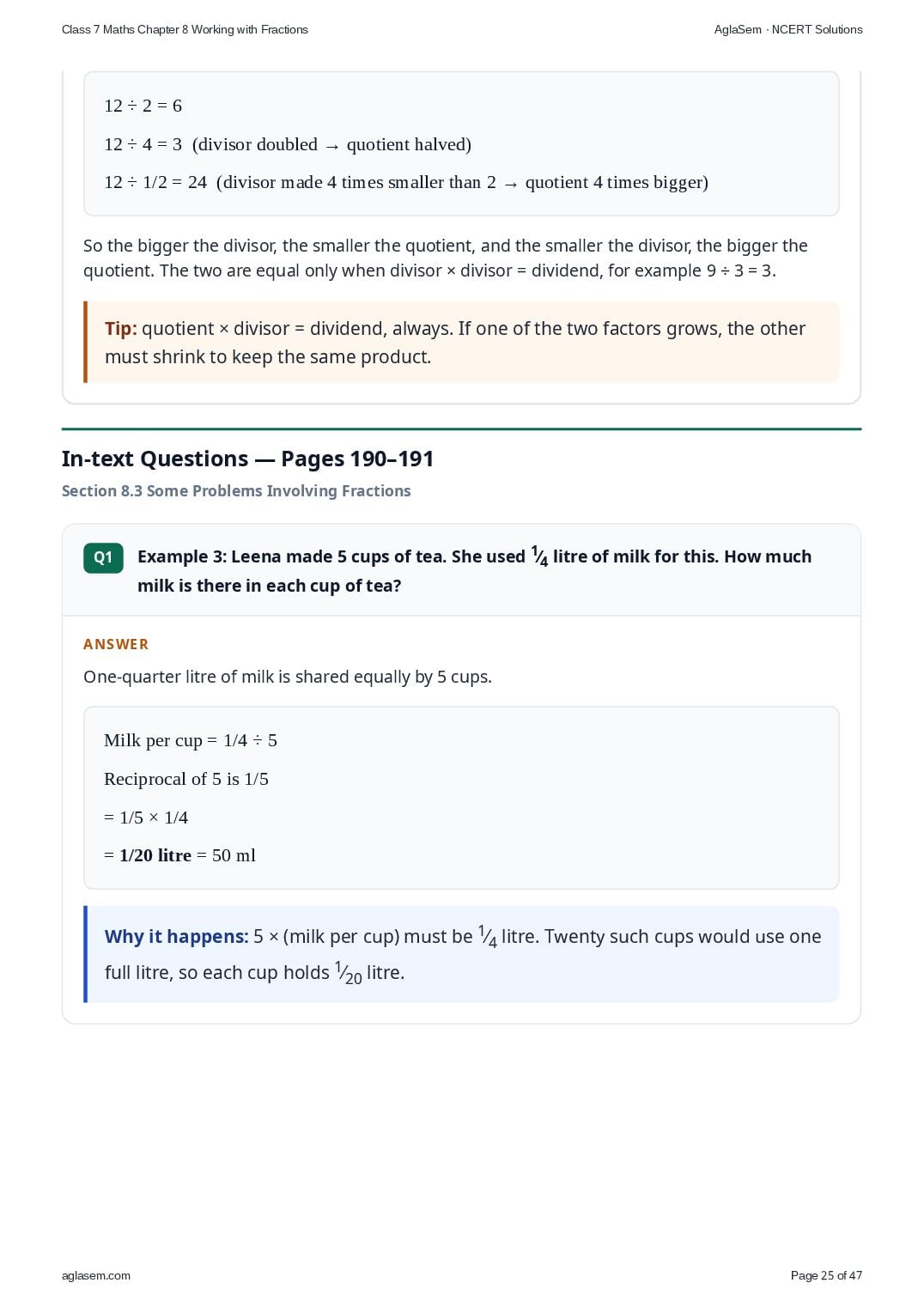
- Is there a similar relationship between the divisor and the quotient? Use your understanding of such relationships in multiplication to answer the questions above.
- Example 3: Leena made 5 cups of tea. She used 1 ⁄ 4 litre of milk for this. How much milk is there in each cup of tea?
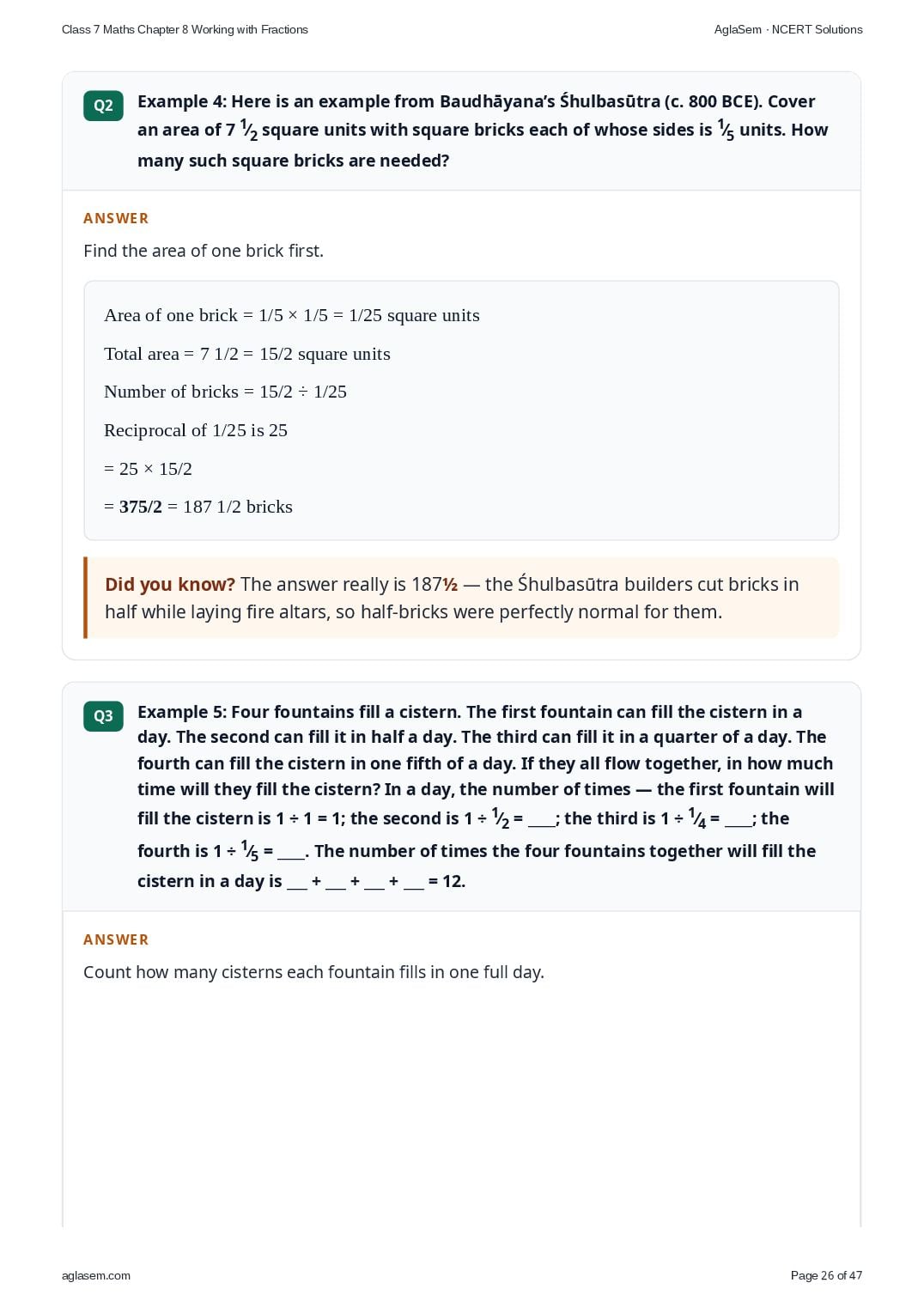
- Example 4: Here is an example from Baudhāyana’s Śhulbasūtra (c. 800 BCE). Cover an area of 7 1 ⁄ 2 square units with square bricks each of whose sides is 1 ⁄ 5 units. How many such square bricks are needed?
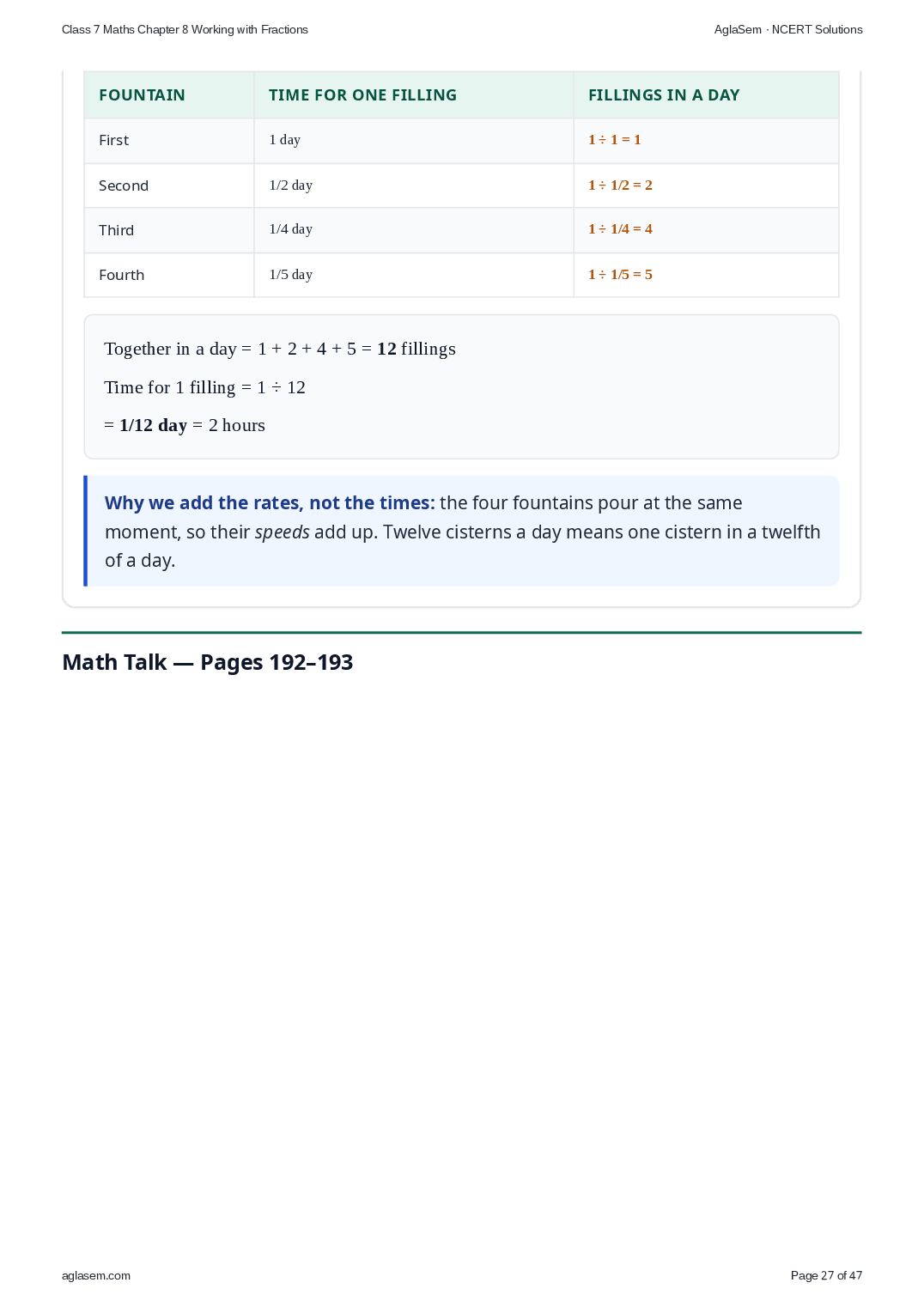
- Example 5: Four fountains fill a cistern. The first fountain can fill the cistern in a day. The second can fill it in half a day. The third can fill it in a quarter of a day. The fourth can fill the cistern in one fifth of a day. If they all flow together, in how much time will they fill the cistern? In a day, the number of times — the first fountain will fill the cistern is 1 ÷ 1 = 1; the second is 1 ÷ 1 ⁄ 2 = ____; the third is 1 ÷ 1 ⁄ 4 = ____; the fourth is 1 ÷ 1 ⁄ 5 = ____. The number of times the four fountains together will fill the cistern in a day is ___ + ___ + ___ + ___ = 12.
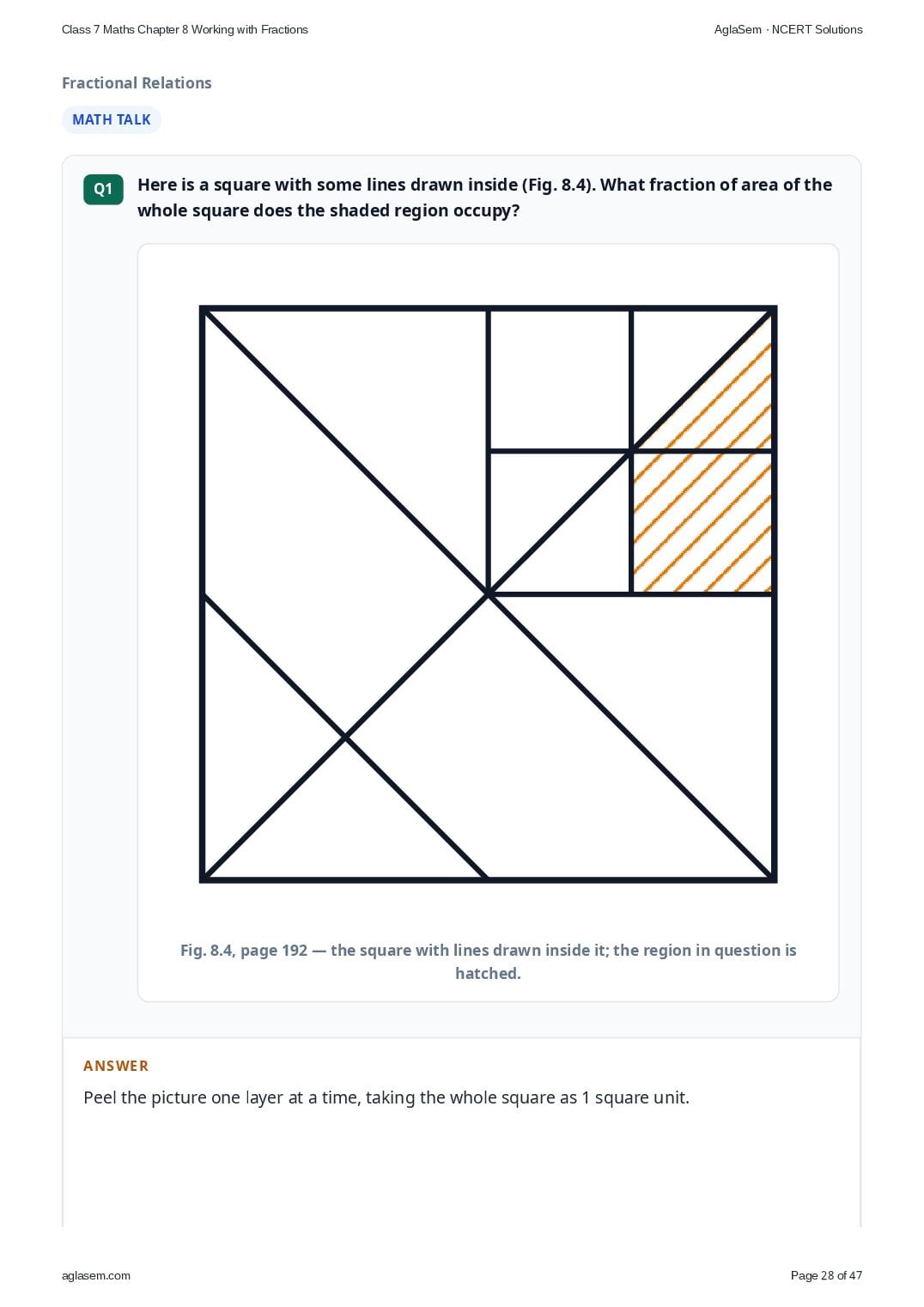
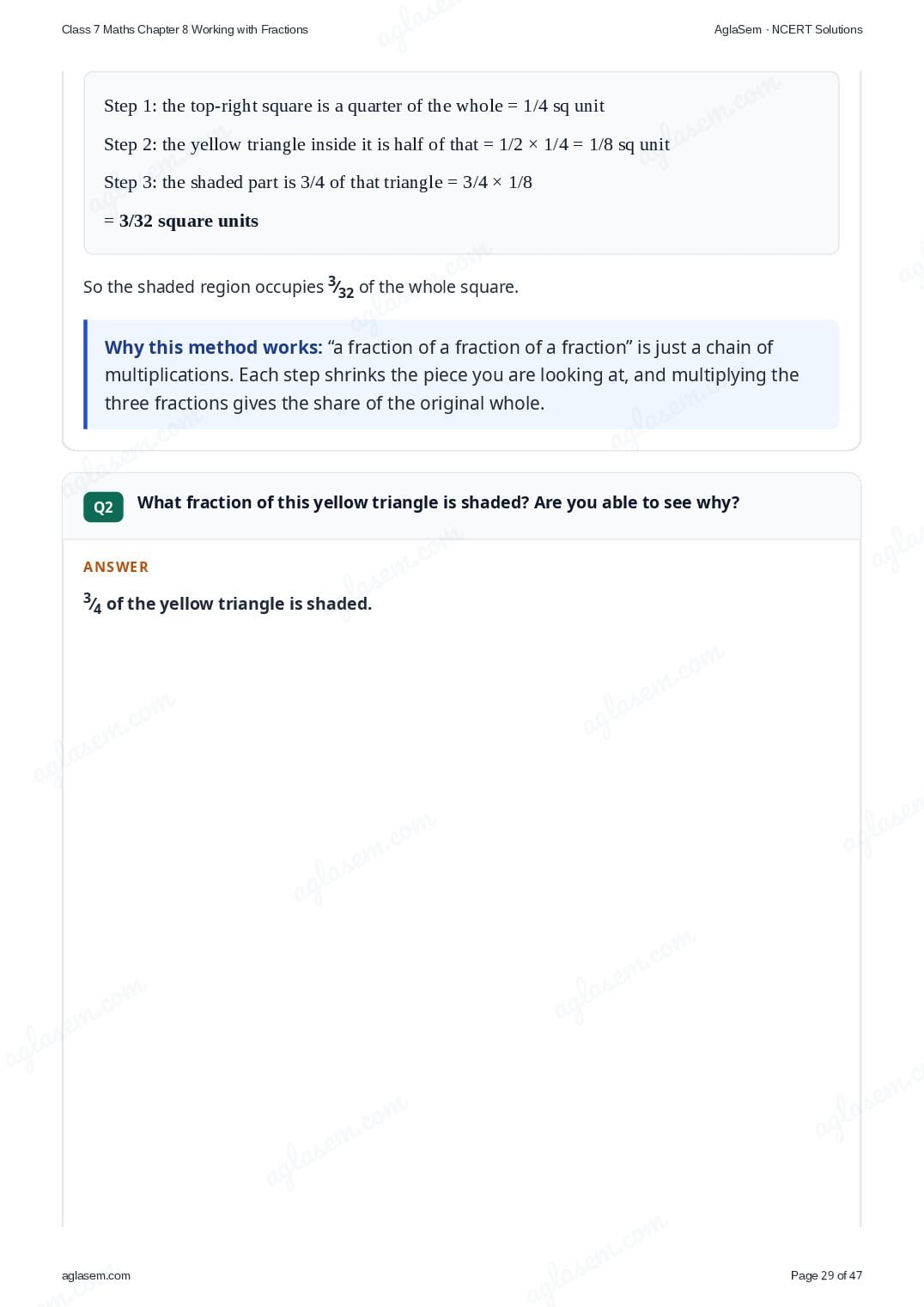
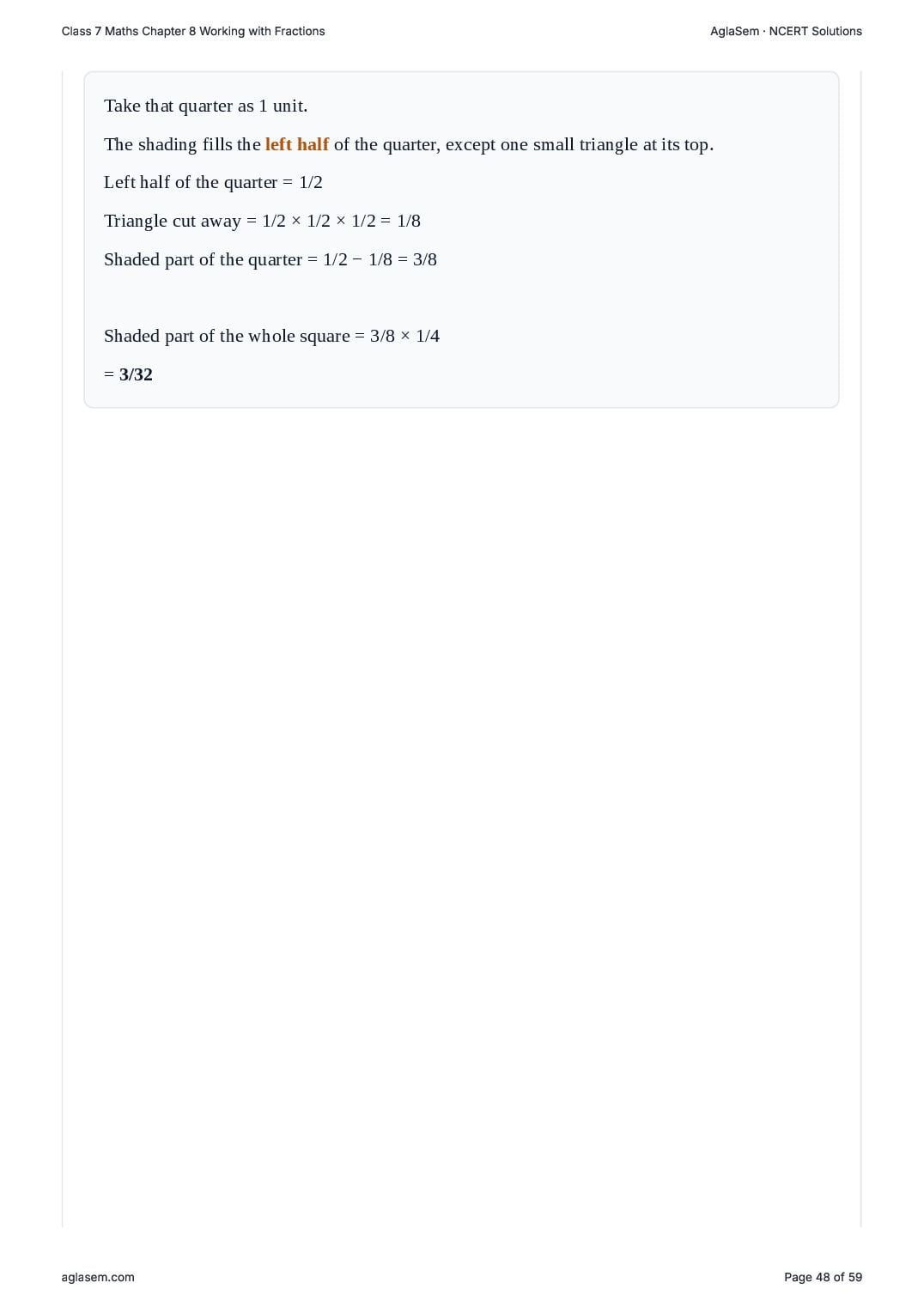
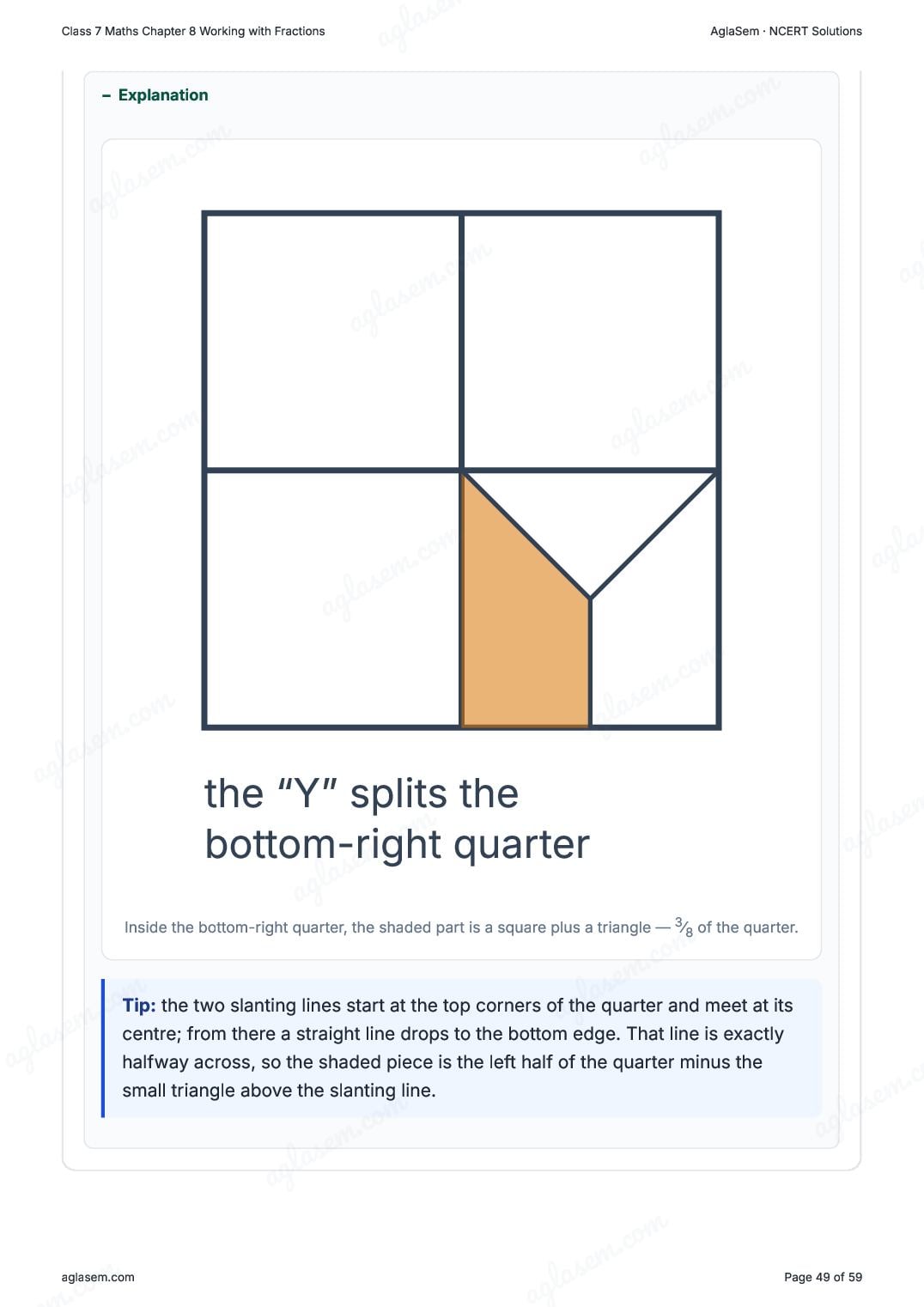
- Here is a square with some lines drawn inside (Fig. 8.4). What fraction of area of the whole square does the shaded region occupy?
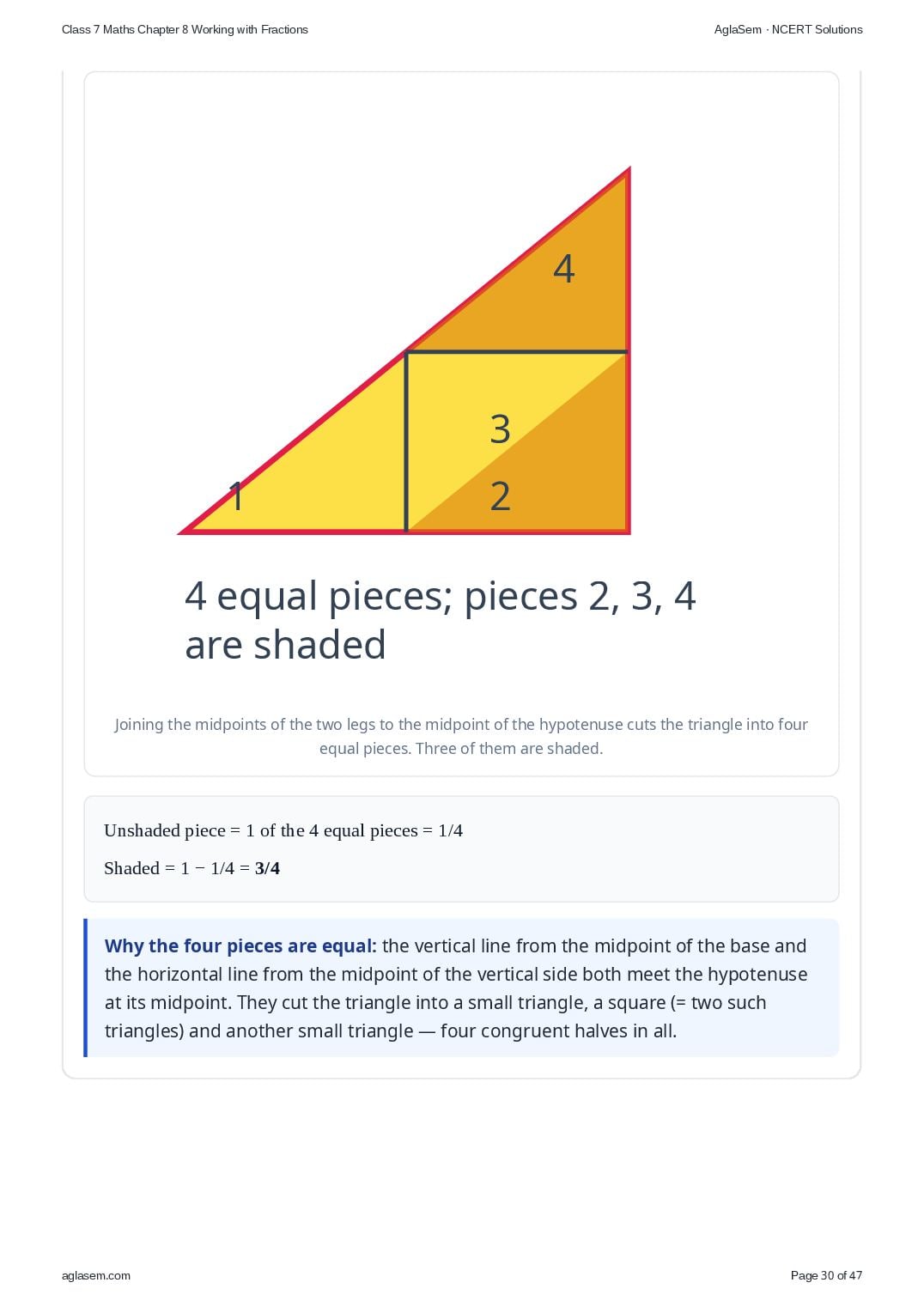
- What fraction of this yellow triangle is shaded? Are you able to see why?
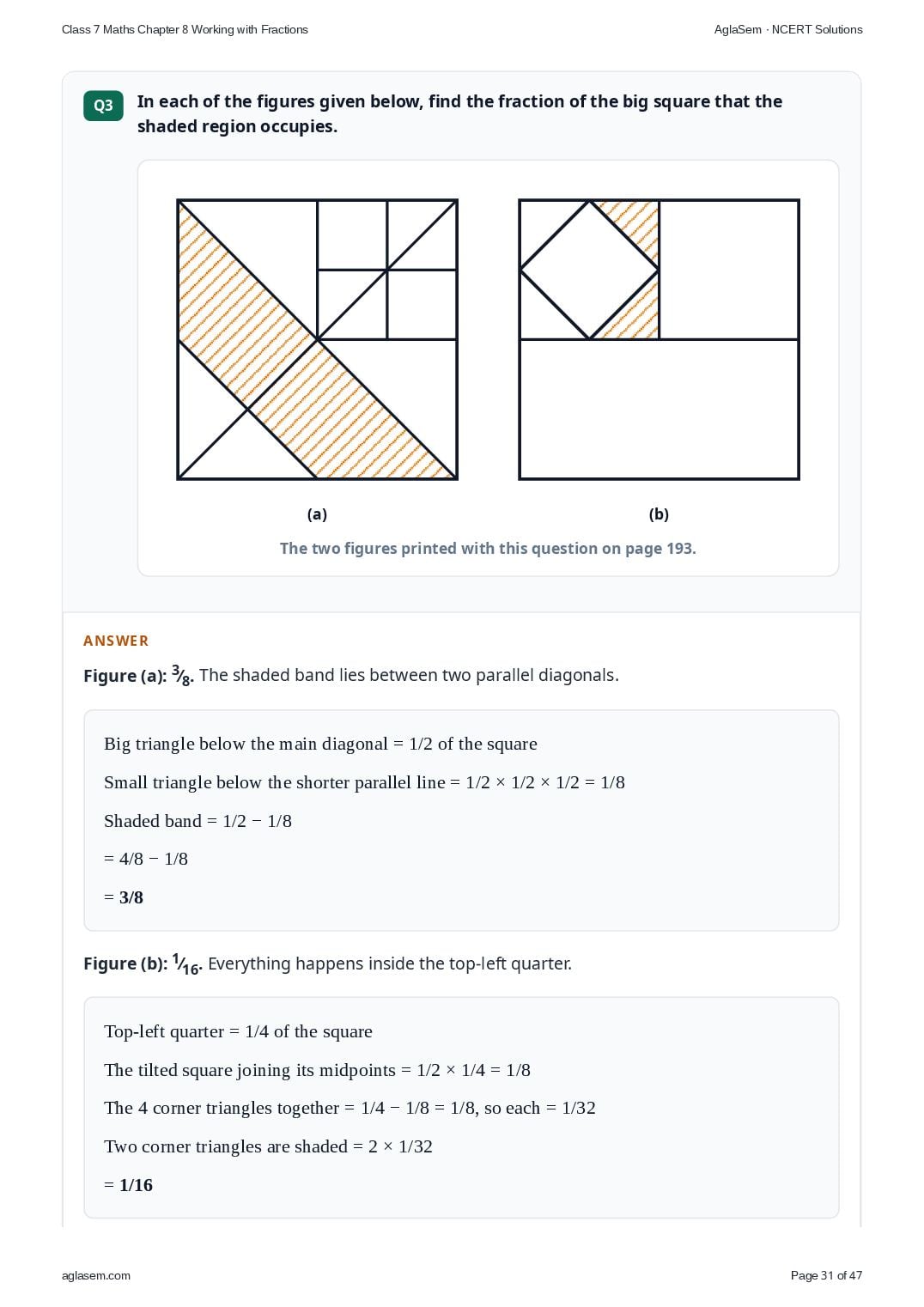
- In each of the figures given below, find the fraction of the big square that the shaded region occupies.
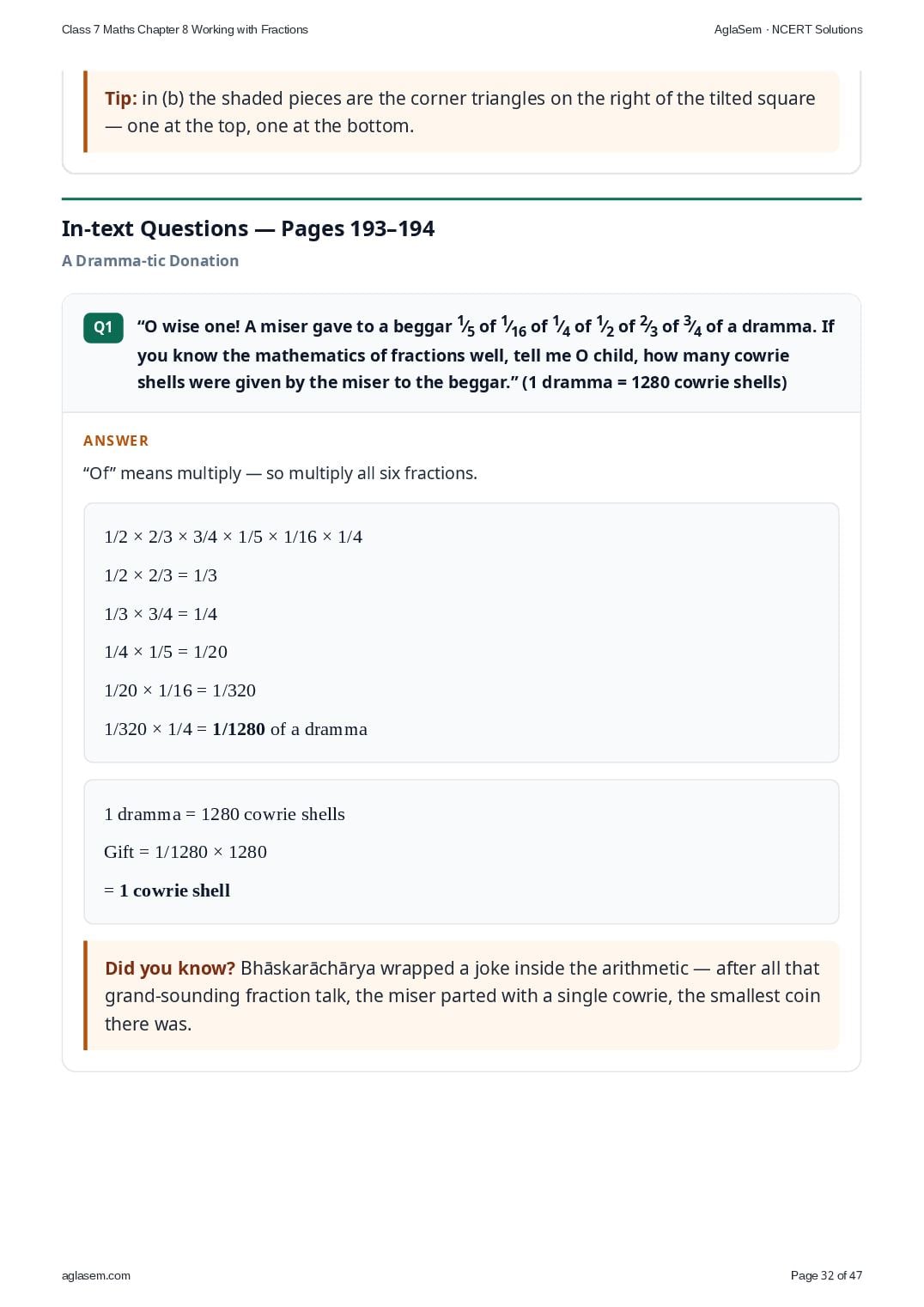
- “O wise one! A miser gave to a beggar 1 ⁄ 5 of 1 ⁄ 16 of 1 ⁄ 4 of 1 ⁄ 2 of 2 ⁄ 3 of 3 ⁄ 4 of a dramma. If you know the mathematics of fractions well, tell me O child, how many cowrie shells were given by the miser to the beggar.” (1 dramma = 1280 cowrie shells)
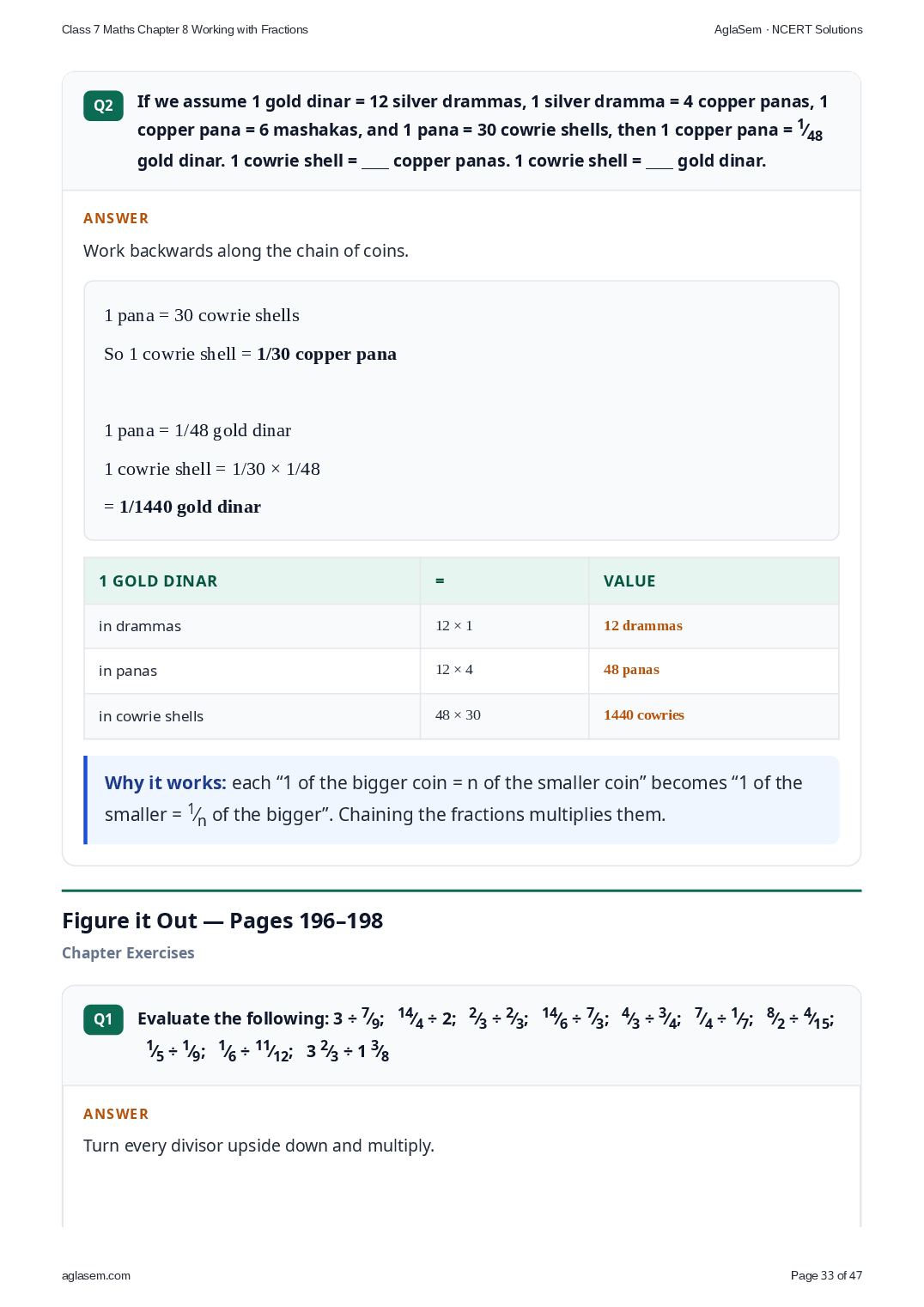
- If we assume 1 gold dinar = 12 silver drammas, 1 silver dramma = 4 copper panas, 1 copper pana = 6 mashakas, and 1 pana = 30 cowrie shells, then 1 copper pana = 1 ⁄ 48 gold dinar. 1 cowrie shell = ____ copper panas. 1 cowrie shell = ____ gold dinar.
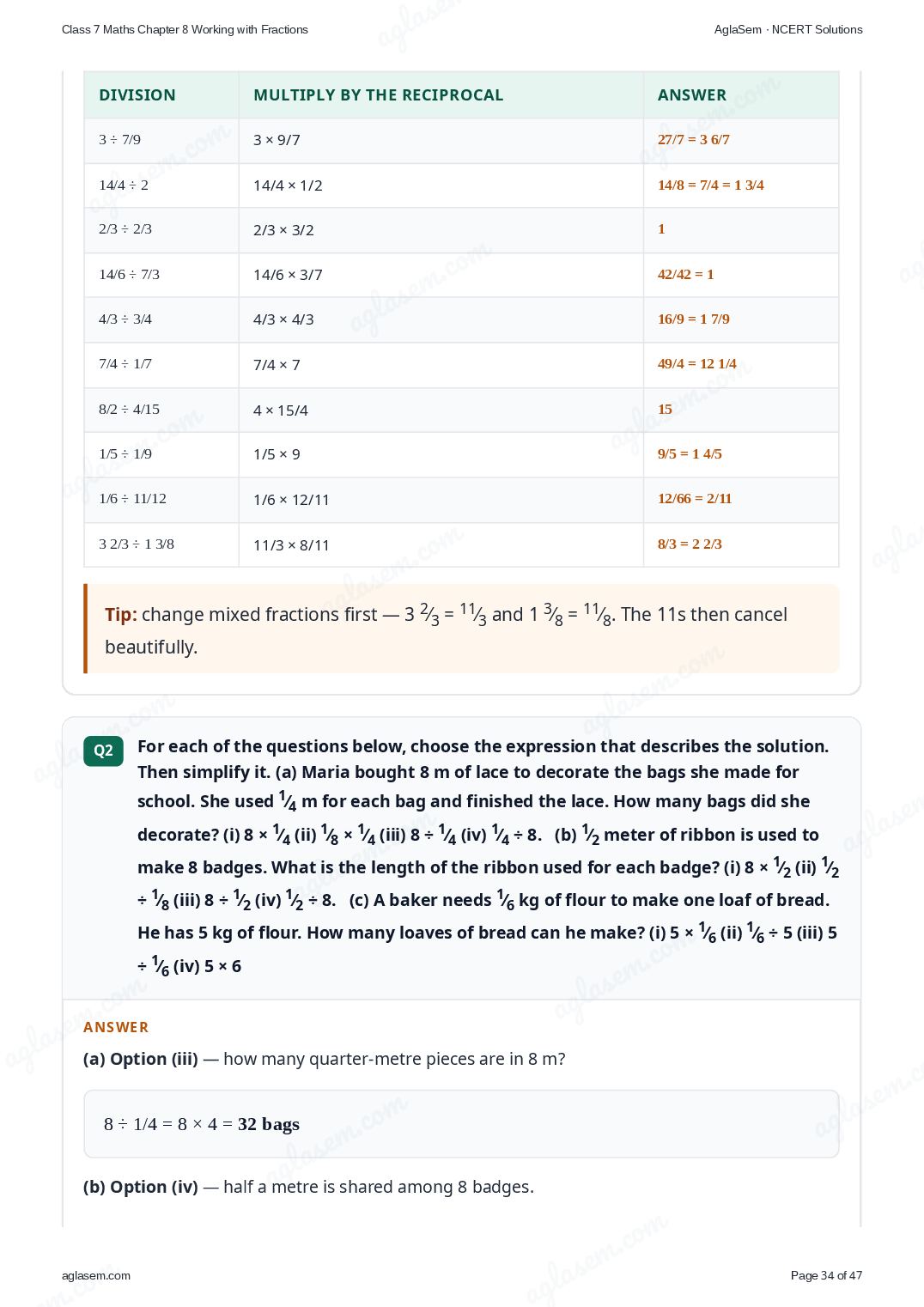
- Evaluate the following: 3 ÷ 7 ⁄ 9 ; 14 ⁄ 4 ÷ 2; 2 ⁄ 3 ÷ 2 ⁄ 3 ; 14 ⁄ 6 ÷ 7 ⁄ 3 ; 4 ⁄ 3 ÷ 3 ⁄ 4 ; 7 ⁄ 4 ÷ 1 ⁄ 7 ; 8 ⁄ 2 ÷ 4 ⁄ 15 ; 1 ⁄ 5 ÷ 1 ⁄ 9 ; 1 ⁄ 6 ÷ 11 ⁄ 12 ; 3 2 ⁄ 3 ÷ 1 3 ⁄ 8
- For each of the questions below, choose the expression that describes the solution. Then simplify it. (a) Maria bought 8 m of lace to decorate the bags she made for school. She used 1 ⁄ 4 m for each bag and finished the lace. How many bags did she decorate? (i) 8 × 1 ⁄ 4 (ii) 1 ⁄ 8 × 1 ⁄ 4 (iii) 8 ÷ 1 ⁄ 4 (iv) 1 ⁄ 4 ÷ 8. (b) 1 ⁄ 2 meter of ribbon is used to make 8 badges. What is the length of the ribbon used for each badge? (i) 8 × 1 ⁄ 2 (ii) 1 ⁄ 2 ÷ 1 ⁄ 8 (iii) 8 ÷ 1 ⁄ 2 (iv) 1 ⁄ 2 ÷ 8. (c) A baker needs 1 ⁄ 6 kg of flour to make one loaf of bread. He has 5 kg of flour. How many loaves of bread can he make? (i) 5 × 1 ⁄ 6 (ii) 1 ⁄ 6 ÷ 5 (iii) 5 ÷ 1 ⁄ 6 (iv) 5 × 6
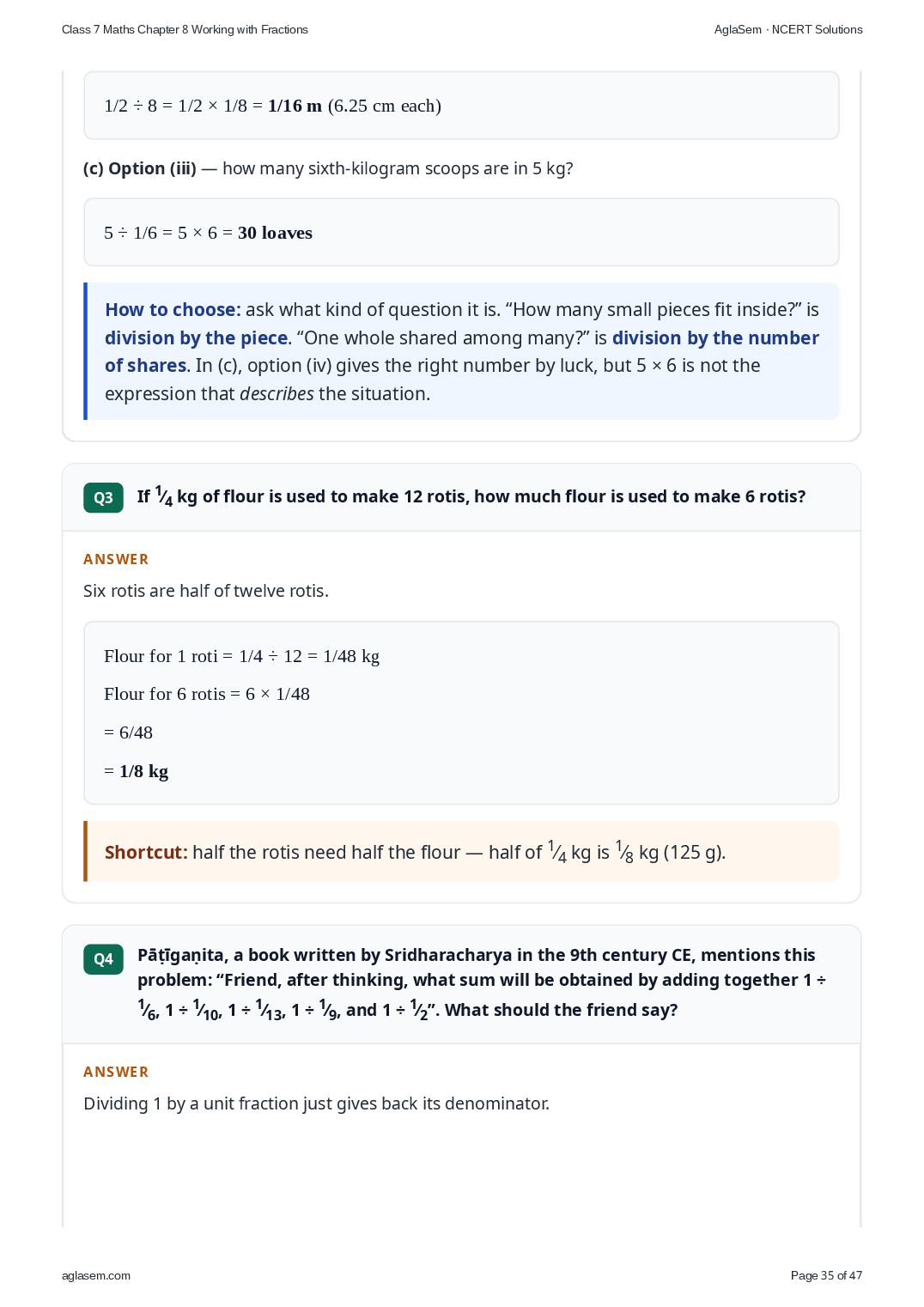
- If 1 ⁄ 4 kg of flour is used to make 12 rotis, how much flour is used to make 6 rotis?
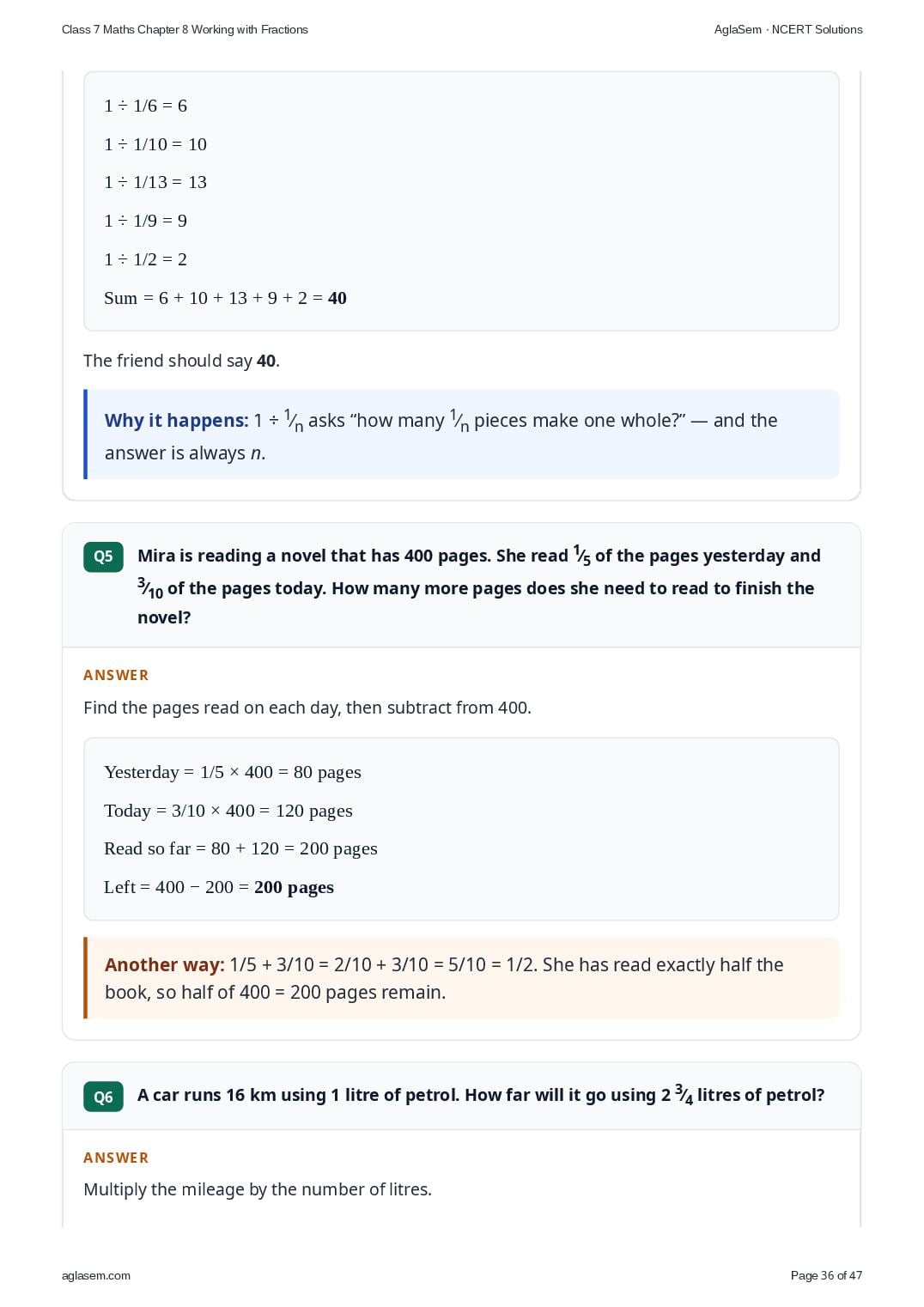
- Pāṭīgaṇita, a book written by Sridharacharya in the 9th century CE, mentions this problem: “Friend, after thinking, what sum will be obtained by adding together 1 ÷ 1 ⁄ 6 , 1 ÷ 1 ⁄ 10 , 1 ÷ 1 ⁄ 13 , 1 ÷ 1 ⁄ 9 , and 1 ÷ 1 ⁄ 2 ”. What should the friend say?
- Mira is reading a novel that has 400 pages. She read 1 ⁄ 5 of the pages yesterday and 3 ⁄ 10 of the pages today. How many more pages does she need to read to finish the novel?
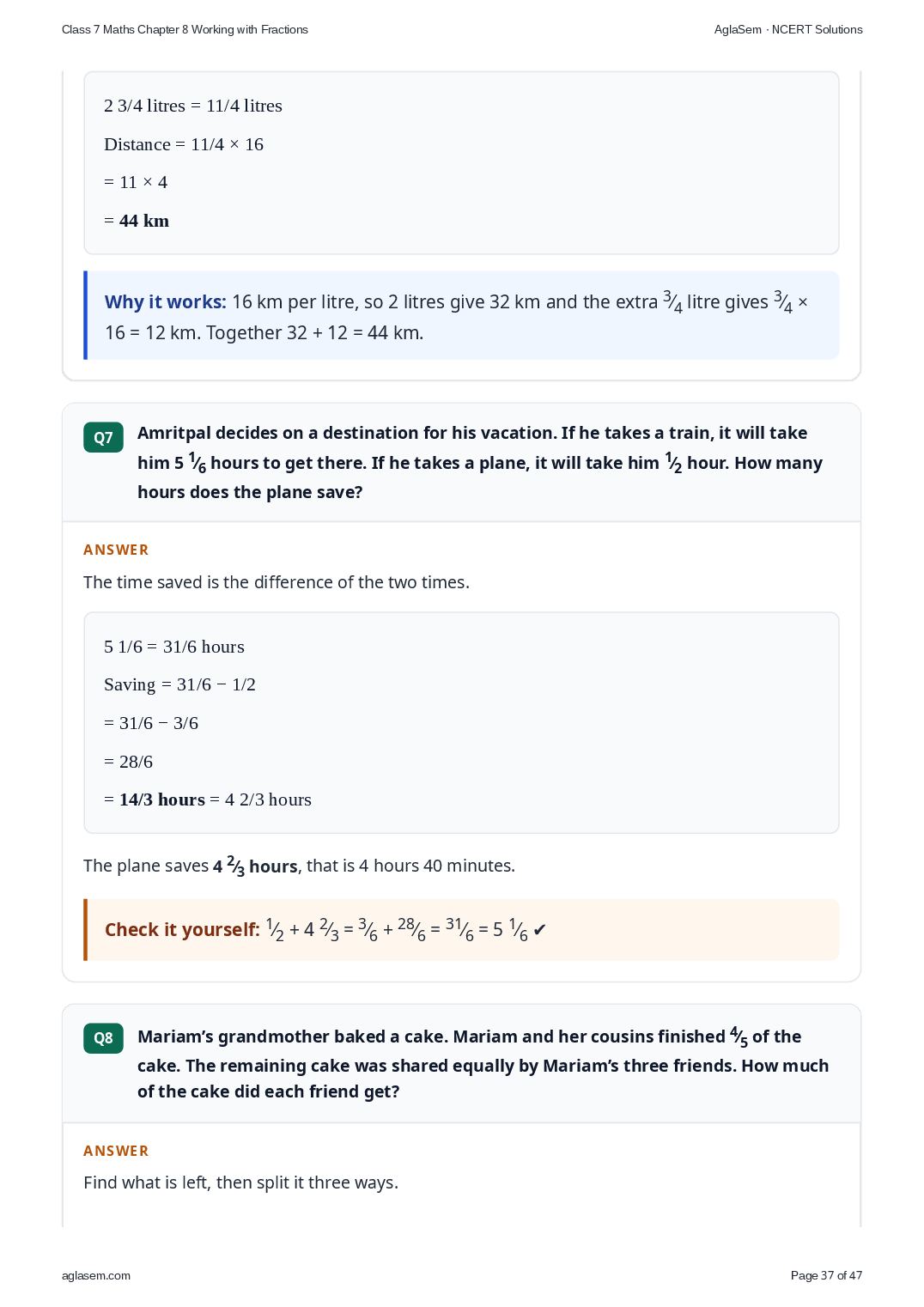
- A car runs 16 km using 1 litre of petrol. How far will it go using 2 3 ⁄ 4 litres of petrol?
- Amritpal decides on a destination for his vacation. If he takes a train, it will take him 5 1 ⁄ 6 hours to get there. If he takes a plane, it will take him 1 ⁄ 2 hour. How many hours does the plane save?
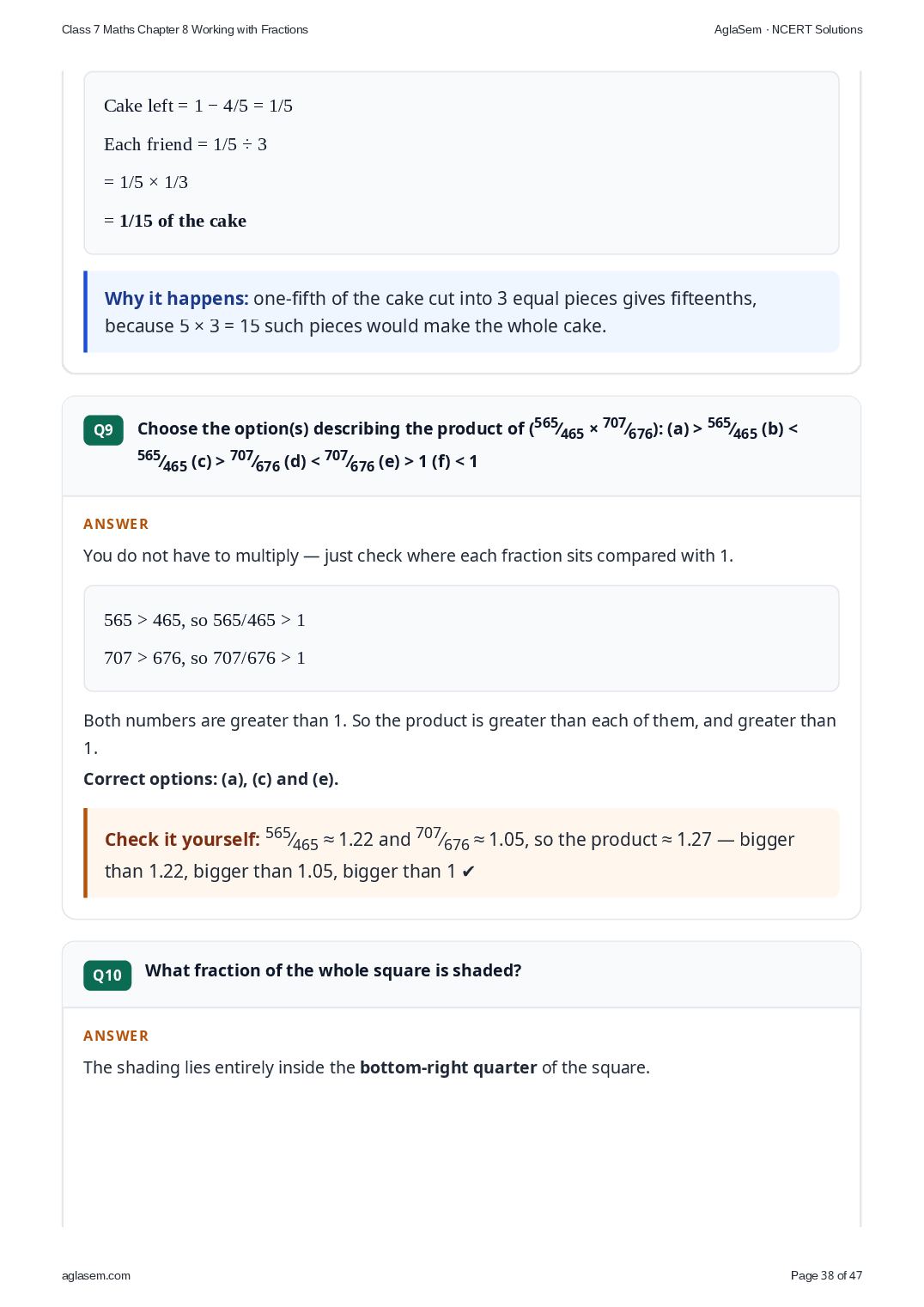
- Mariam’s grandmother baked a cake. Mariam and her cousins finished 4 ⁄ 5 of the cake. The remaining cake was shared equally by Mariam’s three friends. How much of the cake did each friend get?
- Choose the option(s) describing the product of ( 565 ⁄ 465 × 707 ⁄ 676 ): (a) > 565 ⁄ 465 (b) < 565 ⁄ 465 (c) > 707 ⁄ 676 (d) < 707 ⁄ 676 (e) > 1 (f) < 1
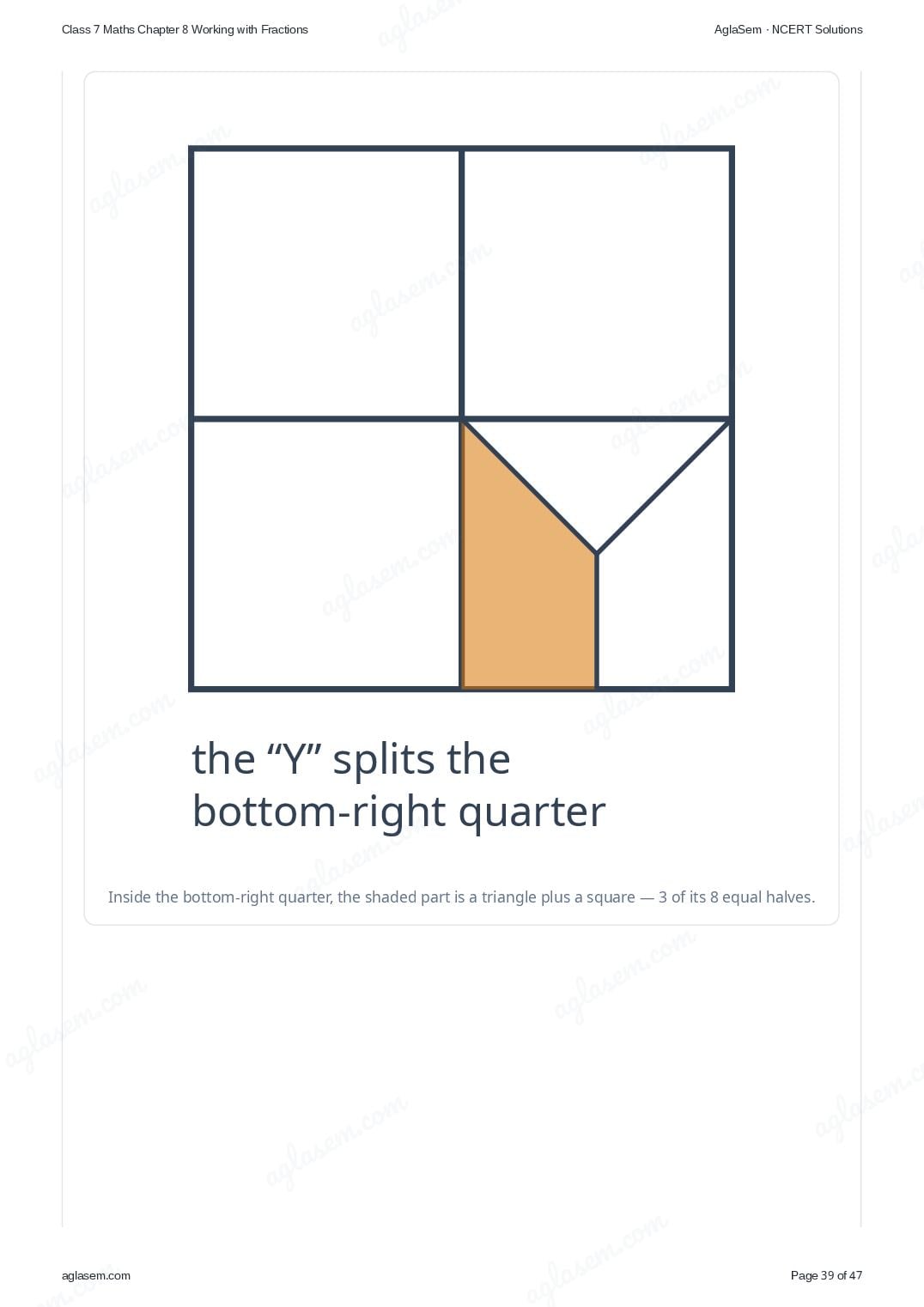
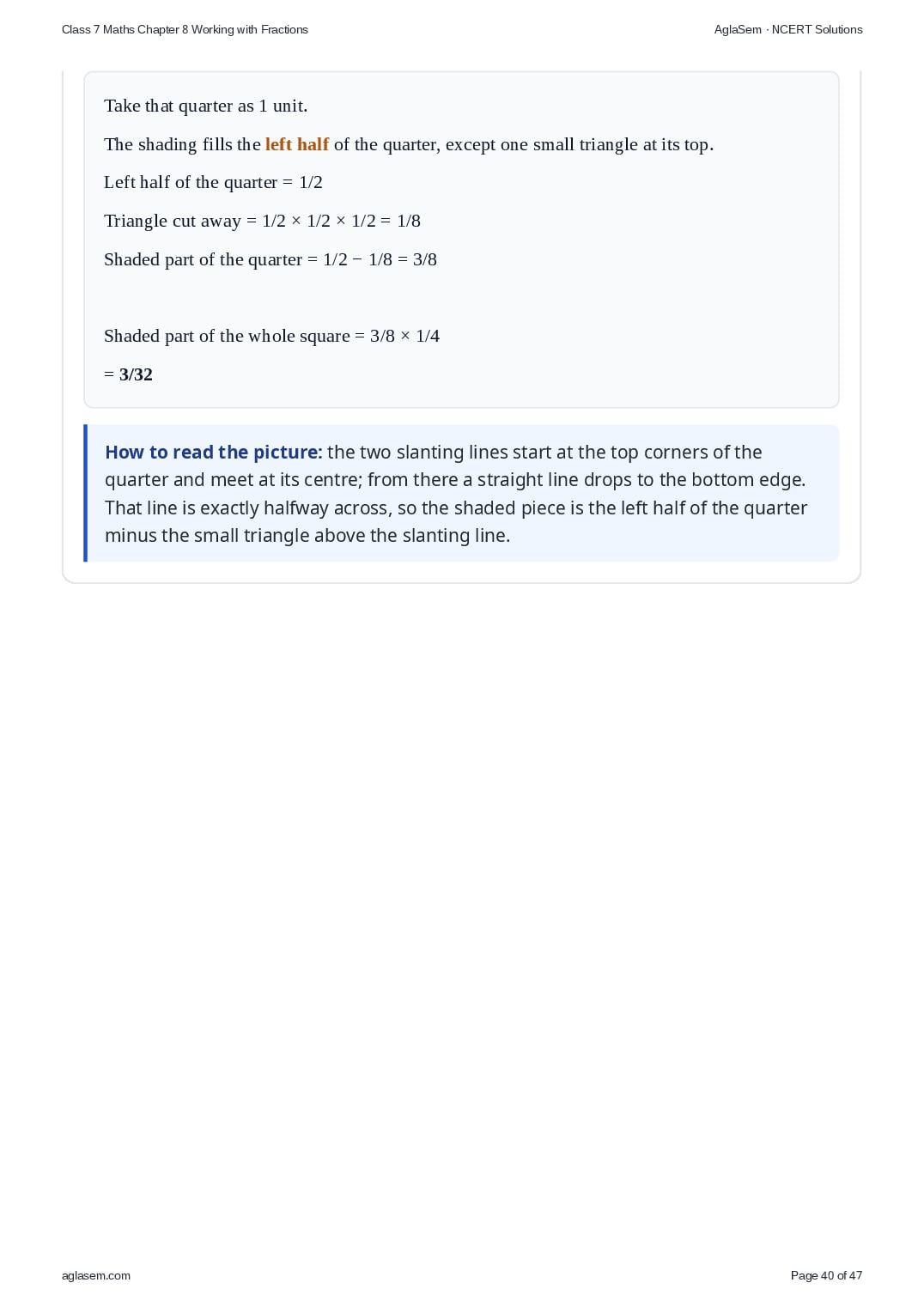
- What fraction of the whole square is shaded?
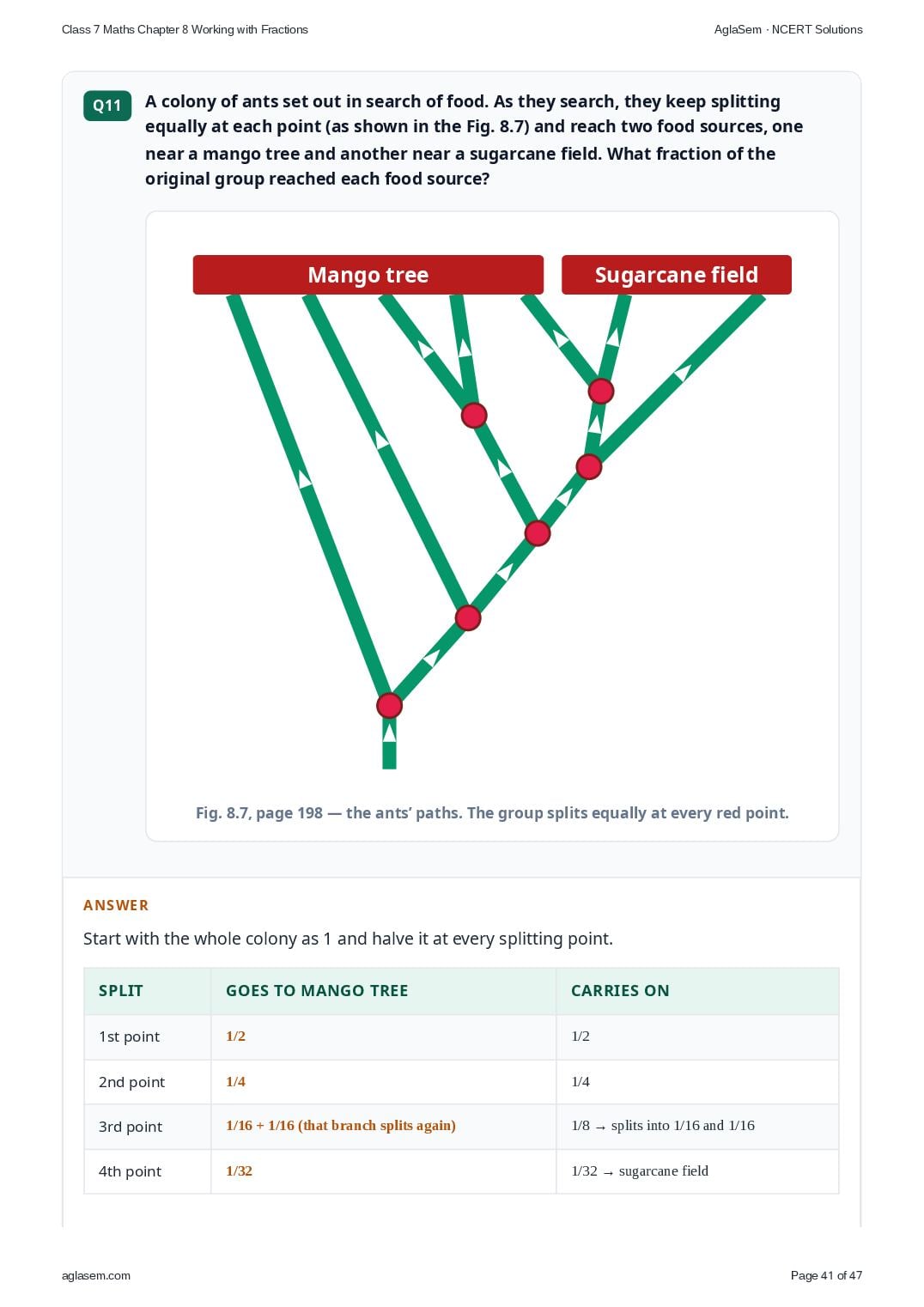
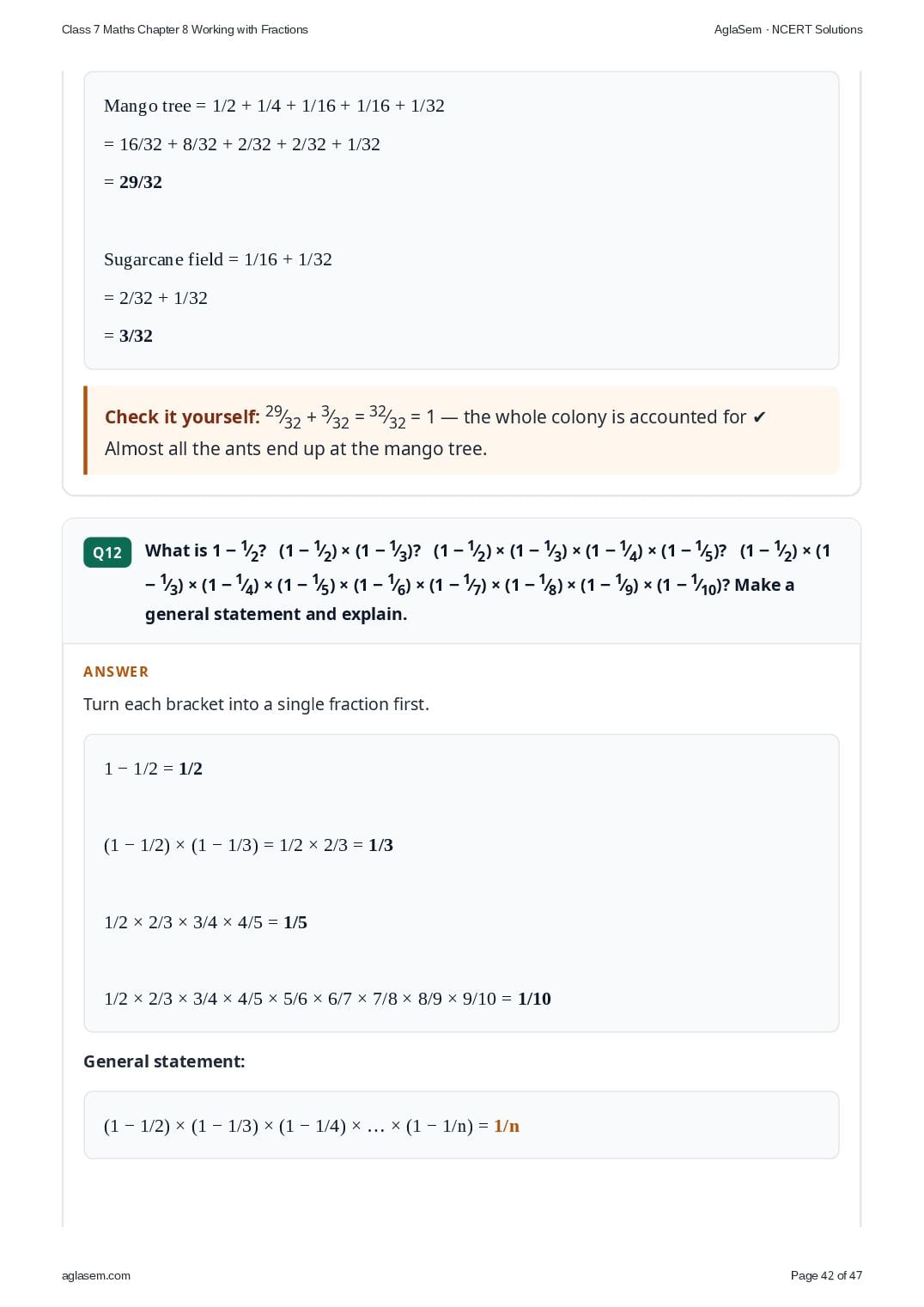
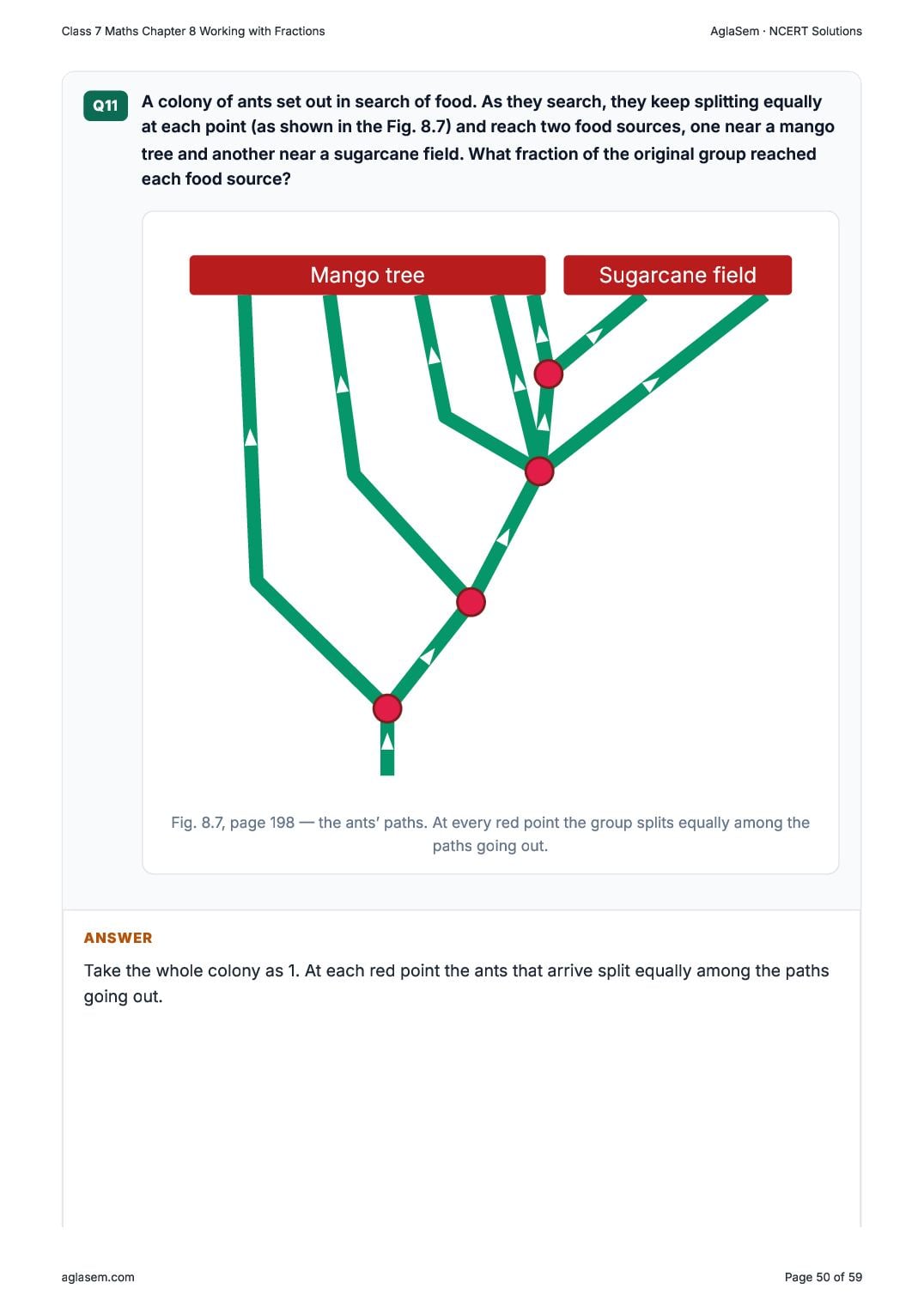
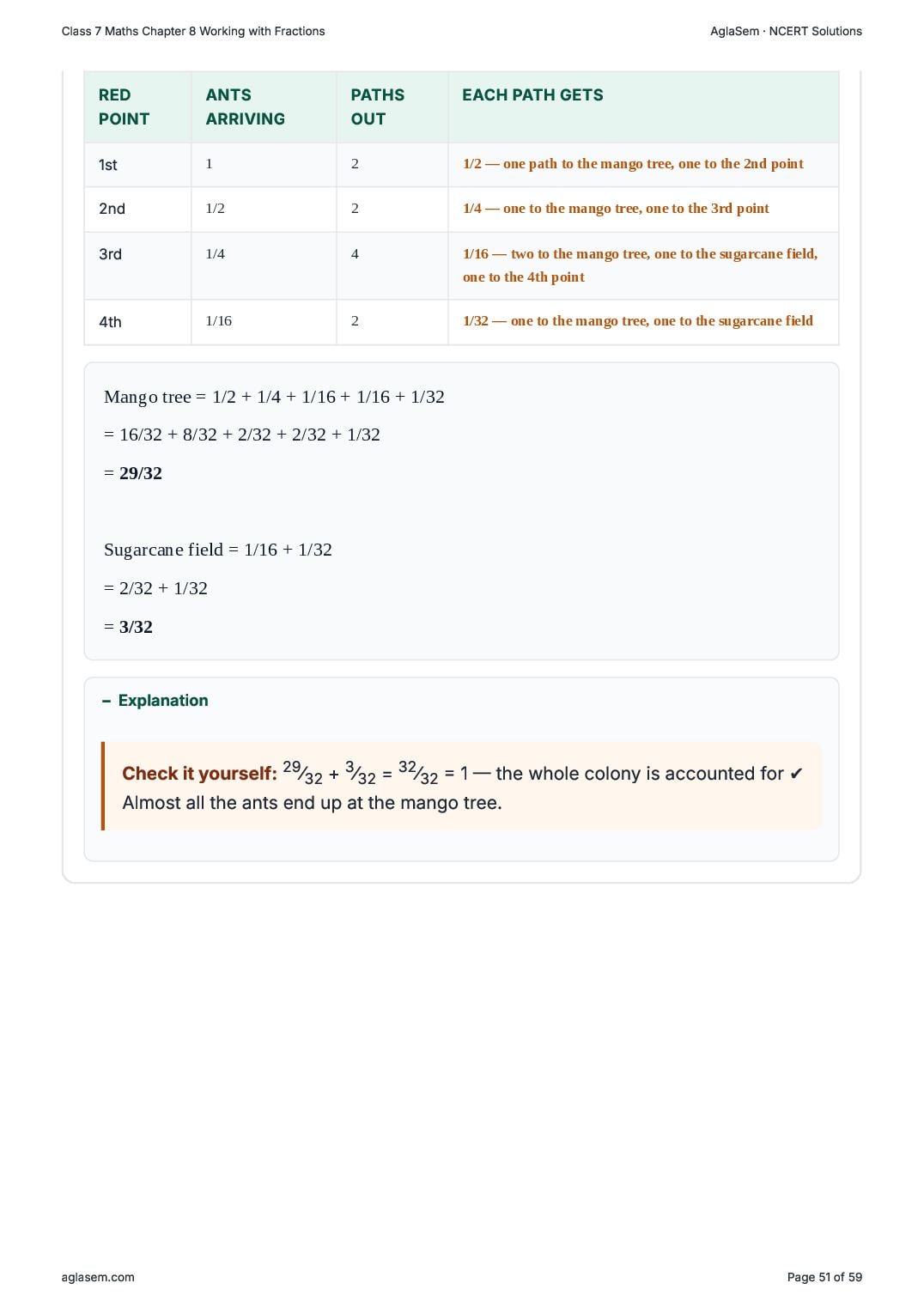
- A colony of ants set out in search of food. As they search, they keep splitting equally at each point (as shown in the Fig. 8.7) and reach two food sources, one near a mango tree and another near a sugarcane field. What fraction of the original group reached each food source?
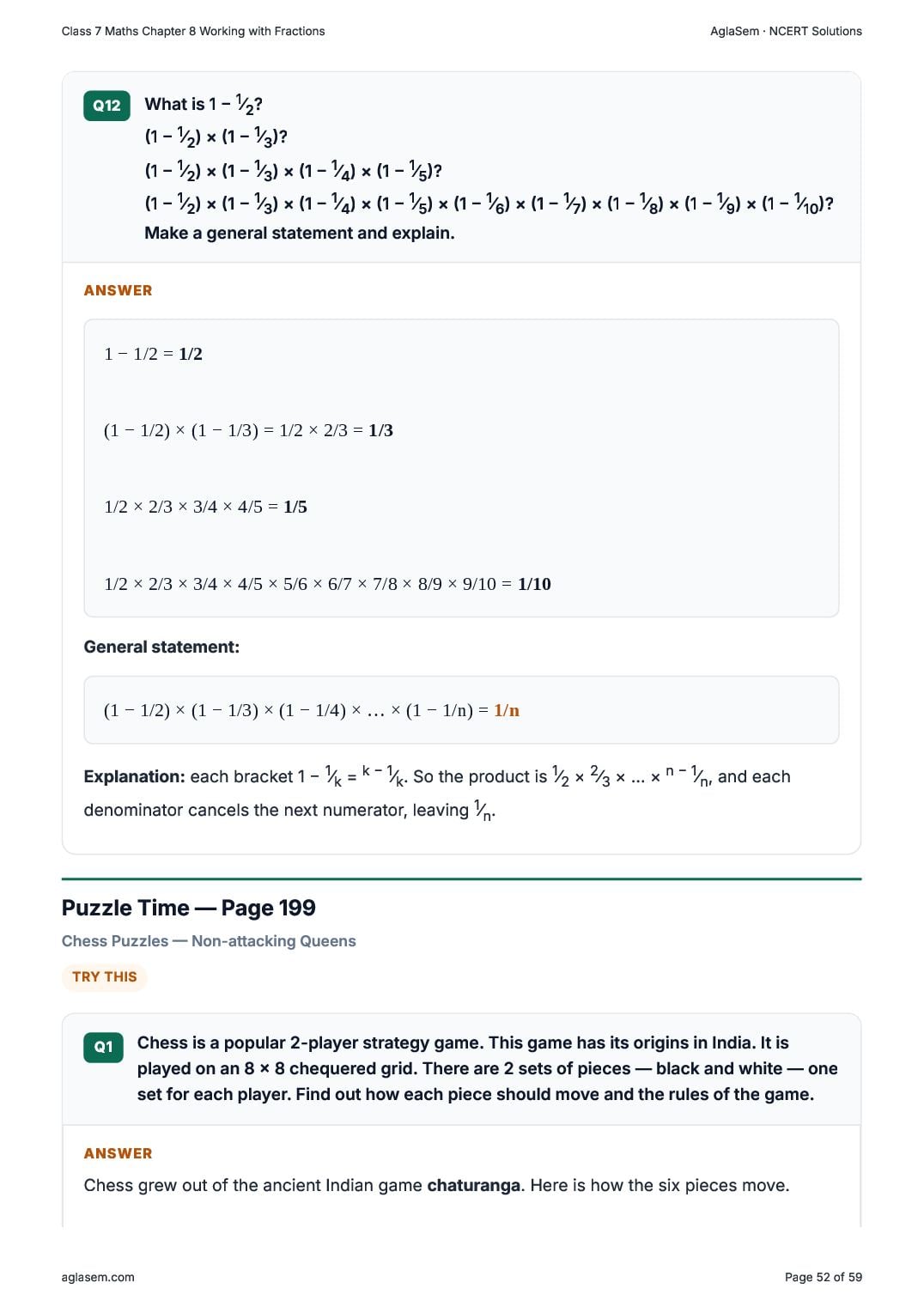
- What is 1 − 1 ⁄ 2 ? (1 − 1 ⁄ 2 ) × (1 − 1 ⁄ 3 )? (1 − 1 ⁄ 2 ) × (1 − 1 ⁄ 3 ) × (1 − 1 ⁄ 4 ) × (1 − 1 ⁄ 5 )? (1 − 1 ⁄ 2 ) × (1 − 1 ⁄ 3 ) × (1 − 1 ⁄ 4 ) × (1 − 1 ⁄ 5 ) × (1 − 1 ⁄ 6 ) × (1 − 1 ⁄ 7 ) × (1 − 1 ⁄ 8 ) × (1 − 1 ⁄ 9 ) × (1 − 1 ⁄ 10 )? Make a general statement and explain.
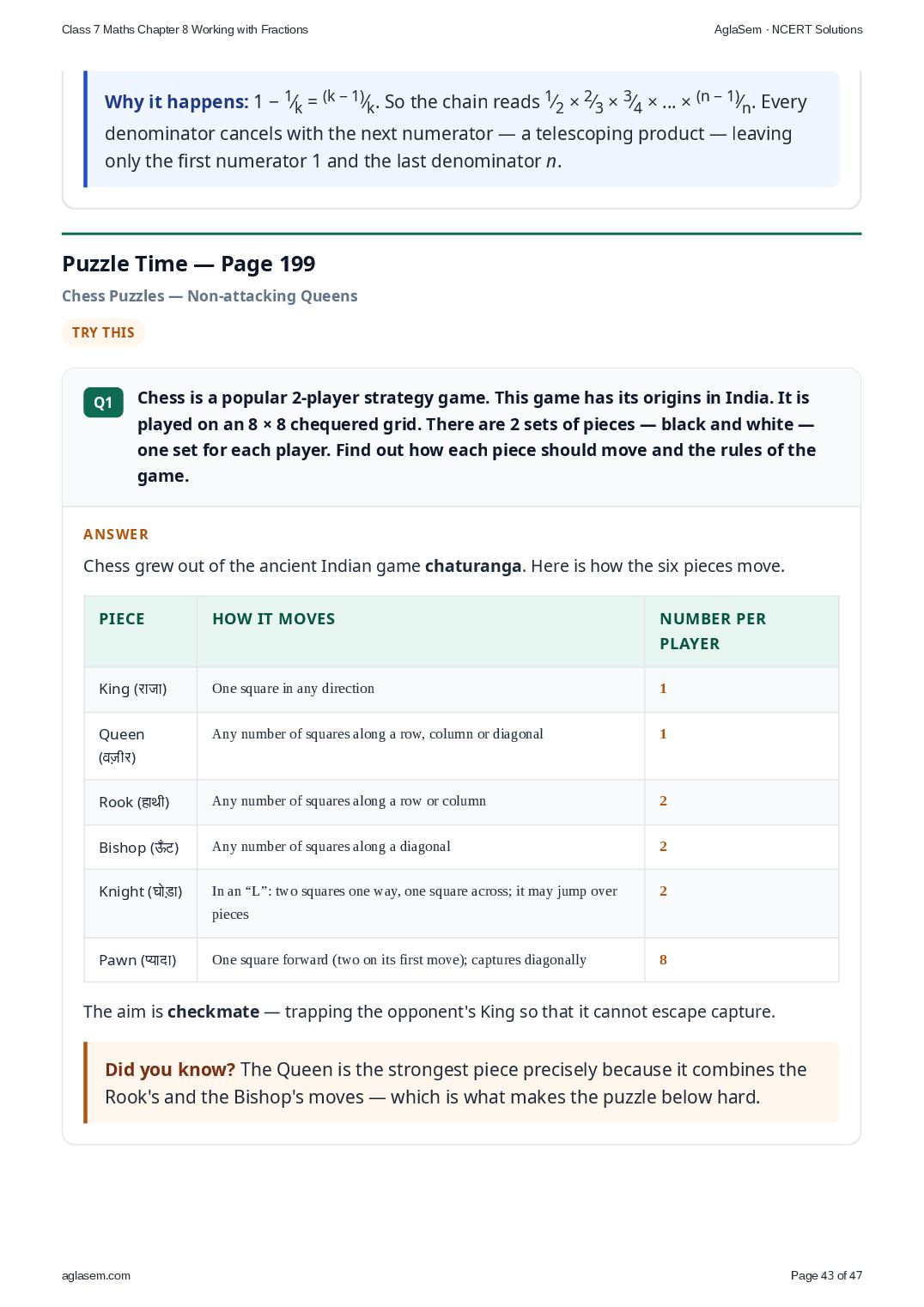
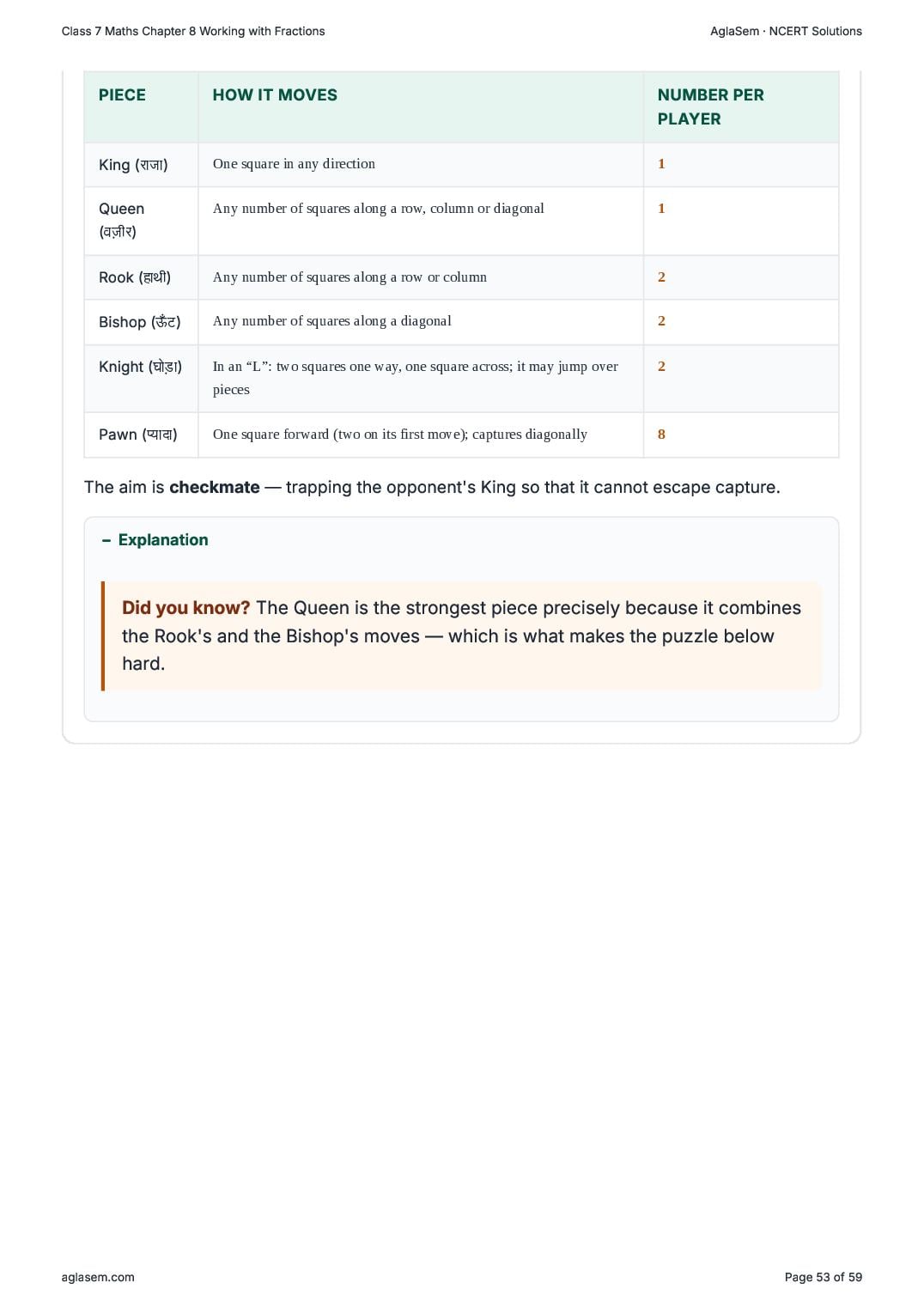
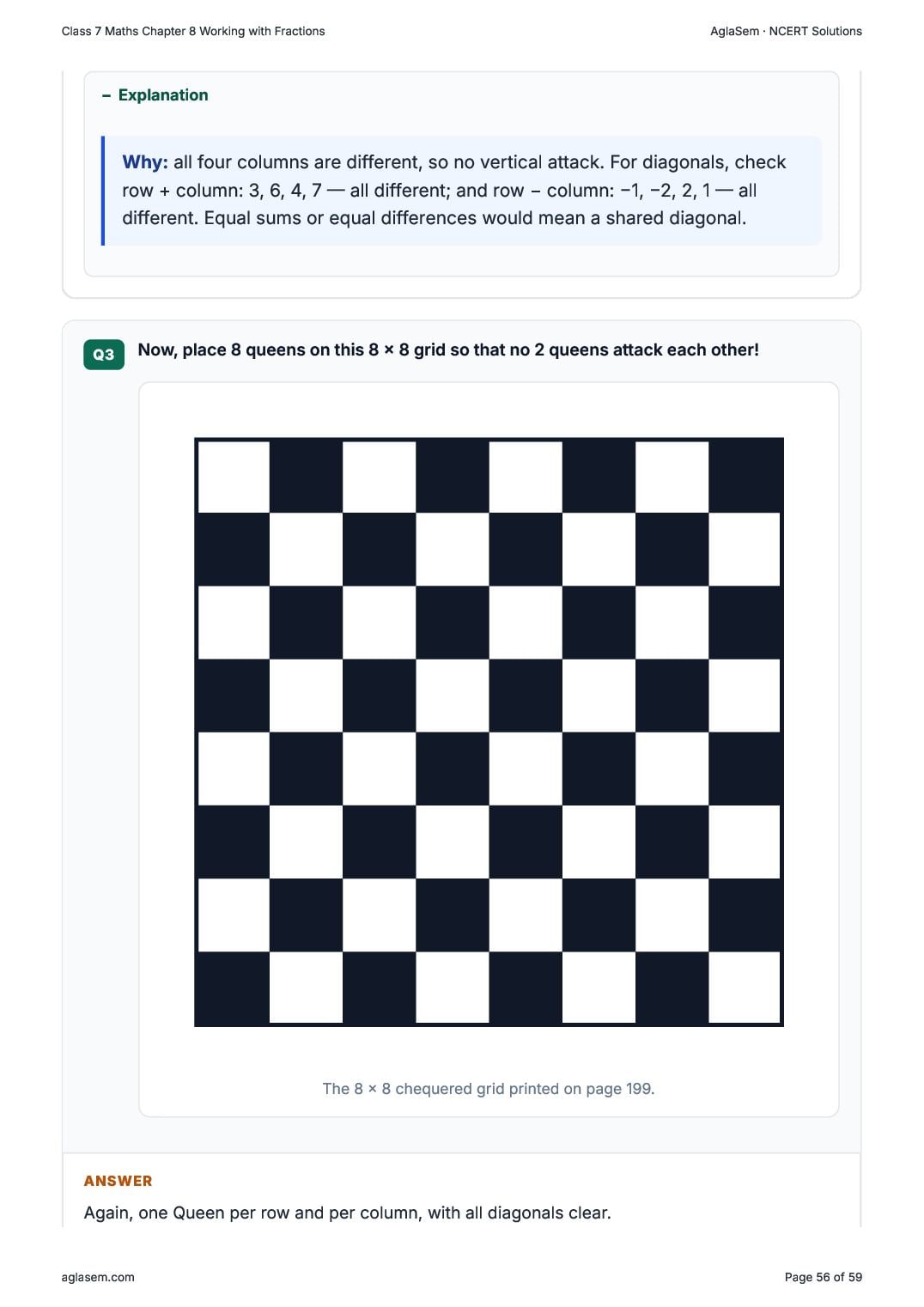
- Chess is a popular 2-player strategy game. This game has its origins in India. It is played on an 8 × 8 chequered grid. There are 2 sets of pieces — black and white — one set for each player. Find out how each piece should move and the rules of the game.
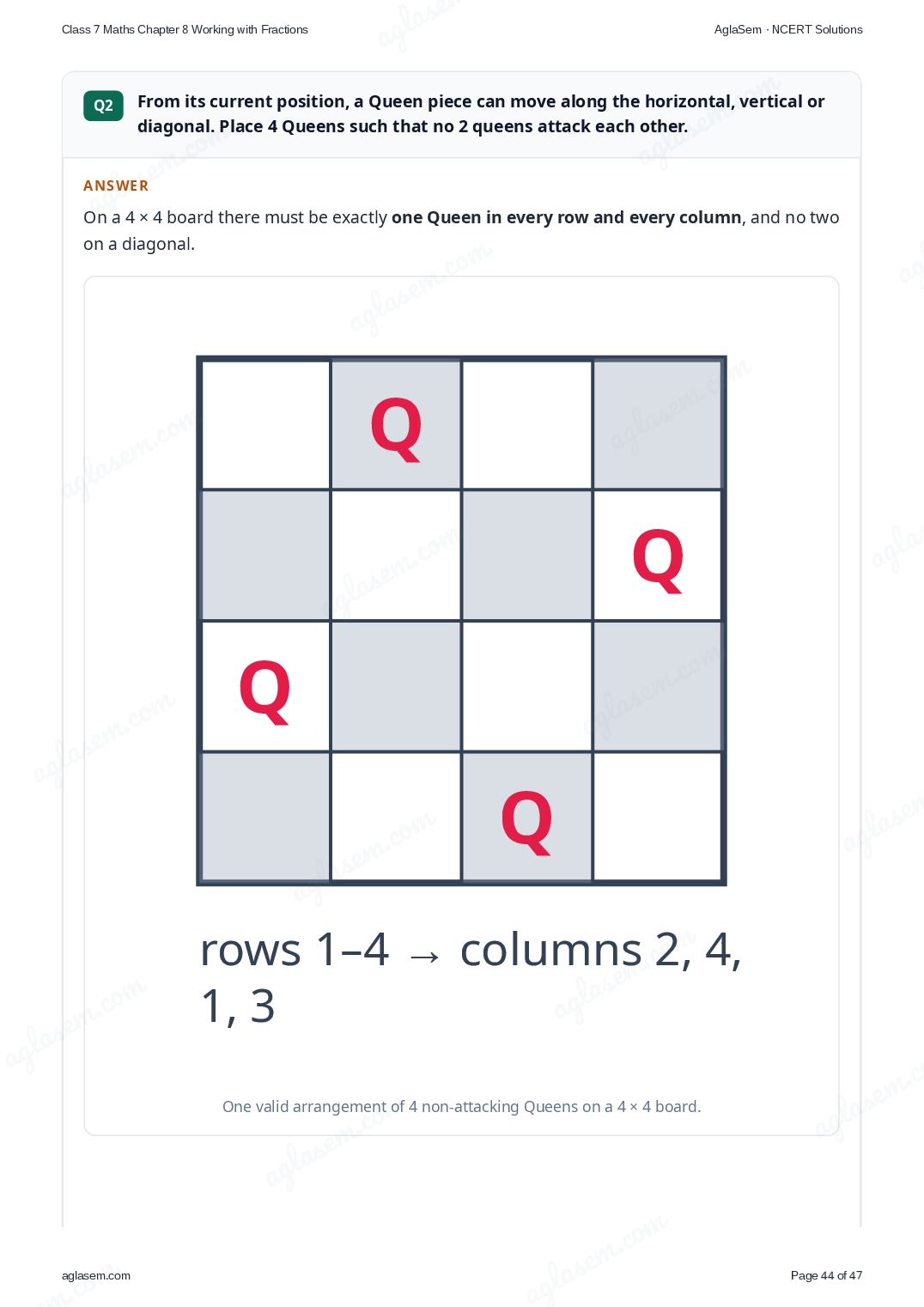
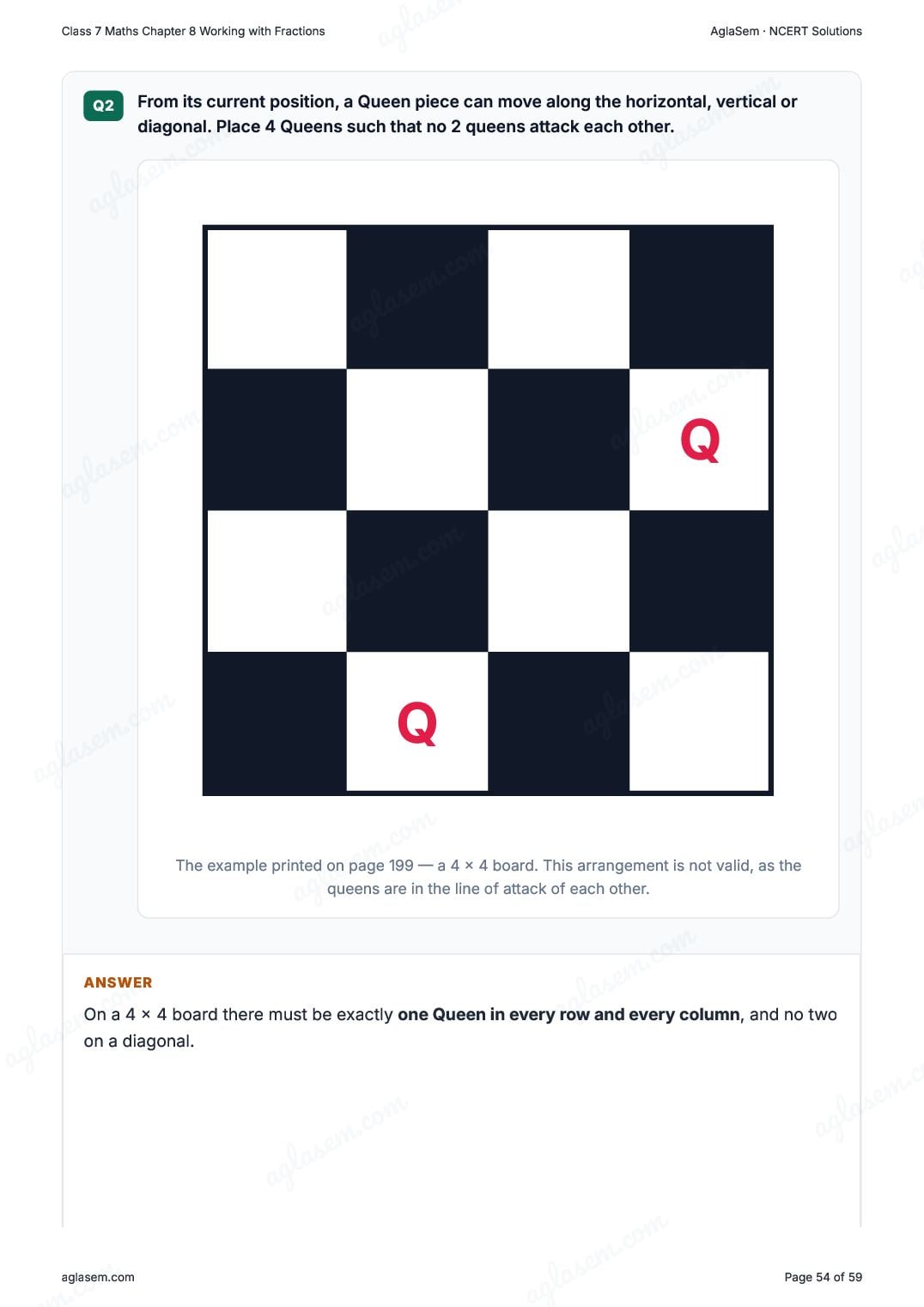
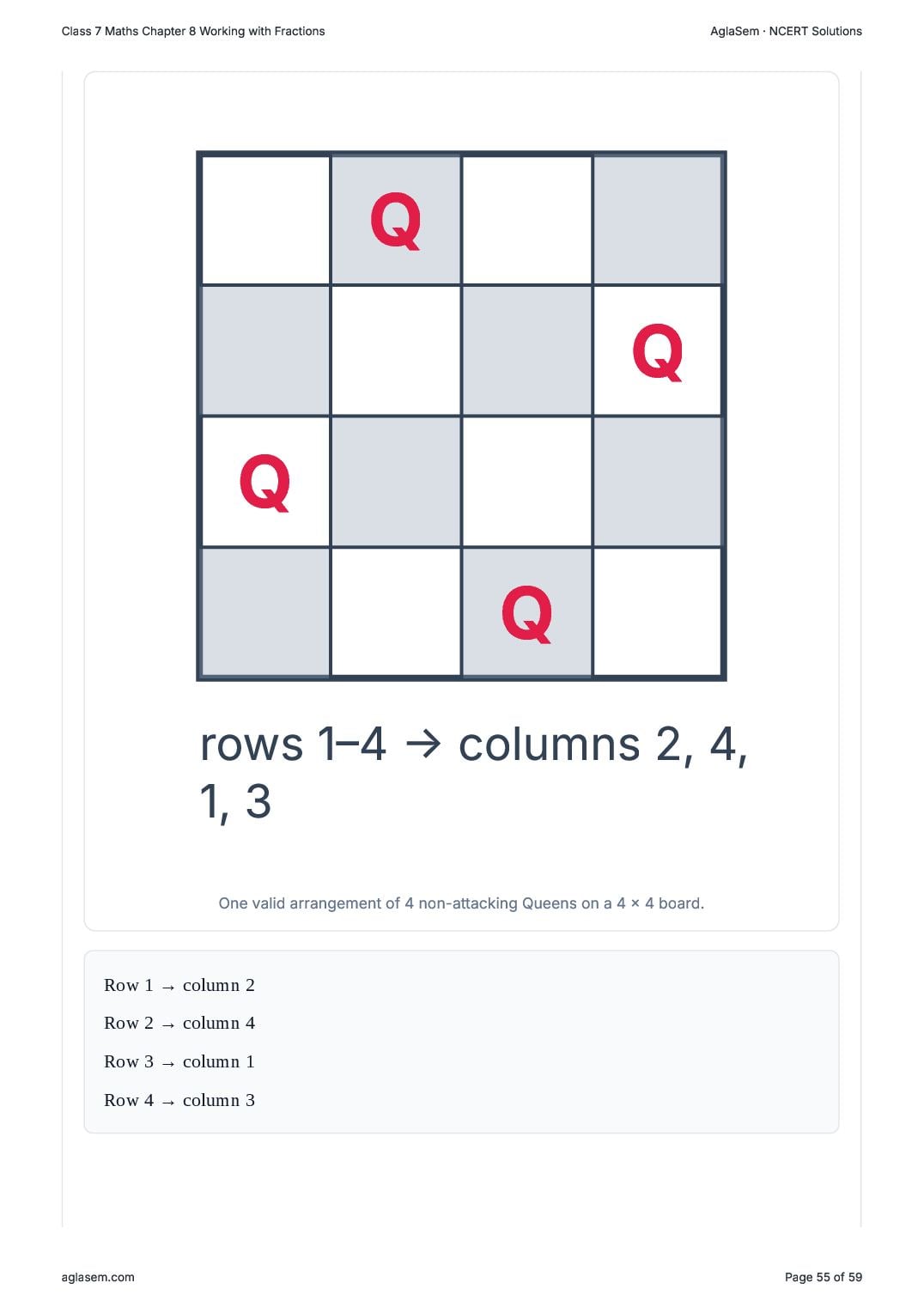
- From its current position, a Queen piece can move along the horizontal, vertical or diagonal. Place 4 Queens such that no 2 queens attack each other.
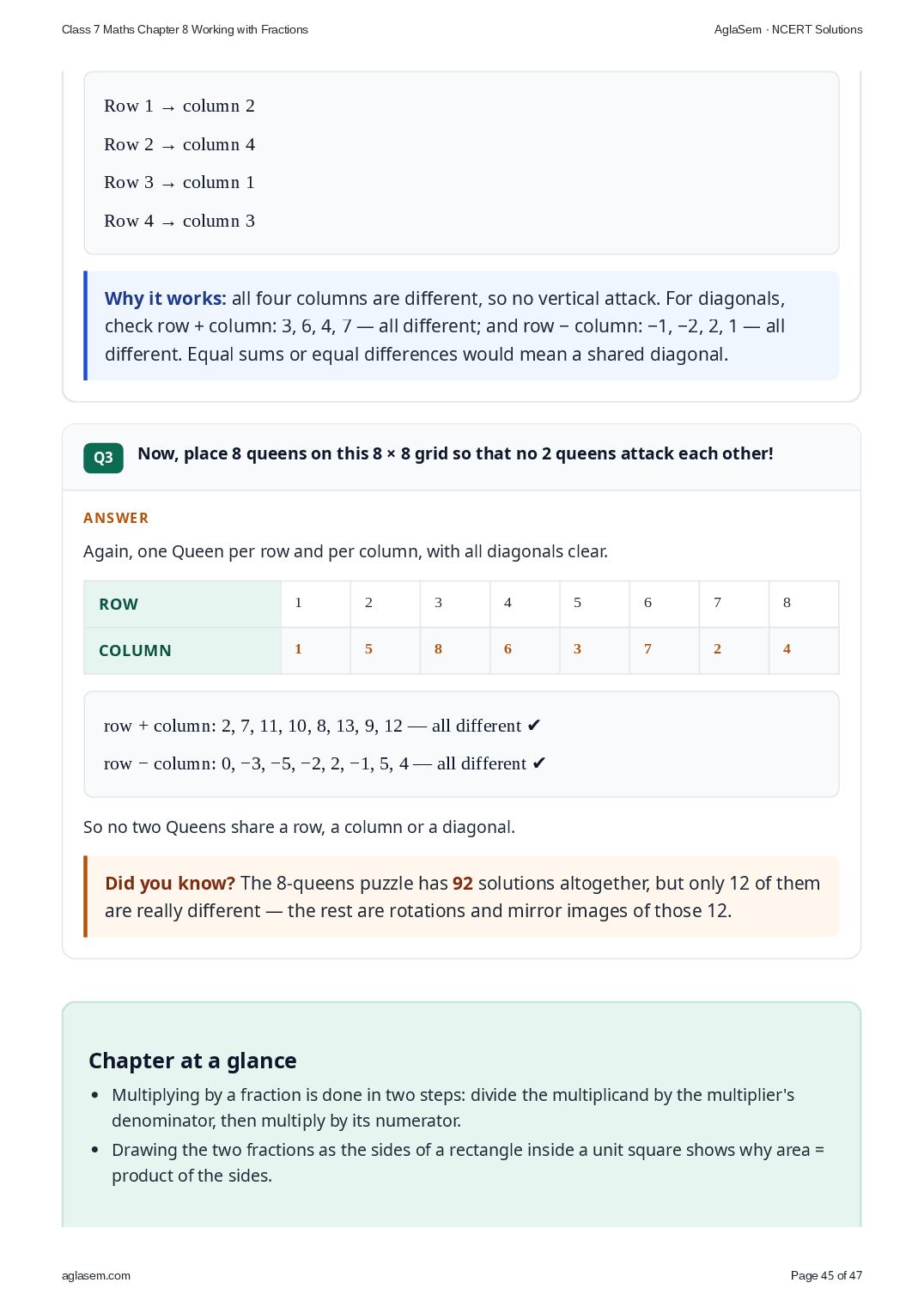
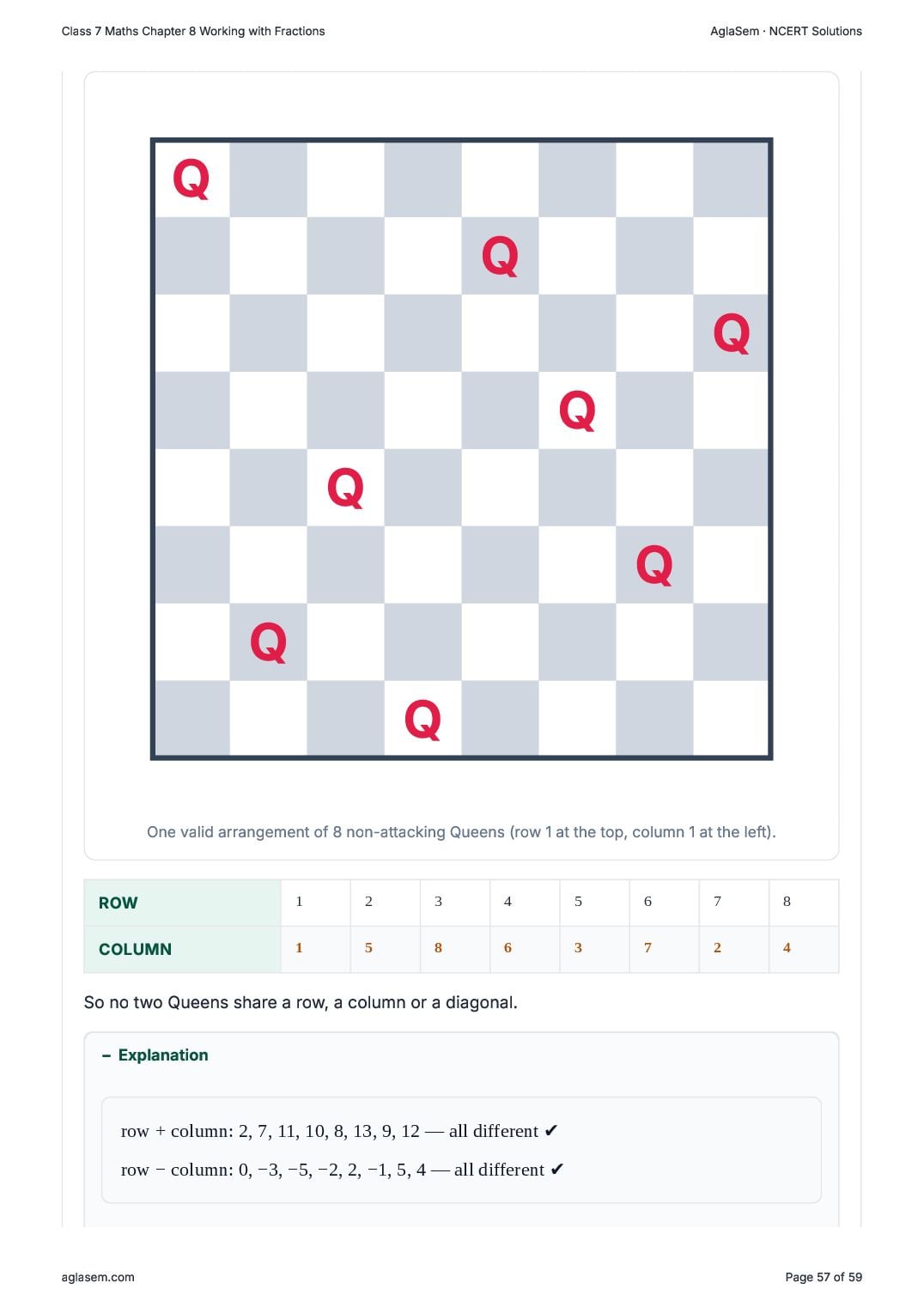
- Now, place 8 queens on this 8 × 8 grid so that no 2 queens attack each other!
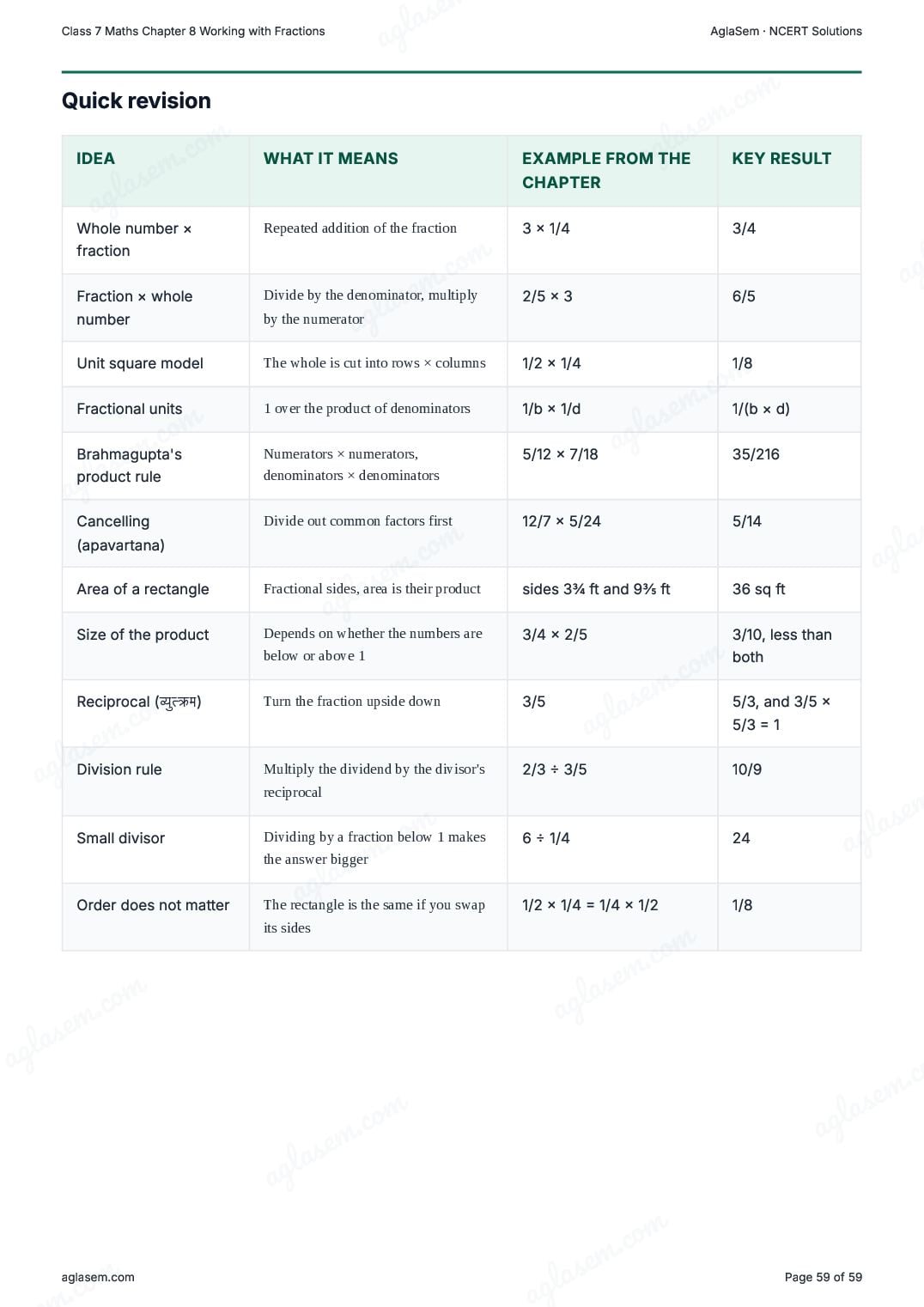
Chapter at a Glance
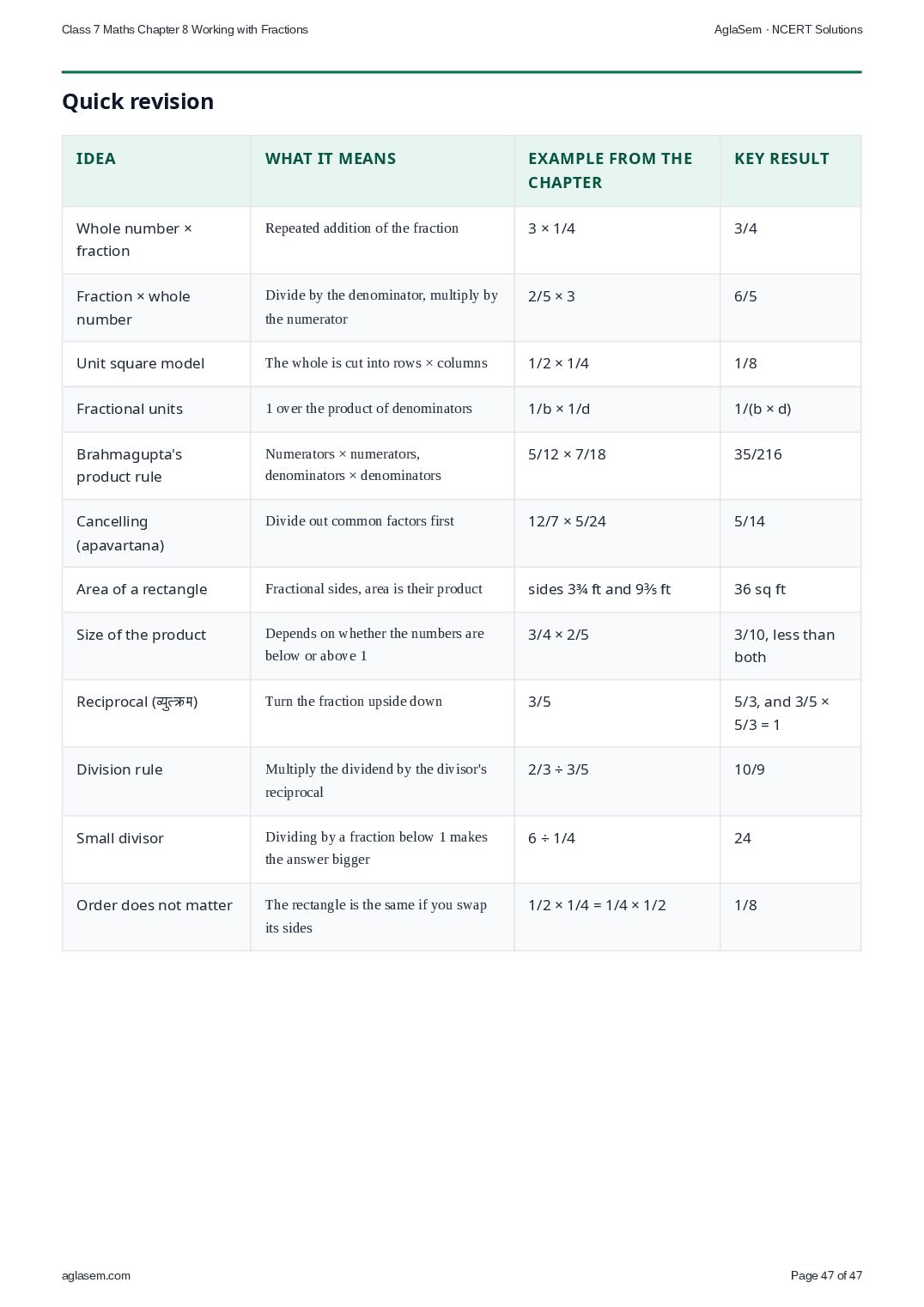
- Multiplying by a fraction is done in two steps: divide the multiplicand by the multiplier's denominator, then multiply by its numerator.
- Drawing the two fractions as the sides of a rectangle inside a unit square shows why area = product of the sides .
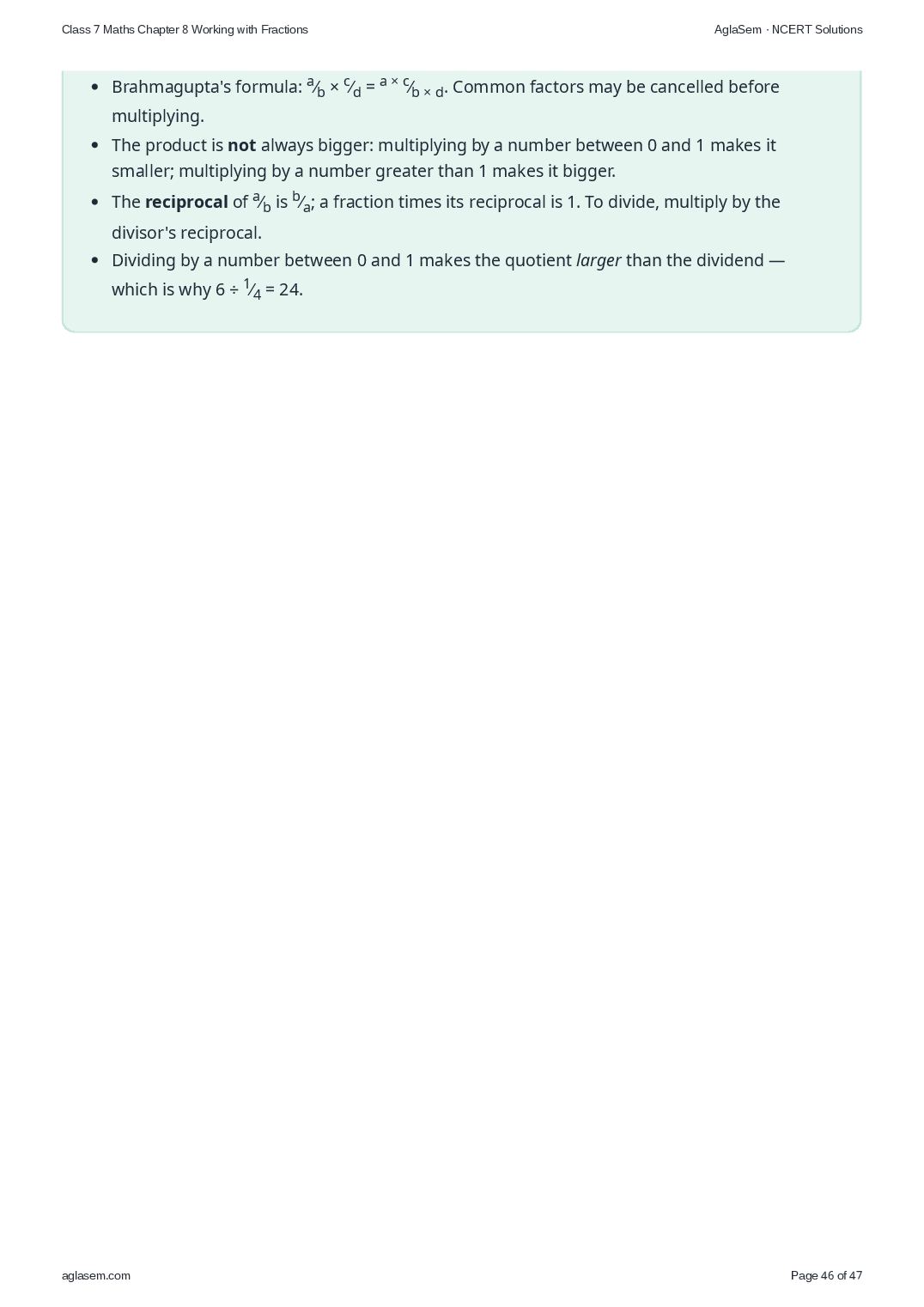
- Brahmagupta's formula: a ⁄ b × c ⁄ d = a × c ⁄ b × d . Common factors may be cancelled before multiplying.
- The product is not always bigger: multiplying by a number between 0 and 1 makes it smaller; multiplying by a number greater than 1 makes it bigger.
- The reciprocal of a ⁄ b is b ⁄ a ; a fraction times its reciprocal is 1. To divide, multiply by the divisor's reciprocal.
- Dividing by a number between 0 and 1 makes the quotient larger than the dividend — which is why 6 ÷ 1 ⁄ 4 = 24.
How to Download NCERT Solutions for Class 7 Maths Chapter 8 PDF
Follow these simple steps to get the Working with Fractions questions-and-answers PDF from Ganita Prakash.
- Search NCERT Solutions for Class 7 Maths Chapter 8 aglasem and open this page.
- Read the exercise questions with answers for Working with Fractions shown above.
- Click the Download PDF link to save the Working with Fractions solutions to your device.
NCERT Solutions for Class 7 Maths – All Chapters
There are more chapters to study besides Working with Fractions in Maths. Here are the NCERT Solutions for all chapters of Class 7 Maths.
- Chapter 1 Large Numbers Around Us
- Chapter 2 Arithmetic Expressions
- Chapter 3 a Peek Beyond the Point
- Chapter 4 Expressions Using Letter Numbers
- Chapter 5 Parallel and Intersecting Lines
- Chapter 6 Number Play
- Chapter 7 a Tale of Three Intersecting Lines
- Chapter 8 Working with Fractions
NCERT Solutions for Class 7 – All Subjects
Just like Chapter 8 of Maths, you can get the exercise questions with answers for every other subject of Class 7. Here are the NCERT Solutions for all subjects of Class 7.
NCERT Solutions for Class 7 Maths Chapter 8 – An Overview
The key highlights of this study material are as follows.
| Aspects | Details |
|---|---|
| Class | Class 7 |
| Subject | Maths |
| Chapter Number | Chapter 8 |
| Chapter Name | Working with Fractions |
| Book Name | Ganita Prakash |
| Book By | NCERT (National Council of Educational Research and Training) |
| Educational Resource Here | NCERT Solutions of Class 7 Maths Chapter 8 for all exercises |
| More Questions Answers of This Subject | NCERT Solutions for Class 7 Maths |
| Download Book Chapter | NCERT Book Class 7 Maths |
| All Questions Answers For This Class | NCERT Solutions for Class 7 |
| Complete Solutions | NCERT Solutions |
NCERT Solutions for Class 7 Maths Chapter 8 Working with Fractions – FAQs
What are the NCERT Solutions for Class 7 Maths Chapter 8 Working with Fractions?
They are the complete, step-by-step answers to all the exercise and in-text questions of Chapter 8 Working with Fractions from the NCERT Class 7 Maths textbook Ganita Prakash, written by experts as per the latest NCERT syllabus.
How can I download the Class 7 Maths Chapter 8 solutions PDF for free?
Open this page on aglasem, read the Working with Fractions questions with answers, and click the “Download Solutions PDF” link. The Class 7 Maths Chapter 8 NCERT Solutions PDF is completely free to download.
Are these NCERT Solutions as per the latest 2026-27 syllabus?
Yes. The NCERT Solutions for Class 7 Maths Chapter 8 are based on the latest NCERT textbook Ganita Prakash and the current 2026-27 CBSE syllabus, so the questions and answers match what you study in class.
Where can I get NCERT Solutions for the other chapters of Class 7 Maths?
You can find the answers to every chapter on the NCERT Solutions for Class 7 Maths page, and solutions for every subject on the NCERT Solutions for Class 7 page.
How do NCERT Solutions help in exam preparation?
They show the correct method to solve each question, help you write answers the way they are expected in exams, let you check and correct your own work, and save revision time — which together improve your marks in Class 7 Maths.
If you have any queries on NCERT Solutions for Class 7 Maths Chapter 8 Working with Fractions, then please ask in the comments below.