NCERT Solutions for Class 7 Social Science Chapter 8 How the Land Becomes Sacred provide clear, step-by-step answers to every exercise and in-text question from the chapter How the Land Becomes Sacred of the NCERT textbook Exploring Society India and Beyond. Prepared by subject experts as per the latest NCERT (CBSE) syllabus for 2026-27, these NCERT Solutions for Class 7 Social Science help you understand each concept, write exam-ready answers, and check your own solutions. You can read them online below or download the free Class 7 Social Science Chapter 8 question-answer PDF.
NCERT Solutions for Class 7 Social Science Chapter 8 How the Land Becomes Sacred
- Class: Class 7
- Subject: Social Science
- Chapter: Chapter 8 – How the Land Becomes Sacred
- Textbook: Exploring Society India and Beyond (NCERT)
- Study material: NCERT Solutions – questions with answers, free PDF
These solutions answer all the exercise questions of Chapter 8 How the Land Becomes Sacred — including the in-text questions, short-answer and long-answer questions, and activities — with complete explanations so you can follow the method, not just the final answer. Read the full solutions below.
NCERT Solutions Class 7 Social Science Chapter 8 How the Land Becomes Sacred View Download
NCERT Solutions for Class 7 Social Science Chapter 8 PDF Download
You can read the NCERT Solutions for Class 7 Social Science Chapter 8 online above, or download the complete question-answer PDF to study How the Land Becomes Sacred offline at any time.
NCERT Solutions for Class 7 Social Science Chapter 8 PDF Download Link – Click Here to Download Solutions PDF
Questions Covered in This Chapter
These NCERT Solutions answer all 27 questions of this chapter. The questions solved are:
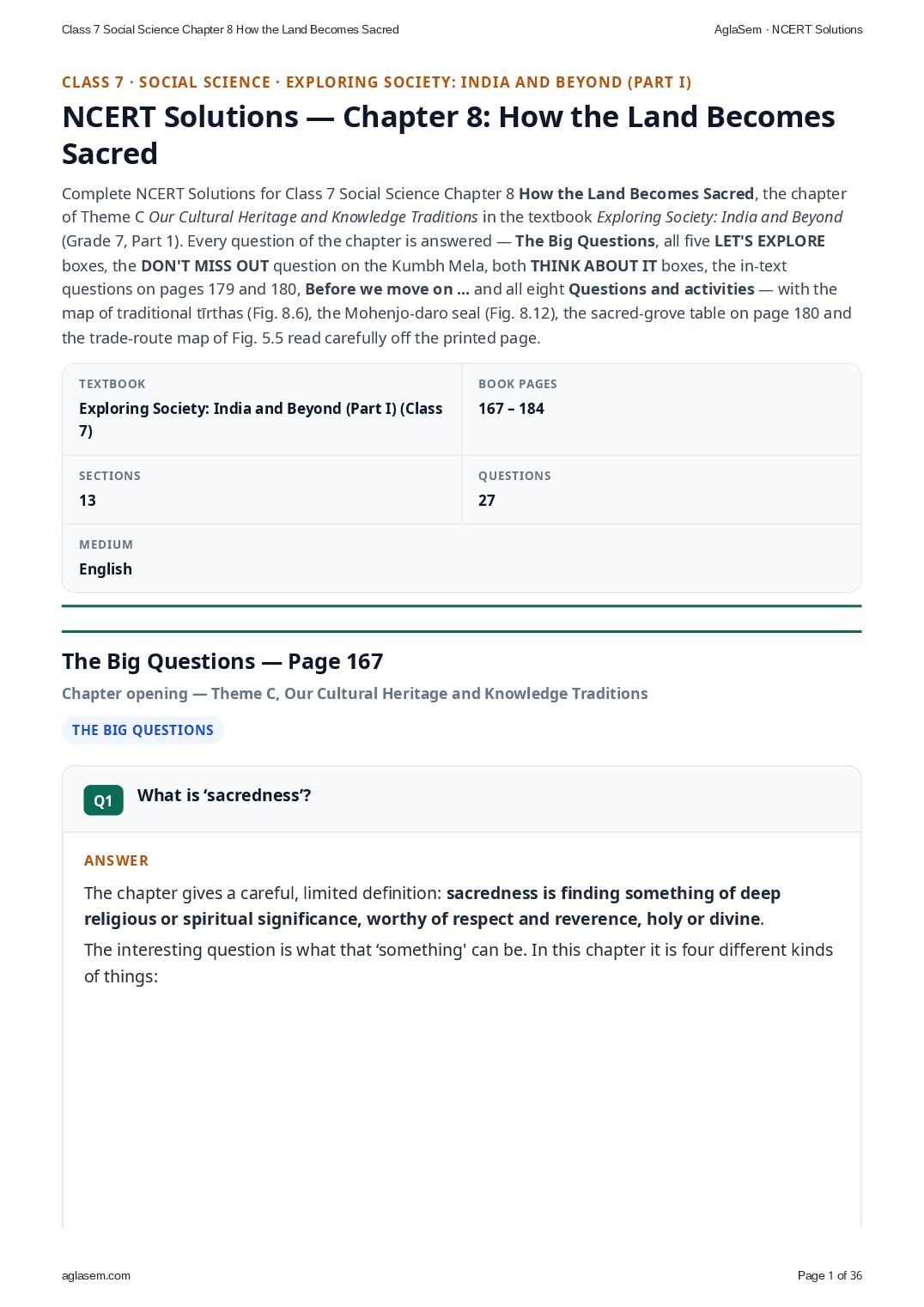
- What is ‘sacredness’?
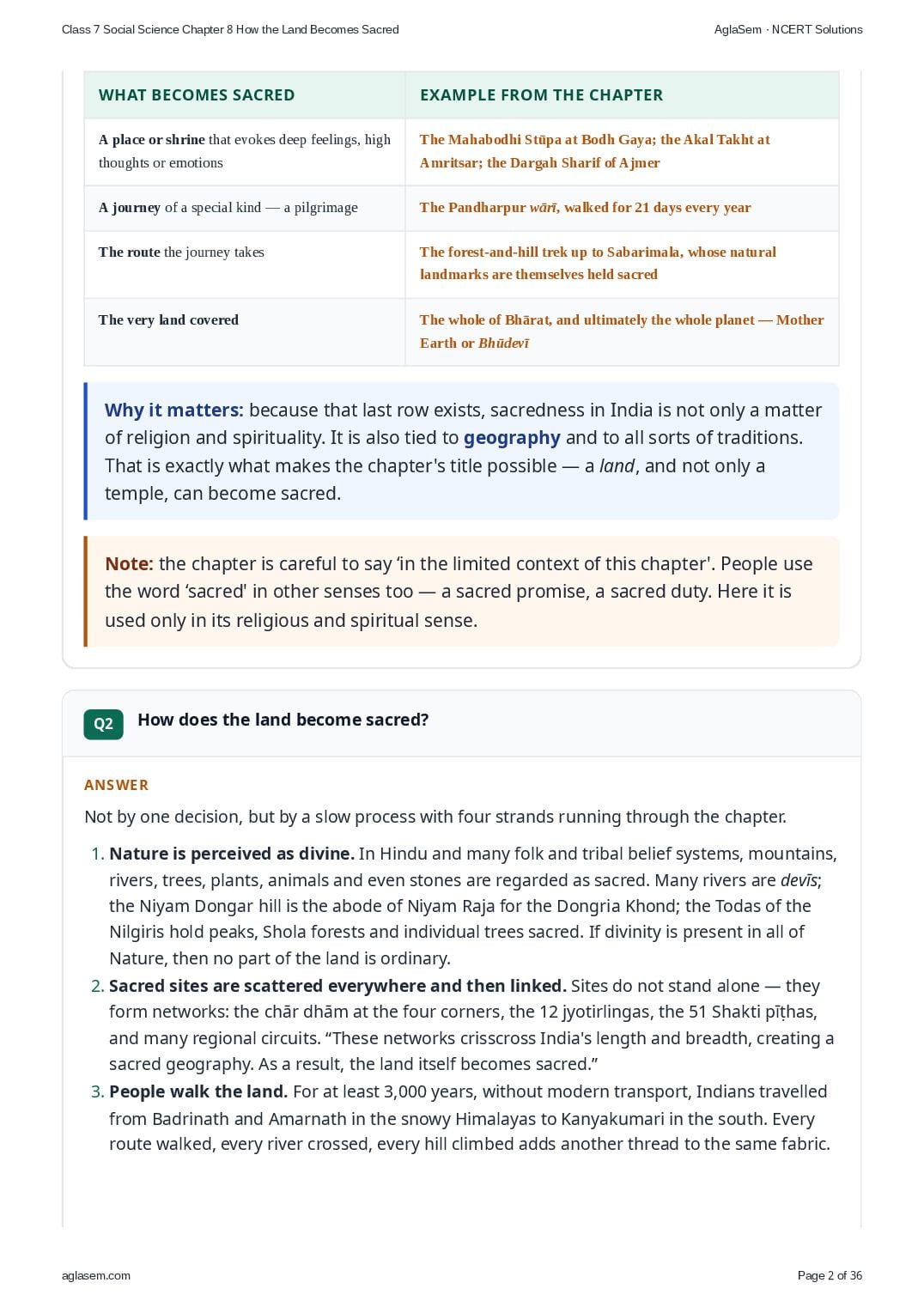
- How does the land become sacred?
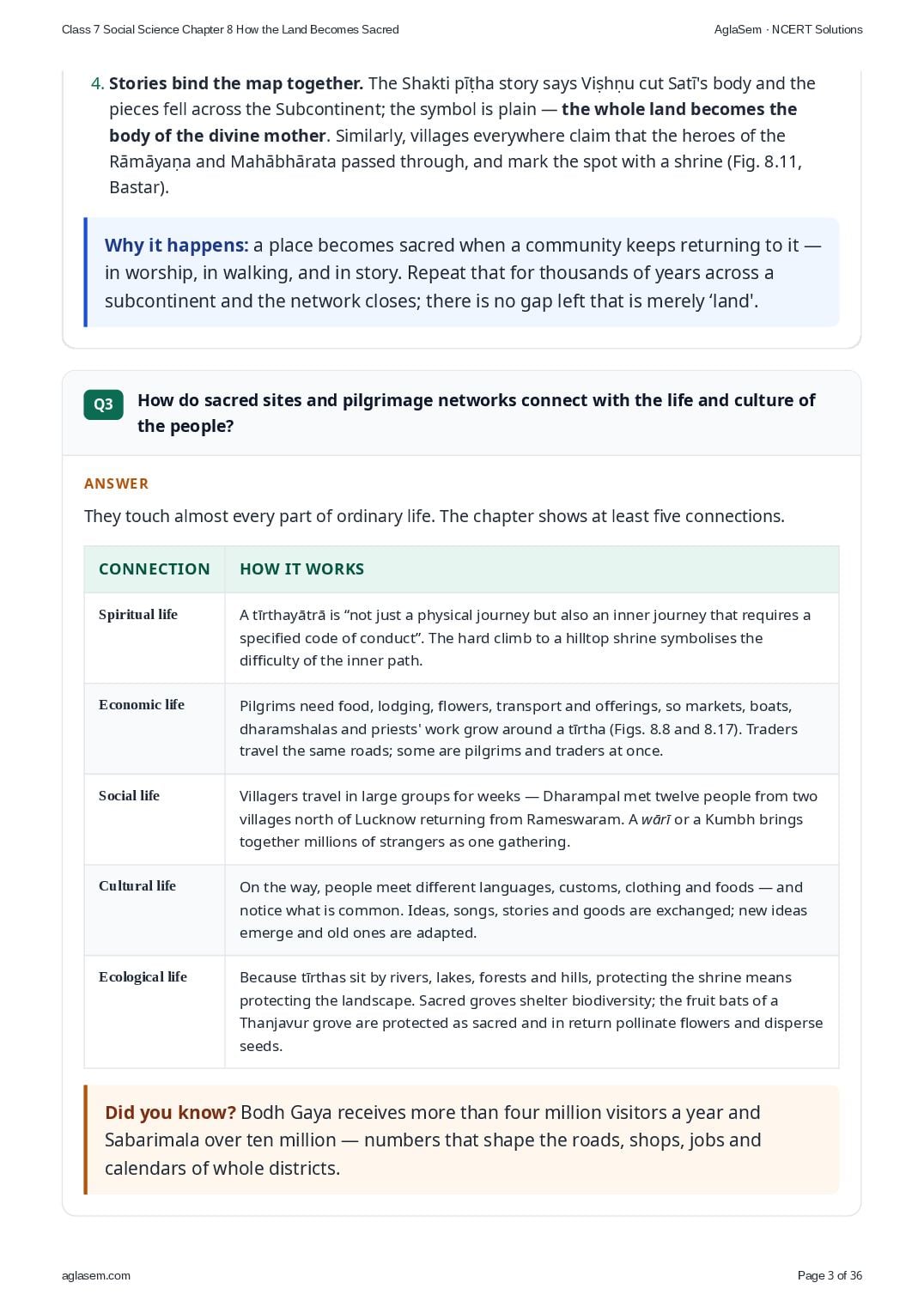
- How do sacred sites and pilgrimage networks connect with the life and culture of the people?
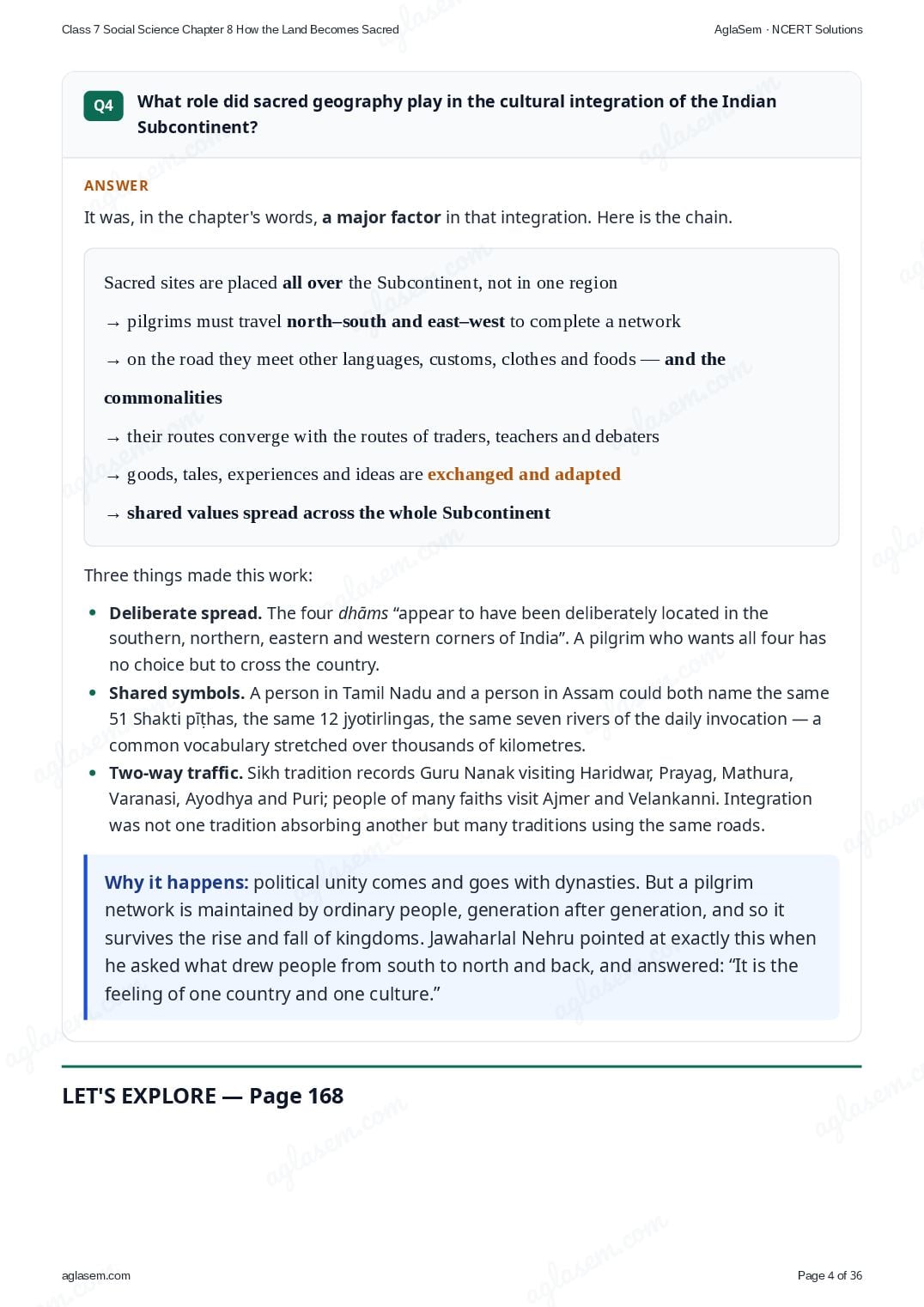
- What role did sacred geography play in the cultural integration of the Indian Subcontinent?
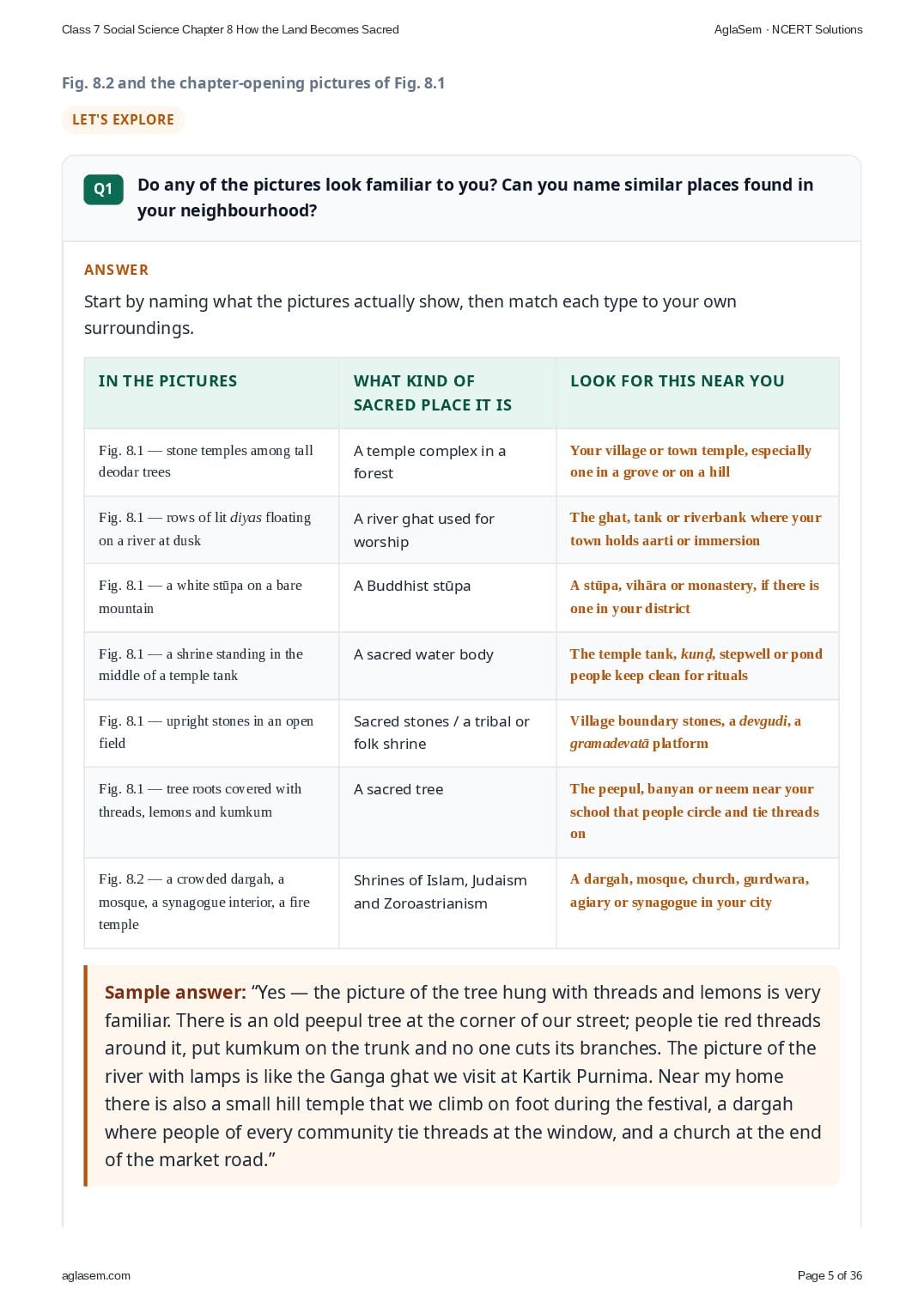
- Do any of the pictures look familiar to you? Can you name similar places found in your neighbourhood?
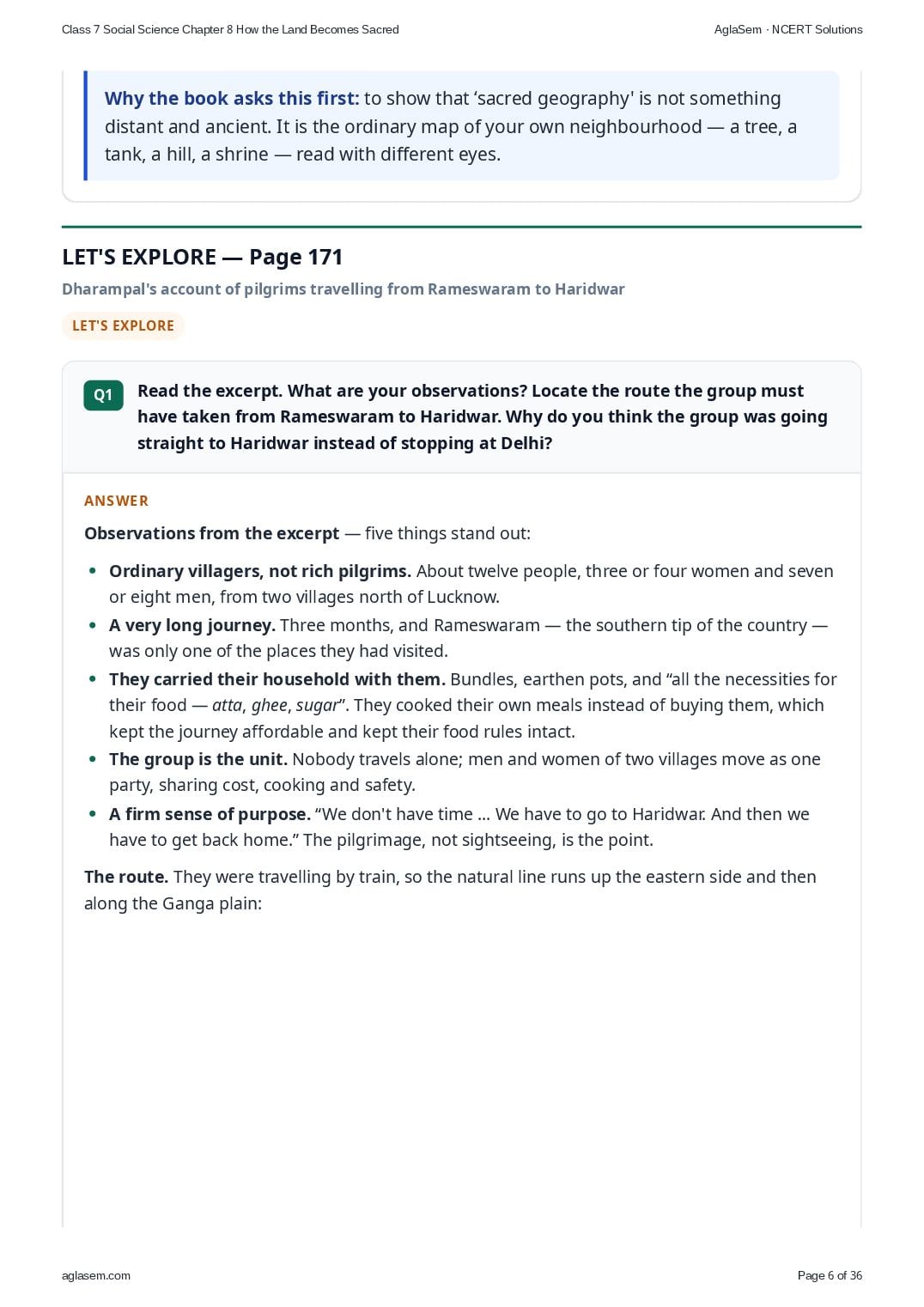
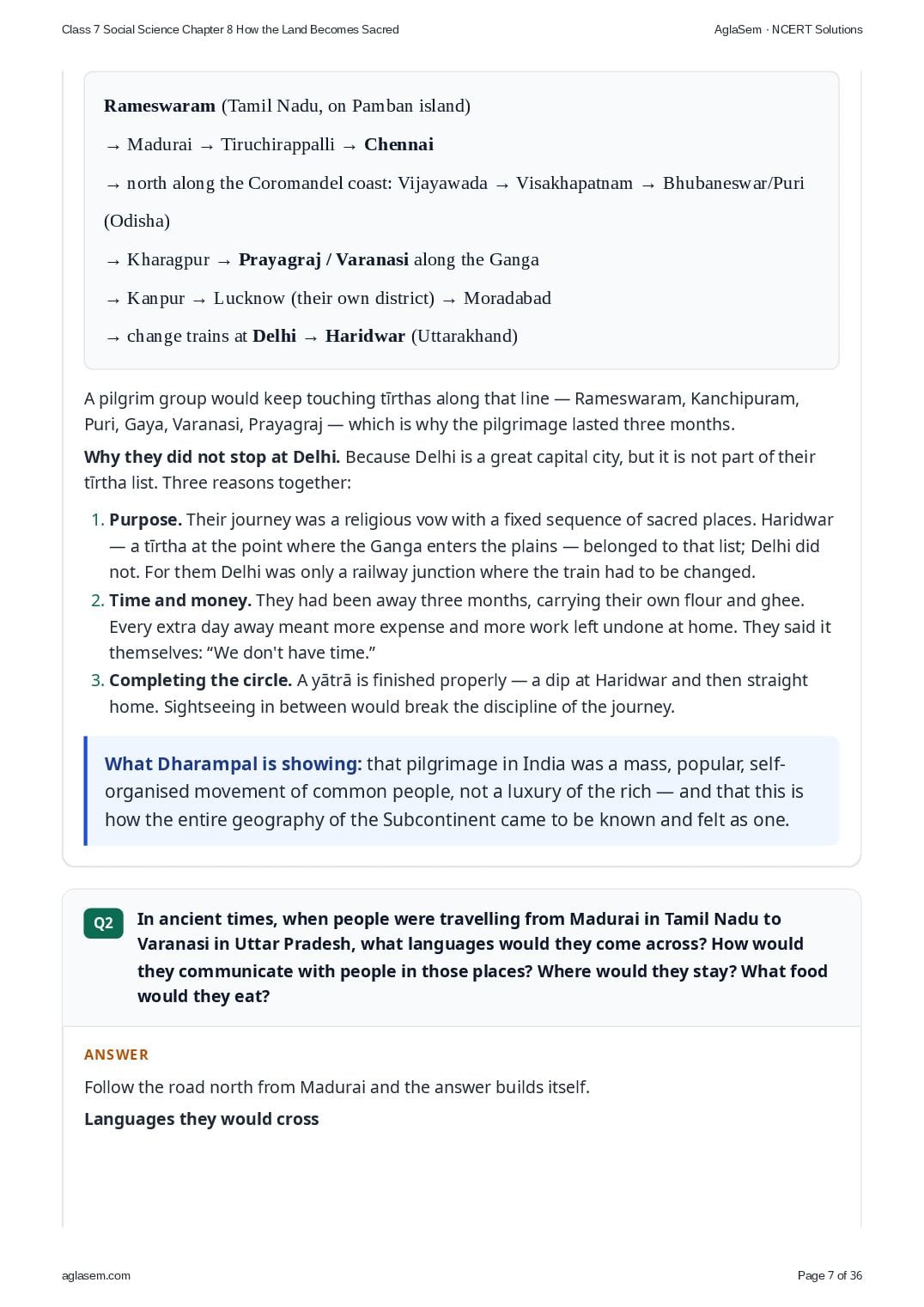
- Read the excerpt. What are your observations? Locate the route the group must have taken from Rameswaram to Haridwar. Why do you think the group was going straight to Haridwar instead of stopping at Delhi?
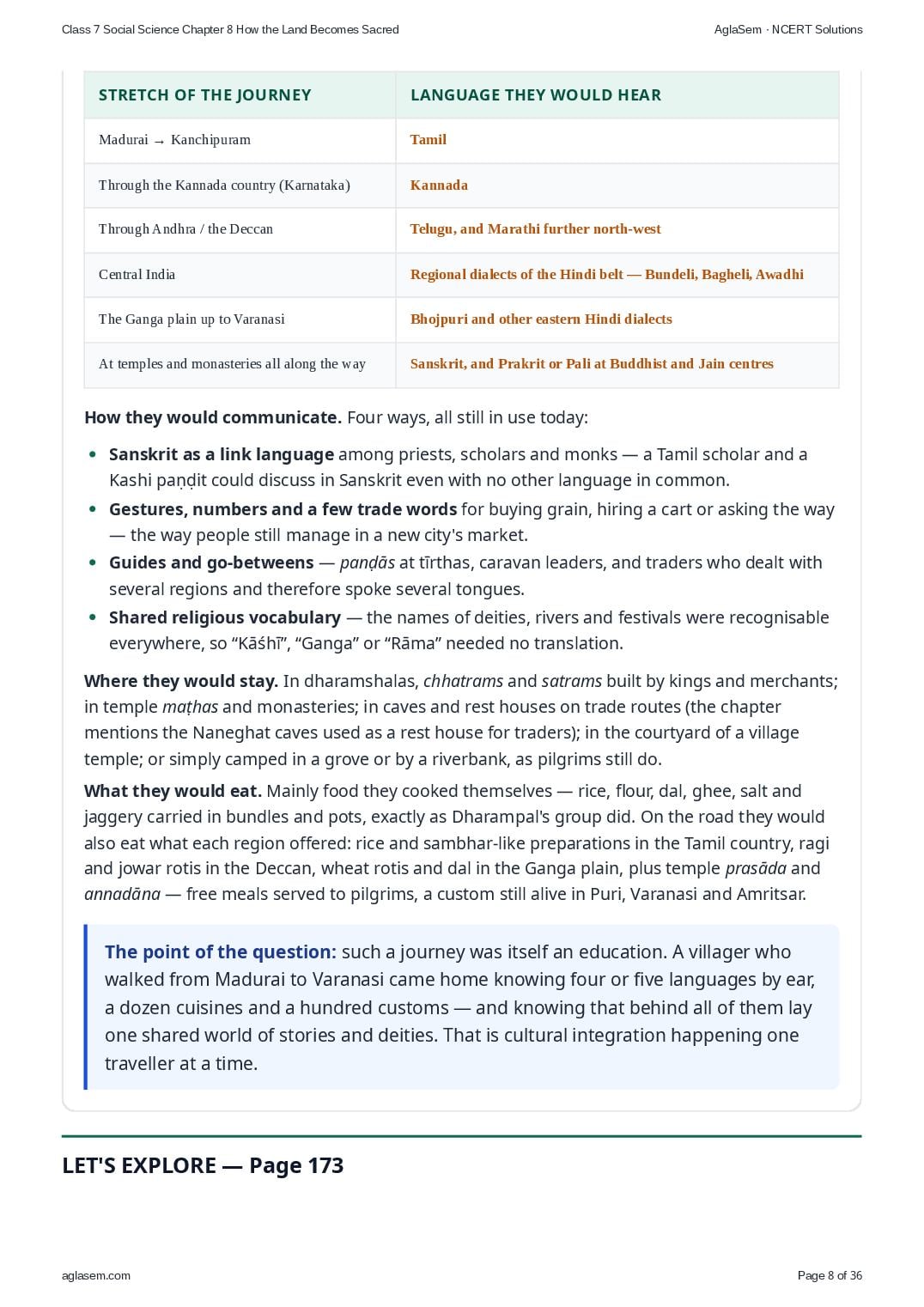
- In ancient times, when people were travelling from Madurai in Tamil Nadu to Varanasi in Uttar Pradesh, what languages would they come across? How would they communicate with people in those places? Where would they stay? What food would they eat?
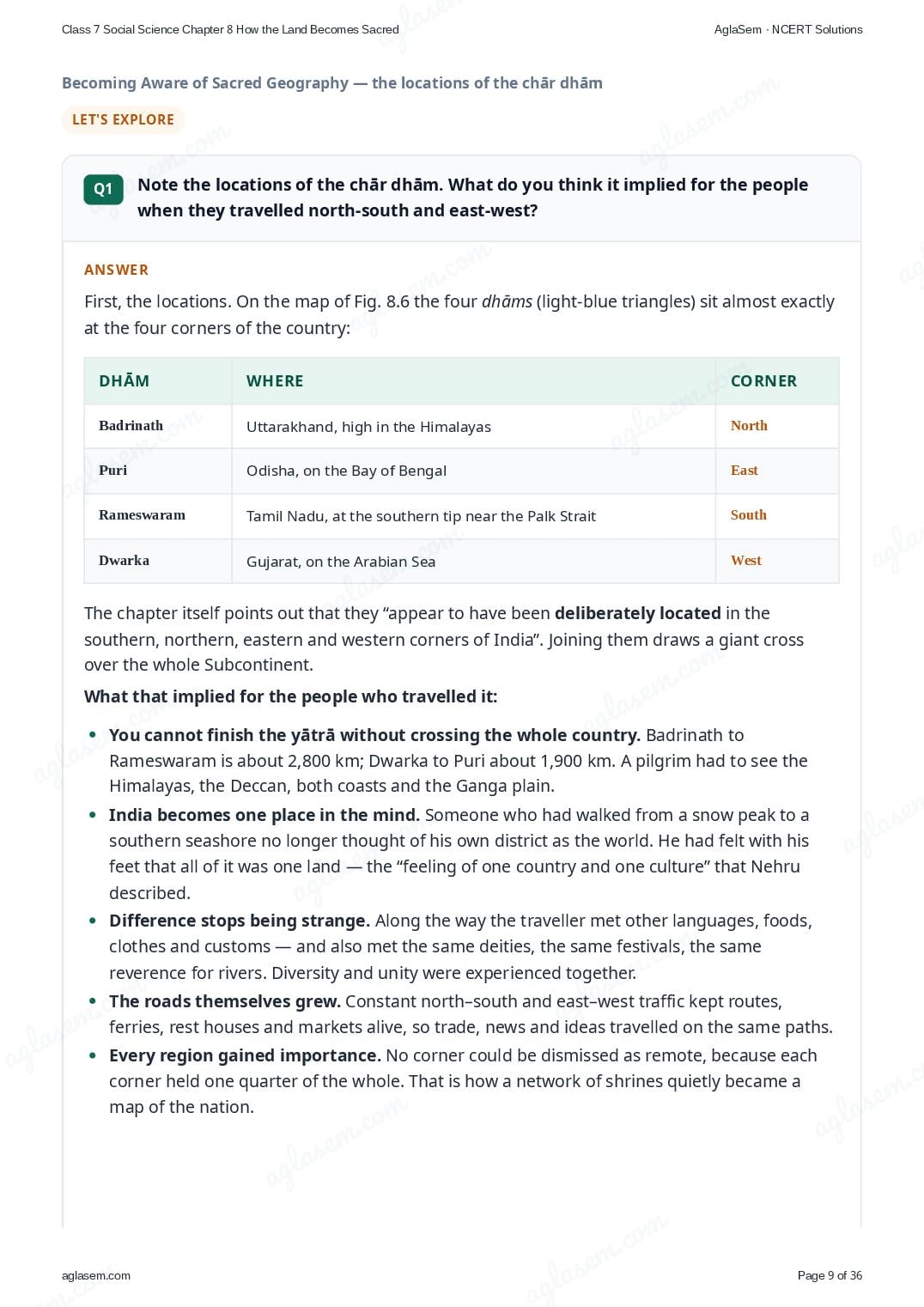
- Note the locations of the chār dhām. What do you think it implied for the people when they travelled north-south and east-west?
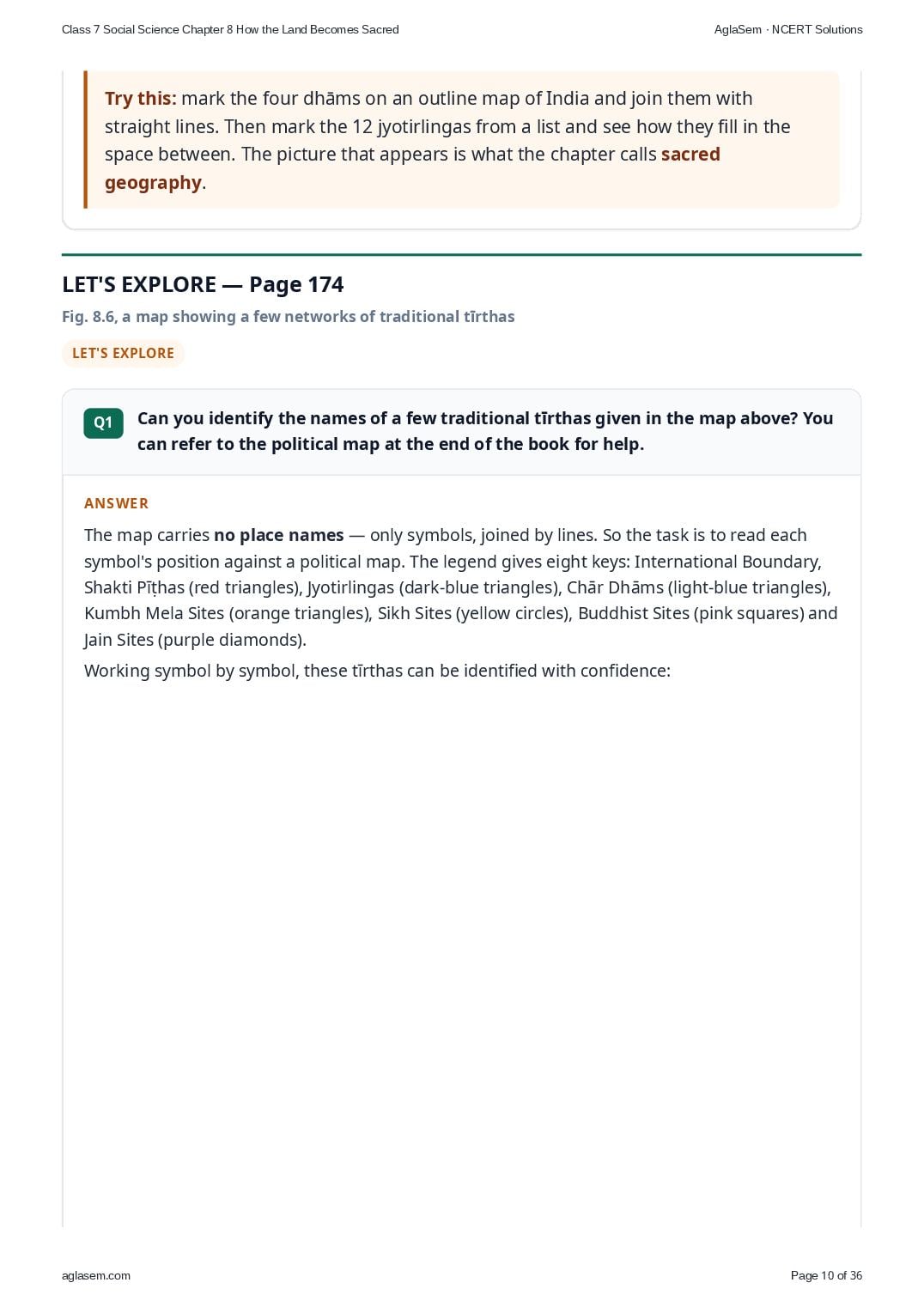
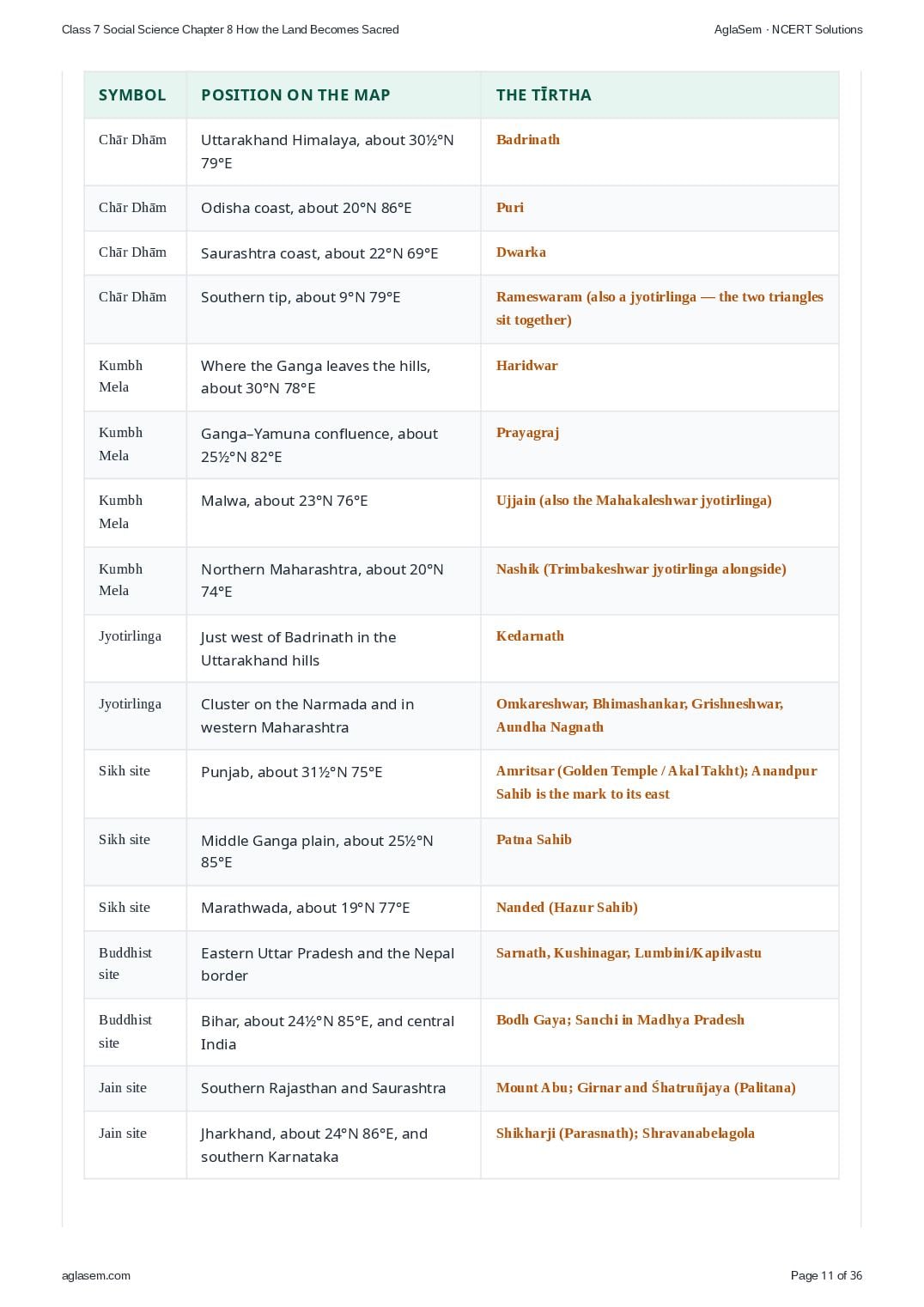
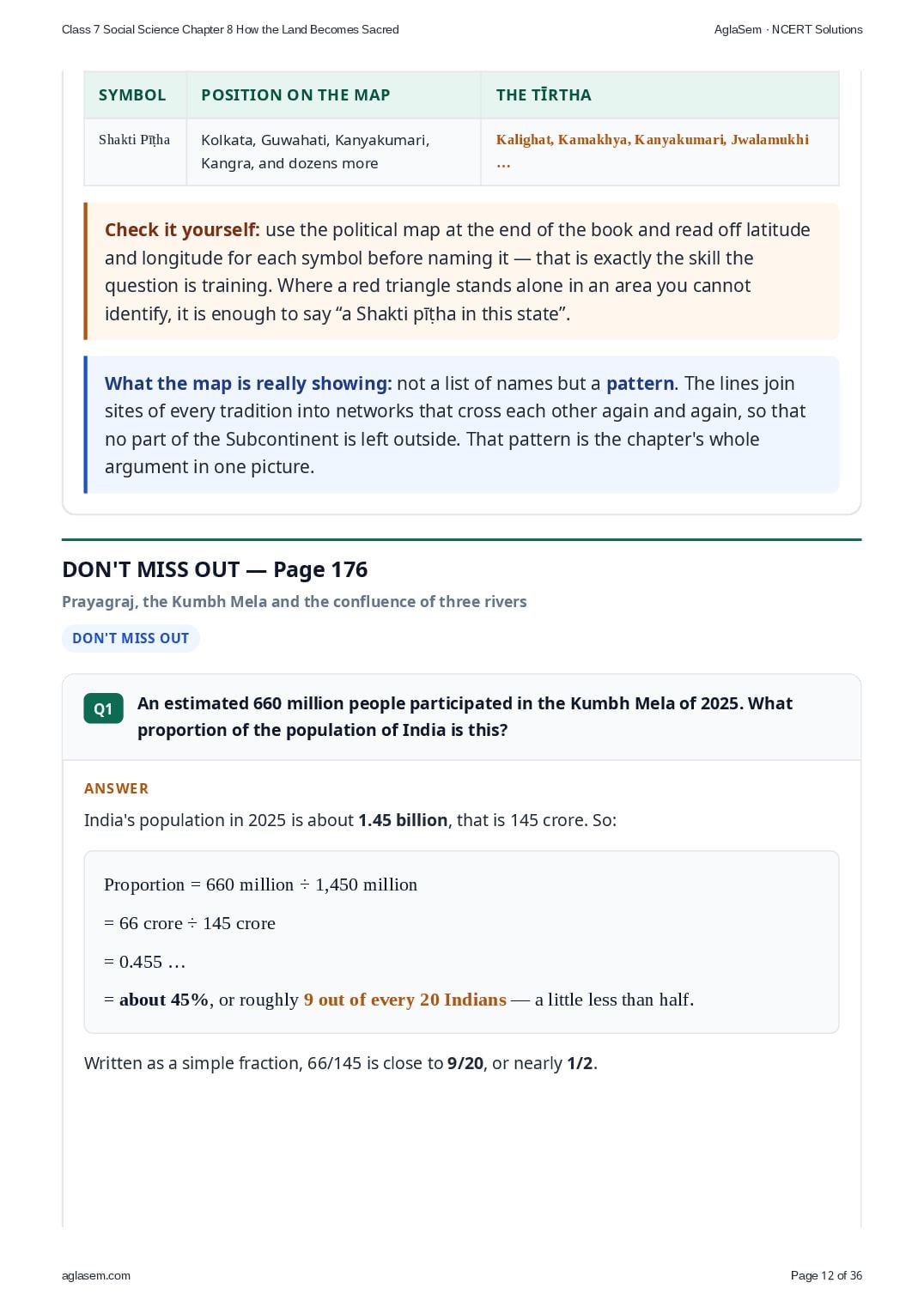
- Can you identify the names of a few traditional tīrthas given in the map above? You can refer to the political map at the end of the book for help.
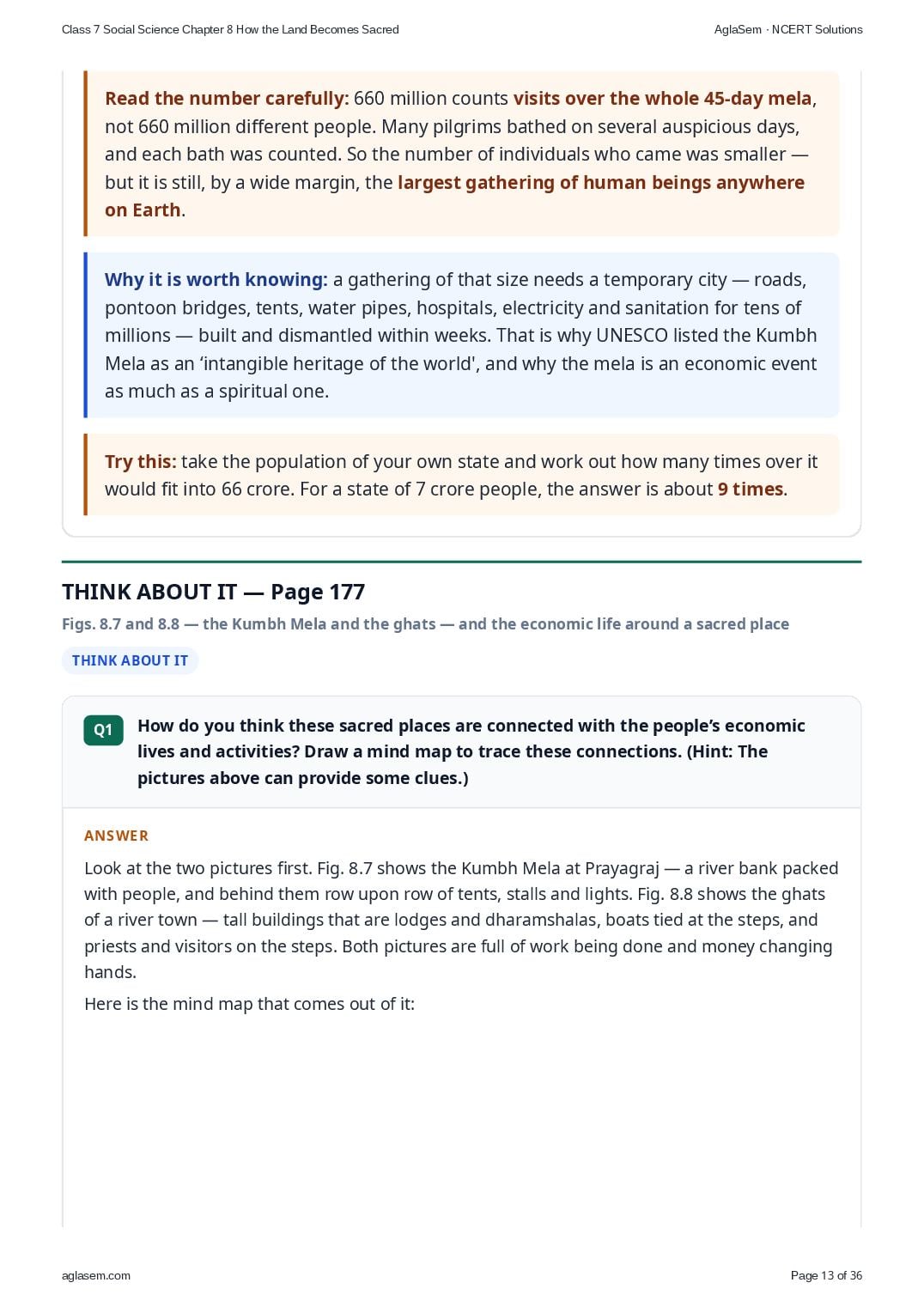
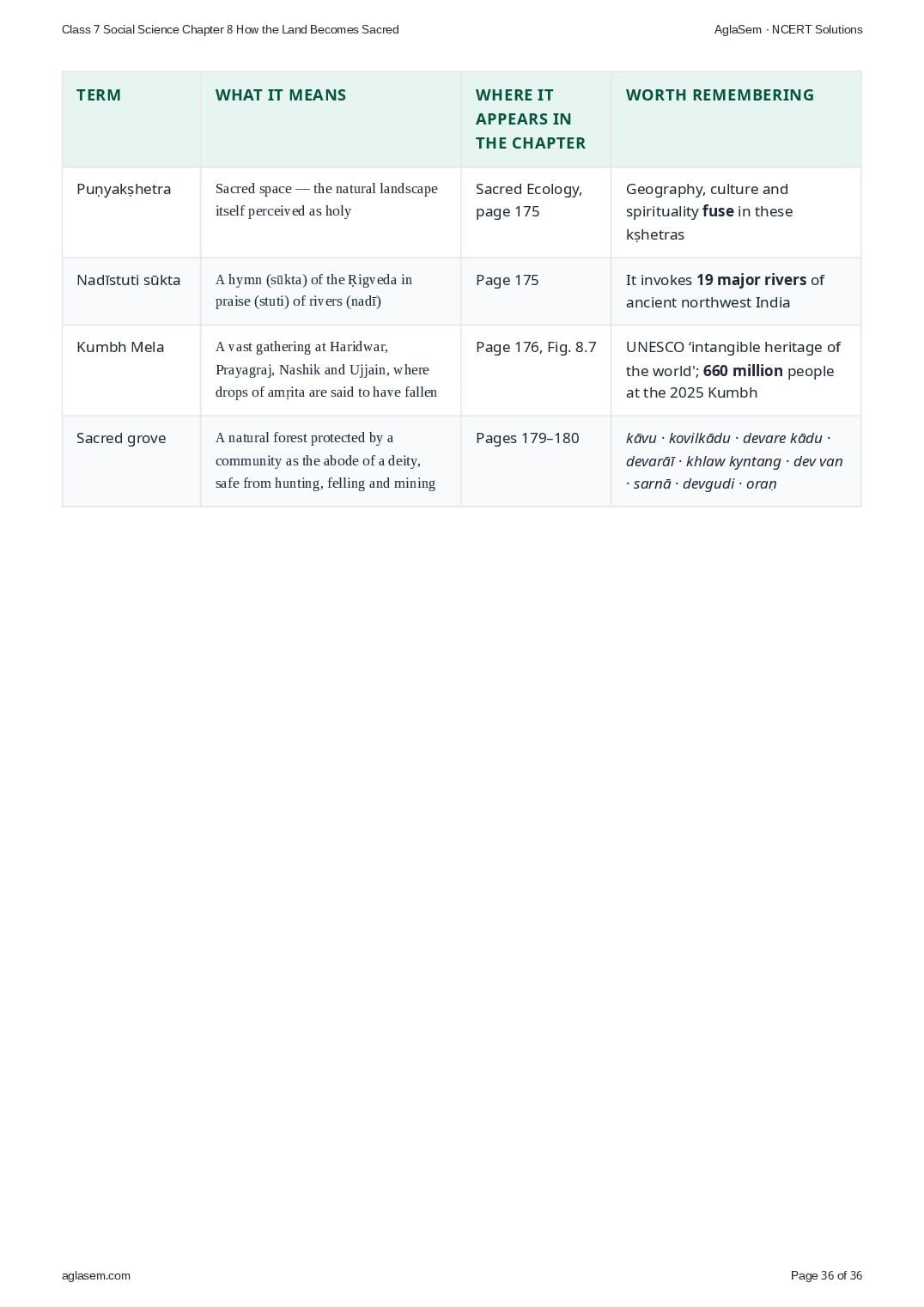
- An estimated 660 million people participated in the Kumbh Mela of 2025. What proportion of the population of India is this?
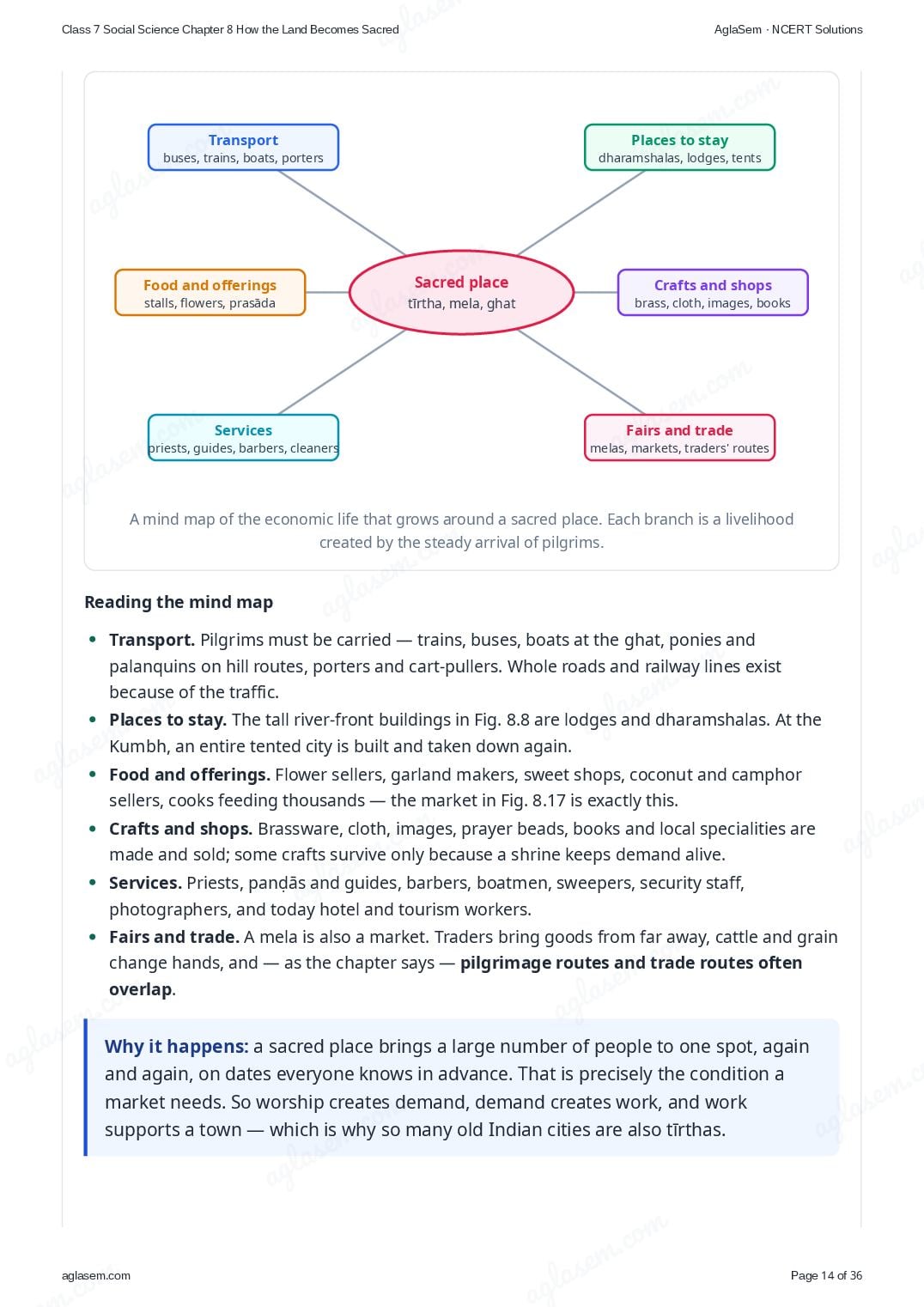
- How do you think these sacred places are connected with the people’s economic lives and activities? Draw a mind map to trace these connections. (Hint: The pictures above can provide some clues.)
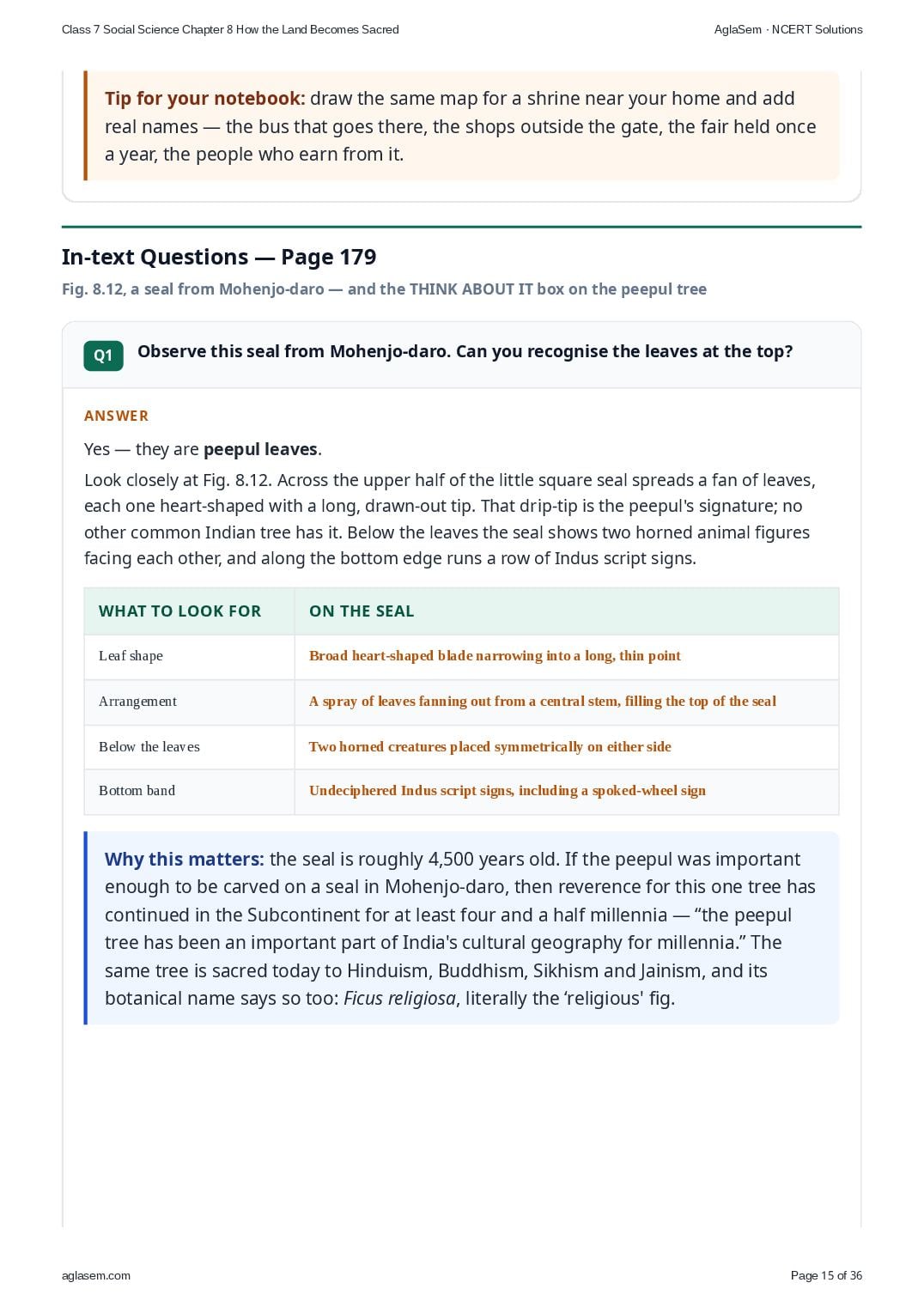
- Observe this seal from Mohenjo-daro. Can you recognise the leaves at the top?
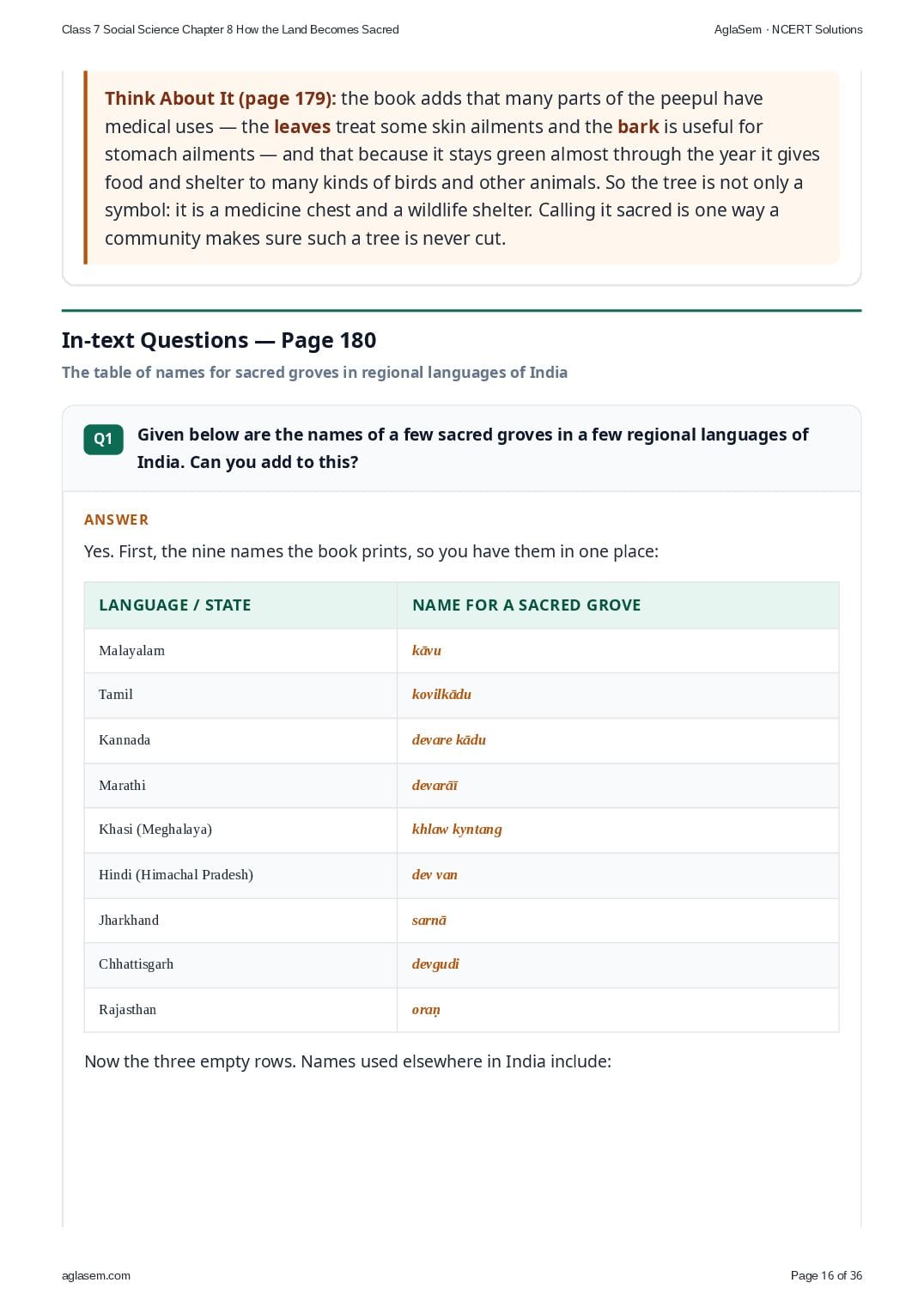
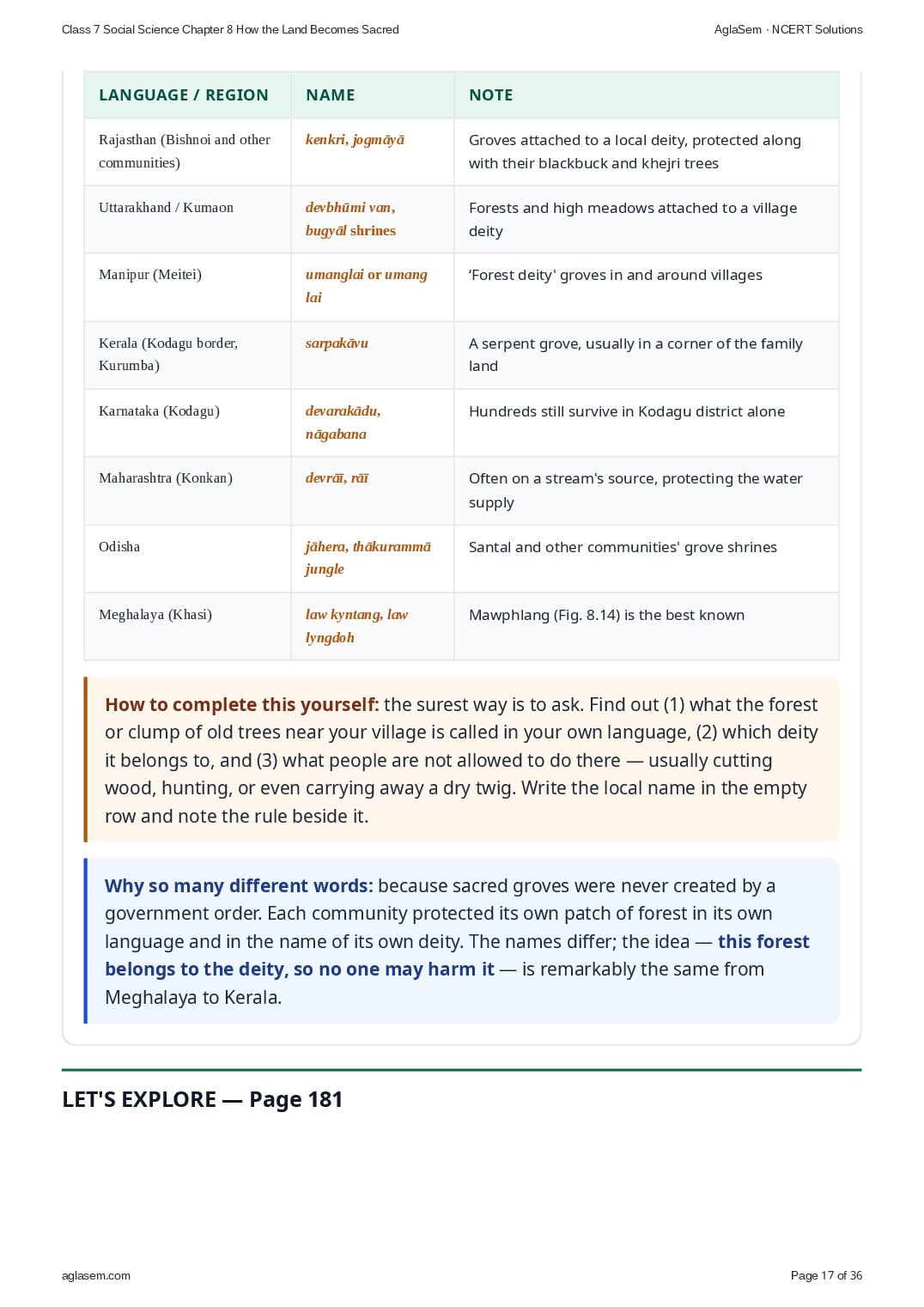
- Given below are the names of a few sacred groves in a few regional languages of India. Can you add to this?
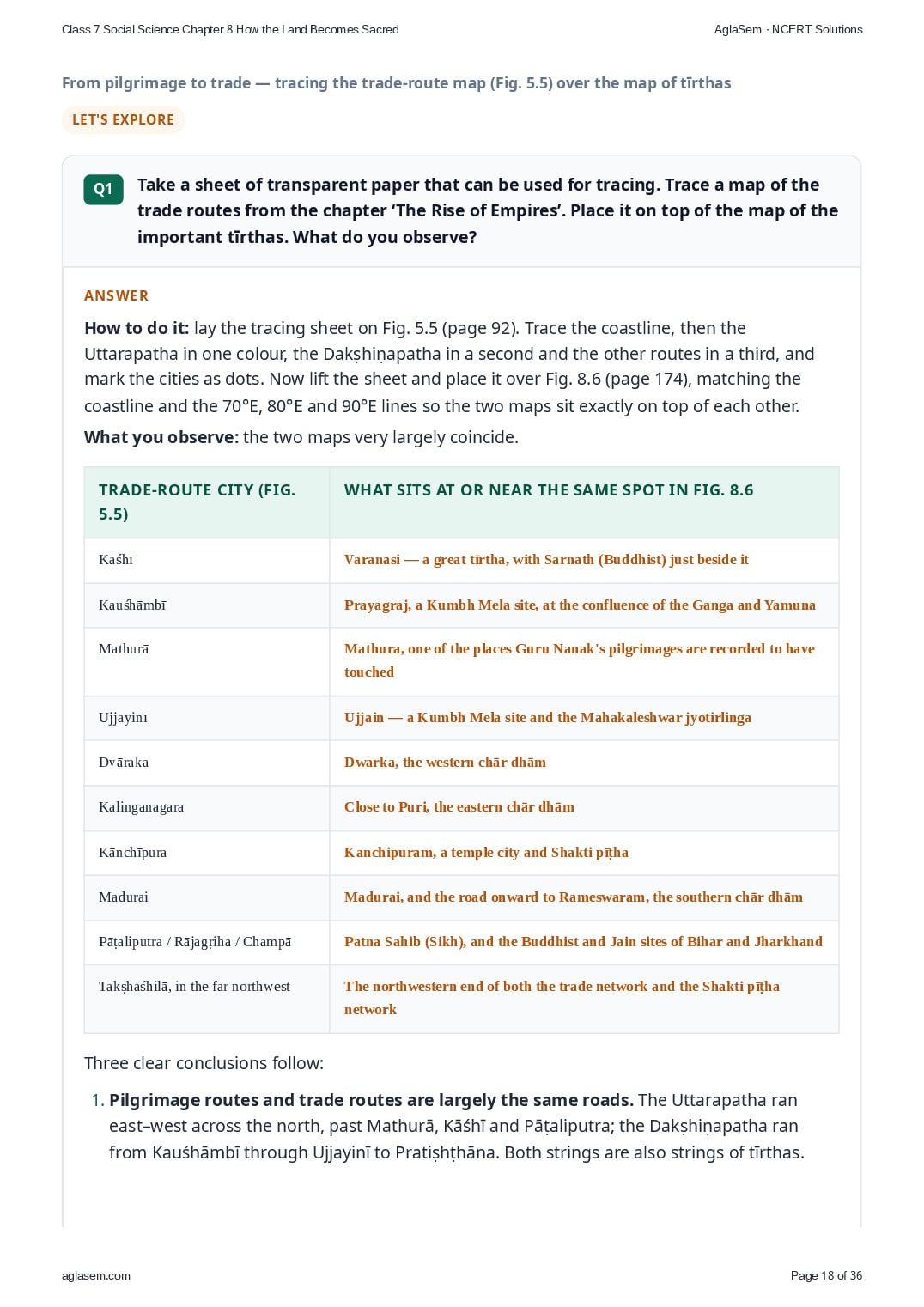
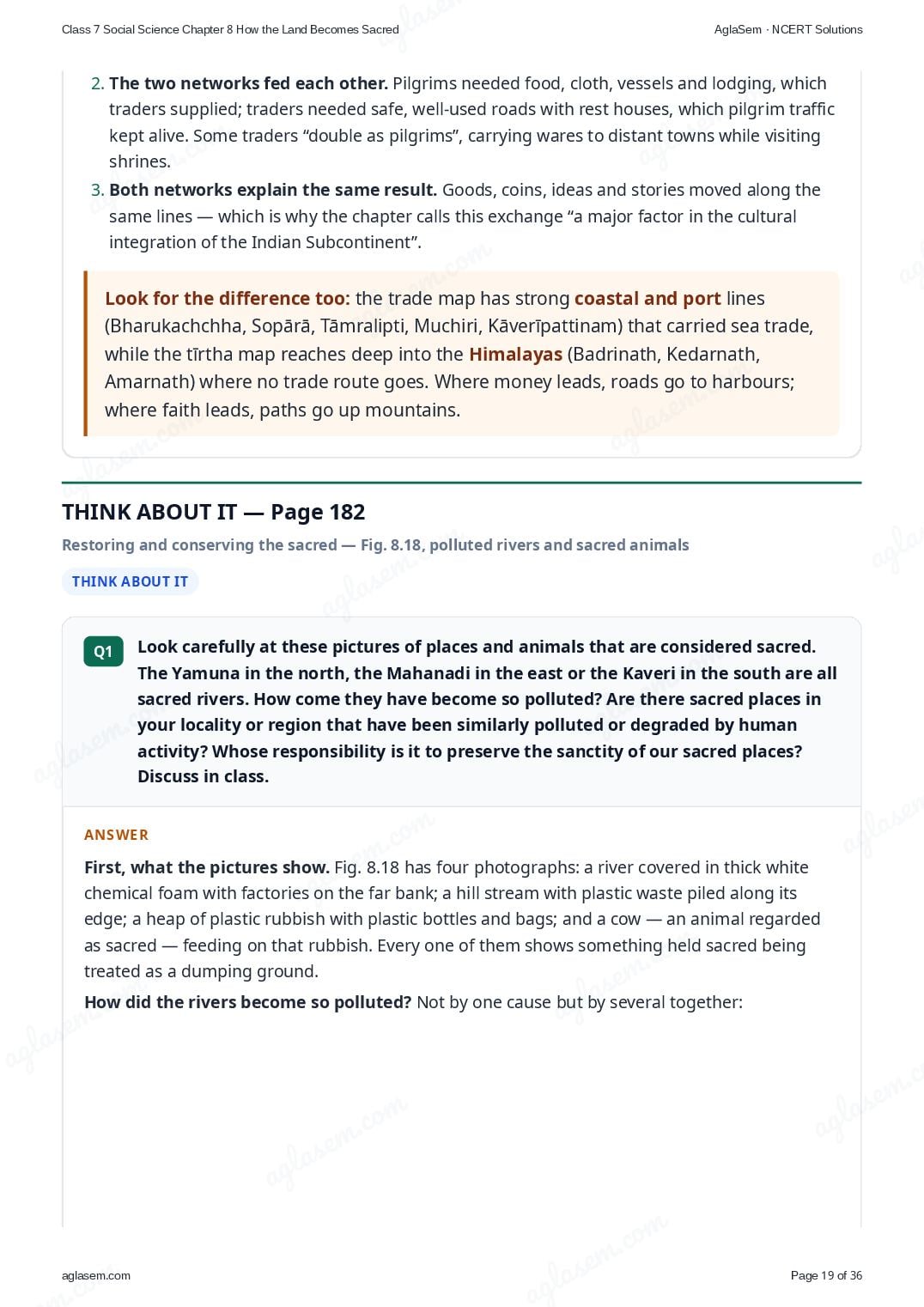
- Take a sheet of transparent paper that can be used for tracing. Trace a map of the trade routes from the chapter ‘The Rise of Empires’. Place it on top of the map of the important tīrthas. What do you observe?
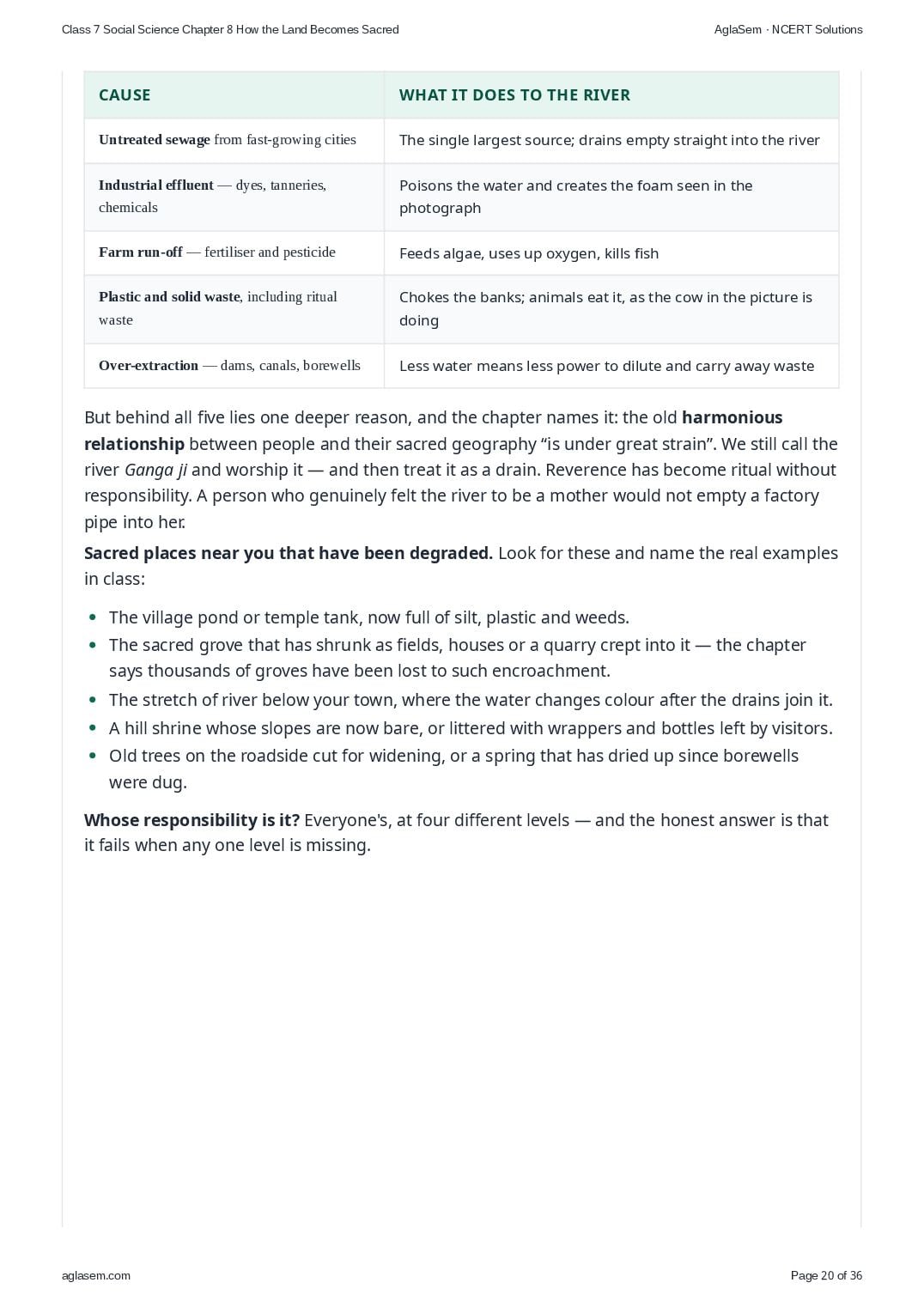
- Look carefully at these pictures of places and animals that are considered sacred. The Yamuna in the north, the Mahanadi in the east or the Kaveri in the south are all sacred rivers. How come they have become so polluted? Are there sacred places in your locality or region that have been similarly polluted or degraded by human activity? Whose responsibility is it to preserve the sanctity of our sacred places? Discuss in class.
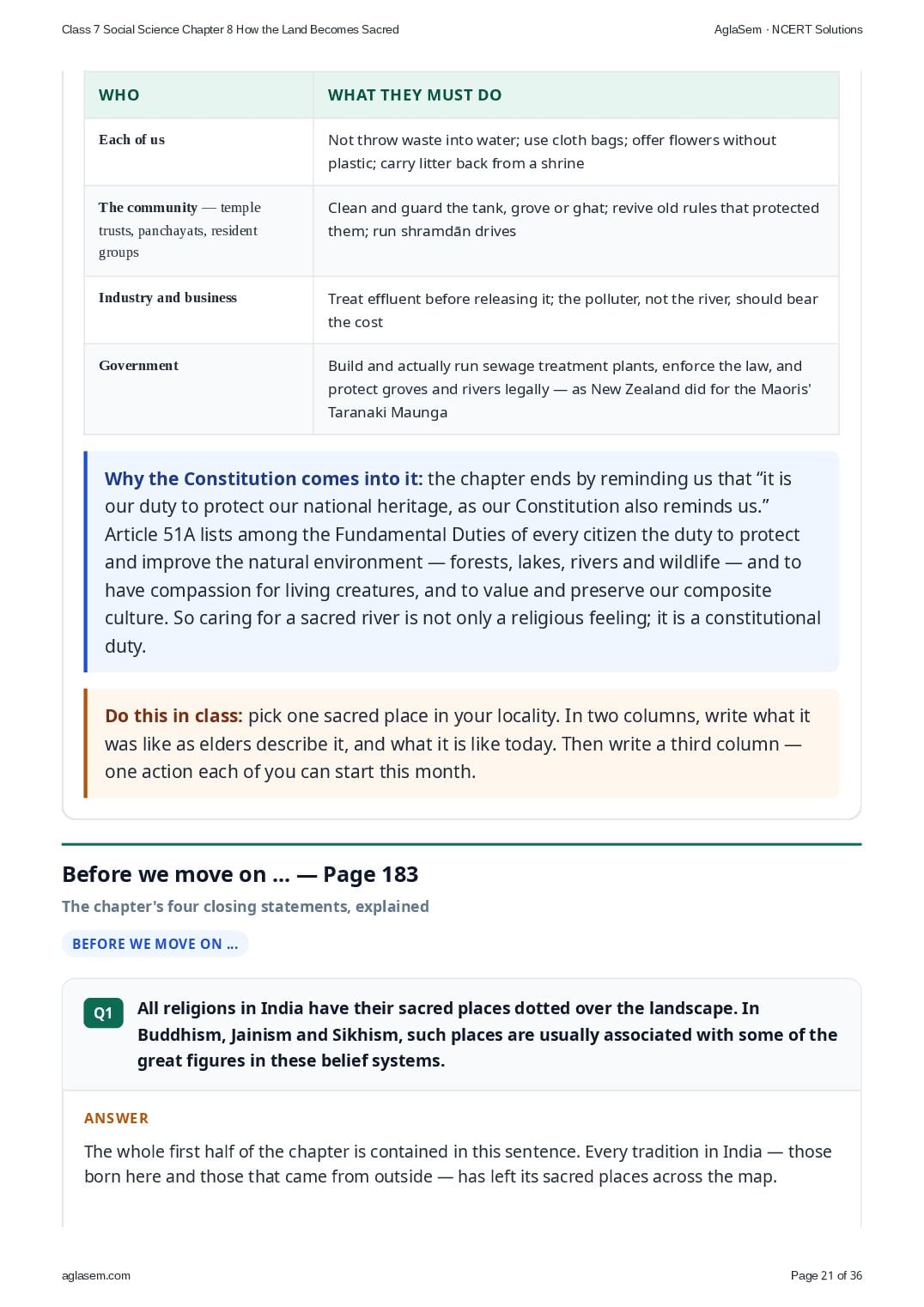
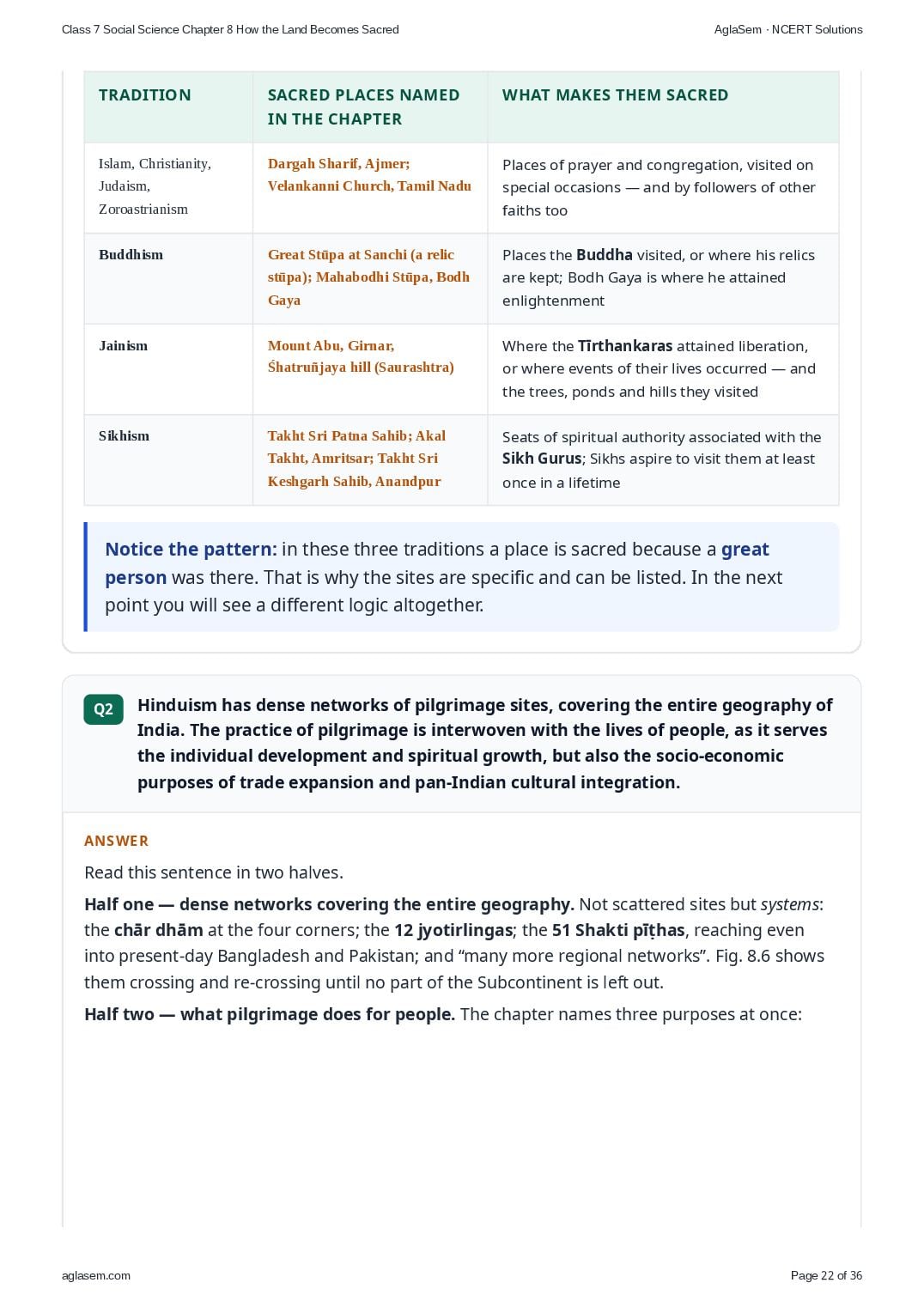
- All religions in India have their sacred places dotted over the landscape. In Buddhism, Jainism and Sikhism, such places are usually associated with some of the great figures in these belief systems.
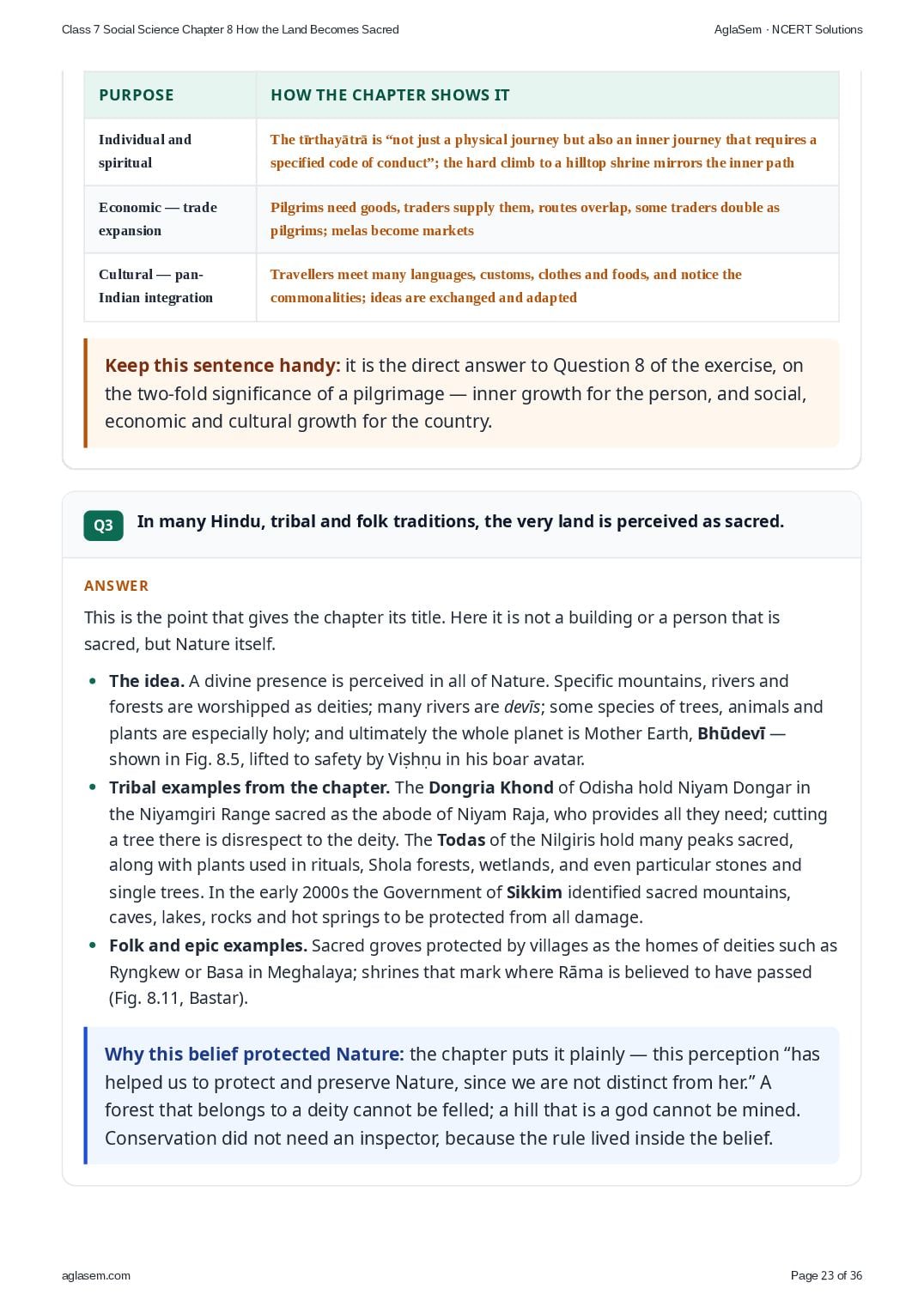
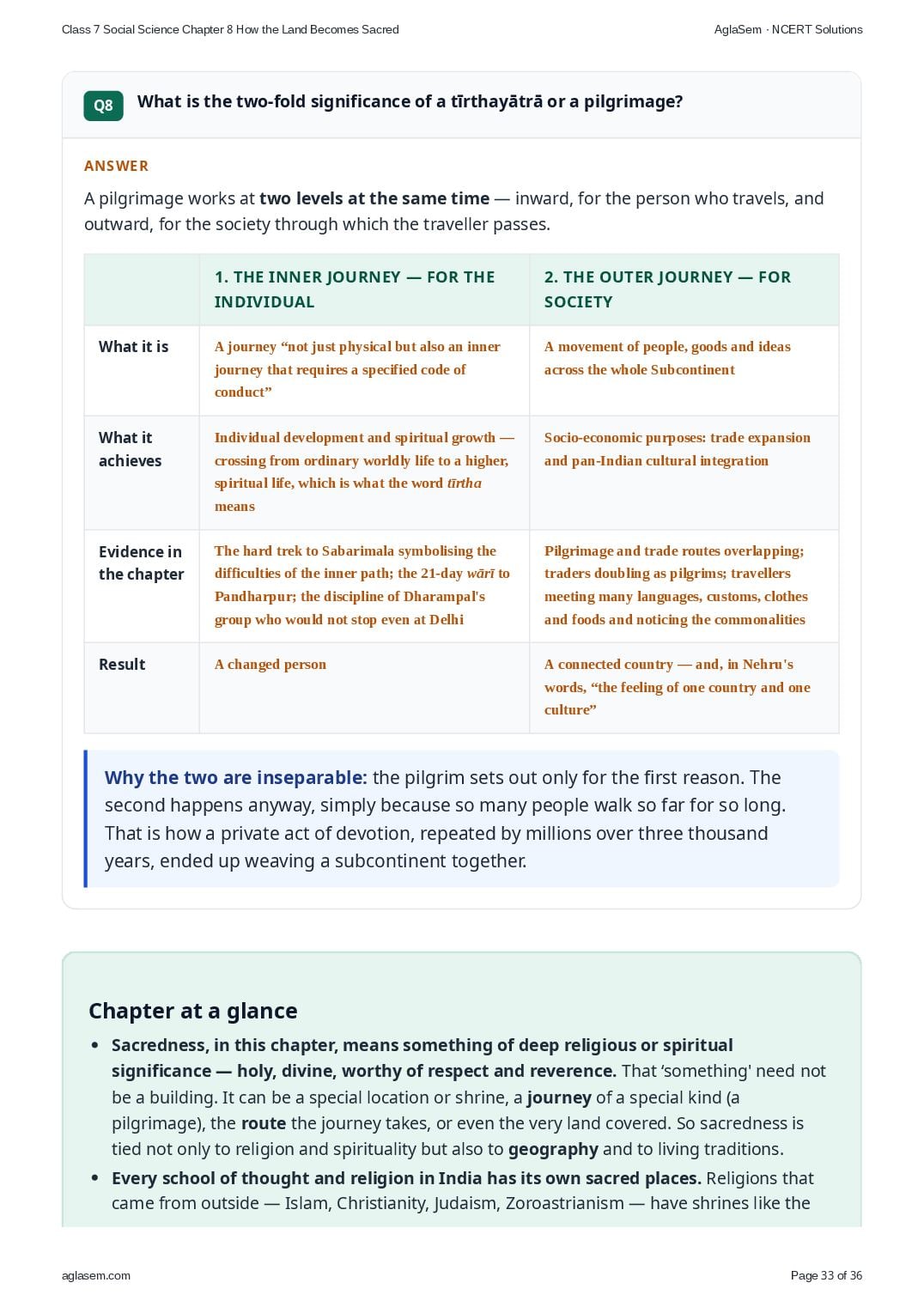
- Hinduism has dense networks of pilgrimage sites, covering the entire geography of India. The practice of pilgrimage is interwoven with the lives of people, as it serves the individual development and spiritual growth, but also the socio-economic purposes of trade expansion and pan-Indian cultural integration.
- In many Hindu, tribal and folk traditions, the very land is perceived as sacred.
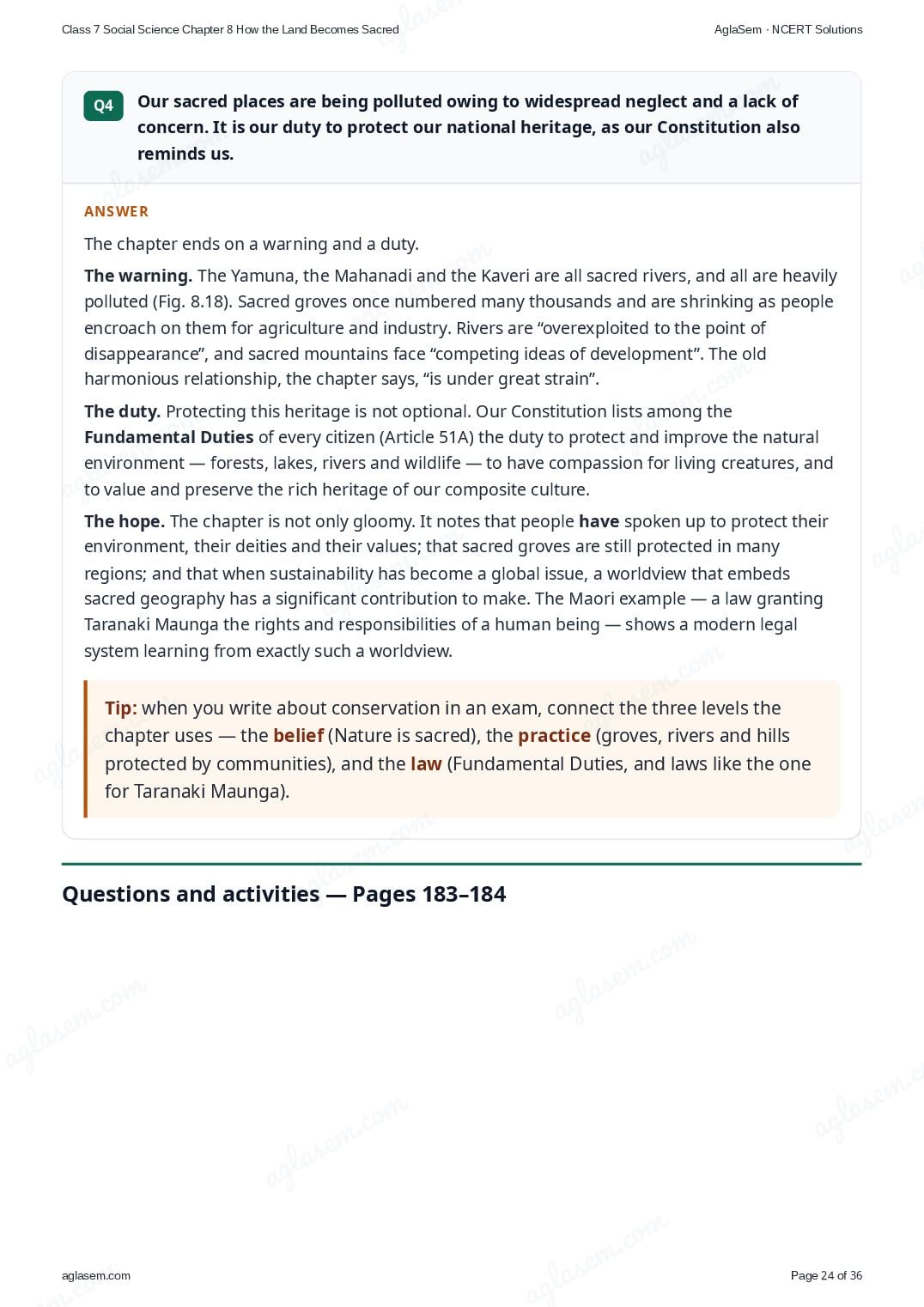
- Our sacred places are being polluted owing to widespread neglect and a lack of concern. It is our duty to protect our national heritage, as our Constitution also reminds us.
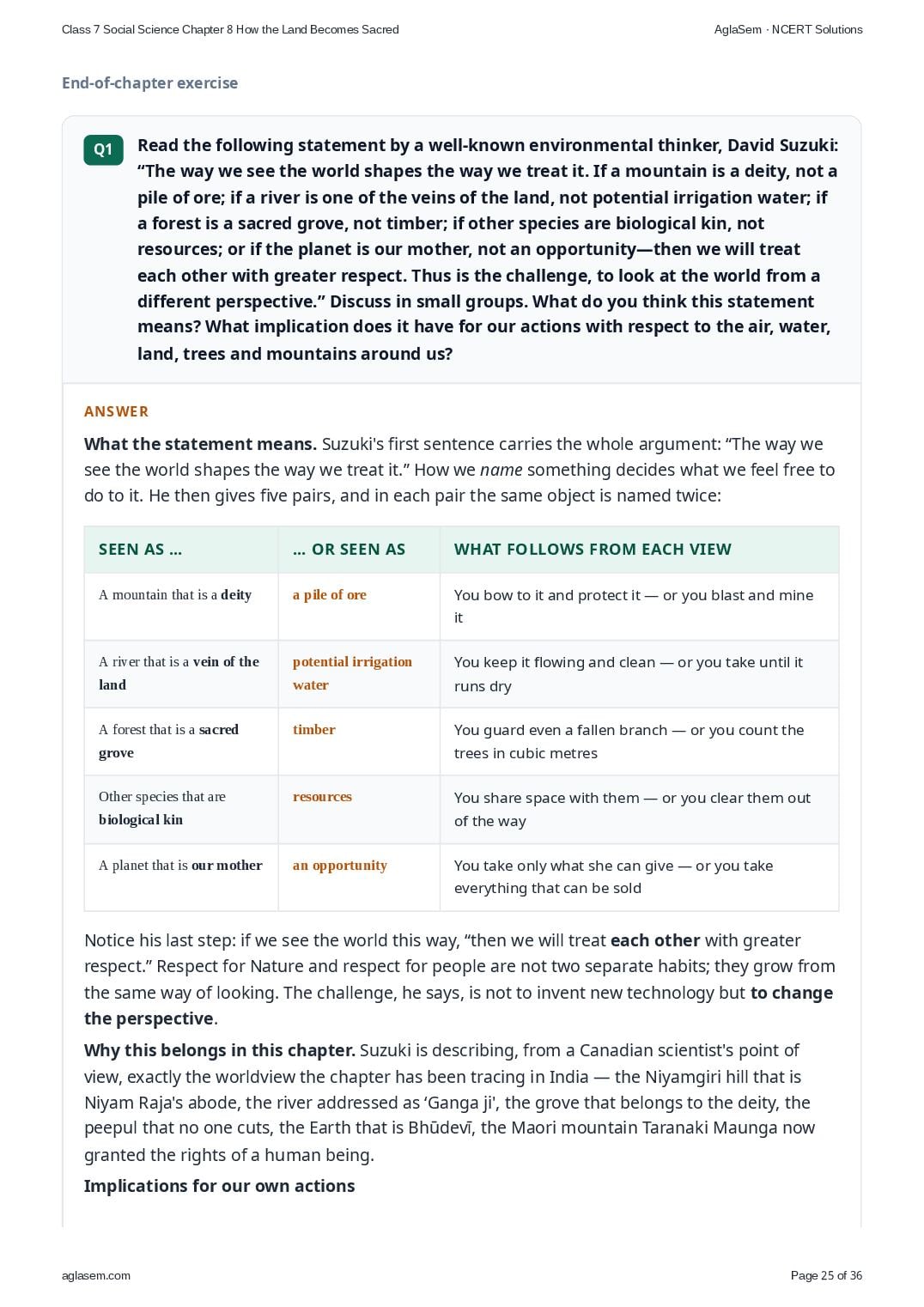
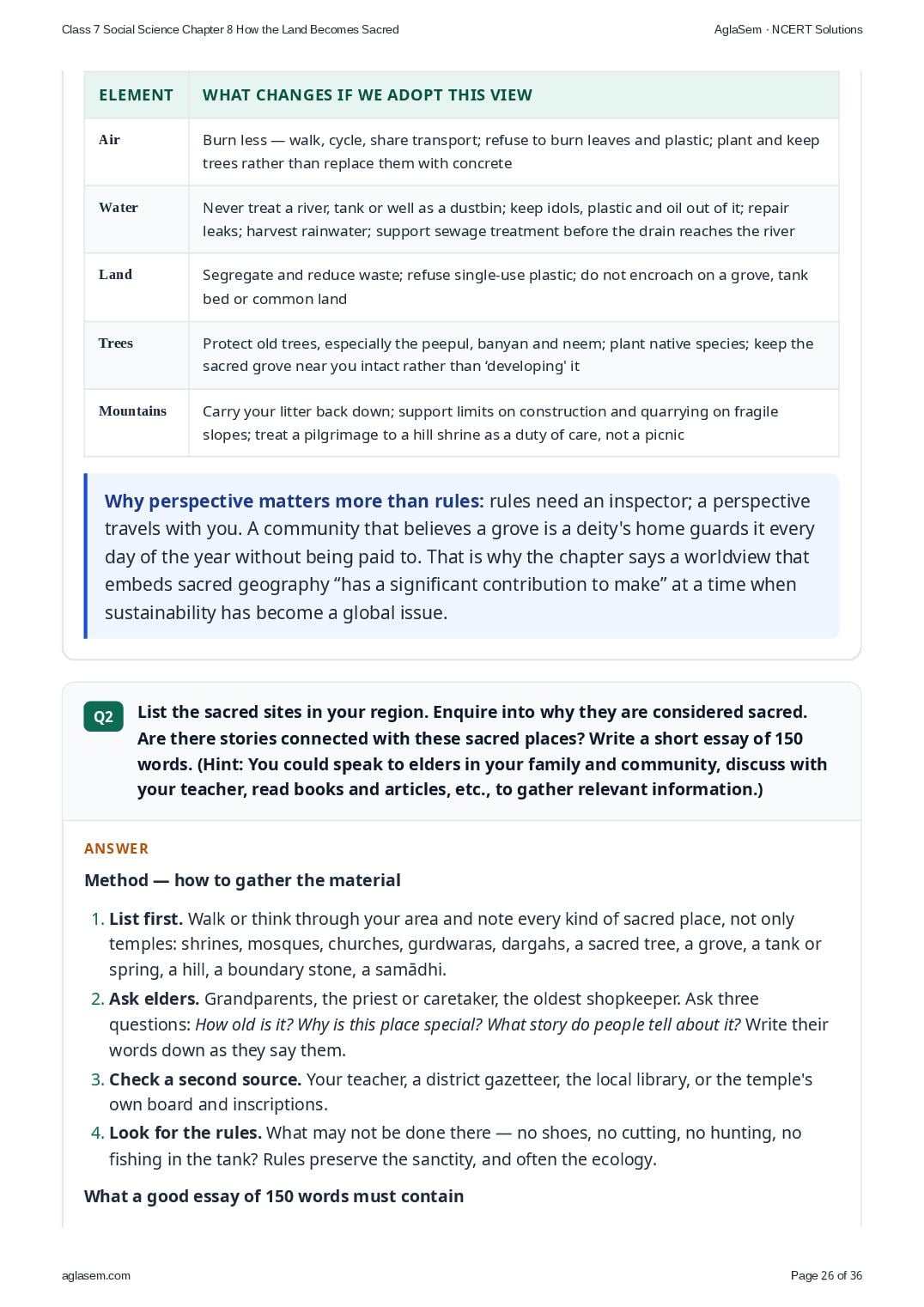
- Read the following statement by a well-known environmental thinker, David Suzuki: “The way we see the world shapes the way we treat it. If a mountain is a deity, not a pile of ore; if a river is one of the veins of the land, not potential irrigation water; if a forest is a sacred grove, not timber; if other species are biological kin, not resources; or if the planet is our mother, not an opportunity—then we will treat each other with greater respect. Thus is the challenge, to look at the world from a different perspective.” Discuss in small groups. What do you think this statement means? What implication does it have for our actions with respect to the air, water, land, trees and mountains around us?
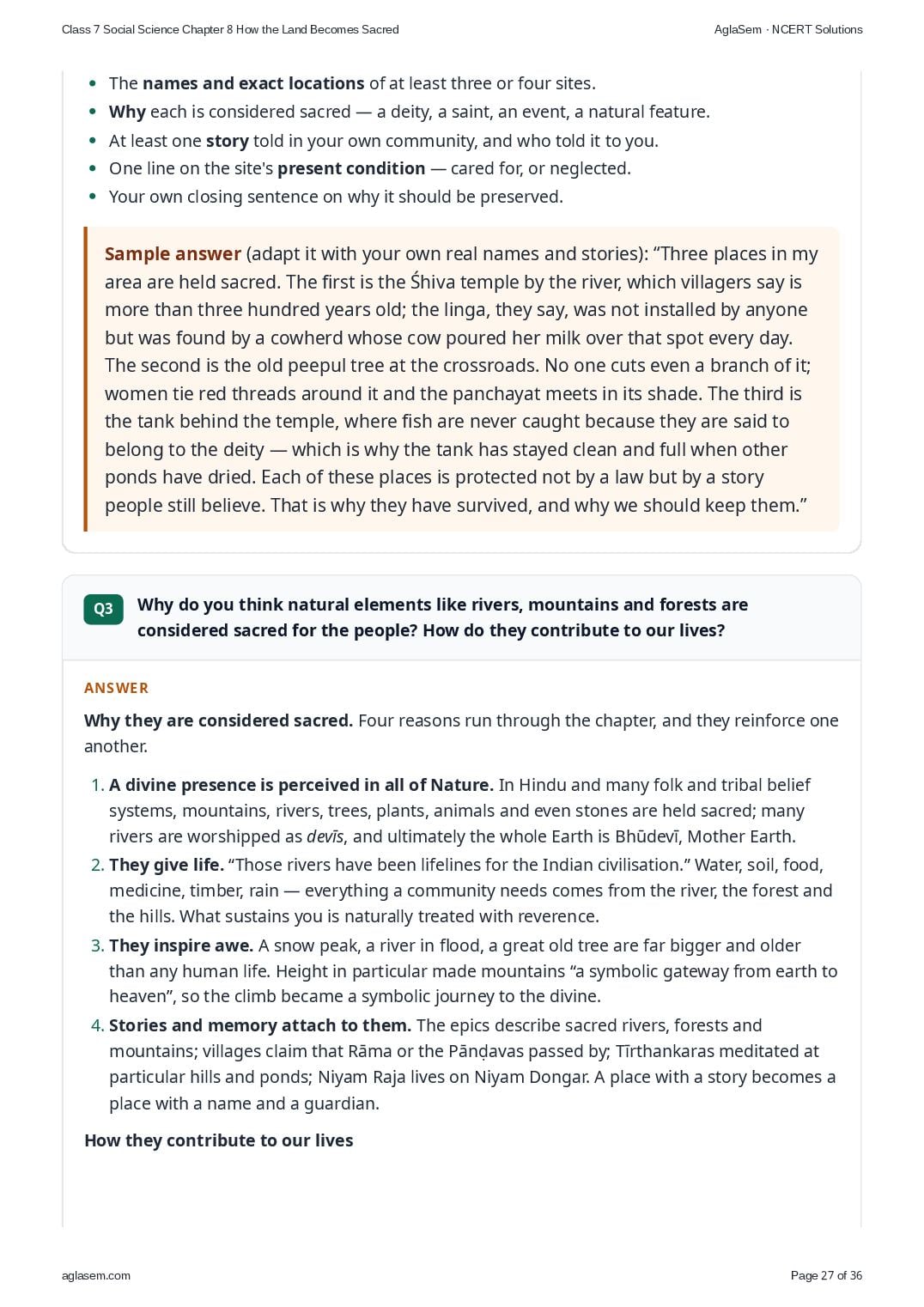
- List the sacred sites in your region. Enquire into why they are considered sacred. Are there stories connected with these sacred places? Write a short essay of 150 words. (Hint: You could speak to elders in your family and community, discuss with your teacher, read books and articles, etc., to gather relevant information.)
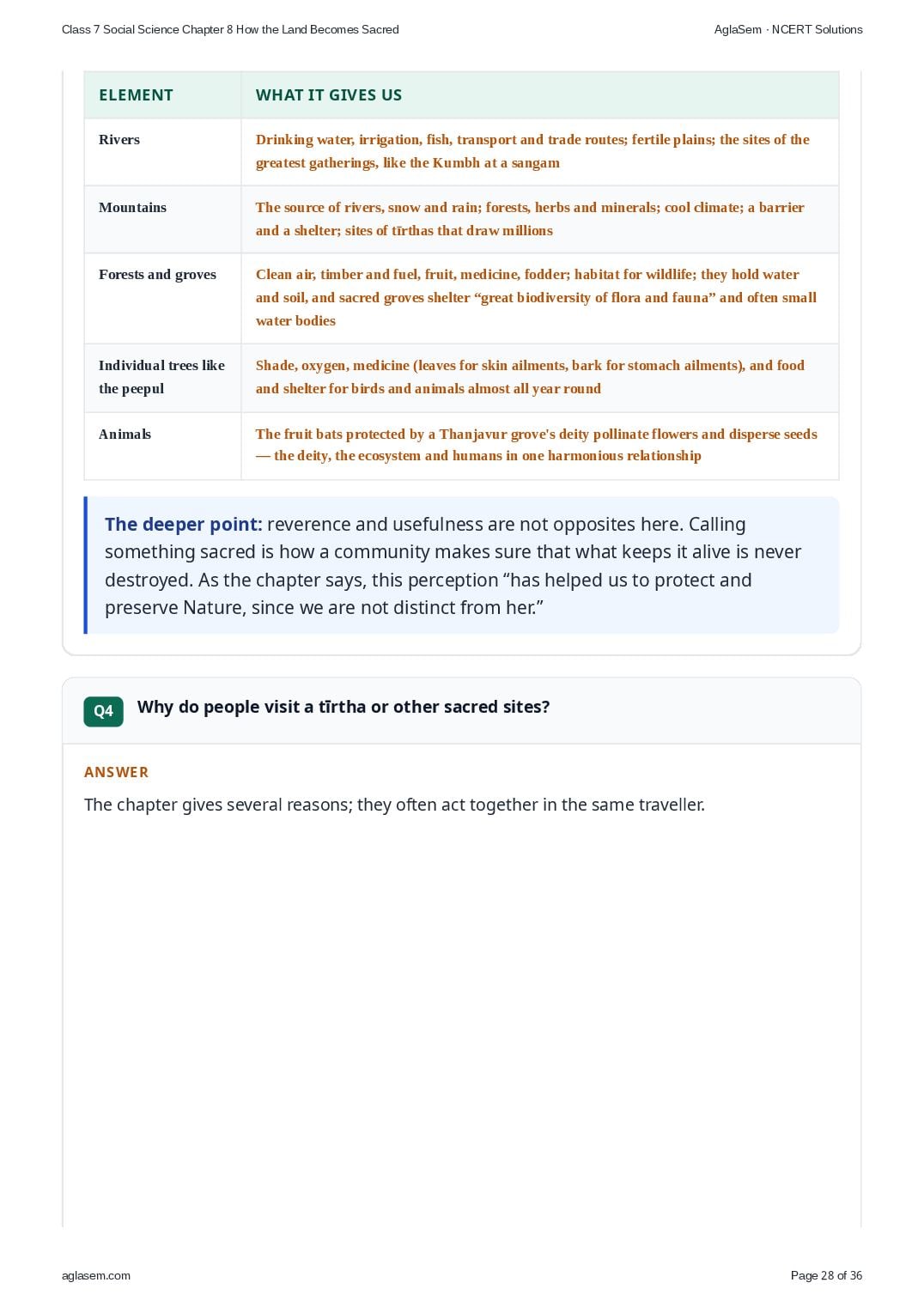
- Why do you think natural elements like rivers, mountains and forests are considered sacred for the people? How do they contribute to our lives?
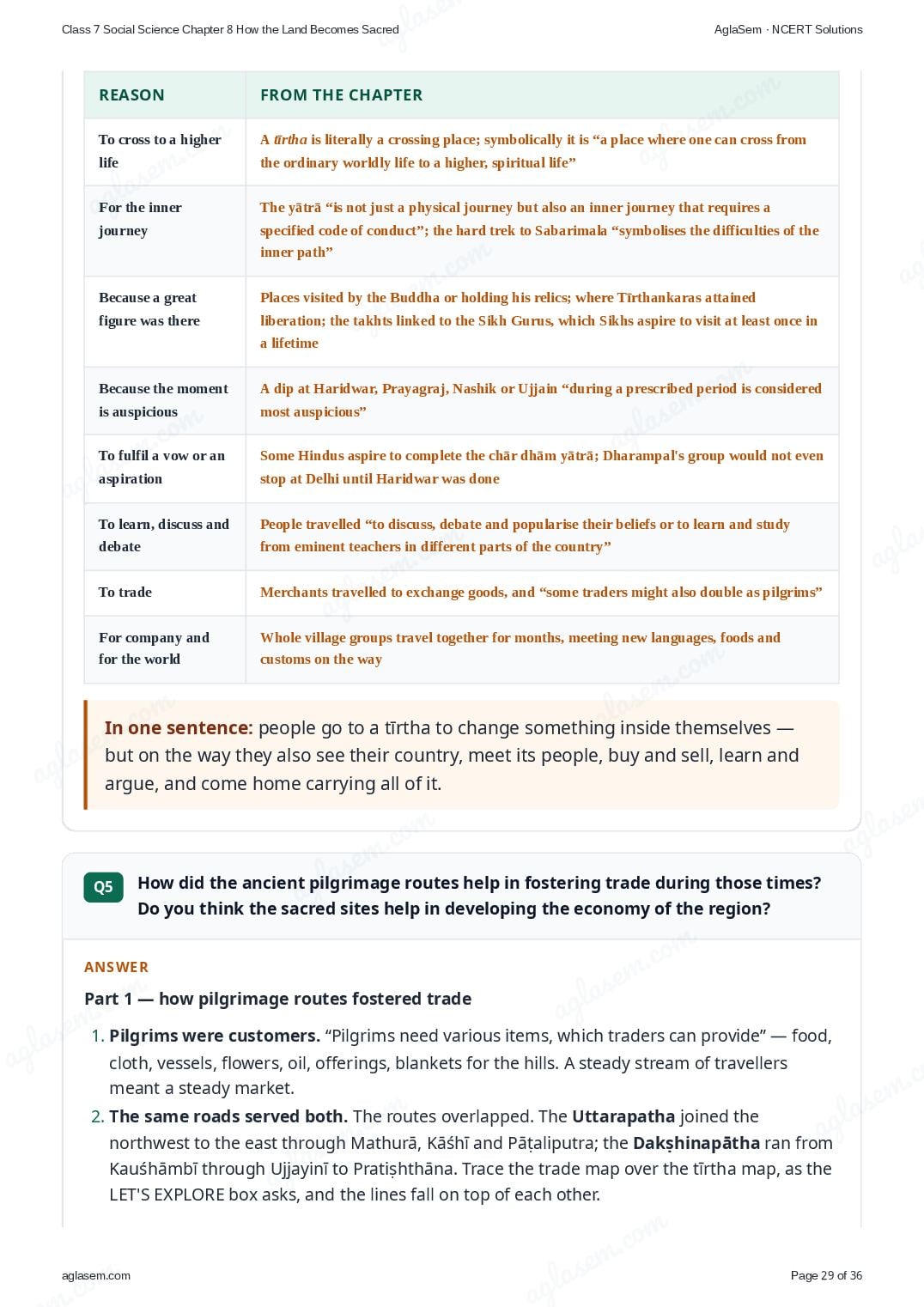
- Why do people visit a tīrtha or other sacred sites?
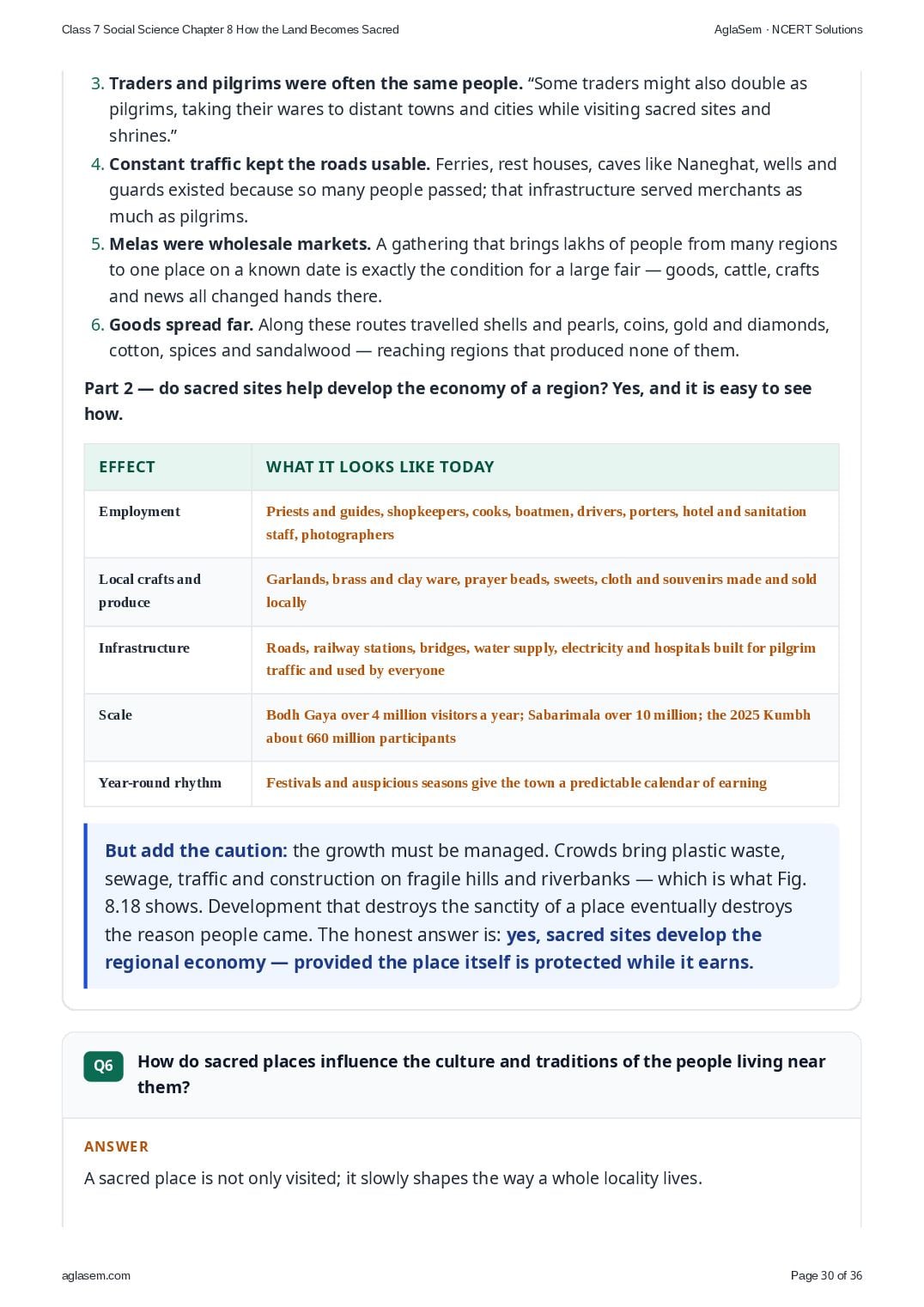
- How did the ancient pilgrimage routes help in fostering trade during those times? Do you think the sacred sites help in developing the economy of the region?
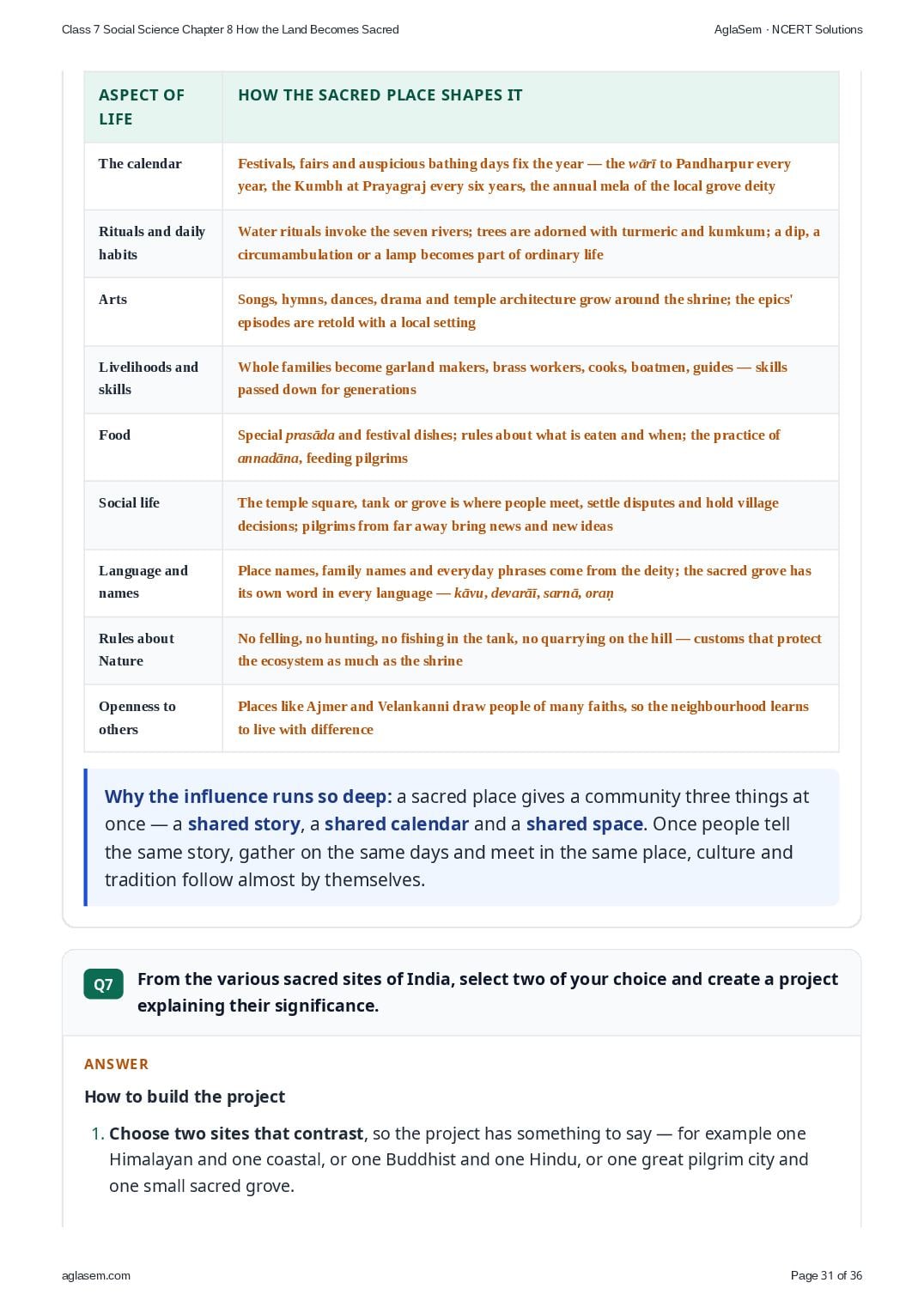
- How do sacred places influence the culture and traditions of the people living near them?
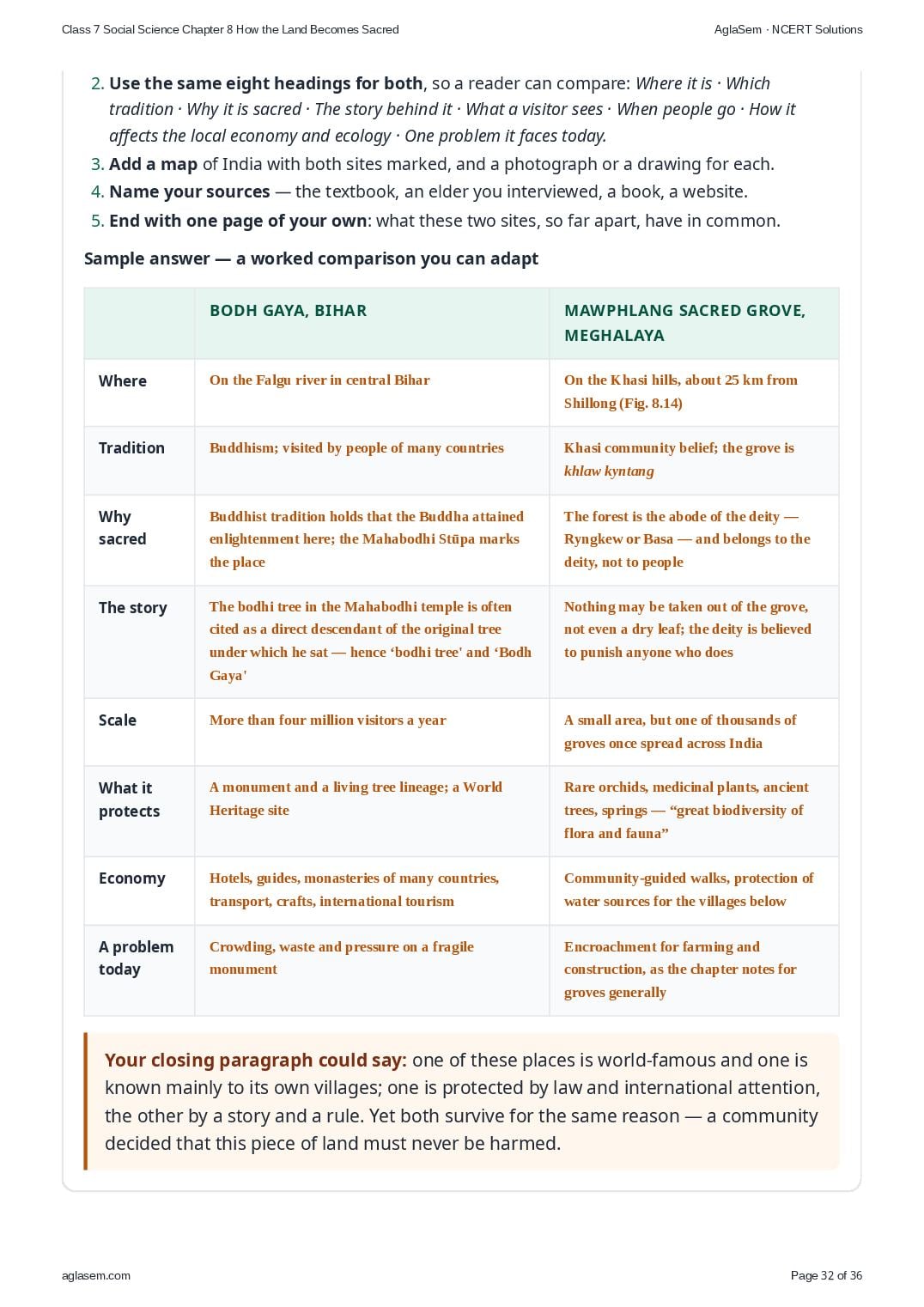
- From the various sacred sites of India, select two of your choice and create a project explaining their significance.
- What is the two-fold significance of a tīrthayātrā or a pilgrimage?
Chapter at a Glance
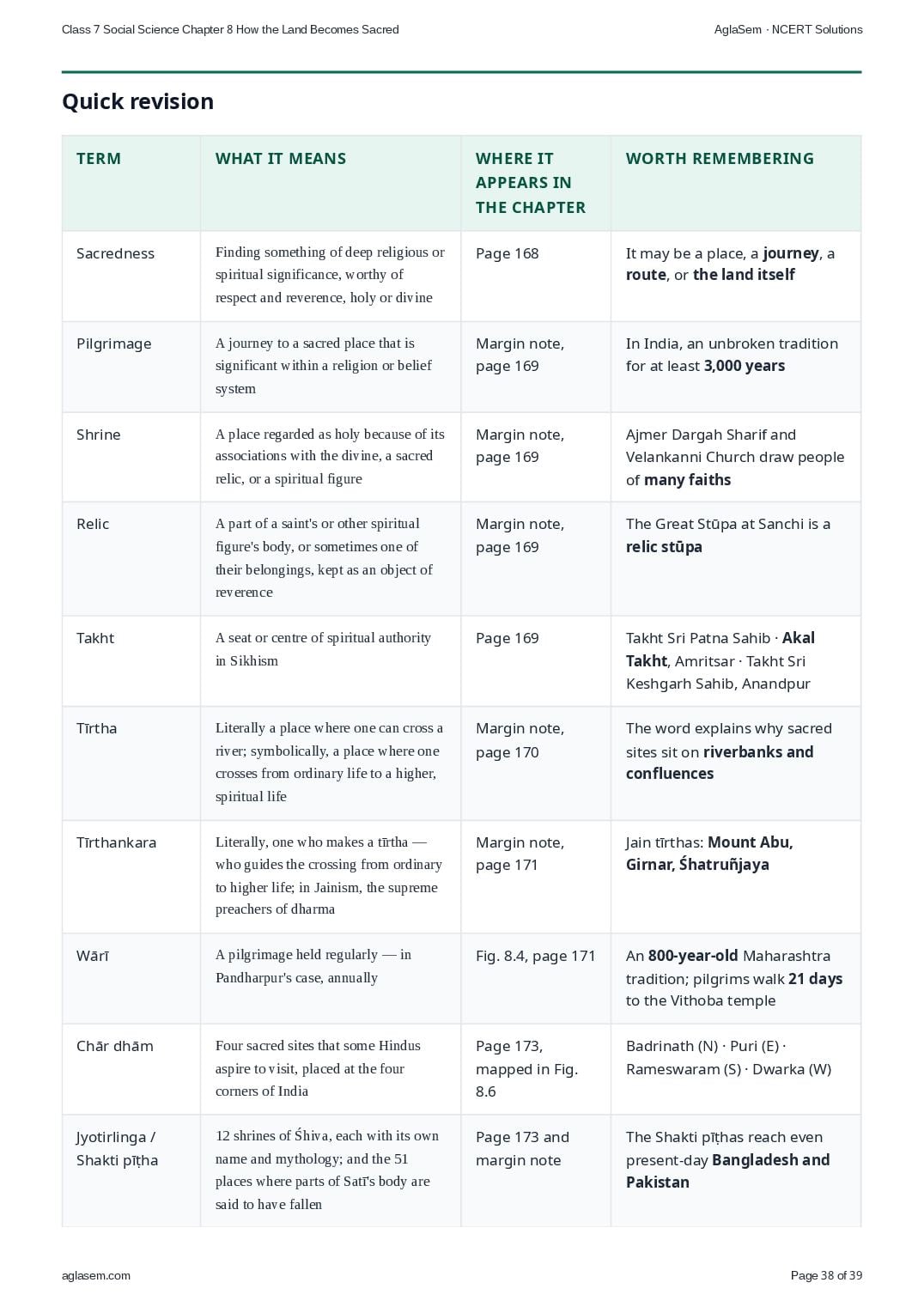
- Sacredness, in this chapter, means something of deep religious or spiritual significance — holy, divine, worthy of respect and reverence. That ‘something' need not be a building. It can be a special location or shrine, a journey of a special kind (a pilgrimage), the route the journey takes, or even the very land covered . So sacredness is tied not only to religion and spirituality but also to geography and to living traditions.
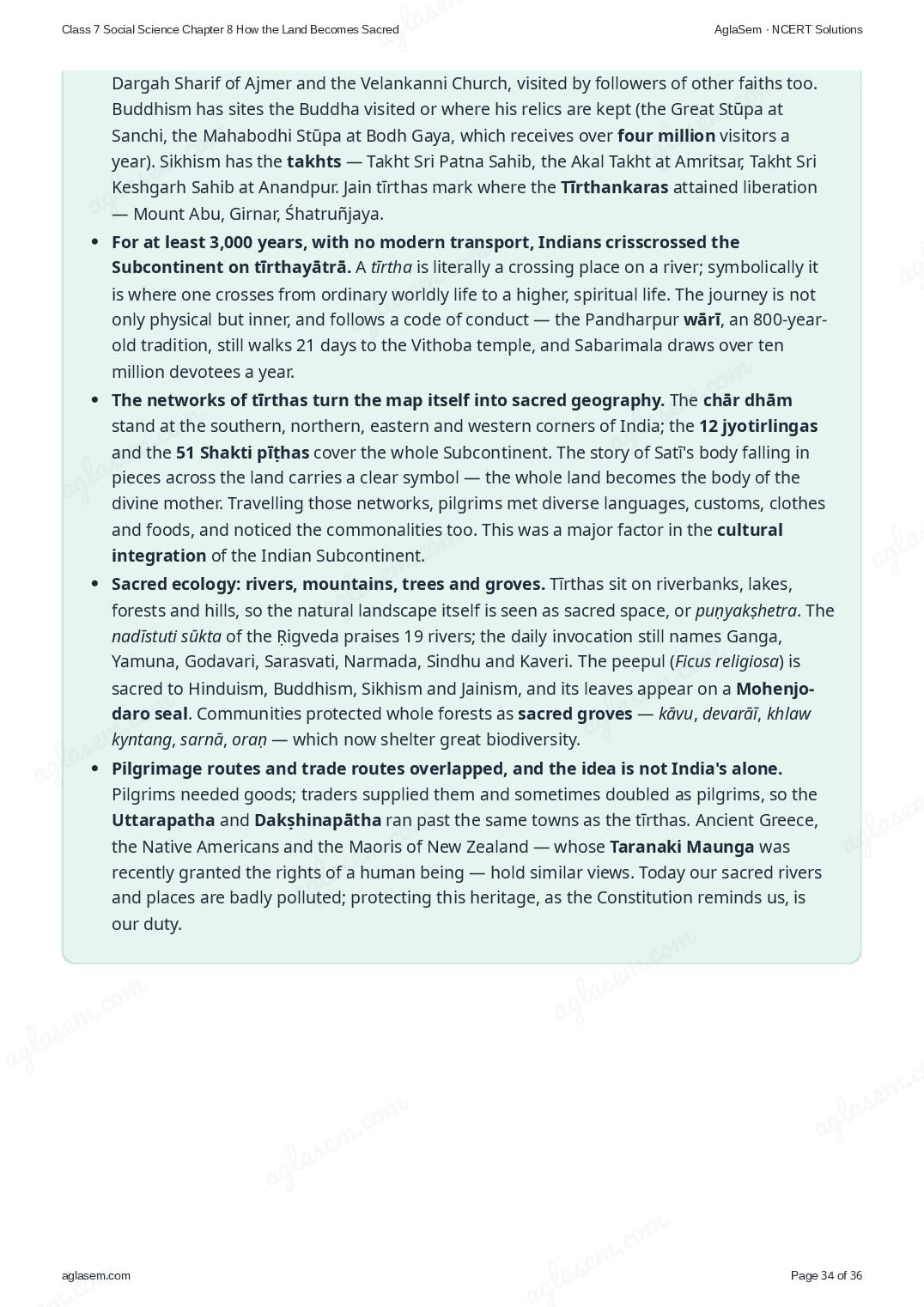
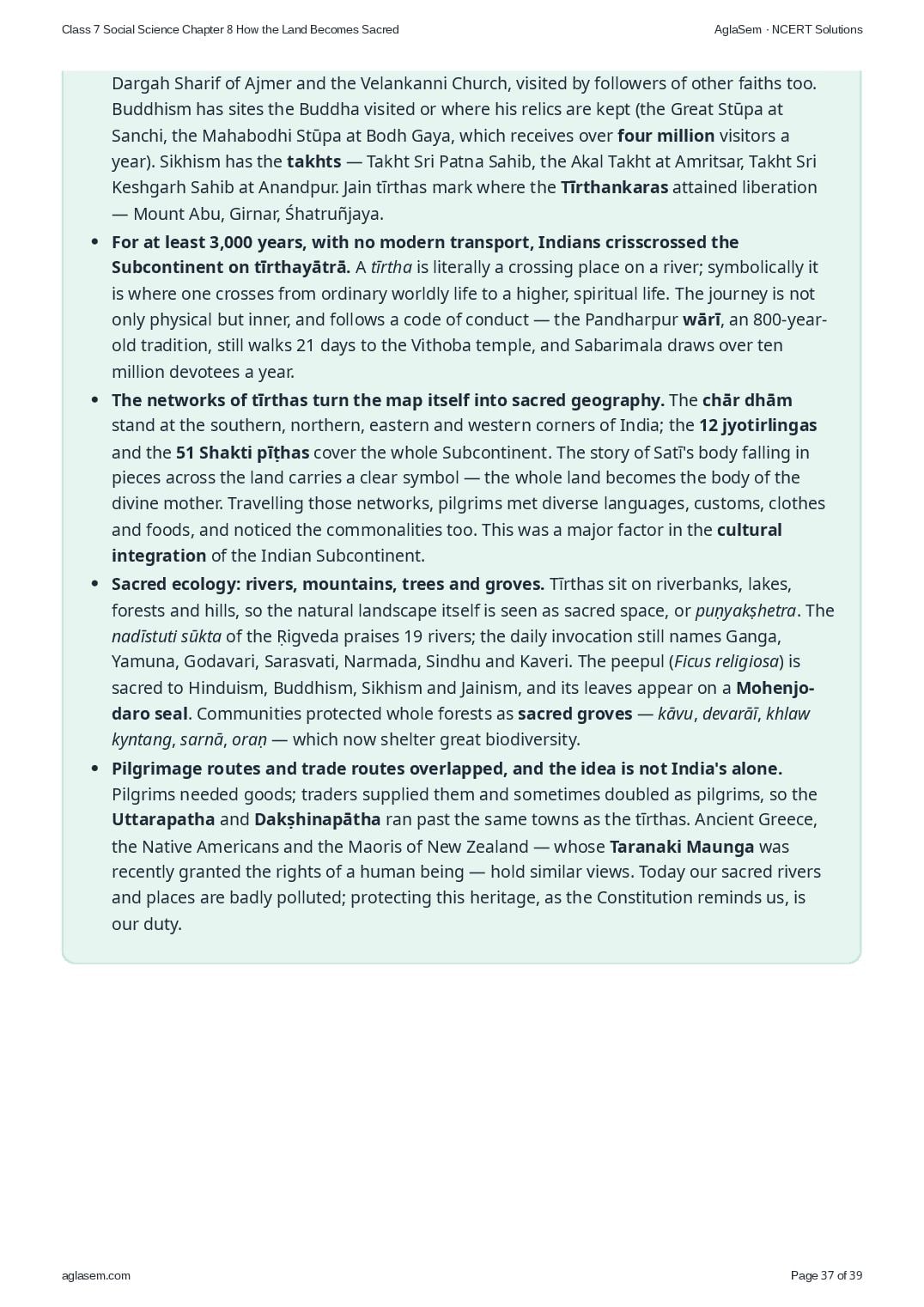
- Every school of thought and religion in India has its own sacred places. Religions that came from outside — Islam, Christianity, Judaism, Zoroastrianism — have shrines like the Dargah Sharif of Ajmer and the Velankanni Church, visited by followers of other faiths too. Buddhism has sites the Buddha visited or where his relics are kept (the Great Stūpa at Sanchi, the Mahabodhi Stūpa at Bodh Gaya, which receives over four million visitors a year). Sikhism has the takhts — Takht Sri Patna Sahib, the Akal Takht at Amritsar, Takht Sri Keshgarh Sahib at Anandpur. Jain tīrthas mark where the Tīrthankaras attained liberation — Mount Abu, Girnar, Śhatruñjaya.
- For at least 3,000 years, with no modern transport, Indians crisscrossed the Subcontinent on tīrthayātrā. A tīrtha is literally a crossing place on a river; symbolically it is where one crosses from ordinary worldly life to a higher, spiritual life. The journey is not only physical but inner, and follows a code of conduct — the Pandharpur wārī , an 800-year-old tradition, still walks 21 days to the Vithoba temple, and Sabarimala draws over ten million devotees a year.
- The networks of tīrthas turn the map itself into sacred geography. The chār dhām stand at the southern, northern, eastern and western corners of India; the 12 jyotirlingas and the 51 Shakti pīṭhas cover the whole Subcontinent. The story of Satī's body falling in pieces across the land carries a clear symbol — the whole land becomes the body of the divine mother . Travelling those networks, pilgrims met diverse languages, customs, clothes and foods, and noticed the commonalities too. This was a major factor in the cultural integration of the Indian Subcontinent.
- Sacred ecology: rivers, mountains, trees and groves. Tīrthas sit on riverbanks, lakes, forests and hills, so the natural landscape itself is seen as sacred space, or puṇyakṣhetra . The nadīstuti sūkta of the Ṛigveda praises 19 rivers; the daily invocation still names Ganga, Yamuna, Godavari, Sarasvati, Narmada, Sindhu and Kaveri. The peepul ( Ficus religiosa ) is sacred to Hinduism, Buddhism, Sikhism and Jainism, and its leaves appear on a Mohenjo-daro seal . Communities protected whole forests as sacred groves — kāvu , devarāī , khlaw kyntang , sarnā , oraṇ — which now shelter great biodiversity.
- Pilgrimage routes and trade routes overlapped, and the idea is not India's alone. Pilgrims needed goods; traders supplied them and sometimes doubled as pilgrims, so the Uttarapatha and Dakṣhinapātha ran past the same towns as the tīrthas. Ancient Greece, the Native Americans and the Maoris of New Zealand — whose Taranaki Maunga was recently granted the rights of a human being — hold similar views. Today our sacred rivers and places are badly polluted; protecting this heritage, as the Constitution reminds us, is our duty.
How to Download NCERT Solutions for Class 7 Social Science Chapter 8 PDF
Follow these simple steps to get the How the Land Becomes Sacred questions-and-answers PDF from Exploring Society India and Beyond.
- Search NCERT Solutions for Class 7 Social Science Chapter 8 aglasem and open this page.
- Read the exercise questions with answers for How the Land Becomes Sacred shown above.
- Click the Download PDF link to save the How the Land Becomes Sacred solutions to your device.
NCERT Solutions for Class 7 Social Science – All Chapters
There are more chapters to study besides How the Land Becomes Sacred in Social Science. Here are the NCERT Solutions for all chapters of Class 7 Social Science.
- Chapter 1 Geographical Diversity of India
- Chapter 2 Understanding the Weather
- Chapter 3 Climates of India
- Chapter 4 New Beginnings Cities and States
- Chapter 5 the Rise of Empires
- Chapter 6 the Age of Reorganisation
- Chapter 7 the Gupta Era an Age of Tireless Creativity
- Chapter 8 How the Land Becomes Sacred
- Chapter 9 From the Rulers to the Ruled Types of Governments
- Chapter 10 the Constitution of India an Introduction
- Chapter 11 From Barter to Money
- Chapter 12 Understanding Markets
NCERT Solutions for Class 7 – All Subjects
Just like Chapter 8 of Social Science, you can get the exercise questions with answers for every other subject of Class 7. Here are the NCERT Solutions for all subjects of Class 7.
NCERT Solutions for Class 7 Social Science Chapter 8 – An Overview
The key highlights of this study material are as follows.
| Aspects | Details |
|---|---|
| Class | Class 7 |
| Subject | Social Science |
| Chapter Number | Chapter 8 |
| Chapter Name | How the Land Becomes Sacred |
| Book Name | Exploring Society India and Beyond |
| Book By | NCERT (National Council of Educational Research and Training) |
| Educational Resource Here | NCERT Solutions of Class 7 Social Science Chapter 8 for all exercises |
| More Questions Answers of This Subject | NCERT Solutions for Class 7 Social Science |
| Download Book Chapter | NCERT Book Class 7 Social Science |
| All Questions Answers For This Class | NCERT Solutions for Class 7 |
| Complete Solutions | NCERT Solutions |
NCERT Solutions for Class 7 Social Science Chapter 8 How the Land Becomes Sacred – FAQs
What are the NCERT Solutions for Class 7 Social Science Chapter 8 How the Land Becomes Sacred?
They are the complete, step-by-step answers to all the exercise and in-text questions of Chapter 8 How the Land Becomes Sacred from the NCERT Class 7 Social Science textbook Exploring Society India and Beyond, written by experts as per the latest NCERT syllabus.
How can I download the Class 7 Social Science Chapter 8 solutions PDF for free?
Open this page on aglasem, read the How the Land Becomes Sacred questions with answers, and click the “Download Solutions PDF” link. The Class 7 Social Science Chapter 8 NCERT Solutions PDF is completely free to download.
Are these NCERT Solutions as per the latest 2026-27 syllabus?
Yes. The NCERT Solutions for Class 7 Social Science Chapter 8 are based on the latest NCERT textbook Exploring Society India and Beyond and the current 2026-27 CBSE syllabus, so the questions and answers match what you study in class.
Where can I get NCERT Solutions for the other chapters of Class 7 Social Science?
You can find the answers to every chapter on the NCERT Solutions for Class 7 Social Science page, and solutions for every subject on the NCERT Solutions for Class 7 page.
How do NCERT Solutions help in exam preparation?
They show the correct method to solve each question, help you write answers the way they are expected in exams, let you check and correct your own work, and save revision time — which together improve your marks in Class 7 Social Science.
If you have any queries on NCERT Solutions for Class 7 Social Science Chapter 8 How the Land Becomes Sacred, then please ask in the comments below.
