NCERT Solutions for Class 7 Social Science Chapter 11 From Barter to Money provide clear, step-by-step answers to every exercise and in-text question from the chapter From Barter to Money of the NCERT textbook Exploring Society India and Beyond. Prepared by subject experts as per the latest NCERT (CBSE) syllabus for 2026-27, these NCERT Solutions for Class 7 Social Science help you understand each concept, write exam-ready answers, and check your own solutions. You can read them online below or download the free Class 7 Social Science Chapter 11 question-answer PDF.
NCERT Solutions for Class 7 Social Science Chapter 11 From Barter to Money
- Class: Class 7
- Subject: Social Science
- Chapter: Chapter 11 – From Barter to Money
- Textbook: Exploring Society India and Beyond (NCERT)
- Study material: NCERT Solutions – questions with answers, free PDF
These solutions answer all the exercise questions of Chapter 11 From Barter to Money — including the in-text questions, short-answer and long-answer questions, and activities — with complete explanations so you can follow the method, not just the final answer. Read the full solutions below.
NCERT Solutions Class 7 Social Science Chapter 11 From Barter to Money View Download
NCERT Solutions for Class 7 Social Science Chapter 11 PDF Download
You can read the NCERT Solutions for Class 7 Social Science Chapter 11 online above, or download the complete question-answer PDF to study From Barter to Money offline at any time.
NCERT Solutions for Class 7 Social Science Chapter 11 PDF Download Link – Click Here to Download Solutions PDF
Questions Covered in This Chapter
These NCERT Solutions answer all 33 questions of this chapter. The questions solved are:
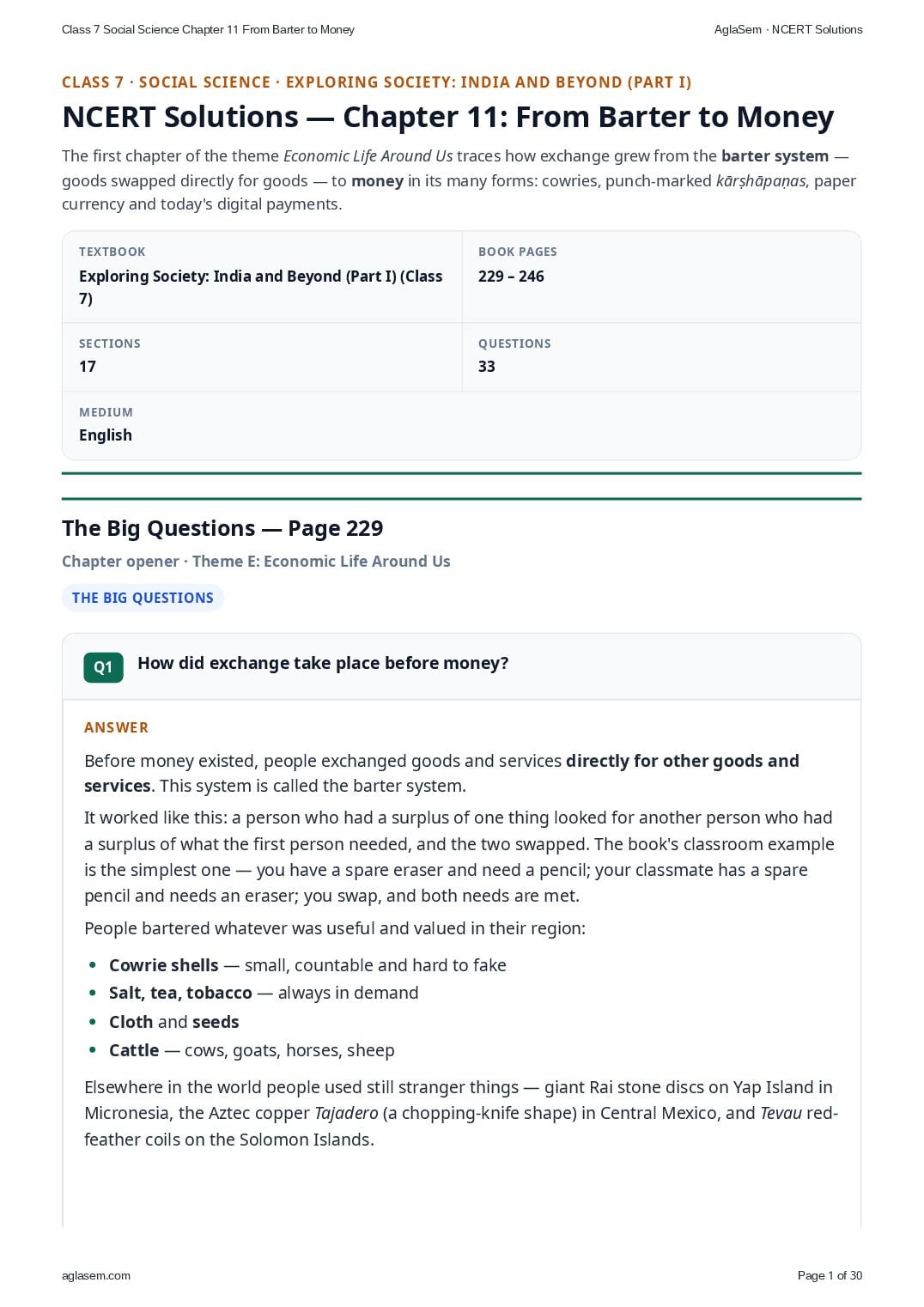
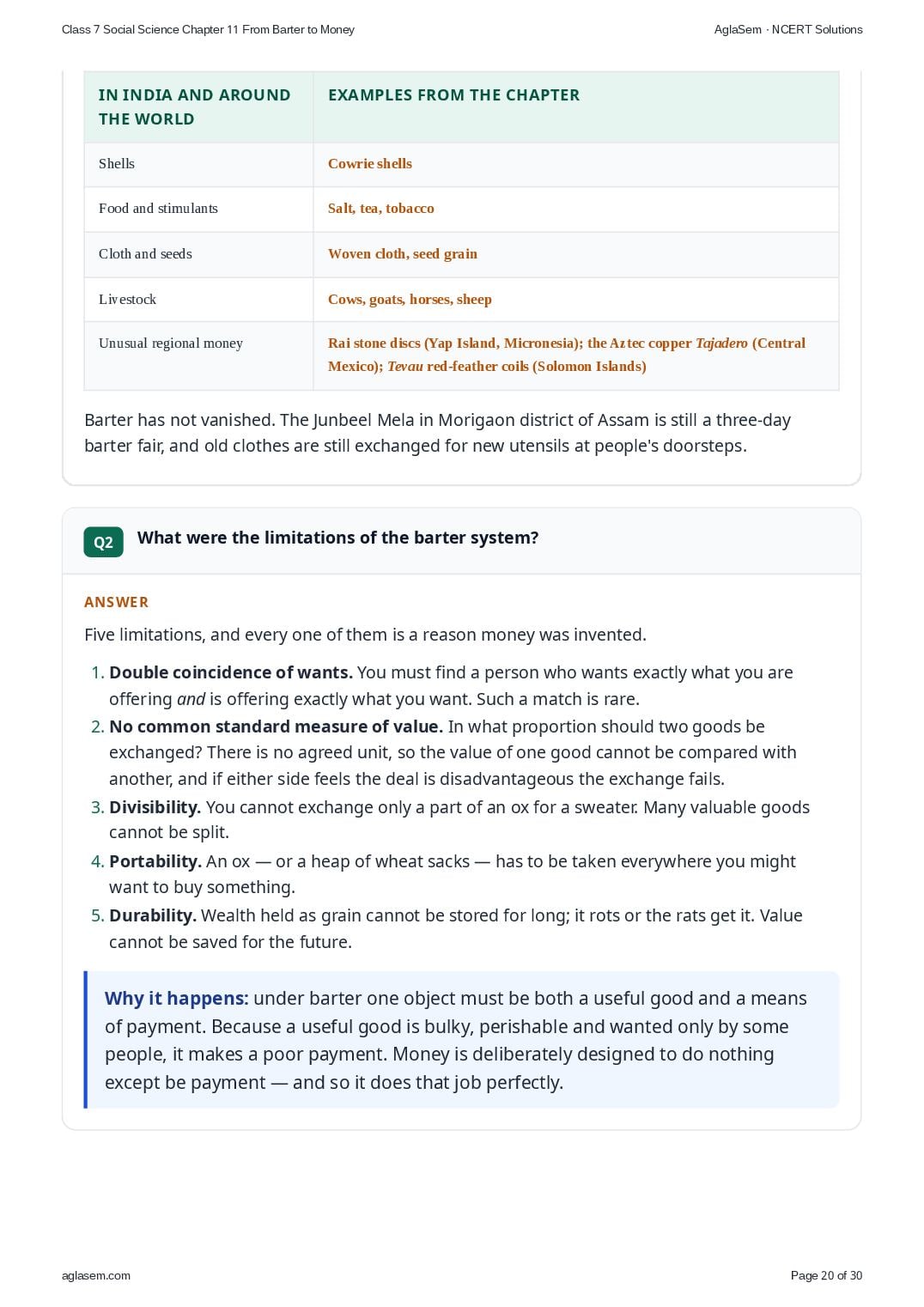
- How did exchange take place before money?
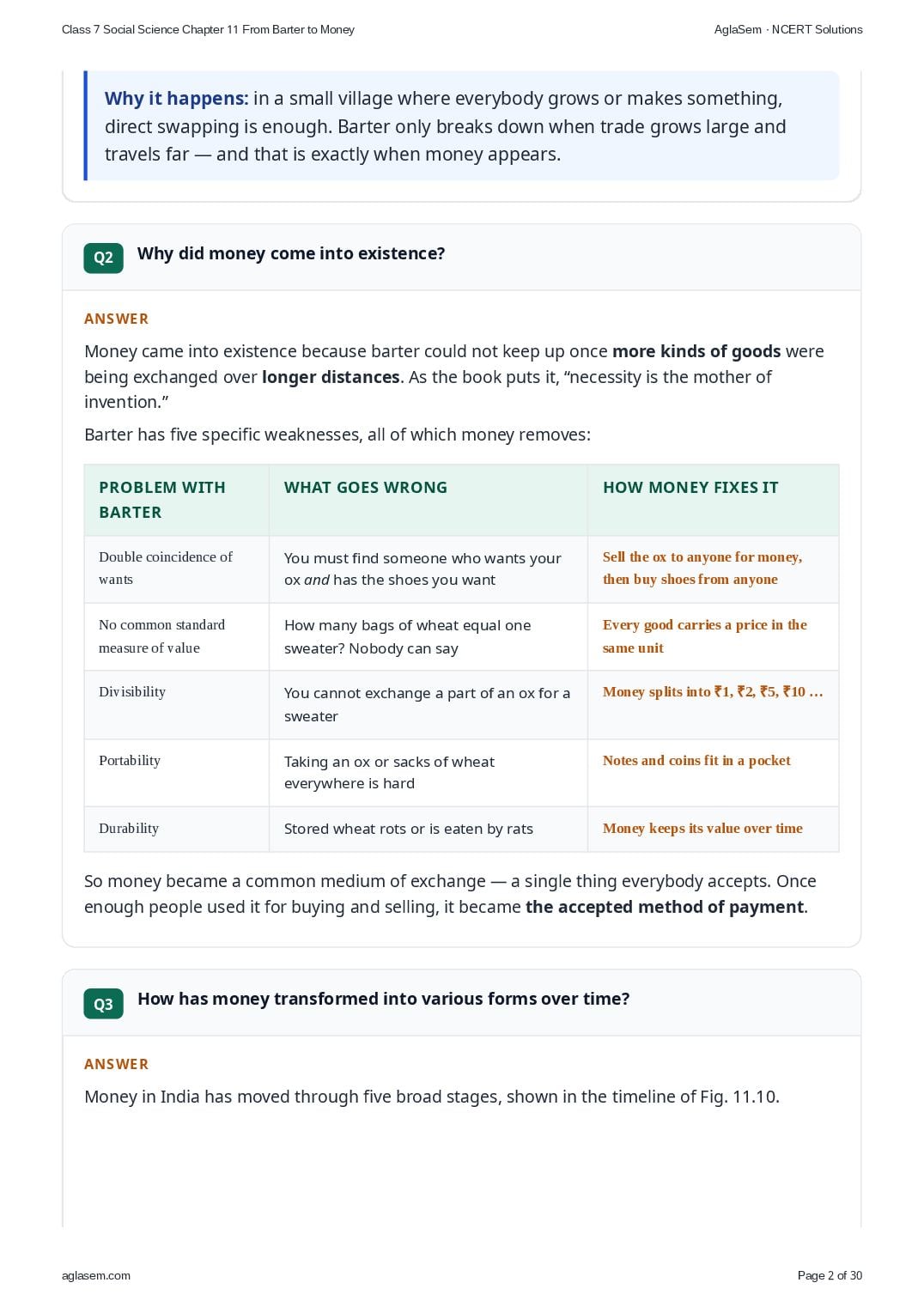
- Why did money come into existence?
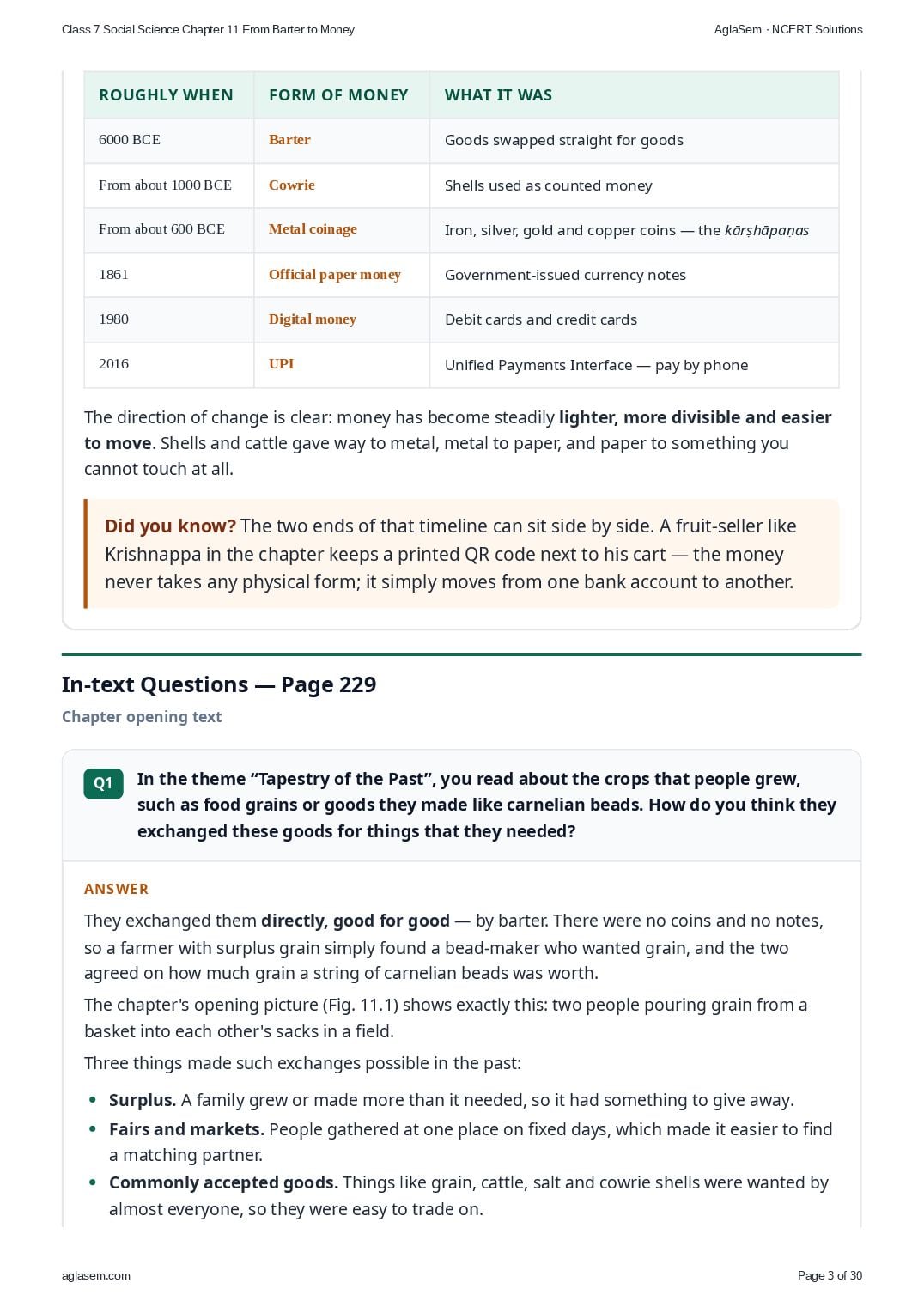
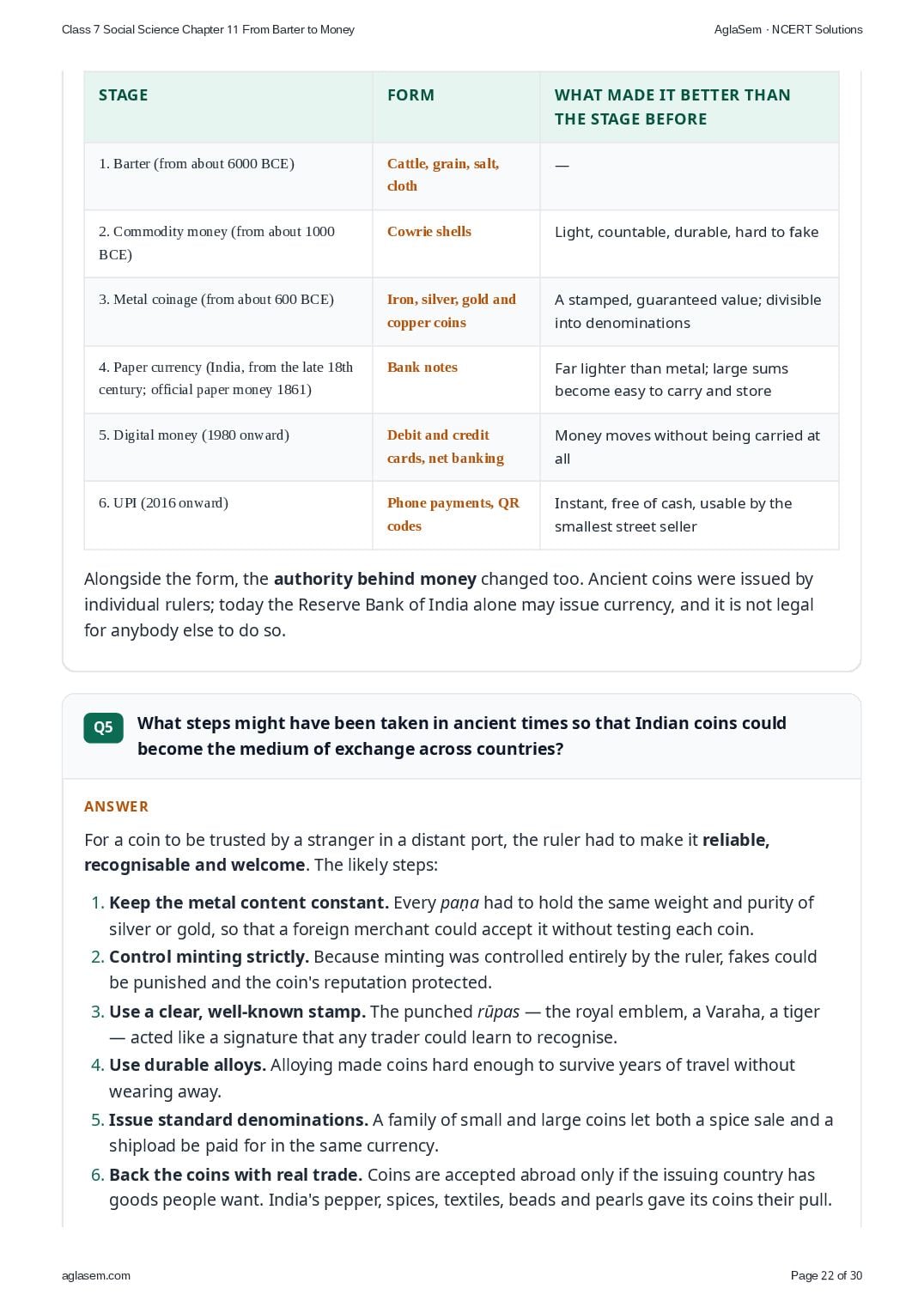
- How has money transformed into various forms over time?
- In the theme “Tapestry of the Past”, you read about the crops that people grew, such as food grains or goods they made like carnelian beads. How do you think they exchanged these goods for things that they needed?
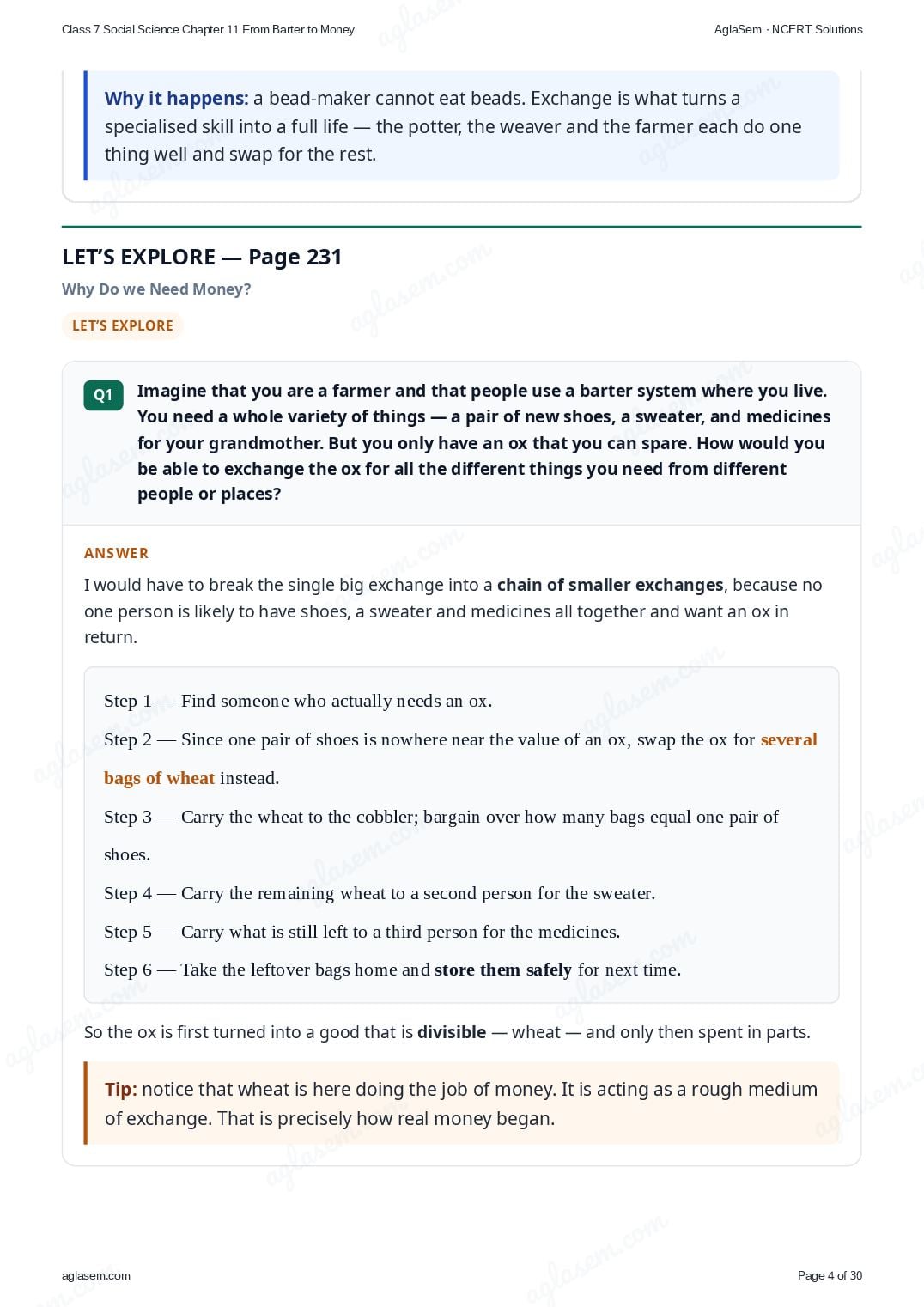
- Imagine that you are a farmer and that people use a barter system where you live. You need a whole variety of things — a pair of new shoes, a sweater, and medicines for your grandmother. But you only have an ox that you can spare. How would you be able to exchange the ox for all the different things you need from different people or places?
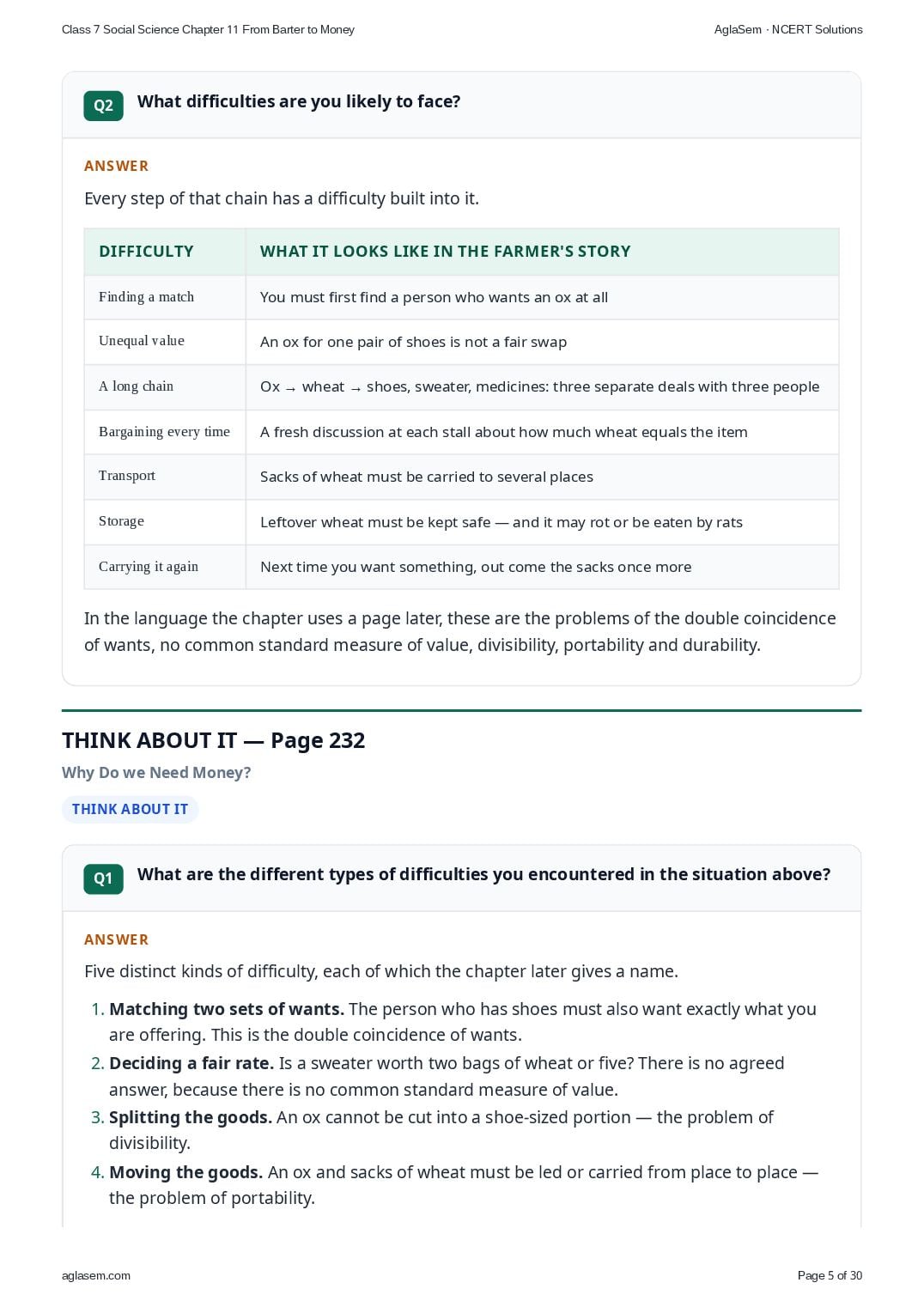
- What difficulties are you likely to face?
- What are the different types of difficulties you encountered in the situation above?
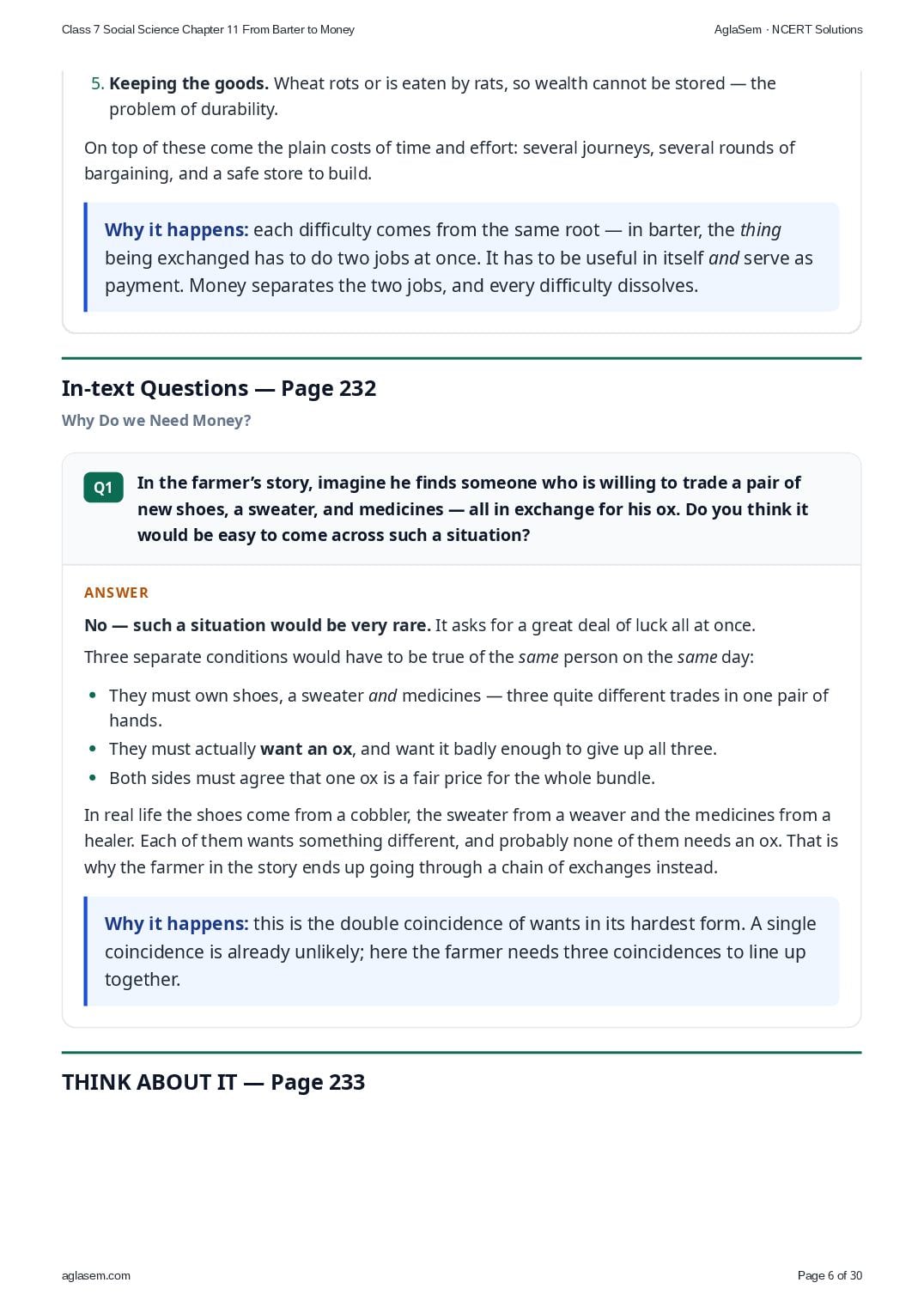
- In the farmer’s story, imagine he finds someone who is willing to trade a pair of new shoes, a sweater, and medicines — all in exchange for his ox. Do you think it would be easy to come across such a situation?
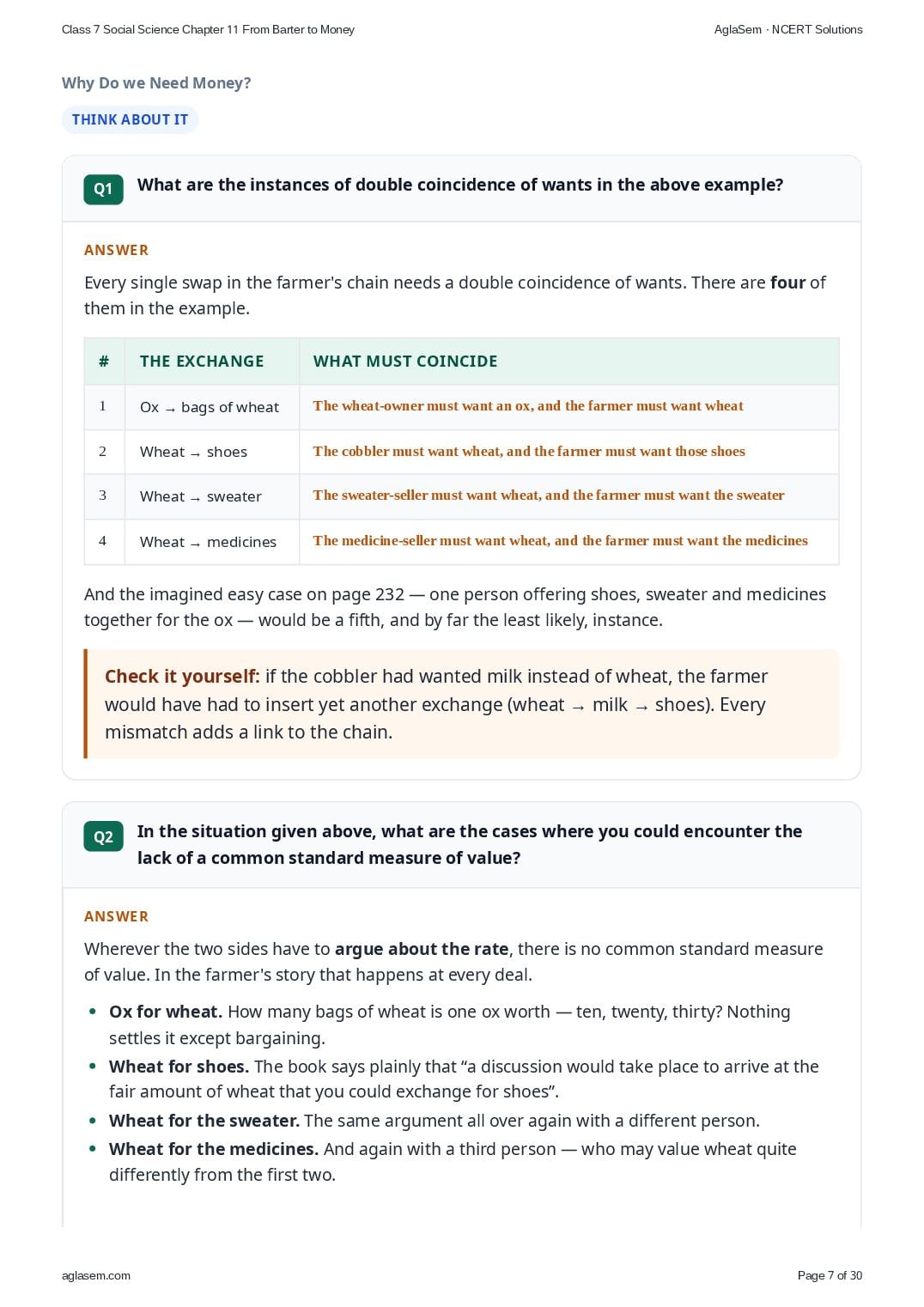
- What are the instances of double coincidence of wants in the above example?
- In the situation given above, what are the cases where you could encounter the lack of a common standard measure of value?
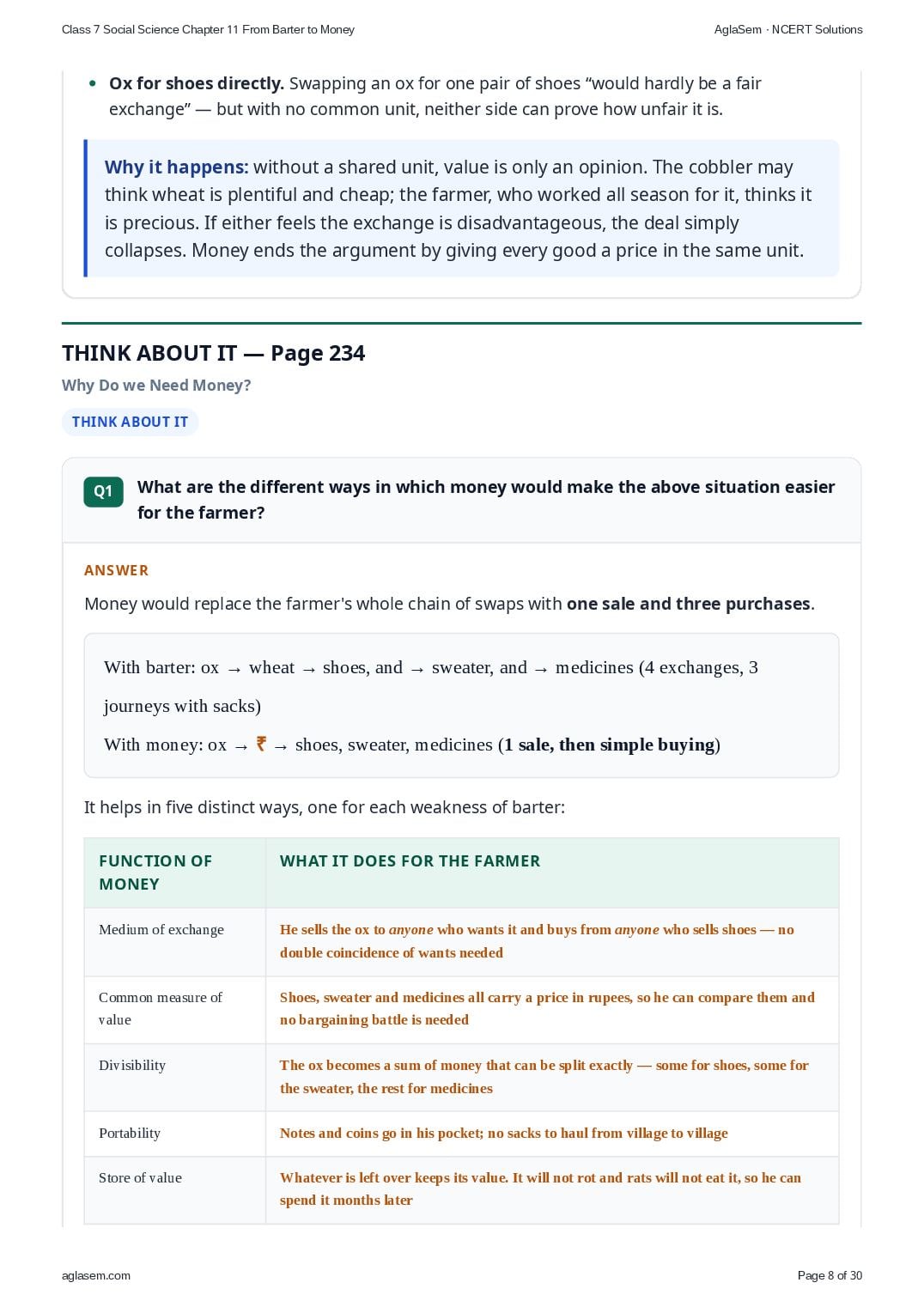
- What are the different ways in which money would make the above situation easier for the farmer?
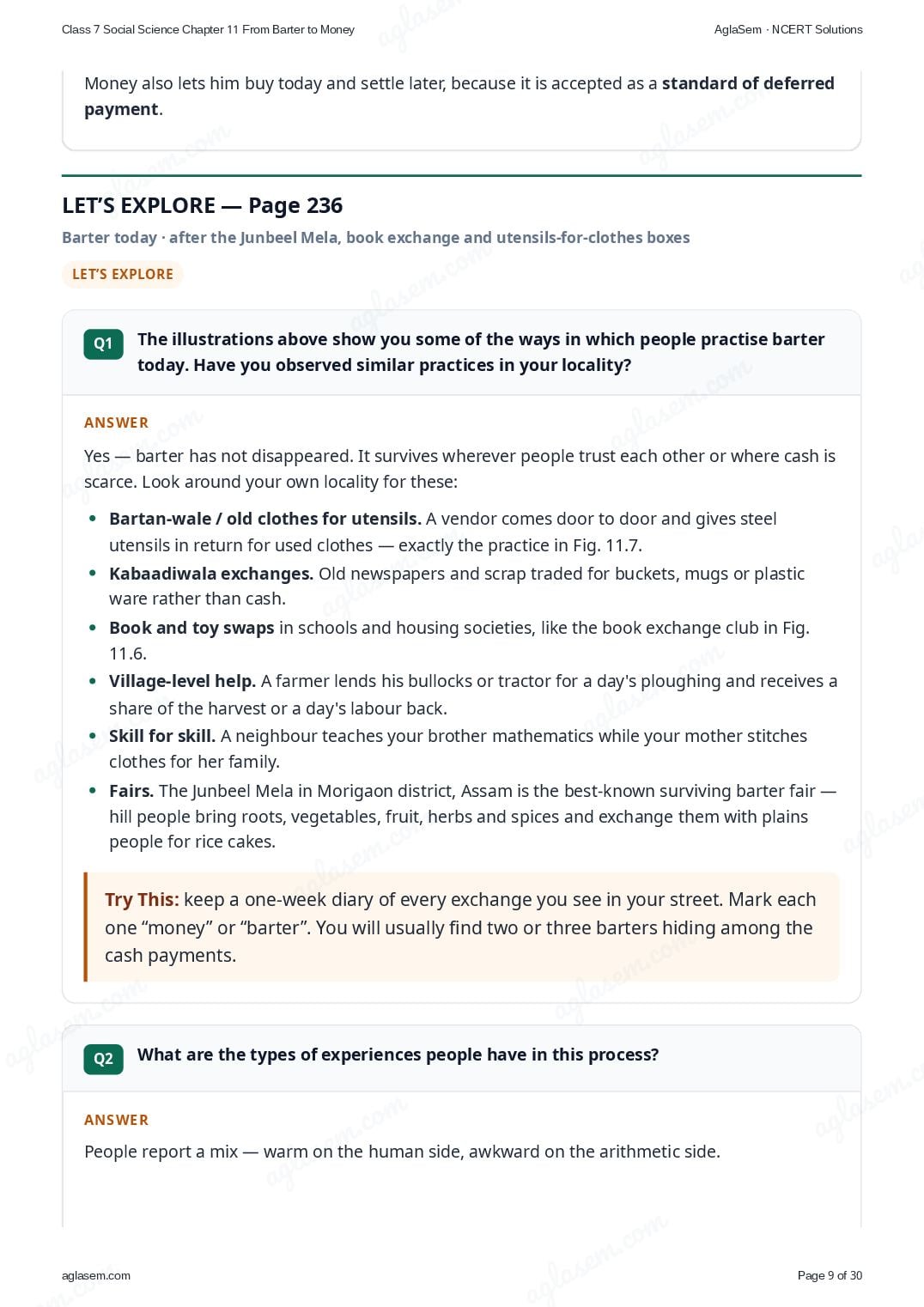
- The illustrations above show you some of the ways in which people practise barter today. Have you observed similar practices in your locality?
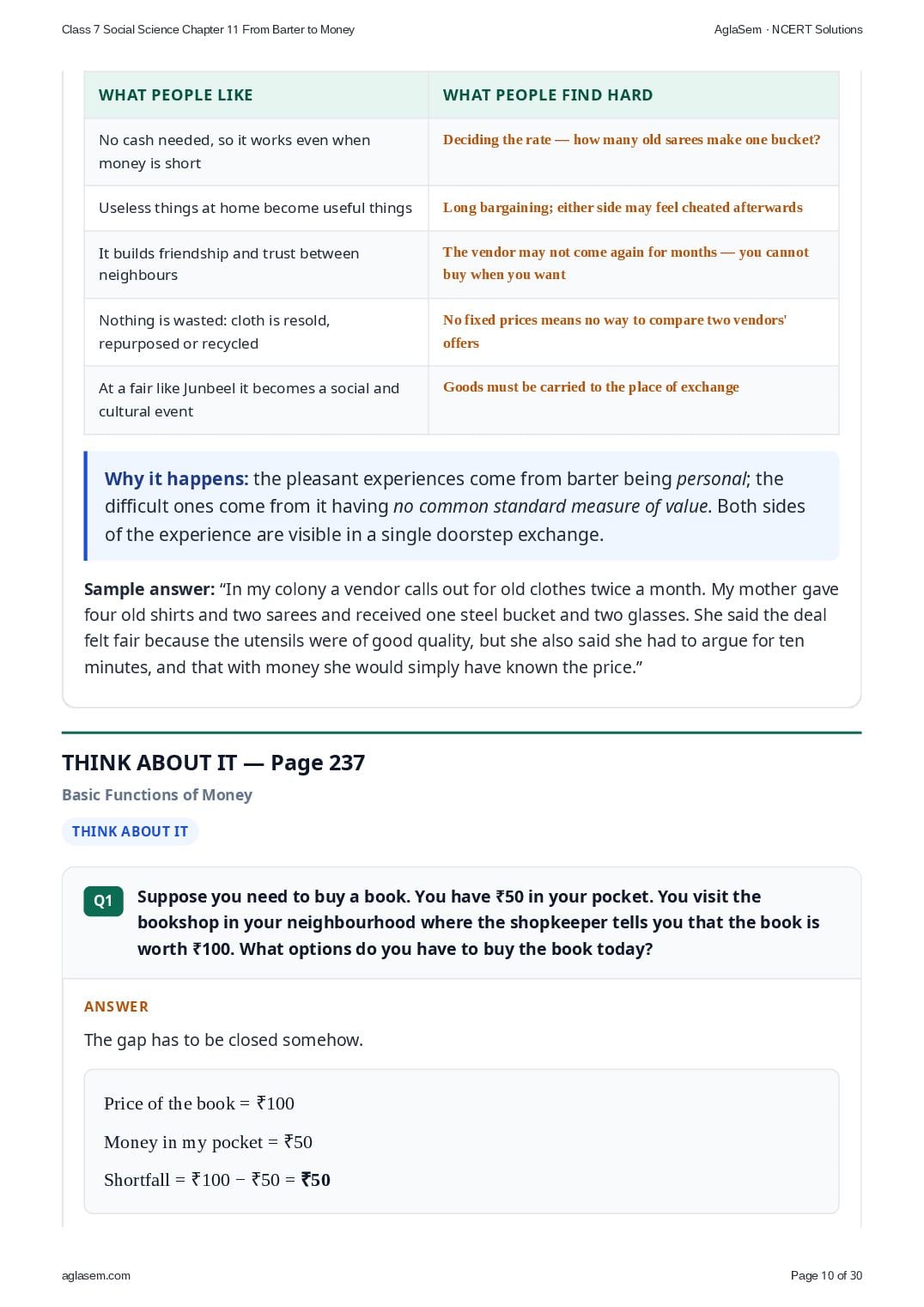
- What are the types of experiences people have in this process?
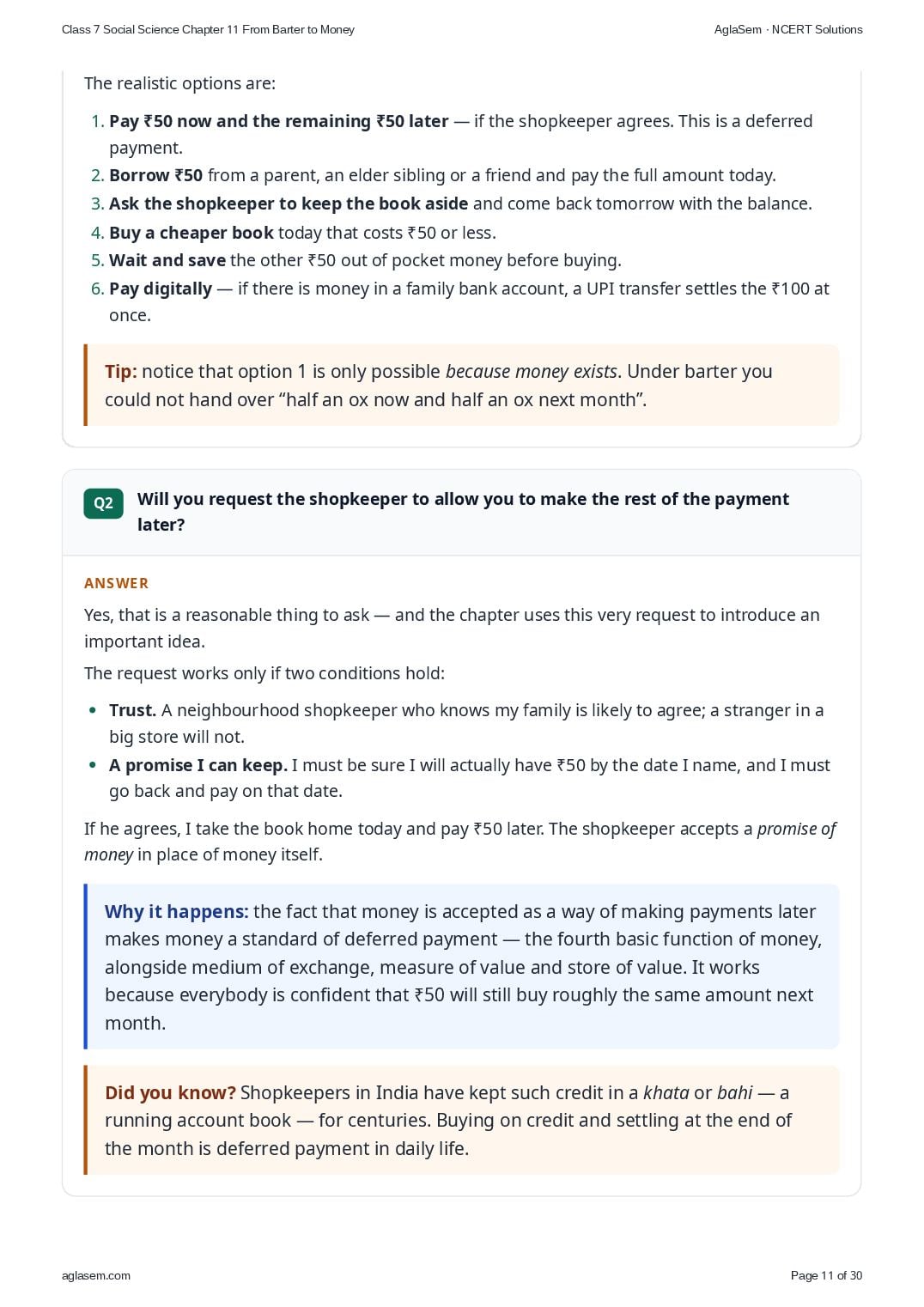
- Suppose you need to buy a book. You have ₹50 in your pocket. You visit the bookshop in your neighbourhood where the shopkeeper tells you that the book is worth ₹100. What options do you have to buy the book today?
- Will you request the shopkeeper to allow you to make the rest of the payment later?
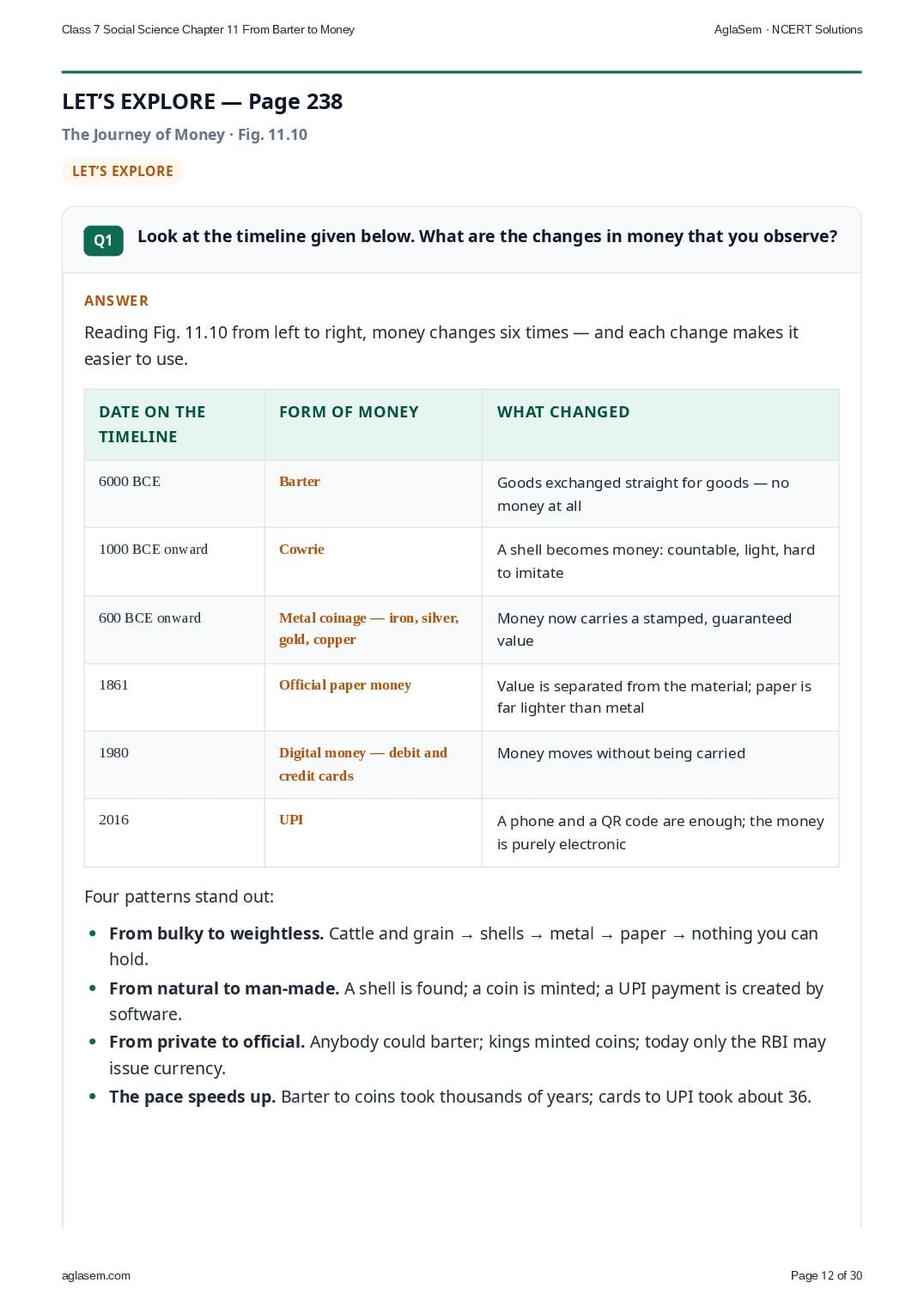
- Look at the timeline given below. What are the changes in money that you observe?
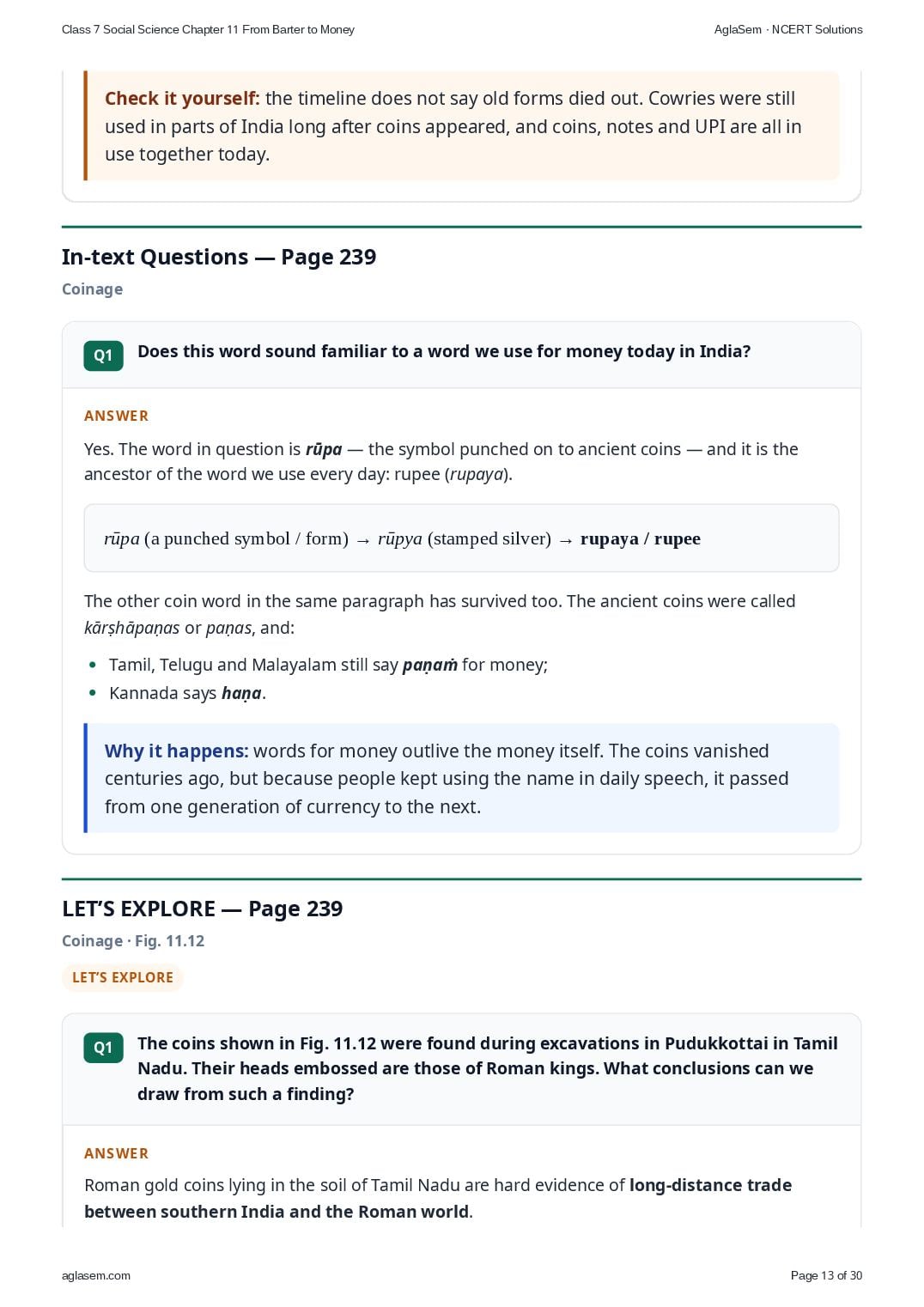
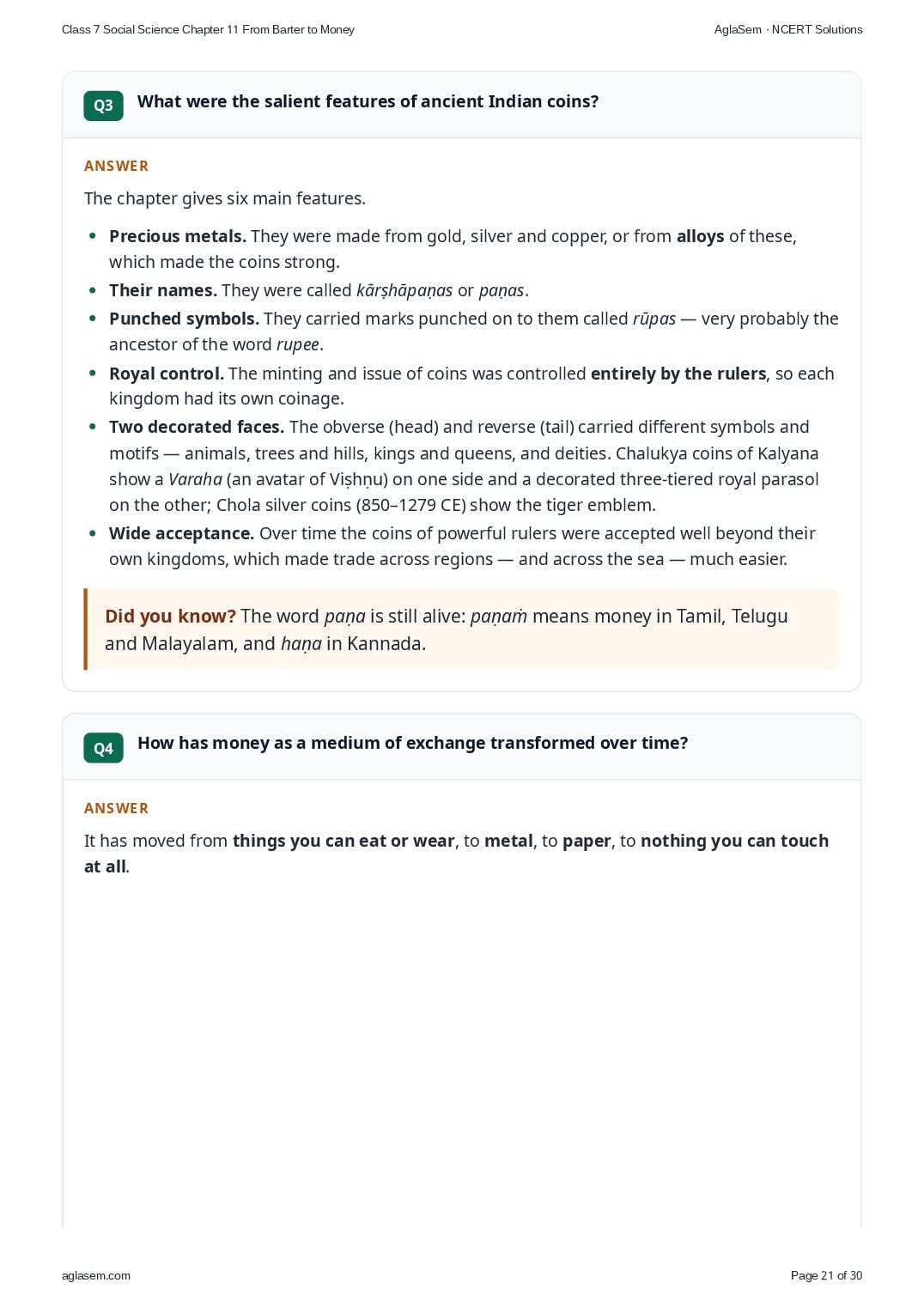
- Does this word sound familiar to a word we use for money today in India?
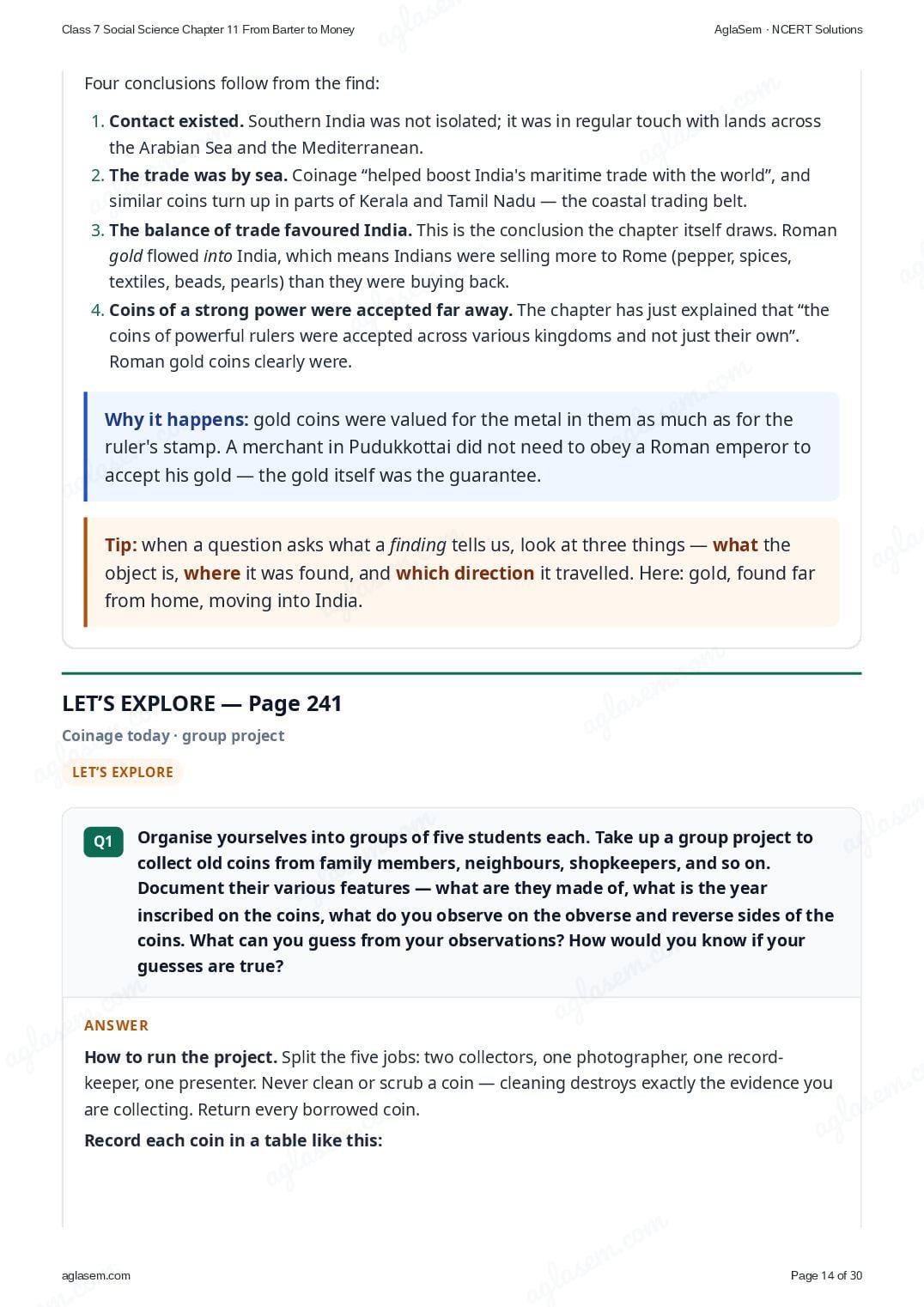
- The coins shown in Fig. 11.12 were found during excavations in Pudukkottai in Tamil Nadu. Their heads embossed are those of Roman kings. What conclusions can we draw from such a finding?
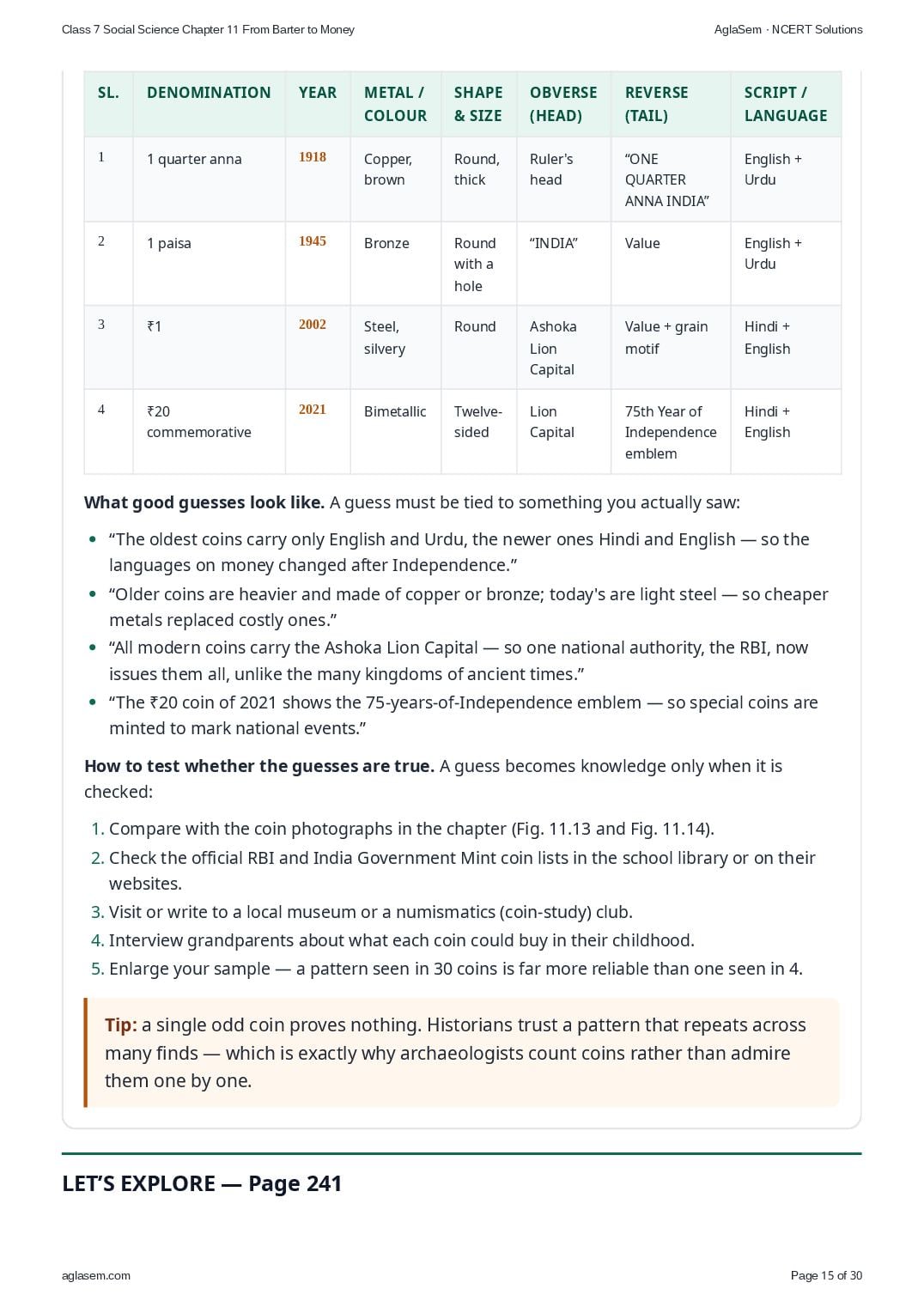
- Organise yourselves into groups of five students each. Take up a group project to collect old coins from family members, neighbours, shopkeepers, and so on. Document their various features — what are they made of, what is the year inscribed on the coins, what do you observe on the obverse and reverse sides of the coins. What can you guess from your observations? How would you know if your guesses are true?
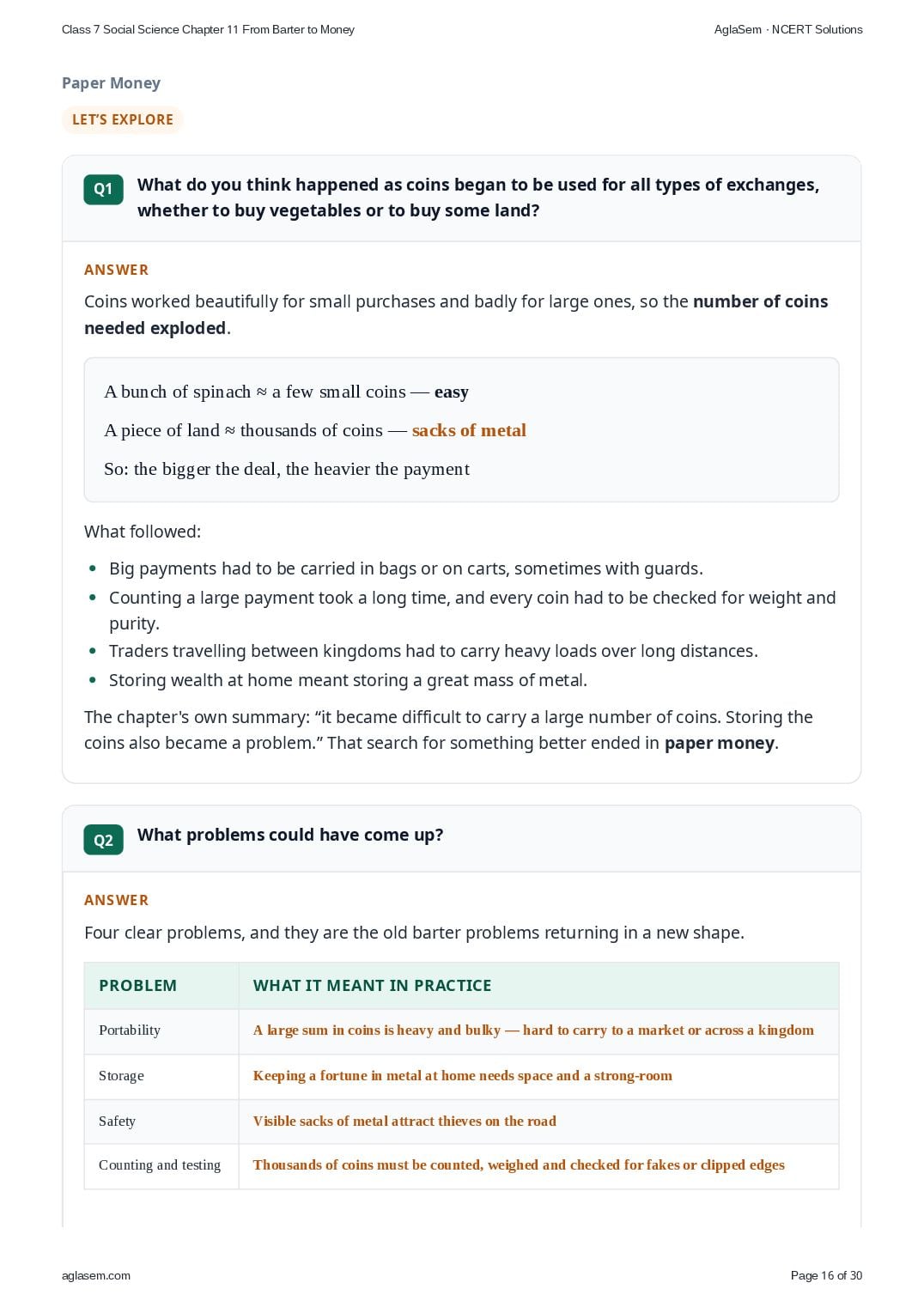
- What do you think happened as coins began to be used for all types of exchanges, whether to buy vegetables or to buy some land?
- What problems could have come up?
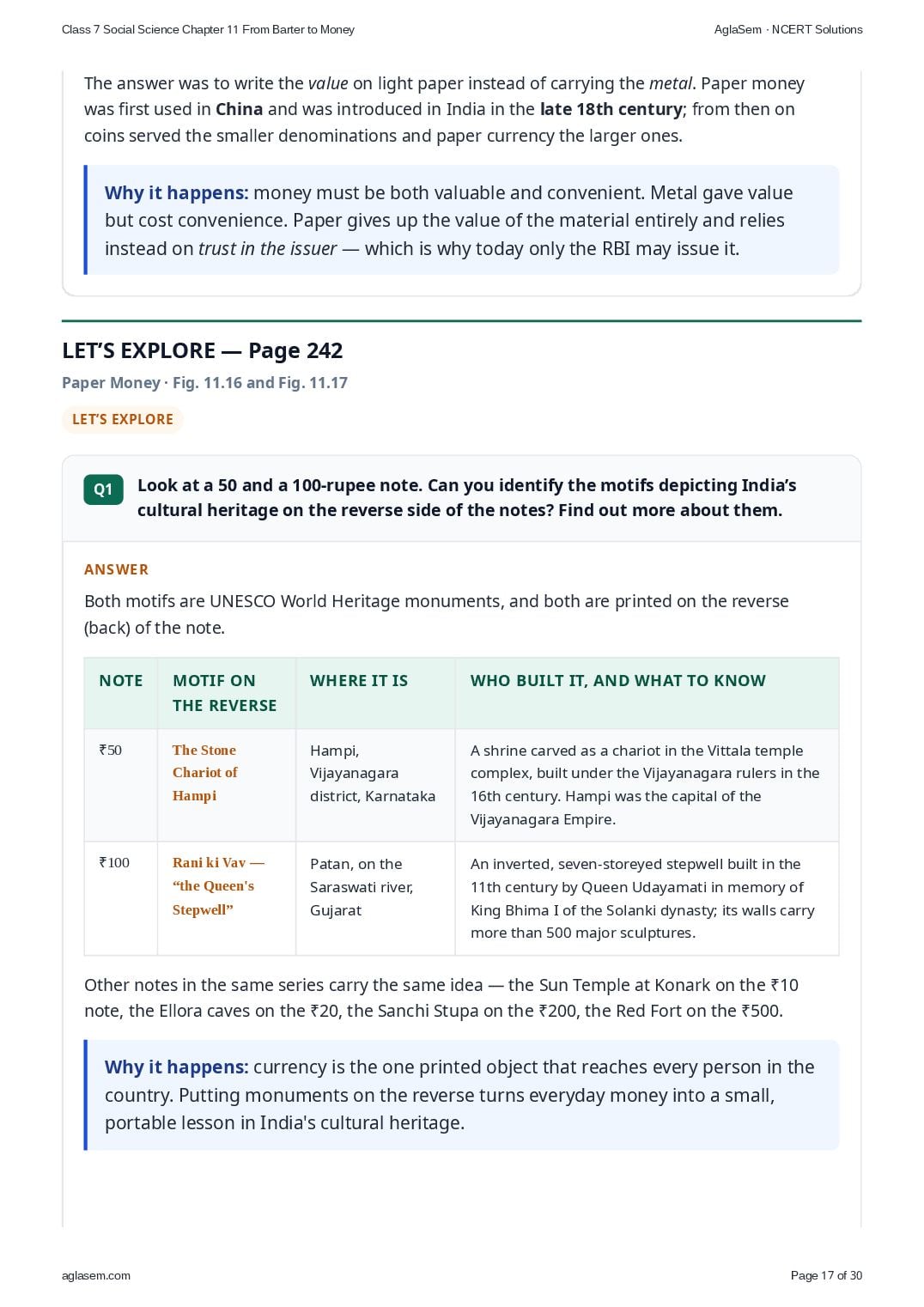
- Look at a 50 and a 100-rupee note. Can you identify the motifs depicting India’s cultural heritage on the reverse side of the notes? Find out more about them.
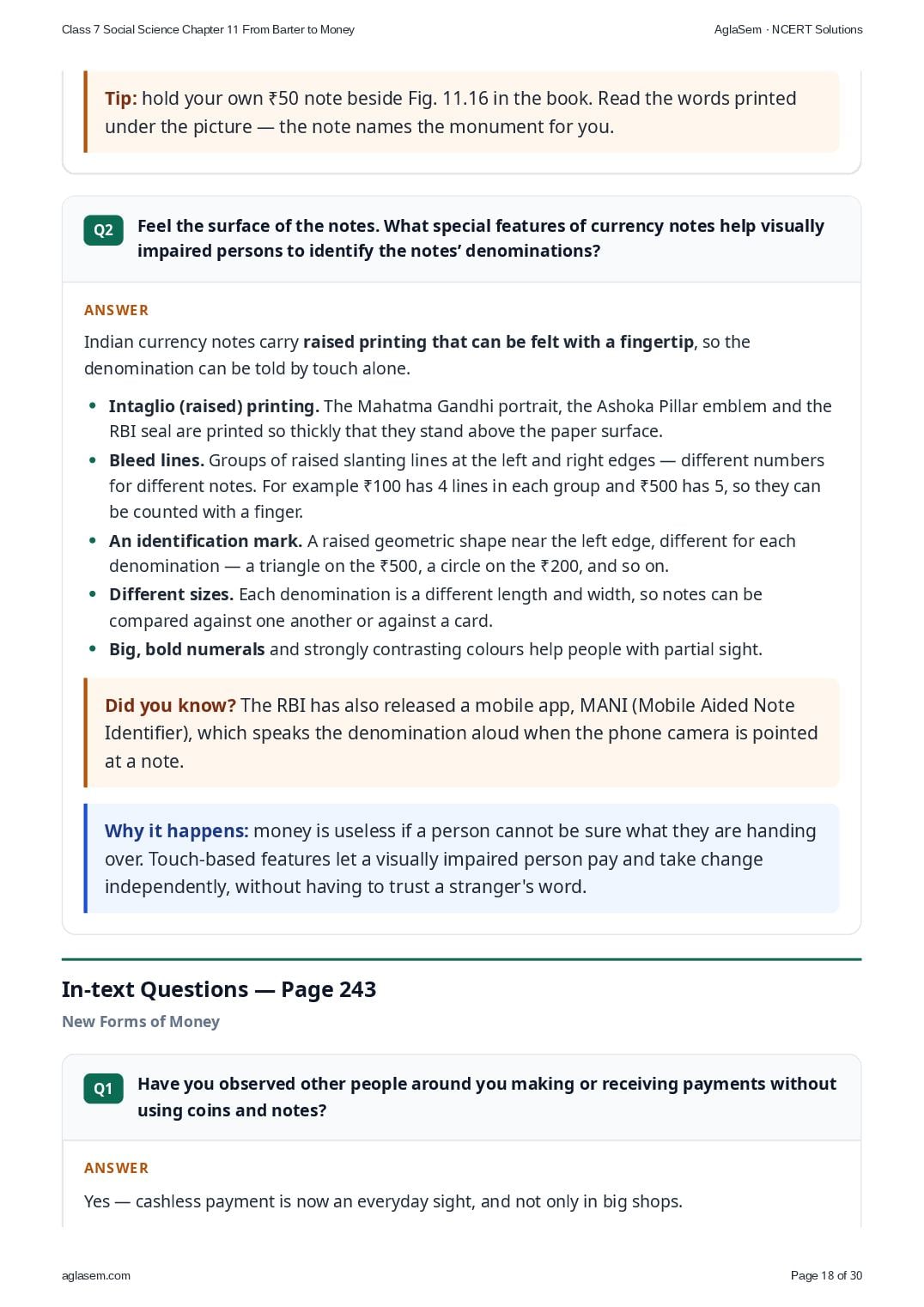
- Feel the surface of the notes. What special features of currency notes help visually impaired persons to identify the notes’ denominations?
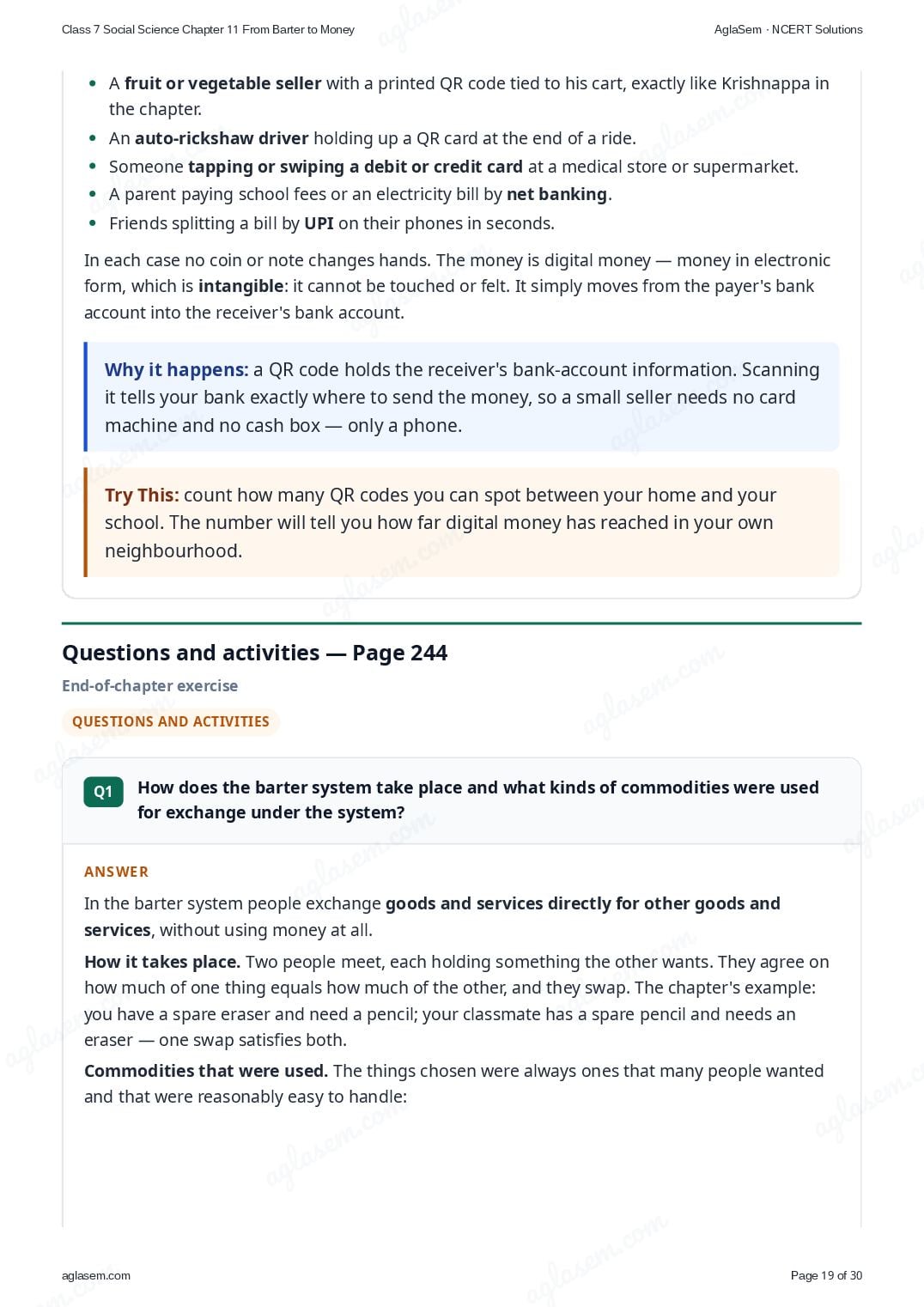
- Have you observed other people around you making or receiving payments without using coins and notes?
- How does the barter system take place and what kinds of commodities were used for exchange under the system?
- What were the limitations of the barter system?
- What were the salient features of ancient Indian coins?
- How has money as a medium of exchange transformed over time?
- What steps might have been taken in ancient times so that Indian coins could become the medium of exchange across countries?
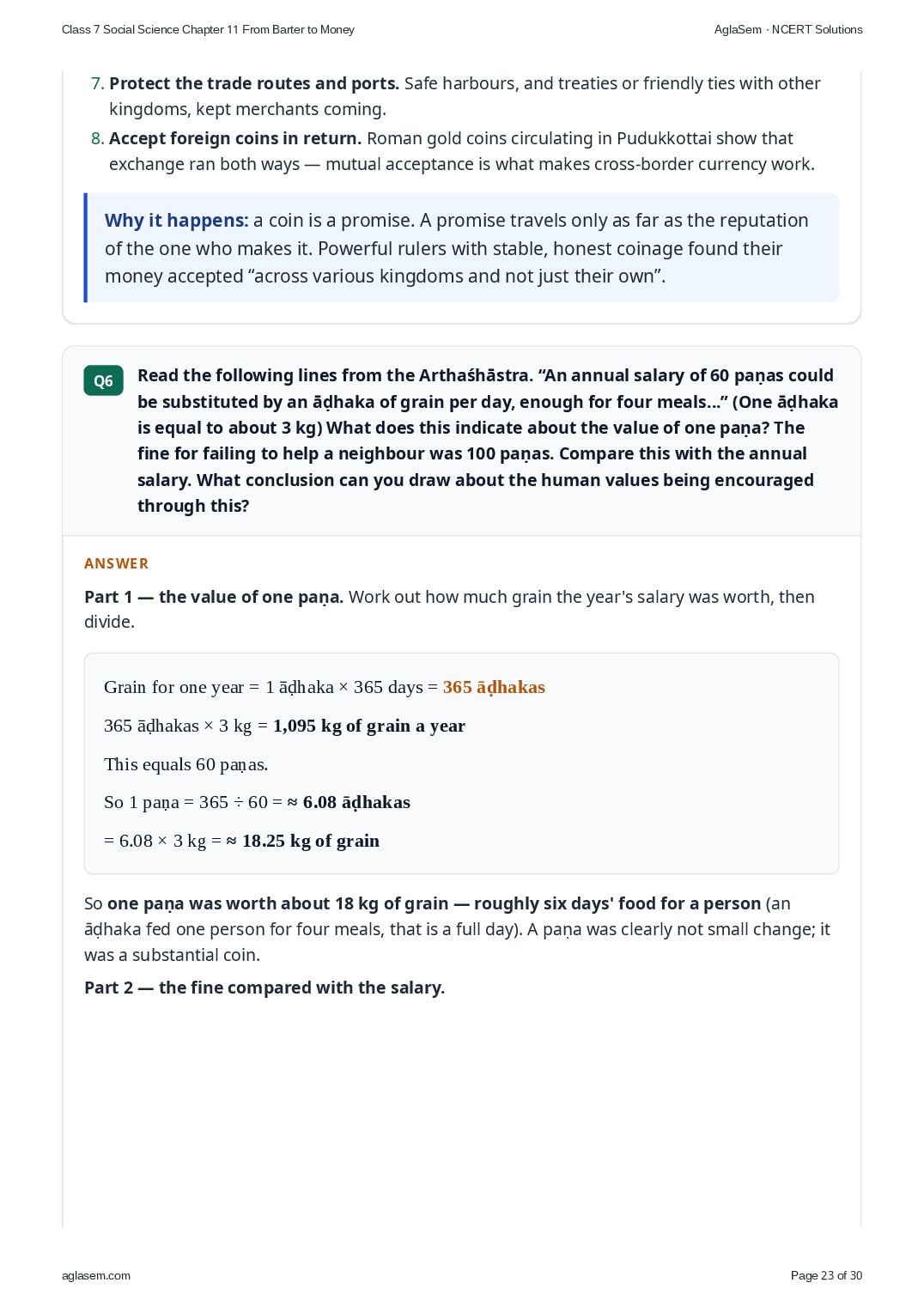
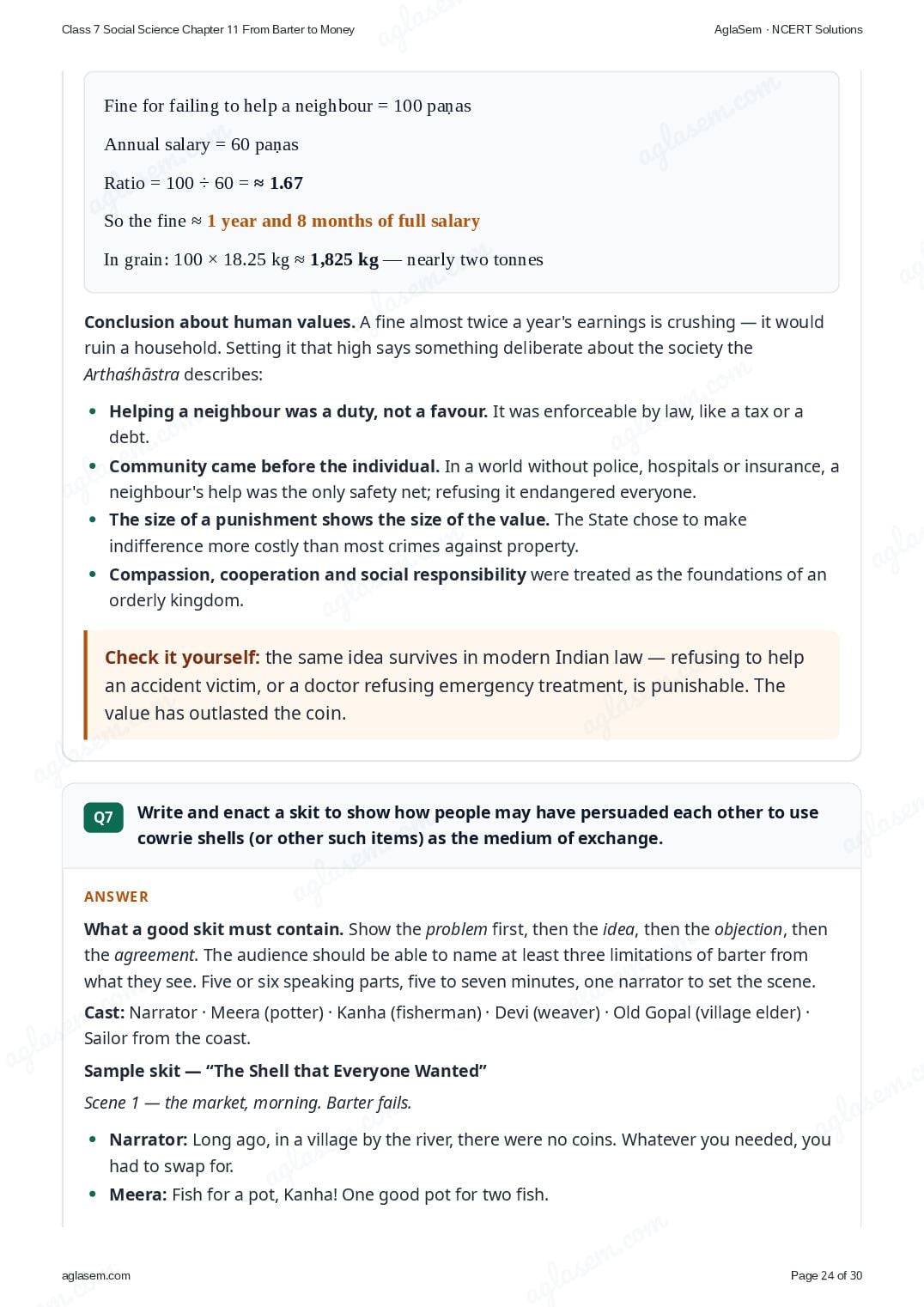
- Read the following lines from the Arthaśhāstra. “An annual salary of 60 paṇas could be substituted by an āḍhaka of grain per day, enough for four meals…” (One āḍhaka is equal to about 3 kg) What does this indicate about the value of one paṇa? The fine for failing to help a neighbour was 100 paṇas. Compare this with the annual salary. What conclusion can you draw about the human values being encouraged through this?
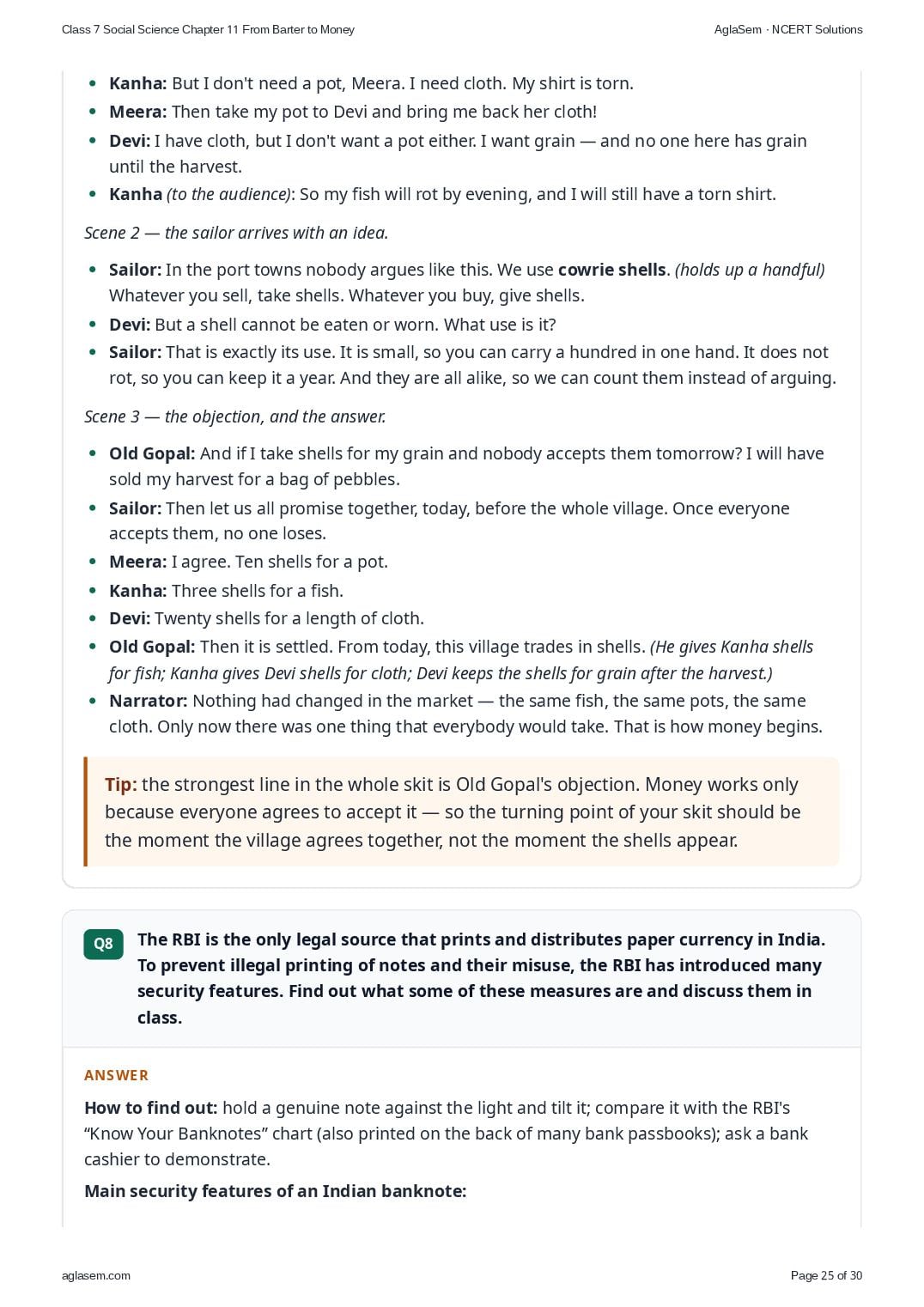
- Write and enact a skit to show how people may have persuaded each other to use cowrie shells (or other such items) as the medium of exchange.
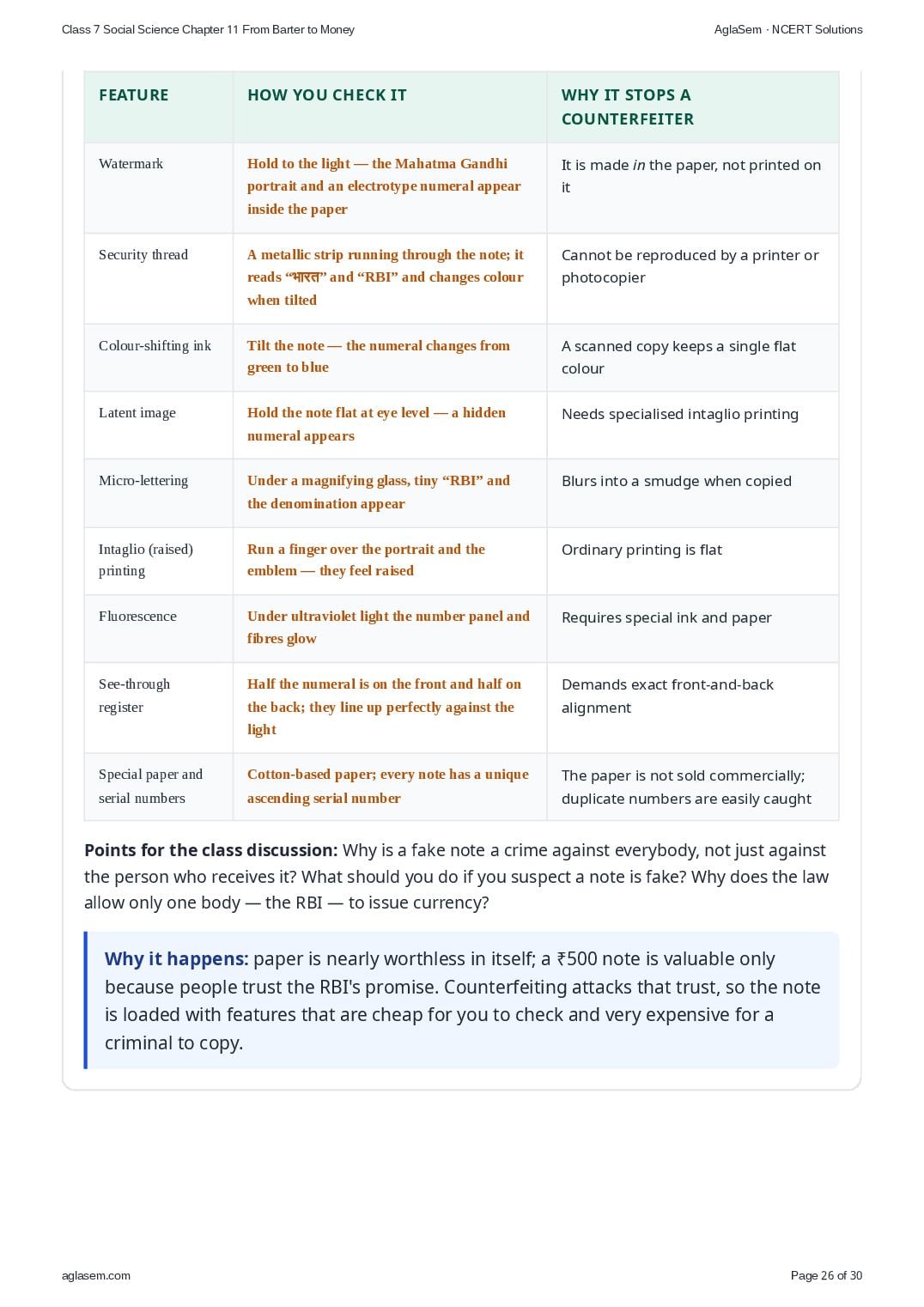
- The RBI is the only legal source that prints and distributes paper currency in India. To prevent illegal printing of notes and their misuse, the RBI has introduced many security features. Find out what some of these measures are and discuss them in class.
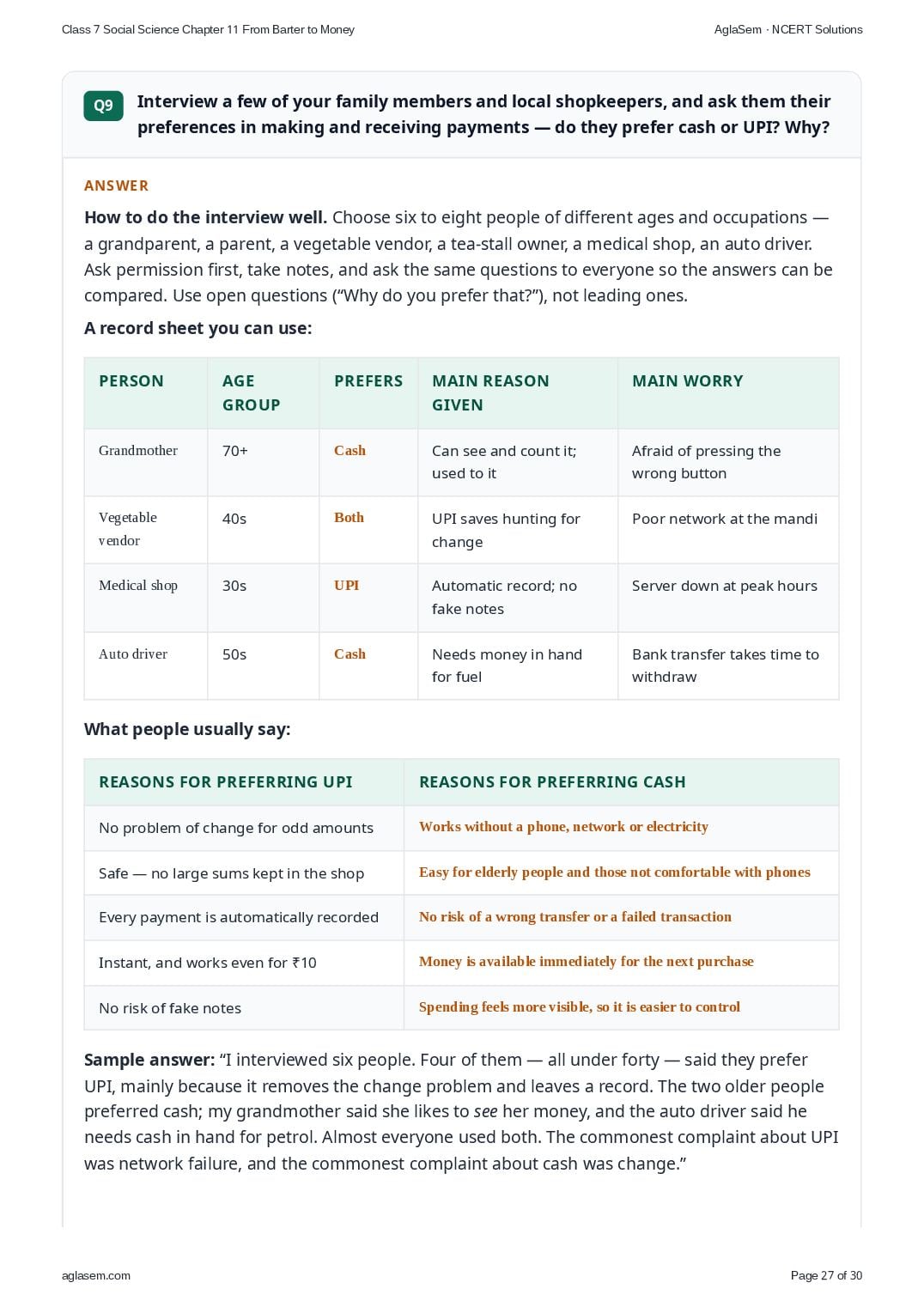
- Interview a few of your family members and local shopkeepers, and ask them their preferences in making and receiving payments — do they prefer cash or UPI? Why?
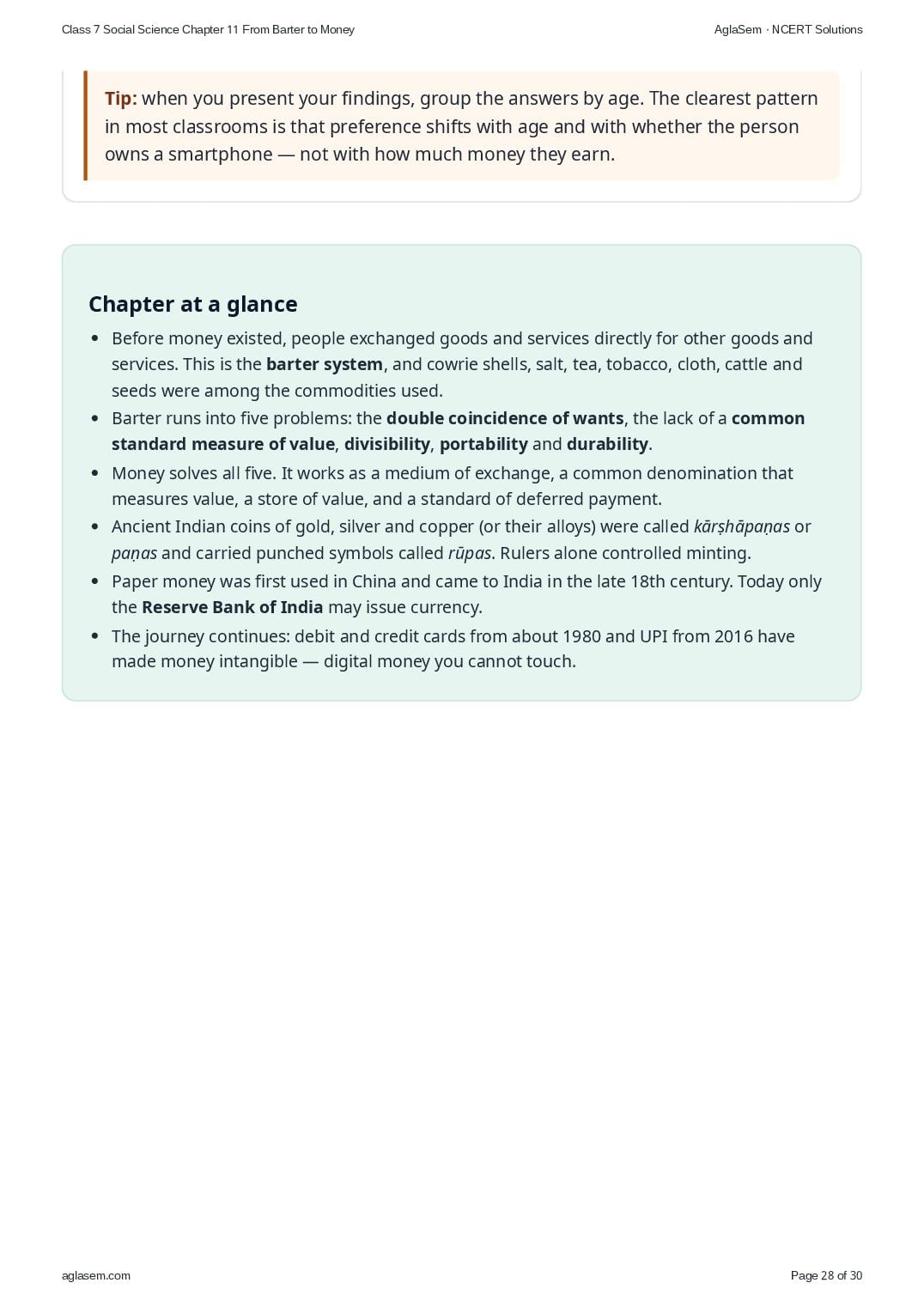
Chapter at a Glance
- Before money existed, people exchanged goods and services directly for other goods and services. This is the barter system , and cowrie shells, salt, tea, tobacco, cloth, cattle and seeds were among the commodities used.
- Barter runs into five problems: the double coincidence of wants , the lack of a common standard measure of value , divisibility , portability and durability .
- Money solves all five. It works as a medium of exchange, a common denomination that measures value, a store of value, and a standard of deferred payment.
- Ancient Indian coins of gold, silver and copper (or their alloys) were called kārṣhāpaṇas or paṇas and carried punched symbols called rūpas . Rulers alone controlled minting.
- Paper money was first used in China and came to India in the late 18th century. Today only the Reserve Bank of India may issue currency.
- The journey continues: debit and credit cards from about 1980 and UPI from 2016 have made money intangible — digital money you cannot touch.
How to Download NCERT Solutions for Class 7 Social Science Chapter 11 PDF
Follow these simple steps to get the From Barter to Money questions-and-answers PDF from Exploring Society India and Beyond.
- Search NCERT Solutions for Class 7 Social Science Chapter 11 aglasem and open this page.
- Read the exercise questions with answers for From Barter to Money shown above.
- Click the Download PDF link to save the From Barter to Money solutions to your device.
NCERT Solutions for Class 7 Social Science – All Chapters
There are more chapters to study besides From Barter to Money in Social Science. Here are the NCERT Solutions for all chapters of Class 7 Social Science.
- Chapter 1 Geographical Diversity of India
- Chapter 2 Understanding the Weather
- Chapter 3 Climates of India
- Chapter 4 New Beginnings Cities and States
- Chapter 5 the Rise of Empires
- Chapter 6 the Age of Reorganisation
- Chapter 7 the Gupta Era an Age of Tireless Creativity
- Chapter 8 How the Land Becomes Sacred
- Chapter 9 From the Rulers to the Ruled Types of Governments
- Chapter 10 the Constitution of India an Introduction
- Chapter 11 From Barter to Money
- Chapter 12 Understanding Markets
NCERT Solutions for Class 7 – All Subjects
Just like Chapter 11 of Social Science, you can get the exercise questions with answers for every other subject of Class 7. Here are the NCERT Solutions for all subjects of Class 7.
NCERT Solutions for Class 7 Social Science Chapter 11 – An Overview
The key highlights of this study material are as follows.
| Aspects | Details |
|---|---|
| Class | Class 7 |
| Subject | Social Science |
| Chapter Number | Chapter 11 |
| Chapter Name | From Barter to Money |
| Book Name | Exploring Society India and Beyond |
| Book By | NCERT (National Council of Educational Research and Training) |
| Educational Resource Here | NCERT Solutions of Class 7 Social Science Chapter 11 for all exercises |
| More Questions Answers of This Subject | NCERT Solutions for Class 7 Social Science |
| Download Book Chapter | NCERT Book Class 7 Social Science |
| All Questions Answers For This Class | NCERT Solutions for Class 7 |
| Complete Solutions | NCERT Solutions |
NCERT Solutions for Class 7 Social Science Chapter 11 From Barter to Money – FAQs
What are the NCERT Solutions for Class 7 Social Science Chapter 11 From Barter to Money?
They are the complete, step-by-step answers to all the exercise and in-text questions of Chapter 11 From Barter to Money from the NCERT Class 7 Social Science textbook Exploring Society India and Beyond, written by experts as per the latest NCERT syllabus.
How can I download the Class 7 Social Science Chapter 11 solutions PDF for free?
Open this page on aglasem, read the From Barter to Money questions with answers, and click the “Download Solutions PDF” link. The Class 7 Social Science Chapter 11 NCERT Solutions PDF is completely free to download.
Are these NCERT Solutions as per the latest 2026-27 syllabus?
Yes. The NCERT Solutions for Class 7 Social Science Chapter 11 are based on the latest NCERT textbook Exploring Society India and Beyond and the current 2026-27 CBSE syllabus, so the questions and answers match what you study in class.
Where can I get NCERT Solutions for the other chapters of Class 7 Social Science?
You can find the answers to every chapter on the NCERT Solutions for Class 7 Social Science page, and solutions for every subject on the NCERT Solutions for Class 7 page.
How do NCERT Solutions help in exam preparation?
They show the correct method to solve each question, help you write answers the way they are expected in exams, let you check and correct your own work, and save revision time — which together improve your marks in Class 7 Social Science.
If you have any queries on NCERT Solutions for Class 7 Social Science Chapter 11 From Barter to Money, then please ask in the comments below.
