NCERT Solutions for Class 7 Social Science Chapter 12 Understanding Markets provide clear, step-by-step answers to every exercise and in-text question from the chapter Understanding Markets of the NCERT textbook Exploring Society India and Beyond. Prepared by subject experts as per the latest NCERT (CBSE) syllabus for 2026-27, these NCERT Solutions for Class 7 Social Science help you understand each concept, write exam-ready answers, and check your own solutions. You can read them online below or download the free Class 7 Social Science Chapter 12 question-answer PDF.
NCERT Solutions for Class 7 Social Science Chapter 12 Understanding Markets
- Class: Class 7
- Subject: Social Science
- Chapter: Chapter 12 – Understanding Markets
- Textbook: Exploring Society India and Beyond (NCERT)
- Study material: NCERT Solutions – questions with answers, free PDF
These solutions answer all the exercise questions of Chapter 12 Understanding Markets — including the in-text questions, short-answer and long-answer questions, and activities — with complete explanations so you can follow the method, not just the final answer. Read the full solutions below.
NCERT Solutions Class 7 Social Science Chapter 12 Understanding Markets View Download
NCERT Solutions for Class 7 Social Science Chapter 12 PDF Download
You can read the NCERT Solutions for Class 7 Social Science Chapter 12 online above, or download the complete question-answer PDF to study Understanding Markets offline at any time.
NCERT Solutions for Class 7 Social Science Chapter 12 PDF Download Link – Click Here to Download Solutions PDF
Questions Covered in This Chapter
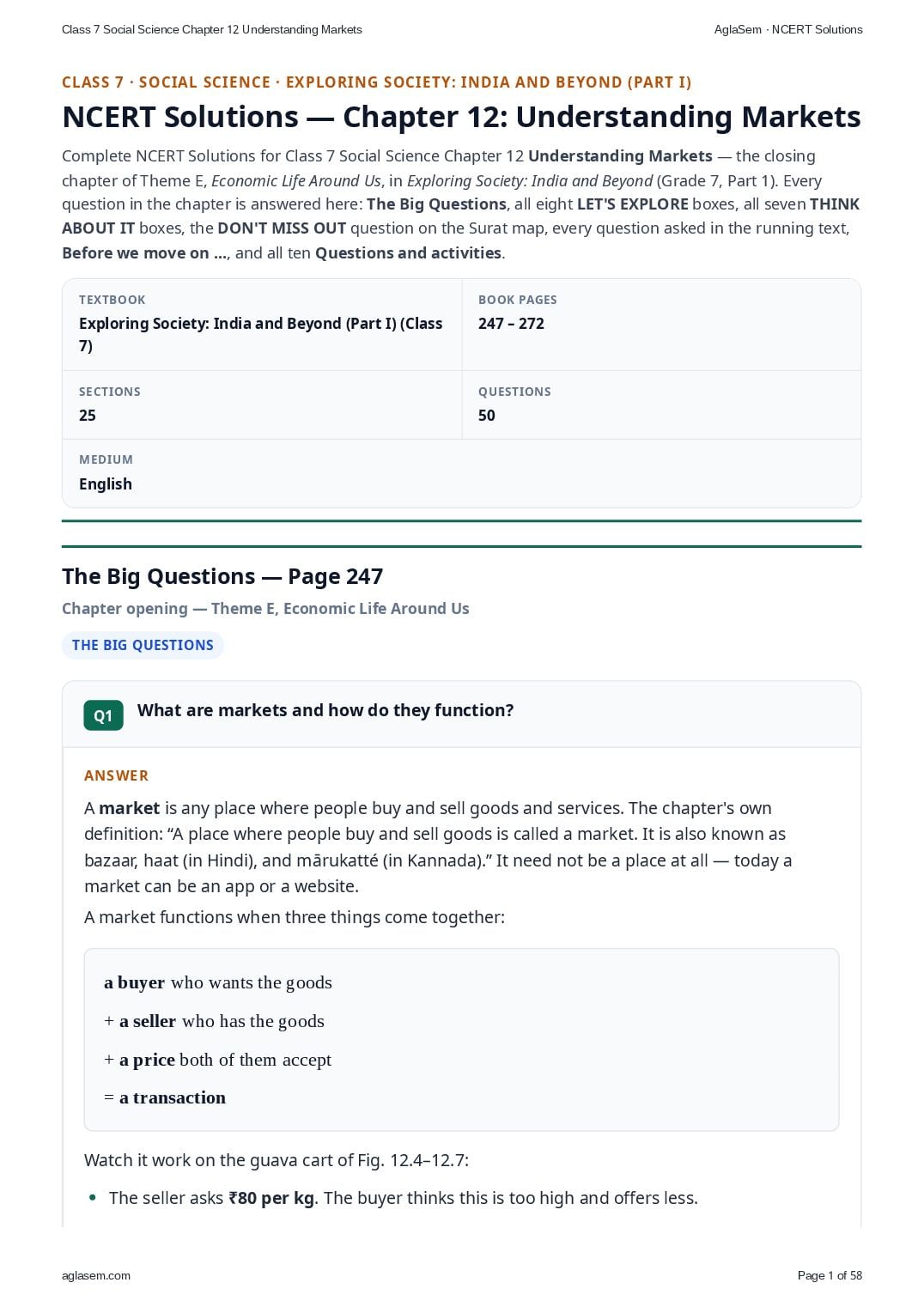
These NCERT Solutions answer all 50 questions of this chapter. The questions solved are:
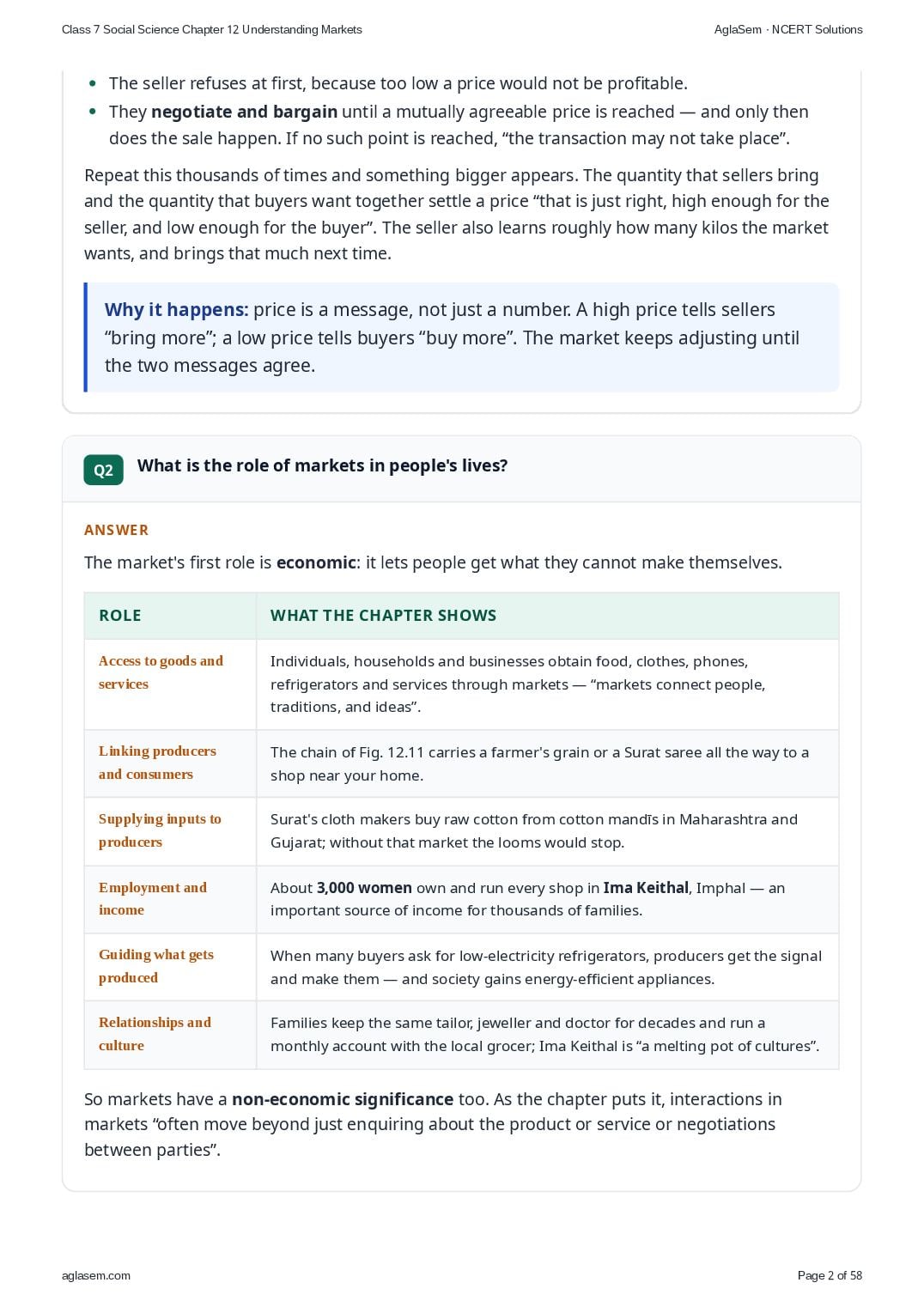
- What are markets and how do they function?
- What is the role of markets in people's lives?
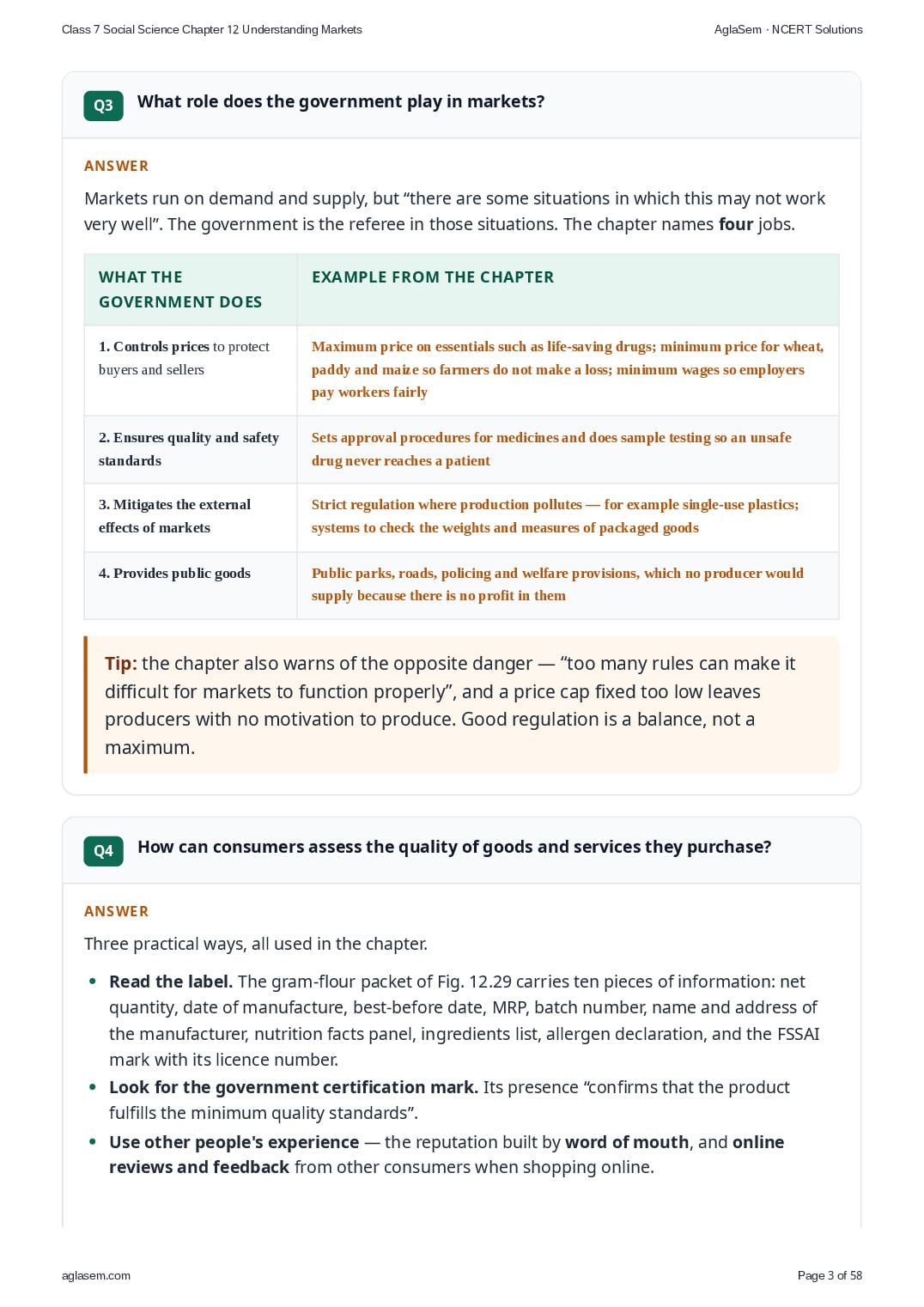
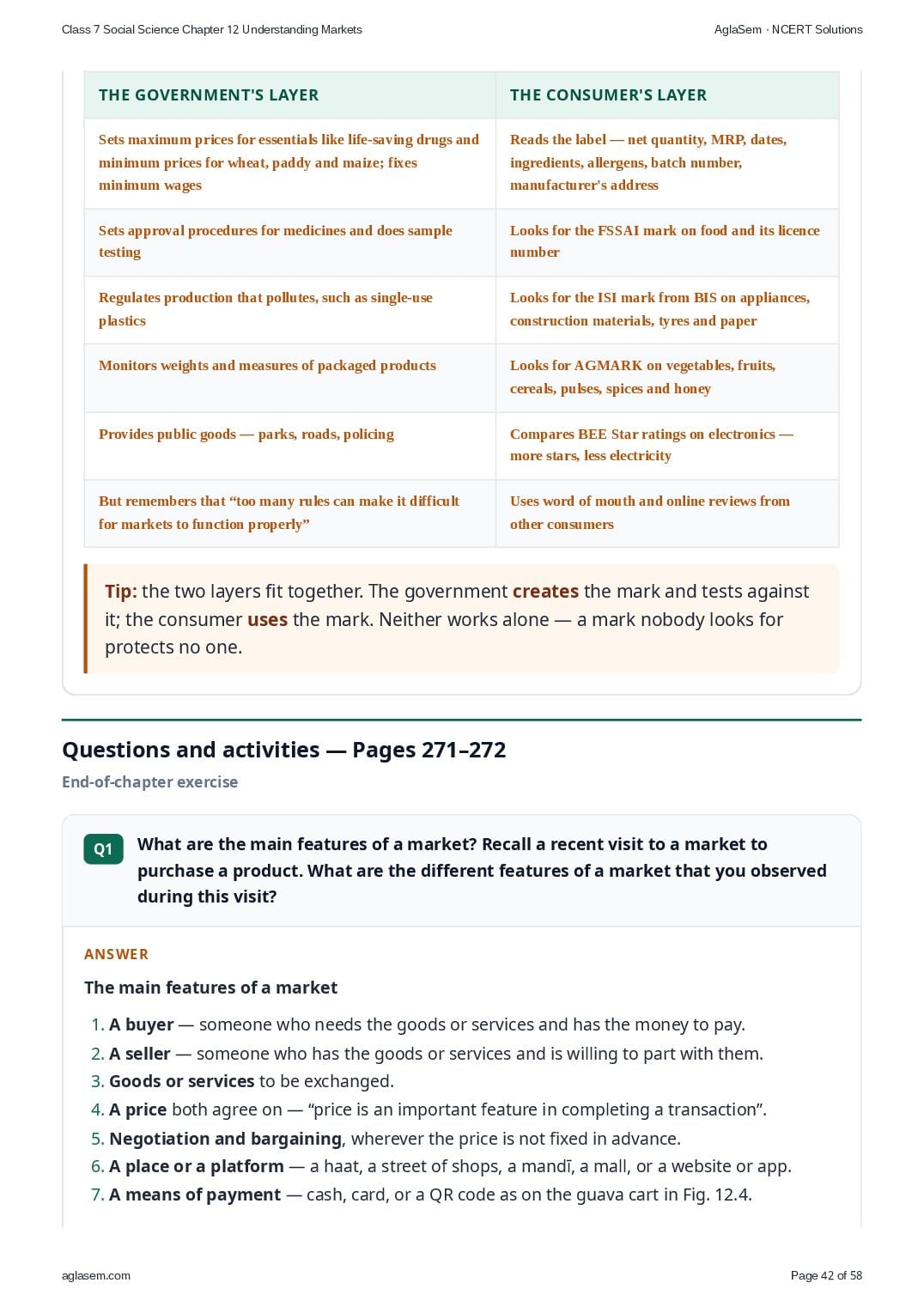
- What role does the government play in markets?
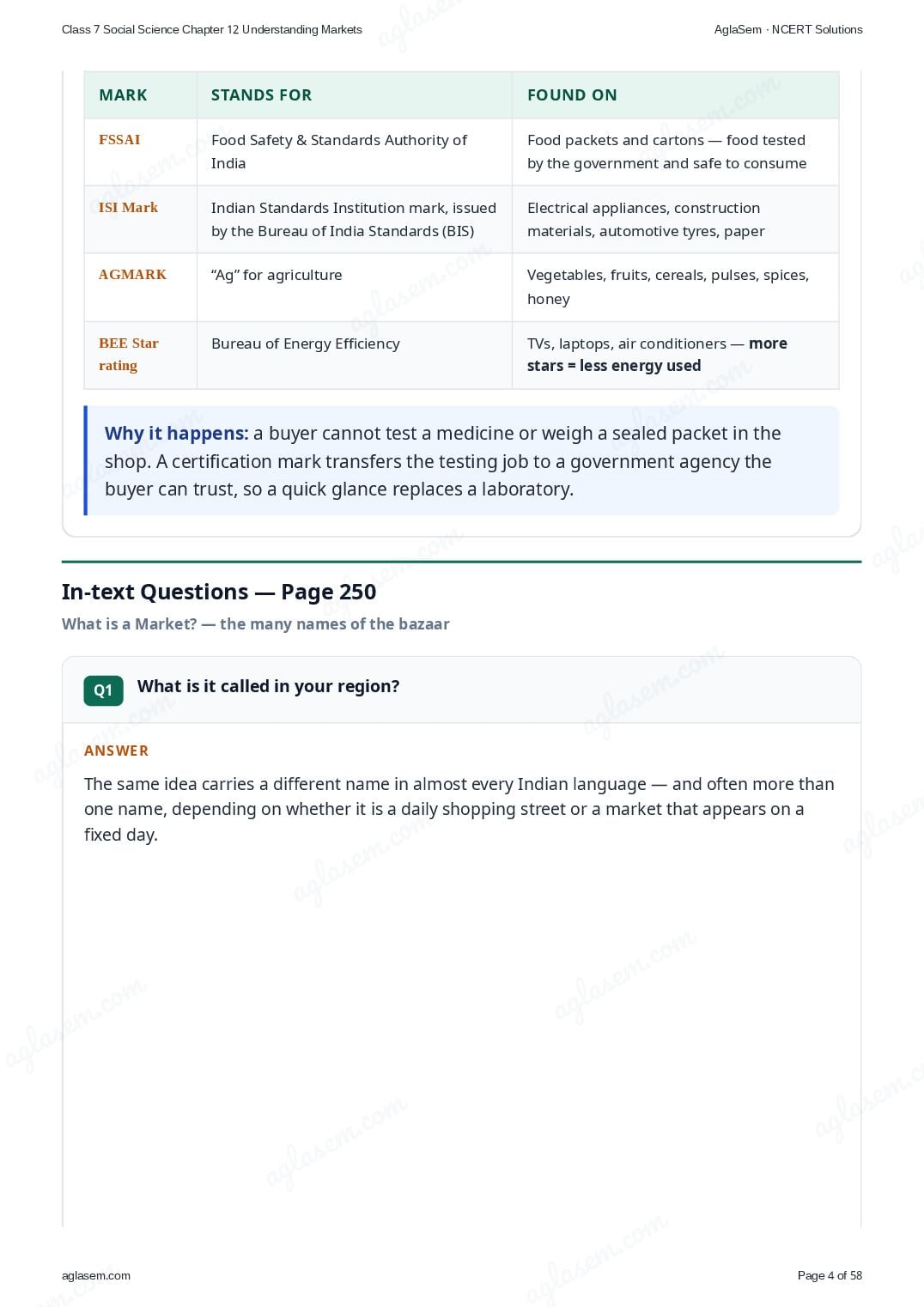
- How can consumers assess the quality of goods and services they purchase?
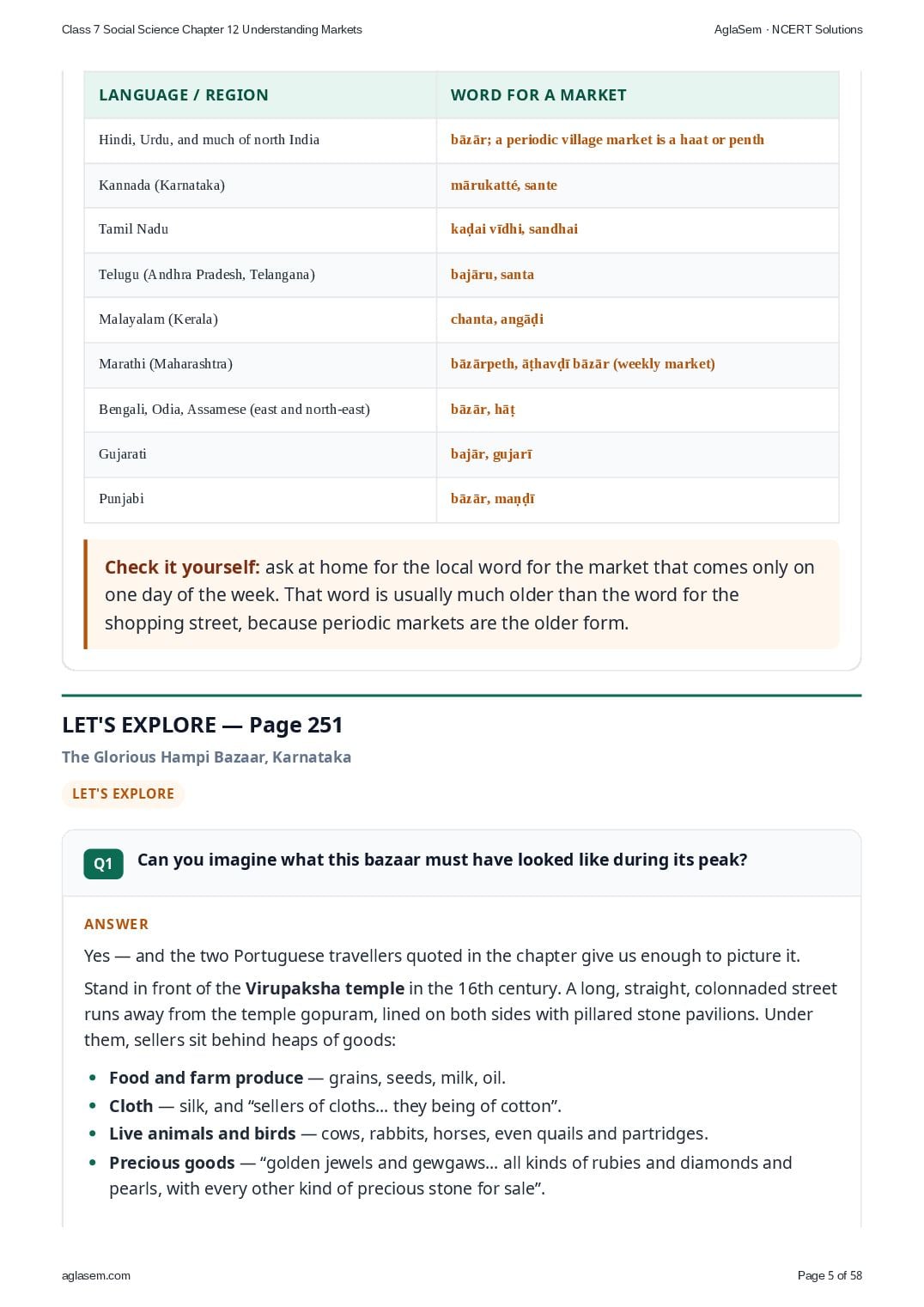
- What is it called in your region?
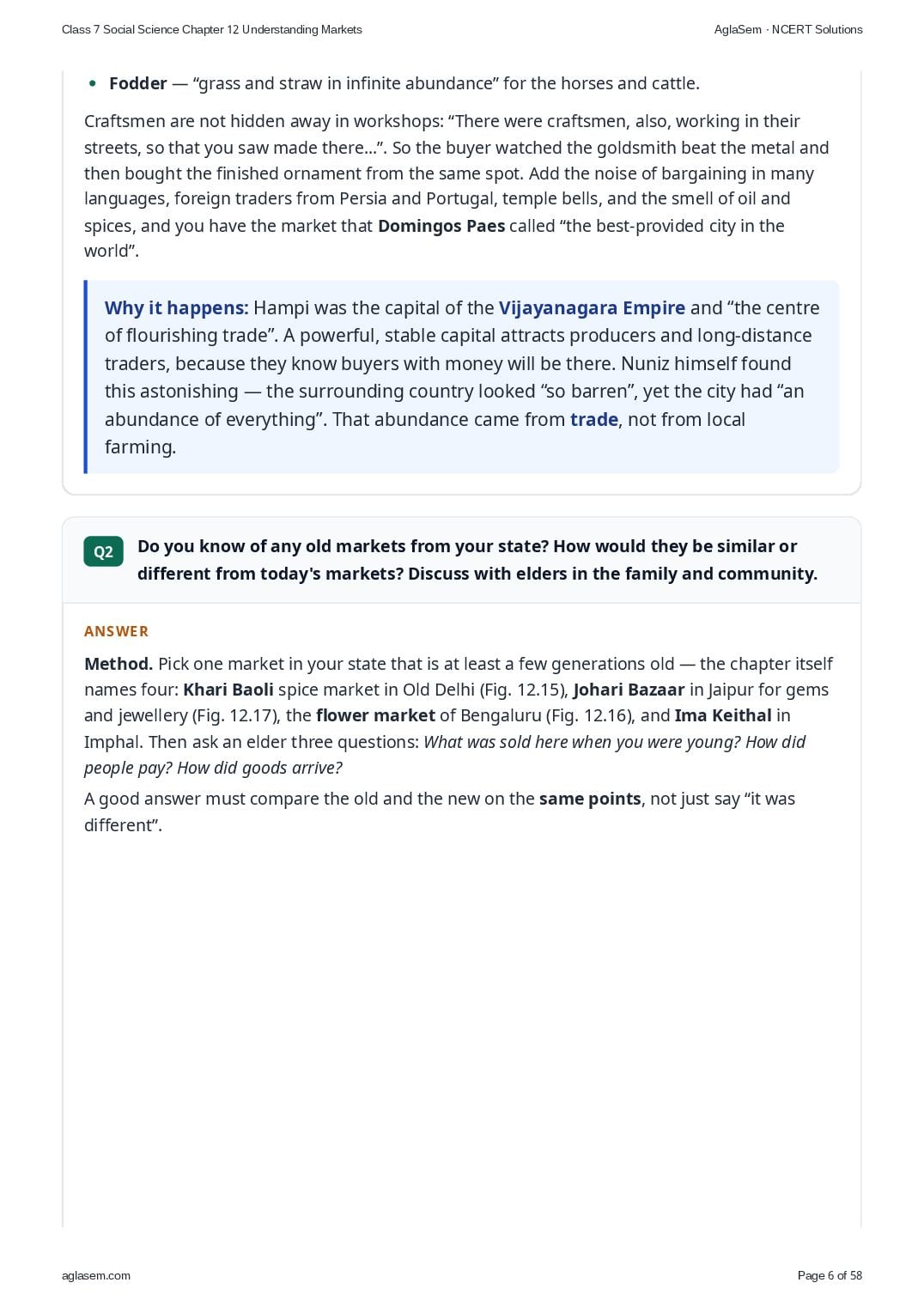
- Can you imagine what this bazaar must have looked like during its peak?
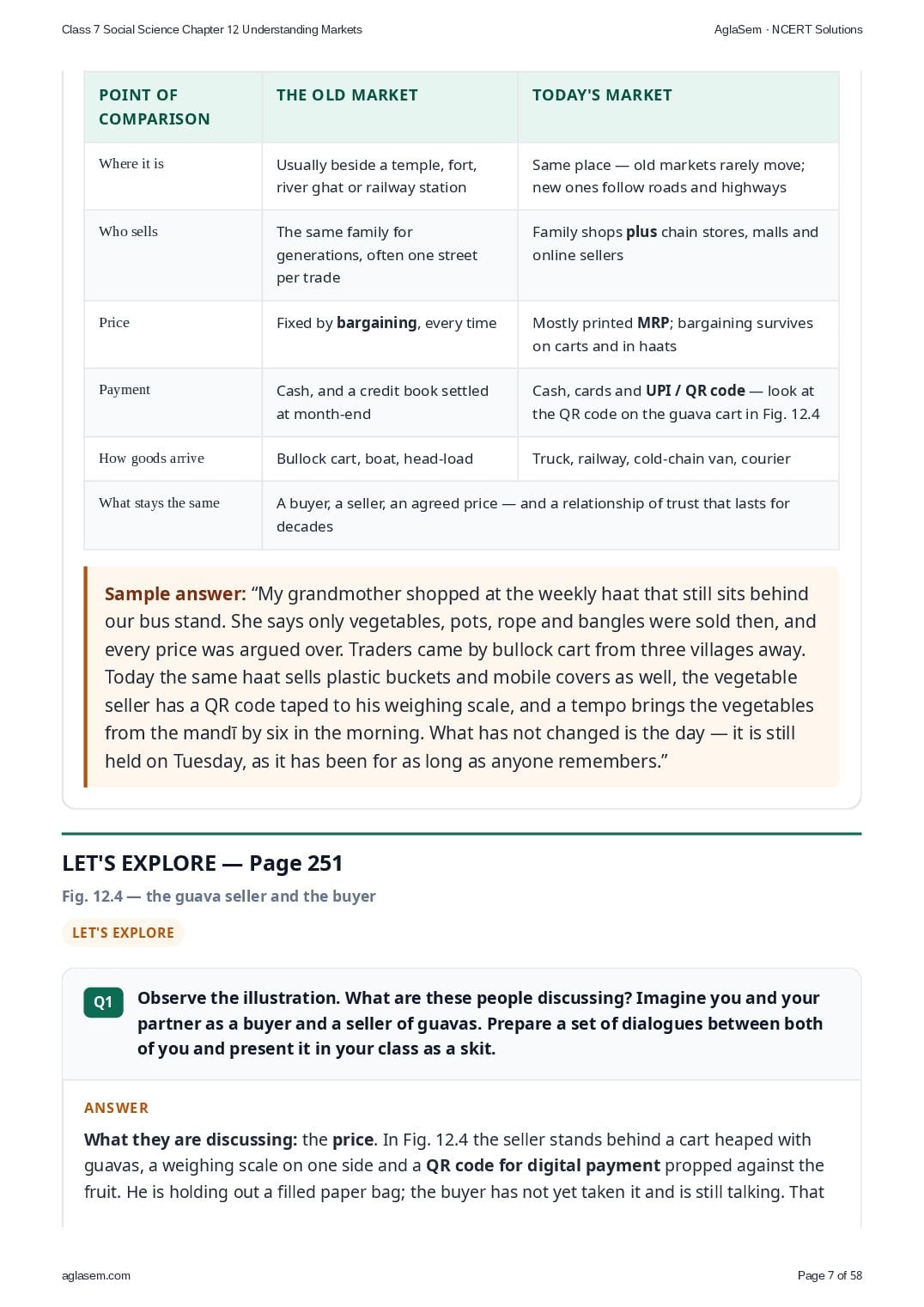
- Do you know of any old markets from your state? How would they be similar or different from today's markets? Discuss with elders in the family and community.
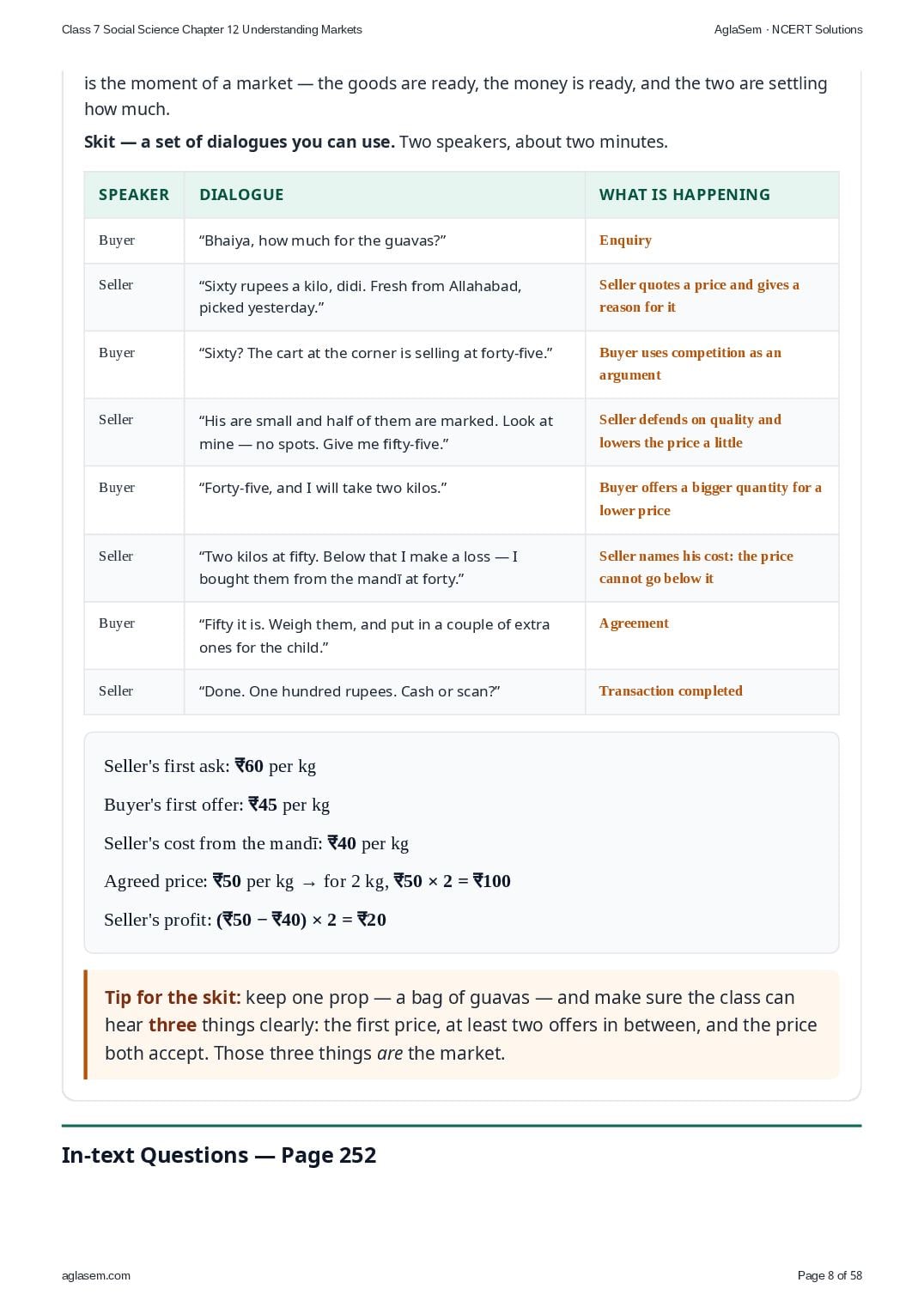
- Observe the illustration. What are these people discussing? Imagine you and your partner as a buyer and a seller of guavas. Prepare a set of dialogues between both of you and present it in your class as a skit.
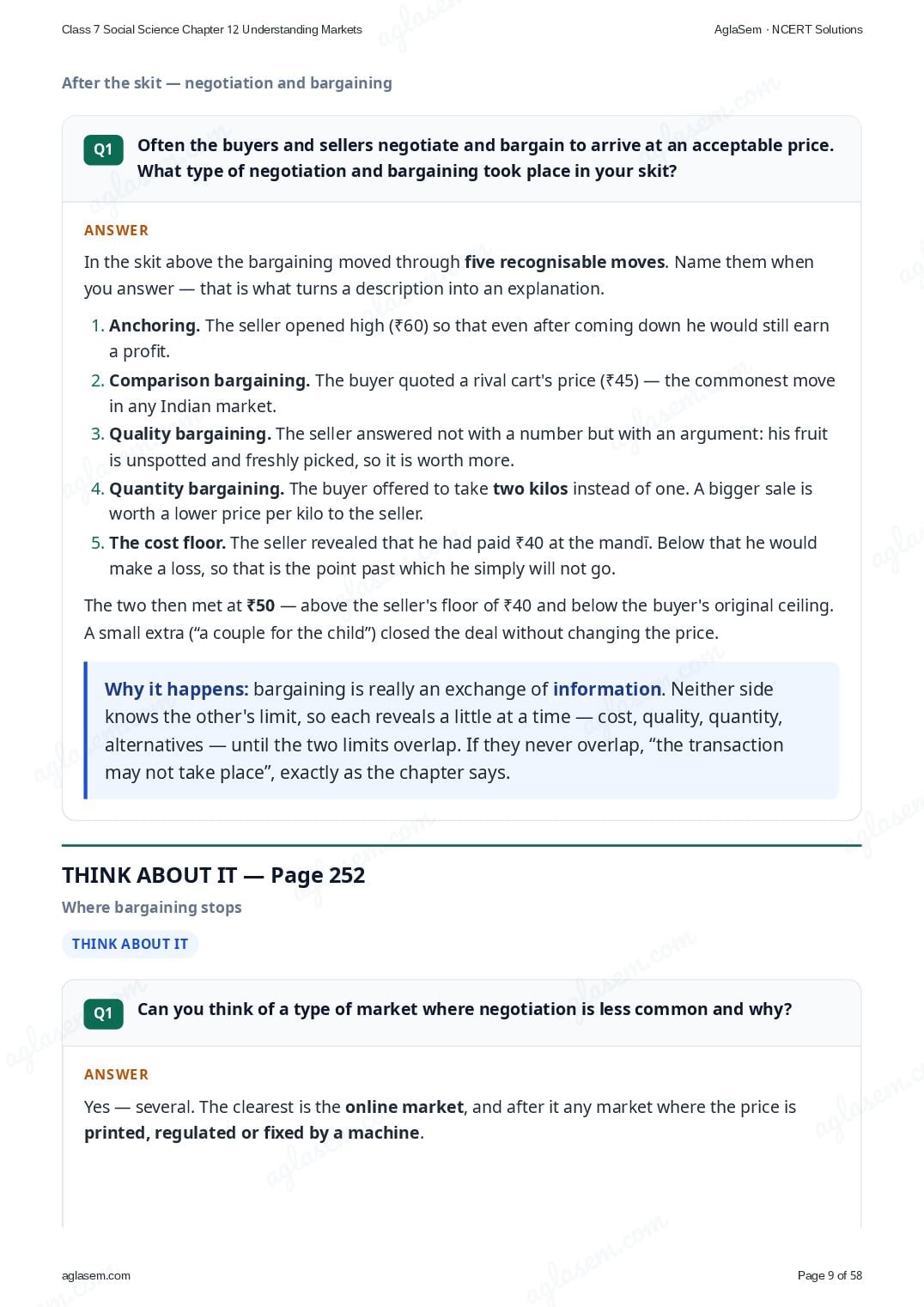
- Often the buyers and sellers negotiate and bargain to arrive at an acceptable price. What type of negotiation and bargaining took place in your skit?
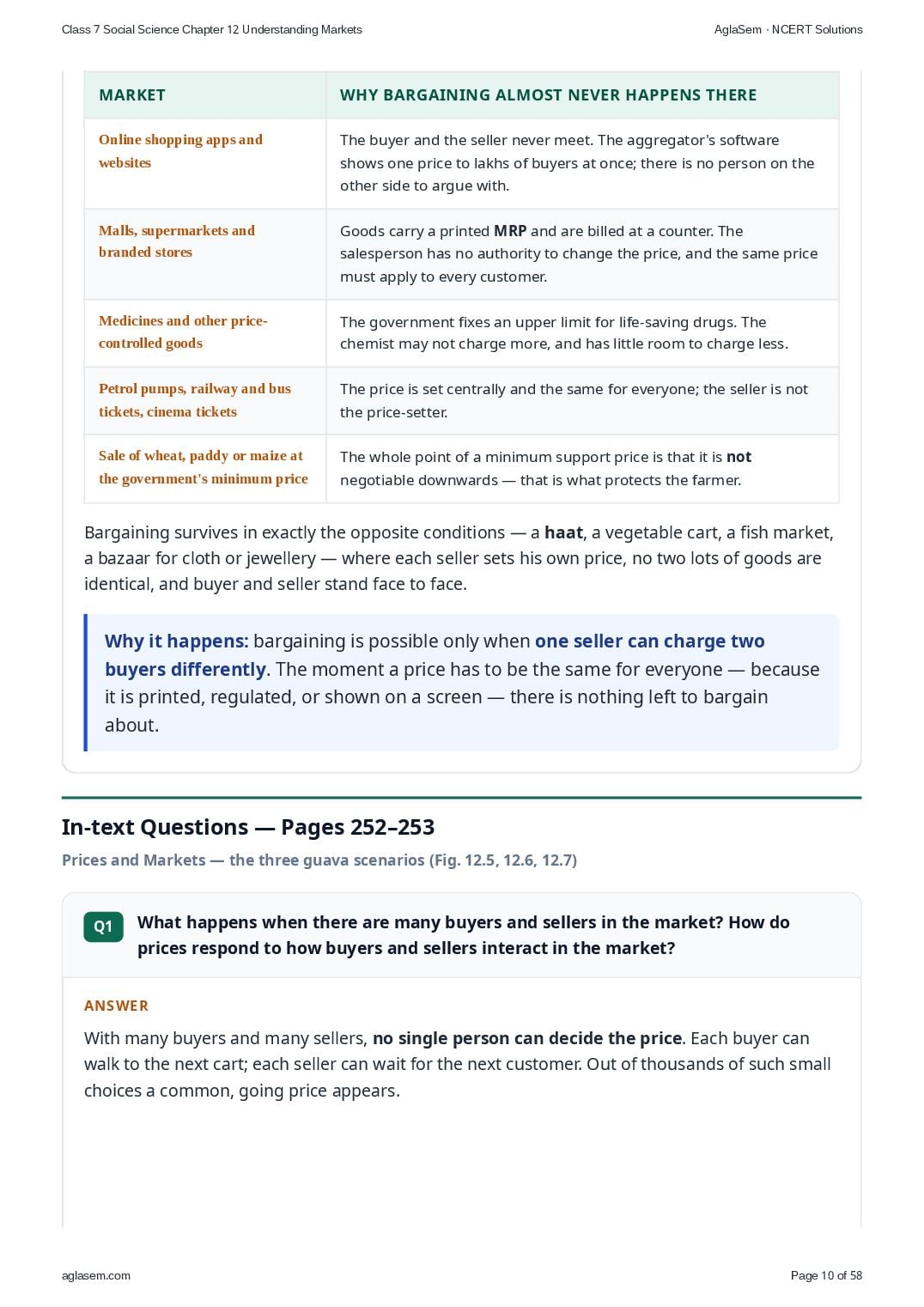
- Can you think of a type of market where negotiation is less common and why?
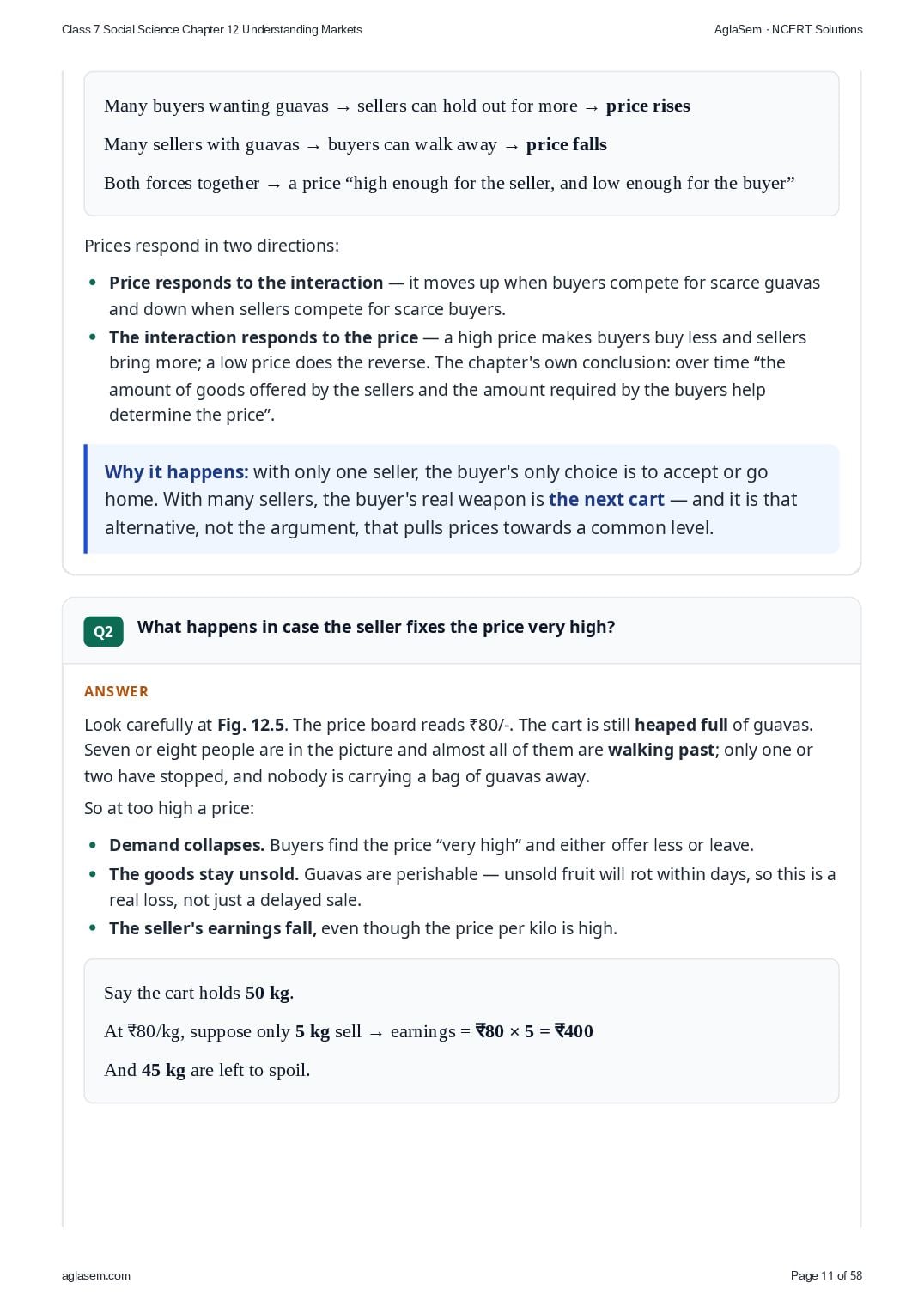
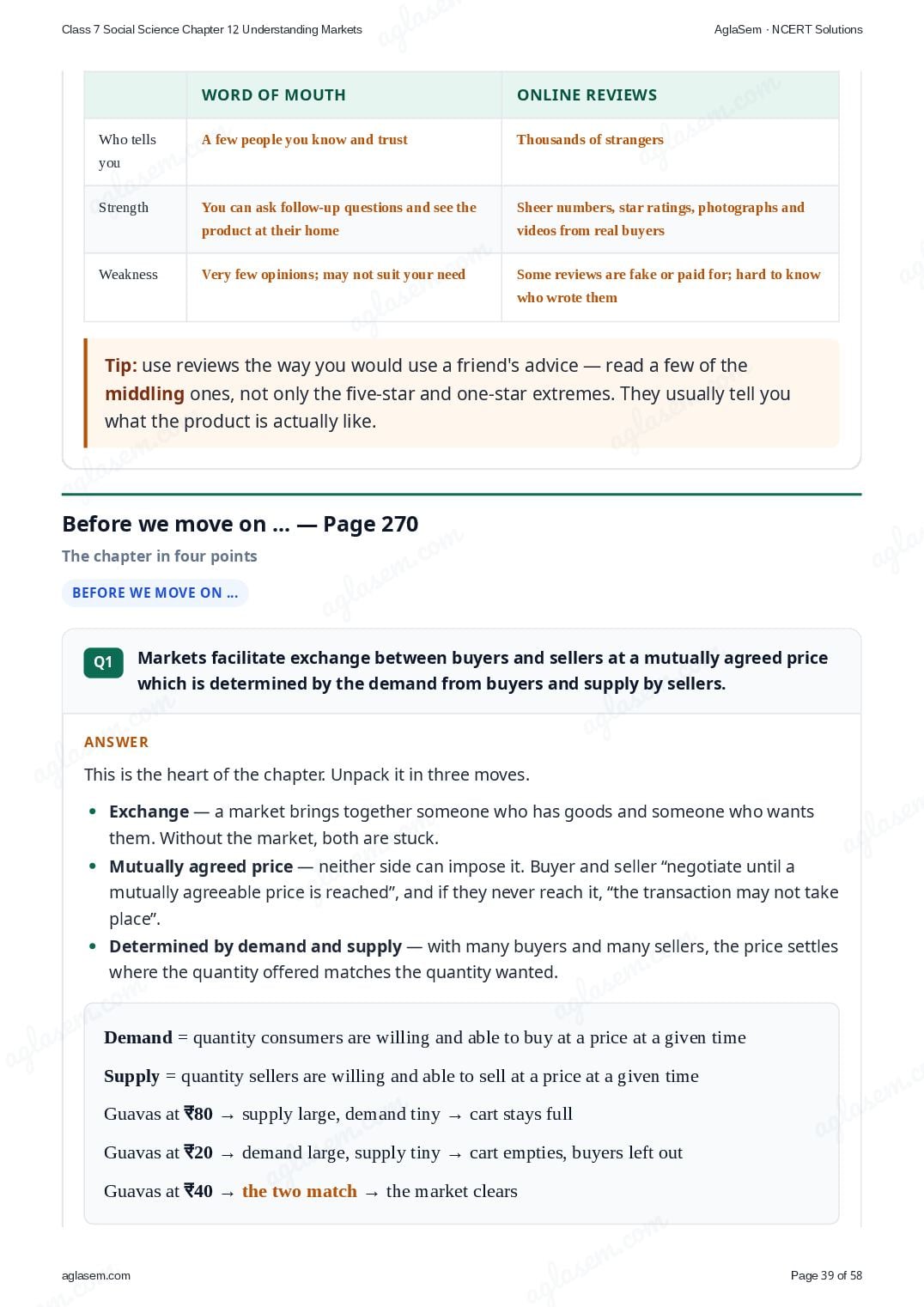
- What happens when there are many buyers and sellers in the market? How do prices respond to how buyers and sellers interact in the market?
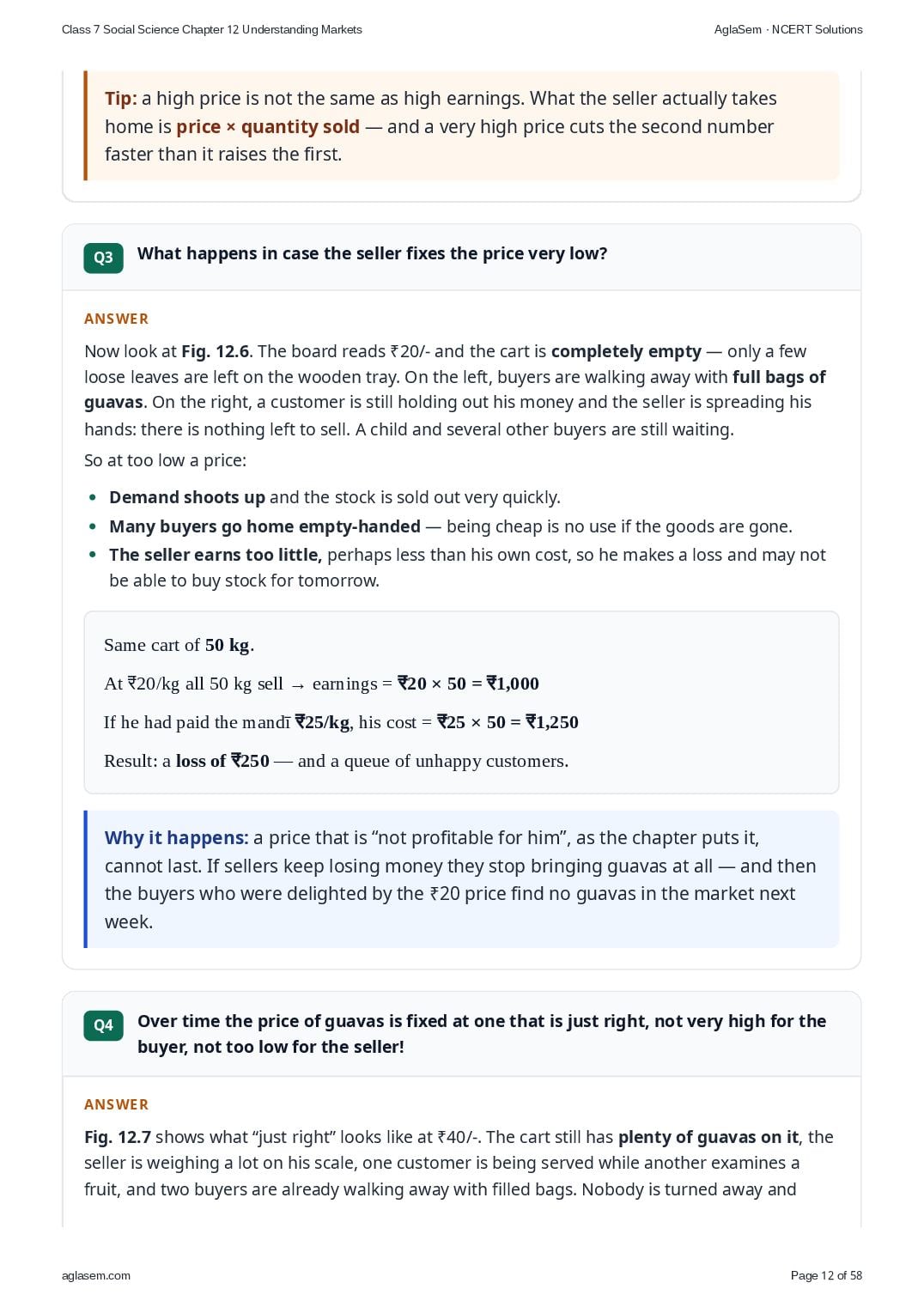
- What happens in case the seller fixes the price very high?
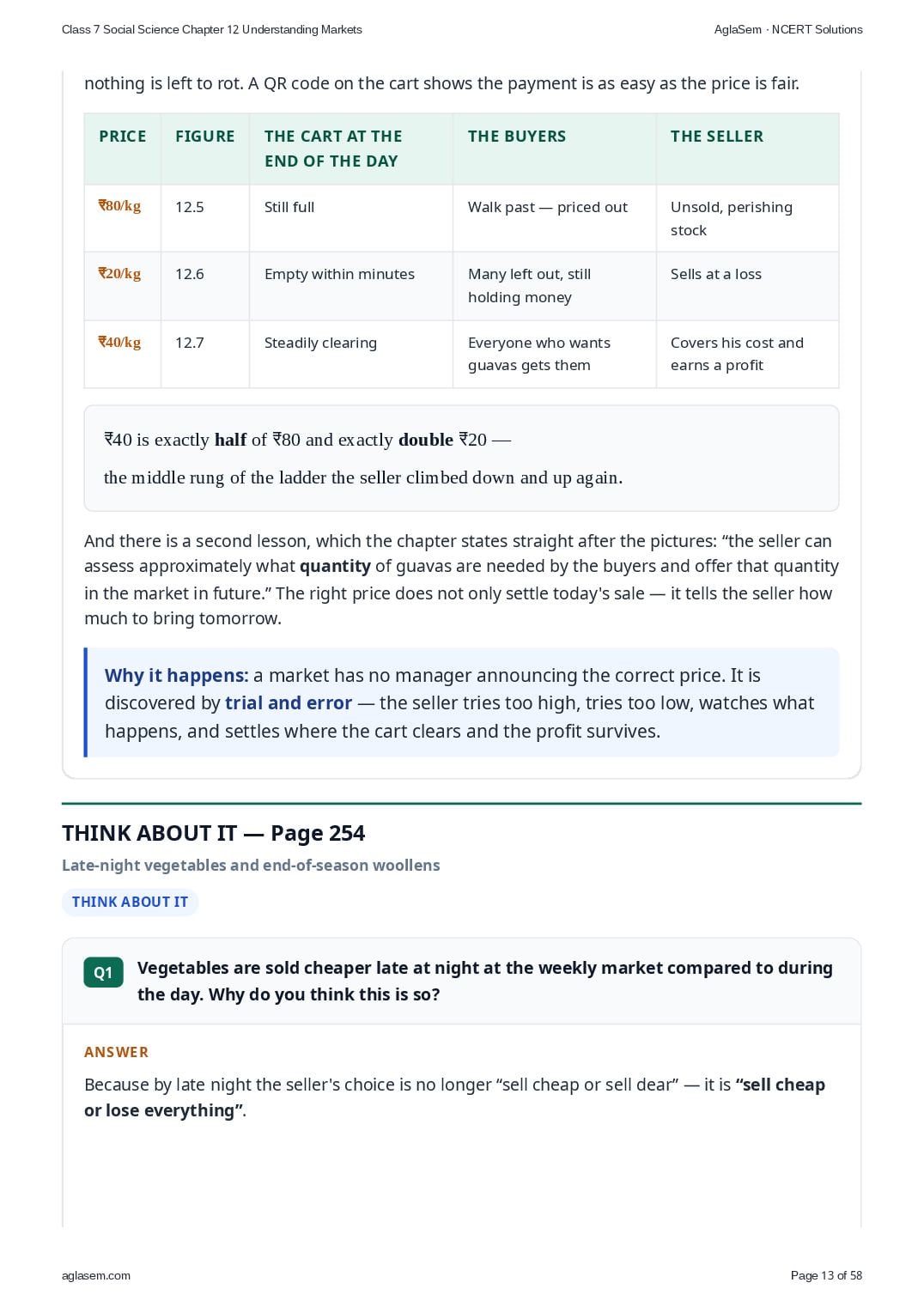
- What happens in case the seller fixes the price very low?
- Over time the price of guavas is fixed at one that is just right, not very high for the buyer, not too low for the seller!
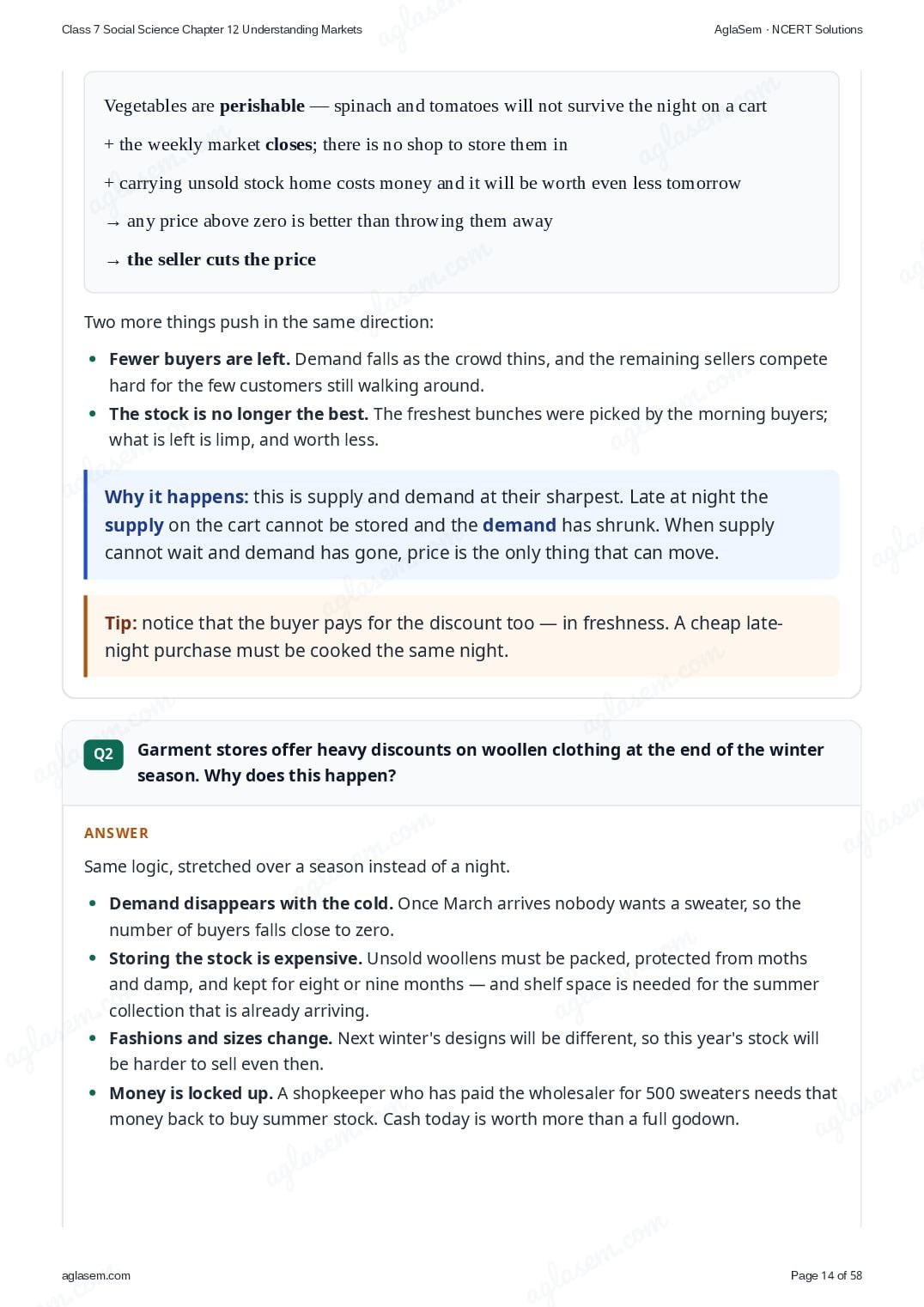
- Vegetables are sold cheaper late at night at the weekly market compared to during the day. Why do you think this is so?
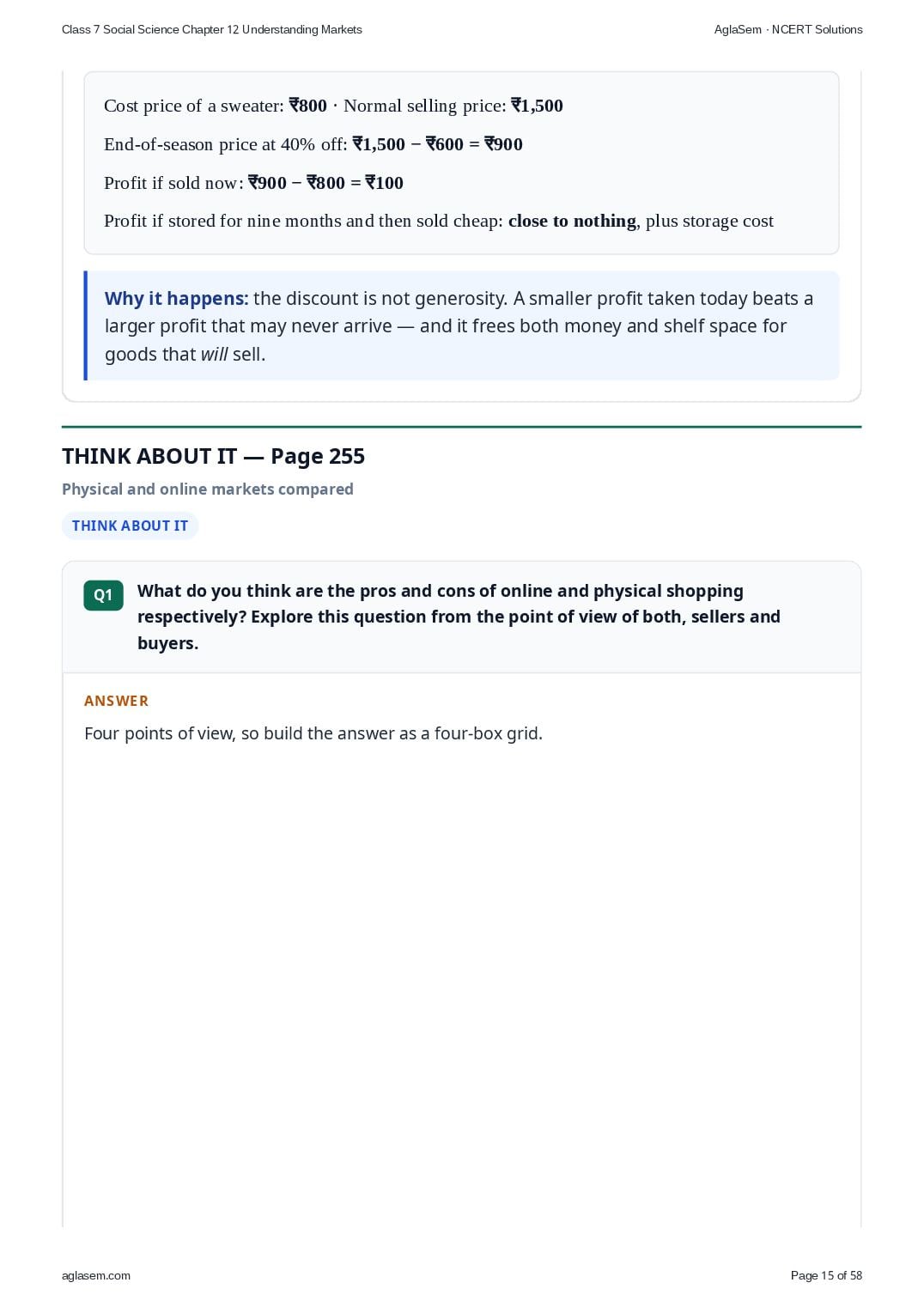
- Garment stores offer heavy discounts on woollen clothing at the end of the winter season. Why does this happen?
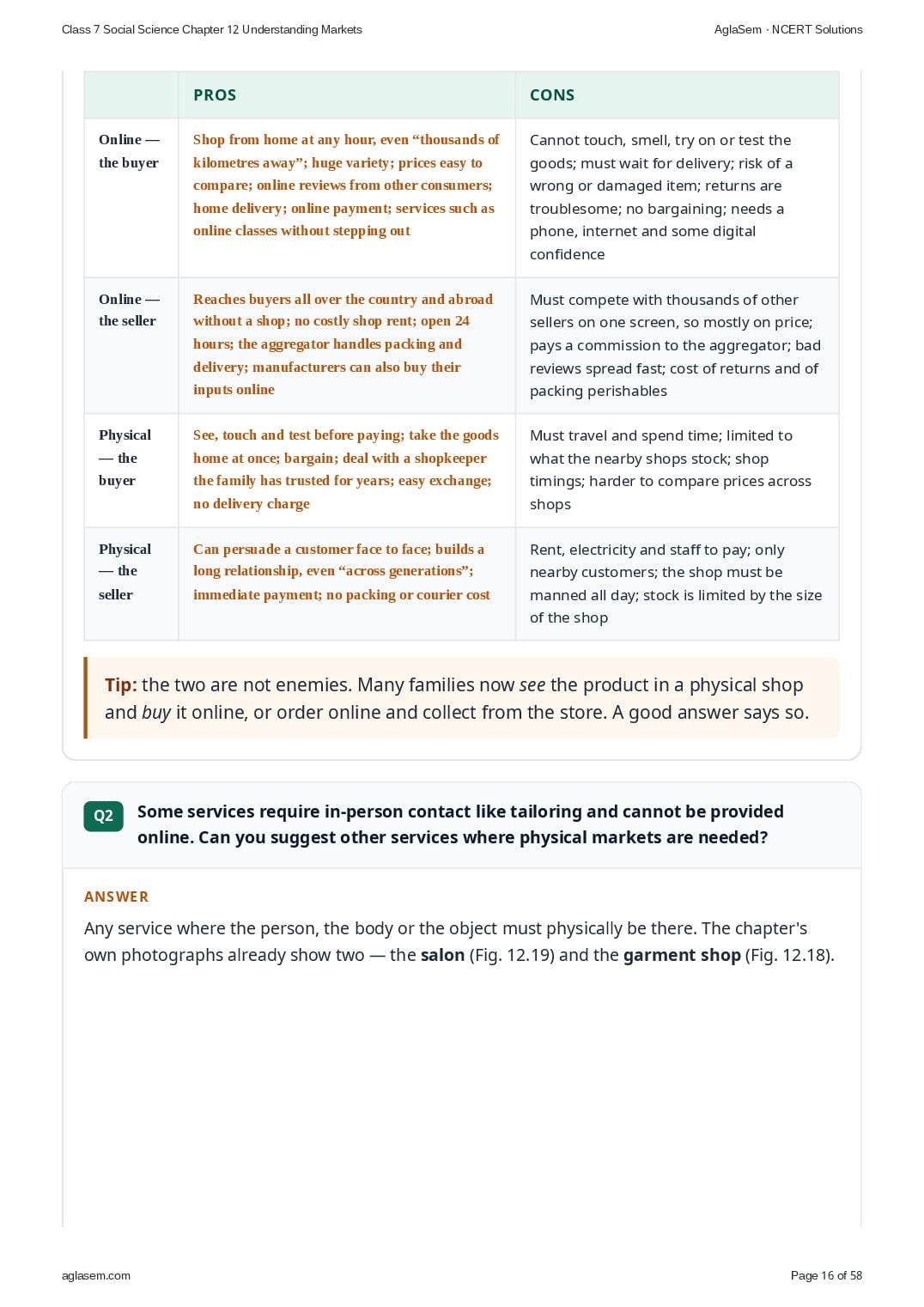
- What do you think are the pros and cons of online and physical shopping respectively? Explore this question from the point of view of both, sellers and buyers.
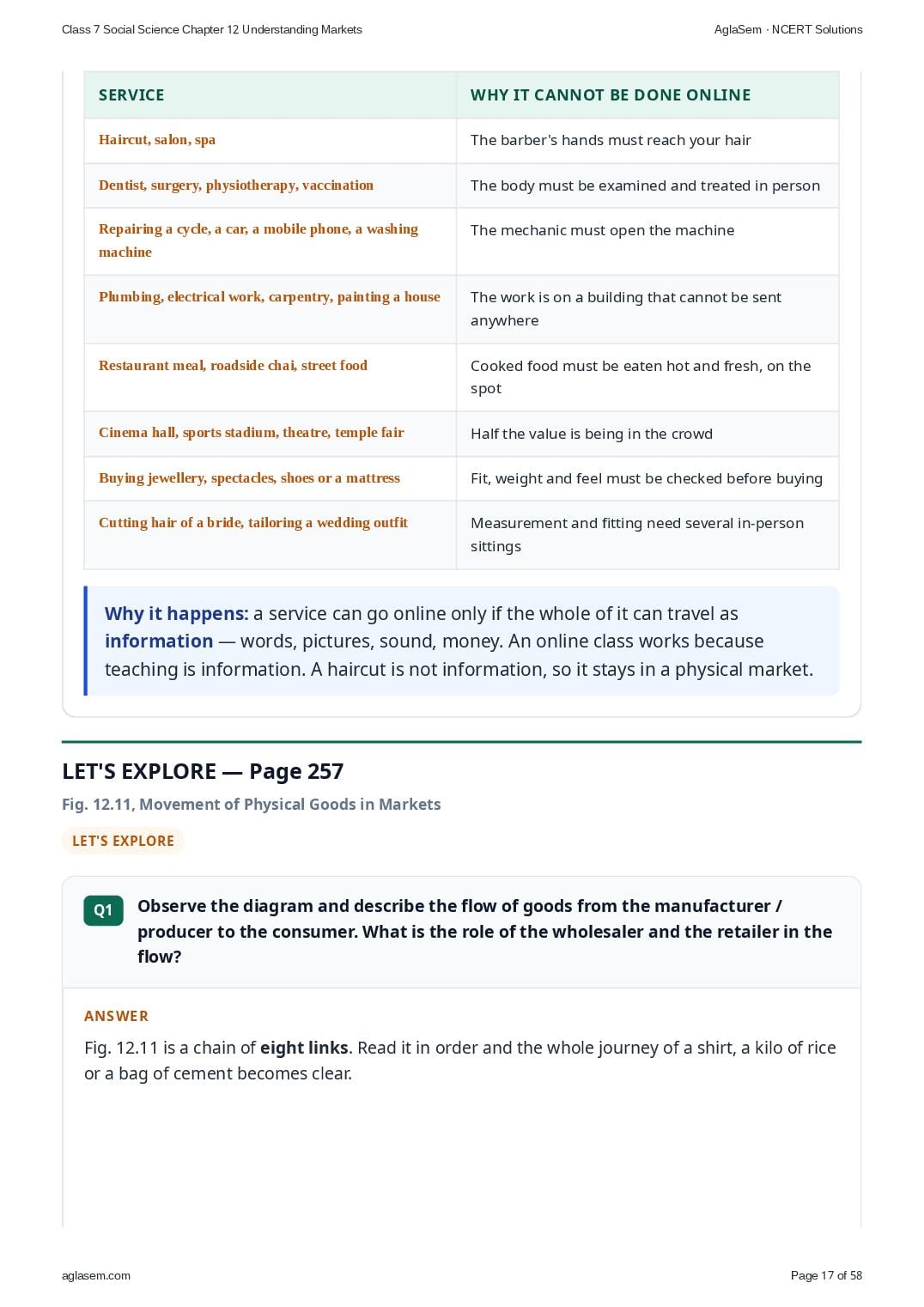
- Some services require in-person contact like tailoring and cannot be provided online. Can you suggest other services where physical markets are needed?
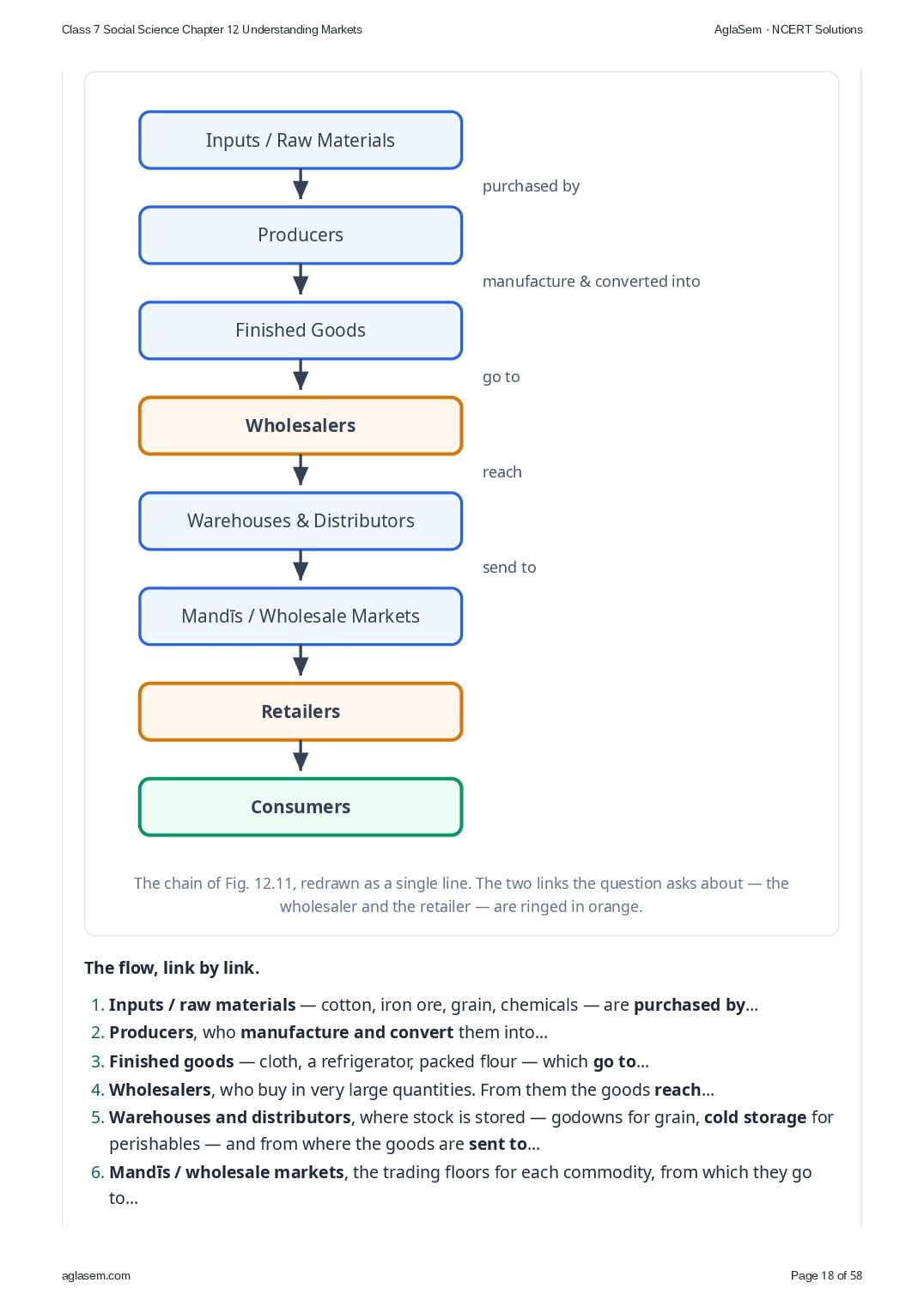
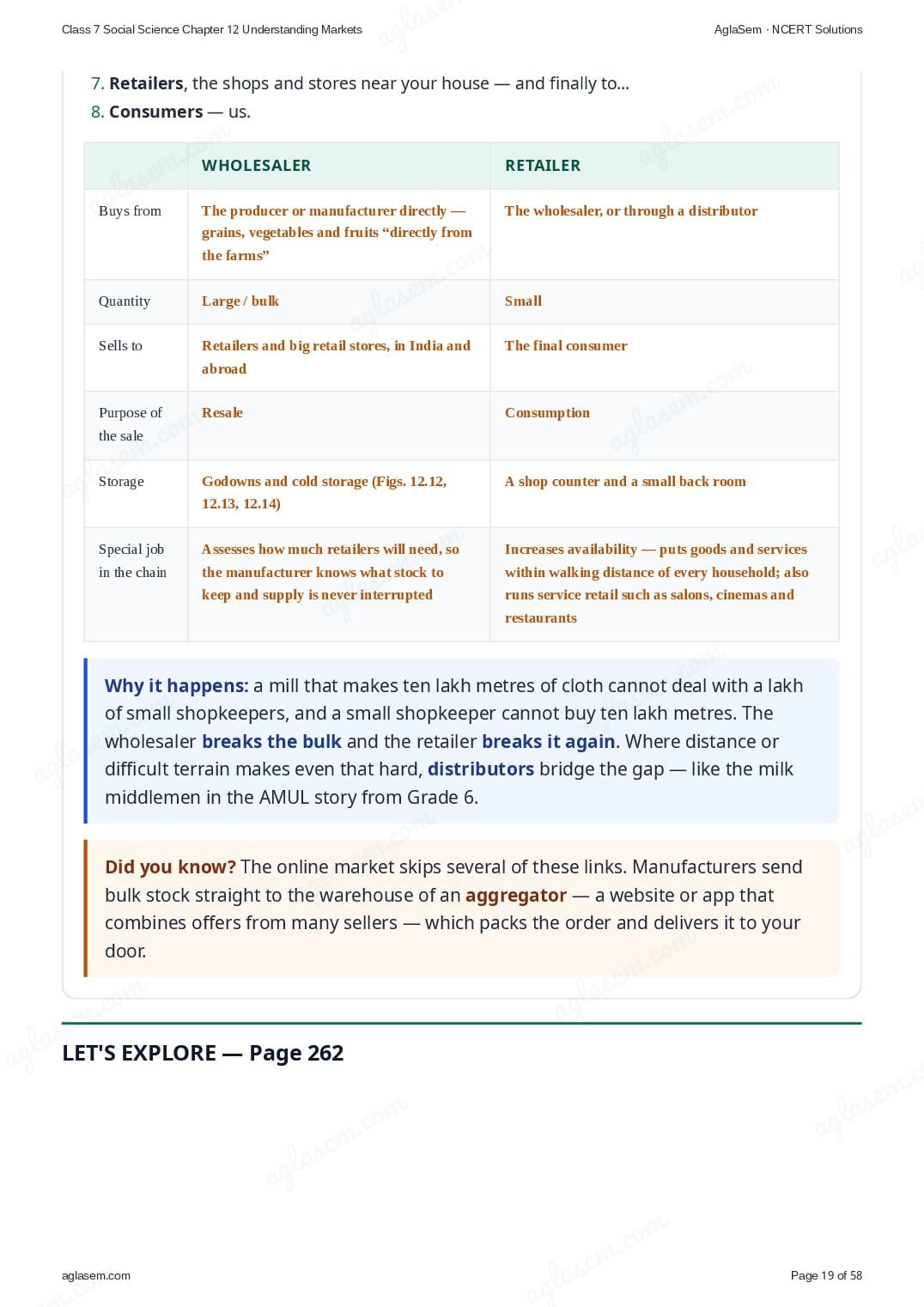
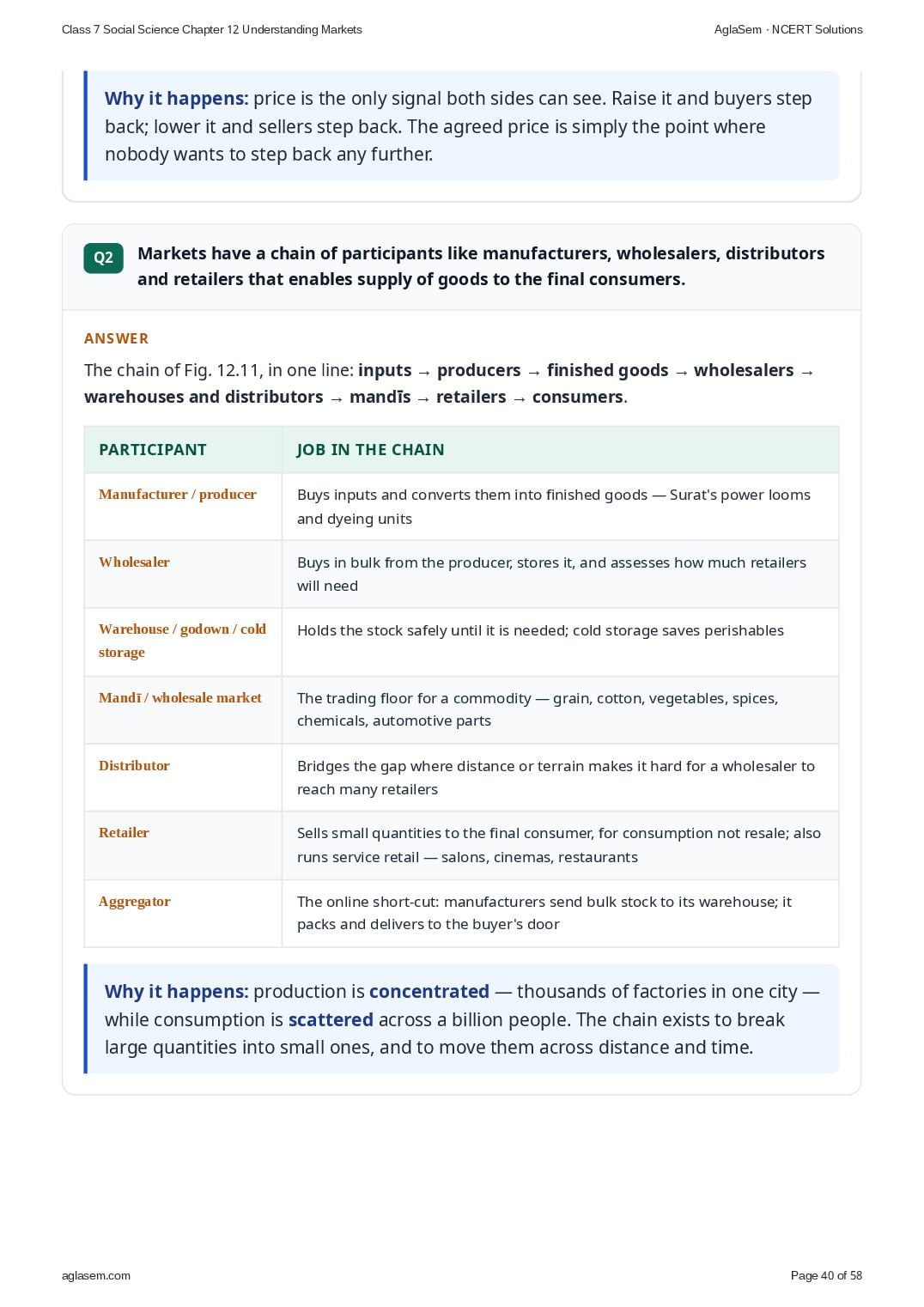
- Observe the diagram and describe the flow of goods from the manufacturer / producer to the consumer. What is the role of the wholesaler and the retailer in the flow?
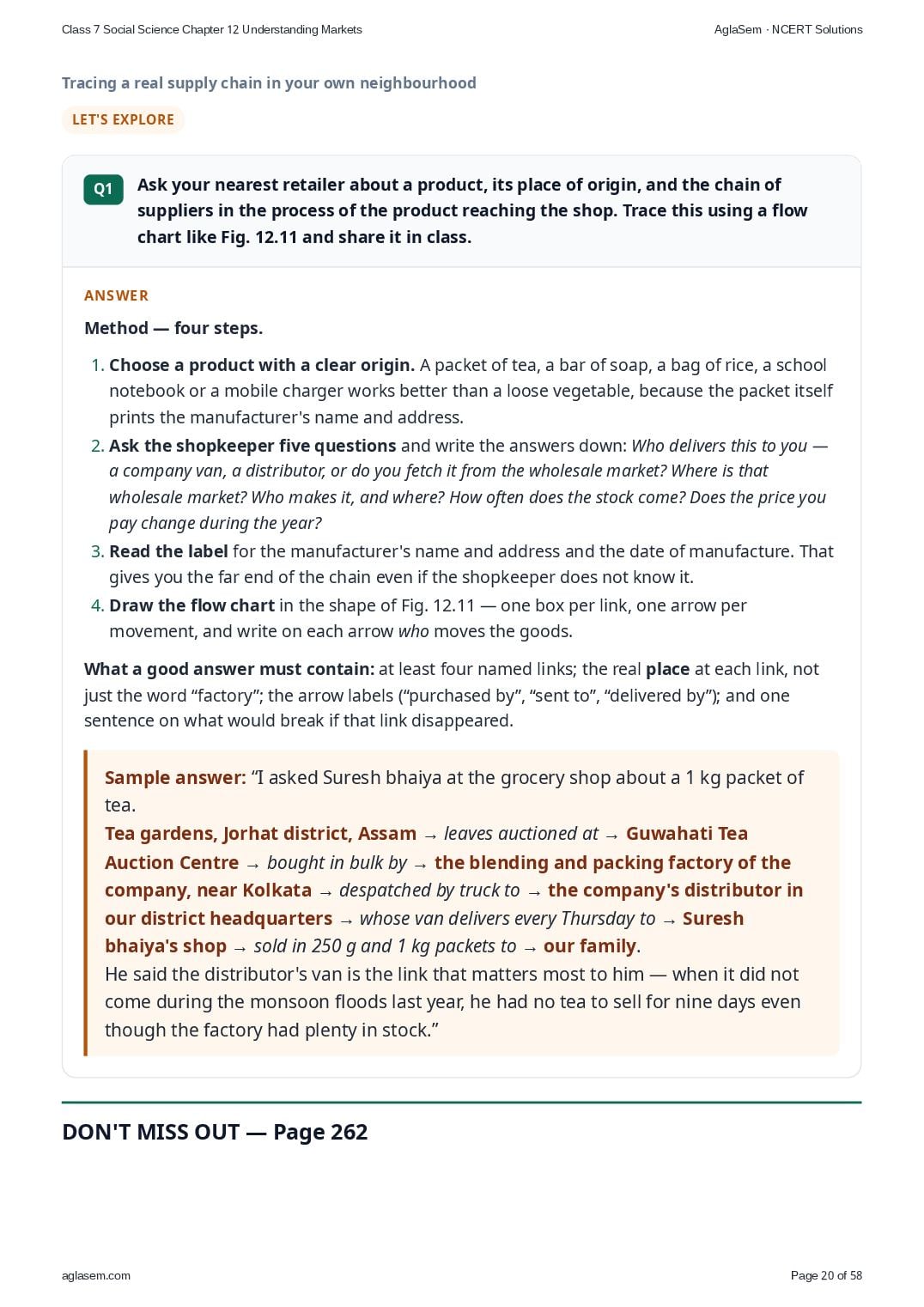
- Ask your nearest retailer about a product, its place of origin, and the chain of suppliers in the process of the product reaching the shop. Trace this using a flow chart like Fig. 12.11 and share it in class.
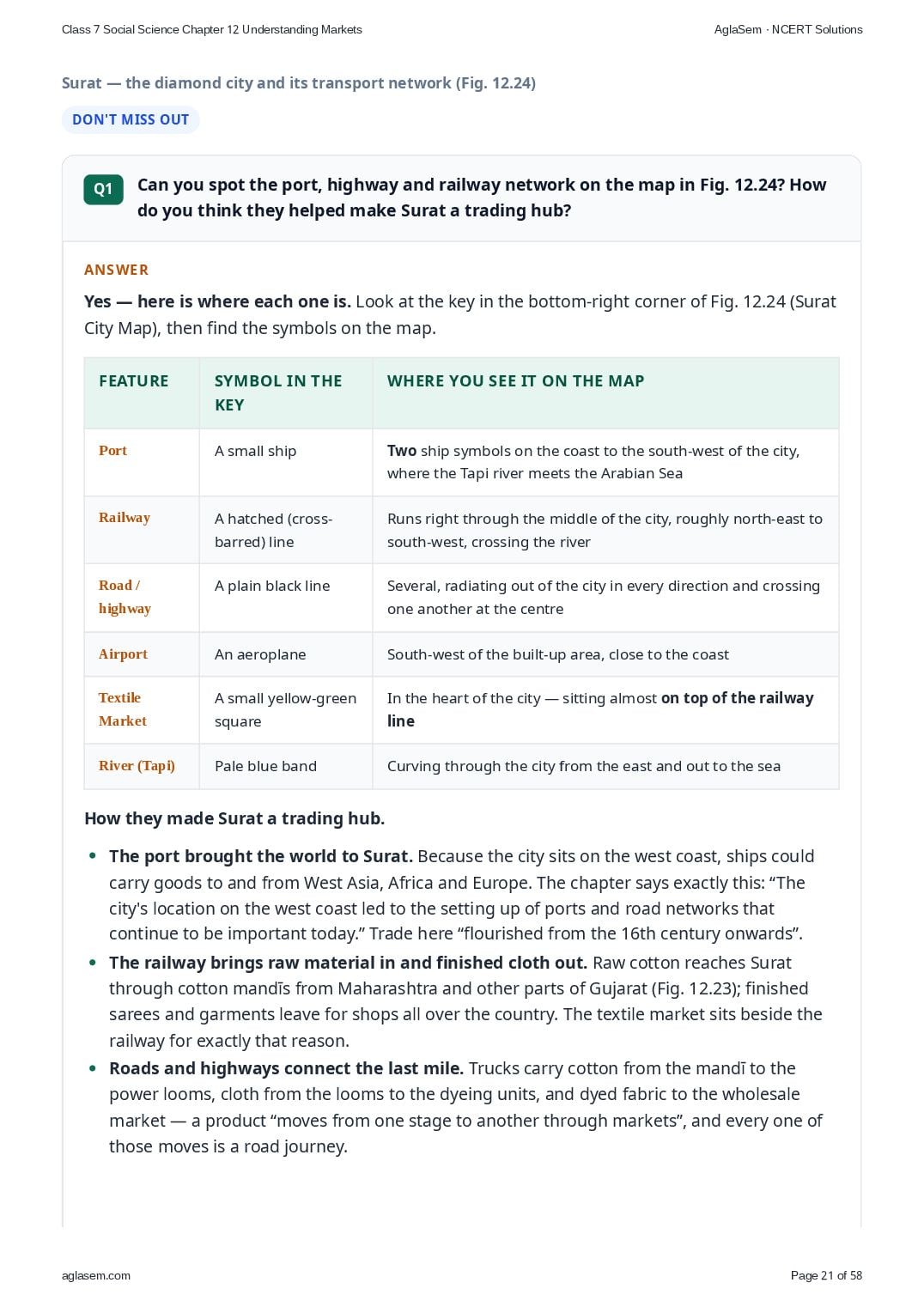
- Can you spot the port, highway and railway network on the map in Fig. 12.24? How do you think they helped make Surat a trading hub?
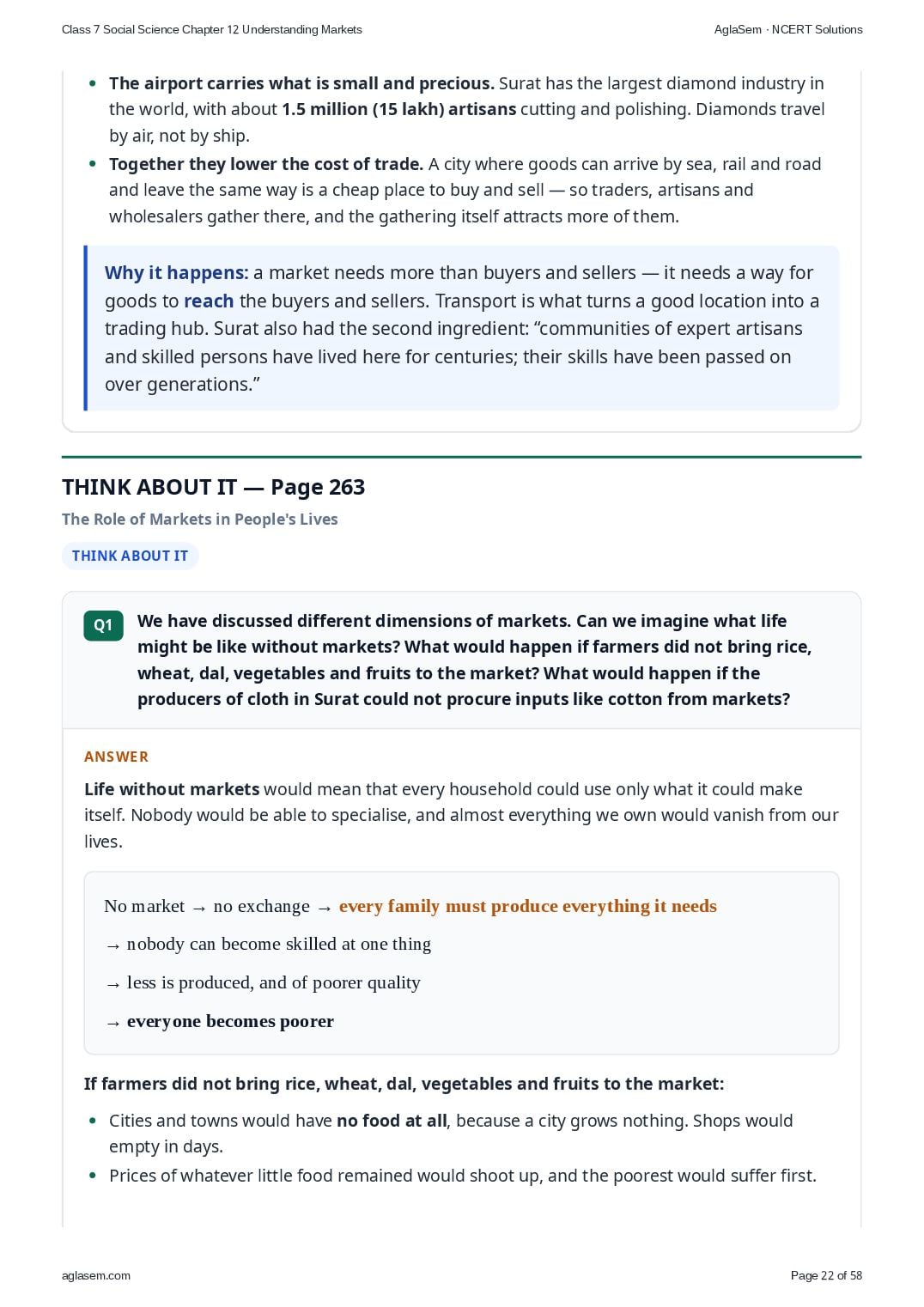
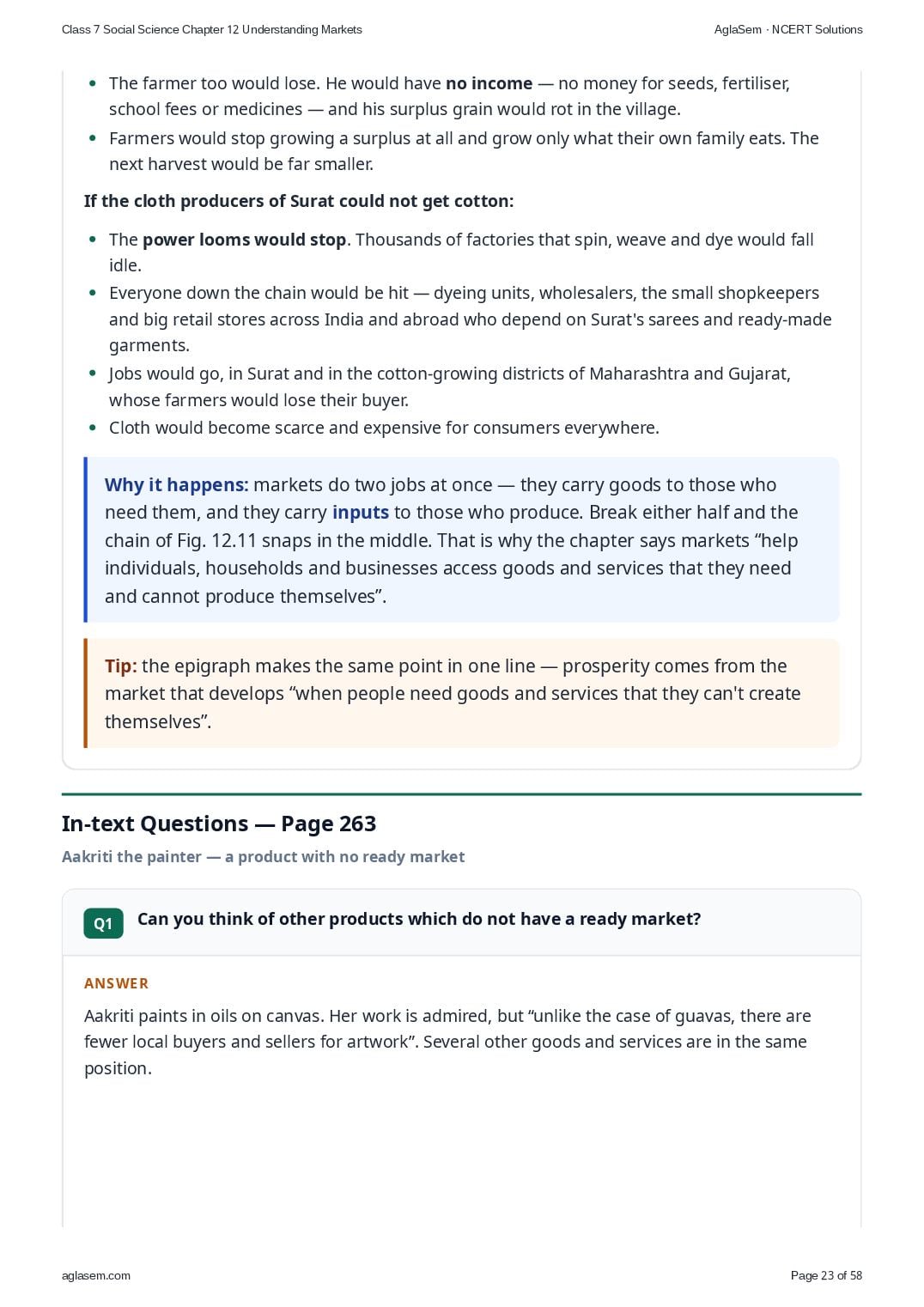
- We have discussed different dimensions of markets. Can we imagine what life might be like without markets? What would happen if farmers did not bring rice, wheat, dal, vegetables and fruits to the market? What would happen if the producers of cloth in Surat could not procure inputs like cotton from markets?
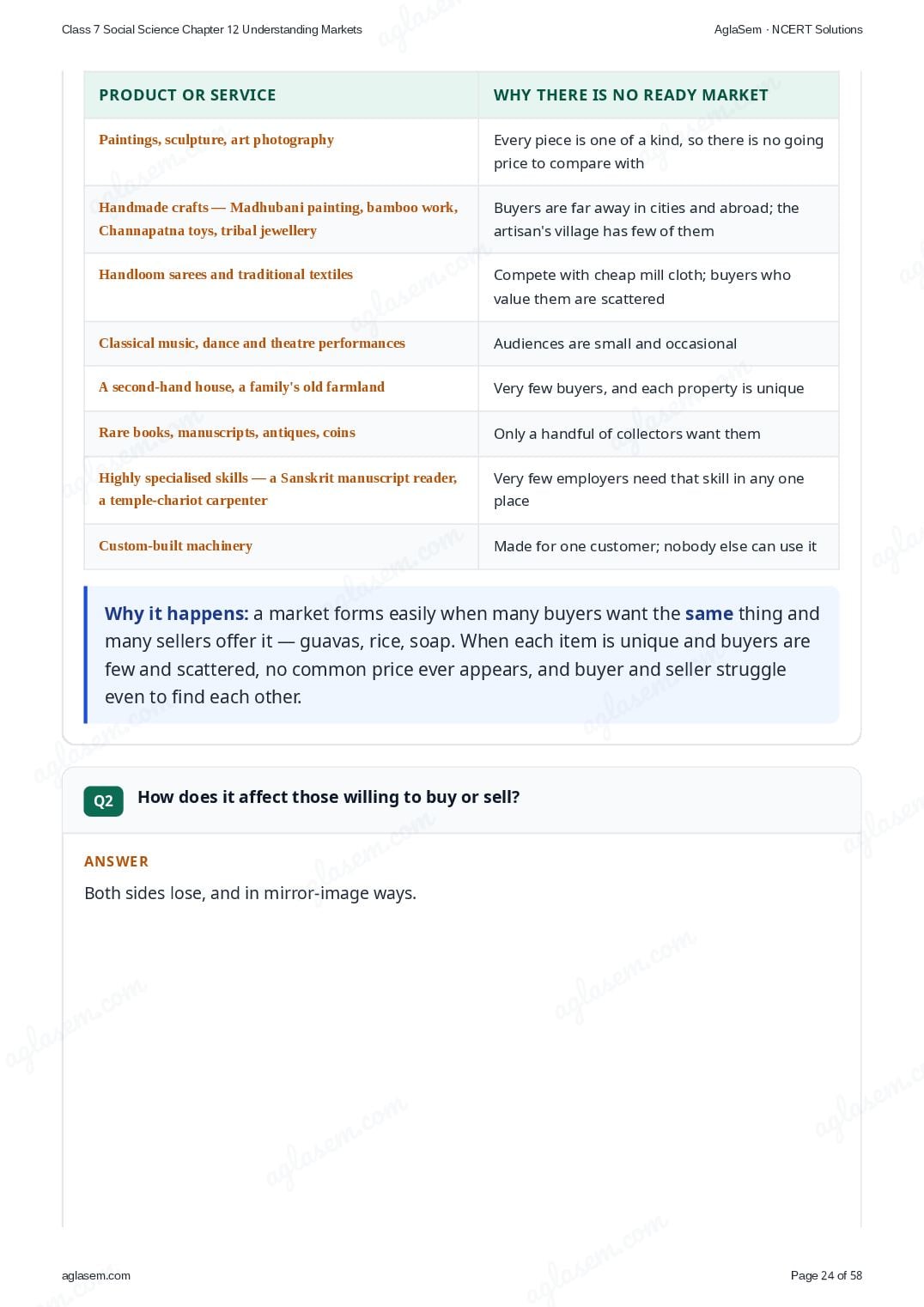
- Can you think of other products which do not have a ready market?
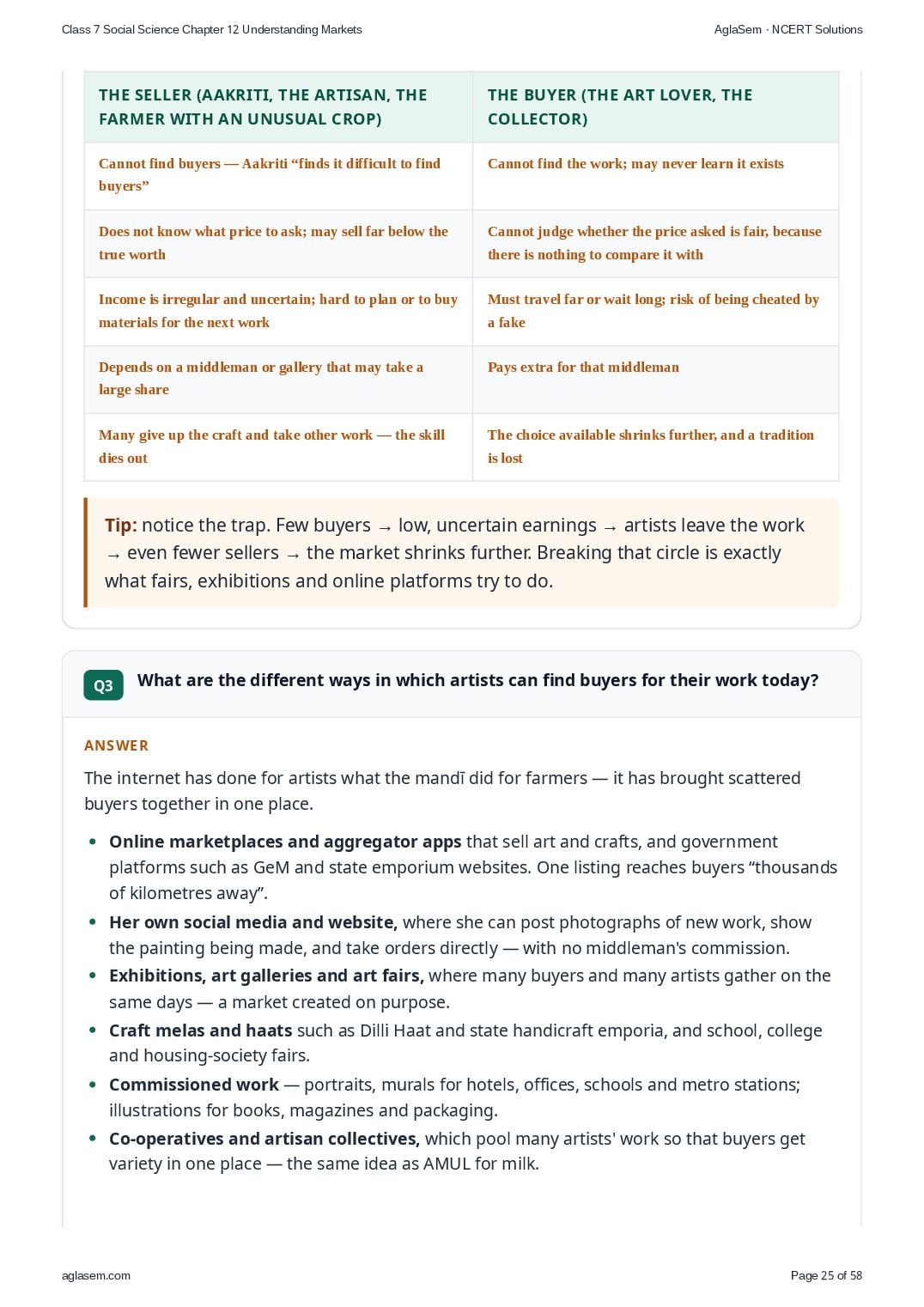
- How does it affect those willing to buy or sell?
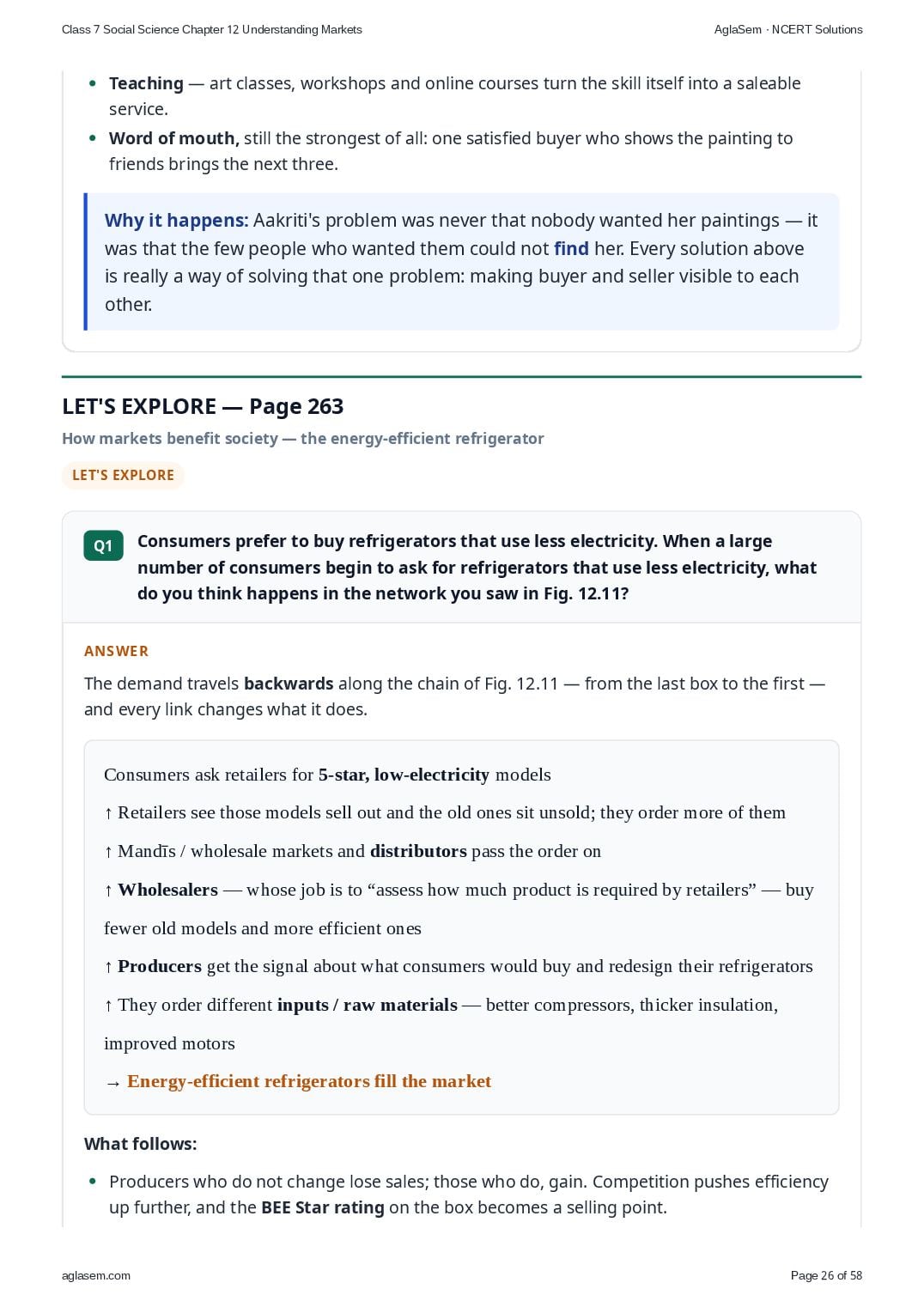
- What are the different ways in which artists can find buyers for their work today?
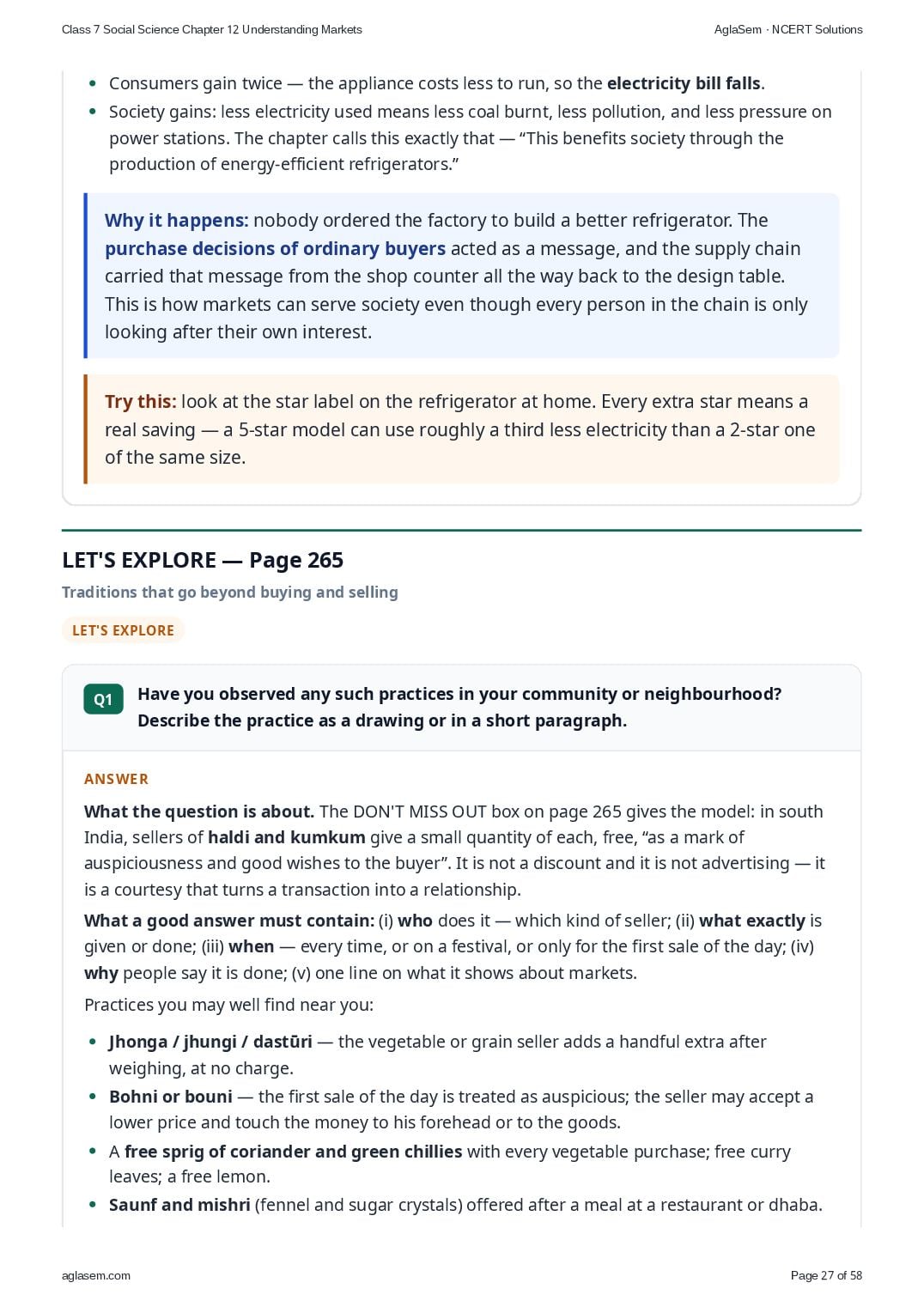
- Consumers prefer to buy refrigerators that use less electricity. When a large number of consumers begin to ask for refrigerators that use less electricity, what do you think happens in the network you saw in Fig. 12.11?
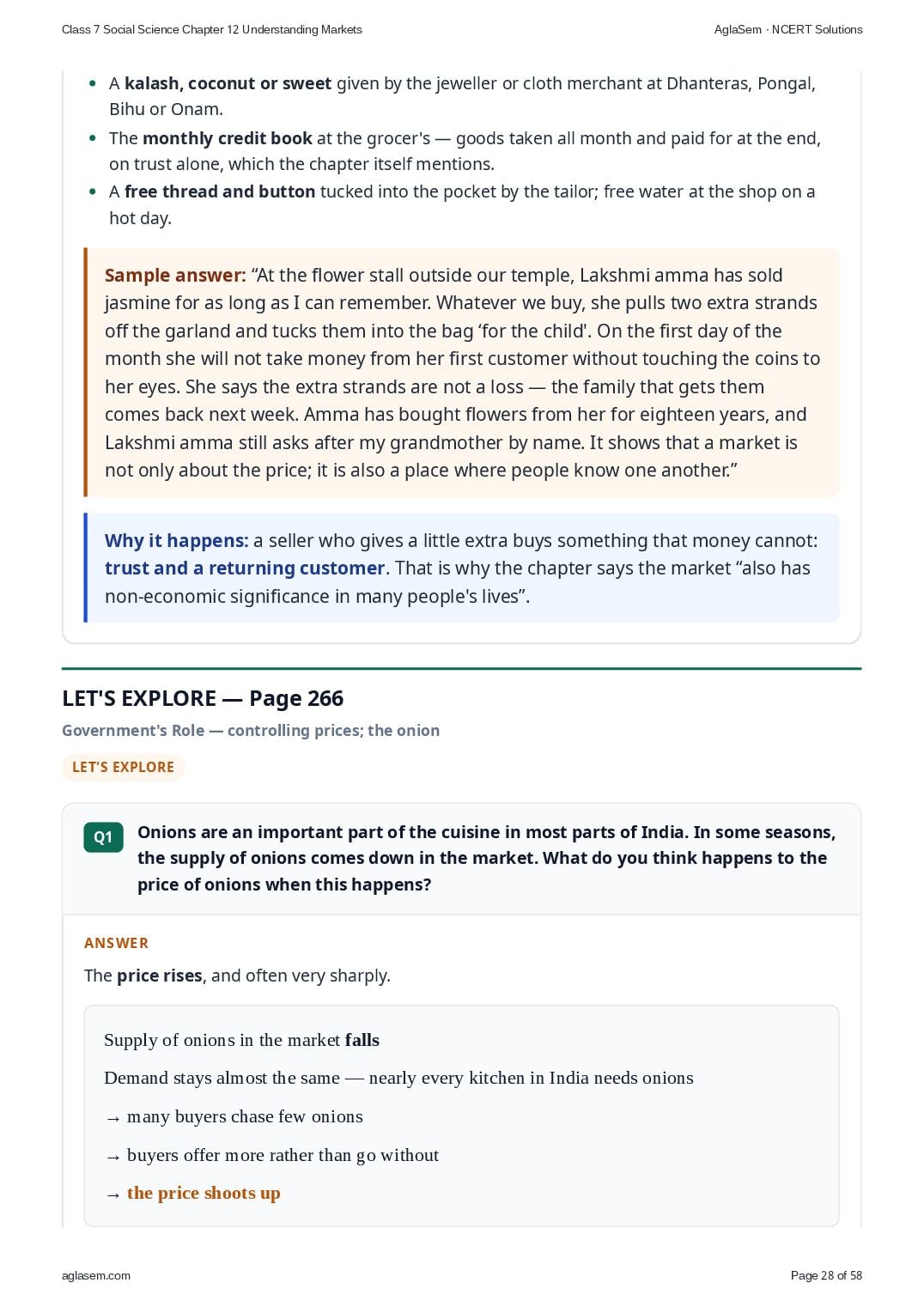
- Have you observed any such practices in your community or neighbourhood? Describe the practice as a drawing or in a short paragraph.
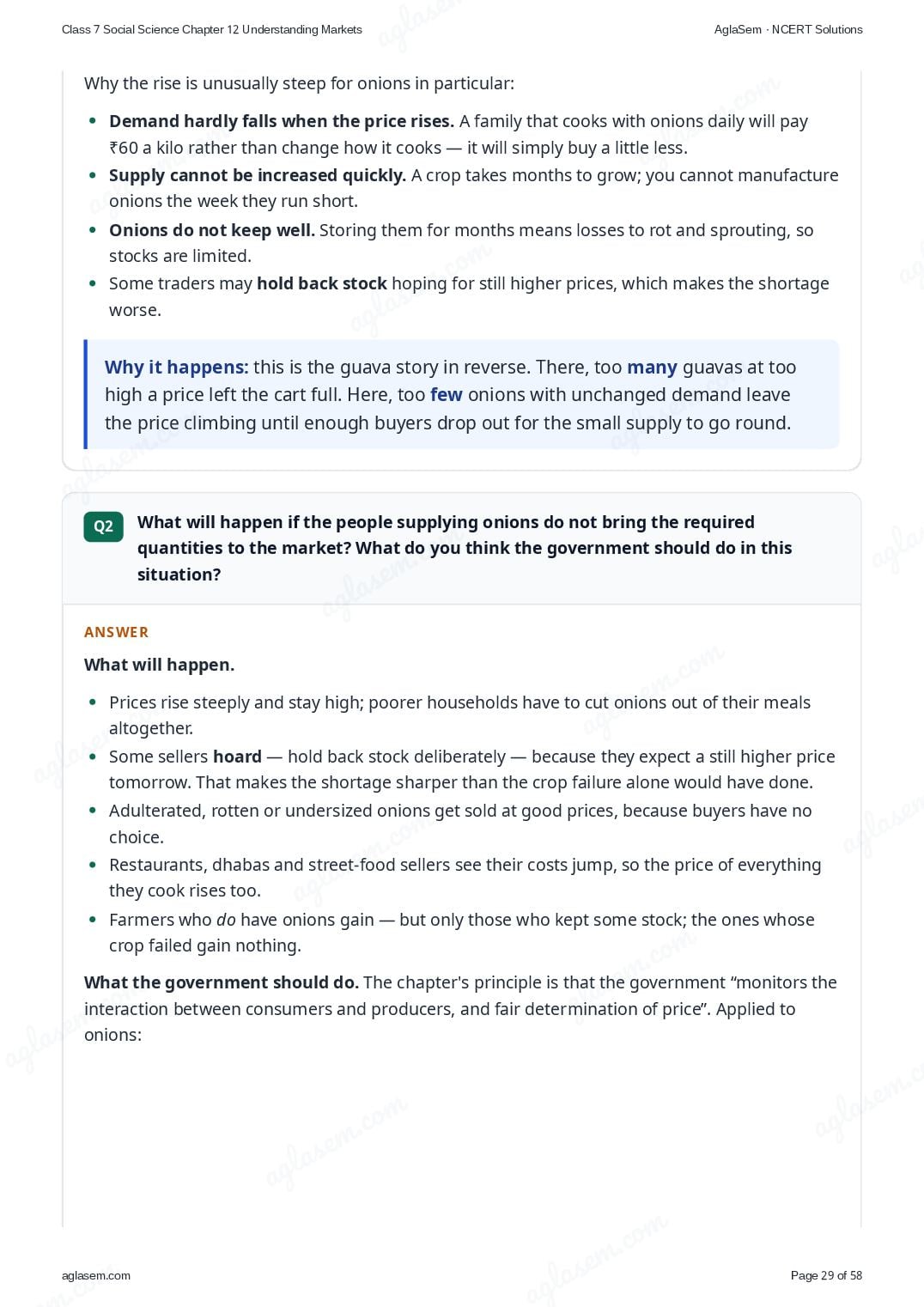
- Onions are an important part of the cuisine in most parts of India. In some seasons, the supply of onions comes down in the market. What do you think happens to the price of onions when this happens?
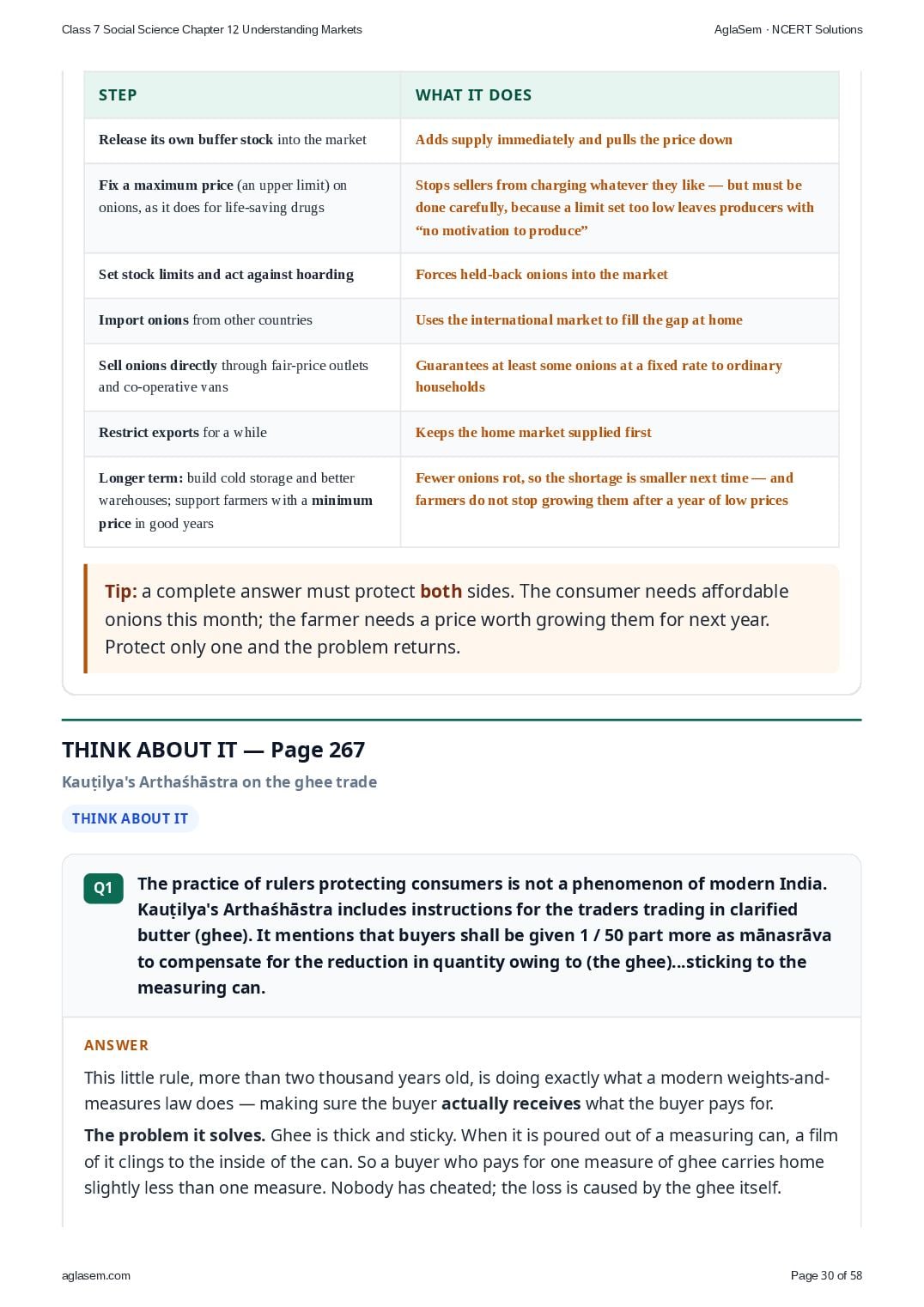
- What will happen if the people supplying onions do not bring the required quantities to the market? What do you think the government should do in this situation?
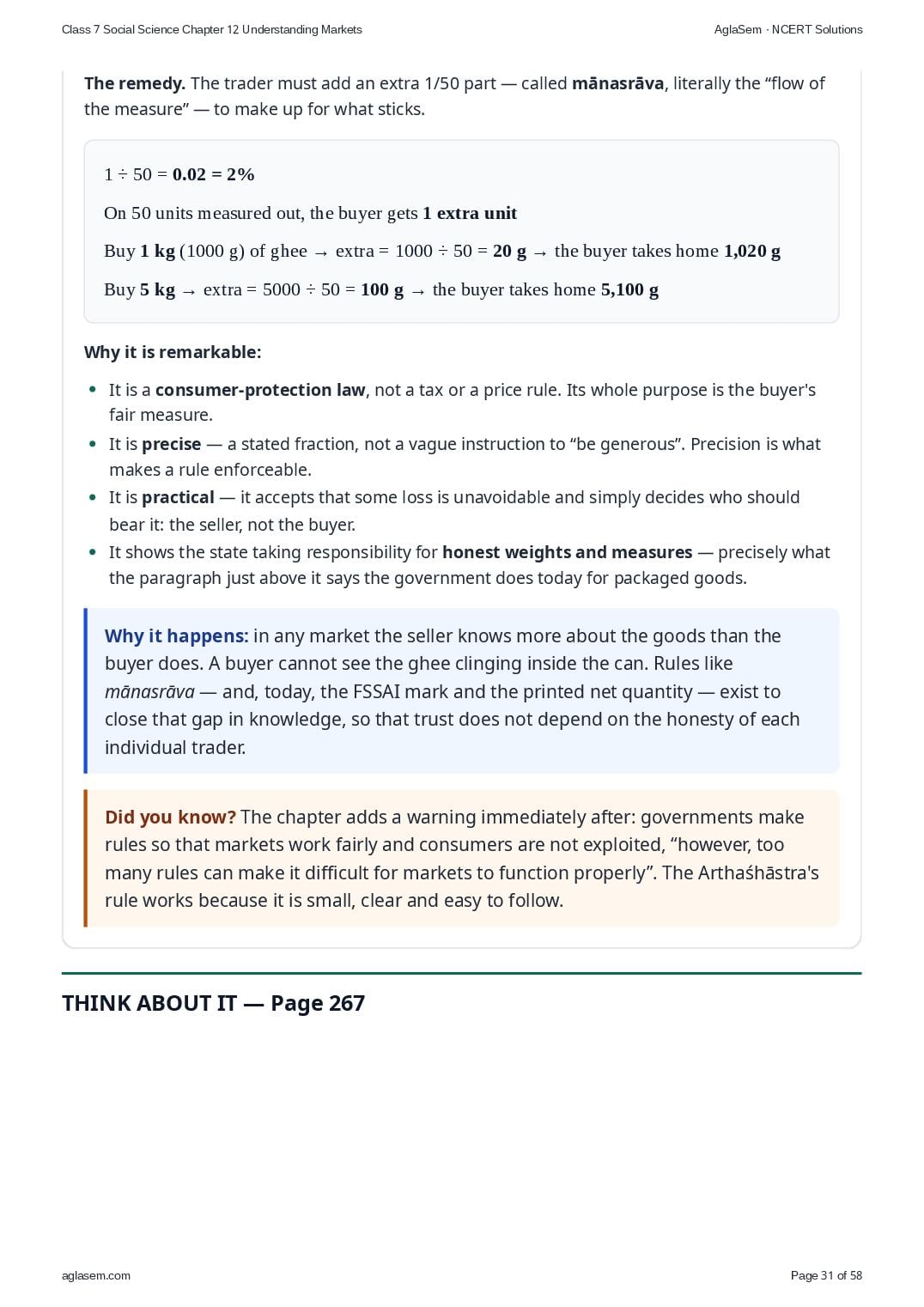
- The practice of rulers protecting consumers is not a phenomenon of modern India. Kauṭilya's Arthaśhāstra includes instructions for the traders trading in clarified butter (ghee). It mentions that buyers shall be given 1 / 50 part more as mānasrāva to compensate for the reduction in quantity owing to (the ghee)…sticking to the measuring can.
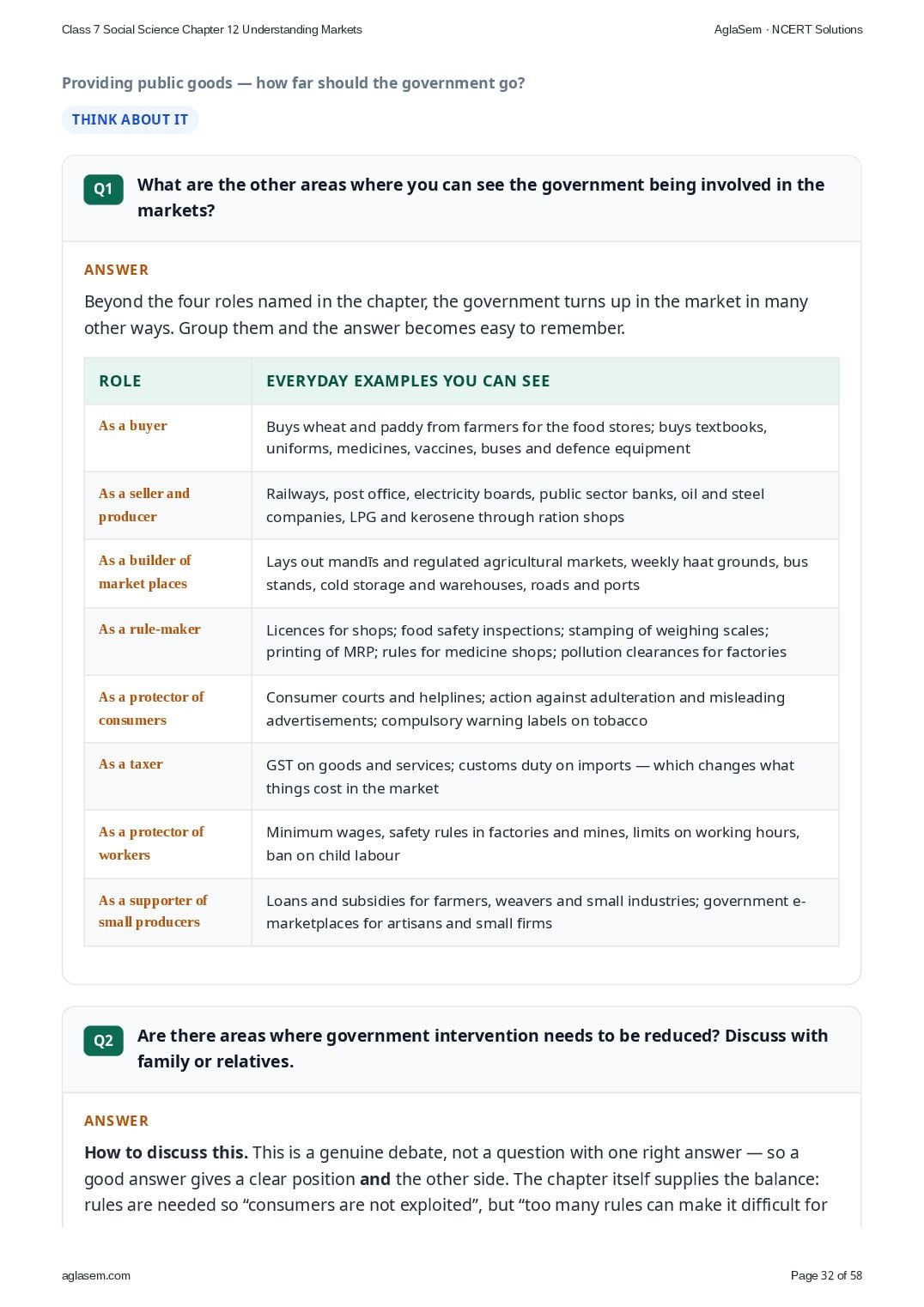
- What are the other areas where you can see the government being involved in the markets?
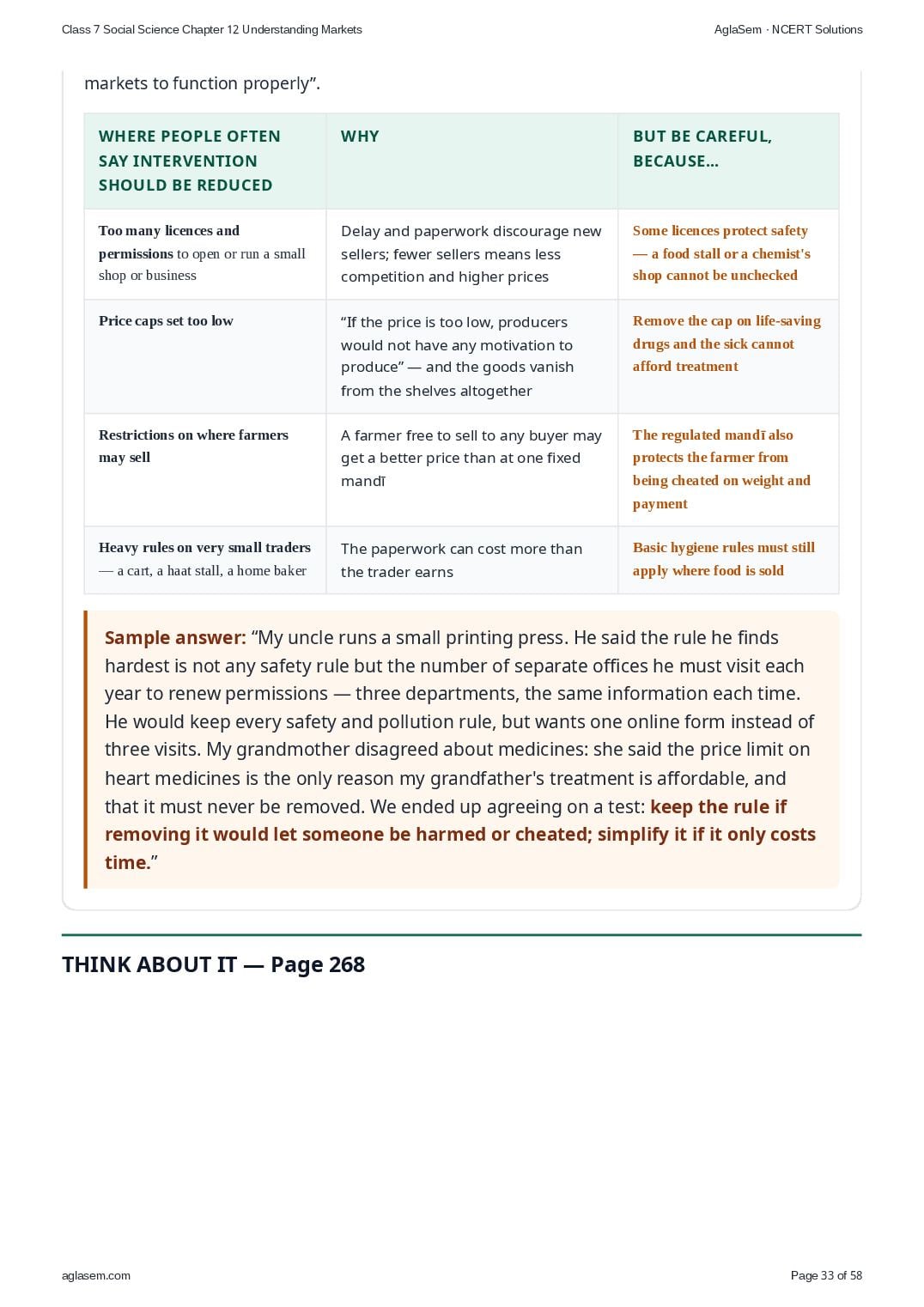
- Are there areas where government intervention needs to be reduced? Discuss with family or relatives.
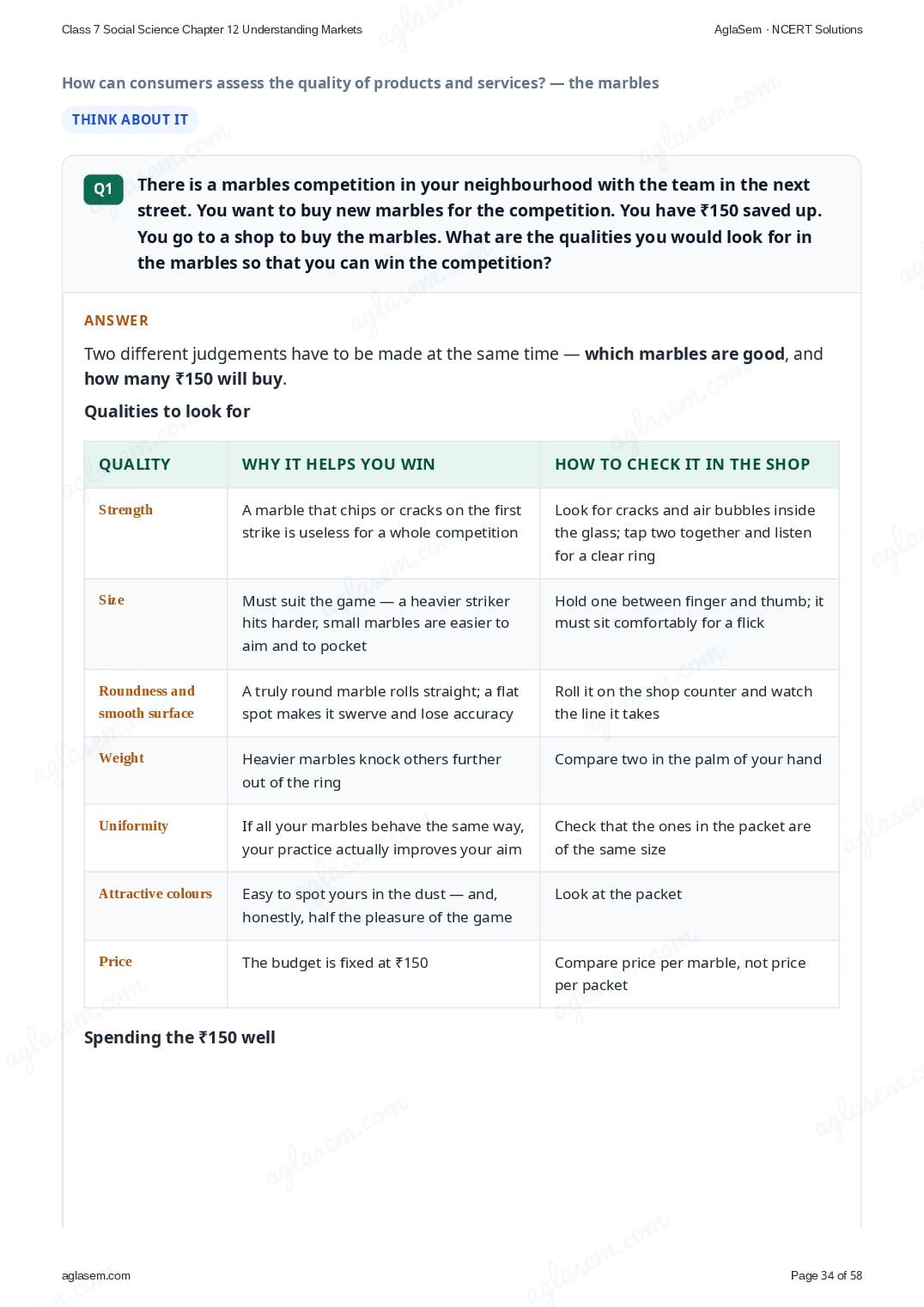
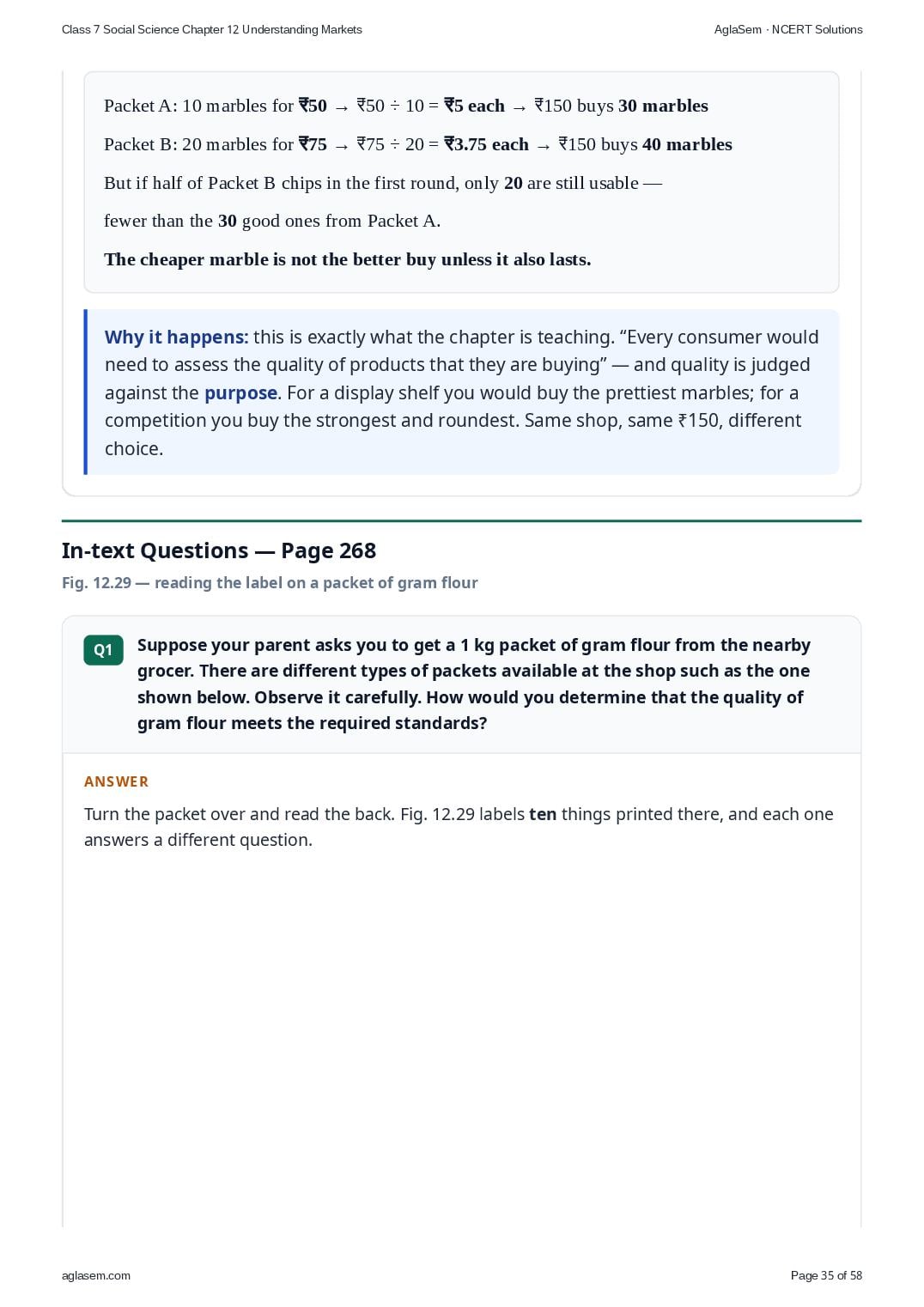
- There is a marbles competition in your neighbourhood with the team in the next street. You want to buy new marbles for the competition. You have ₹150 saved up. You go to a shop to buy the marbles. What are the qualities you would look for in the marbles so that you can win the competition?
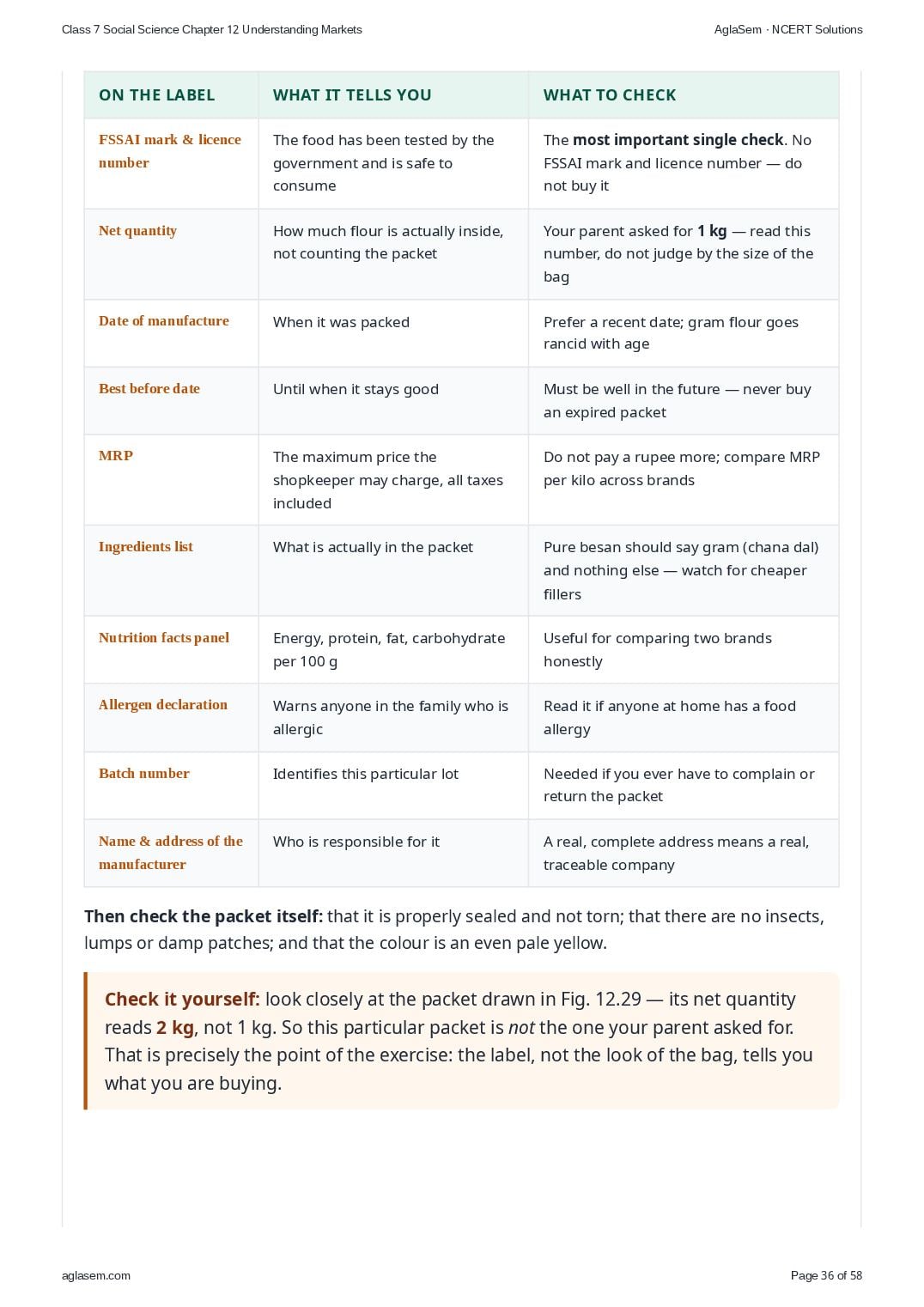
- Suppose your parent asks you to get a 1 kg packet of gram flour from the nearby grocer. There are different types of packets available at the shop such as the one shown below. Observe it carefully. How would you determine that the quality of gram flour meets the required standards?
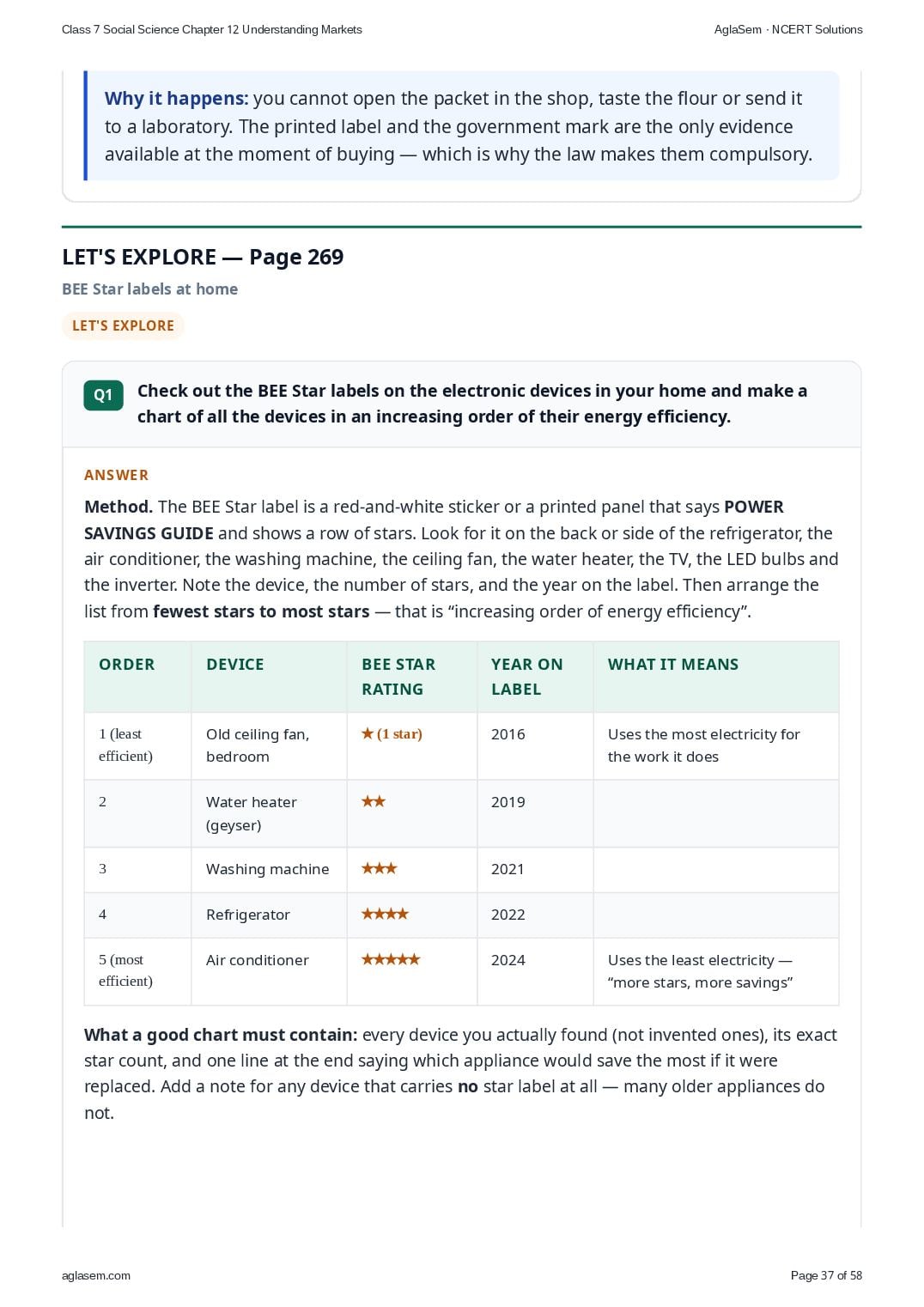
- Check out the BEE Star labels on the electronic devices in your home and make a chart of all the devices in an increasing order of their energy efficiency.
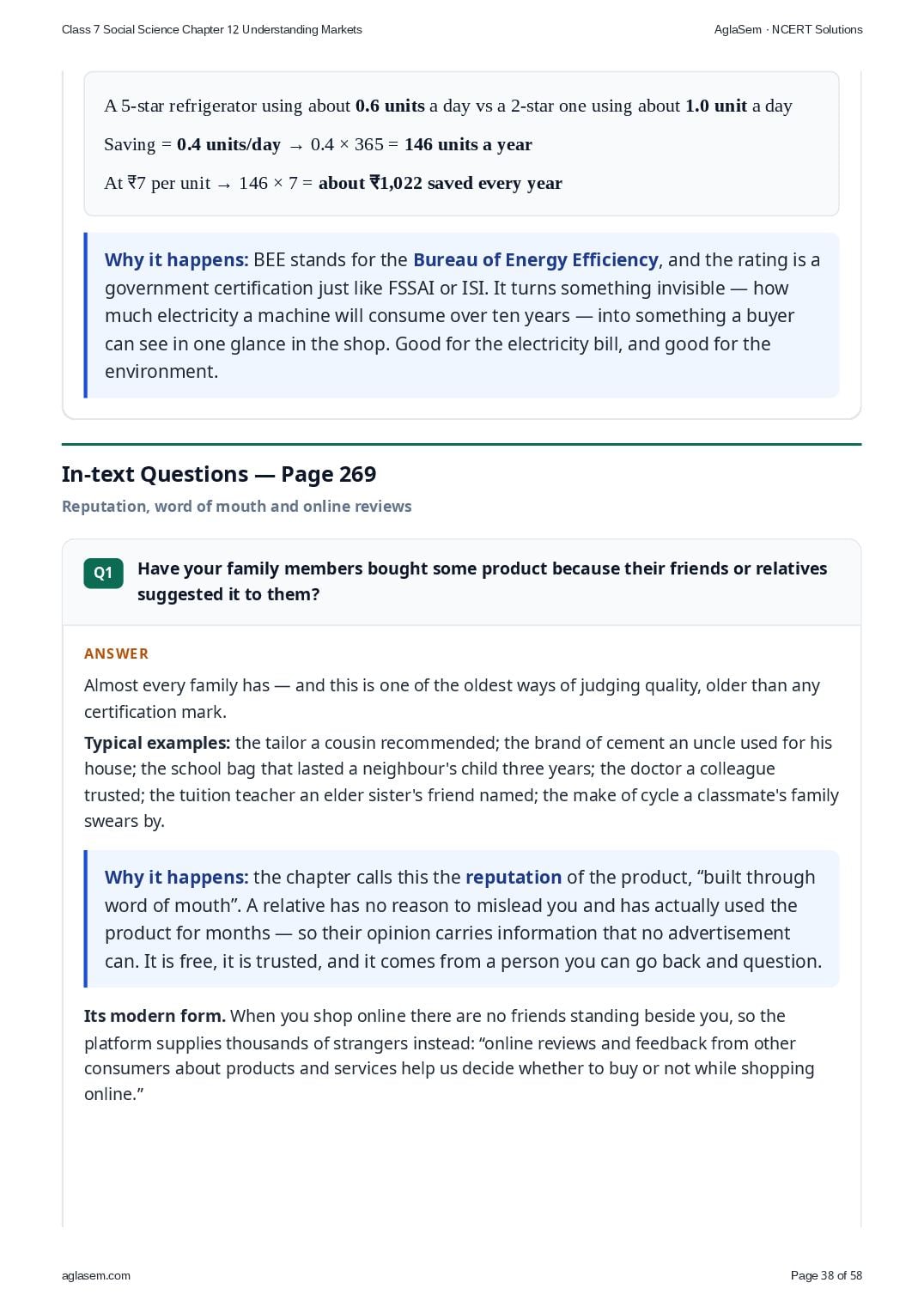
- Have your family members bought some product because their friends or relatives suggested it to them?
- Markets facilitate exchange between buyers and sellers at a mutually agreed price which is determined by the demand from buyers and supply by sellers.
- Markets have a chain of participants like manufacturers, wholesalers, distributors and retailers that enables supply of goods to the final consumers.
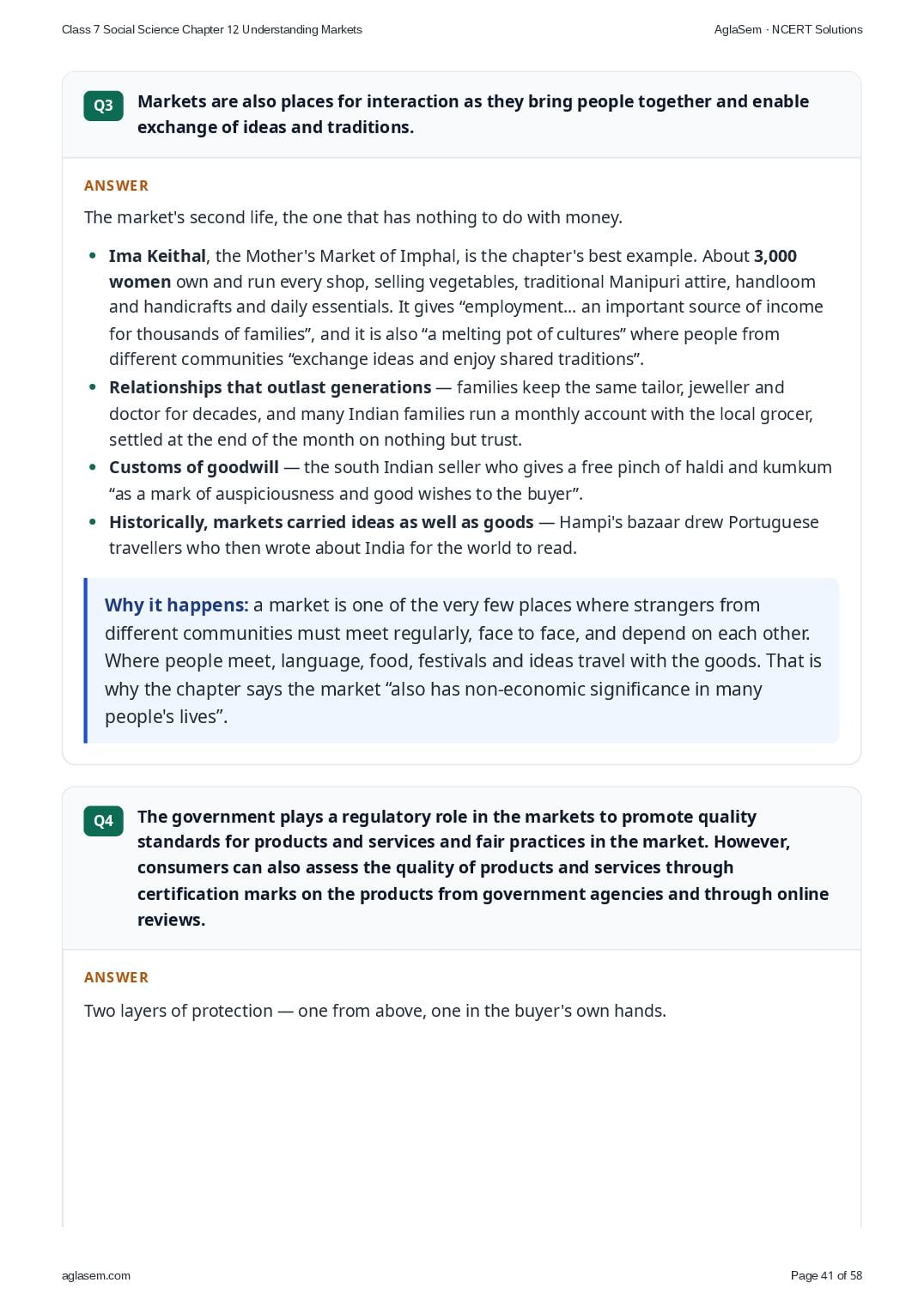
- Markets are also places for interaction as they bring people together and enable exchange of ideas and traditions.
- The government plays a regulatory role in the markets to promote quality standards for products and services and fair practices in the market. However, consumers can also assess the quality of products and services through certification marks on the products from government agencies and through online reviews.
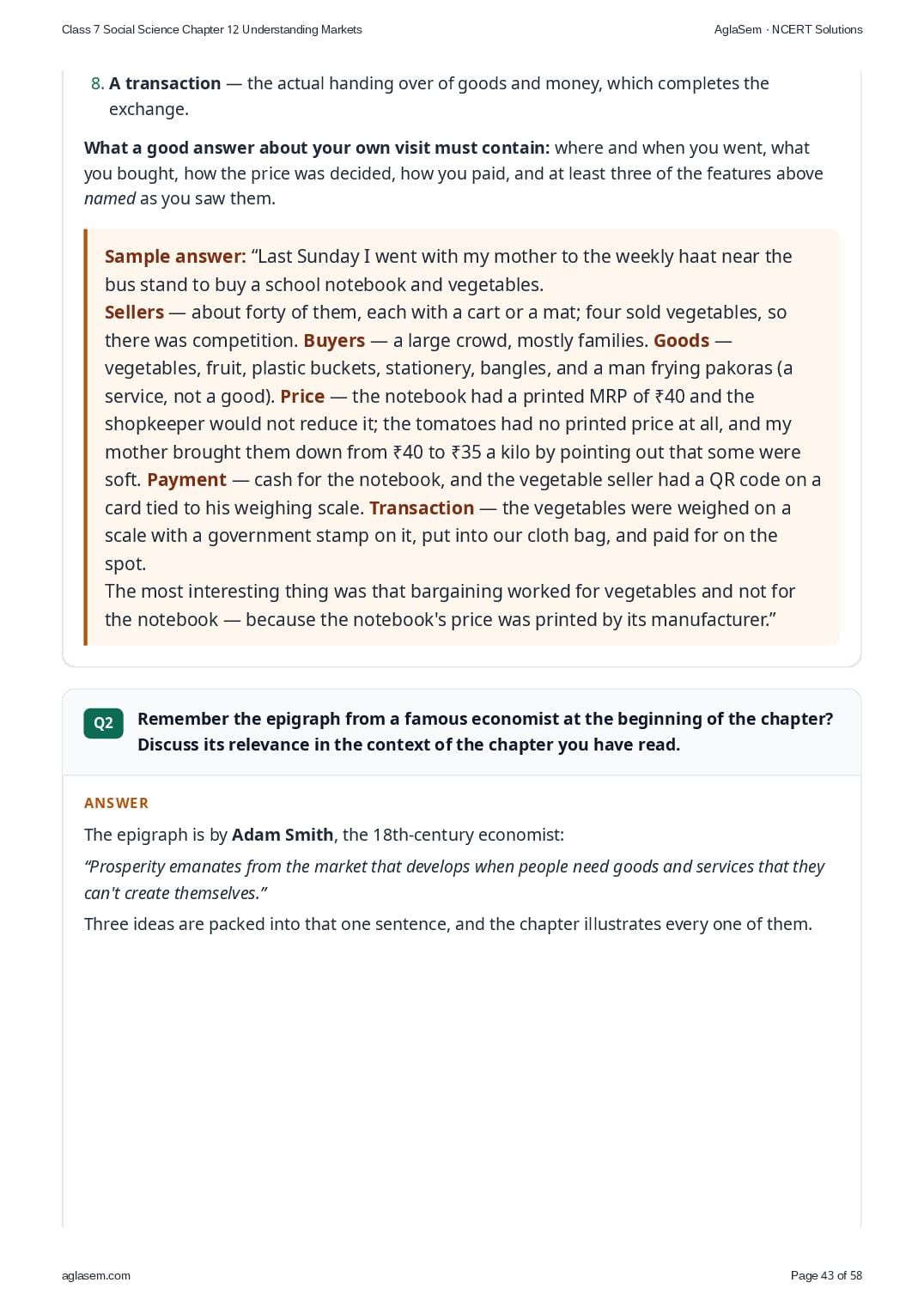
- What are the main features of a market? Recall a recent visit to a market to purchase a product. What are the different features of a market that you observed during this visit?
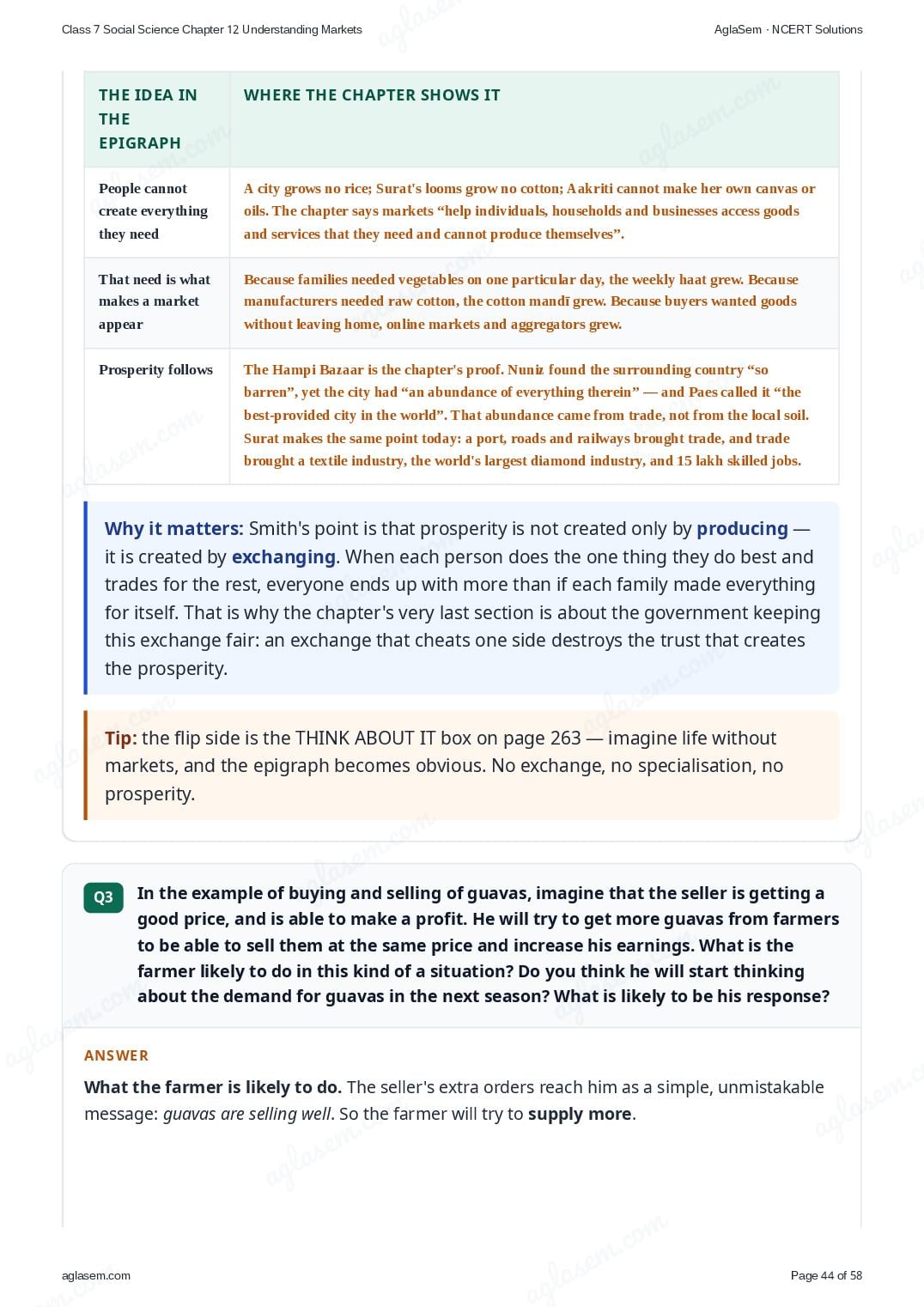
- Remember the epigraph from a famous economist at the beginning of the chapter? Discuss its relevance in the context of the chapter you have read.
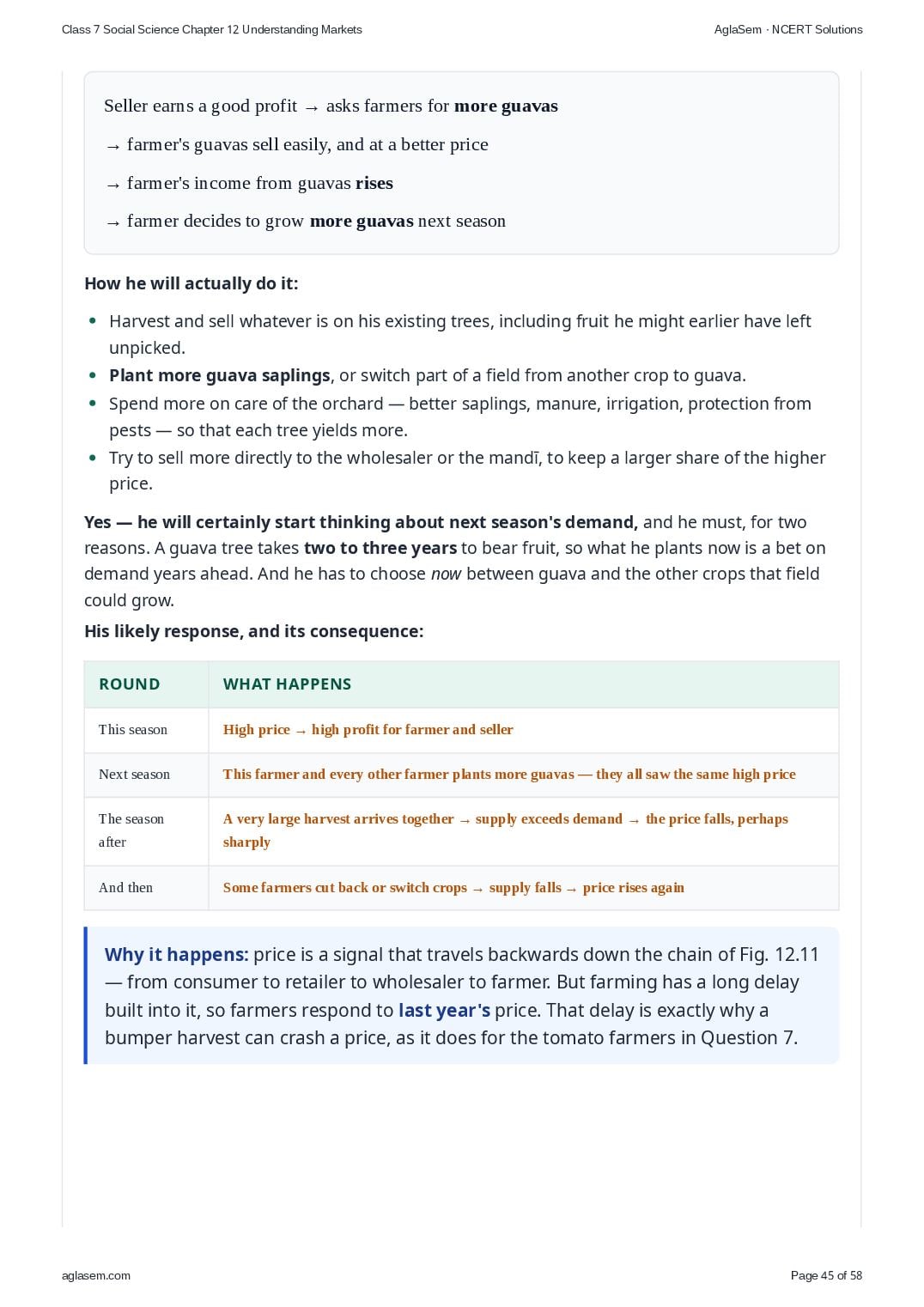
- In the example of buying and selling of guavas, imagine that the seller is getting a good price, and is able to make a profit. He will try to get more guavas from farmers to be able to sell them at the same price and increase his earnings. What is the farmer likely to do in this kind of a situation? Do you think he will start thinking about the demand for guavas in the next season? What is likely to be his response?
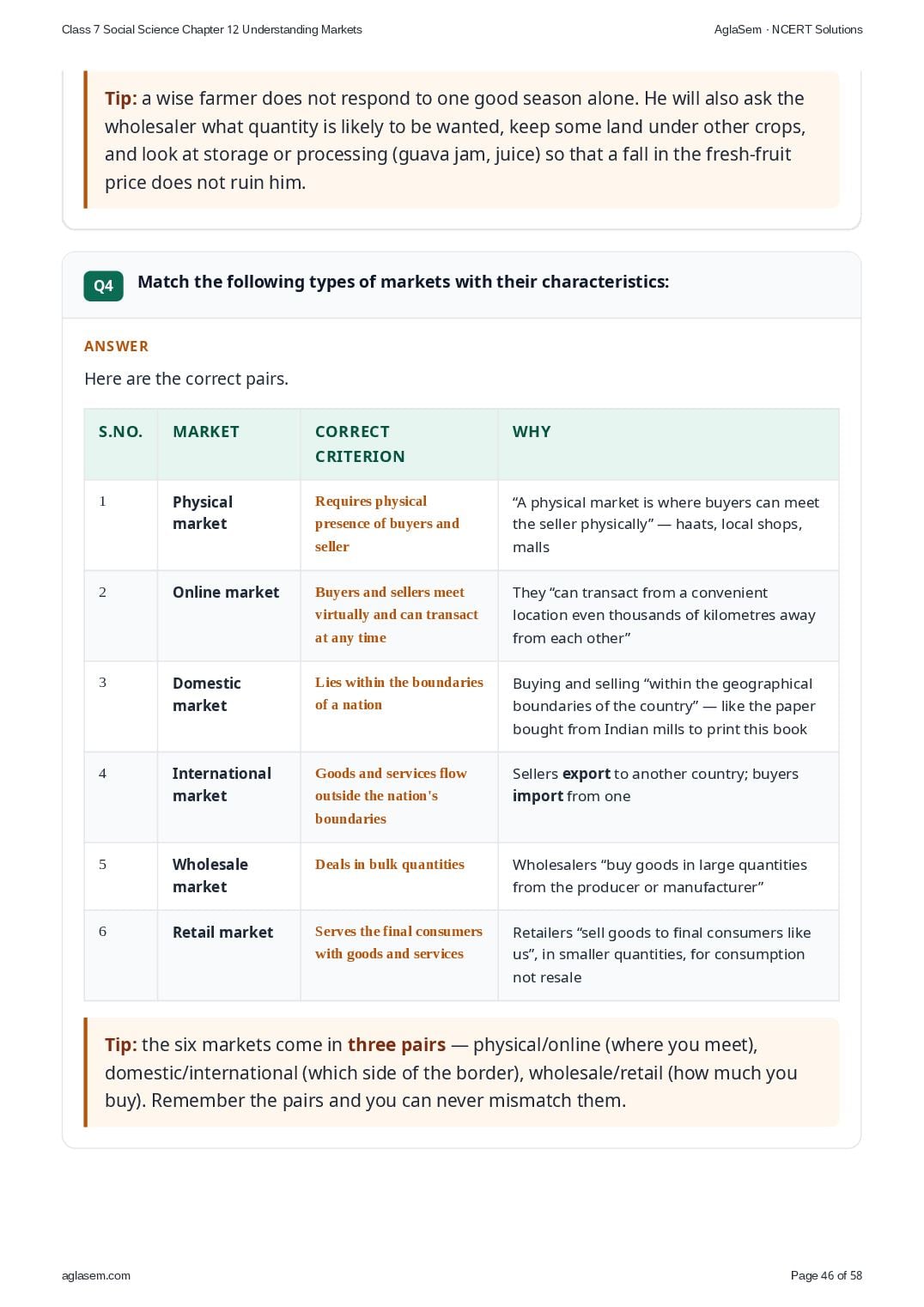
- Match the following types of markets with their characteristics:
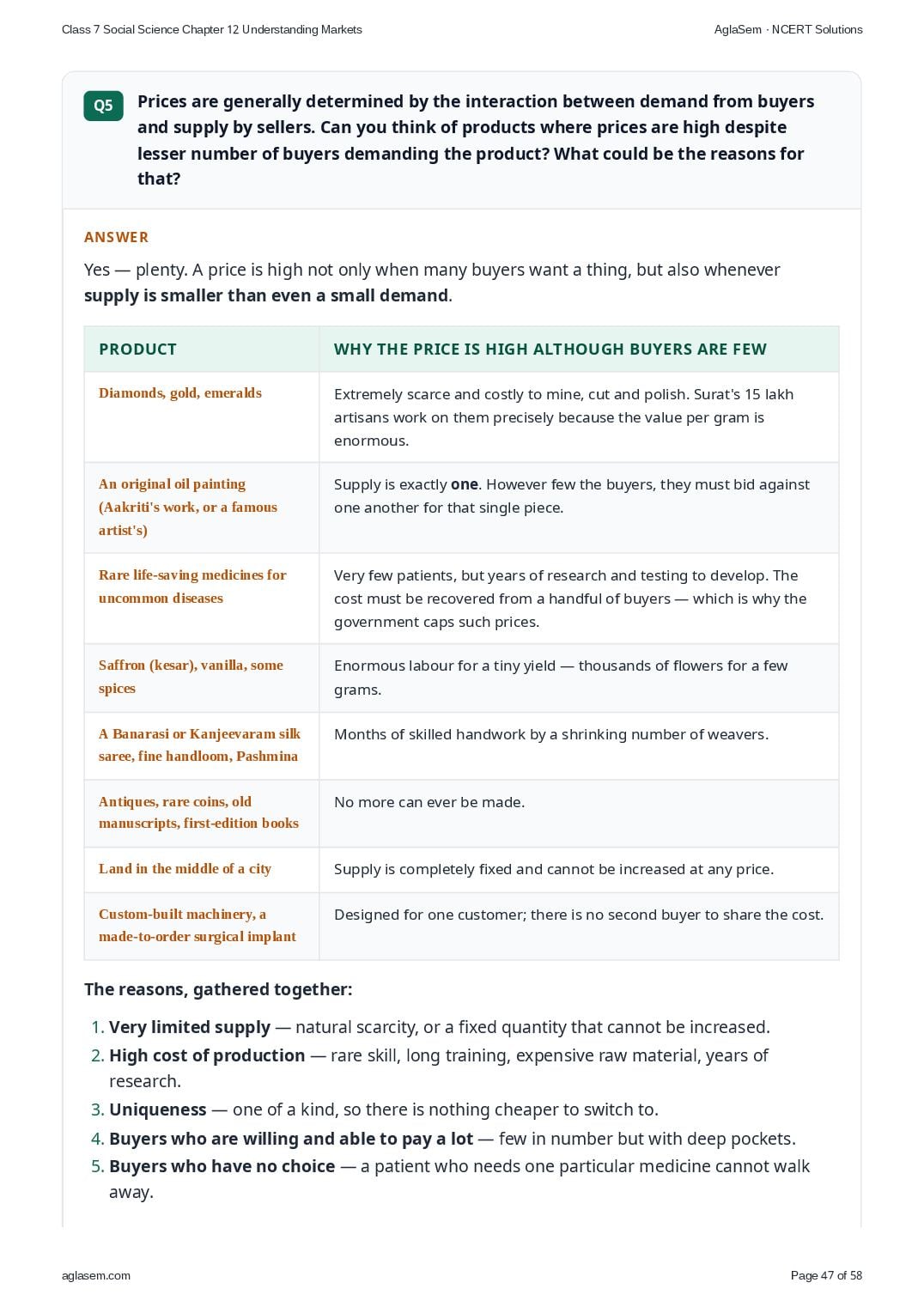
- Prices are generally determined by the interaction between demand from buyers and supply by sellers. Can you think of products where prices are high despite lesser number of buyers demanding the product? What could be the reasons for that?
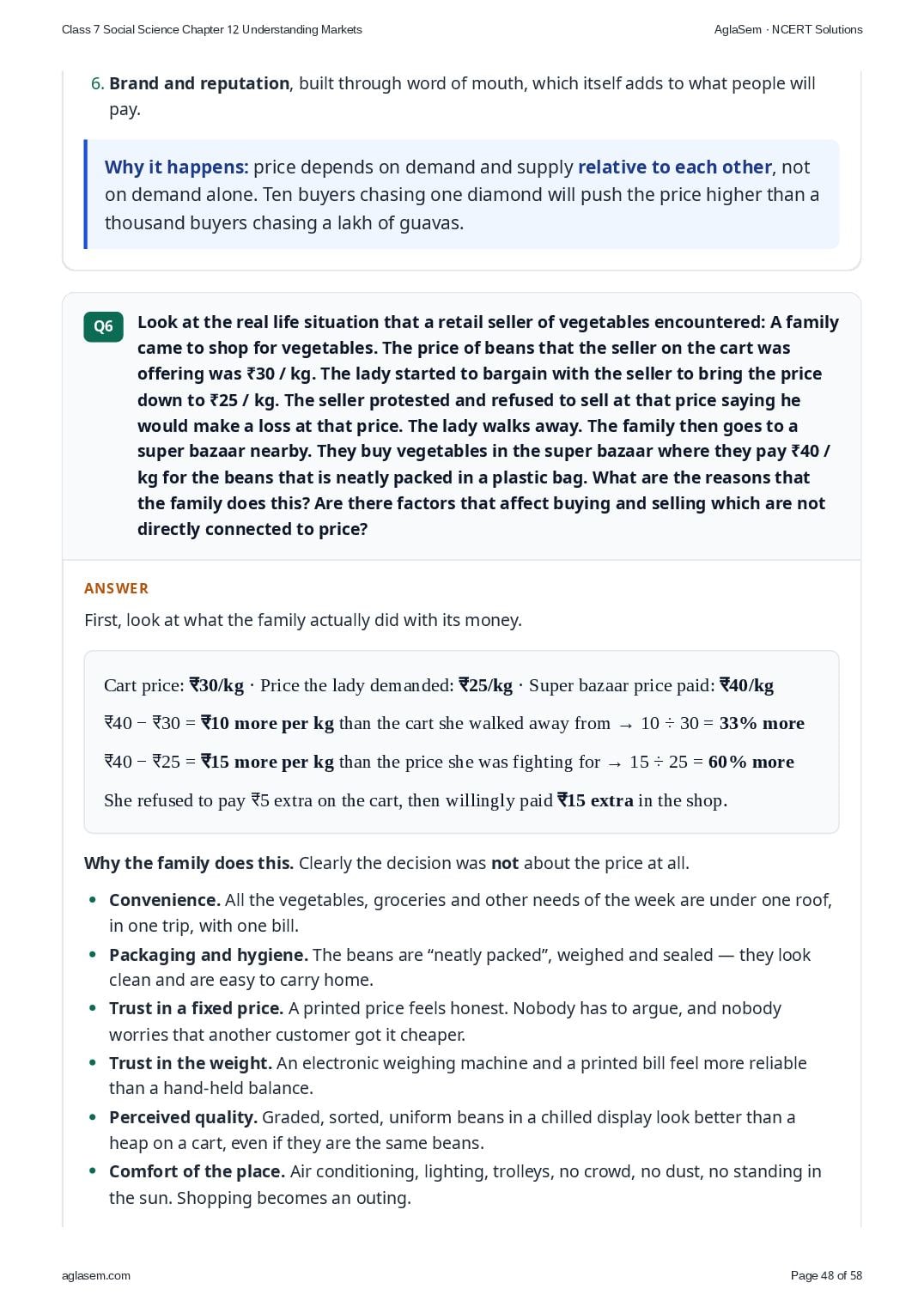
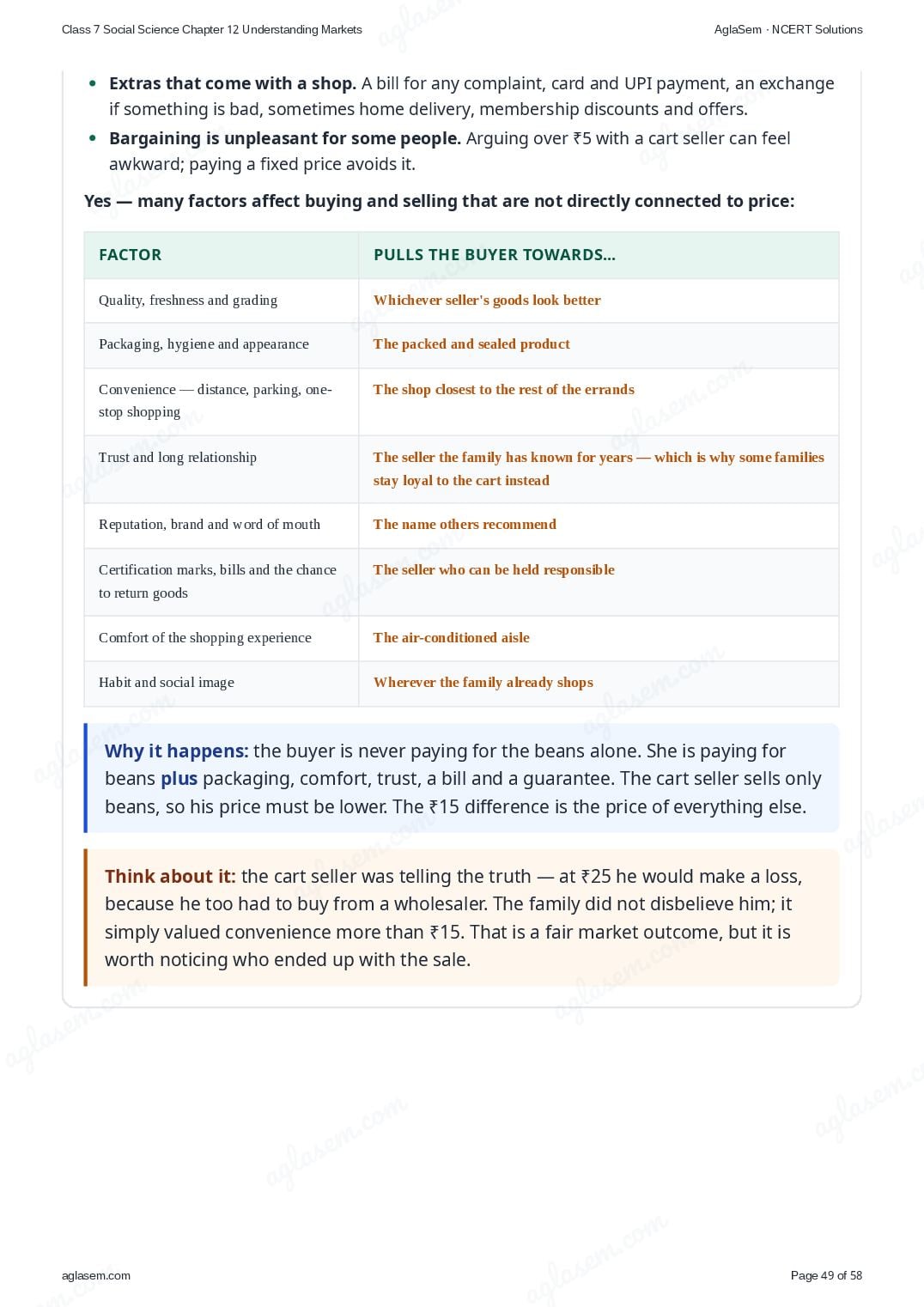
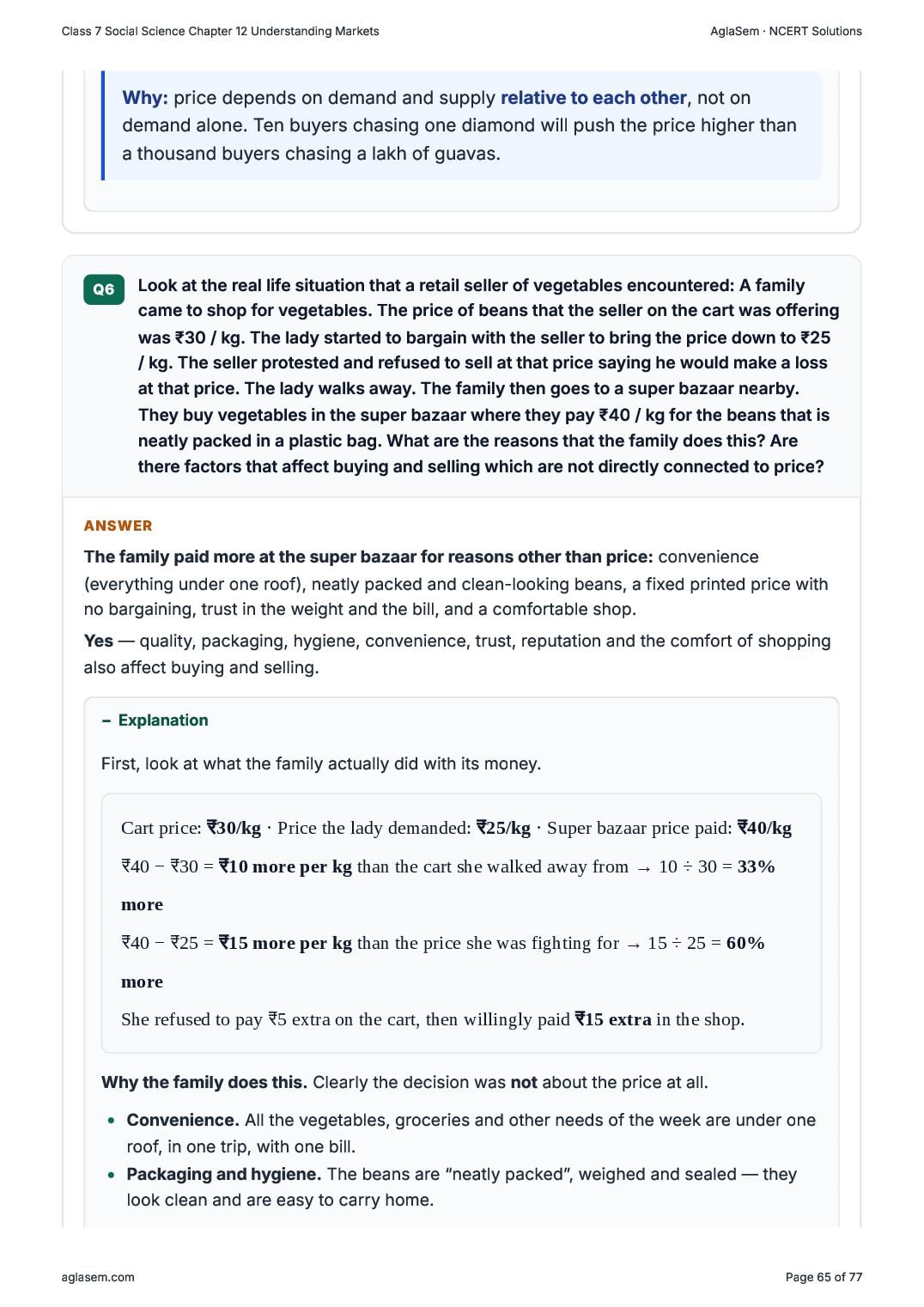
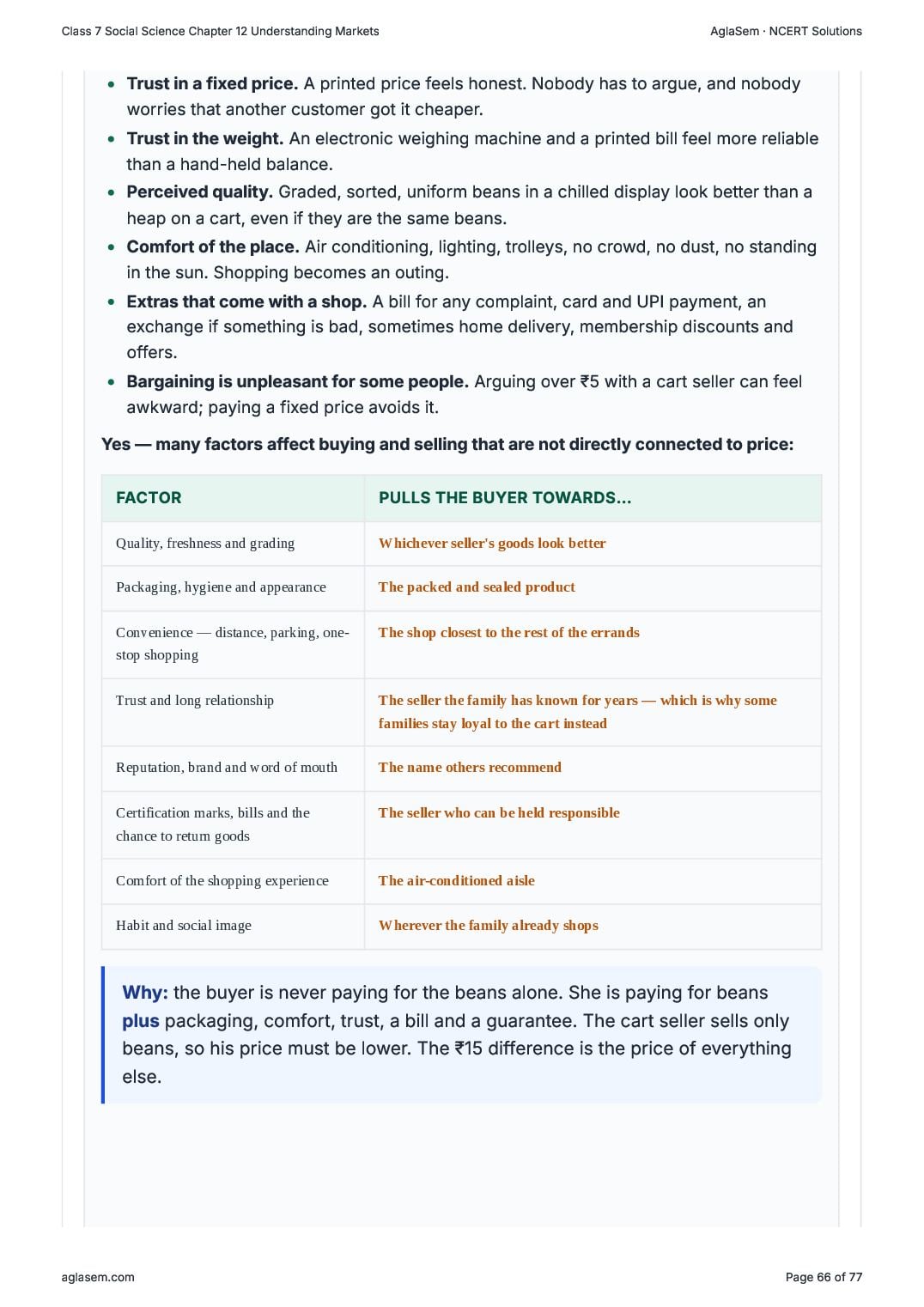
- Look at the real life situation that a retail seller of vegetables encountered: A family came to shop for vegetables. The price of beans that the seller on the cart was offering was ₹30 / kg. The lady started to bargain with the seller to bring the price down to ₹25 / kg. The seller protested and refused to sell at that price saying he would make a loss at that price. The lady walks away. The family then goes to a super bazaar nearby. They buy vegetables in the super bazaar where they pay ₹40 / kg for the beans that is neatly packed in a plastic bag. What are the reasons that the family does this? Are there factors that affect buying and selling which are not directly connected to price?
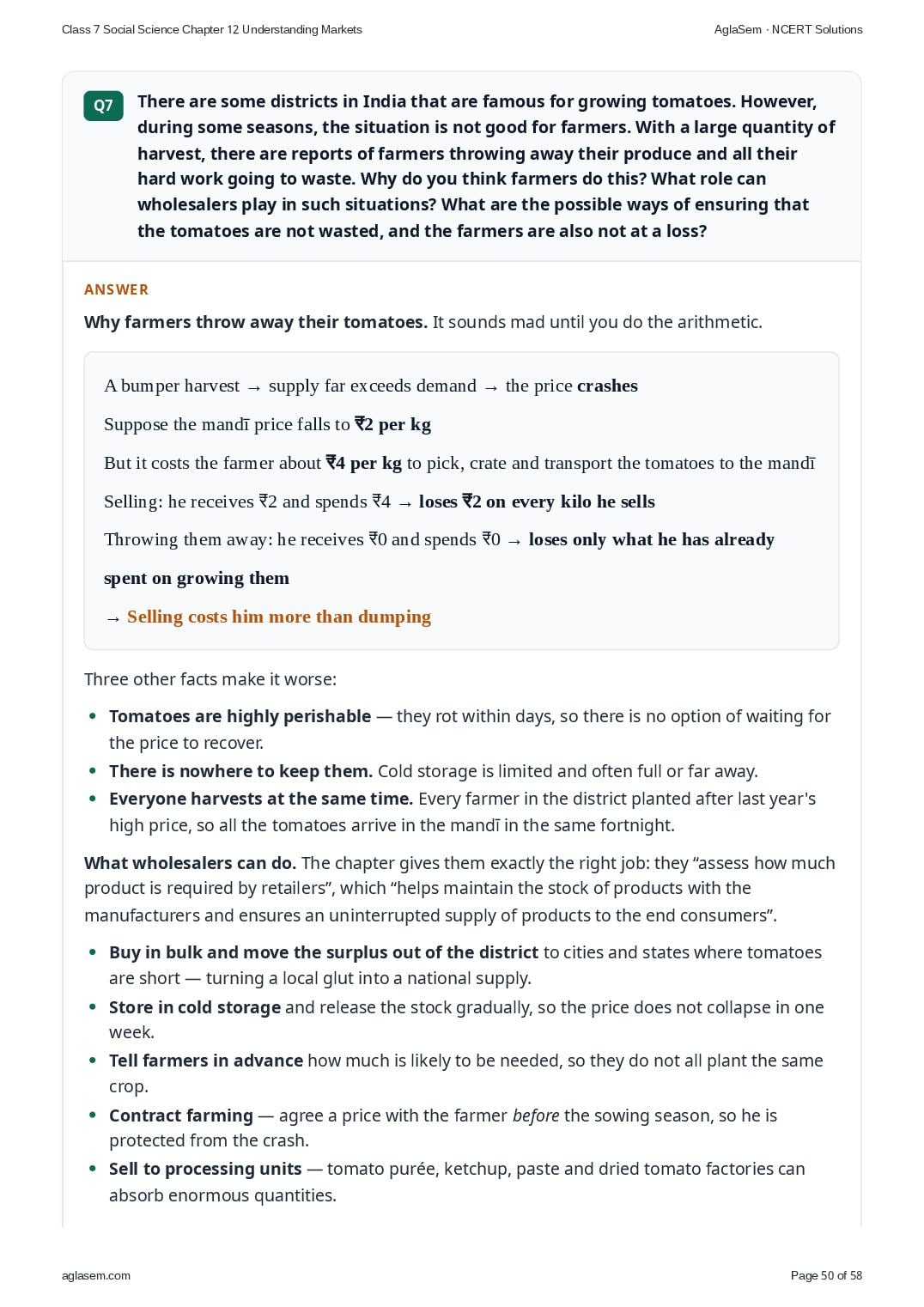
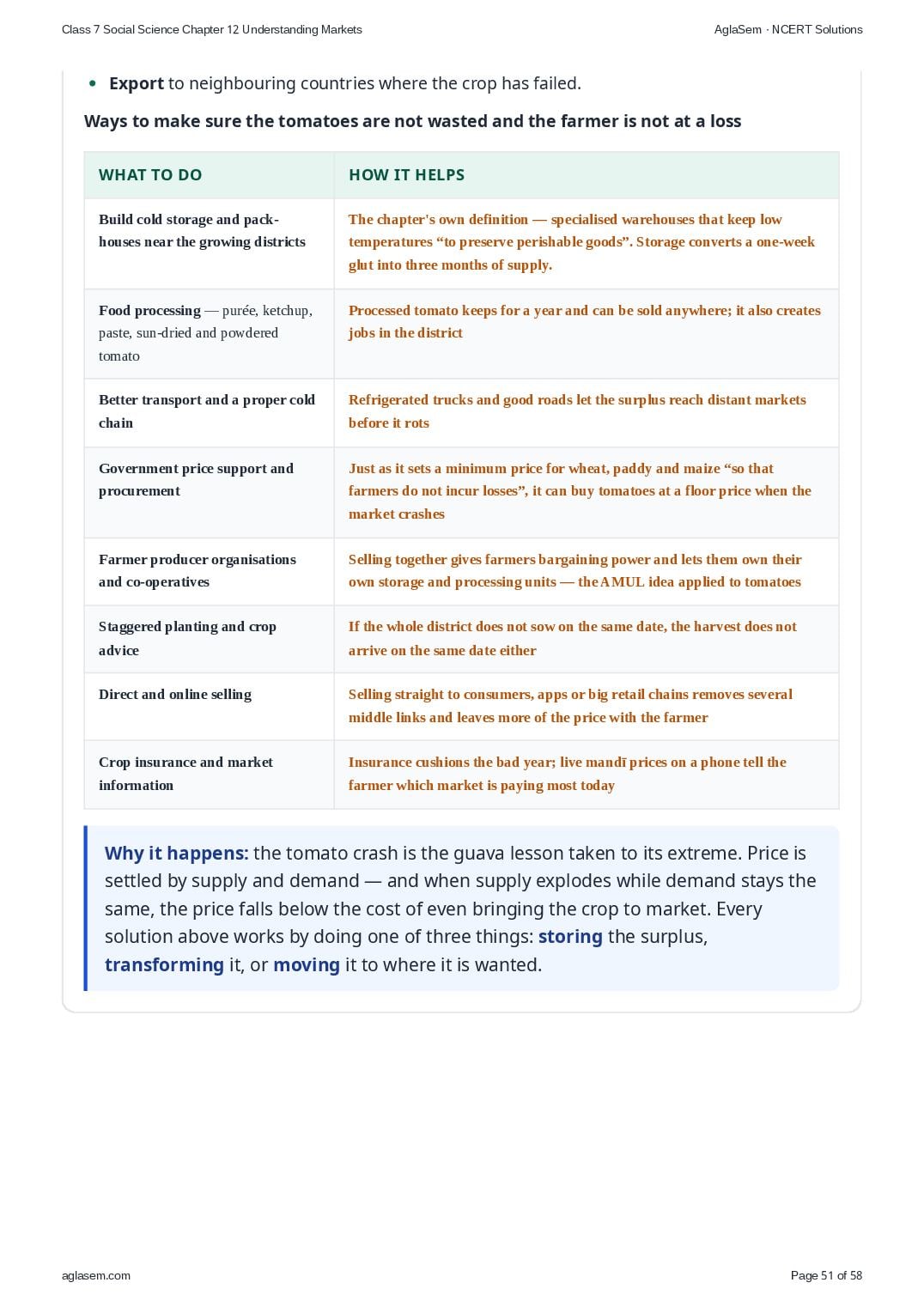
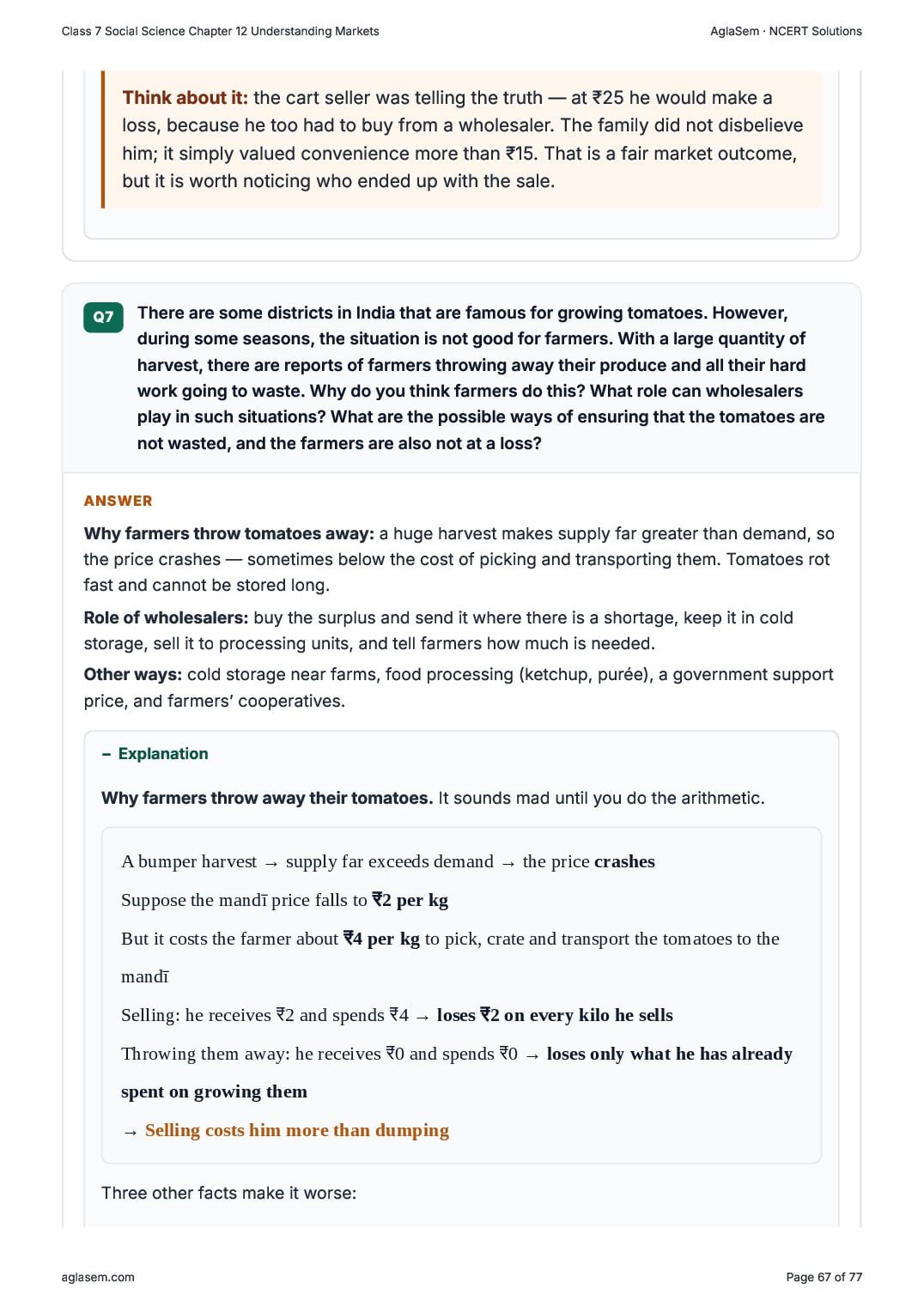
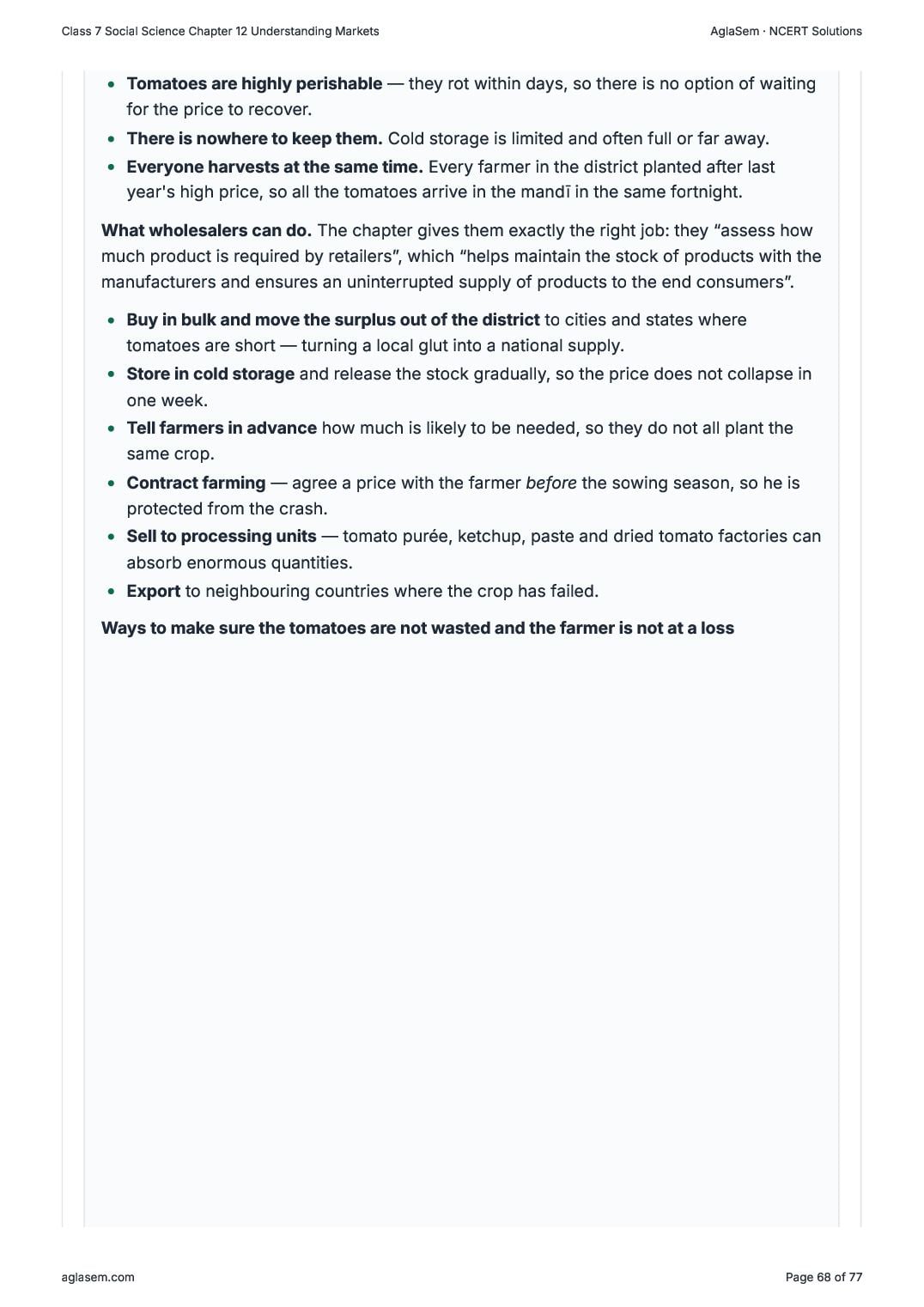
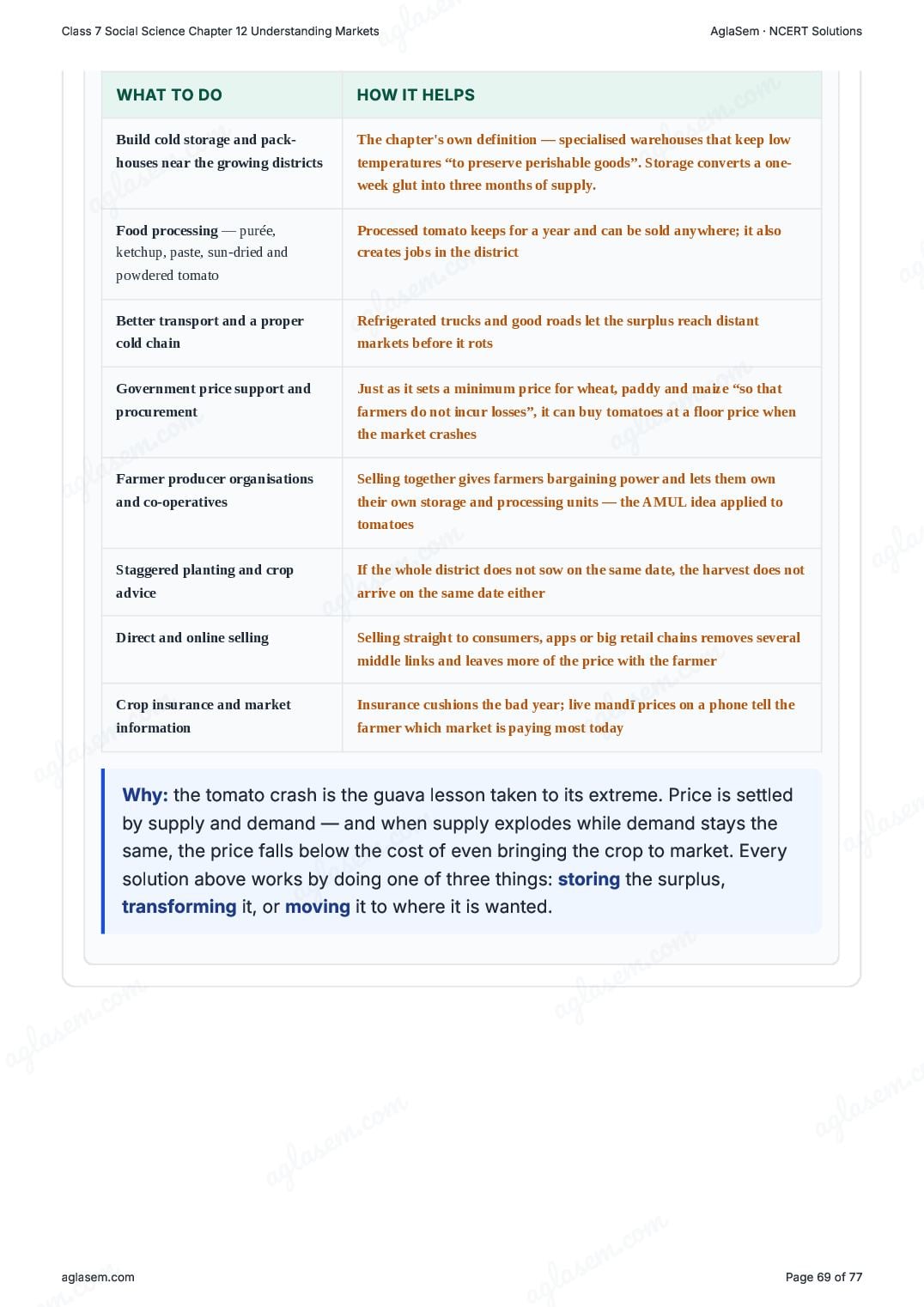
- There are some districts in India that are famous for growing tomatoes. However, during some seasons, the situation is not good for farmers. With a large quantity of harvest, there are reports of farmers throwing away their produce and all their hard work going to waste. Why do you think farmers do this? What role can wholesalers play in such situations? What are the possible ways of ensuring that the tomatoes are not wasted, and the farmers are also not at a loss?
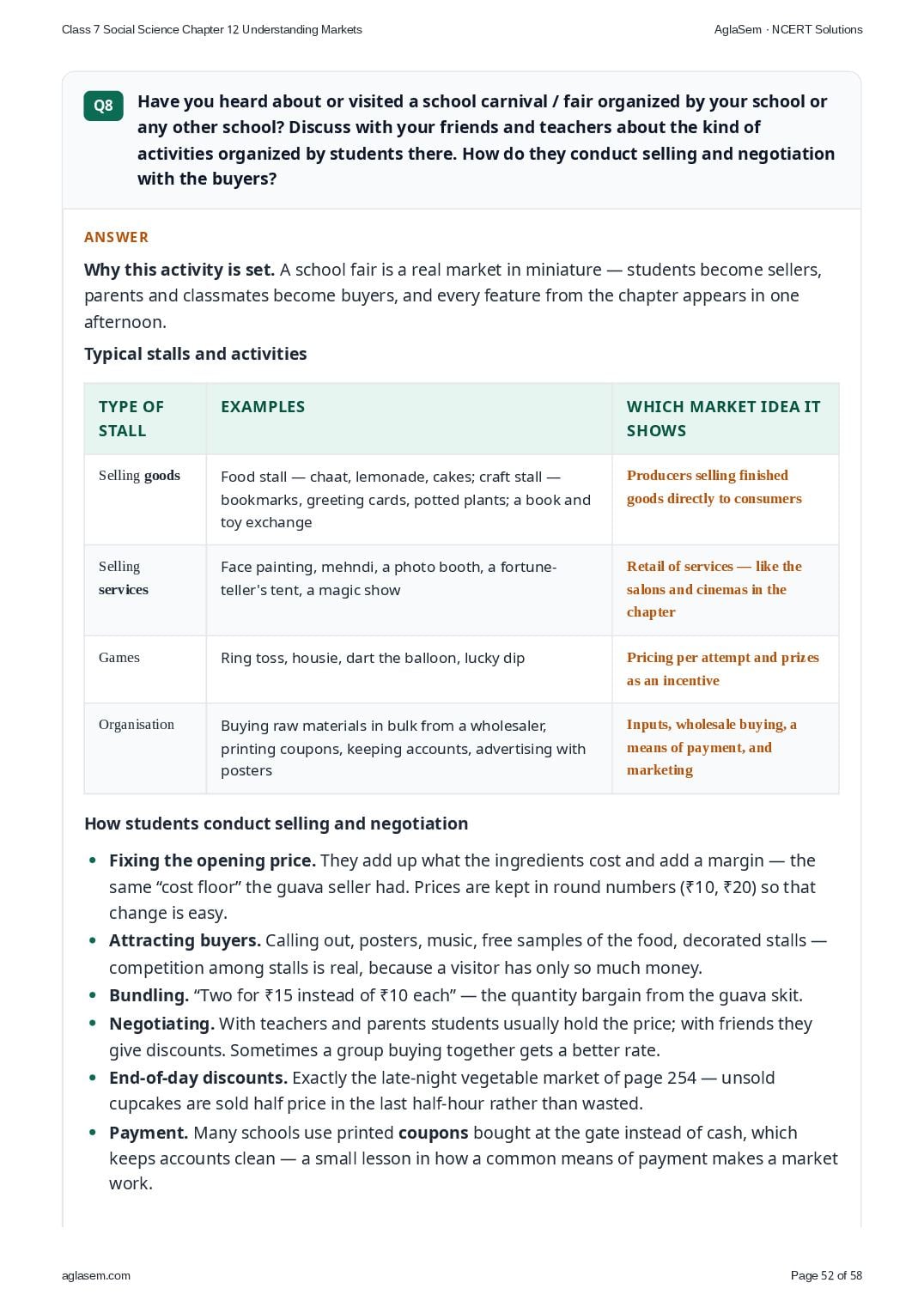
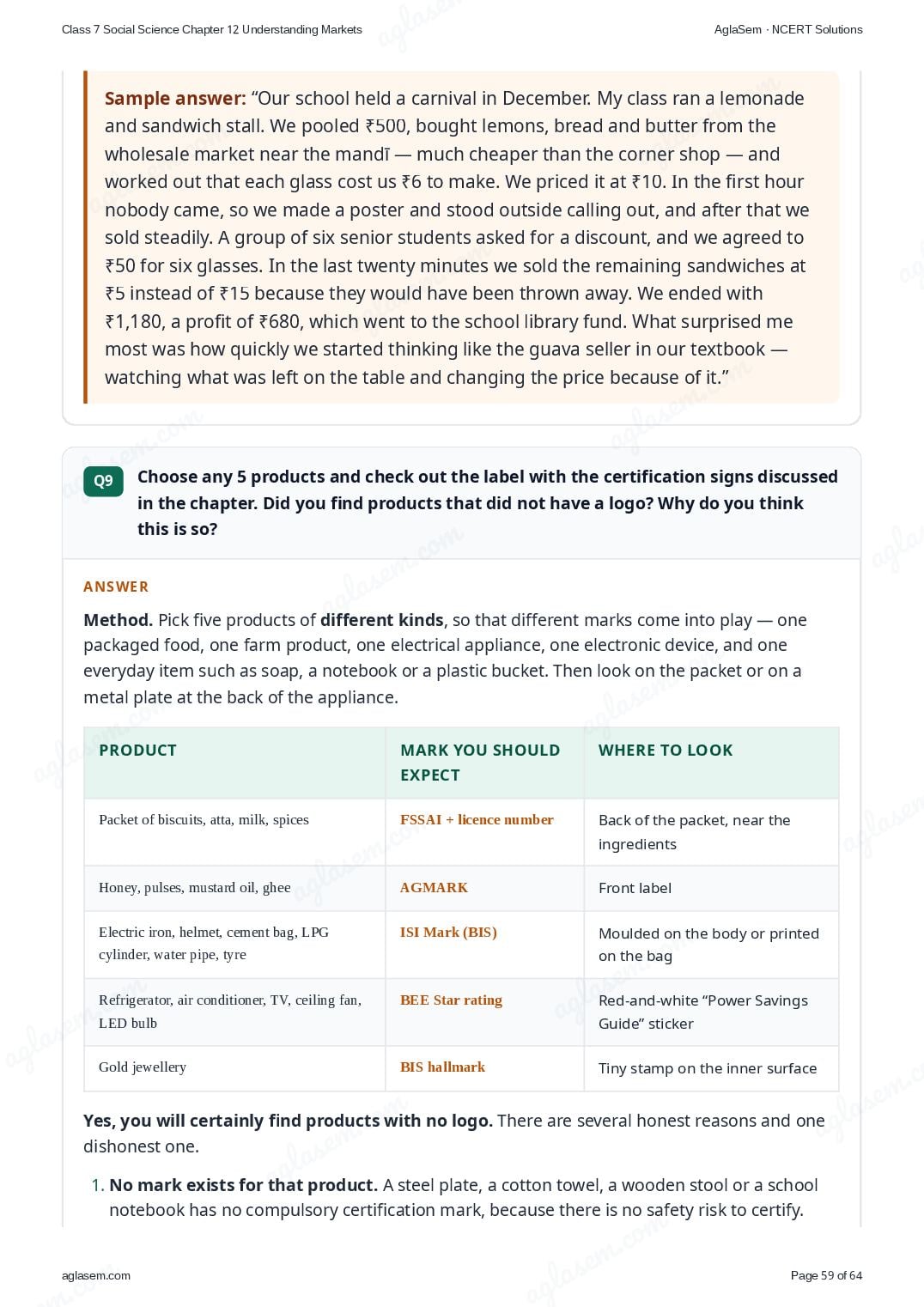
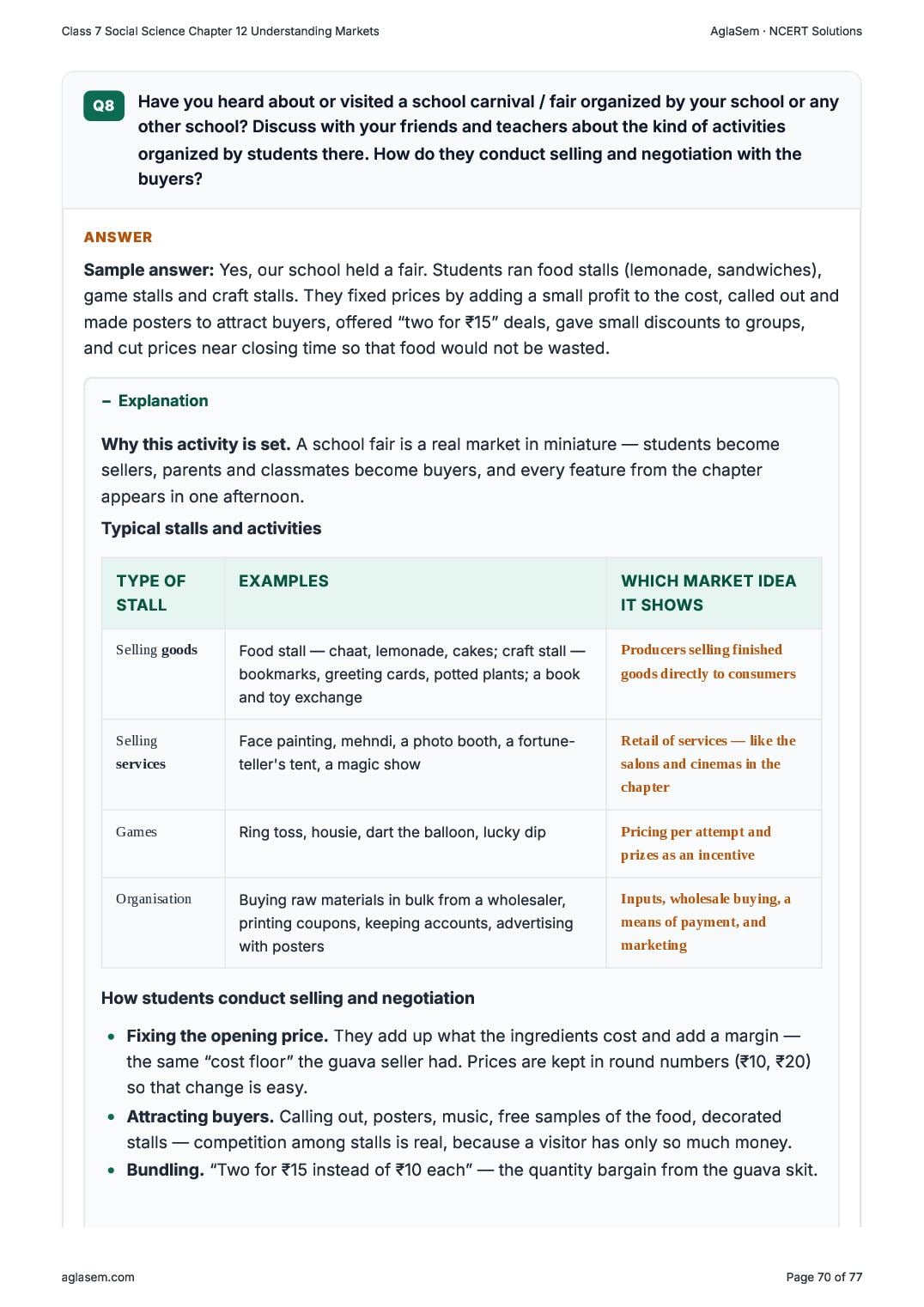
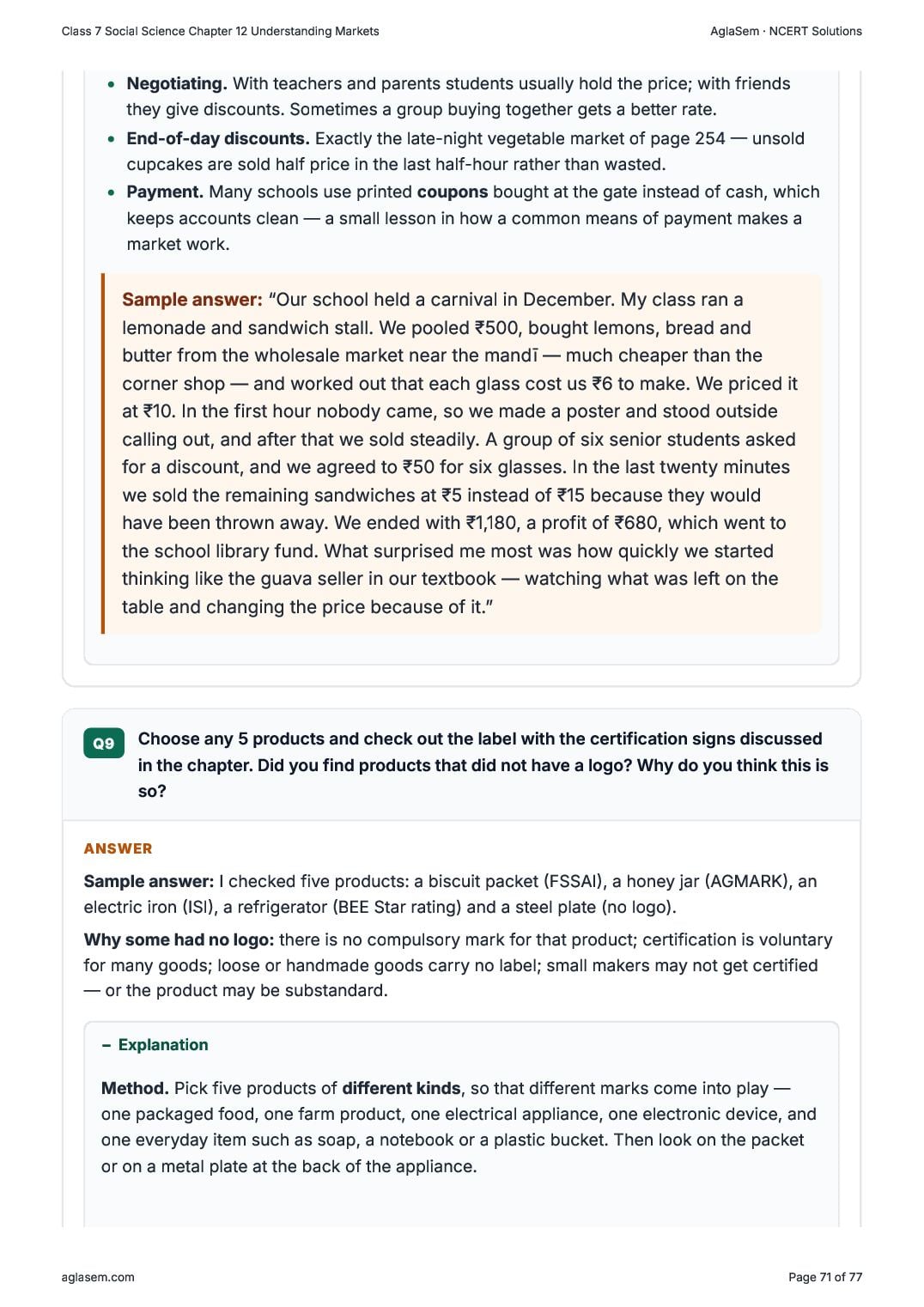
- Have you heard about or visited a school carnival / fair organized by your school or any other school? Discuss with your friends and teachers about the kind of activities organized by students there. How do they conduct selling and negotiation with the buyers?
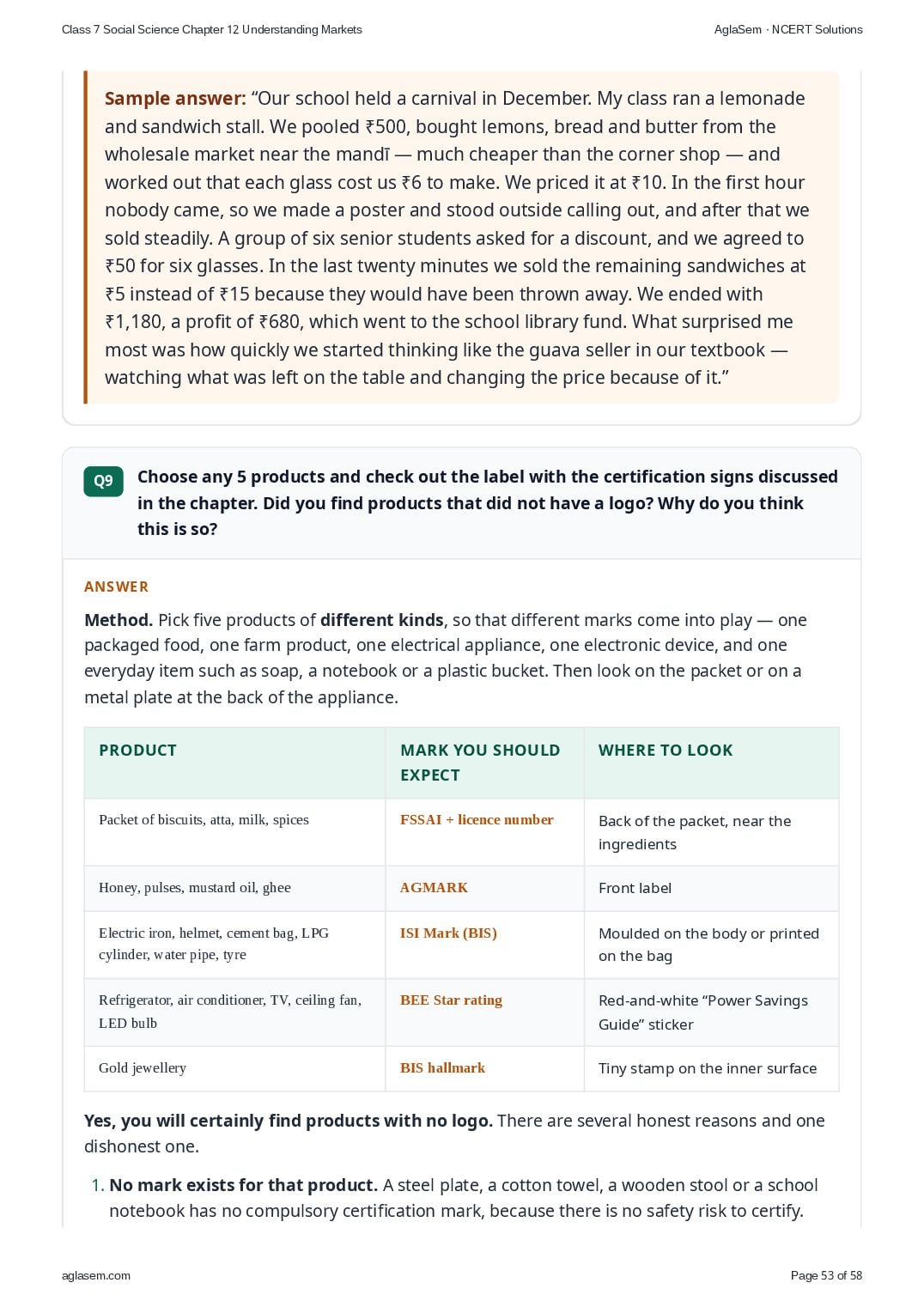
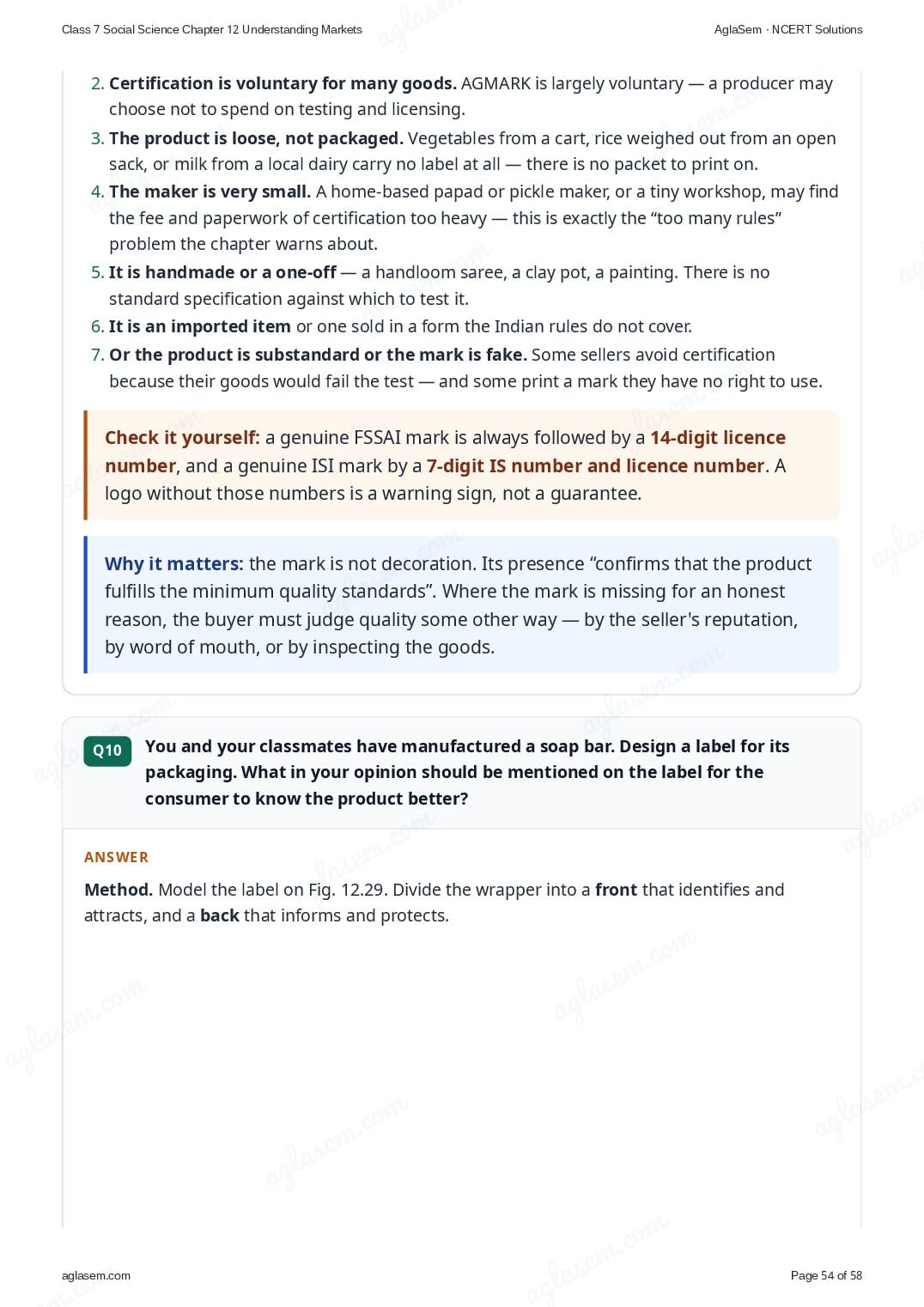
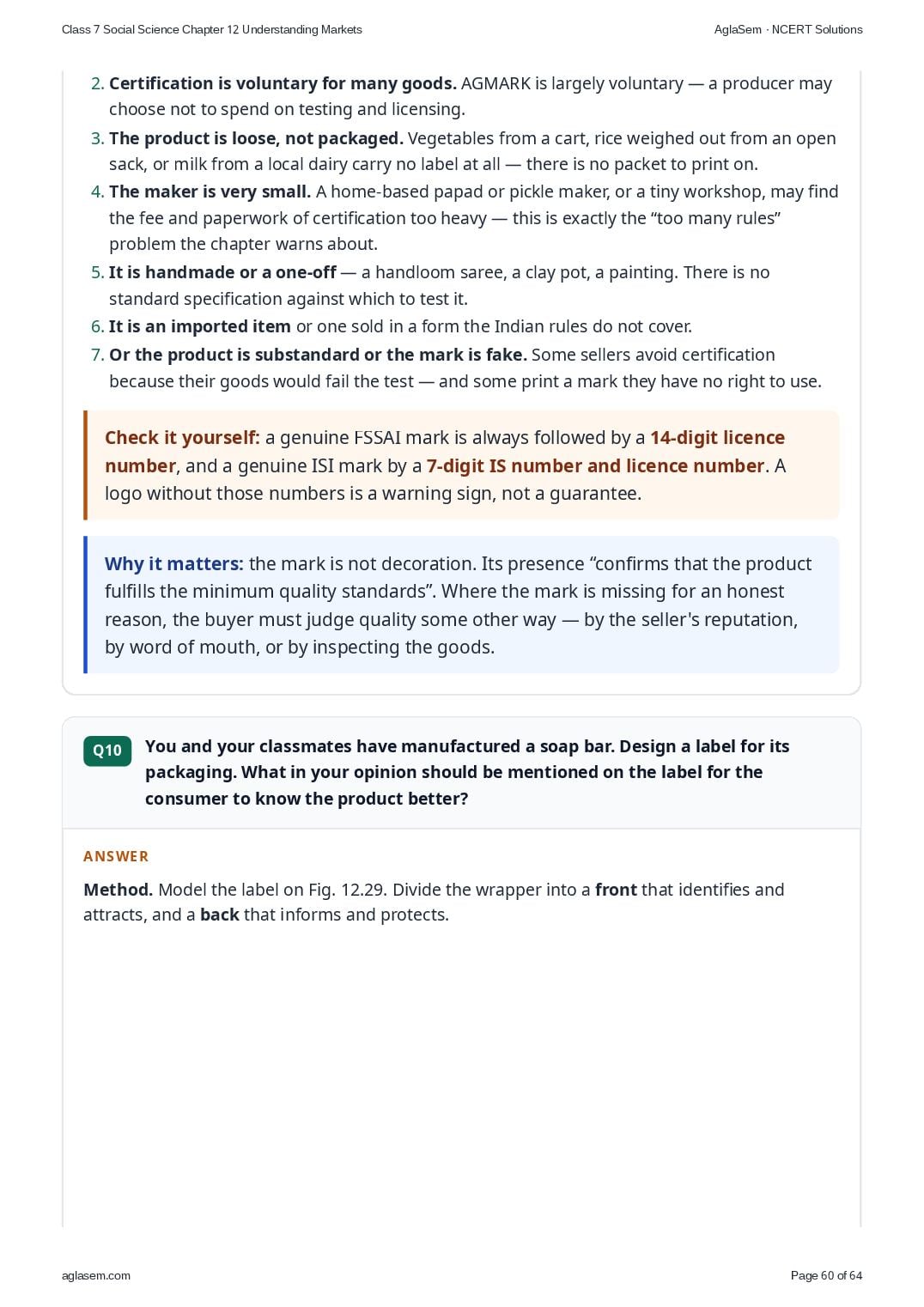
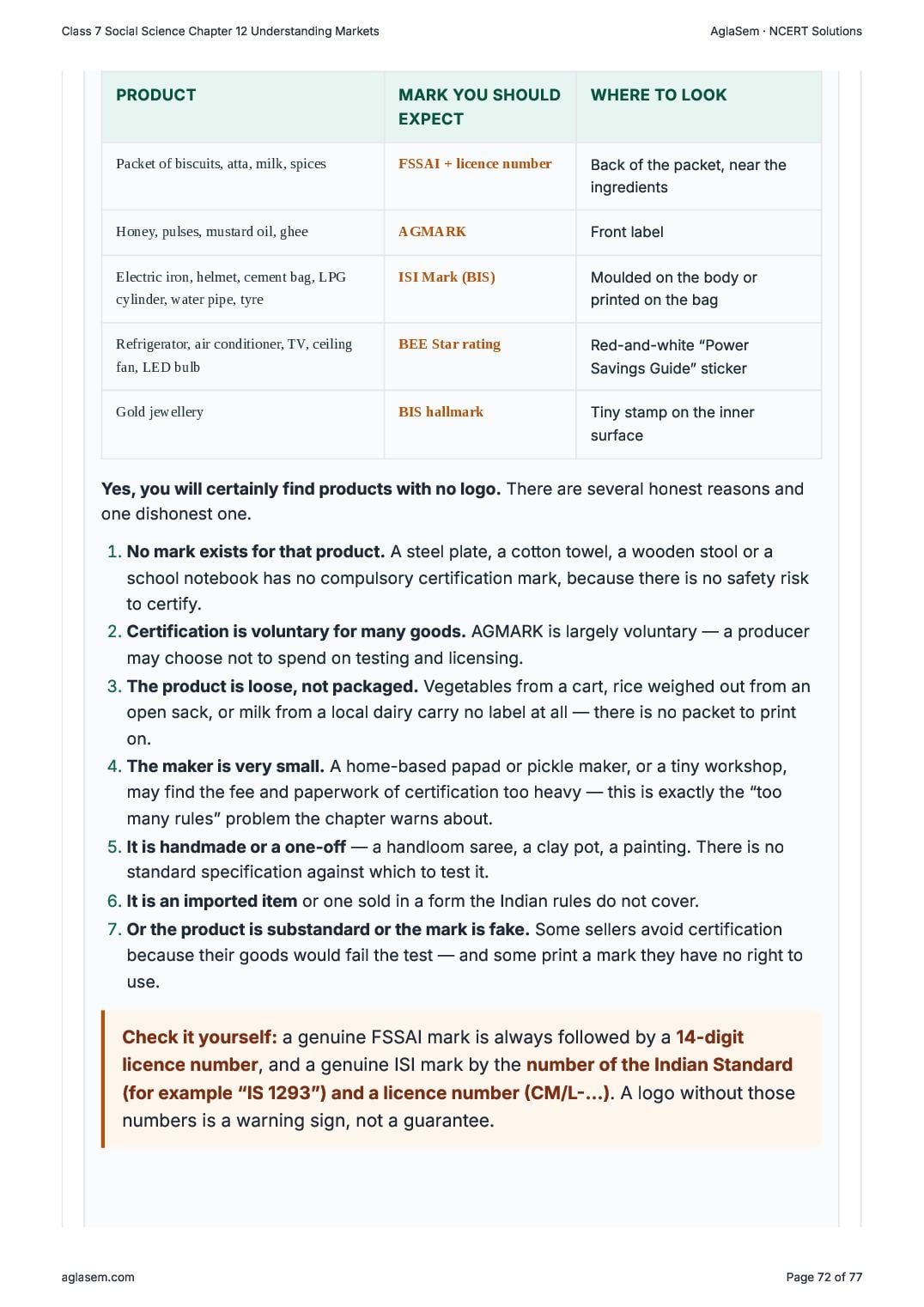
- Choose any 5 products and check out the label with the certification signs discussed in the chapter. Did you find products that did not have a logo? Why do you think this is so?
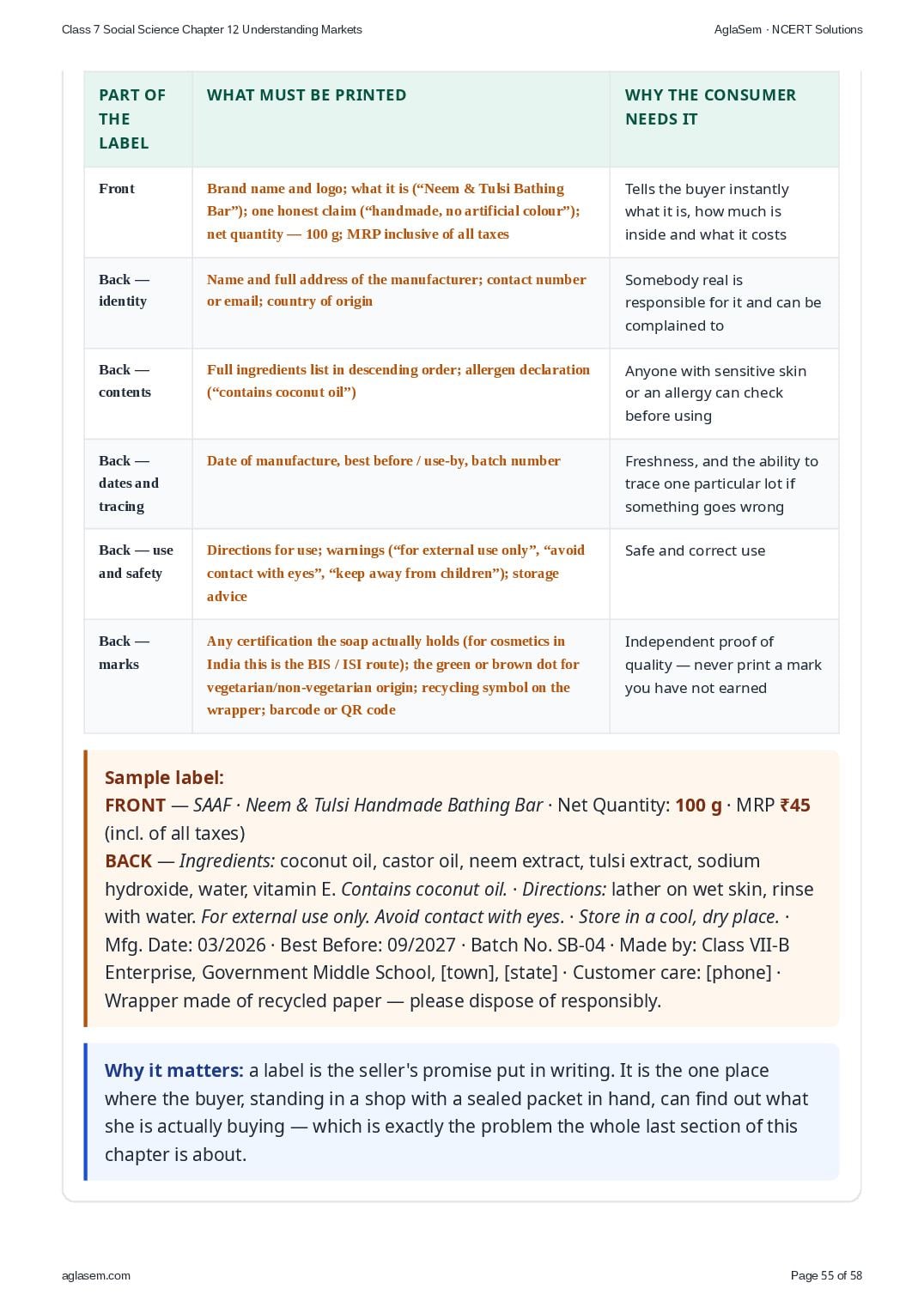
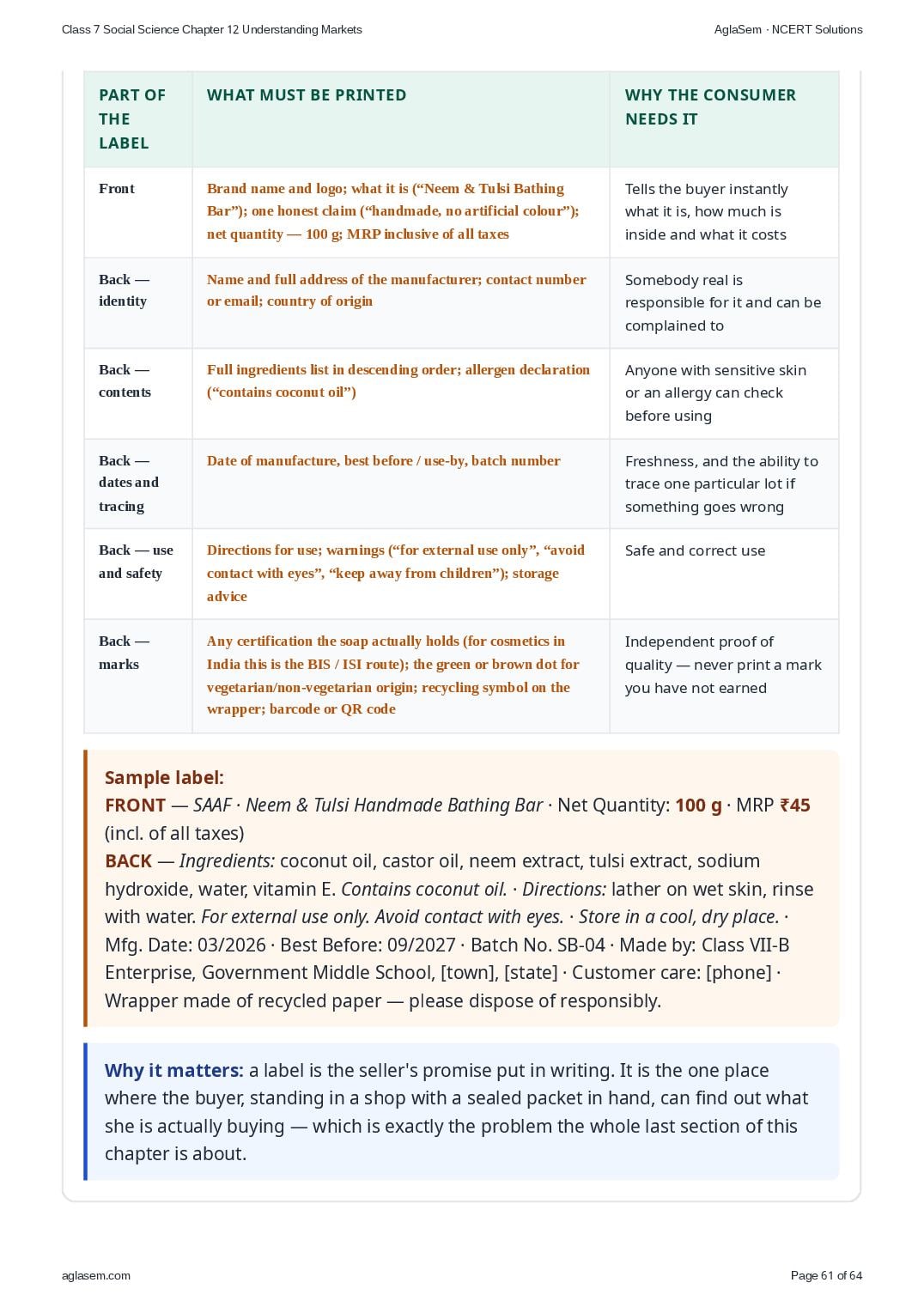
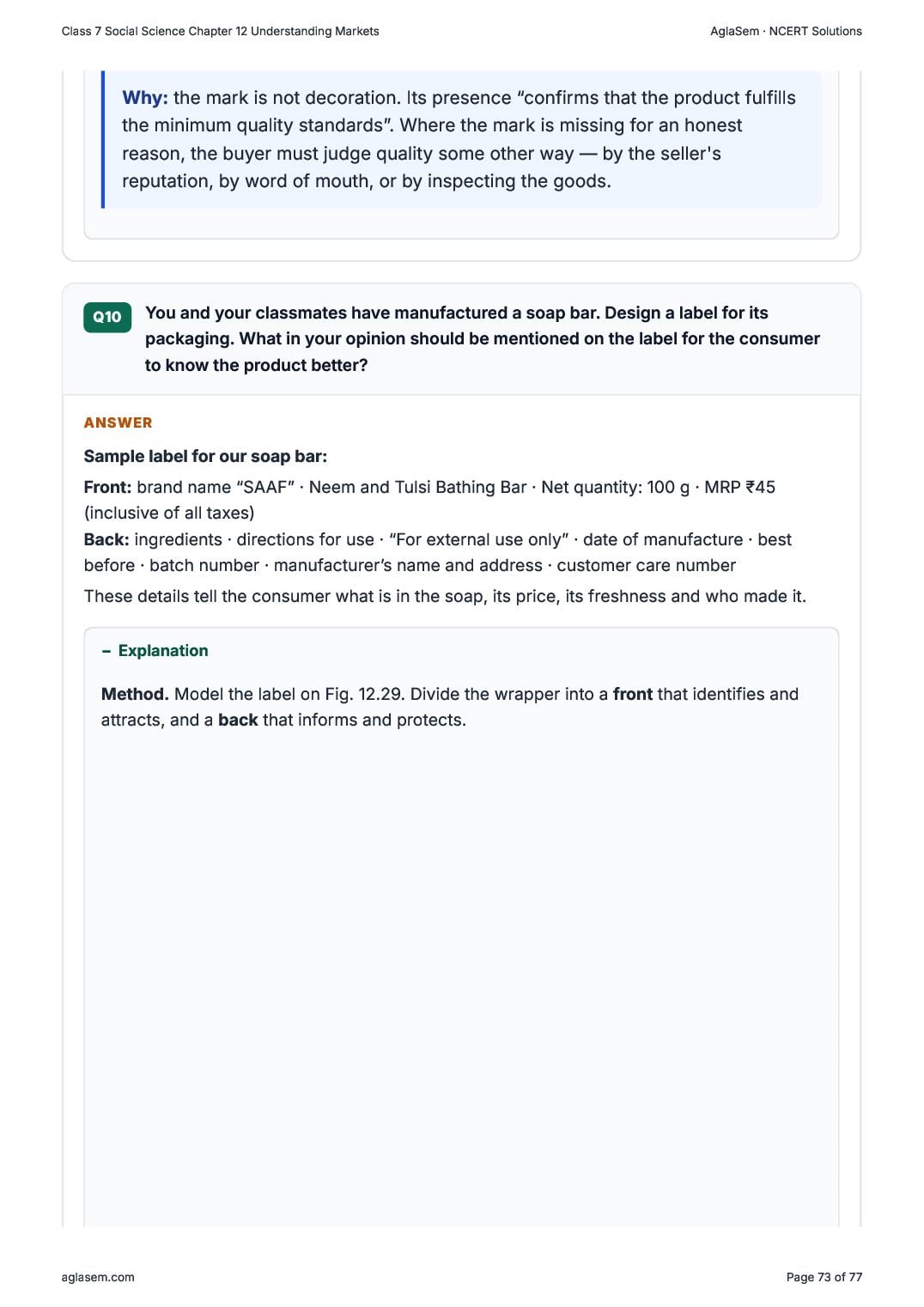
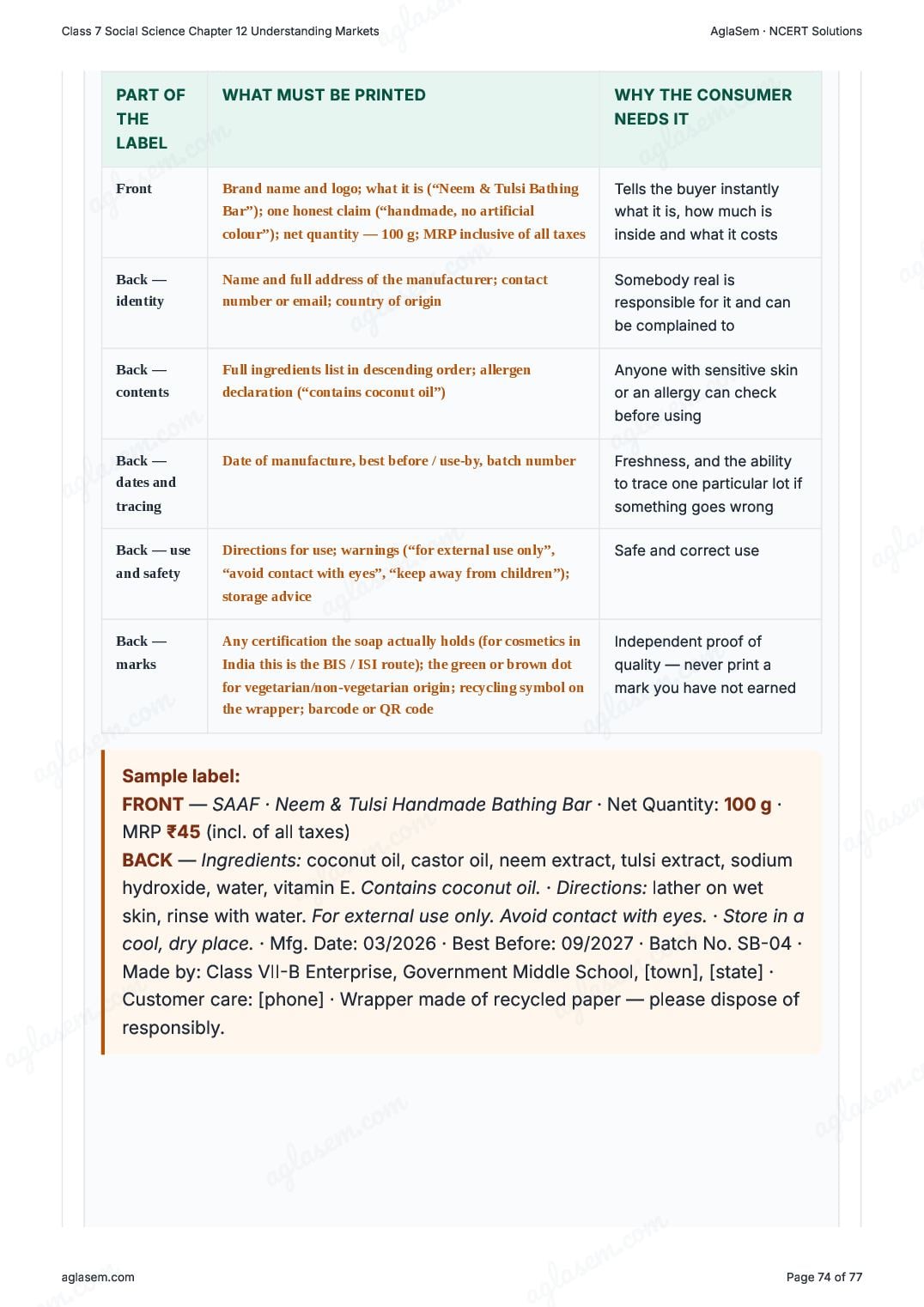
- You and your classmates have manufactured a soap bar. Design a label for its packaging. What in your opinion should be mentioned on the label for the consumer to know the product better?
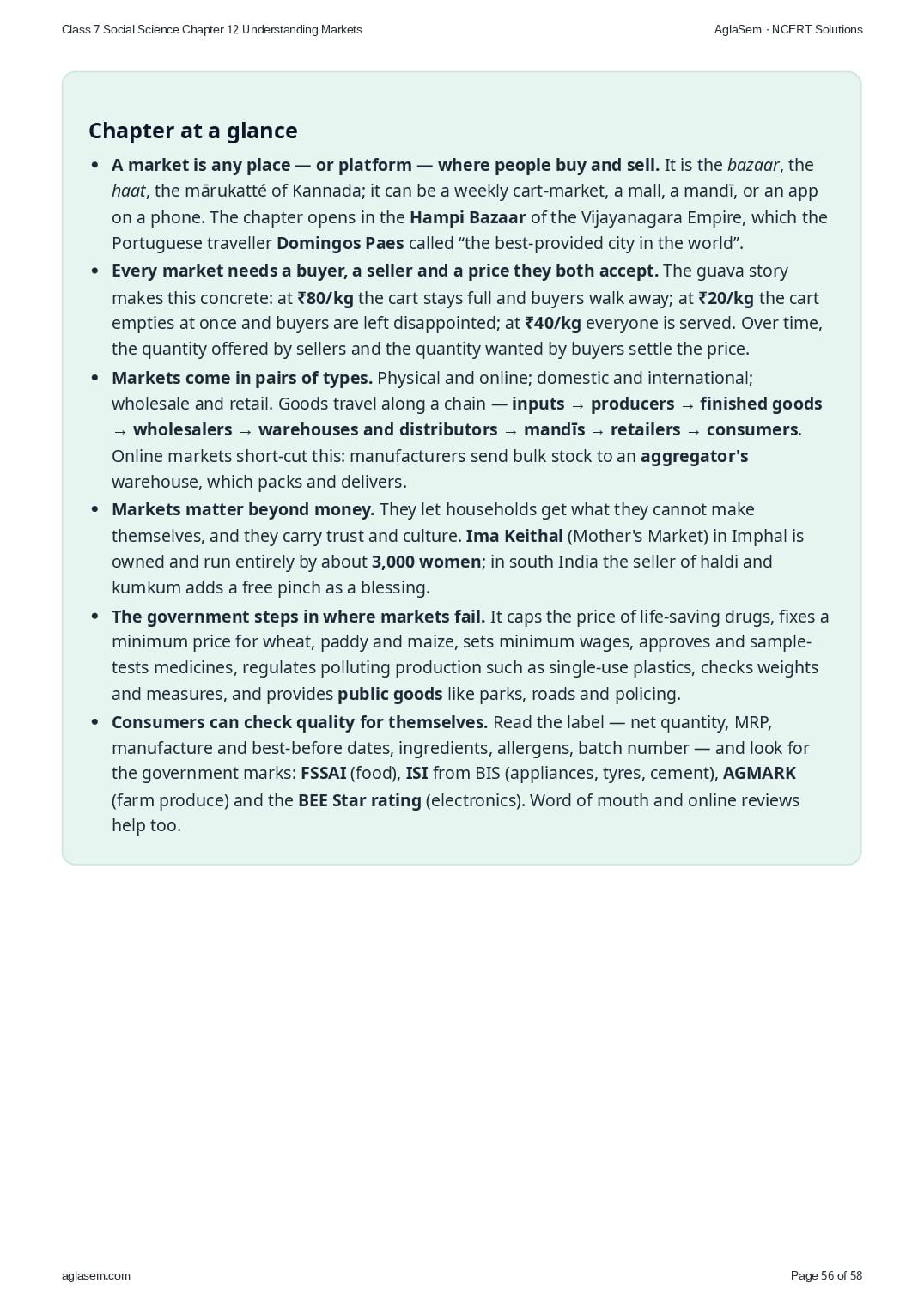
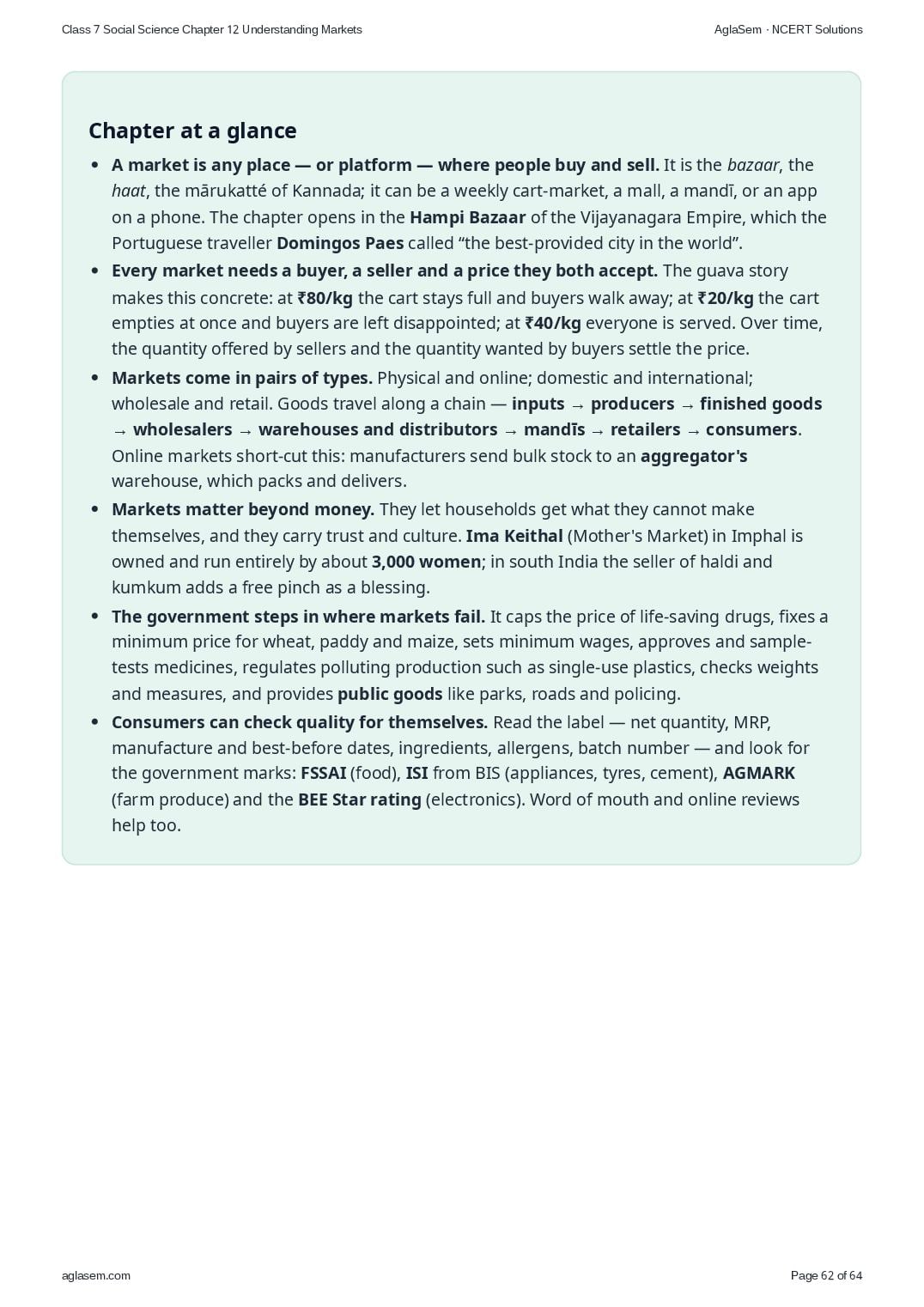
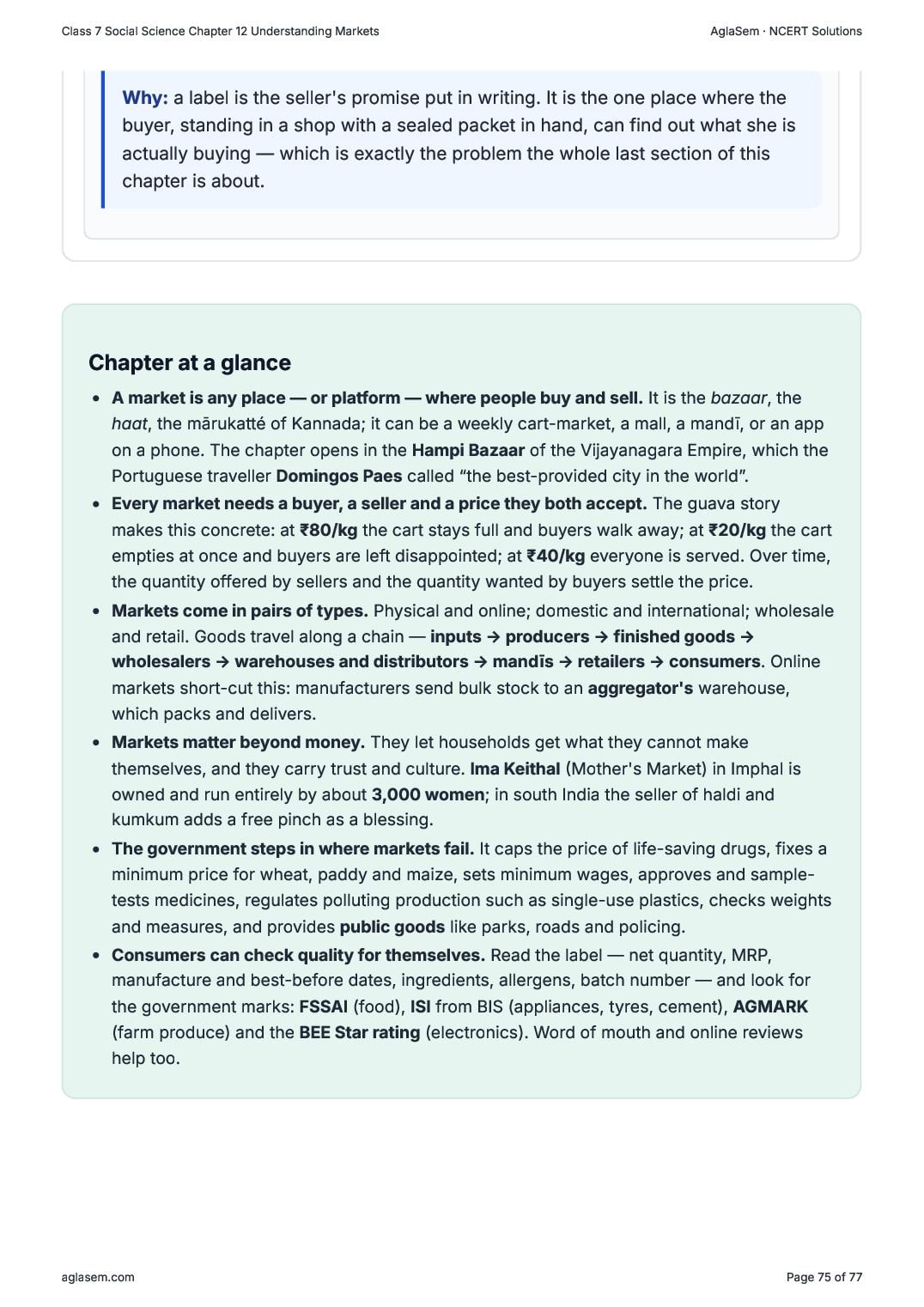
Chapter at a Glance
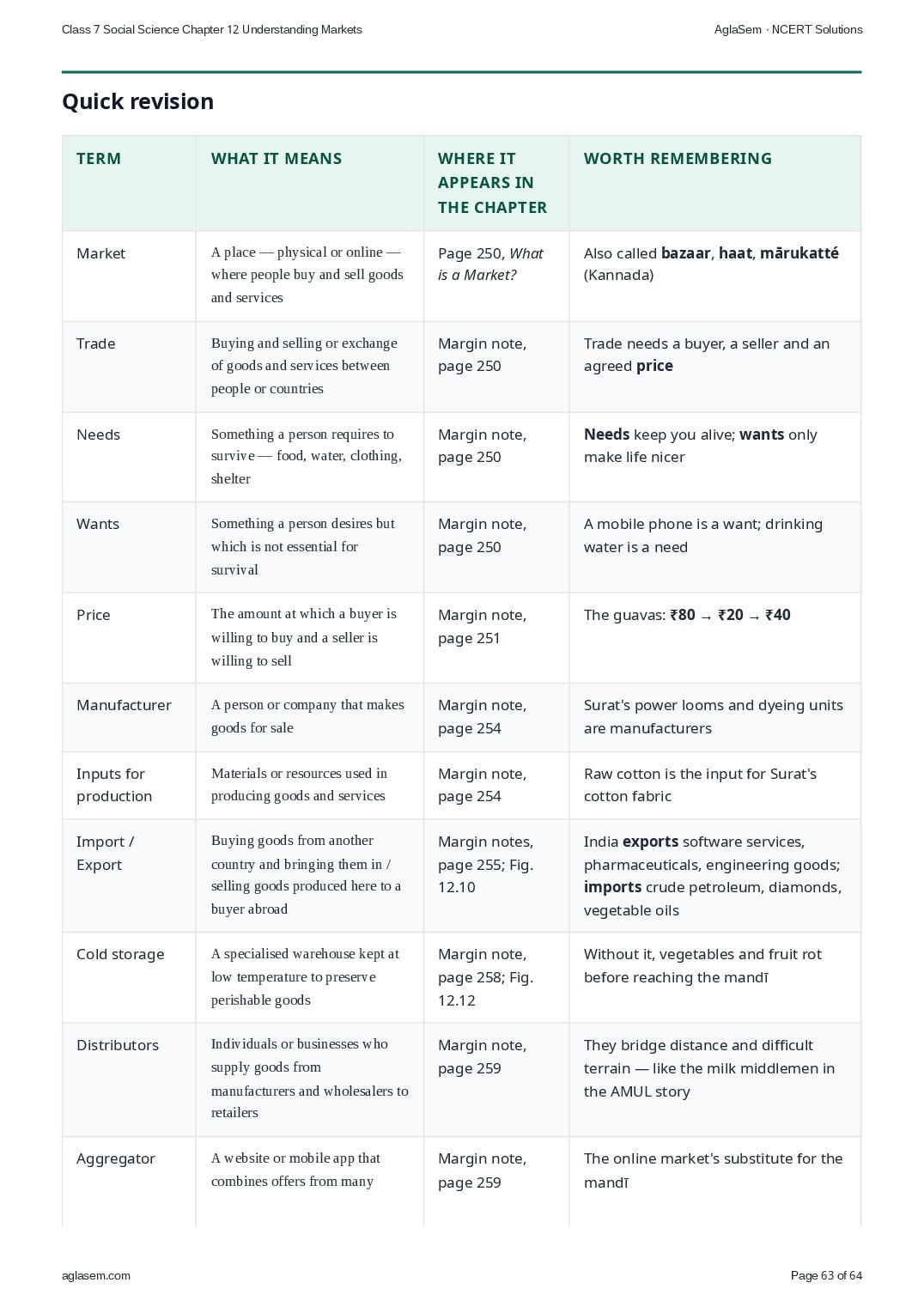
- A market is any place — or platform — where people buy and sell. It is the bazaar , the haat , the mārukatté of Kannada; it can be a weekly cart-market, a mall, a mandī, or an app on a phone. The chapter opens in the Hampi Bazaar of the Vijayanagara Empire, which the Portuguese traveller Domingos Paes called “the best-provided city in the world”.
- Every market needs a buyer, a seller and a price they both accept. The guava story makes this concrete: at ₹80/kg the cart stays full and buyers walk away; at ₹20/kg the cart empties at once and buyers are left disappointed; at ₹40/kg everyone is served. Over time, the quantity offered by sellers and the quantity wanted by buyers settle the price.
- Markets come in pairs of types. Physical and online; domestic and international; wholesale and retail. Goods travel along a chain — inputs → producers → finished goods → wholesalers → warehouses and distributors → mandīs → retailers → consumers . Online markets short-cut this: manufacturers send bulk stock to an aggregator's warehouse, which packs and delivers.
- Markets matter beyond money. They let households get what they cannot make themselves, and they carry trust and culture. Ima Keithal (Mother's Market) in Imphal is owned and run entirely by about 3,000 women ; in south India the seller of haldi and kumkum adds a free pinch as a blessing.
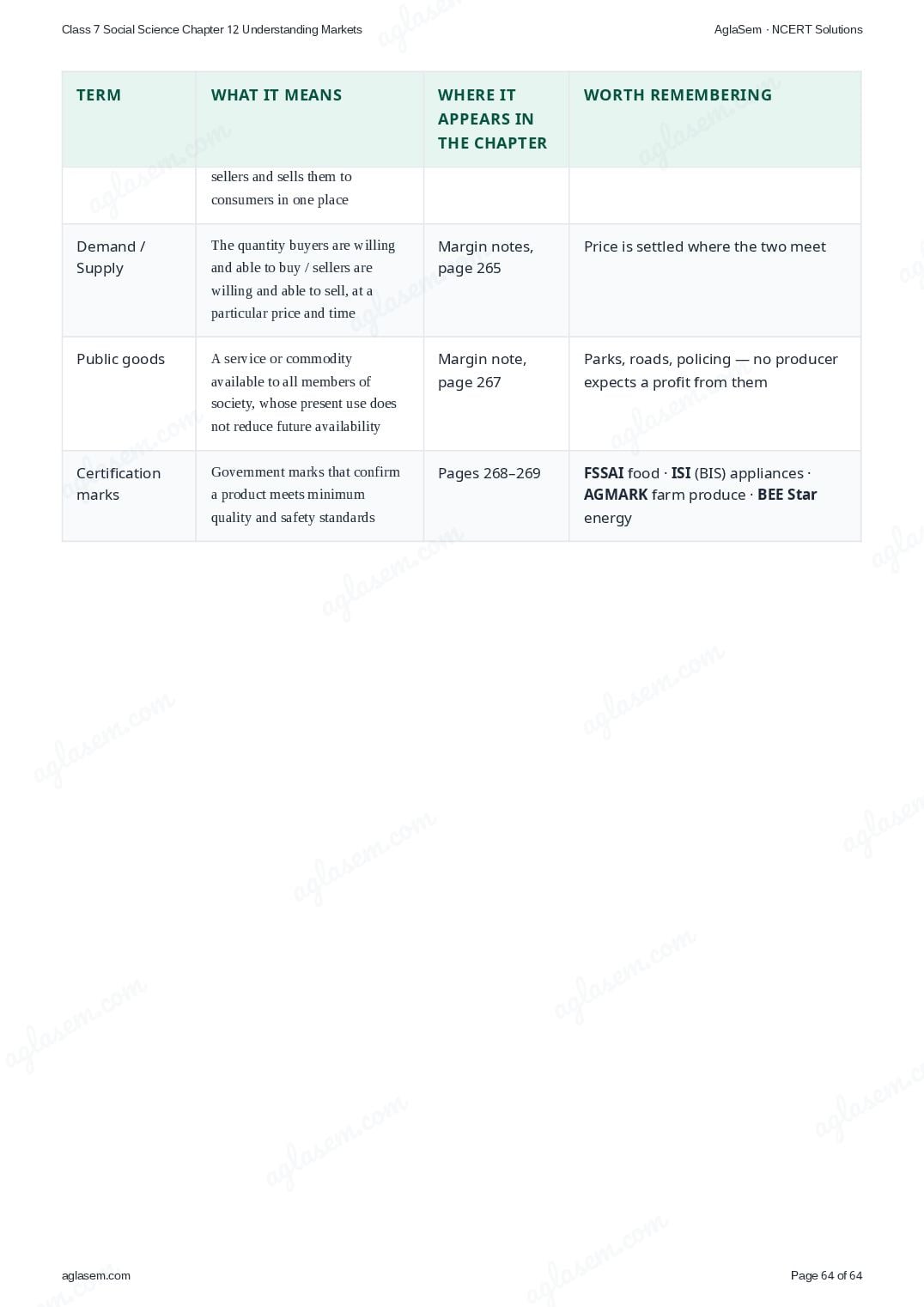
- The government steps in where markets fail. It caps the price of life-saving drugs, fixes a minimum price for wheat, paddy and maize, sets minimum wages, approves and sample-tests medicines, regulates polluting production such as single-use plastics, checks weights and measures, and provides public goods like parks, roads and policing.
- Consumers can check quality for themselves. Read the label — net quantity, MRP, manufacture and best-before dates, ingredients, allergens, batch number — and look for the government marks: FSSAI (food), ISI from BIS (appliances, tyres, cement), AGMARK (farm produce) and the BEE Star rating (electronics). Word of mouth and online reviews help too.
How to Download NCERT Solutions for Class 7 Social Science Chapter 12 PDF
Follow these simple steps to get the Understanding Markets questions-and-answers PDF from Exploring Society India and Beyond.
- Search NCERT Solutions for Class 7 Social Science Chapter 12 aglasem and open this page.
- Read the exercise questions with answers for Understanding Markets shown above.
- Click the Download PDF link to save the Understanding Markets solutions to your device.
NCERT Solutions for Class 7 Social Science – All Chapters
There are more chapters to study besides Understanding Markets in Social Science. Here are the NCERT Solutions for all chapters of Class 7 Social Science.
- Chapter 1 Geographical Diversity of India
- Chapter 2 Understanding the Weather
- Chapter 3 Climates of India
- Chapter 4 New Beginnings Cities and States
- Chapter 5 the Rise of Empires
- Chapter 6 the Age of Reorganisation
- Chapter 7 the Gupta Era an Age of Tireless Creativity
- Chapter 8 How the Land Becomes Sacred
- Chapter 9 From the Rulers to the Ruled Types of Governments
- Chapter 10 the Constitution of India an Introduction
- Chapter 11 From Barter to Money
- Chapter 12 Understanding Markets
NCERT Solutions for Class 7 – All Subjects
Just like Chapter 12 of Social Science, you can get the exercise questions with answers for every other subject of Class 7. Here are the NCERT Solutions for all subjects of Class 7.
NCERT Solutions for Class 7 Social Science Chapter 12 – An Overview
The key highlights of this study material are as follows.
| Aspects | Details |
|---|---|
| Class | Class 7 |
| Subject | Social Science |
| Chapter Number | Chapter 12 |
| Chapter Name | Understanding Markets |
| Book Name | Exploring Society India and Beyond |
| Book By | NCERT (National Council of Educational Research and Training) |
| Educational Resource Here | NCERT Solutions of Class 7 Social Science Chapter 12 for all exercises |
| More Questions Answers of This Subject | NCERT Solutions for Class 7 Social Science |
| Download Book Chapter | NCERT Book Class 7 Social Science |
| All Questions Answers For This Class | NCERT Solutions for Class 7 |
| Complete Solutions | NCERT Solutions |
NCERT Solutions for Class 7 Social Science Chapter 12 Understanding Markets – FAQs
What are the NCERT Solutions for Class 7 Social Science Chapter 12 Understanding Markets?
They are the complete, step-by-step answers to all the exercise and in-text questions of Chapter 12 Understanding Markets from the NCERT Class 7 Social Science textbook Exploring Society India and Beyond, written by experts as per the latest NCERT syllabus.
How can I download the Class 7 Social Science Chapter 12 solutions PDF for free?
Open this page on aglasem, read the Understanding Markets questions with answers, and click the “Download Solutions PDF” link. The Class 7 Social Science Chapter 12 NCERT Solutions PDF is completely free to download.
Are these NCERT Solutions as per the latest 2026-27 syllabus?
Yes. The NCERT Solutions for Class 7 Social Science Chapter 12 are based on the latest NCERT textbook Exploring Society India and Beyond and the current 2026-27 CBSE syllabus, so the questions and answers match what you study in class.
Where can I get NCERT Solutions for the other chapters of Class 7 Social Science?
You can find the answers to every chapter on the NCERT Solutions for Class 7 Social Science page, and solutions for every subject on the NCERT Solutions for Class 7 page.
How do NCERT Solutions help in exam preparation?
They show the correct method to solve each question, help you write answers the way they are expected in exams, let you check and correct your own work, and save revision time — which together improve your marks in Class 7 Social Science.
If you have any queries on NCERT Solutions for Class 7 Social Science Chapter 12 Understanding Markets, then please ask in the comments below.