NCERT Solutions for Class 7 Social Science Chapter 15 Empires and Kingdoms: 6th to 10th Centuries – step-by-step answers to every exercise and in-text question of the chapter, as per the latest NCERT syllabus for 2027. Read them online or download the free question-answer PDF.
Answers to Chapter 15, Empires and Kingdoms: 6th to 10th Centuries — the third chapter of Theme B, Tapestry of the Past, in Exploring Society: India and Beyond (Grade 7, Part 2). Every question the chapter asks is answered here: the three Big Questions, all nine LET’S EXPLORE boxes, all five THINK ABOUT IT boxes that ask something, the DON’T MISS OUT question about two-language inscriptions, the three questions asked inside the running text (pages 63, 75 and 82), the six points of Before we move on …, and all seven end-of-chapter Questions and activities. The boxes that carry no question — DON’T MISS OUT on Kādambarī, on Nrupatunga Road, on Kalhaṇa, on the Bhauma-Kara queens and on the Indian numerals; THINK ABOUT IT on Dharmapāla’s beliefs and on the twelve dynasties; and LET’S REMEMBER on the merchant guilds — are folded into the answers and the revision table below. Every date, name and quotation here is taken from the chapter itself.
NCERT Solutions for Class 7 Social Science Chapter 15 Empires and Kingdoms: 6th to 10th Centuries PDF
All the answers are on this page below. The PDF also explains every answer – why it is right and how to check it – so download it for revision.
| Chapter | Download | |
|---|---|---|
| Solutions PDF | Empires and Kingdoms: 6th to 10th Centuries | View PDF |
NCERT Solutions for Class 7 Social Science Chapter 15 Empires and Kingdoms: 6th to 10th Centuries – Questions and Answers
All 42 questions of the chapter (textbook pages Part II, 61 – 96) are answered below, in the order of the book – in-text questions, activities and the end-of-chapter exercises. Each answer is written the way you would write it in the exam.
The Big Questions — Page 61Chapter opening — Theme B, Tapestry of the Past
The main changes were:
- One large empire gave way to many strong regional kingdoms — the Puṣhyabhūtis, Pālas, Gurjara-Pratīhāras, Rāṣhṭrakūṭas, Chālukyas, Pallavas, Cholas and others.
- Kings ruled a core region directly and the rest through sāmantas (vassals).
- Land grants spread, bringing new land under cultivation.
- Regional languages such as Kannada, Tamil and Telugu grew beside Sanskrit.
- The Bhakti tradition spread across India.
- Jātis multiplied, and society became more complex.
Politically, India was divided among many regional kingdoms that often fought one another; culturally and religiously, these same regions grew richer, and India remained “all part of one India”. Kings competed as patrons: they built temples such as the Kailaśhanātha at Ellora, supported universities like Vikramaśhilā and Nālandā, and encouraged Sanskrit along with Kannada, Tamil and Telugu. Rulers patronised Hindu, Buddhist and Jain traditions alike, and Bhakti spread devotion in local languages.
Foreign invaders were resisted, and most were absorbed. The Hūṇas were defeated by the Aulikara kings and, by the 7th century, had assimilated into Indian society, using Sanskrit, Gupta-style coins and Indian deities. The Arabs conquered Sindh in 712, but Indian rulers such as Nāgabhaṭa I pushed them back, and after three centuries they held only two small states in Sindh and Punjab. Through trade and learning, Indian numerals and the zero reached the Arab world and Europe.
In-text Question — Page 63The opening survey — was this an ending or a beginning?
It is both. It was the end of an age of large empires: after the Guptas, no single power controlled most of India for long. But it was also the dawn of a new era: regional kingdoms produced great temples (Ellora, Māmallapuram), universities (Vikramaśhilā), new literature, the Bhakti movement and advances in mathematics. The chapter calls it “a period of transformation and regional consolidation”, not a historical void.
LET’S EXPLORE — Page 64The ‘Great King of Kings’ — the shift of the capital to Kannauj
At Pāṭaliputra — present-day Patna, in Bihar, on the Ganga. Both the Mauryas and the Guptas ruled from there (you met it in Part 1 of this textbook, in ‘The Rise of Empires’ and ‘The Gupta Era’).
It made Kannauj the prize of north Indian politics. Kannauj lay in the rich Ganga plain and could be reached from the west, the east and the Deccan. So after Harṣha, the Gurjara-Pratīhāras, the Pālas and the Rāṣhṭrakūṭas fought over it through the 8th and 9th centuries — the Tripartite Struggle — “with fluctuating outcomes and no lasting victor”. No single power could dominate the north for long.
LET’S EXPLORE — Page 64Harṣha’s signature on the Banskhera copper plate (Fig. 3.5)

The line reads svahasto mama mahārājādhirāja śhrī harṣhasya — “By my own hand, the great king of kings, Śhrī Harṣha”. It is written in Nagari, the script that later became Devanagari, so many letters are recognisable if you read Hindi. Take it word by word.
| Word in the plate | In Devanagari | Meaning | Letters you can pick out |
|---|---|---|---|
| svahasto | स्वहस्तो | ‘by my own hand’ | the conjunct स्व at the start, then ह (ha) and स्त (sta) |
| mama | मम | ‘my’ | two identical म (ma) shapes side by side — the easiest word to spot |
| mahārājādhirāja | महाराजाधिराज | ‘great king of kings’ | म, हा, रा, ज — and notice रा and ज repeat, because ‘rāja’ occurs twice |
| śhrī | श्री | an honorific, ‘revered’ | the familiar श्री you still see at the top of letters and shop boards |
| harṣhasya | हर्षस्य | ‘of Harṣha’ | ह again, the r mark above (रेफ), ष and the ending स्य |
LET’S EXPLORE — Page 66Xuanzang’s route from China to India and back (Fig. 3.7)
Deserts: the Gobi Desert and the Taklamakan Desert. Mountains: the Hindu Kush, which he crossed on his way into India and again on his way back. He did not cross the Himalayas or the Plateau of Tibet head-on; he went round them and entered India from the northwest through Bamiyan, Kabul and Taxila.
Nālandā, Bodh Gaya, Lumbini, Taxila, Mathura, Amaravati and Kānchī. Nālandā was the greatest Buddhist university of the time, where Xuanzang himself studied; Bodh Gaya is where the Buddha attained enlightenment; Lumbini is his birthplace; Taxila was an ancient centre of learning in the northwest; Amaravati was a famous stūpa site; and Kānchī had, by his account, 100 Buddhist monasteries.
THINK ABOUT IT — Page 67Harṣha’s five-yearly assembly at Prayāga
Yes — it recalls the Kumbh Mela at Prayagraj, which we read about in Part 1 (‘How the Land Becomes Sacred’). Both are huge gatherings at the same sacred confluence of the Ganga and Yamuna, held again and again at fixed intervals, drawing holy men and ordinary people from far away. Harṣha’s giving away of wealth also recalls the gifts (dāna) of earlier rulers, such as a Sātavāhana queen’s gifts to priests and monks.
LET’S EXPLORE — Page 68A Tripartite Struggle for Kannauj (Fig. 3.3)
Kannauj was attractive because:
- it lay in the fertile Ganga–Yamuna plain, whose rich harvests gave large land revenue;
- it stood on the Ganga, the main route for trade and armies;
- it lay where the lands of the Gurjara-Pratīhāras (west), the Pālas (east) and the Rāṣhṭrakūṭas (south) met, so all three could reach it;
- as Harṣha’s imperial capital, holding it meant claiming to be the leading ruler of north India.
THINK ABOUT IT — Page 72Al-Masūdī on a Rāṣhṭrakūṭa ruler
It tells us that the Rāṣhṭrakūṭas were a very powerful kingdom, with countless troops and elephants, and that they were tolerant rulers. They respected and protected the Muslims living in their kingdom and allowed mosques to be built and used freely. This fits the chapter’s statement that they “equally patronised Hindu, Buddhist, and Jain schools of thought”: their respect for all faiths extended even to a newly arrived religion.
LET’S EXPLORE — Page 74Kalhaṇa and the writing of history (Rājatarangiṇī)
According to Kalhaṇa, a historian should:
- join broken, scattered accounts into one connected story;
- study all the earlier works (he examined eleven chronicles);
- check them against evidence such as inscriptions and royal grants, and correct their errors;
- be fair and impartial, like a judge — “free from love or hatred”.
He also wanted history to teach moral lessons.
His method was careful and based on evidence: he read eleven earlier chronicles, checked them against inscriptions, royal grants and other records, and corrected their errors to write one connected account.
Like historians today, he used many sources, trusted hard evidence and aimed to be impartial. Unlike them, he wrote in Sanskrit verse, wrote mostly about kings and aimed to draw moral lessons; today historians also use archaeology and science, and write about ordinary people too.
‘Free from love or hatred’ means that a historian should not favour a ruler he likes or blacken one he dislikes; like a judge, he must report the facts as the evidence shows them. This makes a historian more reliable because nothing awkward is left out, his praise and blame can be trusted, and readers get the facts and can judge for themselves.
LET’S EXPLORE — Pages 74–75Ādi Śhankarāchārya, the Shankaracharya Hill (Fig. 3.14) and the four maṭhas
Badrinath (Uttarakhand) is in the north, Puri (Odisha) in the east, Dwarka (Gujarat) in the west and Sringeri (Karnataka) in the south.
Why the four corners: maṭhas at the four ends of India could spread his teaching to every region, reach pilgrims who already travelled to these sacred places, and bind the whole land together as one — something a single central maṭha could not do.
In-text Question — Page 75The Deccan and Beyond
Yes. Prabhāvatī Gupta was the daughter of the Gupta emperor Chandragupta II. She was married to a prince of the Vākāṭaka kingdom, the Guptas’ neighbours to the south. When he died early, she ruled the kingdom as regent and kept the ties between the Vākāṭakas and the Guptas strong. After the Vākāṭaka dynasty ended, several kingdoms fought for supremacy in the Deccan.
LET’S EXPLORE — Page 79The Durga panel at Māmallapuram (Fig. 3.18)
Durga’s vāhana is the lion, carved in the middle of the panel, charging at the demon. Her weapons: she has eight arms; the clearest weapons are a bow and a sword. The others, traditionally identified in this panel, include arrows, a shield, a discus (chakra), a conch (śhankha), a bell and a noose.
Durga’s attendants charge forward eagerly, weapons raised, all moving towards the demon — they are confident and winning. The demon’s attendants are in disorder: one has fallen to the ground and the others are falling back or turning away behind their shields — they are frightened and losing. Her side includes squat dwarf gaṇas as well as slender warriors; his side are crowned soldiers with shields.
It shows that the demon is losing and retreating. His body slants backwards, away from Durga, as if he is giving ground; he holds his huge club across his body to defend himself instead of attacking; and his attendants are falling around him. Durga, by contrast, is upright and confident on her lion. The panel captures the moment just before his defeat.
DON’T MISS OUT — Page 81Inscriptions in two languages
Because each part was meant for different readers. The praise of the king and his dynasty was written in Sanskrit, the prestigious language of learning understood by scholars and courts all over India, so it spread the ruler’s fame. The practical details — which land, its boundaries, taxes and conditions — were written in the local language so that villagers and local officials could understand and follow them, and settle disputes later.
In-text Question — Page 82Other Developments
Society changed in many ways:
- Administration: kings ruled core regions directly and the rest through sāmantas; villages stayed largely self-governed, and south India had village assemblies (sabhās).
- Economy: land grants spread farming; irrigation works, trade and towns grew.
- Social life: jātis multiplied, but the system stayed flexible; some communities faced discrimination.
- Culture: rulers supported many faiths, and the Bhakti movement spread.
THINK ABOUT IT — Page 85Social life — how the Kāyasthas became a jāti
A professional group becomes a jāti when its members begin to marry mainly within the group, so that membership passes by birth rather than by skill. The Kāyasthas were scribes and clerks, at first a profession open to people of different varṇas. Families of Brāhmaṇa and non-Brāhmaṇa origin in the profession merged. Over time they married mainly within their group, and in the 10th century they became a distinct jāti.
LET’S EXPLORE — Page 90The coins of Toramāṇa and Skandagupta (Fig. 3.26)
Details: each coin shows a king’s head in profile, facing right, on one side (Toramāṇa’s inside a border of dots). On the other side, Toramāṇa’s coin has a wheel and his name ‘Tora’ in Brahmi; Skandagupta’s has a peacock with a Brahmi legend around it.
Why similar: the Hūṇas copied Gupta coin designs, royal titles and symbols.
Conclusion: the Hūṇas were adopting Indian culture and wanted their coins to look familiar and be accepted.
LET’S EXPLORE — Page 91The queens of Sindh in the Chachnāma
It suggests that the people resisted the invaders bravely and did not give up even after their king was killed. Dāhar’s widowed queen kept fighting, and another queen gave away her treasure to keep the soldiers fighting. Resistance came from the whole society, including women. Indeed, within two years of Qasim’s death, Indian chiefs rebelled and won back most of the conquered territory.
To keep the resistance going. With the king dead and the kingdom in danger, her treasure would otherwise have fallen to the invaders as loot. By giving it to the brave soldiers, she rewarded them, kept them together and paid for the fight, and her own sacrifice inspired them to “stand against the invaders”.
It shows that women could play an active and courageous role in war. Dāhar’s widowed queen led the resistance herself after the king’s death, and when all hope was gone she chose death over capture. Another queen used her treasure to reward and inspire the soldiers. So royal women could lead, organise and encourage the defence of their kingdom.
THINK ABOUT IT — Page 92Sulaiman on a Gurjara-Pratīhāra ruler
Because this Gurjara-Pratīhāra ruler was the strongest opponent of the Arabs in India. The Pratīhāras repeatedly pushed back Arab invasions, and this king had huge forces and the finest cavalry in India. The Arab armies advanced in the name of Islam, so Sulaiman, writing from the Arab side, called the king who blocked them a foe of the Muslim faith — though the conflict was mainly military and political.
THINK ABOUT IT — Page 93Words shared by Sanskrit, Arabic and English
| Sanskrit | Arabic | English |
|---|---|---|
| sandal | sandalwood | |
| tāmbūla | tanbūl | |
| karpūra | camphor | |
| pippalī | filfil |
The completed table (the missing words are in bold):
| Sanskrit | Arabic | English | What the word is |
|---|---|---|---|
| chandana | sandal | sandalwood | The fragrant wood of the sandal tree |
| tāmbūla | tanbūl | betel (leaf) | The paan leaf, chewed after a meal |
| karpūra | kāfūr | camphor | The white crystal burnt in worship |
| pippalī | filfil | pepper | Long pepper — and then pepper generally |
The words sound alike because they travelled with trade from one language to another; Arabic has no ‘p’ sound, so pippalī became filfil.
Before we move on … — Page 95The chapter in six points
After the Guptas, power was shared among many regional kingdoms. The Pālas, Gurjara-Pratīhāras and Rāṣhṭrakūṭas were evenly matched in armies, administration and strategy, so none could defeat the others for good — their long struggle over Kannauj had “no lasting victor”. That is why no single empire dominated India in this period.
Earlier invaders — Greeks, Śhakas, Kuṣhāṇas and Hūṇas — settled down and adopted Indian culture; the Hūṇas, for example, used Sanskrit, Gupta-style coins and Indian deities. The Arabs, who came with the new religion of Islam, did not merge in this way. They conquered Sindh in 712, but strong resistance by Indian rulers meant that, even after three centuries, they held only two small states in Sindh and Punjab.
Rulers supported all faiths, whatever their own belief. Harṣha, a devotee of Śhiva, was also attached to Buddhism; the Rāṣhṭrakūṭas equally patronised Hindu, Buddhist and Jain schools; the Pallavas supported Jain, Vaishnavite and Shaivite traditions. Bhakti began in the Tamil south with the 12 Ālvārs (devotees of Viṣhṇu) and 63 Nāyanmārs (devotees of Śhiva), and spread across India in regional languages to people of all backgrounds.
Major achievements of the period:
- Literature: Bāṇa’s Kādambarī and Harṣhacharita, Kalhaṇa’s Rājatarangiṇī, Tamil bhakti poetry, Kannada and Telugu works.
- Art: the Kailaśhanātha temple at Ellora, the rock-cut temples of Māmallapuram, the Bāhubalī statue, Chola bronzes.
- Science: Brahmagupta’s rules for zero and negative numbers; Bhāskara I, Virahānka and Mahāvīra in mathematics; better astronomy.
- Technology and learning: irrigation tanks; universities such as Vikramaśhilā and Nālandā.
More complex: jātis multiplied, many based on occupation or region; tribes, migrants and other groups were absorbed, and people mostly married within their group — the Kāyasthas, for example, became a distinct jāti in the 10th century.
Still flexible: the system varied from region to region, and groups could rise — the Pālas and Kākatīyas, said to be originally Śhūdras, came to be regarded as Kṣhatriyas. Yet discrimination also existed.
Trade linked villages, regions and distant lands. Local markets and merchant guilds flourished; from the 8th century ships sailed from the west coast to Iran, Iraq and East Africa, and from the east coast to Sri Lanka, Southeast Asia and China. Trade made cities and ports thrive and carried ideas across the seas.
Questions and activities — Page 96End-of-chapter exercise
Dear Ilango,
Life here is uncertain. Kannauj is the prize everyone wants, so the Pālas, the Pratīhāras and the Rāṣhṭrakūṭas keep attacking it. When armies come, roads close and grain becomes costly. The rulers keep changing, but the taxes never stop. They are able kings who build temples and support poets, but none of them can protect us for long. How lucky you are in Kānchī, far from this fight!
Your friend,
Devadatta
Advantages: a king could control a very large area without running all of it himself; sāmantas knew their regions, managed local administration and led armies; defeated rulers could be kept as tributaries instead of being fought again.
Challenges: sāmantas’ loyalty was fragile, especially when the centre grew weak; powerful ones could rebel or even overthrow their overlords — the Rāṣhṭrakūṭas, once sāmantas of the Chālukyas, did exactly that. So kingdoms were unstable and rarely lasted long.
Sample write-up (main points):
| Hūṇas | Arabs | |
|---|---|---|
| Aims | Conquest of rich lands — fierce conquerors from Central Asia | Conquest presented as a religious war (bin Qasim’s words in the Chachnāma) |
| Methods | Swift horse-riding archers; deep raids into the Ganga plains | Naval raids on the west coast (637); then an organised army that conquered Sindh (712) |
| Impact | Defeated by the Aulikaras; then fully assimilated — Sanskrit inscriptions, Gupta-style coins, Indian deities | Held back by Indian rulers; only two small states in Sindh and Punjab after three centuries; stayed a separate group, but in Sindh allowed temples and worship to continue |
Conclusion: both invasions were contained by Indian rulers, but the Hūṇas merged into Indian society while the Arabs remained a separate group.
Sample plan for the poster:
- Ālvār — Āṇḍāḷ: the only woman among the 12 Ālvārs, a devotee of Viṣhṇu, linked by tradition with Srivilliputhur (Tamil Nadu); famous for the Tiruppāvai.
- Nāyanār — Kāraikāl Ammaiyār (Fig. 3.24): one of the three women among the 63 Nāyanmārs, a devotee of Śhiva, who probably lived in the 6th century CE.
- Poems: verses from a published translation, translator named.
- Why they matter: devotion in Tamil, open to everyone, including women.
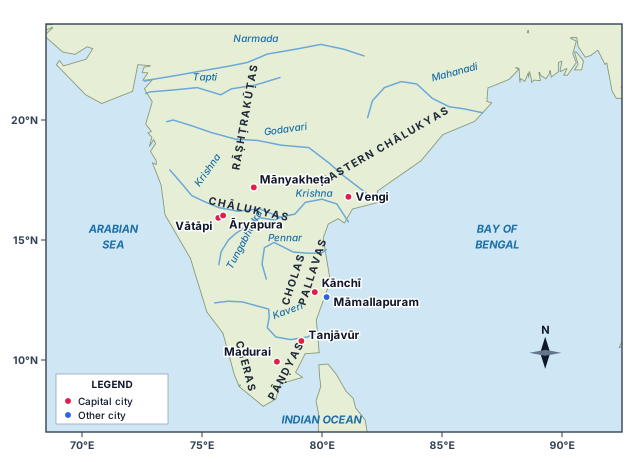
Ancient names on the chapter’s maps (Fig. 3.3 and Fig. 3.16) with their modern names:
| Name on the map | Modern name | State |
|---|---|---|
| Sthāneśhvara | Thanesar | Haryana |
| Kānyakubja | Kannauj | Uttar Pradesh |
| Prayāga | Prayagraj | Uttar Pradesh |
| Kāśhī | Varanasi | Uttar Pradesh |
| Ujjayinī | Ujjain | Madhya Pradesh |
| Mānyakheṭa | Malkhed (Malkheda) | Karnataka |
| Vātāpi | Badami | Karnataka |
| Āryapura | Aihole | Karnataka |
| Vengi | Pedavegi, near Eluru | Andhra Pradesh |
| Kānchī | Kanchipuram | Tamil Nadu |
| Māmallapuram | Mahabalipuram | Tamil Nadu |
| Tanjāvūr | Thanjavur | Tamil Nadu |
| Madurai | Madurai (unchanged) | Tamil Nadu |
(a)–(iii), (b)–(iv), (c)–(ii), (d)–(v), (e)–(i)
| Ruler / dynasty | City | Why |
|---|---|---|
| (a) Rāṣhṭrakūṭas | (iii) Mānyakheṭa | They shifted their power centre to present-day Karnataka, “with their capital at Mānyakheṭa (modern Malkheda)” |
| (b) Gurjara-Pratīhāras | (iv) Ujjayinī | Their early capital was Bhillamāla; “it seems to have shifted later to Ujjayinī” |
| (c) Cholas | (ii) Tanjāvūr | Vijayālaya founded the revived Chola kingdom “from his new capital at Tanjāvūr (now spelt ‘Thanjavur’)” |
| (d) Harṣhavardhana | (v) Kānyakubja | He ascended the throne in 606 CE at Kannauj, “anciently known as Kānyakubja” |
| (e) Pallavas | (i) Kānchī | “With its capital at Kānchī (or Kānchipura, present-day Kanchipuram in Tamil Nadu)” |
Chapter 15 of 20 – Social Science
- Previous: Chapter 14 India and Her Neighbours
- Next: Chapter 16 Turning Tides: 11th and 12th Centuries
- All chapters: NCERT Solutions Class 7 Social Science
Also for This Chapter
NCERT Solutions Class 7 Social Science Chapter 15 Empires and Kingdoms: 6th to 10th Centuries – Overview
| Class | Class 7 |
| Subject | Social Science |
| Chapter | 15 – Empires and Kingdoms: 6th to 10th Centuries |
| Textbook pages | Part II, 61 – 96 |
| Questions solved | 42 |
| Session | 2027 |
| Format | Full answers on this page + PDF |
NCERT Solutions Class 7 Social Science Chapter 15 – FAQs
Where can I download NCERT Solutions Class 7 Social Science Chapter 15 Empires and Kingdoms: 6th to 10th Centuries PDF?
Read every answer on this page, or download the free PDF from the table at the top.
Is this for the 2027 session?
Yes, it follows the latest NCERT Class 7 Social Science book for 2027.
How many questions are solved in NCERT Class 7 Social Science Chapter 15?
All 42 questions of the chapter (textbook pages Part II, 61 – 96) – the in-text questions, activities and the end-of-chapter exercises.
How should I use these solutions?
Read the chapter in the NCERT book first, attempt the questions yourself, then check your answers here.