NCERT Solutions for Class 7 Social Science Chapter 10 the Constitution of India an Introduction provide clear, step-by-step answers to every exercise and in-text question from the chapter the Constitution of India an Introduction of the NCERT textbook Exploring Society India and Beyond. Prepared by subject experts as per the latest NCERT (CBSE) syllabus for 2026-27, these NCERT Solutions for Class 7 Social Science help you understand each concept, write exam-ready answers, and check your own solutions. You can read them online below or download the free Class 7 Social Science Chapter 10 question-answer PDF.
NCERT Solutions for Class 7 Social Science Chapter 10 the Constitution of India an Introduction
- Class: Class 7
- Subject: Social Science
- Chapter: Chapter 10 – the Constitution of India an Introduction
- Textbook: Exploring Society India and Beyond (NCERT)
- Study material: NCERT Solutions – questions with answers, free PDF
These solutions answer all the exercise questions of Chapter 10 the Constitution of India an Introduction — including the in-text questions, short-answer and long-answer questions, and activities — with complete explanations so you can follow the method, not just the final answer. Read the full solutions below.
NCERT Solutions Class 7 Social Science Chapter 10 the Constitution of India an Introduction View Download
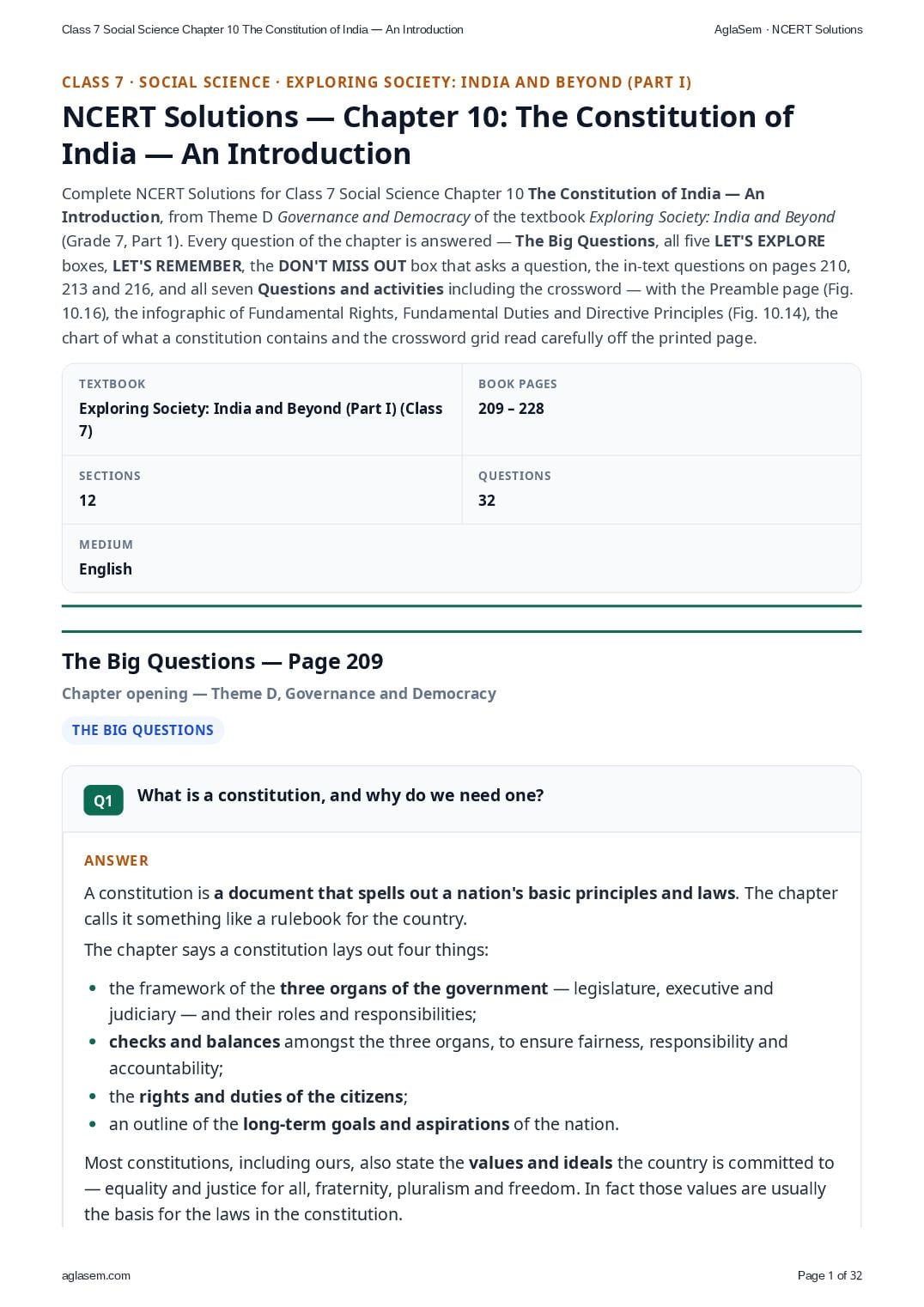
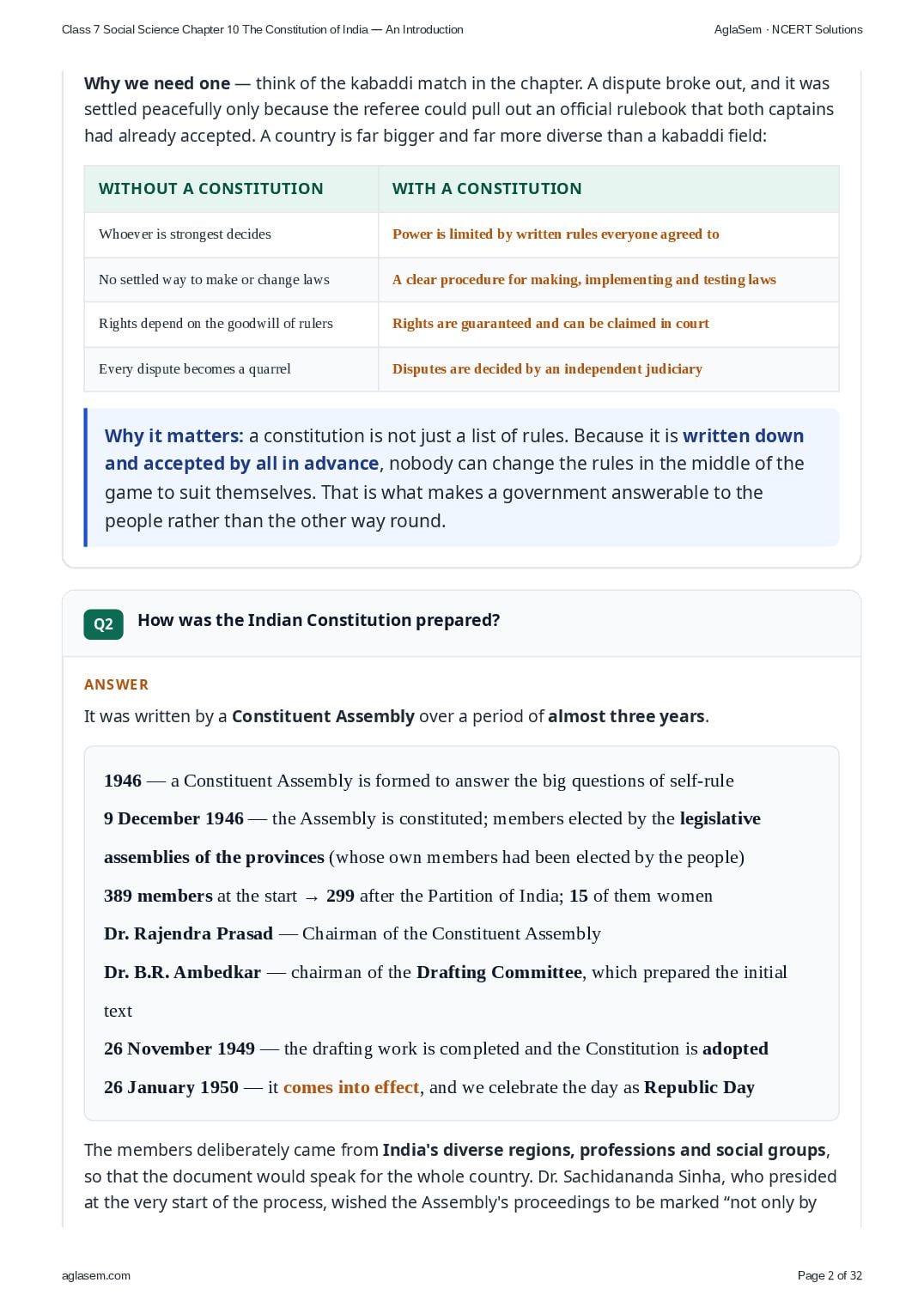


NCERT Solutions for Class 7 Social Science Chapter 10 PDF Download
You can read the NCERT Solutions for Class 7 Social Science Chapter 10 online above, or download the complete question-answer PDF to study the Constitution of India an Introduction offline at any time.
NCERT Solutions for Class 7 Social Science Chapter 10 PDF Download Link – Click Here to Download Solutions PDF
Questions Covered in This Chapter
These NCERT Solutions answer all 32 questions of this chapter. The questions solved are:
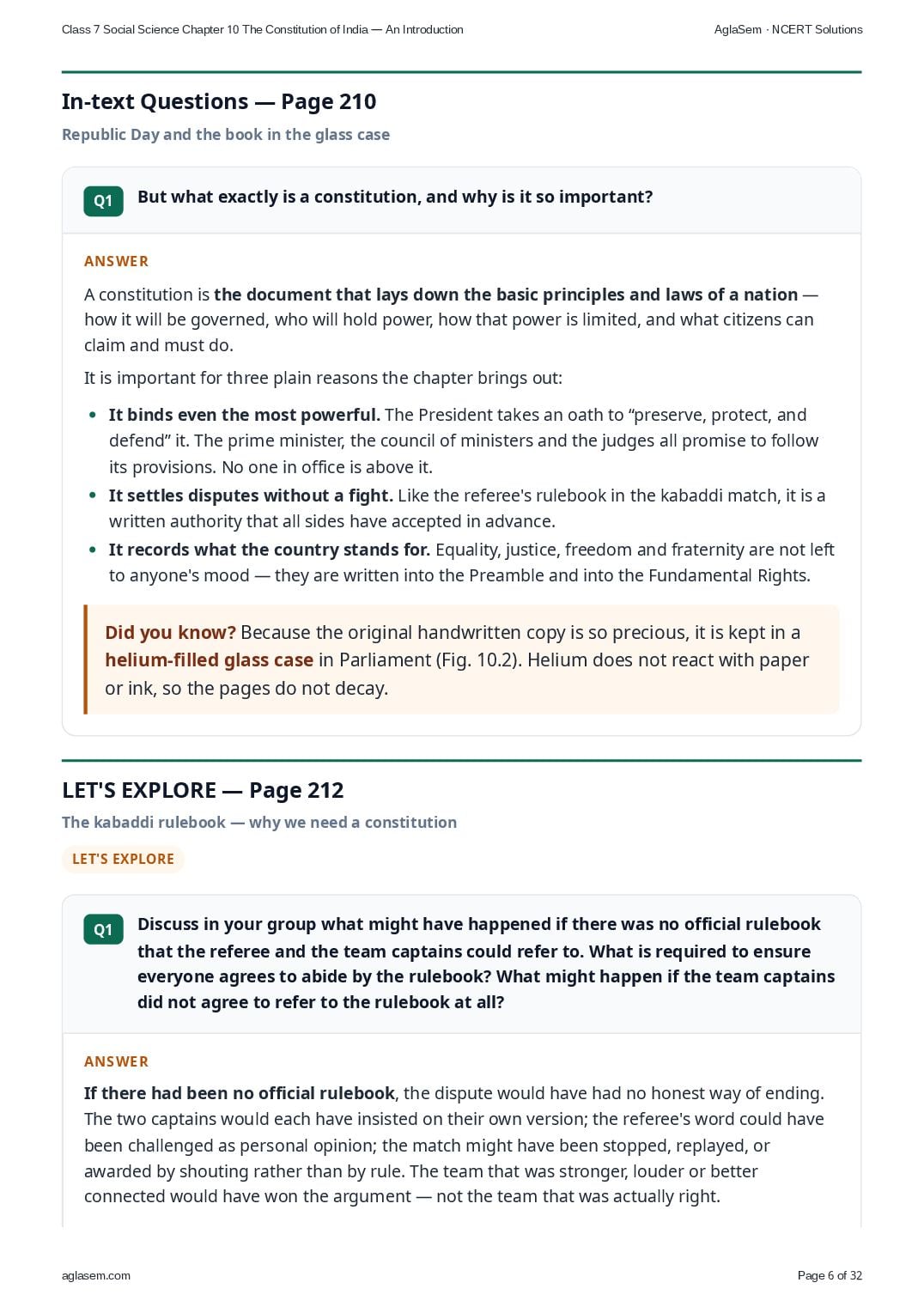
- What is a constitution, and why do we need one?
- How was the Indian Constitution prepared?
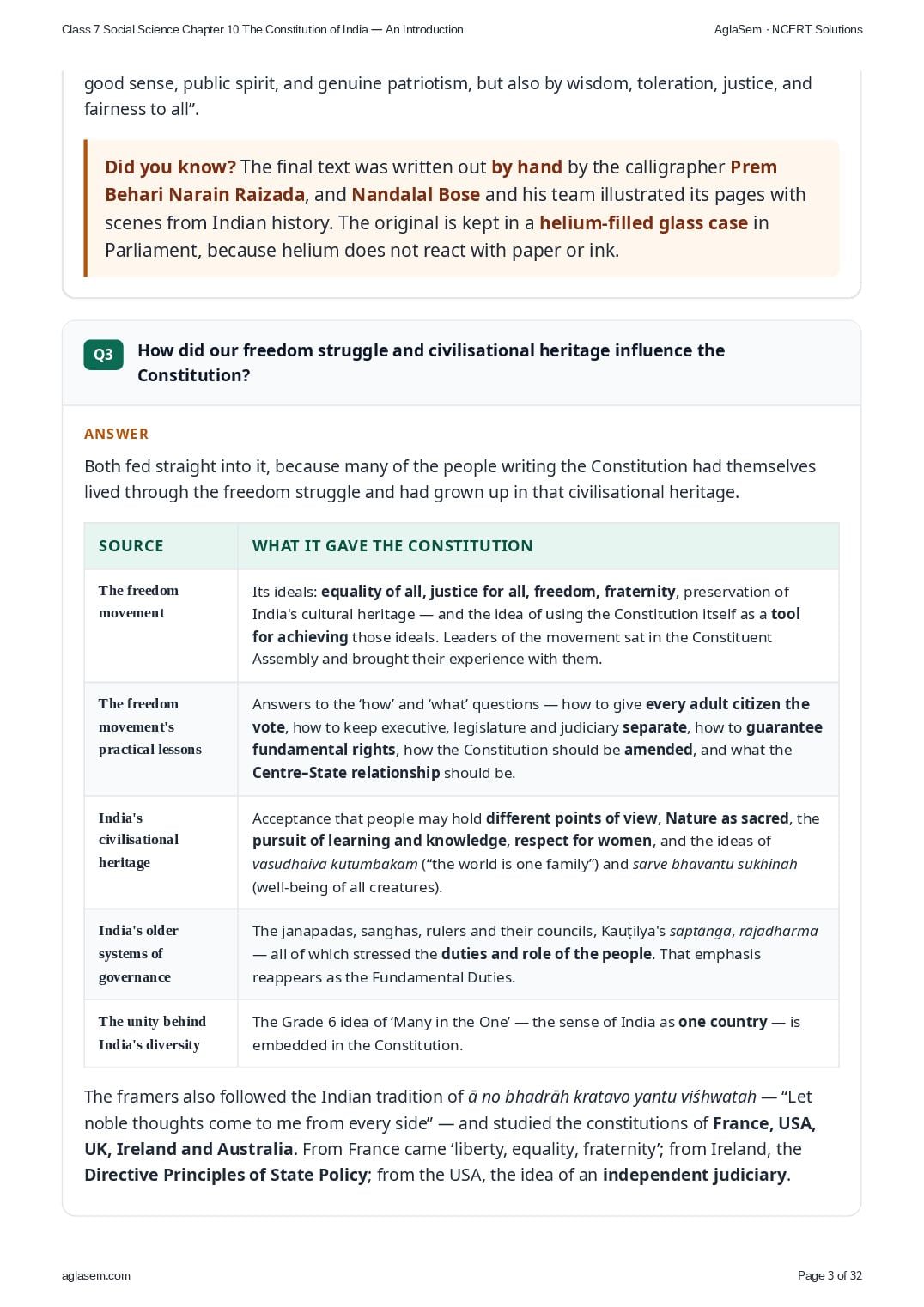
- How did our freedom struggle and civilisational heritage influence the Constitution?
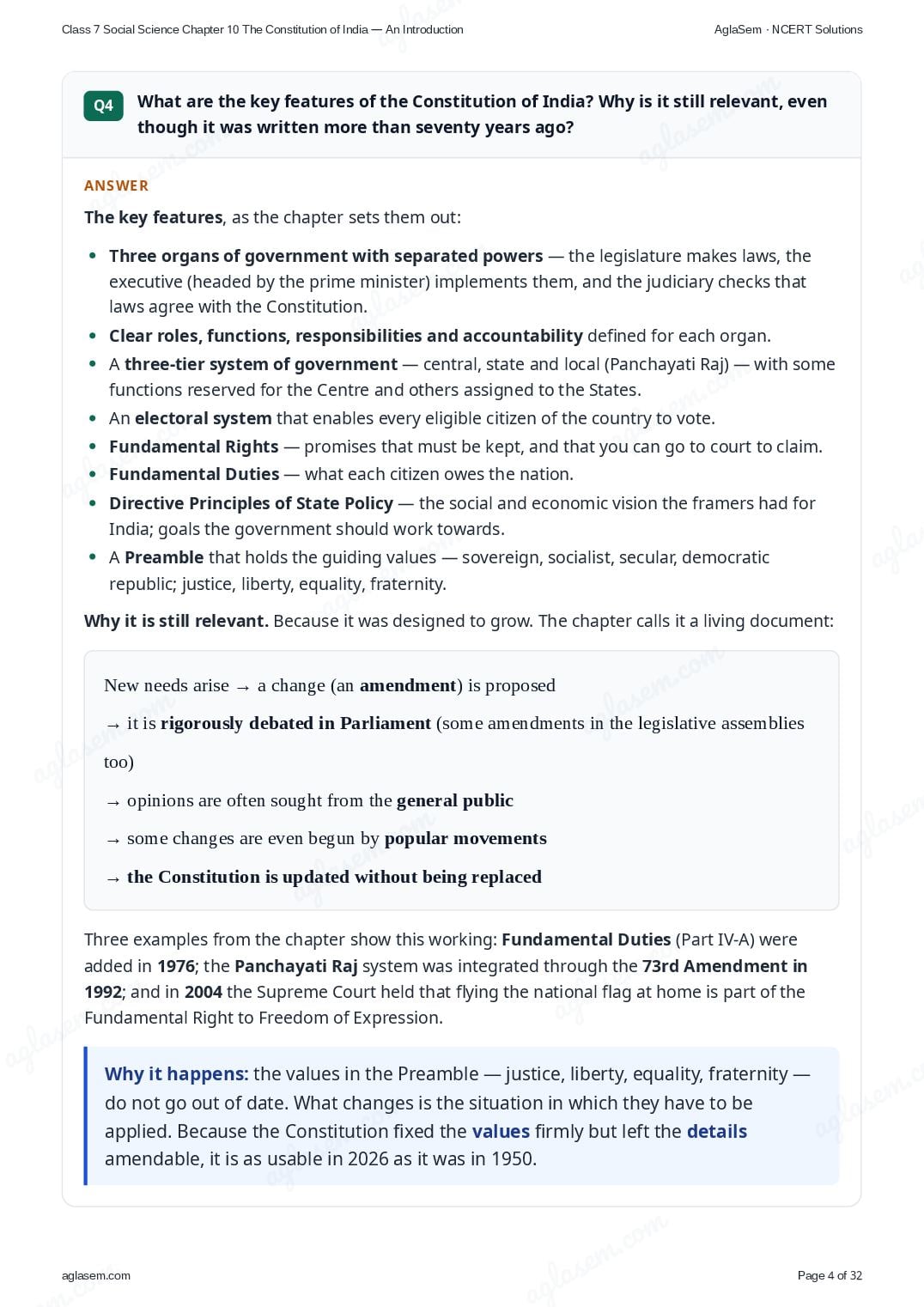
- What are the key features of the Constitution of India? Why is it still relevant, even though it was written more than seventy years ago?
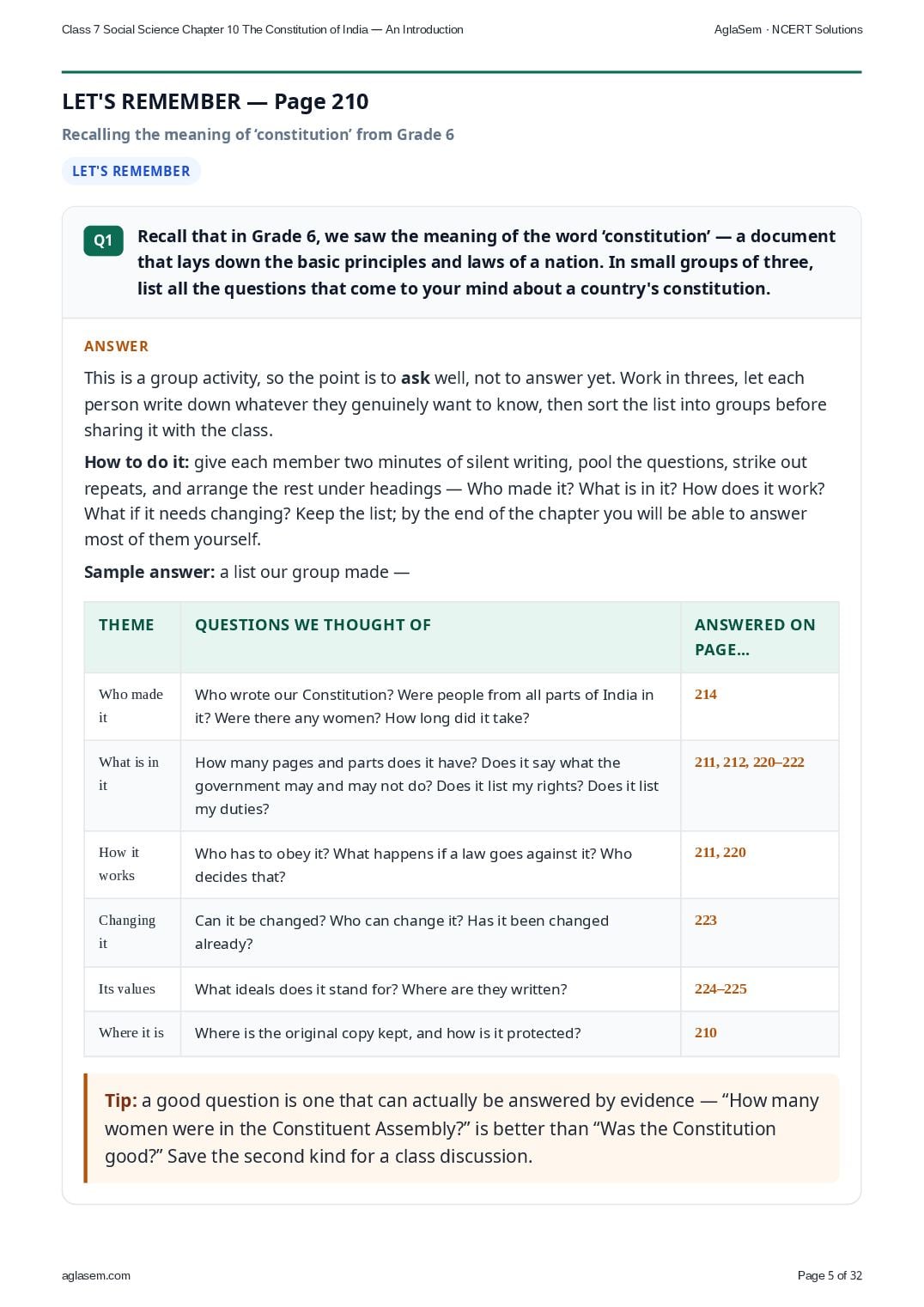
- Recall that in Grade 6, we saw the meaning of the word ‘constitution’ — a document that lays down the basic principles and laws of a nation. In small groups of three, list all the questions that come to your mind about a country's constitution.
- But what exactly is a constitution, and why is it so important?
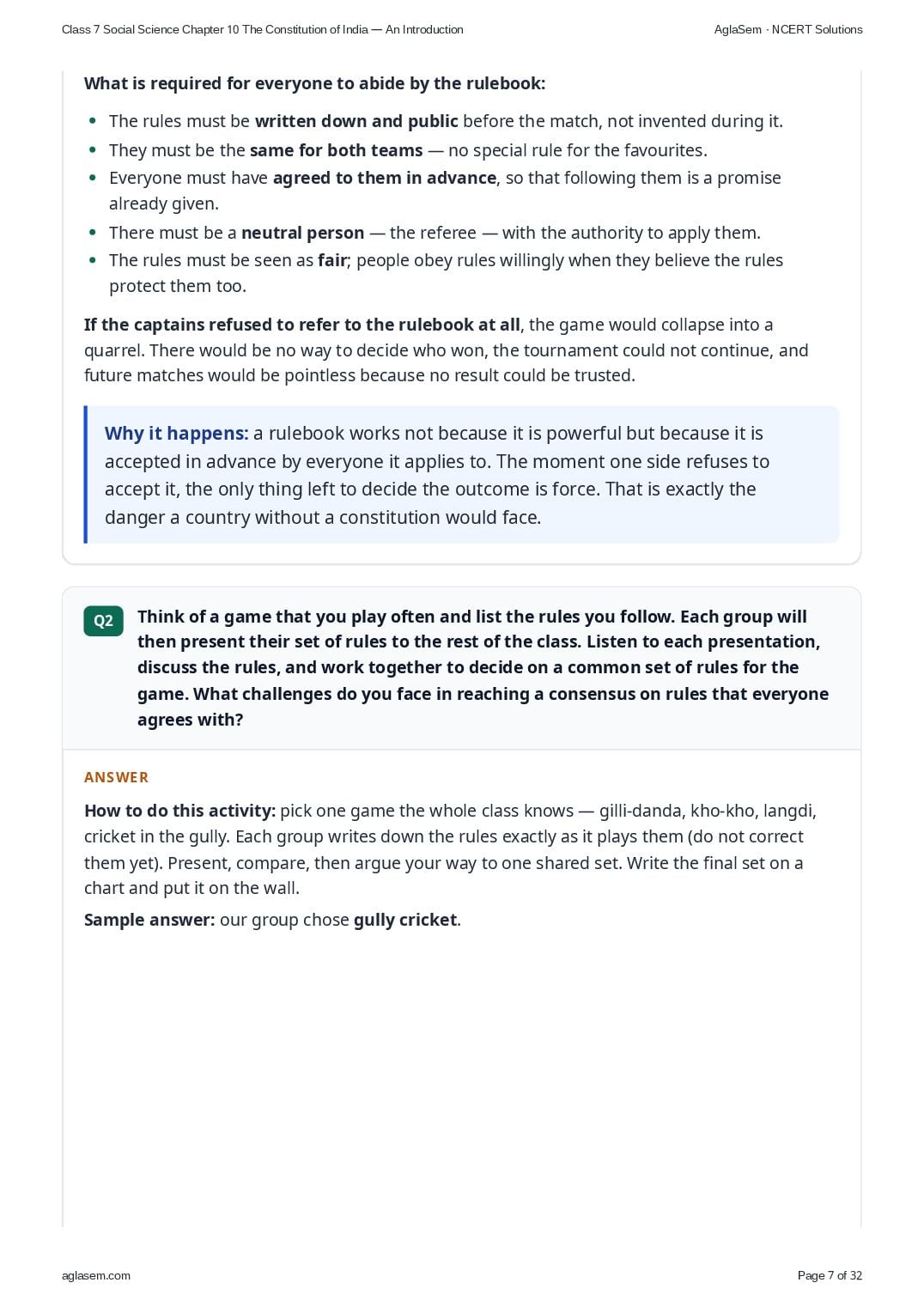
- Discuss in your group what might have happened if there was no official rulebook that the referee and the team captains could refer to. What is required to ensure everyone agrees to abide by the rulebook? What might happen if the team captains did not agree to refer to the rulebook at all?
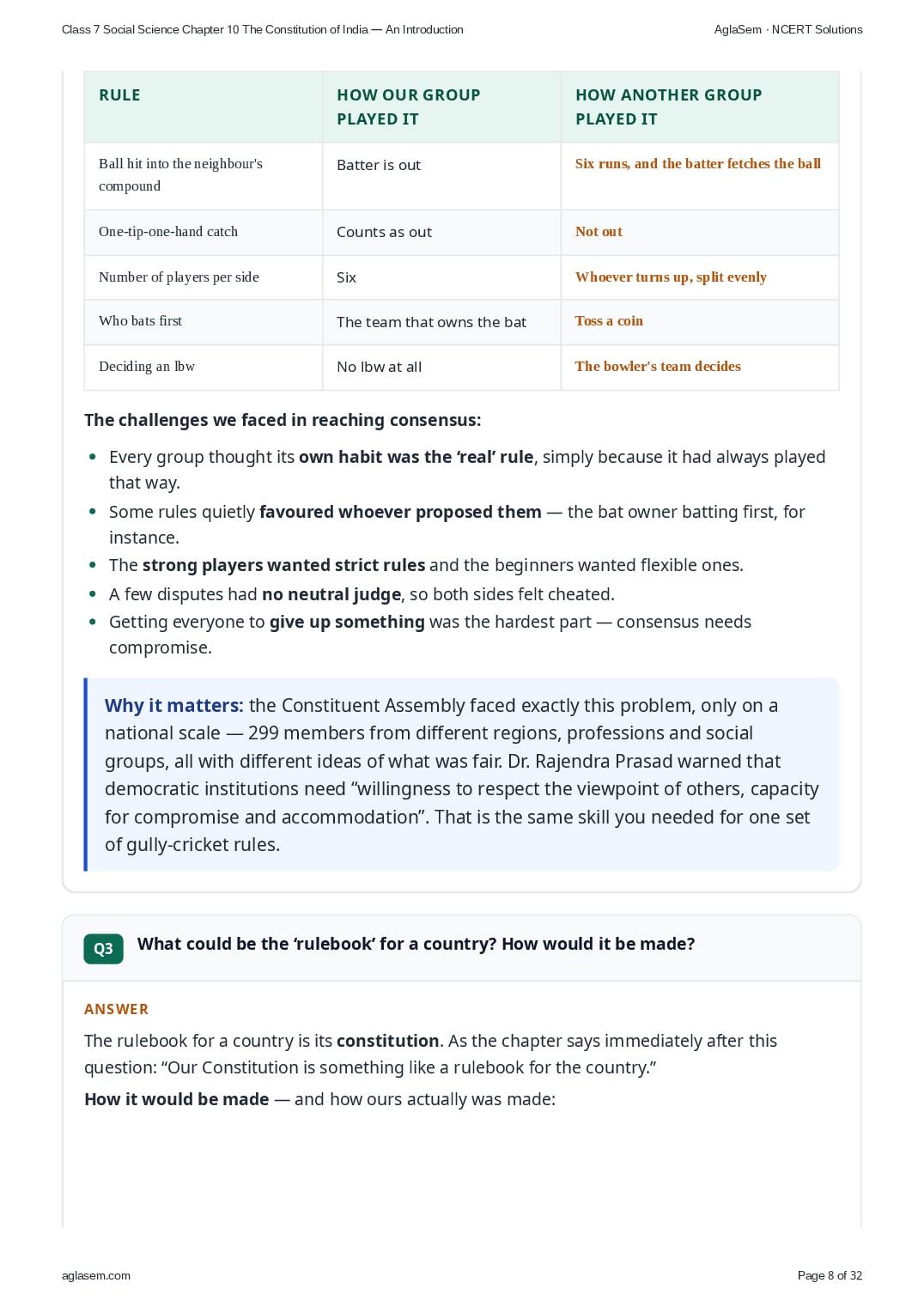
- Think of a game that you play often and list the rules you follow. Each group will then present their set of rules to the rest of the class. Listen to each presentation, discuss the rules, and work together to decide on a common set of rules for the game. What challenges do you face in reaching a consensus on rules that everyone agrees with?
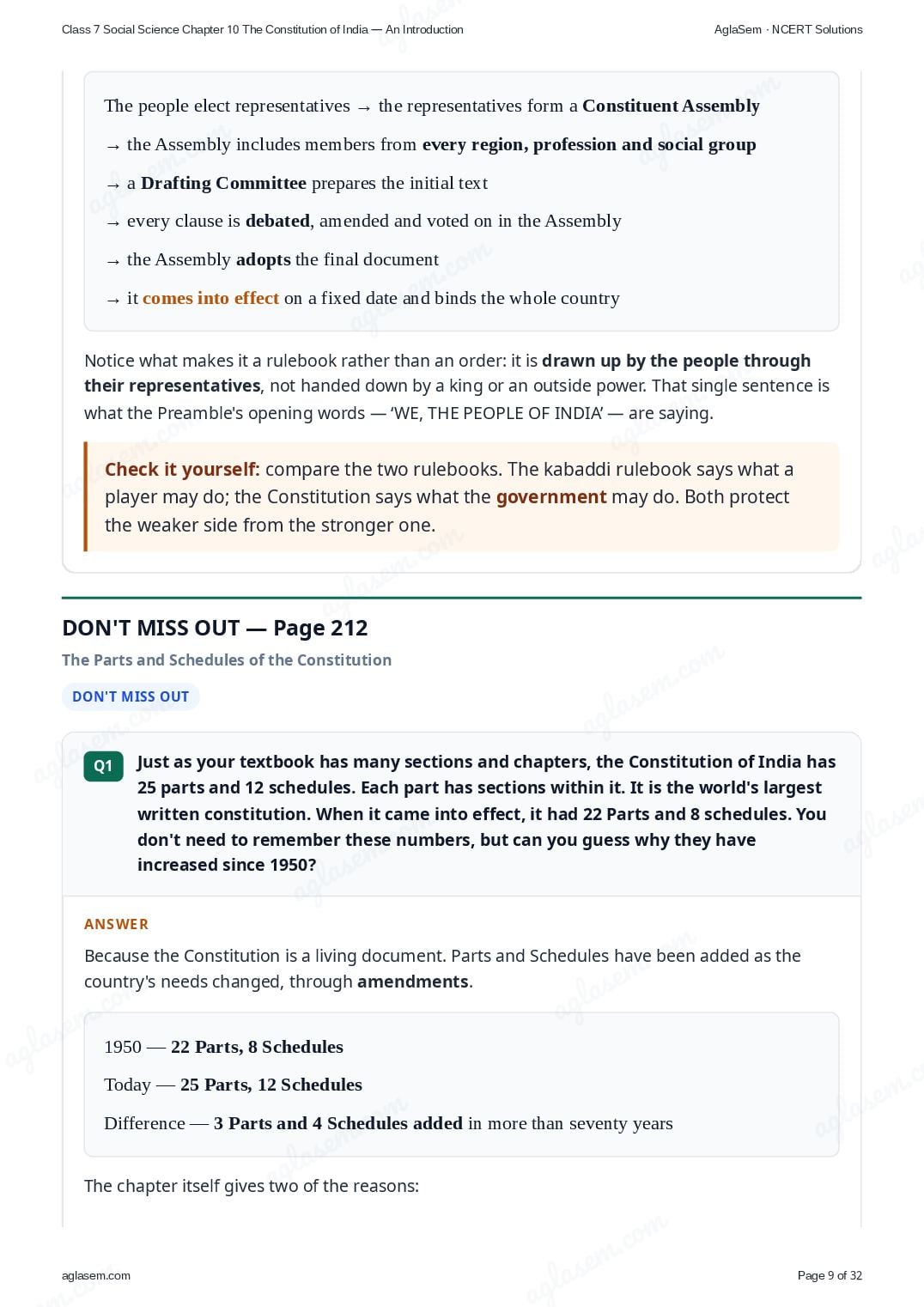
- What could be the ‘rulebook’ for a country? How would it be made?
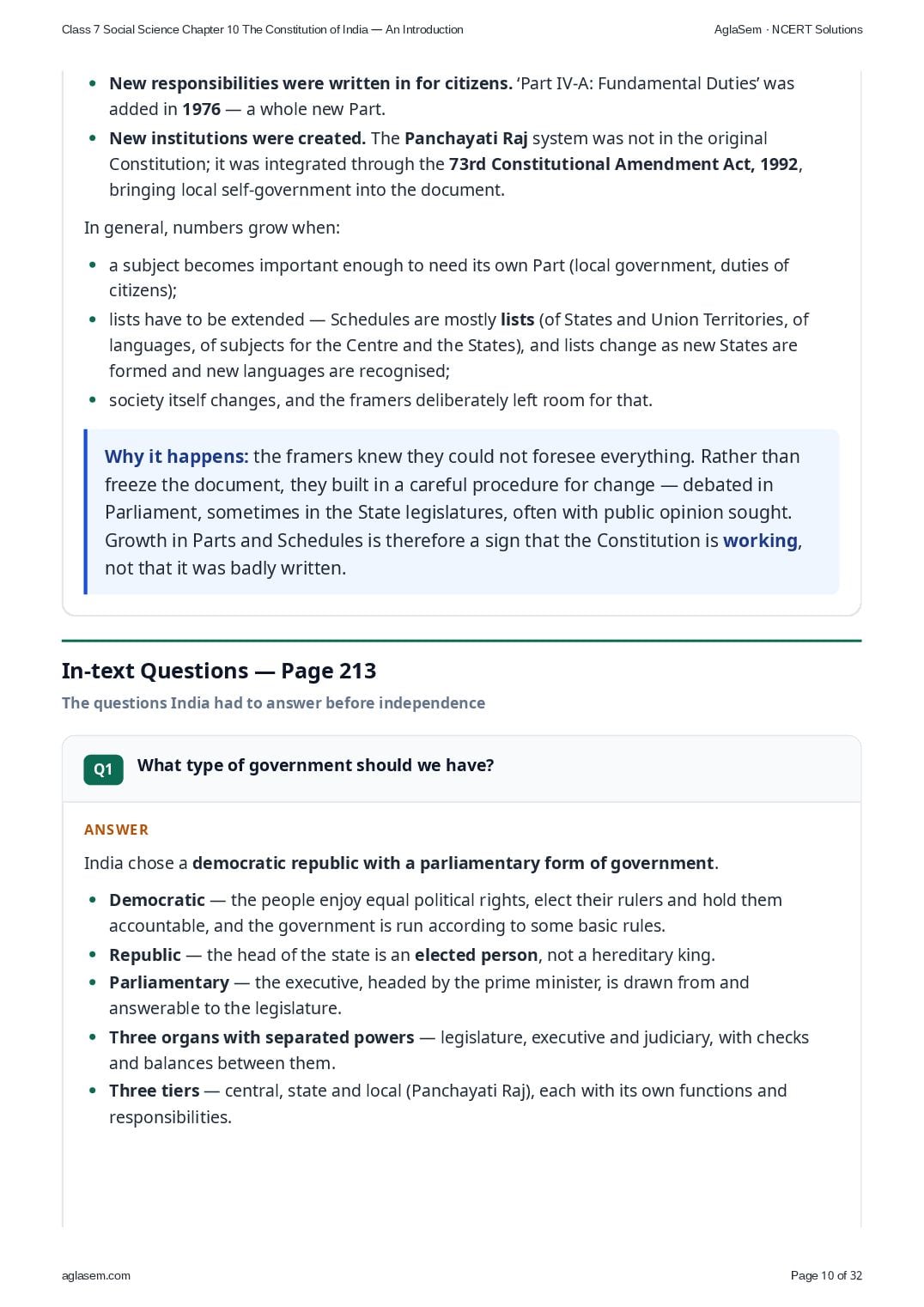
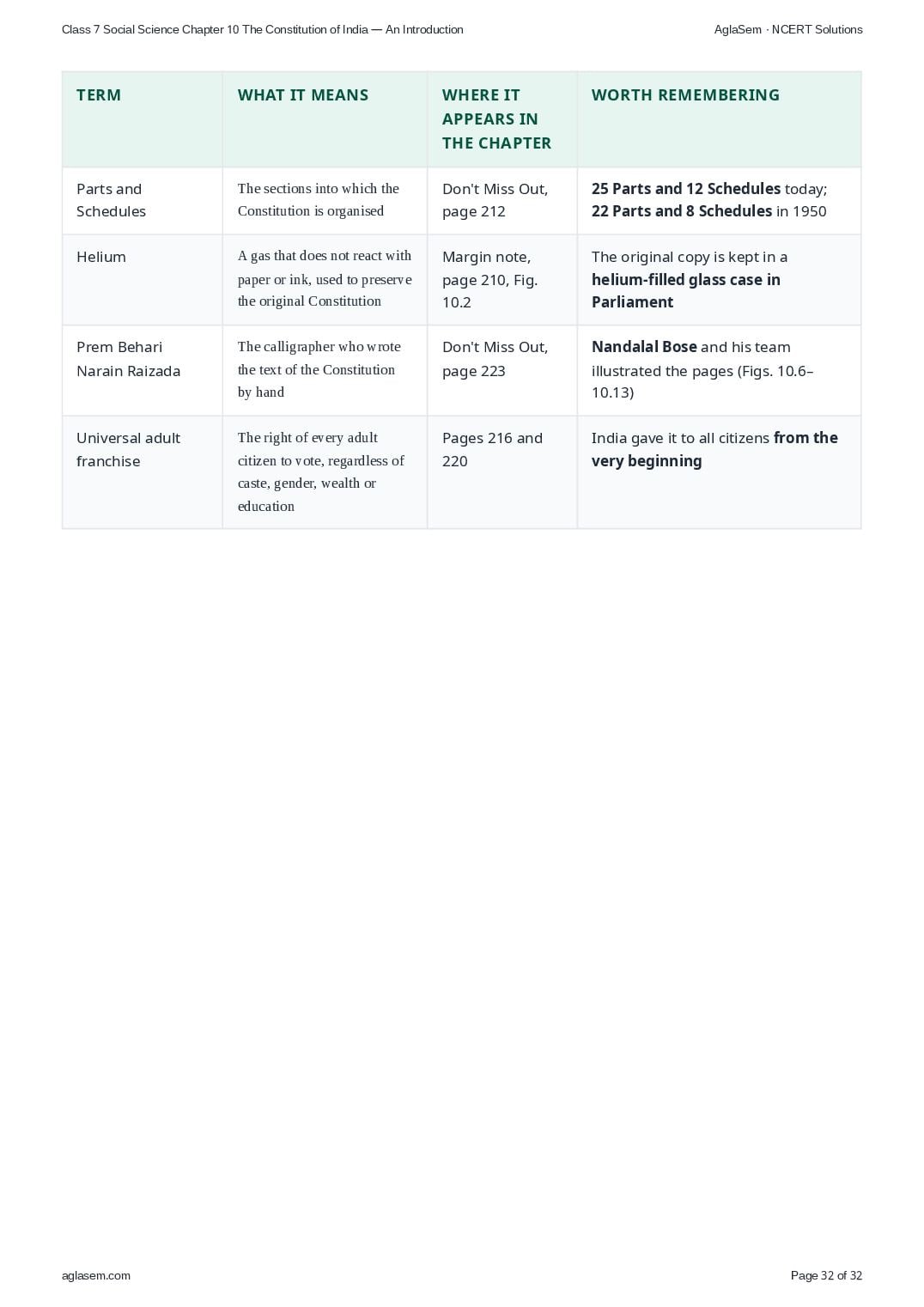
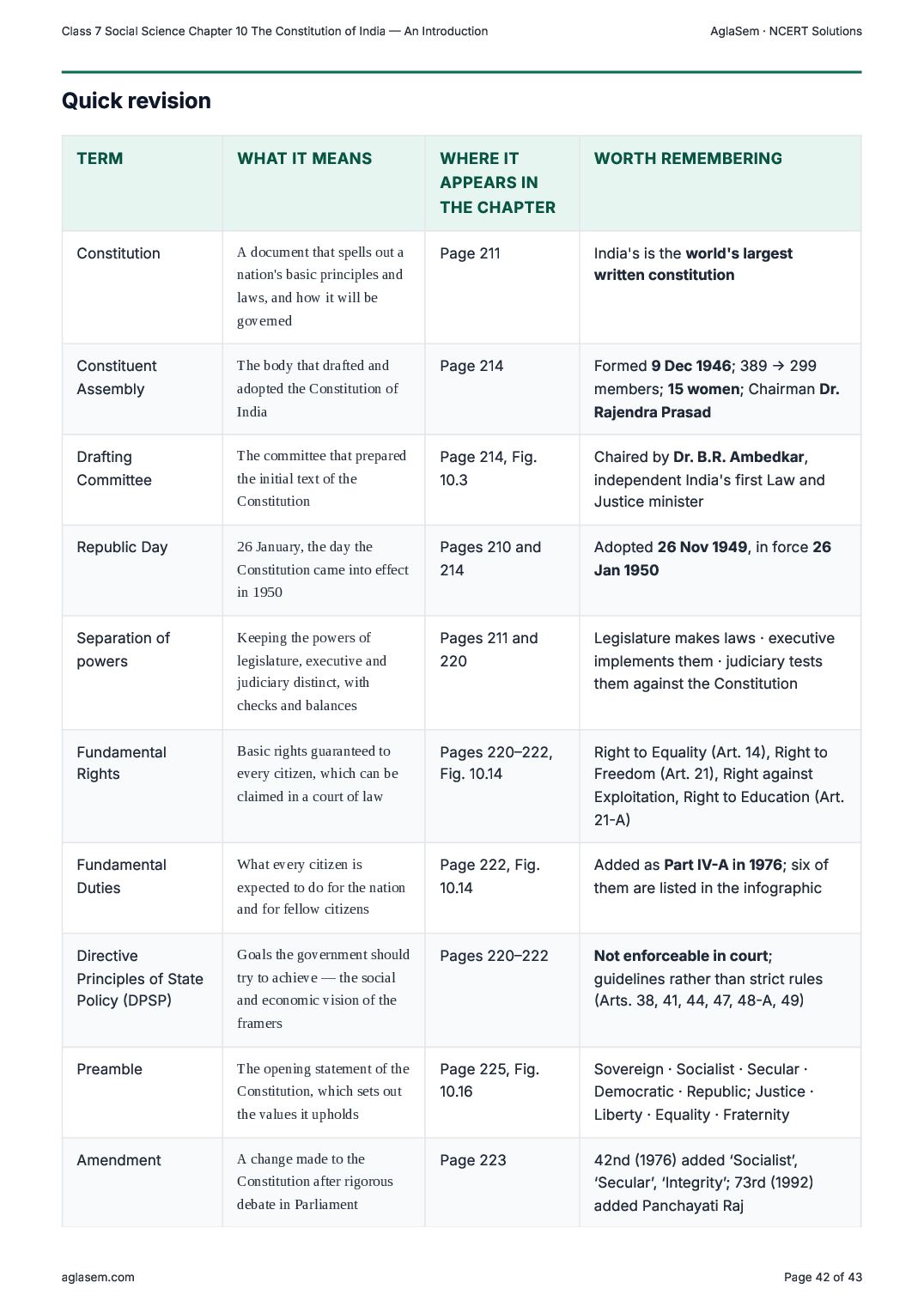
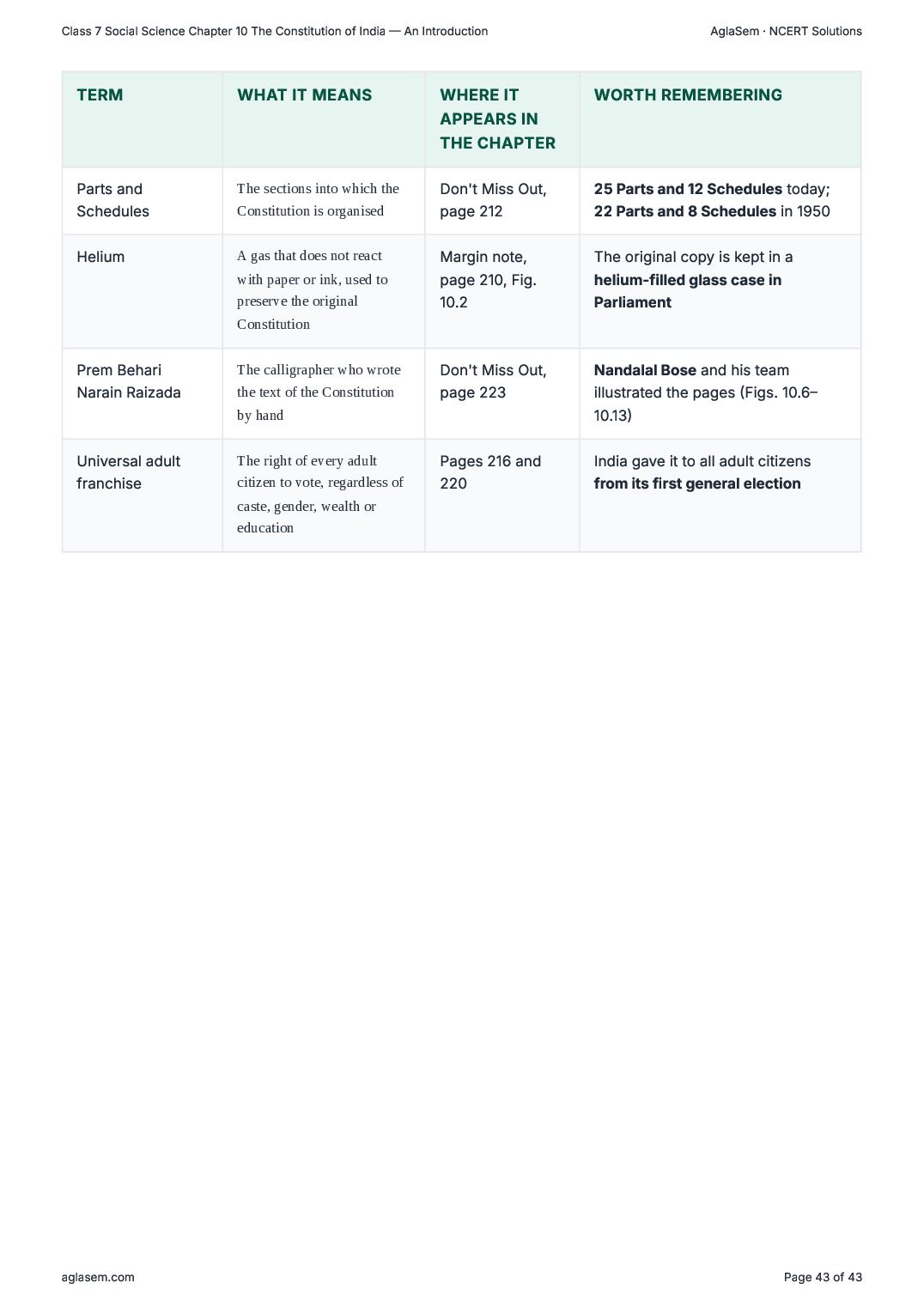
- Just as your textbook has many sections and chapters, the Constitution of India has 25 parts and 12 schedules. Each part has sections within it. It is the world's largest written constitution. When it came into effect, it had 22 Parts and 8 schedules. You don't need to remember these numbers, but can you guess why they have increased since 1950?
- What type of government should we have?
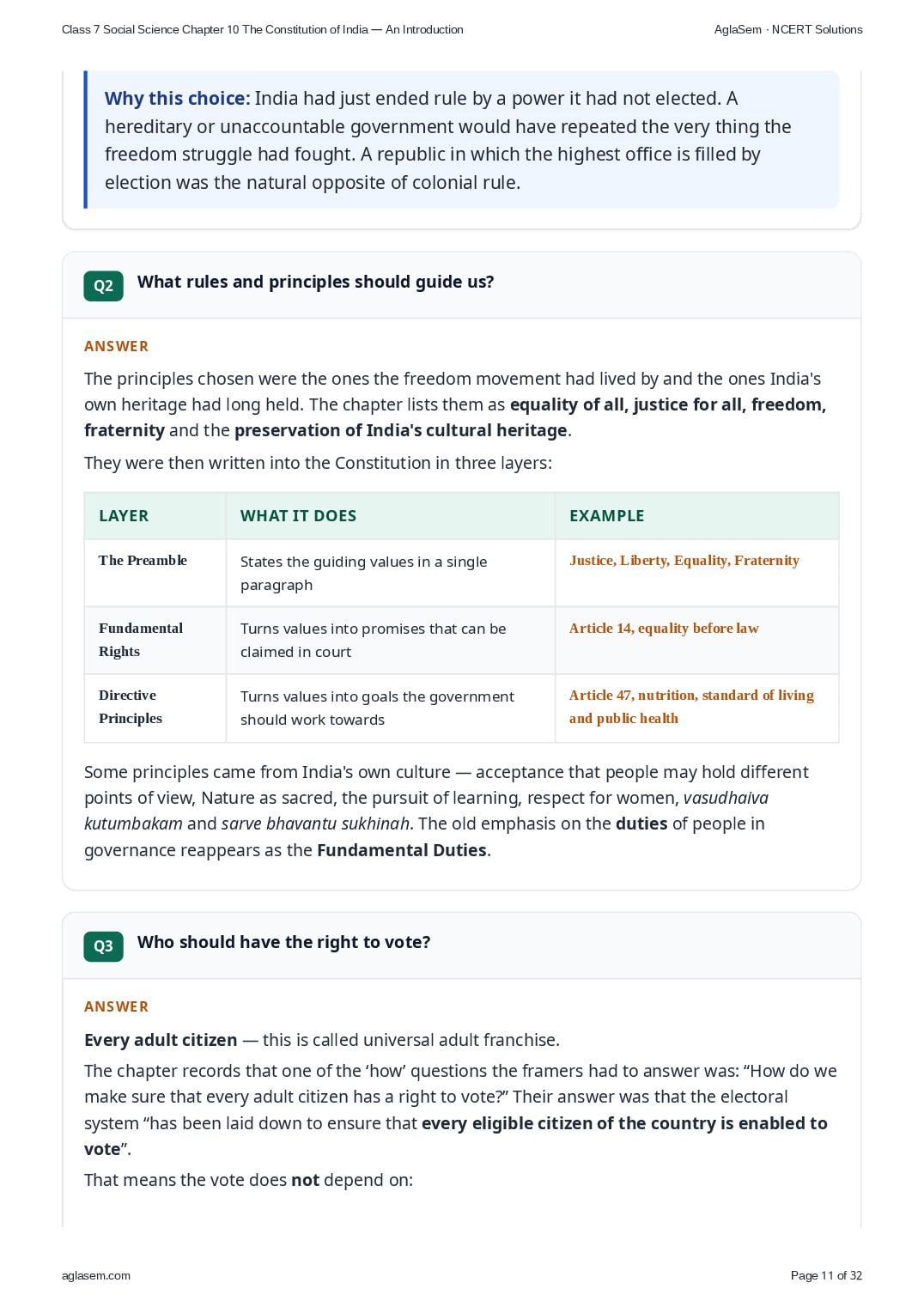
- What rules and principles should guide us?
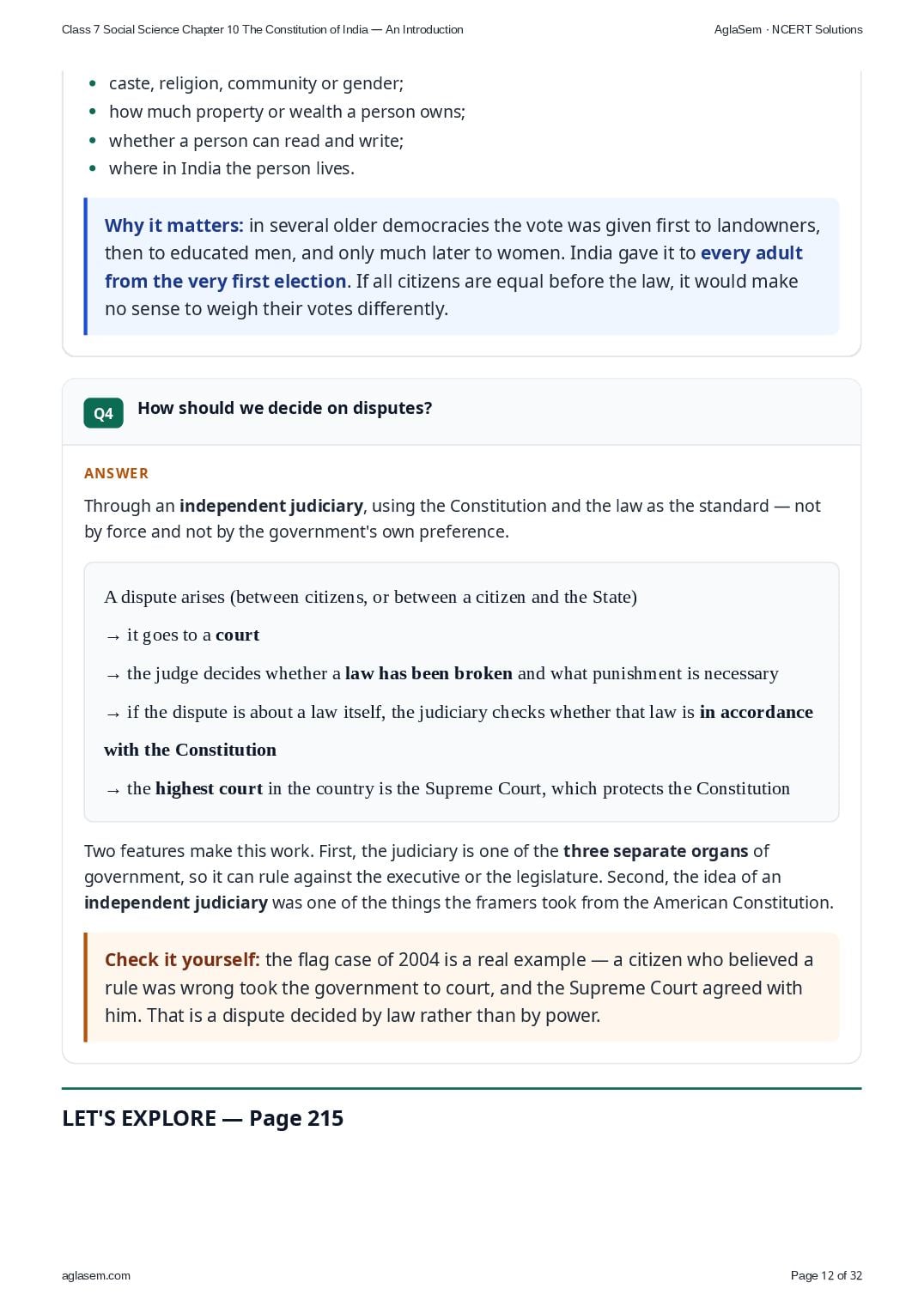
- Who should have the right to vote?
- How should we decide on disputes?
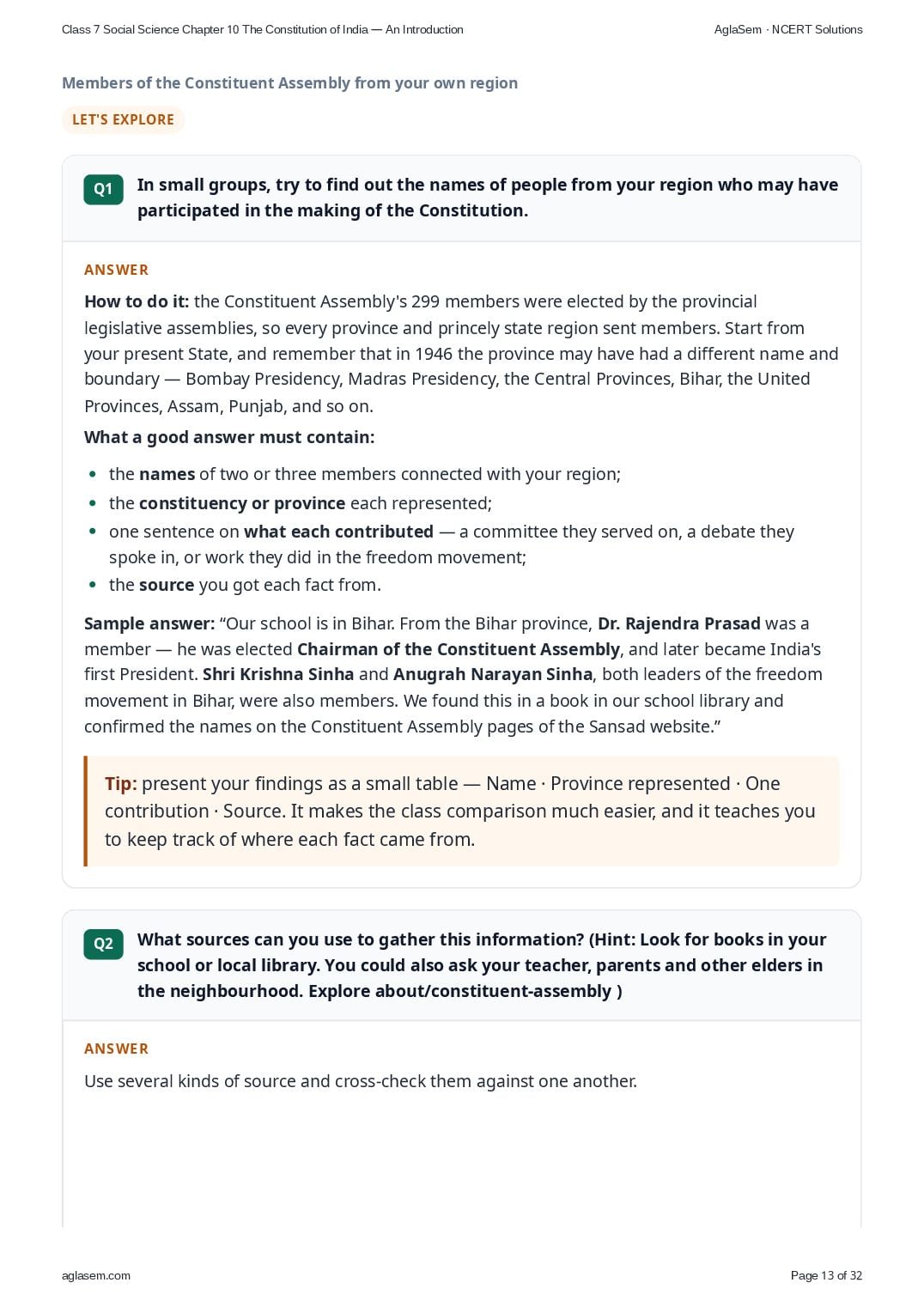
- In small groups, try to find out the names of people from your region who may have participated in the making of the Constitution.
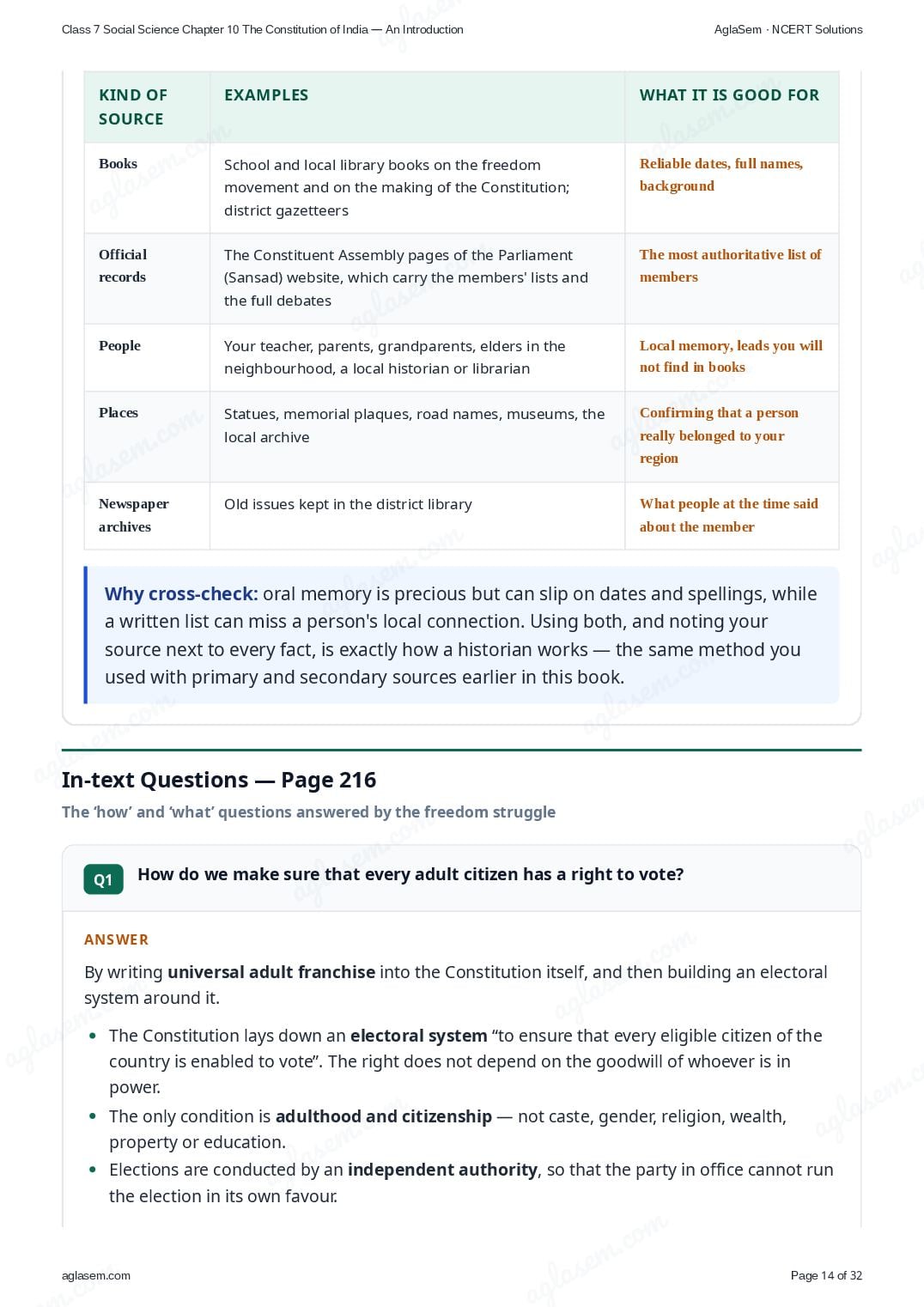
- What sources can you use to gather this information? (Hint: Look for books in your school or local library. You could also ask your teacher, parents and other elders in the neighbourhood. Explore about/constituent-assembly )
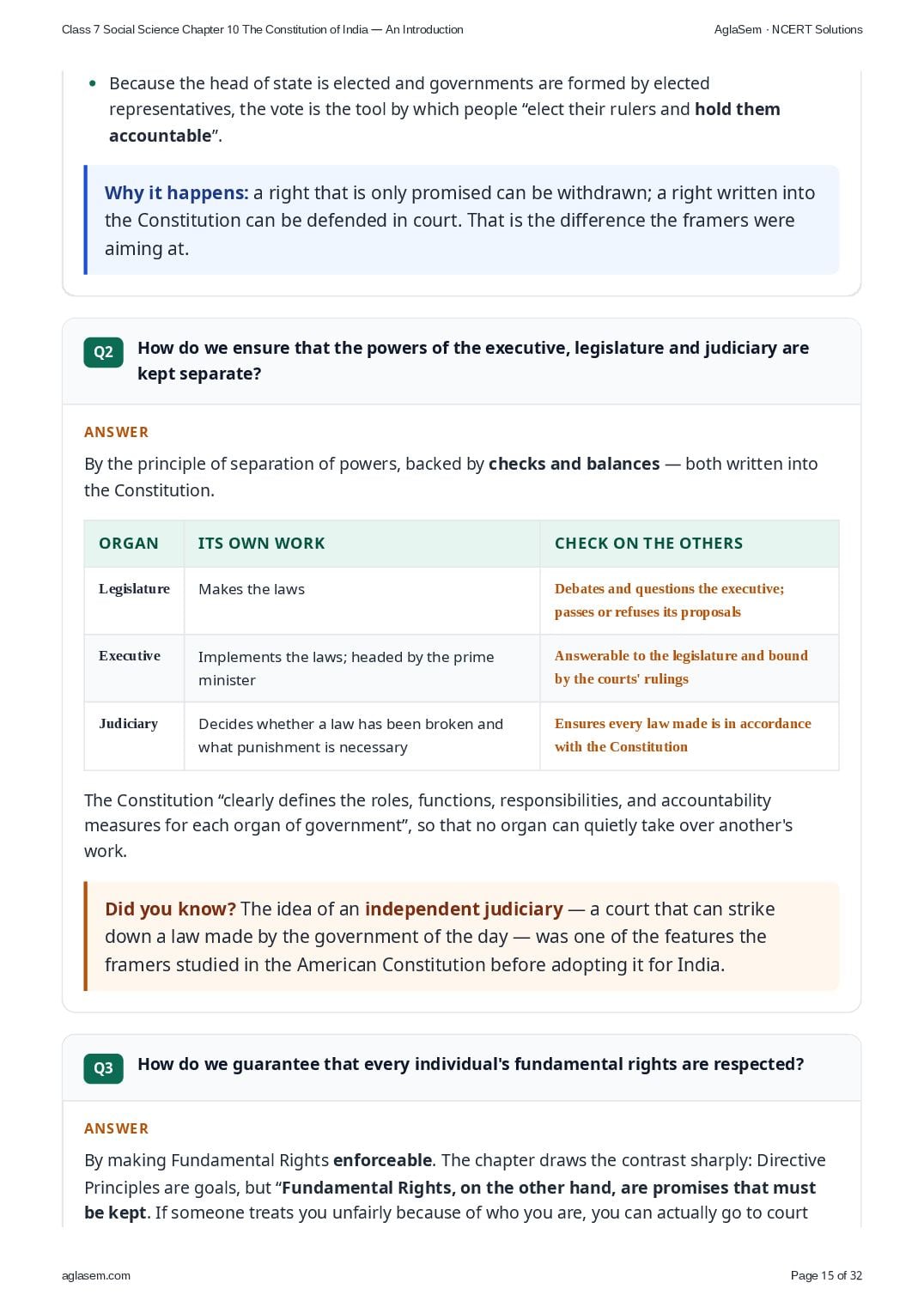
- How do we make sure that every adult citizen has a right to vote?
- How do we ensure that the powers of the executive, legislature and judiciary are kept separate?
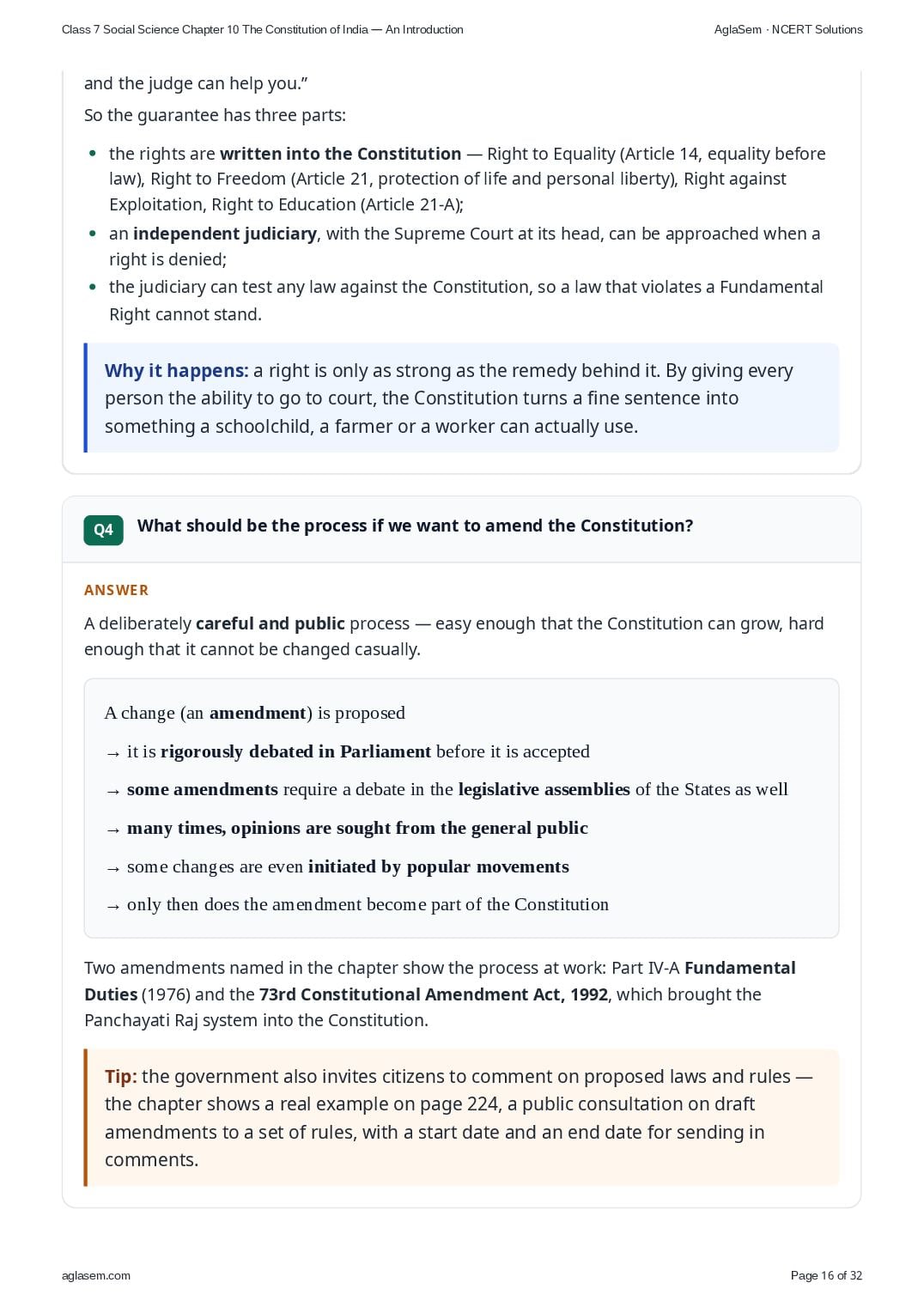
- How do we guarantee that every individual's fundamental rights are respected?
- What should be the process if we want to amend the Constitution?
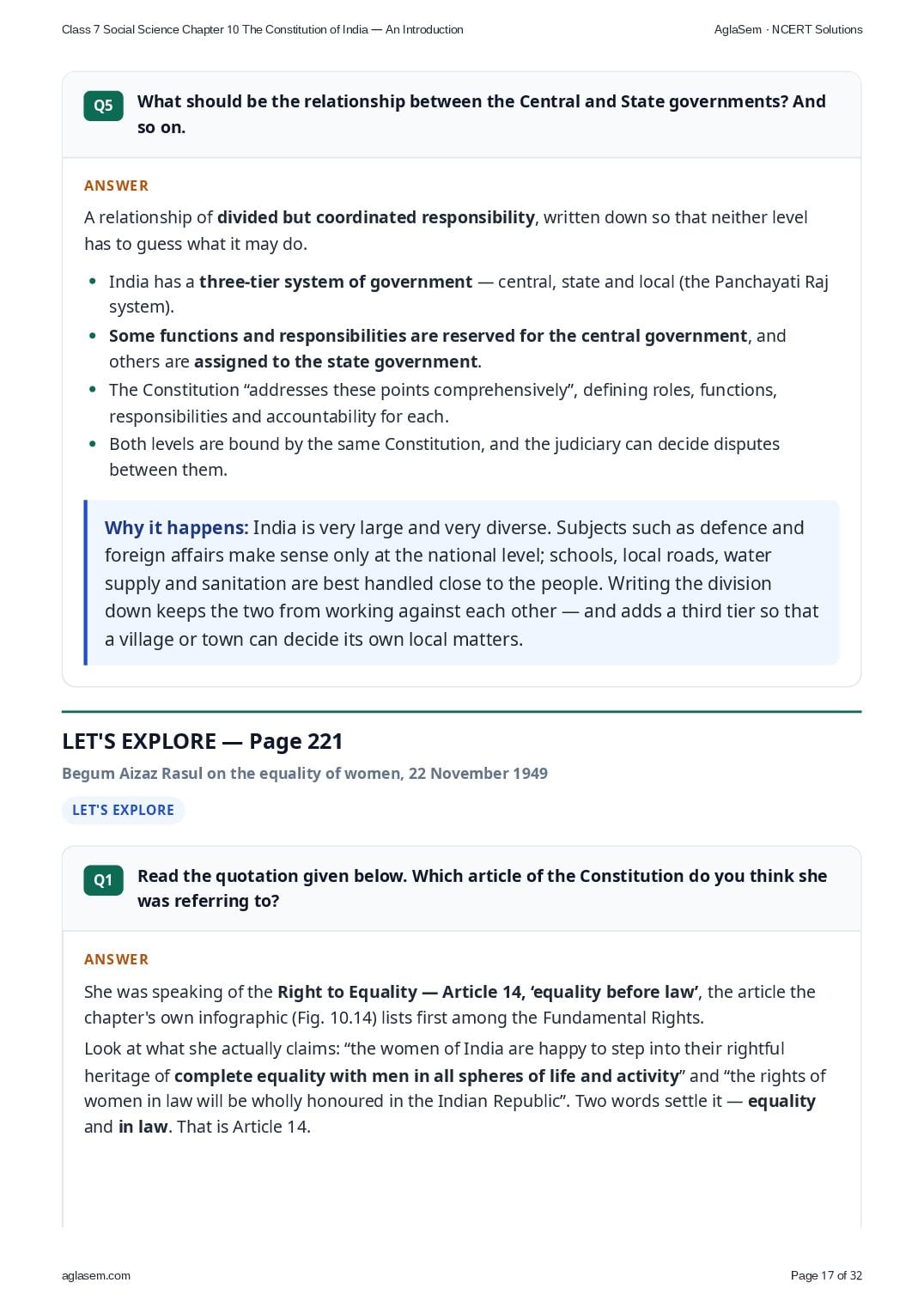
- What should be the relationship between the Central and State governments? And so on.
- Read the quotation given below. Which article of the Constitution do you think she was referring to?
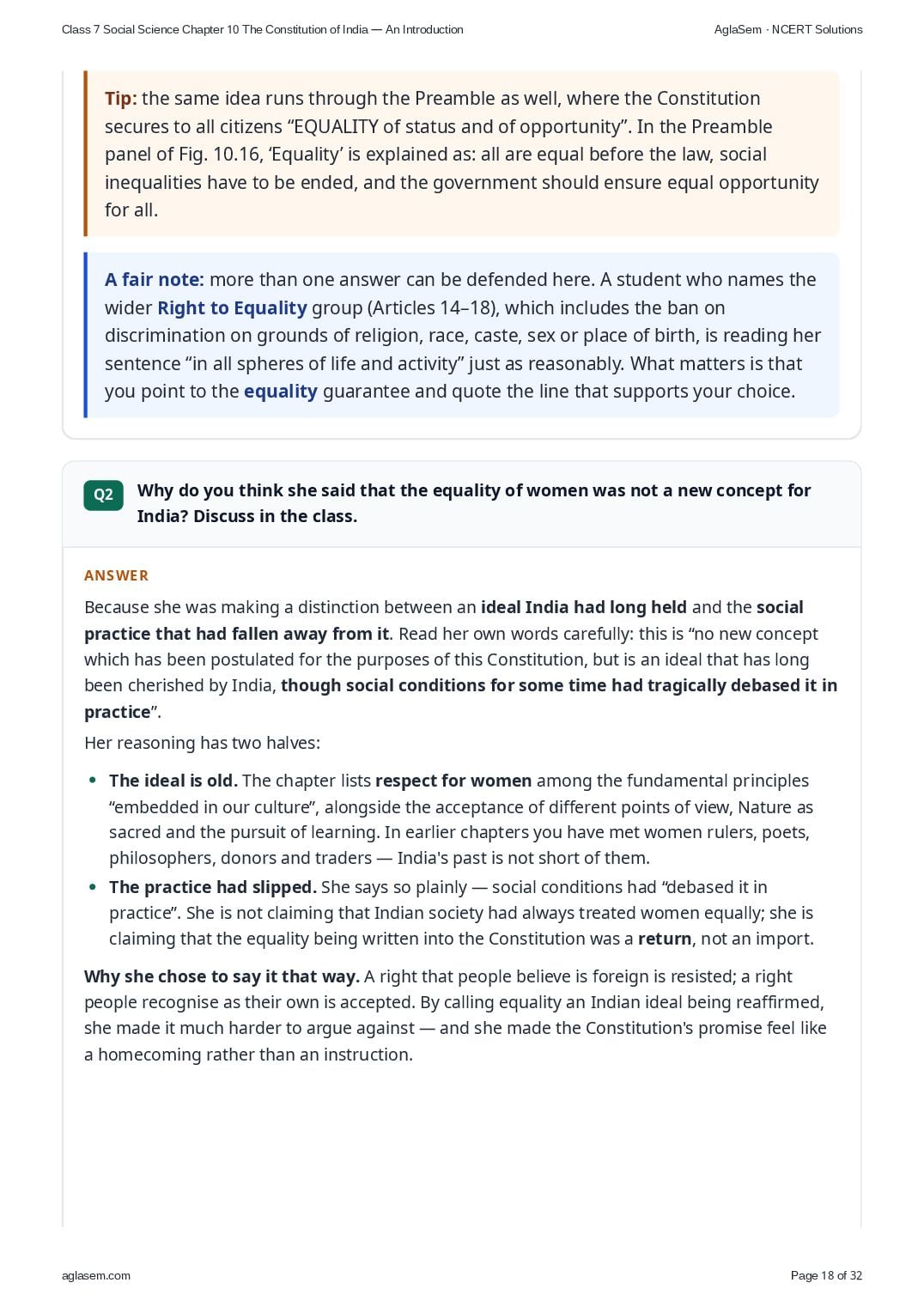
- Why do you think she said that the equality of women was not a new concept for India? Discuss in the class.
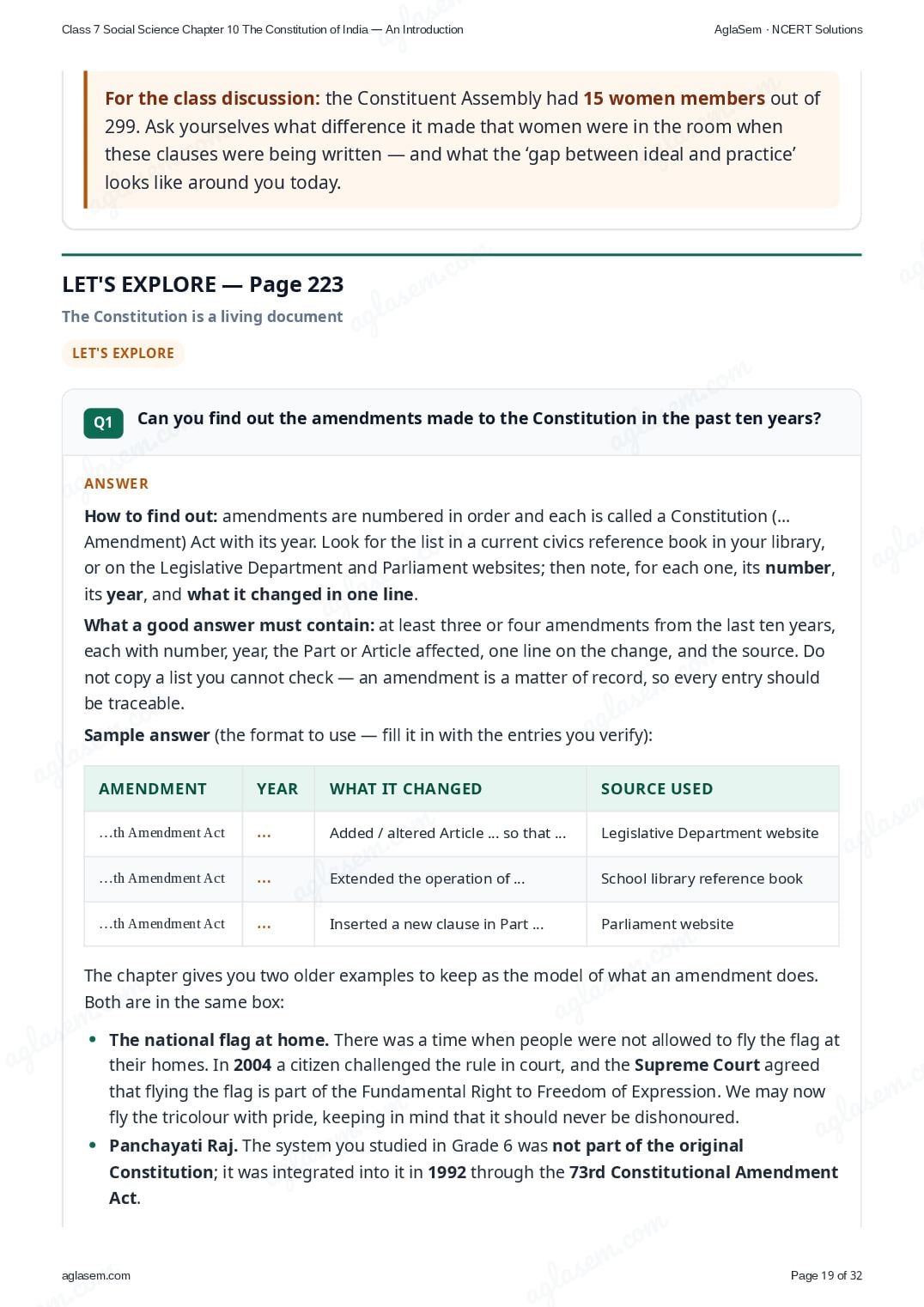
- Can you find out the amendments made to the Constitution in the past ten years?
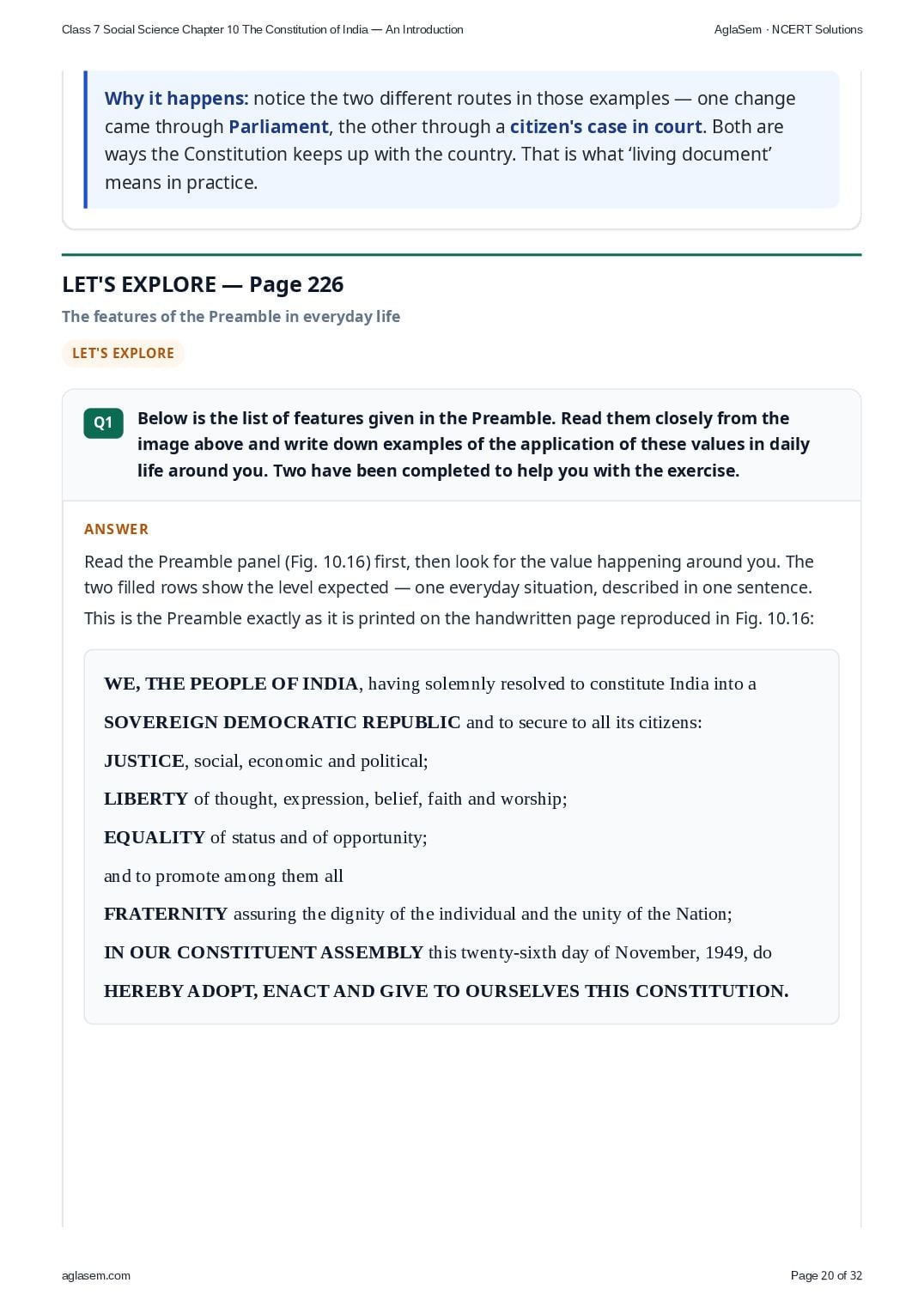
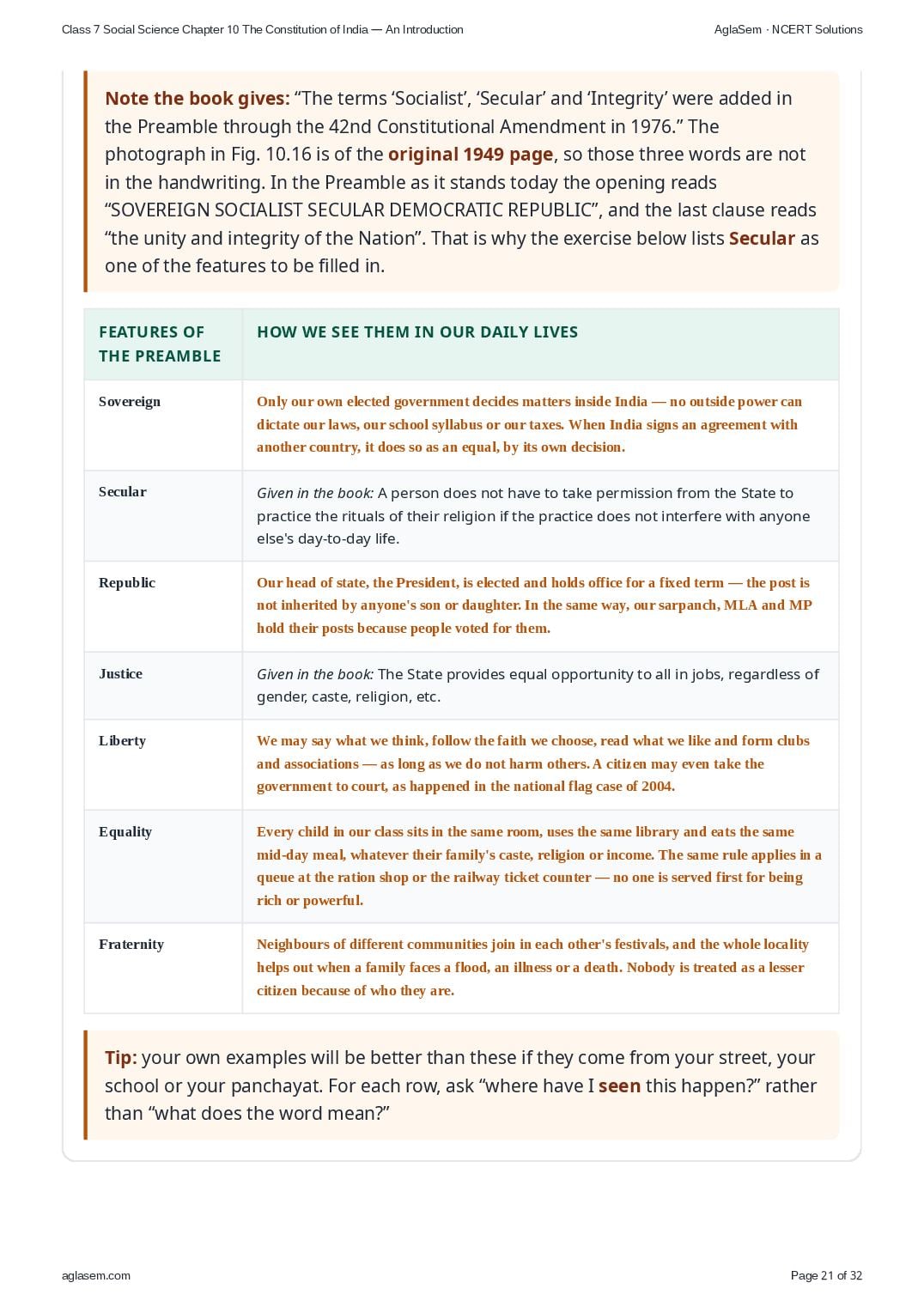
- Below is the list of features given in the Preamble. Read them closely from the image above and write down examples of the application of these values in daily life around you. Two have been completed to help you with the exercise.
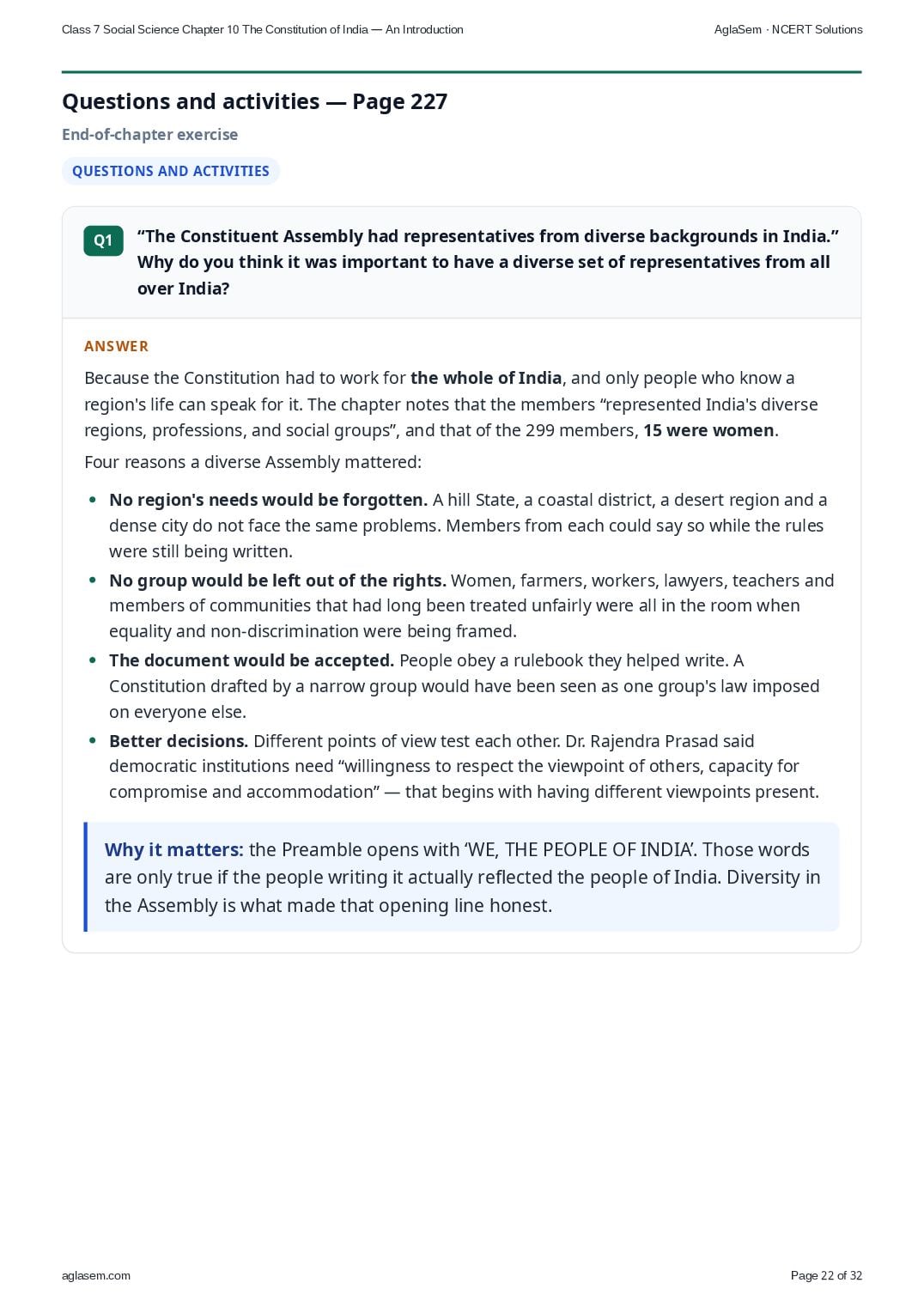
- “The Constituent Assembly had representatives from diverse backgrounds in India.” Why do you think it was important to have a diverse set of representatives from all over India?
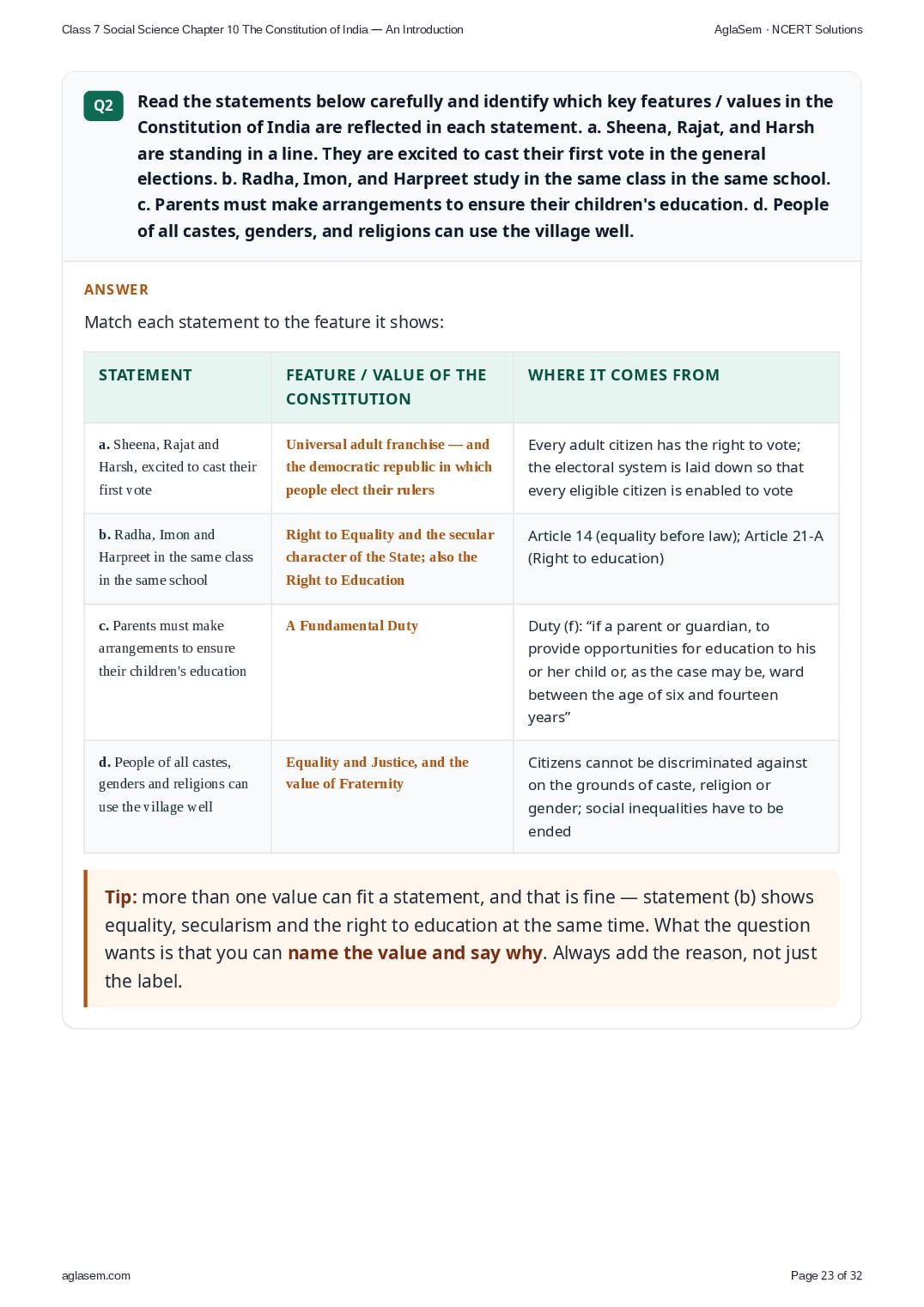
- Read the statements below carefully and identify which key features / values in the Constitution of India are reflected in each statement. a. Sheena, Rajat, and Harsh are standing in a line. They are excited to cast their first vote in the general elections. b. Radha, Imon, and Harpreet study in the same class in the same school. c. Parents must make arrangements to ensure their children's education. d. People of all castes, genders, and religions can use the village well.
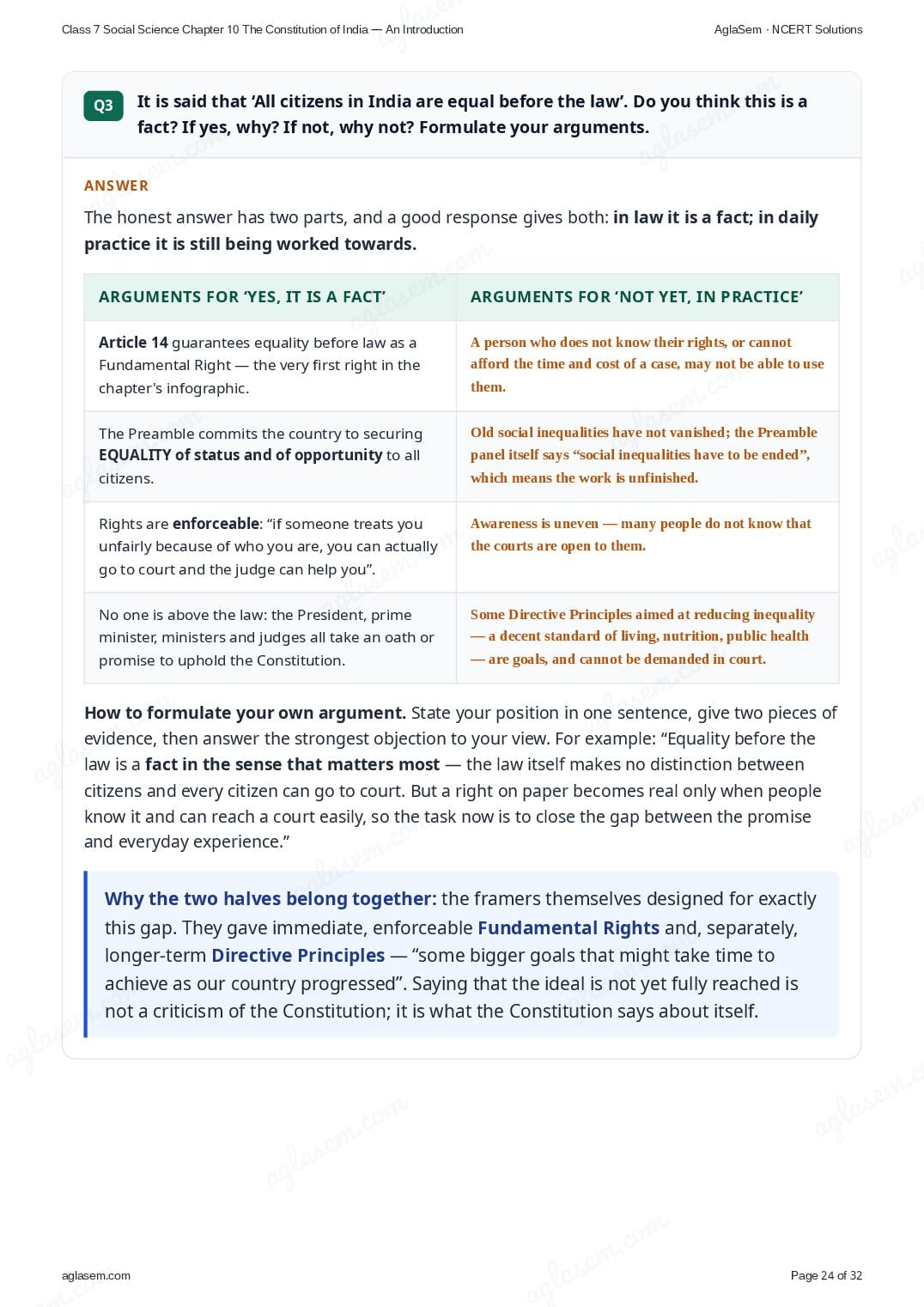
- It is said that ‘All citizens in India are equal before the law’. Do you think this is a fact? If yes, why? If not, why not? Formulate your arguments.
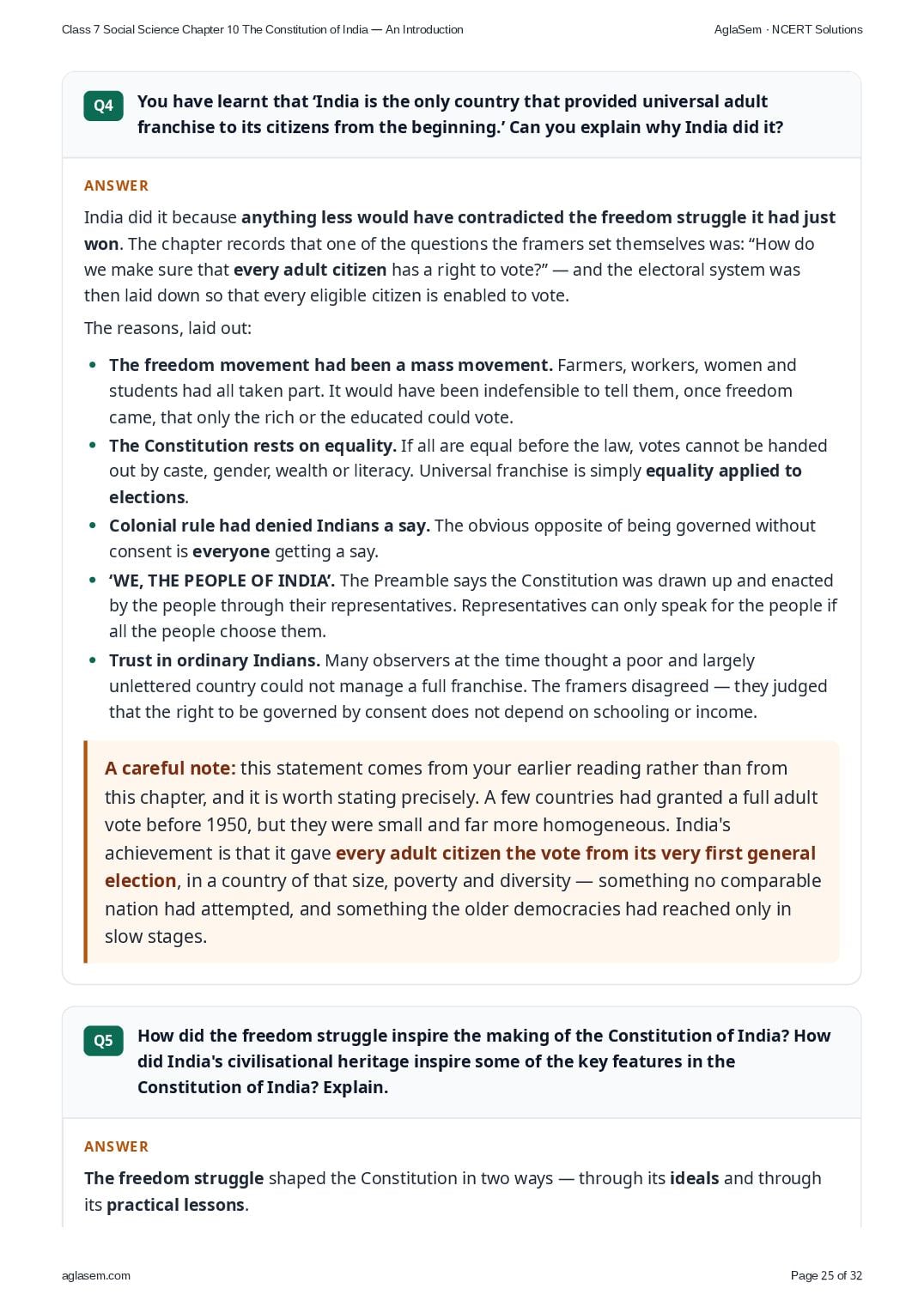
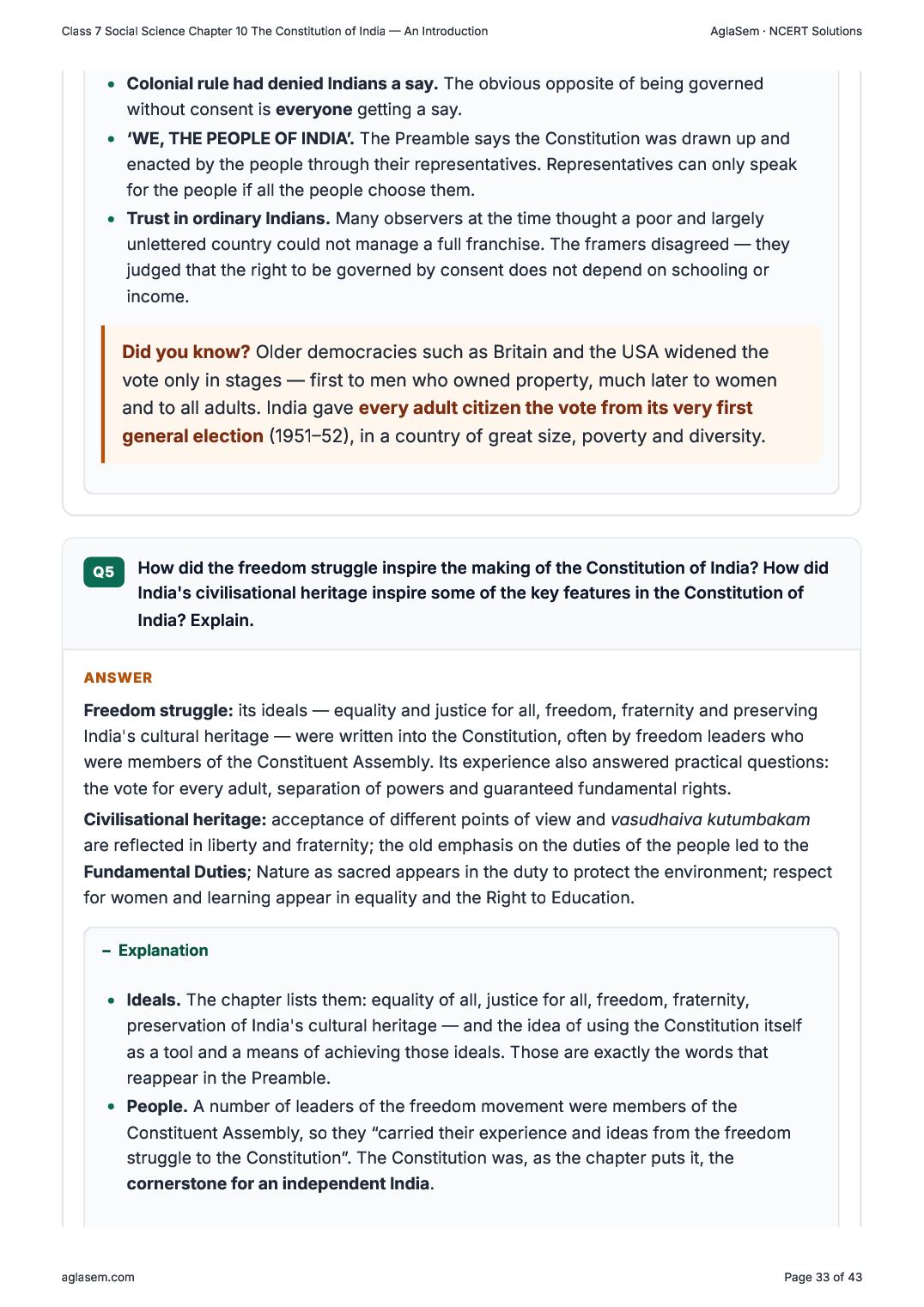
- You have learnt that ‘India is the only country that provided universal adult franchise to its citizens from the beginning.’ Can you explain why India did it?
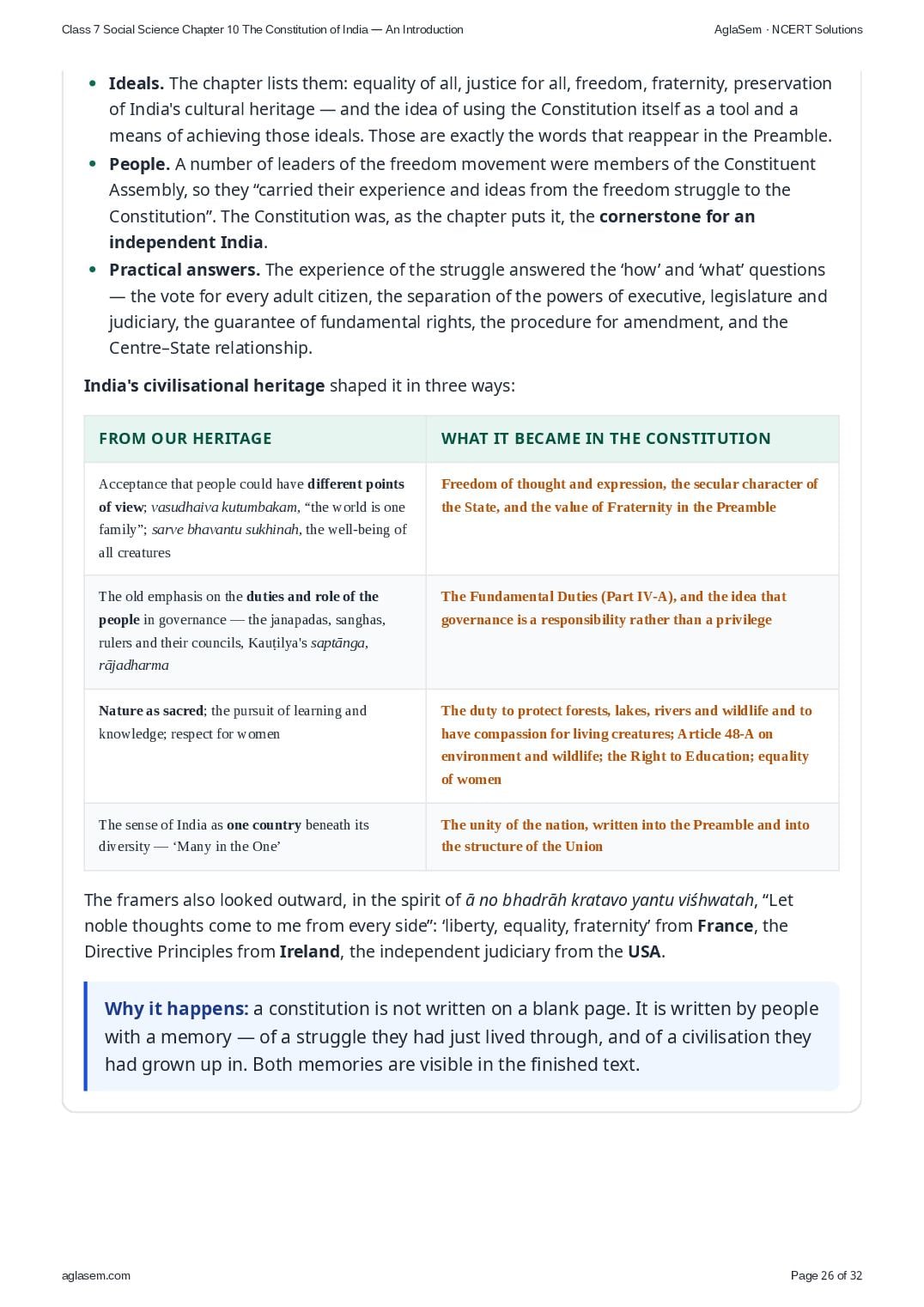
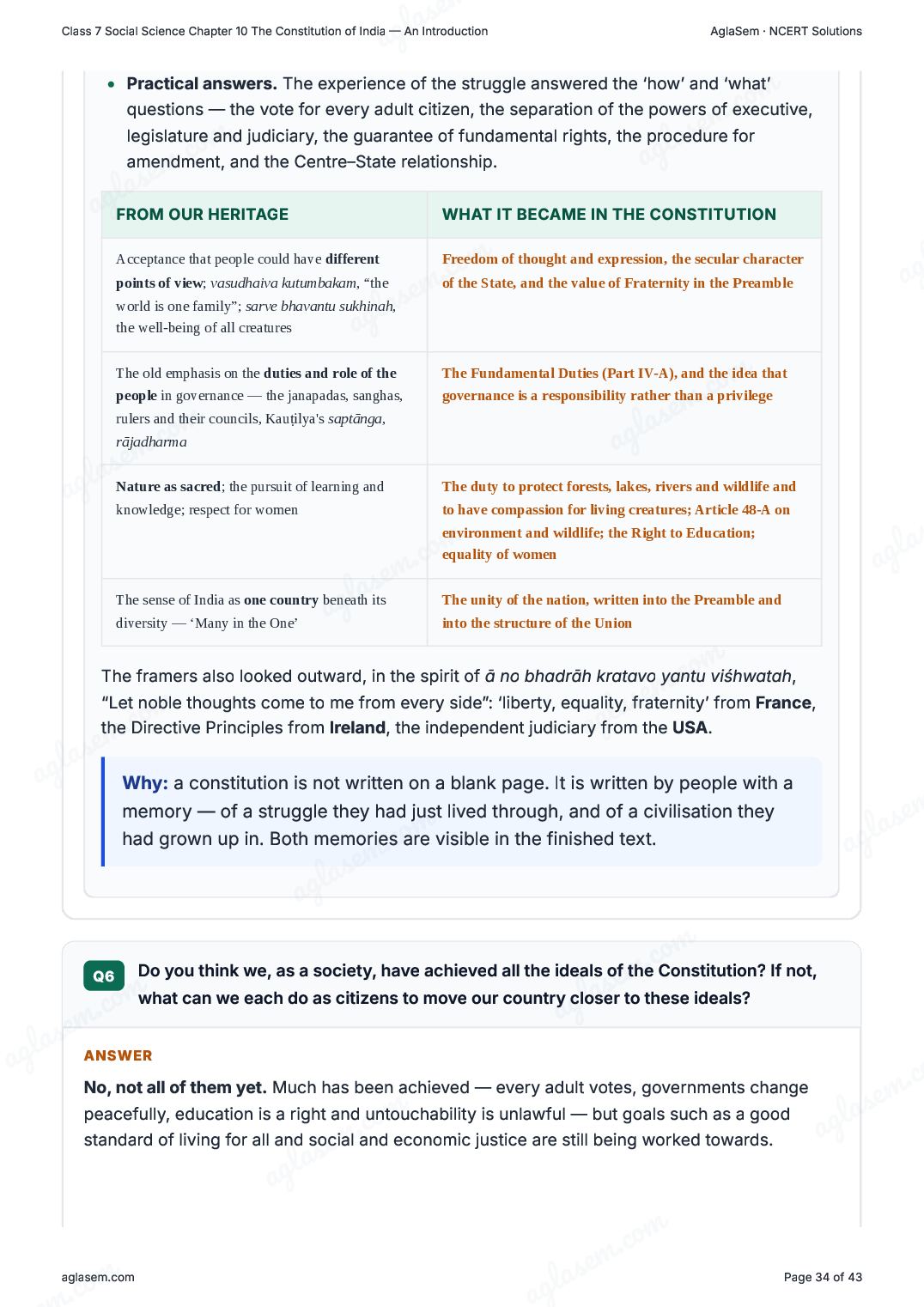
- How did the freedom struggle inspire the making of the Constitution of India? How did India's civilisational heritage inspire some of the key features in the Constitution of India? Explain.
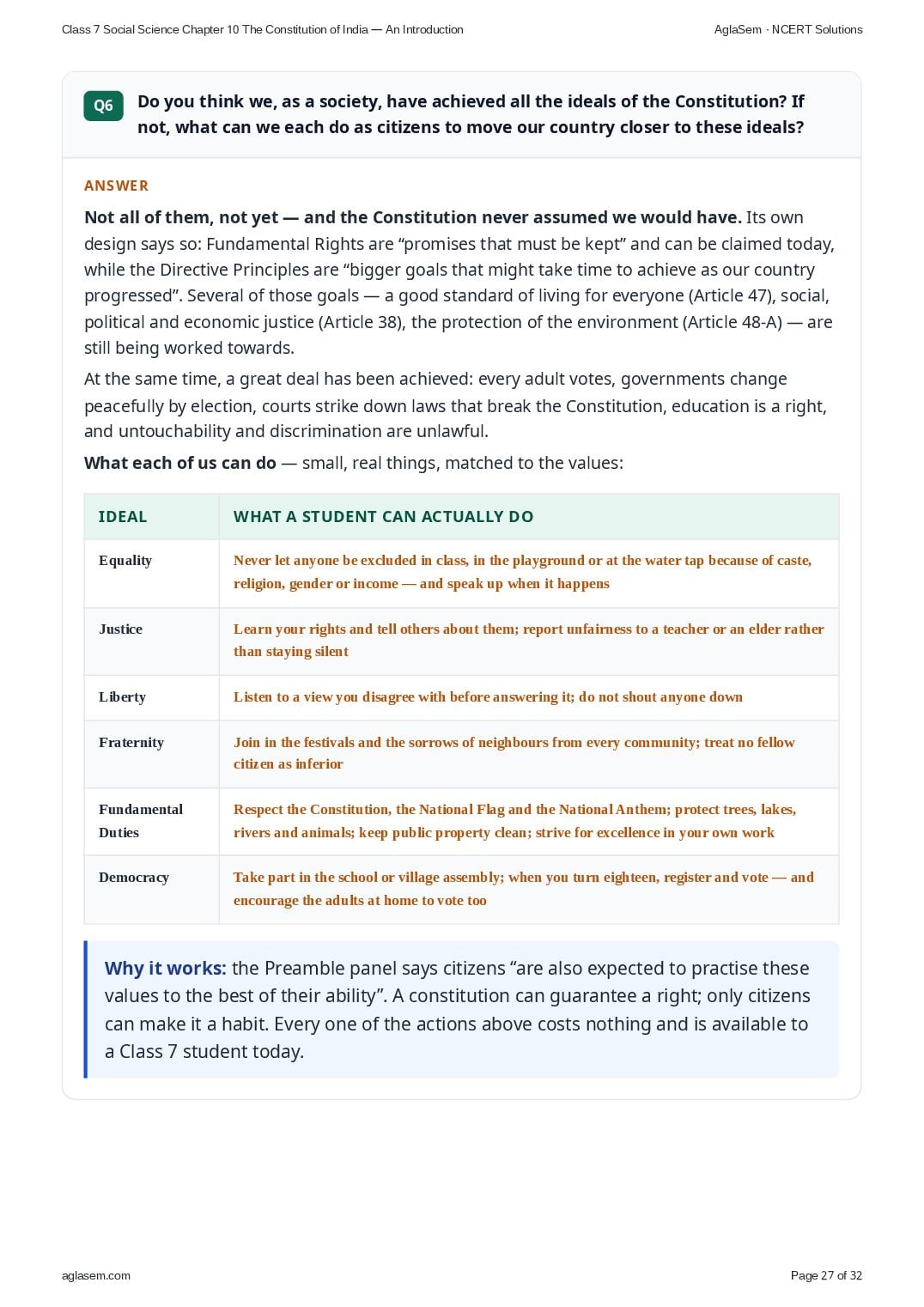
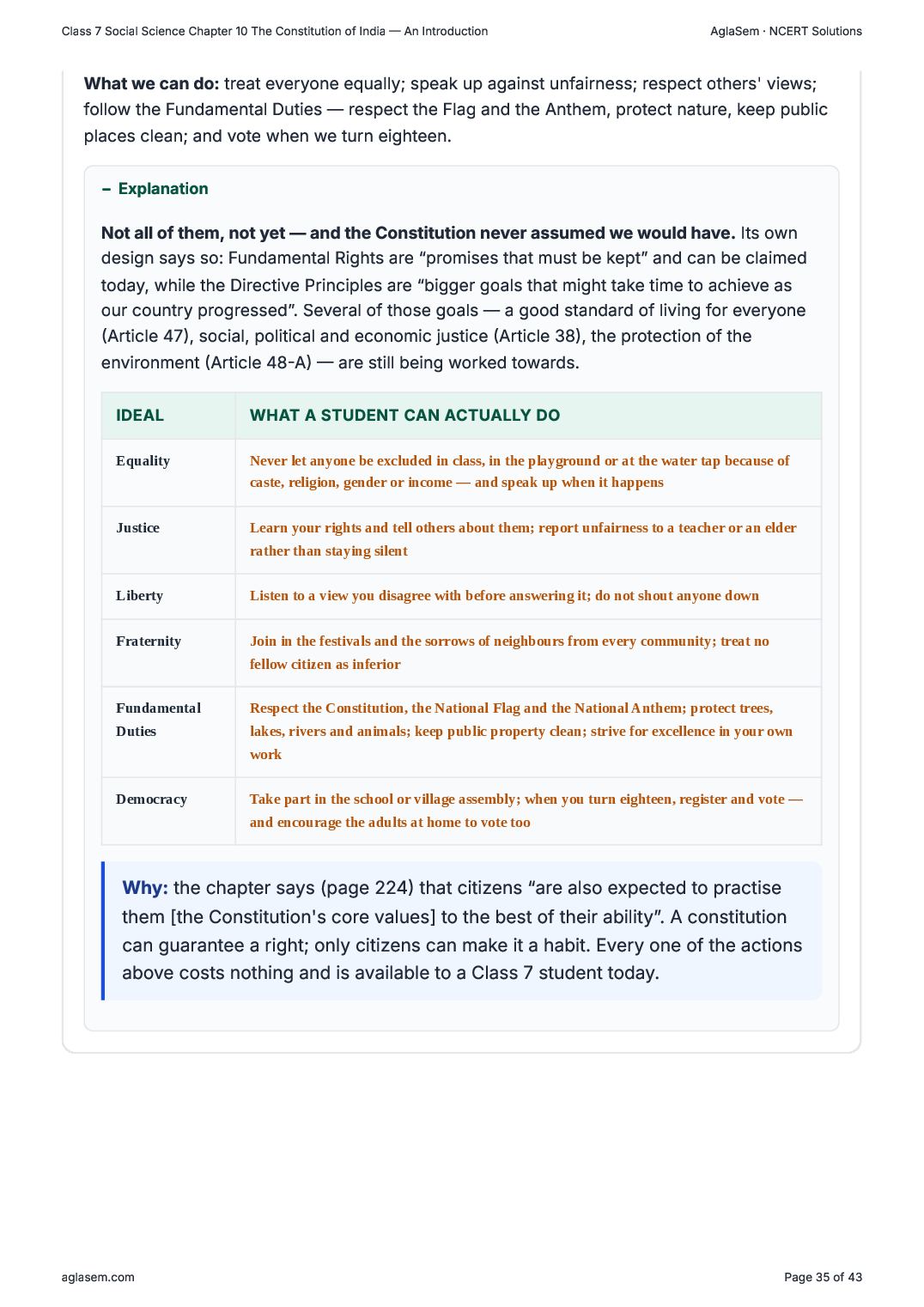
- Do you think we, as a society, have achieved all the ideals of the Constitution? If not, what can we each do as citizens to move our country closer to these ideals?
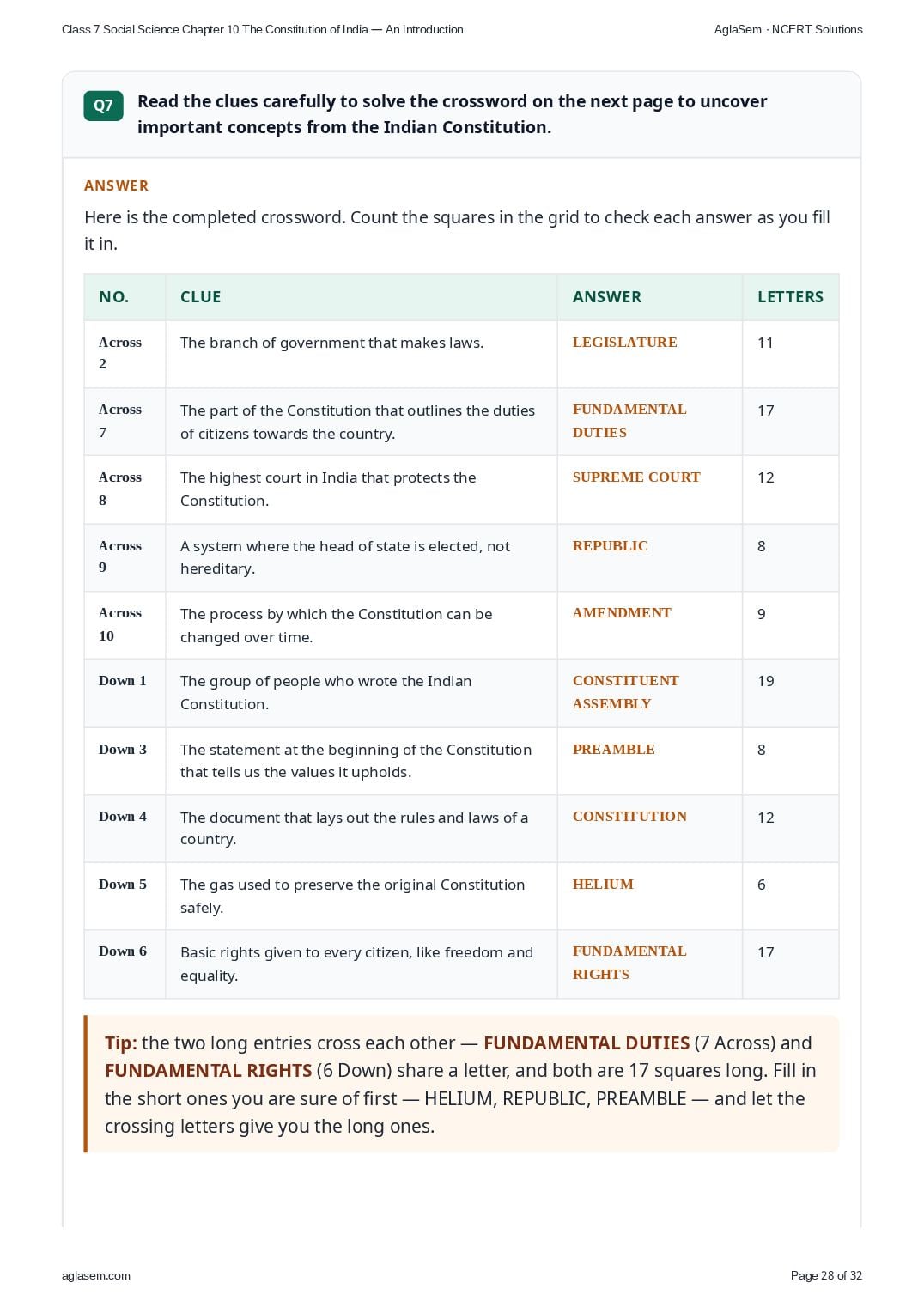
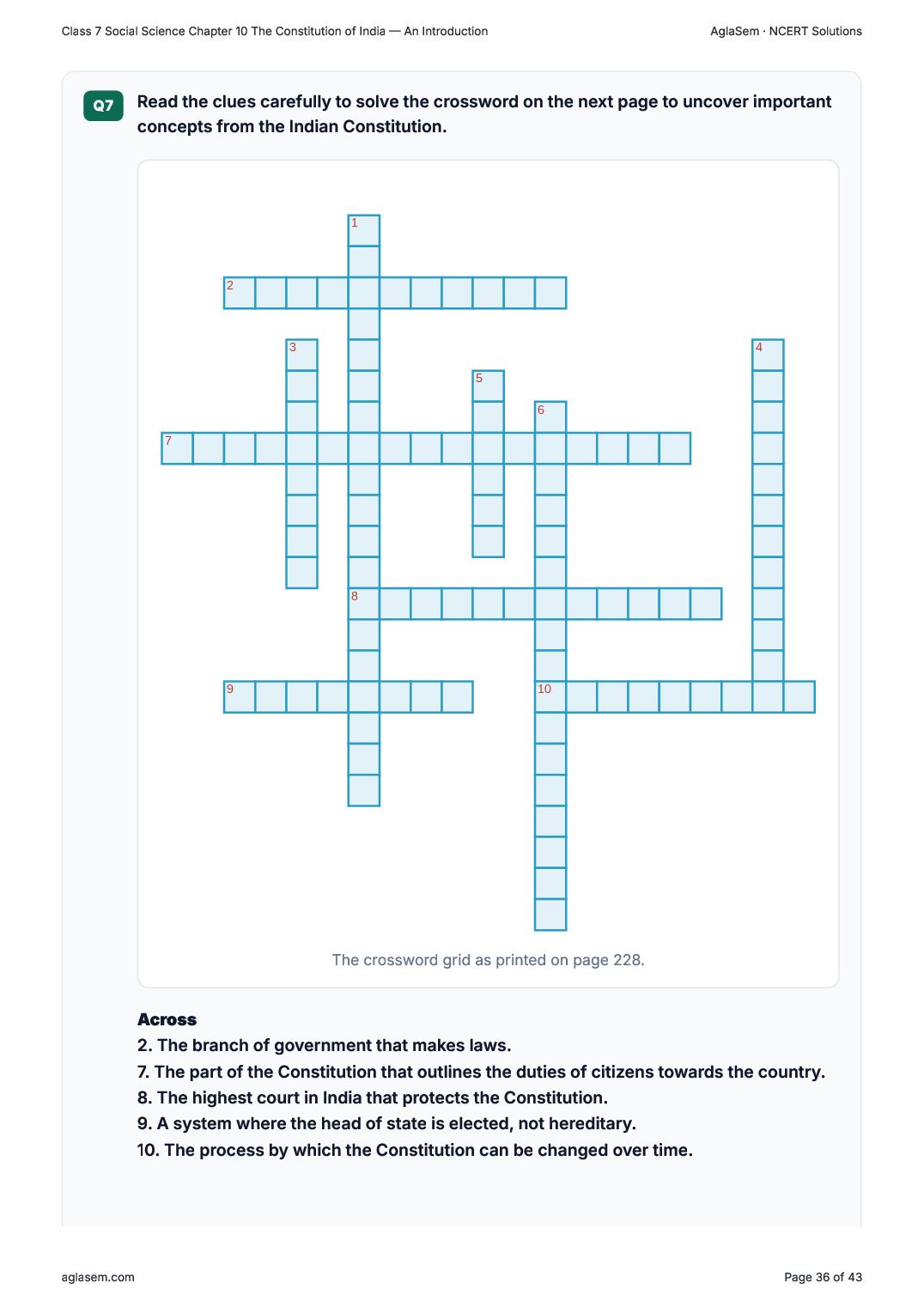
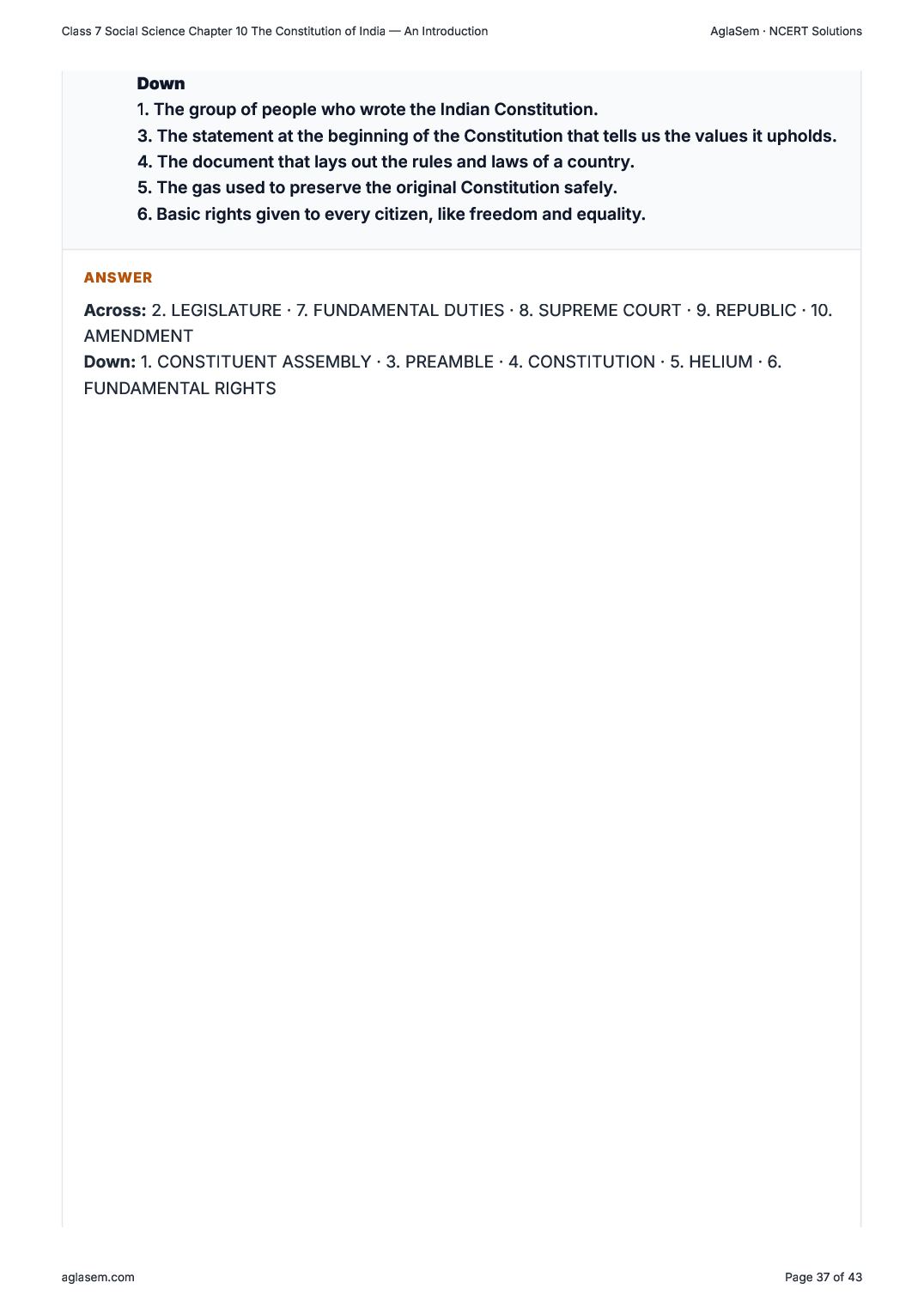
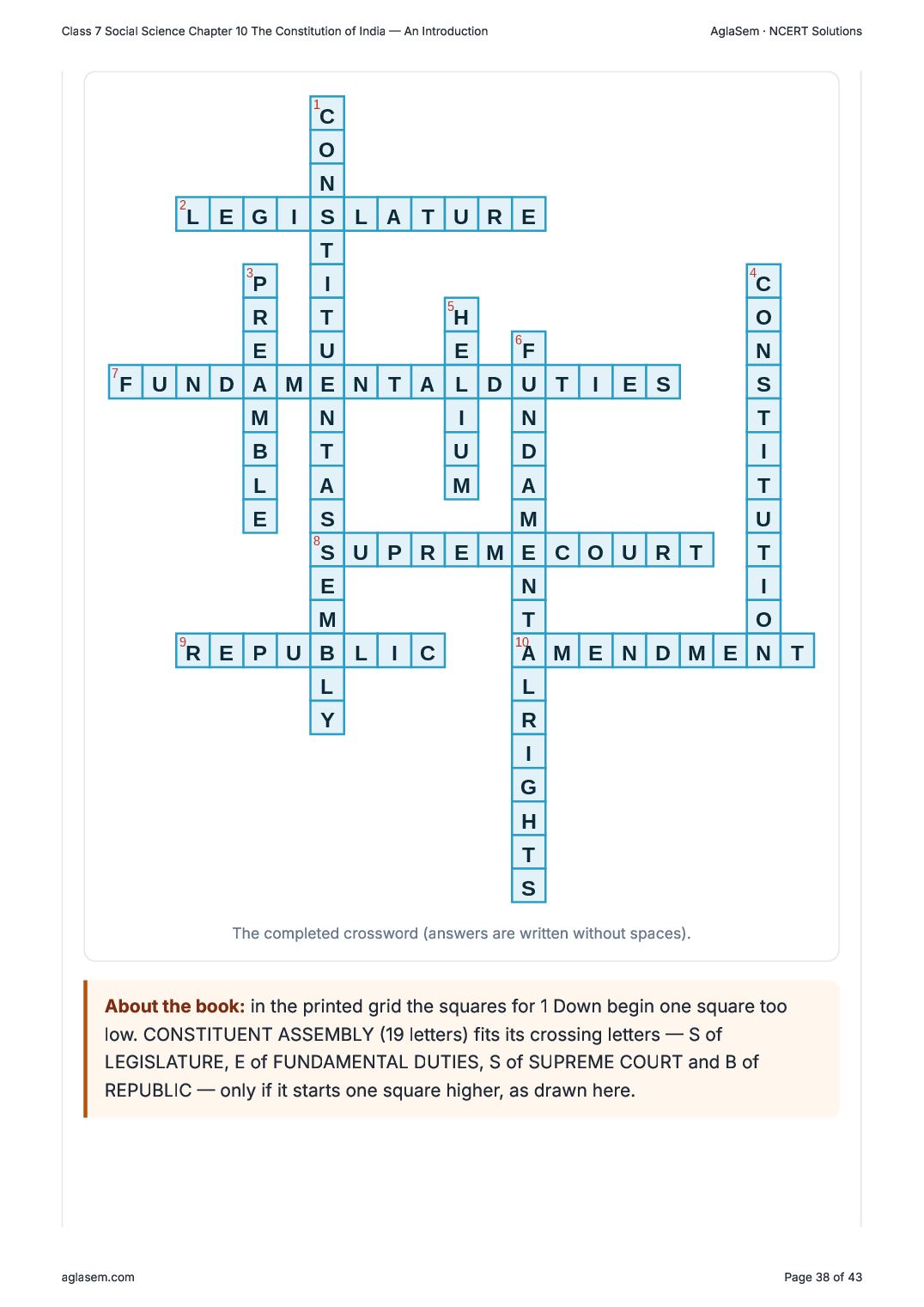
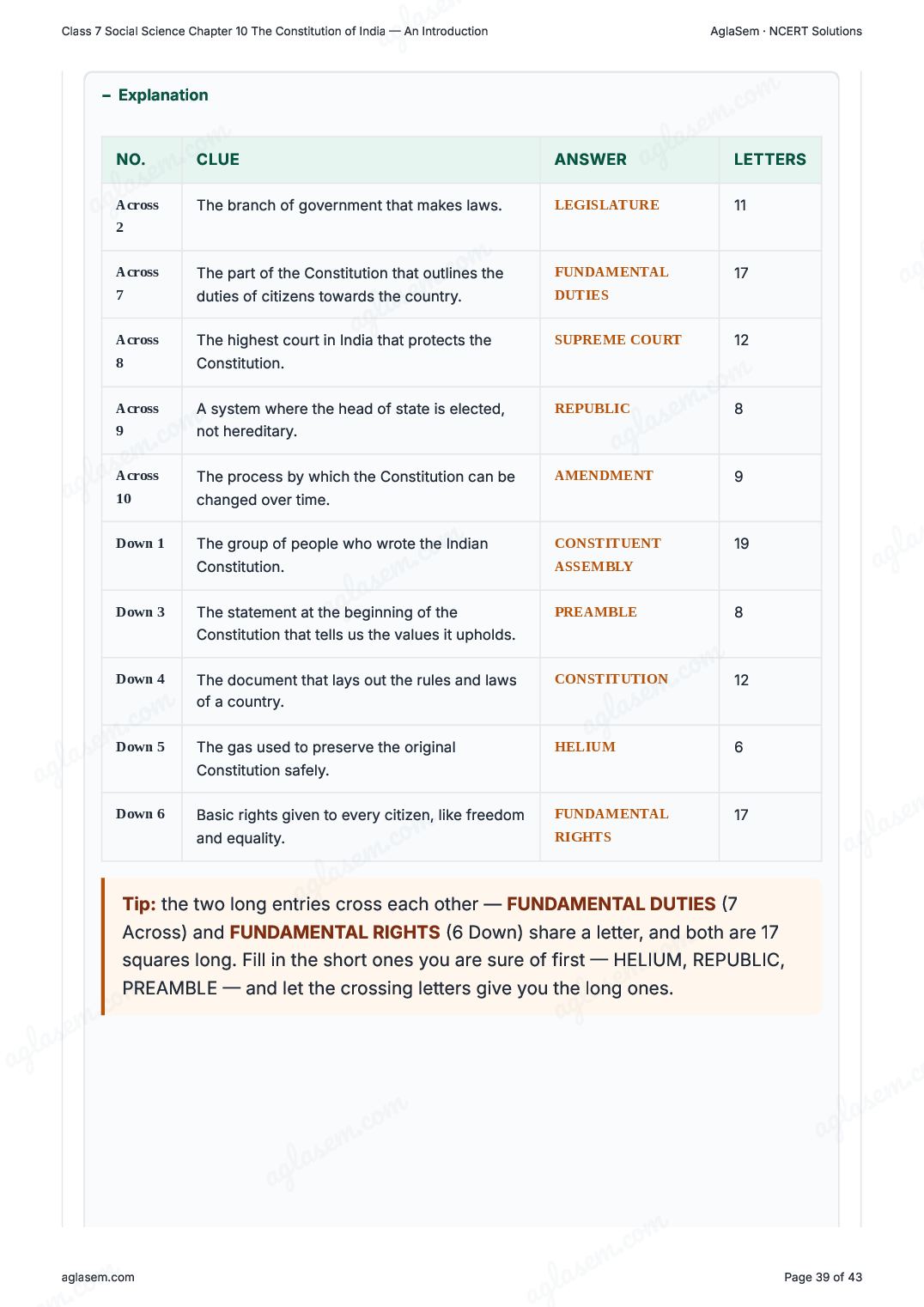
- Read the clues carefully to solve the crossword on the next page to uncover important concepts from the Indian Constitution.
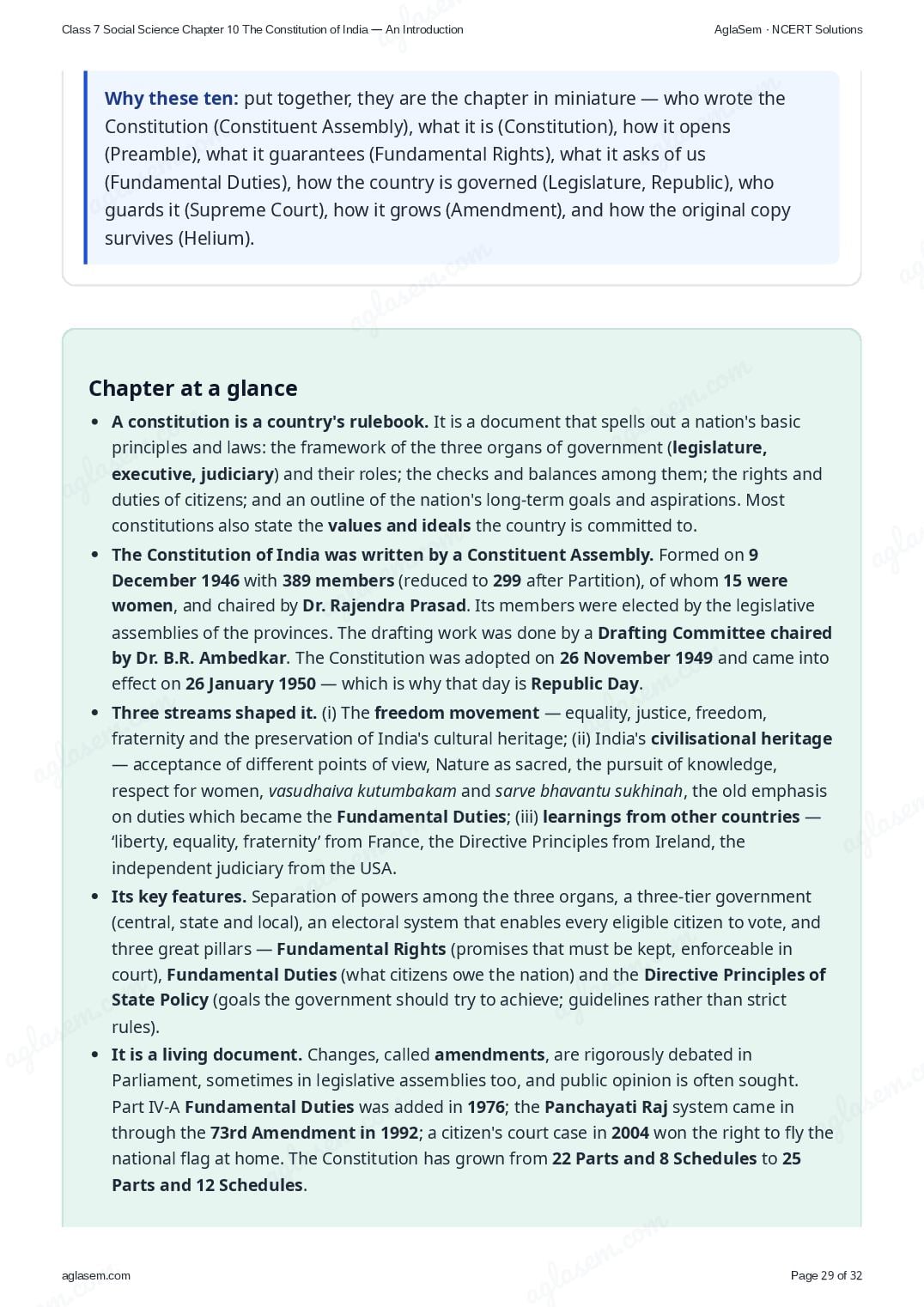
Chapter at a Glance
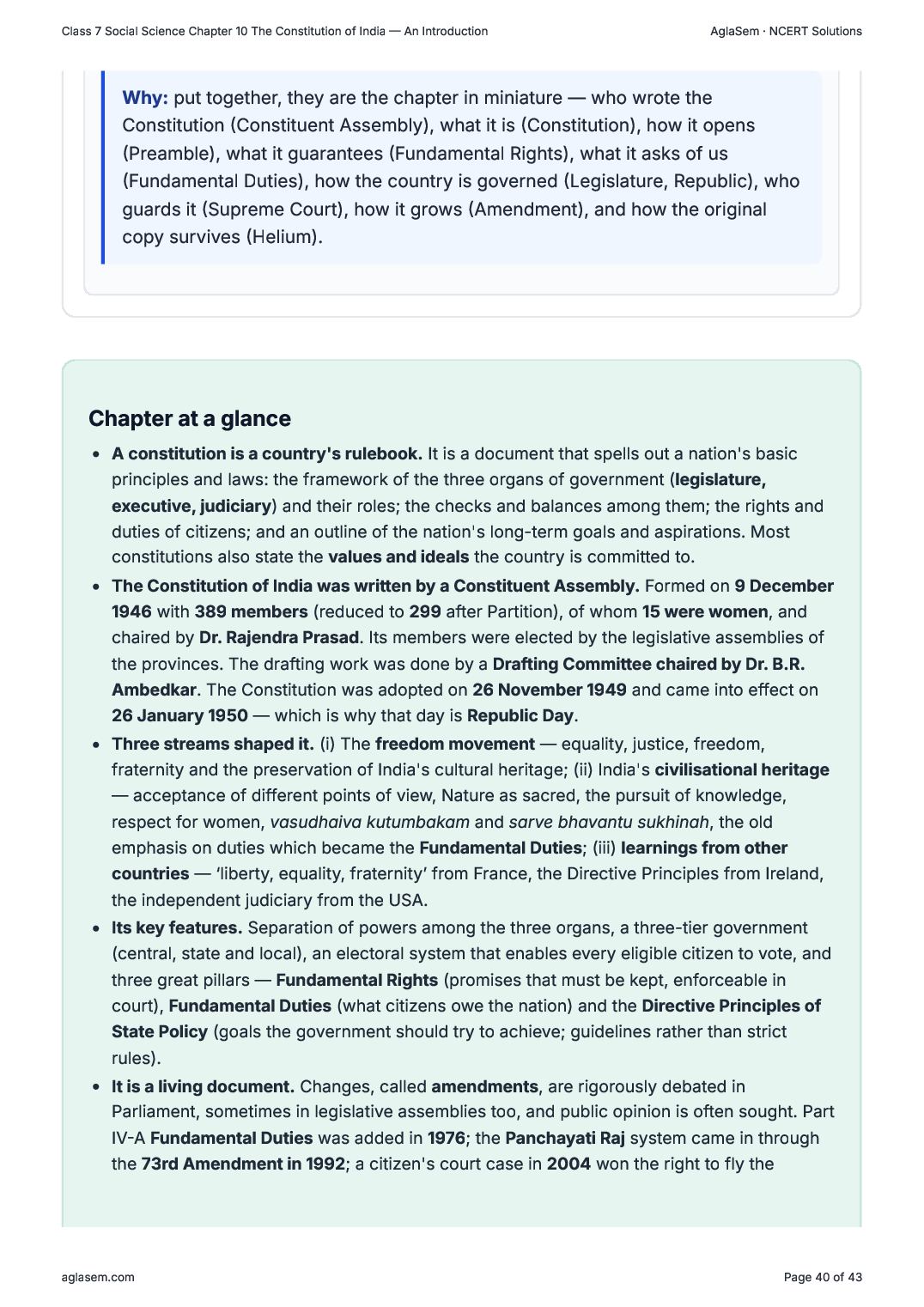
- A constitution is a country's rulebook. It is a document that spells out a nation's basic principles and laws: the framework of the three organs of government ( legislature, executive, judiciary ) and their roles; the checks and balances among them; the rights and duties of citizens; and an outline of the nation's long-term goals and aspirations. Most constitutions also state the values and ideals the country is committed to.
- The Constitution of India was written by a Constituent Assembly. Formed on 9 December 1946 with 389 members (reduced to 299 after Partition), of whom 15 were women , and chaired by Dr. Rajendra Prasad . Its members were elected by the legislative assemblies of the provinces. The drafting work was done by a Drafting Committee chaired by Dr. B.R. Ambedkar . The Constitution was adopted on 26 November 1949 and came into effect on 26 January 1950 — which is why that day is Republic Day .
- Three streams shaped it. (i) The freedom movement — equality, justice, freedom, fraternity and the preservation of India's cultural heritage; (ii) India's civilisational heritage — acceptance of different points of view, Nature as sacred, the pursuit of knowledge, respect for women, vasudhaiva kutumbakam and sarve bhavantu sukhinah , the old emphasis on duties which became the Fundamental Duties ; (iii) learnings from other countries — ‘liberty, equality, fraternity’ from France, the Directive Principles from Ireland, the independent judiciary from the USA.
- Its key features. Separation of powers among the three organs, a three-tier government (central, state and local), an electoral system that enables every eligible citizen to vote, and three great pillars — Fundamental Rights (promises that must be kept, enforceable in court), Fundamental Duties (what citizens owe the nation) and the Directive Principles of State Policy (goals the government should try to achieve; guidelines rather than strict rules).
- It is a living document. Changes, called amendments , are rigorously debated in Parliament, sometimes in legislative assemblies too, and public opinion is often sought. Part IV-A Fundamental Duties was added in 1976 ; the Panchayati Raj system came in through the 73rd Amendment in 1992 ; a citizen's court case in 2004 won the right to fly the national flag at home. The Constitution has grown from 22 Parts and 8 Schedules to 25 Parts and 12 Schedules .
- The Preamble holds the guiding values. ‘WE, THE PEOPLE OF INDIA’ — Sovereign, Socialist, Secular, Democratic, Republic — securing Justice, Liberty, Equality and promoting Fraternity . The words ‘Socialist’, ‘Secular’ and ‘Integrity’ were added by the 42nd Amendment in 1976 . The original text was handwritten by calligrapher Prem Behari Narain Raizada and illustrated by Nandalal Bose and his team; the copy is preserved in a helium-filled glass case in Parliament.
How to Download NCERT Solutions for Class 7 Social Science Chapter 10 PDF
Follow these simple steps to get the the Constitution of India an Introduction questions-and-answers PDF from Exploring Society India and Beyond.
- Search NCERT Solutions for Class 7 Social Science Chapter 10 aglasem and open this page.
- Read the exercise questions with answers for the Constitution of India an Introduction shown above.
- Click the Download PDF link to save the the Constitution of India an Introduction solutions to your device.
NCERT Solutions for Class 7 Social Science – All Chapters
There are more chapters to study besides the Constitution of India an Introduction in Social Science. Here are the NCERT Solutions for all chapters of Class 7 Social Science.
- Chapter 1 Geographical Diversity of India
- Chapter 2 Understanding the Weather
- Chapter 3 Climates of India
- Chapter 4 New Beginnings Cities and States
- Chapter 5 the Rise of Empires
- Chapter 6 the Age of Reorganisation
- Chapter 7 the Gupta Era an Age of Tireless Creativity
- Chapter 8 How the Land Becomes Sacred
- Chapter 9 From the Rulers to the Ruled Types of Governments
- Chapter 10 the Constitution of India an Introduction
- Chapter 11 From Barter to Money
- Chapter 12 Understanding Markets
NCERT Solutions for Class 7 – All Subjects
Just like Chapter 10 of Social Science, you can get the exercise questions with answers for every other subject of Class 7. Here are the NCERT Solutions for all subjects of Class 7.
NCERT Solutions for Class 7 Social Science Chapter 10 – An Overview
The key highlights of this study material are as follows.
| Aspects | Details |
|---|---|
| Class | Class 7 |
| Subject | Social Science |
| Chapter Number | Chapter 10 |
| Chapter Name | the Constitution of India an Introduction |
| Book Name | Exploring Society India and Beyond |
| Book By | NCERT (National Council of Educational Research and Training) |
| Educational Resource Here | NCERT Solutions of Class 7 Social Science Chapter 10 for all exercises |
| More Questions Answers of This Subject | NCERT Solutions for Class 7 Social Science |
| Download Book Chapter | NCERT Book Class 7 Social Science |
| All Questions Answers For This Class | NCERT Solutions for Class 7 |
| Complete Solutions | NCERT Solutions |
NCERT Solutions for Class 7 Social Science Chapter 10 the Constitution of India an Introduction – FAQs
What are the NCERT Solutions for Class 7 Social Science Chapter 10 the Constitution of India an Introduction?
They are the complete, step-by-step answers to all the exercise and in-text questions of Chapter 10 the Constitution of India an Introduction from the NCERT Class 7 Social Science textbook Exploring Society India and Beyond, written by experts as per the latest NCERT syllabus.
How can I download the Class 7 Social Science Chapter 10 solutions PDF for free?
Open this page on aglasem, read the the Constitution of India an Introduction questions with answers, and click the “Download Solutions PDF” link. The Class 7 Social Science Chapter 10 NCERT Solutions PDF is completely free to download.
Are these NCERT Solutions as per the latest 2026-27 syllabus?
Yes. The NCERT Solutions for Class 7 Social Science Chapter 10 are based on the latest NCERT textbook Exploring Society India and Beyond and the current 2026-27 CBSE syllabus, so the questions and answers match what you study in class.
Where can I get NCERT Solutions for the other chapters of Class 7 Social Science?
You can find the answers to every chapter on the NCERT Solutions for Class 7 Social Science page, and solutions for every subject on the NCERT Solutions for Class 7 page.
How do NCERT Solutions help in exam preparation?
They show the correct method to solve each question, help you write answers the way they are expected in exams, let you check and correct your own work, and save revision time — which together improve your marks in Class 7 Social Science.
If you have any queries on NCERT Solutions for Class 7 Social Science Chapter 10 the Constitution of India an Introduction, then please ask in the comments below.