NCERT Solutions for Class 7 Social Science Chapter 5 the Rise of Empires provide clear, step-by-step answers to every exercise and in-text question from the chapter the Rise of Empires of the NCERT textbook Exploring Society India and Beyond. Prepared by subject experts as per the latest NCERT (CBSE) syllabus for 2026-27, these NCERT Solutions for Class 7 Social Science help you understand each concept, write exam-ready answers, and check your own solutions. You can read them online below or download the free Class 7 Social Science Chapter 5 question-answer PDF.
NCERT Solutions for Class 7 Social Science Chapter 5 the Rise of Empires
- Class: Class 7
- Subject: Social Science
- Chapter: Chapter 5 – the Rise of Empires
- Textbook: Exploring Society India and Beyond (NCERT)
- Study material: NCERT Solutions – questions with answers, free PDF
These solutions answer all the exercise questions of Chapter 5 the Rise of Empires — including the in-text questions, short-answer and long-answer questions, and activities — with complete explanations so you can follow the method, not just the final answer. Read the full solutions below.
NCERT Solutions Class 7 Social Science Chapter 5 the Rise of Empires View Download
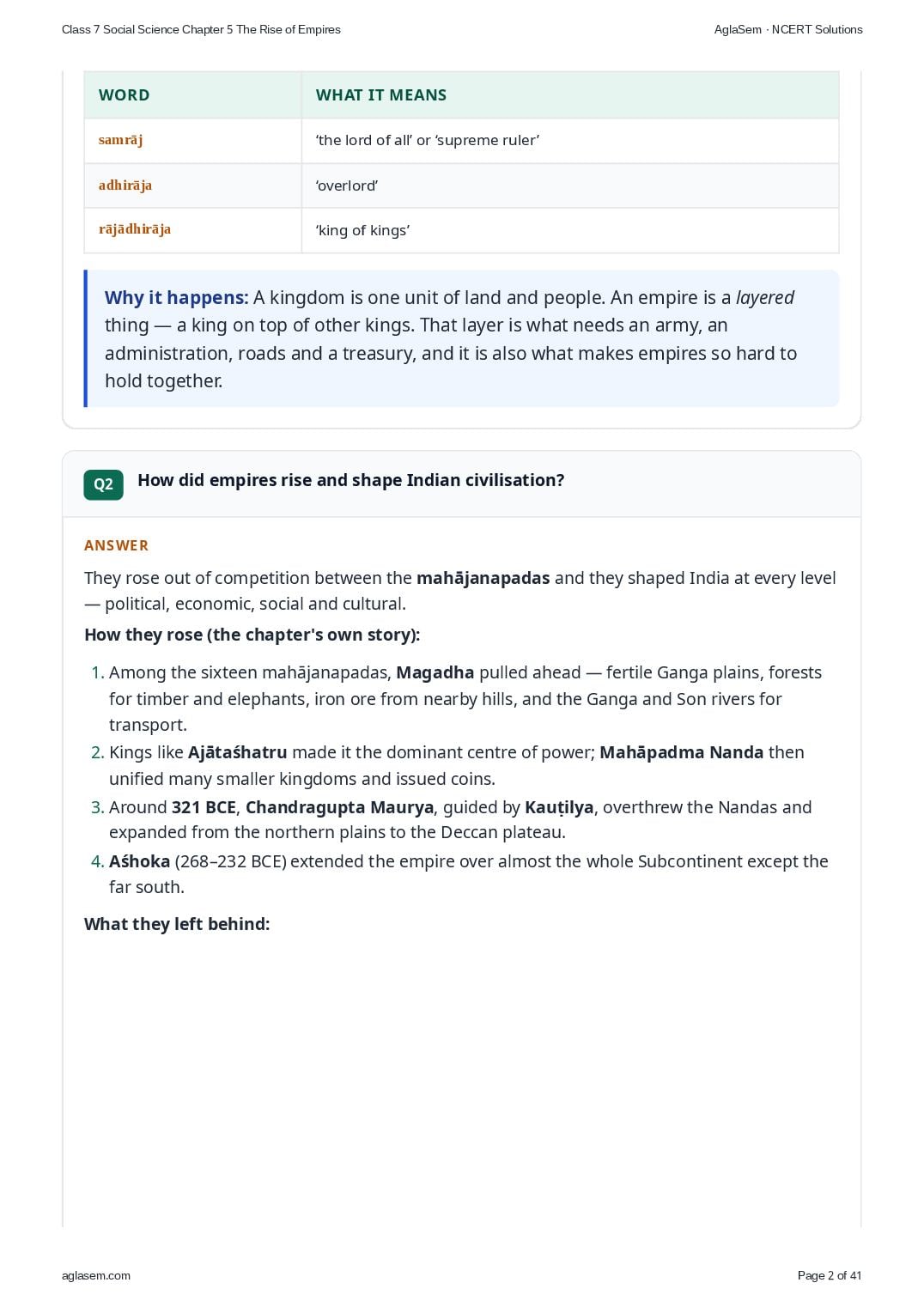

NCERT Solutions for Class 7 Social Science Chapter 5 PDF Download
You can read the NCERT Solutions for Class 7 Social Science Chapter 5 online above, or download the complete question-answer PDF to study the Rise of Empires offline at any time.
NCERT Solutions for Class 7 Social Science Chapter 5 PDF Download Link – Click Here to Download Solutions PDF
Questions Covered in This Chapter
These NCERT Solutions answer all 35 questions of this chapter. The questions solved are:
- What is an empire?
- How did empires rise and shape Indian civilisation?
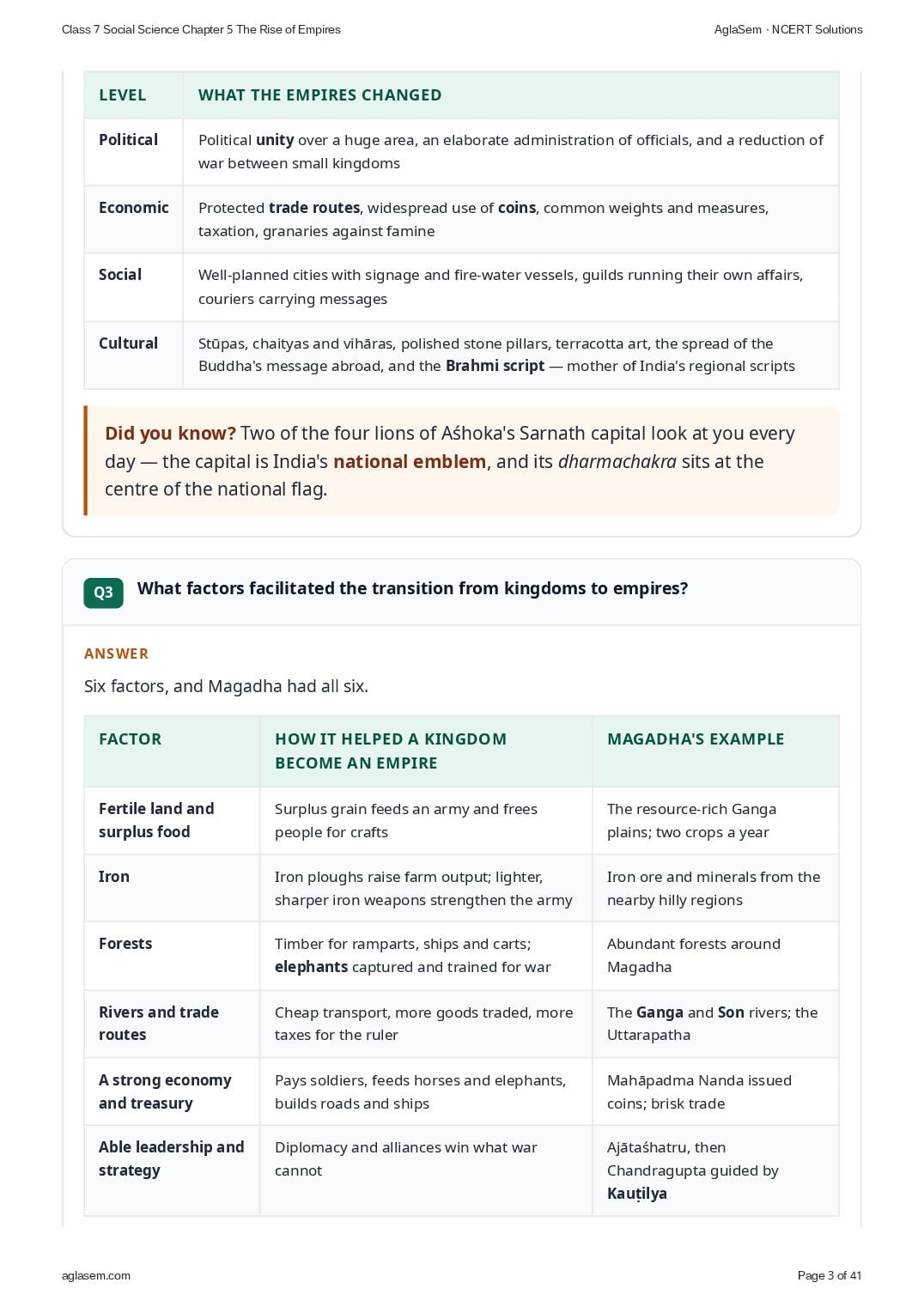
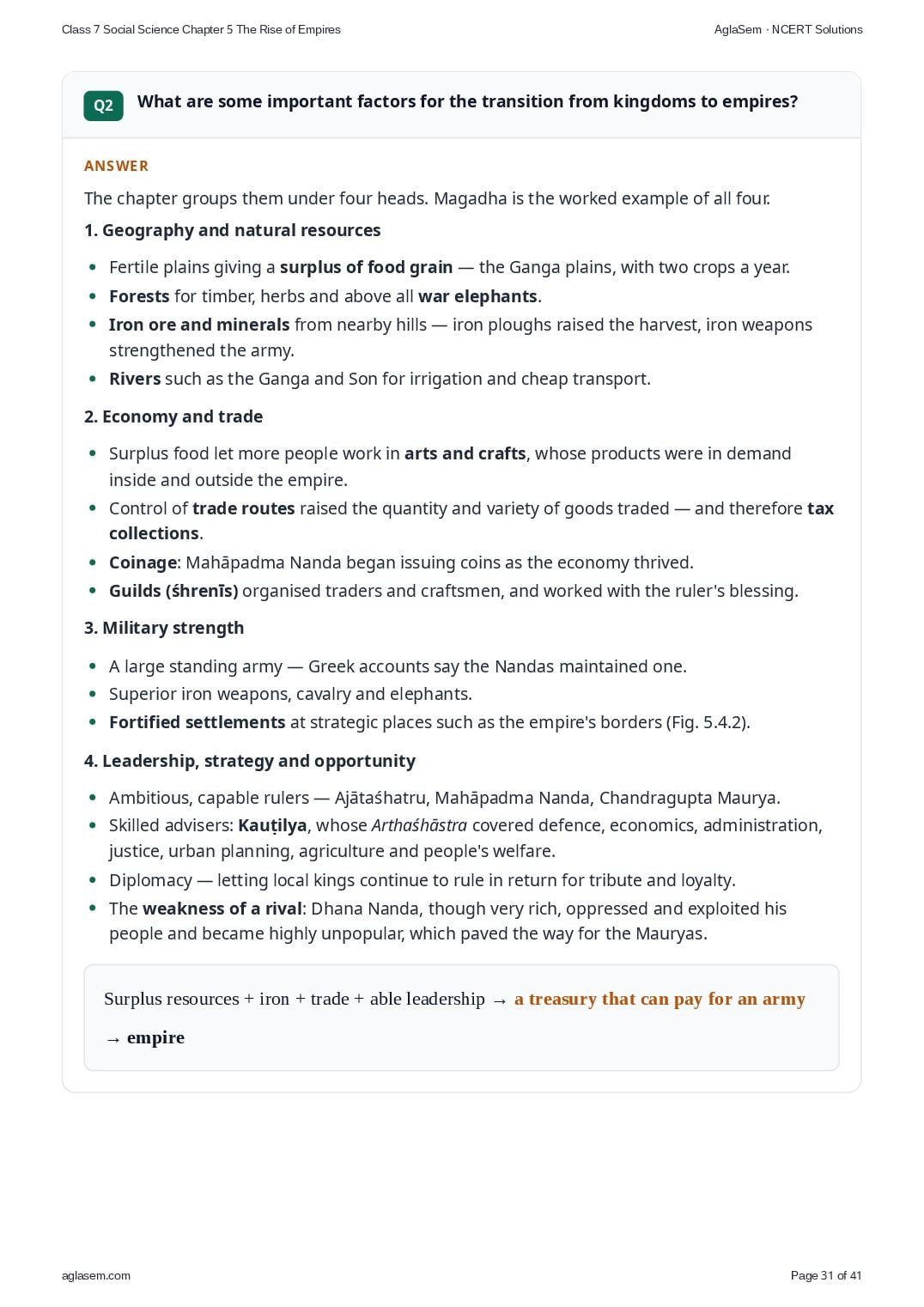
- What factors facilitated the transition from kingdoms to empires?
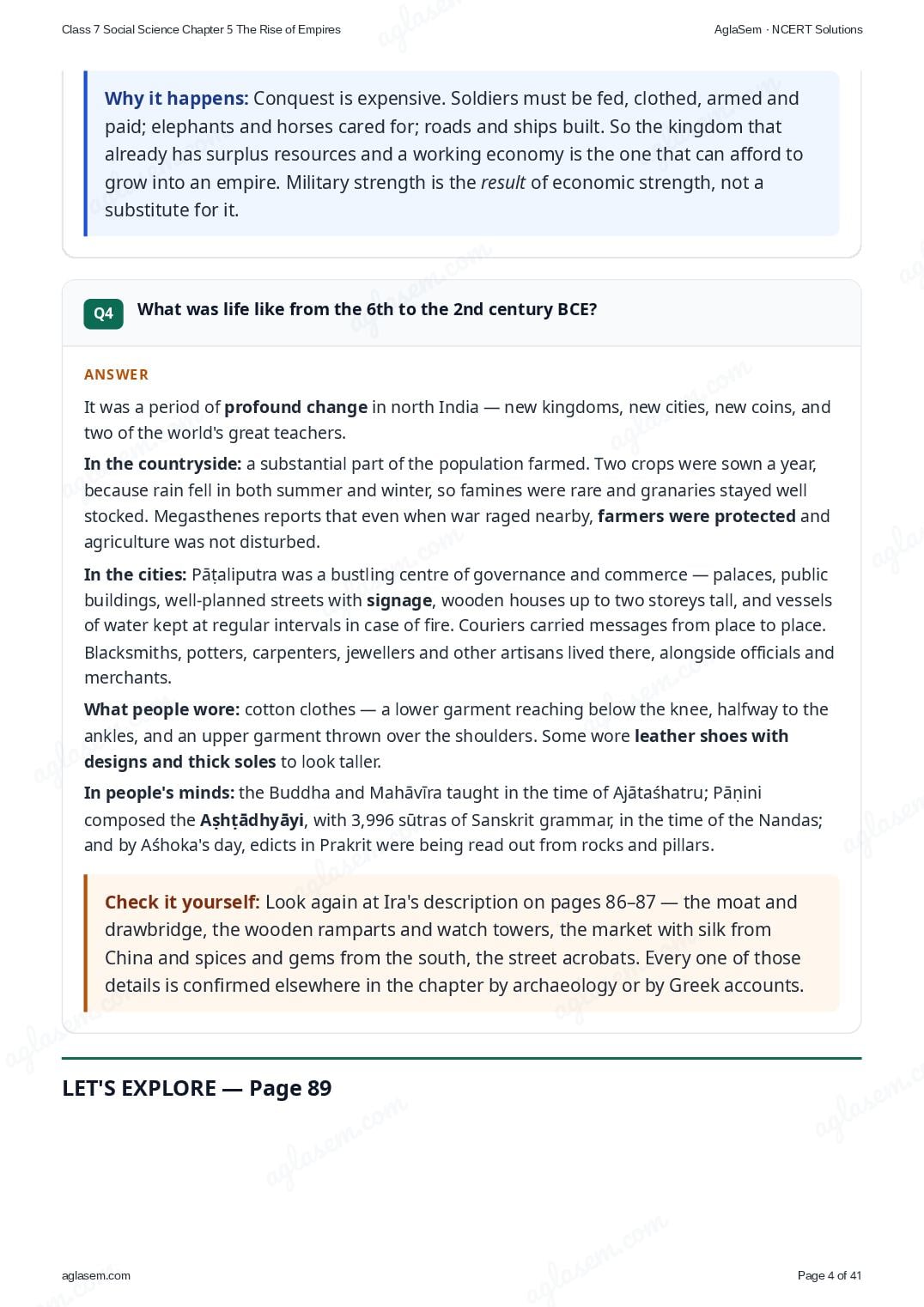
- What was life like from the 6th to the 2nd century BCE?
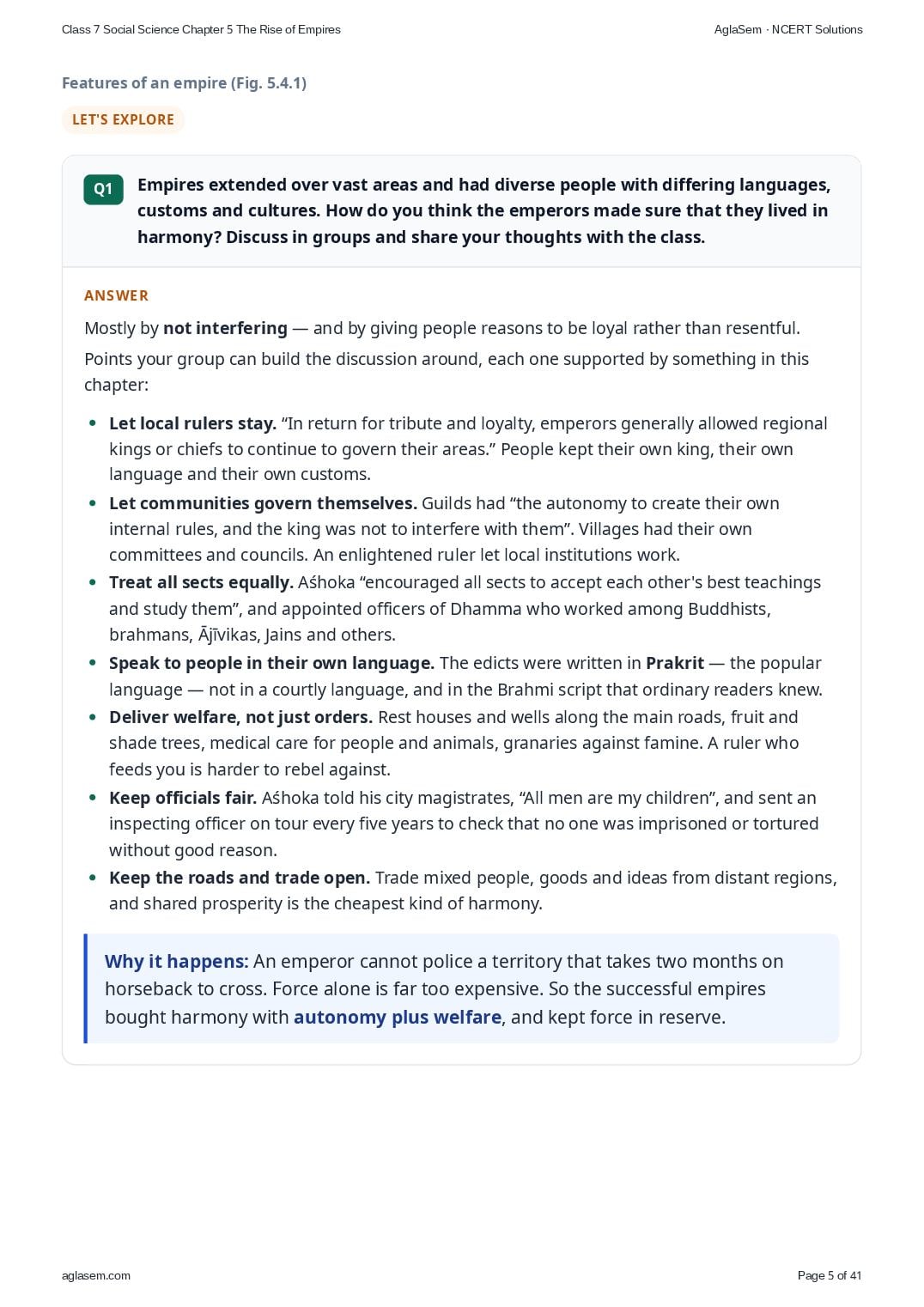
- Empires extended over vast areas and had diverse people with differing languages, customs and cultures. How do you think the emperors made sure that they lived in harmony? Discuss in groups and share your thoughts with the class.
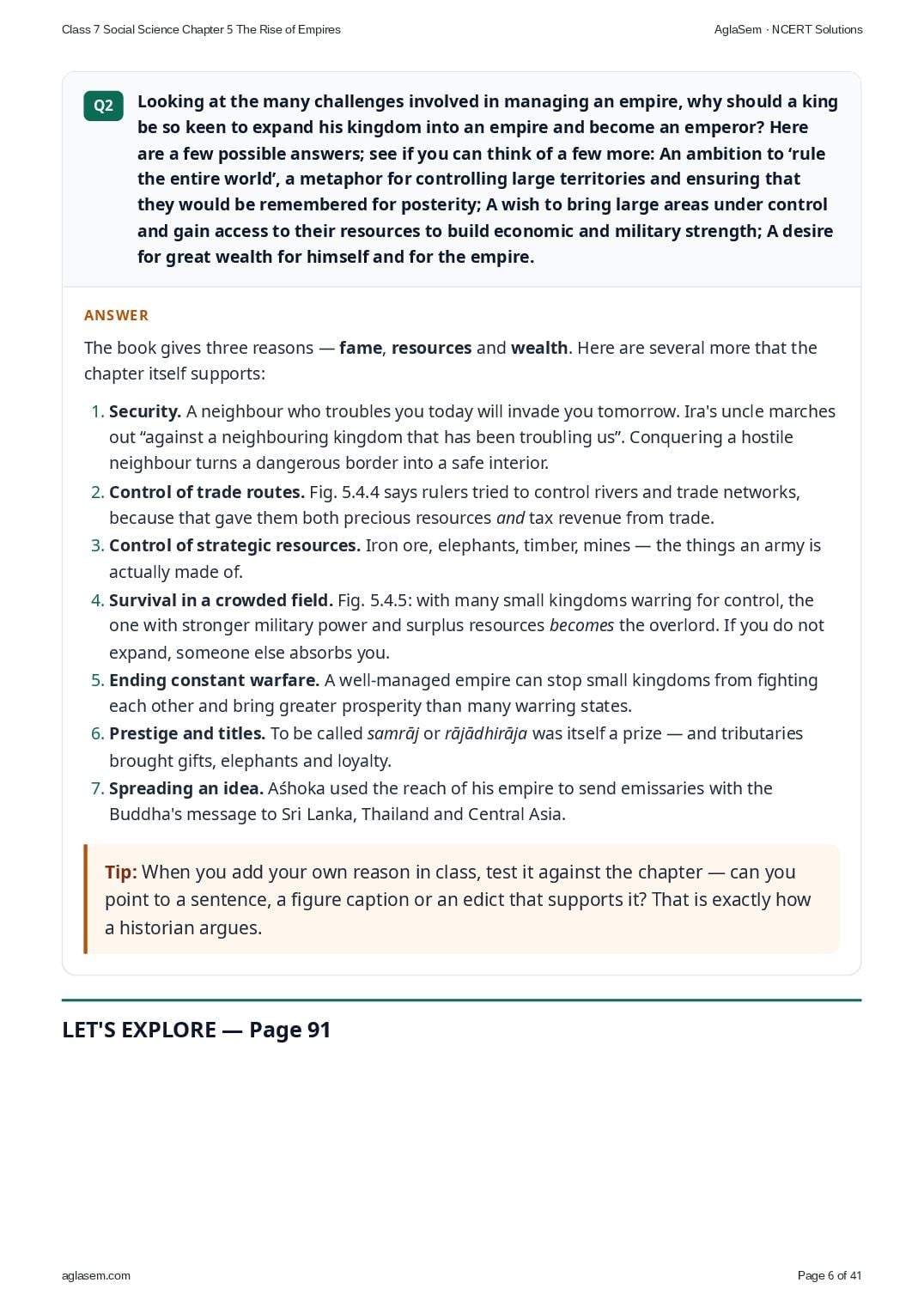
- Looking at the many challenges involved in managing an empire, why should a king be so keen to expand his kingdom into an empire and become an emperor? Here are a few possible answers; see if you can think of a few more: An ambition to ‘rule the entire world’, a metaphor for controlling large territories and ensuring that they would be remembered for posterity; A wish to bring large areas under control and gain access to their resources to build economic and military strength; A desire for great wealth for himself and for the empire.
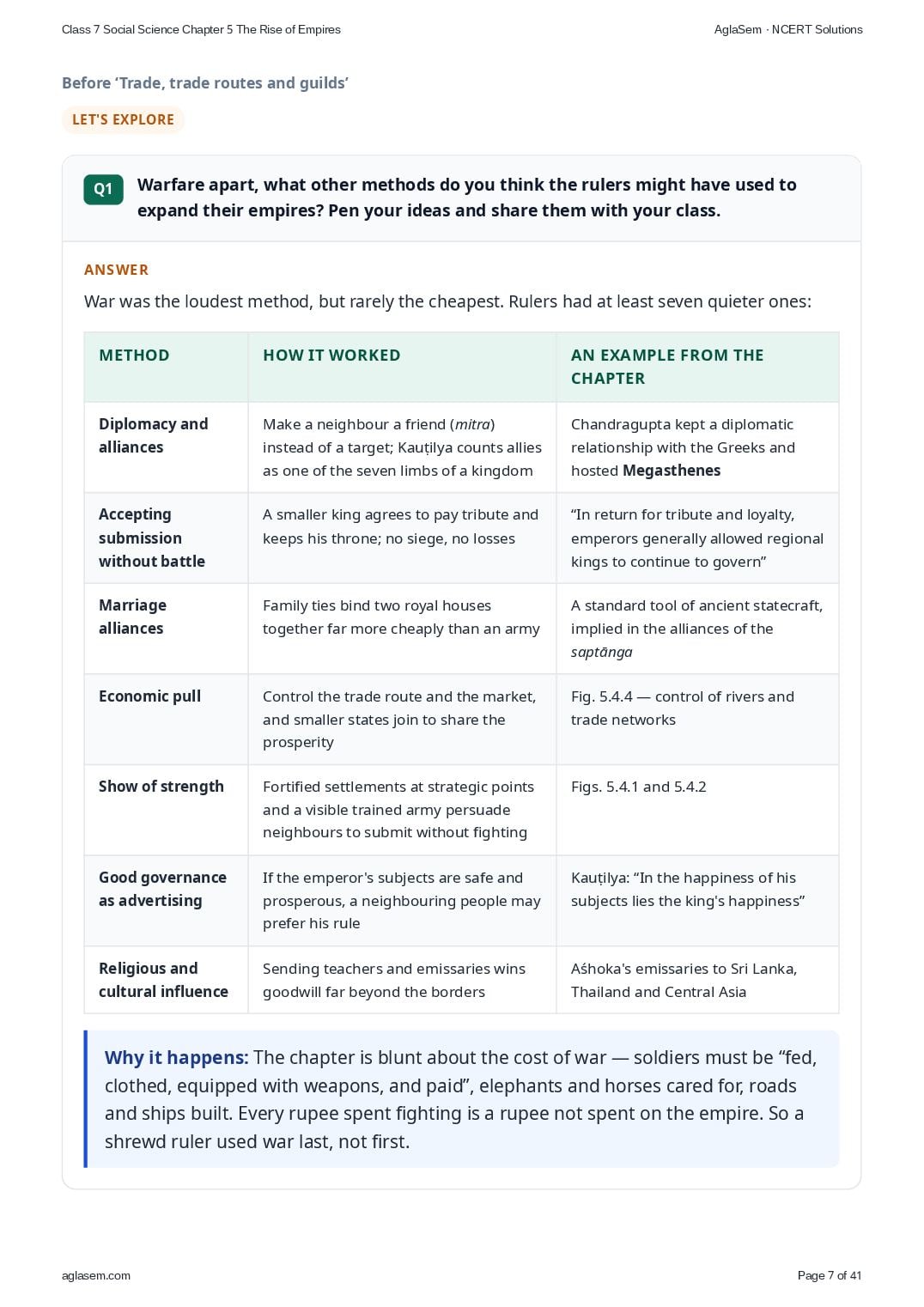
- Warfare apart, what other methods do you think the rulers might have used to expand their empires? Pen your ideas and share them with your class.
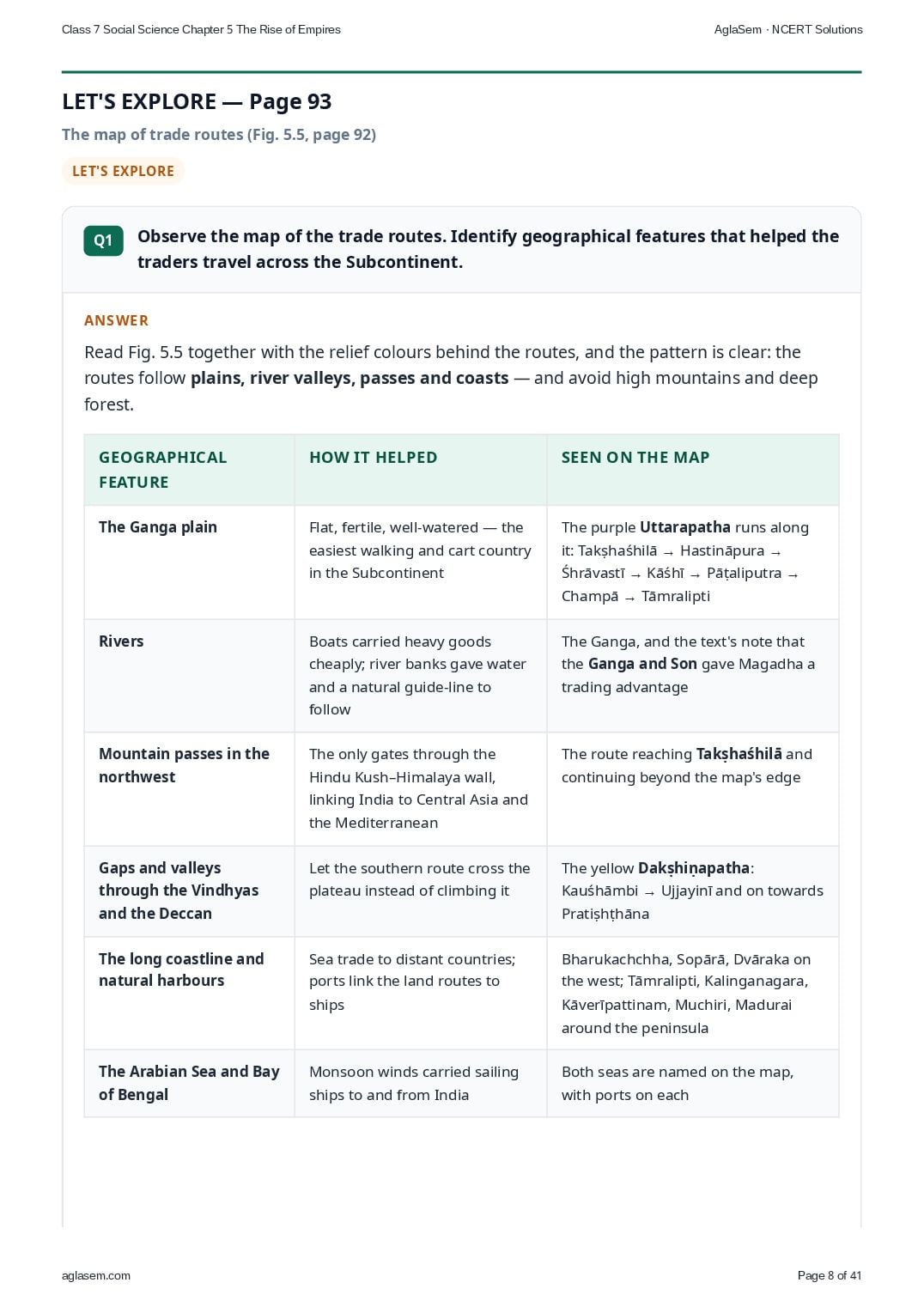
- Observe the map of the trade routes. Identify geographical features that helped the traders travel across the Subcontinent.
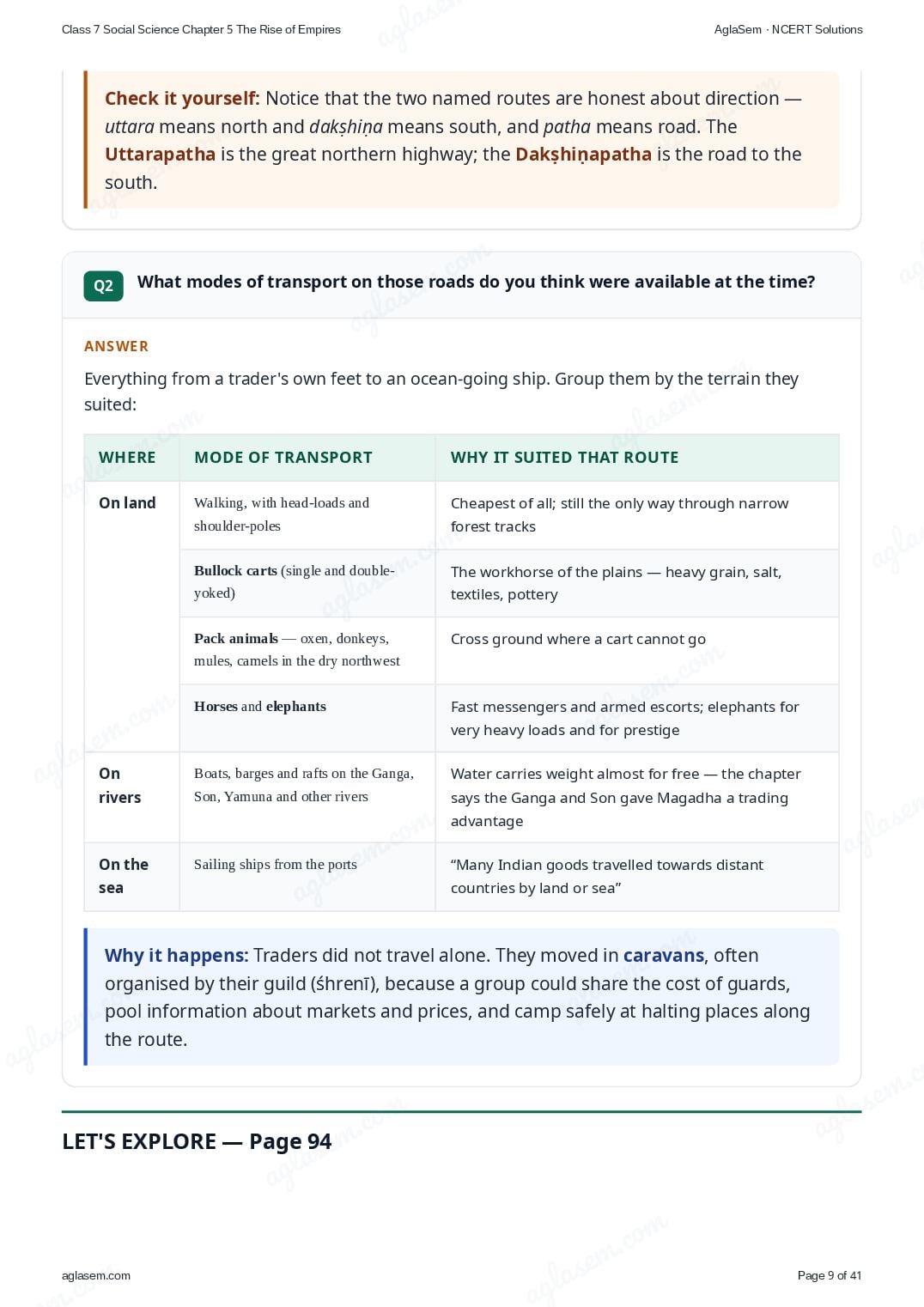
- What modes of transport on those roads do you think were available at the time?
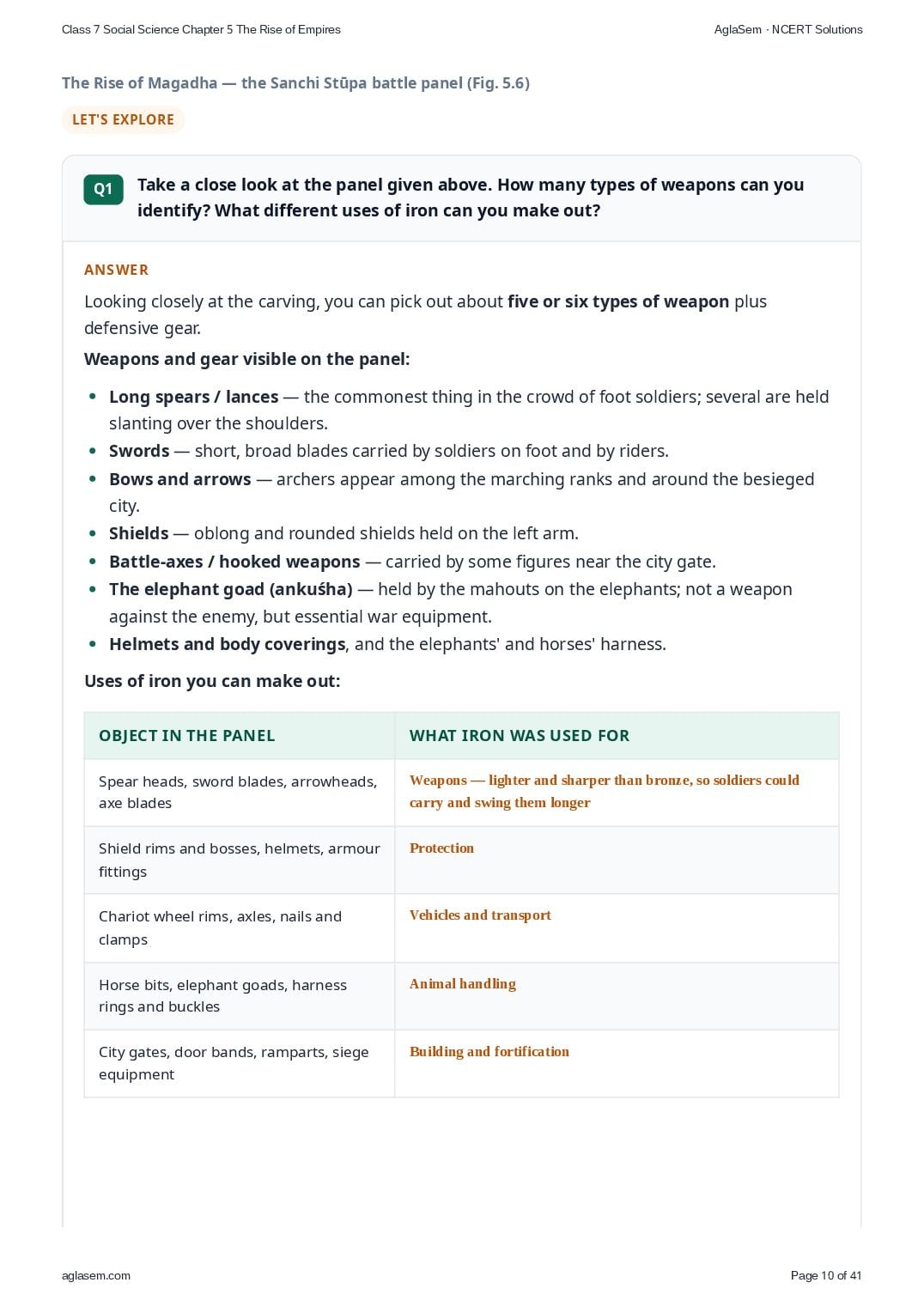
- Take a close look at the panel given above. How many types of weapons can you identify? What different uses of iron can you make out?
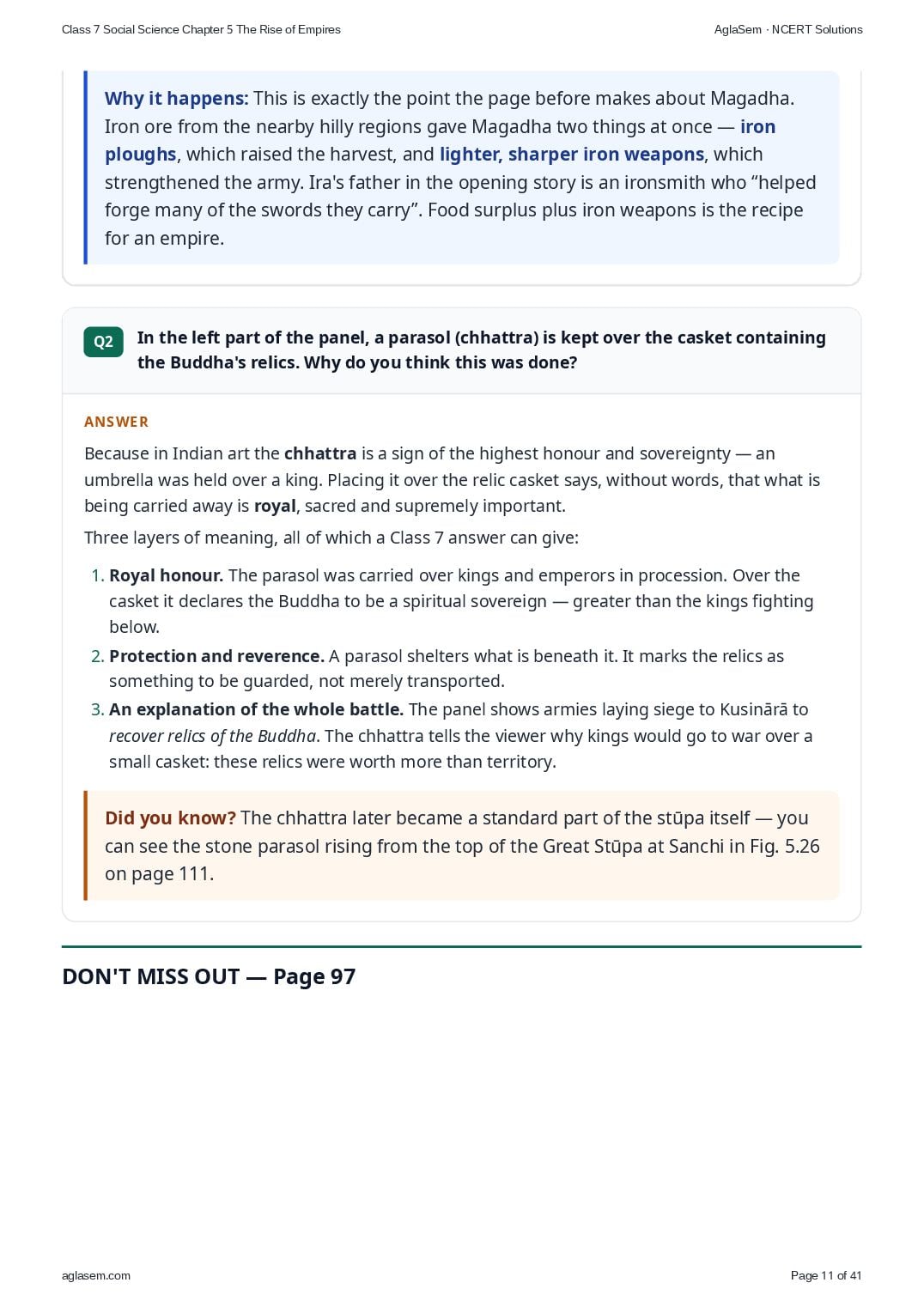
- In the left part of the panel, a parasol (chhattra) is kept over the casket containing the Buddha's relics. Why do you think this was done?
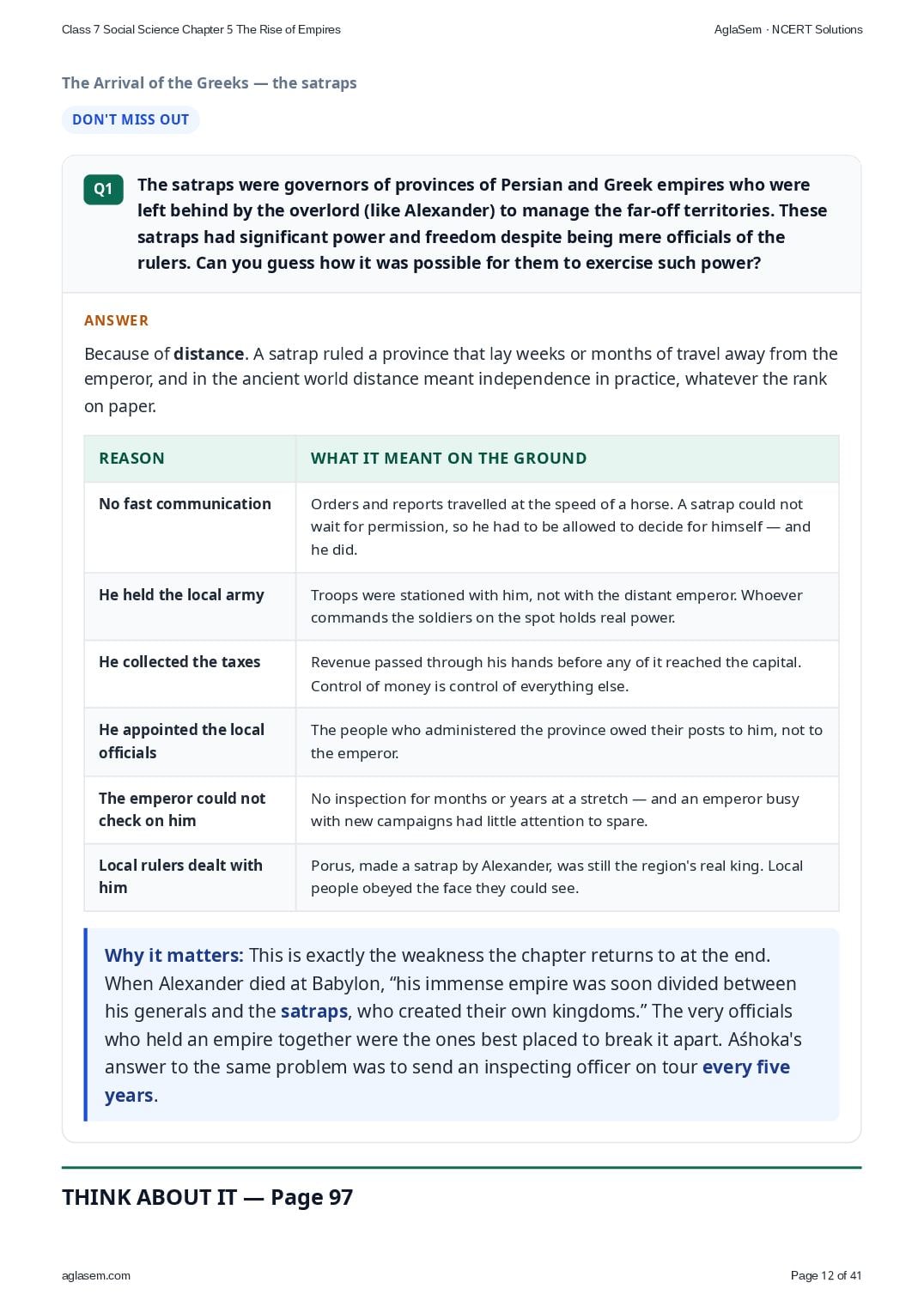
- The satraps were governors of provinces of Persian and Greek empires who were left behind by the overlord (like Alexander) to manage the far-off territories. These satraps had significant power and freedom despite being mere officials of the rulers. Can you guess how it was possible for them to exercise such power?
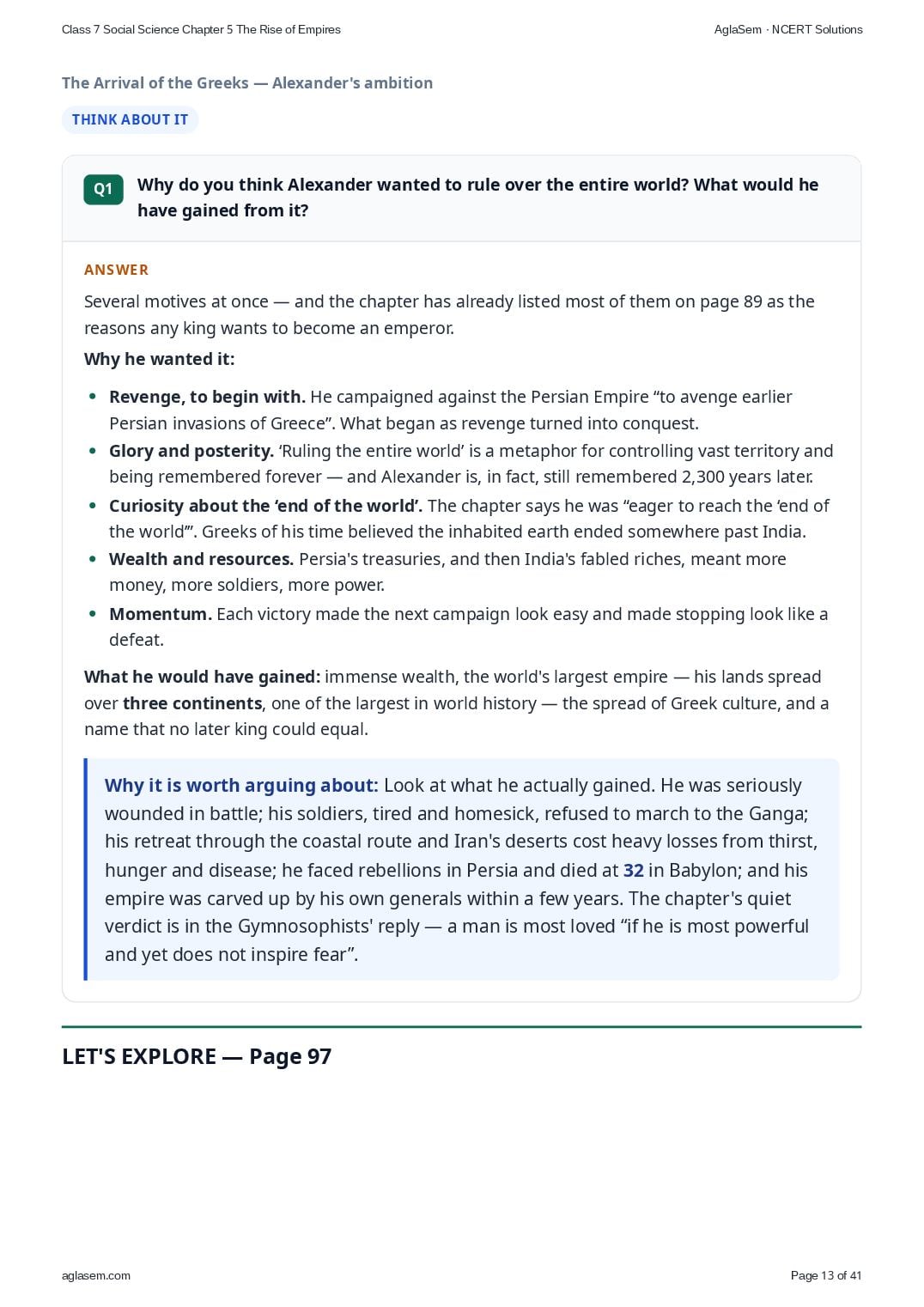
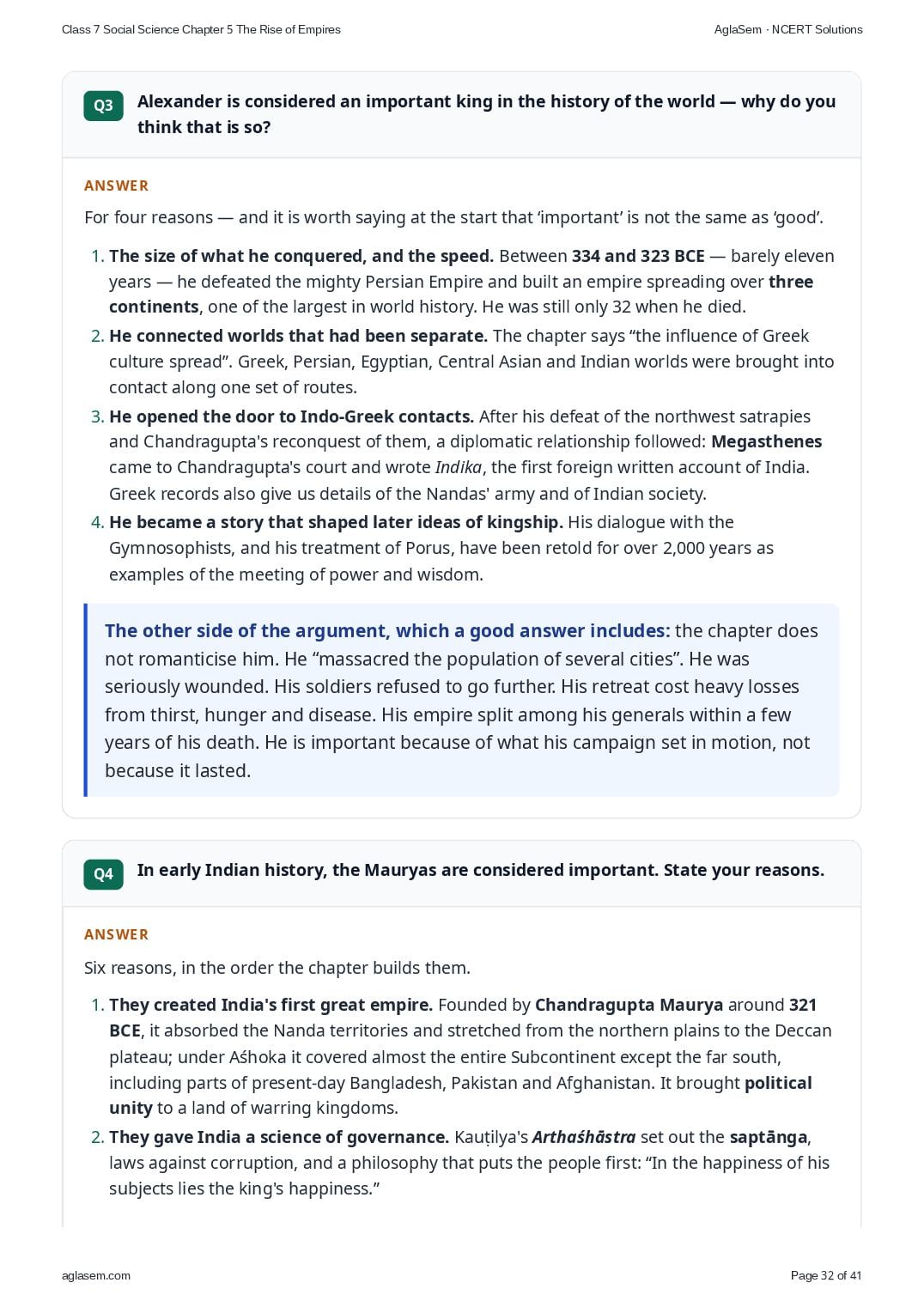
- Why do you think Alexander wanted to rule over the entire world? What would he have gained from it?
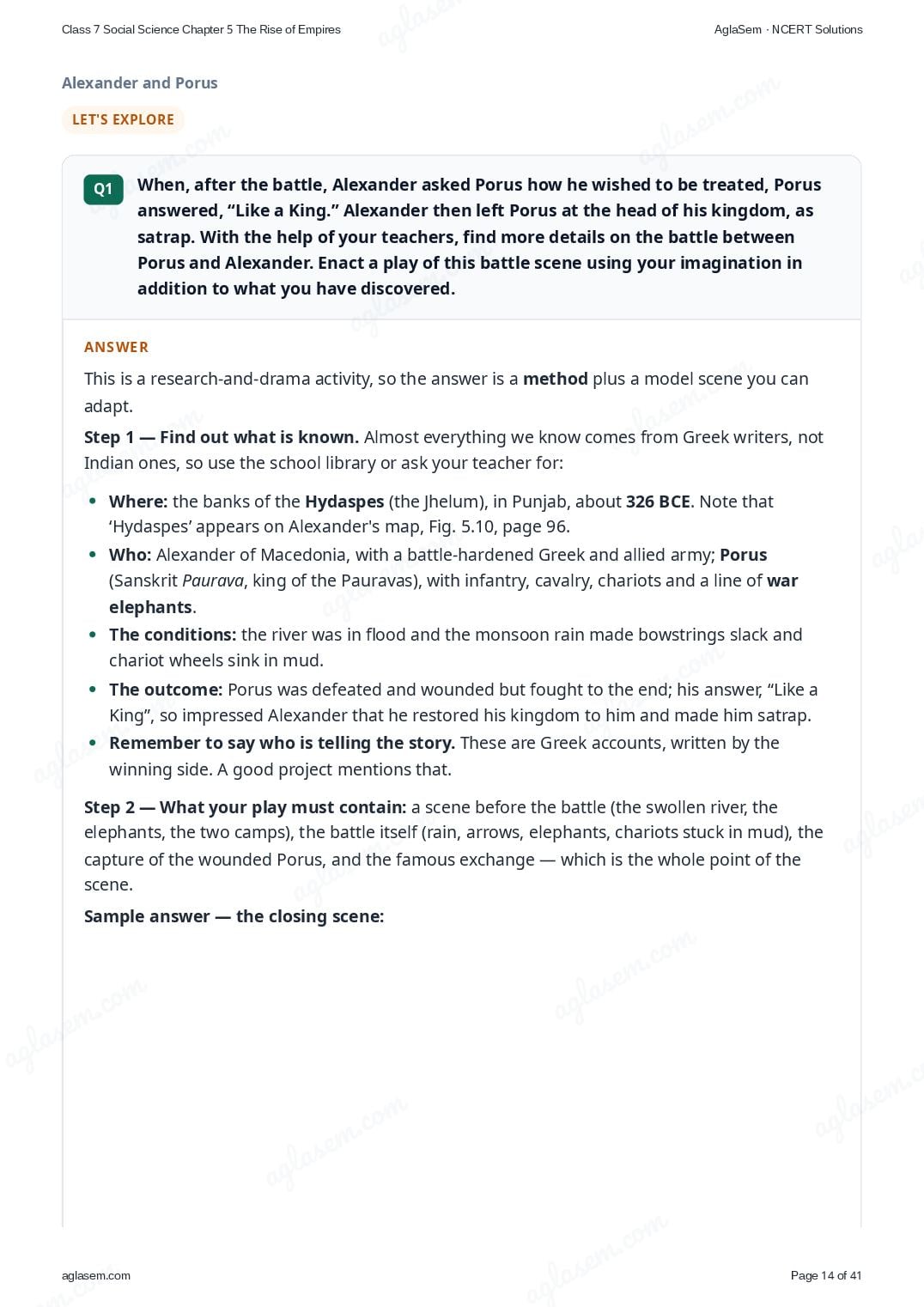
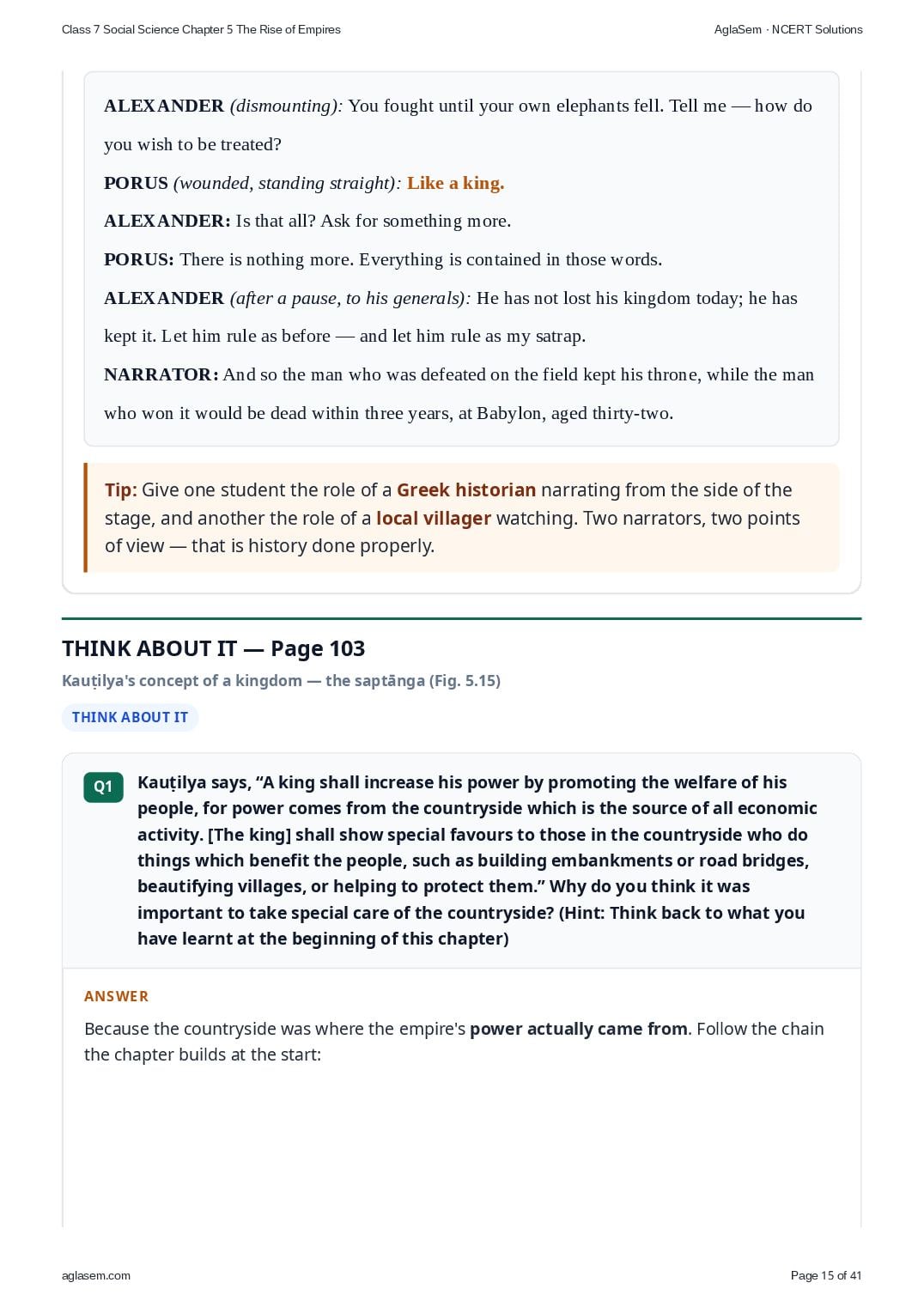
- When, after the battle, Alexander asked Porus how he wished to be treated, Porus answered, “Like a King.” Alexander then left Porus at the head of his kingdom, as satrap. With the help of your teachers, find more details on the battle between Porus and Alexander. Enact a play of this battle scene using your imagination in addition to what you have discovered.
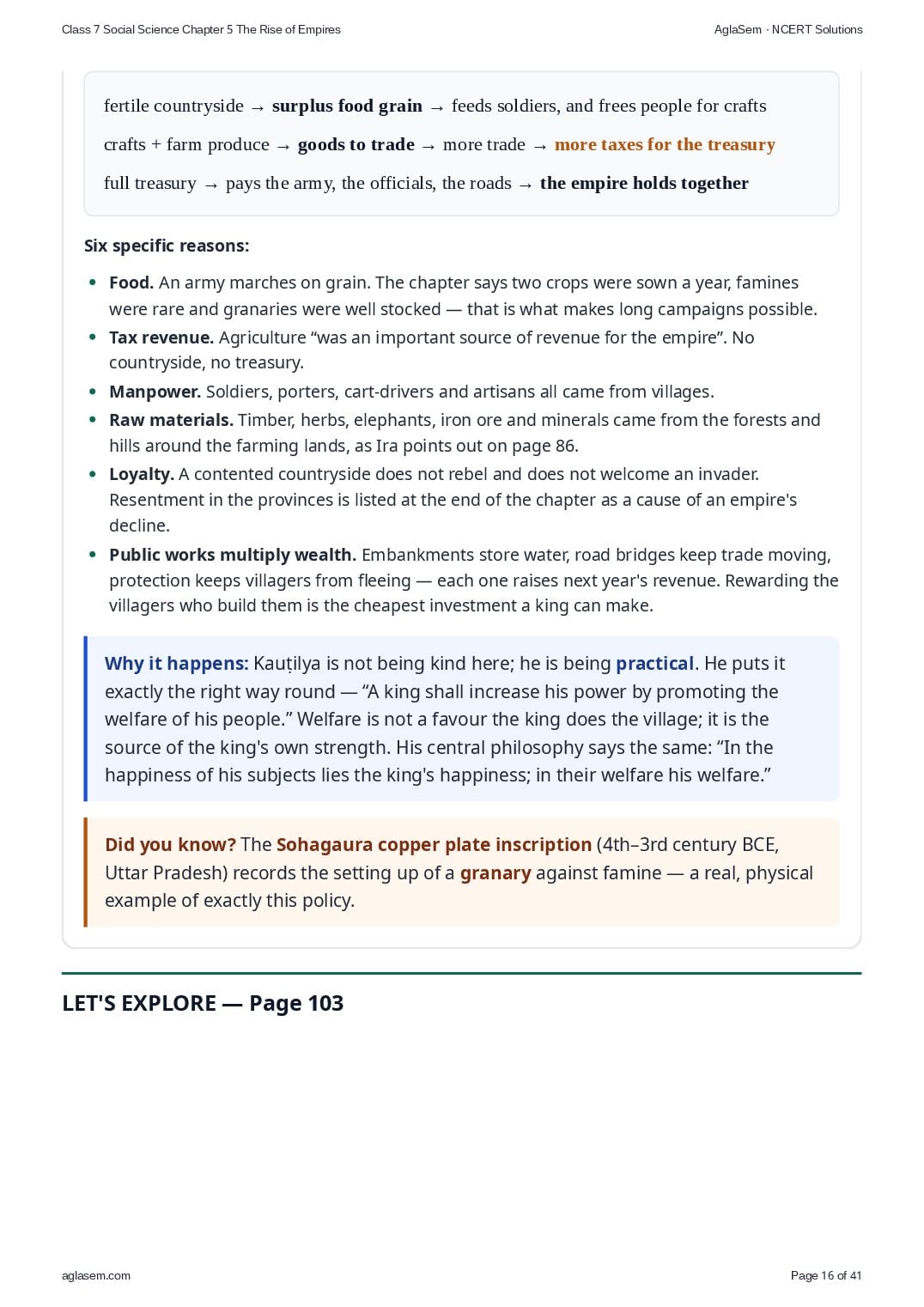
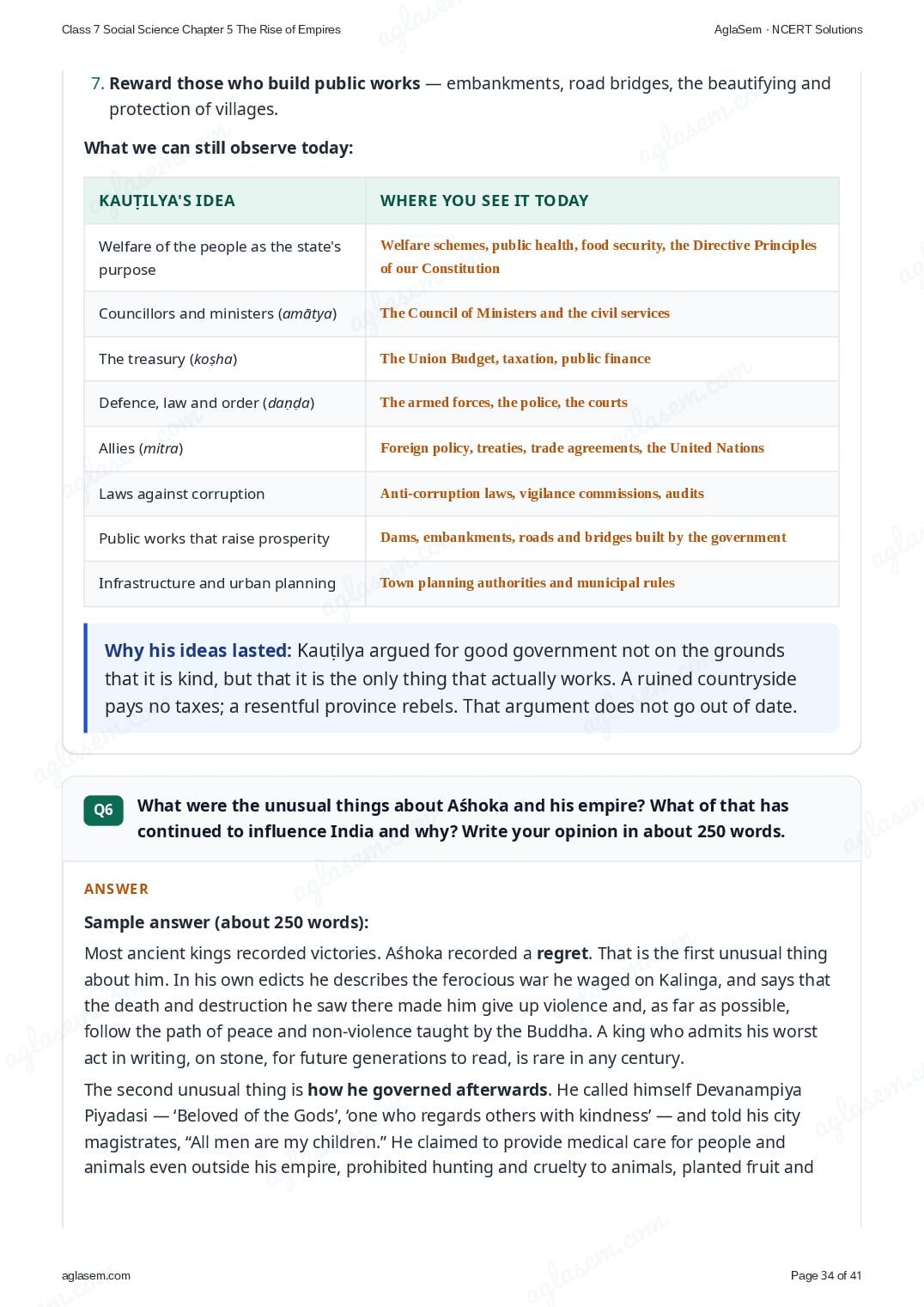
- Kauṭilya says, “A king shall increase his power by promoting the welfare of his people, for power comes from the countryside which is the source of all economic activity. [The king] shall show special favours to those in the countryside who do things which benefit the people, such as building embankments or road bridges, beautifying villages, or helping to protect them.” Why do you think it was important to take special care of the countryside? (Hint: Think back to what you have learnt at the beginning of this chapter)
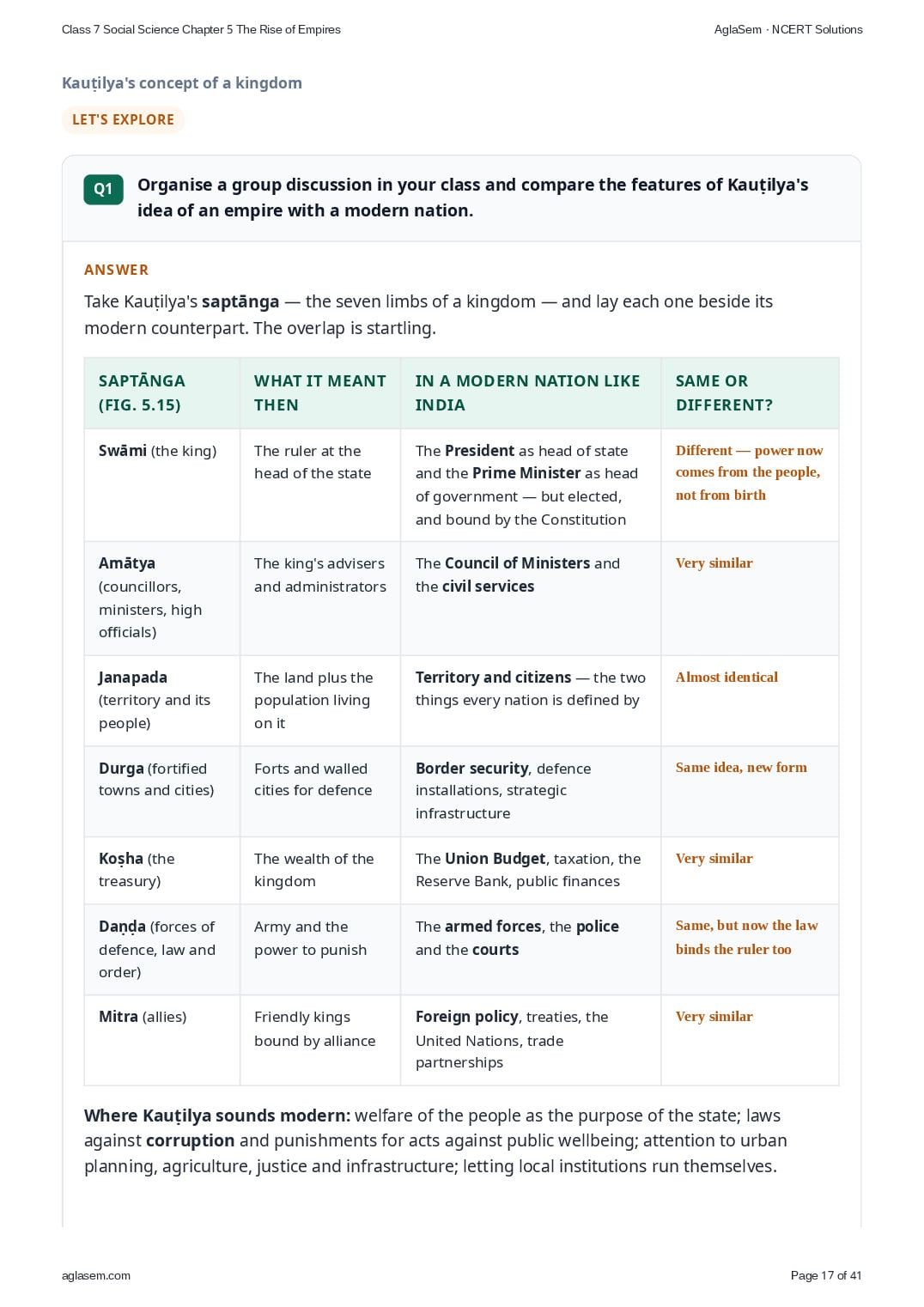
- Organise a group discussion in your class and compare the features of Kauṭilya's idea of an empire with a modern nation.
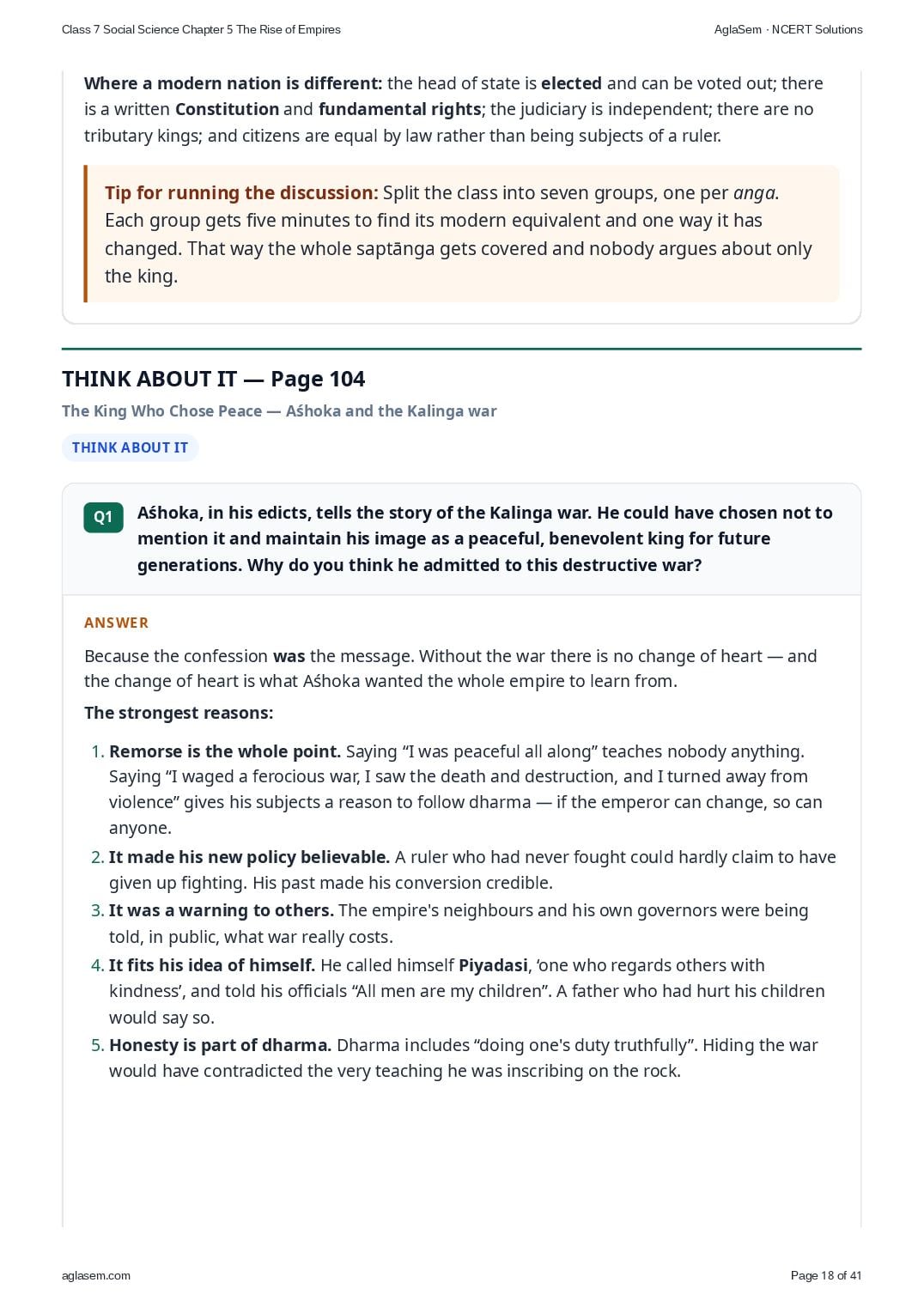
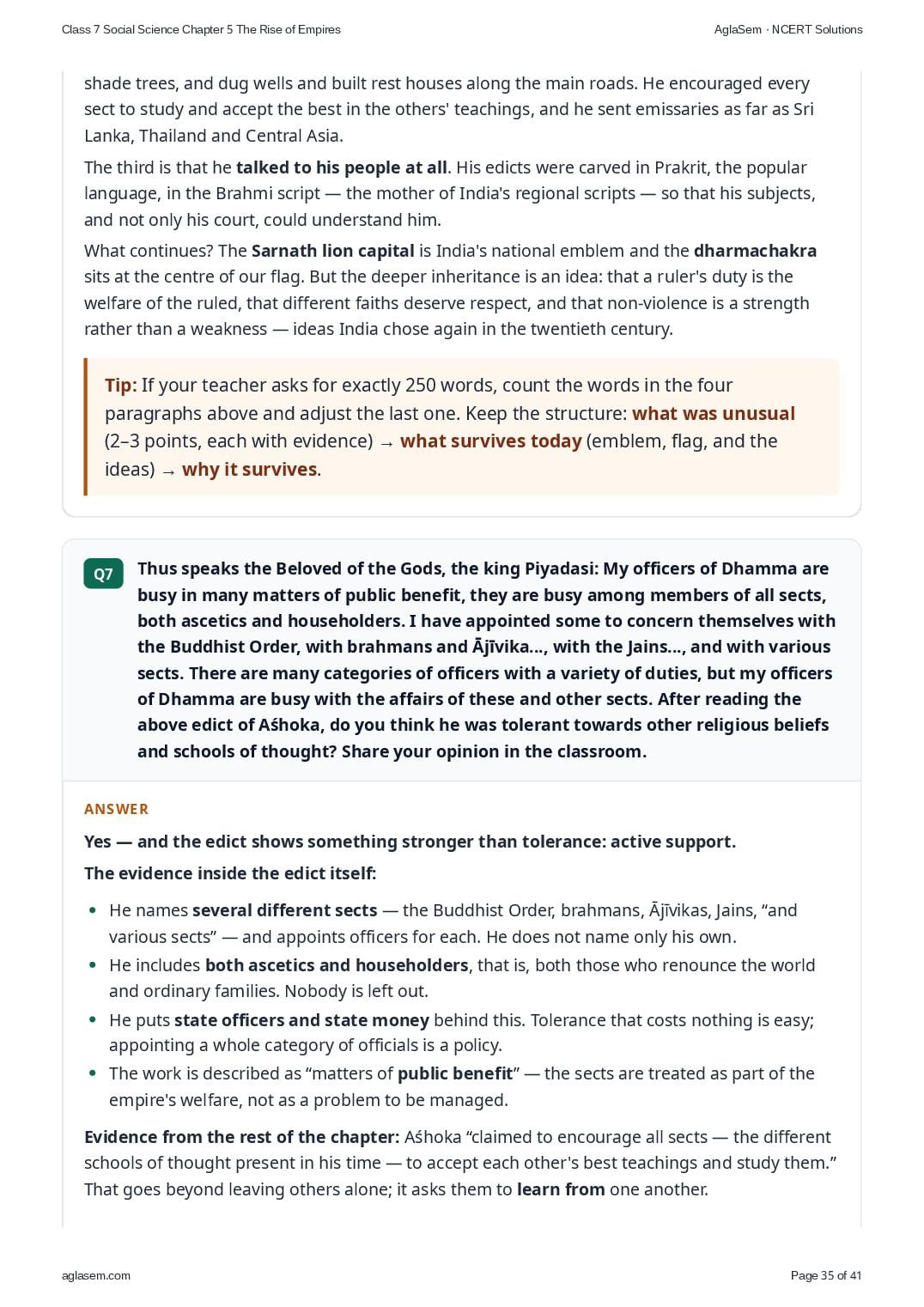
- Aśhoka, in his edicts, tells the story of the Kalinga war. He could have chosen not to mention it and maintain his image as a peaceful, benevolent king for future generations. Why do you think he admitted to this destructive war?
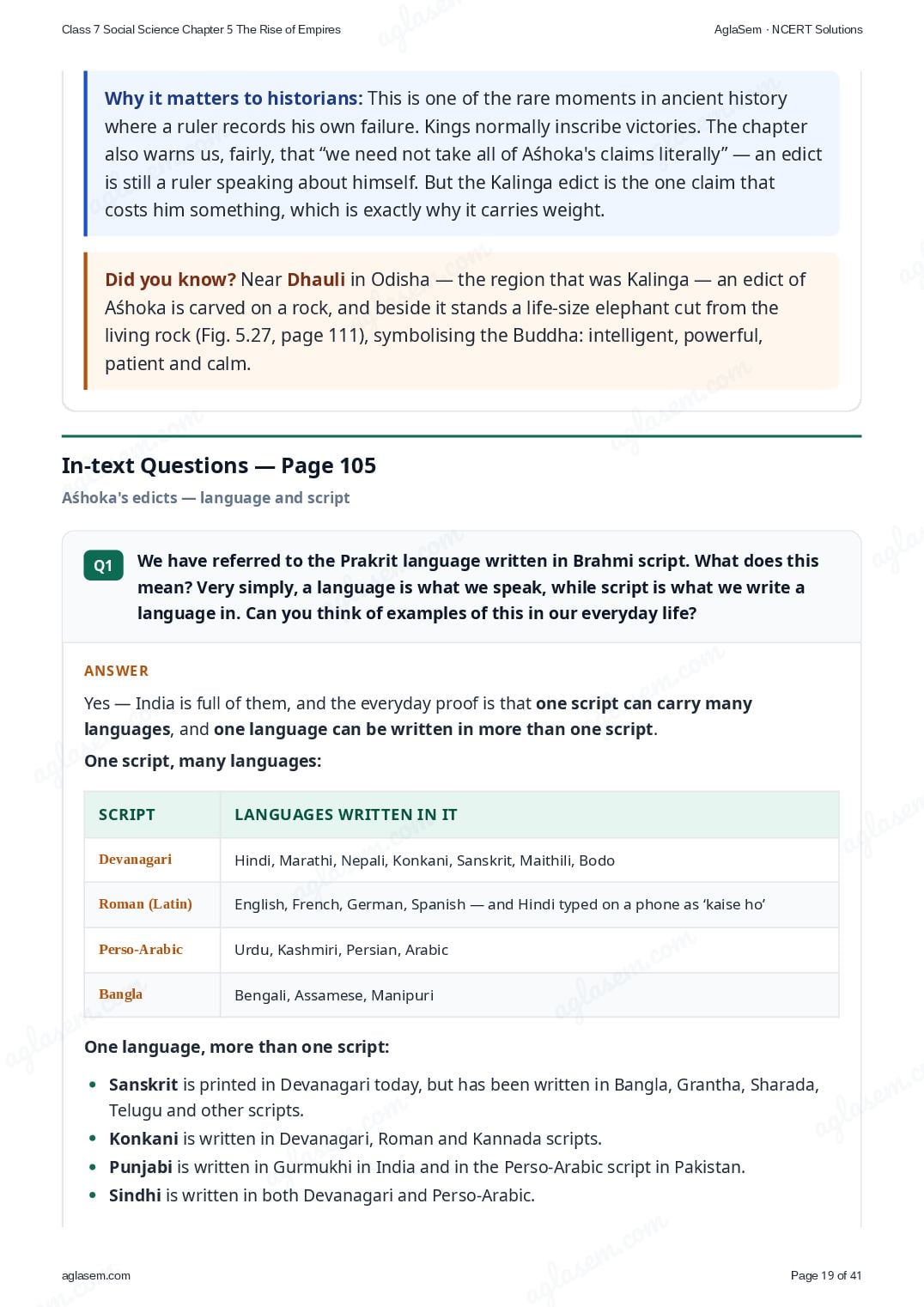
- We have referred to the Prakrit language written in Brahmi script. What does this mean? Very simply, a language is what we speak, while script is what we write a language in. Can you think of examples of this in our everyday life?
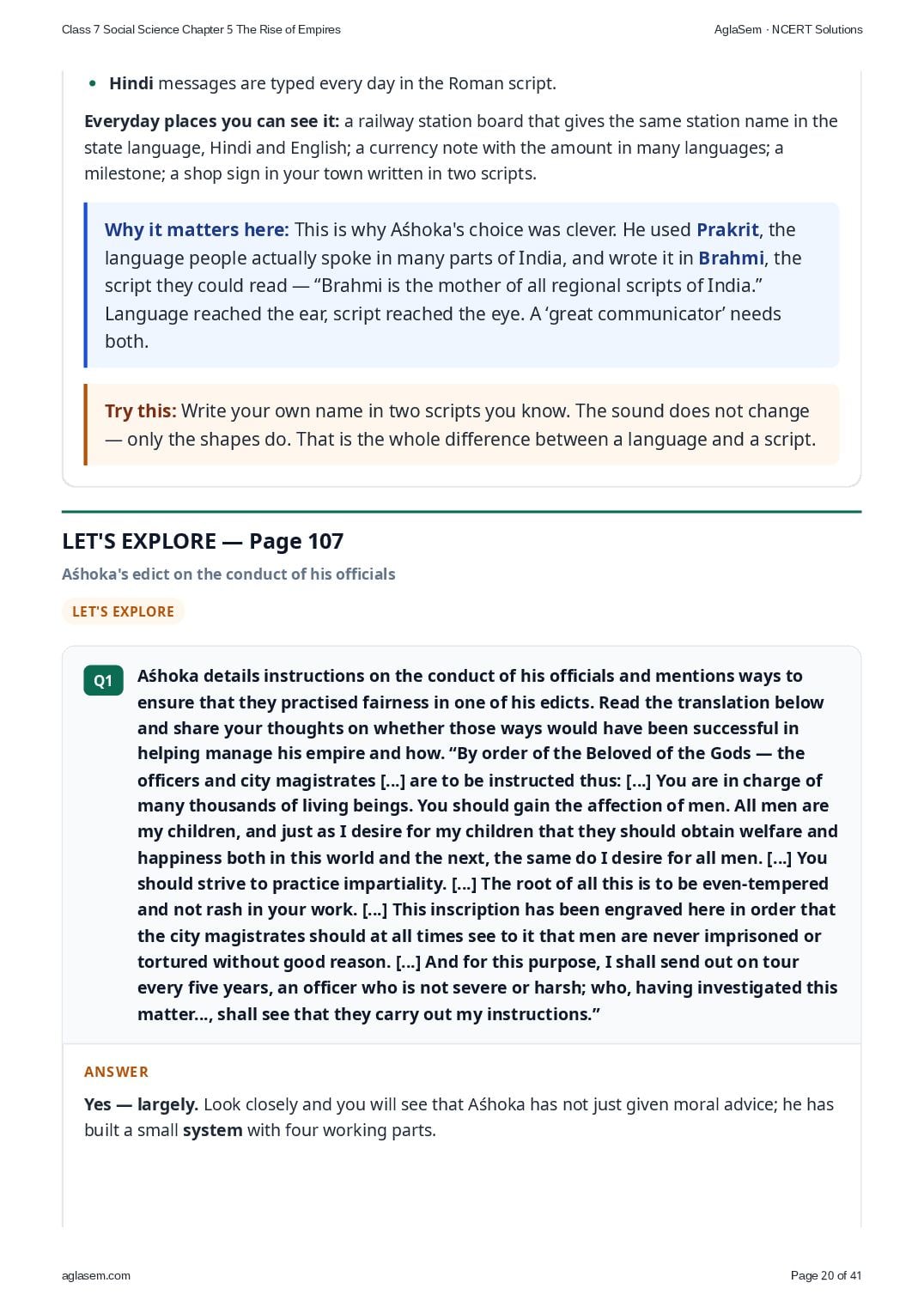
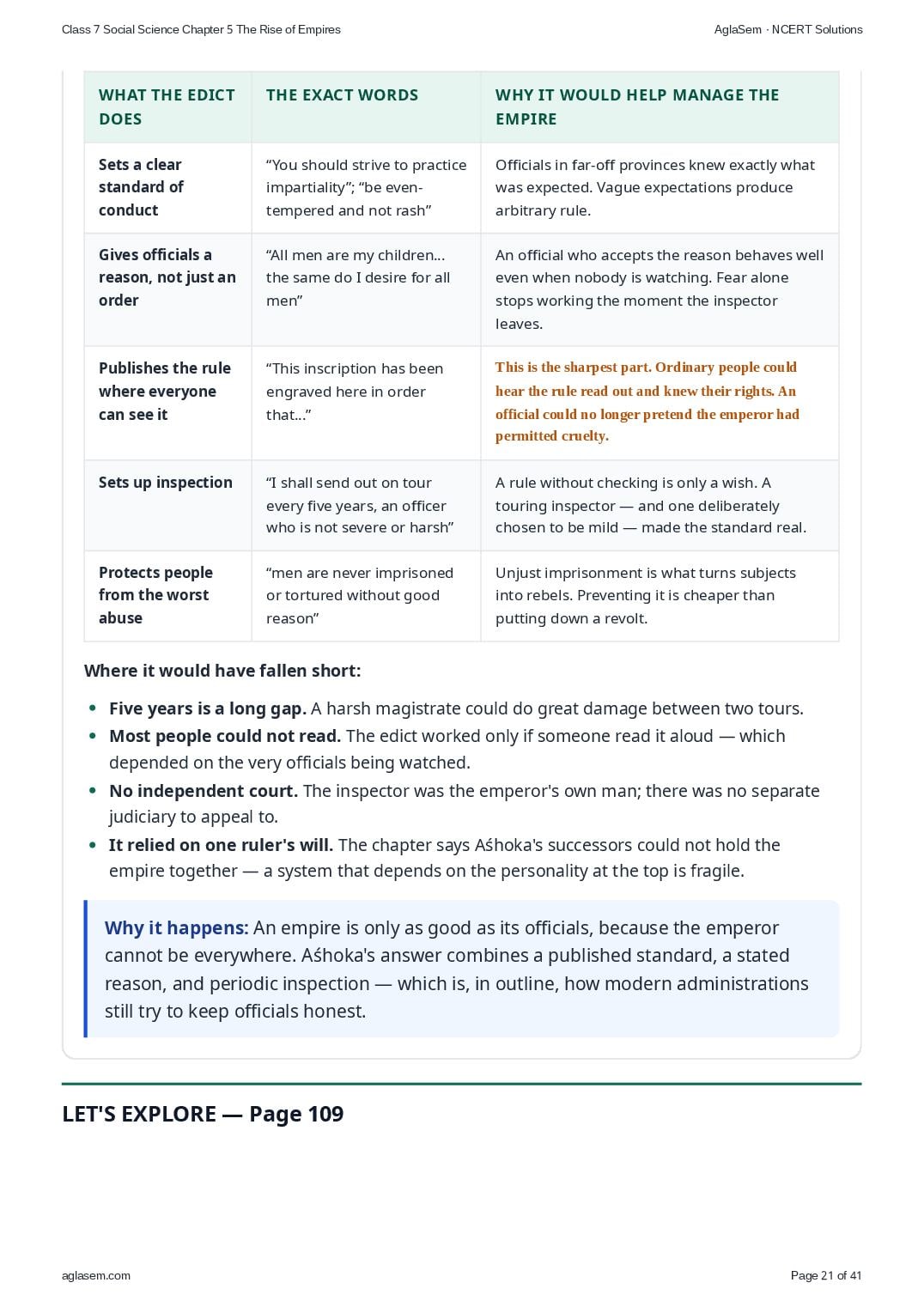
- Aśhoka details instructions on the conduct of his officials and mentions ways to ensure that they practised fairness in one of his edicts. Read the translation below and share your thoughts on whether those ways would have been successful in helping manage his empire and how. “By order of the Beloved of the Gods — the officers and city magistrates […] are to be instructed thus: […] You are in charge of many thousands of living beings. You should gain the affection of men. All men are my children, and just as I desire for my children that they should obtain welfare and happiness both in this world and the next, the same do I desire for all men. […] You should strive to practice impartiality. […] The root of all this is to be even-tempered and not rash in your work. […] This inscription has been engraved here in order that the city magistrates should at all times see to it that men are never imprisoned or tortured without good reason. […] And for this purpose, I shall send out on tour every five years, an officer who is not severe or harsh; who, having investigated this matter…, shall see that they carry out my instructions.”
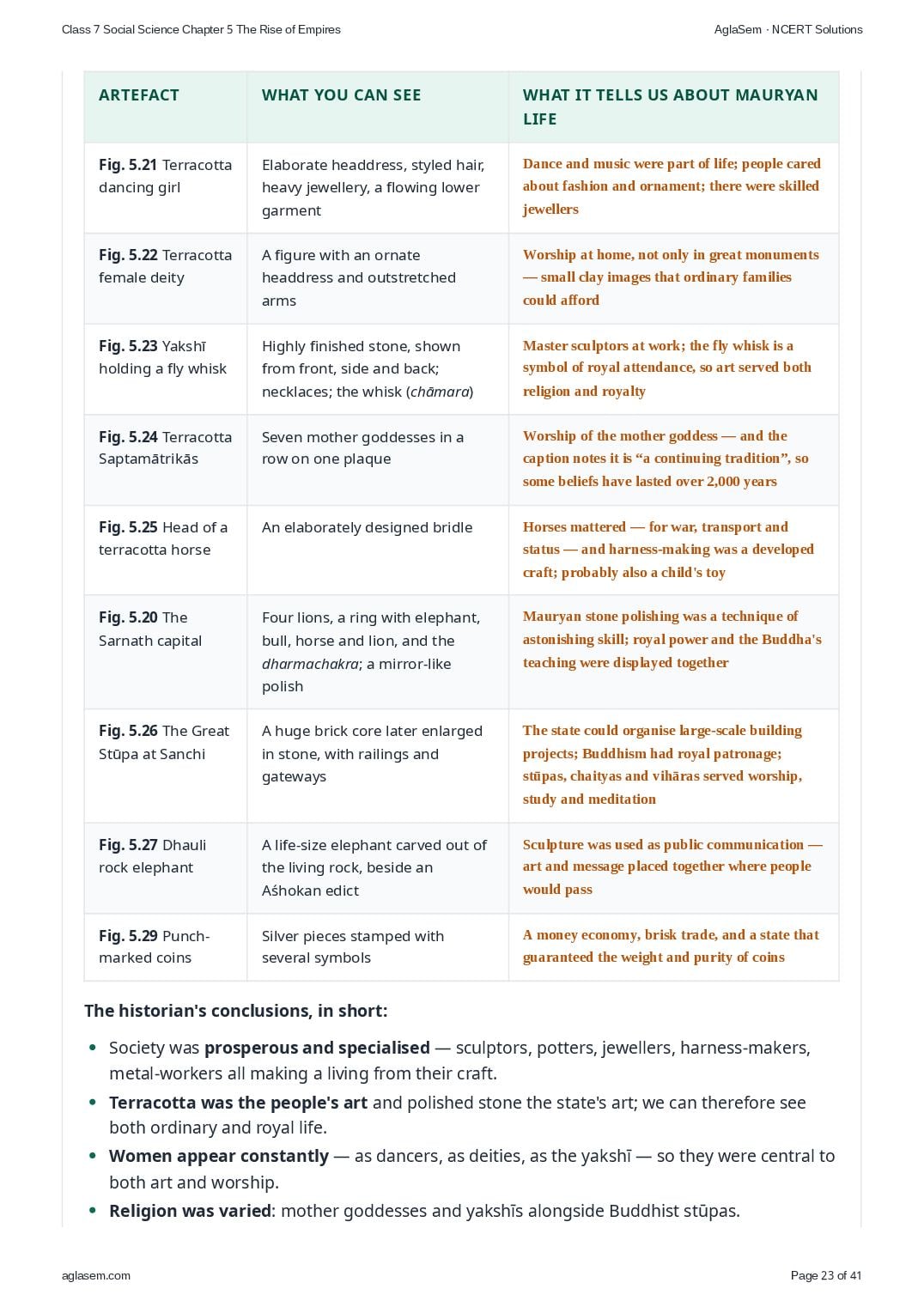
- Wear the hat of a historian. Look carefully at the artefacts presented on the spread on the next page. What conclusions can you draw about people and life during the Mauryan era?
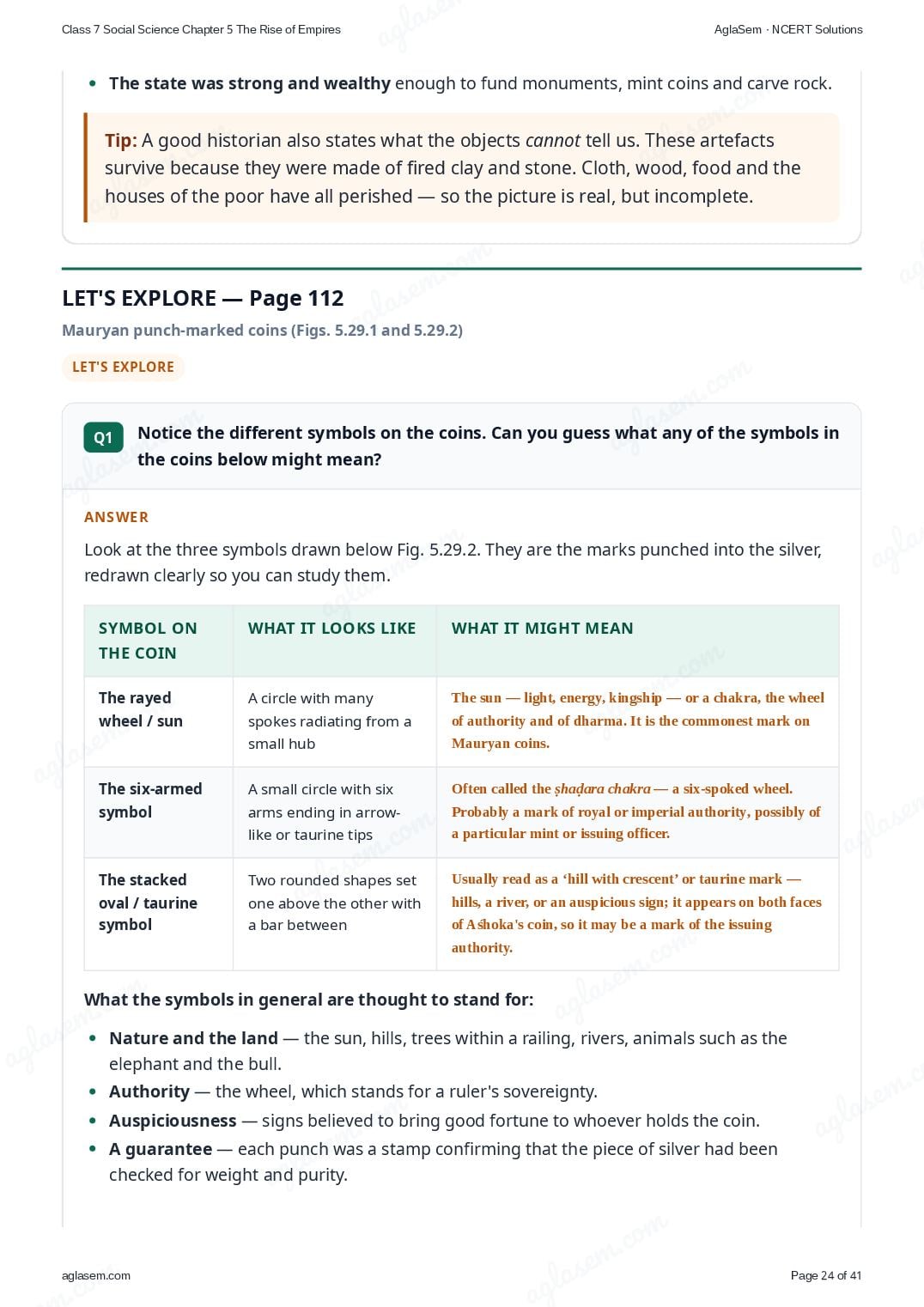
- Notice the different symbols on the coins. Can you guess what any of the symbols in the coins below might mean?
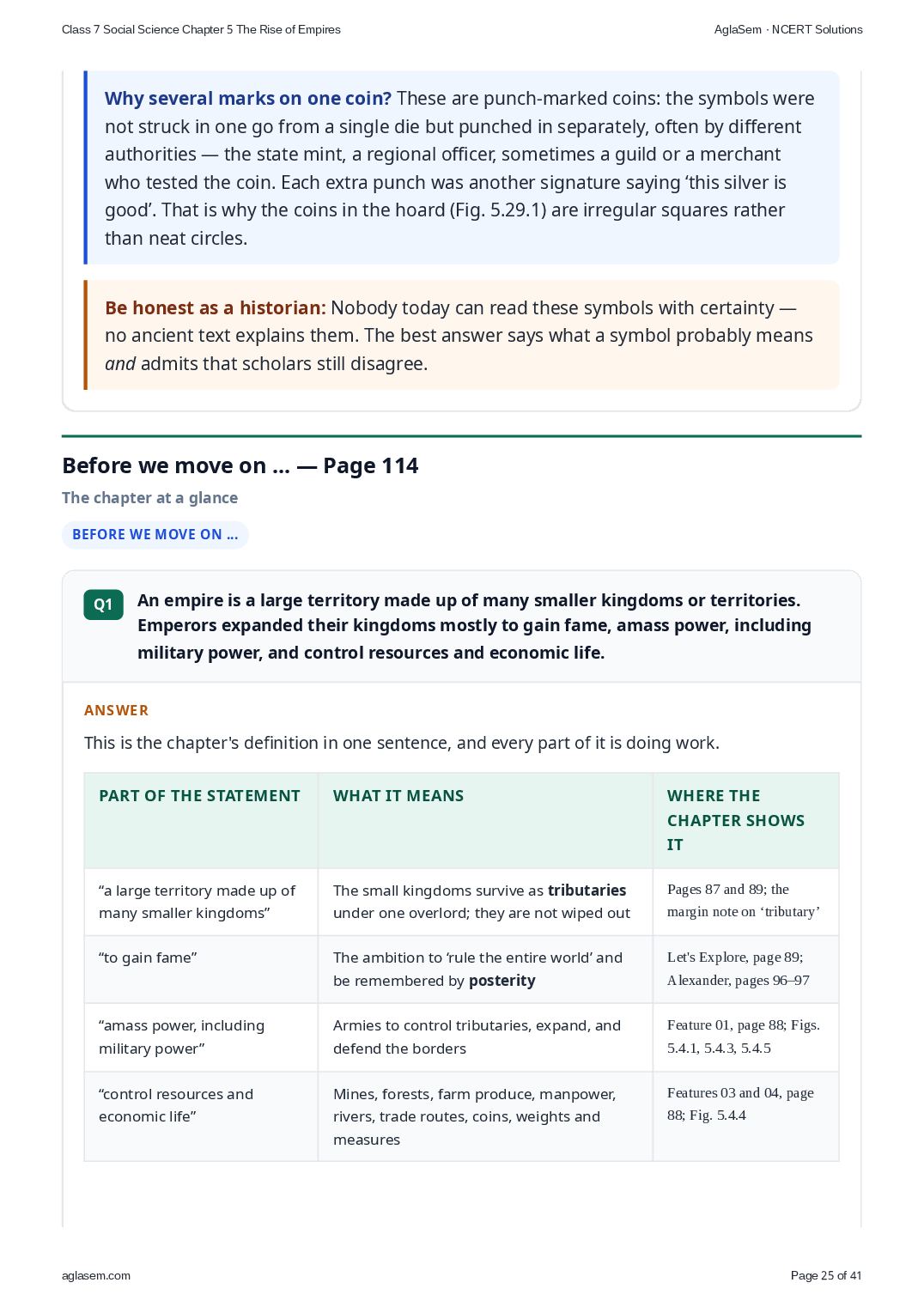
- An empire is a large territory made up of many smaller kingdoms or territories. Emperors expanded their kingdoms mostly to gain fame, amass power, including military power, and control resources and economic life.
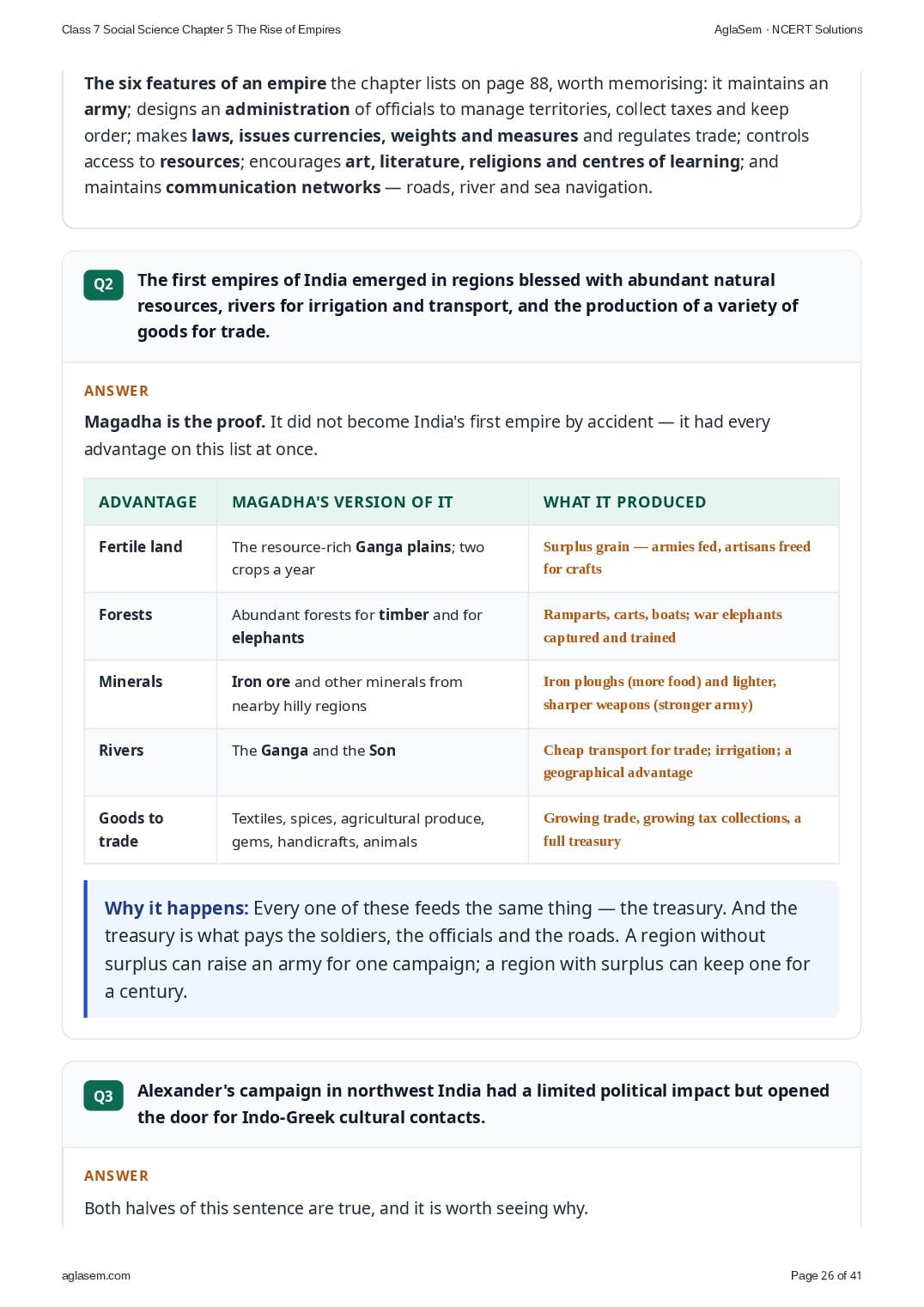
- The first empires of India emerged in regions blessed with abundant natural resources, rivers for irrigation and transport, and the production of a variety of goods for trade.
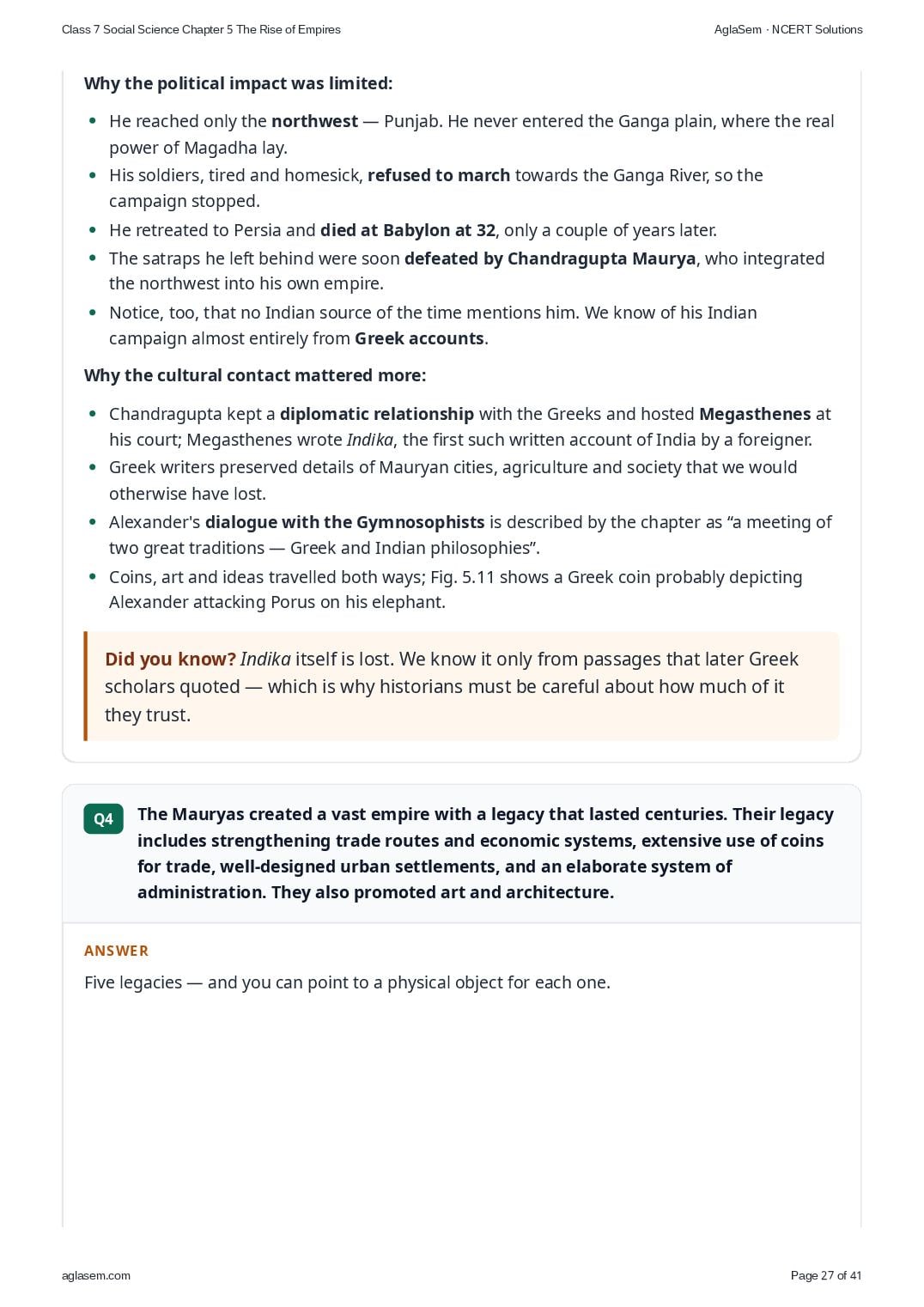
- Alexander's campaign in northwest India had a limited political impact but opened the door for Indo-Greek cultural contacts.
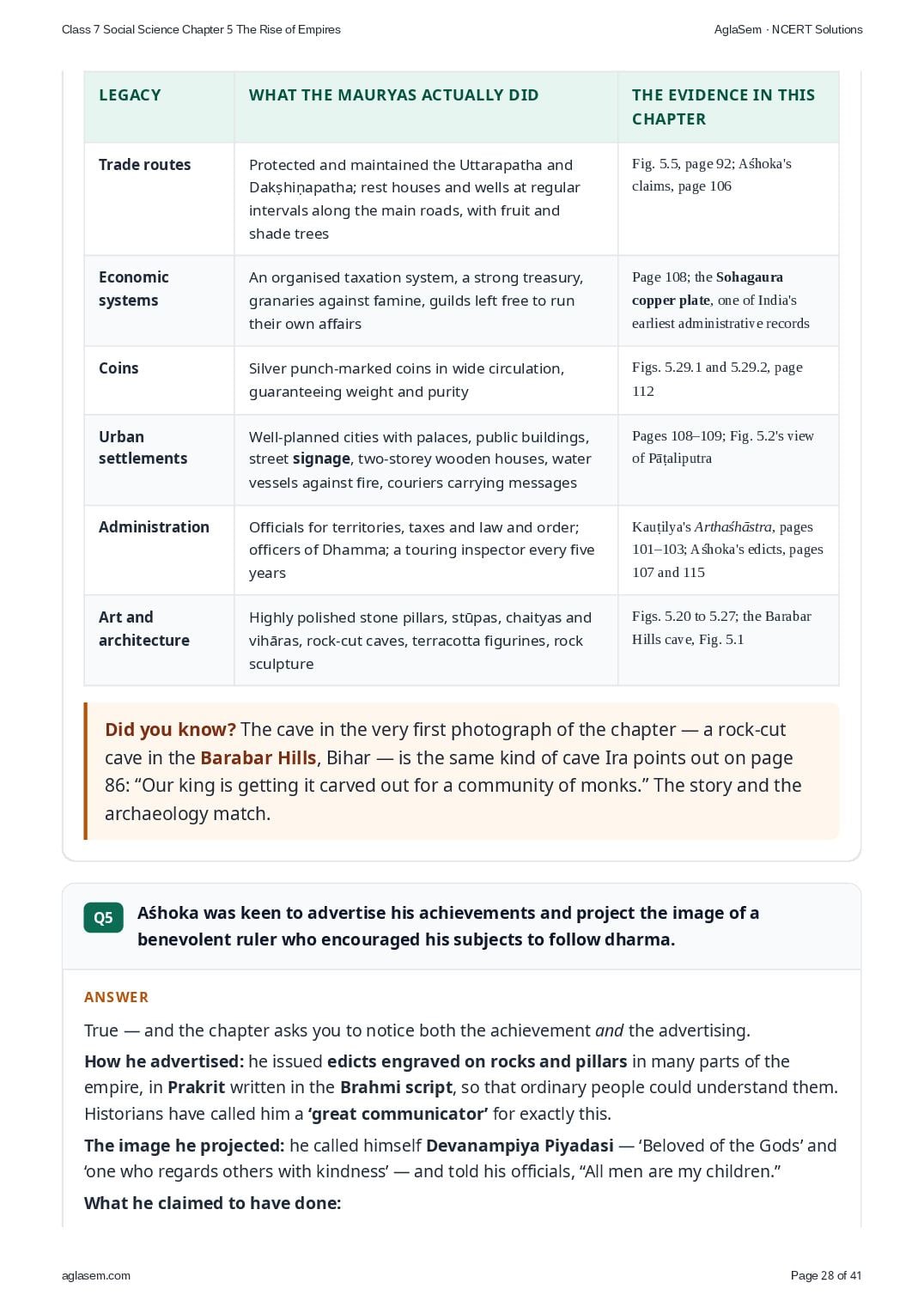
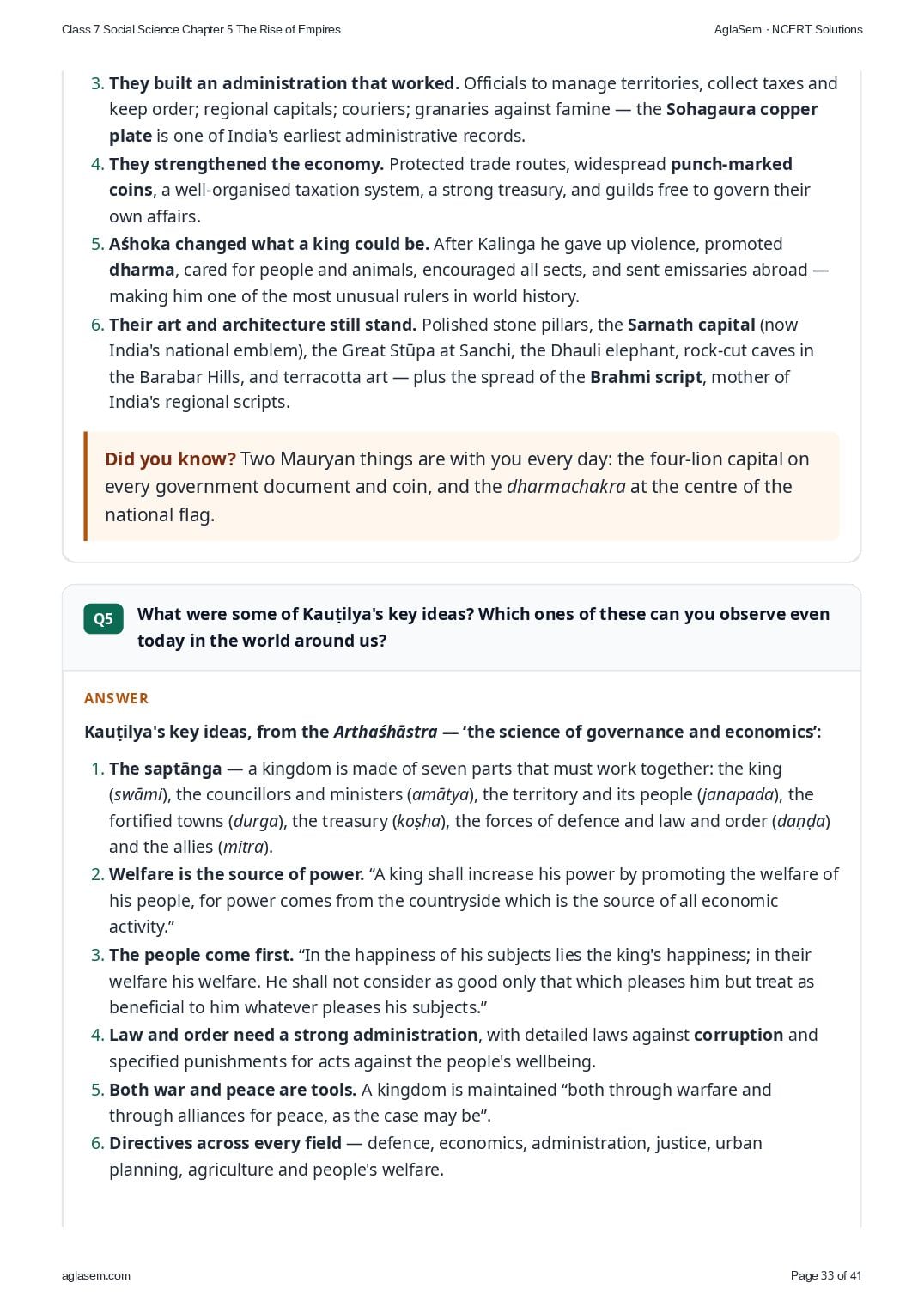
- The Mauryas created a vast empire with a legacy that lasted centuries. Their legacy includes strengthening trade routes and economic systems, extensive use of coins for trade, well-designed urban settlements, and an elaborate system of administration. They also promoted art and architecture.
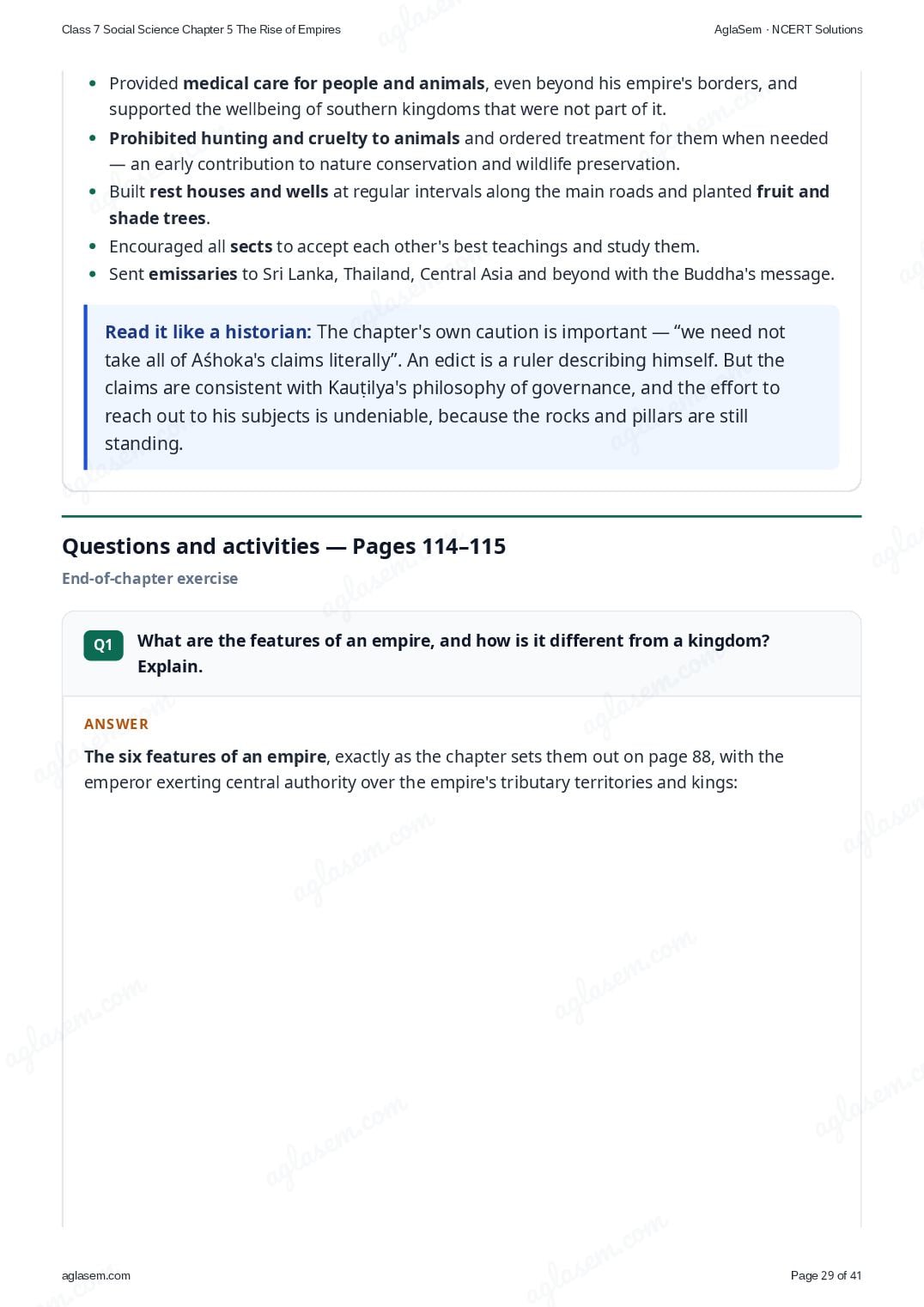
- Aśhoka was keen to advertise his achievements and project the image of a benevolent ruler who encouraged his subjects to follow dharma.
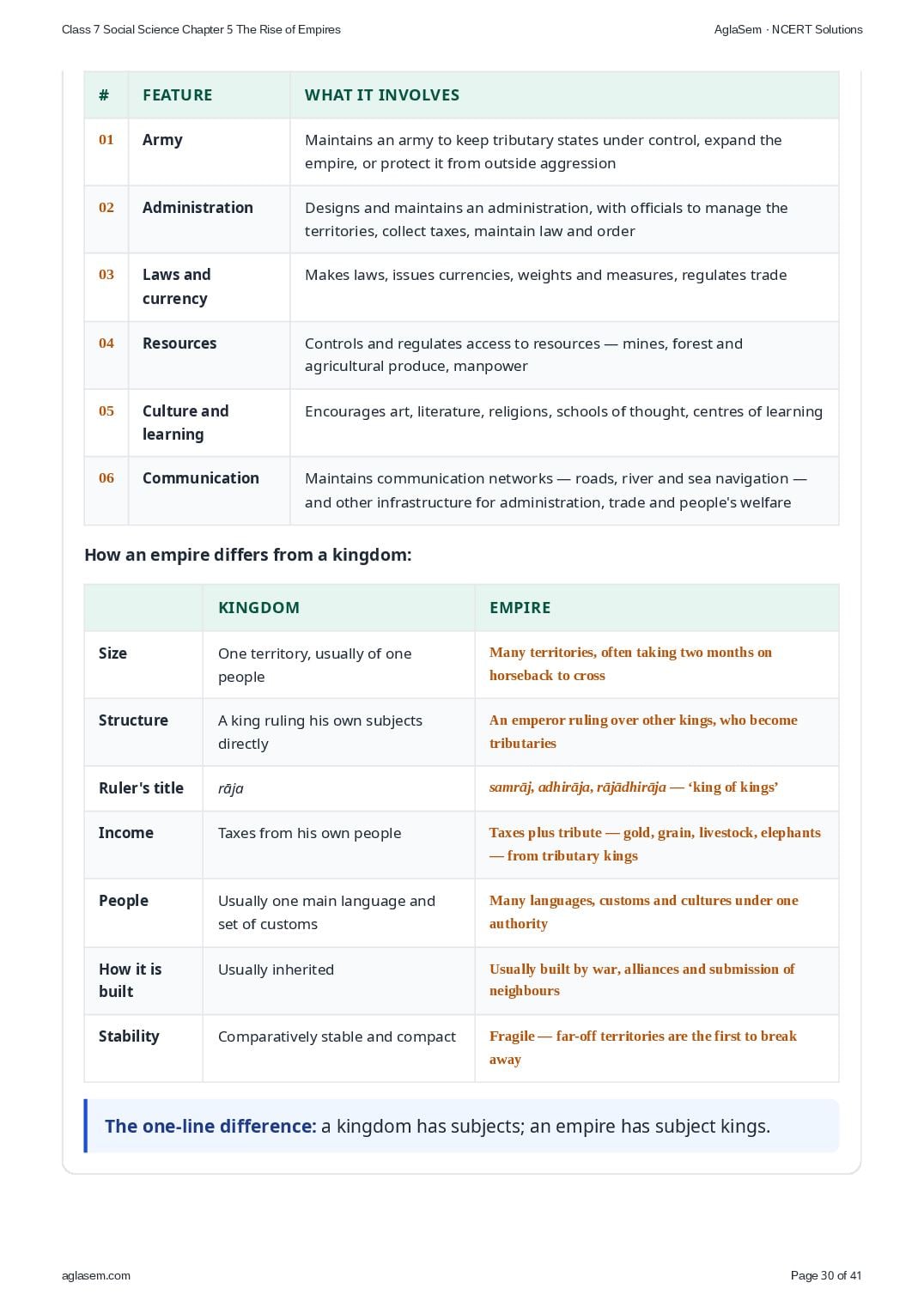
- What are the features of an empire, and how is it different from a kingdom? Explain.
- What are some important factors for the transition from kingdoms to empires?
- Alexander is considered an important king in the history of the world — why do you think that is so?
- In early Indian history, the Mauryas are considered important. State your reasons.
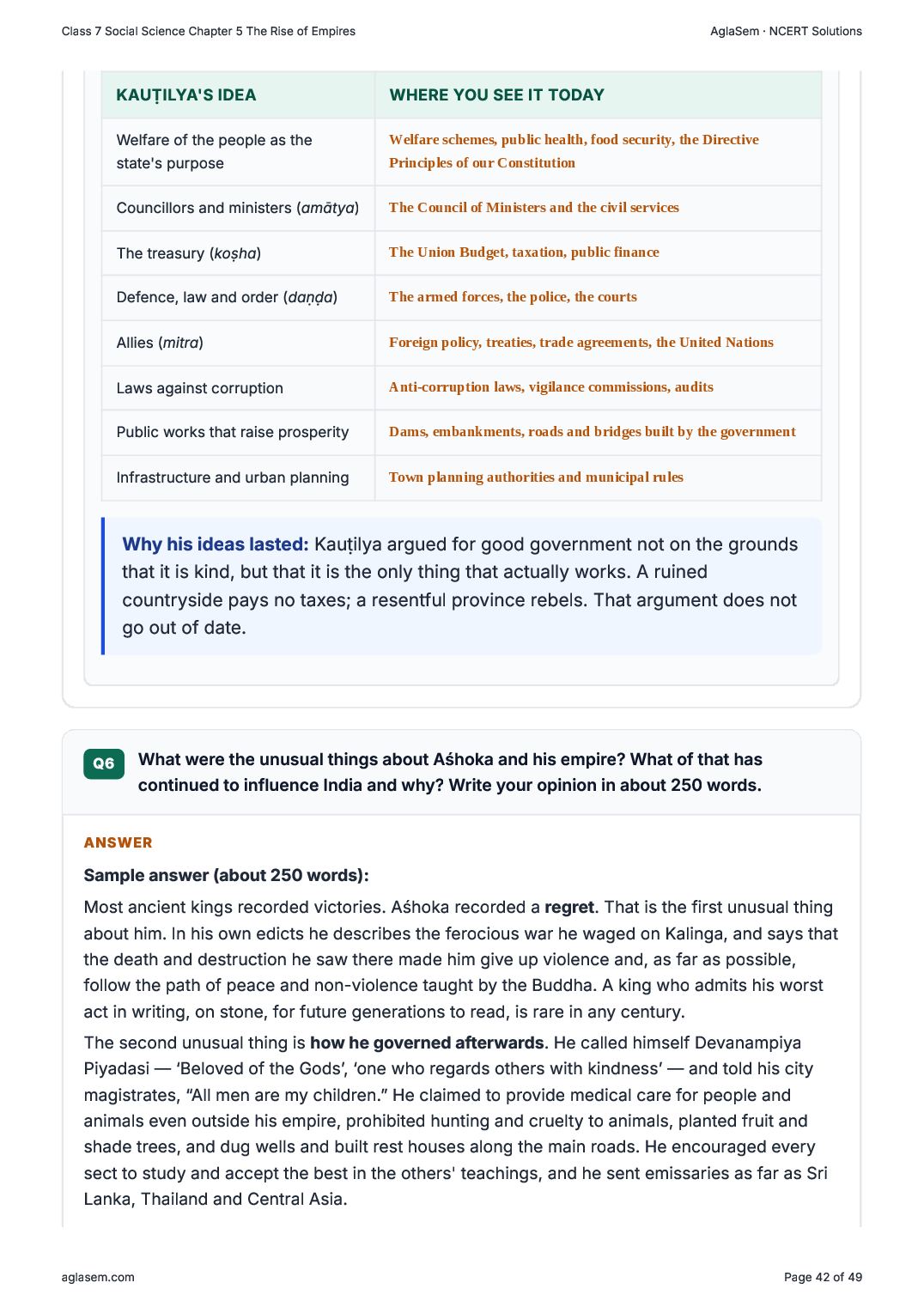
- What were some of Kauṭilya's key ideas? Which ones of these can you observe even today in the world around us?
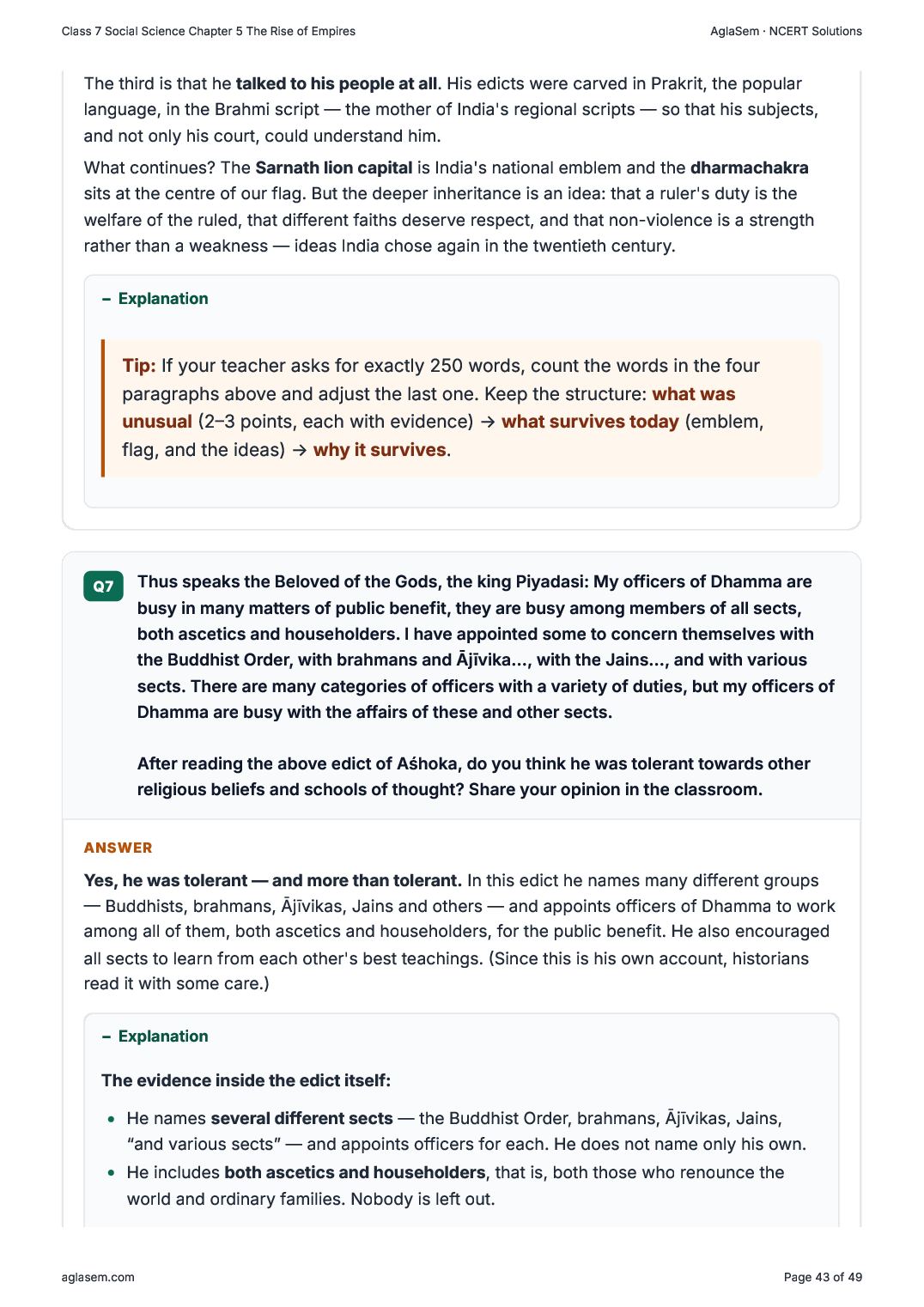
- What were the unusual things about Aśhoka and his empire? What of that has continued to influence India and why? Write your opinion in about 250 words.
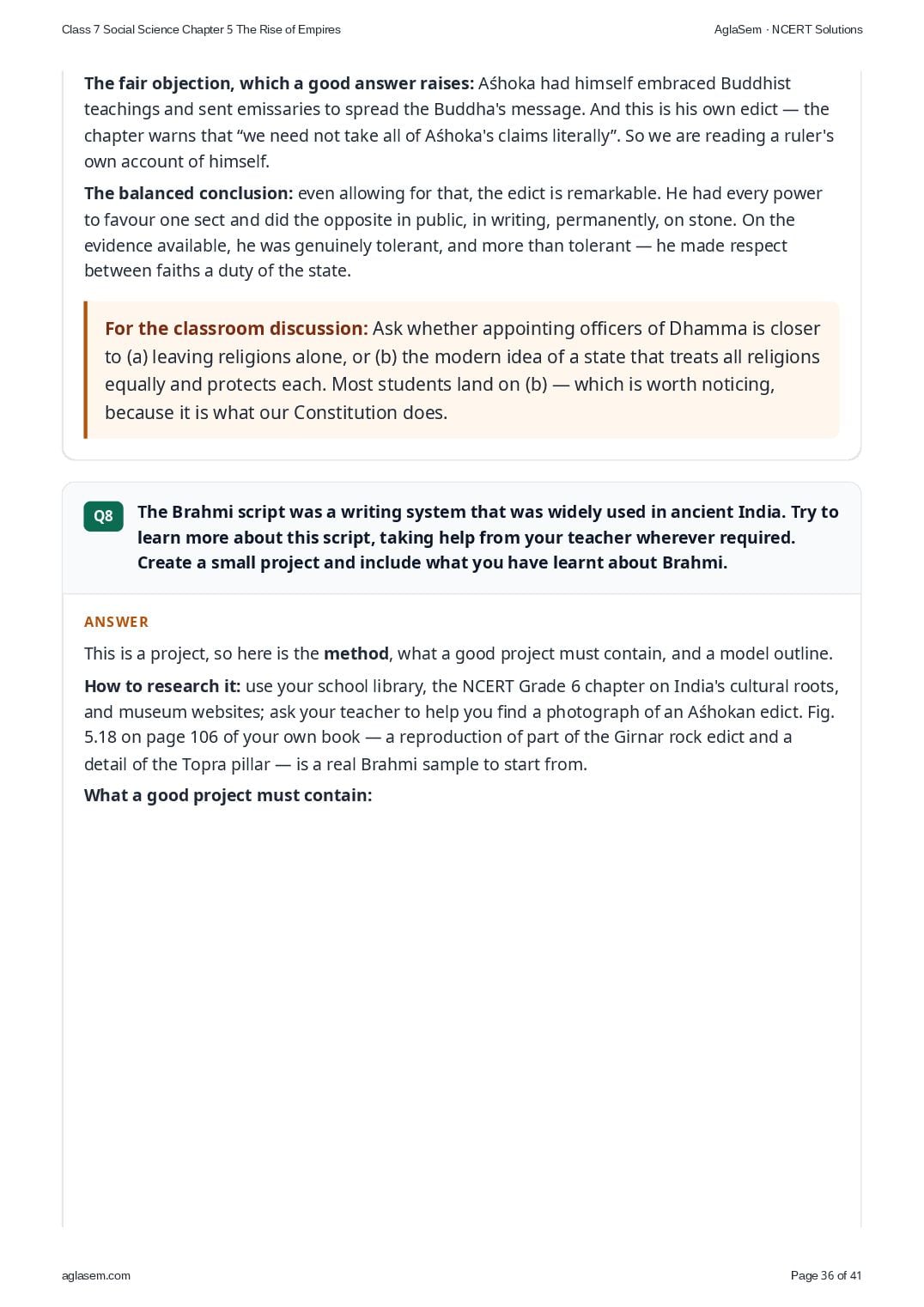
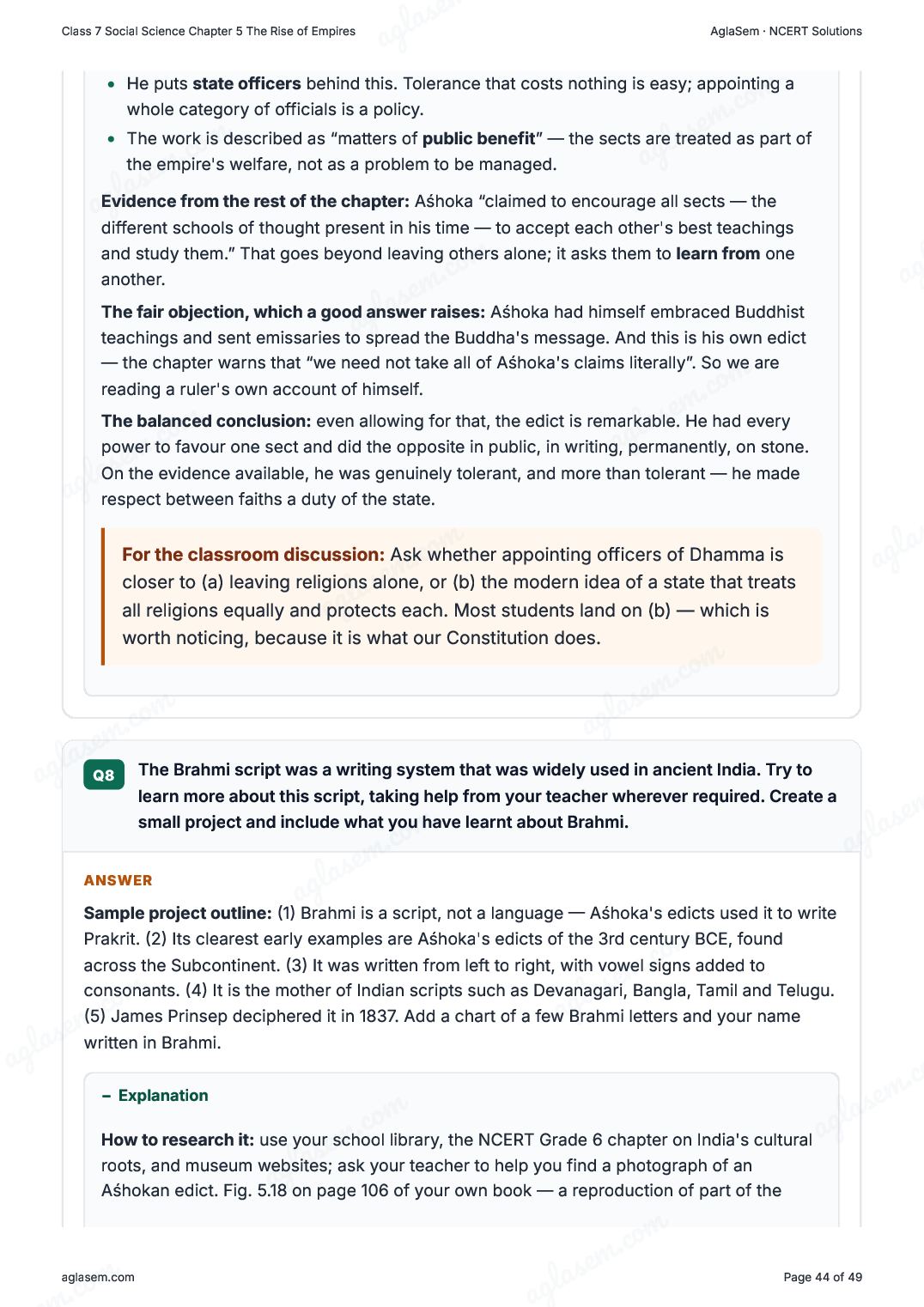
- Thus speaks the Beloved of the Gods, the king Piyadasi: My officers of Dhamma are busy in many matters of public benefit, they are busy among members of all sects, both ascetics and householders. I have appointed some to concern themselves with the Buddhist Order, with brahmans and Ājīvika…, with the Jains…, and with various sects. There are many categories of officers with a variety of duties, but my officers of Dhamma are busy with the affairs of these and other sects. After reading the above edict of Aśhoka, do you think he was tolerant towards other religious beliefs and schools of thought? Share your opinion in the classroom.
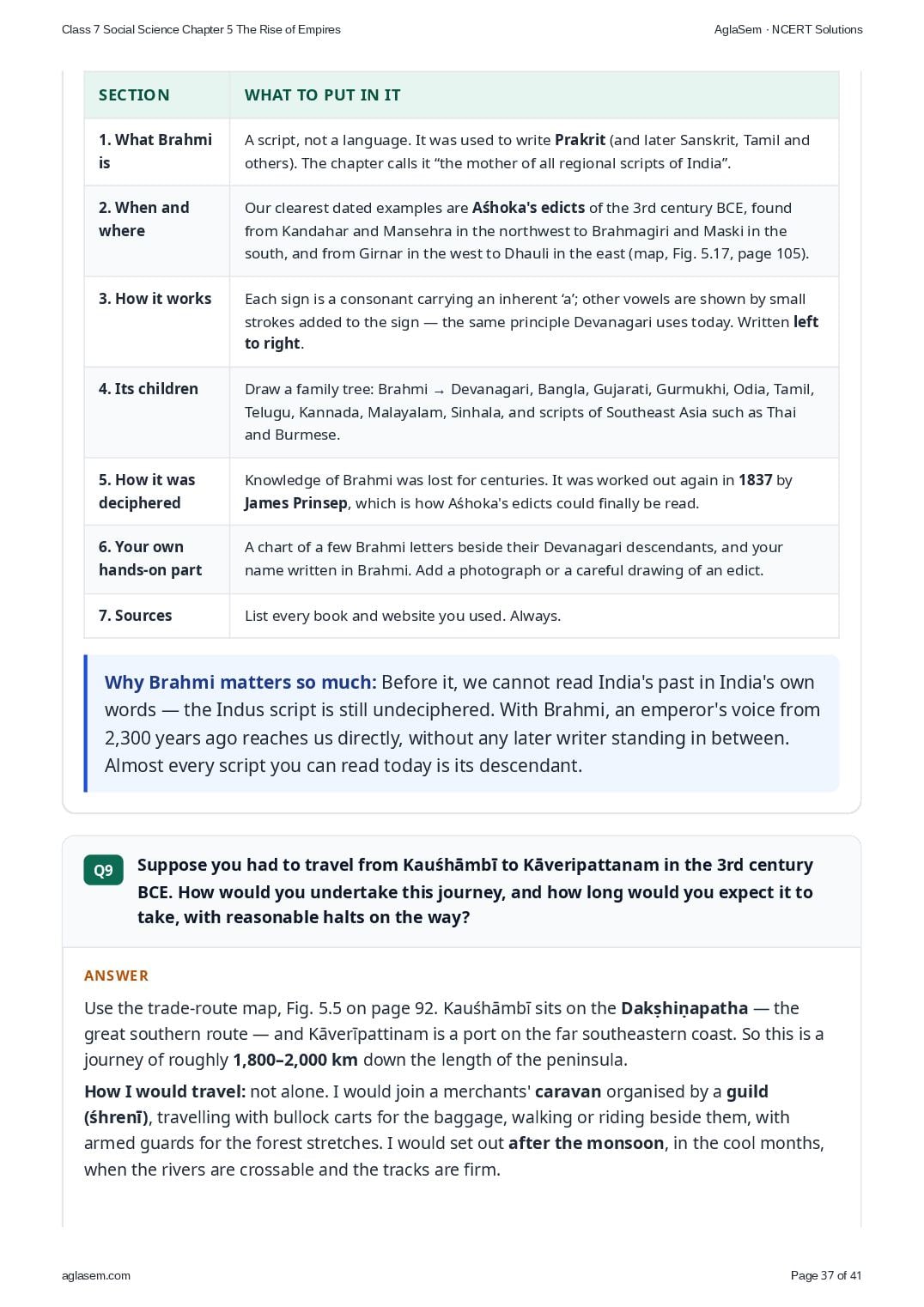
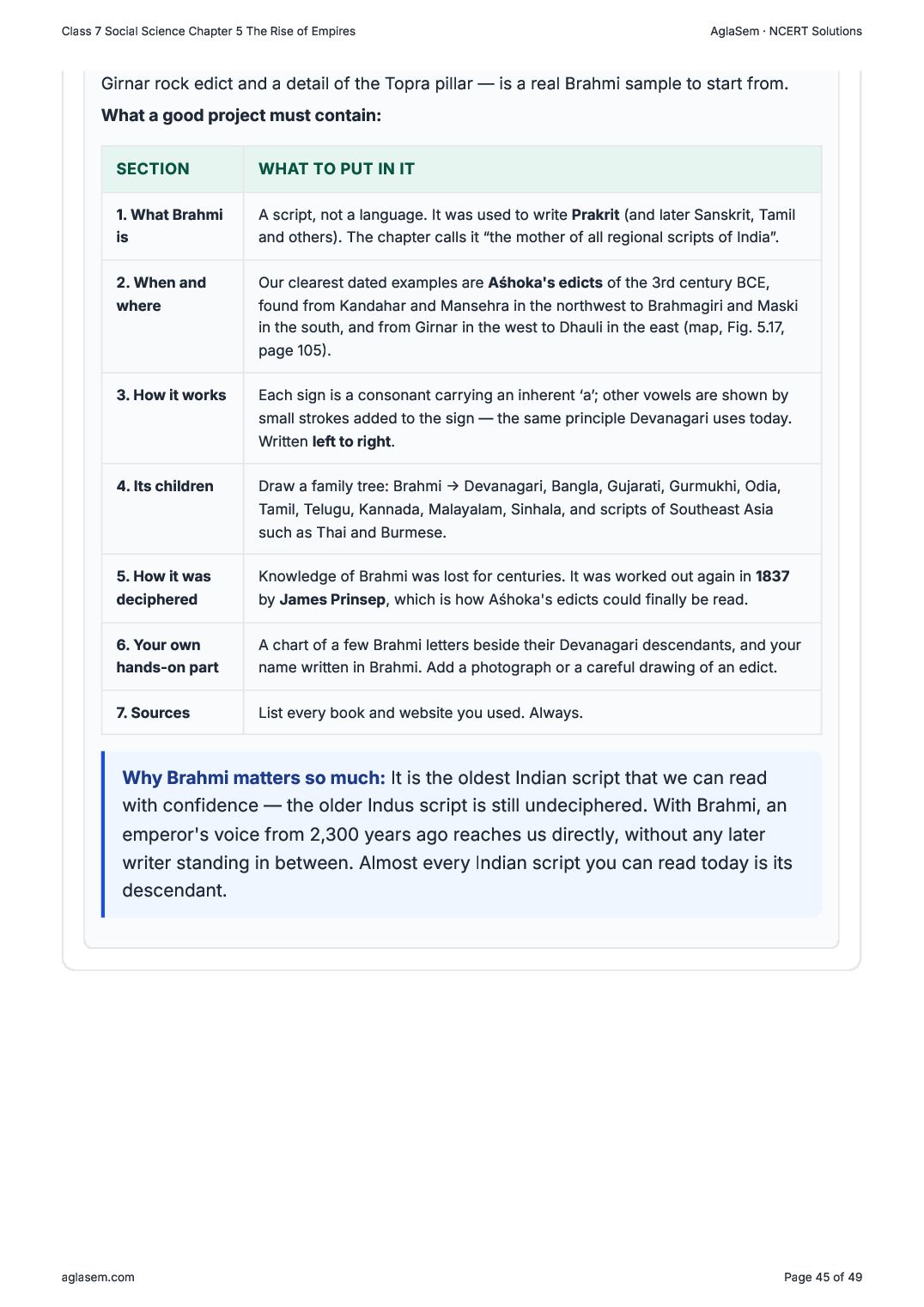
- The Brahmi script was a writing system that was widely used in ancient India. Try to learn more about this script, taking help from your teacher wherever required. Create a small project and include what you have learnt about Brahmi.
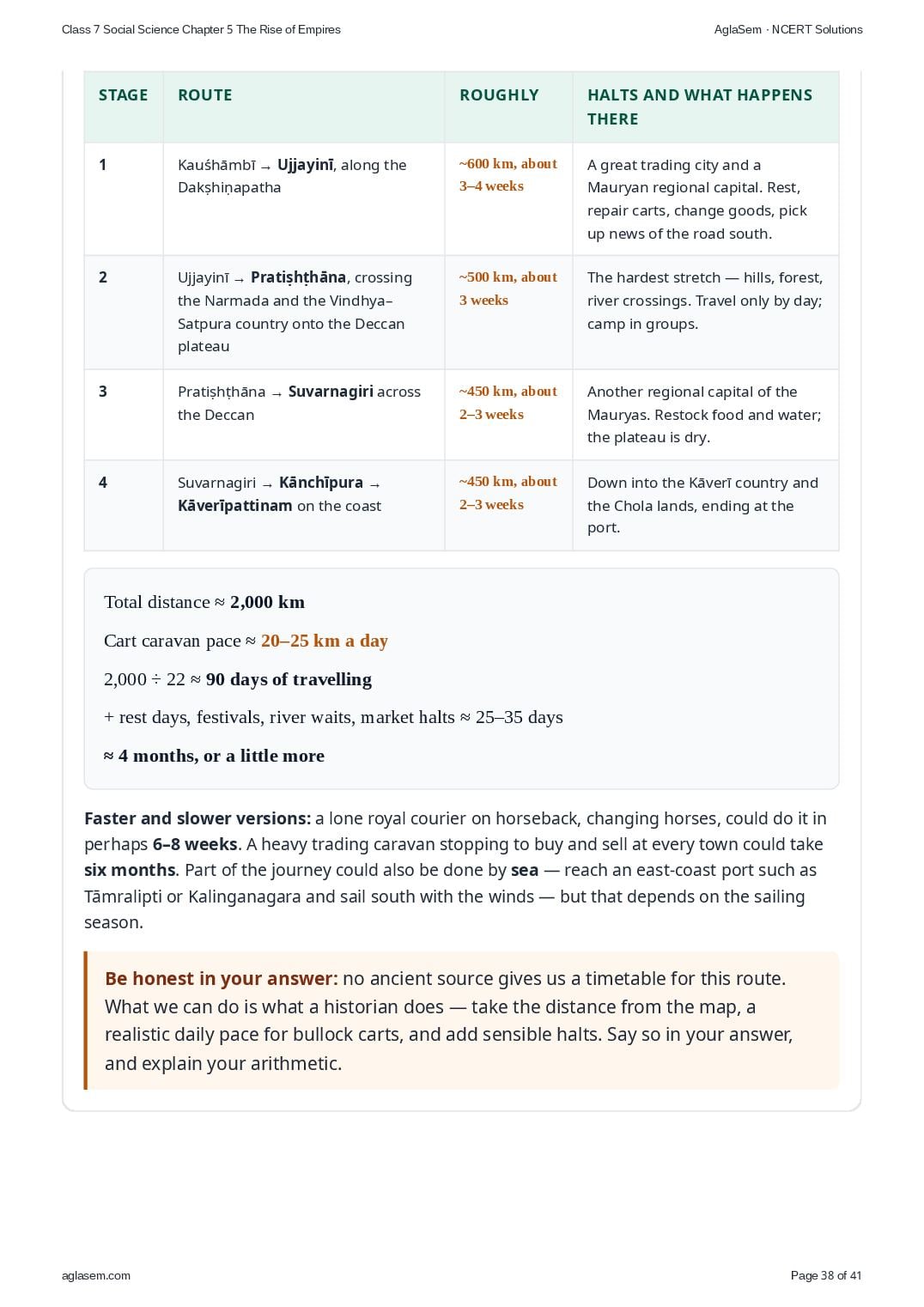
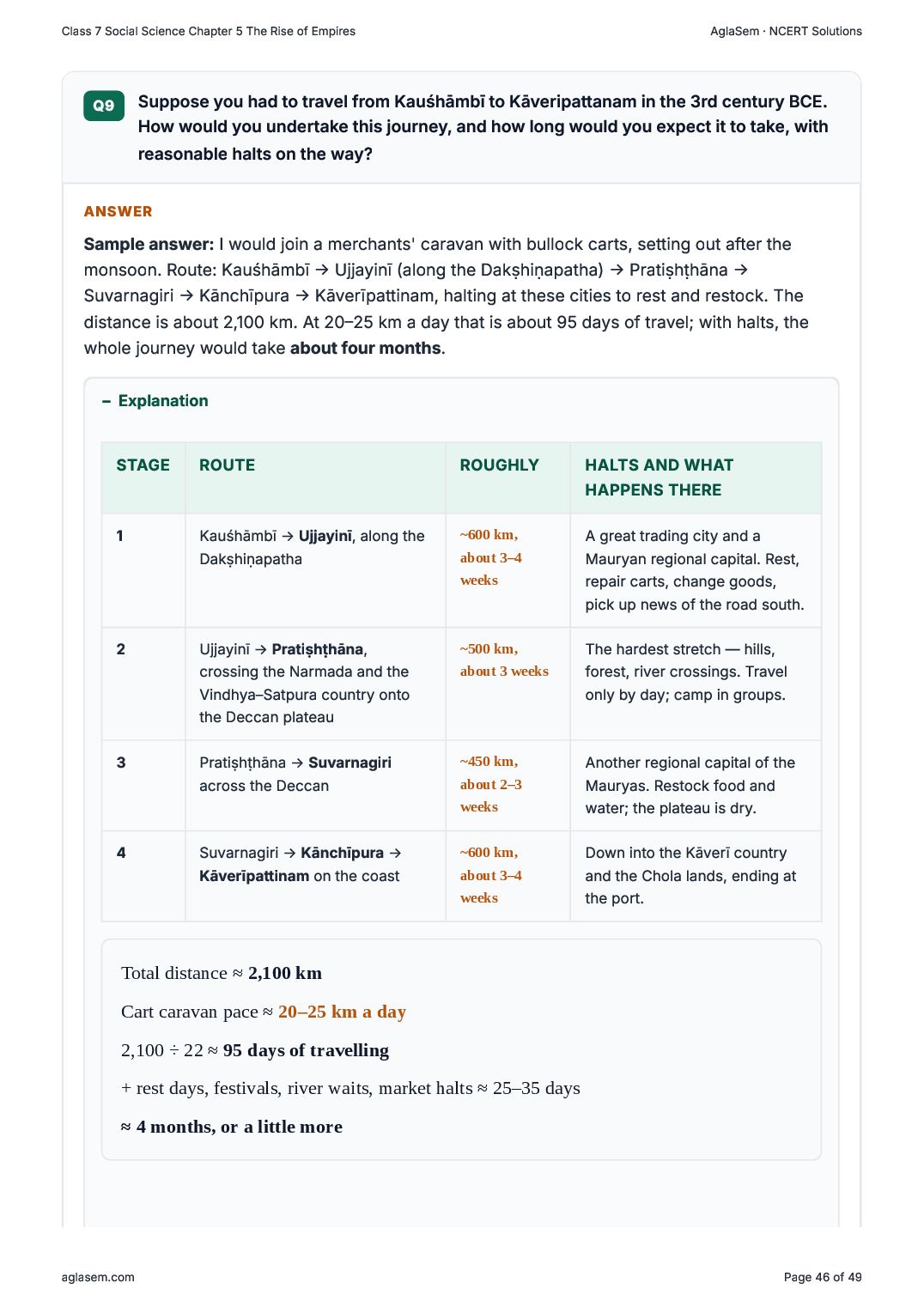
- Suppose you had to travel from Kauśhāmbī to Kāveripattanam in the 3rd century BCE. How would you undertake this journey, and how long would you expect it to take, with reasonable halts on the way?
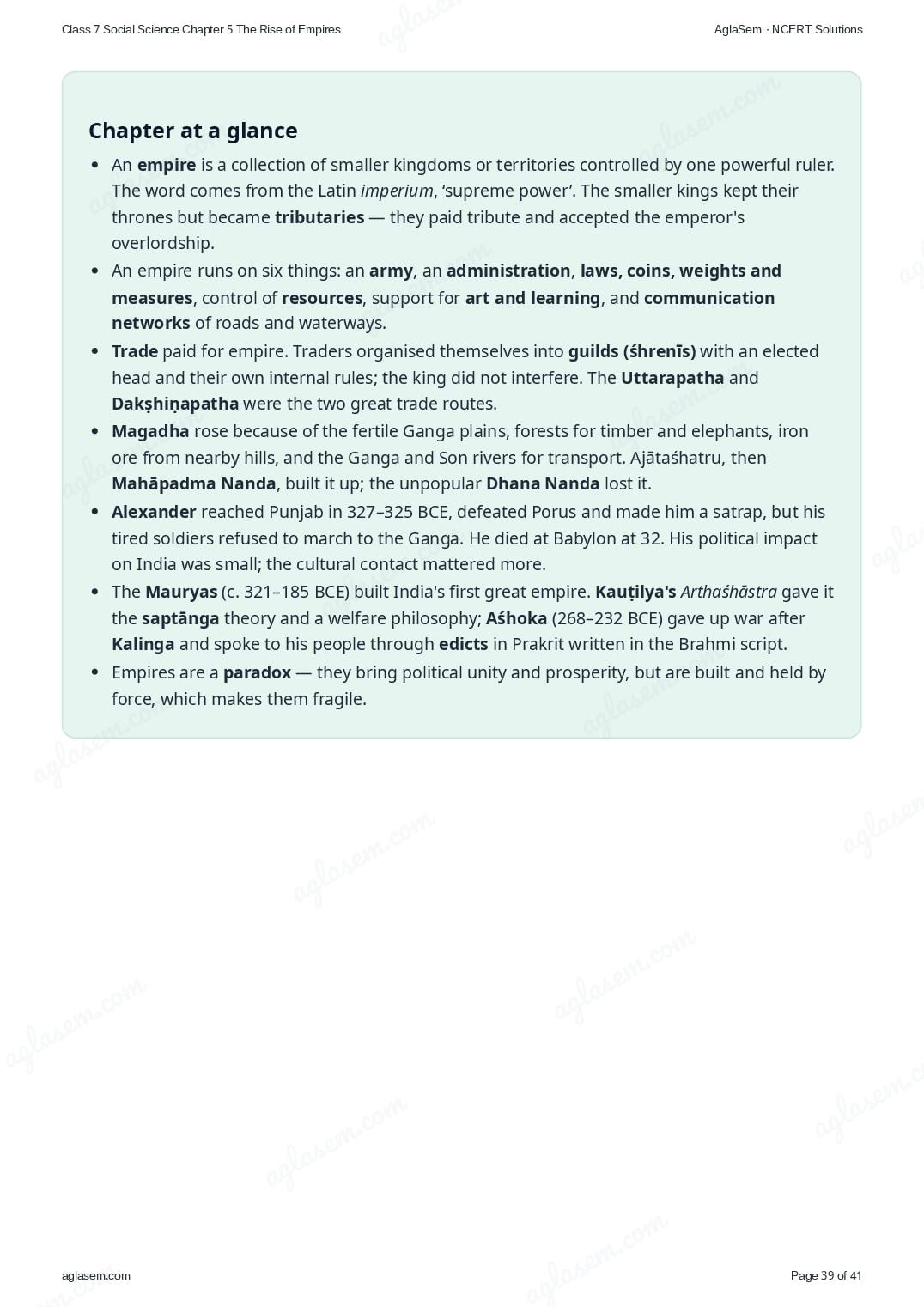
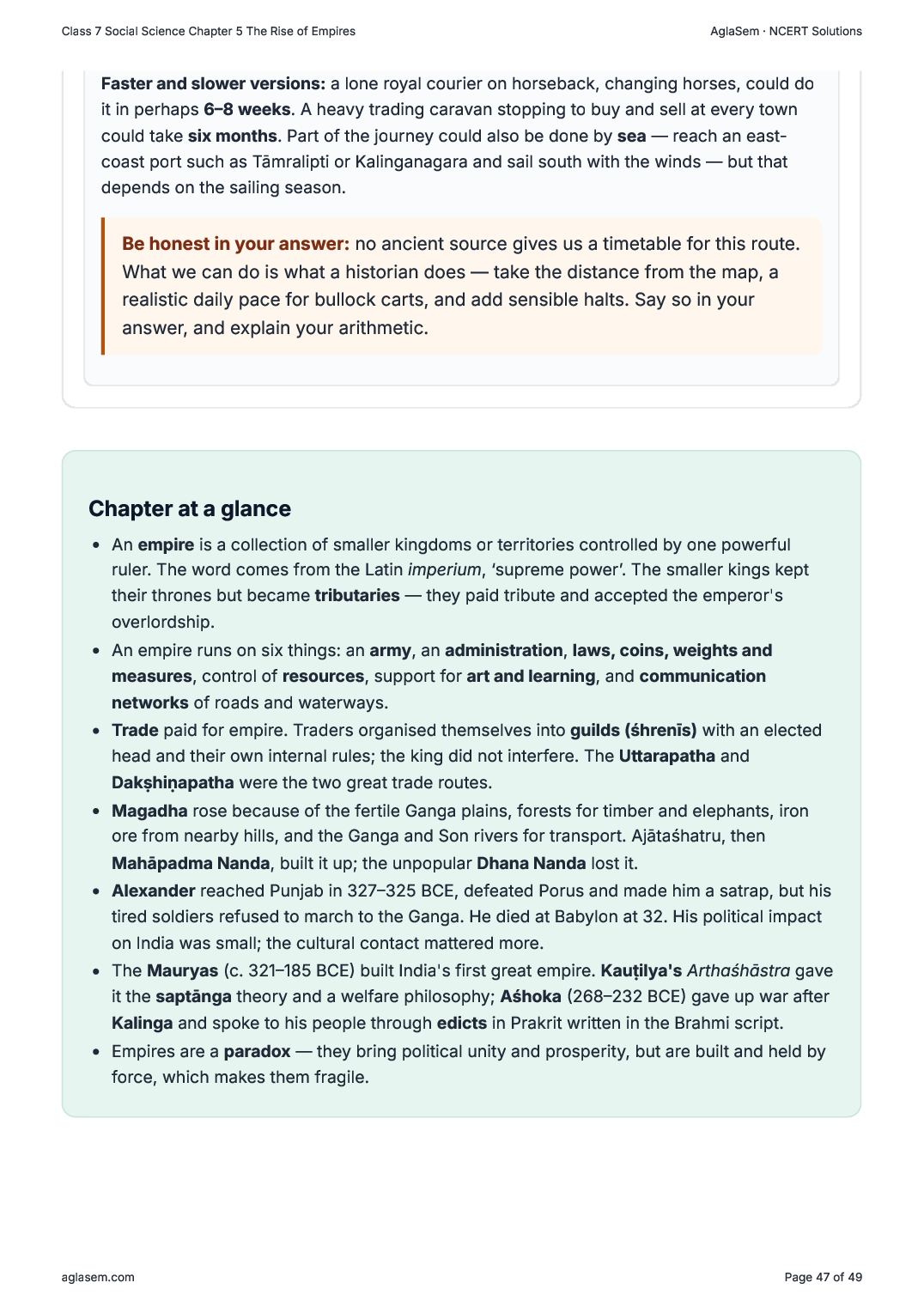
Chapter at a Glance
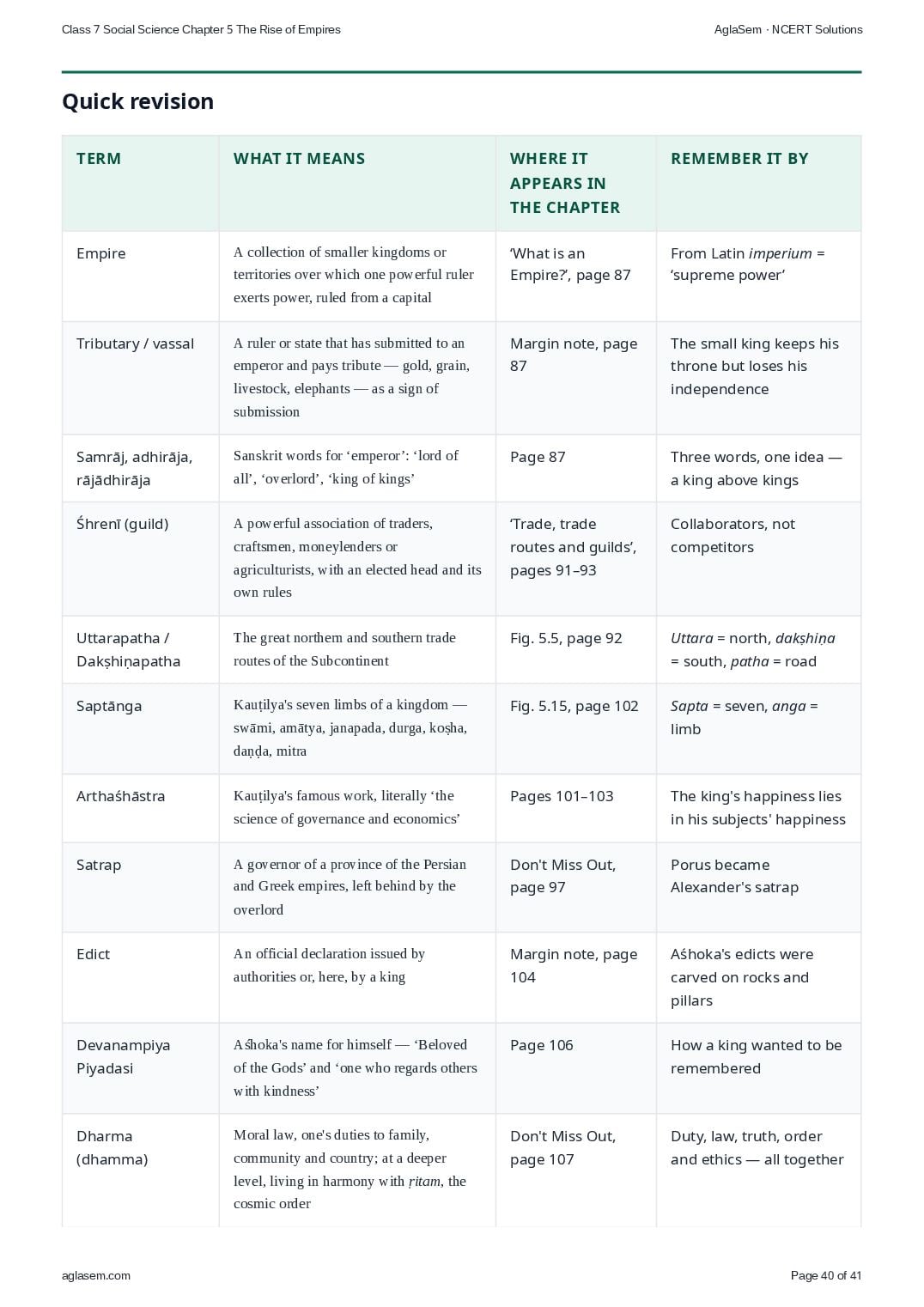
- An empire is a collection of smaller kingdoms or territories controlled by one powerful ruler. The word comes from the Latin imperium , ‘supreme power’. The smaller kings kept their thrones but became tributaries — they paid tribute and accepted the emperor's overlordship.
- An empire runs on six things: an army , an administration , laws, coins, weights and measures , control of resources , support for art and learning , and communication networks of roads and waterways.
- Trade paid for empire. Traders organised themselves into guilds (śhrenīs) with an elected head and their own internal rules; the king did not interfere. The Uttarapatha and Dakṣhiṇapatha were the two great trade routes.
- Magadha rose because of the fertile Ganga plains, forests for timber and elephants, iron ore from nearby hills, and the Ganga and Son rivers for transport. Ajātaśhatru, then Mahāpadma Nanda , built it up; the unpopular Dhana Nanda lost it.
- Alexander reached Punjab in 327–325 BCE, defeated Porus and made him a satrap, but his tired soldiers refused to march to the Ganga. He died at Babylon at 32. His political impact on India was small; the cultural contact mattered more.
- The Mauryas (c. 321–185 BCE) built India's first great empire. Kauṭilya's Arthaśhāstra gave it the saptānga theory and a welfare philosophy; Aśhoka (268–232 BCE) gave up war after Kalinga and spoke to his people through edicts in Prakrit written in the Brahmi script.
- Empires are a paradox — they bring political unity and prosperity, but are built and held by force, which makes them fragile.
How to Download NCERT Solutions for Class 7 Social Science Chapter 5 PDF
Follow these simple steps to get the the Rise of Empires questions-and-answers PDF from Exploring Society India and Beyond.
- Search NCERT Solutions for Class 7 Social Science Chapter 5 aglasem and open this page.
- Read the exercise questions with answers for the Rise of Empires shown above.
- Click the Download PDF link to save the the Rise of Empires solutions to your device.
NCERT Solutions for Class 7 Social Science – All Chapters
There are more chapters to study besides the Rise of Empires in Social Science. Here are the NCERT Solutions for all chapters of Class 7 Social Science.
- Chapter 1 Geographical Diversity of India
- Chapter 2 Understanding the Weather
- Chapter 3 Climates of India
- Chapter 4 New Beginnings Cities and States
- Chapter 5 the Rise of Empires
- Chapter 6 the Age of Reorganisation
- Chapter 7 the Gupta Era an Age of Tireless Creativity
- Chapter 8 How the Land Becomes Sacred
- Chapter 9 From the Rulers to the Ruled Types of Governments
- Chapter 10 the Constitution of India an Introduction
- Chapter 11 From Barter to Money
- Chapter 12 Understanding Markets
NCERT Solutions for Class 7 – All Subjects
Just like Chapter 5 of Social Science, you can get the exercise questions with answers for every other subject of Class 7. Here are the NCERT Solutions for all subjects of Class 7.
NCERT Solutions for Class 7 Social Science Chapter 5 – An Overview
The key highlights of this study material are as follows.
| Aspects | Details |
|---|---|
| Class | Class 7 |
| Subject | Social Science |
| Chapter Number | Chapter 5 |
| Chapter Name | the Rise of Empires |
| Book Name | Exploring Society India and Beyond |
| Book By | NCERT (National Council of Educational Research and Training) |
| Educational Resource Here | NCERT Solutions of Class 7 Social Science Chapter 5 for all exercises |
| More Questions Answers of This Subject | NCERT Solutions for Class 7 Social Science |
| Download Book Chapter | NCERT Book Class 7 Social Science |
| All Questions Answers For This Class | NCERT Solutions for Class 7 |
| Complete Solutions | NCERT Solutions |
NCERT Solutions for Class 7 Social Science Chapter 5 the Rise of Empires – FAQs
What are the NCERT Solutions for Class 7 Social Science Chapter 5 the Rise of Empires?
They are the complete, step-by-step answers to all the exercise and in-text questions of Chapter 5 the Rise of Empires from the NCERT Class 7 Social Science textbook Exploring Society India and Beyond, written by experts as per the latest NCERT syllabus.
How can I download the Class 7 Social Science Chapter 5 solutions PDF for free?
Open this page on aglasem, read the the Rise of Empires questions with answers, and click the “Download Solutions PDF” link. The Class 7 Social Science Chapter 5 NCERT Solutions PDF is completely free to download.
Are these NCERT Solutions as per the latest 2026-27 syllabus?
Yes. The NCERT Solutions for Class 7 Social Science Chapter 5 are based on the latest NCERT textbook Exploring Society India and Beyond and the current 2026-27 CBSE syllabus, so the questions and answers match what you study in class.
Where can I get NCERT Solutions for the other chapters of Class 7 Social Science?
You can find the answers to every chapter on the NCERT Solutions for Class 7 Social Science page, and solutions for every subject on the NCERT Solutions for Class 7 page.
How do NCERT Solutions help in exam preparation?
They show the correct method to solve each question, help you write answers the way they are expected in exams, let you check and correct your own work, and save revision time — which together improve your marks in Class 7 Social Science.
If you have any queries on NCERT Solutions for Class 7 Social Science Chapter 5 the Rise of Empires, then please ask in the comments below.