NCERT Solutions for Class 7 Social Science Chapter 1 Geographical Diversity of India provide clear, step-by-step answers to every exercise and in-text question from the chapter Geographical Diversity of India of the NCERT textbook Exploring Society India and Beyond. Prepared by subject experts as per the latest NCERT (CBSE) syllabus for 2026-27, these NCERT Solutions for Class 7 Social Science help you understand each concept, write exam-ready answers, and check your own solutions. You can read them online below or download the free Class 7 Social Science Chapter 1 question-answer PDF.
NCERT Solutions for Class 7 Social Science Chapter 1 Geographical Diversity of India
- Class: Class 7
- Subject: Social Science
- Chapter: Chapter 1 – Geographical Diversity of India
- Textbook: Exploring Society India and Beyond (NCERT)
- Study material: NCERT Solutions – questions with answers, free PDF
These solutions answer all the exercise questions of Chapter 1 Geographical Diversity of India — including the in-text questions, short-answer and long-answer questions, and activities — with complete explanations so you can follow the method, not just the final answer. Read the full solutions below.
NCERT Solutions Class 7 Social Science Chapter 1 Geographical Diversity of India View Download
NCERT Solutions for Class 7 Social Science Chapter 1 PDF Download
You can read the NCERT Solutions for Class 7 Social Science Chapter 1 online above, or download the complete question-answer PDF to study Geographical Diversity of India offline at any time.
NCERT Solutions for Class 7 Social Science Chapter 1 PDF Download Link – Click Here to Download Solutions PDF
Questions Covered in This Chapter
These NCERT Solutions answer all 36 questions of this chapter. The questions solved are:
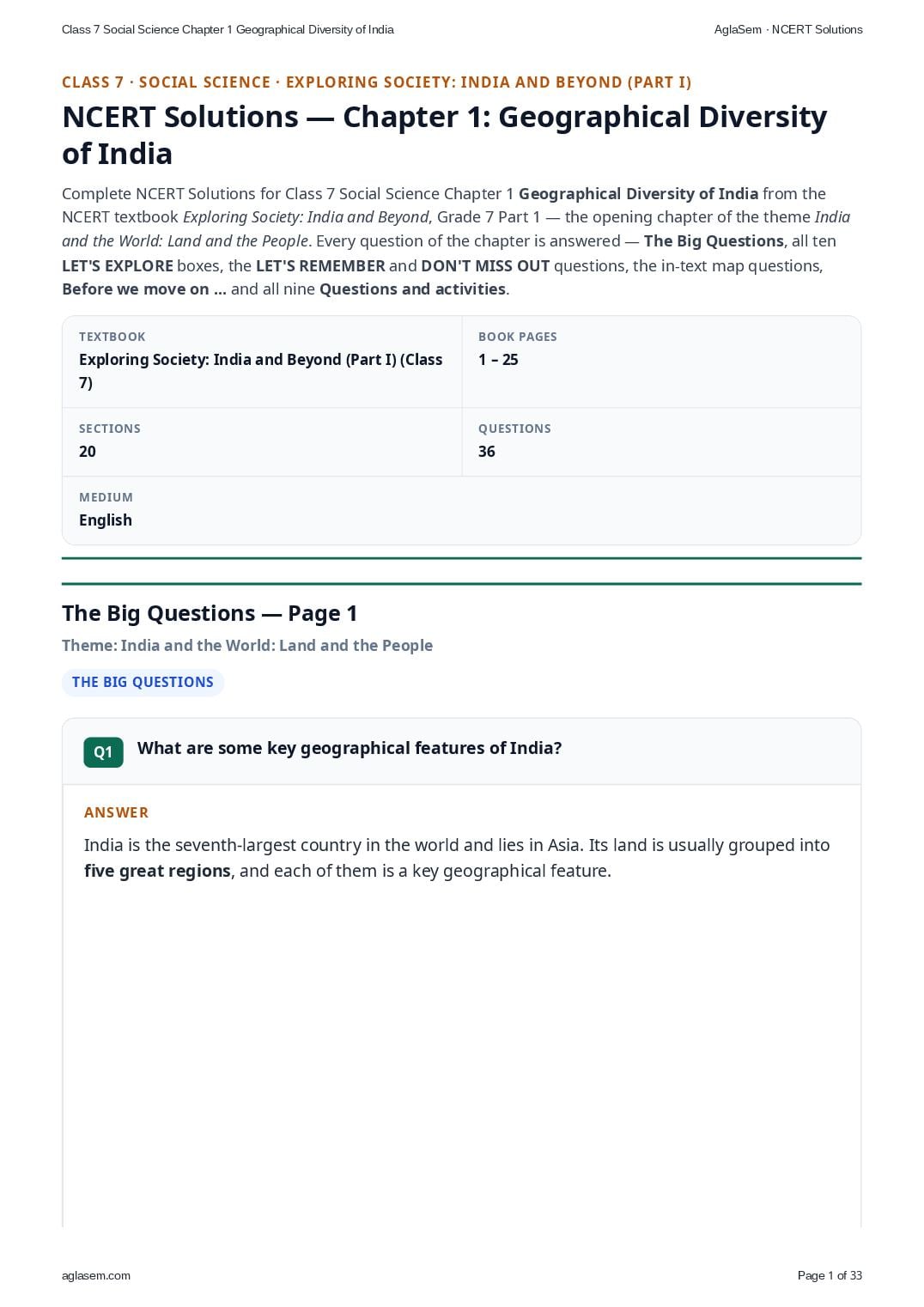
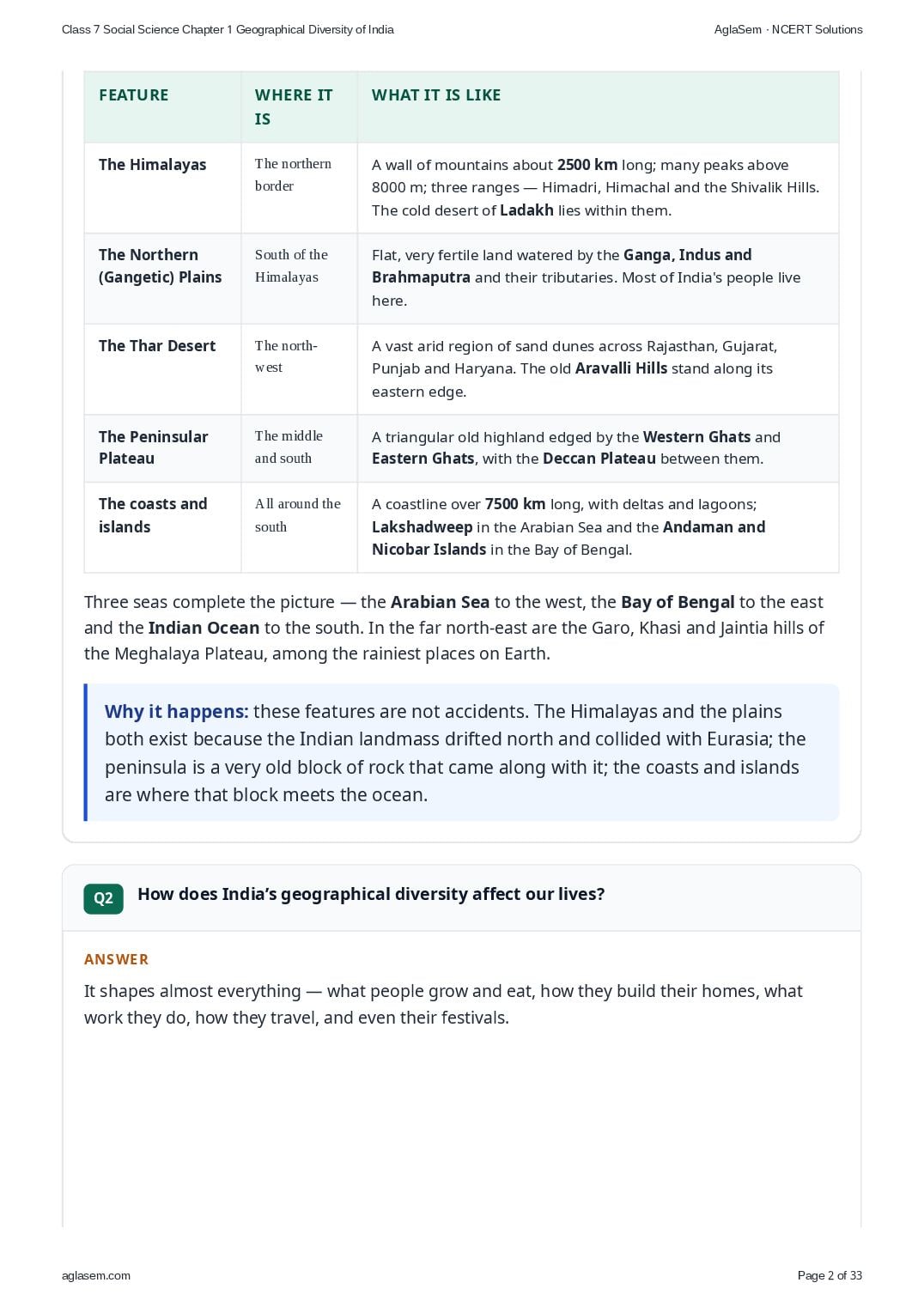
- What are some key geographical features of India?
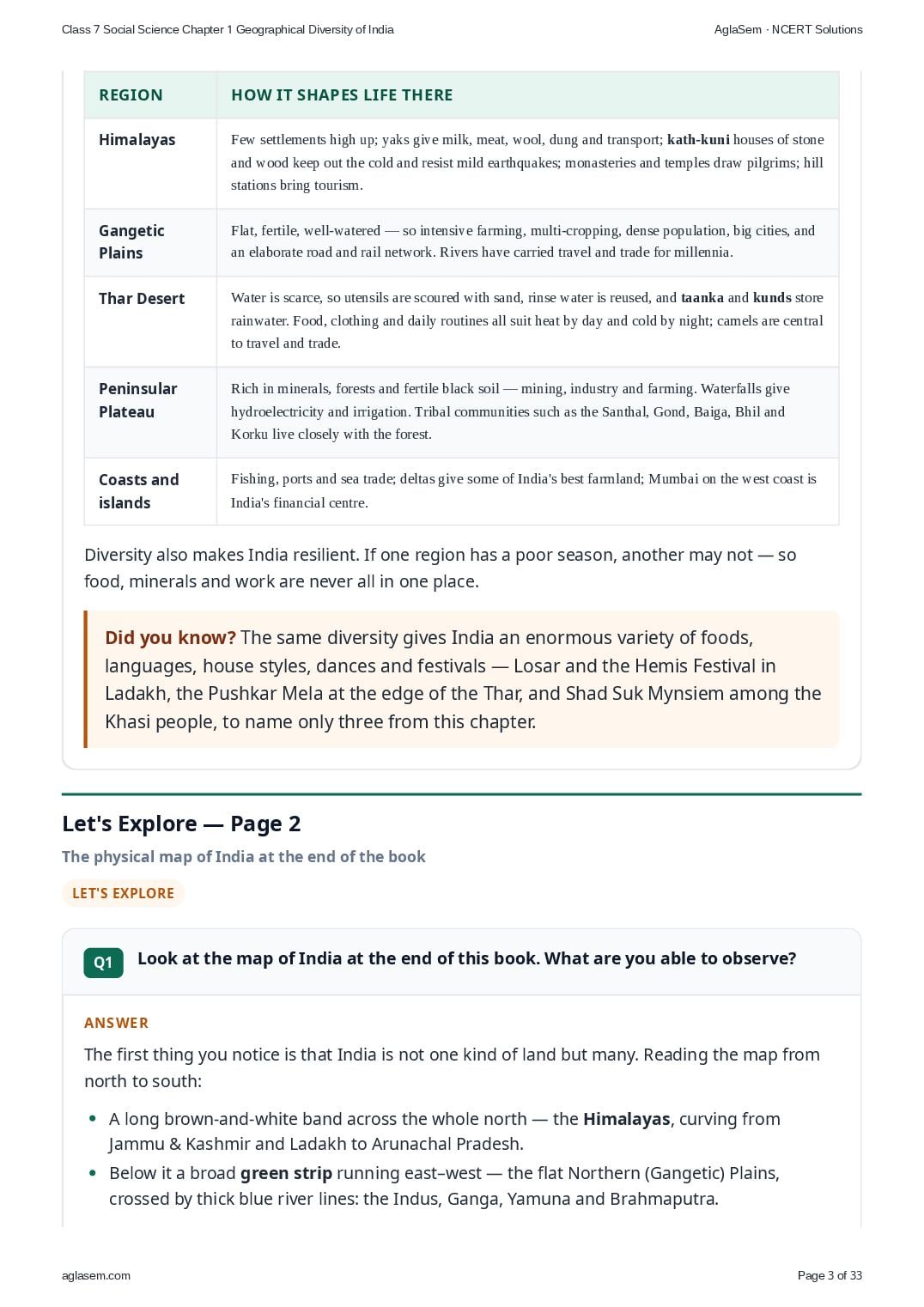
- How does India’s geographical diversity affect our lives?
- Look at the map of India at the end of this book. What are you able to observe?
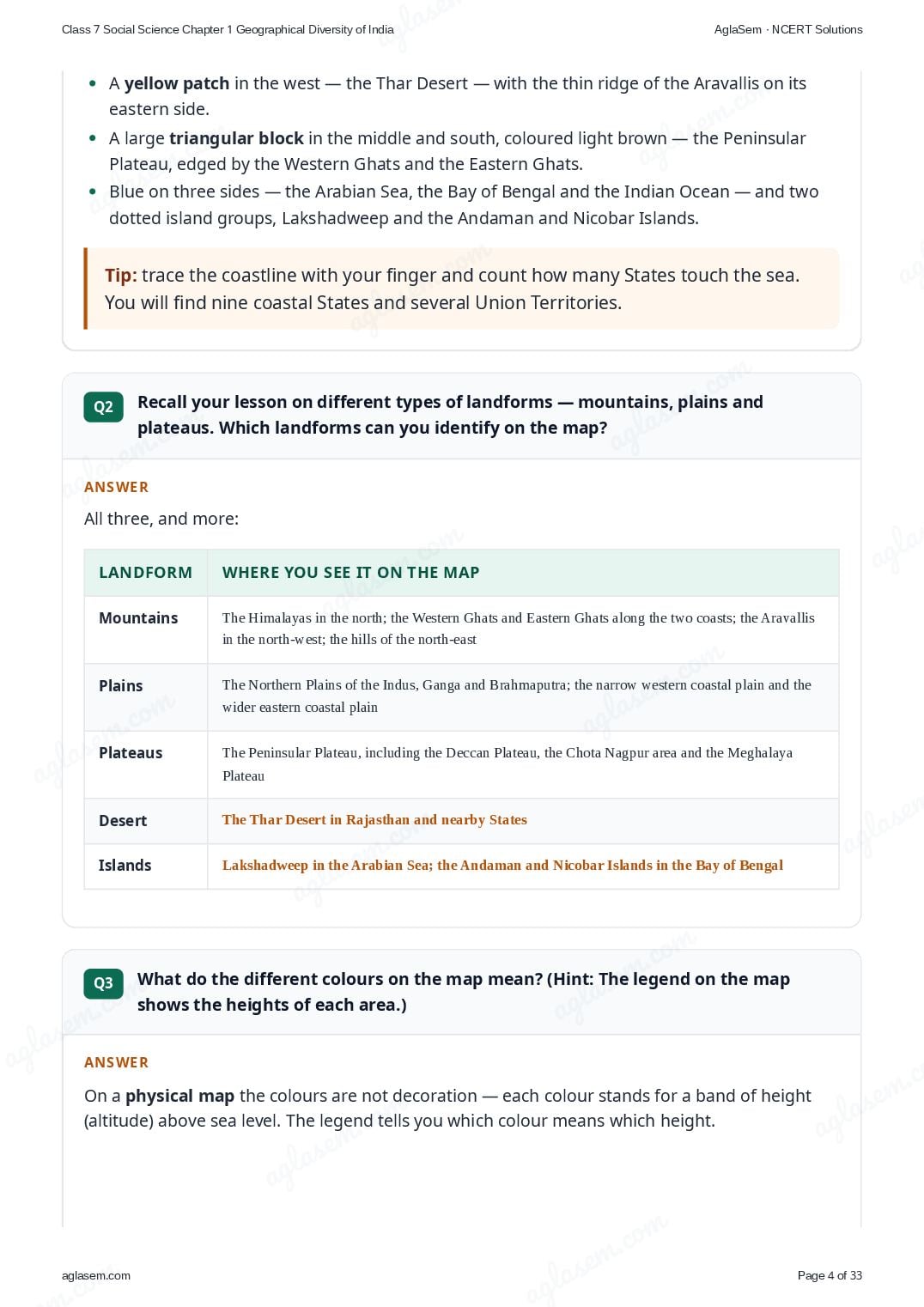
- Recall your lesson on different types of landforms — mountains, plains and plateaus. Which landforms can you identify on the map?
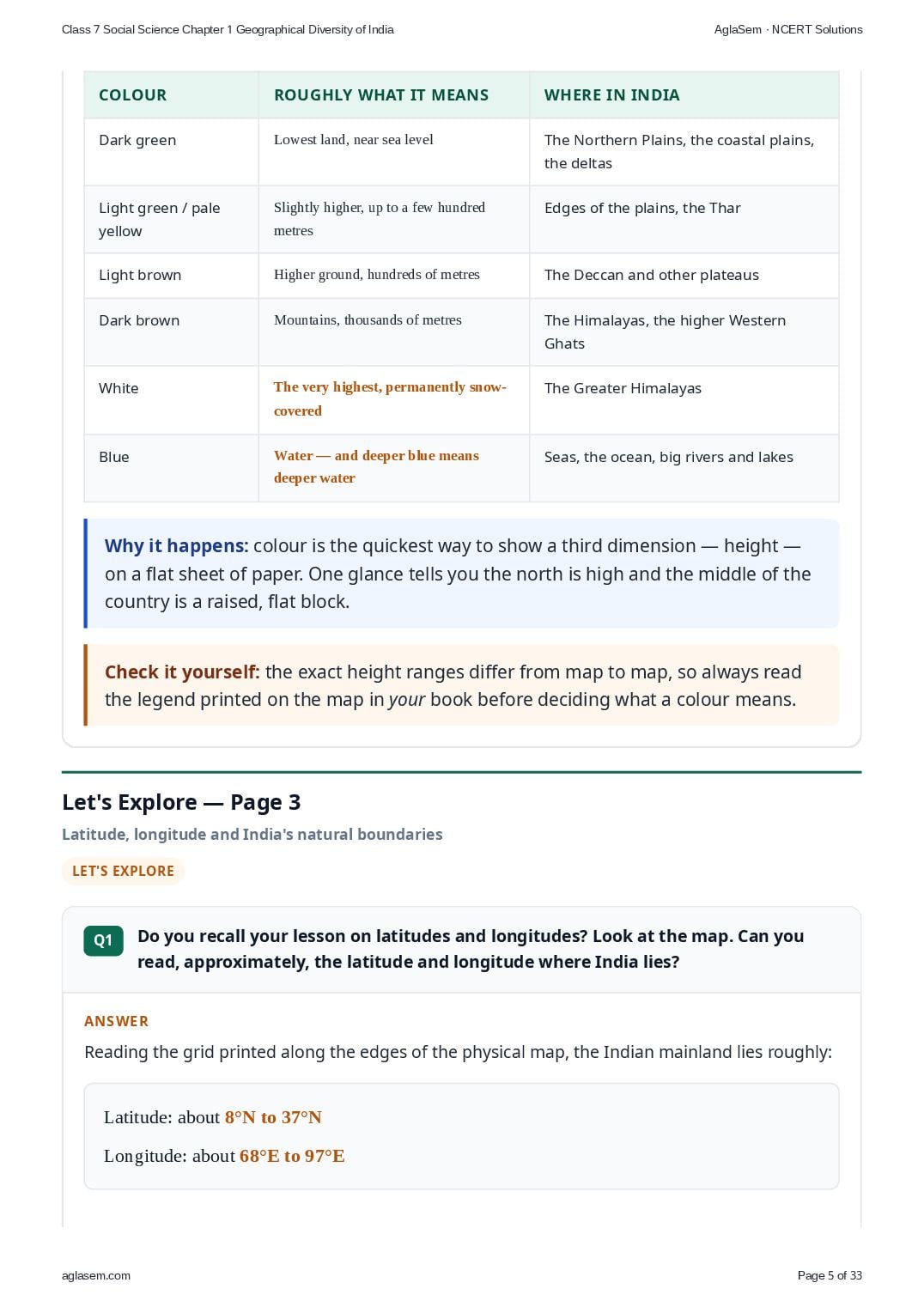
- What do the different colours on the map mean? (Hint: The legend on the map shows the heights of each area.)
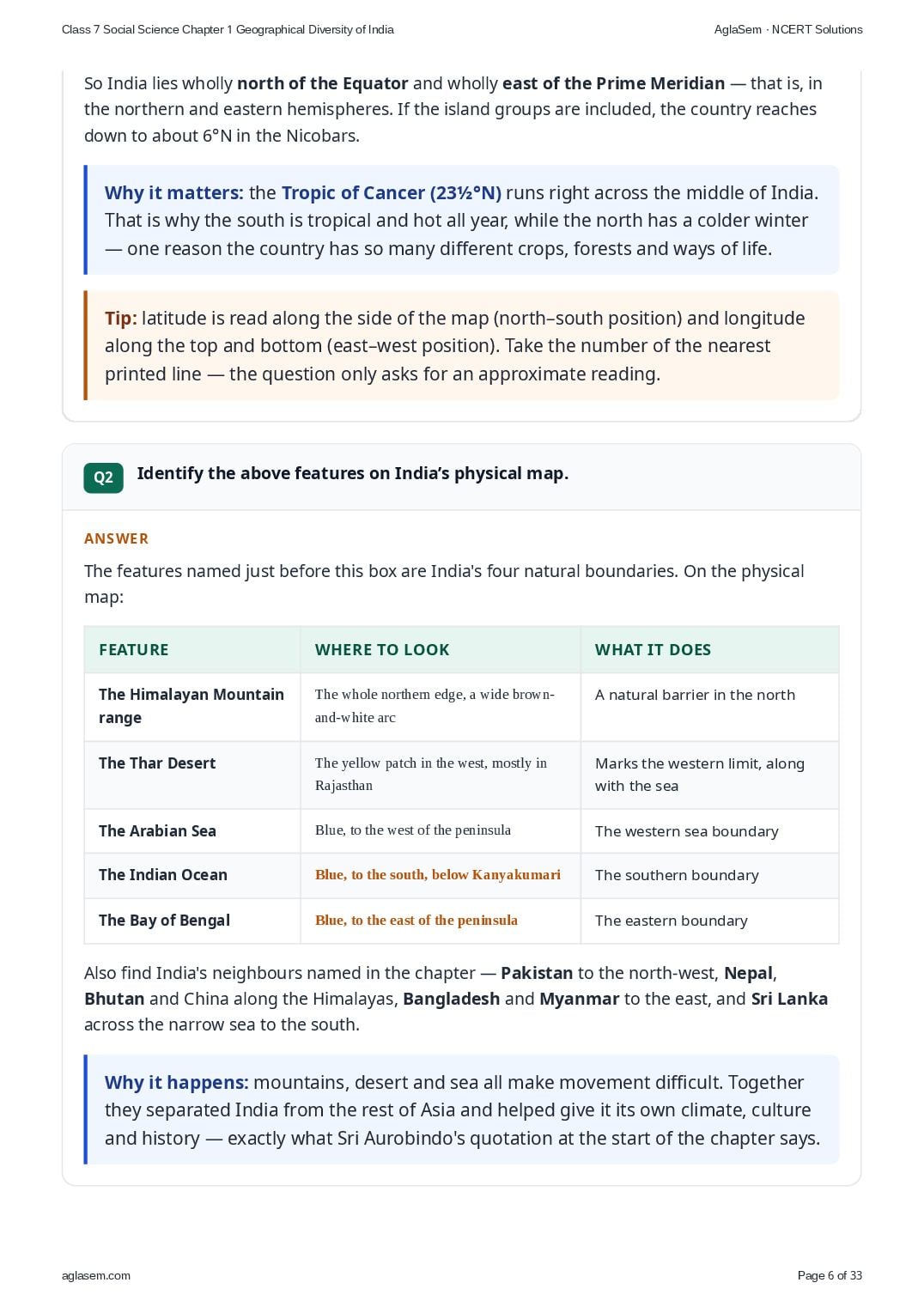
- Do you recall your lesson on latitudes and longitudes? Look at the map. Can you read, approximately, the latitude and longitude where India lies?
- Identify the above features on India’s physical map.
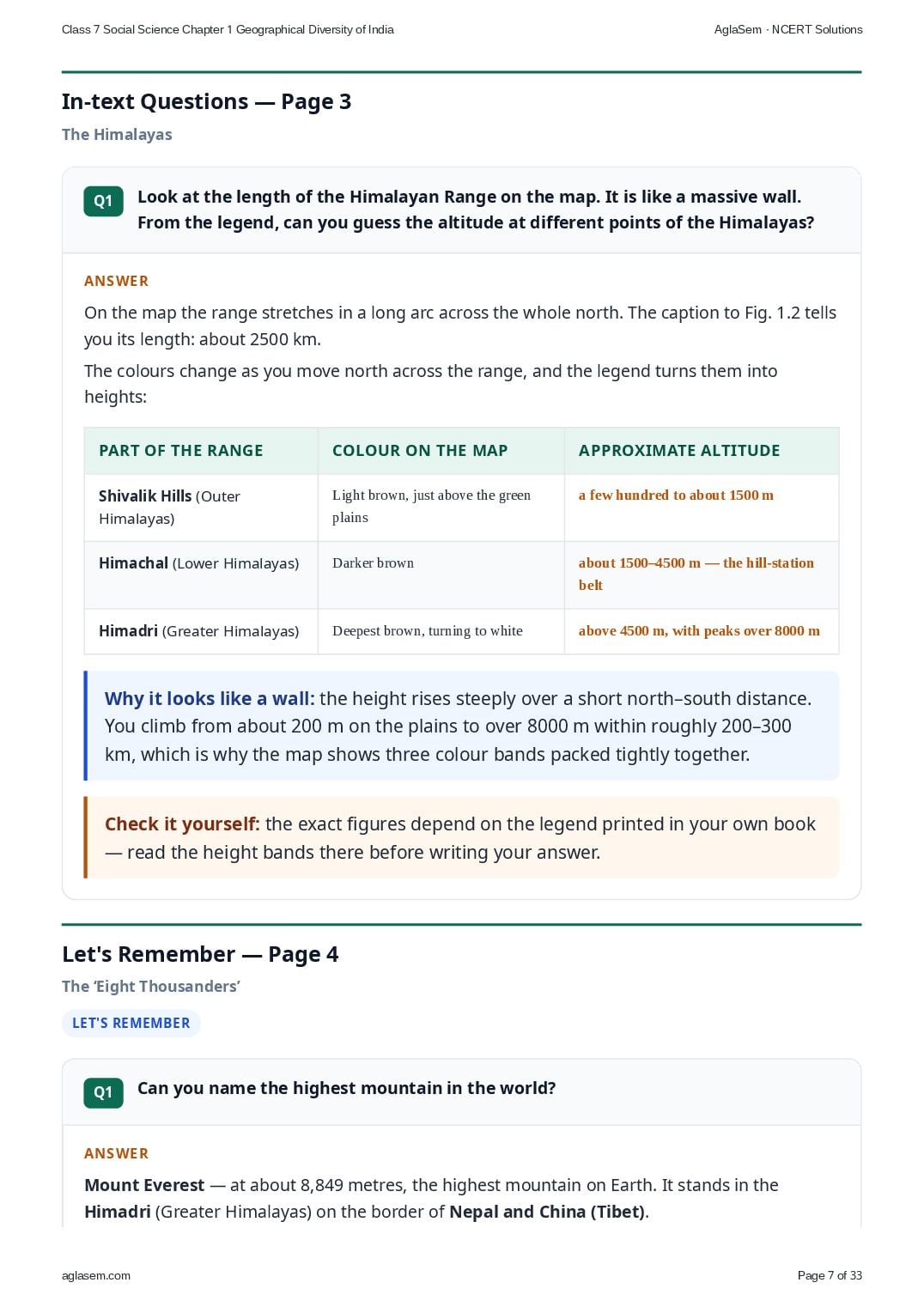
- Look at the length of the Himalayan Range on the map. It is like a massive wall. From the legend, can you guess the altitude at different points of the Himalayas?
- Can you name the highest mountain in the world?
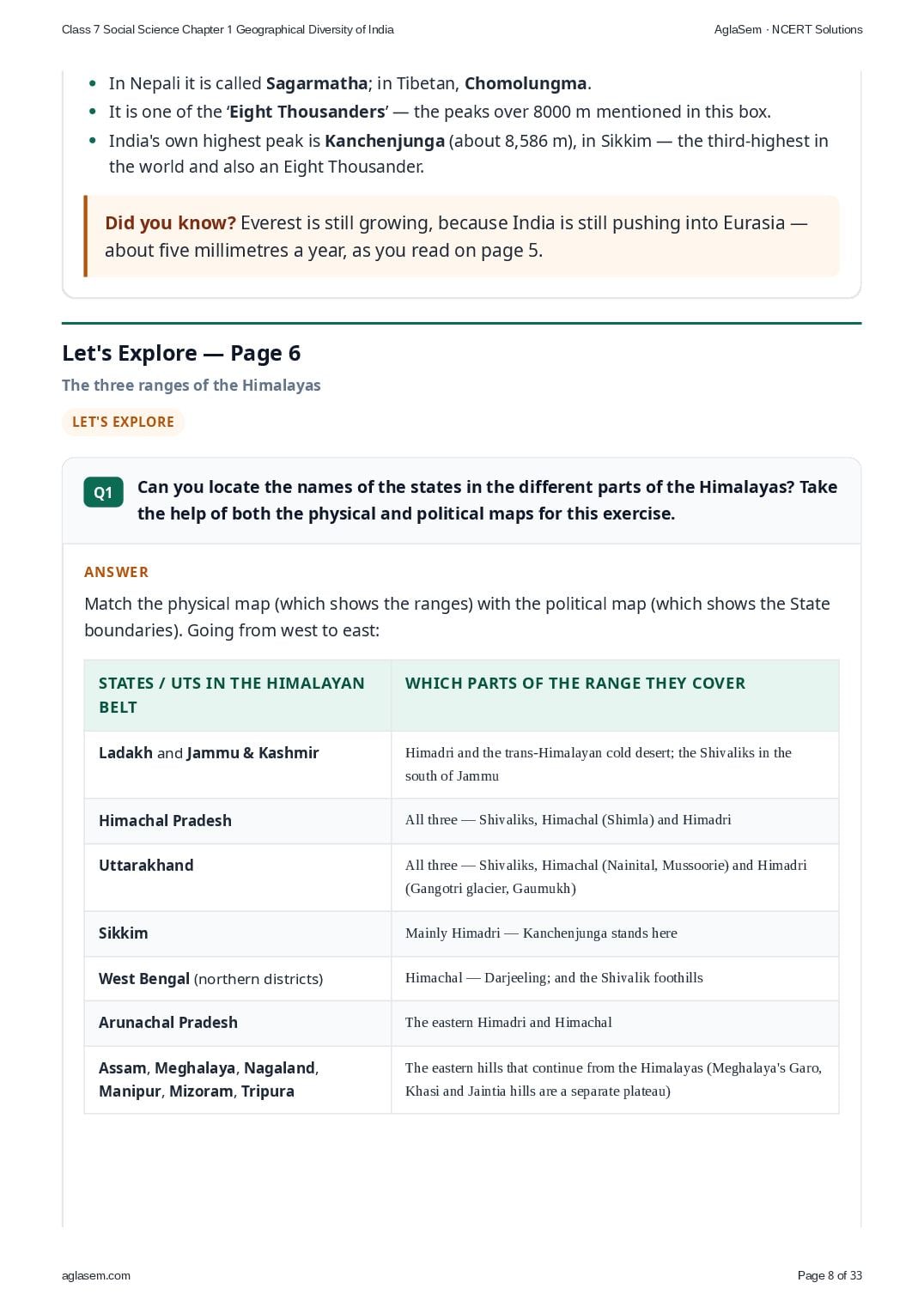
- Can you locate the names of the states in the different parts of the Himalayas? Take the help of both the physical and political maps for this exercise.
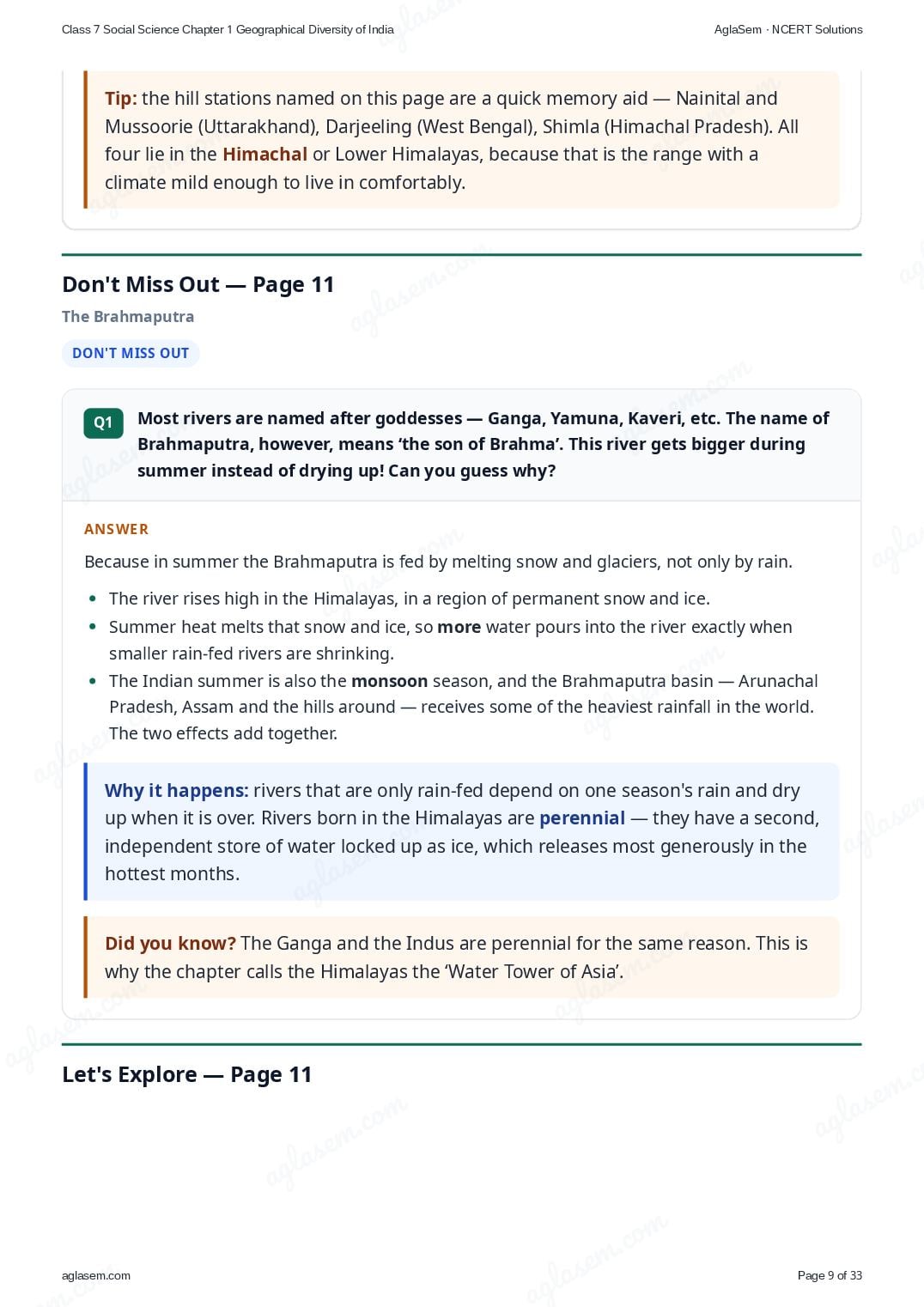
- Most rivers are named after goddesses — Ganga, Yamuna, Kaveri, etc. The name of Brahmaputra, however, means ‘the son of Brahma’. This river gets bigger during summer instead of drying up! Can you guess why?
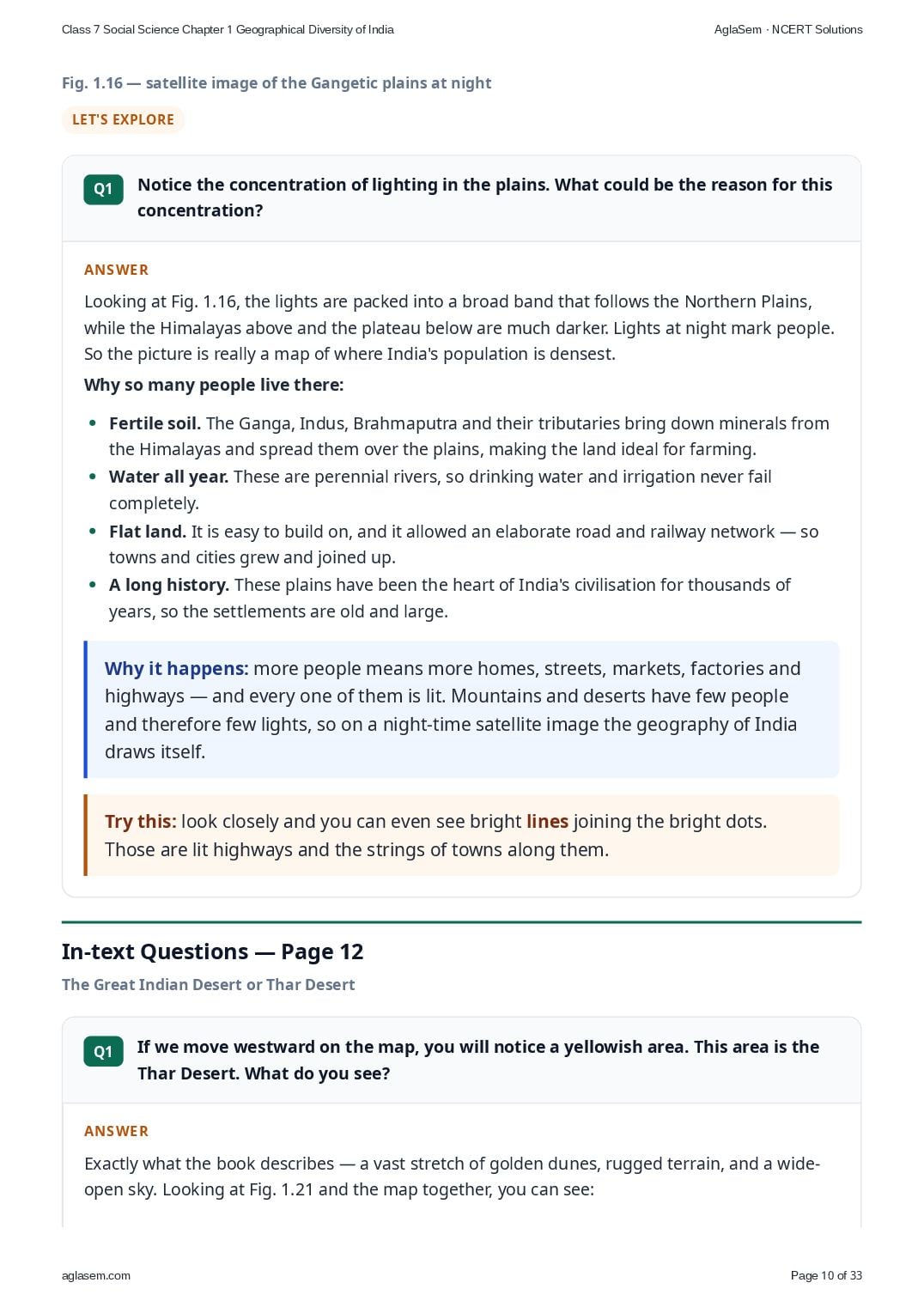
- Notice the concentration of lighting in the plains. What could be the reason for this concentration?
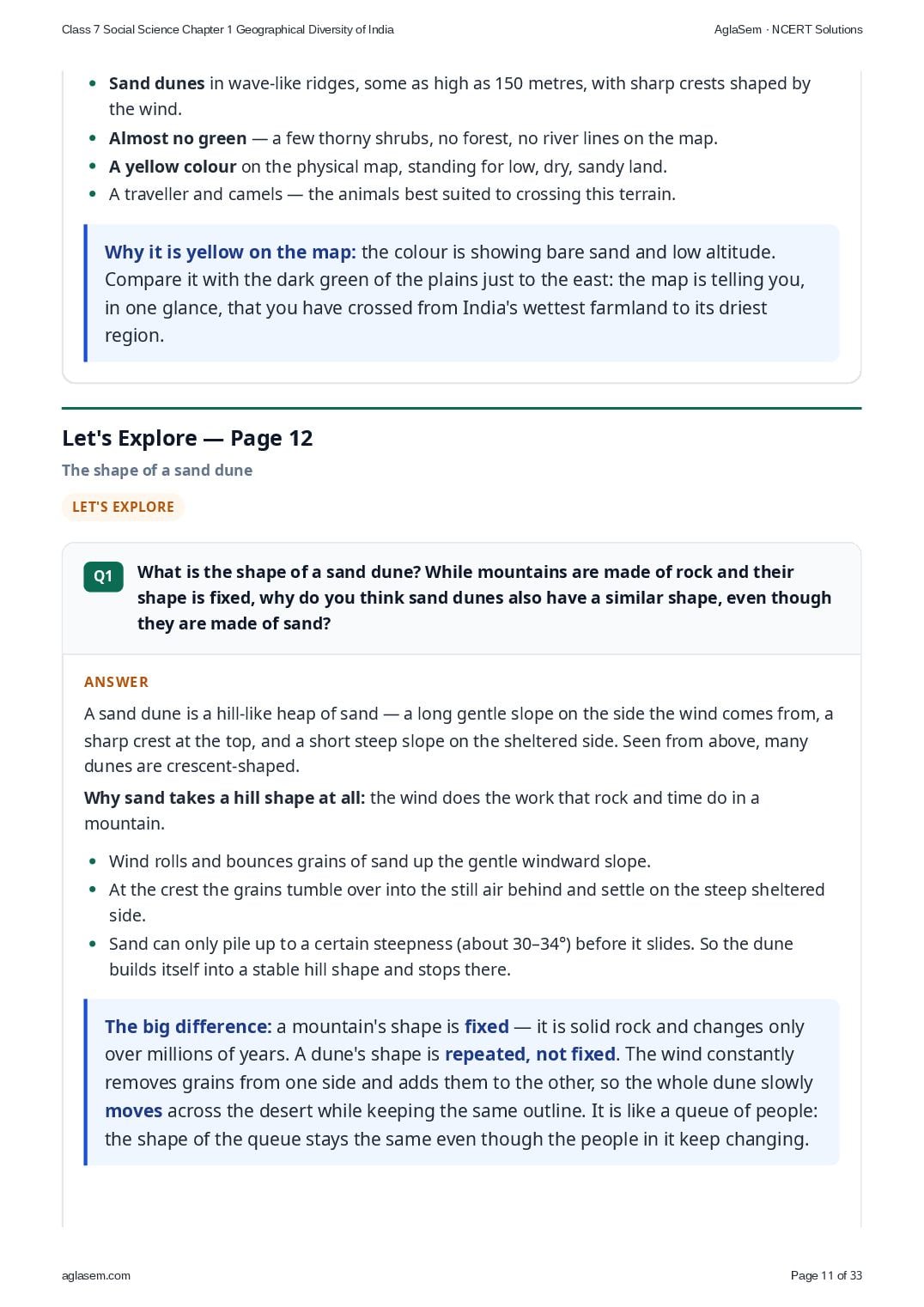
- If we move westward on the map, you will notice a yellowish area. This area is the Thar Desert. What do you see?
- What is the shape of a sand dune? While mountains are made of rock and their shape is fixed, why do you think sand dunes also have a similar shape, even though they are made of sand?
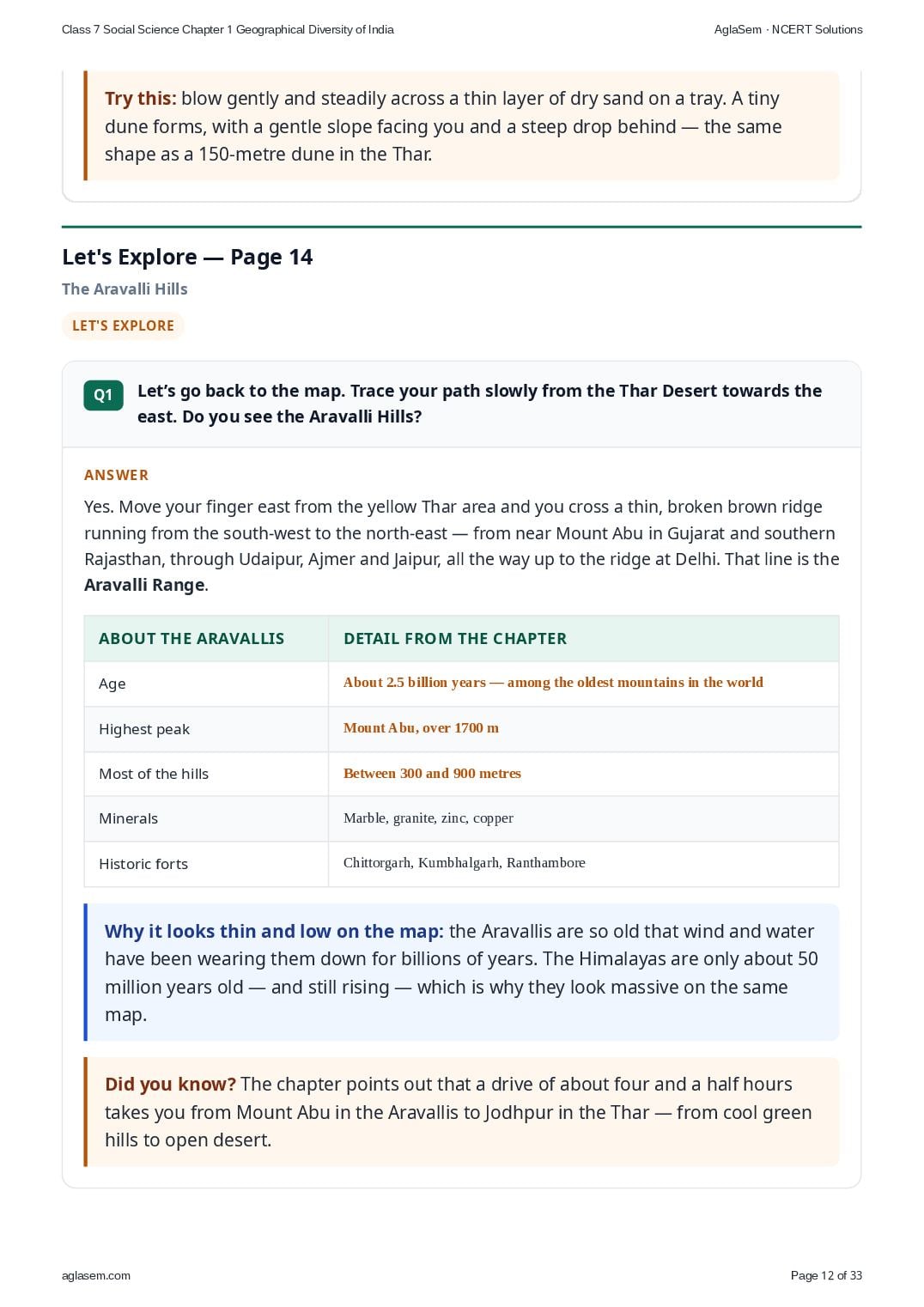
- Let’s go back to the map. Trace your path slowly from the Thar Desert towards the east. Do you see the Aravalli Hills?
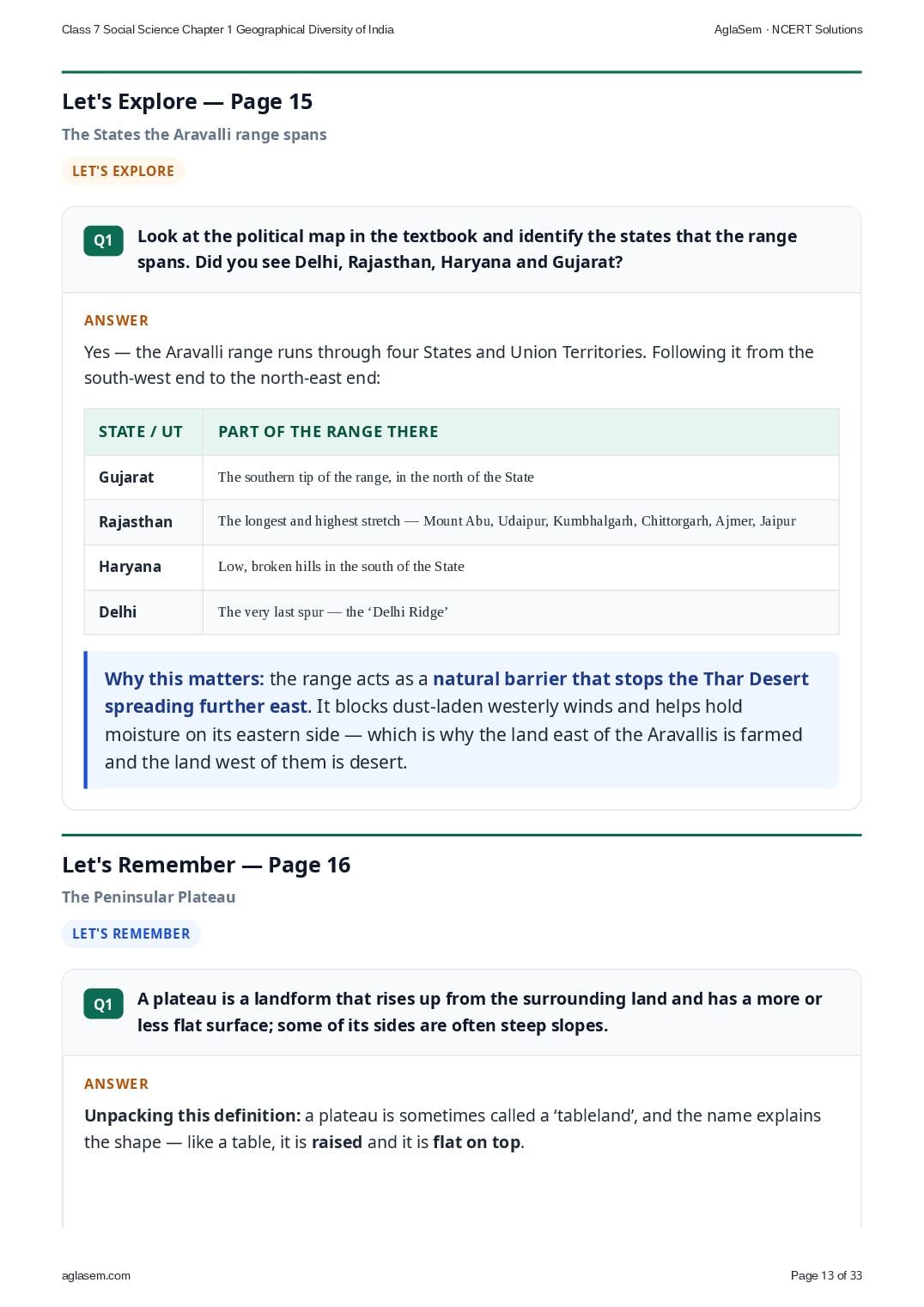
- Look at the political map in the textbook and identify the states that the range spans. Did you see Delhi, Rajasthan, Haryana and Gujarat?
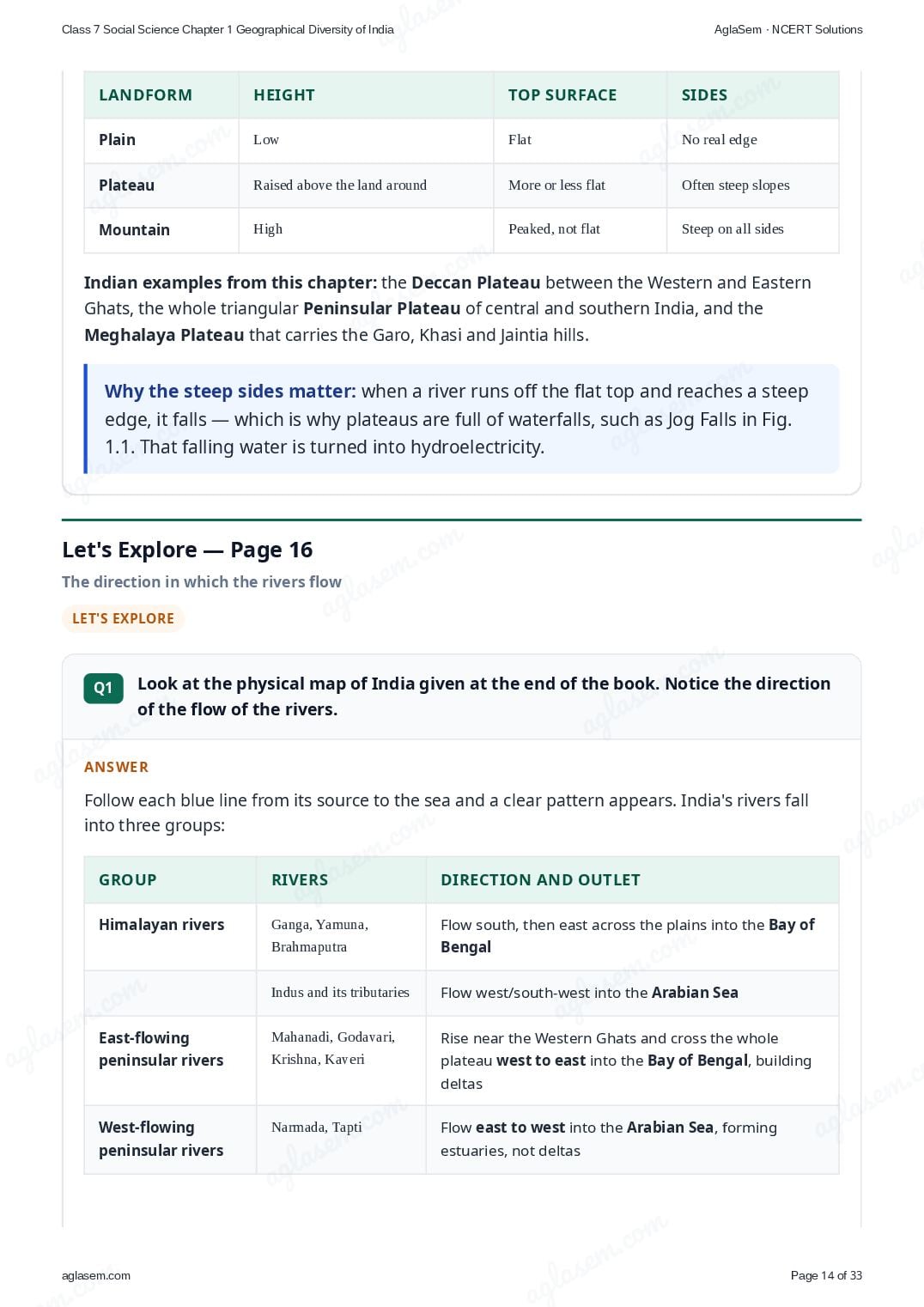
- A plateau is a landform that rises up from the surrounding land and has a more or less flat surface; some of its sides are often steep slopes.
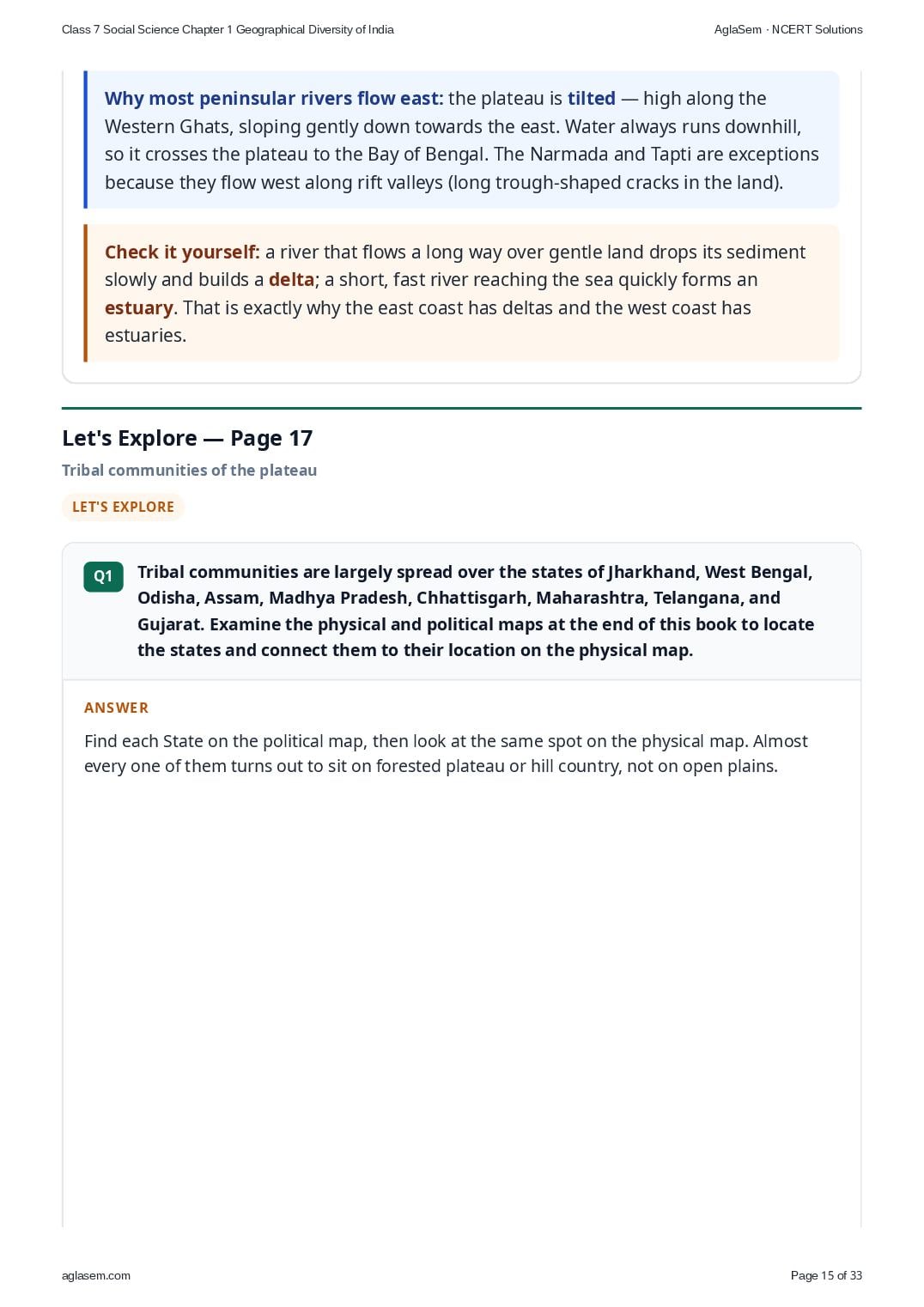
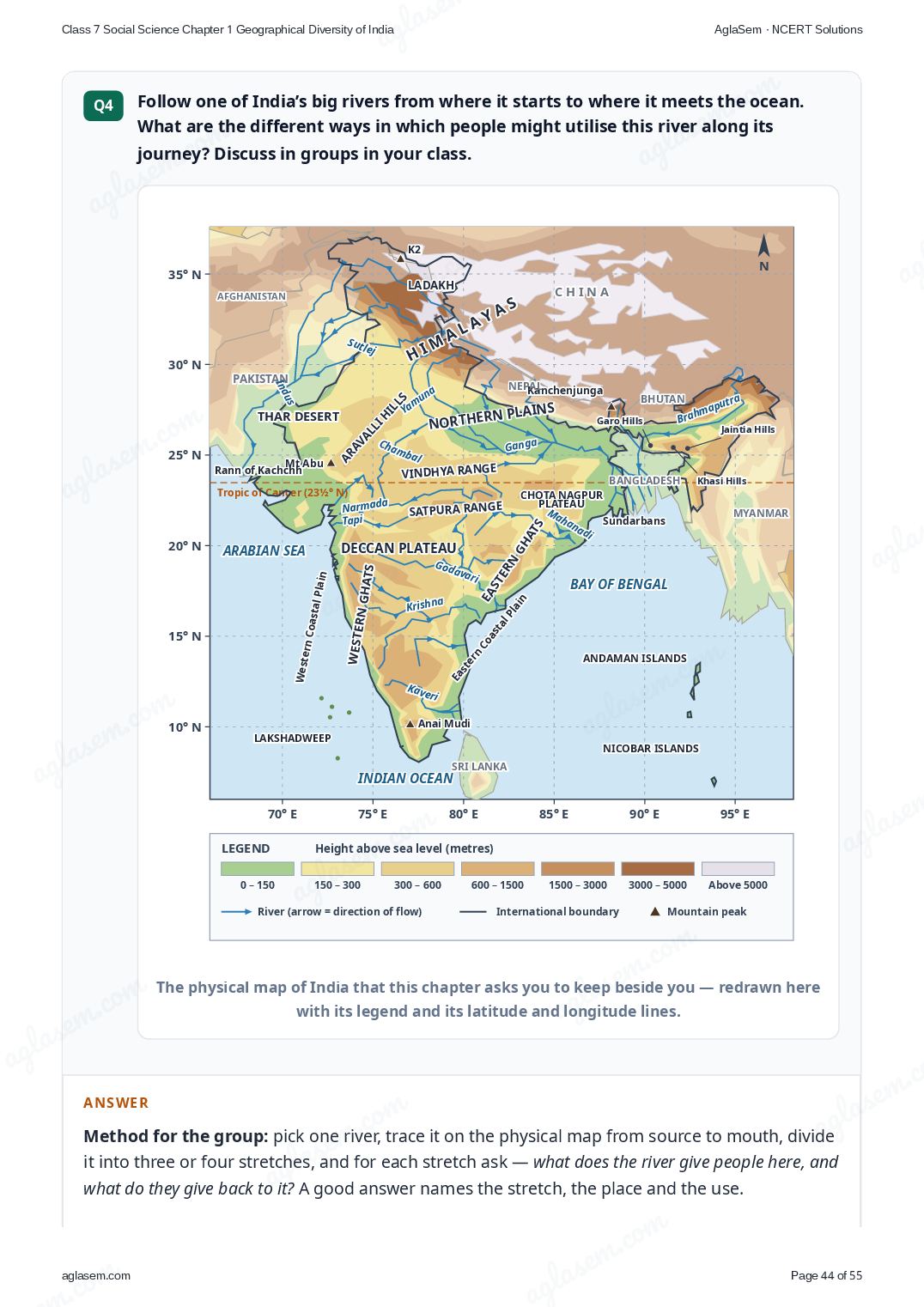
- Look at the physical map of India given at the end of the book. Notice the direction of the flow of the rivers.
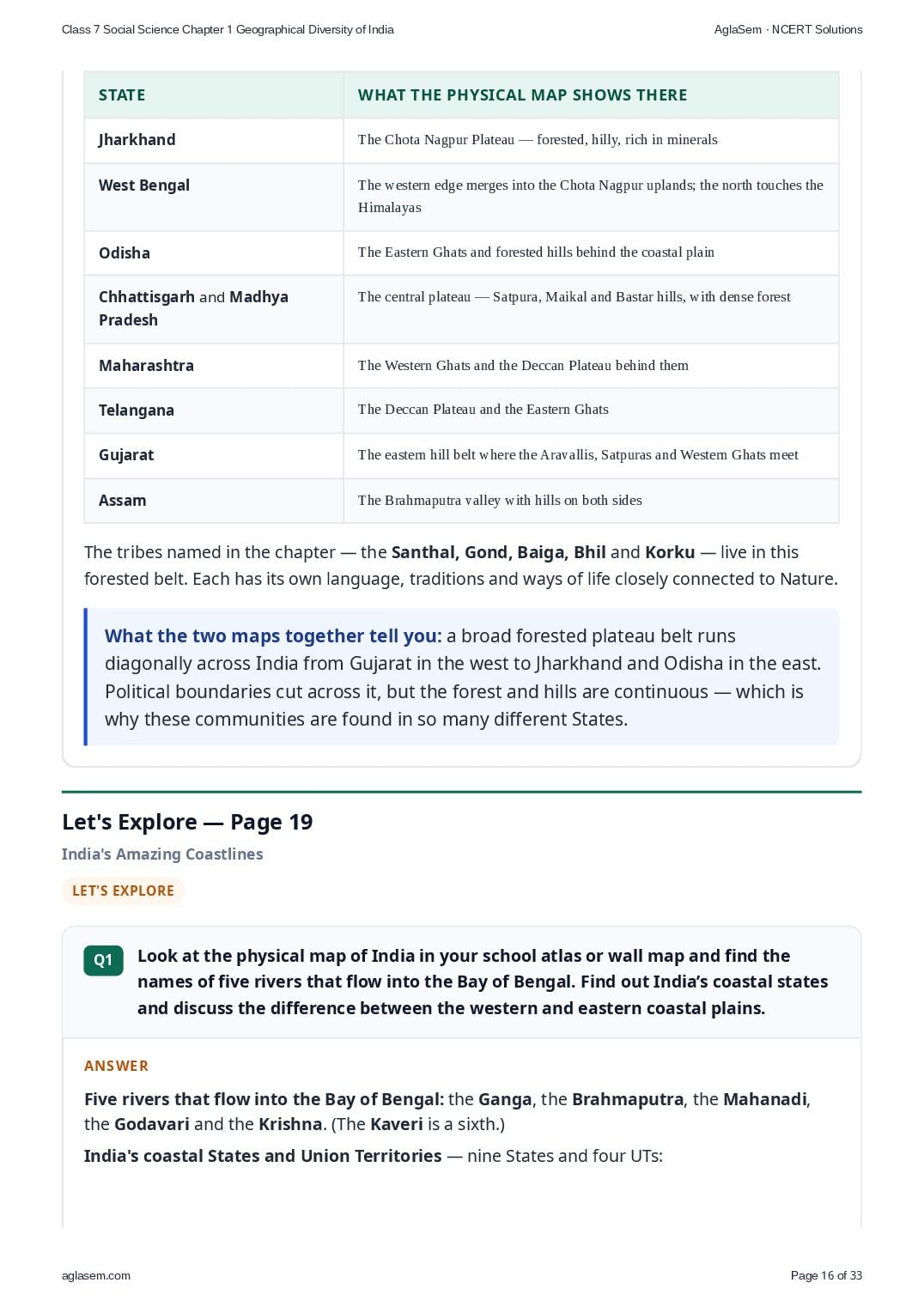
- Tribal communities are largely spread over the states of Jharkhand, West Bengal, Odisha, Assam, Madhya Pradesh, Chhattisgarh, Maharashtra, Telangana, and Gujarat. Examine the physical and political maps at the end of this book to locate the states and connect them to their location on the physical map.
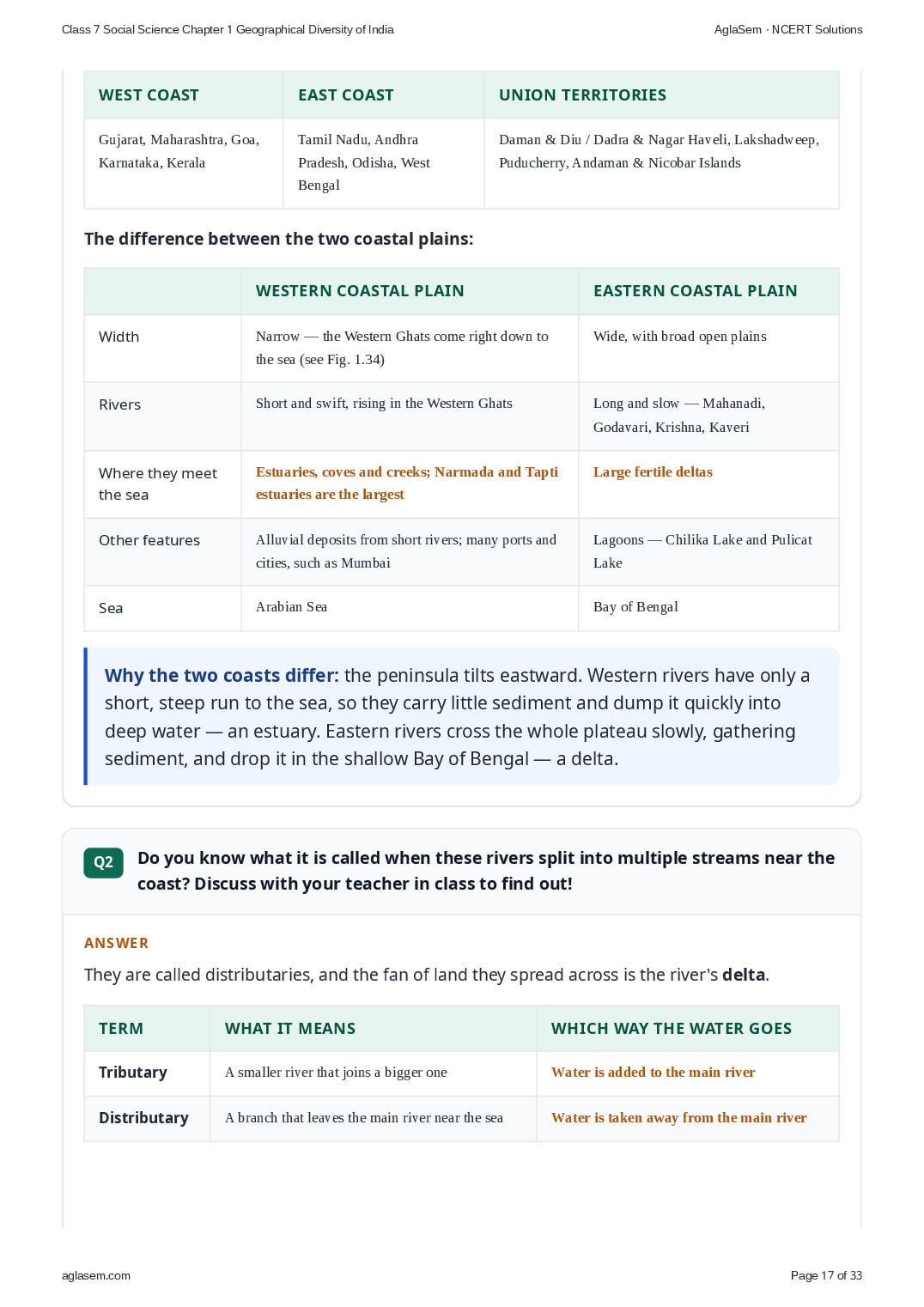
- Look at the physical map of India in your school atlas or wall map and find the names of five rivers that flow into the Bay of Bengal. Find out India’s coastal states and discuss the difference between the western and eastern coastal plains.
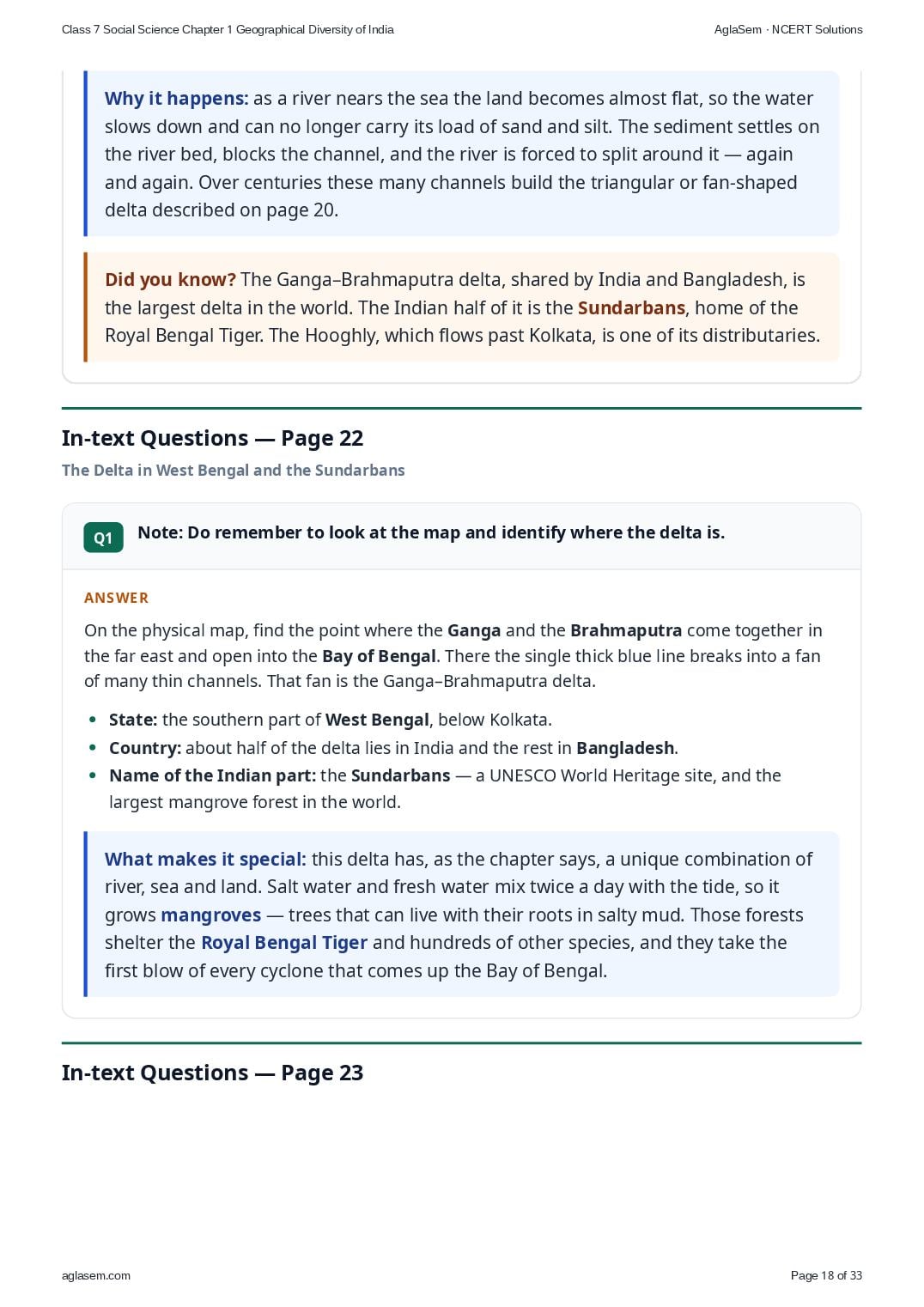
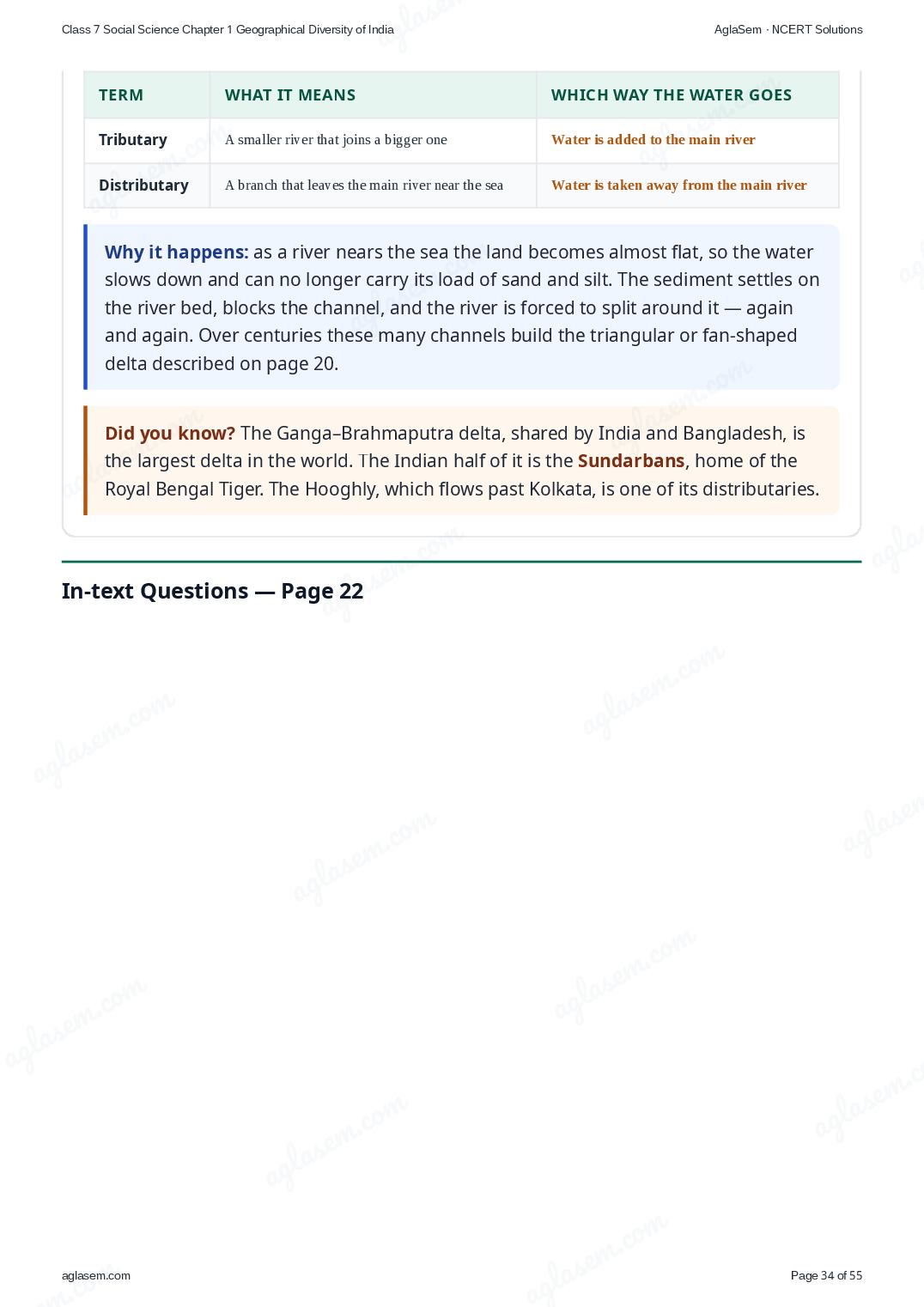
- Do you know what it is called when these rivers split into multiple streams near the coast? Discuss with your teacher in class to find out!
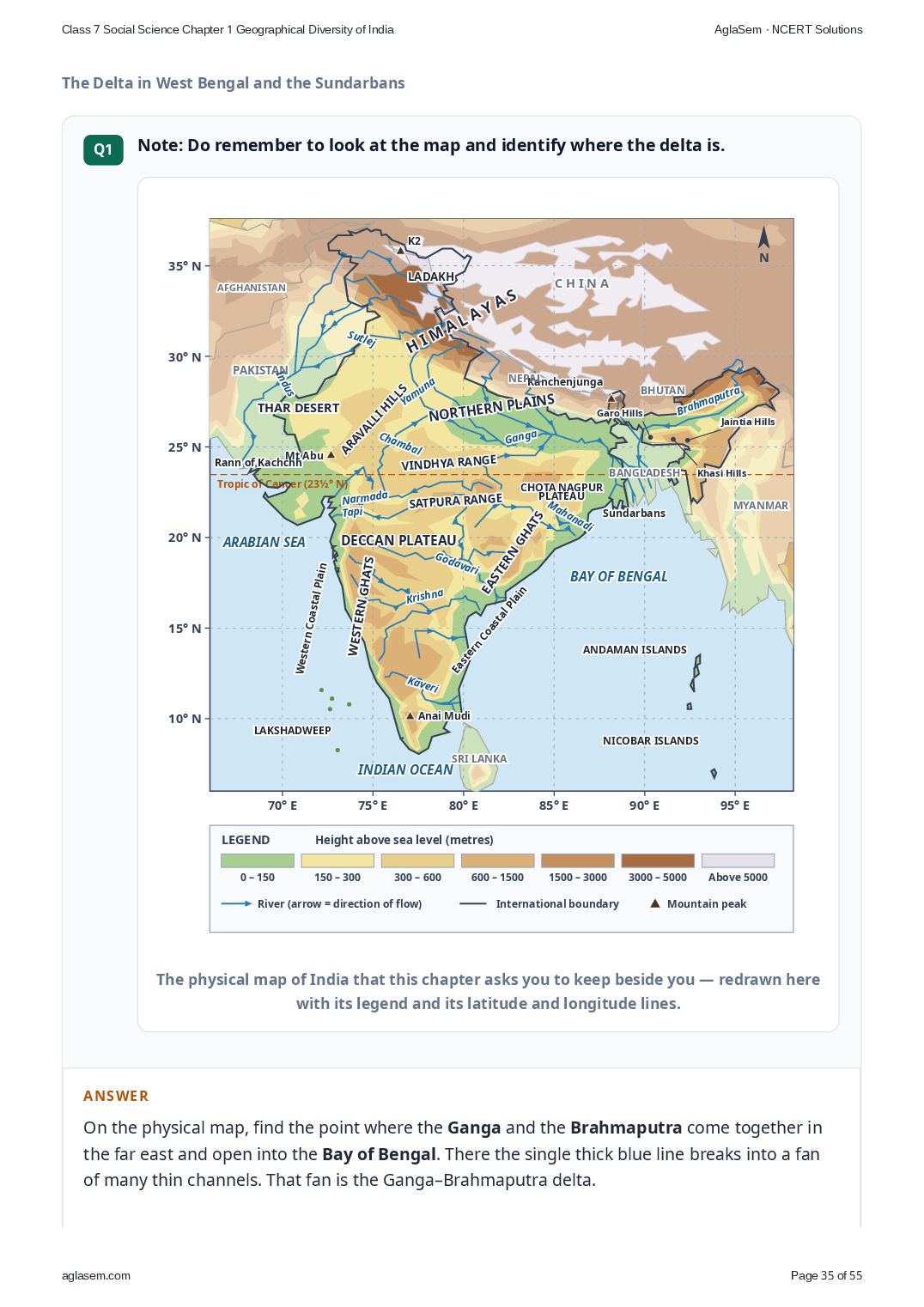
- Note: Do remember to look at the map and identify where the delta is.
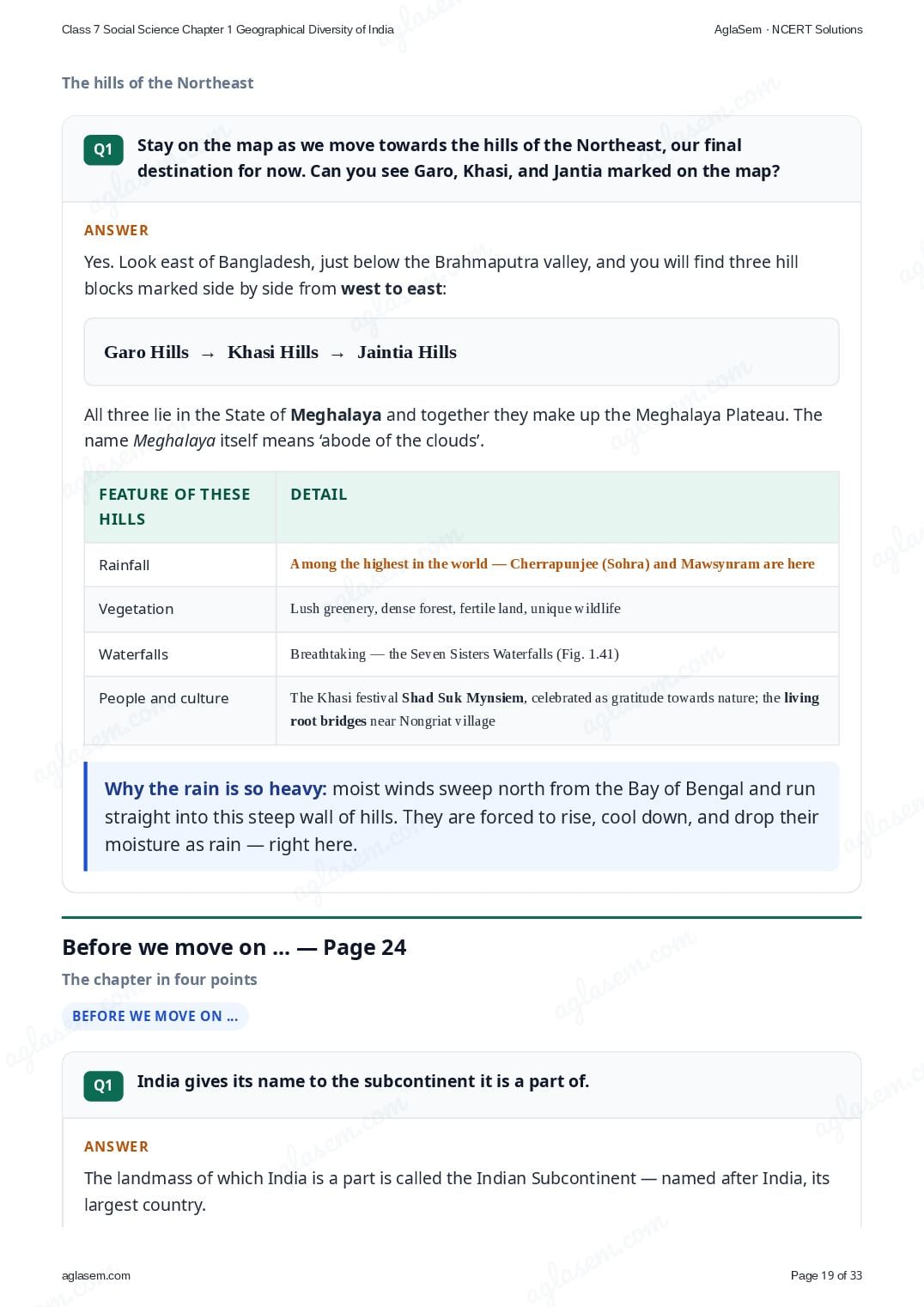
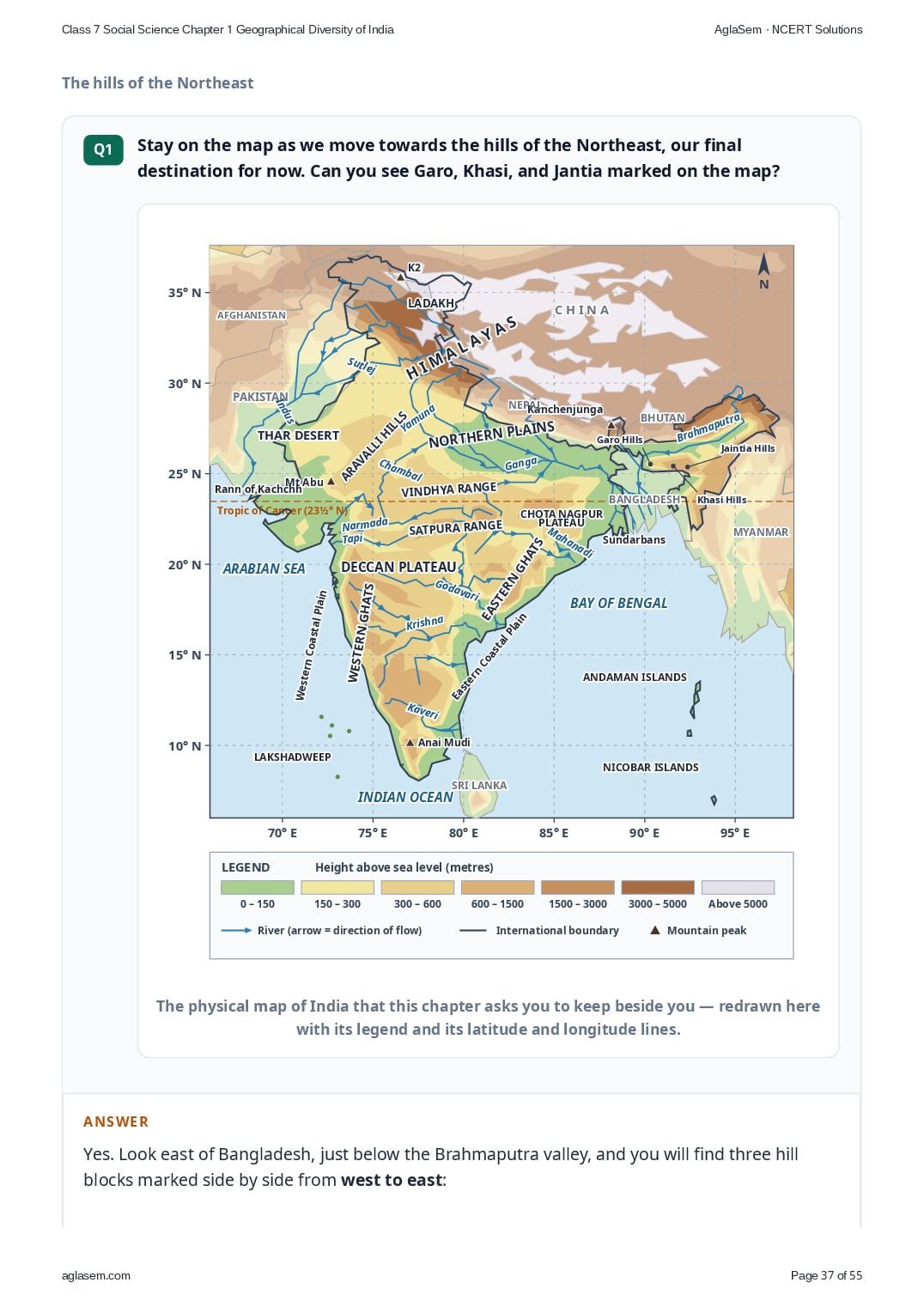
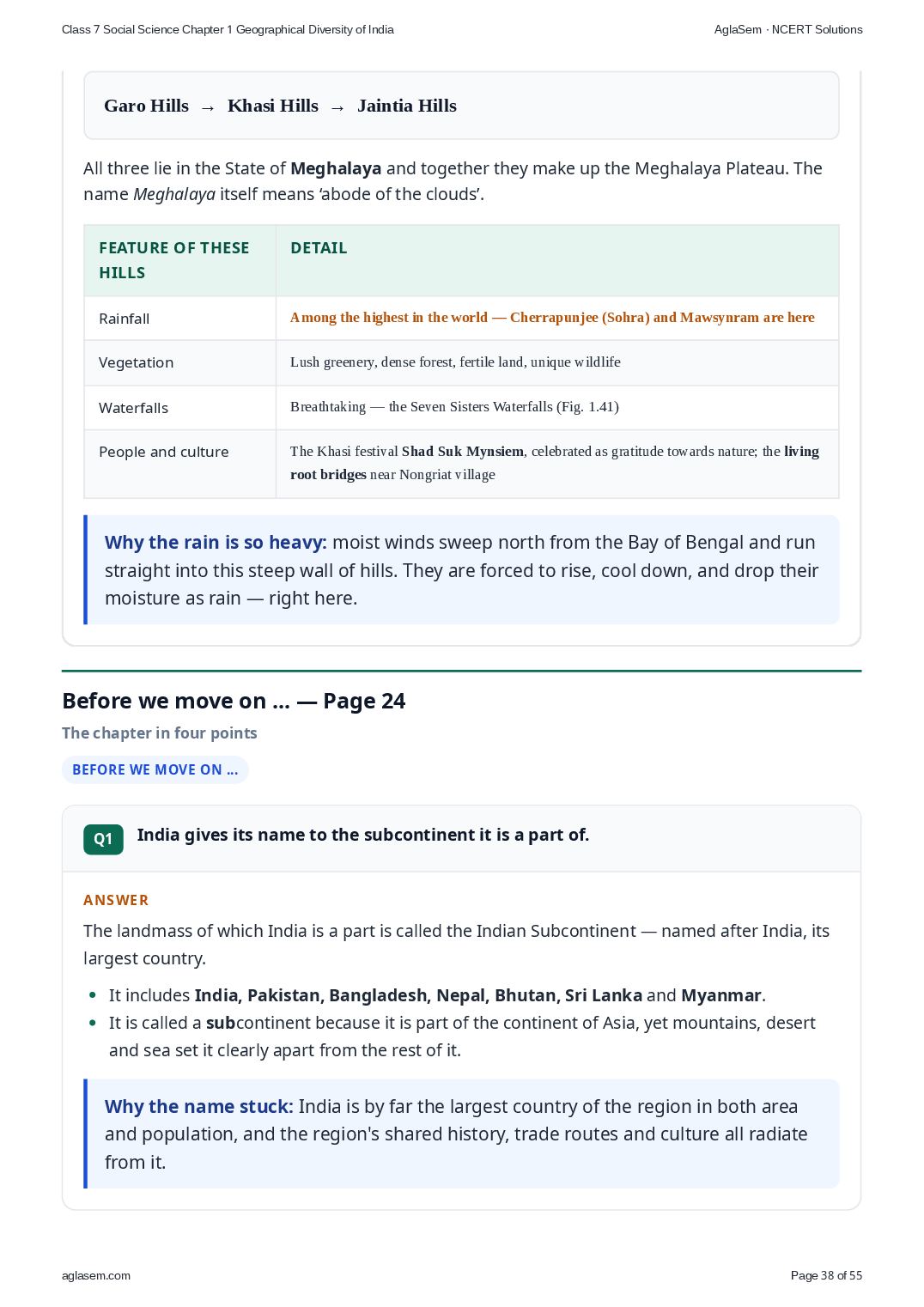
- Stay on the map as we move towards the hills of the Northeast, our final destination for now. Can you see Garo, Khasi, and Jantia marked on the map?
- India gives its name to the subcontinent it is a part of.
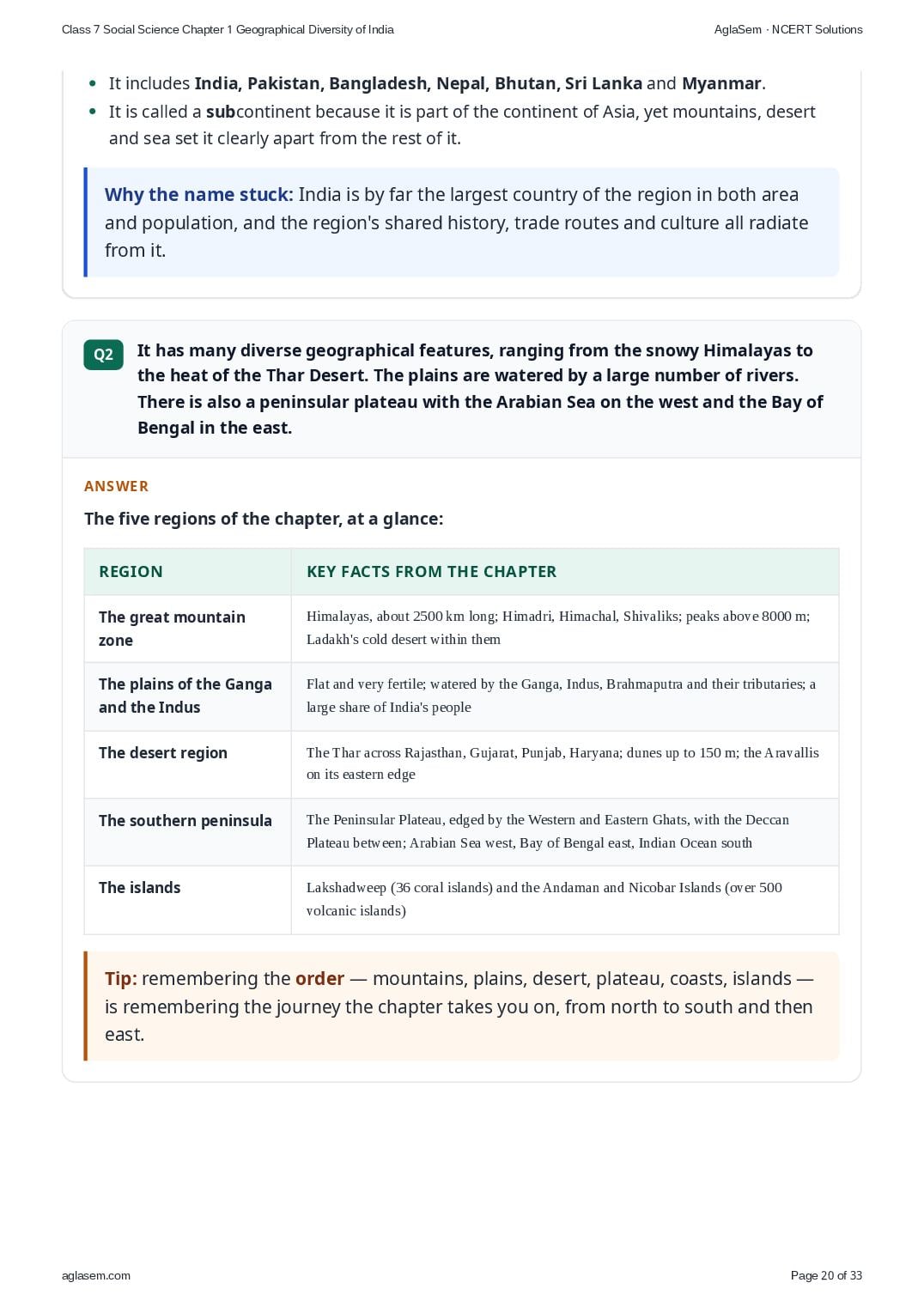
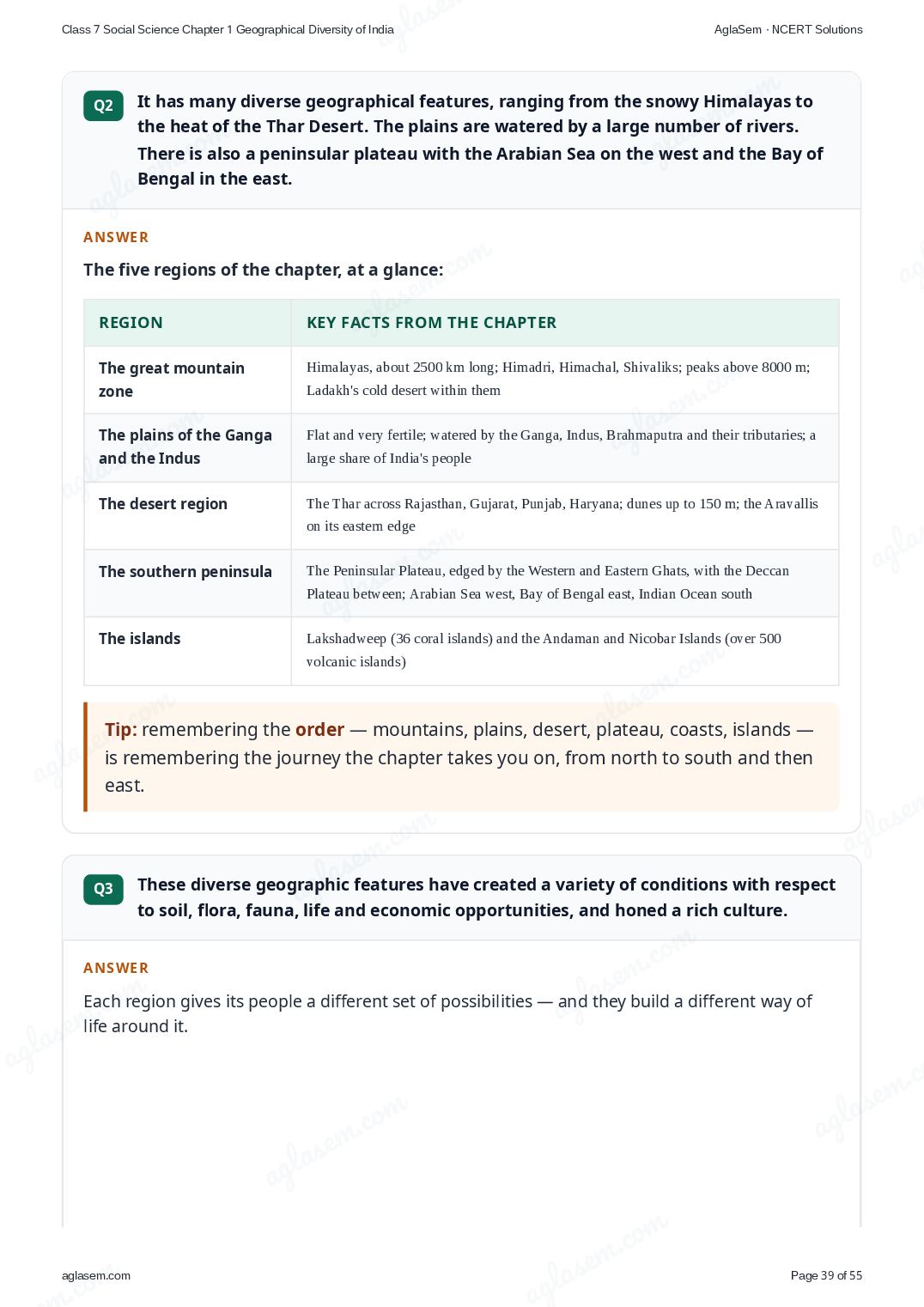
- It has many diverse geographical features, ranging from the snowy Himalayas to the heat of the Thar Desert. The plains are watered by a large number of rivers. There is also a peninsular plateau with the Arabian Sea on the west and the Bay of Bengal in the east.
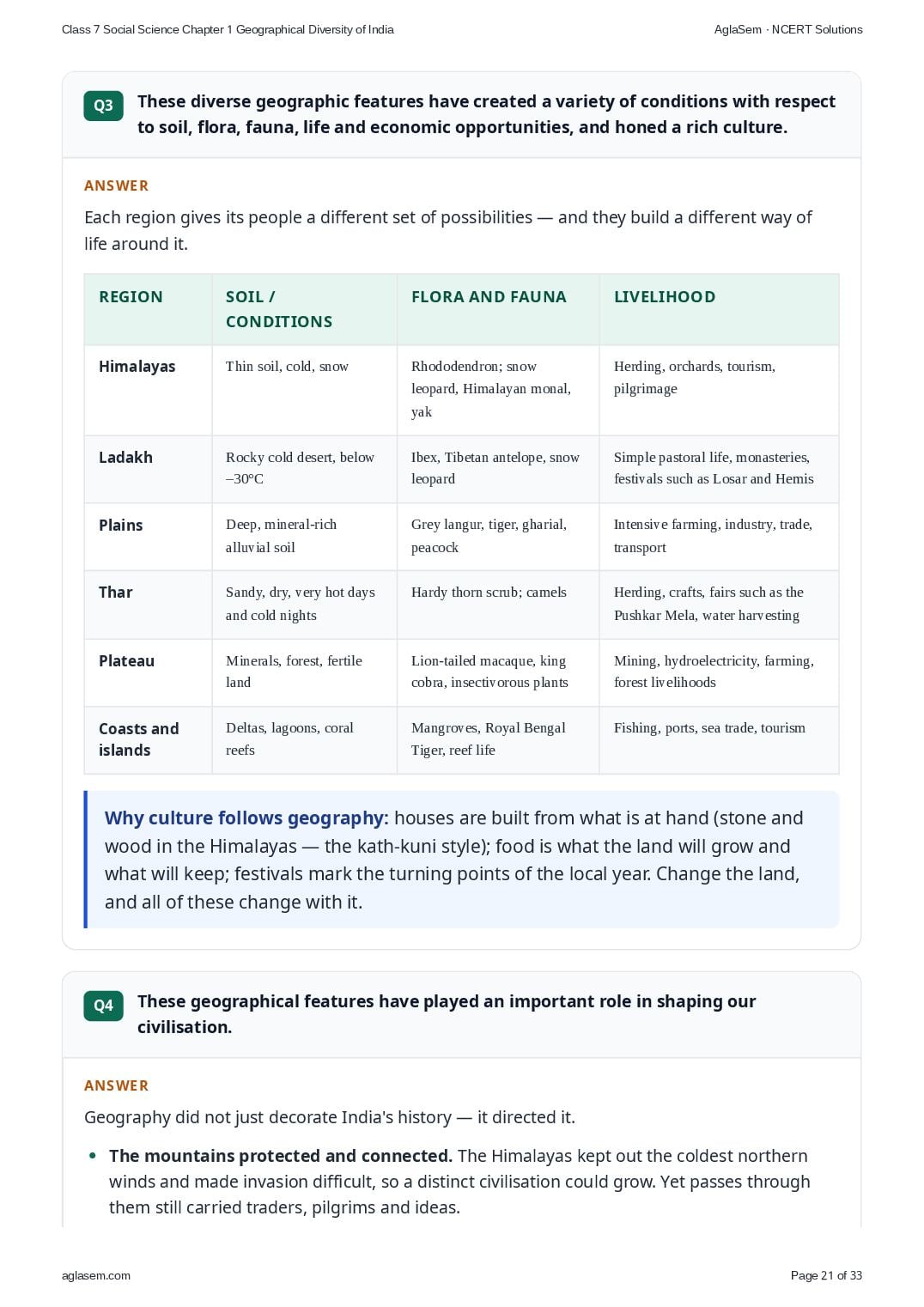
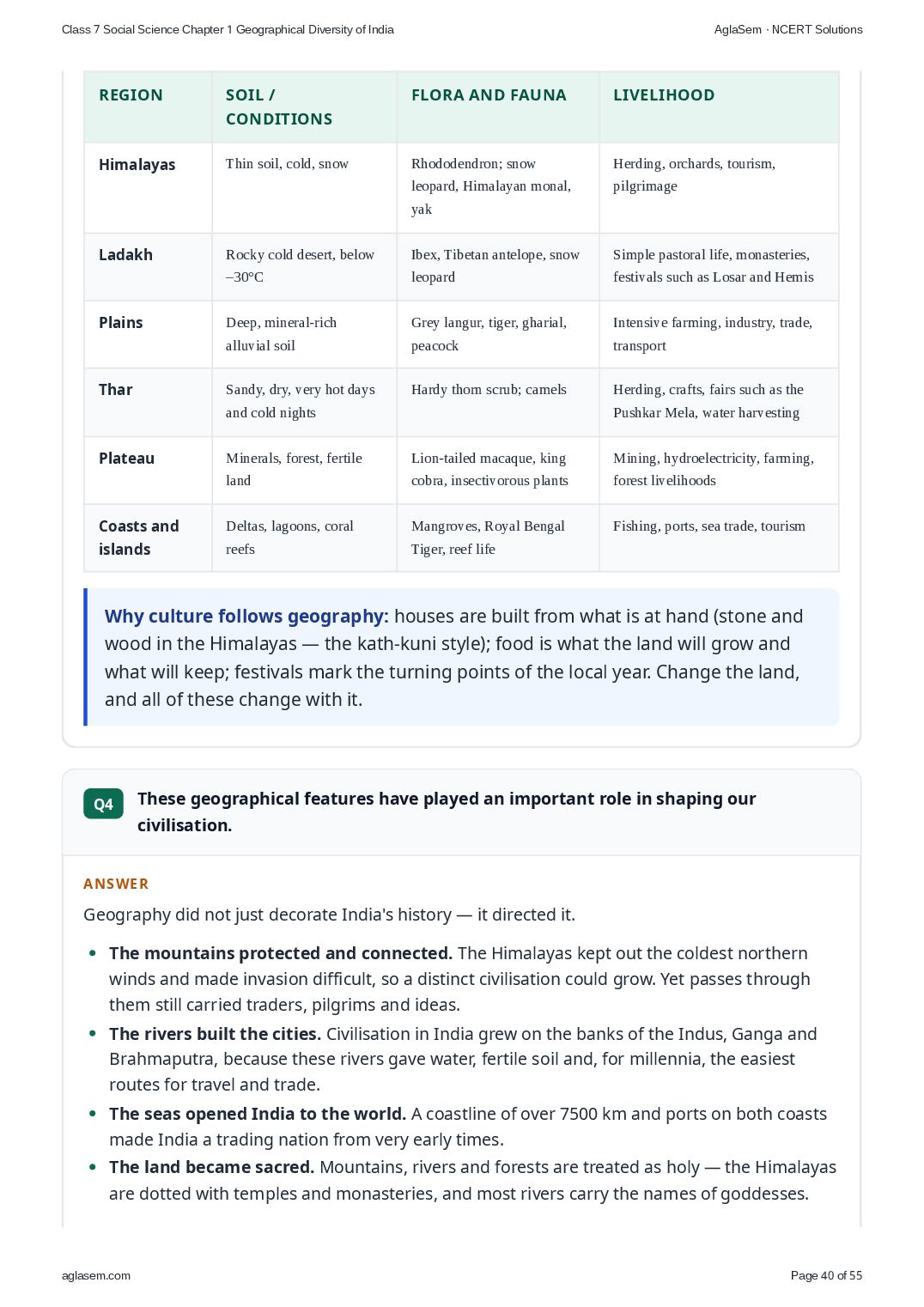
- These diverse geographic features have created a variety of conditions with respect to soil, flora, fauna, life and economic opportunities, and honed a rich culture.
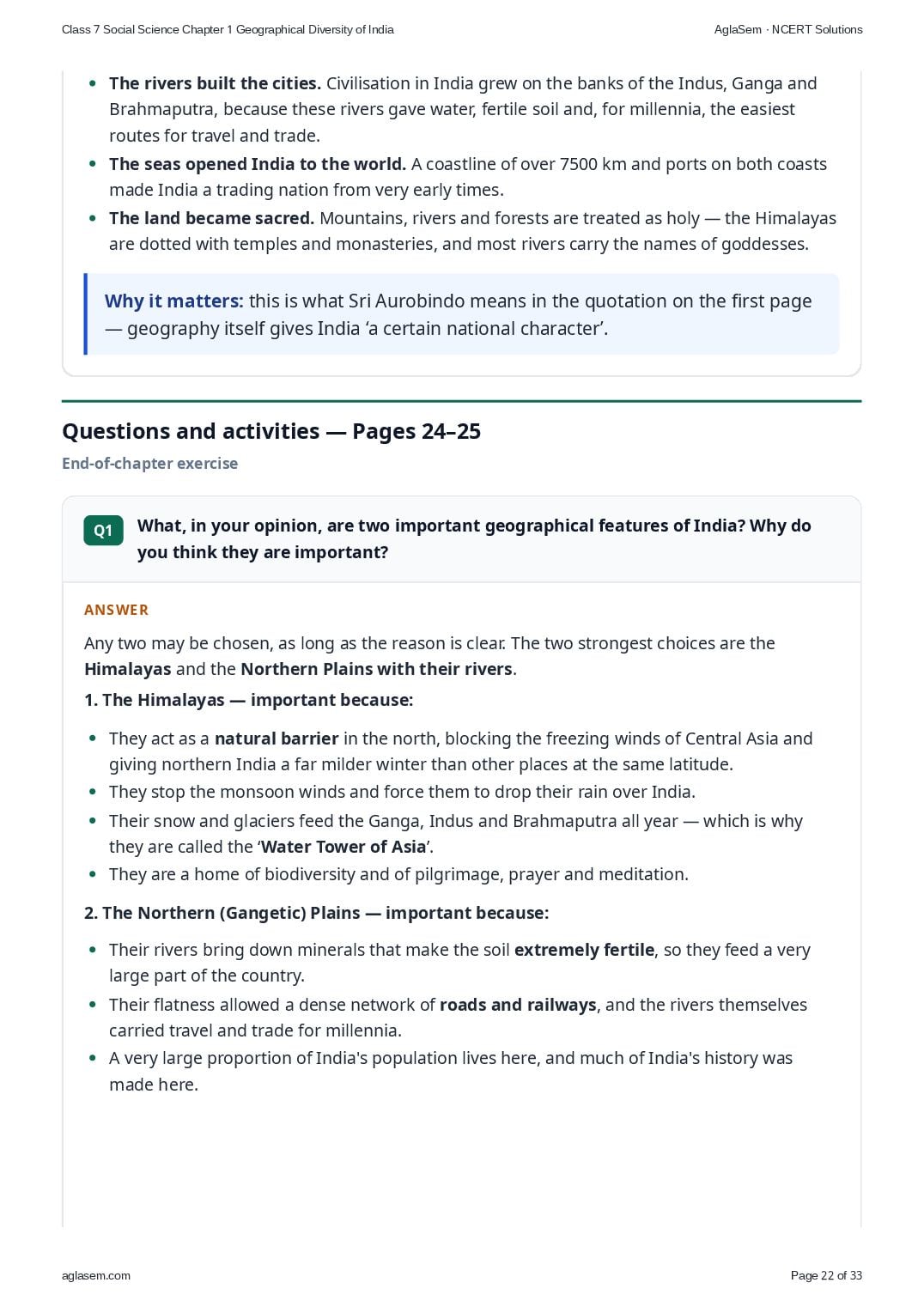
- These geographical features have played an important role in shaping our civilisation.
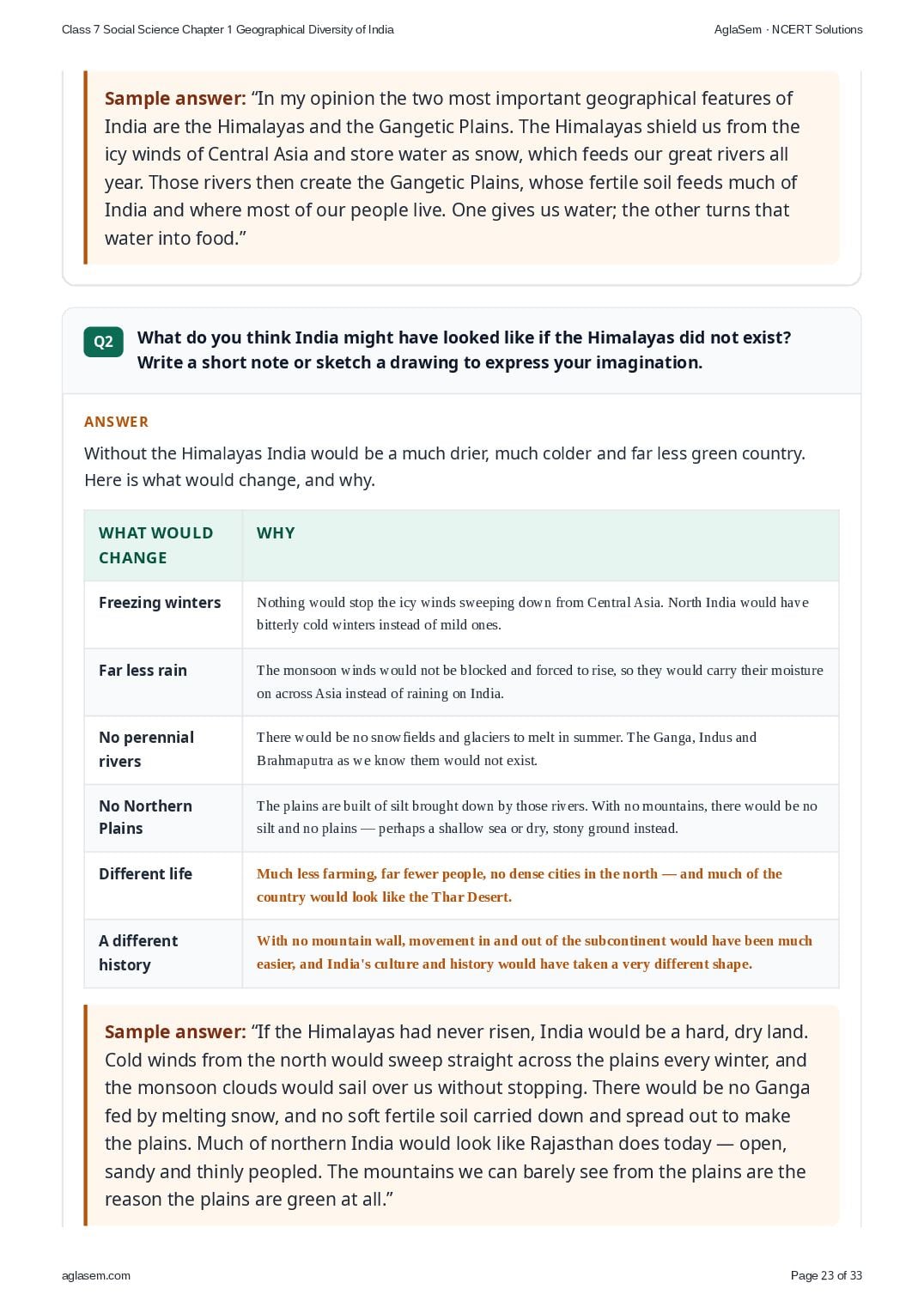
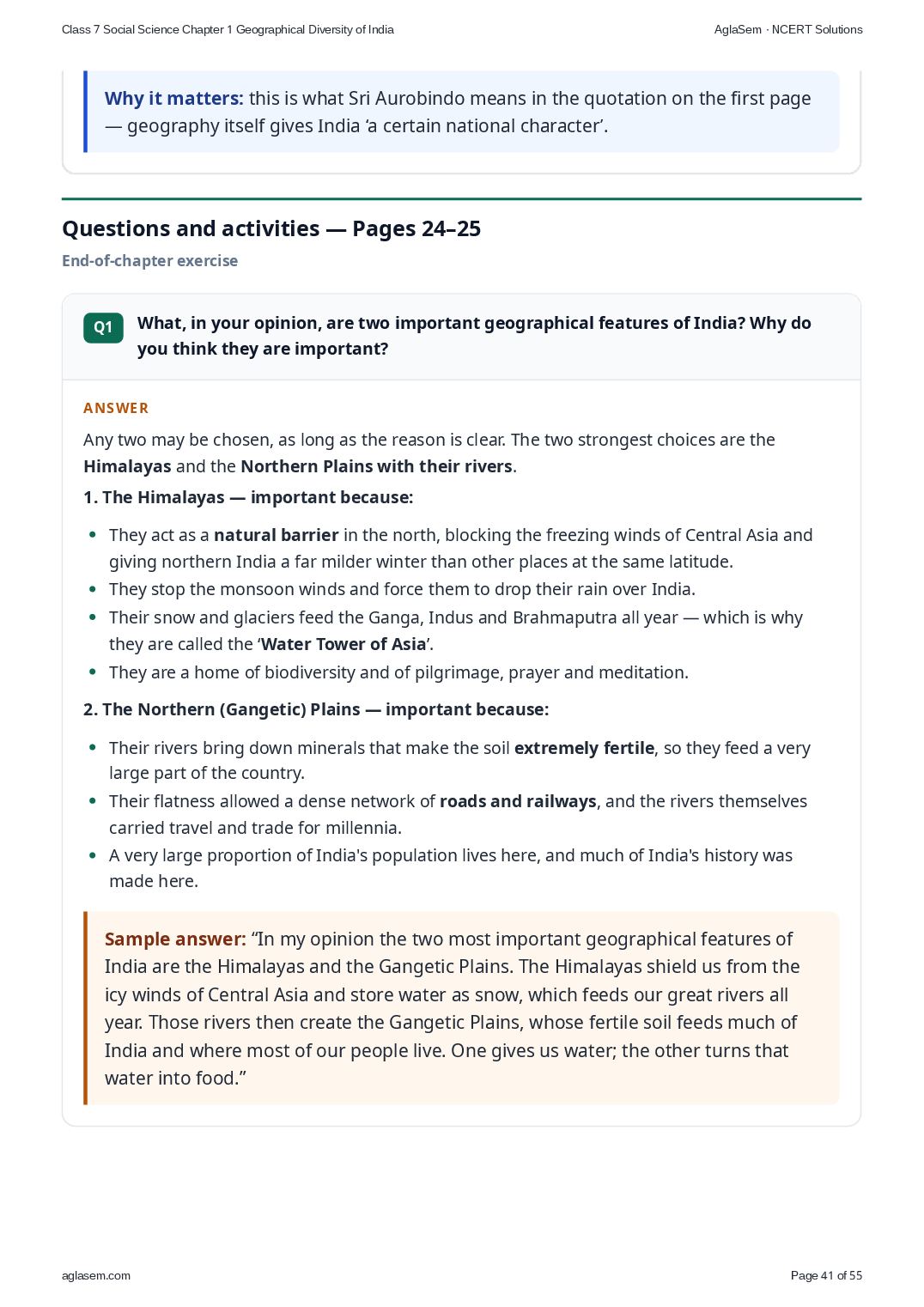
- What, in your opinion, are two important geographical features of India? Why do you think they are important?
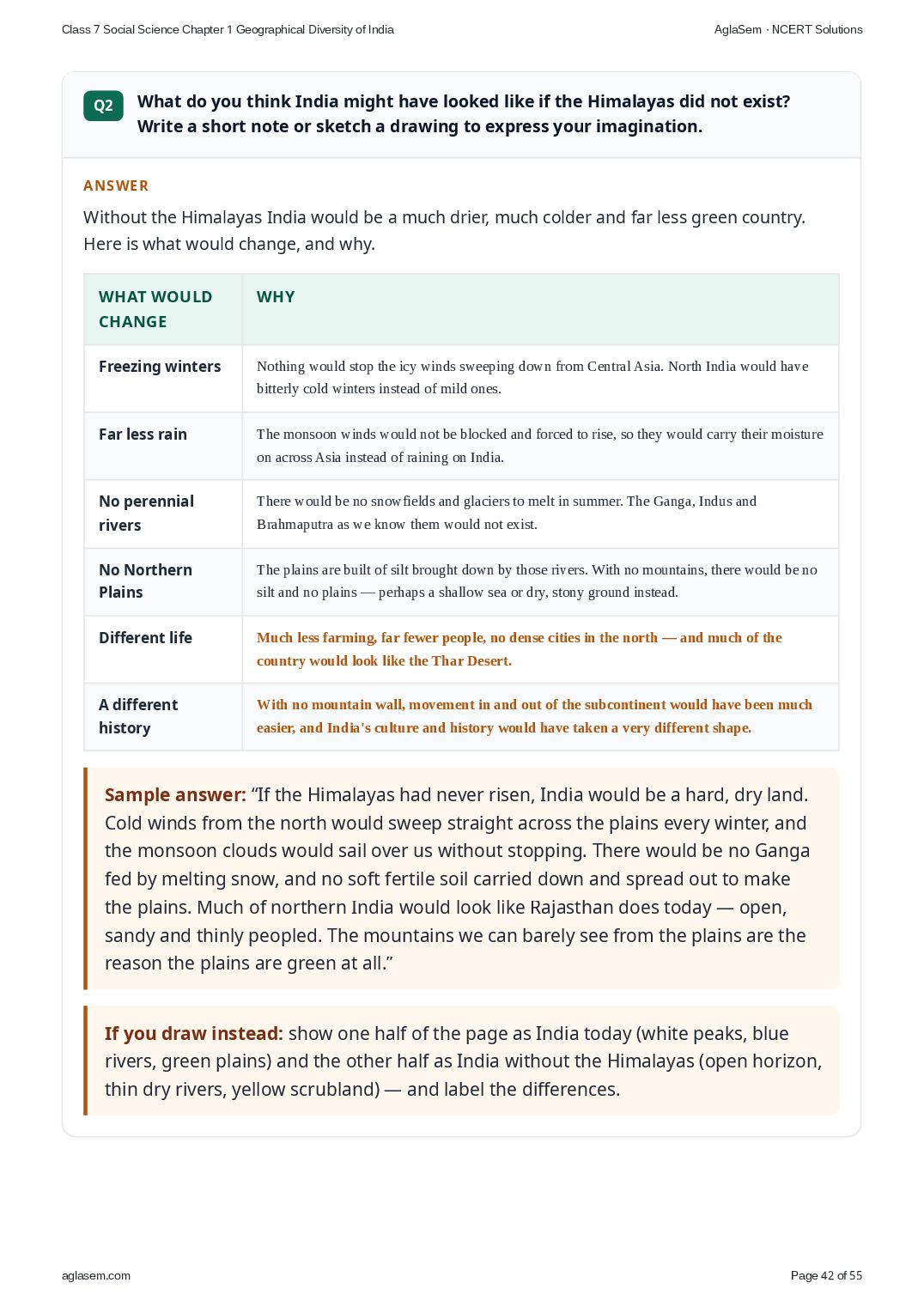
- What do you think India might have looked like if the Himalayas did not exist? Write a short note or sketch a drawing to express your imagination.
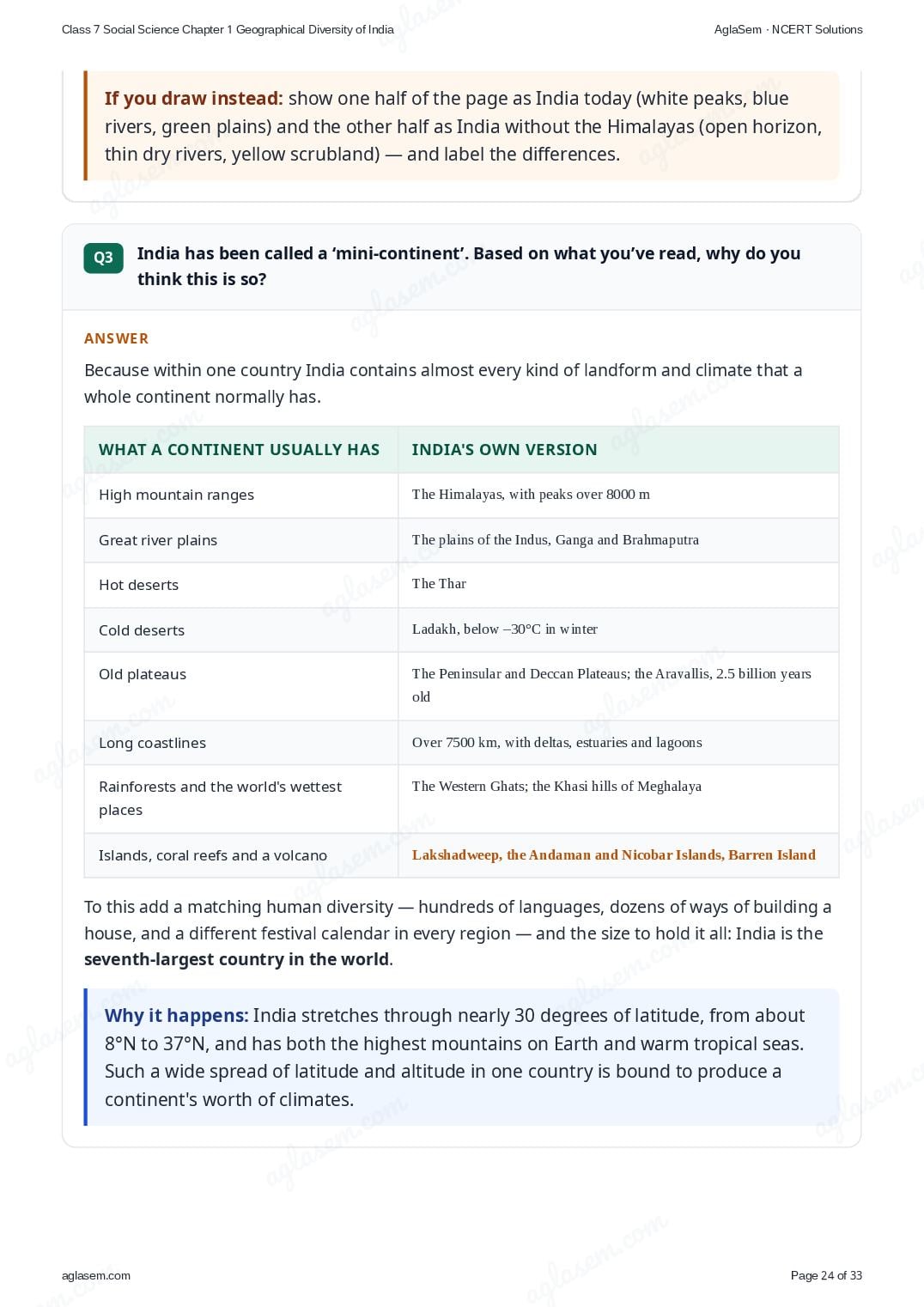
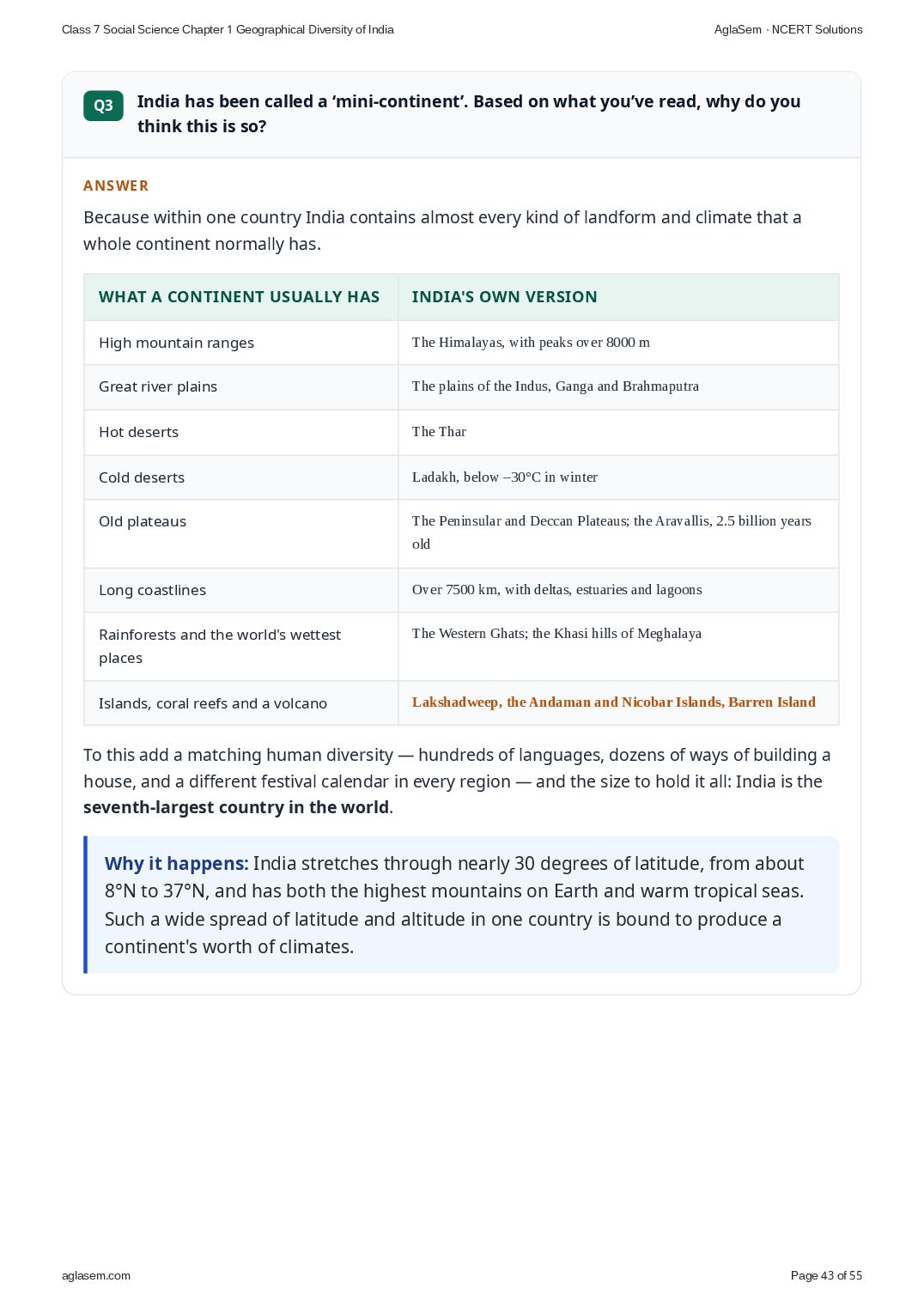
- India has been called a ‘mini-continent’. Based on what you’ve read, why do you think this is so?
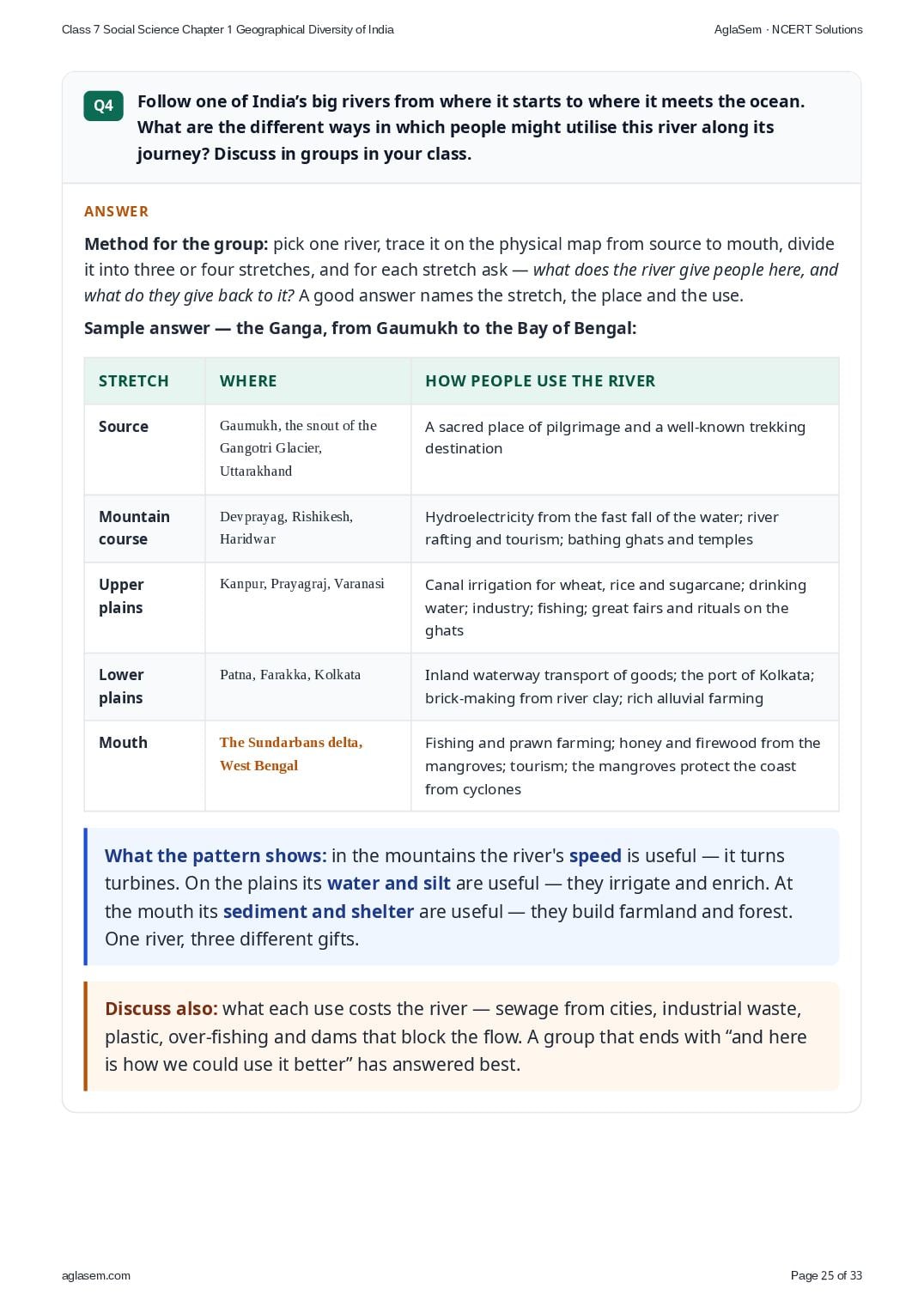
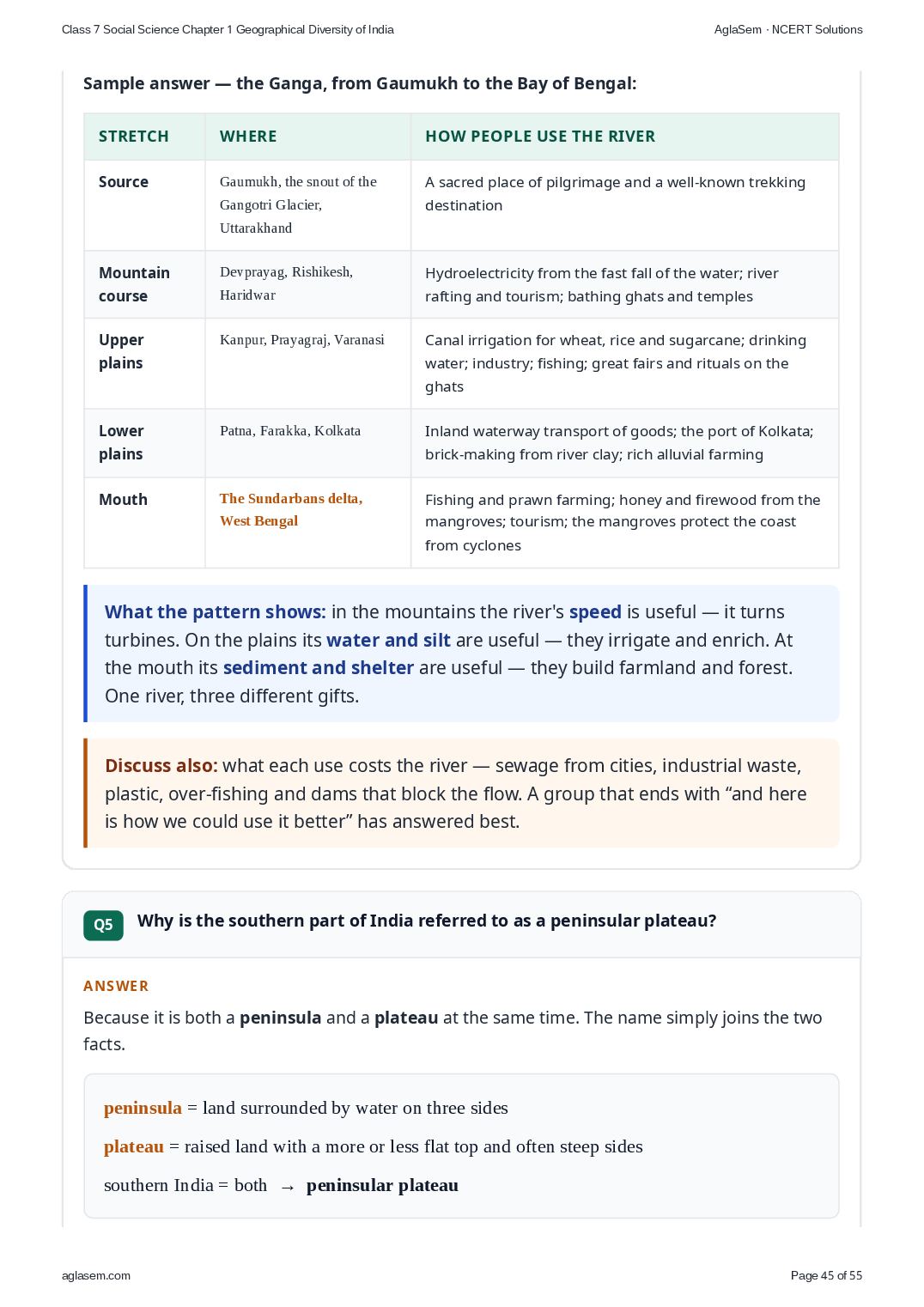
- Follow one of India’s big rivers from where it starts to where it meets the ocean. What are the different ways in which people might utilise this river along its journey? Discuss in groups in your class.
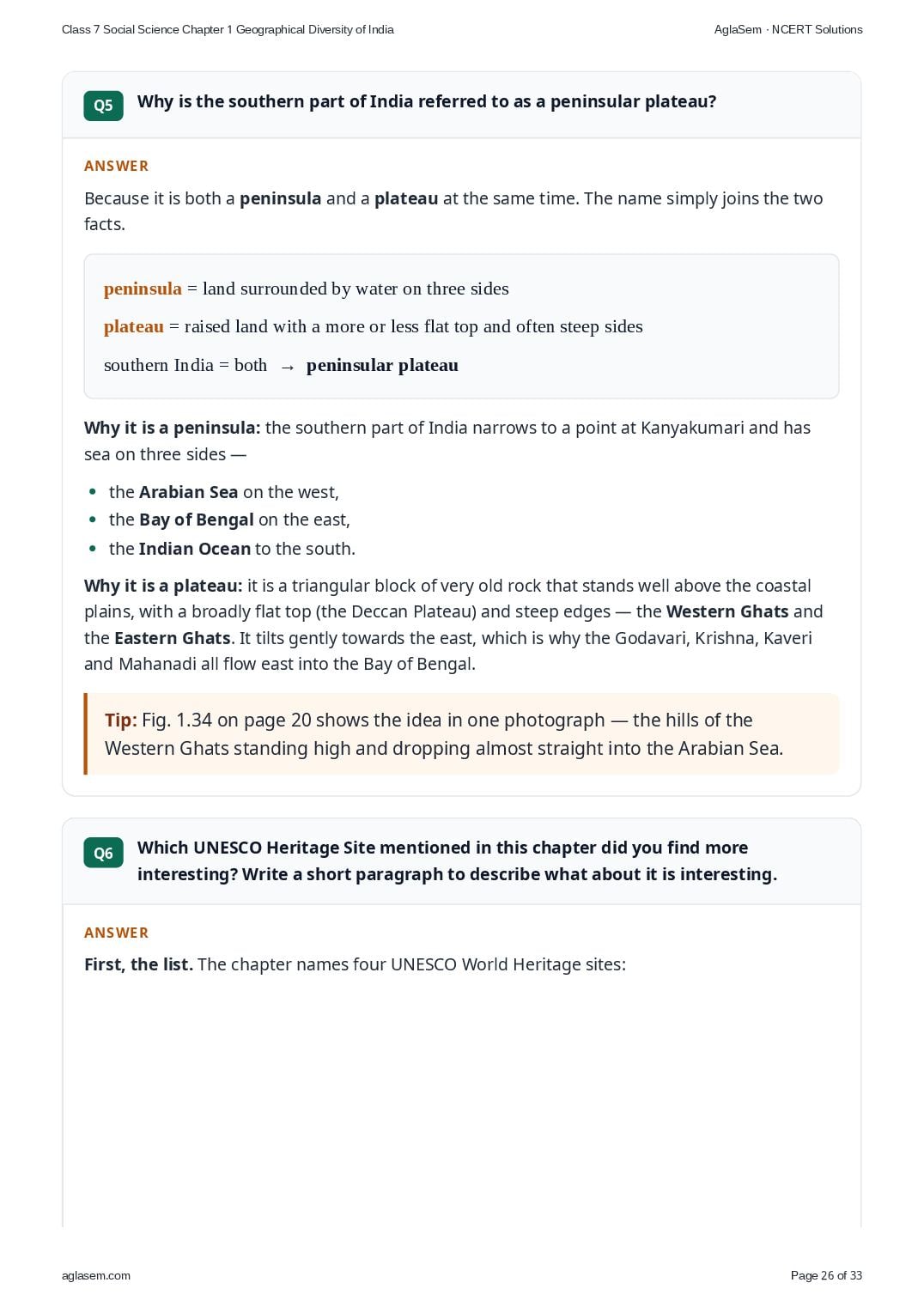
- Why is the southern part of India referred to as a peninsular plateau?
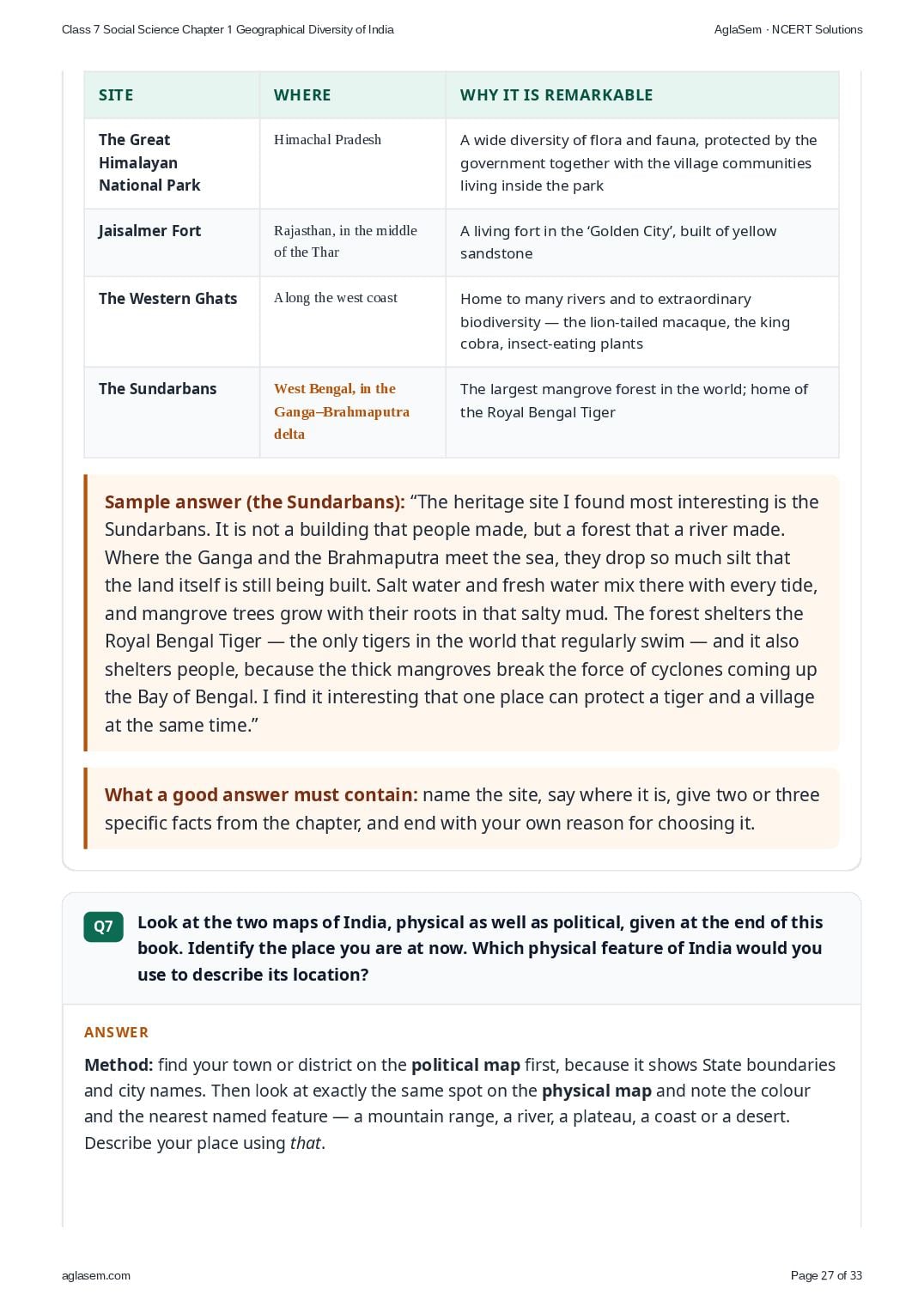
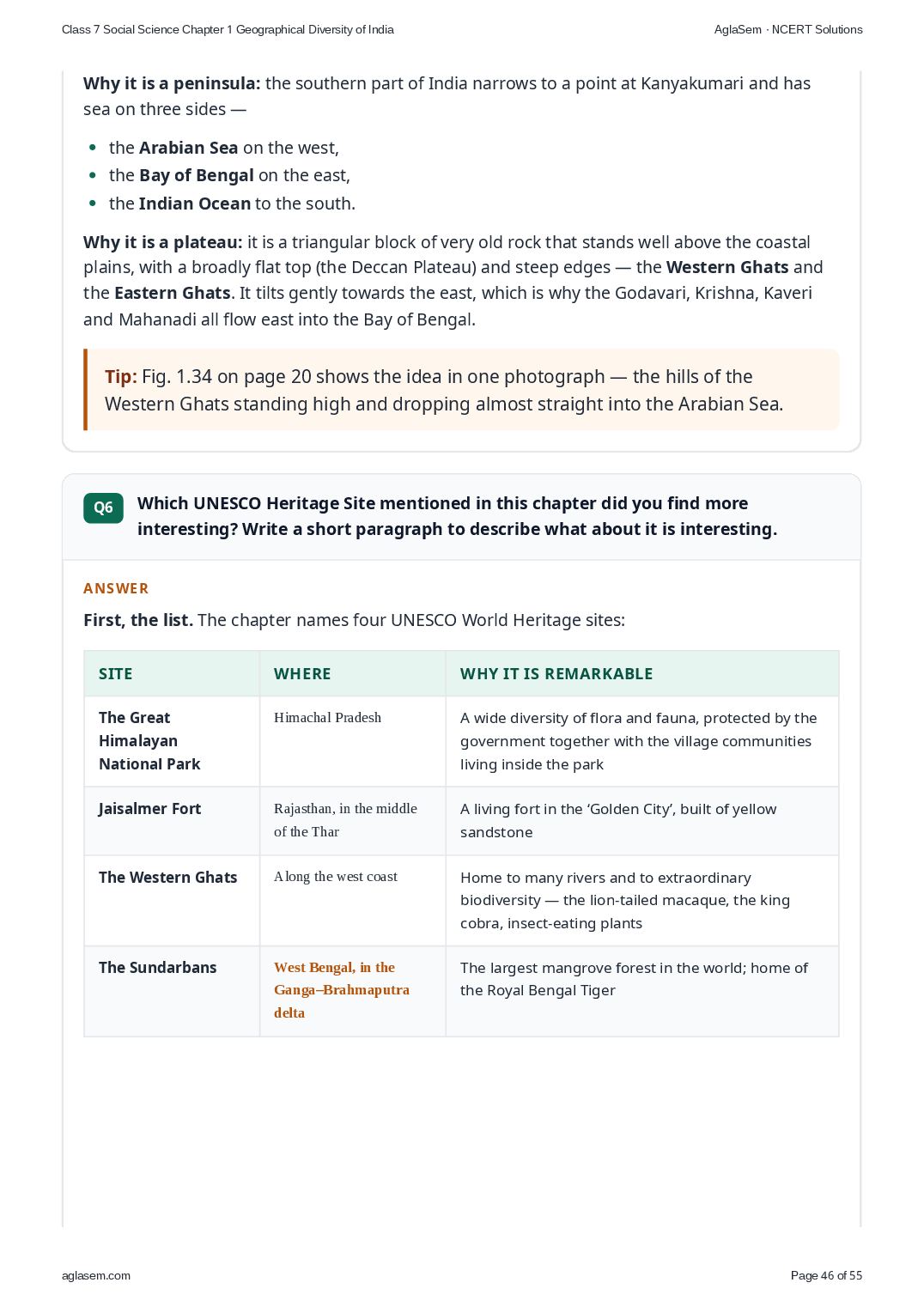
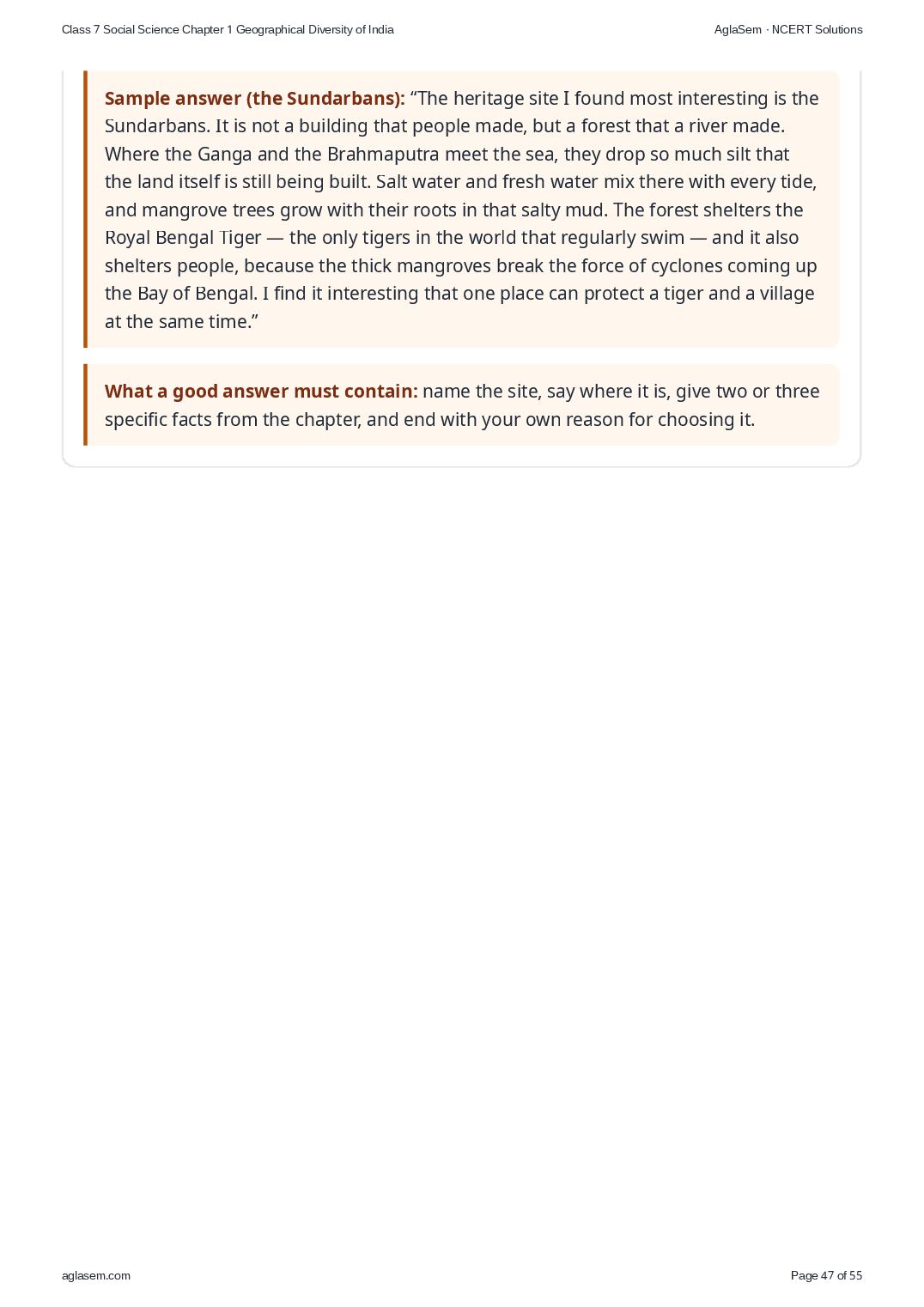
- Which UNESCO Heritage Site mentioned in this chapter did you find more interesting? Write a short paragraph to describe what about it is interesting.
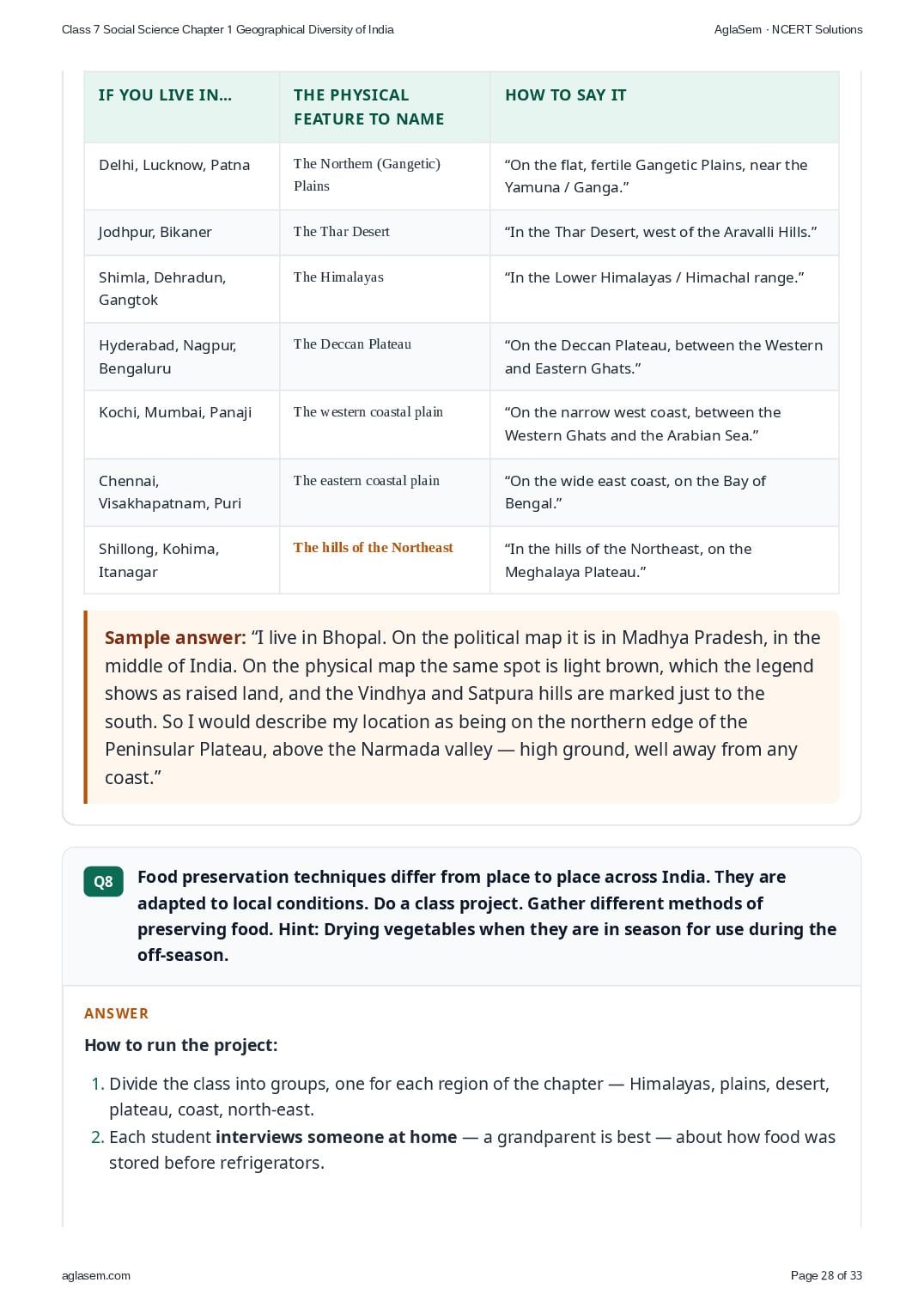
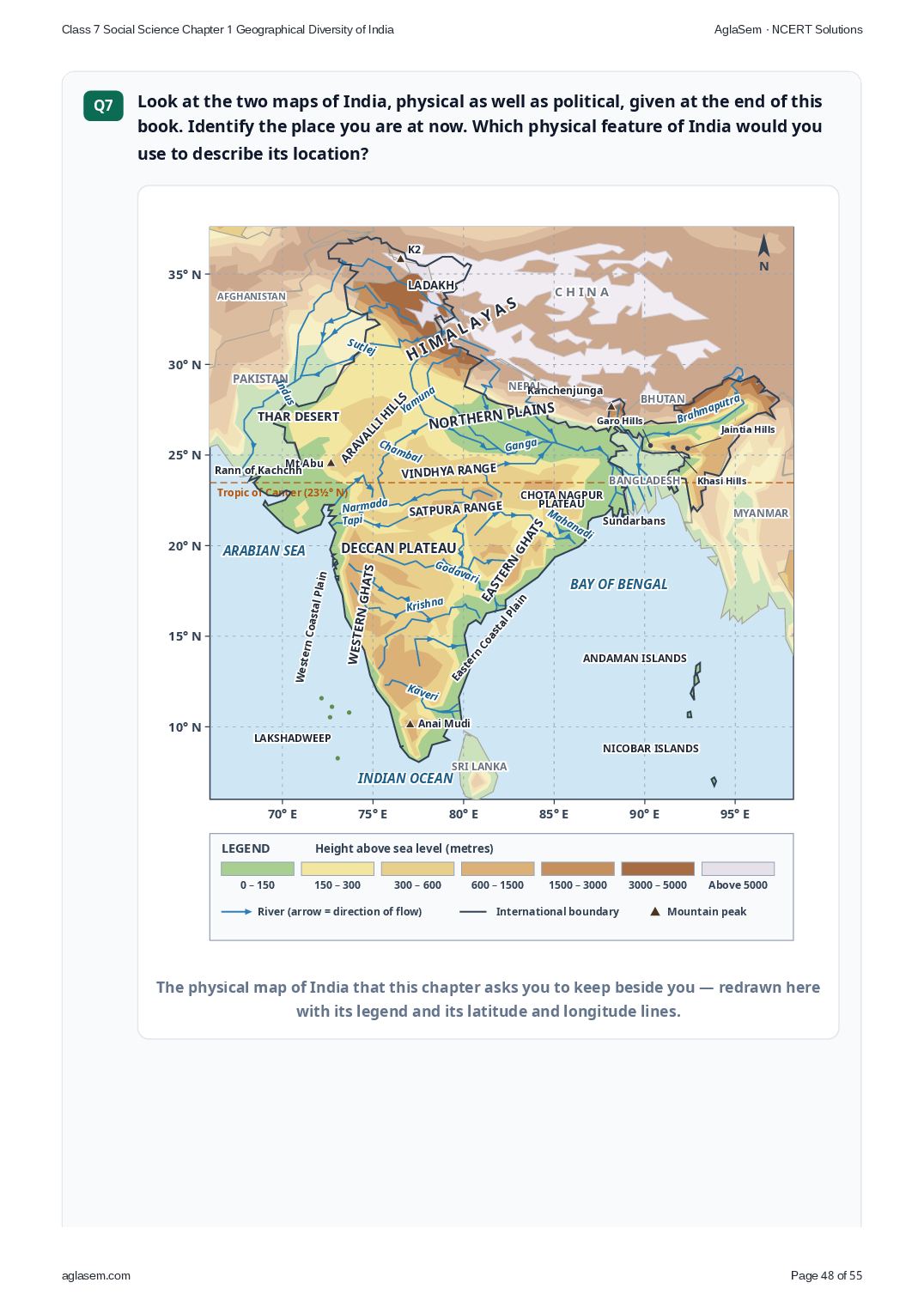
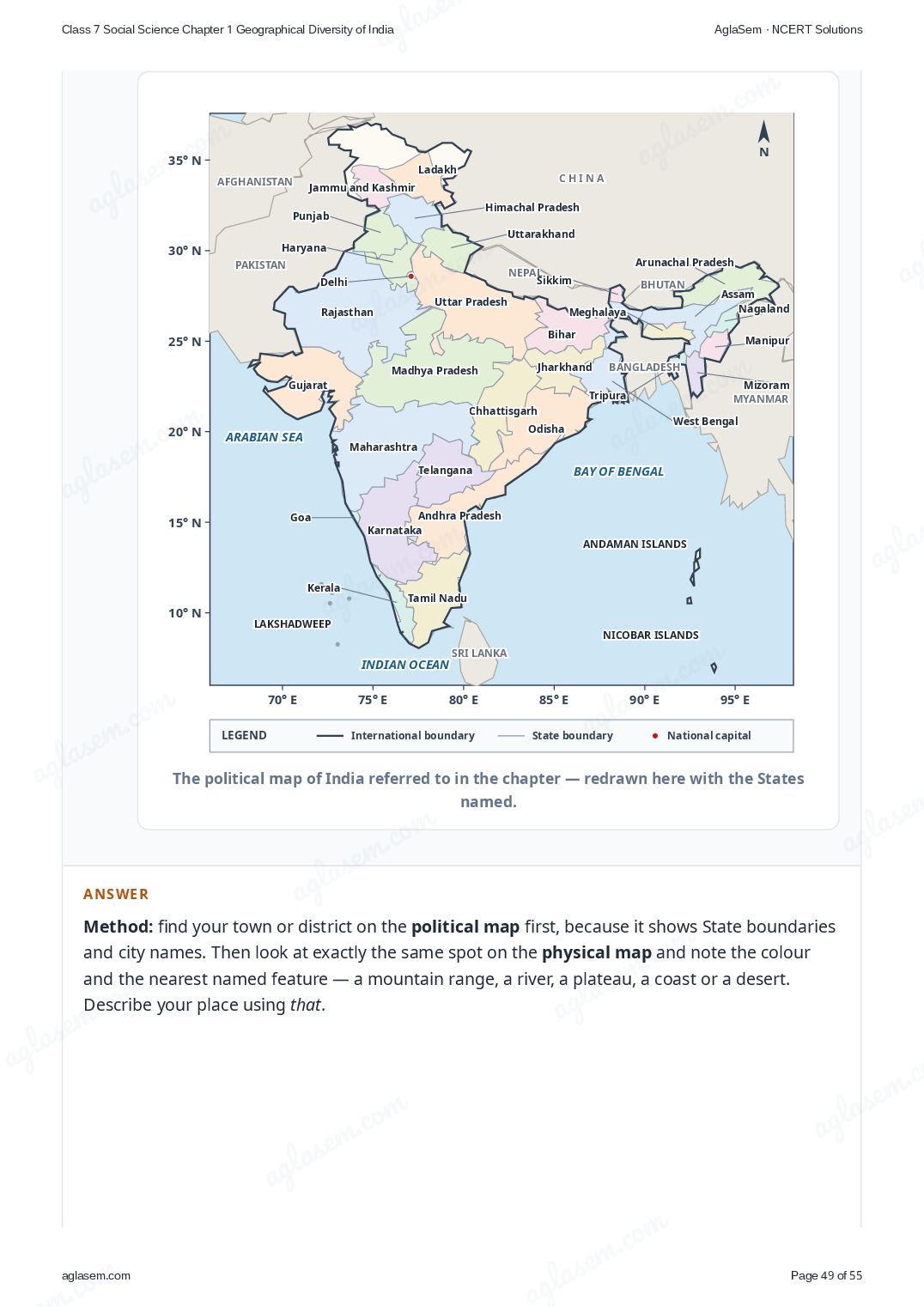
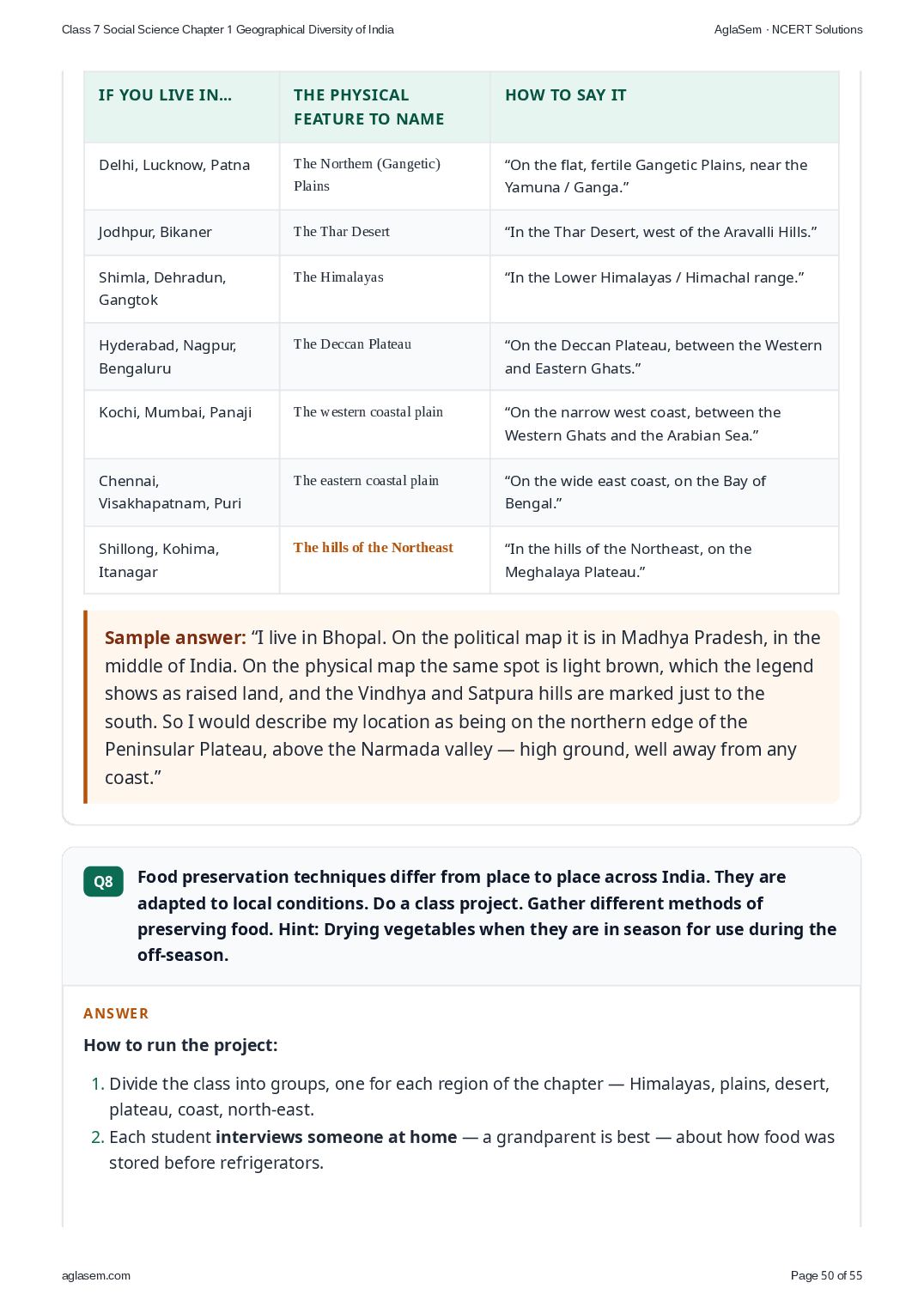
- Look at the two maps of India, physical as well as political, given at the end of this book. Identify the place you are at now. Which physical feature of India would you use to describe its location?
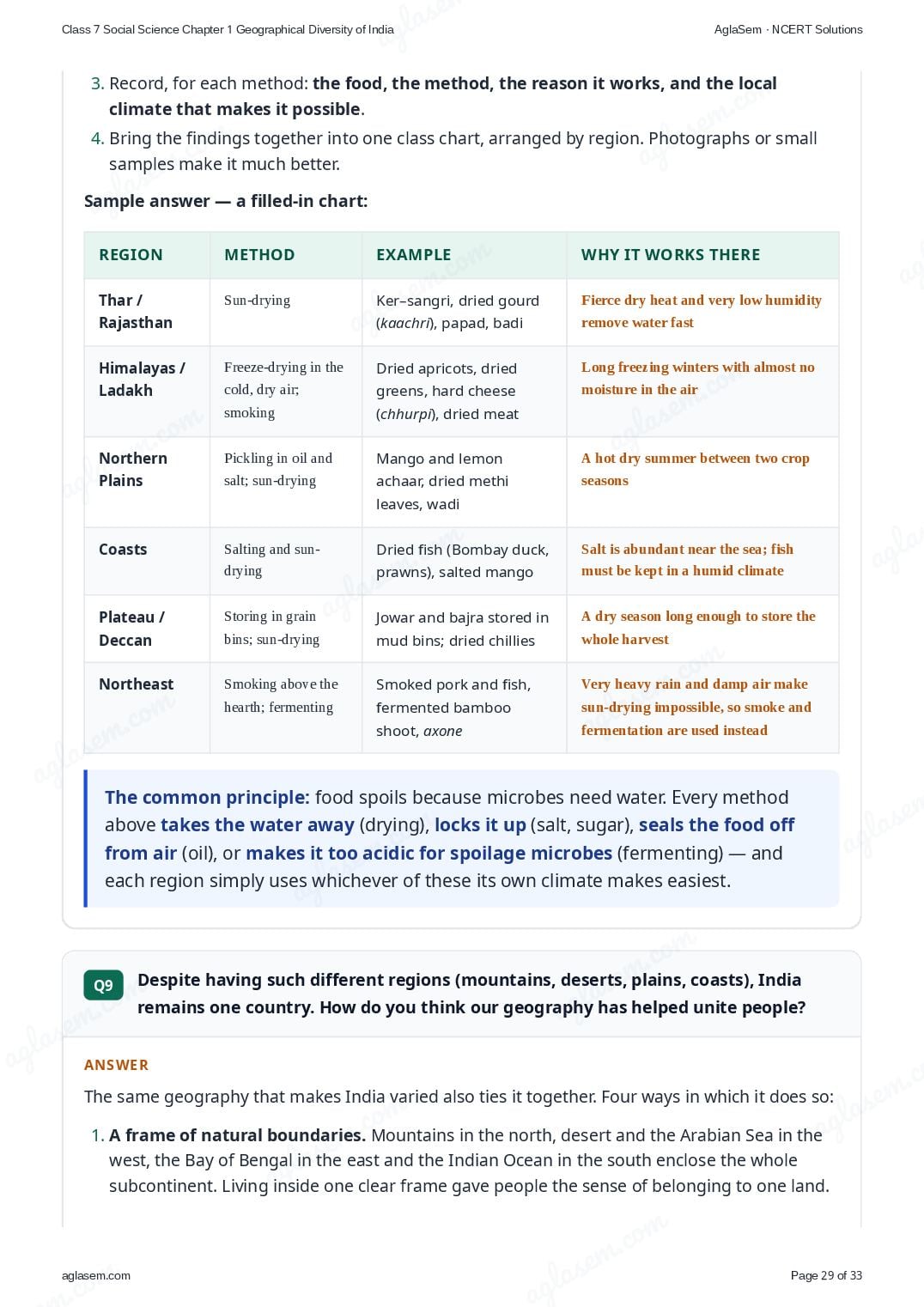
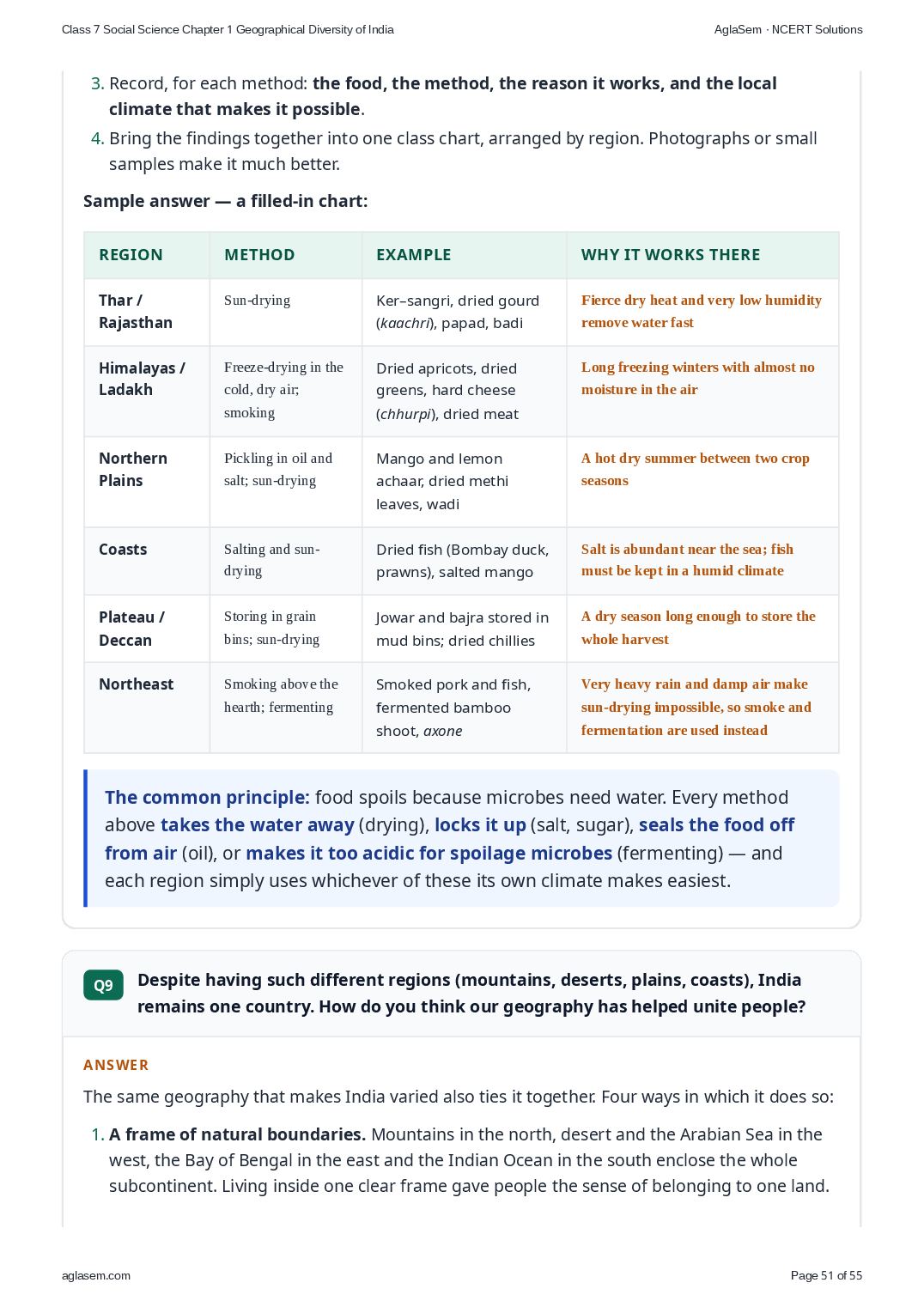
- Food preservation techniques differ from place to place across India. They are adapted to local conditions. Do a class project. Gather different methods of preserving food. Hint: Drying vegetables when they are in season for use during the off-season.
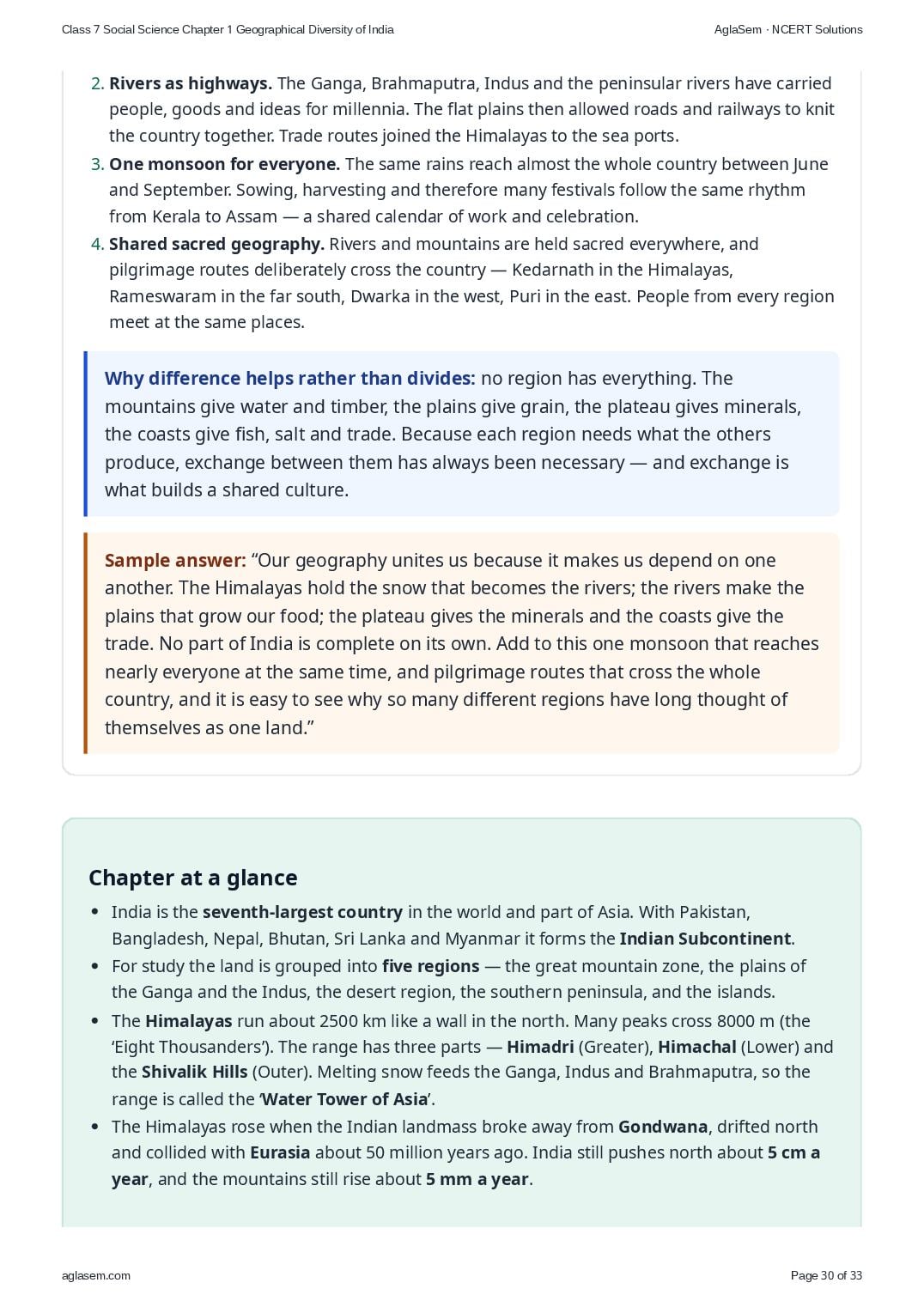
- Despite having such different regions (mountains, deserts, plains, coasts), India remains one country. How do you think our geography has helped unite people?
Chapter at a Glance
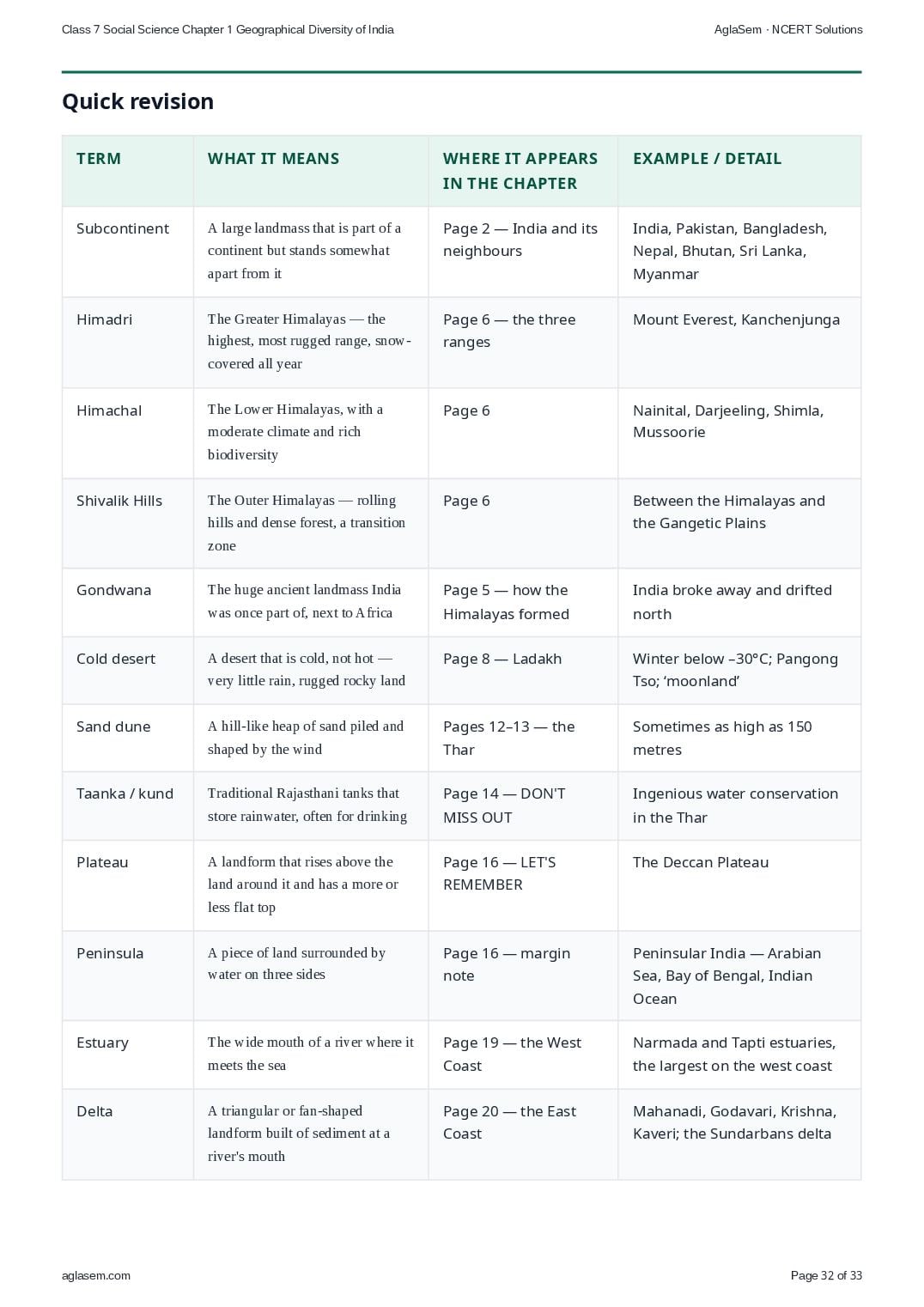
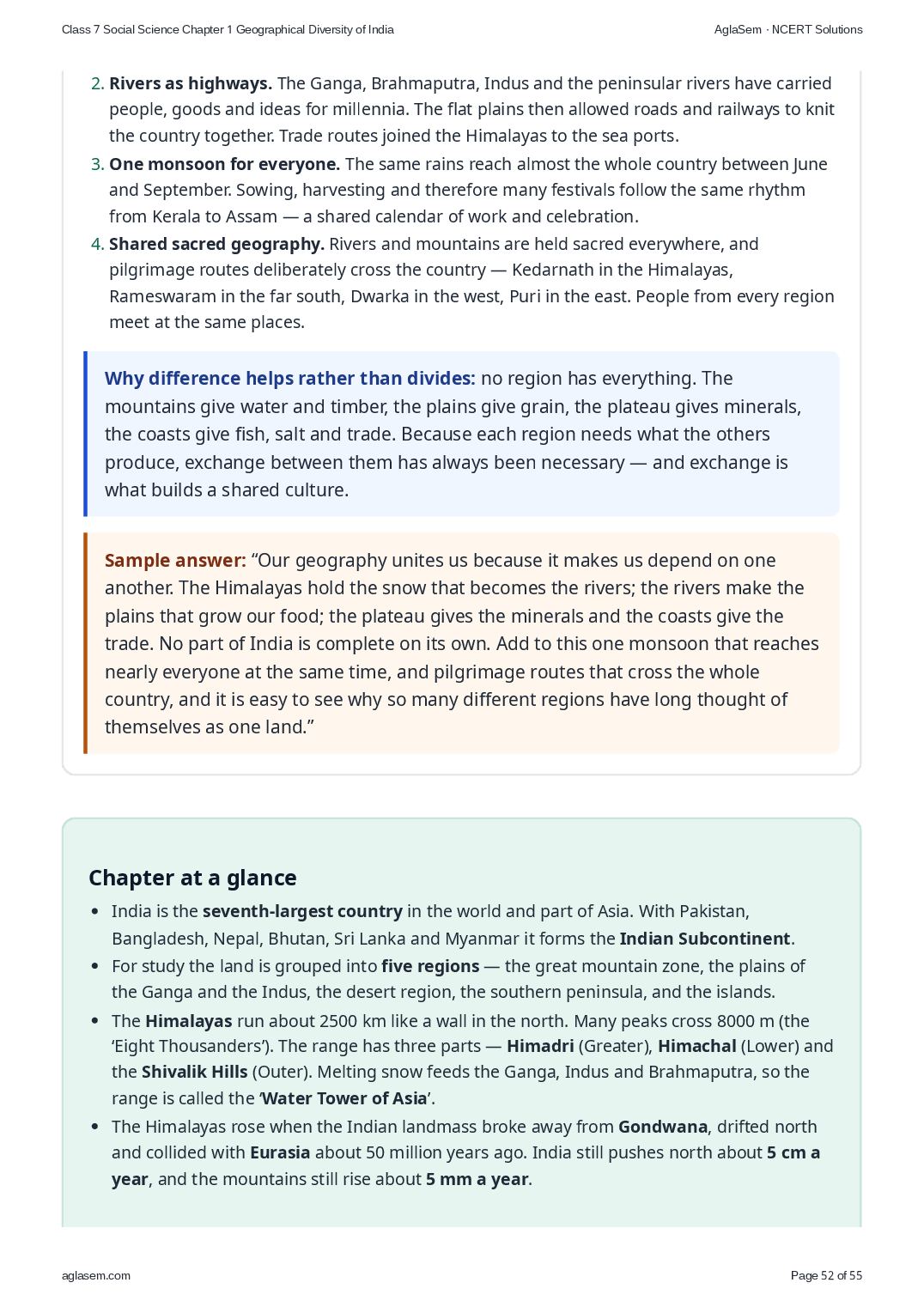
- India is the seventh-largest country in the world and part of Asia. With Pakistan, Bangladesh, Nepal, Bhutan, Sri Lanka and Myanmar it forms the Indian Subcontinent .
- For study the land is grouped into five regions — the great mountain zone, the plains of the Ganga and the Indus, the desert region, the southern peninsula, and the islands.
- The Himalayas run about 2500 km like a wall in the north. Many peaks cross 8000 m (the ‘Eight Thousanders’). The range has three parts — Himadri (Greater), Himachal (Lower) and the Shivalik Hills (Outer). Melting snow feeds the Ganga, Indus and Brahmaputra, so the range is called the ‘ Water Tower of Asia ’.
- The Himalayas rose when the Indian landmass broke away from Gondwana , drifted north and collided with Eurasia about 50 million years ago. India still pushes north about 5 cm a year , and the mountains still rise about 5 mm a year .
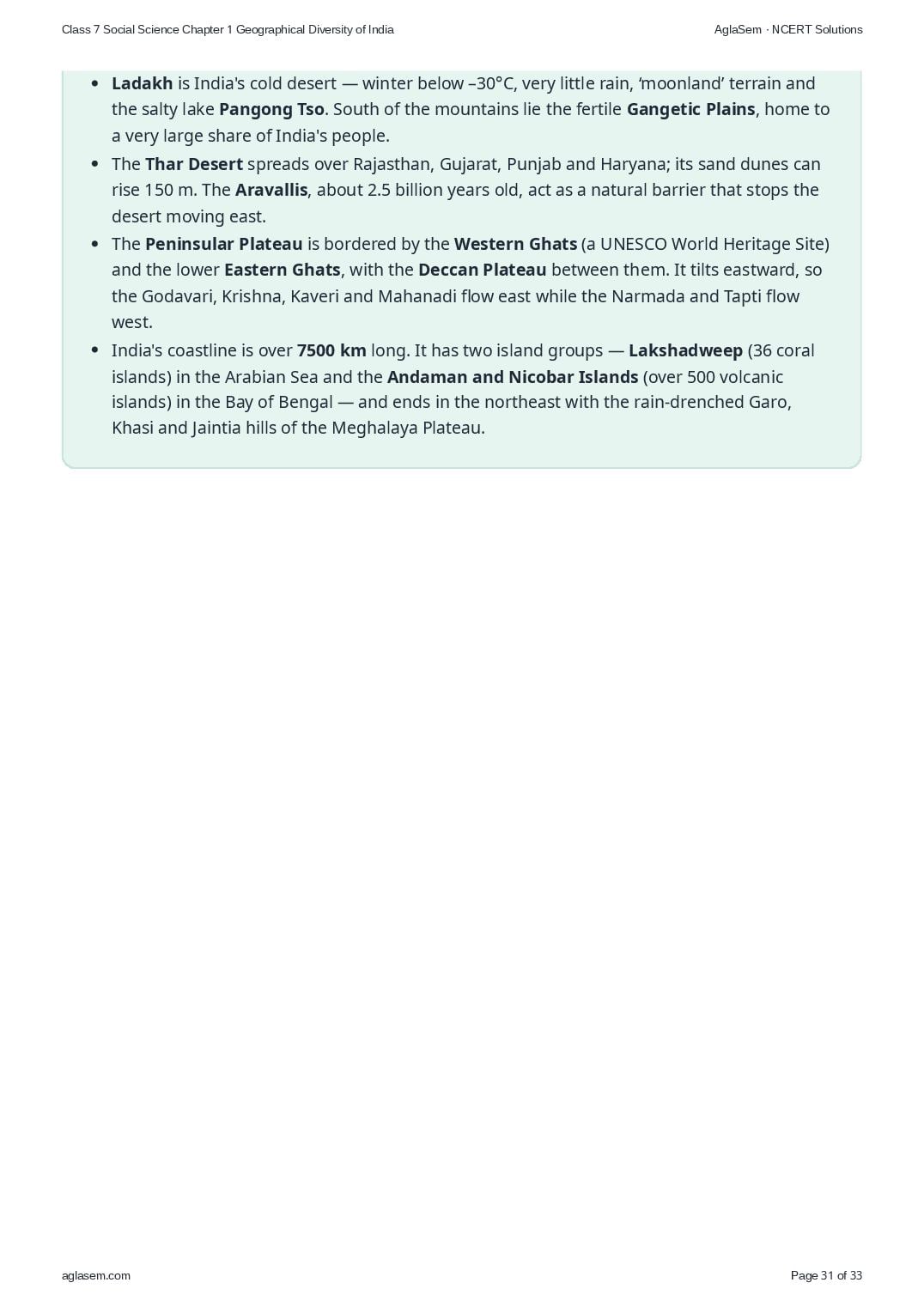
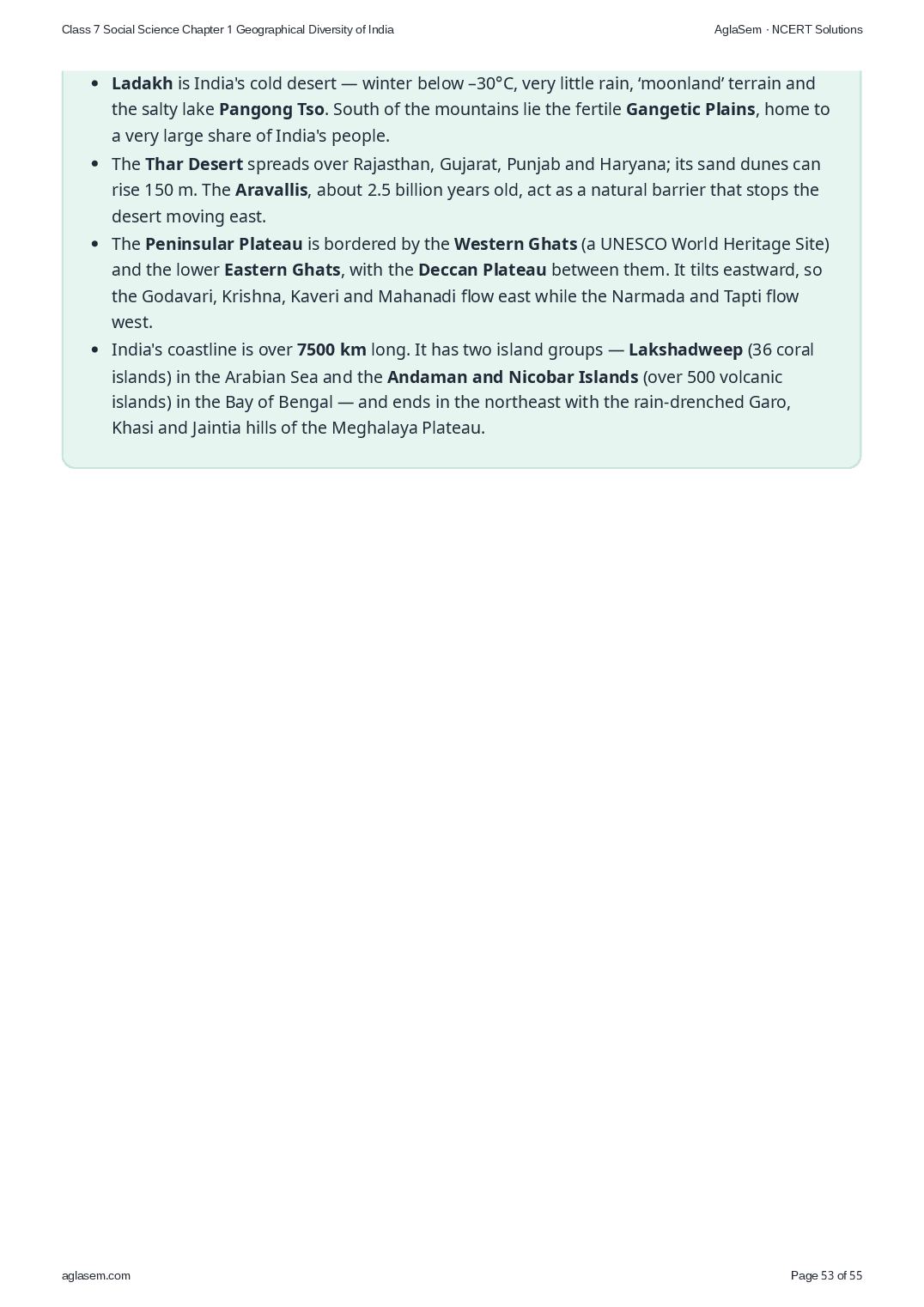
- Ladakh is India's cold desert — winter below –30°C, very little rain, ‘moonland’ terrain and the salty lake Pangong Tso . South of the mountains lie the fertile Gangetic Plains , home to a very large share of India's people.
- The Thar Desert spreads over Rajasthan, Gujarat, Punjab and Haryana; its sand dunes can rise 150 m. The Aravallis , about 2.5 billion years old, act as a natural barrier that stops the desert moving east.
- The Peninsular Plateau is bordered by the Western Ghats (a UNESCO World Heritage Site) and the lower Eastern Ghats , with the Deccan Plateau between them. It tilts eastward, so the Godavari, Krishna, Kaveri and Mahanadi flow east while the Narmada and Tapti flow west.
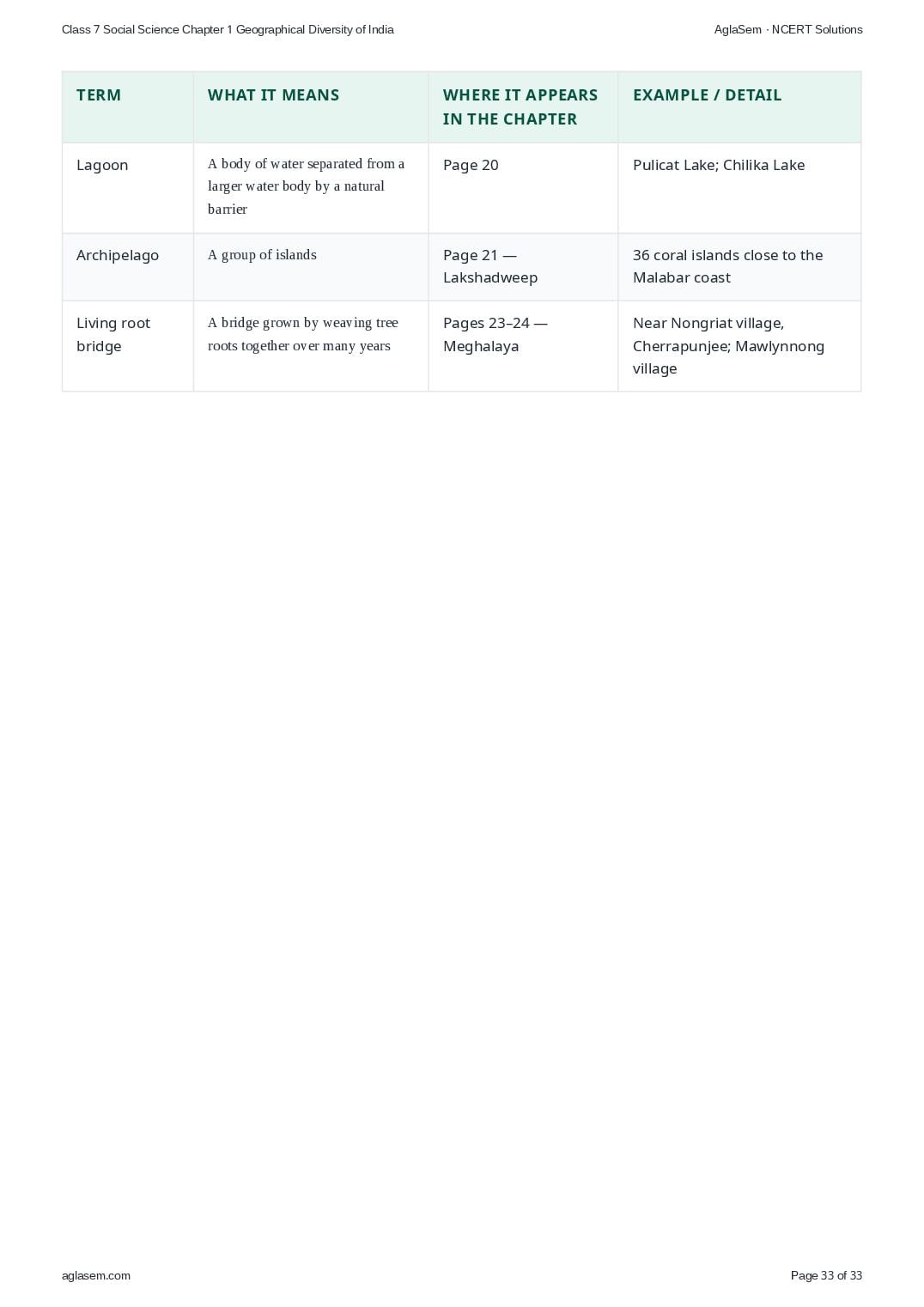
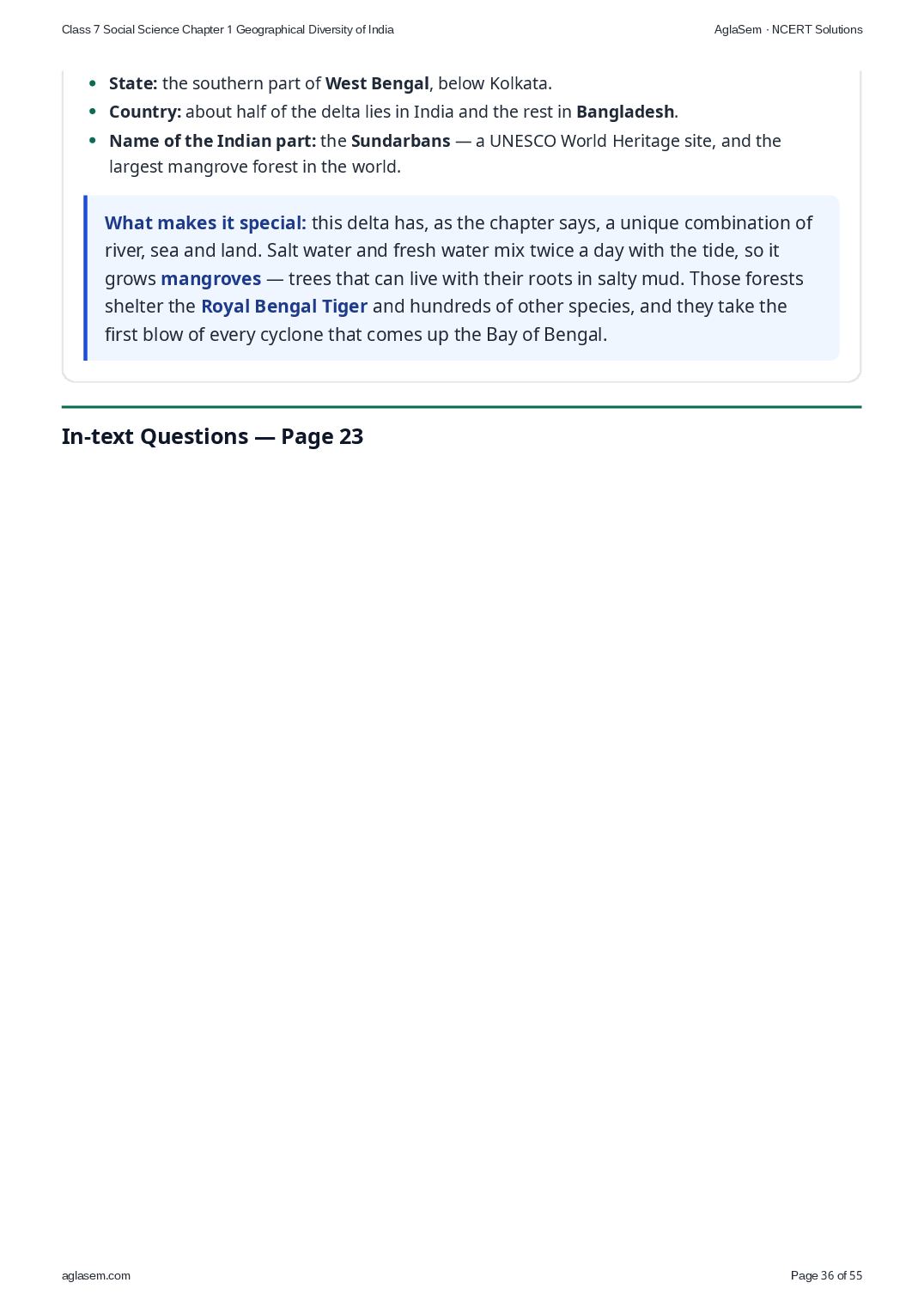
- India's coastline is over 7500 km long. It has two island groups — Lakshadweep (36 coral islands) in the Arabian Sea and the Andaman and Nicobar Islands (over 500 volcanic islands) in the Bay of Bengal — and ends in the northeast with the rain-drenched Garo, Khasi and Jaintia hills of the Meghalaya Plateau.
How to Download NCERT Solutions for Class 7 Social Science Chapter 1 PDF
Follow these simple steps to get the Geographical Diversity of India questions-and-answers PDF from Exploring Society India and Beyond.
- Search NCERT Solutions for Class 7 Social Science Chapter 1 aglasem and open this page.
- Read the exercise questions with answers for Geographical Diversity of India shown above.
- Click the Download PDF link to save the Geographical Diversity of India solutions to your device.
NCERT Solutions for Class 7 Social Science – All Chapters
There are more chapters to study besides Geographical Diversity of India in Social Science. Here are the NCERT Solutions for all chapters of Class 7 Social Science.
- Chapter 1 Geographical Diversity of India
- Chapter 2 Understanding the Weather
- Chapter 3 Climates of India
- Chapter 4 New Beginnings Cities and States
- Chapter 5 the Rise of Empires
- Chapter 6 the Age of Reorganisation
- Chapter 7 the Gupta Era an Age of Tireless Creativity
- Chapter 8 How the Land Becomes Sacred
- Chapter 9 From the Rulers to the Ruled Types of Governments
- Chapter 10 the Constitution of India an Introduction
- Chapter 11 From Barter to Money
- Chapter 12 Understanding Markets
NCERT Solutions for Class 7 – All Subjects
Just like Chapter 1 of Social Science, you can get the exercise questions with answers for every other subject of Class 7. Here are the NCERT Solutions for all subjects of Class 7.
NCERT Solutions for Class 7 Social Science Chapter 1 – An Overview
The key highlights of this study material are as follows.
| Aspects | Details |
|---|---|
| Class | Class 7 |
| Subject | Social Science |
| Chapter Number | Chapter 1 |
| Chapter Name | Geographical Diversity of India |
| Book Name | Exploring Society India and Beyond |
| Book By | NCERT (National Council of Educational Research and Training) |
| Educational Resource Here | NCERT Solutions of Class 7 Social Science Chapter 1 for all exercises |
| More Questions Answers of This Subject | NCERT Solutions for Class 7 Social Science |
| Download Book Chapter | NCERT Book Class 7 Social Science |
| All Questions Answers For This Class | NCERT Solutions for Class 7 |
| Complete Solutions | NCERT Solutions |
NCERT Solutions for Class 7 Social Science Chapter 1 Geographical Diversity of India – FAQs
What are the NCERT Solutions for Class 7 Social Science Chapter 1 Geographical Diversity of India?
They are the complete, step-by-step answers to all the exercise and in-text questions of Chapter 1 Geographical Diversity of India from the NCERT Class 7 Social Science textbook Exploring Society India and Beyond, written by experts as per the latest NCERT syllabus.
How can I download the Class 7 Social Science Chapter 1 solutions PDF for free?
Open this page on aglasem, read the Geographical Diversity of India questions with answers, and click the “Download Solutions PDF” link. The Class 7 Social Science Chapter 1 NCERT Solutions PDF is completely free to download.
Are these NCERT Solutions as per the latest 2026-27 syllabus?
Yes. The NCERT Solutions for Class 7 Social Science Chapter 1 are based on the latest NCERT textbook Exploring Society India and Beyond and the current 2026-27 CBSE syllabus, so the questions and answers match what you study in class.
Where can I get NCERT Solutions for the other chapters of Class 7 Social Science?
You can find the answers to every chapter on the NCERT Solutions for Class 7 Social Science page, and solutions for every subject on the NCERT Solutions for Class 7 page.
How do NCERT Solutions help in exam preparation?
They show the correct method to solve each question, help you write answers the way they are expected in exams, let you check and correct your own work, and save revision time — which together improve your marks in Class 7 Social Science.
If you have any queries on NCERT Solutions for Class 7 Social Science Chapter 1 Geographical Diversity of India, then please ask in the comments below.