NCERT Solutions for Class 7 Social Science Chapter 7 the Gupta Era an Age of Tireless Creativity provide clear, step-by-step answers to every exercise and in-text question from the chapter the Gupta Era an Age of Tireless Creativity of the NCERT textbook Exploring Society India and Beyond. Prepared by subject experts as per the latest NCERT (CBSE) syllabus for 2026-27, these NCERT Solutions for Class 7 Social Science help you understand each concept, write exam-ready answers, and check your own solutions. You can read them online below or download the free Class 7 Social Science Chapter 7 question-answer PDF.
NCERT Solutions for Class 7 Social Science Chapter 7 the Gupta Era an Age of Tireless Creativity
- Class: Class 7
- Subject: Social Science
- Chapter: Chapter 7 – the Gupta Era an Age of Tireless Creativity
- Textbook: Exploring Society India and Beyond (NCERT)
- Study material: NCERT Solutions – questions with answers, free PDF
These solutions answer all the exercise questions of Chapter 7 the Gupta Era an Age of Tireless Creativity — including the in-text questions, short-answer and long-answer questions, and activities — with complete explanations so you can follow the method, not just the final answer. Read the full solutions below.
NCERT Solutions Class 7 Social Science Chapter 7 the Gupta Era an Age of Tireless Creativity View Download
NCERT Solutions for Class 7 Social Science Chapter 7 PDF Download
You can read the NCERT Solutions for Class 7 Social Science Chapter 7 online above, or download the complete question-answer PDF to study the Gupta Era an Age of Tireless Creativity offline at any time.
NCERT Solutions for Class 7 Social Science Chapter 7 PDF Download Link – Click Here to Download Solutions PDF
Questions Covered in This Chapter
These NCERT Solutions answer all 22 questions of this chapter. The questions solved are:
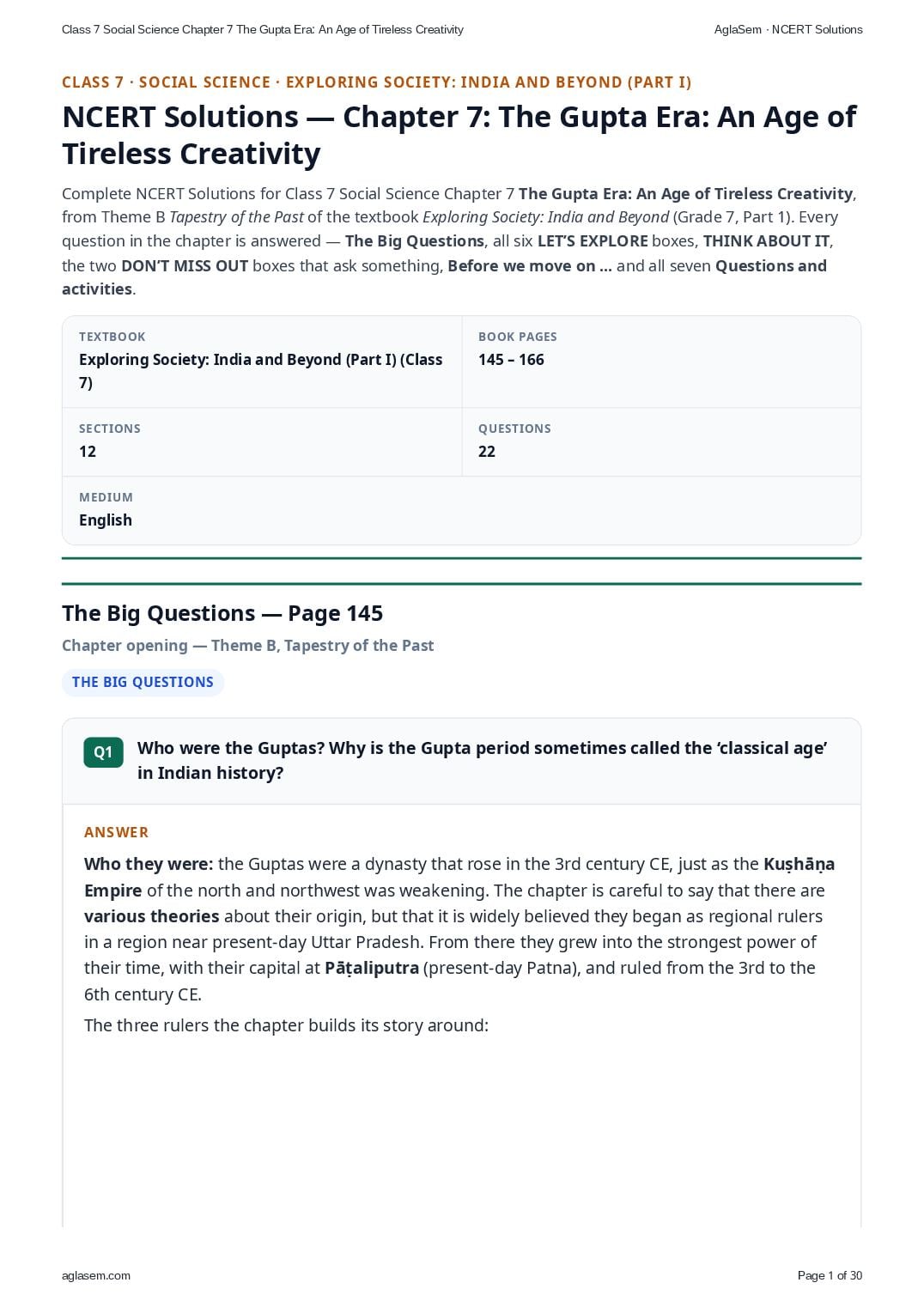
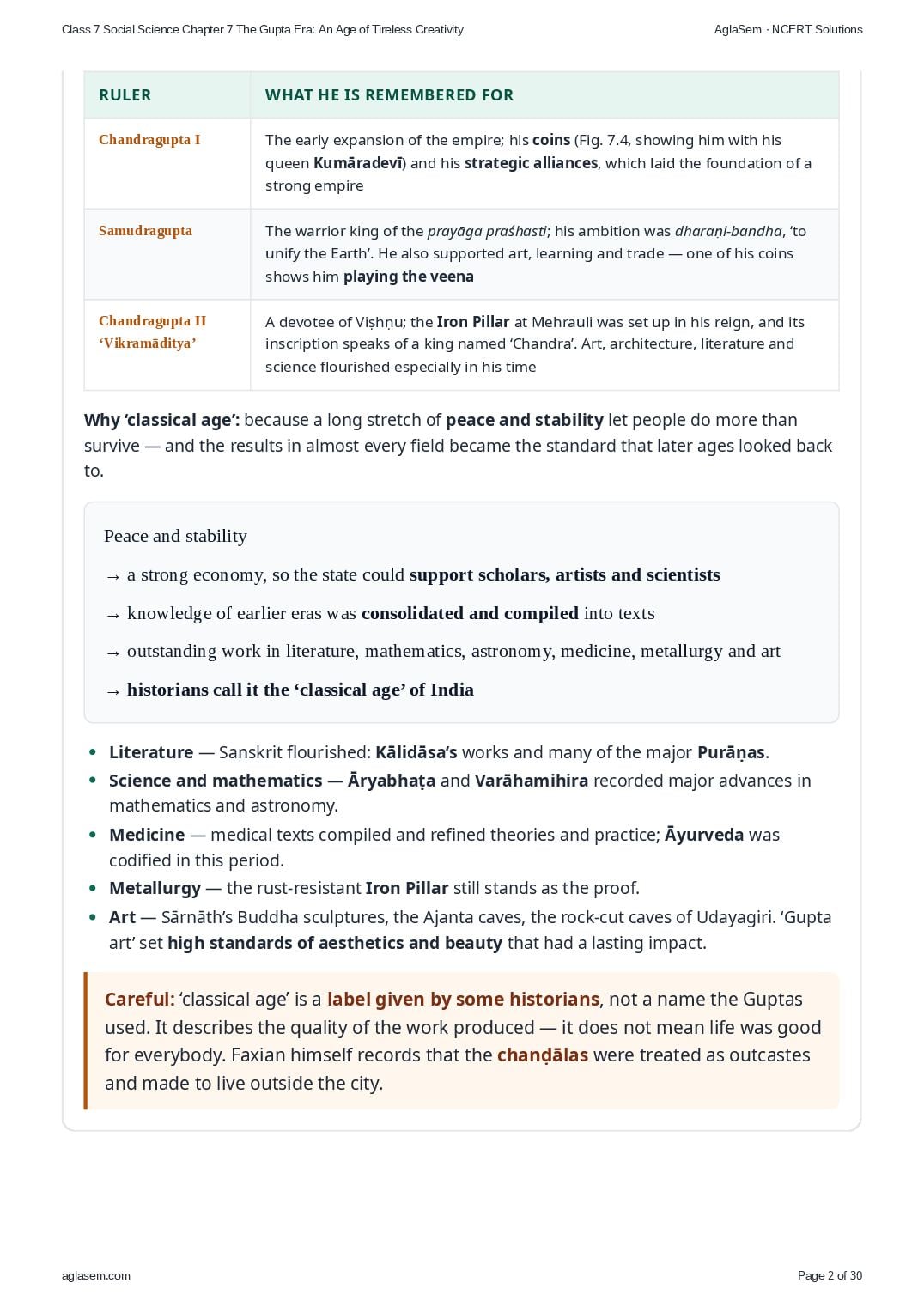
- Who were the Guptas? Why is the Gupta period sometimes called the ‘classical age’ in Indian history?
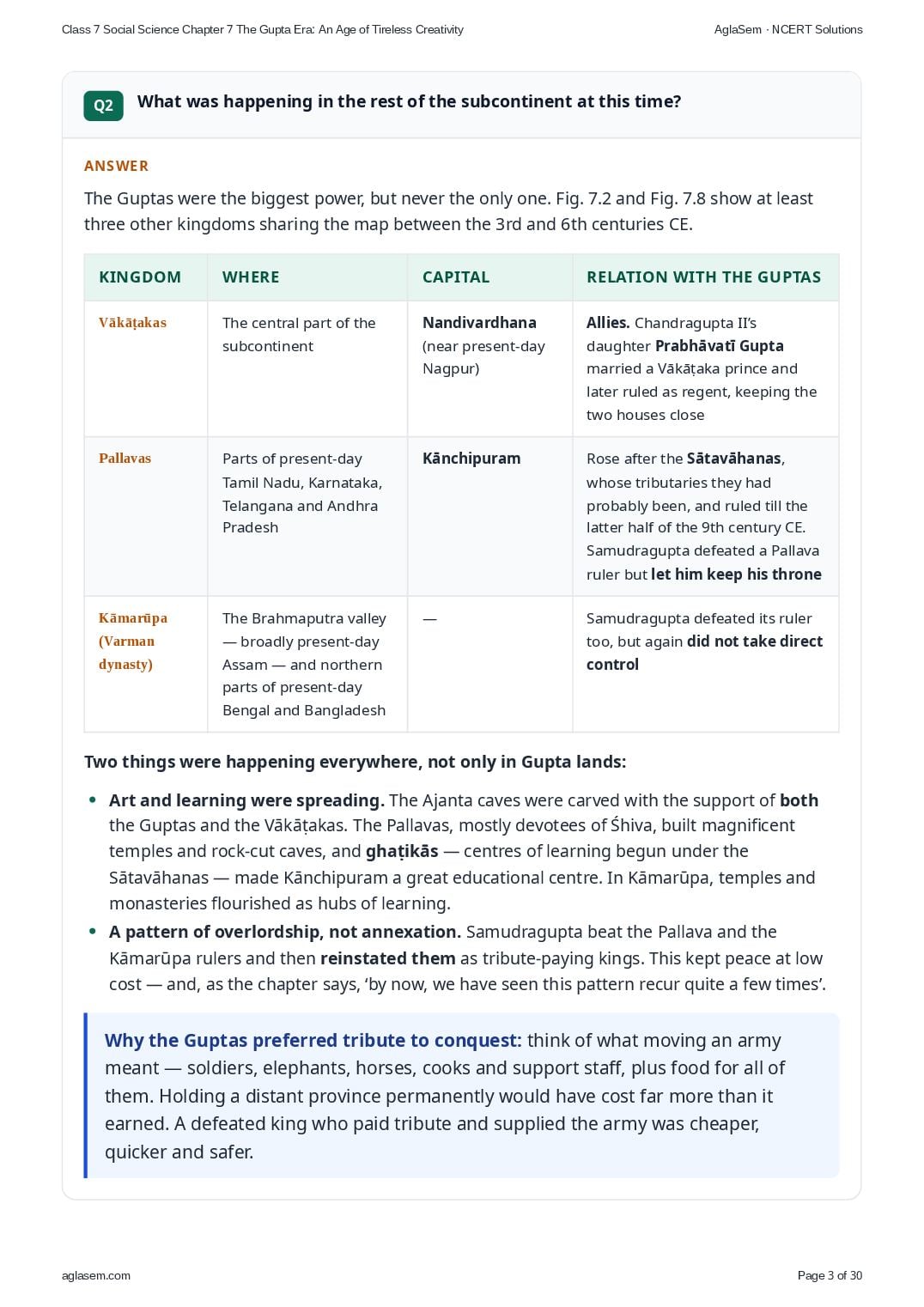
- What was happening in the rest of the subcontinent at this time?
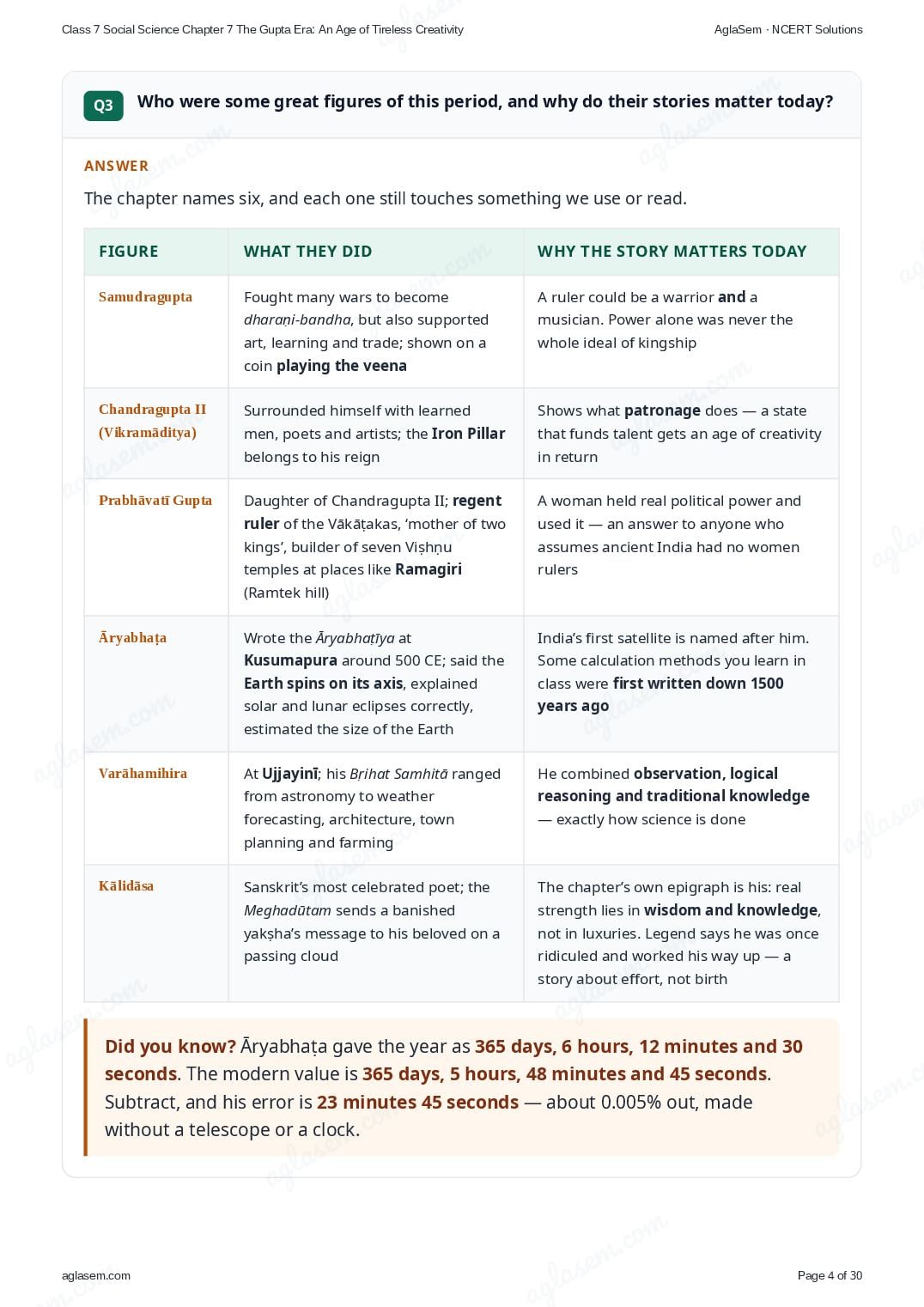
- Who were some great figures of this period, and why do their stories matter today?
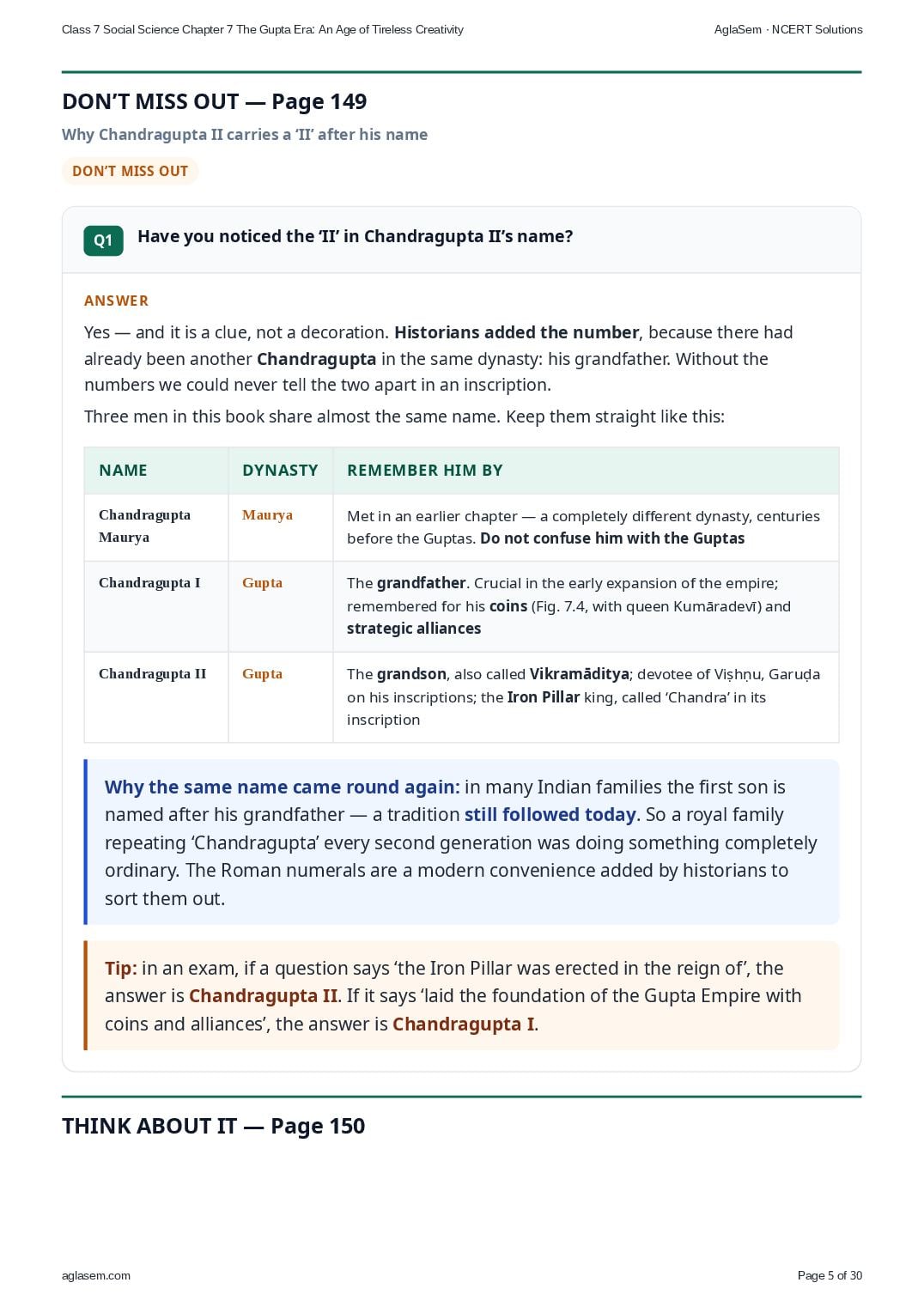
- Have you noticed the ‘II’ in Chandragupta II’s name?
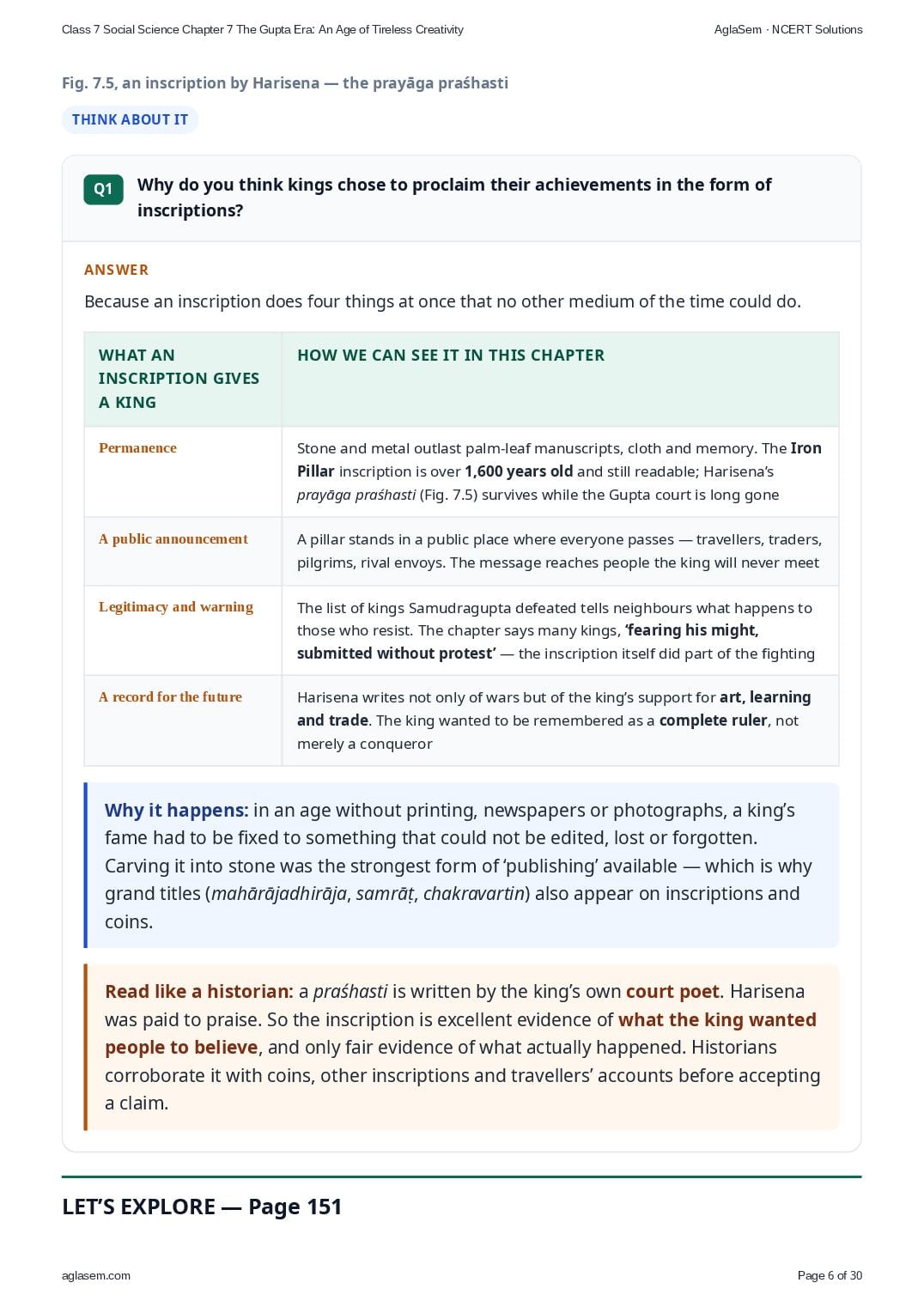
- Why do you think kings chose to proclaim their achievements in the form of inscriptions?
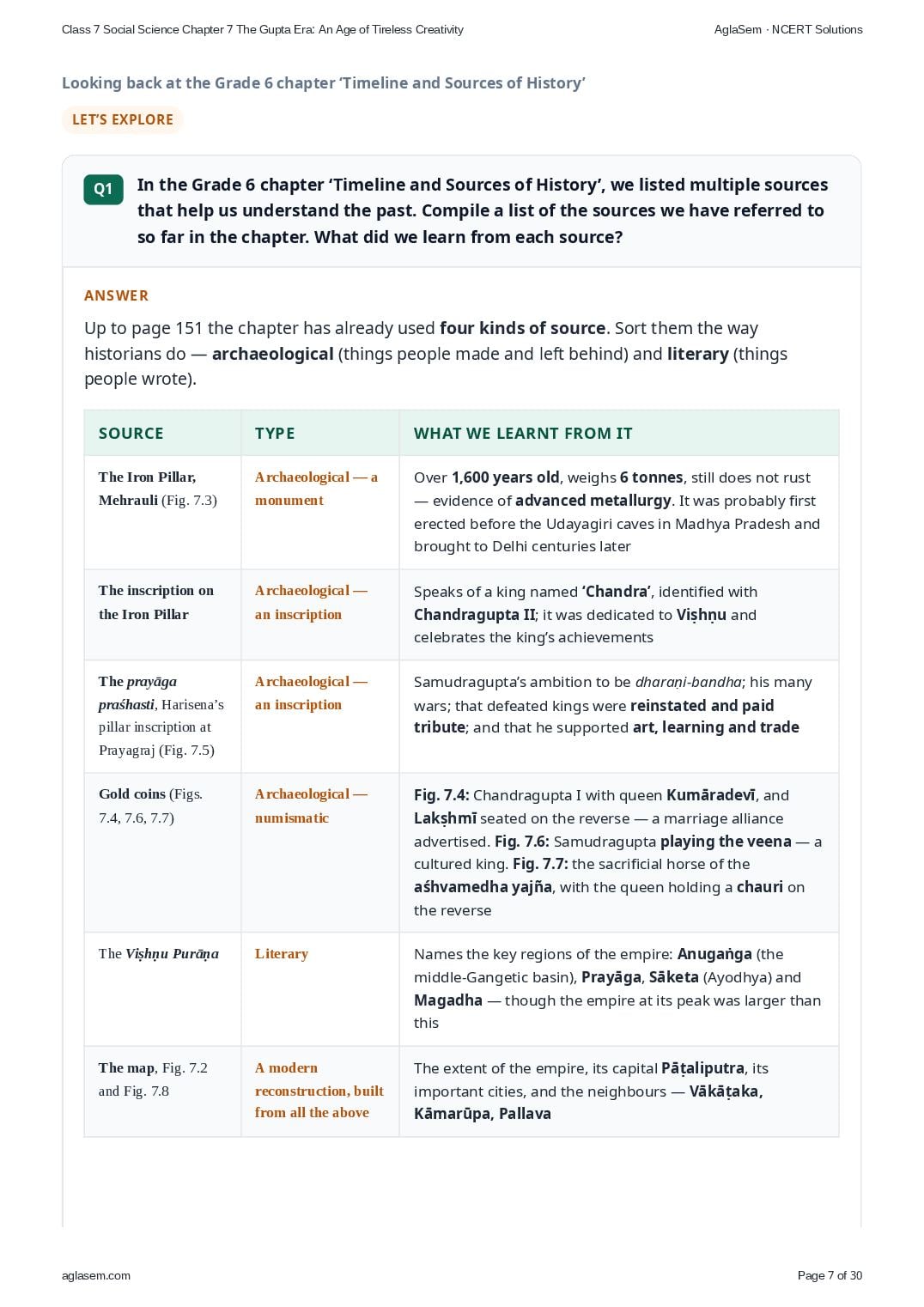
- In the Grade 6 chapter ‘Timeline and Sources of History’, we listed multiple sources that help us understand the past. Compile a list of the sources we have referred to so far in the chapter. What did we learn from each source?
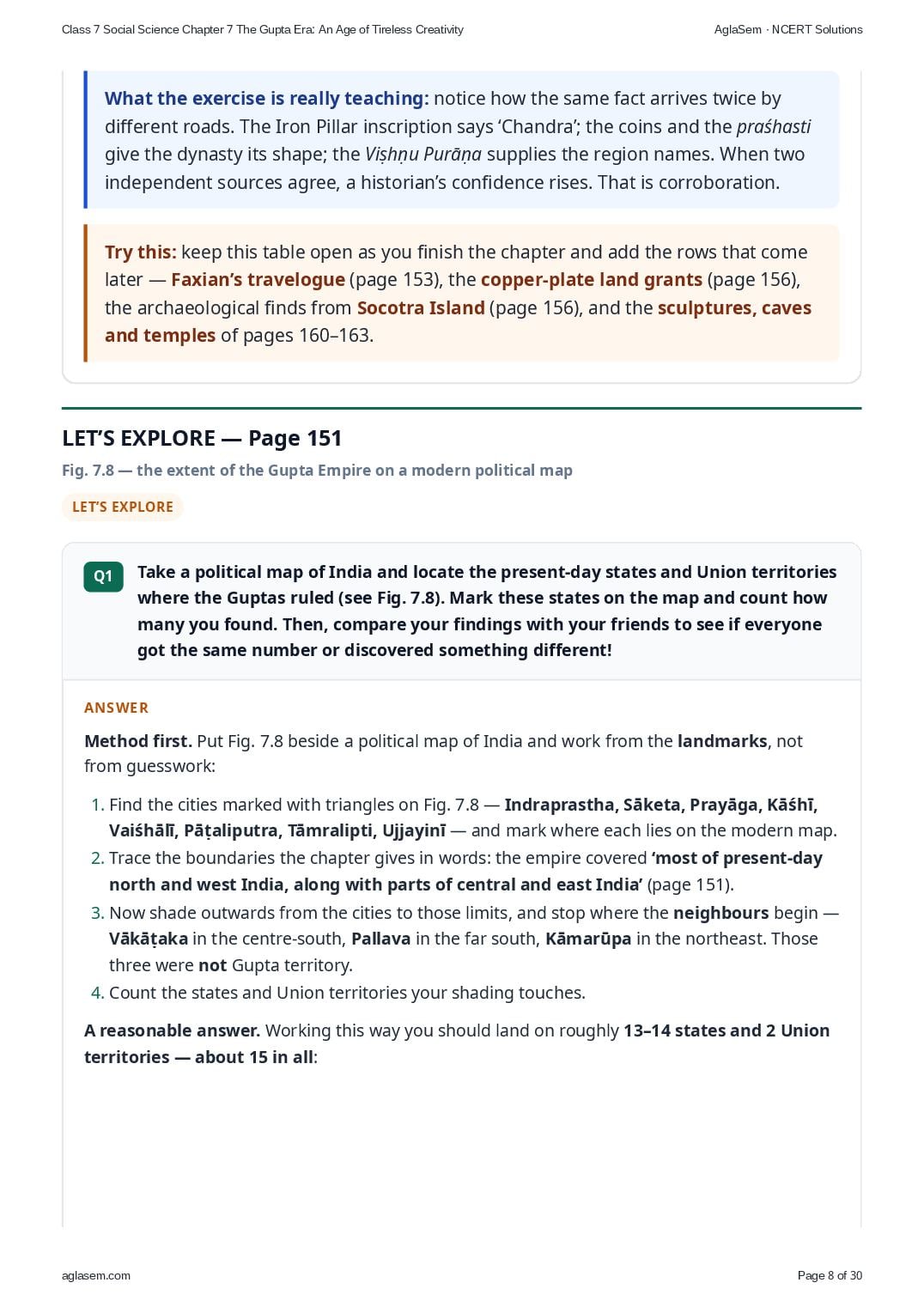
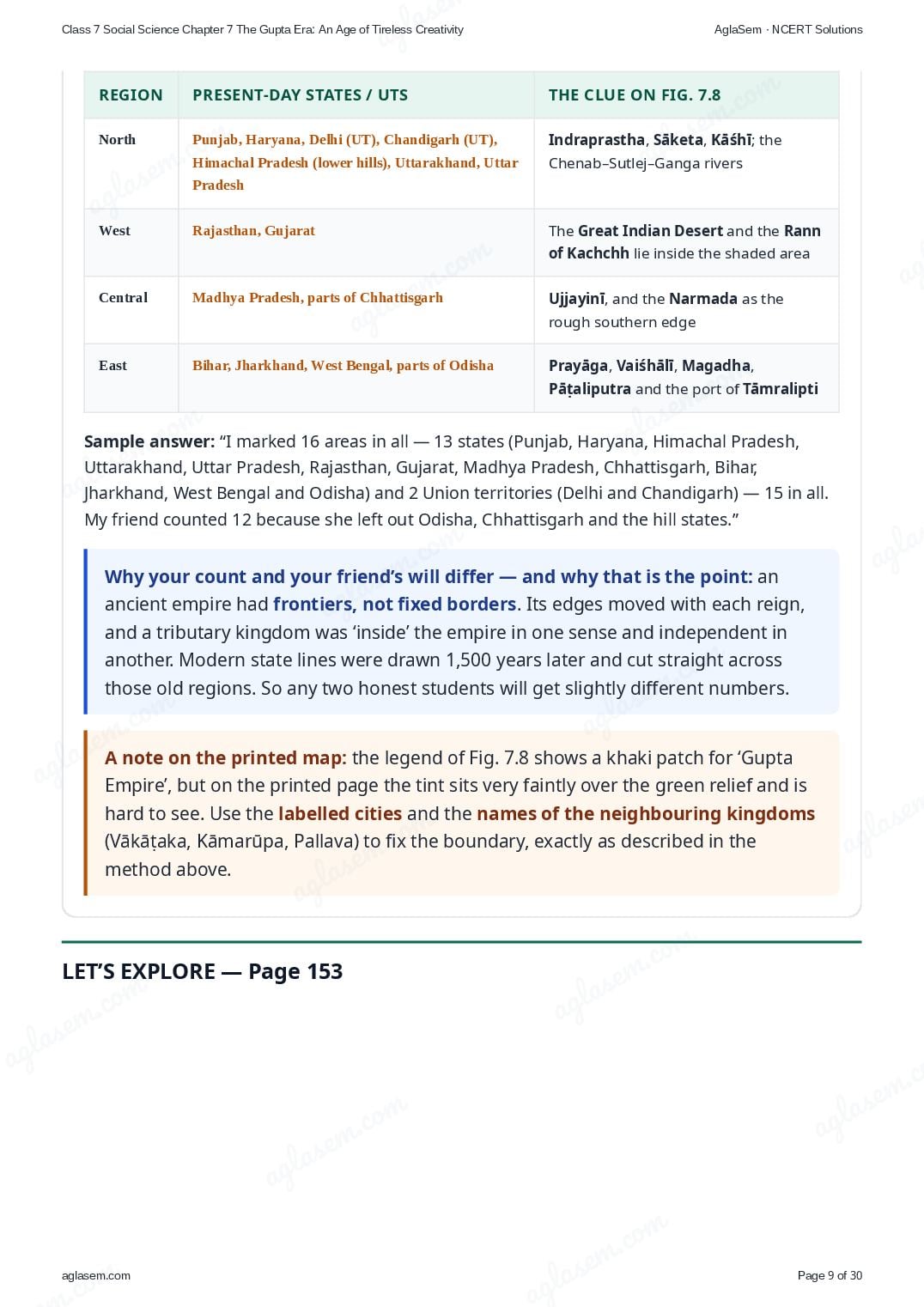
- Take a political map of India and locate the present-day states and Union territories where the Guptas ruled (see Fig. 7.8). Mark these states on the map and count how many you found. Then, compare your findings with your friends to see if everyone got the same number or discovered something different!
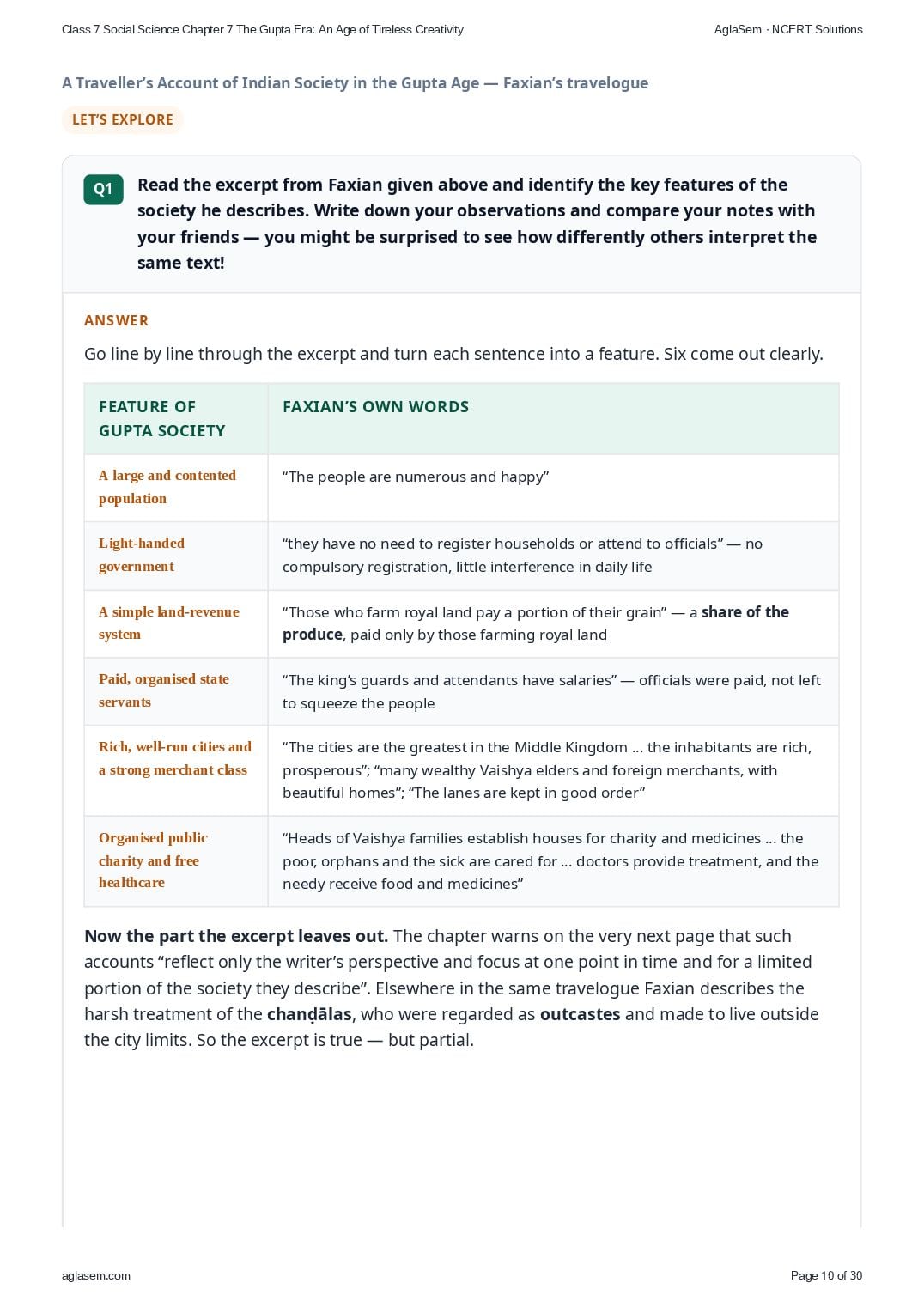
- Read the excerpt from Faxian given above and identify the key features of the society he describes. Write down your observations and compare your notes with your friends — you might be surprised to see how differently others interpret the same text!
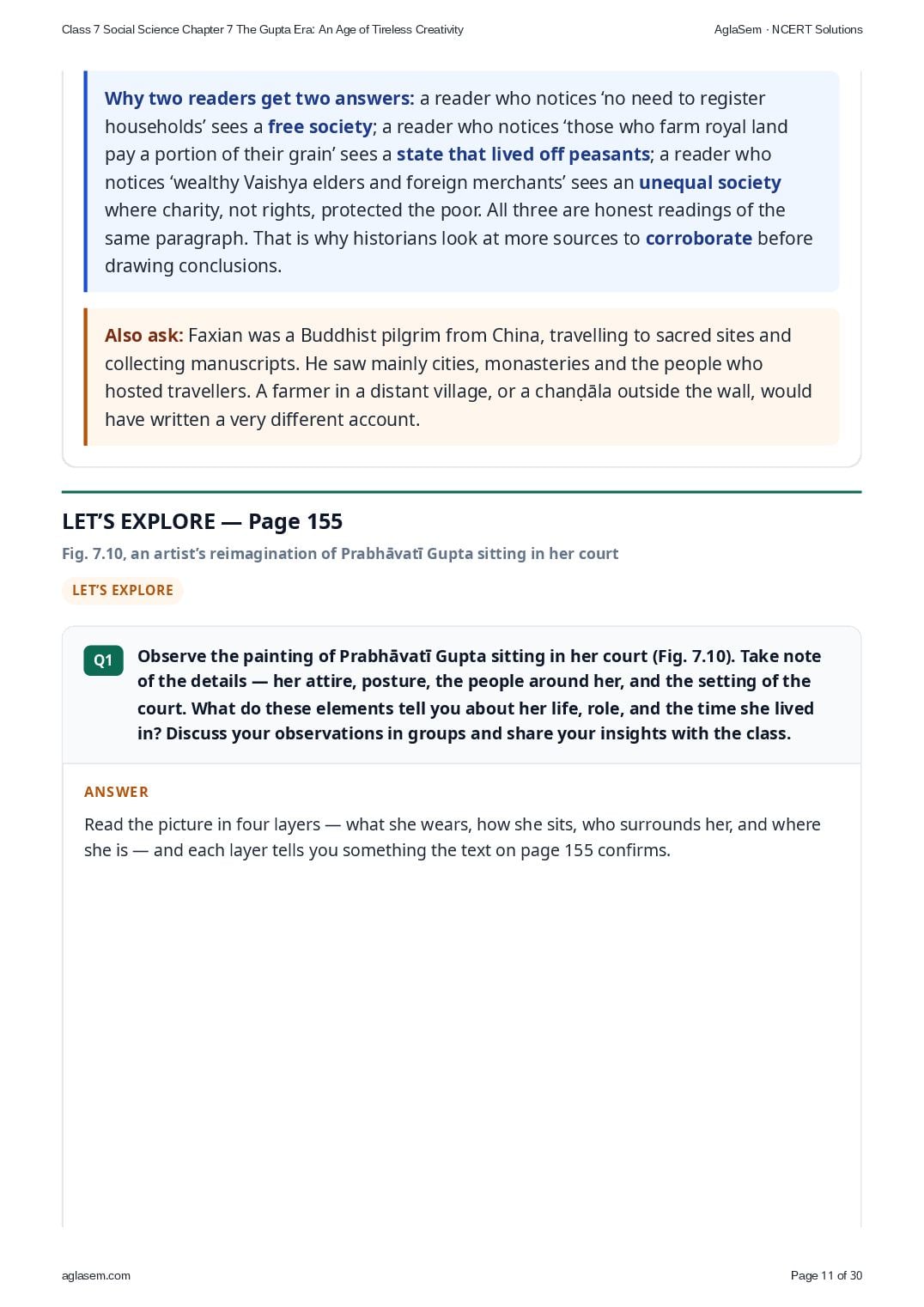
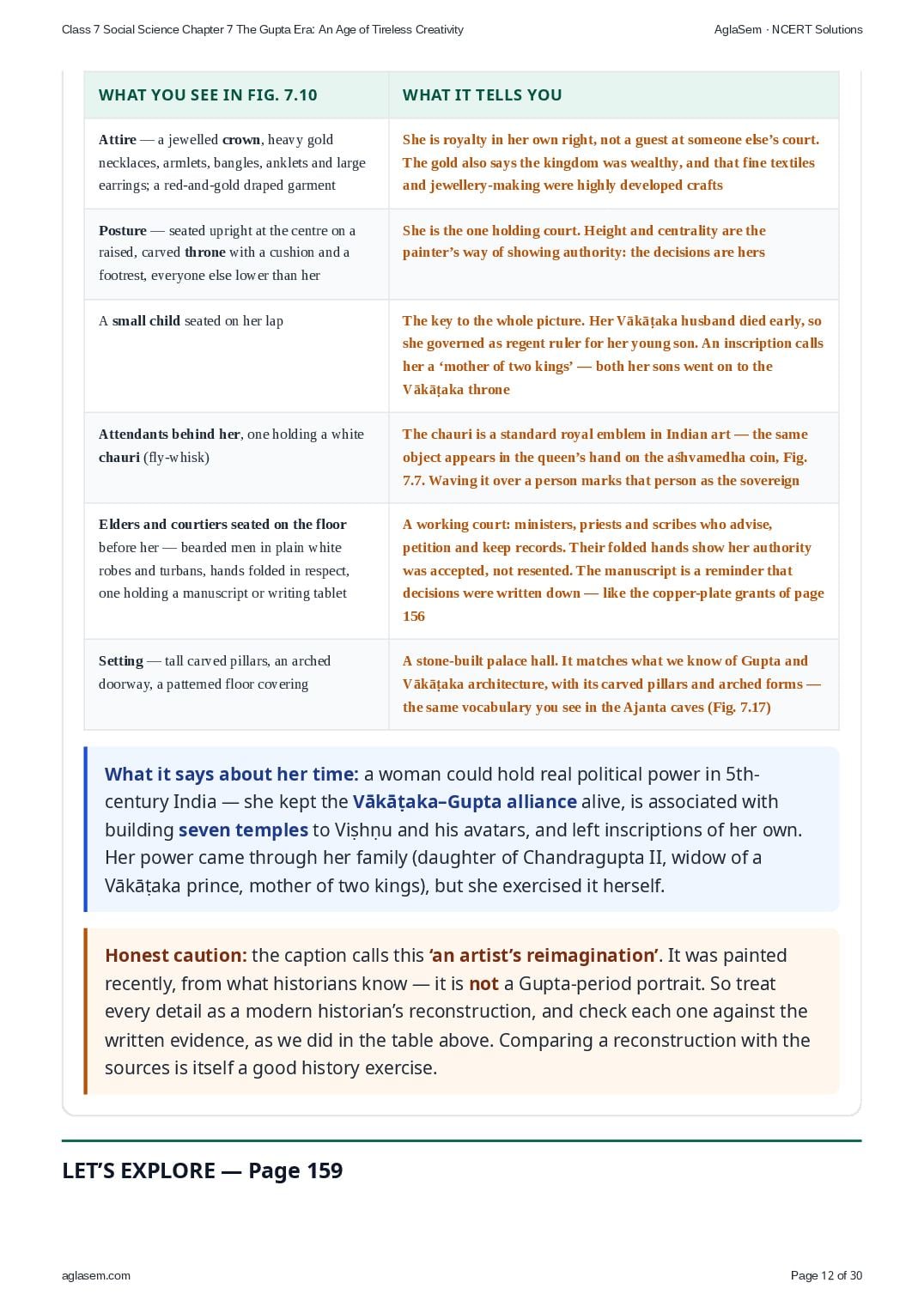
- Observe the painting of Prabhāvatī Gupta sitting in her court (Fig. 7.10). Take note of the details — her attire, posture, the people around her, and the setting of the court. What do these elements tell you about her life, role, and the time she lived in? Discuss your observations in groups and share your insights with the class.
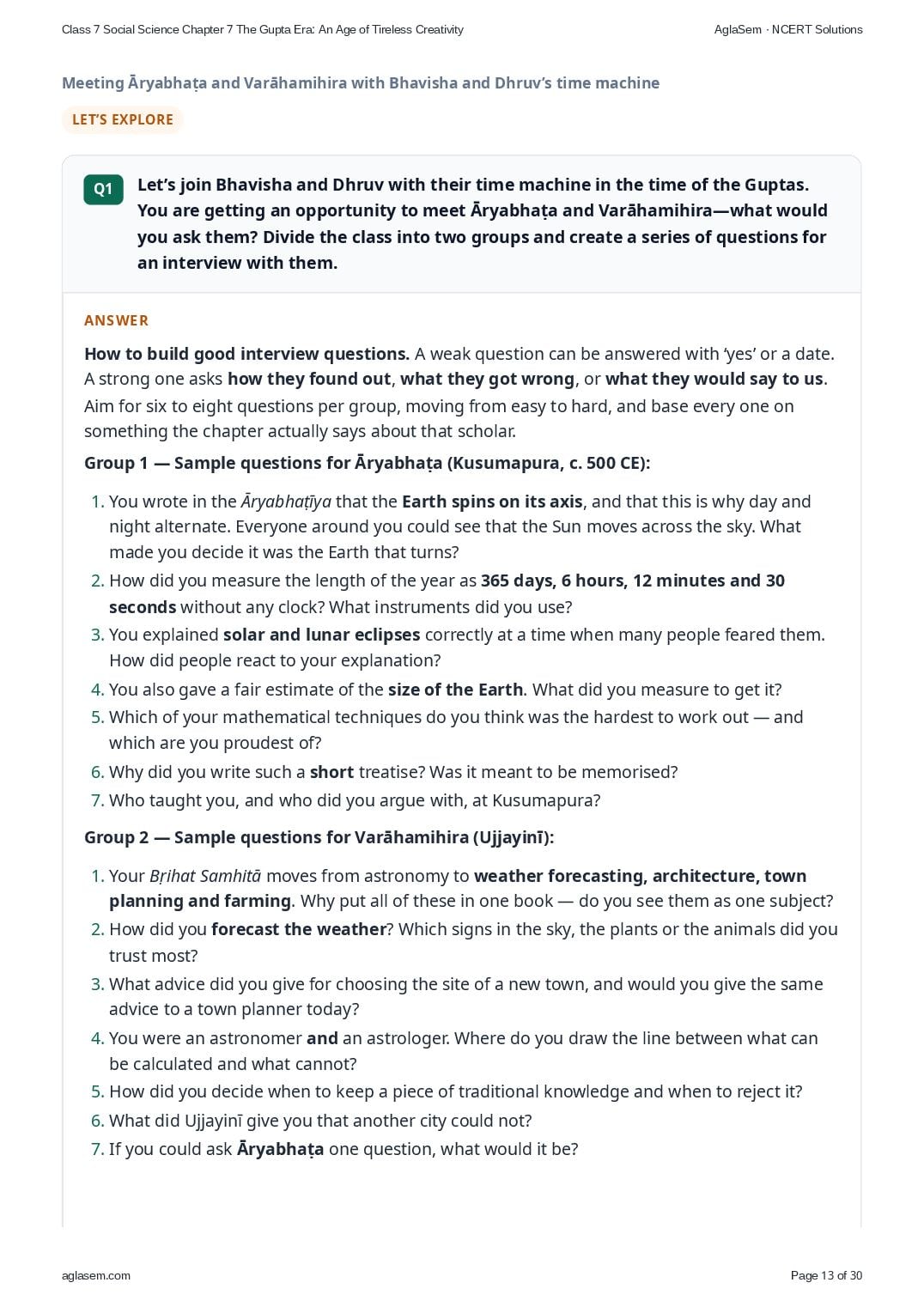
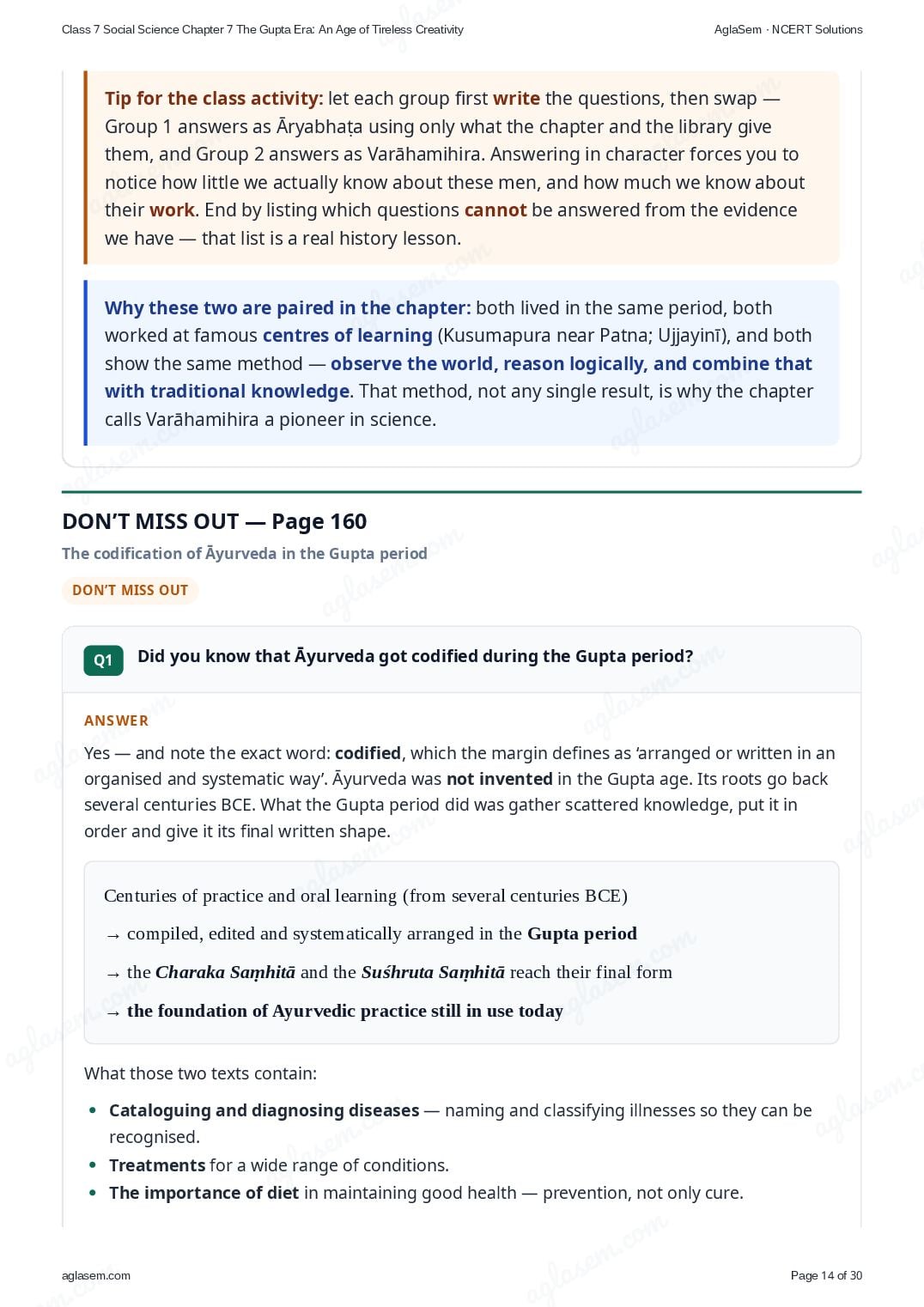
- Let’s join Bhavisha and Dhruv with their time machine in the time of the Guptas. You are getting an opportunity to meet Āryabhaṭa and Varāhamihira—what would you ask them? Divide the class into two groups and create a series of questions for an interview with them.
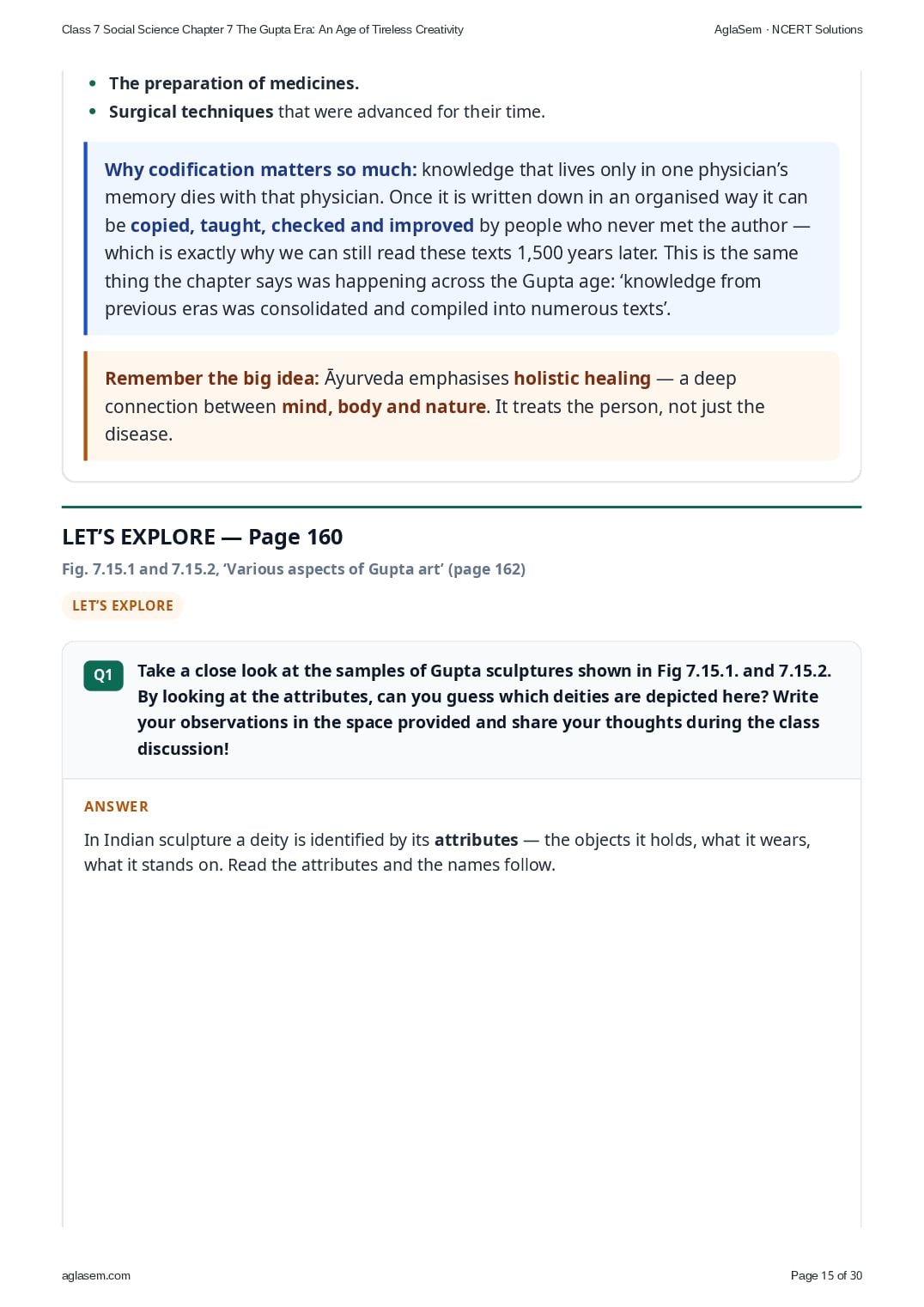
- Did you know that Āyurveda got codified during the Gupta period?
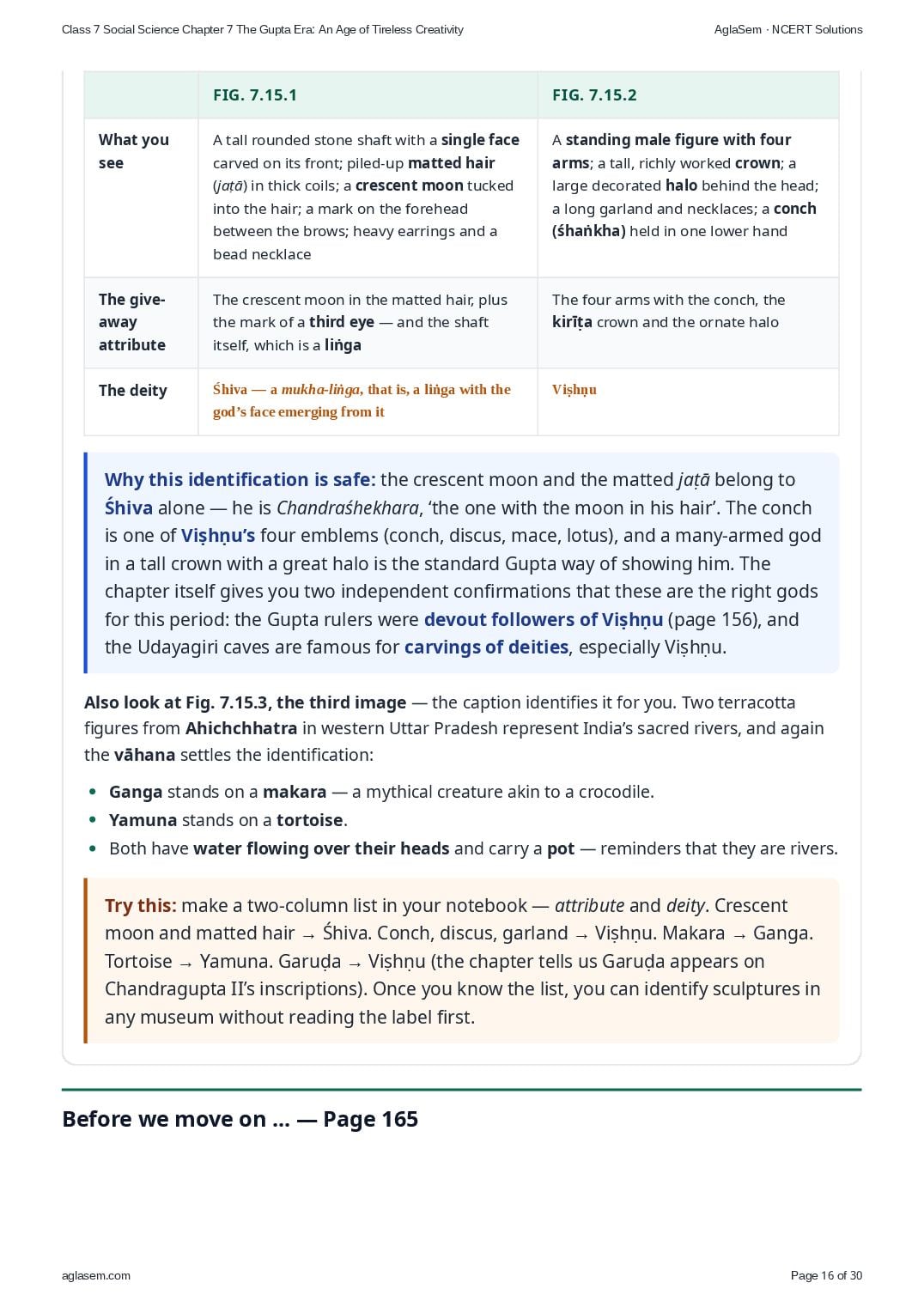
- Take a close look at the samples of Gupta sculptures shown in Fig 7.15.1. and 7.15.2. By looking at the attributes, can you guess which deities are depicted here? Write your observations in the space provided and share your thoughts during the class discussion!
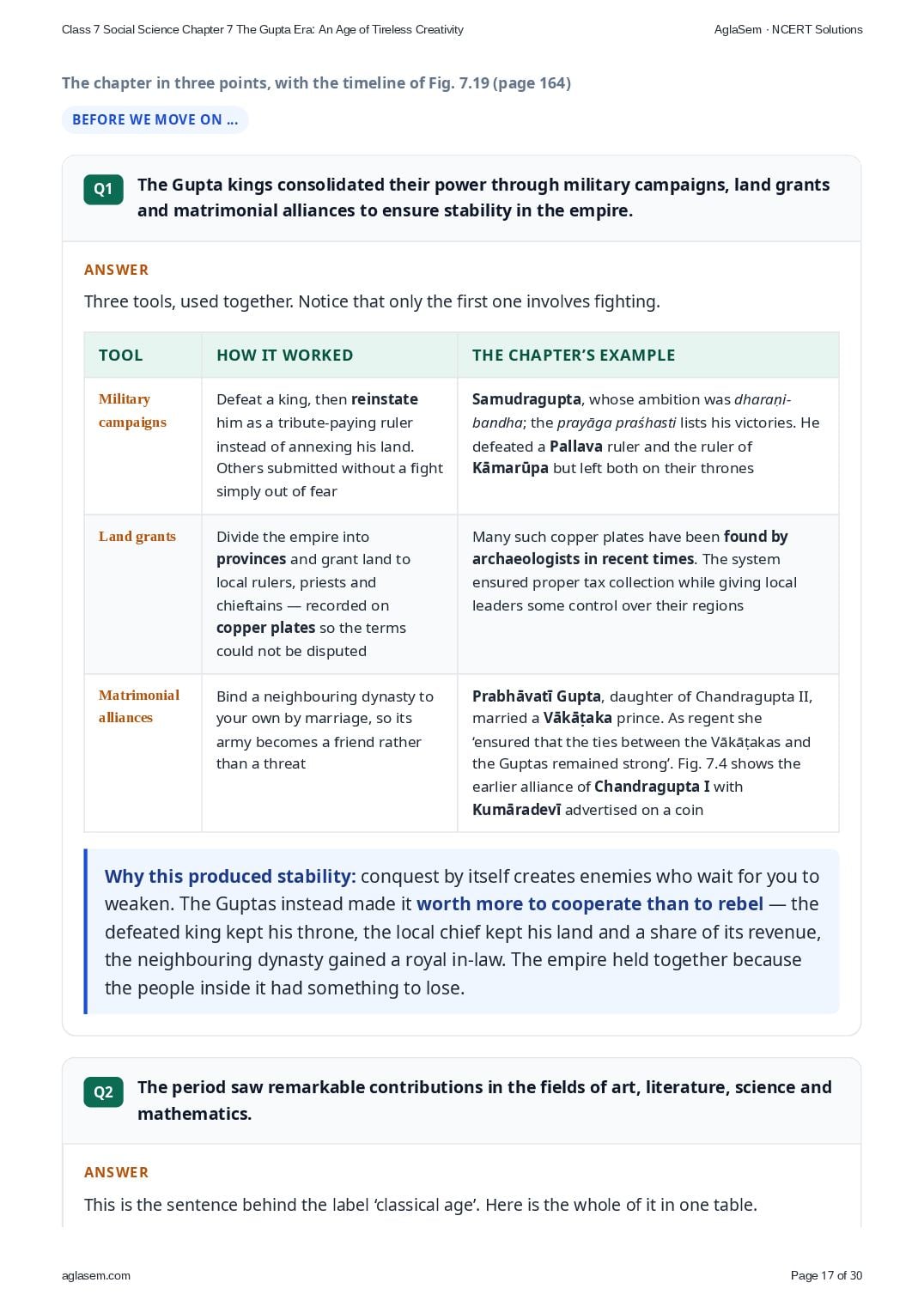
- The Gupta kings consolidated their power through military campaigns, land grants and matrimonial alliances to ensure stability in the empire.
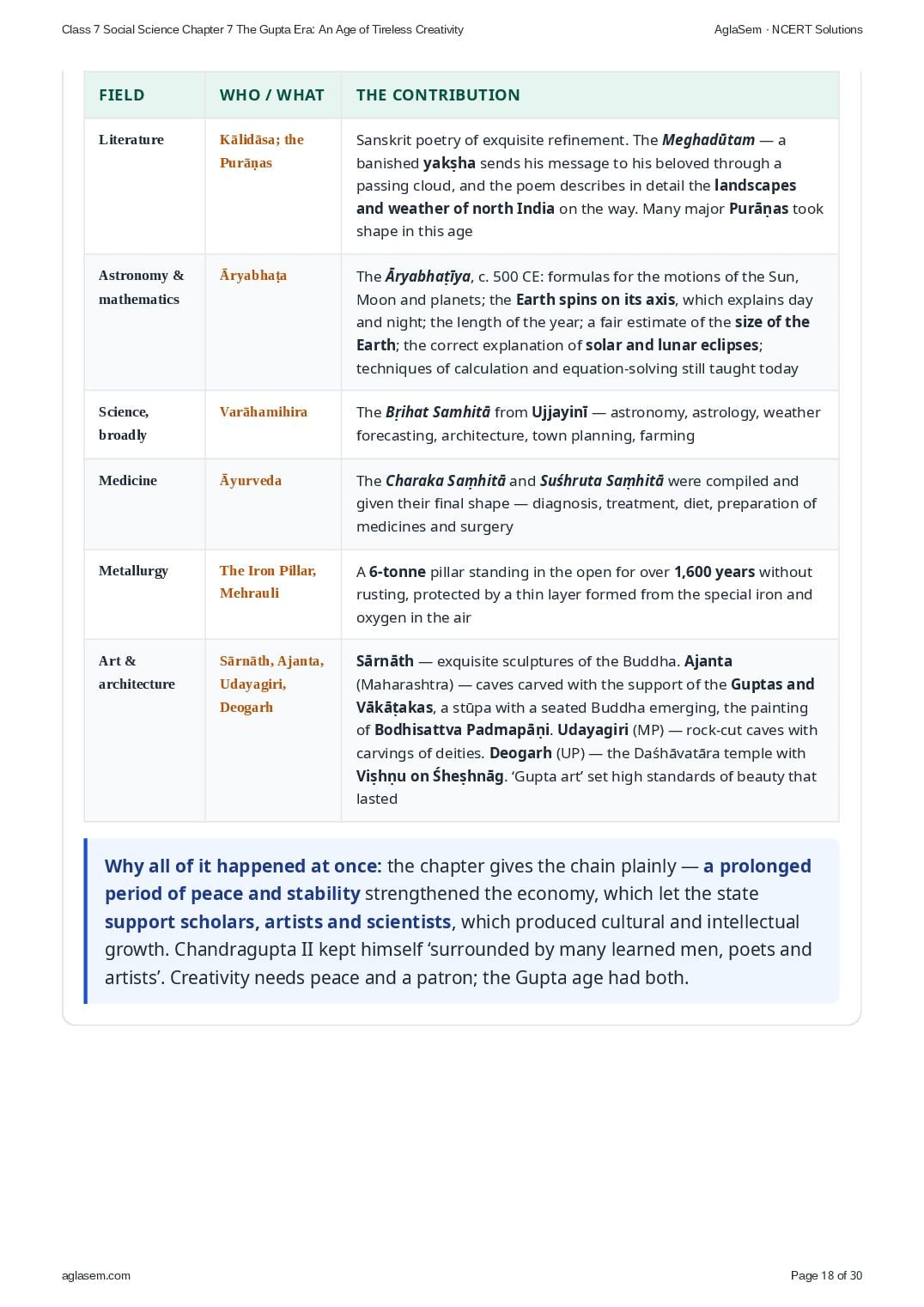
- The period saw remarkable contributions in the fields of art, literature, science and mathematics.
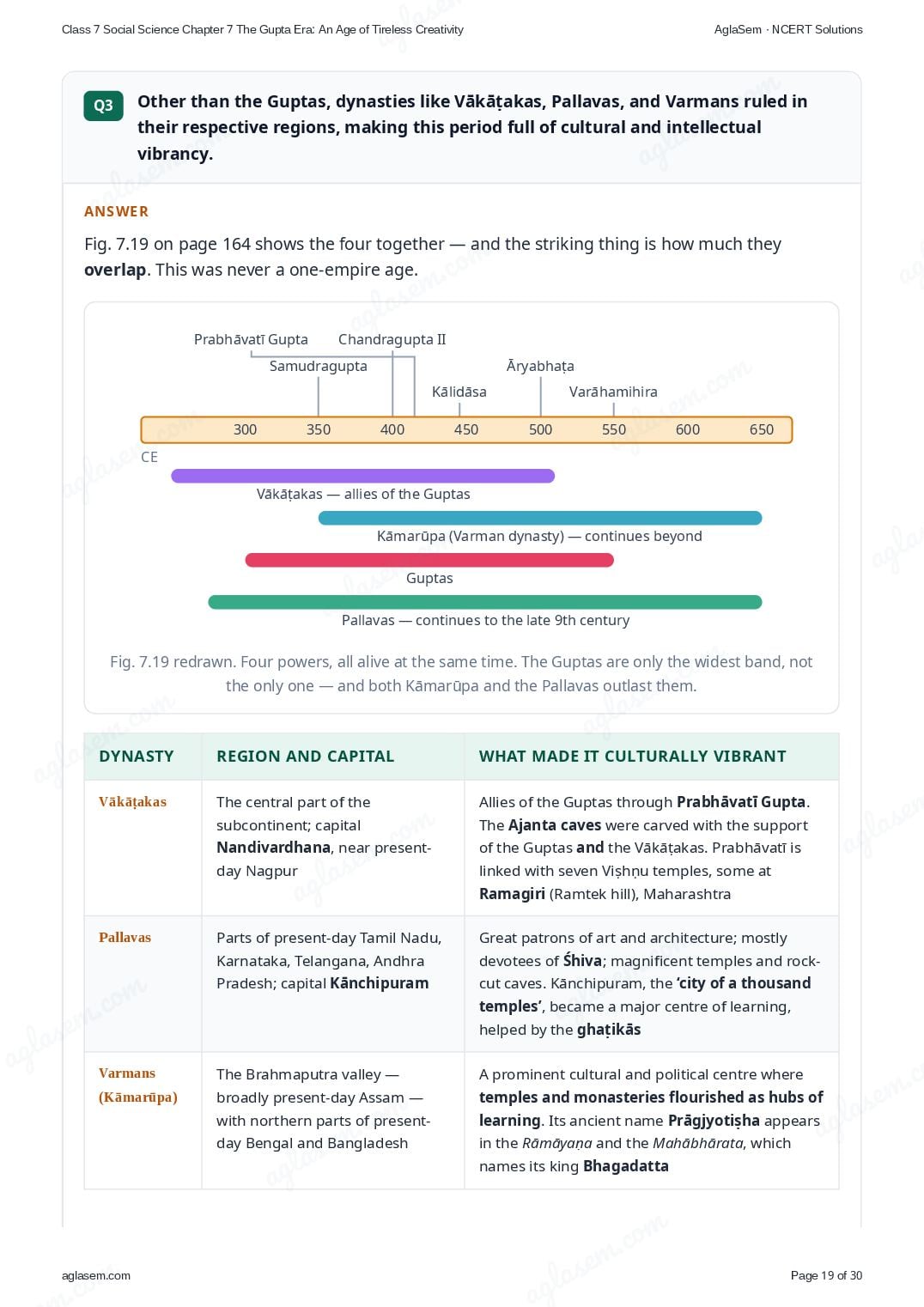
- Other than the Guptas, dynasties like Vākāṭakas, Pallavas, and Varmans ruled in their respective regions, making this period full of cultural and intellectual vibrancy.
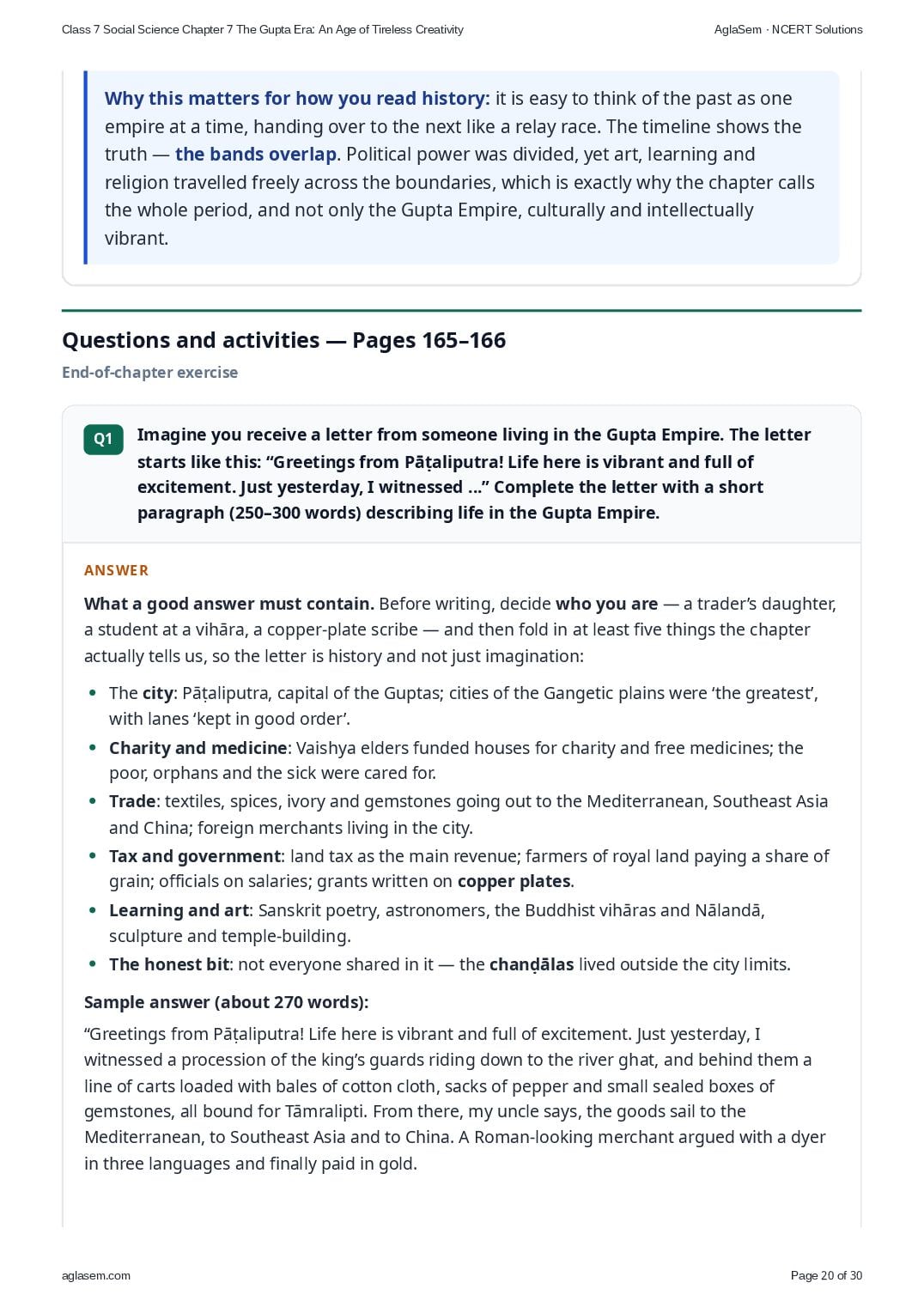
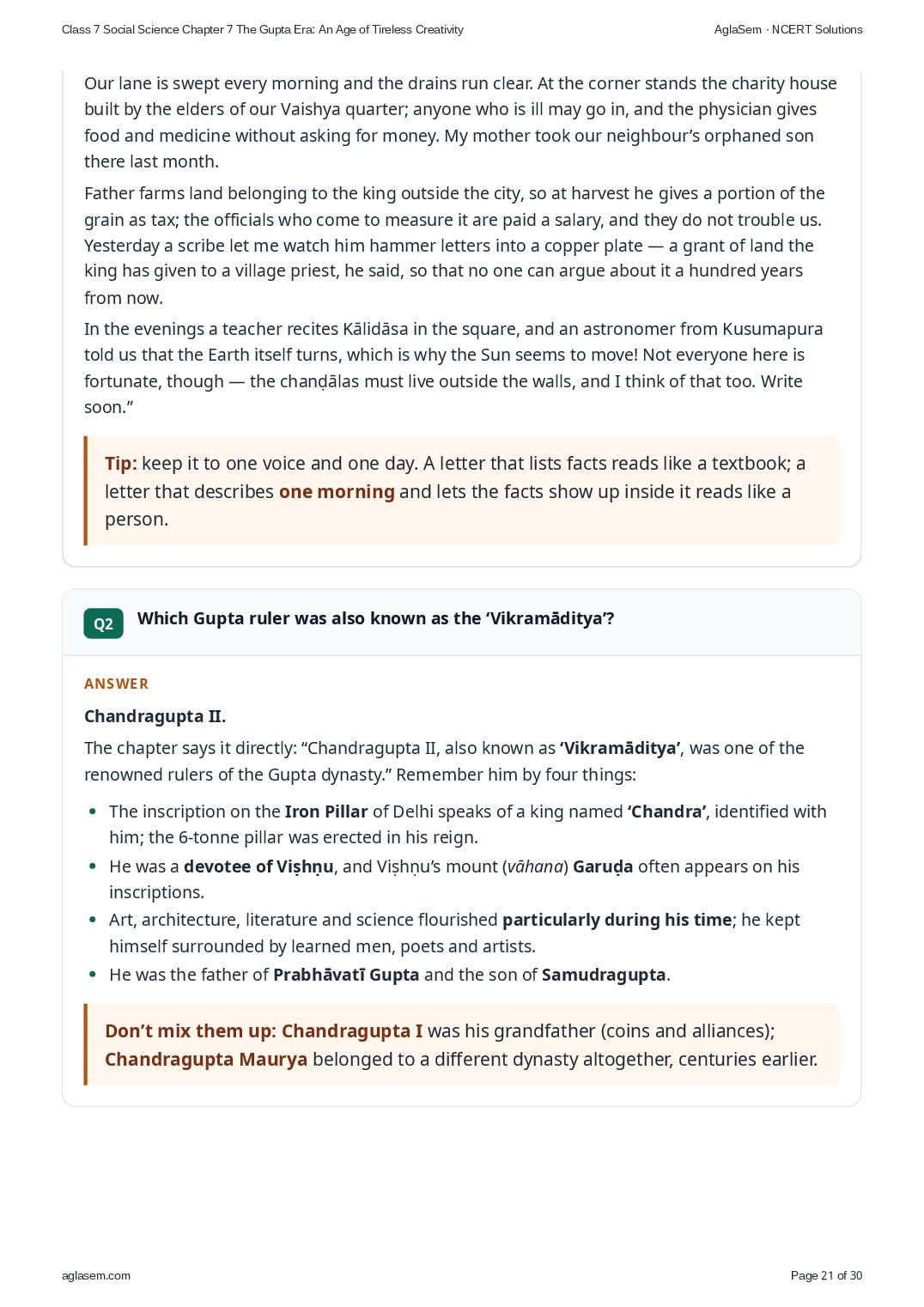
- Imagine you receive a letter from someone living in the Gupta Empire. The letter starts like this: “Greetings from Pāṭaliputra! Life here is vibrant and full of excitement. Just yesterday, I witnessed …” Complete the letter with a short paragraph (250–300 words) describing life in the Gupta Empire.
- Which Gupta ruler was also known as the ‘Vikramāditya’?
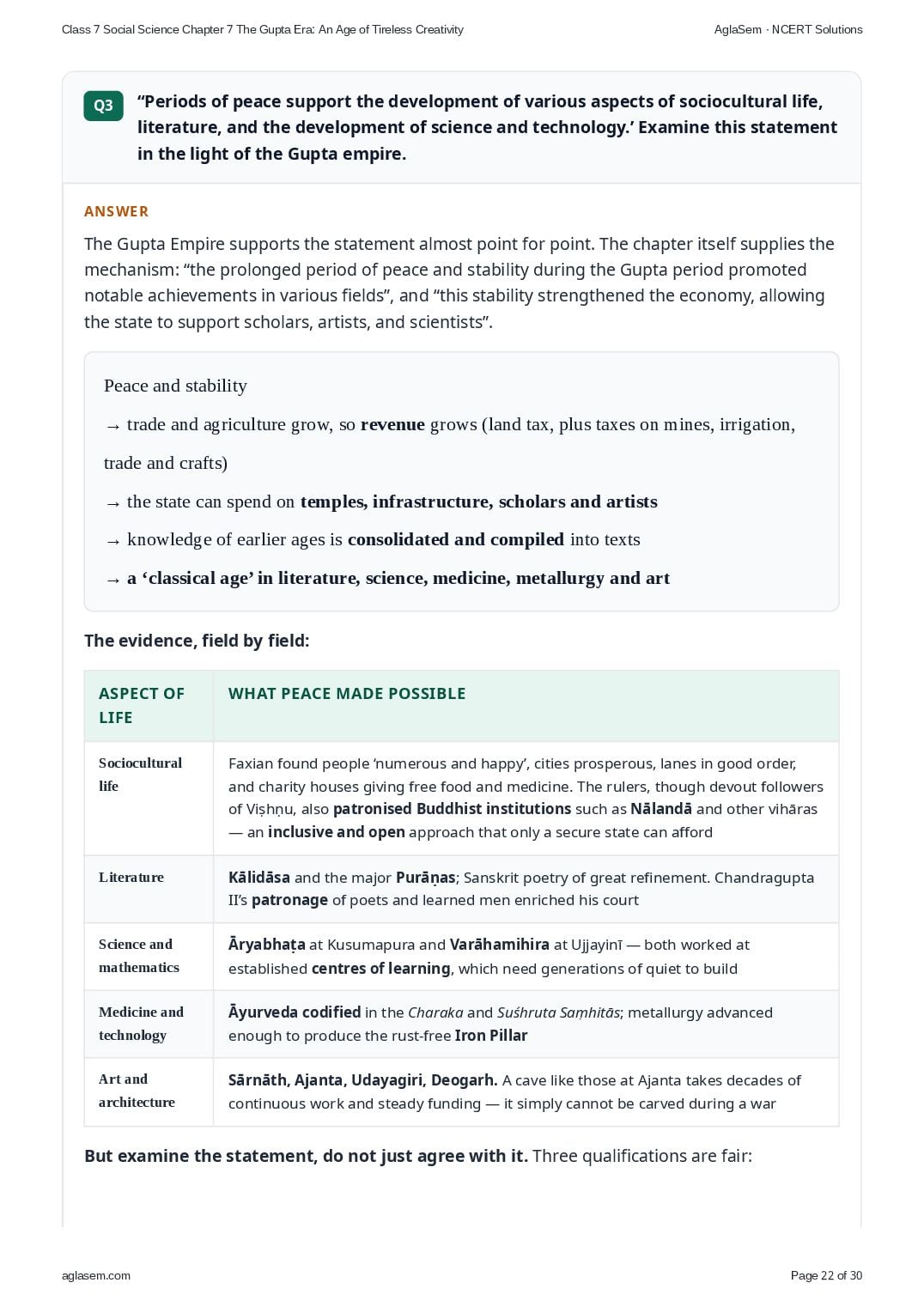
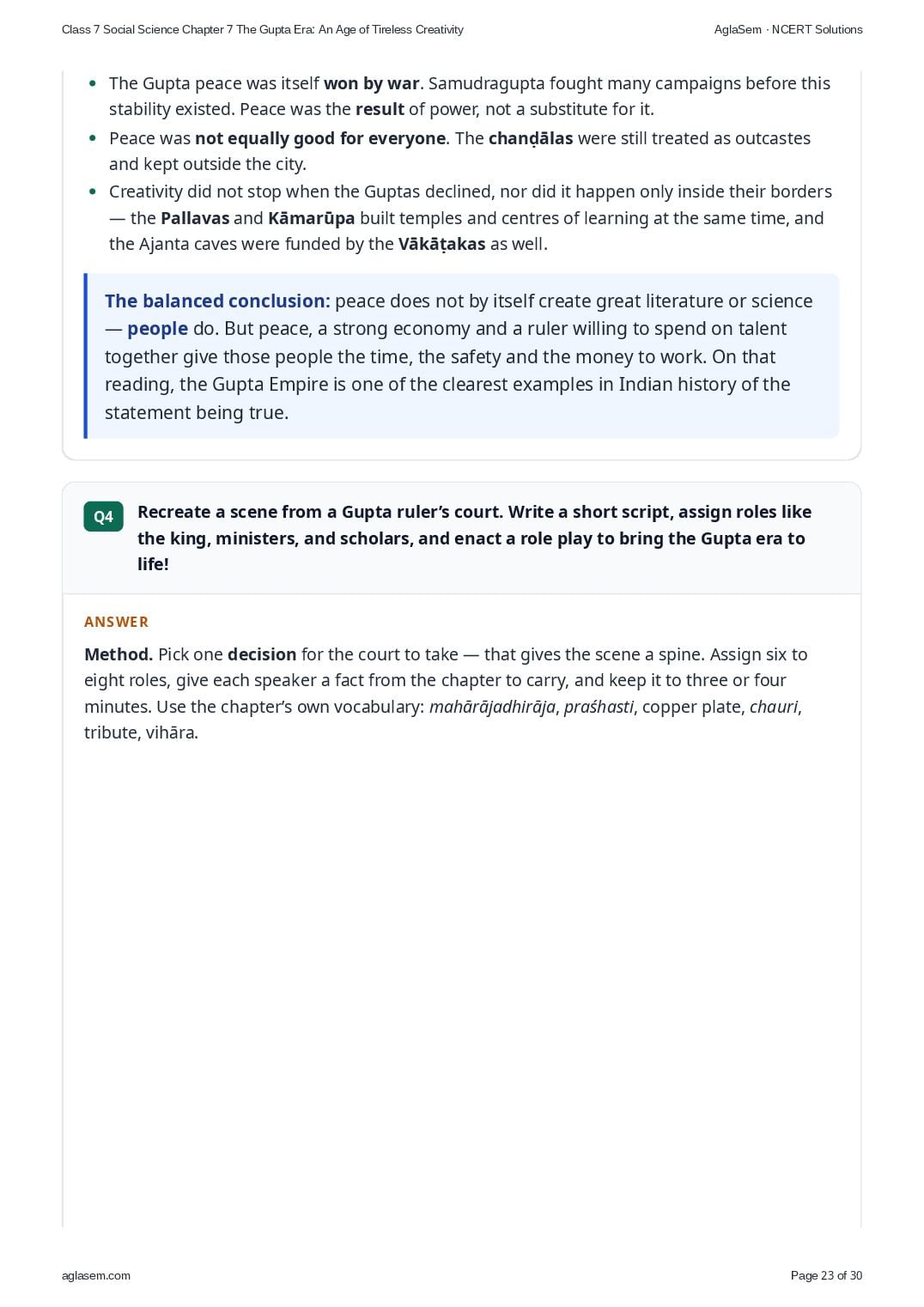
- “Periods of peace support the development of various aspects of sociocultural life, literature, and the development of science and technology.’ Examine this statement in the light of the Gupta empire.
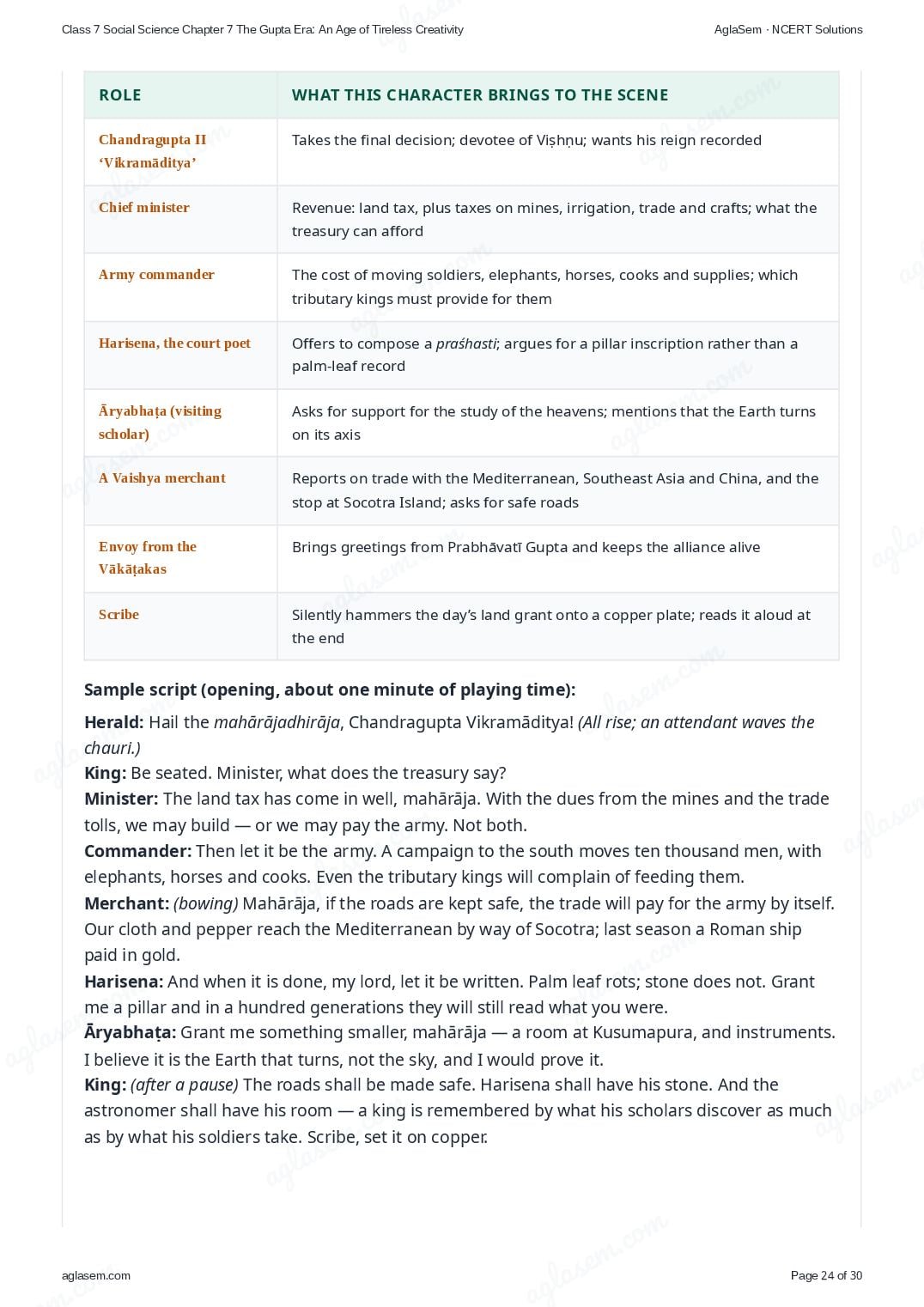
- Recreate a scene from a Gupta ruler’s court. Write a short script, assign roles like the king, ministers, and scholars, and enact a role play to bring the Gupta era to life!
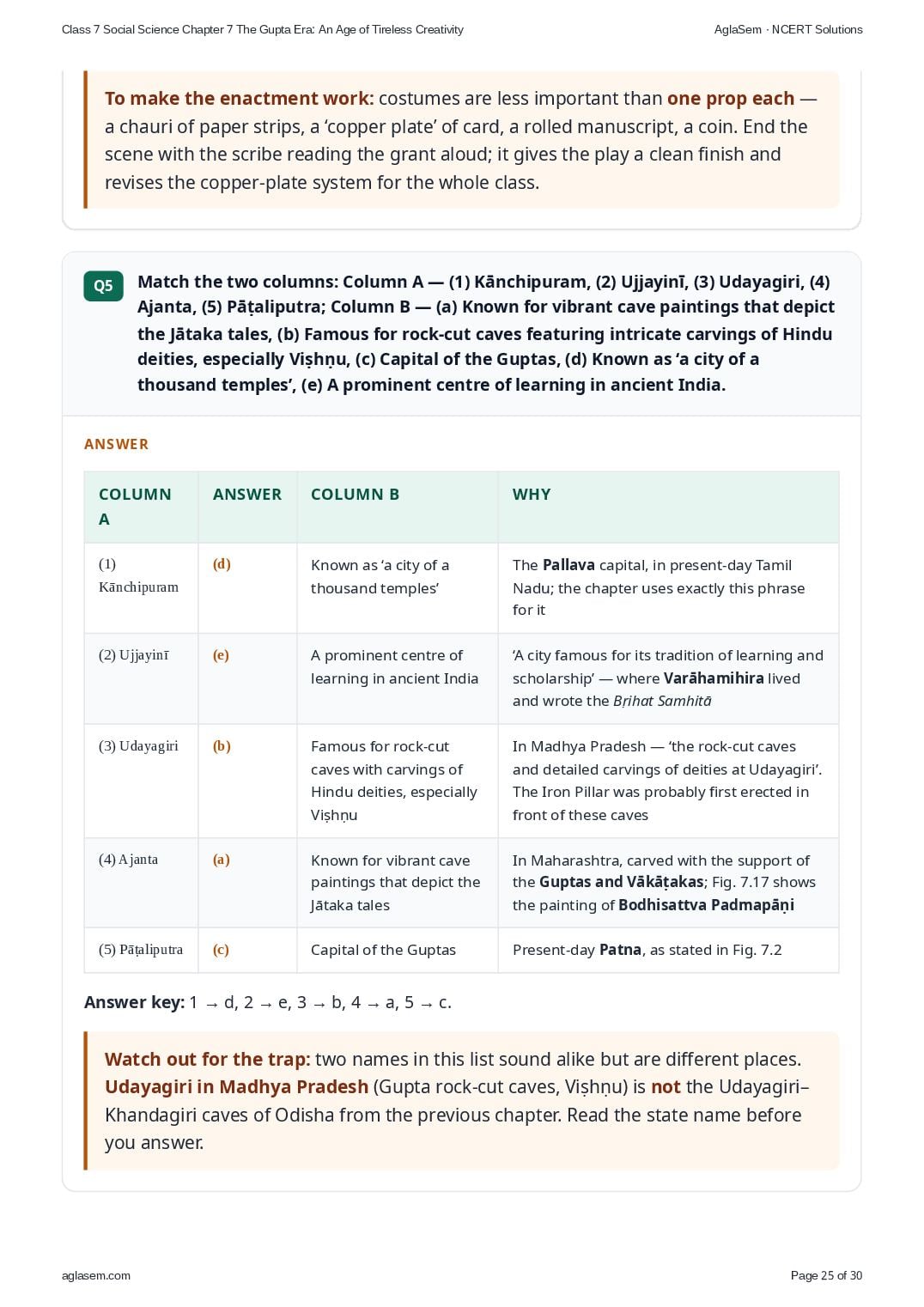
- Match the two columns: Column A — (1) Kānchipuram, (2) Ujjayinī, (3) Udayagiri, (4) Ajanta, (5) Pāṭaliputra; Column B — (a) Known for vibrant cave paintings that depict the Jātaka tales, (b) Famous for rock-cut caves featuring intricate carvings of Hindu deities, especially Viṣhṇu, (c) Capital of the Guptas, (d) Known as ‘a city of a thousand temples’, (e) A prominent centre of learning in ancient India.
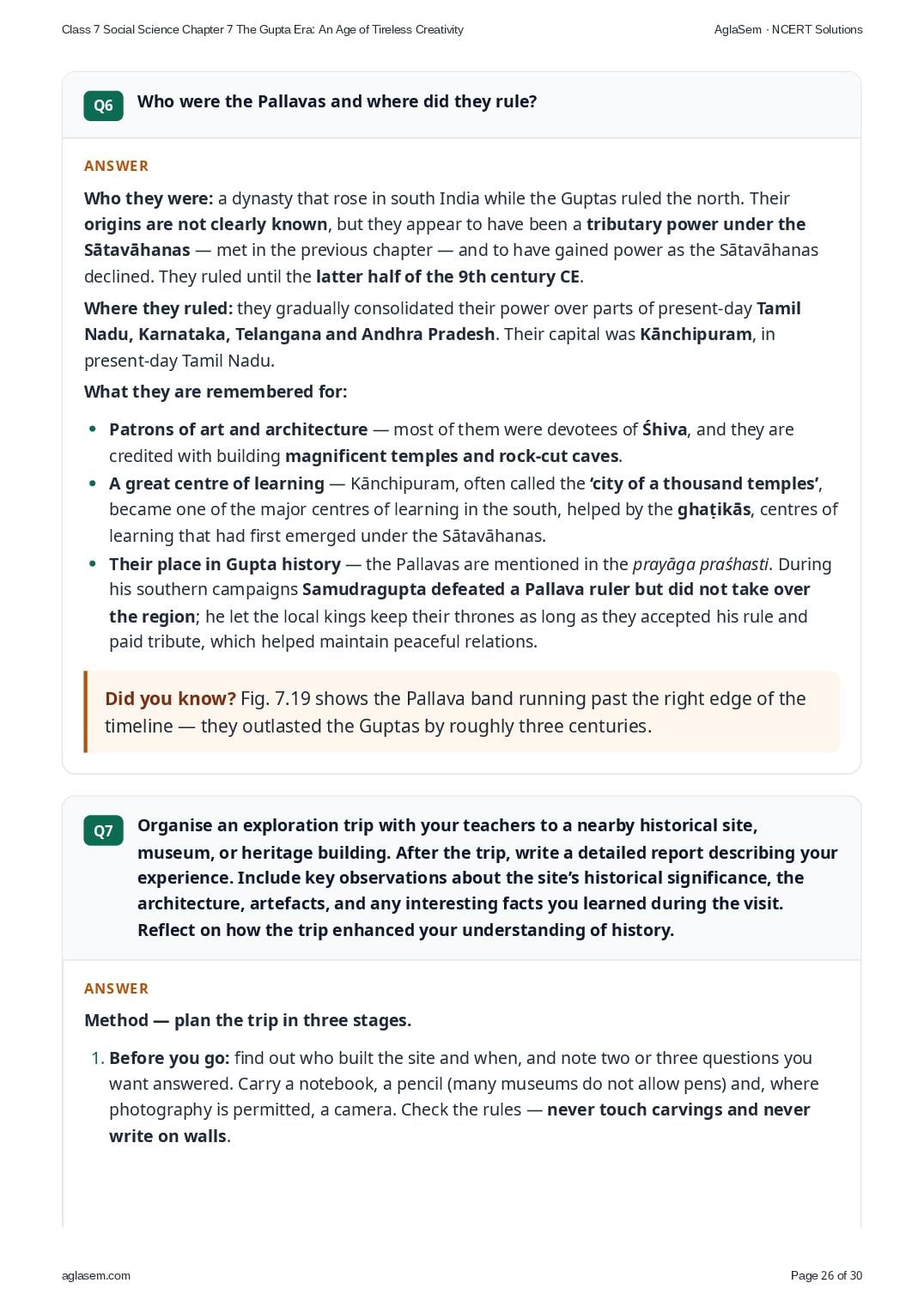
- Who were the Pallavas and where did they rule?
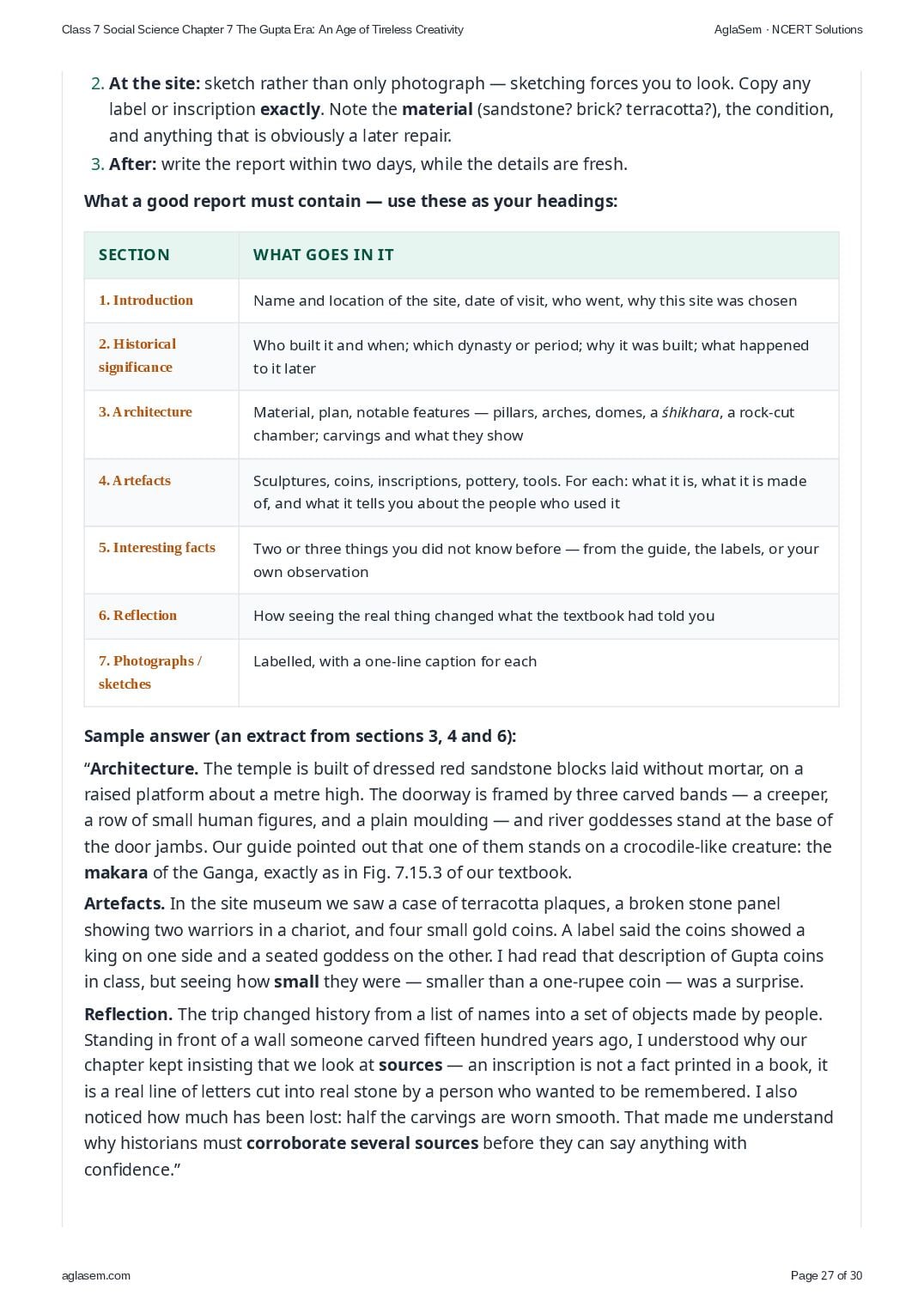
- Organise an exploration trip with your teachers to a nearby historical site, museum, or heritage building. After the trip, write a detailed report describing your experience. Include key observations about the site’s historical significance, the architecture, artefacts, and any interesting facts you learned during the visit. Reflect on how the trip enhanced your understanding of history.
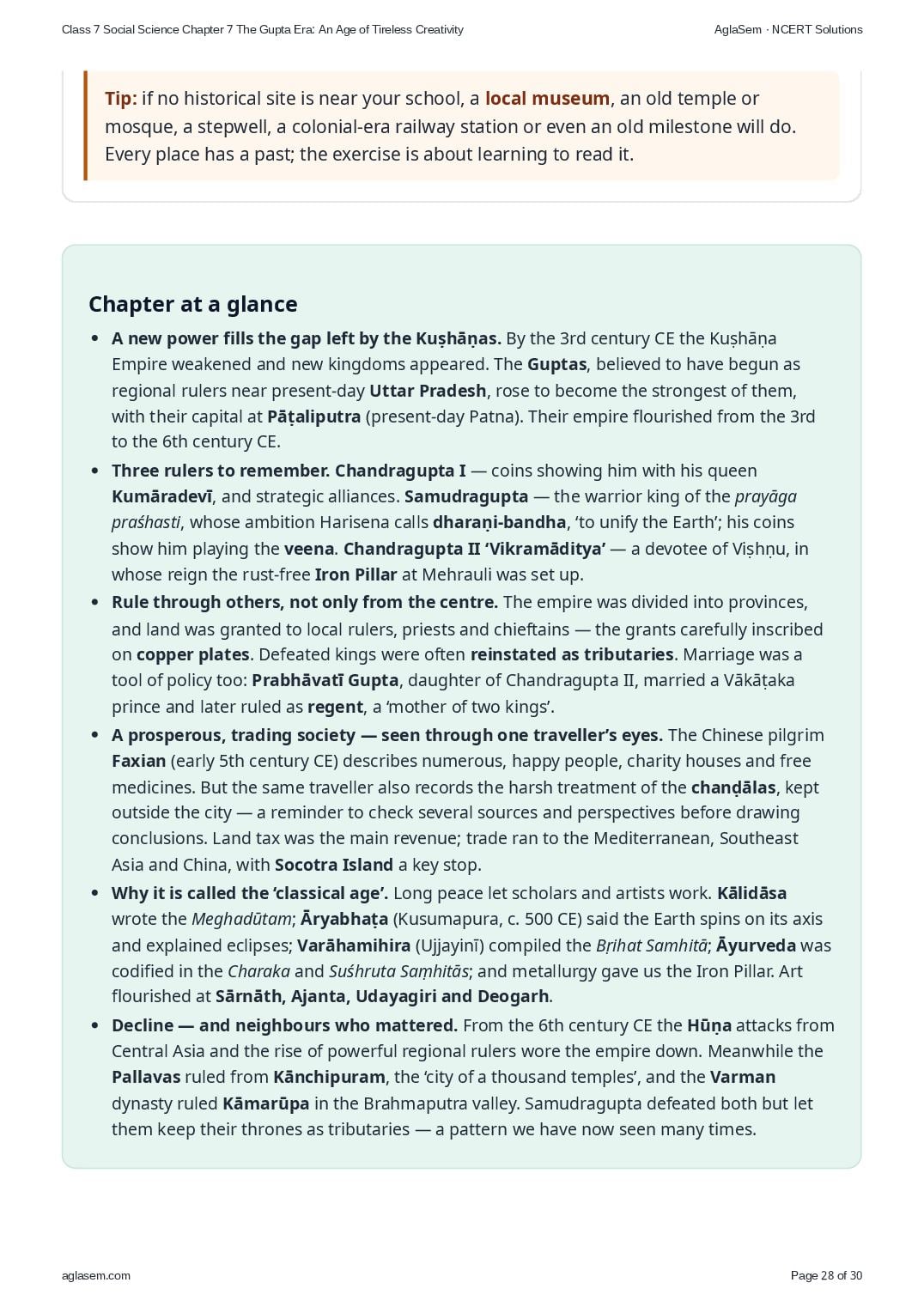
Chapter at a Glance
- A new power fills the gap left by the Kuṣhāṇas. By the 3rd century CE the Kuṣhāṇa Empire weakened and new kingdoms appeared. The Guptas , believed to have begun as regional rulers near present-day Uttar Pradesh , rose to become the strongest of them, with their capital at Pāṭaliputra (present-day Patna). Their empire flourished from the 3rd to the 6th century CE.
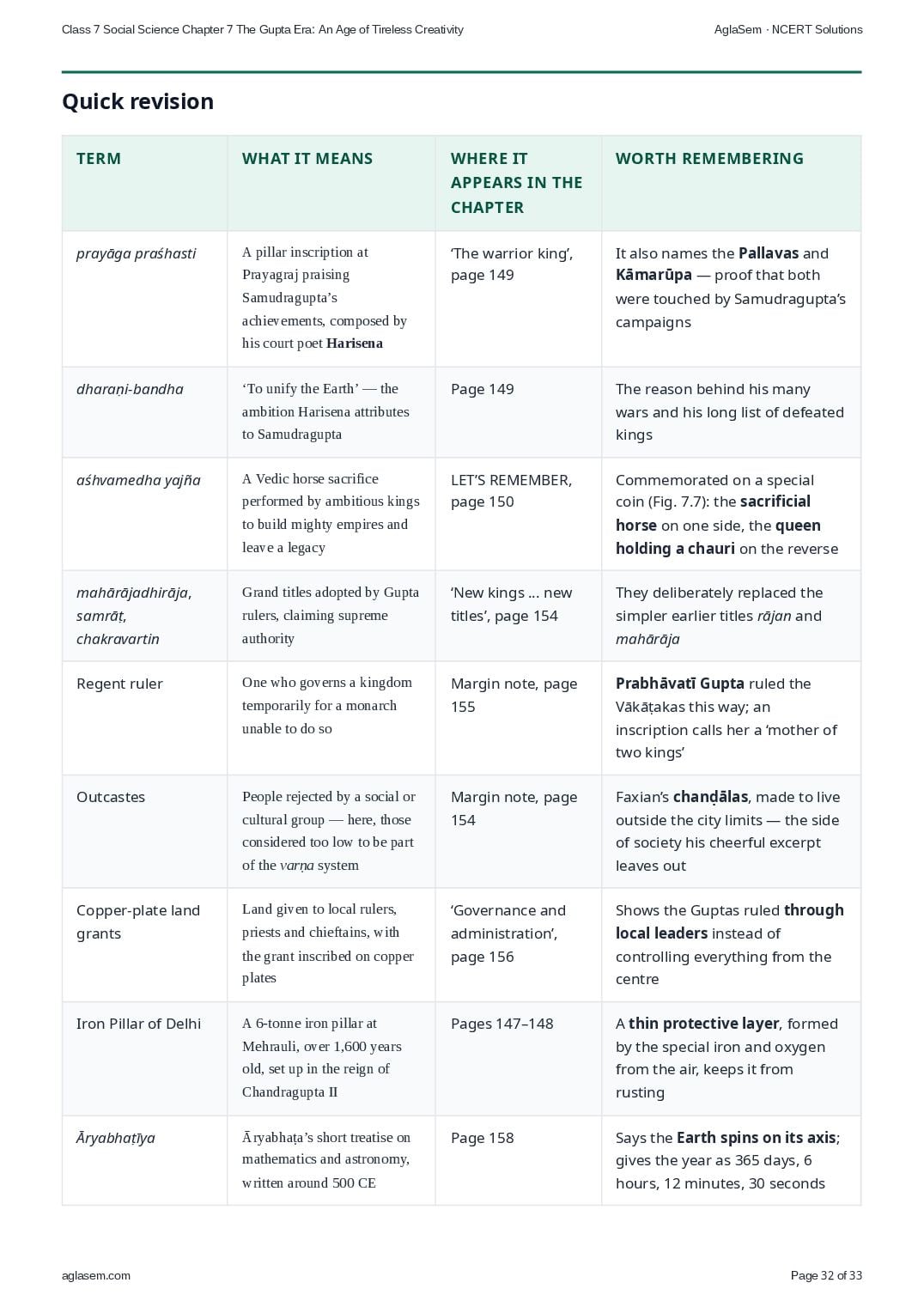
- Three rulers to remember. Chandragupta I — coins showing him with his queen Kumāradevī , and strategic alliances. Samudragupta — the warrior king of the prayāga praśhasti , whose ambition Harisena calls dharaṇi-bandha , ‘to unify the Earth’; his coins show him playing the veena . Chandragupta II ‘Vikramāditya’ — a devotee of Viṣhṇu, in whose reign the rust-free Iron Pillar at Mehrauli was set up.
- Rule through others, not only from the centre. The empire was divided into provinces, and land was granted to local rulers, priests and chieftains — the grants carefully inscribed on copper plates . Defeated kings were often reinstated as tributaries . Marriage was a tool of policy too: Prabhāvatī Gupta , daughter of Chandragupta II, married a Vākāṭaka prince and later ruled as regent , a ‘mother of two kings’.
- A prosperous, trading society — seen through one traveller’s eyes. The Chinese pilgrim Faxian (early 5th century CE) describes numerous, happy people, charity houses and free medicines. But the same traveller also records the harsh treatment of the chanḍālas , kept outside the city — a reminder to check several sources and perspectives before drawing conclusions. Land tax was the main revenue; trade ran to the Mediterranean, Southeast Asia and China, with Socotra Island a key stop.
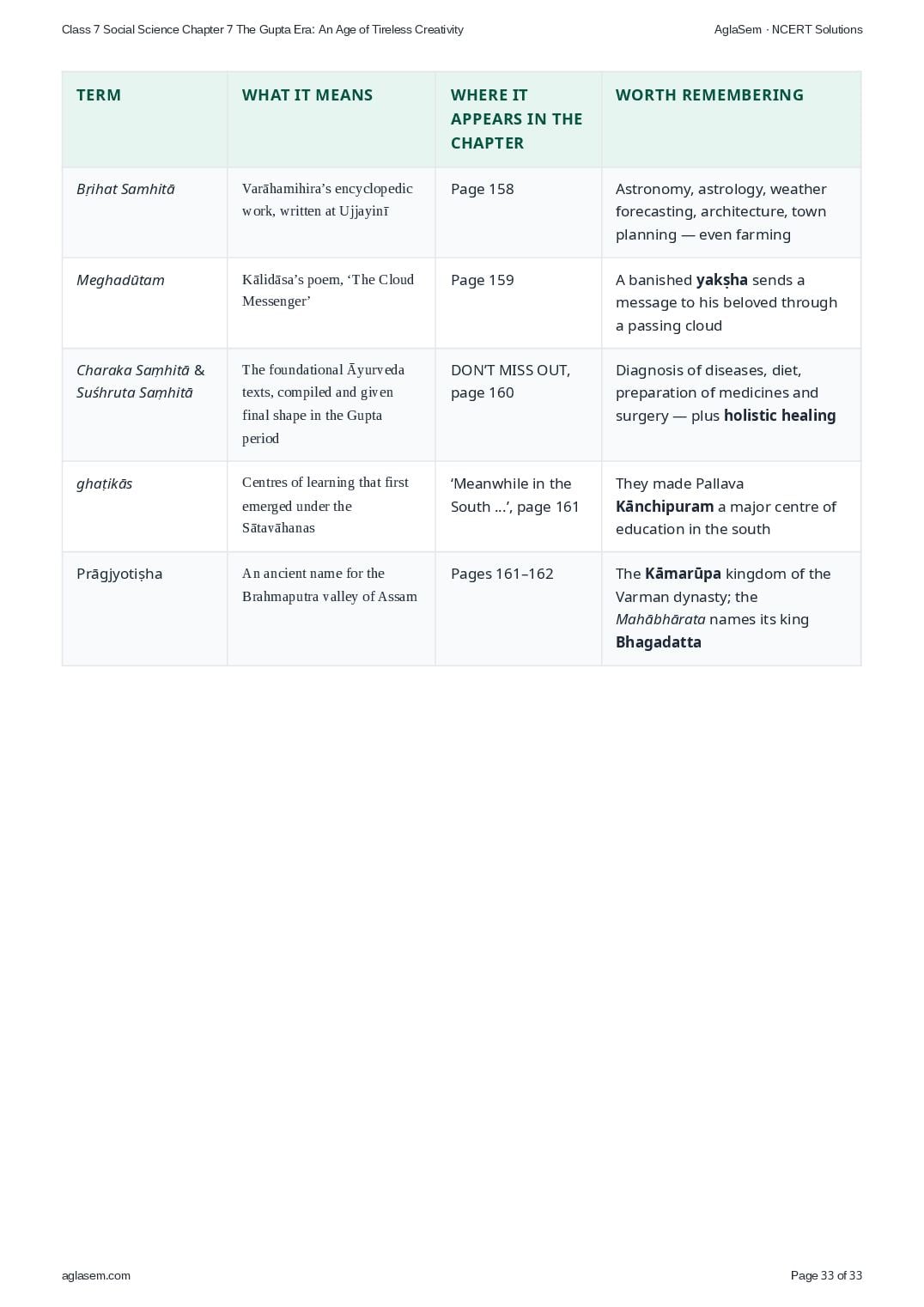
- Why it is called the ‘classical age’. Long peace let scholars and artists work. Kālidāsa wrote the Meghadūtam ; Āryabhaṭa (Kusumapura, c. 500 CE) said the Earth spins on its axis and explained eclipses; Varāhamihira (Ujjayinī) compiled the Bṛihat Samhitā ; Āyurveda was codified in the Charaka and Suśhruta Saṃhitās ; and metallurgy gave us the Iron Pillar. Art flourished at Sārnāth, Ajanta, Udayagiri and Deogarh .
- Decline — and neighbours who mattered. From the 6th century CE the Hūṇa attacks from Central Asia and the rise of powerful regional rulers wore the empire down. Meanwhile the Pallavas ruled from Kānchipuram , the ‘city of a thousand temples’, and the Varman dynasty ruled Kāmarūpa in the Brahmaputra valley. Samudragupta defeated both but let them keep their thrones as tributaries — a pattern we have now seen many times.
How to Download NCERT Solutions for Class 7 Social Science Chapter 7 PDF
Follow these simple steps to get the the Gupta Era an Age of Tireless Creativity questions-and-answers PDF from Exploring Society India and Beyond.
- Search NCERT Solutions for Class 7 Social Science Chapter 7 aglasem and open this page.
- Read the exercise questions with answers for the Gupta Era an Age of Tireless Creativity shown above.
- Click the Download PDF link to save the the Gupta Era an Age of Tireless Creativity solutions to your device.
NCERT Solutions for Class 7 Social Science – All Chapters
There are more chapters to study besides the Gupta Era an Age of Tireless Creativity in Social Science. Here are the NCERT Solutions for all chapters of Class 7 Social Science.
- Chapter 1 Geographical Diversity of India
- Chapter 2 Understanding the Weather
- Chapter 3 Climates of India
- Chapter 4 New Beginnings Cities and States
- Chapter 5 the Rise of Empires
- Chapter 6 the Age of Reorganisation
- Chapter 7 the Gupta Era an Age of Tireless Creativity
- Chapter 8 How the Land Becomes Sacred
- Chapter 9 From the Rulers to the Ruled Types of Governments
- Chapter 10 the Constitution of India an Introduction
- Chapter 11 From Barter to Money
- Chapter 12 Understanding Markets
NCERT Solutions for Class 7 – All Subjects
Just like Chapter 7 of Social Science, you can get the exercise questions with answers for every other subject of Class 7. Here are the NCERT Solutions for all subjects of Class 7.
NCERT Solutions for Class 7 Social Science Chapter 7 – An Overview
The key highlights of this study material are as follows.
| Aspects | Details |
|---|---|
| Class | Class 7 |
| Subject | Social Science |
| Chapter Number | Chapter 7 |
| Chapter Name | the Gupta Era an Age of Tireless Creativity |
| Book Name | Exploring Society India and Beyond |
| Book By | NCERT (National Council of Educational Research and Training) |
| Educational Resource Here | NCERT Solutions of Class 7 Social Science Chapter 7 for all exercises |
| More Questions Answers of This Subject | NCERT Solutions for Class 7 Social Science |
| Download Book Chapter | NCERT Book Class 7 Social Science |
| All Questions Answers For This Class | NCERT Solutions for Class 7 |
| Complete Solutions | NCERT Solutions |
NCERT Solutions for Class 7 Social Science Chapter 7 the Gupta Era an Age of Tireless Creativity – FAQs
What are the NCERT Solutions for Class 7 Social Science Chapter 7 the Gupta Era an Age of Tireless Creativity?
They are the complete, step-by-step answers to all the exercise and in-text questions of Chapter 7 the Gupta Era an Age of Tireless Creativity from the NCERT Class 7 Social Science textbook Exploring Society India and Beyond, written by experts as per the latest NCERT syllabus.
How can I download the Class 7 Social Science Chapter 7 solutions PDF for free?
Open this page on aglasem, read the the Gupta Era an Age of Tireless Creativity questions with answers, and click the “Download Solutions PDF” link. The Class 7 Social Science Chapter 7 NCERT Solutions PDF is completely free to download.
Are these NCERT Solutions as per the latest 2026-27 syllabus?
Yes. The NCERT Solutions for Class 7 Social Science Chapter 7 are based on the latest NCERT textbook Exploring Society India and Beyond and the current 2026-27 CBSE syllabus, so the questions and answers match what you study in class.
Where can I get NCERT Solutions for the other chapters of Class 7 Social Science?
You can find the answers to every chapter on the NCERT Solutions for Class 7 Social Science page, and solutions for every subject on the NCERT Solutions for Class 7 page.
How do NCERT Solutions help in exam preparation?
They show the correct method to solve each question, help you write answers the way they are expected in exams, let you check and correct your own work, and save revision time — which together improve your marks in Class 7 Social Science.
If you have any queries on NCERT Solutions for Class 7 Social Science Chapter 7 the Gupta Era an Age of Tireless Creativity, then please ask in the comments below.
