Download The Gupta Era: An Age of Tireless Creativity – NCERT Class 7 Social Science Chapter 7 PDF from the new NCERT Class 7 Social Science book Exploring Society: India and Beyond (2026-27). Read the chapter online or download the free PDF. A new power fills the gap left by the Kuṣhāṇas. By the 3rd century CE the Kuṣhāṇa Empire weakened and new kingdoms appeared. The Guptas, believed to have begun as regional rulers near present-day Uttar Pradesh, rose to become the strongest of them,…
The Gupta Era: An Age of Tireless Creativity PDF – Chapter 7 of Exploring Society: India and Beyond (Part I)
Read the chapter online or download the PDF.
| Chapter | Download | |
|---|---|---|
| Chapter 7 PDF | The Gupta Era: An Age of Tireless Creativity | View PDF |
| Full book | NCERT Class 7 Social Science – Exploring Society: India and Beyond | View Book |
Read Online
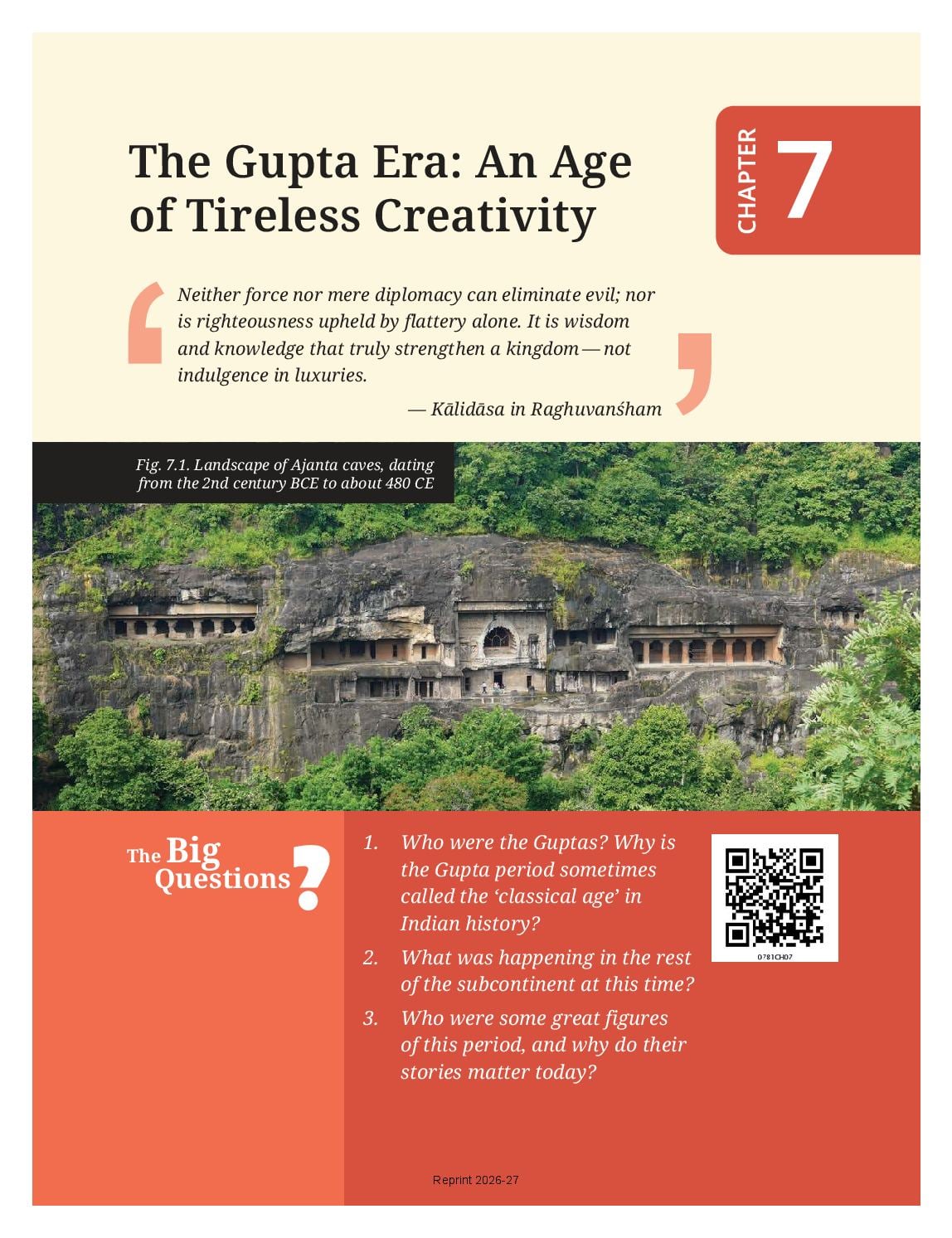
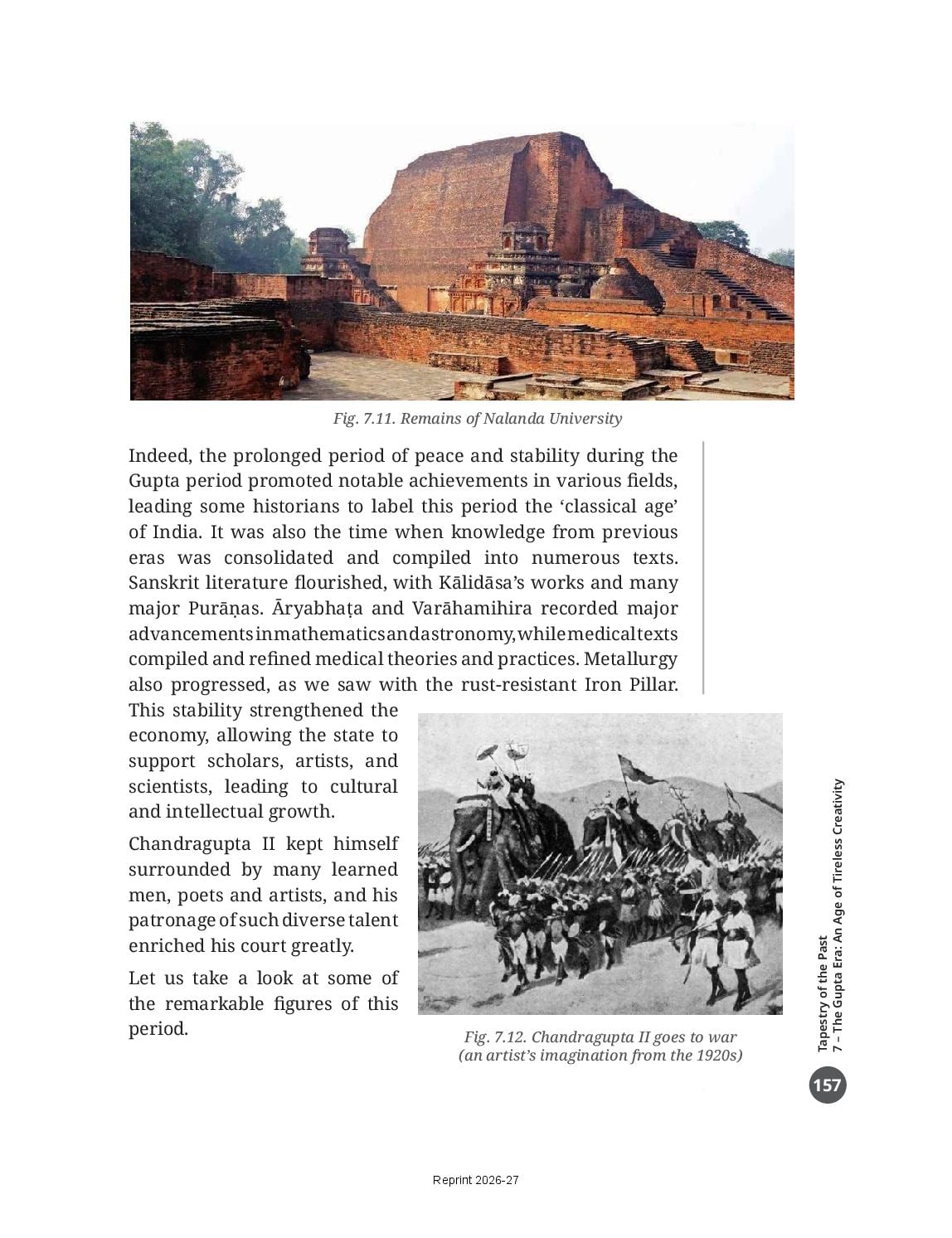
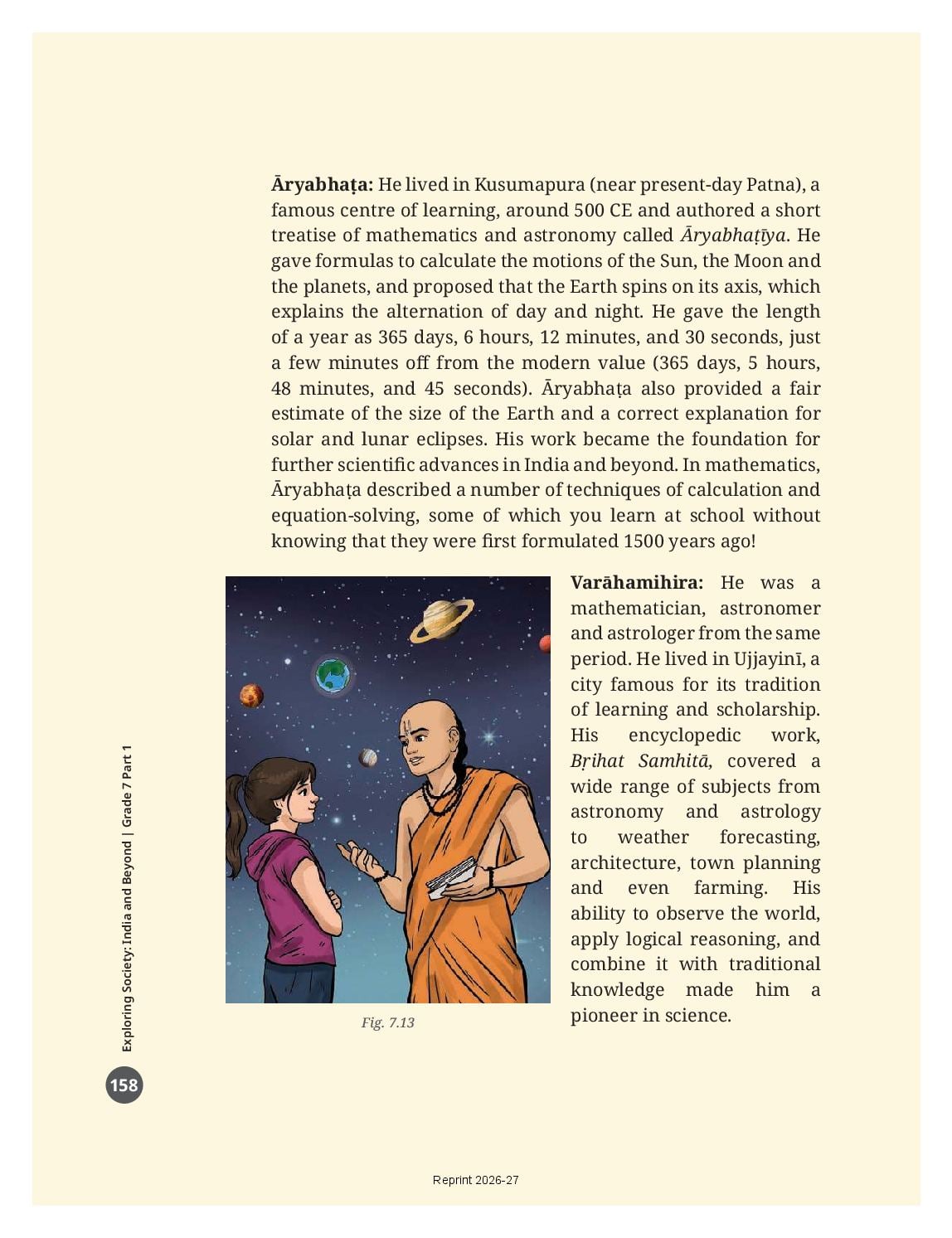
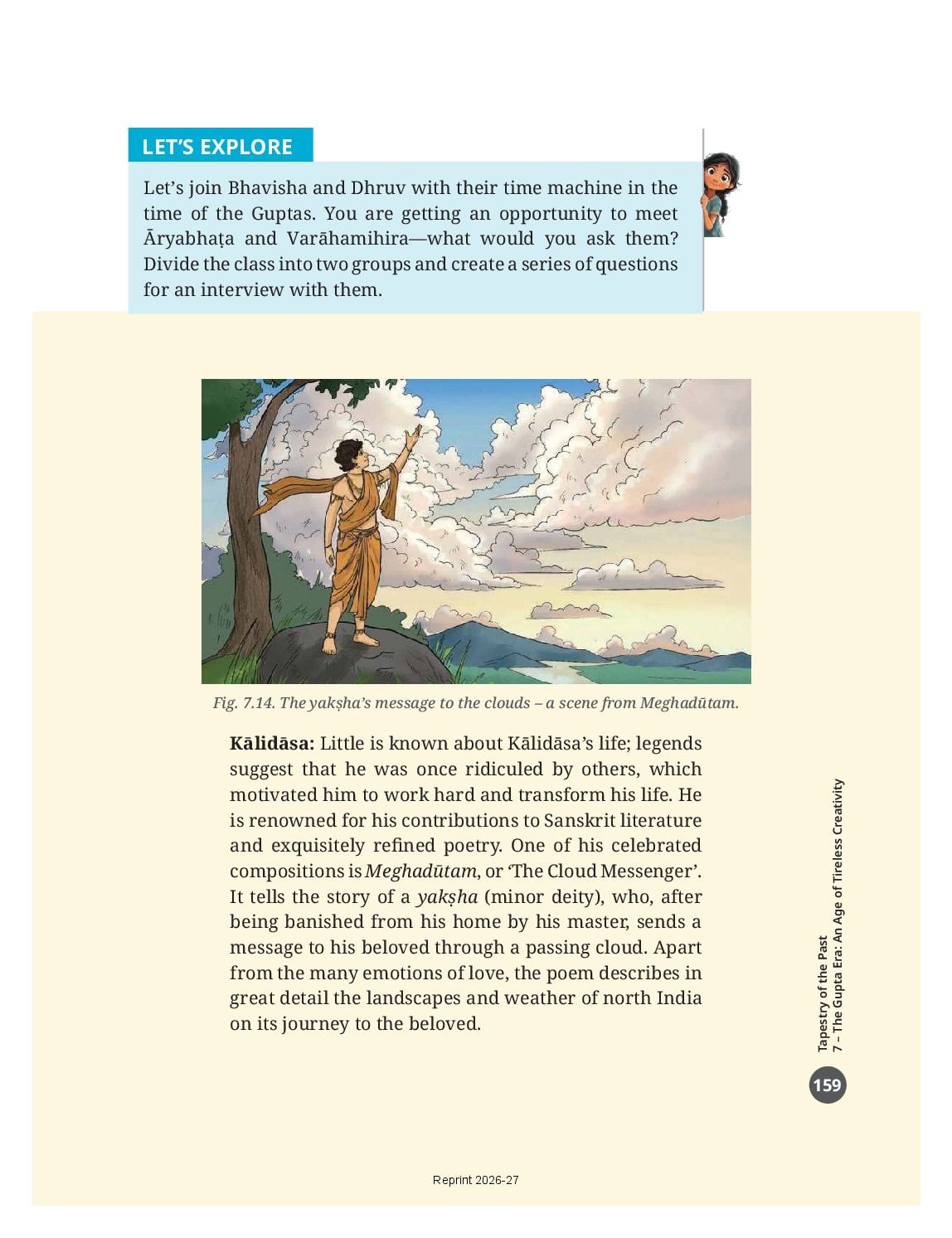
What Is in The Gupta Era: An Age of Tireless Creativity? (Class 7 Social Science Chapter 7)
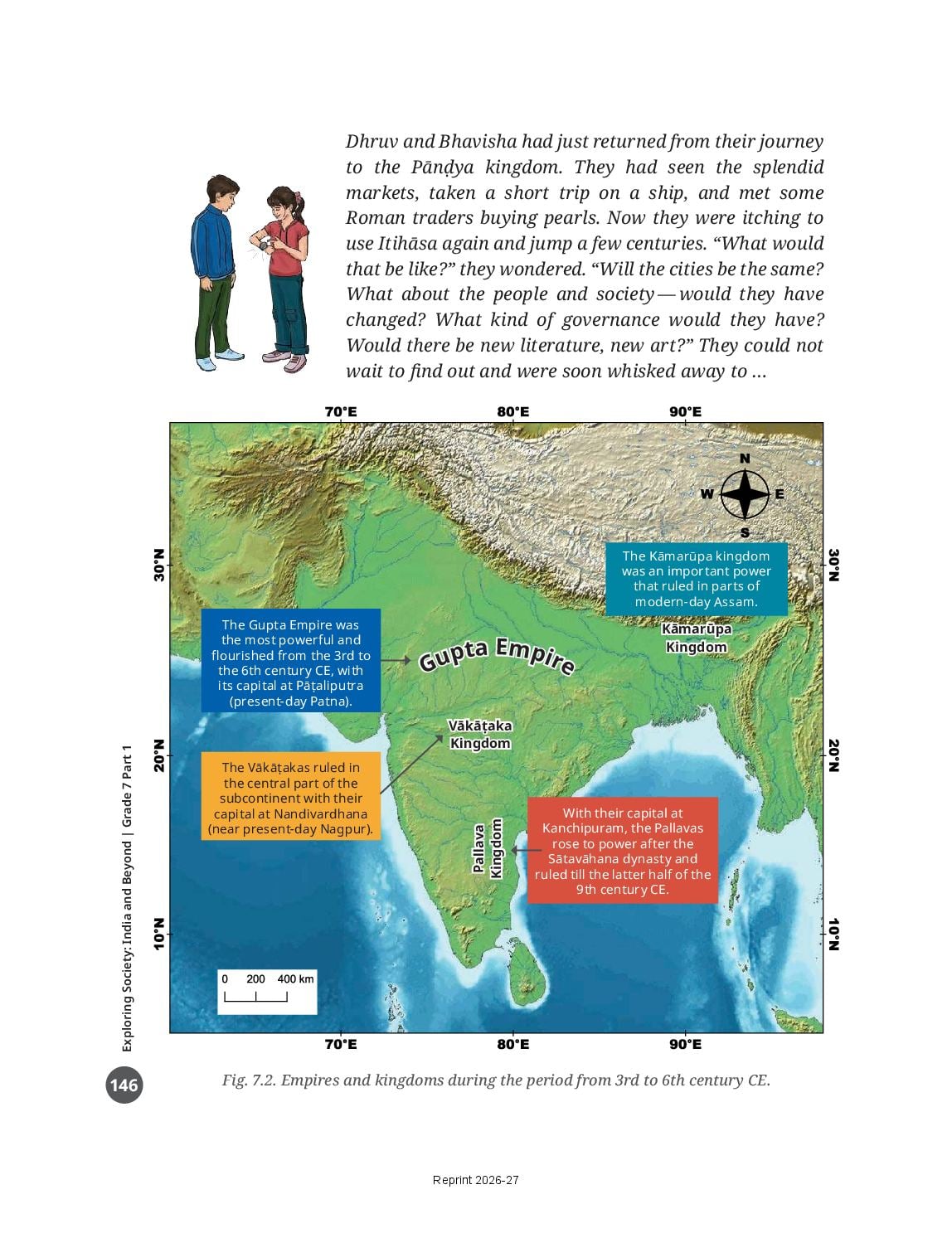
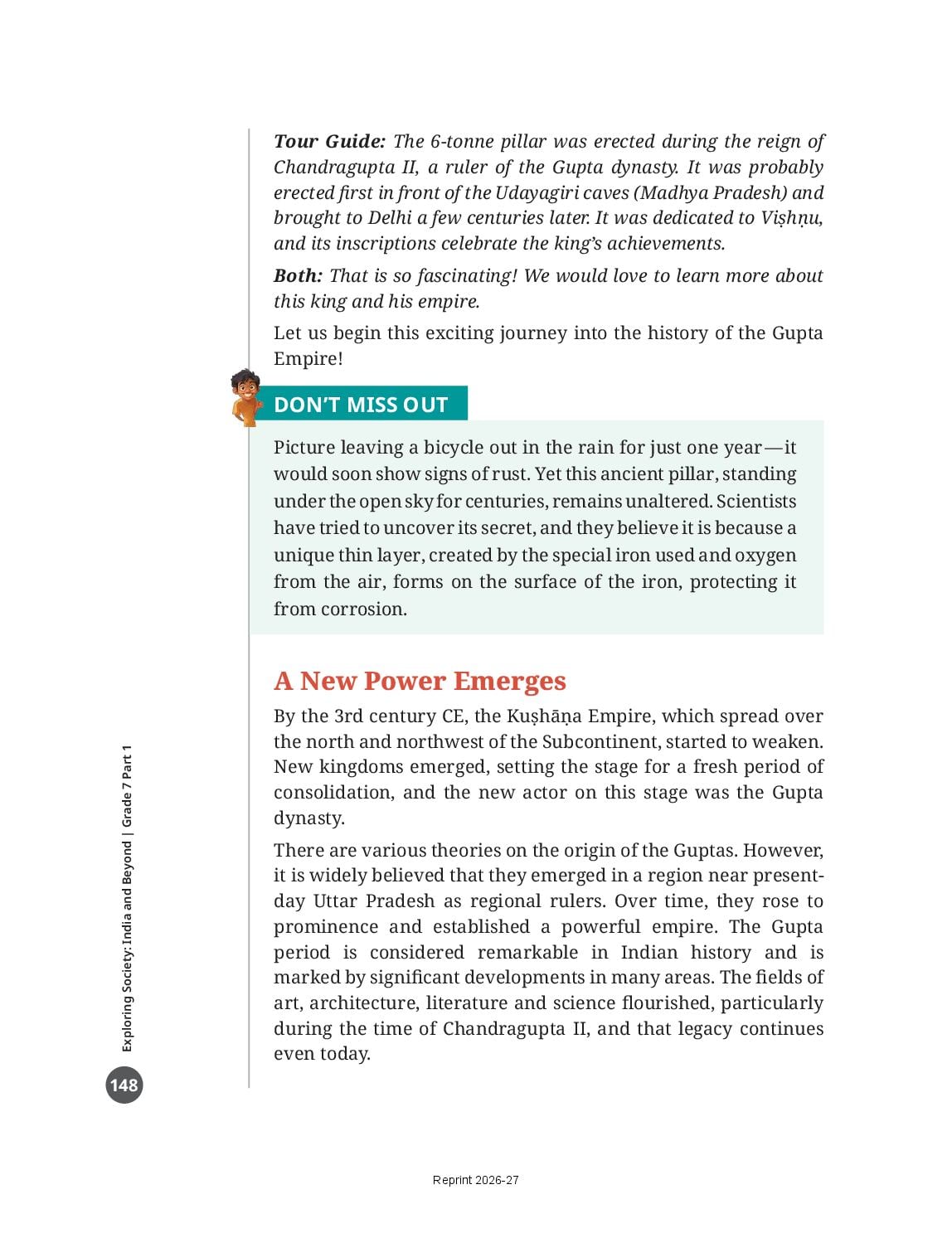
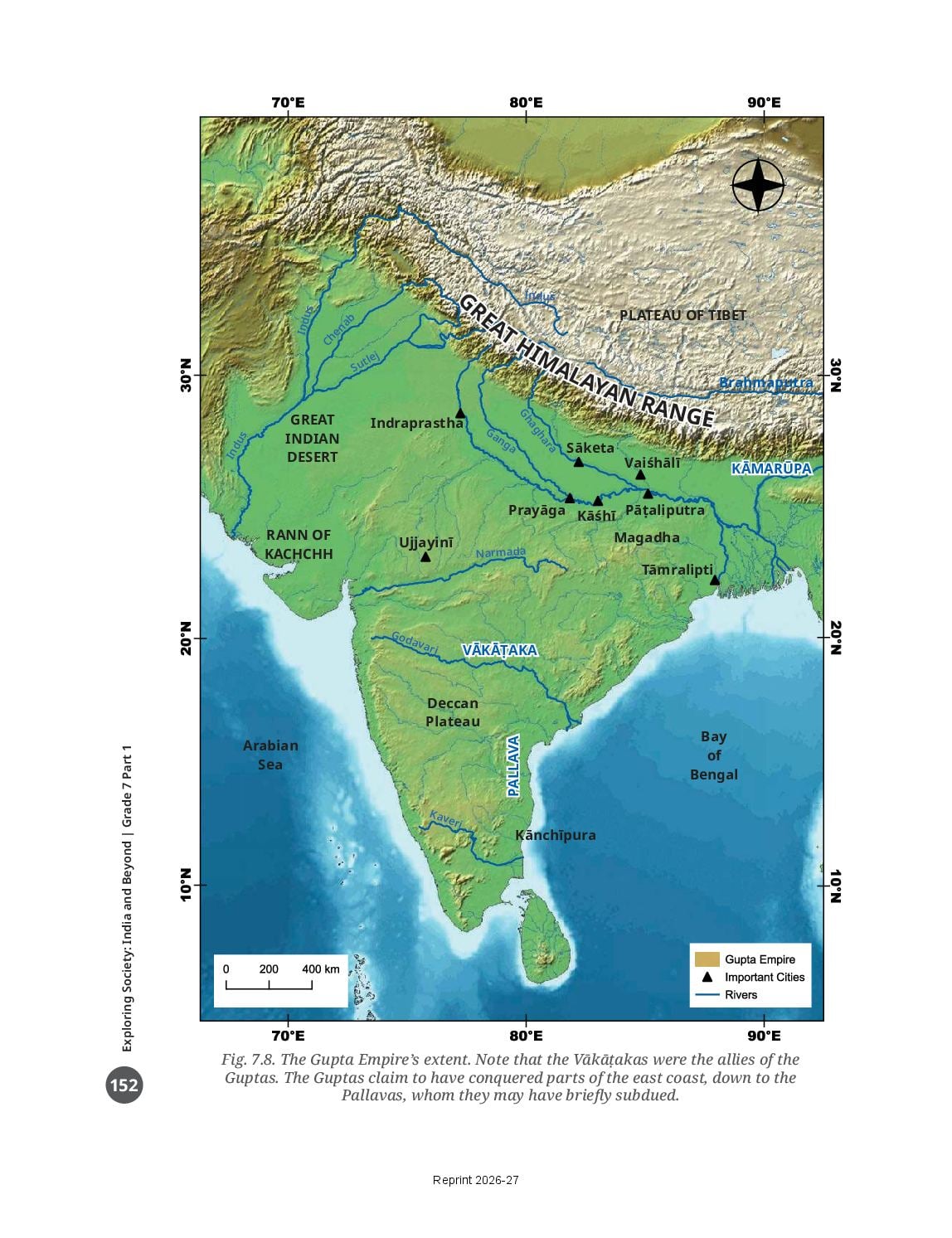
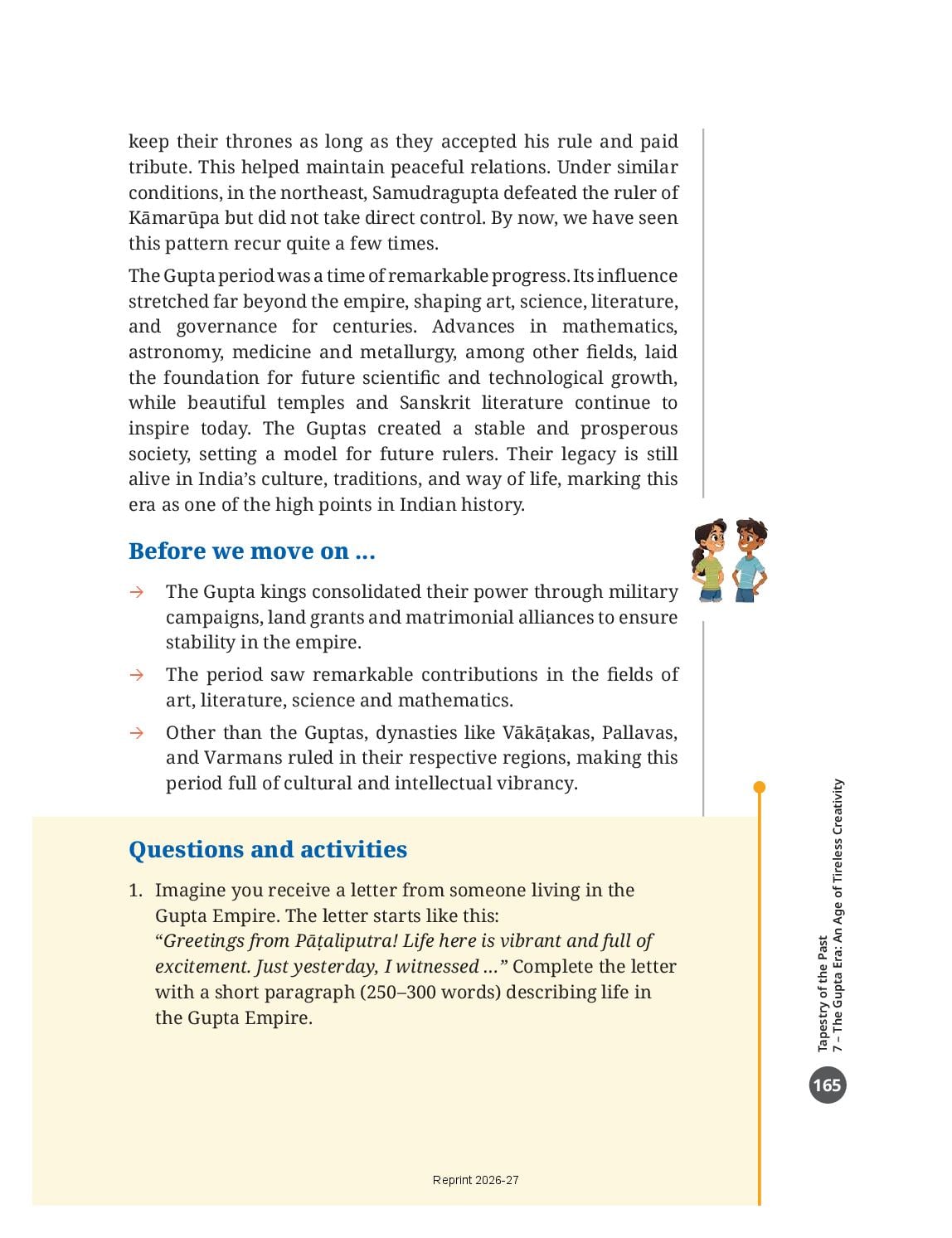
- A new power fills the gap left by the Kuṣhāṇas. By the 3rd century CE the Kuṣhāṇa Empire weakened and new kingdoms appeared. The Guptas, believed to have begun as regional rulers near present-day Uttar Pradesh, rose to become the strongest of them, with their capital at Pāṭaliputra (present-day Patna). Their empire flourished from the 3rd to the 6th century CE.
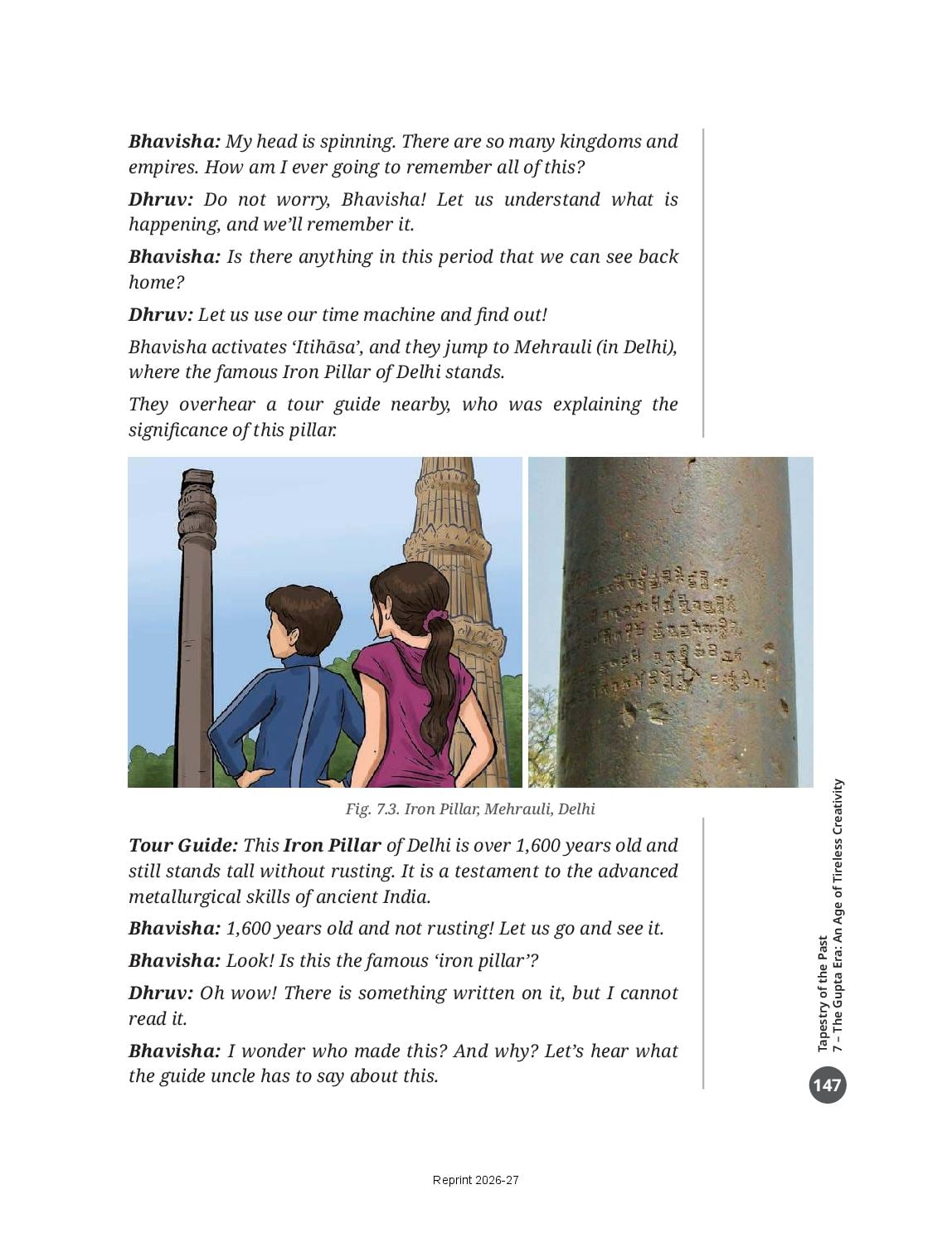
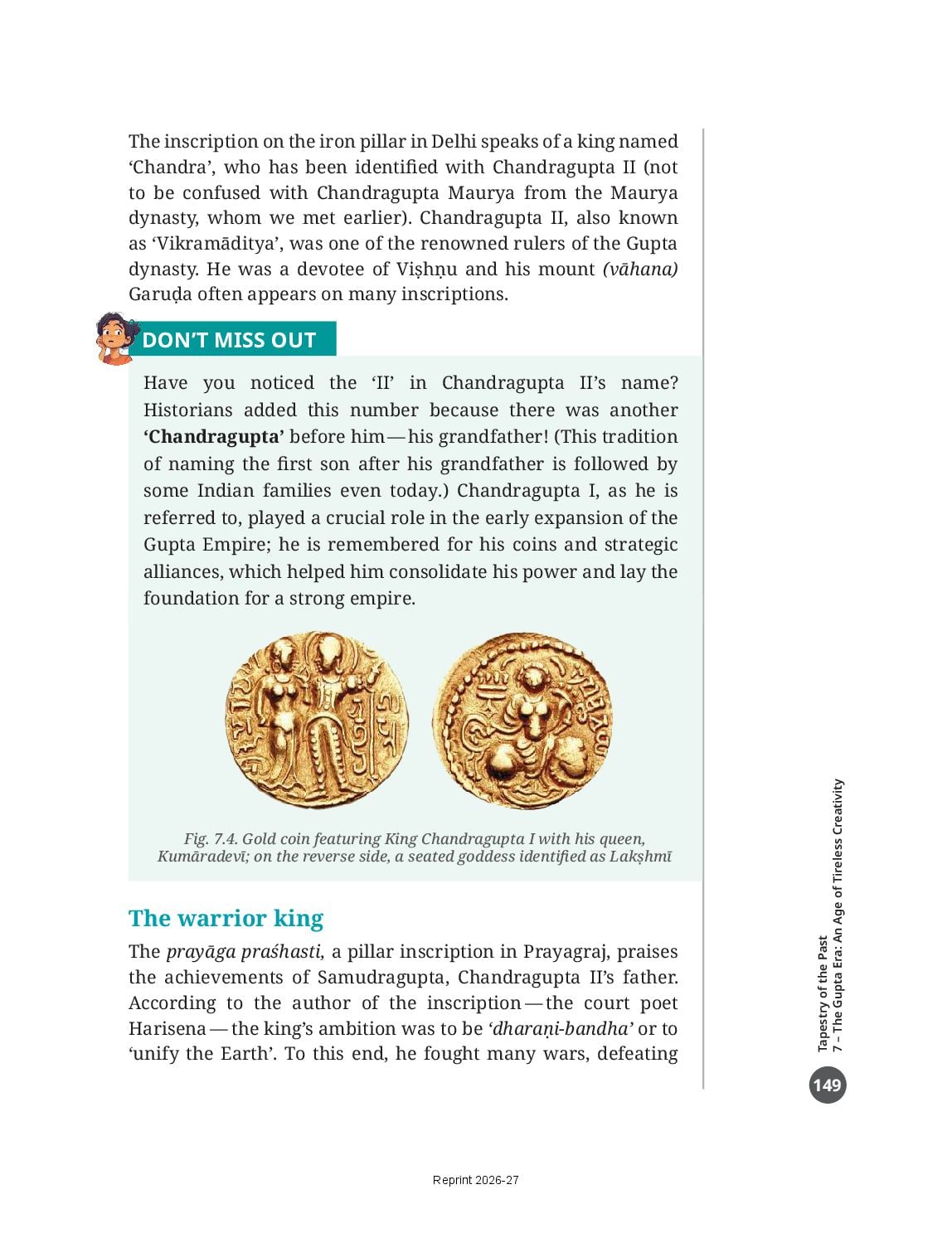
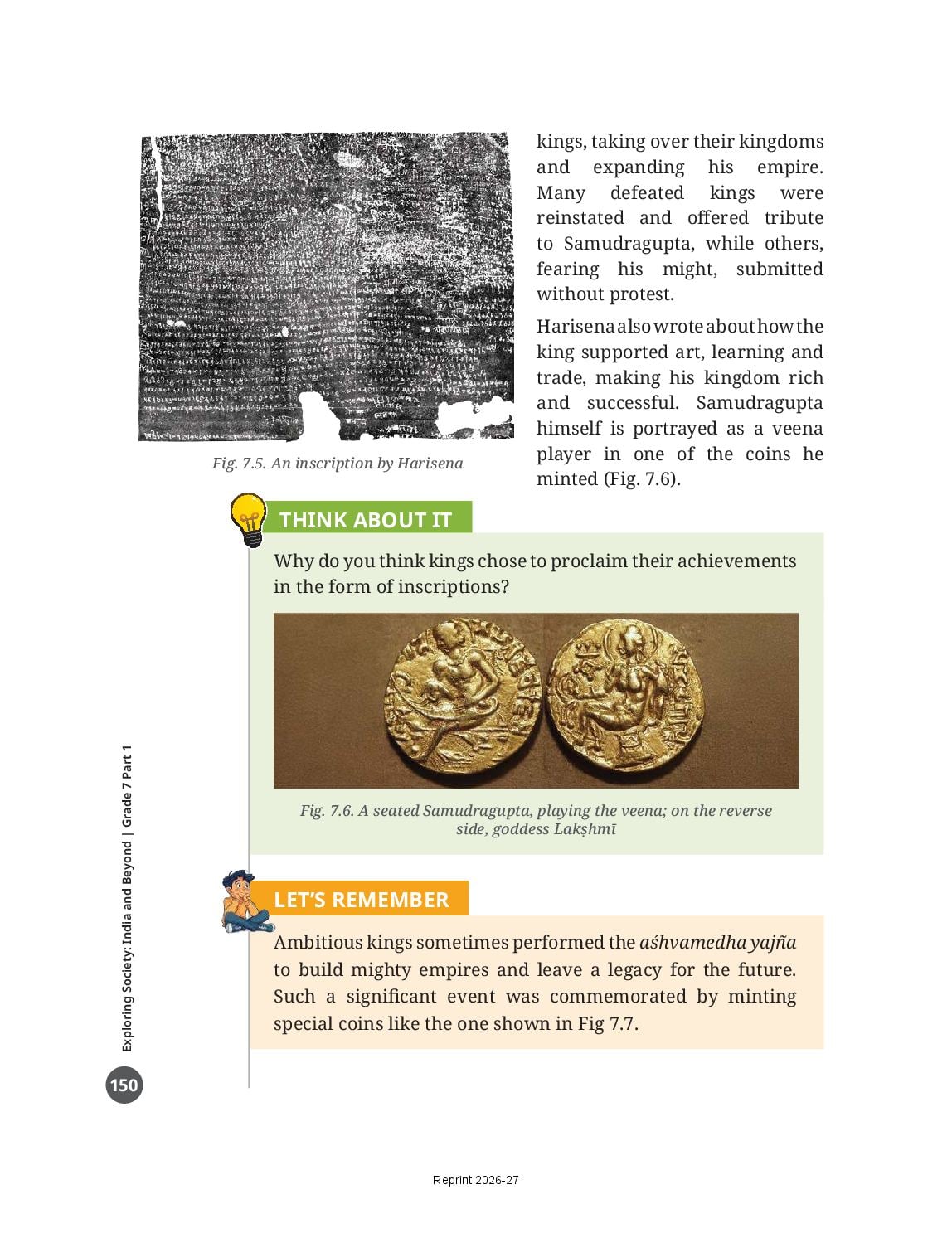
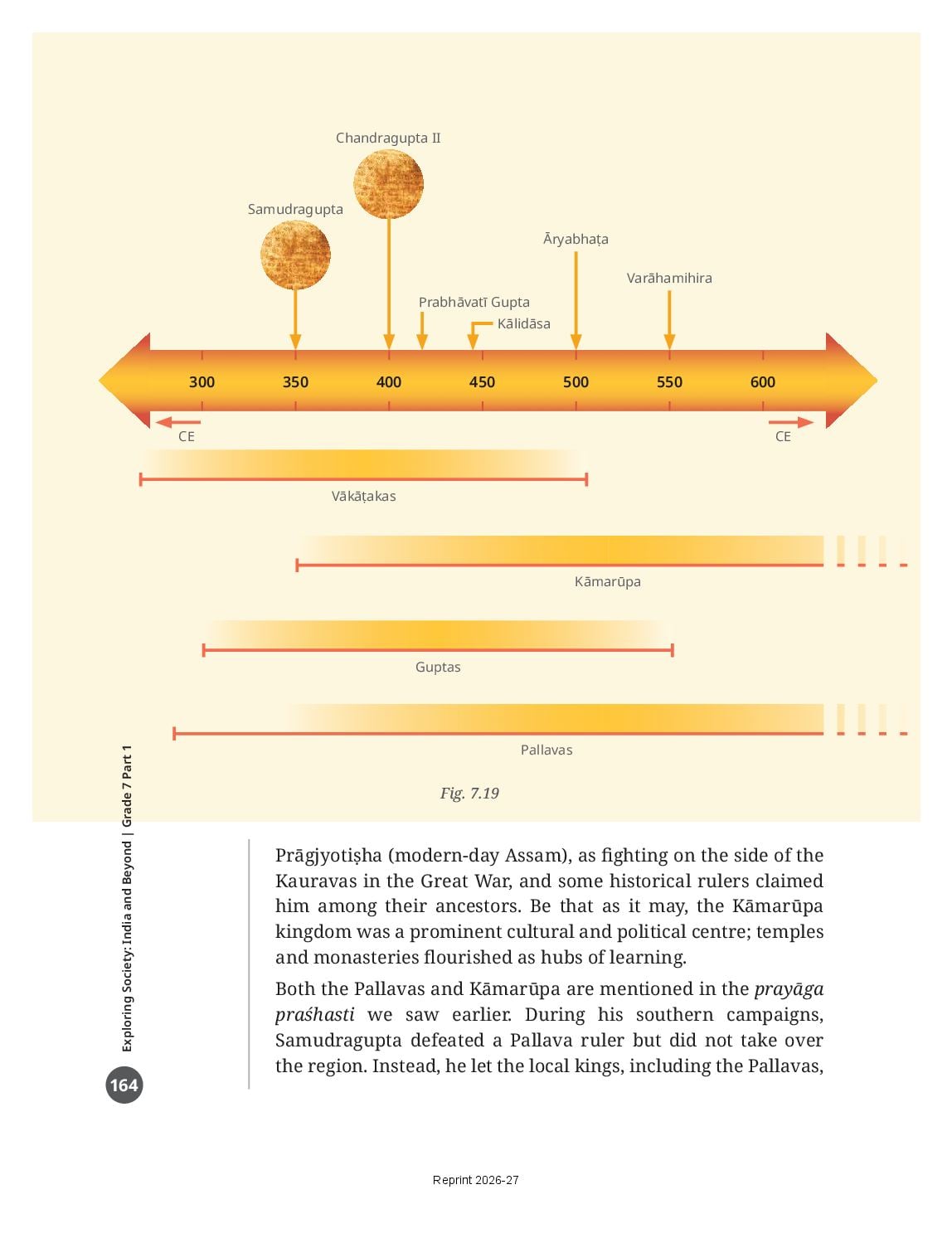
- Three rulers to remember. Chandragupta I — coins showing him with his queen Kumāradevī, and strategic alliances. Samudragupta — the warrior king of the prayāga praśhasti, whose ambition Harisena calls dharaṇi-bandha, ‘to unify the Earth’; his coins show him playing the veena. Chandragupta II ‘Vikramāditya’ — a devotee of Viṣhṇu, in whose reign the rust-free Iron Pillar at Mehrauli was set up.
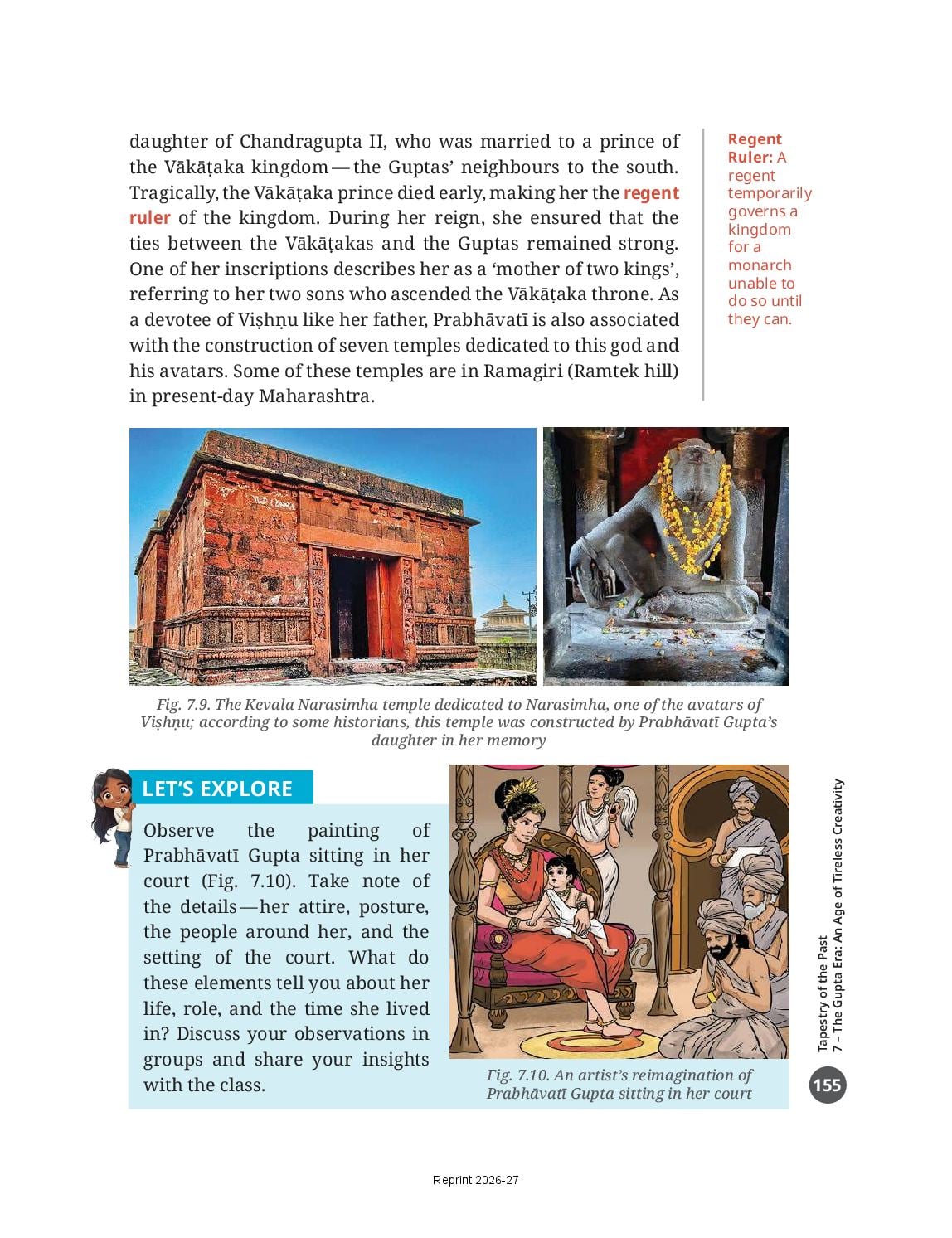
- Rule through others, not only from the centre. The empire was divided into provinces, and land was granted to local rulers, priests and chieftains — the grants carefully inscribed on copper plates. Defeated kings were often reinstated as tributaries. Marriage was a tool of policy too: Prabhāvatī Gupta, daughter of Chandragupta II, married a Vākāṭaka prince and later ruled as regent, a ‘mother of two kings’.
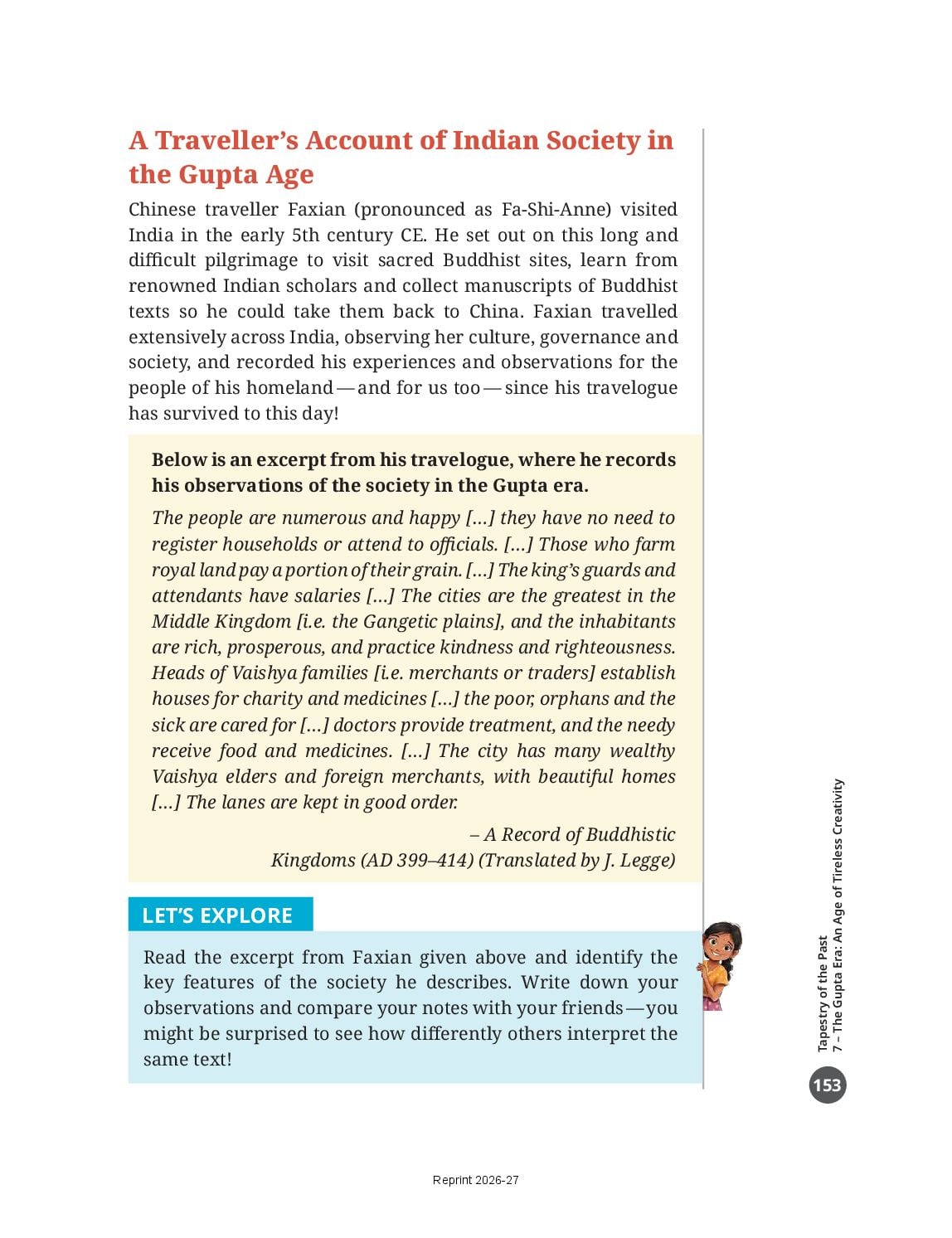
- A prosperous, trading society — seen through one traveller’s eyes. The Chinese pilgrim Faxian (early 5th century CE) describes numerous, happy people, charity houses and free medicines. But the same traveller also records the harsh treatment of the chanḍālas, kept outside the city — a reminder to check several sources and perspectives before drawing conclusions. Land tax was the main revenue; trade ran to the Mediterranean, Southeast Asia and China, with Socotra Island a key stop.
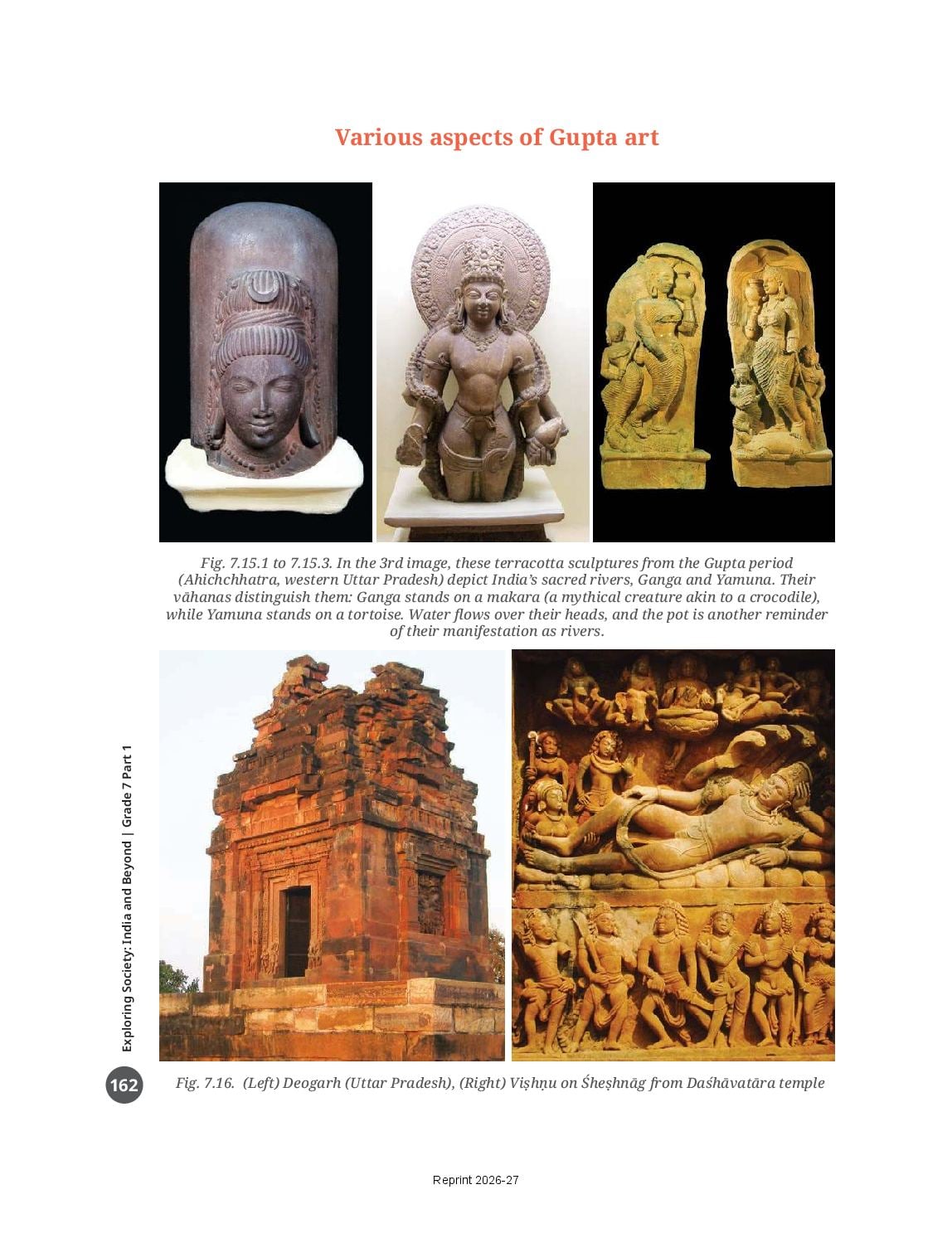
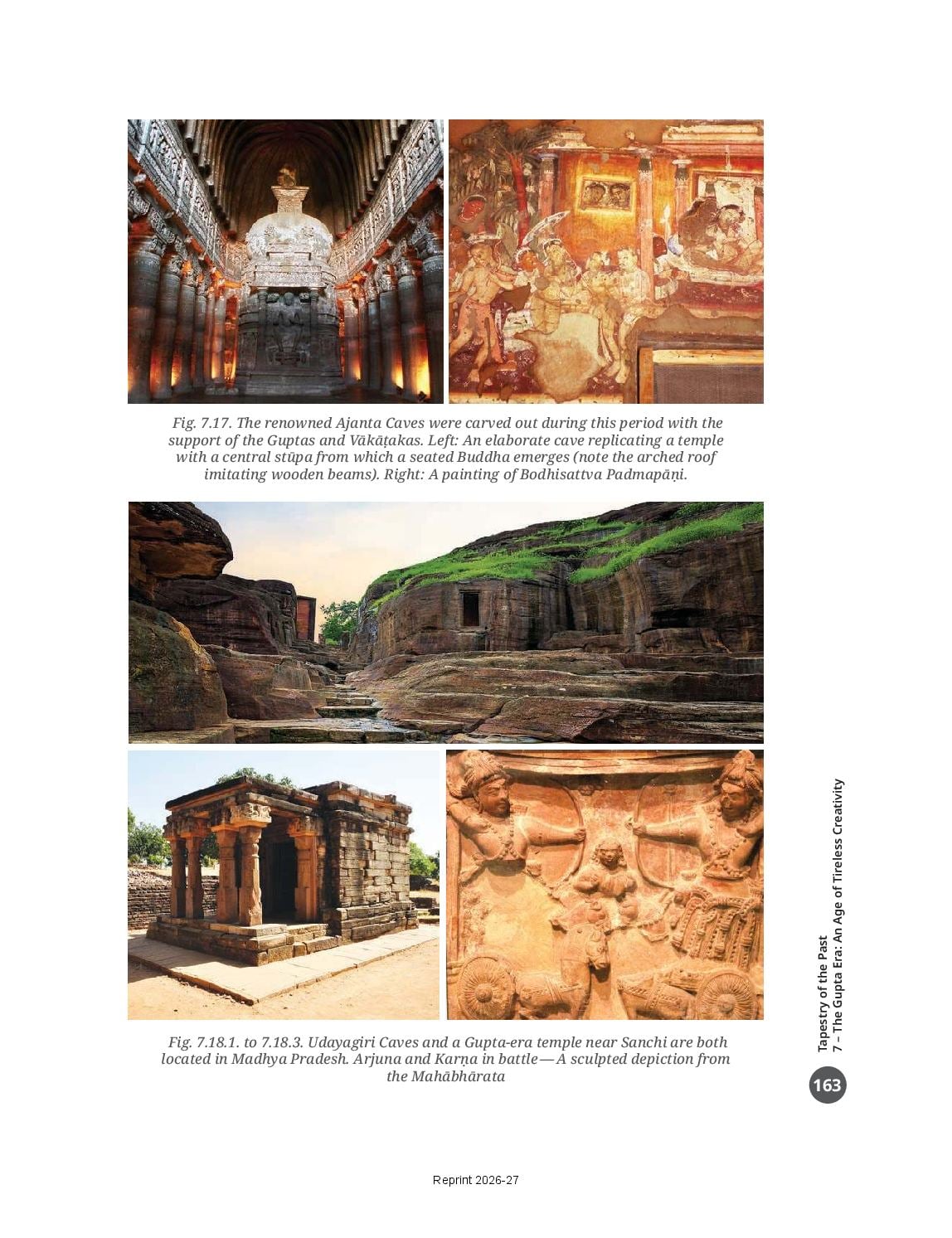
- Why it is called the ‘classical age’. Long peace let scholars and artists work. Kālidāsa wrote the Meghadūtam; Āryabhaṭa (Kusumapura, c. 500 CE) said the Earth spins on its axis and explained eclipses; Varāhamihira (Ujjayinī) compiled the Bṛihat Samhitā; Āyurveda was codified in the Charaka and Suśhruta Saṃhitās; and metallurgy gave us the Iron Pillar. Art flourished at Sārnāth, Ajanta, Udayagiri and Deogarh.
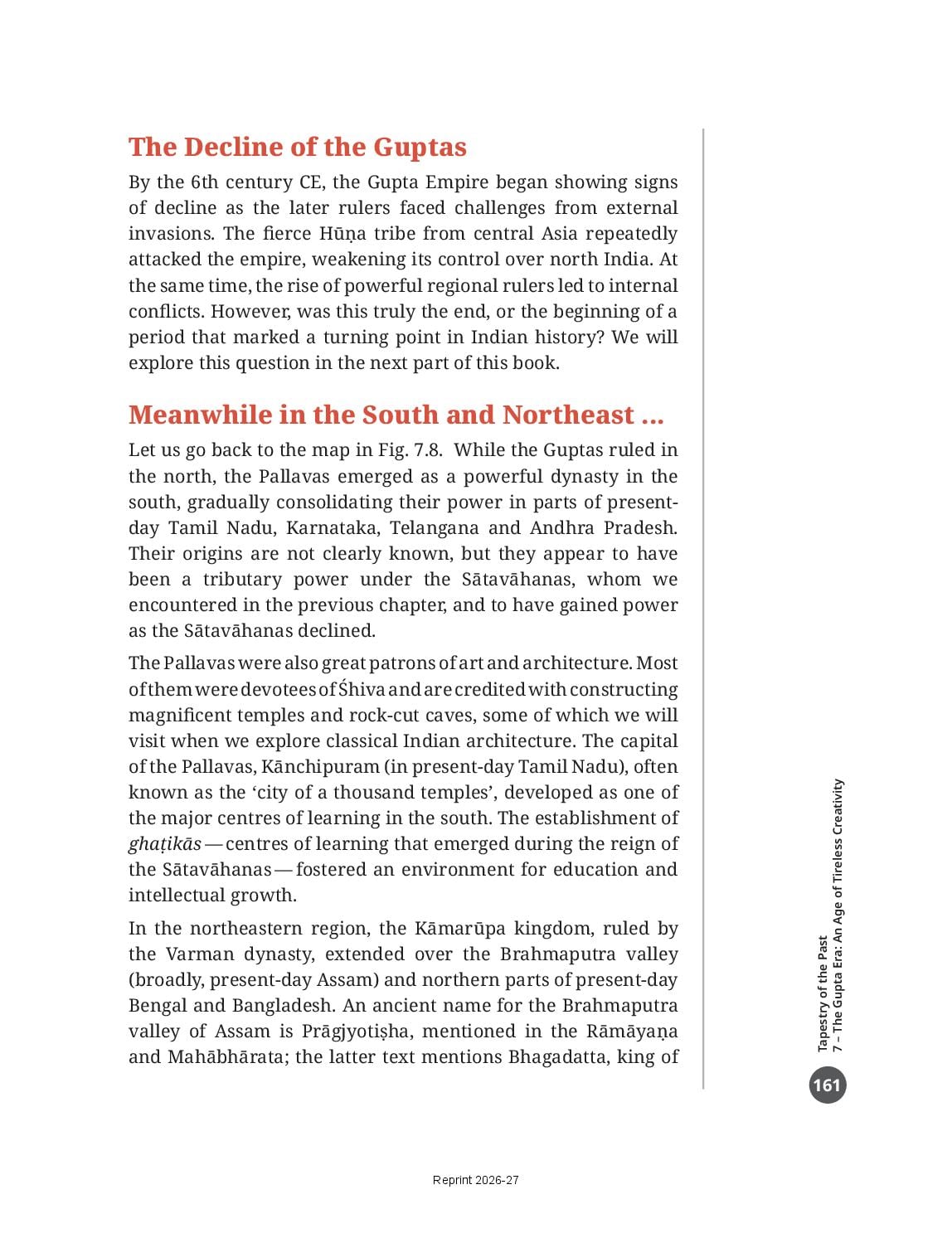
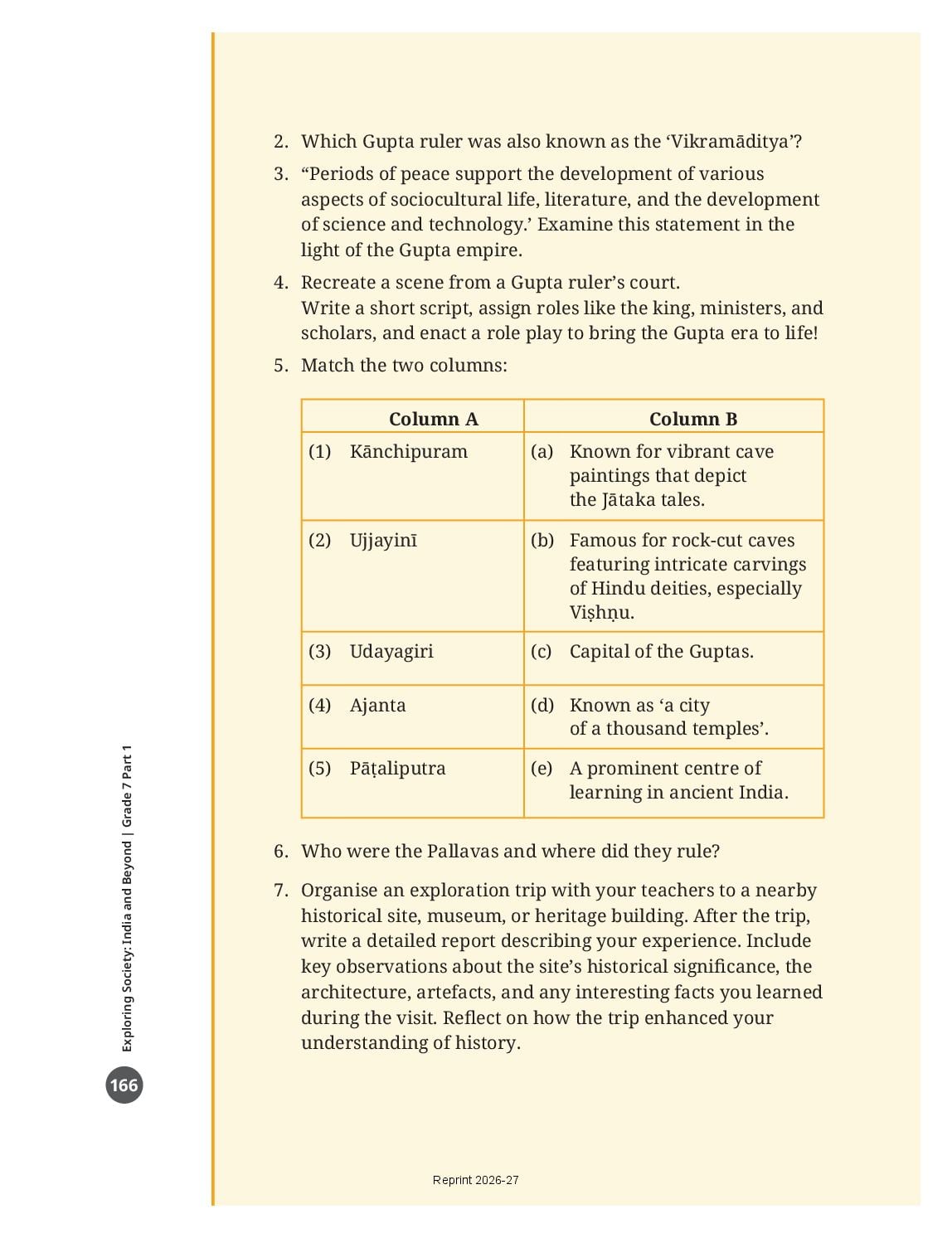
- Decline — and neighbours who mattered. From the 6th century CE the Hūṇa attacks from Central Asia and the rise of powerful regional rulers wore the empire down. Meanwhile the Pallavas ruled from Kānchipuram, the ‘city of a thousand temples’, and the Varman dynasty ruled Kāmarūpa in the Brahmaputra valley. Samudragupta defeated both but let them keep their thrones as tributaries — a pattern we have now seen many times.
Quick revision – The Gupta Era: An Age of Tireless Creativity
| Term | What it means | Where it appears in the chapter | Worth remembering |
|---|---|---|---|
| prayāga praśhasti | A pillar inscription at Prayagraj praising Samudragupta’s achievements, composed by his court poet Harisena | ‘The warrior king’, page 149 | It also names the Pallavas and Kāmarūpa — proof that both were touched by Samudragupta’s campaigns |
| dharaṇi-bandha | ‘To unify the Earth’ — the ambition Harisena attributes to Samudragupta | Page 149 | The reason behind his many wars and his long list of defeated kings |
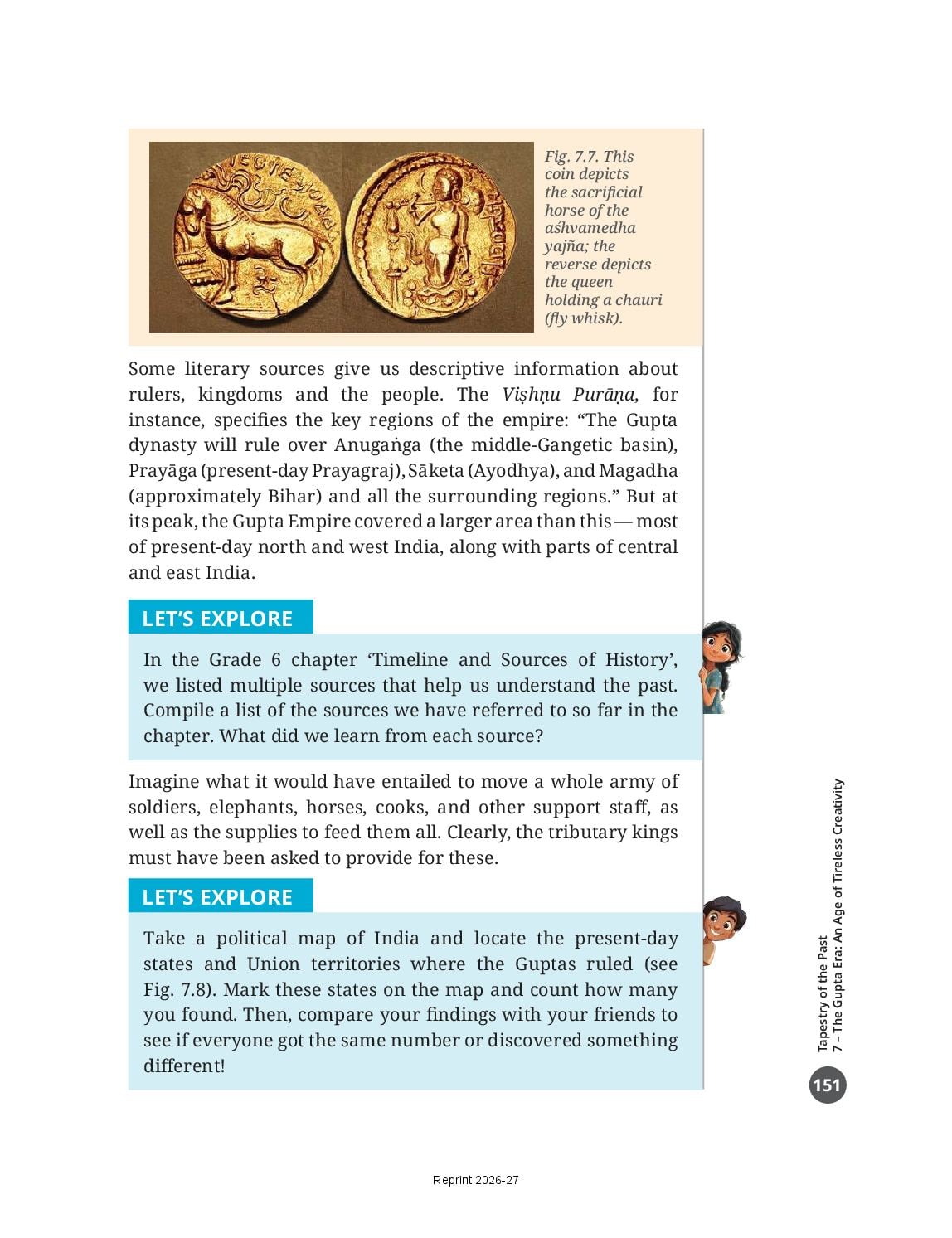
| aśhvamedha yajña | A Vedic horse sacrifice performed by ambitious kings to build mighty empires and leave a legacy | LET’S REMEMBER, page 150 | Commemorated on a special coin (Fig. 7.7): the sacrificial horse on one side, the queen holding a chauri on the reverse |
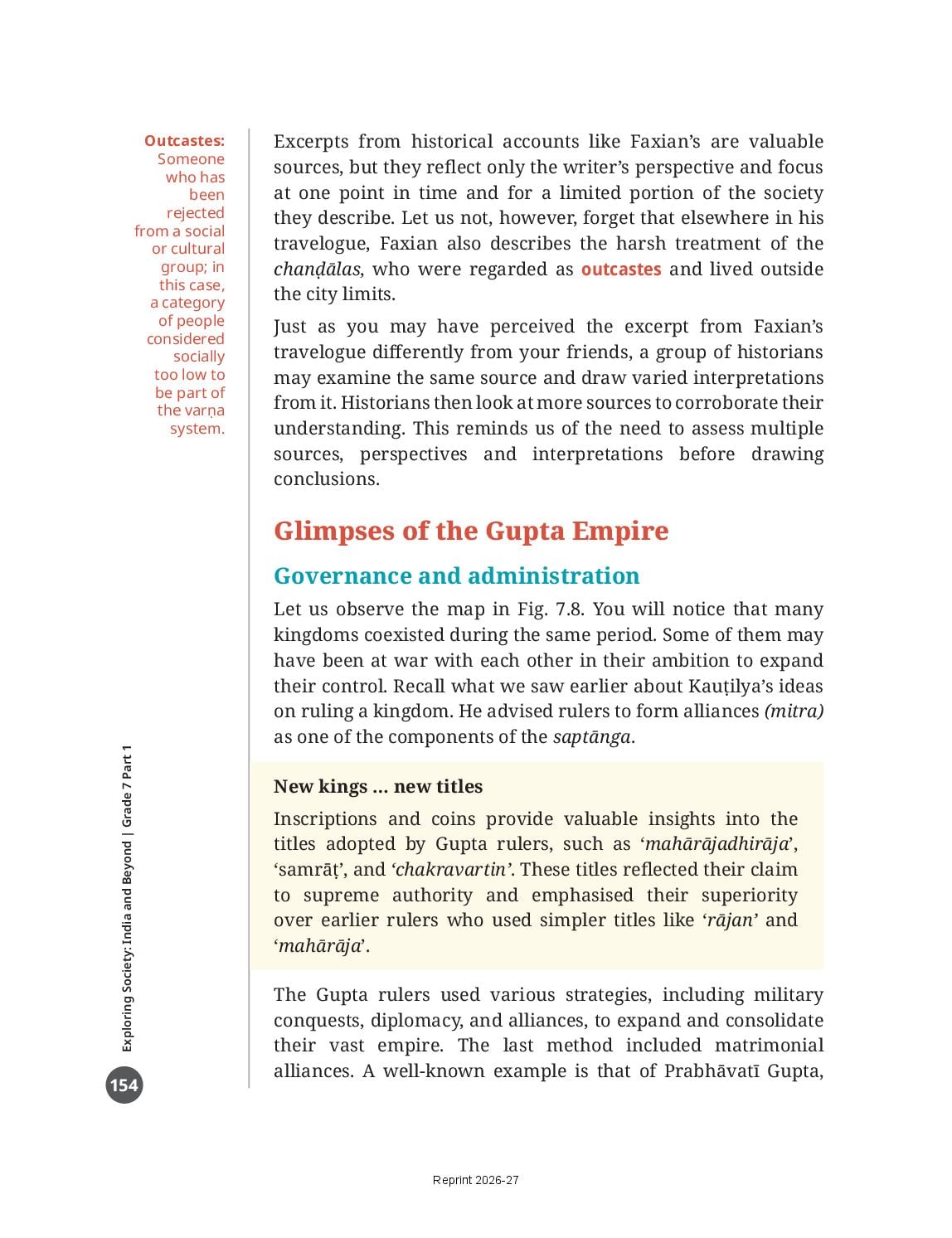
| mahārājadhirāja, samrāṭ, chakravartin | Grand titles adopted by Gupta rulers, claiming supreme authority | ‘New kings … new titles’, page 154 | They deliberately replaced the simpler earlier titles rājan and mahārāja |
| Regent ruler | One who governs a kingdom temporarily for a monarch unable to do so | Margin note, page 155 | Prabhāvatī Gupta ruled the Vākāṭakas this way; an inscription calls her a ‘mother of two kings’ |
| Outcastes | People rejected by a social or cultural group — here, those considered too low to be part of the varṇa system | Margin note, page 154 | Faxian’s chanḍālas, made to live outside the city limits — the side of society his cheerful excerpt leaves out |
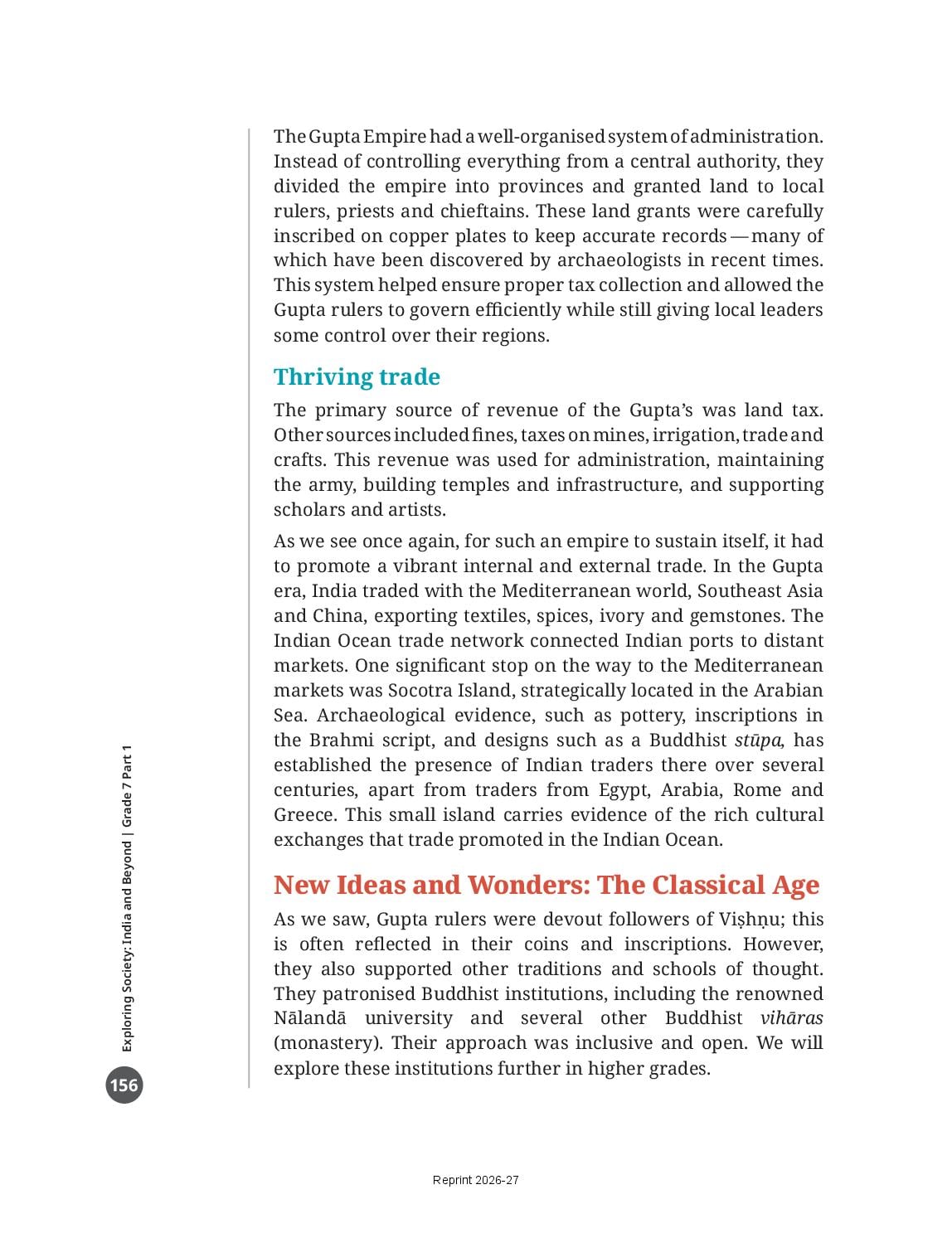
| Copper-plate land grants | Land given to local rulers, priests and chieftains, with the grant inscribed on copper plates | ‘Governance and administration’, page 156 | Shows the Guptas ruled through local leaders instead of controlling everything from the centre |
| Iron Pillar of Delhi | A 6-tonne iron pillar at Mehrauli, over 1,600 years old, set up in the reign of Chandragupta II | Pages 147–148 | A thin protective layer, formed by the special iron and oxygen from the air, keeps it from rusting |
| Āryabhaṭīya | Āryabhaṭa’s short treatise on mathematics and astronomy, written around 500 CE | Page 158 | Says the Earth spins on its axis; gives the year as 365 days, 6 hours, 12 minutes, 30 seconds |
| Bṛihat Samhitā | Varāhamihira’s encyclopedic work, written at Ujjayinī | Page 158 | Astronomy, astrology, weather forecasting, architecture, town planning — even farming |
| Meghadūtam | Kālidāsa’s poem, ‘The Cloud Messenger’ | Page 159 | A banished yakṣha sends a message to his beloved through a passing cloud |
| Charaka Saṃhitā & Suśhruta Saṃhitā | The foundational Āyurveda texts, compiled and given final shape in the Gupta period | DON’T MISS OUT, page 160 | Diagnosis of diseases, diet, preparation of medicines and surgery — plus holistic healing |
| ghaṭikās | Centres of learning that first emerged under the Sātavāhanas | ‘Meanwhile in the South …’, page 161 | They made Pallava Kānchipuram a major centre of education in the south |
| Prāgjyotiṣha | An ancient name for the Brahmaputra valley of Assam | Pages 161 and 164 | The Kāmarūpa kingdom of the Varman dynasty; the Mahābhārata names its king Bhagadatta |
Old NCERT vs New – Class 7 Social Science
This chapter is from Exploring Society: India and Beyond, the new NCERT Class 7 Social Science book (NCF-SE 2023, used from 2025-26). It replaced the old book “Our Pasts, Our Environment and Social and Political Life”, so chapter numbers and names differ from older PDFs.
Solutions and All Chapters
Answers to the exercises and the full chapter list of Exploring Society: India and Beyond:
The Gupta Era: An Age of Tireless Creativity – Overview
| Class | Class 7 |
| Subject | Social Science |
| Book | Exploring Society: India and Beyond – new NCERT book |
| Part | Part I |
| Chapter | 7 of 20 – The Gupta Era: An Age of Tireless Creativity |
| Book pages | 145 – 166 |
| Edition | NCERT Reprint 2026-27 |
| Session | 2026-27 |
| Free – read online or download |
Class 7 Social Science Chapter 7 – FAQs
Where can I download The Gupta Era: An Age of Tireless Creativity Class 7 PDF?
From the download table on this page – the chapter PDF is free, and the full book is linked too.
What is Class 7 Social Science Chapter 7 about?
A new power fills the gap left by the Kuṣhāṇas. By the 3rd century CE the Kuṣhāṇa Empire weakened and new kingdoms appeared. The Guptas, believed to have begun as regional rulers near present-day Uttar Pradesh, rose to become the strongest of them, with their capital at Pāṭaliputra (present-day Patna). Their empire flourished from the 3rd to the 6th century CE.
Is The Gupta Era: An Age of Tireless Creativity from the new NCERT Class 7 Social Science book?
Yes. It is chapter 7 of exploring society: india and beyond (part i), the new NCERT Class 7 Social Science book for 2026-27.
Is this the latest NCERT edition for 2026-27?
Yes – the PDF is NCERT’s latest edition for the 2026-27 session.
Where are the NCERT Solutions for Class 7 Social Science Chapter 7?
Open the NCERT Solutions link above for answers to the exercise questions.