Download The Story of Indian Farming – NCERT Class 7 Social Science Chapter 13 PDF from the new NCERT Class 7 Social Science book Exploring Society: India and Beyond (2026-27). Read the chapter online or download the free PDF. Farming is one of the oldest occupations of humankind, and India’s oldest story. Broadly, ‘agriculture’ covers farming, animal husbandry, forestry and horticulture, and in some places pisciculture and silk rearing too. A little over 18 per cent of…
The Story of Indian Farming PDF – Chapter 13 of Exploring Society: India and Beyond (Part II)
Read the chapter online or download the PDF.
| Chapter | Download | |
|---|---|---|
| Chapter 13 PDF | The Story of Indian Farming | View PDF |
| Full book | NCERT Class 7 Social Science – Exploring Society: India and Beyond | View Book |
Read Online
What Is in The Story of Indian Farming? (Class 7 Social Science Chapter 13)
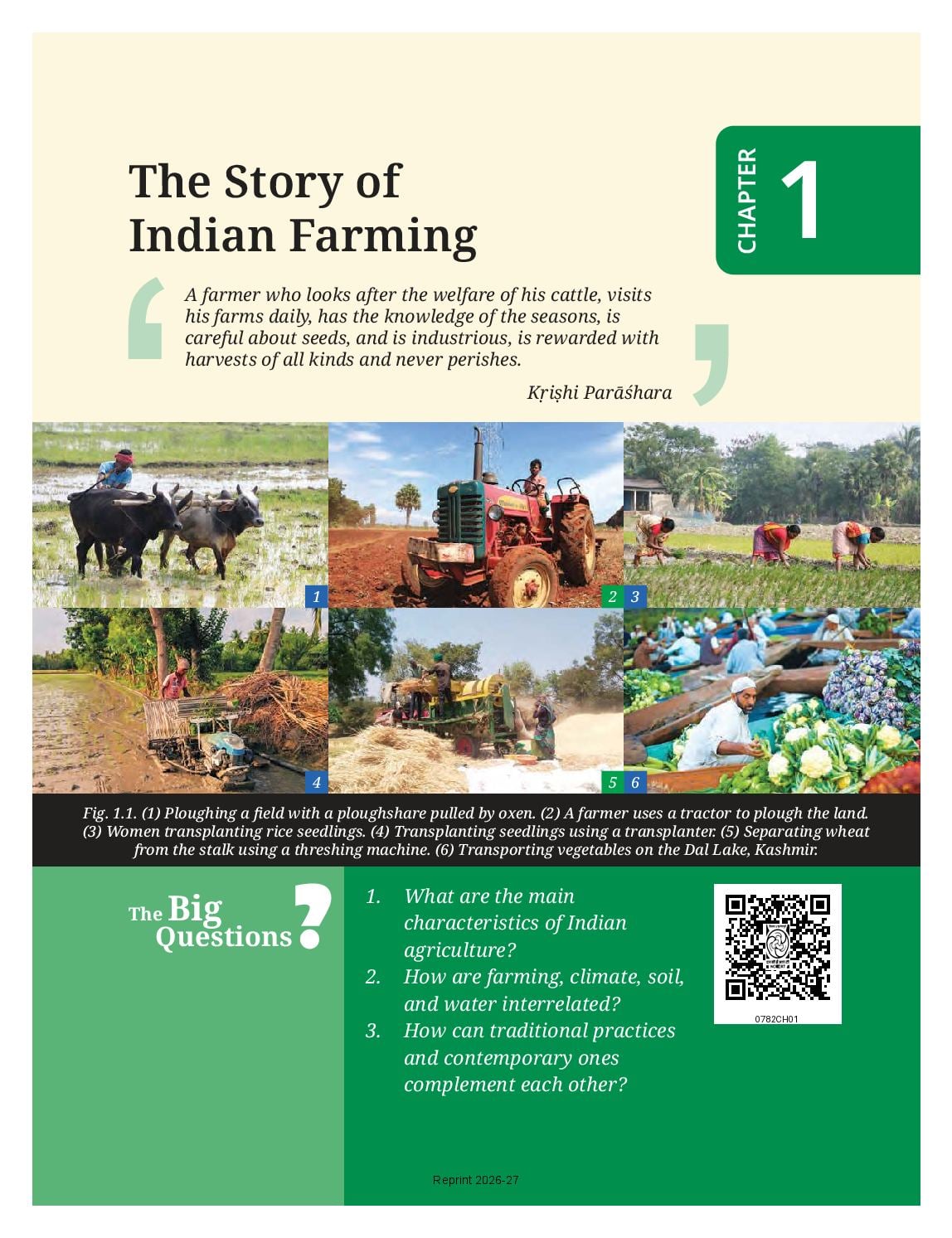
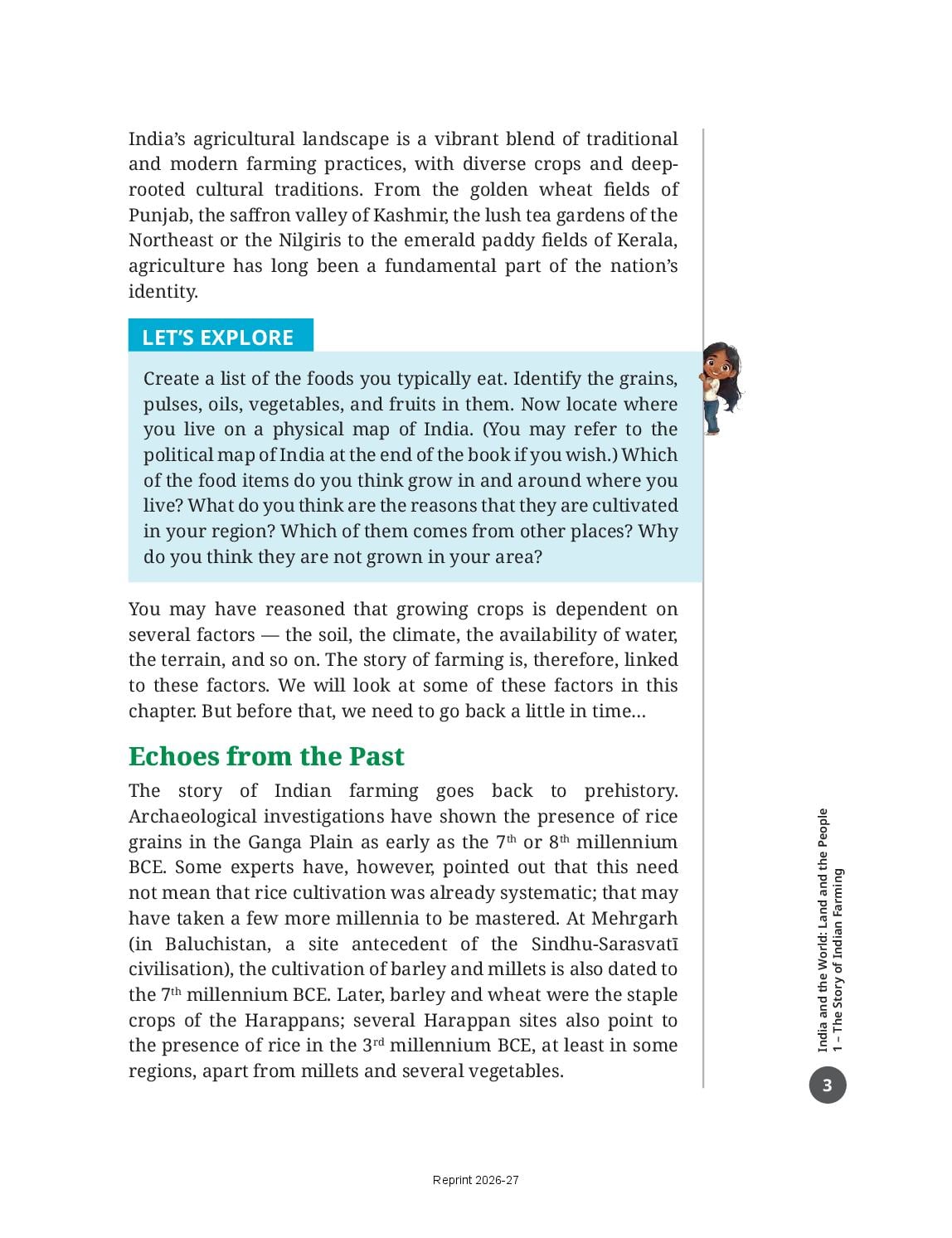
- Farming is one of the oldest occupations of humankind, and India’s oldest story. Broadly, ‘agriculture’ covers farming, animal husbandry, forestry and horticulture, and in some places pisciculture and silk rearing too. A little over 18 per cent of India’s GDP and about 46 per cent of its working population depend on agriculture and allied activities (2022-2023). In rural India, more than 75 per cent of those working in agriculture are women (2025).
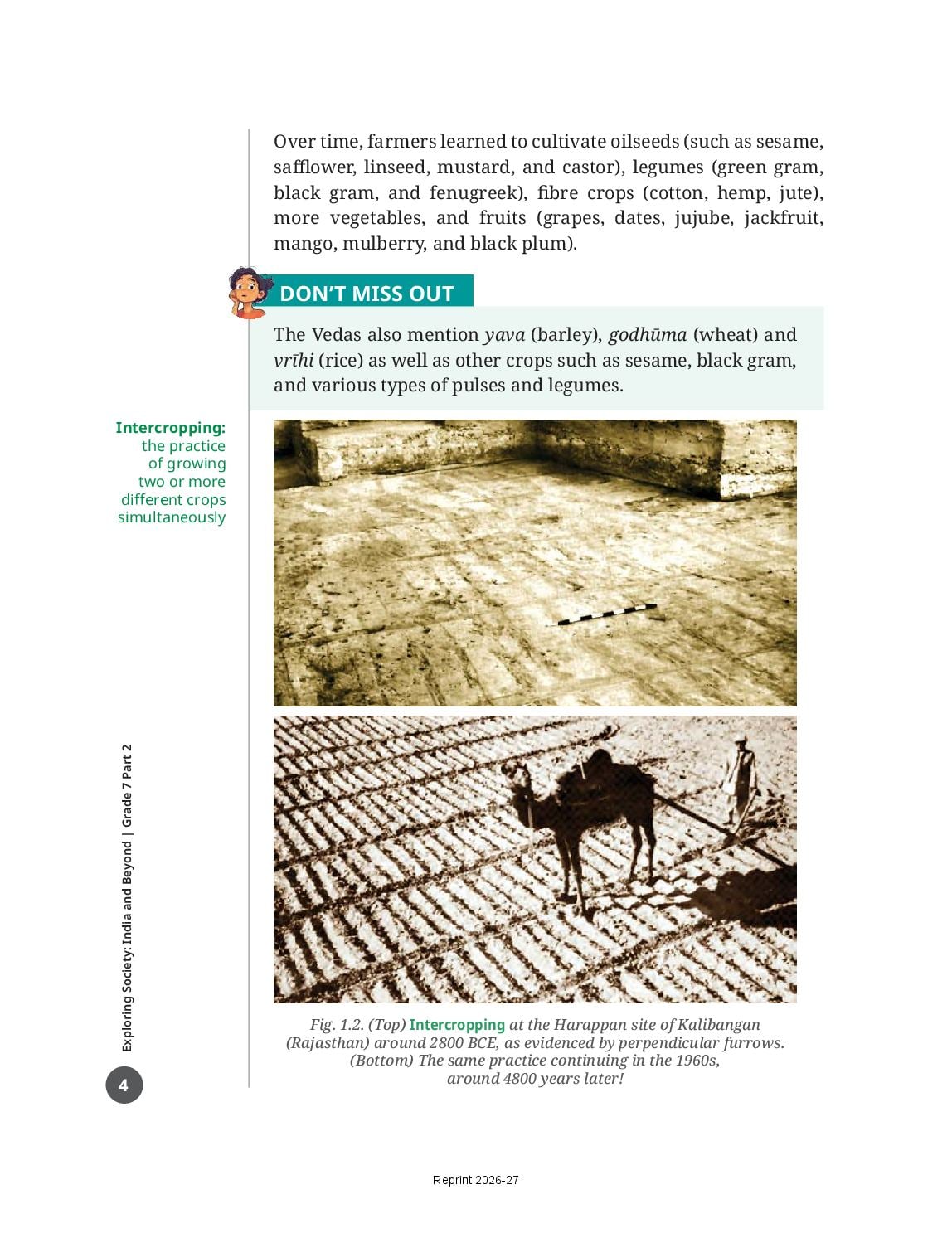
- Indian farming goes back to prehistory. Rice grains appear in the Ganga Plain as early as the 7th–8th millennium BCE; barley and millets were cultivated at Mehrgarh in the 7th millennium BCE; barley and wheat were the staples of the Harappans. Fig. 1.2 shows intercropping at Kalibangan around 2800 BCE — and the very same criss-cross furrows still in use in the 1960s, about 4800 years later.
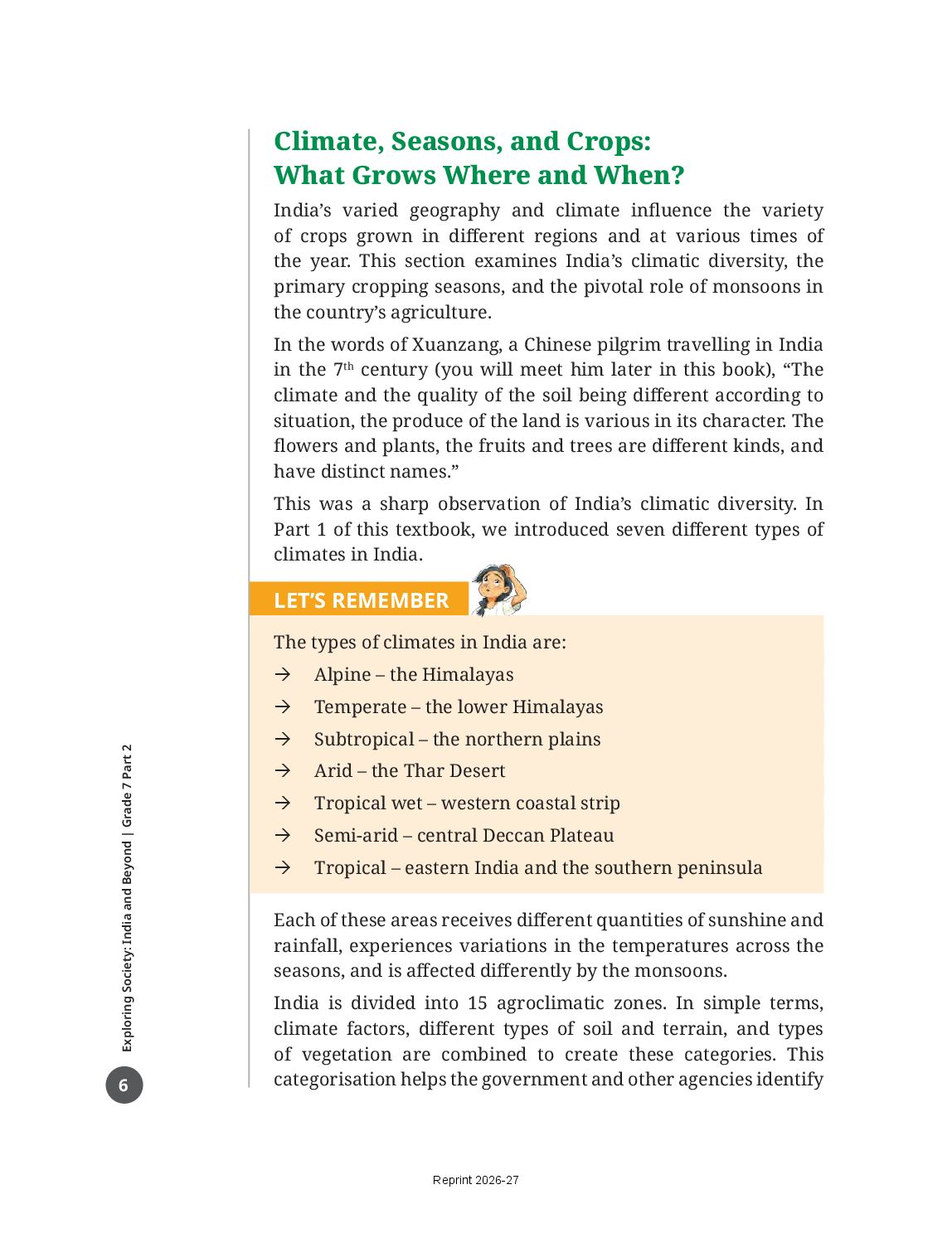
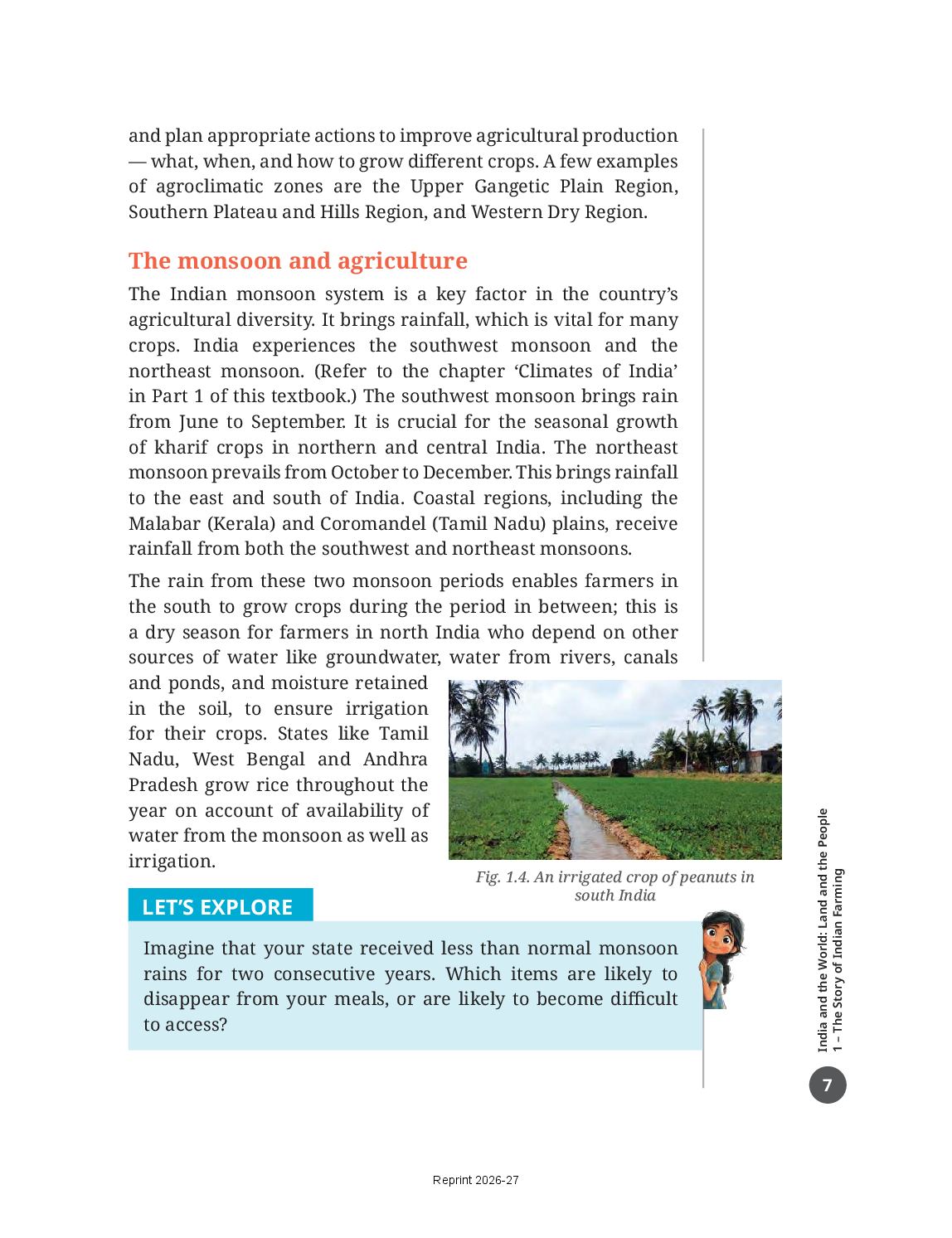
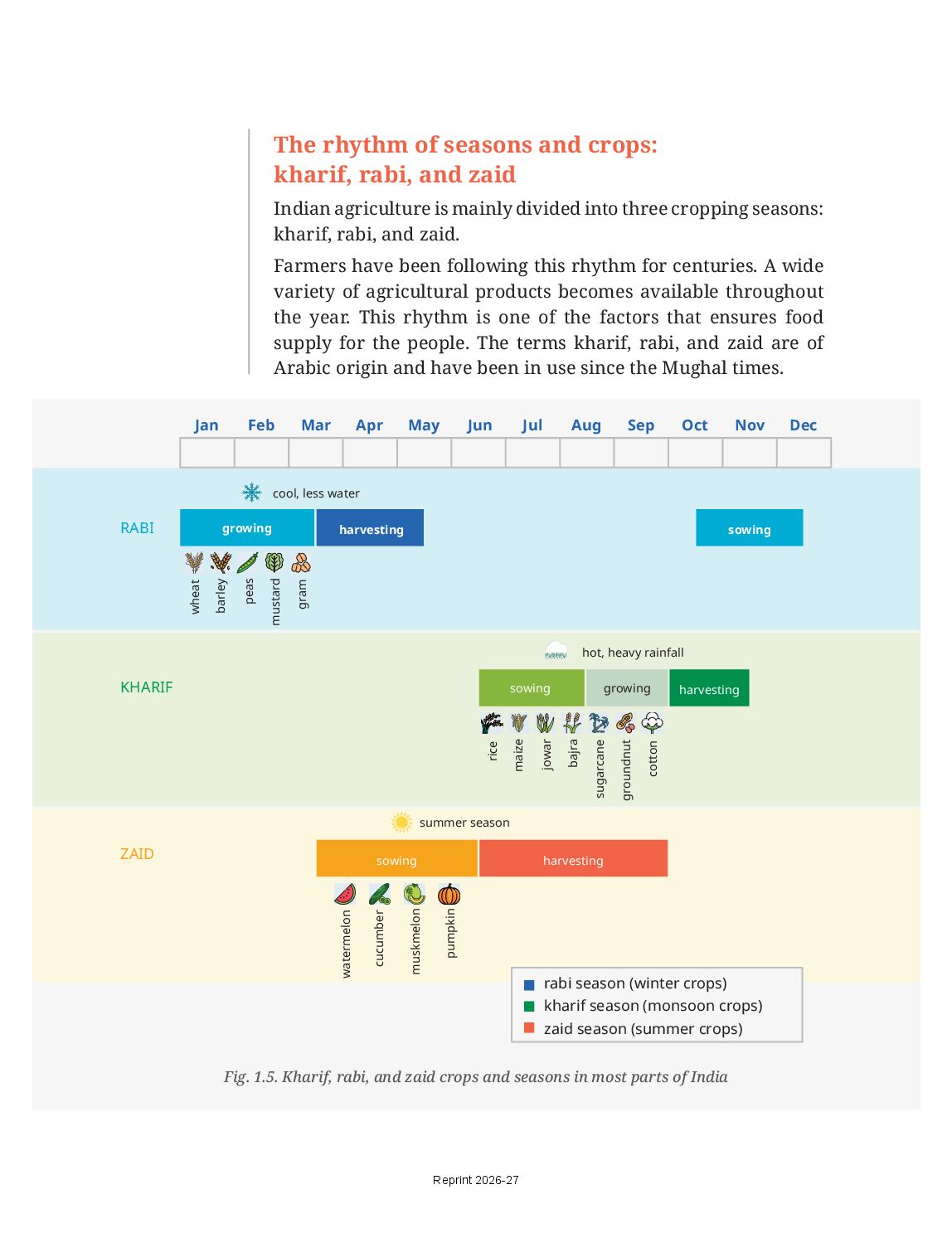
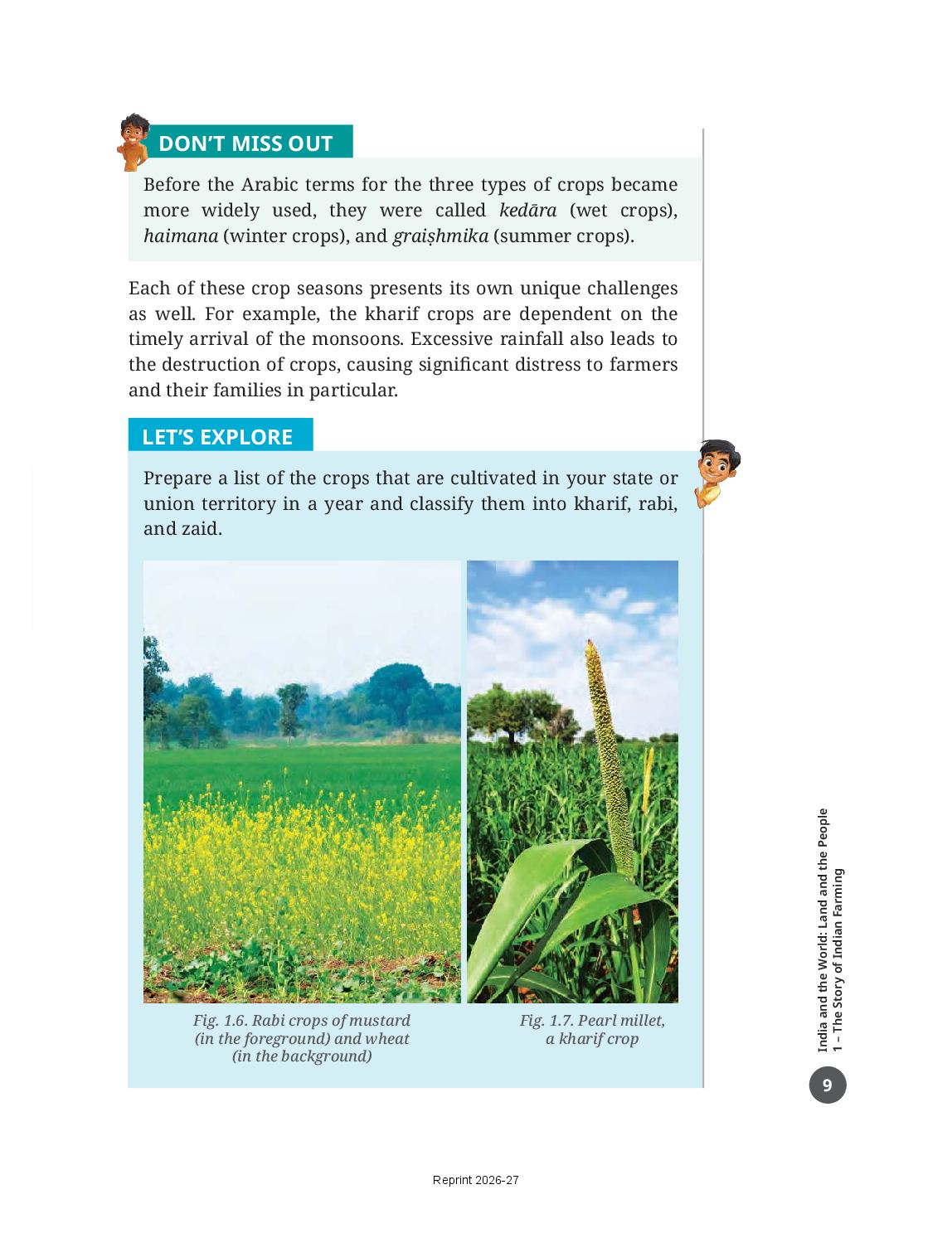
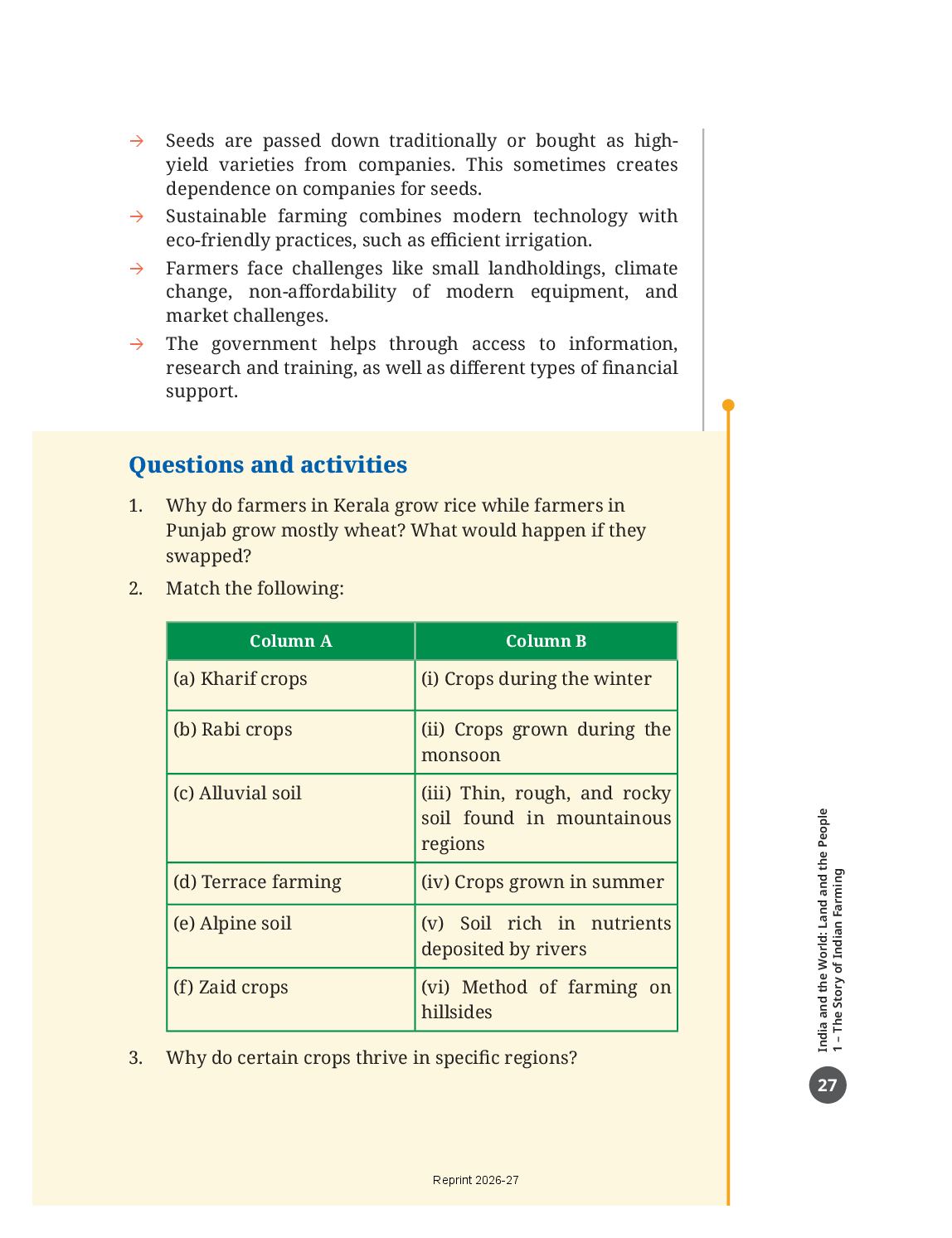
- Climate sets the calendar. India has seven climate types and 15 agroclimatic zones. The southwest monsoon (June–September) waters the kharif crops of north and central India; the northeast monsoon (October–December) waters the east and south. Farming follows three seasons — kharif (monsoon), rabi (winter) and zaid (summer) — Arabic words used since Mughal times, earlier called kedāra, haimana and graiṣhmika.
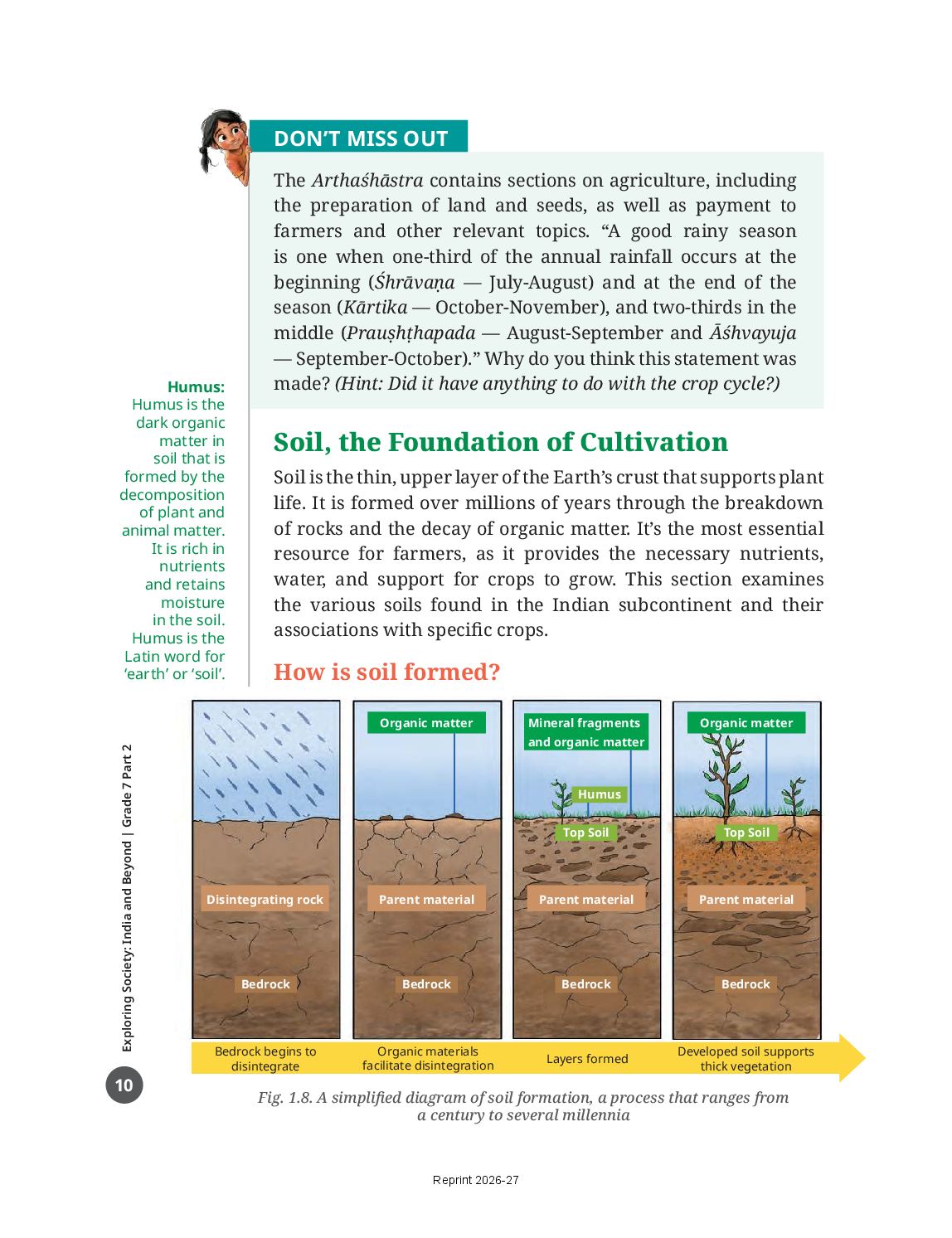
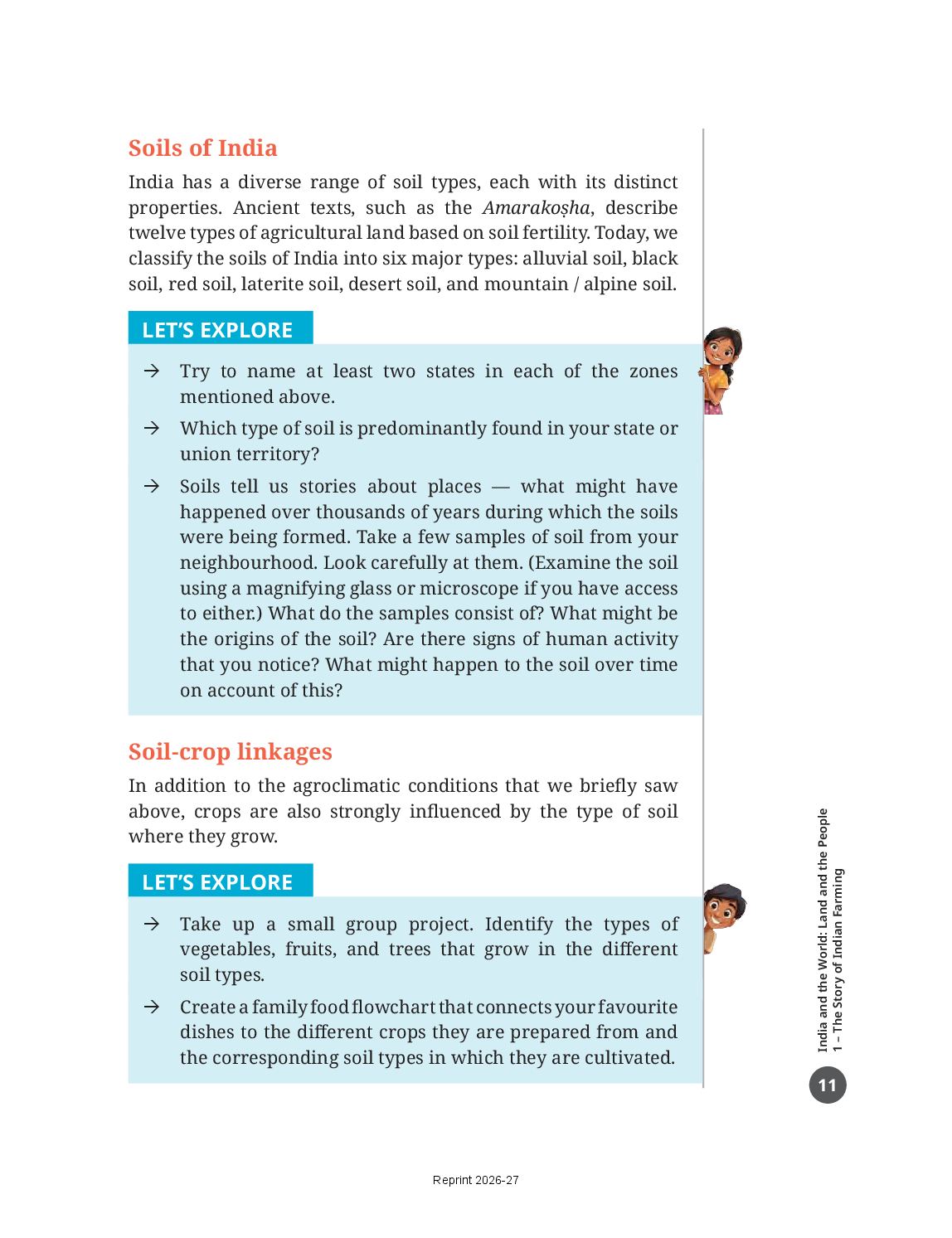
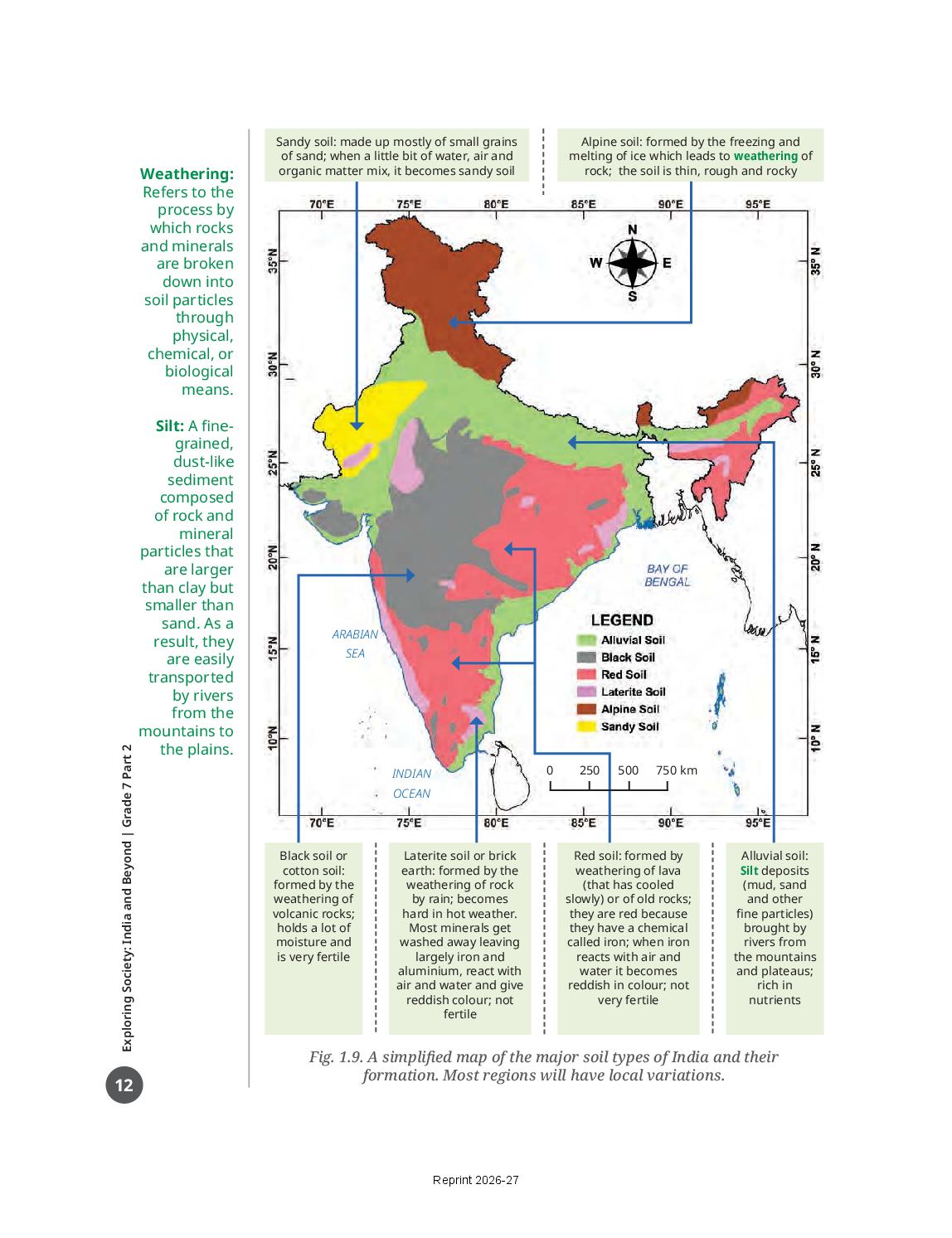
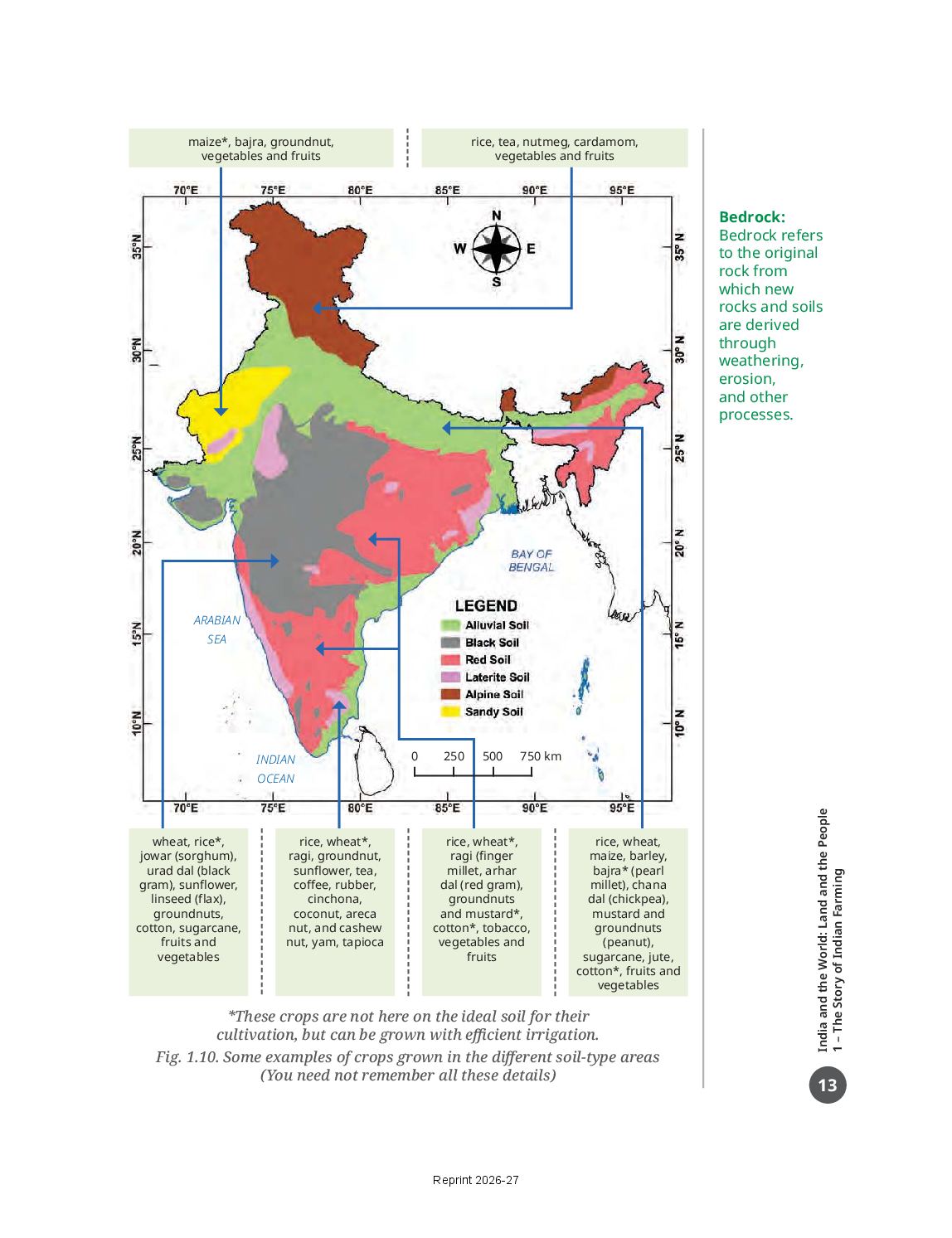
- Soil decides what will actually grow. Soil is the thin upper layer of the Earth’s crust, built up over millions of years from broken rock and decayed organic matter. India has six major soil types — alluvial, black, red, laterite, desert (sandy) and mountain/alpine. Farmers keep soil healthy by crop rotation, multiple cropping, contour ploughing and organic manure, and today also by terracing, afforestation, mulching and precise use of fertilisers.
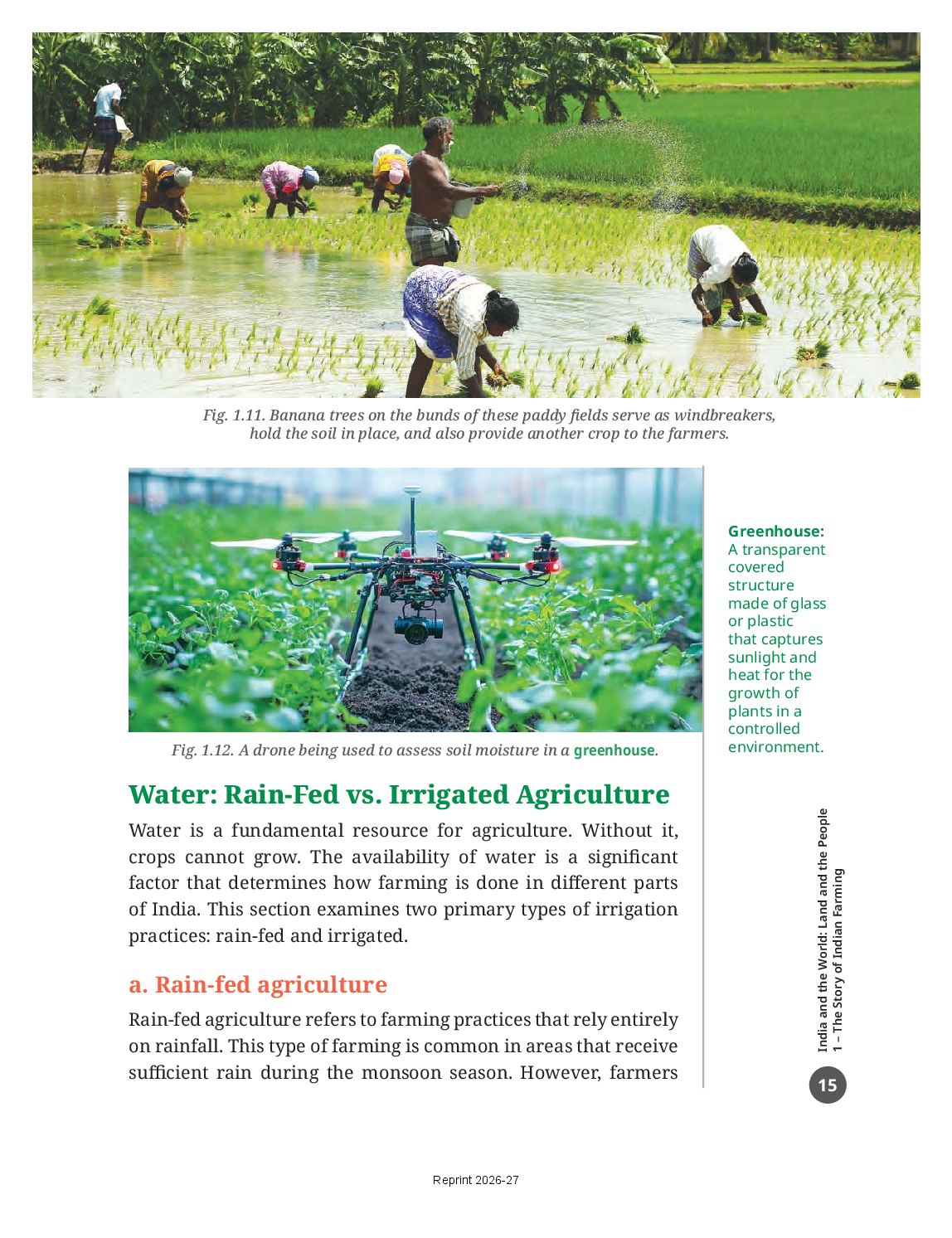
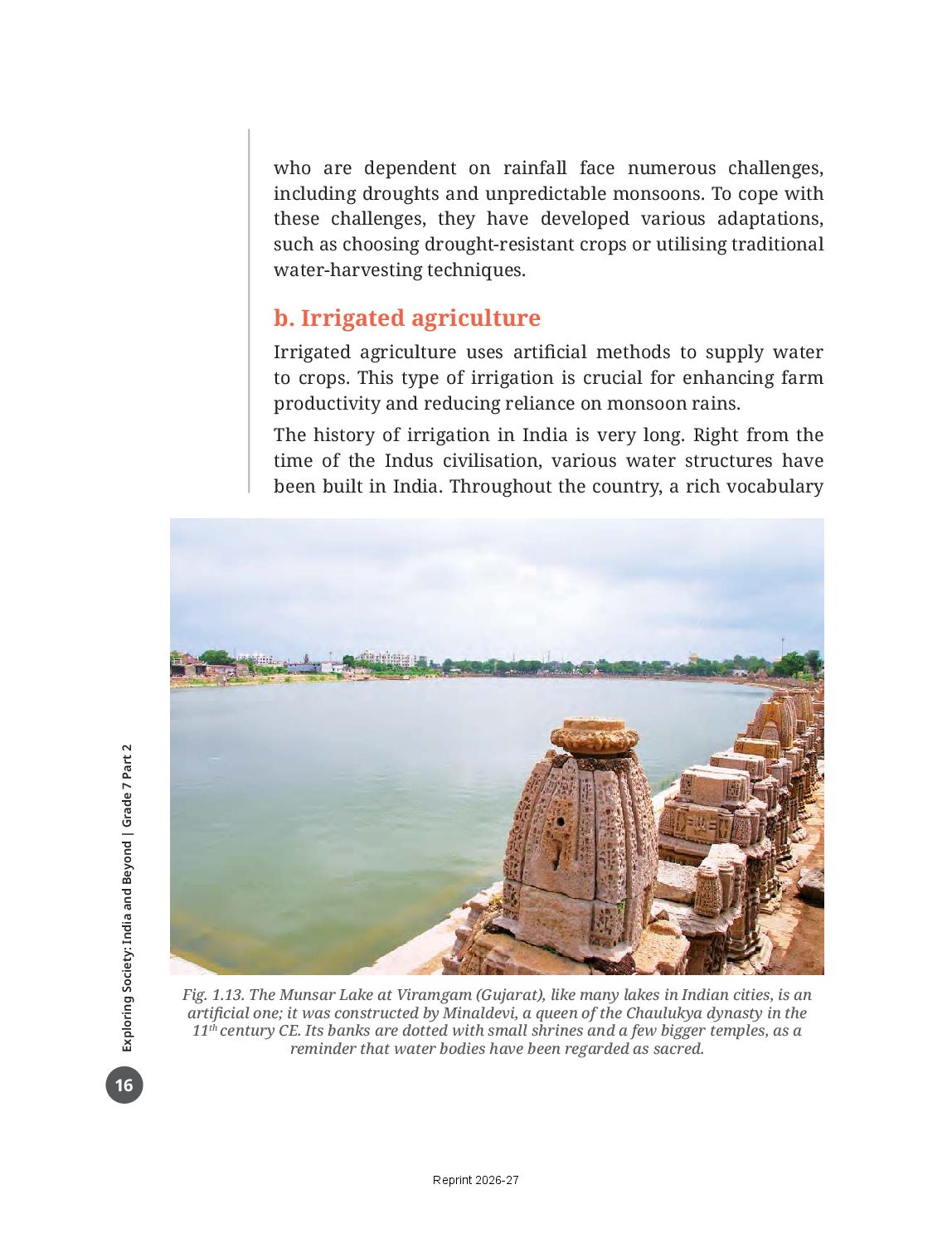
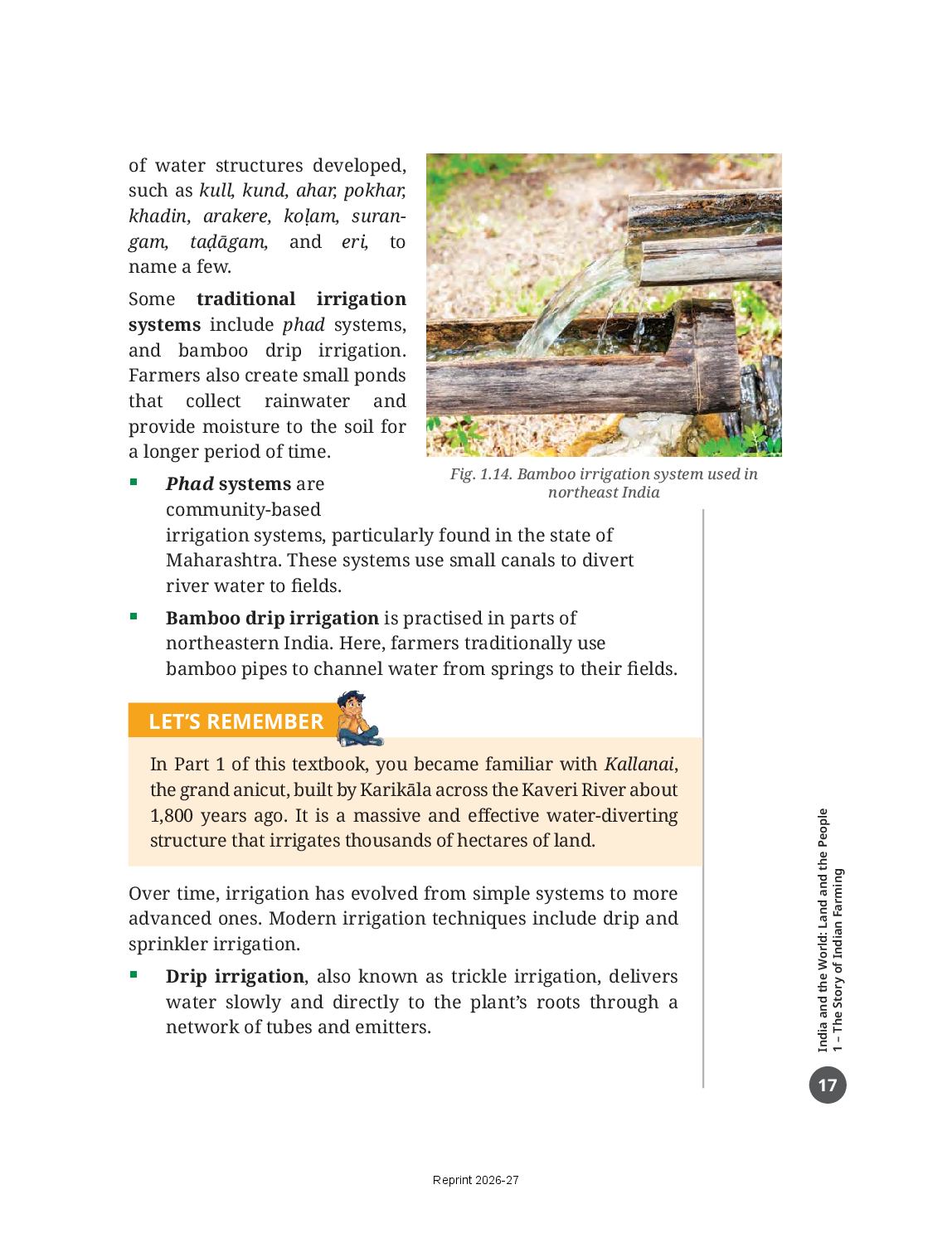
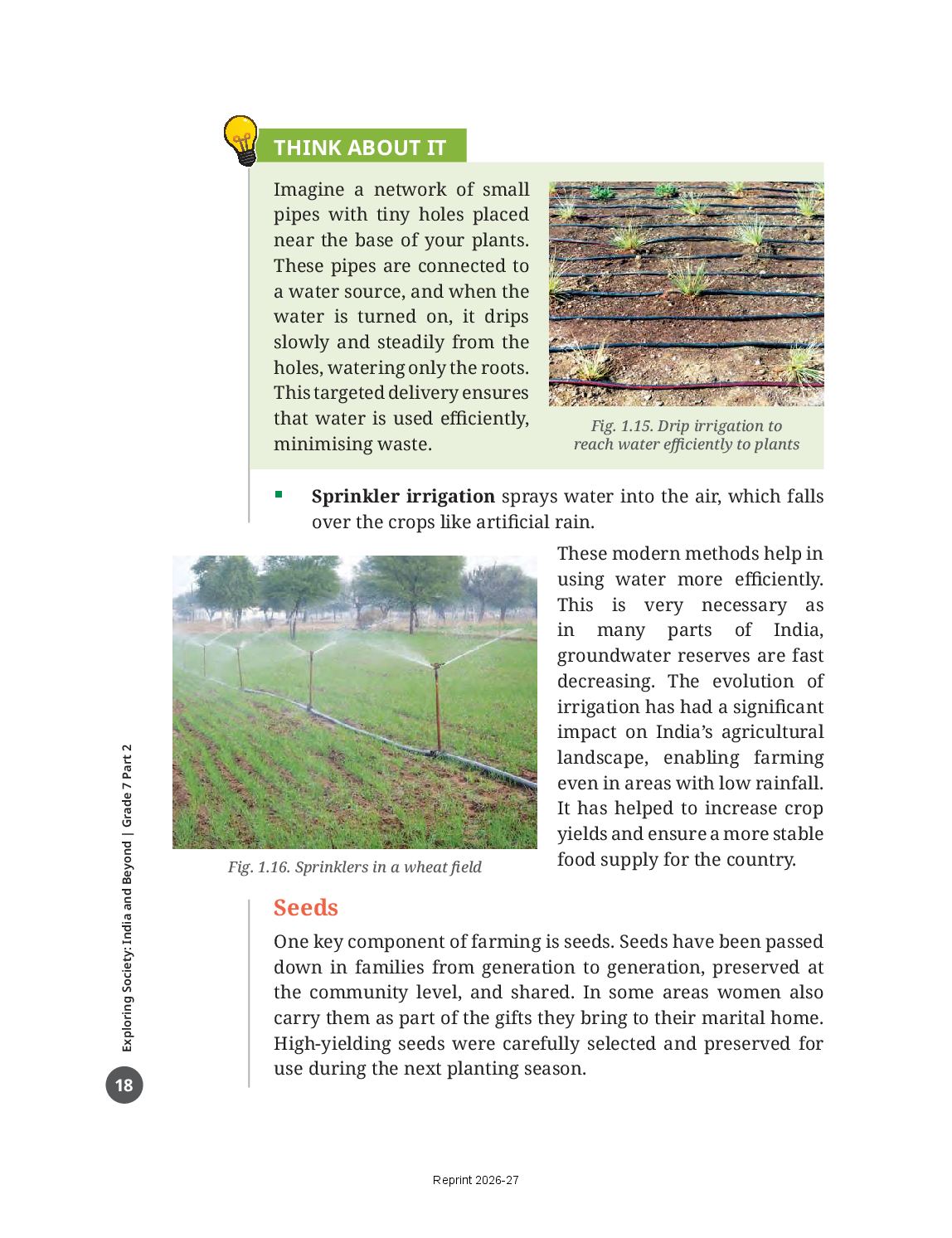
- Water divides Indian farming in two. Rain-fed farming depends entirely on rainfall; irrigated farming supplies water artificially. India has a very long irrigation history — kull, kund, ahar, pokhar, khadin, arakere, koḷam, surangam, taḍāgam, eri — plus phad systems in Maharashtra, bamboo drip irrigation in the Northeast, and the Kallanai of Karikāla, about 1,800 years old. Modern methods are drip and sprinkler irrigation.
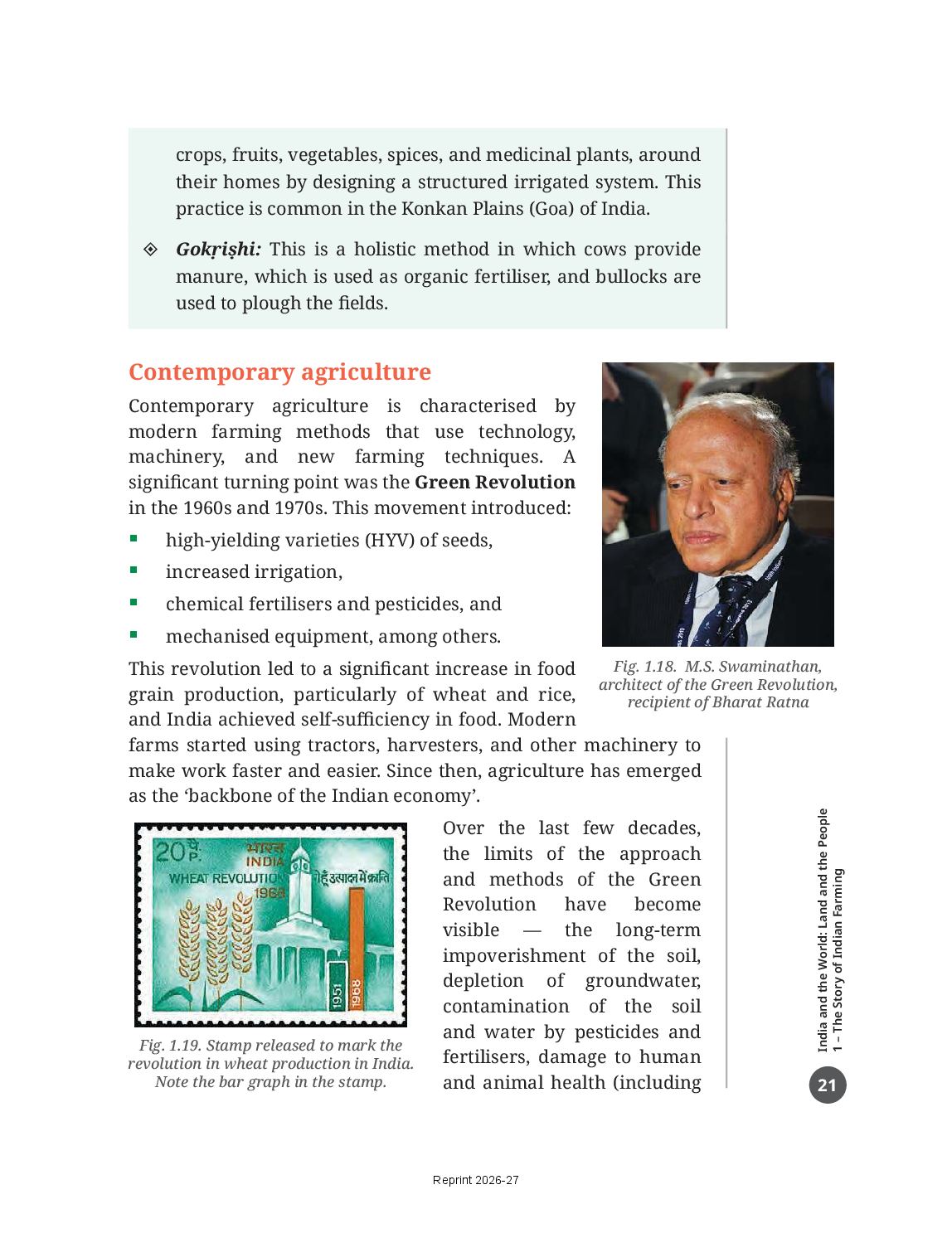
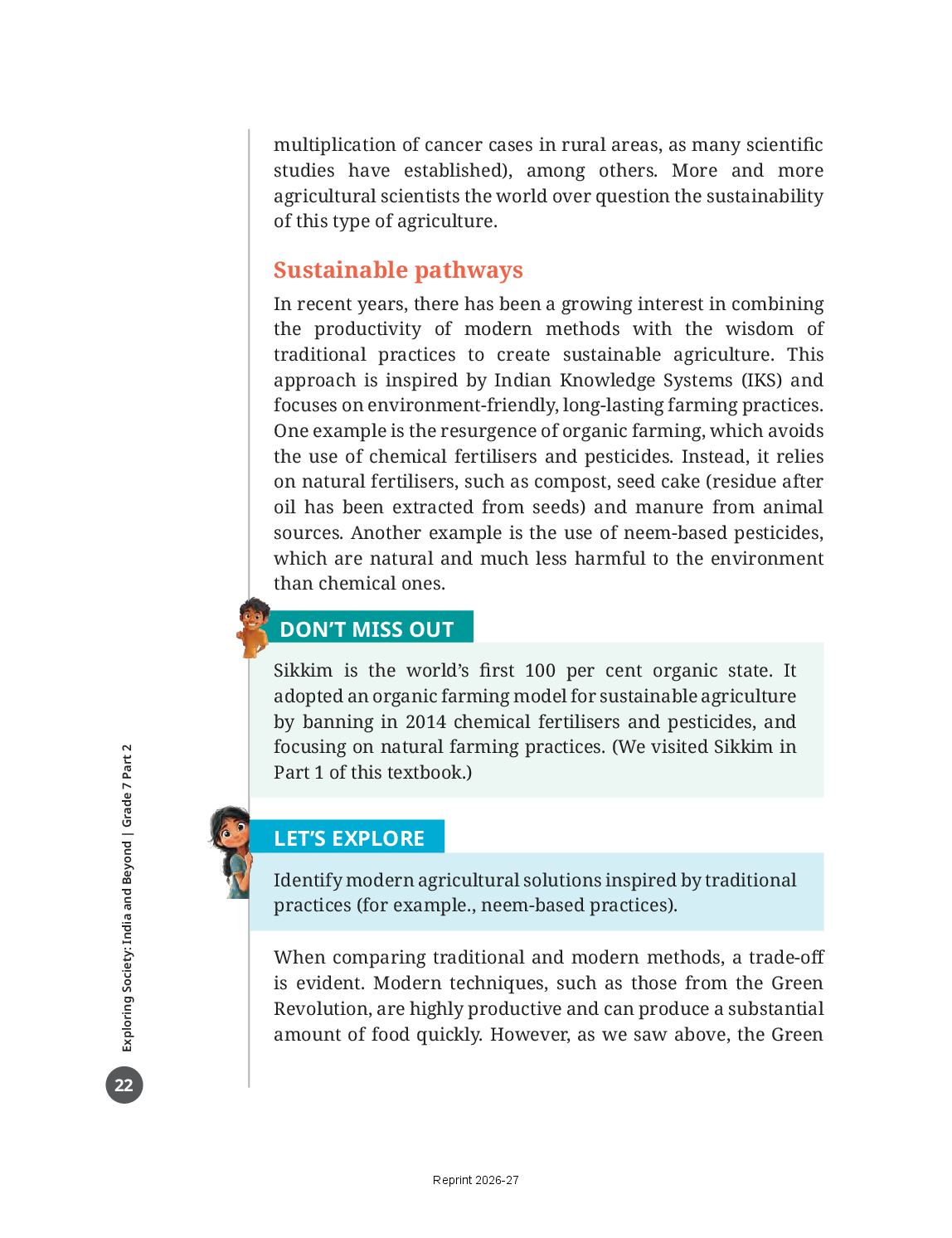
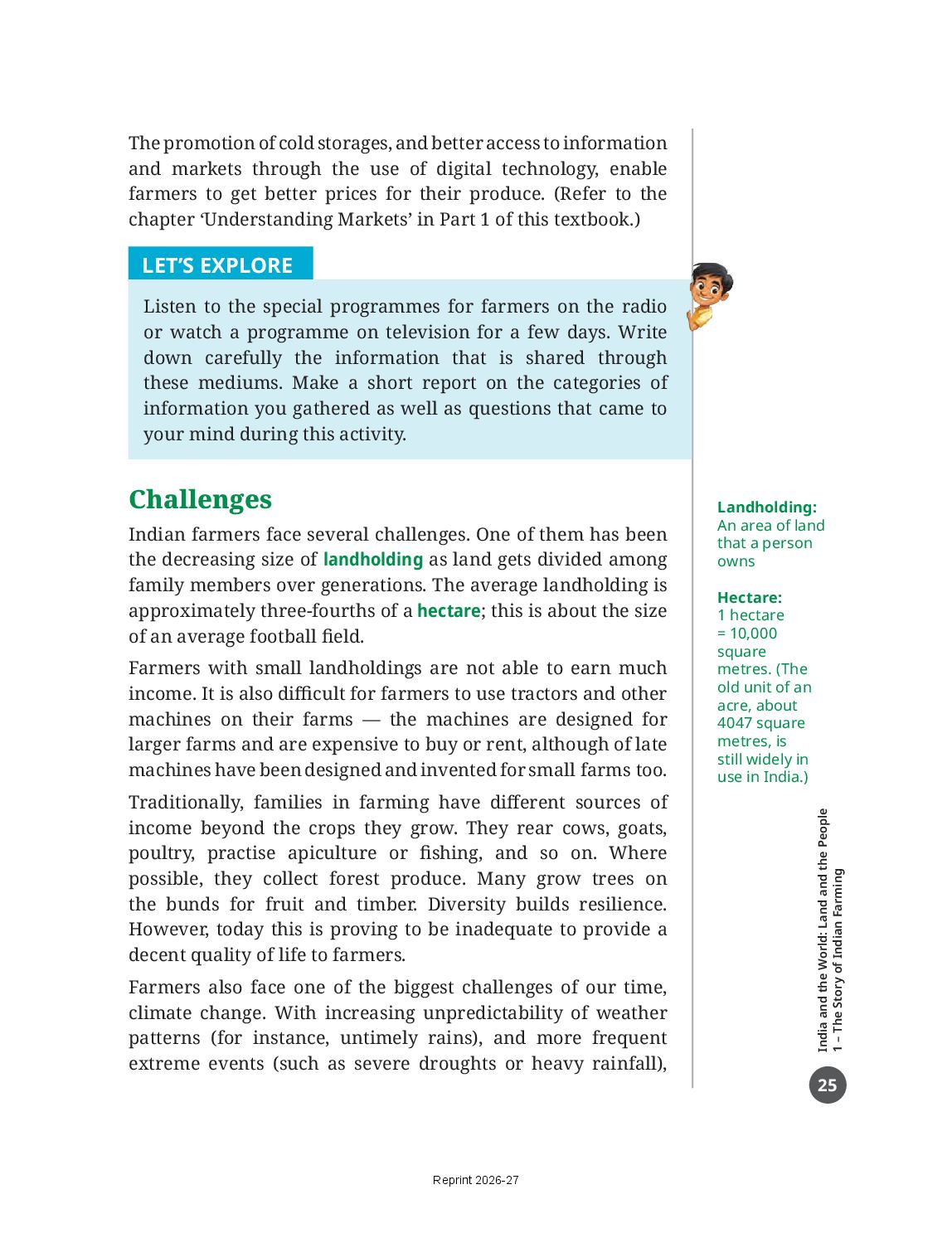
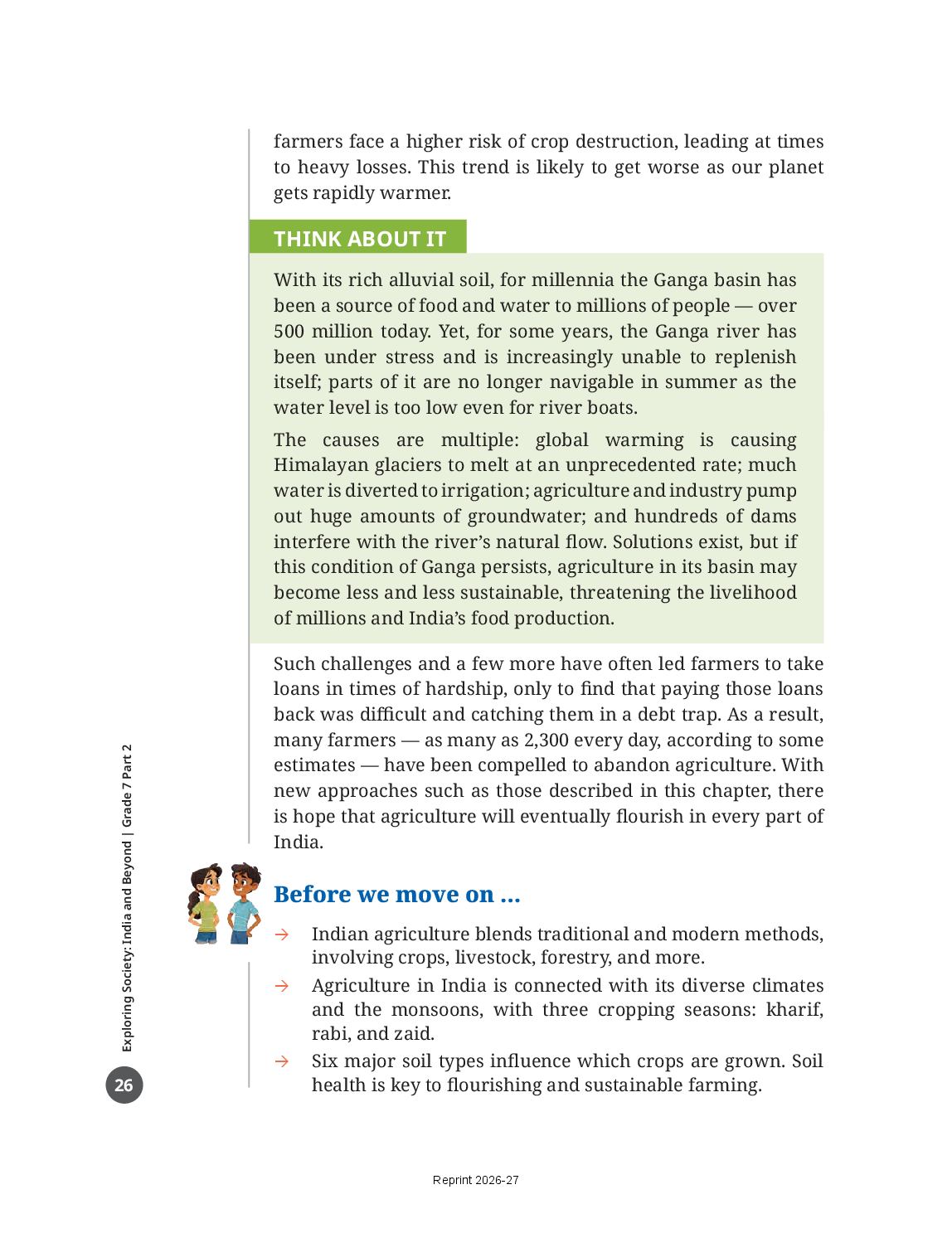
- The challenge today is balance. The Green Revolution of the 1960s–70s brought HYV seeds, irrigation, chemicals and machines, and India became self-sufficient in food — but it also brought soil impoverishment, falling groundwater and pollution. Sustainable pathways — organic farming, neem-based pesticides, Sikkim as the world’s first 100 per cent organic state — try to join modern productivity to traditional wisdom. Farmers still face small landholdings (about three-fourths of a hectare), debt and climate change.
Quick revision – The Story of Indian Farming
| Term | What it means | Where it appears in the chapter | Worth remembering |
|---|---|---|---|
| Agriculture | Preparation of soil, cultivation of plants, rearing of livestock and often growing of trees — broadly farming, animal husbandry, forestry and horticulture | Page 2, India’s Agricultural Landscape | From Latin agri = field and culture = to cultivate (DON’T MISS OUT, page 2) |
| Agriculture and allied activities | The Government of India’s grouping: agriculture, livestock activities, beekeeping (apiculture), fisheries, silkworm rearing and silk yarn, and fibre production such as cotton and hemp | DON’T MISS OUT, page 2 | Just over 18% of GDP; about 46% of the working population (2022-2023) |
| Threshing | Removing the edible grain from the straw or husk, manually or using a machine | Margin note, page 2 | More than 75% of rural agricultural workers are women (2025) — they sow, harvest and thresh |
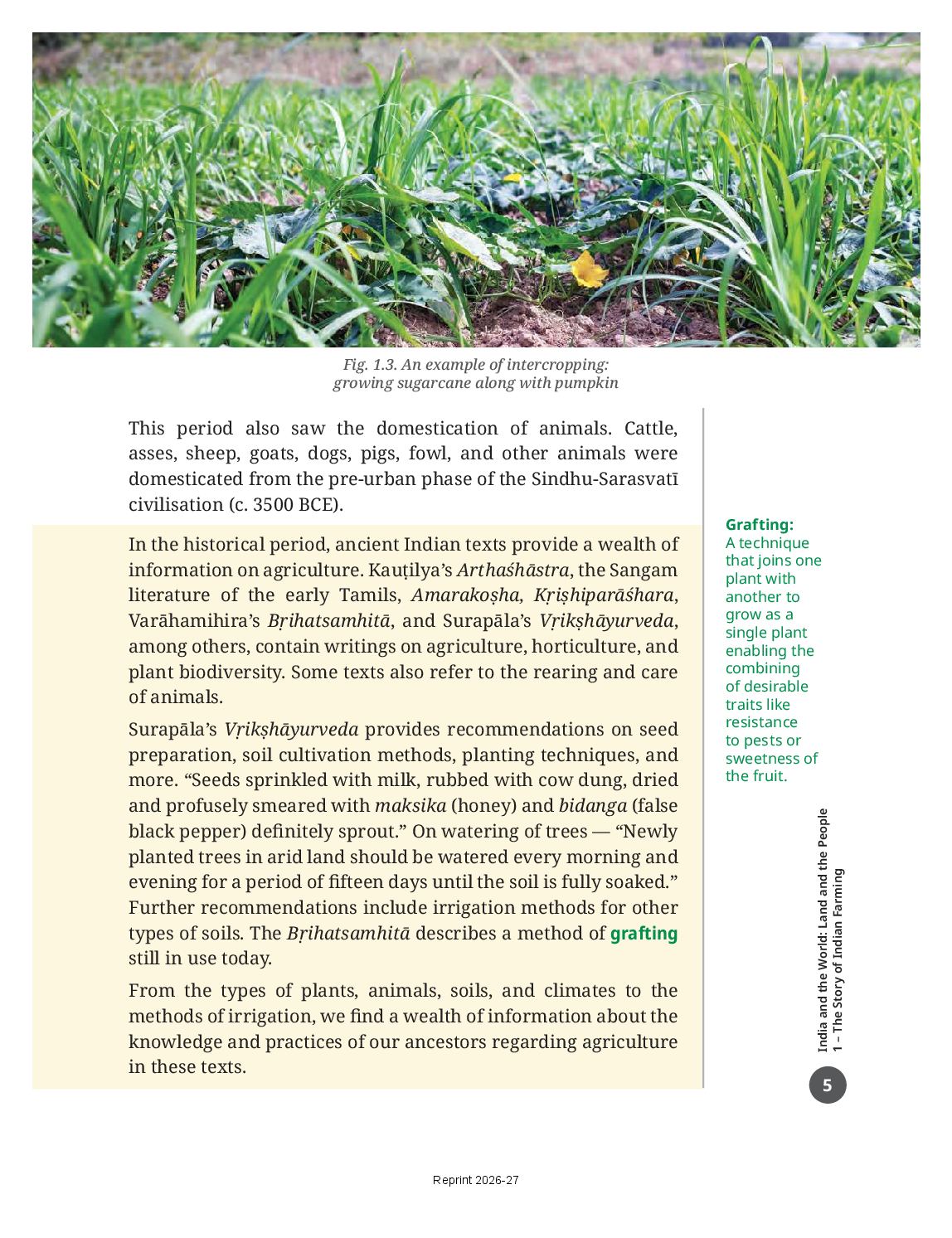
| Intercropping | The practice of growing two or more different crops simultaneously | Margin note, page 4; Fig. 1.2, Fig. 1.3 | Seen in the perpendicular furrows at Kalibangan, c. 2800 BCE — and again in the 1960s |
| Grafting | Joining one plant with another so that they grow as a single plant, combining desirable traits like pest resistance or sweetness | Margin note, page 5 | The Bṛihatsamhitā describes a grafting method still in use today |
| Agroclimatic zone | A region defined by combining climate factors, soil and terrain types, and vegetation | Pages 6–7 | India has 15 — e.g. Upper Gangetic Plain, Southern Plateau and Hills, Western Dry Region |
| Kharif / rabi / zaid | The monsoon, winter and summer cropping seasons | Pages 8–9; Fig. 1.5 | Arabic words used since Mughal times; earlier kedāra, haimana, graiṣhmika |
| Humus | The dark organic matter in soil formed by the decomposition of plant and animal matter; rich in nutrients, retains moisture | Margin note, page 10 | Humus is the Latin word for ‘earth’ or ‘soil’ |
| Weathering | The process by which rocks and minerals are broken down into soil particles by physical, chemical or biological means | Margin note, page 12 | Black, red, laterite and alpine soils are all formed by the weathering of rock (Fig. 1.9) |
| Silt | Fine, dust-like sediment of rock and mineral particles — larger than clay, smaller than sand, and easily carried by rivers | Margin note, page 12 | Silt carried from the mountains is what makes alluvial soil rich |
| Bedrock | The original rock from which new rocks and soils are derived through weathering, erosion and other processes | Margin note, page 13; Fig. 1.8 | Stage 1 of soil formation: bedrock begins to disintegrate |
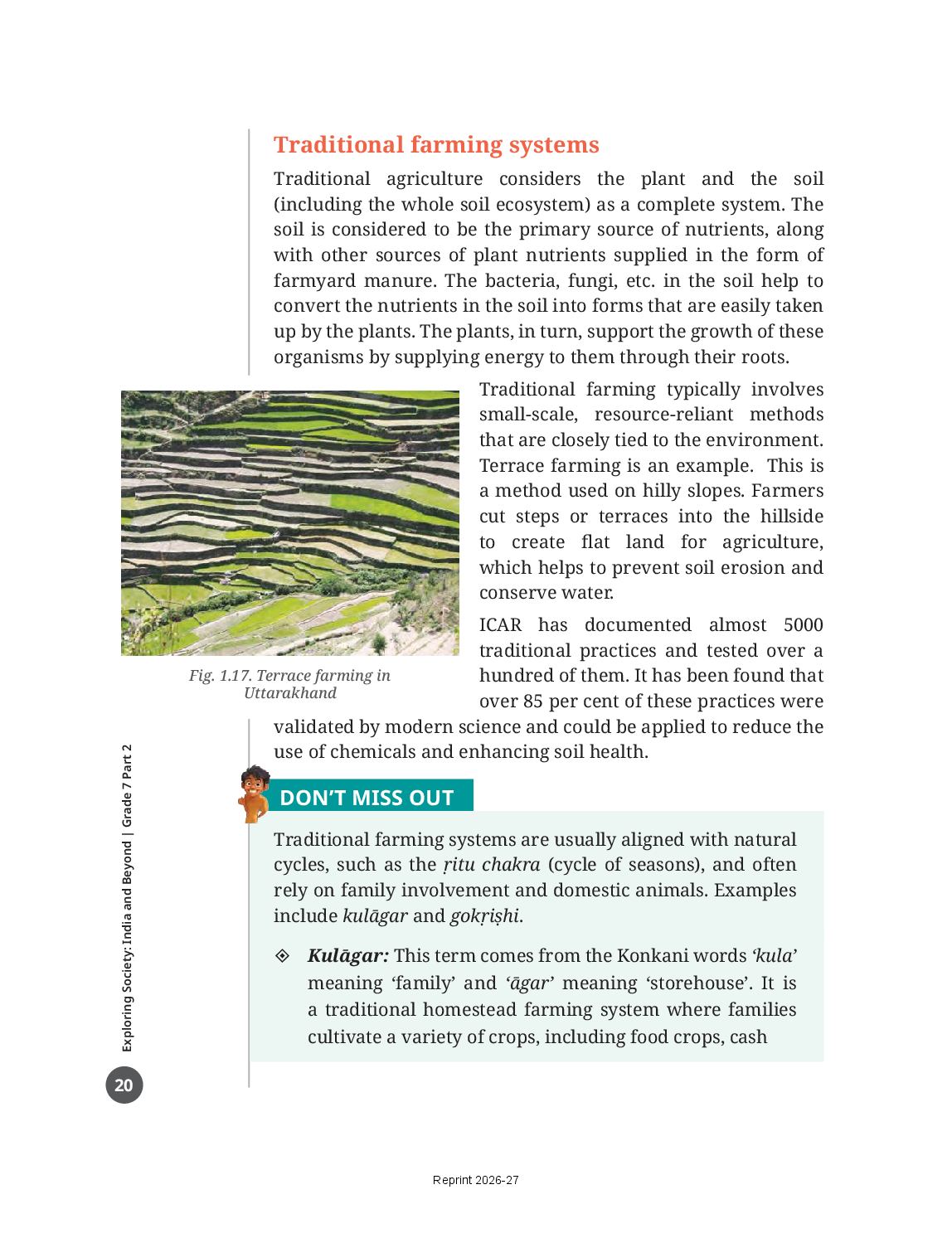
| Soil conservation | Managing soil to prevent its degradation and preserve its productivity | Margin note, page 14 | Traditional: crop rotation, multiple cropping, contour ploughing · Modern: terracing, afforestation, mulching |
| Panchagavya | A fermented mixture of five cow products — dung, urine, milk, curd and ghee | DON’T MISS OUT, page 14 | Recent studies show it works as a biofertiliser and raises disease resistance |
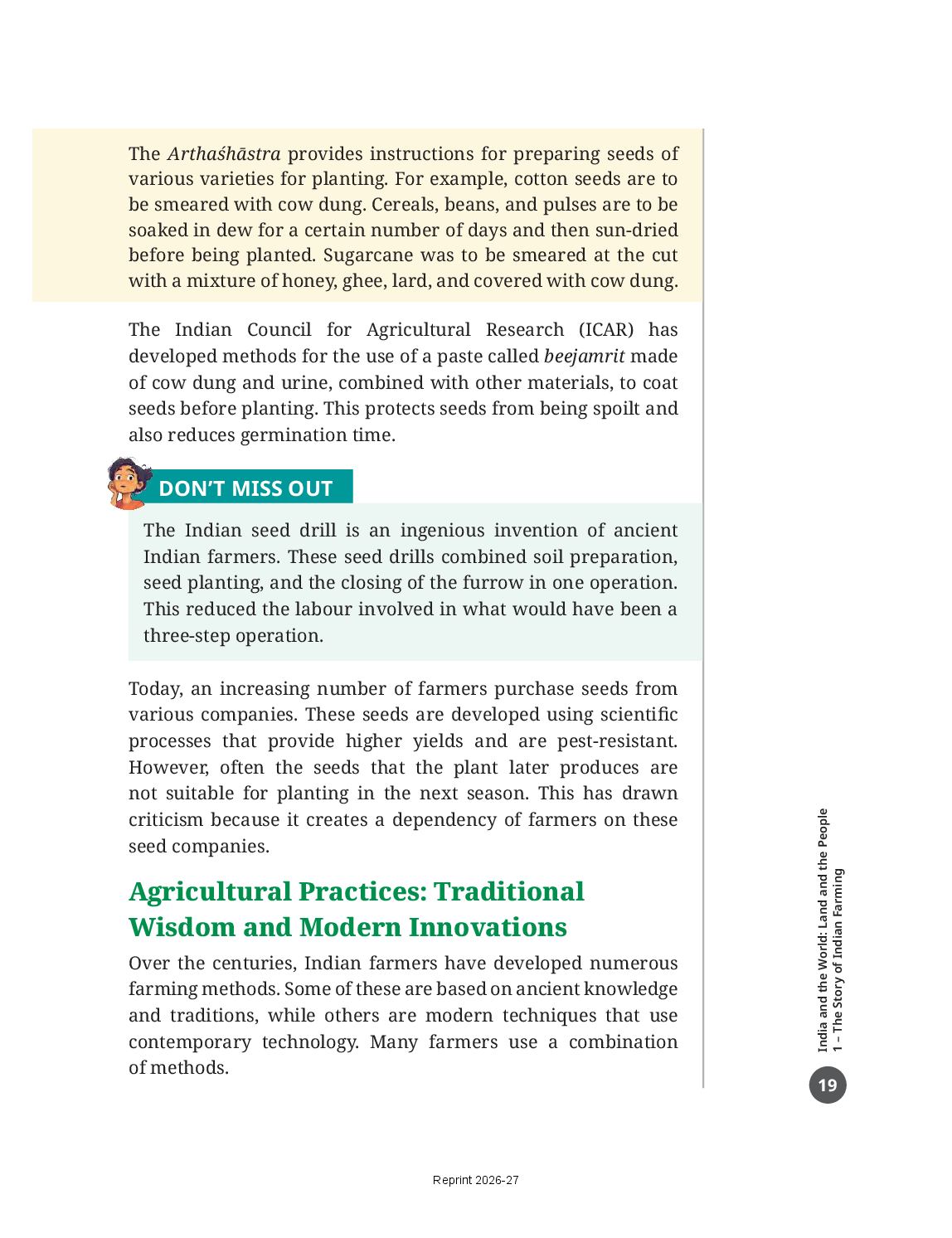
| Beejamrit | An ICAR-developed paste of cow dung and urine with other materials, used to coat seeds before planting | Page 19 | Protects seeds from spoiling and reduces germination time |
Old NCERT vs New – Class 7 Social Science
This chapter is from Exploring Society: India and Beyond, the new NCERT Class 7 Social Science book (NCF-SE 2023, used from 2025-26). It replaced the old book “Our Pasts, Our Environment and Social and Political Life”, so chapter numbers and names differ from older PDFs.
Solutions and All Chapters
Answers to the exercises and the full chapter list of Exploring Society: India and Beyond:
The Story of Indian Farming – Overview
| Class | Class 7 |
| Subject | Social Science |
| Book | Exploring Society: India and Beyond – new NCERT book |
| Part | Part II |
| Chapter | 13 of 20 – The Story of Indian Farming |
| Book pages | Part II, 1 – 28 |
| Edition | NCERT Reprint 2026-27 |
| Session | 2026-27 |
| Free – read online or download |
Class 7 Social Science Chapter 13 – FAQs
Where can I download The Story of Indian Farming Class 7 PDF?
From the download table on this page – the chapter PDF is free, and the full book is linked too.
What is Class 7 Social Science Chapter 13 about?
Farming is one of the oldest occupations of humankind, and India’s oldest story. Broadly, ‘agriculture’ covers farming, animal husbandry, forestry and horticulture, and in some places pisciculture and silk rearing too. A little over 18 per cent of India’s GDP and about 46 per cent of its working population depend on agriculture and allied activities (2022-2023). In rural India, more than 75 per cent of those working in agriculture are women (2025).
Is The Story of Indian Farming from the new NCERT Class 7 Social Science book?
Yes. It is chapter 13 of exploring society: india and beyond (part ii), the new NCERT Class 7 Social Science book for 2026-27.
Is this the latest NCERT edition for 2026-27?
Yes – the PDF is NCERT’s latest edition for the 2026-27 session.
Where are the NCERT Solutions for Class 7 Social Science Chapter 13?
Open the NCERT Solutions link above for answers to the exercise questions.