Download The Age of Reorganisation – NCERT Class 7 Social Science Chapter 6 PDF from the new NCERT Class 7 Social Science book Exploring Society: India and Beyond (2026-27). Read the chapter online or download the free PDF. The Maurya empire broke up, and the map of India was redrawn. The last Maurya emperor was assassinated around 185 BCE by his commander-in-chief Puṣhyamitra Śhunga — hardly half a century after Aśhoka. Many new kingdoms emerged, most of them earlier…
The Age of Reorganisation PDF – Chapter 6 of Exploring Society: India and Beyond (Part I)
Read the chapter online or download the PDF.
| Chapter | Download | |
|---|---|---|
| Chapter 6 PDF | The Age of Reorganisation | View PDF |
| Full book | NCERT Class 7 Social Science – Exploring Society: India and Beyond | View Book |
Read Online
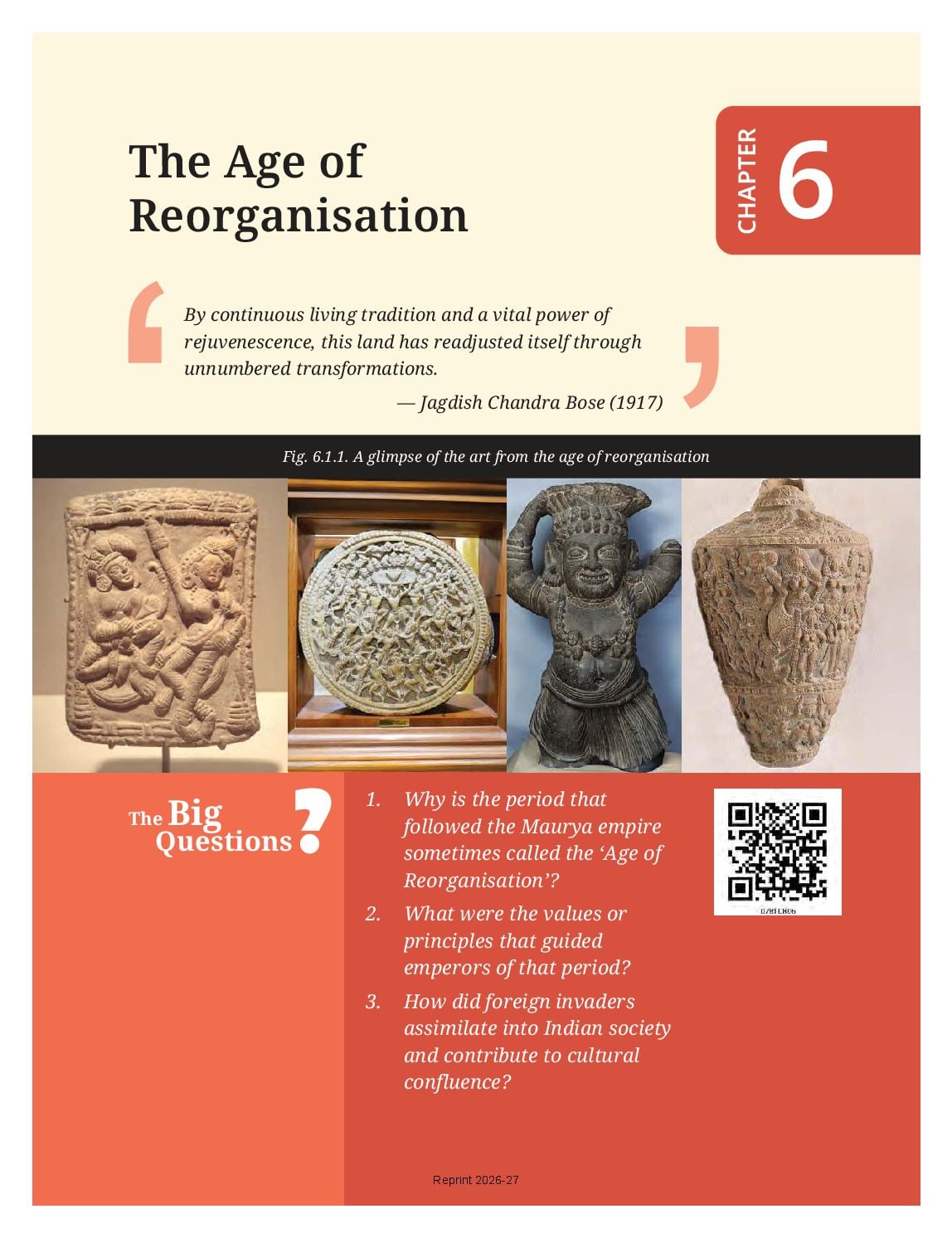
What Is in The Age of Reorganisation? (Class 7 Social Science Chapter 6)
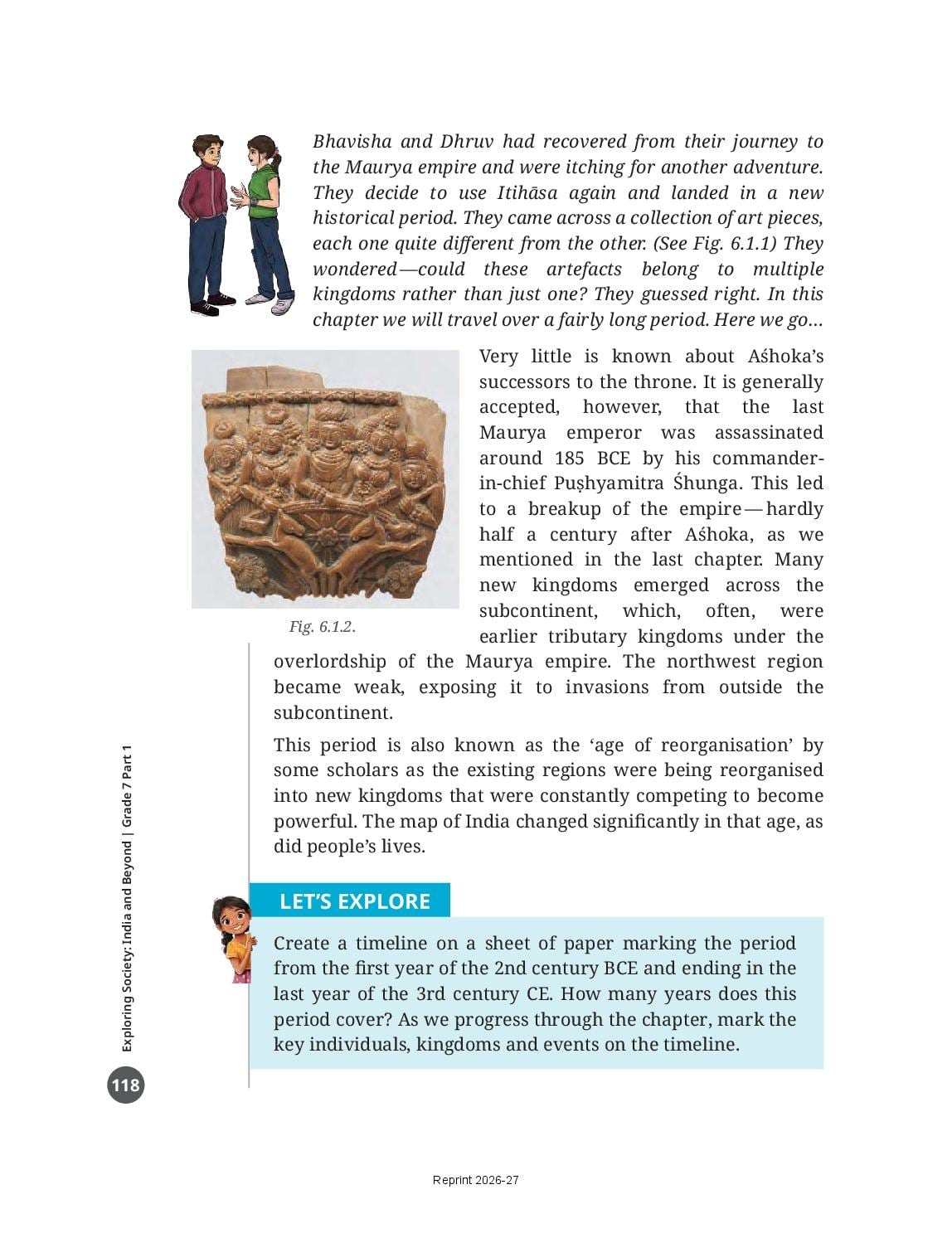
- The Maurya empire broke up, and the map of India was redrawn. The last Maurya emperor was assassinated around 185 BCE by his commander-in-chief Puṣhyamitra Śhunga — hardly half a century after Aśhoka. Many new kingdoms emerged, most of them earlier tributary kingdoms under Maurya overlordship. Because the existing regions were being reorganised into new competing kingdoms, some scholars call the period the ‘age of reorganisation’.
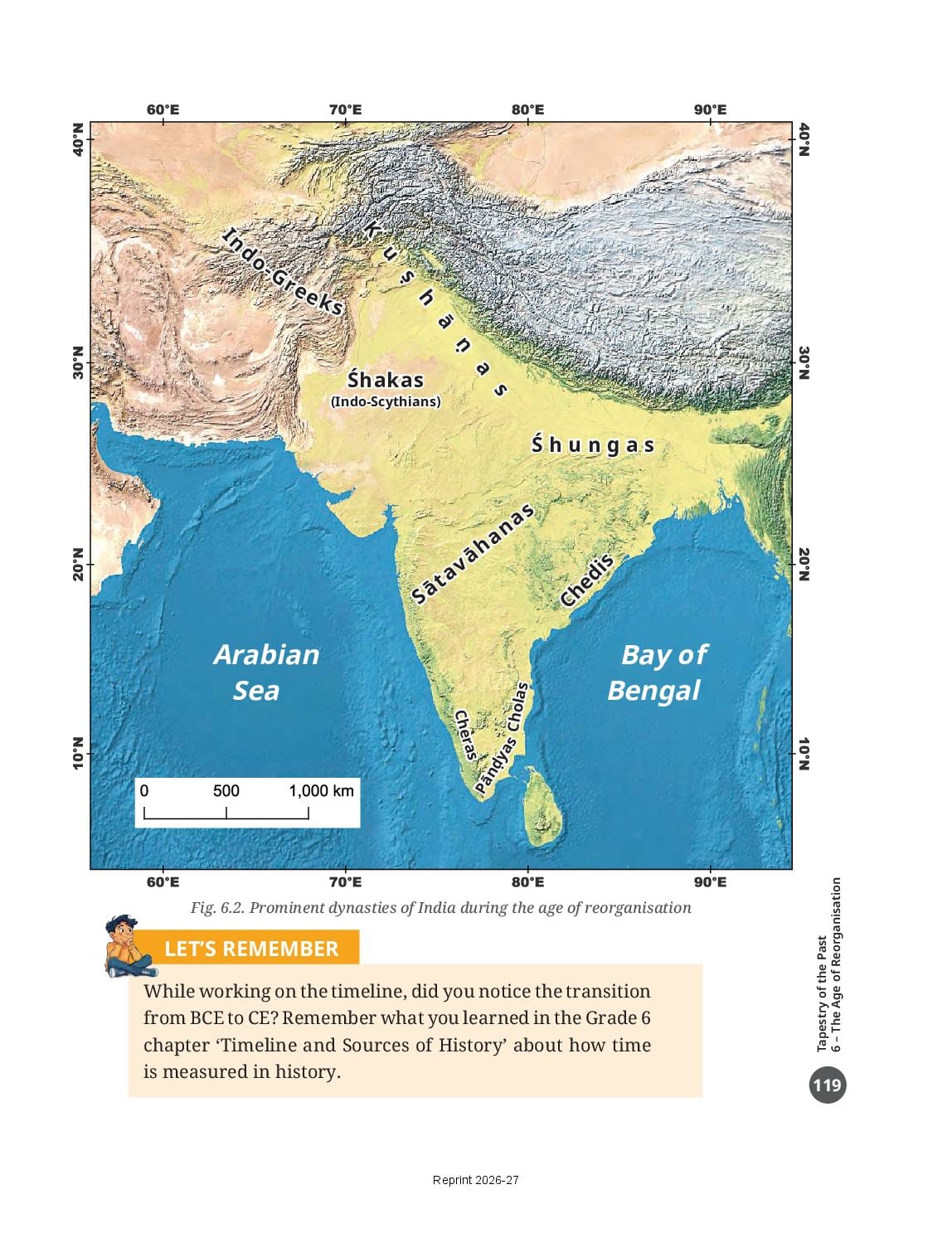
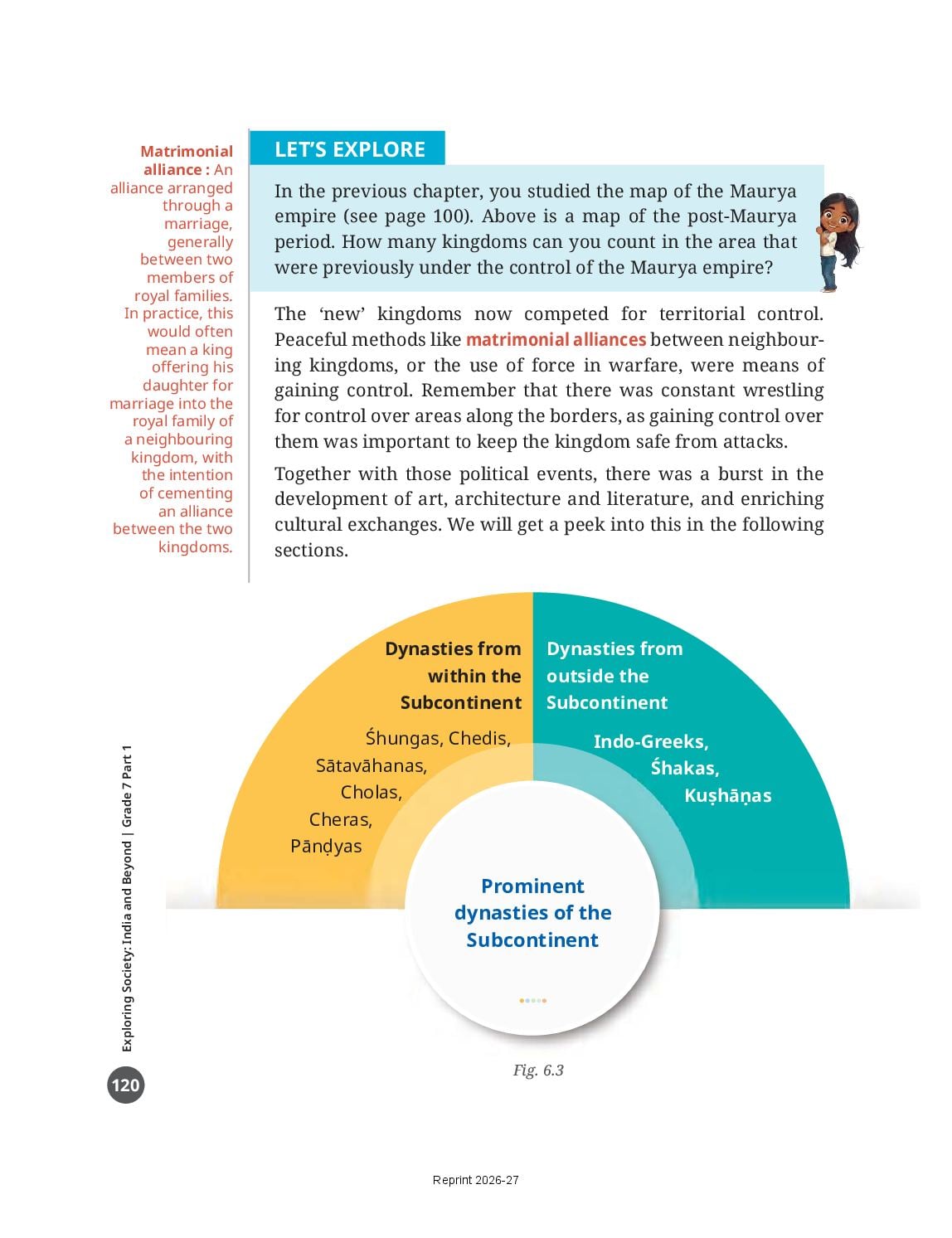
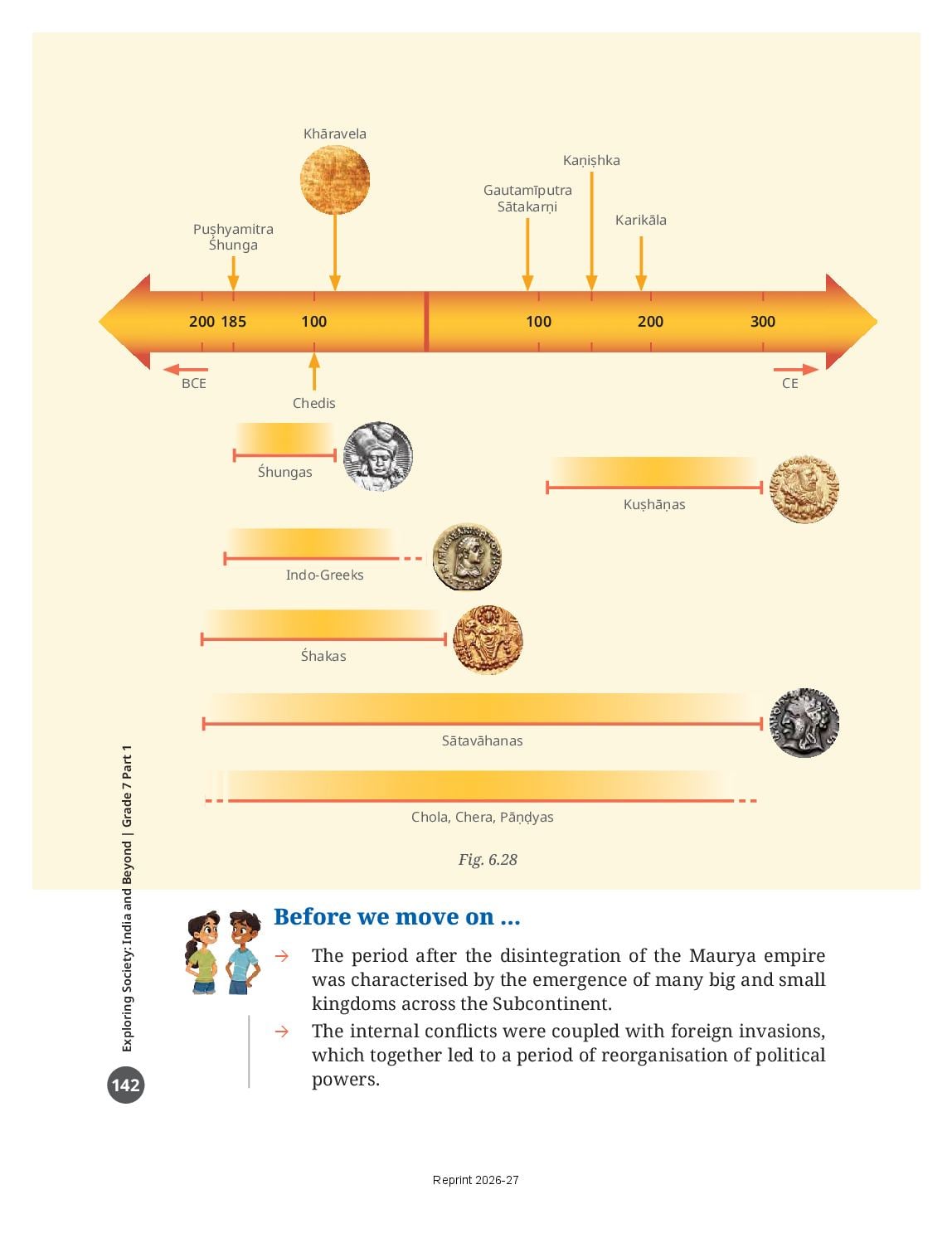
- Nine dynasties fill the map (Fig. 6.2) — six from within, three from outside. From within the Subcontinent: Śhungas, Chedis, Sātavāhanas, Cholas, Cheras, Pānḍyas. From outside: Indo-Greeks, Śhakas (Indo-Scythians) and Kuṣhāṇas. They competed for territory by two means — matrimonial alliances and warfare — especially along the borders.
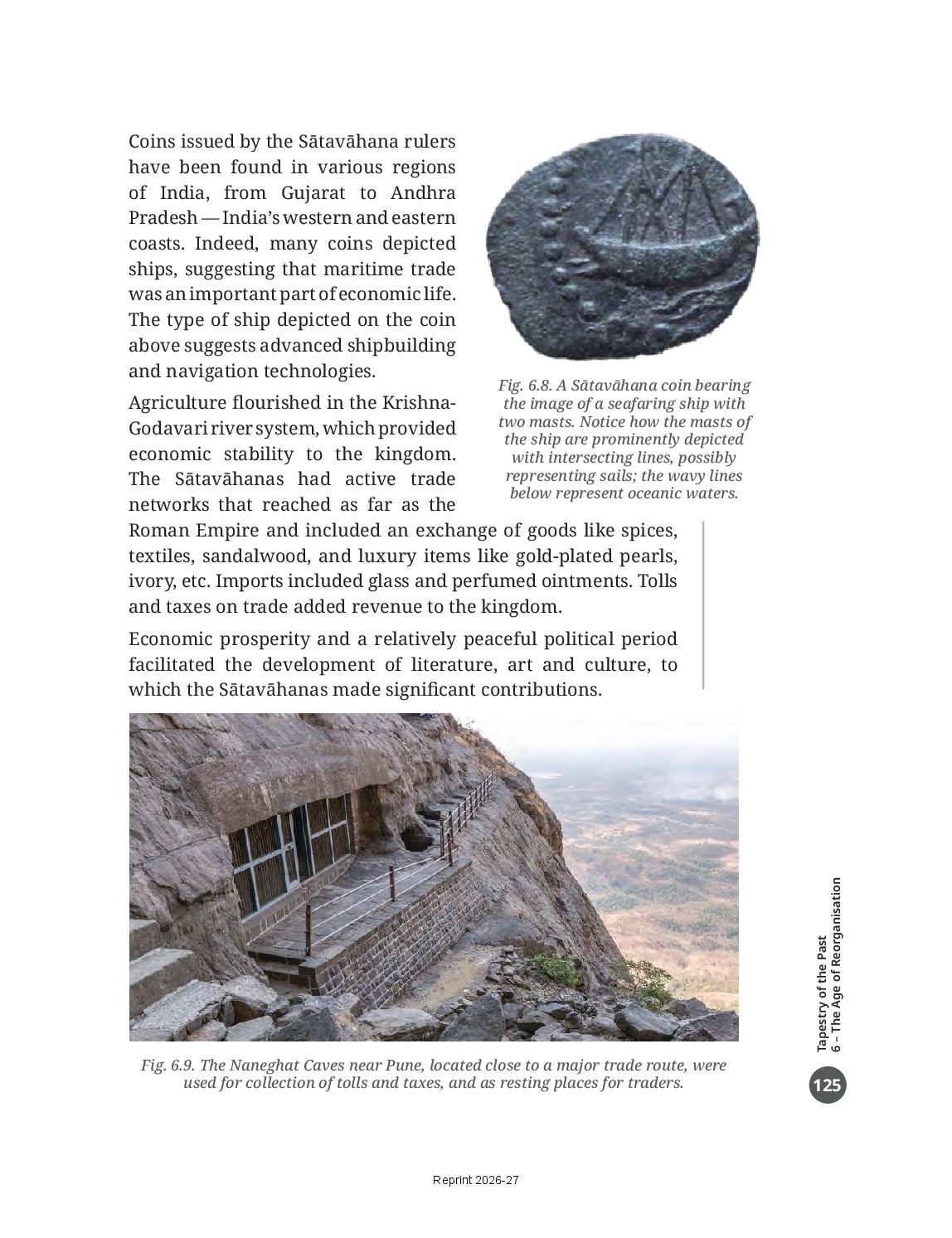
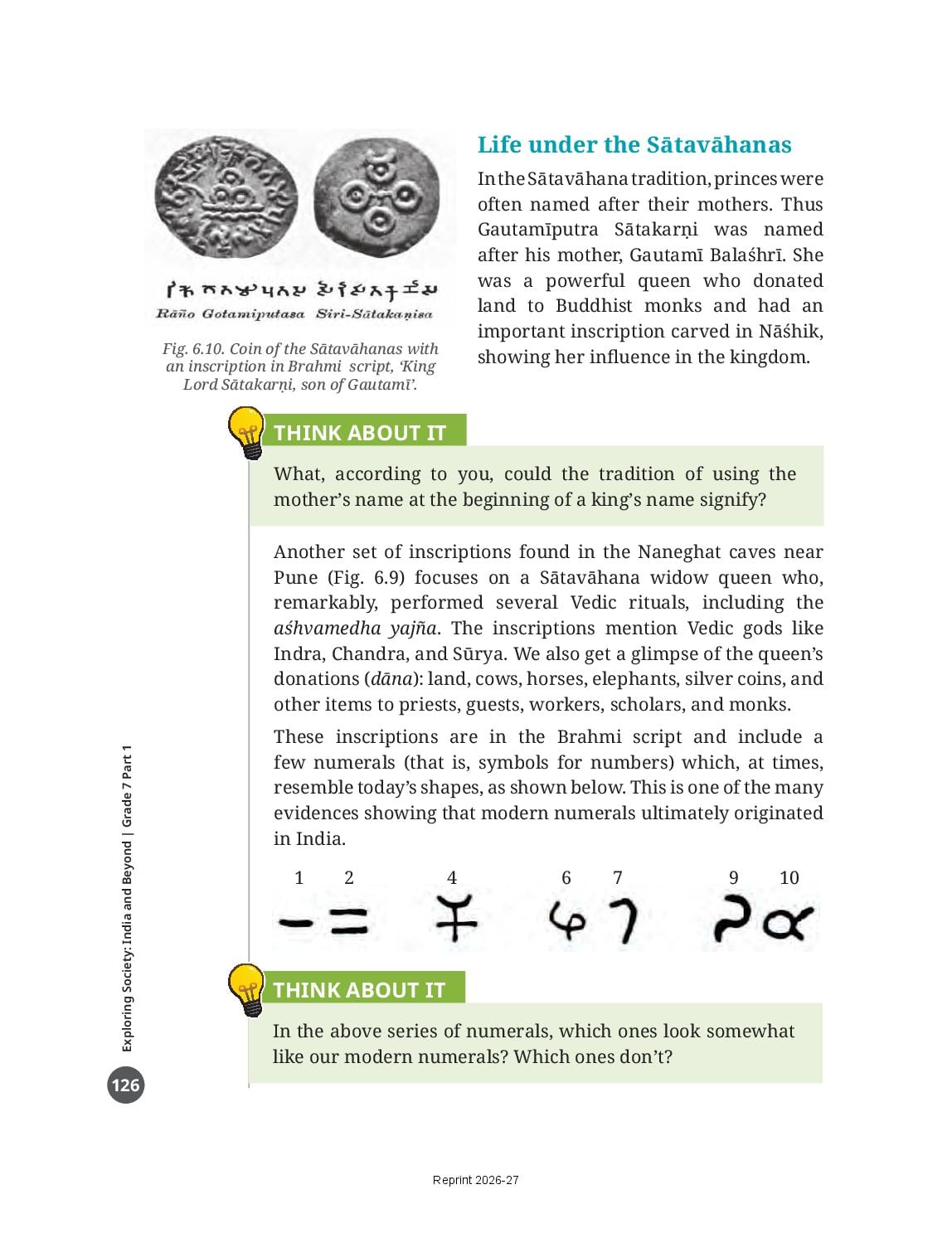
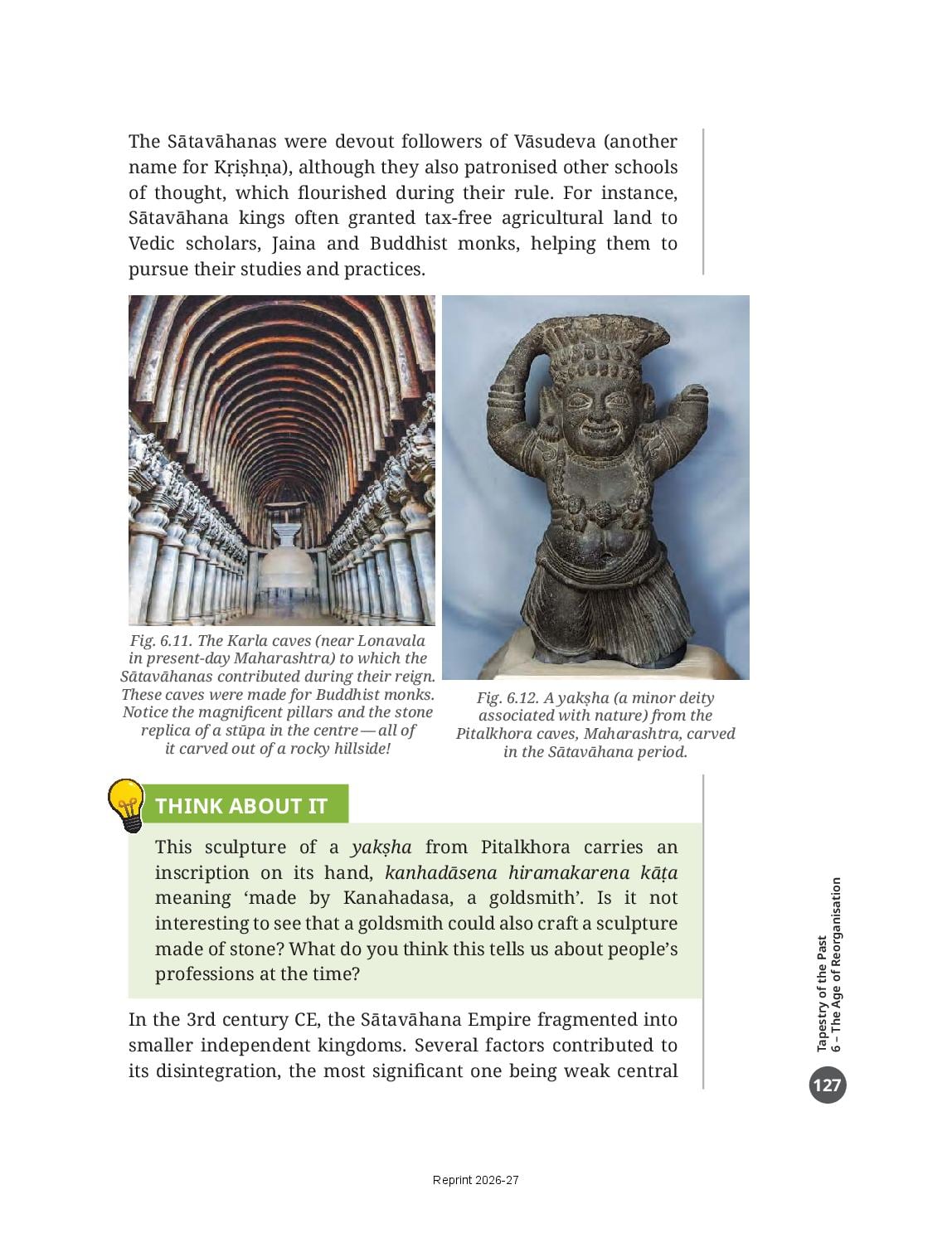
- In the Deccan the Sātavāhanas grew rich on trade. Their coins, found from Gujarat to Andhra Pradesh, show two-masted ships — proof of maritime trade reaching the Roman Empire. Agriculture flourished in the Krishna–Godavari system; tolls and taxes at places like the Naneghat caves added revenue. Princes were named after their mothers — Gautamīputra Sātakarṇi after Gautamī Balaśhrī.
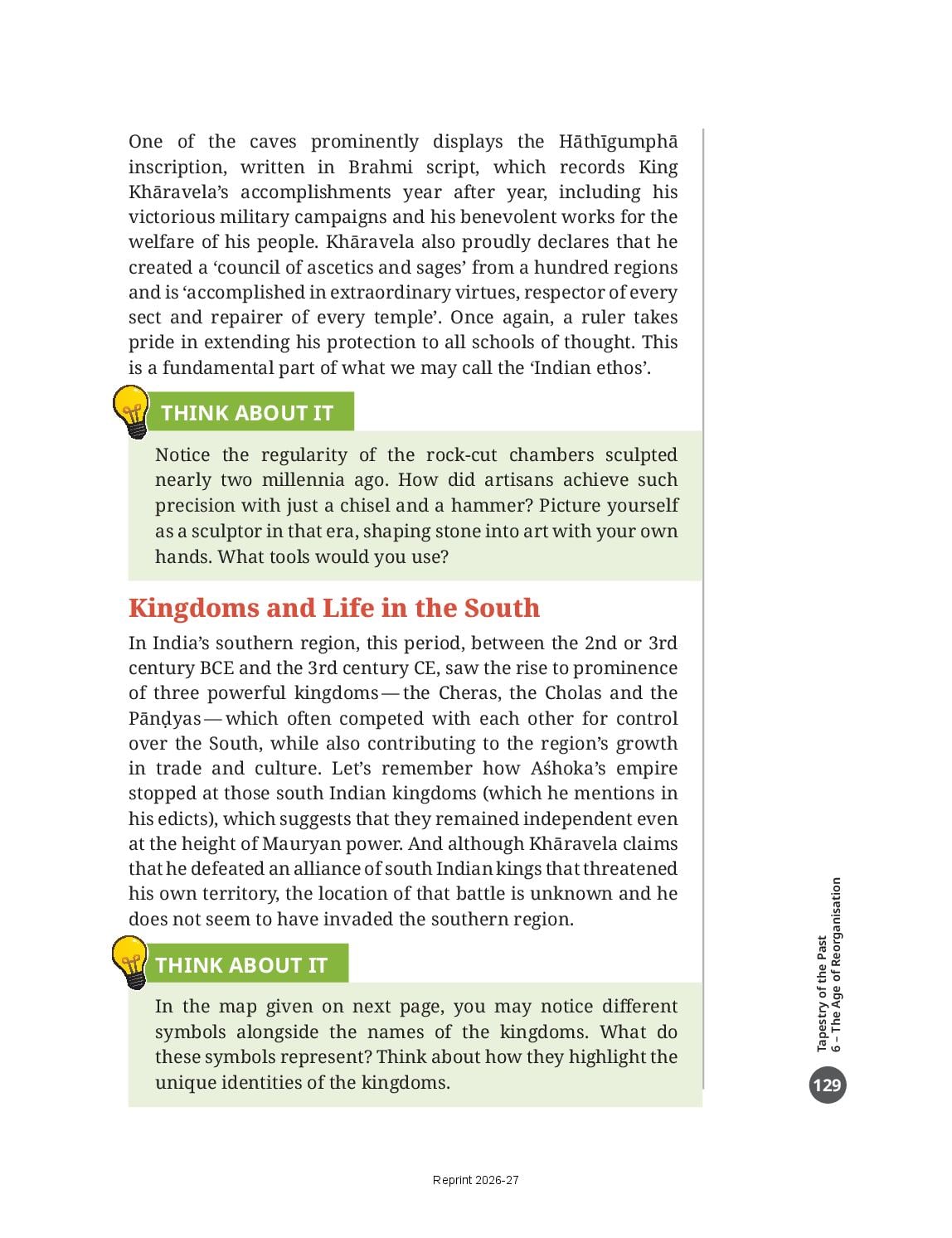
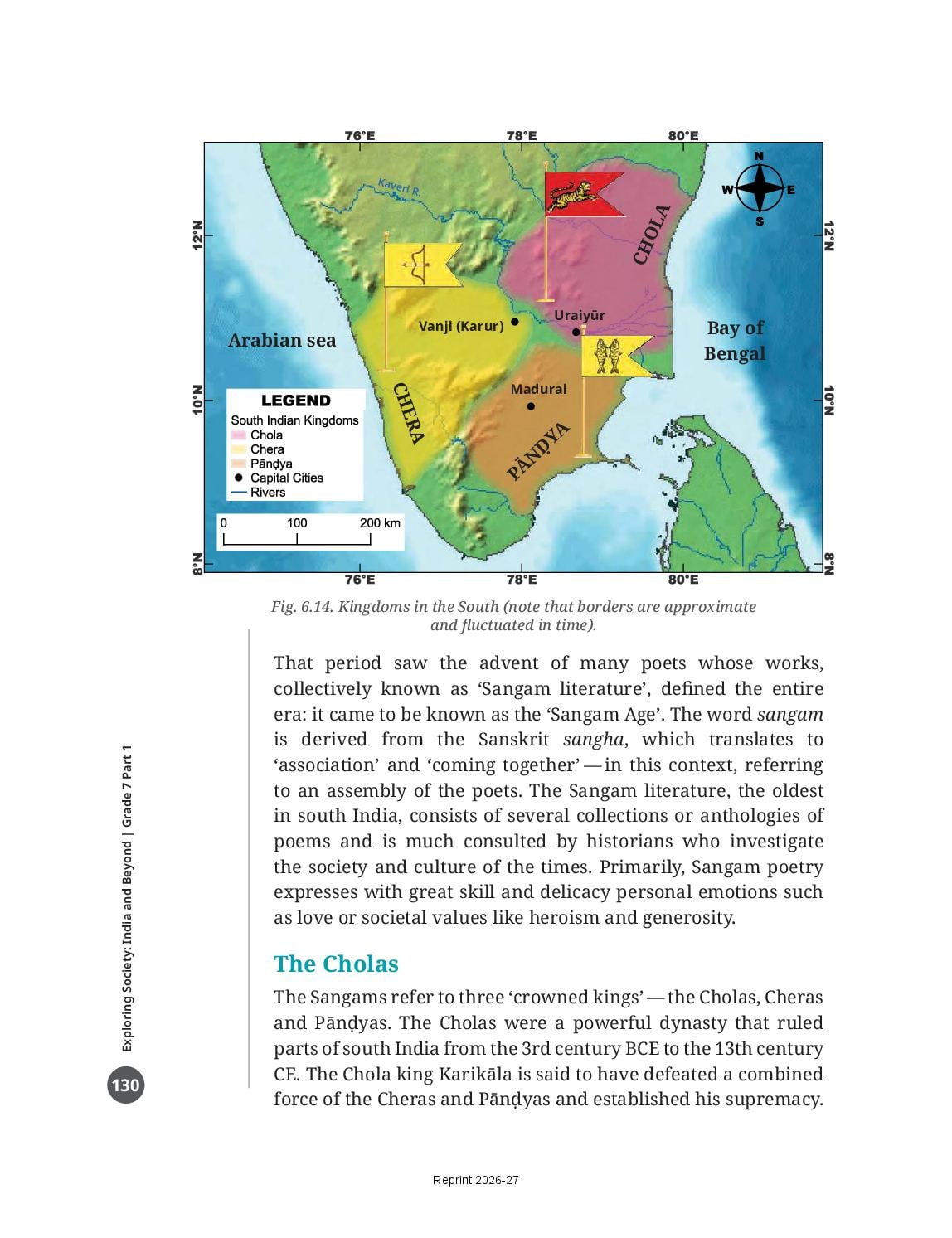
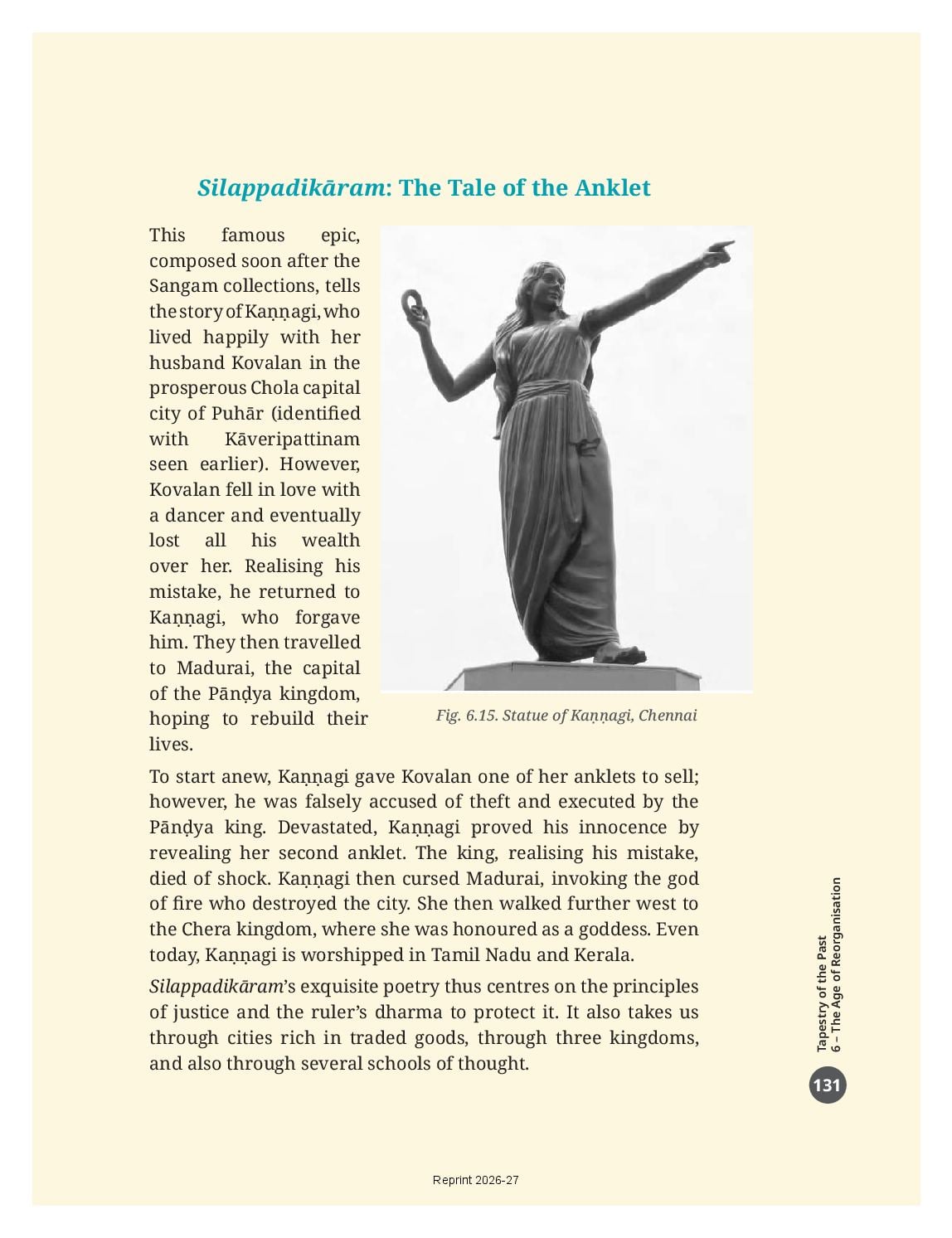
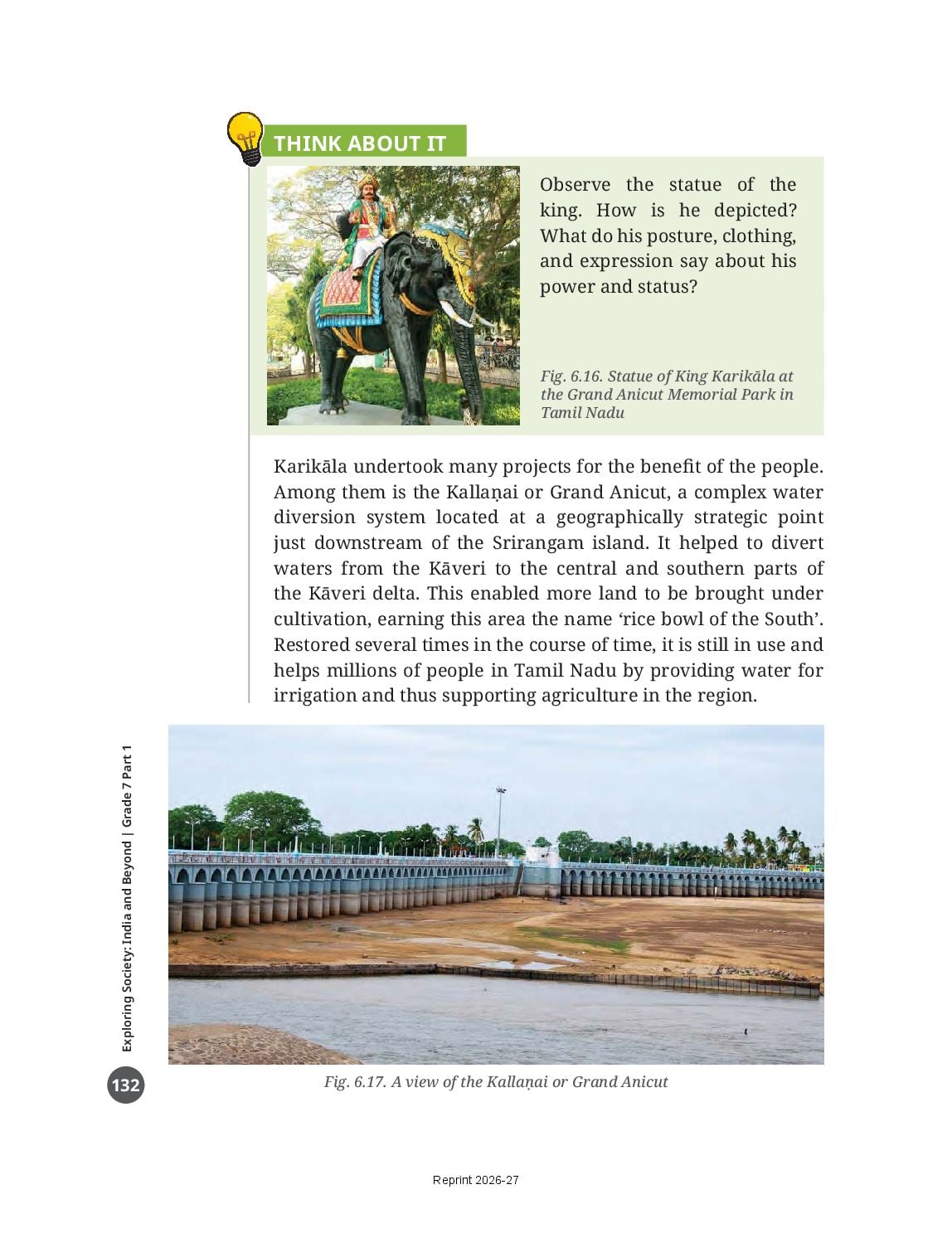
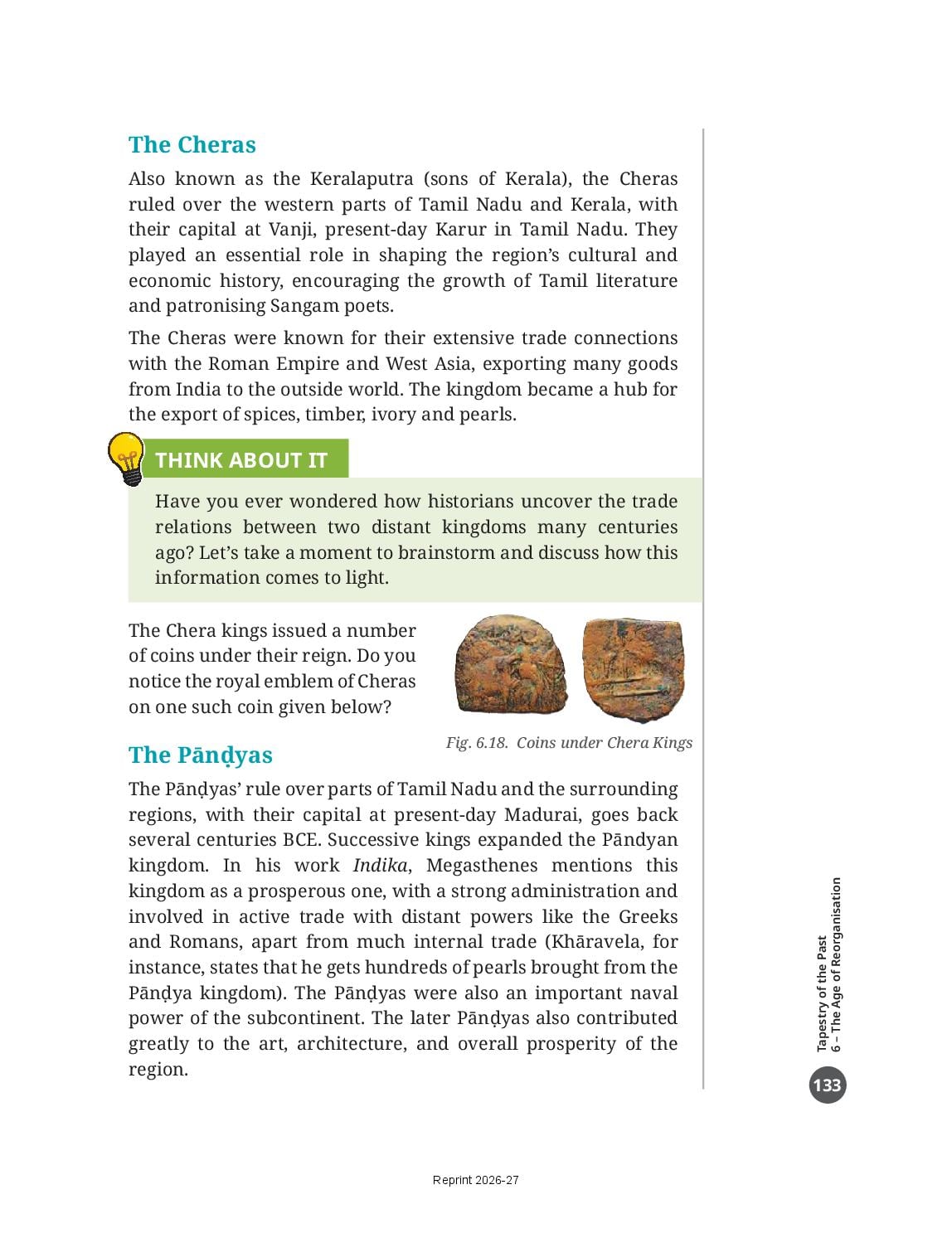
- In the far south, three ‘crowned kings’ and the Sangam Age. The Cholas (Uraiyūr; king Karikāla, builder of the Kallaṇai or Grand Anicut), the Cheras (Vanji/Karur, the ‘Keralaputra’, trading with Rome) and the Pānḍyas (Madurai, famous for pearls and sea power). Their poets’ anthologies are the Sangam literature, from Sanskrit sangha, ‘assembly’ — the oldest literature of south India.
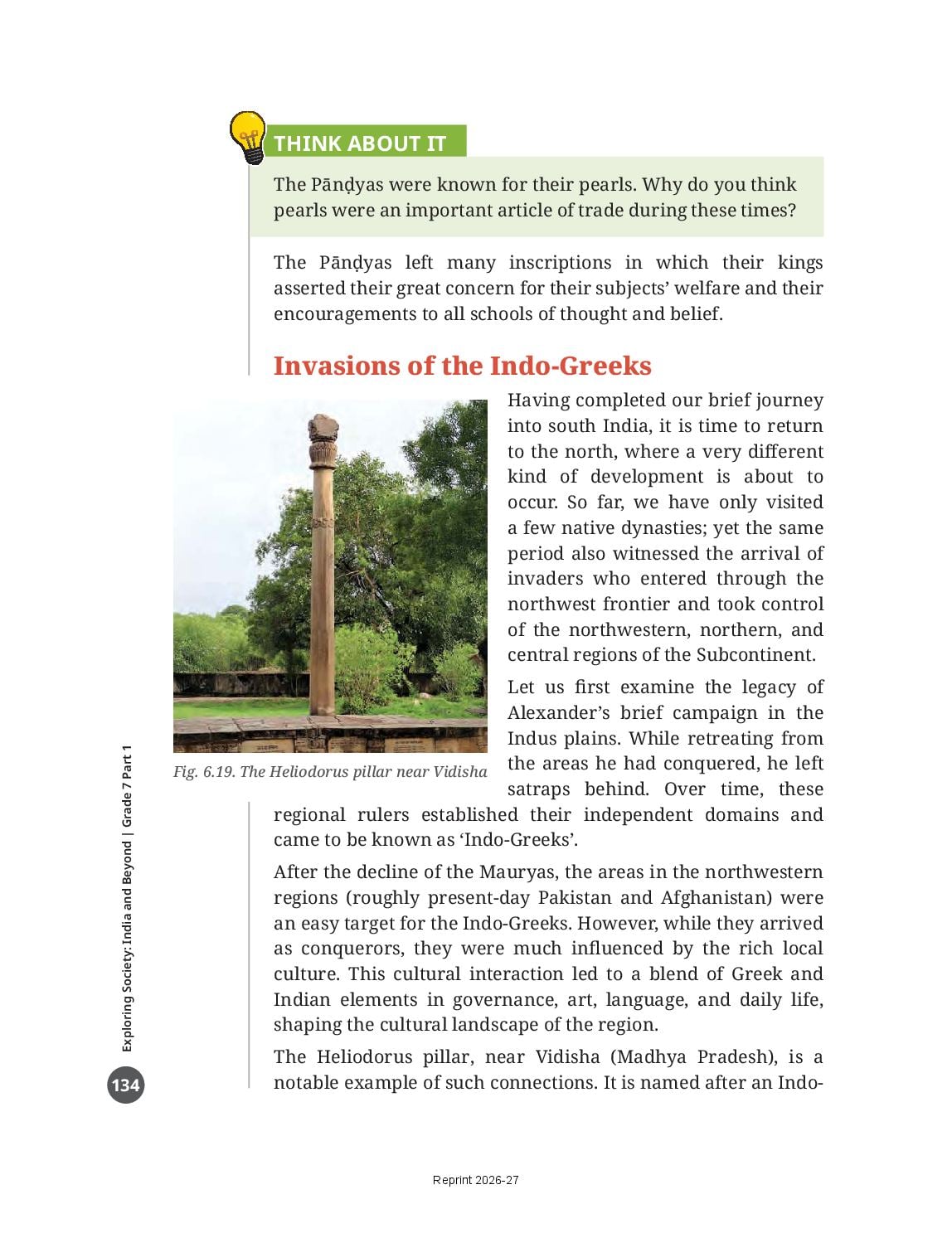
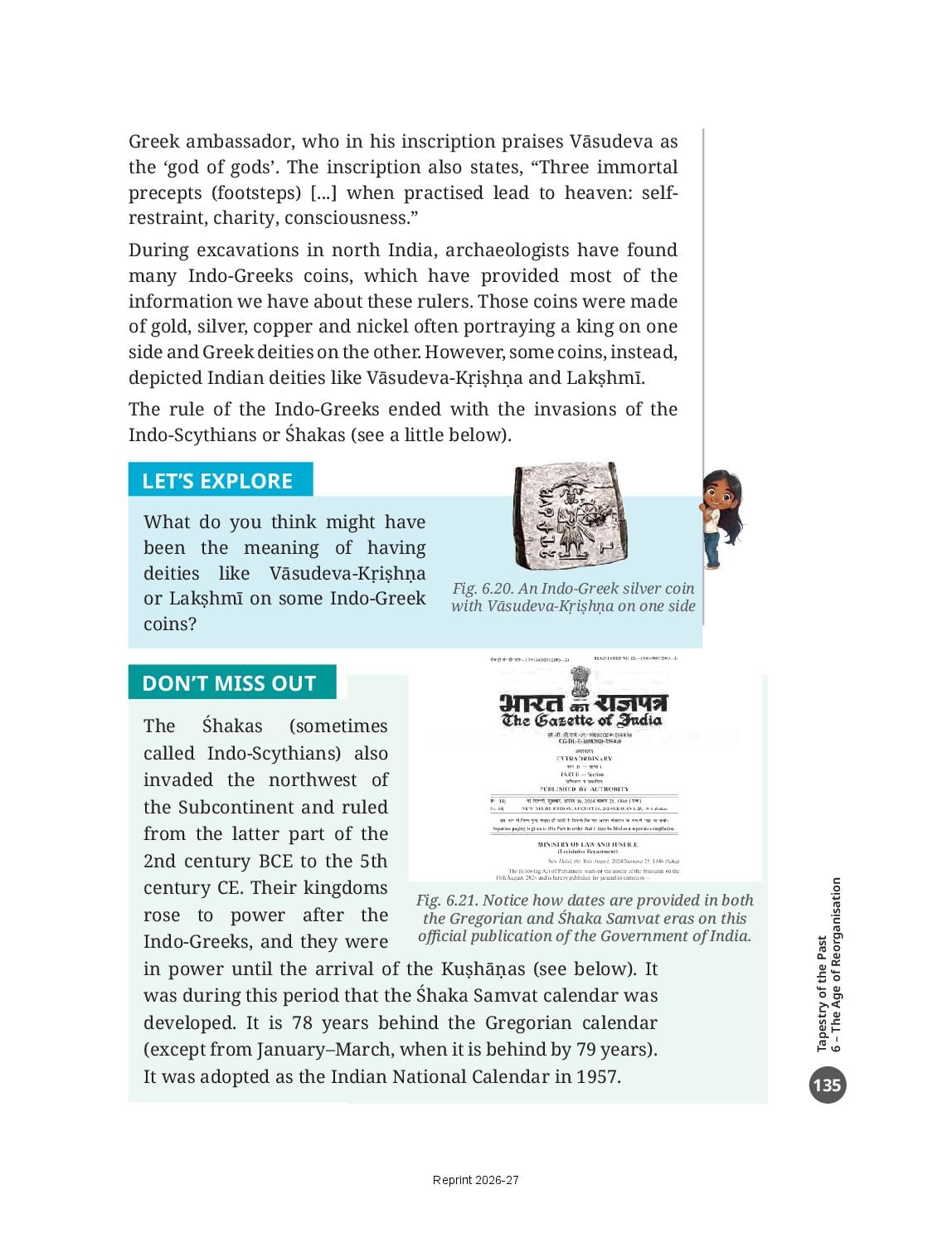
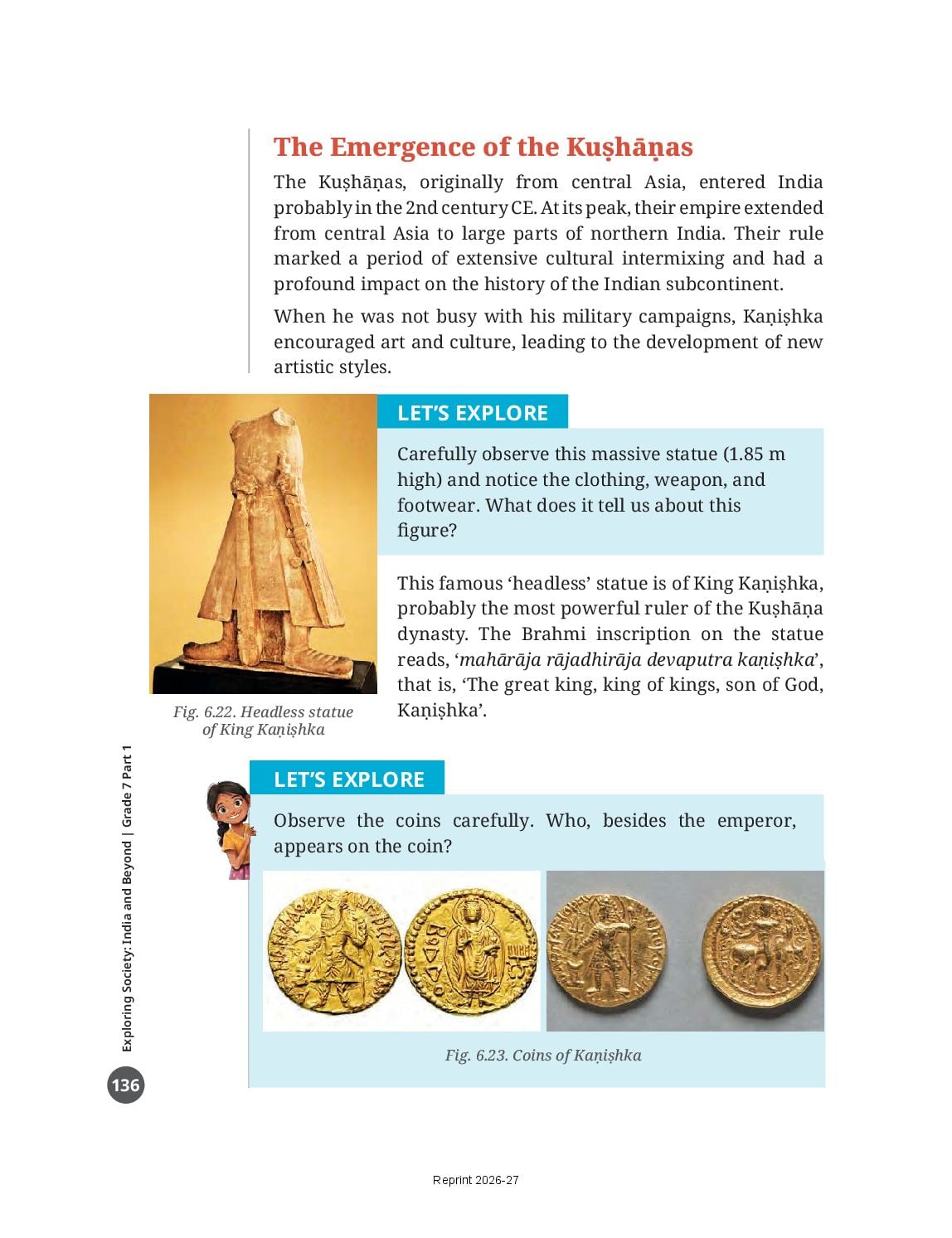
- Invaders came through the northwest — and were absorbed. Alexander’s satraps became the Indo-Greeks, whose ambassador Heliodorus set up a pillar near Vidisha praising Vāsudeva as ‘god of gods’. Then came the Śhakas (the Śhaka Samvat calendar, 78 years behind the Gregorian, is the Indian National Calendar since 1957) and the Kuṣhāṇas, whose king Kaṇiṣhka put Buddha and Śhiva on his coins and controlled parts of the Silk Route.
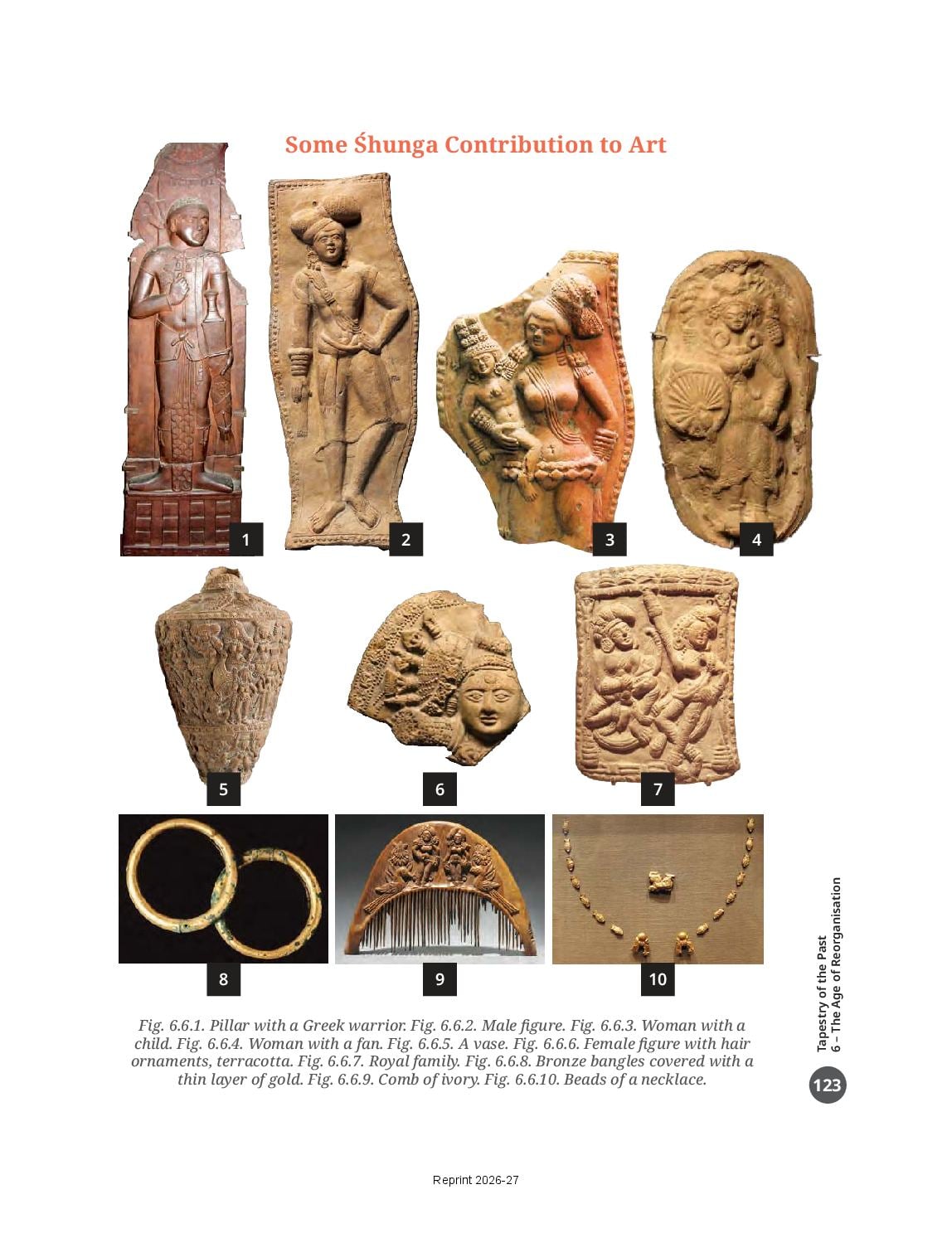
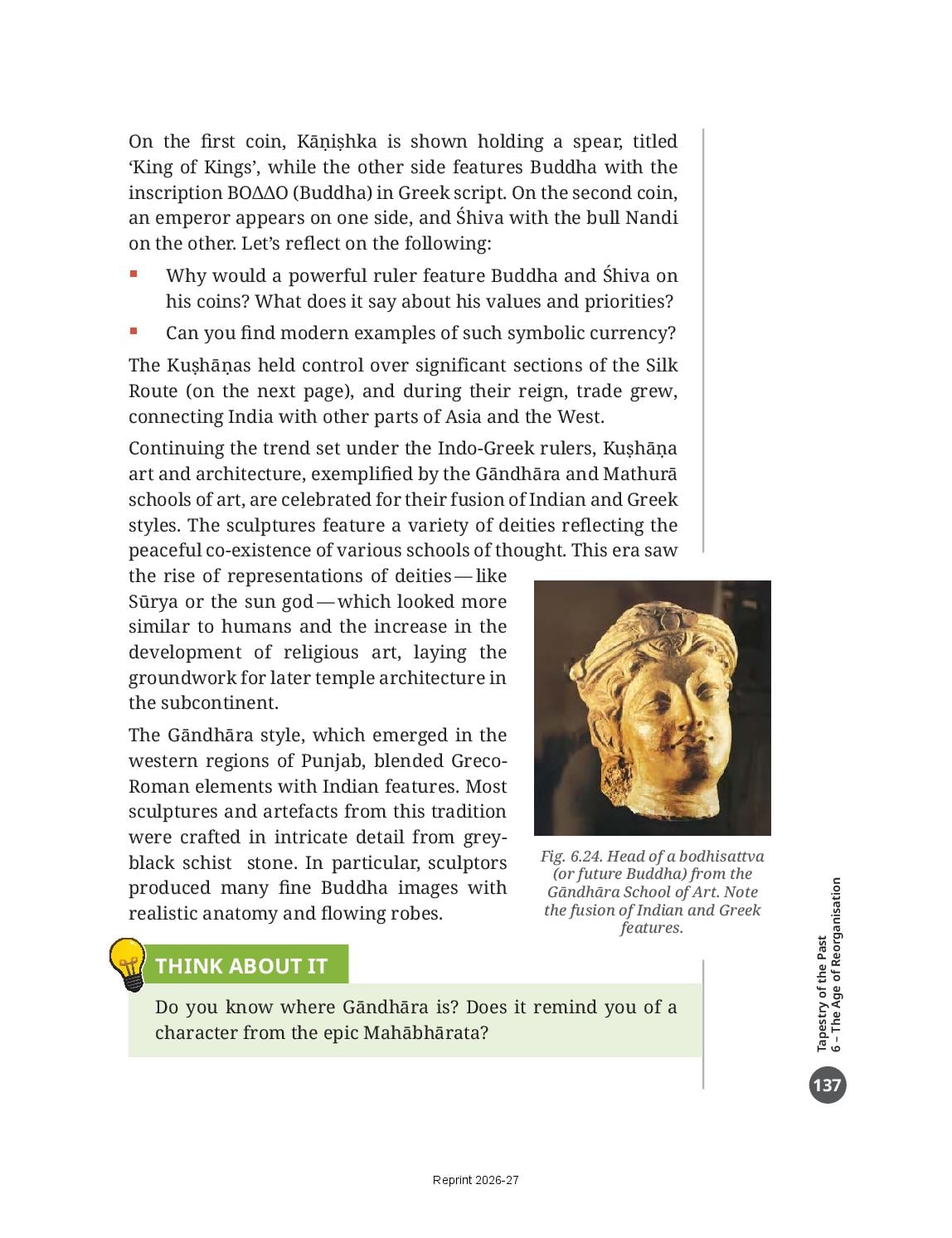
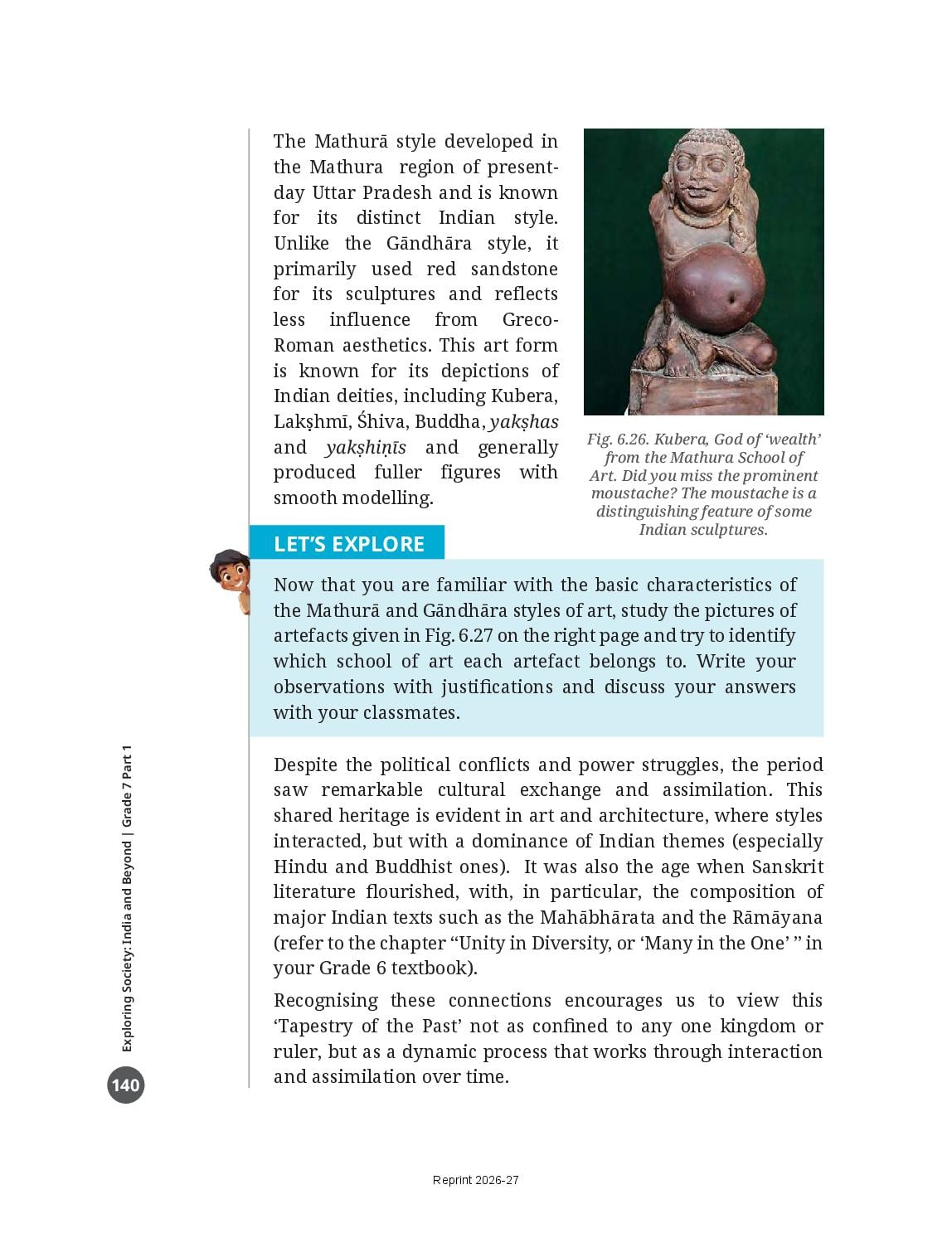
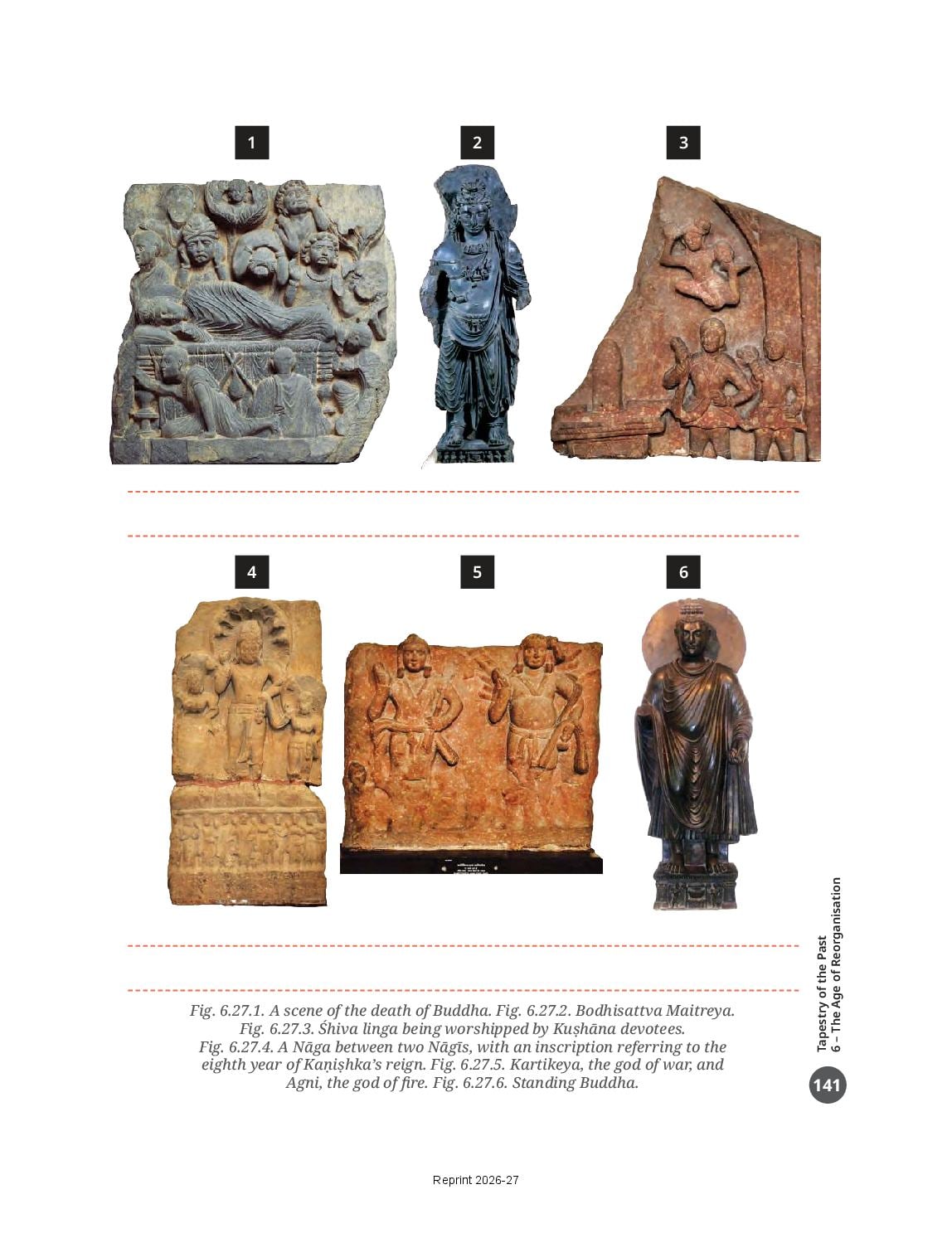
- Politics divided, culture united. The Gāndhāra school (grey-black schist, Greco-Roman modelling) and the Mathurā school (red sandstone, fuller Indian figures) grew side by side; deities began to be shown in human form, preparing the way for later temple architecture. Sanskrit literature flourished — the Mahābhārata and the Rāmāyaṇa were composed in this age. The ‘Tapestry of the Past’ is best seen not as one kingdom’s story but as a continuous process of interaction and assimilation.
Quick revision – The Age of Reorganisation
| Term | What it means | Where it appears in the chapter | Worth remembering |
|---|---|---|---|
| Age of Reorganisation | The post-Maurya period, when older regions were reorganised into new, competing kingdoms | Page 118 | Roughly 200 BCE to 300 CE — the span of the chapter’s timeline |
| Matrimonial alliance | An alliance arranged through a marriage, generally between two royal families — a king often offering his daughter to a neighbouring royal family | Margin note, page 120 | The peaceful way of gaining control; the other way was war |
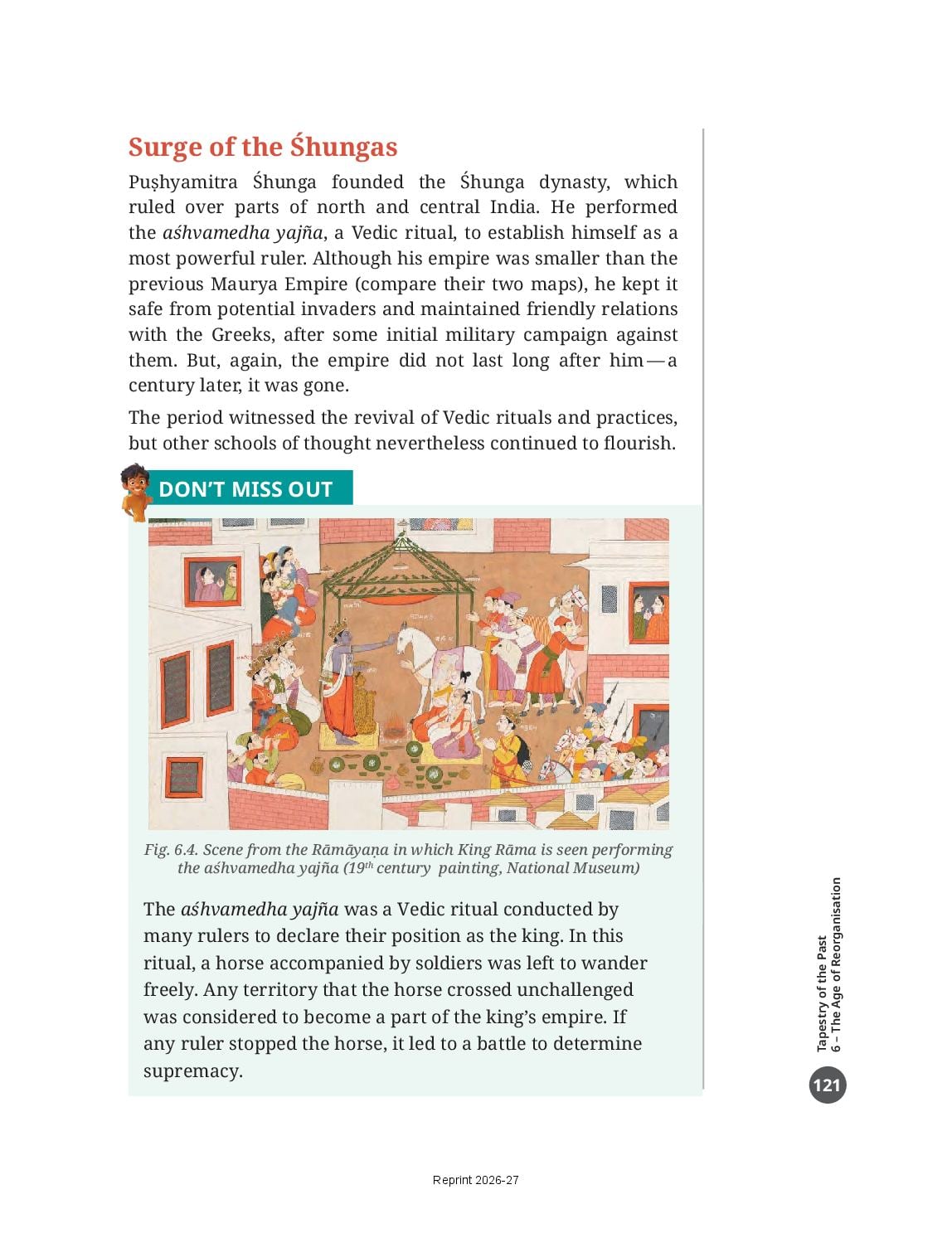
| Aśhvamedha yajña | A Vedic ritual in which a horse wandered freely with soldiers; land it crossed unchallenged became the king’s, and a challenge meant battle | Don’t Miss Out, page 121 | Performed by Puṣhyamitra Śhunga and by a Sātavāhana widow queen |
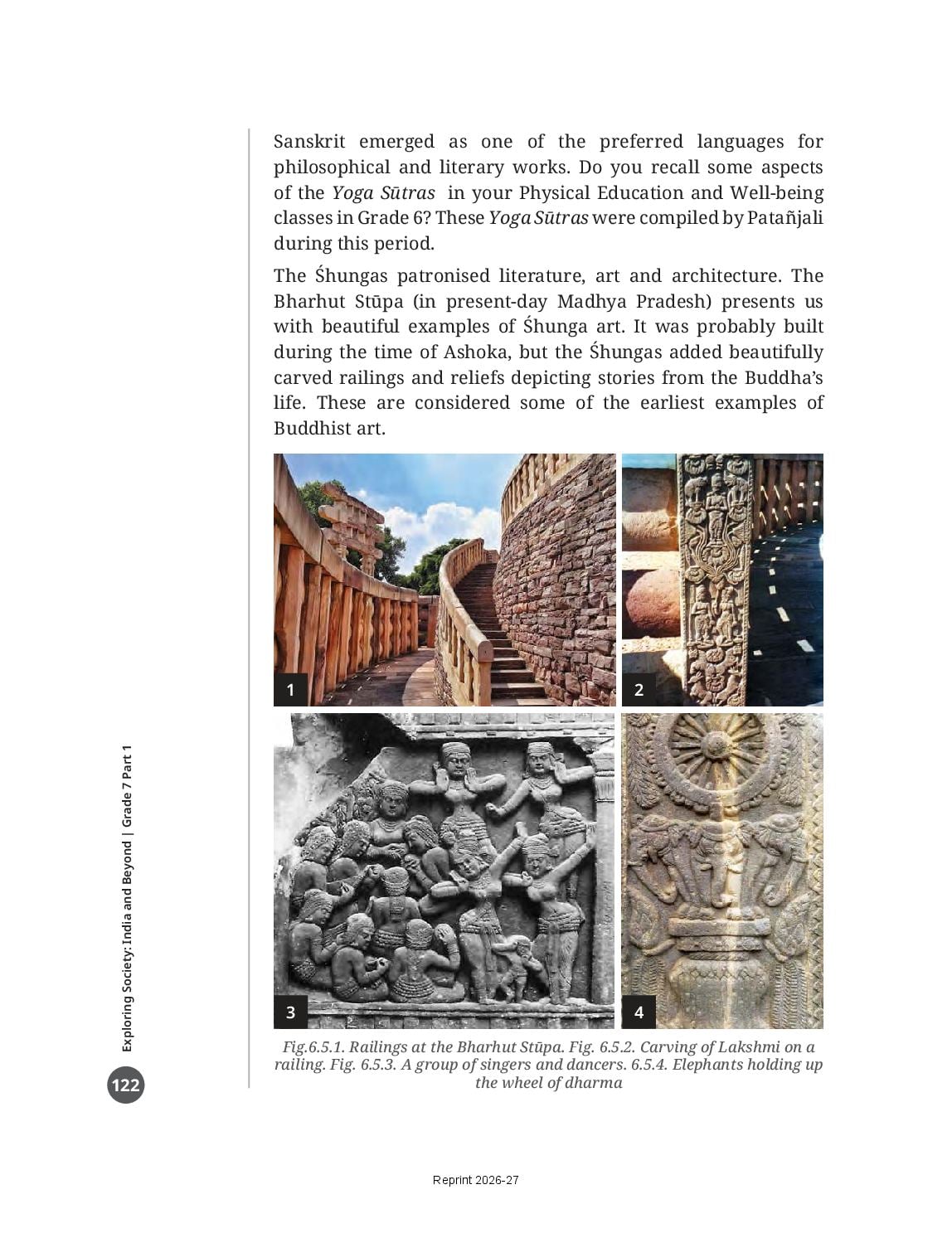
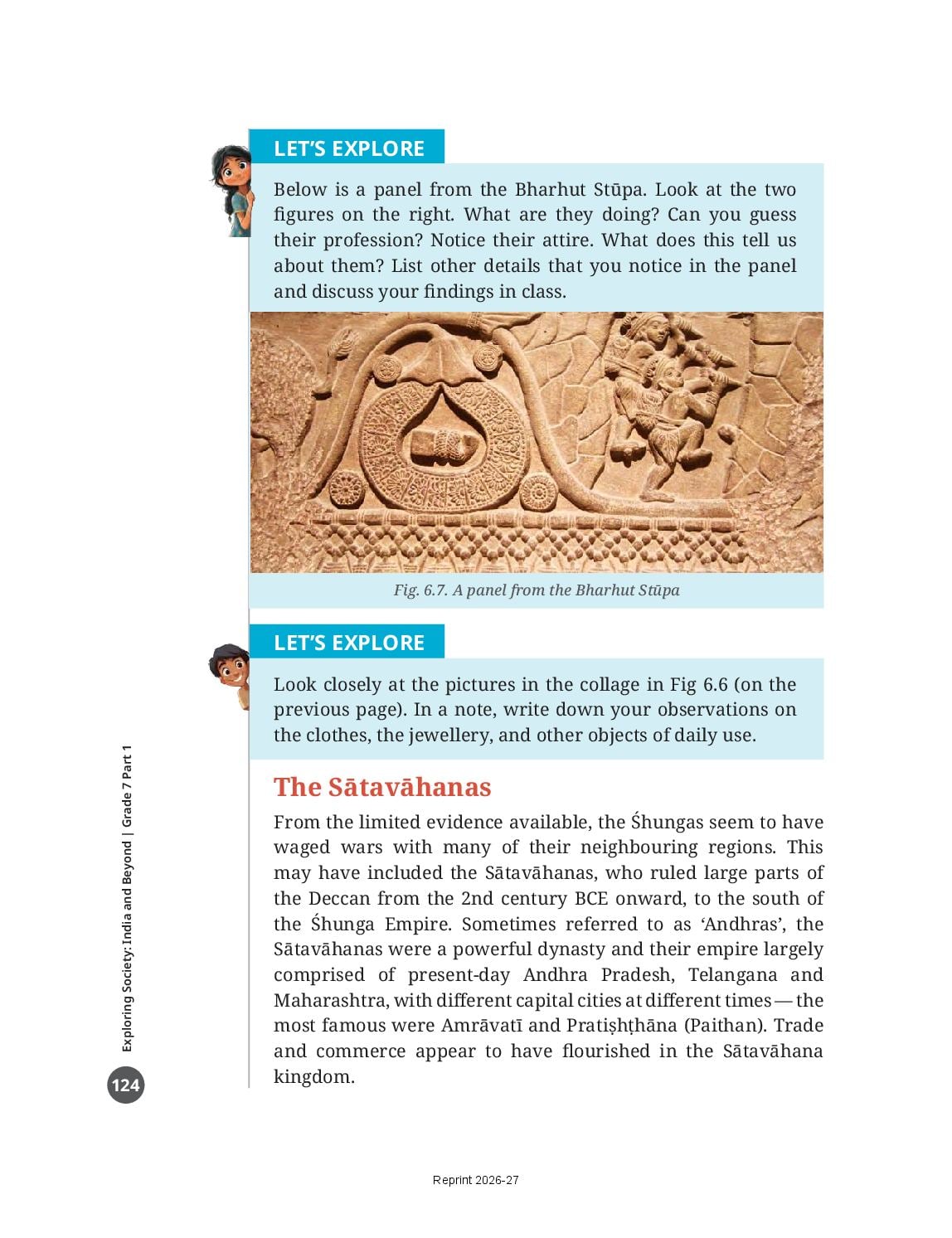
| Bharhut Stūpa | A stūpa in present-day Madhya Pradesh, probably built under Aśhoka; the Śhungas added carved railings and reliefs | Page 122, Figs. 6.5 and 6.7 | Among the earliest examples of Buddhist art |
| Sātavāhanas | A powerful Deccan dynasty (from the 2nd century BCE), sometimes called ‘Andhras’ | Pages 124–128 | Capitals Amrāvatī and Pratiṣhṭhāna (Paithan) |
| Naneghat caves | Caves near Pune on a major trade route, used to collect tolls and taxes and as a rest house for traders | Page 125, Fig. 6.9 | Their inscriptions record a queen’s dāna and early Brahmi numerals |
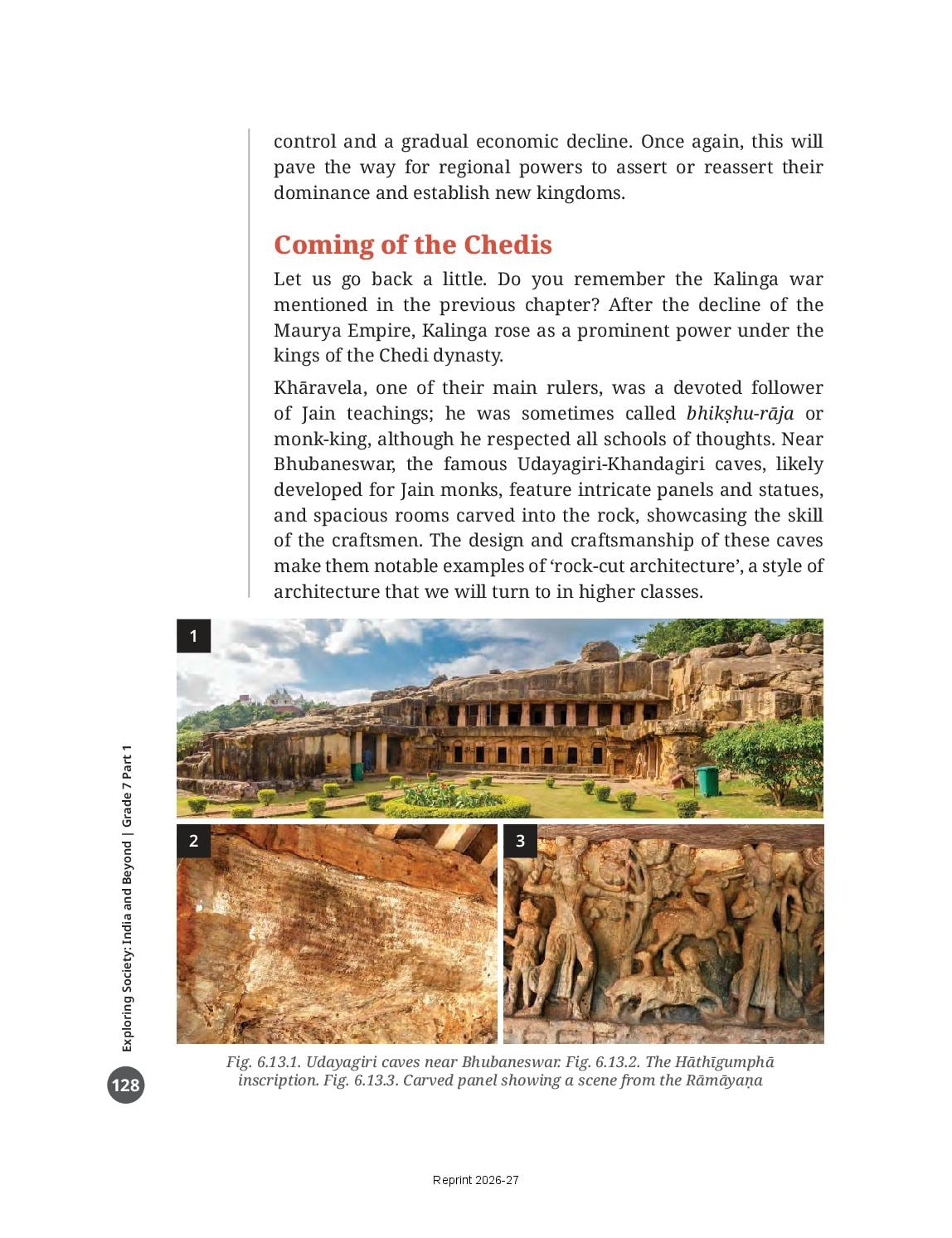
| Hāthīgumphā inscription | A Brahmi inscription in a cave at Udayagiri recording King Khāravela’s achievements year by year | Page 129, Fig. 6.13.2 | Khāravela calls himself ‘respector of every sect and repairer of every temple’ |
| Rock-cut architecture | Architecture created by cutting chambers and pillars out of living rock instead of building them up | Page 128 | Udayagiri–Khandagiri (Jain) and Karla (Buddhist) caves |
| Sangam literature | Anthologies of Tamil poems by an assembly of poets; from Sanskrit sangha, ‘association’, ‘coming together’ | Page 130 | The oldest literature of south India; it names the three crowned kings |
| Kallaṇai (Grand Anicut) | Karikāla’s water-diversion system on the Kāveri, just downstream of Srirangam island | Page 132, Fig. 6.17 | Still in use; made the delta the ‘rice bowl of the South’ |
| Śhaka Samvat | The calendar era developed under the Śhakas, 78 years behind the Gregorian (79 from January to March) | Don’t Miss Out, page 135 | Adopted as the Indian National Calendar in 1957 |
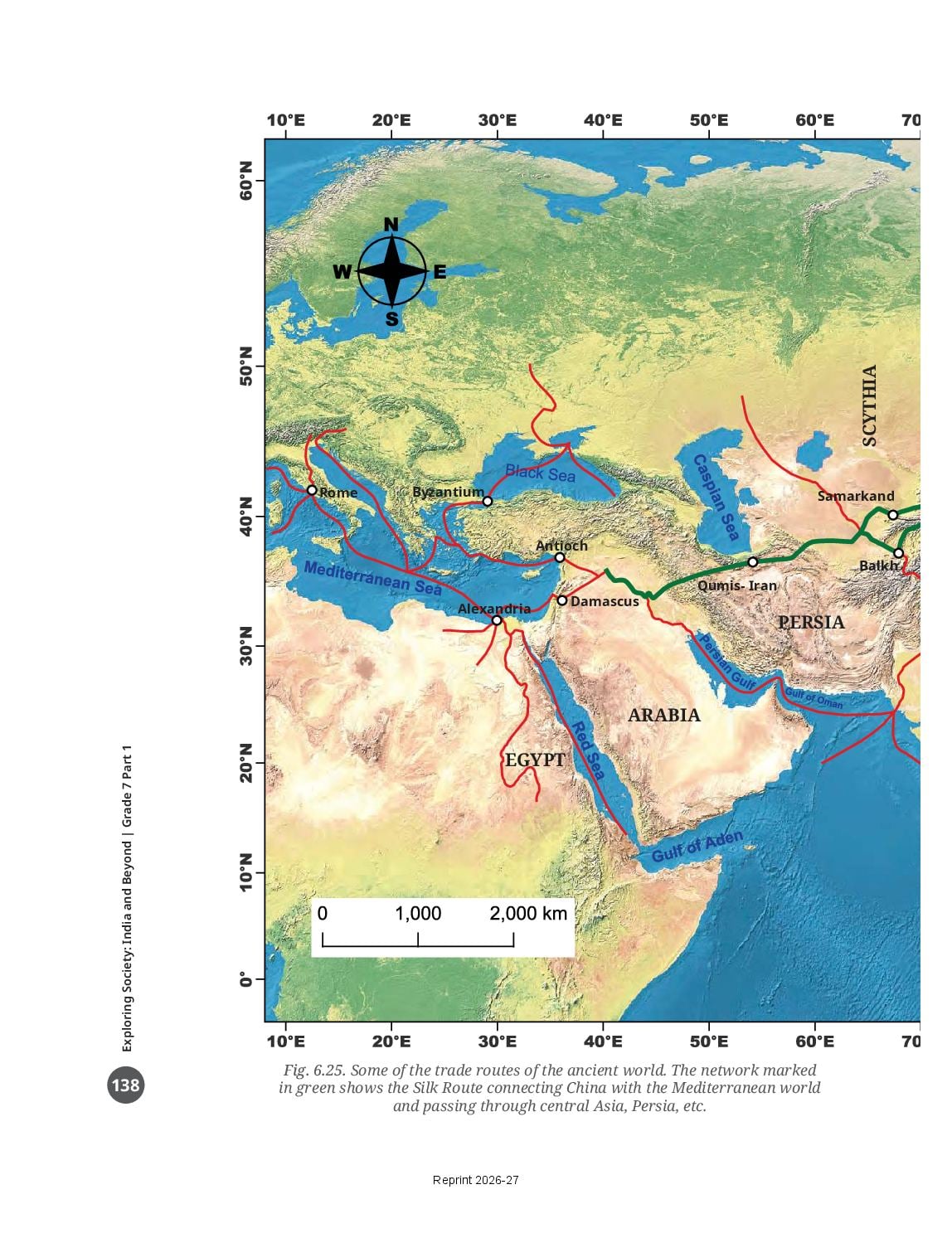
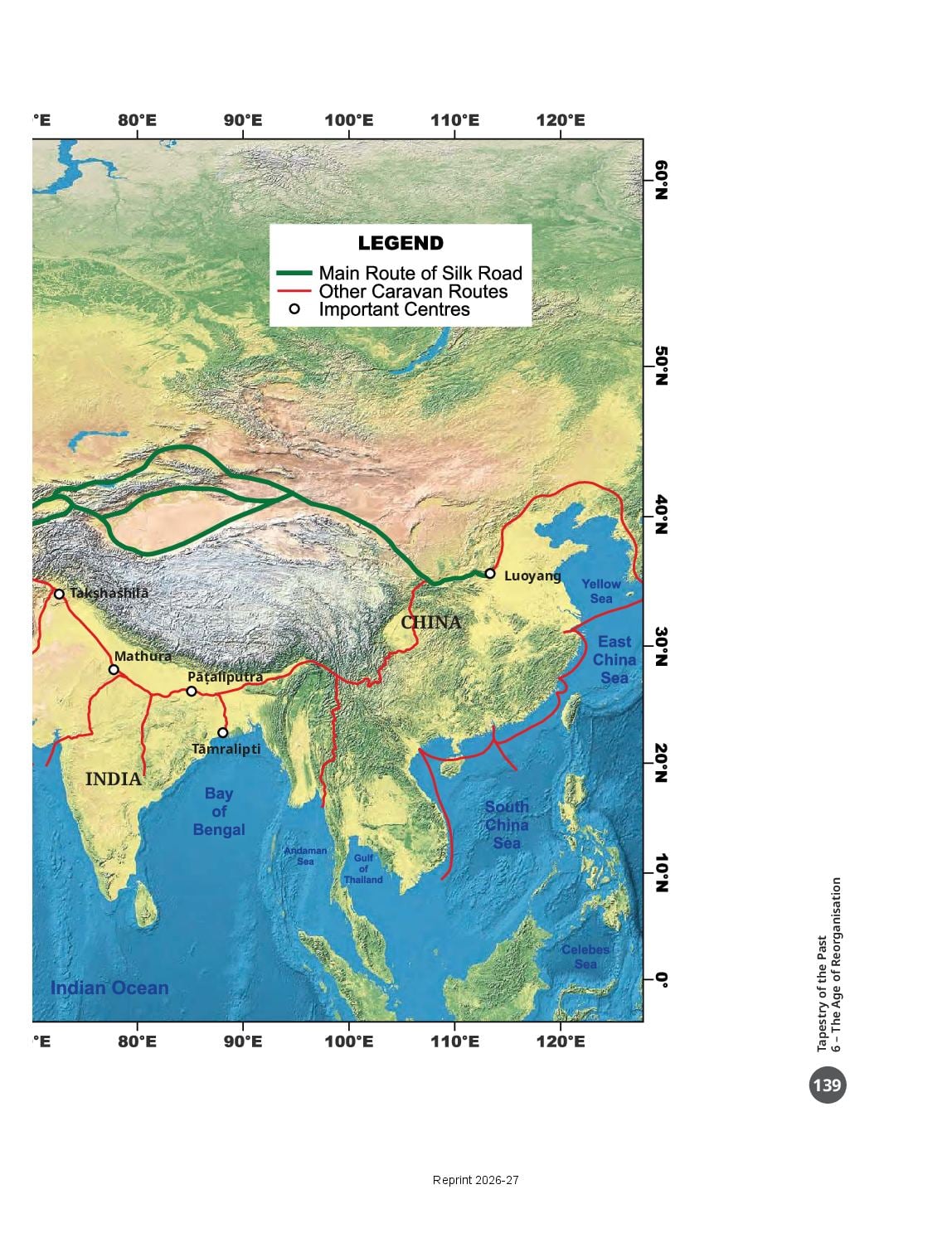
| Silk Route | The trade network connecting China with the Mediterranean world through central Asia and Persia | Fig. 6.25, pages 138–139 | The Kuṣhāṇas controlled significant sections of it |
| Gāndhāra school | Art of the western Punjab region blending Greco-Roman with Indian features, mostly in grey-black schist | Page 137, Fig. 6.24 | Realistic anatomy, flowing robes, fine detail |
| Mathurā school | Art of the Mathura region in a distinctly Indian style, mostly in red sandstone | Page 140, Fig. 6.26 | Fuller figures, smooth modelling, Indian deities, yakṣhas and yakṣhiṇīs |
Old NCERT vs New – Class 7 Social Science
This chapter is from Exploring Society: India and Beyond, the new NCERT Class 7 Social Science book (NCF-SE 2023, used from 2025-26). It replaced the old book “Our Pasts, Our Environment and Social and Political Life”, so chapter numbers and names differ from older PDFs.
Solutions and All Chapters
Answers to the exercises and the full chapter list of Exploring Society: India and Beyond:
The Age of Reorganisation – Overview
| Class | Class 7 |
| Subject | Social Science |
| Book | Exploring Society: India and Beyond – new NCERT book |
| Part | Part I |
| Chapter | 6 of 20 – The Age of Reorganisation |
| Book pages | 117 – 143 |
| Edition | NCERT Reprint 2026-27 |
| Session | 2026-27 |
| Free – read online or download |
Class 7 Social Science Chapter 6 – FAQs
Where can I download The Age of Reorganisation Class 7 PDF?
From the download table on this page – the chapter PDF is free, and the full book is linked too.
What is Class 7 Social Science Chapter 6 about?
The Maurya empire broke up, and the map of India was redrawn. The last Maurya emperor was assassinated around 185 BCE by his commander-in-chief Puṣhyamitra Śhunga — hardly half a century after Aśhoka. Many new kingdoms emerged, most of them earlier tributary kingdoms under Maurya overlordship. Because the existing regions were being reorganised into new competing kingdoms, some scholars call the period the ‘age of reorganisation’.
Is The Age of Reorganisation from the new NCERT Class 7 Social Science book?
Yes. It is chapter 6 of exploring society: india and beyond (part i), the new NCERT Class 7 Social Science book for 2026-27.
Is this the latest NCERT edition for 2026-27?
Yes – the PDF is NCERT’s latest edition for the 2026-27 session.
Where are the NCERT Solutions for Class 7 Social Science Chapter 6?
Open the NCERT Solutions link above for answers to the exercise questions.