Download The Constitution of India – An Introduction – NCERT Class 7 Social Science Chapter 10 PDF from the new NCERT Class 7 Social Science book Exploring Society: India and Beyond (2026-27). Read the chapter online or download the free PDF. A constitution is a country’s rulebook. It is a document that spells out a nation’s basic principles and laws: the framework of the three organs of government (legislature, executive, judiciary) and their roles; the checks and balances among them;…
The Constitution of India – An Introduction PDF – Chapter 10 of Exploring Society: India and Beyond (Part I)
Read the chapter online or download the PDF.
| Chapter | Download | |
|---|---|---|
| Chapter 10 PDF | The Constitution of India – An Introduction | View PDF |
| Full book | NCERT Class 7 Social Science – Exploring Society: India and Beyond | View Book |
Read Online
What Is in The Constitution of India – An Introduction? (Class 7 Social Science Chapter 10)
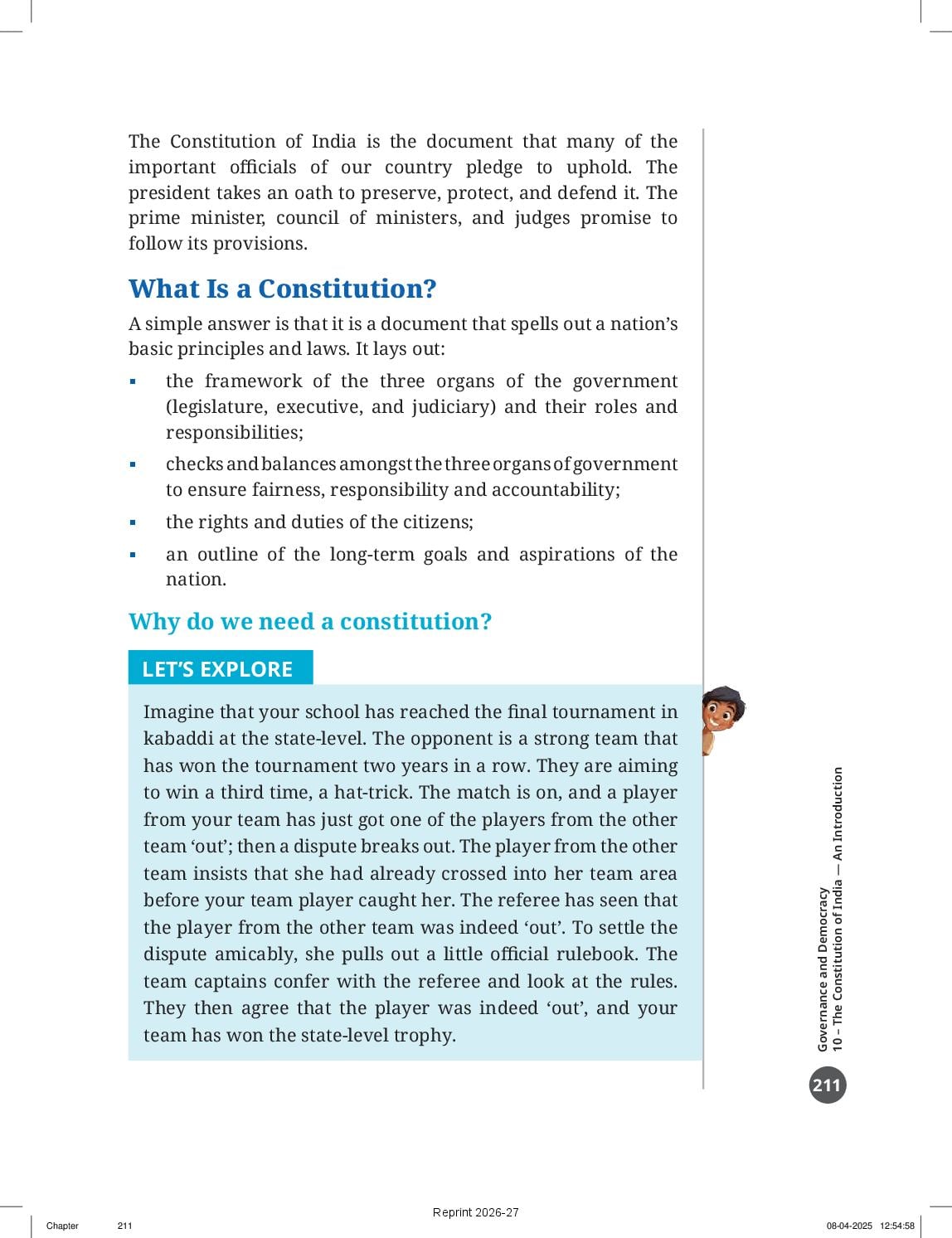
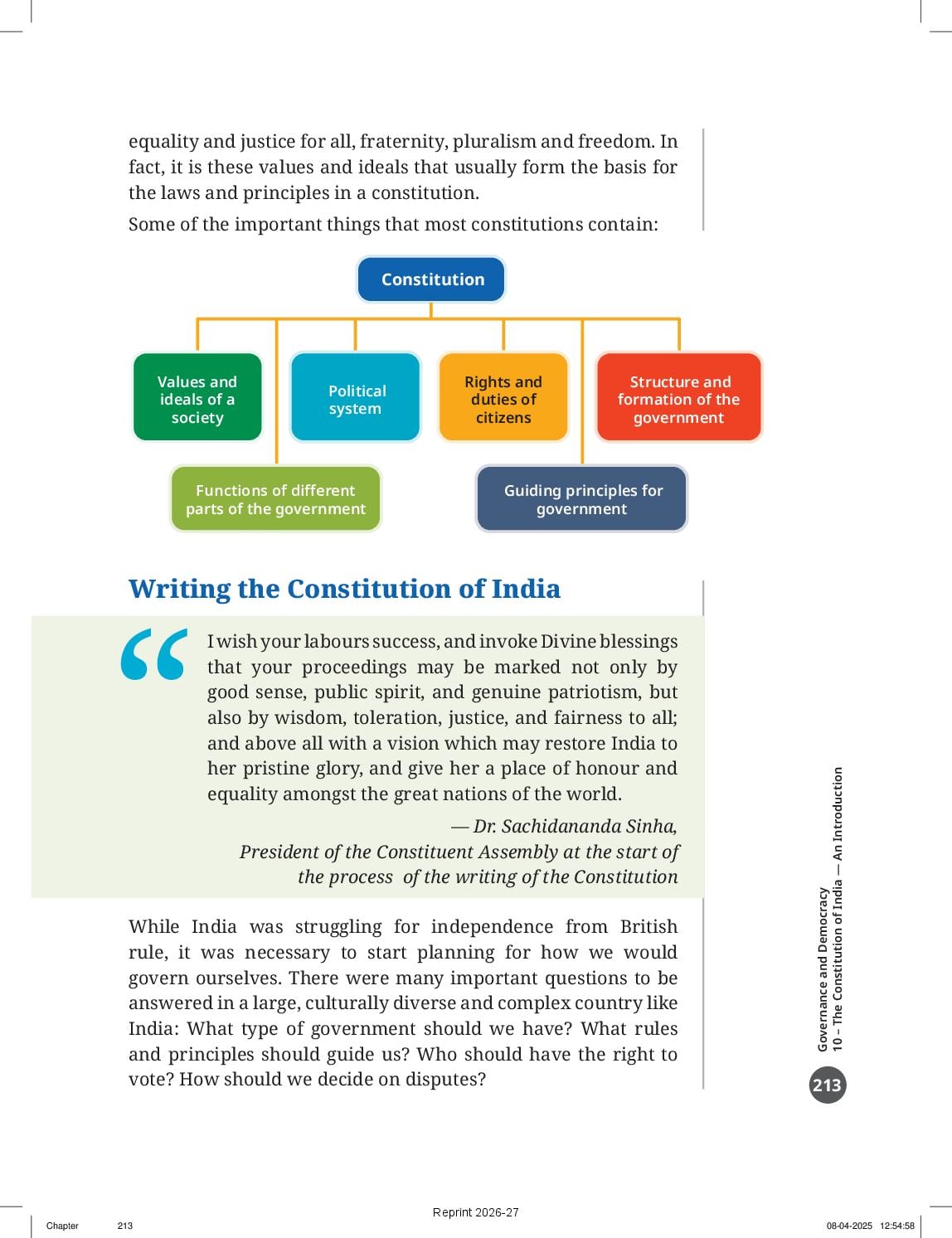
- A constitution is a country’s rulebook. It is a document that spells out a nation’s basic principles and laws: the framework of the three organs of government (legislature, executive, judiciary) and their roles; the checks and balances among them; the rights and duties of citizens; and an outline of the nation’s long-term goals and aspirations. Most constitutions also state the values and ideals the country is committed to.
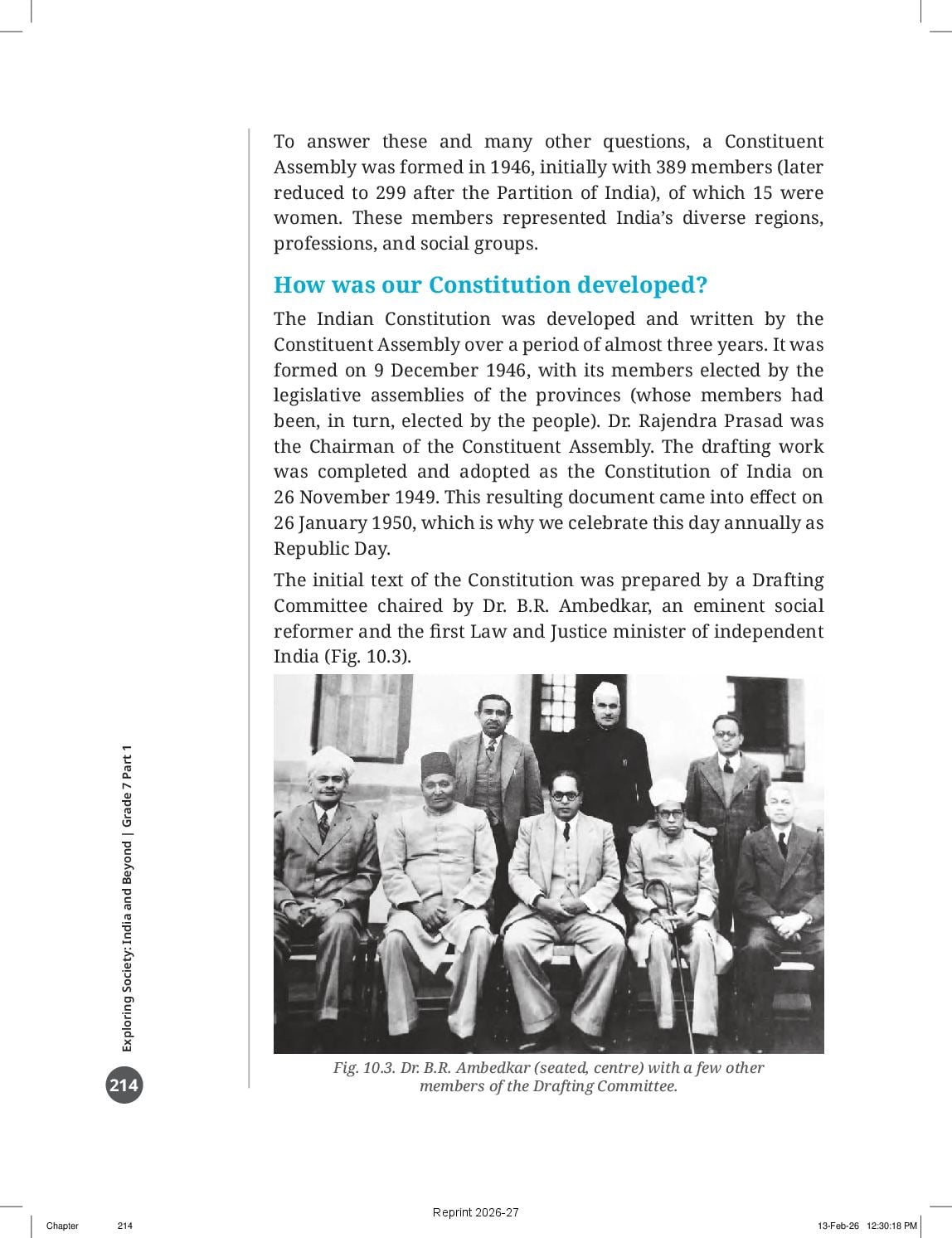
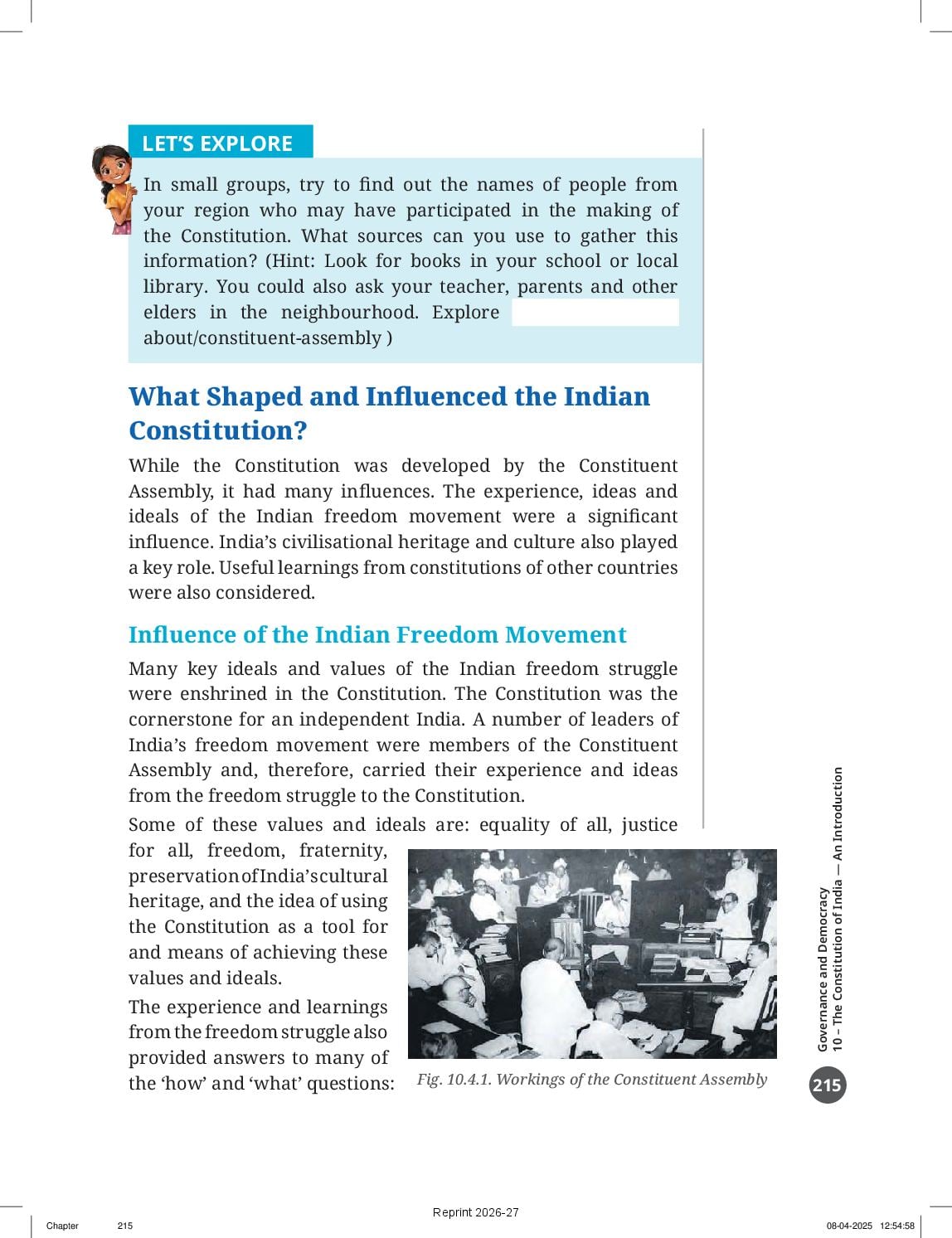
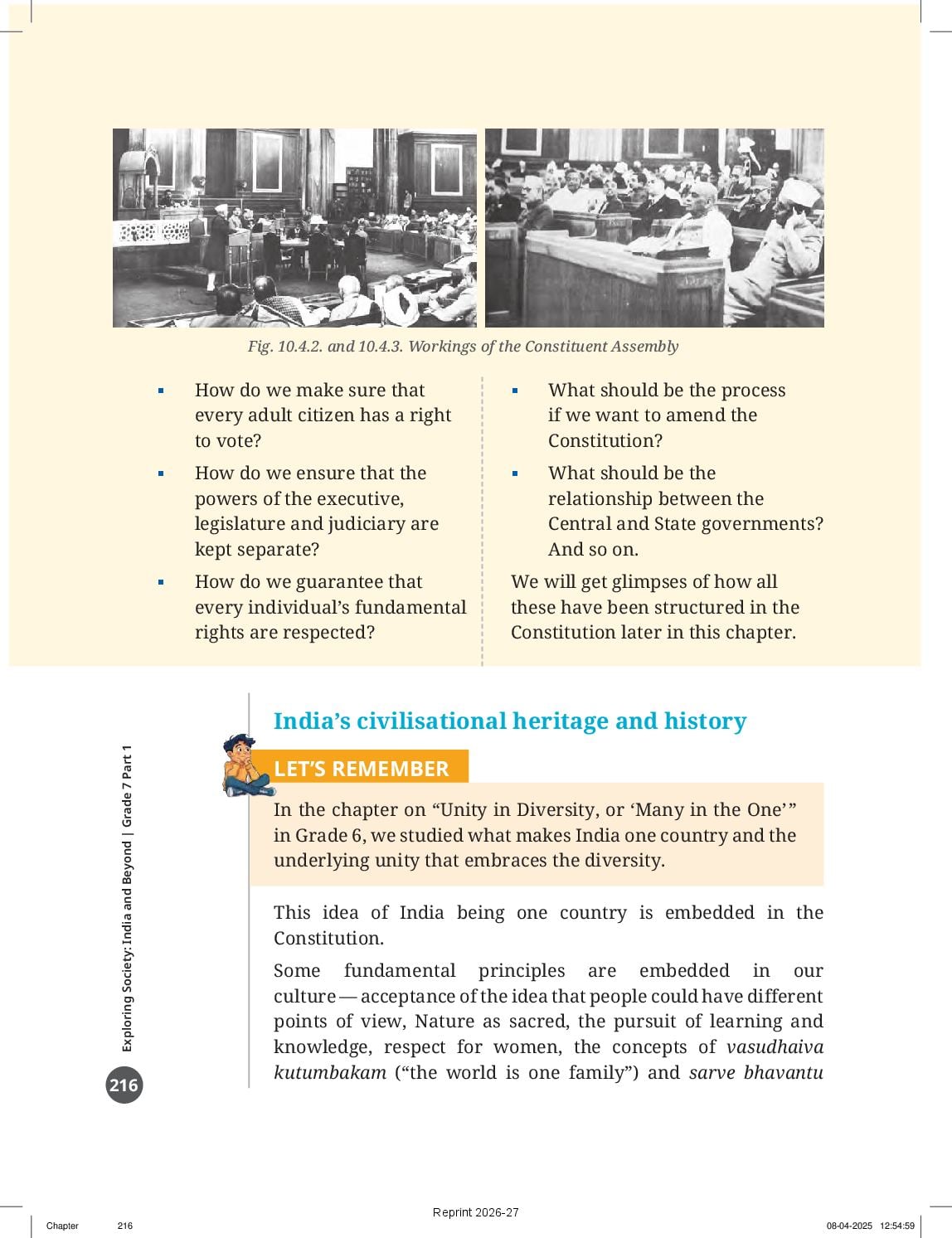
- The Constitution of India was written by a Constituent Assembly. Formed on 9 December 1946 with 389 members (reduced to 299 after Partition), of whom 15 were women, and chaired by Dr. Rajendra Prasad. Its members were elected by the legislative assemblies of the provinces. The drafting work was done by a Drafting Committee chaired by Dr. B.R. Ambedkar. The Constitution was adopted on 26 November 1949 and came into effect on 26 January 1950 — which is why that day is Republic Day.
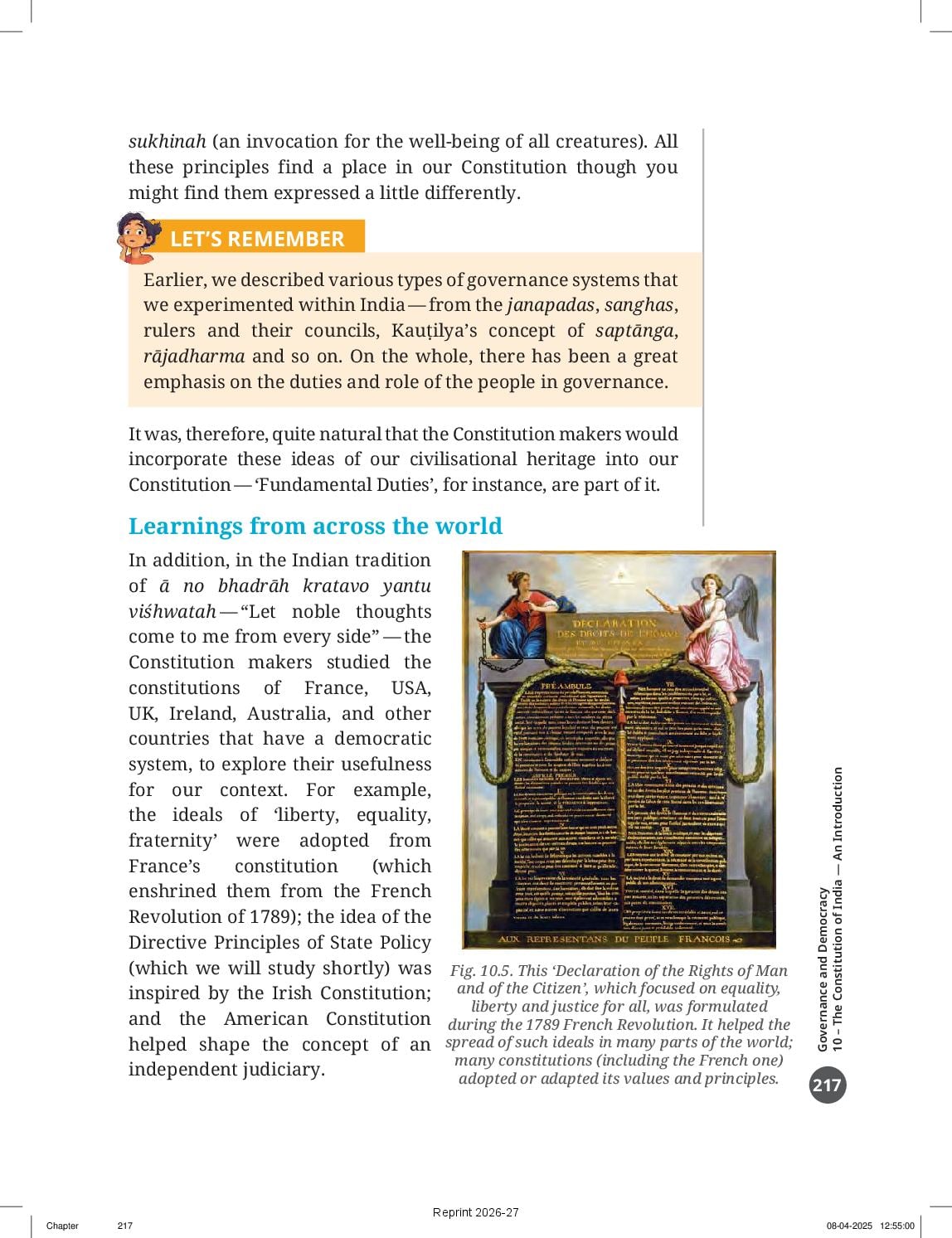
- Three streams shaped it. (i) The freedom movement — equality, justice, freedom, fraternity and the preservation of India’s cultural heritage; (ii) India’s civilisational heritage — acceptance of different points of view, Nature as sacred, the pursuit of knowledge, respect for women, vasudhaiva kutumbakam and sarve bhavantu sukhinah, the old emphasis on duties which became the Fundamental Duties; (iii) learnings from other countries — ‘liberty, equality, fraternity’ from France, the Directive Principles from Ireland, the independent judiciary from the USA.
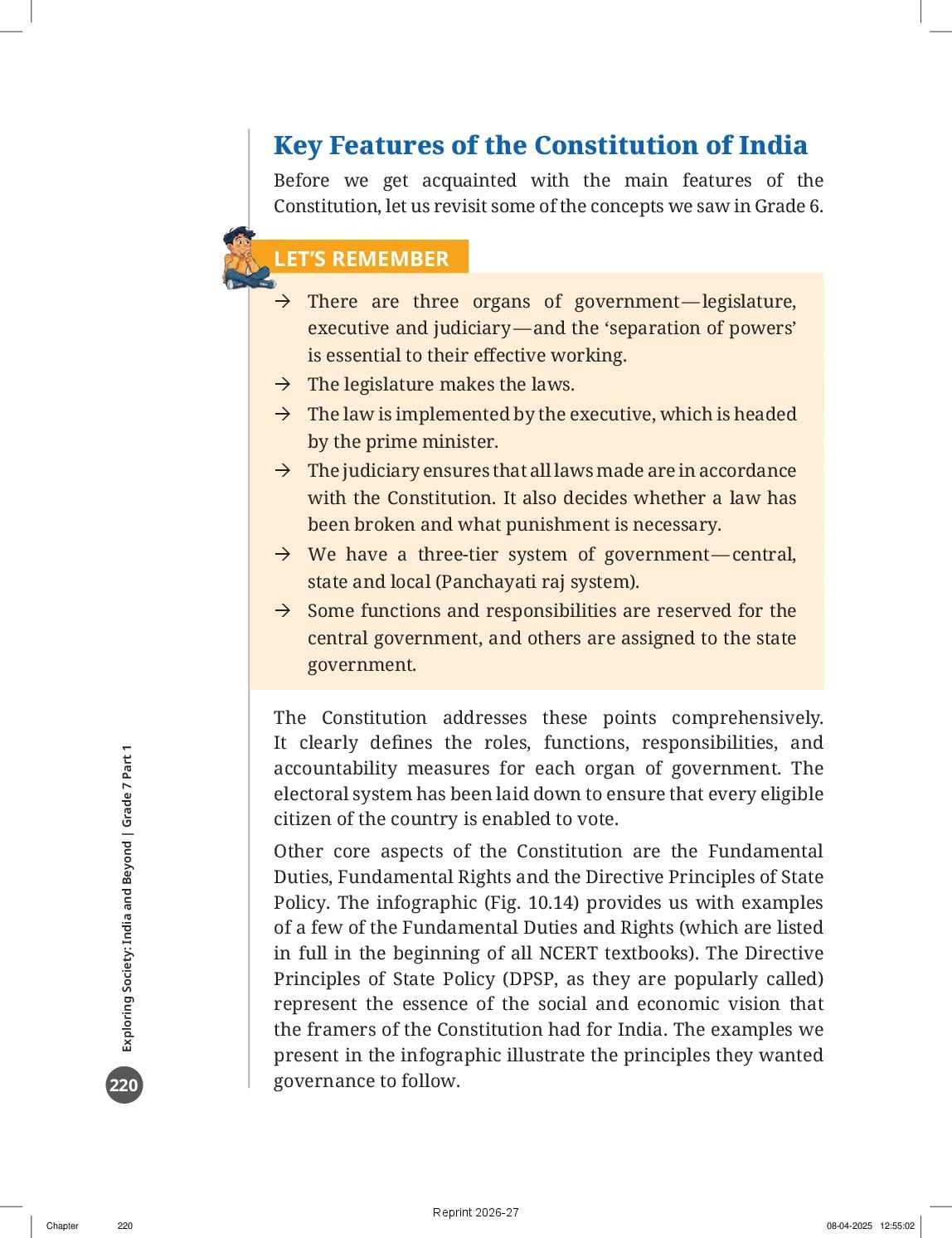
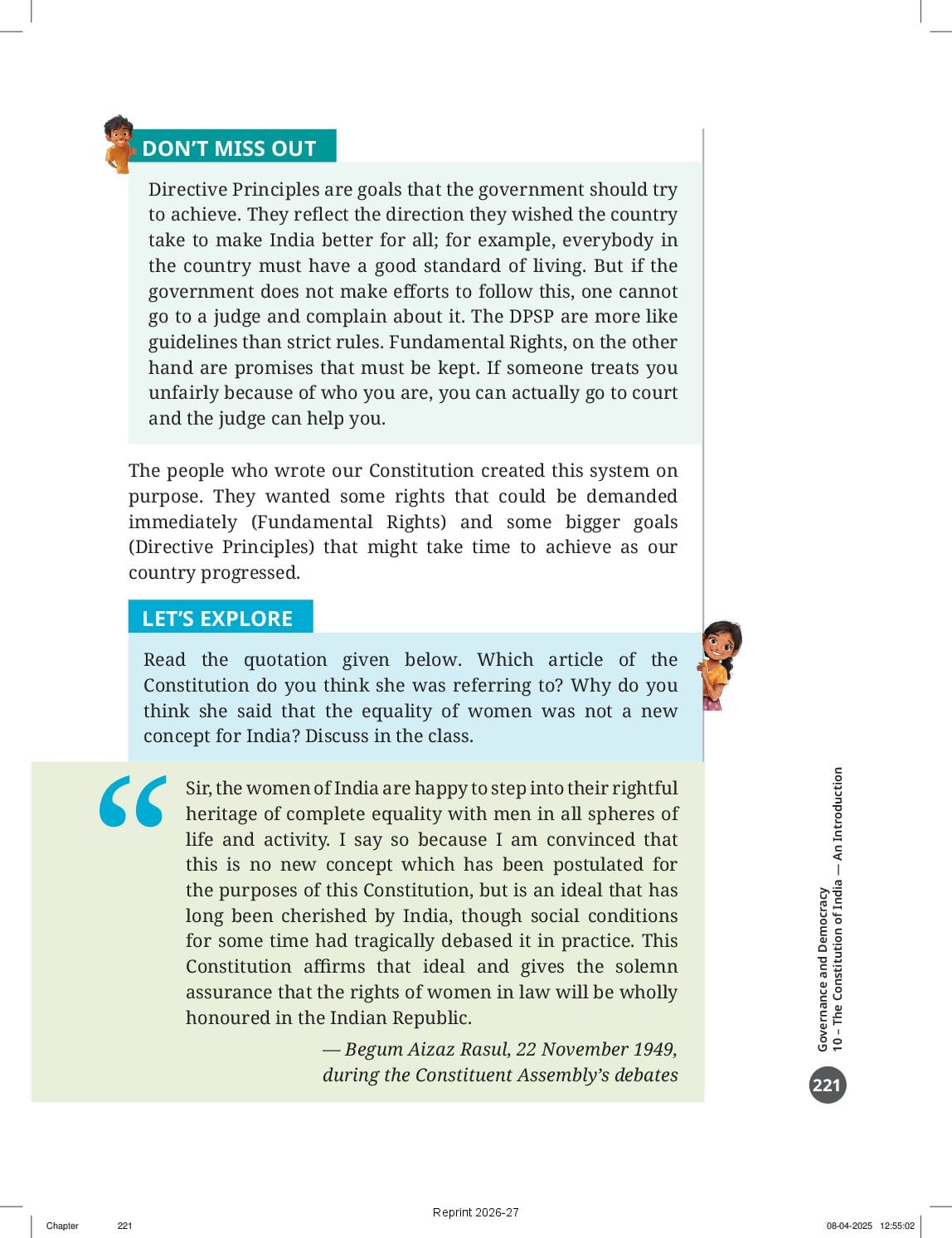
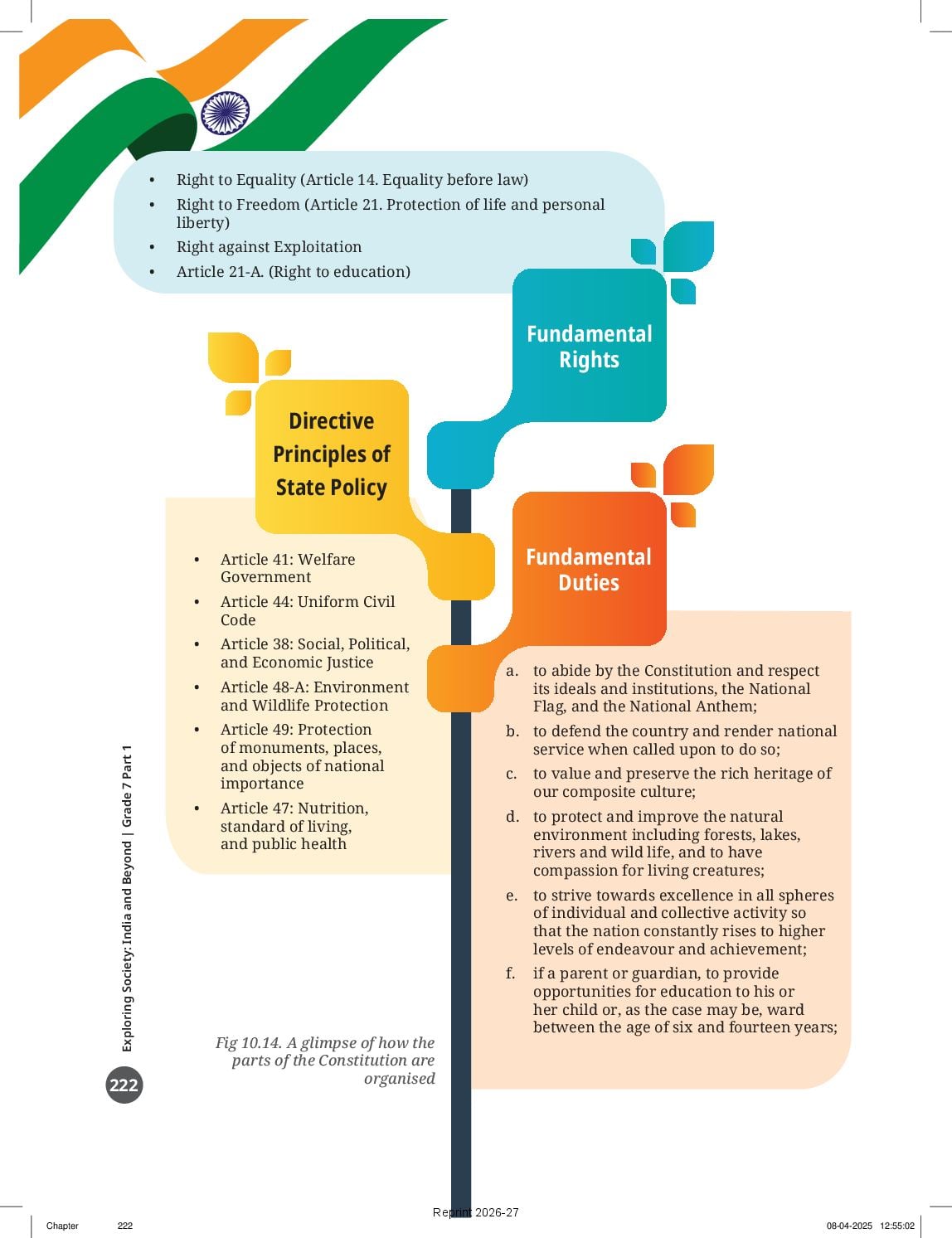
- Its key features. Separation of powers among the three organs, a three-tier government (central, state and local), an electoral system that enables every eligible citizen to vote, and three great pillars — Fundamental Rights (promises that must be kept, enforceable in court), Fundamental Duties (what citizens owe the nation) and the Directive Principles of State Policy (goals the government should try to achieve; guidelines rather than strict rules).
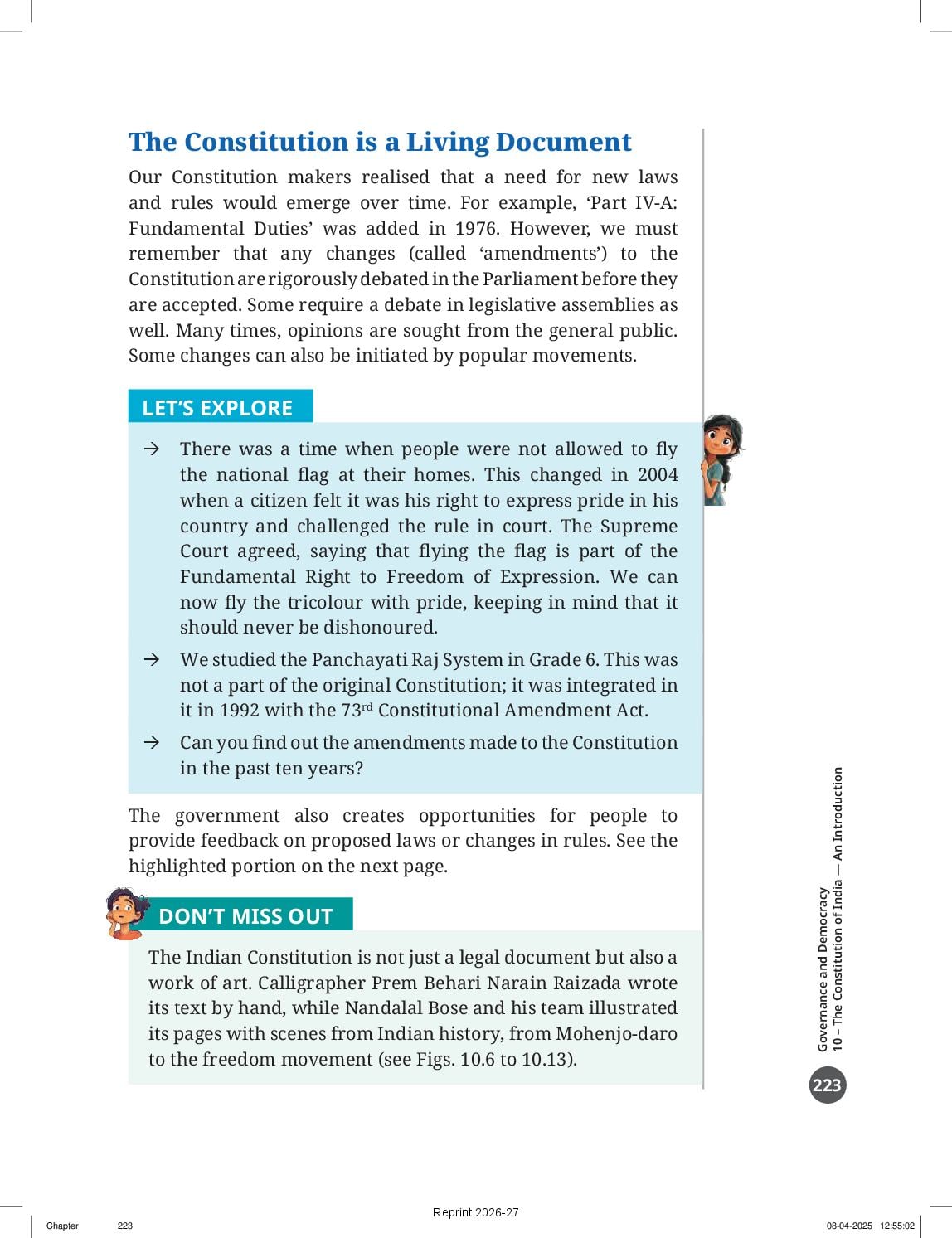
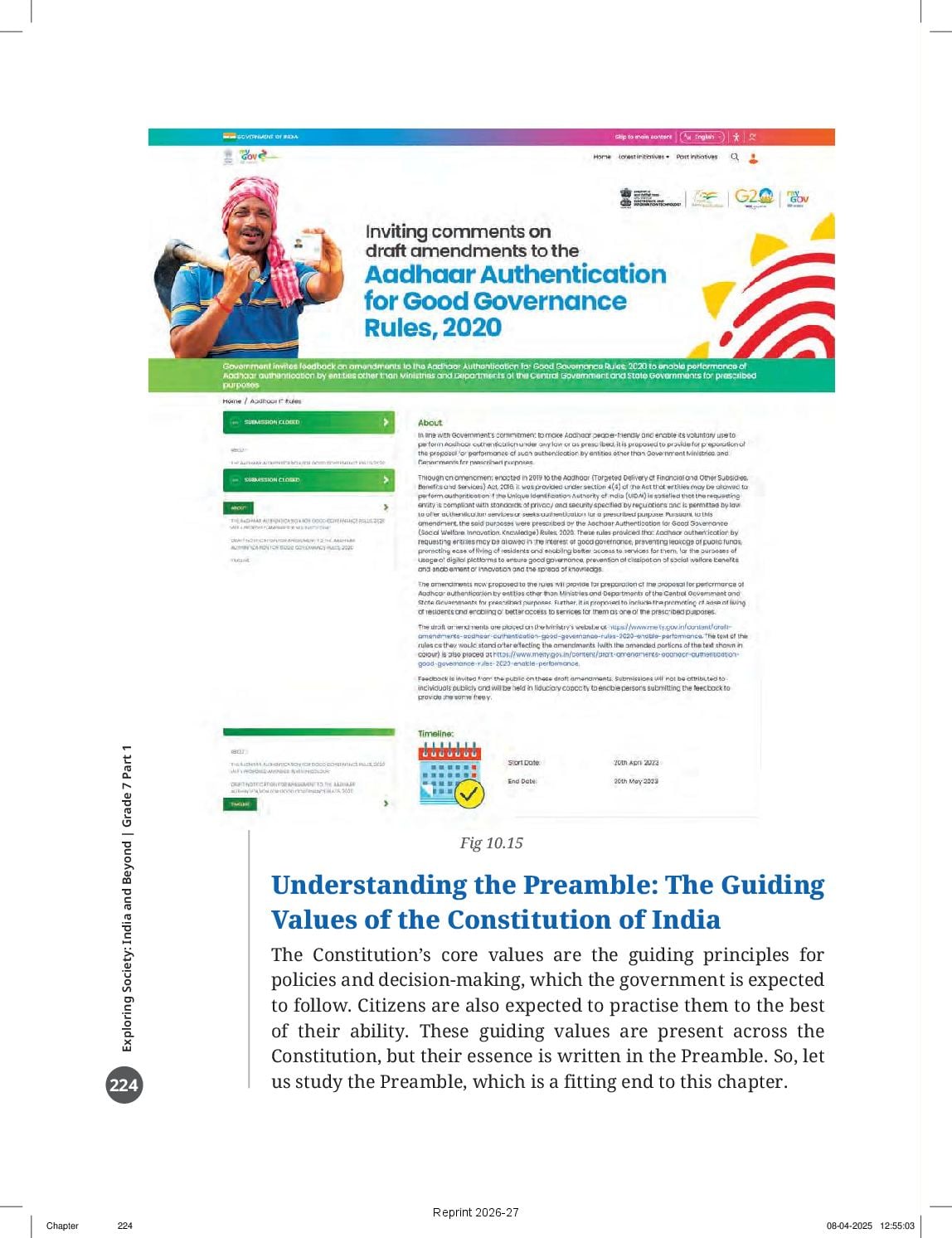
- It is a living document. Changes, called amendments, are rigorously debated in Parliament, sometimes in legislative assemblies too, and public opinion is often sought. Part IV-A Fundamental Duties was added in 1976; the Panchayati Raj system came in through the 73rd Amendment in 1992; a citizen’s court case in 2004 won the right to fly the national flag at home. The Constitution has grown from 22 Parts and 8 Schedules to 25 Parts and 12 Schedules.
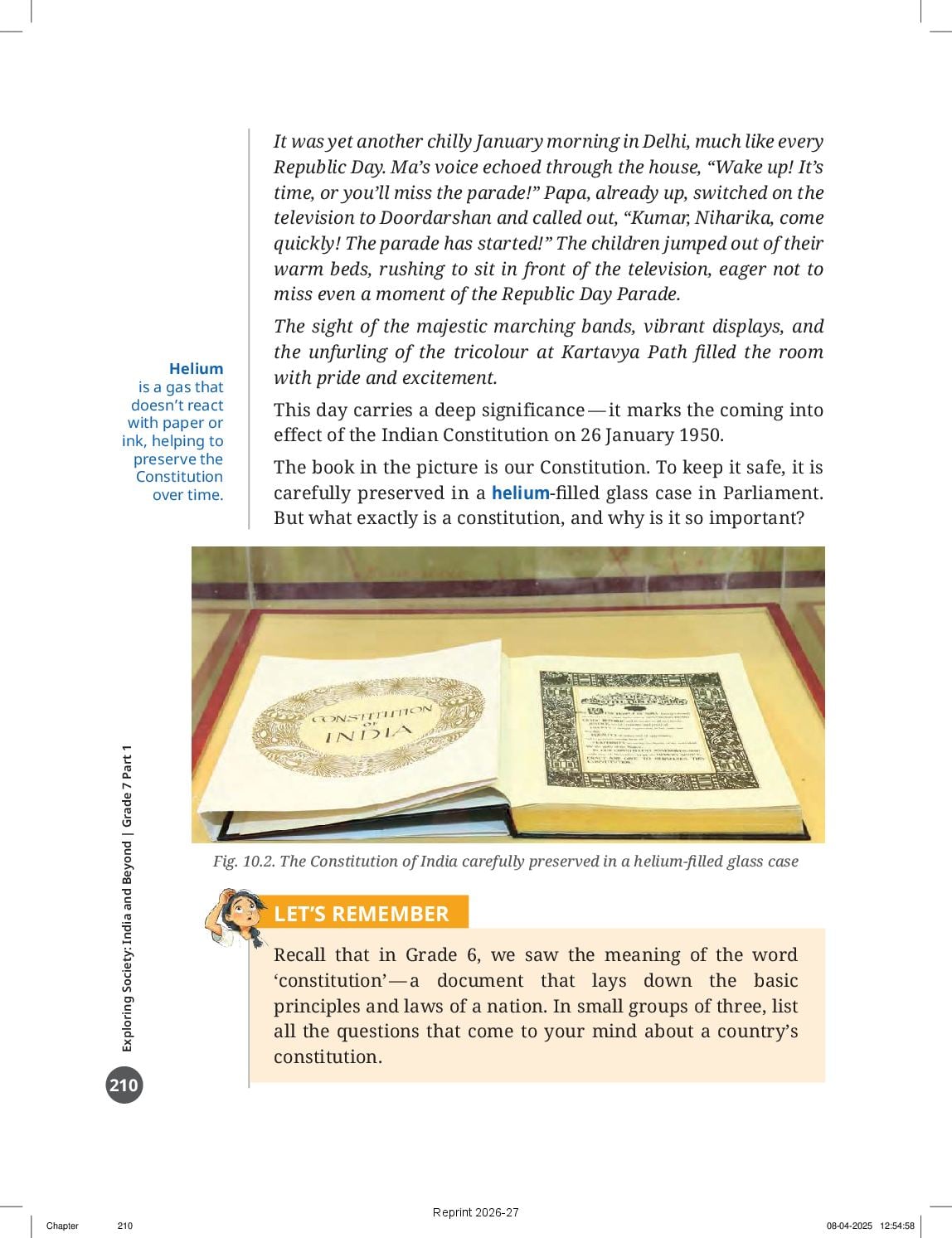
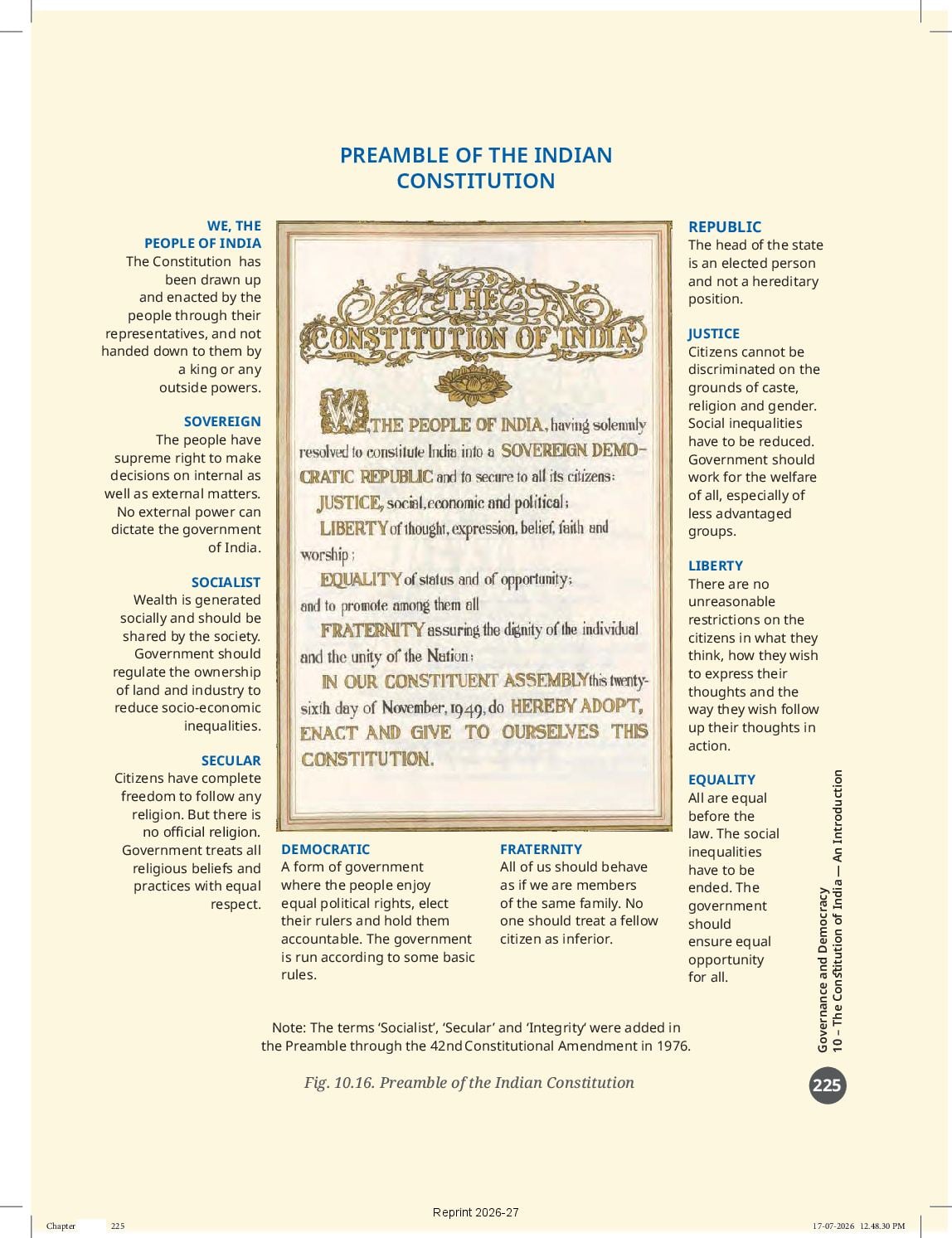
- The Preamble holds the guiding values. ‘WE, THE PEOPLE OF INDIA’ — Sovereign, Socialist, Secular, Democratic, Republic — securing Justice, Liberty, Equality and promoting Fraternity. The words ‘Socialist’, ‘Secular’ and ‘Integrity’ were added by the 42nd Amendment in 1976. The original text was handwritten by calligrapher Prem Behari Narain Raizada and illustrated by Nandalal Bose and his team; the copy is preserved in a helium-filled glass case in Parliament.
Quick revision – The Constitution of India – An Introduction
| Term | What it means | Where it appears in the chapter | Worth remembering |
|---|---|---|---|
| Constitution | A document that spells out a nation’s basic principles and laws, and how it will be governed | Page 211 | India’s is the world’s largest written constitution |
| Constituent Assembly | The body that drafted and adopted the Constitution of India | Page 214 | Formed 9 Dec 1946; 389 → 299 members; 15 women; Chairman Dr. Rajendra Prasad |
| Drafting Committee | The committee that prepared the initial text of the Constitution | Page 214, Fig. 10.3 | Chaired by Dr. B.R. Ambedkar, independent India’s first Law and Justice minister |
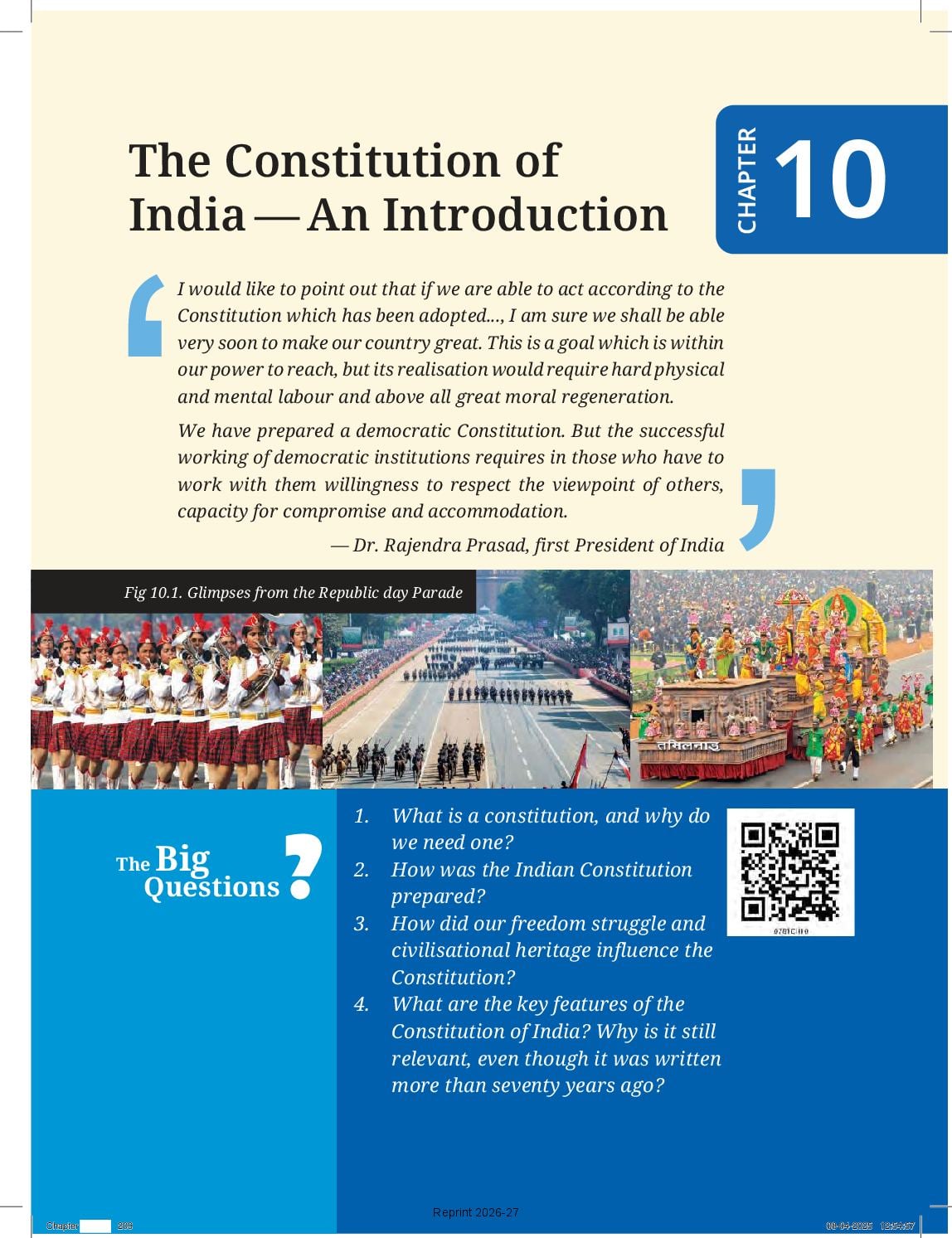
| Republic Day | 26 January, the day the Constitution came into effect in 1950 | Pages 210 and 214 | Adopted 26 Nov 1949, in force 26 Jan 1950 |
| Separation of powers | Keeping the powers of legislature, executive and judiciary distinct, with checks and balances | Pages 211 and 220 | Legislature makes laws · executive implements them · judiciary tests them against the Constitution |
| Fundamental Rights | Basic rights guaranteed to every citizen, which can be claimed in a court of law | Pages 220–222, Fig. 10.14 | Right to Equality (Art. 14), Right to Freedom (Art. 21), Right against Exploitation, Right to Education (Art. 21-A) |
| Fundamental Duties | What every citizen is expected to do for the nation and for fellow citizens | Page 222, Fig. 10.14 | Added as Part IV-A in 1976; six of them are listed in the infographic |
| Directive Principles of State Policy (DPSP) | Goals the government should try to achieve — the social and economic vision of the framers | Pages 220–222 | Not enforceable in court; guidelines rather than strict rules (Arts. 38, 41, 44, 47, 48-A, 49) |
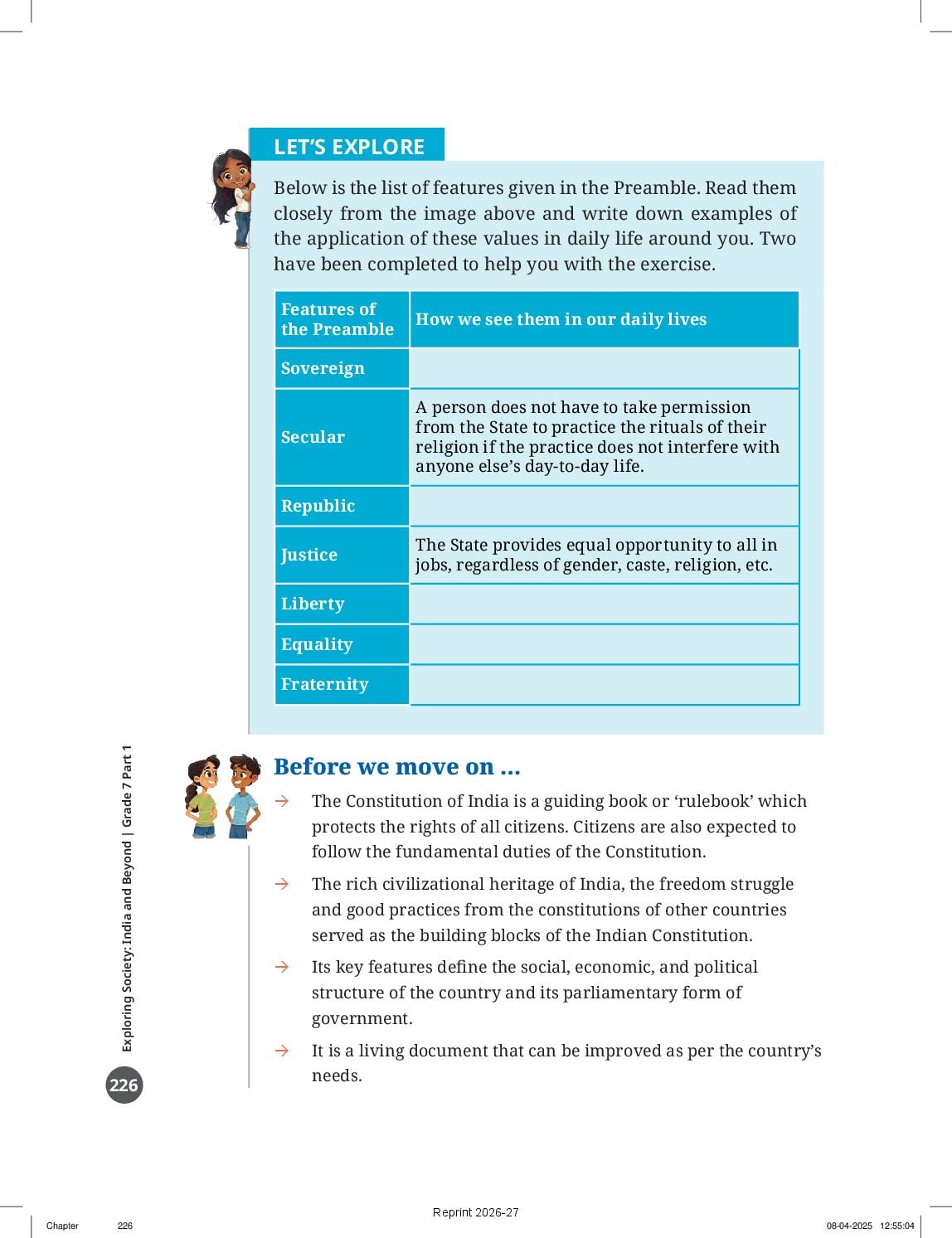
| Preamble | The opening statement of the Constitution, which sets out the values it upholds | Page 225, Fig. 10.16 | Sovereign · Socialist · Secular · Democratic · Republic; Justice · Liberty · Equality · Fraternity |
| Amendment | A change made to the Constitution after rigorous debate in Parliament | Page 223 | 42nd (1976) added ‘Socialist’, ‘Secular’, ‘Integrity’; 73rd (1992) added Panchayati Raj |
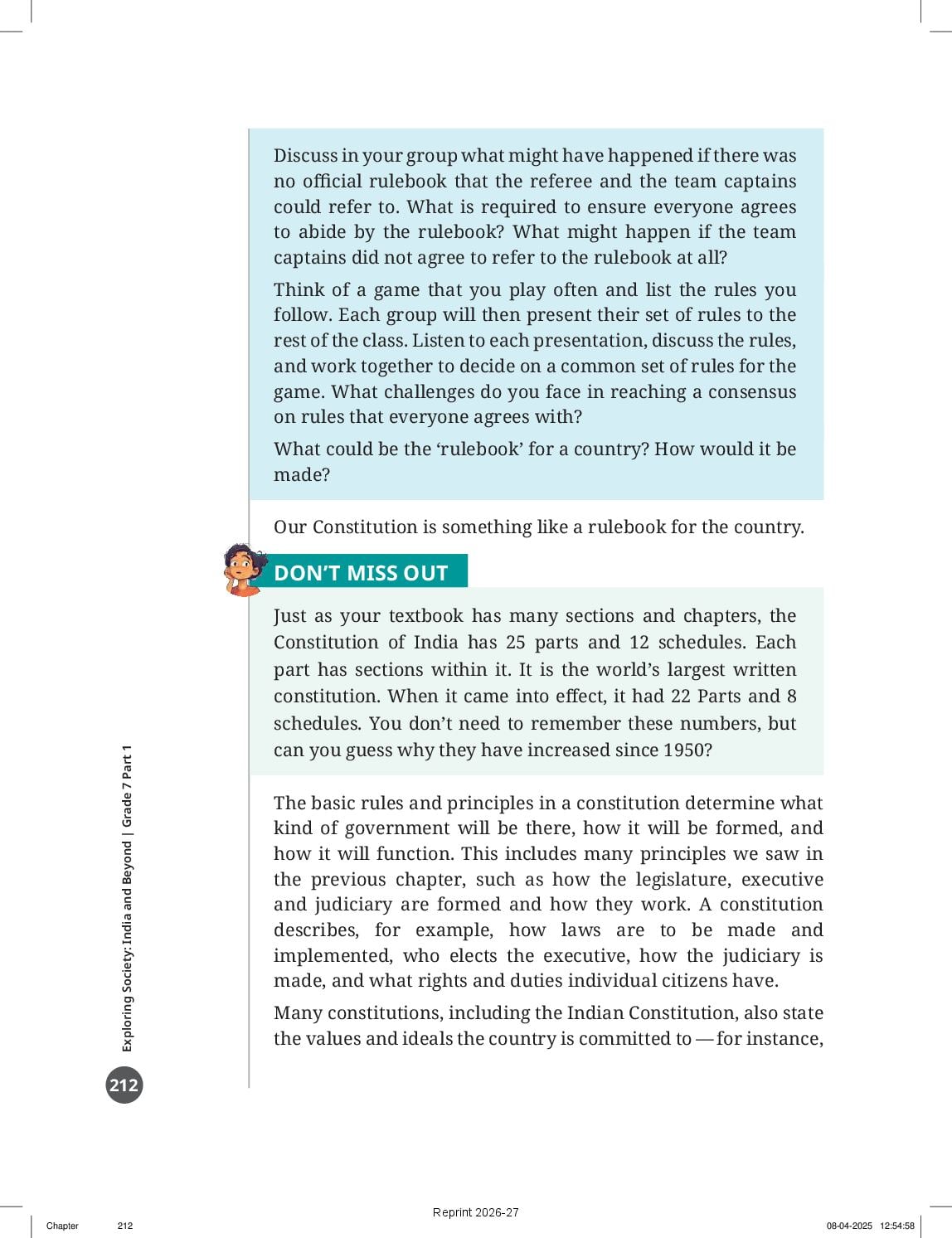
| Parts and Schedules | The sections into which the Constitution is organised | Don’t Miss Out, page 212 | 25 Parts and 12 Schedules today; 22 Parts and 8 Schedules in 1950 |
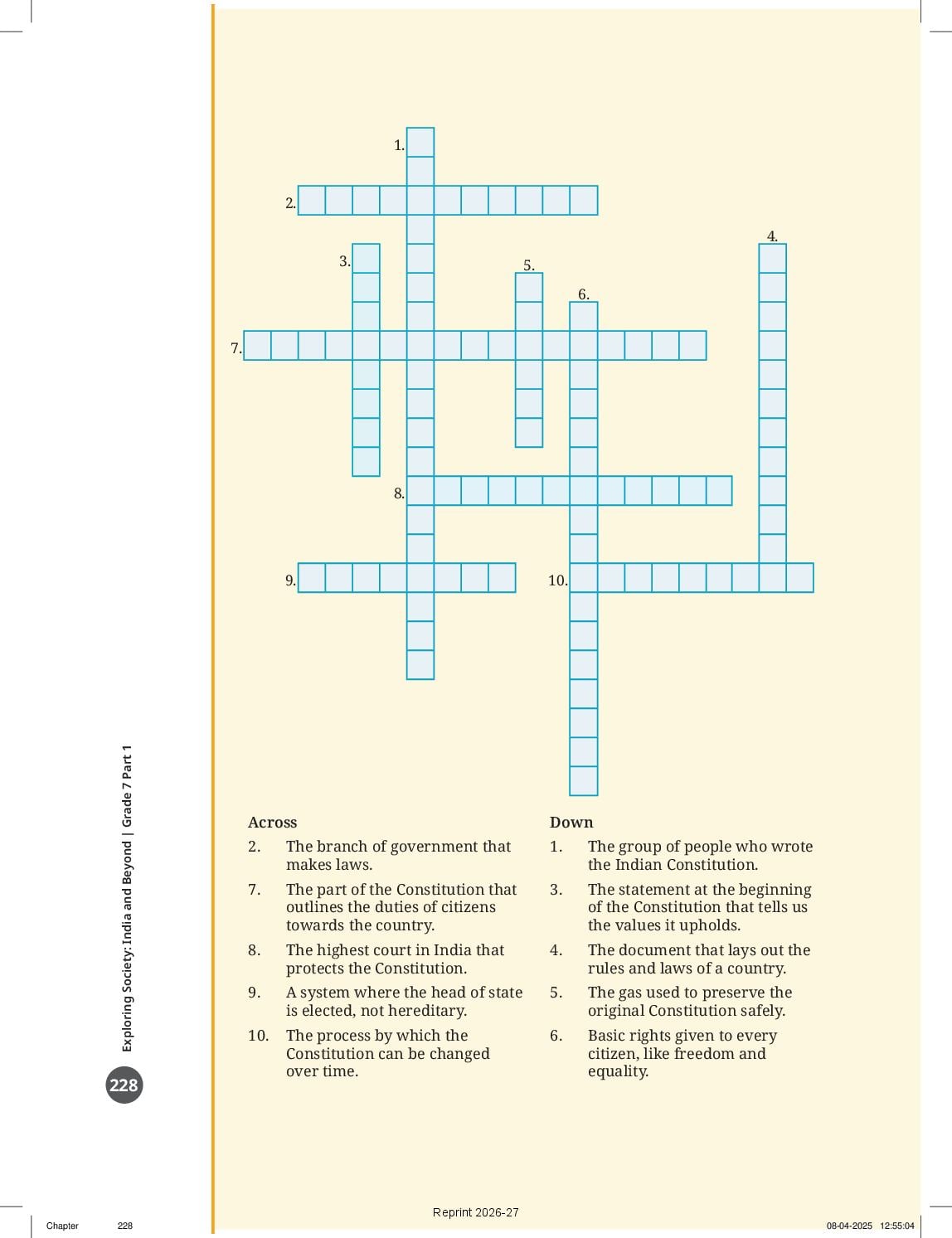
| Helium | A gas that does not react with paper or ink, used to preserve the original Constitution | Margin note, page 210, Fig. 10.2 | The original copy is kept in a helium-filled glass case in Parliament |
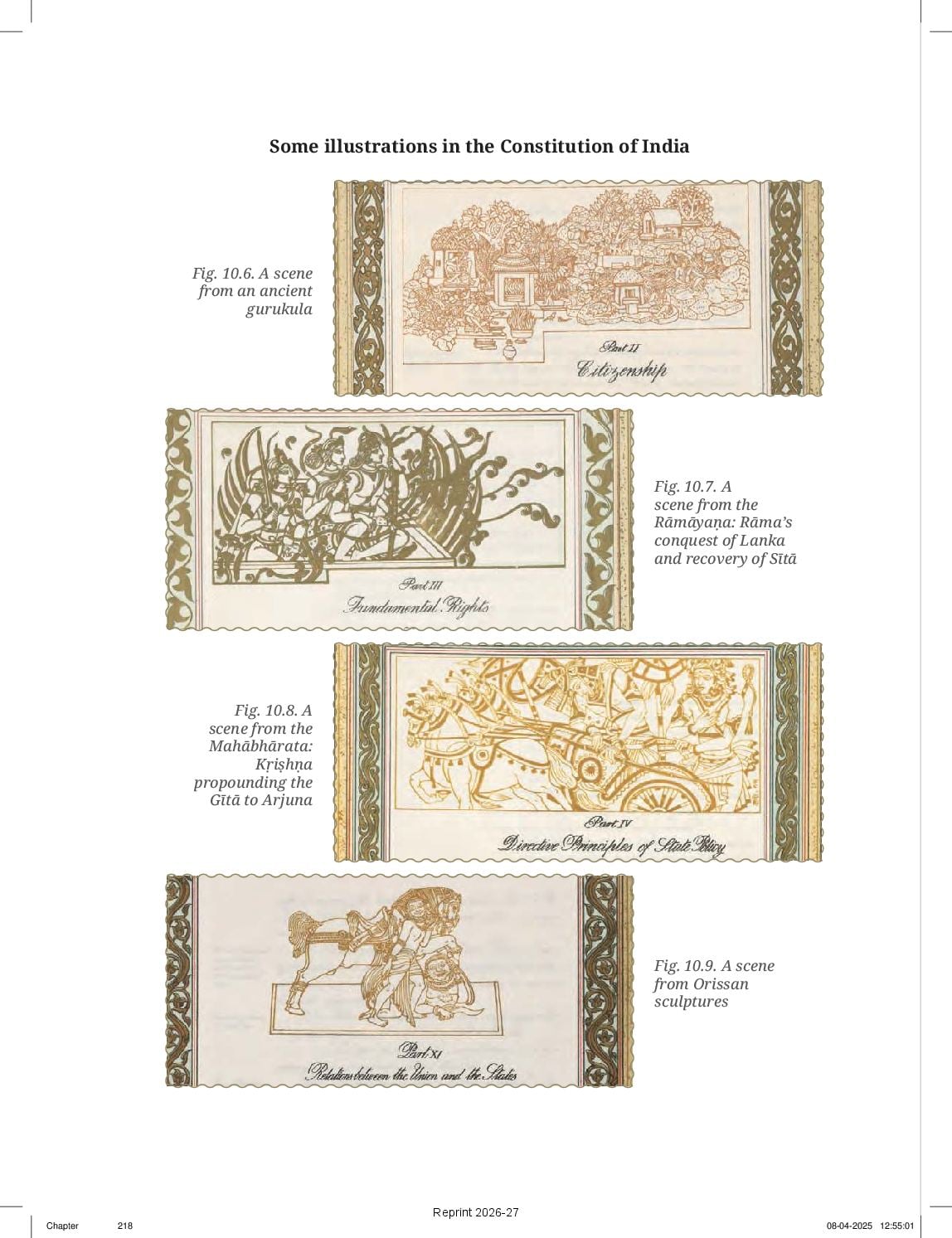
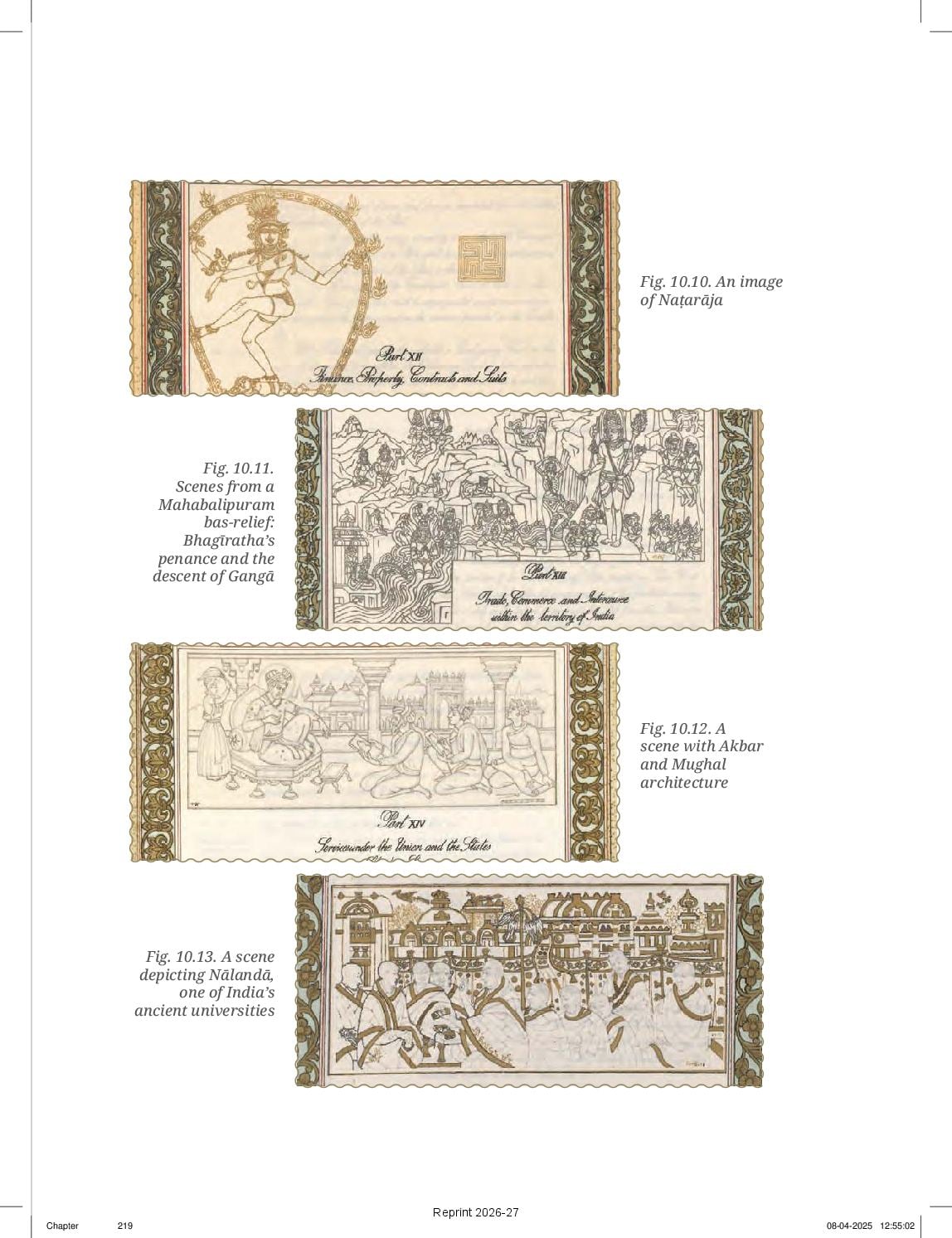
| Prem Behari Narain Raizada | The calligrapher who wrote the text of the Constitution by hand | Don’t Miss Out, page 223 | Nandalal Bose and his team illustrated the pages (Figs. 10.6–10.13) |
| Universal adult franchise | The right of every adult citizen to vote, regardless of caste, gender, wealth or education | Pages 216 and 220 | India gave it to all adult citizens from its first general election |
Old NCERT vs New – Class 7 Social Science
This chapter is from Exploring Society: India and Beyond, the new NCERT Class 7 Social Science book (NCF-SE 2023, used from 2025-26). It replaced the old book “Our Pasts, Our Environment and Social and Political Life”, so chapter numbers and names differ from older PDFs.
Solutions and All Chapters
Answers to the exercises and the full chapter list of Exploring Society: India and Beyond:
The Constitution of India – An Introduction – Overview
| Class | Class 7 |
| Subject | Social Science |
| Book | Exploring Society: India and Beyond – new NCERT book |
| Part | Part I |
| Chapter | 10 of 20 – The Constitution of India – An Introduction |
| Book pages | 209 – 228 |
| Edition | NCERT Reprint 2026-27 |
| Session | 2026-27 |
| Free – read online or download |
Class 7 Social Science Chapter 10 – FAQs
Where can I download The Constitution of India – An Introduction Class 7 PDF?
From the download table on this page – the chapter PDF is free, and the full book is linked too.
What is Class 7 Social Science Chapter 10 about?
A constitution is a country’s rulebook. It is a document that spells out a nation’s basic principles and laws: the framework of the three organs of government (legislature, executive, judiciary) and their roles; the checks and balances among them; the rights and duties of citizens; and an outline of the nation’s long-term goals and aspirations. Most constitutions also state the values and ideals the country is committed to.
Is The Constitution of India – An Introduction from the new NCERT Class 7 Social Science book?
Yes. It is chapter 10 of exploring society: india and beyond (part i), the new NCERT Class 7 Social Science book for 2026-27.
Is this the latest NCERT edition for 2026-27?
Yes – the PDF is NCERT’s latest edition for the 2026-27 session.
Where are the NCERT Solutions for Class 7 Social Science Chapter 10?
Open the NCERT Solutions link above for answers to the exercise questions.