Download Infrastructure: Engine of India’s Development – NCERT Class 7 Social Science Chapter 19 PDF from the new NCERT Class 7 Social Science book Exploring Society: India and Beyond (2026-27). Read the chapter online or download the free PDF. Physical infrastructure is the “vast network of tangible structures built to keep our cities and villages functioning”. The chapter lists four families of it: transportation (roads, bridges, railways), utilities (electricity, water pipelines),…
Infrastructure: Engine of India’s Development PDF – Chapter 19 of Exploring Society: India and Beyond (Part II)
Read the chapter online or download the PDF.
| Chapter | Download | |
|---|---|---|
| Chapter 19 PDF | Infrastructure: Engine of India’s Development | View PDF |
| Full book | NCERT Class 7 Social Science – Exploring Society: India and Beyond | View Book |
Read Online


What Is in Infrastructure: Engine of India’s Development? (Class 7 Social Science Chapter 19)
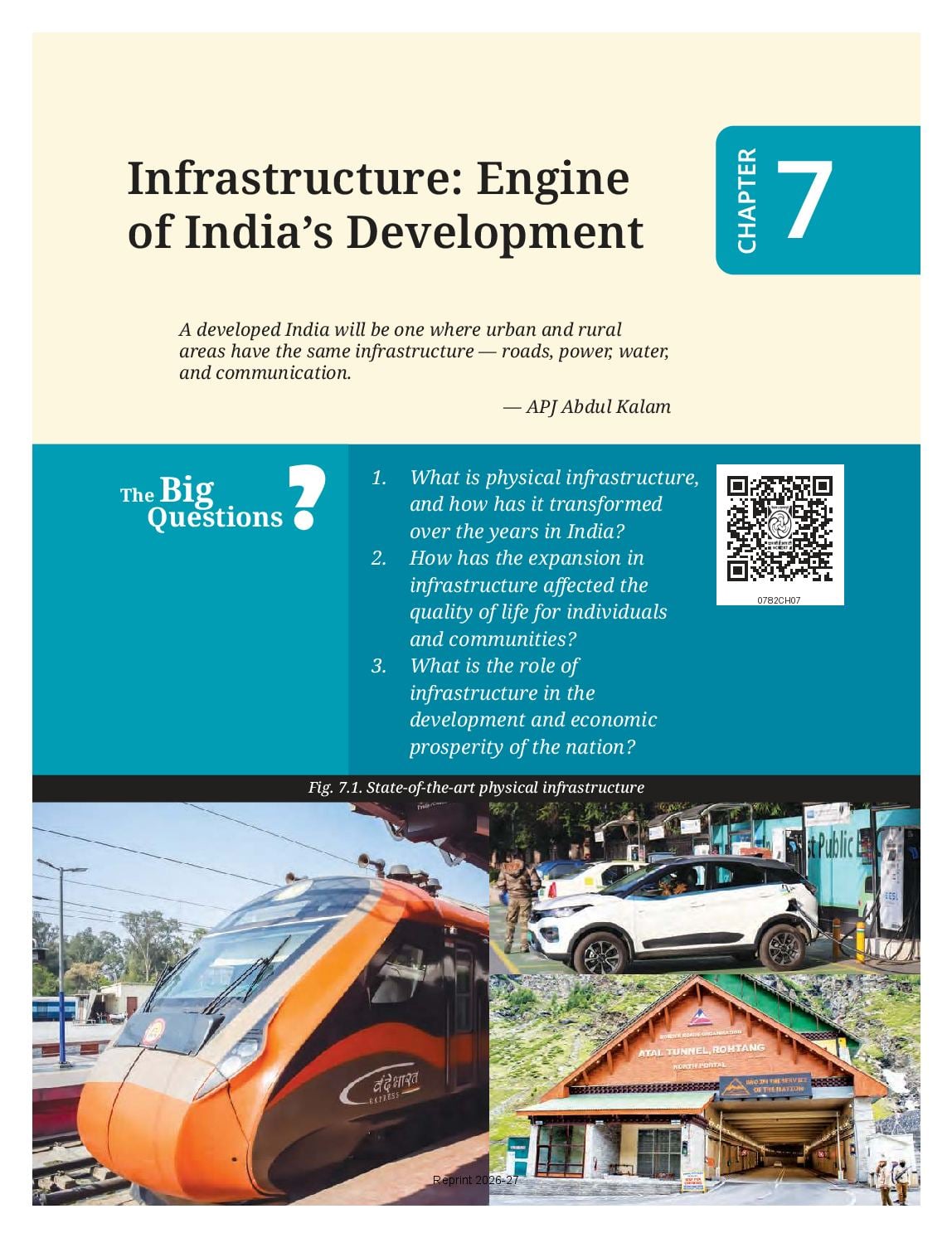
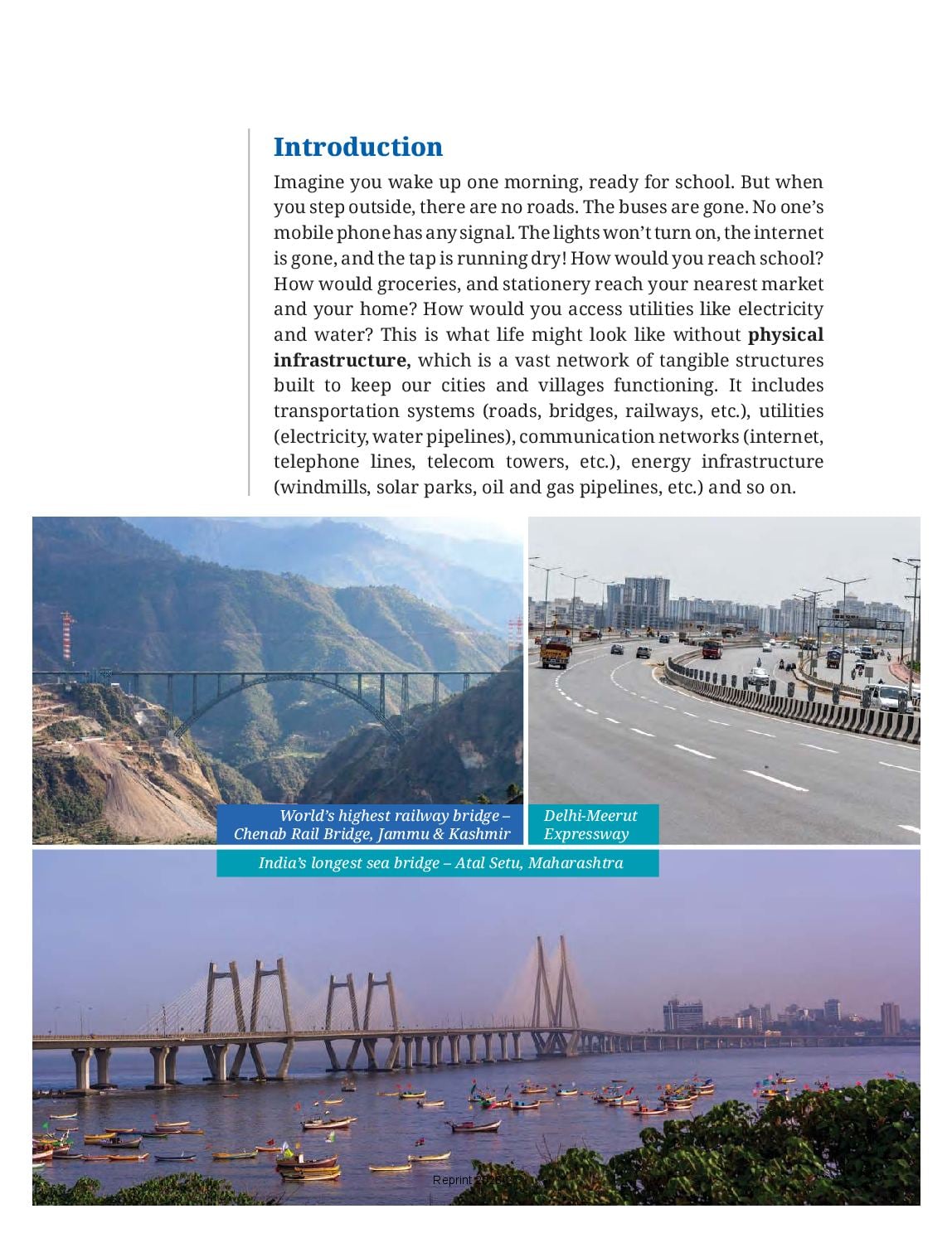
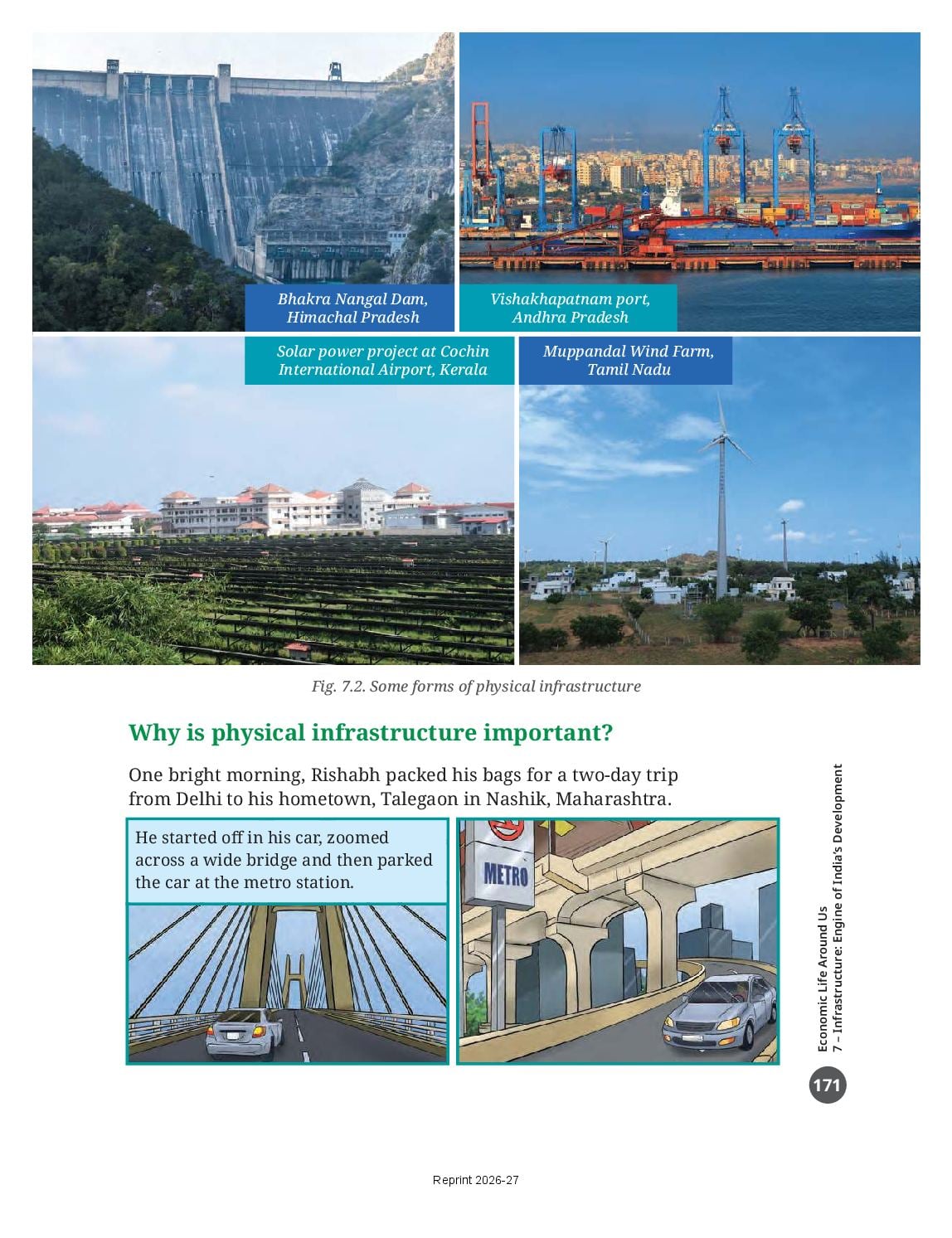
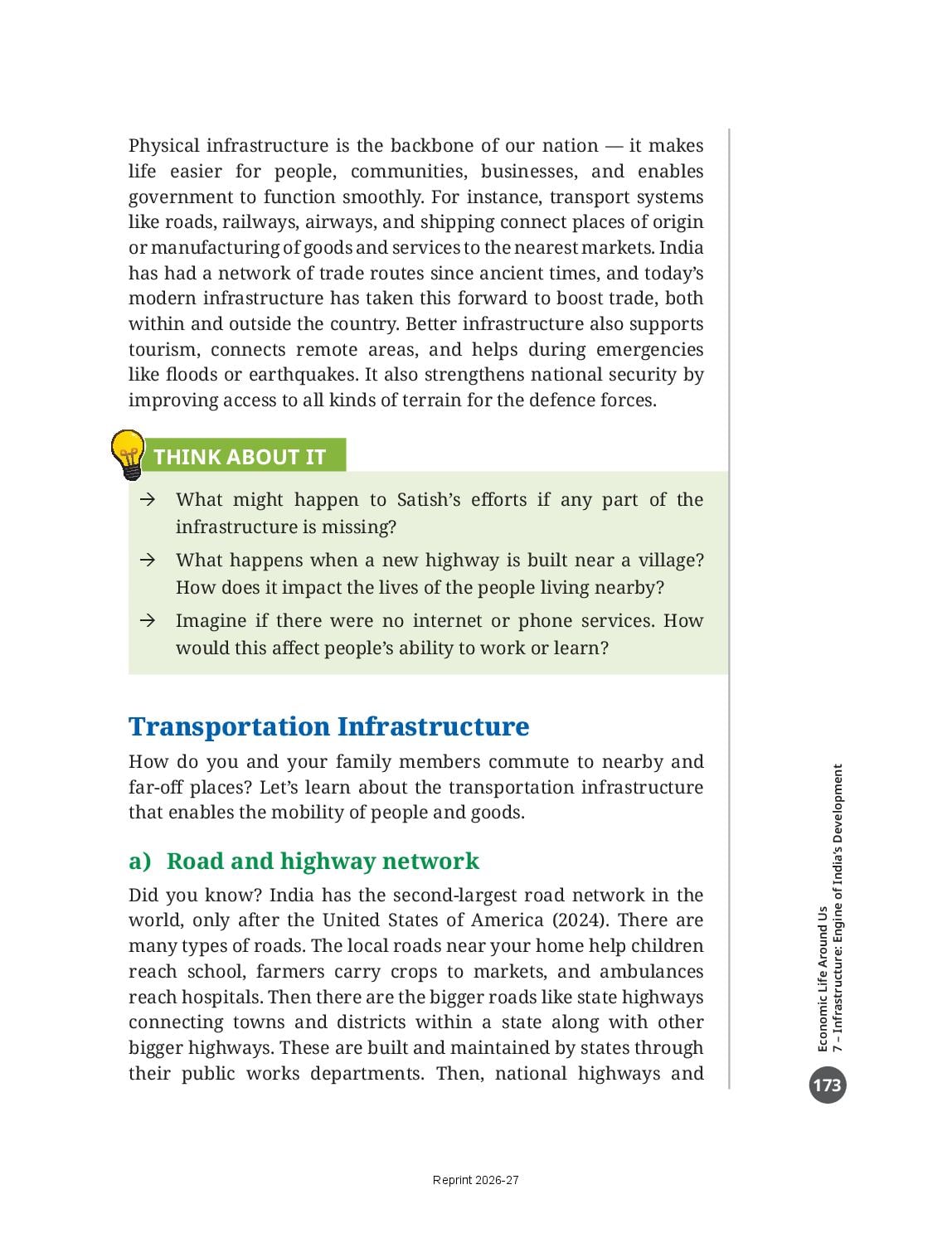
- Physical infrastructure is the “vast network of tangible structures built to keep our cities and villages functioning”. The chapter lists four families of it: transportation (roads, bridges, railways), utilities (electricity, water pipelines), communication networks (internet, telephone lines, telecom towers) and energy infrastructure (windmills, solar parks, oil and gas pipelines). The opening quotation from APJ Abdul Kalam sets the standard: a developed India is one where urban and rural areas have the same infrastructure.
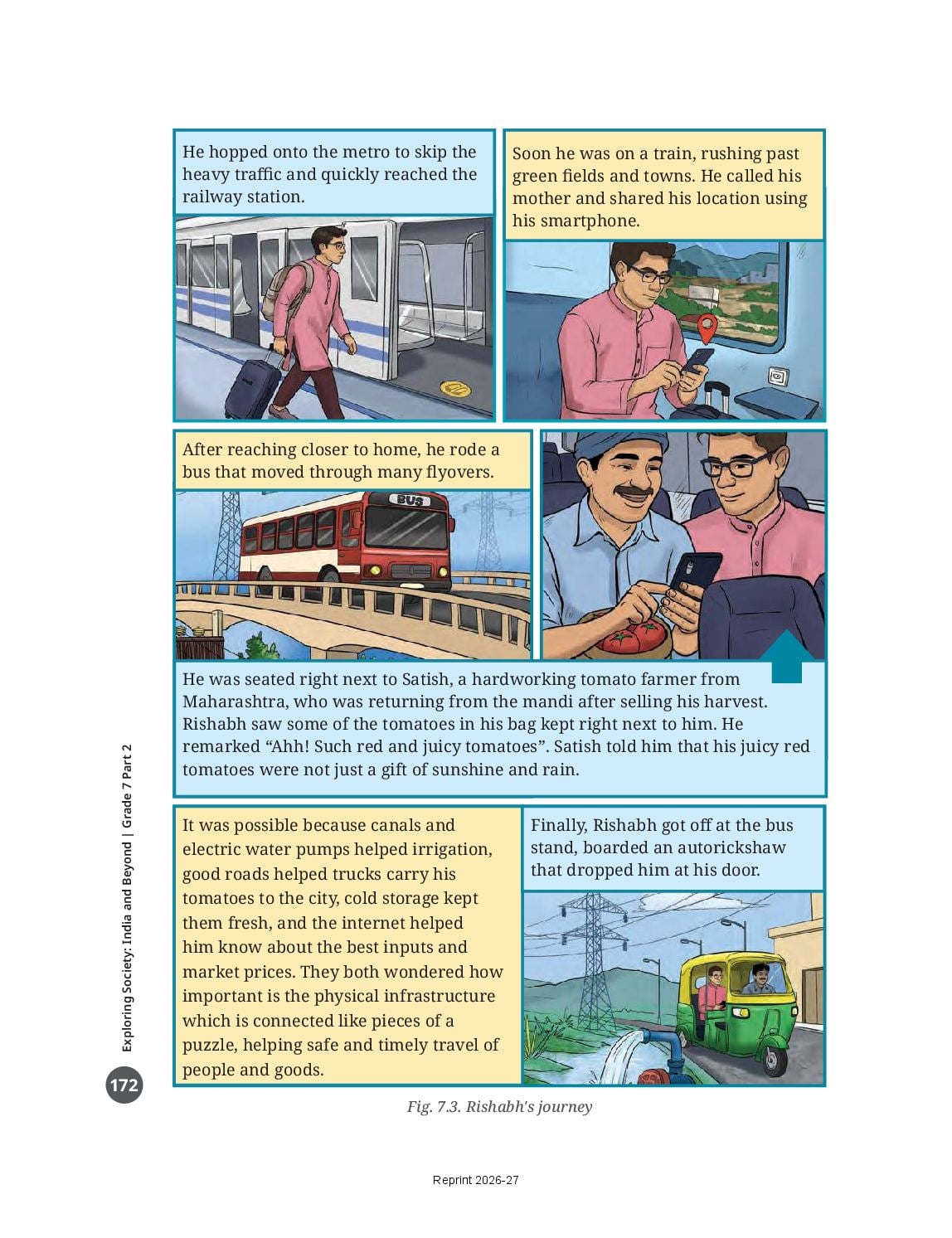
- Infrastructure works as a chain, not as separate pieces. Rishabh’s journey from Delhi to Talegaon uses a bridge, a car park, a metro, a train, a smartphone, a bus, flyovers and an autorickshaw. Satish’s tomatoes need canals and electric pumps for irrigation, roads for the trucks, cold storage to stay fresh, and the internet for input and price information. Remove one link and the whole chain suffers.
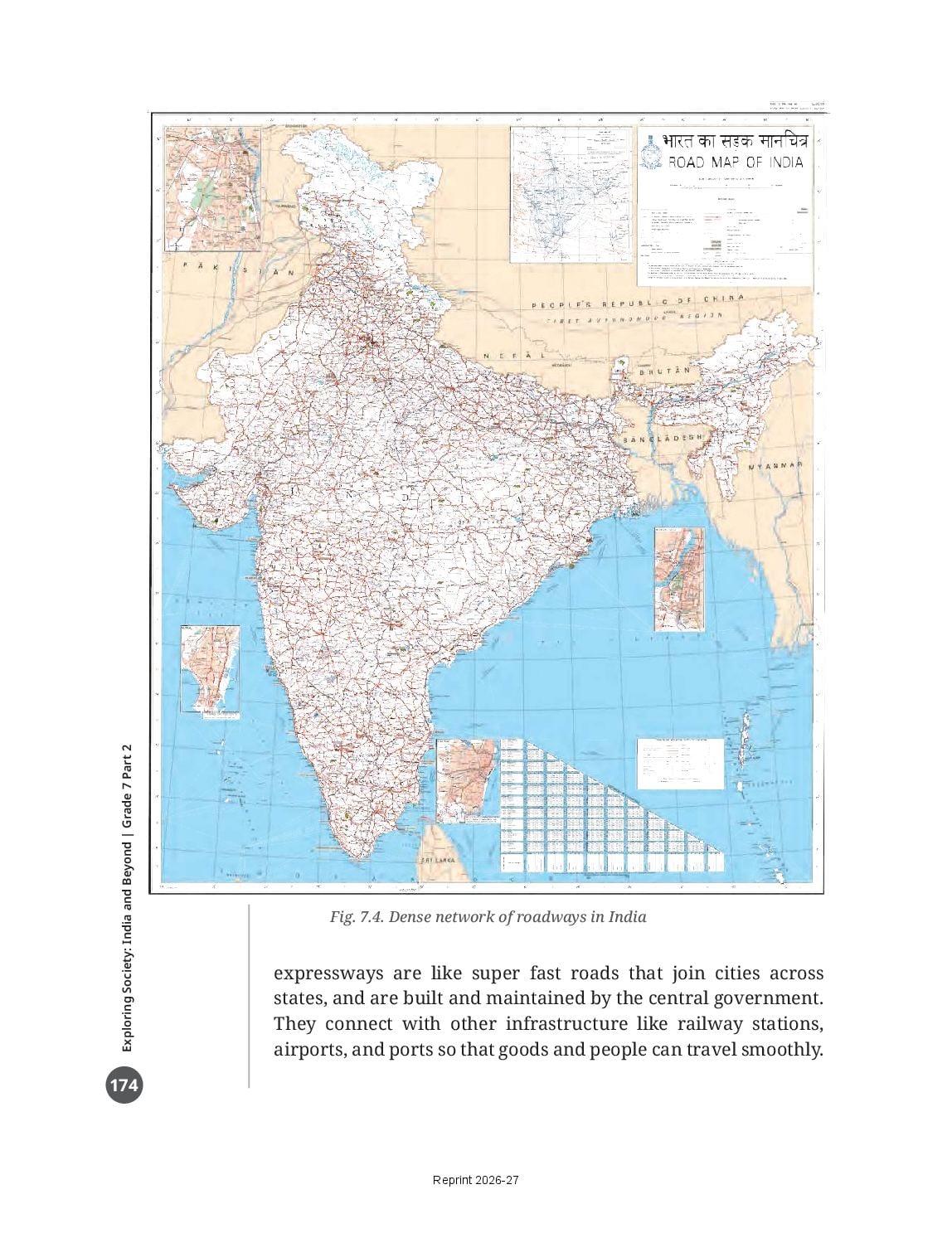
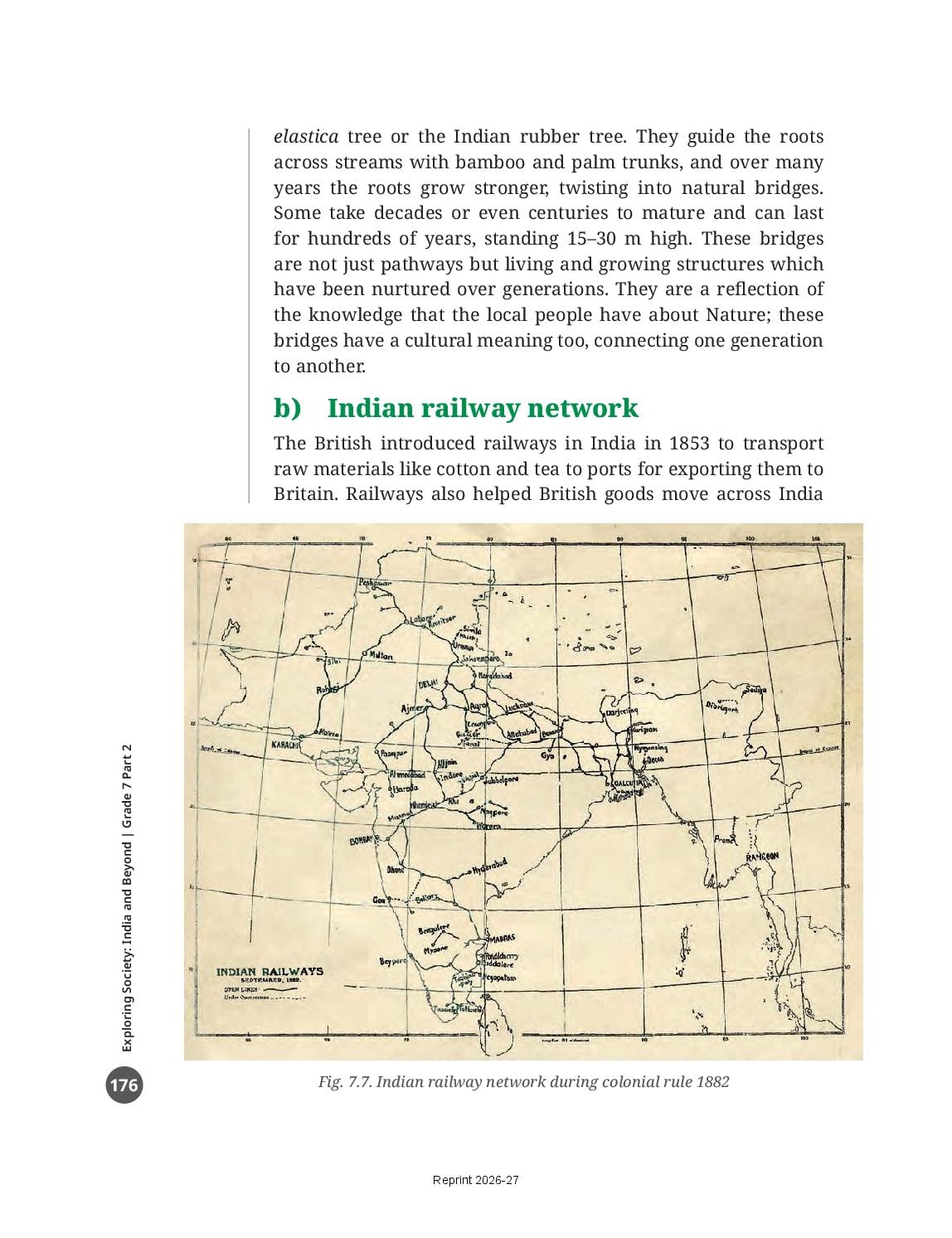
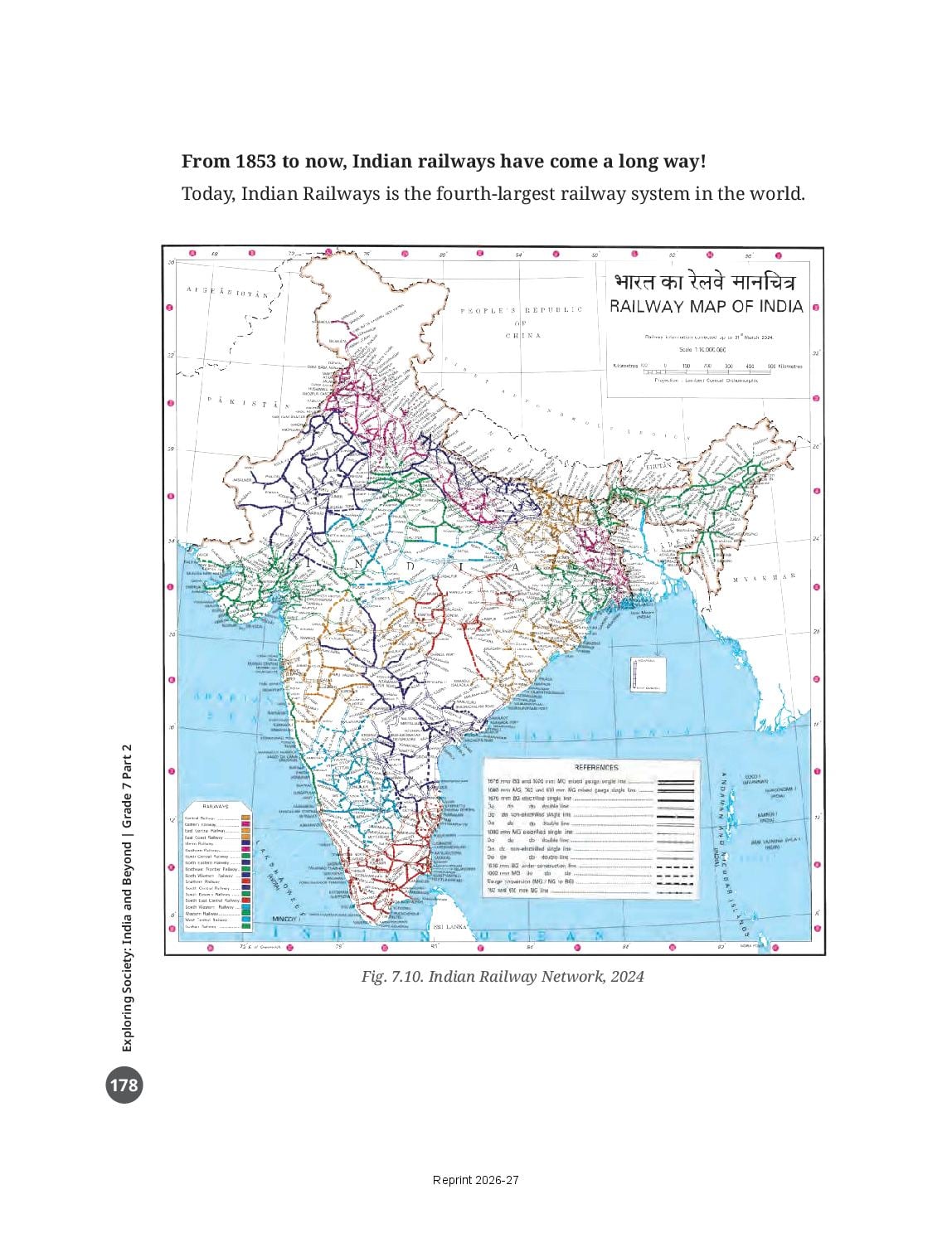
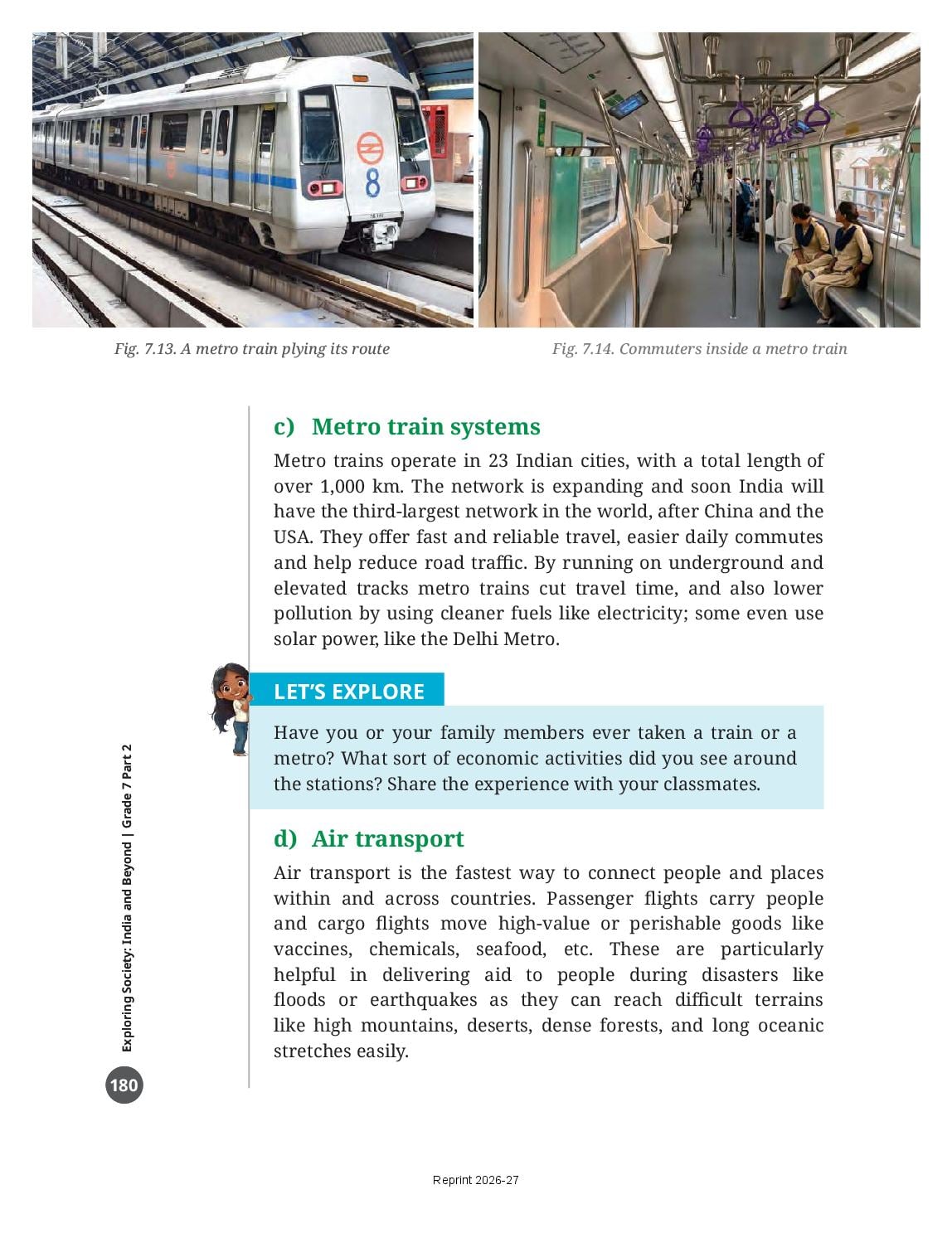
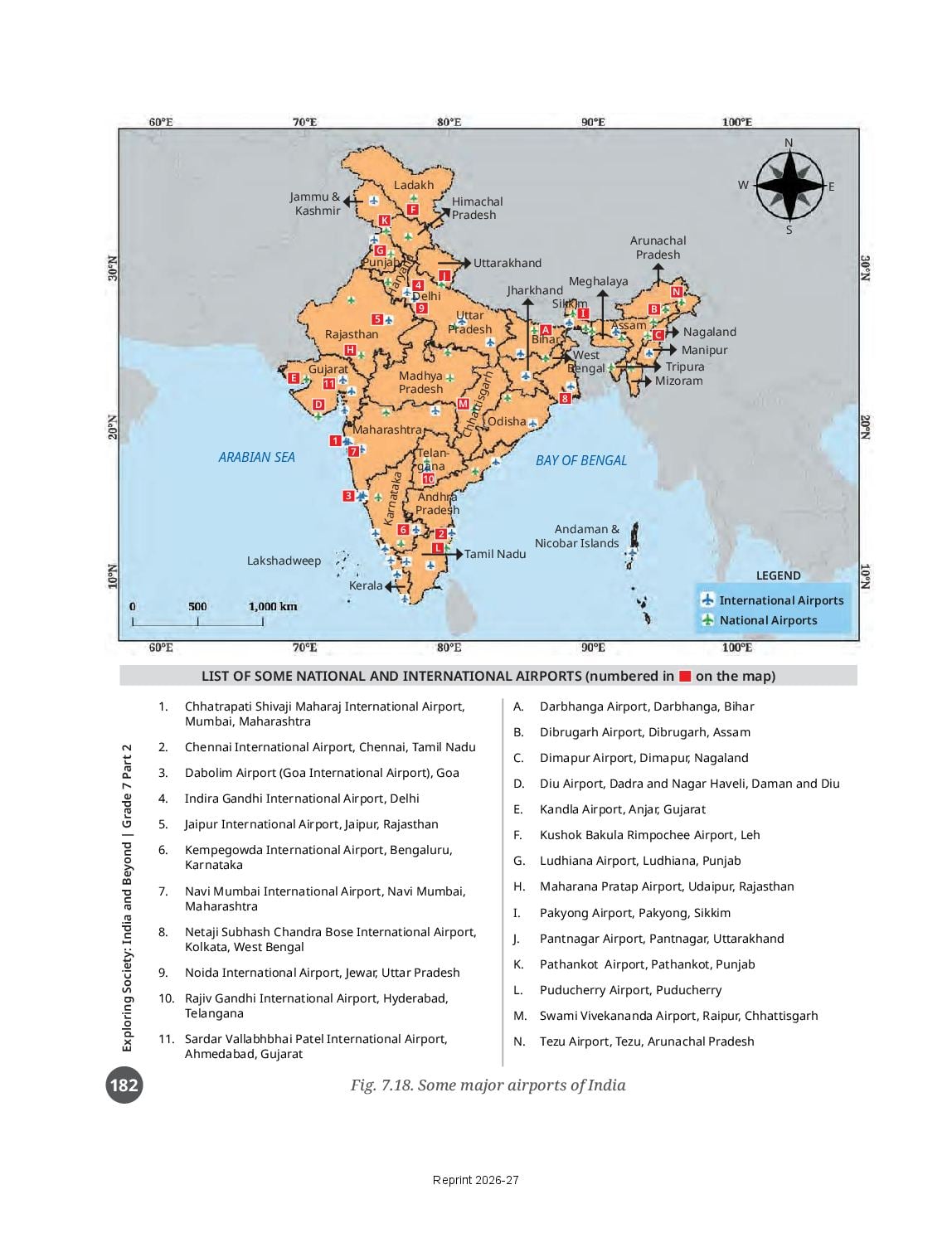
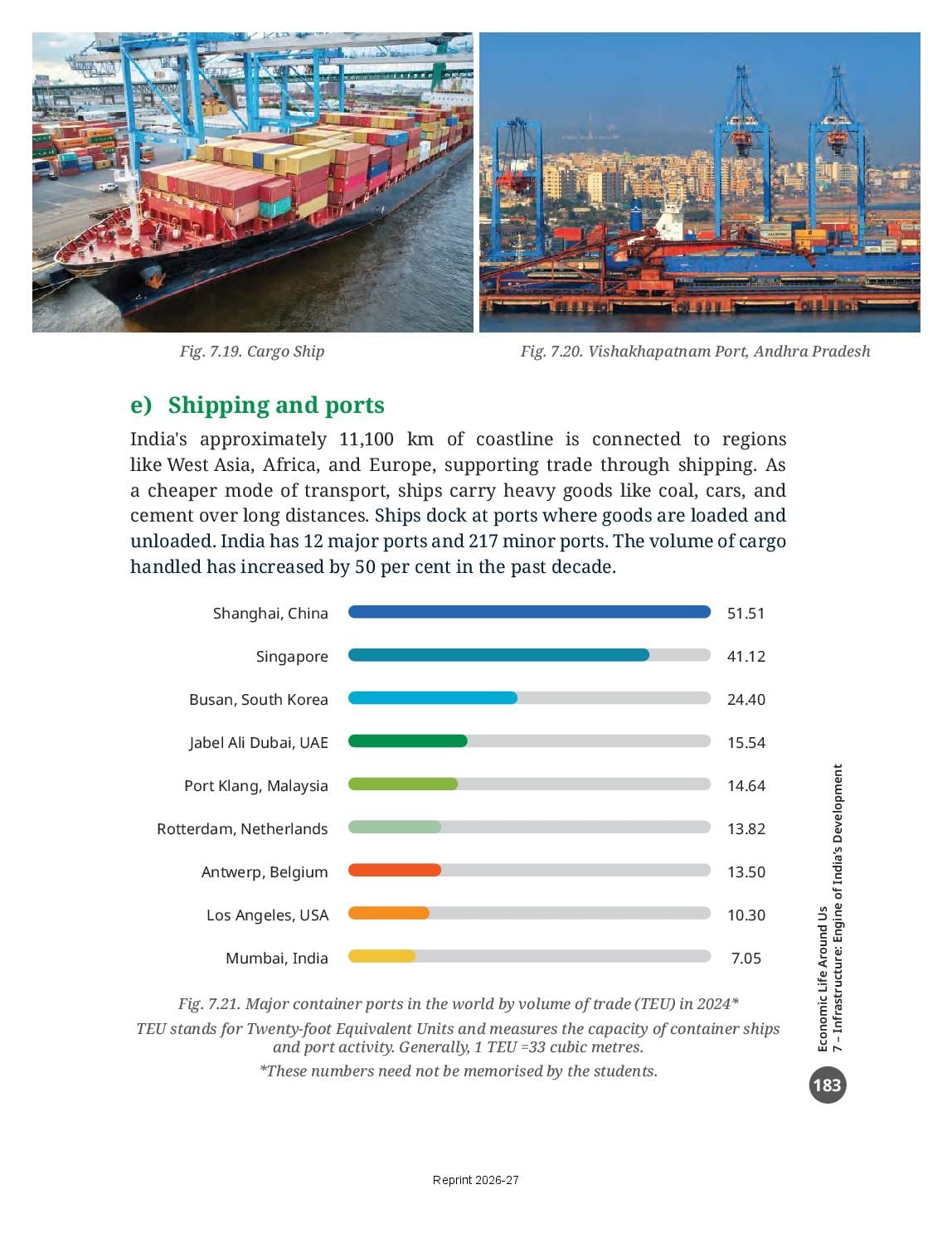
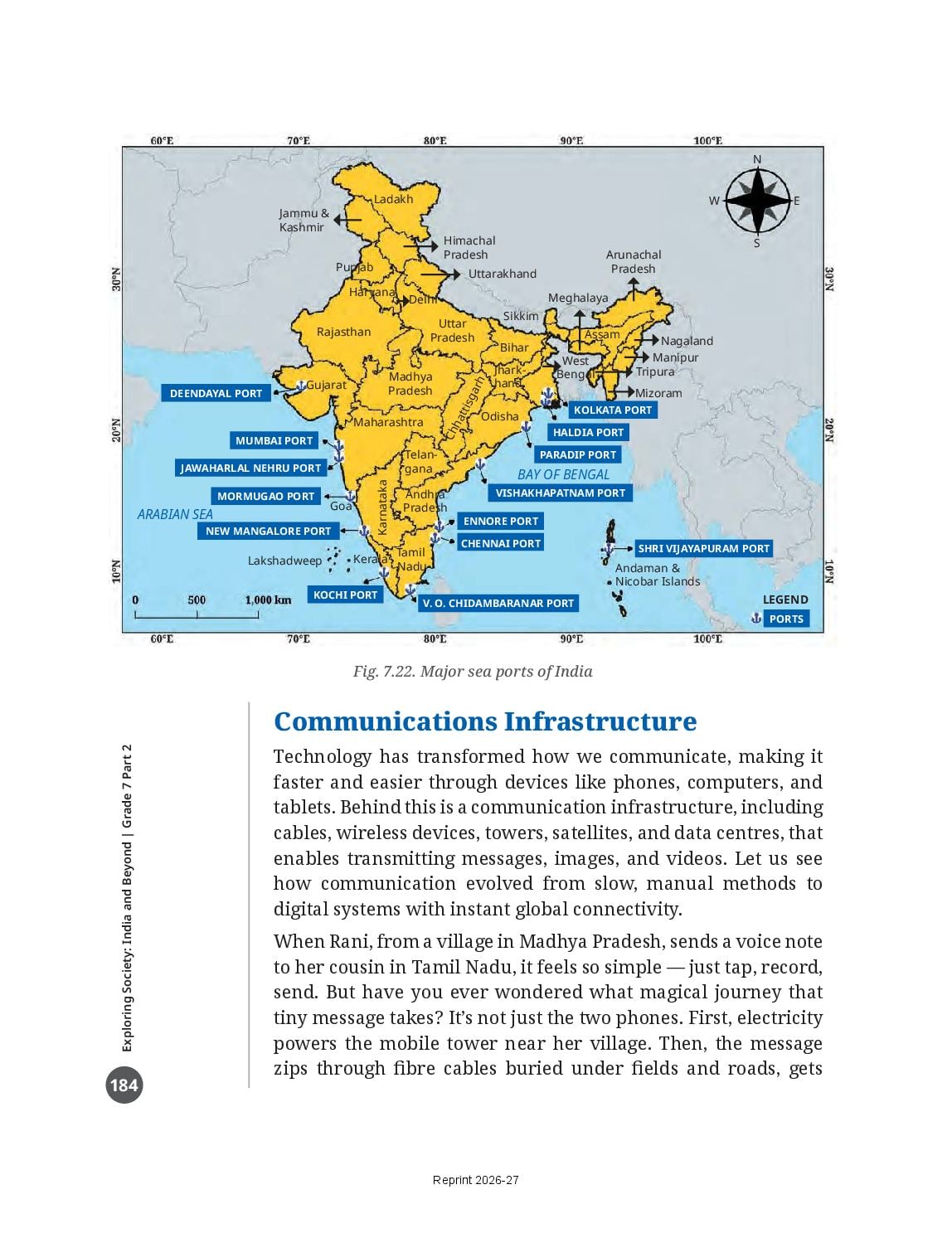
- Transport: five networks. India has the world’s second-largest road network after the USA (2024); national highways are about 150,000 km, with NH44 the longest at 4,112 km (Srinagar to Kanyakumari). Railways began in 1853 under British rule, and today carry over 20 million passengers a day and employ about 1.21 million people (2024). Metros run in 23 cities over more than 1,000 km. India had 159 airports in 2025 and about 376 million air passengers in 2024–25. Its 11,100 km coastline serves 12 major and 217 minor ports.
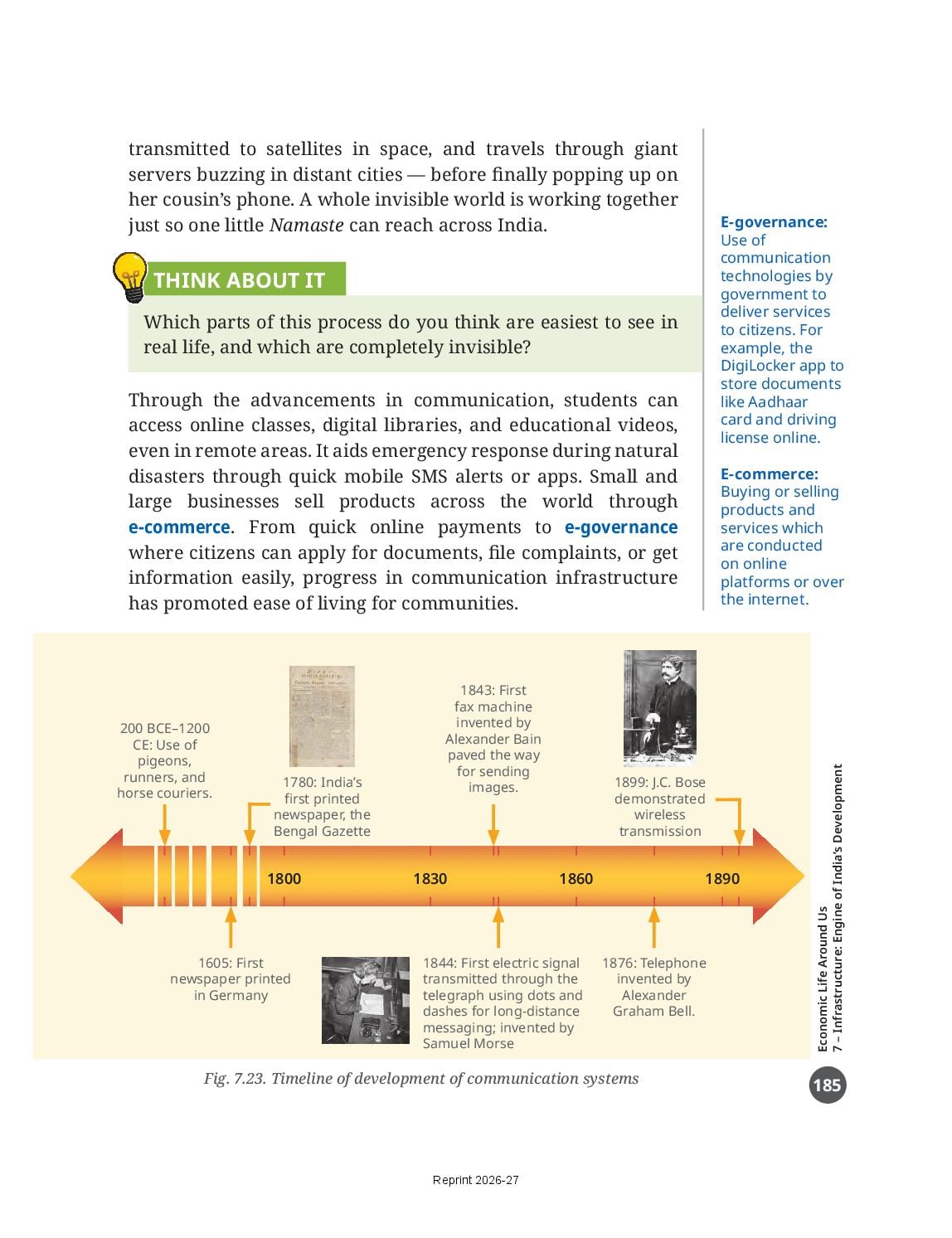
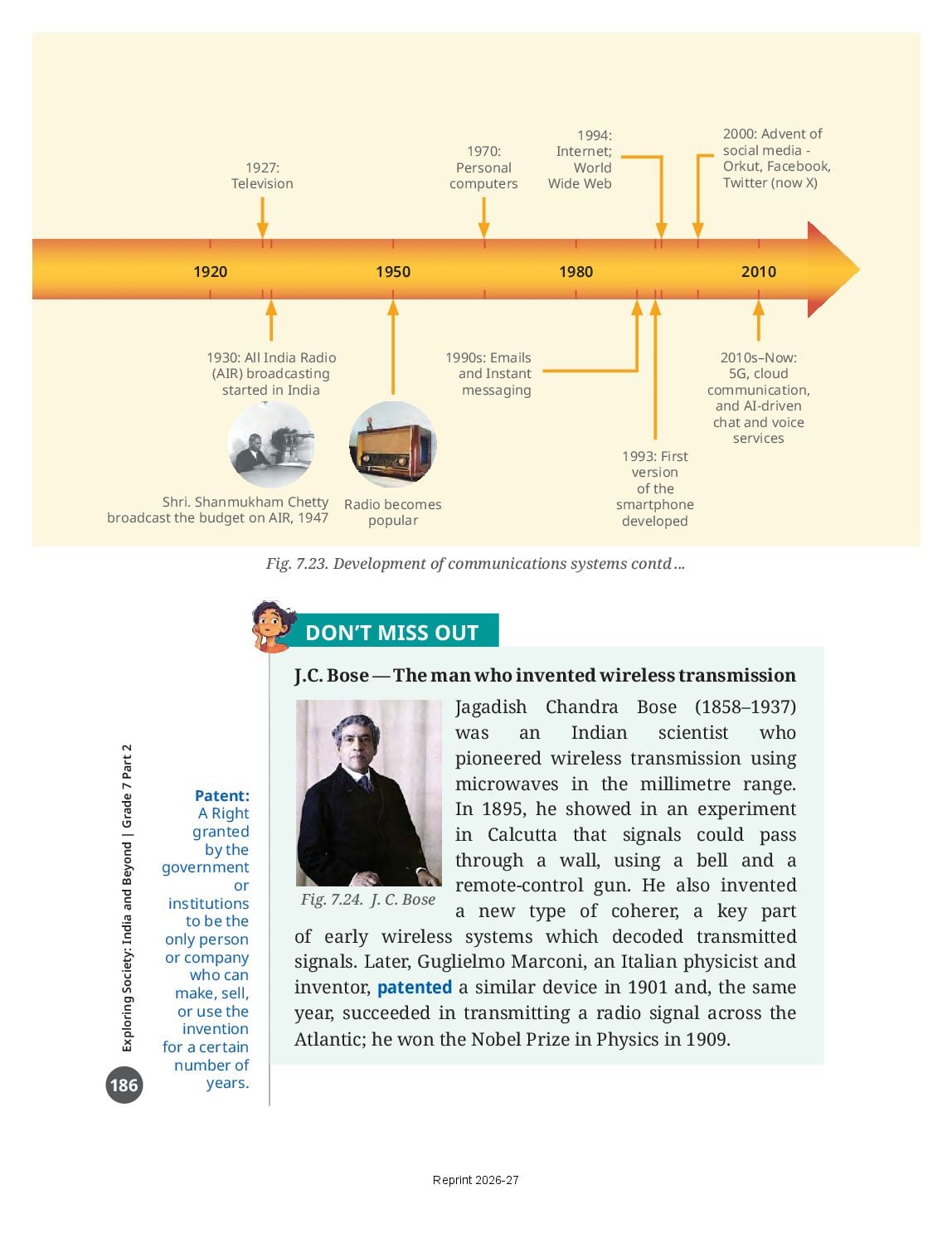
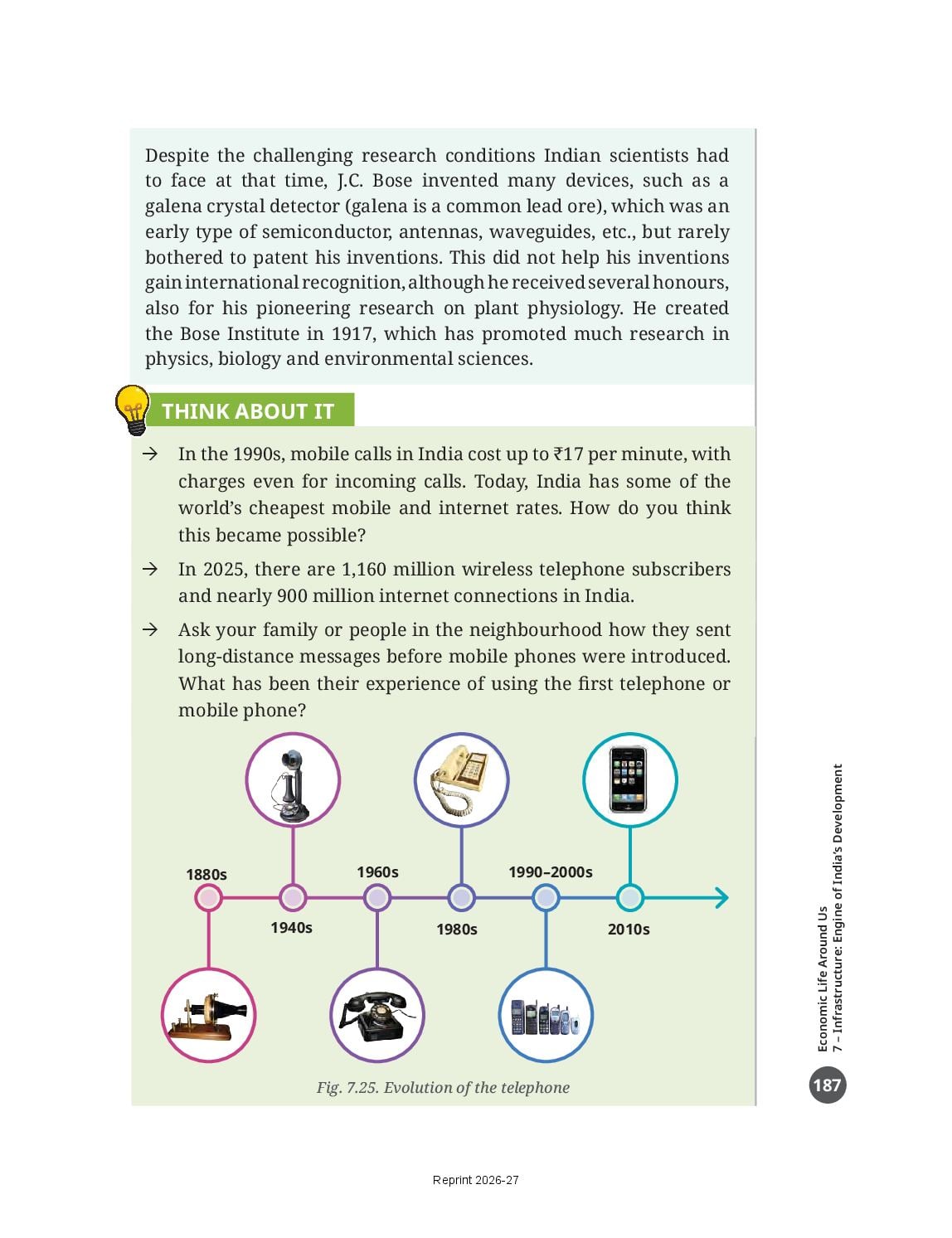
- Communication changed from couriers to cloud. Fig. 7.23 runs from pigeons, runners and horse couriers (200 BCE–1200 CE) through the Bengal Gazette (1780), the telegraph (1844), the telephone (1876) and J.C. Bose’s wireless demonstration (1899), to All India Radio (1930), personal computers (1970), the internet and World Wide Web (1994), and 5G, cloud communication and AI-driven services today. In 2025 India had 1,160 million wireless telephone subscribers and nearly 900 million internet connections.
- Good infrastructure changes ordinary lives. The Dhola Sadiya Bridge (9.15 km, India’s second longest) replaced ferries that stopped during floods, and cut travel time by four hours — so vegetables now reach the market before they spoil and hospitals can be reached in a flood. Meghalaya’s living root bridges (jingkieng jri), grown by Khāsi and Jaintia communities from the roots of the Indian rubber tree, stand 15–30 m high and last for centuries — infrastructure that is also knowledge and culture.
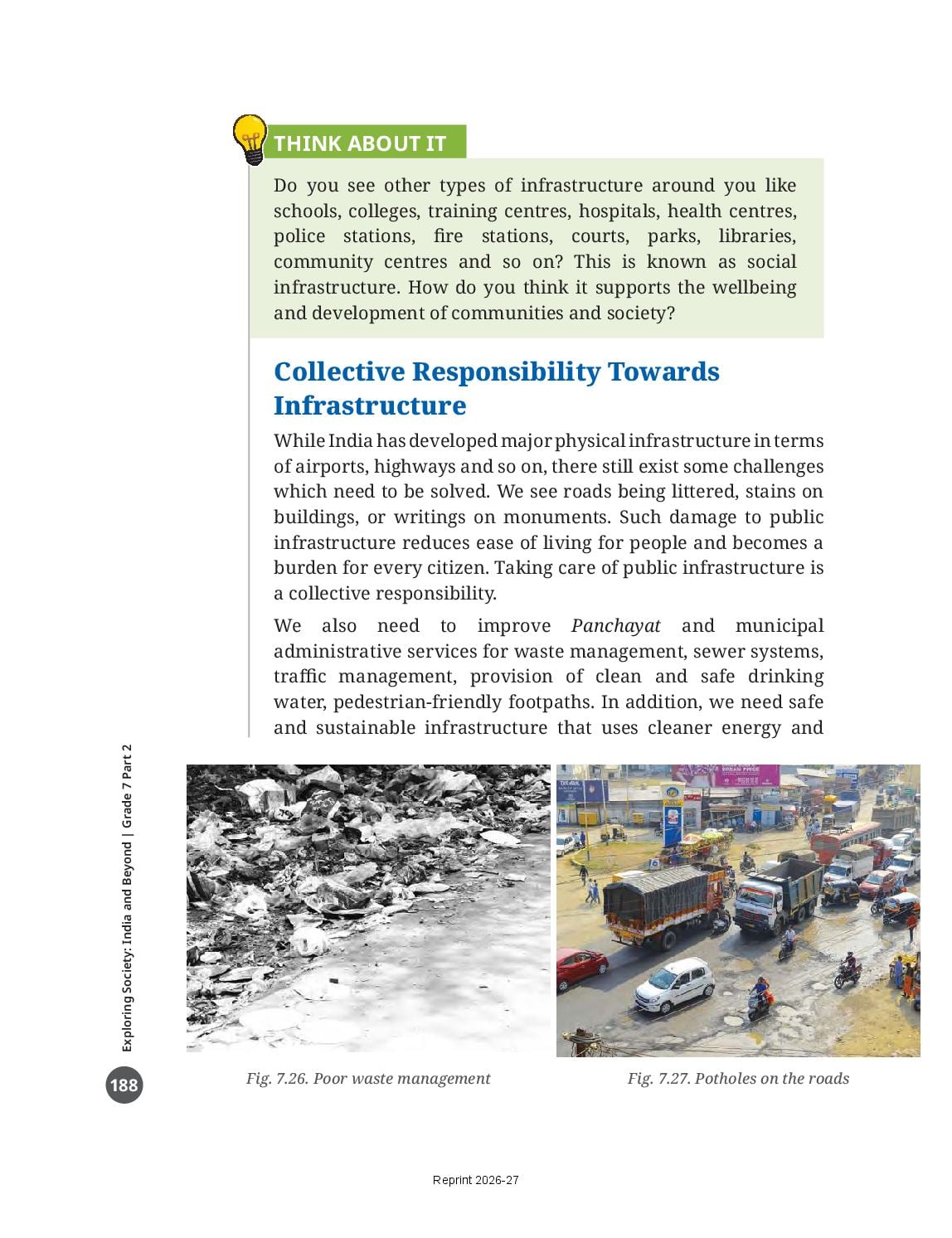
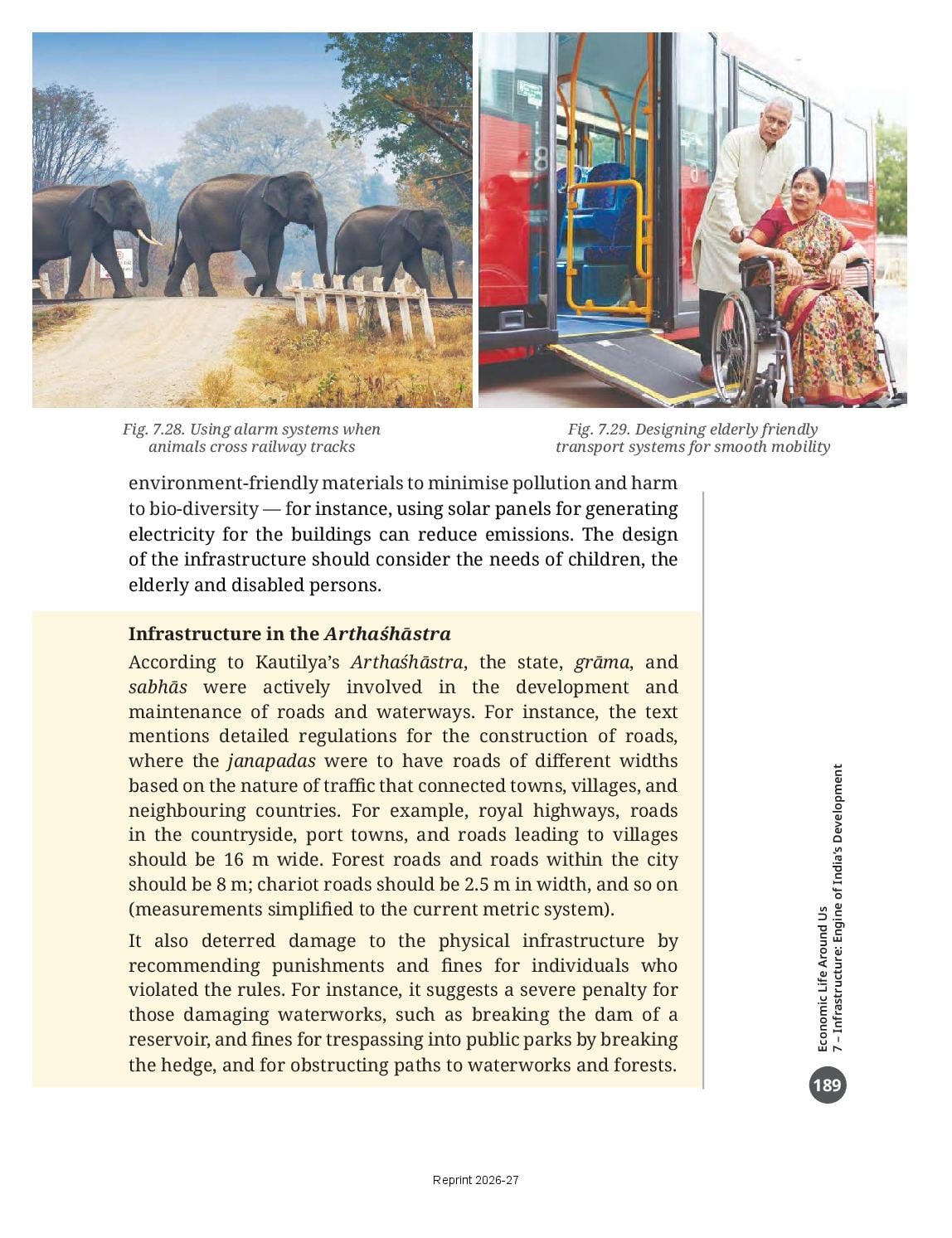
- Looking after infrastructure is a shared duty — and an old idea. Littered roads, stained buildings, writing on monuments and potholes reduce ease of living for everyone. Kautilya’s Arthaśhāstra already laid down road widths (about 16 m for royal highways, 8 m for city and forest roads, 2.5 m for chariot roads) and penalties for damaging waterworks or blocking public paths. The chapter also asks for infrastructure that is sustainable and designed for children, the elderly and disabled persons.
Quick revision – Infrastructure: Engine of India’s Development
| Term or fact | What it means | Where it appears in the chapter | Worth remembering |
|---|---|---|---|
| Physical infrastructure | The vast network of tangible structures built to keep cities and villages functioning | Page 170, Introduction | Four families: transport, utilities, communication, energy |
| Social infrastructure | Schools, colleges, training centres, hospitals, health centres, police and fire stations, courts, parks, libraries, community centres | THINK ABOUT IT, page 188 | Physical infrastructure carries things; social infrastructure builds people |
| National highways | Fast roads joining cities across states, built and maintained by the central government | Pages 173–175 | About 150,000 km (2025); NH44 is longest at 4,112 km |
| State highways | Roads connecting towns and districts within a state, built and maintained by state public works departments | Page 173 | Below them are the local roads that reach homes, fields and schools |
| Golden Quadrilateral | Highway network connecting Delhi, Mumbai, Chennai and Kolkata | DON’T MISS OUT, page 175 | Four cities, four corners of the country |
| Dhola Sadiya Bridge (Bhupen Hazarika Setu) | Bridge over the Lohit River joining Assam and Arunachal Pradesh | Page 175, Fig. 7.5 | 9.15 km, India’s second longest; cut travel time by 4 hours |
| Living root bridge (jingkieng jri) | A bridge grown from the roots of the Ficus elastica (Indian rubber tree), guided across streams with bamboo and palm trunks | Pages 175–176, Fig. 7.6 | Made by the Khāsi and Jaintia tribes; 15–30 m high; takes decades to mature |
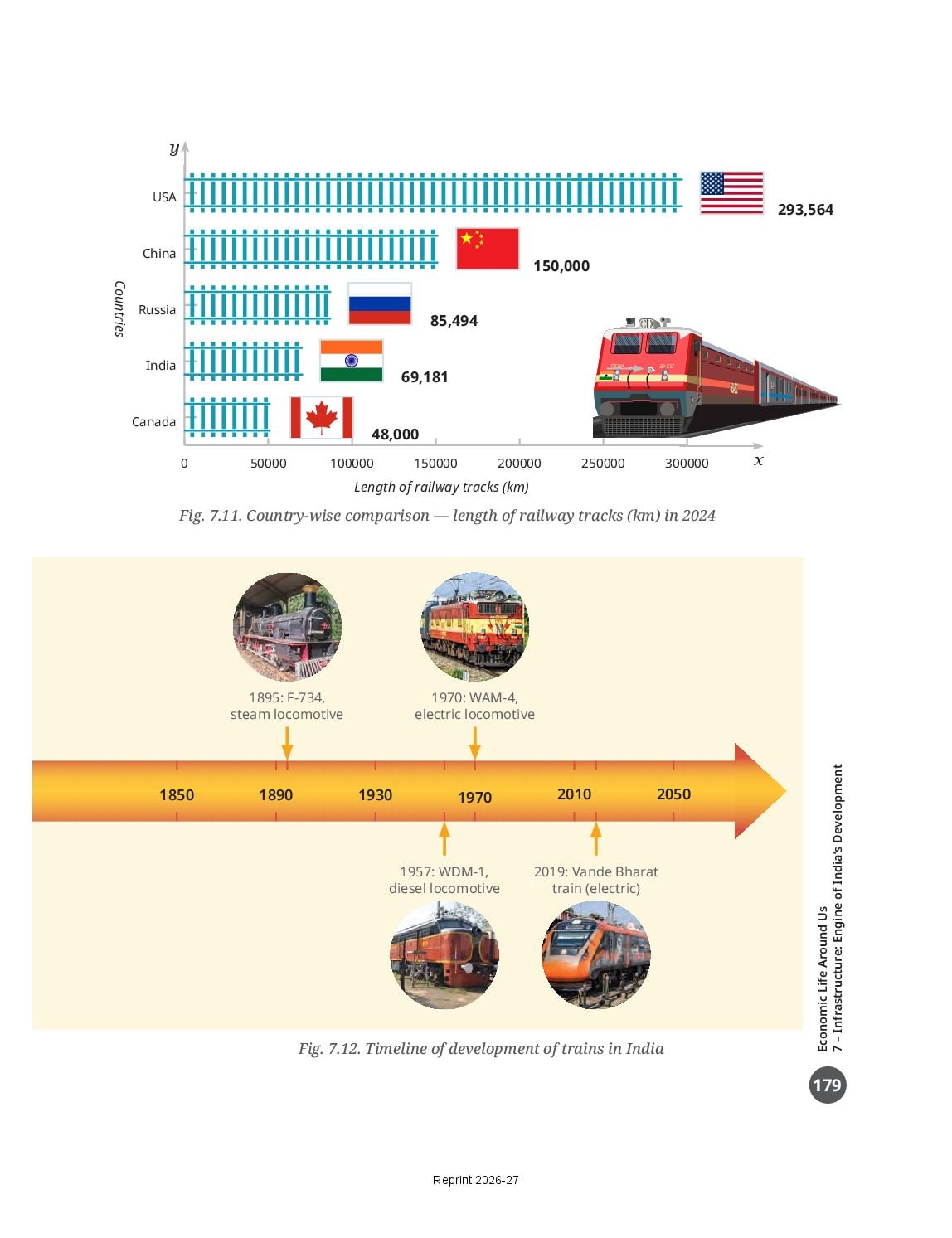
| Indian Railways | Started by the British in 1853 to move raw materials to ports; today the world’s fourth-largest railway system | Pages 176–179 | Over 20 million passengers a day; about 1.21 million employees (2024) |
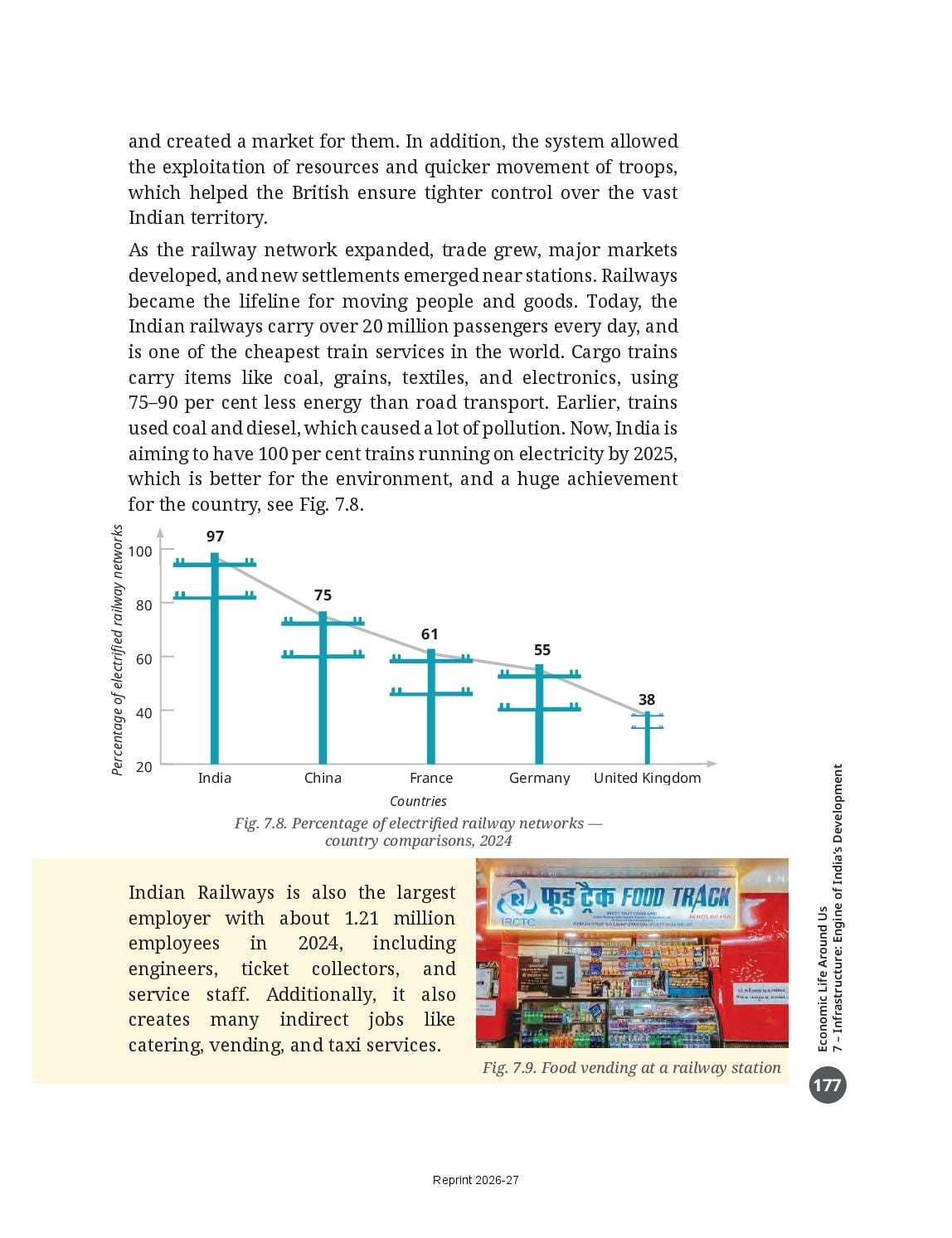
| Electrified railway network | Share of railway track that runs on electricity instead of coal or diesel | Fig. 7.8, page 177 | India 97% · China 75% · France 61% · Germany 55% · UK 38% (2024) |
| Length of railway track, 2024 | Country-wise comparison of total track length | Fig. 7.11, page 179 | USA 293,564 · China 150,000 · Russia 85,494 · India 69,181 · Canada 48,000 km |
| Metro train systems | Fast urban rail on underground and elevated tracks | Page 180 | 23 cities, over 1,000 km; Delhi Metro uses some solar power |
| Air transport | Fastest link between people and places; passenger flights and cargo flights | Pages 180–182 | 159 airports in 2025; about 376 million passengers in 2024–25 |
| Ports and shipping | Ships dock at ports where heavy goods are loaded and unloaded | Pages 183–184, Figs. 7.21–7.22 | Coastline about 11,100 km; 12 major and 217 minor ports; cargo up 50% in a decade |
| TEU | Twenty-foot Equivalent Units — a measure of container-ship capacity and port activity | Note under Fig. 7.21, page 183 | Generally 1 TEU = 33 cubic metres; these numbers need not be memorised |
Old NCERT vs New – Class 7 Social Science
This chapter is from Exploring Society: India and Beyond, the new NCERT Class 7 Social Science book (NCF-SE 2023, used from 2025-26). It replaced the old book “Our Pasts, Our Environment and Social and Political Life”, so chapter numbers and names differ from older PDFs.
Solutions and All Chapters
Answers to the exercises and the full chapter list of Exploring Society: India and Beyond:
Infrastructure: Engine of India’s Development – Overview
| Class | Class 7 |
| Subject | Social Science |
| Book | Exploring Society: India and Beyond – new NCERT book |
| Part | Part II |
| Chapter | 19 of 20 – Infrastructure: Engine of India’s Development |
| Book pages | Part II, 169 – 192 |
| Edition | NCERT Reprint 2026-27 |
| Session | 2026-27 |
| Free – read online or download |
Class 7 Social Science Chapter 19 – FAQs
Where can I download Infrastructure: Engine of India’s Development Class 7 PDF?
From the download table on this page – the chapter PDF is free, and the full book is linked too.
What is Class 7 Social Science Chapter 19 about?
Physical infrastructure is the “vast network of tangible structures built to keep our cities and villages functioning”. The chapter lists four families of it: transportation (roads, bridges, railways), utilities (electricity, water pipelines), communication networks (internet, telephone lines, telecom towers) and energy infrastructure (windmills, solar parks, oil and gas pipelines). The opening quotation from APJ Abdul Kalam sets the standard: a developed India is one where urban and rural areas have the same infrastructure.
Is Infrastructure: Engine of India’s Development from the new NCERT Class 7 Social Science book?
Yes. It is chapter 19 of exploring society: india and beyond (part ii), the new NCERT Class 7 Social Science book for 2026-27.
Is this the latest NCERT edition for 2026-27?
Yes – the PDF is NCERT’s latest edition for the 2026-27 session.
Where are the NCERT Solutions for Class 7 Social Science Chapter 19?
Open the NCERT Solutions link above for answers to the exercise questions.