NCERT Solutions for Class 7 Social Science Chapter 2 Understanding the Weather provide clear, step-by-step answers to every exercise and in-text question from the chapter Understanding the Weather of the NCERT textbook Exploring Society India and Beyond. Prepared by subject experts as per the latest NCERT (CBSE) syllabus for 2026-27, these NCERT Solutions for Class 7 Social Science help you understand each concept, write exam-ready answers, and check your own solutions. You can read them online below or download the free Class 7 Social Science Chapter 2 question-answer PDF.
NCERT Solutions for Class 7 Social Science Chapter 2 Understanding the Weather
- Class: Class 7
- Subject: Social Science
- Chapter: Chapter 2 – Understanding the Weather
- Textbook: Exploring Society India and Beyond (NCERT)
- Study material: NCERT Solutions – questions with answers, free PDF
These solutions answer all the exercise questions of Chapter 2 Understanding the Weather — including the in-text questions, short-answer and long-answer questions, and activities — with complete explanations so you can follow the method, not just the final answer. Read the full solutions below.
NCERT Solutions Class 7 Social Science Chapter 2 Understanding the Weather View Download

NCERT Solutions for Class 7 Social Science Chapter 2 PDF Download
You can read the NCERT Solutions for Class 7 Social Science Chapter 2 online above, or download the complete question-answer PDF to study Understanding the Weather offline at any time.
NCERT Solutions for Class 7 Social Science Chapter 2 PDF Download Link – Click Here to Download Solutions PDF
Questions Covered in This Chapter
These NCERT Solutions answer all 37 questions of this chapter. The questions solved are:
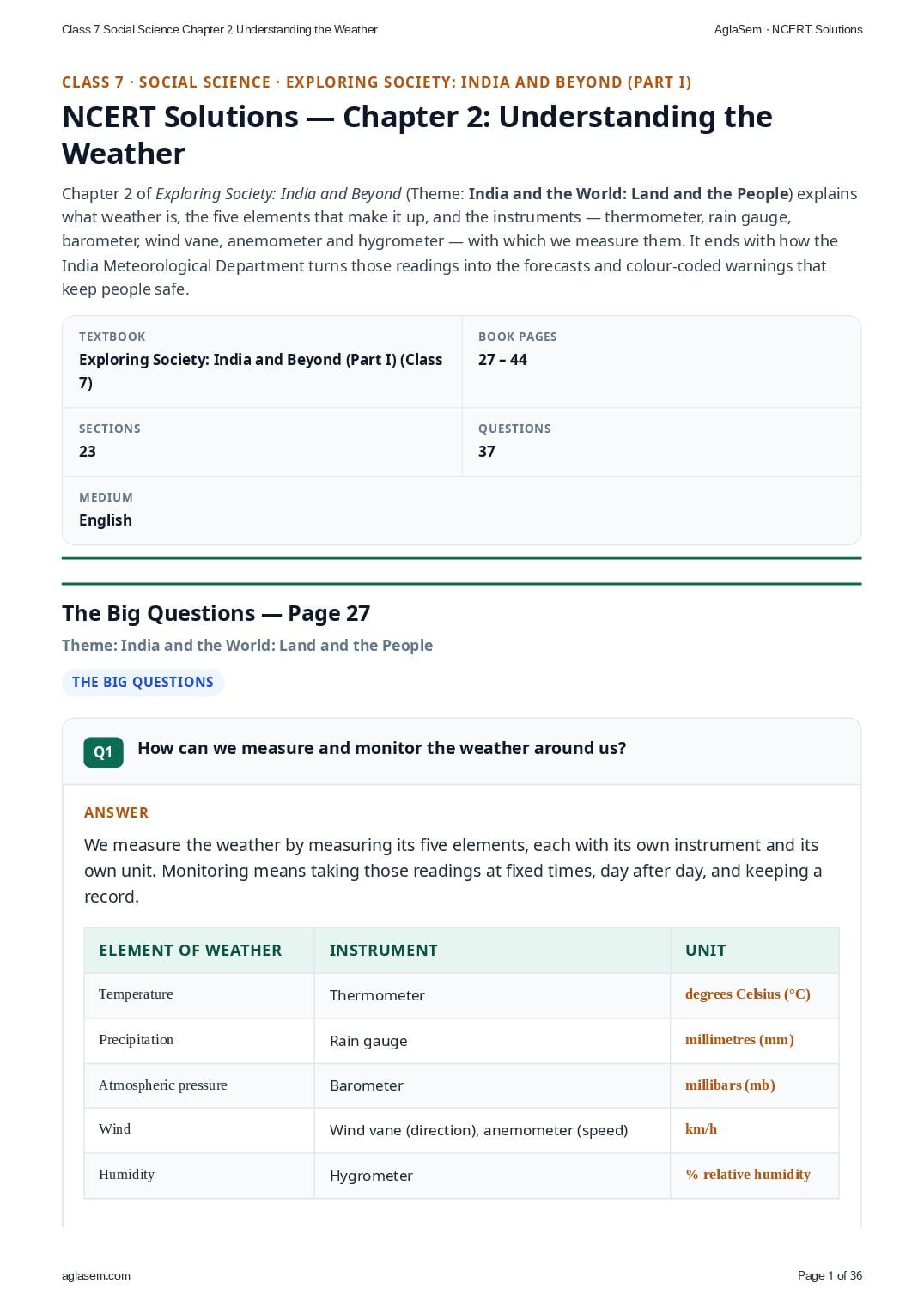
- How can we measure and monitor the weather around us?
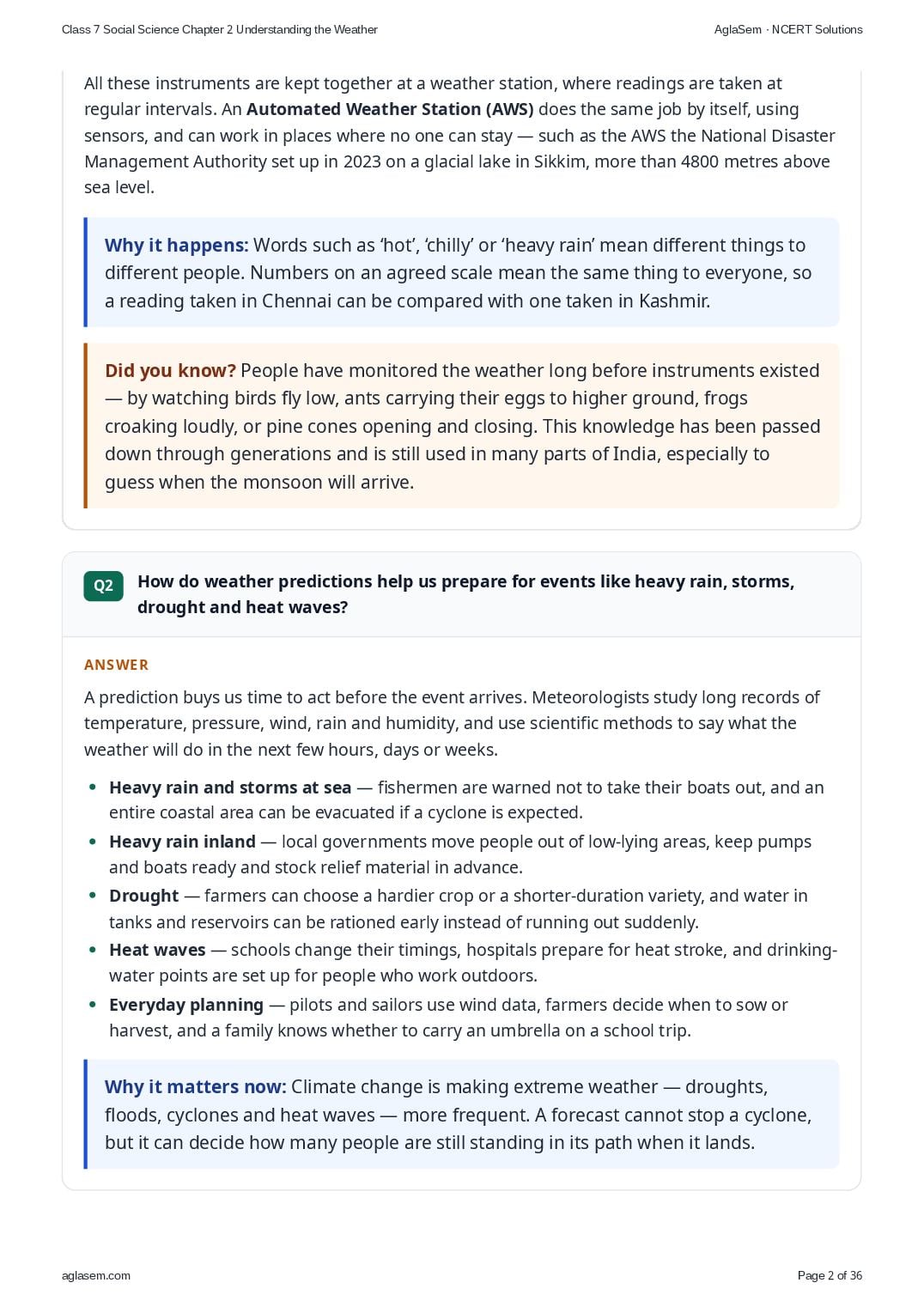
- How do weather predictions help us prepare for events like heavy rain, storms, drought and heat waves?
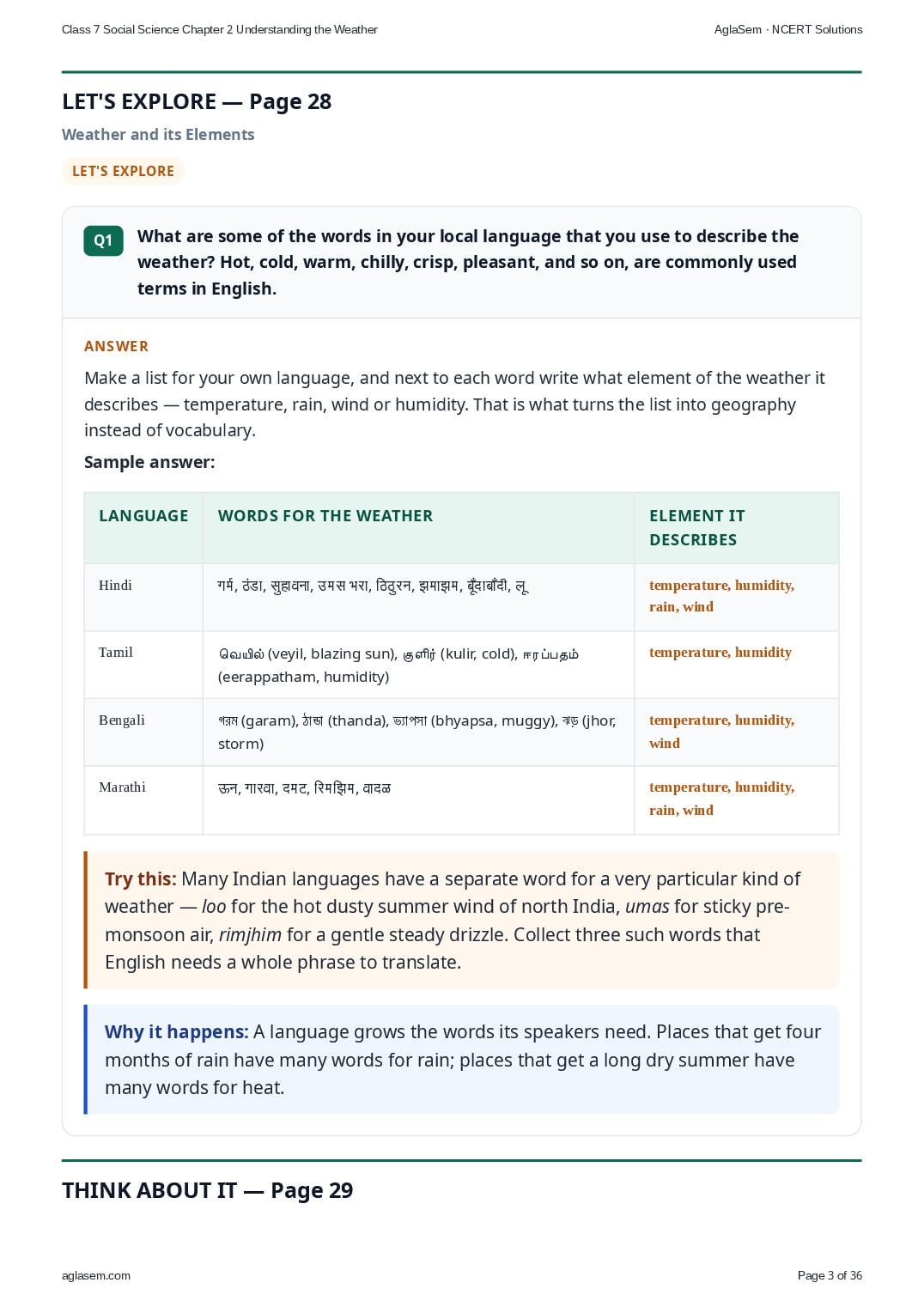
- What are some of the words in your local language that you use to describe the weather? Hot, cold, warm, chilly, crisp, pleasant, and so on, are commonly used terms in English.
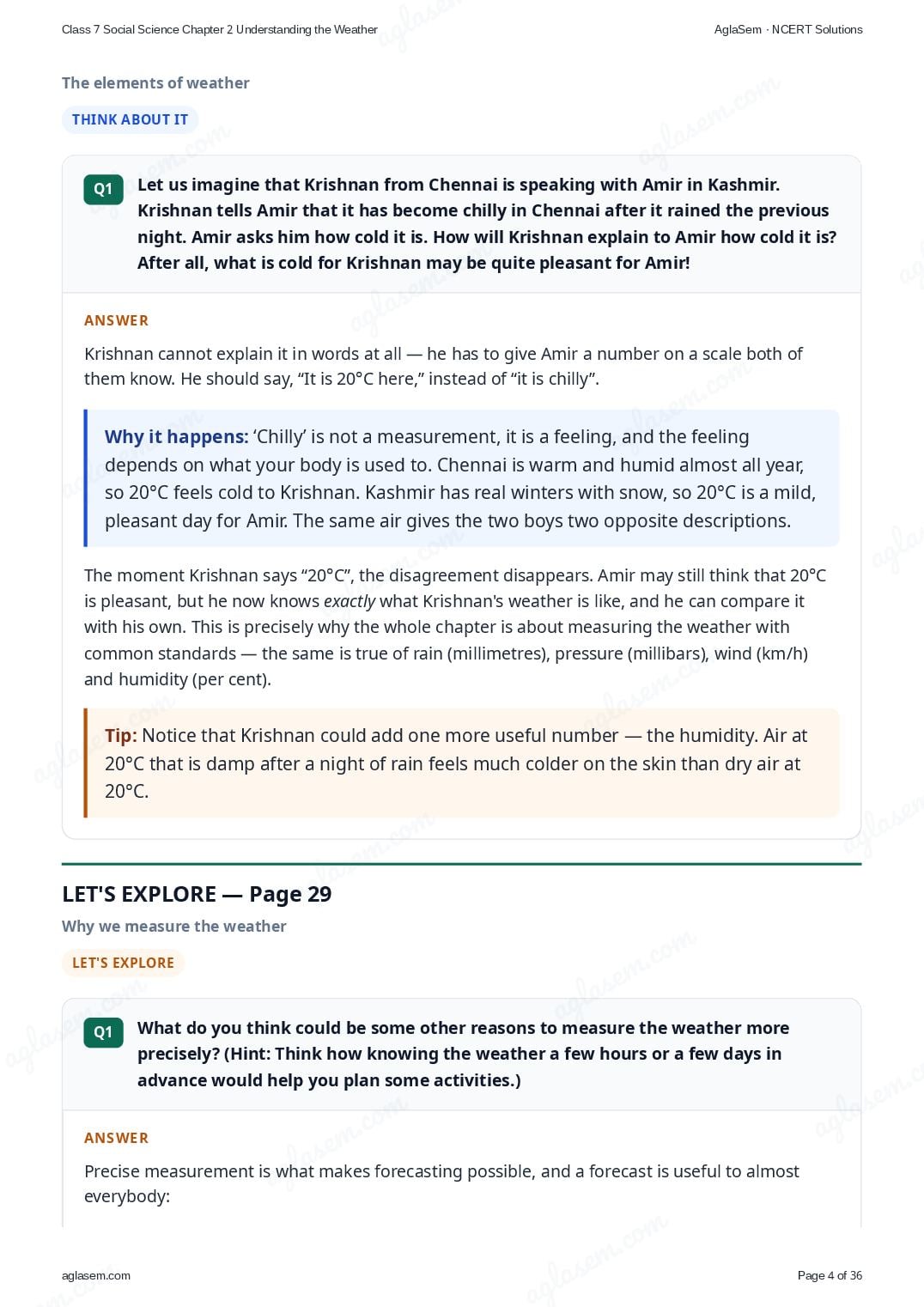
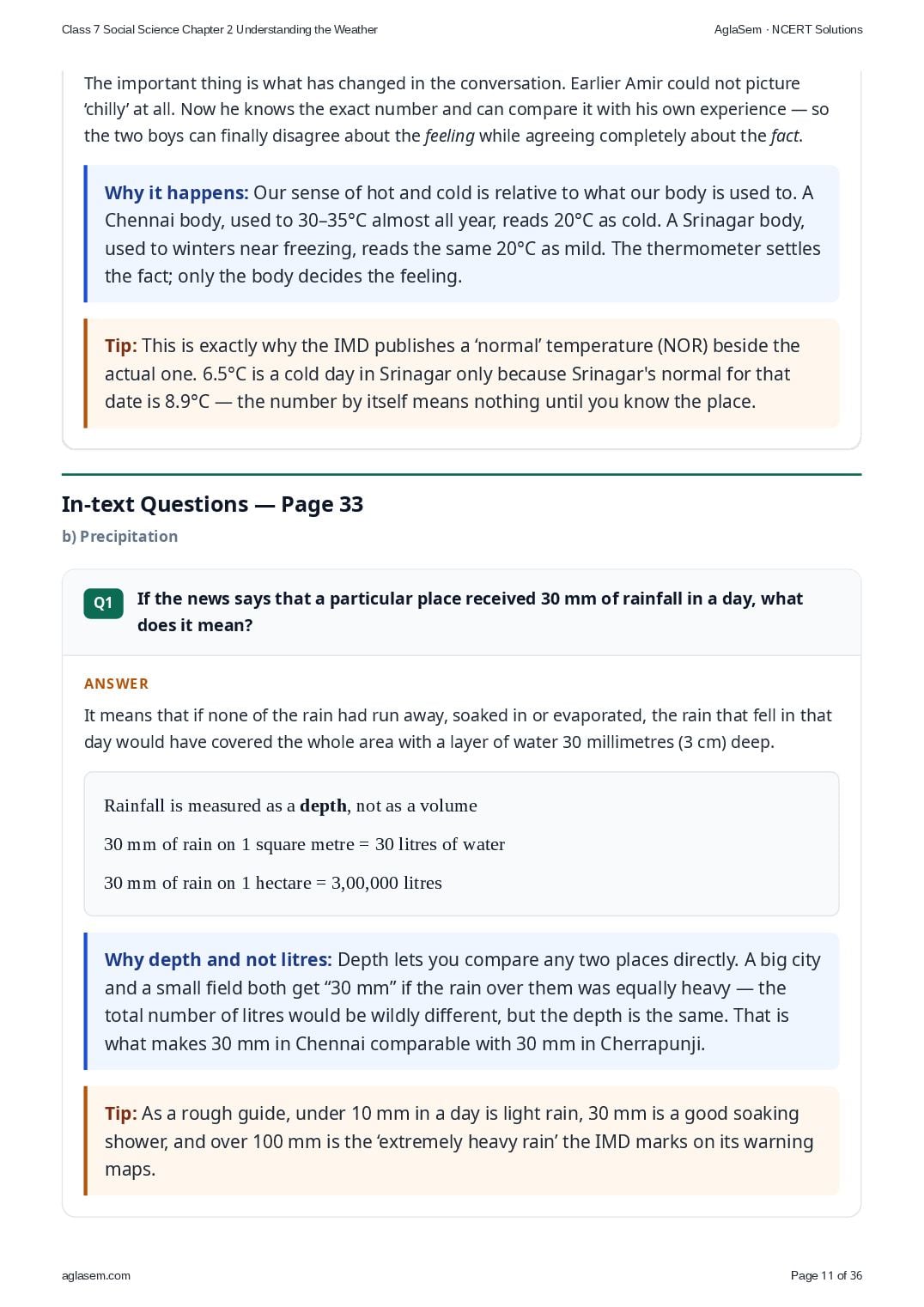
- Let us imagine that Krishnan from Chennai is speaking with Amir in Kashmir. Krishnan tells Amir that it has become chilly in Chennai after it rained the previous night. Amir asks him how cold it is. How will Krishnan explain to Amir how cold it is? After all, what is cold for Krishnan may be quite pleasant for Amir!
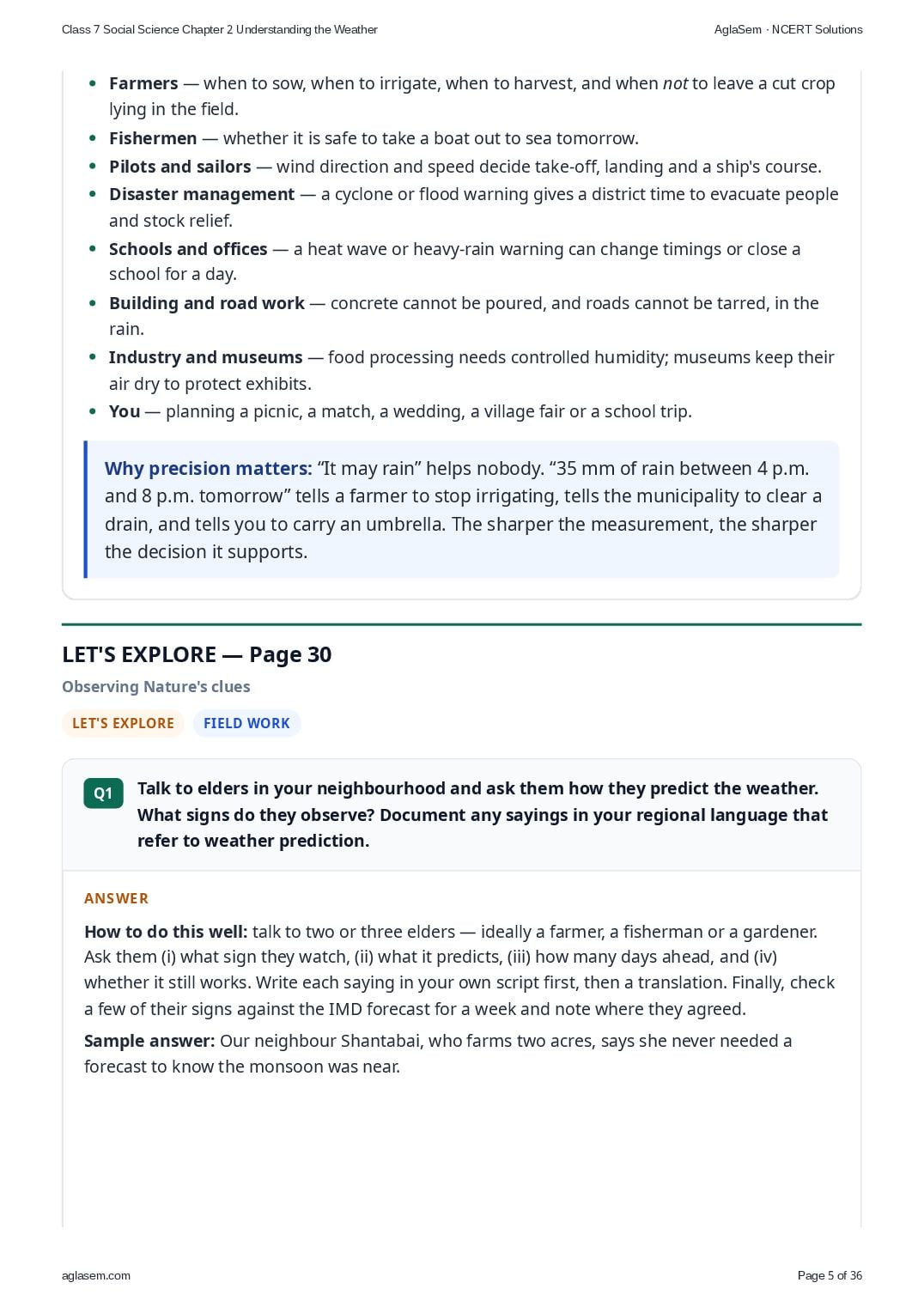
- What do you think could be some other reasons to measure the weather more precisely? (Hint: Think how knowing the weather a few hours or a few days in advance would help you plan some activities.)
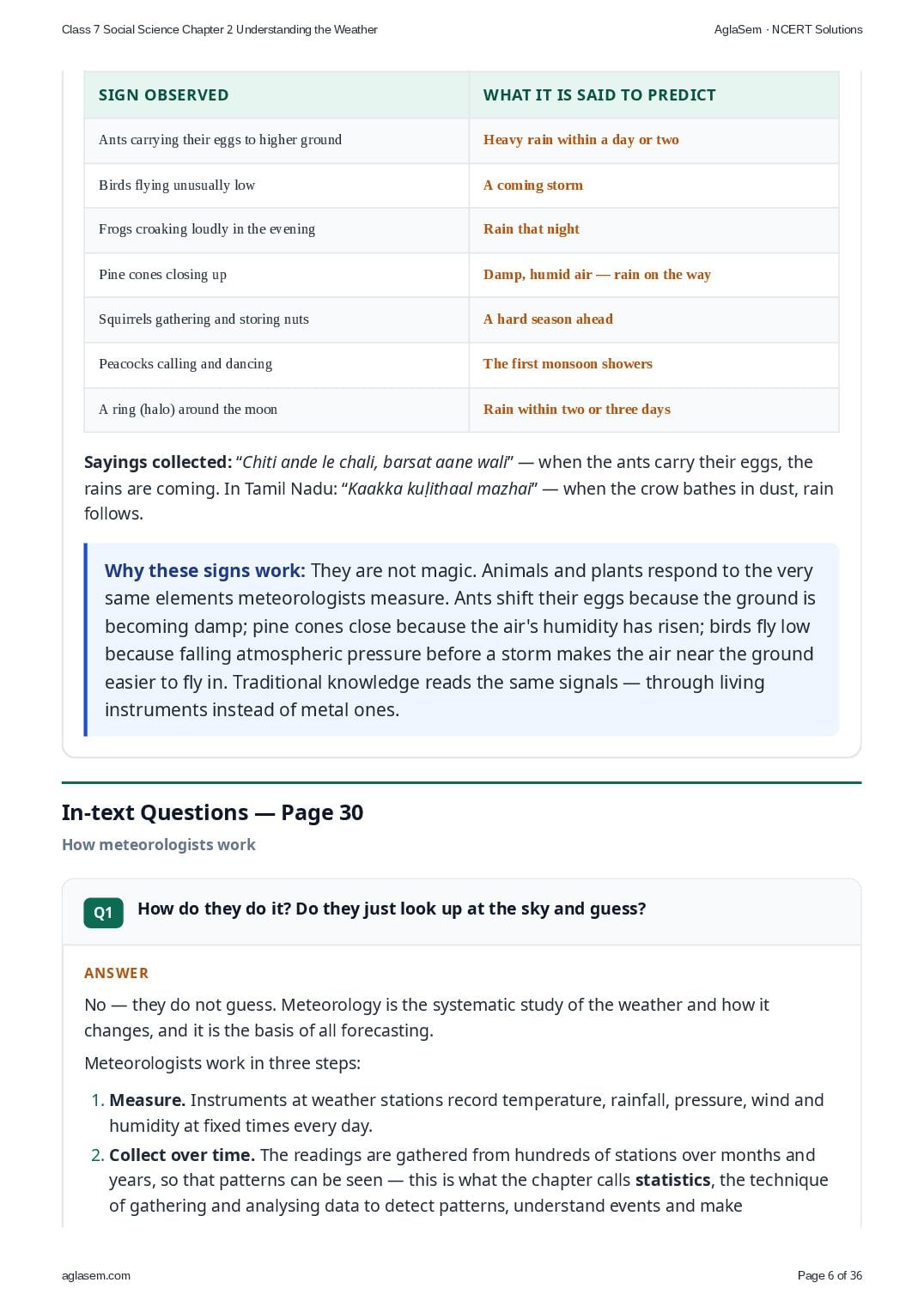
- Talk to elders in your neighbourhood and ask them how they predict the weather. What signs do they observe? Document any sayings in your regional language that refer to weather prediction.
- How do they do it? Do they just look up at the sky and guess?
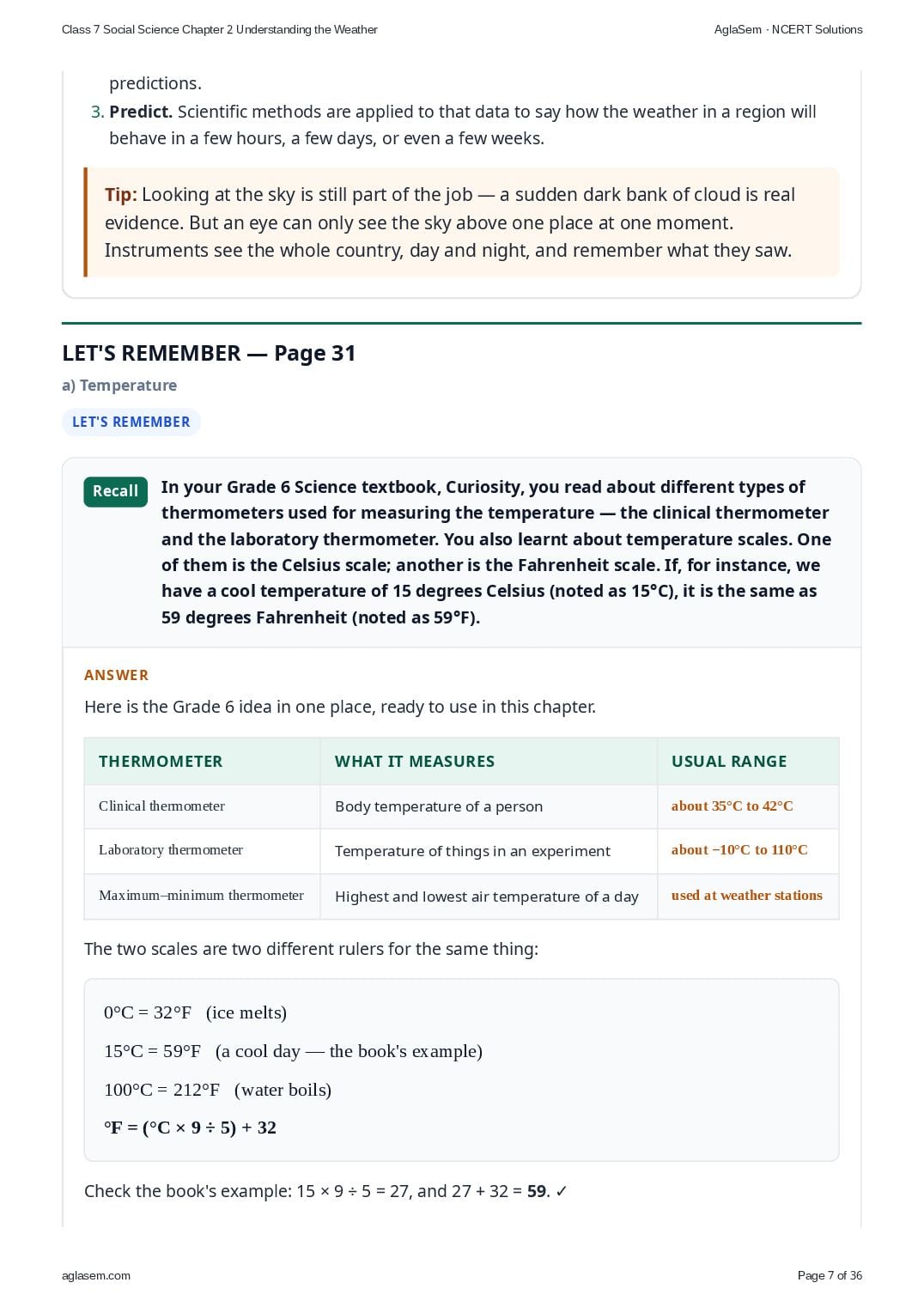
- In your Grade 6 Science textbook, Curiosity, you read about different types of thermometers used for measuring the temperature — the clinical thermometer and the laboratory thermometer. You also learnt about temperature scales. One of them is the Celsius scale; another is the Fahrenheit scale. If, for instance, we have a cool temperature of 15 degrees Celsius (noted as 15°C), it is the same as 59 degrees Fahrenheit (noted as 59°F).
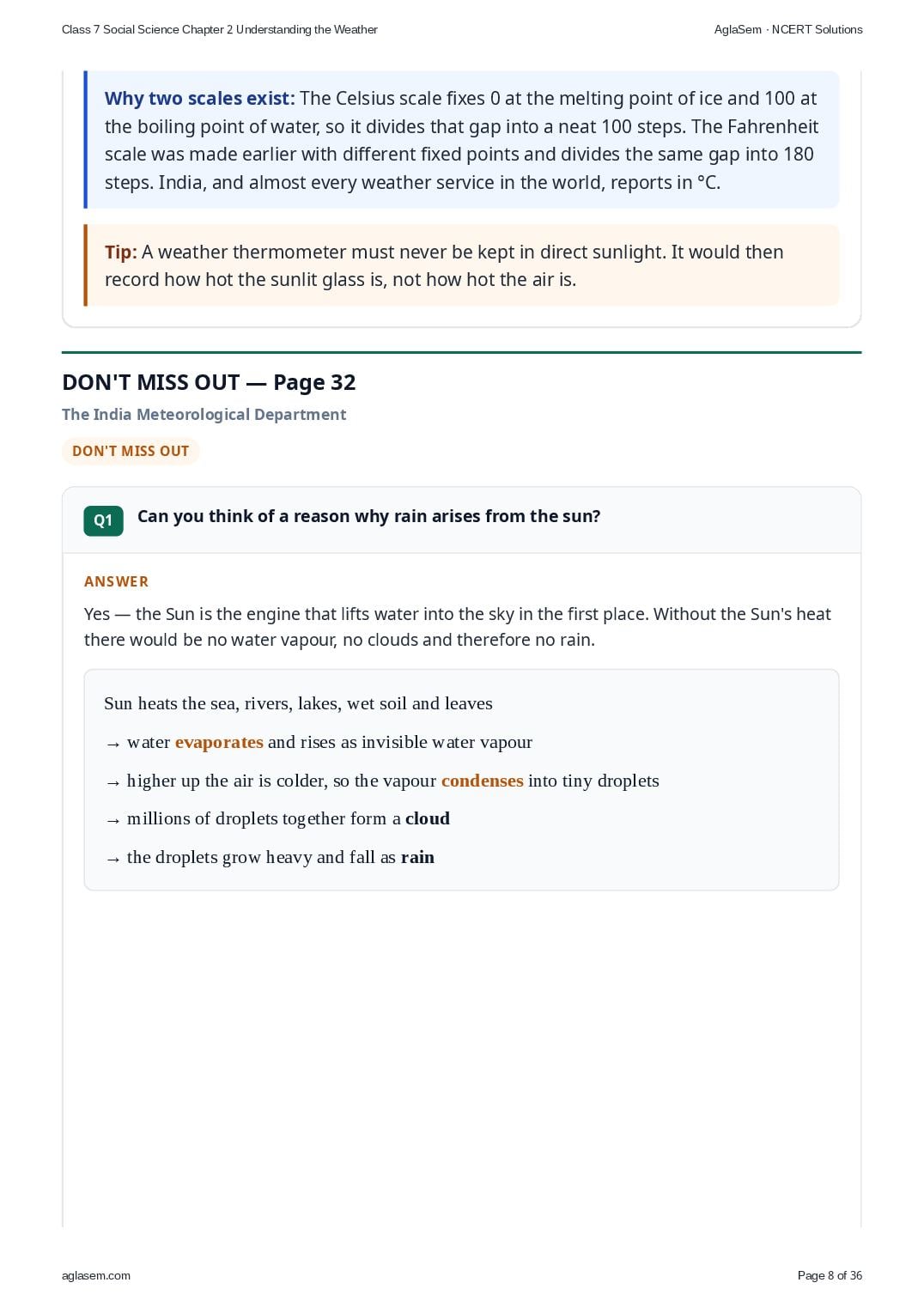
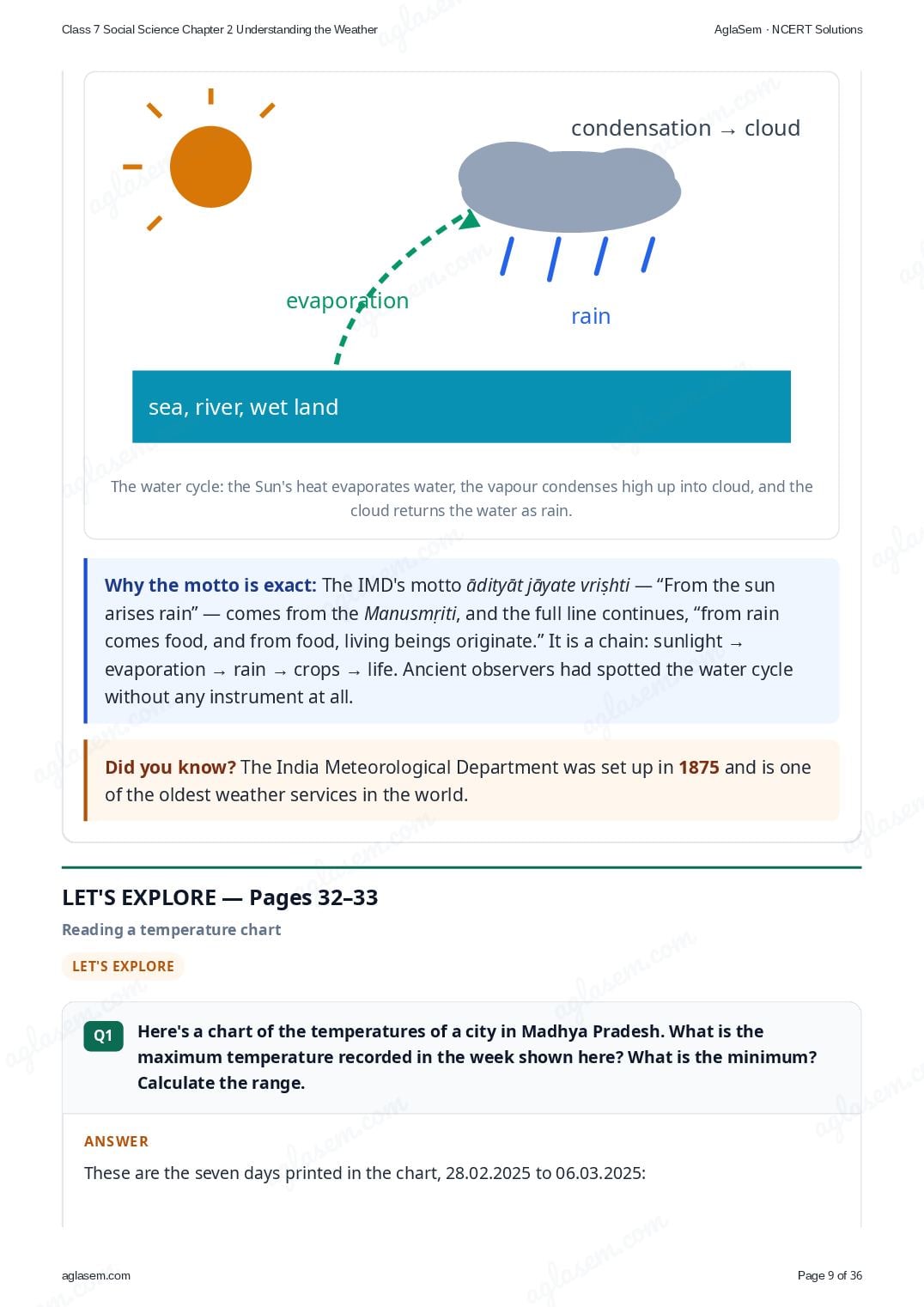
- Can you think of a reason why rain arises from the sun?
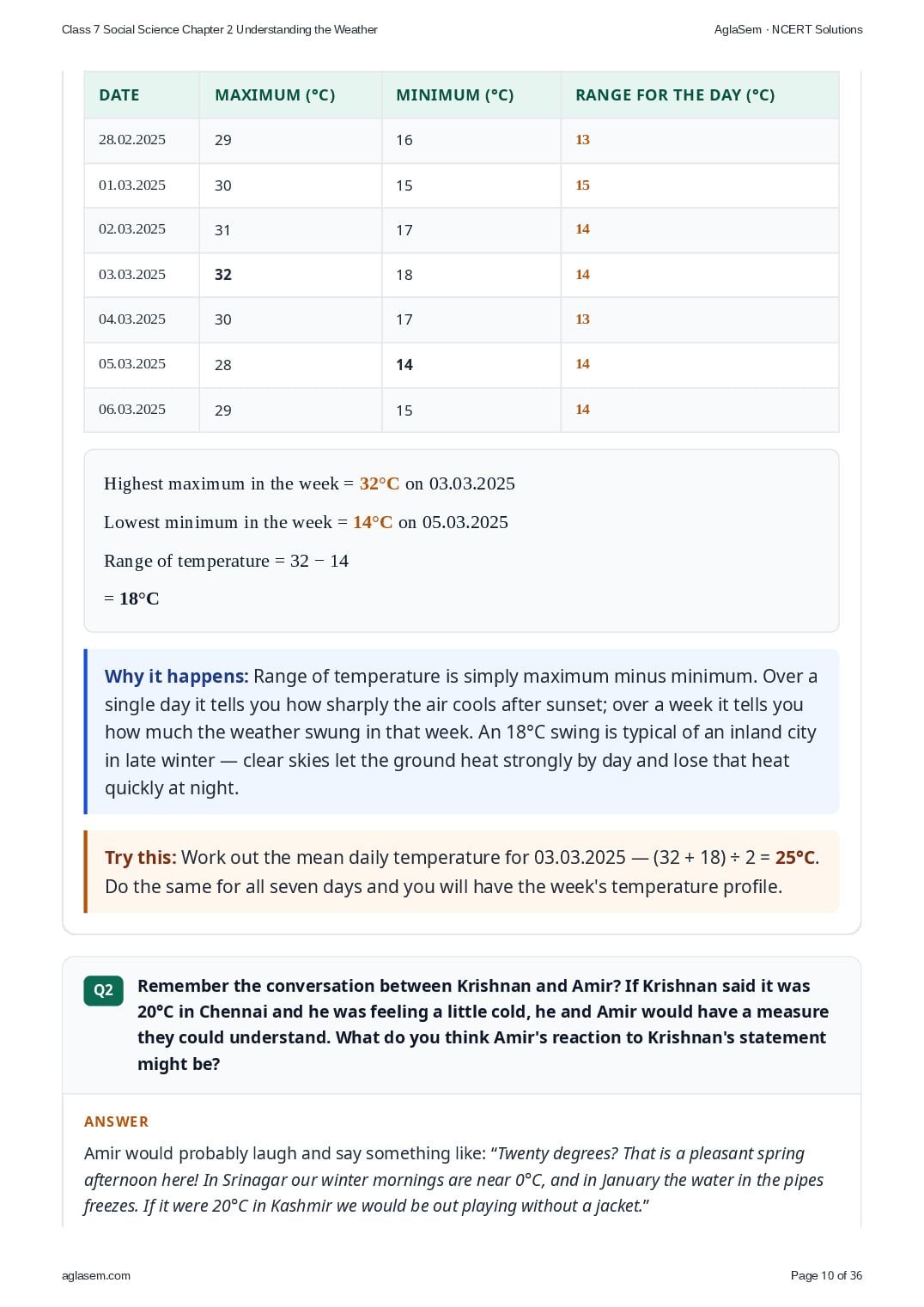
- Here's a chart of the temperatures of a city in Madhya Pradesh. What is the maximum temperature recorded in the week shown here? What is the minimum? Calculate the range.
- Remember the conversation between Krishnan and Amir? If Krishnan said it was 20°C in Chennai and he was feeling a little cold, he and Amir would have a measure they could understand. What do you think Amir's reaction to Krishnan's statement might be?
- If the news says that a particular place received 30 mm of rainfall in a day, what does it mean?
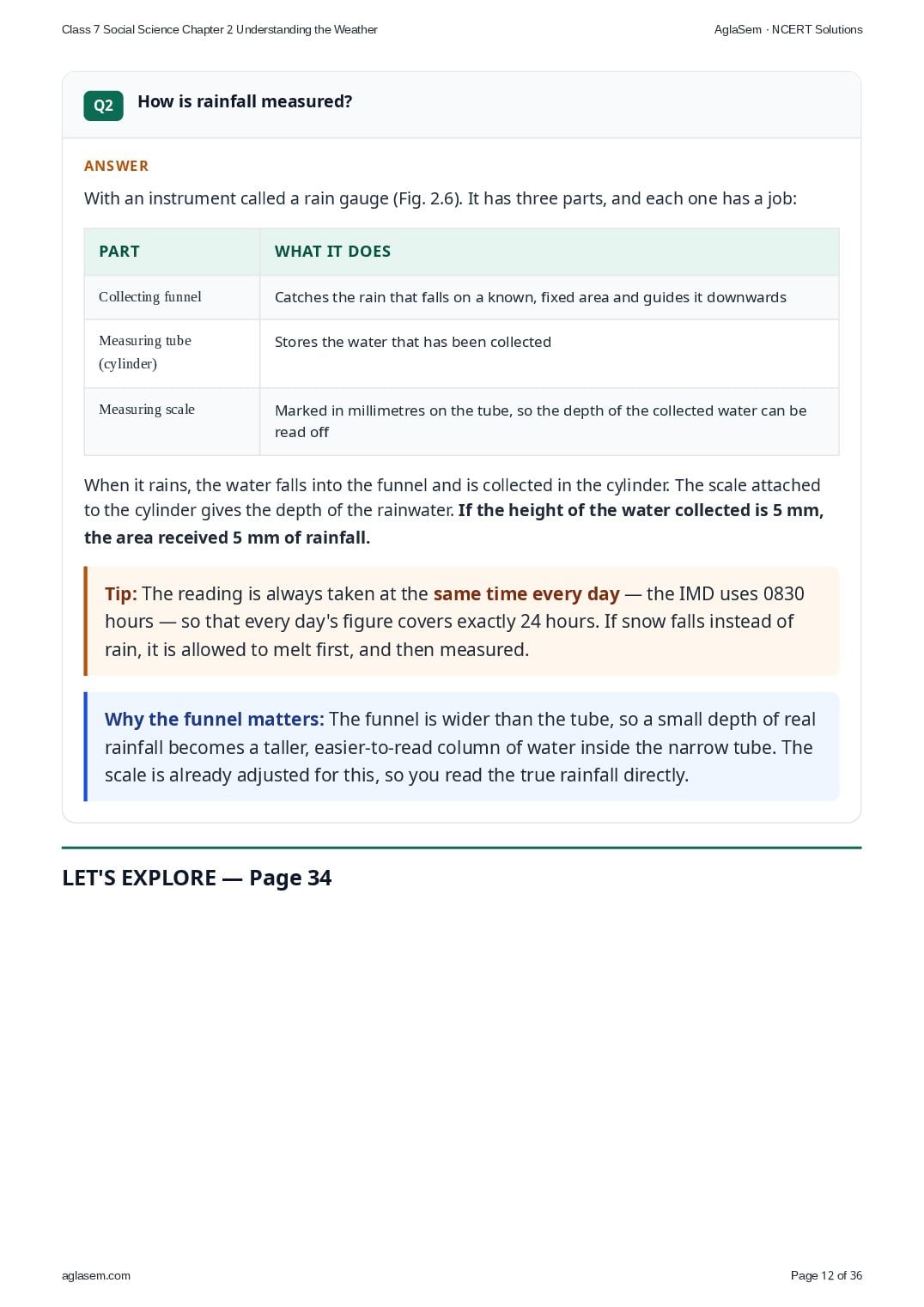
- How is rainfall measured?
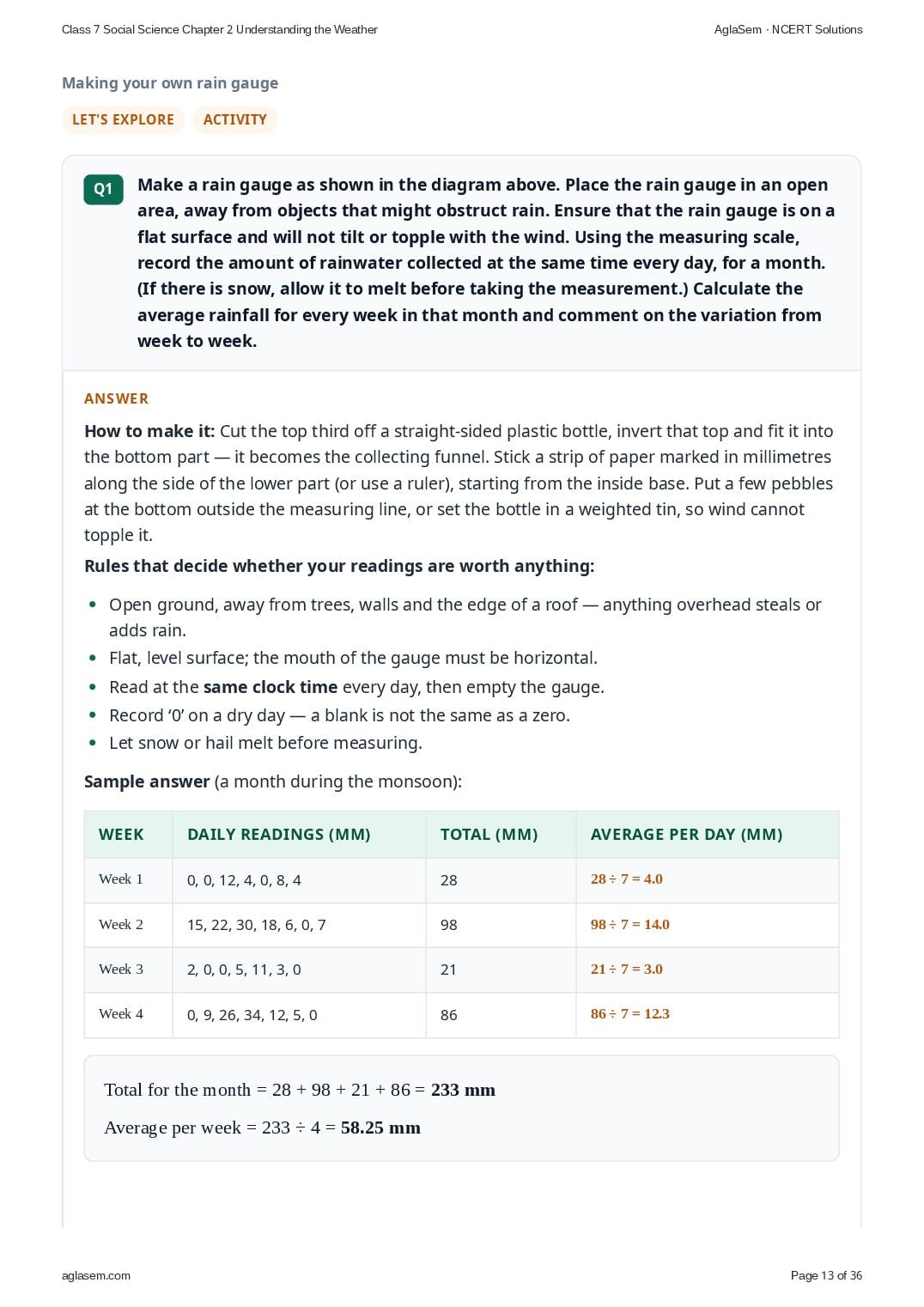
- Make a rain gauge as shown in the diagram above. Place the rain gauge in an open area, away from objects that might obstruct rain. Ensure that the rain gauge is on a flat surface and will not tilt or topple with the wind. Using the measuring scale, record the amount of rainwater collected at the same time every day, for a month. (If there is snow, allow it to melt before taking the measurement.) Calculate the average rainfall for every week in that month and comment on the variation from week to week.
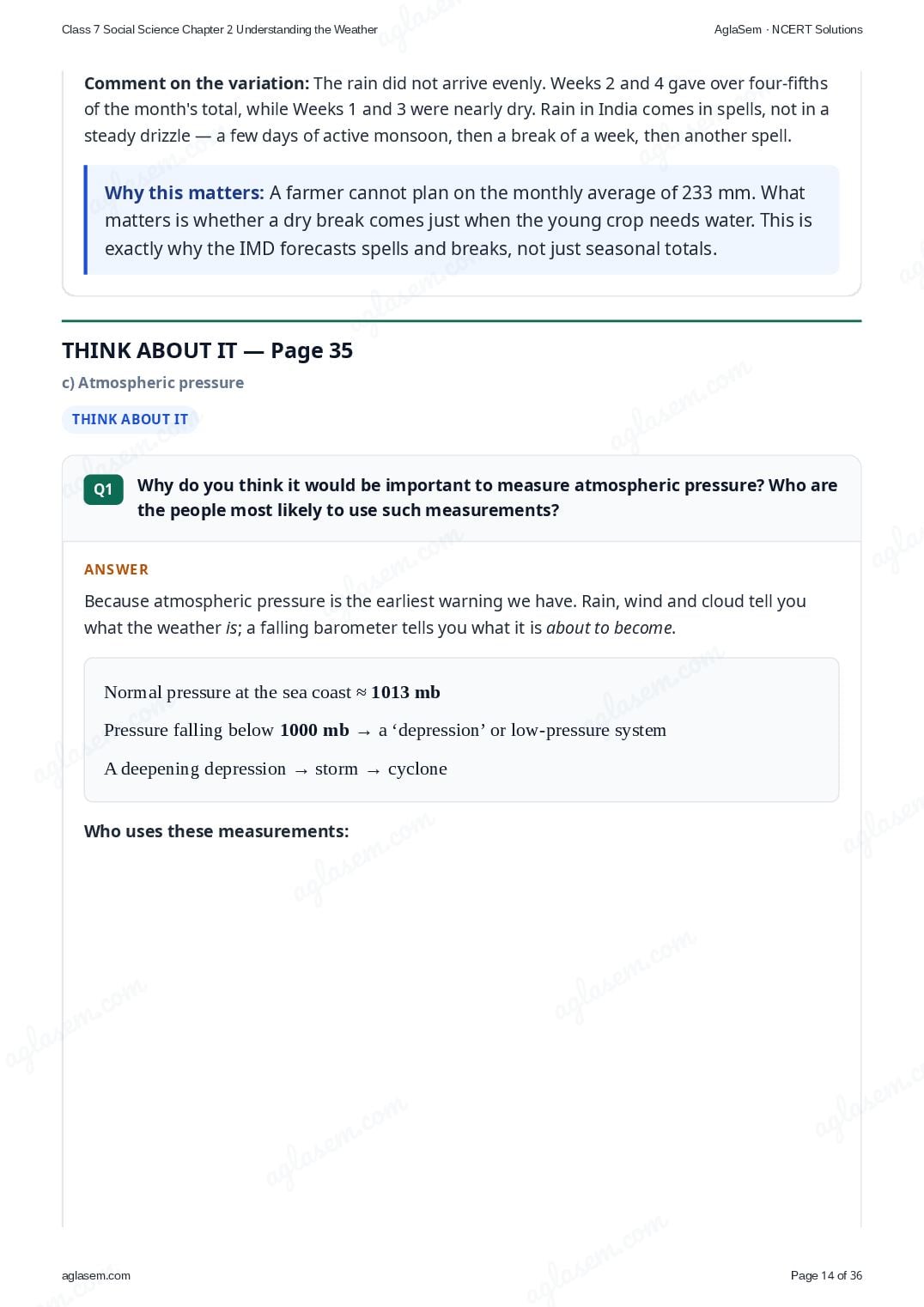
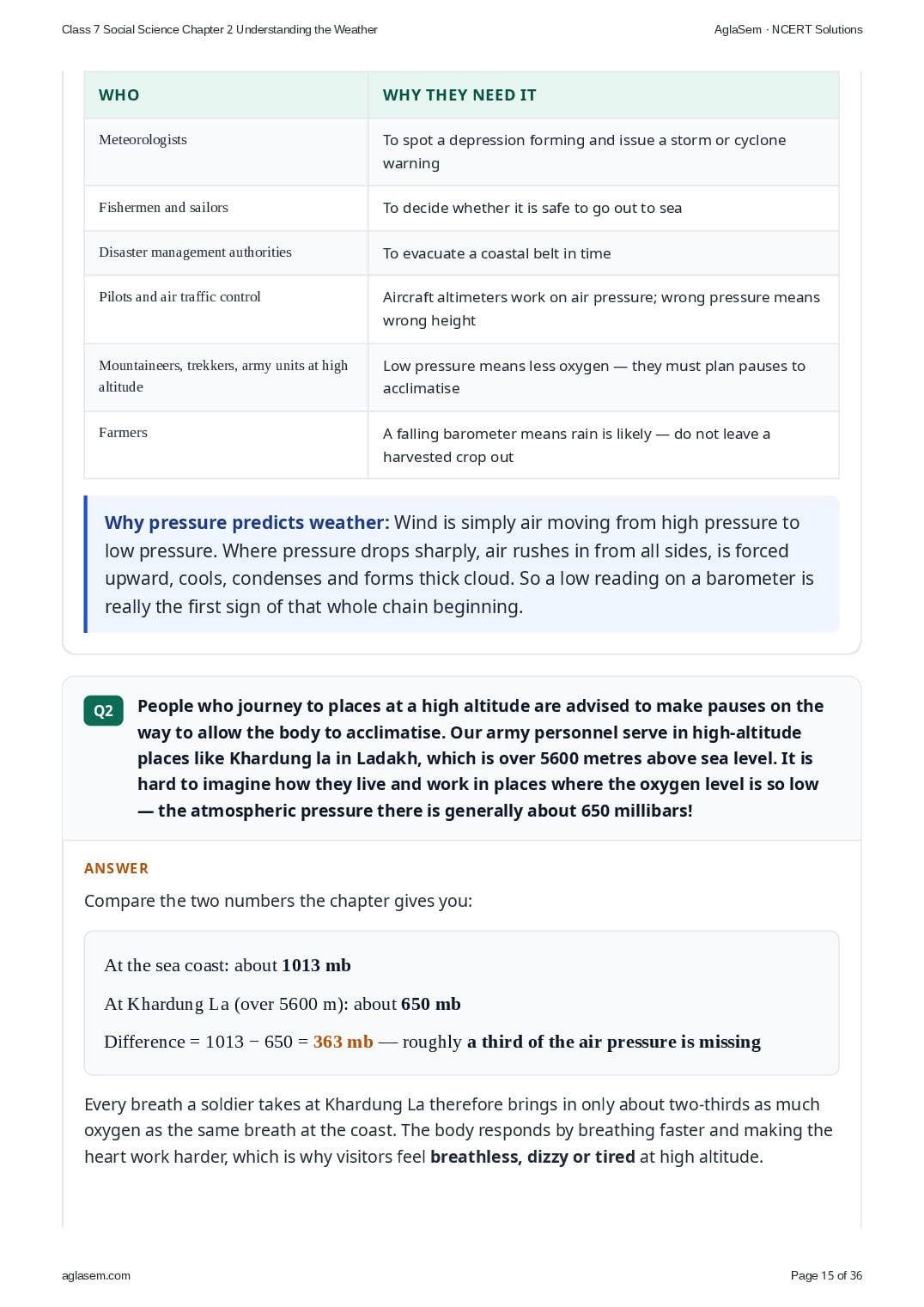
- Why do you think it would be important to measure atmospheric pressure? Who are the people most likely to use such measurements?
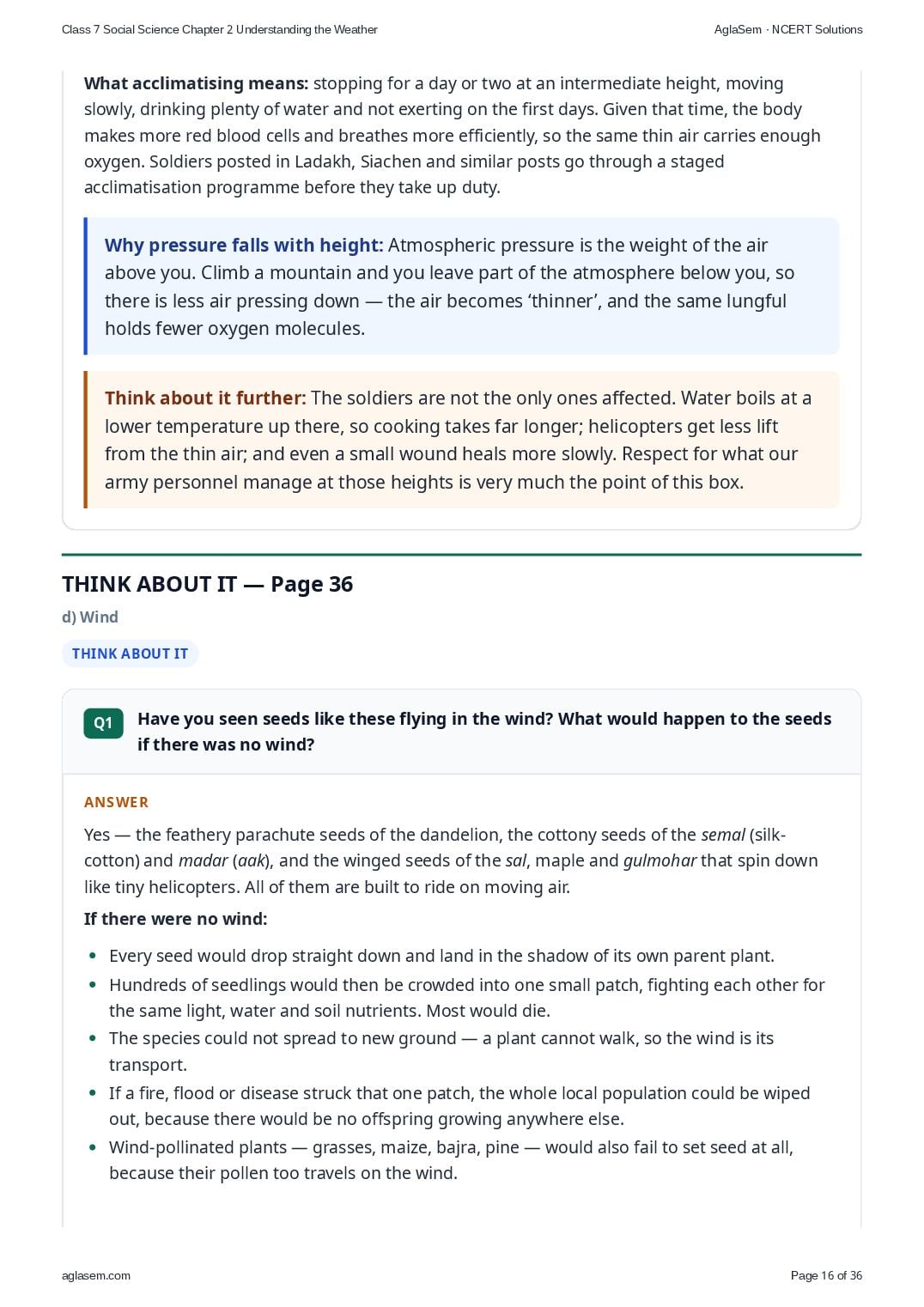
- People who journey to places at a high altitude are advised to make pauses on the way to allow the body to acclimatise. Our army personnel serve in high-altitude places like Khardung la in Ladakh, which is over 5600 metres above sea level. It is hard to imagine how they live and work in places where the oxygen level is so low — the atmospheric pressure there is generally about 650 millibars!
- Have you seen seeds like these flying in the wind? What would happen to the seeds if there was no wind?
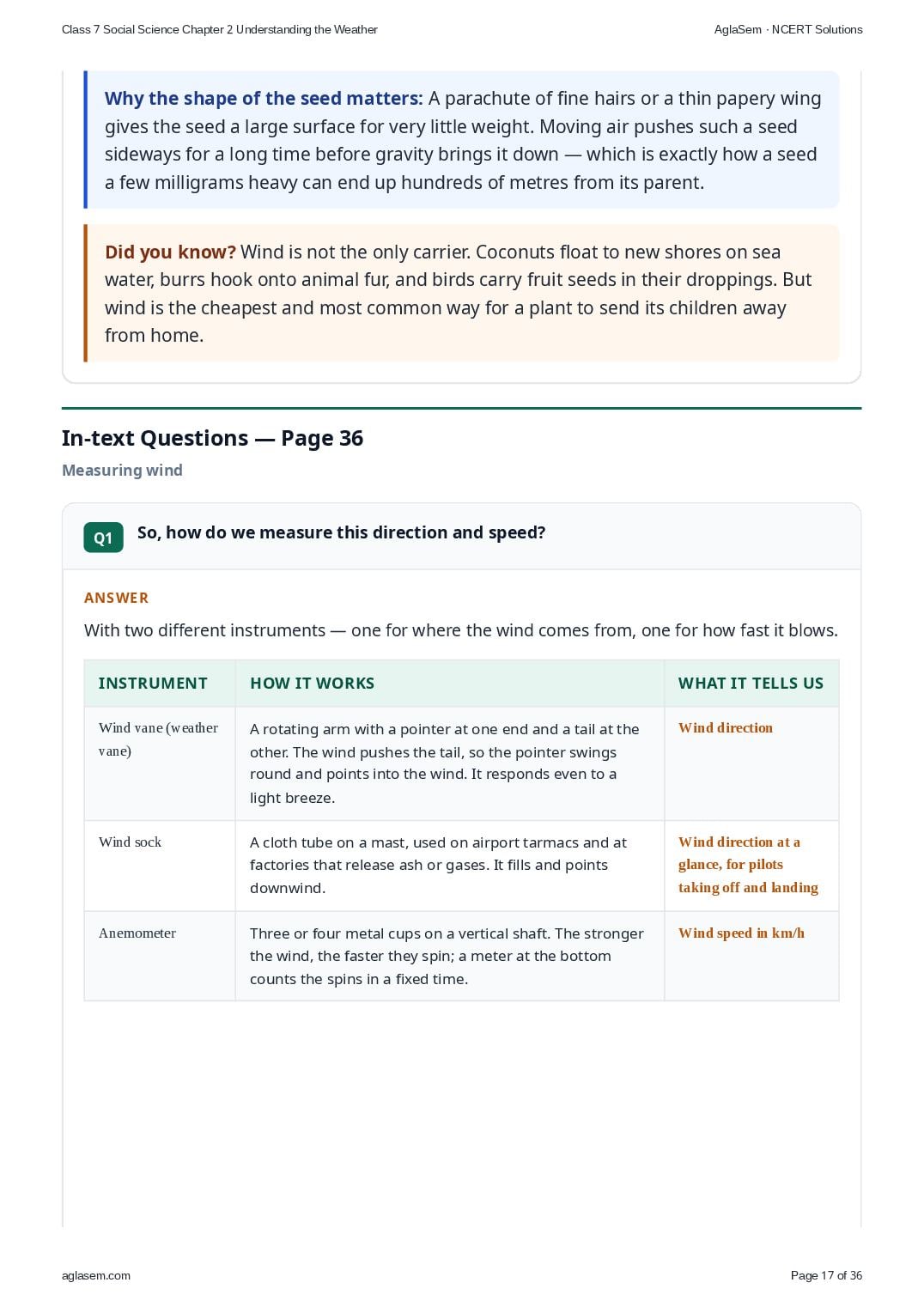
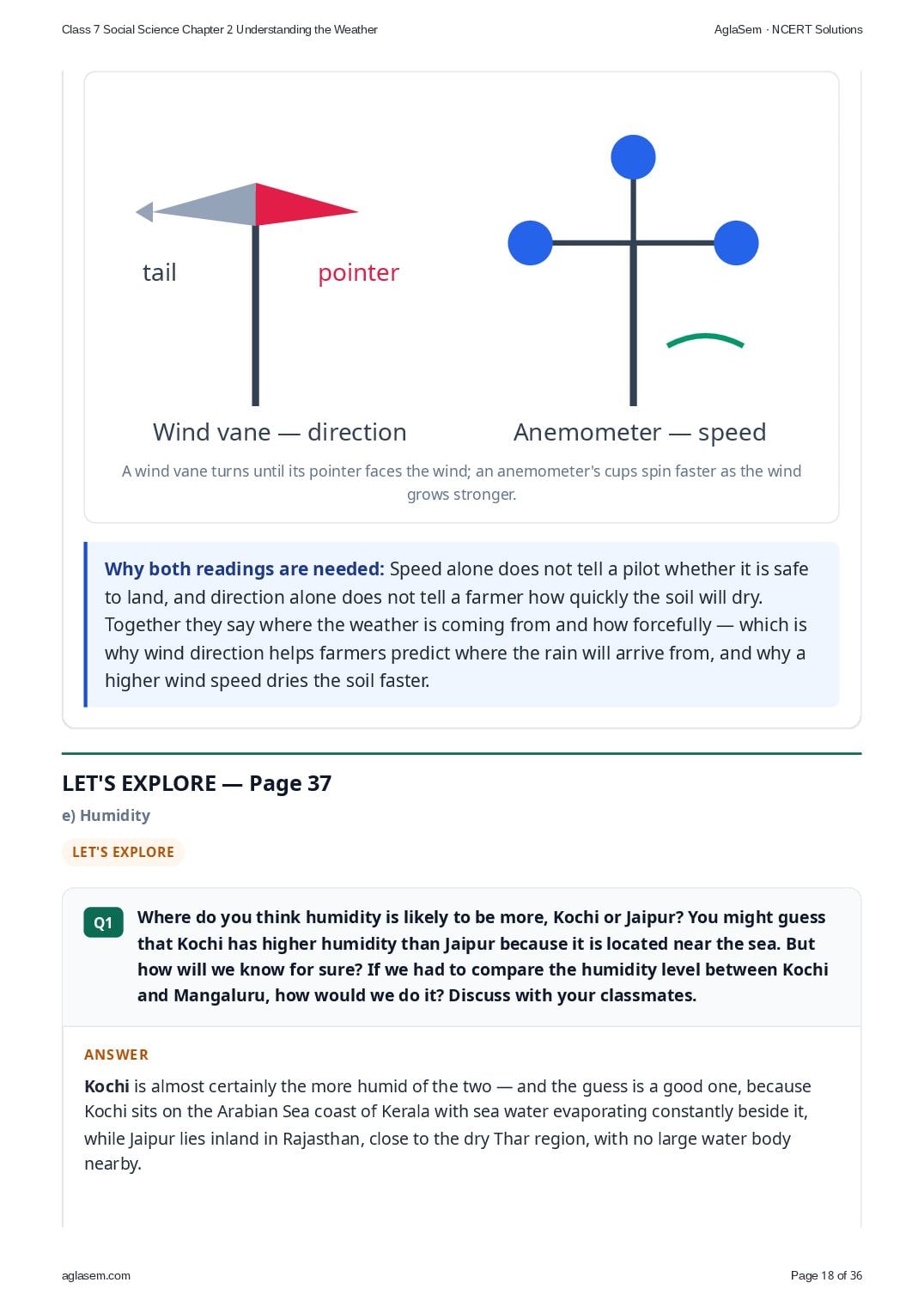
- So, how do we measure this direction and speed?
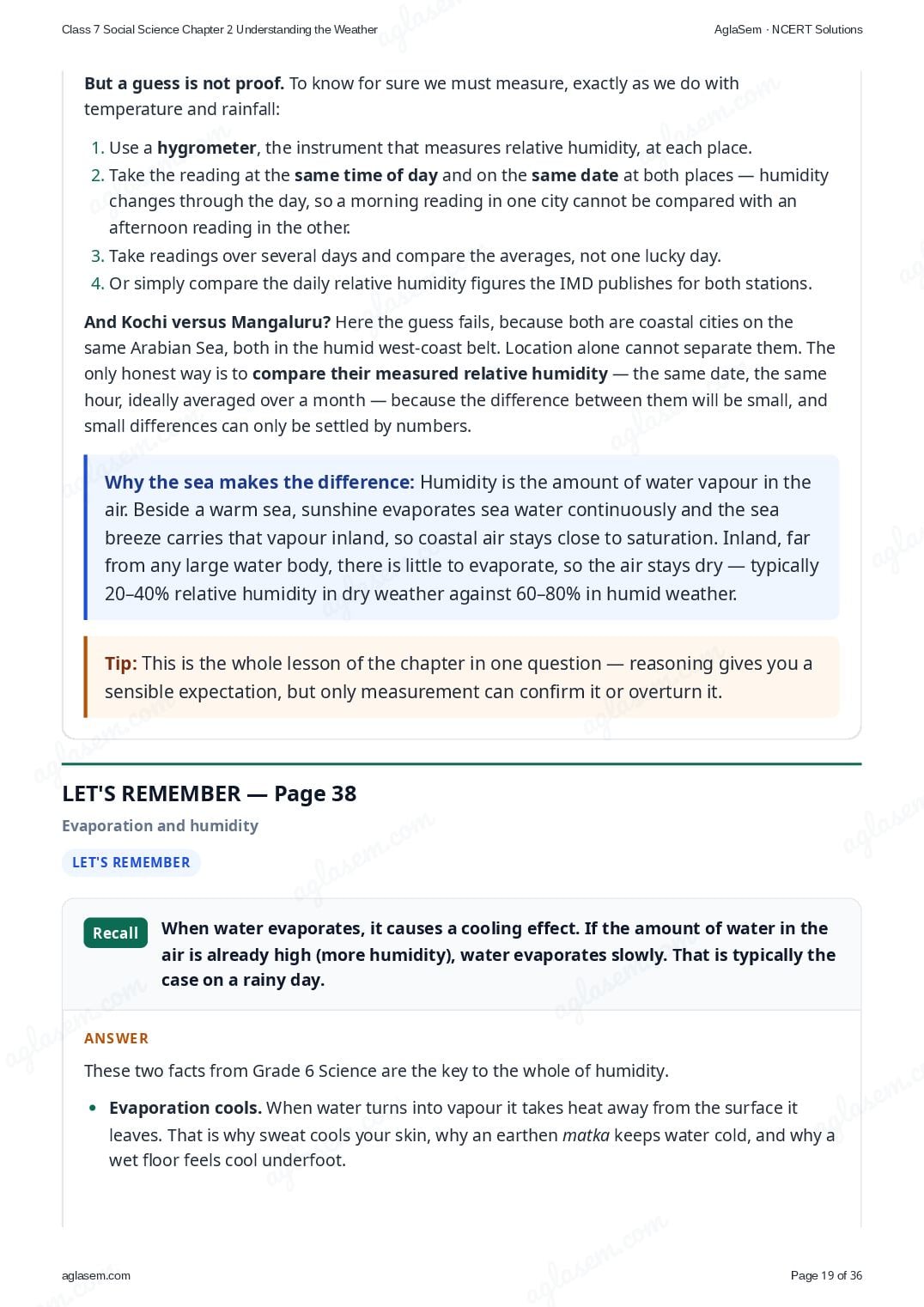
- Where do you think humidity is likely to be more, Kochi or Jaipur? You might guess that Kochi has higher humidity than Jaipur because it is located near the sea. But how will we know for sure? If we had to compare the humidity level between Kochi and Mangaluru, how would we do it? Discuss with your classmates.
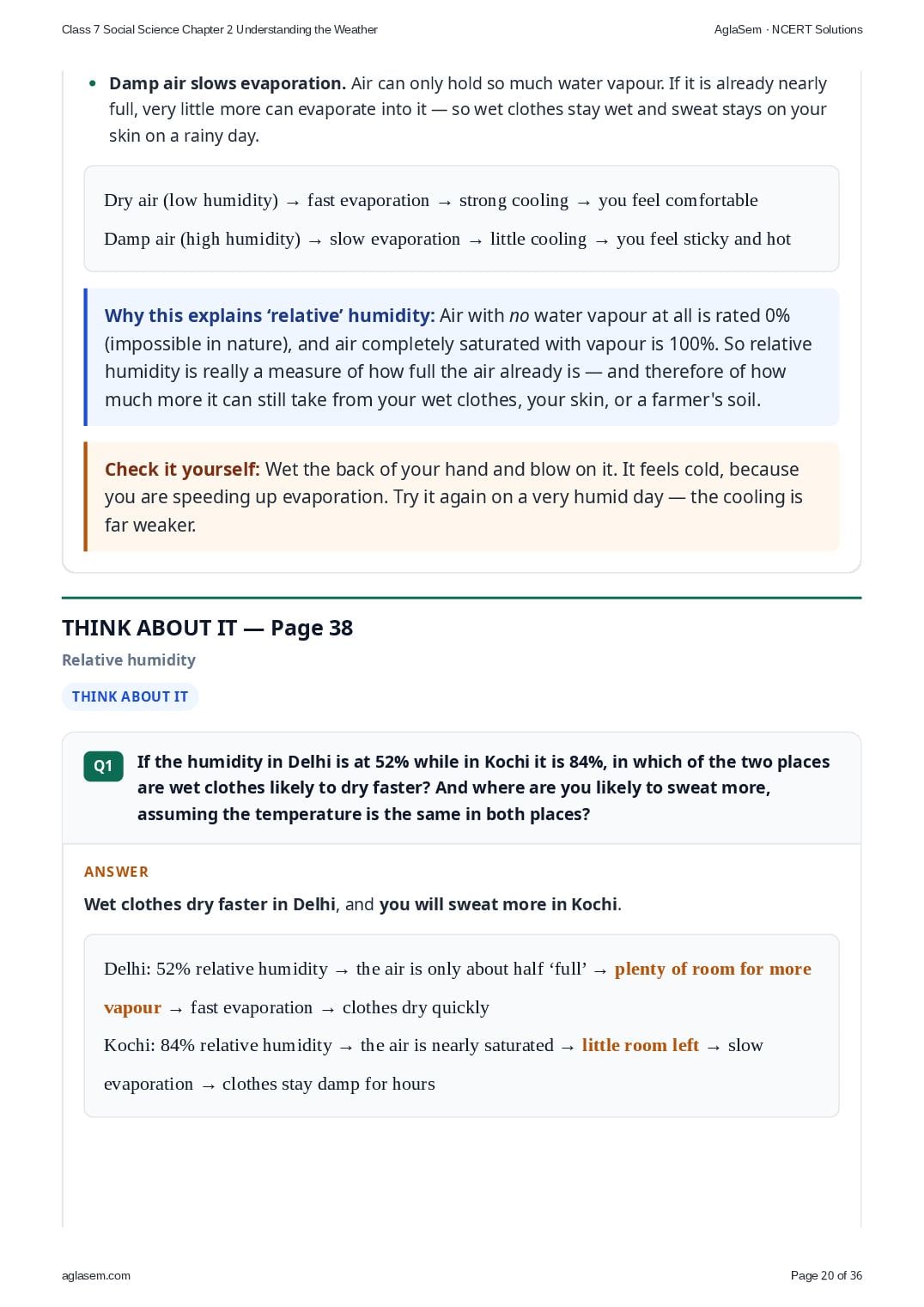
- When water evaporates, it causes a cooling effect. If the amount of water in the air is already high (more humidity), water evaporates slowly. That is typically the case on a rainy day.
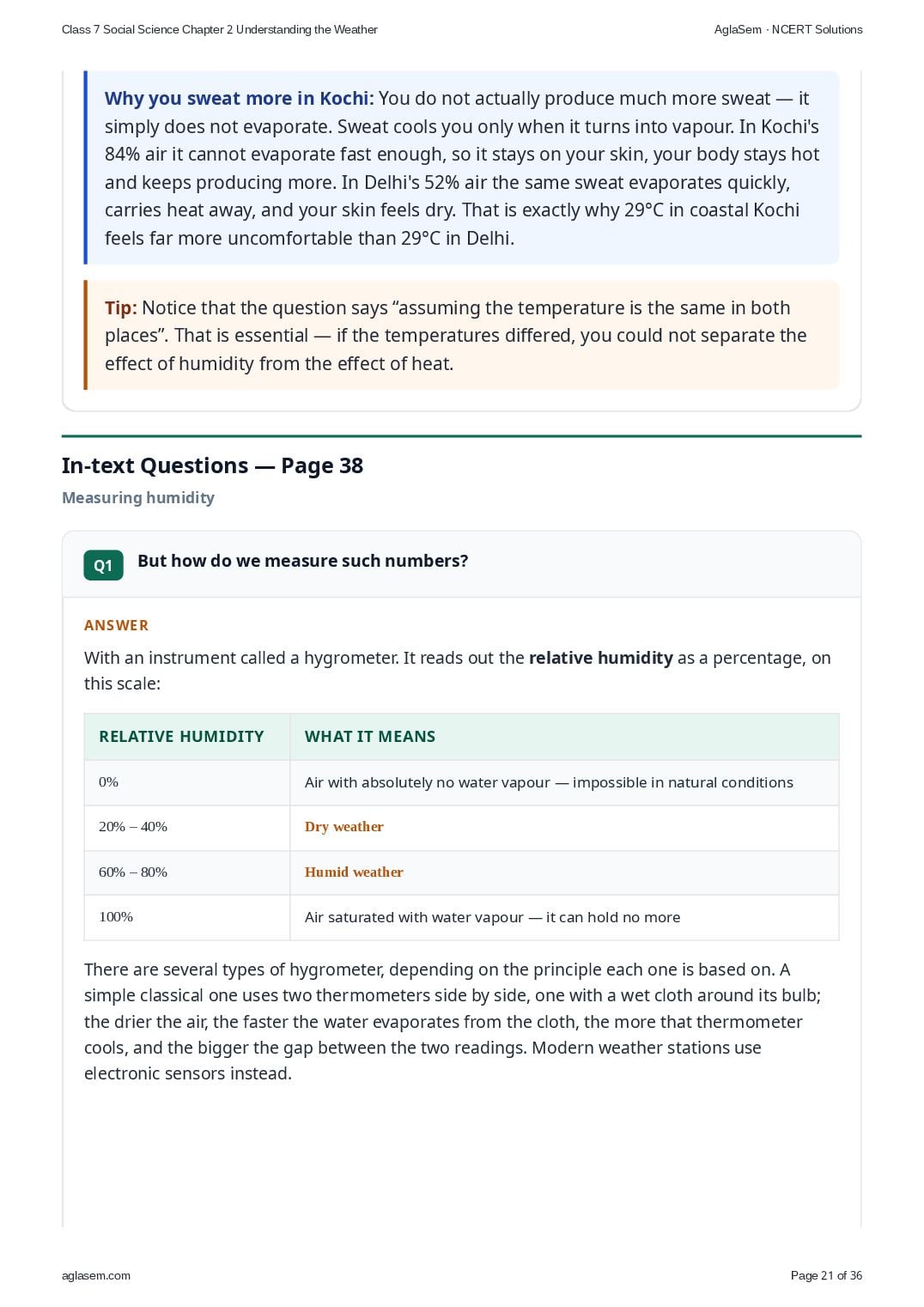
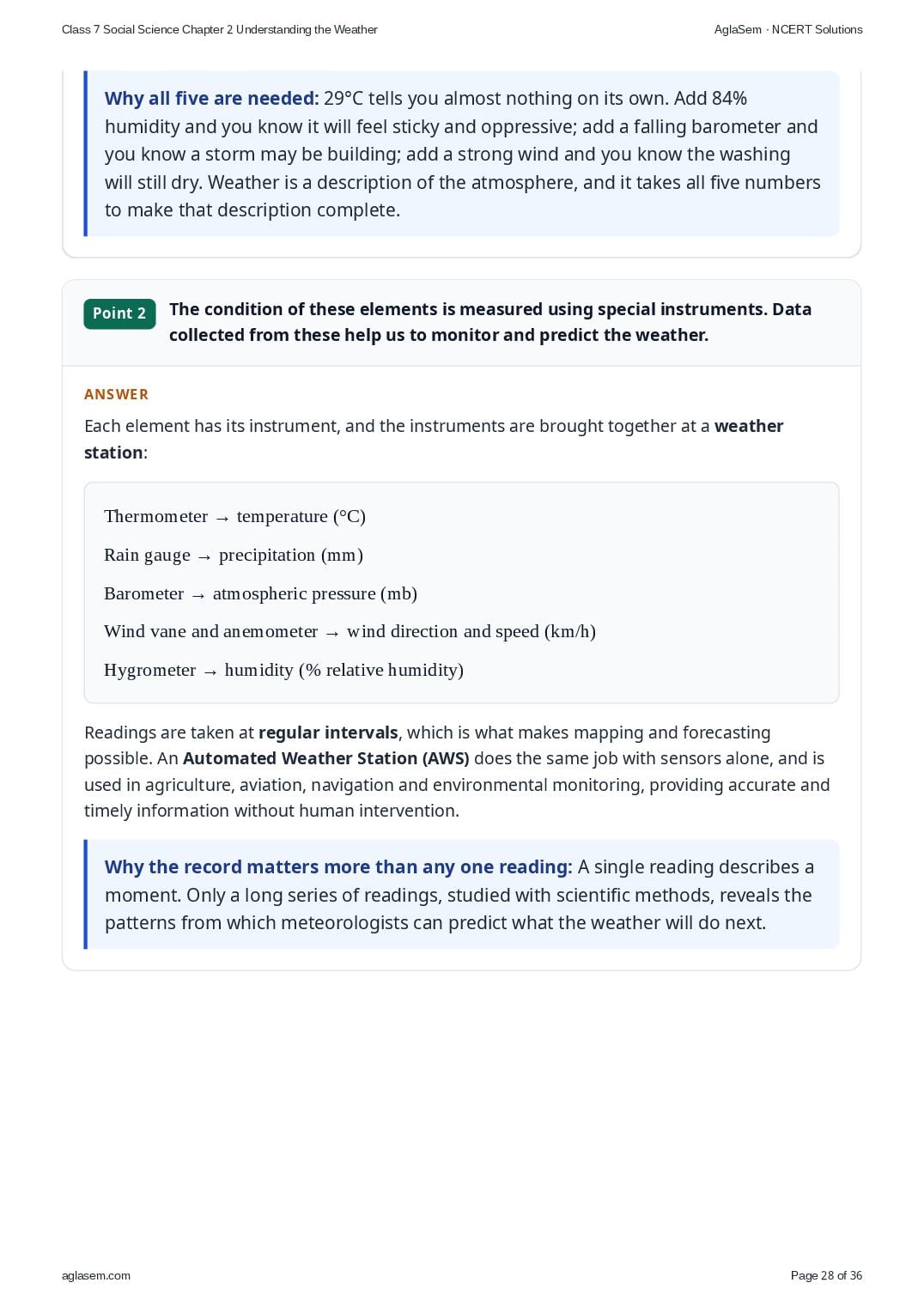
- If the humidity in Delhi is at 52% while in Kochi it is 84%, in which of the two places are wet clothes likely to dry faster? And where are you likely to sweat more, assuming the temperature is the same in both places?
- But how do we measure such numbers?
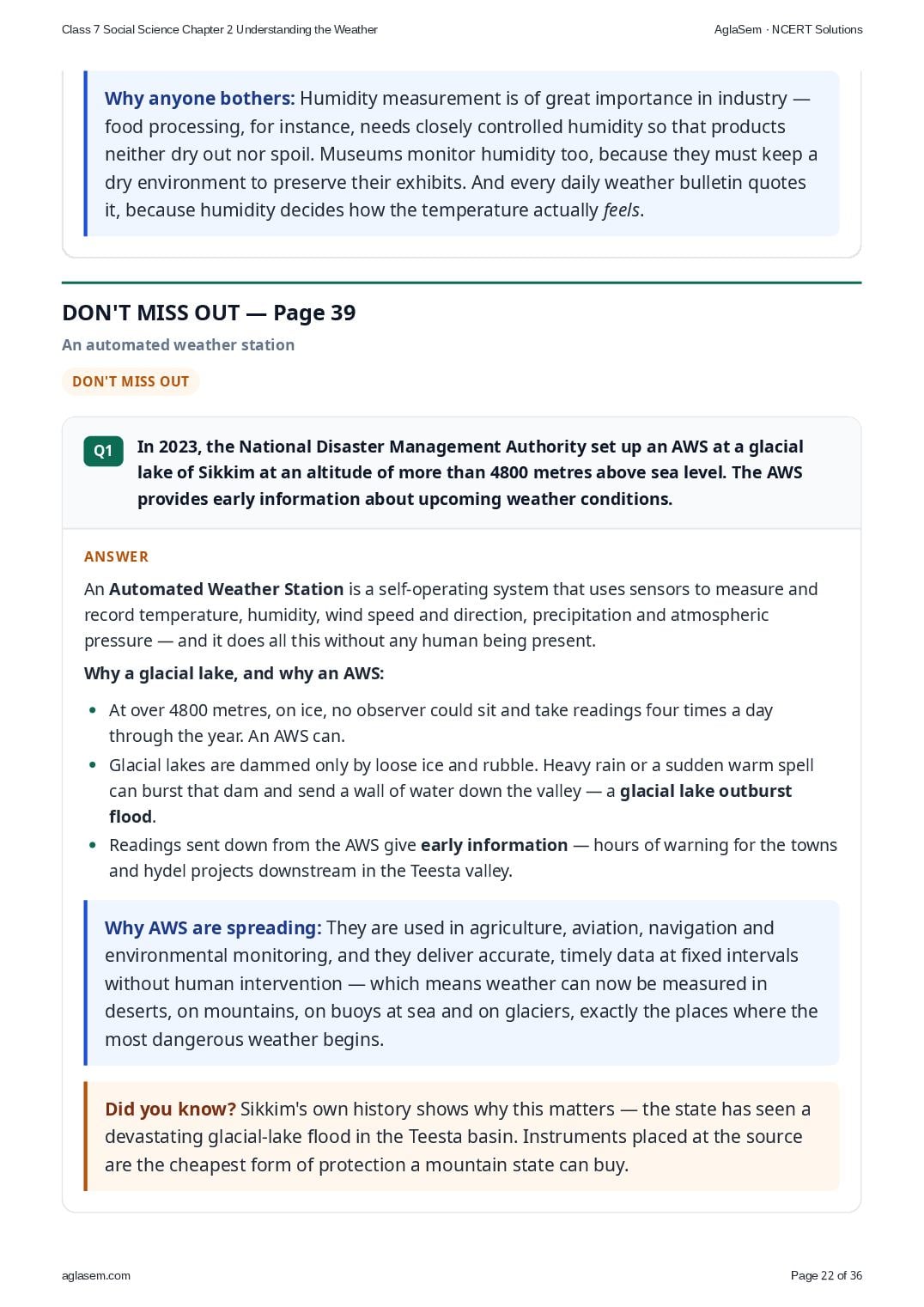
- In 2023, the National Disaster Management Authority set up an AWS at a glacial lake of Sikkim at an altitude of more than 4800 metres above sea level. The AWS provides early information about upcoming weather conditions.
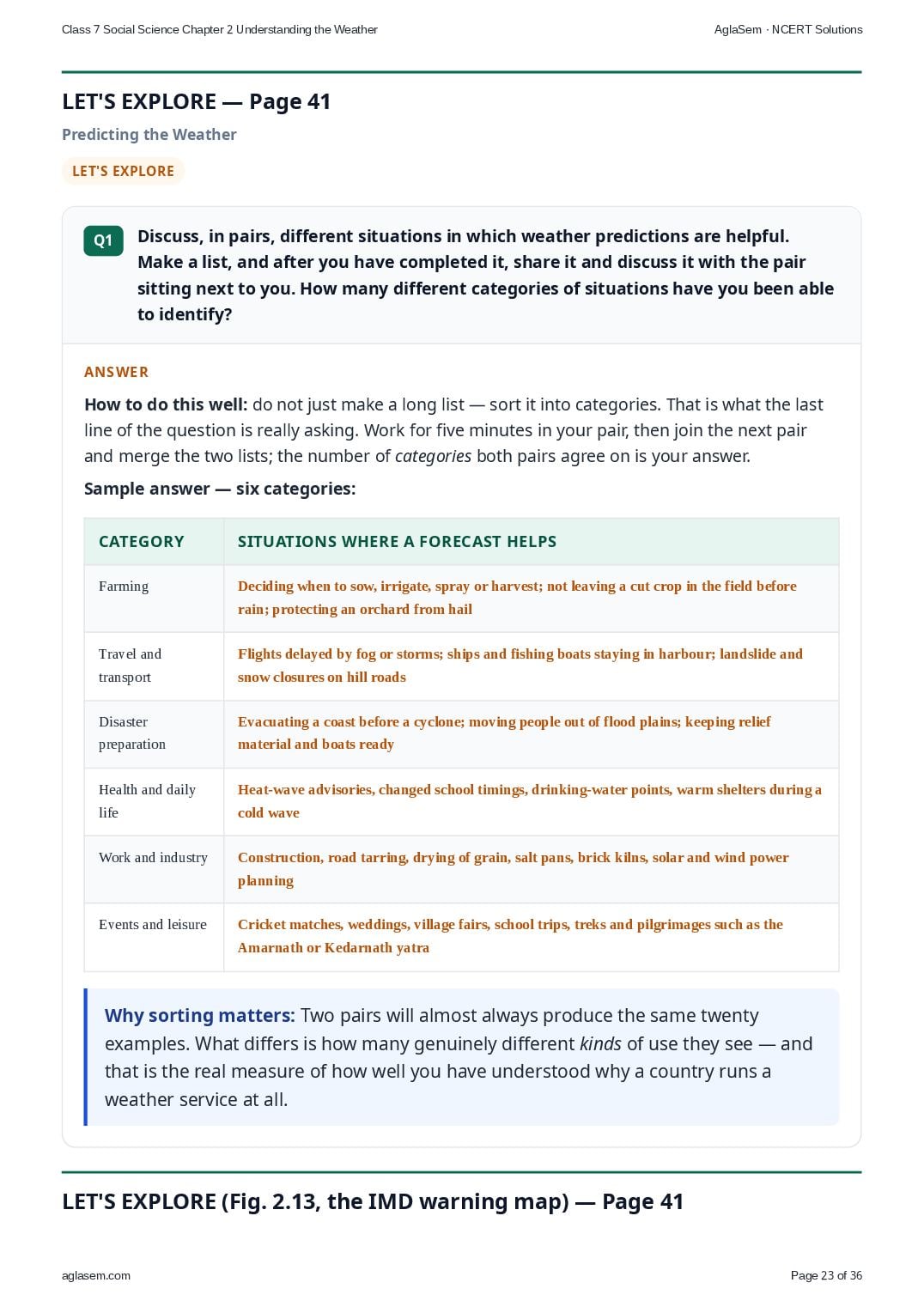
- Discuss, in pairs, different situations in which weather predictions are helpful. Make a list, and after you have completed it, share it and discuss it with the pair sitting next to you. How many different categories of situations have you been able to identify?
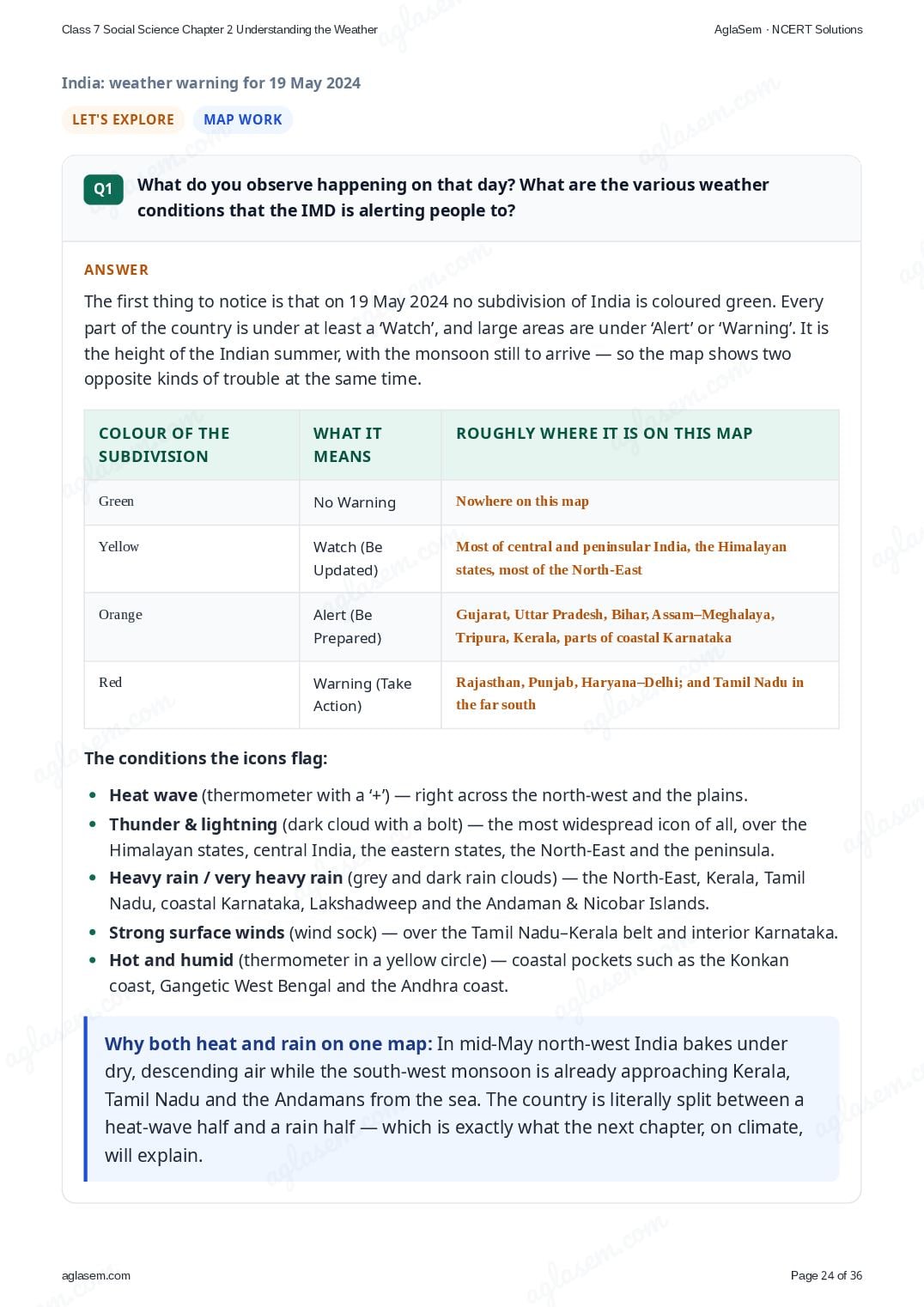
- What do you observe happening on that day? What are the various weather conditions that the IMD is alerting people to?
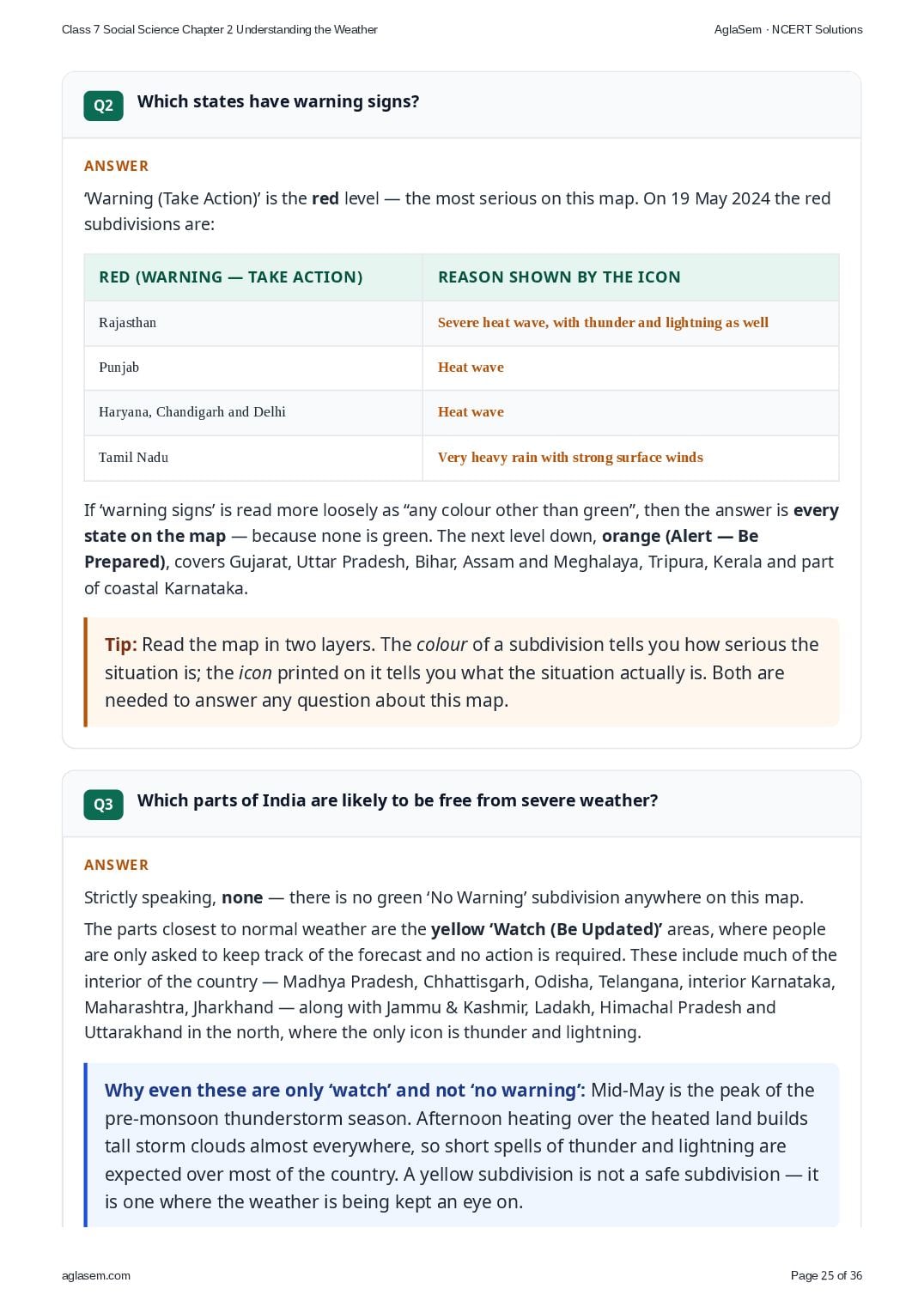
- Which states have warning signs?
- Which parts of India are likely to be free from severe weather?
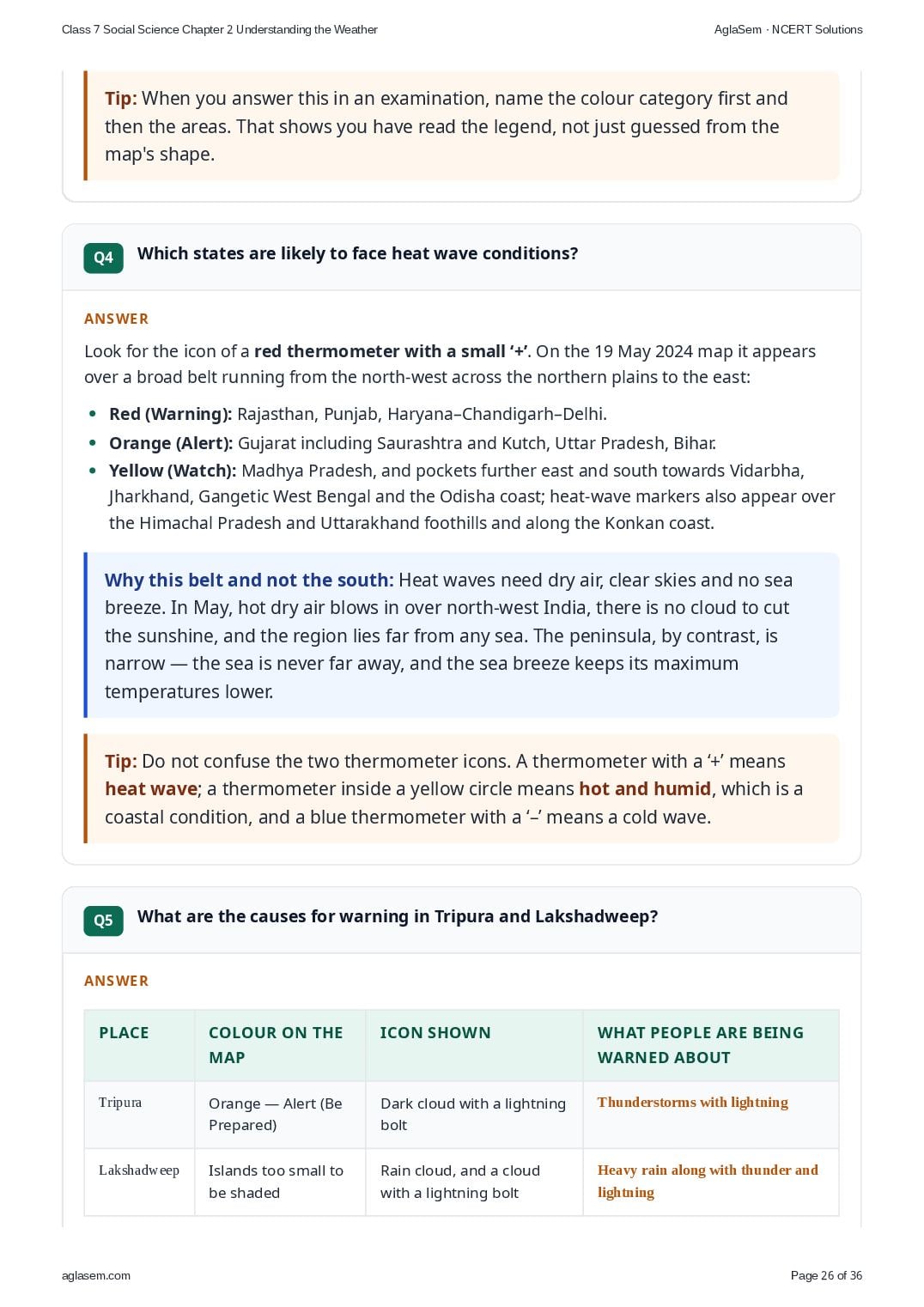
- Which states are likely to face heat wave conditions?
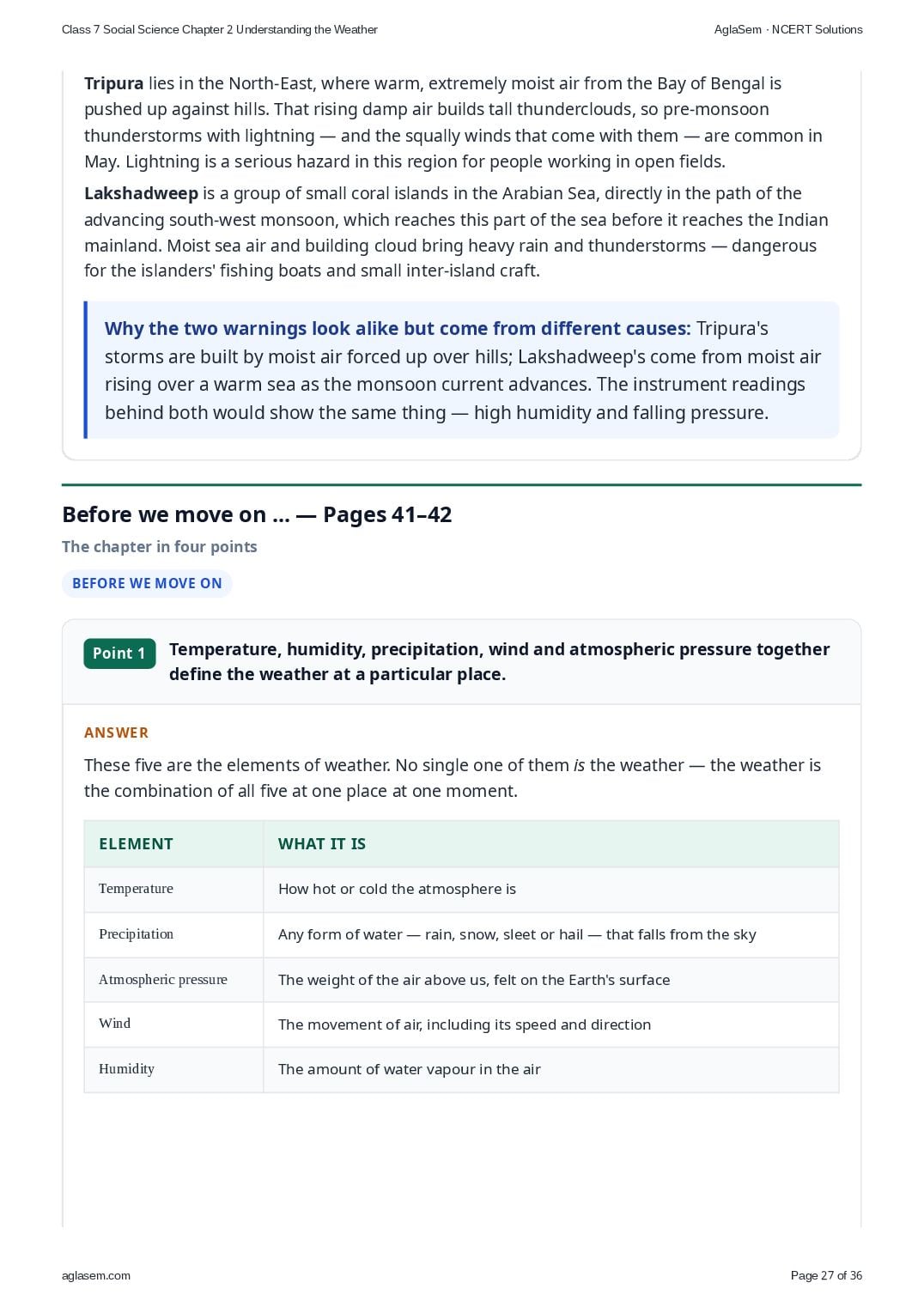
- What are the causes for warning in Tripura and Lakshadweep?
- Temperature, humidity, precipitation, wind and atmospheric pressure together define the weather at a particular place.
- The condition of these elements is measured using special instruments. Data collected from these help us to monitor and predict the weather.
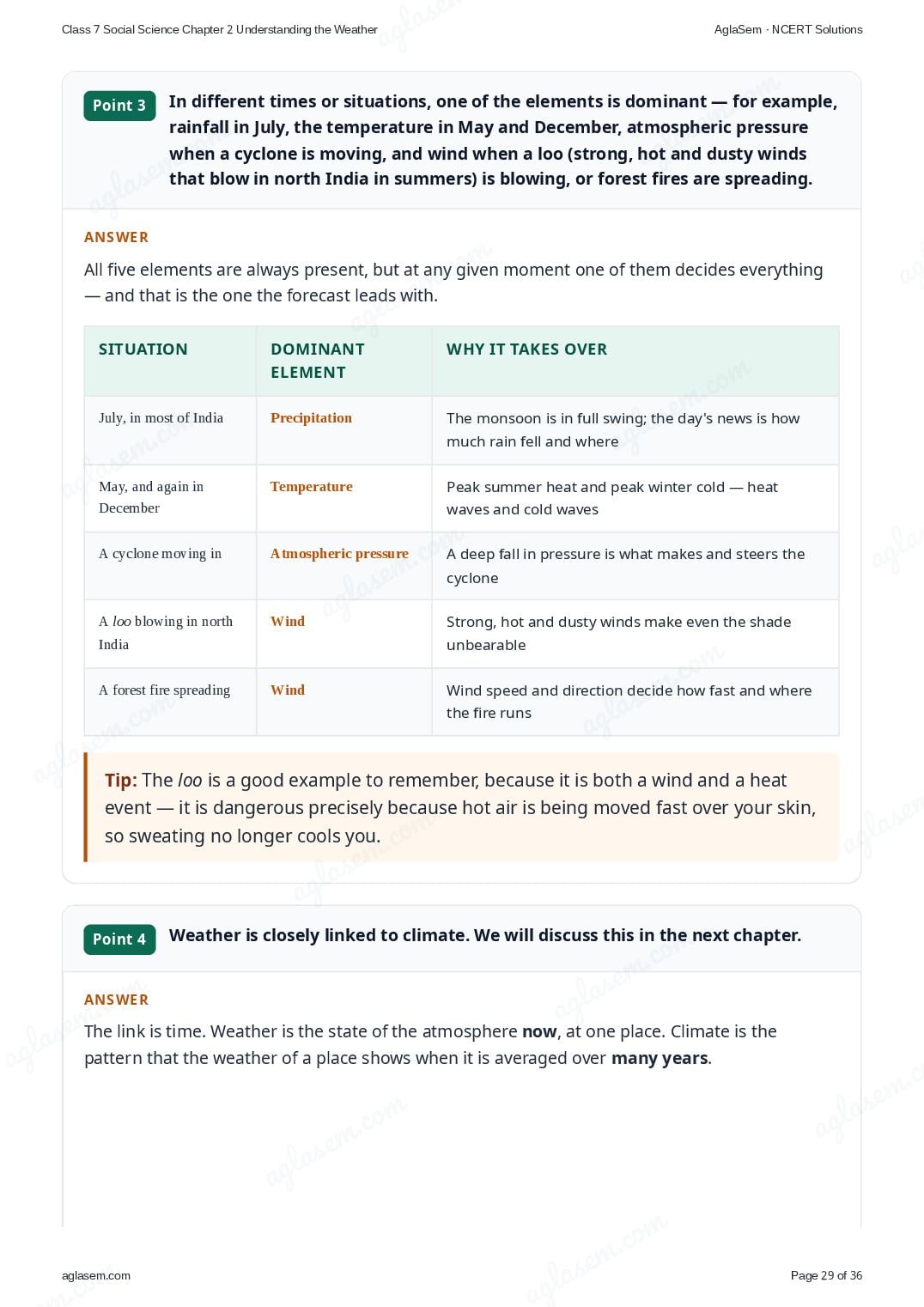
- In different times or situations, one of the elements is dominant — for example, rainfall in July, the temperature in May and December, atmospheric pressure when a cyclone is moving, and wind when a loo (strong, hot and dusty winds that blow in north India in summers) is blowing, or forest fires are spreading.
- Weather is closely linked to climate. We will discuss this in the next chapter.
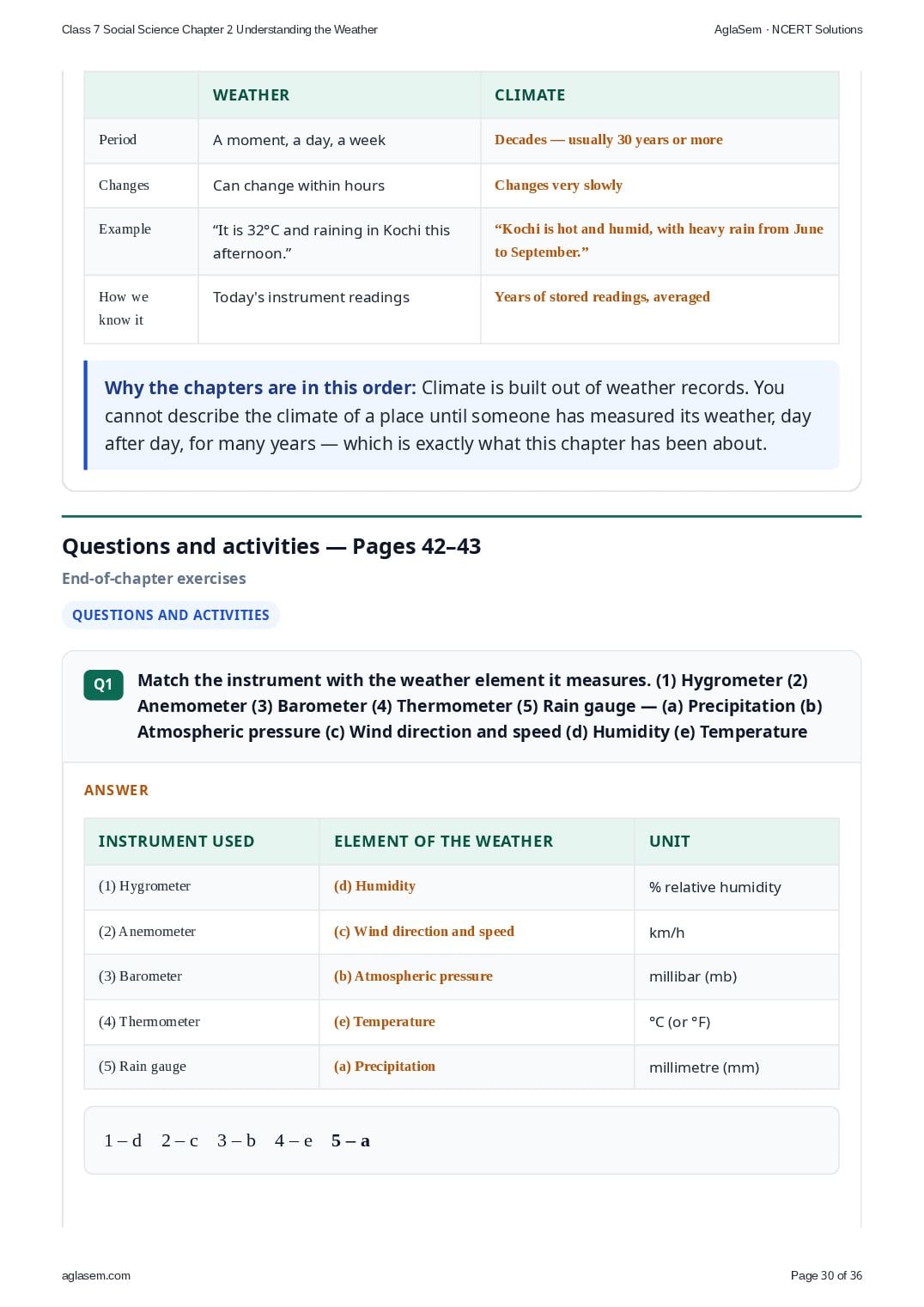
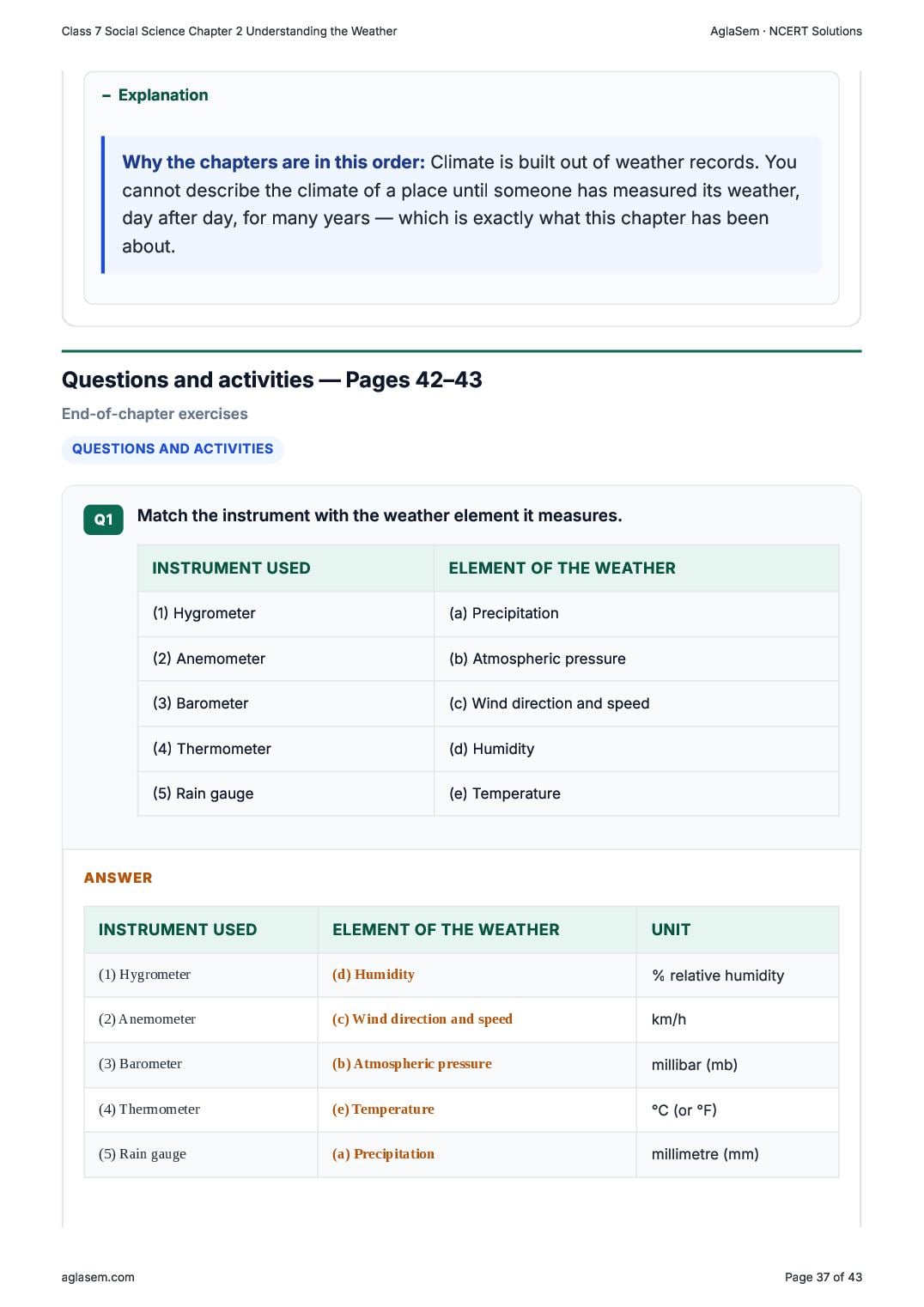
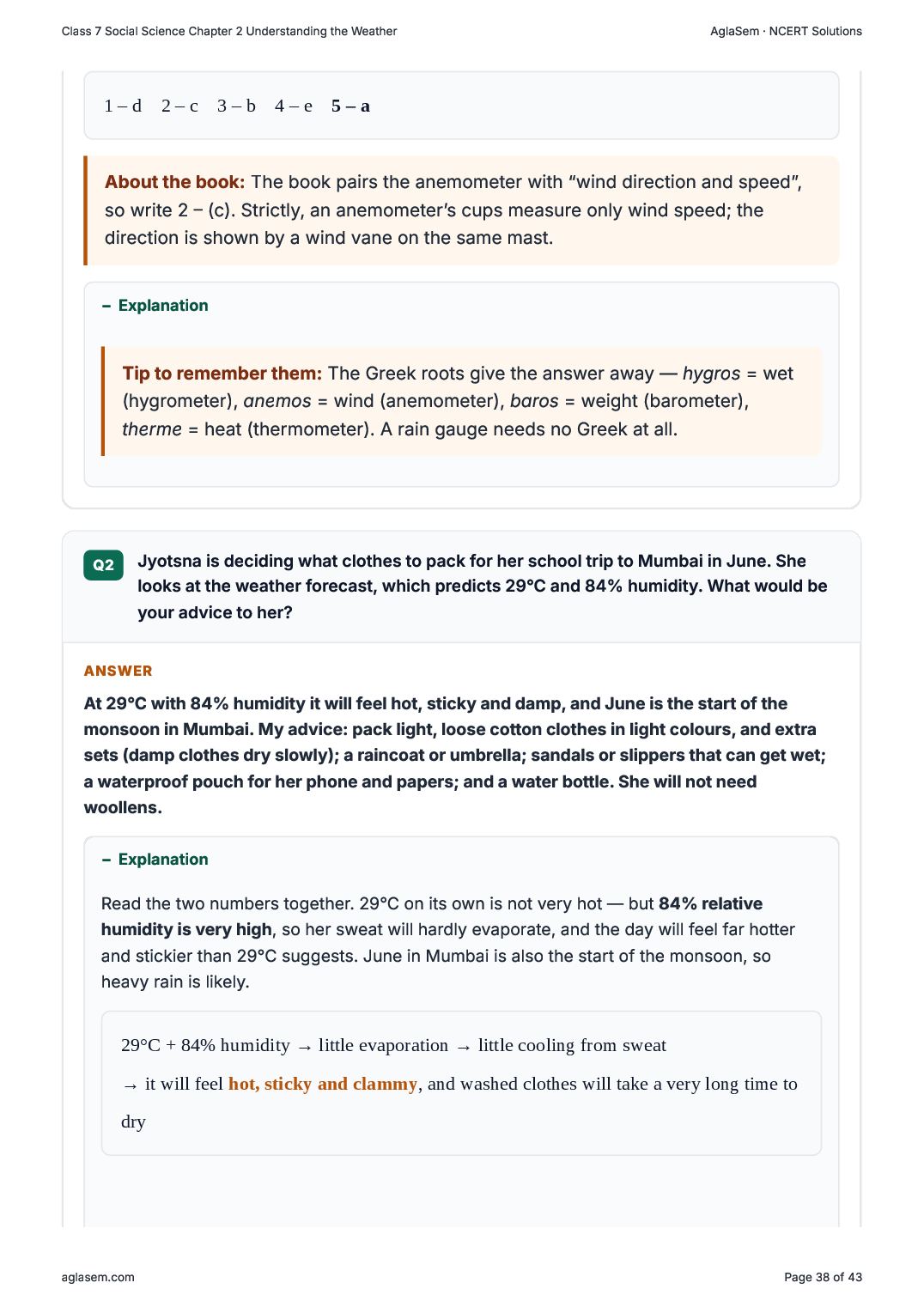
- Match the instrument with the weather element it measures. (1) Hygrometer (2) Anemometer (3) Barometer (4) Thermometer (5) Rain gauge — (a) Precipitation (b) Atmospheric pressure (c) Wind direction and speed (d) Humidity (e) Temperature
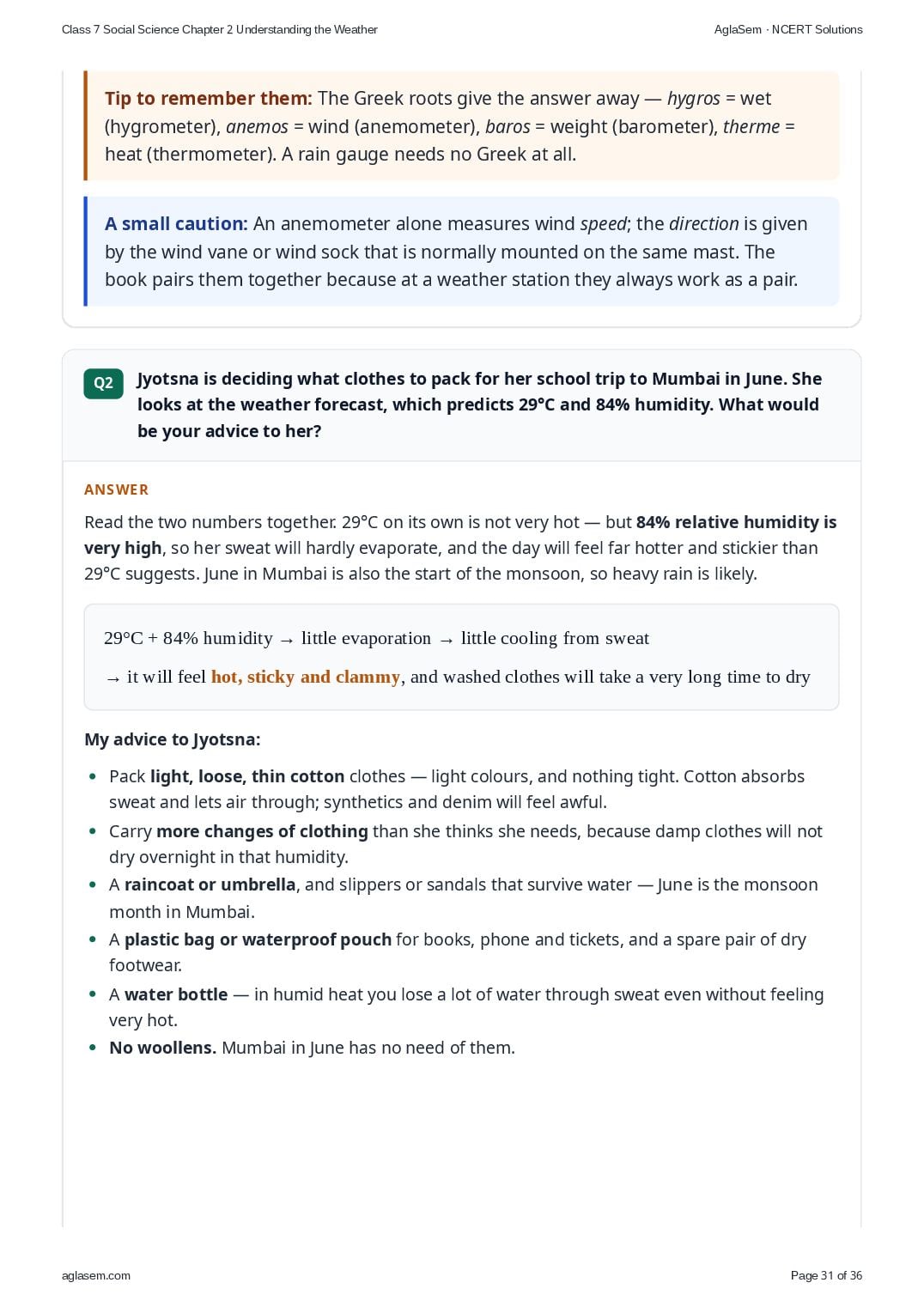
- Jyotsna is deciding what clothes to pack for her school trip to Mumbai in June. She looks at the weather forecast, which predicts 29°C and 84% humidity. What would be your advice to her?
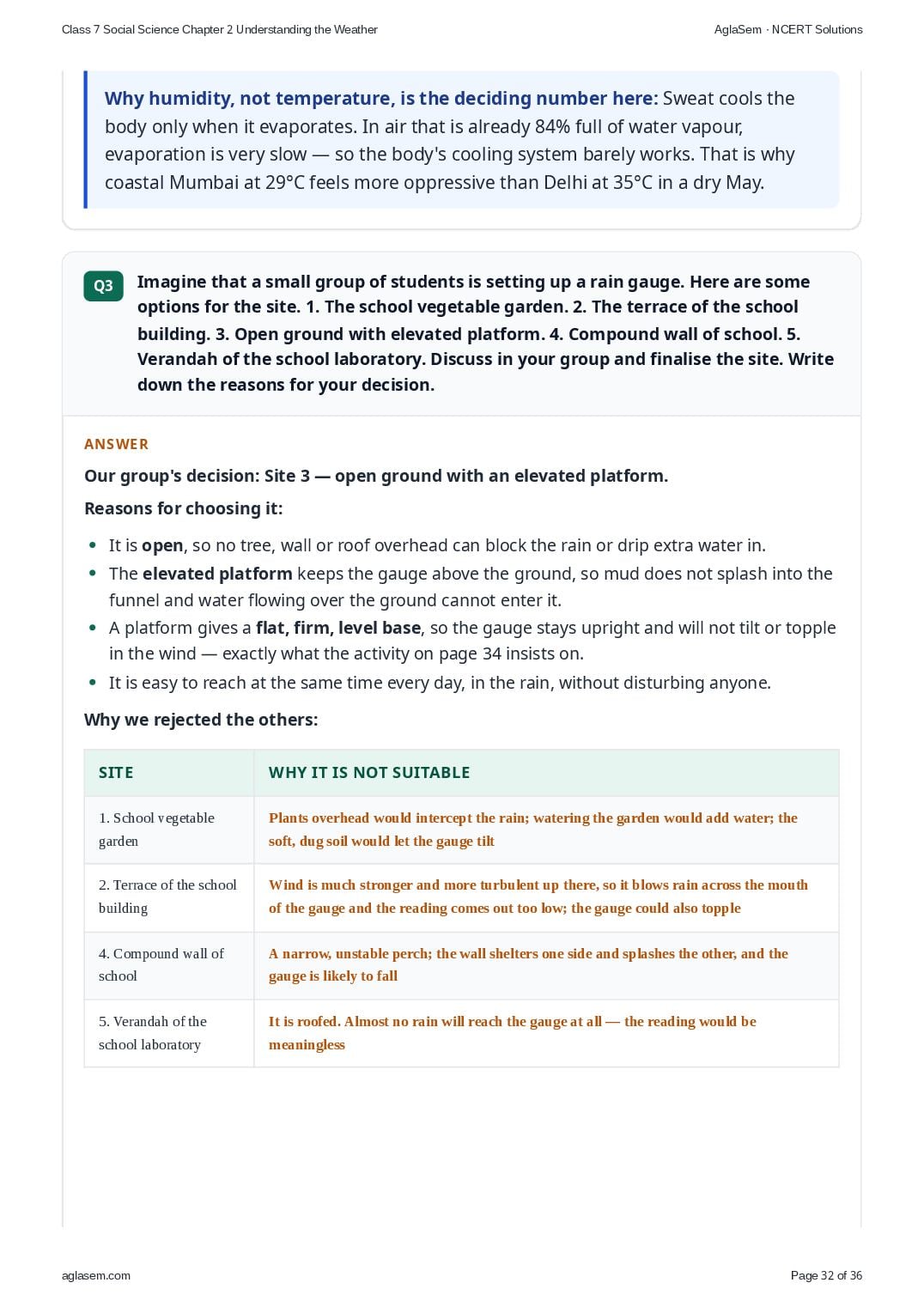
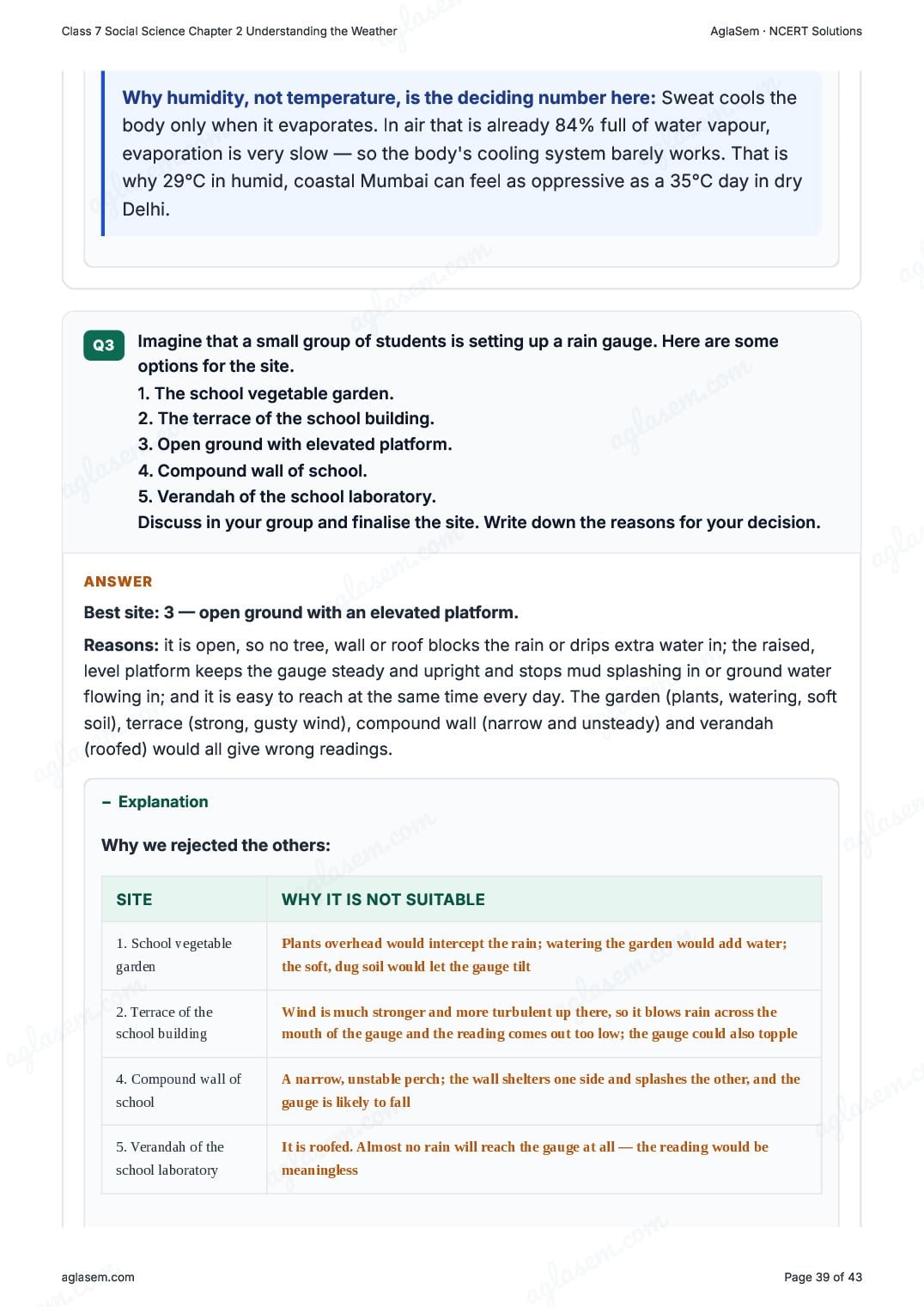
- Imagine that a small group of students is setting up a rain gauge. Here are some options for the site. 1. The school vegetable garden. 2. The terrace of the school building. 3. Open ground with elevated platform. 4. Compound wall of school. 5. Verandah of the school laboratory. Discuss in your group and finalise the site. Write down the reasons for your decision.
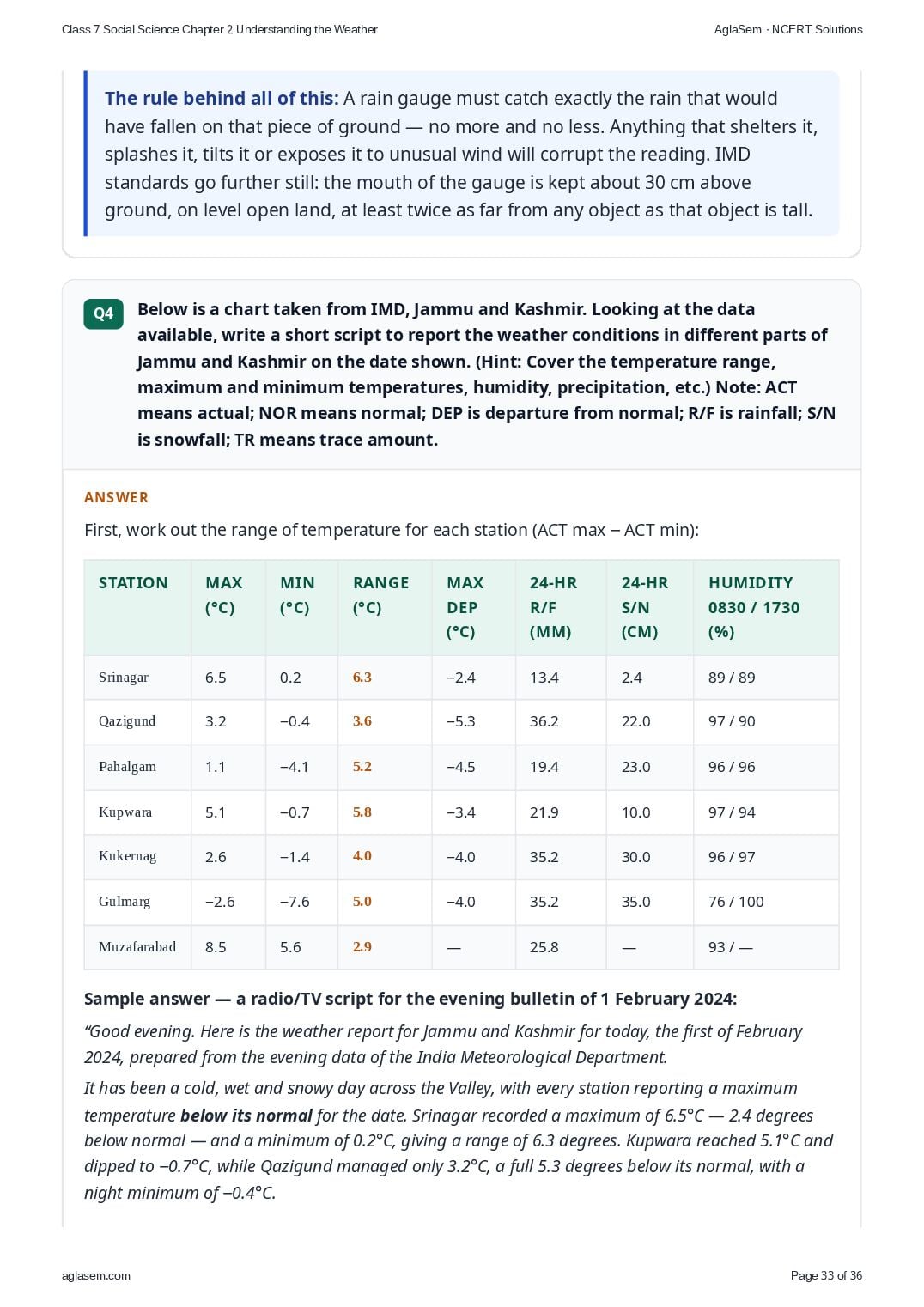
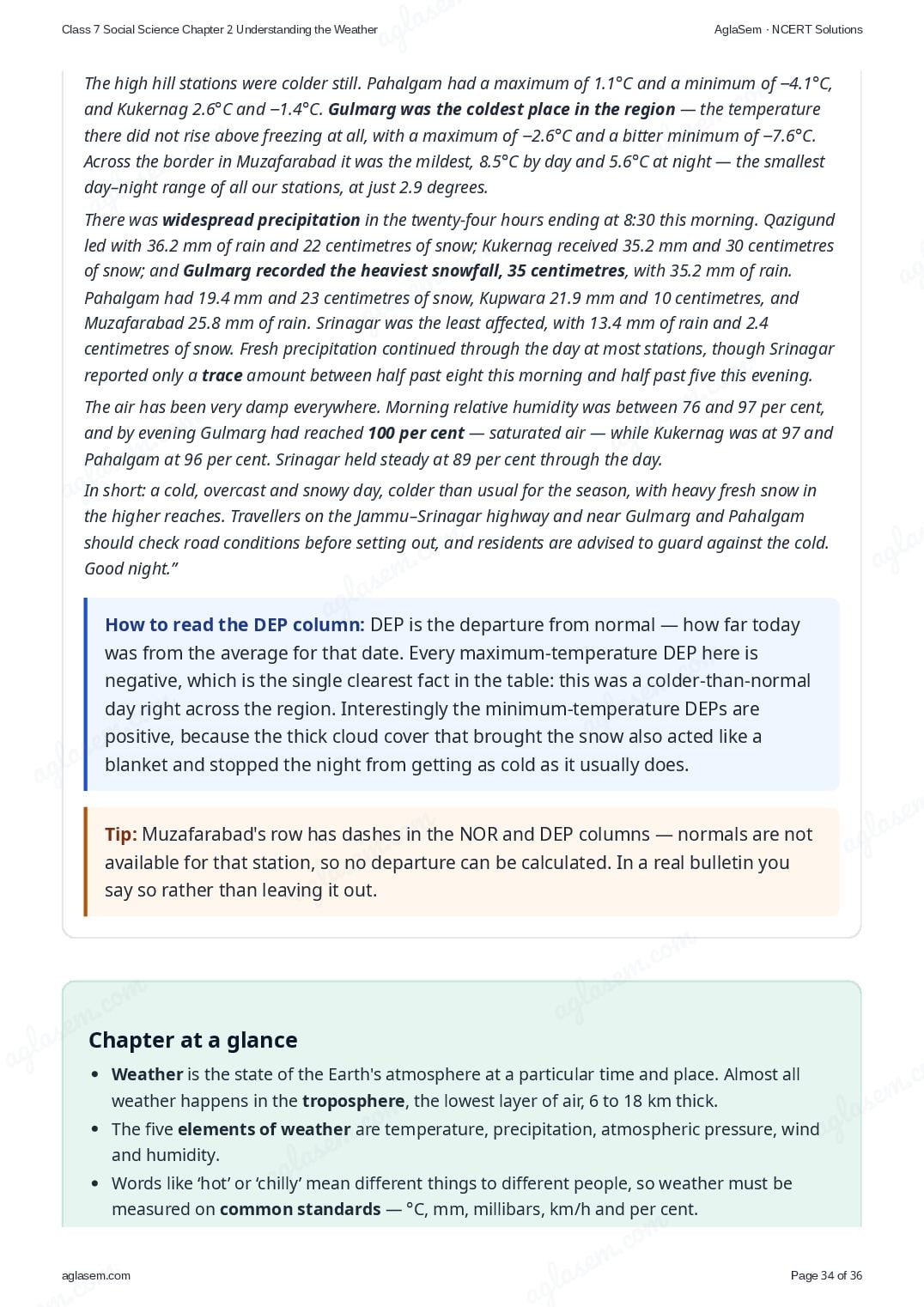
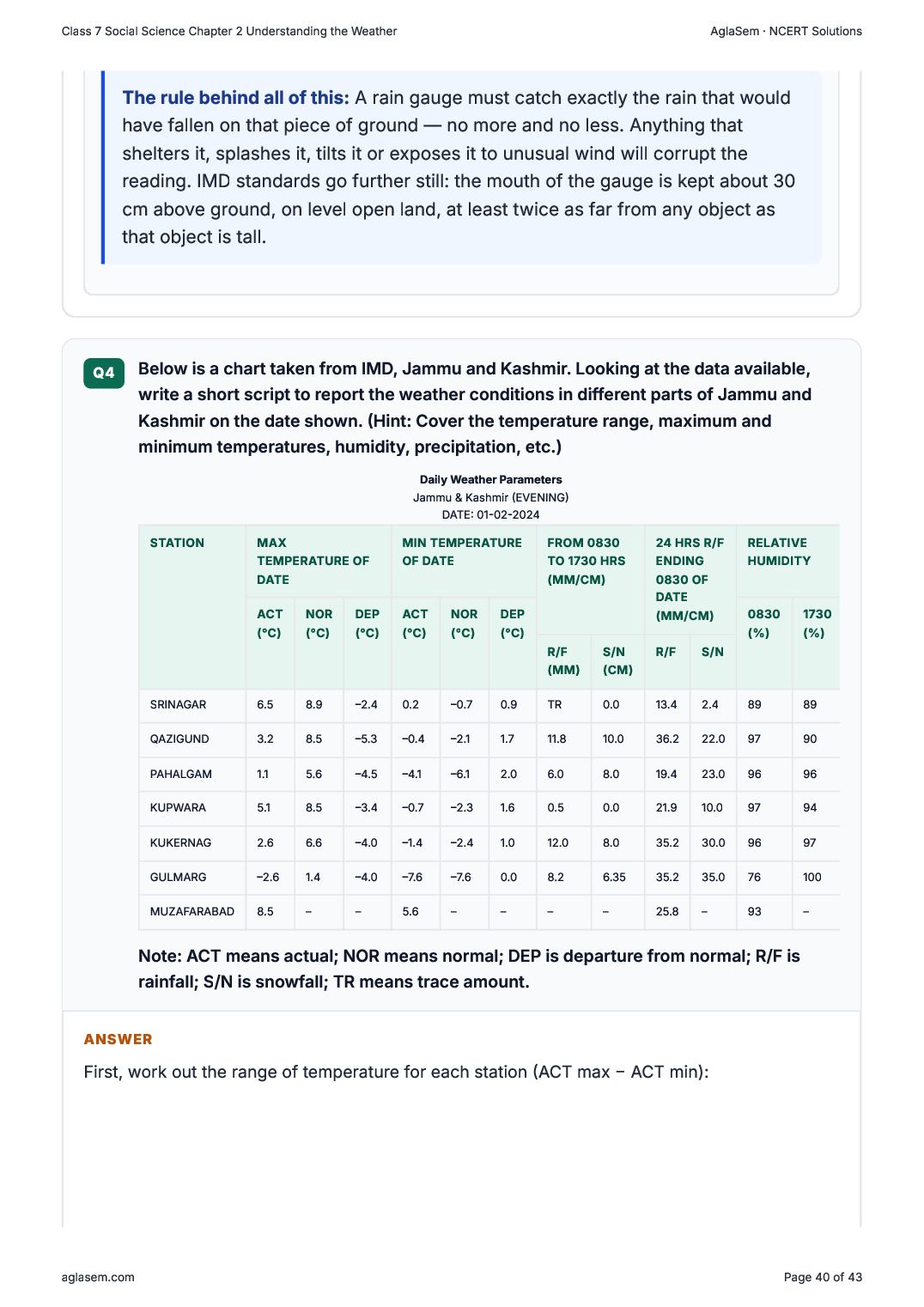
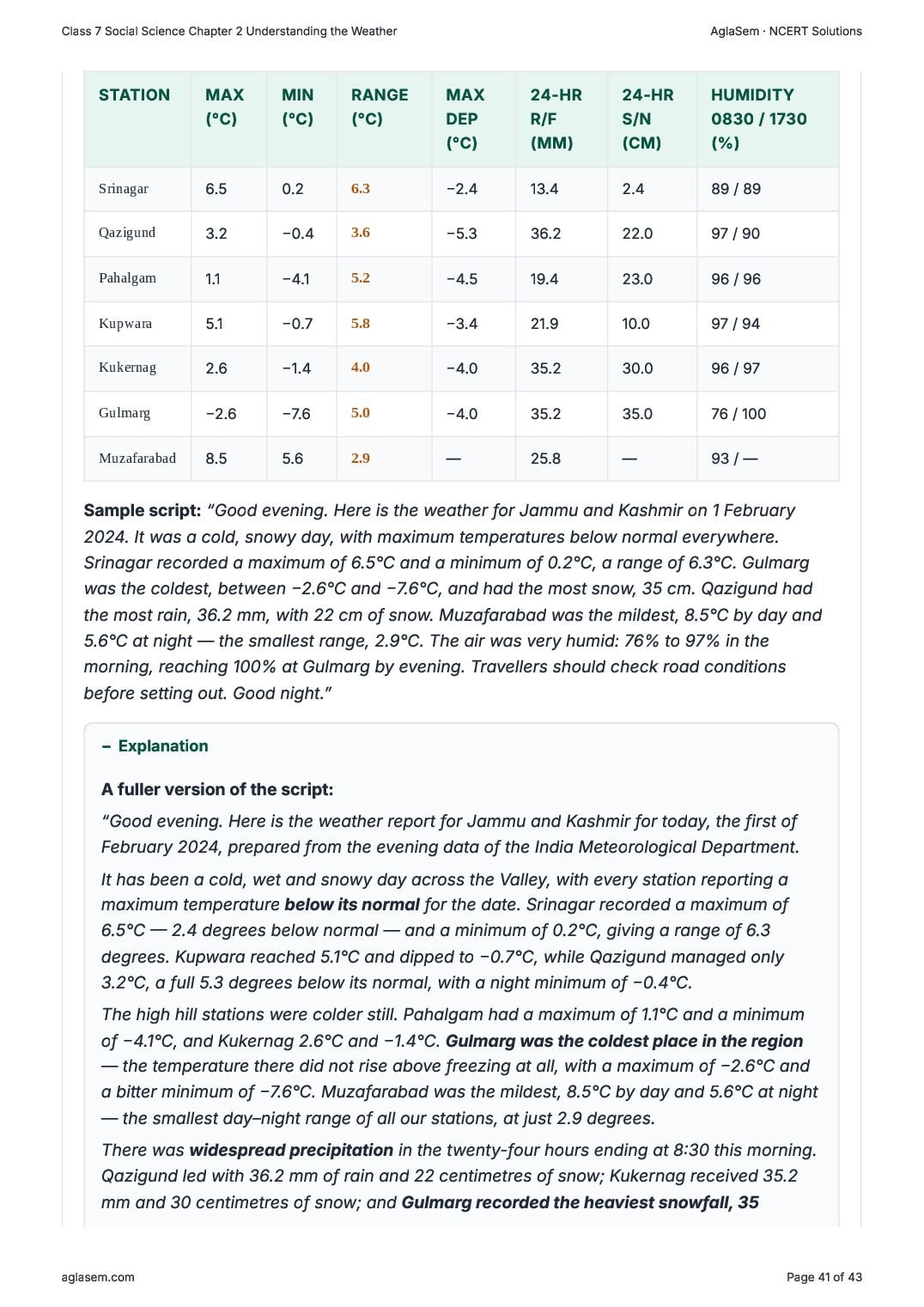
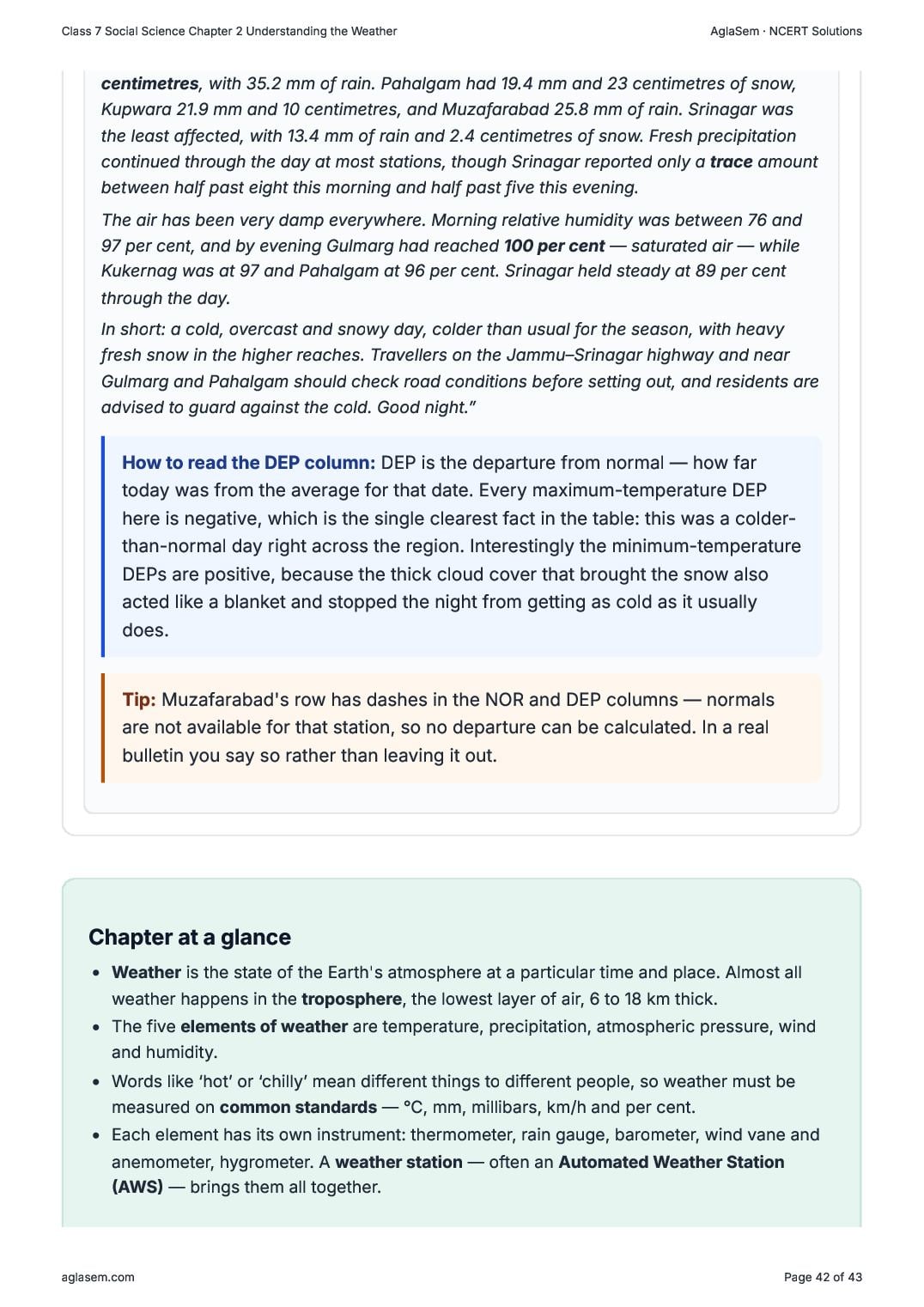
- Below is a chart taken from IMD, Jammu and Kashmir. Looking at the data available, write a short script to report the weather conditions in different parts of Jammu and Kashmir on the date shown. (Hint: Cover the temperature range, maximum and minimum temperatures, humidity, precipitation, etc.) Note: ACT means actual; NOR means normal; DEP is departure from normal; R/F is rainfall; S/N is snowfall; TR means trace amount.
Chapter at a Glance
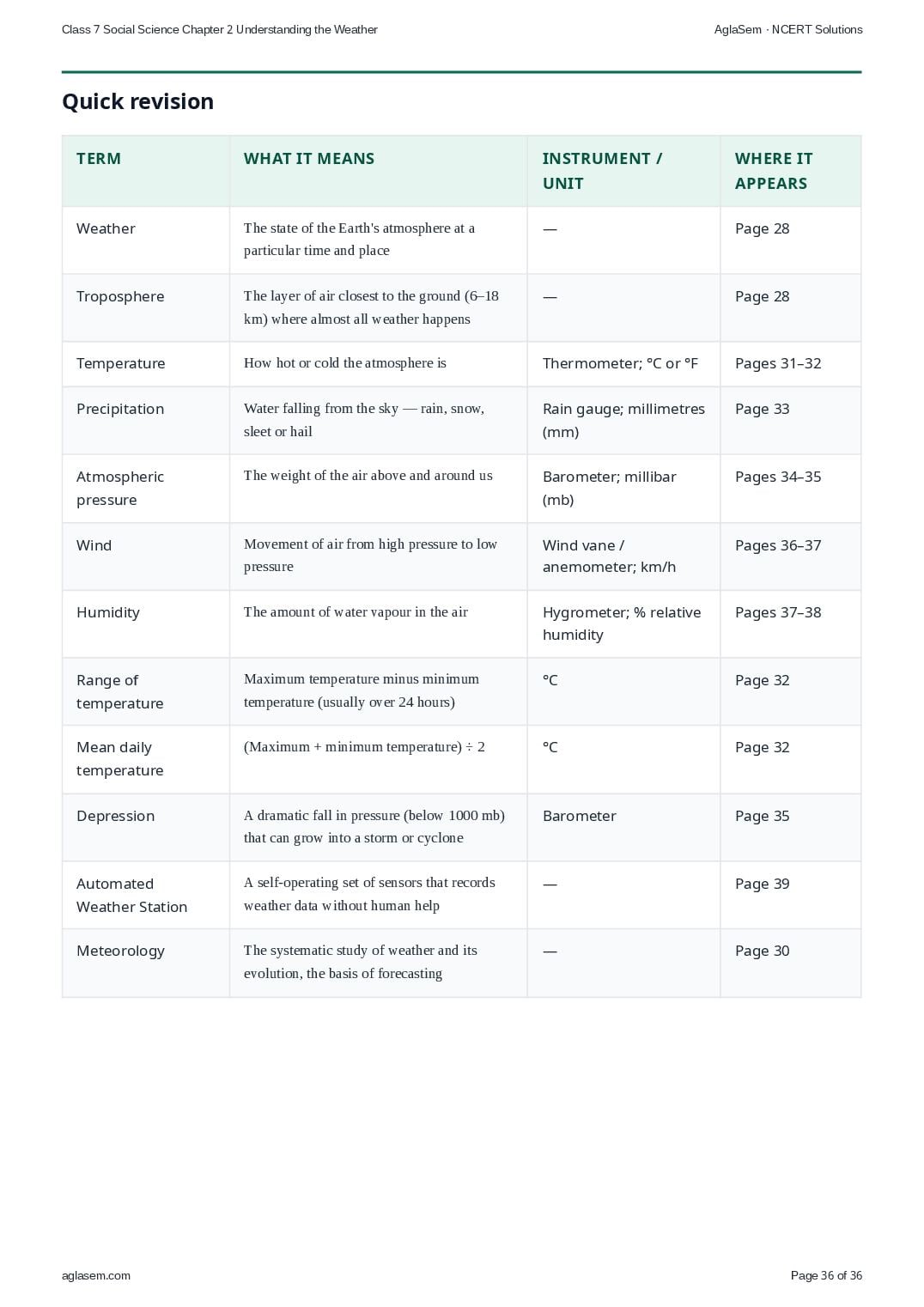
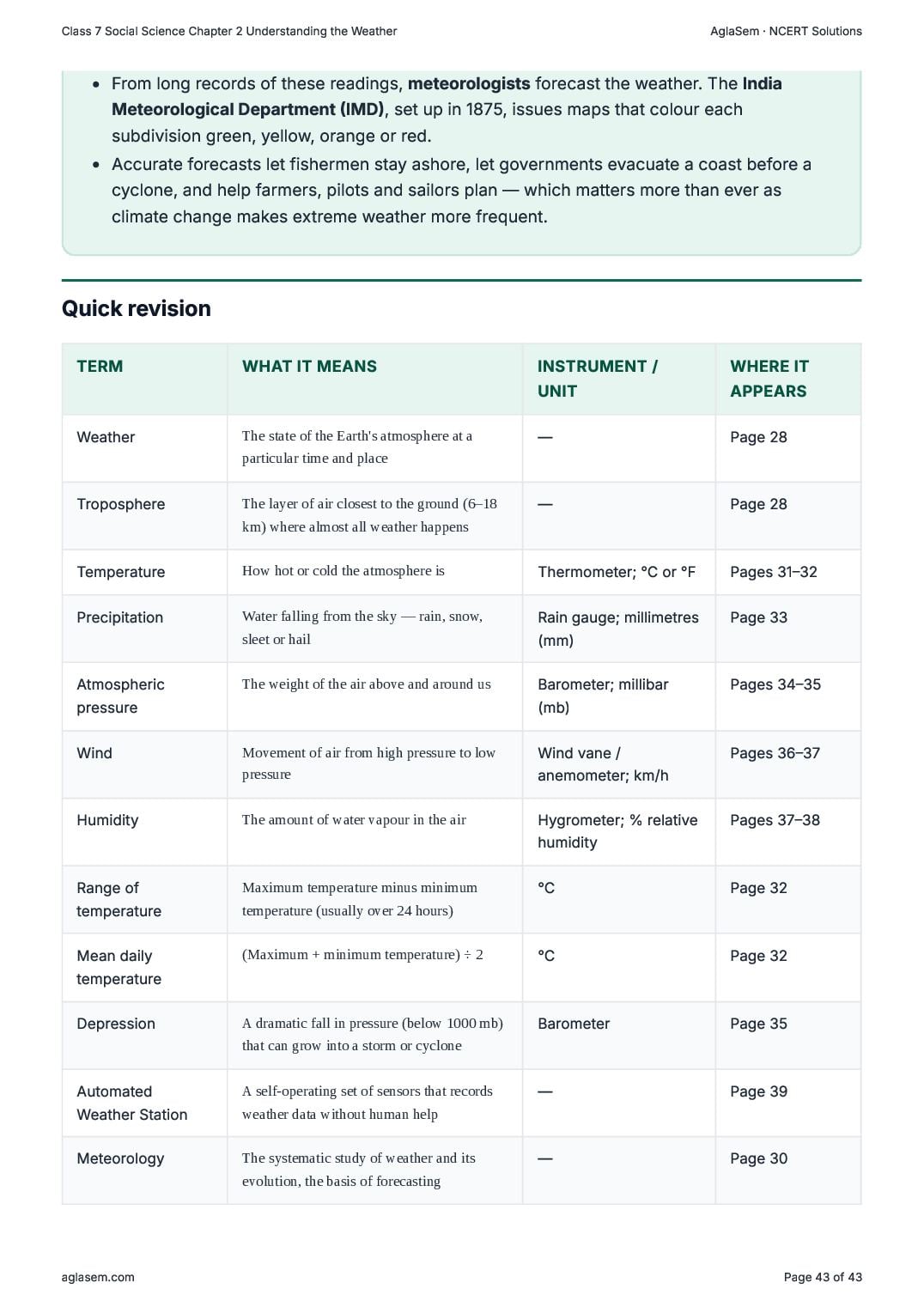
- Weather is the state of the Earth's atmosphere at a particular time and place. Almost all weather happens in the troposphere , the lowest layer of air, 6 to 18 km thick.
- The five elements of weather are temperature, precipitation, atmospheric pressure, wind and humidity.
- Words like ‘hot’ or ‘chilly’ mean different things to different people, so weather must be measured on common standards — °C, mm, millibars, km/h and per cent.
- Each element has its own instrument: thermometer, rain gauge, barometer, wind vane and anemometer, hygrometer. A weather station — often an Automated Weather Station (AWS) — brings them all together.
- From long records of these readings, meteorologists forecast the weather. The India Meteorological Department (IMD) , set up in 1875, issues maps that colour each subdivision green, yellow, orange or red.
- Accurate forecasts let fishermen stay ashore, let governments evacuate a coast before a cyclone, and help farmers, pilots and sailors plan — which matters more than ever as climate change makes extreme weather more frequent.
How to Download NCERT Solutions for Class 7 Social Science Chapter 2 PDF
Follow these simple steps to get the Understanding the Weather questions-and-answers PDF from Exploring Society India and Beyond.
- Search NCERT Solutions for Class 7 Social Science Chapter 2 aglasem and open this page.
- Read the exercise questions with answers for Understanding the Weather shown above.
- Click the Download PDF link to save the Understanding the Weather solutions to your device.
NCERT Solutions for Class 7 Social Science – All Chapters
There are more chapters to study besides Understanding the Weather in Social Science. Here are the NCERT Solutions for all chapters of Class 7 Social Science.
- Chapter 1 Geographical Diversity of India
- Chapter 2 Understanding the Weather
- Chapter 3 Climates of India
- Chapter 4 New Beginnings Cities and States
- Chapter 5 the Rise of Empires
- Chapter 6 the Age of Reorganisation
- Chapter 7 the Gupta Era an Age of Tireless Creativity
- Chapter 8 How the Land Becomes Sacred
- Chapter 9 From the Rulers to the Ruled Types of Governments
- Chapter 10 the Constitution of India an Introduction
- Chapter 11 From Barter to Money
- Chapter 12 Understanding Markets
NCERT Solutions for Class 7 – All Subjects
Just like Chapter 2 of Social Science, you can get the exercise questions with answers for every other subject of Class 7. Here are the NCERT Solutions for all subjects of Class 7.
NCERT Solutions for Class 7 Social Science Chapter 2 – An Overview
The key highlights of this study material are as follows.
| Aspects | Details |
|---|---|
| Class | Class 7 |
| Subject | Social Science |
| Chapter Number | Chapter 2 |
| Chapter Name | Understanding the Weather |
| Book Name | Exploring Society India and Beyond |
| Book By | NCERT (National Council of Educational Research and Training) |
| Educational Resource Here | NCERT Solutions of Class 7 Social Science Chapter 2 for all exercises |
| More Questions Answers of This Subject | NCERT Solutions for Class 7 Social Science |
| Download Book Chapter | NCERT Book Class 7 Social Science |
| All Questions Answers For This Class | NCERT Solutions for Class 7 |
| Complete Solutions | NCERT Solutions |
NCERT Solutions for Class 7 Social Science Chapter 2 Understanding the Weather – FAQs
What are the NCERT Solutions for Class 7 Social Science Chapter 2 Understanding the Weather?
They are the complete, step-by-step answers to all the exercise and in-text questions of Chapter 2 Understanding the Weather from the NCERT Class 7 Social Science textbook Exploring Society India and Beyond, written by experts as per the latest NCERT syllabus.
How can I download the Class 7 Social Science Chapter 2 solutions PDF for free?
Open this page on aglasem, read the Understanding the Weather questions with answers, and click the “Download Solutions PDF” link. The Class 7 Social Science Chapter 2 NCERT Solutions PDF is completely free to download.
Are these NCERT Solutions as per the latest 2026-27 syllabus?
Yes. The NCERT Solutions for Class 7 Social Science Chapter 2 are based on the latest NCERT textbook Exploring Society India and Beyond and the current 2026-27 CBSE syllabus, so the questions and answers match what you study in class.
Where can I get NCERT Solutions for the other chapters of Class 7 Social Science?
You can find the answers to every chapter on the NCERT Solutions for Class 7 Social Science page, and solutions for every subject on the NCERT Solutions for Class 7 page.
How do NCERT Solutions help in exam preparation?
They show the correct method to solve each question, help you write answers the way they are expected in exams, let you check and correct your own work, and save revision time — which together improve your marks in Class 7 Social Science.
If you have any queries on NCERT Solutions for Class 7 Social Science Chapter 2 Understanding the Weather, then please ask in the comments below.