NCERT Solutions for Class 7 Social Science Chapter 9 From the Rulers to the Ruled Types of Governments provide clear, step-by-step answers to every exercise and in-text question from the chapter From the Rulers to the Ruled Types of Governments of the NCERT textbook Exploring Society India and Beyond. Prepared by subject experts as per the latest NCERT (CBSE) syllabus for 2026-27, these NCERT Solutions for Class 7 Social Science help you understand each concept, write exam-ready answers, and check your own solutions. You can read them online below or download the free Class 7 Social Science Chapter 9 question-answer PDF.
NCERT Solutions for Class 7 Social Science Chapter 9 From the Rulers to the Ruled Types of Governments
- Class: Class 7
- Subject: Social Science
- Chapter: Chapter 9 – From the Rulers to the Ruled Types of Governments
- Textbook: Exploring Society India and Beyond (NCERT)
- Study material: NCERT Solutions – questions with answers, free PDF
These solutions answer all the exercise questions of Chapter 9 From the Rulers to the Ruled Types of Governments — including the in-text questions, short-answer and long-answer questions, and activities — with complete explanations so you can follow the method, not just the final answer. Read the full solutions below.
NCERT Solutions Class 7 Social Science Chapter 9 From the Rulers to the Ruled Types of Governments View Download
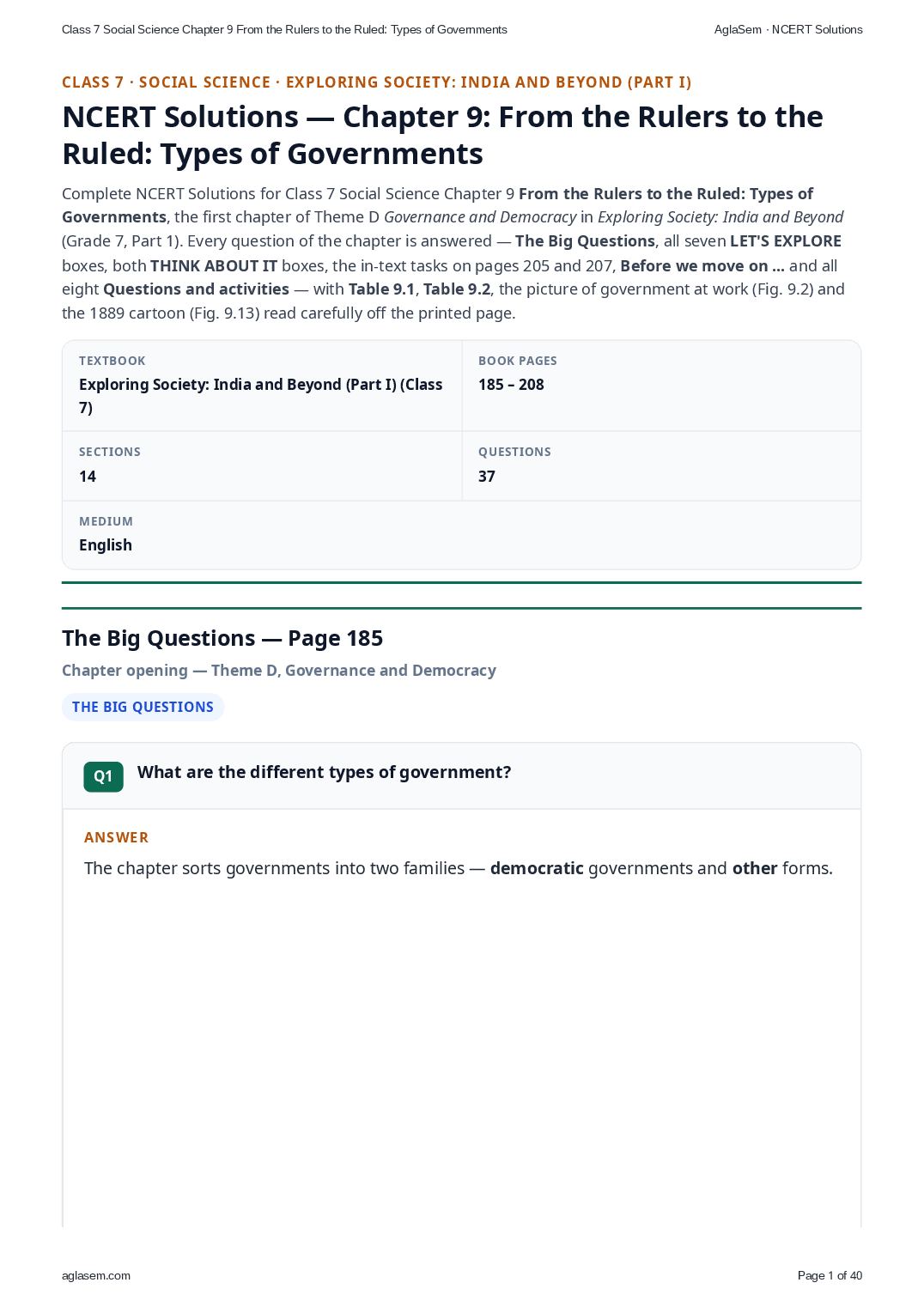
NCERT Solutions for Class 7 Social Science Chapter 9 PDF Download
You can read the NCERT Solutions for Class 7 Social Science Chapter 9 online above, or download the complete question-answer PDF to study From the Rulers to the Ruled Types of Governments offline at any time.
NCERT Solutions for Class 7 Social Science Chapter 9 PDF Download Link – Click Here to Download Solutions PDF
Questions Covered in This Chapter
These NCERT Solutions answer all 37 questions of this chapter. The questions solved are:
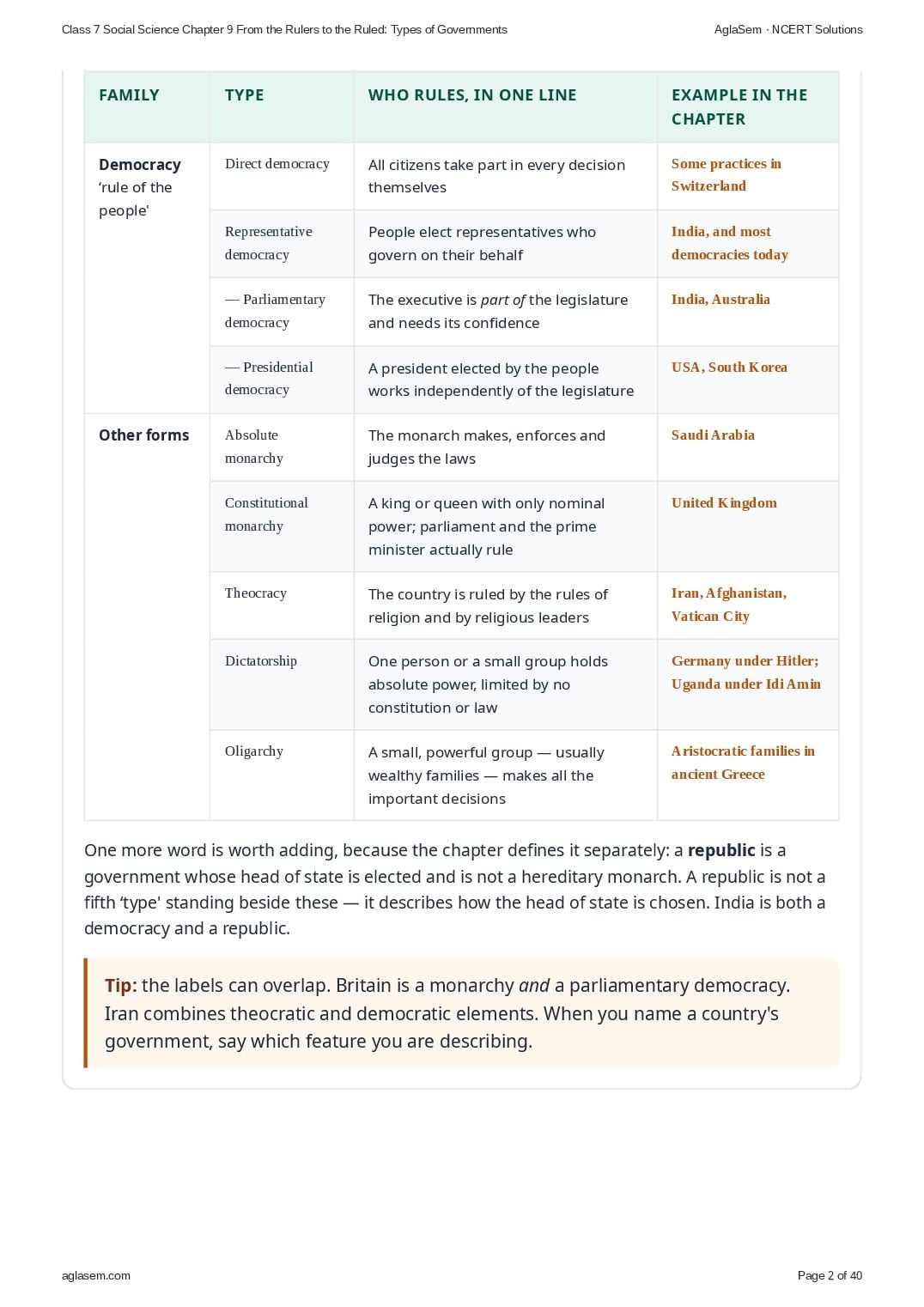
- What are the different types of government?
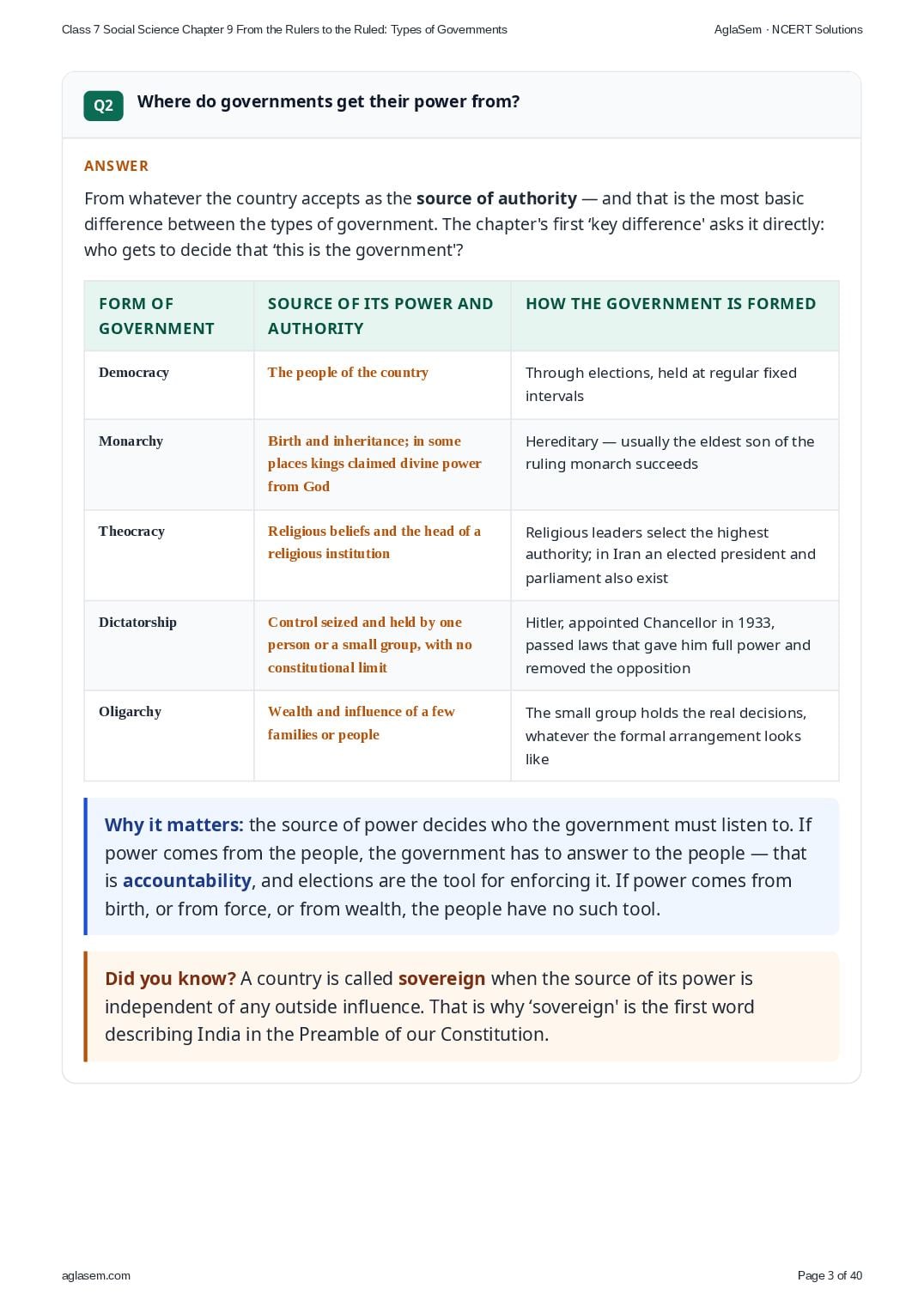
- Where do governments get their power from?
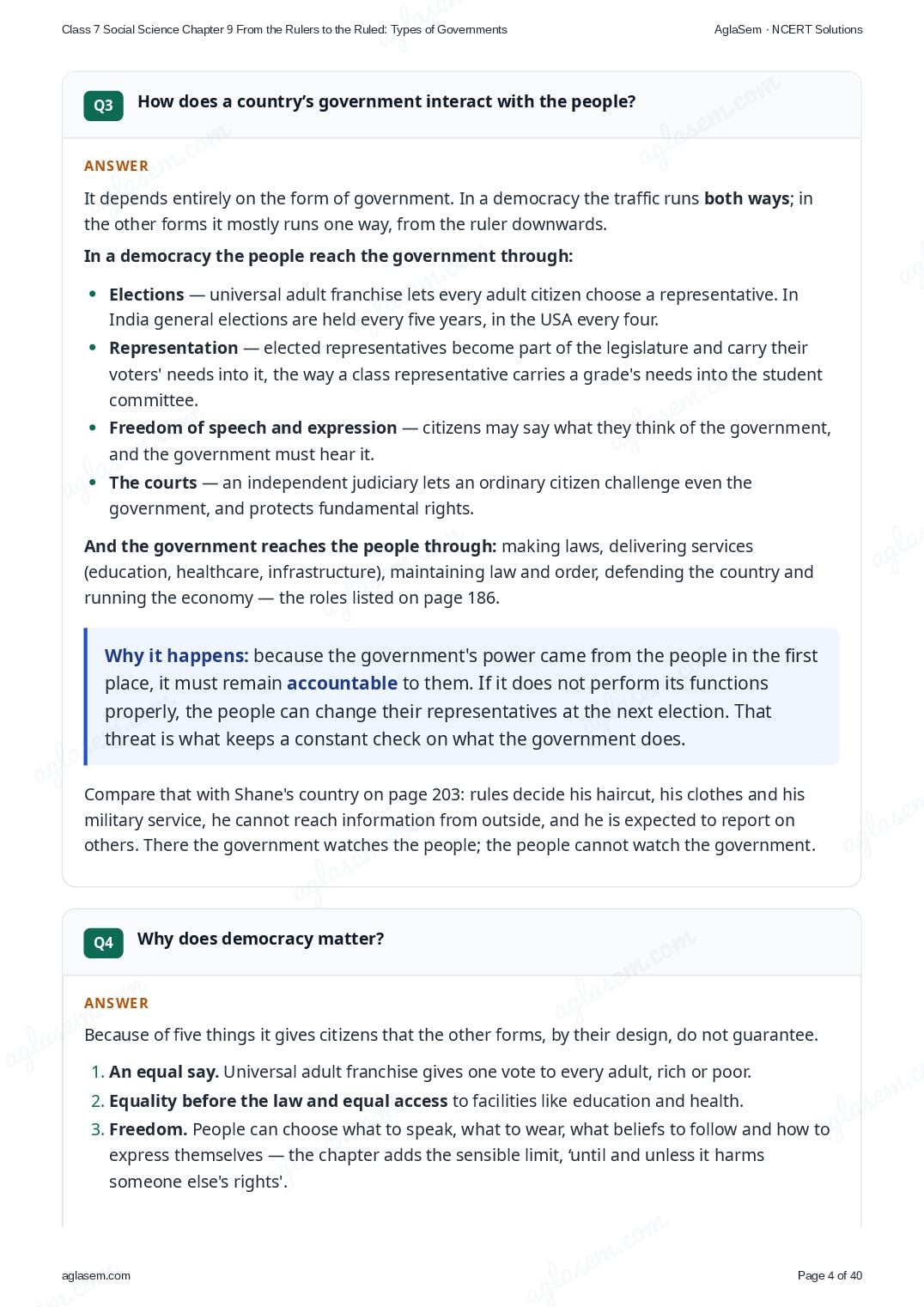
- How does a country’s government interact with the people?
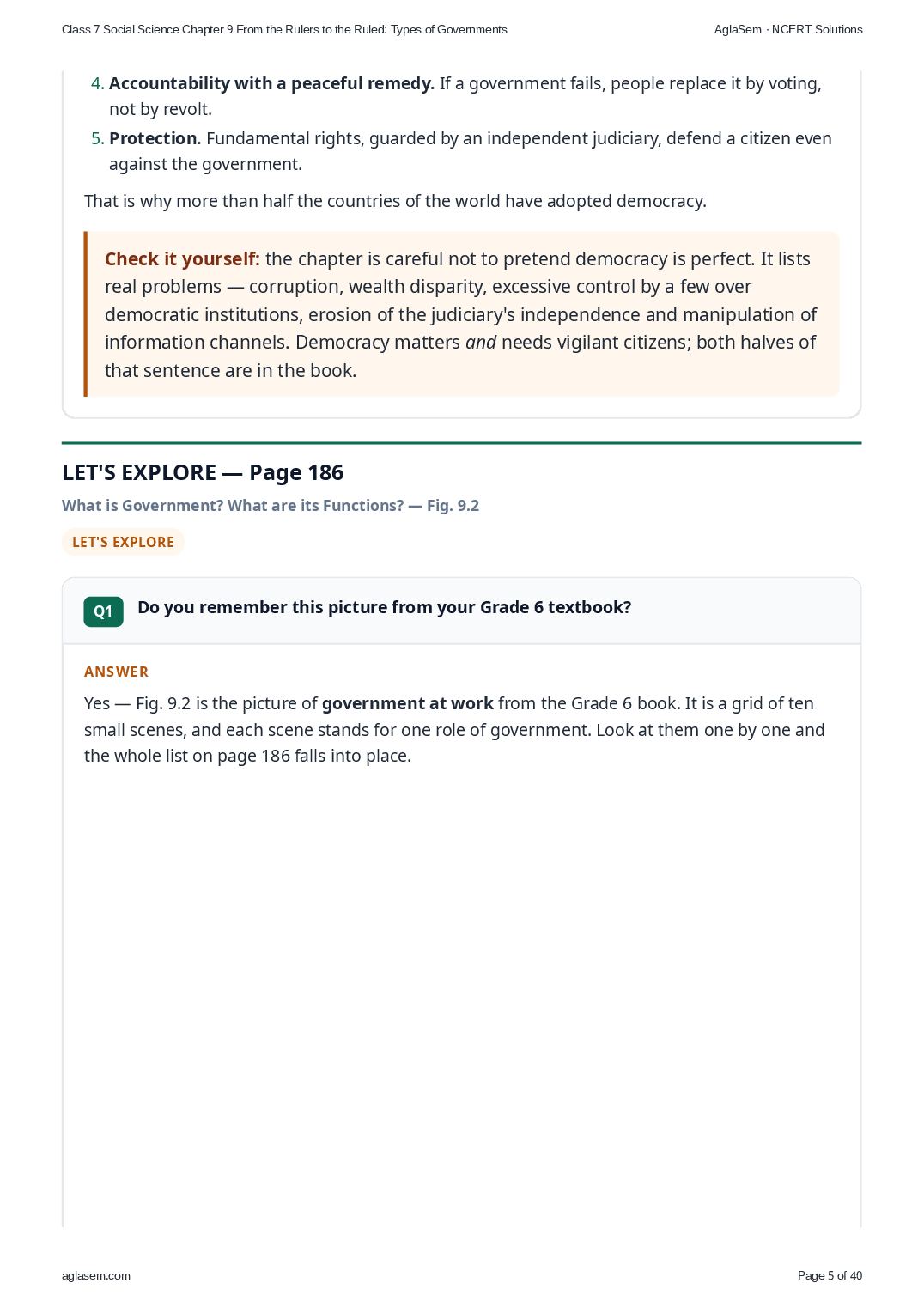
- Why does democracy matter?
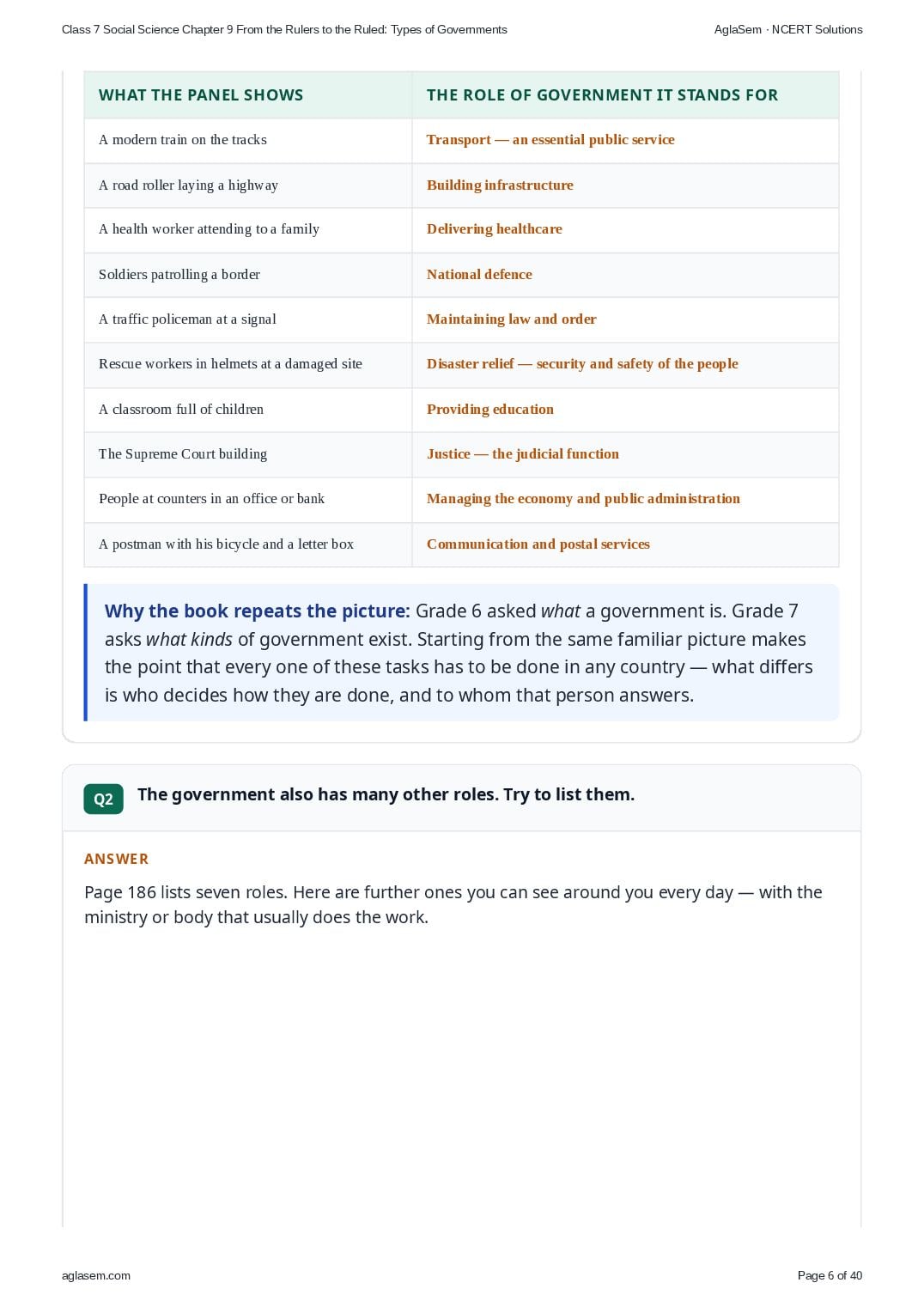
- Do you remember this picture from your Grade 6 textbook?
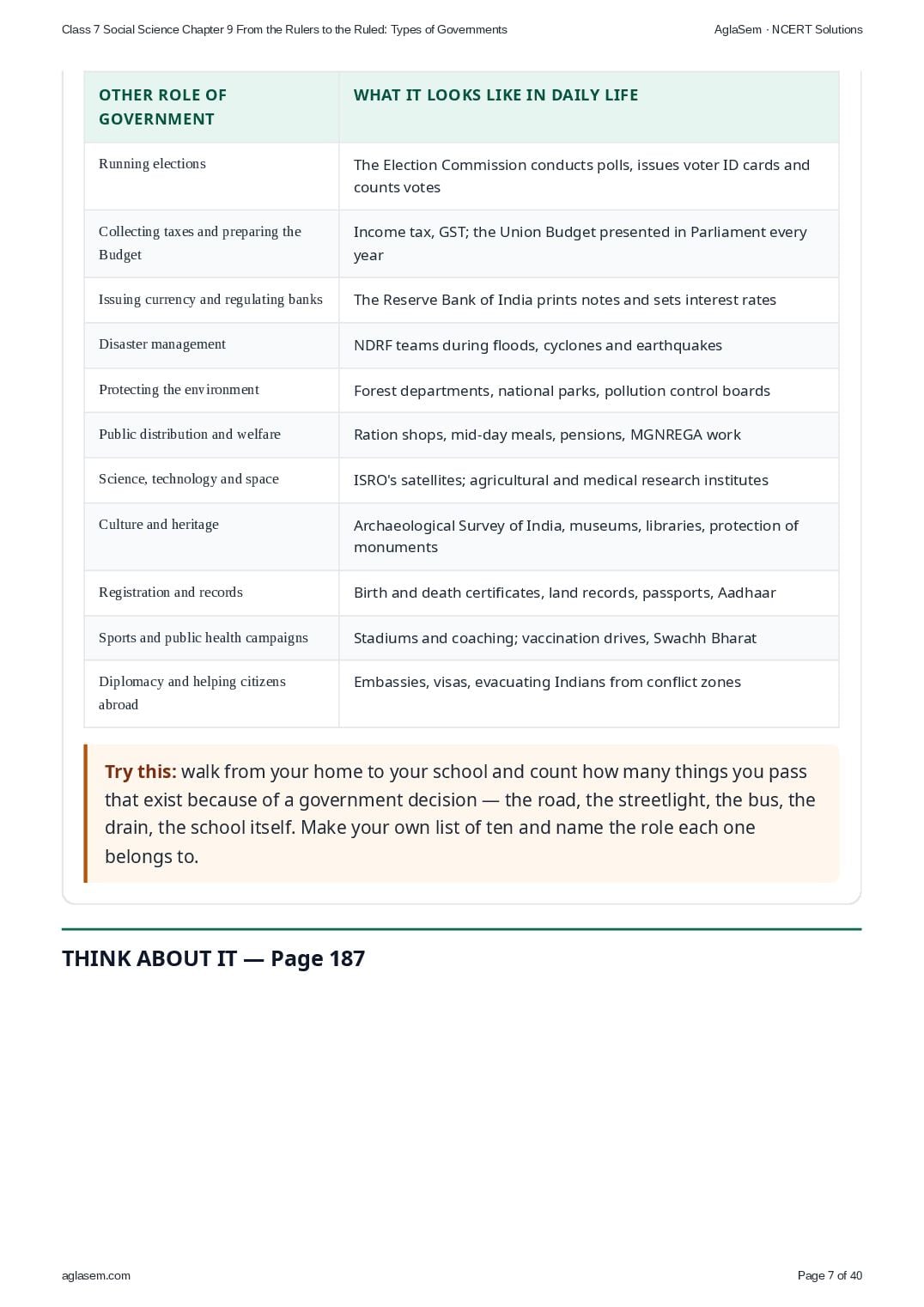
- The government also has many other roles. Try to list them.
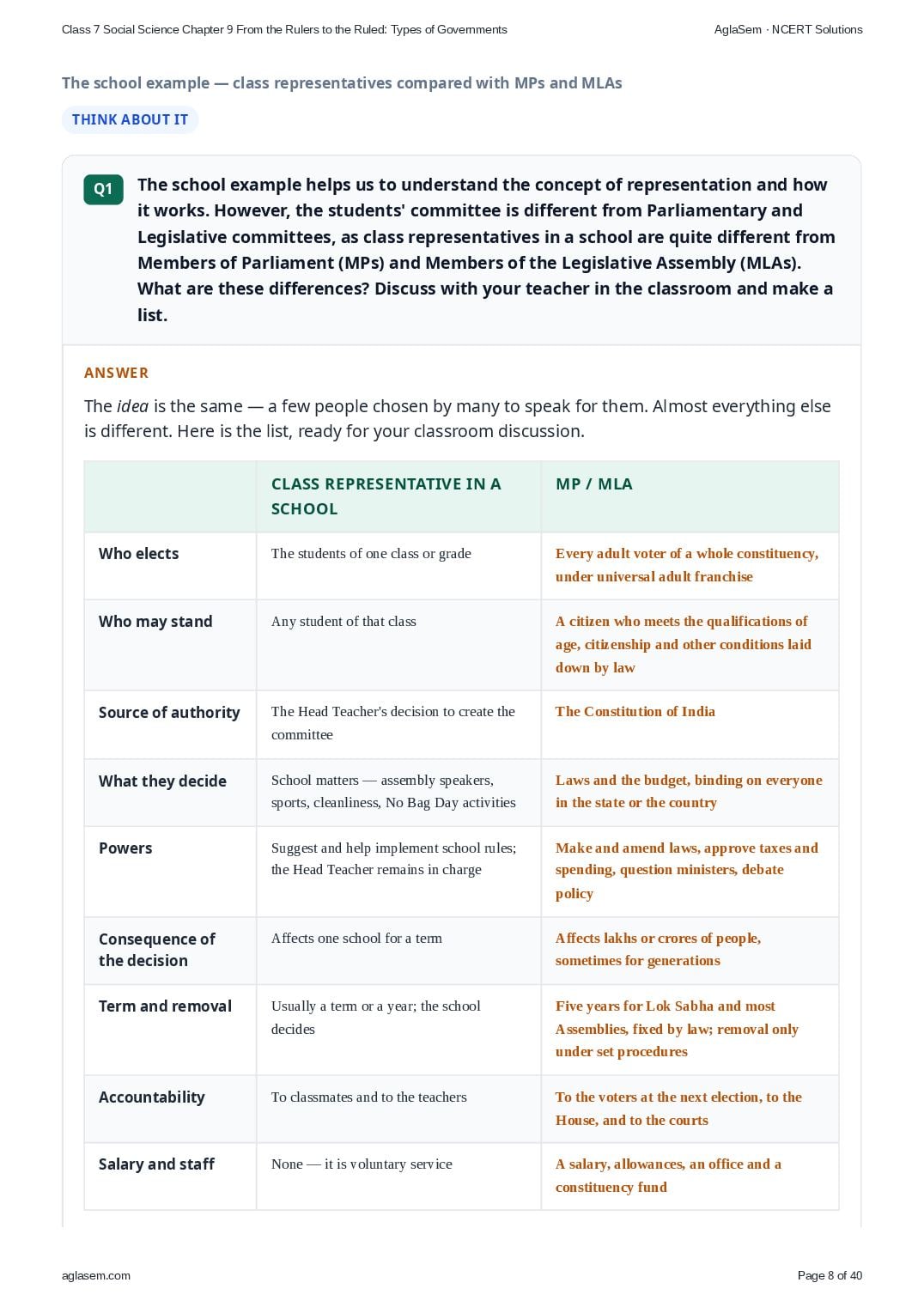
- The school example helps us to understand the concept of representation and how it works. However, the students' committee is different from Parliamentary and Legislative committees, as class representatives in a school are quite different from Members of Parliament (MPs) and Members of the Legislative Assembly (MLAs). What are these differences? Discuss with your teacher in the classroom and make a list.
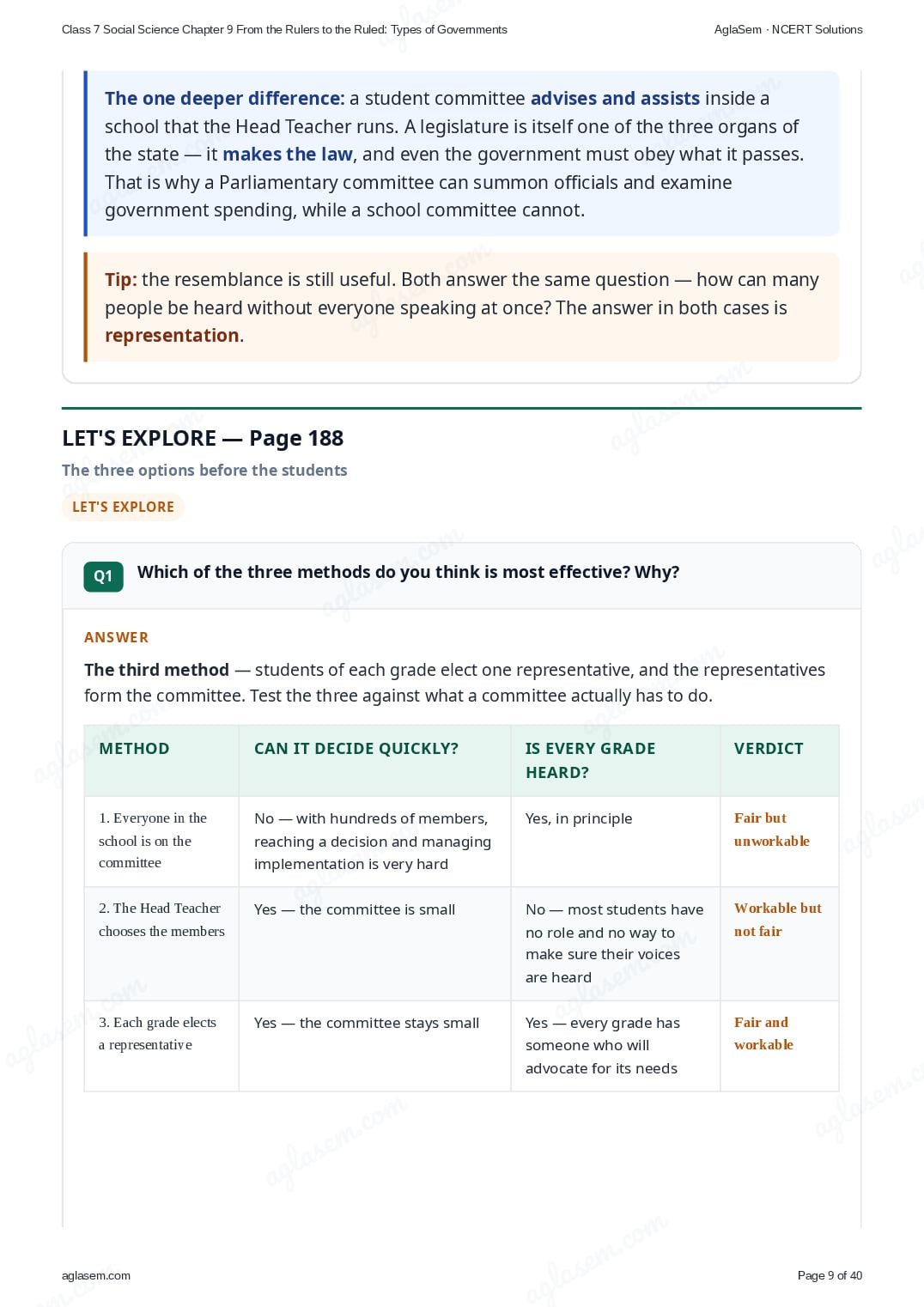
- Which of the three methods do you think is most effective? Why?
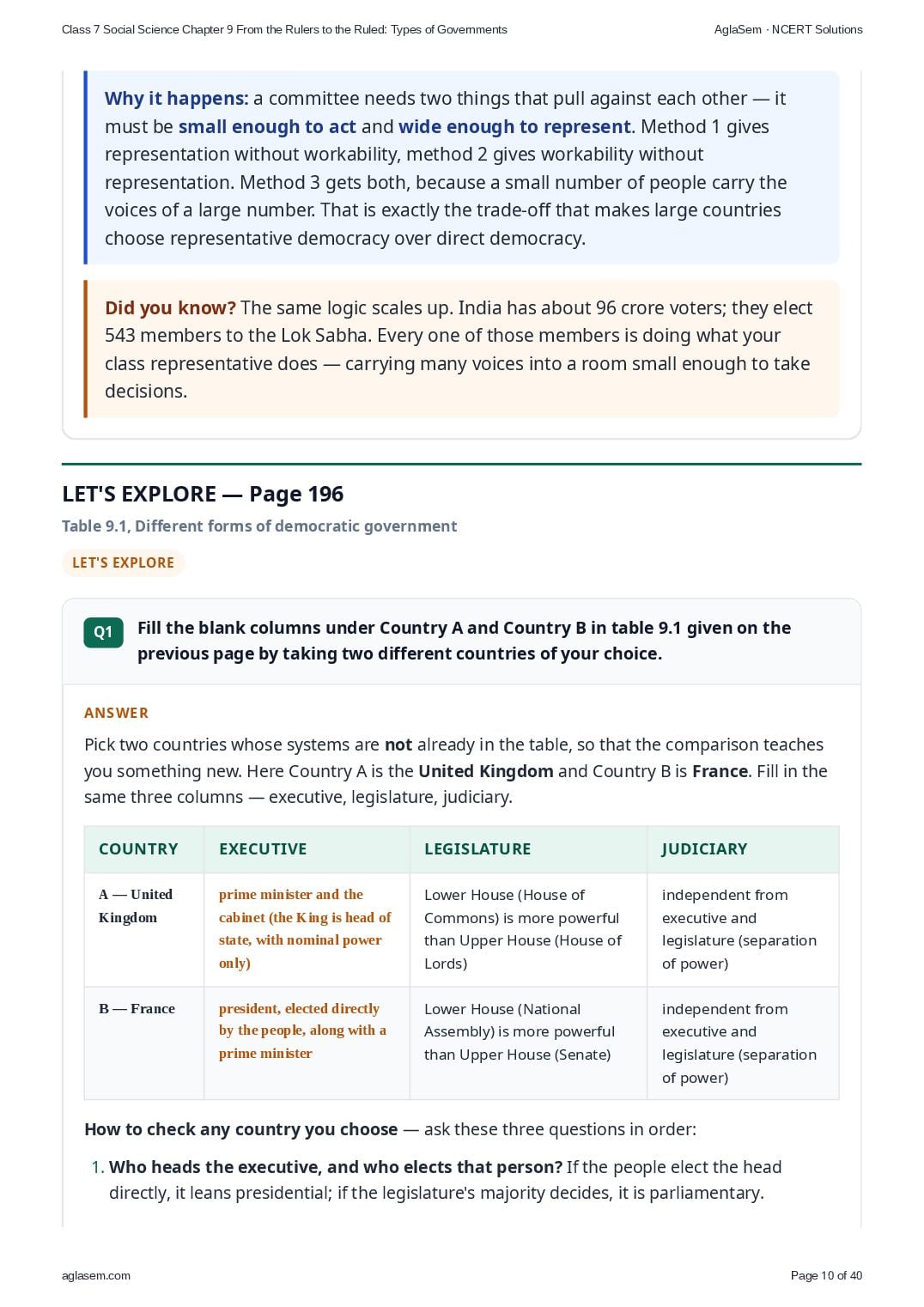
- Fill the blank columns under Country A and Country B in table 9.1 given on the previous page by taking two different countries of your choice.
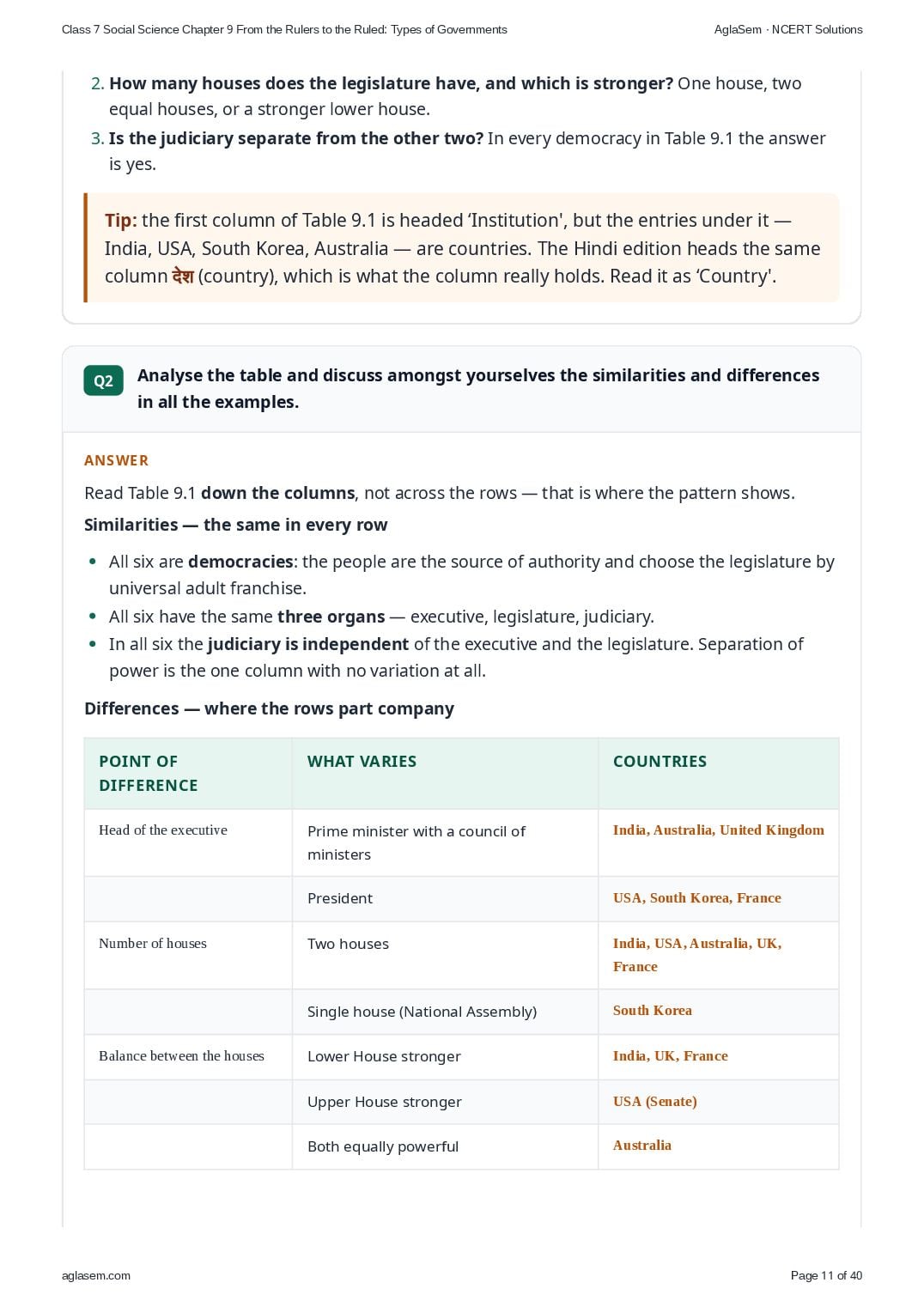
- Analyse the table and discuss amongst yourselves the similarities and differences in all the examples.
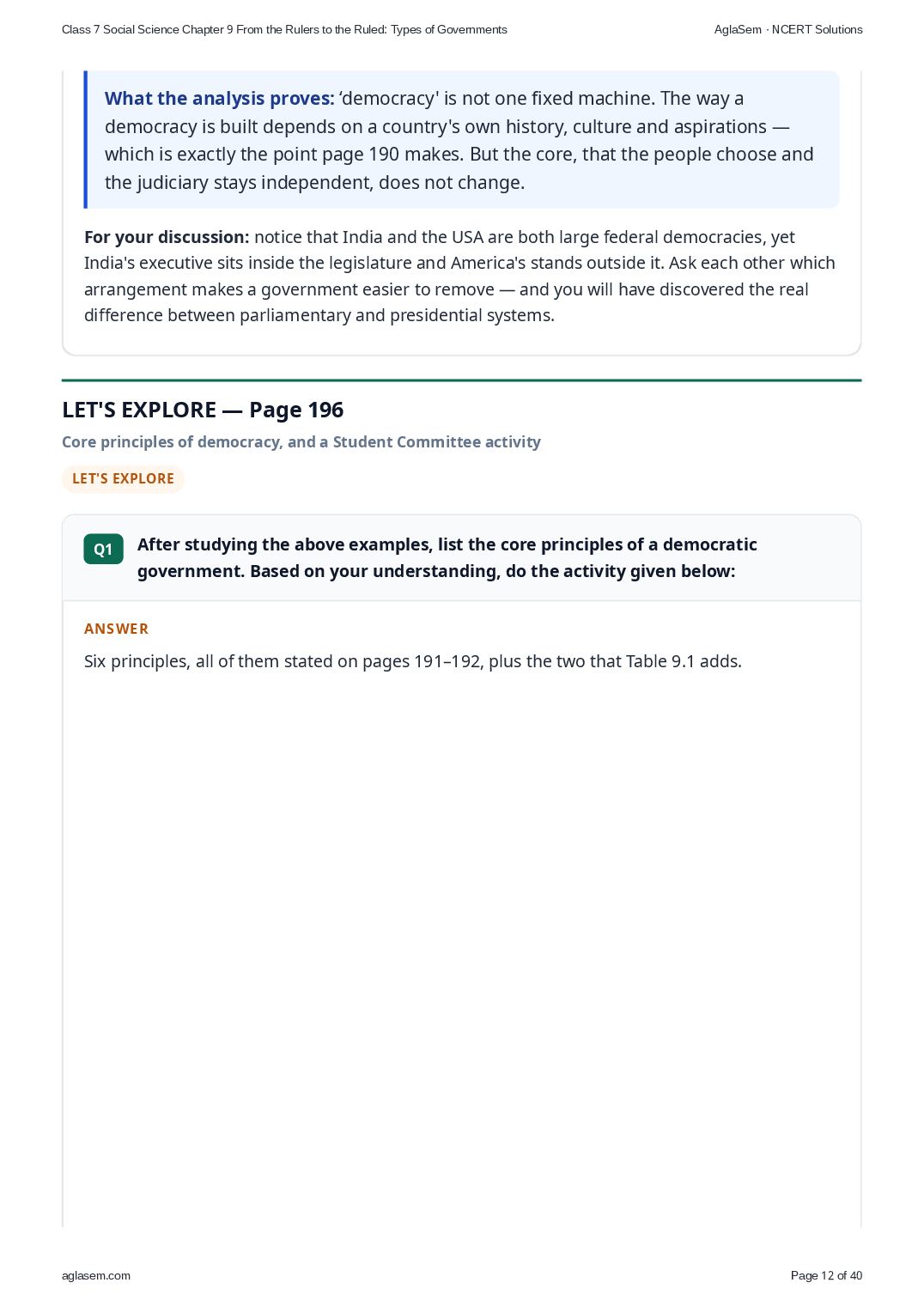
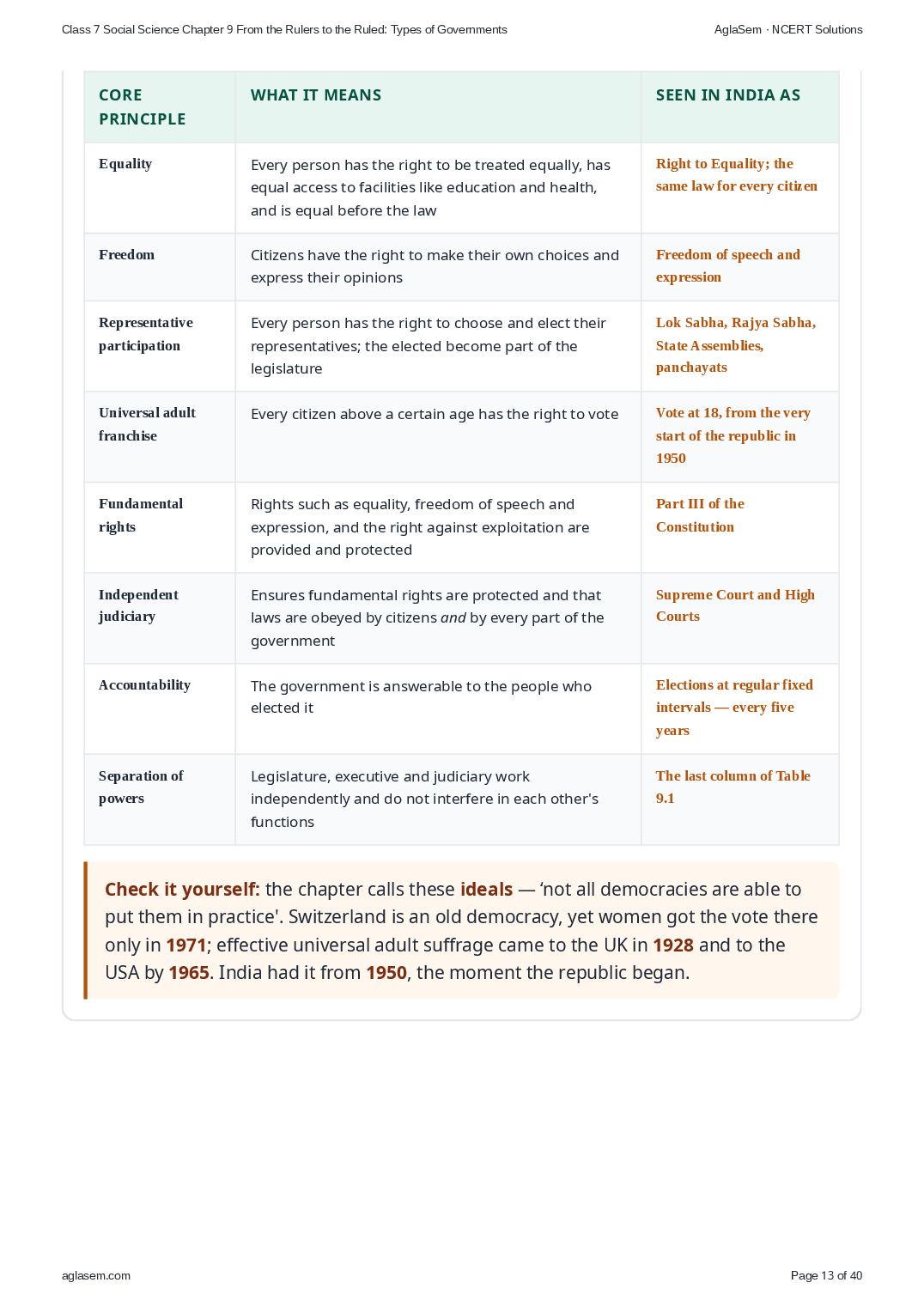
- After studying the above examples, list the core principles of a democratic government. Based on your understanding, do the activity given below:
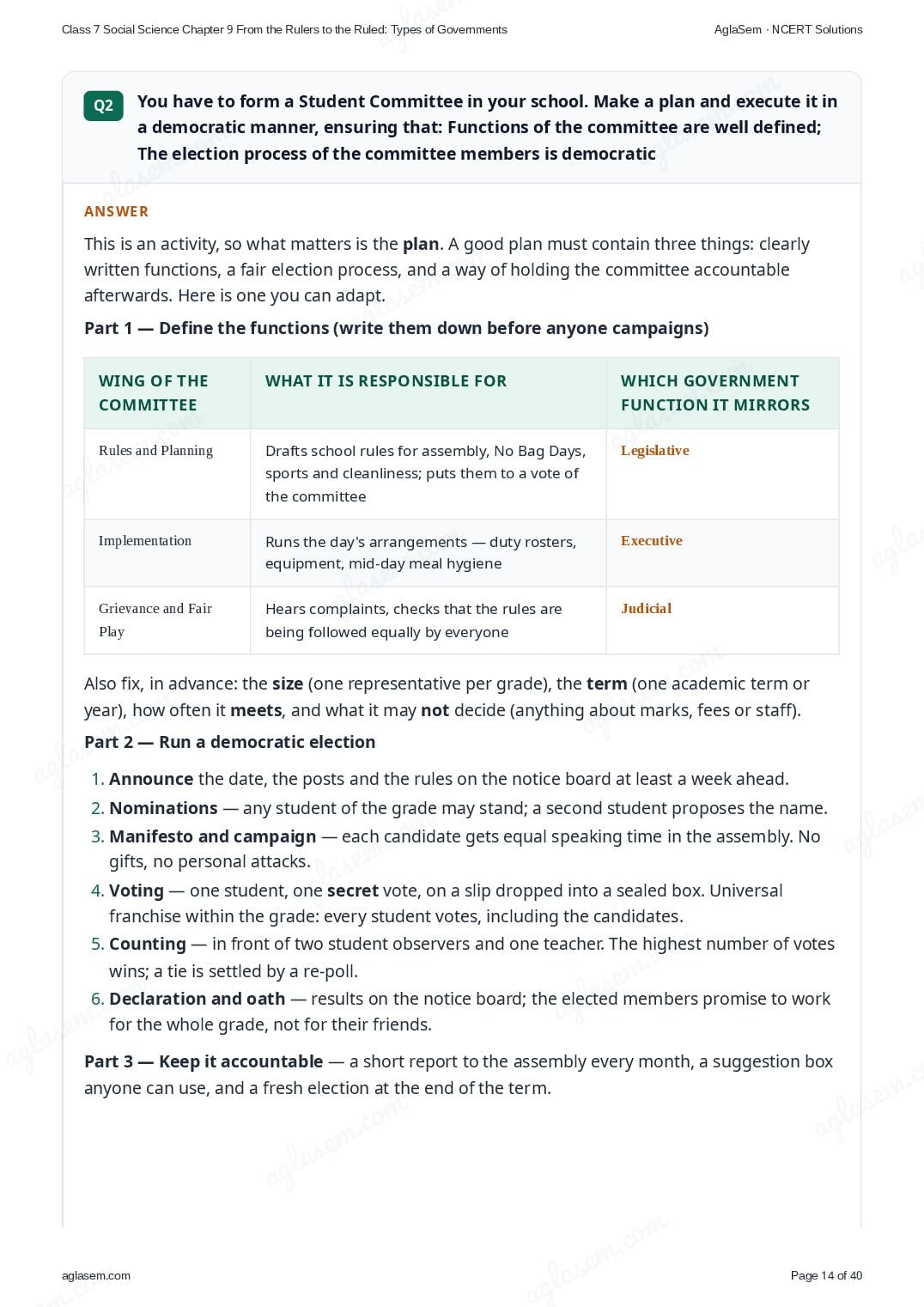
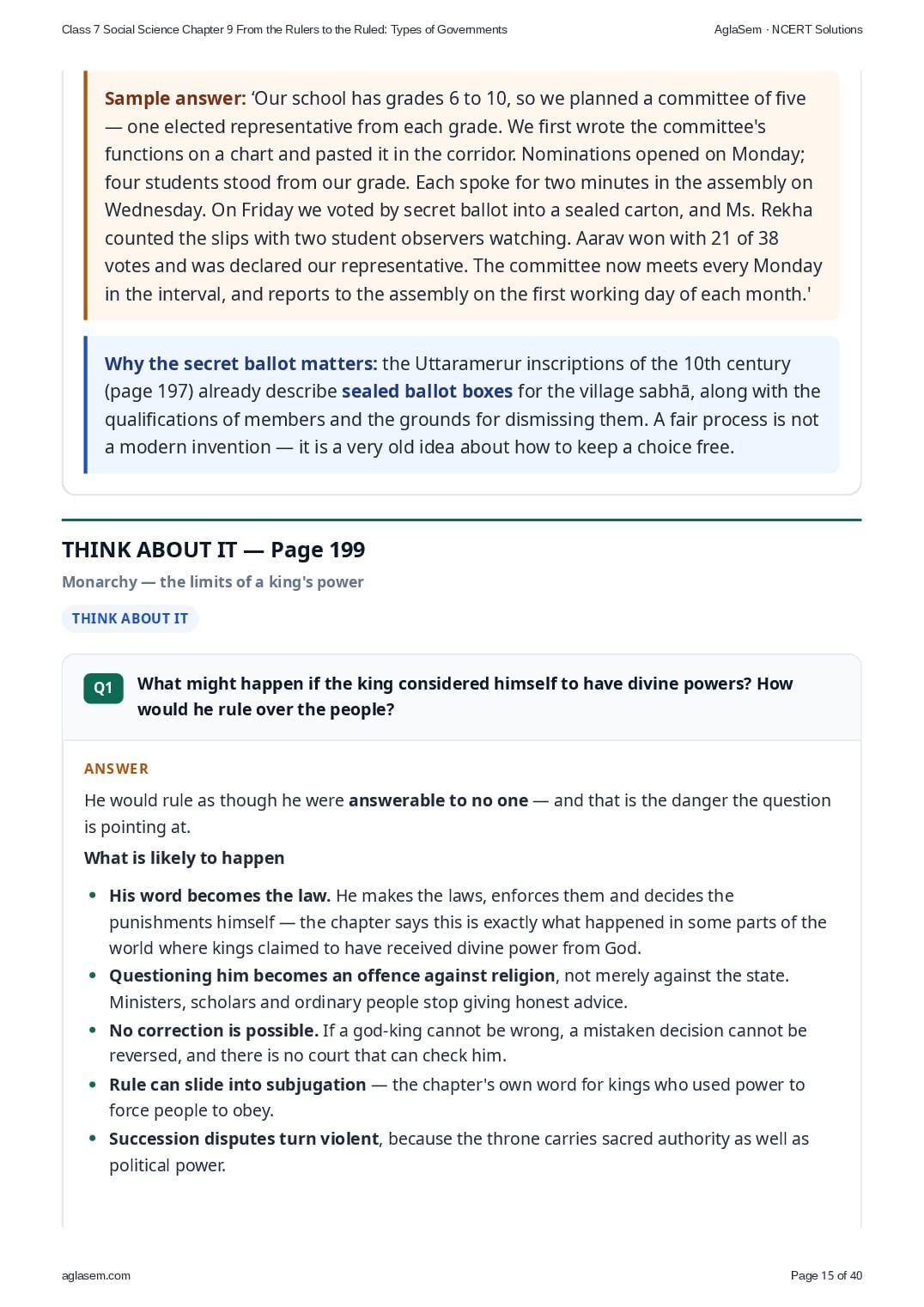
- You have to form a Student Committee in your school. Make a plan and execute it in a democratic manner, ensuring that: Functions of the committee are well defined; The election process of the committee members is democratic
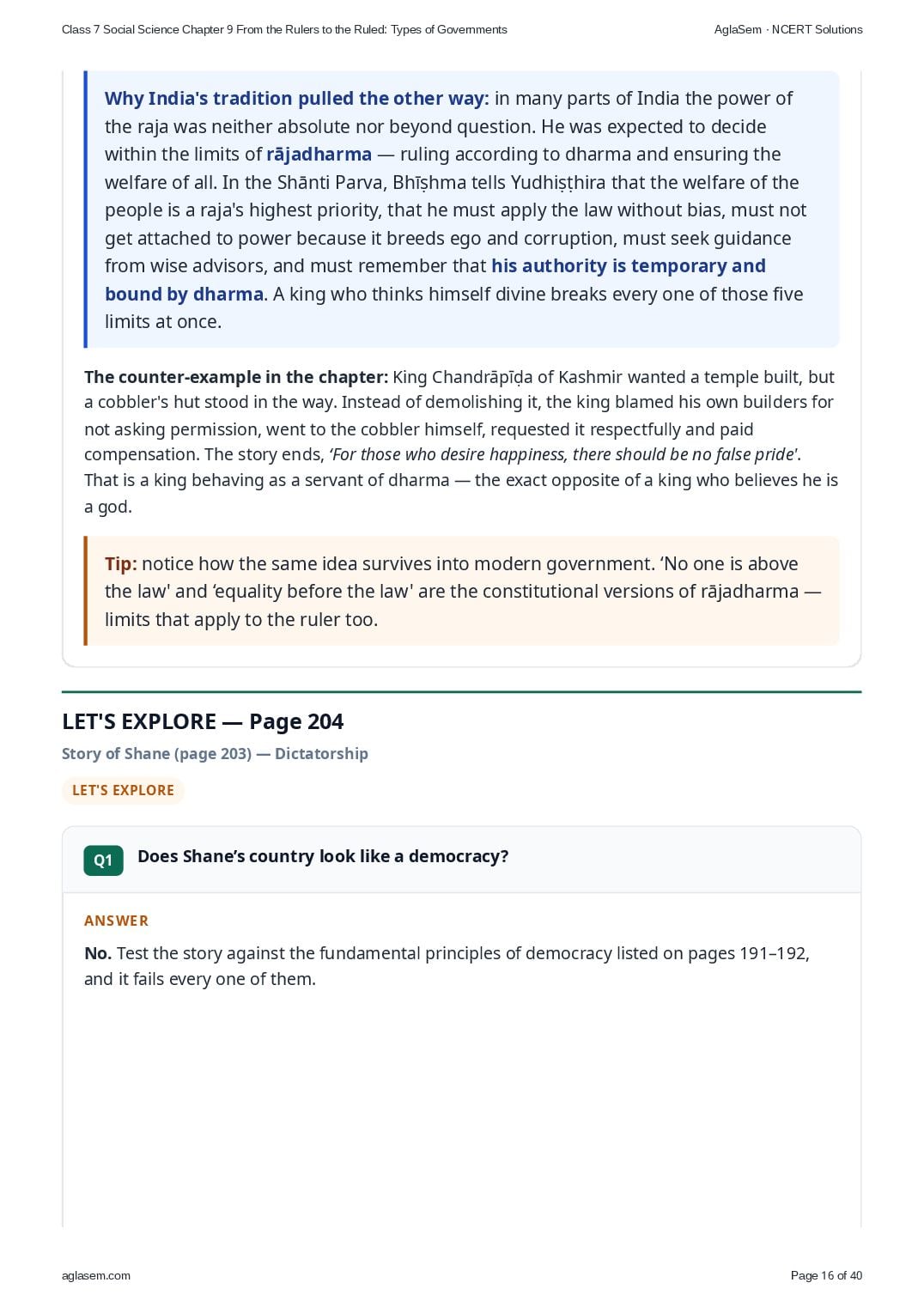
- What might happen if the king considered himself to have divine powers? How would he rule over the people?
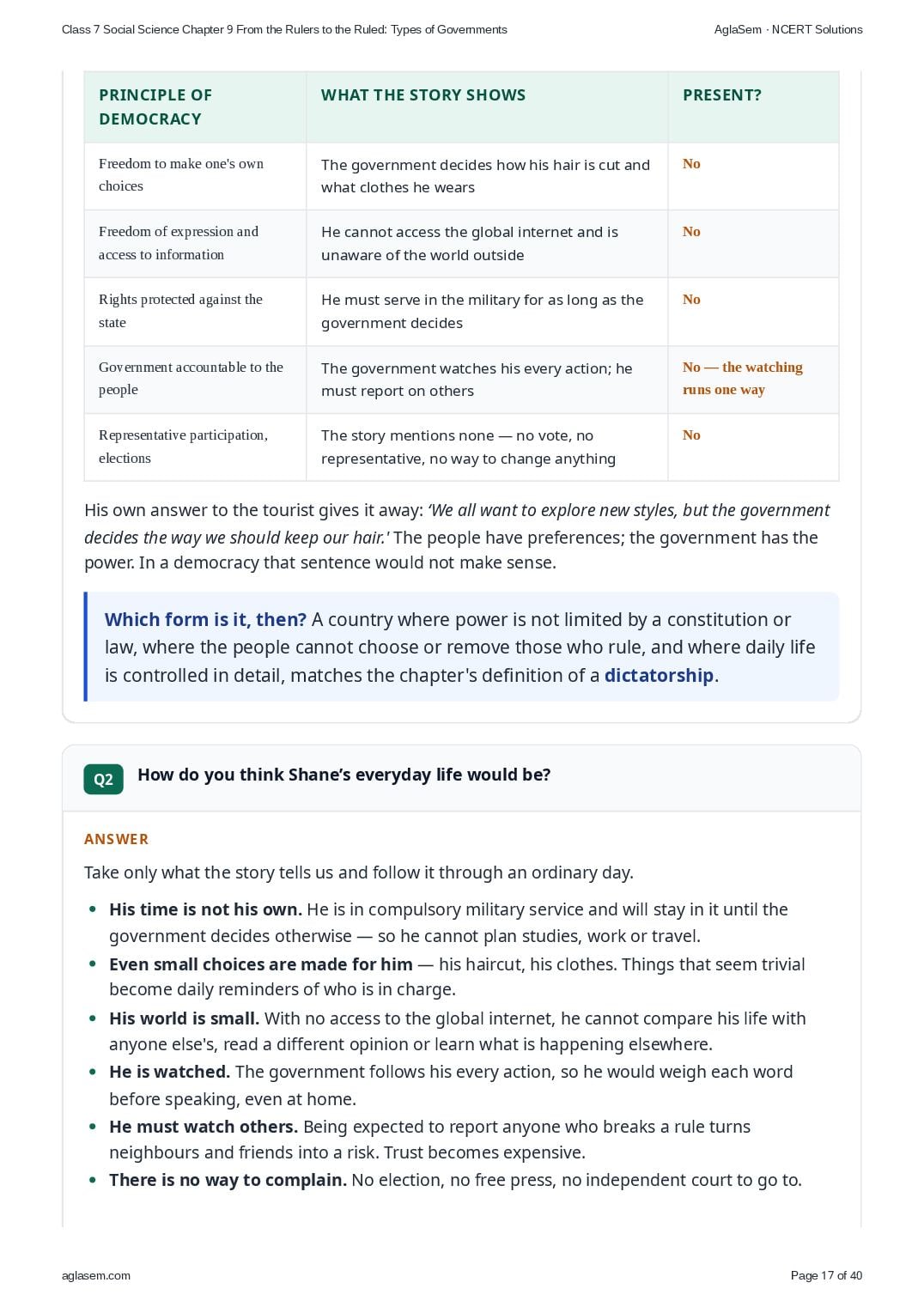
- Does Shane’s country look like a democracy?
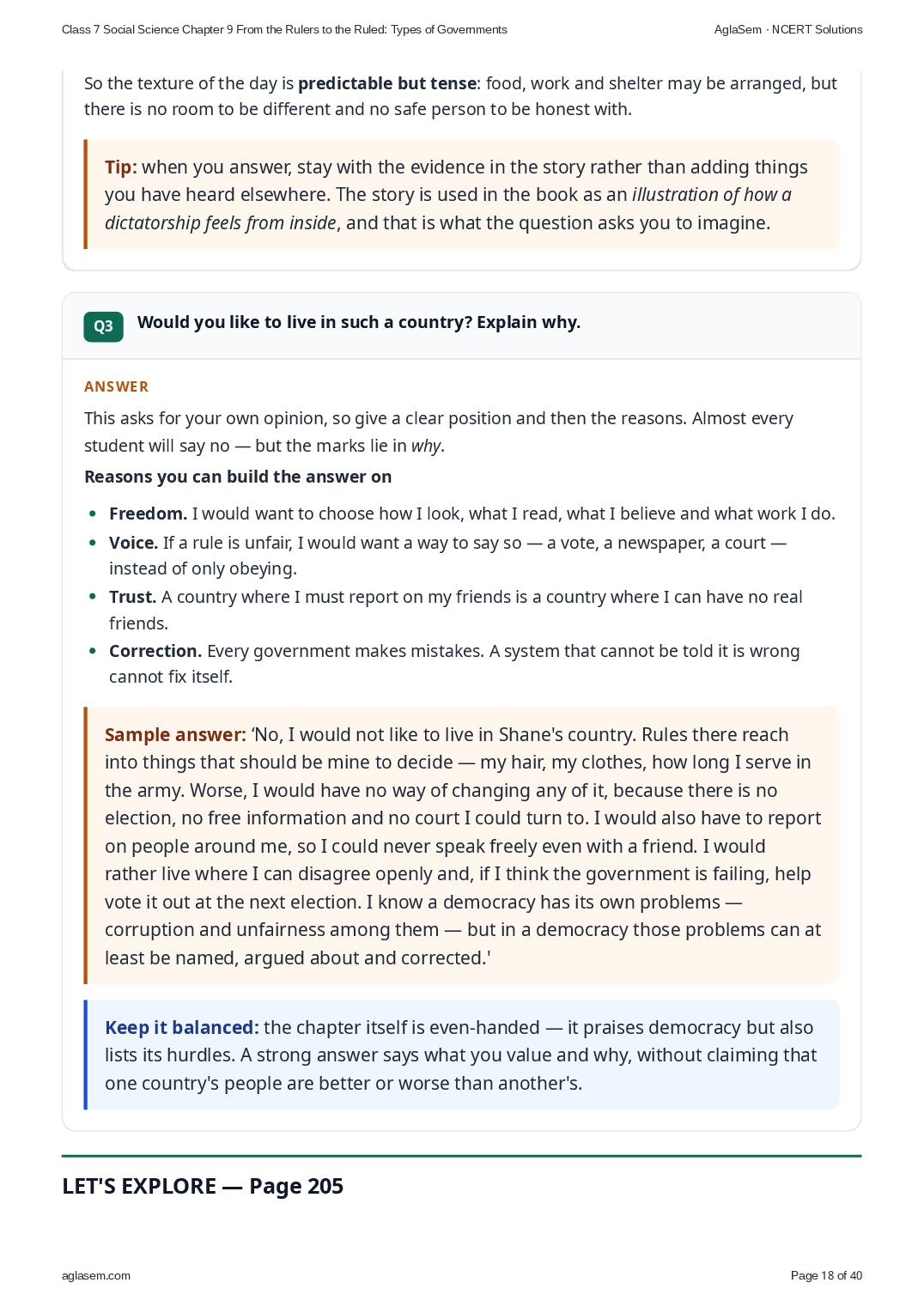
- How do you think Shane’s everyday life would be?
- Would you like to live in such a country? Explain why.
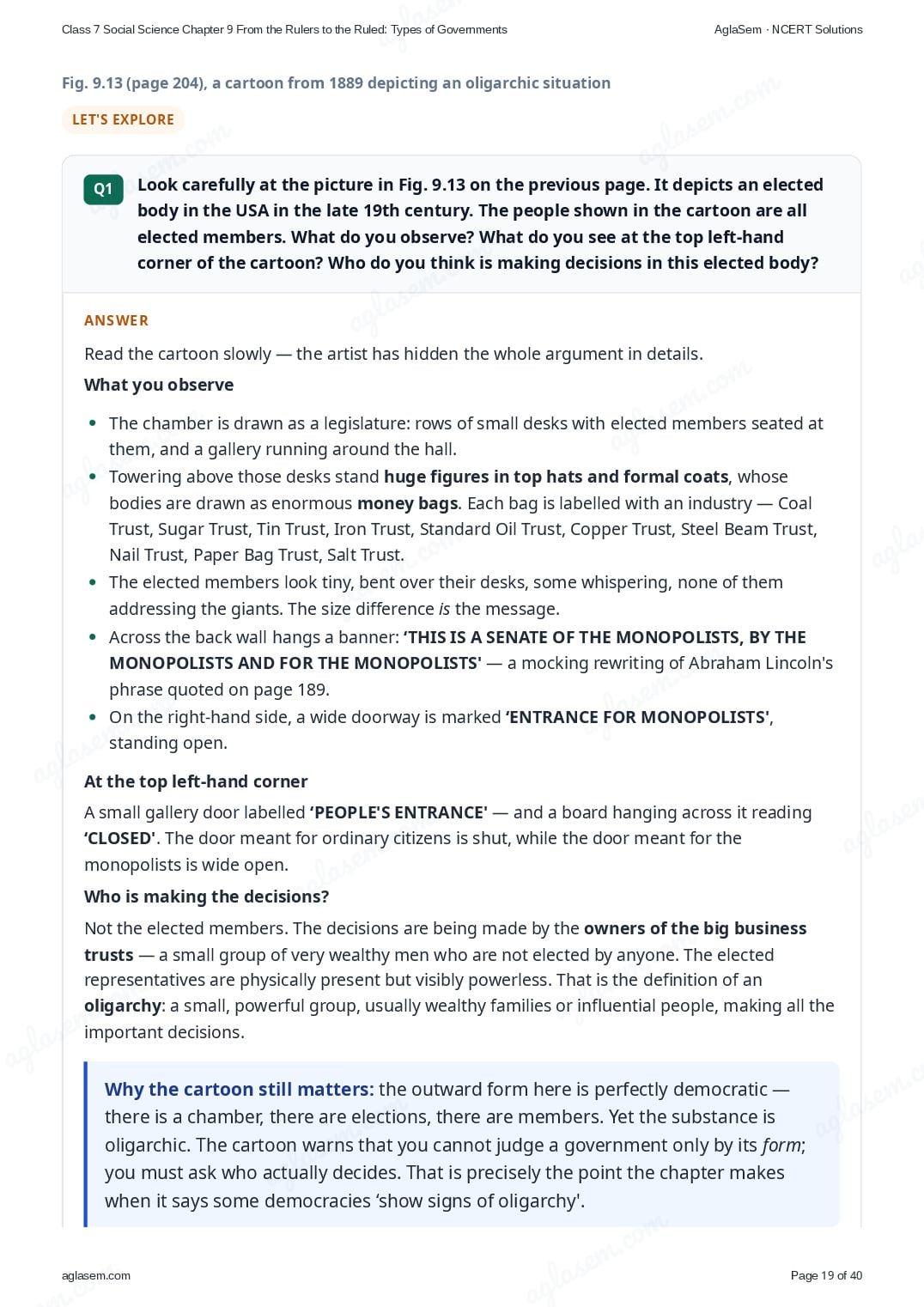
- Look carefully at the picture in Fig. 9.13 on the previous page. It depicts an elected body in the USA in the late 19th century. The people shown in the cartoon are all elected members. What do you observe? What do you see at the top left-hand corner of the cartoon? Who do you think is making decisions in this elected body?
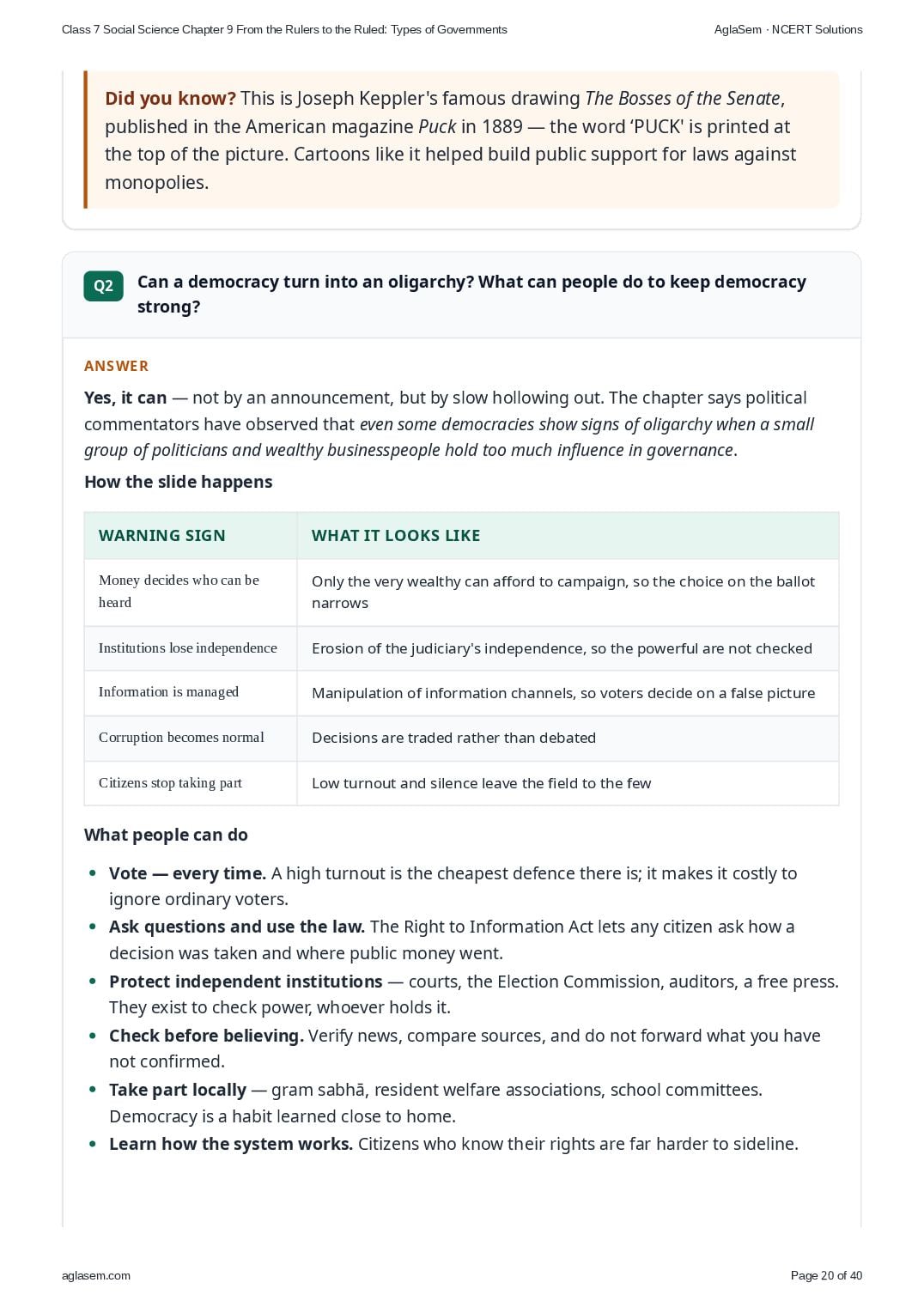
- Can a democracy turn into an oligarchy? What can people do to keep democracy strong?
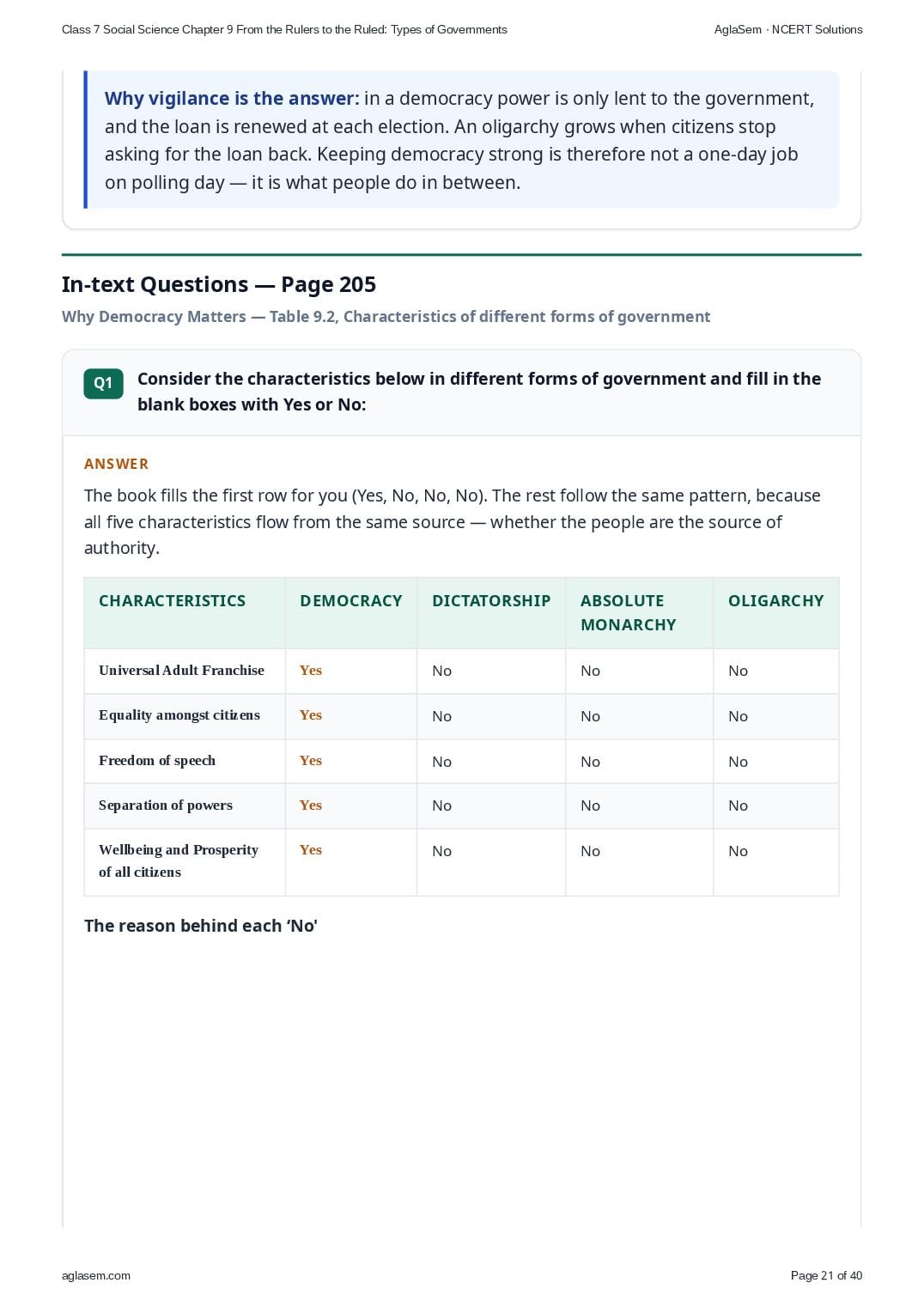
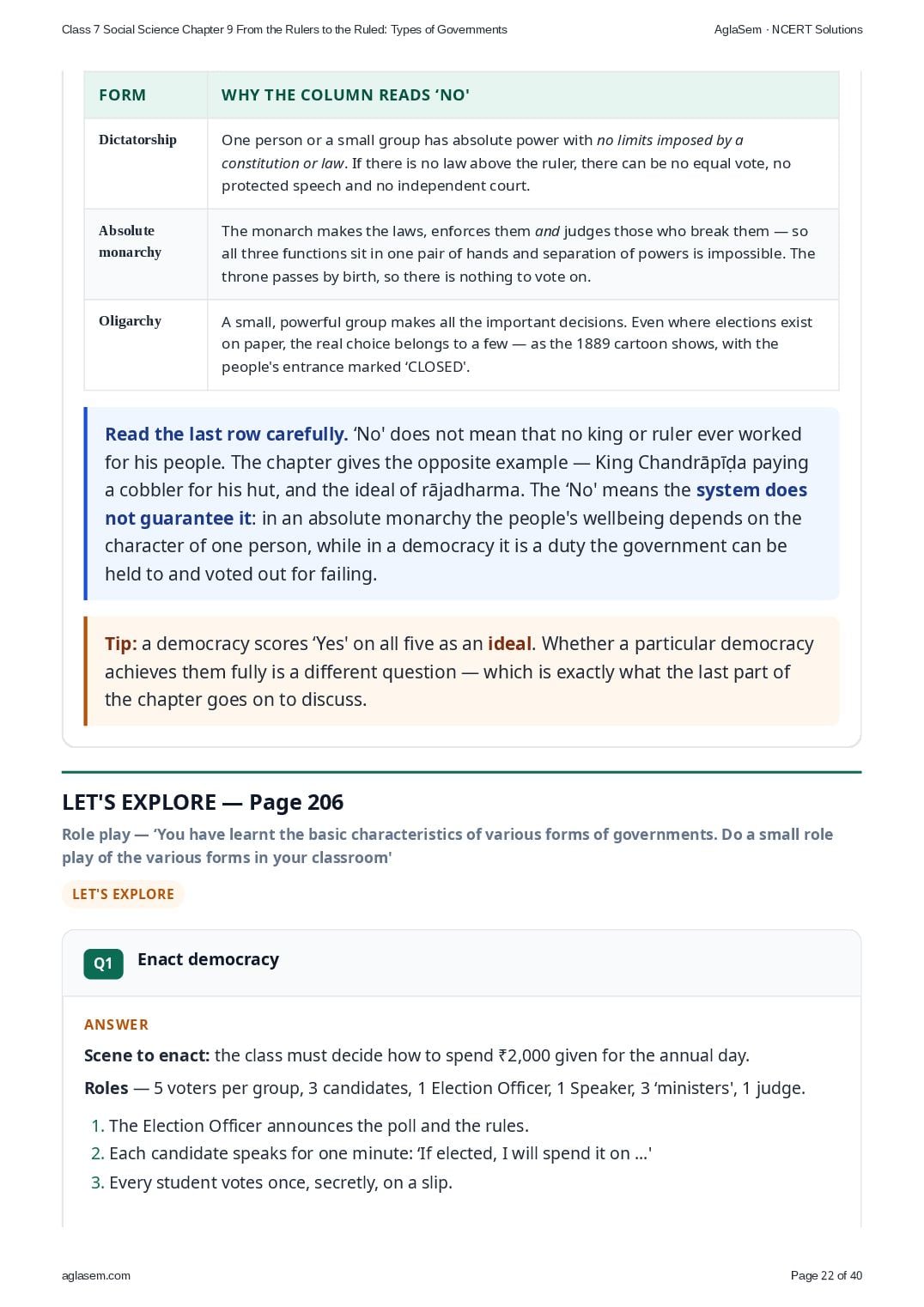
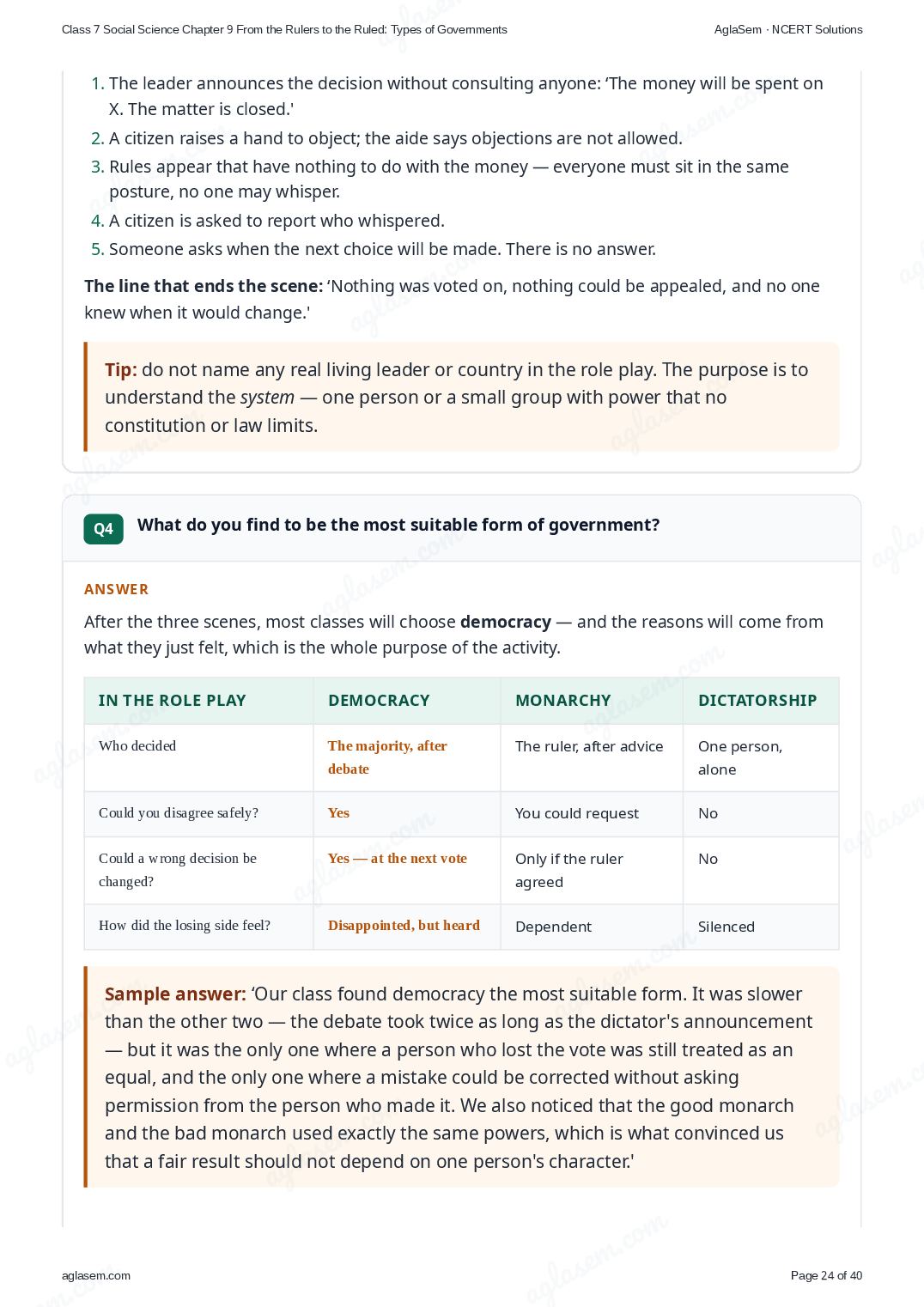
- Consider the characteristics below in different forms of government and fill in the blank boxes with Yes or No:
- Enact democracy
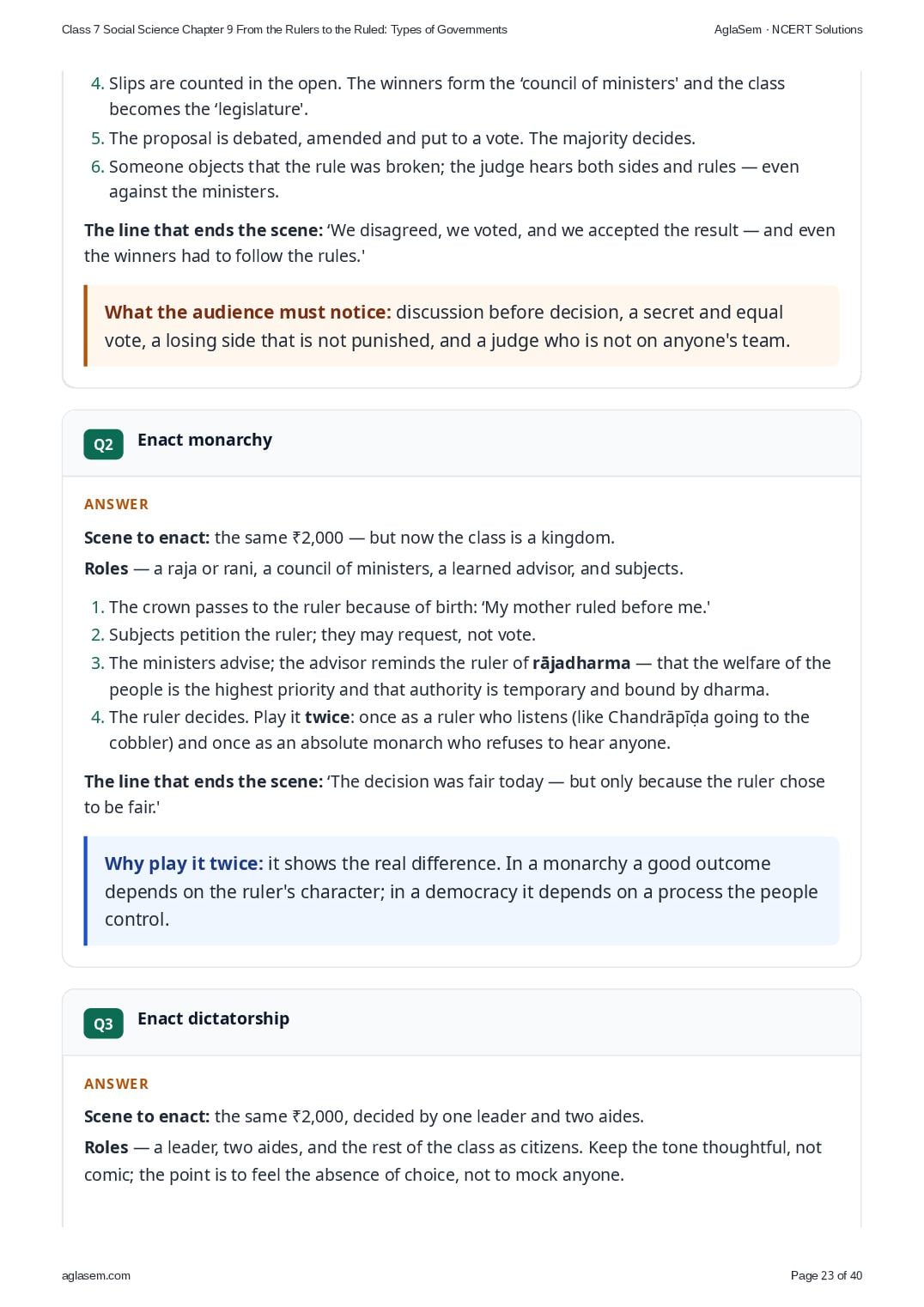
- Enact monarchy
- Enact dictatorship
- What do you find to be the most suitable form of government?
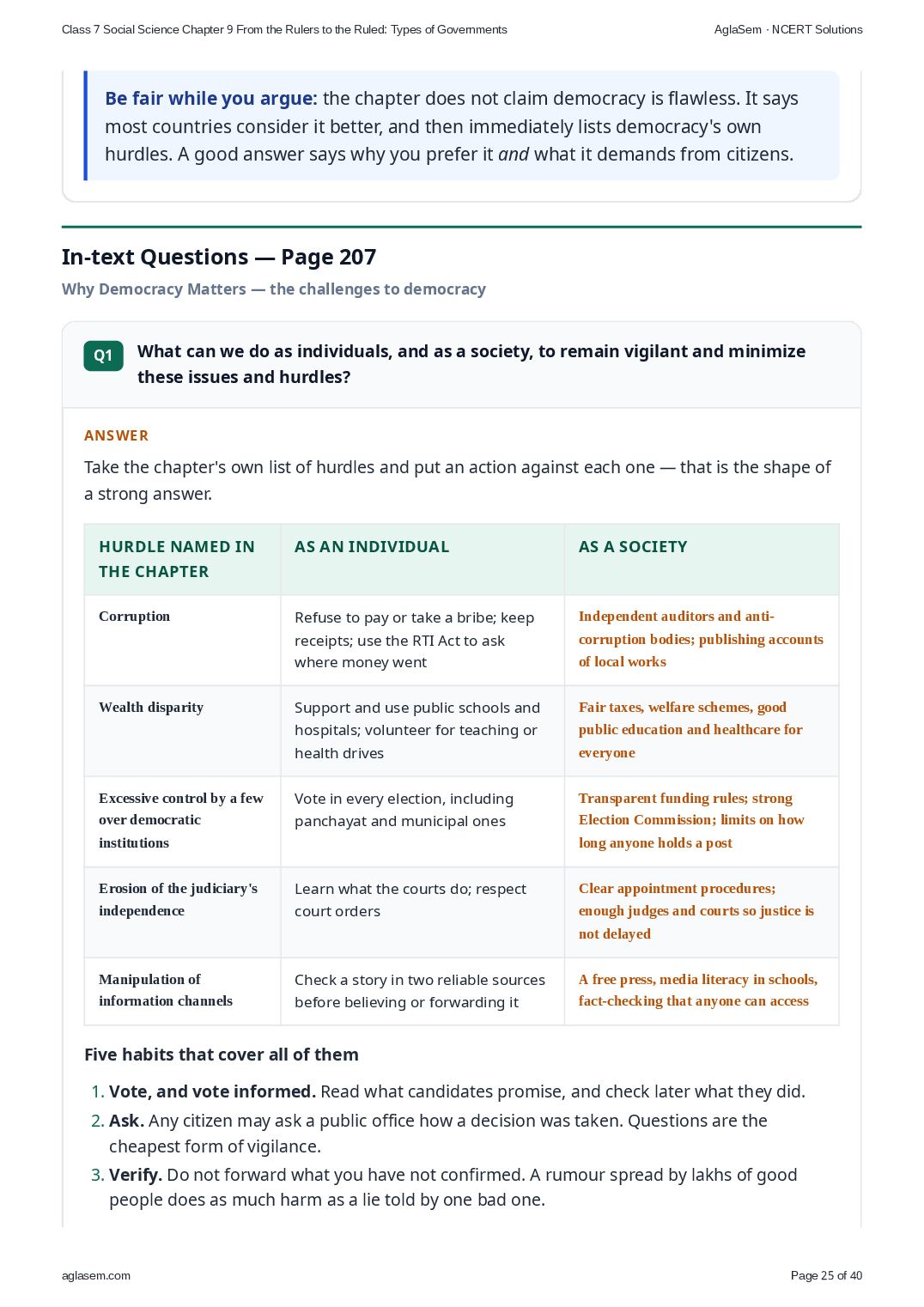
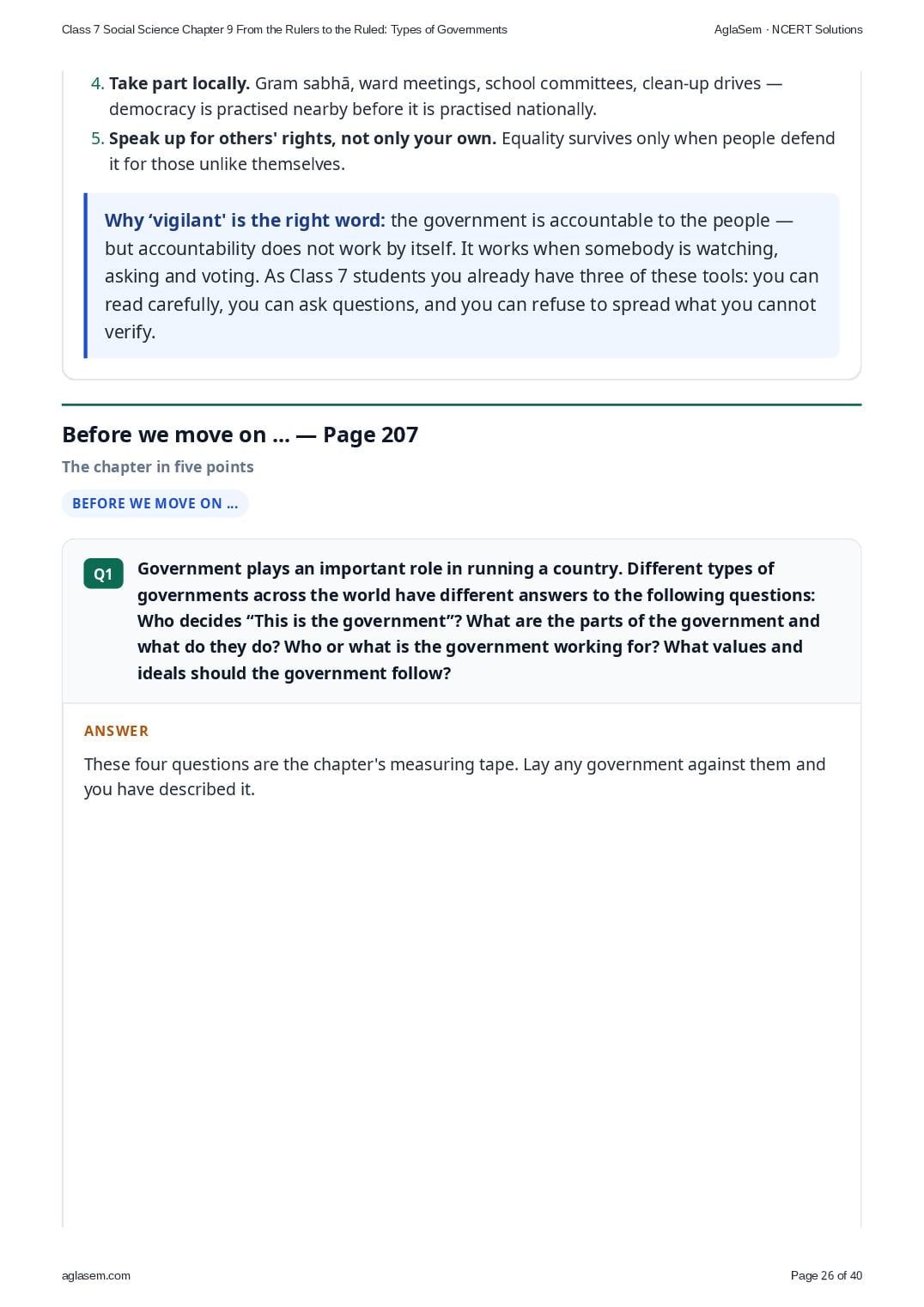
- What can we do as individuals, and as a society, to remain vigilant and minimize these issues and hurdles?
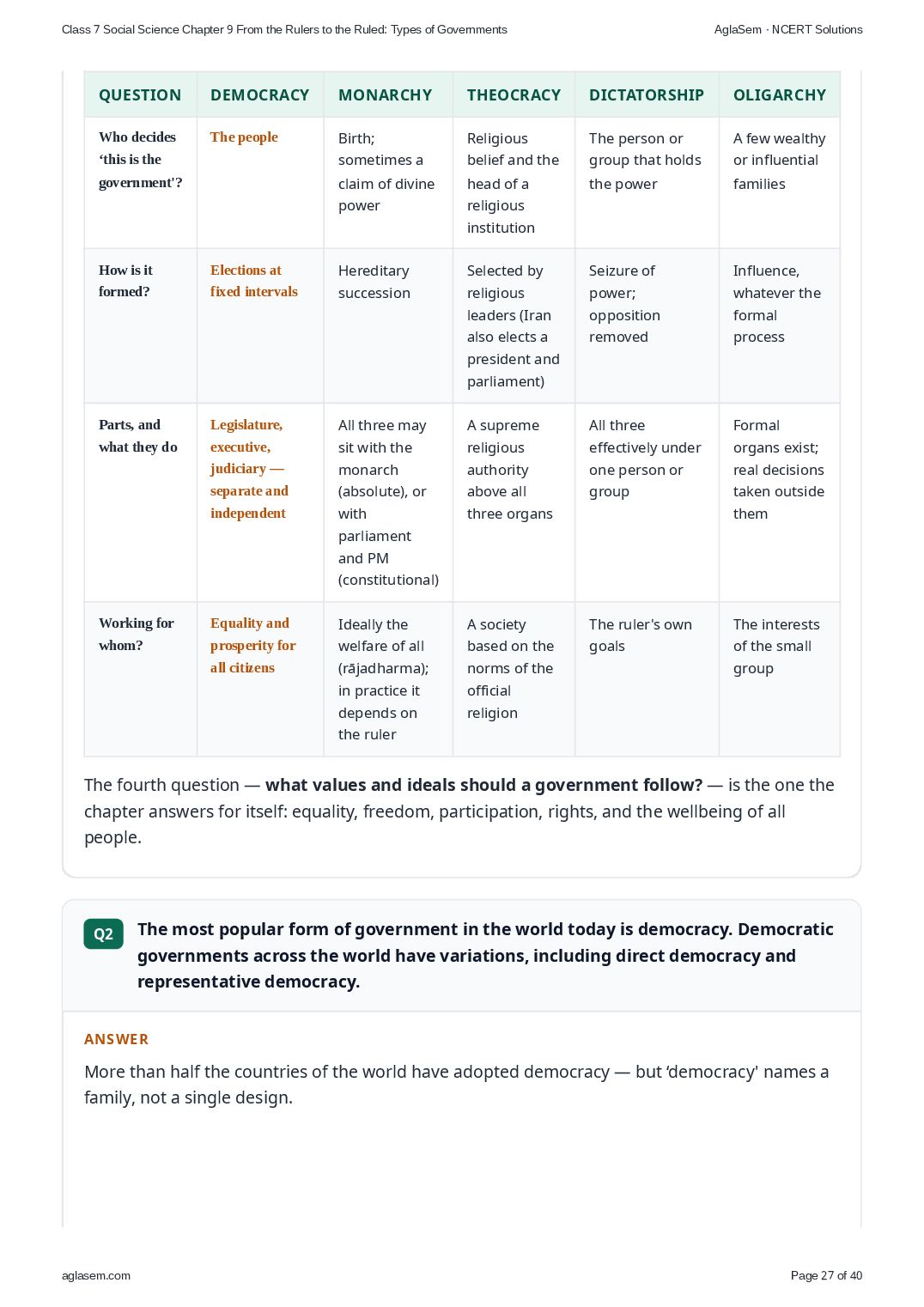
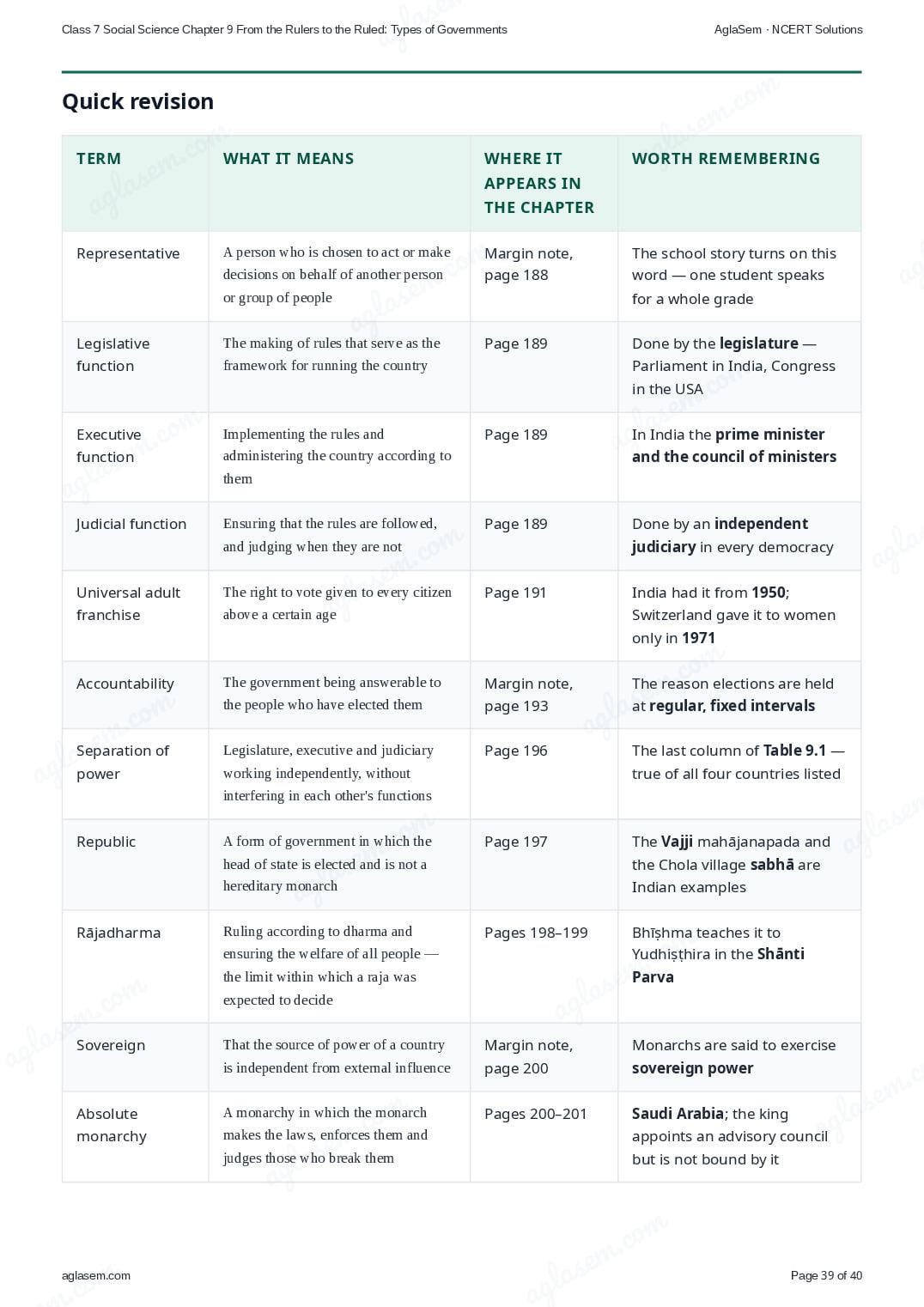
- Government plays an important role in running a country. Different types of governments across the world have different answers to the following questions: Who decides “This is the government”? What are the parts of the government and what do they do? Who or what is the government working for? What values and ideals should the government follow?
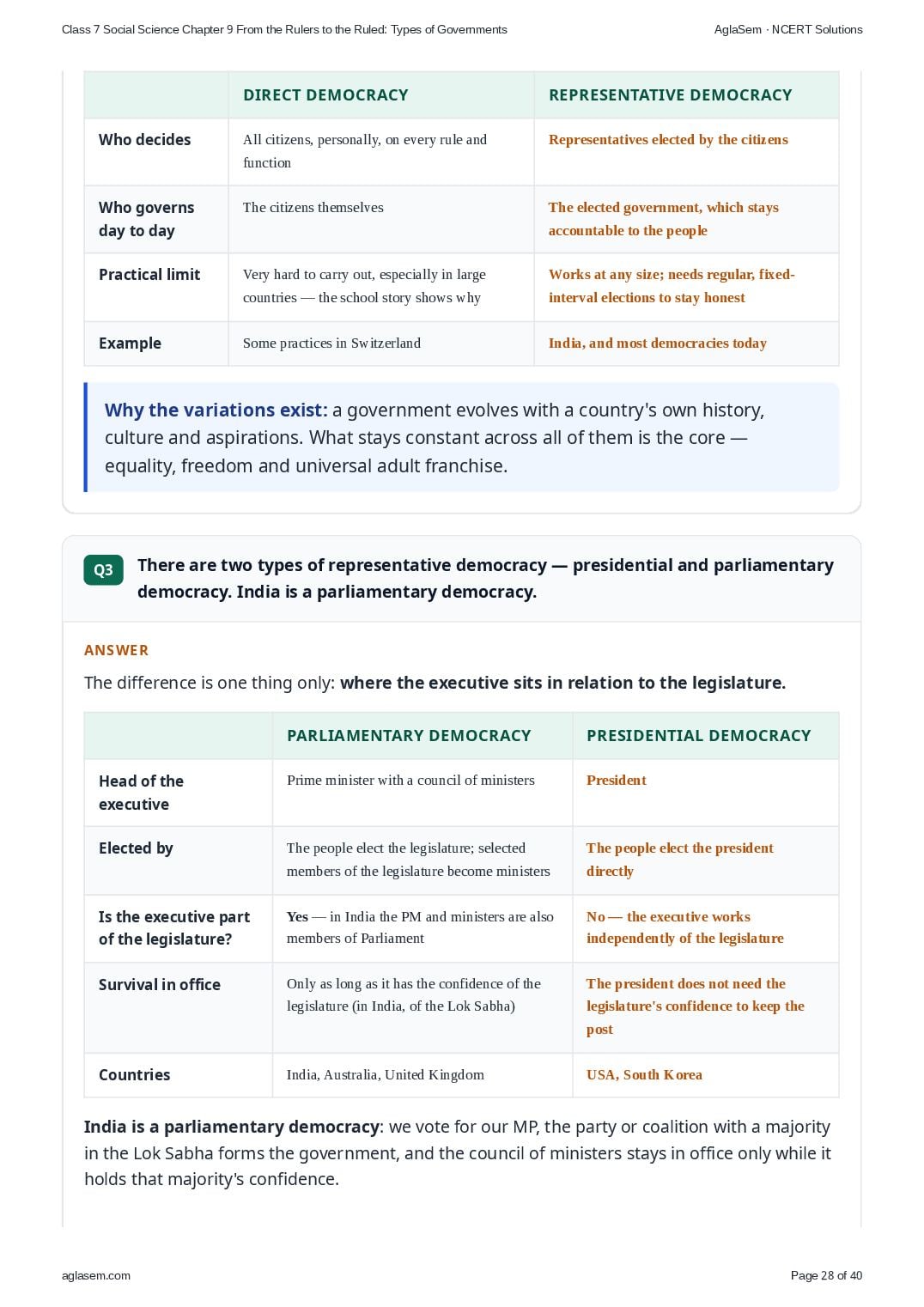
- The most popular form of government in the world today is democracy. Democratic governments across the world have variations, including direct democracy and representative democracy.
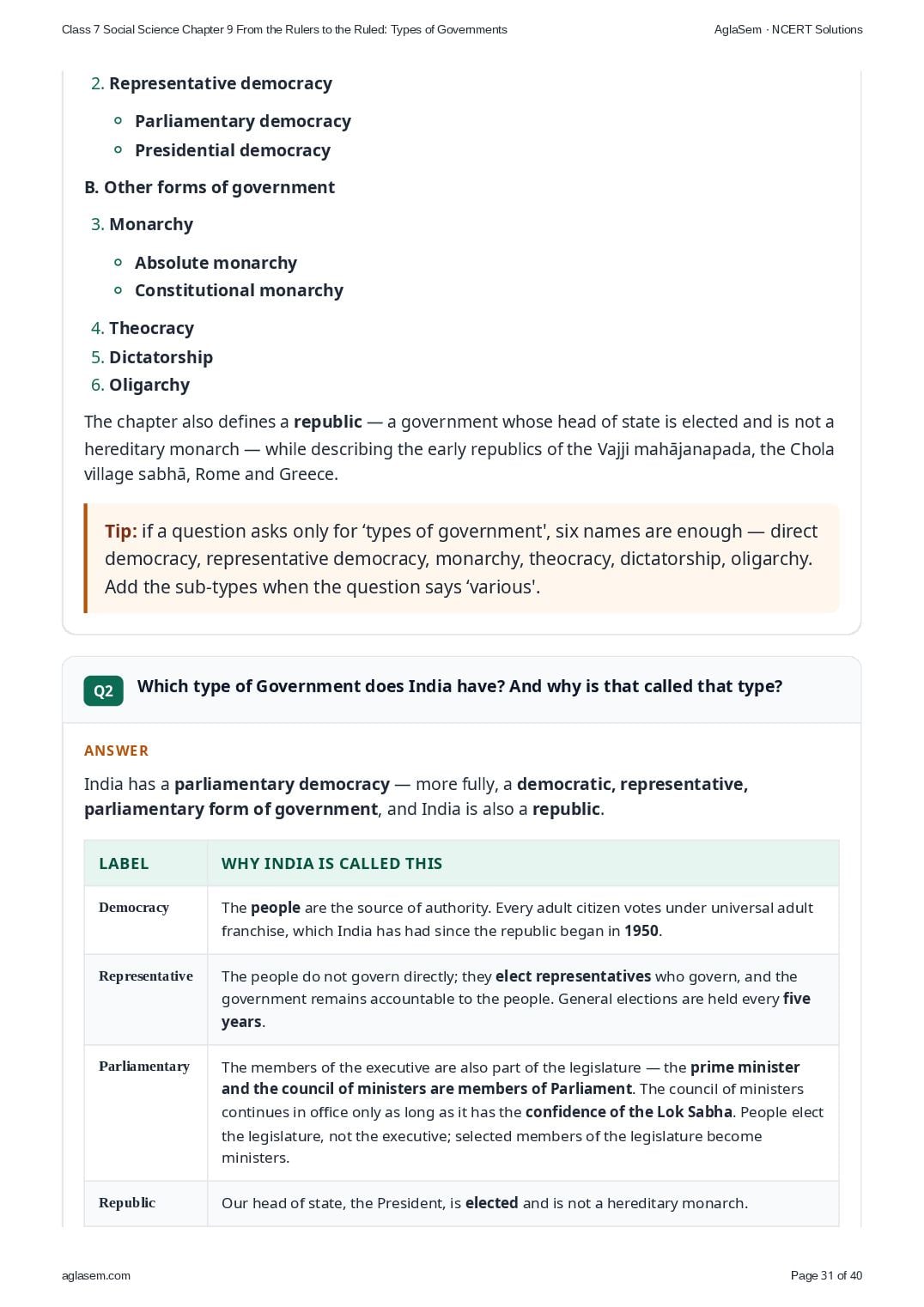
- There are two types of representative democracy — presidential and parliamentary democracy. India is a parliamentary democracy.
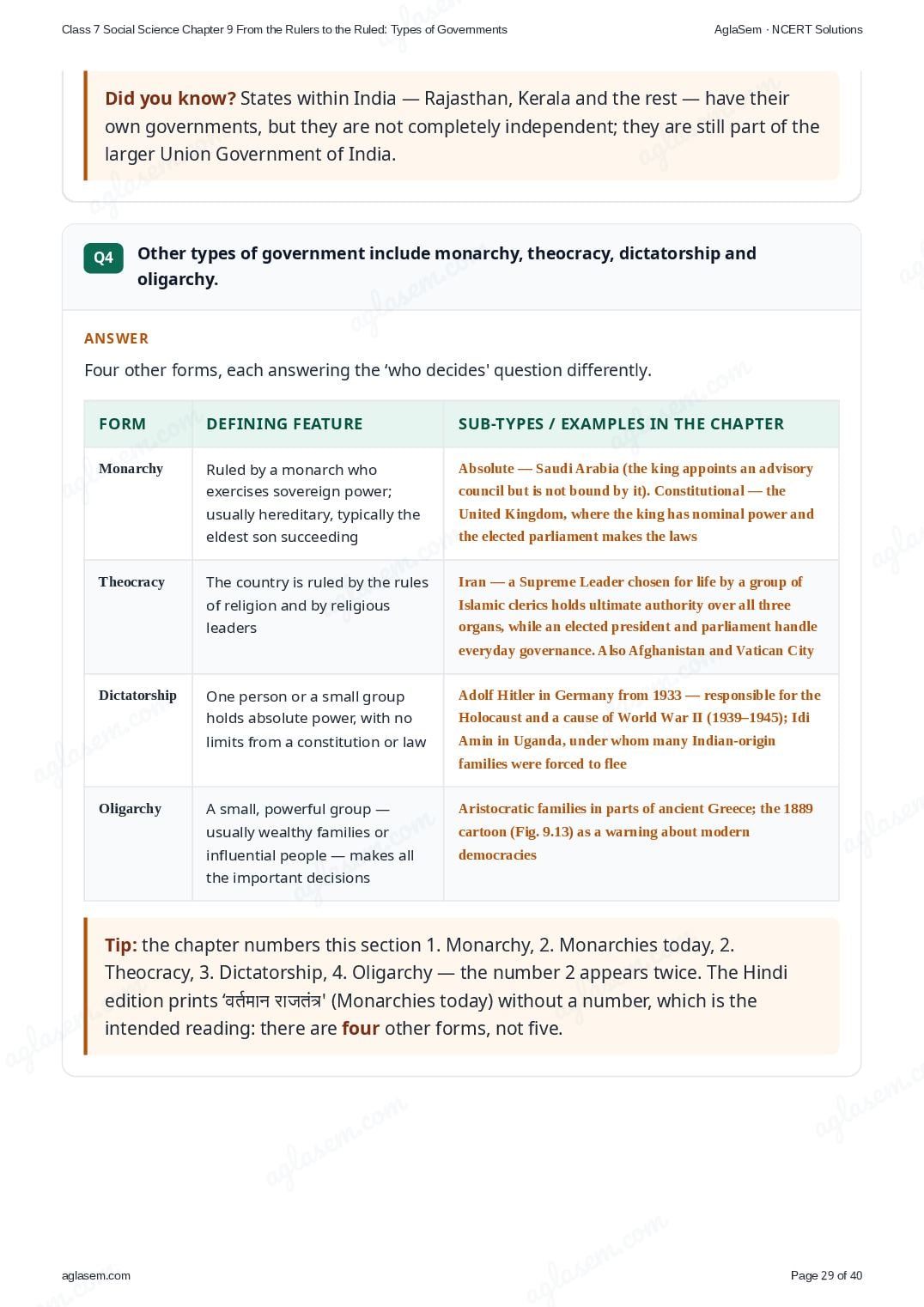
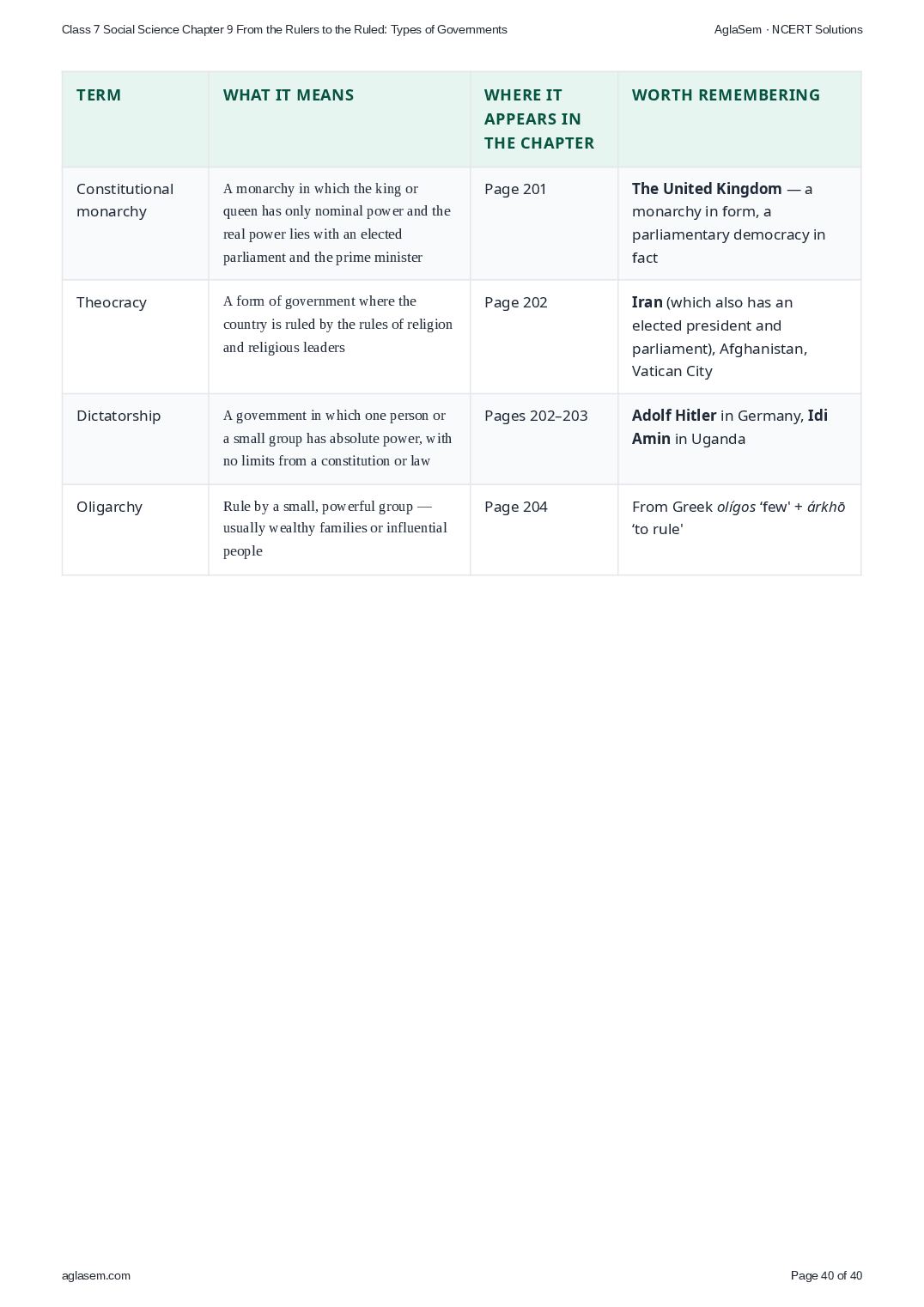
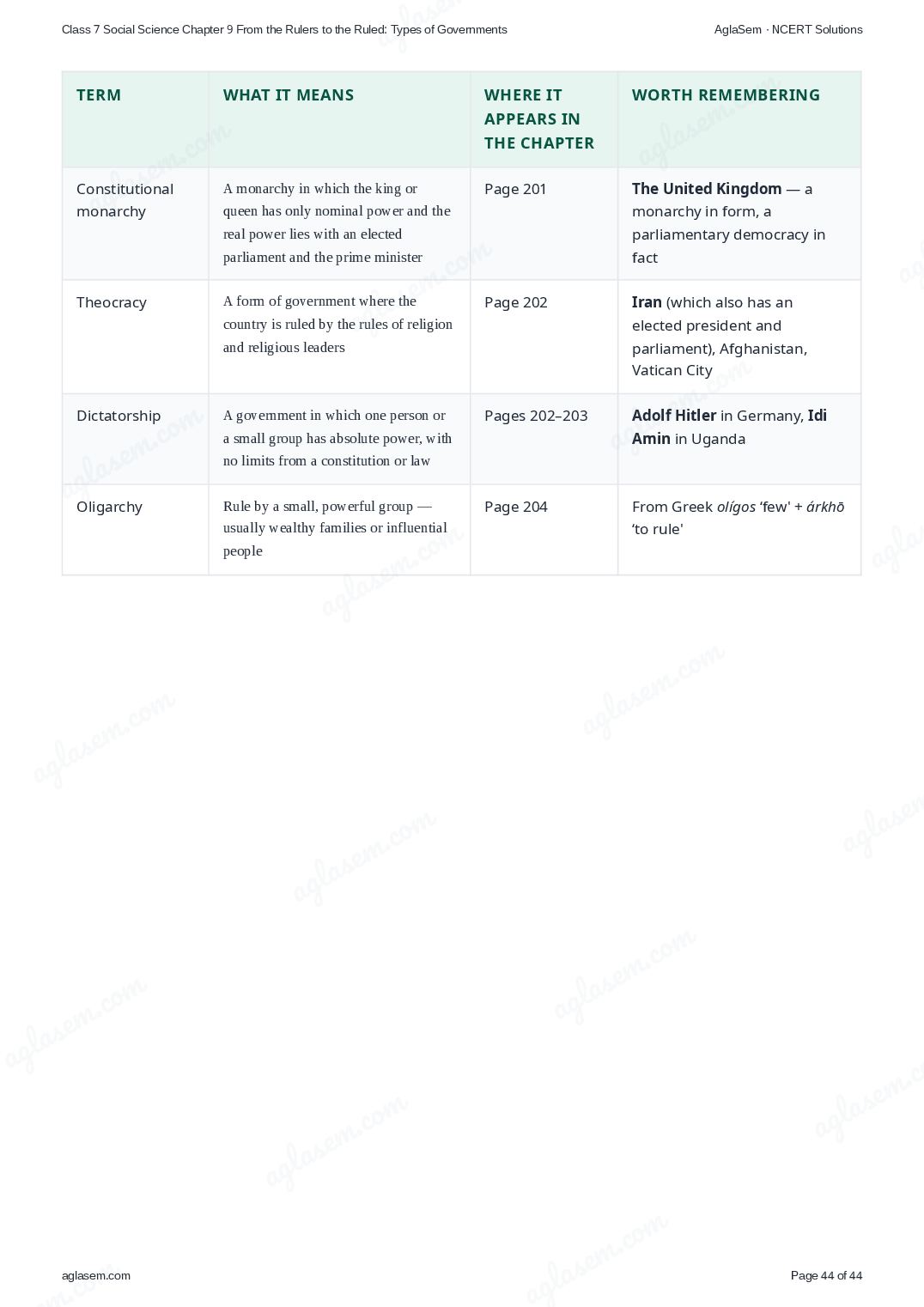
- Other types of government include monarchy, theocracy, dictatorship and oligarchy.
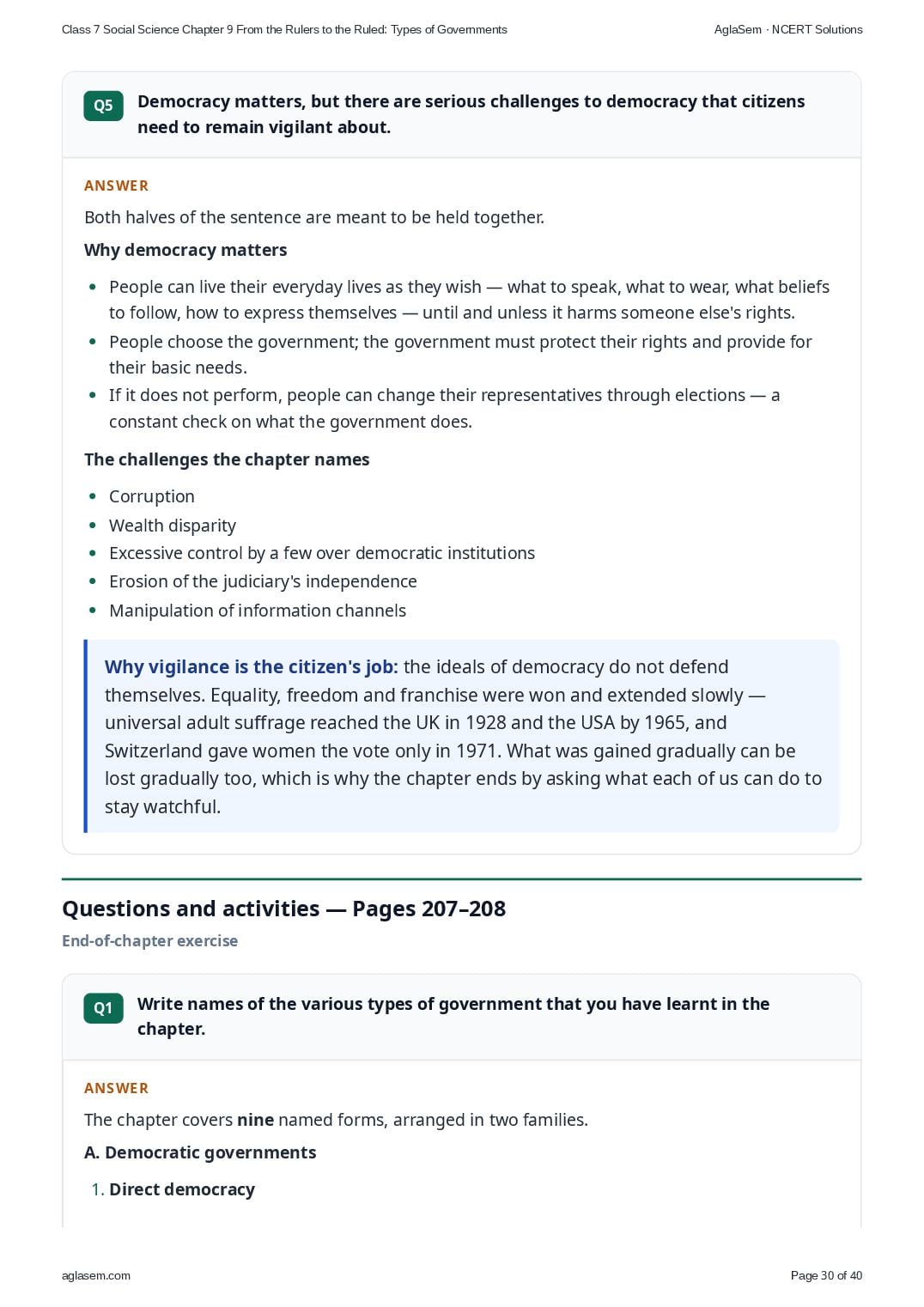
- Democracy matters, but there are serious challenges to democracy that citizens need to remain vigilant about.
- Write names of the various types of government that you have learnt in the chapter.
- Which type of Government does India have? And why is that called that type?
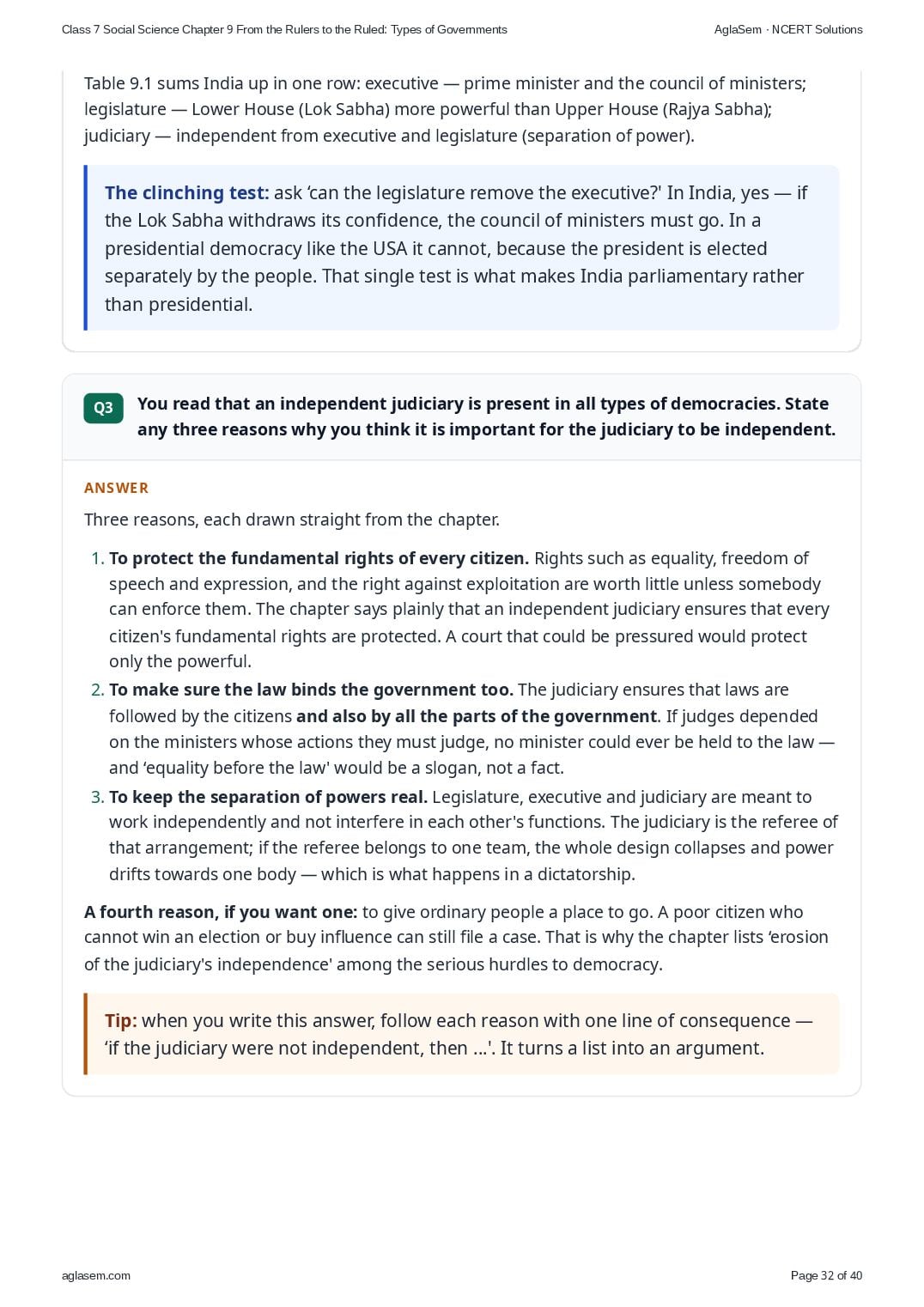
- You read that an independent judiciary is present in all types of democracies. State any three reasons why you think it is important for the judiciary to be independent.
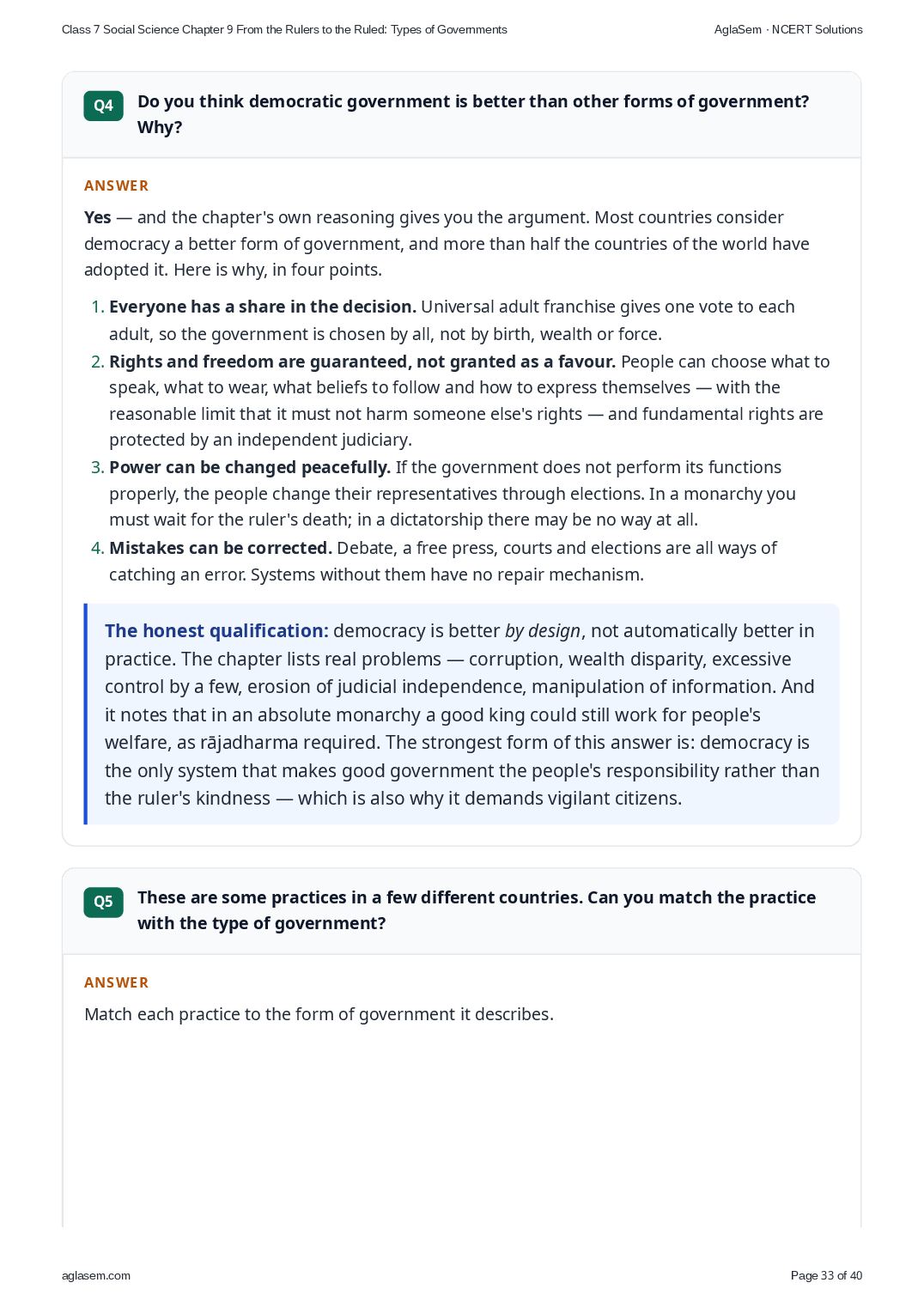
- Do you think democratic government is better than other forms of government? Why?
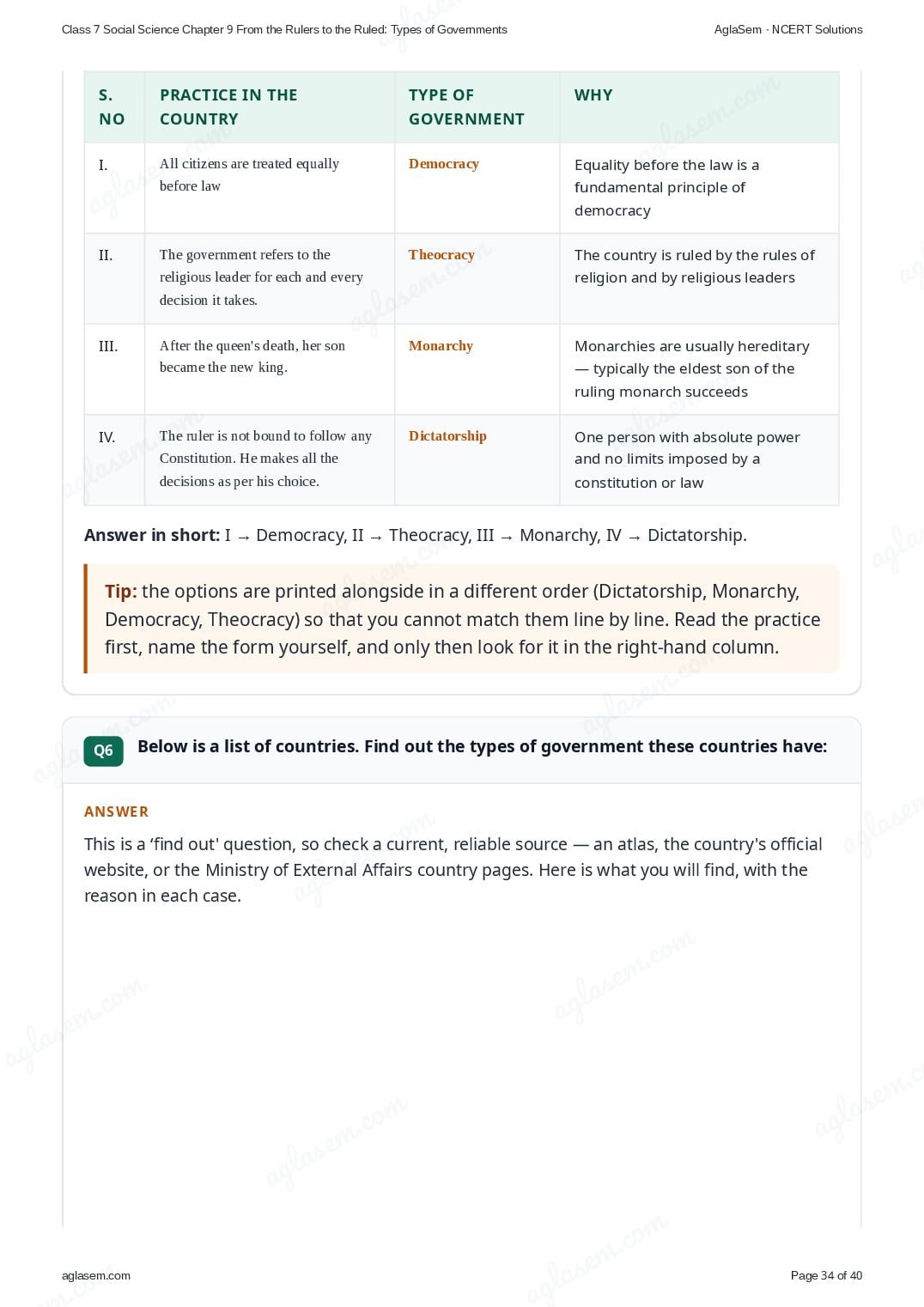
- These are some practices in a few different countries. Can you match the practice with the type of government?
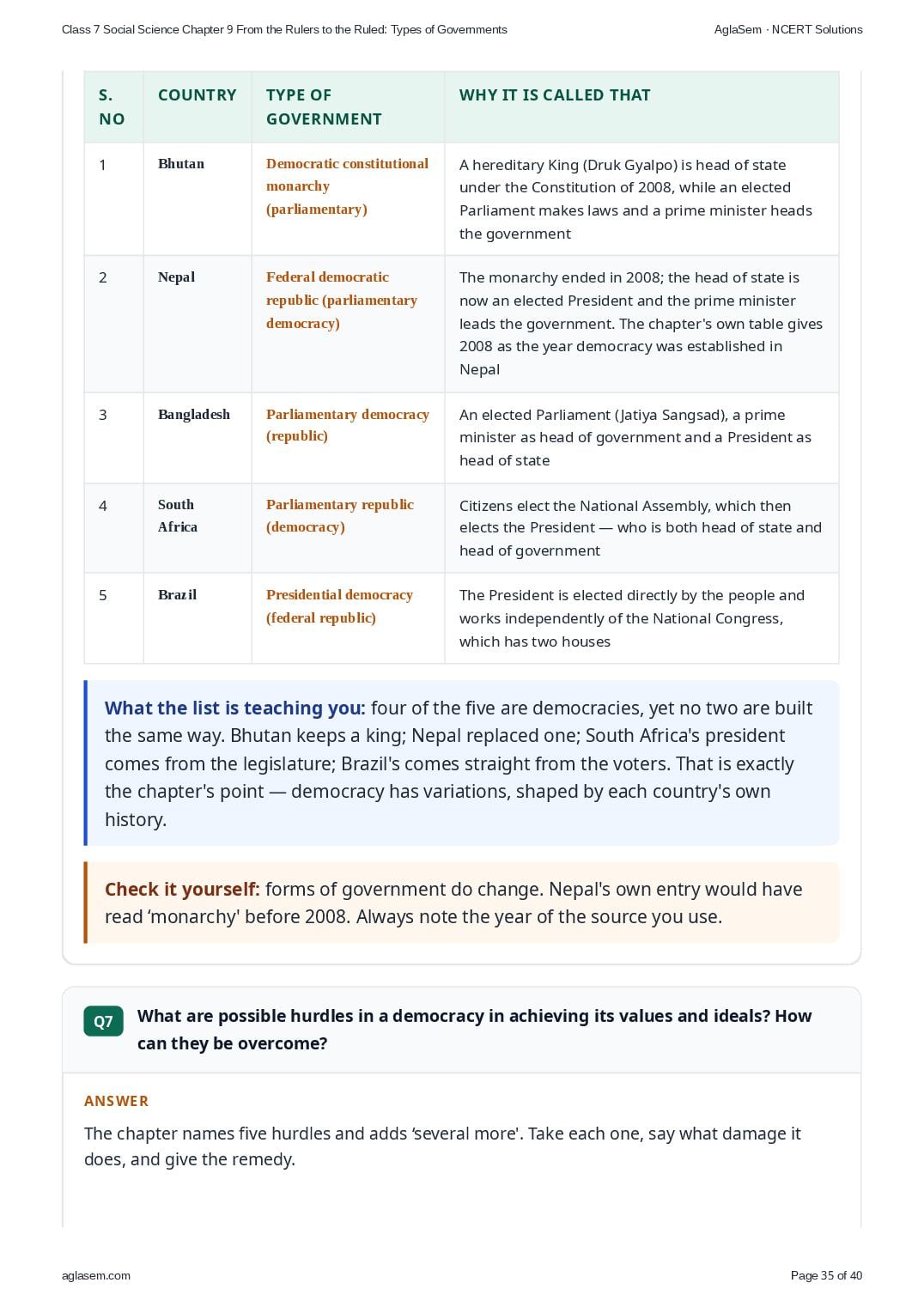
- Below is a list of countries. Find out the types of government these countries have:
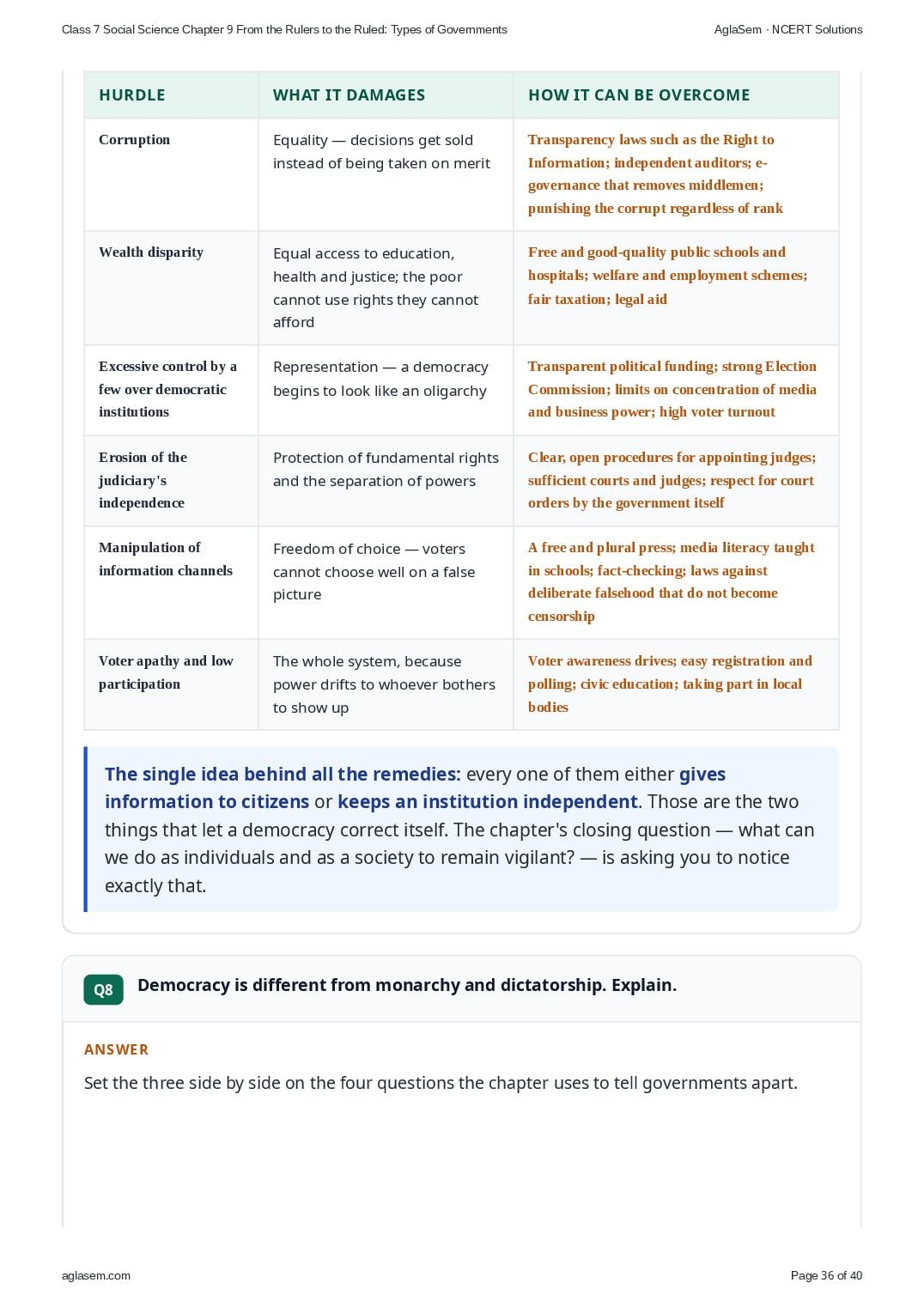
- What are possible hurdles in a democracy in achieving its values and ideals? How can they be overcome?
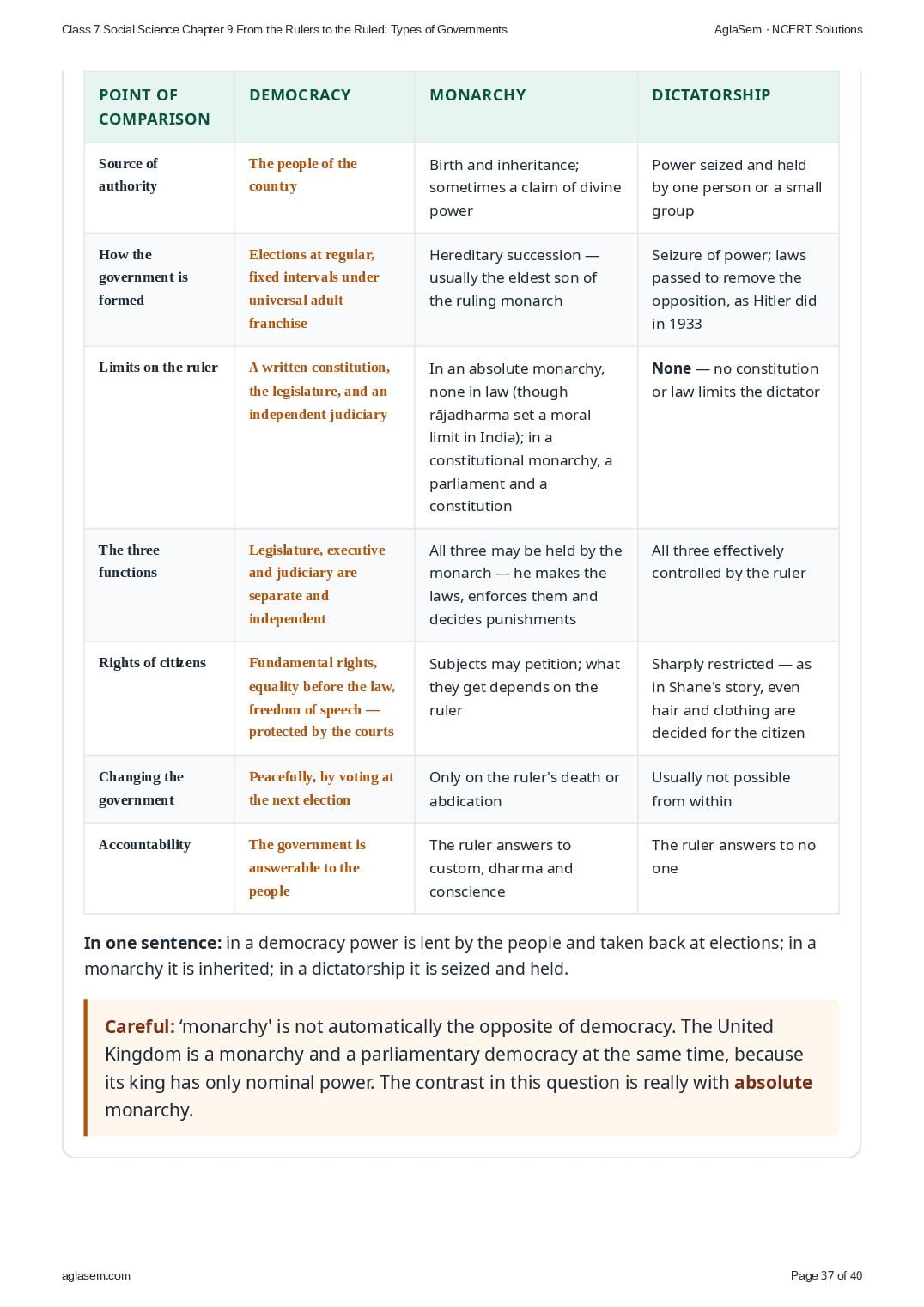
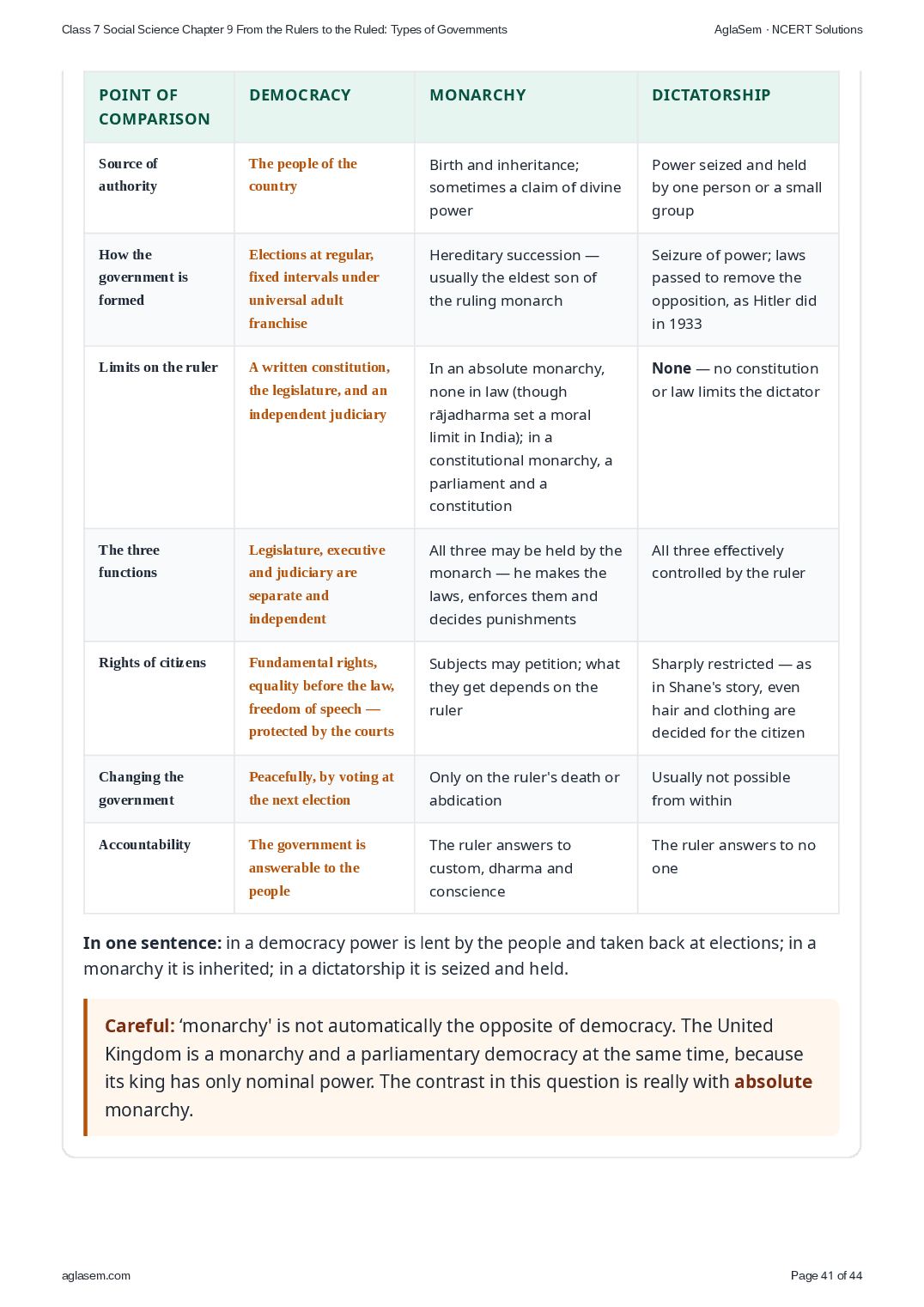
- Democracy is different from monarchy and dictatorship. Explain.
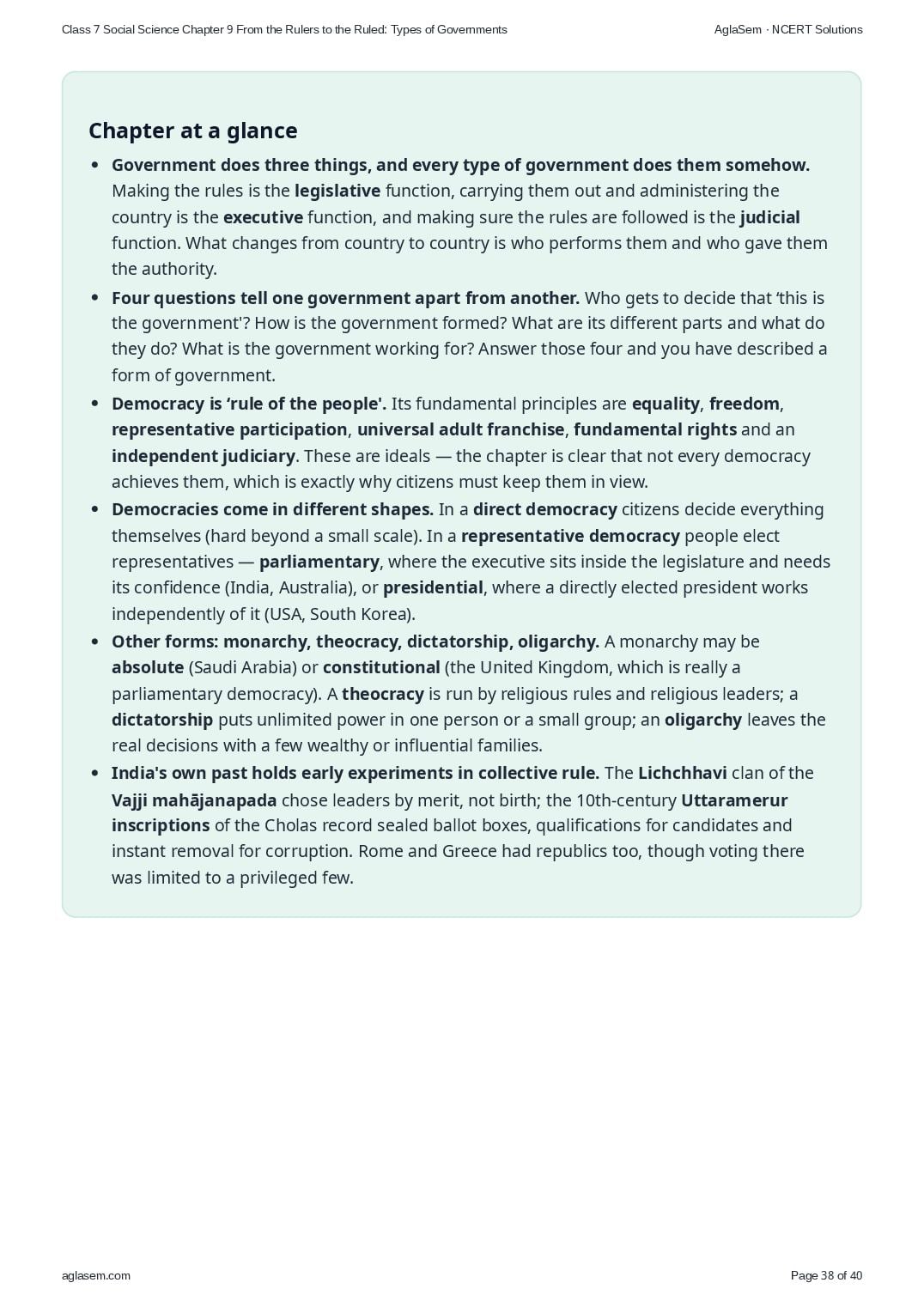
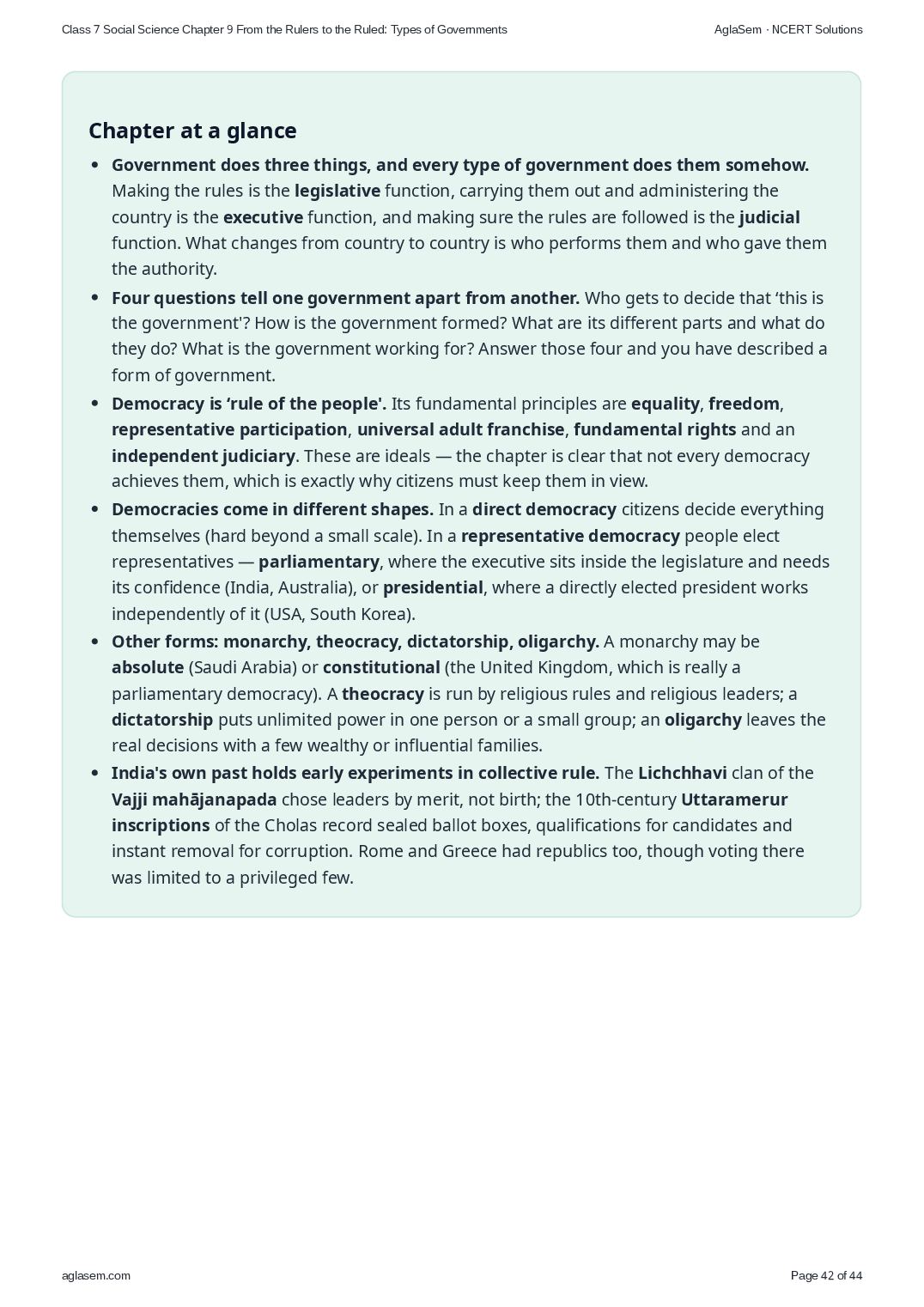
Chapter at a Glance
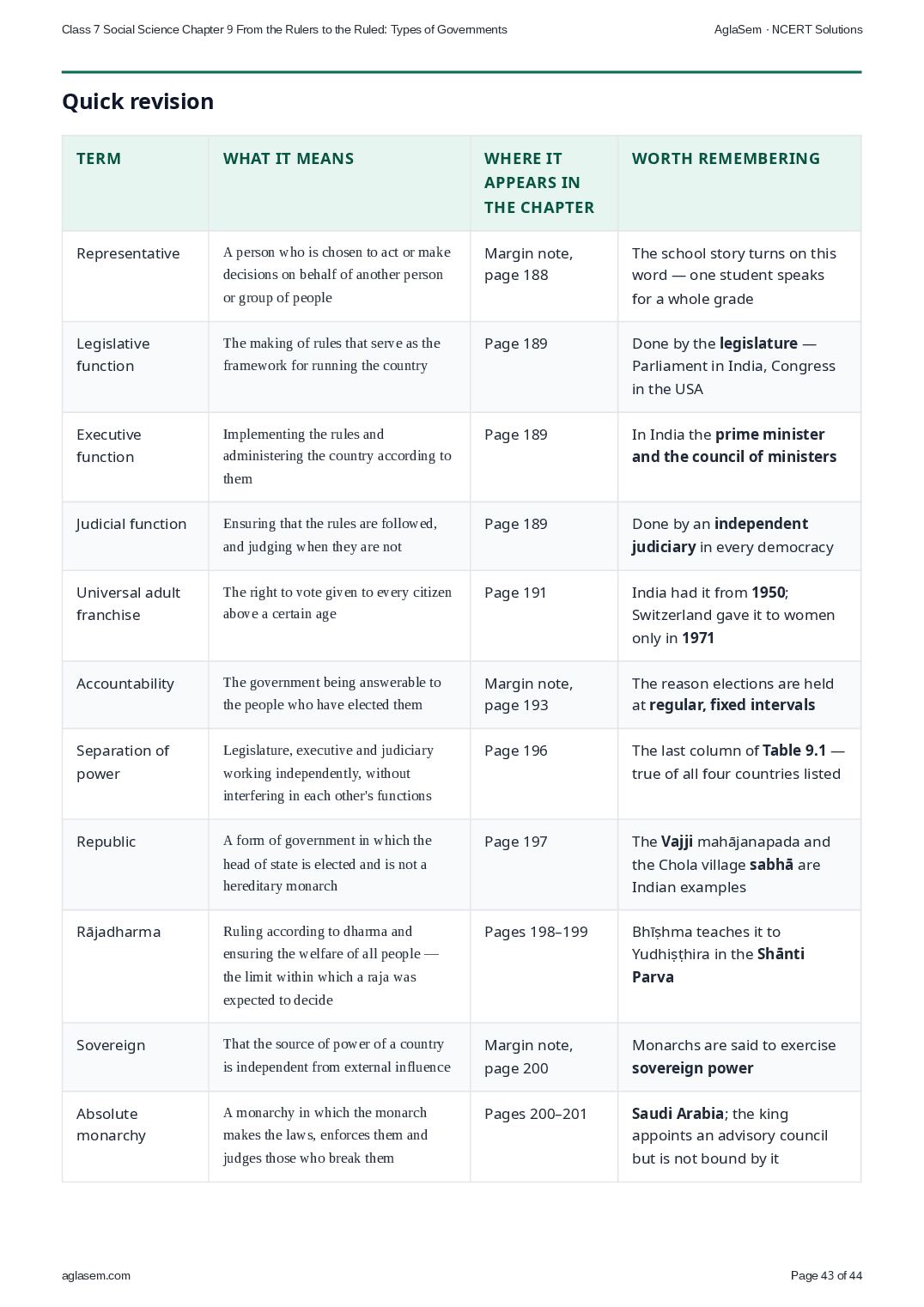
- Government does three things, and every type of government does them somehow. Making the rules is the legislative function, carrying them out and administering the country is the executive function, and making sure the rules are followed is the judicial function. What changes from country to country is who performs them and who gave them the authority .
- Four questions tell one government apart from another. Who gets to decide that ‘this is the government'? How is the government formed? What are its different parts and what do they do? What is the government working for? Answer those four and you have described a form of government.
- Democracy is ‘rule of the people'. Its fundamental principles are equality , freedom , representative participation , universal adult franchise , fundamental rights and an independent judiciary . These are ideals — the chapter is clear that not every democracy achieves them, which is exactly why citizens must keep them in view.
- Democracies come in different shapes. In a direct democracy citizens decide everything themselves (hard beyond a small scale). In a representative democracy people elect representatives — parliamentary , where the executive sits inside the legislature and needs its confidence (India, Australia), or presidential , where a directly elected president works independently of it (USA, South Korea).
- Other forms: monarchy, theocracy, dictatorship, oligarchy. A monarchy may be absolute (Saudi Arabia) or constitutional (the United Kingdom, which is really a parliamentary democracy). A theocracy is run by religious rules and religious leaders; a dictatorship puts unlimited power in one person or a small group; an oligarchy leaves the real decisions with a few wealthy or influential families.
- India's own past holds early experiments in collective rule. The Lichchhavi clan of the Vajji mahājanapada chose leaders by merit, not birth; the 10th-century Uttaramerur inscriptions of the Cholas record sealed ballot boxes, qualifications for candidates and instant removal for corruption. Rome and Greece had republics too, though voting there was limited to a privileged few.
How to Download NCERT Solutions for Class 7 Social Science Chapter 9 PDF
Follow these simple steps to get the From the Rulers to the Ruled Types of Governments questions-and-answers PDF from Exploring Society India and Beyond.
- Search NCERT Solutions for Class 7 Social Science Chapter 9 aglasem and open this page.
- Read the exercise questions with answers for From the Rulers to the Ruled Types of Governments shown above.
- Click the Download PDF link to save the From the Rulers to the Ruled Types of Governments solutions to your device.
NCERT Solutions for Class 7 Social Science – All Chapters
There are more chapters to study besides From the Rulers to the Ruled Types of Governments in Social Science. Here are the NCERT Solutions for all chapters of Class 7 Social Science.
- Chapter 1 Geographical Diversity of India
- Chapter 2 Understanding the Weather
- Chapter 3 Climates of India
- Chapter 4 New Beginnings Cities and States
- Chapter 5 the Rise of Empires
- Chapter 6 the Age of Reorganisation
- Chapter 7 the Gupta Era an Age of Tireless Creativity
- Chapter 8 How the Land Becomes Sacred
- Chapter 9 From the Rulers to the Ruled Types of Governments
- Chapter 10 the Constitution of India an Introduction
- Chapter 11 From Barter to Money
- Chapter 12 Understanding Markets
NCERT Solutions for Class 7 – All Subjects
Just like Chapter 9 of Social Science, you can get the exercise questions with answers for every other subject of Class 7. Here are the NCERT Solutions for all subjects of Class 7.
NCERT Solutions for Class 7 Social Science Chapter 9 – An Overview
The key highlights of this study material are as follows.
| Aspects | Details |
|---|---|
| Class | Class 7 |
| Subject | Social Science |
| Chapter Number | Chapter 9 |
| Chapter Name | From the Rulers to the Ruled Types of Governments |
| Book Name | Exploring Society India and Beyond |
| Book By | NCERT (National Council of Educational Research and Training) |
| Educational Resource Here | NCERT Solutions of Class 7 Social Science Chapter 9 for all exercises |
| More Questions Answers of This Subject | NCERT Solutions for Class 7 Social Science |
| Download Book Chapter | NCERT Book Class 7 Social Science |
| All Questions Answers For This Class | NCERT Solutions for Class 7 |
| Complete Solutions | NCERT Solutions |
NCERT Solutions for Class 7 Social Science Chapter 9 From the Rulers to the Ruled Types of Governments – FAQs
What are the NCERT Solutions for Class 7 Social Science Chapter 9 From the Rulers to the Ruled Types of Governments?
They are the complete, step-by-step answers to all the exercise and in-text questions of Chapter 9 From the Rulers to the Ruled Types of Governments from the NCERT Class 7 Social Science textbook Exploring Society India and Beyond, written by experts as per the latest NCERT syllabus.
How can I download the Class 7 Social Science Chapter 9 solutions PDF for free?
Open this page on aglasem, read the From the Rulers to the Ruled Types of Governments questions with answers, and click the “Download Solutions PDF” link. The Class 7 Social Science Chapter 9 NCERT Solutions PDF is completely free to download.
Are these NCERT Solutions as per the latest 2026-27 syllabus?
Yes. The NCERT Solutions for Class 7 Social Science Chapter 9 are based on the latest NCERT textbook Exploring Society India and Beyond and the current 2026-27 CBSE syllabus, so the questions and answers match what you study in class.
Where can I get NCERT Solutions for the other chapters of Class 7 Social Science?
You can find the answers to every chapter on the NCERT Solutions for Class 7 Social Science page, and solutions for every subject on the NCERT Solutions for Class 7 page.
How do NCERT Solutions help in exam preparation?
They show the correct method to solve each question, help you write answers the way they are expected in exams, let you check and correct your own work, and save revision time — which together improve your marks in Class 7 Social Science.
If you have any queries on NCERT Solutions for Class 7 Social Science Chapter 9 From the Rulers to the Ruled Types of Governments, then please ask in the comments below.