NCERT Solutions for Class 7 Social Science Chapter 3 Climates of India provide clear, step-by-step answers to every exercise and in-text question from the chapter Climates of India of the NCERT textbook Exploring Society India and Beyond. Prepared by subject experts as per the latest NCERT (CBSE) syllabus for 2026-27, these NCERT Solutions for Class 7 Social Science help you understand each concept, write exam-ready answers, and check your own solutions. You can read them online below or download the free Class 7 Social Science Chapter 3 question-answer PDF.
NCERT Solutions for Class 7 Social Science Chapter 3 Climates of India
- Class: Class 7
- Subject: Social Science
- Chapter: Chapter 3 – Climates of India
- Textbook: Exploring Society India and Beyond (NCERT)
- Study material: NCERT Solutions – questions with answers, free PDF
These solutions answer all the exercise questions of Chapter 3 Climates of India — including the in-text questions, short-answer and long-answer questions, and activities — with complete explanations so you can follow the method, not just the final answer. Read the full solutions below.
NCERT Solutions Class 7 Social Science Chapter 3 Climates of India View Download
NCERT Solutions for Class 7 Social Science Chapter 3 PDF Download
You can read the NCERT Solutions for Class 7 Social Science Chapter 3 online above, or download the complete question-answer PDF to study Climates of India offline at any time.
NCERT Solutions for Class 7 Social Science Chapter 3 PDF Download Link – Click Here to Download Solutions PDF
Questions Covered in This Chapter
These NCERT Solutions answer all 45 questions of this chapter. The questions solved are:
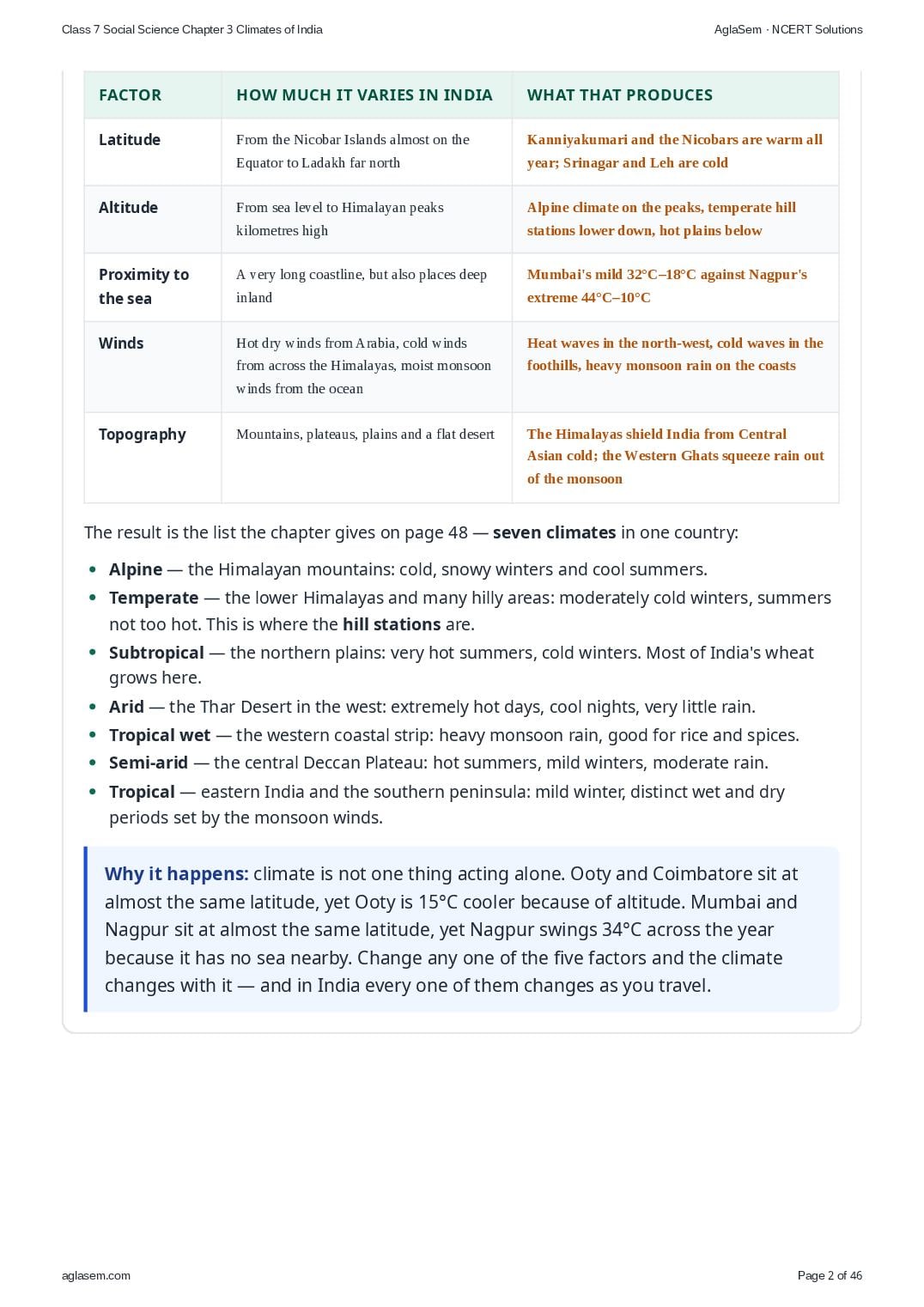
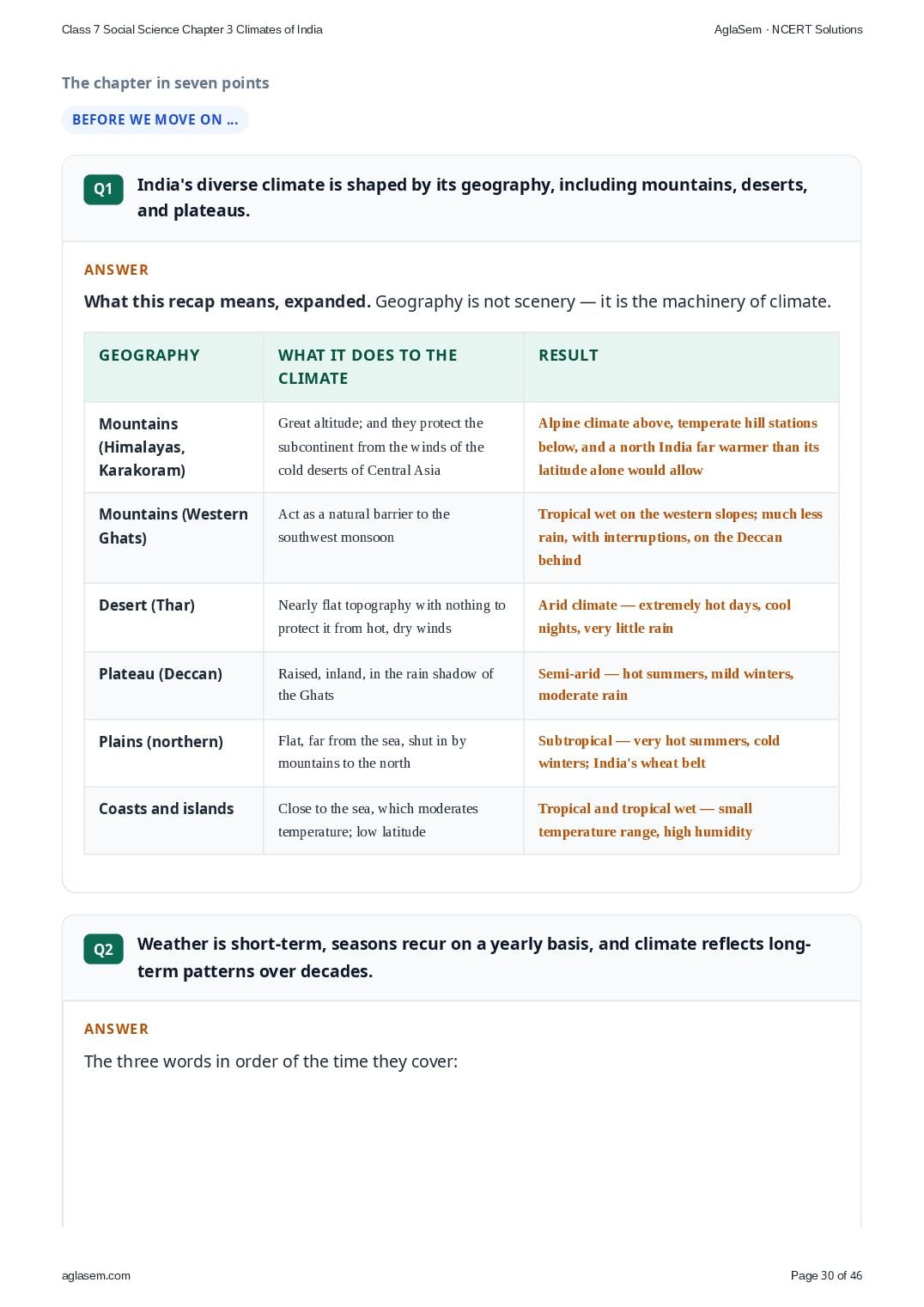
- What makes India's climate so diverse?
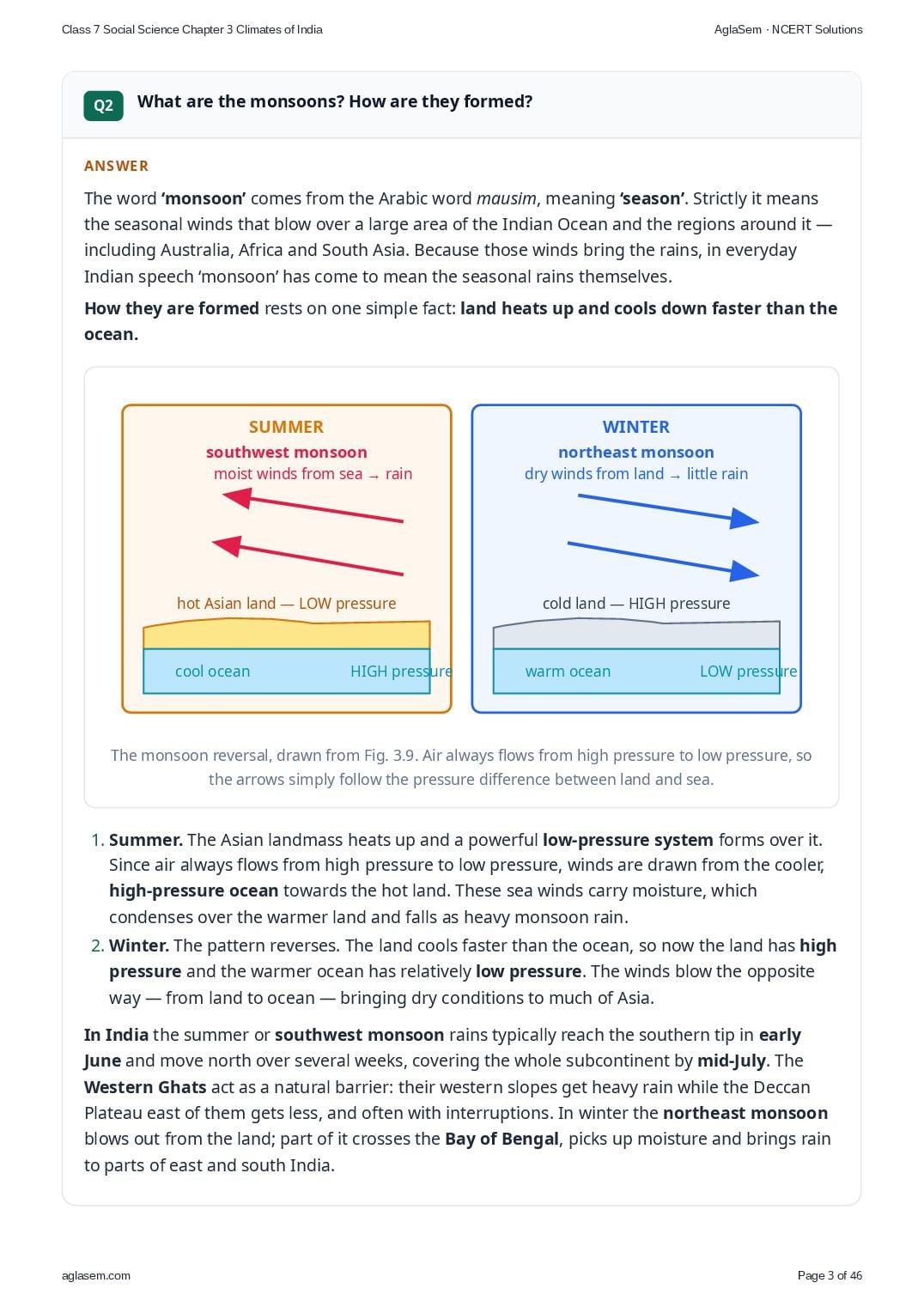
- What are the monsoons? How are they formed?
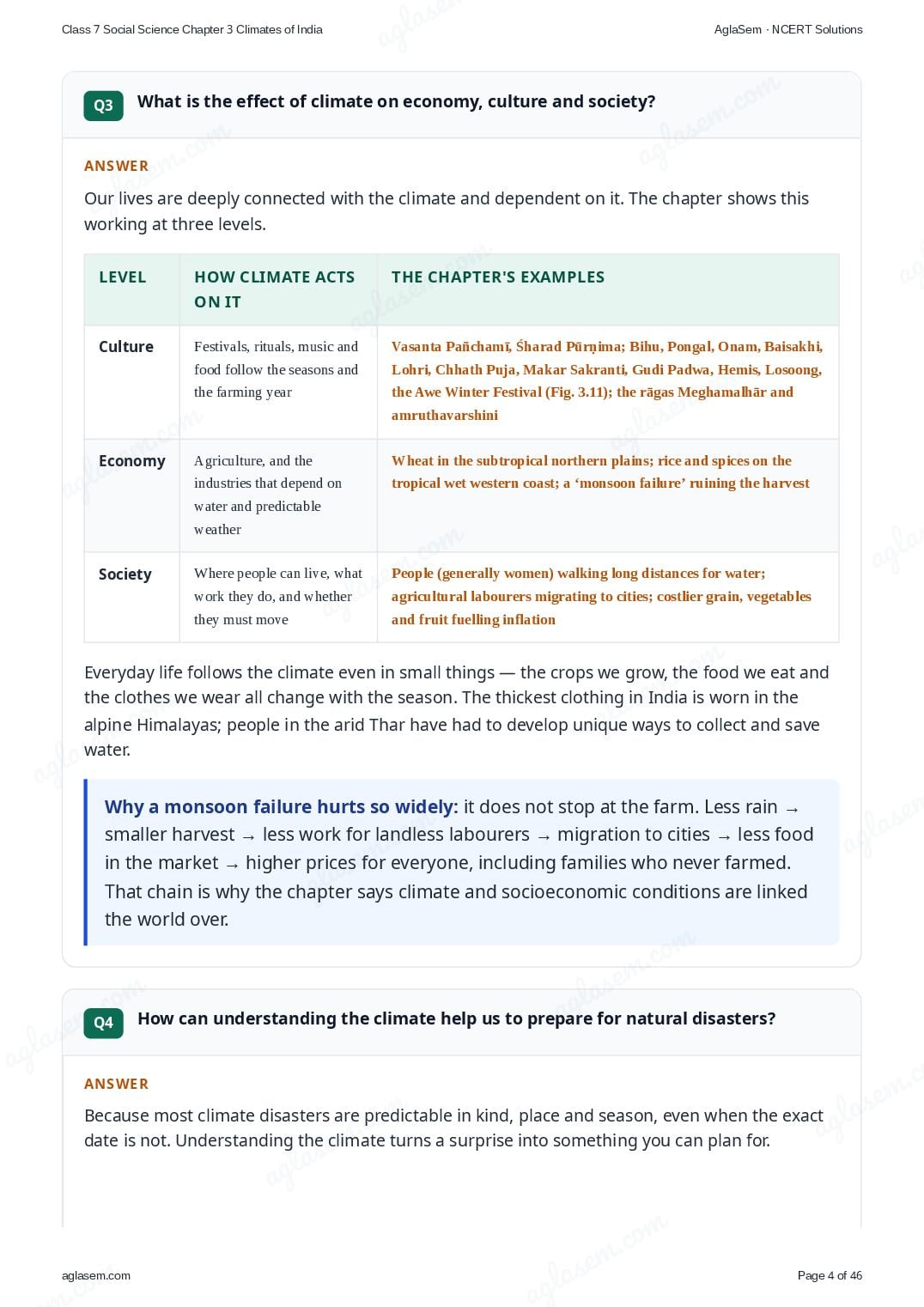
- What is the effect of climate on economy, culture and society?
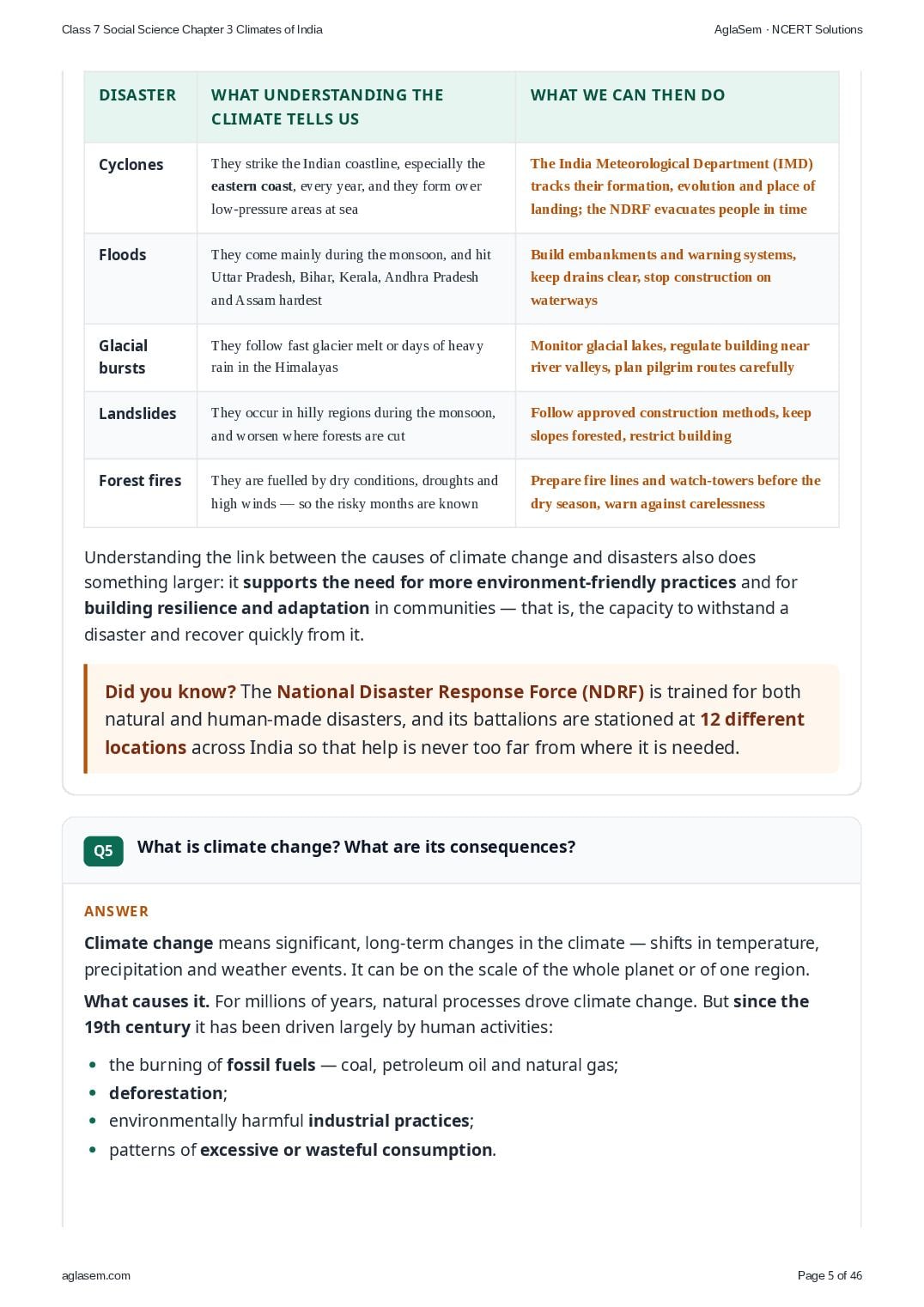
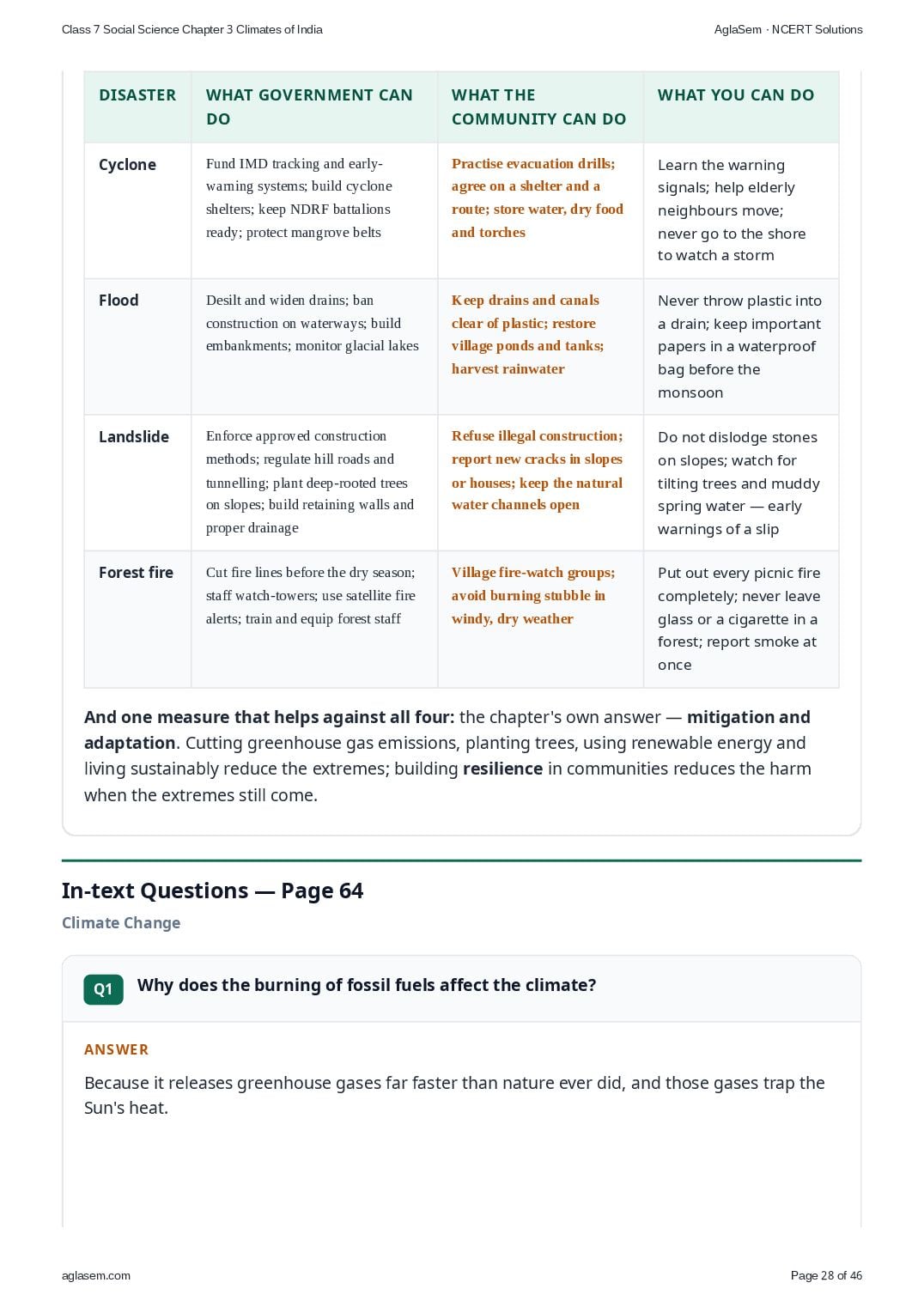
- How can understanding the climate help us to prepare for natural disasters?
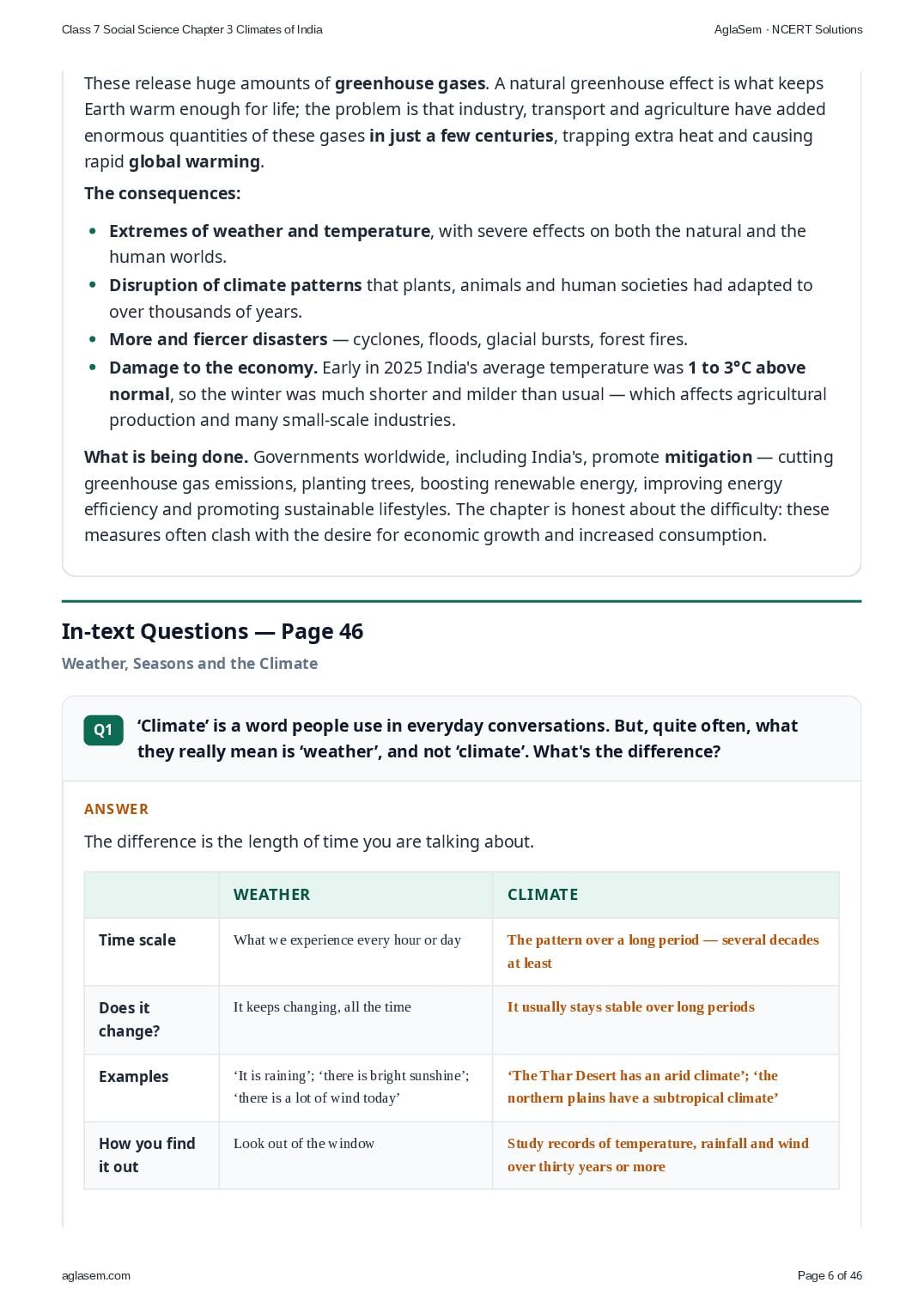
- What is climate change? What are its consequences?
- ‘Climate’ is a word people use in everyday conversations. But, quite often, what they really mean is ‘weather’, and not ‘climate’. What's the difference?
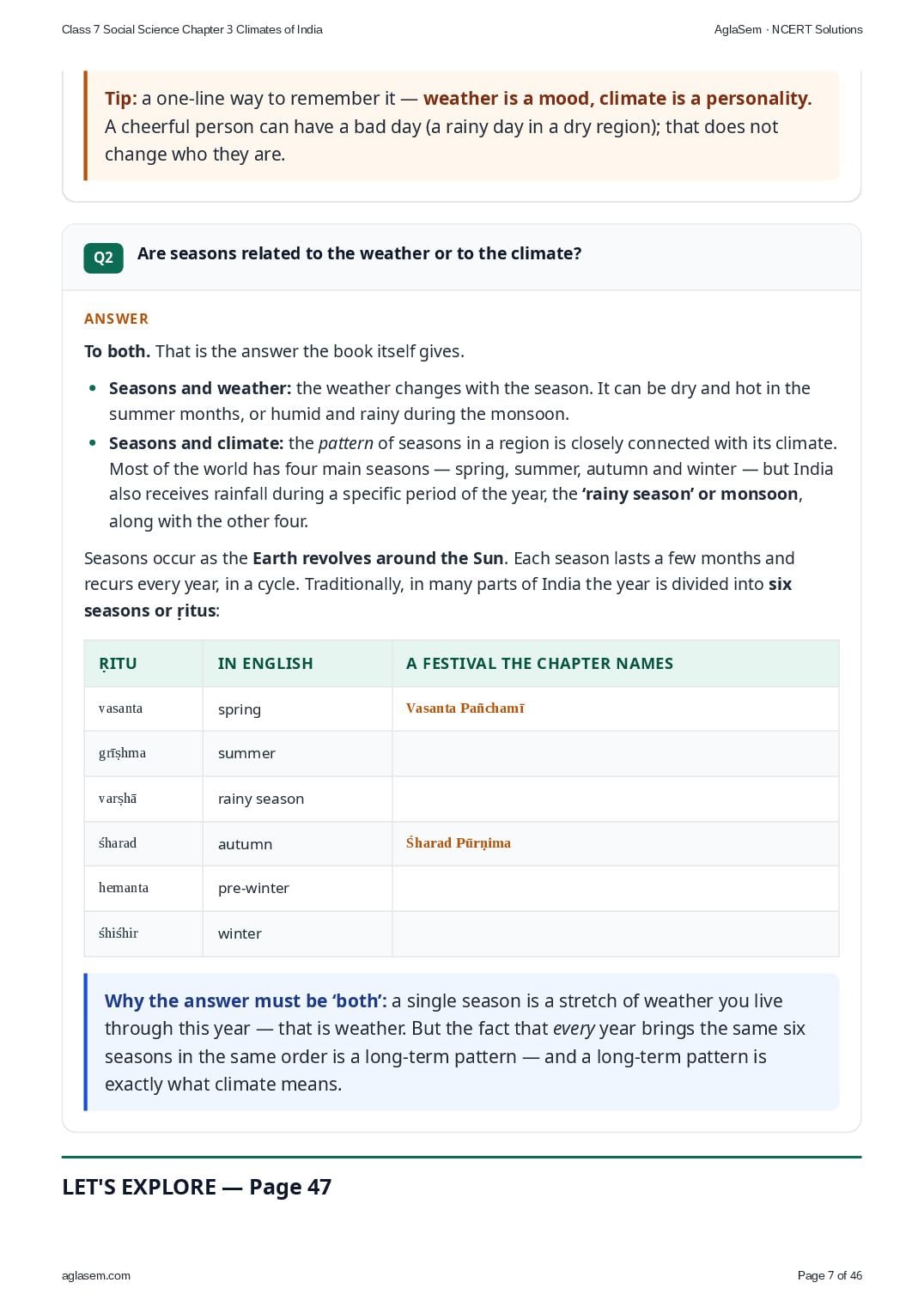
- Are seasons related to the weather or to the climate?
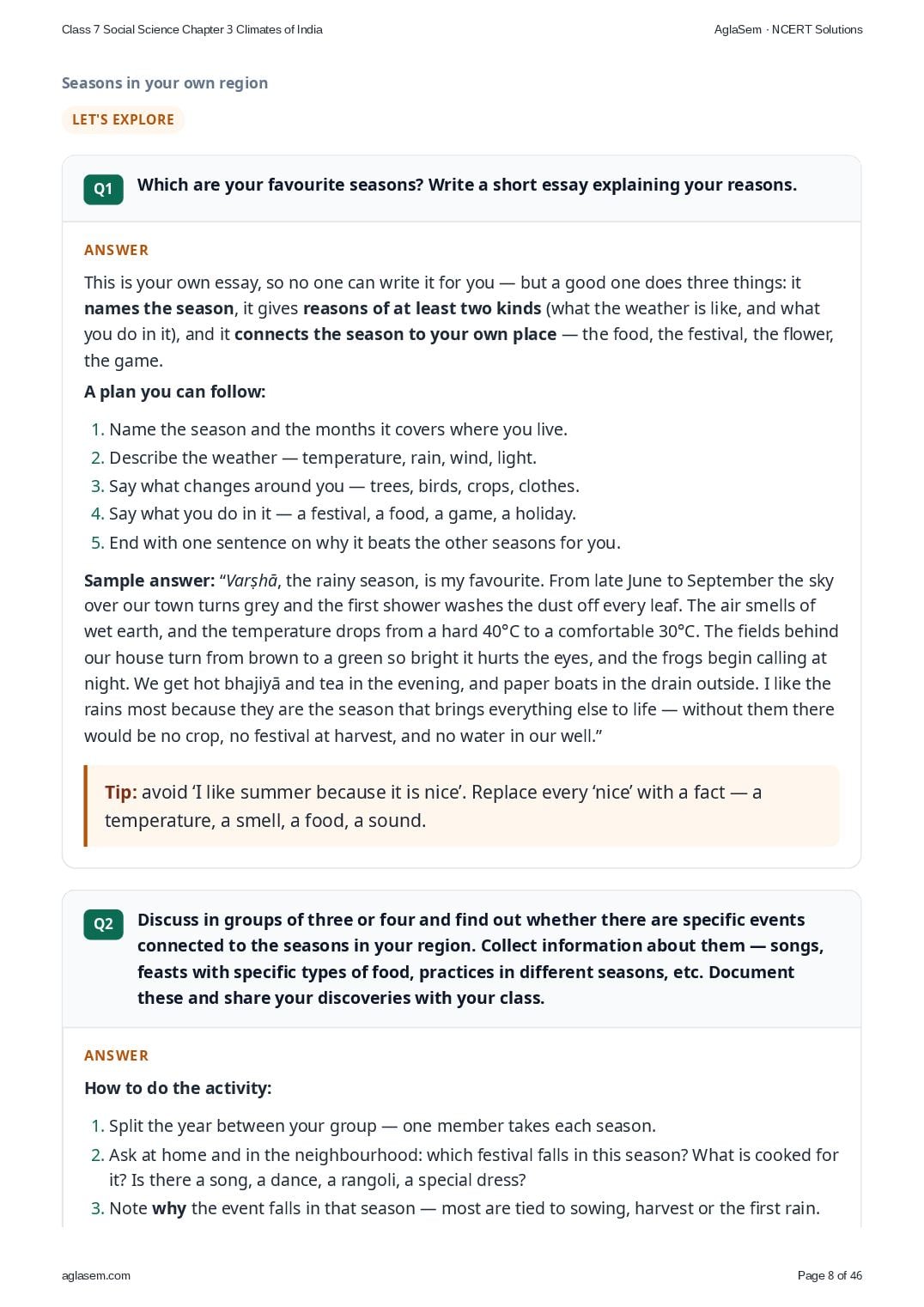
- Which are your favourite seasons? Write a short essay explaining your reasons.
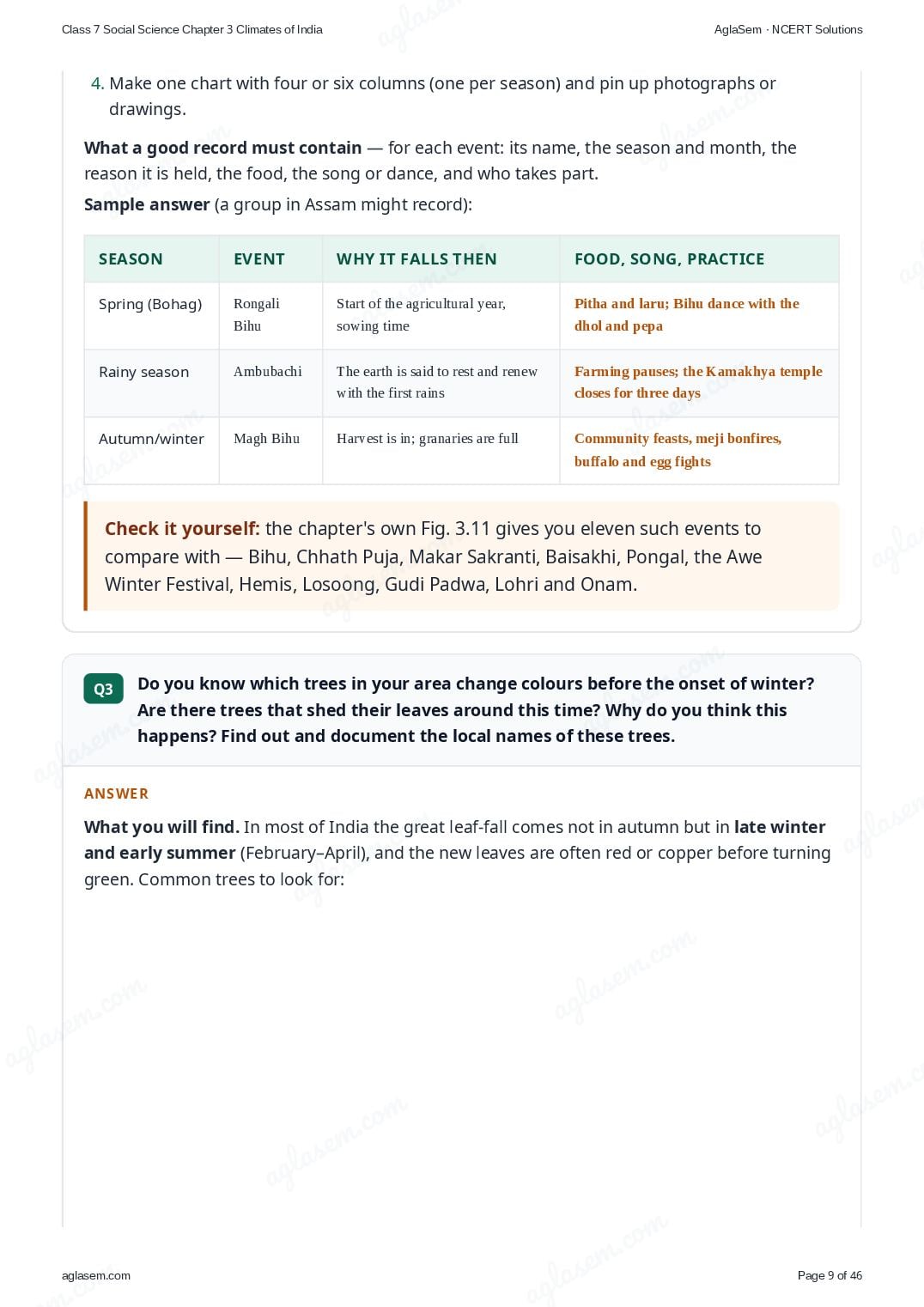
- Discuss in groups of three or four and find out whether there are specific events connected to the seasons in your region. Collect information about them — songs, feasts with specific types of food, practices in different seasons, etc. Document these and share your discoveries with your class.
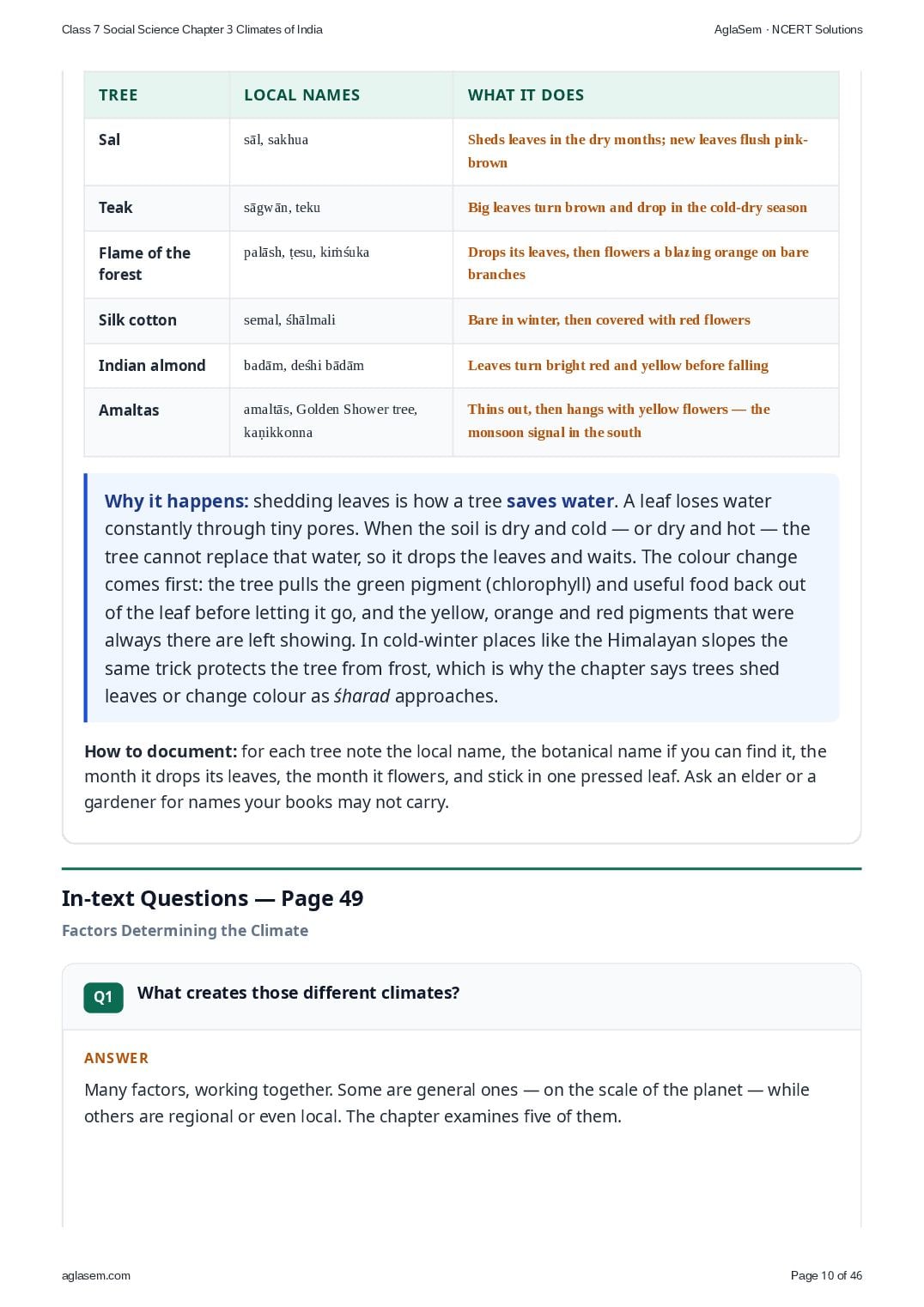
- Do you know which trees in your area change colours before the onset of winter? Are there trees that shed their leaves around this time? Why do you think this happens? Find out and document the local names of these trees.
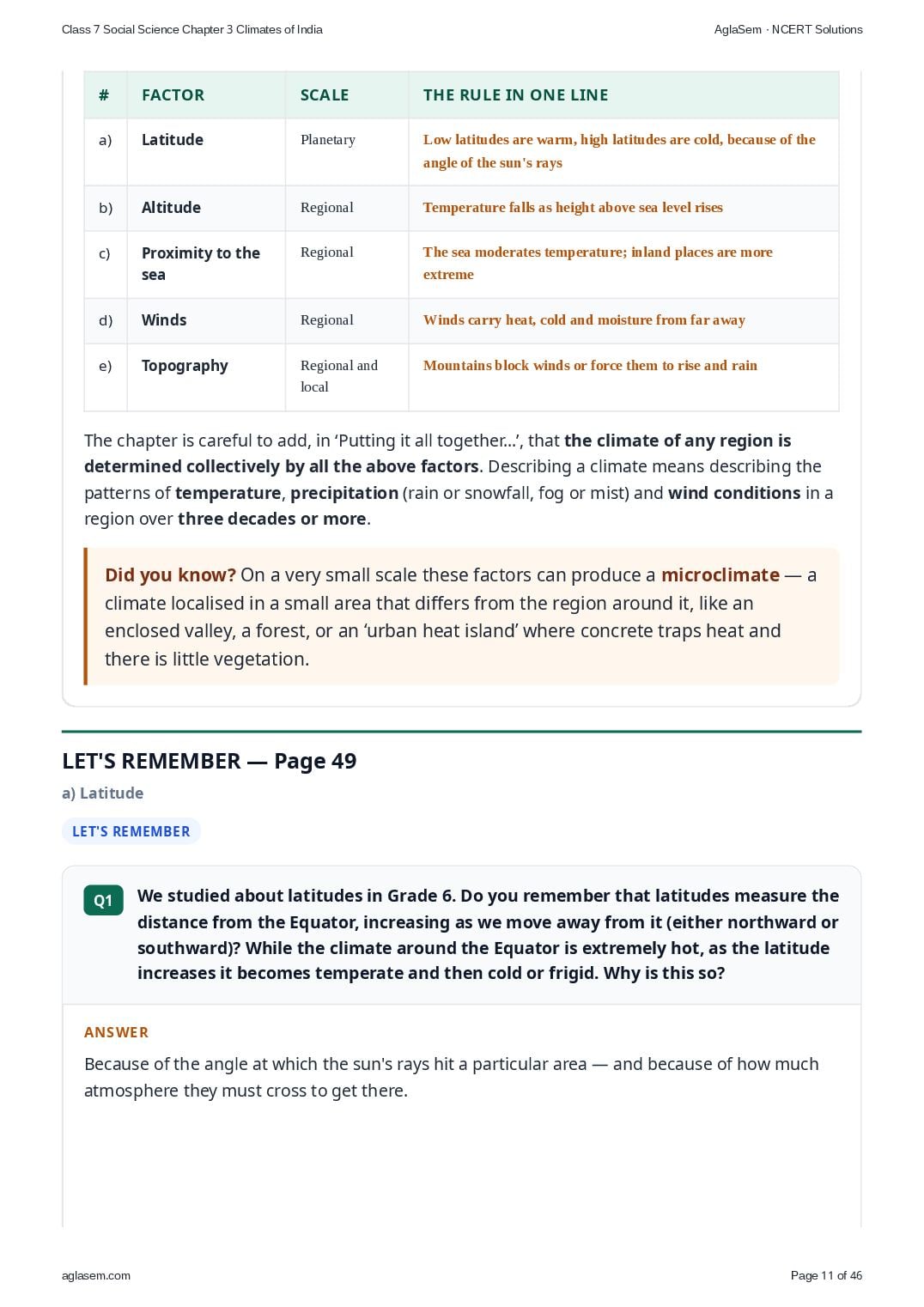
- What creates those different climates?
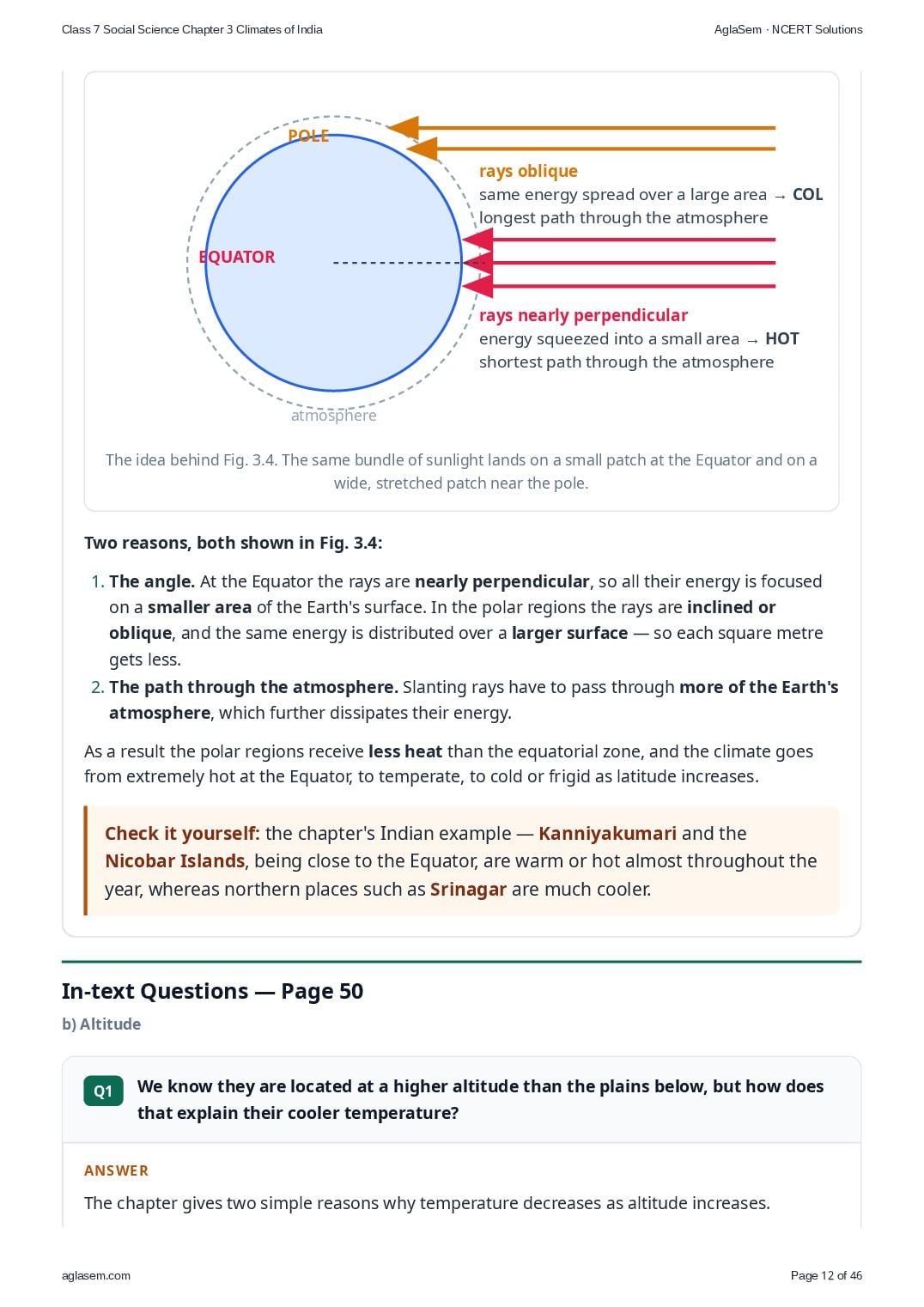
- We studied about latitudes in Grade 6. Do you remember that latitudes measure the distance from the Equator, increasing as we move away from it (either northward or southward)? While the climate around the Equator is extremely hot, as the latitude increases it becomes temperate and then cold or frigid. Why is this so?
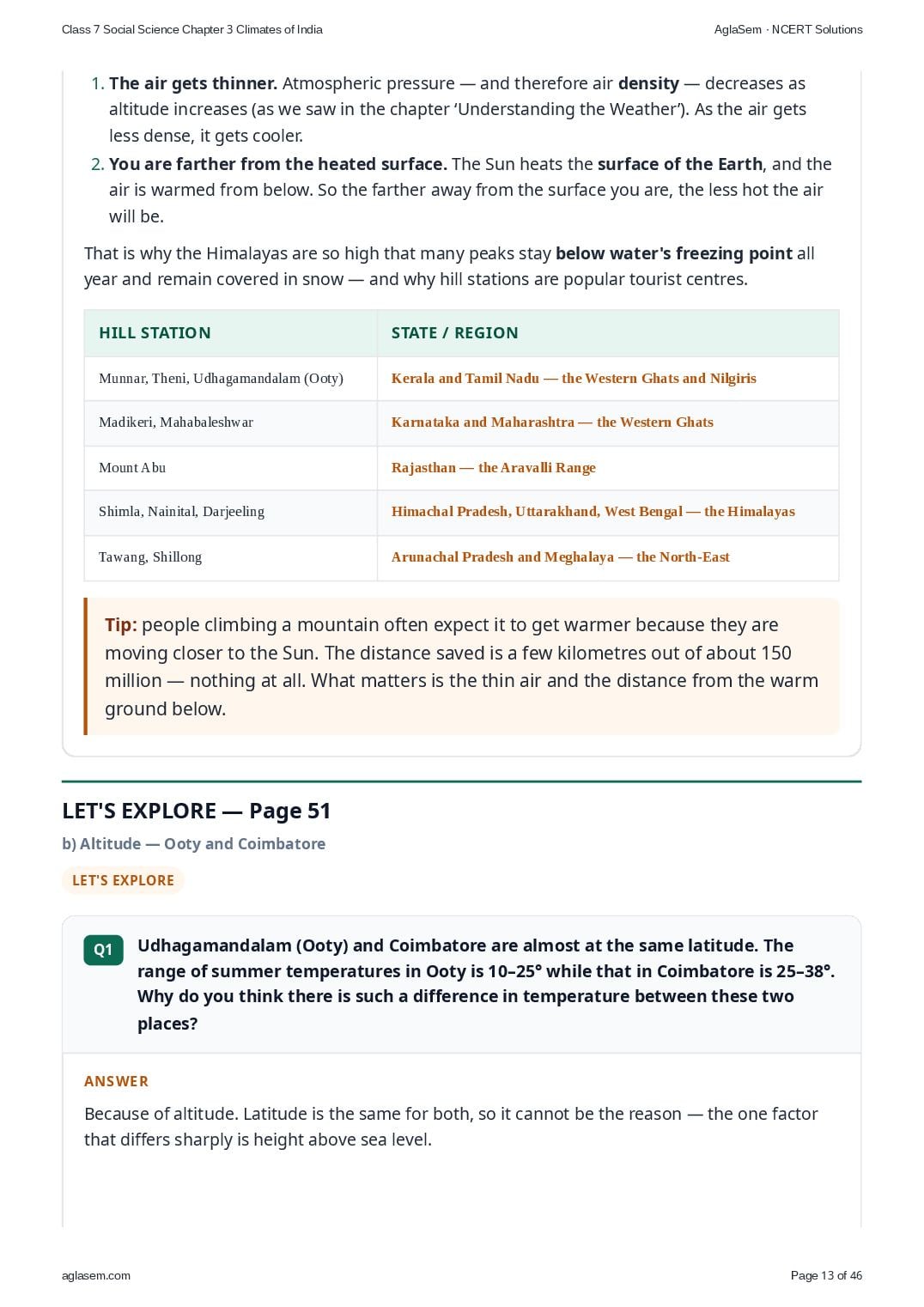
- We know they are located at a higher altitude than the plains below, but how does that explain their cooler temperature?
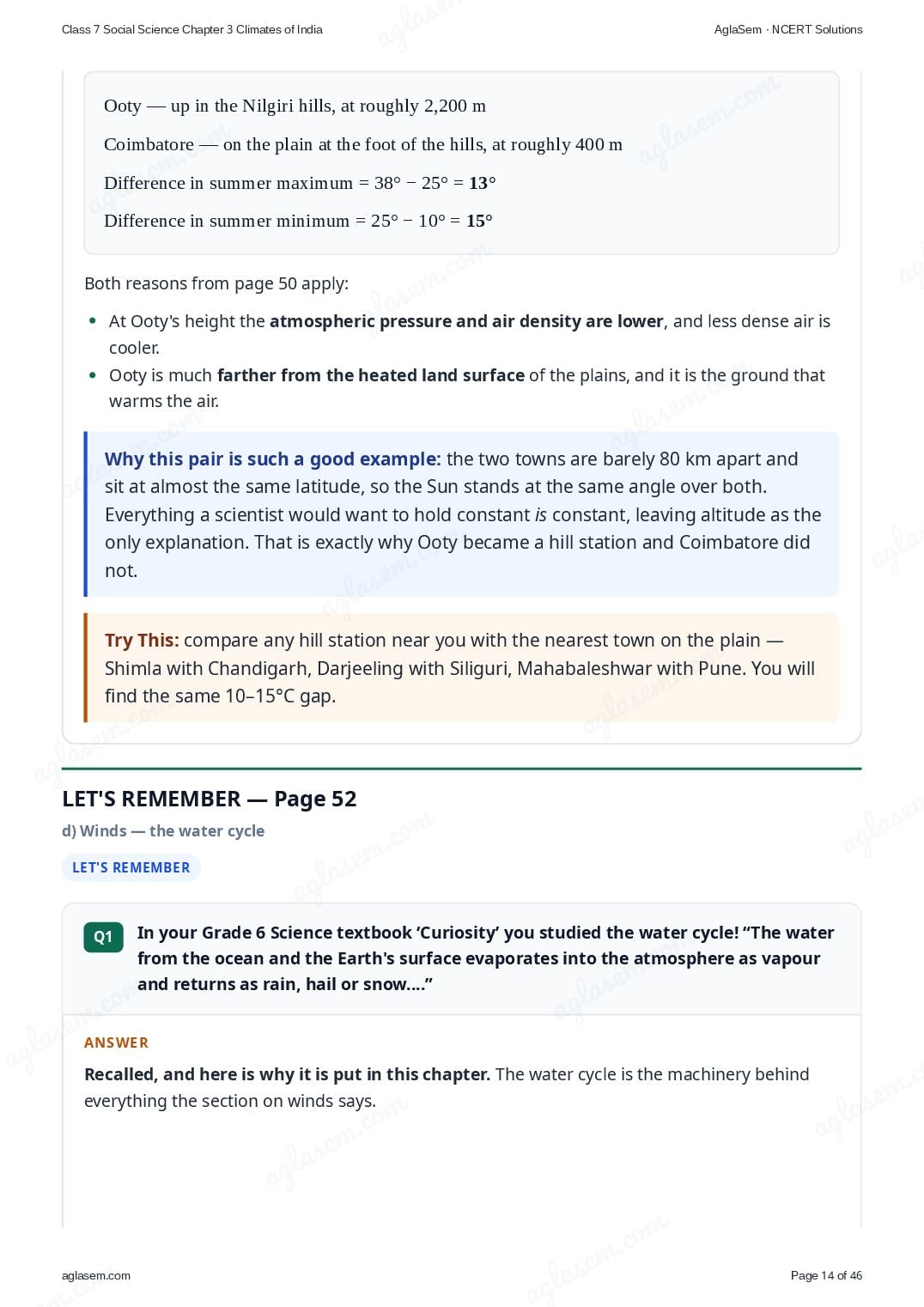
- Udhagamandalam (Ooty) and Coimbatore are almost at the same latitude. The range of summer temperatures in Ooty is 10–25° while that in Coimbatore is 25–38°. Why do you think there is such a difference in temperature between these two places?
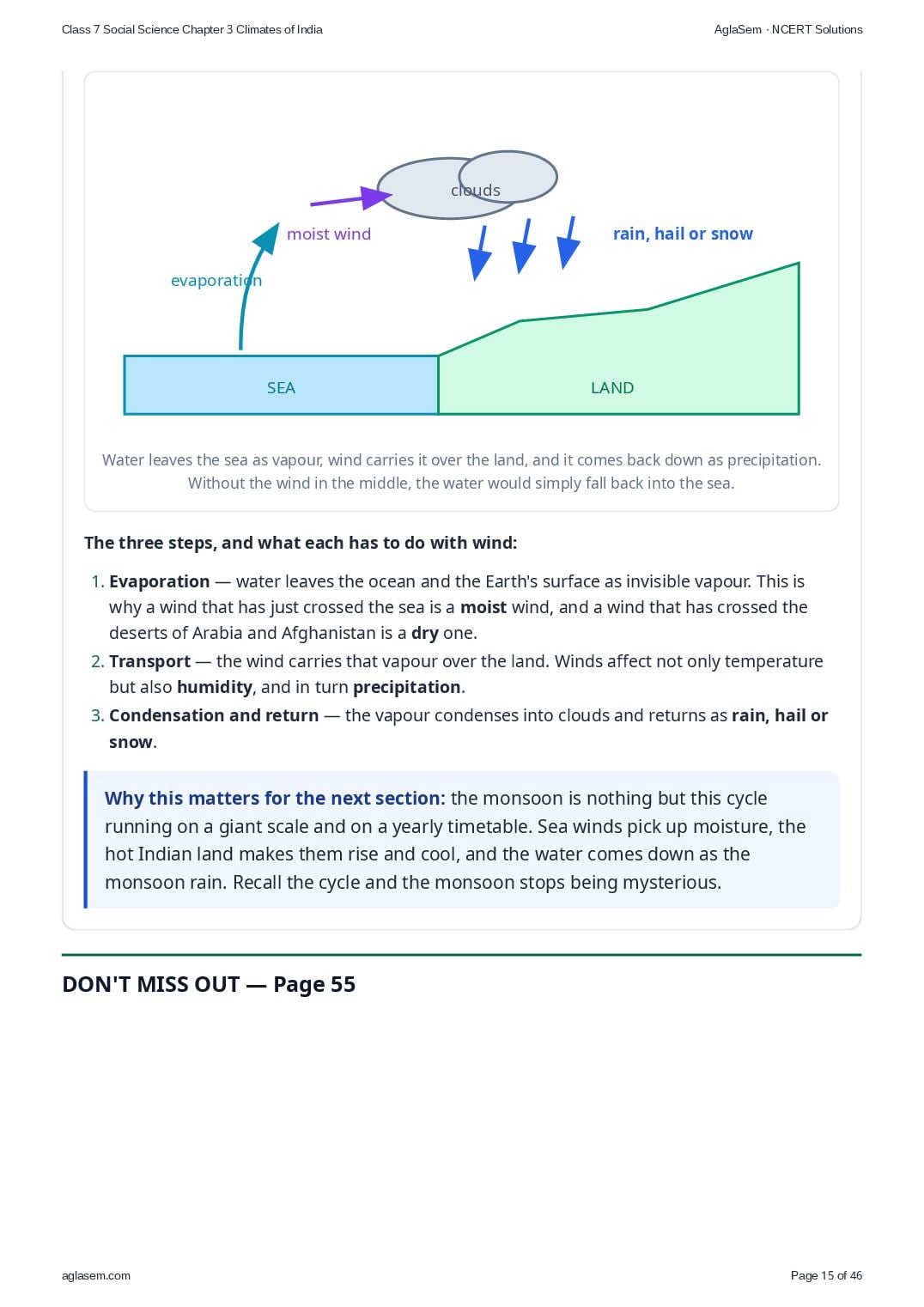
- In your Grade 6 Science textbook ‘Curiosity’ you studied the water cycle! “The water from the ocean and the Earth's surface evaporates into the atmosphere as vapour and returns as rain, hail or snow….”
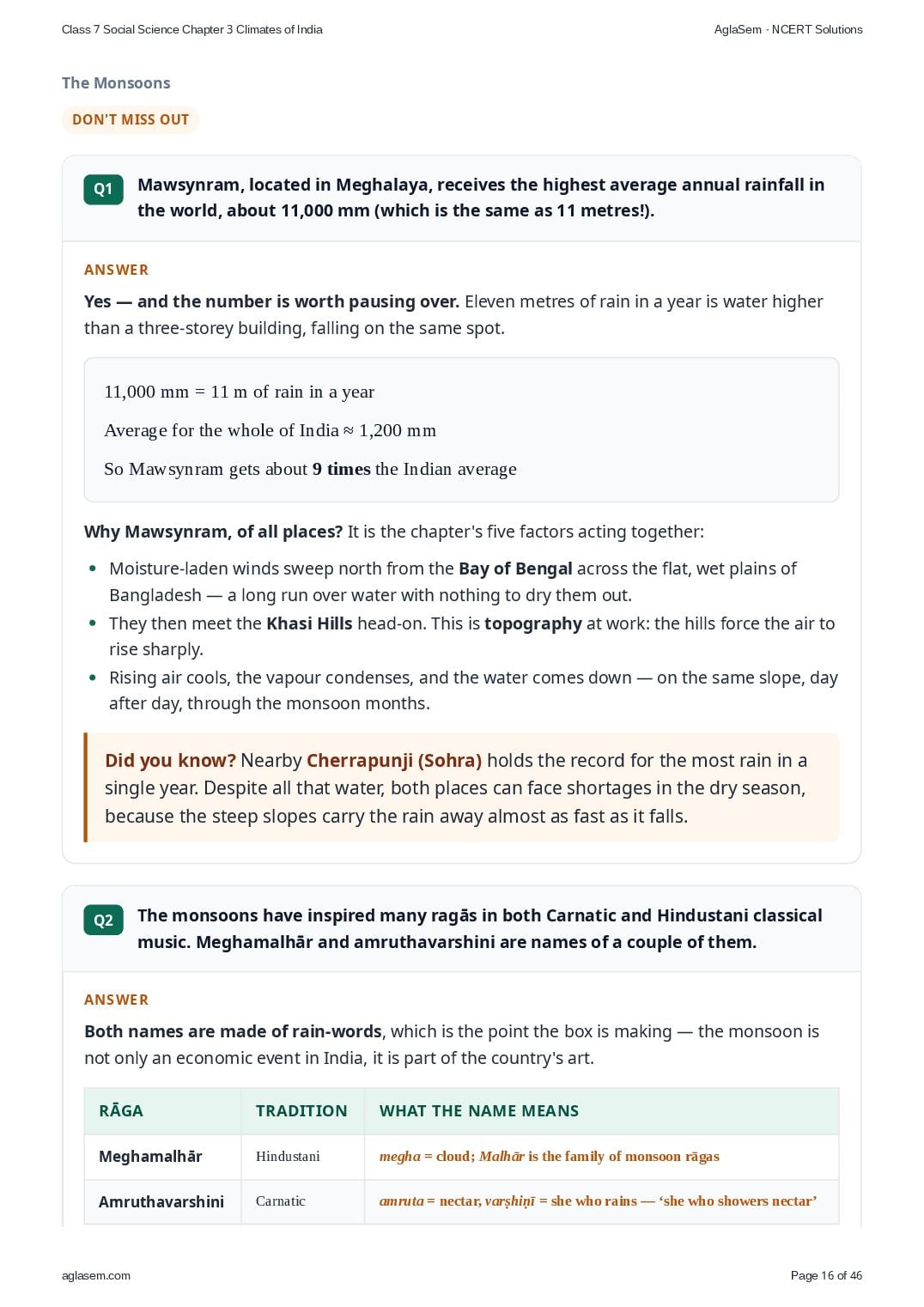
- Mawsynram, located in Meghalaya, receives the highest average annual rainfall in the world, about 11,000 mm (which is the same as 11 metres!).
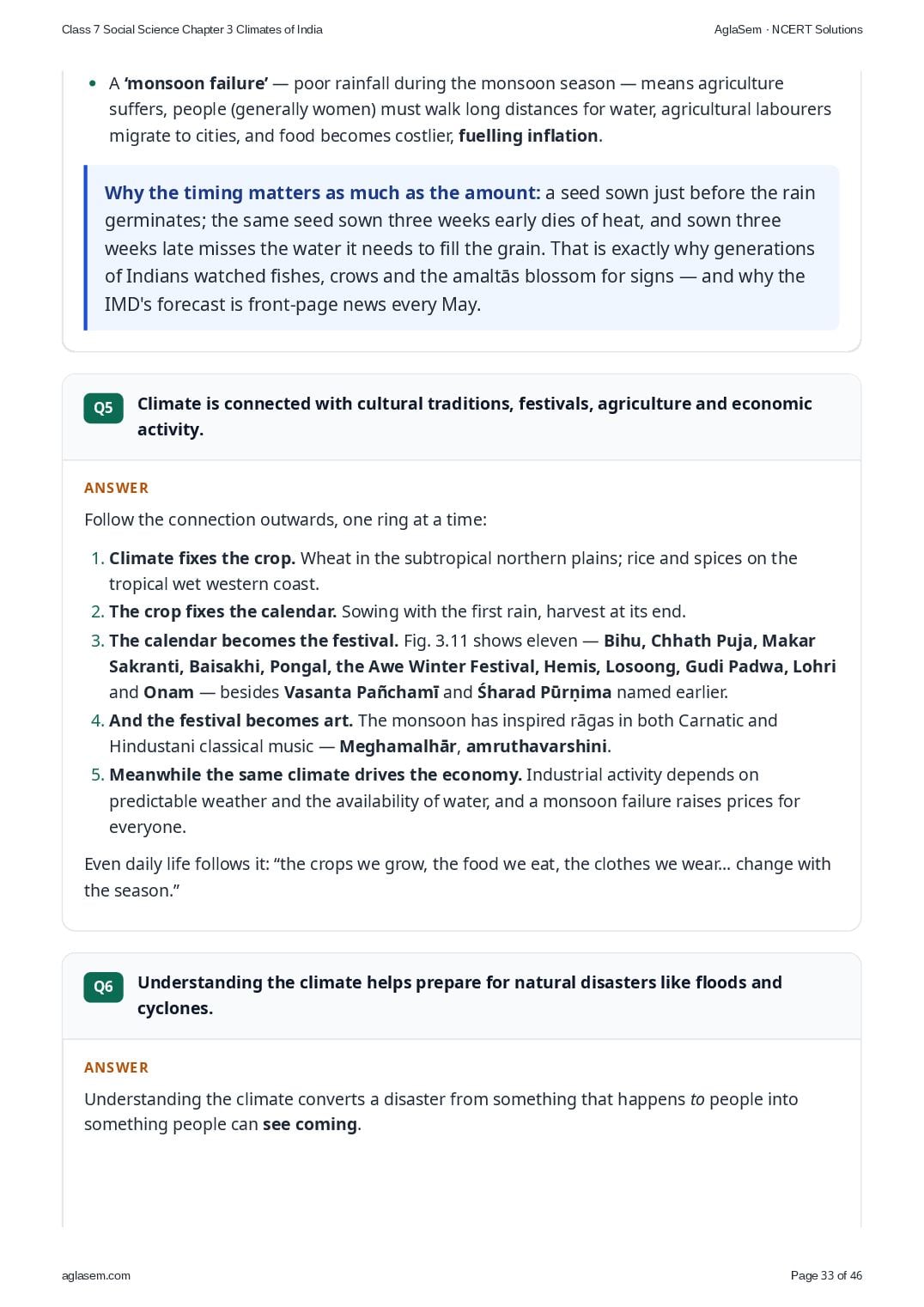
- The monsoons have inspired many ragās in both Carnatic and Hindustani classical music. Meghamalhār and amruthavarshini are names of a couple of them.
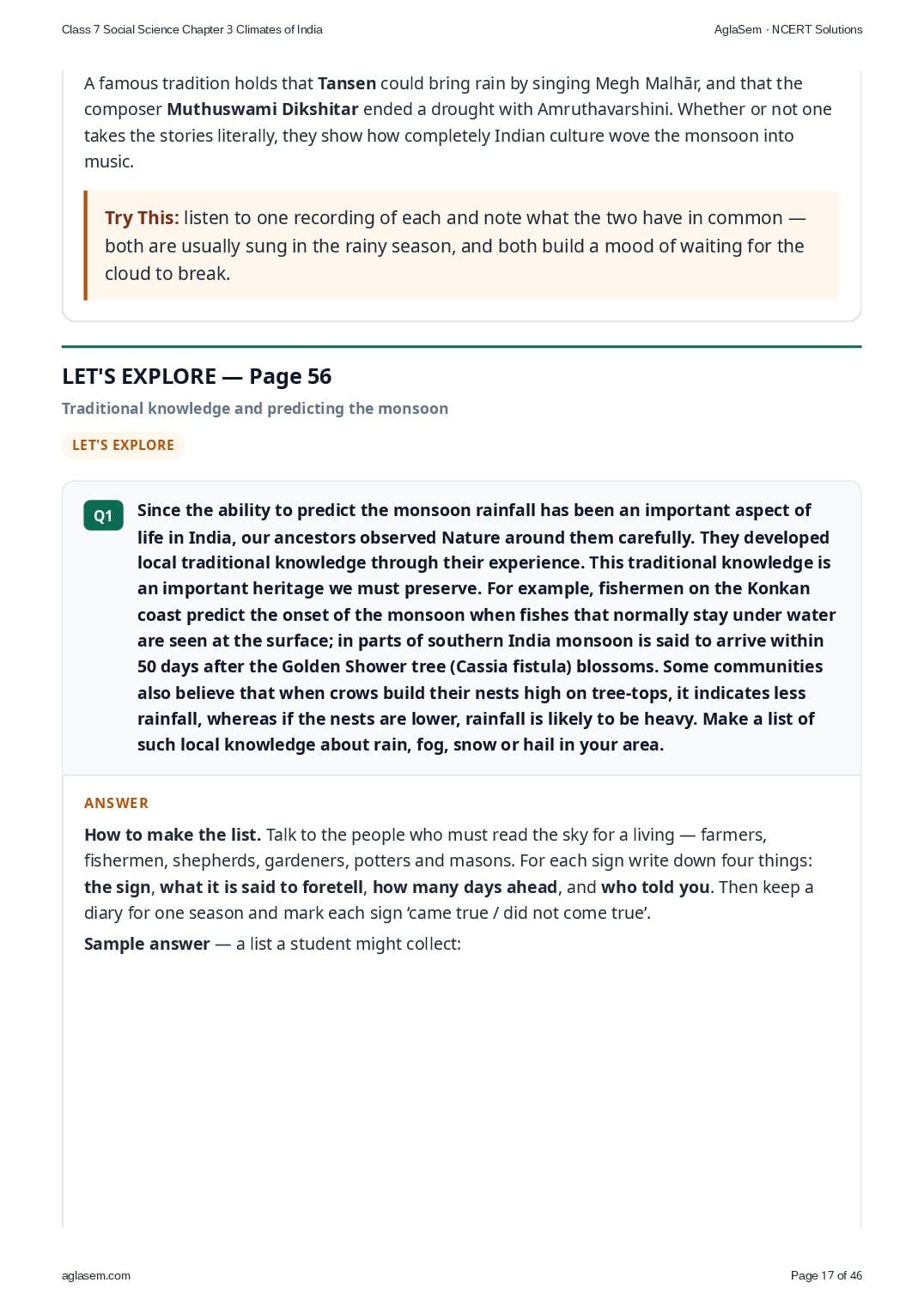
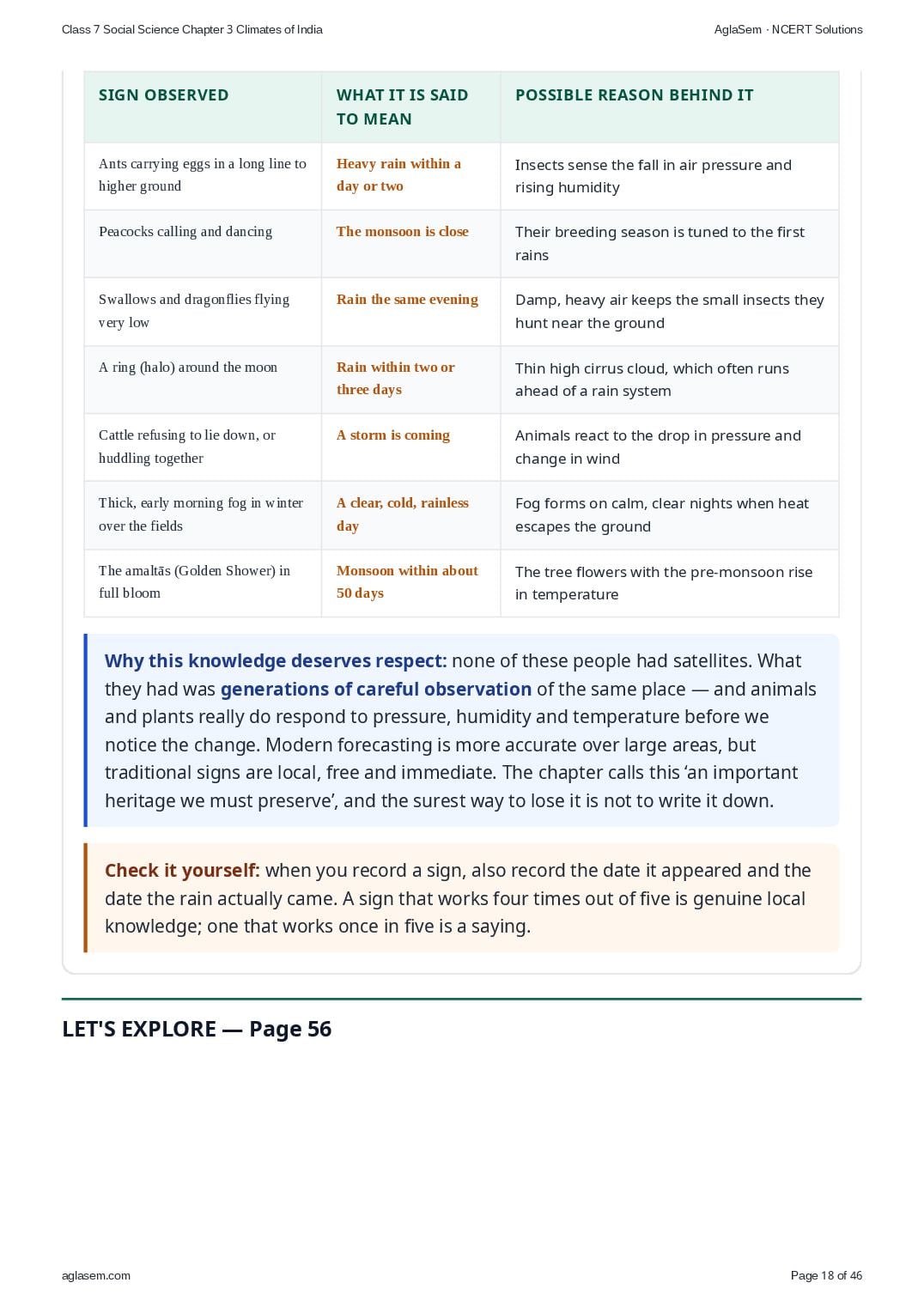
- Since the ability to predict the monsoon rainfall has been an important aspect of life in India, our ancestors observed Nature around them carefully. They developed local traditional knowledge through their experience. This traditional knowledge is an important heritage we must preserve. For example, fishermen on the Konkan coast predict the onset of the monsoon when fishes that normally stay under water are seen at the surface; in parts of southern India monsoon is said to arrive within 50 days after the Golden Shower tree (Cassia fistula) blossoms. Some communities also believe that when crows build their nests high on tree-tops, it indicates less rainfall, whereas if the nests are lower, rainfall is likely to be heavy. Make a list of such local knowledge about rain, fog, snow or hail in your area.
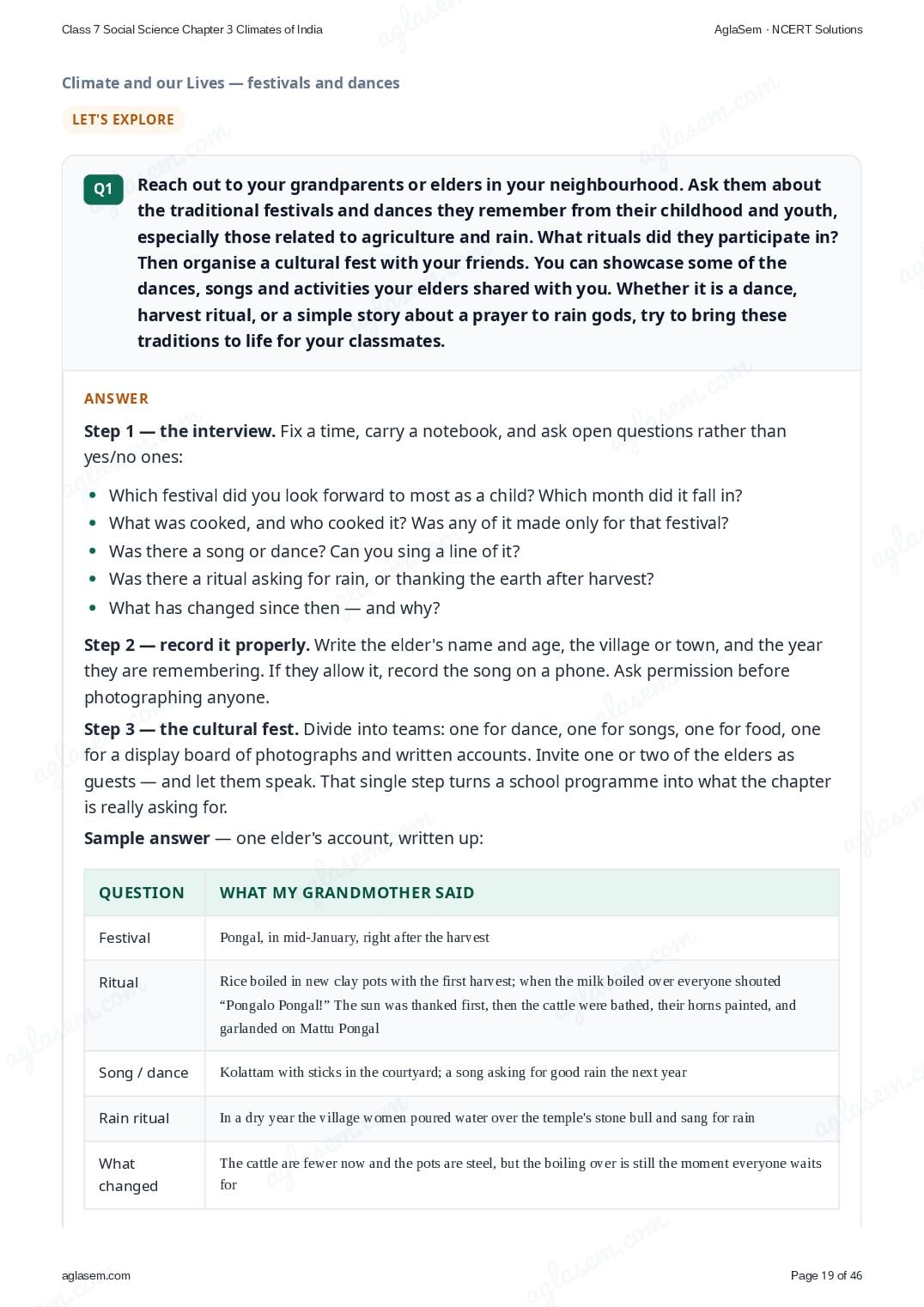
- Reach out to your grandparents or elders in your neighbourhood. Ask them about the traditional festivals and dances they remember from their childhood and youth, especially those related to agriculture and rain. What rituals did they participate in? Then organise a cultural fest with your friends. You can showcase some of the dances, songs and activities your elders shared with you. Whether it is a dance, harvest ritual, or a simple story about a prayer to rain gods, try to bring these traditions to life for your classmates.
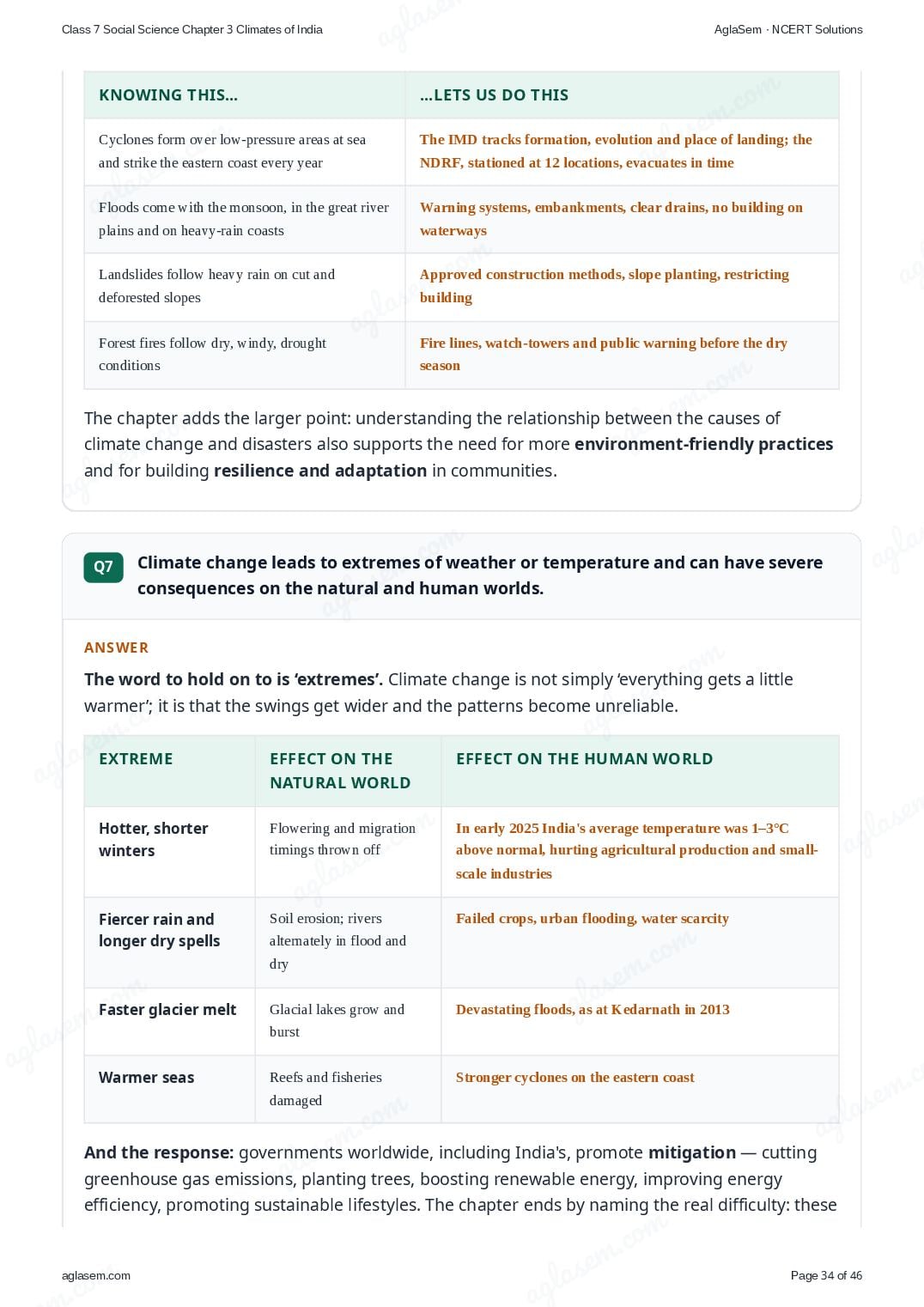
- The National Disaster Response Force (NDRF) is specially trained to respond to natural as well as human-made disasters. NDRF battalions are located at 12 different locations in India. The NDRF has played a key role in rescue and evacuation during disasters like cyclones, landslides and floods.
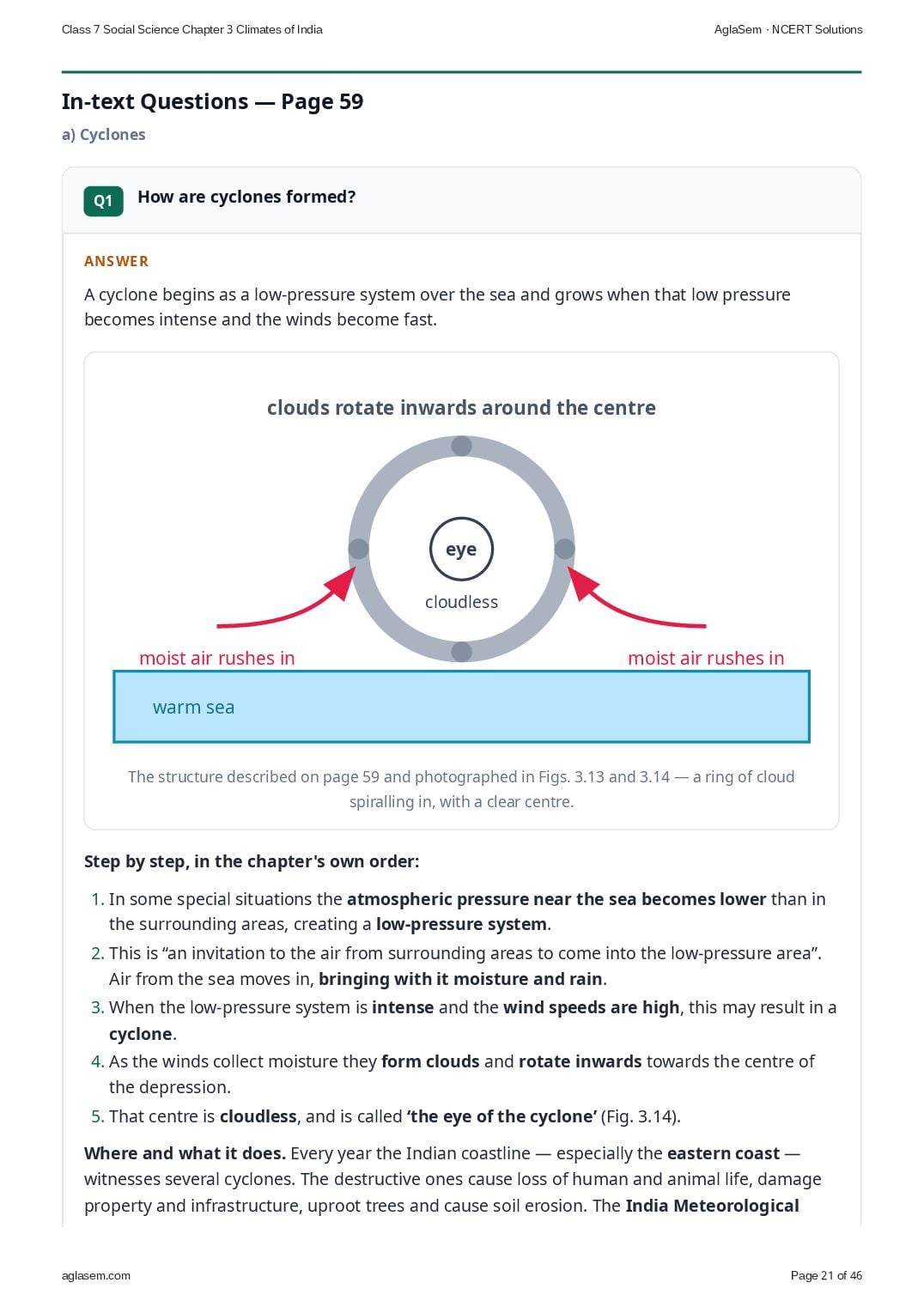
- How are cyclones formed?
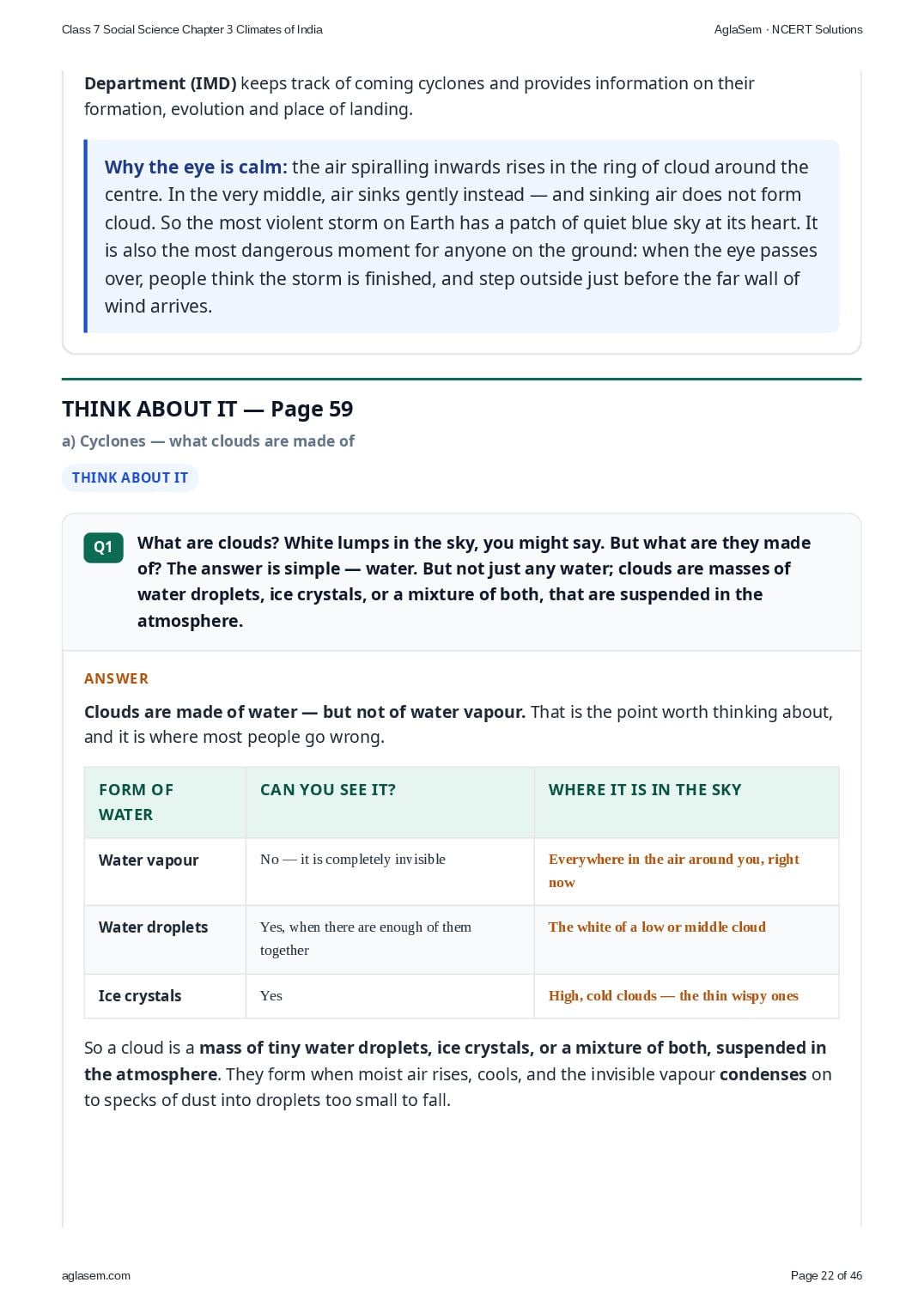
- What are clouds? White lumps in the sky, you might say. But what are they made of? The answer is simple — water. But not just any water; clouds are masses of water droplets, ice crystals, or a mixture of both, that are suspended in the atmosphere.
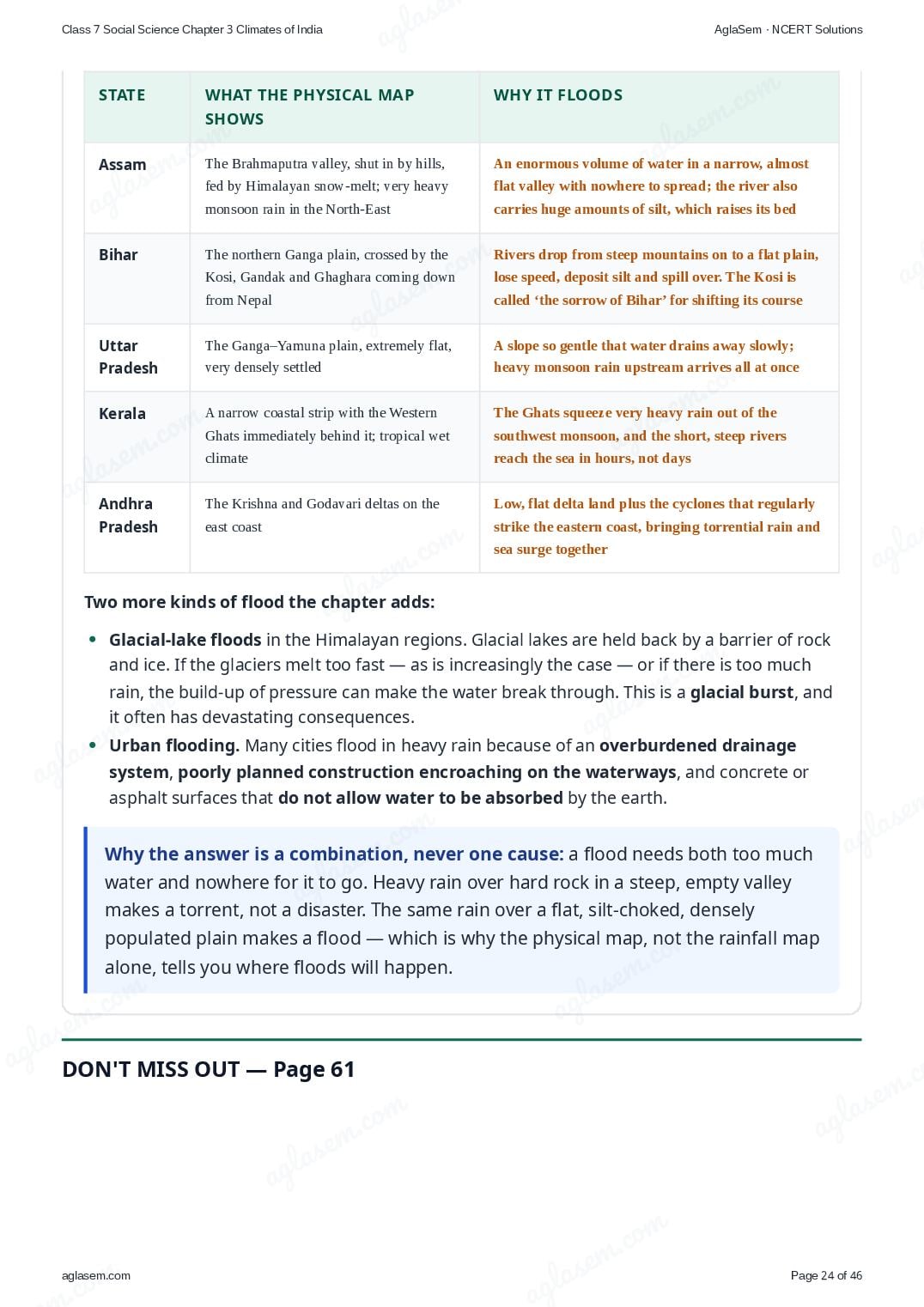
- Have you seen or read about floods? Look at the physical map of India. Discuss in pairs why you think floods occur in the areas mentioned above.
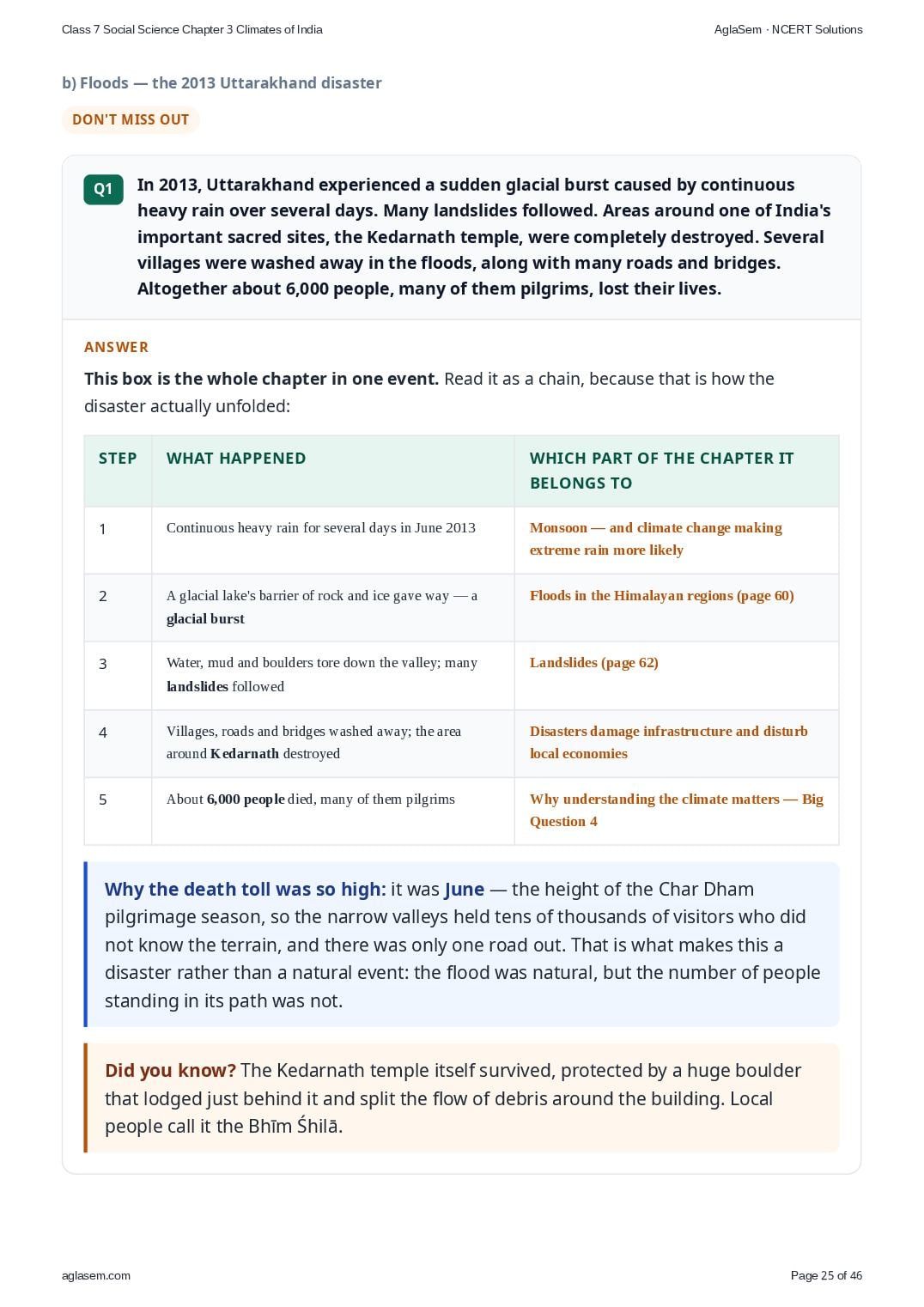
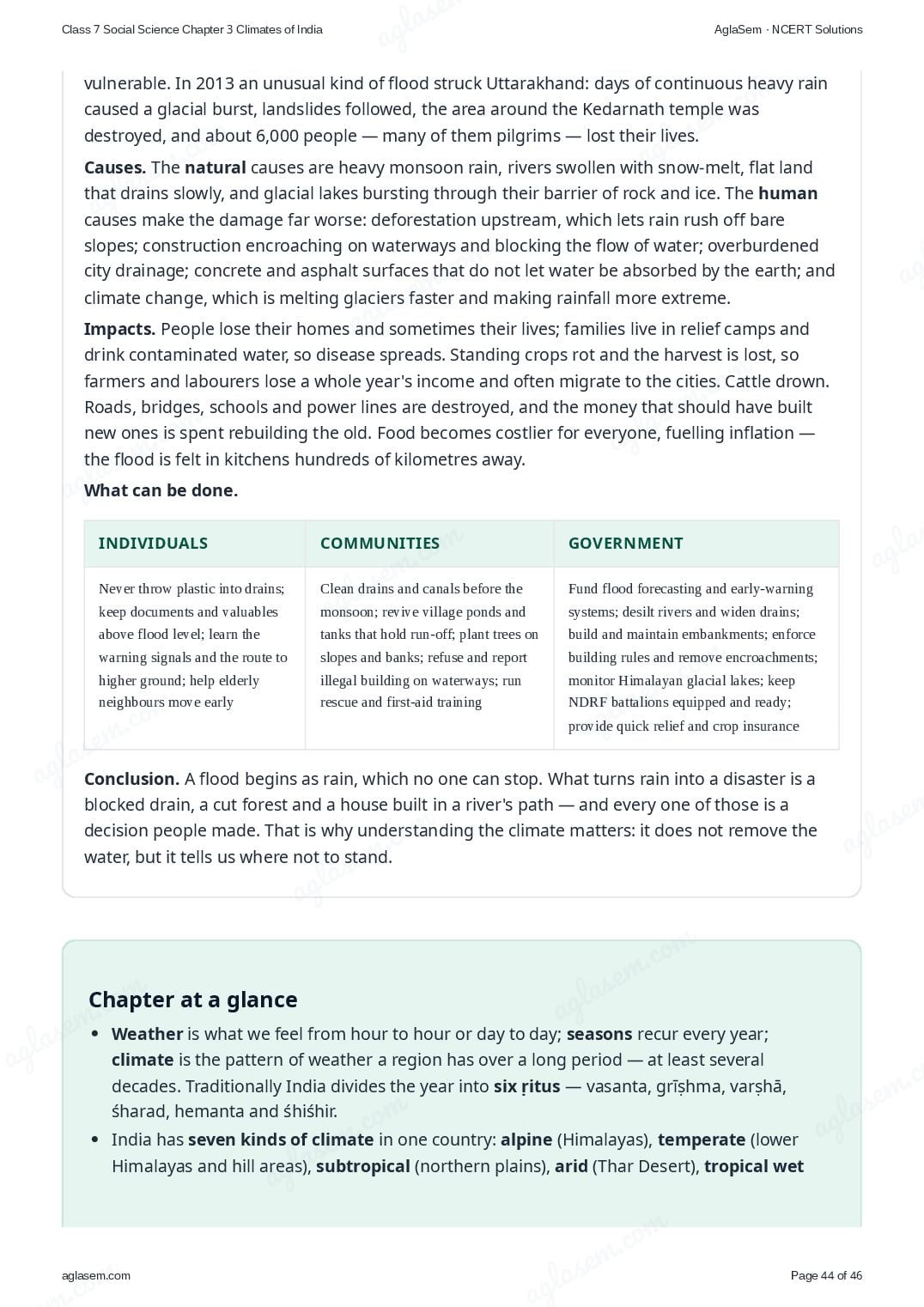
- In 2013, Uttarakhand experienced a sudden glacial burst caused by continuous heavy rain over several days. Many landslides followed. Areas around one of India's important sacred sites, the Kedarnath temple, were completely destroyed. Several villages were washed away in the floods, along with many roads and bridges. Altogether about 6,000 people, many of them pilgrims, lost their lives.
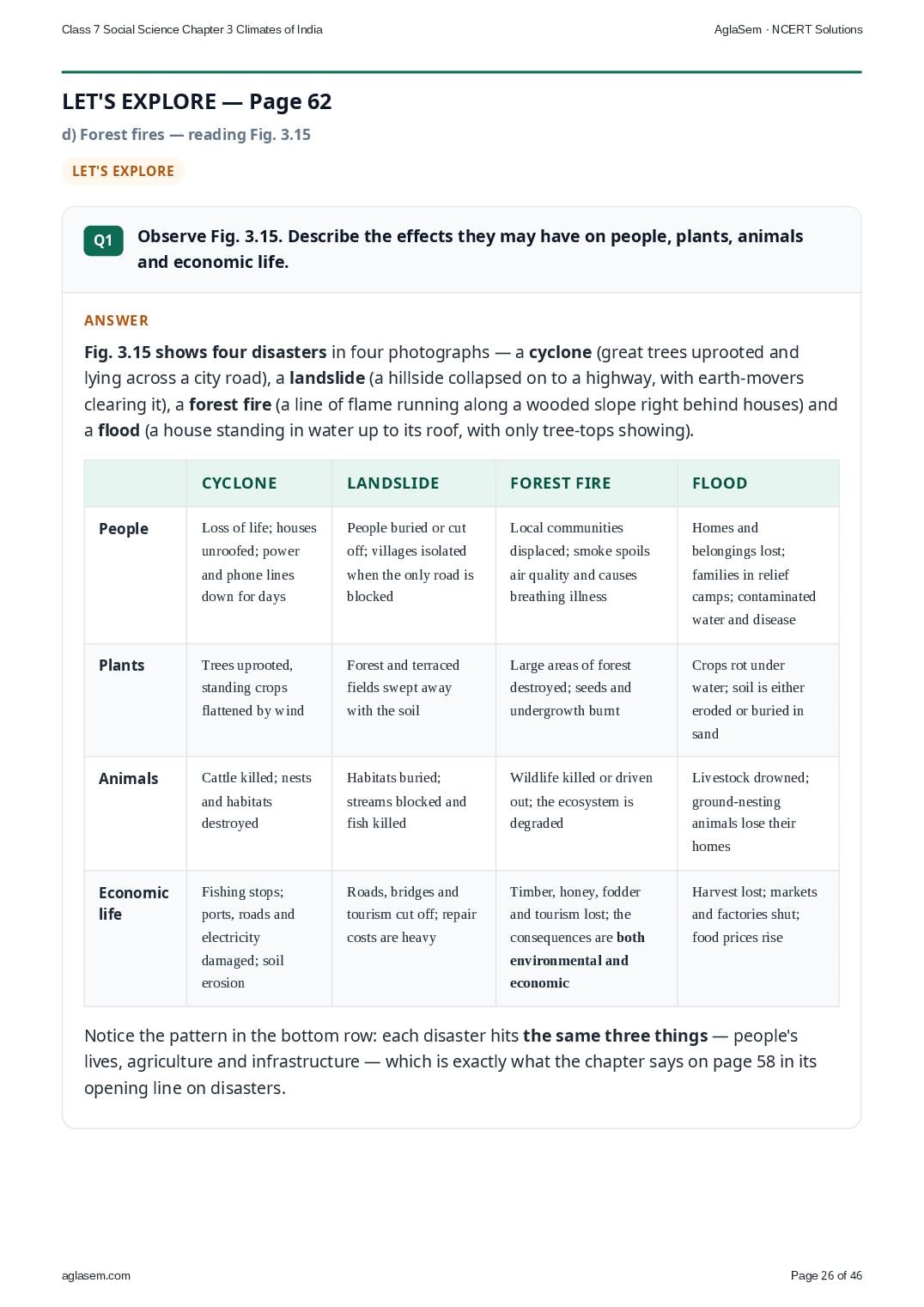
- Observe Fig. 3.15. Describe the effects they may have on people, plants, animals and economic life.
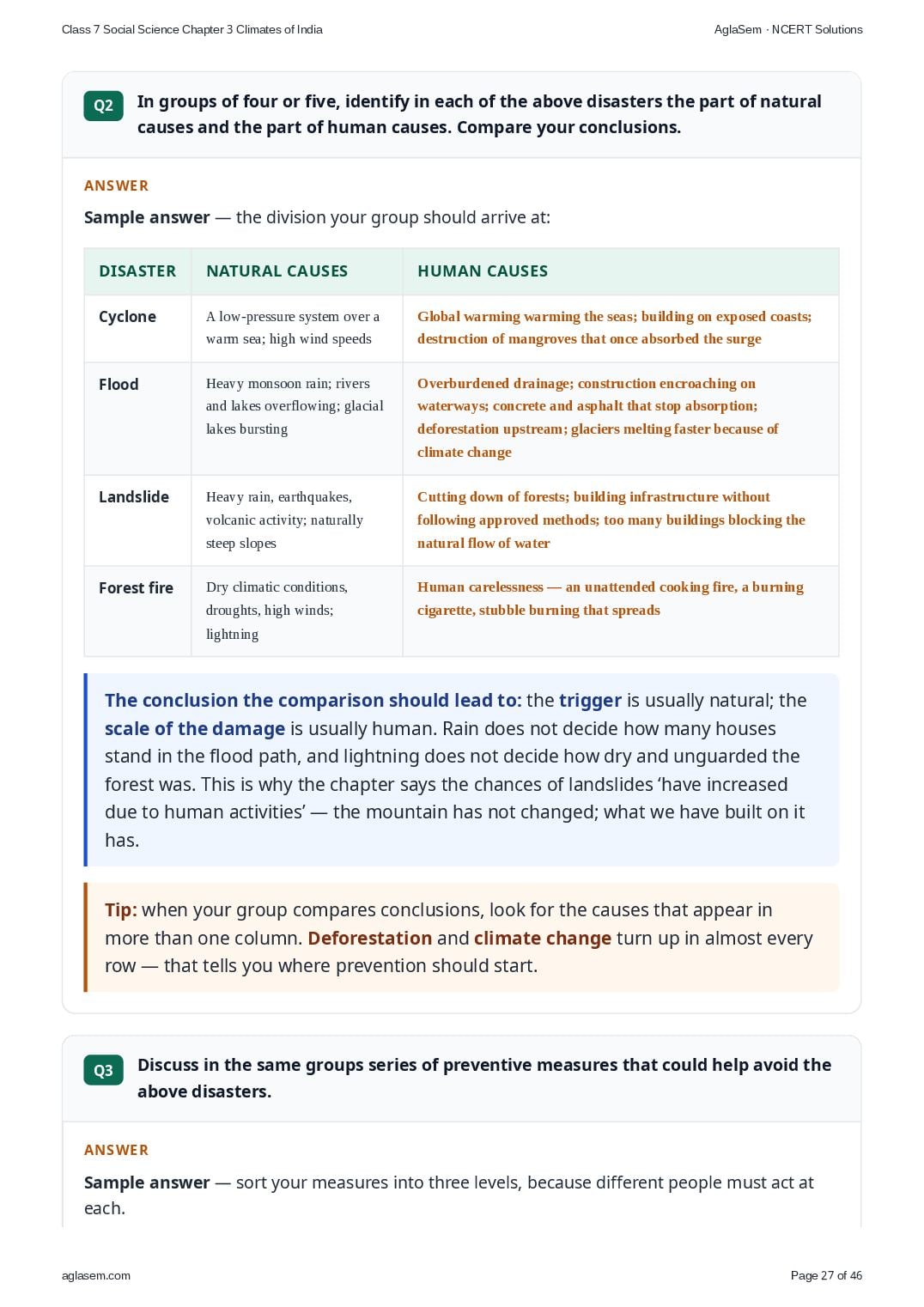
- In groups of four or five, identify in each of the above disasters the part of natural causes and the part of human causes. Compare your conclusions.
- Discuss in the same groups series of preventive measures that could help avoid the above disasters.
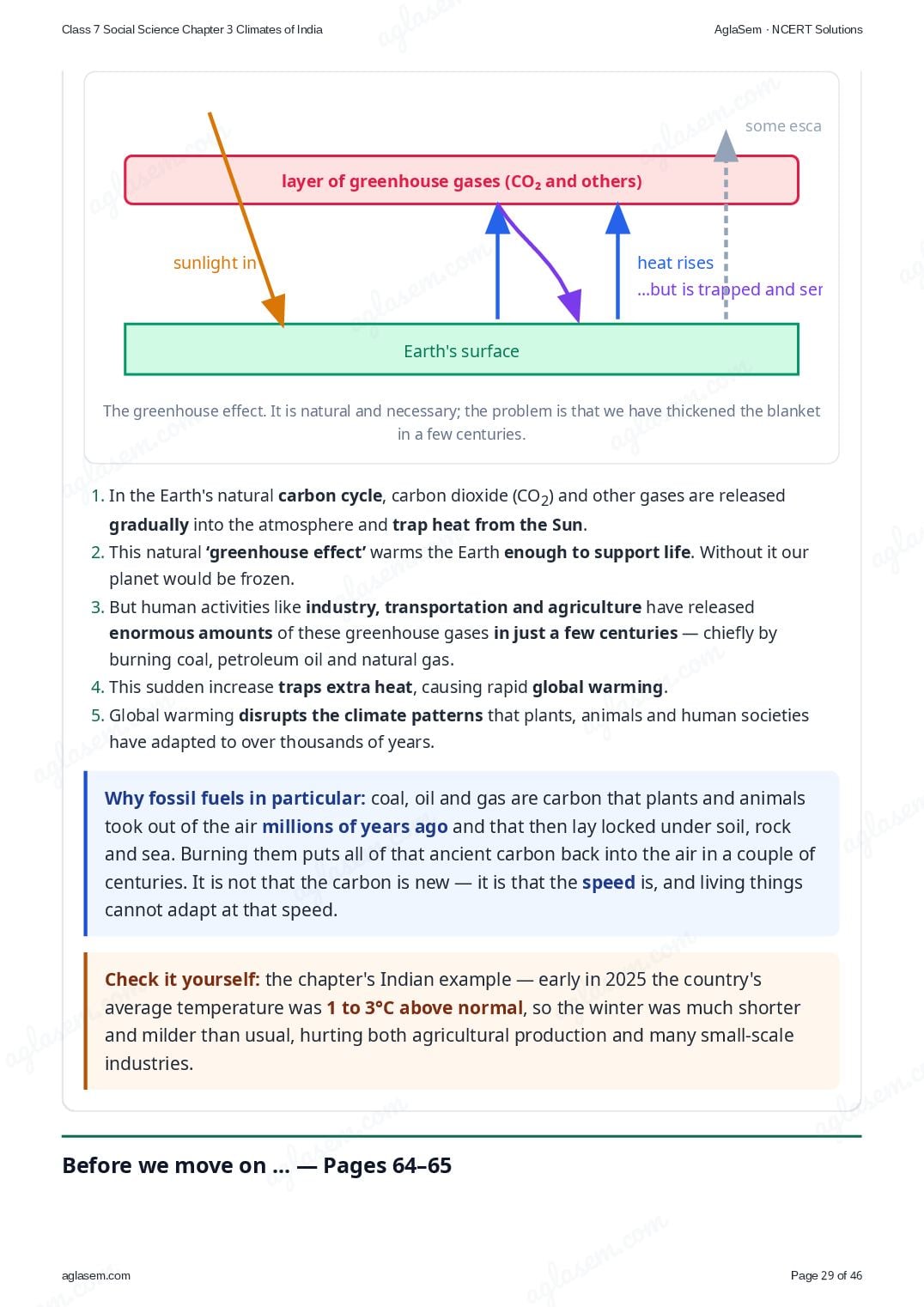
- Why does the burning of fossil fuels affect the climate?
- India's diverse climate is shaped by its geography, including mountains, deserts, and plateaus.
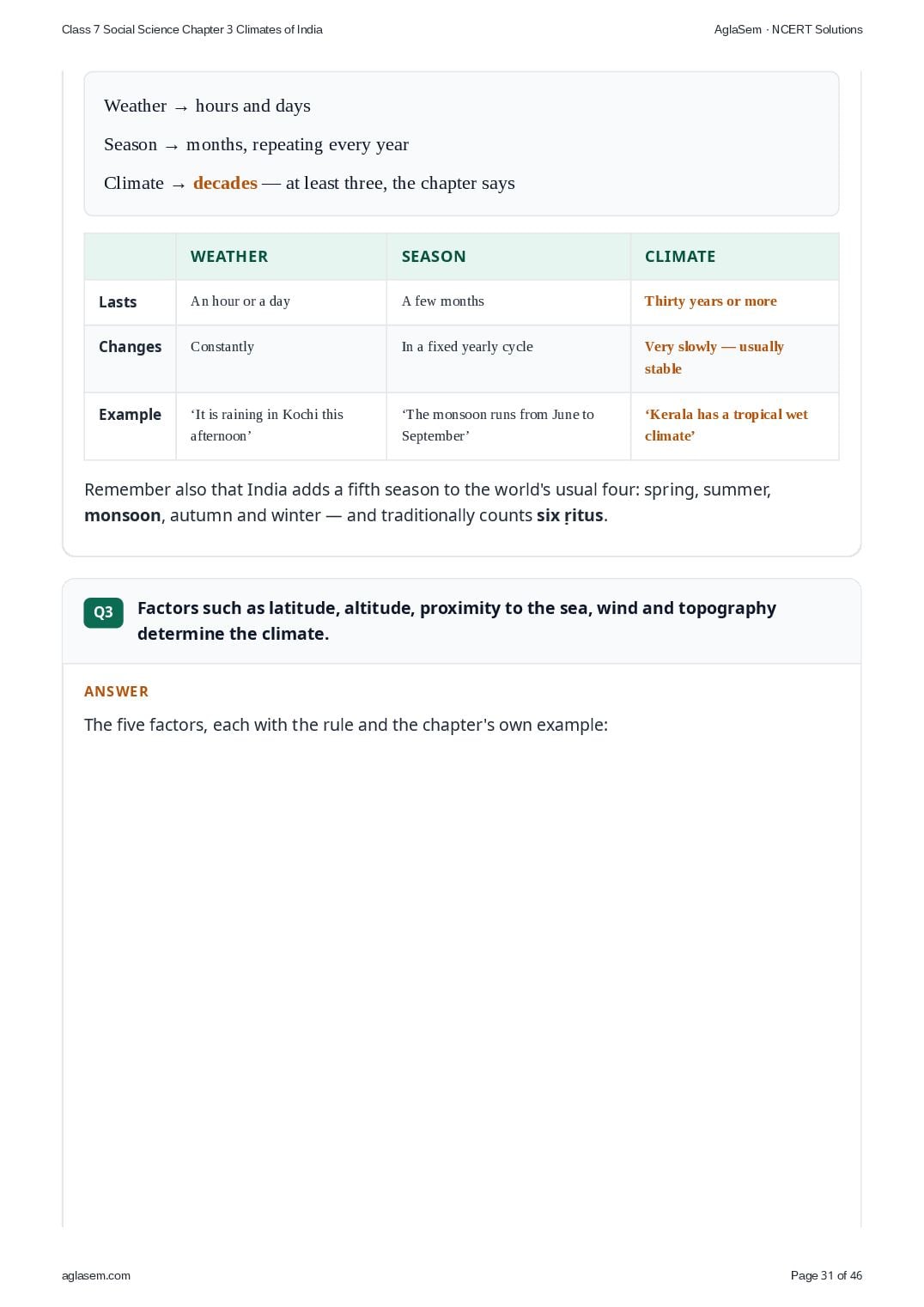
- Weather is short-term, seasons recur on a yearly basis, and climate reflects long-term patterns over decades.
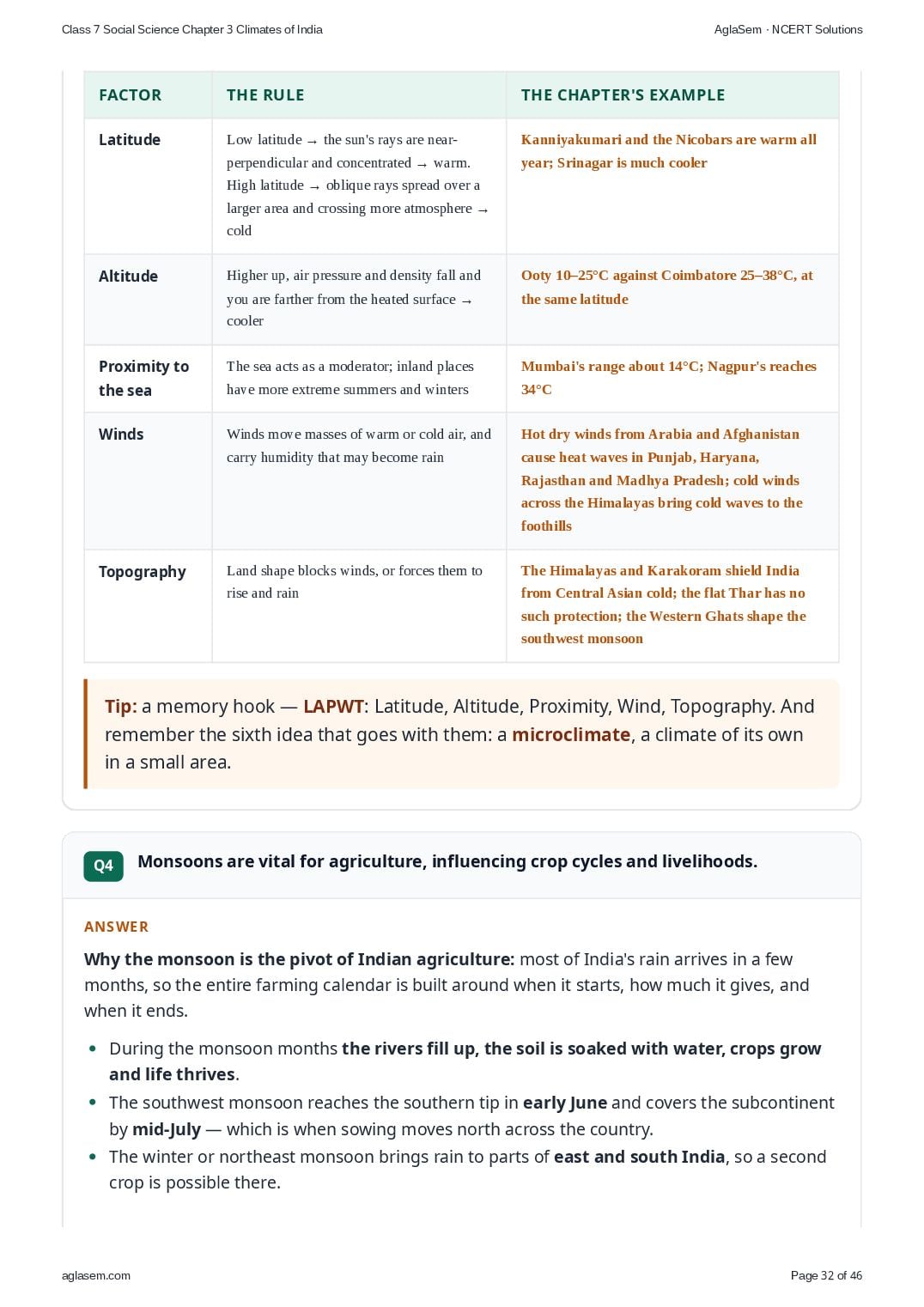
- Factors such as latitude, altitude, proximity to the sea, wind and topography determine the climate.
- Monsoons are vital for agriculture, influencing crop cycles and livelihoods.
- Climate is connected with cultural traditions, festivals, agriculture and economic activity.
- Understanding the climate helps prepare for natural disasters like floods and cyclones.
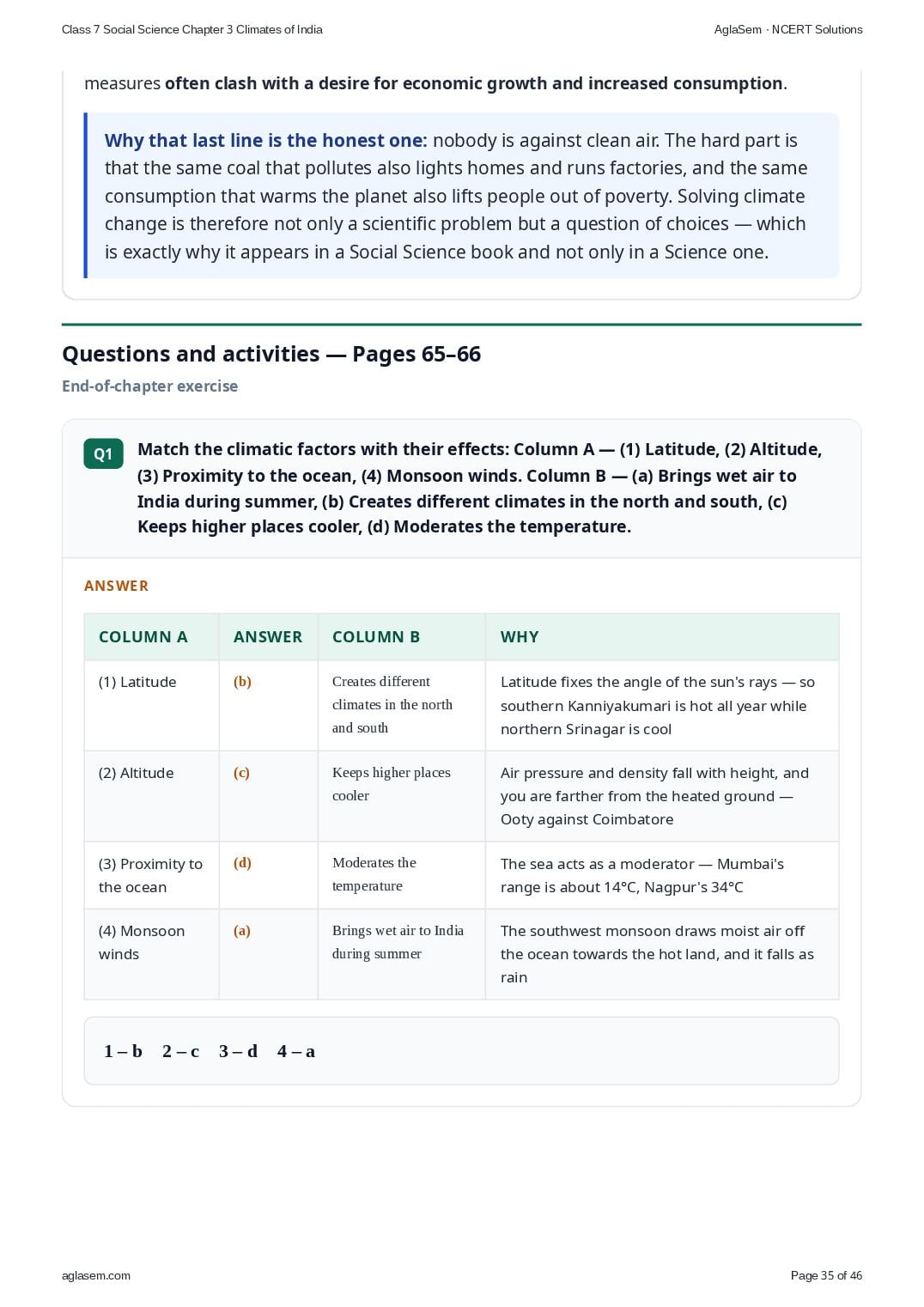
- Climate change leads to extremes of weather or temperature and can have severe consequences on the natural and human worlds.
- Match the climatic factors with their effects: Column A — (1) Latitude, (2) Altitude, (3) Proximity to the ocean, (4) Monsoon winds. Column B — (a) Brings wet air to India during summer, (b) Creates different climates in the north and south, (c) Keeps higher places cooler, (d) Moderates the temperature.
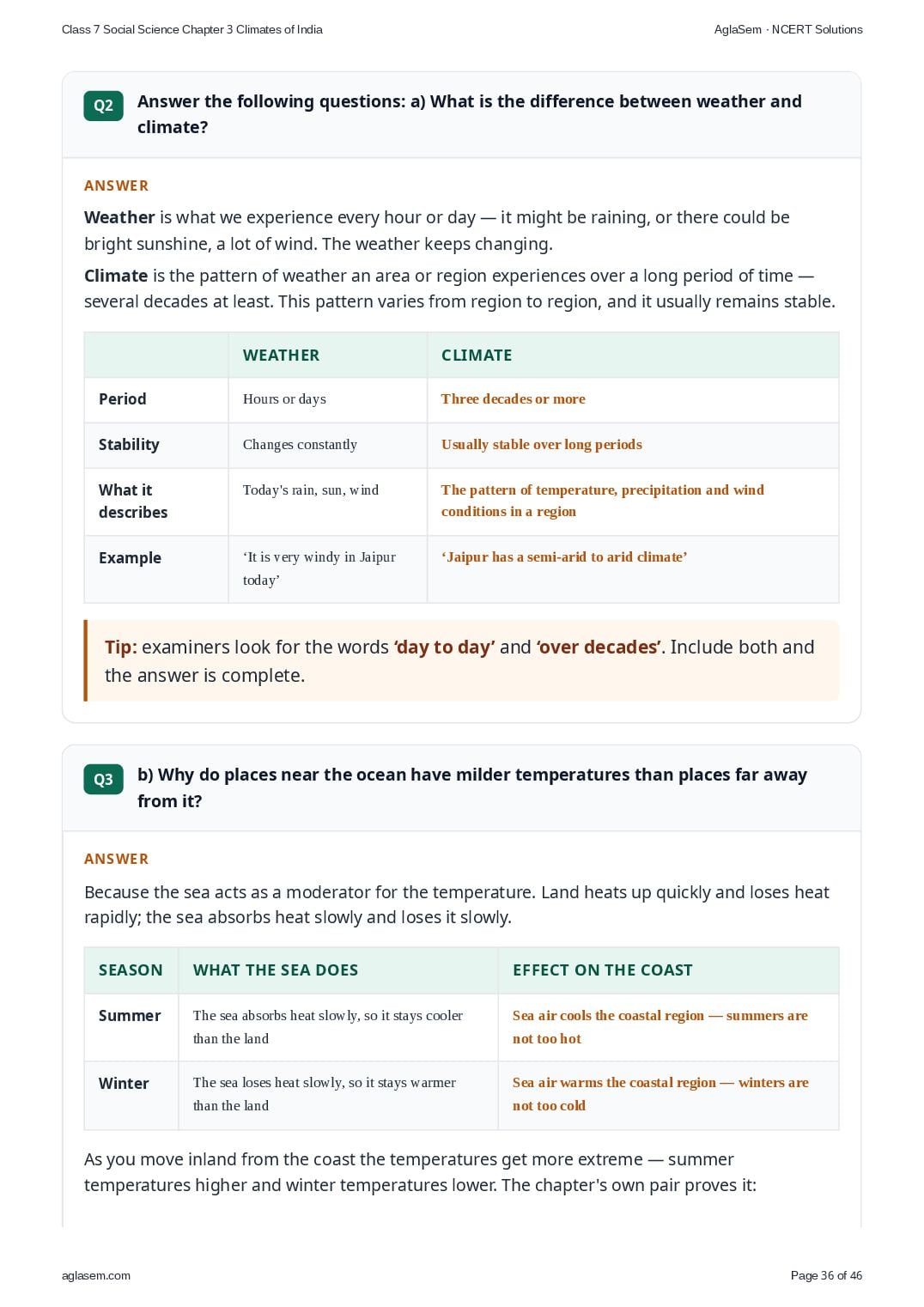
- Answer the following questions: a) What is the difference between weather and climate?
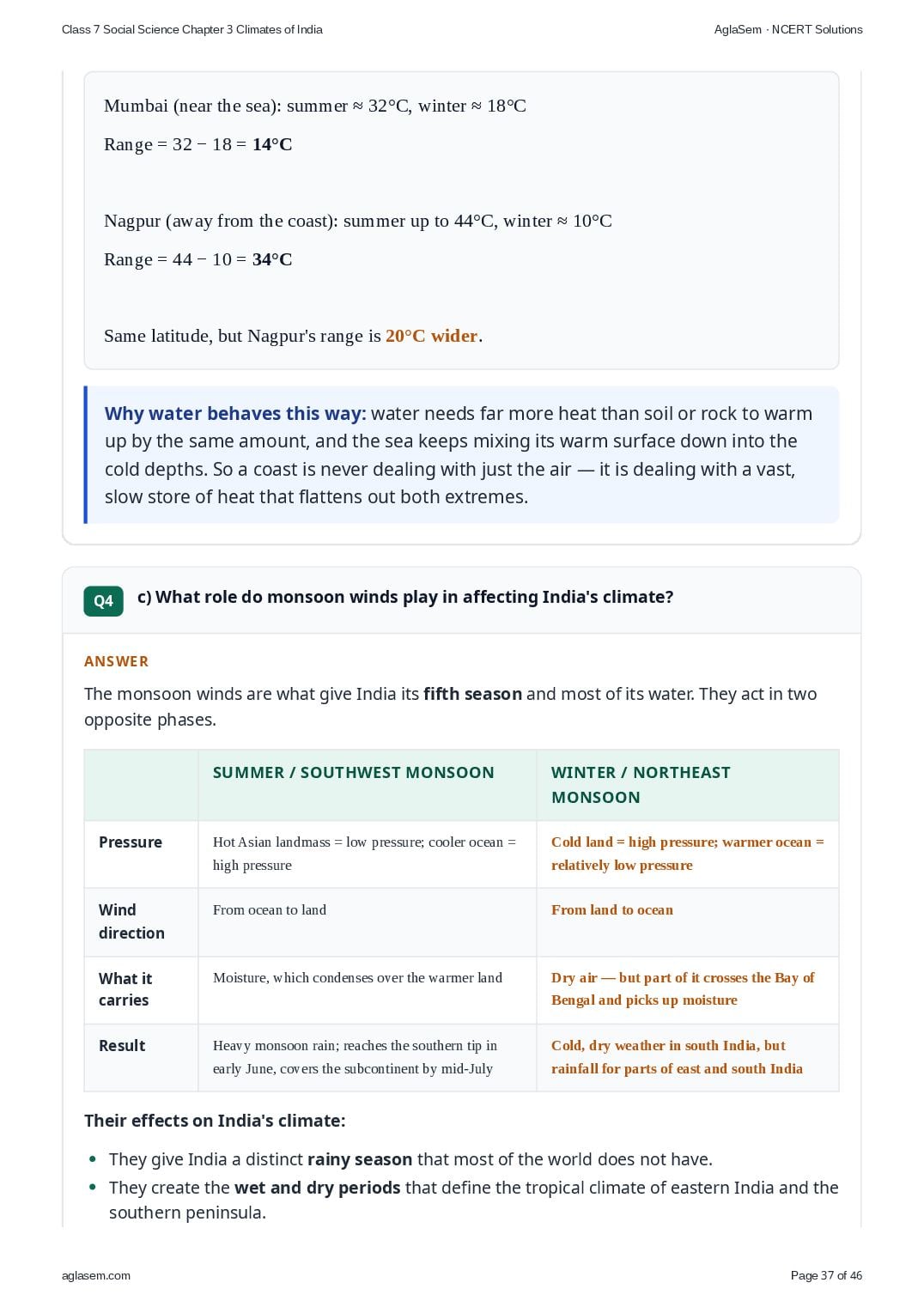
- b) Why do places near the ocean have milder temperatures than places far away from it?
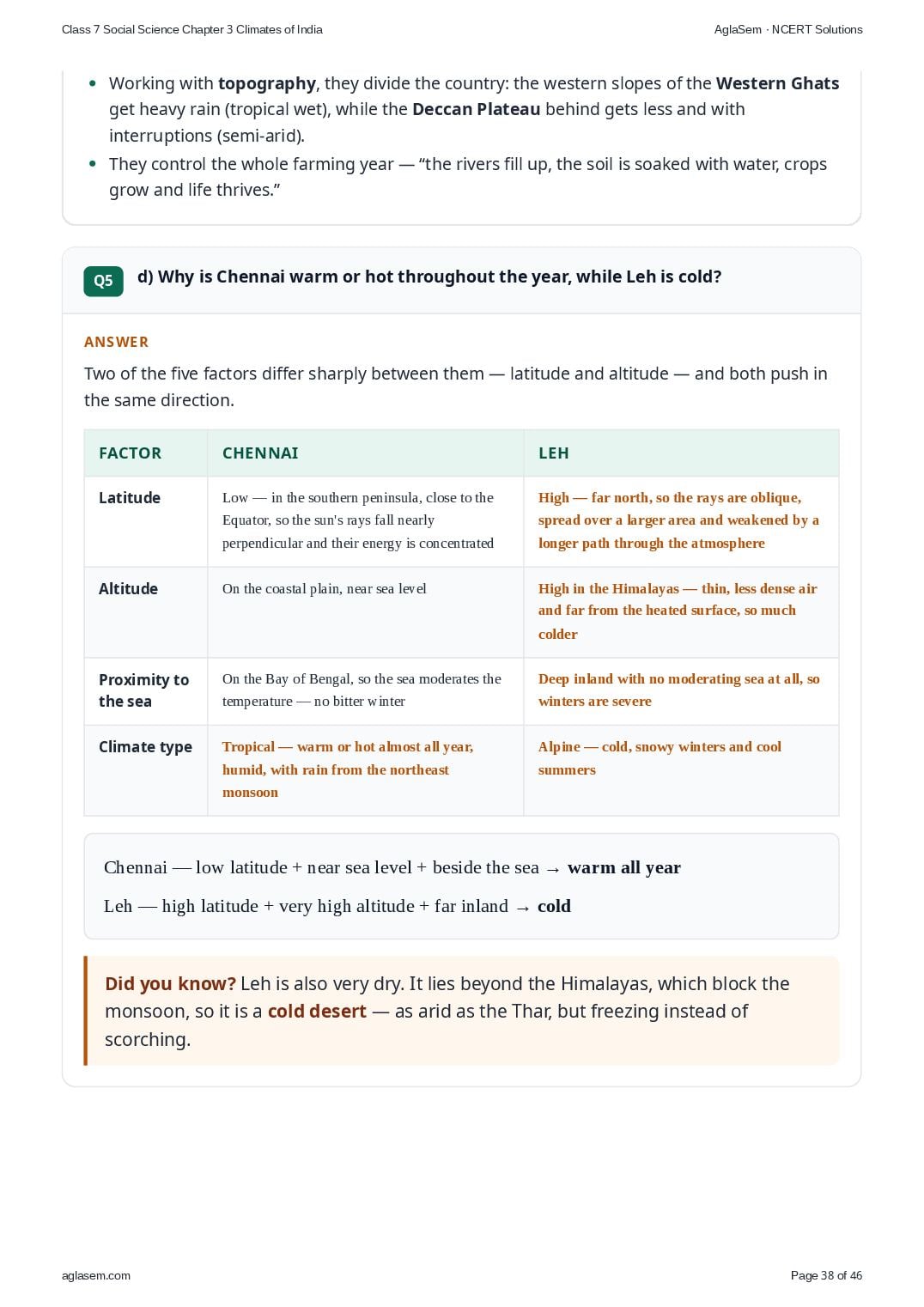
- c) What role do monsoon winds play in affecting India's climate?
- d) Why is Chennai warm or hot throughout the year, while Leh is cold?
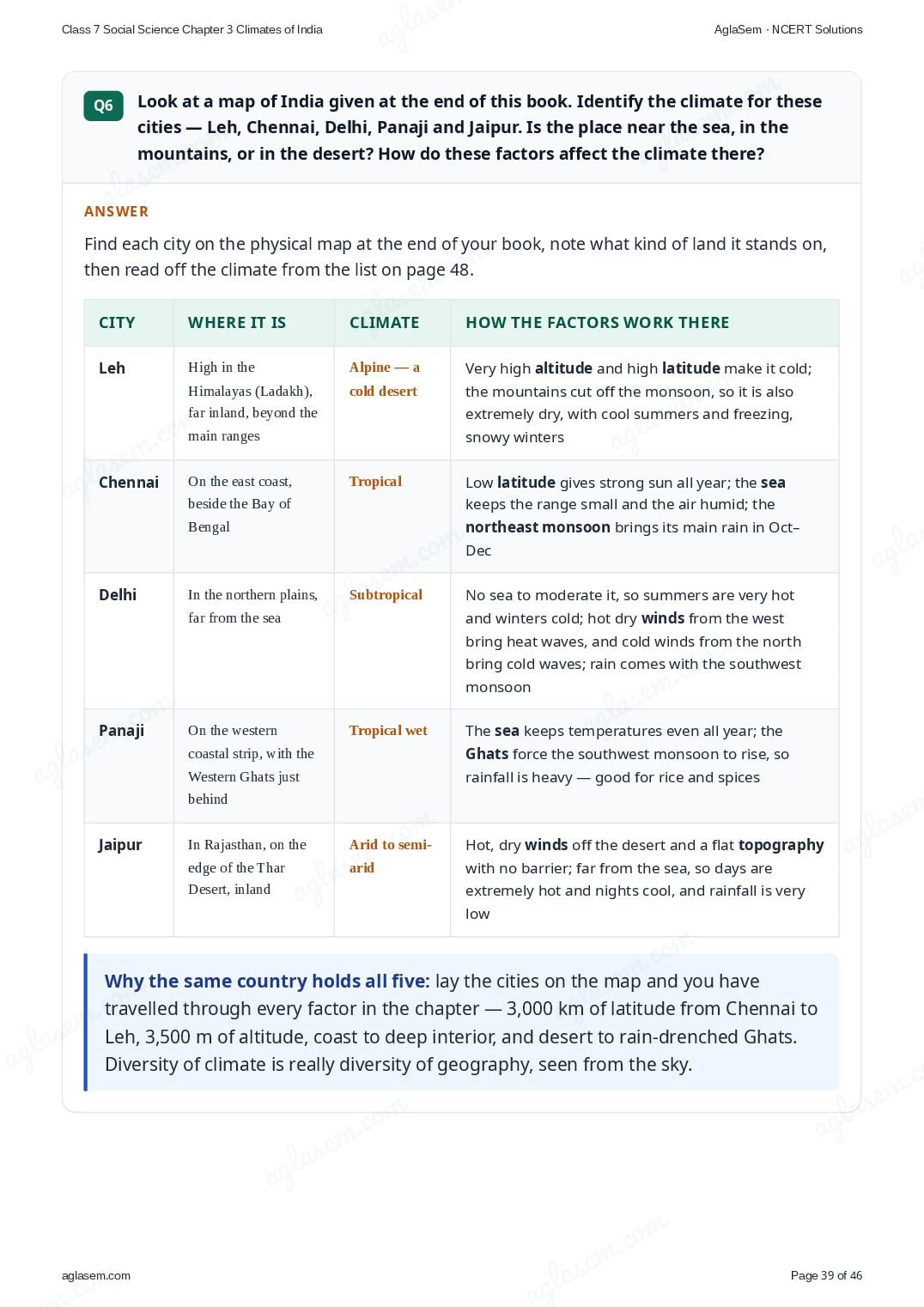
- Look at a map of India given at the end of this book. Identify the climate for these cities — Leh, Chennai, Delhi, Panaji and Jaipur. Is the place near the sea, in the mountains, or in the desert? How do these factors affect the climate there?
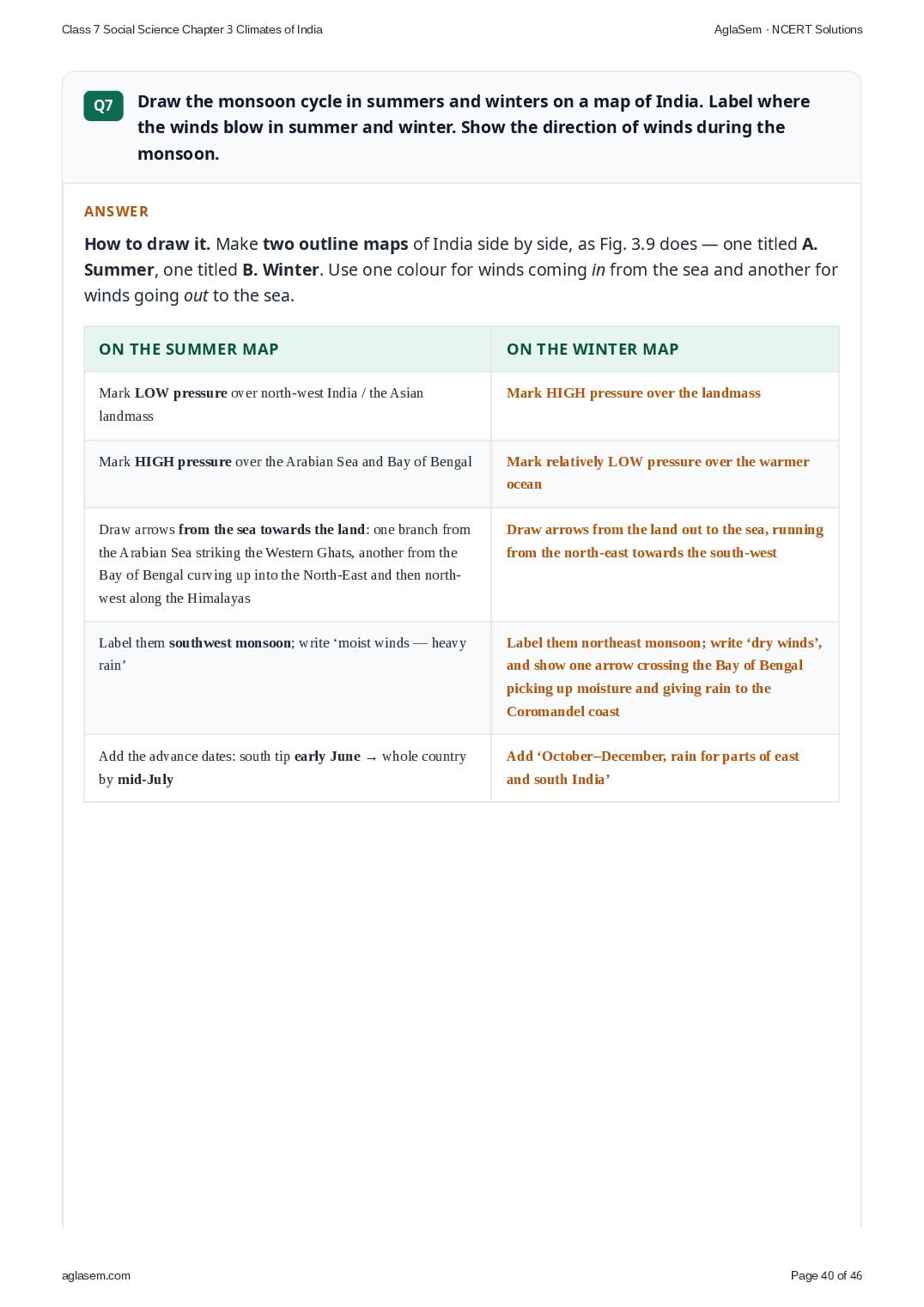
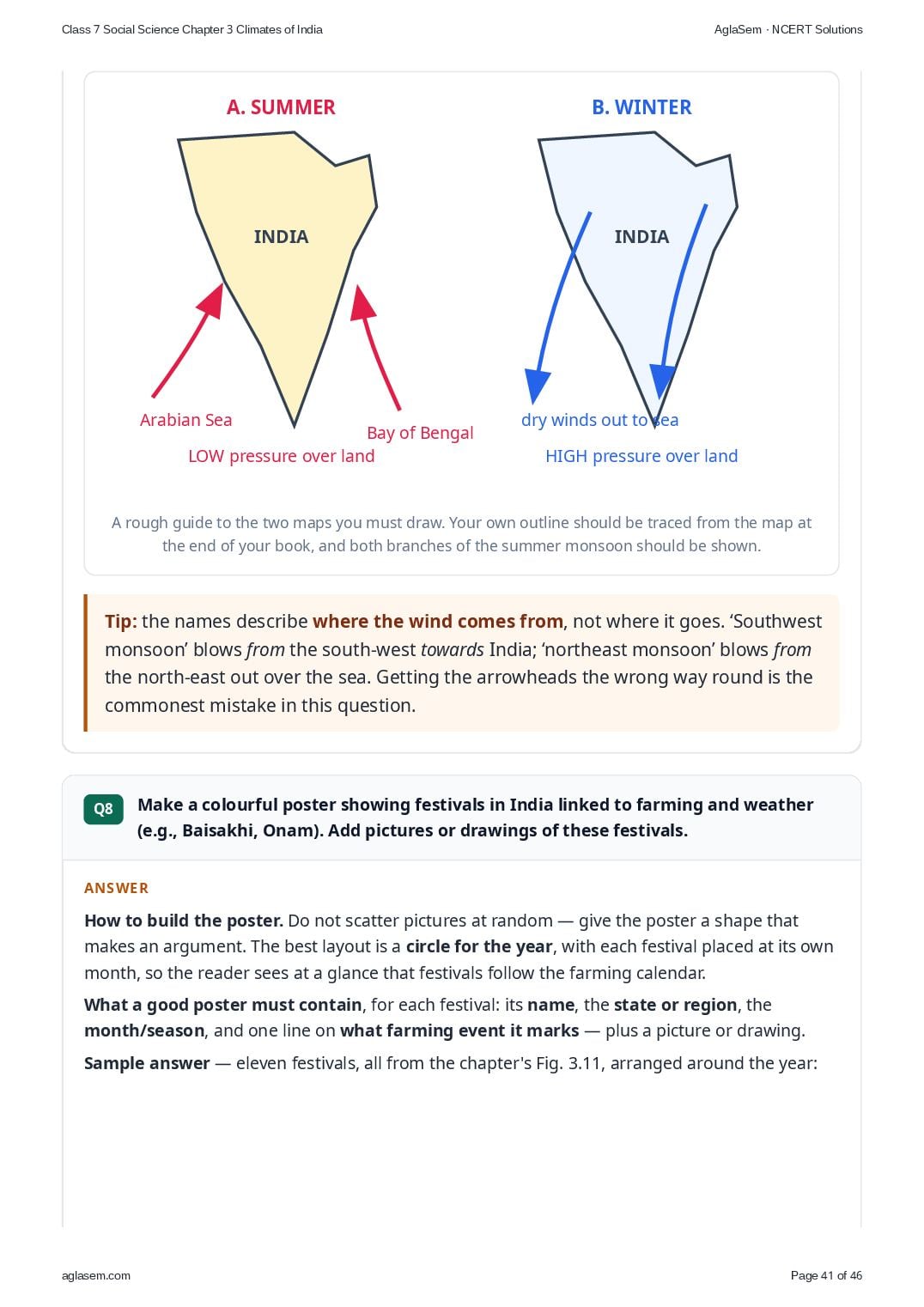
- Draw the monsoon cycle in summers and winters on a map of India. Label where the winds blow in summer and winter. Show the direction of winds during the monsoon.
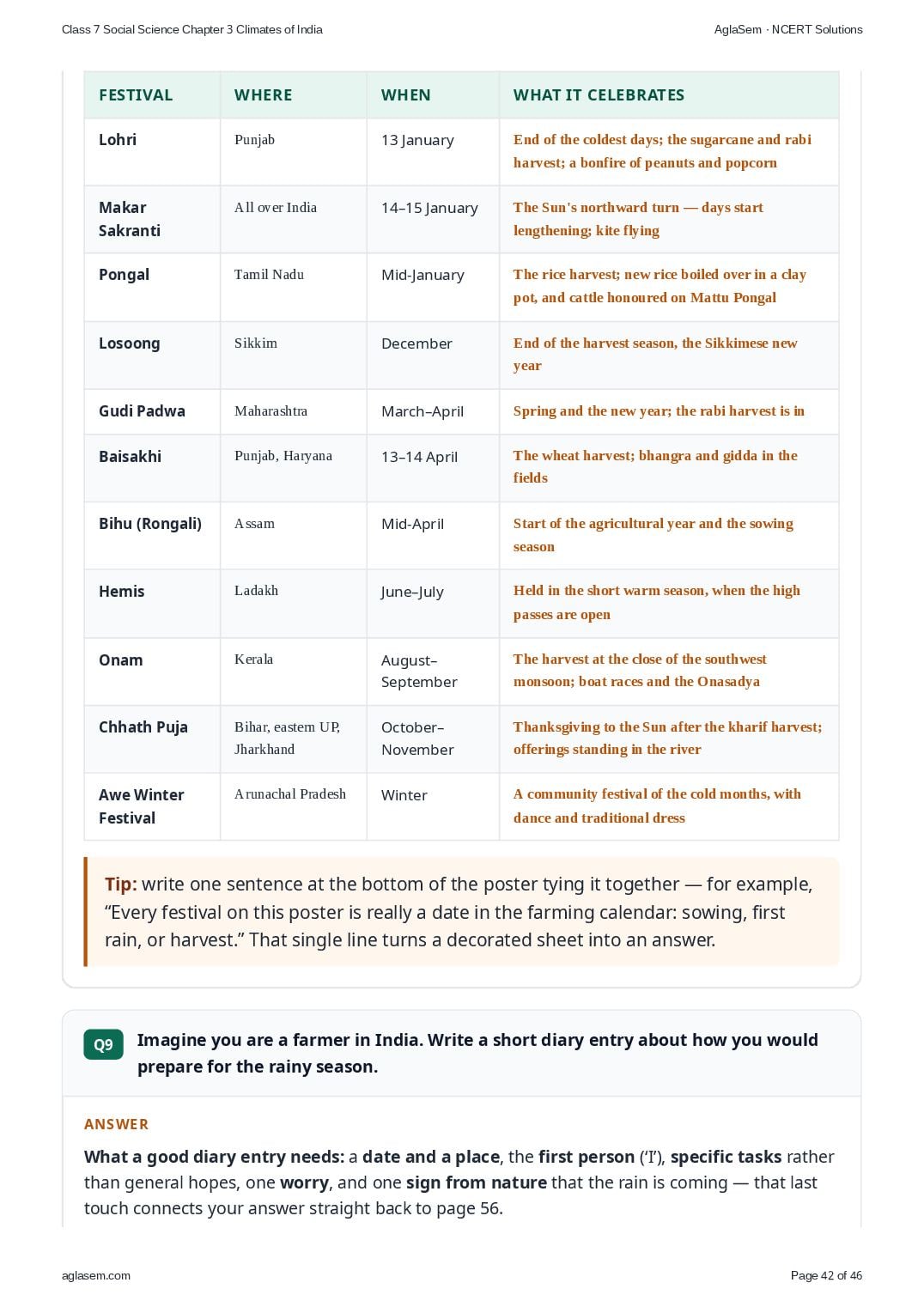
- Make a colourful poster showing festivals in India linked to farming and weather (e.g., Baisakhi, Onam). Add pictures or drawings of these festivals.
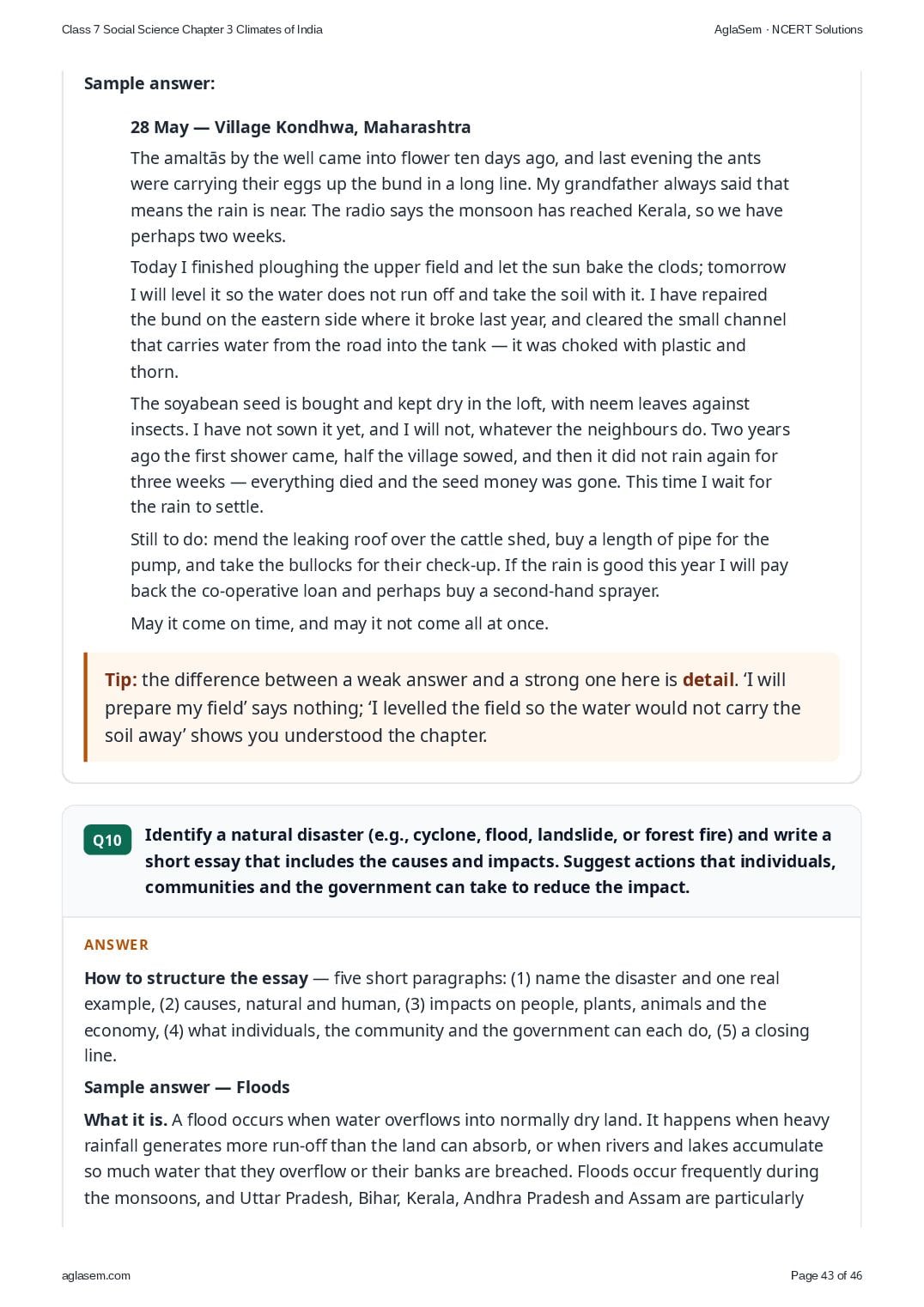
- Imagine you are a farmer in India. Write a short diary entry about how you would prepare for the rainy season.
- Identify a natural disaster (e.g., cyclone, flood, landslide, or forest fire) and write a short essay that includes the causes and impacts. Suggest actions that individuals, communities and the government can take to reduce the impact.
Chapter at a Glance
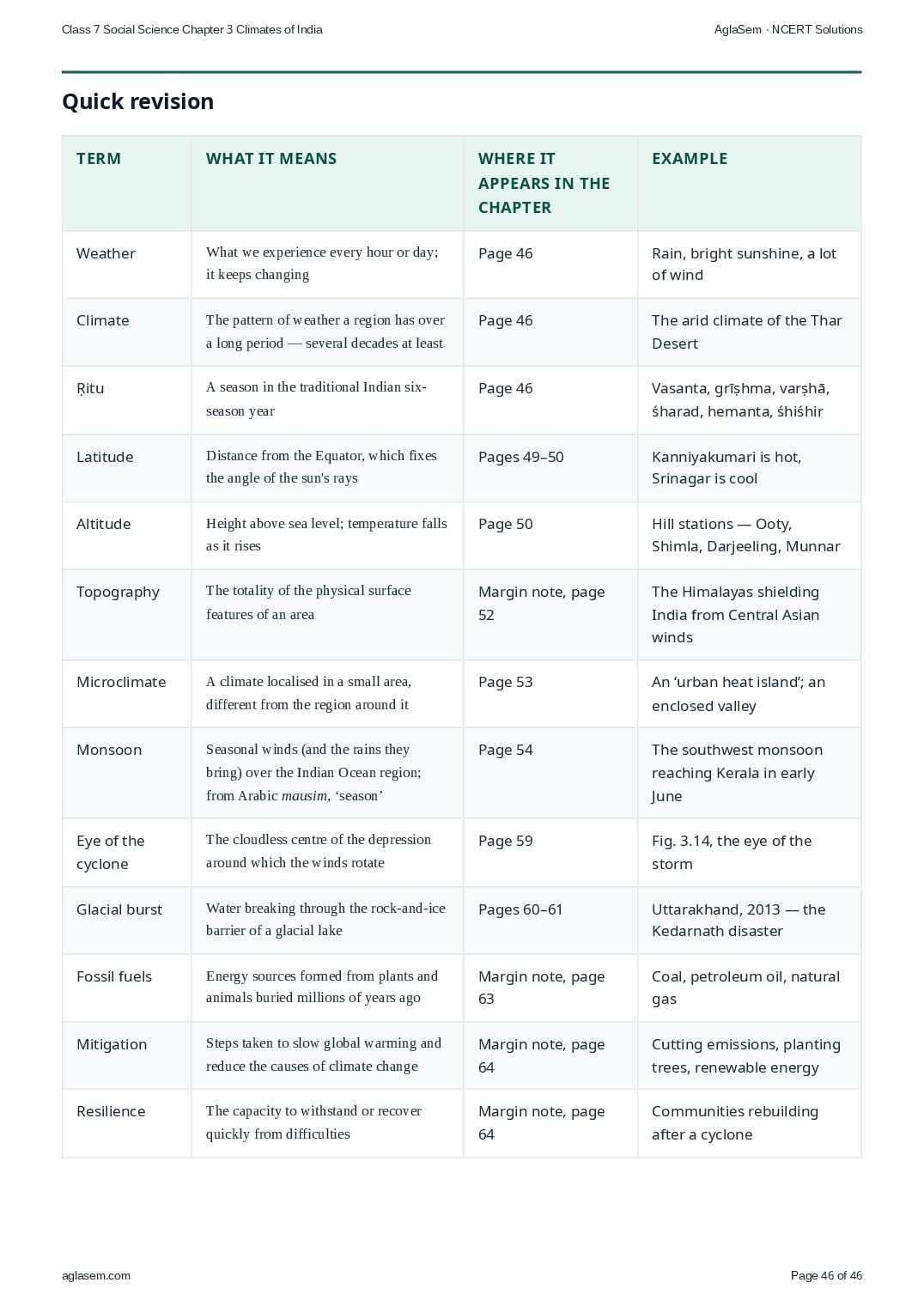
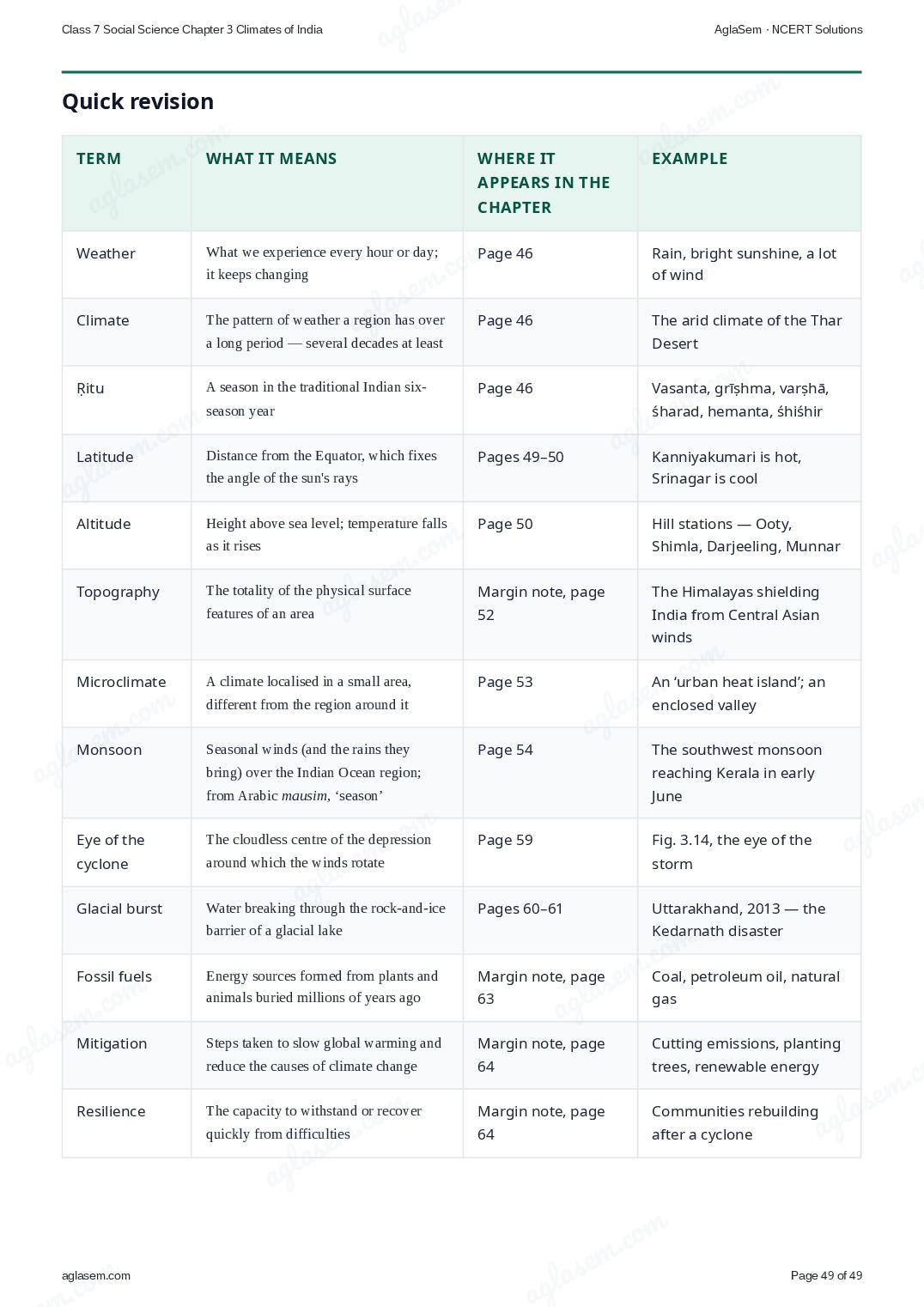
- Weather is what we feel from hour to hour or day to day; seasons recur every year; climate is the pattern of weather a region has over a long period — at least several decades . Traditionally India divides the year into six ṛitus — vasanta, grīṣhma, varṣhā, śharad, hemanta and śhiśhir.
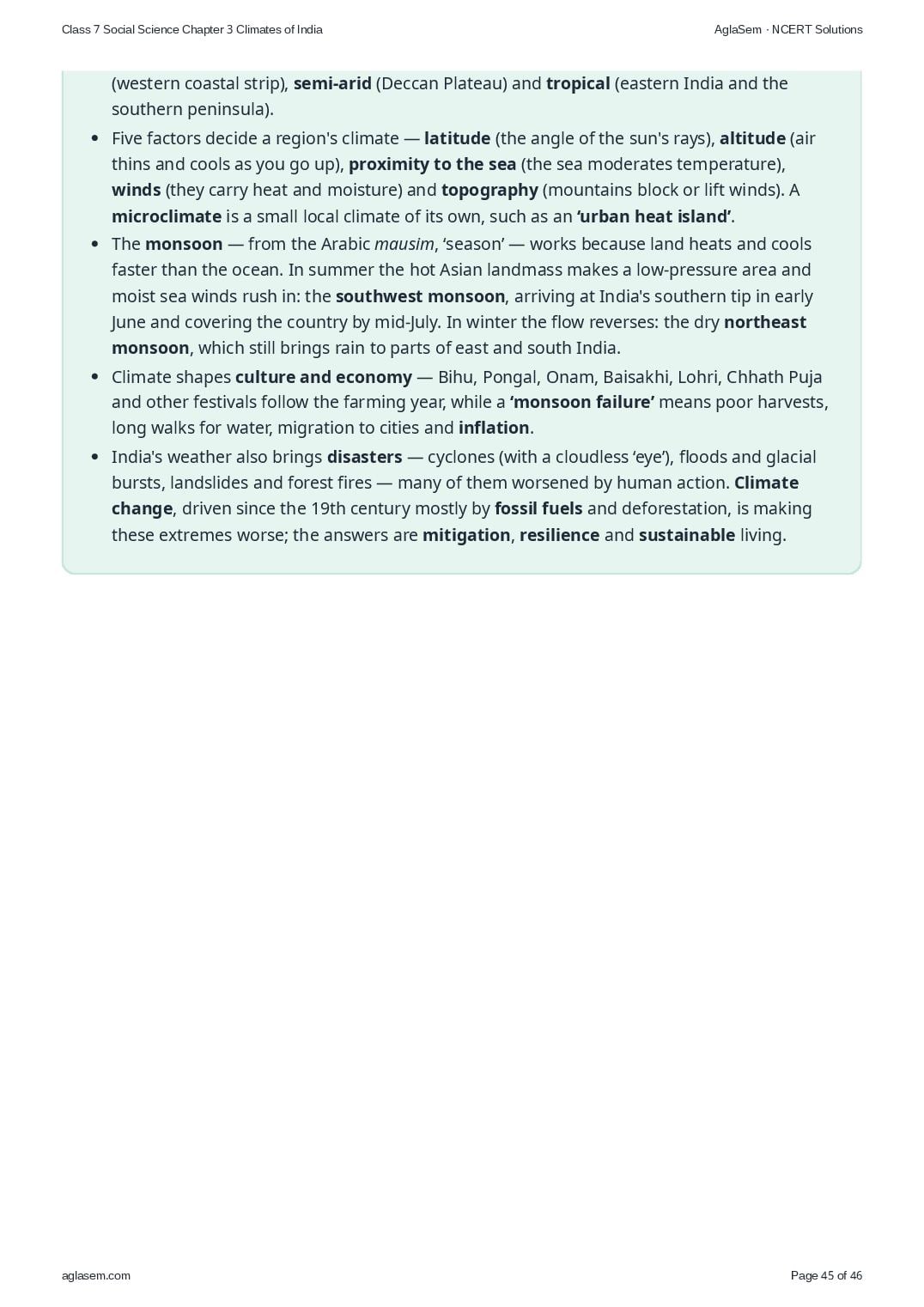
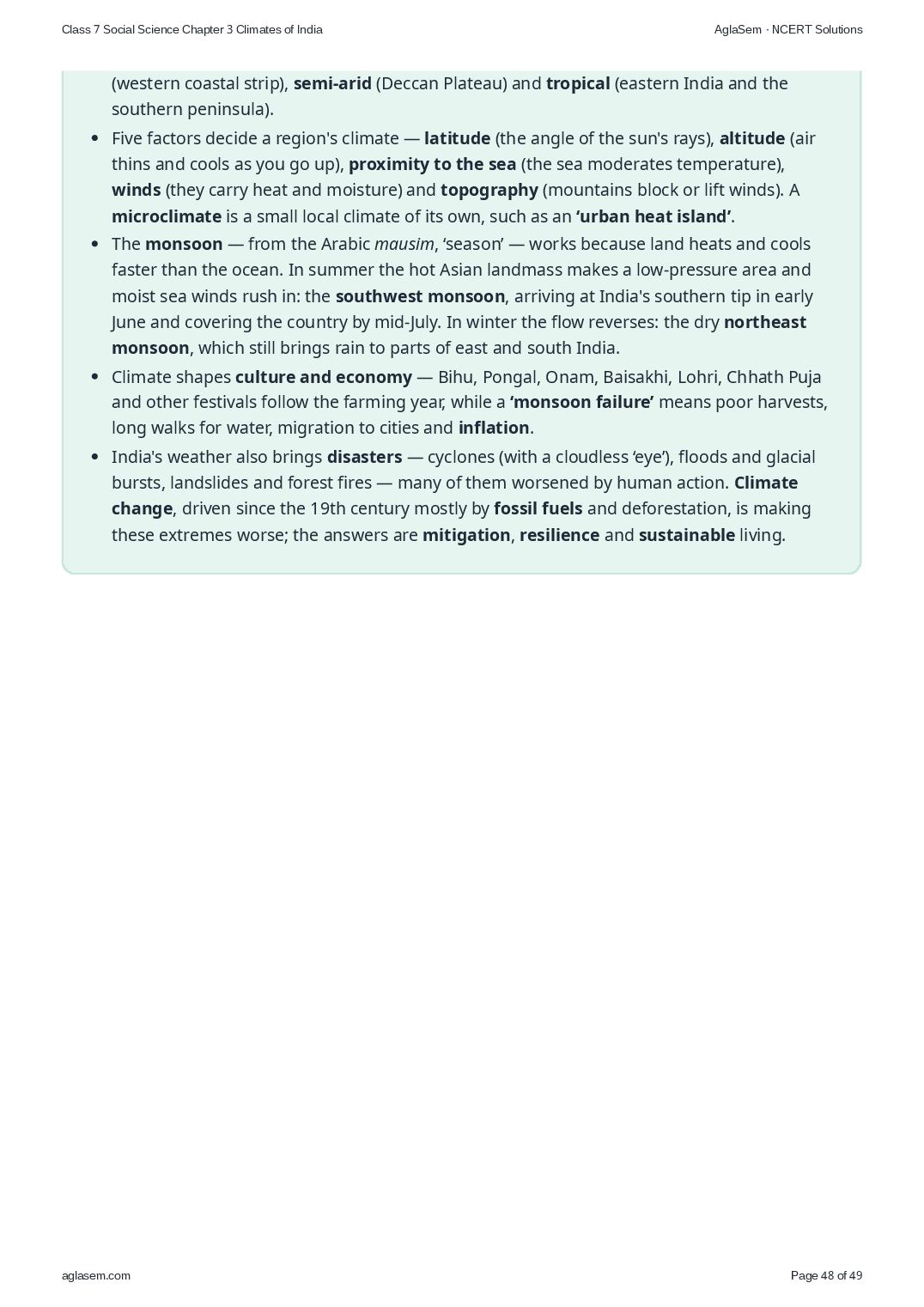
- India has seven kinds of climate in one country: alpine (Himalayas), temperate (lower Himalayas and hill areas), subtropical (northern plains), arid (Thar Desert), tropical wet (western coastal strip), semi-arid (Deccan Plateau) and tropical (eastern India and the southern peninsula).
- Five factors decide a region's climate — latitude (the angle of the sun's rays), altitude (air thins and cools as you go up), proximity to the sea (the sea moderates temperature), winds (they carry heat and moisture) and topography (mountains block or lift winds). A microclimate is a small local climate of its own, such as an ‘urban heat island’ .
- The monsoon — from the Arabic mausim , ‘season’ — works because land heats and cools faster than the ocean . In summer the hot Asian landmass makes a low-pressure area and moist sea winds rush in: the southwest monsoon , arriving at India's southern tip in early June and covering the country by mid-July. In winter the flow reverses: the dry northeast monsoon , which still brings rain to parts of east and south India.
- Climate shapes culture and economy — Bihu, Pongal, Onam, Baisakhi, Lohri, Chhath Puja and other festivals follow the farming year, while a ‘monsoon failure’ means poor harvests, long walks for water, migration to cities and inflation .
- India's weather also brings disasters — cyclones (with a cloudless ‘eye’), floods and glacial bursts, landslides and forest fires — many of them worsened by human action. Climate change , driven since the 19th century mostly by fossil fuels and deforestation, is making these extremes worse; the answers are mitigation , resilience and sustainable living.
How to Download NCERT Solutions for Class 7 Social Science Chapter 3 PDF
Follow these simple steps to get the Climates of India questions-and-answers PDF from Exploring Society India and Beyond.
- Search NCERT Solutions for Class 7 Social Science Chapter 3 aglasem and open this page.
- Read the exercise questions with answers for Climates of India shown above.
- Click the Download PDF link to save the Climates of India solutions to your device.
NCERT Solutions for Class 7 Social Science – All Chapters
There are more chapters to study besides Climates of India in Social Science. Here are the NCERT Solutions for all chapters of Class 7 Social Science.
- Chapter 1 Geographical Diversity of India
- Chapter 2 Understanding the Weather
- Chapter 3 Climates of India
- Chapter 4 New Beginnings Cities and States
- Chapter 5 the Rise of Empires
- Chapter 6 the Age of Reorganisation
- Chapter 7 the Gupta Era an Age of Tireless Creativity
- Chapter 8 How the Land Becomes Sacred
- Chapter 9 From the Rulers to the Ruled Types of Governments
- Chapter 10 the Constitution of India an Introduction
- Chapter 11 From Barter to Money
- Chapter 12 Understanding Markets
NCERT Solutions for Class 7 – All Subjects
Just like Chapter 3 of Social Science, you can get the exercise questions with answers for every other subject of Class 7. Here are the NCERT Solutions for all subjects of Class 7.
NCERT Solutions for Class 7 Social Science Chapter 3 – An Overview
The key highlights of this study material are as follows.
| Aspects | Details |
|---|---|
| Class | Class 7 |
| Subject | Social Science |
| Chapter Number | Chapter 3 |
| Chapter Name | Climates of India |
| Book Name | Exploring Society India and Beyond |
| Book By | NCERT (National Council of Educational Research and Training) |
| Educational Resource Here | NCERT Solutions of Class 7 Social Science Chapter 3 for all exercises |
| More Questions Answers of This Subject | NCERT Solutions for Class 7 Social Science |
| Download Book Chapter | NCERT Book Class 7 Social Science |
| All Questions Answers For This Class | NCERT Solutions for Class 7 |
| Complete Solutions | NCERT Solutions |
NCERT Solutions for Class 7 Social Science Chapter 3 Climates of India – FAQs
What are the NCERT Solutions for Class 7 Social Science Chapter 3 Climates of India?
They are the complete, step-by-step answers to all the exercise and in-text questions of Chapter 3 Climates of India from the NCERT Class 7 Social Science textbook Exploring Society India and Beyond, written by experts as per the latest NCERT syllabus.
How can I download the Class 7 Social Science Chapter 3 solutions PDF for free?
Open this page on aglasem, read the Climates of India questions with answers, and click the “Download Solutions PDF” link. The Class 7 Social Science Chapter 3 NCERT Solutions PDF is completely free to download.
Are these NCERT Solutions as per the latest 2026-27 syllabus?
Yes. The NCERT Solutions for Class 7 Social Science Chapter 3 are based on the latest NCERT textbook Exploring Society India and Beyond and the current 2026-27 CBSE syllabus, so the questions and answers match what you study in class.
Where can I get NCERT Solutions for the other chapters of Class 7 Social Science?
You can find the answers to every chapter on the NCERT Solutions for Class 7 Social Science page, and solutions for every subject on the NCERT Solutions for Class 7 page.
How do NCERT Solutions help in exam preparation?
They show the correct method to solve each question, help you write answers the way they are expected in exams, let you check and correct your own work, and save revision time — which together improve your marks in Class 7 Social Science.
If you have any queries on NCERT Solutions for Class 7 Social Science Chapter 3 Climates of India, then please ask in the comments below.
