Download A Story of Numbers – NCERT Class 8 Maths Chapter 3 PDF from the new NCERT Class 8 Maths book Ganita Prakash (2026-27). Read the chapter online or download the free PDF. To count you need a standard sequence of objects, names or written symbols with a fixed order — that sequence is a number system. Counting a collection means making a one-to-one mapping onto it.
A Story of Numbers PDF – Chapter 3 of Ganita Prakash (Part I)
Read the chapter online or download the PDF.
| Chapter | Download | |
|---|---|---|
| Chapter 3 PDF | A Story of Numbers | View PDF |
| Full book | NCERT Class 8 Maths – Ganita Prakash | View Book |
Read Online
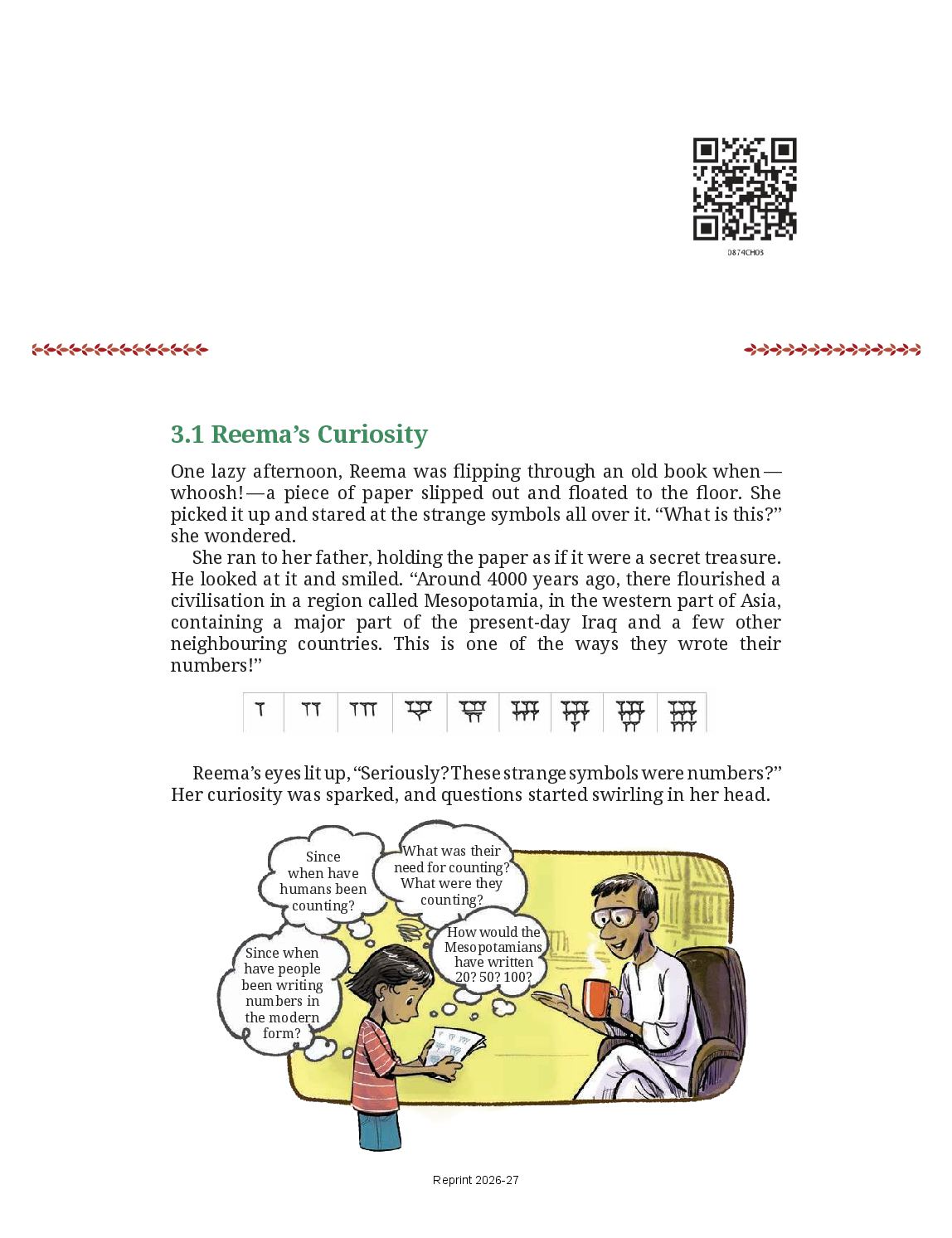
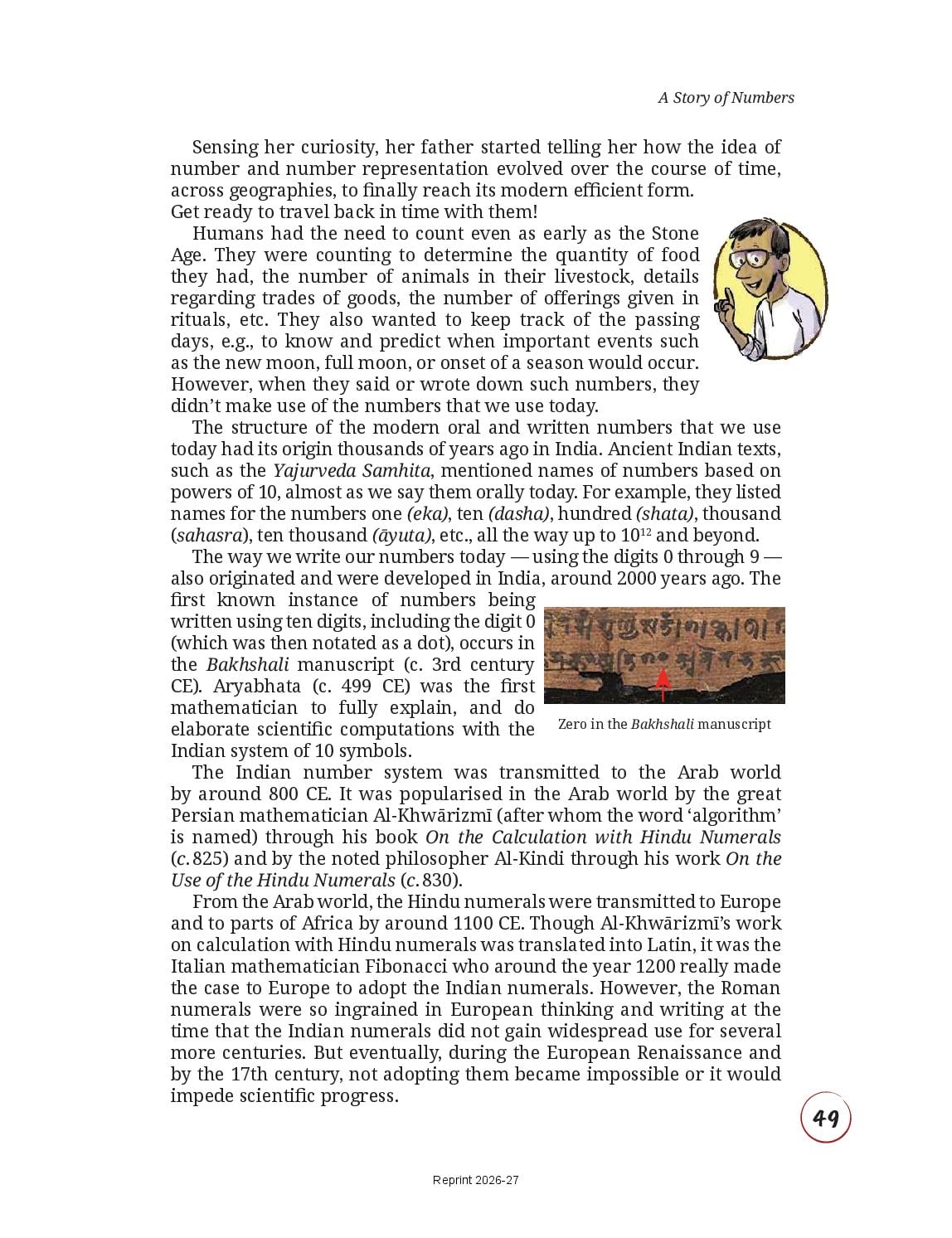
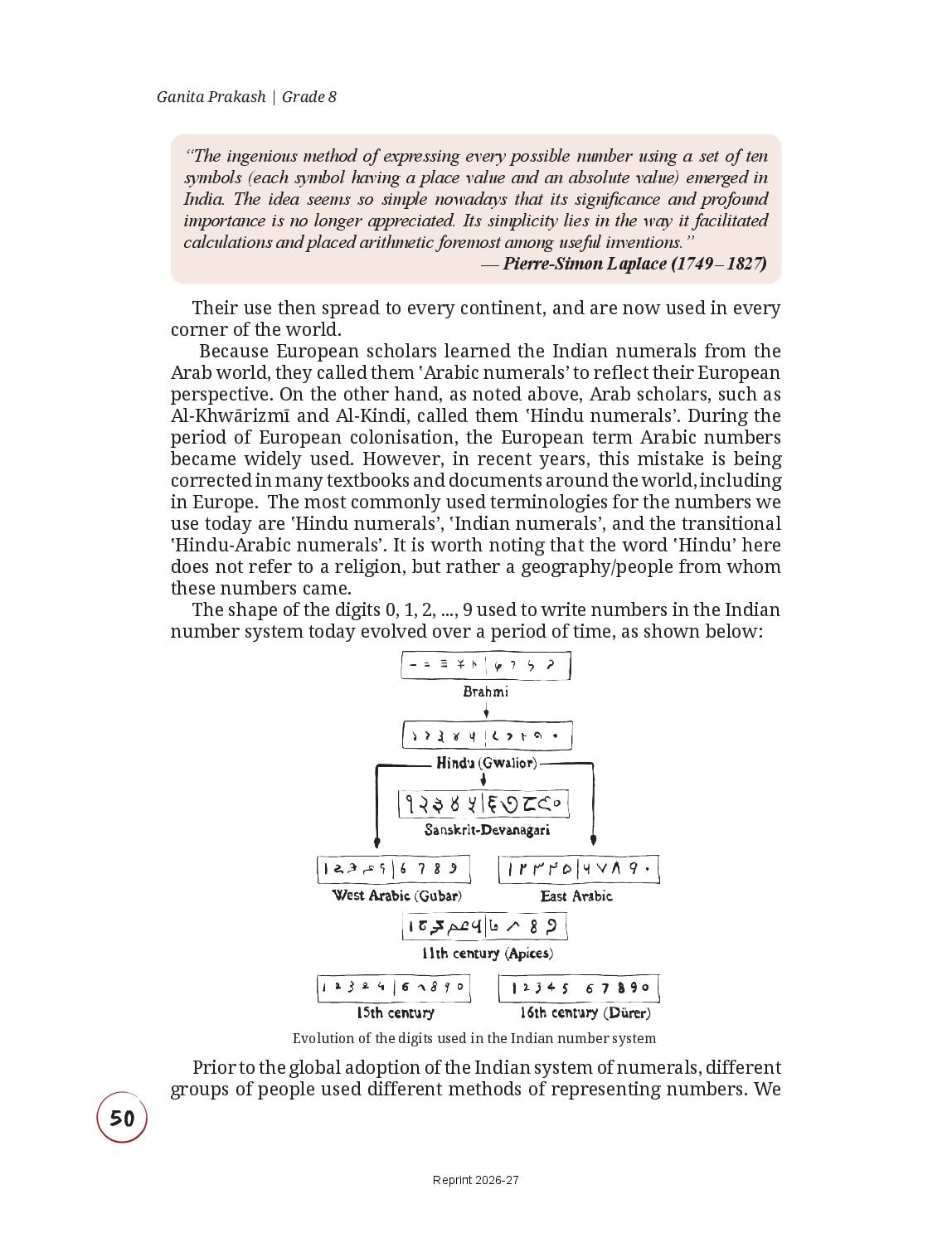
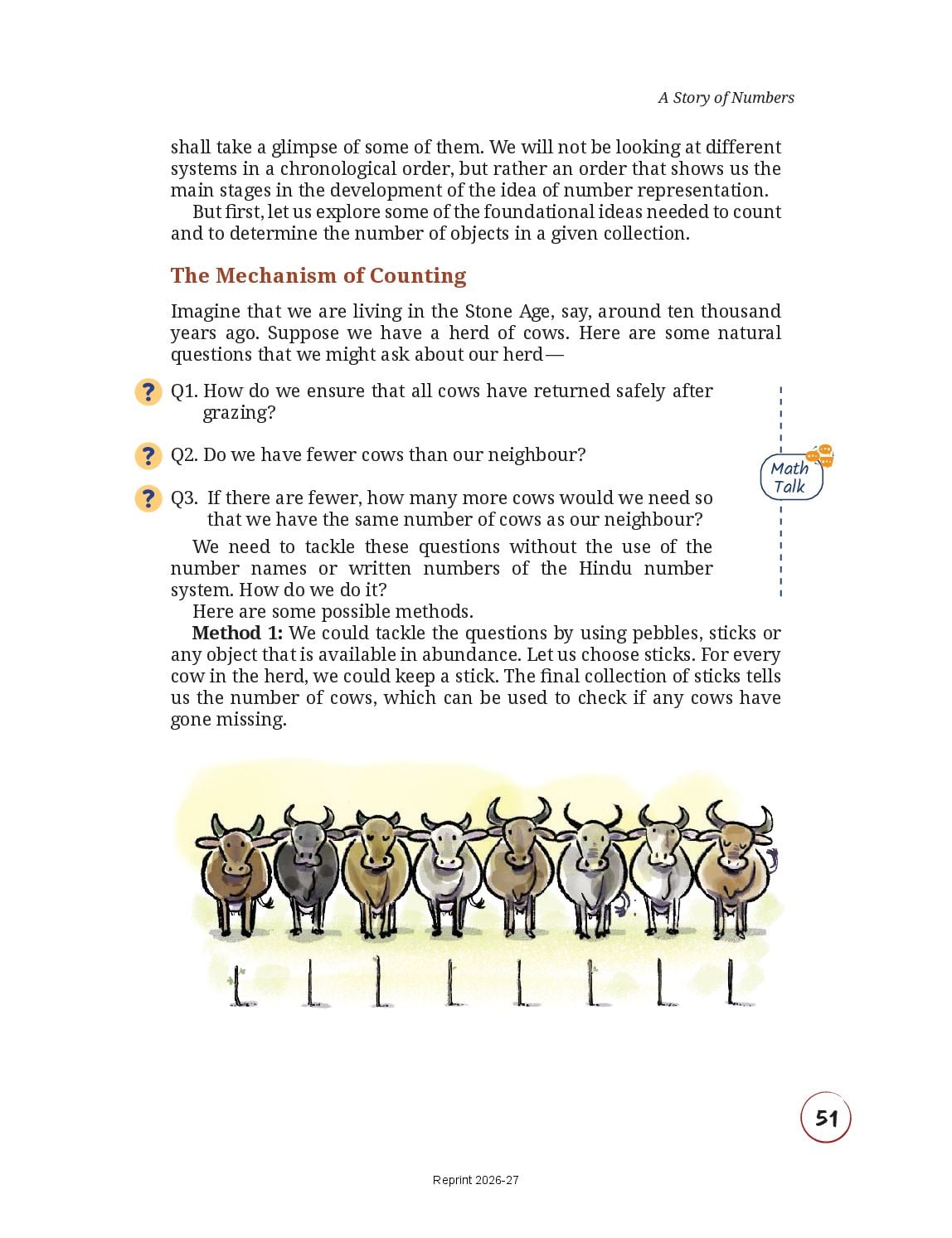
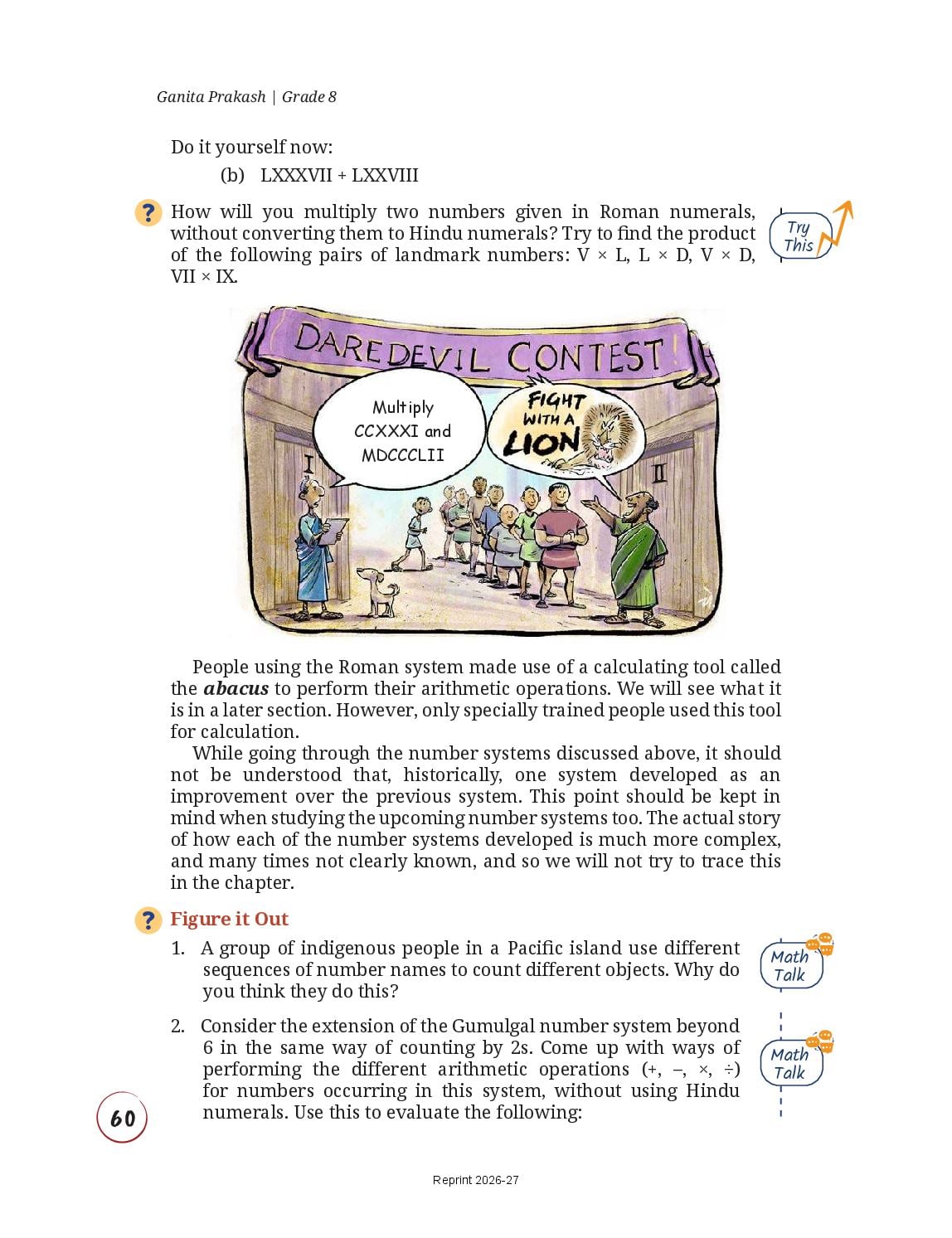
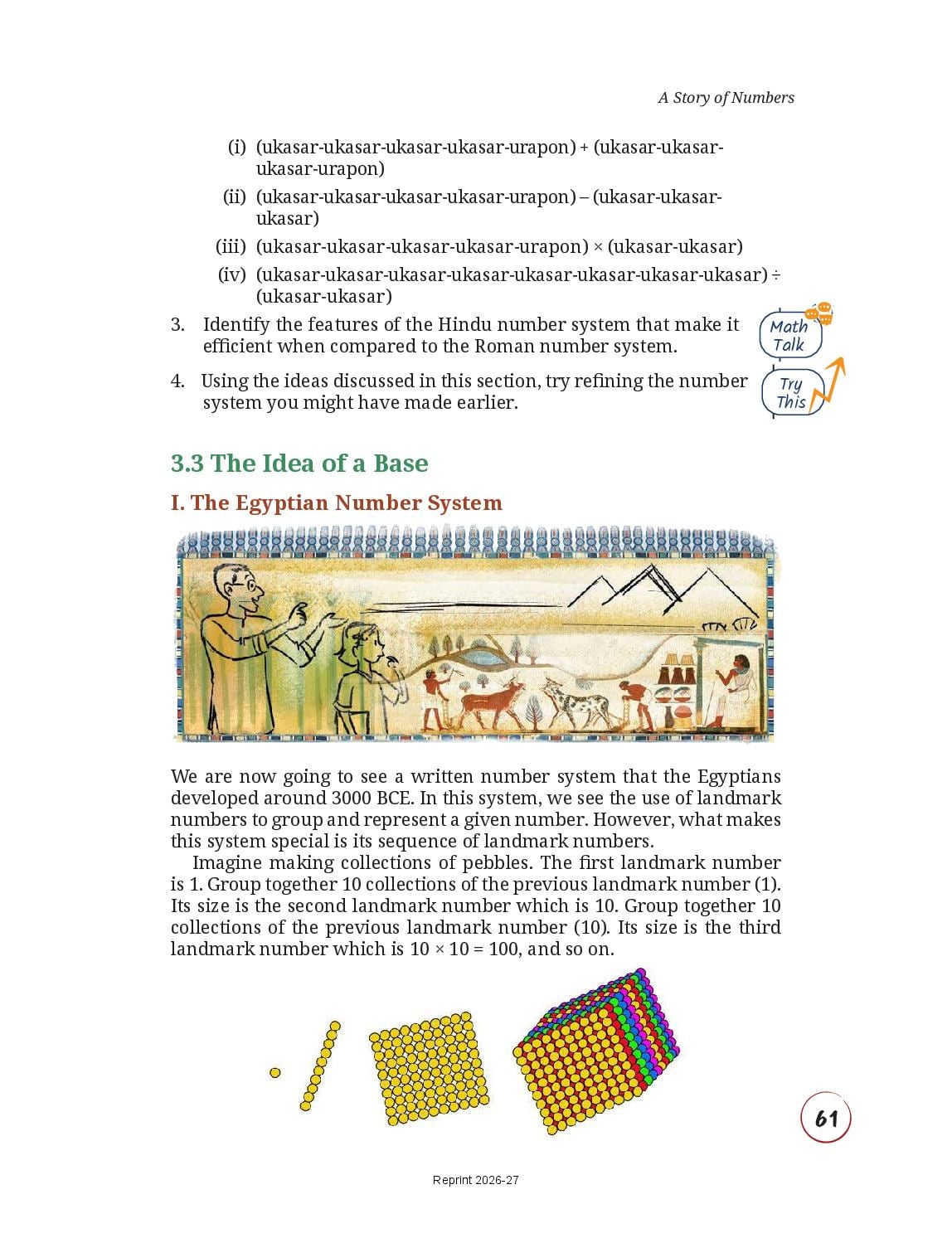
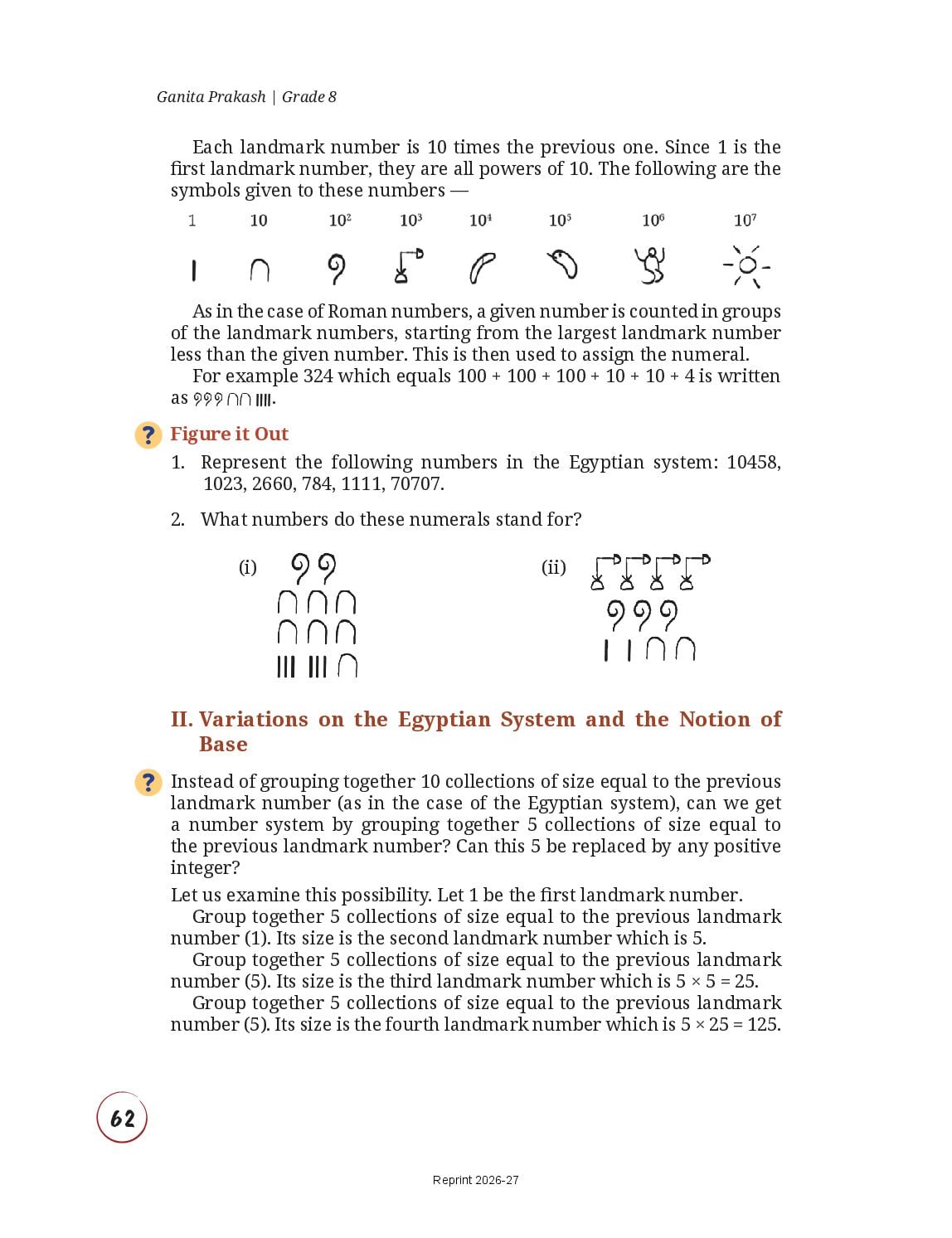
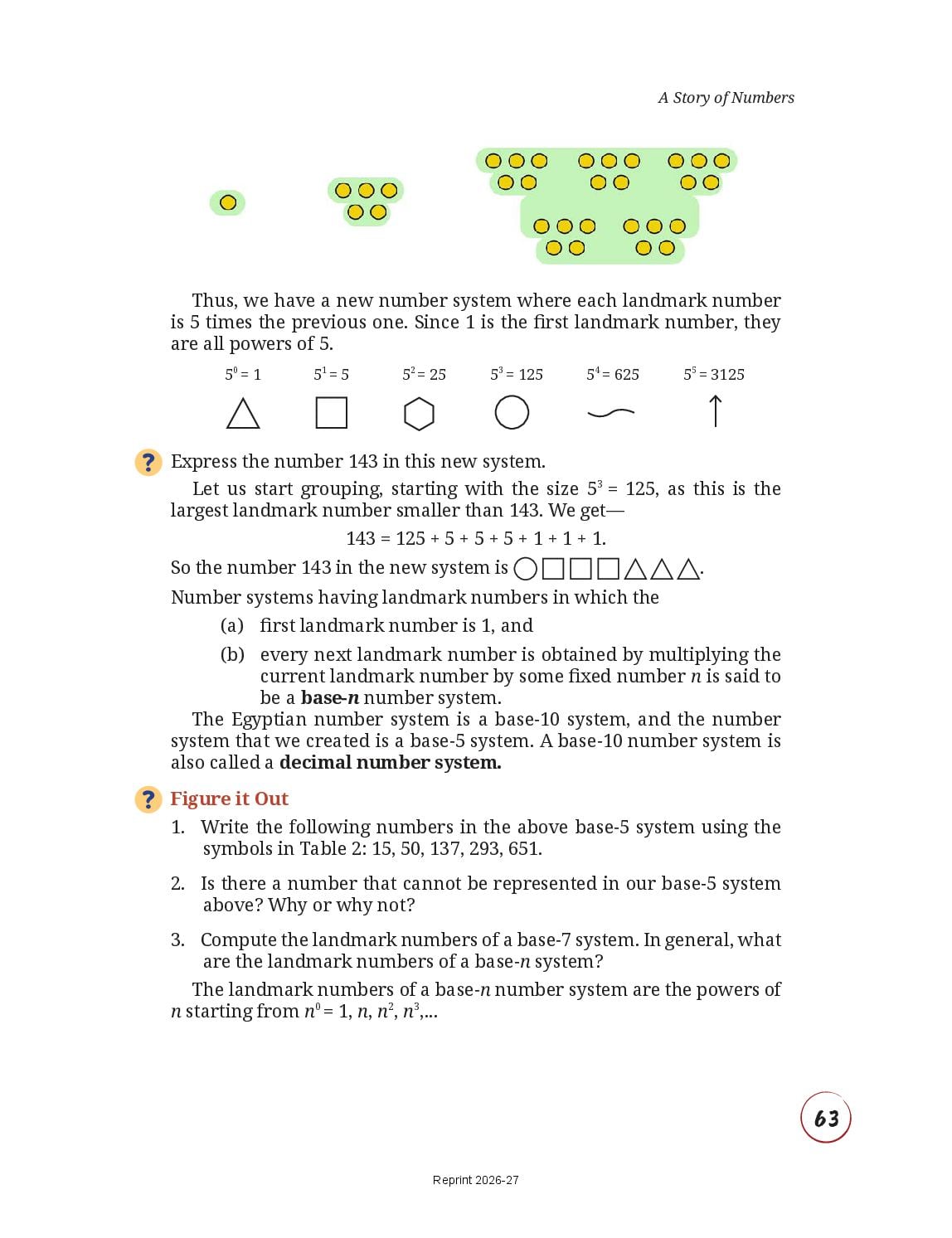
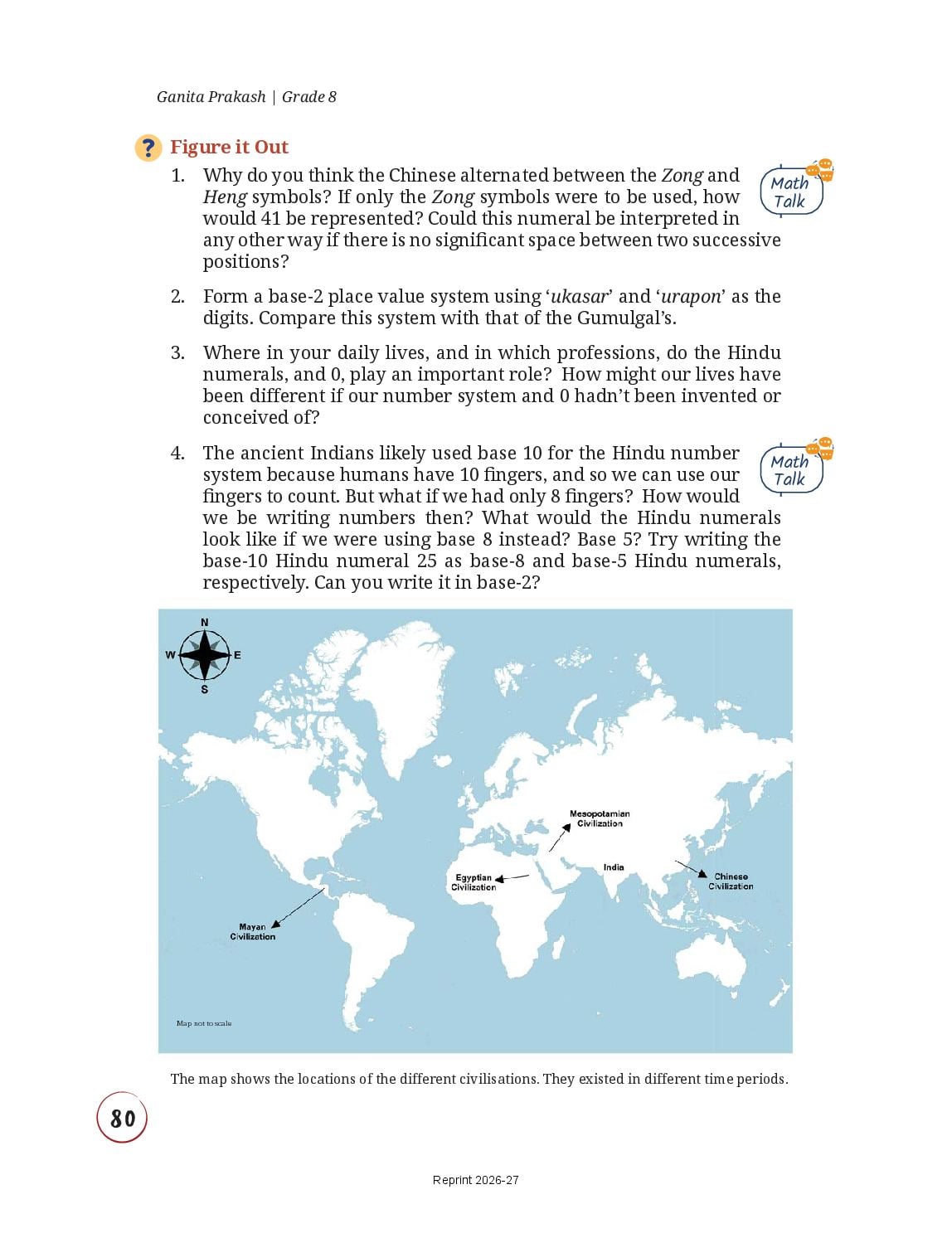
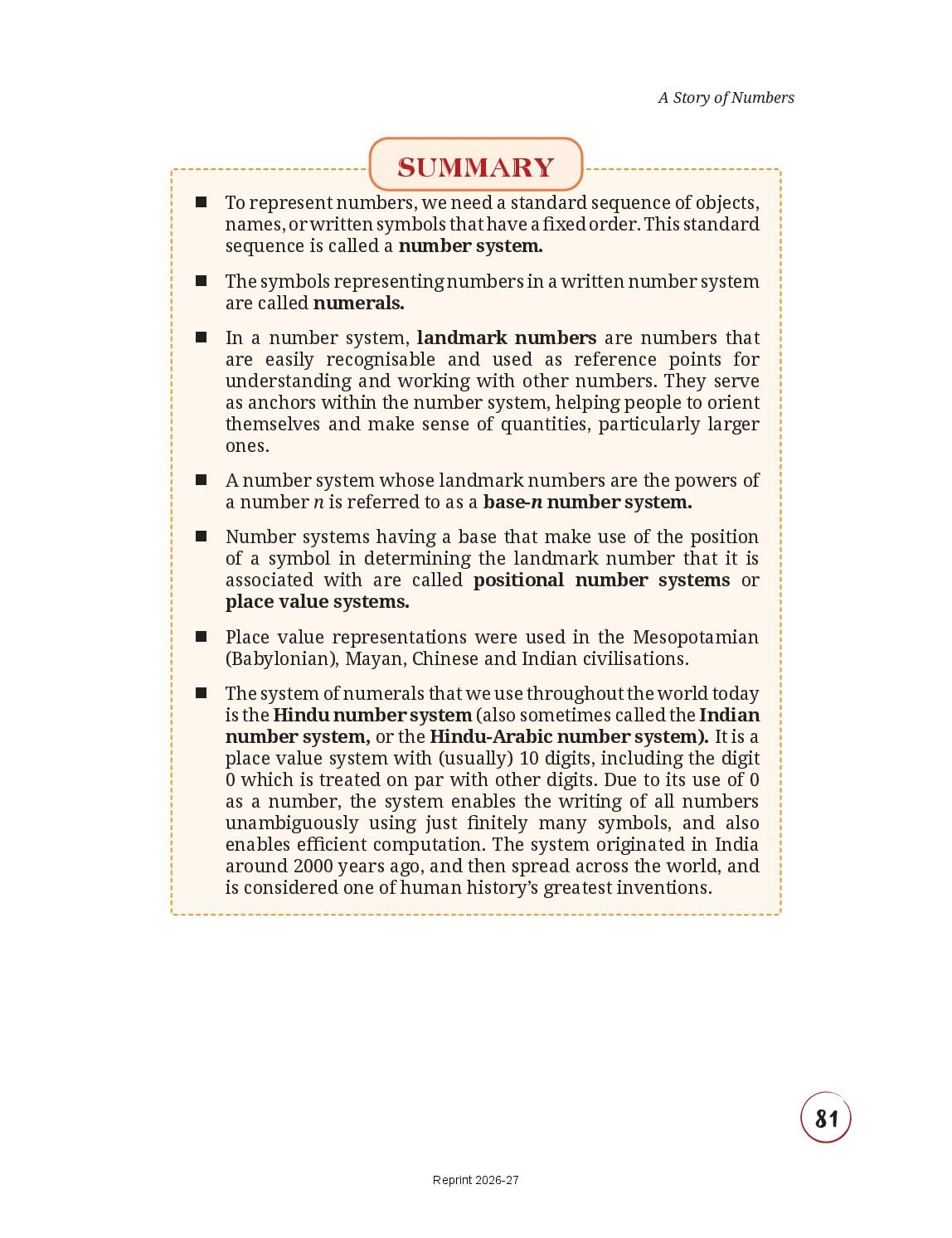
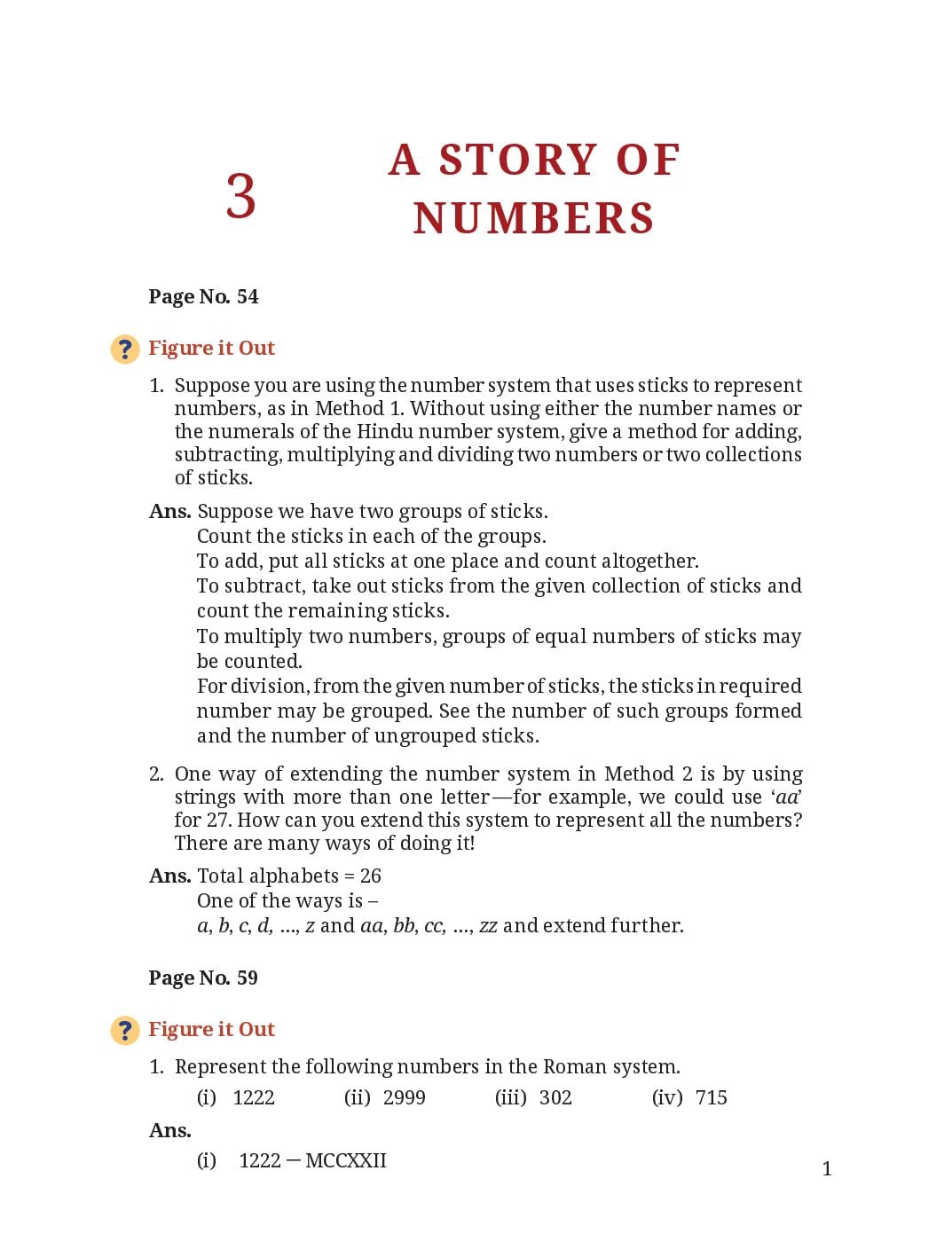
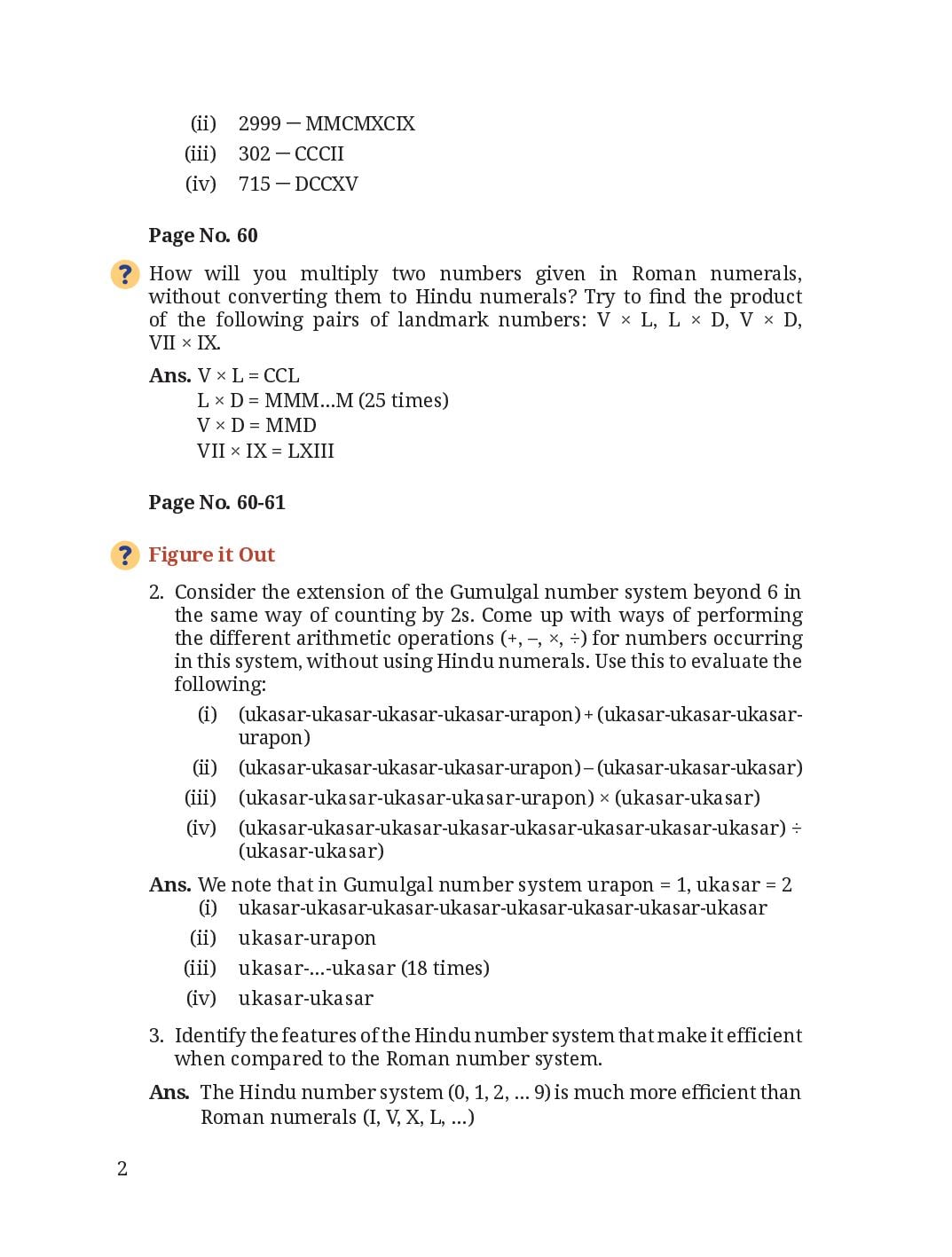
What Is in A Story of Numbers? (Class 8 Maths Chapter 3)
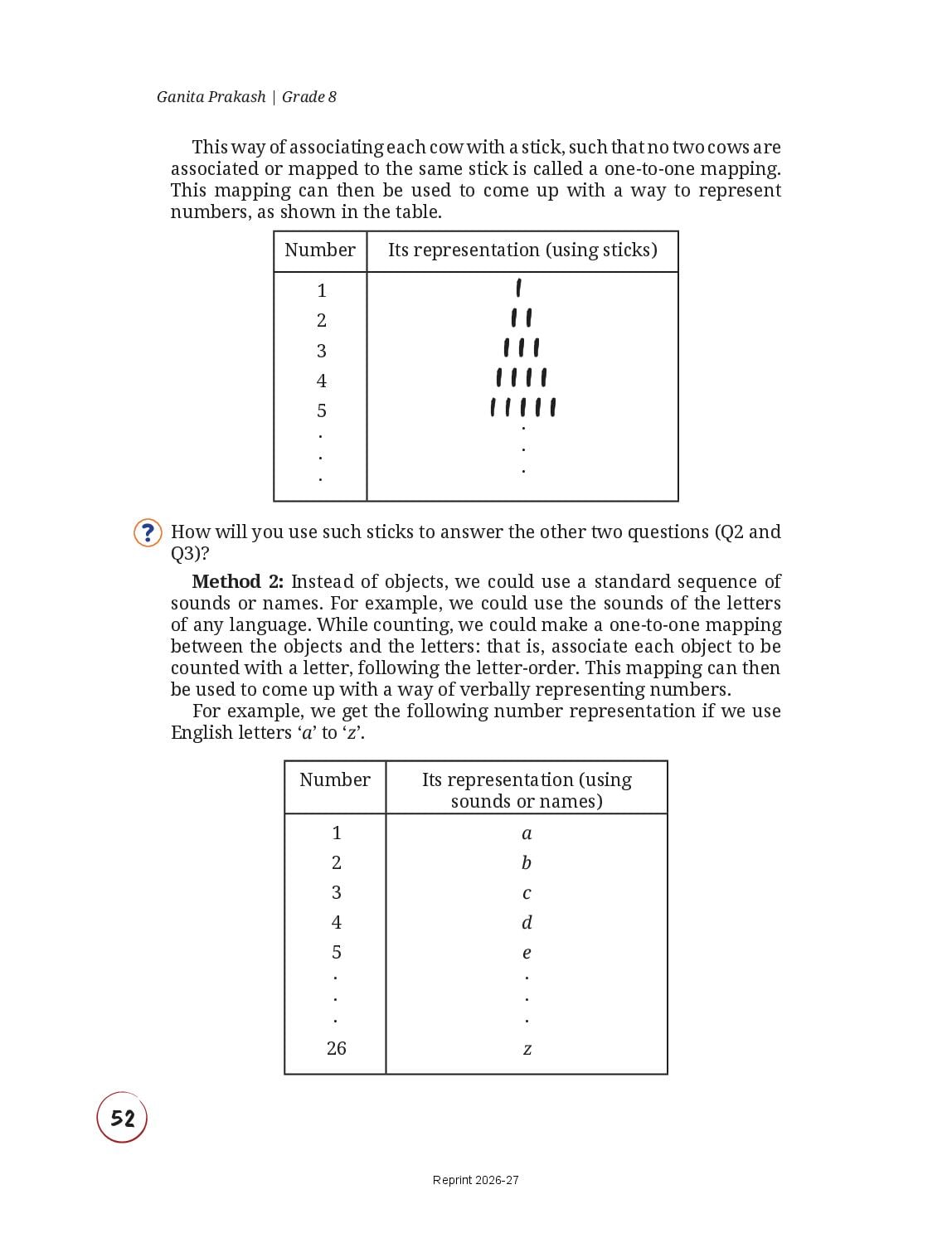
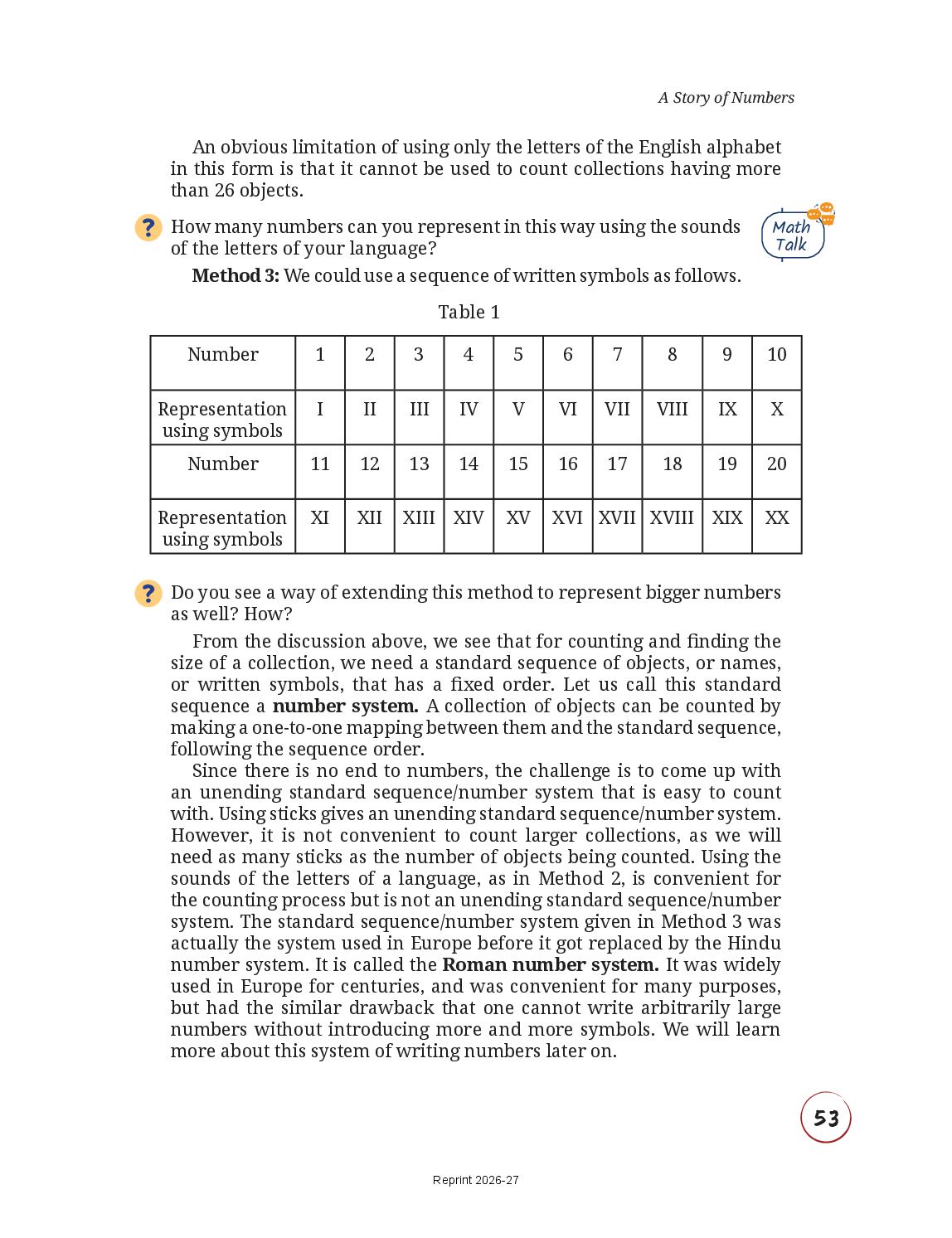
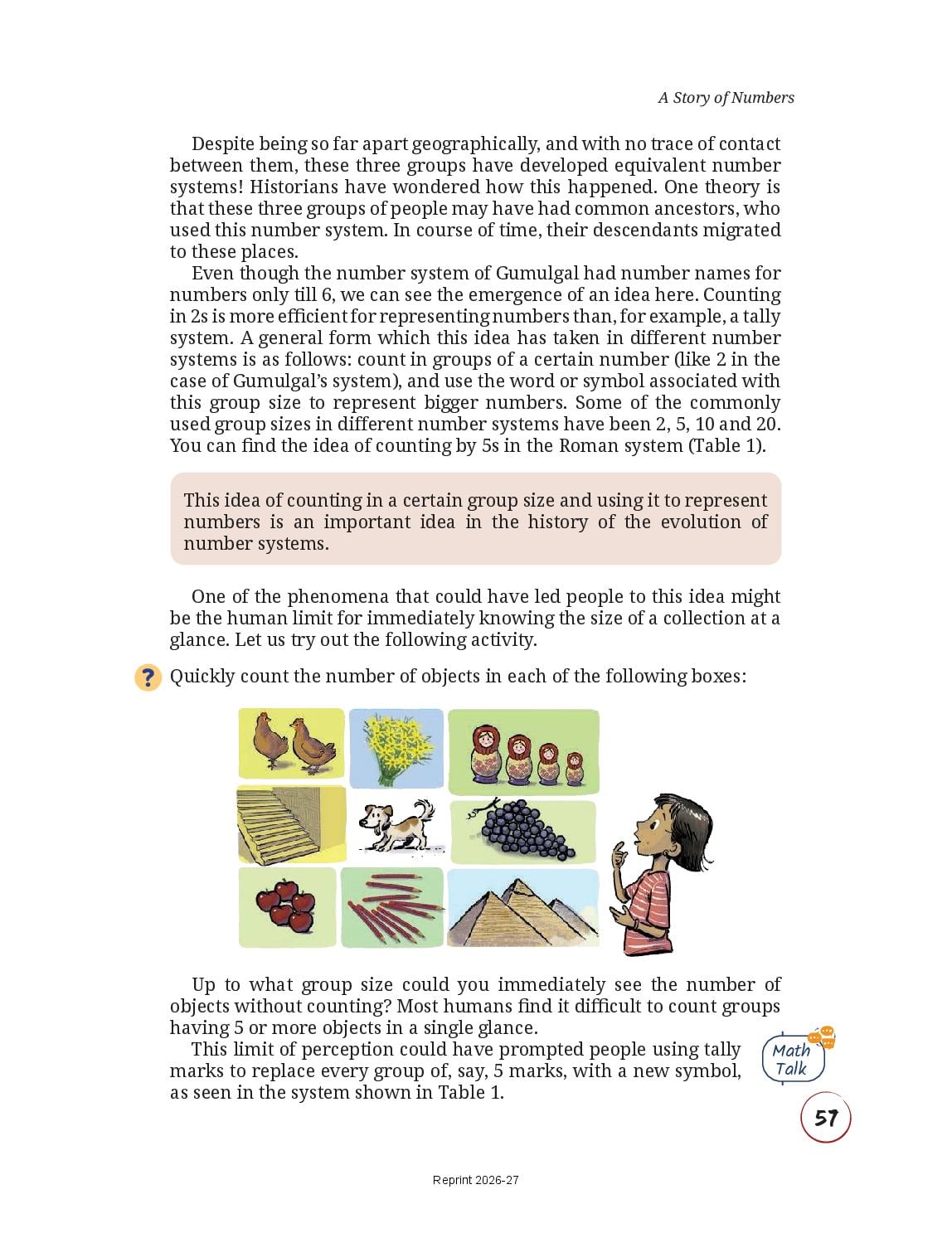
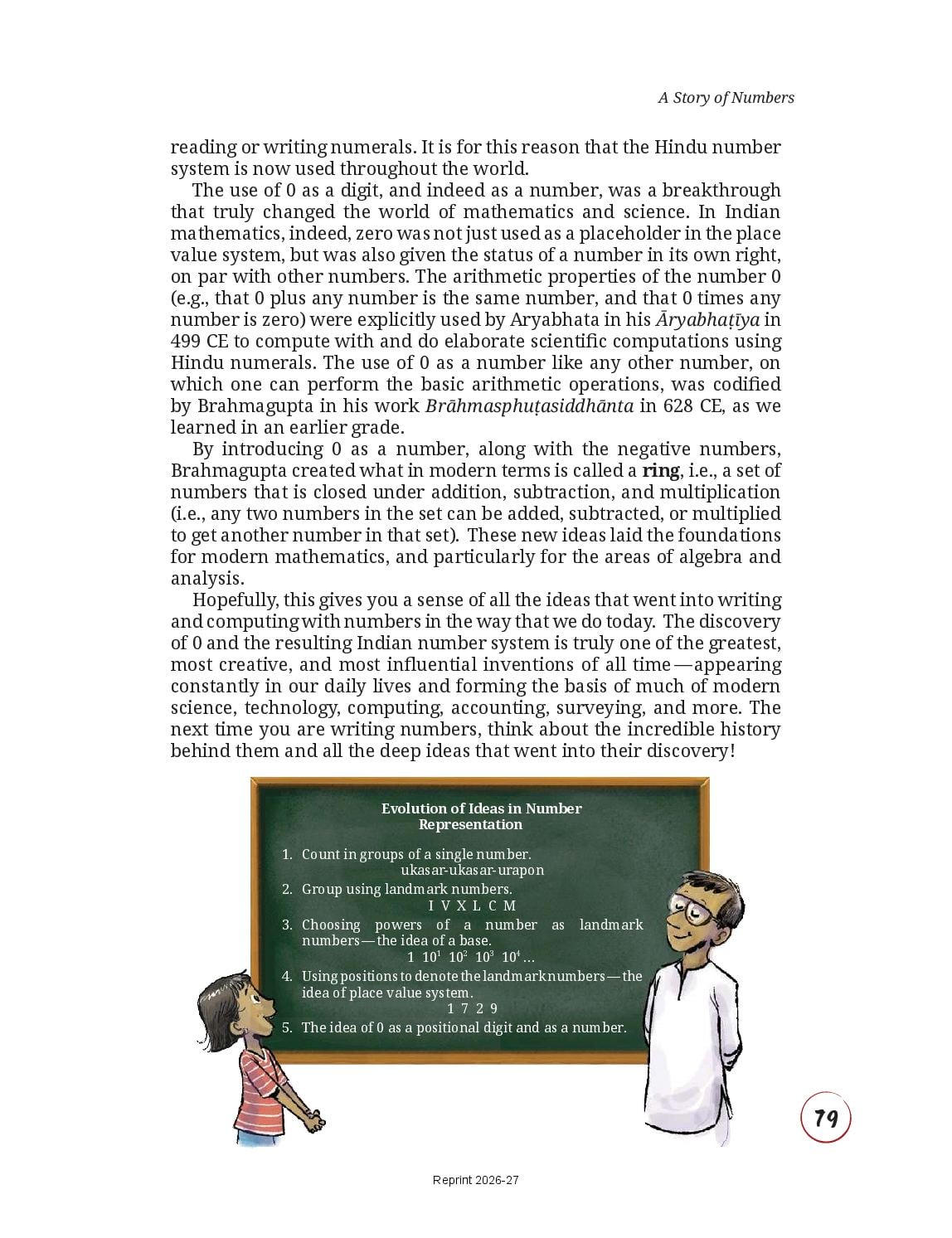
- To count you need a standard sequence of objects, names or written symbols with a fixed order — that sequence is a number system. Counting a collection means making a one-to-one mapping onto it.
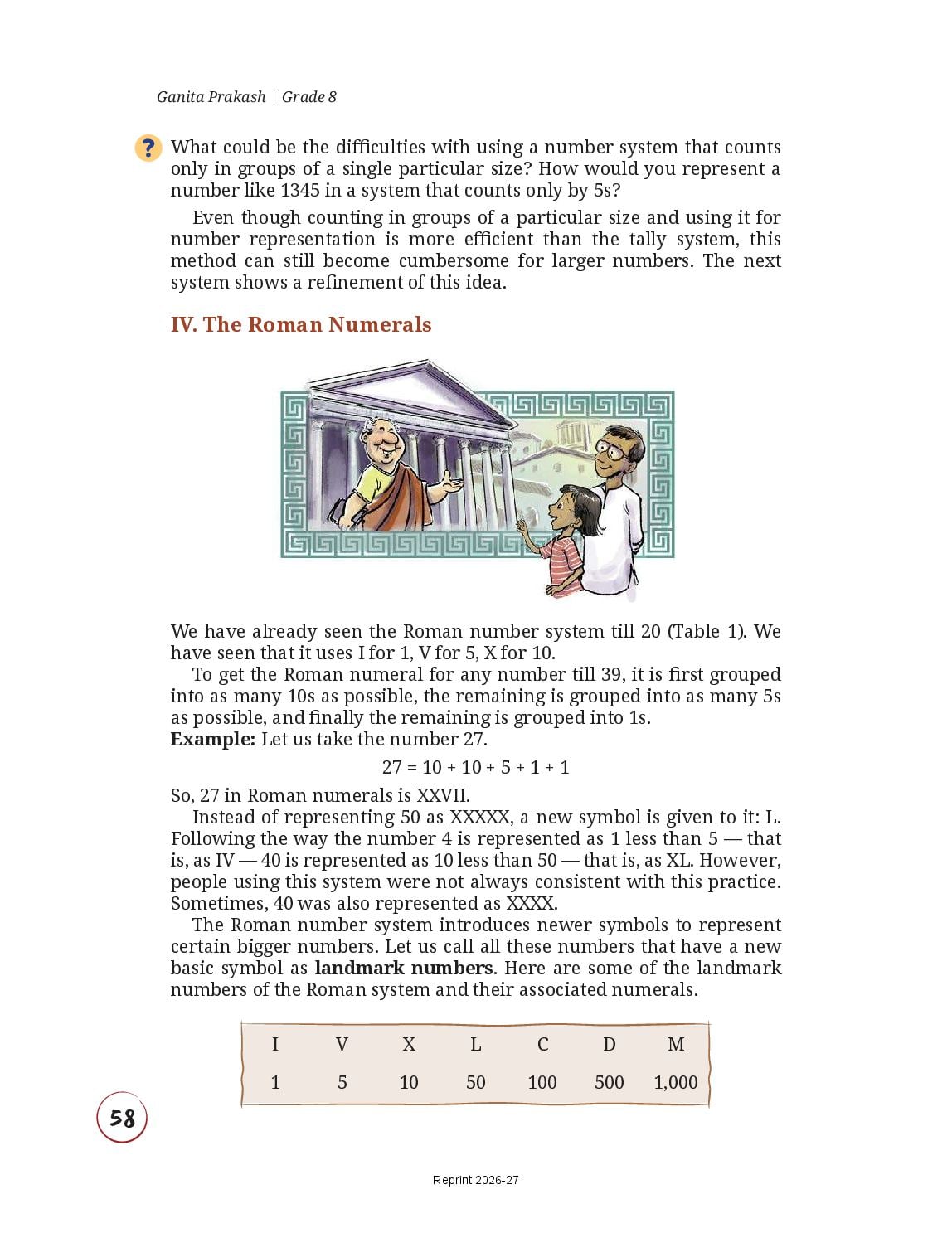
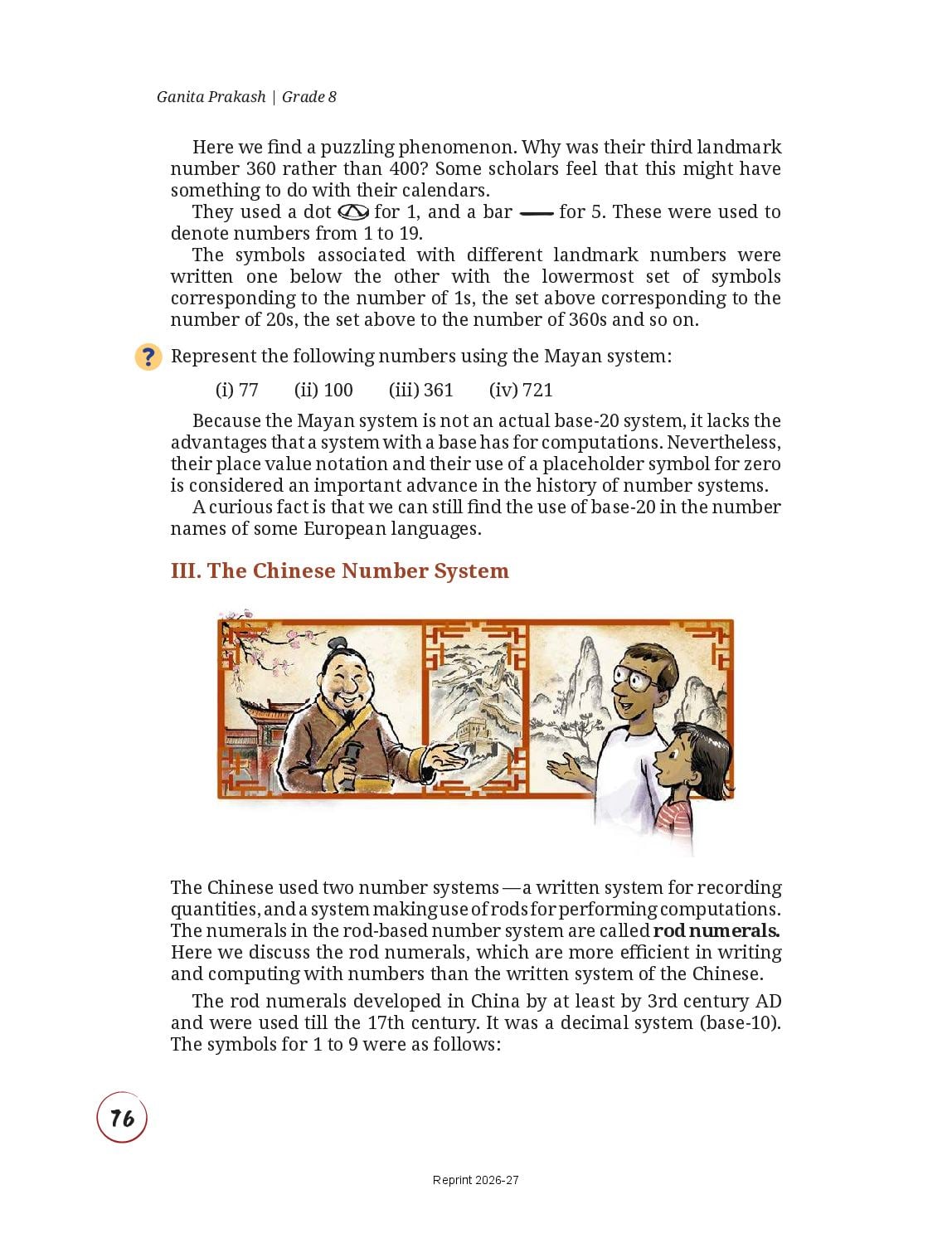
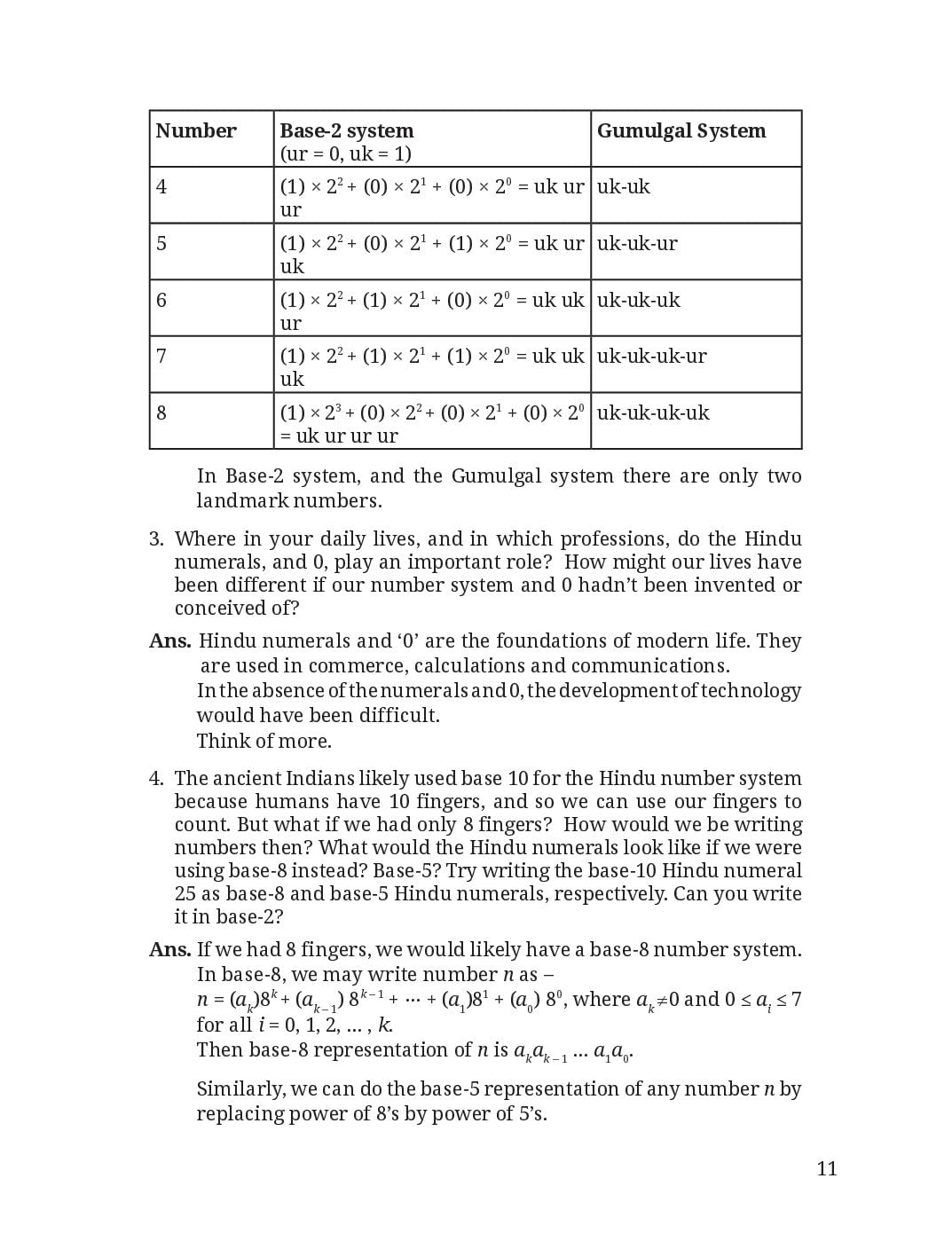
- The written symbols of a number system are called numerals. Numbers that get a symbol of their own and act as reference points are called landmark numbers.
- If the landmark numbers are 1, n, n2, n3, … — the powers of one number — the system is a base-n system. Base 10 is called decimal.
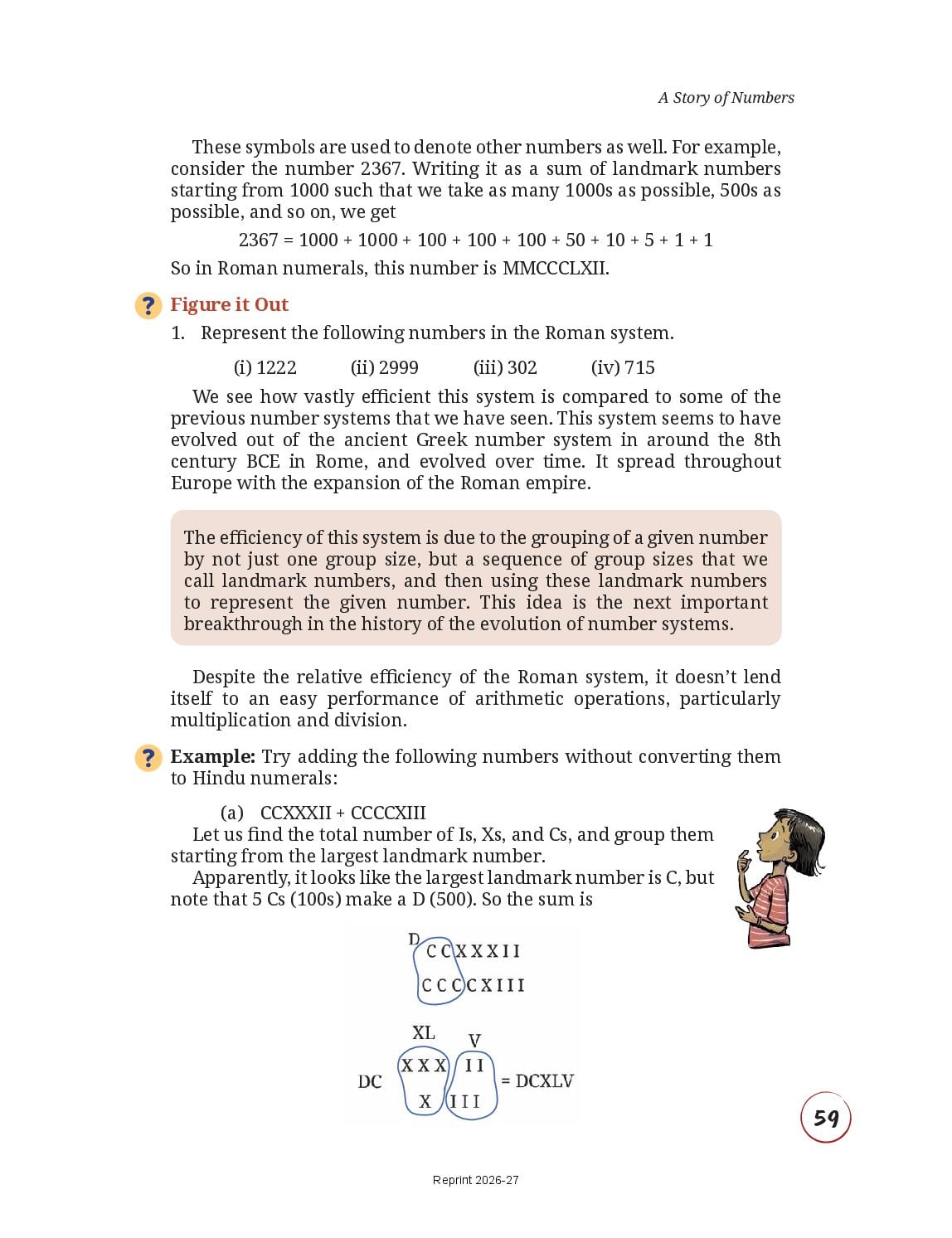
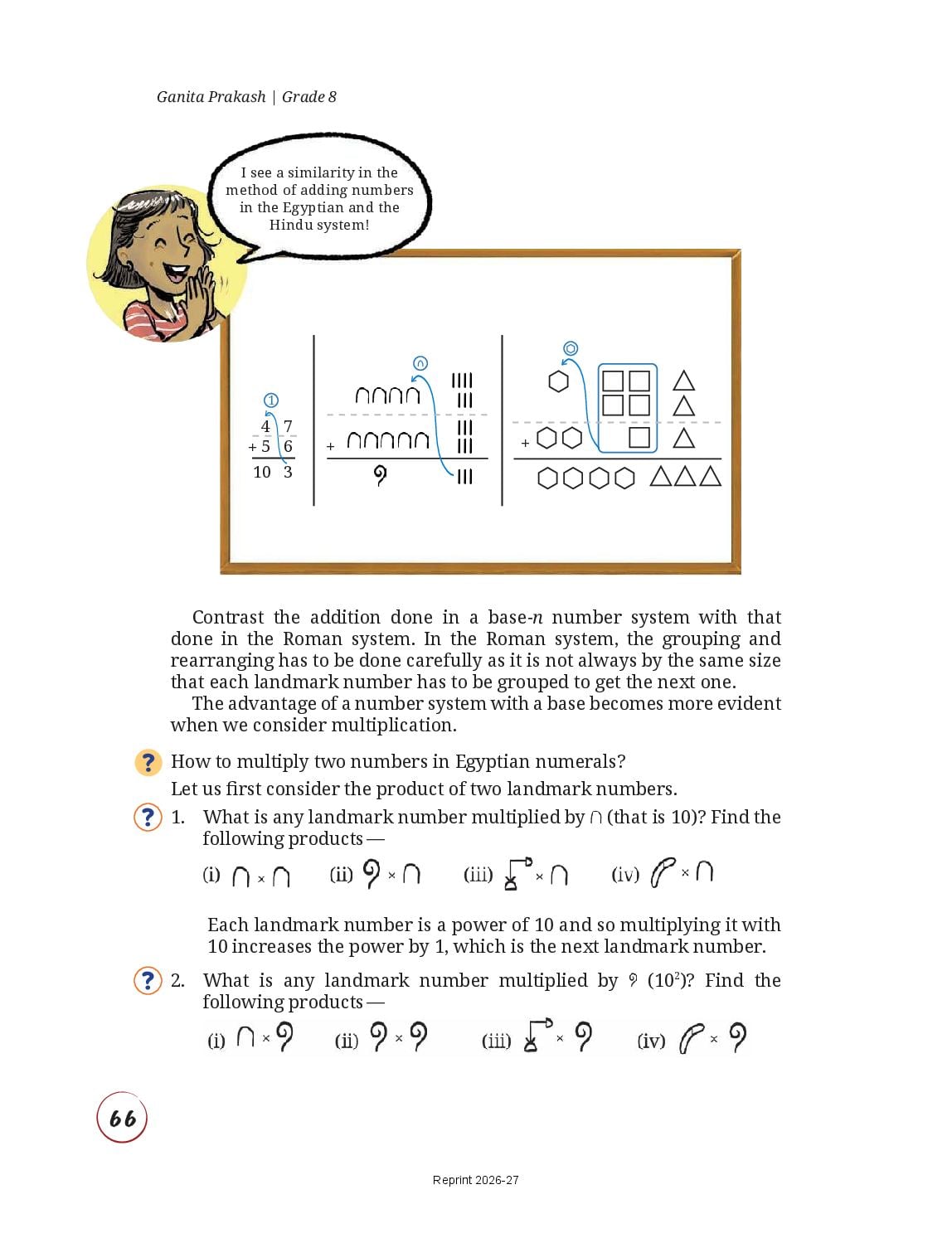
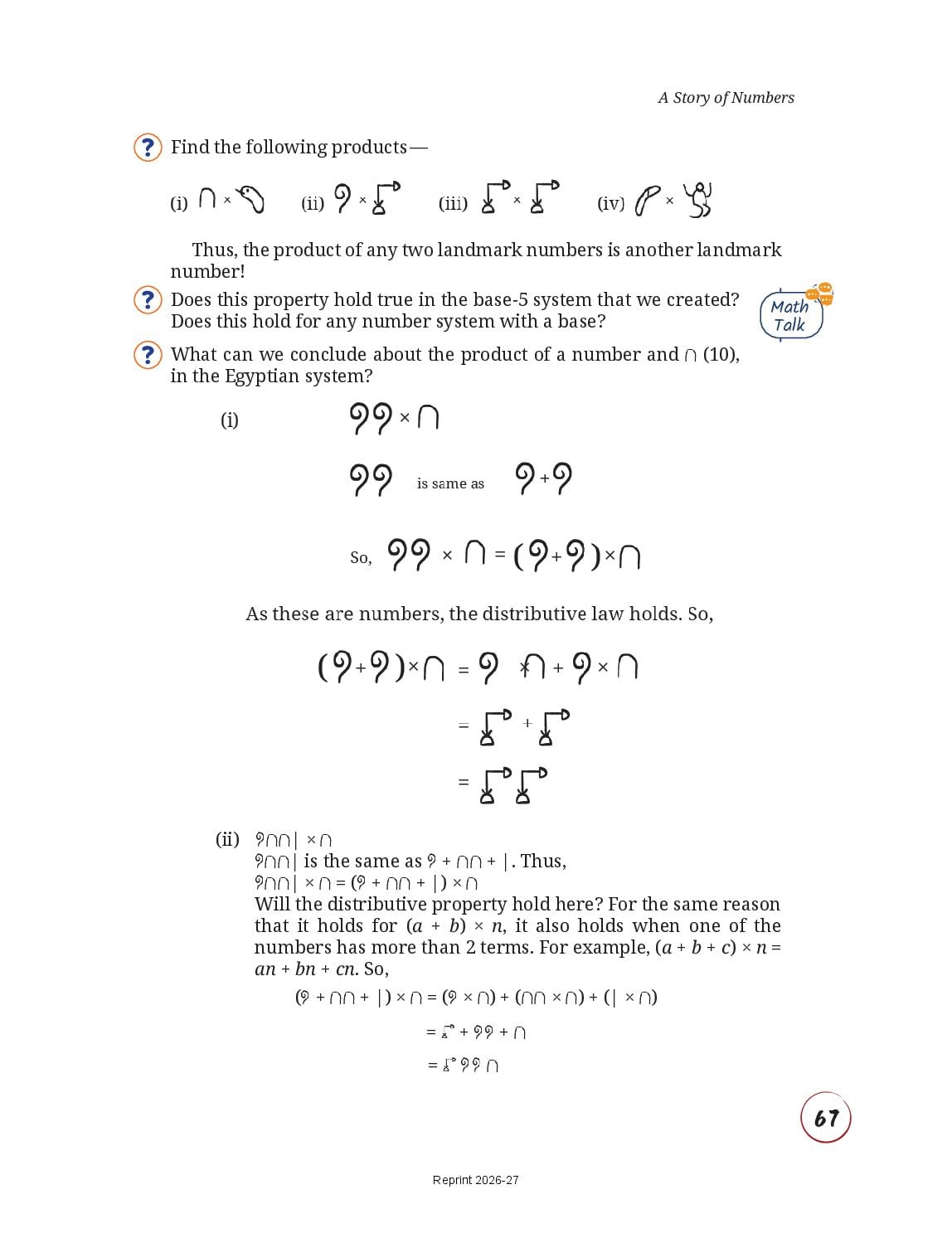
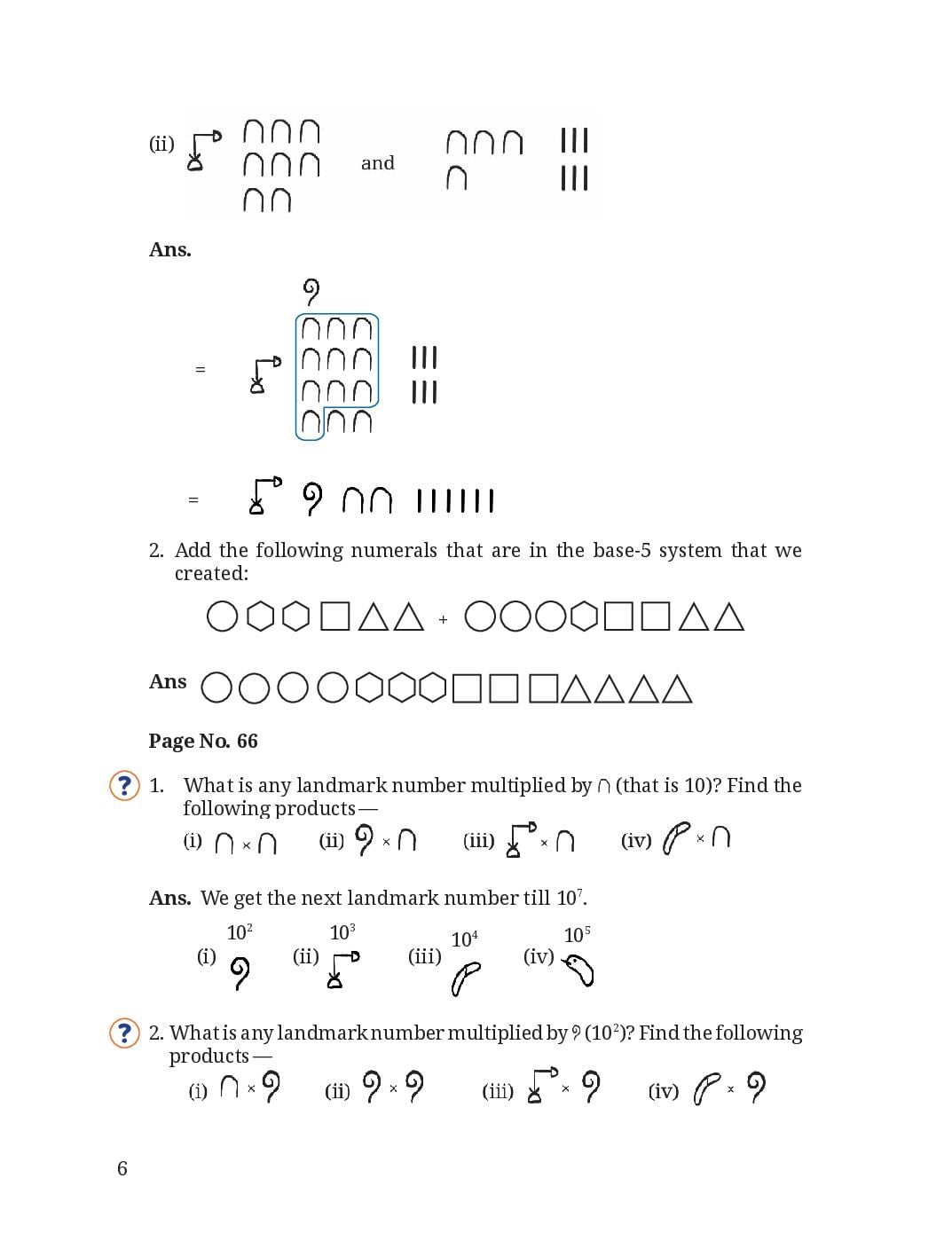
- In a base-n system the product of two landmark numbers is again a landmark number, which is exactly why multiplication is easy there and hard in the Roman system.
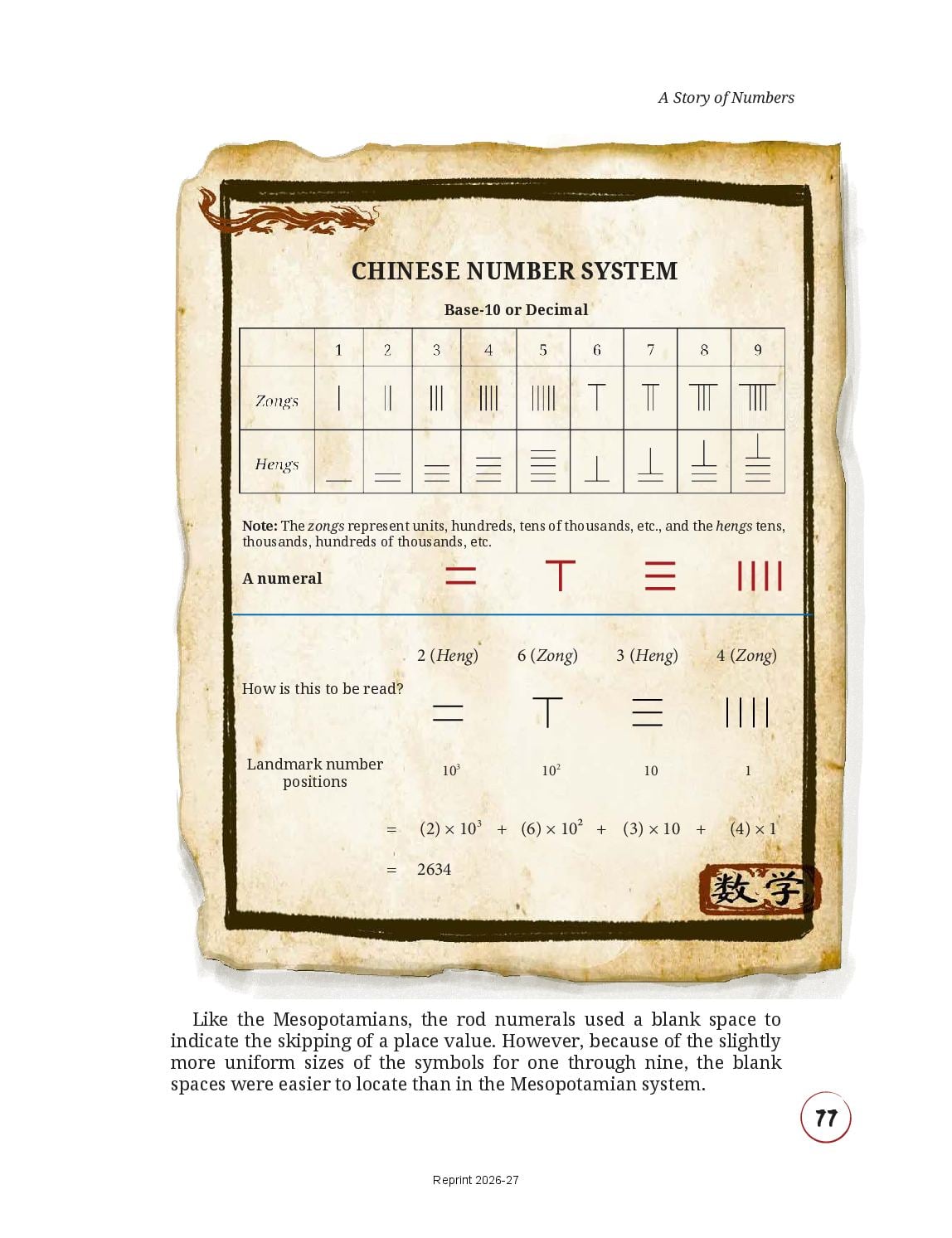
- A system that uses the position of a symbol to decide which landmark it counts is a place value system. Mesopotamia, the Maya, China and India all reached this idea.
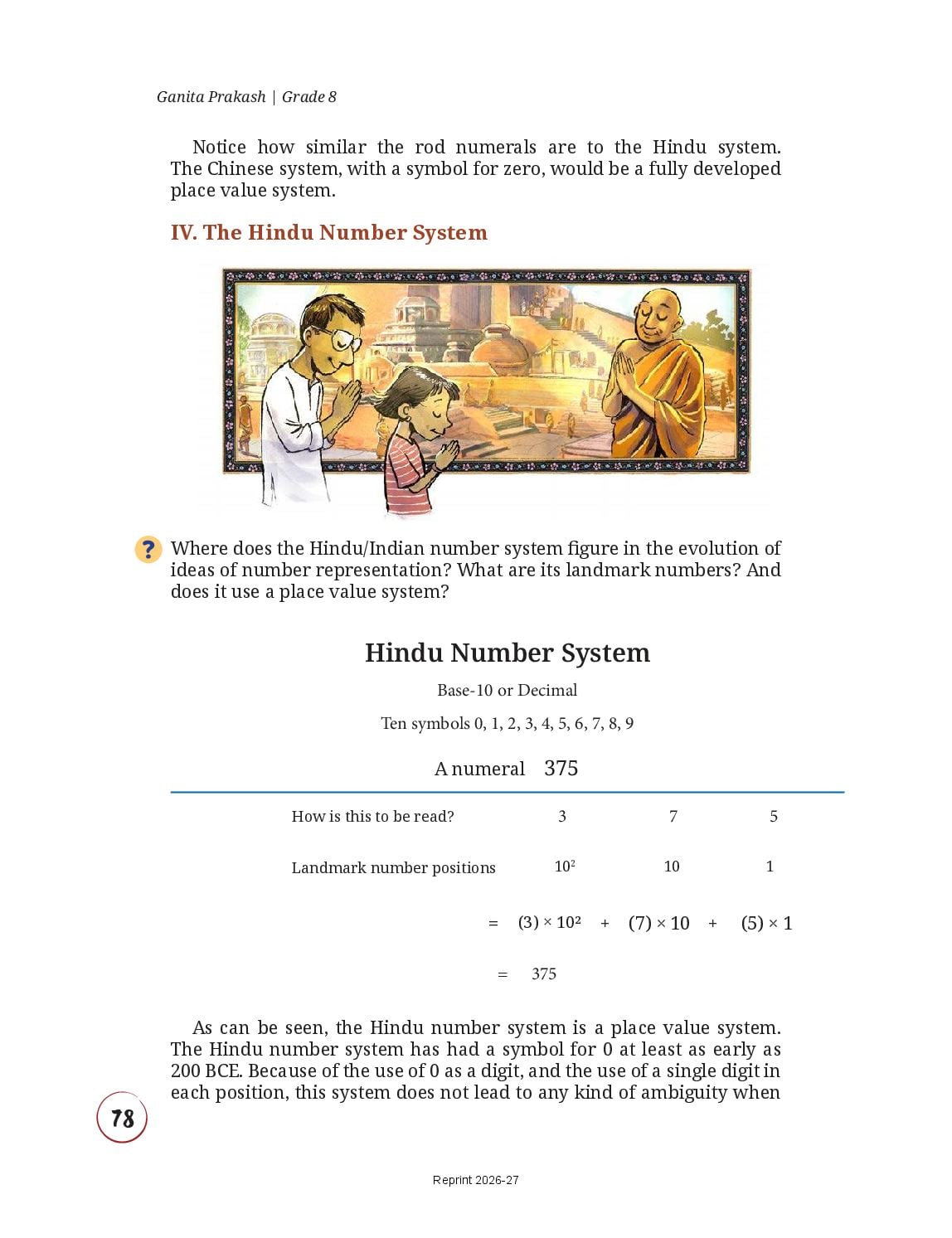
- The Hindu (Indian) number system — base 10, place value, and 0 treated both as a placeholder digit and as a number in its own right — writes every number unambiguously with just ten symbols. It began in India about 2000 years ago and is now used everywhere.
Quick revision – A Story of Numbers
| Number system | Landmark numbers | The idea it adds | How 27 is written |
|---|---|---|---|
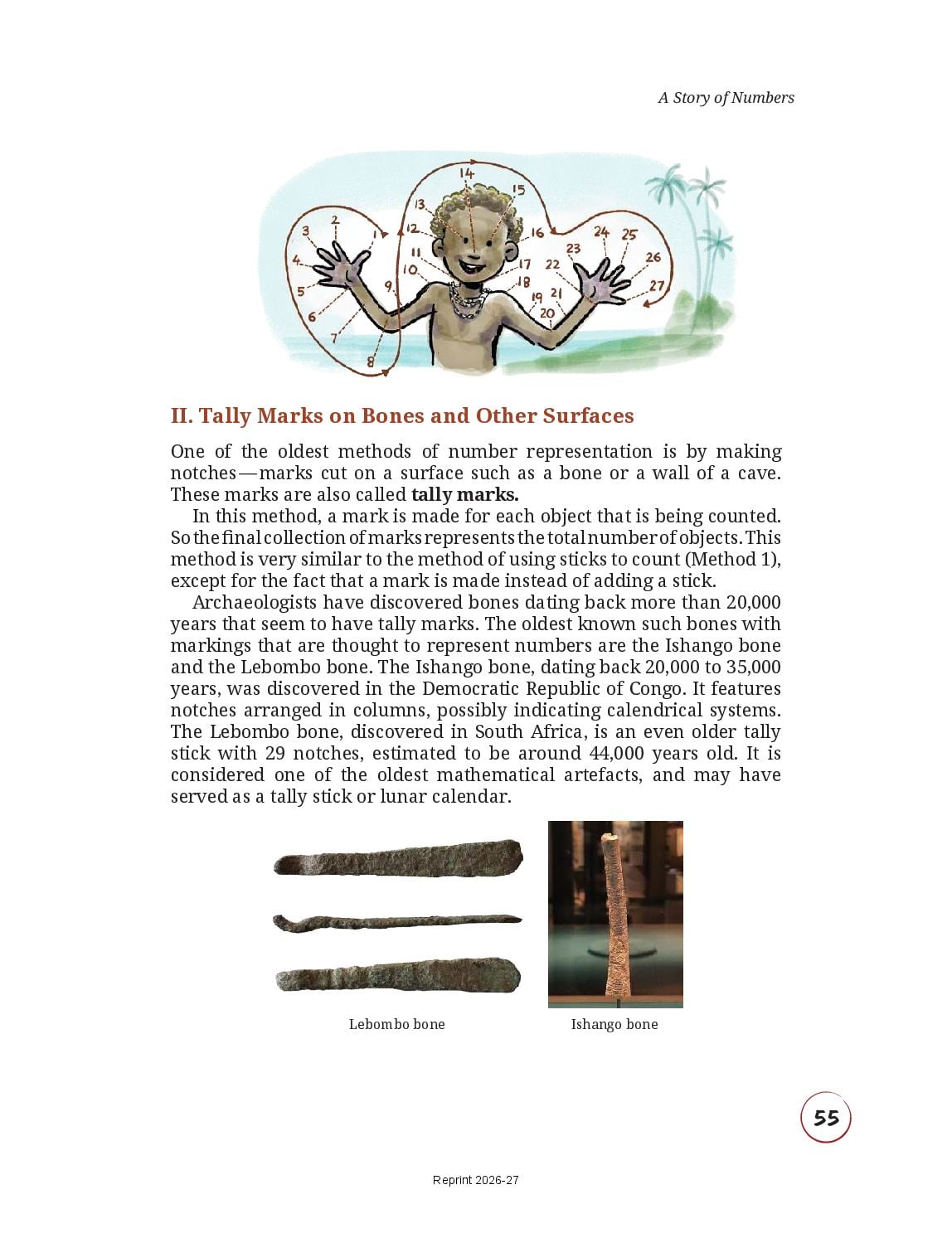
| Sticks / tally marks | 1 only | One-to-one mapping: one mark per object | 27 marks |
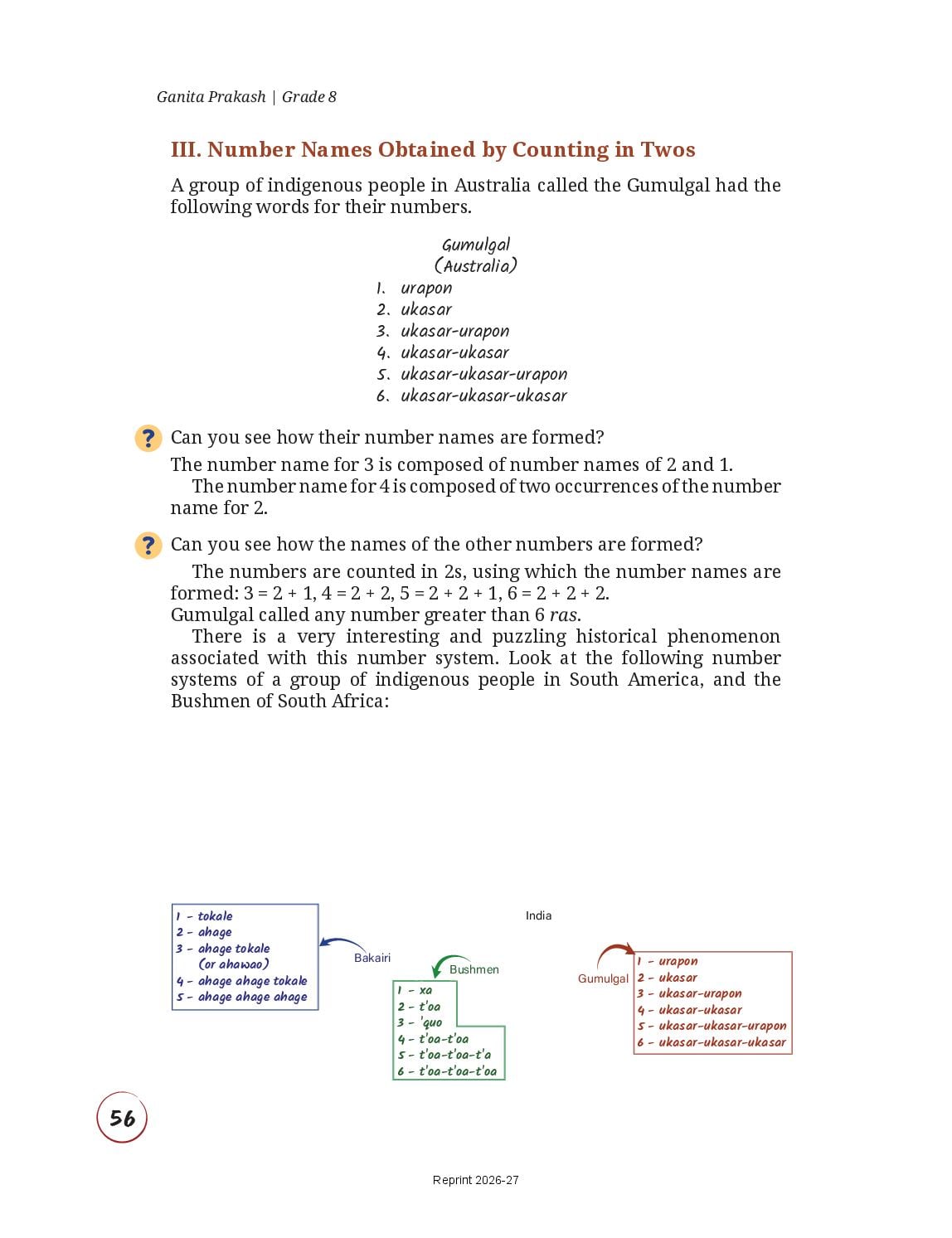
| Gumulgal (Australia) | 1, 2 | Counting in a fixed group size (2s) | Ukasar repeated 13 times, then urapon (14 words) |
| Roman | 1, 5, 10, 50, 100, 500, 1000 | A sequence of landmark numbers — but not powers of one number | XXVII |
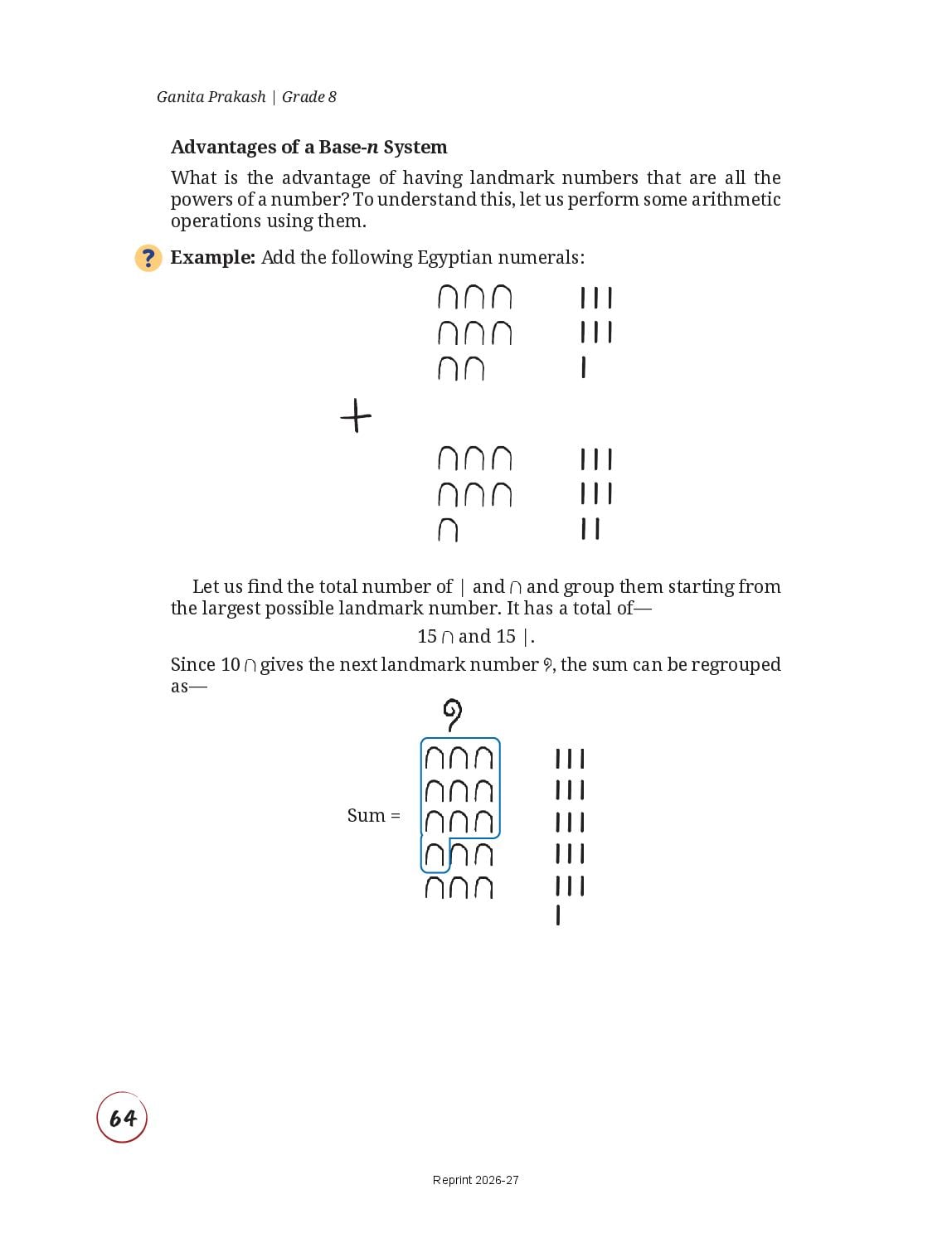
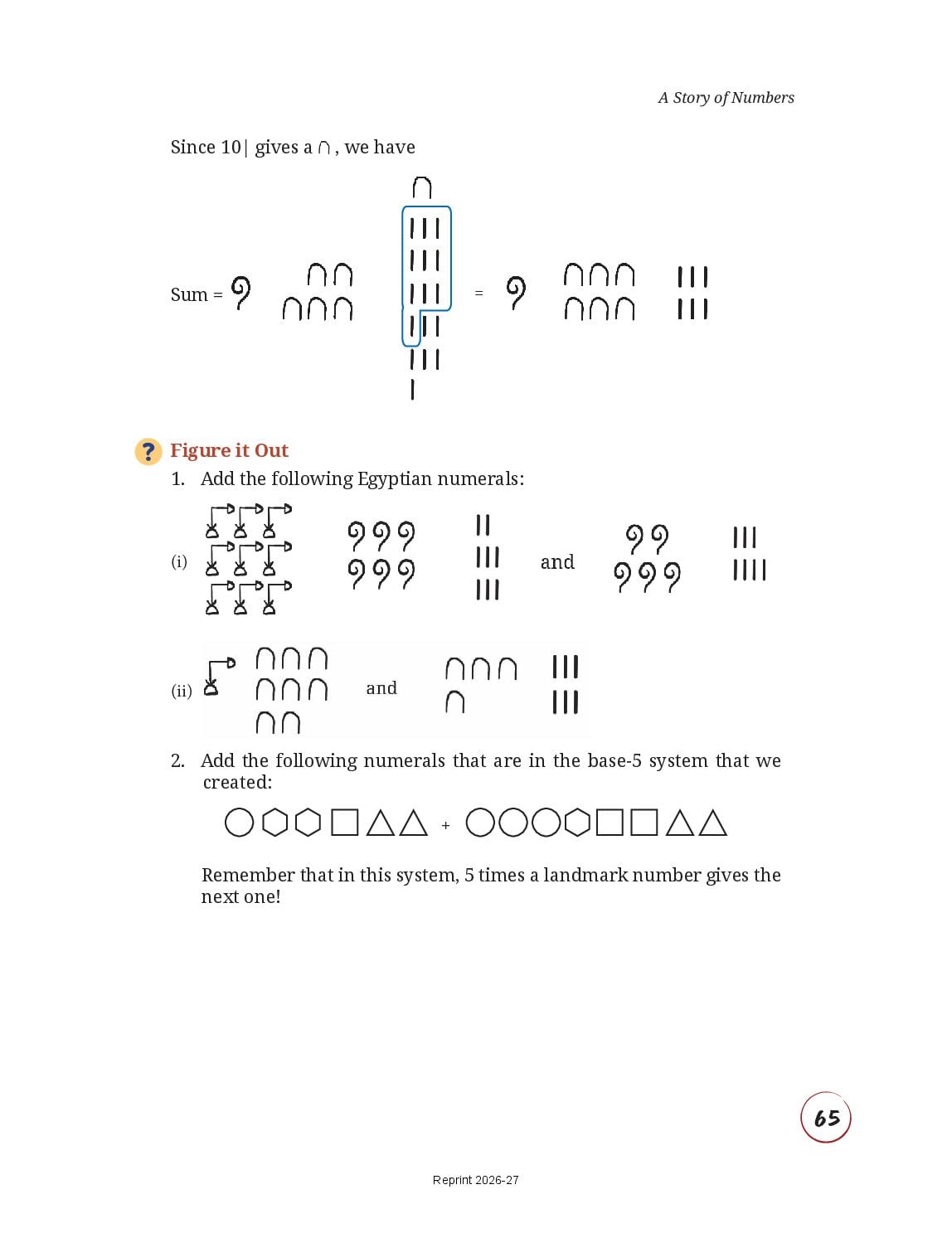
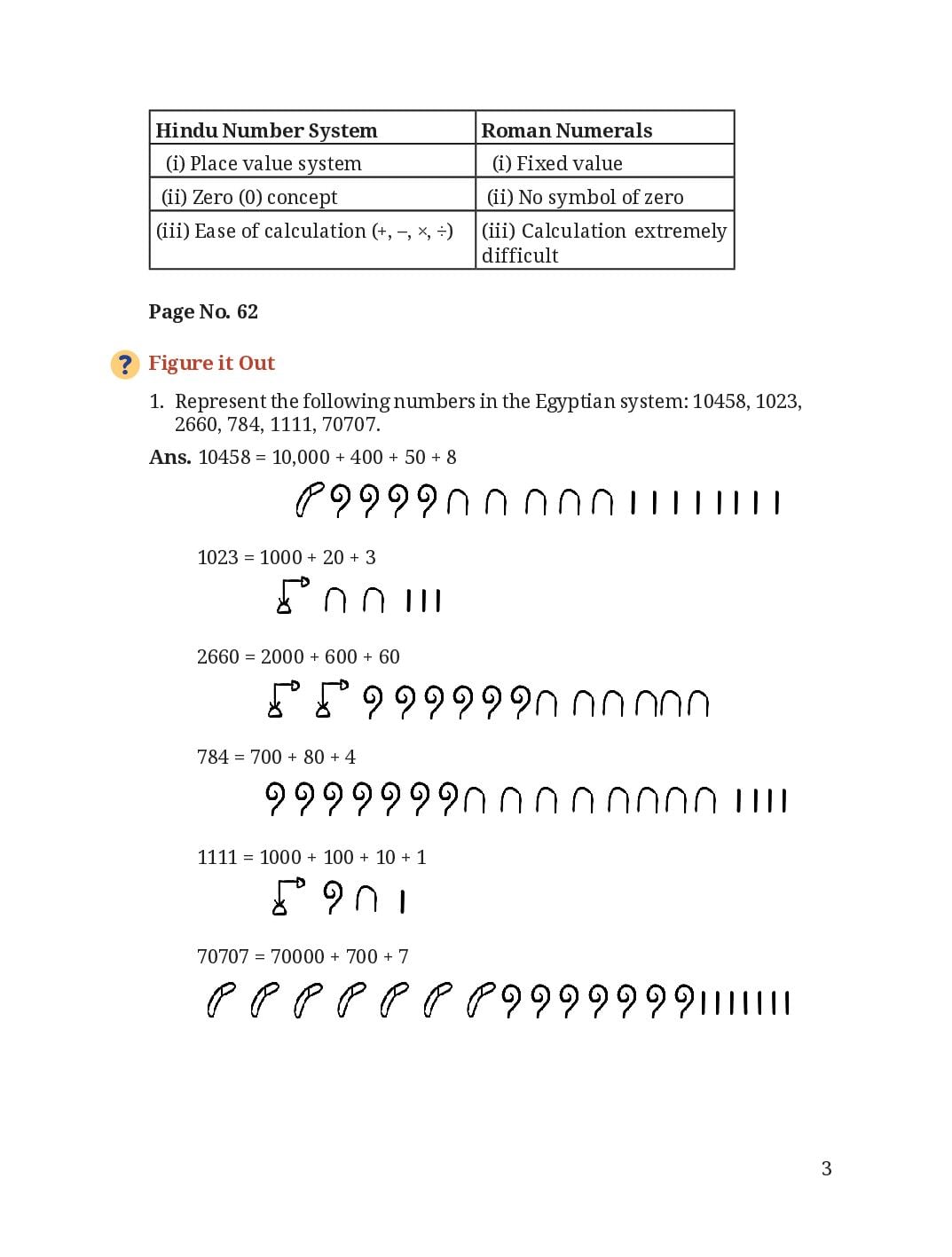
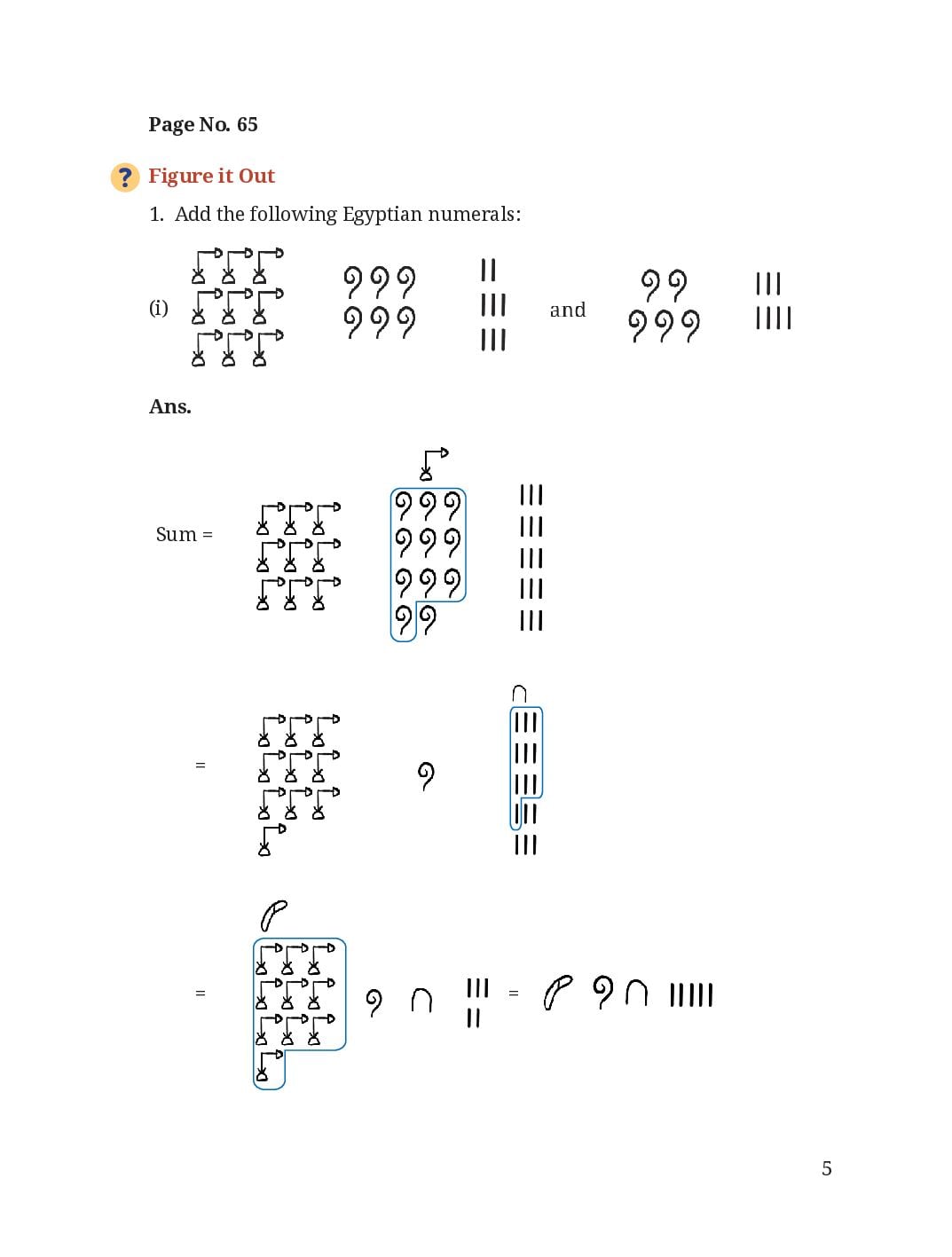
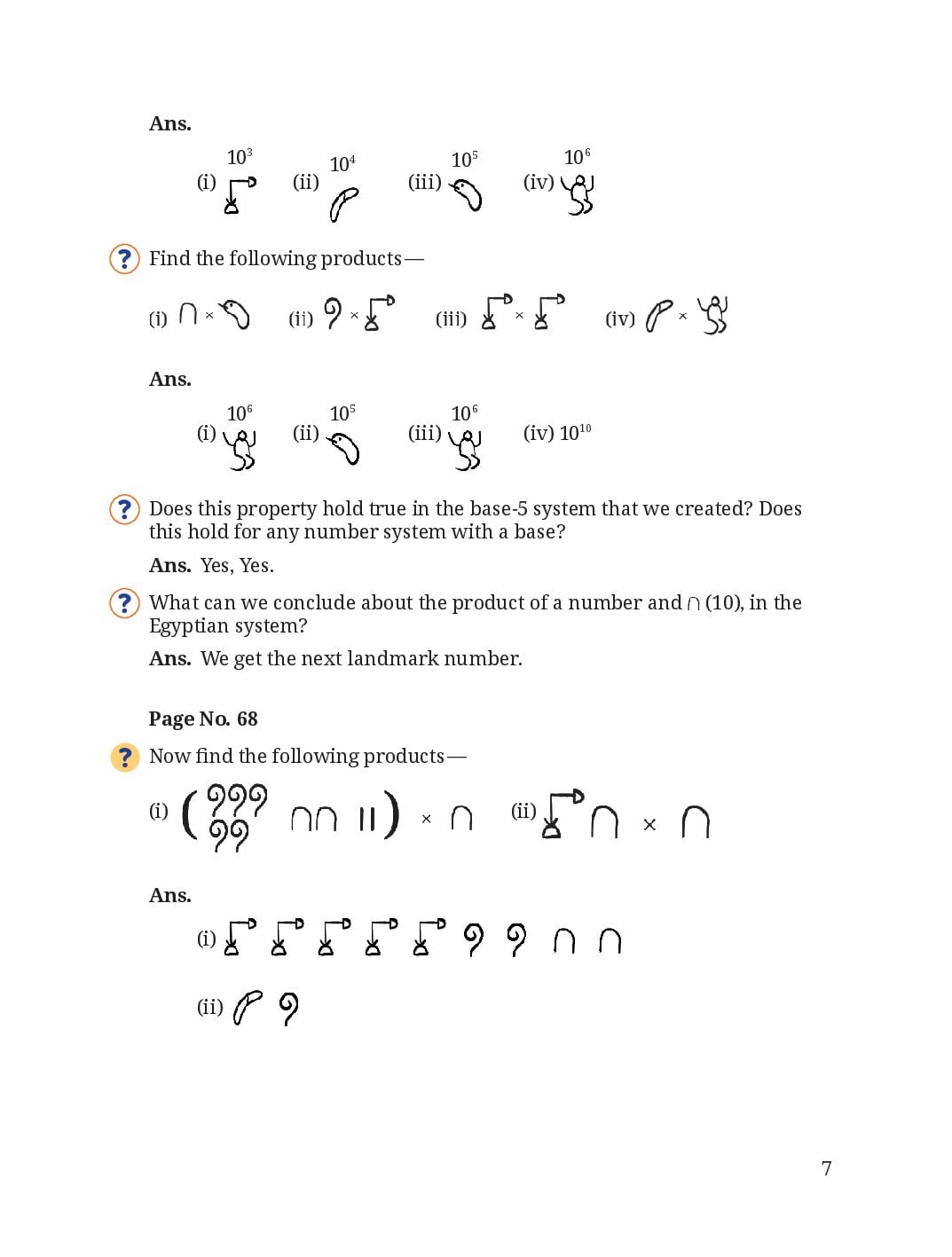
| Egyptian | 1, 10, 102, …, 107 | Landmarks are powers of 10 — a base | 2 arches + 7 strokes |
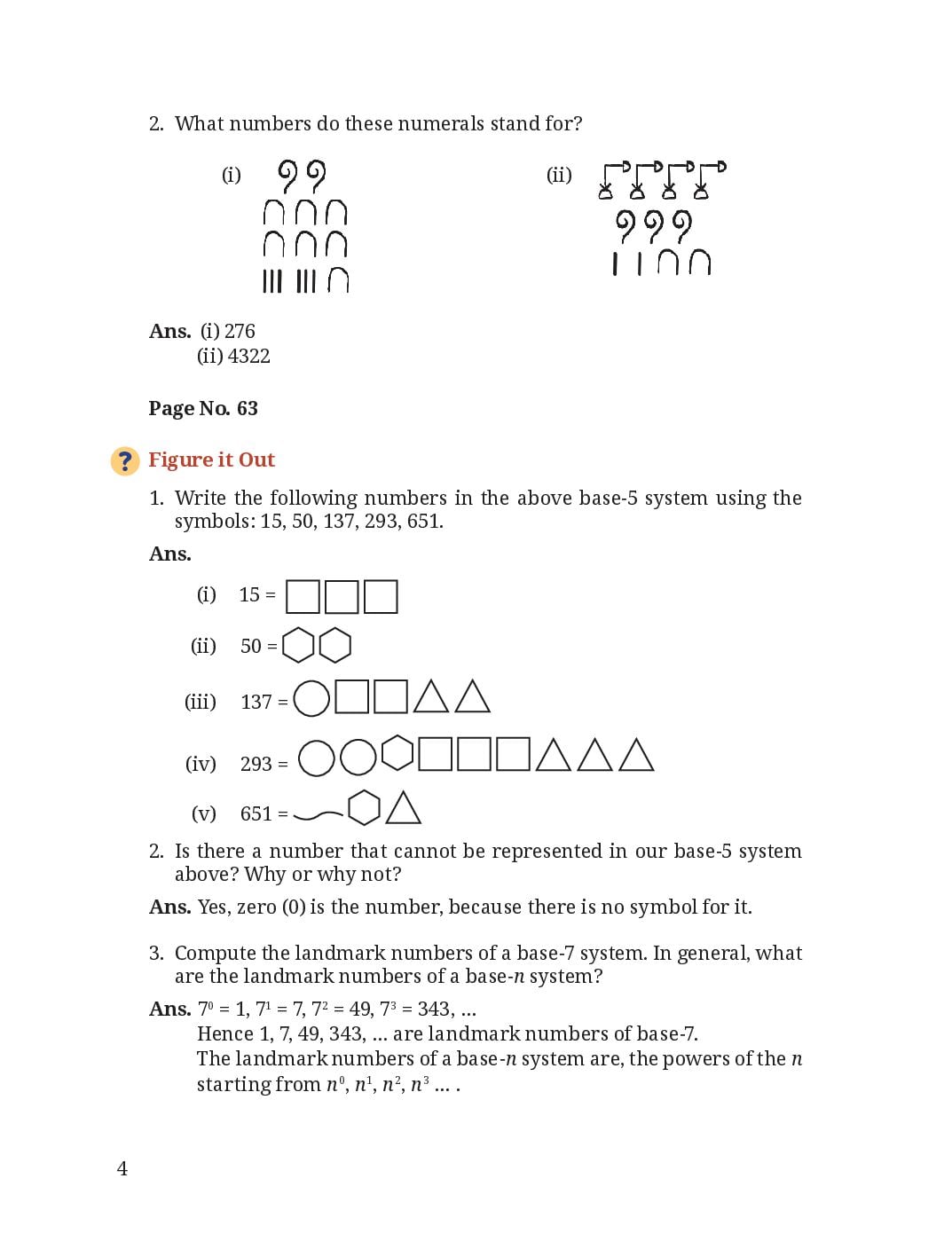
| Our base-5 system | 1, 5, 25, 125, 625, 3125 | The same idea with a different base | ⬡ △△ (25 + 1 + 1) |
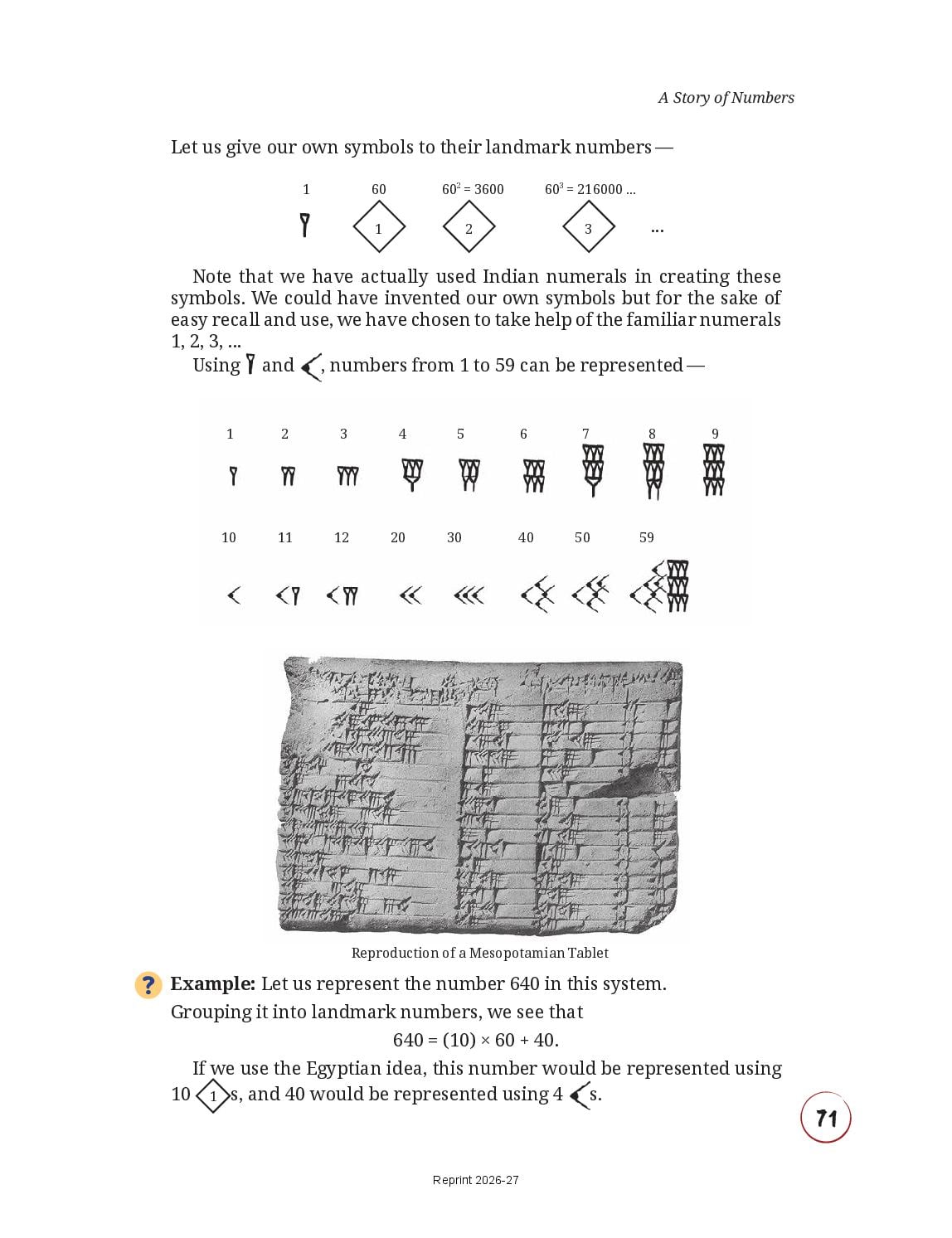
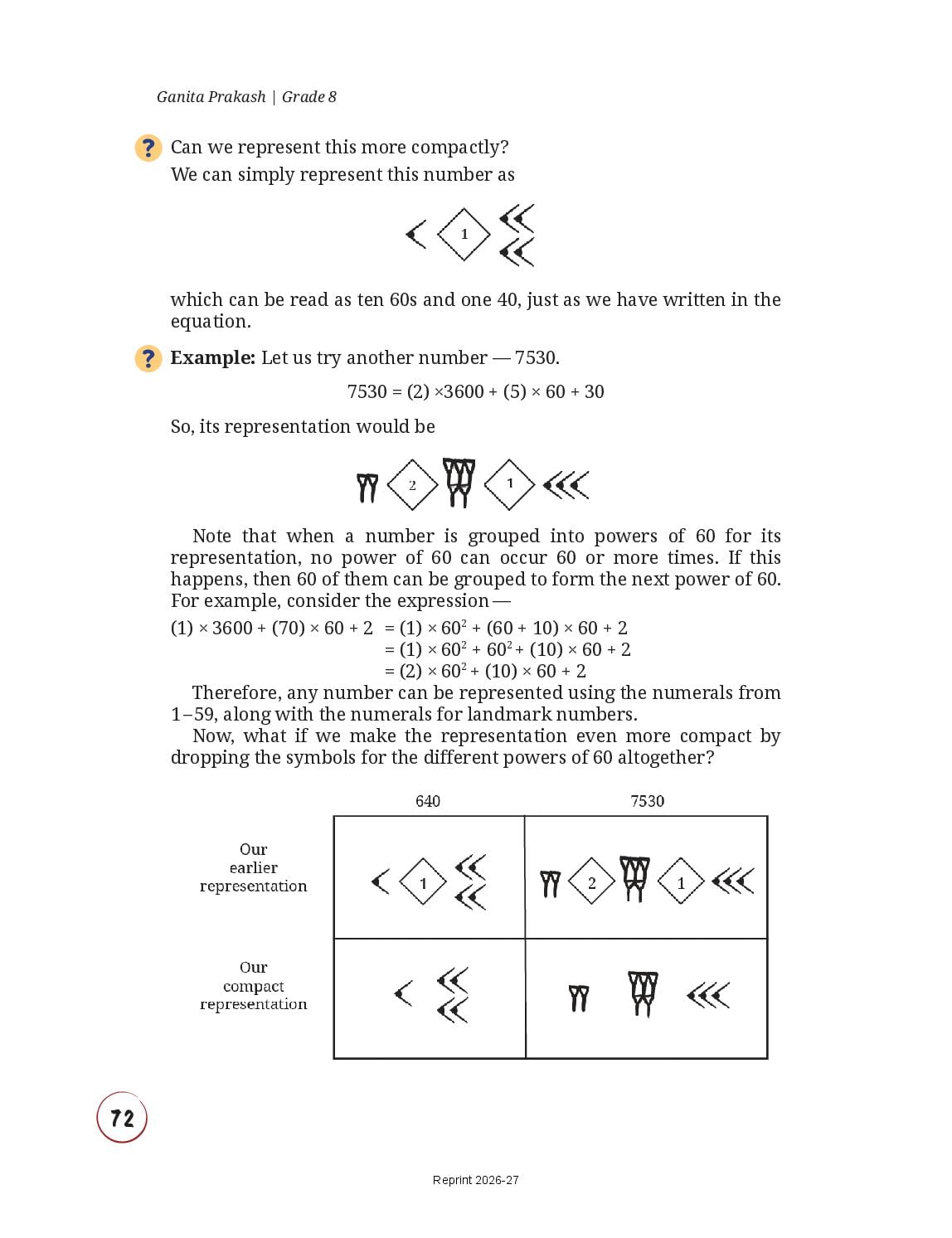
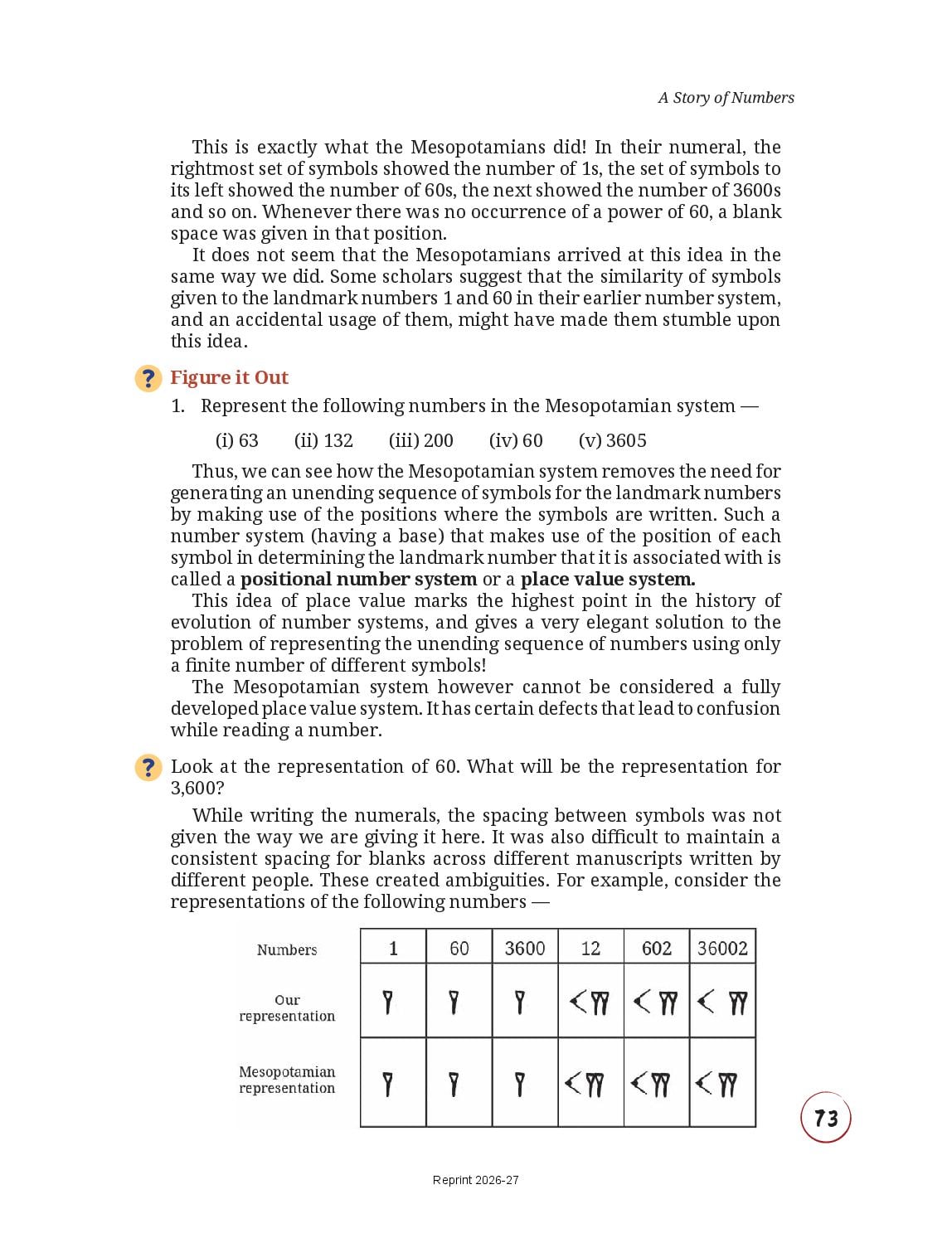
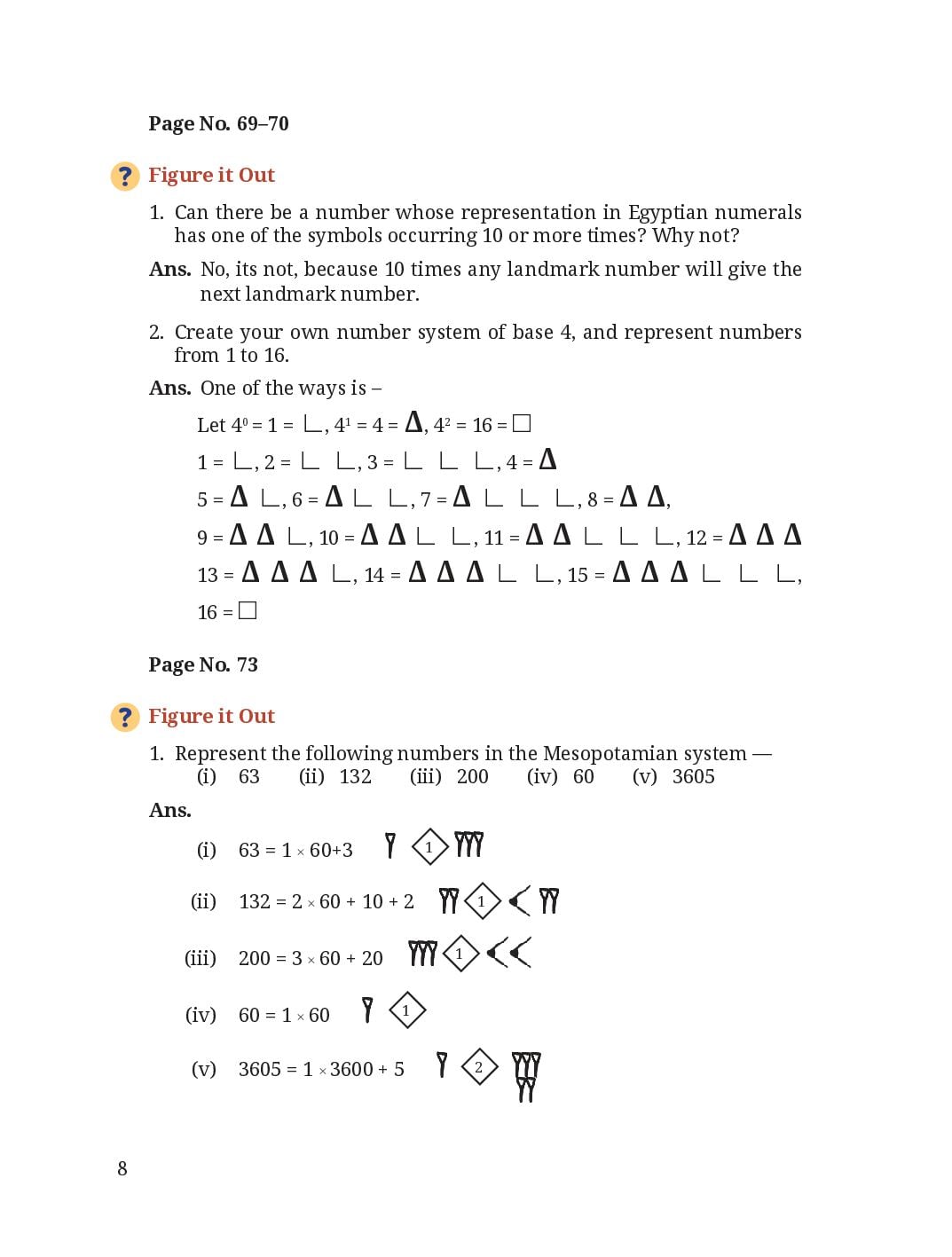
| Mesopotamian (Babylonian) | 1, 60, 602, 603 | Place value; later a placeholder for a blank | << YYYYYYY (two 10-wedges, seven 1-wedges) |
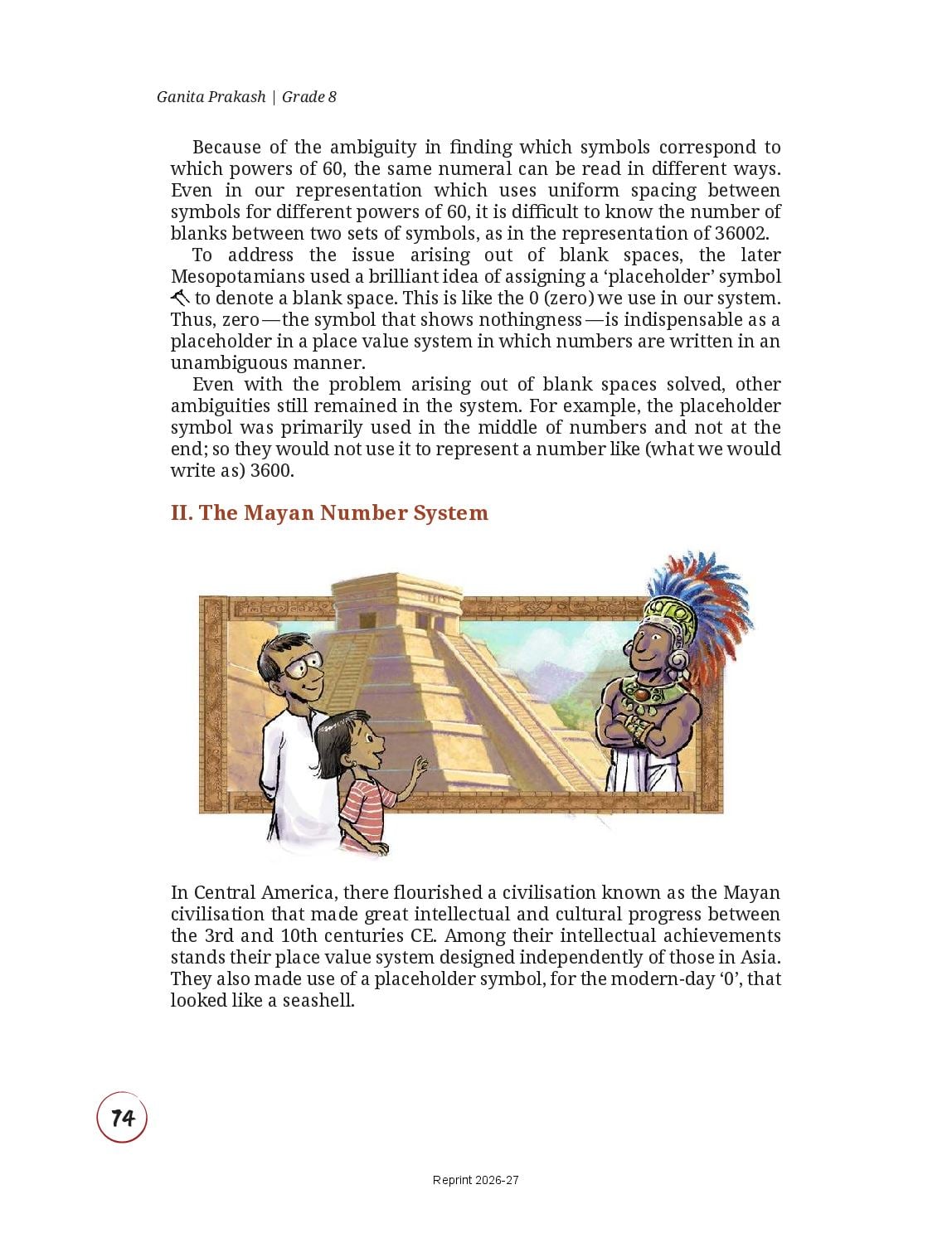
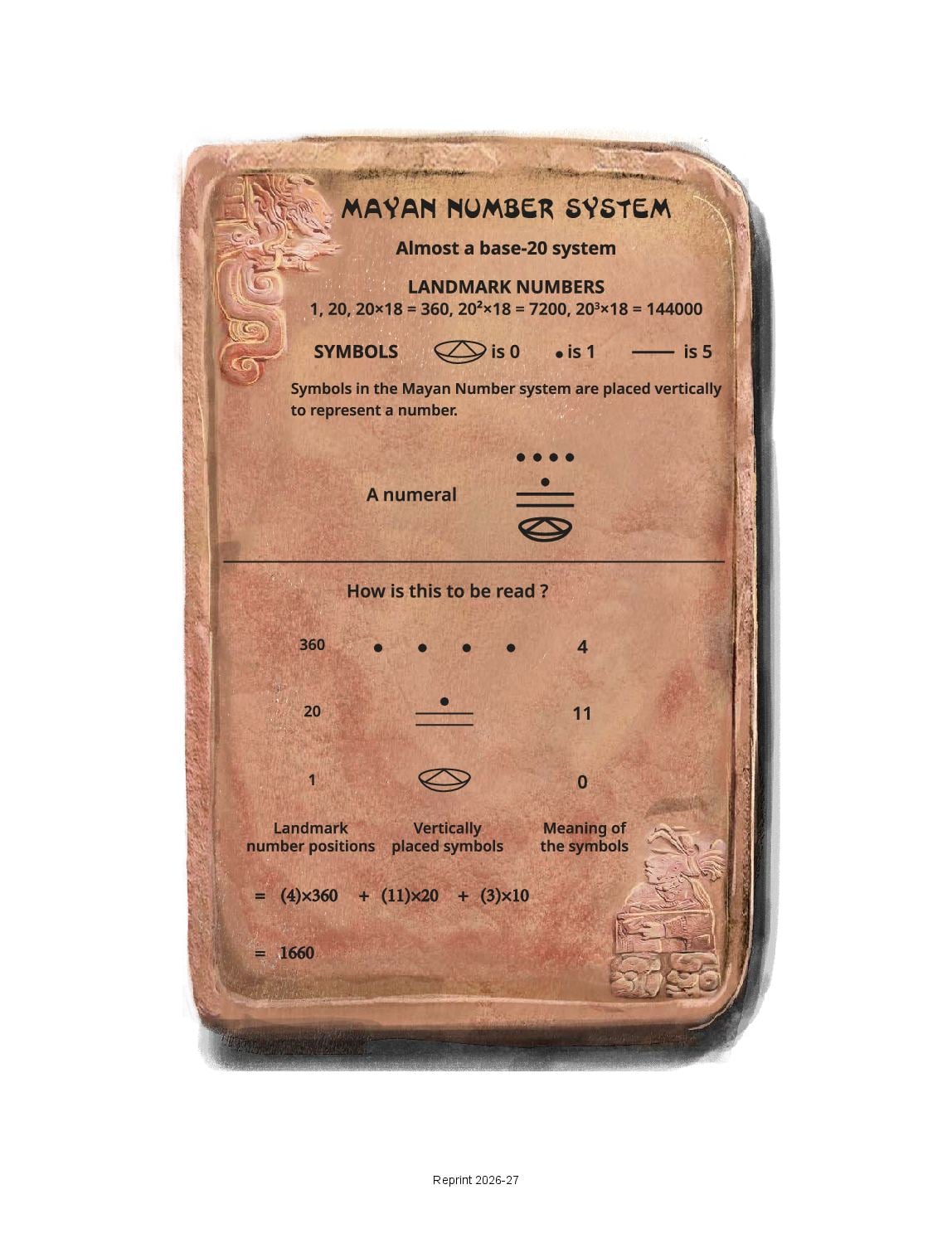
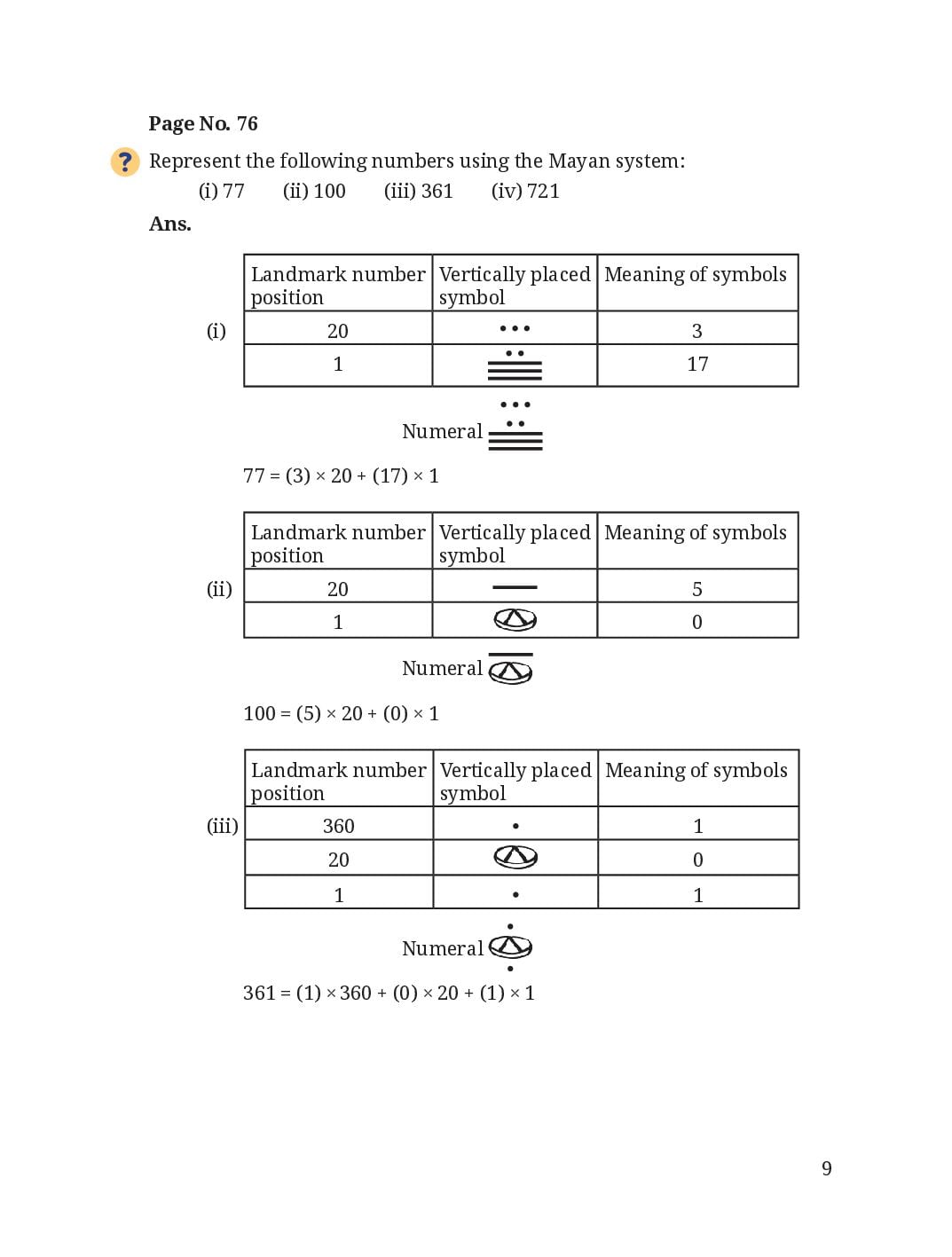
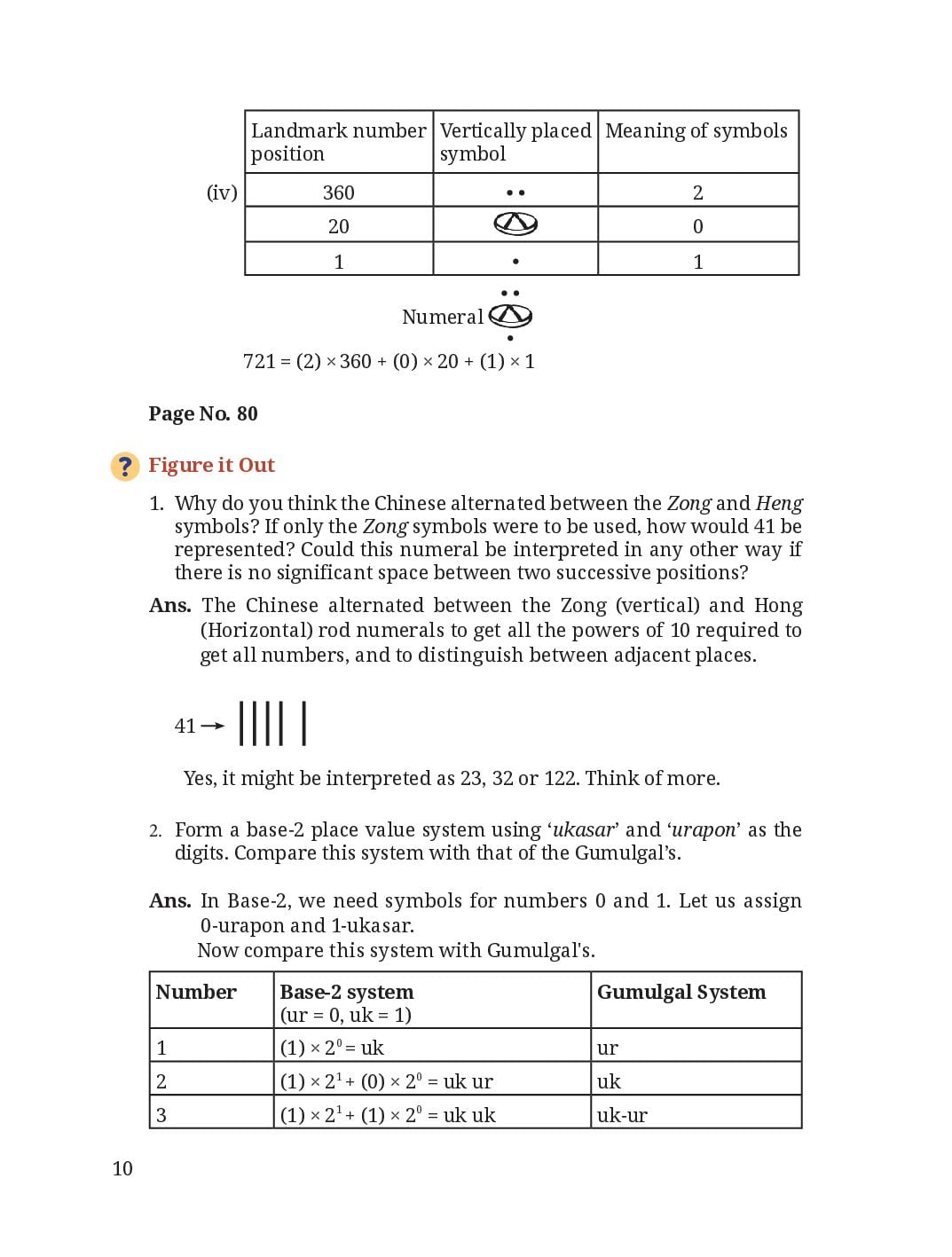
| Mayan | 1, 20, 360, 7200, 144000 | Place value written vertically; a shell for 0 | 1 dot above; 1 bar + 2 dots below |
| Chinese rod numerals | Powers of 10 | Place value made readable by alternating Zong and Heng | Heng-2 above the tens place, Zong-7 in the units |
| Hindu (Indian) | 1, 10, 100, 1000, … | 0 as a digit and as a number; ten symbols for everything | 27 |
Old NCERT vs New – Class 8 Maths
This chapter is from Ganita Prakash, the new NCERT Class 8 Maths book (NCF-SE 2023, used from 2025-26). It replaced the old book “Mathematics”, so chapter numbers and names differ from older PDFs.
Solutions and All Chapters
Answers to the exercises and the full chapter list of Ganita Prakash:
A Story of Numbers – Overview
| Class | Class 8 |
| Subject | Maths |
| Book | Ganita Prakash – new NCERT book |
| Part | Part I |
| Chapter | 3 of 14 – A Story of Numbers |
| Book pages | 48 – 81 |
| Edition | NCERT Reprint 2026-27 |
| Session | 2026-27 |
| Free – read online or download |
Class 8 Maths Chapter 3 – FAQs
Where can I download A Story of Numbers Class 8 PDF?
From the download table on this page – the chapter PDF is free, and the full book is linked too.
What is Class 8 Maths Chapter 3 about?
To count you need a standard sequence of objects, names or written symbols with a fixed order — that sequence is a number system. Counting a collection means making a one-to-one mapping onto it.
Is A Story of Numbers from the new NCERT Class 8 Maths book?
Yes. It is chapter 3 of ganita prakash (part i), the new NCERT Class 8 Maths book for 2026-27.
Is this the latest NCERT edition for 2026-27?
Yes – the PDF is NCERT’s latest edition for the 2026-27 session.
Where are the NCERT Solutions for Class 8 Maths Chapter 3?
Open the NCERT Solutions link above for answers to the exercise questions.