NCERT Solutions for Class 8 Maths Chapter 3 A Story of Numbers provide clear, step-by-step answers to every exercise and in-text question from the chapter A Story of Numbers of the NCERT textbook Ganita Prakash. Prepared by subject experts as per the latest NCERT (CBSE) syllabus for 2026-27, these NCERT Solutions for Class 8 Maths help you understand each concept, write exam-ready answers, and check your own solutions. You can read them online below or download the free Class 8 Maths Chapter 3 question-answer PDF.
NCERT Solutions for Class 8 Maths Chapter 3 A Story of Numbers
- Class: Class 8
- Subject: Maths
- Chapter: Chapter 3 – A Story of Numbers
- Textbook: Ganita Prakash (NCERT)
- Study material: NCERT Solutions – questions with answers, free PDF
These solutions answer all the exercise questions of Chapter 3 A Story of Numbers — including the in-text questions, short-answer and long-answer questions, and activities — with complete explanations so you can follow the method, not just the final answer. Read the full solutions below.
NCERT Solutions Class 8 Maths Chapter 3 a Story of Numbers View Download
NCERT Solutions for Class 8 Maths Chapter 3 PDF Download
You can read the NCERT Solutions for Class 8 Maths Chapter 3 online above, or download the complete question-answer PDF to study A Story of Numbers offline at any time.
NCERT Solutions for Class 8 Maths Chapter 3 PDF Download Link – Click Here to Download Solutions PDF
Questions Covered in This Chapter
These NCERT Solutions answer all 55 questions of this chapter. The questions solved are:
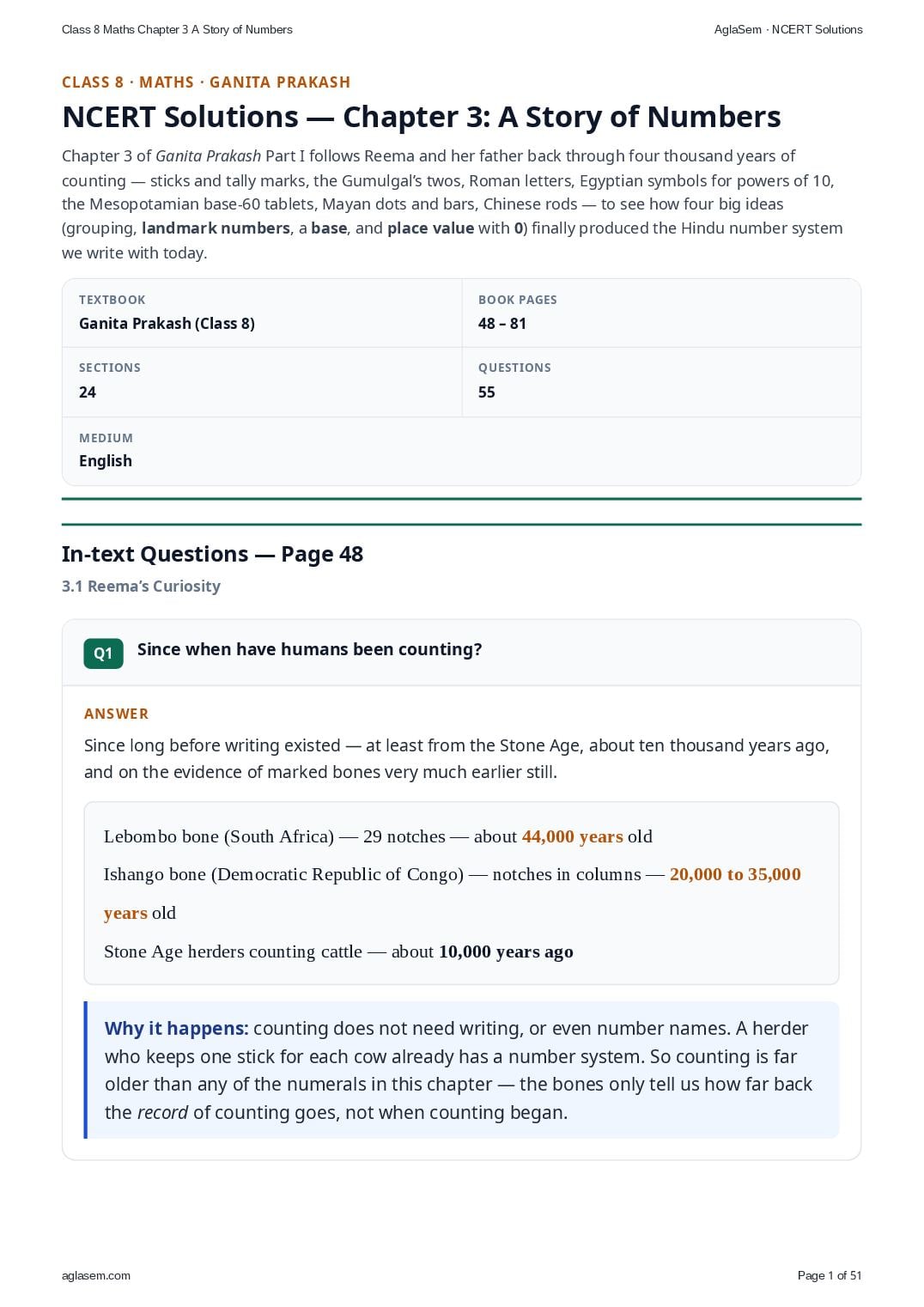
- Since when have humans been counting?
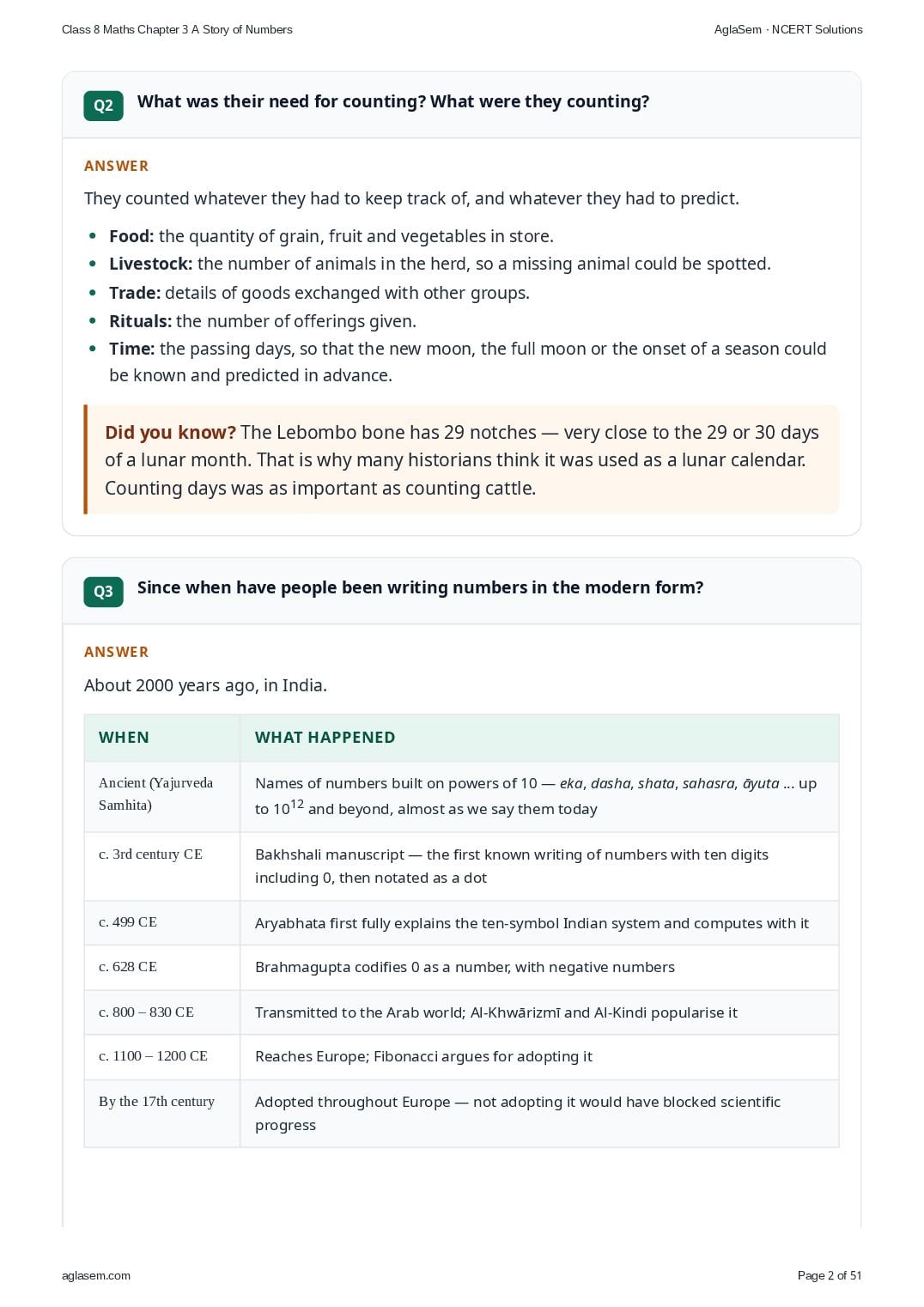
- What was their need for counting? What were they counting?
- Since when have people been writing numbers in the modern form?
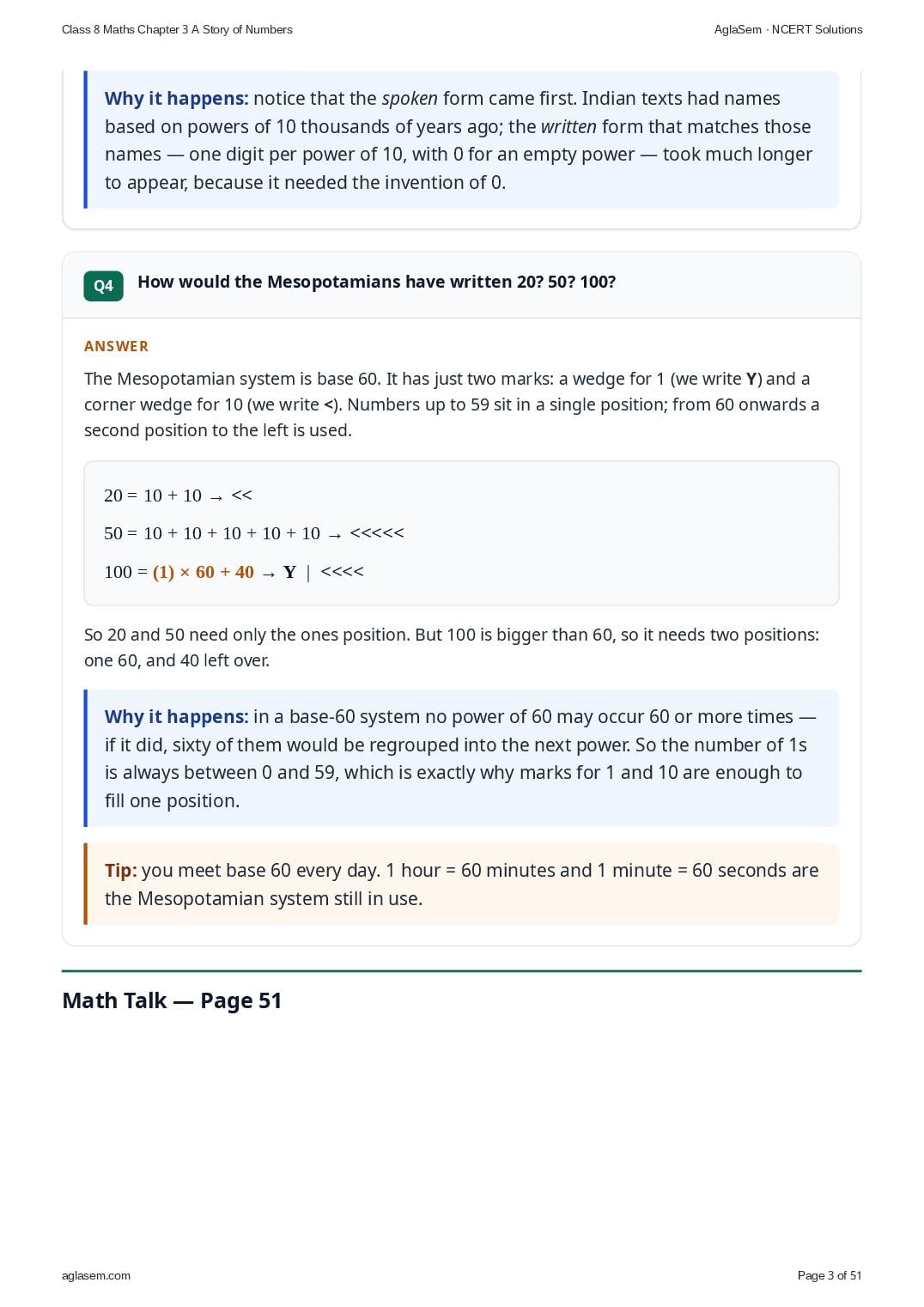
- How would the Mesopotamians have written 20? 50? 100?
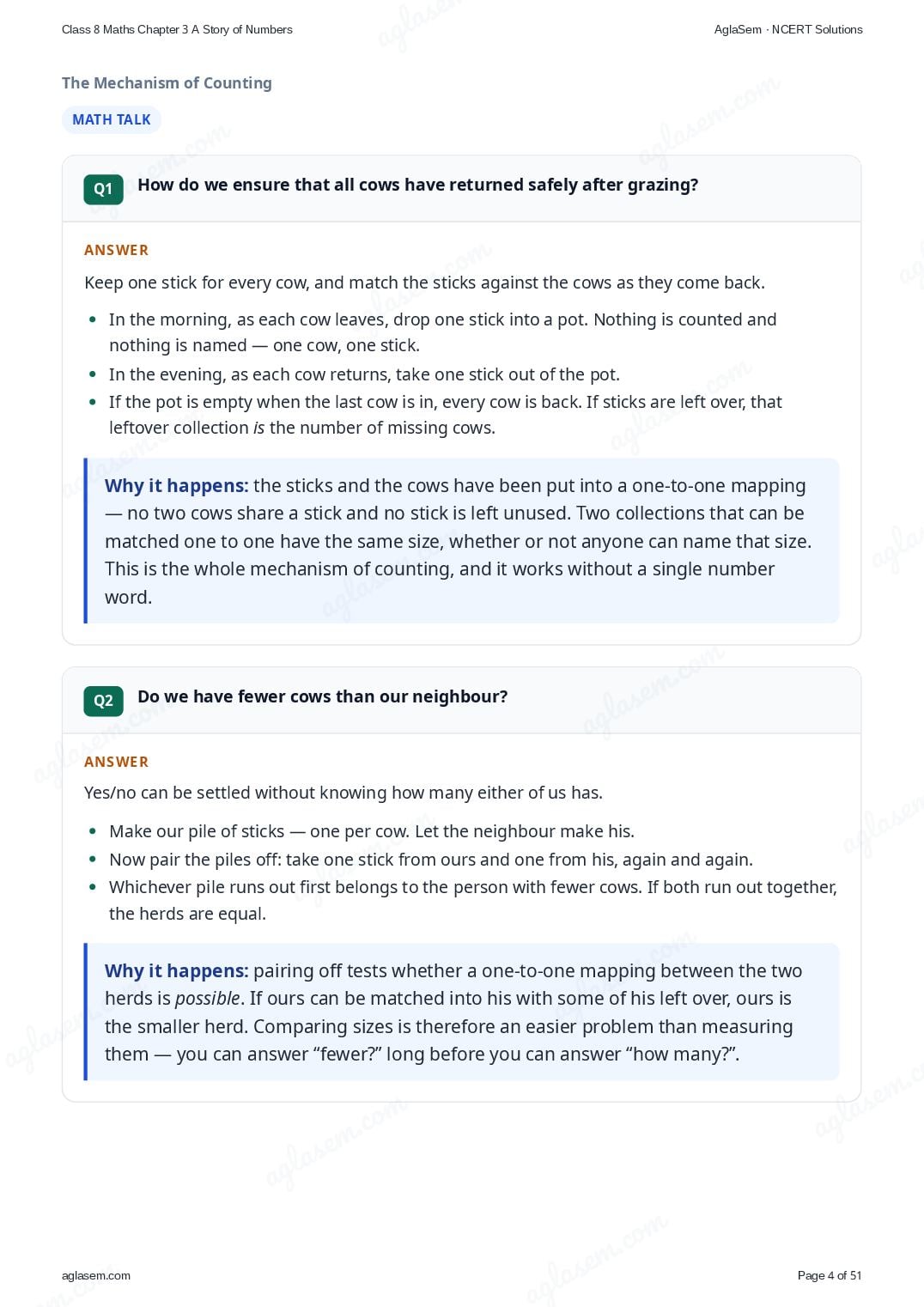
- How do we ensure that all cows have returned safely after grazing?
- Do we have fewer cows than our neighbour?
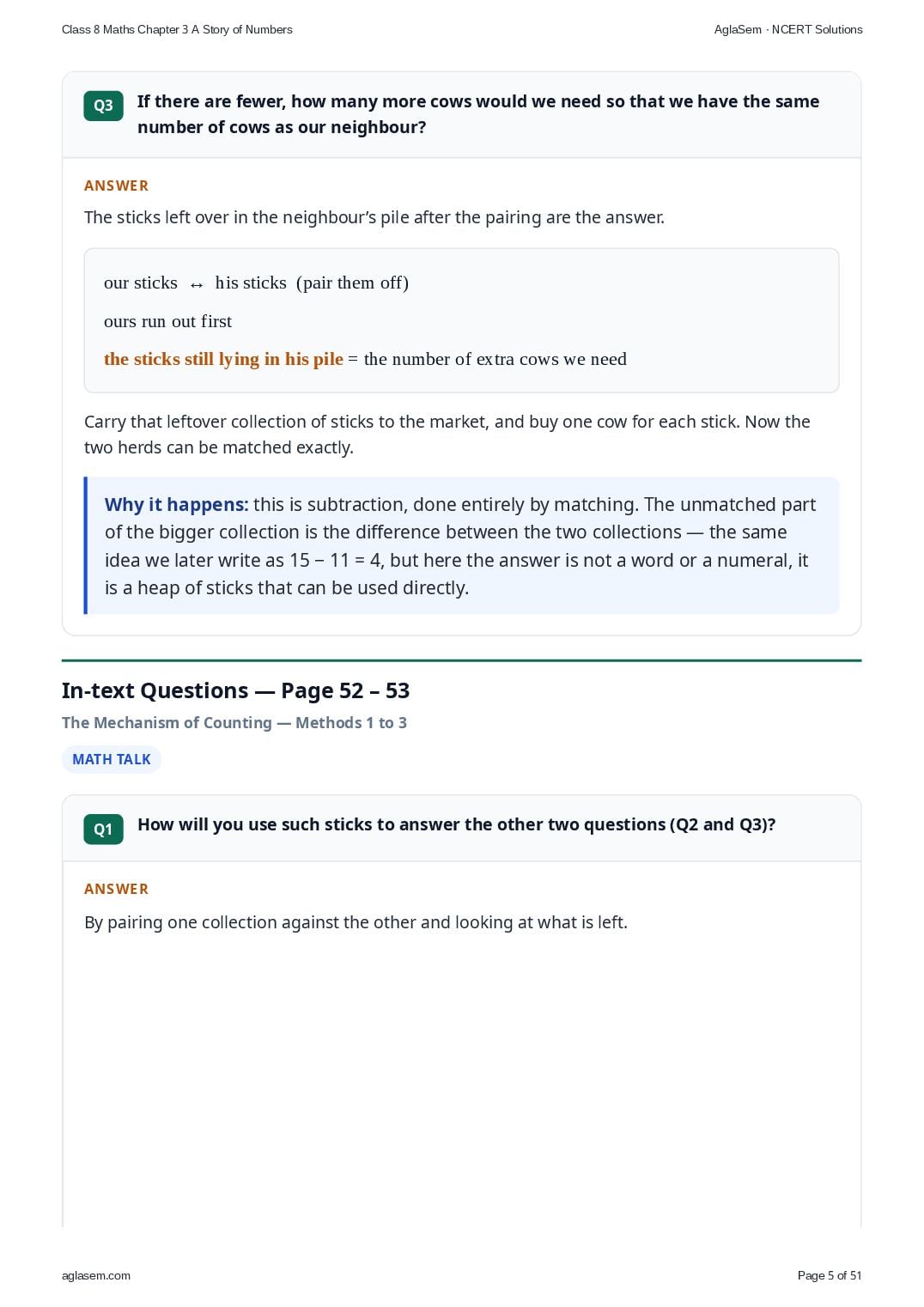
- If there are fewer, how many more cows would we need so that we have the same number of cows as our neighbour?
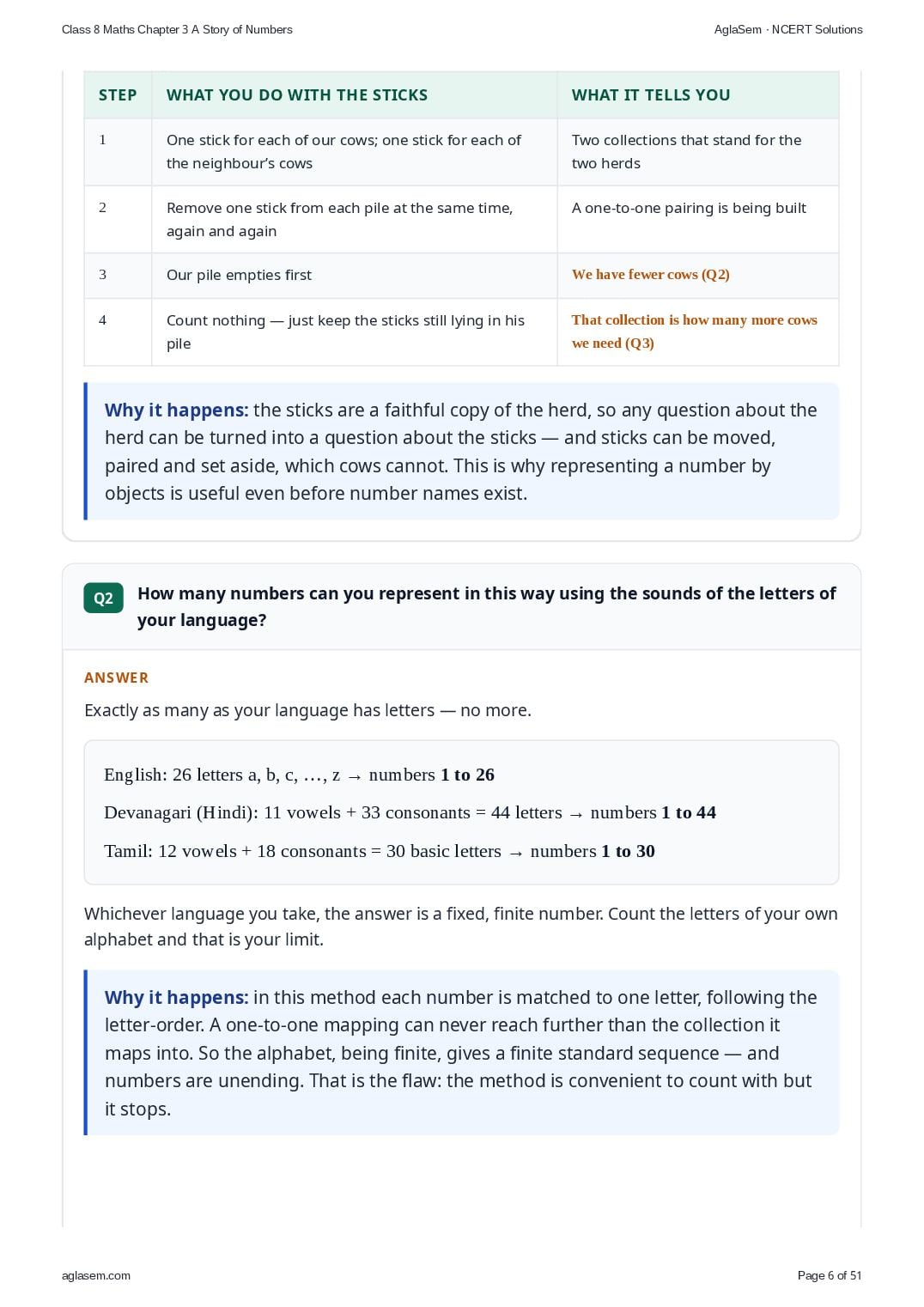
- How will you use such sticks to answer the other two questions (Q2 and Q3)?
- How many numbers can you represent in this way using the sounds of the letters of your language?
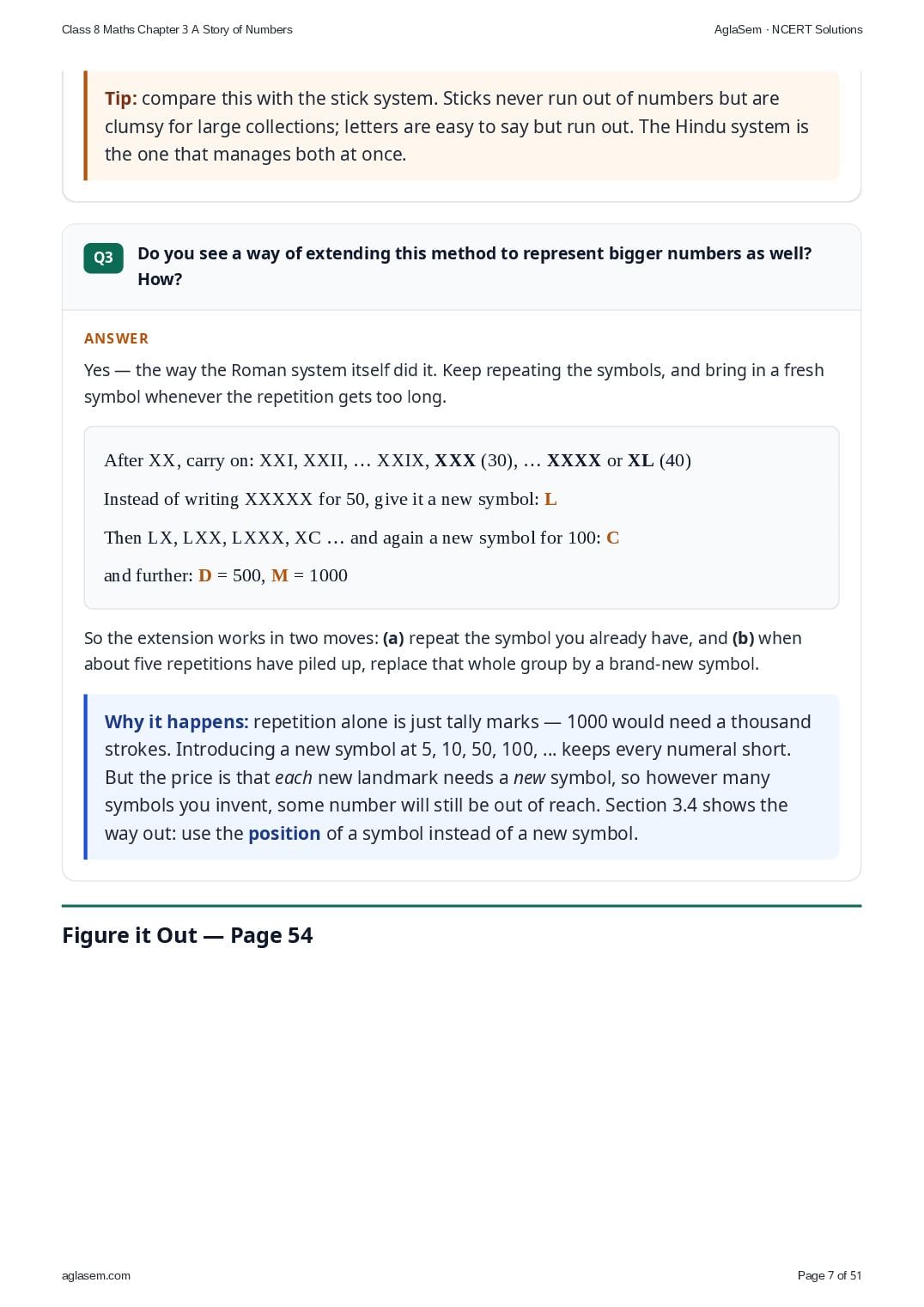
- Do you see a way of extending this method to represent bigger numbers as well? How?
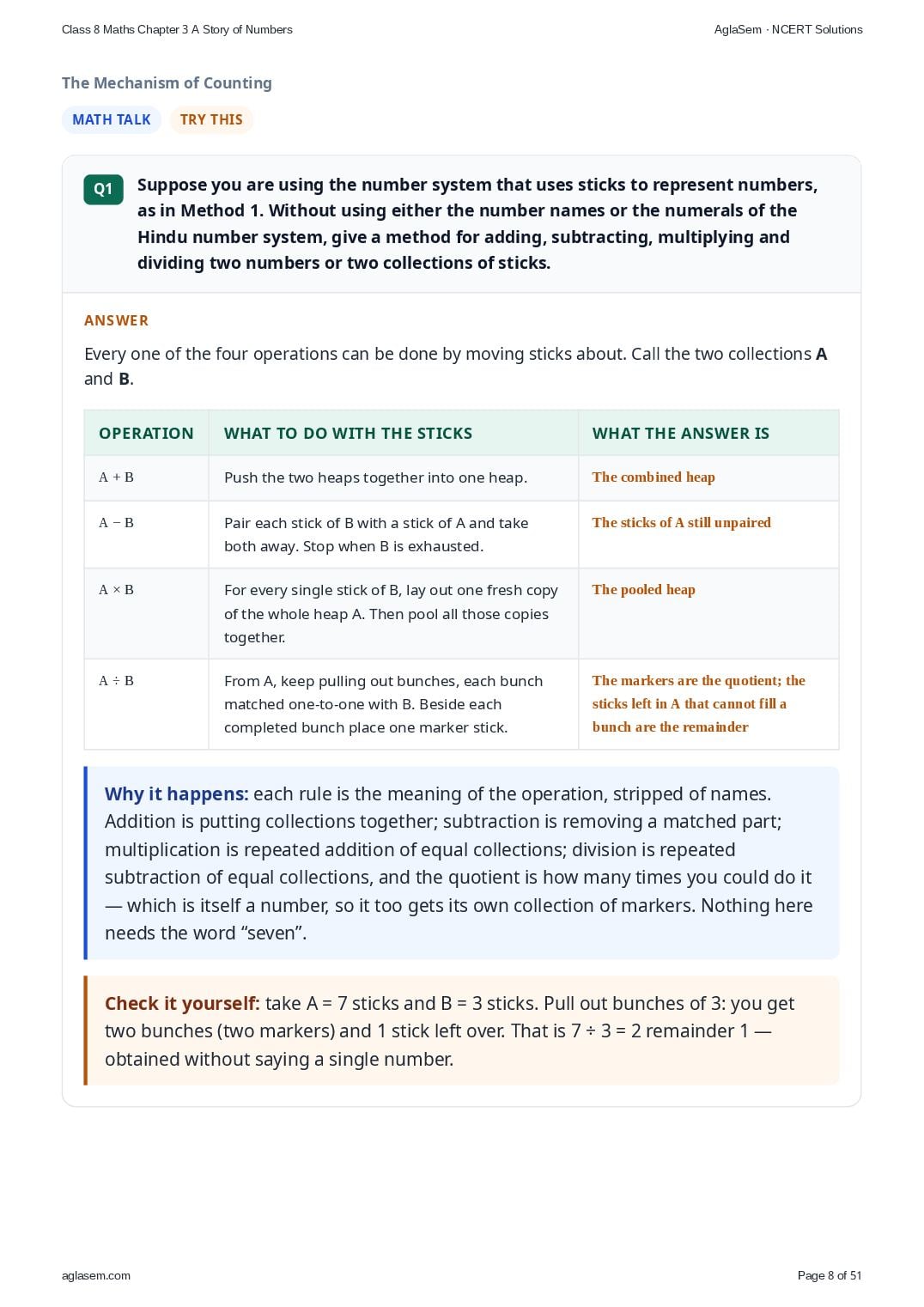
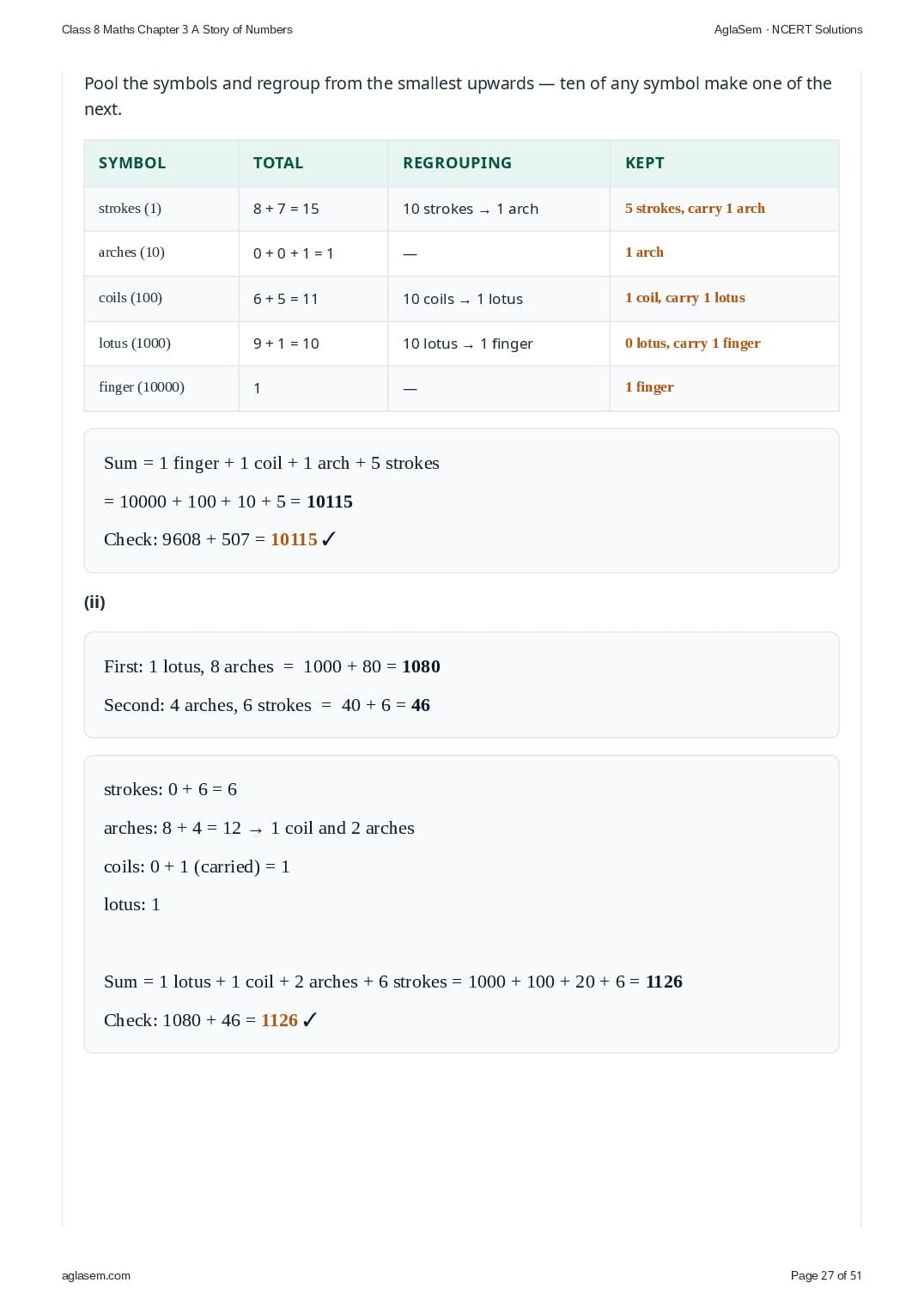
- Suppose you are using the number system that uses sticks to represent numbers, as in Method 1. Without using either the number names or the numerals of the Hindu number system, give a method for adding, subtracting, multiplying and dividing two numbers or two collections of sticks.
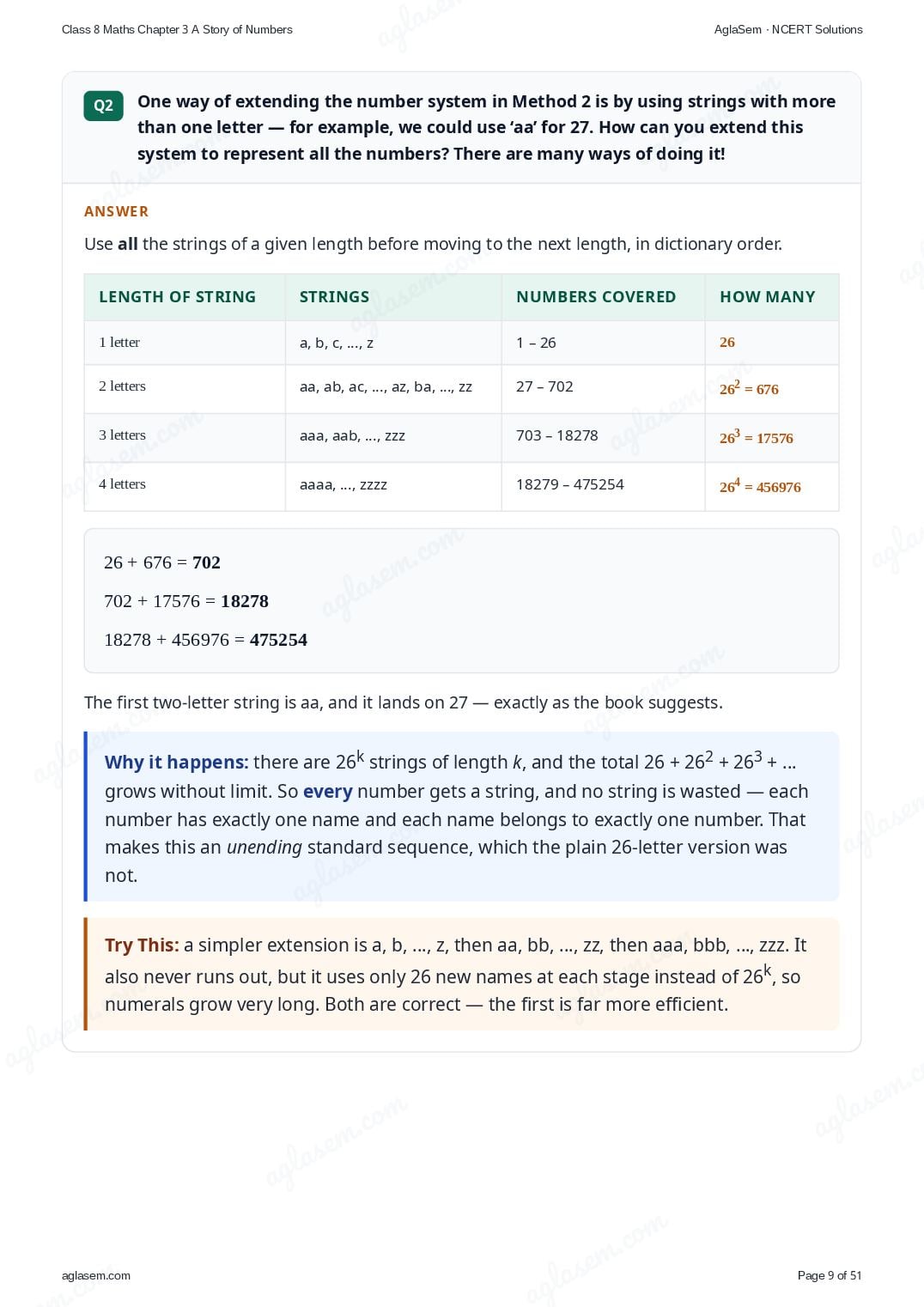
- One way of extending the number system in Method 2 is by using strings with more than one letter — for example, we could use ‘aa’ for 27. How can you extend this system to represent all the numbers? There are many ways of doing it!
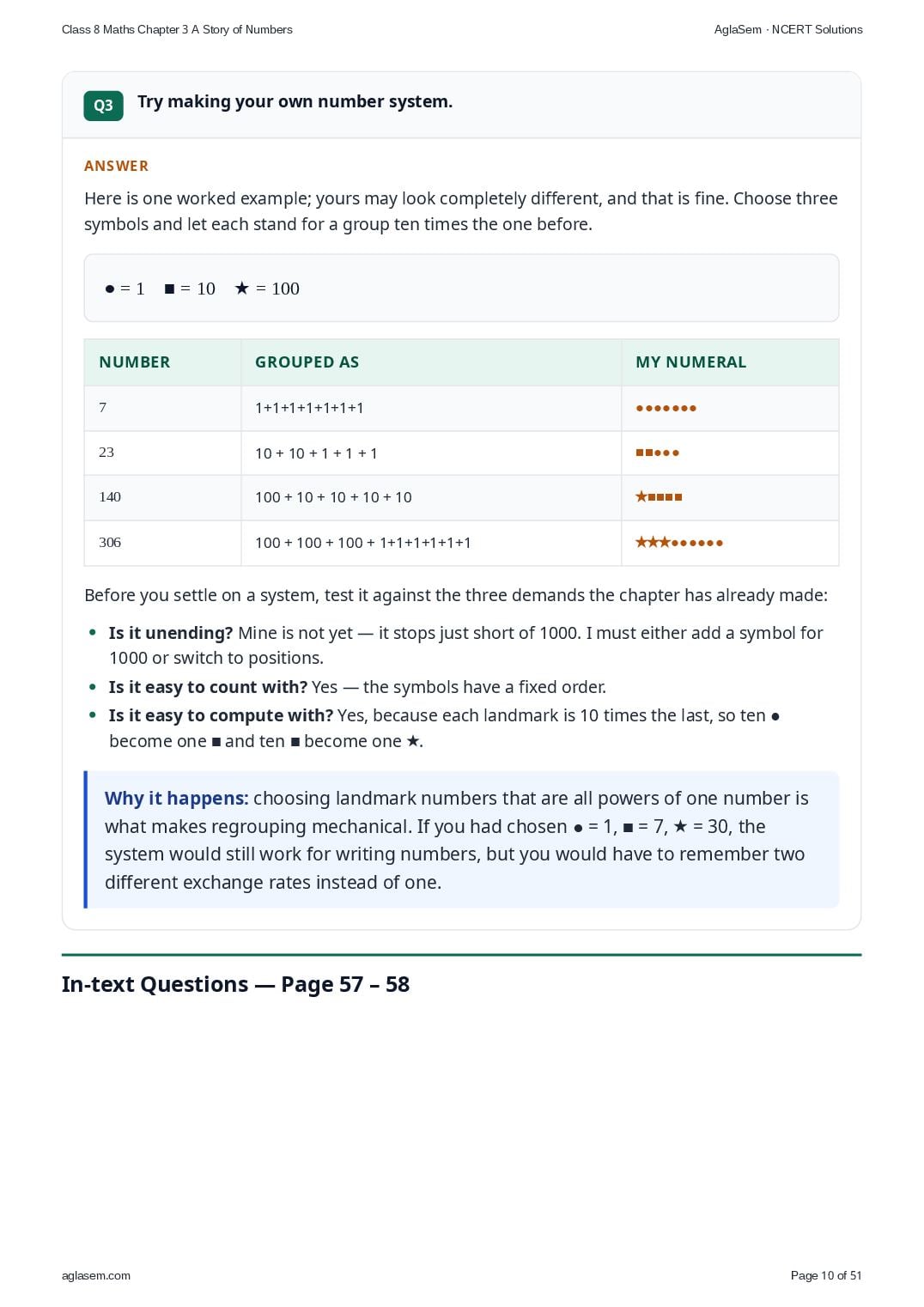
- Try making your own number system.
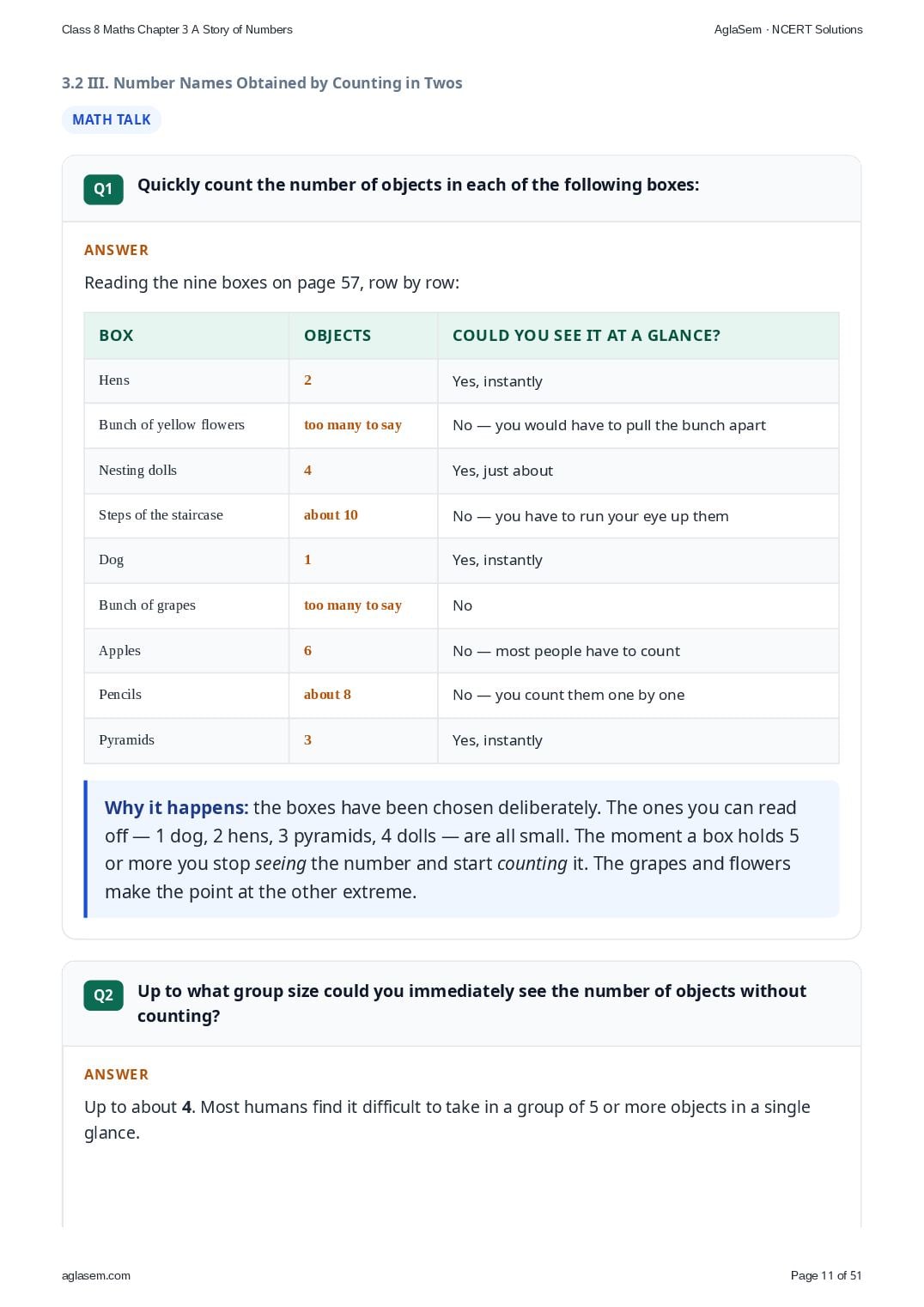
- Quickly count the number of objects in each of the following boxes:
- Up to what group size could you immediately see the number of objects without counting?
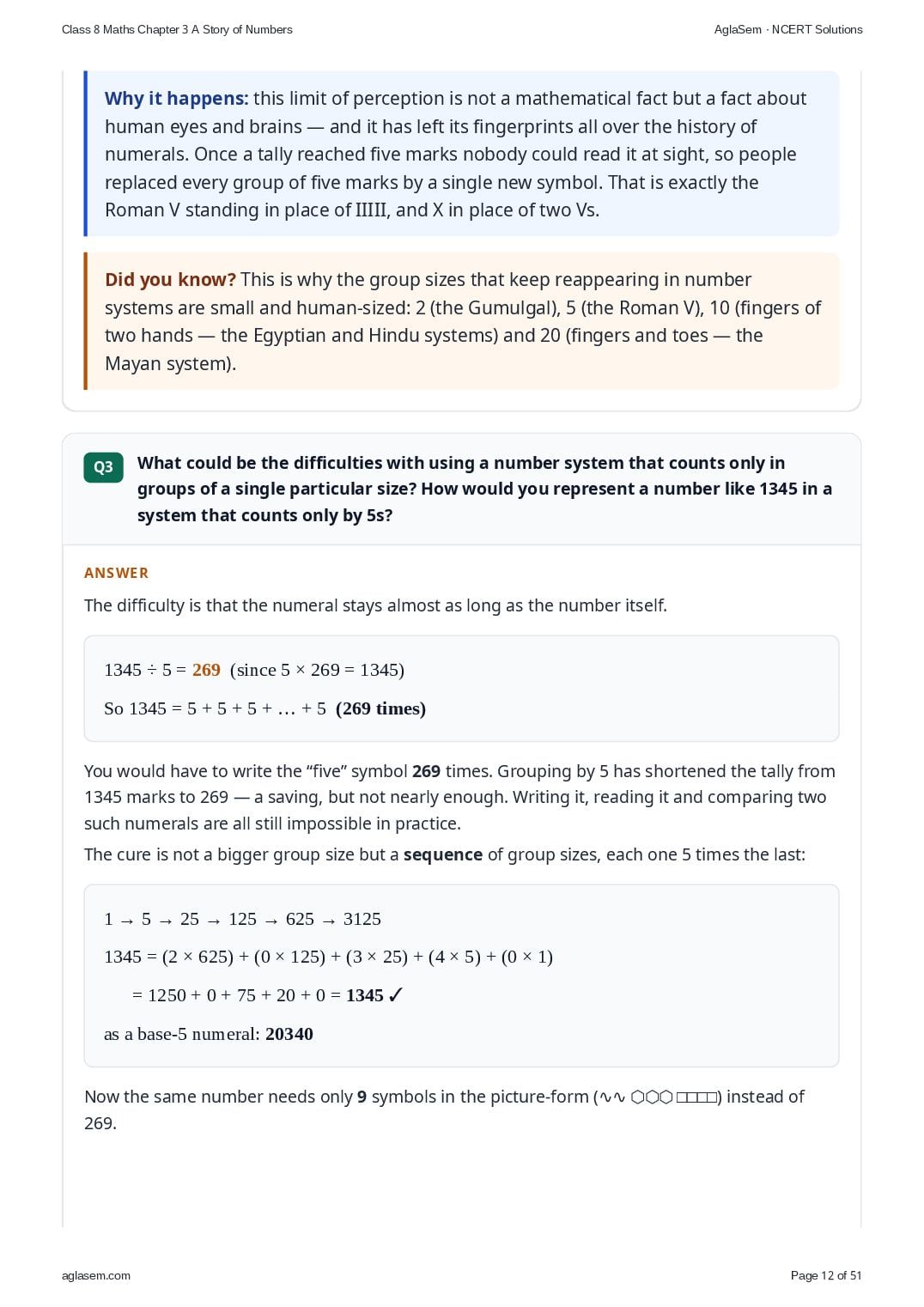
- What could be the difficulties with using a number system that counts only in groups of a single particular size? How would you represent a number like 1345 in a system that counts only by 5s?
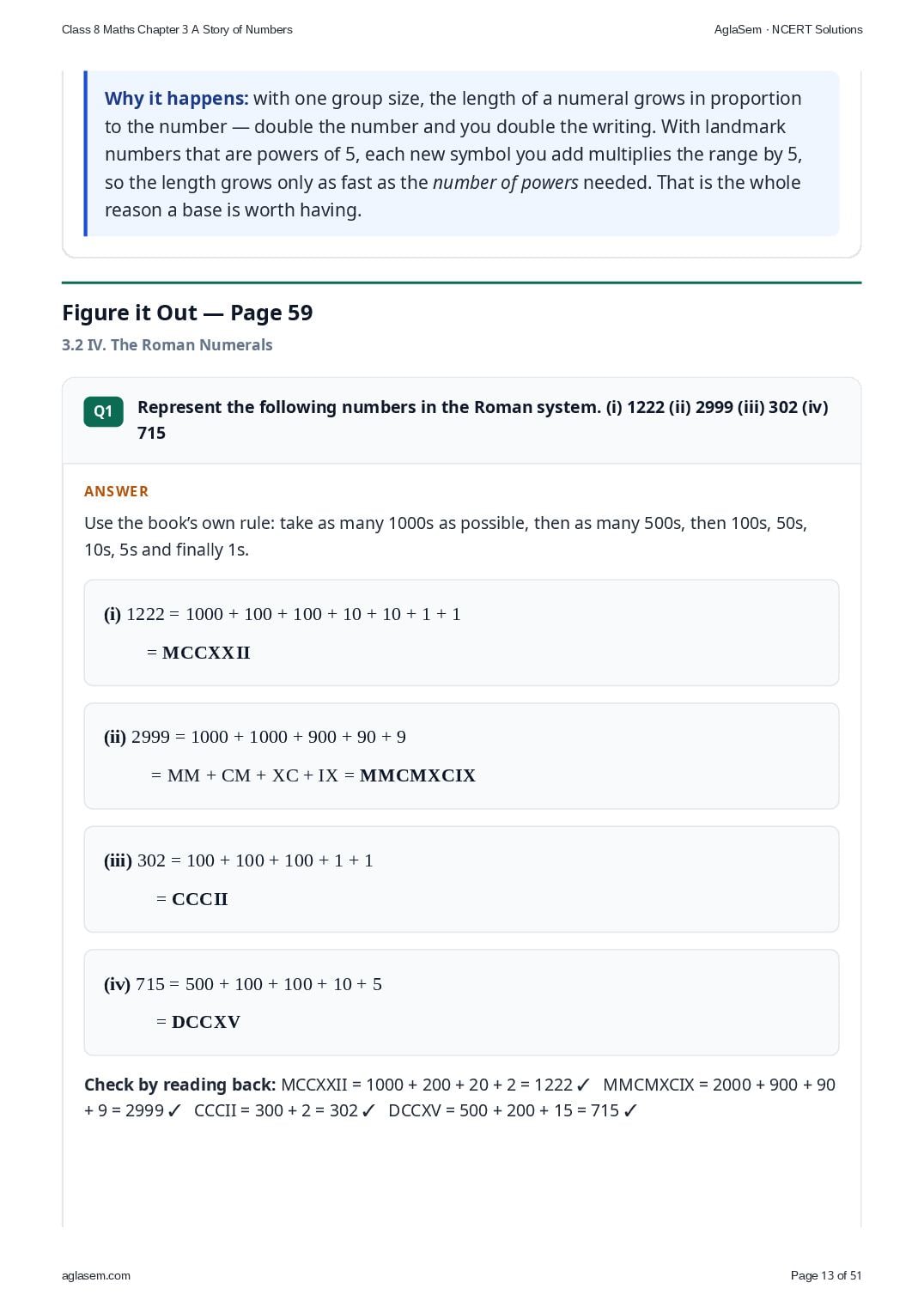
- Represent the following numbers in the Roman system. (i) 1222 (ii) 2999 (iii) 302 (iv) 715
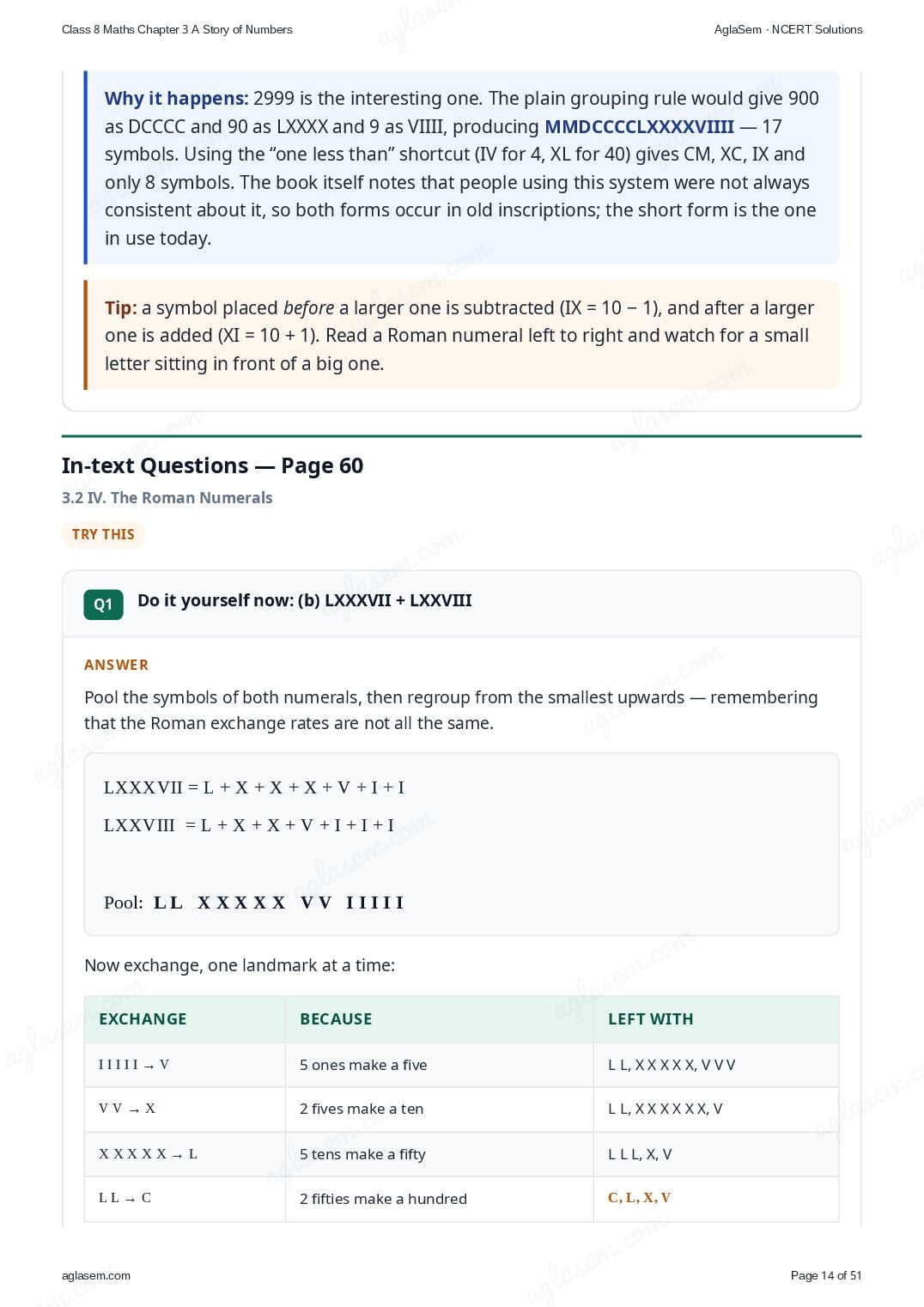
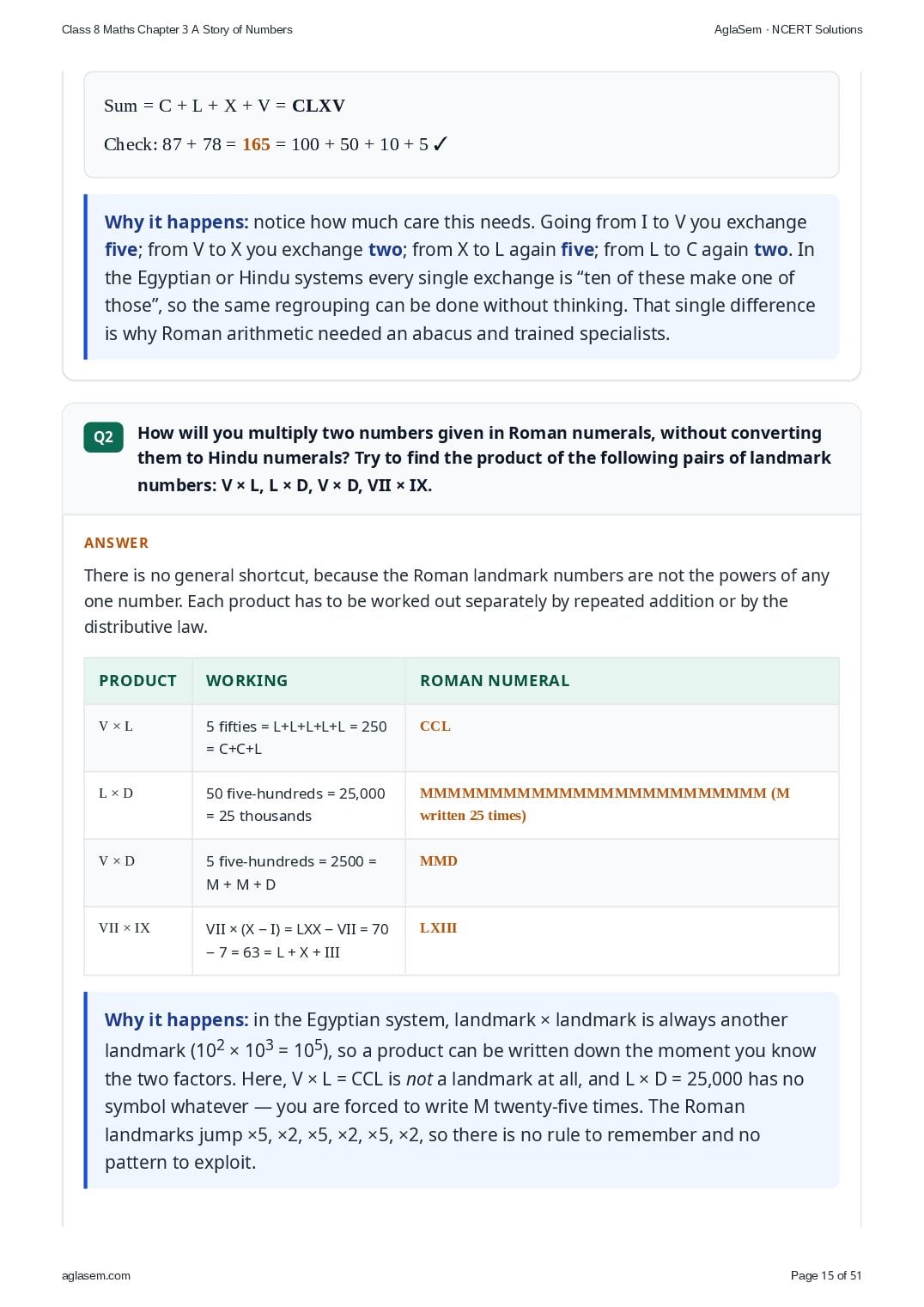
- Do it yourself now: (b) LXXXVII + LXXVIII
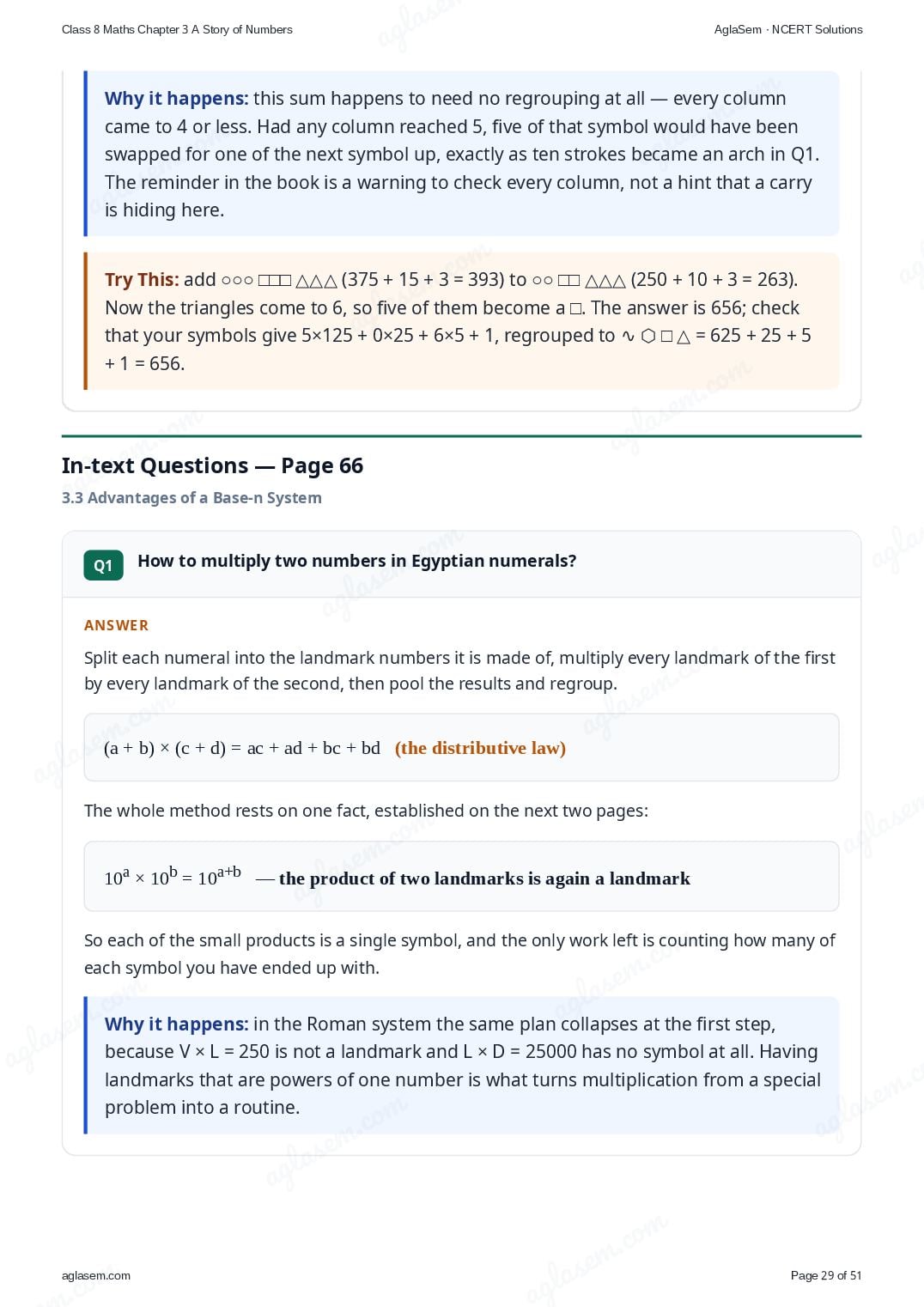
- How will you multiply two numbers given in Roman numerals, without converting them to Hindu numerals? Try to find the product of the following pairs of landmark numbers: V × L, L × D, V × D, VII × IX.
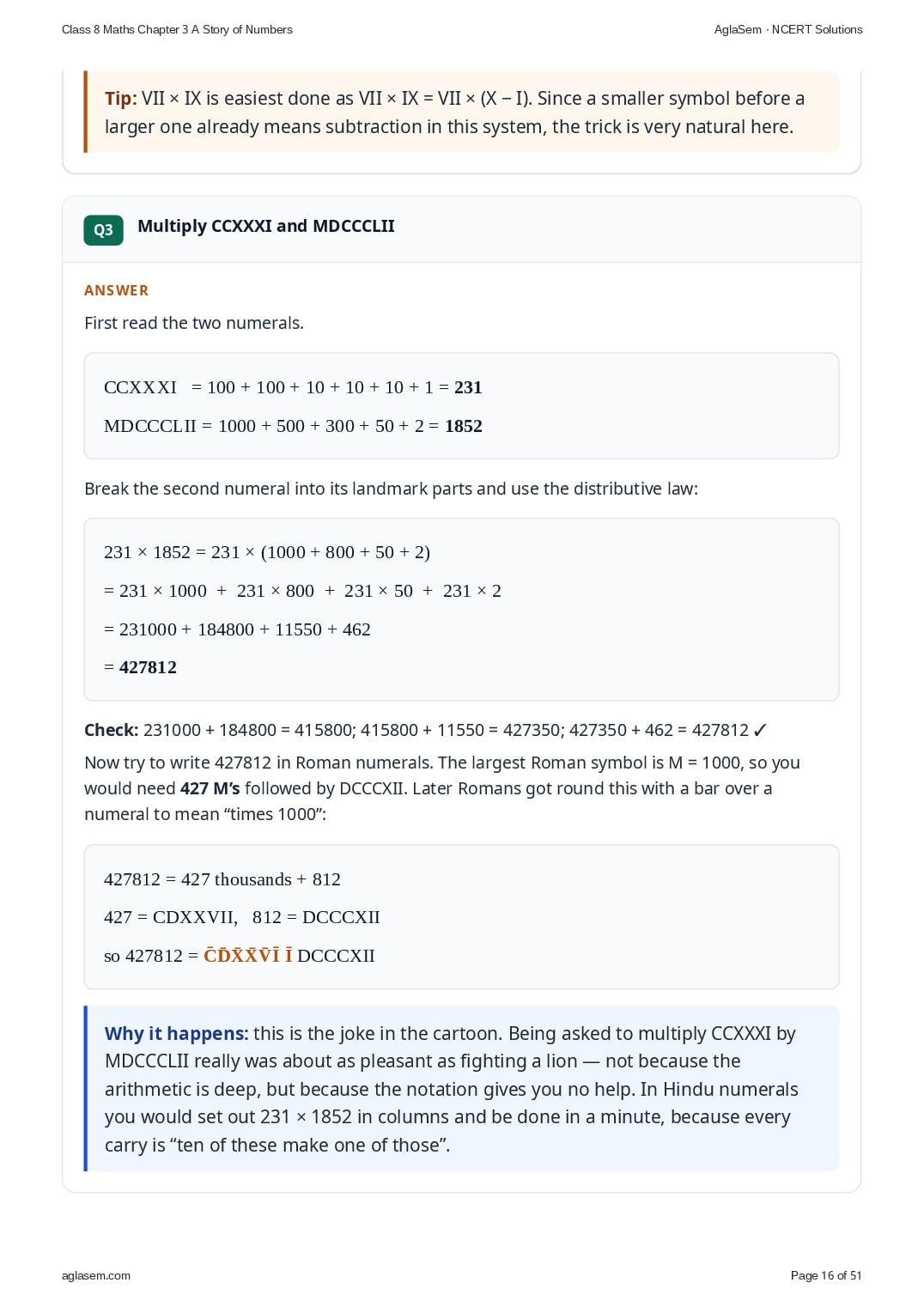
- Multiply CCXXXI and MDCCCLII
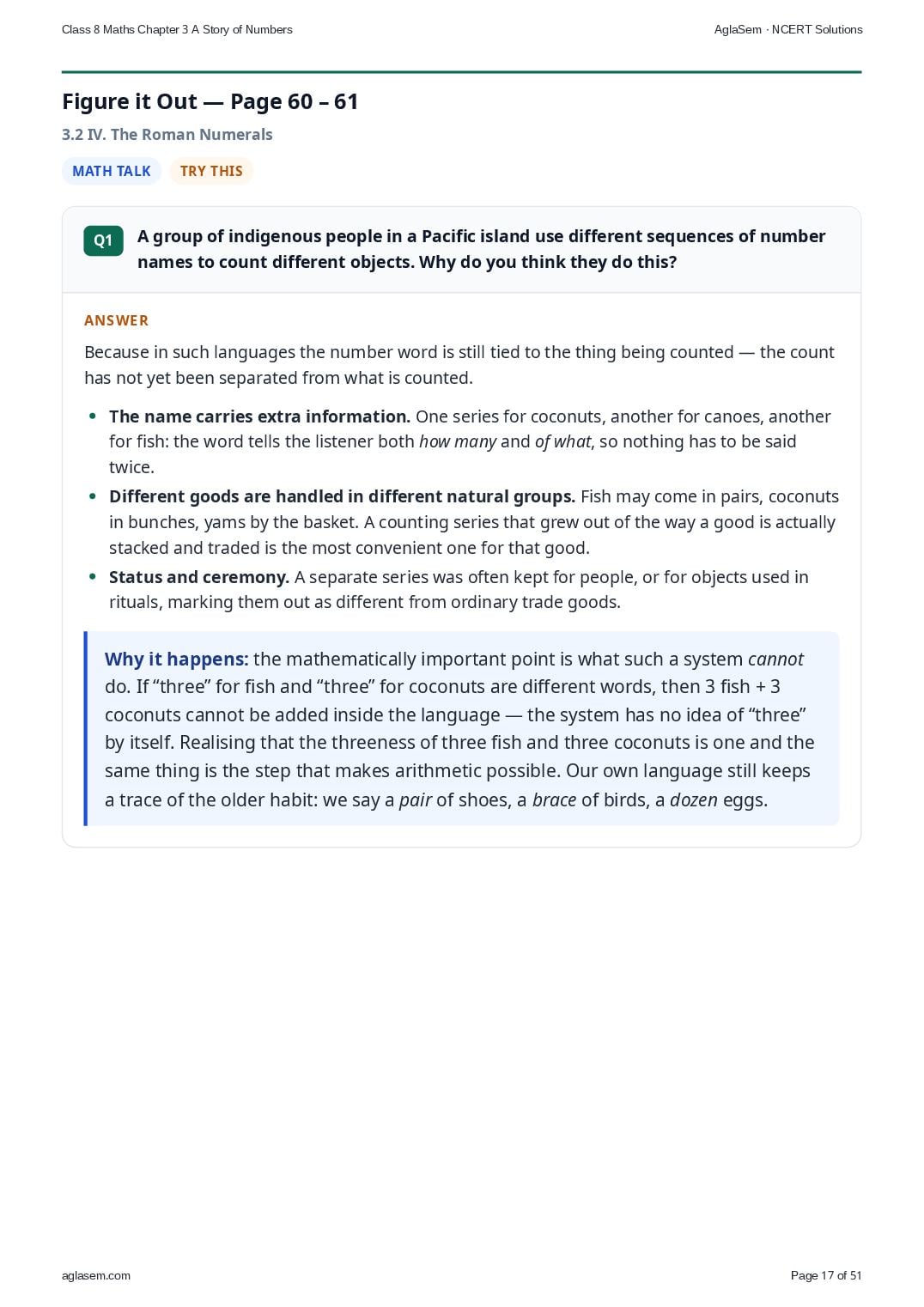
- A group of indigenous people in a Pacific island use different sequences of number names to count different objects. Why do you think they do this?
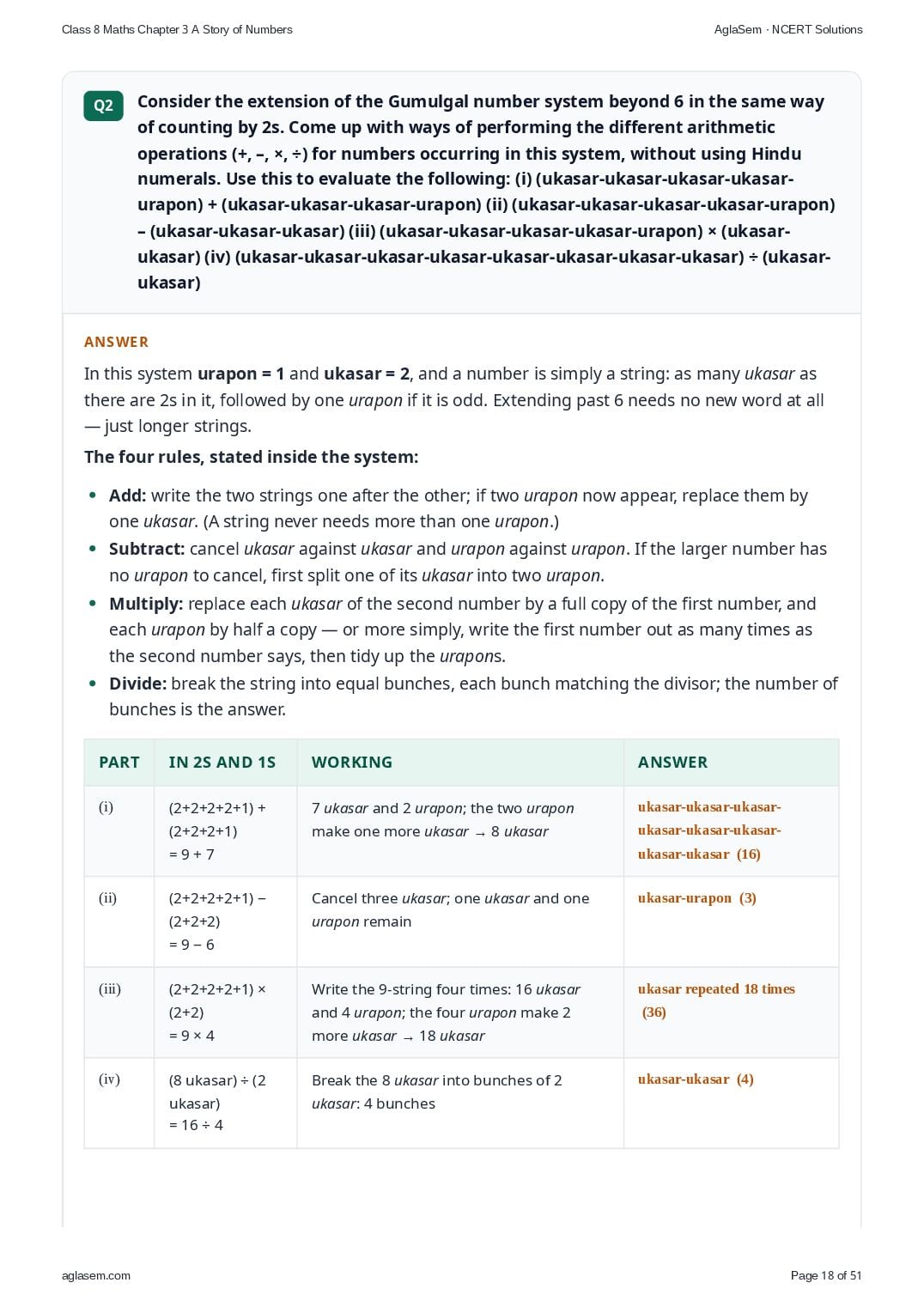
- Consider the extension of the Gumulgal number system beyond 6 in the same way of counting by 2s. Come up with ways of performing the different arithmetic operations (+, –, ×, ÷) for numbers occurring in this system, without using Hindu numerals. Use this to evaluate the following: (i) (ukasar-ukasar-ukasar-ukasar-urapon) + (ukasar-ukasar-ukasar-urapon) (ii) (ukasar-ukasar-ukasar-ukasar-urapon) – (ukasar-ukasar-ukasar) (iii) (ukasar-ukasar-ukasar-ukasar-urapon) × (ukasar-ukasar) (iv) (ukasar-ukasar-ukasar-ukasar-ukasar-ukasar-ukasar-ukasar) ÷ (ukasar-ukasar)
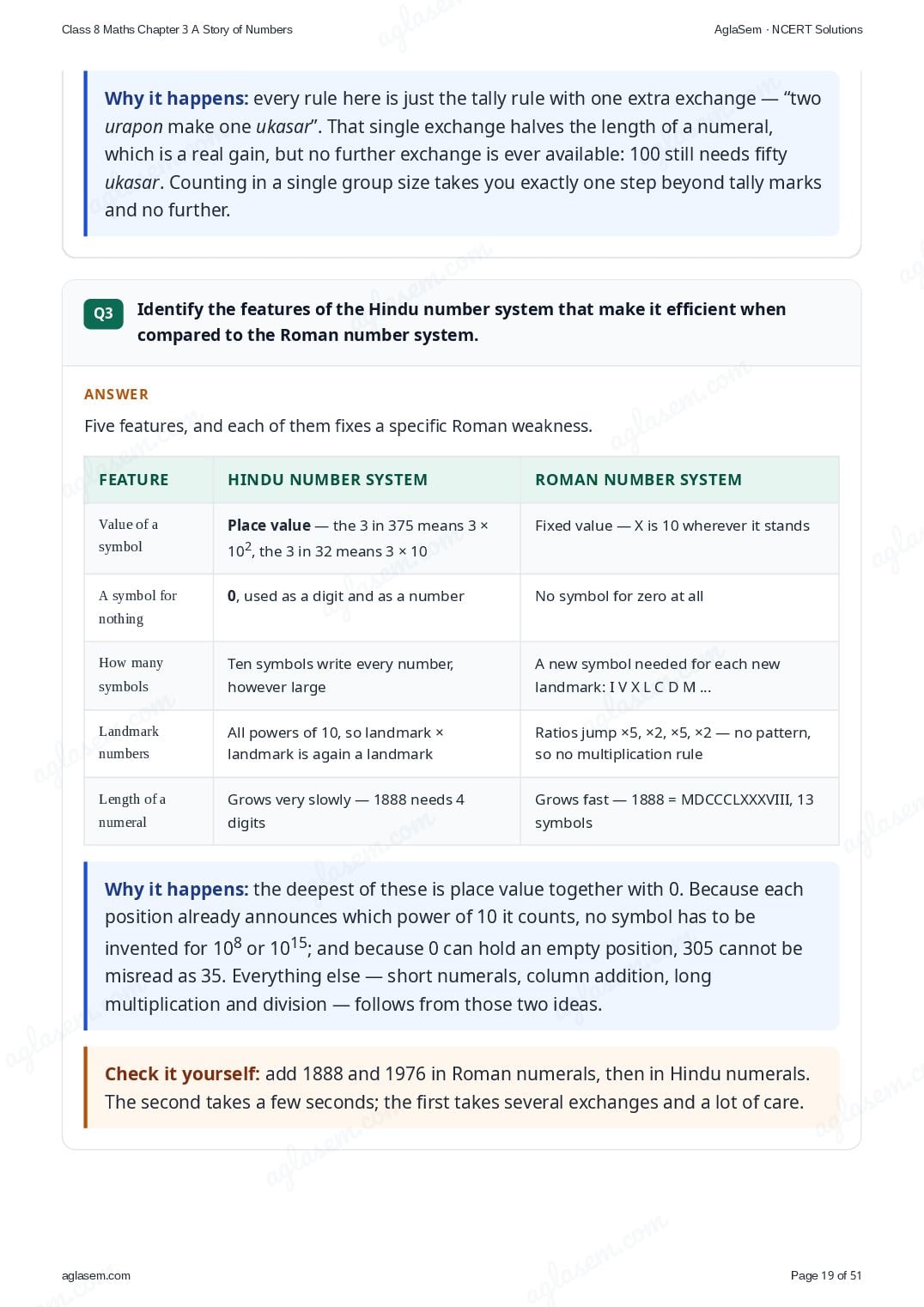
- Identify the features of the Hindu number system that make it efficient when compared to the Roman number system.
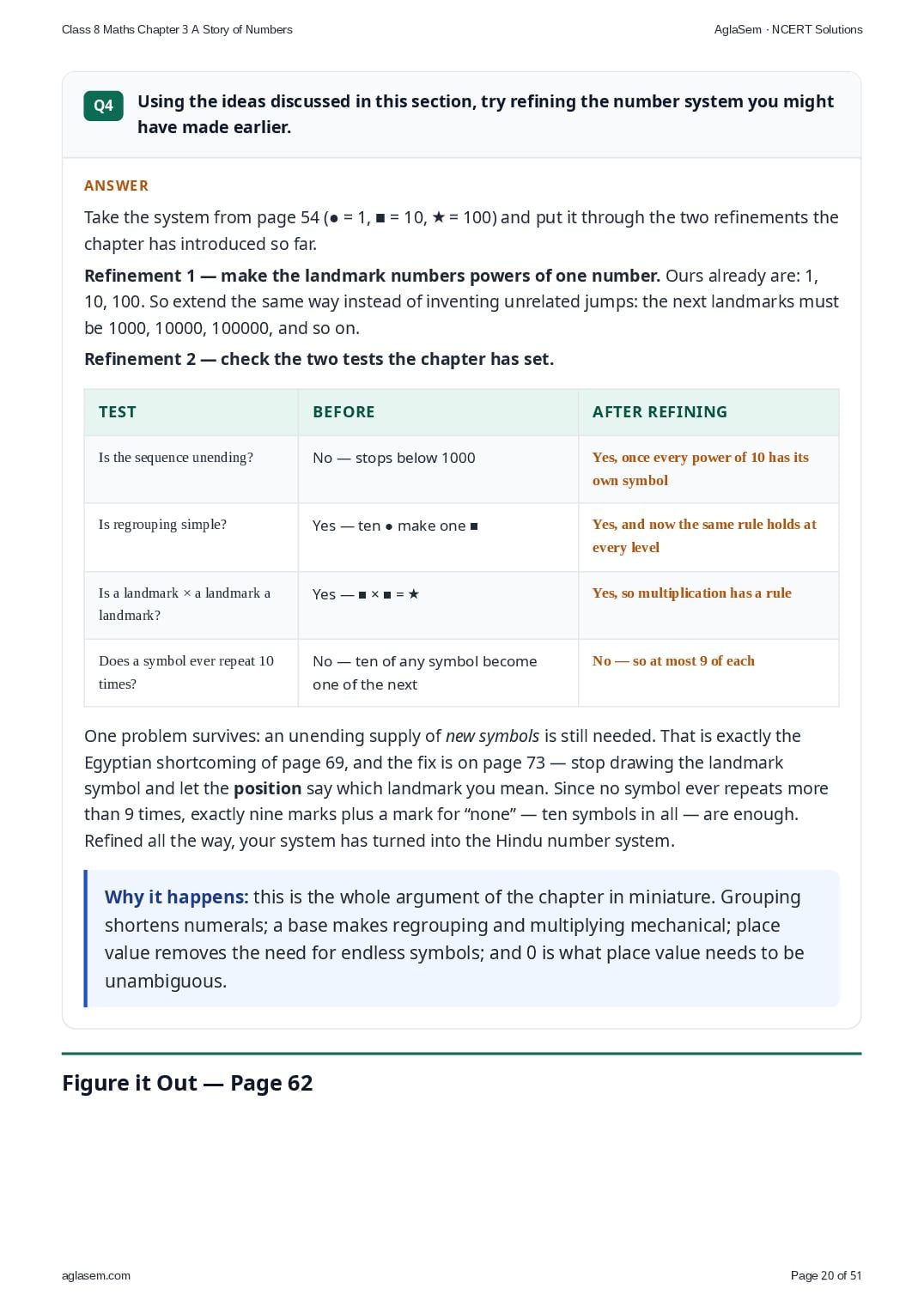
- Using the ideas discussed in this section, try refining the number system you might have made earlier.
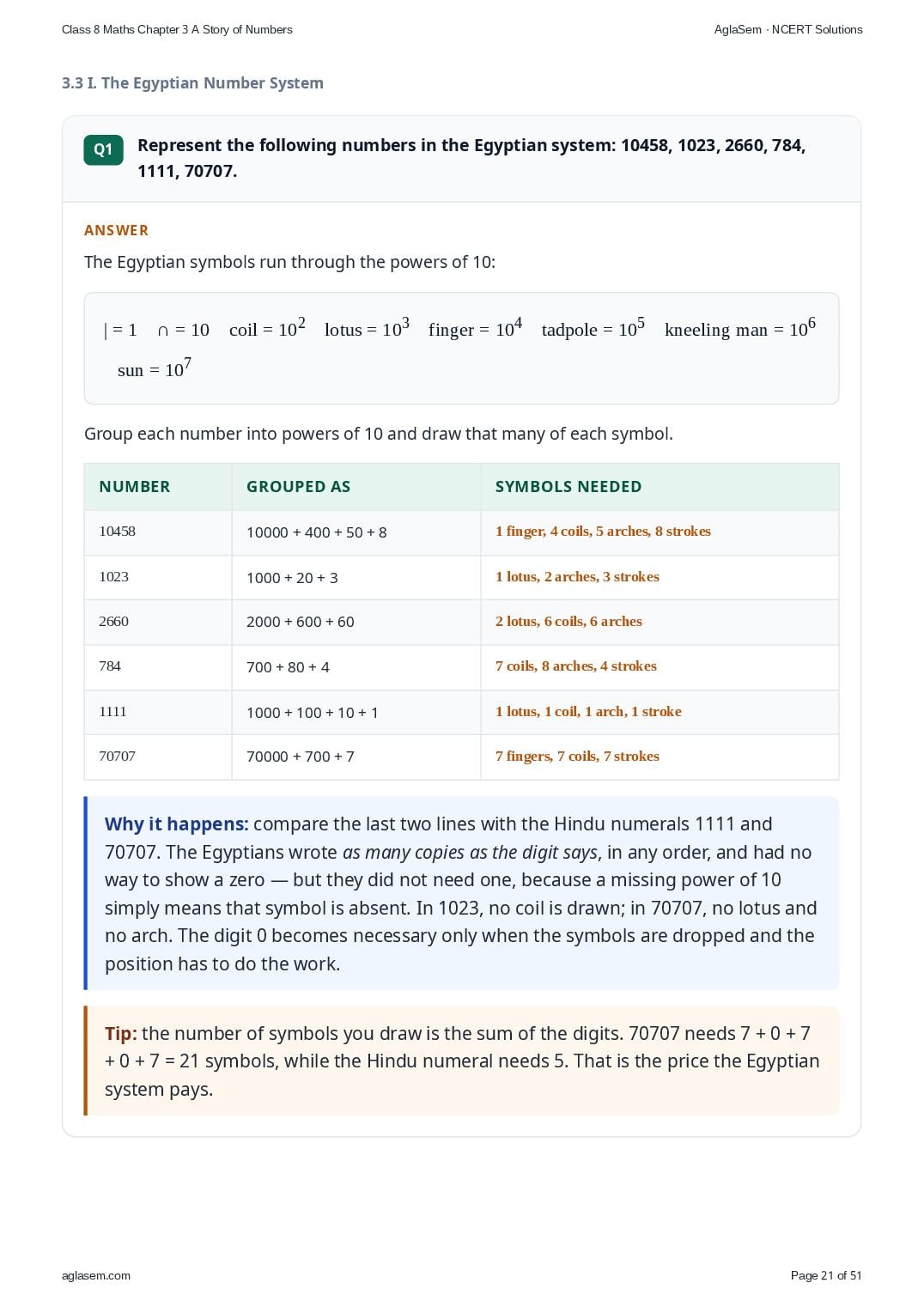
- Represent the following numbers in the Egyptian system: 10458, 1023, 2660, 784, 1111, 70707.
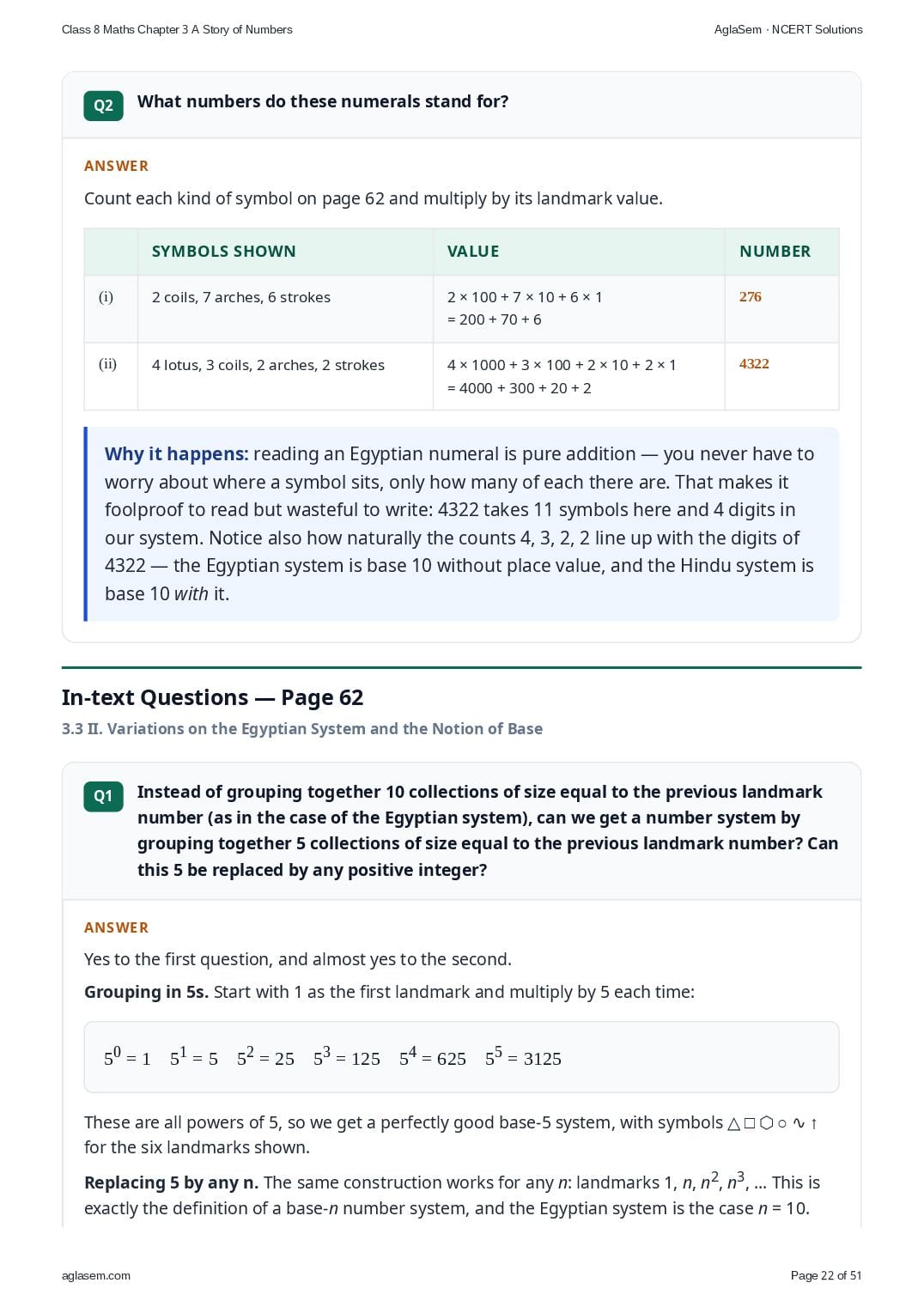
- What numbers do these numerals stand for?
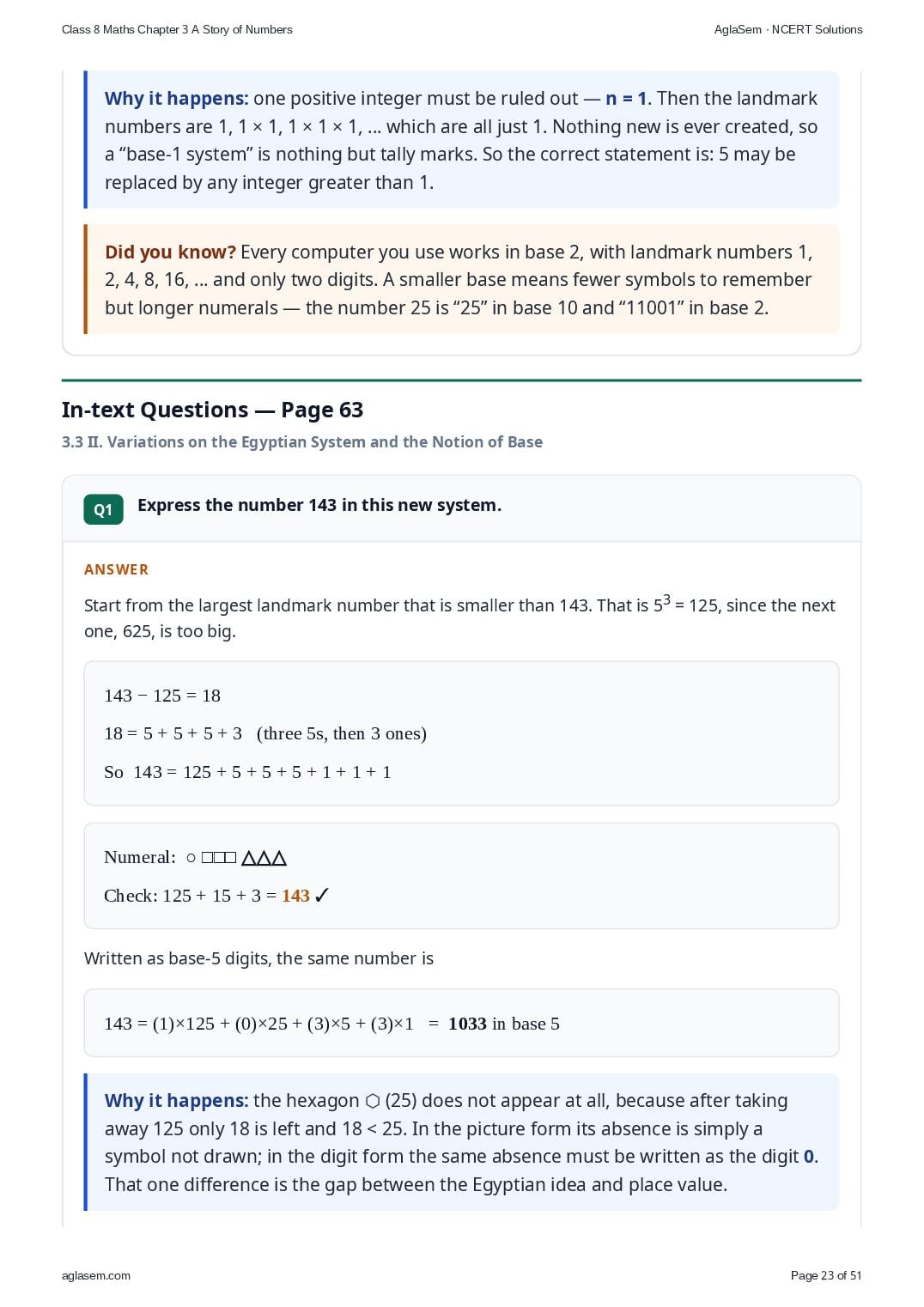
- Instead of grouping together 10 collections of size equal to the previous landmark number (as in the case of the Egyptian system), can we get a number system by grouping together 5 collections of size equal to the previous landmark number? Can this 5 be replaced by any positive integer?
- Express the number 143 in this new system.
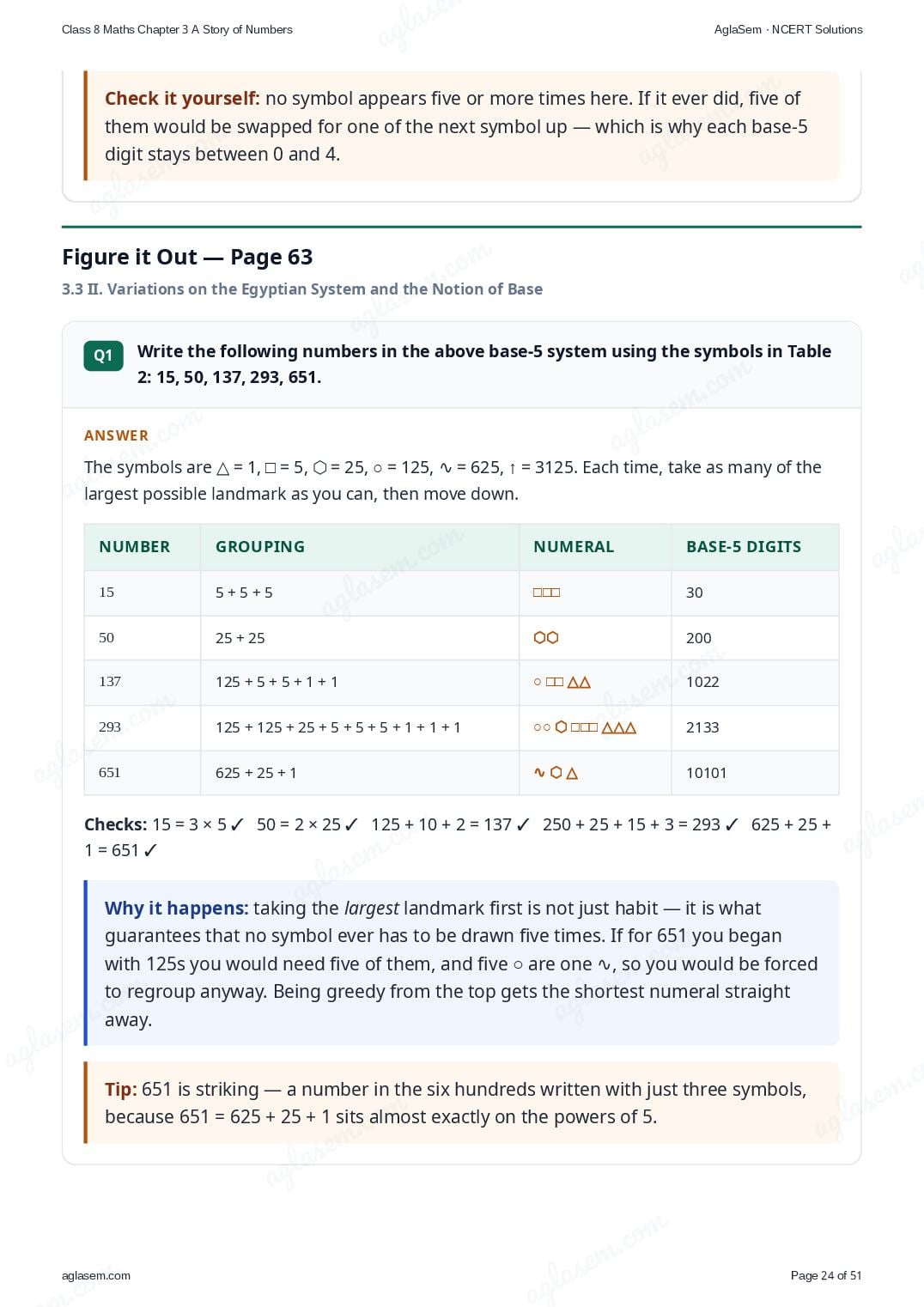
- Write the following numbers in the above base-5 system using the symbols in Table 2: 15, 50, 137, 293, 651.
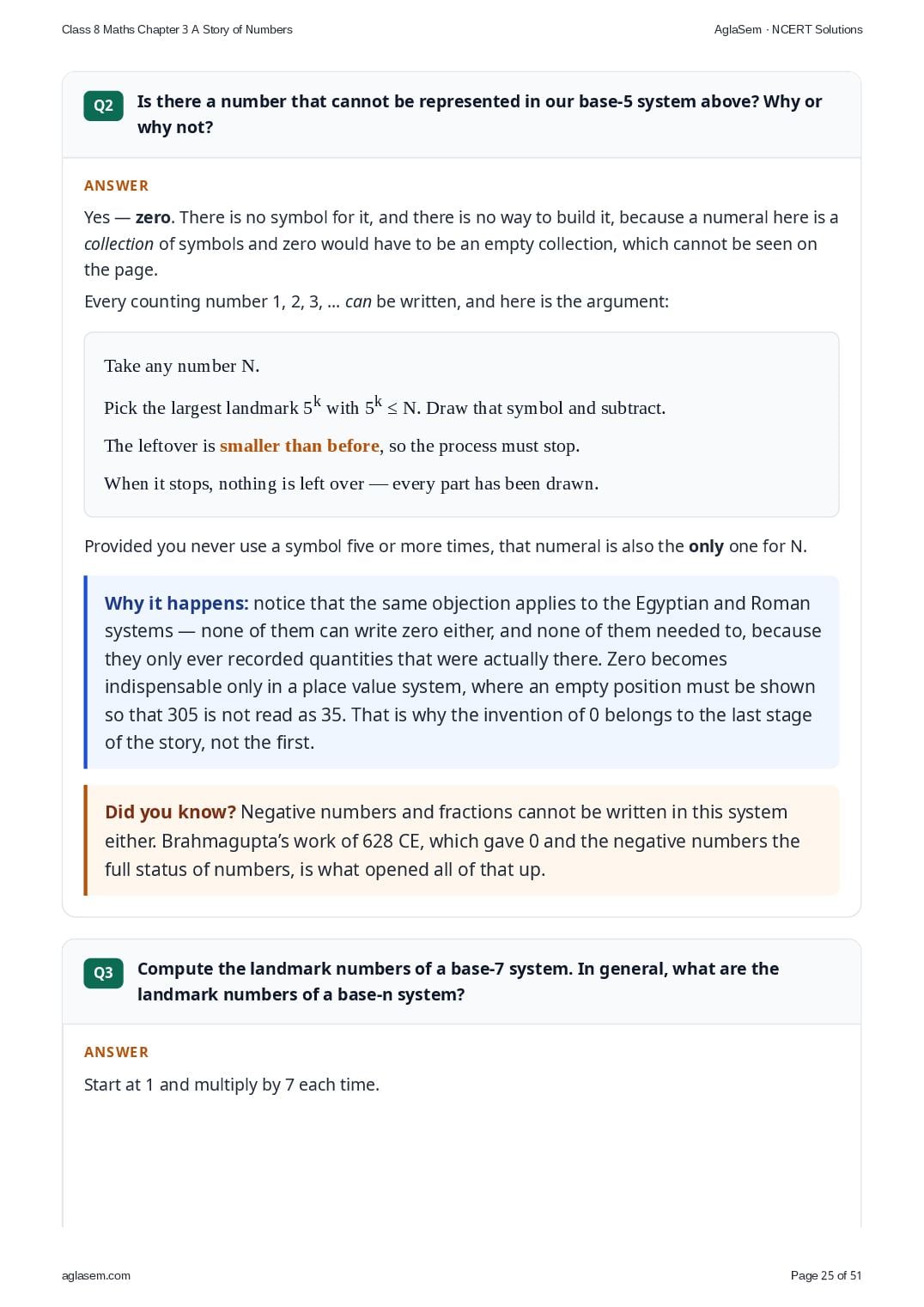
- Is there a number that cannot be represented in our base-5 system above? Why or why not?
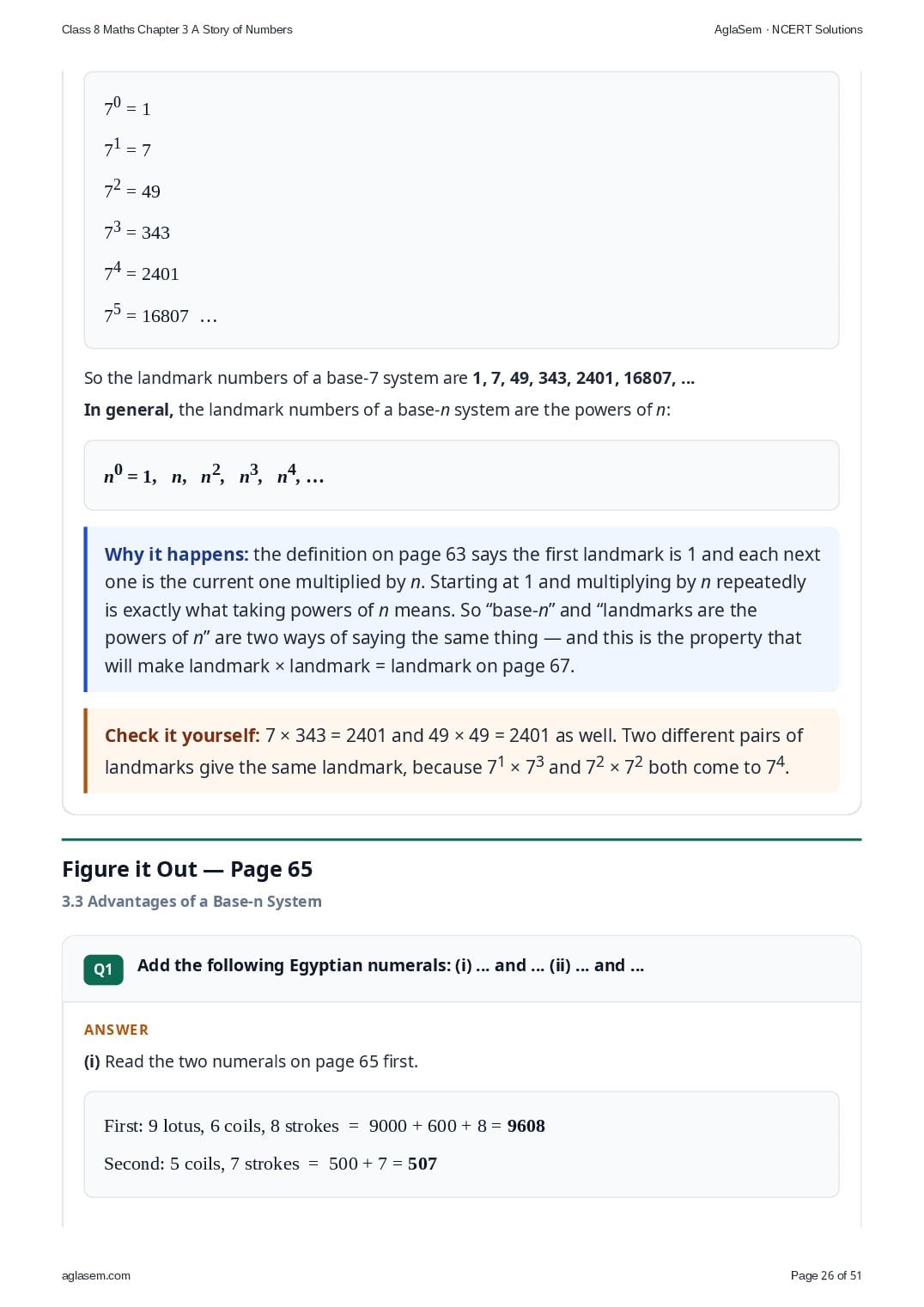
- Compute the landmark numbers of a base-7 system. In general, what are the landmark numbers of a base-n system?
- Add the following Egyptian numerals: (i) … and … (ii) … and …
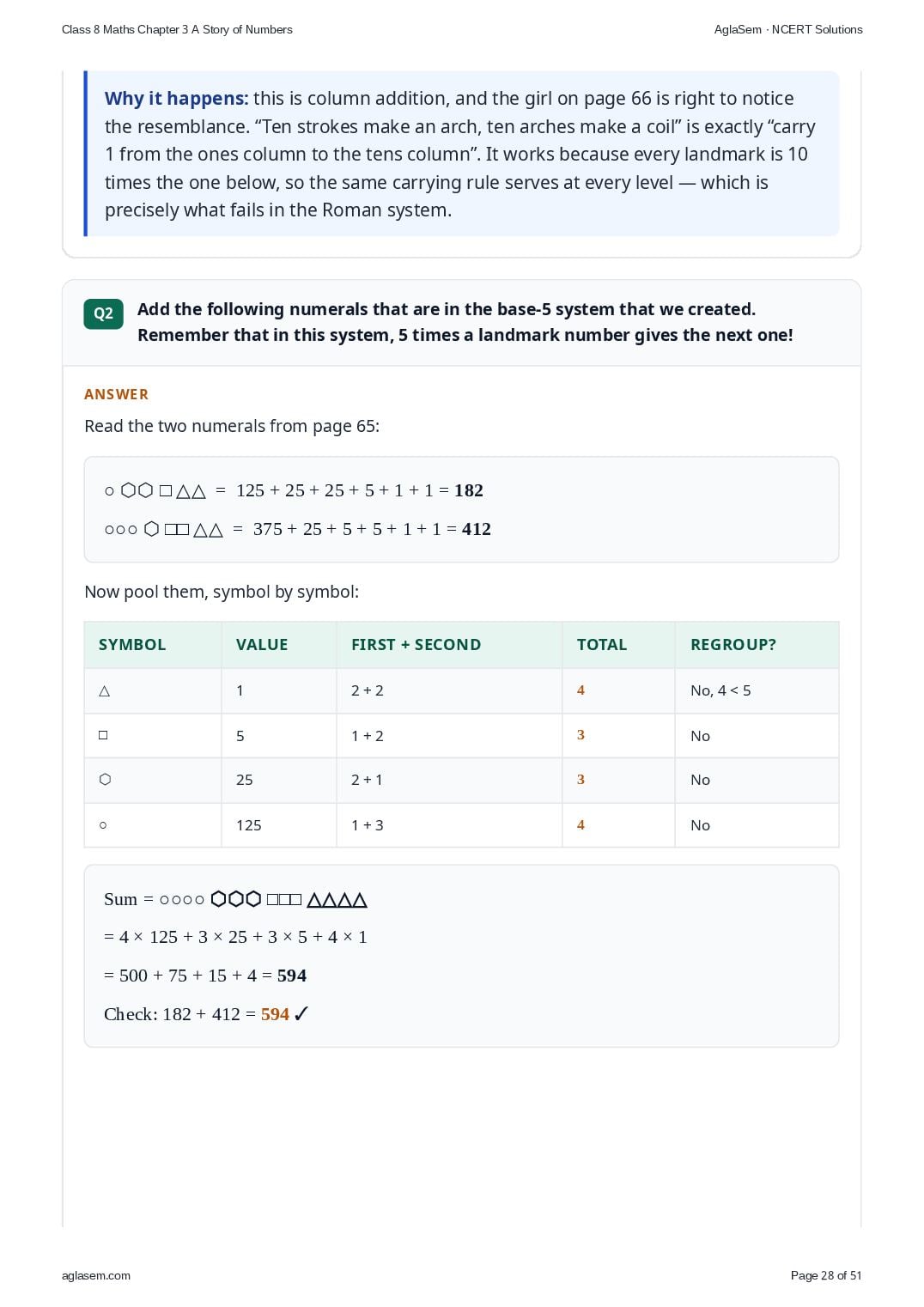
- Add the following numerals that are in the base-5 system that we created. Remember that in this system, 5 times a landmark number gives the next one!
- How to multiply two numbers in Egyptian numerals?
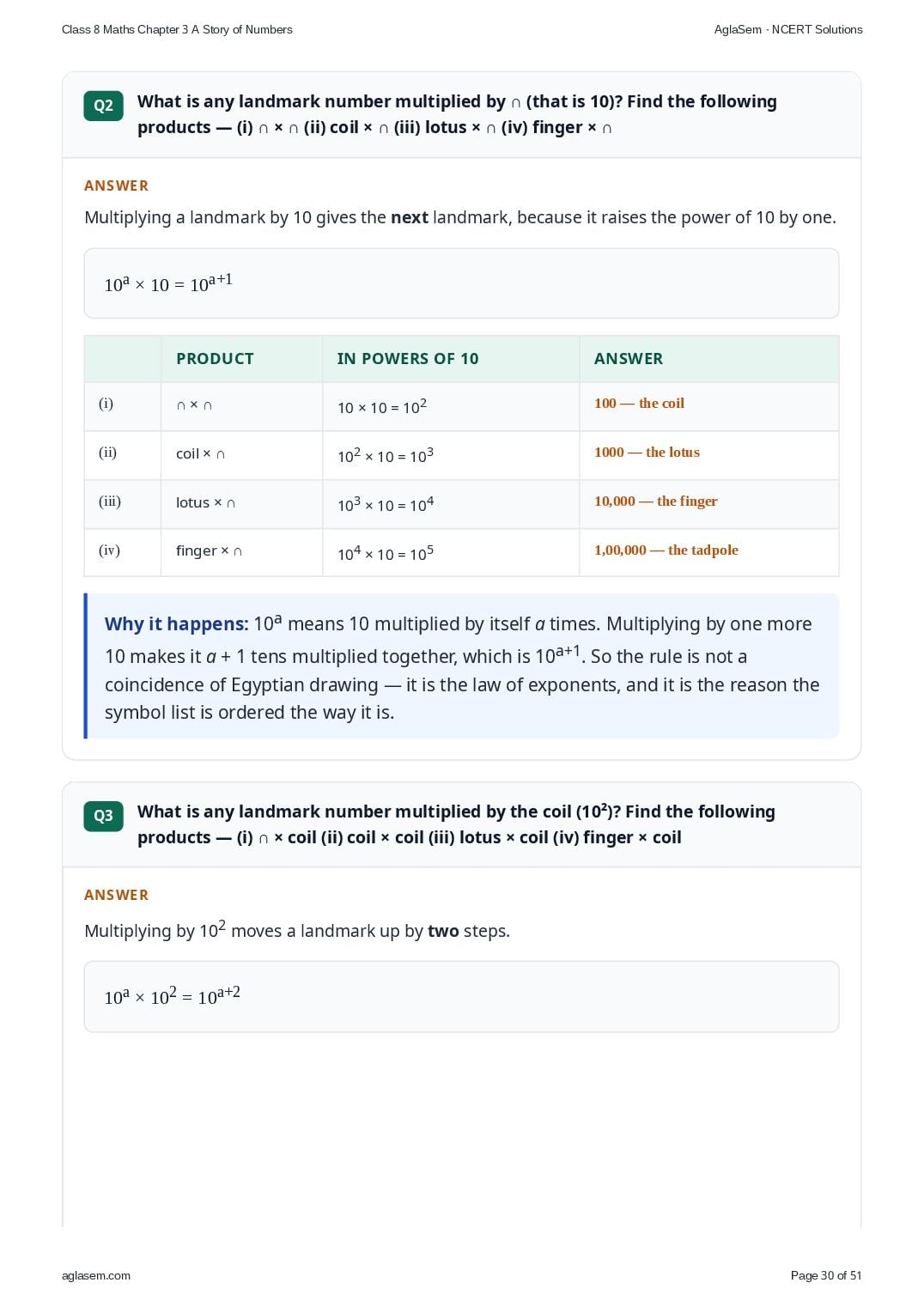
- What is any landmark number multiplied by ∩ (that is 10)? Find the following products — (i) ∩ × ∩ (ii) coil × ∩ (iii) lotus × ∩ (iv) finger × ∩
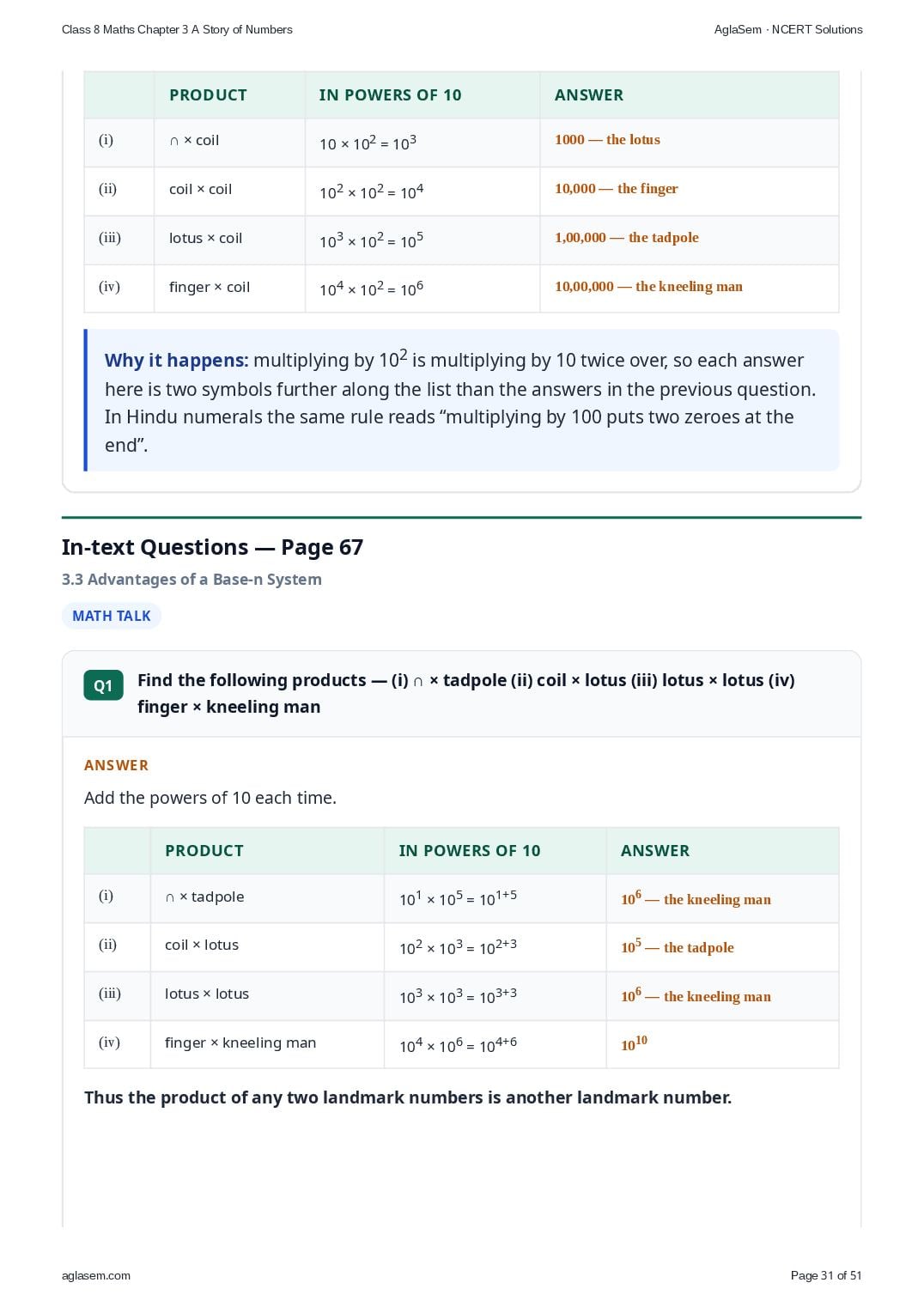
- What is any landmark number multiplied by the coil (10²)? Find the following products — (i) ∩ × coil (ii) coil × coil (iii) lotus × coil (iv) finger × coil
- Find the following products — (i) ∩ × tadpole (ii) coil × lotus (iii) lotus × lotus (iv) finger × kneeling man
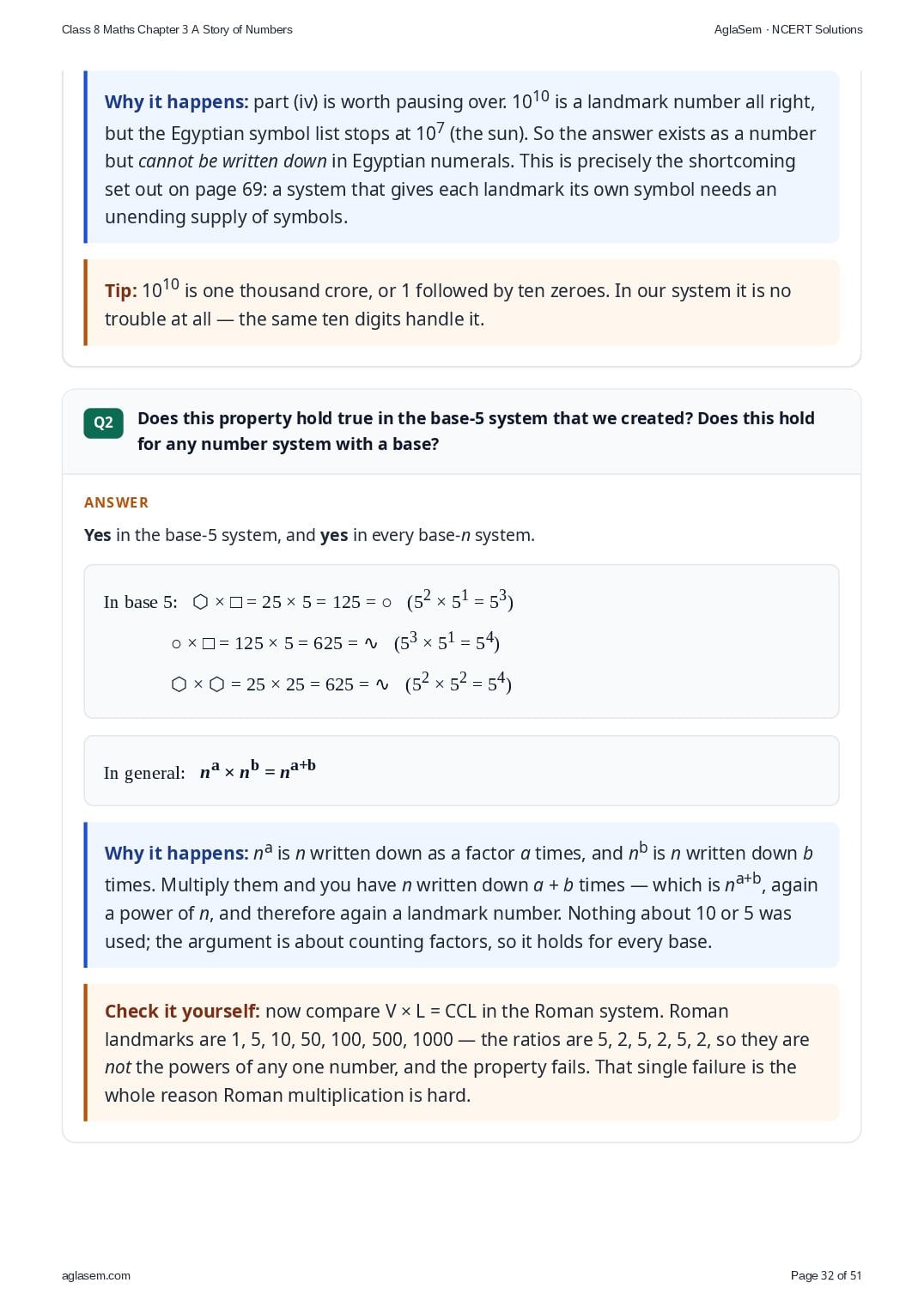
- Does this property hold true in the base-5 system that we created? Does this hold for any number system with a base?
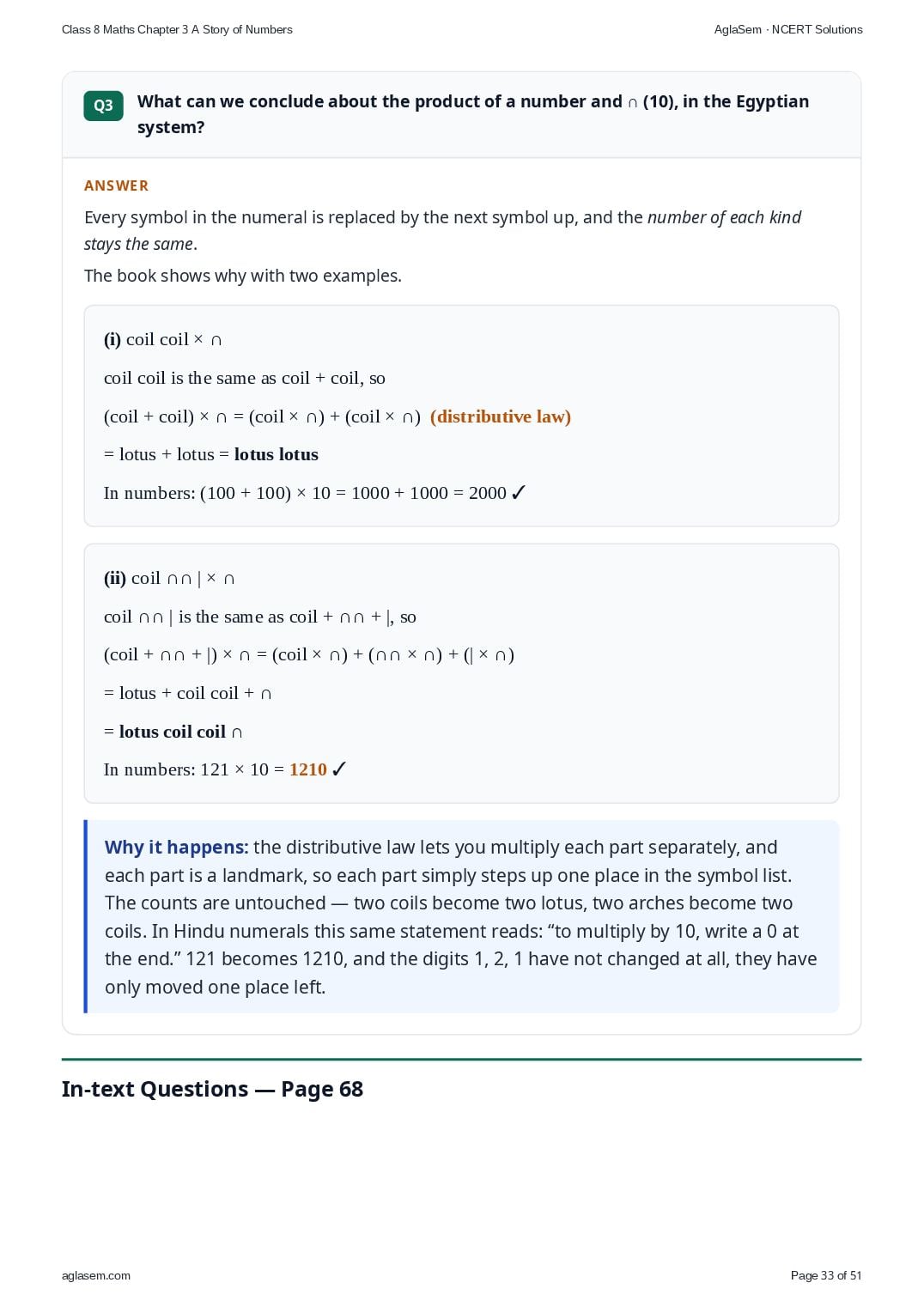
- What can we conclude about the product of a number and ∩ (10), in the Egyptian system?
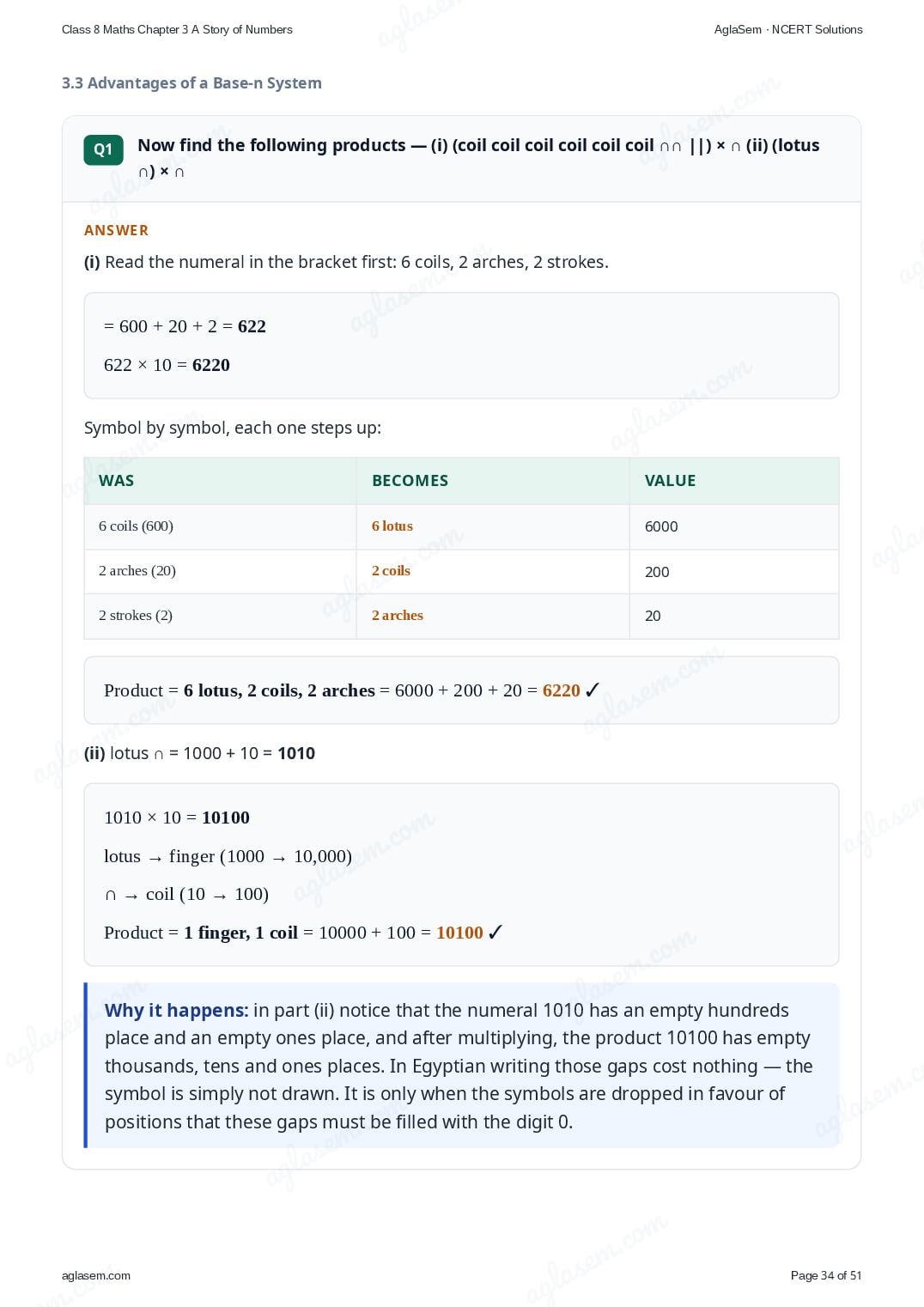
- Now find the following products — (i) (coil coil coil coil coil coil ∩∩ ||) × ∩ (ii) (lotus ∩) × ∩
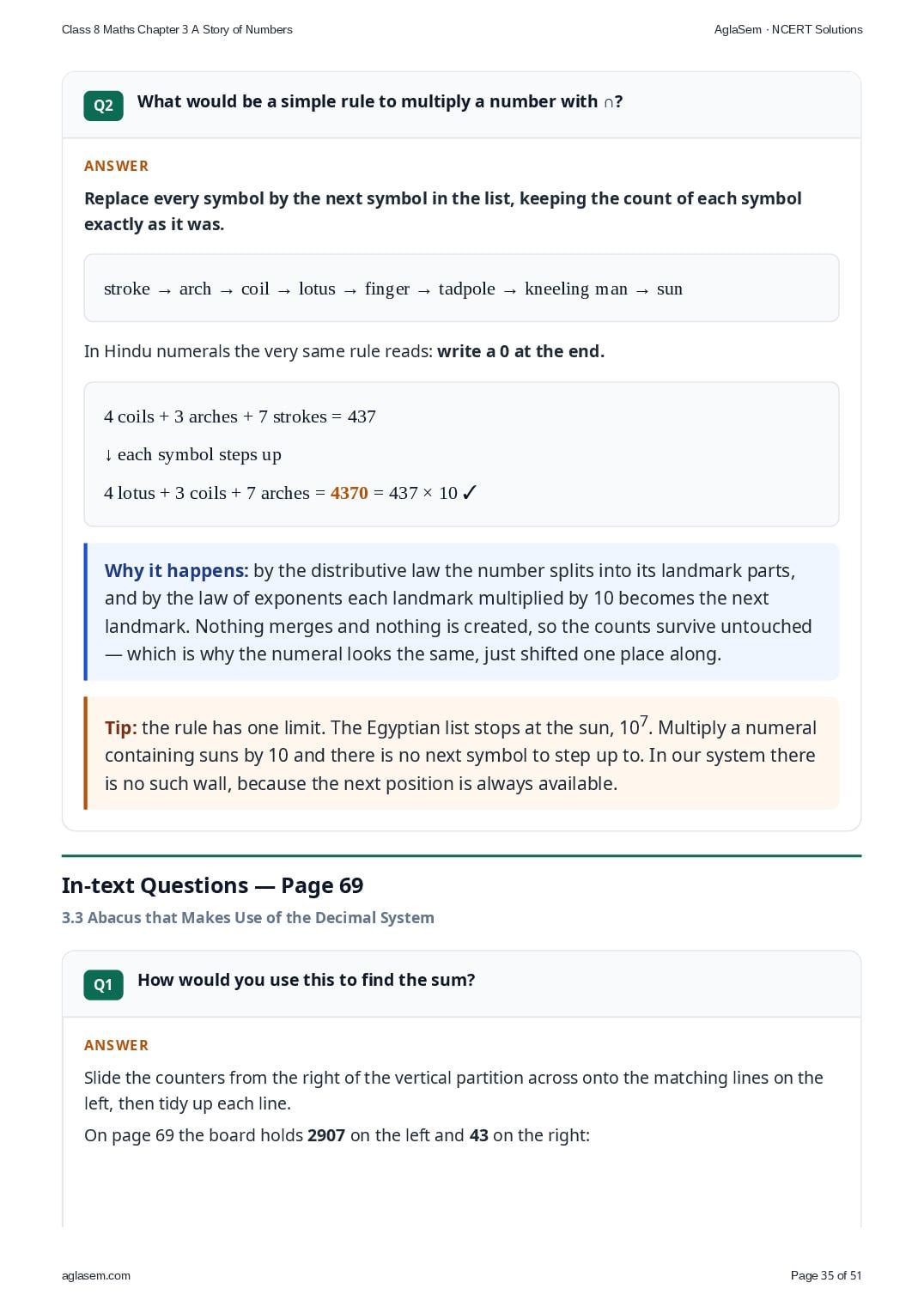
- What would be a simple rule to multiply a number with ∩?
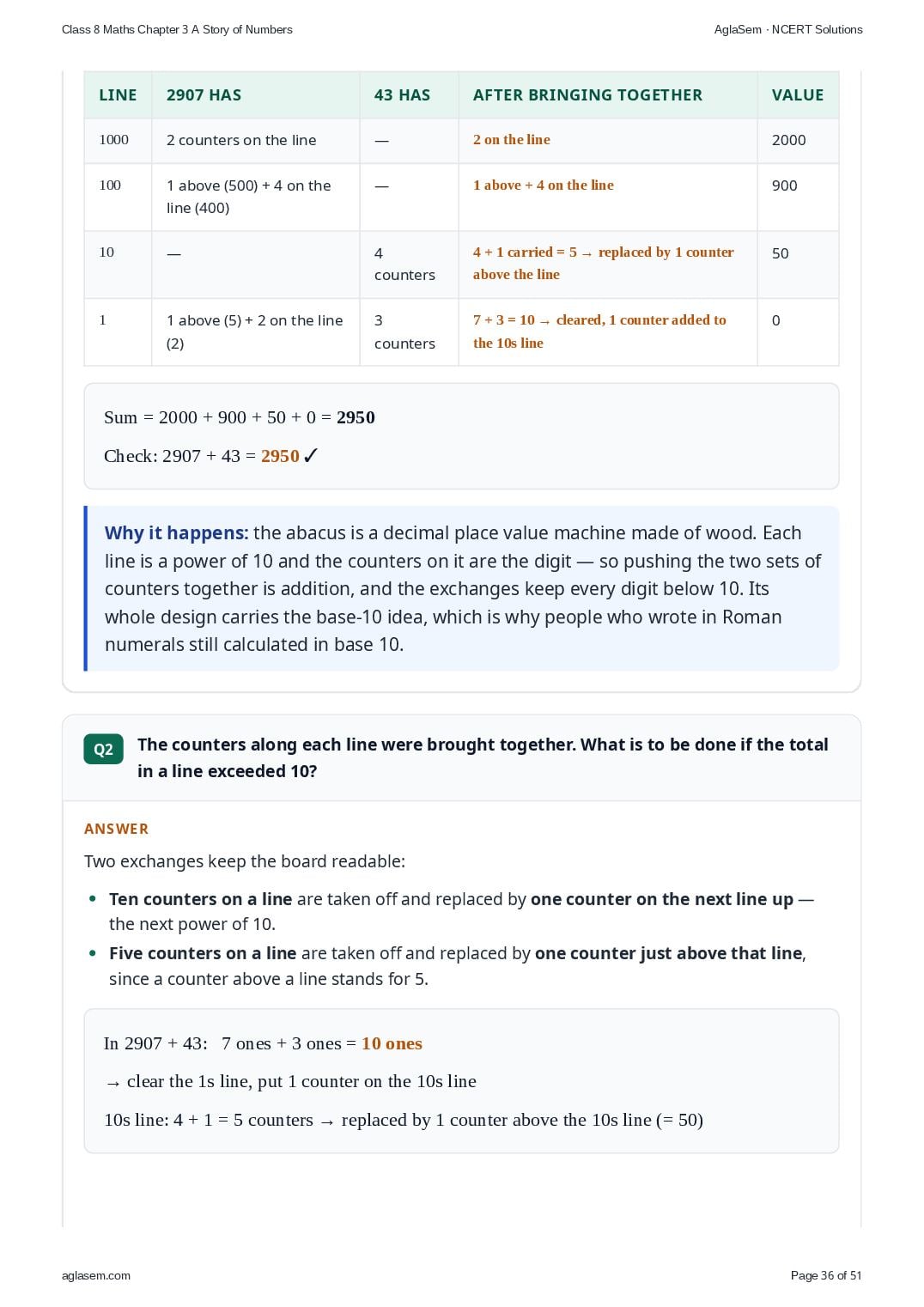
- How would you use this to find the sum?
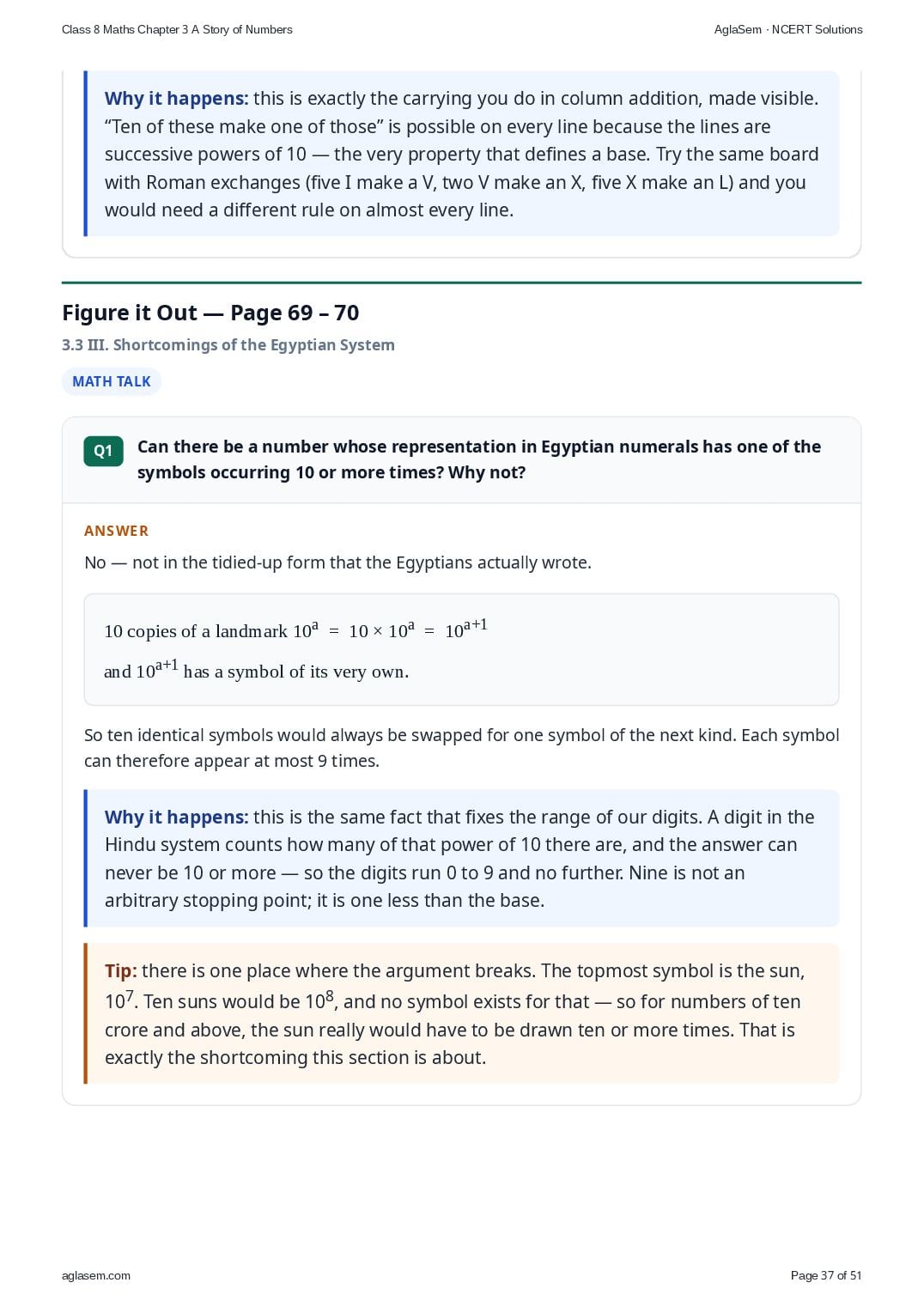
- The counters along each line were brought together. What is to be done if the total in a line exceeded 10?
- Can there be a number whose representation in Egyptian numerals has one of the symbols occurring 10 or more times? Why not?
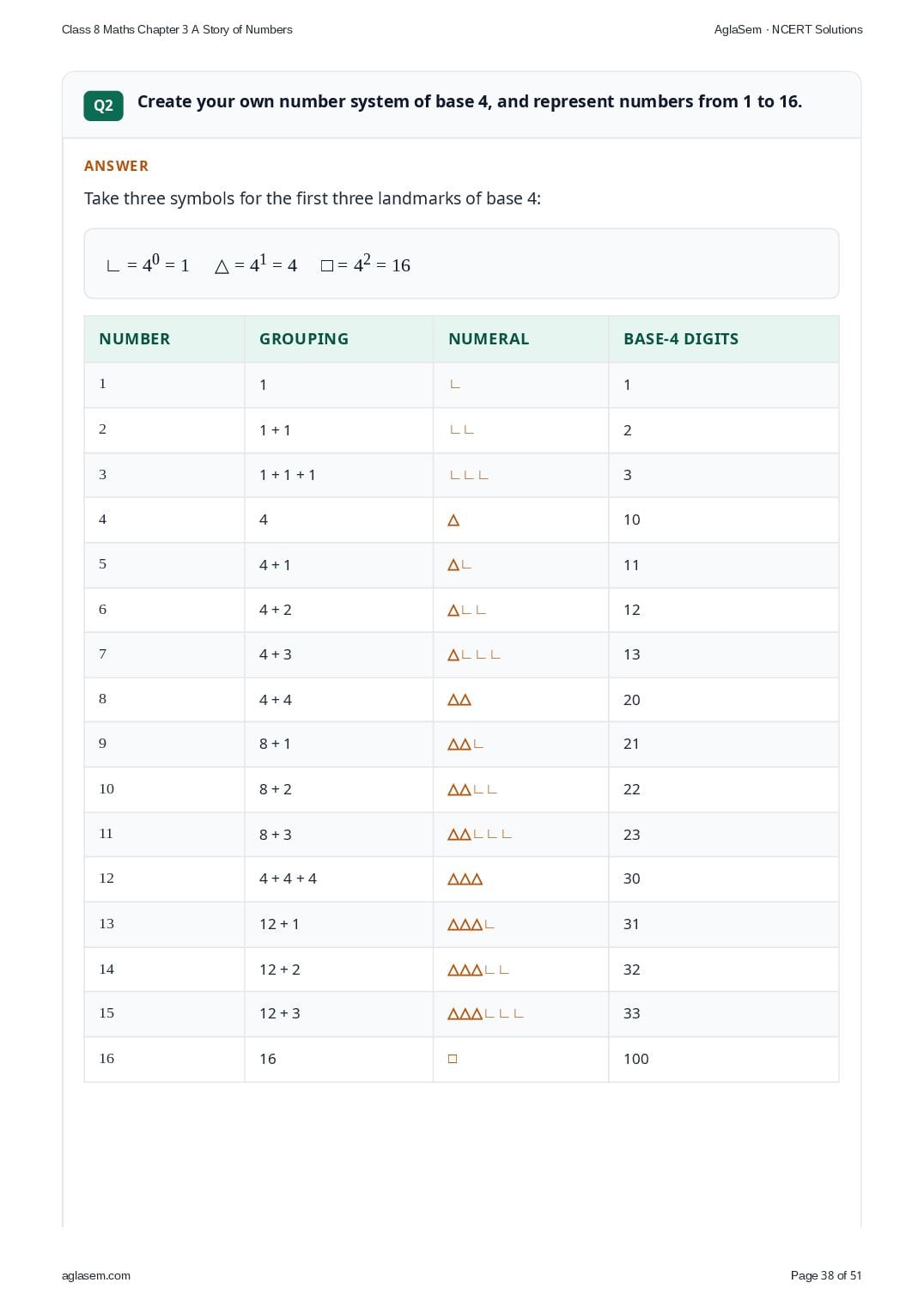
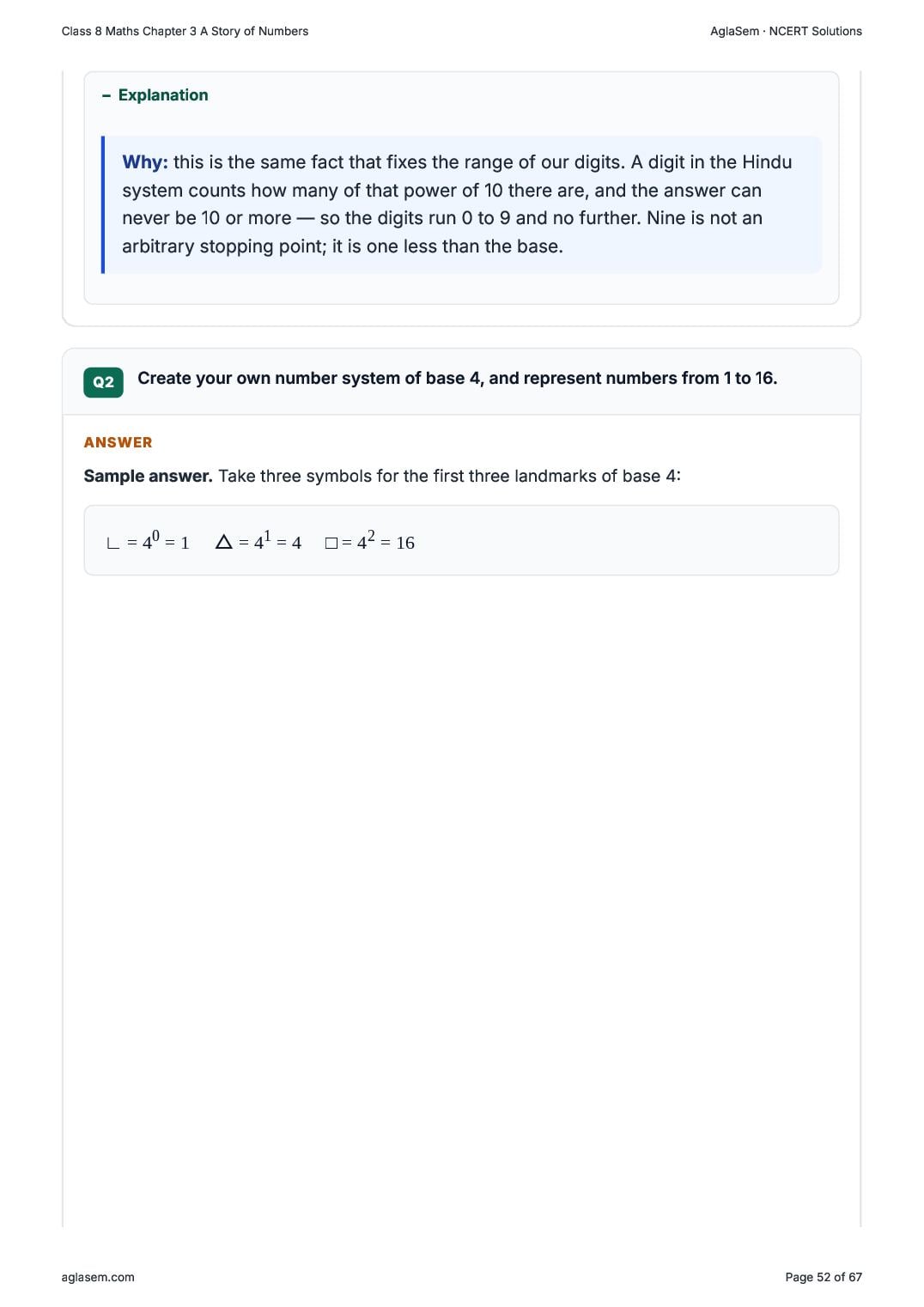
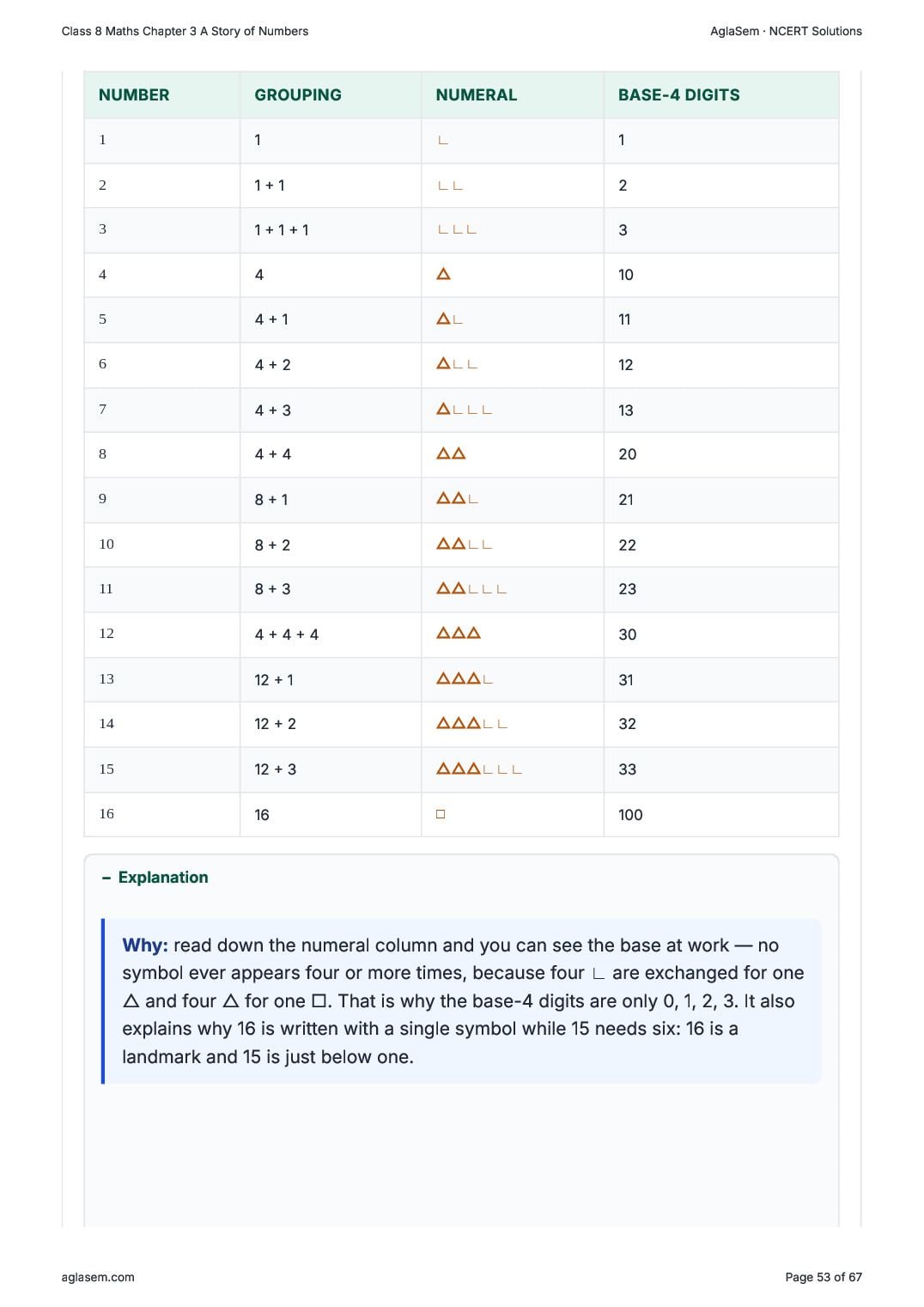
- Create your own number system of base 4, and represent numbers from 1 to 16.
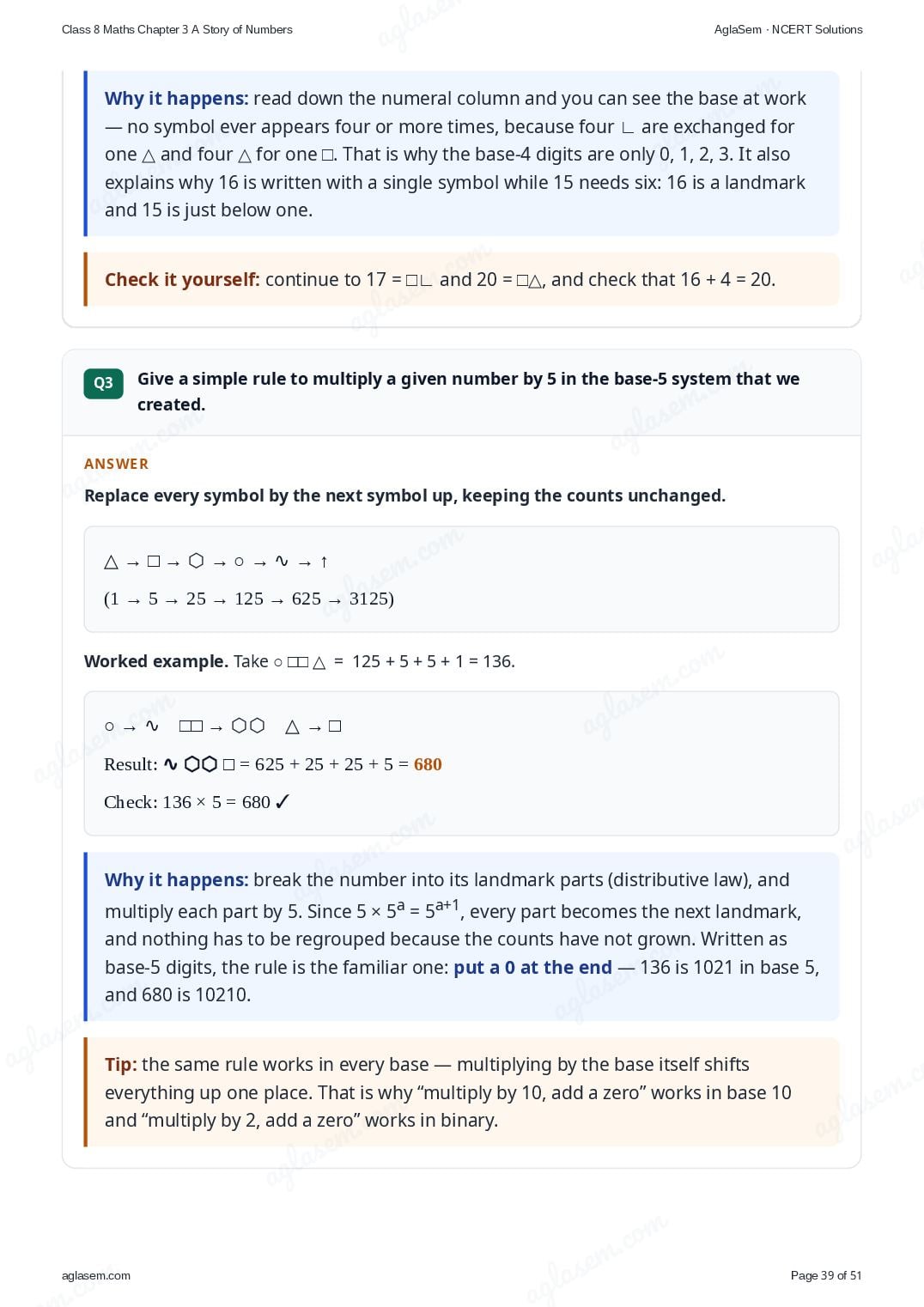
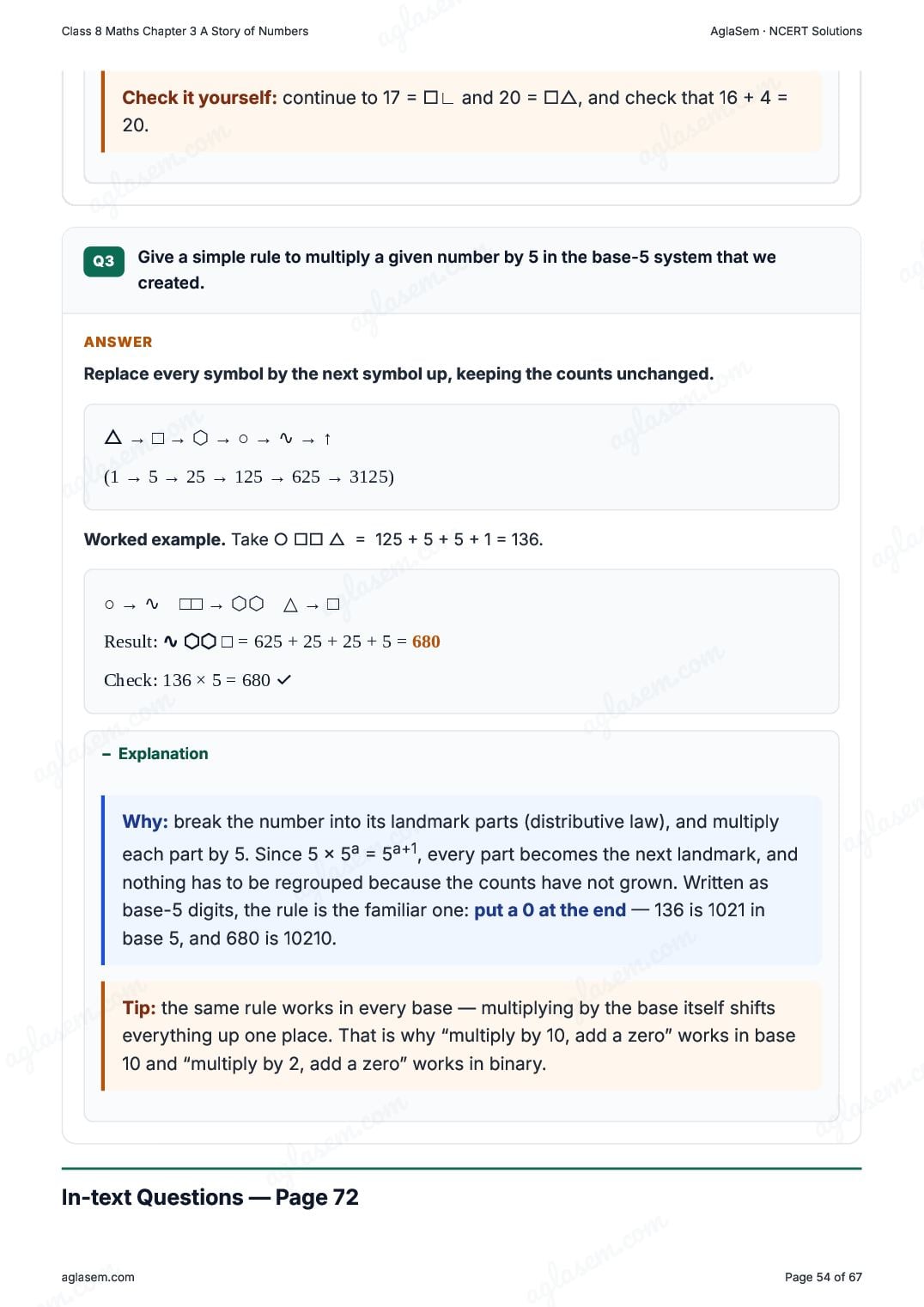
- Give a simple rule to multiply a given number by 5 in the base-5 system that we created.
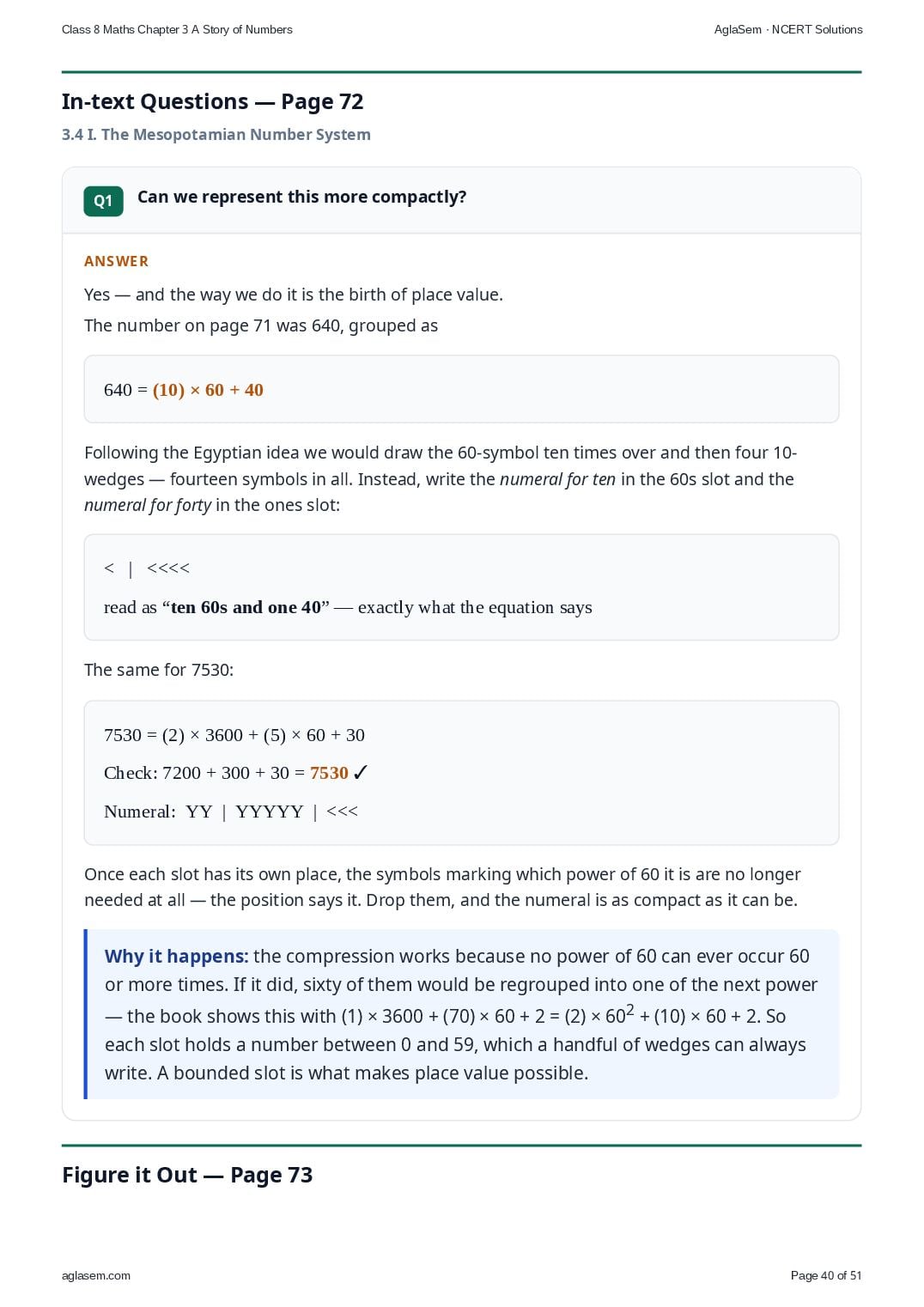
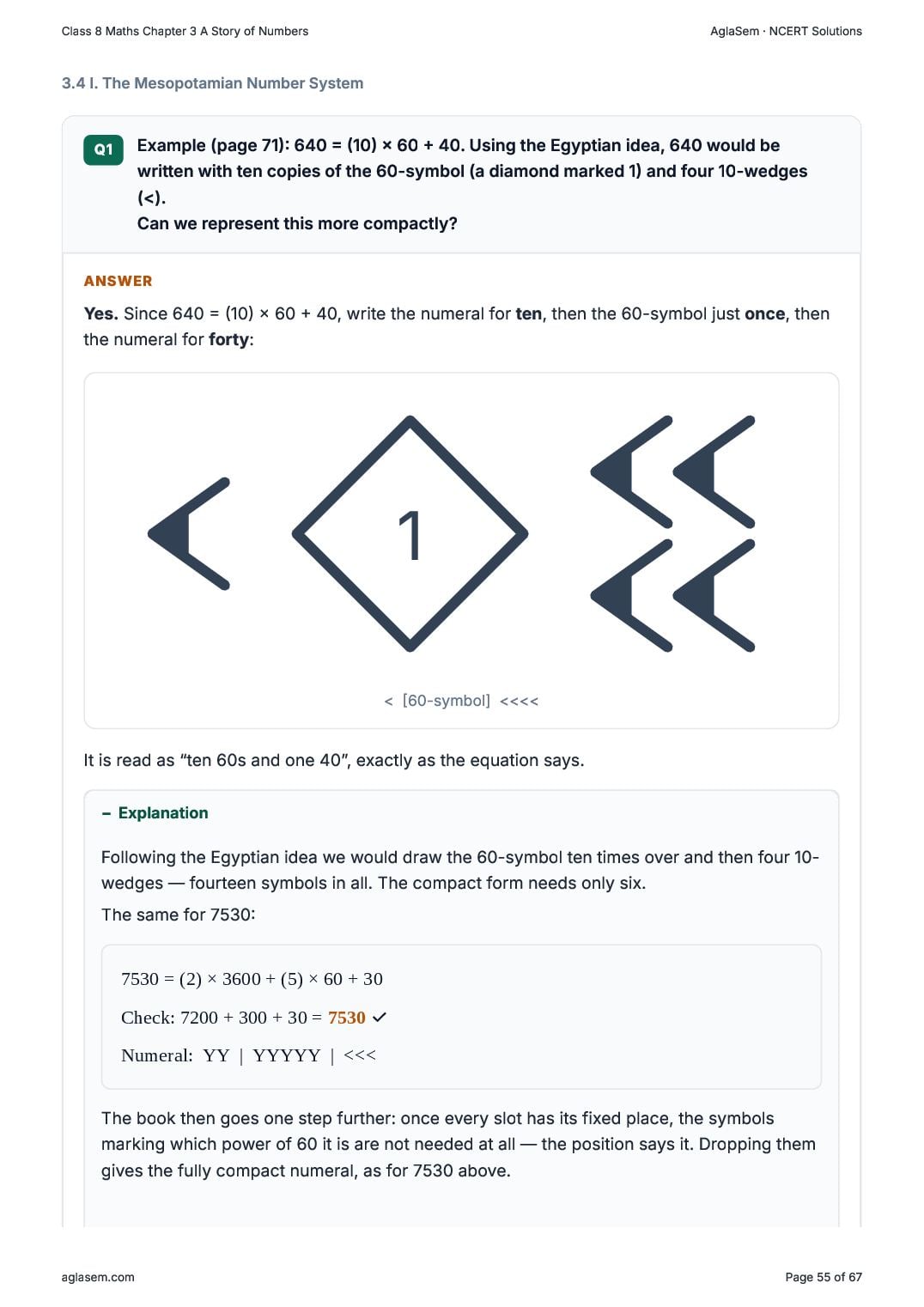
- Can we represent this more compactly?
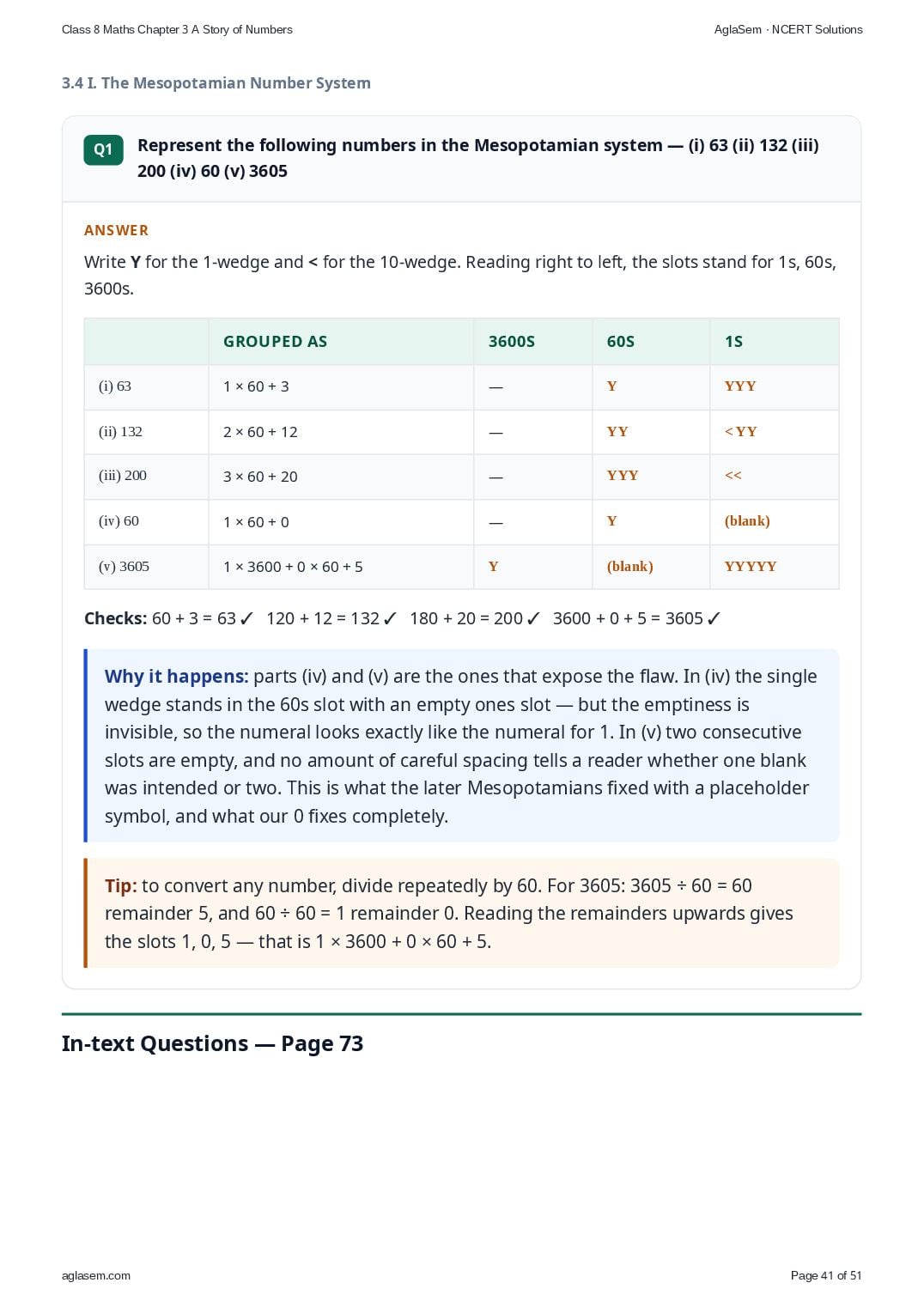
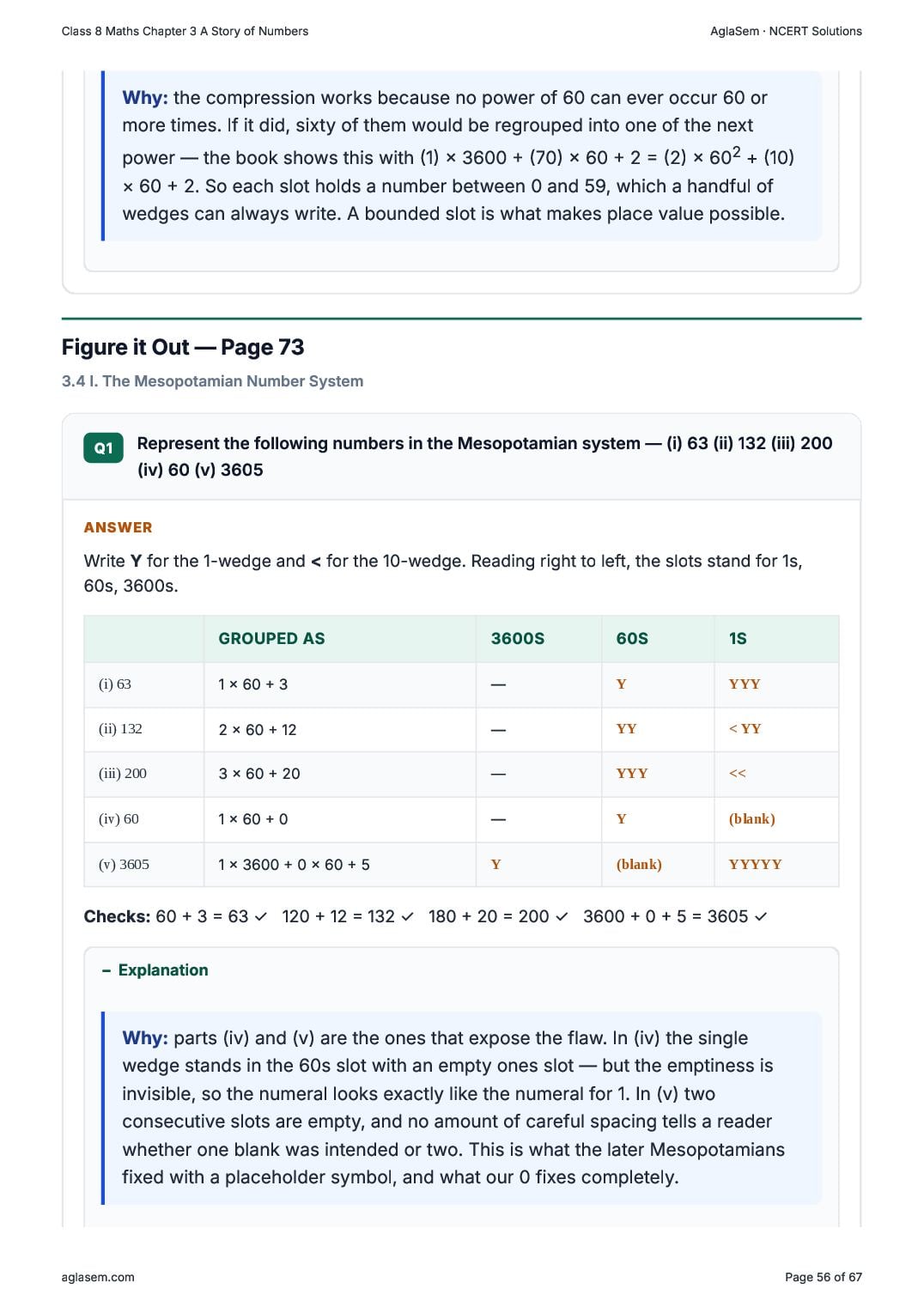
- Represent the following numbers in the Mesopotamian system — (i) 63 (ii) 132 (iii) 200 (iv) 60 (v) 3605
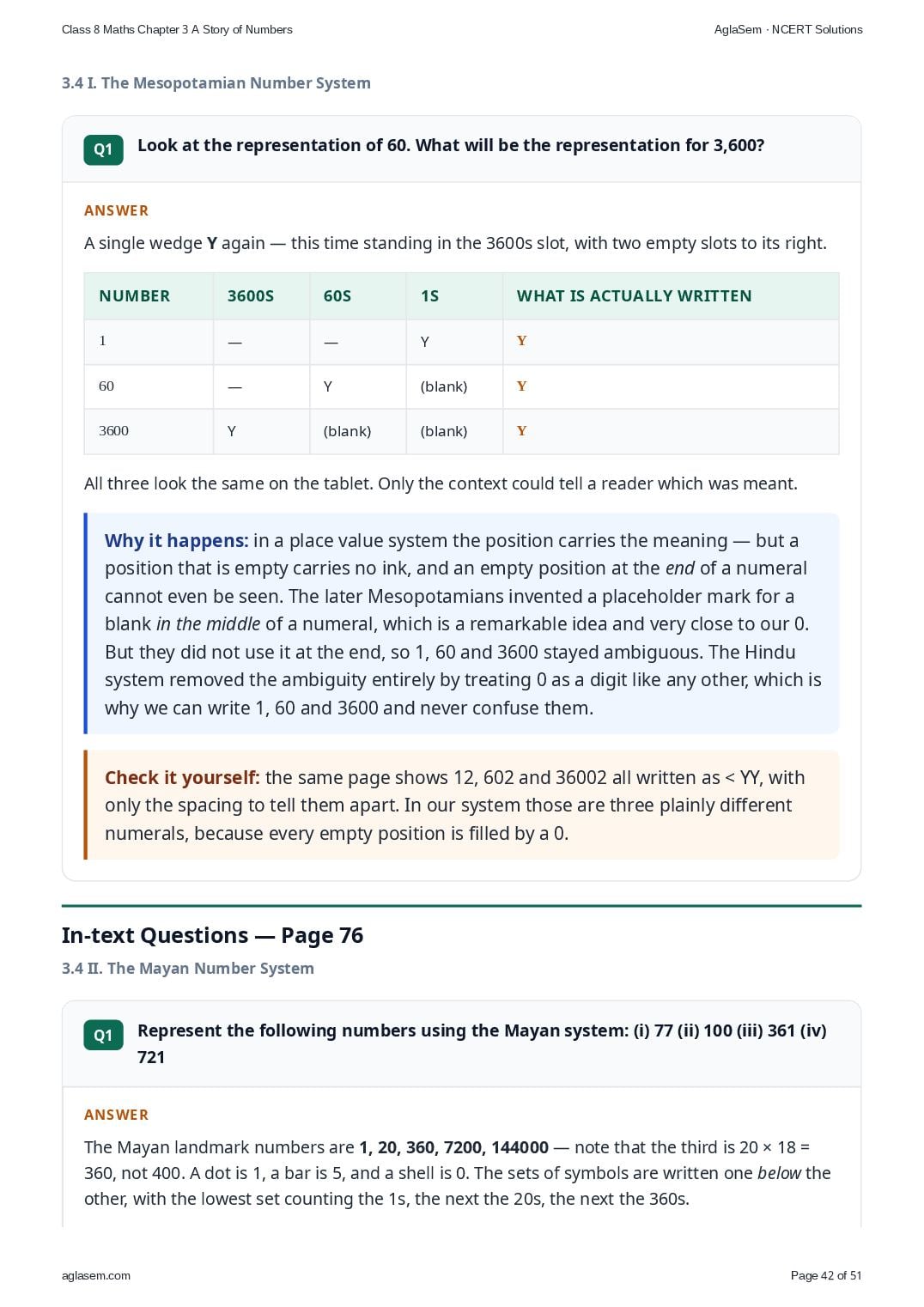
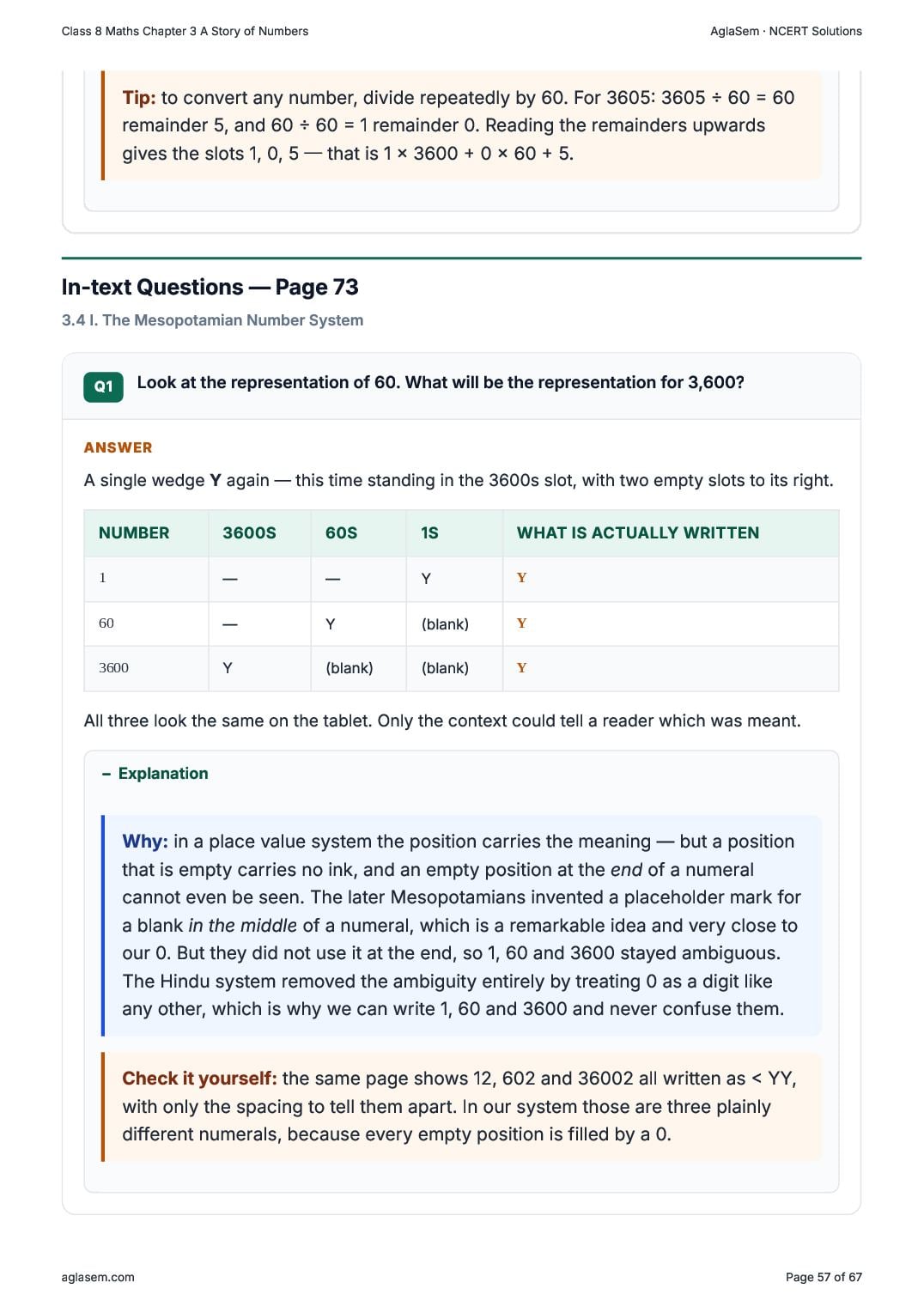
- Look at the representation of 60. What will be the representation for 3,600?
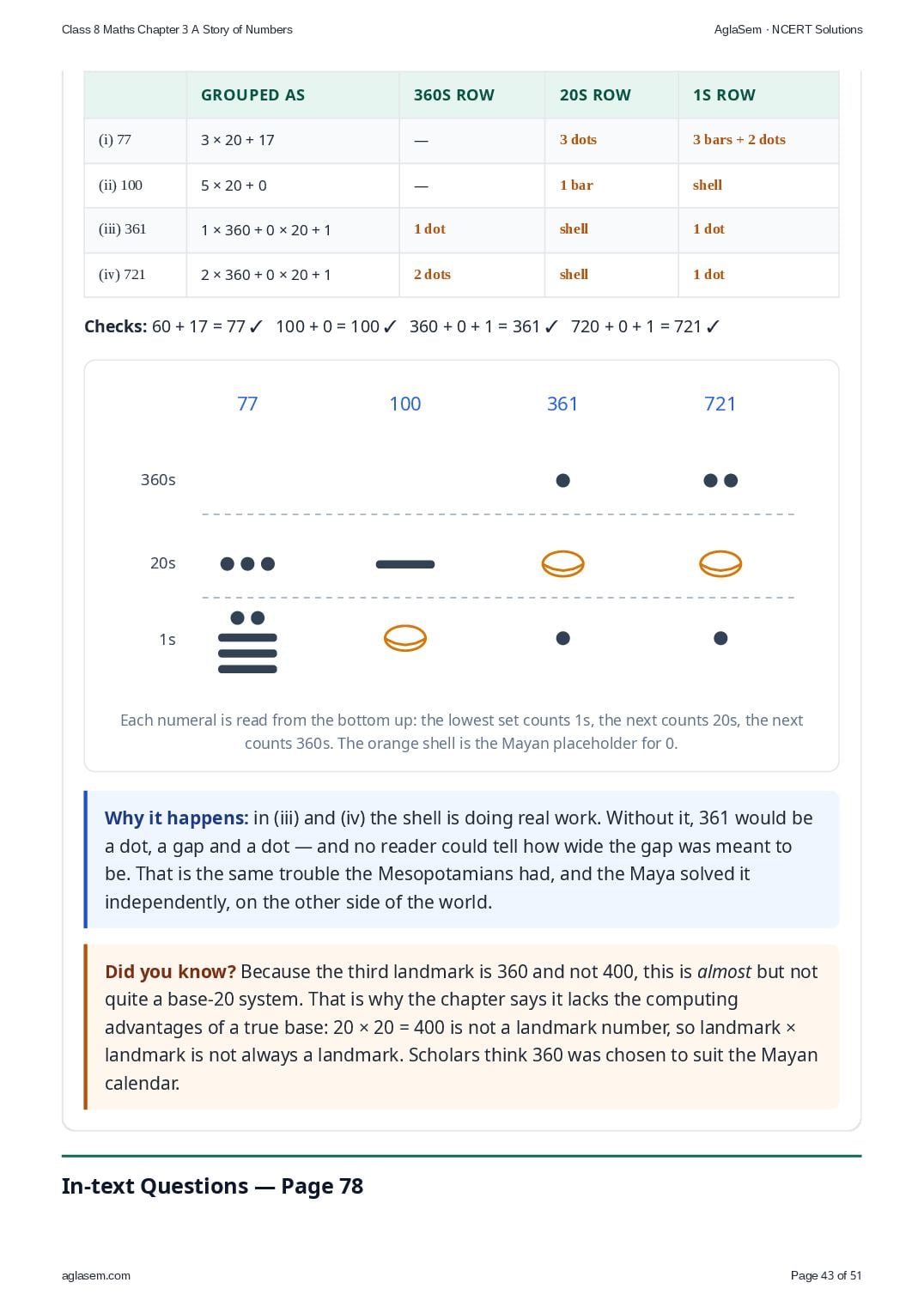
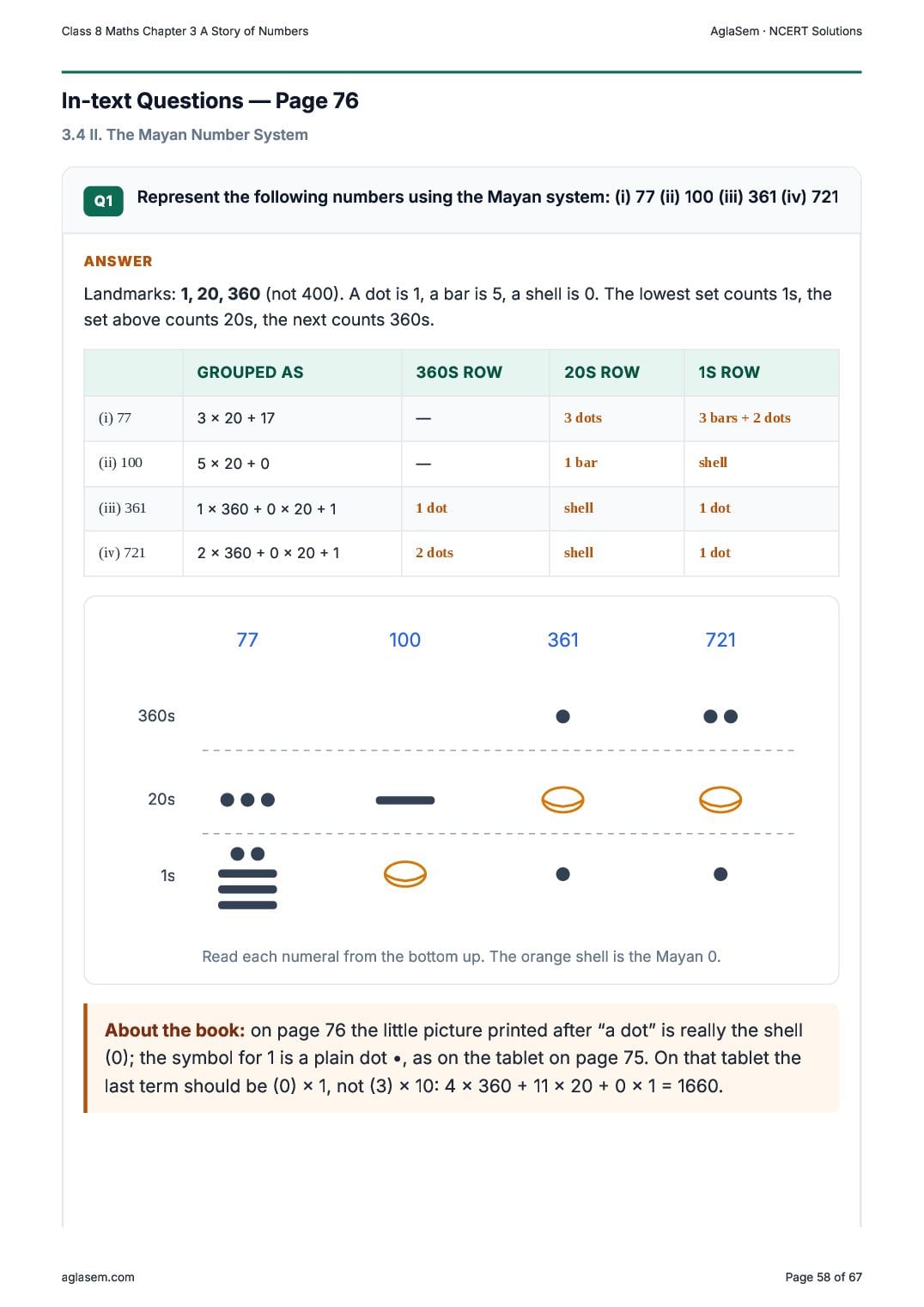
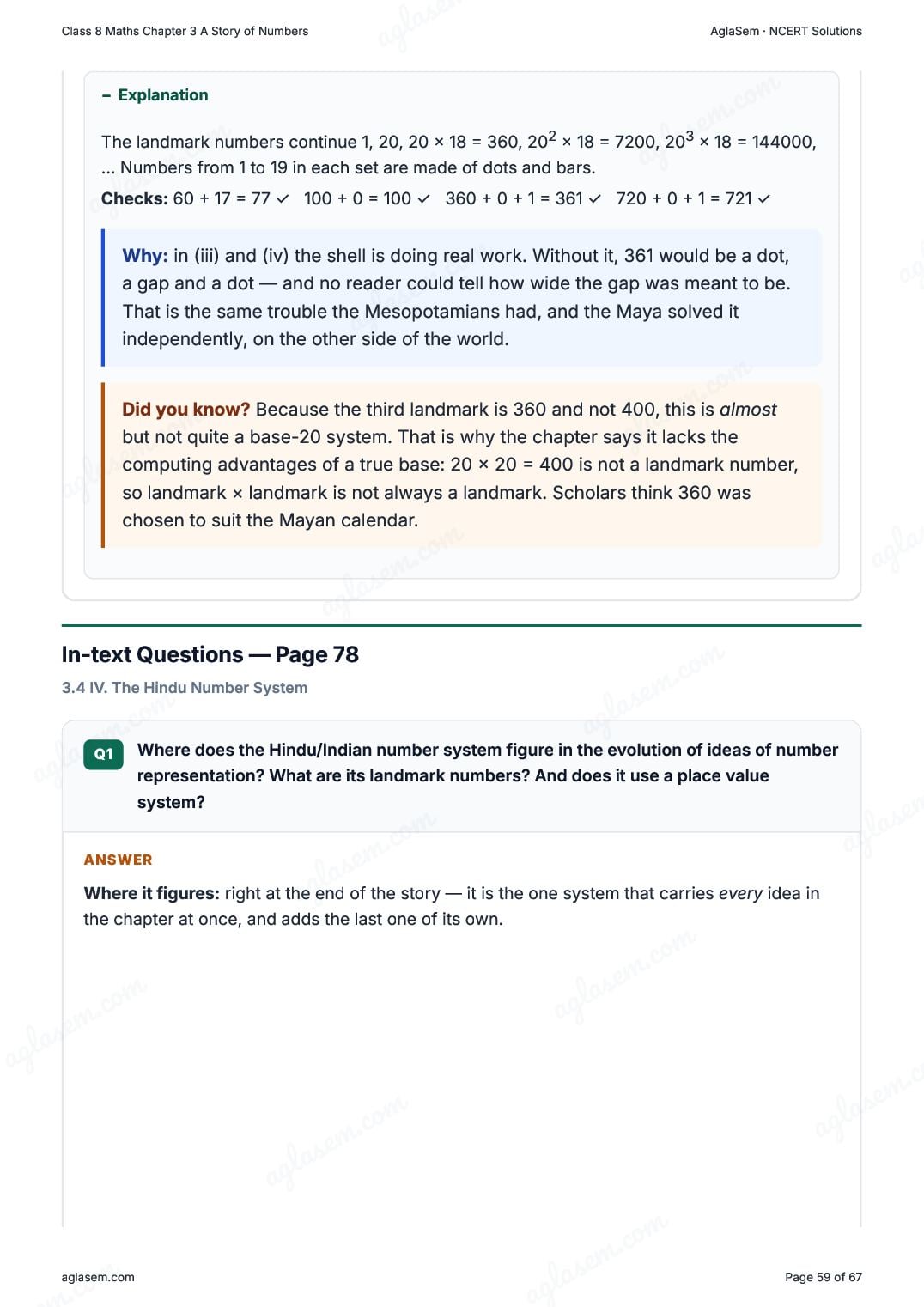
- Represent the following numbers using the Mayan system: (i) 77 (ii) 100 (iii) 361 (iv) 721
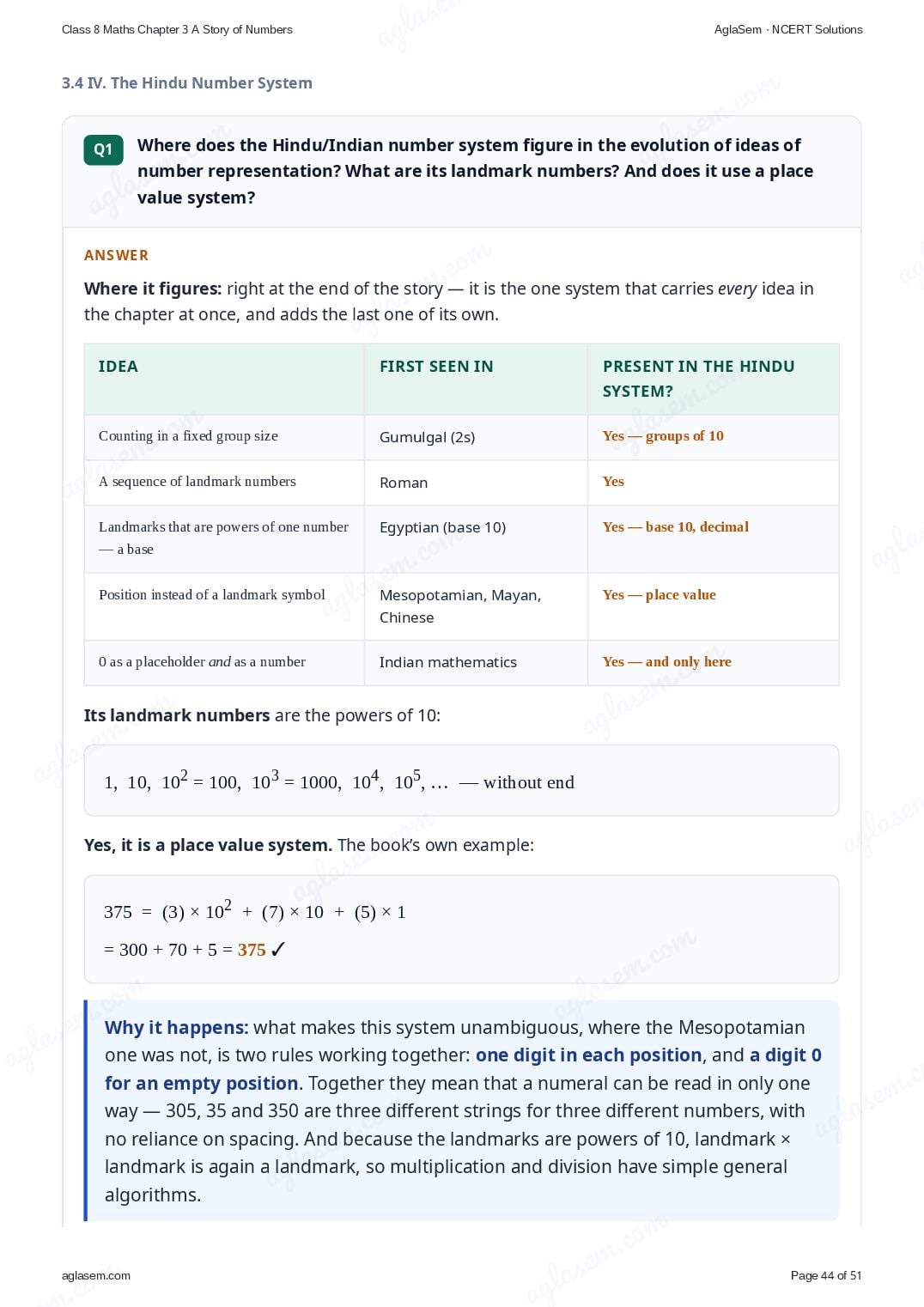
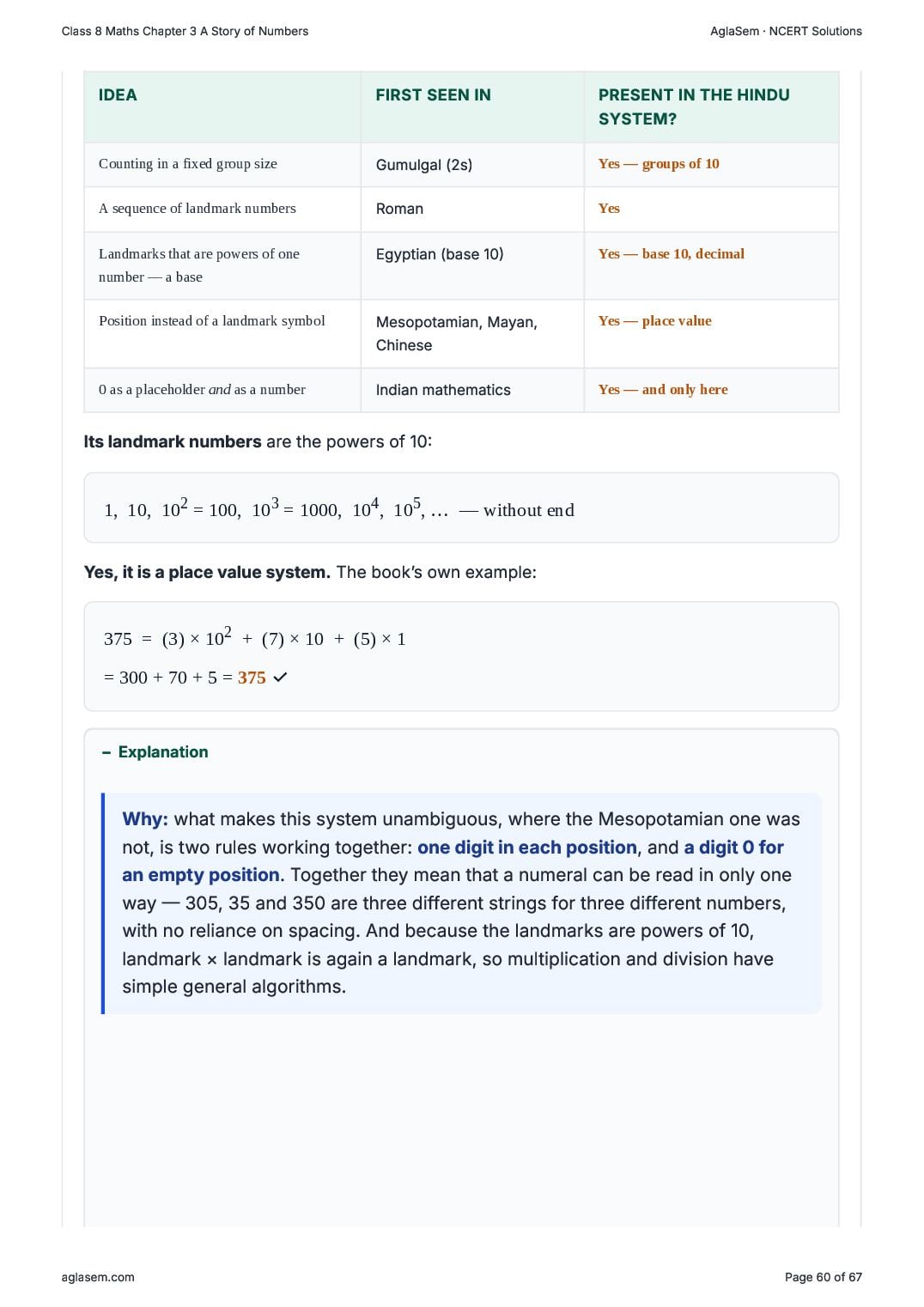
- Where does the Hindu/Indian number system figure in the evolution of ideas of number representation? What are its landmark numbers? And does it use a place value system?
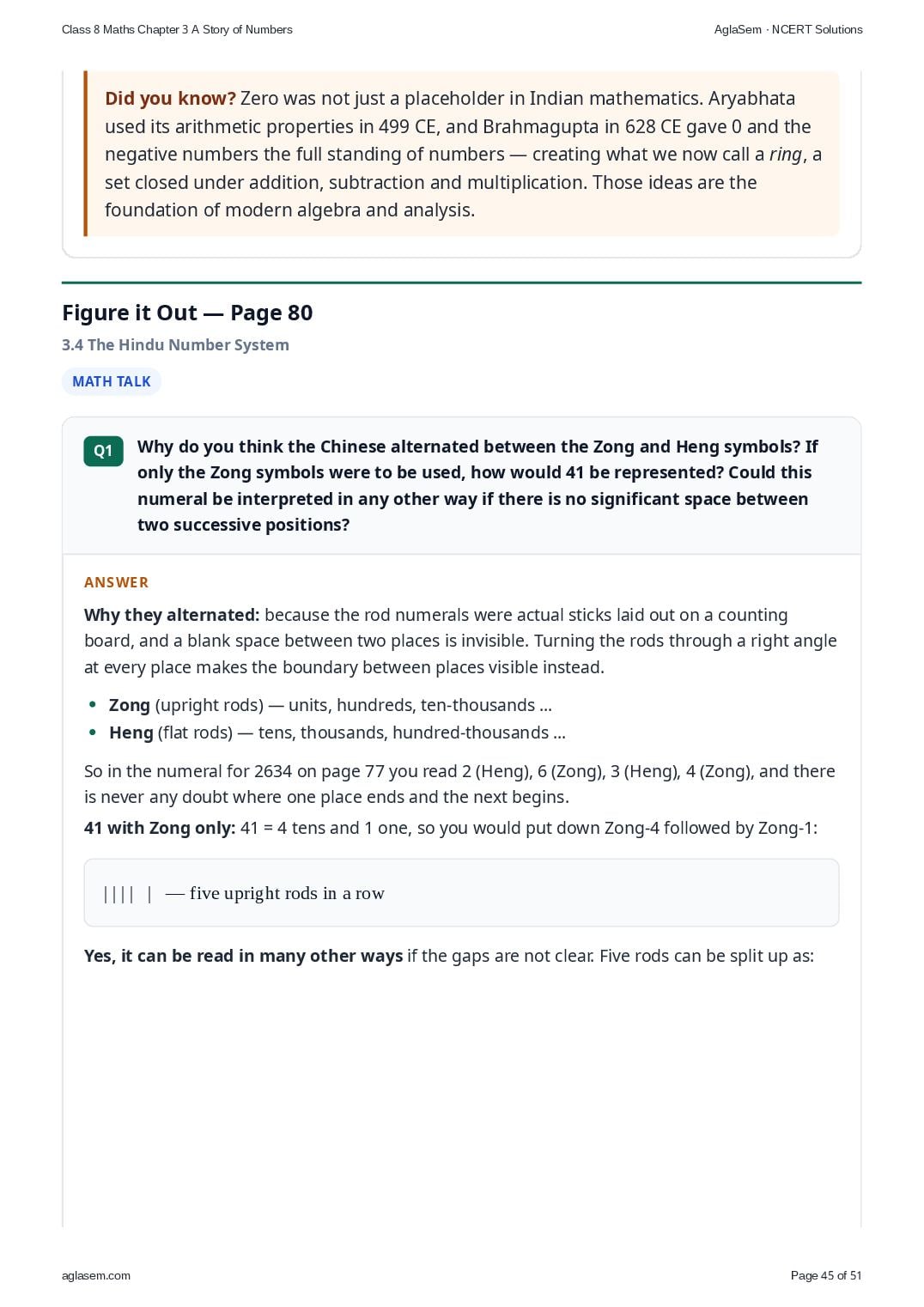
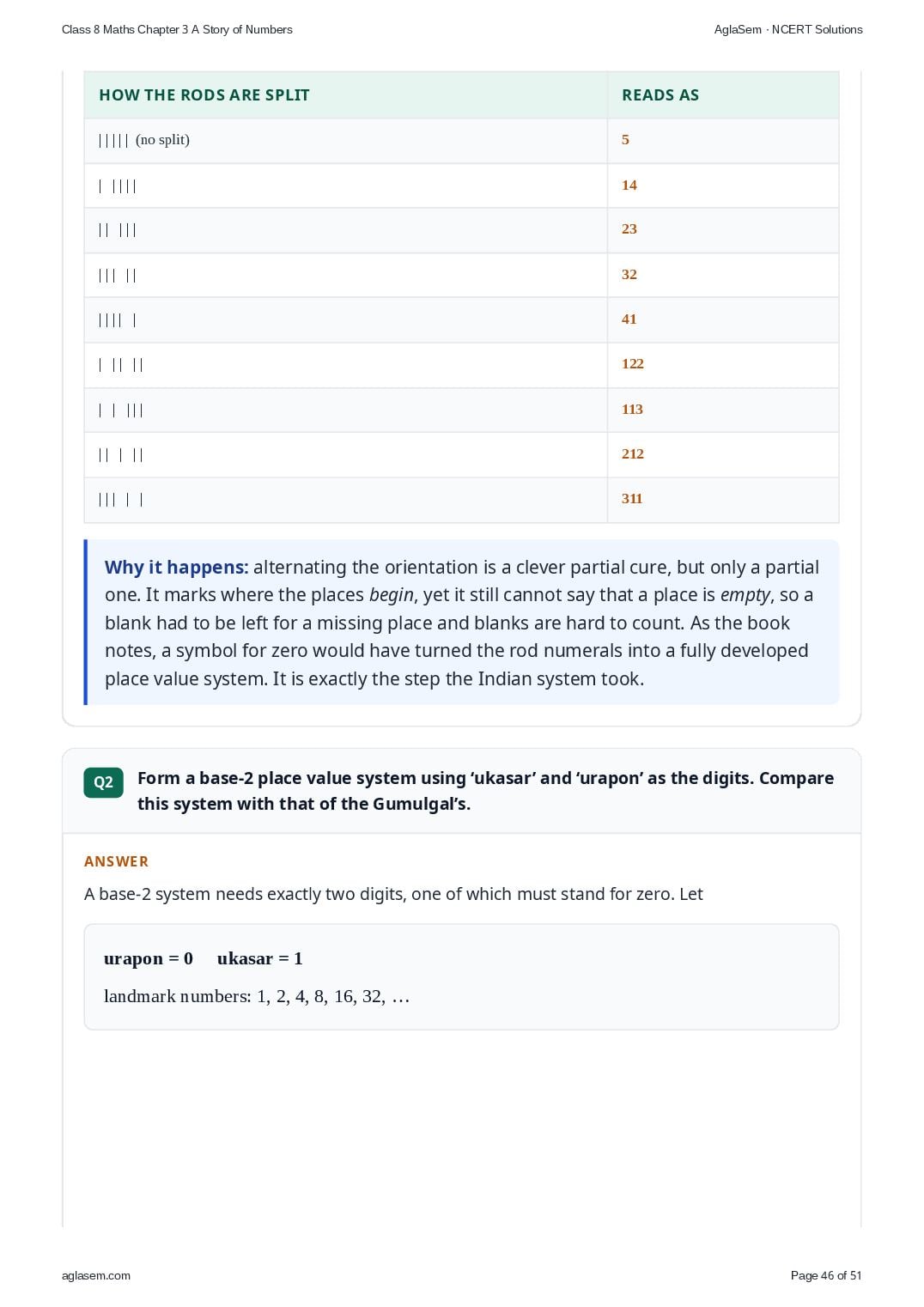
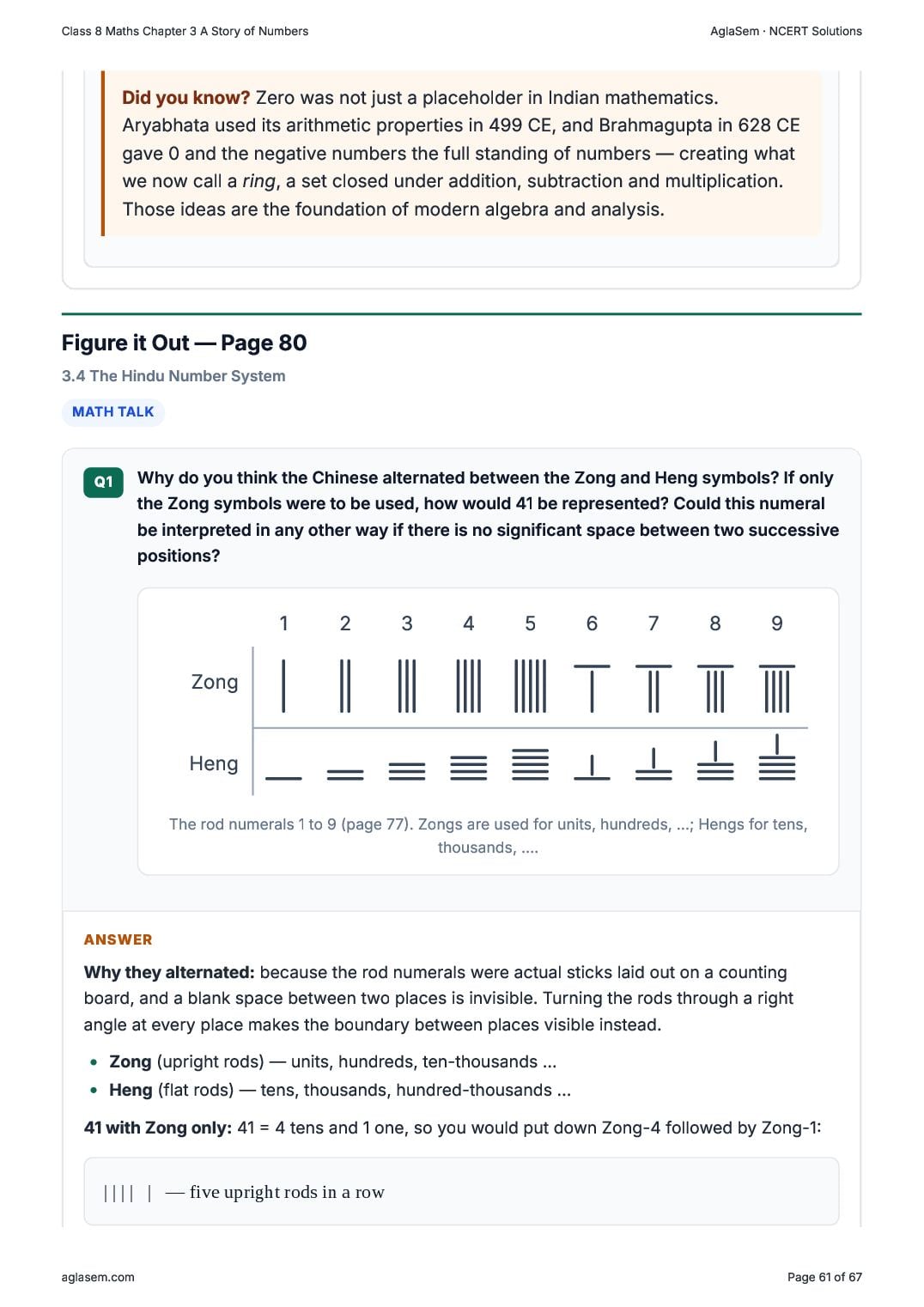
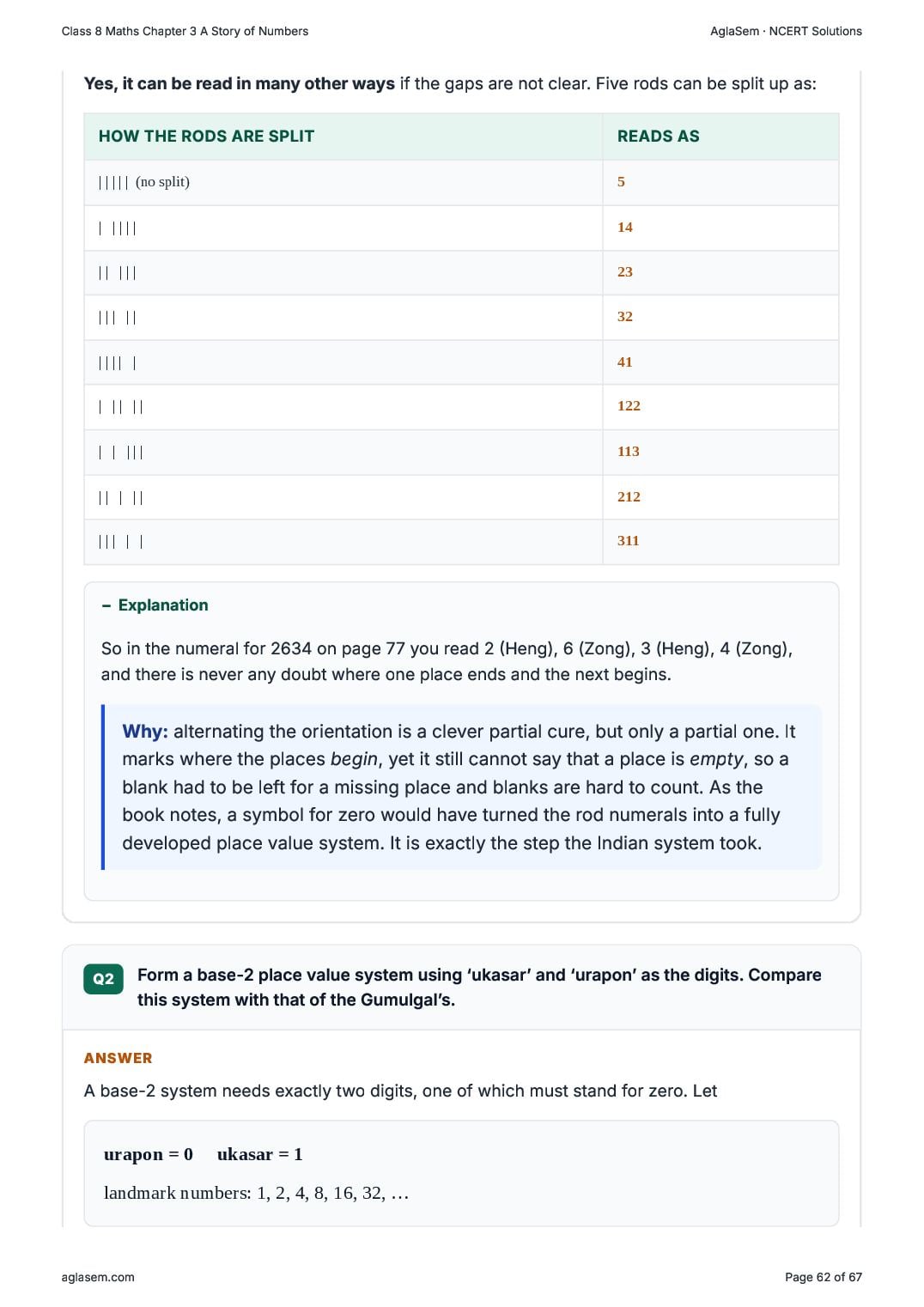
- Why do you think the Chinese alternated between the Zong and Heng symbols? If only the Zong symbols were to be used, how would 41 be represented? Could this numeral be interpreted in any other way if there is no significant space between two successive positions?
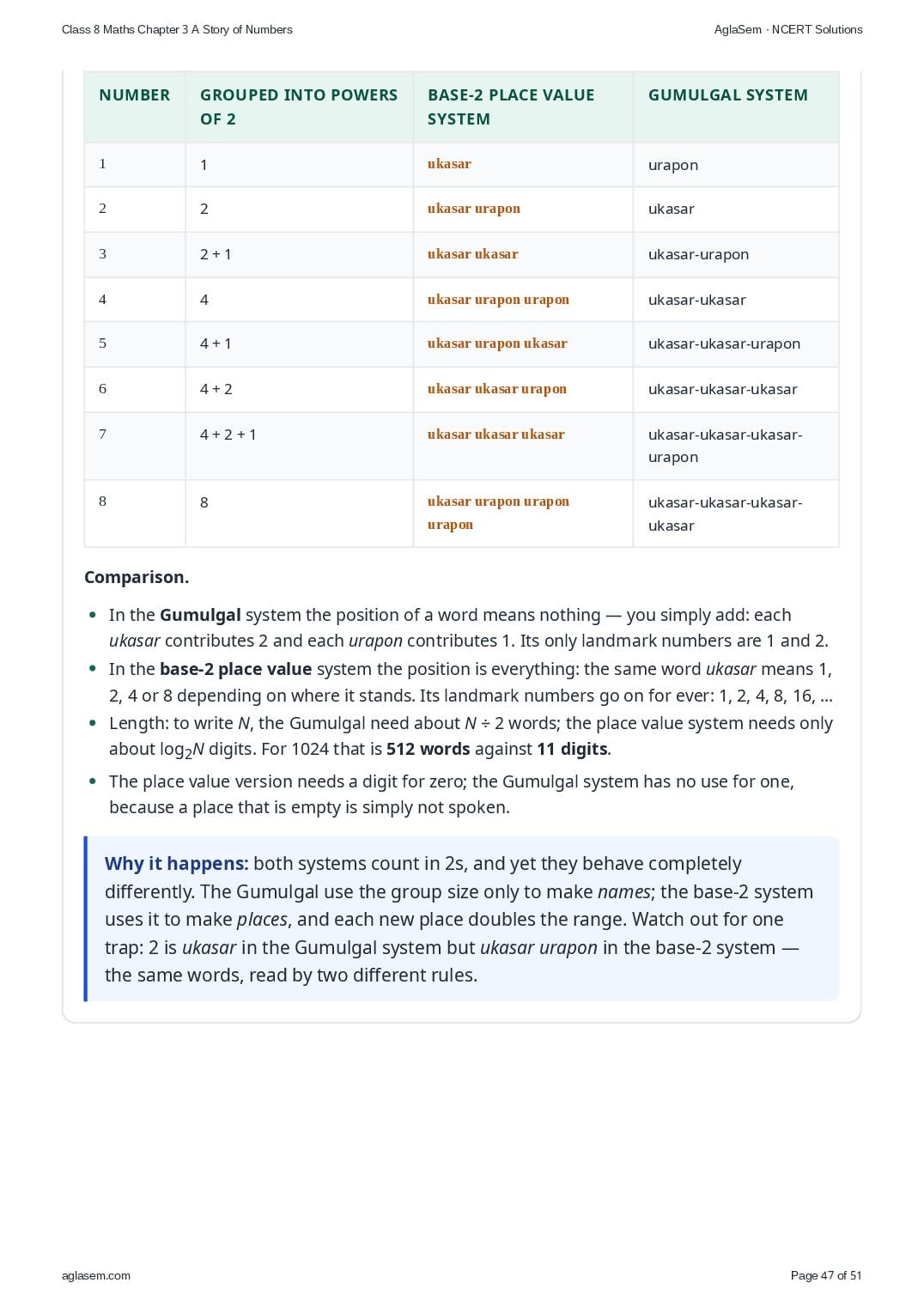
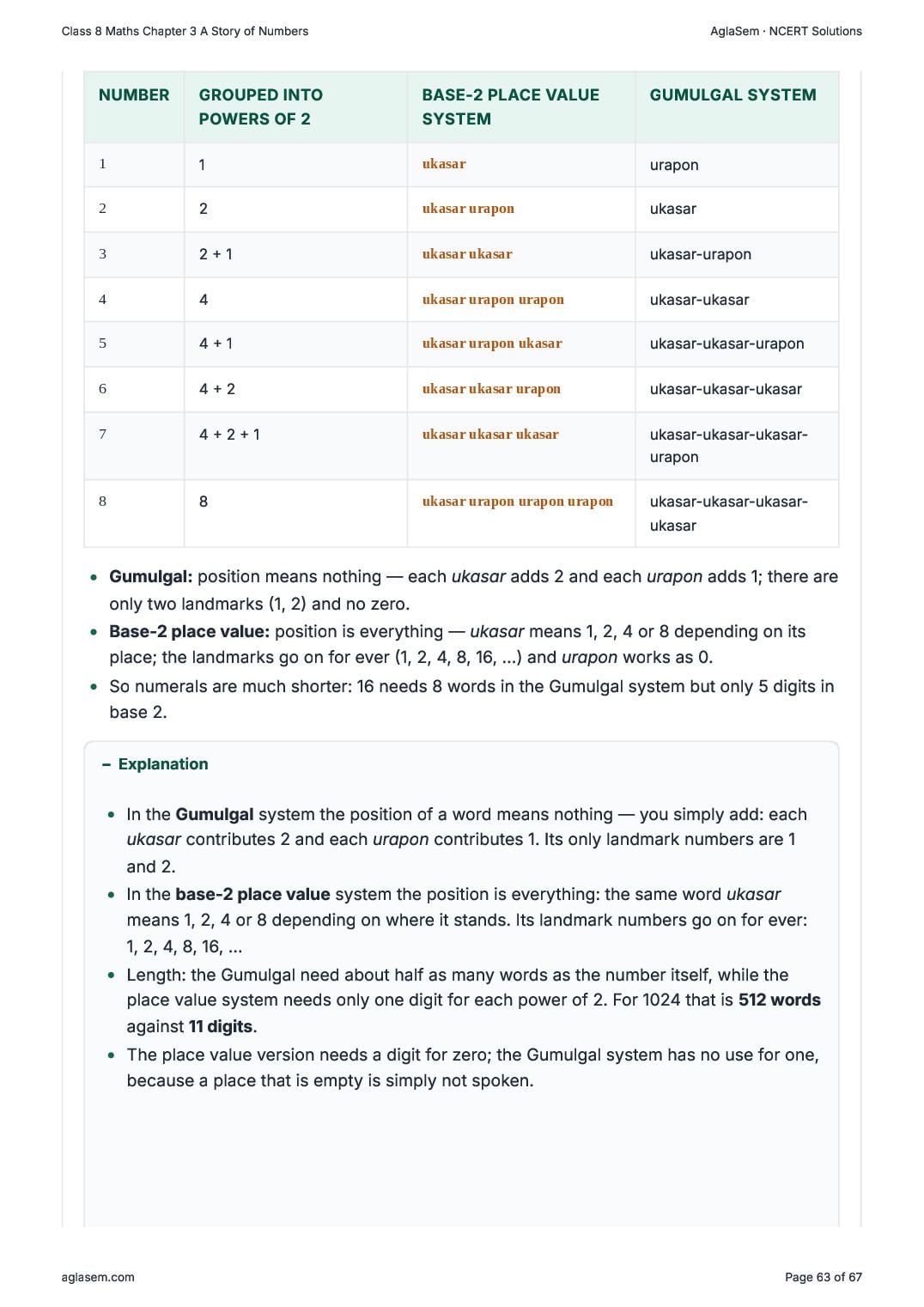
- Form a base-2 place value system using ‘ukasar’ and ‘urapon’ as the digits. Compare this system with that of the Gumulgal’s.
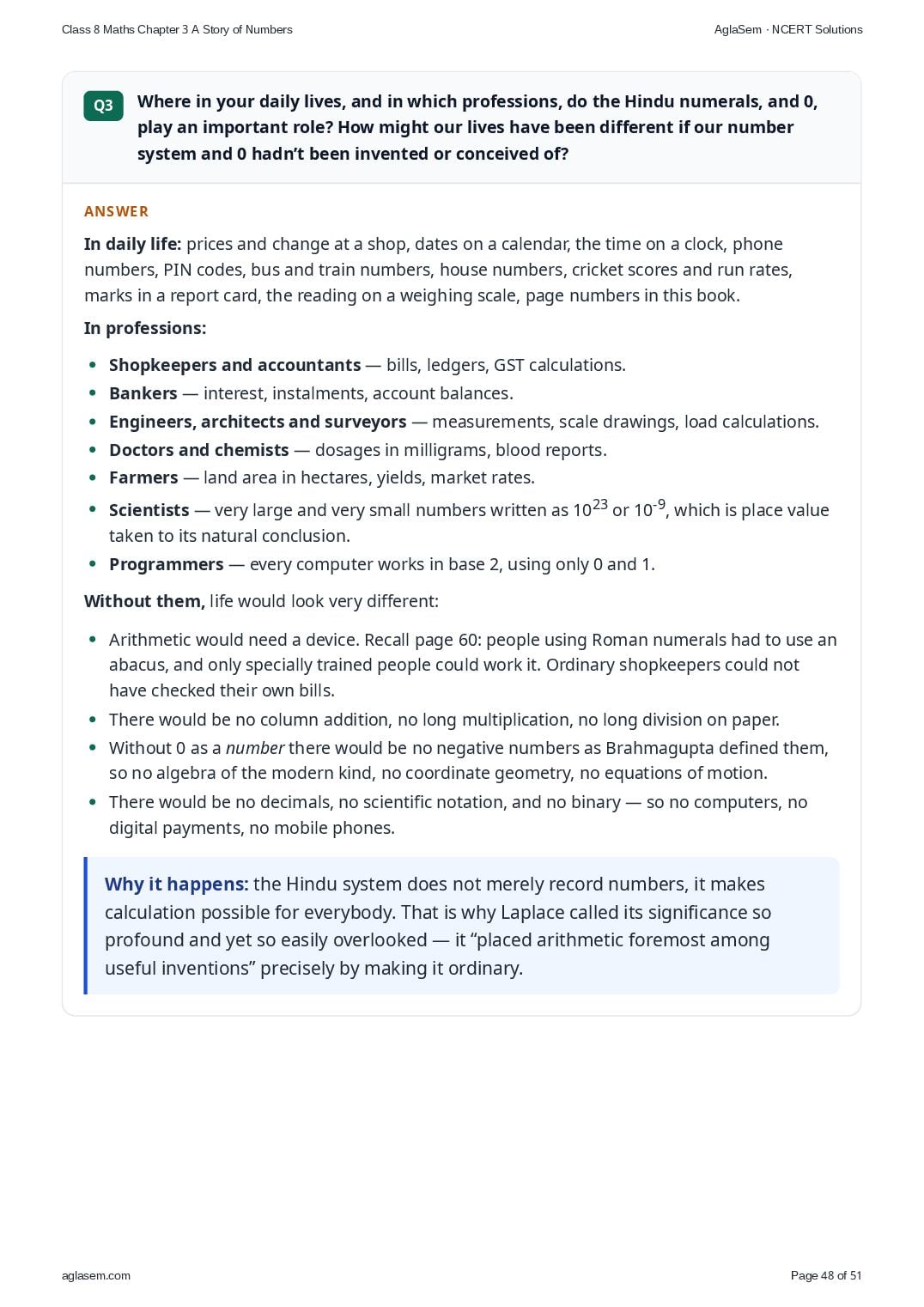
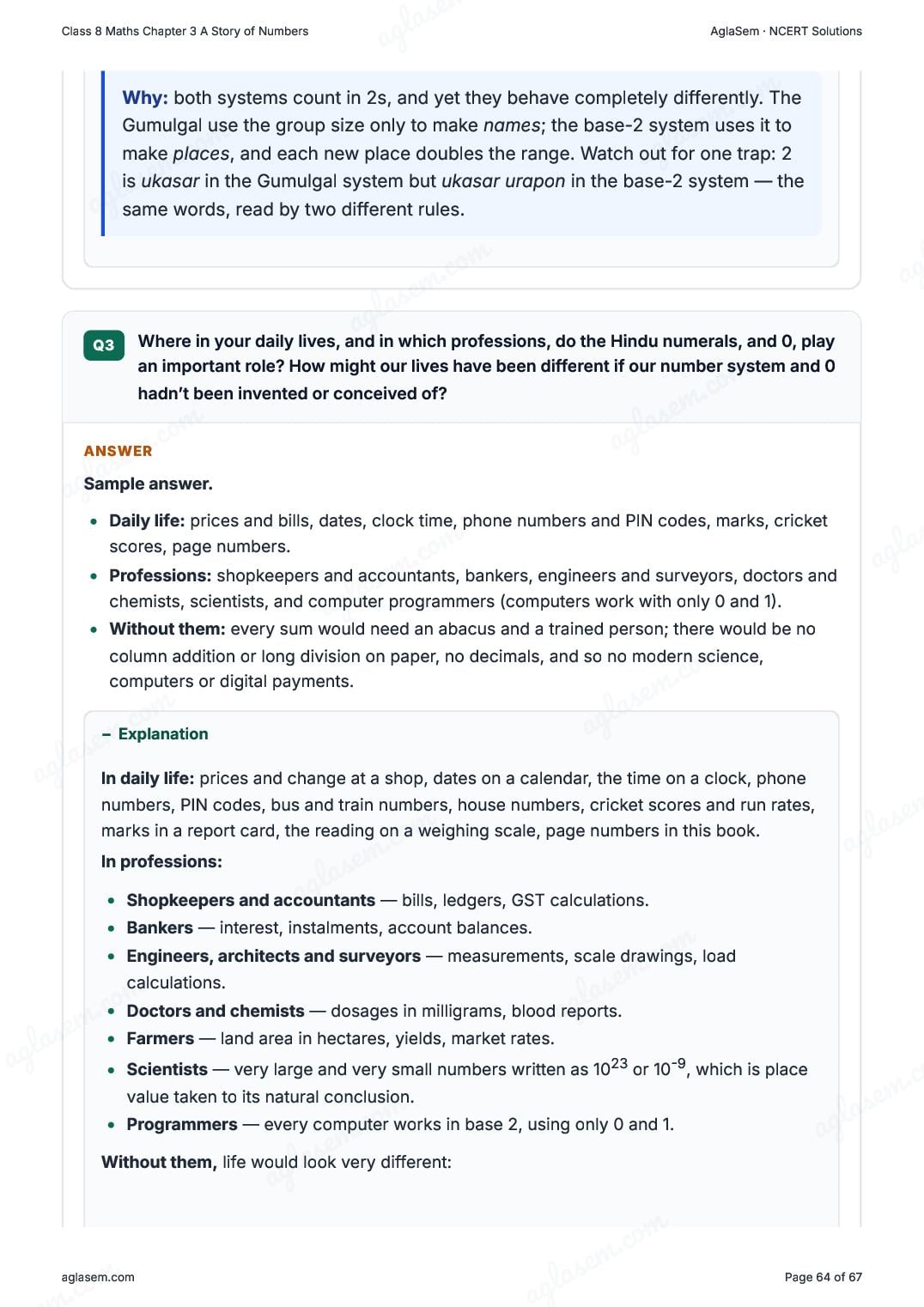
- Where in your daily lives, and in which professions, do the Hindu numerals, and 0, play an important role? How might our lives have been different if our number system and 0 hadn’t been invented or conceived of?
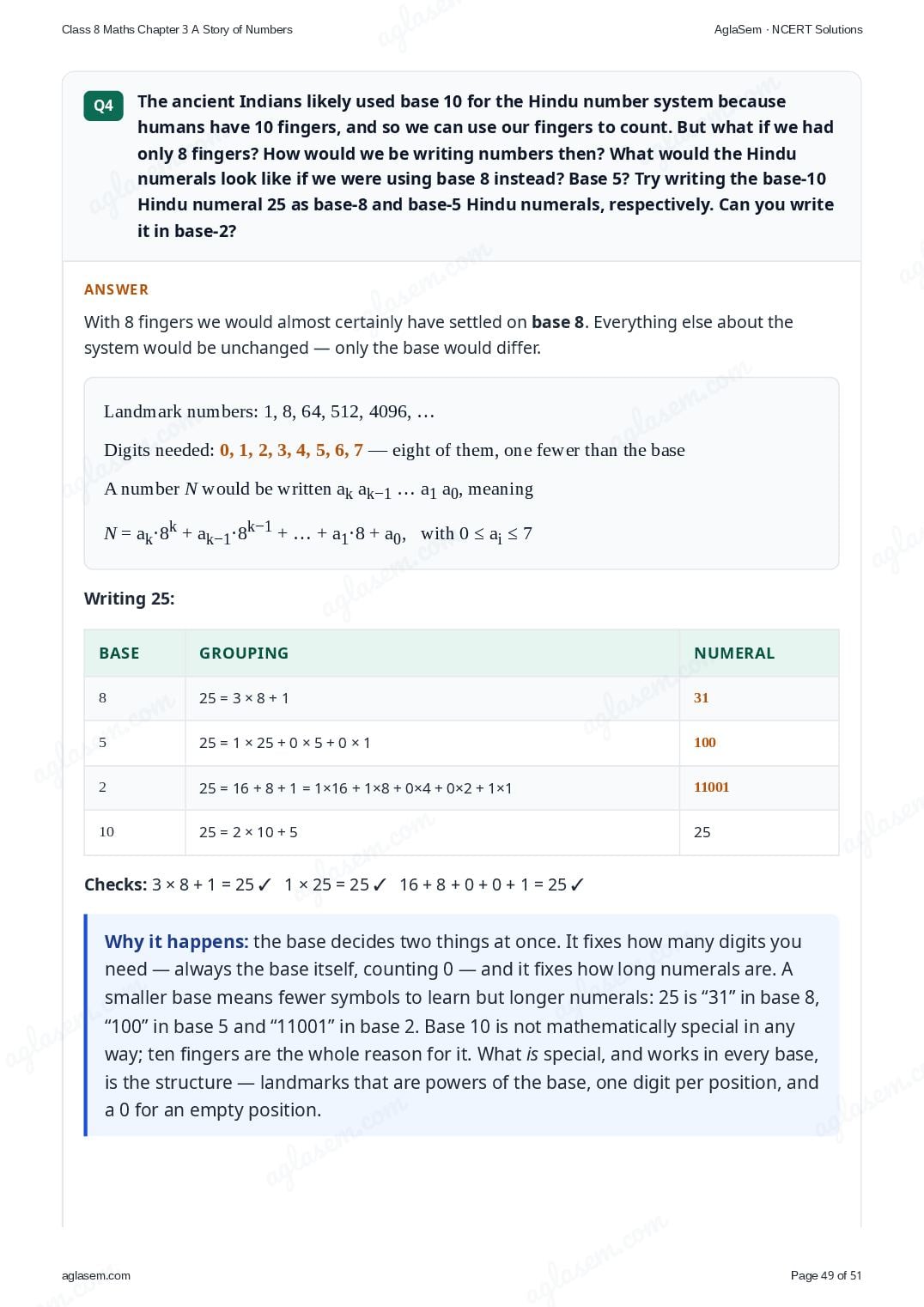
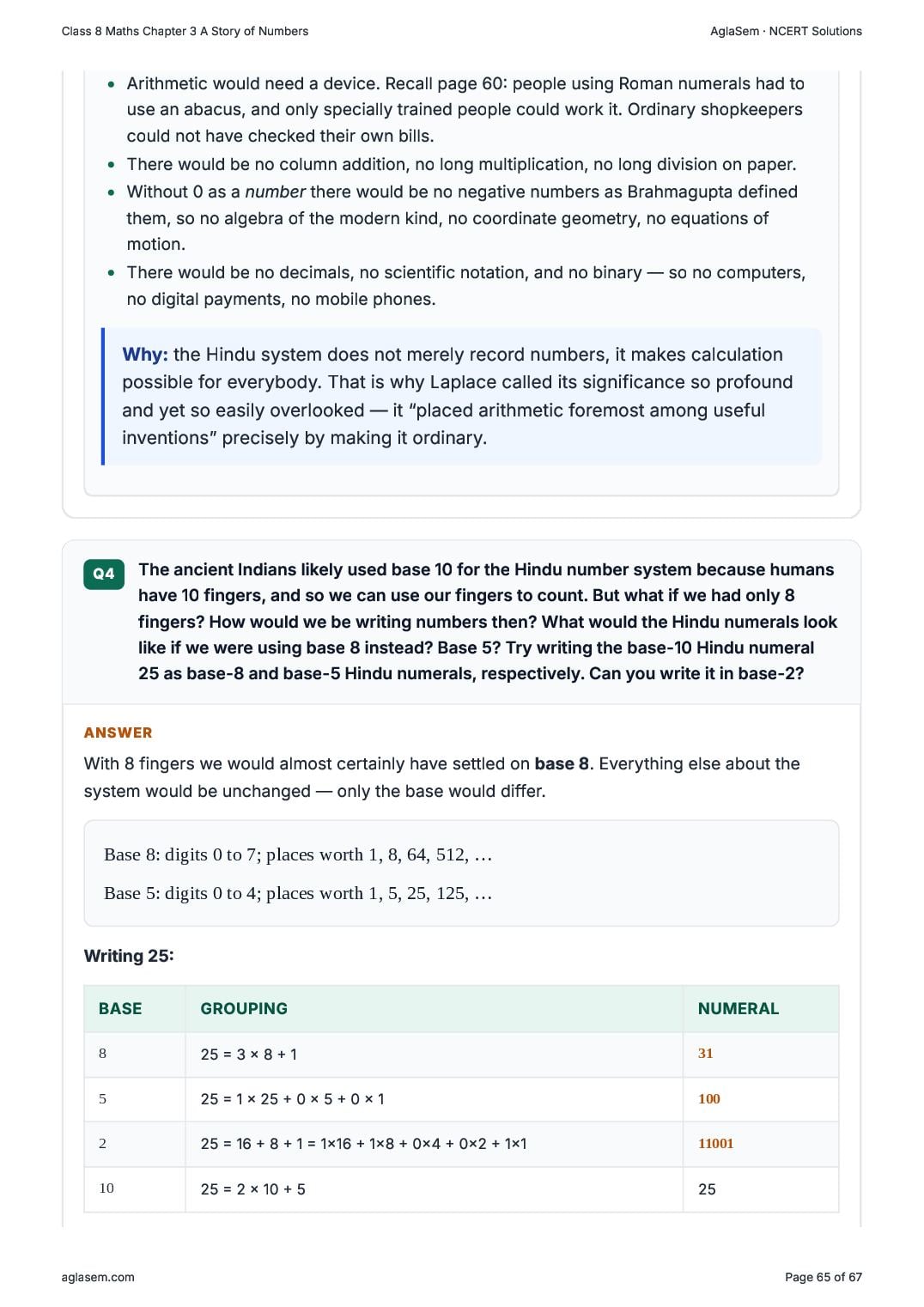
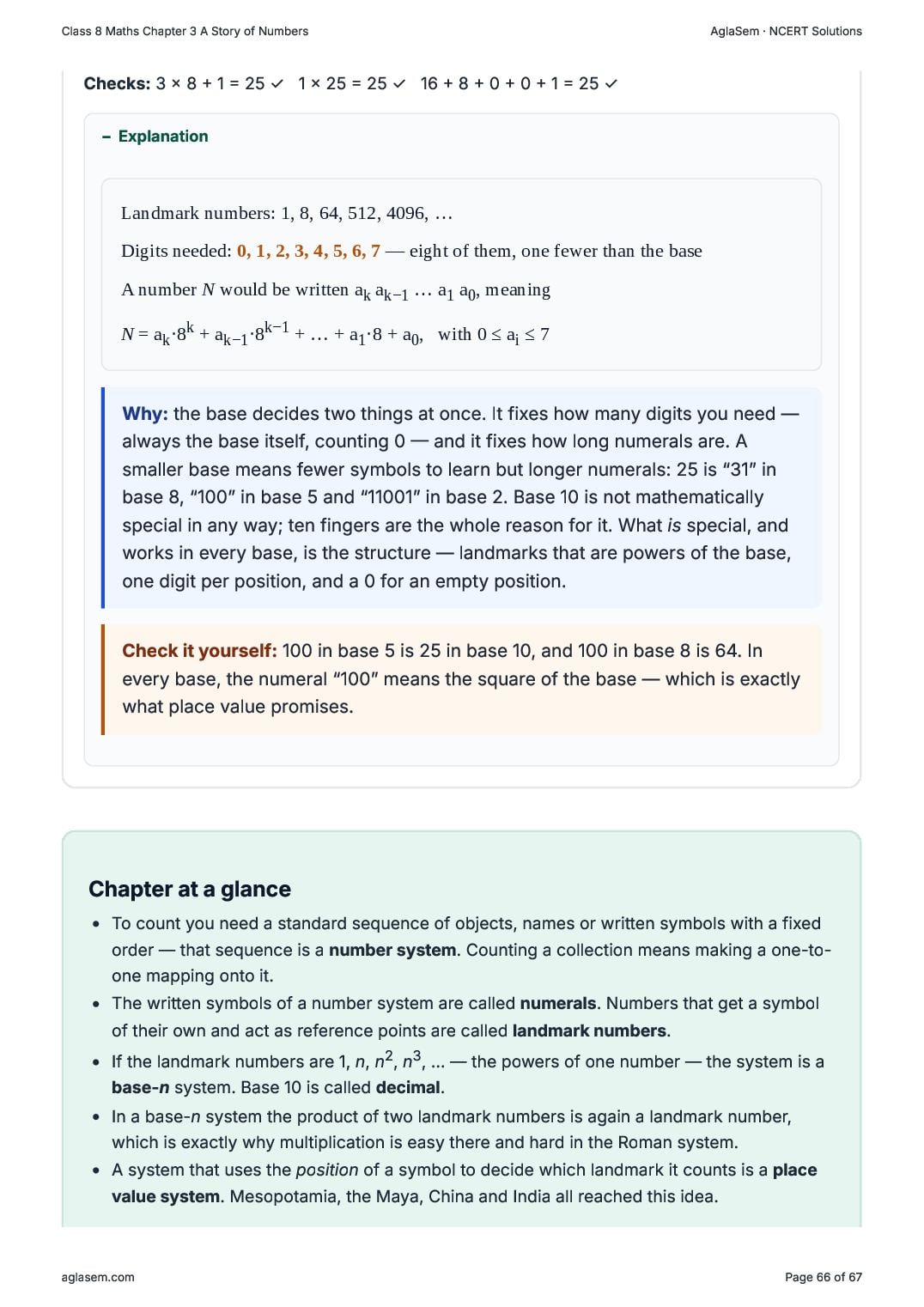
- The ancient Indians likely used base 10 for the Hindu number system because humans have 10 fingers, and so we can use our fingers to count. But what if we had only 8 fingers? How would we be writing numbers then? What would the Hindu numerals look like if we were using base 8 instead? Base 5? Try writing the base-10 Hindu numeral 25 as base-8 and base-5 Hindu numerals, respectively. Can you write it in base-2?
Chapter at a Glance
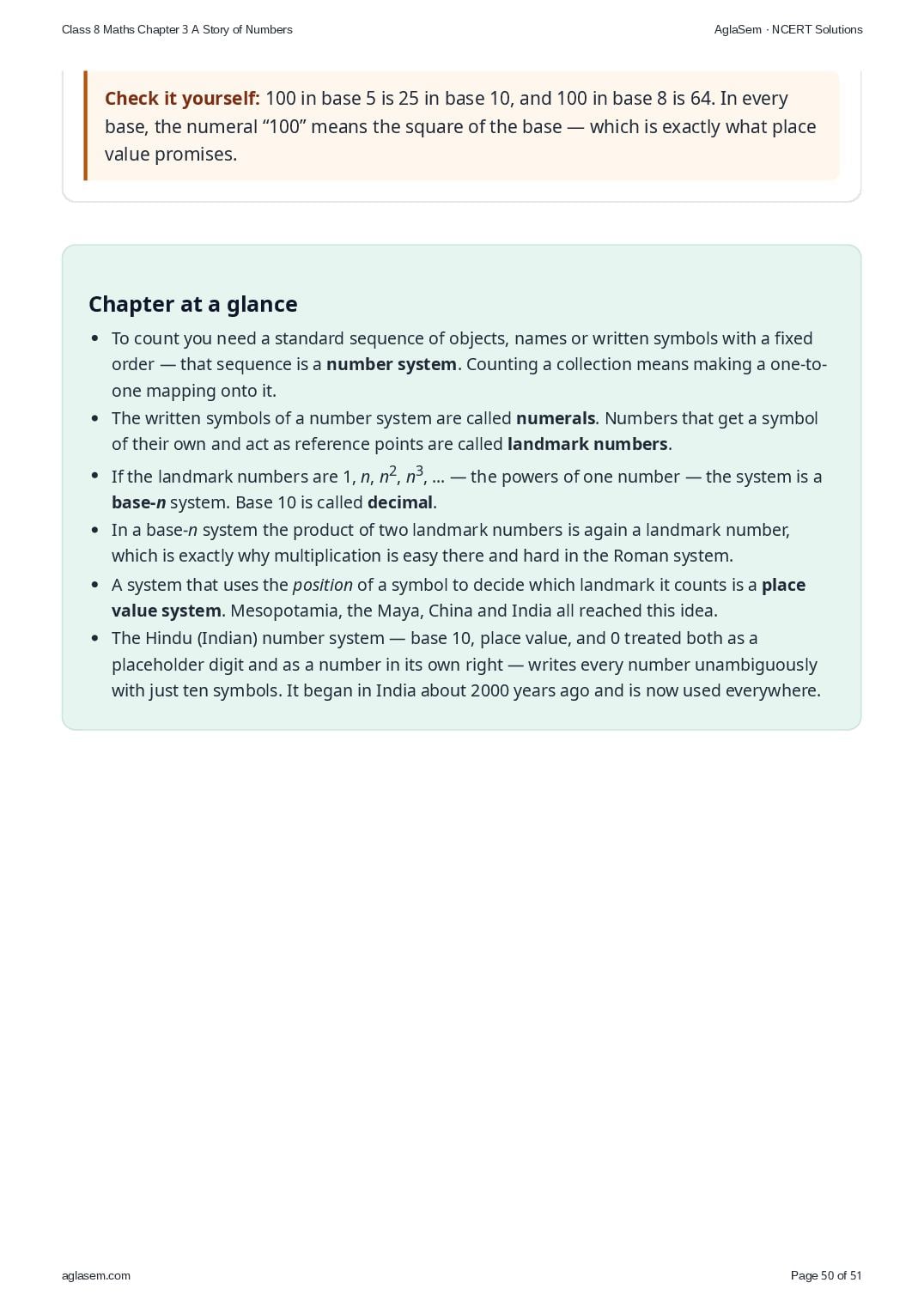
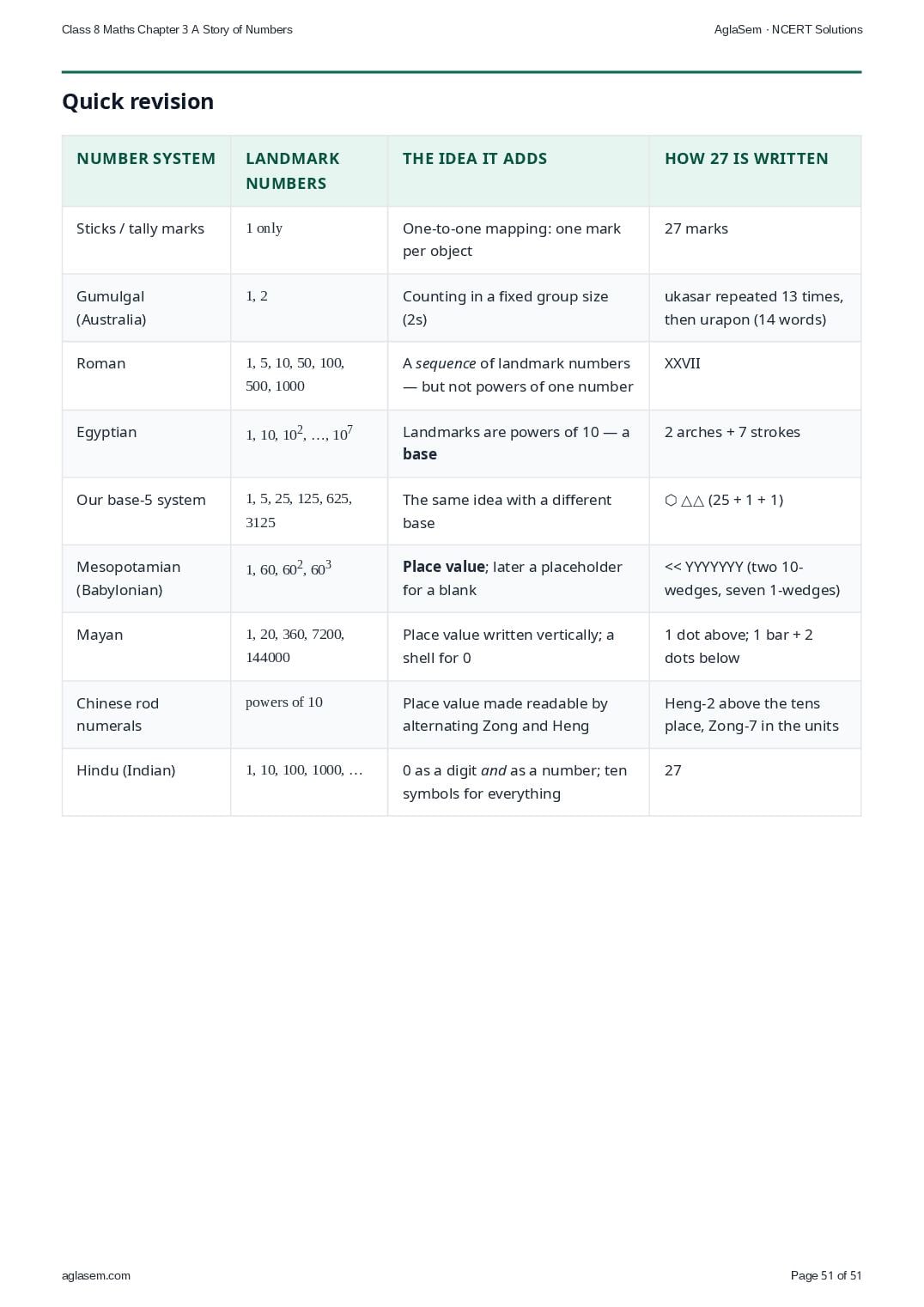
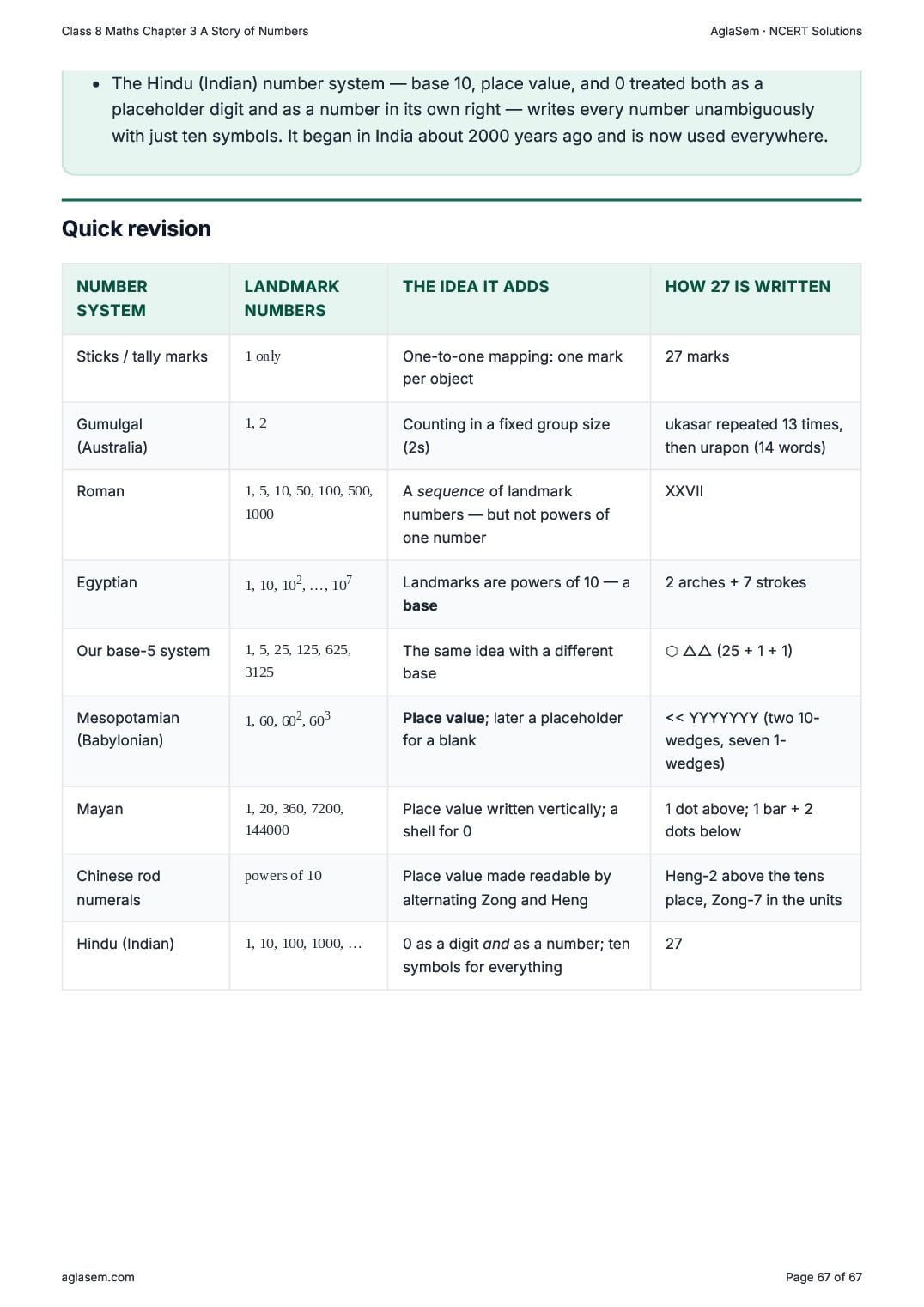
- To count you need a standard sequence of objects, names or written symbols with a fixed order — that sequence is a number system . Counting a collection means making a one-to-one mapping onto it.
- The written symbols of a number system are called numerals . Numbers that get a symbol of their own and act as reference points are called landmark numbers .
- If the landmark numbers are 1, n , n 2 , n 3 , … — the powers of one number — the system is a base- n system. Base 10 is called decimal .
- In a base- n system the product of two landmark numbers is again a landmark number, which is exactly why multiplication is easy there and hard in the Roman system.
- A system that uses the position of a symbol to decide which landmark it counts is a place value system . Mesopotamia, the Maya, China and India all reached this idea.
- The Hindu (Indian) number system — base 10, place value, and 0 treated both as a placeholder digit and as a number in its own right — writes every number unambiguously with just ten symbols. It began in India about 2000 years ago and is now used everywhere.
How to Download NCERT Solutions for Class 8 Maths Chapter 3 PDF
Follow these simple steps to get the A Story of Numbers questions-and-answers PDF from Ganita Prakash.
- Search NCERT Solutions for Class 8 Maths Chapter 3 aglasem and open this page.
- Read the exercise questions with answers for A Story of Numbers shown above.
- Click the Download PDF link to save the A Story of Numbers solutions to your device.
NCERT Solutions for Class 8 Maths – All Chapters
There are more chapters to study besides A Story of Numbers in Maths. Here are the NCERT Solutions for all chapters of Class 8 Maths.
- Chapter 1 A Square and a Cube
- Chapter 2 Power Play
- Chapter 3 A Story of Numbers
- Chapter 4 Quadrilaterals
- Chapter 5 Number Play
- Chapter 6 We Distribute Yet Things Multiply
- Chapter 7 Proportional Reasoning 1
- Chapter 8 Fractions in Disguise
- Chapter 9 The Baudh Yana Pythagoras Theorem
- Chapter 10 Proportional Reasoning 2
- Chapter 11 Exploring Some Geometric Themes
- Chapter 12 Tales By Dots and Lines
- Chapter 13 Algebra Play
- Chapter 14 Area
NCERT Solutions for Class 8 – All Subjects
Just like Chapter 3 of Maths, you can get the exercise questions with answers for every other subject of Class 8. Here are the NCERT Solutions for all subjects of Class 8.
NCERT Solutions for Class 8 Maths Chapter 3 – An Overview
The key highlights of this study material are as follows.
| Aspects | Details |
|---|---|
| Class | Class 8 |
| Subject | Maths |
| Chapter Number | Chapter 3 |
| Chapter Name | A Story of Numbers |
| Book Name | Ganita Prakash |
| Book By | NCERT (National Council of Educational Research and Training) |
| Educational Resource Here | NCERT Solutions of Class 8 Maths Chapter 3 for all exercises |
| More Questions Answers of This Subject | NCERT Solutions for Class 8 Maths |
| Download Book Chapter | NCERT Book Class 8 Maths |
| All Questions Answers For This Class | NCERT Solutions for Class 8 |
| Complete Solutions | NCERT Solutions |
NCERT Solutions for Class 8 Maths Chapter 3 A Story of Numbers – FAQs
What are the NCERT Solutions for Class 8 Maths Chapter 3 A Story of Numbers?
They are the complete, step-by-step answers to all the exercise and in-text questions of Chapter 3 A Story of Numbers from the NCERT Class 8 Maths textbook Ganita Prakash, written by experts as per the latest NCERT syllabus.
How can I download the Class 8 Maths Chapter 3 solutions PDF for free?
Open this page on aglasem, read the A Story of Numbers questions with answers, and click the “Download Solutions PDF” link. The Class 8 Maths Chapter 3 NCERT Solutions PDF is completely free to download.
Are these NCERT Solutions as per the latest 2026-27 syllabus?
Yes. The NCERT Solutions for Class 8 Maths Chapter 3 are based on the latest NCERT textbook Ganita Prakash and the current 2026-27 CBSE syllabus, so the questions and answers match what you study in class.
Where can I get NCERT Solutions for the other chapters of Class 8 Maths?
You can find the answers to every chapter on the NCERT Solutions for Class 8 Maths page, and solutions for every subject on the NCERT Solutions for Class 8 page.
How do NCERT Solutions help in exam preparation?
They show the correct method to solve each question, help you write answers the way they are expected in exams, let you check and correct your own work, and save revision time — which together improve your marks in Class 8 Maths.
If you have any queries on NCERT Solutions for Class 8 Maths Chapter 3 A Story of Numbers, then please ask in the comments below.