NCERT Solutions for Class 8 Maths Chapter 9 The Baudh Yana Pythagoras Theorem provide clear, step-by-step answers to every exercise and in-text question from the chapter The Baudh Yana Pythagoras Theorem of the NCERT textbook Ganita Prakash. Prepared by subject experts as per the latest NCERT (CBSE) syllabus for 2026-27, these NCERT Solutions for Class 8 Maths help you understand each concept, write exam-ready answers, and check your own solutions. You can read them online below or download the free Class 8 Maths Chapter 9 question-answer PDF.
NCERT Solutions for Class 8 Maths Chapter 9 The Baudh Yana Pythagoras Theorem
- Class: Class 8
- Subject: Maths
- Chapter: Chapter 9 – The Baudh Yana Pythagoras Theorem
- Textbook: Ganita Prakash (NCERT)
- Study material: NCERT Solutions – questions with answers, free PDF
These solutions answer all the exercise questions of Chapter 9 The Baudh Yana Pythagoras Theorem — including the in-text questions, short-answer and long-answer questions, and activities — with complete explanations so you can follow the method, not just the final answer. Read the full solutions below.
NCERT Solutions Class 8 Maths Chapter 9 the Baudh Yana Pythagoras Theorem View Download
NCERT Solutions for Class 8 Maths Chapter 9 PDF Download
You can read the NCERT Solutions for Class 8 Maths Chapter 9 online above, or download the complete question-answer PDF to study The Baudh Yana Pythagoras Theorem offline at any time.
NCERT Solutions for Class 8 Maths Chapter 9 PDF Download Link – Click Here to Download Solutions PDF
Questions Covered in This Chapter
These NCERT Solutions answer all 59 questions of this chapter. The questions solved are:
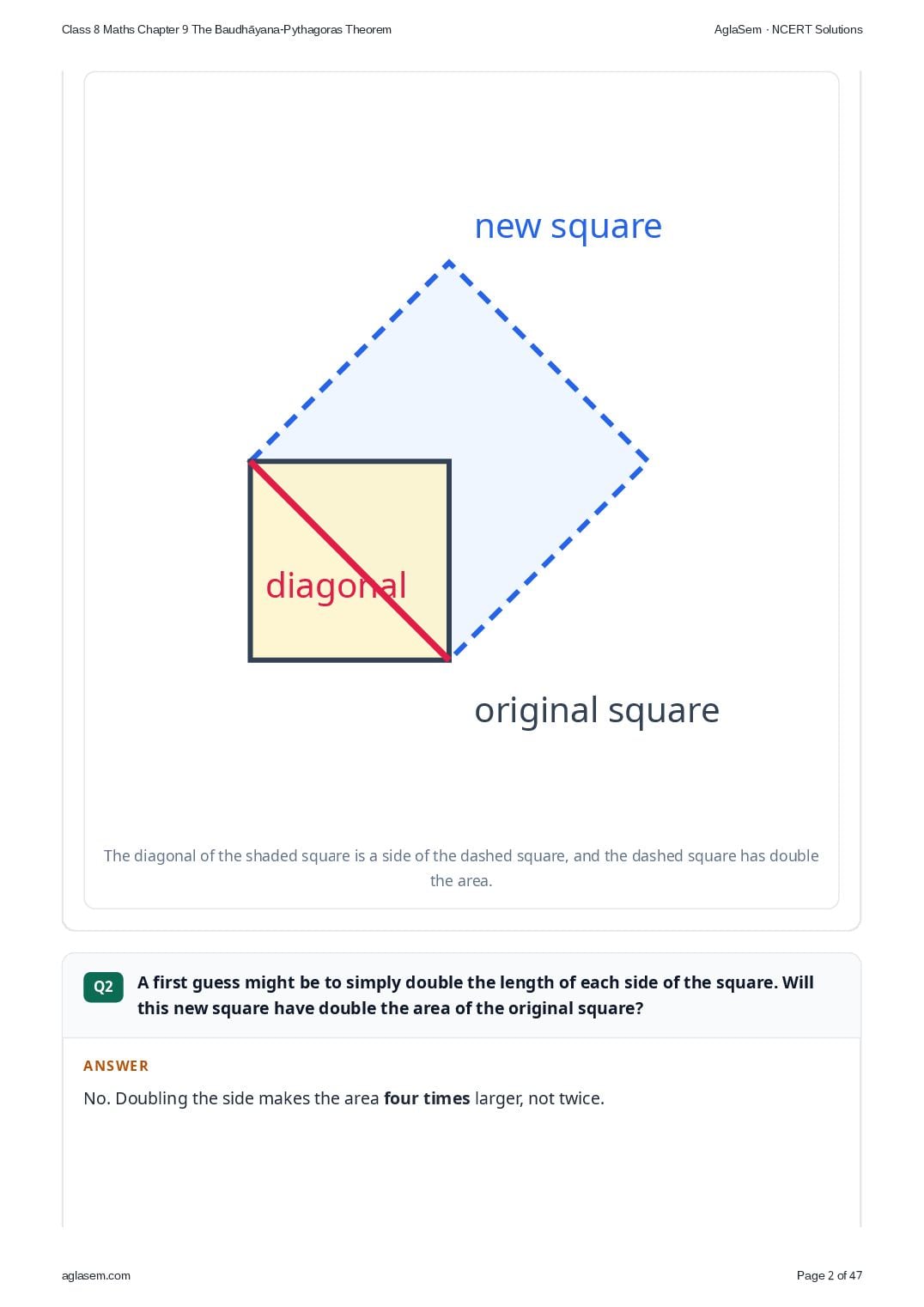
- How can one construct a square having double the area of a given square?
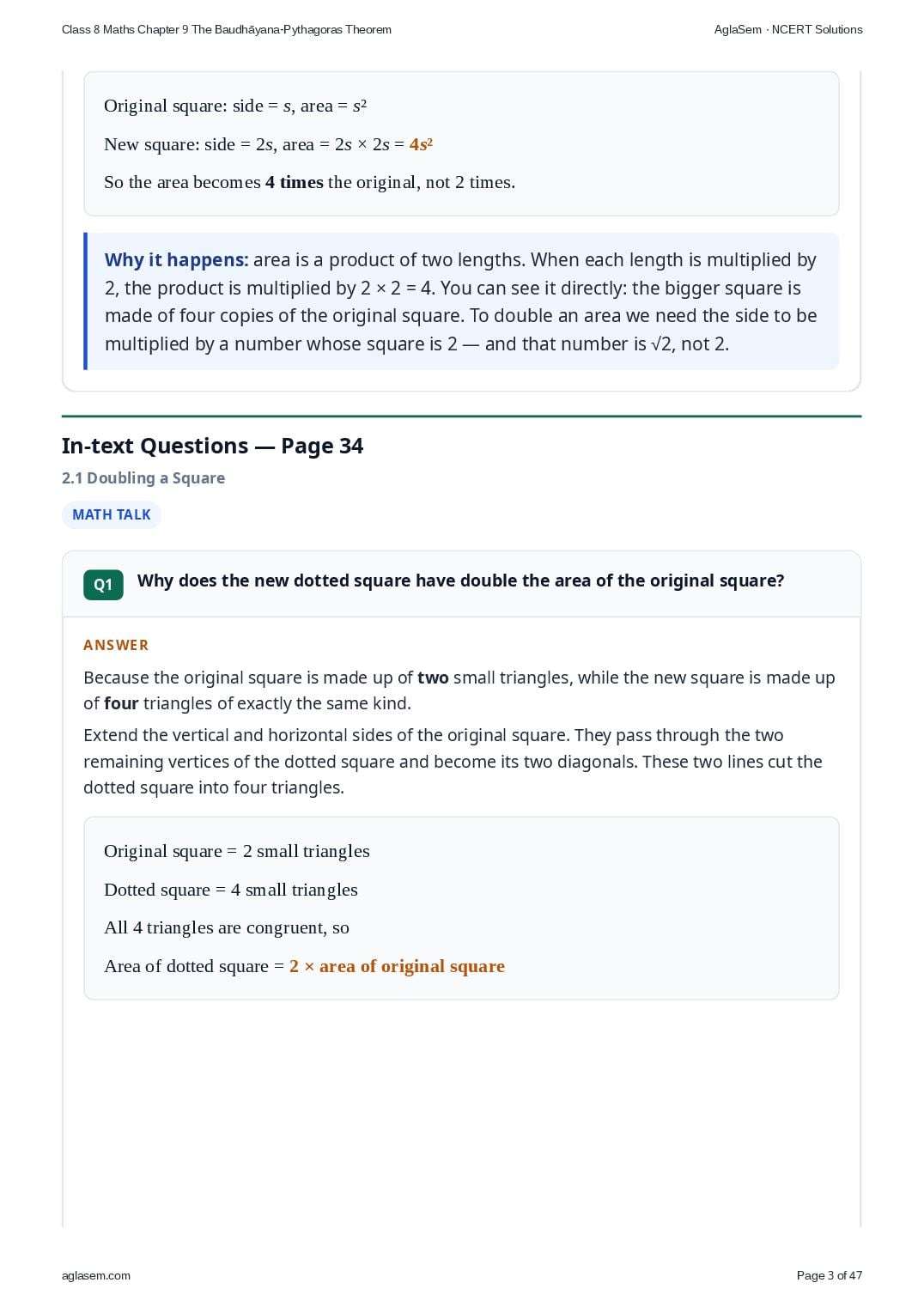
- A first guess might be to simply double the length of each side of the square. Will this new square have double the area of the original square?
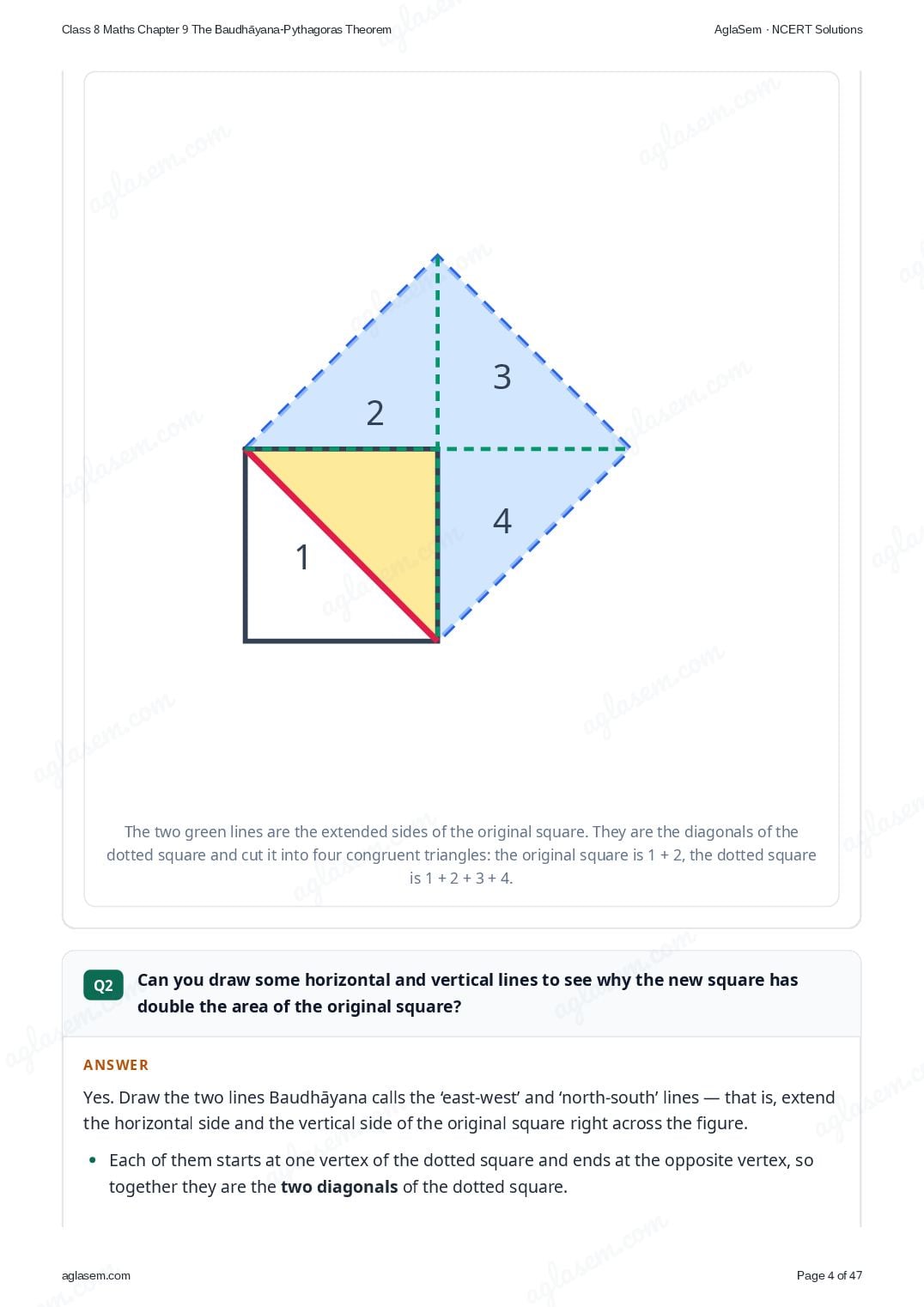
- Why does the new dotted square have double the area of the original square?
- Can you draw some horizontal and vertical lines to see why the new square has double the area of the original square?
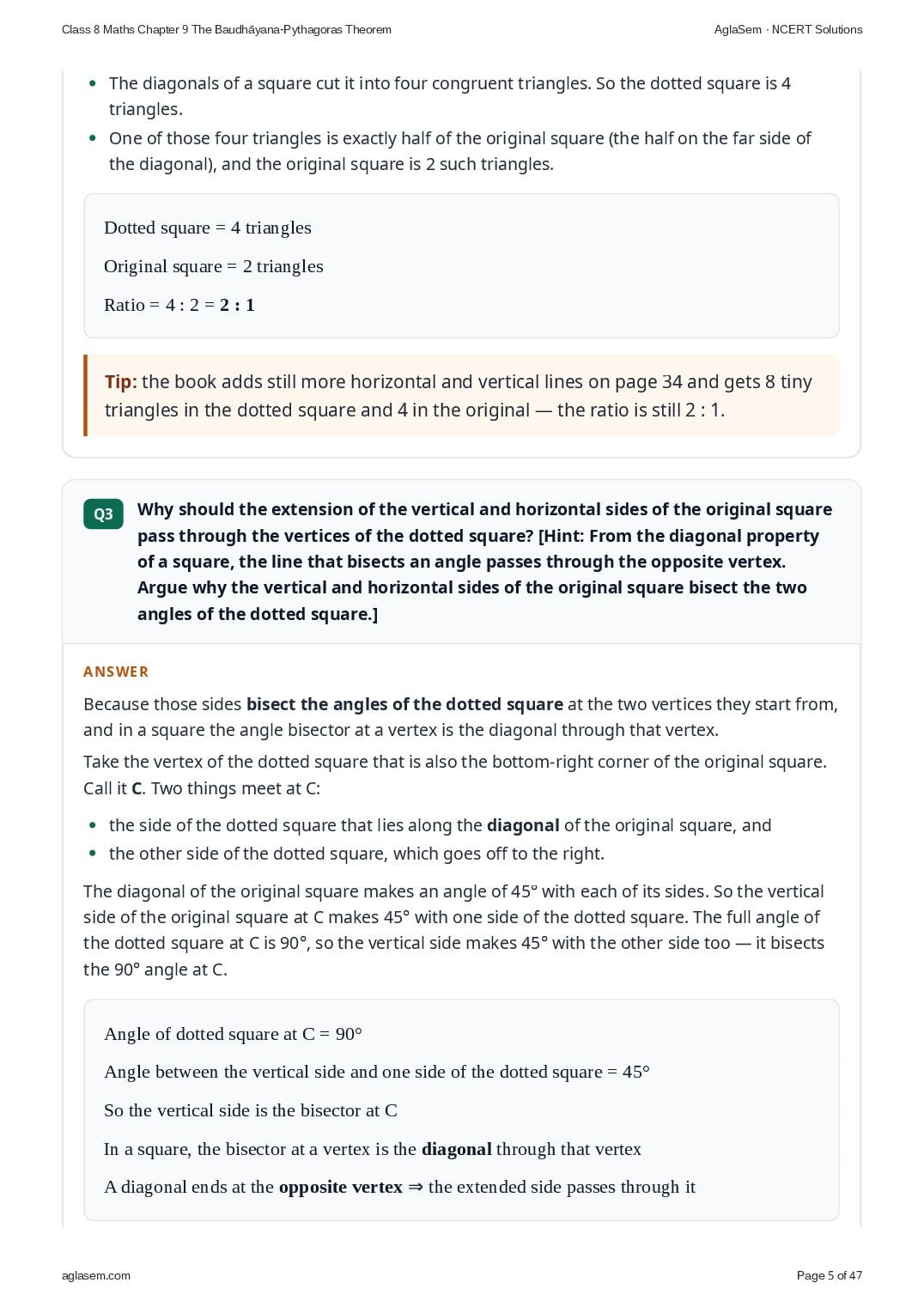
- Why should the extension of the vertical and horizontal sides of the original square pass through the vertices of the dotted square? [Hint: From the diagonal property of a square, the line that bisects an angle passes through the opposite vertex. Argue why the vertical and horizontal sides of the original square bisect the two angles of the dotted square.]
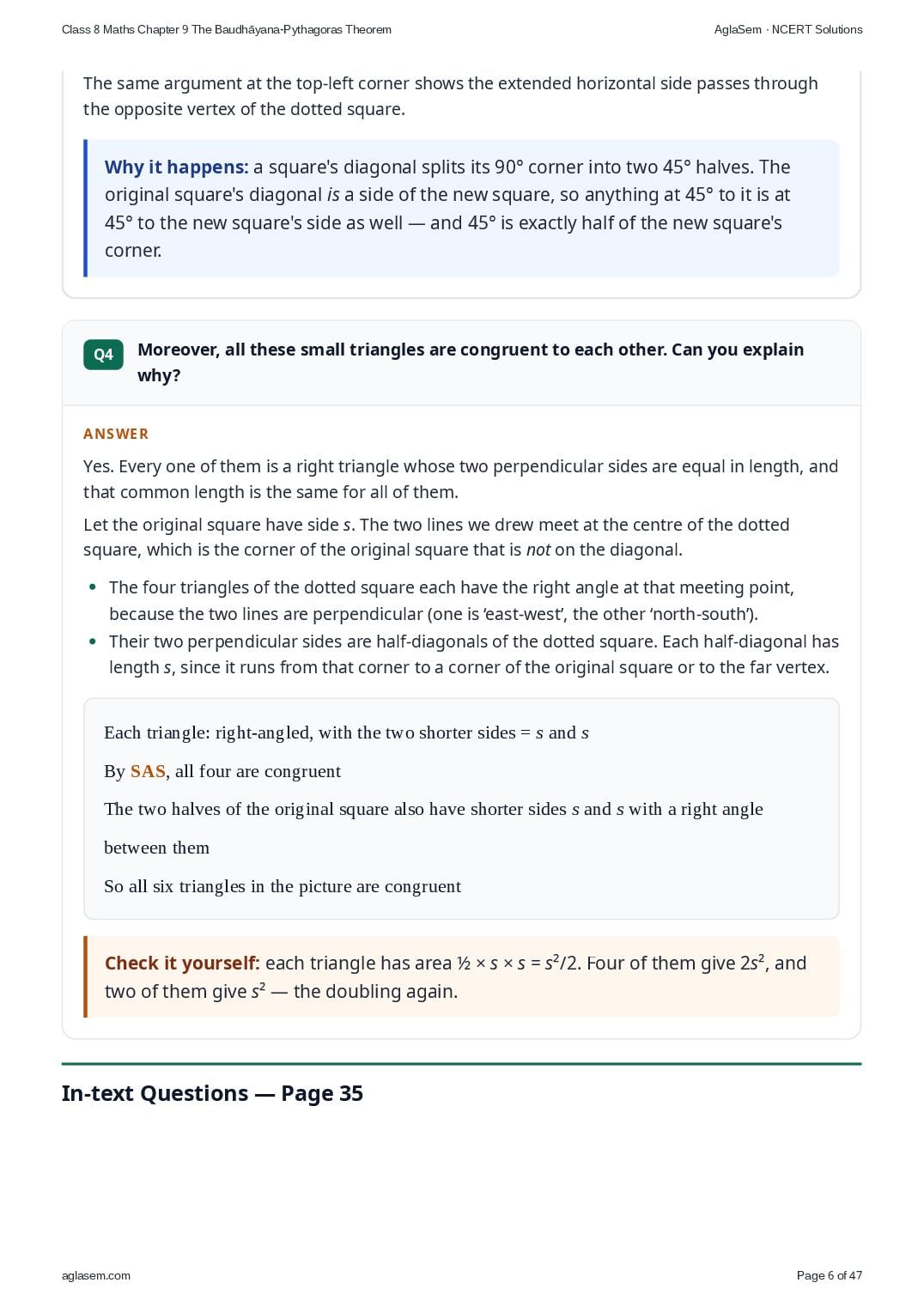
- Moreover, all these small triangles are congruent to each other. Can you explain why?
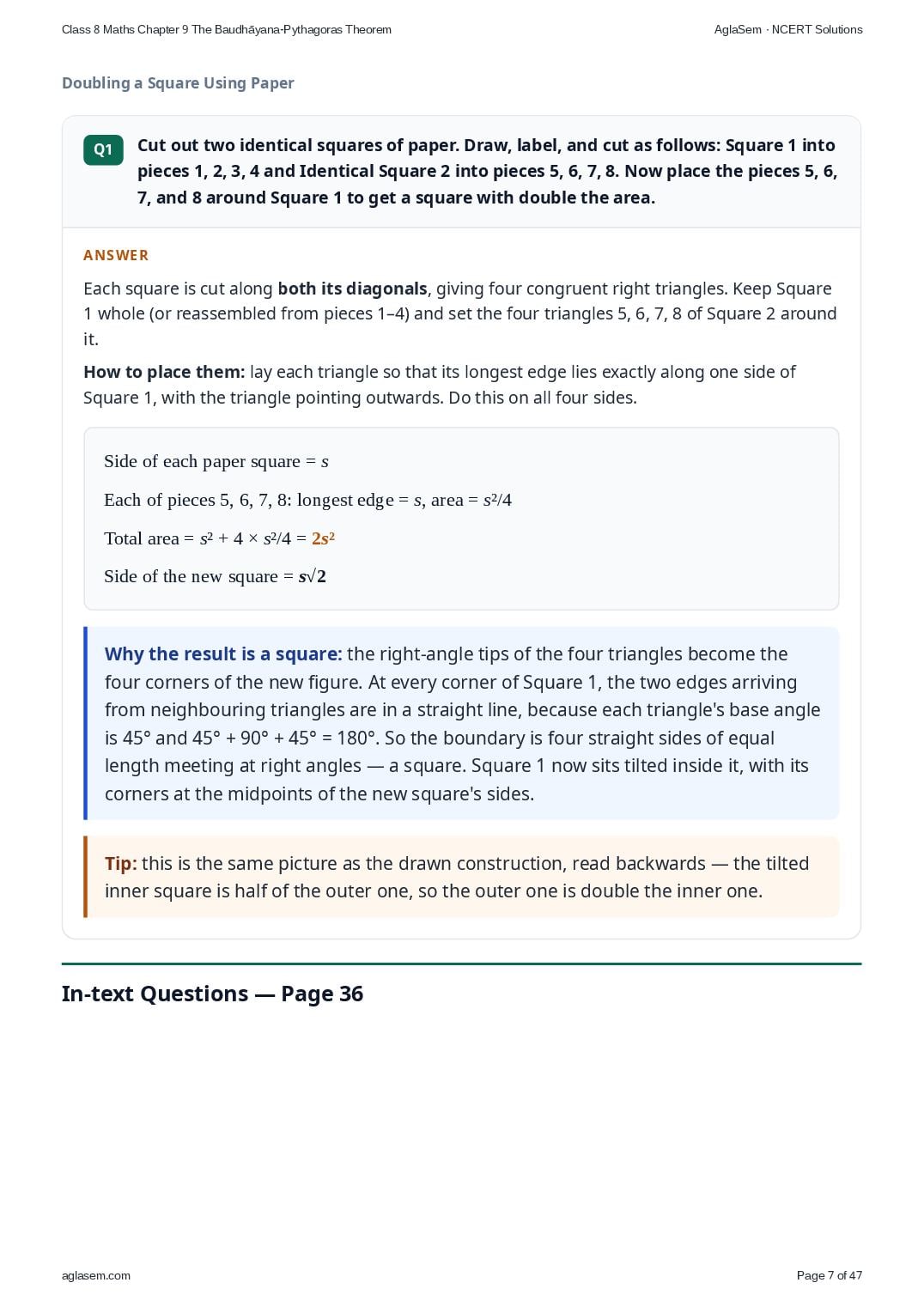
- Cut out two identical squares of paper. Draw, label, and cut as follows: Square 1 into pieces 1, 2, 3, 4 and Identical Square 2 into pieces 5, 6, 7, 8. Now place the pieces 5, 6, 7, and 8 around Square 1 to get a square with double the area.
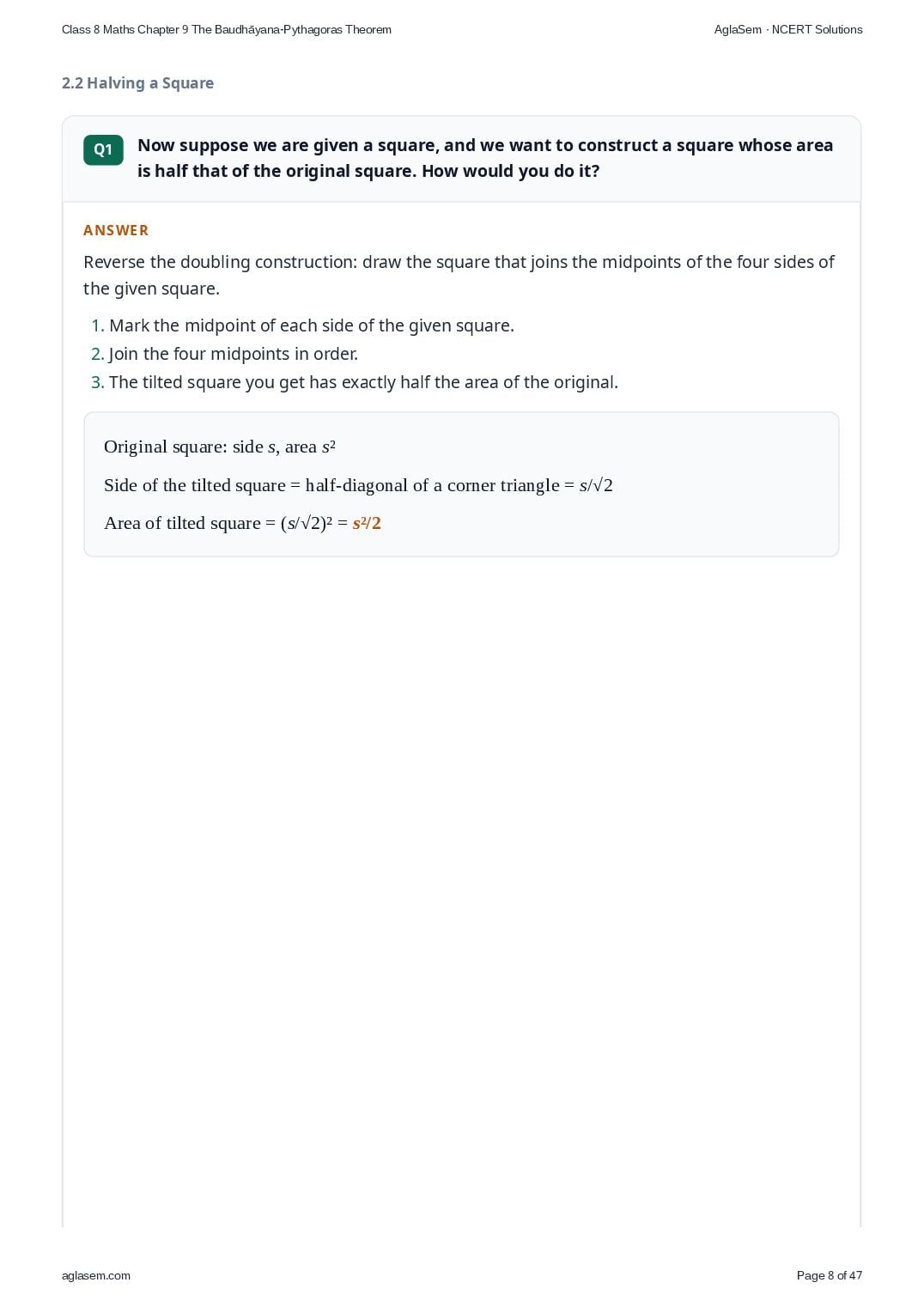
- Now suppose we are given a square, and we want to construct a square whose area is half that of the original square. How would you do it?
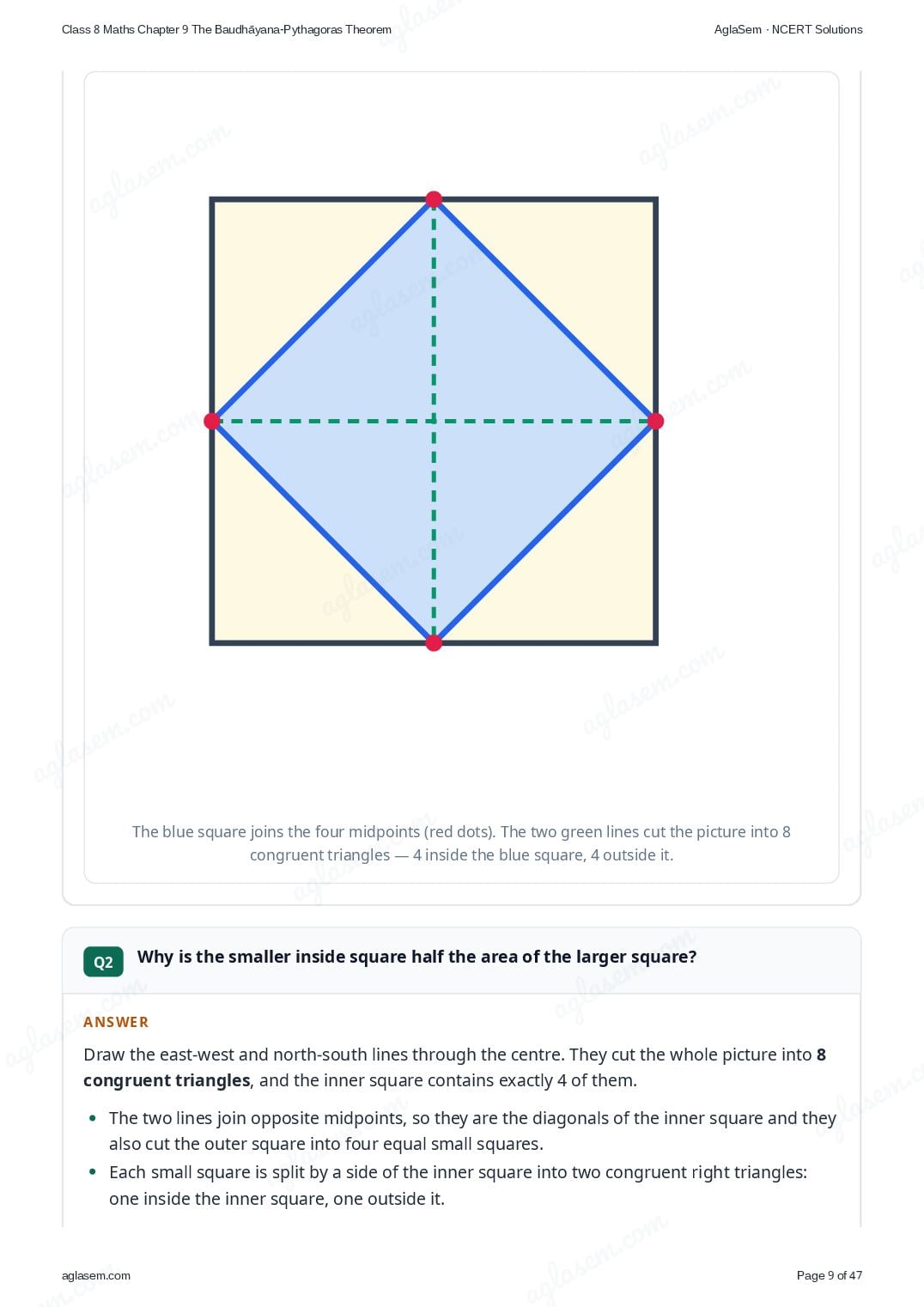
- Why is the smaller inside square half the area of the larger square?
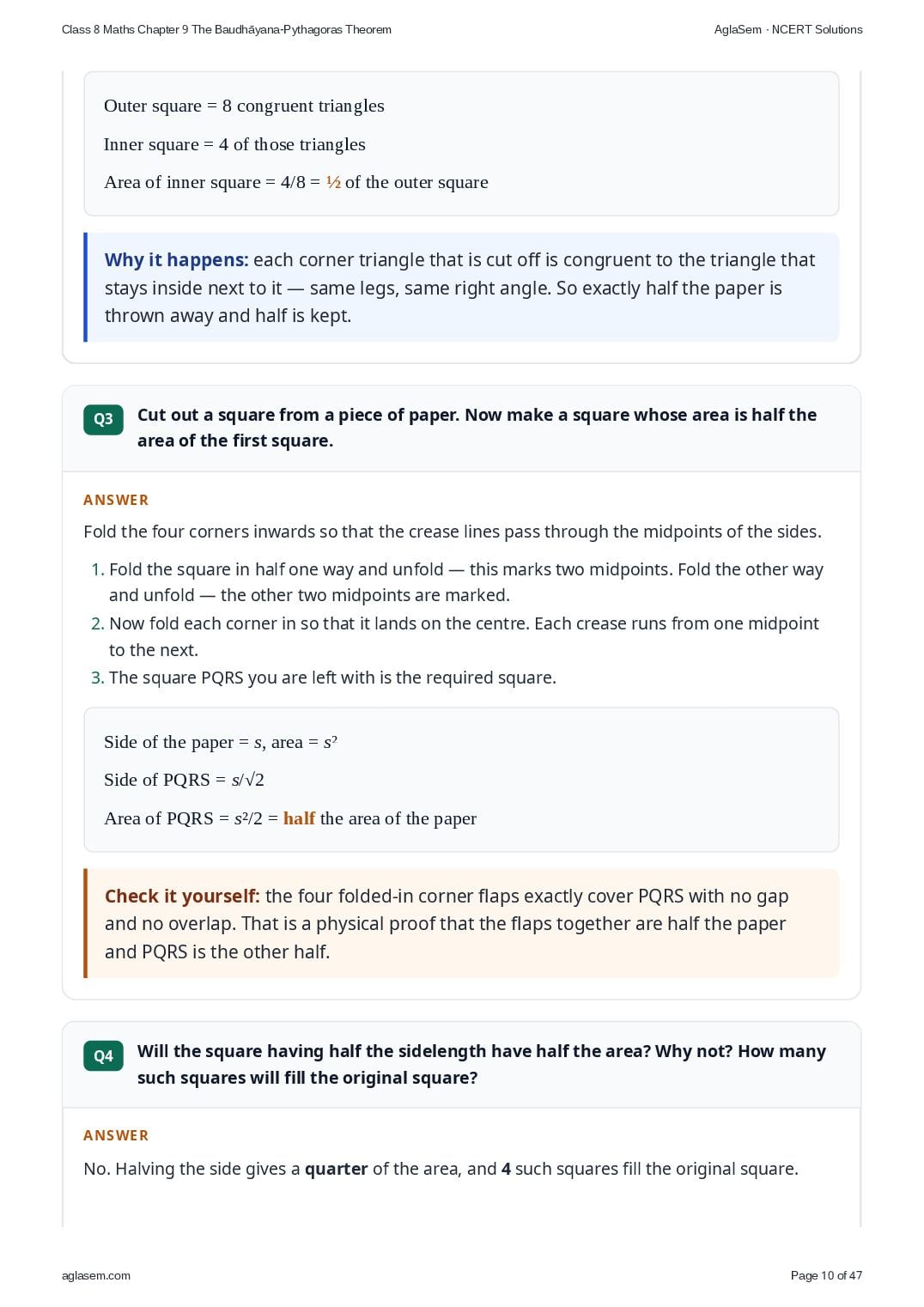
- Cut out a square from a piece of paper. Now make a square whose area is half the area of the first square.
- Will the square having half the sidelength have half the area? Why not? How many such squares will fill the original square?
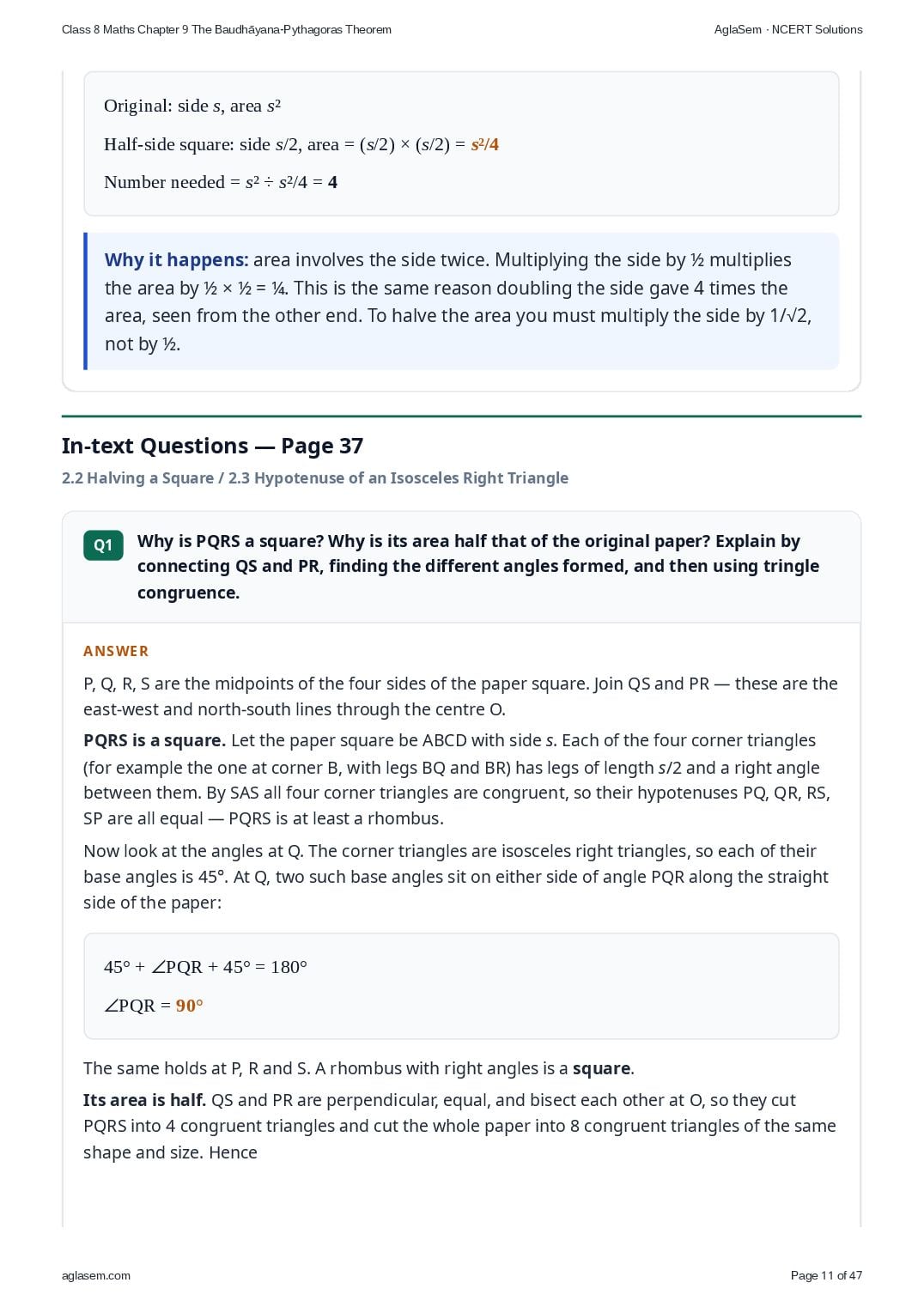
- Why is PQRS a square? Why is its area half that of the original paper? Explain by connecting QS and PR, finding the different angles formed, and then using tringle congruence.
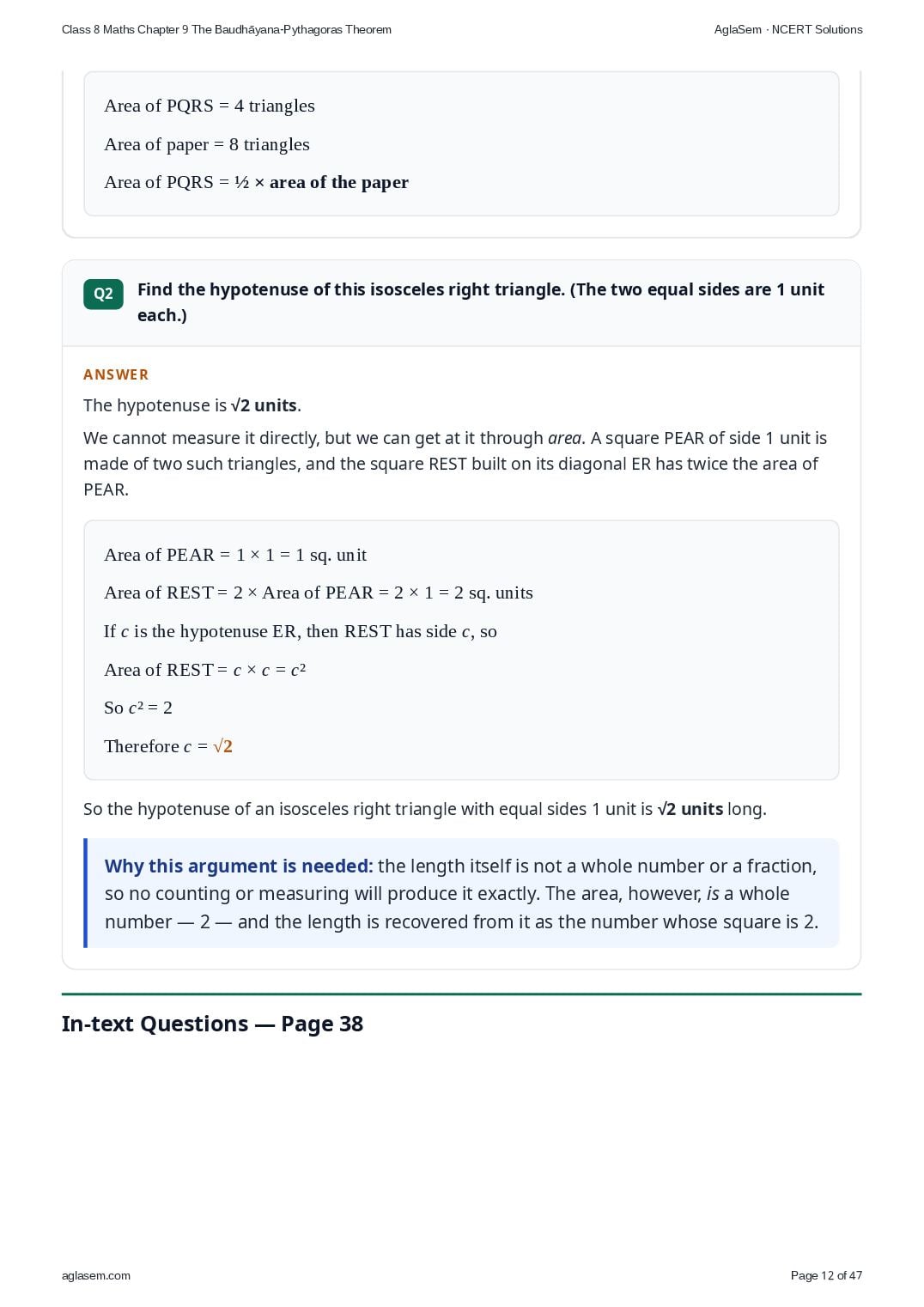
- Find the hypotenuse of this isosceles right triangle. (The two equal sides are 1 unit each.)
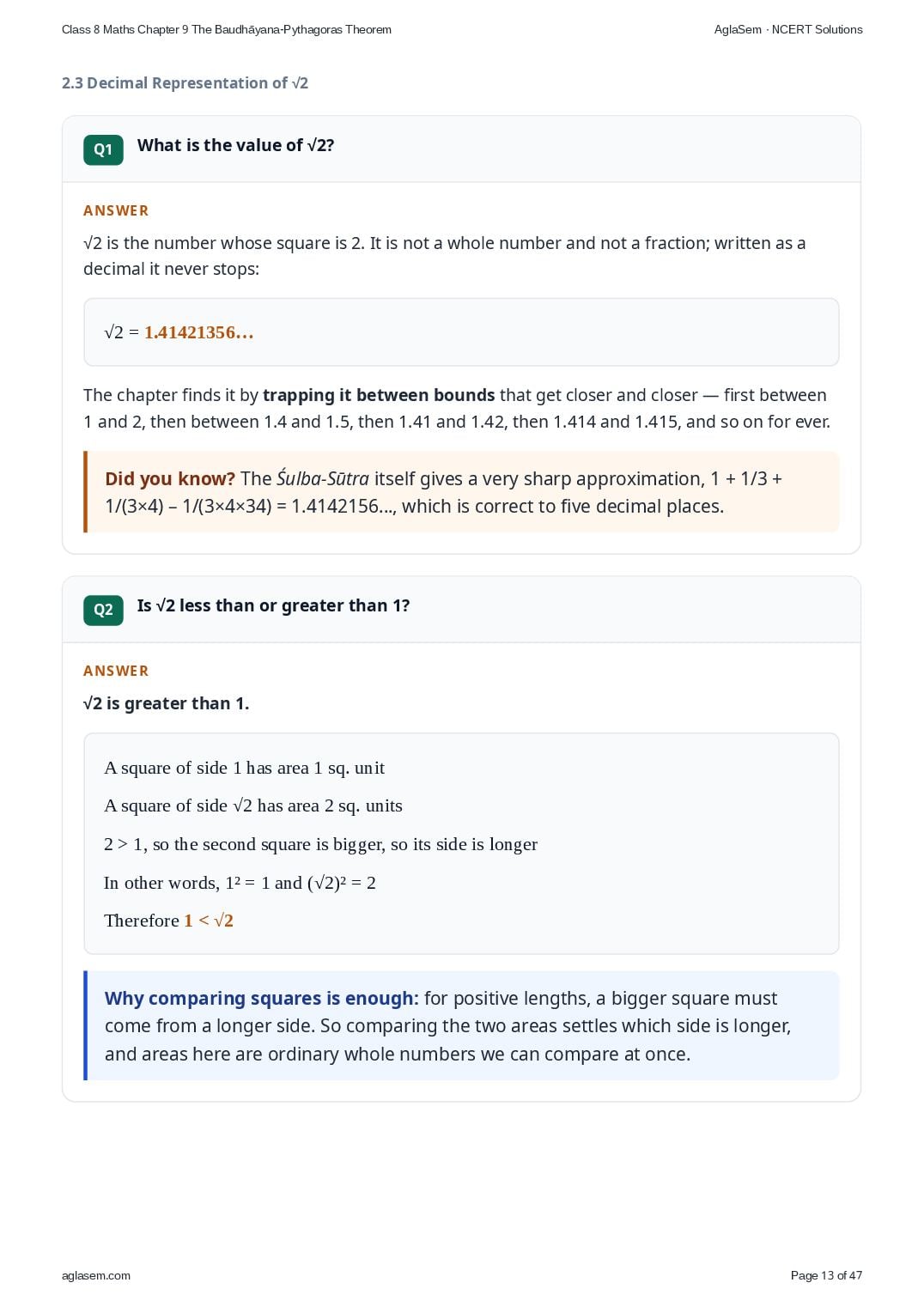
- What is the value of √2?
- Is √2 less than or greater than 1?
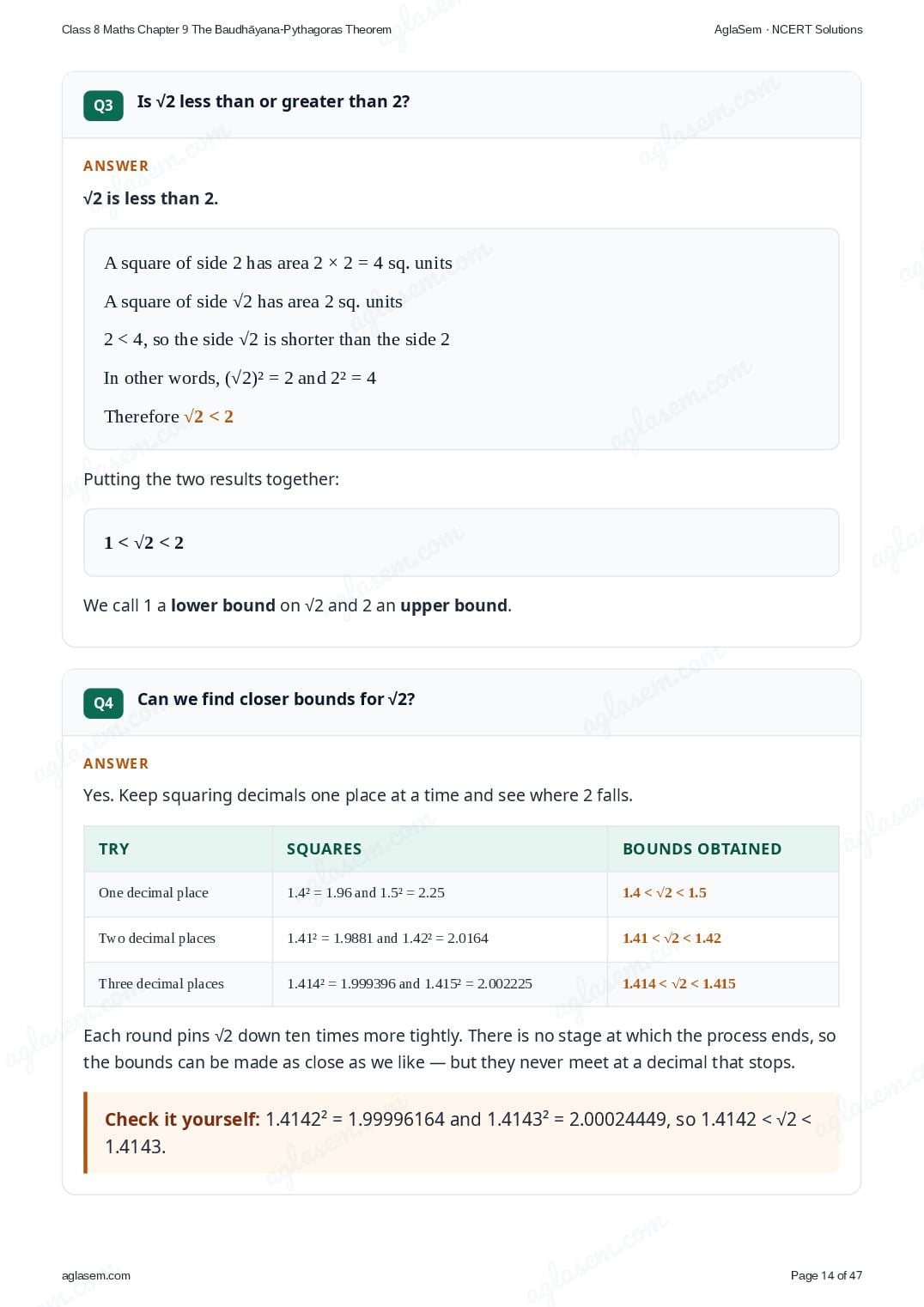
- Is √2 less than or greater than 2?
- Can we find closer bounds for √2?
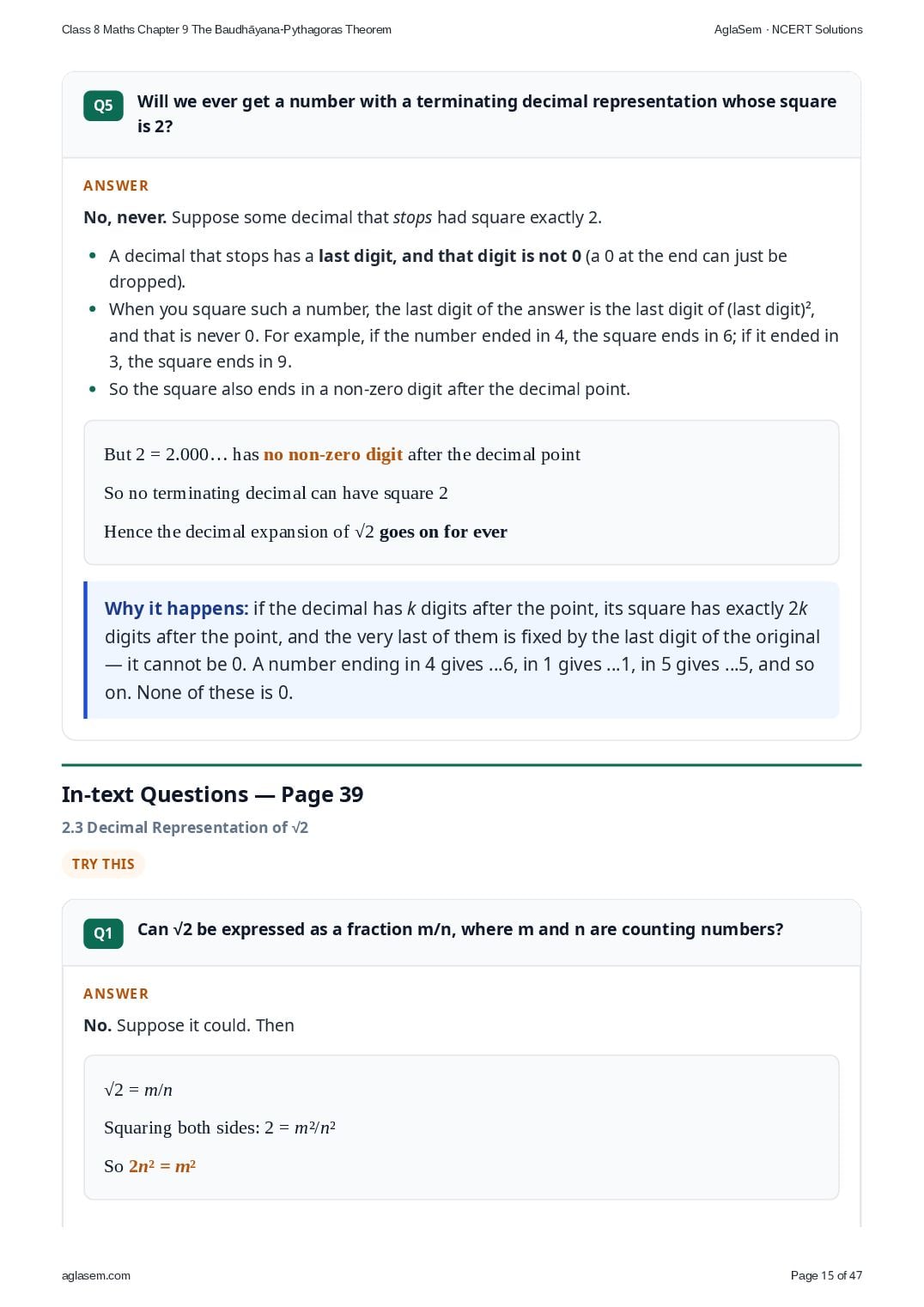
- Will we ever get a number with a terminating decimal representation whose square is 2?
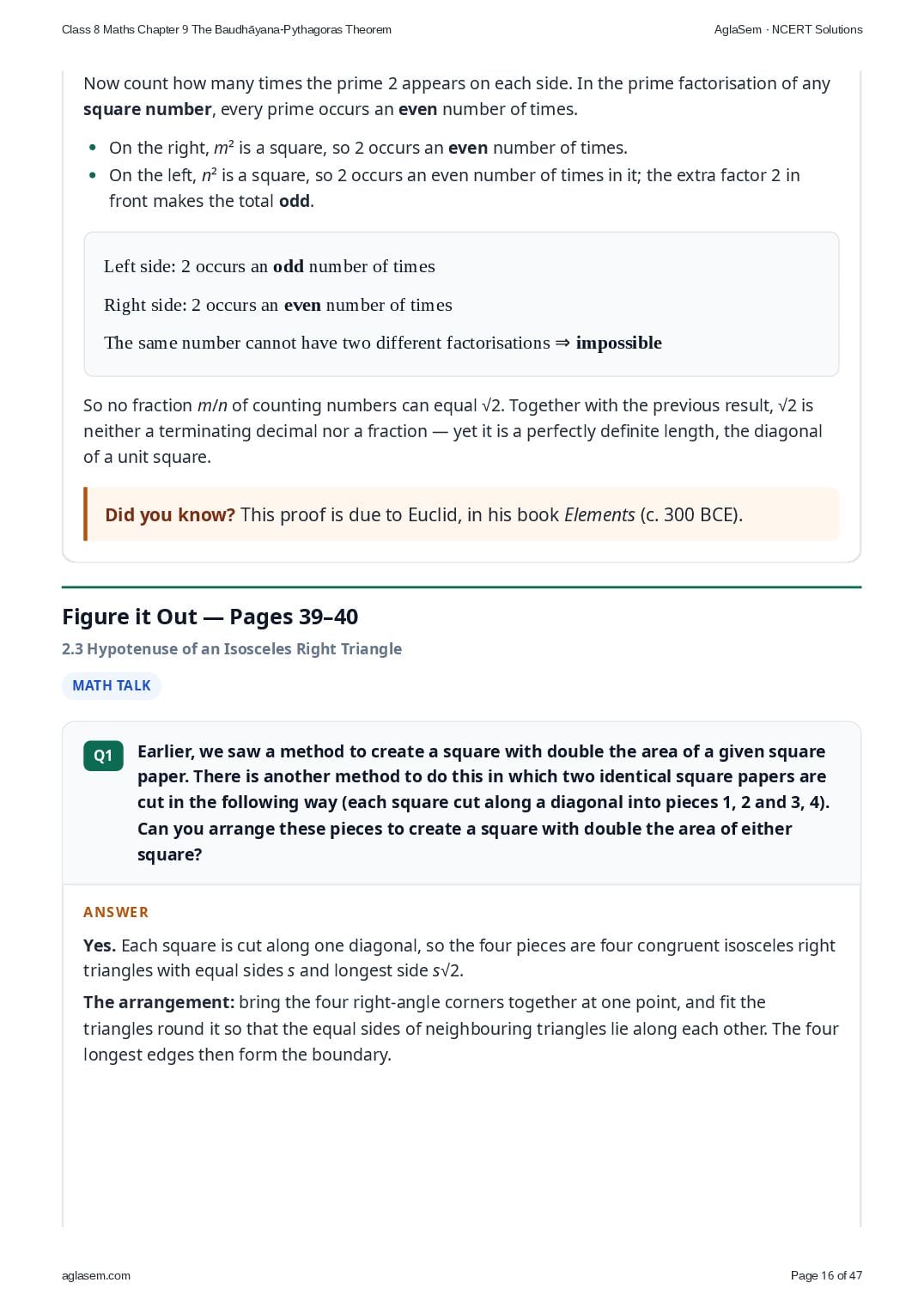
- Can √2 be expressed as a fraction m/n, where m and n are counting numbers?
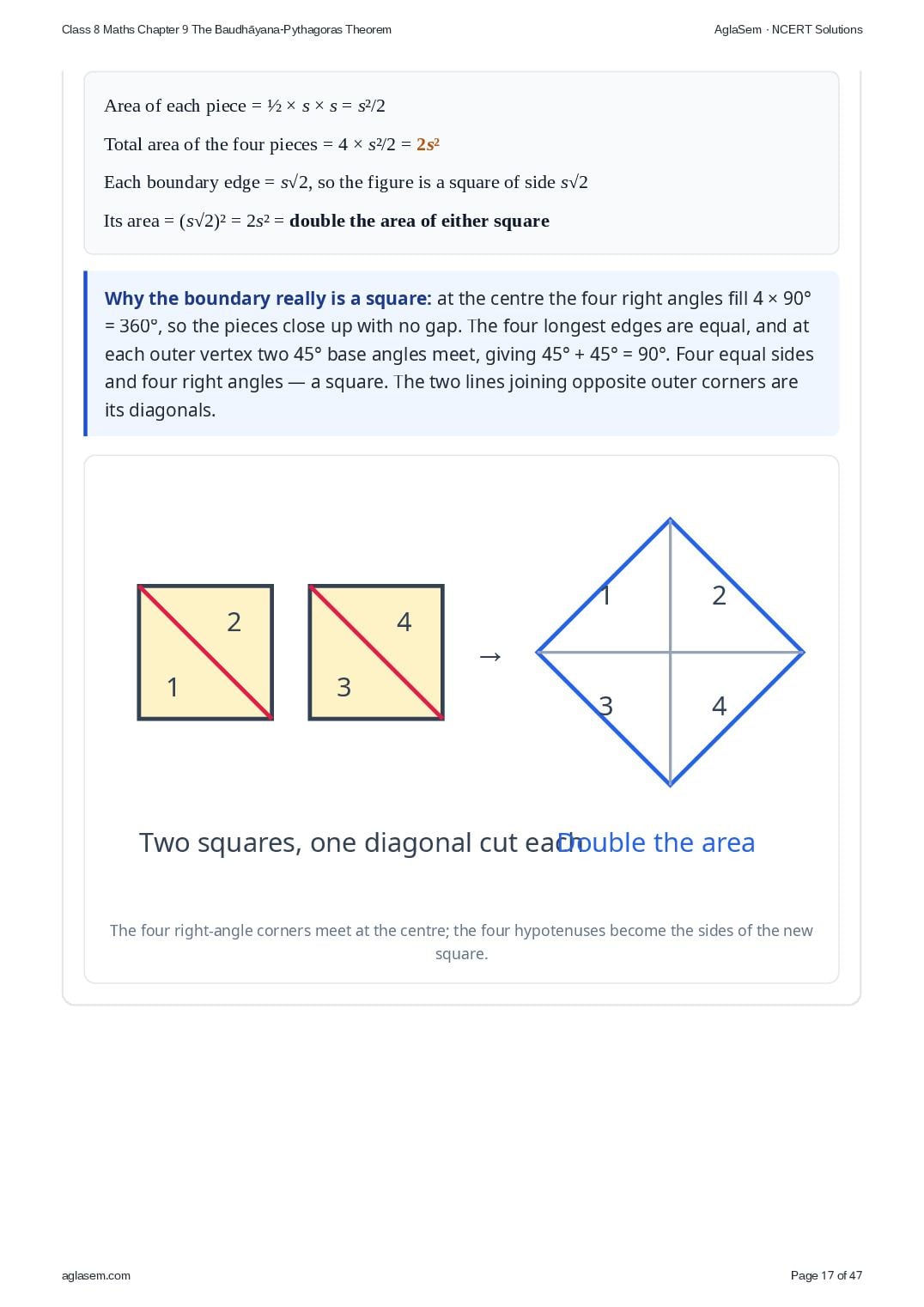
- Earlier, we saw a method to create a square with double the area of a given square paper. There is another method to do this in which two identical square papers are cut in the following way (each square cut along a diagonal into pieces 1, 2 and 3, 4). Can you arrange these pieces to create a square with double the area of either square?
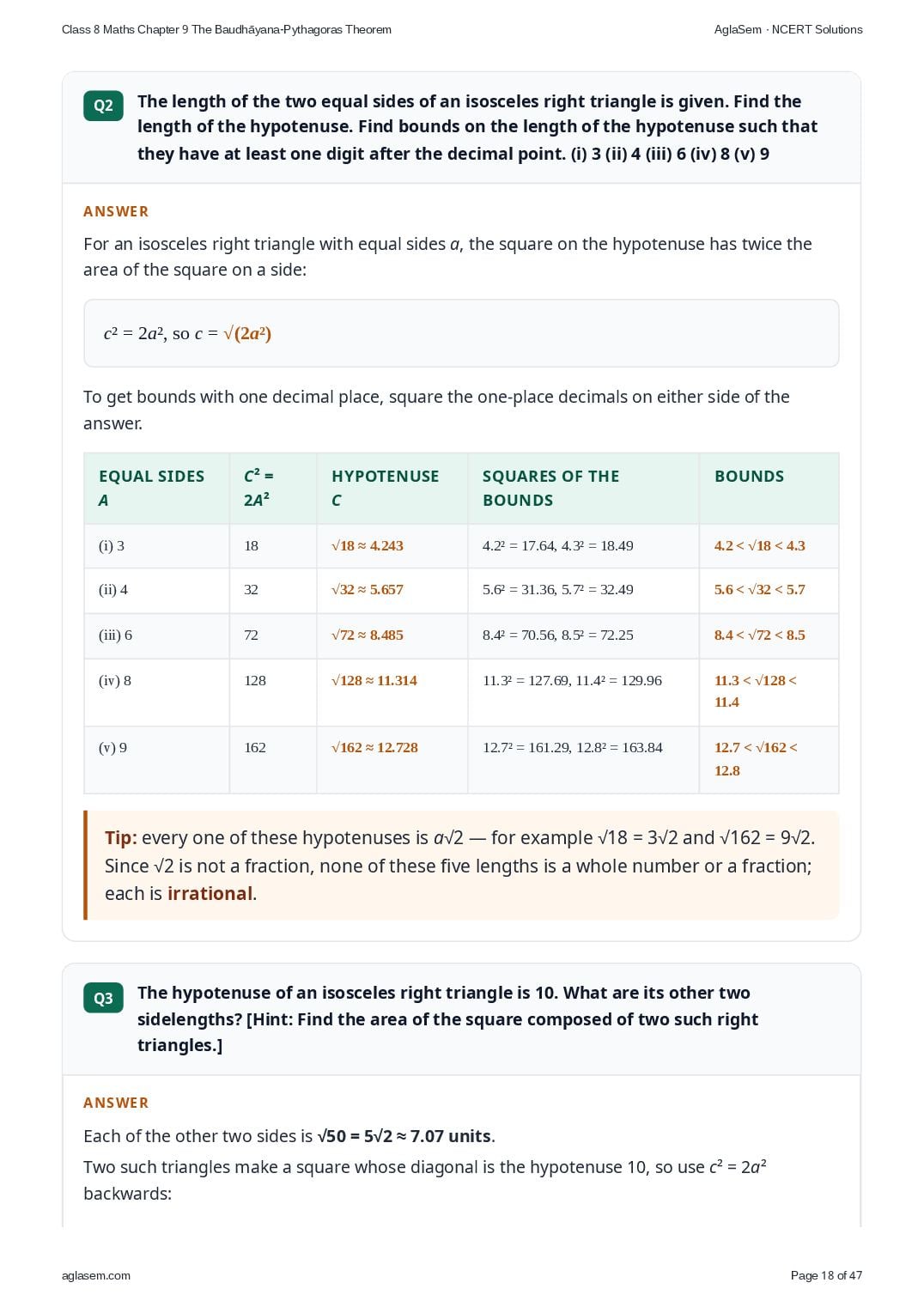
- The length of the two equal sides of an isosceles right triangle is given. Find the length of the hypotenuse. Find bounds on the length of the hypotenuse such that they have at least one digit after the decimal point. (i) 3 (ii) 4 (iii) 6 (iv) 8 (v) 9
- The hypotenuse of an isosceles right triangle is 10. What are its other two sidelengths? [Hint: Find the area of the square composed of two such right triangles.]
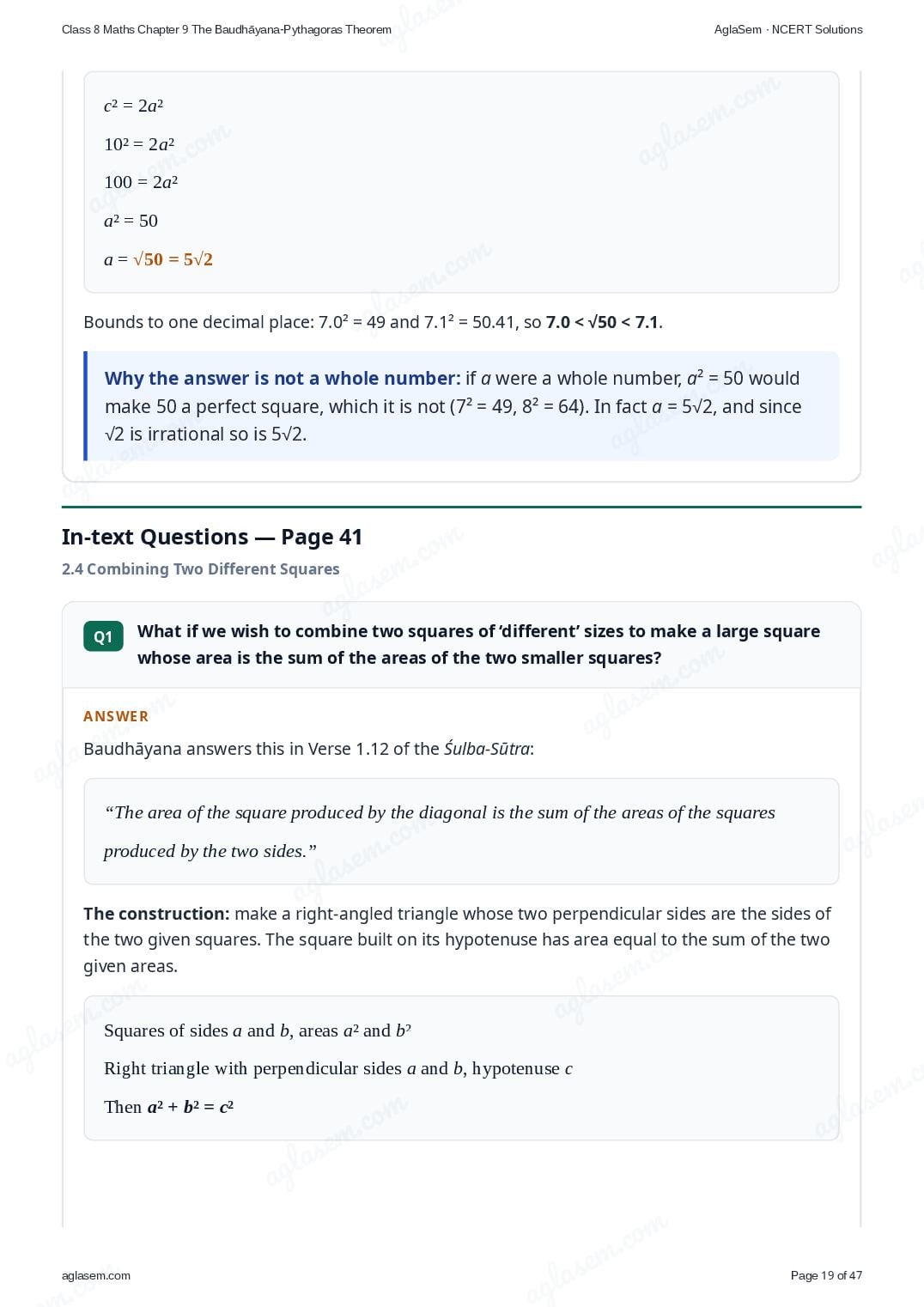
- What if we wish to combine two squares of ‘different’ sizes to make a large square whose area is the sum of the areas of the two smaller squares?
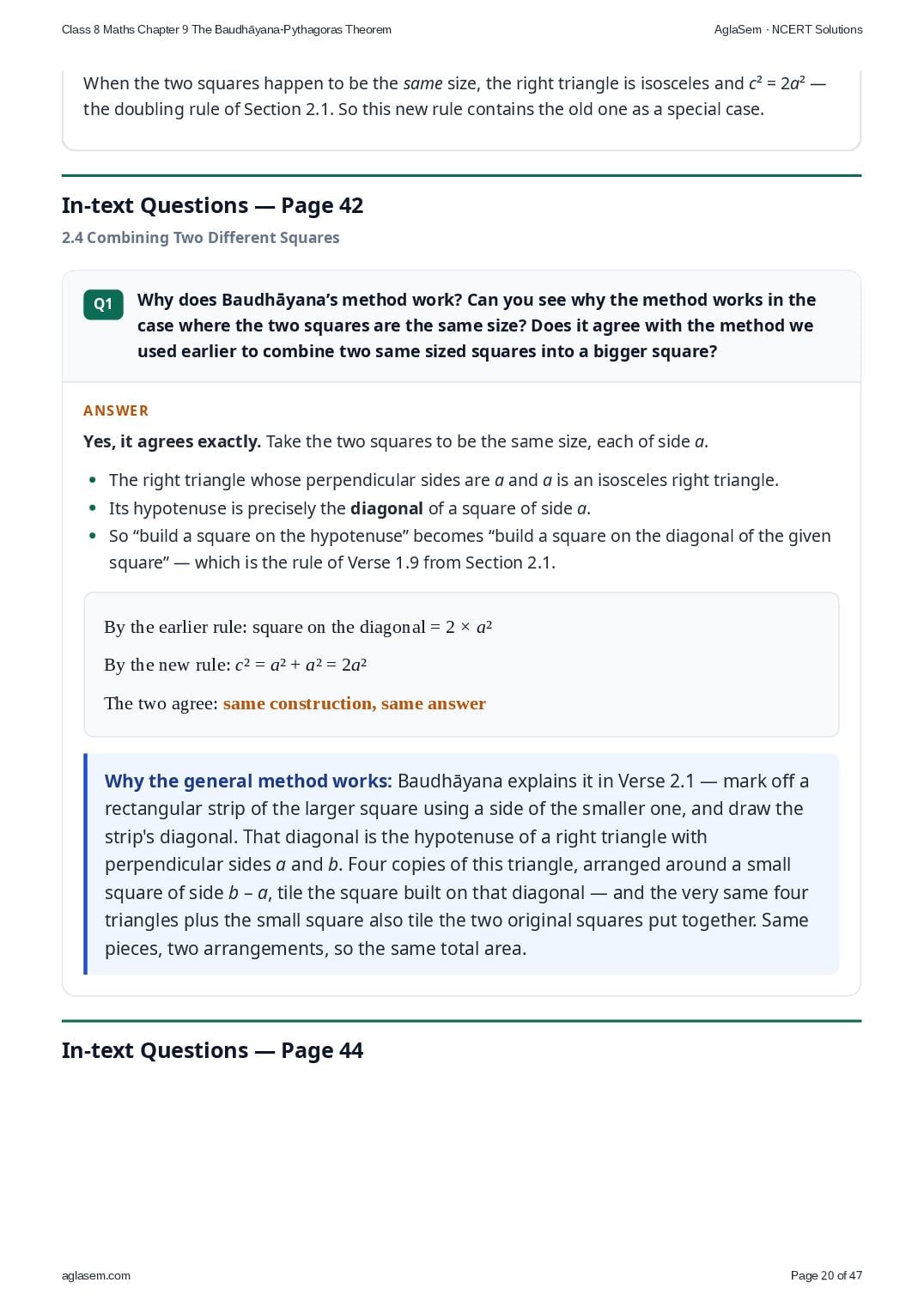
- Why does Baudhāyana’s method work? Can you see why the method works in the case where the two squares are the same size? Does it agree with the method we used earlier to combine two same sized squares into a bigger square?
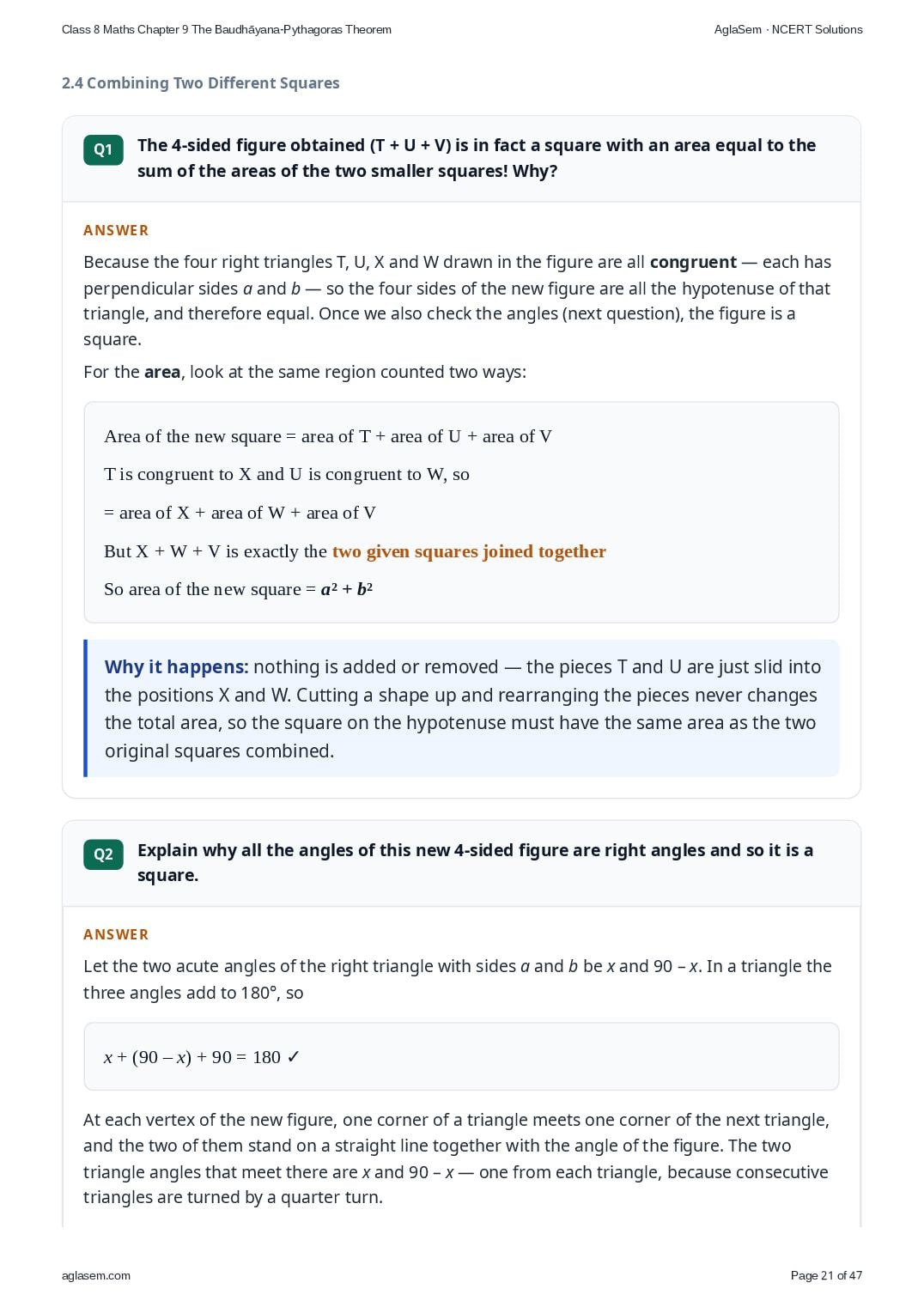
- The 4-sided figure obtained (T + U + V) is in fact a square with an area equal to the sum of the areas of the two smaller squares! Why?
- Explain why all the angles of this new 4-sided figure are right angles and so it is a square.
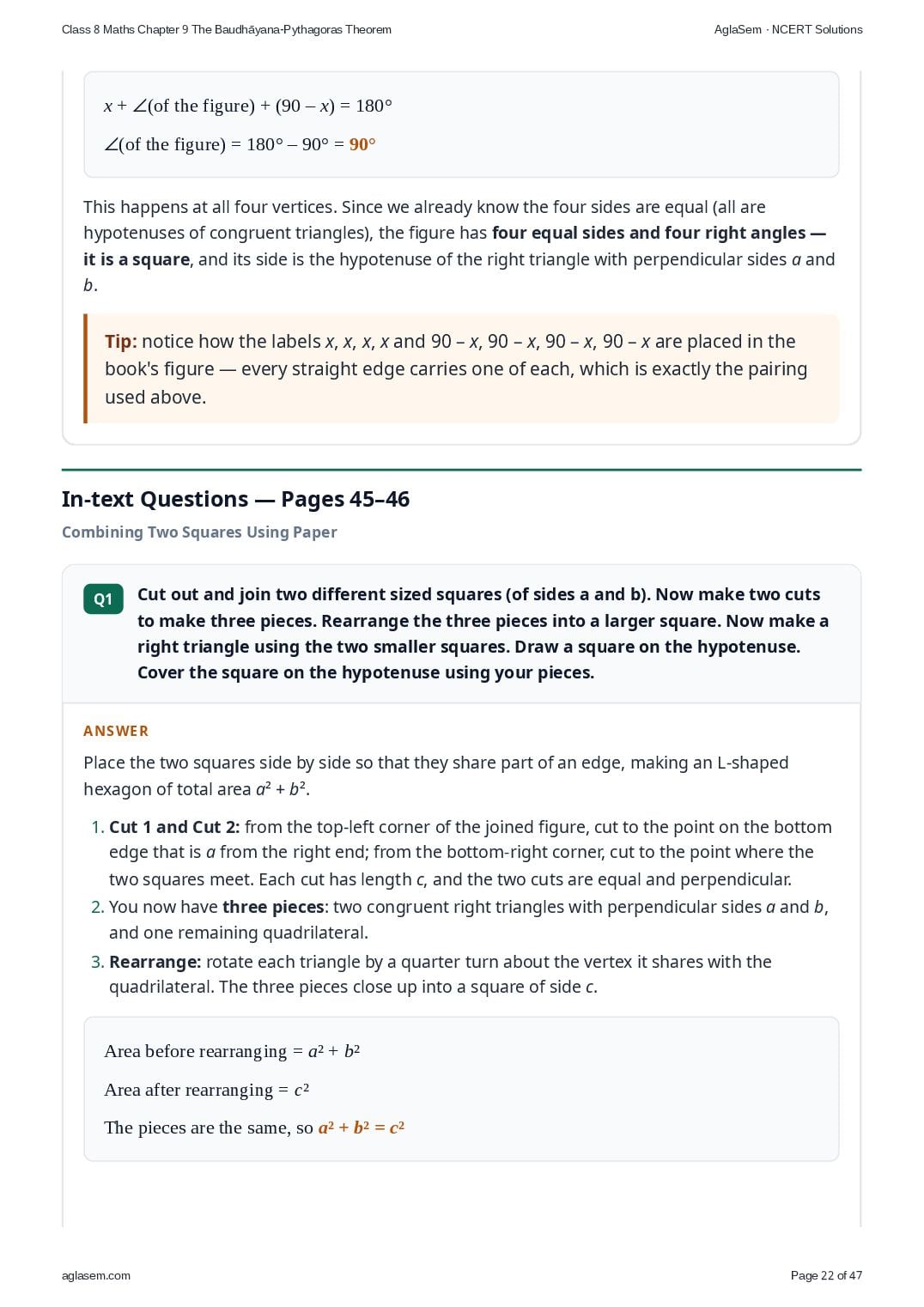
- Cut out and join two different sized squares (of sides a and b). Now make two cuts to make three pieces. Rearrange the three pieces into a larger square. Now make a right triangle using the two smaller squares. Draw a square on the hypotenuse. Cover the square on the hypotenuse using your pieces.
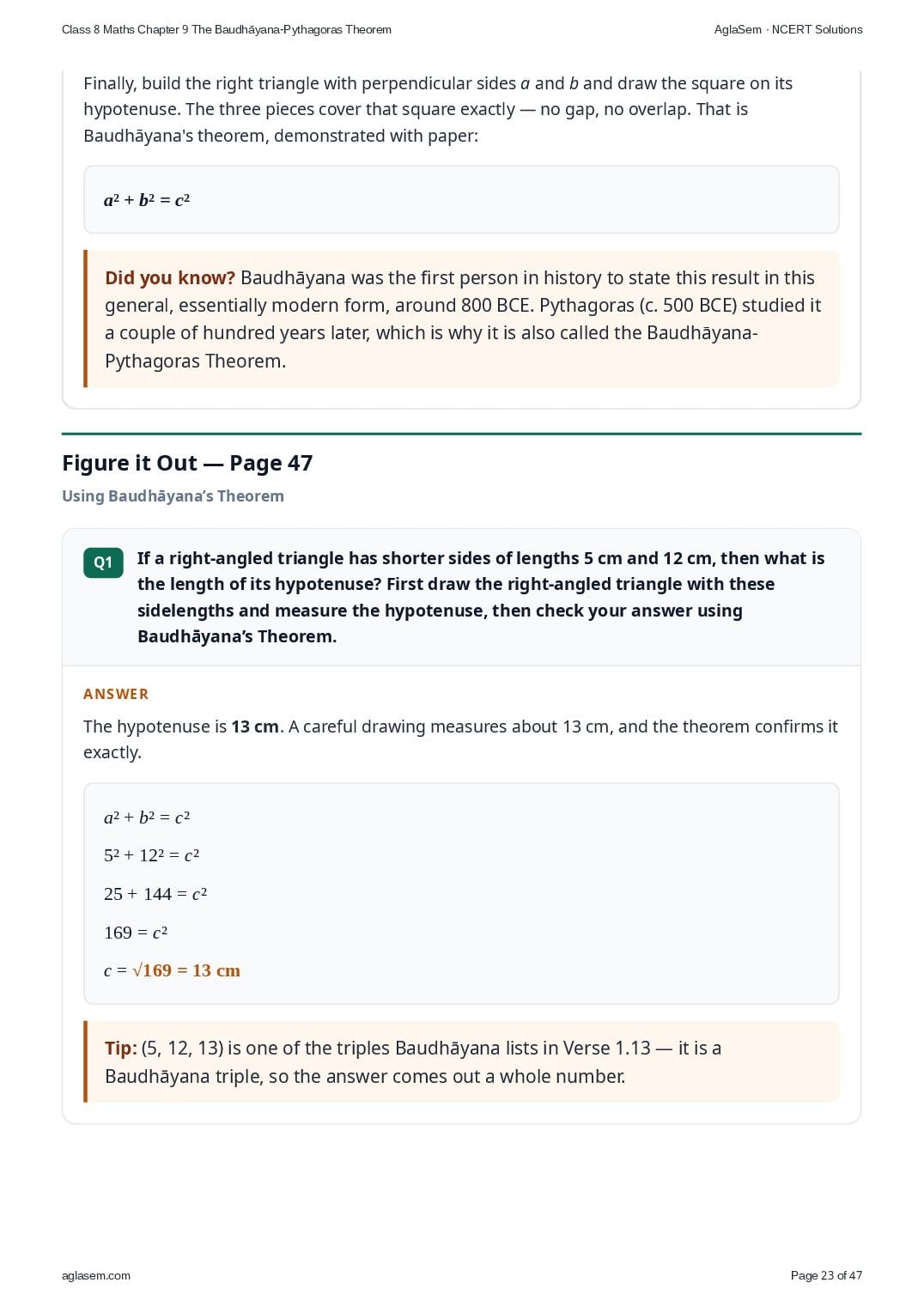
- If a right-angled triangle has shorter sides of lengths 5 cm and 12 cm, then what is the length of its hypotenuse? First draw the right-angled triangle with these sidelengths and measure the hypotenuse, then check your answer using Baudhāyana’s Theorem.
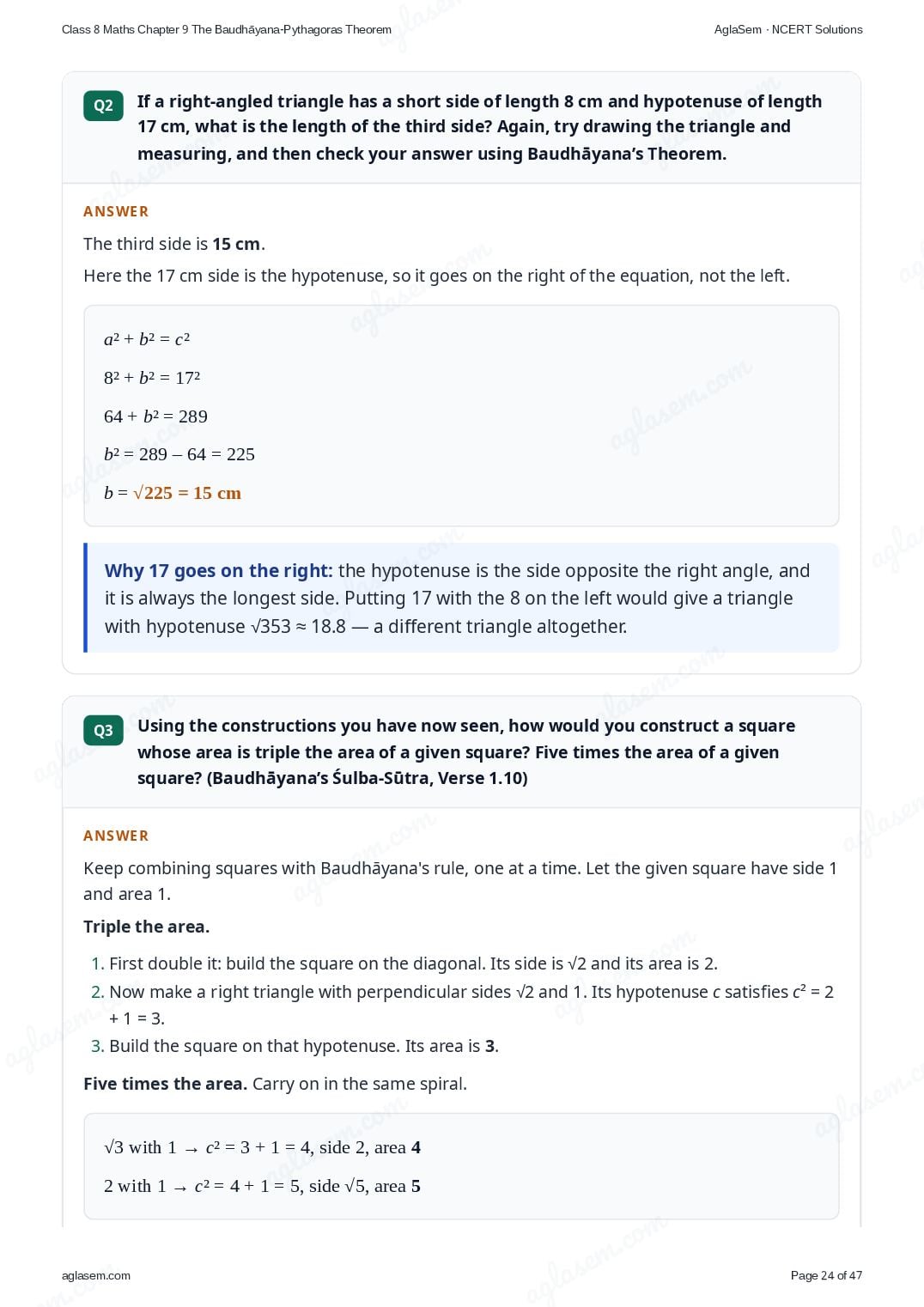
- If a right-angled triangle has a short side of length 8 cm and hypotenuse of length 17 cm, what is the length of the third side? Again, try drawing the triangle and measuring, and then check your answer using Baudhāyana’s Theorem.
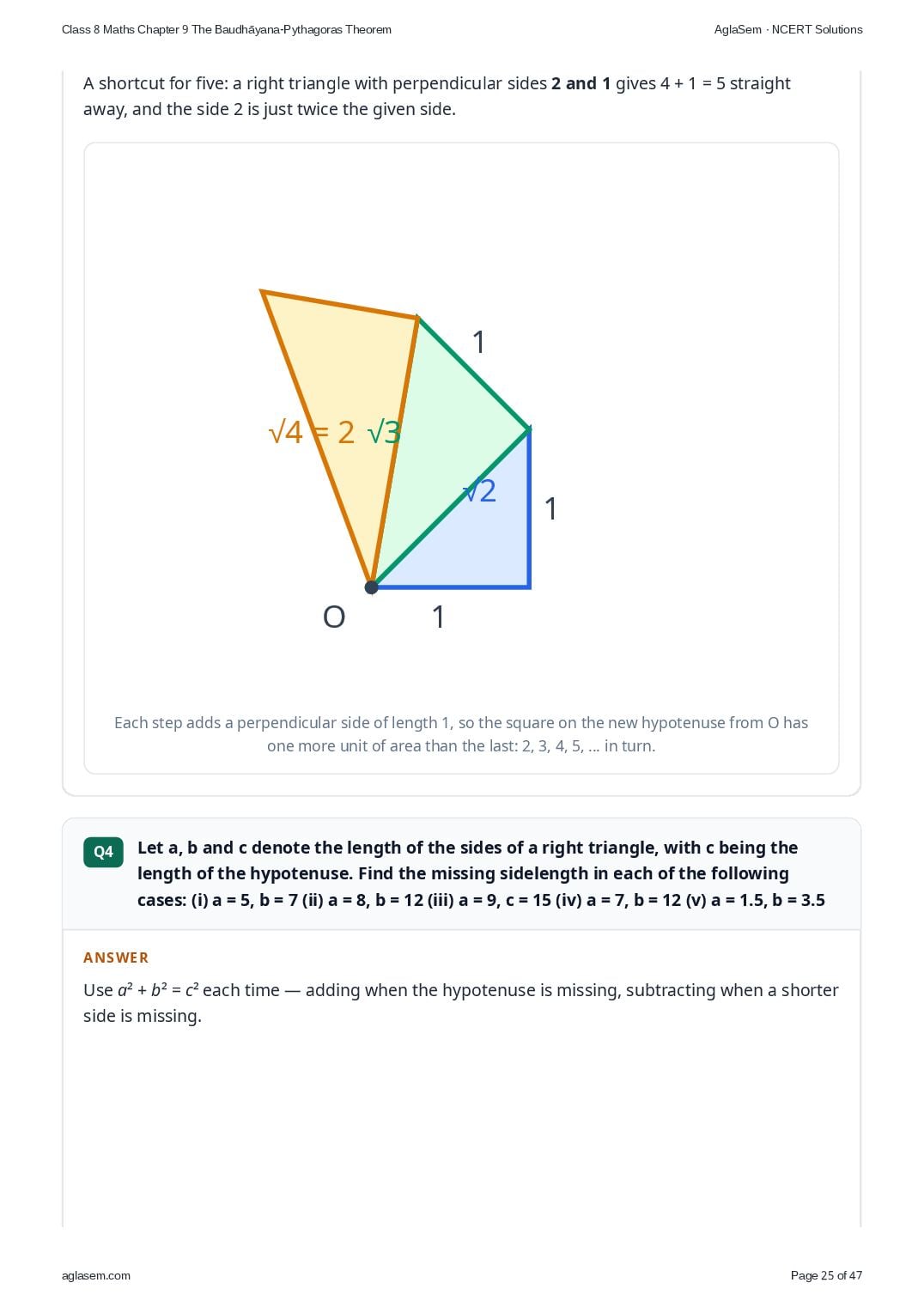
- Using the constructions you have now seen, how would you construct a square whose area is triple the area of a given square? Five times the area of a given square? (Baudhāyana’s Śulba-Sūtra, Verse 1.10)
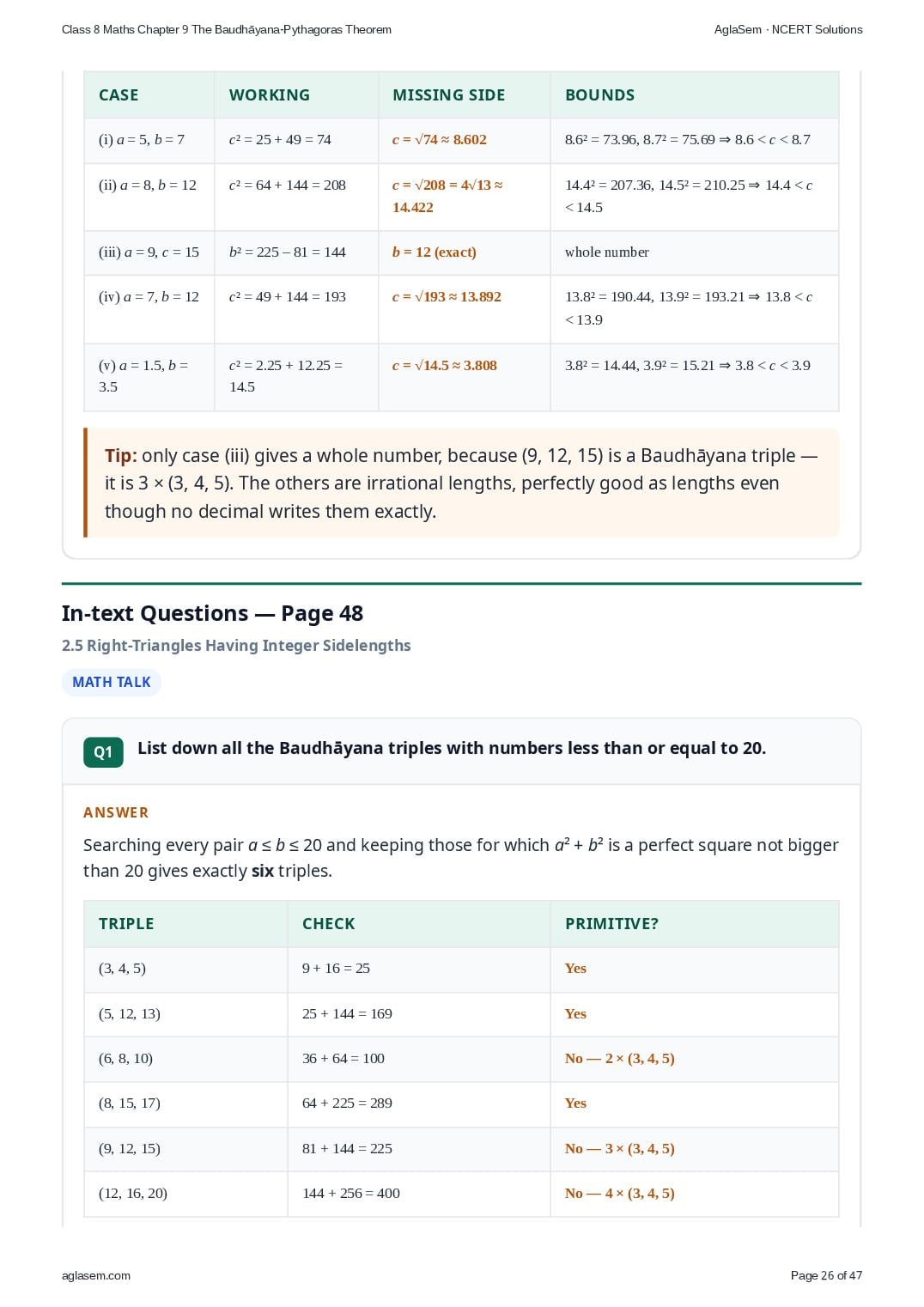
- Let a, b and c denote the length of the sides of a right triangle, with c being the length of the hypotenuse. Find the missing sidelength in each of the following cases: (i) a = 5, b = 7 (ii) a = 8, b = 12 (iii) a = 9, c = 15 (iv) a = 7, b = 12 (v) a = 1.5, b = 3.5
- List down all the Baudhāyana triples with numbers less than or equal to 20.
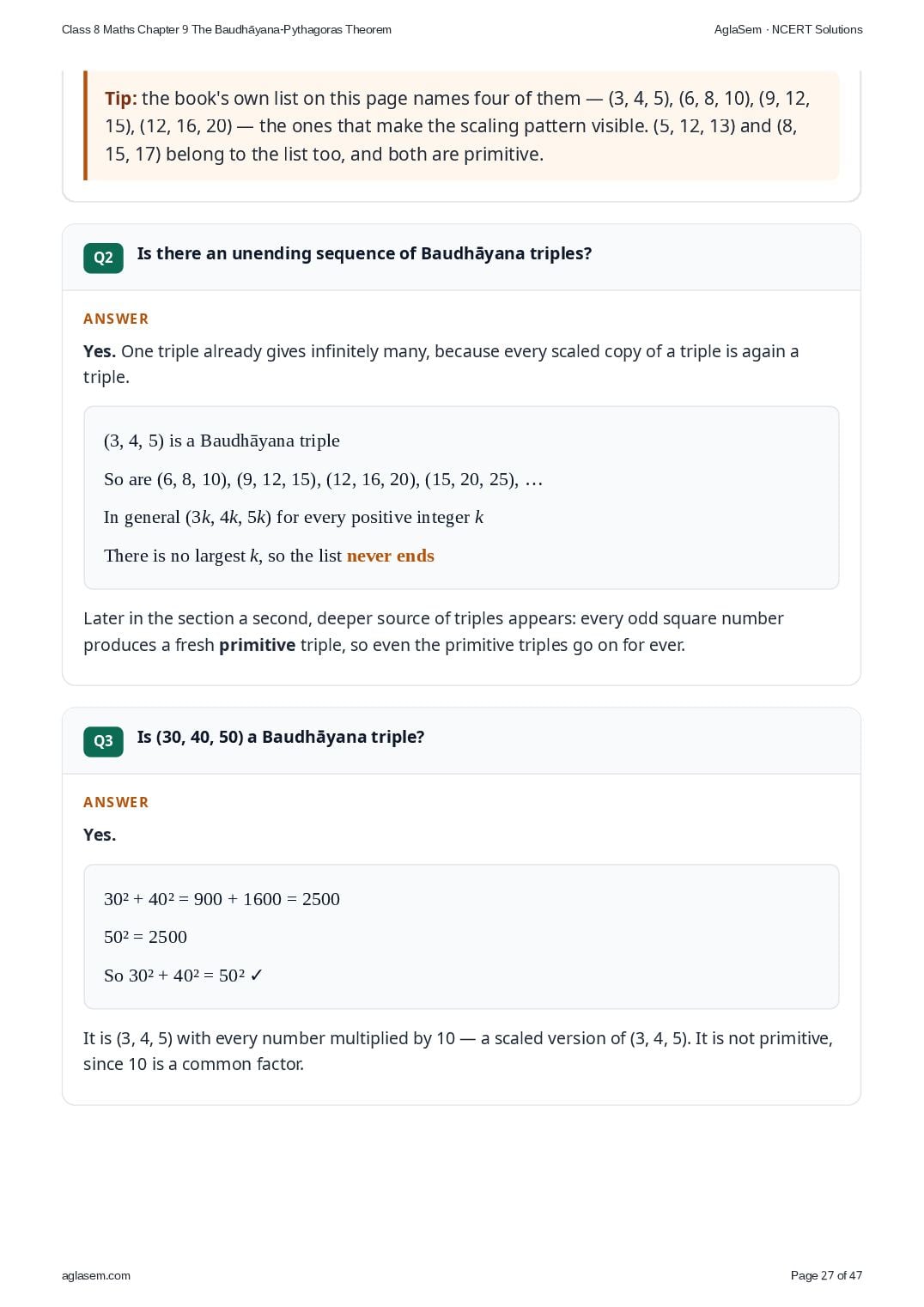
- Is there an unending sequence of Baudhāyana triples?
- Is (30, 40, 50) a Baudhāyana triple?
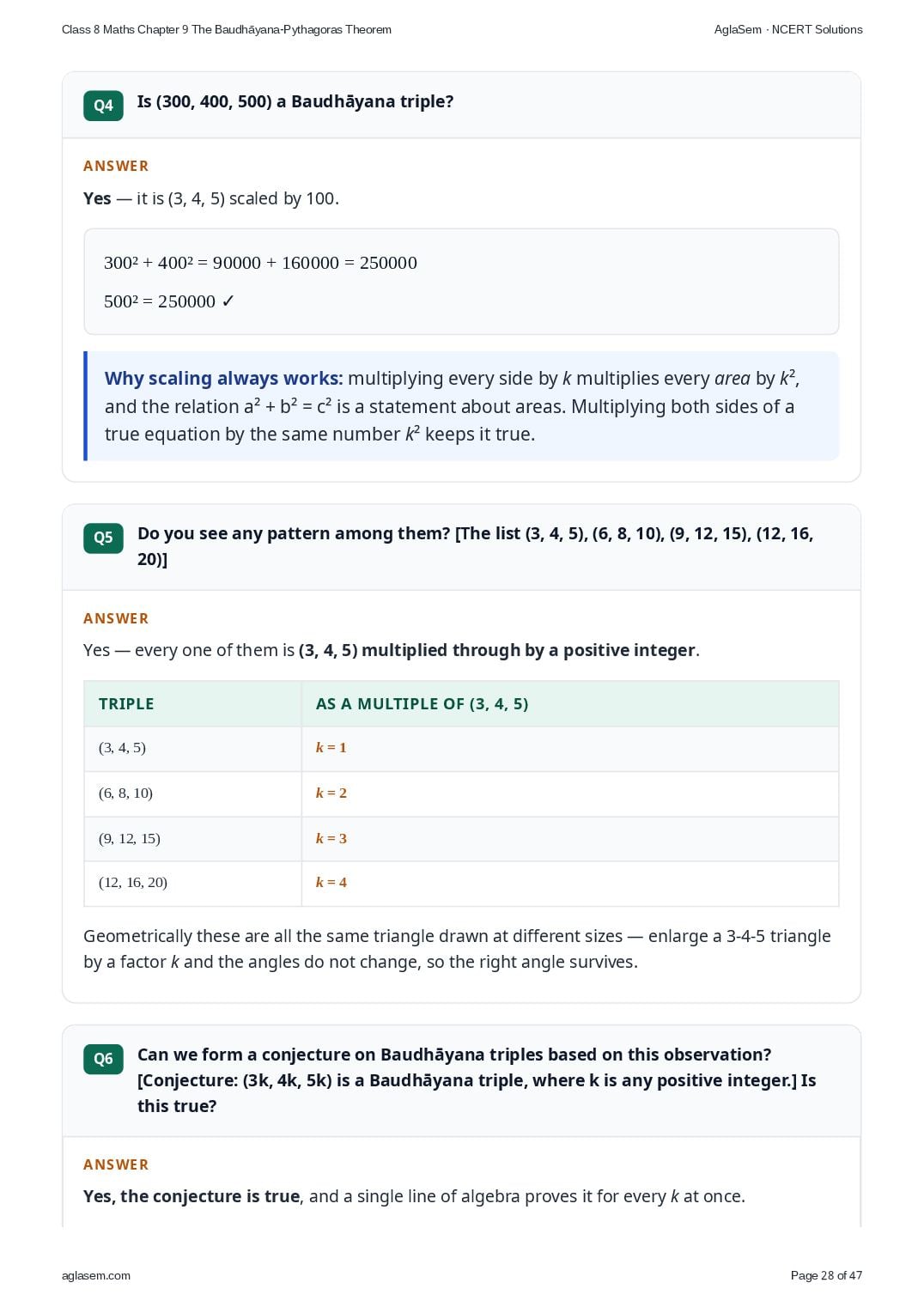
- Is (300, 400, 500) a Baudhāyana triple?
- Do you see any pattern among them? [The list (3, 4, 5), (6, 8, 10), (9, 12, 15), (12, 16, 20)]
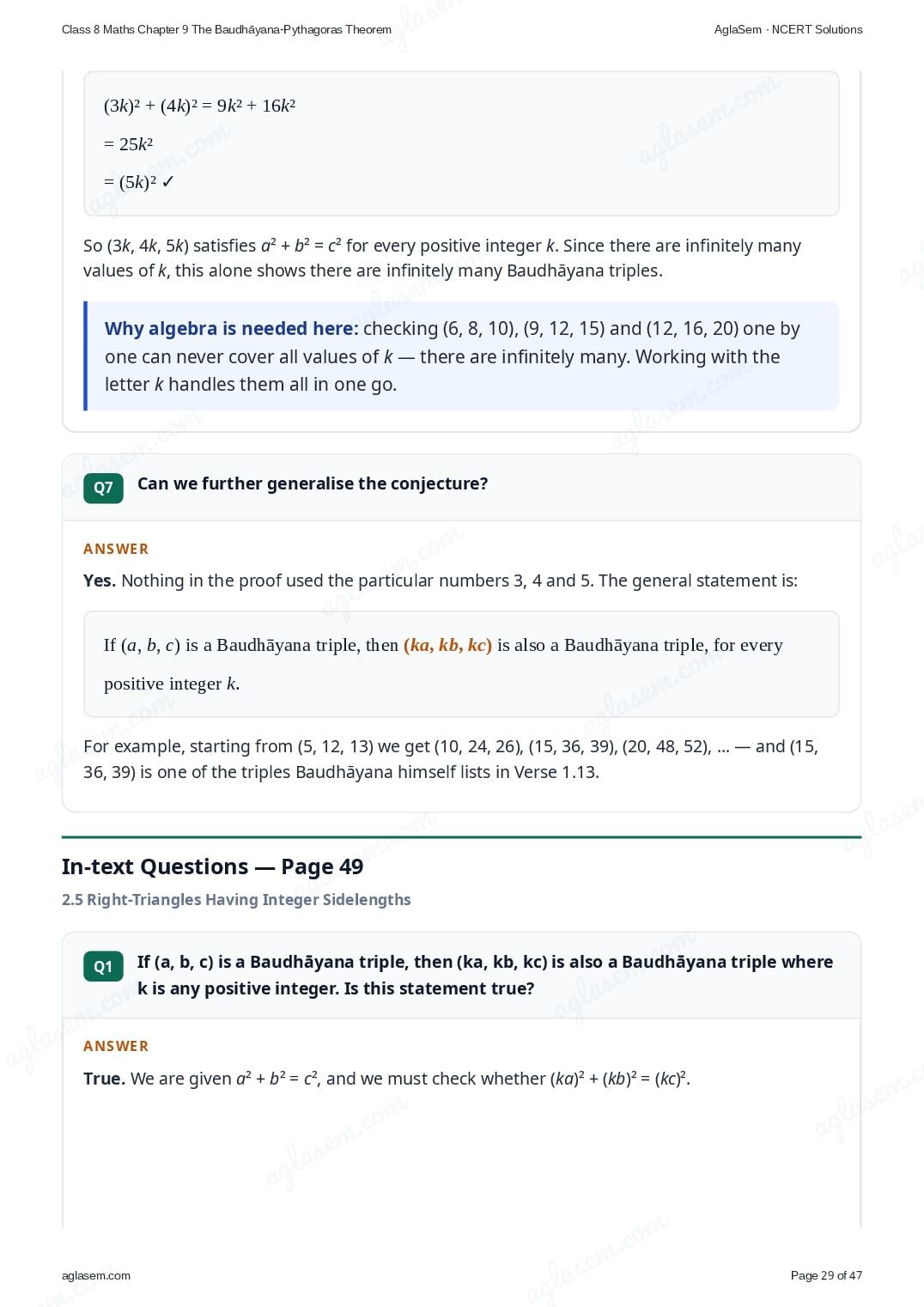
- Can we form a conjecture on Baudhāyana triples based on this observation? [Conjecture: (3k, 4k, 5k) is a Baudhāyana triple, where k is any positive integer.] Is this true?
- Can we further generalise the conjecture?
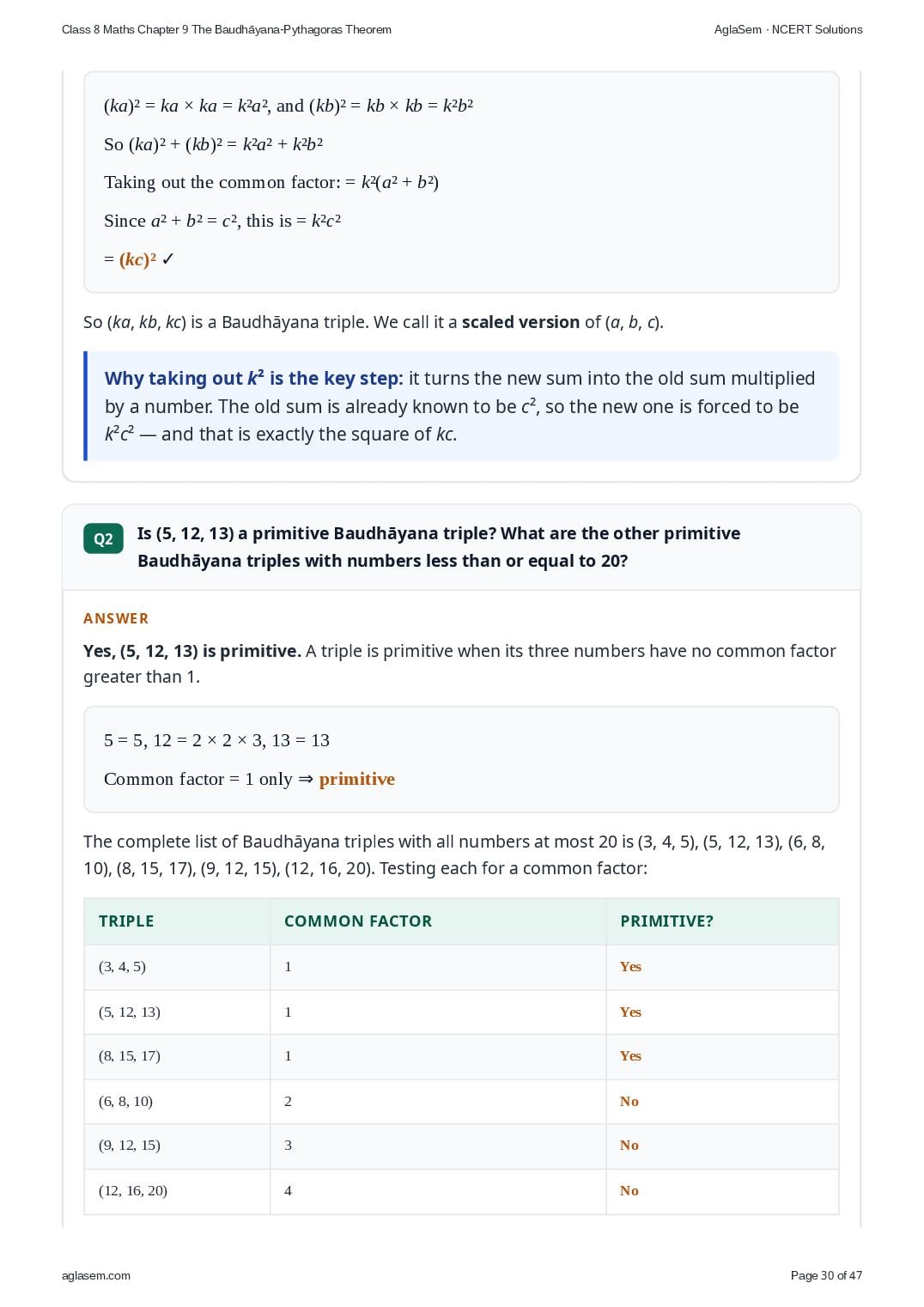
- If (a, b, c) is a Baudhāyana triple, then (ka, kb, kc) is also a Baudhāyana triple where k is any positive integer. Is this statement true?
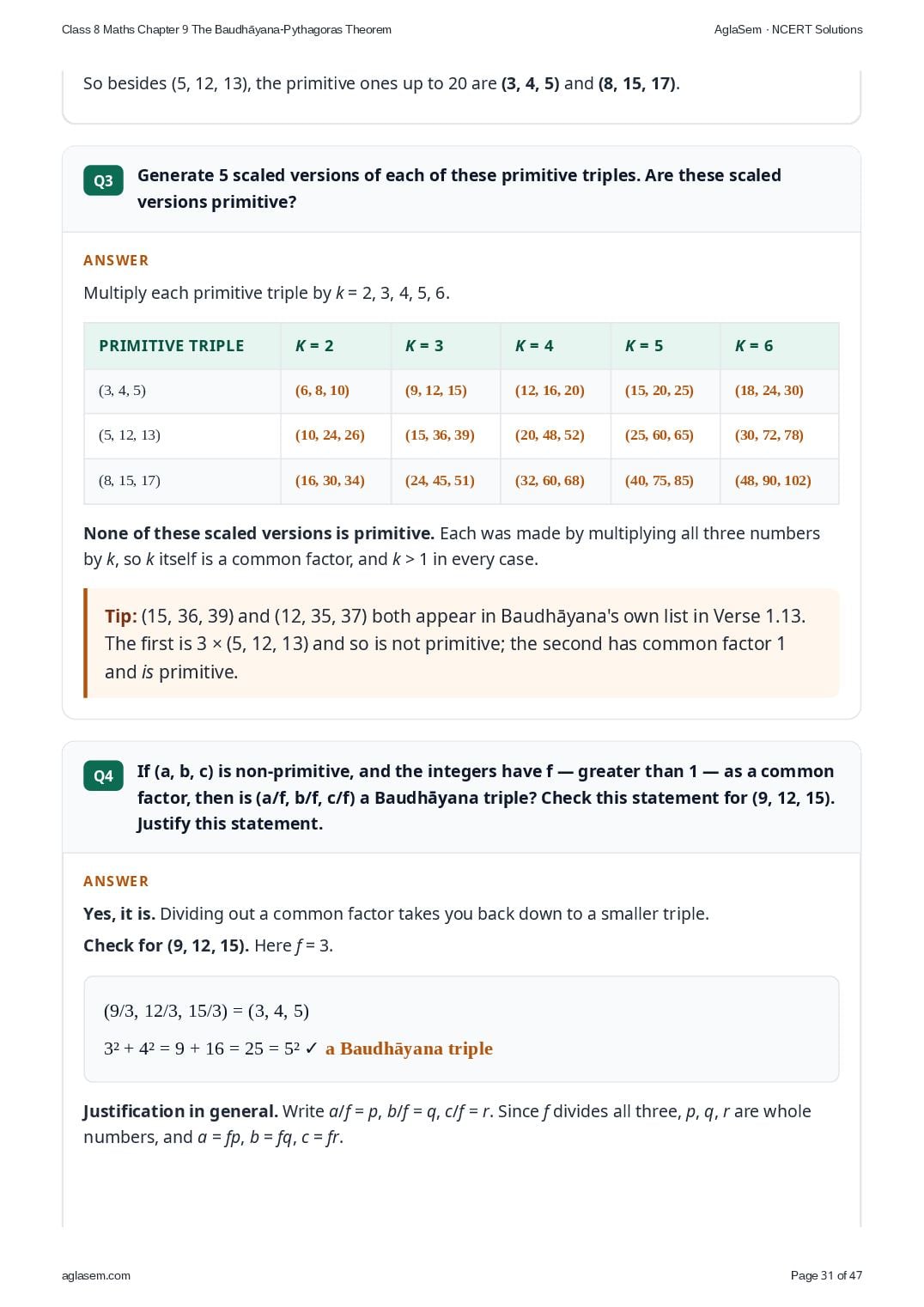
- Is (5, 12, 13) a primitive Baudhāyana triple? What are the other primitive Baudhāyana triples with numbers less than or equal to 20?
- Generate 5 scaled versions of each of these primitive triples. Are these scaled versions primitive?
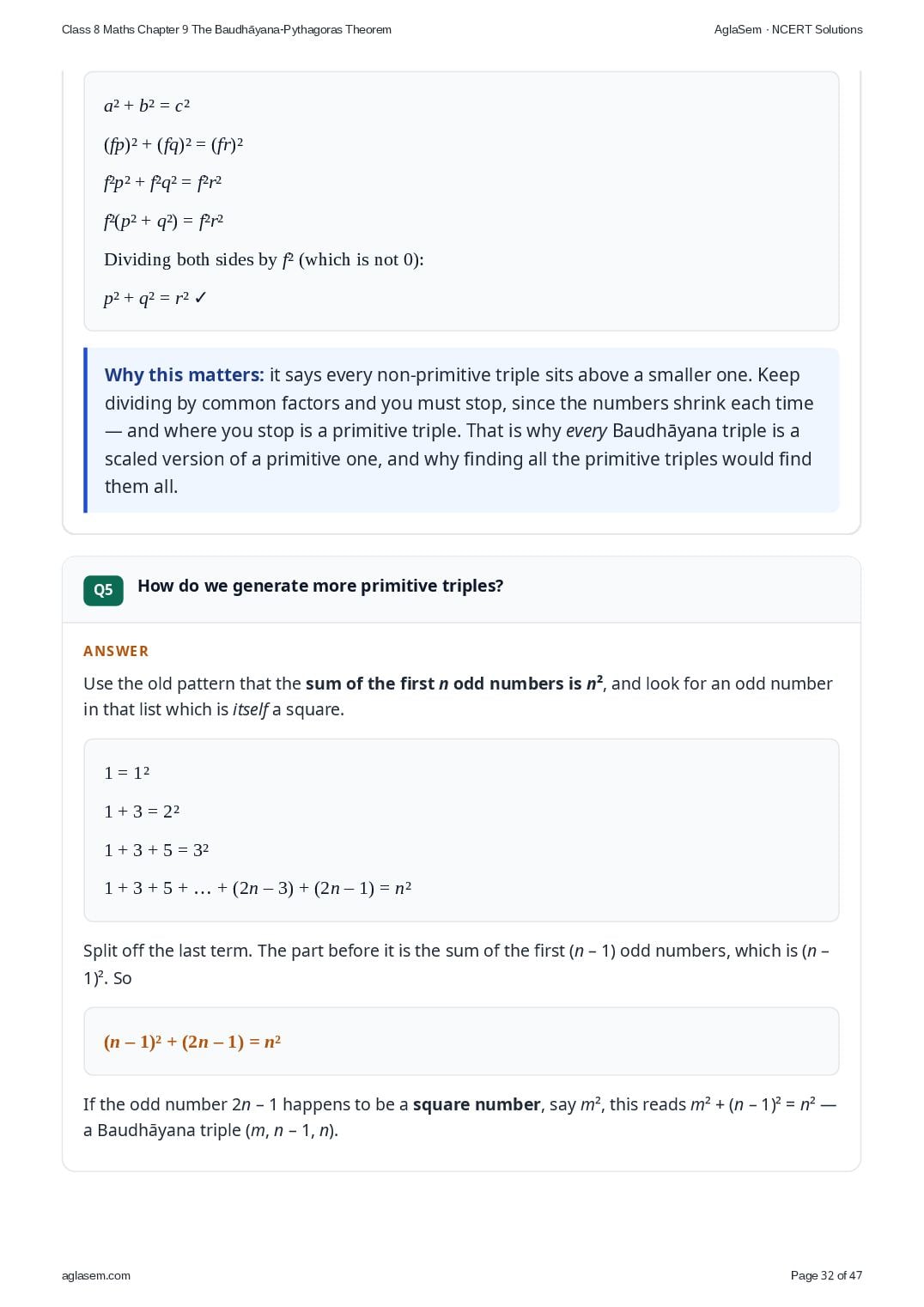
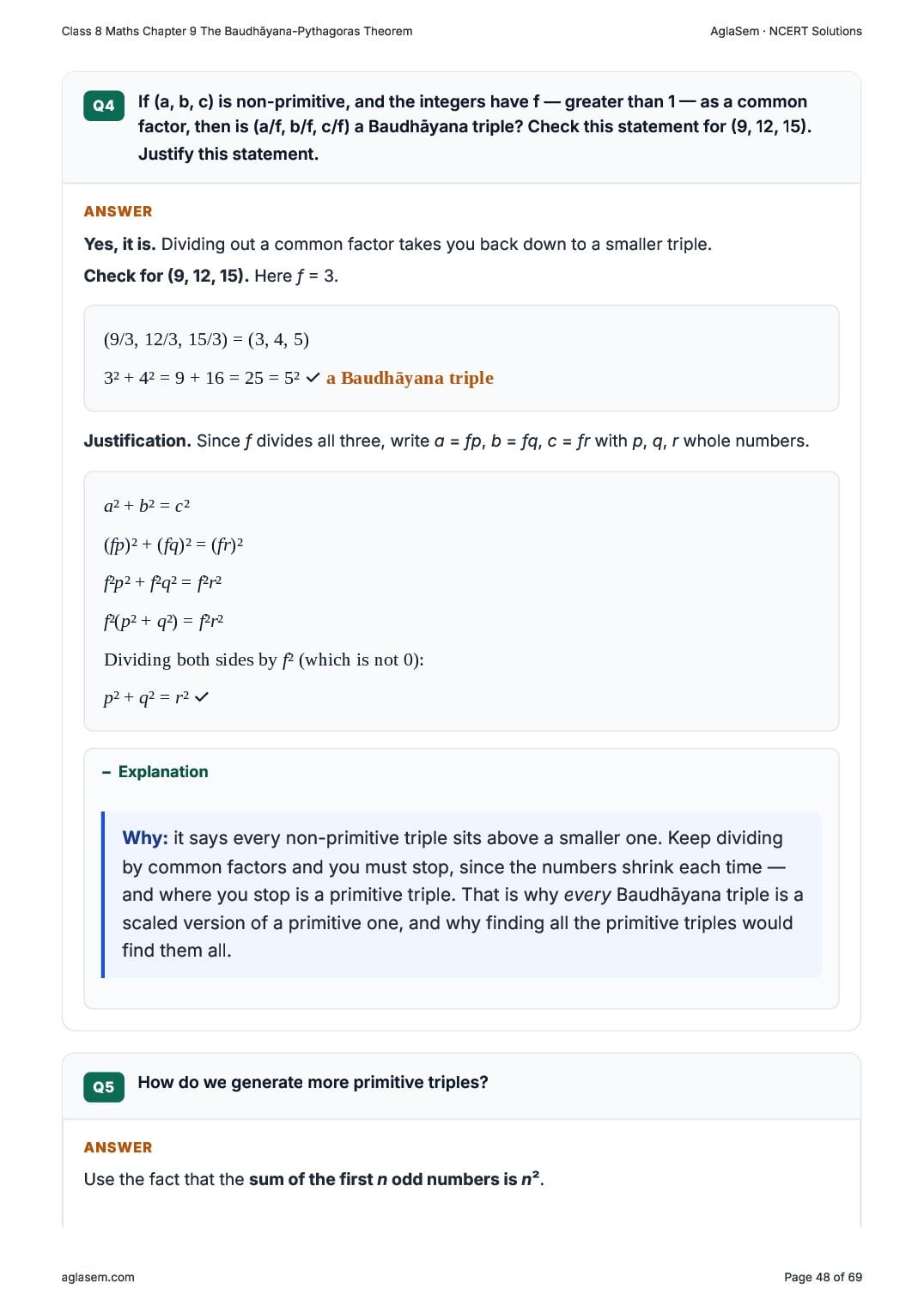
- If (a, b, c) is non-primitive, and the integers have f — greater than 1 — as a common factor, then is (a/f, b/f, c/f) a Baudhāyana triple? Check this statement for (9, 12, 15). Justify this statement.
- How do we generate more primitive triples?
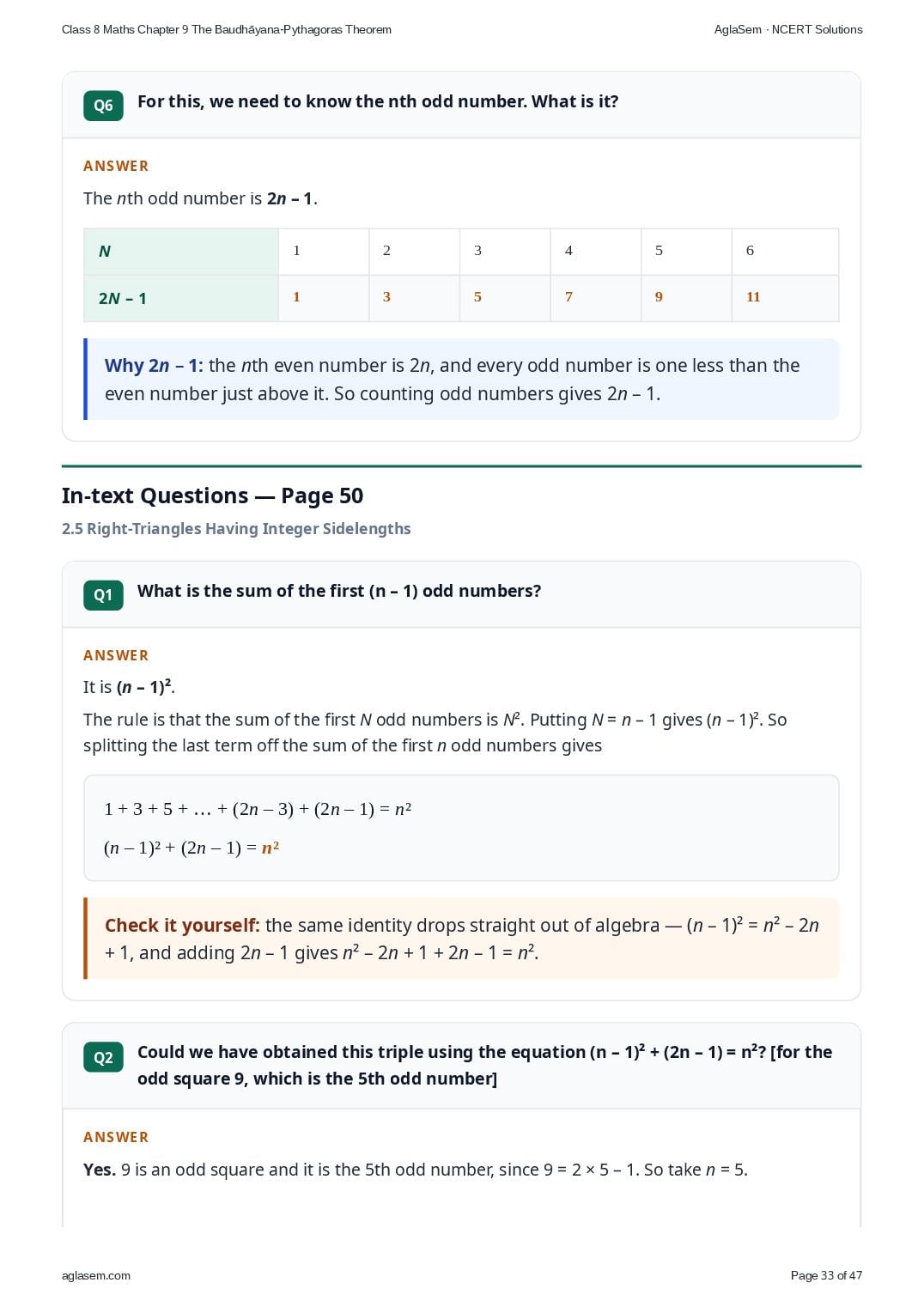
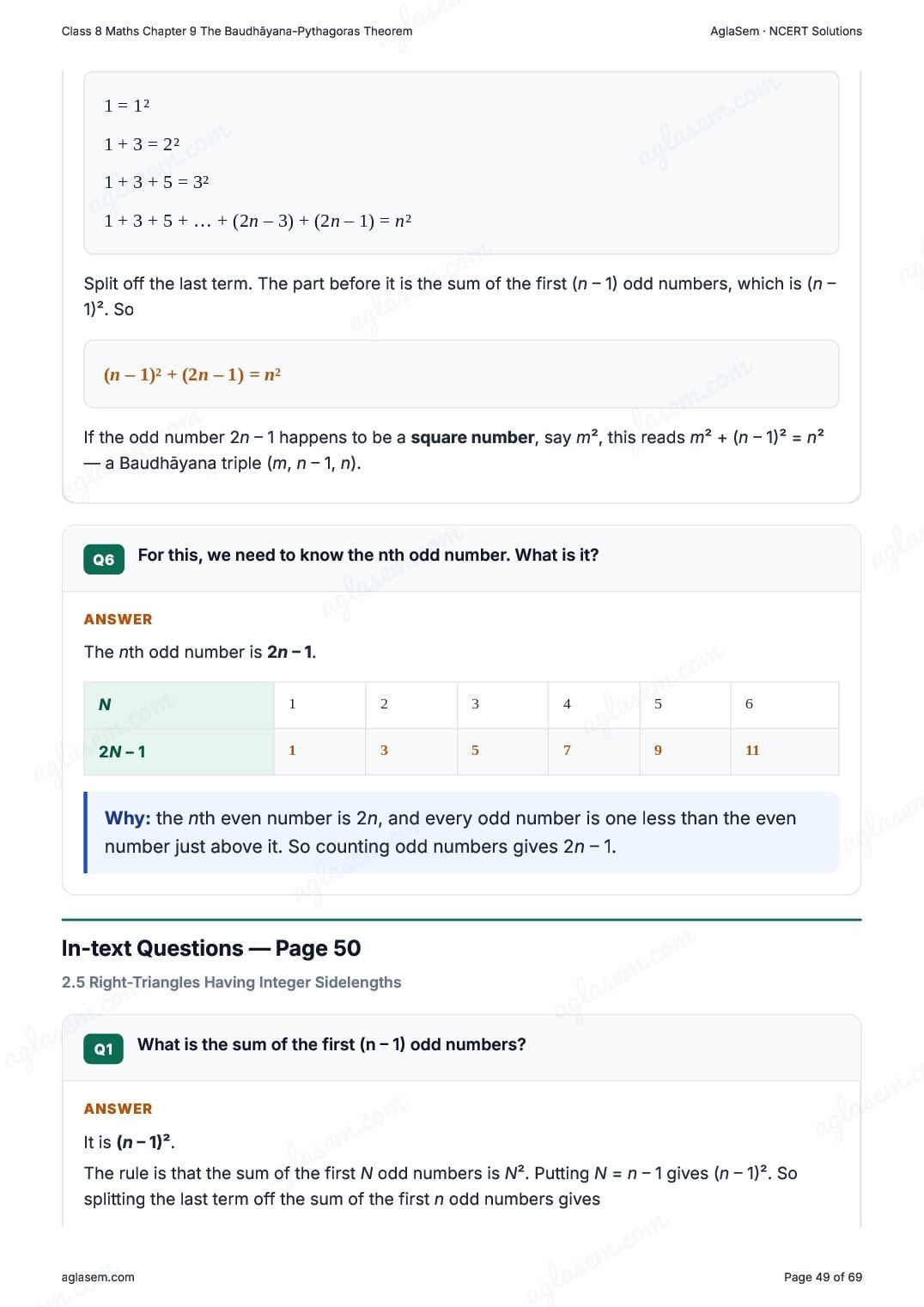
- For this, we need to know the nth odd number. What is it?
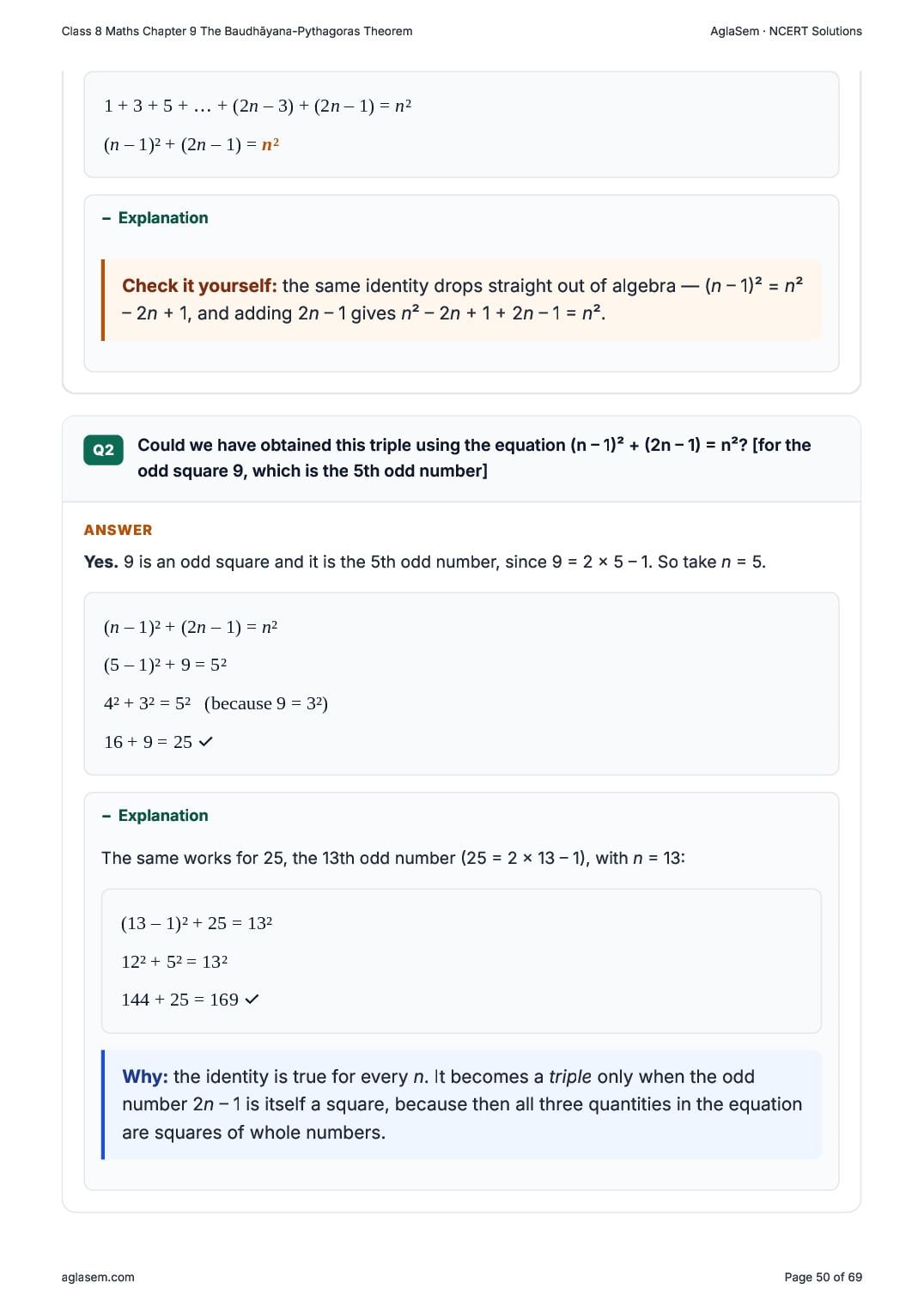
- What is the sum of the first (n – 1) odd numbers?
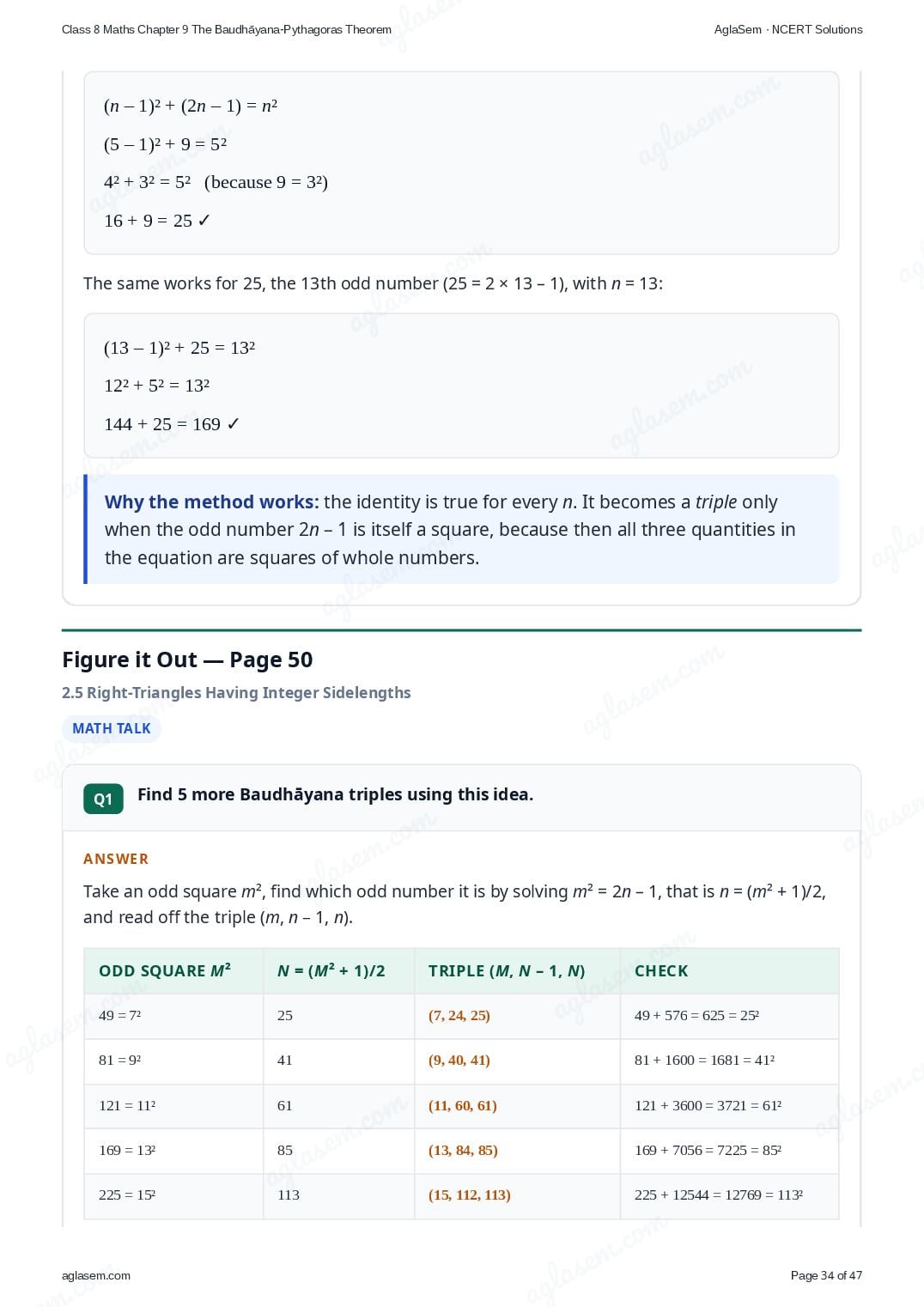
- Could we have obtained this triple using the equation (n – 1)² + (2n – 1) = n²? [for the odd square 9, which is the 5th odd number]
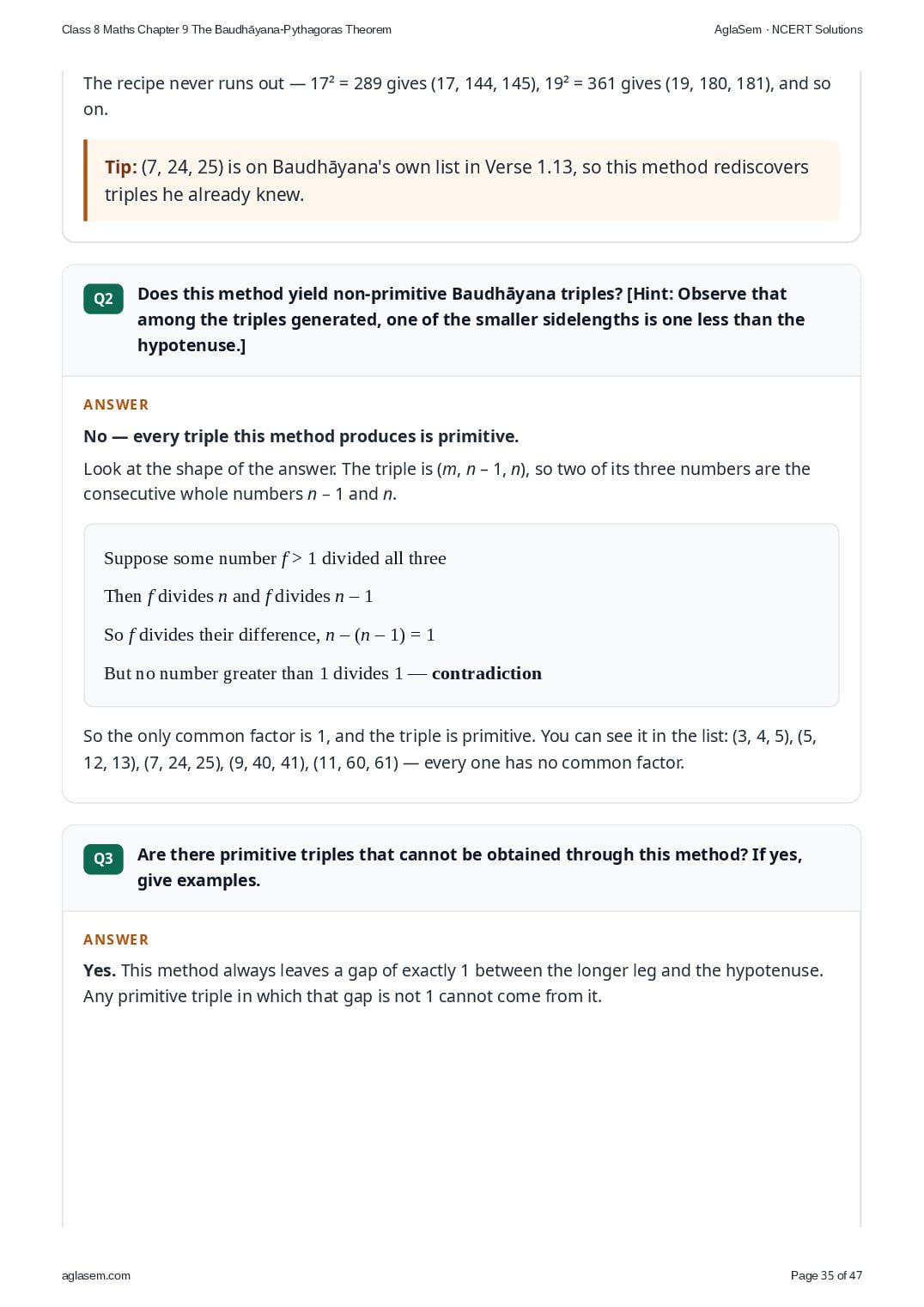
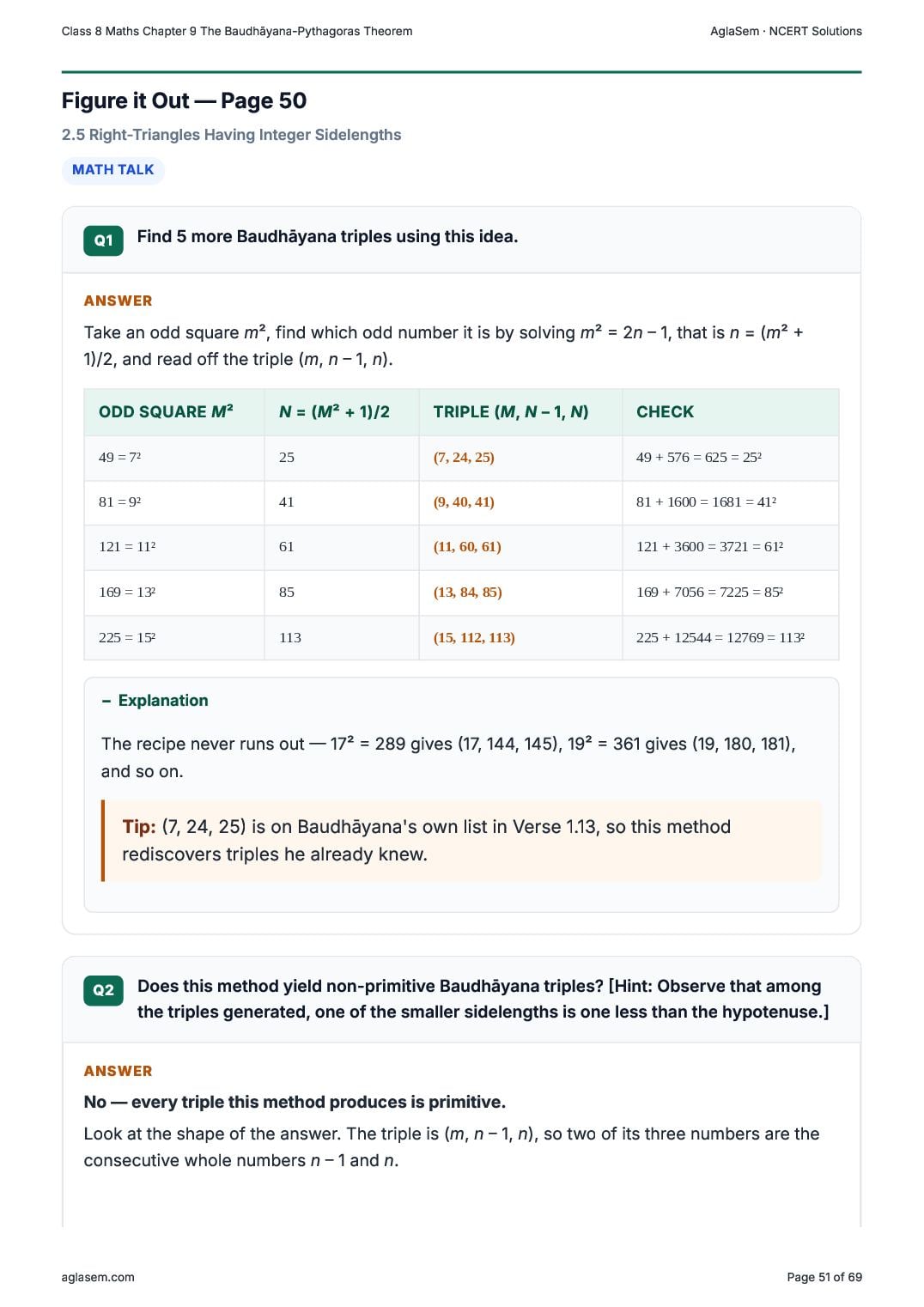
- Find 5 more Baudhāyana triples using this idea.
- Does this method yield non-primitive Baudhāyana triples? [Hint: Observe that among the triples generated, one of the smaller sidelengths is one less than the hypotenuse.]
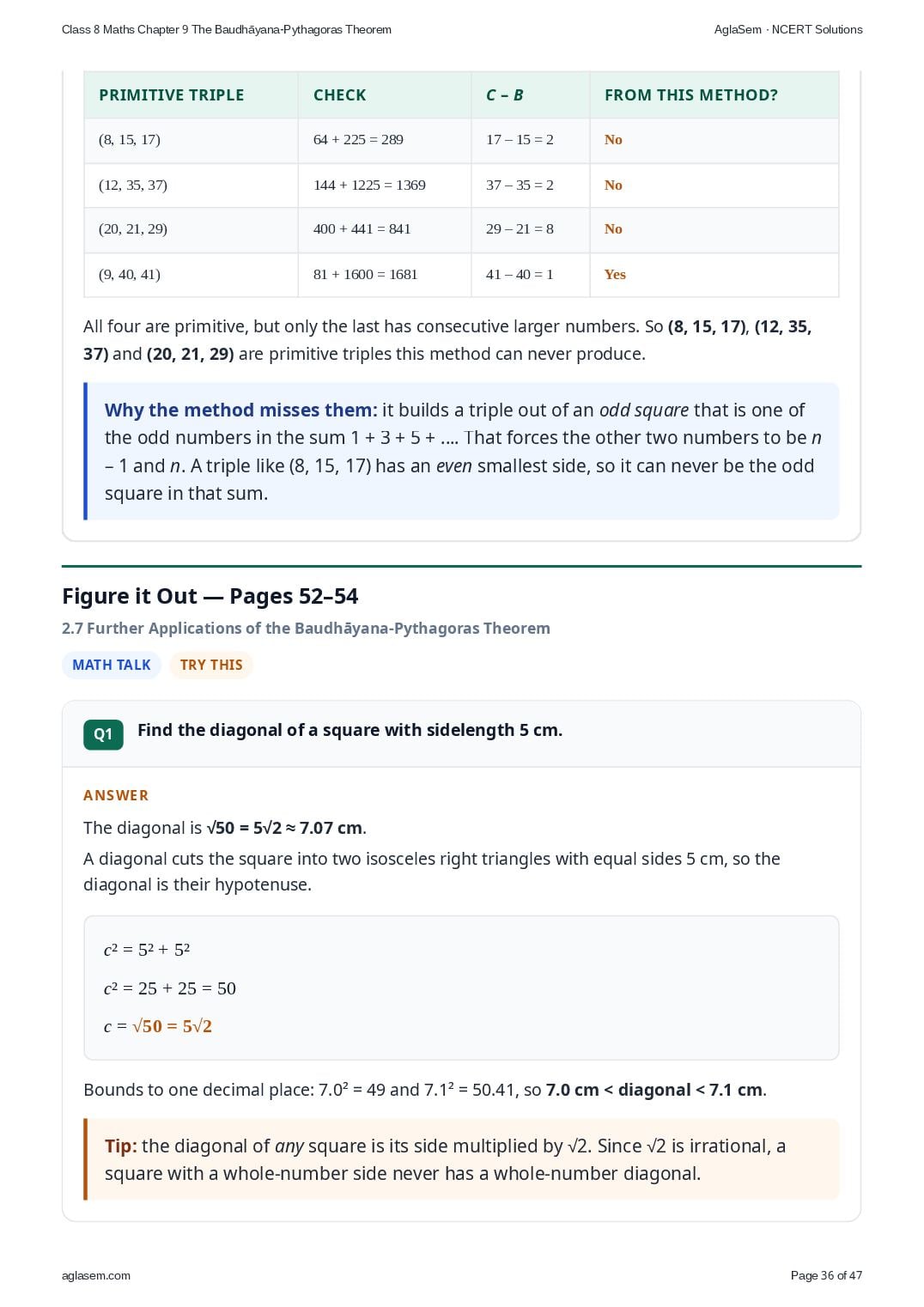
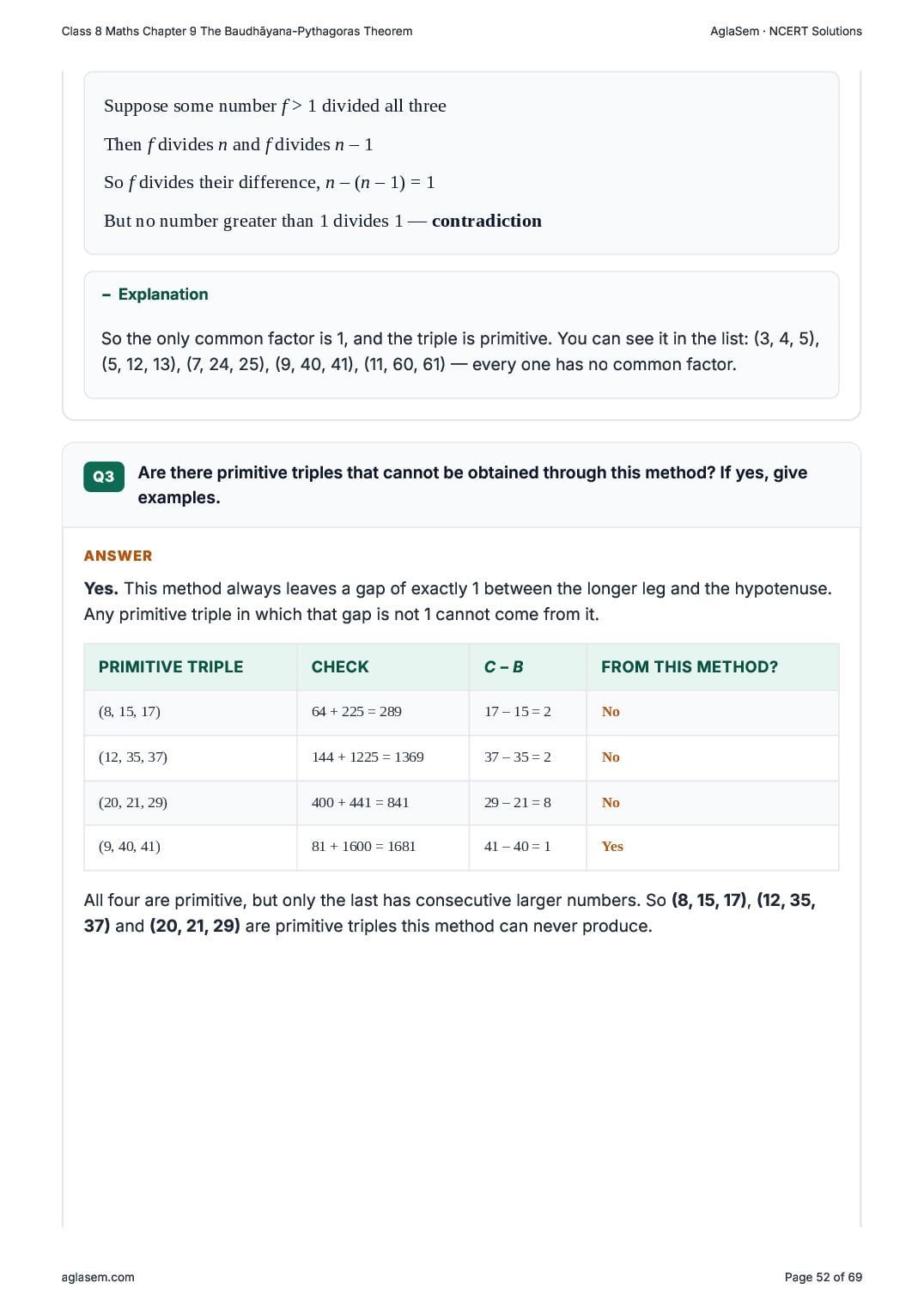
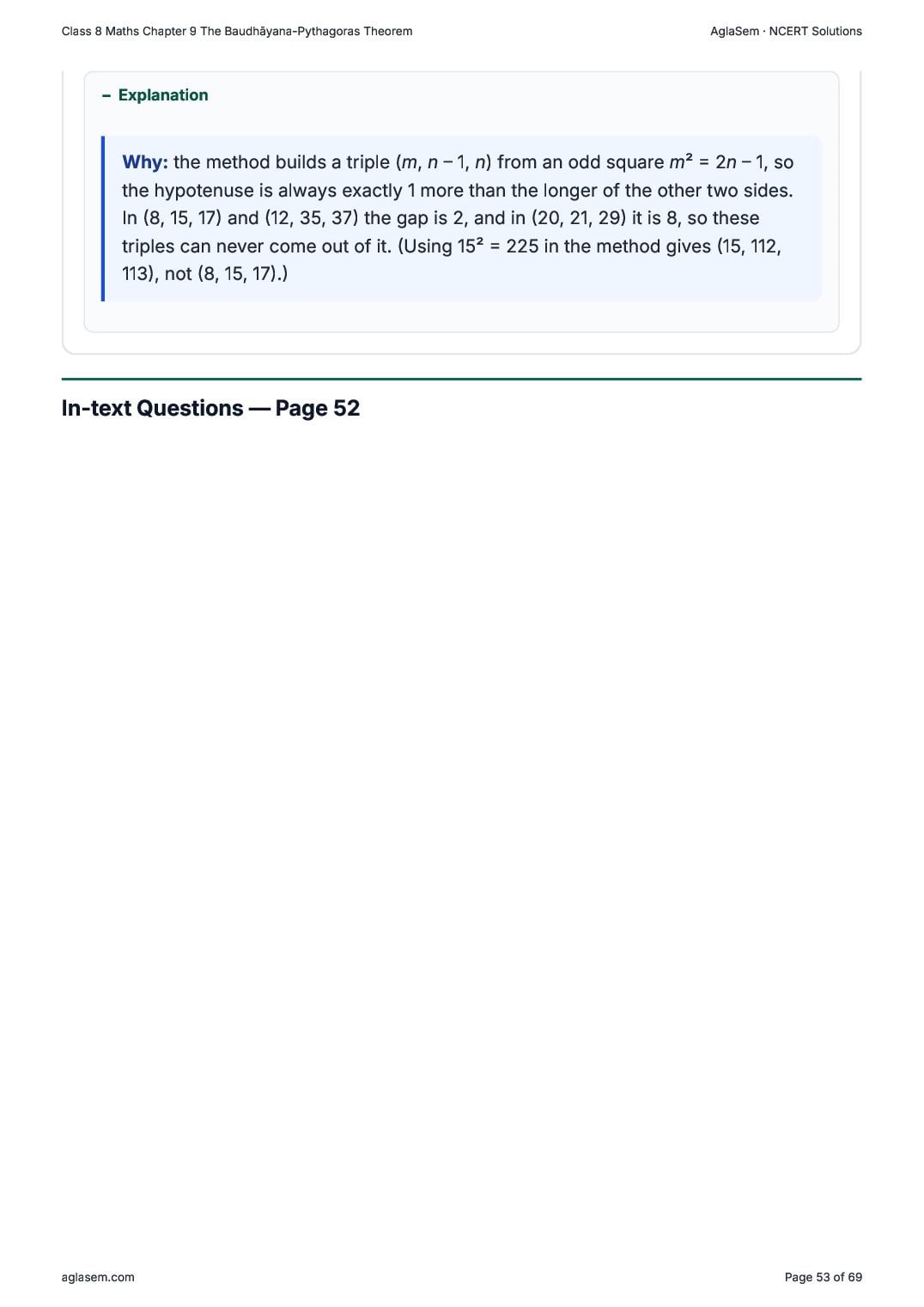
- Are there primitive triples that cannot be obtained through this method? If yes, give examples.
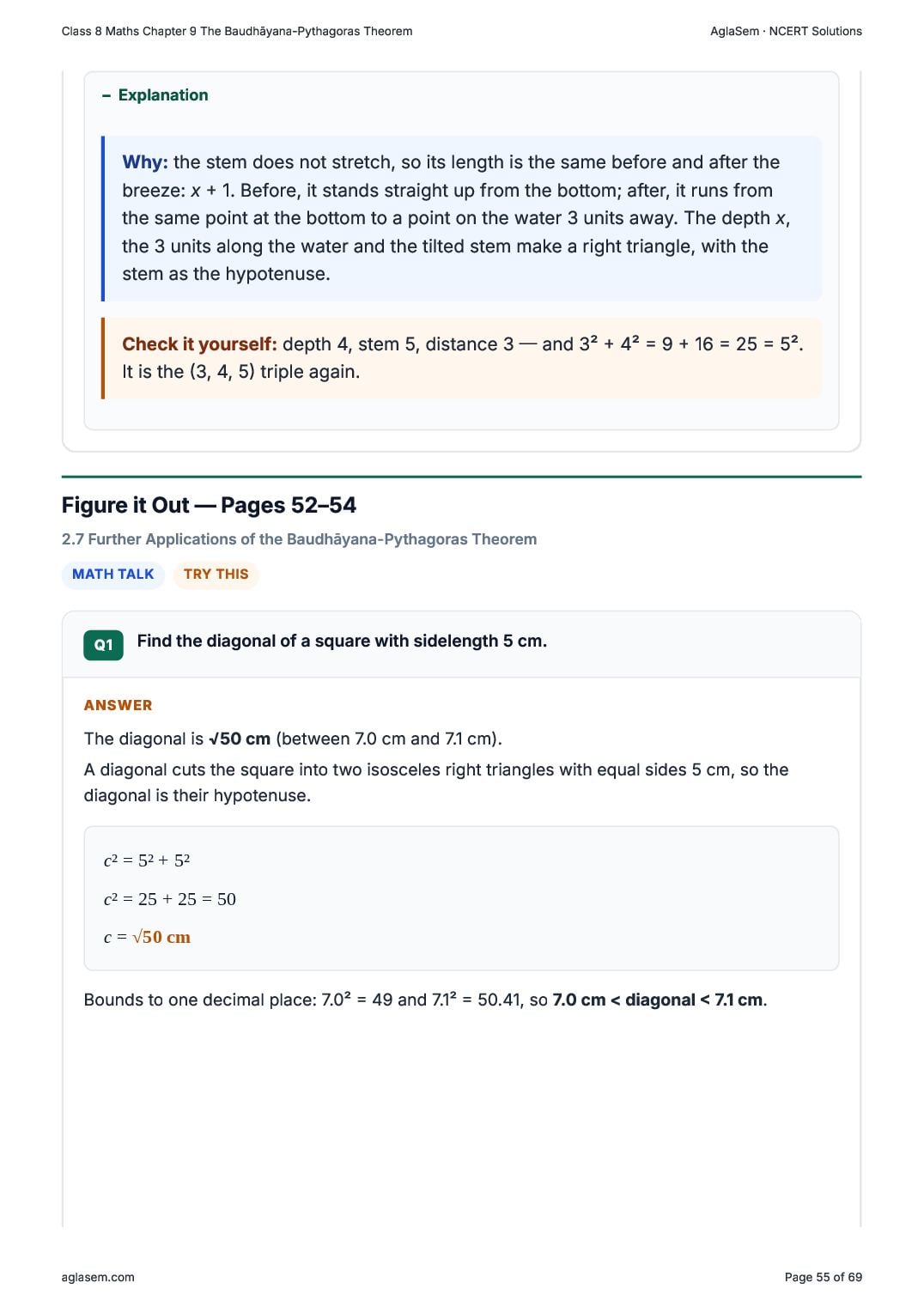
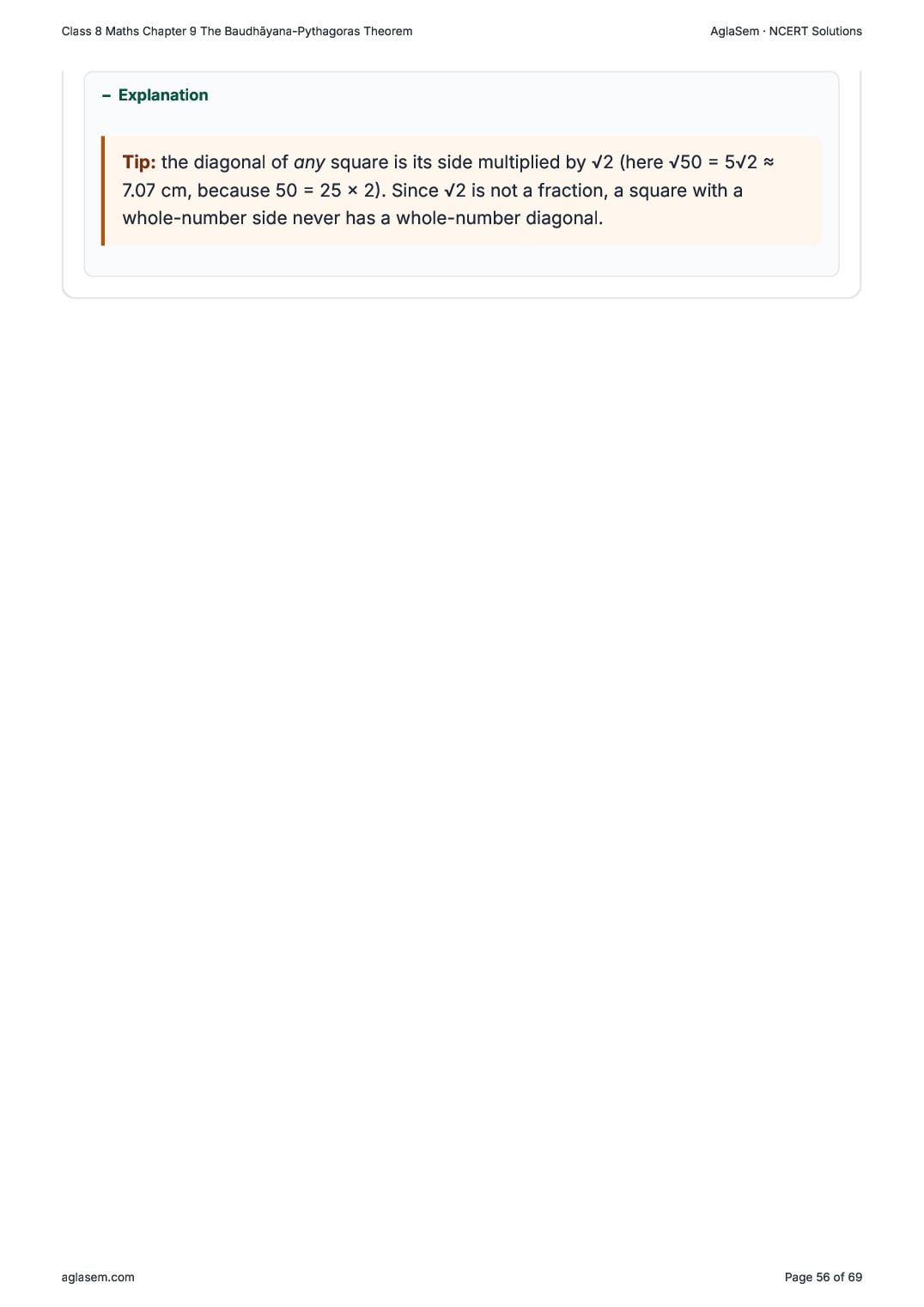
- Find the diagonal of a square with sidelength 5 cm.
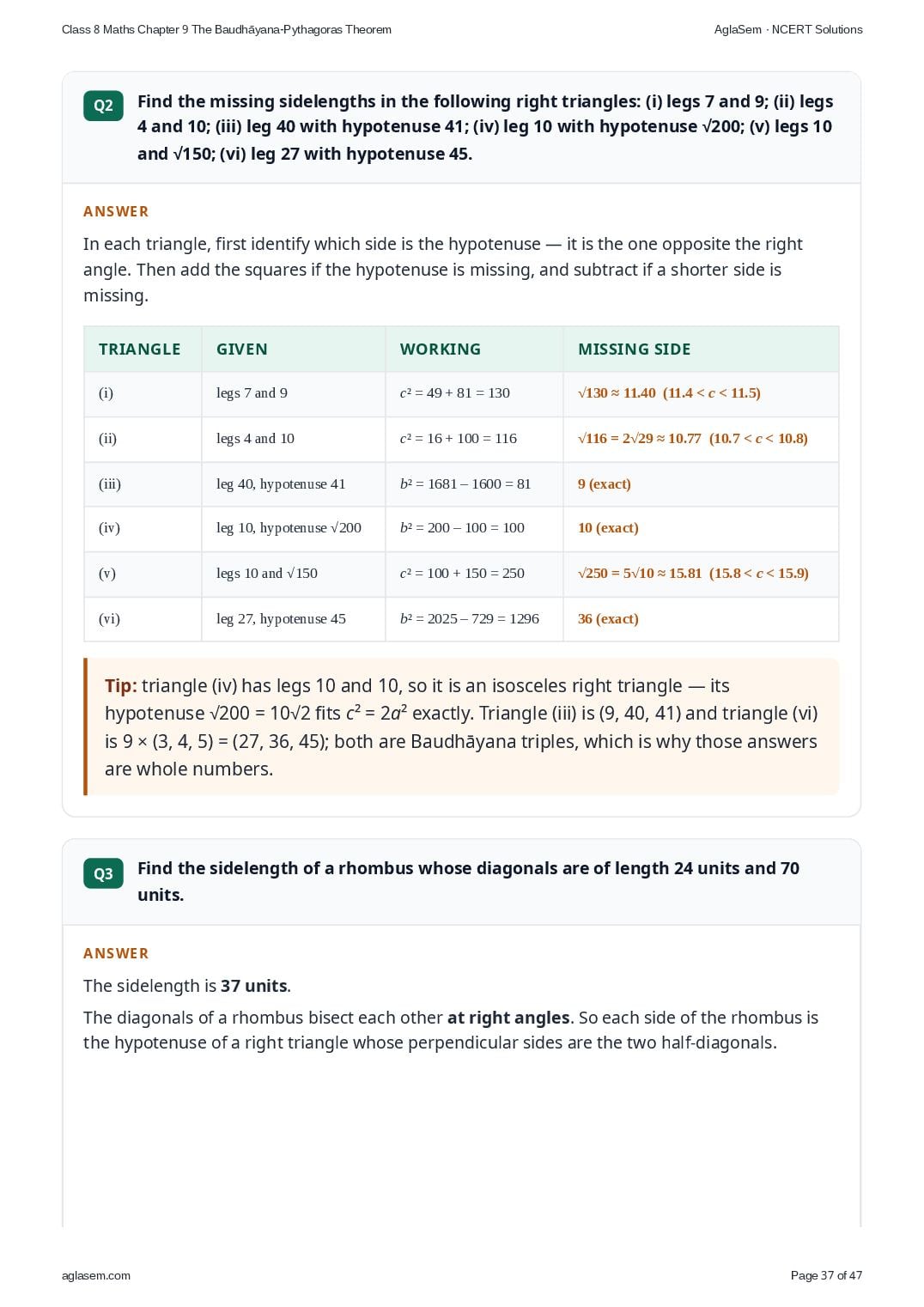
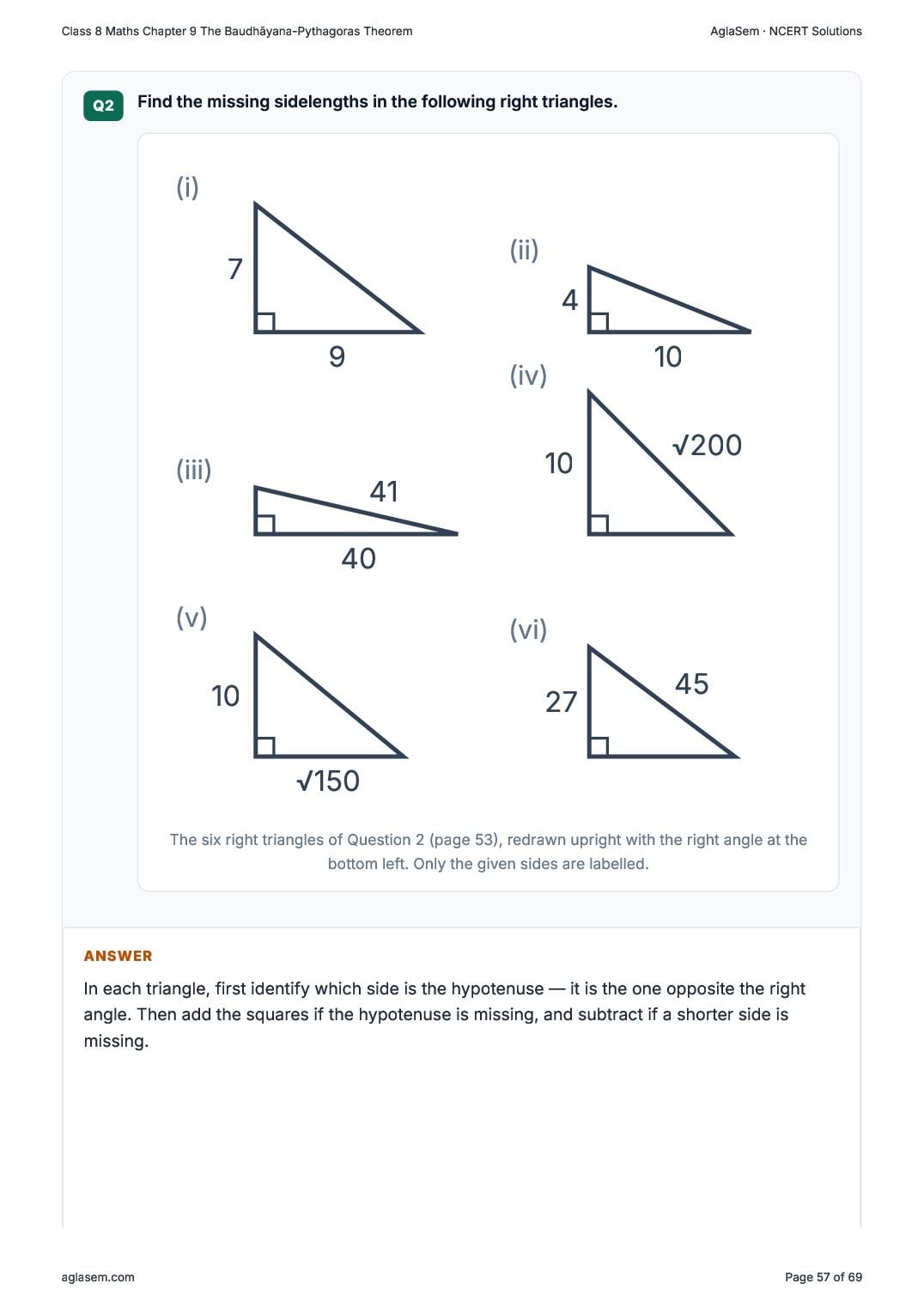
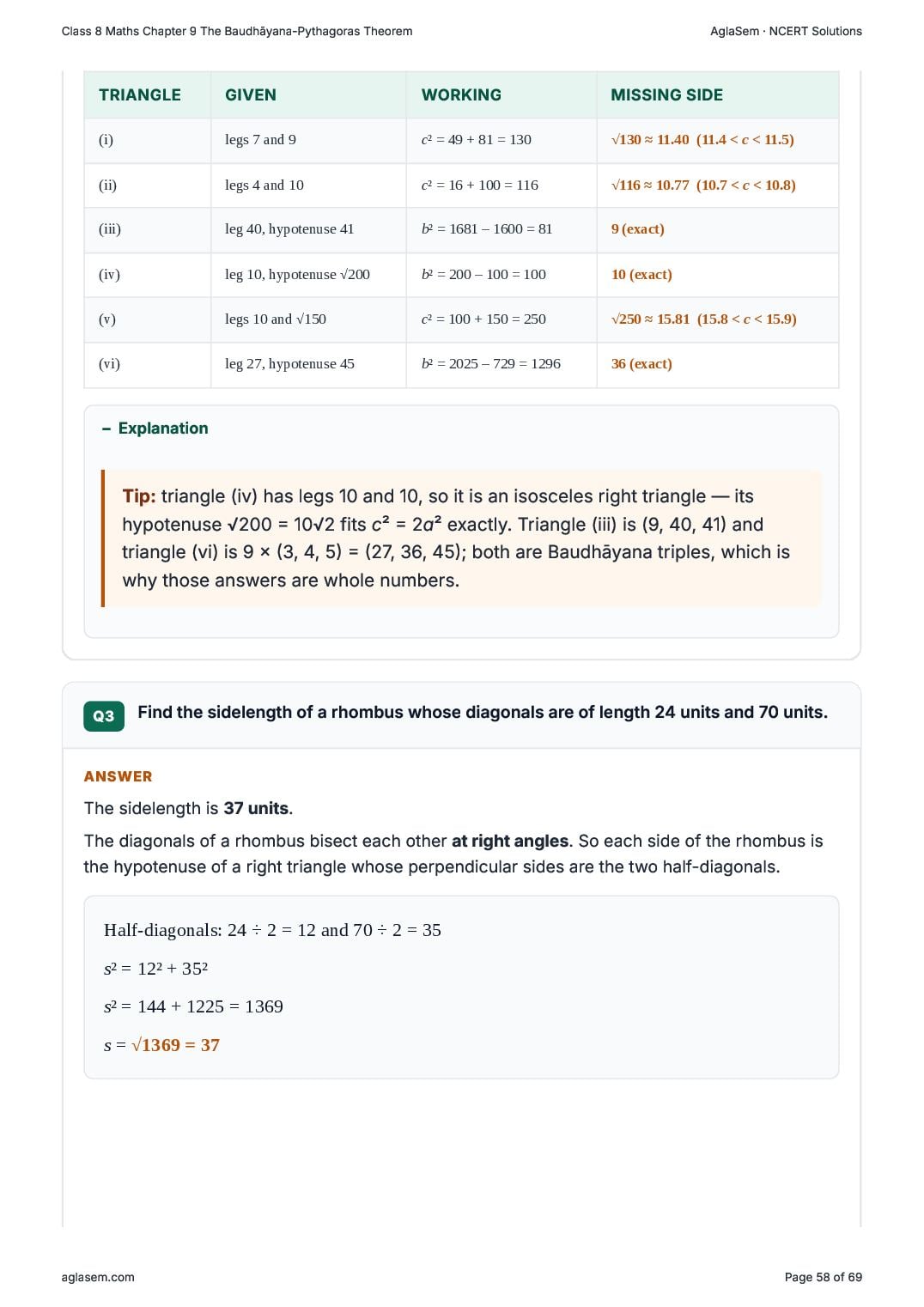
- Find the missing sidelengths in the following right triangles: (i) legs 7 and 9; (ii) legs 4 and 10; (iii) leg 40 with hypotenuse 41; (iv) leg 10 with hypotenuse √200; (v) legs 10 and √150; (vi) leg 27 with hypotenuse 45.
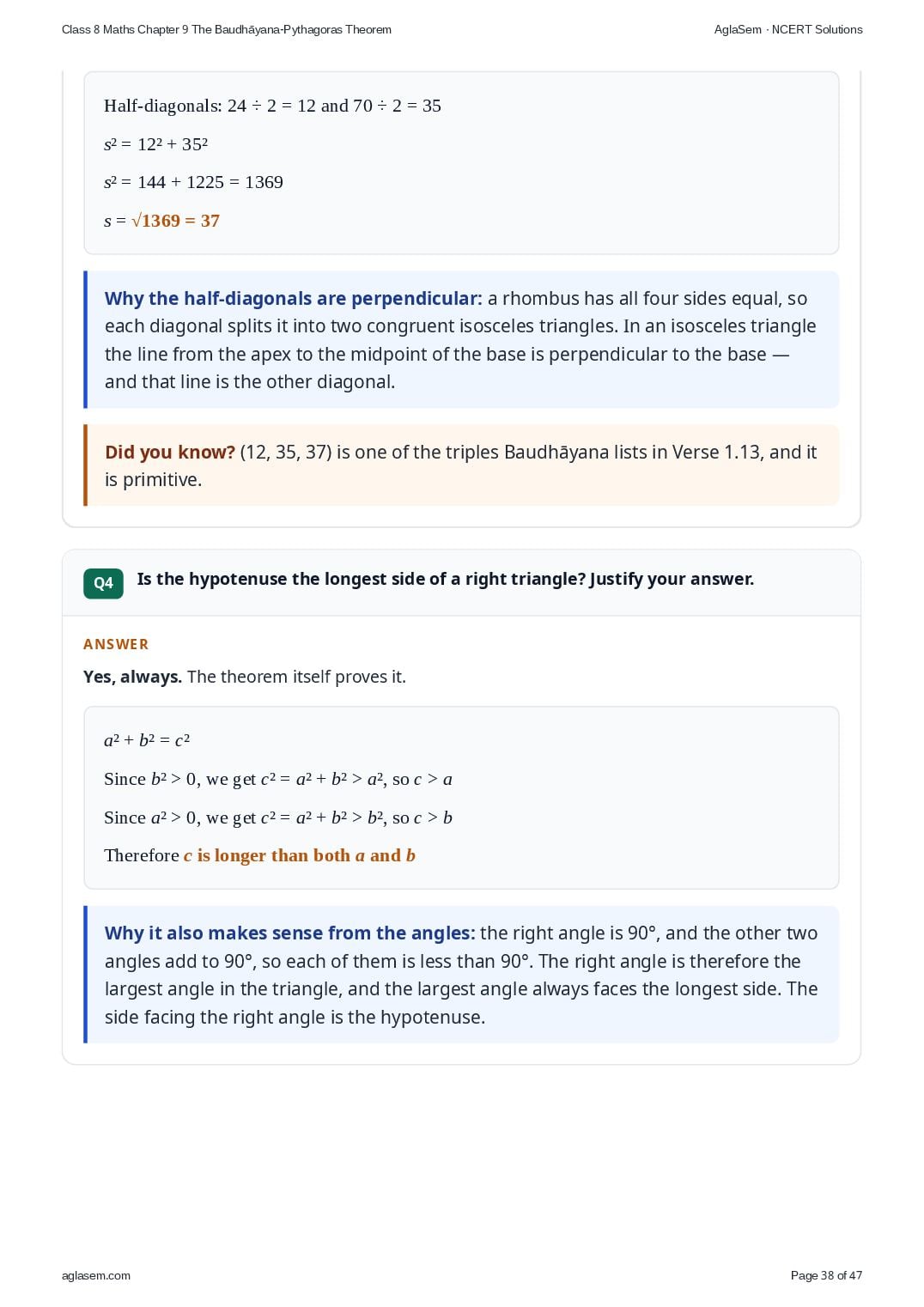
- Find the sidelength of a rhombus whose diagonals are of length 24 units and 70 units.
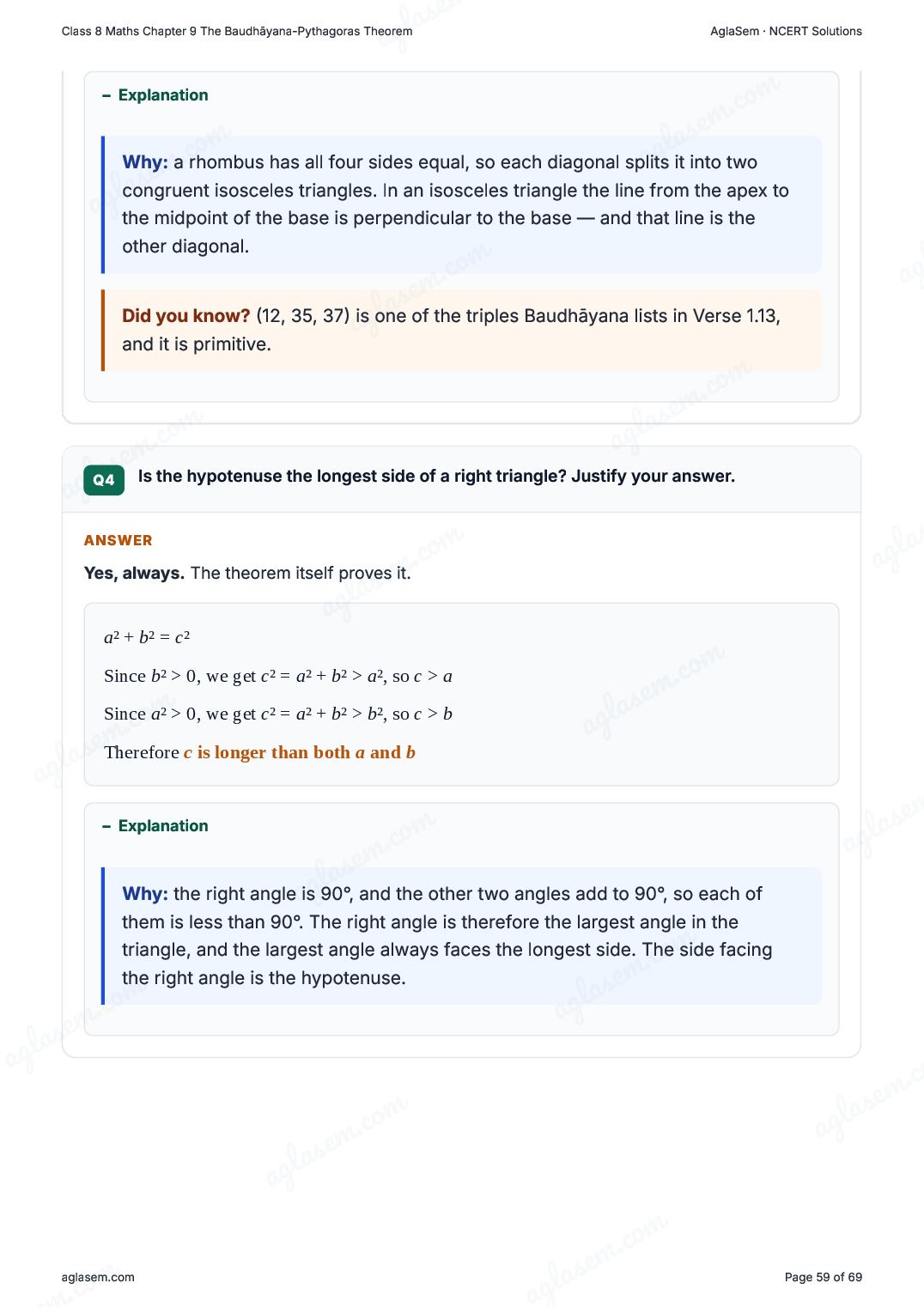
- Is the hypotenuse the longest side of a right triangle? Justify your answer.
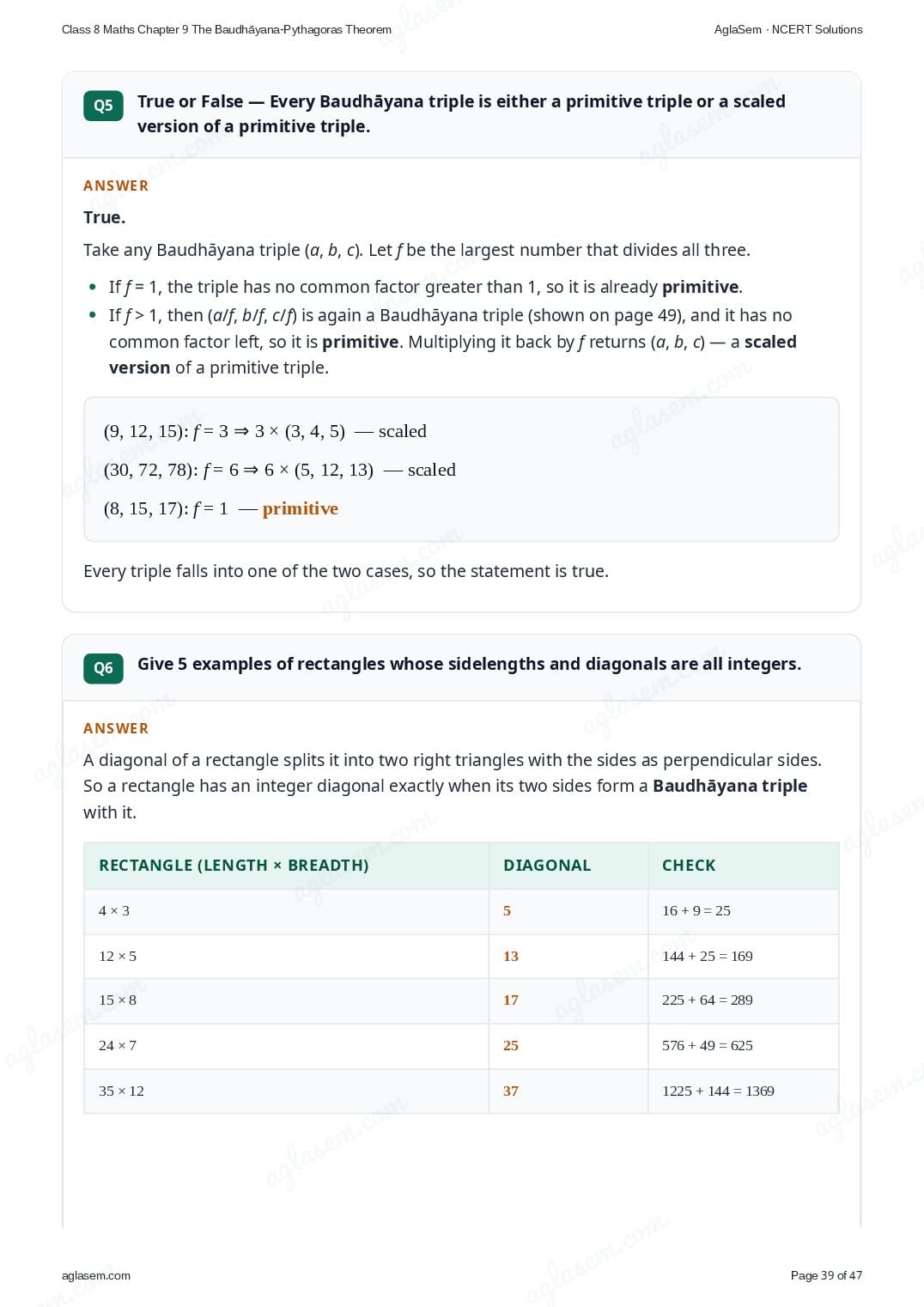
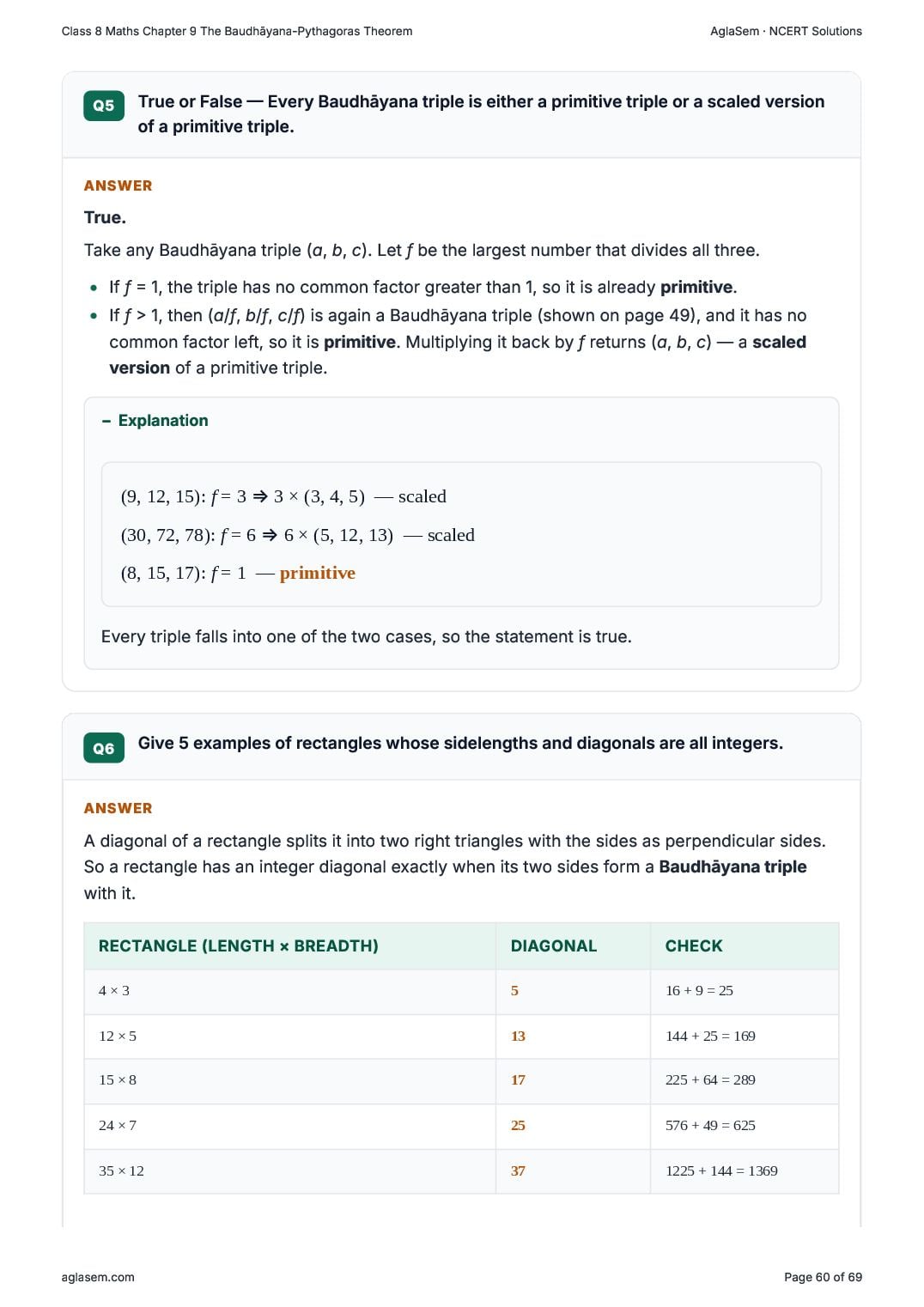
- True or False — Every Baudhāyana triple is either a primitive triple or a scaled version of a primitive triple.
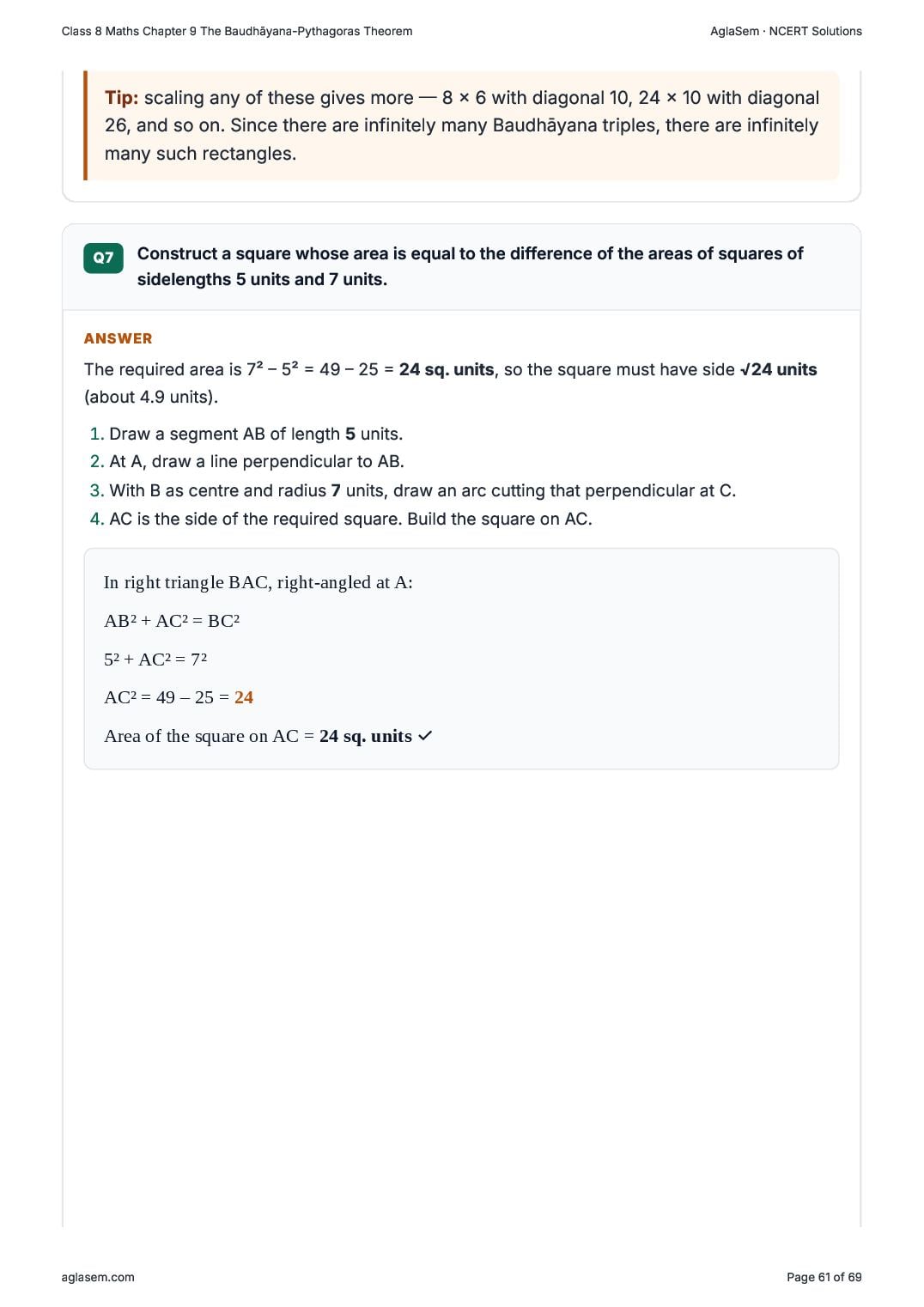
- Give 5 examples of rectangles whose sidelengths and diagonals are all integers.
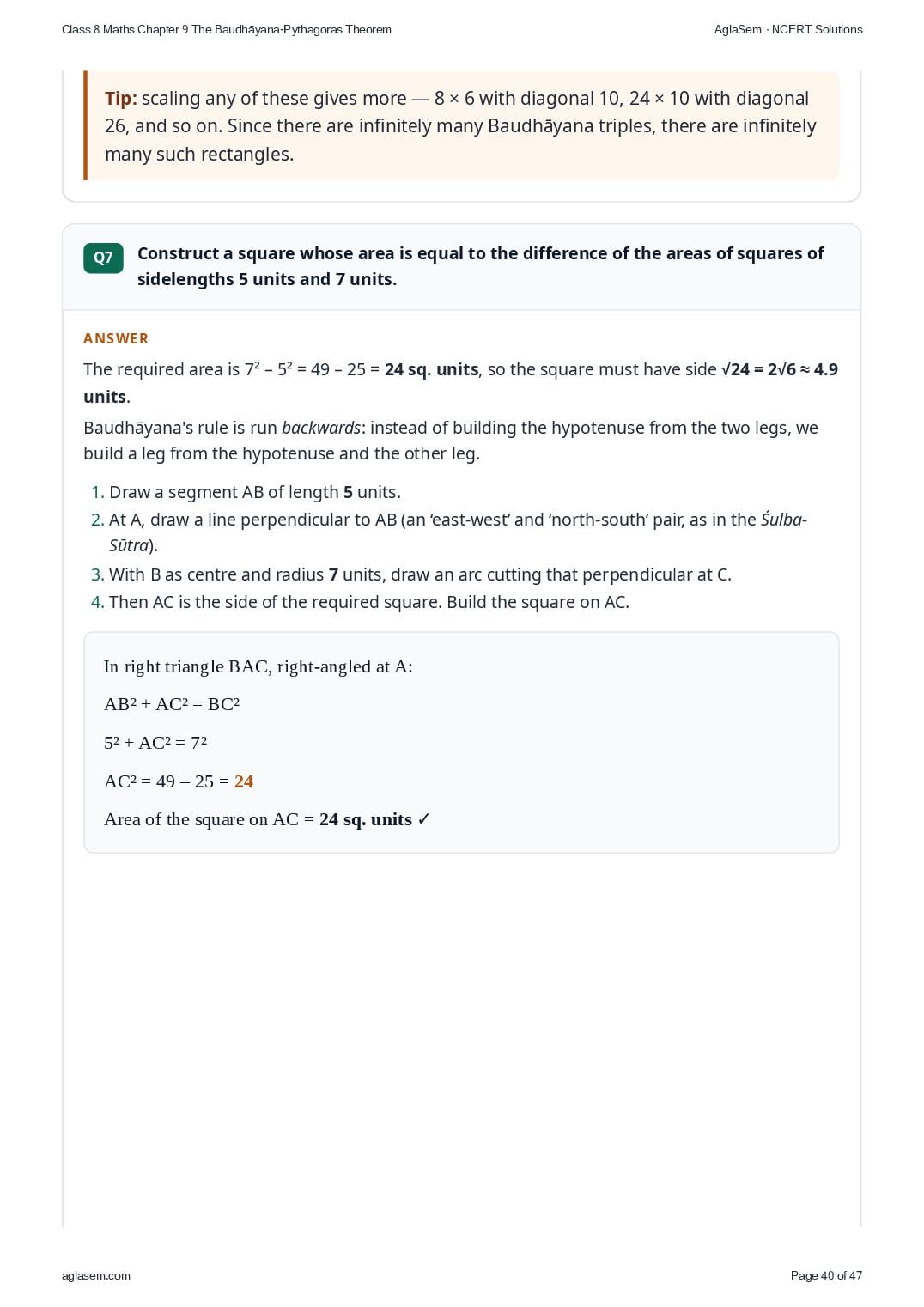
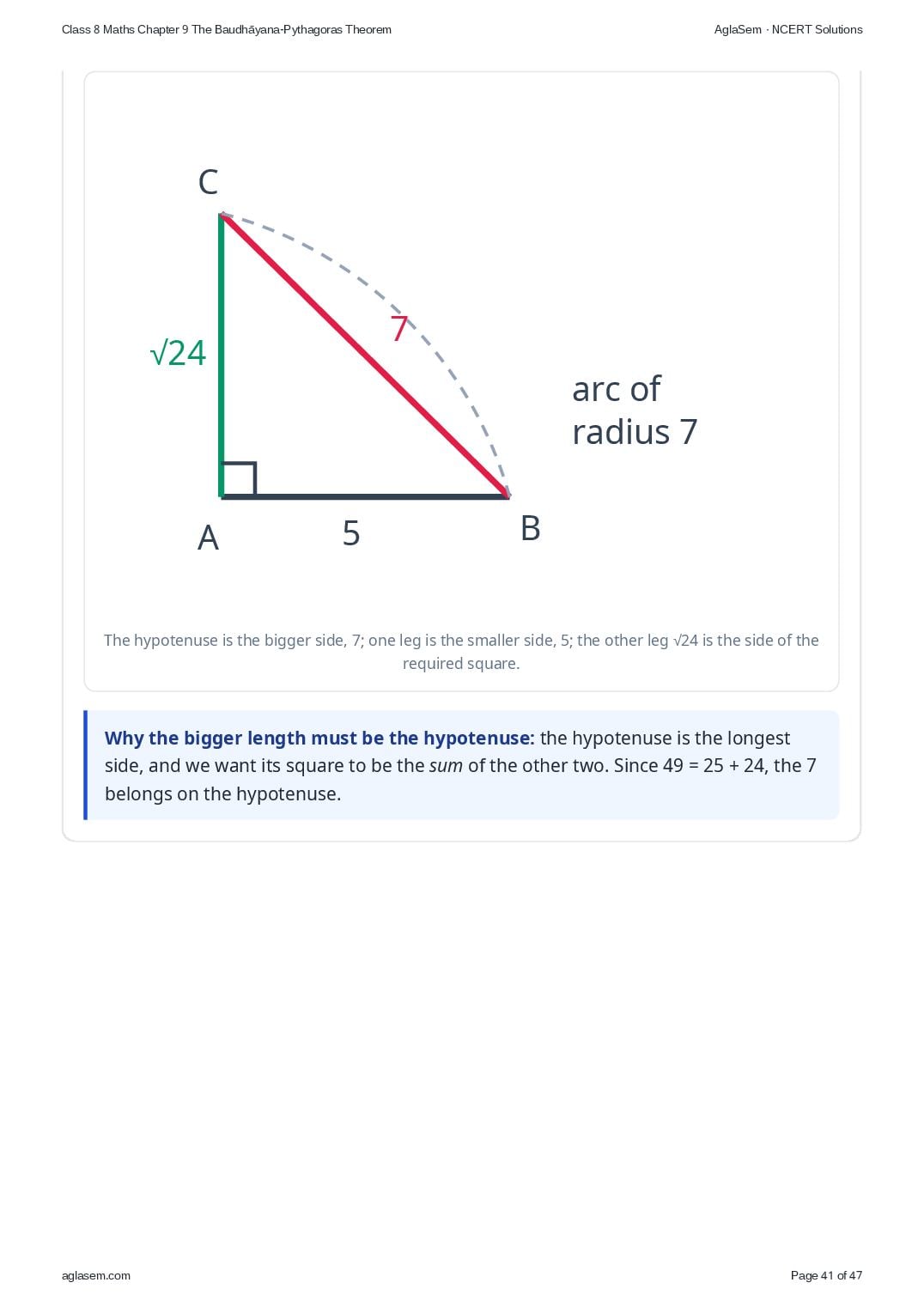
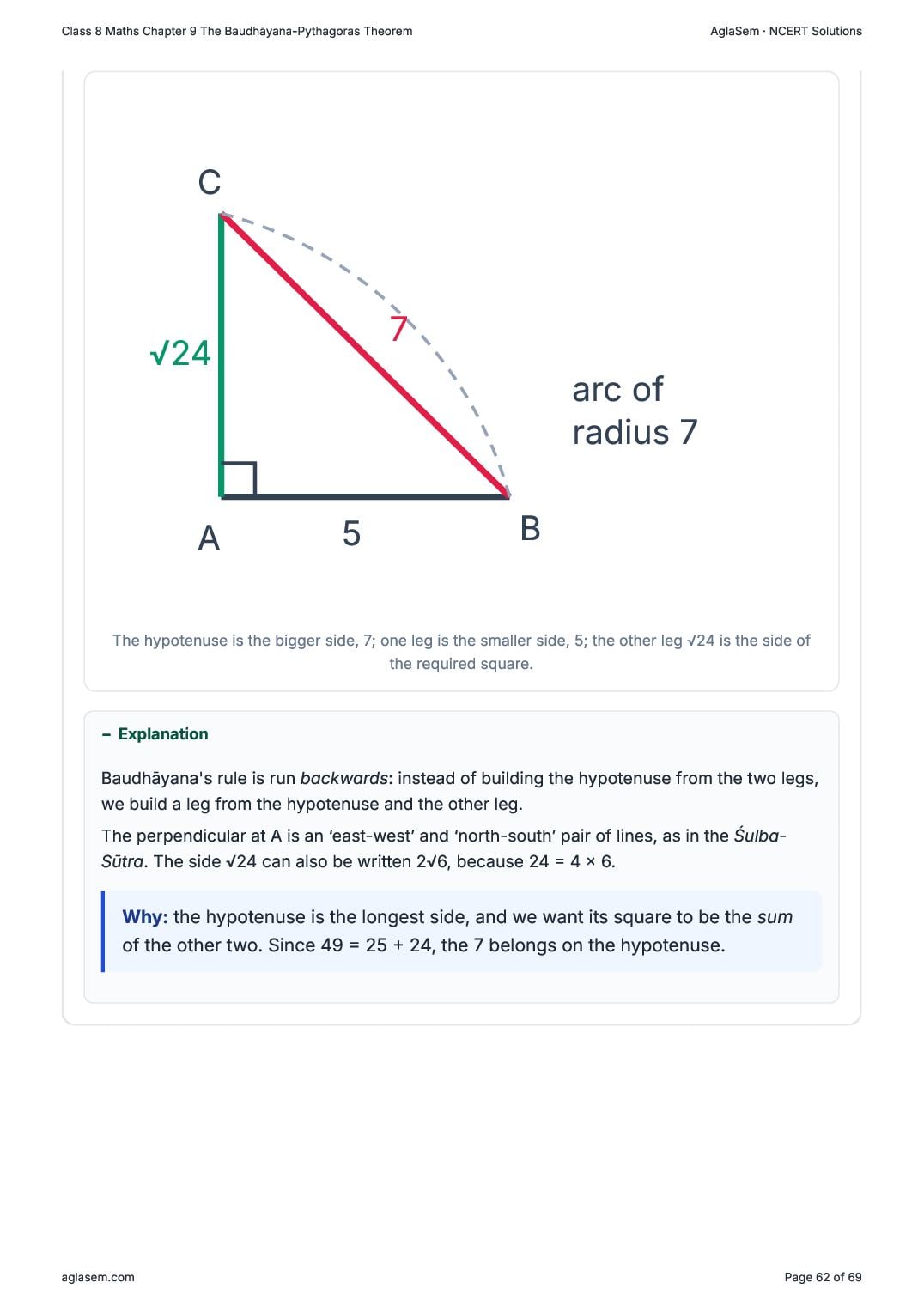
- Construct a square whose area is equal to the difference of the areas of squares of sidelengths 5 units and 7 units.
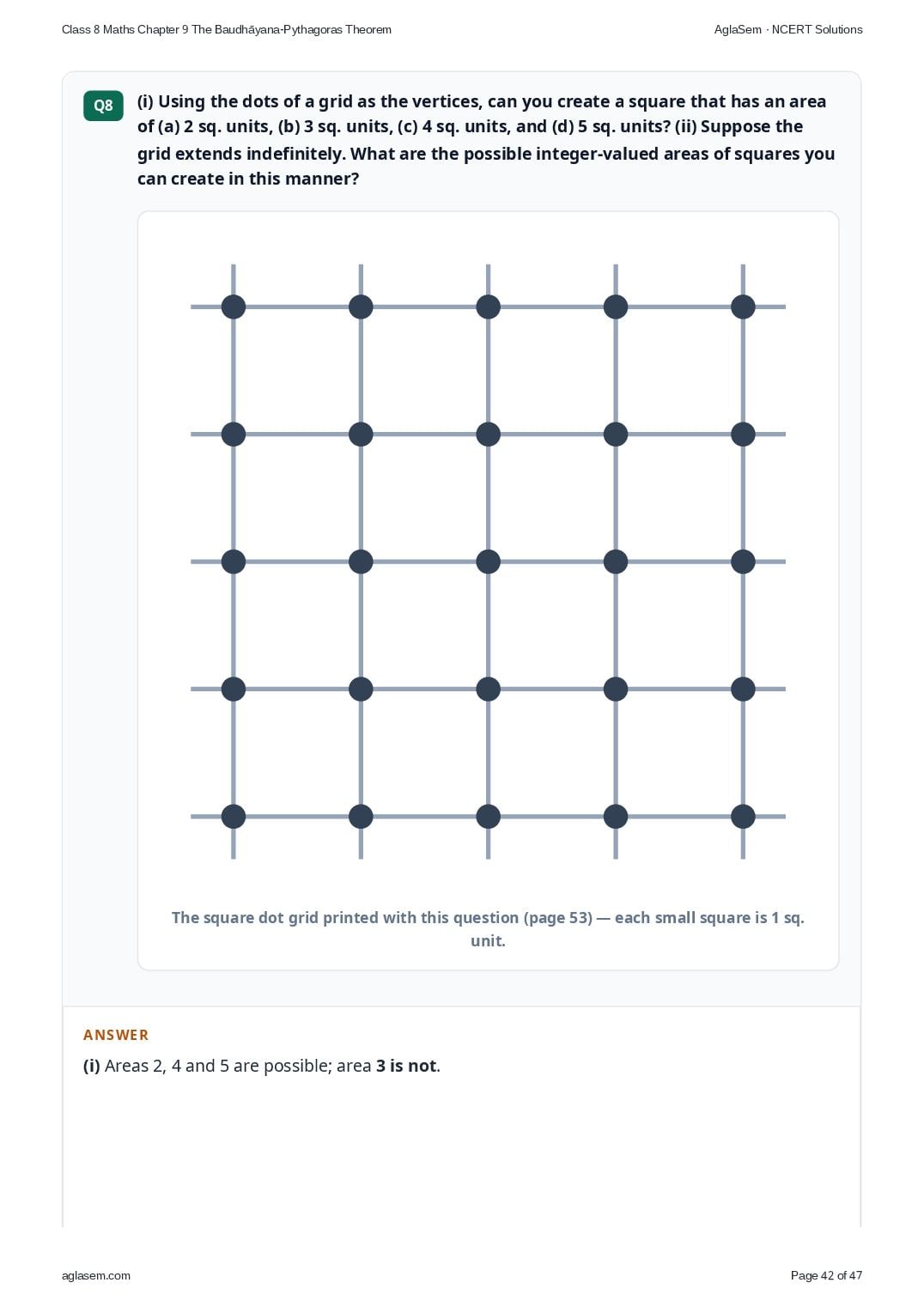
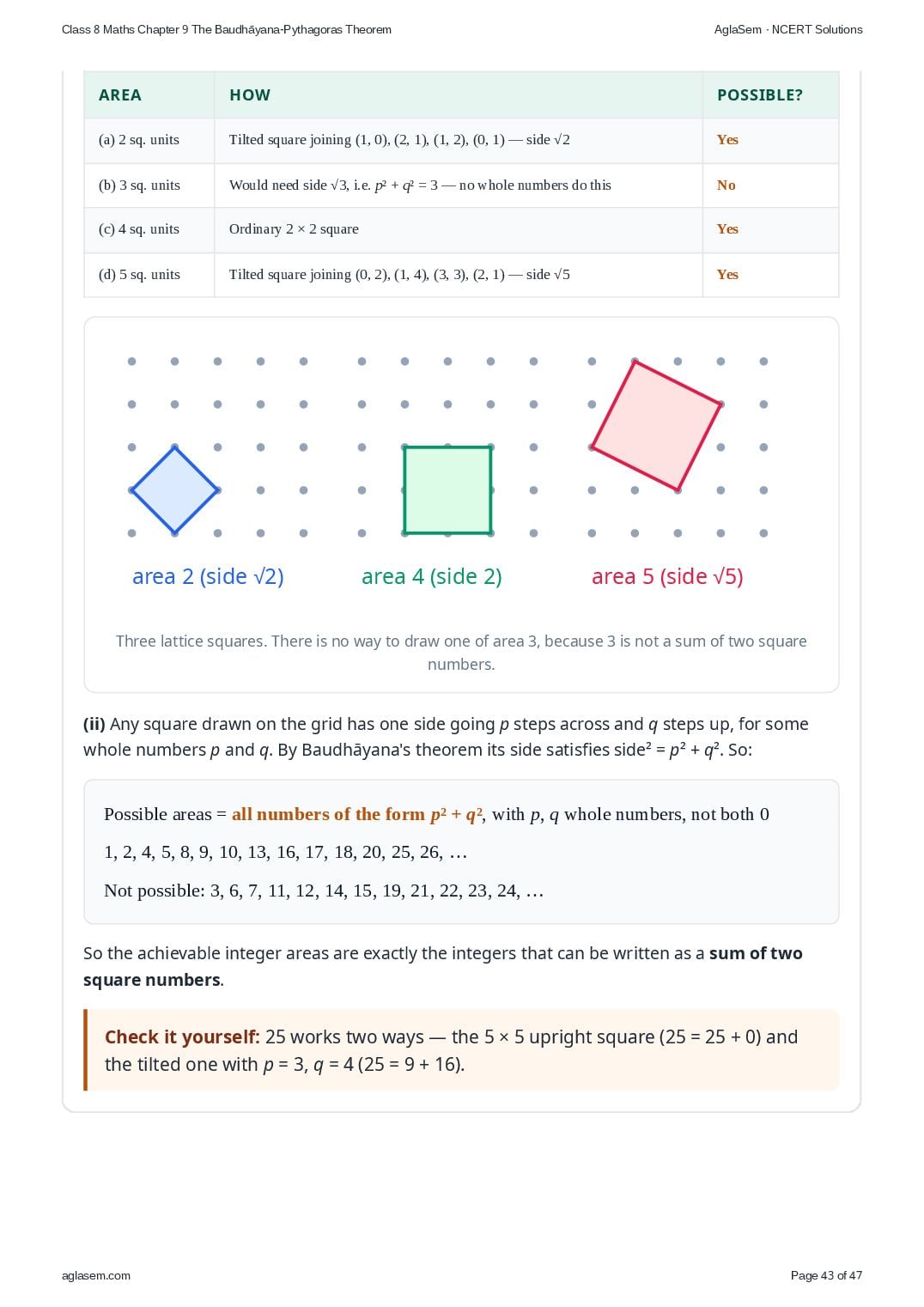
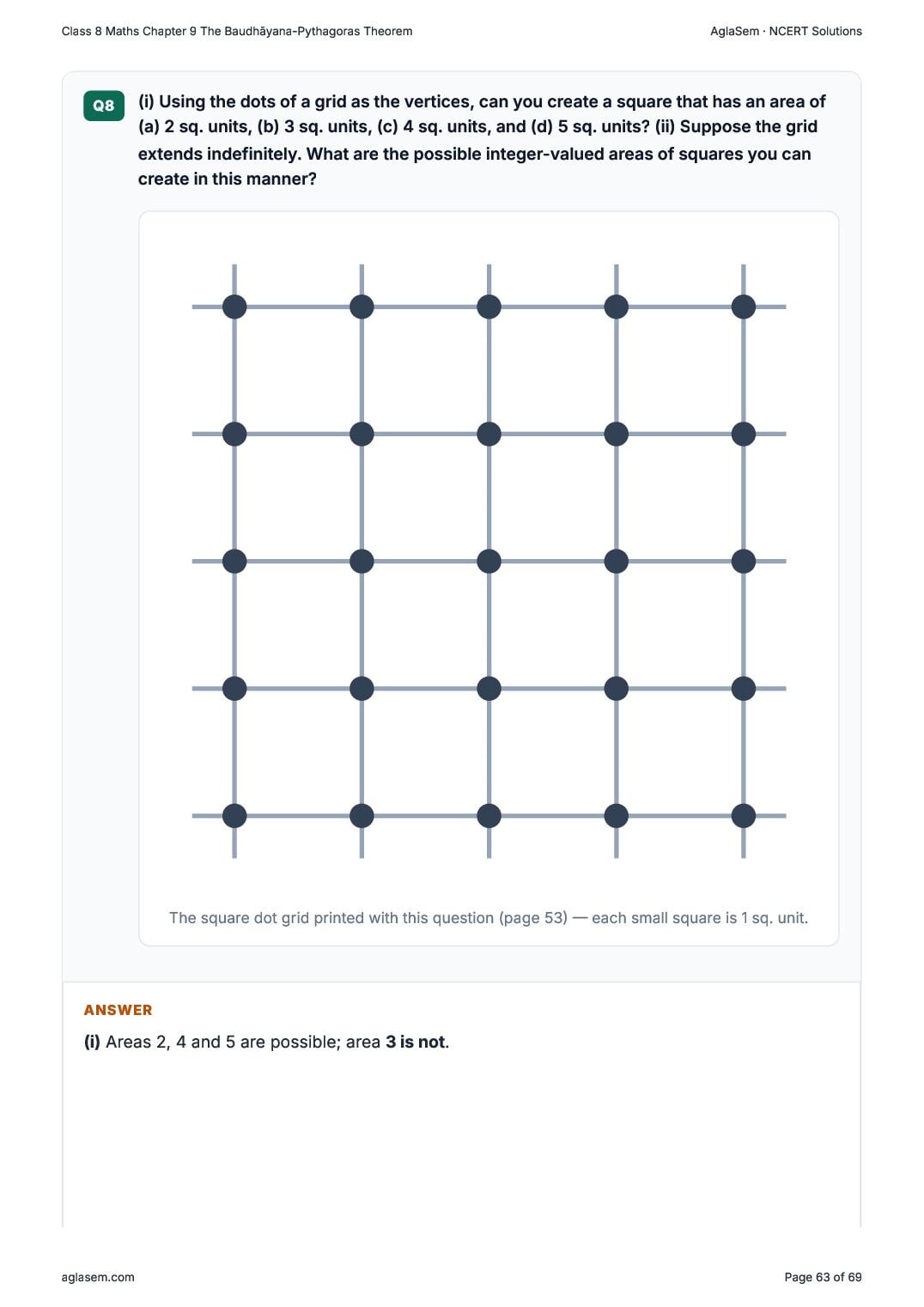
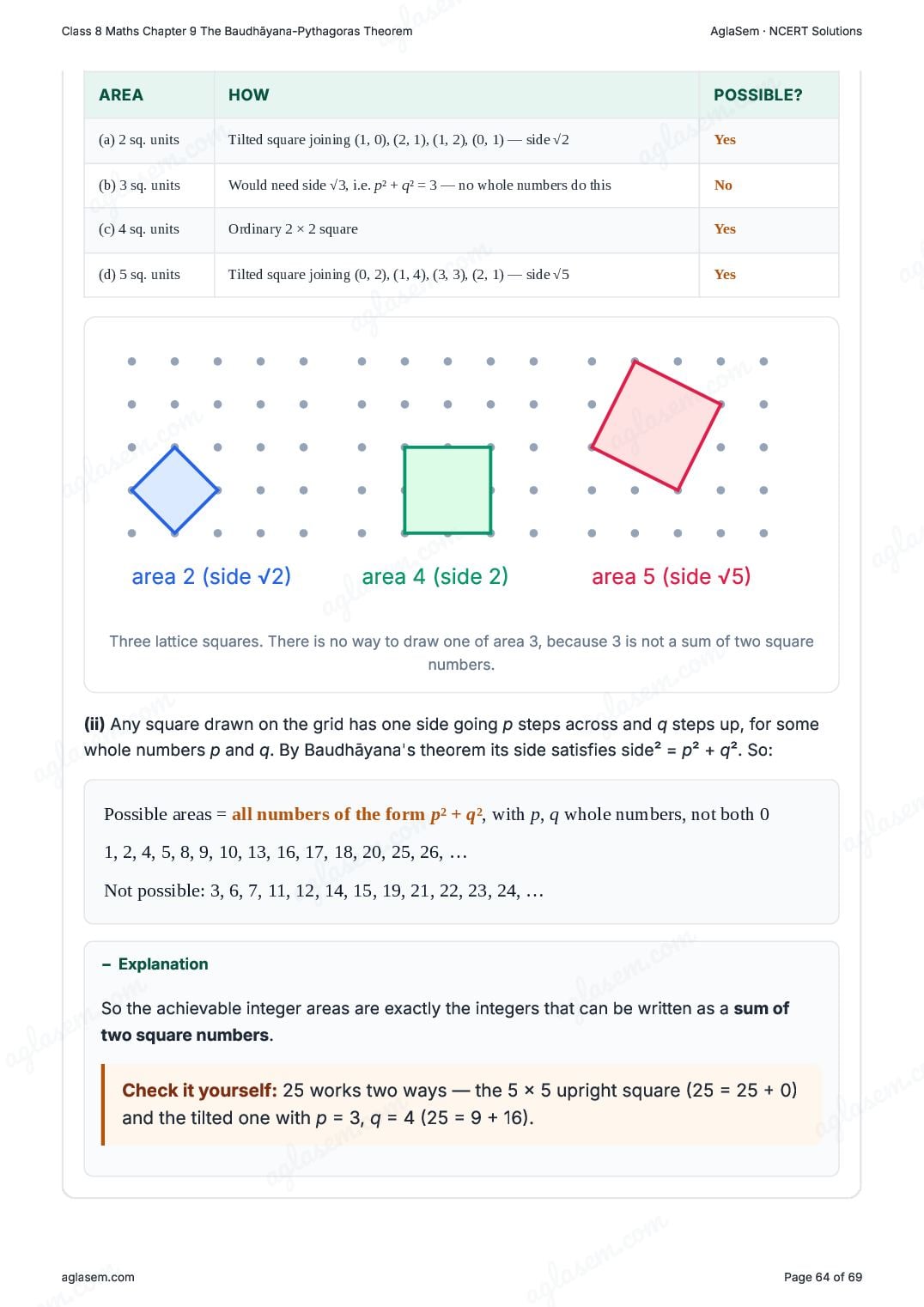
- (i) Using the dots of a grid as the vertices, can you create a square that has an area of (a) 2 sq. units, (b) 3 sq. units, (c) 4 sq. units, and (d) 5 sq. units? (ii) Suppose the grid extends indefinitely. What are the possible integer-valued areas of squares you can create in this manner?
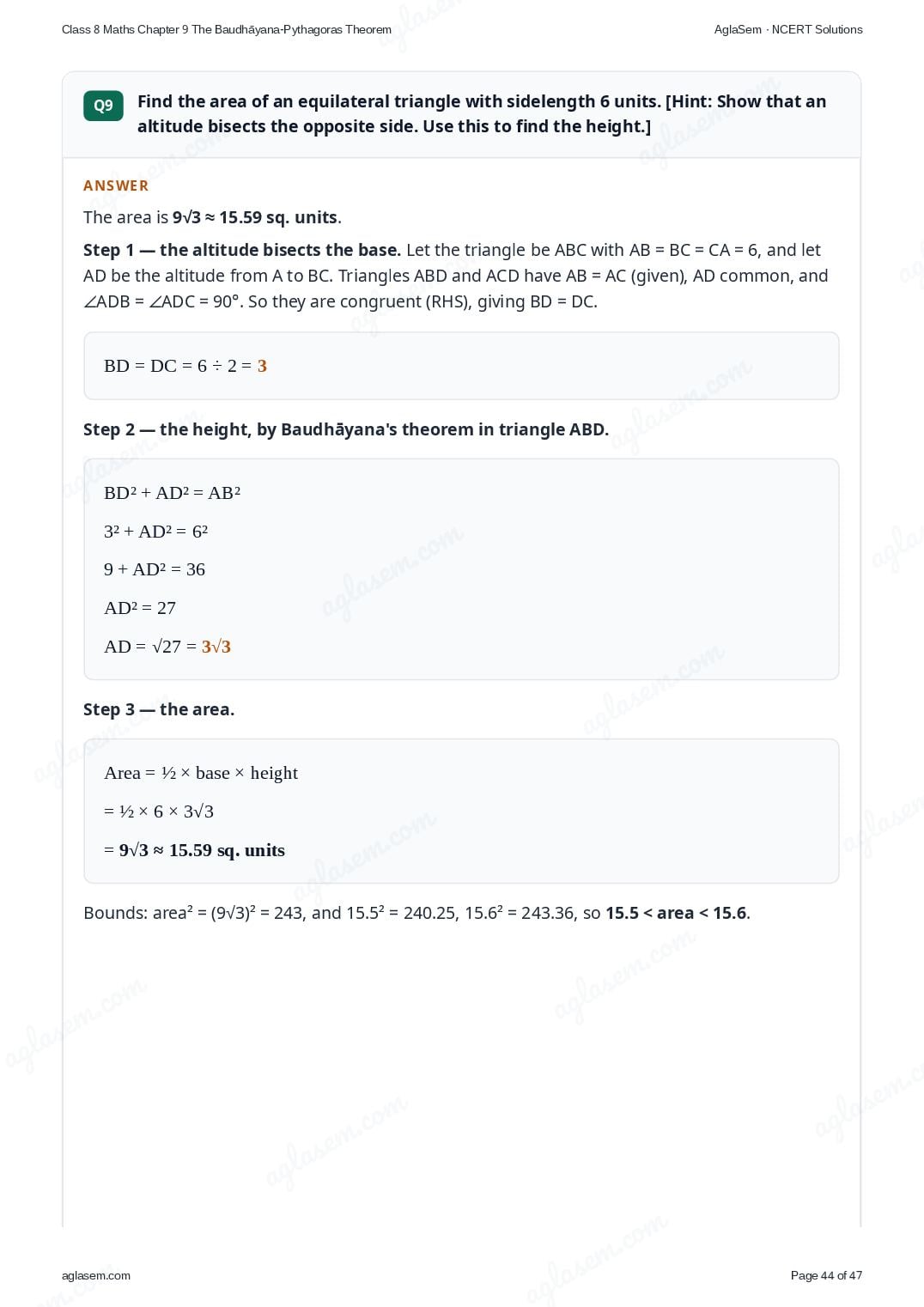
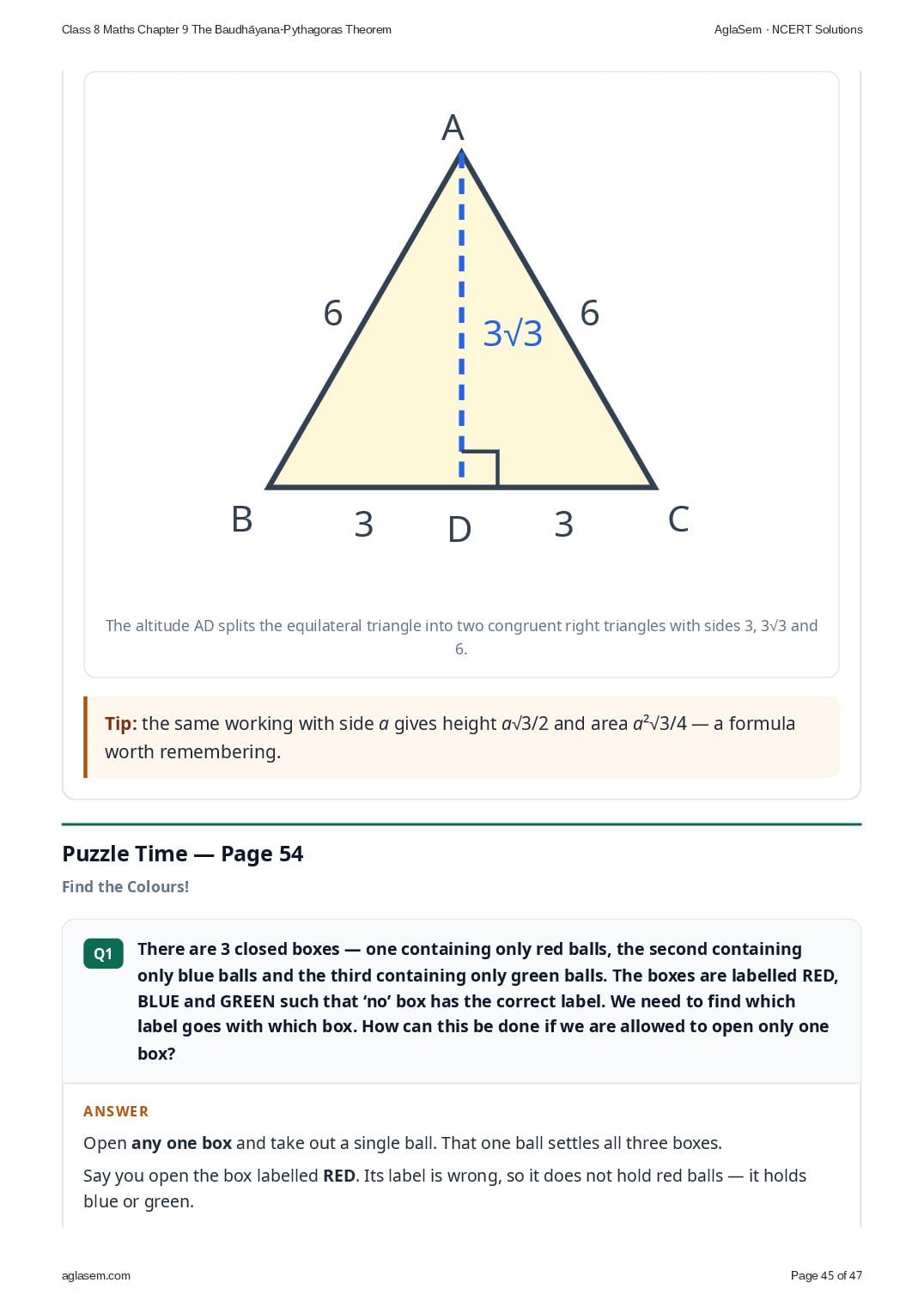
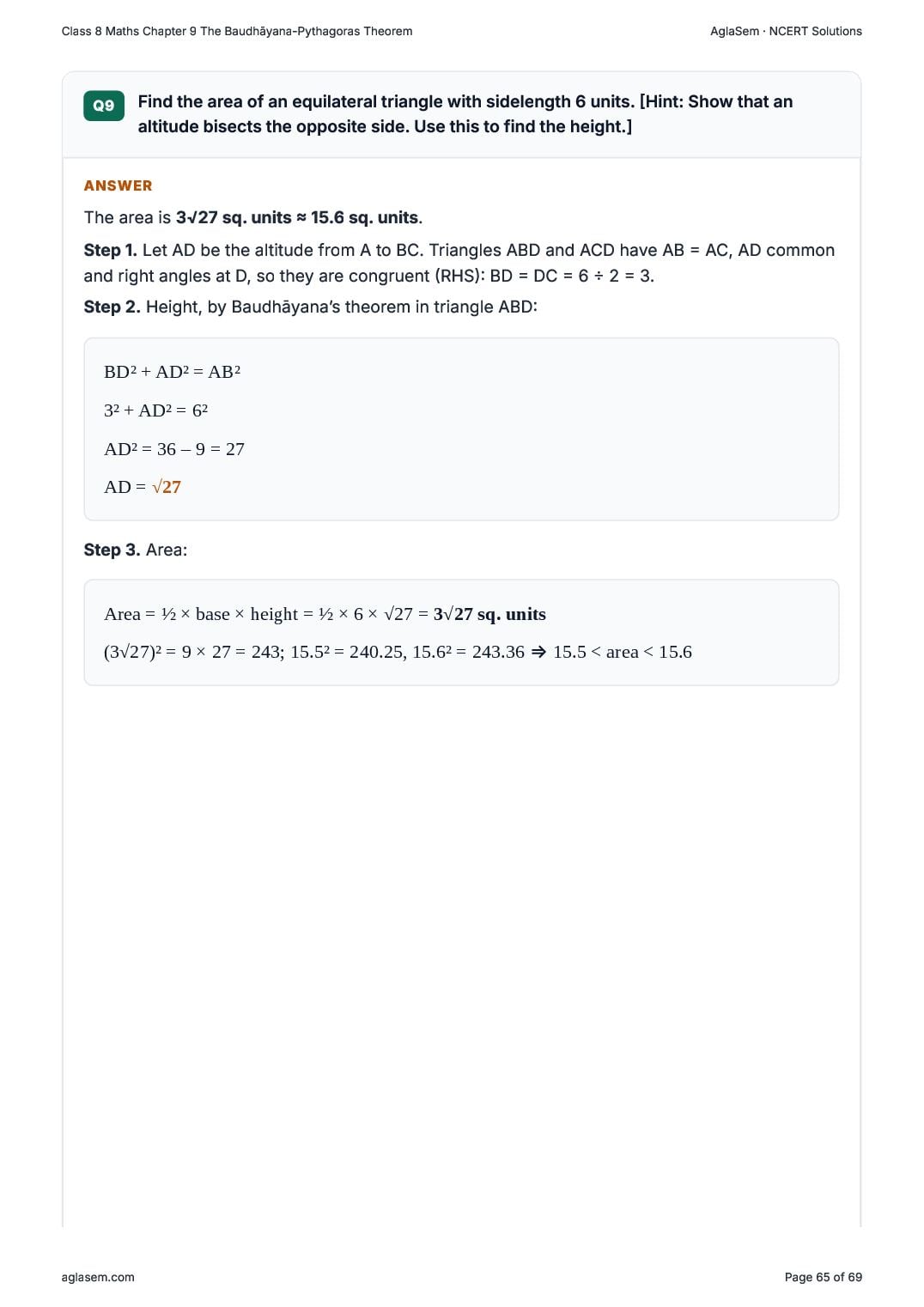
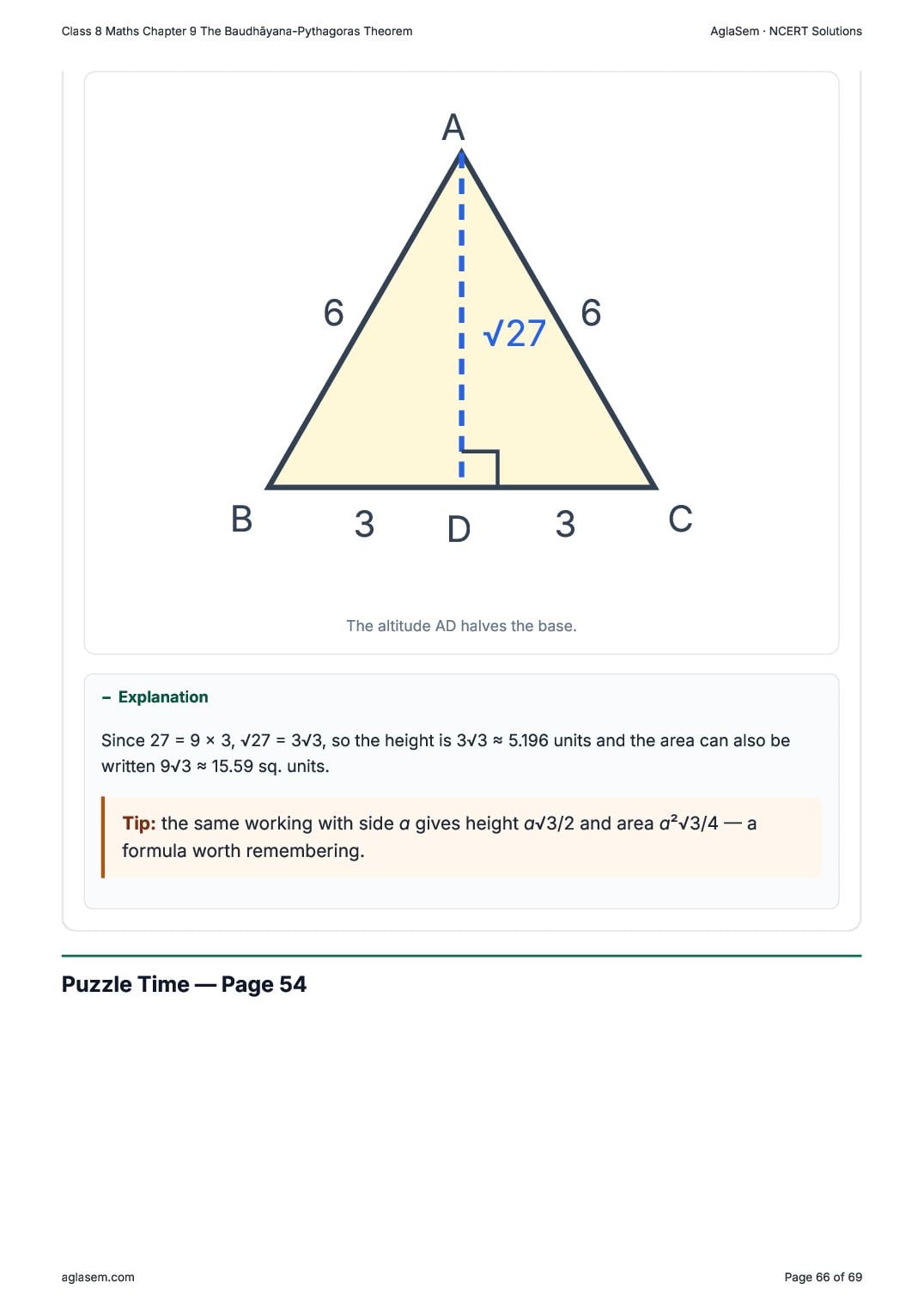
- Find the area of an equilateral triangle with sidelength 6 units. [Hint: Show that an altitude bisects the opposite side. Use this to find the height.]
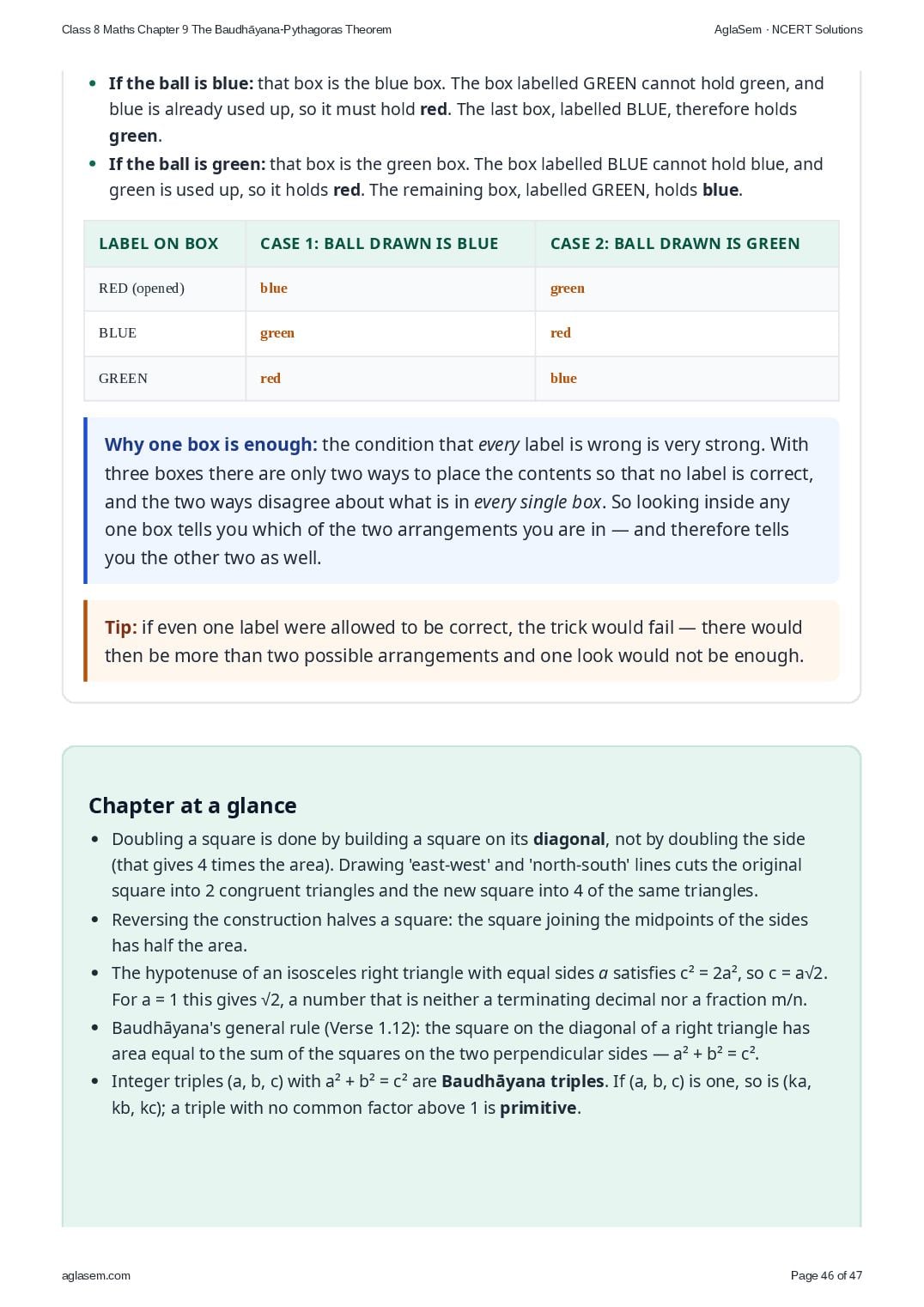
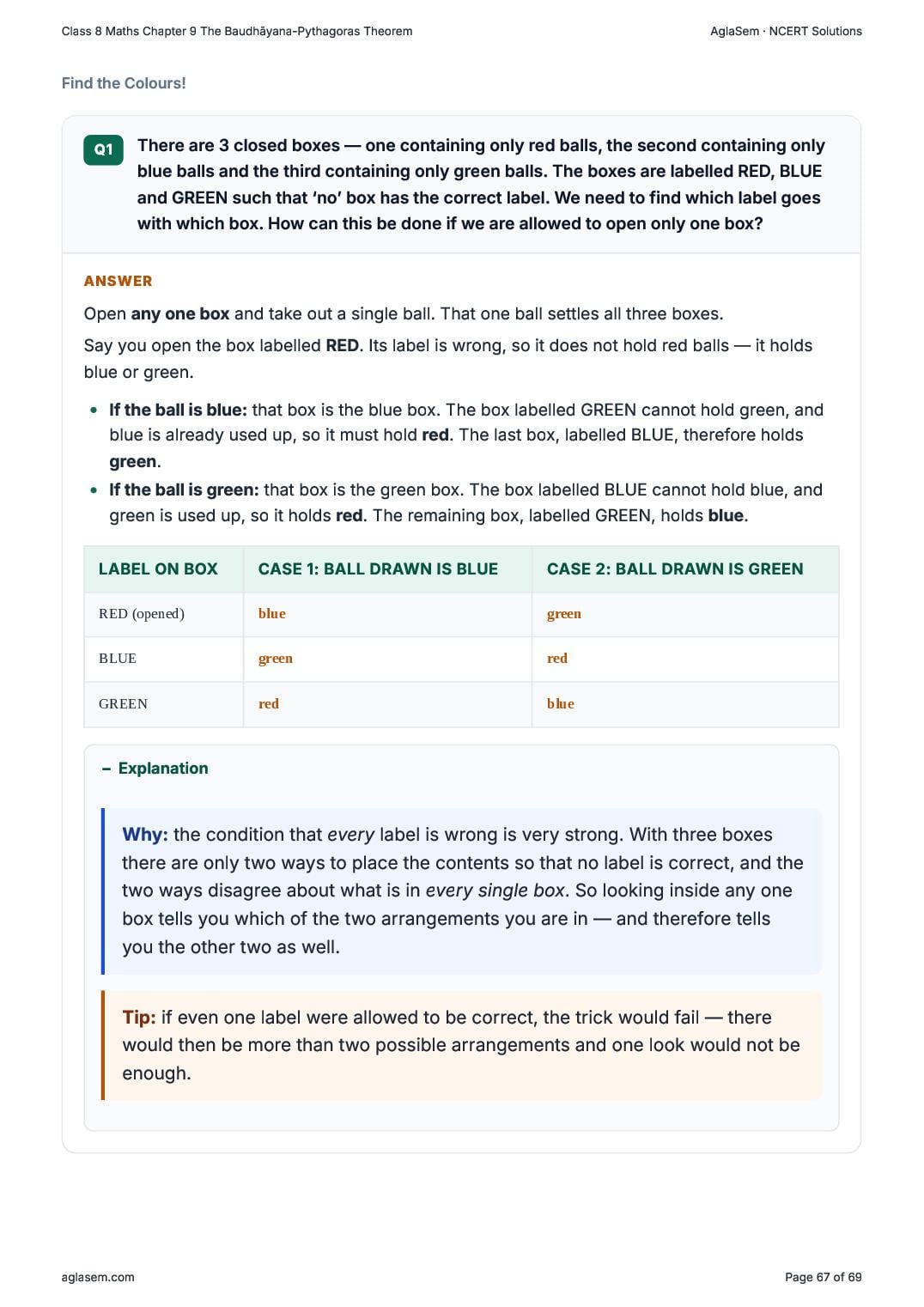
- There are 3 closed boxes — one containing only red balls, the second containing only blue balls and the third containing only green balls. The boxes are labelled RED, BLUE and GREEN such that ‘no’ box has the correct label. We need to find which label goes with which box. How can this be done if we are allowed to open only one box?
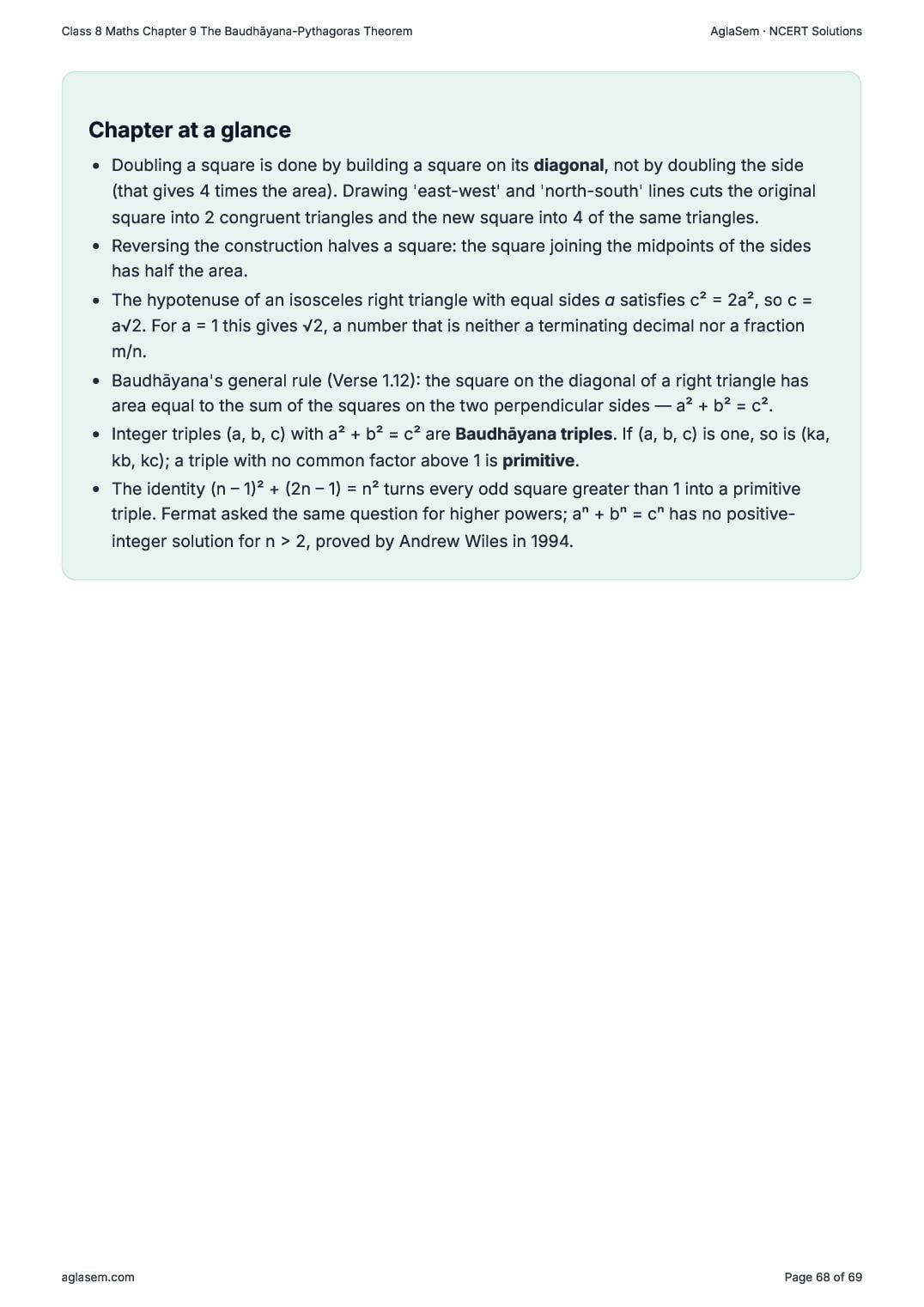
Chapter at a Glance
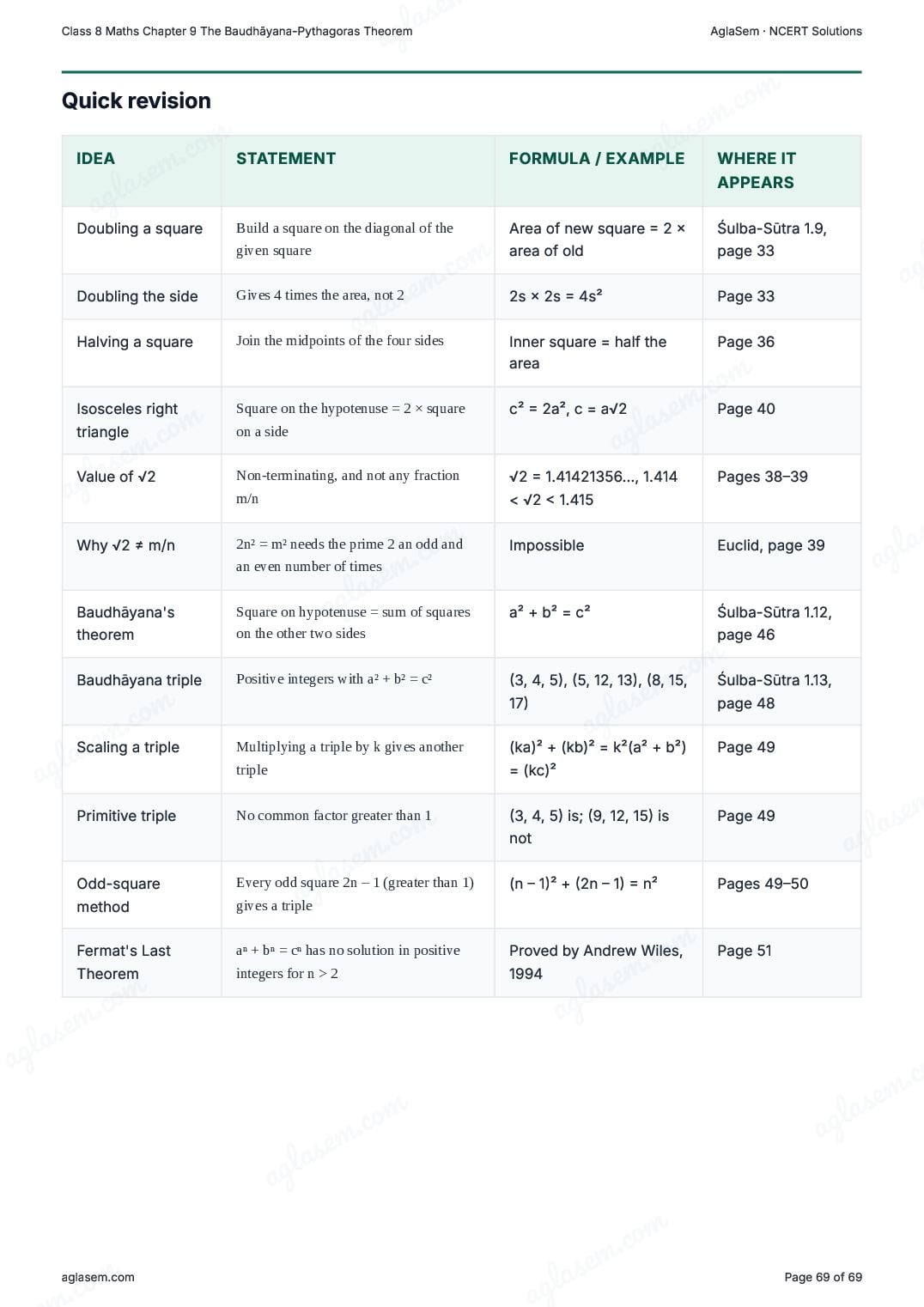
- Doubling a square is done by building a square on its diagonal , not by doubling the side (that gives 4 times the area). Drawing 'east-west' and 'north-south' lines cuts the original square into 2 congruent triangles and the new square into 4 of the same triangles.
- Reversing the construction halves a square: the square joining the midpoints of the sides has half the area.
- The hypotenuse of an isosceles right triangle with equal sides a satisfies c² = 2a², so c = a√2. For a = 1 this gives √2, a number that is neither a terminating decimal nor a fraction m/n.
- Baudhāyana's general rule (Verse 1.12): the square on the diagonal of a right triangle has area equal to the sum of the squares on the two perpendicular sides — a² + b² = c².
- Integer triples (a, b, c) with a² + b² = c² are Baudhāyana triples . If (a, b, c) is one, so is (ka, kb, kc); a triple with no common factor above 1 is primitive .
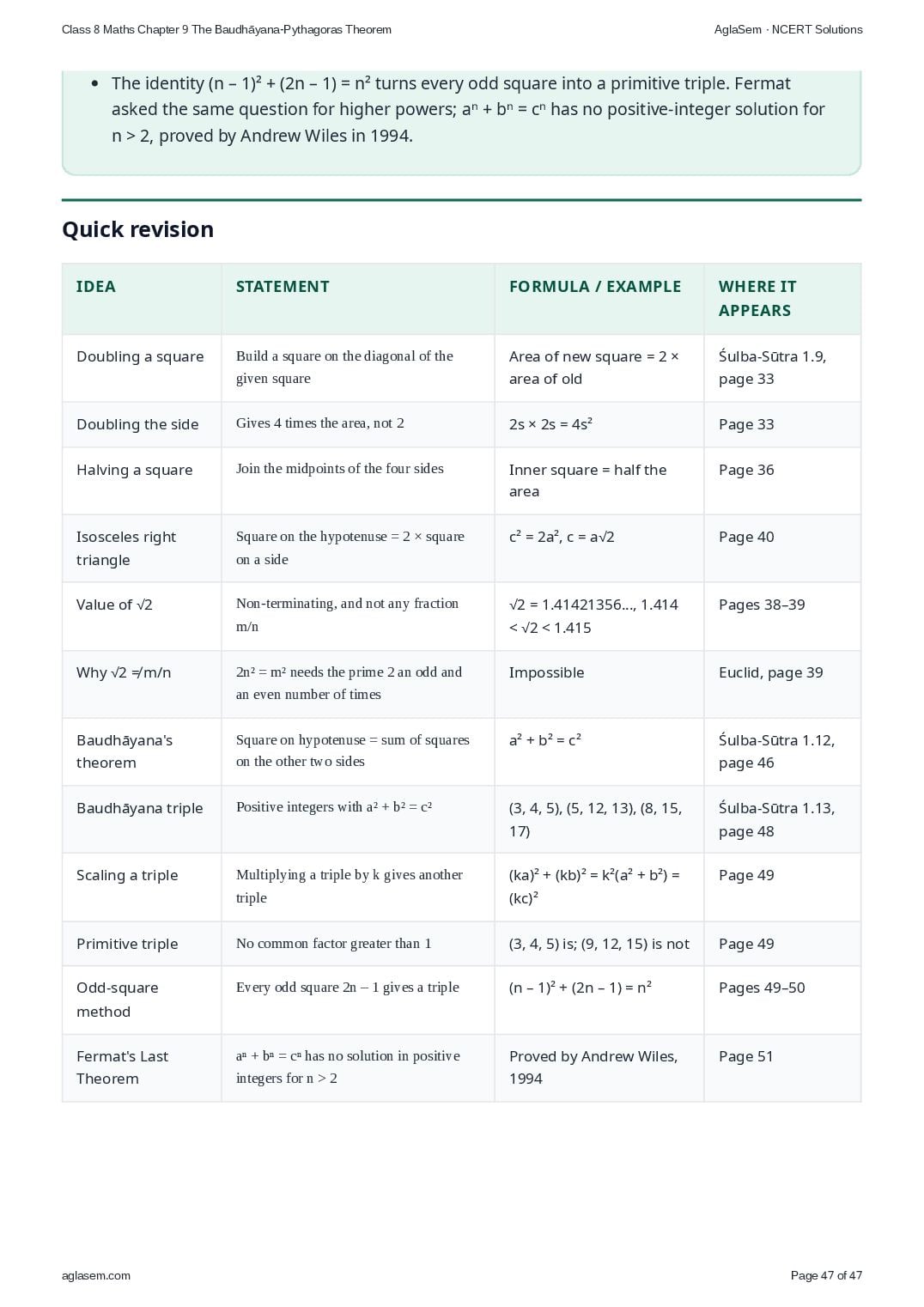
- The identity (n – 1)² + (2n – 1) = n² turns every odd square into a primitive triple. Fermat asked the same question for higher powers; aⁿ + bⁿ = cⁿ has no positive-integer solution for n > 2, proved by Andrew Wiles in 1994.
How to Download NCERT Solutions for Class 8 Maths Chapter 9 PDF
Follow these simple steps to get the The Baudh Yana Pythagoras Theorem questions-and-answers PDF from Ganita Prakash.
- Search NCERT Solutions for Class 8 Maths Chapter 9 aglasem and open this page.
- Read the exercise questions with answers for The Baudh Yana Pythagoras Theorem shown above.
- Click the Download PDF link to save the The Baudh Yana Pythagoras Theorem solutions to your device.
NCERT Solutions for Class 8 Maths – All Chapters
There are more chapters to study besides The Baudh Yana Pythagoras Theorem in Maths. Here are the NCERT Solutions for all chapters of Class 8 Maths.
- Chapter 1 A Square and a Cube
- Chapter 2 Power Play
- Chapter 3 A Story of Numbers
- Chapter 4 Quadrilaterals
- Chapter 5 Number Play
- Chapter 6 We Distribute Yet Things Multiply
- Chapter 7 Proportional Reasoning 1
- Chapter 8 Fractions in Disguise
- Chapter 9 The Baudh Yana Pythagoras Theorem
- Chapter 10 Proportional Reasoning 2
- Chapter 11 Exploring Some Geometric Themes
- Chapter 12 Tales By Dots and Lines
- Chapter 13 Algebra Play
- Chapter 14 Area
NCERT Solutions for Class 8 – All Subjects
Just like Chapter 9 of Maths, you can get the exercise questions with answers for every other subject of Class 8. Here are the NCERT Solutions for all subjects of Class 8.
NCERT Solutions for Class 8 Maths Chapter 9 – An Overview
The key highlights of this study material are as follows.
| Aspects | Details |
|---|---|
| Class | Class 8 |
| Subject | Maths |
| Chapter Number | Chapter 9 |
| Chapter Name | The Baudh Yana Pythagoras Theorem |
| Book Name | Ganita Prakash |
| Book By | NCERT (National Council of Educational Research and Training) |
| Educational Resource Here | NCERT Solutions of Class 8 Maths Chapter 9 for all exercises |
| More Questions Answers of This Subject | NCERT Solutions for Class 8 Maths |
| Download Book Chapter | NCERT Book Class 8 Maths |
| All Questions Answers For This Class | NCERT Solutions for Class 8 |
| Complete Solutions | NCERT Solutions |
NCERT Solutions for Class 8 Maths Chapter 9 The Baudh Yana Pythagoras Theorem – FAQs
What are the NCERT Solutions for Class 8 Maths Chapter 9 The Baudh Yana Pythagoras Theorem?
They are the complete, step-by-step answers to all the exercise and in-text questions of Chapter 9 The Baudh Yana Pythagoras Theorem from the NCERT Class 8 Maths textbook Ganita Prakash, written by experts as per the latest NCERT syllabus.
How can I download the Class 8 Maths Chapter 9 solutions PDF for free?
Open this page on aglasem, read the The Baudh Yana Pythagoras Theorem questions with answers, and click the “Download Solutions PDF” link. The Class 8 Maths Chapter 9 NCERT Solutions PDF is completely free to download.
Are these NCERT Solutions as per the latest 2026-27 syllabus?
Yes. The NCERT Solutions for Class 8 Maths Chapter 9 are based on the latest NCERT textbook Ganita Prakash and the current 2026-27 CBSE syllabus, so the questions and answers match what you study in class.
Where can I get NCERT Solutions for the other chapters of Class 8 Maths?
You can find the answers to every chapter on the NCERT Solutions for Class 8 Maths page, and solutions for every subject on the NCERT Solutions for Class 8 page.
How do NCERT Solutions help in exam preparation?
They show the correct method to solve each question, help you write answers the way they are expected in exams, let you check and correct your own work, and save revision time — which together improve your marks in Class 8 Maths.
If you have any queries on NCERT Solutions for Class 8 Maths Chapter 9 The Baudh Yana Pythagoras Theorem, then please ask in the comments below.